EP4096101A1 - Methods and apparatus for programmable decoding of a plurality of code types - Google Patents
Methods and apparatus for programmable decoding of a plurality of code types Download PDFInfo
- Publication number
- EP4096101A1 EP4096101A1 EP22185617.2A EP22185617A EP4096101A1 EP 4096101 A1 EP4096101 A1 EP 4096101A1 EP 22185617 A EP22185617 A EP 22185617A EP 4096101 A1 EP4096101 A1 EP 4096101A1
- Authority
- EP
- European Patent Office
- Prior art keywords
- data
- code
- parallel decoders
- interleaver
- programmable
- Prior art date
- Legal status (The legal status is an assumption and is not a legal conclusion. Google has not performed a legal analysis and makes no representation as to the accuracy of the status listed.)
- Withdrawn
Links
Images



Classifications
-
- H—ELECTRICITY
- H03—ELECTRONIC CIRCUITRY
- H03M—CODING; DECODING; CODE CONVERSION IN GENERAL
- H03M13/00—Coding, decoding or code conversion, for error detection or error correction; Coding theory basic assumptions; Coding bounds; Error probability evaluation methods; Channel models; Simulation or testing of codes
- H03M13/29—Coding, decoding or code conversion, for error detection or error correction; Coding theory basic assumptions; Coding bounds; Error probability evaluation methods; Channel models; Simulation or testing of codes combining two or more codes or code structures, e.g. product codes, generalised product codes, concatenated codes, inner and outer codes
- H03M13/2957—Turbo codes and decoding
- H03M13/296—Particular turbo code structure
-
- H—ELECTRICITY
- H03—ELECTRONIC CIRCUITRY
- H03M—CODING; DECODING; CODE CONVERSION IN GENERAL
- H03M13/00—Coding, decoding or code conversion, for error detection or error correction; Coding theory basic assumptions; Coding bounds; Error probability evaluation methods; Channel models; Simulation or testing of codes
- H03M13/27—Coding, decoding or code conversion, for error detection or error correction; Coding theory basic assumptions; Coding bounds; Error probability evaluation methods; Channel models; Simulation or testing of codes using interleaving techniques
- H03M13/2703—Coding, decoding or code conversion, for error detection or error correction; Coding theory basic assumptions; Coding bounds; Error probability evaluation methods; Channel models; Simulation or testing of codes using interleaving techniques the interleaver involving at least two directions
- H03M13/2725—Turbo interleaver for 3rd generation partnership project 2 [3GPP2] mobile telecommunication systems, e.g. as defined in the 3GPP2 technical specifications C.S0002
-
- H—ELECTRICITY
- H03—ELECTRONIC CIRCUITRY
- H03M—CODING; DECODING; CODE CONVERSION IN GENERAL
- H03M13/00—Coding, decoding or code conversion, for error detection or error correction; Coding theory basic assumptions; Coding bounds; Error probability evaluation methods; Channel models; Simulation or testing of codes
- H03M13/65—Purpose and implementation aspects
- H03M13/6508—Flexibility, adaptability, parametrability and configurability of the implementation
-
- H—ELECTRICITY
- H03—ELECTRONIC CIRCUITRY
- H03M—CODING; DECODING; CODE CONVERSION IN GENERAL
- H03M13/00—Coding, decoding or code conversion, for error detection or error correction; Coding theory basic assumptions; Coding bounds; Error probability evaluation methods; Channel models; Simulation or testing of codes
- H03M13/65—Purpose and implementation aspects
- H03M13/6508—Flexibility, adaptability, parametrability and configurability of the implementation
- H03M13/6513—Support of multiple code types, e.g. unified decoder for LDPC and turbo codes
-
- H—ELECTRICITY
- H03—ELECTRONIC CIRCUITRY
- H03M—CODING; DECODING; CODE CONVERSION IN GENERAL
- H03M13/00—Coding, decoding or code conversion, for error detection or error correction; Coding theory basic assumptions; Coding bounds; Error probability evaluation methods; Channel models; Simulation or testing of codes
- H03M13/65—Purpose and implementation aspects
- H03M13/6508—Flexibility, adaptability, parametrability and configurability of the implementation
- H03M13/6519—Support of multiple transmission or communication standards
-
- H—ELECTRICITY
- H03—ELECTRONIC CIRCUITRY
- H03M—CODING; DECODING; CODE CONVERSION IN GENERAL
- H03M13/00—Coding, decoding or code conversion, for error detection or error correction; Coding theory basic assumptions; Coding bounds; Error probability evaluation methods; Channel models; Simulation or testing of codes
- H03M13/65—Purpose and implementation aspects
- H03M13/6522—Intended application, e.g. transmission or communication standard
- H03M13/6525—3GPP LTE including E-UTRA
-
- H—ELECTRICITY
- H03—ELECTRONIC CIRCUITRY
- H03M—CODING; DECODING; CODE CONVERSION IN GENERAL
- H03M13/00—Coding, decoding or code conversion, for error detection or error correction; Coding theory basic assumptions; Coding bounds; Error probability evaluation methods; Channel models; Simulation or testing of codes
- H03M13/65—Purpose and implementation aspects
- H03M13/6522—Intended application, e.g. transmission or communication standard
- H03M13/6544—IEEE 802.16 (WIMAX and broadband wireless access)
-
- H—ELECTRICITY
- H03—ELECTRONIC CIRCUITRY
- H03M—CODING; DECODING; CODE CONVERSION IN GENERAL
- H03M13/00—Coding, decoding or code conversion, for error detection or error correction; Coding theory basic assumptions; Coding bounds; Error probability evaluation methods; Channel models; Simulation or testing of codes
- H03M13/65—Purpose and implementation aspects
- H03M13/6569—Implementation on processors, e.g. DSPs, or software implementations
Definitions
- the present invention relates generally to error correction coding techniques for digital communications, and more particularly, to techniques for parallel decoding and interleaving of a plurality of codes, such as convolutional and turbo codes.
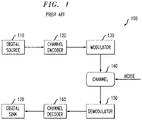
- FIG. 1 is a block diagram of a typical digital communication 100.
- a digital source 110 produces a sequence of binary messages.
- an exemplary channel encoder 120 uses a forward error-correction coding scheme, to increase the redundancy of the source messages and to transform the source messages into encoded messages (often referred to as codewords).
- codewords encoded messages
- the error correction coding provides increased resilience to channel noise.
- a modulator 130 transforms the encoded messages into signals that are appropriate for transmission over a channel 140. These signals enter the channel 140 and are typically corrupted by noise and interference on the channel.
- a demodulator 150 receives the noisy signals from the channel 140 and converts the received signals into blocks of symbols.
- a channel decoder 160 exploits the redundancy introduced by the channel encoder 120 to attempt to correct any errors added by the channel 140 and to restore the original messages.
- a number of different decoding techniques have been proposed or suggested to decode signals encoded using error correction codes.
- Error correction encoding techniques for wireless communication systems often employ convolutional or turbo coding of the data before the signal is modulated so that errors introduced by noise and interference on the channel may be corrected.
- a convolutional code is an error correction code where each m-bit string is transformed into an n-bit symbol, where m/n is the code rate (n is greater than or equal to m) and the transformation is a function of the previous k information symbols, where k is the constraint length of the code.
- Turbo codes are another class of error correction codes that are said to approach the theoretical limits imposed by Shannon's theorem with reduced decoding complexity relative to the convolutional codes that would be required for similar performance.
- WiMAX Worldwide Interoperability for Microwave Access
- LTE Long Term Evolution
- UMB Ultra Mobile Broadband
- WCDMA Wideband Code Division Multiple Access
- US 5 734 962 A discloses a satellite communications network, which utilizes parallel concatenated coding on its inbound and/or outbound links.
- the parallel concatenated coding techniques are used in conjunction with a spread-spectrum modulation to provide a communications system which meets FCC regulations
- the provided communications system disclosed network associates a given spreading sequence with a particular error correcting code to allow different signals to utilize different error correcting codes simultaneously. Since each detected signal's spreading sequence is identified by a corresponding demodulator, the receiver can appropriately configure the programmable decoder for each detected signal.
- US 2002/029364 A1 discloses a method for processing of turbo codes, wherein an interleaver for interleaving code symbols is provided.
- the interleaver has a plurality of subsections, each subsection having a set of addresses and each address having an index. A substantially constant relationship exists from anyone subsection to any other subsection between the index of each address at a particular location.
- a turbo code may be efficiently decoded using various generated interleavers with spreading properties.
- An interleaver may contain addresses in locations 0,1,2 ... N, that are used to permute data for encoding and decoding in a turbo code based forward error correction system. Thereby, the numbers 0,1,2 ... N are merely the locations of the interleaver addresses, and not the interleaver addresses themselves.
- a method for decoding data encoded using one of a plurality of code types, where each of the code types correspond to a communication standard.
- the decoding method comprises the steps of identifying the code type associated with the data; allocating the data to a plurality of programmable parallel decoders, wherein the programmable parallel decoders can be reconfigured to decode data encoded using each of the plurality of code types; and providing the data and the associated code type to the allocated programmable parallel decoders.
- Program code (for example, from a local memory) can be loaded into one or more of the programmable parallel decoders based on the identified code type.
- a method for generating one or more interleaver tables for use by M parallel decoders that decode data of at least one code type.
- the interleaver table generation method comprises the steps of generating a first interleaver table based on a communication standard for the at least one code type; and dividing the first interleaver table by M to create a second interleaver table having M clusters, wherein each entry in the second interleaver table indicates one of the M parallel decoders as a target decoder and a target address for interleaved data.
- the data can then be interleaved among the M parallel decoders using a communications network.
- a method for interleaving data among M parallel decoders comprises the steps of reading data to be decoded; accessing an interleaver table, wherein each entry in the interleaver table identifies one of the M parallel decoders as a target decoder and a target address of a communications network for interleaved data; and writing the data to the target address of the communications network.
- the communications network can comprise, for example, a cross-bar switch and/or one or more first-in-first-out buffer.
- aspects of the present invention provide programmable decoders that support a plurality of communication standards.
- the conventional channel decoder 160 of FIG. 1 is modified to provide a decoder function for a plurality of encoding techniques.
- the conventional channel decoder 160 of FIG. 1 is modified to provide a decoder function for the WiMAX, LTE and UMB error correction protocols.
- the conventional channel decoder 160 of FIG. 1 is modified to provide a decoder function for the WiMAX, LTE and UMB error correction protocols.
- ⁇ 1 performs a number of symbol processing functions, such as puncturing and de-puncturing, cyclic redundancy check (CRC) generation and checking, interleaving and de-interleaving, and multiplexing and de-multiplexing, that are required by the supported communication standards.
- symbol processing functions such as puncturing and de-puncturing, cyclic redundancy check (CRC) generation and checking, interleaving and de-interleaving, and multiplexing and de-multiplexing, that are required by the supported communication standards.
- CRC cyclic redundancy check
- a plurality of programmable "thread processors" are employed to support a number of convolutional and turbo-like codes.
- a communication network is used for interleaving instead of one or more dedicated interleaver/de-interleaver modules to reduce the processing time.
- a decoder such as the decoder 160 of FIG. 1 , can process codewords on a frame-by-frame basis. Each frame is comprised of several codewords that require the same code operation type. Codewords are added to a frame in the order that they are received and the results are returned in the same order.
- the codes are typically decoded with one of several known sequential decoding algorithms, such as the well-known Fano algorithm. See, for example, R.M. Fano "A heuristic Discussion of Probabilistic Decoding” (1963). Unlike Viterbi decoding, sequential decoding techniques do not employ maximum likelihood techniques, but the complexity increases only slightly with constraint length, allowing the use of strong, long-constraint-length codes.
- Viterbi and sequential decoding algorithms generate hard-decisions, indicating the bits that form the most likely codeword.
- An approximate confidence measure can optionally be added to each bit by use of the well-known Soft Output Viterbi Algorithm (SOVA).
- SOVA Soft Output Viterbi Algorithm
- Maximum a posteriori (MAP) soft-decisions for each bit can be obtained by use of the BCJR algorithm (Bahl-Cocke-Jelinek-Raviv Algorithm). See, for example, L. Bahl et al., "Optimal Decoding of Linear Codes for Minimizing Symbol Error Rate," (March, 1974 ).
- FIG. 2 is a schematic block diagram of an exemplary trellis 200 employed by a conventional MAP decoder for decoding convolutional codes.
- the exemplary trellis 200 can be used, for example, by a MAP decoder that computes a forward state metric 210 and a backward state metric 220, in a known manner, to calculate an output L-value.
- FIG. 2 illustrates the computation of such path metrics for a number of encoder states, s 0 through s 3 , for a number of input bits, such as bits u 0 through u 3 .
- r P u l ⁇ 1
- FIG. 3 is a block diagram of an exemplary conventional iterative conventional algorithm 300 for decoding turbo codes.
- turbo codes are used in a number of data communication standards, such as 3G, 4G and IEEE 802.16.
- the received code block is divided into 3 parts: (y 0 , y 1 , y 2 ).
- Vectors (y 0 , y 1 ) are sent to a first MAP-decoder 310.
- the MAP-decoder 310 produces a vector L i out where L i out is the output L-value of i-th decoder (a posteriori L-value).
- the vector L i out is added by an adder 320 to a vector L i in generated by a de-interleaver 340 (discussed below) to generate a vector L i ex .
- L i ex is the extrinsic L-value of i-th decoder (extrinsic a posteriori L-value).
- L i in is the input L-value of i-th decoder.
- the vector L i ex is applied to an interleaver 330.
- the interleaver 330 performs some mixing of the vector components.
- the output of the interleaver 330 is a vector L 2 in .
- the vector L 2 in and vectors (y 0 , y 2 ) are applied to a second MAP-decoder 380.
- the MAP-decoder 380 produces a vector L 2 out .
- the vector L 2 out is added by an adder 350 to the vector L 2 in generated by interleaver 330 to generate a vector L 2 ex .
- the vector L 2 ex is applied to the de-interleaver 340.
- the de- interleaver 340 performs a transformation that is an inverse to the operation performed by interleaver 330.
- the output of the de-interleaver 340 is the vector L 1 in discussed above.
- the vector L 1 in and vectors (y 0 , y 1 ) are applied to the first MAP-decoder 310 and continues in an iterative manner.
- the vector L 2 out generated by the MAP-decoder 380 is also applied to a second de-interleaver 370, which generates the bit decisions. This iterative process stops after a fixed number of iterations or if some specific stopping criteria is satisfied.
- decoding algorithms 300 typically support code blocks of different sizes.
- the source message size can vary from 40 to 5114 bits.
- the decoding algorithms 300 should efficiently handle a data flow that consists of code blocks of different sizes.
- the total time needed to decode a code block is proportional to the code block size.
- the total size of the random-access memory inside the decoder 160 is proportional to the size of maximum code block that the decoder 160 can suppol1.
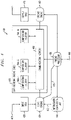
- FIG. 4 is a schematic block diagram of a decoder 400 incorporating features of the present invention.
- the decoder 400 comprises a soft decoding engine (SDE) 410, an input first-in-first-out (FIFO) buffer 420, a load engine 430, an interleaver computation unit 440, a thread processor 450-, an upload engine 460 and an output FIFO buffer 470.
- the soft decoding engine 410 comprises a communication network 480, used for interleaving in a manner discussed below, and a plurality of computation clusters 500-1 through 500-N (collectively referred to herein as computation clusters 500), discussed further below in conjunction with FIG. 5 .
- the soft decoding engine 410 decodes a plurality of codes in accordance with an aspect of the present invention, such as turbo codes, convolution codes, and LDPC codes.
- the soft decoding engine 410 may be configured to simultaneously decode several code words at the same time.
- the input FIFO buffer 420 stores the data that is coming into the decoder 400 from an input port 405.
- the load engine 430 receives the input data for several codewords from the FIFO 420.
- the load engine 430 reads the interleaved addresses for the data from the interleaver computation unit 440 by means of connection 432, receives control signals from the thread processor 450 by means of connection 435 and sends the data to the communication network 480.
- the thread processor 450 may be implemented, for example, using a Coware processor (see, http://www.coware.com/).
- the interleaver computation unit 440 generates one or more interleaver tables 600, discussed further below in conjunction with FIGS. 6A through 6D , containing destination addresses that are used by the computation clusters 500 to write the data for the next half iteration.
- the thread processor 450 generates a command stream for the decoding algorithms in the computation clusters 500 based on the program memory content.
- the thread processor 450 receives control information from input port 445 with the data that is received on port 405.
- the control information comprises headers and configuration data that defines the communication standard that was used to encode the data.
- the control information may specify the type of code (code type identifier), the number of codewords in a frame and the codeword length.
- the thread processor 450 provides the appropriate information to the computation clusters 500 via the communication network 480. If the thread processor 450 determines that a new code type needs to be decoded the thread processor 450 will send the parameters to the computation clusters 500 with a code type identifier. As discussed further below in conjunction with FIG. 5 , the computation clusters 500 will load the appropriate program code, if needed, to decode the codeword based on the code type identifier.
- the input FIFO buffer 420 stores the data that is coming into the decoder 400 from an input port 405.
- the upload engine 460 receives the decoded data from the communication network 480 and applies it to the output FIFO buffer 470.
- the communication network 480 provides arbitrary configurable connections between components, such as the thread processor 450 and the computation clusters 500.
- the communication network 480 can be implemented as a cross-bar switch or FlFOs. The operation of the communication network 480 is discussed further below in the section entitled "Parallel Interleaving.”
- FIG. 5 is a schematic block diagram of an exemplary computation cluster 500 that incorporates features of the present invention. As previously indicated, a plurality of computation clusters 500 decodes the data in parallel. As shown in FIG. 5 , the exemplary computation cluster 500 comprises a thread processor 510, a data memory 520, an arithmetic unit 530 and a memory controller 540.
- the thread processor 450 of FIG. 4 provides the appropriate control information to the computation clusters 500 via the communication network 480. If the thread processor 450 determines that a new code type needs to be decoded, the thread processor 450 will send the parameters to the computation clusters 500 with a code type identifier. Based on the code type identifier, the thread processor 510 in the computation cluster 500 will load the appropriate program code, if needed, from the data memory 520 (via the memory controller 540) to decode the codeword based on the code type identifier.
- the decoding operations performed by the thread processor 510 are discussed further below in a section entitled "Parallel Decoding.” Generally, reads are local and writes are performed according to interleaver tables 600.
- the data memory 520 stores a plurality of programs for decoding codewords associated with a plurality of different communication standards.
- the thread processor 510 interprets a program and according to the program provides instructions for the arithmetic unit 530. Generally, based on the identified communication standard, such as LTE, the thread processor 510 in each cluster 500 is loaded with the appropriate program code from the data memory 520, as well as the interleaver tables 600 and other parameters for the identified standard (based on, for example, the indicated codeword size). ll1ereafter, the computation cluster 500 can decode all codewords received that have been encoded with the same standard.
- the identified communication standard such as LTE
- the decoding process is typically an iterative process.
- the computation clusters 500 read their own local port of data (e.g., the received vector, for example, from the data memory 520) and L 1 in (see FIG. 3 ) and obtain the target address of the data cluster from the interleaver table(s) 700 (Table 3), as discussed further below in the following section.
- the computation clusters 500 interleave the data in accordance with the present invention by writing the data to the communication network 480 using the indicated target address.
- the data is decoded by the computation clusters 500 and sent to the communication network 480, but is not stored locally by the computation clusters 500.
- the data is sent to the target address and is not needed until the next half iteration.
- the computation clusters 500 again read their own local port of data (e.g., the received vector, for example, from the data memory 520) and L 2 in (see FIG. 3 ) and obtain the target address of the data cluster from the interleaver table(s) 600 (Table 4), as discussed further below in the following section. Thereafter, the computation clusters 500 de-interleave the data in accordance with the present invention by writing the data to the communication network 480 using the indicated target address.
- the computation clusters 500 de-interleave the data in accordance with the present invention by writing the data to the communication network 480 using the indicated target address.
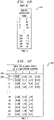
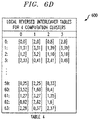
- FIGS. 6A through 60 illustrate four sample interleaving tables 600.
- the tables in FIGS. 6A and 68 are generated based on the corresponding standard document.
- the exemplary tables were generated using the algorithm specified in Section 5.1.3.2.3 of http://www.3gpp.org/ftp/Specs/archive/36_series/36.212/36212-810.zip.
- the parameters f 1 and f 2 depend on the block size K and are summarized in Table 5.1.3-3 of the LTE standards document.
- the exemplary interleaver table of FIG. 6A (Table 1) has two columns.
- the first column is an input data index.
- the second column is an output (interleaved) data index.
- the first two rows of the table in FIG. 6A are:
- This notation indicates that after the interleaving (i.e., writing to the communications network 480 in accordance with the present invention), the 0-th data word remains at index 0 while the first (1-st) data word goes to index 171.
- the exemplary de-interleaver table of FIG. 6B (Table 2), often referred to as a "reversed interleaver table,” is a reversed copy of the interleaver table of FIG. 6A .
- the first line (row two) of the interleaver table ( FIG. 6A ) is "1 171". Therefore, the 171-st line of the second table is "171 1". This notation indicates that after the de-interleaving (i.e., writing to the communications network 480 in accordance with the present invention), the 171-st data word is written to index 1.
- embodiments of the present invention employ a plurality of parallel programmable thread processors 510 to support a number of convolutional and turbo-like codes.
- a communication network 480 is used for interleaving the decoding processes performed by the parallel thread processors 510.
- interleaver and de-interleaver tables in FIGS. 6C and 6D are generated by dividing the original tables of FIGS. 6A and 6B by M (equal to 4) to create four clusters. In this manner, the interleaver and de-interleaver tables of FIGS. 6C and 6D allow the interleaving process to be divided for a parallel decoding implementation.
- the format is ⁇ target cluster index> ⁇ target memory address> ⁇ .
- the first entry 620 corresponds to the first entry of FIG. 6A and again indicates that the 0-th data word remains at index 0 for Cluster 0.
- the second entry 625 indicates that the first word (correspond to row 1) goes to index 43 of Cluster 2 (corresponding to the second entry of" 1 171" from FIG. 6A for a mod 64 operation).
- the exemplary de-interleaver table of FIG. 6D (Table 4), often referred to as a "reversed interleaver table for 4 computation clusters," is a reversed copy of the interleaver table of FIG. 6C .
- the de-interleaver table of FIG. 6D retUl11S data to the original position, in a known manner.
- a decoder 400 ( FIG. 4 ) must typically be initialized before the decoders enters a functional mode.
- the decoder 400 is programmed for its regular operations, in a known manner.
- the thread processors 510 ( FIG. 5 ) are loaded with the appropriate programs for the communications standard, as well as the data that will be decoded during the functional mode.
- the decoder initialization part reads the data and loads the selected thread processors 510.
- the decoder sets its status register to a predefined value and is then ready to start processing received frames.
- an outside block typically sends a data frame to the decoder and monitors the status register for the finish of the processing. When the results are ready, they are taken outside and a new frame can be sent to the decoder.
- a frame is comprised of several codewords with the same decoding operation type. To indicate that a new frame is ready, one or more flags may be set for one clock cycle. Thereafter, the decoder 400 expects to receive a set of headers followed by the data for every codeword in the frame.
- the first header that sent to the decoder 400 is a frame title header (e.g., indicating operation type (format) and the number of codewords in the frame). Thereafter, the decoder receives a group of headers, with one header for each codeword in the frame.
- a frame title header e.g., indicating operation type (format) and the number of codewords in the frame.
- An exemplary frame codeword header indicates: Field Meaning Codeword length A number of information bits in a codeword Address A decoder memory address where the codeword will be placed Processor ID ID of a first thread processor that will process the codeword Number of addresses A number of addresses that the codeword will occupy Number of processors A number of thread processors that will process the codeword Thread processor data The thread processor parameters used for the codeword processing
- headers can be sent containing the thread processor parameters for all the thread processors 510 in the decoding engine.
- a title header can be sent for as many cycles as necessary to specify the number of codewords each thread processor 510 is going to process:
- An exemplary thread processor title header indicates: Field Meaning Number of CWs Processor ID ID of a thread processor Number of codewords A number of codewords the thread processor will process Then, it is sent one header for each thread processor codeword Field Meaning Processor ID ID of a thread processor Codeword ID ID of a thread processor's codeword Address Starting memory address of the codeword Number of addresses A number of addresses that the codeword will occupy Thread processor data
- the decoder 400 receives the codeword data in accordance with the information in the headers. It is assumed in the exemplary embodiment that the soft values take 8 bits of the data so it is possible to receive at most 16 soft values in one clock cycle. After the complete frame is decoded, the decoder sets the value of status register to a predefined value, such as 'DONE', and the data can be taken from the output FIFO 470.
- the functions of the present invention can be embodied in the form of methods and apparatuses for practicing those methods.
- One or more aspects of the present invention can be embodied in the form of program code, for example, whether stored in a storage medium, loaded into and/or executed by a machine, or transmitted over some transmission medium, wherein, when the program code is loaded into and executed by a machine, such as a computer, the machine becomes an apparatus for practicing the invention.
- the program code segments combine with the processor to provide a device that operates analogously to specific logic circuits.
- the invention can also be implemented in one or more of an integrated circuit, a digital signal processor, a microprocessor, and a micro-controller.
- a plurality of identical die are typically formed in a repeated pattern on a surface of the wafer.
- Each die includes a device described herein, and may include other structures or circuits.
- the individual die are cut or diced from the wafer, then packaged as an integrated circuit.
- One skilled in the art would know how to dice wafers and package die to produce integrated circuits. Integrated circuits so manufactured are considered part of this invention.
Landscapes
- Engineering & Computer Science (AREA)
- Physics & Mathematics (AREA)
- Probability & Statistics with Applications (AREA)
- Theoretical Computer Science (AREA)
- Computer Networks & Wireless Communication (AREA)
- Error Detection And Correction (AREA)
- Detection And Prevention Of Errors In Transmission (AREA)
Applications Claiming Priority (4)
| Application Number | Priority Date | Filing Date | Title |
|---|---|---|---|
| US200813892008A | 2008-06-13 | 2008-06-13 | |
| US12/138,920 US8035537B2 (en) | 2008-06-13 | 2008-06-13 | Methods and apparatus for programmable decoding of a plurality of code types |
| EP08874658.1A EP2313979B1 (en) | 2008-06-13 | 2008-12-23 | Methods for programmable decoding of a plurality of code types |
| PCT/US2008/088221 WO2009151481A2 (en) | 2008-06-13 | 2008-12-23 | Methods and apparatus for progarammable decoding of a plurality of code types |
Related Parent Applications (1)
| Application Number | Title | Priority Date | Filing Date |
|---|---|---|---|
| EP08874658.1A Division EP2313979B1 (en) | 2008-06-13 | 2008-12-23 | Methods for programmable decoding of a plurality of code types |
Publications (1)
| Publication Number | Publication Date |
|---|---|
| EP4096101A1 true EP4096101A1 (en) | 2022-11-30 |
Family
ID=40456316
Family Applications (2)
| Application Number | Title | Priority Date | Filing Date |
|---|---|---|---|
| EP08874658.1A Active EP2313979B1 (en) | 2008-06-13 | 2008-12-23 | Methods for programmable decoding of a plurality of code types |
| EP22185617.2A Withdrawn EP4096101A1 (en) | 2008-06-13 | 2008-12-23 | Methods and apparatus for programmable decoding of a plurality of code types |
Family Applications Before (1)
| Application Number | Title | Priority Date | Filing Date |
|---|---|---|---|
| EP08874658.1A Active EP2313979B1 (en) | 2008-06-13 | 2008-12-23 | Methods for programmable decoding of a plurality of code types |
Country Status (7)
| Country | Link |
|---|---|
| US (1) | US8035537B2 (enExample) |
| EP (2) | EP2313979B1 (enExample) |
| JP (2) | JP2011523325A (enExample) |
| KR (1) | KR101611631B1 (enExample) |
| CN (1) | CN101971504A (enExample) |
| TW (1) | TWI487293B (enExample) |
| WO (1) | WO2009151481A2 (enExample) |
Families Citing this family (8)
| Publication number | Priority date | Publication date | Assignee | Title |
|---|---|---|---|---|
| US8811452B2 (en) * | 2009-12-08 | 2014-08-19 | Samsung Electronics Co., Ltd. | Method and apparatus for parallel processing turbo decoder |
| US20110202819A1 (en) * | 2010-02-12 | 2011-08-18 | Yuan Lin | Configurable Error Correction Encoding and Decoding |
| JP5692780B2 (ja) | 2010-10-05 | 2015-04-01 | 日本電気株式会社 | マルチコア型誤り訂正処理システムおよび誤り訂正処理装置 |
| RU2011118108A (ru) * | 2011-05-06 | 2012-11-20 | ЭлЭсАй Корпорейшн (US) | Устройство (варианты) и способ параллельного декодирования для нескольких стандартов связи |
| US8879671B2 (en) * | 2012-08-30 | 2014-11-04 | Intel Mobile Communications GmbH | Worker and iteration control for parallel turbo decoder |
| US9256491B1 (en) * | 2013-09-23 | 2016-02-09 | Qlogic, Corporation | Method and system for data integrity |
| US11290130B2 (en) * | 2018-11-07 | 2022-03-29 | Telefonaktiebolaget Lm Ericsson (Publ) | Optimized implementation of (de-)interleaving and rate (de-)matching for 3GPP new radio |
| US12007881B2 (en) * | 2021-12-20 | 2024-06-11 | Google Llc | Method for populating spanner databases in test environments |
Citations (3)
| Publication number | Priority date | Publication date | Assignee | Title |
|---|---|---|---|---|
| US5734962A (en) | 1996-07-17 | 1998-03-31 | General Electric Company | Satellite communications system utilizing parallel concatenated coding |
| US20020029364A1 (en) | 2000-01-03 | 2002-03-07 | Edmonston Brian S. | System and method for high speed processing of turbo codes |
| US20020119803A1 (en) * | 2000-12-29 | 2002-08-29 | Bitterlich Stefan Johannes | Channel codec processor configurable for multiple wireless communications standards |
Family Cites Families (9)
| Publication number | Priority date | Publication date | Assignee | Title |
|---|---|---|---|---|
| JPH0884162A (ja) * | 1994-09-14 | 1996-03-26 | Hitachi Ltd | ディジタルケーブルサービスの送受信方法および送信装置並びに受信装置 |
| US6205187B1 (en) * | 1997-12-12 | 2001-03-20 | General Dynamics Government Systems Corporation | Programmable signal decoder |
| JP2000316033A (ja) * | 1999-04-30 | 2000-11-14 | Toshiba Corp | 送信装置、受信装置、データ伝送システム、及びデータ伝送方法 |
| US6674971B1 (en) * | 1999-09-03 | 2004-01-06 | Teraconnect, Inc. | Optical communication network with receiver reserved channel |
| US7346135B1 (en) * | 2002-02-13 | 2008-03-18 | Marvell International, Ltd. | Compensation for residual frequency offset, phase noise and sampling phase offset in wireless networks |
| CN1656445B (zh) * | 2002-05-24 | 2010-05-05 | Nxp股份有限公司 | 处理系统 |
| JP4815228B2 (ja) * | 2006-02-09 | 2011-11-16 | 富士通株式会社 | ビタビ復号回路および無線機 |
| US8218518B2 (en) * | 2006-06-09 | 2012-07-10 | Samsung Electronics Co., Ltd. | Interleaver interface for a software-defined radio system |
| JP4837645B2 (ja) * | 2006-10-12 | 2011-12-14 | ルネサスエレクトロニクス株式会社 | 誤り訂正符号復号回路 |
-
2008
- 2008-06-13 US US12/138,920 patent/US8035537B2/en not_active Expired - Fee Related
- 2008-12-23 JP JP2011513475A patent/JP2011523325A/ja active Pending
- 2008-12-23 EP EP08874658.1A patent/EP2313979B1/en active Active
- 2008-12-23 EP EP22185617.2A patent/EP4096101A1/en not_active Withdrawn
- 2008-12-23 WO PCT/US2008/088221 patent/WO2009151481A2/en not_active Ceased
- 2008-12-23 CN CN2008801276098A patent/CN101971504A/zh active Pending
- 2008-12-23 KR KR1020107027877A patent/KR101611631B1/ko not_active Expired - Fee Related
-
2009
- 2009-01-13 TW TW098101082A patent/TWI487293B/zh not_active IP Right Cessation
-
2014
- 2014-07-08 JP JP2014140362A patent/JP5840741B2/ja not_active Expired - Fee Related
Patent Citations (3)
| Publication number | Priority date | Publication date | Assignee | Title |
|---|---|---|---|---|
| US5734962A (en) | 1996-07-17 | 1998-03-31 | General Electric Company | Satellite communications system utilizing parallel concatenated coding |
| US20020029364A1 (en) | 2000-01-03 | 2002-03-07 | Edmonston Brian S. | System and method for high speed processing of turbo codes |
| US20020119803A1 (en) * | 2000-12-29 | 2002-08-29 | Bitterlich Stefan Johannes | Channel codec processor configurable for multiple wireless communications standards |
Non-Patent Citations (3)
| Title |
|---|
| JOHN DIELISSEN ET AL: "Multistandard FEC Decoders for Wireless Devices", IEEE TRANSACTIONS ON CIRCUITS AND SYSTEMS II: EXPRESS BRIEFS, IEEE, USA, vol. 55, no. 3, 1 March 2008 (2008-03-01), pages 284 - 288, XP002521050, ISSN: 1549-7747, [retrieved on 20080325], DOI: 10.1109/TCSII.2008.918964 * |
| L. BAHL ET AL., OPTIMAL DECODING OF LINEAR CODES FOR MINIMIZING SYMBOL ERROR RATE, March 1974 (1974-03-01) |
| SHU LINDANIEL COSTELLO: "Error Control Coding", 2004 |
Also Published As
| Publication number | Publication date |
|---|---|
| WO2009151481A2 (en) | 2009-12-17 |
| EP2313979A2 (en) | 2011-04-27 |
| TWI487293B (zh) | 2015-06-01 |
| KR101611631B1 (ko) | 2016-04-11 |
| WO2009151481A3 (en) | 2010-12-02 |
| US8035537B2 (en) | 2011-10-11 |
| TW201014203A (en) | 2010-04-01 |
| KR20110037953A (ko) | 2011-04-13 |
| US20090309770A1 (en) | 2009-12-17 |
| EP2313979B1 (en) | 2022-07-20 |
| JP2011523325A (ja) | 2011-08-04 |
| JP2014209785A (ja) | 2014-11-06 |
| JP5840741B2 (ja) | 2016-01-06 |
| CN101971504A (zh) | 2011-02-09 |
Similar Documents
| Publication | Publication Date | Title |
|---|---|---|
| JP4298170B2 (ja) | マップデコーダ用の区分されたデインターリーバメモリ | |
| US7191377B2 (en) | Combined turbo-code/convolutional code decoder, in particular for mobile radio systems | |
| EP2313979B1 (en) | Methods for programmable decoding of a plurality of code types | |
| KR100803957B1 (ko) | 고도의 병렬식 맵 디코더 | |
| US8443265B2 (en) | Method and apparatus for map decoding and turbo decoder using the same | |
| US8065588B2 (en) | Formulaic flexible collision-free memory accessing for parallel turbo decoding with quadratic polynomial permutation (QPP) interleave | |
| JP2006115145A (ja) | 復号装置及び復号方法 | |
| KR20080098391A (ko) | 양방향 슬라이딩 윈도우 아키텍처를 갖는 map 디코더 | |
| US20010039636A1 (en) | System and method employing a modular decoder for decoding turbo and turbo-like codes in a communications network | |
| JP4874312B2 (ja) | ターボ符号復号装置、ターボ符号復号方法及び通信システム | |
| US20090077330A1 (en) | Modified branch metric calculator to reduce interleaver memory and improve performance in a fixed-point turbo decoder | |
| US8214723B2 (en) | Fast encoding and decoding methods and related devices | |
| US8448033B2 (en) | Interleaving/de-interleaving method, soft-in/soft-out decoding method and error correction code encoder and decoder utilizing the same | |
| CN100486117C (zh) | 通信装置和无线通信系统 | |
| US7873897B2 (en) | Devices and methods for bit-level coding and decoding of turbo codes | |
| US20040019843A1 (en) | Turbo decoder and turbo decoding method and storage medium where the method is stored | |
| CN102057580A (zh) | 针对多标准的可重新配置的Turbo交织器 | |
| Gonzalez-Perez et al. | Parallel and configurable turbo decoder implementation for 3GPP-LTE | |
| CN1211931C (zh) | 用于最大后验概率解码器的存储器体系结构 | |
| US9130728B2 (en) | Reduced contention storage for channel coding | |
| US9128888B2 (en) | Method and apparatus for turbo decoder memory collision resolution | |
| US20160204803A1 (en) | Decoding method for convolutionally coded signal | |
| CN119853710A (zh) | 采用新架构的Turbo码解码器、解码方法及北斗接收机 | |
| KR20140128605A (ko) | 병렬 연산 터보코드 복호 방법 및 그 장치 | |
| JP2001326577A (ja) | 直接連接畳込み符号器、及び、直接連接畳込み符号化方法 |
Legal Events
| Date | Code | Title | Description |
|---|---|---|---|
| PUAI | Public reference made under article 153(3) epc to a published international application that has entered the european phase |
Free format text: ORIGINAL CODE: 0009012 |
|
| STAA | Information on the status of an ep patent application or granted ep patent |
Free format text: STATUS: THE APPLICATION HAS BEEN PUBLISHED |
|
| AC | Divisional application: reference to earlier application |
Ref document number: 2313979 Country of ref document: EP Kind code of ref document: P |
|
| AK | Designated contracting states |
Kind code of ref document: A1 Designated state(s): AT BE BG CH CY CZ DE DK EE ES FI FR GB GR HR HU IE IS IT LI LT LU LV MC MT NL NO PL PT RO SE SI SK TR |
|
| STAA | Information on the status of an ep patent application or granted ep patent |
Free format text: STATUS: THE APPLICATION IS DEEMED TO BE WITHDRAWN |
|
| 18D | Application deemed to be withdrawn |
Effective date: 20230531 |