EP4095058A1 - Bag for holding and transporting products, especially fruit and vegetable produce - Google Patents
Bag for holding and transporting products, especially fruit and vegetable produce Download PDFInfo
- Publication number
- EP4095058A1 EP4095058A1 EP21750185.7A EP21750185A EP4095058A1 EP 4095058 A1 EP4095058 A1 EP 4095058A1 EP 21750185 A EP21750185 A EP 21750185A EP 4095058 A1 EP4095058 A1 EP 4095058A1
- Authority
- EP
- European Patent Office
- Prior art keywords
- bands
- strips
- paper
- glued
- bag
- Prior art date
- Legal status (The legal status is an assumption and is not a legal conclusion. Google has not performed a legal analysis and makes no representation as to the accuracy of the status listed.)
- Pending
Links
- 235000012055 fruits and vegetables Nutrition 0.000 title claims abstract description 12
- 239000002131 composite material Substances 0.000 claims abstract description 22
- 239000003292 glue Substances 0.000 claims abstract description 19
- 238000004026 adhesive bonding Methods 0.000 claims abstract description 11
- 230000002787 reinforcement Effects 0.000 claims abstract description 3
- 238000005304 joining Methods 0.000 claims description 11
- 239000004744 fabric Substances 0.000 claims description 3
- 238000000926 separation method Methods 0.000 claims description 3
- 102000008186 Collagen Human genes 0.000 claims description 2
- 108010035532 Collagen Proteins 0.000 claims description 2
- 229920001436 collagen Polymers 0.000 claims description 2
- 239000000025 natural resin Substances 0.000 claims description 2
- 239000000463 material Substances 0.000 description 21
- 239000004033 plastic Substances 0.000 description 19
- 229920003023 plastic Polymers 0.000 description 19
- 239000000047 product Substances 0.000 description 19
- 238000004519 manufacturing process Methods 0.000 description 10
- 241000196324 Embryophyta Species 0.000 description 7
- 239000000835 fiber Substances 0.000 description 4
- 238000000034 method Methods 0.000 description 4
- 238000004064 recycling Methods 0.000 description 4
- 235000017166 Bambusa arundinacea Nutrition 0.000 description 3
- 235000017491 Bambusa tulda Nutrition 0.000 description 3
- 241001330002 Bambuseae Species 0.000 description 3
- 235000015334 Phyllostachys viridis Nutrition 0.000 description 3
- 239000011425 bamboo Substances 0.000 description 3
- 238000004806 packaging method and process Methods 0.000 description 3
- 239000002699 waste material Substances 0.000 description 3
- 241001465754 Metazoa Species 0.000 description 2
- 244000061456 Solanum tuberosum Species 0.000 description 2
- 235000002595 Solanum tuberosum Nutrition 0.000 description 2
- 239000001913 cellulose Substances 0.000 description 2
- 229920002678 cellulose Polymers 0.000 description 2
- 235000020971 citrus fruits Nutrition 0.000 description 2
- 230000007613 environmental effect Effects 0.000 description 2
- 239000012467 final product Substances 0.000 description 2
- 238000007689 inspection Methods 0.000 description 2
- 235000012015 potatoes Nutrition 0.000 description 2
- 230000003014 reinforcing effect Effects 0.000 description 2
- 238000003466 welding Methods 0.000 description 2
- 241000251468 Actinopterygii Species 0.000 description 1
- 244000291564 Allium cepa Species 0.000 description 1
- 235000002732 Allium cepa var. cepa Nutrition 0.000 description 1
- 241000282414 Homo sapiens Species 0.000 description 1
- 239000004743 Polypropylene Substances 0.000 description 1
- 239000011324 bead Substances 0.000 description 1
- 238000009833 condensation Methods 0.000 description 1
- 230000005494 condensation Effects 0.000 description 1
- 238000010276 construction Methods 0.000 description 1
- 238000005520 cutting process Methods 0.000 description 1
- 238000001035 drying Methods 0.000 description 1
- 230000000694 effects Effects 0.000 description 1
- 239000003344 environmental pollutant Substances 0.000 description 1
- 238000003912 environmental pollution Methods 0.000 description 1
- 239000012634 fragment Substances 0.000 description 1
- 238000010348 incorporation Methods 0.000 description 1
- 229920001179 medium density polyethylene Polymers 0.000 description 1
- 239000004701 medium-density polyethylene Substances 0.000 description 1
- 238000003801 milling Methods 0.000 description 1
- 239000000123 paper Substances 0.000 description 1
- 231100000719 pollutant Toxicity 0.000 description 1
- -1 polypropylene Polymers 0.000 description 1
- 229920001155 polypropylene Polymers 0.000 description 1
- 230000000284 resting effect Effects 0.000 description 1
- 239000010902 straw Substances 0.000 description 1
- 239000004753 textile Substances 0.000 description 1
- 235000013311 vegetables Nutrition 0.000 description 1
- 238000010792 warming Methods 0.000 description 1
- 238000004078 waterproofing Methods 0.000 description 1
- 238000005493 welding type Methods 0.000 description 1
Images

Classifications
-
- B—PERFORMING OPERATIONS; TRANSPORTING
- B65—CONVEYING; PACKING; STORING; HANDLING THIN OR FILAMENTARY MATERIAL
- B65D—CONTAINERS FOR STORAGE OR TRANSPORT OF ARTICLES OR MATERIALS, e.g. BAGS, BARRELS, BOTTLES, BOXES, CANS, CARTONS, CRATES, DRUMS, JARS, TANKS, HOPPERS, FORWARDING CONTAINERS; ACCESSORIES, CLOSURES, OR FITTINGS THEREFOR; PACKAGING ELEMENTS; PACKAGES
- B65D33/00—Details of, or accessories for, sacks or bags
- B65D33/01—Ventilation or drainage of bags
-
- B—PERFORMING OPERATIONS; TRANSPORTING
- B65—CONVEYING; PACKING; STORING; HANDLING THIN OR FILAMENTARY MATERIAL
- B65D—CONTAINERS FOR STORAGE OR TRANSPORT OF ARTICLES OR MATERIALS, e.g. BAGS, BARRELS, BOTTLES, BOXES, CANS, CARTONS, CRATES, DRUMS, JARS, TANKS, HOPPERS, FORWARDING CONTAINERS; ACCESSORIES, CLOSURES, OR FITTINGS THEREFOR; PACKAGING ELEMENTS; PACKAGES
- B65D29/00—Sacks or like containers made of fabrics; Flexible containers of open-work, e.g. net-like construction
-
- B—PERFORMING OPERATIONS; TRANSPORTING
- B65—CONVEYING; PACKING; STORING; HANDLING THIN OR FILAMENTARY MATERIAL
- B65D—CONTAINERS FOR STORAGE OR TRANSPORT OF ARTICLES OR MATERIALS, e.g. BAGS, BARRELS, BOTTLES, BOXES, CANS, CARTONS, CRATES, DRUMS, JARS, TANKS, HOPPERS, FORWARDING CONTAINERS; ACCESSORIES, CLOSURES, OR FITTINGS THEREFOR; PACKAGING ELEMENTS; PACKAGES
- B65D31/00—Bags or like containers made of paper and having structural provision for thickness of contents
-
- B—PERFORMING OPERATIONS; TRANSPORTING
- B65—CONVEYING; PACKING; STORING; HANDLING THIN OR FILAMENTARY MATERIAL
- B65D—CONTAINERS FOR STORAGE OR TRANSPORT OF ARTICLES OR MATERIALS, e.g. BAGS, BARRELS, BOTTLES, BOXES, CANS, CARTONS, CRATES, DRUMS, JARS, TANKS, HOPPERS, FORWARDING CONTAINERS; ACCESSORIES, CLOSURES, OR FITTINGS THEREFOR; PACKAGING ELEMENTS; PACKAGES
- B65D33/00—Details of, or accessories for, sacks or bags
- B65D33/02—Local reinforcements or stiffening inserts, e.g. wires, strings, strips or frames
-
- B—PERFORMING OPERATIONS; TRANSPORTING
- B65—CONVEYING; PACKING; STORING; HANDLING THIN OR FILAMENTARY MATERIAL
- B65D—CONTAINERS FOR STORAGE OR TRANSPORT OF ARTICLES OR MATERIALS, e.g. BAGS, BARRELS, BOTTLES, BOXES, CANS, CARTONS, CRATES, DRUMS, JARS, TANKS, HOPPERS, FORWARDING CONTAINERS; ACCESSORIES, CLOSURES, OR FITTINGS THEREFOR; PACKAGING ELEMENTS; PACKAGES
- B65D33/00—Details of, or accessories for, sacks or bags
- B65D33/04—Windows or other apertures, e.g. for viewing contents
-
- B—PERFORMING OPERATIONS; TRANSPORTING
- B65—CONVEYING; PACKING; STORING; HANDLING THIN OR FILAMENTARY MATERIAL
- B65D—CONTAINERS FOR STORAGE OR TRANSPORT OF ARTICLES OR MATERIALS, e.g. BAGS, BARRELS, BOTTLES, BOXES, CANS, CARTONS, CRATES, DRUMS, JARS, TANKS, HOPPERS, FORWARDING CONTAINERS; ACCESSORIES, CLOSURES, OR FITTINGS THEREFOR; PACKAGING ELEMENTS; PACKAGES
- B65D65/00—Wrappers or flexible covers; Packaging materials of special type or form
- B65D65/38—Packaging materials of special type or form
- B65D65/46—Applications of disintegrable, dissolvable or edible materials
- B65D65/466—Bio- or photodegradable packaging materials
-
- B—PERFORMING OPERATIONS; TRANSPORTING
- B65—CONVEYING; PACKING; STORING; HANDLING THIN OR FILAMENTARY MATERIAL
- B65D—CONTAINERS FOR STORAGE OR TRANSPORT OF ARTICLES OR MATERIALS, e.g. BAGS, BARRELS, BOTTLES, BOXES, CANS, CARTONS, CRATES, DRUMS, JARS, TANKS, HOPPERS, FORWARDING CONTAINERS; ACCESSORIES, CLOSURES, OR FITTINGS THEREFOR; PACKAGING ELEMENTS; PACKAGES
- B65D85/00—Containers, packaging elements or packages, specially adapted for particular articles or materials
- B65D85/30—Containers, packaging elements or packages, specially adapted for particular articles or materials for articles particularly sensitive to damage by shock or pressure
- B65D85/34—Containers, packaging elements or packages, specially adapted for particular articles or materials for articles particularly sensitive to damage by shock or pressure for fruit, e.g. apples, oranges or tomatoes
- B65D85/345—Containers, packaging elements or packages, specially adapted for particular articles or materials for articles particularly sensitive to damage by shock or pressure for fruit, e.g. apples, oranges or tomatoes having a meshed or apertured closure to allow contents to breathe
-
- Y—GENERAL TAGGING OF NEW TECHNOLOGICAL DEVELOPMENTS; GENERAL TAGGING OF CROSS-SECTIONAL TECHNOLOGIES SPANNING OVER SEVERAL SECTIONS OF THE IPC; TECHNICAL SUBJECTS COVERED BY FORMER USPC CROSS-REFERENCE ART COLLECTIONS [XRACs] AND DIGESTS
- Y02—TECHNOLOGIES OR APPLICATIONS FOR MITIGATION OR ADAPTATION AGAINST CLIMATE CHANGE
- Y02A—TECHNOLOGIES FOR ADAPTATION TO CLIMATE CHANGE
- Y02A40/00—Adaptation technologies in agriculture, forestry, livestock or agroalimentary production
- Y02A40/90—Adaptation technologies in agriculture, forestry, livestock or agroalimentary production in food processing or handling, e.g. food conservation
-
- Y—GENERAL TAGGING OF NEW TECHNOLOGICAL DEVELOPMENTS; GENERAL TAGGING OF CROSS-SECTIONAL TECHNOLOGIES SPANNING OVER SEVERAL SECTIONS OF THE IPC; TECHNICAL SUBJECTS COVERED BY FORMER USPC CROSS-REFERENCE ART COLLECTIONS [XRACs] AND DIGESTS
- Y02—TECHNOLOGIES OR APPLICATIONS FOR MITIGATION OR ADAPTATION AGAINST CLIMATE CHANGE
- Y02W—CLIMATE CHANGE MITIGATION TECHNOLOGIES RELATED TO WASTEWATER TREATMENT OR WASTE MANAGEMENT
- Y02W90/00—Enabling technologies or technologies with a potential or indirect contribution to greenhouse gas [GHG] emissions mitigation
- Y02W90/10—Bio-packaging, e.g. packing containers made from renewable resources or bio-plastics
Definitions
- the present invention relates to a bag mainly designed to hold and transport certain products, especially fruit and vegetable produce, with the advantage over conventional bags that the use of plastic materials for manufacturing the same has been entirely or almost entirely eliminated, without losing features of resistance, reliability and handling with respect to known bags.
- the technical field that the present invention belongs to is comprised within the industrial sector dedicated to providing bags for packaging products, mainly in the fruit and vegetable sector.
- the uncontrolled dumping of these plastic materials results in increased environmental pollution that directly affects environmental habitats, especially land and crops that are produced, rivers, seas and also animals that populate these habitats, including human beings who live in various spaces where said waste is deposited or who, as the case may be, consume plant or animal products that have been affected by this uncontrolled dumping, as occurs, for example, with the consumption of vegetables, fish, or others.
- These residual materials are also the underlying basis of global warming, given that it is difficult for them to degrade naturally and no short-term solution is foreseen.
- plastic materials of this type are both properly recycled and, preferably, replaced by others that are more environmentally friendly and do not have the direct or indirect consequences associated with plastic materials.
- one cause of the problem raised is the large number of bags that are used daily worldwide to transport and package a multiplicity of products, for consumption or otherwise, which are made from plastic materials.
- plastic bags used daily for packaging and transporting products such as fruit and vegetables, and more especially those intended for packaging potatoes and citrus fruits.
- very thin plastics are being used to manufacture bags with a view to reduce the amount of plastic used as much as possible.
- the magnitude of the problem is partially reduced by adopting measures of this type, the fact is that the problem raised is not completely eliminated and continues to affect the environment in the manner already described, albeit to a lesser extent.
- Spanish patent ES-2 356 876 from the same applicant, already proposed a type of bag for fruit and vegetable produce, obtained by using fragments or portions obtained by dividing a tubular body formed from a continuous band closed on itself, wherein medium-density polyethylene strips or bands are alternately combined with reticulated bioriented polypropylene bands, with a noticeable reduction in the amount of plastic materials used in the manufacturing process with respect to conventional bags.
- the present invention provides an effective solution to the aforementioned problems, and to this end it provides a bag for holding and transporting products, fruit and vegetable produce or products of another type, made of paper and with which it is possible to avoid the use of plastic materials by at least 95% compared to conventional bags for the same application.
- the present invention starts with the aforementioned Patent ES-2 356 876 , but with respect to this patent it has the following essential differences:
- the reticulated bands or meshes used in the manufacture of the bag proposed by the present invention use cellulose-based materials, such as recycled paper threads used solely as such or advantageously combined with other plant fibres.
- the paper recycling process includes a milling operation by which the fibre of the paper to be recycled is shortened.
- the recycling machines usually add some plant fibre to achieve better performance of the final product obtained, it being common for these plant fibres to consist of, for example, straw fibres.
- said plant fibres are specifically bamboo fibres since, according to the tests carried out, bamboo is a plant material with excellent performance in applications of this type, it is a naturally degradable material, and it also considerably improves the quality of the final product.
- the bag is made from a composite-type sheet, which is made from reticulated bands or strips or meshes, which alternate with other closed (non-reticulated) bands or strips, which composite sheet is folded on itself to form a tubular body that can be divided into different positions to obtain individual bags, of a previously established size.
- Longitudinal joining (i.e., along each of the lateral edges) between adjoining bands or strips is carried out by applying a glue bead on a narrow longitudinal overlay area between adjacent reticulated and non-reticulated bands and, optionally, by applying a narrow strip of paper in such a way that when resting it on the overlay area of the reticulated strip or mesh, it is glued to the respective glued longitudinal edge of the corresponding closed strip or band.
- the glue penetrates through the holes in the reticulated band or mesh, and in the event the aforementioned narrow strip of paper is incorporated, the longitudinal reticulated band or mesh portion forms a firm joining with the corresponding longitudinal portion of the closed band.
- the overlay areas between the outer bands of the composite sheet when the latter is closed to form the tubular body is also carried out by applying glue.
- the incorporation of a strip of paper in the longitudinal overlay area between a reticulated band or mesh with a non-reticulated (closed) band may optionally include the addition of a strip of paper that covers this longitudinal overlay area and is adhered by means of the same glue that is applied to the overlay area.
- This optional embodiment provides the advantage that the joining between bands is more reinforced, and therefore, reinforcing the resistance of the material at the critical points of breakage has been envisaged for the case in which the bags are intended to hold somewhat heavier weights.
- the closed bands of the bags constructed in the manner described above can be optionally provided with windows that allow for the products contained inside the bag to be directly observed.
- said closed bands can include windows, preferably quadrangular and of variable size and positioning, on which paper mesh portions are applied to close such windows, and the bonding attachment thereof to the surface surrounding each window is carried out with the help of a frame also made of paper, of a suitable size for the window on which it is located, and such that it is applied to the mesh portion itself with the use of glue to achieve the same effect of introducing the glue into the holes in the mesh and with it the integral joining between such elements.
- the glues used to form the bags described are biodegradable, for example, made from natural resins and collagens.
- Figure 1 of the drawings depicts a schematic representation of an exemplary embodiment of a composite sheet for forming bags for holding and transporting products, where, despite having been defined for their special preferred use with fruit and vegetable produce, it should be understood that this use is not limiting and that the bag of the invention may be used with products of any type, provided that the weight and size thereof allow it.
- Figure 1 shows that the composite sheet for making bags according to the invention has been generally indicated with the numerical reference 1 and it comprises several mutually adjacent bands or strips extending longitudinally, which include reticulated bands or meshes, indicated with the numerical reference 2 and which alternate in the transverse direction with other closed longitudinal bands 3, 3, i.e., bands having a continuous surface, without openings or non-reticulated in any way.
- All the bands or strips mentioned, i.e., the reticulated bands or strips 2 or meshes and the closed or continuous bands 3, 3 are made of paper, with predetermined features of resistance and handling. For this reason, the joining between adjacent longitudinal bands is exempt from the use of any type of welding process or similar, and the bonding between bands or strips 2 with the adjacent bands or strips 3 thereof is carried out by gluing a longitudinal portion or area, for example, the glued portion indicated with reference 4 in Figure 1 , located next to each edge of each of the closed bands or strips 3, 3, with overlay of such longitudinal portions of the adjacent bands.
- a narrow strip of paper can be applied on the overlay area of the portions joined by gluing, such that since it is also made of paper, it remains joined to said overlay area by means of the glue that passes through the holes 10 of the reticulated band or mesh of only paper threads or of paper threads combined with other natural fibre threads (see detail D1), reinforcing the joining with a view to prevent easy or accidental separation of both adjacent bands or strips 2, 3, and providing the final bag with greater resistance to hold a greater weight.
- the composite sheet 1 includes other glued portions, arranged transversely in previously defined positions, such as those indicated by the numerical reference 6. These defined positions are spaced apart by separations of variable length depending on the size of the bag, since they correspond to the dividing or cutting area of the tubular body (not shown) obtained by folding the composite band 1, as defined in the aforementioned patent document ES-2356 876 ; although in the case of the present invention such glued portions may be located, as just mentioned, in different positions along the length of the composite sheet 1 depending on each bag to be manufactured.
- FIG. 2 of the drawings an end elevation view of the composite sheet of Figure 1 can be seen.
- the representation of Figure 2 corresponding to the embodiment including the reinforcement strip of paper 5, clearly depicts the alternating positioning of the reticulated bands or strips 2 in the form of meshes with the closed bands or strips 3, 3 with a continuous surface, the overlay of the end longitudinal portions, on both sides, of every two consecutive bands or strips, the application of glue 4 along such overlay portions, and the final application of said strip of paper 5 on the glued areas for the indicated purposes.
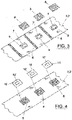
- the surface of the outer face of each of the closed bands or strips 3, 3, with a continuous surface provide ample space for the printing of marks, legends, graphics or any other type of information. Having this ample space for such prints is facilitated by the fact that the surface of the bands or strips 3, 3 are continuous, but in an optional embodiment, said bands or strips 3, 3 can also include inspection windows of the product held and transported inside the bag once said bag has been formed from the tubular body obtained by folding the composite sheet 1. This optional embodiment with windows made in the continuous bands or strips 3, 3 is shown in Figures 3 and 4 of the attached drawings.
- FIG. 3 of the drawings a schematic representation of a closed band or strip is shown, such as those indicated with the numerical references 3, 3 in Figures 1 and 2 , wherein said band or strip 3, 3 includes, in predetermined positions corresponding to each of the band divisions to be cut to make a respective bag, a window 7 generally, although not exclusively, with a quadrangular shape and pre-established size, there also being covering or closing elements for such windows 7 consisting of mesh portions 8, also made of paper fibres, larger in size than that of the windows and directly applicable on the same.
- Each of the windows 7 includes a glued perimeter area 9 such that the application of the mesh portions 8 made of paper fibres (or, where appropriate, made of paper fibres combined with other natural fibres), as represented in Figure 4 , covering the entirety of the window 7 and the respective glued perimeter area 9 thereof, and the definitive attachment is carried out with the help of frame pieces 10, also made of paper, each of them provided with a central opening 10 with the same shape and size as that of the respective window to which it is applied, and intended to provide the definitive joining between each mesh portion 8 and the surface of the band or strip 3, 3 by virtue of gluing to the glued area 9 that surrounds each window, through the very holes or openings of the corresponding mesh portion 8.
- the invention enables bags for holding and transporting products, such as fruit and vegetable produce or products of another type, to be made, the manufacture of which does not use any type of plastic or other materials except for paper and glue for gluing and joining operations between components.
- the invention is particularly applicable in the industrial sector dedicated to the manufacture of bags, in particular bags for fruit and vegetable produce or other products, without the use of plastic materials.
Landscapes
- Engineering & Computer Science (AREA)
- Mechanical Engineering (AREA)
- Life Sciences & Earth Sciences (AREA)
- Biodiversity & Conservation Biology (AREA)
- Bag Frames (AREA)
- Wrappers (AREA)
Abstract
Description
- The present invention relates to a bag mainly designed to hold and transport certain products, especially fruit and vegetable produce, with the advantage over conventional bags that the use of plastic materials for manufacturing the same has been entirely or almost entirely eliminated, without losing features of resistance, reliability and handling with respect to known bags.
- The technical field that the present invention belongs to is comprised within the industrial sector dedicated to providing bags for packaging products, mainly in the fruit and vegetable sector.
- As is known, currently there is great concern worldwide about the need to reduce, in the most urgent and effective way possible, the consequences resulting from the use of the enormous amount of plastics now employed to manufacture multiple articles of common day-to-day use; plastics which are used sometimes as the only base material or other times combined with other materials, and of which a large portion, once they have fulfilled the purpose for which they were used, are not recycled properly with the consequent environmental damage that it entails. Thus, the uncontrolled dumping of these plastic materials results in increased environmental pollution that directly affects environmental habitats, especially land and crops that are produced, rivers, seas and also animals that populate these habitats, including human beings who live in various spaces where said waste is deposited or who, as the case may be, consume plant or animal products that have been affected by this uncontrolled dumping, as occurs, for example, with the consumption of vegetables, fish, or others. These residual materials are also the underlying basis of global warming, given that it is difficult for them to degrade naturally and no short-term solution is foreseen.
- For all these reasons, it is easy to understand the need for plastic materials of this type to be both properly recycled and, preferably, replaced by others that are more environmentally friendly and do not have the direct or indirect consequences associated with plastic materials. As is known, one cause of the problem raised is the large number of bags that are used daily worldwide to transport and package a multiplicity of products, for consumption or otherwise, which are made from plastic materials. Of special interest are plastic bags used daily for packaging and transporting products such as fruit and vegetables, and more especially those intended for packaging potatoes and citrus fruits. In these applications, in an attempt to reduce the consequences of the problem raised, very thin plastics are being used to manufacture bags with a view to reduce the amount of plastic used as much as possible. However, even though the magnitude of the problem is partially reduced by adopting measures of this type, the fact is that the problem raised is not completely eliminated and continues to affect the environment in the manner already described, albeit to a lesser extent.
- Spanish patent
ES-2 356 876 - Based on the foregoing, it is understood that it would be appropriate and necessary to find an effective solution relative to the manufacture of bags of this type, which resolves or at least significantly mitigates the problems that currently exist in terms of the use and recyclability of plastic materials used in the manufacture of bags for holding and transporting products, especially fruit and vegetable produce, and ideally, a solution that preferably allows for the complete or near complete replacement of the plastic materials used up until now by other materials that are not pollutants and therefore behave in a more environmentally friendly manner.
- The present invention provides an effective solution to the aforementioned problems, and to this end it provides a bag for holding and transporting products, fruit and vegetable produce or products of another type, made of paper and with which it is possible to avoid the use of plastic materials by at least 95% compared to conventional bags for the same application. For this, the present invention starts with the aforementioned Patent
ES-2 356 876 - the band or strip intended to have the graphic printing (reticulated closed band) is made of paper instead of plastic;
- the reticulated bands or meshes are made from cellulose or other textile material instead of plastic (for example, only paper thread or a combination of paper threads and other plant fibre threads, for example, bamboo threads since it is a natural waste product);
- the bands or strips closed or with a continuous surface (i.e., those that are not reticulated) are also made of paper;
- there is no need to use thermal welding between the reticulated meshes and/or the counter-sheets, but rather, since they are both made of paper or fabric, glue is used and they are bonded together by means of a gluing operation;
- the horizontal welding used in the prior art for closing the ends of the bag is replaced by a gluing operation, also with the aid of a suitable glue;
- also, the vertical joining that attaches the edges of the tube together when it is folded on itself to obtain the bag, as well as the bonding therebetween is also carried out with the help of a strip of glue, and
- the closed sheets comprise an inspection window which is also closed with the help of pieces of paper mesh.
- As mentioned above, the reticulated bands or meshes used in the manufacture of the bag proposed by the present invention use cellulose-based materials, such as recycled paper threads used solely as such or advantageously combined with other plant fibres. As is known, the paper recycling process includes a milling operation by which the fibre of the paper to be recycled is shortened. In practice, during this recycling process, the recycling machines usually add some plant fibre to achieve better performance of the final product obtained, it being common for these plant fibres to consist of, for example, straw fibres. In the present invention, it has been envisaged that said plant fibres are specifically bamboo fibres since, according to the tests carried out, bamboo is a plant material with excellent performance in applications of this type, it is a naturally degradable material, and it also considerably improves the quality of the final product.
- As will be understood, obtaining a bag in the manner indicated makes it possible to ensure the construction of substantially improved bags both in aspects related to their own performance and in relation to the disposal and recycling of the bags, since:
- Firstly, the paper bands do not need any waterproofing or other type of treatment;
- Secondly, as a consequence of the foregoing, since the paper bands are not treated in any way, they absorb the moisture of the packaged products (for example, potatoes, onions, citrus fruits, etc.), which ensures a considerable increase in the product shelf life (sometimes an increase of up to 100%), since the moisture is absorbed and dissipated by the fibres contained in the paper of the bands and also of the meshes, which also increases the drying surface and naturally prevents condensation that occurs in plastic bags and accelerates the rotting process.
- From a structural point of view, taking into account the aspects that have just been explained, the bag is made from a composite-type sheet, which is made from reticulated bands or strips or meshes, which alternate with other closed (non-reticulated) bands or strips, which composite sheet is folded on itself to form a tubular body that can be divided into different positions to obtain individual bags, of a previously established size. Longitudinal joining (i.e., along each of the lateral edges) between adjoining bands or strips is carried out by applying a glue bead on a narrow longitudinal overlay area between adjacent reticulated and non-reticulated bands and, optionally, by applying a narrow strip of paper in such a way that when resting it on the overlay area of the reticulated strip or mesh, it is glued to the respective glued longitudinal edge of the corresponding closed strip or band. In this way, the glue penetrates through the holes in the reticulated band or mesh, and in the event the aforementioned narrow strip of paper is incorporated, the longitudinal reticulated band or mesh portion forms a firm joining with the corresponding longitudinal portion of the closed band. Similarly, the overlay areas between the outer bands of the composite sheet when the latter is closed to form the tubular body is also carried out by applying glue.
- On the other hand, as mentioned previously, the incorporation of a strip of paper in the longitudinal overlay area between a reticulated band or mesh with a non-reticulated (closed) band may optionally include the addition of a strip of paper that covers this longitudinal overlay area and is adhered by means of the same glue that is applied to the overlay area. This optional embodiment provides the advantage that the joining between bands is more reinforced, and therefore, reinforcing the resistance of the material at the critical points of breakage has been envisaged for the case in which the bags are intended to hold somewhat heavier weights.
- For the closure at both ends of the bags obtained by dividing the tubular body formed by folding the composite sheet, the application of transverse strips glued in the determined positions for dividing the tubular body has also been envisaged.
- In the same way, the closed bands of the bags constructed in the manner described above can be optionally provided with windows that allow for the products contained inside the bag to be directly observed. For this, it has been envisaged that said closed bands can include windows, preferably quadrangular and of variable size and positioning, on which paper mesh portions are applied to close such windows, and the bonding attachment thereof to the surface surrounding each window is carried out with the help of a frame also made of paper, of a suitable size for the window on which it is located, and such that it is applied to the mesh portion itself with the use of glue to achieve the same effect of introducing the glue into the holes in the mesh and with it the integral joining between such elements.
- According to the principles defined in the present invention to help reduce and/or eliminate waste that is harmful to the environment, at this point in the description it should be clarified that the glues used to form the bags described are biodegradable, for example, made from natural resins and collagens.
- These and other features and advantages of the invention will become more apparent from the detailed description of a preferred embodiment thereof that follows, which is given solely by way of illustration and not limitation and refers to the accompanying drawings, wherein:
-
Figure 1 is a schematic representation of an example of a composite sheet for the making of bags for holding and transporting products, together with a detail D1 that depicts the reticular aspect of the strip or mesh; -
Figure 2 is an end elevation view of the composite sheet ofFigure 1 , -
Figure 3 is a schematic example of a closed band or strip of the type used in the composite sheet ofFigure 1 , optionally provided with viewing windows in longitudinally distributed positions, and -
Figure 4 is a schematic example of a closed band or strip like the one shown inFigure 3 , provided with means applicable to the viewing windows, for closing and protecting the same. -
Figure 1 of the drawings depicts a schematic representation of an exemplary embodiment of a composite sheet for forming bags for holding and transporting products, where, despite having been defined for their special preferred use with fruit and vegetable produce, it should be understood that this use is not limiting and that the bag of the invention may be used with products of any type, provided that the weight and size thereof allow it. - The representation shown in
Figure 1 shows that the composite sheet for making bags according to the invention has been generally indicated with thenumerical reference 1 and it comprises several mutually adjacent bands or strips extending longitudinally, which include reticulated bands or meshes, indicated with thenumerical reference 2 and which alternate in the transverse direction with other closedlongitudinal bands - All the bands or strips mentioned, i.e., the reticulated bands or
strips 2 or meshes and the closed orcontinuous bands strips 2 with the adjacent bands orstrips 3 thereof is carried out by gluing a longitudinal portion or area, for example, the glued portion indicated withreference 4 inFigure 1 , located next to each edge of each of the closed bands orstrips numerical reference 5, can be applied on the overlay area of the portions joined by gluing, such that since it is also made of paper, it remains joined to said overlay area by means of the glue that passes through theholes 10 of the reticulated band or mesh of only paper threads or of paper threads combined with other natural fibre threads (see detail D1), reinforcing the joining with a view to prevent easy or accidental separation of both adjacent bands orstrips - As can also be seen in
Figure 1 , thecomposite sheet 1 includes other glued portions, arranged transversely in previously defined positions, such as those indicated by thenumerical reference 6. These defined positions are spaced apart by separations of variable length depending on the size of the bag, since they correspond to the dividing or cutting area of the tubular body (not shown) obtained by folding thecomposite band 1, as defined in the aforementioned patent documentES-2356 876 composite sheet 1 depending on each bag to be manufactured. - Referring to
Figure 2 of the drawings, an end elevation view of the composite sheet ofFigure 1 can be seen. The representation ofFigure 2 , corresponding to the embodiment including the reinforcement strip ofpaper 5, clearly depicts the alternating positioning of the reticulated bands orstrips 2 in the form of meshes with the closed bands orstrips glue 4 along such overlay portions, and the final application of said strip ofpaper 5 on the glued areas for the indicated purposes. - According to the preferred embodiments that have just been described, the surface of the outer face of each of the closed bands or
strips strips strips composite sheet 1. This optional embodiment with windows made in the continuous bands orstrips Figures 3 and 4 of the attached drawings. - Thus, first looking at
Figure 3 of the drawings, a schematic representation of a closed band or strip is shown, such as those indicated with thenumerical references Figures 1 and 2 , wherein said band orstrip window 7 generally, although not exclusively, with a quadrangular shape and pre-established size, there also being covering or closing elements forsuch windows 7 consisting ofmesh portions 8, also made of paper fibres, larger in size than that of the windows and directly applicable on the same. Each of thewindows 7 includes a gluedperimeter area 9 such that the application of themesh portions 8 made of paper fibres (or, where appropriate, made of paper fibres combined with other natural fibres), as represented inFigure 4 , covering the entirety of thewindow 7 and the respective gluedperimeter area 9 thereof, and the definitive attachment is carried out with the help offrame pieces 10, also made of paper, each of them provided with acentral opening 10 with the same shape and size as that of the respective window to which it is applied, and intended to provide the definitive joining between eachmesh portion 8 and the surface of the band orstrip glued area 9 that surrounds each window, through the very holes or openings of thecorresponding mesh portion 8. - As can be deduced from the foregoing, the invention enables bags for holding and transporting products, such as fruit and vegetable produce or products of another type, to be made, the manufacture of which does not use any type of plastic or other materials except for paper and glue for gluing and joining operations between components.
- It should be clarified that references to paper as a material for manufacturing the bag also include fabrics, both terms being interchangeable throughout this description.
- Additionally, it should also be understood that the bag described above allows for handles to be incorporated in a manner known per se, such that the description of this feature will be omitted for the sake of brevity.
- As can be seen from the preceding description of a preferred embodiment, the invention is particularly applicable in the industrial sector dedicated to the manufacture of bags, in particular bags for fruit and vegetable produce or other products, without the use of plastic materials.
- It is not considered necessary to extend the contents of this description for a person skilled in the art to understand its scope and the advantages derived from it, as well as to carry out the practical embodiment of its object. Notwithstanding the foregoing, those skilled in the art will be able to understand and determine that within the essence of the invention, multiple variations in detail may be introduced, which may affect the shapes, dimensions and sizes, without thereby departing from the scope of the invention as defined by the attached claims.
Claims (5)
- A bag for holding and transporting products, especially fruit and vegetable produce, as well as other products with weight and size suitable to the features of the bag, said bag being obtained by dividing a tubular body obtained by folding a composite sheet (1) which comprises reticulated bands or strips (2) or meshes and closed bands or strips (3, 3'), all of them extending along the longitudinal direction of the composite sheet (1) and arranged mutually adjacent, alternating along the transverse direction of the composite sheet (1), characterised in that the reticulated bands or strips (2) or meshes and the closed strips or bands (3, 3') longitudinally adjacent along the transverse direction of said composite sheet (1) are made exclusively of paper or fabric;in that each of the bands or strips (2; 3, 3') of said composite sheet (1) includes, on one of the lateral edges thereof, a glued area or portion (4), the glued areas or portions (4) of the adjacent bands or strips (2; 3, 3') mutually overlaying each other to allow mutual bonding of said bands or strips (2; 3, 3') to each other, andin that the composite sheet (1) further includes glued portions (6) arranged along the transverse direction of the composite sheet (1), spaced apart longitudinally, the separation between glued portions (6) varying depending on the size of the bag to be manufactured,wherein the gluing operations are carried out with the use of a biodegradable glue, such as a natural resin and collagen-based glue.
- The bag according to claim 1, characterised in that each joining between overlayed glued longitudinal areas (4) of the adjacent bands or strips (2; 3, 3') of the composite sheet (1) includes a respective strip (5), also made of paper, applied on said overlay portions between adjacent strips and bonded by gluing through the glue applied on the glued portions (4), which passes through the holes in the overlay portion of the reticulated band or strip (2) or mesh, covering and thereby providing reinforcement to the joining.
- The bag according to claims 1 and 2, characterised in that each closed band or strip (3, 3') includes a window (7) for observing the product inside the bag, surrounded by a glued perimeter area (9).
- The bag according to claim 3, characterised in that it comprises mesh portions (8), also made of paper, such as only paper fibres or paper fibres combined with other plant fibres, said mesh portions (8) being applicable on each respective window of the windows (7) included in the closed bands or strips (3, 3') for closing and protecting the same, and bondable by gluing to the glued perimeter area (9) of the corresponding window.
- The bag according to claims 2 and 3, characterised in that it also includes frame pieces (10) made of paper, with a central opening (10') of the same shape and size as the corresponding window, these frame pieces (10) being intended to be applied on the mesh portions (8) that cover each window, also being attached in their position by virtue of the glued perimeter area (9) and the glue that accesses from said glued perimeter area (9) through the holes in the mesh portion (8) itself.
Applications Claiming Priority (2)
| Application Number | Priority Date | Filing Date | Title |
|---|---|---|---|
| ES202030083A ES2847946B2 (en) | 2020-02-04 | 2020-02-04 | BAG TO CONTAIN AND TRANSPORT PRODUCTS, ESPECIALLY FRUIT AND VEGETABLE PRODUCTS |
| PCT/ES2021/070026 WO2021156527A1 (en) | 2020-02-04 | 2021-01-19 | Bag for holding and transporting products, especially fruit and vegetable produce |
Publications (2)
| Publication Number | Publication Date |
|---|---|
| EP4095058A1 true EP4095058A1 (en) | 2022-11-30 |
| EP4095058A4 EP4095058A4 (en) | 2024-03-27 |
Family
ID=77076146
Family Applications (1)
| Application Number | Title | Priority Date | Filing Date |
|---|---|---|---|
| EP21750185.7A Pending EP4095058A4 (en) | 2020-02-04 | 2021-01-19 | Bag for holding and transporting products, especially fruit and vegetable produce |
Country Status (3)
| Country | Link |
|---|---|
| EP (1) | EP4095058A4 (en) |
| ES (1) | ES2847946B2 (en) |
| WO (1) | WO2021156527A1 (en) |
Cited By (1)
| Publication number | Priority date | Publication date | Assignee | Title |
|---|---|---|---|---|
| WO2025056537A1 (en) * | 2023-09-15 | 2025-03-20 | Smurfit Kappa España, S.A. | Cardboard box for horticultural products with one or multiple viewing windows |
Families Citing this family (2)
| Publication number | Priority date | Publication date | Assignee | Title |
|---|---|---|---|---|
| ES1259168Y (en) * | 2020-10-20 | 2021-04-09 | Innovation Packmakers S L | Paper sack. |
| DE102021111622A1 (en) | 2021-05-05 | 2022-11-10 | Mayr-Melnhof Karton Ag | packaging and surface element |
Family Cites Families (11)
| Publication number | Priority date | Publication date | Assignee | Title |
|---|---|---|---|---|
| US5823683A (en) * | 1995-10-23 | 1998-10-20 | Amoco Corporation | Self-seaming produce bag |
| ES2204272B1 (en) * | 2002-02-21 | 2005-08-01 | Cristobal Meseguer, S.A. | COIL FOR MANUFACTURE OF BAGS FOR HORTOFRUTICOLAS AND SIMILAR PRODUCTS. |
| ES1051865Y (en) * | 2002-03-21 | 2003-03-16 | Meseguer Cristobal Sa | TUBULAR COIL FOR OBTAINING BAGS FOR HORTOFRUTICOLAS AND SIMILAR PRODUCTS. |
| ES2239920B1 (en) * | 2005-04-04 | 2006-06-16 | Seinec, S.A. | HORTOFRUTICOLAS PRODUCTS BAG. |
| WO2010102324A1 (en) * | 2009-03-13 | 2010-09-16 | Anthony Kwaw Quansah | Laminate material and reusable, recyclable bags thereof |
| ES2356876B1 (en) | 2009-06-09 | 2012-03-07 | Cristóbal Meseguer, S.A. | HORTOFRUT�? COLAS PRODUCT BAG. |
| PL402682A1 (en) * | 2013-02-05 | 2014-08-18 | Agrotex International Spółka Z Ograniczoną Odpowiedzialnością | Packaging material, especially for fruits and vegetables |
| PL238562B1 (en) * | 2016-12-25 | 2021-09-06 | Silbo Spolka Z Ograniczona Odpowiedzialnoscia | Bag-shaped packaging material |
| KR20180087622A (en) * | 2017-01-25 | 2018-08-02 | 김형주 | Pouch having Mirror Function |
| PL243875B1 (en) * | 2018-06-29 | 2023-10-23 | Silbo Spolka Z Ograniczona Odpowiedzialnoscia | Method of making packaging material, packaging material and packaging |
| ES1221442Y (en) * | 2018-10-03 | 2019-02-26 | Gold Fiber Europe S L | BIODEGRADABLE FOOD CONTAINER |
-
2020
- 2020-02-04 ES ES202030083A patent/ES2847946B2/en active Active
-
2021
- 2021-01-19 EP EP21750185.7A patent/EP4095058A4/en active Pending
- 2021-01-19 WO PCT/ES2021/070026 patent/WO2021156527A1/en not_active Ceased
Cited By (1)
| Publication number | Priority date | Publication date | Assignee | Title |
|---|---|---|---|---|
| WO2025056537A1 (en) * | 2023-09-15 | 2025-03-20 | Smurfit Kappa España, S.A. | Cardboard box for horticultural products with one or multiple viewing windows |
Also Published As
| Publication number | Publication date |
|---|---|
| ES2847946B2 (en) | 2023-02-15 |
| ES2847946A1 (en) | 2021-08-04 |
| EP4095058A4 (en) | 2024-03-27 |
| WO2021156527A1 (en) | 2021-08-12 |
Similar Documents
| Publication | Publication Date | Title |
|---|---|---|
| EP4095058A1 (en) | Bag for holding and transporting products, especially fruit and vegetable produce | |
| US9533810B2 (en) | Packaging for preserving fruits and vegetables, and manufacturing method | |
| US20050100252A1 (en) | Heat-sealed multi-wall flexible container | |
| CZ13880U1 (en) | Packaged soap cube | |
| DE102007040880A1 (en) | Air chamber packaging film with multilayered dissimilar raw materials | |
| EP3339004A1 (en) | Packaging material for bag-shaped packaging | |
| EP2347972B1 (en) | Resealable packaging | |
| EP3587095A2 (en) | A method for manufacturing a packaging material, a packaging material and a packaging | |
| NL2008045C2 (en) | Bag with pre-applied strap handle. | |
| US10010637B2 (en) | Thermally shrinkable wrapper, in particular for use in sterilization process | |
| DE3921258A1 (en) | Packet for pourable goods | |
| US3507087A (en) | Article-separating packages for flat articles such as surgical supplies | |
| ES2848081B2 (en) | PAPER BAG WITH SEPARABLE INTERNAL WATERPROOFING COMPONENT | |
| US20120106871A1 (en) | Combination Grocery/Receptacle Bag with Reinforced Bottom | |
| US20090116767A1 (en) | Continuous tube for forming bags containing fruit and vegetable products | |
| ES2898405B2 (en) | PROCEDURE FOR PREPARING A PAPER BAND WITH A COMPOSITE PAPER MESH, FOR USE IN THE MANUFACTURING OF BAGS, AND COMPOSITE PAPER MESH | |
| EP2933203B1 (en) | Continuous web for producing bags consisting of plasticised paper and comprising a plate, for fruit and vegetable products and the like | |
| WO1994002365A1 (en) | Container and method for manufacturing the same | |
| EP3766796B1 (en) | Package for food products | |
| EP4357271A1 (en) | Flexible intermediate bulk container for the transport and storage of bulk goods | |
| US20120093440A1 (en) | Packaging bag having handle | |
| NL2018516B1 (en) | Method for making windowed packaging material | |
| WO2025074263A1 (en) | Tray cover made of natural material and tray thereby covered | |
| AU2002313991A1 (en) | Improved packaging system | |
| EP1899153B1 (en) | Method to make a package for foodstuffs and package thus obtained |
Legal Events
| Date | Code | Title | Description |
|---|---|---|---|
| STAA | Information on the status of an ep patent application or granted ep patent |
Free format text: STATUS: THE INTERNATIONAL PUBLICATION HAS BEEN MADE |
|
| PUAI | Public reference made under article 153(3) epc to a published international application that has entered the european phase |
Free format text: ORIGINAL CODE: 0009012 |
|
| STAA | Information on the status of an ep patent application or granted ep patent |
Free format text: STATUS: REQUEST FOR EXAMINATION WAS MADE |
|
| 17P | Request for examination filed |
Effective date: 20220802 |
|
| AK | Designated contracting states |
Kind code of ref document: A1 Designated state(s): AL AT BE BG CH CY CZ DE DK EE ES FI FR GB GR HR HU IE IS IT LI LT LU LV MC MK MT NL NO PL PT RO RS SE SI SK SM TR |
|
| DAV | Request for validation of the european patent (deleted) | ||
| DAX | Request for extension of the european patent (deleted) | ||
| A4 | Supplementary search report drawn up and despatched |
Effective date: 20240226 |
|
| RIC1 | Information provided on ipc code assigned before grant |
Ipc: B65D 33/34 20060101ALI20240220BHEP Ipc: B65D 33/04 20060101ALI20240220BHEP Ipc: B65D 33/02 20060101ALI20240220BHEP Ipc: B65D 33/01 20060101ALI20240220BHEP Ipc: B65D 30/02 20060101AFI20240220BHEP |