EP4093619B1 - Tyre - Google Patents
Tyre Download PDFInfo
- Publication number
- EP4093619B1 EP4093619B1 EP21701317.6A EP21701317A EP4093619B1 EP 4093619 B1 EP4093619 B1 EP 4093619B1 EP 21701317 A EP21701317 A EP 21701317A EP 4093619 B1 EP4093619 B1 EP 4093619B1
- Authority
- EP
- European Patent Office
- Prior art keywords
- tyre
- tread
- layer
- protrusions
- cavity
- Prior art date
- Legal status (The legal status is an assumption and is not a legal conclusion. Google has not performed a legal analysis and makes no representation as to the accuracy of the status listed.)
- Active
Links
Images



Classifications
-
- B—PERFORMING OPERATIONS; TRANSPORTING
- B60—VEHICLES IN GENERAL
- B60C—VEHICLE TYRES; TYRE INFLATION; TYRE CHANGING; CONNECTING VALVES TO INFLATABLE ELASTIC BODIES IN GENERAL; DEVICES OR ARRANGEMENTS RELATED TO TYRES
- B60C11/00—Tyre tread bands; Tread patterns; Anti-skid inserts
- B60C11/03—Tread patterns
-
- B—PERFORMING OPERATIONS; TRANSPORTING
- B60—VEHICLES IN GENERAL
- B60C—VEHICLE TYRES; TYRE INFLATION; TYRE CHANGING; CONNECTING VALVES TO INFLATABLE ELASTIC BODIES IN GENERAL; DEVICES OR ARRANGEMENTS RELATED TO TYRES
- B60C11/00—Tyre tread bands; Tread patterns; Anti-skid inserts
- B60C11/03—Tread patterns
- B60C11/0306—Patterns comprising block rows or discontinuous ribs
-
- B—PERFORMING OPERATIONS; TRANSPORTING
- B60—VEHICLES IN GENERAL
- B60C—VEHICLE TYRES; TYRE INFLATION; TYRE CHANGING; CONNECTING VALVES TO INFLATABLE ELASTIC BODIES IN GENERAL; DEVICES OR ARRANGEMENTS RELATED TO TYRES
- B60C11/00—Tyre tread bands; Tread patterns; Anti-skid inserts
- B60C11/03—Tread patterns
- B60C11/11—Tread patterns in which the raised area of the pattern consists only of isolated elements, e.g. blocks
-
- B—PERFORMING OPERATIONS; TRANSPORTING
- B60—VEHICLES IN GENERAL
- B60C—VEHICLE TYRES; TYRE INFLATION; TYRE CHANGING; CONNECTING VALVES TO INFLATABLE ELASTIC BODIES IN GENERAL; DEVICES OR ARRANGEMENTS RELATED TO TYRES
- B60C11/00—Tyre tread bands; Tread patterns; Anti-skid inserts
- B60C11/03—Tread patterns
- B60C11/12—Tread patterns characterised by the use of narrow slits or incisions, e.g. sipes
- B60C11/1259—Depth of the sipe
-
- B—PERFORMING OPERATIONS; TRANSPORTING
- B60—VEHICLES IN GENERAL
- B60C—VEHICLE TYRES; TYRE INFLATION; TYRE CHANGING; CONNECTING VALVES TO INFLATABLE ELASTIC BODIES IN GENERAL; DEVICES OR ARRANGEMENTS RELATED TO TYRES
- B60C11/00—Tyre tread bands; Tread patterns; Anti-skid inserts
- B60C11/03—Tread patterns
- B60C11/13—Tread patterns characterised by the groove cross-section, e.g. for buttressing or preventing stone-trapping
- B60C11/1376—Three dimensional block surfaces departing from the enveloping tread contour
-
- B—PERFORMING OPERATIONS; TRANSPORTING
- B60—VEHICLES IN GENERAL
- B60C—VEHICLE TYRES; TYRE INFLATION; TYRE CHANGING; CONNECTING VALVES TO INFLATABLE ELASTIC BODIES IN GENERAL; DEVICES OR ARRANGEMENTS RELATED TO TYRES
- B60C3/00—Tyres characterised by the transverse section
- B60C3/04—Tyres characterised by the transverse section characterised by the relative dimensions of the section, e.g. low profile
-
- B—PERFORMING OPERATIONS; TRANSPORTING
- B60—VEHICLES IN GENERAL
- B60C—VEHICLE TYRES; TYRE INFLATION; TYRE CHANGING; CONNECTING VALVES TO INFLATABLE ELASTIC BODIES IN GENERAL; DEVICES OR ARRANGEMENTS RELATED TO TYRES
- B60C7/00—Non-inflatable or solid tyres
- B60C7/10—Non-inflatable or solid tyres characterised by means for increasing resiliency
- B60C7/102—Tyres built-up with separate rubber parts
-
- B—PERFORMING OPERATIONS; TRANSPORTING
- B60—VEHICLES IN GENERAL
- B60C—VEHICLE TYRES; TYRE INFLATION; TYRE CHANGING; CONNECTING VALVES TO INFLATABLE ELASTIC BODIES IN GENERAL; DEVICES OR ARRANGEMENTS RELATED TO TYRES
- B60C7/00—Non-inflatable or solid tyres
- B60C7/10—Non-inflatable or solid tyres characterised by means for increasing resiliency
- B60C7/107—Non-inflatable or solid tyres characterised by means for increasing resiliency comprising lateral openings
-
- B—PERFORMING OPERATIONS; TRANSPORTING
- B60—VEHICLES IN GENERAL
- B60C—VEHICLE TYRES; TYRE INFLATION; TYRE CHANGING; CONNECTING VALVES TO INFLATABLE ELASTIC BODIES IN GENERAL; DEVICES OR ARRANGEMENTS RELATED TO TYRES
- B60C11/00—Tyre tread bands; Tread patterns; Anti-skid inserts
- B60C11/03—Tread patterns
- B60C2011/0337—Tread patterns characterised by particular design features of the pattern
- B60C2011/0339—Grooves
- B60C2011/0341—Circumferential grooves
- B60C2011/0355—Circumferential grooves characterised by depth
-
- B—PERFORMING OPERATIONS; TRANSPORTING
- B60—VEHICLES IN GENERAL
- B60C—VEHICLE TYRES; TYRE INFLATION; TYRE CHANGING; CONNECTING VALVES TO INFLATABLE ELASTIC BODIES IN GENERAL; DEVICES OR ARRANGEMENTS RELATED TO TYRES
- B60C11/00—Tyre tread bands; Tread patterns; Anti-skid inserts
- B60C11/03—Tread patterns
- B60C2011/0337—Tread patterns characterised by particular design features of the pattern
- B60C2011/0339—Grooves
- B60C2011/0358—Lateral grooves, i.e. having an angle of 45 to 90 degees to the equatorial plane
- B60C2011/0367—Lateral grooves, i.e. having an angle of 45 to 90 degees to the equatorial plane characterised by depth
-
- B—PERFORMING OPERATIONS; TRANSPORTING
- B60—VEHICLES IN GENERAL
- B60C—VEHICLE TYRES; TYRE INFLATION; TYRE CHANGING; CONNECTING VALVES TO INFLATABLE ELASTIC BODIES IN GENERAL; DEVICES OR ARRANGEMENTS RELATED TO TYRES
- B60C11/00—Tyre tread bands; Tread patterns; Anti-skid inserts
- B60C11/03—Tread patterns
- B60C11/12—Tread patterns characterised by the use of narrow slits or incisions, e.g. sipes
- B60C11/1236—Tread patterns characterised by the use of narrow slits or incisions, e.g. sipes with special arrangements in the tread pattern
- B60C2011/1245—Tread patterns characterised by the use of narrow slits or incisions, e.g. sipes with special arrangements in the tread pattern being arranged in crossing relation, e.g. sipe mesh
-
- B—PERFORMING OPERATIONS; TRANSPORTING
- B60—VEHICLES IN GENERAL
- B60C—VEHICLE TYRES; TYRE INFLATION; TYRE CHANGING; CONNECTING VALVES TO INFLATABLE ELASTIC BODIES IN GENERAL; DEVICES OR ARRANGEMENTS RELATED TO TYRES
- B60C2200/00—Tyres specially adapted for particular applications
- B60C2200/04—Tyres specially adapted for particular applications for road vehicles, e.g. passenger cars
-
- B—PERFORMING OPERATIONS; TRANSPORTING
- B60—VEHICLES IN GENERAL
- B60Y—INDEXING SCHEME RELATING TO ASPECTS CROSS-CUTTING VEHICLE TECHNOLOGY
- B60Y2200/00—Type of vehicle
- B60Y2200/10—Road Vehicles
-
- B—PERFORMING OPERATIONS; TRANSPORTING
- B60—VEHICLES IN GENERAL
- B60Y—INDEXING SCHEME RELATING TO ASPECTS CROSS-CUTTING VEHICLE TECHNOLOGY
- B60Y2200/00—Type of vehicle
- B60Y2200/90—Vehicles comprising electric prime movers
- B60Y2200/91—Electric vehicles
Definitions
- the present invention relates to tyres for vehicles such as cars.
- Conventional tyres comprise a rubber surface including a tread pattern of grooves, and an inner tube filled under pressure with air.
- the rubber surface is held against a ground surface by the weight of the vehicle and provides traction against the ground surface; the grooves of the tread pattern are provided to expel water from between the tyre and the ground surface; and the inner tube is provided to increase rigidity of the tyre and to absorb shocks while maintaining traction.
- the grooves of the tread pattern provide a fixed reduction in the contact area between the tyre and the ground surface, and thus a reduction in traction.
- tyre designers have to compromise between the ability to expel water and the maximum traction.
- the rubber surface is typically fairly thin and soft, and is at risk of piercing through to the inner tube.
- tyre pressure is lost, leading to at least reduced traction and control of the vehicle, and potentially to a crash.
- a tyre which can address at least some of the above issues, by providing improved traction, reduced wear, increased adaptability to different environmental conditions and/or puncture resistance.
- US 3805865 A describes a vehicle tire construction having a tread portion with fingertip treads of generally frustro-conical shape extending radially of the carcass and tapering in length from an outer portion to a central circumferential portion of the tire.
- the central circumferential portion of the tire is recessed to provide improved gripping contact with hard road surfaces, including ice, under abnormal loading of the tire.
- CN 109177647 A describes a transformable adaptive tire, which comprises a hub, a tire and elastic connecting members connecting the tire and the hub.
- the tire is connected by a plurality of tire flapswith a fan-shaped cross-section, and the elastic connecting members are connected between the plurality of tire flaps and the hub.
- the transformable adaptive tire of the invention can be preferably adapted to different terrain.
- the present invention provides a tyre as set out in claim 1.
- the tyre comprises an inner body and protrusions, the protrusions being arranged around a circumference of the inner body and extending radially outward from the inner body, wherein the surface sections are the radially-distal ends of the protrusions.
- the protrusions have a length of at least 10% of a radius of the tyre.
- the protrusions are arranged in rows extending along an axial width of the tyre.
- the rows are perpendicular to a direction of rotation of the tyre.
- the protrusions can deform perpendicular to the rows, i.e. along the direction of rotation of the tyre. This enables the rows to absorb smaller variations in torque and reduce wear on the surface sections.
- each row comprises a plurality of adjacent protrusions.
- protrusions By providing rows of adjacent protrusions, a grid-like arrangement of protrusions is formed, and the protrusions can deform either or both of along the direction of rotation and perpendicular to the direction of rotation. This enables better adaptation of the tread to an uneven ground surface, and improved traction.
- the rows are arranged adjacent to each other around the whole circumference of the tyre.
- the protrusions provide some of the above-identified advantages even when used on only part of the tread. However, it is desirable that the tread is consistent in the circumferential direction around the tyre, so that the forces on the axle are not dependent upon the angular position of the wheel.
- the surface sections may be raised in a middle portion relative to an edge portion, for directing water or loose material towards the edge portion.
- the water or loose material By directing water or loose material towards edges of the surface sections, the water or loose material is positioned to apply a force for moving the surface sections apart, to adapt the tread pattern and produce one or more grooves.
- the super elastic linking layer replaces a conventional inner tube, and enables a more solid connection between the tread and the wheel interface. This improves torque transfer to the tread and reduces the elastic fatigue associated with the side wall of a conventional tyre.
- the tyre further comprises a compressible gas-filled cushion adapted to fit the cavity.
- Providing a gas-filled cushion has the advantage of reducing wear on the cavity, by preventing opposing sides of the cavity from rubbing against each other.
- the cavity is in fluid connection with an external environment of the tyre.
- Providing a fluid connection means that there is no pressure difference between the cavity and the external environment and, in the event that the tyre is pierced, there is no sudden change in the behaviour of the tyre. This reduces the risk of a more serious accident due to the piercing.
- the linking layer comprises a plurality of cavities distributed around a circumference of the tyre.
- the uniformity of the linking layer as the tyre rolls is improved, and the tyre can roll more smoothly.
- the tyre further comprises a connecting wall fitted to an axial end of the tyre, the connecting wall covering the linking layer.
- the linking layer which is super elastic, may be less robust than the tread. Accordingly, by covering the linking layer, the connecting wall increases the durability and lifetime of the tyre.
- the cavity may extend to an axial end of the tyre and the connecting wall may cover the cavity.
- the connecting wall can prevent debris or water from entering the cavity in the linking layer, reducing a risk of debris increasing friction in the cavity. Additionally, if the cavity has a gas-filled cushion, the connecting wall reduces the risk of the cushion escaping from the tyre, or debris damaging the cushion.
- the connecting wall may be detachable from the tyre.
- a detachable connecting wall has the advantage that the cavity can be easily cleaned and/or the cushion replaced.
- the connecting wall may comprise a mounting portion for mounting the tyre on a wheel hub.
- the connecting wall By enabling the connecting wall to be explicitly attached to a wheel hub, the risk of the tyre detaching from the wheel in the event of a sideways impact is reduced, and safety is increased.
- a tread layer comprises a plurality of disc sections arranged around the linking layer and along a rotation axis of the tyre.
- tyres of different widths can be assembled by stacking different quantities of a common pre-fabricated disc section, or complex tread patterns can be assembled by stacking different pre-fabricated disc sections.
- a spacer is arranged between a pair of adjacent disc sections.
- a gap can be provided between disc sections of the tread layer, wherein the gap can be configured to improve traction, cooling or water removal in the tread layer.
- the present invention provides a method for assembling a plurality of tyres according to the first aspect.
- the method comprises:
- a tread layer is formed and cured directly onto an inner carcass.
- a new tread layer is cured directly onto a recycled carcass.
- curing of the tread a slow stage of production, can only be performed as a later stage of assembling the tyre and the curing is complicated by the presence of the carcass.
- a tread layer can be fully formed before it is assembled with a linking layer.
- the present invention provides an electric vehicle comprising a tyre according to the first aspect.
- tyres in electric vehicles experience high torque and thus increased wear. Accordingly, electric vehicles particularly benefit from use of the tyre of the first aspect.
- a tyre of the first aspect may be used with a combustion engine.
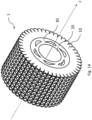
- Figs. 1A to 1D are schematic illustrations of a tyre 1 according to an embodiment, from different viewpoints.
- the tyre 1 has a loosely cylindrical geometry and can be described by reference to an axis around which it is configured to rotate, labelled z in Figs 1A to 1D .
- the axial direction is parallel to the z axis, the radial direction is toward or away from the z axis, and the circumferential direction is around the z axis.
- the tyre 1 comprises a tread layer 10, a wheel interface 20 and a linking layer 30.
- the tread layer 10 comprises an adaptive tread 11 forming its outer surface for the tyre to roll on a ground surface.
- the adaptive tread 11 comprises a plurality of surface sections 12, as shown in greater detail in Fig. 1C which is an enlarged view of the circle C that is labelled in Fig. 1B .
- Each of the surface sections 12 may be flat or may have a partial tread pattern.
- each surface section 12 has a partial tread pattern which comprises a raised central section surrounded by a recessed outer section.
- the central section may, for example, be square, round, oval diamond etc.
- This particular partial tread pattern directs loose material or water on the ground surface towards the joins between the surface sections 12 such that the loose material or water applies a force to cause the surface sections 12 to move apart, without requiring deformation of the individual surface sections, by the mechanism described later.
- the difference between the raised and recessed sections may be small, and may simply be enough to bias loose material or water towards the joins between the surface sections 12.
- the surface sections 12 are arranged in a grid-like arrangement to form the overall tread surface.
- the surface sections 12 may be immediately adjacent in the grid (as shown in Figs. 1B and 1C ).
- the "joins" between surface sections 12 may contain gaps such that there are expandable and/or compressible grooves between the surface sections 12.
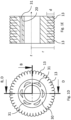
- Fig. 1D is a side view of the tyre 1.
- Fig. 1E is a composite cross-section following the line B-B marked in Fig. 1D , from the top of Fig. 1D to the centre of the tyre 1, and then from the centre of the tyre 1 to the right of Fig. 1D .
- the surface section 12 are the radially-distal ends of protrusions 13, which may also be described as rods.
- the radially-proximal ends of the protrusions 13 extend outward from an inner body of the tyre 1 that, in this embodiment, includes a tread interface 14 of the tread layer 10, as well as the linking layer 30 and the wheel interface 20.
- the protrusions 13 have a length d which is a substantial portion of the radius r of the tyre 1 (dimensions labelled in Fig. 1E ), greater than the depth of a conventional tread (8 mm when new) and usually at least 15 mm to 20 mm.
- the protrusion length may be large enough that r ⁇ 10d, i.e. the protrusions have a length of at least 10% of the tyre radius, or even r ⁇ 4d, i.e. the protrusions have a length of at least 25% of the tyre radius.
- This large length d of the protrusions 13 means that the inner body is further from the road than in a conventional tyre and, among other advantages, has the effect that a risk of a ground surface, or object on the ground surface, piercing into the inner body is significantly reduced. Accordingly, in embodiments where the tread of the invention is combined with internal gas cushioning (e.g. an inner tube or an insert of the type described below), then a chance of decompression or sudden blowout is reduced, and safety and control are improved.
- internal gas cushioning e.g. an inner tube or an insert of the type described below
- Each of the protrusions 13 can bend along their length, when a force is applied either due to friction between the ground surface and the tyre 1 or due to the presence of loose material or water. This bending translates into motion of the corresponding surface section 12 in the circumferential direction around the tyre (which may be, in use, parallel to the direction of motion of the vehicle) or motion of the corresponding surface section 12 in the axial direction (in use, perpendicular to the direction of motion of the vehicle).
- the protrusions 13, and by extension the tyre 1 can conform to an uneven ground surface and maintain maximum traction. Additionally, when the ground surface is wet or includes loose material, forces at the edges of the surface sections 12 or slipping of individual surface sections 12 will create grooves for water or loose material to be expelled from between the tyre 1 and the ground surface, in order to maintain maximum grip and contact area with the ground surface. Due to the two possible directions of bending of the protrusions 13, these grooves may extend parallel to the direction of motion (as in conventional tyres with fixed grooves) or may extend perpendicular to the direction of motion.
- the length d of the protrusions 13 may be chosen according to the application of the tyre.
- a tyre 1 which is expected to travel over rocky terrain may have a large length d, so that the protrusions 13 can bend a large distance over their length, and conform around relatively large objects in the uneven ground surface.
- the tyre 1 of the embodiment can be driven back onto a smooth surface (such as a road) and, once the protrusions 13 return to their unbent configuration, the tyre 1 will have a large surface contact that is not limited by fixed grooves.
- a tyre 1 which is expected to travel at high speeds may have a large length d, so that the protrusions 13 have less overall stiffness, and the surface sections 12 can move more quickly in response to changes in the ground surface. Additionally, the temperatures of the surface sections 12 will generally increase a high speeds, leading to an expansion and increased rigidity of the material from which the protrusions 13 are formed. This will shorten and stiffen the protrusions in use, meaning that a tyre 1 expected to go at high speeds may advantageously be designed to be less stiff prior to use (for example by including longer protrusions), with the expectation that stiffness will increase in use.
- the protrusions 13, and more generally the tread layer 10 may be formed by any known methods for forming rubber or another suitable viscoelastic or elastic material, including synthetic rubbers.
- the tread layer 10 may be formed by moulding and curing, by compacting recycled material, and/or by stamping or cutting. Certain manufacturing techniques may impose a minimum length of the protrusions 13 - for example, if the protrusions 13 are moulded, they will need to be long enough to allow for release from the mould.
- the linking layer 30 connects the tread interface 14 of the tread layer 10 to the wheel interface 20.
- the linking layer 30 is made from a solid super elastic material containing at least one cavity 31.
- the super elastic material is a material with a higher elasticity than a material of the tread layer 10.
- the super elastic material may for example comprise viscoelastic (uncured) rubber wherein the material inherently confers super elasticity, a wire frame wherein the structure of the frame confers super elasticity, or a combination of inherently and structurally elastic materials such as a wire frame embedded in rubber.
- the linking layer 30 and wheel interface 20 provide a largely contiguous connection between the wheel and the tread layer 10. This provides better transfer of torque from the wheel to the tread than the side wall of a conventional tyre, and does not compromise traction efficiency to keep the tyre attached to the wheel unlike a conventional tyre with an inner tube. Additionally, the improved transfer of torque means that the body of the tyre is less stretched in use between the wheel interface and the tread layer, by comparison to a conventional tyre, and experiences less elastic fatigue.
- Replacing a conventional inner tube with the linking layer 30 also means that the tyre 1 is heavier than a conventional tyre, which helps to increase traction of the tyre and control of the vehicle on which it is used.
- the cavity 31 extends through the axial width of the tyre 1 and thus can be in fluid communication with an external environment of the tyre (e.g. ambient air) at either or both of the axial ends of the tyre 1.
- an external environment of the tyre e.g. ambient air
- the presence of the cavity 31 allows the super elastic of the linking layer 30 to be compressed further, and thus dampen transfer of vibration from an uneven ground surface to the vehicle, similarly to the purpose of an inner tube in a conventional tyre.
- the cavity may have various cross-sectional shapes such as the inverted aerofoil-like shape shown in Fig. 1D , adapted to in a sense provide an outward lift for the tyre 1 as pressure flows around the wheel with its rotation.
- a simpler circular or half-moon shape still would allow for increased compression of the linking layer 30.
- the cavity shape can be optimised to maintain balance and smoothness on rotation.
- the cavity 31 may be provided with a compressible gas-filled cushion adapted to fit the cavity.
- a compressible gas-filled cushion adapted to fit the cavity.
- Such a cushion has the effect of reducing friction between the walls of the cavity as the cavity is distorted when the wheel rotates, increasing the lifetime of the linking layer 30.
- the cushion works in tandem with the super elastic material of the linking layer 30 to dampen vibration, as a hybrid of the conventional tyre approach and the super elastic linking of the present invention.
- the cushion may be filled with air, nitrogen, or another gas, and a pressure and material (or molar mass) of the gas in the cushion is matched to the choice of super elastic material in order to optimise durability, torque transfer and vibration suppression of the linking layer 30.
- nitrogen has a lower molar mass (14) than ambient air (28.8), and may be chosen when it is desirable to minimize weight of the tyre while maximising the pressure in the cushion, as may be required for rougher ground surfaces or high speeds.
- the linking layer 30 may be attached to the tread layer 10 in various ways including mechanical interference, an adhesive, or by applying curing, heat and/or pressure.
- the linking layer 30 and the tread layer 10 may be moulded from a single super elastic material, although this would require a compromise between durability of the material that makes contact with the ground surface and elasticity of the linking layer 30, and therefore may be preferably avoided.
- the side walls of a tyre are curved, and the tread layer 10 must be formed directly on to the curved carcass.
- the side walls of the linking layer 30 can be flat such that the tread layer 10 can be simply arranged around the radius of the linking layer.
- a tread layer in a conventional method of manufacturing a tyre, a tread layer must be cured directly onto an inner carcass.
- a new tread layer in a conventional method of re-treading a tyre, a new tread layer must be cured directly onto a recycled carcass, This means that curing of the tread, a slow stage of production, can only be performed as a later stage of assembling the tyre and the curing is complicated by the presence of the carcass.
- Fig. 2 is a schematic cross-sectional illustration of a tyre according to a second example embodiment.
- the position of the cross-section corresponds to the line D-D marked in Fig. 1D .
- This embodiment is similar to the embodiment described above by reference to Figs. 1A to 1E , except that the tyre 1 additionally comprises connecting walls 40 fitted to the axial ends of the tyre 1.
- the connecting walls 40 may be arranged to cover and protect the linking layer 30. More specifically, the connecting walls 40 may be arranged to cover an end of the one or more cavities 31, and thereby prevent debris from entering the cavity 31 and/or prevent a gas-filled cushion (where present) from escaping from the cavity 31. In order to provide this protection, it is not necessary that the connecting walls 40 seal the cavities 31, and the cavities 31 may nevertheless be in fluid contact with the external environment, as described above for the first embodiment.
- the connecting walls 40 may simultaneously, in use, protect a wheel to which the tyre is attached, as an alternative to a hubcap.
- the connecting wall 40 may be shaped to increase airflow over calliper, disc and brake parts while reducing water spray.
- the connecting walls 40 may have a variety of shapes, including a solid disc or a ventilated disc with one or more holes to allow air flow through to a wheel to which the tyre is attached and/or to the linking layer 30.
- the connecting walls 40 may be moulded as part of the tread layer 10 or the linking layer 30, and made of the same material as the associated layer. Alternatively, the connecting walls 40 may be separate elements which are detachable from the rest of the tyre 1. For example, the connecting walls 40 may be adapted to engage with an end of the one or more cavities 31, or may comprise one or more through holes for fasteners to engage with the linking layer 30 (as shown in Fig. 3 ). By making the connecting wall 40 detachable by design, a gas-filled cushion in a cavity 31 can be easily replaced in the event that it is pierced or degrades naturally.
- the connecting walls 40 may also comprise a mounting portion for mounting the tyre 1 on a wheel hub.
- This fixed attachment between the tyre and wheel hub has the advantage of improving safety by preventing the tyre from detaching from the wheel in the event of a sideways impact on the tyre 1.
- a hybrid tyre may comprise a mixture of a conventional tread and a modified tread according to the above embodiment.
- the outer portions of the tread may be as described above, while a central portion of the tread may be smooth as in a conventional dry tyre.
- the smooth central portion can increase the contact area of the tyre, while the outer sections can maintain some traction in wet conditions.
- a mixture of conventional tread and tread according to the above embodiment may partly increase traction, decrease wear, and/or increase adaptability by comparison to a conventional tyre, without incurring the full cost of an improved tyre that is entirely according to the above embodiment.
- the moveable surface sections 12 can be achieved by means other than protrusions 13.
- the adaptive tread may comprise a continuous surface containing different sections with different elasticity. Sections of higher stiffness may correspond to the surface sections 12 of the above-described embodiment, while sections of lower stiffness may stretch to provide adaptive spacing between the surface sections 12, as an alternative to the bending protrusions described above. If the difference in elasticity is large enough, the lower-stiffness sections may form grooves to behave similarly to the above-described embodiment.
- an adaptive tread may be actively controlled using, for example, dielectric elastomer sections and control circuitry applying a voltage to the dielectric elastomer sections. This may be used with either of the above alternatives, either by varying the elasticity (bendability) of the protrusions 13 in the illustrated embodiment, or by varying the elasticity of the lower-stiffness sections in the alternative example.
- linking layer 30 can be used without being combined with the above-described tread layer 10.
- the super elastic linking layer 30 may be used in a tyre with a conventional tread.
- the advantages of the connecting wall 40 may be provided on only one axial end of the tyre 1.
- the connecting wall 40 may be provided to protect an inner side of the tyre, while a conventional wheel hubcap may be relied upon to provide partially-similar protection on an outer side of the tyre.
- Fig. 3 is a schematic exploded view of a tyre according to a third embodiment.
- the third embodiment differs from the second embodiment in that the tread layer 10 comprises a plurality of disc sections 100.
- Each disc section 100 may be similar to the tread layer 10 as described above.
- the linking layer 30 of the third embodiment has a greater length in the axial (z) direction than one disc section 100, and the plurality of disc sections 100 are arranged around and along the linking layer 30.
- the tread layer 10 of the second embodiment is divided in the axial direction into the plurality of disc sections 100 of the third embodiment.
- Each disc section 100 may be adapted to interlock with an adjacent disc section 100.
- each disc section 100 may comprise one or more sockets or protrusions in the axial direction which fit together. This may reduce shear forces on the attachment between the disc sections 100 and the linking layer 30.
- disc sections 100 may be bonded together by various means such as vulcanisation, application of heat or pressure, or using adhesives.
- a complex tread layer 10 can be assembled in a modular fashion by combining disc sections 100 with different tread patterns.
- the inner (second and third) tread sections may comprise a conventional tread pattern
- the outer (first and fourth) tread sections may comprise adaptive tread 11 as described above.
- pre-fabricated disc sections 100 can be combined to form any combination of tread patterns.
- disc sections 100 can be combined to form a tyre of any overall width, when assembled with a corresponding linking layer 30. This means that a single type of disc section 100 can be used to produce tyres of different widths.
- Fig. 4 is a schematic cross-section view of a tyre according to a fourth embodiment.
- the fourth embodiment differs from the third embodiment in that the tread layer 10 comprises spacers 50 arranged between pairs of adjacent disc sections 100.
- the spacers 50 are tread sections with a lower radius than the disc sections 100, and are configured to define a spacing between disc sections 100 in the axial direction.
- the spacers 50 may also be configured to interlock with the adjacent disc sections 100.
- different spacers 50 may have different radii and may define different spacings between disc sections 100.
- the radii and spacings may be optimised according to an expected load and expected road conditions for the tyre.
- an increased spacing between disc sections 100 may be used, as an equivalent to using multiple narrow tyres or snow chains, in order to provide increased traction.
- increased spacing between disc sections may increase ventilation and reduce the operating temperature of the tyre surface, or may decrease the chance of aquaplaning.
Landscapes
- Engineering & Computer Science (AREA)
- Mechanical Engineering (AREA)
- Tires In General (AREA)
- Medicines Containing Material From Animals Or Micro-Organisms (AREA)
Description
- The present invention relates to tyres for vehicles such as cars.
- Conventional tyres comprise a rubber surface including a tread pattern of grooves, and an inner tube filled under pressure with air. The rubber surface is held against a ground surface by the weight of the vehicle and provides traction against the ground surface; the grooves of the tread pattern are provided to expel water from between the tyre and the ground surface; and the inner tube is provided to increase rigidity of the tyre and to absorb shocks while maintaining traction.
- These conventional tyres have several limitations.
- Traction between the tyre and the ground surface is limited, and some wear occurs as the rubber surface slips or skids on the ground surface.
- While the rubber surface can stretch and deform to some extent, the grooves of the tread pattern provide a fixed reduction in the contact area between the tyre and the ground surface, and thus a reduction in traction. Thus tyre designers have to compromise between the ability to expel water and the maximum traction. This leads to different designs specialised for different conditions, such as slick tyres (with smooth surfaces) for dry conditions and wet tyres (with extensive grooves) for wet conditions. With such specialisations, it is not desirable (and may even be dangerous) to use the same tyres in different conditions.
- Additionally, the rubber surface is typically fairly thin and soft, and is at risk of piercing through to the inner tube. When the inner tube is pierced, tyre pressure is lost, leading to at least reduced traction and control of the vehicle, and potentially to a crash.
- These issues are amplified in electric vehicles, because electric engines typically apply much more torque than a combustion engine, and electric vehicles are also typically heavier, meaning that traction on tyres, and the associated wear as the tyres slip or stretch, is significantly increased (by up to 3 times in some cases). The lifetime of tyres used with electric vehicles is correspondingly reduced (for example from 30,000 miles to 10,000 miles) and, given the desired environmental friendliness of electric vehicles, this more frequent need to replace and dispose of tyres may be seen as a problem.
- Accordingly, it is desirable to provide a tyre which can address at least some of the above issues, by providing improved traction, reduced wear, increased adaptability to different environmental conditions and/or puncture resistance.
-
US 3805865 A describes a vehicle tire construction having a tread portion with fingertip treads of generally frustro-conical shape extending radially of the carcass and tapering in length from an outer portion to a central circumferential portion of the tire. The central circumferential portion of the tire is recessed to provide improved gripping contact with hard road surfaces, including ice, under abnormal loading of the tire. -
CN 109177647 A describes a transformable adaptive tire, which comprises a hub, a tire and elastic connecting members connecting the tire and the hub. The tire is connected by a plurality of tire flapswith a fan-shaped cross-section, and the elastic connecting members are connected between the plurality of tire flaps and the hub. The transformable adaptive tire of the invention can be preferably adapted to different terrain. - Background to the application also includes Hankook's Motiv, Tiltread, Flexup and Shiftrac designs (available on the Hankook Youtube channel, or from XP055785965 and XP055785967 showing screen shots from the internet site of Hankook), as well as patent publications
CN206598673U ,EP1902866A1 ,GB2467956A WO83/02429A1 EP2418098A2 andWO2007/003865A1 - According to a first aspect, the present invention provides a tyre as set out in
claim 1. - By providing a tread which can change its tread pattern without deformation, contact area between the tyre surface and the ground surface can be changed beyond the stretching and deformation limits of a conventional tyre tread. This can improve traction, reduce wear and increase adaptability, by enabling the tread to conform with a ground surface and also expel water when water is present.
- The tyre comprises an inner body and protrusions, the protrusions being arranged around a circumference of the inner body and extending radially outward from the inner body, wherein the surface sections are the radially-distal ends of the protrusions.
- By providing the surface sections as the ends of protrusions, relative motion is enabled passively without deforming the surface section by instead deforming the protrusion along its radial length. This is a relatively straightforward solution which can be moulded and/or cut using conventional tyre materials.
- Optionally, the protrusions have a length of at least 10% of a radius of the tyre.
- By providing protrusions of a length which is a substantial proportion of the tyre radius, the chance of the tyre being pierced all the way through the tread is reduced, and the risk of puncture is reduced.
- Optionally, the protrusions are arranged in rows extending along an axial width of the tyre. In other words, the rows are perpendicular to a direction of rotation of the tyre.
- By providing rows extending along the axial width, the protrusions can deform perpendicular to the rows, i.e. along the direction of rotation of the tyre. This enables the rows to absorb smaller variations in torque and reduce wear on the surface sections.
- Optionally, each row comprises a plurality of adjacent protrusions.
- By providing rows of adjacent protrusions, a grid-like arrangement of protrusions is formed, and the protrusions can deform either or both of along the direction of rotation and perpendicular to the direction of rotation. This enables better adaptation of the tread to an uneven ground surface, and improved traction.
- Optionally, the rows are arranged adjacent to each other around the whole circumference of the tyre.
- The protrusions provide some of the above-identified advantages even when used on only part of the tread. However, it is desirable that the tread is consistent in the circumferential direction around the tyre, so that the forces on the axle are not dependent upon the angular position of the wheel.
- Optionally, the surface sections may be raised in a middle portion relative to an edge portion, for directing water or loose material towards the edge portion.
- By directing water or loose material towards edges of the surface sections, the water or loose material is positioned to apply a force for moving the surface sections apart, to adapt the tread pattern and produce one or more grooves.
- The super elastic linking layer replaces a conventional inner tube, and enables a more solid connection between the tread and the wheel interface. This improves torque transfer to the tread and reduces the elastic fatigue associated with the side wall of a conventional tyre.
- Optionally, the tyre further comprises a compressible gas-filled cushion adapted to fit the cavity.
- Providing a gas-filled cushion has the advantage of reducing wear on the cavity, by preventing opposing sides of the cavity from rubbing against each other.
- Optionally, the cavity is in fluid connection with an external environment of the tyre.
- Providing a fluid connection means that there is no pressure difference between the cavity and the external environment and, in the event that the tyre is pierced, there is no sudden change in the behaviour of the tyre. This reduces the risk of a more serious accident due to the piercing.
- Optionally, the linking layer comprises a plurality of cavities distributed around a circumference of the tyre.
- By distributing cavities around the circumference, the uniformity of the linking layer as the tyre rolls is improved, and the tyre can roll more smoothly.
- Optionally, the tyre further comprises a connecting wall fitted to an axial end of the tyre, the connecting wall covering the linking layer.
- The linking layer, which is super elastic, may be less robust than the tread. Accordingly, by covering the linking layer, the connecting wall increases the durability and lifetime of the tyre.
- As a further optional feature, the cavity may extend to an axial end of the tyre and the connecting wall may cover the cavity.
- The connecting wall can prevent debris or water from entering the cavity in the linking layer, reducing a risk of debris increasing friction in the cavity. Additionally, if the cavity has a gas-filled cushion, the connecting wall reduces the risk of the cushion escaping from the tyre, or debris damaging the cushion.
- Optionally, the connecting wall may be detachable from the tyre.
- A detachable connecting wall has the advantage that the cavity can be easily cleaned and/or the cushion replaced.
- Optionally, the connecting wall may comprise a mounting portion for mounting the tyre on a wheel hub.
- By enabling the connecting wall to be explicitly attached to a wheel hub, the risk of the tyre detaching from the wheel in the event of a sideways impact is reduced, and safety is increased.
- Optionally, a tread layer comprises a plurality of disc sections arranged around the linking layer and along a rotation axis of the tyre.
- By providing a tread layer comprising a plurality of sections, tyres of different widths can be assembled by stacking different quantities of a common pre-fabricated disc section, or complex tread patterns can be assembled by stacking different pre-fabricated disc sections.
- As a further optional feature, a spacer is arranged between a pair of adjacent disc sections.
- By providing a spacer between a pair of adjacent disc sections (or regularly between pairs of adjacent disc sections), a gap can be provided between disc sections of the tread layer, wherein the gap can be configured to improve traction, cooling or water removal in the tread layer.
- According to a second aspect, the present invention provides a method for assembling a plurality of tyres according to the first aspect. The method comprises:
- manufacturing a plurality of linking layers arranged to link a wheel interface to a tread layer, wherein the linking layer is formed from a super elastic material and comprises a cavity;
- manufacturing a plurality of tread layers; and
- assembling a plurality of tyres by arranging a tread layer of the plurality of tread layers around a linking layer of the plurality of linking layers.
- In a conventional method of manufacturing a tyre, a tread layer is formed and cured directly onto an inner carcass. Similarly, in a conventional method of re-treading a tyre, a new tread layer is cured directly onto a recycled carcass, This means that curing of the tread, a slow stage of production, can only be performed as a later stage of assembling the tyre and the curing is complicated by the presence of the carcass. On the other hand, according to the invention, a tread layer can be fully formed before it is assembled with a linking layer.
- According to a third aspect, the present invention provides an electric vehicle comprising a tyre according to the first aspect.
- As mentioned above, tyres in electric vehicles experience high torque and thus increased wear. Accordingly, electric vehicles particularly benefit from use of the tyre of the first aspect.
- Nevertheless, a tyre of the first aspect may be used with a combustion engine.
-
-
Fig. 1A is a schematic perspective view of a tyre according to an embodiment; -
Fig. 1B is a schematic front view of the tyre; -
Fig. 1C is a schematic detail view of surface sections of the tyre; -
Fig. 1D is a schematic side view of the tyre; -
Fig. 1E is a schematic cross-sectional view of the tyre; -
Fig. 2 is a schematic cross-sectional view of a tyre according to another embodiment; -
Fig. 3 is a schematic exploded view of a tyre according to a third embodiment; -
Fig. 4 is a schematic cross-sectional view of a tyre according to a fourth embodiment. -
Figs. 1A to 1D are schematic illustrations of atyre 1 according to an embodiment, from different viewpoints. Thetyre 1 has a loosely cylindrical geometry and can be described by reference to an axis around which it is configured to rotate, labelled z inFigs 1A to 1D . The axial direction is parallel to the z axis, the radial direction is toward or away from the z axis, and the circumferential direction is around the z axis. - As shown in
Figs. 1A to 1D , around the z-axis, thetyre 1 comprises atread layer 10, awheel interface 20 and a linkinglayer 30. - Referring to
Fig. 1B , thetread layer 10 comprises anadaptive tread 11 forming its outer surface for the tyre to roll on a ground surface. Theadaptive tread 11 comprises a plurality ofsurface sections 12, as shown in greater detail inFig. 1C which is an enlarged view of the circle C that is labelled inFig. 1B . - Each of the
surface sections 12 may be flat or may have a partial tread pattern. - In the example shown in
Figs. 1B and 1C , eachsurface section 12 has a partial tread pattern which comprises a raised central section surrounded by a recessed outer section. The central section may, for example, be square, round, oval diamond etc. This particular partial tread pattern directs loose material or water on the ground surface towards the joins between thesurface sections 12 such that the loose material or water applies a force to cause thesurface sections 12 to move apart, without requiring deformation of the individual surface sections, by the mechanism described later. The difference between the raised and recessed sections may be small, and may simply be enough to bias loose material or water towards the joins between thesurface sections 12. - The
surface sections 12 are arranged in a grid-like arrangement to form the overall tread surface. In an unstressed state (i.e. no force applied), thesurface sections 12 may be immediately adjacent in the grid (as shown inFigs. 1B and 1C ). Alternatively, in the unstressed state, the "joins" betweensurface sections 12 may contain gaps such that there are expandable and/or compressible grooves between thesurface sections 12. By providing gaps in the unstressed state, the minimum force required to move anindividual surface section 12 may be reduced, as it can initially move independently ofadjacent surface sections 12 in the grid. -
Fig. 1D is a side view of thetyre 1. On the other hand,Fig. 1E is a composite cross-section following the line B-B marked inFig. 1D , from the top ofFig. 1D to the centre of thetyre 1, and then from the centre of thetyre 1 to the right ofFig. 1D . - Referring to
Figs. 1D and 1E , it can be seen that thesurface section 12 are the radially-distal ends ofprotrusions 13, which may also be described as rods. The radially-proximal ends of theprotrusions 13 extend outward from an inner body of thetyre 1 that, in this embodiment, includes a tread interface 14 of thetread layer 10, as well as the linkinglayer 30 and thewheel interface 20. - The
protrusions 13 have a length d which is a substantial portion of the radius r of the tyre 1 (dimensions labelled inFig. 1E ), greater than the depth of a conventional tread (8 mm when new) and usually at least 15 mm to 20 mm. In some examples, the protrusion length may be large enough that r ≤ 10d, i.e. the protrusions have a length of at least 10% of the tyre radius, or even r ≤ 4d, i.e. the protrusions have a length of at least 25% of the tyre radius. This large length d of theprotrusions 13 means that the inner body is further from the road than in a conventional tyre and, among other advantages, has the effect that a risk of a ground surface, or object on the ground surface, piercing into the inner body is significantly reduced. Accordingly, in embodiments where the tread of the invention is combined with internal gas cushioning (e.g. an inner tube or an insert of the type described below), then a chance of decompression or sudden blowout is reduced, and safety and control are improved. - Each of the
protrusions 13 can bend along their length, when a force is applied either due to friction between the ground surface and thetyre 1 or due to the presence of loose material or water. This bending translates into motion of thecorresponding surface section 12 in the circumferential direction around the tyre (which may be, in use, parallel to the direction of motion of the vehicle) or motion of thecorresponding surface section 12 in the axial direction (in use, perpendicular to the direction of motion of the vehicle). - By bending in combinations of the circumferential direction and the axial direction, the
protrusions 13, and by extension thetyre 1, can conform to an uneven ground surface and maintain maximum traction. Additionally, when the ground surface is wet or includes loose material, forces at the edges of thesurface sections 12 or slipping ofindividual surface sections 12 will create grooves for water or loose material to be expelled from between thetyre 1 and the ground surface, in order to maintain maximum grip and contact area with the ground surface. Due to the two possible directions of bending of theprotrusions 13, these grooves may extend parallel to the direction of motion (as in conventional tyres with fixed grooves) or may extend perpendicular to the direction of motion. - The length d of the
protrusions 13 may be chosen according to the application of the tyre. - For example, a
tyre 1 which is expected to travel over rocky terrain may have a large length d, so that theprotrusions 13 can bend a large distance over their length, and conform around relatively large objects in the uneven ground surface. Nevertheless, unlike a conventional tyre with large tread grooves for grip, thetyre 1 of the embodiment can be driven back onto a smooth surface (such as a road) and, once theprotrusions 13 return to their unbent configuration, thetyre 1 will have a large surface contact that is not limited by fixed grooves. - Similarly, a
tyre 1 which is expected to travel at high speeds may have a large length d, so that theprotrusions 13 have less overall stiffness, and thesurface sections 12 can move more quickly in response to changes in the ground surface. Additionally, the temperatures of thesurface sections 12 will generally increase a high speeds, leading to an expansion and increased rigidity of the material from which theprotrusions 13 are formed. This will shorten and stiffen the protrusions in use, meaning that atyre 1 expected to go at high speeds may advantageously be designed to be less stiff prior to use (for example by including longer protrusions), with the expectation that stiffness will increase in use. - The
protrusions 13, and more generally thetread layer 10 may be formed by any known methods for forming rubber or another suitable viscoelastic or elastic material, including synthetic rubbers. For example, thetread layer 10 may be formed by moulding and curing, by compacting recycled material, and/or by stamping or cutting. Certain manufacturing techniques may impose a minimum length of the protrusions 13 - for example, if theprotrusions 13 are moulded, they will need to be long enough to allow for release from the mould. - Referring again to
Figs. 1D and 1E , the linkinglayer 30 connects the tread interface 14 of thetread layer 10 to thewheel interface 20. Unlike a conventional tyre where the inner volume is largely taken up by an inner tube, the linkinglayer 30 is made from a solid super elastic material containing at least onecavity 31. The super elastic material is a material with a higher elasticity than a material of thetread layer 10. The super elastic material may for example comprise viscoelastic (uncured) rubber wherein the material inherently confers super elasticity, a wire frame wherein the structure of the frame confers super elasticity, or a combination of inherently and structurally elastic materials such as a wire frame embedded in rubber. - When the
tyre 1 is put in position on a wheel of a vehicle, the linkinglayer 30 andwheel interface 20 provide a largely contiguous connection between the wheel and thetread layer 10. This provides better transfer of torque from the wheel to the tread than the side wall of a conventional tyre, and does not compromise traction efficiency to keep the tyre attached to the wheel unlike a conventional tyre with an inner tube. Additionally, the improved transfer of torque means that the body of the tyre is less stretched in use between the wheel interface and the tread layer, by comparison to a conventional tyre, and experiences less elastic fatigue. - Replacing a conventional inner tube with the linking
layer 30 also means that thetyre 1 is heavier than a conventional tyre, which helps to increase traction of the tyre and control of the vehicle on which it is used. - As shown in
Fig. 1D , thecavity 31 extends through the axial width of thetyre 1 and thus can be in fluid communication with an external environment of the tyre (e.g. ambient air) at either or both of the axial ends of thetyre 1. The presence of thecavity 31 allows the super elastic of the linkinglayer 30 to be compressed further, and thus dampen transfer of vibration from an uneven ground surface to the vehicle, similarly to the purpose of an inner tube in a conventional tyre. However, by eliminating the need for a pressurised gas in the tyre and eliminating the corresponding risk of depressurisation or blowout, safety and control are improved. - The cavity may have various cross-sectional shapes such as the inverted aerofoil-like shape shown in
Fig. 1D , adapted to in a sense provide an outward lift for thetyre 1 as pressure flows around the wheel with its rotation. Alternatively, a simpler circular or half-moon shape still would allow for increased compression of the linkinglayer 30. The cavity shape can be optimised to maintain balance and smoothness on rotation. - In some embodiments, the
cavity 31 may be provided with a compressible gas-filled cushion adapted to fit the cavity. Such a cushion has the effect of reducing friction between the walls of the cavity as the cavity is distorted when the wheel rotates, increasing the lifetime of the linkinglayer 30. The cushion works in tandem with the super elastic material of the linkinglayer 30 to dampen vibration, as a hybrid of the conventional tyre approach and the super elastic linking of the present invention. - The cushion may be filled with air, nitrogen, or another gas, and a pressure and material (or molar mass) of the gas in the cushion is matched to the choice of super elastic material in order to optimise durability, torque transfer and vibration suppression of the linking
layer 30. For example, nitrogen has a lower molar mass (14) than ambient air (28.8), and may be chosen when it is desirable to minimize weight of the tyre while maximising the pressure in the cushion, as may be required for rougher ground surfaces or high speeds. - In embodiments having a cushion, it is desirable to provide
multiple cavities 31 with respective separate cushions, such that a depressurization cannot affect the whole tyre at once - in the embodiment shown inFig. 1D , sixcavities 31 are arranged symmetrically around thetyre 1.Multiple cavities 31 may also be used even when no cushions are included, in order to more evenly spread the effect of the cavity around the wheel, and provide smoother rolling of the tyre. - The linking
layer 30 may be attached to thetread layer 10 in various ways including mechanical interference, an adhesive, or by applying curing, heat and/or pressure. Alternatively, the linkinglayer 30 and thetread layer 10 may be moulded from a single super elastic material, although this would require a compromise between durability of the material that makes contact with the ground surface and elasticity of the linkinglayer 30, and therefore may be preferably avoided. - Furthermore, in a traditional carcass and inner tube configuration, the side walls of a tyre are curved, and the
tread layer 10 must be formed directly on to the curved carcass. On the other hand, the side walls of the linkinglayer 30 can be flat such that thetread layer 10 can be simply arranged around the radius of the linking layer. - In particular, in a conventional method of manufacturing a tyre, a tread layer must be cured directly onto an inner carcass. Similarly, in a conventional method of re-treading a tyre, a new tread layer must be cured directly onto a recycled carcass, This means that curing of the tread, a slow stage of production, can only be performed as a later stage of assembling the tyre and the curing is complicated by the presence of the carcass.
- On the other hand, according to the invention, a
tread layer 10 can be fully formed before it is attached to alinking layer 30, and any required earlier curing stage can be a simple process of curing thetread layer 10 alone. -
Fig. 2 is a schematic cross-sectional illustration of a tyre according to a second example embodiment. The position of the cross-section corresponds to the line D-D marked inFig. 1D . This embodiment is similar to the embodiment described above by reference toFigs. 1A to 1E , except that thetyre 1 additionally comprises connectingwalls 40 fitted to the axial ends of thetyre 1. - The connecting
walls 40 may be arranged to cover and protect the linkinglayer 30. More specifically, the connectingwalls 40 may be arranged to cover an end of the one ormore cavities 31, and thereby prevent debris from entering thecavity 31 and/or prevent a gas-filled cushion (where present) from escaping from thecavity 31. In order to provide this protection, it is not necessary that the connectingwalls 40 seal thecavities 31, and thecavities 31 may nevertheless be in fluid contact with the external environment, as described above for the first embodiment. - The connecting
walls 40 may simultaneously, in use, protect a wheel to which the tyre is attached, as an alternative to a hubcap. Specifically, the connectingwall 40 may be shaped to increase airflow over calliper, disc and brake parts while reducing water spray. - The connecting
walls 40 may have a variety of shapes, including a solid disc or a ventilated disc with one or more holes to allow air flow through to a wheel to which the tyre is attached and/or to the linkinglayer 30. - The connecting
walls 40 may be moulded as part of thetread layer 10 or the linkinglayer 30, and made of the same material as the associated layer. Alternatively, the connectingwalls 40 may be separate elements which are detachable from the rest of thetyre 1. For example, the connectingwalls 40 may be adapted to engage with an end of the one ormore cavities 31, or may comprise one or more through holes for fasteners to engage with the linking layer 30 (as shown inFig. 3 ). By making the connectingwall 40 detachable by design, a gas-filled cushion in acavity 31 can be easily replaced in the event that it is pierced or degrades naturally. - The connecting
walls 40 may also comprise a mounting portion for mounting thetyre 1 on a wheel hub. This fixed attachment between the tyre and wheel hub has the advantage of improving safety by preventing the tyre from detaching from the wheel in the event of a sideways impact on thetyre 1. - In the above example, the
protrusions 13 are arranged in a grid around the whole circumference and axial width of thetyre 1. However, in other embodiments, a hybrid tyre may comprise a mixture of a conventional tread and a modified tread according to the above embodiment. For example, across the axial width of the tyre, the outer portions of the tread may be as described above, while a central portion of the tread may be smooth as in a conventional dry tyre. In this case, the smooth central portion can increase the contact area of the tyre, while the outer sections can maintain some traction in wet conditions. A mixture of conventional tread and tread according to the above embodiment may partly increase traction, decrease wear, and/or increase adaptability by comparison to a conventional tyre, without incurring the full cost of an improved tyre that is entirely according to the above embodiment. - Furthermore, the
moveable surface sections 12 can be achieved by means other thanprotrusions 13. For example, the adaptive tread may comprise a continuous surface containing different sections with different elasticity. Sections of higher stiffness may correspond to thesurface sections 12 of the above-described embodiment, while sections of lower stiffness may stretch to provide adaptive spacing between thesurface sections 12, as an alternative to the bending protrusions described above. If the difference in elasticity is large enough, the lower-stiffness sections may form grooves to behave similarly to the above-described embodiment. - Furthermore, rather than relying on purely passive bending of protrusions or differences in elasticity, an adaptive tread may be actively controlled using, for example, dielectric elastomer sections and control circuitry applying a voltage to the dielectric elastomer sections. This may be used with either of the above alternatives, either by varying the elasticity (bendability) of the
protrusions 13 in the illustrated embodiment, or by varying the elasticity of the lower-stiffness sections in the alternative example. - The above-described
tread layer 10 can be used without being combined with the above-describedlinking layer 30. Theprotrusions 13 of thetread layer 10 may be implemented for an otherwise conventional tyre, such as a tyre having an inner tube. - Similarly, the above-described
linking layer 30 can be used without being combined with the above-describedtread layer 10. The superelastic linking layer 30 may be used in a tyre with a conventional tread. - Although the above-described second embodiment includes two connecting walls, the advantages of the connecting
wall 40 may be provided on only one axial end of thetyre 1. For example, referring to a position of the tyre when used in a vehicle, the connectingwall 40 may be provided to protect an inner side of the tyre, while a conventional wheel hubcap may be relied upon to provide partially-similar protection on an outer side of the tyre. -
Fig. 3 is a schematic exploded view of a tyre according to a third embodiment. The third embodiment differs from the second embodiment in that thetread layer 10 comprises a plurality ofdisc sections 100. - Each
disc section 100 may be similar to thetread layer 10 as described above. However, the linkinglayer 30 of the third embodiment has a greater length in the axial (z) direction than onedisc section 100, and the plurality ofdisc sections 100 are arranged around and along the linkinglayer 30. In other words, thetread layer 10 of the second embodiment is divided in the axial direction into the plurality ofdisc sections 100 of the third embodiment. - Each
disc section 100 may be adapted to interlock with anadjacent disc section 100. For example, eachdisc section 100 may comprise one or more sockets or protrusions in the axial direction which fit together. This may reduce shear forces on the attachment between thedisc sections 100 and the linkinglayer 30. - Alternatively,
disc sections 100 may be bonded together by various means such as vulcanisation, application of heat or pressure, or using adhesives. - With the above configuration, a
complex tread layer 10 can be assembled in a modular fashion by combiningdisc sections 100 with different tread patterns. For example, the inner (second and third) tread sections may comprise a conventional tread pattern, and the outer (first and fourth) tread sections may compriseadaptive tread 11 as described above. More generally,pre-fabricated disc sections 100 can be combined to form any combination of tread patterns. - Furthermore,
disc sections 100 can be combined to form a tyre of any overall width, when assembled with a corresponding linkinglayer 30. This means that a single type ofdisc section 100 can be used to produce tyres of different widths. -
Fig. 4 is a schematic cross-section view of a tyre according to a fourth embodiment. The fourth embodiment differs from the third embodiment in that thetread layer 10 comprisesspacers 50 arranged between pairs ofadjacent disc sections 100. - The
spacers 50 are tread sections with a lower radius than thedisc sections 100, and are configured to define a spacing betweendisc sections 100 in the axial direction. - The
spacers 50 may also be configured to interlock with theadjacent disc sections 100. - As shown in
Fig. 4 ,different spacers 50 may have different radii and may define different spacings betweendisc sections 100. The radii and spacings may be optimised according to an expected load and expected road conditions for the tyre. - For example, in winter conditions, an increased spacing between
disc sections 100 may be used, as an equivalent to using multiple narrow tyres or snow chains, in order to provide increased traction. Similarly, in summer, increased spacing between disc sections may increase ventilation and reduce the operating temperature of the tyre surface, or may decrease the chance of aquaplaning.
Claims (15)
- A tyre (1) comprising an adaptive tread (11), the adaptive tread comprising a plurality of surface sections (12), wherein each surface section can move without deformation relative to the other surface sections to form a tread pattern,the tyre comprising an inner body and protrusions (13), the protrusions being arranged around a circumference of the inner body and extending radially outward from the inner body, wherein the surface sections are the radially-distal ends of the protrusions,wherein the inner body comprises a tread interface, a wheel interface (20) and linking layer (30) arranged to link the wheel interface to the tread interface,wherein the linking layer (30) is formed from a super elastic material and comprises a cavity (31),wherein the super elastic material has a higher elasticity than the tread.
- A tyre according to claim 1, wherein the protrusions (13) have a length of at least 10% of a radius of the tyre.
- A tyre according to claim 1, wherein the protrusions (13) are arranged in rows extending along an axial width of the tyre.
- A tyre according to any of claims 1 to 3, wherein a middle portion of each surface section (12) is raised relative to an edge portion of the surface section (12), for directing water or loose material towards the edge portions.
- A tyre according to any preceding claim, further comprising a compressible gas-filled cushion adapted to fit the cavity (31).
- A tyre according to any preceding claim, wherein the cavity (31) is in fluid connection with an external environment of the tyre.
- A tyre according to any preceding claim, wherein the linking layer (30) comprises a plurality of cavities (31) distributed around a circumference of the tyre.
- A tyre according to any preceding claim, further comprising a connecting wall (40) fitted to an axial end of the tyre, the connecting wall covering the linking layer (30).
- A tyre according to claim 8, wherein the cavity (31) extends to an axial end of the tyre, and the connecting wall (40) covers the cavity (31).
- A tyre according to claim 9, wherein the connecting wall (40) is detachable from the tyre.
- A tyre according to any of claims 8 to 10, wherein the connecting wall (40) comprises a mounting portion for mounting the tyre on a wheel hub.
- A tyre according to any preceding claim, wherein a tread layer (10) comprises a plurality of disc sections (100) arranged around the linking layer (30) and along a rotation axis of the tyre.
- A tyre according to claim 12, wherein a spacer (50) is arranged between a pair of adjacent disc sections (100).
- A method for assembling a plurality of tyres according to any preceding claim, the method comprising:manufacturing a plurality of linking layers (30) arranged to link a wheel interface (20) to a tread layer (10), wherein each linking layer is formed from the super elastic material and comprises a cavity;manufacturing a plurality of tread layers (10, 100); andassembling a plurality of tyres by arranging a tread layer of the plurality of tread layers around a linking layer of the plurality of linking layers.
- An electric vehicle comprising a tyre according to any of claims 1 to 13.
Applications Claiming Priority (2)
| Application Number | Priority Date | Filing Date | Title |
|---|---|---|---|
| GB2001022.9A GB2587247B (en) | 2020-01-24 | 2020-01-24 | Tyre |
| PCT/EP2021/051322 WO2021148529A1 (en) | 2020-01-24 | 2021-01-21 | Tyre |
Publications (3)
| Publication Number | Publication Date |
|---|---|
| EP4093619A1 EP4093619A1 (en) | 2022-11-30 |
| EP4093619B1 true EP4093619B1 (en) | 2024-11-20 |
| EP4093619C0 EP4093619C0 (en) | 2024-11-20 |
Family
ID=69725956
Family Applications (1)
| Application Number | Title | Priority Date | Filing Date |
|---|---|---|---|
| EP21701317.6A Active EP4093619B1 (en) | 2020-01-24 | 2021-01-21 | Tyre |
Country Status (10)
| Country | Link |
|---|---|
| US (1) | US12377687B2 (en) |
| EP (1) | EP4093619B1 (en) |
| JP (1) | JP7727642B2 (en) |
| KR (1) | KR20220127273A (en) |
| CN (1) | CN115362070B (en) |
| AU (1) | AU2021210579A1 (en) |
| BR (1) | BR112022013955A2 (en) |
| CA (2) | CA3165677A1 (en) |
| GB (1) | GB2587247B (en) |
| WO (1) | WO2021148529A1 (en) |
Families Citing this family (1)
| Publication number | Priority date | Publication date | Assignee | Title |
|---|---|---|---|---|
| RU2758560C1 (en) * | 2018-03-23 | 2021-10-29 | Треллеборг Вил Системз Италия С.П.А. | Solid tire with special cushioning holes designed for use in industry and construction |
Citations (2)
| Publication number | Priority date | Publication date | Assignee | Title |
|---|---|---|---|---|
| EP1902866B1 (en) * | 2006-09-25 | 2009-12-02 | Bridgestone Corporation | Non-pneumatic tire |
| EP2418098B1 (en) * | 2010-08-12 | 2013-12-04 | The Boeing Company | Non-pneumatic tire and wheel assembly and a fabrication method |
Family Cites Families (45)
| Publication number | Priority date | Publication date | Assignee | Title |
|---|---|---|---|---|
| GB191224552A (en) | 1912-10-26 | 1913-05-29 | Benjamin Wladimirow Wittenberg | Improvements in and relating to Non-skid Tyres for Vehicles. |
| GB191424552A (en) * | 1914-12-23 | 1915-12-16 | Arthur Herbert Curtis | Improvements connected with Electrical Resistances. |
| US1659531A (en) * | 1926-02-01 | 1928-02-14 | krusemark | |
| NL67776C (en) * | 1933-02-28 | 1900-01-01 | ||
| US2048635A (en) * | 1935-12-20 | 1936-07-21 | Gen Tire & Rubber Co | Tire tread |
| GB518601A (en) * | 1938-10-15 | 1940-03-01 | Bull John Rubber Company Ltd | Improvements in pneumatic tyres |
| GB844817A (en) * | 1958-03-03 | 1960-08-17 | Dayton Rubber Company | Vehicle wheel tyres |
| US3805865A (en) * | 1969-10-15 | 1974-04-23 | W Price | Tire tread construction |
| GB1514474A (en) * | 1974-08-23 | 1978-06-14 | Dunlop Ltd | Tyre and wheel assemblies |
| CH647461A5 (en) * | 1982-01-13 | 1985-01-31 | Sylvain Nahum | Slip band. |
| US4722378A (en) * | 1986-05-19 | 1988-02-02 | The Goodyear Tire & Rubber Company | Tire treads with convex elements |
| JPH02189205A (en) * | 1989-01-13 | 1990-07-25 | Bridgestone Corp | Tire block |
| JPH05147410A (en) * | 1991-11-28 | 1993-06-15 | Yokohama Rubber Co Ltd:The | Pneumatic tire |
| AU665011B2 (en) * | 1991-12-17 | 1995-12-14 | Homma Science Corporation | Elastic wheels and ski gear employing the same |
| US5265659A (en) * | 1992-03-18 | 1993-11-30 | Uniroyal Goodrich Licensing Services, Inc. | Non-pneumatic tire with ride-enhancing insert |
| JPH05319030A (en) * | 1992-05-25 | 1993-12-03 | Toyo Tire & Rubber Co Ltd | Radial tire |
| IT1276320B1 (en) * | 1994-02-22 | 1997-10-28 | Pirelli | TIRE FOR MEDIUM / HEAVY TRANSPORT VEHICLES WITH UNIVERSAL TYPE TREAD |
| BE1010097A3 (en) * | 1996-04-12 | 1997-12-02 | A Havelange Ets | Tyre for a vehicle wheel and wheel equipped with such a tyre |
| JPH10244813A (en) * | 1997-03-03 | 1998-09-14 | Bridgestone Corp | Pneumatic tire |
| JP2002234315A (en) * | 2001-02-09 | 2002-08-20 | Yukio Yoshie | Spike tire |
| JP3868247B2 (en) * | 2001-10-03 | 2007-01-17 | 横浜ゴム株式会社 | Pneumatic tire |
| JP2003072315A (en) * | 2002-08-02 | 2003-03-12 | Fukuyama Rubber Ind Co Ltd | Non-pneumatic tire |
| ITTO20040120A1 (en) * | 2004-02-27 | 2004-05-27 | Fiat Auto Spa | TIRE FOR VEHICLES, IN PARTICULAR, VEHICLES |
| EP1898688A1 (en) | 2005-07-01 | 2008-03-19 | Simba International Limited | A soil treatment apparatus, a soil treatment component and a method of assembling a soil treatment apparatus |
| JP4946011B2 (en) * | 2005-11-17 | 2012-06-06 | 横浜ゴム株式会社 | Non-pneumatic tire |
| US20090211677A1 (en) * | 2008-02-25 | 2009-08-27 | Palinkas Richard L | Modular tire assembly |
| JP5392950B2 (en) * | 2009-01-30 | 2014-01-22 | 伊藤 善三 | Tires and race competition methods |
| GB2467956B (en) | 2009-02-21 | 2013-05-01 | Eva Plas Injection Moulding Ltd | Tyres |
| FR2962938B1 (en) * | 2010-07-20 | 2013-06-14 | Michelin Soc Tech | NON-PNEUMATIC FLEXIBLE BANDAGE WHOSE CARRIER STRUCTURE COMPRISES METAL BLADES |
| AU2012268817B2 (en) * | 2012-12-20 | 2014-10-23 | Risengo Pty Ltd | A stair measuring apparatus |
| JP2018500240A (en) * | 2014-12-26 | 2018-01-11 | コンパニー ゼネラール デ エタブリッスマン ミシュラン | Tires for attenuating rotational noise |
| DE102015000529A1 (en) * | 2015-01-17 | 2016-07-21 | Maik Preß | vehicle tires |
| EP3253591B1 (en) * | 2015-02-04 | 2021-06-30 | Camso Inc. | Non-pneumatic tire and other annular devices |
| US20170368879A1 (en) * | 2016-06-28 | 2017-12-28 | The Goodyear Tire & Rubber Company | Non-pneumatic tire |
| CN106080054A (en) * | 2016-06-30 | 2016-11-09 | 南京嘉瑞斯电力科技有限公司 | A kind of passive tyre pressure monitoring system based on integrated pressure sensor |
| WO2018117009A1 (en) * | 2016-12-19 | 2018-06-28 | Compagnie Generale Des Etablissements Michelin | A tread for improving aerodynamic |
| CN206598673U (en) * | 2017-04-10 | 2017-10-31 | 刘莎 | A kind of integrated damping and the wheel of radius variable |
| WO2019087218A1 (en) * | 2017-11-03 | 2019-05-09 | Trelleborg Wheel Systems Italia S.P.A. | Solid tyre for industrial and construction applications |
| US11167595B2 (en) * | 2017-11-10 | 2021-11-09 | Paccar Inc | Tire tread with reduced rolling resistance |
| CN108068548B (en) * | 2017-12-26 | 2020-08-04 | 绍兴京越智能科技有限公司 | Explosion-proof self-warning type tire outer ring and manufacturing device thereof |
| RU2758560C1 (en) * | 2018-03-23 | 2021-10-29 | Треллеборг Вил Системз Италия С.П.А. | Solid tire with special cushioning holes designed for use in industry and construction |
| CN109177647B (en) | 2018-09-13 | 2023-03-07 | 广州番禺职业技术学院 | A convertible and adaptable tire |
| CN209600177U (en) * | 2019-03-12 | 2019-11-08 | 安徽世界村新材料有限公司 | A kind of high durable non-inflatable tyre |
| CN111055635A (en) * | 2019-12-30 | 2020-04-24 | 山东理工大学 | A Zhaozhou bridge closed non-pneumatic tire |
| CN211764709U (en) * | 2020-03-19 | 2020-10-27 | 河南省六凌广角新能源科技有限公司 | A kind of bridge hole safety and environmental protection tire |
-
2020
- 2020-01-24 GB GB2001022.9A patent/GB2587247B/en active Active
-
2021
- 2021-01-21 CN CN202180024549.2A patent/CN115362070B/en active Active
- 2021-01-21 CA CA3165677A patent/CA3165677A1/en active Pending
- 2021-01-21 WO PCT/EP2021/051322 patent/WO2021148529A1/en not_active Ceased
- 2021-01-21 JP JP2022544372A patent/JP7727642B2/en active Active
- 2021-01-21 BR BR112022013955A patent/BR112022013955A2/en unknown
- 2021-01-21 KR KR1020227027059A patent/KR20220127273A/en active Pending
- 2021-01-21 EP EP21701317.6A patent/EP4093619B1/en active Active
- 2021-01-21 CA CA3213140A patent/CA3213140A1/en active Pending
- 2021-01-21 US US17/794,794 patent/US12377687B2/en active Active
- 2021-01-21 AU AU2021210579A patent/AU2021210579A1/en active Pending
Patent Citations (2)
| Publication number | Priority date | Publication date | Assignee | Title |
|---|---|---|---|---|
| EP1902866B1 (en) * | 2006-09-25 | 2009-12-02 | Bridgestone Corporation | Non-pneumatic tire |
| EP2418098B1 (en) * | 2010-08-12 | 2013-12-04 | The Boeing Company | Non-pneumatic tire and wheel assembly and a fabrication method |
Also Published As
| Publication number | Publication date |
|---|---|
| GB202001022D0 (en) | 2020-03-11 |
| CN115362070A (en) | 2022-11-18 |
| JP7727642B2 (en) | 2025-08-21 |
| US20230072753A1 (en) | 2023-03-09 |
| GB2587247B (en) | 2021-10-06 |
| CA3213140A1 (en) | 2021-07-29 |
| KR20220127273A (en) | 2022-09-19 |
| GB2587247A (en) | 2021-03-24 |
| EP4093619A1 (en) | 2022-11-30 |
| BR112022013955A2 (en) | 2022-10-11 |
| CN115362070B (en) | 2024-05-28 |
| WO2021148529A1 (en) | 2021-07-29 |
| JP2023511171A (en) | 2023-03-16 |
| CA3165677A1 (en) | 2021-07-29 |
| US12377687B2 (en) | 2025-08-05 |
| EP4093619C0 (en) | 2024-11-20 |
| AU2021210579A1 (en) | 2022-08-18 |
Similar Documents
| Publication | Publication Date | Title |
|---|---|---|
| EP2825398B1 (en) | Non-pneumatic tire | |
| EP3397507B1 (en) | Non-pneumatic wheel | |
| US11999419B2 (en) | Track system for traction of a vehicle | |
| US20130263985A1 (en) | Semi-pneumatic tire (intire) | |
| WO2017106704A2 (en) | Track system for traction of a vehicle | |
| CN108688406A (en) | The manufacturing method of semisolid tire and semisolid tire | |
| WO2008009042A1 (en) | Tyre construction | |
| EP4093619B1 (en) | Tyre | |
| RU2441767C1 (en) | Studded tire | |
| AU715864B2 (en) | Solid tire core | |
| CN116890571B (en) | A biomimetic structure, an airless explosion-proof safety tire and its preparation method | |
| CN103419571A (en) | Antislip tire | |
| KR20220060968A (en) | Spoke structure of non-pneumatic tire | |
| CN219544431U (en) | Aviation tire with inner belt structure | |
| KR102684345B1 (en) | Non-pneumatic tire | |
| KR102823277B1 (en) | A nonpneumatic tire having spokes with cross members | |
| CN217835269U (en) | Solid handcart tire with lamellar skeleton texture | |
| KR200394840Y1 (en) | Tread of Pneumatic Tire | |
| WO2015020544A1 (en) | Vehicle wheel with non-pneumatic tyre | |
| JPH03143709A (en) | Tire wheel provided with flexible unit |
Legal Events
| Date | Code | Title | Description |
|---|---|---|---|
| STAA | Information on the status of an ep patent application or granted ep patent |
Free format text: STATUS: UNKNOWN |
|
| STAA | Information on the status of an ep patent application or granted ep patent |
Free format text: STATUS: THE INTERNATIONAL PUBLICATION HAS BEEN MADE |
|
| PUAI | Public reference made under article 153(3) epc to a published international application that has entered the european phase |
Free format text: ORIGINAL CODE: 0009012 |
|
| STAA | Information on the status of an ep patent application or granted ep patent |
Free format text: STATUS: REQUEST FOR EXAMINATION WAS MADE |
|
| 17P | Request for examination filed |
Effective date: 20220824 |
|
| AK | Designated contracting states |
Kind code of ref document: A1 Designated state(s): AL AT BE BG CH CY CZ DE DK EE ES FI FR GB GR HR HU IE IS IT LI LT LU LV MC MK MT NL NO PL PT RO RS SE SI SK SM TR |
|
| RIN1 | Information on inventor provided before grant (corrected) |
Inventor name: KILLINGBECK, BERNARD |
|
| DAV | Request for validation of the european patent (deleted) | ||
| DAX | Request for extension of the european patent (deleted) | ||
| REG | Reference to a national code |
Ref country code: DE Ref legal event code: R079 Free format text: PREVIOUS MAIN CLASS: B60C0007100000 Ipc: B60C0003040000 Ref country code: DE Ref legal event code: R079 Ref document number: 602021022050 Country of ref document: DE Free format text: PREVIOUS MAIN CLASS: B60C0007100000 Ipc: B60C0003040000 |
|
| GRAP | Despatch of communication of intention to grant a patent |
Free format text: ORIGINAL CODE: EPIDOSNIGR1 |
|
| GRAP | Despatch of communication of intention to grant a patent |
Free format text: ORIGINAL CODE: EPIDOSNIGR1 |
|
| STAA | Information on the status of an ep patent application or granted ep patent |
Free format text: STATUS: GRANT OF PATENT IS INTENDED |
|
| INTG | Intention to grant announced |
Effective date: 20240614 |
|
| RIC1 | Information provided on ipc code assigned before grant |
Ipc: B60C 11/03 20060101ALI20240531BHEP Ipc: B60C 7/10 20060101ALI20240531BHEP Ipc: B60C 11/13 20060101ALI20240531BHEP Ipc: B60C 11/12 20060101ALI20240531BHEP Ipc: B60C 11/11 20060101ALI20240531BHEP Ipc: B60C 3/04 20060101AFI20240531BHEP |
|
| GRAS | Grant fee paid |
Free format text: ORIGINAL CODE: EPIDOSNIGR3 |
|
| GRAA | (expected) grant |
Free format text: ORIGINAL CODE: 0009210 |
|
| STAA | Information on the status of an ep patent application or granted ep patent |
Free format text: STATUS: THE PATENT HAS BEEN GRANTED |
|
| AK | Designated contracting states |
Kind code of ref document: B1 Designated state(s): AL AT BE BG CH CY CZ DE DK EE ES FI FR GR HR HU IE IS IT LI LT LU LV MC MK MT NL NO PL PT RO RS SE SI SK SM TR |
|
| RBV | Designated contracting states (corrected) |
Designated state(s): AL AT BE BG CH CY CZ DE DK EE ES FI FR GR HR HU IE IS IT LI LT LU LV MC MK MT NL NO PL PT RO RS SE SI SK SM TR |
|
| REG | Reference to a national code |
Ref country code: CH Ref legal event code: EP |
|
| REG | Reference to a national code |
Ref country code: DE Ref legal event code: R096 Ref document number: 602021022050 Country of ref document: DE |
|
| REG | Reference to a national code |
Ref country code: IE Ref legal event code: FG4D |
|
| U01 | Request for unitary effect filed |
Effective date: 20241203 |
|
| U07 | Unitary effect registered |
Designated state(s): AT BE BG DE DK EE FI FR IT LT LU LV MT NL PT RO SE SI Effective date: 20241212 |
|
| PG25 | Lapsed in a contracting state [announced via postgrant information from national office to epo] |
Ref country code: HR Free format text: LAPSE BECAUSE OF FAILURE TO SUBMIT A TRANSLATION OF THE DESCRIPTION OR TO PAY THE FEE WITHIN THE PRESCRIBED TIME-LIMIT Effective date: 20241120 Ref country code: IS Free format text: LAPSE BECAUSE OF FAILURE TO SUBMIT A TRANSLATION OF THE DESCRIPTION OR TO PAY THE FEE WITHIN THE PRESCRIBED TIME-LIMIT Effective date: 20250320 |
|
| PG25 | Lapsed in a contracting state [announced via postgrant information from national office to epo] |
Ref country code: ES Free format text: LAPSE BECAUSE OF FAILURE TO SUBMIT A TRANSLATION OF THE DESCRIPTION OR TO PAY THE FEE WITHIN THE PRESCRIBED TIME-LIMIT Effective date: 20241120 |
|
| PG25 | Lapsed in a contracting state [announced via postgrant information from national office to epo] |
Ref country code: NO Free format text: LAPSE BECAUSE OF FAILURE TO SUBMIT A TRANSLATION OF THE DESCRIPTION OR TO PAY THE FEE WITHIN THE PRESCRIBED TIME-LIMIT Effective date: 20250220 |
|
| PG25 | Lapsed in a contracting state [announced via postgrant information from national office to epo] |
Ref country code: GR Free format text: LAPSE BECAUSE OF FAILURE TO SUBMIT A TRANSLATION OF THE DESCRIPTION OR TO PAY THE FEE WITHIN THE PRESCRIBED TIME-LIMIT Effective date: 20250221 |
|
| PG25 | Lapsed in a contracting state [announced via postgrant information from national office to epo] |
Ref country code: PL Free format text: LAPSE BECAUSE OF FAILURE TO SUBMIT A TRANSLATION OF THE DESCRIPTION OR TO PAY THE FEE WITHIN THE PRESCRIBED TIME-LIMIT Effective date: 20241120 |
|
| PG25 | Lapsed in a contracting state [announced via postgrant information from national office to epo] |
Ref country code: RS Free format text: LAPSE BECAUSE OF FAILURE TO SUBMIT A TRANSLATION OF THE DESCRIPTION OR TO PAY THE FEE WITHIN THE PRESCRIBED TIME-LIMIT Effective date: 20250220 |
|
| U21 | Renewal fee for the european patent with unitary effect paid with additional fee |
Year of fee payment: 5 Effective date: 20250522 |
|
| PG25 | Lapsed in a contracting state [announced via postgrant information from national office to epo] |
Ref country code: SM Free format text: LAPSE BECAUSE OF FAILURE TO SUBMIT A TRANSLATION OF THE DESCRIPTION OR TO PAY THE FEE WITHIN THE PRESCRIBED TIME-LIMIT Effective date: 20241120 |
|
| PG25 | Lapsed in a contracting state [announced via postgrant information from national office to epo] |
Ref country code: SK Free format text: LAPSE BECAUSE OF FAILURE TO SUBMIT A TRANSLATION OF THE DESCRIPTION OR TO PAY THE FEE WITHIN THE PRESCRIBED TIME-LIMIT Effective date: 20241120 |
|
| PG25 | Lapsed in a contracting state [announced via postgrant information from national office to epo] |
Ref country code: CZ Free format text: LAPSE BECAUSE OF FAILURE TO SUBMIT A TRANSLATION OF THE DESCRIPTION OR TO PAY THE FEE WITHIN THE PRESCRIBED TIME-LIMIT Effective date: 20241120 |
|
| REG | Reference to a national code |
Ref country code: CH Ref legal event code: PL |
|
| PG25 | Lapsed in a contracting state [announced via postgrant information from national office to epo] |
Ref country code: MC Free format text: LAPSE BECAUSE OF FAILURE TO SUBMIT A TRANSLATION OF THE DESCRIPTION OR TO PAY THE FEE WITHIN THE PRESCRIBED TIME-LIMIT Effective date: 20241120 |
|
| PLBE | No opposition filed within time limit |
Free format text: ORIGINAL CODE: 0009261 |
|
| STAA | Information on the status of an ep patent application or granted ep patent |
Free format text: STATUS: NO OPPOSITION FILED WITHIN TIME LIMIT |
|
| PG25 | Lapsed in a contracting state [announced via postgrant information from national office to epo] |
Ref country code: CH Free format text: LAPSE BECAUSE OF NON-PAYMENT OF DUE FEES Effective date: 20250131 |
|
| 26N | No opposition filed |
Effective date: 20250821 |
|
| PG25 | Lapsed in a contracting state [announced via postgrant information from national office to epo] |
Ref country code: IE Free format text: LAPSE BECAUSE OF NON-PAYMENT OF DUE FEES Effective date: 20250121 |