EP4089422B1 - Vorrichtung und verfahren zur schätzung der isolationsimpedanz eines tt- oder tn-netzes - Google Patents
Vorrichtung und verfahren zur schätzung der isolationsimpedanz eines tt- oder tn-netzes Download PDFInfo
- Publication number
- EP4089422B1 EP4089422B1 EP21305626.0A EP21305626A EP4089422B1 EP 4089422 B1 EP4089422 B1 EP 4089422B1 EP 21305626 A EP21305626 A EP 21305626A EP 4089422 B1 EP4089422 B1 EP 4089422B1
- Authority
- EP
- European Patent Office
- Prior art keywords
- switch
- conductor
- value
- voltage
- component
- Prior art date
- Legal status (The legal status is an assumption and is not a legal conclusion. Google has not performed a legal analysis and makes no representation as to the accuracy of the status listed.)
- Active
Links
Images


Classifications
-
- G—PHYSICS
- G01—MEASURING; TESTING
- G01R—MEASURING ELECTRIC VARIABLES; MEASURING MAGNETIC VARIABLES
- G01R27/00—Arrangements for measuring resistance, reactance, impedance, or electric characteristics derived therefrom
- G01R27/02—Measuring real or complex resistance, reactance, impedance, or other two-pole characteristics derived therefrom, e.g. time constant
- G01R27/025—Measuring very high resistances, e.g. isolation resistances, i.e. megohm-meters
-
- G—PHYSICS
- G01—MEASURING; TESTING
- G01R—MEASURING ELECTRIC VARIABLES; MEASURING MAGNETIC VARIABLES
- G01R31/00—Arrangements for testing electric properties; Arrangements for locating electric faults; Arrangements for electrical testing characterised by what is being tested not provided for elsewhere
- G01R31/50—Testing of electric apparatus, lines, cables or components for short-circuits, continuity, leakage current or incorrect line connections
- G01R31/52—Testing for short-circuits, leakage current or ground faults
Definitions
- the present invention relates to a device for estimating the insulation impedance of a TT or TN network.
- the present invention also relates to an associated method.
- AC power grids There are several types of AC power grids, depending in particular on the method of earthing the neutral point of the secondary of the grid distribution transformers as well as the earthing of the masses connected to this transformer.
- the network When the neutral point is connected to earth, the network is of the "TN” or "TT" type.
- the neutral point is floating and therefore isolated from earth by the galvanic isolation provided by the transformer, the network is said to be of the "IT" type.
- the neutral of the transformer secondary is connected to earth, and the masses of the various equipment supplied by the network are connected to a conductor, called the "earth conductor", which is connected to the neutral of the transformer, but the impedance of the connection between the neutral and the earth conductor is generally not known.
- each mass is connected directly to earth by a corresponding earth conductor, without passing through the transformer.
- the impedance between earth and neutral is unknown.
- a device for estimating the insulation impedance of an alternating TT or TN electrical network according to claim 1.
- the device has one or more of the characteristics of dependent claims 2 to 8, taken in isolation or in all technically possible combinations.
- the method has one or more of the characteristics of claims 10 to 13, taken in isolation or in all technically possible combinations.
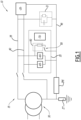
- An electrical installation 10 is shown on the figure 1 .
- the installation 10 comprises an electrical network 15, a load 20 and a first example of a device 25 for estimating the insulation impedance of the load 20.
- Power grid 15 is an alternative power grid.
- a frequency is defined for the network 15, which is the frequency of the alternating current flowing in the network 15.
- the frequency of the network 15 is, for example, between 45 hertz (Hz) and 66 Hz.
- the electrical network 15 comprises a transformer 30, at least one phase conductor 35, a neutral conductor 40 and at least one earth conductor 45.
- the transformer 30 is configured to impose a respective alternating electrical voltage between the neutral conductor 40 and each phase conductor 35, each of these conductors 35, 40 being connected to the transformer 30.
- the voltage imposed by transformer 30 is, for example, between 207 volts (V) and 253 V.
- the transformer 30 comprises at least one primary winding and at least one secondary winding, and is configured to generate the electrical voltage on its secondary winding(s) from one or more alternating electrical voltage(s) received on the primary winding(s), in a manner known per se.
- phase 35 conductors are likely to vary. For example, if network 15 is a single-phase network, one phase 35 conductor is present, and so on.
- the neutral conductor 40 is connected to earth.
- An impedance ZT is indicated on the figure 1 to represent the impedance of the neutral 40 connection to earth.
- the neutral conductor 40 is not galvanically isolated from earth.
- Each ground conductor 45 is configured to connect an electrical ground of all or part of the load 20 to ground.
- a single ground conductor 45 will be considered hereinafter, however it should be noted that the number of ground conductor(s) 45 is likely to vary. For example, each sub-part of the load 20 is likely to be connected to ground by a respective ground conductor 45 or by a single ground conductor 45 common to all the sub-parts of the load 20, as shown in FIG. figure 1 .
- Each earth conductor 45 is, for example, as shown in the figure 1 , connected to the neutral conductor 40 by a connection having an impedance ZPE.
- the network 15 is a so-called “TN” network.
- each earth conductor 45 is directly connected to earth via its impedance ZPE, without being connected to the neutral conductor 40.
- the network 15 is a so-called “TT” network.
- Each earth conductor 45 is, in particular, distinct from the neutral conductor 40.
- protective conductor is generally considered synonymous with the term “earth conductor.”
- the load 20 is formed by all the devices and installations arranged downstream of the transformer 30 and electrically supplied by the network 15.
- Load 20 is, for example, a single installation, or alternatively a set of separate installations independent of each other.
- the load 20 is, in particular, electrically connected to the phase conductor 35 or to several phase conductors 35, and to the neutral conductor 40.
- the load 20 has an electrical mass connected to the earth conductor 45.
- An isolation impedance Z i is defined for the load.
- the insulation impedance Z i is the electrical impedance between the load 20 and the earth conductor 45.
- insulation impedance Z i is likely to vary, for example in the event of an insulation fault between the load 20 and its ground.
- the estimating device 25 is configured to estimate the insulation impedance Zi of the load 20.
- the estimating device 25 is connected to the phase conductor 35 and to the neutral conductor 40 upstream of the load 20.
- the estimating device 25 is, furthermore, connected to the earth conductor 45.
- the estimation device 25 comprises an electrical circuit 50, a first switch 55, a first sensor 60, a second sensor 65 and a processing module 70.
- the electrical circuit 50 is connected between the phase conductor 35 and the earth conductor 45.
- the electrical circuit 50 is configured to be crossed by an electric current flowing between the phase conductor 35 and the earth conductor 45.
- the electrical circuit 50 is notably connected between the phase conductor 35 and the earth conductor 45 upstream of the load 20.
- the electrical circuit 50 has an impedance Z c .
- the impedance Z c is predetermined.
- the electrical circuit 50 is configured to switch between two distinct impedance values Z c , each impedance value Z c being predetermined.
- the electrical circuit 50 is, for example, formed by a single electrically conductive element having the impedance Z c .
- the element is, for example, an ohmic conductor.
- the electrical circuit 50 comprises a plurality of electrically conductive elements such as ohmic conductors, capacitors or even coils, which cooperate to form an electrical component whose impedance Z c is known.
- the impedance Z c is, for example, between 1 kilo ohm (k ⁇ ) and 500 k ⁇ , in particular equal to 300 k ⁇ .
- the first switch 55 is configured to switch between an open state and a closed state.
- the first switch 55 When the first switch 55 is in the open state, the first switch 55 blocks the passage of current flowing between the phase conductor 35 and the ground conductor 45 through the circuit 50.
- the first switch 55 When the first switch 55 is in the closed state, the first switch 55 allows the passage of current flowing between the phase conductor 35 and the earth conductor 45 through the circuit 50.
- the first switch 55 connects, for example, one end of the circuit 50 to the phase conductor 35. In this case, the other end of the circuit 50 is connected to the earth conductor 45.
- the first switch 55 connects one end of the circuit 50 to the earth conductor 45.
- the other end of the circuit 50 is connected to the phase conductor 35.
- the first switch 55 is, for example, a disconnector comprising two terminals, an actuator and an element movable by the actuator between an open position in which the movable element is distant from at least one of the terminals and a closed position in which the movable element electrically connects the two terminals together.
- one of the two terminals is for example connected to circuit 50 and the other terminal is connected either to phase conductor 35 or to earth conductor 45, as the case may be.
- first switches 55 are likely to be used.
- the first sensor 60 is configured to measure values of a voltage between the phase conductor 35 and the earth conductor 45.
- value of a voltage between the phase conductor and the earth conductor is understood to mean either a difference between an electrical potential of the phase conductor 35 and an electrical potential of the earth conductor 45 or a difference between two electrical potentials, this difference being representative of the difference between the electrical potential of the phase conductor 35 and the electrical potential of the earth conductor 45.
- the measured difference is, for example, proportional to the difference between the electrical potential of the phase conductor 35 and the electrical potential of the earth conductor 45.
- the first sensor 60 is, in particular, configured to measure first voltage values between the phase conductor 35 and the earth conductor 45 when the first switch is in the open state.
- the first sensor 60 is, in particular, configured to measure second voltage values between the phase conductor 35 and the earth conductor 45 when the first switch is in the closed state.
- the first sensor 60 is configured to transmit the first and second voltage values to the processing module 70.
- the first and second voltage values are in particular complex voltage values estimated from samples acquired by the first sensor 60 with a frequency multiple of the frequency of the network 15.
- the acquired voltage values include both a voltage module and a phase, a function of, among other things, the network frequency 15, of the voltage.
- the first sensor 60 is configured to acquire first voltage samples between the phase conductor 35 and the ground conductor 45 with a predetermined frequency, different from the network frequency and not an integer multiple thereof, while the first switch 55 is in the open state or in the closed state, respectively, and to estimate second voltage samples with a frequency multiple of the network frequency (i.e. to provide first or second values at repeated time instants with a frequency multiple of the network frequency) from the acquired samples, by interpolation.
- This technique is notably called “resampling”, since it involves generating voltage samples at a frequency adapted to the network frequency, from samples presenting a different frequency.
- the first and second voltage values are notably estimated from the first and second samples.
- the second sensor 65 is configured to measure values of a voltage between the neutral conductor 40 and the earth conductor 45.
- value of a voltage between the neutral conductor and the earth conductor is understood to mean either a difference between an electrical potential of the neutral conductor 40 and an electrical potential of the earth conductor 45 or a difference between two electrical potentials, this difference being representative of the difference between the electrical potential of the neutral conductor 40 and the electrical potential of the earth conductor 45.
- the measured difference is, for example, proportional to the difference between the electrical potential of the neutral conductor 40 and the electrical potential of the earth conductor 45.
- the second sensor 65 is, in particular, configured to measure third voltage values between the neutral conductor 40 and the earth conductor 45 when the first switch is in the open state.
- the second sensor 65 is, in particular, configured to measure fourth voltage values between the neutral conductor 40 and the earth conductor 45 when the first switch is in the closed state.
- the second sensor 65 is configured to transmit the third and fourth voltage values to the processing module 70.
- the third and fourth voltage values are in particular complex values estimated from samples acquired by the second sensor 65 with a frequency multiple of the frequency of the network 15.
- the second sensor 65 is configured to acquire third voltage samples between the neutral conductor 40 and the earth conductor 45 with a predetermined frequency, different from the network frequency and not an integer multiple thereof, while the first switch 55 is in the open state or in the closed state, respectively, and to estimate fourth voltage samples with a frequency multiple of the network frequency (i.e. to provide third or fourth values at repeated time instants with a frequency multiple of the network frequency) from the acquired samples, by interpolation.
- the third and fourth voltage values are notably estimated from the third and fourth samples.
- the processing module 70 is configured to estimate the insulation impedance Z i from first, second, third and fourth values measured by the first and second sensors 60, 65.
- V1, V2, V3 and V4 are respectively the first, second, third and fourth voltage values estimated by the first and second sensors 60, 65.
- the insulation impedance Z i , the impedance ZT and the impedance ZPE are not known. However, since the impedances ZT and ZPE participate in the calculation of the different values V1 to V4, the use of the latter makes it possible to obtain an equation which no longer depends on ZPE and ZT.
- the insulation impedance Z i Z c ⁇ V 4 V 3 ⁇ 1
- the first, second, third and fourth values are in particular complex voltage values, taken at network frequency 15 as mentioned previously.
- the processing module 70 is notably configured to control the acquisition of the first, second, third and fourth voltage values by the first and second sensors 60, 65, as well as to control the switching of the first switch 55 between its open and closed states.
- processing module 70 is configured to estimate the frequency of the network 15, in a manner known per se.
- the processing module 70 is notably configured to implement a method for estimating the insulation impedance Z i .
- the processing module 70 comprises, for example, a processor and a memory containing software instructions, the execution of which causes the implementation of this method.
- the processing module 70 is constituted by one or more dedicated electronic circuits such as printed circuits, or by a set of programmable logic components.
- the method comprises a first measurement step 200, a switching step 210, a second measurement step 220, an estimation step 230 and a comparison step 240.
- the first switch 55 is in the open state.
- the first sensor 60 and the second sensor 65 each acquire a first or third respective voltage value, following receipt of a command to this effect transmitted by the processing module 70.
- the first and third values are acquired simultaneously.
- the first and third values are, in particular, evaluated via a Fourier transform from the resampled samples.
- the processing module 70 controls the switching of the first switch 55 from the open state to the closed state.
- the first switch 55 is in the closed state.
- the first sensor 60 and the second sensor 65 each acquire, simultaneously, a second or fourth respective voltage value, following receipt of a command to this effect transmitted by the processing module 70.
- the second and fourth values are, in particular, evaluated via a Fourier transform from the resampled samples.
- the first switch 55 is then switched back to its open state at the end of the second measurement step 220.
- steps 200 and 220 may be reversed.
- the processing module 70 estimates the impedance Z; from the first, second, third and fourth measured values, and from the impedance Z c of the circuit 50, according to equation (1).
- the evaluated insulation impedance Z i is compared to one or more thresholds.
- the real part of the insulation impedance Z i is compared to a first impedance threshold and the imaginary part of the insulation impedance is compared to a second impedance threshold.
- the modulus of the insulation impedance Z i is compared to a modulus threshold.
- an alert is generated for either an operator or a device capable of interrupting the current flowing in the network 15.
- the alert is generated if the real part, the imaginary part and/or the modulus is greater than the corresponding threshold.
- the insulation impedance Z i is evaluated in a simple manner without requiring the measurement of a current, and therefore without an associated current sensor.
- the estimation device 25 is easier to integrate and more precise than the estimation devices of the state of the art.
- the processing module 70 can estimate the frequency of the network and adapt accordingly the frequency of acquisition of the voltage samples by the sensors 60, 65, the impedance Z i is estimated more precisely. In particular, this makes it possible to overcome transient effects which can occur immediately after the opening or closing of the switch 55.
- Resampling allows the use of 60, 65 sensors with a fixed sampling frequency, and therefore little complexity, since the acquired samples are resampled from the initial samples.
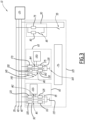
- the second example installation 10 includes a second example estimation device 25.
- the circuit 50 comprises a first electrical component 75, a second electrical component 80 and a second switch 85.
- electrical component will be understood in this description as relating to either a single electrically conductive element such as an ohmic conductor, a capacitor or a coil, or a set of such elements connected to each other and which can be considered as a single component having a known impedance.
- an electrical component may consist of two electrically conductive elements connected to each other in series or in parallel.
- the first electrical component 75 is configured to be crossed by an electric current when the first switch 55 is in the closed state, regardless of the state of the second switch 85.
- the first electrical component 75 has a first impedance Z1.
- the first impedance Z1 is predetermined.
- the first impedance Z1 is a resistance between 10 k ⁇ and 500 k ⁇ , in particular equal to 300 k ⁇ .
- the second electrical component 80 is connected in parallel with the first electrical component 75.
- the second electrical component 80 is connected by one of its terminals to the phase conductor 35 and by the other of its terminals to the second switch 85, the latter connecting the second electrical component 80 to the first switch 55.
- the second electrical component 80 has a second predetermined impedance Z c2 .
- the second impedance Z2 is, for example, an electrical resistance.
- the second impedance Z2 has, in particular, a module strictly lower than a module of the first impedance Z1.
- the second impedance Z2 is an electrical resistance between 10 k ⁇ and 300 k ⁇ , in particular equal to 16 k ⁇ .
- the second switch 85 is configured to switch between a first state and a second state.
- the second switch 85 When the second switch 85 is in the first state, shown in the figure 3 , the second switch prevents the passage of a current flowing between the phase conductor 35 and the earth conductor 45 and passing through the second component 80 if the first switch 55 is in its closed state.
- the impedance Z c of the circuit 50 is the impedance Z1.
- the second switch 85 When the second switch 85 is in the second state, the second switch allows the passage of a current flowing between the phase conductor 35 and the earth conductor 45 and passing through the second component 80 regardless of the state of the first switch 55.
- the impedance Z c of the circuit 50 corresponds to the combination of the impedances Z1 and Z2 in parallel, here equal to 15.2k ⁇ .
- the first sensor 60 comprises a first voltage divider 90, a second voltage divider 95 and a first measuring module 100.
- the first voltage divider 90 comprises a third electrical component 105 and a fourth electrical component 110.
- the third component 105 and the fourth component 110 are connected in series with each other between the phase conductor 35 and an intermediate point 115.
- a midpoint M1 is defined for the first voltage divider, which is the point to which the third component 105 and the fourth component 110 are connected.
- the third component 105 connects the phase conductor 35 to the midpoint M1.
- the third component 105 has a third impedance Z3.
- the third impedance Z3 is, for example, an electrical resistance, notably between 100 k ⁇ and 50 M ⁇ .
- the third impedance Z3 is equal to 4.4 MegOhm (M ⁇ ), and is obtained by connecting in series two ohmic conductors of 2.2 M ⁇ each.
- the fourth component 110 connects the midpoint M1 to the intermediate point 115.
- the fourth component 110 has a fourth impedance Z4.
- the fourth impedance Z4 has a modulus strictly lower than the modulus of the third impedance Z3.
- a ratio between the modules of the third and fourth impedances is between 10000 and 100, in particular equal to 4400/1.3.
- the fourth component 110 is, for example, constituted by a 22 nanofarad (nF) capacitor and a 1.3 k ⁇ ohmic conductor, connected in parallel between the midpoint M1 and the intermediate point 115.
- the intermediate point 115 is the measurement reference (0 V), determined by the power supply.
- the second voltage divider 95 comprises a fifth electrical component 120 and a sixth electrical component 125.
- the fifth electrical component 120 and the sixth electrical component 125 are connected in series to each other between the ground conductor 45 and the intermediate point 115.
- a midpoint M 2 is defined for the second voltage divider 95, which is the point at which the fifth electrical component 120 and the sixth electrical component 125 are connected.
- the fifth electrical component 120 connects the earth conductor 45 to the midpoint M2.
- the fifth electrical component 120 has a fifth impedance Z5.
- the fifth impedance Z5 is, for example, an electrical resistance, notably between 100 k ⁇ and 50 M.
- the fifth impedance Z5 is equal to 4.4 MegOhm (M ⁇ ), and is obtained by connecting in series two ohmic conductors of 2.2 M ⁇ each.
- the fifth impedance Z5 is, for example, equal to the third impedance Z3.
- the sixth electrical component 125 connects the midpoint M2 to the intermediate point 115.
- the sixth electrical component 125 has a sixth impedance Z6.
- the sixth impedance Z6 has a modulus strictly lower than the modulus of the fifth impedance Z5.
- a ratio between the modules of the fifth and sixth impedances is between 100 ⁇ and 100k ⁇ , in particular equal to 4400/1.3.
- the sixth electrical component 125 is, for example, constituted by a 22 nanofarad (nF) capacitor and a 1.3 k ⁇ ohmic conductor, connected in parallel between the midpoint M2 and the intermediate point 115.
- the sixth impedance Z6 is, for example, equal to the fourth impedance Z4.
- the first measuring module 100 is configured to measure voltage values between the two midpoints M1 and M2.
- the first measuring module 100 is, for example, a digital/analog converter capable of converting the voltage between the minuses M1 and M2 into a digital signal.
- the voltage between the two midpoints M1 and M2 is proportional to the difference in electrical potential between the phase conductor 40 and the earth conductor 45.
- the second sensor 65 comprises a third voltage divider 130, a fourth voltage divider 135, a third switch 140, an electrical injection component 145 and a second measurement module 150.
- the third voltage divider 130 comprises a seventh electrical component 155 and an eighth electrical component 160.
- the seventh electrical component 155 and the eighth electrical component 160 are connected in series with each other between the neutral conductor 40 and an intermediate point 165.
- a midpoint M3 is defined for the third voltage divider 130, which is the point at which the seventh electrical component 155 and the eighth electrical component 160 are connected.
- the seventh component 155 connects the neutral conductor 40 to the midpoint M3.
- the seventh component 155 has a seventh impedance Z7.
- the seventh impedance Z7 is, for example, an electrical resistance, notably between 100 k ⁇ and 50 M ⁇ .
- the seventh impedance Z7 is equal to 4.4 M ⁇ , and is obtained by connecting in series two ohmic conductors of 2.2 M ⁇ each.
- the eighth component 160 connects the midpoint M3 to the intermediate point 165.
- the eighth component 160 has an eighth impedance Z8.
- the eighth impedance Z8 has a modulus strictly lower than the modulus of the seventh impedance Z7.
- a ratio between the modules of the seventh and eighth impedances is between 1 and 10000, in particular equal to 4510/110.
- the eighth impedance Z8 is, for example, constituted by a 22 nanofarad (nF) capacitor and a 110 k ⁇ ohmic conductor, connected in parallel between the midpoint M3 and the intermediate point 165.
- the fourth voltage divider 135 includes a ninth electrical component 170 and a tenth electrical component 175.
- the ninth electrical component 170 and the tenth electrical component 175 are connected in series to each other between the ground conductor 45 and the intermediate point 165.
- a midpoint M 4 is defined for the fourth voltage divider, which is the point to which the ninth electrical component 170 and the tenth electrical component 175 are both connected.
- the ninth electrical component 170 connects the earth conductor 45 to the midpoint M3.
- the ninth electrical component 170 has a ninth impedance Z9.
- the ninth impedance Z9 is, for example, an electrical resistance, notably between 1000 ⁇ and 50 M ⁇ .
- the ninth impedance Z9 is equal to 4.4 M ⁇ , and is obtained by connecting in series two ohmic conductors of 2.2 M ⁇ each.
- the ninth impedance Z9 is, for example, equal to the seventh impedance Z7.
- the tenth electrical component 175 connects the midpoint M4 to the intermediate point 165.
- the tenth electrical component 175 has a tenth impedance Z10.
- the tenth impedance Z10 has a modulus strictly lower than the modulus of the ninth impedance Z9.
- a ratio between the modules of the ninth and tenth impedances is between 1 and 10000, in particular equal to 4510/110.
- the sixth electrical component 125 is, for example, constituted by a 22 nanofarad (nF) capacitor and a 110 k ⁇ ohmic conductor, connected in parallel between the midpoint M4 and the intermediate point 165.
- the tenth impedance Z10 is, for example, equal to the eighth impedance Z8.
- the injection component 145 is connected in parallel with the component 155 between the neutral conductor and the midpoint M3.
- the injection component 145 is notably connected by one of its terminals to the neutral conductor 40 and by the other of its terminals to the third switch 140.
- Component 145 has an impedance called injection impedance Z inj .
- the impedance Z inj in particular has a module strictly lower than the module of the impedance Z7 of the component 155.
- Component 145 is, for example, an ohmic conductor having a resistance between 100 ⁇ and 10 M ⁇ .
- the third switch 140 is configured to switch between a third state in which the switch 140 isolates the midpoint M3 of the component 145 and a fourth state in which the switch 140 connects the midpoint M3 to the component 145.
- the switch 140 and the injection component 145 are reversed, the switch 140 then connecting the component 145 to the neutral conductor 40.
- the switches 85 and 55 are also capable of being moved, in particular by being connected between the components 75, 80 and the phase conductor 35.
- the second measuring module 150 is configured to measure voltage values between the two midpoints M3 and M4.
- the second measuring module 150 is, for example, a digital/analog converter capable of converting the voltage between the minuses M1 and M2 into a digital signal.
- the voltage between the two midpoints M3 and M4 is proportional to the difference in electrical potential between the neutral conductor 40 and the earth conductor 45.
- a gain is defined for the second measuring module 150.
- the gain is a coefficient of correspondence between the voltage between the points M3 and M4 and a signal generated by the second measurement module 150, the signal being used by the second measurement module 150 to estimate the voltage measured between the points M3 and M4.
- the signal is generated by an amplifier which amplifies the voltage between the points M3 and M4 by a factor equal to the gain.
- the amplifier is for example part of an amplification stage at the input of the measurement module 150.
- the second measurement module 150 is notably configured to adjust the gain between a minimum gain value and a maximum gain value.
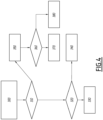
- a flow chart of the steps implemented by the second example of estimation device 25, during the estimation method, during the first measurement step 200 is shown in the figure 4 .
- the first measurement step 200 comprises steps 300, 310, 320, 330, 340, 350, 360, 370 and 380.
- the three switches 55, 85 and 140 are open and therefore block the flow of current.
- the second sensor 65 acquires a third initial voltage value between the neutral conductor 40 and the earth conductor 45, the gain having the minimum gain value.
- step 310 the third initial value is compared to a first predetermined voltage threshold.
- the modulus of the third initial value is compared to the first voltage threshold.
- the first threshold is, for example, between 5 V and 100 V, in particular equal to 50 Volts (V).
- step 320 If the third initial value is less than or equal to the first threshold, step 320 is implemented. Otherwise, step 350 is implemented.
- step 320 the third initial value is compared to a second predetermined voltage threshold.
- the modulus of the third initial value is compared to the second voltage threshold.
- the second voltage threshold is strictly lower than the first voltage threshold.
- the second threshold is between 0.1 percent (%) and 90% of the first voltage threshold.
- the second voltage threshold is equal to 2V.
- step 330 is implemented. Otherwise, step 340 is implemented.
- step 330 the processing module 70 controls the increase in the gain of the second sensor 65.
- processing module 70 controls the closing of at least one switch among the second switch 85 and the third switch 140.
- the processing module 70 then commands the measurement of a new third value as well as a first value by the sensors 60, 65.
- the injection component 145 Since the injection component 145 is connected in parallel with the component 155, the current flowing through the components 160, 170 and 175 is higher than if the switch 140 were open, and the voltage between the points M3 and M4 is therefore higher, which improves the accuracy of the measurement of the new third value.
- the processing module 70 controls the implementation of steps 210 to 240, using the new third value.
- the switch 85 since the switch 85 is closed and therefore allows a current to flow through the component 80, the current injected into the earth conductor 45 from the phase conductor 35 is higher than if the switch 85 were closed. The accuracy of the measurement is therefore improved.
- step 340 the processing module 70 controls the increase in the gain of the second sensor 65 but keeps the second switch 85 and the third switch 140 open.
- step 340 the processing module 70 controls measurement of the first value and the implementation of steps 210 to 240.
- step 350 the first and third values are measured simultaneously by the sensors 60, 65.
- step 360 a phase shift between the first and third values is measured and compared to a third threshold.
- the absolute value of the phase shift is compared to the third threshold.
- the third threshold is, for example, between 5° and 90°, in particular equal to 20 degrees (°).
- step 370 is implemented. Otherwise, step 380 is implemented.
- step 370 the processing module 70 controls the implementation of steps 210 to 240 after the end of step 380.
- the processing module 70 generates an alert, intended for an operator or a remote device, in particular a device comprising a switch capable of cutting off the current in the network 15.
- the alert contains information indicating that the imaginary part of the insulation impedance Z i is too high.
- the processing module 70 controls the implementation of steps 210 to 240 after the end of step 380.
- one or more of the switches 55, 85, 140 further comprises a cleaning contact connected to the neutral conductor by a cleaning resistor having an impedance less than or equal to 300 k ⁇ , for example equal to 23 k ⁇ if the voltage of the network 15 is 230 V, which would correspond to a current of 0.01 A flowing through the cleaning contact.
- Each of the switches 55, 85, 140 comprises an element movable between several positions, this element being connected to a first electrical contact when the switch 55, 85, 140 is closed and being distant from this first contact when the switch 55, 85, 140 is open.
- the movable element is also provided to be connected to the cleaning contact, for example when the switch 55, 85, 140 is open and prevents current flow through the components 75, 80 and 160, or when it is desired to clean the switch 55, 85, 140.
- pairs of voltage dividers 90, 95, 130, 135 makes it possible to measure simply and accurately the voltage between the phase conductor 35 or the neutral conductor 40 and the earth conductor 45.
- components 80 and 145, as well as switches 140 and 85 makes it possible, if necessary, to inject more current either into the second sensor 65 or into the earth conductor 45, and thus to increase the precision of the measurement carried out without having to modify the setting of the measuring device 25, or to improve this precision for cases where the maximum gain would prove insufficient.
- the gain modification also makes it possible to ensure good measurement accuracy in a simple manner even in the absence of switches 85 and 140.
- phase shift between the currents of conductors 35 and 40 provides information on the reactance of the insulation impedance Z i and therefore on the occurrence of anomalies such as the presence of significant capacitances in the filters or excessive length of the cables (for example).
- FIG 5 there is shown, as an example, a mode of implementation of the estimation device 25 of the figure 1 in a “TT” type network. It then appears that the device 25 is arranged and connected in the same way in a TT network as in a TN network, and operates in an identical manner.
Landscapes
- Physics & Mathematics (AREA)
- General Physics & Mathematics (AREA)
- Measurement Of Resistance Or Impedance (AREA)
Claims (13)
- Vorrichtung (25) zum Schätzen des Isolationswiderstands eines TT- oder TN-Wechselstromnetzes (15), umfassend einen geerdeten Nullleiter (40), mindestens einen Phasenleiter (35) und einen Erdungsleiter (45), der mit der Erde des Netzes (15) verbunden ist, das Netz (15) ferner umfassend eine Last (20), die mit mindestens dem Phasenleiter (35) und dem Nullleiter (40) verbunden ist, wobei der Isolationswiderstand der Widerstand zwischen der Last (20) und dem Erdungsleiter (45) ist, die Vorrichtung (25) dazu bestimmt ist, mit dem Nullleiter (40), dem Phasenleiter (35) und dem Erdungsleiter (45) stromaufwärts von der Last (20) verbunden zu werden, die Vorrichtung umfassend- eine elektrische Schaltung (50), die einen Widerstand mit einem vorbestimmten Wert aufweist und zwischen dem Phasenleiter (35) und dem Erdungsleiter (45) verbunden ist,- einen ersten Schalter (55), der konfiguriert ist, um zwischen einem offenen Zustand, in dem der erste Schalter (55) den Durchgang eines Stroms zwischen dem Phasenleiter (35) und dem Erdungsleiter (45) durch die elektrische Schaltung (50) sperrt, und einem geschlossenen Zustand, in dem der erste Schalter (55) den Durchgang eines Stroms zwischen dem Phasenleiter (35) und dem Erdungsleiter (45) durch die elektrische Schaltung (50) zulässt, umzuschalten,- einen ersten Sensor (60), der konfiguriert ist, um einen ersten Wert einer Spannung zwischen dem Phasenleiter (35) und dem Erdungsleiter (45) zu messen, wenn der erste Schalter (55) in dem offenen Zustand ist, und um einen zweiten Wert der Spannung zwischen dem Phasenleiter (35) und dem Erdungsleiter (45) zu messen, wenn der erste Schalter (55) in dem geschlossenen Zustand ist,- einen zweiten Sensor (65), der konfiguriert ist, um einen dritten Wert einer Spannung zwischen dem Nullleiter (40) und dem Erdungsleiter (45) zu messen, wenn der erste Schalter (55) in dem offenen Zustand ist, und um einen vierten Wert der Spannung zwischen dem Nullleiter (40) und dem Erdungsleiter (45) zu messen, wenn der erste Schalter (55) in dem geschlossenen Zustand ist, und- ein Verarbeitungsmodul (70), das konfiguriert ist, um den Widerstand der Isolierung anhand des vorbestimmten Werts des Widerstands und des ersten, des zweiten, des dritten und des vierten gemessenen Werts zu schätzen, wobei das Verarbeitungsmodul (70) dadurch gekennzeichnet ist, dass es konfiguriert ist, um eine Frequenz des in dem Phasenleiter (35) fließenden Stroms zu schätzen, die Messung von ersten Spannungsabtastwerten mit einer Frequenz, die ein Vielfaches der berechneten Frequenz ist, durch den ersten und den zweiten Sensor (60, 65) zu steuern und den ersten, den zweiten, den dritten und den vierten Wert anhand der gemessenen ersten Abtastwerte zu schätzen.
- Vorrichtung nach Anspruch 1, wobei das Verarbeitungsmodul (70) konfiguriert ist, um den Widerstand der Isolierung gemäß der folgenden Gleichung zu schätzen:

- Vorrichtung nach Anspruch 1 oder 2, wobei jeder erste oder zweite Sensor (60, 65) zwei Spannungsteiler (90, 95, 130, 135) in Reihe umfasst, jeder Spannungsteiler (90, 95, 130, 135) umfassend mindestens zwei Komponenten (105, 110, 120, 125, 155, 160, 170, 175), die an einem Mittelpunkt (M1, M2, M3, M4) in Reihe verbunden sind, wobei jeder erste oder zweite Sensor (60, 65) konfiguriert ist, um die entsprechende Spannung zwischen den Mittelpunkten (M1, M2, M3, M4) der zwei Spannungsteiler (90, 95, 130, 135) des betrachteten ersten oder zweiten Sensors (60, 65) zu messen.
- Vorrichtung nach Anspruch 3, wobei der zweite Sensor (65) einen ersten Spannungsteiler (130) und einen zweiten Spannungsteiler (135) umfasst, wobei der erste Spannungsteiler (130) den zweiten Spannungsteiler (135) mit dem Nullleiter (40) verbindet, der erste Spannungsteiler (130) umfassend eine erste Komponente (155) und eine zweite Komponente (160), die zwischen die erste Komponente (155) und den zweiten Spannungsteiler (135) eingefügt ist, wobei der Mittelpunkt (M3) des ersten Teilers (130) zwischen die erste Komponente (155) und die zweite Komponente (160) eingefügt ist, der zweite Sensor (65) ferner umfassend eine dritte Komponente (145), die mit dem Nullleiter (40) verbunden ist, und einen zweiten Schalter (140), der konfiguriert ist, um zwischen einem ersten Zustand, in dem der zweite Schalter (140) den Mittelpunkt (M3) von der dritten Komponente (145) isoliert, und einem zweiten Zustand, in dem der zweite Schalter (140) den Mittelpunkt (M3) mit der dritten Komponente (145) verbindet, umzuschalten.
- Vorrichtung nach Anspruch 4, wobei das Verarbeitungsmodul (70) zu Folgendem konfiguriert ist:- Steuern der Messung eines dritten Werts zu steuern, wenn der zweite Schalter (140) in dem ersten Zustand ist,- Vergleichen des dritten Werts mit einem ersten vorbestimmten Spannungsschwellenwert,- Steuern des Umschaltens des zweiten Schalters (140) in den zweiten Zustand, wenn der dritte Wert kleiner als oder gleich wie der erste Schwellenwert ist, und- Steuern der Erfassung, durch den zweiten Sensor (65), eines neuen dritten Werts, wenn der zweite Schalter (140) in dem zweiten Zustand ist, und Schätzen des Isolationswiderstands anhand des neuen dritten Werts.
- Vorrichtung nach einem der Ansprüche 1 bis 5, die elektrische Schaltung (50) umfassend eine vierte Komponente (75), die konfiguriert ist, um von einem elektrischen Strom durchquert zu werden, wenn der erste Schalter (55) geschlossen ist, eine fünfte elektrische Komponente (80), die parallel zu der vierten Komponente (75) zwischen dem Phasenleiter (35) und dem Erdungsleiter (45) verbunden ist, und einen dritten Schalter (85), der konfiguriert ist, um zwischen einem dritten Zustand, in dem der dritte Schalter (85) den Durchgang eines Stroms zwischen dem Phasenleiter (35) und dem Erdungsleiter (45) durch die fünfte Komponente (80) unabhängig vom Zustand des ersten Schalters (55) sperrt, und einem vierten Zustand, in dem der dritte Schalter (85) den Durchgang eines Stroms zwischen dem Phasenleiter (35) und dem Erdungsleiter (45) durch die fünfte Komponente (80) zulässt, wenn der erste Schalter (55) in dem geschlossenen Zustand ist, umzuschalten.
- Vorrichtung nach Anspruch 6, wobei das Verarbeitungsmodul (70) zu Folgendem konfiguriert ist:- Messen eines anfänglichen Werts des Isolationswiderstands, wenn der dritte Schalter (85) in dem dritten Zustand ist,- Vergleichen des anfänglichen Werts mit einem zweiten vorbestimmten Schwellenwert,- Steuern des Umschaltens des dritten Schalters (85) in den vierten Zustand, wenn der anfängliche Wert größer als oder gleich wie der zweite Schwellenwert ist, und- Steuern der Erfassung von mindestens einem ersten, zweiten, einem dritten und einem vierten Wert, wenn der dritte Schalter (85) in dem vierten Zustand ist, und Schätzen eines neuen Werts des Isolationswiderstands anhand des ersten, des zweiten, des dritten und des vierten gemessenen Werts, wenn der dritte Schalter (85) in dem vierten Zustand ist.
- Vorrichtung nach einem der Ansprüche 1 bis 7, wobei jeder erste oder zweite Sensor (60, 65) konfiguriert ist, um zweite Spannungsabtastwerte mit einer vorbestimmten Frequenz zu bestimmen und um die ersten Abtastwerte durch Interpolation anhand der abgetasteten Werte zu bestimmen.
- Verfahren zum Schätzen eines Isolationswiderstands eines TT- oder TN-Wechselstromnetzes (15), umfassend einen geerdeten Nullleiter (40), mindestens einen Phasenleiter (35) und einen Erdungsleiter (45), der mit der Erde des Netzes verbunden ist, das Netz (15) ferner umfassend eine Last (20), die mit mindestens dem Phasenleiter (35) und dem Nullleiter (40) verbunden ist, wobei der Isolationswiderstand der Widerstand zwischen der Last (20) und dem Erdungsleiter (45) ist, wobei das Verfahren durch eine Vorrichtung (25) durchgeführt wird, die mit dem Nullleiter (40), dem Phasenleiter (35) und dem Erdungsleiter (45) stromaufwärts von der Last (20) verbunden ist, die Vorrichtung (25) umfassend eine elektrische Schaltung (50), die einen Widerstand mit einem vorbestimmten Wert aufweist und zwischen dem Phasenleiter (35) und dem Erdungsleiter (45) verbunden ist, die Vorrichtung (25) ferner umfassend einen ersten Schalter (55), der konfiguriert ist, um zwischen einem offenen Zustand, in dem der erste Schalter (55) den Durchgang eines Stroms zwischen dem Phasenleiter (35) und dem Erdungsleiter (45) durch die elektrische Schaltung (50) sperrt, und einem geschlossenen Zustand, in dem der erste Schalter (55) den Durchgang eines Stroms zwischen dem Phasenleiter (35) und dem Erdungsleiter (45) durch die elektrische Schaltung zulässt, umzuschalten,
das Verfahren umfassend die folgenden Schritte:- Messen (200) eines ersten Werts einer Spannung zwischen dem Phasenleiter (35) und dem Erdungsleiter (45) durch einen ersten Sensor (60), wenn der erste Schalter (55) in dem offenen Zustand ist,- Messen (200) eines dritten Werts einer Spannung zwischen dem Nullleiter (40) und dem Erdungsleiter (45) durch einen zweiten Sensor (65), wenn der erste Schalter (55) in dem offenen Zustand ist,- Umschalten (210) des ersten Schalters (55) in den geschlossenen Zustand,- Messen (220) eines zweiten Werts der Spannung zwischen dem Phasenleiter (35) und dem Erdungsleiter (45) durch den ersten Sensor (60), wenn der erste Schalter (55) in dem geschlossenen Zustand ist,- Messen (220) eines vierten Werts der Spannung zwischen dem Nullleiter (40) und dem Erdungsleiter (45), wenn der erste Schalter (55) im geschlossenen Zustand ist, durch den zweiten Sensor (65),- Schätzen (230) des Widerstand der Isolierung anhand des vorbestimmten Werts des Widerstands und des ersten, des zweiten, des dritten und des vierten gemessenen Werts, und Schätzen einer Frequenz des in dem Phasenleiter (35) fließenden Stroms, um die Messung von ersten Spannungsabtastwerten mit einer Frequenz, die ein Vielfaches der berechneten Frequenz ist, durch den ersten und den zweiten Sensor (60, 65) zu steuern und um den ersten, den zweiten, den dritten und den vierten Wert anhand der gemessenen ersten Abtastwerte zu schätzen. - Verfahren nach Anspruch 9, wobei der zweite Sensor (65) einen ersten Spannungsteiler (130) und einen zweiten Spannungsteiler (135) in Reihe umfasst, die zwischen dem Nullleiter (40) und dem Erdungsleiter (45) in Reihe verbunden sind, jeder erste oder zweite Spannungsteiler (130, 135) umfassend mindestens zwei Komponenten (155, 160, 170, 175), die an einem Mittelpunkt (M3, M4) in Reihe verbunden sind, wobei der zweite Sensor (65) konfiguriert ist, um die entsprechende Spannung zwischen den Mittelpunkten (M3, M4) der zwei Spannungsteiler (130, 135) zu messen,
der erste Spannungsteiler (130) den zweiten Spannungsteiler (135) mit dem Nullleiter (40) verbindet und eine erste Komponente (155) und eine zweite Komponente (160) umfasst, die zwischen die erste Komponente (155) und den zweiten Spannungsteiler (135) eingefügt ist, wobei der Mittelpunkt (M3) des ersten Teilers (130) zwischen die erste Komponente (155) und die zweite Komponente (160) eingefügt ist, der zweite Sensor (65) ferner umfassend eine dritte Komponente (145), die mit dem Nullleiter (40) verbunden ist, und einen zweiten Schalter (140), der konfiguriert ist, um zwischen einem ersten Zustand, in dem der zweite Schalter (140) den Mittelpunkt (M3) des ersten Teilers (130) von der dritten Komponente (140) isoliert, und einem zweiten Zustand, in dem der zweite Schalter (140) den Mittelpunkt (M3) mit der dritten Komponente (145) verbindet, umzuschalten, das Verfahren ferner umfassend die folgenden Schritte:- Messen (300) eines dritten anfänglichen Werts, wenn der zweite Schalter (140) in dem ersten Zustand ist,- Vergleichen (310) des dritten Werts mit einem ersten vorbestimmten Spannungsschwellenwert,- Umschalten (320) des zweiten Schalters in den zweiten Zustand, wenn der dritte Wert kleiner als oder gleich wie der erste Schwellenwert ist,- Erfassen (330), durch den ersten Sensor, eines neuen dritten Werts, wenn der zweite Schalter in dem zweiten Zustand ist, und- Schätzen (230) des Isolationswiderstands anhand des neuen dritten Werts. - Verfahren nach Anspruch 9 oder 10, umfassend, wenn der vierte anfängliche Wert strikt über einem zweiten Schwellenwert ist, der strikt über dem ersten Schwellenwert ist, die folgenden Schritte:- Messen (350) einer Phasenverschiebung zwischen der Spannung zwischen dem Phasenleiter (35) und dem Erdungsleiter (45) und der Spannung zwischen dem Nullleiter (40) und dem Erdungsleiter (45),- Vergleichen (360) der Phasenverschiebung mit einem dritten Schwellenwert, und- wenn die Phasenverschiebung größer als der dritte Schwellenwert ist, Senden (380) einer Warnung durch die Schätzvorrichtung (25) an einen Bediener oder eine Vorrichtung, die von der Schätzvorrichtung (25) verschieden ist.
- Verfahren nach Anspruch 11, wobei die elektrische Schaltung (50) eine vierte Komponente (75) umfasst, die konfiguriert ist, um von einem elektrischen Strom durchquert zu werden, wenn der erste Schalter (55) geschlossen ist, eine fünfte elektrische Komponente (80), die parallel zu der vierten Komponente (75) zwischen dem Phasenleiter (35) und dem Erdungsleiter (45) verbunden ist, und einen dritten Schalter (85), der konfiguriert ist, um zwischen einem dritten Zustand, in dem der dritte Schalter (85) den Durchgang eines Stroms zwischen dem Phasenleiter (35) und dem Erdungsleiter (45) durch die fünfte Komponente (80) unabhängig vom Zustand des ersten Schalters (55) sperrt, und einem vierten Zustand, in dem der dritte Schalter (85) den Durchgang eines Stroms zwischen dem Phasenleiter (35) und dem Erdungsleiter (45) durch die fünfte Komponente (80) zulässt, wenn der erste Schalter (55) in dem geschlossenen Zustand ist, umzuschalten, das Verfahren umfassend die folgenden Schritte:- Umschalten (320) des dritten Schalters (85) in den vierten Zustand, wenn der dritte anfängliche Wert größer als oder gleich wie der zweite Schwellenwert ist, und- Erfassen mindestens eines ersten, eines zweiten, eines dritten und eines vierten Werts, wenn der dritte Schalter (85) in dem vierten Zustand ist, und- Schätzen (230) des Isolationswiderstands anhand des ersten, des zweiten, des dritten und des vierten gemessenen Werts, wenn der dritte Schalter (85) in dem vierten Zustand ist.
- Verfahren nach Anspruch 12, ferner umfassend, wenn der dritte anfängliche Wert strikt über dem ersten Schwellenwert und kleiner als oder gleich wie der zweite Schwellenwert ist, einen Schritt (340) eines Anpassens einer Verstärkung des zweiten Sensors (65) und eines Messens des vierten Werts mit der angepassten Verstärkung.
Priority Applications (1)
| Application Number | Priority Date | Filing Date | Title |
|---|---|---|---|
| EP21305626.0A EP4089422B1 (de) | 2021-05-12 | 2021-05-12 | Vorrichtung und verfahren zur schätzung der isolationsimpedanz eines tt- oder tn-netzes |
Applications Claiming Priority (1)
| Application Number | Priority Date | Filing Date | Title |
|---|---|---|---|
| EP21305626.0A EP4089422B1 (de) | 2021-05-12 | 2021-05-12 | Vorrichtung und verfahren zur schätzung der isolationsimpedanz eines tt- oder tn-netzes |
Publications (3)
| Publication Number | Publication Date |
|---|---|
| EP4089422A1 EP4089422A1 (de) | 2022-11-16 |
| EP4089422C0 EP4089422C0 (de) | 2025-01-01 |
| EP4089422B1 true EP4089422B1 (de) | 2025-01-01 |
Family
ID=76217777
Family Applications (1)
| Application Number | Title | Priority Date | Filing Date |
|---|---|---|---|
| EP21305626.0A Active EP4089422B1 (de) | 2021-05-12 | 2021-05-12 | Vorrichtung und verfahren zur schätzung der isolationsimpedanz eines tt- oder tn-netzes |
Country Status (1)
| Country | Link |
|---|---|
| EP (1) | EP4089422B1 (de) |
Family Cites Families (7)
| Publication number | Priority date | Publication date | Assignee | Title |
|---|---|---|---|---|
| JPS585672A (ja) | 1981-07-01 | 1983-01-13 | Toyo Commun Equip Co Ltd | 絶縁抵抗検出方法 |
| WO1998058432A1 (de) | 1997-06-17 | 1998-12-23 | Dipl.-Ing. Walther Bender Gmbh & Co. Kg | Verfahren und einrichtung zur isolations- und fehlerstromüberwachung in einem elektrischen wechselstromnetz |
| DE10355086B4 (de) | 2003-11-24 | 2018-06-14 | Bender Gmbh & Co. Kg | Verfahren zum Bestimmen des ohmschen Isolationswiderstandes eines geerdeten Wechselstromnetzes |
| JP2006220520A (ja) * | 2005-02-10 | 2006-08-24 | Honda Motor Co Ltd | 非接地直流電源の絶縁抵抗測定装置及びその方法 |
| FR3007844B1 (fr) * | 2013-06-26 | 2015-07-17 | Schneider Electric Ind Sas | Dispositif d'estimation de l'impedance d'une liaison electrique de terre, procede d'estimation et systeme d'alimentation electrique associes |
| KR102742037B1 (ko) * | 2019-01-03 | 2024-12-13 | 주식회사 엘지에너지솔루션 | 절연저항 측정 장치 및 방법 |
| EP3990934A1 (de) * | 2019-06-28 | 2022-05-04 | Elpro GmbH | Vorrichtung und verfahren zur überwachung von geschirmten dc-stromkabeln |
-
2021
- 2021-05-12 EP EP21305626.0A patent/EP4089422B1/de active Active
Also Published As
| Publication number | Publication date |
|---|---|
| EP4089422A1 (de) | 2022-11-16 |
| EP4089422C0 (de) | 2025-01-01 |
Similar Documents
| Publication | Publication Date | Title |
|---|---|---|
| FR3019303B1 (fr) | Dispositif de mesure d'au moins une grandeur physique d'une installation electrique | |
| CA2344241C (fr) | Procede et dispositif pour la localisation d'un defaut d'isolement d'un cable electrique | |
| EP0518785B1 (de) | Anordnung zur Überwachung und Messung der Isolierung für elektrische Netze mit isoliertem Nulleiter | |
| EP2820433B1 (de) | Elektrizitätszähler und verfahren zur feststellung des zustandes eines schutzschalters einer mit diesem zähler verbundenen vorrichtung | |
| EP3715874B1 (de) | Stromzähler, der einen schaltkreis zur erkennung eines offenen oder geschlossenen zustands eines leistungsschalters umfasst | |
| FR3019304A1 (fr) | Procede de mesure de la consommation energetique des branches d'un reseau electrique et equipement de mesure mettant en oeuvre ledit procede | |
| EP2909909B1 (de) | Schutzeinrichtung für eine mehrzahl von gleichspannungsquellen | |
| EP0595677B1 (de) | Verfahren und Vorrichtung zum Messen der Anpassung und Fehlanpassung der Kompensation eines Stromversorgungsnetzes | |
| EP4089422B1 (de) | Vorrichtung und verfahren zur schätzung der isolationsimpedanz eines tt- oder tn-netzes | |
| EP0592337B1 (de) | Elektronischer Auslöser mit Erdschutz | |
| FR2690573A1 (fr) | Dispositif de contrôle de défaut homopolaire dans un réseau de distribution électrique. | |
| EP4105670B1 (de) | Detektion der öffnung eines externen transformators | |
| EP0591011B1 (de) | Einrichtung zum Feststellen von Fehlern auf einem unterirdischen elektrischen Energieverteilungsnetz | |
| WO2021234240A1 (fr) | Mesure de la tension dans un câble mono-conducteur isolé | |
| CN116148648B (zh) | 检测断路器的断开或闭合状态 | |
| EP1290456A1 (de) | Verfahren zur detektion von widerstandsbehafteten fehlern | |
| EP1083644B1 (de) | Lichtbogenstromsensitiver Erdfehlerschutz, Auslöser und Schutzschalter mit einer solchen Vorrichtung | |
| WO2009144083A1 (fr) | Procede et systeme de detection d'un courant secondaire residuel dans un transformateur de courant dans un reseau electrique haute tension, et de detection de la formation d'un arc dans un disjoncteur | |
| EP2200058B1 (de) | Verfahren zur Bestimmung eines geeigneten Moments zum Ausschalten eines Umschaltmittels | |
| EP4492598A1 (de) | Verfahren zur überprüfung der eignung für restströme von differentialschutzschaltern | |
| EP0554188A1 (de) | Gerät zur Messung elektrischer Grössen | |
| FR3118182A1 (fr) | Procédé de contrôle d’état de serrage d’une installation électrique dispositif et système associés | |
| EP3798648A1 (de) | Verfahren zur bestimmung der position einer fehlervorstufe in einem in betrieb befindlichen hochspannungskabel | |
| BE867549A (fr) | Procede et appareil d'essai de reseau telephonique | |
| FR2556102A1 (fr) | Appareil de mesure de la symetrie d'impedance par rapport a la terre d'un equipement de telecommunication a paires symetriques |
Legal Events
| Date | Code | Title | Description |
|---|---|---|---|
| PUAI | Public reference made under article 153(3) epc to a published international application that has entered the european phase |
Free format text: ORIGINAL CODE: 0009012 |
|
| STAA | Information on the status of an ep patent application or granted ep patent |
Free format text: STATUS: THE APPLICATION HAS BEEN PUBLISHED |
|
| AK | Designated contracting states |
Kind code of ref document: A1 Designated state(s): AL AT BE BG CH CY CZ DE DK EE ES FI FR GB GR HR HU IE IS IT LI LT LU LV MC MK MT NL NO PL PT RO RS SE SI SK SM TR |
|
| STAA | Information on the status of an ep patent application or granted ep patent |
Free format text: STATUS: REQUEST FOR EXAMINATION WAS MADE |
|
| 17P | Request for examination filed |
Effective date: 20230504 |
|
| RBV | Designated contracting states (corrected) |
Designated state(s): AL AT BE BG CH CY CZ DE DK EE ES FI FR GB GR HR HU IE IS IT LI LT LU LV MC MK MT NL NO PL PT RO RS SE SI SK SM TR |
|
| GRAP | Despatch of communication of intention to grant a patent |
Free format text: ORIGINAL CODE: EPIDOSNIGR1 |
|
| STAA | Information on the status of an ep patent application or granted ep patent |
Free format text: STATUS: GRANT OF PATENT IS INTENDED |
|
| RIC1 | Information provided on ipc code assigned before grant |
Ipc: G01R 31/52 20200101ALI20240829BHEP Ipc: G01R 27/02 20060101AFI20240829BHEP |
|
| INTG | Intention to grant announced |
Effective date: 20240930 |
|
| GRAS | Grant fee paid |
Free format text: ORIGINAL CODE: EPIDOSNIGR3 |
|
| GRAA | (expected) grant |
Free format text: ORIGINAL CODE: 0009210 |
|
| STAA | Information on the status of an ep patent application or granted ep patent |
Free format text: STATUS: THE PATENT HAS BEEN GRANTED |
|
| AK | Designated contracting states |
Kind code of ref document: B1 Designated state(s): AL AT BE BG CH CY CZ DE DK EE ES FI FR GB GR HR HU IE IS IT LI LT LU LV MC MK MT NL NO PL PT RO RS SE SI SK SM TR |
|
| REG | Reference to a national code |
Ref country code: GB Ref legal event code: FG4D Free format text: NOT ENGLISH |
|
| REG | Reference to a national code |
Ref country code: DE Ref legal event code: R096 Ref document number: 602021024221 Country of ref document: DE |
|
| REG | Reference to a national code |
Ref country code: CH Ref legal event code: EP |
|
| REG | Reference to a national code |
Ref country code: IE Ref legal event code: FG4D Free format text: LANGUAGE OF EP DOCUMENT: FRENCH |
|
| U01 | Request for unitary effect filed |
Effective date: 20250108 |
|
| U07 | Unitary effect registered |
Designated state(s): AT BE BG DE DK EE FI FR IT LT LU LV MT NL PT RO SE SI Effective date: 20250116 |
|
| U20 | Renewal fee for the european patent with unitary effect paid |
Year of fee payment: 5 Effective date: 20250526 |
|
| PG25 | Lapsed in a contracting state [announced via postgrant information from national office to epo] |
Ref country code: PL Free format text: LAPSE BECAUSE OF FAILURE TO SUBMIT A TRANSLATION OF THE DESCRIPTION OR TO PAY THE FEE WITHIN THE PRESCRIBED TIME-LIMIT Effective date: 20250101 |
|
| PG25 | Lapsed in a contracting state [announced via postgrant information from national office to epo] |
Ref country code: ES Free format text: LAPSE BECAUSE OF FAILURE TO SUBMIT A TRANSLATION OF THE DESCRIPTION OR TO PAY THE FEE WITHIN THE PRESCRIBED TIME-LIMIT Effective date: 20250101 |
|
| PGFP | Annual fee paid to national office [announced via postgrant information from national office to epo] |
Ref country code: GB Payment date: 20250526 Year of fee payment: 5 |
|
| PG25 | Lapsed in a contracting state [announced via postgrant information from national office to epo] |
Ref country code: IS Free format text: LAPSE BECAUSE OF FAILURE TO SUBMIT A TRANSLATION OF THE DESCRIPTION OR TO PAY THE FEE WITHIN THE PRESCRIBED TIME-LIMIT Effective date: 20250501 Ref country code: NO Free format text: LAPSE BECAUSE OF FAILURE TO SUBMIT A TRANSLATION OF THE DESCRIPTION OR TO PAY THE FEE WITHIN THE PRESCRIBED TIME-LIMIT Effective date: 20250401 |
|
| PG25 | Lapsed in a contracting state [announced via postgrant information from national office to epo] |
Ref country code: HR Free format text: LAPSE BECAUSE OF FAILURE TO SUBMIT A TRANSLATION OF THE DESCRIPTION OR TO PAY THE FEE WITHIN THE PRESCRIBED TIME-LIMIT Effective date: 20250101 |
|
| PG25 | Lapsed in a contracting state [announced via postgrant information from national office to epo] |
Ref country code: GR Free format text: LAPSE BECAUSE OF FAILURE TO SUBMIT A TRANSLATION OF THE DESCRIPTION OR TO PAY THE FEE WITHIN THE PRESCRIBED TIME-LIMIT Effective date: 20250402 |
|
| PG25 | Lapsed in a contracting state [announced via postgrant information from national office to epo] |
Ref country code: CZ Free format text: LAPSE BECAUSE OF FAILURE TO SUBMIT A TRANSLATION OF THE DESCRIPTION OR TO PAY THE FEE WITHIN THE PRESCRIBED TIME-LIMIT Effective date: 20250101 |
|
| PG25 | Lapsed in a contracting state [announced via postgrant information from national office to epo] |
Ref country code: SM Free format text: LAPSE BECAUSE OF FAILURE TO SUBMIT A TRANSLATION OF THE DESCRIPTION OR TO PAY THE FEE WITHIN THE PRESCRIBED TIME-LIMIT Effective date: 20250101 |
|
| PG25 | Lapsed in a contracting state [announced via postgrant information from national office to epo] |
Ref country code: SK Free format text: LAPSE BECAUSE OF FAILURE TO SUBMIT A TRANSLATION OF THE DESCRIPTION OR TO PAY THE FEE WITHIN THE PRESCRIBED TIME-LIMIT Effective date: 20250101 |
|
| PLBE | No opposition filed within time limit |
Free format text: ORIGINAL CODE: 0009261 |
|
| STAA | Information on the status of an ep patent application or granted ep patent |
Free format text: STATUS: NO OPPOSITION FILED WITHIN TIME LIMIT |
|
| REG | Reference to a national code |
Ref country code: CH Ref legal event code: L10 Free format text: ST27 STATUS EVENT CODE: U-0-0-L10-L00 (AS PROVIDED BY THE NATIONAL OFFICE) Effective date: 20251112 |
|
| 26N | No opposition filed |
Effective date: 20251002 |
|
| REG | Reference to a national code |
Ref country code: CH Ref legal event code: H13 Free format text: ST27 STATUS EVENT CODE: U-0-0-H10-H13 (AS PROVIDED BY THE NATIONAL OFFICE) Effective date: 20251223 |
|
| PG25 | Lapsed in a contracting state [announced via postgrant information from national office to epo] |
Ref country code: CH Free format text: LAPSE BECAUSE OF NON-PAYMENT OF DUE FEES Effective date: 20250531 |
|
| PG25 | Lapsed in a contracting state [announced via postgrant information from national office to epo] |
Ref country code: MC Free format text: LAPSE BECAUSE OF FAILURE TO SUBMIT A TRANSLATION OF THE DESCRIPTION OR TO PAY THE FEE WITHIN THE PRESCRIBED TIME-LIMIT Effective date: 20250101 |