EP4086331B1 - Wc-stein umfassend zwei unterschiedliche zusammensetzungen mit pigmenten - Google Patents
Wc-stein umfassend zwei unterschiedliche zusammensetzungen mit pigmenten Download PDFInfo
- Publication number
- EP4086331B1 EP4086331B1 EP21172204.6A EP21172204A EP4086331B1 EP 4086331 B1 EP4086331 B1 EP 4086331B1 EP 21172204 A EP21172204 A EP 21172204A EP 4086331 B1 EP4086331 B1 EP 4086331B1
- Authority
- EP
- European Patent Office
- Prior art keywords
- composition
- toilet
- pigments
- block
- phase
- Prior art date
- Legal status (The legal status is an assumption and is not a legal conclusion. Google has not performed a legal analysis and makes no representation as to the accuracy of the status listed.)
- Active
Links
Images
Classifications
-
- C—CHEMISTRY; METALLURGY
- C11—ANIMAL OR VEGETABLE OILS, FATS, FATTY SUBSTANCES OR WAXES; FATTY ACIDS THEREFROM; DETERGENTS; CANDLES
- C11D—DETERGENT COMPOSITIONS; USE OF SINGLE SUBSTANCES AS DETERGENTS; SOAP OR SOAP-MAKING; RESIN SOAPS; RECOVERY OF GLYCEROL
- C11D17/00—Detergent materials or soaps characterised by their shape or physical properties
- C11D17/0047—Detergents in the form of bars or tablets
- C11D17/0056—Lavatory cleansing blocks
-
- C—CHEMISTRY; METALLURGY
- C11—ANIMAL OR VEGETABLE OILS, FATS, FATTY SUBSTANCES OR WAXES; FATTY ACIDS THEREFROM; DETERGENTS; CANDLES
- C11D—DETERGENT COMPOSITIONS; USE OF SINGLE SUBSTANCES AS DETERGENTS; SOAP OR SOAP-MAKING; RESIN SOAPS; RECOVERY OF GLYCEROL
- C11D17/00—Detergent materials or soaps characterised by their shape or physical properties
- C11D17/04—Detergent materials or soaps characterised by their shape or physical properties combined with or containing other objects
- C11D17/041—Compositions releasably affixed on a substrate or incorporated into a dispensing means
-
- C—CHEMISTRY; METALLURGY
- C11—ANIMAL OR VEGETABLE OILS, FATS, FATTY SUBSTANCES OR WAXES; FATTY ACIDS THEREFROM; DETERGENTS; CANDLES
- C11D—DETERGENT COMPOSITIONS; USE OF SINGLE SUBSTANCES AS DETERGENTS; SOAP OR SOAP-MAKING; RESIN SOAPS; RECOVERY OF GLYCEROL
- C11D3/00—Other compounding ingredients of detergent compositions covered in group C11D1/00
- C11D3/40—Dyes ; Pigments
Definitions
- Toilet cleaning blocks also known as toilet blocks, have long been used to clean, disinfect and scent toilets under the bowl edge (so-called rim blocks) and in the water tank (in-tank blocks or cistern blocks).
- rim blocks and in the water tank
- in-tank blocks or cistern blocks In recent years, aesthetics and performance have become increasingly important. This has led, for example, to the development of solid, gel or liquid scented air fresheners, some of which are offered in multi-chamber containers, allowing the combination of a cleaning agent, which is released when the toilet is flushed, with permanent room scenting.
- a rim block is formed from a single composition.
- the composition is extruded, the strand is cut and, if necessary, formed.
- Rim blocks that have two different compositions have also been known for some time. This makes it possible to combine different active substances, such as dyes, fragrances in the form of perfume oils, or biocides in the toilet block.
- a toilet block with several compositions can produce a different release profile than is possible with a toilet block with one composition.
- a first active substance can be used in the first composition and a second active substance in the second composition. If, for example, only the first active substance is compatible with the first composition, i.e. for chemical or physicochemical reasons, the second active substance cannot be used in the first composition, the use of an additional second composition, which contains the second active ingredient, but both active ingredients are used in the toilet block.
- Toilet blocks are made of DE 699 34 422 T2 , WO 2006/070209 A1 and EP 3 628 726 A1 known.
- Toilet blocks that contain two different compositions are known from the state of the art.
- the use of different compositions makes it possible to refine the profile of the fragrance or colorant release and can contribute to a more appealing appearance of the toilet block.
- the task was therefore to provide a shapely and aesthetically pleasing coloured toilet block that would be evenly rinsed throughout its entire service life and, in particular, would have an appealing aesthetic appearance.
- a toilet block comprising at least one first composition and one second composition, wherein the one first composition and the one second composition at least partially form the surface of the toilet block; and the first composition and/or the second composition comprises a pigment and wherein the toilet block has a spherical geometry.
- the first composition and the second composition form a spiral pattern on the surface of the toilet block.
- pigments are colorants, i.e. coloring substances, which are present in the composition as solid particles and are insoluble in water. These are to be distinguished from conventional “dyes”, which are water-soluble.
- Pigments include colored pigments and white pigments.
- White pigments are therefore also to be understood as pigments according to the invention, with particular mention being made of titanium dioxide, lithopone, barium sulfate, zinc oxide (zinc white), zinc sulfide and lead carbonate (lead white), with titanium oxide being preferred.
- Calcium aluminate sulfate is also a suitable white pigment.
- Titanium dioxide is a preferred white pigment.
- colored pigments are understood to mean pigments that have a color.
- Colorful pigments are therefore understood to mean all pigments that are not white pigments.
- Preferred embodiments comprise combinations of white pigment and/or colored pigment for the first composition and the second composition, respectively.
- the pigments are preferably contained in the composition in an amount of 0.0001 to 20 wt.%, more preferably in an amount of 0.001 to 5 wt.% based on the entire toilet block.
- the first composition comprises a colored pigment.
- the second composition can optionally contain a white pigment.
- the white phase can also contain no pigment, which means that this phase is then free of pigment and, of course, also free of water-soluble dyes.
- the one first composition comprises a colored pigment and the one second composition comprises a white pigment.
- the one first composition comprises a colored pigment and a white pigment and the one second composition comprises a colored pigment.
- the first composition comprises a colored pigment and a white pigment and the second composition comprises a colored pigment and a white pigment.
- the first composition and the second composition are essentially free of water-soluble dyes.
- the toilet block is completely free of water-soluble dyes and contains only pigments as coloring agents.
- the most important industrial pigments can be divided into eight classes of substances. These are titanium dioxide, carbon black, bismuth pigments, oxides and Hydroxides, iron cyan blue, ultramarine, cadmium pigments and chromate pigments.
- the group of oxides and hydroxides is further divided into iron oxide pigments, chromium oxide and mixed phase oxide pigments such as Rinman's green - the latter with the subgroups spinel pigments, hematite pigments, inverse spinel pigments and rutile derivatives.
- the group of chromate pigments is further divided into chrome yellow, chrome green and molybdates.
- Pigments typically form in the form of primary particles.
- the primary particles can grow together to form aggregates via their surfaces.
- Agglomerates are when primary particles and/or aggregates are connected via their corners/edges.
- the toilet block is described, wherein the first composition and the second composition form a spiral pattern on the surface of the toilet block.
- a spiral also known as a snail line, is a curve that runs around a point or an axis and moves away from or closer to this center depending on the observer's perspective.
- Titanium oxide is a white pigment, which is also referred to as a pigment in connection with the present invention.
- the first composition and/or a second composition comprising titanium dioxide as a pigment and containing no other pigments or dyes.
- the phase formed by the corresponding composition has a white appearance.
- extrusion refers to a process in which one or more compositions are pressed out of an opening under pressure, preferably continuously.
- the opening is also known to a person skilled in the art as a profile nozzle.
- the resulting body with the cross-section of the opening is called an extrudate.
- coextrusion refers to an extrusion process wherein at least a first composition and a second composition are brought together in an extrusion head or also called an extruder head.
- the extruder head forms a passageway, one end of the passageway being formed by a profile nozzle through which the combined compositions can exit as an extrudate.
- the passage in the extruder head has a side wall.
- the first composition and the second composition are brought together in the extruder head such that the first composition is in spatial contact with a partial area of the side wall of the extruder head and the second composition is in spatial contact with another partial area of the side wall of the extruder head.
- Such an arrangement differs in particular from a concentric coextrusion, in which a first composition is completely in spatial contact with the side wall of the extruder head and a second composition is extruded concentrically within the first composition, ie the second composition is not in spatial contact with the side wall of the extruder head. In the extrudate, the second composition is thus concentrically enclosed by the first composition.
- the extrudate according to the invention and thus also The toilet block according to the invention therefore differs significantly from such a concentric extrudate known from the prior art.
- the first composition comprises a first active ingredient and the second composition comprises a second active ingredient, wherein the first active ingredient and the second active ingredient differ from each other.
- the first active substance is a first dye and the second active substance is a second dye.
- the first active substance is a first fragrance and the second active substance is a second fragrance.
- the production of the toilet block comprises a molding step after the coextrusion step.
- the compositions form the surface of the toilet block in substantially equal proportions.
- the spherical shape according to the invention has the advantage that, due to its symmetrical geometry, the toilet block can be rinsed essentially evenly, i.e. the water can run off evenly on all sides.
- Such symmetry is particularly advantageous for a toilet block that comprises two compositions that essentially make up the surface of the toilet block in equal proportions. In conjunction with the symmetry of the toilet block, this results in both compositions being released simultaneously into the flushing water.
- the two compositions are "interwoven" on the surface in such a way that the two compositions are interwoven in streaks and are thus distributed completely evenly over the surface.
- Such a distribution of the compositions on the surface of the stone can be achieved in particular by simultaneously cutting and ball-forming a cylindrical (non-concentric) coextrudate.
- a spherical shape is also particularly advantageous because it is evenly rinsed due to the highly symmetrical geometry of the toilet blocks. Rinsing water is directed evenly along the surface of the sphere and comes into even contact with the entire surface of the block.
- the invention preferably comprises a toilet block and a method for producing a toilet block, wherein the extrudate is cut into smaller units.
- the invention preferably comprises a toilet block and a method for producing a toilet block, wherein the extrudate is cut into smaller units of approximately the same size.
- a method for producing the toilet block is described as an example, wherein the passage is essentially cylindrical.
- the circumference of the partial cylinder of the extrudate that corresponds to the first composition can be different from the circumference of the partial cylinder that corresponds to the second composition. This makes it possible to tailor the appearance and release profile of the toilet block. It is possible, for example, for the first composition to form a partial cylinder with a 3/4 circumference and the second composition to form a partial cylinder with a 1/4 circumference. It is also possible, for example, for the first composition to form a partial cylinder with a 2/3 circumference and the second composition to form a partial cylinder with a 1/3 circumference. However, it is preferred that the two compositions each form a half cylinder. In other words, if the passage is essentially cylindrical, the extrusion strand preferably has half cylinders of the same size.
- a method for producing the toilet block wherein the partial region of the side wall of the passage with which the first composition is in contact and the partial region of the side wall of the passage with which the second composition is in contact have a substantially equal area.
- the invention relates to a device comprising at least one toilet block according to one of the preceding claims, wherein the at least one toilet block is present in a chamber of the device, wherein the device can be attached to the edge of a toilet.
- the device has at least two, preferably at least three and more preferably at least four toilet blocks.
- the dispensing device consists of a container which has an inlet opening at its head end through which flushing water can enter the container via the flushing water distribution element.
- the flushing water entering the container dissolves some of the toilet cleaning block stored in the container, whereby the flushing water, now loaded with the corresponding preparation, leaves the container via the outlet opening and is thus dispensed into the interior of the toilet bowl.
- the flush water distribution element is shaped like a plate. In addition, however, tub-like, slide-like or ramp-like shapes and any combination of these are also possible.
- the flush water distribution element engages the flush water flow of the toilet bowl, whereby the main flow direction of the flush water flow is usually directed downwards in the direction of gravity.
- the flush water flow is broken by the flush water distribution element, which acts like a baffle plate, and distributed over the surface of the flush water distribution element.
- the surface of the flush water distribution element facing the flush water flow can have liquid-conducting and/or liquid-distributing structures, such as transverse and/or longitudinal grooves, capillaries or grids.
- the flushing water distribution element can further comprise an opening through which flushing water can flow into the inlet opening of the container.
- the toilet basket shown has a holding element by which the toilet basket can be detachably attached to the edge of a toilet bowl by a user.
- the holder has a first spring element and a second spring element, wherein when the toilet flusher is installed in the toilet, the first spring element has a substantially vertical spring travel and the second spring element has a substantially horizontal spring travel, thereby enabling an improved and more flexible fixation of the toilet basket to toilets with different bowl edge thicknesses and designs.
- the dispensing device has a plate-like flush water distribution element which, when the dispensing device is installed in a toilet bowl, extends directly from below the inlet opening of the container in the direction of the toilet rim.
- the passage has an internal cross-sectional area which is preferably approximately 1 to 10 cm 2 and more preferably 2 to 5 cm 2 .
- the passage has an internal diameter which is preferably between 15 mm and 30 mm, more preferably between 15 and 25 mm and more preferably between 18 mm and 22 mm.
- the ball volume is preferably 2 cm 3 to 20 cm 3 , more preferably 5 cm 3 to 15 cm 3 and more preferably 8 cm 3 to 9 cm 3 .
- the ball diameter is preferably 10 mm to 40 mm, more preferably 15 mm to 30 mm and more preferably 22 mm to 28 mm.
- the ball weight is preferably 5 to 30 g, more preferably 5 to 20 g and more preferably 10 to 15 g.
- the invention relates to a method for producing a solid toilet block comprising a coextrusion step, wherein the at least one first composition and a second composition, before leaving a profile nozzle, are brought together in a passage of an extrusion head such that the first composition is in spatial contact with a portion of the side wall of the passage and the second composition is in spatial contact with another part of the side wall.
- the method is designed such that the method further comprises: at least one cutting step, wherein the forming step cuts the extrudate into smaller units.
- the method is designed such that the method further comprises: at least one cutting step, wherein the extrudate is cut into smaller units by the shaping step.
- the cutting step preferably takes place substantially simultaneously with a shaping step, wherein the shaping step is preferably a sphere shaping step.
- the method is designed such that the method further comprises: a forming step, wherein the extrudate is formed into a sphere by the forming step and the toilet block thus essentially has a spherical geometry.
- the strand is cut to dimensions that are similar in all three spatial directions. Subsequent ball forming or spherical shaping is possible, but not absolutely necessary.
- the method is designed such that the cutting step and the shaping step are carried out simultaneously.
- the strand is cut by rotating rollers and simultaneously shaped into a ball by the roller mold.
- Such methods are known for extrudates with a single composition from the production of chocolate balls.
- it was surprisingly found that such methods for extrudates with two compositions interweave the two compositions in a spiral shape, i.e. like streaks.
- Puricolor Violet PVI 23-L & was used as the violet pigment and PV Fast Green GNX as the green pigment.
- Solvaperm Blue 2B was used as the blue dye, while Duasyn Brilliant Red F3B-SF Liquid was used as the red dye.
- the quantities given are proportional weight percentages based on the total weight of the toilet block.
- toilet blocks were provided with a colored phase 1 and a white phase 2, with at least one pigment being used (colored pigment in phase 1 and/or titanium dioxide as a white pigment in phase 2).
- at least one pigment being used (colored pigment in phase 1 and/or titanium dioxide as a white pigment in phase 2).
- Particularly spectacular results were seen here when a colored pigment was used in the first phase and titanium dioxide as a white pigment in the second phase. Even if titanium dioxide is not absolutely necessary for coloring in the white phase, it does stabilize the phase boundary additionally.
- phase boundary can be further stabilized by additionally using titanium dioxide in one of the two phases and, even more preferably, in both phases.
- the spherical toilet blocks were obtained according to the described non-concentric coextrusion process.
- the two phases showed a spiral, intertwined course.
- Phase 1 or “Phase 2” corresponds to the first composition or the second composition, respectively, according to the terminology otherwise used in the application.
- the toilet blocks were placed in a device, attached to the edge of a toilet and tested by flushing, with all toilet blocks showing essentially uniform flushing of the two compositions.
- compositions can contain only anionic surfactants, only non-ionic surfactants or mixtures of these. Cationic surfactants are also conceivable.
- the compositions listed are therefore only examples and should not be understood as limiting.
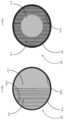
- Figure 1 shows an extruder head (105) having a passage (110) which is used in a method for producing a solid toilet block according to the prior art.
- the extruder head provides an extrudate having at least a first composition (121) and a second composition (122).
- the first composition and the second composition differ from each other.
- the production of the toilet block comprises a coextrusion step which takes place concentrically.
- the first composition is in spatial contact with the entire side wall of the passage (110a), while the second composition is not in spatial contact with the side wall of the passage.
- Figure 2 shows an extruder head (205) having a cylindrical passage (210) which is used in a method for producing a solid toilet block according to the invention.
- the extruder head provides an extrudate having at least a first composition (221) and a second composition (222).
- the first composition and the second composition differ from one another.
- the production of the toilet block comprises a coextrusion step which takes place non-concentrically.
- the first composition is in spatial contact with a partial area of the side wall of the passage (210a), while the second composition is in contact with another partial area of the side wall (210b) of the cylindrical passage.
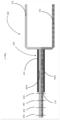
- Figure 3 shows a device (300) comprising an extruder head (305) having a passage (310), which is used in a method to produce a solid toilet block according to the invention.
- the extruder head provides an extrudate comprising at least a first composition (321) and a second composition (322).
- the first composition and the second composition differ from one another.
- the production of the toilet block comprises a coextrusion step which is carried out non-concentrically.
- the first composition is in spatial contact with a partial area of the side wall of the passage (310a), while the second composition is in contact with another partial area of the side wall (310b) of the passage.
- the initially separated strands are combined in the extruder head.
- the coextruded strand is passed through a Profile nozzle (312) is pressed out of the extruder head.
- One or more cutting steps follow.
- the method is designed such that the block is divided into smaller units by several cuts. The cuts can be made simultaneously or at different times.
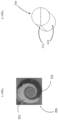
- Figure 4 shows a WC block (402) which was manufactured by means of a coextrusion step which is carried out non-concentrically.
- the WC block consists of two half cylinders, one half cylinder consisting of a first composition (421) and the other half cylinder consisting of a second composition (422).
- the toilet block shown was obtained without a subsequent ball forming step, ie the cylindrical extrudate was only cut and thus divided into smaller pieces.
- Figure 5 shows a toilet block (502) that was produced by means of a coextrusion step that is non-concentric.
- the extrudate which consists of two half-cylinders, one half-cylinder consisting of a first composition (521) and the other half-cylinder consisting of a second composition (522), was cut into smaller pieces and formed by means of a ball-forming step, i.e. the cylindrical extrudate was cut and formed into a ball.
- a ball-forming step the two compositions are "interwoven" with one another on the surface and form a spiral pattern, the two compositions being interwoven with one another in a streak-like manner and occupying approximately equal areas of the surface of the toilet block.
- Such a distribution of the compositions on the surface of the block can be achieved in particular by simultaneously cutting and ball-forming a cylindrical (non-concentric) coextrudate.
- the cylindrical coextrudate is positioned between two rotating rollers that "cut" the elongated strand into the individual toilet blocks and at the same time form each block into a ball.
- Such processes are known from the field of chocolate ball production.
- Manufacturers of corresponding machines known as rolling machines for chocolate balls include, for example, the company Krüger & Salecker Maschinenbau GmbH & Co. KG, with the ARM 0252 - 0601 type being particularly preferred.
- the phase boundaries are extended and, due to the curved spiral course, are particularly susceptible to color diffusion. The phase boundaries are therefore particularly "blurred".
- the effect according to the invention which occurs when at least one of the compositions contains pigments, and thus the phases can be clearly separated from one another, is therefore particularly striking.
Landscapes
- Chemical & Material Sciences (AREA)
- Life Sciences & Earth Sciences (AREA)
- Engineering & Computer Science (AREA)
- Chemical Kinetics & Catalysis (AREA)
- Oil, Petroleum & Natural Gas (AREA)
- Wood Science & Technology (AREA)
- Organic Chemistry (AREA)
- Detergent Compositions (AREA)
Description
- WC-Reinigungsstücke, auch als WC-Steine bekannt, werden bereits seit langem zur Reinigung, Desinfektion und Beduftung von Toiletten unter dem Beckenrand (sogenannte Rimblocks) sowie im Wasserkasten (In-tank-Blocks oder cistern blocks) eingesetzt. Dabei haben in den letzten Jahren die Ästhetik und die Leistung eine immer größere Bedeutung erlangt. Dies führte beispielsweise zur Entwicklung fester oder gelförmiger oder flüssiger Duftspüler, die teilweise in Mehrkammerbehältnissen angeboten werden und so die Kombination eines Reinigungsmittels, welches bei Betätigung der WC-Spülung abgegeben wird, mit einer permanenten Raumbeduftung erlauben.
- Üblicherweise wird ein Rimblock aus einer einzigen Zusammensetzung gebildet. Dabei wird die Zusammensetzung extrudiert, der Strang geschnitten und gegebenenfalls geformt.
- Seit einiger Zeit sind auch Rimblocks bekannt, die zwei unterschiedliche Zusammensetzungen aufweisen. Hierdurch wird ermöglicht, unterschiedliche Aktivstoffe, wie Farbstoffe, Duftstoffe in Form von Parfümölen, oder Biozide in dem WC-Block zu kombinieren. Durch einen WC-Block mit mehreren Zusammensetzungen kann ein anderes Freisetzungsprofil erzeugt werden, als dies im Falle eines WC-Blocks mit einer Zusammensetzung möglich ist. Durch Verwendung von wenigstens zwei Zusammensetzungen kann in der ersten Zusammensetzung ein erster Aktivstoff verwendet werden und in der zweiten Zusammensetzung ein zweiter Aktivstoff. Wenn z.B. nur der erste Aktivstoff mit der ersten Zusammensetzung kompatibel ist, d.h. aus chemischen Gründen oder physikochemischen Gründen, der zweite Aktivstoff nicht in der ersten Zusammensetzung eingesetzt werden kann, können durch den Einsatz einer zusätzlichen zweiten Zusammensetzung, die den zweiten Aktivstoff enthält, dennoch beide Aktivstoffe in dem WC-Stein eingesetzt werden.
-
- Aus dem Stand der Technik sind also WC-Steine bekannt, die zwei unterschiedliche Zusammensetzungen umfassen. Die Verwendung unterschiedlicher Zusammensetzungen ermöglicht das Profil der Duftstoff- bzw. Farbstofffreisetzung zu verfeinern und kann zu einer ansprechenderen Optik des WC-Steins beitragen.
- Es stellte sich daher die Aufgabe, einen formschönen und ästhetischen farbigen WC-Stein bereitzustellen, der während seiner gesamten Lebensdauer gleichmäßig abgespült wird und insbesondere ein ansprechendes ästhetisches Erscheinungsbild aufweist.
- Die Aufgabe wird durch gelöst durch einen WC-Stein aufweisend wenigstens eine erste Zusammensetzung und eine zweite Zusammensetzung, wobei die eine erste Zusammensetzung als auch die eine zweite Zusammensetzung wenigstens teilweise die Oberfläche des WC-Steins bilden; und
die eine erste Zusammensetzung und/oder die zweite Zusammensetzung ein Pigment umfasst und wobei der WC-Stein eine Kugelgeometrie aufweist. Die eine erste Zusammensetzung und die eine zweite Zusammensetzung bilden ein spiralförmiges Muster auf der Oberfläche des WC-Steins. - Es zeigt sich überraschenderweise, dass durch die Verwendung von Pigmenten in wenigstens einer der beiden Phasen die Tendenz der Farben zwischen den Phasen zu diffundieren deutlich vermindert werden konnte. Während in Fällen, in denen keine der beiden Zusammensetzungen Pigmente enthält, die Phasengrenzen "verwischen", waren in den Fällen, in denen wenigstens eine der Zusammensetzungen Pigmente enthält, die Phasen klar voneinander abgegrenzt. Die WC-Steine gemäß der Erfindung waren insgesamt deutlich optisch ansprechender als die WC-Steine ohne Pigmente.
- Im Zusammenhang mit der vorliegenden Erfindung sind "Pigmente" Farbmittel, also farbgebende Substanzen, welche in der Zusammensetzung als Feststoff-Partikel vorliegen und wasserunlöslich sind. Hiervon zu unterscheiden sind herkömmliche "Farbstoffe", welche wasserlöslich sind.
- Pigmente umfassen bunte Pigmente und Weißpigmente.
- Weißpigmente sind also ebenfalls als Pigmente gemäß der Erfindung zu verstehen, wobei insbesondere Titandioxid, Lithopone, Bariumsulfat, Zinkoxid (Zinkweiß), Zinksulfid Bleicarbonat (Bleiweiß) zu nennen sind, wobei Titanoxid bevorzugt ist. Auch Calcium Aluminatsulphat ist ein geeignetes Weißpigment. Titandioxid ist ein bevorzugtes Weißpigment. Als "bunte Pigmente" werden im Zusammenhang mit der vorliegenden Anmeldung Pigmente verstanden, die eine Farbigkeit aufwiesen. Als "bunte Pigmente" sind also alle Pigmente verstanden, die keine Weißpigmente sind.
- Bevorzugte Ausführungsformen umfassen für die erste Zusammensetzung bzw. die zweite Zusammensetzung Kombinationen von Weißpigment und/oder buntem Pigment.
- Die Pigmente sind in der Zusammensetzung bevorzugt in einer Menge von 0,0001 bis 20 Gew.-% enthalten, weiter bevorzugt in eine Menge von 0,001 bis 5 Gew.-% bezogen auf den gesamten WC-Stein.
- Gemäß einer bevorzugten Ausführungsform weist die eine erste Zusammensetzung ein buntes Pigment auf.
- Sofern die zweite Phase als weiße Phase gewählt wird, kann die zweite Zusammensetzung optional ein Weißpigment aufweisen. Allerdings kann die weiße Phase auch kein Pigment aufweisen, womit die diese Phase dann frei von Pigment und selbstverständlich auch frei von wasserlöslichen Farbstoffen ist.
- Gemäß einer bevorzugten Ausführungsform weist die eine erste Zusammensetzung ein buntes Pigment auf und die eine zweite Zusammensetzung weist ein weißes Pigment auf.
- Gemäß einer bevorzugten Ausführungsform weist die eine erste Zusammensetzung ein buntes Pigment und ein Weißpigment auf und die eine zweite Zusammensetzung weist ein buntes Pigment auf.
- Gemäß einer besonders bevorzugten Ausführungsform weist die eine erste Zusammensetzung ein buntes Pigment auf und ein Weißpigment auf und die eine zweite Zusammensetzung weist ein buntes Pigment und ein Weißpigment auf.
- Gemäß einer bevorzugten Ausführungsform ist die erste Zusammensetzung und die zweite Zusammensetzung im Wesentlichen frei von wasserlöslichen Farbstoffen. Insbesondere ist der WC-Stein insgesamt frei von wasserlöslichen Farbstoffen und weist ausschließlich Pigmente als Färbemittel auf.
- Chemisch können die industriell wichtigsten Pigmente in acht Stoffklassen eingeteilt werden. Im Einzelnen sind dies Titandioxid, Ruß, Bismutpigmente, Oxide und Hydroxide, Eisencyanblau, Ultramarin, Cadmiumpigmente und Chromatpigmente. Die Gruppe der Oxide und Hydroxide wird weiter unterteilt in Eisenoxidpigmente, Chromoxid und Mischphasenoxidpigmente wie Rinmans Grün - letztere mit den Untergruppen Spinellpigmente, Hämatitpigmente, Inverse Spinellpigmente und Rutilderivate. Die Gruppe der Chromatpigmente unterteilt sich weiter in Chromgelb, Chromgrün und Molybdate.
- Pigmente entstehen typischerweise in Form der Primärteilchen. Die Primärteilchen können über ihre Flächen zu Aggregaten zusammenwachsen. Von Agglomeraten spricht man, wenn Primärteilchen und/oder Aggregate über ihre Ecken/Kanten verbunden sind.
- Erfindungsgemäss wird der WC-Stein beschrieben, wobei die eine erste Zusammensetzung und die eine zweite Zusammensetzung ein spiralförmiges Muster auf der Oberfläche des WC-Steins bilden. Eine Spirale, auch als Schneckenlinie bezeichnet, ist eine Kurve, die um einen Punkt oder eine Achse verläuft und sich je nach Betrachterperspektive von diesem Zentrum entfernt oder sich ihm annähert.
- Bei einem solchen Muster sind die Phasengrenzen ausgedehnt und durch den geschwungenen spiralförmigen Verlauf besonders anfällig für eine Farbdiffusion. Die Phasengrenzen "verwischen" also besonders auffällig. Der erfindungsgemäße Effekt der entsteht, wenn wenigstens eine der Zusammensetzungen Pigmente enthält, und damit die Phasen klar voneinander abgegrenzt werden können, ist also besonders markant. Titanoxid ist eine Weißpigment, welches im Zusammenhang mit der vorliegenden Erfindung ebenfalls als Pigment bezeichnet wird. Bevorzugt weist die eine erste Zusammensetzung und/oder die eine zweite Zusammensetzung, die Titandioxid als Pigment umfasst, keine weiteren Pigmente oder Farbstoffe aufweist. Die Phase, die von der entsprechenden Zusammensetzung gebildet wird, hat ein weißes Erscheinungsbild.
- Die folgenden Ausführungsformen stellen eine Möglichkeit dar einen kugelförmigen WC-Stein mit einem spiralförmigen Muster bereitzustellen:
- Exemplarisch wird ein Verfahren zur Herstellung des WC-Steins beschrieben, wobei die wenigstens eine erste Zusammensetzung und eine zweite Zusammensetzung, wobei sich die erste Zusammensetzung von der zweiten Zusammensetzung unterscheidet und die Herstellung des WC-Steins einen Coextrusionsschritt umfasst, wobei
- die erste Zusammensetzung in räumlichem Kontakt mit einem Teilbereich der Seitenwandung des Durchganges steht und die zweite Zusammensetzung in räumlichem Kontakt mit einem anderen Teilbereich der Seitenwandung steht.
- Im Zusammenhang mit der vorliegenden Erfindung steht der Begriff Extrusion für ein Verfahren, bei dem eine oder mehrere Zusammensetzungen unter Druck bevorzugt kontinuierlich aus einer Öffnung herausgepresst werden. Die Öffnung ist einem Fachmann auch als Profildüse bekannt. Der dabei entstehende Körper mit dem Querschnitt der Öffnung wird Extrudat genannt.
- Im Zusammenhang mit der vorliegenden Erfindung steht der Begriff Coextrusion für ein Extrusionsverfahren, wobei wenigstens eine erste Zusammensetzung und eine zweite Zusammensetzung in einem Extrusionskopf oder auch Extruderkopf genannt zusammengeführt werden.
- Der Extruderkopf bildet einen Durchgang, wobei ein Ende des Durchgangs durch eine Profildüse gebildet ist, durch die die zusammengeführten Zusammensetzungen als Extrudat heraustreten können.
- Während der Extrusion kommt es im Extrusionskopf im Wesentlichen zu keiner vollständigen homogenen Vermischungen der ersten Zusammensetzung und der zweiten Zusammensetzung. Anders ausgedrückt bleibt die erste Zusammensetzung und die zweite Zusammensetzung dahingehend erhalten, dass diese im Extrudat noch voneinander unterschieden werden können. Dies schließt nicht aus, dass es im Kontaktbereich der ersten Zusammensetzung und der zweiten Zusammensetzung teilweise zu einer leichten Vermischung oder Vermengung der Zusammensetzungen kommen kann.
- Der Durchgang im Extruderkopf weist eine Seitenwandung auf. Die erste Zusammensetzung und die zweite Zusammensetzung werden derart im Extruderkopf zusammengeführt, dass die erste Zusammensetzung in räumlichem Kontakt mit einem Teilbereich der Seitenwandung des Extruderkopfes steht und die zweite Zusammensetzung in räumlichem Kontakt mit einem anderen Teilbereich der Seitenwandung des Extruderkopfes steht.
- Eine solche Anordnung unterscheidet sich insbesondere von einer konzentrischen Coextrusion, bei welcher eine erste Zusammensetzung vollständig in räumlichem Kontakt mit der Seitenwandung des Extruderkopfes steht und eine zweite Zusammensetzung konzentrisch innerhalb der ersten Zusammensetzung extrudiert wird, d.h. die zweite Zusammensetzung in keinem räumlichen Kontakt mit der Seitenwandung des Extruderkopfes steht. Im Extrudat ist die zweite Zusammensetzung damit konzentrisch von der ersten Zusammensetzung umschlossen. Das erfindungsgemäße Extrudat und damit auch der erfindungsgemäße WC-Stein unterscheidet sich damit deutlich von einem solchen aus dem Stand der Technik bekannten konzentrischen Extrudat.
- WC-Stein gemäß dem vorhergehenden Anspruch, wobei die erste Zusammensetzung einen ersten Aktivstoff aufweist und die zweite Zusammensetzung einen zweiten Aktivstoff aufweist, wobei sich der erste Aktivstoff und der zweite Aktivstoff voneinander unterscheiden.
- Bevorzugt ist der erste Aktivstoff ein erster Farbstoff und der zweite Aktivstoff ein zweiter Farbstoff.
- WC-Stein gemäß dem vorhergehenden Anspruch, wobei der erste Aktivstoff ein erster Duftstoff ist und der zweite Aktivstoff ein zweiter Duftstoff ist.
- Exemplarisch wird ein Verfahren zur Herstellung des WC-Steins beschrieben, wobei die Herstellung des WC-Steins nach dem Coextrusionsschritt einen Formungsschritt umfasst. Gemäß einer bevorzugten Ausführungsform, bilden die Zusammensetzungen im Wesentlichen zu gleichen Anteilen die Oberfläche des WC-Blocks.
- Die erfindungsgemässe Kugelform hat den Vorteil, dass diese aufgrund ihrer symmetrischen Geometrie den WC-Stein im Wesentlichen gleichmäßig abspülen lässt, d.h. das Wasser kann an allen Seiten gleichmäßig ablaufen. Eine solche Symmetrie ist insbesondere bei einem WC-Stein vorteilhaft, der zwei Zusammensetzungen umfasst, die im Wesentlichen zu gleichen Anteilen die Oberfläche des WC-Blocks bilden. So kommt es in Zusammenspiel mit der Symmetrie des WC-Steins zu einer gleichzeitigen Freisetzung beider Zusammensetzungen in das Spülwasser.
- In der Regel ist eine gleichbleibende Abgabe der beiden Aktivstoffe über im Wesentlichen den gesamten Verwendungszeitraum gewünscht. Durch einen Kugelformungsschritt werden die beiden Zusammensetzung auf der Oberfläche miteinander dahingehend "verwoben", dass die beiden Zusammensetzungen schlierenartig miteinander verwoben werden und damit völlig gleichmäßig über die Oberfläche verteilt sind. Eine solche Verteilung der Zusammensetzungen auf der Oberfläche des Steins lässt sich insbesondere durch gleichzeitiges Schneiden und Kugelformen eines Zylindrischen (nicht-konzentrischen) Coextrudates erreichen.
- Eine Kugelform ist ferner besonders vorteilhaft, da diese aufgrund ihrer hochsymmetrischen Geometrie der WC-Steine gleichmäßig abgespült wird. Dabei wird Spülwasser entlang der Oberfläche der Kugel gleichmäßig entlang geleitet und es kommt gleichmäßig mit der gesamten Oberfläche des Steins in Kontakt.
- Bevorzugt umfasst die Erfindung einen WC-Stein sowie ein Verfahren zur Herstellung eines WC-Steins, wobei das Extrudat in kleinere Einheiten geschnitten wird.
- Bevorzugt umfasst die Erfindung einen WC-Stein sowie ein Verfahren zur Herstellung eines WC-Steins, wobei das Extrudat in etwa gleich große kleinere Einheiten geschnitten wird. Exemplarisch wird ein Verfahren zur Herstellung des WC-Steins beschrieben, wobei der Durchgang im Wesentlichen zylinderförmig ausgebildet ist.
- Der Umfang des Teilzylinders des Extrudats, der der ersten Zusammensetzung entspricht, kann anders sein als der Umfang des Teilzylinders, der der zweiten Zusammensetzung entspricht. Hierdurch lässt sich das Aussehen und das Freisetzungsprofil des WC-Steins maßgeschneidert ändern. Möglich ist beispielsweise, dass die erste Zusammensetzung einen Teilzylinder bildet mit 3/4 Kreisumfang und die zweite Zusammensetzung einen Teilzylinder bildet mit 1/4 Kreisumfang. Möglich ist beispielsweise ferner, dass die erste Zusammensetzung einen Teilzylinder bildet mit 2/3 Kreisumfang und die zweite Zusammensetzung einen Teilzylinder bildet mit 1/3 Kreisumfang. Bevorzugt ist allerdings, dass die beiden Zusammensetzungen jeweils einen Halbzylinder bilden. Anders ausgedrückt, sofern der Durchgang im Wesentlichen zylinderförmig ausgebildet ist, weist der Extrusionsstrang bevorzugt Halbzylinder mit gleicher Größe auf.
- Exemplarisch wird ein Verfahren zur Herstellung des WC-Steins beschrieben, wobei der Teilbereich der Seitenwandung des Durchgangs, mit dem die erste Zusammensetzung in Kontakt steht und der Teilbereich der Seitenwandung des Durchganges, mit dem die zweite Zusammensetzung in Kontakt steht, eine im Wesentlichen gleich große Fläche aufweisen.
- Teilt man einen Zylinder durch eine Ebene, die seine Achse enthält, so entstehen zwei kongruente Halbzylinder. Wie beim Zylinder bestimmen der Radius und die Höhe den Halbzylinder. Sofern der Durchgang im Wesentlichen zylinderförmig ausgebildet ist, weist der Extrusionsstrang Halbzylinder mit gleicher Größe auf.
- Gemäß einem weiteren Aspekt betrifft die Erfindung eine Vorrichtung aufweisend wenigstens einen WC-Stein gemäß einem der vorhergehenden Ansprüche, wobei der wenigstens eine WC-Stein in einer Kammer der Vorrichtung vorliegt, wobei die Vorrichtung am Rand einer Toilette angebracht werden kann.
- Vorzugsweise weist die Vorrichtung wenigstens zwei, bevorzugt wenigstens drei und weiter bevorzugt wenigstens vier WC-Steine auf.
- Im Folgenden wird bespielhaft eine bevorzugte Vorrichtung beschreiben. Die Abgabevorrichtung besteht aus einem Behälter, welcher an seinem kopfseitigen Ende eine Einlassöffnung aufweist, durch die Spülwasser über das Spülwasserverteilelement in den Behälter eintreten kann. Das in den Behälter eingetretene Spülwasser löst etwas vom im Behälter bevorrateten WC-Reinigungsblock, wobei das nunmehr mit der entsprechenden Zubereitung beladene Spülwasser den Behälter über die Auslassöffnung verlässt und so ins Innere des Toilettenbeckens abgegeben wird.
- Das Spülwasserverteilelement ist in der hier beschriebenen Ausführungsform plattenartig ausgeformt. Daneben sind aber beispielsweise auch wannenartige, rutschenartige oder rampenartige Ausformungen sowie beliebige Kombinationen derselben möglich. Das Spülwasserverteilelement greift in den Spülwasserstrom des Toilettenbeckens ein, wobei üblicherweise die Hauptströmungsrichtung des Spülwasserstroms in Schwerkraftrichtung nach unten gerichtet ist. Der Spülwasserstrom wird durch das Spülwasserverteilelement, welches ähnlich wie eine Prallplatte wirkt, gebrochen und über die Oberfläche des Spülwasserverteilelements verteilt. Die dem Spülwasserfluss zugewandte Oberfläche des Spülwasserverteilelements kann flüssigkeitsleitende und/oder-verteilende Strukturen aufweisen, wie beispielsweise quer und/oder längs verlaufende Rillen, Kapillaren oder Gitter.
- Das Spülwasserverteilelement kann ferner eine Öffnung aufweisen, durch welche Spülwasser in die Einlassöffnung des Behälters einfließen kann.
- Das gezeigte WC-Körbchen weist ein Halteelement auf, durch den das WC-Körbchen am Rand eines Toilettenbeckens durch einen Benutzer lösbar angebracht werden kann.
- Der Halter weist ein erstes Federelement und ein zweites Federelement auf, wobei im in der Toilette eingebauten Zustand des WC-Spülers das erste Federelement einen im Wesentlichen vertikalen Federweg und das zweite Federelement einen im Wesentlichen horizontalen Federweg aufweist, wodurch eine verbesserte und flexiblere Fixierung des WC-Körbchens an Toiletten mit unterschiedlichen Beckenrandstärken und -ausgestaltungen ermöglicht ist.
- Gemäß einer weiteren Ausführungsform weist die Abgabevorrichtung ein plattenartiges Spülwasserverteilelement auf, welches sich im eingebauten Zustand der Abgabevorrichtung in einem Toilettenbecken unmittelbar von unterhalb der Einlassöffnung des Behälters in Richtung des Toilettenrands erstreckt.
- Gemäß einer weiteren Ausführungsform weist der Durchgang innen eine Querschnittsfläche auf, die bevorzugt etwa 1 bis 10 cm2 beträgt und weiter bevorzugt 2 bis 5 cm2 beträgt. Gemäß einer weiteren Ausführungsform weist der Durchgang innen einen Durchmesser auf, der bevorzugt zwischen 15 mm und 30 mm, weiter bevorzugt zwischen 15 und 25 mm und weiter bevorzugt zwischen 18 mm und 22 mm beträgt.
- Das Kugelvolumen beträgt bevorzugt 2 cm3 bis 20 cm3, weiter bevorzugt 5 cm3 bis 15 cm3 und weiter bevorzugt 8 cm3 bis 9 cm3. Gemäß einer weiteren Ausführungsform beträgt der Kugeldurchmesser bevorzugt 10 mm bis 40 mm, weiter bevorzugt 15 mm bis 30 mm und weiter bevorzugt 22 mm bis 28 mm. Gemäß einer weiteren Ausführungsform beträgt das Kugelgewicht bevorzugt 5 bis 30 g, weiter bevorzugt 5 bis 20 g und weiter bevorzugt 10 bis 15 g.
- Gemäß einem weiteren Aspekt betrifft die Erfindung ein Verfahren zur Herstellung eines festen WC-Steins umfassend einen Coextrusionsschritt, wobei die wenigstens eine erste Zusammensetzung und eine zweite Zusammensetzung, vor dem Verlassen durch eine Profildüse, in einem Durchgang eines Extrusionskopfes derart zusammengeführt werden, dass die erste Zusammensetzung in räumlichem Kontakt mit einem Teilbereich der Seitenwandung des Durchganges steht und die zweite Zusammensetzung in räumlichem Kontakt mit einem anderen Teilbereich der Seitenwandung steht.
- Gemäß einer bevorzugten Ausführungsform ist das Verfahren dahingehend ausgestaltetet, dass das Verfahren ferner umfasst: wenigstens einen Schneideschritt, wobei durch den Formungsschritt das Extrudat zu kleineren Einheiten geschnitten wird.
- Gemäß einer weiteren bevorzugten Ausführungsform ist das Verfahren dahingehend ausgestaltetet, dass das Verfahren ferner umfasst: wenigstens einen Schneideschritt, wobei durch den Formungsschritt das Extrudat zu kleineren Einheiten geschnitten wird. Der Schneideschritt findet bevorzugt im Wesentlichen gleichzeitig mit einem Formungsschritt statt, wobei der Formungsschritt bevorzugt ein Kugelformungsschritt ist.
- Gemäß einer bevorzugten Ausführungsform ist das Verfahren dahingehend ausgestaltetet, dass das Verfahren ferner umfasst: einen Formungsschritt, wobei durch den Formungsschritt das Extrudat zu einer Kugel geformt wird und der WC-Stein damit im Wesentlichen eine Kugelgeometrie aufweist.
- Bevorzugt erfolgt das Zuschneiden des Strangs in Abmessungen, die in allen drei Raumrichtungen ähnlich groß sind. Eine anschließende Ballformung bzw. Kugelformung ist möglich, aber nicht zwingen erforderlich.
- Neben einer zylindrischen Stranggeometrie sind auch weitere Geometrien möglich wie z.B. dreieckig, rechteckig, sternförmig, oder auch anderweitig figürliche Formen. Hierbei ist vorteilhaft, dass ein weiterer Formungsschritt entfällt. Ferner lässt sich hierdurch auch eine Variation des Freisetzungsprofils erreichen.
- Gemäß einer bevorzugten Ausführungsform ist das Verfahren dahingehend ausgestaltetet, dass der Schneidschritt und der Formungsschritt gleichzeitig durchgeführt werden. Dabei wird beispielsweise durch rotierende Walzen der Strang geschnitten und gleichzeitig durch die Walzenform zu einer Kugel geformt. Solche Verfahren sind für Extrudate mit einer einzigen Zusammensetzung aus der Herstellung für Schokoladenkugeln bekannt. Im Falle der vorliegenden Erfindung wurde überraschend festgestellt, dass solche Verfahren bei Extrudaten mit zwei Zusammensetzungen, die beiden Zusammensetzungen spiralförmig, also schlierenartig, miteinander verweben.
- Es wurden folgende Zusammensetzungen hergestellt. Die Beurteilung der Phasenfarbstabilität erfolgte gemäß der folgenden Reihenfolge: - - (sehr schlecht), - (schlecht), akzeptabel (o), gut (+), sehr gut (++).
C1 C2 C3 Natrium Sulfat 49,09 49,09 49,08 Alkylbenzolsulfonat Na 25 25 25 Olefinsulfonat-Na C14-16 15 15 15 Alkoholethoxylat C16-18 25 EO 10 10 10 Farbstoff Rot (Phase 1) - 0,01 0,01 Farbstoff Blau (Phase 2) 0,01 - 0,01 Phasenstabilität Farbe - - - - E1 E2 E3 Natrium Sulfat 49,99 49,79 49,59 Alkylbenzolsulfonat Na 25 25 25 Olefinsulfonat-Na C14-16 15 15 15 Alkoholethoxylat C16-18 25 EO 10 10 10 Pigment Violett (Phase 1) 0,01 0,01 0,01 Titandioxid (Phase 1) - - 0,2 Titandioxid (Phase 2) - 0,2 0,2 Phasenstabilität Farbe o + ++ E4 E5 E6 Natrium Sulfat 49,98 49,78 49,59 Alkylbenzolsulfonat Na 25 25 25 Olefinsulfonat-Na C14-16 15 15 15 Alkoholethoxylat C16-18 25 EO 10 10 10 Pigment Violett (Phase 1) 0,01 0,01 0,0,1 Titandioxid (Phase 1) - 0,2 0,2 Pigment Grün (Phase 2) 0,01 0,01 0,01 Titandioxid (Phase 2) - - 0,2 Phasenstabilität Farbe o + ++ - Sämtliche Phasen werden in der Anwendung zusätzlich noch mit Duftstoffen versehen. Es wurde Puricolor Violett PVI 23-L & als Pigment Violett verwendet und PV Fast Green GNX als Pigment Grün. In den Vergleichsversuchen wurde Solvaperm Blue 2B als blauer Farbstoff verwendet, während Duasyn Brilliant Red F3B-SF Liquid als roter Farbstoff verwendet wurde.
- Die Mengenangaben sind anteilige Gew.-% Angaben bezogen auf das gesamte Gewicht des WC-Steins.
- In den Vergleichsversuchen C1, C2 und C3 wurden herkömmliche wasserlösliche Farbstoffe (keine Pigmente) verwendet. Es zeigte sich eine starke Diffusion der Farbstoffe und damit ein derart starkes Verwischen der Phasen, dass die Phasengrenzen nicht mehr erkennbar waren.
- In den erfindungsgemäßen Versuchen E1, E2 und E3 wurden WC-Steine mit einer bunten Phase 1 und einer weißen Phase 2 bereitgestellt, wobei zumindest ein Pigment eingesetzt (buntes Pigment in Phase 1 und/oder Titandioxid als Weißpigment in Phase 2). Hier zeigten sich besonders eindrucksvolle Resultate, bei der Verwendung eines bunten Pigmentes in der ersten Phase und gleichzeitig von Titandioxid als Weißpigment in der zweiten Phase. Auch wenn Titandioxid in der weißen Phasen nicht zwingend zur Farbgebung notwendig ist, stabilisiert dieses doch die Phasengrenze zusätzlich.
- In den weiteren Versuchen E4, E5 und E6 wurden zwei Pigmente eingesetzt (buntes Pigment in Phase 1 und Phase 2 sowie optional Titandioxid als Weißpigment in Phase 1 und/oder Phase 2). Hier konnte gezeigt werden, dass die Phasengrenze weiter stabilisiert werden kann durch zusätzliche Verwendung von Titandioxid in einer der beiden Phasen und noch bevorzugter zusätzlich in beiden Phasen.
- Die kugelförmigen WC-Steine wurden gemäß dem beschrieben nicht-konzentrischen Coextrusionsverfahren erhalten. Die beiden Phasen zeigten einen spiralförmigen, verschlungenen Verlauf.
- Alle Angaben sind als Gew.-% bezogen auf den Gesamtgehalt in der Zusammensetzung zu verstehen.
- Der Begriff "Phase 1" bzw. "Phase 2" entspricht der ersten Zusammensetzung bzw. der zweiten Zusammensetzung gemäß der in der Anmeldung ansonsten verwendeten Terminologie.
- Es zeigt sich überraschenderweise, dass durch die Verwendung von Pigmenten in wenigstens einer der beiden Phasen die Tendenz der Farben zwischen den Phasen zu diffundieren deutlich vermindert werden konnte. Während in den Vergleichsversuchen die Phasengrenzen "verwischen", waren in den erfindungsgemäßen Beispielen die Phasen klar voneinander abgegrenzt. Die WC-Steine gemäß den erfindungsgemäßen Beispielen waren insgesamt deutlich optisch ansprechender als die WC-Steine gemäß den Vergleichsbeispielen.
- Diese Erkenntnisse sind darüber hinaus umso überraschender, da die WC-Steine fest sind also kein oder allenfalls geringe Mengen Wasser umfassen.
- Die WC-Steine wurden in eine Vorrichtung eingebracht, am Rand einer Toilette angebracht und mittels Spülen getestet, wobei bei allen WC steinen eine im Wesentlichen gleichmäßiges Abspülen der beiden Zusammensetzungen beobachtet werden kann.
- Mittlerweise sind kugelförmige WC-Steine mit unterschiedlichsten Kombinationen von verschiedenen Tensiden bekannt. So können die Zusammensetzungen nur anionische Tenside, nur nicht-ionische Tenside oder Mischungen hiervon beinhalten. Auch kationische Tenside sind denkbar. Die angeführten Zusammensetzungen sind daher nur exemplarisch und nicht einschränkend zu verstehen.
- Anhand der beigefügten Zeichnungen werden Ausführungsformen der WC-Reinigungsblöcke erläutert, insbesondere werden Möglichkeiten beschrieben, einen WC-Stein mit spiralförmigem Muster bereitzustellen. Allerdings sind dem Fachmann auch andere Möglichkeiten bekannt spiralförmige Muster bereitzustellen, beispielsweise mittels Schmelzen zweiter Zusammensetzungen. Im Einzelnen sind dargestellt:
- Fig. 1
- Konzentrische Coextrusion aus dem Stand der Technik
- Fig. 2
- Nicht-konzentrische Coextrusion gemäß der Erfindung
- Fig. 3
- Vorrichtung für eine Nichtkonzentrische Coextrusion gemäß der Erfindung
- Fig. 4
- WC-Stein gemäß der Erfindung
- Fig. 5
- Weiterer WC-Stein gemäß der Erfindung
-
- 105 Extruderkopf
- 110 Durchgang des Extruderkopfes
- 110a Seitenwandung des Extruderkopfes
- 121 erste Zusammensetzung
- 122 zweite Zusammensetzung
- 205 Extruderkopf
- 210 Durchgang des Extruderkopfes
- 210a Teil der Seitenwandung des Extruderkopfes
- 220b Teil der Seitenwandung des Extruderkopfes
- 221 erste Zusammensetzung
- 222 zweite Zusammensetzung
- 300 Vorrichtung zur Herstellung des erfindungsgemäßen WC-Blocks
- 305 Durchgang des Extruderkopfes
- 310 Durchgang des Extruderkopfes
- 310a Teilbereich der Seitenwandung des Extruderkopfes
- 310b Teilbereich der Seitenwandung des Extruderkopfes
- 312 Profildüse
- 320b Seitenwandung des Extruderkopfes
- 321 erste Zusammensetzung
- 322 zweite Zusammensetzung
- 330 Schnittstelle
- 402 WC-Block erhalten ohne Kugelformungsschritt
- 521 erste Zusammensetzung
- 522 zweite Zusammensetzung
- 502 WC-Block erhalten mit Kugelformungsschritt
- 521 erste Zusammensetzung
- 522 zweite Zusammensetzung
-
Figur 1 zeigt einen Extruderkopf (105) aufweisend einen Durchgang (110), der in einem Verfahren eingesetzt wird, um einen festen WC-Stein gemäß dem Stand der Technik herzustellen. Der Extruderkopf stellt ein Extrudat bereit aufweisend wenigstens eine erste Zusammensetzung (121) und eine zweite Zusammensetzung (122). Die erste Zusammensetzung und die zweite Zusammensetzung unterscheiden sich voneinander. Die Herstellung des WC-Steins umfasst einen Coextrusionsschritt der konzentrisch erfolgt. Bei der konzentrischen Extrusion steht die erste Zusammensetzung in räumlichem Kontakt mit der gesamten Seitenwandung des Durchganges (110a), während die zweite Zusammensetzung nicht in räumlichem Kontakt mit Seitenwandung des Durchganges steht. -
Figur 2 zeigt einen Extruderkopf (205) aufweisend einen zylinderförmigen Durchgang (210), der in einem Verfahren eingesetzt wird um einen festen WC-Stein gemäß der Erfindung herzustellen. Der Extruderkopf stellt ein Extrudat bereit aufweisend wenigstens eine erste Zusammensetzung (221) und eine zweite Zusammensetzung (222). Die erste Zusammensetzung und die zweiten Zusammensetzung unterscheiden sich voneinander. Die Herstellung des WC-Steins umfasst einen Coextrusionsschritt, der nicht-konzentrisch erfolgt. Bei dieser erfindungsgemäßen Extrusion steht die erste Zusammensetzung in räumlichem Kontakt mit einem Teilbereich der Seitenwandung des Durchganges (210a), während die zweite Zusammensetzung mit einem anderen Teilbereich der Seitenwandung (210b) des zylinderförmigen Durchganges in Kontakt steht. -
Figur 3 zeigt eine Vorrichtung (300) umfassend einen Extruderkopf (305) aufweisend einen Durchgang (310), die in einem Verfahren eingesetzt wird, um einen festen WC-Stein gemäß der Erfindung herzustellen. Der Extruderkopf stellt ein Extrudat bereit aufweisend wenigstens eine erste Zusammensetzung (321) und eine zweite Zusammensetzung (322). Die erste Zusammensetzung und die zweiten Zusammensetzung unterscheiden sich voneinander. Die Herstellung des WC-Steins umfasst einen Coextrusionsschritt, der nicht-konzentrisch erfolgt. Bei dieser erfindungsgemäßen Extrusion steht die erste Zusammensetzung in räumlichem Kontakt mit einem Teilbereich der Seitenwandung des Durchganges (310a), während die zweite Zusammensetzung mit einem anderen Teilbereich der Seitenwandung (310b) des Durchganges in Kontakt steht. Dabei werden die zunächst getrennten Stränge im Extruderkopf vereinigt. Der coextrudierte Strang wird durch eine Profildüse (312) aus dem Extruderkopf herausgepresst. Es folgen ein oder mehrere Schneideschritte. Gemäß der gezeigten Ausführungsform ist das Verfahren dahingehend ausgestaltetet, das durch mehrere Schnitte der Block in kleinere Einheiten getrennt wird. Die Schnitte können gleichzeitig oder zeitlich getrennt erfolgen. -
Figur 4 zeigt einen WC-Stein (402), der mittels eines Coextrusionsschrittes, der nicht-konzentrisch erfolgt, hergestellt wurde. In der gezeigten speziellen Ausführungsform besteht der WC-Stein aus zwei Halbzylindern, wobei ein Halbzylinder aus einer ersten Zusammensetzung (421) besteht und der andere Halbzylinder aus einer zweiten Zusammensetzung (422) besteht. Der inFigur 4 gezeigte WC-Stein wurde ohne anschließenden Kugelformungsschritt erhalten, d.h. das zylindrische Extrudat wurde lediglich geschnitten und damit in kleinere Stücke zerteilt. -
Figur 5 zeigt einen WC-Stein (502), der mittels eines Coextrusionsschrittes, der nicht-konzentrisch erfolgt, hergestellt wurde. In der gezeigten speziellen Ausführungsform wurde das Extrudat, welches aus zwei Halbzylindern besteht, wobei ein Halbzylinder aus einer ersten Zusammensetzung besteht (521) und der andere Halbzylinder aus einer zweiten Zusammensetzung besteht (522) in kleinere Stücke geschnitten und mittels eines Kugelformungsschritts geformt, d.h. das zylindrische Extrudat wurde geschnitten und zu einer Kugel verformt. Durch einen Kugelformungsschritt werden die beiden Zusammensetzung auf der Oberfläche miteinander "verwoben" und bilden ein spiralförmiges Muster aus, wobei die beiden Zusammensetzungen schlierenartig miteinander verwoben sind und in etwa gleich große Flächen der Oberfläche des WC-Steins einnehmen. Eine solche Verteilung der Zusammensetzungen auf der Oberfläche des Steins lässt sich insbesondere durch gleichzeitiges Schneiden und Kugelformen eines zylindrischen (nicht-konzentrischen) Coextrudates erreichen. Dabei wird das zylindrische Coextrudat zwischen zwei rotierenden Rollen positioniert, die den länglichen Strang in die einzelnen WC-Steine "schneiden" und gleichzeitig jeden Stein zu einer Kugel formen. Solche Verfahren sind bekannt aus dem Bereich der Herstellung von Schokoladenkugeln. Hersteller entsprechender als Abrollmaschinen für Schokoladenkugeln bezeichneter Maschinen ist beispielsweise die Firma Krüger & Salecker Maschinenbau GmbH & Co. KG, wobei insbesondere der Typ ARM 0252 - 0601 bevorzugt ist. Bei dem spiralenförmigen Muster sind die Phasengrenzen ausgedehnt und durch den geschwungenen spiralförmigen Verlauf besonders anfällig für eine Farbdiffusion. Die Phasengrenzen "verwischen" also besonders auffällig. Der erfindungsgemäße Effekt der entsteht, wenn wenigstens eine der Zusammensetzungen Pigmente enthält, und damit die Phasen klar voneinander abgegrenzt werden können, ist also besonders markant.
Claims (5)
- Ein fester WC-Stein (402, 502) aufweisend wenigstens eine erste Zusammensetzung (121, 221, 321, 421, 521) und eine zweite Zusammensetzung (122, 222, 322, 422, 522), dadurch gekennzeichnet, dassdie eine erste Zusammensetzung (121, 221, 321, 421, 521) als auch die eine zweite Zusammensetzung (122, 222, 322, 422, 522) wenigstens teilweise die Oberfläche des WC-Steins (402, 502) bilden; und ferner
die eine erste Zusammensetzung (121, 221, 321, 421, 521) und/oder die eine zweite Zusammensetzung (122, 222, 322, 422, 522) ein Pigment umfasst; und wobeider WC-Stein eine Kugelgeometrie aufweist, dadurch gekennzeichnet, dass die eine erste Zusammensetzung (121, 221, 321, 421, 521) und die eine zweite Zusammensetzung (122, 222, 322, 422, 522) ein spiralförmiges Muster auf der Oberfläche des WC-Steins (402, 502) bilden. - WC-Stein gemäß Anspruch 1, wobei die eine erste Zusammensetzung (121, 221, 321, 421, 521) und/oder die eine zweite Zusammensetzung (122, 222, 322, 422, 522) ein Weißpigment als Pigment umfasst.
- WC-Stein gemäß Anspruch 1, wobei die eine erste Zusammensetzung (121, 221, 321, 421, 521) ein buntes Pigment und ein Weißpigment umfasst und die eine zweite Zusammensetzung (122, 222, 322, 422, 522) ein Weißpigment umfasst.
- Vorrichtung aufweisend wenigstens einen WC-Stein gemäß einem der vorhergehenden Ansprüche, wobei
der wenigstens eine WC-Stein in einer Kammer der Vorrichtung vorliegt, wobei die Vorrichtung am Rand einer Toilette angebracht werden kann. - Vorrichtung gemäß dem vorhergehenden Anspruch, wobei
die Vorrichtung wenigstens zwei, bevorzugt wenigstens drei und weiter bevorzugt wenigstens vier WC-Steine aufweist.
Priority Applications (2)
| Application Number | Priority Date | Filing Date | Title |
|---|---|---|---|
| EP21172204.6A EP4086331B1 (de) | 2021-05-05 | 2021-05-05 | Wc-stein umfassend zwei unterschiedliche zusammensetzungen mit pigmenten |
| PCT/EP2022/060690 WO2022233595A1 (de) | 2021-05-05 | 2022-04-22 | Wc-stein umfassend zwei unterschiedliche zusammensetzungen mit pigmenten |
Applications Claiming Priority (1)
| Application Number | Priority Date | Filing Date | Title |
|---|---|---|---|
| EP21172204.6A EP4086331B1 (de) | 2021-05-05 | 2021-05-05 | Wc-stein umfassend zwei unterschiedliche zusammensetzungen mit pigmenten |
Publications (2)
| Publication Number | Publication Date |
|---|---|
| EP4086331A1 EP4086331A1 (de) | 2022-11-09 |
| EP4086331B1 true EP4086331B1 (de) | 2024-06-12 |
Family
ID=75825489
Family Applications (1)
| Application Number | Title | Priority Date | Filing Date |
|---|---|---|---|
| EP21172204.6A Active EP4086331B1 (de) | 2021-05-05 | 2021-05-05 | Wc-stein umfassend zwei unterschiedliche zusammensetzungen mit pigmenten |
Country Status (2)
| Country | Link |
|---|---|
| EP (1) | EP4086331B1 (de) |
| WO (1) | WO2022233595A1 (de) |
Family Cites Families (3)
| Publication number | Priority date | Publication date | Assignee | Title |
|---|---|---|---|---|
| GB2342922B (en) * | 1998-10-19 | 2002-12-24 | Jeyes Group Plc | Lavatory cleansing block |
| GB0428559D0 (en) * | 2004-12-31 | 2005-02-09 | Jeyes Group Ltd | Lavatory cleansing block |
| PL3628726T3 (pl) * | 2018-09-27 | 2025-12-01 | Henkel Ag & Co. Kgaa | Kostka toaletowa zawierająca dwie różne kompozycje |
-
2021
- 2021-05-05 EP EP21172204.6A patent/EP4086331B1/de active Active
-
2022
- 2022-04-22 WO PCT/EP2022/060690 patent/WO2022233595A1/de not_active Ceased
Also Published As
| Publication number | Publication date |
|---|---|
| EP4086331A1 (de) | 2022-11-09 |
| WO2022233595A1 (de) | 2022-11-10 |
Similar Documents
| Publication | Publication Date | Title |
|---|---|---|
| DE69502503T2 (de) | Farbveränderliche rasierhilfe | |
| DE4439677A1 (de) | Reinigungsmittelstück für Spültoiletten | |
| EP2620489B1 (de) | Wirkstoffabgabevorrichtung und verfahren zur herstellung einer wirkstoffabgabevorrichtung | |
| DE2426492A1 (de) | Verfahren und vorrichtung zur herstellung mehrfarbiger seife | |
| EP4098734B1 (de) | Wc-system mit mehrphasiger gelzusammensetzung | |
| EP0265453B1 (de) | Geschlossenporiger Schaumteppich und Vorrichtung zu dessen Ausbildung | |
| DE69839384T2 (de) | Zerstäubungsvorrichtung für behandlungsmittel von künstlichem haar | |
| EP3583992B1 (de) | Filtereinsatz für eine wasserauslaufarmatur mit trinkwasserfilter | |
| DE60124001T2 (de) | Behälter zur ausgabe von schaum, sowie verfahren zum befüllen des behälters | |
| EP3628726B1 (de) | Wc-stein umfassend zwei unterschiedliche zusammensetzungen | |
| DE598898C (de) | Verfahren zum Erzeugen von Glasrohren und Glasstangen mit andersfarbigen Glaseinlagen | |
| EP4086331A1 (de) | Wc-stein umfassend zwei unterschiedliche zusammensetzungen mit pigmenten | |
| DE1550419B2 (de) | Ventilverschlusstueck und verfahren zu seiner herstellung | |
| EP3628725A1 (de) | Reinigungs- und beduftungsmittel für den sanitärbereich und herstellungsverfahren | |
| EP2620490B1 (de) | Wirkstoffabgabevorrichtung und Verfahren zur Herstellung einer Wirkstoffabgabevorrichtung | |
| DE2261674C3 (de) | Vorrichtung zum Ansaugen und Beimischen von Zusatzstoffen in einen Flüssigkeitsstrom einer Badearmatur od.dgl | |
| DE2712587A1 (de) | Verfahren und vorrichtung zum einspritzen von fluessigkeiten in reinigungsmittelstuecke | |
| EP3477010A1 (de) | Wc-körbchen und wc-spülersystem | |
| EP3469057B1 (de) | Vorrichtung mit reinigungsmittel für den toilettenbereich | |
| DE69423864T2 (de) | Verfahren und Vorrichtung zum Reaktionsspritzgiessen von zweifarbigen Polyurethanformteilen | |
| DE102017111399A1 (de) | Reinigungsmittel umfassendes WC-Körbchen | |
| DE602005003048T2 (de) | Herstellungsverfahren einer Reifenlauffläche | |
| DE2151843B2 (de) | Verfahren zur Herstellung von Stückseilen mit Perlglanzefiekt und Vorrichtung zur Durchführung dieses Verfahrens | |
| EP3476926A1 (de) | Selbsthaftende sanitärmittel | |
| DE102024125431A1 (de) | System, Verfahren und Dosiervorrichtung zur Dosierung zumindest eines Zusatzstoffs für eine Spülflüssigkeit eines Spülflüssigkeit führenden Sanitärelements sowie Sanitärelement mit Dosiervorrichtung für die Dosierung zumindest eines Zusatzstoffs für eine Spülflüssigkeit des Sanitärelements |
Legal Events
| Date | Code | Title | Description |
|---|---|---|---|
| PUAI | Public reference made under article 153(3) epc to a published international application that has entered the european phase |
Free format text: ORIGINAL CODE: 0009012 |
|
| STAA | Information on the status of an ep patent application or granted ep patent |
Free format text: STATUS: REQUEST FOR EXAMINATION WAS MADE |
|
| 17P | Request for examination filed |
Effective date: 20210505 |
|
| AK | Designated contracting states |
Kind code of ref document: A1 Designated state(s): AL AT BE BG CH CY CZ DE DK EE ES FI FR GB GR HR HU IE IS IT LI LT LU LV MC MK MT NL NO PL PT RO RS SE SI SK SM TR |
|
| P01 | Opt-out of the competence of the unified patent court (upc) registered |
Effective date: 20230530 |
|
| STAA | Information on the status of an ep patent application or granted ep patent |
Free format text: STATUS: EXAMINATION IS IN PROGRESS |
|
| 17Q | First examination report despatched |
Effective date: 20230905 |
|
| GRAP | Despatch of communication of intention to grant a patent |
Free format text: ORIGINAL CODE: EPIDOSNIGR1 |
|
| STAA | Information on the status of an ep patent application or granted ep patent |
Free format text: STATUS: GRANT OF PATENT IS INTENDED |
|
| INTG | Intention to grant announced |
Effective date: 20240408 |
|
| GRAS | Grant fee paid |
Free format text: ORIGINAL CODE: EPIDOSNIGR3 |
|
| GRAA | (expected) grant |
Free format text: ORIGINAL CODE: 0009210 |
|
| STAA | Information on the status of an ep patent application or granted ep patent |
Free format text: STATUS: THE PATENT HAS BEEN GRANTED |
|
| AK | Designated contracting states |
Kind code of ref document: B1 Designated state(s): AL AT BE BG CH CY CZ DE DK EE ES FI FR GB GR HR HU IE IS IT LI LT LU LV MC MK MT NL NO PL PT RO RS SE SI SK SM TR |
|
| REG | Reference to a national code |
Ref country code: GB Ref legal event code: FG4D Free format text: NOT ENGLISH |
|
| REG | Reference to a national code |
Ref country code: CH Ref legal event code: EP |
|
| REG | Reference to a national code |
Ref country code: DE Ref legal event code: R096 Ref document number: 502021003967 Country of ref document: DE |
|
| REG | Reference to a national code |
Ref country code: IE Ref legal event code: FG4D Free format text: LANGUAGE OF EP DOCUMENT: GERMAN |
|
| PG25 | Lapsed in a contracting state [announced via postgrant information from national office to epo] |
Ref country code: BG Free format text: LAPSE BECAUSE OF FAILURE TO SUBMIT A TRANSLATION OF THE DESCRIPTION OR TO PAY THE FEE WITHIN THE PRESCRIBED TIME-LIMIT Effective date: 20240612 |
|
| PG25 | Lapsed in a contracting state [announced via postgrant information from national office to epo] |
Ref country code: HR Free format text: LAPSE BECAUSE OF FAILURE TO SUBMIT A TRANSLATION OF THE DESCRIPTION OR TO PAY THE FEE WITHIN THE PRESCRIBED TIME-LIMIT Effective date: 20240612 Ref country code: FI Free format text: LAPSE BECAUSE OF FAILURE TO SUBMIT A TRANSLATION OF THE DESCRIPTION OR TO PAY THE FEE WITHIN THE PRESCRIBED TIME-LIMIT Effective date: 20240612 |
|
| REG | Reference to a national code |
Ref country code: LT Ref legal event code: MG9D |
|
| PG25 | Lapsed in a contracting state [announced via postgrant information from national office to epo] |
Ref country code: GR Free format text: LAPSE BECAUSE OF FAILURE TO SUBMIT A TRANSLATION OF THE DESCRIPTION OR TO PAY THE FEE WITHIN THE PRESCRIBED TIME-LIMIT Effective date: 20240913 |
|
| REG | Reference to a national code |
Ref country code: NL Ref legal event code: MP Effective date: 20240612 |
|
| PG25 | Lapsed in a contracting state [announced via postgrant information from national office to epo] |
Ref country code: ES Free format text: LAPSE BECAUSE OF FAILURE TO SUBMIT A TRANSLATION OF THE DESCRIPTION OR TO PAY THE FEE WITHIN THE PRESCRIBED TIME-LIMIT Effective date: 20240612 |
|
| PG25 | Lapsed in a contracting state [announced via postgrant information from national office to epo] |
Ref country code: LV Free format text: LAPSE BECAUSE OF FAILURE TO SUBMIT A TRANSLATION OF THE DESCRIPTION OR TO PAY THE FEE WITHIN THE PRESCRIBED TIME-LIMIT Effective date: 20240612 |
|
| PG25 | Lapsed in a contracting state [announced via postgrant information from national office to epo] |
Ref country code: NO Free format text: LAPSE BECAUSE OF FAILURE TO SUBMIT A TRANSLATION OF THE DESCRIPTION OR TO PAY THE FEE WITHIN THE PRESCRIBED TIME-LIMIT Effective date: 20240912 Ref country code: LV Free format text: LAPSE BECAUSE OF FAILURE TO SUBMIT A TRANSLATION OF THE DESCRIPTION OR TO PAY THE FEE WITHIN THE PRESCRIBED TIME-LIMIT Effective date: 20240612 Ref country code: HR Free format text: LAPSE BECAUSE OF FAILURE TO SUBMIT A TRANSLATION OF THE DESCRIPTION OR TO PAY THE FEE WITHIN THE PRESCRIBED TIME-LIMIT Effective date: 20240612 Ref country code: GR Free format text: LAPSE BECAUSE OF FAILURE TO SUBMIT A TRANSLATION OF THE DESCRIPTION OR TO PAY THE FEE WITHIN THE PRESCRIBED TIME-LIMIT Effective date: 20240913 Ref country code: FI Free format text: LAPSE BECAUSE OF FAILURE TO SUBMIT A TRANSLATION OF THE DESCRIPTION OR TO PAY THE FEE WITHIN THE PRESCRIBED TIME-LIMIT Effective date: 20240612 Ref country code: ES Free format text: LAPSE BECAUSE OF FAILURE TO SUBMIT A TRANSLATION OF THE DESCRIPTION OR TO PAY THE FEE WITHIN THE PRESCRIBED TIME-LIMIT Effective date: 20240612 Ref country code: BG Free format text: LAPSE BECAUSE OF FAILURE TO SUBMIT A TRANSLATION OF THE DESCRIPTION OR TO PAY THE FEE WITHIN THE PRESCRIBED TIME-LIMIT Effective date: 20240612 Ref country code: RS Free format text: LAPSE BECAUSE OF FAILURE TO SUBMIT A TRANSLATION OF THE DESCRIPTION OR TO PAY THE FEE WITHIN THE PRESCRIBED TIME-LIMIT Effective date: 20240912 |
|
| PG25 | Lapsed in a contracting state [announced via postgrant information from national office to epo] |
Ref country code: NL Free format text: LAPSE BECAUSE OF FAILURE TO SUBMIT A TRANSLATION OF THE DESCRIPTION OR TO PAY THE FEE WITHIN THE PRESCRIBED TIME-LIMIT Effective date: 20240612 |
|
| PG25 | Lapsed in a contracting state [announced via postgrant information from national office to epo] |
Ref country code: NL Free format text: LAPSE BECAUSE OF FAILURE TO SUBMIT A TRANSLATION OF THE DESCRIPTION OR TO PAY THE FEE WITHIN THE PRESCRIBED TIME-LIMIT Effective date: 20240612 |
|
| PG25 | Lapsed in a contracting state [announced via postgrant information from national office to epo] |
Ref country code: PT Free format text: LAPSE BECAUSE OF FAILURE TO SUBMIT A TRANSLATION OF THE DESCRIPTION OR TO PAY THE FEE WITHIN THE PRESCRIBED TIME-LIMIT Effective date: 20241014 |
|
| PG25 | Lapsed in a contracting state [announced via postgrant information from national office to epo] |
Ref country code: PT Free format text: LAPSE BECAUSE OF FAILURE TO SUBMIT A TRANSLATION OF THE DESCRIPTION OR TO PAY THE FEE WITHIN THE PRESCRIBED TIME-LIMIT Effective date: 20241014 |
|
| PG25 | Lapsed in a contracting state [announced via postgrant information from national office to epo] |
Ref country code: PL Free format text: LAPSE BECAUSE OF FAILURE TO SUBMIT A TRANSLATION OF THE DESCRIPTION OR TO PAY THE FEE WITHIN THE PRESCRIBED TIME-LIMIT Effective date: 20240612 |
|
| PG25 | Lapsed in a contracting state [announced via postgrant information from national office to epo] |
Ref country code: EE Free format text: LAPSE BECAUSE OF FAILURE TO SUBMIT A TRANSLATION OF THE DESCRIPTION OR TO PAY THE FEE WITHIN THE PRESCRIBED TIME-LIMIT Effective date: 20240612 |
|
| PG25 | Lapsed in a contracting state [announced via postgrant information from national office to epo] |
Ref country code: IS Free format text: LAPSE BECAUSE OF FAILURE TO SUBMIT A TRANSLATION OF THE DESCRIPTION OR TO PAY THE FEE WITHIN THE PRESCRIBED TIME-LIMIT Effective date: 20241012 |
|
| PG25 | Lapsed in a contracting state [announced via postgrant information from national office to epo] |
Ref country code: CZ Free format text: LAPSE BECAUSE OF FAILURE TO SUBMIT A TRANSLATION OF THE DESCRIPTION OR TO PAY THE FEE WITHIN THE PRESCRIBED TIME-LIMIT Effective date: 20240612 |
|
| PG25 | Lapsed in a contracting state [announced via postgrant information from national office to epo] |
Ref country code: RO Free format text: LAPSE BECAUSE OF FAILURE TO SUBMIT A TRANSLATION OF THE DESCRIPTION OR TO PAY THE FEE WITHIN THE PRESCRIBED TIME-LIMIT Effective date: 20240612 Ref country code: SK Free format text: LAPSE BECAUSE OF FAILURE TO SUBMIT A TRANSLATION OF THE DESCRIPTION OR TO PAY THE FEE WITHIN THE PRESCRIBED TIME-LIMIT Effective date: 20240612 |
|
| PG25 | Lapsed in a contracting state [announced via postgrant information from national office to epo] |
Ref country code: SM Free format text: LAPSE BECAUSE OF FAILURE TO SUBMIT A TRANSLATION OF THE DESCRIPTION OR TO PAY THE FEE WITHIN THE PRESCRIBED TIME-LIMIT Effective date: 20240612 |
|
| PG25 | Lapsed in a contracting state [announced via postgrant information from national office to epo] |
Ref country code: SM Free format text: LAPSE BECAUSE OF FAILURE TO SUBMIT A TRANSLATION OF THE DESCRIPTION OR TO PAY THE FEE WITHIN THE PRESCRIBED TIME-LIMIT Effective date: 20240612 Ref country code: SK Free format text: LAPSE BECAUSE OF FAILURE TO SUBMIT A TRANSLATION OF THE DESCRIPTION OR TO PAY THE FEE WITHIN THE PRESCRIBED TIME-LIMIT Effective date: 20240612 Ref country code: RO Free format text: LAPSE BECAUSE OF FAILURE TO SUBMIT A TRANSLATION OF THE DESCRIPTION OR TO PAY THE FEE WITHIN THE PRESCRIBED TIME-LIMIT Effective date: 20240612 Ref country code: PL Free format text: LAPSE BECAUSE OF FAILURE TO SUBMIT A TRANSLATION OF THE DESCRIPTION OR TO PAY THE FEE WITHIN THE PRESCRIBED TIME-LIMIT Effective date: 20240612 Ref country code: IS Free format text: LAPSE BECAUSE OF FAILURE TO SUBMIT A TRANSLATION OF THE DESCRIPTION OR TO PAY THE FEE WITHIN THE PRESCRIBED TIME-LIMIT Effective date: 20241012 Ref country code: EE Free format text: LAPSE BECAUSE OF FAILURE TO SUBMIT A TRANSLATION OF THE DESCRIPTION OR TO PAY THE FEE WITHIN THE PRESCRIBED TIME-LIMIT Effective date: 20240612 Ref country code: CZ Free format text: LAPSE BECAUSE OF FAILURE TO SUBMIT A TRANSLATION OF THE DESCRIPTION OR TO PAY THE FEE WITHIN THE PRESCRIBED TIME-LIMIT Effective date: 20240612 |
|
| PG25 | Lapsed in a contracting state [announced via postgrant information from national office to epo] |
Ref country code: IT Free format text: LAPSE BECAUSE OF FAILURE TO SUBMIT A TRANSLATION OF THE DESCRIPTION OR TO PAY THE FEE WITHIN THE PRESCRIBED TIME-LIMIT Effective date: 20240612 |
|
| REG | Reference to a national code |
Ref country code: DE Ref legal event code: R097 Ref document number: 502021003967 Country of ref document: DE |
|
| PG25 | Lapsed in a contracting state [announced via postgrant information from national office to epo] |
Ref country code: DK Free format text: LAPSE BECAUSE OF FAILURE TO SUBMIT A TRANSLATION OF THE DESCRIPTION OR TO PAY THE FEE WITHIN THE PRESCRIBED TIME-LIMIT Effective date: 20240612 |
|
| PLBE | No opposition filed within time limit |
Free format text: ORIGINAL CODE: 0009261 |
|
| STAA | Information on the status of an ep patent application or granted ep patent |
Free format text: STATUS: NO OPPOSITION FILED WITHIN TIME LIMIT |
|
| 26N | No opposition filed |
Effective date: 20250313 |
|
| PGFP | Annual fee paid to national office [announced via postgrant information from national office to epo] |
Ref country code: AT Payment date: 20250721 Year of fee payment: 5 |
|
| PG25 | Lapsed in a contracting state [announced via postgrant information from national office to epo] |
Ref country code: SE Free format text: LAPSE BECAUSE OF FAILURE TO SUBMIT A TRANSLATION OF THE DESCRIPTION OR TO PAY THE FEE WITHIN THE PRESCRIBED TIME-LIMIT Effective date: 20240612 |
|
| REG | Reference to a national code |
Ref country code: CH Ref legal event code: H13 Free format text: ST27 STATUS EVENT CODE: U-0-0-H10-H13 (AS PROVIDED BY THE NATIONAL OFFICE) Effective date: 20251223 |
|
| PG25 | Lapsed in a contracting state [announced via postgrant information from national office to epo] |
Ref country code: LU Free format text: LAPSE BECAUSE OF NON-PAYMENT OF DUE FEES Effective date: 20250505 |
|
| PG25 | Lapsed in a contracting state [announced via postgrant information from national office to epo] |
Ref country code: CH Free format text: LAPSE BECAUSE OF NON-PAYMENT OF DUE FEES Effective date: 20250531 |
|
| REG | Reference to a national code |
Ref country code: BE Ref legal event code: MM Effective date: 20250531 |
|
| PG25 | Lapsed in a contracting state [announced via postgrant information from national office to epo] |
Ref country code: MC Free format text: LAPSE BECAUSE OF FAILURE TO SUBMIT A TRANSLATION OF THE DESCRIPTION OR TO PAY THE FEE WITHIN THE PRESCRIBED TIME-LIMIT Effective date: 20240612 |
|
| PG25 | Lapsed in a contracting state [announced via postgrant information from national office to epo] |
Ref country code: IE Free format text: LAPSE BECAUSE OF NON-PAYMENT OF DUE FEES Effective date: 20250505 |
|
| PG25 | Lapsed in a contracting state [announced via postgrant information from national office to epo] |
Ref country code: BE Free format text: LAPSE BECAUSE OF NON-PAYMENT OF DUE FEES Effective date: 20250531 |
|
| PG25 | Lapsed in a contracting state [announced via postgrant information from national office to epo] |
Ref country code: LT Free format text: LAPSE BECAUSE OF FAILURE TO SUBMIT A TRANSLATION OF THE DESCRIPTION OR TO PAY THE FEE WITHIN THE PRESCRIBED TIME-LIMIT Effective date: 20240612 |
|
| PGFP | Annual fee paid to national office [announced via postgrant information from national office to epo] |
Ref country code: GB Payment date: 20260522 Year of fee payment: 6 |
|
| PGFP | Annual fee paid to national office [announced via postgrant information from national office to epo] |
Ref country code: DE Payment date: 20260522 Year of fee payment: 6 |
|
| PGFP | Annual fee paid to national office [announced via postgrant information from national office to epo] |
Ref country code: FR Payment date: 20260526 Year of fee payment: 6 |
|
| PG25 | Lapsed in a contracting state [announced via postgrant information from national office to epo] |
Ref country code: CY Free format text: LAPSE BECAUSE OF FAILURE TO SUBMIT A TRANSLATION OF THE DESCRIPTION OR TO PAY THE FEE WITHIN THE PRESCRIBED TIME-LIMIT Effective date: 20240612 |