EP4082736B1 - Verfahren für den 3d-druck von mineralischen bindemittelzusammensetzungen - Google Patents
Verfahren für den 3d-druck von mineralischen bindemittelzusammensetzungen Download PDFInfo
- Publication number
- EP4082736B1 EP4082736B1 EP22174371.9A EP22174371A EP4082736B1 EP 4082736 B1 EP4082736 B1 EP 4082736B1 EP 22174371 A EP22174371 A EP 22174371A EP 4082736 B1 EP4082736 B1 EP 4082736B1
- Authority
- EP
- European Patent Office
- Prior art keywords
- binder composition
- mineral binder
- weight
- water
- accelerator
- Prior art date
- Legal status (The legal status is an assumption and is not a legal conclusion. Google has not performed a legal analysis and makes no representation as to the accuracy of the status listed.)
- Active
Links
Images
Classifications
-
- B—PERFORMING OPERATIONS; TRANSPORTING
- B28—WORKING CEMENT, CLAY, OR STONE
- B28B—SHAPING CLAY OR OTHER CERAMIC COMPOSITIONS; SHAPING SLAG; SHAPING MIXTURES CONTAINING CEMENTITIOUS MATERIAL, e.g. PLASTER
- B28B1/00—Producing shaped prefabricated articles from the material
- B28B1/001—Rapid manufacturing of 3D objects by additive depositing, agglomerating or laminating of material
-
- B—PERFORMING OPERATIONS; TRANSPORTING
- B28—WORKING CEMENT, CLAY, OR STONE
- B28C—PREPARING CLAY; PRODUCING MIXTURES CONTAINING CLAY OR CEMENTITIOUS MATERIAL, e.g. PLASTER
- B28C5/00—Apparatus or methods for producing mixtures of cement with other substances, e.g. slurries, mortars, porous or fibrous compositions
- B28C5/08—Apparatus or methods for producing mixtures of cement with other substances, e.g. slurries, mortars, porous or fibrous compositions using driven mechanical means affecting the mixing
- B28C5/10—Mixing in containers not actuated to effect the mixing
- B28C5/12—Mixing in containers not actuated to effect the mixing with stirrers sweeping through the materials, e.g. with incorporated feeding or discharging means or with oscillating stirrers
- B28C5/1238—Mixing in containers not actuated to effect the mixing with stirrers sweeping through the materials, e.g. with incorporated feeding or discharging means or with oscillating stirrers for materials flowing continuously through the mixing device and with incorporated feeding or discharging devices
- B28C5/1292—Mixing in containers not actuated to effect the mixing with stirrers sweeping through the materials, e.g. with incorporated feeding or discharging means or with oscillating stirrers for materials flowing continuously through the mixing device and with incorporated feeding or discharging devices with rotating stirring and feeding or discharging means fixed on the same axis, e.g. in an inclined container fed at its lower part
-
- B—PERFORMING OPERATIONS; TRANSPORTING
- B29—WORKING OF PLASTICS; WORKING OF SUBSTANCES IN A PLASTIC STATE IN GENERAL
- B29C—SHAPING OR JOINING OF PLASTICS; SHAPING OF MATERIAL IN A PLASTIC STATE, NOT OTHERWISE PROVIDED FOR; AFTER-TREATMENT OF THE SHAPED PRODUCTS, e.g. REPAIRING
- B29C64/00—Additive manufacturing, i.e. manufacturing of three-dimensional [3D] objects by additive deposition, additive agglomeration or additive layering, e.g. by 3D printing, stereolithography or selective laser sintering
- B29C64/10—Processes of additive manufacturing
- B29C64/106—Processes of additive manufacturing using only liquids or viscous materials, e.g. depositing a continuous bead of viscous material
-
- B—PERFORMING OPERATIONS; TRANSPORTING
- B33—ADDITIVE MANUFACTURING TECHNOLOGY
- B33Y—ADDITIVE MANUFACTURING, i.e. MANUFACTURING OF THREE-DIMENSIONAL [3D] OBJECTS BY ADDITIVE DEPOSITION, ADDITIVE AGGLOMERATION OR ADDITIVE LAYERING, e.g. BY 3D PRINTING, STEREOLITHOGRAPHY OR SELECTIVE LASER SINTERING
- B33Y10/00—Processes of additive manufacturing
-
- B—PERFORMING OPERATIONS; TRANSPORTING
- B33—ADDITIVE MANUFACTURING TECHNOLOGY
- B33Y—ADDITIVE MANUFACTURING, i.e. MANUFACTURING OF THREE-DIMENSIONAL [3D] OBJECTS BY ADDITIVE DEPOSITION, ADDITIVE AGGLOMERATION OR ADDITIVE LAYERING, e.g. BY 3D PRINTING, STEREOLITHOGRAPHY OR SELECTIVE LASER SINTERING
- B33Y40/00—Auxiliary operations or equipment, e.g. for material handling
- B33Y40/10—Pre-treatment
-
- B—PERFORMING OPERATIONS; TRANSPORTING
- B33—ADDITIVE MANUFACTURING TECHNOLOGY
- B33Y—ADDITIVE MANUFACTURING, i.e. MANUFACTURING OF THREE-DIMENSIONAL [3D] OBJECTS BY ADDITIVE DEPOSITION, ADDITIVE AGGLOMERATION OR ADDITIVE LAYERING, e.g. BY 3D PRINTING, STEREOLITHOGRAPHY OR SELECTIVE LASER SINTERING
- B33Y70/00—Materials specially adapted for additive manufacturing
- B33Y70/10—Composites of different types of material, e.g. mixtures of ceramics and polymers or mixtures of metals and biomaterials
-
- C—CHEMISTRY; METALLURGY
- C04—CEMENTS; CONCRETE; ARTIFICIAL STONE; CERAMICS; REFRACTORIES
- C04B—LIME, MAGNESIA; SLAG; CEMENTS; COMPOSITIONS THEREOF, e.g. MORTARS, CONCRETE OR LIKE BUILDING MATERIALS; ARTIFICIAL STONE; CERAMICS; REFRACTORIES; TREATMENT OF NATURAL STONE
- C04B22/00—Use of inorganic materials as active ingredients for mortars, concrete or artificial stone, e.g. accelerators or shrinkage compensating agents
- C04B22/08—Acids or salts thereof
- C04B22/14—Acids or salts thereof containing sulfur in the anion, e.g. sulfides
- C04B22/142—Sulfates
- C04B22/148—Aluminium-sulfate
-
- C—CHEMISTRY; METALLURGY
- C04—CEMENTS; CONCRETE; ARTIFICIAL STONE; CERAMICS; REFRACTORIES
- C04B—LIME, MAGNESIA; SLAG; CEMENTS; COMPOSITIONS THEREOF, e.g. MORTARS, CONCRETE OR LIKE BUILDING MATERIALS; ARTIFICIAL STONE; CERAMICS; REFRACTORIES; TREATMENT OF NATURAL STONE
- C04B28/00—Compositions of mortars, concrete or artificial stone, containing inorganic binders or the reaction product of an inorganic and an organic binder, e.g. polycarboxylate cements
- C04B28/02—Compositions of mortars, concrete or artificial stone, containing inorganic binders or the reaction product of an inorganic and an organic binder, e.g. polycarboxylate cements containing hydraulic cements other than calcium sulfates
- C04B28/04—Portland cements
-
- C—CHEMISTRY; METALLURGY
- C04—CEMENTS; CONCRETE; ARTIFICIAL STONE; CERAMICS; REFRACTORIES
- C04B—LIME, MAGNESIA; SLAG; CEMENTS; COMPOSITIONS THEREOF, e.g. MORTARS, CONCRETE OR LIKE BUILDING MATERIALS; ARTIFICIAL STONE; CERAMICS; REFRACTORIES; TREATMENT OF NATURAL STONE
- C04B28/00—Compositions of mortars, concrete or artificial stone, containing inorganic binders or the reaction product of an inorganic and an organic binder, e.g. polycarboxylate cements
- C04B28/02—Compositions of mortars, concrete or artificial stone, containing inorganic binders or the reaction product of an inorganic and an organic binder, e.g. polycarboxylate cements containing hydraulic cements other than calcium sulfates
- C04B28/06—Aluminous cements
-
- C—CHEMISTRY; METALLURGY
- C04—CEMENTS; CONCRETE; ARTIFICIAL STONE; CERAMICS; REFRACTORIES
- C04B—LIME, MAGNESIA; SLAG; CEMENTS; COMPOSITIONS THEREOF, e.g. MORTARS, CONCRETE OR LIKE BUILDING MATERIALS; ARTIFICIAL STONE; CERAMICS; REFRACTORIES; TREATMENT OF NATURAL STONE
- C04B28/00—Compositions of mortars, concrete or artificial stone, containing inorganic binders or the reaction product of an inorganic and an organic binder, e.g. polycarboxylate cements
- C04B28/02—Compositions of mortars, concrete or artificial stone, containing inorganic binders or the reaction product of an inorganic and an organic binder, e.g. polycarboxylate cements containing hydraulic cements other than calcium sulfates
- C04B28/06—Aluminous cements
- C04B28/065—Calcium aluminosulfate cements, e.g. cements hydrating into ettringite
-
- C—CHEMISTRY; METALLURGY
- C04—CEMENTS; CONCRETE; ARTIFICIAL STONE; CERAMICS; REFRACTORIES
- C04B—LIME, MAGNESIA; SLAG; CEMENTS; COMPOSITIONS THEREOF, e.g. MORTARS, CONCRETE OR LIKE BUILDING MATERIALS; ARTIFICIAL STONE; CERAMICS; REFRACTORIES; TREATMENT OF NATURAL STONE
- C04B40/00—Processes, in general, for influencing or modifying the properties of mortars, concrete or artificial stone compositions, e.g. their setting or hardening ability
- C04B40/0028—Aspects relating to the mixing step of the mortar preparation
- C04B40/0039—Premixtures of ingredients
- C04B40/0046—Premixtures of ingredients characterised by their processing, e.g. sequence of mixing the ingredients when preparing the premixtures
-
- C—CHEMISTRY; METALLURGY
- C04—CEMENTS; CONCRETE; ARTIFICIAL STONE; CERAMICS; REFRACTORIES
- C04B—LIME, MAGNESIA; SLAG; CEMENTS; COMPOSITIONS THEREOF, e.g. MORTARS, CONCRETE OR LIKE BUILDING MATERIALS; ARTIFICIAL STONE; CERAMICS; REFRACTORIES; TREATMENT OF NATURAL STONE
- C04B2103/00—Function or property of ingredients for mortars, concrete or artificial stone
- C04B2103/10—Accelerators; Activators
- C04B2103/12—Set accelerators
-
- C—CHEMISTRY; METALLURGY
- C04—CEMENTS; CONCRETE; ARTIFICIAL STONE; CERAMICS; REFRACTORIES
- C04B—LIME, MAGNESIA; SLAG; CEMENTS; COMPOSITIONS THEREOF, e.g. MORTARS, CONCRETE OR LIKE BUILDING MATERIALS; ARTIFICIAL STONE; CERAMICS; REFRACTORIES; TREATMENT OF NATURAL STONE
- C04B2111/00—Mortars, concrete or artificial stone or mixtures to prepare them, characterised by specific function, property or use
- C04B2111/00034—Physico-chemical characteristics of the mixtures
- C04B2111/00181—Mixtures specially adapted for three-dimensional printing (3DP), stereo-lithography or prototyping
-
- Y—GENERAL TAGGING OF NEW TECHNOLOGICAL DEVELOPMENTS; GENERAL TAGGING OF CROSS-SECTIONAL TECHNOLOGIES SPANNING OVER SEVERAL SECTIONS OF THE IPC; TECHNICAL SUBJECTS COVERED BY FORMER USPC CROSS-REFERENCE ART COLLECTIONS [XRACs] AND DIGESTS
- Y02—TECHNOLOGIES OR APPLICATIONS FOR MITIGATION OR ADAPTATION AGAINST CLIMATE CHANGE
- Y02W—CLIMATE CHANGE MITIGATION TECHNOLOGIES RELATED TO WASTEWATER TREATMENT OR WASTE MANAGEMENT
- Y02W30/00—Technologies for solid waste management
- Y02W30/50—Reuse, recycling or recovery technologies
- Y02W30/91—Use of waste materials as fillers for mortars or concrete
Definitions
- the invention relates to a method for 3D printing mineral binder compositions and molded bodies produced therewith.
- Structural concrete is typically poured into formwork for shaping and allowed to cure.
- Formwork production incurs material costs and is time-consuming, the molding options are limited, and formwork is often treated with environmentally harmful formwork oils.
- thermoplastics The problem of high costs and limited shaping options when using formwork, for example, has been partially solved for thermoplastics through the use of 3D printing processes.
- the 3D printing process is also known as freeform construction.
- Typical materials for 3D printing are thermoplastics, which are heated and then applied in a plastic state, dot by dot or layer by layer. The material is usually applied using a movable print head controlled by a computer. Upon cooling, the polymers gain sufficient strength to hold the given shape.
- cement achieves its strength by reacting with water in a chemical process known as cement hydration.
- cement hydration a chemical process known as cement hydration.
- time from mixing the cement with water to achieving sufficient strength to be self-supporting is several hours.
- 3D printing requires rapid strength development or at least good dimensional stability of the applied material.
- Another problem is the transport of the mortar or concrete mix to the printing device, especially for printing larger structures. Only easily conveyable mixes can be conveyed over a long distance from the mixer to the printing head. However, such mixes are typically not self-supporting and are therefore unsuitable for printing.
- CN 203357623 Describes a process in which, shortly before the concrete is applied, some of the water is removed through a vacuum to create a rigid, self-supporting material. Such installations are expensive, complex, and undesirably increase the weight of the print head. The resulting material is often not homogeneous, which can lead to visual defects as well as cracking.
- WO 2013/064826 describes a method for applying a cementitious material in layers.
- the method describes the addition of an accelerator via a separate inlet located near the nozzle used to dispense the cementitious material, without the use of a mixing device for mixing the accelerator with the cementitious material.
- the described arrangement is not suitable for effectively mixing the cementitious material with the accelerator.
- CN 104310918 Describes a cementitious mixture for 3D printing, in which a premix of accelerator and retarder is prepared and then added to the cementitious dry mix before mixing with water. Cementitious mixtures that already contain the accelerator when mixed with water, even if they contain a retarder, are very difficult to control in their curing behavior.
- JP H02 62205 A Describes a device for continuously stirring, mixing, and discharging a hydraulic material mixed with an accelerator.
- the discharged material is poured into a fixed or movable formwork.
- JP 3 080627 B2 Describes a device for the continuous mixing of aggregates, hardener, and resin.
- the hardener is first mixed with the aggregates and then the resin is added.
- CN 106 988 535 A describes a 3D print head in which printing material and additive are mixed.
- CN 204 354 263 U describes a device for mixing and extruding multicomponent Bingham fluids.
- the object of the present invention is therefore to provide an improved method for the 3D printing of mineral binder compositions.
- the method should enable efficient, reliable, and as rapid as possible application of the mineral binder composition. This should, if possible, be achieved with high quality of the applied layers in terms of strength development and optical uniformity. Surprisingly, this object is achieved by a method as described in claim 1.
- the separation of the steps “provision of the water-based mineral binder composition” and “mixing of the aqueous accelerator” significantly increases the flexibility of the process.
- the water-based mineral binder composition remains easily processable over a longer period of time because the aqueous accelerator is only mixed in with the continuous mixer. This prevents high pressure in the conveying device, especially in a hose between the pump and the continuous mixer, as well as premature stiffening or hardening of the binder composition and thus a possible blockage of the printing device, especially during unplanned waiting times.
- the location of the water-based binder composition and the location of application can be spatially separated, which is advantageous due to the often tight space conditions at the printing point.
- the aqueous accelerator is mixed very well and effectively with the water-based binder composition, whereby the applied layers cure uniformly and quickly.
- the material output from the continuous mixer is very consistent, even though the pumping performance fluctuates when conveying the water-based mineral binder composition to the mixer, which is often the case with normal concrete or mortar pumps.
- the quality of the accelerated mineral binder composition emerging from the mixer is also very consistent, even if the quality of the water-based mineral binder composition exhibits fluctuations. These fluctuations can result from quality variations, particularly in the particle size distribution of the fillers, or fluctuations in the composition of the mineral binder and/or slight deviations in the dosage of the components. Furthermore, the accelerated binder composition leaving the continuous mixer is free of large air pockets and very homogeneous, and the shape of the applied layers is very uniform and visually appealing, with no imperfections.
- the invention relates to a method for applying a mineral binder composition by means of 3D printing, according to claim 1.
- 3D printing is a formwork-free molding process.
- the material is applied layer by layer to create three-dimensional objects.
- the layered construction is computer-controlled, using one or more liquid or solid materials according to specified masses and shapes.
- 3D printing also referred to as “freeform construction,” is defined in this document as a process for producing molded bodies in which a deformable material is applied in multiple layers or smaller portions, forming a solid molded body after curing. The layers are not applied by spraying.
- mineral binder is understood to mean, in particular, a binder which reacts in the presence of water in a hydration reaction to form solid hydrates or hydrate phases.
- mineral binder composition is understood to mean a composition containing at least one mineral binder. This composition contains, in particular, the binder, fillers, and optionally one or more additives.
- water-based mineral binder composition means a mineral binder composition mixed with water, in particular in fluid form.
- cementitious binder is understood to mean, in particular, a binder containing at least 5% by weight, in particular at least 20% by weight, preferably at least 35% by weight, especially at least 65% by weight, of cement clinker, with a maximum content of 100% by weight.
- the cement clinker preferably comprises a Portland cement clinker, a calcium aluminate clinker, or a calcium sulfoaluminate clinker.
- cement clinker refers in particular to ground cement clinker.
- “mortar” or “concrete” refers to aqueous dispersions containing at least one cement and at least one mineral filler, capable of hardening into a solid form after hydration of the cement.
- “Mortar” refers to dispersions containing fillers with particle sizes up to a maximum of approximately 8 mm
- “concrete” refers to dispersions containing fillers with particle sizes larger than 8 mm.
- fresh mortar or “fresh concrete” means mortar or concrete immediately after the components have been mixed with water.
- self-supporting is defined as a material property in which the material changes its individual dimensions by a maximum of 10% after forming, provided no external force is applied. This means that an extruded strand with a square cross-section and a side length of 10 mm has a height of 9 to 10 mm and a width of 10 to 11 mm after curing.
- dynamic mixing element is understood to mean a component that comprises movable elements and is suitable for mixing solid and/or liquid components.
- the method provides a water-containing mineral binder composition.
- This contains at least one mineral binder.
- a suitable mineral binder is, in particular, a mineral binder that reacts in the presence of water in a hydration reaction to form solid hydrates or hydrate phases.
- This can, in particular, be a hydraulic binder that can be hardened with water, even underwater, such as cement or hydraulic lime, or a latent a hydraulic binder which sets with water under the action of additives, such as in particular slag, or a pozzolanic binder, such as in particular fly ash, or a non-hydraulic binder, such as in particular gypsum in the form of anhydrite or hemihydrate gypsum.
- the mineral binder is selected from the group consisting of cement, gypsum, burnt lime, slag and fly ash and mixtures thereof.
- the mineral binder composition comprises at least one hydraulic binder, preferably a cementitious binder.
- the hydraulic binder is selected from the group consisting of Portland cement, calcium aluminate cement, calcium sulfoaluminate cement and mixtures thereof.
- cements classified under DIN EN 197-1 Portland cement (CEM I), Portland composite cement (CEM II), blast furnace slag cement (CEM III), pozzolanic cement (CEM IV), and composite cement (CEM V).
- CEM I Portland cement
- CEM II Portland composite cement
- CEM III blast furnace slag cement
- CEM IV pozzolanic cement
- CEM V composite cement
- cements produced according to an alternative standard, such as the ASTM standard or the Indian standard are equally suitable.
- a cement according to DIN EN 197-1 a calcium sulfoaluminate cement, a calcium aluminate cement, or mixtures thereof, optionally in a mixture with calcium sulfate.
- Portland cement or a cement containing Portland cement according to DIN EN 197-1 is most preferred. Portland cement is particularly readily available and enables mortar with good properties.
- binder mixtures enable short setting times and high early strengths.
- the proportion of the hydraulic binder in the total mineral binder is at least 5% by weight, in particular at least 20 Weight-%, more preferably at least 35 weight-%, especially at least 65 weight-%, with a maximum proportion of 100 weight-%.
- the mineral binder consists of 95 to 100 weight-% hydraulic binder, in particular cement clinker.
- the binder composition contains other binders in addition to or instead of a hydraulic binder.
- binders in addition to or instead of a hydraulic binder.
- latent hydraulic binders and/or pozzolanic binders are, in particular, slag, granulated blast furnace slag, fly ash, and/or silica fume.
- the mineral binder composition preferably also contains fillers, particularly mineral fillers.
- Fillers are chemically inert, solid particulate materials and are available in various shapes, sizes, and materials, ranging from the finest sand particles to large, coarse stones. In principle, all fillers commonly used for concrete and mortar are suitable. Examples of particularly suitable fillers include aggregates, gravel, sand, especially quartz sand and limestone sand, crushed stones, calcined pebbles, or lightweight fillers such as expanded clay, expanded glass, foam glass, pumice, perlite, and vermiculite. Other advantageous fillers include calcium carbonate, aluminum oxide, amorphous silica (silica fumes), or crystalline silica (quartz flour).
- the particle size depends on the application and ranges from 0.1 ⁇ m to 32 mm and more. It is preferable to mix different particle sizes to optimally adjust the properties of the water-based mineral binder composition. Fillers made of different materials can also be mixed. The particle size can be determined using sieve analysis.
- Binder compositions with such particle sizes are easy to convey, can be easily mixed with the aqueous accelerator in the continuous mixer and result in a very homogeneous surface after application.
- fillers with particle sizes up to 32 mm, more preferably up to 20 mm, most preferably up to 16 mm can also be used.
- the water-based mineral binder composition may contain at least one additive, for example, a concrete admixture and/or a mortar admixture and/or process chemicals.
- the at least one additive comprises, in particular, a defoamer, a wetting agent, a dye, a preservative, a flow agent, a retarder, other accelerators, a polymer, an air entraining agent, a rheology aid, a viscosity modifier, a pumping aid, a shrinkage reducer, or a corrosion inhibitor, or combinations thereof.
- a flow agent or plasticizer in the water-based mineral binder composition improves the flowability of the composition.
- suitable flow agents include lignosulfonates, sulfonated naphthalene-formaldehyde condensates, sulfonated melamine-formaldehyde condensates, sulfonated vinyl copolymers, polyalkylene glycols with phosphonate groups, polyalkylene glycols with phosphate groups, polycarboxylates or polycarboxylate ethers, or mixtures of the aforementioned flow agents.
- polycarboxylate ethers are understood to mean comb polymers having anionic groups on the polymer backbone and polyalkylene oxide side chains, wherein the anionic groups are selected in particular from carboxylate groups, sulfonate groups, phosphonate groups or phosphate groups.
- the flow agent preferably contains a polycarboxylate ether.
- the flow agent is a comb polymer comprising a polycarboxylate backbone with attached polyalkylene oxide side chains, particularly polyethylene oxide side chains.
- the side chains are bonded to the polycarboxylate backbone, in particular via ester, ether, imide, and/or amide groups.
- Corresponding comb polymers are also marketed commercially by Sika Sau AG under the Sika ® ViscoCrete ® brand name range.
- the use of setting retarders can be advantageous because it extends the processing time of the water-based binder composition.
- the setting retarder is preferably a hydroxycarboxylic acid, especially tartaric acid, citric acid, or gluconic acid, a sugar, especially sucrose, a phosphate, or a phosphonate, or their salts or mixtures thereof.
- rheology aids can be advantageous because they can improve the cohesion of the composition.
- Preferred rheology aids are natural or modified polysaccharides, especially cellulose ethers or esters, starch, modified starch, xanthan gum, welan, diutan, or carrageenan.
- rheology aid methylcellulose, hydroxyethylcellulose, methylhydroxyethylcellulose or xanthan gum, or mixtures thereof.
- the use of pumping aids can be advantageous because the internal cohesion, smoothness and lubricity of the composition
- the pumping aid preferably contains water-soluble polymers, such as SikaPump® from Sika.
- the binder composition contains a polymer, especially a water-insoluble, film-forming polymer.
- Film-forming polymers when present as a dispersion in a liquid, can coagulate to form films upon drying.
- the polymer is preferably a homopolymer or copolymer of acrylic esters, a copolymer of styrene and butadiene, a copolymer of styrene and acrylic esters, or a homopolymer or copolymer of vinyl acetate.
- Aqueous dispersions of such polymers are commercially available, for example under the trade names Acronal ® (BASF), Primal TM (DOW) or Revacryl (Synthomer).
- redispersible polymer powders which form dispersions when mixed with water, can also be used.
- Such polymer powders are commercially available, for example, under the trade names Vinnapas® (Wacker) or Elotex® (AkzoNobel).
- the mineral binder composition comprises or consists of a hydraulic binder composition, preferably a mortar or concrete composition.
- the water-based mineral binder composition is preferably prepared by mixing a dry mineral binder composition with water.
- the water may further contain additives in dissolved or dispersed form.
- the additives may also be mixed with the water-based mineral binder composition after the addition of the water, either as solids or in dissolved form.
- the production can be carried out in a batch mixer or in a continuous mixer.
- the water-containing mineral binder composition is preferably a fresh mortar with a slump of at least 170 mm, preferably from 200 to 380 mm, particularly preferably from 250 to 350 mm, determined according to DIN EN 1015-3 after lifting the slump hopper without lifting the slump table.
- the water-containing mineral binder composition is preferably a fresh concrete with a slump of at least 100 mm, preferably 200 to 295 mm, most preferably 250 to 280 mm, determined according to DIN EN 12350-2.
- Water-based mineral binder compositions with such a consistency are particularly easy to pump and convey, and can be mixed very well with the aqueous accelerator in the continuous mixer.
- the water-containing mineral binder composition is fed from the point of supply to the continuous mixer, preferably by means of a pump and a delivery line, in particular a hose.
- the water-containing mineral binder composition is preferably easy to convey. Good conveyability is important for 3D printing because it is a prerequisite for homogeneous application.
- the length of a delivery line between the pump and the continuous mixer can reach up to 50 m or more, which can lead to high pressure in the delivery line.
- High pressure, especially in a hose is disadvantageous because the material is subjected to great stress and can burst if overloaded. Easily conveyable compositions can prevent excessive pressure buildup.
- the pressure in the delivery line between the pump and the continuous mixer is preferably below 40 bar, more preferably below 25 bar.
- a so-called “lubricating mixture” can be pumped through the delivery line and pressure device before the water-containing mineral binder composition is fed to the continuous mixer.
- the "lubricating mixture” is not applied; it is typically disposed of in a waste container.
- Suitable lubricating mixtures are, in particular, aqueous solutions of an organic polymer, in particular SikaPump® Start 1, or a low-viscosity mixture of water and cement and/or fine filler, in particular limestone.
- an aqueous polymer solution is first pumped through the delivery line and pressure device, followed by a low-viscosity mixture of water and cement and/or fine filler, before the water-containing mineral binder composition is pumped.
- the water-based mineral binder composition is mixed with an aqueous accelerator.
- the accelerator is preferably a Setting accelerator and/or a hardening accelerator or a mixture thereof.
- the aqueous accelerator preferably contains at least one compound selected from the group consisting of amino alcohols, alkali and alkaline earth nitrates, alkali and alkaline earth nitrites, alkali and alkaline earth thiocyanates, alkali and alkaline earth halides, alkali and alkaline earth carbonates, glycerol, glycerol derivatives, glycols, glycol derivatives, aluminum salts, aluminum hydroxides, alkali and alkaline earth hydroxides, alkali and alkaline earth silicates, alkali and alkaline earth oxides, crystallization nuclei, in particular calcium silicate hydrate compounds in finely divided form, and mixtures thereof.
- the aqueous accelerator particularly preferably contains an aluminum salt or aluminum hydroxide, in particular sodium aluminate, potassium aluminate, aluminum sulfate, aluminum hydroxysulfate, aluminum hydroxide or mixtures thereof.
- Such aluminum compounds accelerate the setting of a hydraulic binder particularly well.
- aqueous accelerators which differ in composition can also be added together or separately.
- the dosage of the accelerator depends on the composition of the water-based mineral binder composition, in particular on the type and quantity of the hydraulic binder, the type and quantity of the retarder, if present, and the quantity of water, as well as on the ambient temperature and the temperature of the water-based binder composition.
- the accelerator is preferably added in such a quantity that the accelerated composition remains readily moldable for several seconds to several minutes. This allows the layers to be applied homogeneously, form a strong bond, and the surface of the molded article can be further treated, for example, by smoothing, if desired.
- the accelerator is applied in insufficient quantities, the accelerated binder composition applied in layers will only reach the necessary strength late, allowing for the application of another layer. This requires a significant reduction in printing speed or waiting times, which delays the completion of the molded part.
- the accelerator dosage is too high, it may happen that the accelerated mineral binder composition hardens, at least partially, already in the mixer, which can lead to blockage of the mixer, or the partial hardening occurs shortly after the mixer before or during application, which can lead to the applied layer being inhomogeneous and crumbly and the bond with a later applied layer being inadequate.
- the mineral binder composition is mixed with the aqueous accelerator shortly before the application of the accelerated mineral binder composition.
- the aqueous accelerator is dosed in an amount in the range of 0.3 to 8 parts by weight, more preferably 0.4 to 5 parts by weight, even more preferably 0.5 to 2.5 parts by weight, calculated as solid without water, based on 100 parts by weight of mineral binder.
- additives can be mixed with the water-based mineral binder composition using the continuous mixer.
- the at least one aqueous accelerator and optionally further additives are preferably dosed via dosing devices in the area of the continuous mixer.
- the conveyance of the water-based mineral binder composition and the aqueous accelerator, and optionally other additives, to the mixer can be carried out, for example, via one or more conveying devices, in particular pumps and conveying lines.
- the conveying devices can be controlled, in particular, via a control unit, and in particular independently of one another.
- the continuous mixer is mounted on a movable print head.
- the print head has a discharge nozzle for the layer-by-layer application of the accelerated mineral binder composition.
- the continuous mixer is mounted on the movable print head directly next to this discharge nozzle. This allows the temporal strength development of the mineral binder to be precisely adjusted.
- the addition of an accelerator can significantly accelerate the overall application process.
- the dimensions and weight of the continuous mixer are adapted to the size of the printing head.
- the mixer in a printing system for smaller molded parts is also smaller than the mixer in a printing system for larger molded parts such as house parts or walls.
- the continuous mixer can have a weight of 20 to 100 kg or more for printing molded parts in the order of several meters, or a weight of about 1 to 20 kg for printing molded parts in the order of about 5 cm to 1 m.
- the accelerator is mixed very quickly, efficiently and homogeneously into the mineral binder composition.
- composition is homogeneous when applied in layers and hardens evenly and quickly.
- the mixer comprises more than one inlet, in particular two, three, four, five, six, seven, or eight inlets.
- the mixing of the water-containing mineral binder composition with the aqueous accelerator takes place in the mixing area at a rotational speed of the agitator shaft of 500 to 3000 revolutions per minute, more preferably of 650 to 2500 revolutions per minute, even more preferably of 800 to 2000 revolutions per minute, most preferably of 1000 to 1500 revolutions per minute.
- the residence time of the water-containing mineral binder composition in the mixer is less than 10 s, more preferably less than 7 s, particularly preferably less than 4 s.
- the average residence time of the binder composition in the mixing device is the average time a particle spends in the mixing device, from the inlet to the outlet.
- the continuous mixer ensures a very good distribution of the accelerator in the binder composition, resulting in a homogeneous curing of the accelerated binder composition without the formation of lumps or poor bonding of the components.
- the use of the aqueous accelerator in combination with the use of the continuous mixer can compensate for the usual fluctuations in the composition of the water-containing mineral binder composition, such as fluctuations in water content, in the particle size distribution of the fillers or in the cement quality, thus making the properties of the accelerated binder composition very constant and the process very robust, which is extremely advantageous.
- the accelerated binder composition is readily deformable immediately after mixing in the accelerator and can be applied in homogeneous layers using the print head. These layers become self-supporting after a short time and exhibit rapid strength development. Subsequent layers can therefore be easily applied to the underlying layers at short intervals and in heights of several centimeters.
- a further unclaimed subject matter is therefore an accelerated binder composition obtained from the described process, which immediately after mixing the water-containing mineral binder composition with the aqueous accelerator has a penetrometer resistance of at most 0.03 MPa for at least 10 seconds, and after at most 10 minutes, preferably after at most 6 minutes, even more preferably after at most 4 minutes, has a penetrometer resistance of more than 0.03 MPa, wherein the penetrometer resistance is determined at 21°C with a penetrometer according to ASTM C-403 with a needle of 1 mm diameter.
- the accelerated binder composition is preferably applied via a movable print head.
- the print head has at least one discharge opening, which can be identical to the outlet of the continuous mixer, through which the curable material can be discharged.
- the good stability of the applied layers eliminates the need to carry formwork panels at the discharge opening of the print head.
- a discharge nozzle is located at the discharge opening to shape the discharged material.
- the shape is not limited, but should be adapted to the maximum particle size of the material to be discharged.
- the discharge nozzle is preferably rectangular, square, or round. Additional shaping elements can be mounted in the discharge nozzle.
- the print head is movable in one, two, or three spatial directions.
- a print head that is movable in three spatial directions is particularly preferred. This allows molded bodies of almost any shape to be produced in a particularly simple manner.
- the movement of the print head can be realized in particular by mounting the print head on a conventional robot arm which can be moved in one, two or three spatial directions.
- the print head is preferably located on a 3-axis gantry robot system. This enables rapid printing of even large molded parts with flexible shapes.
- the build space is the area, for example, a surface, on which the molded body is built.
- the accelerated mineral binder composition when provided and applied at 21°C, has a compressive strength of at least 10 MPa 8 hours, more preferably 4 hours, most preferably 1 hour, after mixing with the aqueous accelerator, the compressive strength being determined according to EN 196-1.
- shaped bodies can be produced surprisingly quickly by layer-by-layer application.
- the height of an individual layer is preferably 1 mm to 200 mm, more preferably 5 mm to 100 mm, in particular 10 mm to 50 mm.
- the total height of the shaped body or the thickness of all individual layers of the shaped body taken together is preferably 0.01 m to 100 m or more, more preferably 0.1 m to 80 m, even more preferably 0.3 m to 30 m, in particular 0.5 m to 10 m. This is particularly the case if the mineral binder composition comprises or consists of a mortar or concrete composition.
- the surface of the molded body can be smoothed, repaired, or specially shaped using suitable tools, as long as it is still workable. This can be done as part of the machine production process or manually as a separate step.
- the surface can also be coated with a functional or decorative finish, such as paint.
- the molded body can also be cut with suitable tools while it is still workable. This allows holes to be made in the molded body, particularly for window openings, door openings, cable entry points, or even cuts, especially for subsequent processing steps.
- the molded body produced using the process according to the invention can have virtually any desired shape.
- the molded body is, for example, a building, a prefabricated part for a building, a construction element, a masonry structure, a bridge, a column, a decorative element such as artificial mountains, reefs, or sculptures, a basin, a fountain, or a tub.
- the molded body can be solid or hollow, with or without a base.
- the molded body can be created directly on site and cannot be moved after application. However, the molded body can also be created elsewhere, particularly in a factory. This is preferably done on a non-adherent base. After curing, the molded body can be transported to the desired location.
- Sigunit ® -L53 AF is an aqueous alkali-free accelerator based on aluminum sulfate with a solids content of approximately 52% by weight, available from Sika.
- Betoflow ® D is a fine calcium carbonate powder with a particle size of 1-5 ⁇ m, available from Omya.
- Nekafill ® 15 is a limestone powder available from Kalkfabrik Netstal.
- Sika ® ViscoCrete ® -3088 S is an aqueous retarder/plasticizer based on a polycarboxylate ether, available from Sika.
- Carbowet ® 4000 is a defoamer available from Air Products Chemicals Europe.
- SikaPump ® is a pumping aid containing water-soluble polymers, available from Sika.
- a 3-axis gantry robot was used for 3D printing.
- the gantry robot was equipped with a print head that could be moved in all three spatial directions.
- a dynamic continuous mixer weighing approximately 60 kg was integrated into the print head.
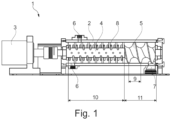
- the mixer was designed as in Fig. 1 shown. It had an inlet for the mortar, an inlet for the aqueous accelerator, and an outlet for the accelerated mortar.
- the drum contained the mixing section and the conveying section and had a diameter of approximately 100 mm.
- the agitator shaft and the conveyor screw were arranged on the same axis.
- the inlets were located near the agitator shaft, and the outlet was at the end of the conveyor screw.
- a round nozzle with a diameter of 40 mm was attached to the outlet.
- a forced-action mixer was used to prepare the fresh mortar.
- the dry mortar components were first mixed for 1 minute, then the water and aqueous components were added and thoroughly mixed within 3 minutes.
- the mortar was pumped through a hose with an inner diameter of 35 mm and a total length of 32 m to the first inlet of the mixer.
- the aqueous accelerator was pumped from a storage container through a hose to the second inlet of the mixer.
- the mortar mixture was continuously mixed with the aqueous accelerator and the accelerated mortar was applied in layers via the outlet and nozzle of the print head.
- the conveying of the mortar mixture, the dosage of the accelerator, the rotation speed of the continuous mixer and the movement of the pressure head were controlled by a computer program.
- the temperature of the water-containing mortar mixture was about 19°C, that of the ambient air about 21°C.
- a fresh mortar was prepared from 120 kg Portland cement CEM I 52.5, 92 kg quartz sand of 0-1 mm with a moisture content of 2.2% by weight, 33 kg Betoflow ® -D, 80 kg Nekafill ® 15, 1.1 kg Sika ® Viscocrete ® -3088 S, 0.004 kg Carbowet ® 4000 and 56.8 kg water.
- the fresh mortar had a slump of 260 mm, measured according to DIN EN 1015-3 after lifting the slump hopper without lifting the spreading table.
- the fresh mortar was conveyed to the continuous mixer at a conveying rate of approximately 33 kg/min.
- Pre-diluted Sigunit ® -L53 AF (CC) (75 wt% Sigunit ® -L53 AF (CC) and 25 wt% water) was fed to the continuous mixer as accelerator at a feed rate of approximately 350-400 ml/min.
- the fresh mortar and accelerator were continuously mixed in the mixer at approximately 1200 revolutions of the agitator shaft per minute.
- the accelerated mortar mixture was applied with the print head onto a plastic sheet laid on a concrete floor in layers approximately 50 mm wide and 10 mm high.
- the print head speed was 20-30 meters per minute.
- the finished molded body had a bottom and top width of approximately 590 mm, a bottom length of approximately 720 mm, and an top length of approximately 1670 mm.
- the printing of the molded body took approximately 15 minutes.
- the height of the lower layers and the The upper layers differed by no more than 5%.
- the printed part exhibited a wavy, very uniform surface with no visible defects.
- the pressure in the hose for conveying the fresh mortar was in the range of 3-5 bar.
- the hollow body was lifted onto a transport pallet using carrying straps and a crane without causing any damage to the printed body.
- the mold was broken using a heavy hammer, and the fragments were optically analyzed.
- the fracture surfaces exhibited a uniform surface, free of air pockets or defects.
- the fracture surfaces showed no preferred orientation, meaning that the applied layers exhibited equally good bonding between each other as within the same layer.
- Example 1 was repeated, but without the addition of an accelerator.
- the mortar flowed from the discharge nozzle and could not be applied in layers. The test was subsequently discontinued.
- Example 1 was repeated, but without using a mixer to mix the accelerator with the mortar mixture.
- the accelerator dosing line was mounted so that the accelerator was dosed just before the discharge nozzle in the center of the hose through which the mortar was conveyed.
- the accelerator dosage was the same as in Example 1.
- the mortar discharged from the discharge nozzle was very inhomogeneous. A buildup of multiple superimposed layers was not possible with this mortar.
- Example 1 was repeated, but the aqueous accelerator was added and mixed directly after the aqueous mortar mixture was prepared. After a few seconds, the mortar stiffened, and conveying to the print head was no longer possible.
- Fig. 1 shows: schematic representation of an exemplary mixer.
- FIG. 1 An exemplary mixer 1 is shown.
- the mixer 1 has a drive 3 and a drum 2 with a mixing area 10 and a conveying area 11.
- a mixing area 10 In the mixing area there is an agitator shaft 4 and two inlets 6, and in the conveying area 11 there is a conveying device 5 and an outlet 7.
- the conveying device 5 is arranged directly adjacent to the agitator shaft 4, so that the accelerated mineral binder composition mixed by the agitator shaft 4 can be directly captured by the conveying device 5 and conveyed out of the drum 2 through the outlet 7.
- the conveying device 5 is designed as a screw conveyor in this illustration.
- the screw conveyor in this illustration has two complete turns 9.
- the screw conveyor can be dimensioned or designed differently.
- the conveying device 5 and the agitator shaft 4 are arranged on the same axis in the drum 2.
- the agitator shaft 4 is equipped with pins 8, so that when the agitator shaft rotates, the water-containing binder composition is moved in the drum by the pins 8.
- inlets 6 are arranged on the drum 2.
- the drum 2 has only one inlet.
- the components to be mixed can already be brought together before being conveyed into the drum 2 via the inlet.
- Such mixers are particularly well suited to mixing the aqueous accelerator with the water-containing mineral binder composition homogeneously and quickly.
- a mixer 1 which additionally comprises a drive 3, and the dynamic mixing element comprises a stirring shaft 4 with stirring elements 8 for mixing the water-containing mineral binder composition with the aqueous accelerator, wherein the mixing area 10 and the conveying area 11 are arranged in a same drum 2.
- the agitator shaft 4 and the conveying device 5 are arranged on the same axis, wherein the conveying device 5 comprises in particular a conveyor screw.
Landscapes
- Chemical & Material Sciences (AREA)
- Engineering & Computer Science (AREA)
- Ceramic Engineering (AREA)
- Materials Engineering (AREA)
- Structural Engineering (AREA)
- Manufacturing & Machinery (AREA)
- Organic Chemistry (AREA)
- Inorganic Chemistry (AREA)
- Mechanical Engineering (AREA)
- Chemical Kinetics & Catalysis (AREA)
- Composite Materials (AREA)
- Civil Engineering (AREA)
- Physics & Mathematics (AREA)
- Optics & Photonics (AREA)
- Curing Cements, Concrete, And Artificial Stone (AREA)
- On-Site Construction Work That Accompanies The Preparation And Application Of Concrete (AREA)
- Producing Shaped Articles From Materials (AREA)
- Preparation Of Clay, And Manufacture Of Mixtures Containing Clay Or Cement (AREA)
Applications Claiming Priority (3)
| Application Number | Priority Date | Filing Date | Title |
|---|---|---|---|
| EP17185654 | 2017-08-09 | ||
| PCT/EP2018/071451 WO2019030255A1 (de) | 2017-08-09 | 2018-08-08 | Verfahren für den 3d-druck von mineralischen bindemittelzusammensetzungen |
| EP18748935.6A EP3664980B1 (de) | 2017-08-09 | 2018-08-08 | Verfahren für den 3d-druck von mineralischen bindemittelzusammensetzungen |
Related Parent Applications (2)
| Application Number | Title | Priority Date | Filing Date |
|---|---|---|---|
| EP18748935.6A Division EP3664980B1 (de) | 2017-08-09 | 2018-08-08 | Verfahren für den 3d-druck von mineralischen bindemittelzusammensetzungen |
| EP18748935.6A Division-Into EP3664980B1 (de) | 2017-08-09 | 2018-08-08 | Verfahren für den 3d-druck von mineralischen bindemittelzusammensetzungen |
Publications (2)
| Publication Number | Publication Date |
|---|---|
| EP4082736A1 EP4082736A1 (de) | 2022-11-02 |
| EP4082736B1 true EP4082736B1 (de) | 2025-03-12 |
Family
ID=59699481
Family Applications (2)
| Application Number | Title | Priority Date | Filing Date |
|---|---|---|---|
| EP22174371.9A Active EP4082736B1 (de) | 2017-08-09 | 2018-08-08 | Verfahren für den 3d-druck von mineralischen bindemittelzusammensetzungen |
| EP18748935.6A Active EP3664980B1 (de) | 2017-08-09 | 2018-08-08 | Verfahren für den 3d-druck von mineralischen bindemittelzusammensetzungen |
Family Applications After (1)
| Application Number | Title | Priority Date | Filing Date |
|---|---|---|---|
| EP18748935.6A Active EP3664980B1 (de) | 2017-08-09 | 2018-08-08 | Verfahren für den 3d-druck von mineralischen bindemittelzusammensetzungen |
Country Status (15)
| Country | Link |
|---|---|
| US (1) | US11331827B2 (da) |
| EP (2) | EP4082736B1 (da) |
| JP (1) | JP7196108B2 (da) |
| KR (1) | KR102584814B1 (da) |
| CN (1) | CN110997260A (da) |
| AU (1) | AU2018314760B2 (da) |
| BR (1) | BR112020000440B1 (da) |
| CA (1) | CA3071864A1 (da) |
| DK (2) | DK3664980T3 (da) |
| ES (2) | ES2925800T3 (da) |
| MX (1) | MX2020001468A (da) |
| PL (2) | PL4082736T3 (da) |
| RU (1) | RU2019142862A (da) |
| SG (1) | SG11202000969RA (da) |
| WO (1) | WO2019030255A1 (da) |
Families Citing this family (22)
| Publication number | Priority date | Publication date | Assignee | Title |
|---|---|---|---|---|
| WO2019030329A1 (de) * | 2017-08-09 | 2019-02-14 | Sika Technology Ag | System zum applizieren eines baustoffes |
| JP7244007B2 (ja) * | 2019-03-08 | 2023-03-22 | 太平洋セメント株式会社 | 三次元造形装置による立体物作製方法 |
| EP3708321A1 (de) * | 2019-03-15 | 2020-09-16 | Sika Technology Ag | Verfahren zum applizieren eines baustoffes |
| EP3708555A1 (en) | 2019-03-15 | 2020-09-16 | Sika Technology Ag | Shrinkage reducer for mineral binder composition and its use |
| EP3708320A1 (de) * | 2019-03-15 | 2020-09-16 | Sika Technology Ag | System zum applizieren eines baustoffes |
| US12180117B2 (en) | 2019-03-15 | 2024-12-31 | Sika Technology Ag | Mineral binder composition for 3D printing |
| CN110173117A (zh) * | 2019-06-18 | 2019-08-27 | 中交第一公路勘察设计研究院有限公司 | 用于混凝土3d打印工具端的旋转出料装置 |
| JP7376341B2 (ja) * | 2019-12-20 | 2023-11-08 | 太平洋セメント株式会社 | 造形用セメント組成物 |
| EP3868730A1 (en) * | 2020-02-18 | 2021-08-25 | Sika Technology Ag | Accelerator for mineral binder compositions |
| US20230146602A1 (en) * | 2020-04-24 | 2023-05-11 | Universiteit Gent | Method for layer-by-layer deposition of concrete |
| CN112495008A (zh) * | 2020-12-03 | 2021-03-16 | 张克军 | 一种循环式快速多级压滤方法 |
| EP4079700A1 (en) * | 2021-04-23 | 2022-10-26 | Sika Technology AG | Aqueous admixture for inorganic binder composition |
| PL4089355T3 (pl) * | 2021-05-11 | 2024-05-13 | Omya International Ag | Urządzenie do wytwarzania ekspandowanego granulatu |
| JP7697626B2 (ja) * | 2021-08-05 | 2025-06-24 | 大成建設株式会社 | 立体造形システムおよび立体造形方法 |
| KR102442518B1 (ko) * | 2021-10-18 | 2022-09-13 | 성신양회 주식회사 | 3d 프린팅용 모르타르 조성물 |
| EP4245492A1 (en) * | 2022-03-16 | 2023-09-20 | Sika Technology AG | Mineral binder-based foams |
| CN115157408B (zh) * | 2022-06-07 | 2023-07-04 | 同济大学 | 一种可精准控制混凝土性能的3d混凝土打印装置及其使用方法 |
| KR102833546B1 (ko) * | 2022-10-24 | 2025-07-15 | (주)포유에듀테크 | 3d 프린터용 점토 출력 용기 충진기 및 그 점토 출력 용기 충진기가 결합된 토련기 |
| WO2024181518A1 (ja) * | 2023-03-02 | 2024-09-06 | 株式会社Polyuse | 粉体組成物、付加製造用モルタル材料、造形物及び造形物の製造方法 |
| JP7544427B1 (ja) * | 2023-03-02 | 2024-09-03 | 株式会社Polyuse | 粉体組成物、付加製造用モルタル材料、造形物及び造形物の製造方法 |
| WO2025056169A1 (en) | 2023-09-15 | 2025-03-20 | Cemex Innovation Holding Ag | Formless production process to place a construction material in a continuous manner |
| WO2026012601A1 (en) * | 2024-07-12 | 2026-01-15 | Construction Research & Technology Gmbh | Method of placing a flowable construction material for 3d concrete printing |
Citations (6)
| Publication number | Priority date | Publication date | Assignee | Title |
|---|---|---|---|---|
| JPH0262205A (ja) | 1988-08-30 | 1990-03-02 | Ohbayashi Corp | 水硬性資料と急結剤の連続混合装置およびその使用方法 |
| WO2013064826A1 (en) | 2011-11-01 | 2013-05-10 | Loughborough University | Method and apparatus for delivery of cementitious material |
| WO2016024863A1 (en) | 2014-08-15 | 2016-02-18 | Ihc Holland Ie B.V. | Deposition of clay structures |
| CN106088610A (zh) | 2016-06-15 | 2016-11-09 | 杭州博彭科技有限公司 | 3d打印建筑墙体的方法和3d打印建筑的设备 |
| EP3147269A1 (de) | 2015-09-22 | 2017-03-29 | HeidelbergCement AG | 3d-druck von bauteilen und gebäuden mit bct-zement |
| EP3431172A1 (de) | 2017-06-30 | 2019-01-23 | Baumit Beteiligungen GmbH | Düse für beton, mörtel od. dgl. sowie deren verwendung |
Family Cites Families (20)
| Publication number | Priority date | Publication date | Assignee | Title |
|---|---|---|---|---|
| DE2947913C2 (de) | 1979-11-28 | 1983-06-30 | Josef 6943 Birkenau Compernaß | Maschine zum Mischen sowie zum Fördern eines Betongemisches |
| JPS6098611U (ja) * | 1983-08-01 | 1985-07-05 | ピ−・エス・コンクリ−ト株式会社 | コンクリ−ト再混練装置 |
| JPS60132836U (ja) * | 1984-02-09 | 1985-09-05 | 株式会社 ちよだ製作所 | オ−ガミキサ |
| CA1308012C (en) * | 1986-01-17 | 1992-09-29 | Robert Wayne Thies | Multilayered polyolefin high shrinkage, low-shrink force shrink film |
| JP3080627B2 (ja) | 1989-12-13 | 2000-08-28 | 三菱レイヨン株式会社 | 連続混練機 |
| JP3206769B2 (ja) * | 1992-06-15 | 2001-09-10 | 電気化学工業株式会社 | 連続混合混練装置 |
| FR2732260B1 (fr) * | 1995-04-03 | 1997-05-09 | Rhone Poulenc Chimie | Procede de projection de beton ou de mortier |
| US7153454B2 (en) * | 2003-01-21 | 2006-12-26 | University Of Southern California | Multi-nozzle assembly for extrusion of wall |
| CN105189405B (zh) | 2013-04-25 | 2018-12-04 | 联合工艺公司 | 通过使用金属粘结剂的部分瞬间液相粘结的陶瓷涡轮部件的增材制造 |
| CN203357623U (zh) | 2013-05-17 | 2013-12-25 | 南京工程学院 | 一种快硬型混凝土3d打印喷嘴 |
| CN104310918B (zh) | 2014-10-20 | 2016-02-03 | 中国建筑股份有限公司 | 用于3d打印技术的水泥基复合材料及其制备方法和用途 |
| CN204354263U (zh) | 2014-12-29 | 2015-05-27 | 中国建筑股份有限公司 | 一种适用于不同粘度的宾汉姆多组分流体混合挤出装置 |
| WO2016164562A1 (en) * | 2015-04-07 | 2016-10-13 | President And Fellows Of Harvard College | Microfluidic active mixing nozzle for three-dimensional printing of viscoelastic inks |
| CN204566322U (zh) * | 2015-05-04 | 2015-08-19 | 马义和 | 一种带有增压装置的建筑构件3d打印喷头 |
| JP6919136B2 (ja) * | 2015-07-23 | 2021-08-18 | 太平洋セメント株式会社 | 造形用セメント組成物、およびセメント質硬化体の製造方法 |
| DK3659699T3 (da) | 2016-03-01 | 2024-08-05 | Sika Tech Ag | System til påføring af et byggemateriale |
| US10074449B2 (en) * | 2016-06-21 | 2018-09-11 | Raytheon Company | Additively manufactured concrete-bearing radiation attenuation structure |
| DK3260258T3 (da) * | 2016-06-22 | 2019-09-23 | Holcim Technology Ltd | Online-styring af reologien af byggemateriale til 3D-printning |
| CN109641260A (zh) * | 2016-06-28 | 2019-04-16 | 太平洋水泥株式会社 | 附加制造装置用的水硬性组合物和铸模的制造方法 |
| CN106988535A (zh) * | 2017-05-17 | 2017-07-28 | 都书鹏 | 具有自动注入外加剂功能的建筑3d打印头 |
-
2018
- 2018-08-08 KR KR1020207004190A patent/KR102584814B1/ko active Active
- 2018-08-08 ES ES18748935T patent/ES2925800T3/es active Active
- 2018-08-08 EP EP22174371.9A patent/EP4082736B1/de active Active
- 2018-08-08 US US16/631,013 patent/US11331827B2/en active Active
- 2018-08-08 CN CN201880051136.1A patent/CN110997260A/zh active Pending
- 2018-08-08 CA CA3071864A patent/CA3071864A1/en active Pending
- 2018-08-08 ES ES22174371T patent/ES3023510T3/es active Active
- 2018-08-08 MX MX2020001468A patent/MX2020001468A/es unknown
- 2018-08-08 BR BR112020000440-5A patent/BR112020000440B1/pt active IP Right Grant
- 2018-08-08 EP EP18748935.6A patent/EP3664980B1/de active Active
- 2018-08-08 WO PCT/EP2018/071451 patent/WO2019030255A1/de not_active Ceased
- 2018-08-08 RU RU2019142862A patent/RU2019142862A/ru unknown
- 2018-08-08 PL PL22174371.9T patent/PL4082736T3/pl unknown
- 2018-08-08 DK DK18748935.6T patent/DK3664980T3/da active
- 2018-08-08 DK DK22174371.9T patent/DK4082736T3/da active
- 2018-08-08 JP JP2019571501A patent/JP7196108B2/ja active Active
- 2018-08-08 AU AU2018314760A patent/AU2018314760B2/en active Active
- 2018-08-08 SG SG11202000969RA patent/SG11202000969RA/en unknown
- 2018-08-08 PL PL18748935.6T patent/PL3664980T3/pl unknown
Patent Citations (6)
| Publication number | Priority date | Publication date | Assignee | Title |
|---|---|---|---|---|
| JPH0262205A (ja) | 1988-08-30 | 1990-03-02 | Ohbayashi Corp | 水硬性資料と急結剤の連続混合装置およびその使用方法 |
| WO2013064826A1 (en) | 2011-11-01 | 2013-05-10 | Loughborough University | Method and apparatus for delivery of cementitious material |
| WO2016024863A1 (en) | 2014-08-15 | 2016-02-18 | Ihc Holland Ie B.V. | Deposition of clay structures |
| EP3147269A1 (de) | 2015-09-22 | 2017-03-29 | HeidelbergCement AG | 3d-druck von bauteilen und gebäuden mit bct-zement |
| CN106088610A (zh) | 2016-06-15 | 2016-11-09 | 杭州博彭科技有限公司 | 3d打印建筑墙体的方法和3d打印建筑的设备 |
| EP3431172A1 (de) | 2017-06-30 | 2019-01-23 | Baumit Beteiligungen GmbH | Düse für beton, mörtel od. dgl. sowie deren verwendung |
Non-Patent Citations (6)
| Title |
|---|
| GOSSELIN C.; DUBALLET R.; ROUX PH.; GAUDILLIèRE N.; DIRRENBERGER J.; MOREL PH.: "Large-scale 3D printing of ultra-high performance concrete – a new processing route for architects and builders", MATERIALS & DESIGN, ELSEVIER, AMSTERDAM, NL, vol. 100, 25 March 2016 (2016-03-25), AMSTERDAM, NL , pages 102 - 109, XP029513521, ISSN: 0264-1275, DOI: 10.1016/j.matdes.2016.03.097 |
| LE T.T.; AUSTIN S.A.; LIM S.; BUSWELL R.A.; LAW R.; GIBB A.G.F.; THORPE T.: "Hardened properties of high-performance printing concrete", CEMENT AND CONCRETE RESEARCH, ELSEVIER LTD, NEW YORK, NY, vol. 42, no. 3, 1 January 1900 (1900-01-01), New York, NY, pages 558 - 566, XP028904696, ISSN: 0008-8846, DOI: 10.1016/j.cemconres.2011.12.003 |
| MATHIAS NäTHER, VENKATESH NAIDU, NERELLA MARTIN, KRAUSE GüNTER, KUNZE VIKTOR, MECHTCHERINE RAINER, SCHACH, VERLAG FRAUNH: "Beton-3D-Druck – Machbarkeitsuntersuchungen zu kontinuierlichen und schalungsfreien Bauverfahren durch 3D-Formung von Frischbeton", 31 December 2017 (2017-12-31), pages 1 - 106, XP055708204, Retrieved from the Internet <URL:https://www.irbnet.de/daten/rswb/17079004398.pdf> |
| MYRDAL R: "COIN P1 Advanced cementing materials, SP 1.2F Controlling hydration development, Retarding admixtures for concrete, State of the Art", SINTEF REPORT, SINTEF BUILDING AND INFRASTRUCTURE, NO, no. SBF BK A07035, 19 December 2007 (2007-12-19), NO , pages 1 - 23, XP002583015, ISBN: 978-82-536-0998-0 |
| THIENERT CHRISTIAN, CHRISTOPH KLAPROTH, REINER OTTERBEIN, FRANK LUDWIG : "Entwicklung und Erprobung eines Online-Messsystems zur Bewertung der Wiederverwendbarkeit von Zementsuspensionen beim Düsenstrahlverfahren ", DEUTSCHE BUNDESSTIFTUNG UMWELT, 1 December 2017 (2017-12-01), pages 1 - 44, XP055927878, Retrieved from the Internet <URL:https://www.dbu.de/OPAC/ab/DBU-Abschlussbericht-AZ-32564_01-Hauptbericht.pdf> |
| VALKENAERS HANS, JANSEN DENNIE, VOET ANDRÉ, VAN GYSEL ANN, FERRARIS ELEONORA: "Additive manufacturing for concrete: a 3D printing principle", CONFERENCE PROCEEDINGS (14TH INTERNATIONAL CONFERENCE OF THE EUROPEAN SOCIETY FOR PRECISION ENGINEERING AND NANOTECHNOLOGY, EUSPEN 2014 20140602 TO 20140606 DUBROVNIK), BEDFORD : EUSPEN, 2014, GB, 1 June 2014 (2014-06-01) - 2014-06-06, GB , pages 139 - 142, XP093152811, ISBN: 978-0-9566790-3-1 |
Also Published As
| Publication number | Publication date |
|---|---|
| BR112020000440A2 (pt) | 2020-07-21 |
| MX2020001468A (es) | 2020-03-20 |
| AU2018314760B2 (en) | 2024-06-13 |
| JP2020529934A (ja) | 2020-10-15 |
| KR102584814B1 (ko) | 2023-10-04 |
| AU2018314760A1 (en) | 2020-02-13 |
| DK3664980T3 (da) | 2022-10-03 |
| EP3664980A1 (de) | 2020-06-17 |
| PL4082736T3 (pl) | 2025-07-07 |
| KR20200037265A (ko) | 2020-04-08 |
| PL3664980T3 (pl) | 2022-10-17 |
| US11331827B2 (en) | 2022-05-17 |
| EP3664980B1 (de) | 2022-07-20 |
| WO2019030255A1 (de) | 2019-02-14 |
| US20200139579A1 (en) | 2020-05-07 |
| BR112020000440B1 (pt) | 2023-12-26 |
| DK4082736T3 (da) | 2025-05-26 |
| ES2925800T3 (es) | 2022-10-19 |
| CA3071864A1 (en) | 2019-02-14 |
| RU2019142862A (ru) | 2021-09-14 |
| ES3023510T3 (en) | 2025-06-02 |
| EP4082736A1 (de) | 2022-11-02 |
| RU2019142862A3 (da) | 2021-11-08 |
| JP7196108B2 (ja) | 2022-12-26 |
| CN110997260A (zh) | 2020-04-10 |
| SG11202000969RA (en) | 2020-03-30 |
Similar Documents
| Publication | Publication Date | Title |
|---|---|---|
| EP4082736B1 (de) | Verfahren für den 3d-druck von mineralischen bindemittelzusammensetzungen | |
| EP3600811B1 (de) | Verfahren zur applikation von fasern enthaltenden mineralischen bindemittelzusammensetzungen | |
| EP3938159B1 (de) | Verfahren zum applizieren eines baustoffes | |
| EP3708320A1 (de) | System zum applizieren eines baustoffes | |
| EP3938212A1 (de) | Mineralische bindemittelzusammensetzung für den 3d-druck | |
| EP3558679A1 (de) | Generative herstellung von formkörpern aus aushärtbaren materialen | |
| EP2152647B2 (de) | Wässrige zubereitungen polymermodifizierter abbindebeschleuniger und deren einsatz im baubereich | |
| EP2313351B1 (de) | Pulverförmige baustoffzusammensetzungen enthaltend langkettige dialkylether | |
| EP3700967B1 (de) | Sprühtrocknungsverfahren | |
| EP2465835B1 (de) | Verfahren zur kontinuierlichen herstellung von mörtelmassen | |
| WO2009130334A1 (de) | Verwendung von kohlenwasserstoffen als additive zur verminderung des staubens bauchemischer produkte | |
| EP4389716A1 (de) | Verfahren zur herstellung eines aktivierten materials, verwendung des materials in einer trockenmörtelmischung, trockenmörtelmischung mit dem material, verfahren zur herstellung der trockenmörtelmischung und deren verwendung | |
| WO2025202461A1 (en) | Fresh concrete or mortar composition for 3d-printing | |
| DE102005057507A1 (de) | Verwendung eines Additivs als Entschalungshilfsmittel |
Legal Events
| Date | Code | Title | Description |
|---|---|---|---|
| PUAI | Public reference made under article 153(3) epc to a published international application that has entered the european phase |
Free format text: ORIGINAL CODE: 0009012 |
|
| STAA | Information on the status of an ep patent application or granted ep patent |
Free format text: STATUS: THE APPLICATION HAS BEEN PUBLISHED |
|
| AC | Divisional application: reference to earlier application |
Ref document number: 3664980 Country of ref document: EP Kind code of ref document: P |
|
| AK | Designated contracting states |
Kind code of ref document: A1 Designated state(s): AL AT BE BG CH CY CZ DE DK EE ES FI FR GB GR HR HU IE IS IT LI LT LU LV MC MK MT NL NO PL PT RO RS SE SI SK SM TR |
|
| STAA | Information on the status of an ep patent application or granted ep patent |
Free format text: STATUS: REQUEST FOR EXAMINATION WAS MADE |
|
| 17P | Request for examination filed |
Effective date: 20230502 |
|
| RBV | Designated contracting states (corrected) |
Designated state(s): AL AT BE BG CH CY CZ DE DK EE ES FI FR GB GR HR HU IE IS IT LI LT LU LV MC MK MT NL NO PL PT RO RS SE SI SK SM TR |
|
| STAA | Information on the status of an ep patent application or granted ep patent |
Free format text: STATUS: EXAMINATION IS IN PROGRESS |
|
| 17Q | First examination report despatched |
Effective date: 20230908 |
|
| REG | Reference to a national code |
Ref country code: DE Ref legal event code: R079 Free format text: PREVIOUS MAIN CLASS: B28C0005120000 Ipc: B33Y0070100000 Ref document number: 502018015653 Country of ref document: DE |
|
| GRAP | Despatch of communication of intention to grant a patent |
Free format text: ORIGINAL CODE: EPIDOSNIGR1 |
|
| STAA | Information on the status of an ep patent application or granted ep patent |
Free format text: STATUS: GRANT OF PATENT IS INTENDED |
|
| RIC1 | Information provided on ipc code assigned before grant |
Ipc: C04B 111/00 20060101ALI20241023BHEP Ipc: C04B 28/06 20060101ALI20241023BHEP Ipc: C04B 28/04 20060101ALI20241023BHEP Ipc: B29C 64/106 20170101ALI20241023BHEP Ipc: B28B 1/00 20060101ALI20241023BHEP Ipc: B28C 5/12 20060101ALI20241023BHEP Ipc: B33Y 10/00 20150101ALI20241023BHEP Ipc: B33Y 70/10 20200101AFI20241023BHEP |
|
| INTG | Intention to grant announced |
Effective date: 20241111 |
|
| GRAL | Information related to payment of fee for publishing/printing deleted |
Free format text: ORIGINAL CODE: EPIDOSDIGR3 |
|
| GRAS | Grant fee paid |
Free format text: ORIGINAL CODE: EPIDOSNIGR3 |
|
| GRAA | (expected) grant |
Free format text: ORIGINAL CODE: 0009210 |
|
| STAA | Information on the status of an ep patent application or granted ep patent |
Free format text: STATUS: THE PATENT HAS BEEN GRANTED |
|
| AC | Divisional application: reference to earlier application |
Ref document number: 3664980 Country of ref document: EP Kind code of ref document: P |
|
| AK | Designated contracting states |
Kind code of ref document: B1 Designated state(s): AL AT BE BG CH CY CZ DE DK EE ES FI FR GB GR HR HU IE IS IT LI LT LU LV MC MK MT NL NO PL PT RO RS SE SI SK SM TR |
|
| REG | Reference to a national code |
Ref country code: GB Ref legal event code: FG4D Free format text: NOT ENGLISH |
|
| REG | Reference to a national code |
Ref country code: CH Ref legal event code: EP |
|
| REG | Reference to a national code |
Ref country code: DE Ref legal event code: R096 Ref document number: 502018015653 Country of ref document: DE |
|
| REG | Reference to a national code |
Ref country code: IE Ref legal event code: FG4D Free format text: LANGUAGE OF EP DOCUMENT: GERMAN |
|
| REG | Reference to a national code |
Ref country code: DK Ref legal event code: T3 Effective date: 20250521 |
|
| REG | Reference to a national code |
Ref country code: NL Ref legal event code: FP |
|
| REG | Reference to a national code |
Ref country code: ES Ref legal event code: FG2A Ref document number: 3023510 Country of ref document: ES Kind code of ref document: T3 Effective date: 20250602 |
|
| PG25 | Lapsed in a contracting state [announced via postgrant information from national office to epo] |
Ref country code: RS Free format text: LAPSE BECAUSE OF FAILURE TO SUBMIT A TRANSLATION OF THE DESCRIPTION OR TO PAY THE FEE WITHIN THE PRESCRIBED TIME-LIMIT Effective date: 20250612 |
|
| PG25 | Lapsed in a contracting state [announced via postgrant information from national office to epo] |
Ref country code: FI Free format text: LAPSE BECAUSE OF FAILURE TO SUBMIT A TRANSLATION OF THE DESCRIPTION OR TO PAY THE FEE WITHIN THE PRESCRIBED TIME-LIMIT Effective date: 20250312 |
|
| REG | Reference to a national code |
Ref country code: LT Ref legal event code: MG9D |
|
| PG25 | Lapsed in a contracting state [announced via postgrant information from national office to epo] |
Ref country code: NO Free format text: LAPSE BECAUSE OF FAILURE TO SUBMIT A TRANSLATION OF THE DESCRIPTION OR TO PAY THE FEE WITHIN THE PRESCRIBED TIME-LIMIT Effective date: 20250612 |
|
| PG25 | Lapsed in a contracting state [announced via postgrant information from national office to epo] |
Ref country code: HR Free format text: LAPSE BECAUSE OF FAILURE TO SUBMIT A TRANSLATION OF THE DESCRIPTION OR TO PAY THE FEE WITHIN THE PRESCRIBED TIME-LIMIT Effective date: 20250312 |
|
| PG25 | Lapsed in a contracting state [announced via postgrant information from national office to epo] |
Ref country code: LV Free format text: LAPSE BECAUSE OF FAILURE TO SUBMIT A TRANSLATION OF THE DESCRIPTION OR TO PAY THE FEE WITHIN THE PRESCRIBED TIME-LIMIT Effective date: 20250312 |
|
| PG25 | Lapsed in a contracting state [announced via postgrant information from national office to epo] |
Ref country code: GR Free format text: LAPSE BECAUSE OF FAILURE TO SUBMIT A TRANSLATION OF THE DESCRIPTION OR TO PAY THE FEE WITHIN THE PRESCRIBED TIME-LIMIT Effective date: 20250613 Ref country code: BG Free format text: LAPSE BECAUSE OF FAILURE TO SUBMIT A TRANSLATION OF THE DESCRIPTION OR TO PAY THE FEE WITHIN THE PRESCRIBED TIME-LIMIT Effective date: 20250312 |
|
| PGFP | Annual fee paid to national office [announced via postgrant information from national office to epo] |
Ref country code: NL Payment date: 20250723 Year of fee payment: 8 |
|
| PG25 | Lapsed in a contracting state [announced via postgrant information from national office to epo] |
Ref country code: SE Free format text: LAPSE BECAUSE OF FAILURE TO SUBMIT A TRANSLATION OF THE DESCRIPTION OR TO PAY THE FEE WITHIN THE PRESCRIBED TIME-LIMIT Effective date: 20250312 |
|
| PG25 | Lapsed in a contracting state [announced via postgrant information from national office to epo] |
Ref country code: SM Free format text: LAPSE BECAUSE OF FAILURE TO SUBMIT A TRANSLATION OF THE DESCRIPTION OR TO PAY THE FEE WITHIN THE PRESCRIBED TIME-LIMIT Effective date: 20250312 |
|
| PG25 | Lapsed in a contracting state [announced via postgrant information from national office to epo] |
Ref country code: PT Free format text: LAPSE BECAUSE OF FAILURE TO SUBMIT A TRANSLATION OF THE DESCRIPTION OR TO PAY THE FEE WITHIN THE PRESCRIBED TIME-LIMIT Effective date: 20250714 |
|
| PGFP | Annual fee paid to national office [announced via postgrant information from national office to epo] |
Ref country code: ES Payment date: 20250901 Year of fee payment: 8 |
|
| PGFP | Annual fee paid to national office [announced via postgrant information from national office to epo] |
Ref country code: DE Payment date: 20250724 Year of fee payment: 8 Ref country code: DK Payment date: 20250723 Year of fee payment: 8 |
|
| PG25 | Lapsed in a contracting state [announced via postgrant information from national office to epo] |
Ref country code: IT Free format text: LAPSE BECAUSE OF FAILURE TO SUBMIT A TRANSLATION OF THE DESCRIPTION OR TO PAY THE FEE WITHIN THE PRESCRIBED TIME-LIMIT Effective date: 20250312 |
|
| PGFP | Annual fee paid to national office [announced via postgrant information from national office to epo] |
Ref country code: TR Payment date: 20250731 Year of fee payment: 8 Ref country code: PL Payment date: 20250725 Year of fee payment: 8 |
|
| PGFP | Annual fee paid to national office [announced via postgrant information from national office to epo] |
Ref country code: GB Payment date: 20250724 Year of fee payment: 8 |
|
| PGFP | Annual fee paid to national office [announced via postgrant information from national office to epo] |
Ref country code: FR Payment date: 20250723 Year of fee payment: 8 Ref country code: AT Payment date: 20250725 Year of fee payment: 8 |
|
| PGFP | Annual fee paid to national office [announced via postgrant information from national office to epo] |
Ref country code: CH Payment date: 20250902 Year of fee payment: 8 |
|
| PG25 | Lapsed in a contracting state [announced via postgrant information from national office to epo] |
Ref country code: EE Free format text: LAPSE BECAUSE OF FAILURE TO SUBMIT A TRANSLATION OF THE DESCRIPTION OR TO PAY THE FEE WITHIN THE PRESCRIBED TIME-LIMIT Effective date: 20250312 |
|
| PGFP | Annual fee paid to national office [announced via postgrant information from national office to epo] |
Ref country code: CZ Payment date: 20250725 Year of fee payment: 8 |
|
| PG25 | Lapsed in a contracting state [announced via postgrant information from national office to epo] |
Ref country code: RO Free format text: LAPSE BECAUSE OF FAILURE TO SUBMIT A TRANSLATION OF THE DESCRIPTION OR TO PAY THE FEE WITHIN THE PRESCRIBED TIME-LIMIT Effective date: 20250312 |
|
| PG25 | Lapsed in a contracting state [announced via postgrant information from national office to epo] |
Ref country code: SK Free format text: LAPSE BECAUSE OF FAILURE TO SUBMIT A TRANSLATION OF THE DESCRIPTION OR TO PAY THE FEE WITHIN THE PRESCRIBED TIME-LIMIT Effective date: 20250312 |
|
| PG25 | Lapsed in a contracting state [announced via postgrant information from national office to epo] |
Ref country code: IS Free format text: LAPSE BECAUSE OF FAILURE TO SUBMIT A TRANSLATION OF THE DESCRIPTION OR TO PAY THE FEE WITHIN THE PRESCRIBED TIME-LIMIT Effective date: 20250712 |
|
| REG | Reference to a national code |
Ref country code: DE Ref legal event code: R026 Ref document number: 502018015653 Country of ref document: DE |
|
| PLBI | Opposition filed |
Free format text: ORIGINAL CODE: 0009260 |
|
| PLAX | Notice of opposition and request to file observation + time limit sent |
Free format text: ORIGINAL CODE: EPIDOSNOBS2 |
|
| 26 | Opposition filed |
Opponent name: KNAUF GIPS KG Effective date: 20251210 |
|
| PG25 | Lapsed in a contracting state [announced via postgrant information from national office to epo] |
Ref country code: MC Free format text: LAPSE BECAUSE OF FAILURE TO SUBMIT A TRANSLATION OF THE DESCRIPTION OR TO PAY THE FEE WITHIN THE PRESCRIBED TIME-LIMIT Effective date: 20250312 |
|
| PG25 | Lapsed in a contracting state [announced via postgrant information from national office to epo] |
Ref country code: LU Free format text: LAPSE BECAUSE OF NON-PAYMENT OF DUE FEES Effective date: 20250808 |