EP4082412B1 - Automatisiertes kochsystem und verfahren zur verwaltung des korbarbeitsablaufs für die lebensmittelzubereitung - Google Patents
Automatisiertes kochsystem und verfahren zur verwaltung des korbarbeitsablaufs für die lebensmittelzubereitung Download PDFInfo
- Publication number
- EP4082412B1 EP4082412B1 EP22170595.7A EP22170595A EP4082412B1 EP 4082412 B1 EP4082412 B1 EP 4082412B1 EP 22170595 A EP22170595 A EP 22170595A EP 4082412 B1 EP4082412 B1 EP 4082412B1
- Authority
- EP
- European Patent Office
- Prior art keywords
- basket
- gantry
- fryer
- food product
- filled
- Prior art date
- Legal status (The legal status is an assumption and is not a legal conclusion. Google has not performed a legal analysis and makes no representation as to the accuracy of the status listed.)
- Active
Links
Images









Classifications
-
- A—HUMAN NECESSITIES
- A47—FURNITURE; DOMESTIC ARTICLES OR APPLIANCES; COFFEE MILLS; SPICE MILLS; SUCTION CLEANERS IN GENERAL
- A47J—KITCHEN EQUIPMENT; COFFEE MILLS; SPICE MILLS; APPARATUS FOR MAKING BEVERAGES
- A47J37/00—Baking; Roasting; Grilling; Frying
- A47J37/12—Deep fat fryers, e.g. for frying fish or chips
- A47J37/1219—Deep fat fryers, e.g. for frying fish or chips with means for lowering or raising the frying basket
-
- A—HUMAN NECESSITIES
- A47—FURNITURE; DOMESTIC ARTICLES OR APPLIANCES; COFFEE MILLS; SPICE MILLS; SUCTION CLEANERS IN GENERAL
- A47J—KITCHEN EQUIPMENT; COFFEE MILLS; SPICE MILLS; APPARATUS FOR MAKING BEVERAGES
- A47J37/00—Baking; Roasting; Grilling; Frying
- A47J37/12—Deep fat fryers, e.g. for frying fish or chips
- A47J37/1228—Automatic machines for frying and dispensing metered amounts of food
-
- A—HUMAN NECESSITIES
- A47—FURNITURE; DOMESTIC ARTICLES OR APPLIANCES; COFFEE MILLS; SPICE MILLS; SUCTION CLEANERS IN GENERAL
- A47J—KITCHEN EQUIPMENT; COFFEE MILLS; SPICE MILLS; APPARATUS FOR MAKING BEVERAGES
- A47J37/00—Baking; Roasting; Grilling; Frying
- A47J37/12—Deep fat fryers, e.g. for frying fish or chips
- A47J37/1266—Control devices, e.g. to control temperature, level or quality of the frying liquid
-
- A—HUMAN NECESSITIES
- A47—FURNITURE; DOMESTIC ARTICLES OR APPLIANCES; COFFEE MILLS; SPICE MILLS; SUCTION CLEANERS IN GENERAL
- A47J—KITCHEN EQUIPMENT; COFFEE MILLS; SPICE MILLS; APPARATUS FOR MAKING BEVERAGES
- A47J37/00—Baking; Roasting; Grilling; Frying
- A47J37/12—Deep fat fryers, e.g. for frying fish or chips
- A47J37/1276—Constructional details
- A47J37/129—Frying vessels
-
- A—HUMAN NECESSITIES
- A47—FURNITURE; DOMESTIC ARTICLES OR APPLIANCES; COFFEE MILLS; SPICE MILLS; SUCTION CLEANERS IN GENERAL
- A47J—KITCHEN EQUIPMENT; COFFEE MILLS; SPICE MILLS; APPARATUS FOR MAKING BEVERAGES
- A47J37/00—Baking; Roasting; Grilling; Frying
- A47J37/12—Deep fat fryers, e.g. for frying fish or chips
- A47J37/1295—Frying baskets or other food holders
Definitions
- This application relates generally to food product cooking methods. More specifically, this application describes methods for adding labor and time efficiencies in food production environments such as restaurants.
- Cooking apparatuses such as fryers, are used to cook various food products, e.g., poultry, fish, potato products, and the like.
- Such cooking apparatuses may include one or more cooking chambers, e.g., fryer pots or vats, which may be filled with a cooking medium, e.g., an oil, a liquid shortening, or a meltable-solid shortening.
- a cooking medium e.g., an oil, a liquid shortening, or a meltable-solid shortening.
- Such cooking apparatuses also may include a heating element, e.g., an electrical heating element, such as a heating coil, or a gas heating element, such as a gas burner and gas conveying tubes, which heats the cooking medium in the cooking chamber.
- the cooking medium After the cooking medium reaches a preset cooking temperature, food products are placed into the cooking medium such that the food products are cooked in the cooking medium.
- the food products may be positioned inside a basket, e.g., a wire basket, and submerged in the cooking medium for a predetermined amount of time sufficient to cook the food products.
- Conventional fryers typically require basket movement and workflow to be handled manually by an operator. In such fryers, the maximum production of the fryer is often limited by the responsiveness of the operator and their ability to manage multiple baskets and cooking tasks at the same time.
- restaurants continue to strive to increase production in order to satisfy customer demand.
- One way to increase production is to utilize a high-volume fryer, such as by replacing a restaurant's pre-existing traditional open fryer with a high-volume fryer.
- high-volume fryers are typically relatively large, and restaurants must operate within the space constraints imposed by the buildings which they occupy.
- restaurant equipment, including fryers must be sized to fit within certain parameters.
- kitchen layouts may allow a particular amount of space for a fryer and may be unable to accommodate fryers having footprints greater than that space.
- Some restaurants may allow a footprint of about 228.6-254 cm (90-100 inches) by about 76.2 cm (30 inches) for a fryer, as well as an associated preparation or holding area.
- a high-volume fryer of a conventional design may require significantly more space than this.
- Many restaurants would be required to undergo substantial building renovations, replace previously installed hoods, or sacrifice space intended for other uses in order to reap the benefits of high-volume fryers.
- Those reconfigurations are expensive, highly disfavored, and sometimes impossible.
- US 2020/305646 A1 relates to an automated fryer with an overhead gantry and a method for cooking food products, wherein the movement of baskets carrying the food products is automated.
- the fryer includes a cooking chamber with a heating element adapted for heating a cooking medium in the cooking chamber.
- KR 2017 0064979 A relates to an automatic fryer.
- the fryer comprises an oil tank and a heating element located in the oil tank.
- the fryer further comprises a basket, which carries the food product and a lifting structure, which is adapted to move the basket into and out of the oil tank.
- the lifting structure comprises a basket support onto which the basket is placed.
- US 5,191,918 A relates to a portioning dispenser for food products, which receives the food products in a storage bin, portions the food products from the storage bin and dispenses a measured portion of the food product into portion containers for further processing.
- the dispenser includes a conveyor system for a plurality of portion containers.
- US 5,172,328 shows a fully automated cooking system and a method for cooking food products.
- the system includes a control station that controls and directs a robot to obtain food product from a dispensing station, place it in a cooking position at a cooking station and, when cooked, removes the food product and deliver it to a storage station.
- An automated cooking system is described in this disclosure, which is not part of the claims.
- the automated cooking system and a corresponding method for managing basket workflow during food preparation at the automated cooking system avoid the problems associated with basket movement and workflow, traditionally handled manually by a human operator.
- the automated cooking system described herein, but which is not part of the claims provides for systems and methods to cook food product in a more efficient manner with regard to both time and labor considerations within the constraints of a restaurant.
- a method for managing basket workflow during food preparation at an automated cooking system according to claim 1.
- the basket loading cycle of the method for managing basket workflow further includes picking up an empty basket from one of the platforms at the fryer with the gantry, moving the gantry and the empty basket to the dispensing freezer, and dropping off the empty basket at the dispensing freezer.
- the basket discharge cycle of the method for managing basket workflow further includes moving the gantry and the empty basket to another selected one of the platforms at the fryer and dropping off the empty basket onto the another selected one of the platforms.
- the method further includes moving only one basket at a time with the gantry during the basket loading cycles and the basket discharge cycles.
- the method further includes preventing uncontrolled rotational movements of any basket during engagement of the basket with the gantry to avoid impacts of the basket, engaged with the gantry, with any other basket at the automated cooking system.
- the steps of picking up a basket with the gantry in the basket loading cycles and the basket discharge cycles of the method further includes clamping the gantry into engagement with only a single pickup point defined along a front surface of the basket.
- the fryer includes at least six platforms defining cooking stations for a basket at the plurality of fryer vats. Additionally, the method further includes managing workflow of at least six baskets simultaneously with the gantry system to move the at least six baskets between the dispensing freezer, the fryer, and the hot holding station to complete cooking cycles for food products loaded into the at least six baskets.
- the gantry system completes at least one of the basket loading cycles or one of the basket discharge cycles in a time period of less than 20 seconds.
- the gantry system completes both one of the basket loading cycles and one of the basket discharge cycles in a time period of less than 35 seconds.
- the method further includes lowering a filled basket, by one of the platforms at the fryer, into a heated cooking medium within a corresponding fryer vat to cook the food products in the basket.
- the method further includes maintaining the filled basket within the corresponding fryer vat for a cooking cycle time defined for cooking the food products in the basket.
- the method further includes lifting the filled basket, by one of the platforms at the fryer, out of the heated cooking medium after the cooking cycle time has elapsed, to position the filled basket with cooked food products in a position ready for pickup by the gantry system.
- the dispensing freezer and the hot holding station are positioned on opposite lateral sides of the fryer and the gantry system moves baskets laterally between he dispensing freezer, the hot holding stations, and the plurality of fryer vats located between the dispensing freezer and the hot holding station.
- the baskets may be loaded with different types of food products for cooking cycles.
- the step of the performing a plurality of basket discharge cycles of the method further comprises moving, during one of the basket discharge cycles, a first filled basket that contains a first type of food product to a first height above a receptacle at the hot holding station, such that actuation of the first filled basket to open with the gantry causes discharge of the first type of food product into the receptacle by dropping the first type of food product from the first height.
- the method further comprises moving, during another of the basket discharge cycles, a second filled basket that contains a second type of food product to a second height above the receptacle at the hot holding station, such that actuation of the second filled basket to open with the gantry causes discharge of the second type of food product into the receptacle by dropping the second type of food product from the second height.
- the first type of food product is different than the second type of food product, and the first and second heights are different.
- the dispensing freezer includes a staging shelf and a basket movement receptacle. Further, during each of the basket loading cycles, the gantry system drops off the empty basket onto the staging shelf, and the gantry system picks up the filled basket from the basket movement receptacle. Moreover, the empty basket and the filled basket are different baskets at the dispensing freezer.
- the method further includes moving the basket movement receptacle to a position adjacent the empty basket on the staging shelf, pivoting the staging shelf out of a movement path of the basket movement receptacle such that the empty basket is supported on the basket movement receptacle, and moving the empty basket with the basket movement receptacle to a filling location at the dispensing freezer where the empty basket is filled with food product, and to a pickup position after the basket is filled with food product for pickup by the gantry system in a subsequent one of the basket loading cycles.
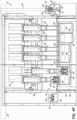
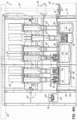
- an automated cooking system 10 including a fryer 12 is shown in accordance with one exemplary embodiment, which is not part of the claims.
- the system 10 and fryer 12 provide improved efficiency in cooking operations.
- the cooking system 10 achieves the increased production by efficiently managing the workflow of baskets 16 moving between a dispensing freezer 18, the fryer 12, and a hot holding station 20. More specifically, the workflow of baskets 16 is primarily achieved using a gantry system 22.
- the gantry system 22 includes a gantry 24 and a gantry control 26, which may be a part of or separate from a system controller 25 for the automated cooking system 10.
- the system described herein provides for cooking food product 14 in a more efficient manner with regard to both time and labor considerations within the constraints of a restaurant.
- the features of the automated cooking system 10 and the fryer 12 are set forth in further detail below to clarify each of these functional advantages and other benefits provided in this disclosure. Other advantages and technical effects of the embodiments of this invention will become evident to one skilled in the art from the following description.
- the automated cooking system 10 includes the fryer 12, a plurality of baskets 16, a dispensing freezer 18, a hot holding station 20, and a gantry system 22.
- the dispensing freezer 18 is of a mostly conventional design, and thus, is not shown in significant detail in the Figures.
- the dispensing freezer 18 shown in this embodiment includes a dispenser (not shown) for dispensing food product 14.
- Food product 14, for example, waffle fries are dispensed into a basket 16 from the dispenser of the dispensing freezer 18, cooked in the fryer 12, and then transferred from the fryer 12 to the hot holding station 20 via the baskets 16, as discussed in greater detail below. While a basket 16 is shown and described, it is appreciated that other moveable food product receptacles are also envisioned.
- the hot holding station 20 of the embodiment shown in FIG. 1 receives cooked food product 14 from the basket 16 of the fryer 12, to thereby enable operator manipulation and packaging to finalize preparation of the food products for delivery to fulfill customer demands, as well understood in the restaurant field.
- the hot holding station 20 is of conventional design and is briefly described as follows: it includes a hot holding cabinet 28 and a hot holding receiving area 30.
- the hot holding cabinet 28 may include a plurality of vertical slots 32 or angled corrugated slots 34 to hold the now cooked food product 14.
- the hot holding receiving area 30 may include an angled front portion 36, and a plurality of apertures 38 to enable circulating air flow to help the cooked food product 14 remain in a desirable state.
- Receptacles 40 for holding packaging to load food products into may be located in the front of the hot holding receiving area 30. Since the throughput of this automated cooking system 10 exceeds current systems, the hot holding receiving area 30 is generally larger to enable one or more workers to package the cooked food product 14 and keep up with the throughput of the automated cooking system 10. It will be understood that other types of hot holding 20 and preparation stations may be used with the fryer 12 in other embodiments. For example, an automated holding and packaging station may be later developed and combined with the features of the automated cooking system 10 described in detail below, without departing from the scope of this disclosure.
- the operator selects the quantity of food product 14 and the repeating rate upon which they wish to cook, and the automated cooking system 10 automatically optimizes the dispensing schedule from the freezer 18 and where to perform the cooking within the fryer 12.
- the food products to be cooked and the production rate may also be communicated to the cooking system 10 by other methods, including wireless communication from order management computer(s) that receive customer demands for food product and facilitate restaurant employees with fulfilling customer demands and orders accordingly.
- the automated cooking system 10 generally operates as follows: it automatically raises the predetermined basket 16, moves the basket 16 to the position to accept the uncooked food product 14, moves the basket 16 to the proper cooking chamber, e.g., fryer vat 42, location, lowers the basket 16 into the cooking medium 44, raises the basket 16 once cooked and moves the basket 16 to be dispensed into the hot holding receiving area 30, and then moves the basket 16 back to a predetermined location at the fryer 12 or back to the freezer 18 to accept more uncooked food product 14.
- the proper cooking chamber e.g., fryer vat 42, location
- the system controller 25 of the automated cooking system 10 may be configured to implement different modes of the system 10 or fryer 12.
- the system controller 25 may be operatively coupled to a dispensing mechanism of the dispensing freezer 18 to enable coordination between the dispensing of uncooked food product 14 from the dispensing freezer 18 into the basket 16, such that a predetermined amount of food product 14 is dispensed into the basket 16.
- the system controller 25 may also interface with other equipment in a fully automated fashion, to cause cooking of food product 14 in response to customer orders or demand.
- the system controller 25 is referred to separately from the gantry control 26 previously described and shown in FIG. 1 , it will be appreciated that the gantry control 26 may be an integral part of a single system controller 25 operating all elements of the cooking system 10 without departing from the scope of this invention.
- the fryer 12 also includes a gantry system 22 that is configured to move a basket 16 between a plurality of positions at the fryer 12.
- the gantry system 22 includes a gantry 24.
- the gantry 24 is moved by the gantry system 22 using a motor (not shown) which is controlled using a gantry control 26 enabling the gantry 24 to move to a desired position.
- the gantry control 26 interfaces with or is part of a system controller 25 (schematically shown in FIG. 1 ), which is described in greater detail below.
- the gantry system 22 is configured to service each platform 46 associated with each fryer vat 42 with a basket 16. The operation of the gantry system 22 and how it helps the cooking system 10 achieve higher food product throughput is described in further detail below.
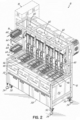
- FIG. 2 shows an exemplary embodiment of the fryer 12 used in the automatic cooking system 10.
- the system 10 includes a frame 50 mounted on a plurality of casters or wheels 52, so that the fryer 12 may be easily moveable on a surface, such as a floor.
- one or more of the wheels 52 are lockable to prevent unwanted movement of the fryer 12 during operation.
- the frame 50 includes feet 54 so that the frame 50 of the system 10 is not placed directly onto a surface, such as a floor.
- the feet 54 are adjustable such that the system 10 can be raised or lowered to a desired height above a surface, such as a floor.
- the wheels 52 or feet 54 may be eliminated if desired.
- a plurality of wall panels 56 are provided on the frame 50 to strengthen the frame 50.
- Various fryer 12 components such as, for example, oil filtration and recirculation components, may be supported by or housed by the frame 50 within the wall panels 56. These components are of a conventional design, and thus, are not shown in detail in the figures.
- Cabinets 58 may be located near the bottom of the fryer 12 and may be used to remove already-used cooking medium 44. According to another embodiment, cabinets 58 may be used as storage for unused cooking medium 44 or other products.
- the fryer 12 includes five fryer vats 42, each configured to hold a cooking medium 44. As shown, each fryer vat 42 is configured to hold at least one basket 16. However, more or fewer fryer vats 42 are also envisioned, with each fryer vat 42 being configured to hold one or more baskets 16.
- the fryer 12 may feature three fryer vats 42 wherein each fryer vat 42 is configured to accommodate two platforms 46 (and thus two cooking baskets 16) each, for a total of six platforms 46 and six baskets 16. At least one heating element 48 is disposed within each fryer vat 42. However, it is envisioned that each fryer vat 42 may include any suitable number of heating elements 48 in any arrangement, as may be desired.
- the heating element 48 is configured to heat the cooking medium 44 to a predetermined temperature so as to cook the food products 14 therein.
- the fryer 12 includes vertical transport assemblies 60, which are configured to raise and lower the baskets 16 into and out of the fryer vats 42 on platforms 46 attached to the vertical transport assemblies 60. It is envisioned that each fryer vat 42 may contain a single basket 16, which is movable on a platform 46 of one of the vertical transport assemblies 60. Alternatively, a fryer vat 42 may accommodate two or more baskets 16, each moveable on a separate platform 46 on a separate vertical transport assembly 60. It is also envisioned that a basket 16 may be used with different fryer vats 42 or different platforms 46 of the vertical transport assemblies 60. Mounted in the rear of the frame 50 are the motors and other corresponding components (not shown) for each of the vertical transport assemblies 60.
- FIGS. 3A-3D show elements of the cooking system 10 and operational steps taken at the adjacent stations to the fryer 12, as initially introduced above.
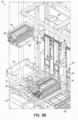
- FIG. 3A the Figure shows a portion of the fryer 12 adjacent the dispensing freezer 18.
- a staging shelf 62 is shown in a deployed position and supporting an empty basket 16.
- the staging shelf 62 In the deployed position, the staging shelf 62 is in a generally horizontal orientation such that a basket 16 can be placed on the staging shelf 62 by the gantry 24.
- the staging shelf 62 can alternatively be in a stowed position. In the stowed position, the staging shelf 62 is generally vertical such that the staging shelf 62 cannot support a basket 16.
- the state of the staging shelf 62 (e.g., in the deployed or stowed position) is determined by the system controller 25 in communication with the gantry control 26.
- FIG. 3A also shows a basket 16 filled with uncooked food product 14 located in a basket movement receptacle 64.
- the basket movement receptacle 64 of this embodiment defines a generally U-shaped support surrounding an open slot facing generally towards the staging shelf 62.
- the basket movement receptacle 64 is located in a pickup position and is waiting for the gantry control 26 to direct the gantry system 22 to move the gantry 24 to the location of the basket movement receptacle 64, in the pickup position, to pick up a basket 16.
- the gantry 24 will move the basket 16 filled with uncooked food product 14 from the basket movement receptacle 64, in the pickup position, to one of the empty platforms 46 at the fryer 12 in preparation for the food product 14 to be cooked by the cooking medium 44 in the corresponding fryer vat 42.
- FIG. 3B shows the basket 16 of FIG. 3A , still filled with uncooked food product 14, moved from the basket movement receptacle 64 (in the pickup position) to the available platform 46 above the fryer vat 42 via the gantry 24.
- a clamping gripper 66 of the gantry 24 engages with a single pickup point 68 on the basket 16 to permit the gantry 24 to move the basket 16 from location to location.
- the engagement of the gantry 24 with a basket 16 is described in further detail below with reference to FIGS. 5A and 5B .
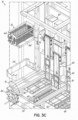
- FIG. 3C shows the basket 16 of FIG. 3B , previously located on the platform 46 above the fryer vat 42 and filled with uncooked food product 14, being submerged into the cooking medium 44 of the fryer vat 42 by the vertical transport assembly 60.
- each platform 46 above a fryer vat 42 is attached to a vertical transport assembly 60 such that the vertical transport assembly 60, upon receiving a signal from the system controller 25, can lower the basket 16 with uncooked food product 14 into the fryer vat 42.
- the vertical transport assembly 60 upon receiving a signal from the system controller 25, lifts the platform 46 and the basket 16 sitting thereon from the fryer vat 42. Through this process, the uncooked food product 14 in the basket 16 becomes cooked food product 14.
- FIG. 3C Also shown in FIG. 3C is the empty basket movement receptacle 64, following removal of the basket 16 by the gantry 24.
- the U-shaped support configuration is clearly visible in this Figure.
- the front and rear sides of the basket movement receptacle 64 in this embodiment include ledges that engage with the front and back ends of a basket 16 during support of the basket 16 in the basket movement receptacle 64.
- the gap between these ledges defines the open slot that is large enough to pass by the staging shelf 62 during movement of the basket movement receptacle 64.
- the basket movement receptacle 64 can thus freely translate upwardly and downwardly past the staging shelf 62 regardless of the position the staging shelf 62 is in, which also allows for pickup of a basket 16 from the staging shelf 62 to then support that same basket on the basket movement receptacle 64.
- Alternative constructions of the basket movement receptacle 64 are possible in other embodiments, so long as a transfer between the staging shelf 62 and the basket movement receptacle 64 continues to be enabled for the basket workflow process steps described herein.
- the basket movement receptacle 64 After the gantry 24 transports a filled basket 16 from the basket movement receptacle 64 to a platform 46, the basket movement receptacle 64, upon receiving a signal from the system controller 25, then receives a basket 16 from the staging shelf 62.
- the basket movement receptacle 64 is shaped such that the staging shelf 62 can fit within the open slot of the generally U-shaped basket movement receptacle 64. In orderto transfer a basket 16 from the staging shelf 62 to the basket movement receptacle 64, the basket movement receptacle 64 moves up to the position of the staging shelf 62.
- the basket 16 is transferred from the staging shelf 62 to the basket movement receptacle 64 by the basket movement receptacle 64 being positioned against the basket 16 and then, the staging shelf 62 pivoting from a deployed position to a stowed position.
- the basket 16 is securely positioned in the basket movement receptacle 64 before the staging shelf 62 changes positions.
- the basket 16 is transferred from the staging shelf 62 to the basket movement receptacle 64 by the basket movement receptacle 64 being positioned slightly below the location of the basket 16 and then, the staging shelf 62 pivoting from a deployed position to a stowed position.
- the basket 16 drops with movement of the staging shelf 62 a short distance from the staging shelf 62 and into the basket movement receptacle 64.
- the basket movement receptacle 64 is generally adjacent to the staging shelf 62 whenever a transfer of the basket 16 occurs in accordance with these embodiments.
- the basket movement receptacle 64 then moves the unfilled basket 16 to a filling position (not shown in detail in FIG. 3C as this position may vary depending on where the outlet(s) of the freezer 18 are located relative to the fryer 12) where the dispensing freezer 18 dispenses uncooked food product 14 into the basket 16.
- the filling position may vary depending upon the type of food product 14 being dispensed by the dispensing freezer 18.
- the dispensing freezer 18 may dispense one uncooked food product 14 at one position and a different uncooked food product 14 at a second position.
- the basket movement receptacle 64 then moves the basket 16 to a pickup position as previously shown in FIG.
- the filling location and pickup position may be different positions.
- the basket 16 may be filled at one location and picked up in different location.
- the filling location and the pickup position may be the same physical location.
- the dispensing freezer 18 may fill a basket 16 at a filling location and then the basket 16 may remain in that position until the basket 16 is picked up by the gantry 24 and taken to a platform 46.
- the portions of the cooking system 10 on this end of the fryer 12 enable coordinated movement and actions to be performed with baskets 16 at/adjacent the dispensing freezer 18 while the gantry 24 works at other portions of the cooking system 10.
- the gantry 24 does not need to manage movement of a basket 16 between filling and holding positions during a filling step, and this simplifies the operation and movement needed by the gantry 24 along this end of the fryer 12.
- the gantry 24 only needs to be able to move to the designated drop off point at the staging shelf 62 and to the pickup point at the lowered position of the basket movement receptacle 64 shown in FIG. 3A .
- the gantry 24 can drop off an empty basket 16 at the staging shelf 62 and then immediately go pick up a filled basket 16 at the basket movement receptacle 64 without delay such that the gantry 24 can more rapidly move to the next basket 16 that needs workflow movements at the cooking system 10.
- the staging shelf 62 and the basket movement receptacle 64 automatically handle movement and filling of a basket 16 while the gantry 24 moves to the fryer 12 and to the hot holding station 20, thereby avoiding the need for the gantry 24 to manage these steps.
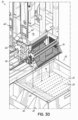
- FIG. 3D shows a portion of the fryer 12 along an opposite end of that shown in FIGS. 3A-3C and the hot holding station 20 adjacent this opposite end of the fryer 12.
- the gantry 24, at the direction of the gantry control 26, has engaged a basket 16 filled with cooked food product 14 (via the clamping gripper 66 of the gantry 24 and the single pickup point 68 of the basket 16, as more fully explained below in reference to FIGS. 5A and 5B ) and brought the basket 16 to a position at a designated height above the hot holding station 20.
- the gantry 24, upon receiving a signal from the gantry control 26, actuates the basket 16 so that the basket 16 opens along a bottom thereof to discharge the cooked food product 14 into the hot holding receiving area 30.
- the particular height above the hot holding station 20 at which the gantry 24 discharges the cooked food product 14 from the basket 16 can vary depending upon the particular cooked food product 14. For example, one cooked food product 14 may be discharged from one height above the hot holding station 20, while a different cooked food product 14 may be discharged from a different height above the hot holding station 20 (e.g., more fragile cooked food product 14 may be dropped from a basket 16 at a lower height above the hot holding receiving area 30 than other cooked food products 14, such differences being programmed into the gantry control 26 based on what types of food product are to be cooked and prepared at the cooking system 10). It will be understood that the hot holding receiving area 30 may be subdivided in some embodiments and the gantry 24 is able to discharge cooked food product from baskets 16 into any of these subdivided areas.
- FIGS. 4A-4H show a series of steps defining a basket loading cycle and a basket discharge cycle according to embodiments of this invention, each of which may be repeatedly performed to manage basket workflow at the cooking system 10.
- FIG. 4A the Figure shows portions of a basket loading cycle in accordance with one embodiment.
- the basket loading cycle begins with an empty basket 16 sitting on one of the platforms 46 positioned over a center one of the fryer vats 42.
- the empty basket 16 is waiting to be picked up by the gantry 24, which is shown positioned over by the dispensing freezer 18 in this state of FIG. 4A .
- FIG. 4A shows in a leftmost one of the fryer vats 42 two baskets 16 filled with recently cooked food product 14 emerging from the cooking medium 44 in a fryer vat 42.
- the vertical transport assemblies 60 lift the platforms 46 on which the baskets 16 sit, thus raising the baskets 16 from the fryer vats 42 and out of the heated cooking medium 44 at the end of a cooking cycle, as shown by the upward arrow in FIG. 4A .
- FIG. 4B shows the gantry 24, after receiving a signal from the gantry control 26, engaging the empty basket 16 on the platform 46 and moving that basket 16 as shown by the upward and leftward movement arrows in FIG. 4B from the platform 46 to the staging shelf 62 adjacent the dispensing freezer 18.
- the system controller 25 sends a signal to the staging shelf 62 so that the staging shelf 62 pivots into a (generally horizontal) deployed position if the staging shelf 62 was previously in a stowed position.
- the gantry 24 places the empty basket 16 on the staging shelf 62 by lowering the basket 16 onto the staging shelf 62 and then disengaging from the basket 16.
- the mechanics of engagement and disengagement between the gantry 24 and a basket 16 are further explained below with respect to FIGS. 5A and 5B .
- FIG. 4C shows a basket 16 filled with uncooked food product 14 in the basket movement receptacle 64, located in a pickup position adjacent the dispensing freezer 18, being engaged by the gantry 24.
- the gantry 24 moves downwardly to the basket movement receptacle 64.
- the basket movement receptacle 64 moves (if necessary) the basket 16 into a pickup position such that the basket 16 is ready to be engaged by the gantry 24 as shown in FIG. 4C .
- Which platform 46 the basket 16 should be moved to is typically determined by the system controller 25.
- the gantry 24 disengages with the basket 16 and leaves the basket 16 on the platform 46 above the fryer vat 42. Note that although a filled basket 16 was previously shown in FIG. 4B at this platform 46 where the gantry 24 drops off the new basket of food to be cooked in FIG.
- this prior basket is understood to have been separately moved and discharged at the hot holding station 20 before the step shown in FIG. 4C (as set forth in the description of basket discharge cycles below), or the filled basket 16 from the basket movement receptacle 64 is moved to a different, open/empty platform 46 during the basket loading cycle. The drop-off of the filled basket 16 onto the platform 46 completes the basket loading cycle of this embodiment.
- FIG. 4D shows the basket movement receptacle 64 moving upwards as shown by the arrow towards the staging shelf 62 in order to transfer the empty basket 16 on the staging shelf 62 from the staging shelf 62 to the basket movement receptacle 64.
- the staging shelf 62 can be pivoted to the generally vertical stowed position to complete the transfer of the basket 16 into the basket movement receptacle 64 as shown.
- FIG. 4D shows baskets 16 filled with uncooked food product 14 on platforms 46 above a fryer vat 42 being lowered into a cooking medium 44 for a cooking cycle via the vertical transport assemblies 60.
- the platforms 46 on which the baskets 16 sit, are attached to the vertical transport assemblies 60 which move the baskets 16 into and out of the cooking medium 44 in the fryer vats 42 upon receiving a signal to initiate a cooking cycle from the system controller 25. These actions can automatically occur at the cooking system 10 while the gantry 24 moves to perform actions on other baskets and platforms, such as in the exemplary basket discharge cycle to now be described.
- FIG. 4E shows a basket 16 in the basket movement receptacle 64 being transported.
- the staging shelf 62 has been pivoted to the vertical, stowed position as shown.
- the basket movement receptacle 64 transports the basket 16 to a filling location.
- the dispenser freezer 18 dispenses uncooked food product 14 into the basket 16.
- the basket movement receptacle 64 then transports the basket 16 from the filling location to the pickup position, if these positions are different from one another.
- the filling location and the pickup position may be distinct physical locations. In a further embodiment, the filling location and the pickup position may be the same physical location.
- the end result is filling of the basket 16 and movement from the initial drop-off position on the staging shelf 62 downwardly as shown by the arrow in FIG. 4E to the pickup position that is accessed by the gantry 24 in a future basket loading cycle.
- the filled basket 16 waits in the basket movement receptacle 64 until the basket 16 is engaged by the gantry 24. These movements can occur simultaneous to other actions being taken by the gantry 24 at the fryer 12.
- FIG. 4E also shows a basket 16 with cooked food product 14 (after exiting a fryer vat 42) being moved from a platform 46 above the fryer vat 42 to a position above the hot holding station 20 via the gantry 24.
- This movement is shown by the rightward arrow in FIG. 4E , resulting in the positioning of the basket 16 and the gantry 24 shown in FIG. 4F and described below.
- This pickup and movement of the filled basket 16 is the beginning of an exemplary basket discharge cycle that is repeatedly performed by the gantry 24 in this embodiment.
- FIG. 4F shows the basket 16 filled with cooked food product 14 suspended by the gantry 24 in a position at a height above the hot holding station 20. Further, FIG. 4F shows the gantry 24, upon receiving a signal from the gantry control 26, actuating the filled basket 16 to open the bottom of same and thereby discharge the cooked food product 14 into the hot holding receiving area 30 of the hot holding station 20. As set forth above, the gantry 24 can vary the height above the hot holding station 20 at which this discharge step occurs depending on the specific type of food product contained within the basket 16. The cooked food is then held in the hot holding receiving area 30 for further preparation and packaging by an operator.
- FIG. 4G shows, like in FIG. 4F , a basket 16 filled with cooked food product 14 suspended in a position at a height above the hot holding station 20 by the gantry 24.
- the basket 16 from which the cooked food product 14 is being discharged in FIG. 4G is positioned at a different height than the basket 16 from which the cooked food product 14 is being discharged in FIG. 4F .
- the basket 16 from which the cooked food product 14 is discharged may be positioned above the hot holding station 20 at different heights. For example, one cooked food product 14 may be discharged at a first height while a different cooked food product 14 may be discharged at a different, second height either higher or lower than the first height.
- FIG. 4H shows the gantry 24, at the direction of the gantry control 26, transporting the basket 16 from a position above the hot holding station 20 (after discharging cooked food product 14) to an open platform 46 above one of the fryer vats 42.
- the gantry 24 disengages with the basket 16 and leaves the basket 16 on a platform 46 above a fryer vat 42, which completes the basket discharge cycle of this embodiment.
- the empty basket 16 is then ready to be engaged by the gantry 24 again when customer demand necessitates. It will be understood that the gantry 24 could omit this drop-off step in other embodiments and instead take the empty basket 16 directly to the staging shelf 62 to begin another basket loading cycle. Further, FIG.
- FIG. 4H shows the staging shelf 62 pivoting from a vertical, stowed position to a horizontal, deployed position in preparation for any empty basket 16 to be placed upon the staging shelf 62 by the gantry 24.
- the gantry 24 can then move again to start a new basket loading cycle, a new basket discharge cycle, or to the basket movement receptacle 64 as specifically shown in FIG. 4H .
- FIGS. 4A-4H show features of the system's 10 basket loading and discharge cycles for managing basket 16 workflow during food preparation at an automated cooking system 10.
- the automated cooking system 10 prioritizes and orders the basket loading cycles and basket discharge cycles for the gantry system 22 to satisfy varying levels of demand for cooked food product 14 from the automated cooking system 10.
- a basket loading cycle includes in one embodiment: the gantry 24 picking up an empty basket 16 from a platform 46, transporting the empty basket 16 to the dispensing freezer 18 to be filled with uncooked food product 14, picking up a basket 16 filled with uncooked food product 14 from the dispensing freezer 18, and transporting the filled basket 16 from the dispensing freezer 18 to a selected platform 46 above a fryer vat 42 (as determined by the gantry control 26) to be cooked in the fryer vat 42.
- the basket loading cycle can be completed in a time period of less than 20 seconds.
- the exemplary embodiment shown performs a basket loading cycle as described here in about 18 seconds, for example.
- a basket discharge cycle includes in one embodiment: the gantry 24 picking up a filled basket 16 containing cooked food product 14 from a platform 46, transporting the filled basket 16 to a position above the hot holding station 20, the gantry 24 actuating the basket 16 to discharge the cooked food product 14 therein into the hot holding station 20 awaiting below, and transporting the emptied basket 16 to a selected platform 46 above a fryer vat 42 (as determined by the gantry control 26).
- the basket discharge cycle can be completed in a time period of less than 20 seconds.
- the exemplary embodiment shown performs a basket discharge cycle as described here in about 16 seconds, for example.
- the gantry system 22 can complete both one of the basket loading cycles and one of the basket discharge cycles in a time period of less than 35 seconds (e.g., the exemplary embodiment performs one of each cycle in about 34 seconds total). This is an improvement in speed by over 40% as compared to conventional automated fryer designs.
- This arrangement allows for successful management of up to 6 or more baskets cooking food product simultaneously at the fryer 12, which can result, for example, in throughput levels of about 68,04 kg (150 pounds) of cooked French fries an hour in one operational example.
- the basket loading and basket discharge cycles could include additional or fewer steps in other embodiments.
- the gantry 24 is configured to manage the workflow of 6 or more baskets and cooking stations (platforms 46) at the fryer 12 simultaneously to provide an increased maximum cooking volume throughput of the cooking system 10.
- the automatic cooking system 10 therefore improves the field of cooking equipment and methodologies by limiting the need for operator intervention (and associate expense) while maximizing how much food product can be cooked and prepared within the standard space used by fryers in commercial setting kitchens.
- the design of the gantry 24 in this cooking system 10 advantageously controls the baskets 16 during the rapid movements of the basket loading and discharge cycles to avoid uncontrolled pivoting or rotations and/or undesired impacts with other baskets 16 held at the cooking system 10. As such, the reliability and throughput is significantly improved even over other automatic fryer designs, one such version of which is described now for reference from previous developments of the original Applicant of the present application.
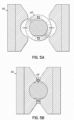
- FIGS. 5A-5B show engagement between the clamping gripper 66 of the gantry 24 and the single pickup point 68 of a basket 16 in accordance with the embodiments of this invention.
- FIG. 5A the Figure shows an embodiment of a single pickup point 68 of a basket 16 facing in the direction of the gantry system 22.
- the single pickup point 68 is in the form of a spool that may be grasped by the clamping gripper 66 as shown and described here.
- the gantry system 22 includes a gantry 24 which, in turn, includes a clamping gripper 66.
- the clamping gripper 66 is a two-piece clamping mechanism which engages with the single pickup point 68 of a basket 16 from opposing sides. Upon receiving a signal from the gantry control 26, the clamping gripper 66 engages and secures the single pickup point 68 of the basket 16 within the clamping gripper 66.
- the Figure shows the clamping gripper 66 of the gantry 24 engaged with the single pickup point 68 of a basket 16.
- the two-piece clamping gripper 66 is clamped into engagement with the single pickup point 68.
- the clamping gripper 66 clamps in engagement with the single pickup point 68 in such a way to prevent the basket 16 from uncontrollably rotating when the basket 16 is engaged with the gantry 24 (e.g., when the basket 16 is being moved from one position to another).
- additional wires or structure may be provided adjacent the spool to help avoid any undesirable or uncontrolled pivoting of the basket 16 during engagement and movement with the gantry 24.
- preventing uncontrolled rotational movements of the basket 16 during engagement with the gantry 24 serves to prevent a basket 16 engaged with the gantry 24 from impacting other baskets 16 at the system 10 or fryer 12, thereby preventing damage to baskets 16, the gantry 24, the fryer 12, or the system 10, as well as preventing food product spills and/or cycle delays associated with such spills and impacts.
- the improved speed and basket workflow management is therefore enabled in part by this engagement of baskets 16 with the gantry 24.
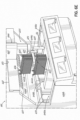
- the fryer 612 includes a front wall panel 644a, a left side wall panel 644b, a right side wall panel 644c, and a rear wall panel 644d adjacent a rear side of the fryer 612 to cover various interior portions of a frame of the fryer 612 and/or various fryer components such as, for example, oil filtration and recirculation components.
- the illustrated fryer 612 includes three cooking chambers 648a-c, each configured to hold a cooking medium. As shown, each cooking chamber 648a-c is configured to hold a single basket 622a-b, for a total of three baskets 622a-b.
- each cooking chamber 648a-c is configured to hold one or more baskets 622a-b.
- At least one heating element 650 is disposed within each cooking chamber 648a-c.
- each cooking chamber 648a-c may include any number of heating elements 650 in any arrangement, as may be desired.
- the heating element 650 is configured to heat the cooking medium to a predetermined temperature.
- An exhaust or vent hood 651 is positioned generally above the cooking chambers 648a-c.
- the illustrated fryer 612 includes touch screen controls 653a-c for each cooking chamber 648a-c.
- the fryer 612 includes a transport assembly 655 that is configured to raise and lower the baskets 622a-b out of and into the cooking chambers 648a-c and also to transfer the baskets 622a-b between a plurality of horizontal positions.
- a transport assembly 655 that is configured to raise and lower the baskets 622a-b out of and into the cooking chambers 648a-c and also to transfer the baskets 622a-b between a plurality of horizontal positions.
- the transport assembly 655 includes an overhead gantry 666 which travels horizontally along a track 667 fixed relative to the frame of the fryer 612. Horizontal movement of the gantry 666 along the track 667 may be enabled by an actuator (not shown).
- the gantry 666 may be belt driven or gear driven in a manner similar to that described above with respect to the aforementioned horizontal transport assemblies.
- the actuator of the gantry 666 and/or a motor thereof may be mounted behind the track 667.
- the gantry 666 includes a hollow body 669 having a shoulder 673 for engaging the track 667 such that the weight of the gantry 666 may be supported by the track 667.
- the gantry 666 further includes a generally vertical telescoping arm 675 configured to be extendable, retractable, and/or rotatable relative to the hollow body 669. More particularly, the arm 675 may be vertically extended from and retracted into the hollow body 669, and may also be rotated about a vertical axis defined by the hollow body 669 and/or arm 675. Vertical and rotational movement of the arm 675 may be enabled by one or more actuators (not shown).
- the arm 675 may be belt driven or gear driven in a manner similar to that described above with respect to the aforementioned vertical transport assemblies.
- the actuator of the arm 675 and/or a motor thereof may be mounted within the hollow body 669 so as to move horizontally along the track 667 therewith.
- the gantry 666 also includes a multi-handed manipulator 679 pivotably coupled to a base 681 which is, in turn, fixedly coupled to the arm 675.
- the illustrated base 681 includes a hollow sleeve 683 configured to rotatably receive a portion of the manipulator 679, such as a rod 685 thereof ( FIG. 6G ).
- the manipulator 679 may be rotated about a horizontal axis defined by the rod 685, for example.
- Rotational movement of the manipulator 679 may be enabled by one or more actuators (not shown).
- the actuator of the manipulator 679 and/or a motor thereof may be mounted within one or more of the hollow body 669, the telescoping arm 675, and/or the base 681 so as to move horizontally along the track 667 therewith.
- the manipulator 679 includes two or more hands 687, 689 fixedly coupled to each other. As shown, the hands 687, 689 extend away from the rod 685 in generally opposite directions. In other embodiments, the hands 687, 689 may not be coupled to each other. In addition, or alternatively, more than two hands 687, 689 may be provided. For example, an alternative manipulator may include three hands offset from each other by approximately 120°.
- Each hand 687, 689 includes a coupling 691 ( FIG. 6G ) for selectively attaching and releasing a basket 622a-b to and from the manipulator 679.
- each coupling 691 may include a generally cylindrical protrusion configured to be received by a corresponding recess 693 of a handle 695 of a basket 622a-b.
- frictional engagement between the protrusion 691 and the recess 693 may attach the manipulator 679 to the basket 622a-b.
- an auxiliary lock may be selectively engaged to assist in attaching the manipulator 679 to the basket 622a-b.
- each coupling 691 may be configured to allow the corresponding basket 622a-b to rotate relative to the manipulator 679 about the coupling 691, such as under gravity, and/or may be configured to rotatably fix the corresponding basket 622a-b relative to the manipulator 679.
- each coupling 691 may be configured to selectively rotatably fix and selectively rotatably release the corresponding basket 622a-b.
- the gantry 666 is positioned proximate the right-side wall panel 644c with the first hand 687 of the manipulator 679 attached to the first basket 622a via the corresponding coupling 691, while the second basket 622b is initially positioned in the second cooking chamber 648b with a rear downwardly facing hook 606 of the basket 622b engaging a support (not shown) for holding the basket 622b.
- the arm 675 may be initially oriented such that the first basket 622a extends laterally away from the fryer 612, such as for receiving uncooked food product from a freezer (not shown).
- the second basket 622b may contain food product (not shown) whose cooking time is nearing completion.
- FIG. 6A shows the transport assembly 655 moving the first basket 622a laterally from proximate the right-side wall panel 644c to above the second cooking chamber 648b, as indicated by the arrow A1.
- the arm 675 rotates counterclockwise about the vertical axis to align the first basket 622a directly above the second basket 622b, as indicated by the arrow A2.
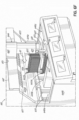
- FIG. 6B shows that upon reaching the second cooking chamber 648b, the second hand 689 of the manipulator 679 attaches to the second basket 622b via the corresponding coupling 691 while the first hand 687 of the manipulator 679 remains attached to the first basket 622a.
- FIG. 6C shows the transport assembly 655 raising the baskets 622a-b via retraction of the arm 675 into the hollow body 669 of the gantry 666, as indicated by the arrow A3. In this manner, the transport assembly 655 raises the second basket 622b out of the second cooking chamber 648b.
- FIG. 6D shows the manipulator 679 rotating clockwise about the horizontal axis, as indicated by the arrows A4, A5.
- the couplings 691 are configured to allow the baskets 622a-b to rotate relative to the manipulator 679 about the respective coupling 691, such that the weight of the food product contained in the baskets 622a-b may allow the baskets 622a-b to remain in a substantially level orientation while the manipulator rotates. In this manner, the baskets 622a-b may avoid spilling the food product during this rotation.
- FIG. 6E shows that upon rotating the manipulator 679 about the horizontal axis such that the vertical positions of the first and second baskets 622a-b have switched, the transport assembly 655 lowers the baskets 622a-b via extension of the arm 675 from the hollow body 669 of the gantry 666, as indicated by the arrow A6. In this manner, the transport assembly 655 lowers the first basket 622a into the second cooking chamber 648b for cooking the food product contained therein. When lowered into the second cooking chamber 648b, a rear downwardly facing hook 606 of the basket 622a may engage a support (not shown) for holding the basket 622a. While FIG.
- FIGE shows that the vertical positions of the first and second baskets 622a-b have switched, alternative embodiments may simply change the heights of the first and second baskets 622a-b to position the first basket 622a relatively lower than the second basket 622b, such as in embodiments have more than two hands 687, 689.
- FIG. 6F shows the transport assembly 655 moving the second basket 622b laterally from above the second cooking chamber 648b to a position proximate the left side wall panel 644b, as indicated by the arrow A7, with the first hand 687 of the manipulator 679 detached from the first basket 622a to leave the first basket 622a in the second cooking chamber 648b.
- the arm 675 rotates counterclockwise about the vertical axis, such as to align the second basket 622b over a holding unit (not shown), as indicated by the arrow A8.
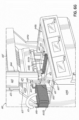
- FIG. 6G shows that when proximate the left side wall panel 644b, the manipulator 679 rotates counterclockwise about the horizontal axis, as indicated by the arrow A9.
- the coupling 691 of the second hand 689 of the manipulator 679 is configured to rotatably fix the second basket 622b relative to the manipulator 679, such that this rotation of the manipulator causes the second basket 622b to tilt away from the substantially level orientation.
- FIG. 6H shows the second basket 622b tilted as a result of the orientation of the manipulator 679 relative to the horizontal axis, such that the cooked food product carried by the second basket 622b may be dispensed therefrom into a holding unit.
- the transport assembly 655 may return to a position proximate the right-side wall panel 644c and repeat the above process for subsequent batches of food product. While two baskets 622a-b are shown, it will be appreciated that additional baskets may be incorporated, such as for cooking food product in the first and third cooking chambers 648a, 648c.
- the multi-handed manipulator 679 of the transport assembly 655 enables rapid placement of a basket 622a-b into a cooking chamber 648a-c immediately following removal of a basket 622a-b from that same cooking chamber 648a-c.
- the multi-handed manipulator 679 is able to place the next basket 622a-b into the cooking chamber 648a-c while continuing to hold the original basket 622a-b, prior to moving the original basket 622a-b to an unloading station, thereby maximizing the time that the cooking chamber 648a-c is used for cooking and minimizing down time to improve the throughput of the fryer 612. In one embodiment, this may save between approximately 10 and 20 seconds per batch as compared to a single-handed manipulator.
- the double arm gantry embodiment of the fryer 612 shown in FIGS. 6A-6H improves production and food product throughput as compared to conventional fryers and systems.
- the fryer 612 manages the workflow of baskets 622a-b to allow for up to 6 baskets of food product to be cooked at the same time.
- the food product is cooked reliably and quickly to provide high throughput of desirable quality cooked foods to meet the customer demands in the restaurant setting.
- the automated cooking system 10 of the first embodiment described above with reference to FIGS. 1-5B achieves several additional operational advantages.
- the gantry system 22 engages with the baskets 16 in such a manner as to eliminate any rotational basket 16 swinging that may lead to adjacent baskets 16 hitting one another, which may occur with the double arm gantry design.
- the gantry system 22 also simplifies the movements needed when engaging with and transferring baskets 16 to and from the platforms 46 in the fryer 12.
- the gantry system 22 is not primarily responsible for vertical movements of baskets 16 into and out of the fryer 12, and complicated rotation mechanisms for managing two baskets 16 at the same time can be omitted from this version of the gantry system 22. Consequently, the cycle time needed for various basket 16 movement and drop-off and pickup actions is decreased even further by the automated cooking system 10 by an additional 30%-50%.
- the cooking system 10 achieves the increased production by efficiently managing the workflow of baskets 16 moving between a freezer 18, the fryer 12, and a hot holding station 20.
- the automated cooking system 10 and its methods of operation described herein therefore improve the fryer art in a significant manner to add the efficiencies with regard to both time and labor considerations and production levels required in modern restaurants without necessitating a significantly bigger fryer footprint.
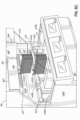
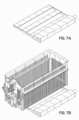
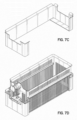
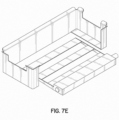
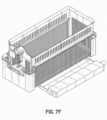
- FIGS. 7A through 7F show an embodiment of a staging shelf 62.
- the staging shelf 62 is generally located in the vicinity of the dispensing freezer 18.
- FIG. 7B in a deployed position the staging shelf 62 can support a basket 16.
- FIGS. 7C and 7D the Figures show an embodiment of a basket movement receptacle 64.
- the basket movement receptacle 64 is a generally U-shaped support surrounding an open slot.
- the basket movement receptacle 64 engages with a basket 16 ( FIG. 7D ) and moves the basket 16 from a filling location, where the basket 16 receives uncooked food product 14 from the dispensing freezer 18, to a pickup position, where the basket 16 can be engaged by the gantry 24 to be delivered to a platform 46 above a fryer vat 42.
- FIGS. 7E and 7F the Figures show a basket movement receptacle 64 and a staging shelf 62 arranged such that the open slot of the basket movement receptacle 64 faces generally towards the staging shelf 62.
- the basket movement receptacle 64 and the staging shelf 62 are configured such that the staging shelf 62 fits within the open slot of the basket movement receptacle 64.
- the basket movement receptacle 64 and the staging shelf 62 work in tandem to engage a basket 16.
- a basket 16 located at a filling location and sitting atop a staging shelf 62 may be engaged from below by a basket movement receptacle 64, such that the basket movement receptacle 64 can transport the basket 16 downward to a pickup position after the staging shelf 62 transitions/pivots from a deployed position to a stowed position.
- FIGS. 7A through 7F Further details of the elements shown in FIGS. 7A through 7F are described in detail above in the overall context of the automated cooking system 10 and therefore are not repeated here for the sake of conciseness.
- the automated cooking system 10 allows the operator to perform other tasks while the automated cooking system 10 is working. Additionally, an automated cooking system 10 allows for improved quality control of the food product 14 (e.g., precise cooking time, more precise weight of product being cooked, optimized heat management by alternating product drops between the various cooking chambers, or synchronized mini-filtration during idle periods). Additionally, the automated cooking system 10 increases the hourly product throughput versus a manually-operated system. Further, the automated cooking system 10 provides superior up-time and predictive fault diagnostics due to continual baseline performance comparisons and configurable warning thresholds.
- Additional benefits of the automated cooking system 10 include, for example, an improved operator experience, availability of manual override at any point of the process, easy cleaning (typical cooking chamber cleaning procedure where the actuator surfaces can be easily wiped down), the system 10 fits into customer's current fryer width footprint, the gantry fits under the 162,56 cm (64 inch) minimum hood clearance, minimal interference with existing fire suppression systems due to the design of the system 10 and fryer 12, making retrofit and site approvals easier, moving parts and controls being shielded from operator and extreme heat, optimized motions allowing for minimal speeds to reduce risk of operator contact, and being retrofittable to existing fryers.
- routines executed by the system controller 25 to implement the embodiments of the invention, whether implemented as part of an operating system or a specific application, component, program, object, module, or sequence of instructions, or a subset thereof, may be referred to herein as "computer program code,” or simply "program code.”
- Program code typically comprises computer-readable instructions that are resident at various times in various memory and storage devices in a computer and that, when read and executed by one or more processors in a computer, cause that computer to perform the operations necessary to execute operations or elements embodying the various embodiments of the invention.
- Computer-readable program instructions for carrying out operations of the embodiments of the invention may be, for example, assembly language or either source code or object code written in any combination of one or more programming languages.
- the program code embodied in any of the applications or modules described herein is capable of being individually or collectively distributed as a program product in a variety of different forms.
- the program code may be distributed using a computer-readable storage medium having computer-readable program instructions thereon for causing a processor to carry out the embodiments of the invention.
- Computer-readable storage media which is inherently non-transitory, may include volatile, non-volatile, removable, and non-removable tangible media implemented in any method or technology for storage of information, such as computer-readable instructions, data structures, program modules, or other data.
- Computer-readable storage media may further include RAM, ROM, erasable programmable read-only memory (EPROM), electrically erasable programmable read-only memory (EEPROM), flash memory or other solid state memory technology, portable compact disc read-only memory (CD-ROM), or other optical storage, magnetic cassettes, magnetic tape, magnetic disk storage or other magnetic storage devices, or any other medium that can be used to store the desired information and which can be read by a computer.
- a computer-readable storage medium should not be construed as transitory signals per se (e.g., radio waves or other propagating electromagnetic waves, electromagnetic waves propagating through a transmission media such as a waveguide, or electrical signals transmitted through a wire).
- Computer-readable program instructions may be downloaded to a computer, another type of programmable data processing apparatus, or another device from a computer-readable storage medium or to an external computer or external storage device via a network.
- Computer-readable program instructions stored in a computer-readable medium may be used to direct a computer, other types of programmable data processing apparatuses, or other devices to function in a particular manner, such that the instructions stored in the computer-readable medium produce an article of manufacture including instructions that implement the functions, acts, or operations specified in the flow-charts, sequence diagrams, or block diagrams.
- the computer program instructions may be provided to one or more processors of a general purpose computer, a special purpose computer, or another programmable data processing apparatus to produce a machine, such that the instructions, which execute via the one or more processors, cause a series of computations to be performed to implement the functions, acts, or operations specified in the flow-charts, sequence diagrams, or block diagrams.
Landscapes
- Engineering & Computer Science (AREA)
- Food Science & Technology (AREA)
- Frying-Pans Or Fryers (AREA)
- Warehouses Or Storage Devices (AREA)
Claims (10)
- Verfahren zum Verwalten eines Korbarbeitsablaufs während einer Lebensmittelzubereitung an einem automatischen Kochsystem (10), welches ein Portalsystem (22) mit einem Portal (24), eine abgebende Gefriereinheit (18), eine Fritteuse (12) mit einer Mehrzahl an Frittierbehältern (42) und eine Heißhaltestation (20) umfasst, wobei das Verfahren umfasst:Durchführen eines Korbladezyklus durch das Portalsystem (22), wobei jeder Korbladezyklus zumindest durch Folgendes gekennzeichnet ist: Aufnehmen eines gefüllten Korbs (16) von der abgebenden Gefriereinheit (18) mit dem Portal (24), Bewegen des Portals (24) und des gefüllten Korbs zu einer ausgewählten Plattform (46) an der Fritteuse, und Ablassen des gefüllten Korbs (16) auf die aus den Plattformen (46) ausgewählten Plattform zum Ermöglichen der Fritteuse (12) das Lebensmittelprodukt im gefüllten Korb (16) zu garen; undDurchführen eines Korbentladezyklus durch das Portalsystem (22), wobei jeder Korbentladezyklus zumindest gekennzeichnet ist durch: Aufnehmen eines gefüllten Korbs (16), welcher mit der Fritteuse (12) gegarte Lebensmittel enthält, von einer der Plattformen (46) an der Fritteuse (12) mit dem Portal (24), Bewegen des Portals (24) und des gefüllten Korbs (16) zur Heißhaltestation (20) und Abladen des gegarten Lebensmittels in die Heißhaltestation (20) zum Leeren des Korbs (16),wobei das automatische Kochsystem (10) die Korbladezyklen und die Korbentladezyklen für das Portalsystem (22) priorisiert und ordnet zum Erfüllen unterschiedlicher Bedarfsstufen für gegarte Lebensmittel von dem automatischen Kochsystem (10),dadurch gekennzeichnet, dass jeder Frittierbehälter (42) wenigstens eine Plattform (46) zum Empfangen und Bewegen eines Korbs (16) umfasst, undgekennzeichnet durch den Schritt Ansteuern des gefüllten Korbs (16) mit dem Portal (24) zum Öffnen des gefüllten Korbs (16) und dabei Entladen des gegarten Lebensmittels vom Korb (16).
- Verfahren nach Anspruch 1, wobei der Korbladezyklus ferner ein Aufnehmen eines leeren Korbs (16) von einer der Plattformen (46) an der Fritteuse (12) mit dem Portal (24), Bewegen des Portals (24) und des leeren Korbs (16) zu der abgebenden Gefriereinheit (18), und Abgeben des leeren Korbs (16) an der abgebenden Gefriereinheit (18) umfasst, und wobei der Korbentladezyklus ferner ein Bewegen des Portals (24) und des leeren Korbs (16) zu einer anderen aus den Plattformen (46) ausgewählten Plattform (46) an der Fritteuse (12), und ein Abgeben des leeren Korbs (16) zu der anderen aus den Plattformen (46) ausgewählten Plattform (46) umfasst.
- Verfahren nach Anspruch 1 oder 2, ferner aufweisend:Bewegen von jeweils nur einem Korb (16) mit dem Portal (24) während der Korbladezyklen und der Korbentladezyklen;vorzugsweise unkontrollierten Rotationsbewegungen eines Korbs (16) während einer Verbindung des Korbs (16) mit dem Portal (24) verhindernd, um somit Stöße des mit dem Portal (24) verbundenen Korbs (16) mit einem anderen Korb (16) an der automatischen Kochstation (10) zu vermeiden;wobei vorzugsweise die Schritte des Aufnehmens eines Korbs (16) mit dem Portal (24) in den Korbladezyklen und den Korbentladezyklen ferner aufweisen:
Klemmen des Portals (24) in Eingriff mit nur einem einzigen Aufhängepunkt, welcher entlang einer Vorderseite des Korbs (16) definiert ist. - Verfahren nach Anspruch 1 oder 2, wobei die Fritteuse (12) wenigstens sechs Plattformen (46), die Kochstationen für einen Korb (16) an der Mehrzahl an Frittierbehältern (42) definieren, umfasst, und wobei das Verfahren ferner aufweist:
Verwalten eines Arbeitsablaufs von wenigstens sechs Körben (16) gleichzeitig mit dem Portalsystem (22) zum Bewegen der wenigstens sechs Körbe (16) zwischen der abgebenden Gefriereinheit (18), der Fritteuse (12), und der Heißhaltestation (20) zum Abschließen von Kochzyklen für in die wenigstens sechs Körbe (16) geladene Lebensmittel. - Verfahren nach Anspruch 1 oder 2, wobei das Portalsystem (22) sowohl einen der Korbladezyklen, als auch einen der Korbentladezyklen in einer Zeitspanne von weniger als 35 Sekunden abschließt,
wobei vorzugsweise das Portalsystem (22) wenigstens einen der Korbladezyklen, oder einen der Korbentladezyklen in einer Zeitspanne von weniger als 20 Sekunden abschließt. - Verfahren nach Anspruch 1 oder 2, ferner umfassend:Senken eines gefüllten Korbs (16) durch eine der Plattformen (46) an der Fritteuse (12) in ein beheiztes Kochmedium innerhalb eines zugehörigen Frittierbehälters (42) zum Garen der Lebensmittel im Korb (16);Halten des gefüllten Korbs (16) innerhalb des zugehörigen Frittierbehälters (42) für eine Kochzykluszeit, die zum Garen der Lebensmittel im Korb (16) definiert ist; undHeben des gefüllten Korbs (16) mit der einen Plattform (46) an der Fritteuse (12), aus dem aufgeheizten Kochmedium nachdem die Kochzykluszeit abgelaufen ist, zum Positionieren des gefüllten Korbs (16) mit gegarten Lebensmitteln in eine Position, die bereit für eine Aufnahme durch das Portalsystem (22) ist.
- Verfahren nach Anspruch 1 oder 2, wobei die abgebende Gefriereinheit (18) und die Heißhaltestation (20) an gegenüberliegenden lateralen Seiten der Fritteuse (12) positioniert sind, und das Portalsystem (22) Körbe (16) lateral zwischen der abgebenden Gefriereinheit (18), der Heißhaltestation (20) und der Mehrzahl an Frittierbehälter (42), die zwischen der abgebenden Gefriereinheit (18) und der Heißhaltestation (20) angeordnet sind, bewegt.
- Verfahren nach Anspruch 1 oder 2, wobei die Körbe (16) mit verschiedenen Sorten von Lebensmitteln für Kochzyklen beladen werden können, und der Schritt des Durchführens einer Vielzahl von Korbentladezyklen ferner aufweist:Bewegen, während eines der Korbentladezyklen, eines ersten gefüllten Korbs (16), der eine erste Sorte Lebensmittel enthält, zu einer ersten Höhe oberhalb eines Fachs an der Heißhaltestation (20), sodass eine Betätigung des ersten gefüllten Korbs (16) zum Öffnen mit dem Portal (24) ein Entladen der ersten Sorte von Lebensmittel in das Fach durch Ablassen der ersten Sorte von Lebensmittel von der ersten Höhe bewirkt; undBewegen, während eines anderen Korbentladezyklus, eines zweiten gefüllten Korbs (16), der eine zweite Sorte Lebensmittel enthält, zu einer zweiten Höhe oberhalb des Fachs an der Heißhaltestation (20), sodass eine Betätigung des zweiten gefüllten Korbs (16) zum Öffnen mit dem Portal (24) ein Entladen der zweiten Sorte Lebensmittel in das Fach durch Ablassen der zweiten Sorte Lebensmittel von der zweiten Höhe bewirkt,wobei die erste Sorte Lebensmittel verschieden ist als die zweite Sorte Lebensmittel, und die erste und zweite Höhe verschieden sind.
- Verfahren nach Anspruch 1 oder 2, wobei die abgebende Gefriereinheit (18) eine Bereitstellungsablage (62) und ein Korbbewegungsfach (64) umfasst, und während jedem der Korbladezyklen:das Portalsystem (22) den leeren Korb (16) auf die Bereitstellungsablage (62) ablässt; unddas Portalsystem (22) den gefüllten Korb (16) vom Korbbewegungsfach (64) aufnimmt,wobei der leere Korb (16) und der gefüllte Korb (16) verschiedene Körbe an der abgebenden Gefriereinheit (18) sind.
- Verfahren nach Anspruch 9, wobei zwischen den Korbladezyklen das Verfahren an der abgebenden Gefriereinheit (18) ferner aufweist:Bewegen des Korbbewegungfachs (64) zu einer an den leeren Korb (16) an der Bereitstellungsablage (62) angrenzenden Position;Schwenken der Bereitstellungsablage (62) aus einer Bewegungsbahn des Korbbewegungfachs (64), sodass der leere Korb (16) auf dem Korbbewegungfach (64) gestützt wird;Bewegen des leeren Korbs (16) mit dem Korbbewegungsfach (64) zu einem Auffüllort an der abgebenden Gefriereinheit (18), wo der leere Korb (16) mit Lebensmitteln gefüllt wird, und zu einer Aufnahmeposition nachdem der Korb (16) mit Lebensmitteln gefüllt ist zum Aufnehmen durch das Portalsystem (22) in einem der Nachfolgenden von den Korbladezyklen.
Priority Applications (2)
| Application Number | Priority Date | Filing Date | Title |
|---|---|---|---|
| EP23210458.8A EP4316321B1 (de) | 2021-04-29 | 2022-04-28 | Verfahren zur verwaltung des korbarbeitsflusses zur lebensmittelherstellung |
| EP23210456.2A EP4316320B1 (de) | 2021-04-29 | 2022-04-28 | Automatisiertes kochsystem und verfahren zur verwaltung des korbarbeitsflusses zur lebensmittelherstellung |
Applications Claiming Priority (3)
| Application Number | Priority Date | Filing Date | Title |
|---|---|---|---|
| US17/244,096 US11678769B2 (en) | 2021-04-29 | 2021-04-29 | Automated cooking system and methods of managing basket workflow for food preparation |
| US17/344,063 US12262847B2 (en) | 2021-04-29 | 2021-06-10 | Automated cooking system and method using basket-gantry interface |
| US17/686,816 US12465173B2 (en) | 2021-04-29 | 2022-03-04 | Automated cooking system with lift platforms |
Related Child Applications (4)
| Application Number | Title | Priority Date | Filing Date |
|---|---|---|---|
| EP23210458.8A Division-Into EP4316321B1 (de) | 2021-04-29 | 2022-04-28 | Verfahren zur verwaltung des korbarbeitsflusses zur lebensmittelherstellung |
| EP23210458.8A Division EP4316321B1 (de) | 2021-04-29 | 2022-04-28 | Verfahren zur verwaltung des korbarbeitsflusses zur lebensmittelherstellung |
| EP23210456.2A Division-Into EP4316320B1 (de) | 2021-04-29 | 2022-04-28 | Automatisiertes kochsystem und verfahren zur verwaltung des korbarbeitsflusses zur lebensmittelherstellung |
| EP23210456.2A Division EP4316320B1 (de) | 2021-04-29 | 2022-04-28 | Automatisiertes kochsystem und verfahren zur verwaltung des korbarbeitsflusses zur lebensmittelherstellung |
Publications (3)
| Publication Number | Publication Date |
|---|---|
| EP4082412A1 EP4082412A1 (de) | 2022-11-02 |
| EP4082412B1 true EP4082412B1 (de) | 2024-06-05 |
| EP4082412C0 EP4082412C0 (de) | 2024-06-05 |
Family
ID=81325341
Family Applications (6)
| Application Number | Title | Priority Date | Filing Date |
|---|---|---|---|
| EP24208094.3A Pending EP4487743A3 (de) | 2021-04-29 | 2022-04-19 | Automatisiertes kochsystem und verfahren mit korb-gantry-schnittstelle |
| EP22168774.2A Active EP4082410B1 (de) | 2021-04-29 | 2022-04-19 | Automatisiertes kochsystem mit hebebühnen |
| EP22168777.5A Active EP4082411B1 (de) | 2021-04-29 | 2022-04-19 | Automatisches kochsystem und verfahren mit korb-portal-schnittstelle |
| EP23210458.8A Active EP4316321B1 (de) | 2021-04-29 | 2022-04-28 | Verfahren zur verwaltung des korbarbeitsflusses zur lebensmittelherstellung |
| EP23210456.2A Active EP4316320B1 (de) | 2021-04-29 | 2022-04-28 | Automatisiertes kochsystem und verfahren zur verwaltung des korbarbeitsflusses zur lebensmittelherstellung |
| EP22170595.7A Active EP4082412B1 (de) | 2021-04-29 | 2022-04-28 | Automatisiertes kochsystem und verfahren zur verwaltung des korbarbeitsablaufs für die lebensmittelzubereitung |
Family Applications Before (5)
| Application Number | Title | Priority Date | Filing Date |
|---|---|---|---|
| EP24208094.3A Pending EP4487743A3 (de) | 2021-04-29 | 2022-04-19 | Automatisiertes kochsystem und verfahren mit korb-gantry-schnittstelle |
| EP22168774.2A Active EP4082410B1 (de) | 2021-04-29 | 2022-04-19 | Automatisiertes kochsystem mit hebebühnen |
| EP22168777.5A Active EP4082411B1 (de) | 2021-04-29 | 2022-04-19 | Automatisches kochsystem und verfahren mit korb-portal-schnittstelle |
| EP23210458.8A Active EP4316321B1 (de) | 2021-04-29 | 2022-04-28 | Verfahren zur verwaltung des korbarbeitsflusses zur lebensmittelherstellung |
| EP23210456.2A Active EP4316320B1 (de) | 2021-04-29 | 2022-04-28 | Automatisiertes kochsystem und verfahren zur verwaltung des korbarbeitsflusses zur lebensmittelherstellung |
Country Status (3)
| Country | Link |
|---|---|
| US (1) | US12465173B2 (de) |
| EP (6) | EP4487743A3 (de) |
| AU (3) | AU2022202201A1 (de) |
Families Citing this family (1)
| Publication number | Priority date | Publication date | Assignee | Title |
|---|---|---|---|---|
| CN118542483B (zh) * | 2024-07-29 | 2024-10-15 | 山东德州扒鸡股份有限公司 | 一种智能自动控制的扒鸡煮制设备 |
Family Cites Families (55)
| Publication number | Priority date | Publication date | Assignee | Title |
|---|---|---|---|---|
| US3164406A (en) | 1960-09-07 | 1965-01-05 | Leonard D Barry | Automatic holding device |
| US4722267A (en) | 1986-03-24 | 1988-02-02 | Longin Galockin | French fry vending machine |
| US4901633A (en) | 1987-09-28 | 1990-02-20 | De Longhi S.P.A. | Rotating oblique basket frier for cyclic immersion cooking |
| JPS63288117A (ja) | 1987-05-21 | 1988-11-25 | 有限会社 高橋商店 | 自動油揚げフライヤ |
| US5172328A (en) | 1988-04-01 | 1992-12-15 | Restaurant Technology, Inc. | Food preparation system and method |
| US4913038A (en) | 1988-08-03 | 1990-04-03 | Henny Penny Corporation | Deep fat fryer with computerized control system |
| US5112633A (en) | 1989-01-13 | 1992-05-12 | Heat And Control, Inc. | Automatic stirring of batch fried food products |
| US4951558A (en) | 1989-04-03 | 1990-08-28 | Figliuzzi Vincent D | Basket lifting mechanism for cooking pot |
| US5142968A (en) | 1989-12-29 | 1992-09-01 | Arthur D. Little, Inc. | Automated deep fat fryer |
| US5224415A (en) | 1989-12-29 | 1993-07-06 | Gas Research Institute | Frozen food storage and dispensing system |
| US5191918A (en) | 1990-05-04 | 1993-03-09 | Restaurant Technology, Inc. | Food dispenser and method |
| US5232151A (en) | 1992-01-02 | 1993-08-03 | Henny Penny Corporation | Cold zone heat regulation device and method for a deep fat fryer |
| US5263406A (en) | 1993-03-02 | 1993-11-23 | Chiu Yao Jui | Vacuum type food frying apparatus |
| US5973297A (en) | 1996-03-28 | 1999-10-26 | Henny Penny Corporation | Apparatus and method for heat regulation of deep fat fryer |
| US6165525A (en) | 1998-08-12 | 2000-12-26 | Reno Rolle | Food cooking system with ultrasonic rotational basket |
| CA2279957A1 (en) | 1999-08-09 | 2001-02-09 | Speed Fry Corporation | Apparatus and method for automatically frying foodstuff |
| US9202206B2 (en) | 2000-09-25 | 2015-12-01 | Ecardless Bancorp, Ltd. | Secure financial transaction processing using location information |
| US7100497B2 (en) | 2001-09-12 | 2006-09-05 | Pitco Frialator, Inc. | High temperature, oil saving, rapid cook fryer system |
| US20030192435A1 (en) | 2002-04-11 | 2003-10-16 | Mcnair John Duncan | Cooking appliance |
| US7441388B2 (en) | 2002-04-22 | 2008-10-28 | Restaurant Technology, Inc. | Automated device for packaging food |
| US6869633B2 (en) | 2002-04-22 | 2005-03-22 | Restaurant Technology, Inc. | Automated food frying device and method |
| US20030205147A1 (en) | 2002-04-22 | 2003-11-06 | Glenn Schackmuth | Conveyor system and method for packaged food |
| US20030205028A1 (en) | 2002-04-22 | 2003-11-06 | Sus Gerald A. | Automated food processing system and method |
| US20040060456A1 (en) | 2002-09-26 | 2004-04-01 | Chung Jing-Yau | Multi-level batch fryer for alternative wok cooking |
| US6588325B1 (en) | 2002-10-31 | 2003-07-08 | Pitco Frialator, Inc. | Deep fat fryer lifting assembly |
| US8850965B2 (en) | 2005-08-08 | 2014-10-07 | Ronald M. Popeil | Device to efficiently cook food |
| US20140227411A1 (en) | 2005-08-08 | 2014-08-14 | Ron's Enterprise, Inc. | Device to efficiently cook foods using liquids and hot vapors |
| US20120167778A1 (en) | 2005-08-08 | 2012-07-05 | Popeil Ronald M | Device to efficiently cook foods using liquids and hot vapors |
| US20110203570A1 (en) | 2005-08-08 | 2011-08-25 | Popeil Ronald M | Device to efficiently cook foods using liquids and hot vapors |
| US20070214968A1 (en) | 2006-03-20 | 2007-09-20 | Prince Castle Inc. | Fry basket |
| US7775156B2 (en) | 2006-04-28 | 2010-08-17 | Restaurant Technology, Inc. | Fry basket for processing of bulk food items and method |
| US20080121578A1 (en) | 2006-11-27 | 2008-05-29 | Henny Penny Corporation | Automatic cooking medium filtering systems and methods |
| US8065954B2 (en) | 2007-03-29 | 2011-11-29 | Spinfry, Inc. | Cooking device |
| US20080237104A1 (en) | 2007-03-29 | 2008-10-02 | Paul Lincoln Foster | Fryer device |
| US8037812B1 (en) | 2007-05-02 | 2011-10-18 | Sumner Sr Douglas Arthur | Bottom opening fryer basket |
| US20090084273A1 (en) | 2007-09-27 | 2009-04-02 | The Frymaster Corporation Llc | Low oil volume fryer with automatic filtration and top-off capability |
| US8549993B2 (en) | 2008-04-14 | 2013-10-08 | Spinfry, Inc. | Cooking device with slidable drawer |
| US20100037782A1 (en) | 2008-08-18 | 2010-02-18 | Spinfry, Inc. | Fryer device with oil removal and conveyor system |
| IT1390860B1 (it) | 2008-09-29 | 2011-10-19 | De Longhi Spa | Friggitrice e procedimento di cottura |
| US8551331B2 (en) | 2009-05-29 | 2013-10-08 | Henny Penny Corporation | Automatic cooking medium filtering systems and methods |
| KR100984964B1 (ko) | 2010-03-15 | 2010-10-04 | 주식회사 파세코 | 튀김기 |
| US8584579B1 (en) | 2011-09-29 | 2013-11-19 | Prh1, Llc | Bottom opening fryer basket |
| WO2013082676A1 (en) | 2011-12-08 | 2013-06-13 | Breville Pty Limited | Method and apparatus for deep fryer |
| KR101288282B1 (ko) | 2012-12-28 | 2013-07-26 | 조혜수 | 리프트형 튀김장치 |
| KR20150027942A (ko) | 2013-09-05 | 2015-03-13 | 한태희 | 자동 요리 기기 표준화 사업 |
| CN106304818B (zh) | 2015-06-10 | 2020-09-11 | 台达电子工业股份有限公司 | 外转子式风扇结构 |
| EP3150092A1 (de) | 2015-10-02 | 2017-04-05 | Franke Technology and Trademark Ltd | Vorrichtung zur automatisierten herstellung von gekochten lebensmittelprodukten |
| BE1023936B9 (nl) | 2016-03-09 | 2017-10-27 | Syral Belgium Nv | Vochtig huisdiervoer dat een eiwitachtige vleesanaloog met een verbeterde textuur omvat |
| KR20170064979A (ko) | 2016-07-18 | 2017-06-12 | 전범주 | 자동 튀김장치 |
| CN111108350B (zh) | 2017-07-27 | 2022-09-16 | 沃特洛电气制造公司 | 用于测量和控制加热器系统性能的传感器系统和集成加热器-传感器 |
| US11529019B2 (en) | 2017-11-30 | 2022-12-20 | Henny Penny Corporation | Automated fryer with overhead gantry and methods for food preparation |
| WO2019136406A1 (en) | 2018-01-08 | 2019-07-11 | Robert Almblad | Automated fryer system with a delaminating food dispensing system |
| US11992156B2 (en) | 2018-05-01 | 2024-05-28 | Pitco Frialator, Inc. | Automated rack fryer basket lift |
| US11192258B2 (en) | 2018-08-10 | 2021-12-07 | Miso Robotics, Inc. | Robotic kitchen assistant for frying including agitator assembly for shaking utensil |
| CN111627163A (zh) * | 2020-05-14 | 2020-09-04 | 广东智源机器人科技有限公司 | 煎炸控制方法、设备及装置 |
-
2022
- 2022-03-04 US US17/686,816 patent/US12465173B2/en active Active
- 2022-03-31 AU AU2022202201A patent/AU2022202201A1/en active Pending
- 2022-03-31 AU AU2022202198A patent/AU2022202198A1/en active Pending
- 2022-03-31 AU AU2022202195A patent/AU2022202195A1/en active Pending
- 2022-04-19 EP EP24208094.3A patent/EP4487743A3/de active Pending
- 2022-04-19 EP EP22168774.2A patent/EP4082410B1/de active Active
- 2022-04-19 EP EP22168777.5A patent/EP4082411B1/de active Active
- 2022-04-28 EP EP23210458.8A patent/EP4316321B1/de active Active
- 2022-04-28 EP EP23210456.2A patent/EP4316320B1/de active Active
- 2022-04-28 EP EP22170595.7A patent/EP4082412B1/de active Active
Also Published As
| Publication number | Publication date |
|---|---|
| EP4082412A1 (de) | 2022-11-02 |
| EP4487743A2 (de) | 2025-01-08 |
| EP4082410A1 (de) | 2022-11-02 |
| EP4316320C0 (de) | 2025-06-04 |
| EP4316320B1 (de) | 2025-06-04 |
| EP4082410B1 (de) | 2025-04-16 |
| EP4487743A3 (de) | 2025-05-07 |
| EP4316320A3 (de) | 2024-04-03 |
| EP4316321B1 (de) | 2025-10-29 |
| AU2022202198A1 (en) | 2022-11-17 |
| EP4082411B1 (de) | 2024-10-23 |
| EP4316321A2 (de) | 2024-02-07 |
| EP4316320A2 (de) | 2024-02-07 |
| EP4082410C0 (de) | 2025-04-16 |
| US12465173B2 (en) | 2025-11-11 |
| AU2022202201A1 (en) | 2022-11-17 |
| EP4082411C0 (de) | 2024-10-23 |
| EP4316321A3 (de) | 2024-04-10 |
| EP4082411A1 (de) | 2022-11-02 |
| US20220346597A1 (en) | 2022-11-03 |
| EP4082412C0 (de) | 2024-06-05 |
| AU2022202195A1 (en) | 2022-11-03 |
Similar Documents
| Publication | Publication Date | Title |
|---|---|---|
| CA1312212C (en) | Food preparation system and method | |
| US5132914A (en) | Food preparation system and method | |
| US10455987B1 (en) | Scalable automated cooking system having small footprint and reduced labor cost | |
| US8034390B2 (en) | Automated food processing system and method | |
| US11910957B2 (en) | Automated fryer with selectively activated heating elements | |
| US20050061160A1 (en) | Automated food frying device and method | |
| US20230277009A1 (en) | Automated Pizza-Making Apparatus and Method | |
| EP4082412B1 (de) | Automatisiertes kochsystem und verfahren zur verwaltung des korbarbeitsablaufs für die lebensmittelzubereitung | |
| US7441388B2 (en) | Automated device for packaging food | |
| US11678769B2 (en) | Automated cooking system and methods of managing basket workflow for food preparation | |
| US7356980B2 (en) | Automated method for packaging food | |
| US12262847B2 (en) | Automated cooking system and method using basket-gantry interface | |
| KR102881308B1 (ko) | 튀김용 조리 기구 | |
| KR102881307B1 (ko) | 튀김물의 기름 제거 장치 | |
| KR102881306B1 (ko) | 로봇을 이용한 무인 자동 튀김 조리 시스템 | |
| KR20210056191A (ko) | 튀김기용 복수개의 튀김바구니 리프팅장치 | |
| CN118340424A (zh) | 一种自动烹饪装置及方法 | |
| CN113538799A (zh) | 鲜食现煮贩卖装置及一种餐盒 |
Legal Events
| Date | Code | Title | Description |
|---|---|---|---|
| PUAI | Public reference made under article 153(3) epc to a published international application that has entered the european phase |
Free format text: ORIGINAL CODE: 0009012 |
|
| STAA | Information on the status of an ep patent application or granted ep patent |
Free format text: STATUS: THE APPLICATION HAS BEEN PUBLISHED |
|
| AK | Designated contracting states |
Kind code of ref document: A1 Designated state(s): AL AT BE BG CH CY CZ DE DK EE ES FI FR GB GR HR HU IE IS IT LI LT LU LV MC MK MT NL NO PL PT RO RS SE SI SK SM TR |
|
| STAA | Information on the status of an ep patent application or granted ep patent |
Free format text: STATUS: REQUEST FOR EXAMINATION WAS MADE |
|
| 17P | Request for examination filed |
Effective date: 20230502 |
|
| RBV | Designated contracting states (corrected) |
Designated state(s): AL AT BE BG CH CY CZ DE DK EE ES FI FR GB GR HR HU IE IS IT LI LT LU LV MC MK MT NL NO PL PT RO RS SE SI SK SM TR |
|
| GRAP | Despatch of communication of intention to grant a patent |
Free format text: ORIGINAL CODE: EPIDOSNIGR1 |
|
| STAA | Information on the status of an ep patent application or granted ep patent |
Free format text: STATUS: GRANT OF PATENT IS INTENDED |
|
| RIC1 | Information provided on ipc code assigned before grant |
Ipc: A47J 37/12 20060101AFI20230627BHEP |
|
| INTG | Intention to grant announced |
Effective date: 20230725 |
|
| RAP3 | Party data changed (applicant data changed or rights of an application transferred) |
Owner name: HENNY PENNY CORPORATION |
|
| GRAJ | Information related to disapproval of communication of intention to grant by the applicant or resumption of examination proceedings by the epo deleted |
Free format text: ORIGINAL CODE: EPIDOSDIGR1 |
|
| STAA | Information on the status of an ep patent application or granted ep patent |
Free format text: STATUS: REQUEST FOR EXAMINATION WAS MADE |
|
| GRAP | Despatch of communication of intention to grant a patent |
Free format text: ORIGINAL CODE: EPIDOSNIGR1 |
|
| STAA | Information on the status of an ep patent application or granted ep patent |
Free format text: STATUS: GRANT OF PATENT IS INTENDED |
|
| INTC | Intention to grant announced (deleted) | ||
| INTG | Intention to grant announced |
Effective date: 20231130 |
|
| GRAJ | Information related to disapproval of communication of intention to grant by the applicant or resumption of examination proceedings by the epo deleted |
Free format text: ORIGINAL CODE: EPIDOSDIGR1 |
|
| STAA | Information on the status of an ep patent application or granted ep patent |
Free format text: STATUS: REQUEST FOR EXAMINATION WAS MADE |
|
| GRAP | Despatch of communication of intention to grant a patent |
Free format text: ORIGINAL CODE: EPIDOSNIGR1 |
|
| STAA | Information on the status of an ep patent application or granted ep patent |
Free format text: STATUS: GRANT OF PATENT IS INTENDED |
|
| INTC | Intention to grant announced (deleted) | ||
| GRAS | Grant fee paid |
Free format text: ORIGINAL CODE: EPIDOSNIGR3 |
|
| GRAA | (expected) grant |
Free format text: ORIGINAL CODE: 0009210 |
|
| STAA | Information on the status of an ep patent application or granted ep patent |
Free format text: STATUS: THE PATENT HAS BEEN GRANTED |
|
| INTG | Intention to grant announced |
Effective date: 20240415 |
|
| RAP3 | Party data changed (applicant data changed or rights of an application transferred) |
Owner name: HENNY PENNY CORPORATION |
|
| AK | Designated contracting states |
Kind code of ref document: B1 Designated state(s): AL AT BE BG CH CY CZ DE DK EE ES FI FR GB GR HR HU IE IS IT LI LT LU LV MC MK MT NL NO PL PT RO RS SE SI SK SM TR |
|
| REG | Reference to a national code |
Ref country code: CH Ref legal event code: EP |
|
| REG | Reference to a national code |
Ref country code: DE Ref legal event code: R096 Ref document number: 602022003755 Country of ref document: DE |
|
| REG | Reference to a national code |
Ref country code: IE Ref legal event code: FG4D |
|
| U01 | Request for unitary effect filed |
Effective date: 20240701 |
|
| U07 | Unitary effect registered |
Designated state(s): AT BE BG DE DK EE FI FR IT LT LU LV MT NL PT SE SI Effective date: 20240710 |
|
| PG25 | Lapsed in a contracting state [announced via postgrant information from national office to epo] |
Ref country code: HR Free format text: LAPSE BECAUSE OF FAILURE TO SUBMIT A TRANSLATION OF THE DESCRIPTION OR TO PAY THE FEE WITHIN THE PRESCRIBED TIME-LIMIT Effective date: 20240605 |
|
| PG25 | Lapsed in a contracting state [announced via postgrant information from national office to epo] |
Ref country code: GR Free format text: LAPSE BECAUSE OF FAILURE TO SUBMIT A TRANSLATION OF THE DESCRIPTION OR TO PAY THE FEE WITHIN THE PRESCRIBED TIME-LIMIT Effective date: 20240906 |
|
| PG25 | Lapsed in a contracting state [announced via postgrant information from national office to epo] |
Ref country code: ES Free format text: LAPSE BECAUSE OF FAILURE TO SUBMIT A TRANSLATION OF THE DESCRIPTION OR TO PAY THE FEE WITHIN THE PRESCRIBED TIME-LIMIT Effective date: 20240605 |
|
| PG25 | Lapsed in a contracting state [announced via postgrant information from national office to epo] |
Ref country code: NO Free format text: LAPSE BECAUSE OF FAILURE TO SUBMIT A TRANSLATION OF THE DESCRIPTION OR TO PAY THE FEE WITHIN THE PRESCRIBED TIME-LIMIT Effective date: 20240905 Ref country code: HR Free format text: LAPSE BECAUSE OF FAILURE TO SUBMIT A TRANSLATION OF THE DESCRIPTION OR TO PAY THE FEE WITHIN THE PRESCRIBED TIME-LIMIT Effective date: 20240605 Ref country code: GR Free format text: LAPSE BECAUSE OF FAILURE TO SUBMIT A TRANSLATION OF THE DESCRIPTION OR TO PAY THE FEE WITHIN THE PRESCRIBED TIME-LIMIT Effective date: 20240906 Ref country code: ES Free format text: LAPSE BECAUSE OF FAILURE TO SUBMIT A TRANSLATION OF THE DESCRIPTION OR TO PAY THE FEE WITHIN THE PRESCRIBED TIME-LIMIT Effective date: 20240605 Ref country code: RS Free format text: LAPSE BECAUSE OF FAILURE TO SUBMIT A TRANSLATION OF THE DESCRIPTION OR TO PAY THE FEE WITHIN THE PRESCRIBED TIME-LIMIT Effective date: 20240905 |
|
| PG25 | Lapsed in a contracting state [announced via postgrant information from national office to epo] |
Ref country code: PL Free format text: LAPSE BECAUSE OF FAILURE TO SUBMIT A TRANSLATION OF THE DESCRIPTION OR TO PAY THE FEE WITHIN THE PRESCRIBED TIME-LIMIT Effective date: 20240605 |
|
| PG25 | Lapsed in a contracting state [announced via postgrant information from national office to epo] |
Ref country code: IS Free format text: LAPSE BECAUSE OF FAILURE TO SUBMIT A TRANSLATION OF THE DESCRIPTION OR TO PAY THE FEE WITHIN THE PRESCRIBED TIME-LIMIT Effective date: 20241005 |
|
| PG25 | Lapsed in a contracting state [announced via postgrant information from national office to epo] |
Ref country code: CZ Free format text: LAPSE BECAUSE OF FAILURE TO SUBMIT A TRANSLATION OF THE DESCRIPTION OR TO PAY THE FEE WITHIN THE PRESCRIBED TIME-LIMIT Effective date: 20240605 |
|
| PG25 | Lapsed in a contracting state [announced via postgrant information from national office to epo] |
Ref country code: SK Free format text: LAPSE BECAUSE OF FAILURE TO SUBMIT A TRANSLATION OF THE DESCRIPTION OR TO PAY THE FEE WITHIN THE PRESCRIBED TIME-LIMIT Effective date: 20240605 Ref country code: RO Free format text: LAPSE BECAUSE OF FAILURE TO SUBMIT A TRANSLATION OF THE DESCRIPTION OR TO PAY THE FEE WITHIN THE PRESCRIBED TIME-LIMIT Effective date: 20240605 |
|
| PG25 | Lapsed in a contracting state [announced via postgrant information from national office to epo] |
Ref country code: SM Free format text: LAPSE BECAUSE OF FAILURE TO SUBMIT A TRANSLATION OF THE DESCRIPTION OR TO PAY THE FEE WITHIN THE PRESCRIBED TIME-LIMIT Effective date: 20240605 |
|
| PG25 | Lapsed in a contracting state [announced via postgrant information from national office to epo] |
Ref country code: SM Free format text: LAPSE BECAUSE OF FAILURE TO SUBMIT A TRANSLATION OF THE DESCRIPTION OR TO PAY THE FEE WITHIN THE PRESCRIBED TIME-LIMIT Effective date: 20240605 Ref country code: SK Free format text: LAPSE BECAUSE OF FAILURE TO SUBMIT A TRANSLATION OF THE DESCRIPTION OR TO PAY THE FEE WITHIN THE PRESCRIBED TIME-LIMIT Effective date: 20240605 Ref country code: RO Free format text: LAPSE BECAUSE OF FAILURE TO SUBMIT A TRANSLATION OF THE DESCRIPTION OR TO PAY THE FEE WITHIN THE PRESCRIBED TIME-LIMIT Effective date: 20240605 Ref country code: PL Free format text: LAPSE BECAUSE OF FAILURE TO SUBMIT A TRANSLATION OF THE DESCRIPTION OR TO PAY THE FEE WITHIN THE PRESCRIBED TIME-LIMIT Effective date: 20240605 Ref country code: IS Free format text: LAPSE BECAUSE OF FAILURE TO SUBMIT A TRANSLATION OF THE DESCRIPTION OR TO PAY THE FEE WITHIN THE PRESCRIBED TIME-LIMIT Effective date: 20241005 Ref country code: CZ Free format text: LAPSE BECAUSE OF FAILURE TO SUBMIT A TRANSLATION OF THE DESCRIPTION OR TO PAY THE FEE WITHIN THE PRESCRIBED TIME-LIMIT Effective date: 20240605 |
|
| PLBE | No opposition filed within time limit |
Free format text: ORIGINAL CODE: 0009261 |
|
| STAA | Information on the status of an ep patent application or granted ep patent |
Free format text: STATUS: NO OPPOSITION FILED WITHIN TIME LIMIT |
|
| 26N | No opposition filed |
Effective date: 20250306 |
|
| U20 | Renewal fee for the european patent with unitary effect paid |
Year of fee payment: 4 Effective date: 20250428 |
|
| REG | Reference to a national code |
Ref country code: CH Ref legal event code: H13 Free format text: ST27 STATUS EVENT CODE: U-0-0-H10-H13 (AS PROVIDED BY THE NATIONAL OFFICE) Effective date: 20251125 |