EP4078039B1 - Lüftungskanaleinheit - Google Patents
Lüftungskanaleinheit Download PDFInfo
- Publication number
- EP4078039B1 EP4078039B1 EP20838957.7A EP20838957A EP4078039B1 EP 4078039 B1 EP4078039 B1 EP 4078039B1 EP 20838957 A EP20838957 A EP 20838957A EP 4078039 B1 EP4078039 B1 EP 4078039B1
- Authority
- EP
- European Patent Office
- Prior art keywords
- fire
- ventilation duct
- testing
- closing part
- duct unit
- Prior art date
- Legal status (The legal status is an assumption and is not a legal conclusion. Google has not performed a legal analysis and makes no representation as to the accuracy of the status listed.)
- Active
Links
Images
Classifications
-
- A—HUMAN NECESSITIES
- A62—LIFE-SAVING; FIRE-FIGHTING
- A62C—FIRE-FIGHTING
- A62C37/00—Control of fire-fighting equipment
- A62C37/50—Testing or indicating devices for determining the state of readiness of the equipment
-
- F—MECHANICAL ENGINEERING; LIGHTING; HEATING; WEAPONS; BLASTING
- F24—HEATING; RANGES; VENTILATING
- F24F—AIR-CONDITIONING; AIR-HUMIDIFICATION; VENTILATION; USE OF AIR CURRENTS FOR SCREENING
- F24F11/00—Control or safety arrangements
- F24F11/30—Control or safety arrangements for purposes related to the operation of the system, e.g. for safety or monitoring
- F24F11/32—Responding to malfunctions or emergencies
- F24F11/33—Responding to malfunctions or emergencies to fire, excessive heat or smoke
- F24F11/35—Responding to malfunctions or emergencies to fire, excessive heat or smoke by closing air passages
-
- A—HUMAN NECESSITIES
- A62—LIFE-SAVING; FIRE-FIGHTING
- A62C—FIRE-FIGHTING
- A62C2/00—Fire prevention or containment
- A62C2/06—Physical fire-barriers
- A62C2/12—Hinged dampers
-
- A—HUMAN NECESSITIES
- A62—LIFE-SAVING; FIRE-FIGHTING
- A62C—FIRE-FIGHTING
- A62C2/00—Fire prevention or containment
- A62C2/06—Physical fire-barriers
- A62C2/24—Operating or controlling mechanisms
-
- F—MECHANICAL ENGINEERING; LIGHTING; HEATING; WEAPONS; BLASTING
- F16—ENGINEERING ELEMENTS AND UNITS; GENERAL MEASURES FOR PRODUCING AND MAINTAINING EFFECTIVE FUNCTIONING OF MACHINES OR INSTALLATIONS; THERMAL INSULATION IN GENERAL
- F16K—VALVES; TAPS; COCKS; ACTUATING-FLOATS; DEVICES FOR VENTING OR AERATING
- F16K17/00—Safety valves; Equalising valves, e.g. pressure relief valves
- F16K17/36—Safety valves; Equalising valves, e.g. pressure relief valves actuated in consequence of extraneous circumstances, e.g. shock, change of position
- F16K17/38—Safety valves; Equalising valves, e.g. pressure relief valves actuated in consequence of extraneous circumstances, e.g. shock, change of position of excessive temperature
- F16K17/383—Safety valves; Equalising valves, e.g. pressure relief valves actuated in consequence of extraneous circumstances, e.g. shock, change of position of excessive temperature the valve comprising fusible, softening or meltable elements, e.g. used as link, blocking element, seal, closure plug
-
- F—MECHANICAL ENGINEERING; LIGHTING; HEATING; WEAPONS; BLASTING
- F16—ENGINEERING ELEMENTS AND UNITS; GENERAL MEASURES FOR PRODUCING AND MAINTAINING EFFECTIVE FUNCTIONING OF MACHINES OR INSTALLATIONS; THERMAL INSULATION IN GENERAL
- F16K—VALVES; TAPS; COCKS; ACTUATING-FLOATS; DEVICES FOR VENTING OR AERATING
- F16K17/00—Safety valves; Equalising valves, e.g. pressure relief valves
- F16K17/36—Safety valves; Equalising valves, e.g. pressure relief valves actuated in consequence of extraneous circumstances, e.g. shock, change of position
- F16K17/38—Safety valves; Equalising valves, e.g. pressure relief valves actuated in consequence of extraneous circumstances, e.g. shock, change of position of excessive temperature
- F16K17/386—Safety valves; Equalising valves, e.g. pressure relief valves actuated in consequence of extraneous circumstances, e.g. shock, change of position of excessive temperature the closure members being rotatable or pivoting
-
- F—MECHANICAL ENGINEERING; LIGHTING; HEATING; WEAPONS; BLASTING
- F24—HEATING; RANGES; VENTILATING
- F24F—AIR-CONDITIONING; AIR-HUMIDIFICATION; VENTILATION; USE OF AIR CURRENTS FOR SCREENING
- F24F11/00—Control or safety arrangements
- F24F11/30—Control or safety arrangements for purposes related to the operation of the system, e.g. for safety or monitoring
- F24F11/32—Responding to malfunctions or emergencies
- F24F11/33—Responding to malfunctions or emergencies to fire, excessive heat or smoke
-
- F—MECHANICAL ENGINEERING; LIGHTING; HEATING; WEAPONS; BLASTING
- F24—HEATING; RANGES; VENTILATING
- F24F—AIR-CONDITIONING; AIR-HUMIDIFICATION; VENTILATION; USE OF AIR CURRENTS FOR SCREENING
- F24F13/00—Details common to, or for air-conditioning, air-humidification, ventilation or use of air currents for screening
- F24F13/02—Ducting arrangements
-
- F—MECHANICAL ENGINEERING; LIGHTING; HEATING; WEAPONS; BLASTING
- F24—HEATING; RANGES; VENTILATING
- F24F—AIR-CONDITIONING; AIR-HUMIDIFICATION; VENTILATION; USE OF AIR CURRENTS FOR SCREENING
- F24F13/00—Details common to, or for air-conditioning, air-humidification, ventilation or use of air currents for screening
- F24F13/08—Air-flow control members, e.g. louvres, grilles, flaps or guide plates
- F24F13/10—Air-flow control members, e.g. louvres, grilles, flaps or guide plates movable, e.g. dampers
- F24F13/14—Air-flow control members, e.g. louvres, grilles, flaps or guide plates movable, e.g. dampers built up of tilting members, e.g. louvre
-
- F—MECHANICAL ENGINEERING; LIGHTING; HEATING; WEAPONS; BLASTING
- F24—HEATING; RANGES; VENTILATING
- F24F—AIR-CONDITIONING; AIR-HUMIDIFICATION; VENTILATION; USE OF AIR CURRENTS FOR SCREENING
- F24F13/00—Details common to, or for air-conditioning, air-humidification, ventilation or use of air currents for screening
- F24F13/02—Ducting arrangements
- F24F13/0263—Insulation for air ducts
-
- F—MECHANICAL ENGINEERING; LIGHTING; HEATING; WEAPONS; BLASTING
- F24—HEATING; RANGES; VENTILATING
- F24F—AIR-CONDITIONING; AIR-HUMIDIFICATION; VENTILATION; USE OF AIR CURRENTS FOR SCREENING
- F24F13/00—Details common to, or for air-conditioning, air-humidification, ventilation or use of air currents for screening
- F24F13/08—Air-flow control members, e.g. louvres, grilles, flaps or guide plates
-
- F—MECHANICAL ENGINEERING; LIGHTING; HEATING; WEAPONS; BLASTING
- F24—HEATING; RANGES; VENTILATING
- F24F—AIR-CONDITIONING; AIR-HUMIDIFICATION; VENTILATION; USE OF AIR CURRENTS FOR SCREENING
- F24F3/00—Air-conditioning systems in which conditioned primary air is supplied from one or more central stations to distributing units in the rooms or spaces where it may receive secondary treatment; Apparatus specially designed for such systems
- F24F3/044—Systems in which all treatment is given in the central station, i.e. all-air systems
- F24F3/0442—Systems in which all treatment is given in the central station, i.e. all-air systems with volume control at a constant temperature
Definitions
- the invention relates to a ventilation duct unit, and in particular to testing of the functioning of a closing part of the ventilation duct unit in case of fire.
- US 2004/224627 A1 discloses a fire/smoke damper control system provided for use in monitoring and controlling operation of one or more fire/smoke dampers in a building.
- the system includes a local damper controller associated with each fire/smoke damper for controlling the opening and closing of each fire/smoke damper, a remote router for controlling the operation of one or more local damper controllers, and circuit communication between the remote router and each local damper controller.
- US 2014/203090 A1 discloses a wireless damper control and test system comprising a portable wireless controller for communicating with a wireless interface using an identifier whereby actuation timing of a damper actuator is transmitted by signal, the wireless interface connected to a damper to be controlled or tested using the transmitted signal
- the object of the invention is to solve the above described problem and to offer a solution that enables testing of the fire safety feature in case of fire to be done cost efficiently, simply, and quickly. This object is achieved with a ventilation duct unit according to independent claim 1.
- the fire testing unit can simply and easily trigger implementation of the fire testing function at a predetermined time.
- the fire testing unit can indicate success of the fire safety function after triggering if it detects a predetermined change between the first state and the second state of the position switch of the closing part after triggering. This way, testing of the fire safety function can be automized to be executed simply, easily, and quickly.
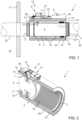
- a ventilation duct unit described in figures 1 and 2 comprises a flow channel 4, which extends from an input opening 2 to an output opening 3, and which is delimited by a wall 5 between the input opening 2 and the output opening 3.
- the ventilation duct unit is shaped so that the wall 5 forms a cylinder-shaped pipe, which has a diameter that can vary for example between 100 - 315 mm.
- the ventilation duct unit 1 is connected to a ventilation duct 23 which continues on both sides of the air conditioning duct unit as a ventilation pipe.
- a closing part 6 is arranged inside the flow channel 4, which closing part presented in open position in figure 2 , enables flow in the flow channel 4, and which closing part presented in closed position in figure 1 prevents flow in the flow channel.
- the closing part 6 changes position between the open and the closed position by rotating in the flow channel about axis 7.
- an actuator 8 moves the closing part 6 between open and closed position by rotating it about the axis 7 in order to achieve flow defined for the actuator in the flow channel 4.
- an electric motor integrated into the actuator, which electric motor is controlled by the control unit of the actuator by utilizing content of its memory.
- actuator 8 controls the position of the closing part 6 according to the command coming from the controller.
- the actuator can pass information about the true position of the closing part 6 to the controller of the actuator.
- the control unit of the actuator and the fire testing unit 21 are implemented as an integrated part, which is a very cost-efficient solution.
- the user can save a set value to be utilized in the controlling of the airflow according to temperature or CO 2 concentration to the memory 11, locally via an user interface, or alternatively via wired or wireless communications link 9, which is used to connect the ventilation duct unit to a separately located control centre which is included in the building automation (not presented in figures).
- the control unit of the actuator in that case compares measured flow against the set value and controls the actuator 8 based on this. Additionally, control unit of the actuator can pass information about the measured flow to the control centre.
- a member 10 for measuring flow is arranged inside the flow channel 4 of the ventilation duct unit 1, in which case the control unit of the actuator 8 receives information of the measured flow, and based on this measurement and set value sends a message to the actuator 8, which moves the closing part 6 in order to achieve the defined flow assigned by the set value.
- the ventilation duct unit can so function as a VAV-controller (Variable Air Volume) for example in an apartment, in a hotel, in an office, in a school or in health care facilities.
- Member 10, which is used for measuring flow can in practice be made up of an ultrasonic sensor, which includes an ultrasonic transmitter and an ultrasonic receiver. Power supply for the member 10 can be implemented from the control unit of the actuator 8, which in practice also receives information of the measured flow and also of the temperature measured by member 10, if a member that is capable of measuring temperatures is used.
- the ventilation duct unit 1 also includes a closing member 12, which in the example cases of the figures is implemented as a part of the actuator 8.
- the closing member 12 implemented as a part of the actuator 8 comprises a spring 13, for example a coil spring, which in case of fire sets the closing member 6 to a predetermined position with spring force by rotating about axis 7. Due to spring force, the closing member 12 ensures that the predetermined position is achieved also when electricity is not available. Detection of fire can be done by ventilation duct unit 1, for example so that one or more thermal fuses 15 are arranged inside the flow channel 4, which allows the actuator 8 to track the temperature. In the example case of the figures, one thermal fuse 15 is located in the channel and a second thermal fuse can be integrated in the actuator 8 itself.
- the power supply from the control unit of the actuator to the actuator 8 can be implemented through a thermal fuse or through more than one thermal fuses, so that blowing of even one thermal fuse shuts off the power supply to the actuator 8.
- a thermal fuse 15 blows, in which case the actuator 8 or its control unit triggers the closing member 12 to set the closing part 6 to a predetermined position.
- the actuator can detect fire based on the signal relayed through its communications link 9.
- the thermal fuse or for example a smoke detector can be arranged separately from the ventilation duct unit, in which case the signal is relayed to the actuator, for example from a separately located control centre.
- a part that breaks down mechanically if the threshold temperature is exceeded can be used as a thermal fuse.
- the actuator 8 or its control unit can trigger the closing member 12 to set the closing part 6 to a predetermined position for example so, that when fire is detected, the actuator 8 stops moving the closing part 6.
- the spring force of spring 13 affects the closing part 6, in which case the spring force takes the closing part 6 to a predetermined position.
- What this predetermined position is, varies due to for example location of the installation and regulations set by the authorities.
- the closing member 12 sets the closing part 6 to a closed position presented in figure 1 . In that case, for example spreading of the fire through the ventilation duct unit is prevented.
- the closing member 12 can, as a response to detecting fire, set the closing part 6 to an open position presented in figure 2 . In that case, for example an airflow can be ensured into a desired space or out of a desired space through the ventilation duct unit in case of fire.
- ventilation duct unit 1 comprises a fireproof insulation material layer 14 which surrounds the wall 5 of the flow channel 4 and isolates the surrounded wall part of the flow channel 4 from its surroundings.
- the ventilation duct unit 1 can be implemented so, that its wall has a dual structure, in which case in addition to the wall 5 that delimits the flow channel 4, the ventilation duct 1 also features an outer wall 24, which closes in the wall 5 of the flow channel 4 and the fireproof insulation material 14 that surrounds it.
- both the wall 5 and the outer wall 24 can be made of metal, for example steel.
- the wall 5 can be for example implemented with coated mineral wool or other fireproof damping material.
- the fireproof insulation material 14 can be designed so that the temperature of the outer wall 24 stays inside defined thresholds.
- a suitable insulation material for this purpose is for example mineral wool.
- the closing part 6 can be designed to be thin compared to thickness of known fire dampers, which often have to be designed to be even 30 mm thick.
- the closing part can be implemented as a closing flap, which can have a thickness of for example 20 mm or even less. This is because heat transferring from space 16 located on the left in figure 1 through closing part 6 to right into the flow channel 4, does not cause direct harm or danger, because the insulation layer 14 of the ventilation duct unit 1 prevents in this case the transfer of this heat load through its outer wall 24 into the space surrounding it.
- a significant advantage can be achieved with a thin closing part, because when controlling the airflow through the ventilation duct unit 1 in normal state, it is significantly easier to implement accurate controlling than if using a thick closing part 6.
- a thick closing part causes a larger pressure loss and develops more disturbing sound.
- holes 18 are formed in the wall 5 that is surrounded by the fireproof insulation material 14.
- the medium, such as air, flowing in the flow channel 4 is brought into contact with the insulation material through these holes.
- the size and number of the holes varies based on the implementation.
- One alternative is to for example use holes with 3 mm diameter so that on the holed area of the wall, area of the holes is approximately 30 % of the total area of the holed area. In this case, an efficient sound reduction is achieved by utilizing the insulation material.
- the closing part 6 is arranged to a part of the flow channel 4, which does not have holes in its wall, in which case closing part 6 can close the flow channel tightly, without possible leaks caused by the holes.
- the space between the wall 5 of the flow channel 4 and the outer wall 24, can be filled by using one single fireproof insulation material, or alternatively more than one different insulation materials can be arranged in this space.
- One alternative, which is illustrated as an example in figures 1 and 2 is that a layer structure is used. In this case, closest to wall 5, insulation material 19 can be used, which achieves the best possible sound reduction, so that flow noise created in flow channel 4 can be efficiently prevented from transferring through outer wall 24 to the surroundings.
- the inner insulation material 19 can be surrounded by a layer made of fireproof insulation material 14.
- the same ventilation duct unit formed of single part is suitable to be used in a ventilation duct as a fire damper, as a silencer, and as a controller of the airflow.
- This is a significant advantage, because it makes it possible to avoid implementing these functions with multiple ventilation duct units set one after another, in which case the need for space is reduced to under halve of the needed space compared to traditional solutions. Also, flow loss caused by a traditional fire damper in the flow channel can be avoided.
- in planning in installing, and in cabling the needs of only one ventilation duct unit need to be considered, in which case the cost savings are significant.
- the ventilation duct unit 1 illustrated in figures also includes a position switch 20 of the closing part, which is in first state, when closing part 6 is in predetermined position (meaning the position, which the closing member sets it to in case of fire), and which is in second state, when the closing part is not in said predetermined position.
- the position switch 20 can be implemented for example with a simple mechanical switch, which has a moving part that closes an electric circuit, which moving part is touched and pressed by closing part 6, closing member 12, actuator 8 or axis 7 which moves the closing part, when the closing part reaches a predetermined position.
- the fire testing unit receives information, that the closing part 6 is in a predetermined position.
- the fire testing unit is implemented as a part of the control unit of the actuator 8. In this case it is an integrated and very cost-efficient solution.
- the fire testing unit can be implemented for example as a program, which is implemented by a processor of the control unit of the actuator by utilizing data saved in a memory 11.
- the fire testing unit triggers an automatic testing of the fire safety function, where the closing part 6 is set to a predetermined position.
- testing of the fire safety function can activate through a control signal via the communications link 9, that is sent from a separately located control centre, in which case the fire testing unit triggers testing of the fire safety functions as a result of such activation.
- the fire testing unit 21 can cut the power supply to the actuator 8 in order to test the fire safety function.
- the fire testing unit 21 tracks the state of the position switch 20 to determine if the state of the position switch changes in a predetermined way between the first and the second state after triggering.
- the exact way the state of the position switch should change "in a predetermined way" can vary from one implementation to another.
- the fire testing unit 21 detects that the state of the position switch 20 has changed in a predetermined way, when it detects that the position switch is in first state after triggering the test. In this case, the fire testing unit can indicate that testing of the fire safety function was successful.
- one option is that the fire testing unit gives an indication of the success of the testing only when the position switch has moved to first state (closing part 6 has reached a predetermined position) in first stage after triggering, and when the fire testing unit after this in second stage has returned the power supply to the actuator 8, and the fire testing unit 21 detects that the position switch is no longer in first state (closing part 6 has moved off of the predetermined position).
- Indication can happen locally with an indicator, such as a LED 22, that is connected to the ventilation duct unit 1.
- indication can happen in a way that the fire testing unit 21 sends a predetermined signal via the connections link 9 from the ventilation duct unit 1 to a separately located control unit.
- the fire testing unit 21 After triggering testing of the fire safety function, the fire testing unit 21 aborts the fire safety testing by activating the actuator to again move the closing part when the testing of the fire safety function is successful, or when a predetermined amount of time has passed after triggering testing of the fire safety function, without the testing of the fire safety function being successful. In practice, in this case, testing of the fire safety function is failed.
- the fire testing unit can indicate failed testing of the fire safety function locally with the indicator 22 or with a message to the control unit via the communications link 9.
- the fire testing unit 21 In order for testing of fire testing function to be done automatically at times required by authorities, the fire testing unit 21 maintains a calendar in memory 11, which in practice is data that allocates the times when testing of the fire testing function is to be triggered.
- a clock is implemented in the fire testing unit 21, in which case based on the clock and this data, the fire testing unit is capable of independently triggering and implementing testing of the fire testing functions at determined times. Testing of the fire safety functions implemented in this way can be started and finished automatically also when the ventilation duct unit in question is in use and controlling the airflow of a room space, because completing the testing event of the fire safety functions is very fast, making the disruption to implemented airflow minimal.
- Ventilation duct unit An example of the ventilation duct unit is described above by referring to an input hole and an output hole, flow being implementable between thereof.
- the same described ventilation duct unit can be utilized in controlling flows flowing in both directions. So, if the flow direction is for example temporarily in the example case presented in figures 1 and 2 from right to left, the hole 3 located on right side functions in this case as the input hole and the hole located on the left as the output channel.
- the wall 5 delimits the flow channel, and has holes through which the medium flowing in the flow channel can reach contact with the insulation material.
- the surface of the insulation material facing the flow channel forms this wall.
- the surface of the insulation material can be coated with a suitable material. In any case, the need for using a separate wall from the insulation material can be avoided, and thus no holes are needed to form on such wall, as flow gets in contact with the insulation material even without the holes.
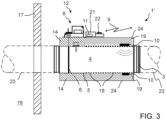
- Figure 3 illustrates a second embodiment of the ventilation duct unit 1'.
- the embodiment of figure 3 matches largely the embodiment illustrated in figures 1 and 2 . This is why the embodiment of figure 3 is primarily described in the following by referring to the differences between these embodiments.
- the embodiment of figure 3 illustrates the use of first insulation material 14 and the use of second insulation material 19 in the space between the flow channel wall 5 and the outer wall 24.
- the insulation material has been arranged into zones.
- the insulation material 14 with the best fireproof qualities is arranged into the first zone that is closest to the closing part 6, and which surrounds the flow channel for part of the length of the flow channel 4.
- the insulation material 19 with the best sound reduction qualities is arranged into the second zone, which is located at the site of the holes 18, and which surrounds the flow channel for part of the length of the flow channel 4.
- the end result is a solution, wherein the best fireproofing is reached in that part of the ventilation duct unit 1', which has the highest temperature as a result of a fire in space 16, and which reaches the best sound reduction in the holed part formed for optimizing sound reduction.
- insulation materials 14 and 19 of figure 3 can be surrounded over the length of the whole ventilation duct unit with an additional layer of insulation, where a third insulation material, or alternatively one of the two insulation materials 14 or 19, can be used.
Landscapes
- Engineering & Computer Science (AREA)
- General Engineering & Computer Science (AREA)
- Mechanical Engineering (AREA)
- Chemical & Material Sciences (AREA)
- Combustion & Propulsion (AREA)
- Health & Medical Sciences (AREA)
- Public Health (AREA)
- Business, Economics & Management (AREA)
- Emergency Management (AREA)
- Air-Flow Control Members (AREA)
- Ventilation (AREA)
- Fire-Detection Mechanisms (AREA)
Claims (12)
- Lüftungskanaleinheit (1, 1') umfassend:einen Einlass (2),einen Auslass (3),einen Strömungskanal (4), der sich von dem Einlass zu dem Auslass erstreckt und durch eine Wand (5) zwischen dem Einlass und dem Auslass begrenzt ist,einen in dem Strömungskanal angeordneten Schließteil (6), der in einer offenen Position die Strömung in dem Strömungskanal (4) ermöglicht und in einer geschlossenen Position die Strömung in dem Strömungskanal verhindert,einen Aktuator (8), der so konfiguriert ist, dass er den Schließteil (6) zwischen der offenen und der geschlossenen Position bewegt, um eine Strömung zu erreichen, die für die Lüftungskanaleinheit in dem Strömungskanal definiert ist,ein Schließelement (12), das als Reaktion auf das Erkennen eines Brands den Schließteil (6) in eine vorbestimmte Position bringt,einen Positionsschalter (20) des Schließteils (6), der sich in einem ersten Zustand befindet, wenn sich der Schließteil (6) in der vorbestimmten Position befindet, und der sich in einem zweiten Zustand befindet, wenn sich der Schließteil (6) nicht in der vorbestimmten Position befindet, undeine Brandprüfeinheit (21), die zu vorbestimmten Zeitpunkten dafür konfiguriert ist, eine Prüfung der Brandschutzfunktionen auszulösen, wobei das Schließelement (12) den Schließteil (6) in die vorbestimmte Position bringt, und die nach dem Auslösen einer Prüfung der Brandschutzfunktionen dafür konfiguriert ist, anzuzeigen, dass die Prüfung der Brandschutzfunktionen erfolgreich war, wenn die Brandprüfeinheit feststellt, dass sich der Zustand des Positionsschalters (20) des Schließteils (6) nach der Auslösung zwischen dem ersten und dem zweiten Zustand in vorbestimmter Weise geändert hat,dadurch gekennzeichnet, dassdie Brandprüfeinheit (21) eine Uhr und einen Speicher (11) umfasst, in dem Daten gespeichert sind und der die Zeitpunkte angibt, zu denen die Brandprüfung ausgelöst werden soll, und die Brandprüfeinheit (21) dafür konfiguriert ist, die Prüfung der Brandschutzfunktionen auszulösen, wenn die Uhr einen Zeitpunkt anzeigt, der mit dem Auslösezeitpunkt der Prüfung der Brandschutzfunktionen übereinstimmt, der in dem Speicher (11) gespeichert ist, unddie Brandprüfeinheit (21) und eine Steuereinheit für den Aktuator (8) in einem Teil integriert sind.
- Lüftungskanaleinheit nach Anspruch 1, dadurch gekennzeichnet, dass die Brandprüfeinheit (21) erkennt, dass sich der Zustand des Positionsschalters (20) des Schließteils nach der Auslösung in der vorbestimmten Weise geändert hat, wenn sich der Positionsschalter nach der Auslösung in den ersten Zustand bewegt hat.
- Lüftungskanaleinheit nach Anspruch 1, dadurch gekennzeichnet, dass die Brandprüfeinheit (21) erkennt, dass sich der Zustand des Positionsschalters (20) des Schließteils nach der Auslösung in der vorbestimmten Weise geändert hat, wenn der Positionsschalter in einer ersten Stufe nach der Auslösung in den ersten Zustand übergegangen ist, und wenn danach die Brandprüfeinheit (21) erkennt, dass der Positionsschalter (20) des Schließteils in einer zweiten Stufe nach Abbruch der Prüfung der Brandschutzfunktionen in den zweiten Zustand übergegangen ist.
- Lüftungskanaleinheit nach einem der Ansprüche 1 bis 3, dadurch gekennzeichnet, dass die Brandprüfeinheit (21) den Erfolg der Brandprüffunktionen durch eine Anzeige (22) anzeigt, die mit der Lüftungskanaleinheit (1, 1') verbunden ist.
- Lüftungskanaleinheit nach einem der Ansprüche 1 bis 4, dadurch gekennzeichnet, dass die Brandprüfeinheit (21) den Erfolg der Brandprüffunktionen anzeigt, indem sie ein vorbestimmtes Signal über eine Übertragungsverbindung (9) an eine Steuereinheit sendet, die getrennt von der Lüftungskanaleinheit angeordnet ist.
- Lüftungskanaleinheit nach einem der Ansprüche 4 bis 5, dadurch gekennzeichnet, dass die Brandprüfeinheit (21) die Prüfung der Brandschutzfunktionen abbricht, indem sie den Aktuator (8) so aktiviert, dass er den Schließteil (6) bewegt, wenn sie erkannt hat, dass sich der Zustand des Positionsschalters (20) des Schließteils in der vorbestimmten Weise geändert hat oder wenn eine vorbestimmte Zeitspanne nach dem Auslösen der Prüfung der Brandschutzfunktionen vergangen ist, ohne dass sie erkannt hat, dass sich der Zustand des Positionsschalters (20) des Schließteils in der vorbestimmten Weise geändert hat.
- Lüftungskanaleinheit nach einem der Ansprüche 1 bis 6, dadurch gekennzeichnet, dass das Schließelement (12) den Schließteil (6) als Reaktion auf die Erkennung eines Brands in die geschlossene Position bringt.
- Lüftungskanaleinheit nach einem der Ansprüche 1 bis 6, dadurch gekennzeichnet, dass das Schließelement (12) den Schließteil (6) als Reaktion auf die Erkennung eines Brands in die offene Position bringt.
- Lüftungskanaleinheit nach einem der Ansprüche 1 bis 8, dadurch gekennzeichnet, dass das Schließelement (12) eine Feder (13) umfasst, deren Federkräfte den Schließteil (6) in die vorbestimmte Position bringen.
- Lüftungskanaleinheit nach einem der Ansprüche 4 bis 9, dadurch gekennzeichnet, dass der Strömungskanal (4) ein Element (10) aufweist, das die Strömung misst, und dass der Aktuator (8) den Schließteil (6) auf der Grundlage der gemessenen Strömung bewegt, um eine definierte Strömung zu erreichen.
- Lüftungskanaleinheit nach einem der Ansprüche 4 bis 10, dadurch gekennzeichnet, dass der Strömungskanal eine Thermosicherung (15) aufweist und dass das Schließelement (12) den Schließteil (6) in die vorbestimmte Position bringt, wenn die Thermosicherung (15) auslöst.
- Lüftungskanaleinheit nach einem der Ansprüche 1 bis 11, dadurch gekennzeichnet, dass die Lüftungskanaleinheit weiter Folgendes umfasst:
ein feuerfestes Isoliermaterial (14), das den Strömungskanal (4) zumindest über einen Teil der Länge umgibt und ihn von seiner Umgebung isoliert.
Applications Claiming Priority (2)
| Application Number | Priority Date | Filing Date | Title |
|---|---|---|---|
| FI20196101A FI130030B (fi) | 2019-12-19 | 2019-12-19 | Ilmastointikanavayksikkö |
| PCT/EP2020/087033 WO2021123175A1 (en) | 2019-12-19 | 2020-12-18 | Ventilation duct unit |
Publications (3)
| Publication Number | Publication Date |
|---|---|
| EP4078039A1 EP4078039A1 (de) | 2022-10-26 |
| EP4078039C0 EP4078039C0 (de) | 2023-10-25 |
| EP4078039B1 true EP4078039B1 (de) | 2023-10-25 |
Family
ID=74175766
Family Applications (1)
| Application Number | Title | Priority Date | Filing Date |
|---|---|---|---|
| EP20838957.7A Active EP4078039B1 (de) | 2019-12-19 | 2020-12-18 | Lüftungskanaleinheit |
Country Status (5)
| Country | Link |
|---|---|
| US (1) | US20230019750A1 (de) |
| EP (1) | EP4078039B1 (de) |
| FI (1) | FI130030B (de) |
| PL (1) | PL4078039T3 (de) |
| WO (1) | WO2021123175A1 (de) |
Cited By (1)
| Publication number | Priority date | Publication date | Assignee | Title |
|---|---|---|---|---|
| EP4610577A1 (de) * | 2024-03-01 | 2025-09-03 | Zol | Rauch- und wärmeabführungsvorrichtung mit einem überwachungsgehäuse |
Family Cites Families (11)
| Publication number | Priority date | Publication date | Assignee | Title |
|---|---|---|---|---|
| SE501274C2 (sv) * | 1992-10-05 | 1995-01-09 | Tomas Fagergren | Ventilationskanal för genomgång av en byggnadsdel i en brandcellindelad byggnad |
| EP1267133A1 (de) * | 2001-06-12 | 2002-12-18 | Climovent System S.r.l. | Verschlussvorrichtung für Lüftungskanäle, insbesondere Feuersperre |
| FI114734B (fi) * | 2002-03-06 | 2004-12-15 | Flaekt Woods Ab | Ilmastointijärjestelmän eristämisjärjestely |
| US7241218B2 (en) * | 2003-05-06 | 2007-07-10 | Ruskin Company | Fire/smoke damper control system |
| US9395099B2 (en) * | 2013-01-22 | 2016-07-19 | Ruskin Company | Wireless damper testing and control system |
| US9858802B2 (en) * | 2015-02-19 | 2018-01-02 | Mark Anthony Stafford | Apparatus for testing fire alarm systems |
| US11273335B2 (en) * | 2017-04-28 | 2022-03-15 | Johnson Controls Tyco IP Holdings LLP | Fire damper actuator system |
| US10001288B1 (en) * | 2017-06-16 | 2018-06-19 | Frank Yang | Smart fan and ventilation system and method |
| US20190257545A1 (en) * | 2018-02-20 | 2019-08-22 | Ecotel Inc. | System and method for multi-zone climate control |
| SE542267C2 (en) * | 2018-03-22 | 2020-03-31 | Abrahamssons Hantverk & Fastighetsservice Ab | A ventilation system for a building having a smoke evacuation functionality and a method for operating said system |
| US11132891B2 (en) * | 2019-08-27 | 2021-09-28 | Honeywell International Inc. | Self-testing fire sensing device |
-
2019
- 2019-12-19 FI FI20196101A patent/FI130030B/fi active
-
2020
- 2020-12-18 PL PL20838957.7T patent/PL4078039T3/pl unknown
- 2020-12-18 US US17/757,444 patent/US20230019750A1/en not_active Abandoned
- 2020-12-18 WO PCT/EP2020/087033 patent/WO2021123175A1/en not_active Ceased
- 2020-12-18 EP EP20838957.7A patent/EP4078039B1/de active Active
Cited By (2)
| Publication number | Priority date | Publication date | Assignee | Title |
|---|---|---|---|---|
| EP4610577A1 (de) * | 2024-03-01 | 2025-09-03 | Zol | Rauch- und wärmeabführungsvorrichtung mit einem überwachungsgehäuse |
| FR3159748A1 (fr) * | 2024-03-01 | 2025-09-05 | Zol | Boîtier de surveillance et dispositif d’évacuation de fumée et de chaleur équipé d’un tel boîtier |
Also Published As
| Publication number | Publication date |
|---|---|
| EP4078039C0 (de) | 2023-10-25 |
| FI130030B (fi) | 2022-12-30 |
| PL4078039T3 (pl) | 2024-03-11 |
| WO2021123175A1 (en) | 2021-06-24 |
| US20230019750A1 (en) | 2023-01-19 |
| EP4078039A1 (de) | 2022-10-26 |
| FI20196101A1 (fi) | 2021-06-20 |
Similar Documents
| Publication | Publication Date | Title |
|---|---|---|
| US7774102B2 (en) | System including interactive controllers for controlling operation of climate control system | |
| US10982876B2 (en) | Wireless damper testing and control system | |
| CN1910527B (zh) | 分区域供暖、通风与空调系统的正确安装的检验方法 | |
| JP4866902B2 (ja) | リフト設備のためのシャフトを備えた建物における熱エネルギー管理方法およびシステム | |
| US20070131784A1 (en) | Low voltage power line communication for climate control system | |
| EP4078039B1 (de) | Lüftungskanaleinheit | |
| KR20060111670A (ko) | Hvac 시스템의 구역 댐퍼 장애 검출 | |
| CA2766813A1 (en) | Make-up air system and method | |
| US20060082452A1 (en) | Method for initiating a remote hazardous condition detector self test and for testing the interconnection of remote hazardous condition detectors | |
| US20230042007A1 (en) | Ventilation duct unit | |
| KR102680241B1 (ko) | 지능형 연기 감지식 방화 댐퍼 | |
| CN208606334U (zh) | 带空气压力检测装置的消防正压送风系统 | |
| US4100931A (en) | Fire damper | |
| CN101983323B (zh) | 监测壁炉装置的方法和系统 | |
| JP2009186062A (ja) | 無線制御システム | |
| JP6431416B2 (ja) | 冷媒配管系の防火区画貫通部に設置される耐火キャップの脱落防止装置および脱落防止方法 | |
| KR20010113079A (ko) | 건축물의 제연구역에 대한 자동제연시스템 | |
| KR102569971B1 (ko) | 발코니 결로방지 시스템 및 이를 이용한 발코니 결로방지 방법 | |
| JP7212551B2 (ja) | 自然排気システム | |
| JP2023157070A (ja) | 空調システムおよび空調システムの制御方法 | |
| EP2584278A1 (de) | Lüftungsanlage für ventilieren einen Brandabschnitt eines Gebäudes | |
| US8705038B2 (en) | Duct detector | |
| CZ310380B6 (cs) | Regulátor průtoku vzduchu s akustickým tlumením | |
| JP2002031388A (ja) | 空調設備の風量制御装置 | |
| KR102851185B1 (ko) | 비화재보 테스트시스템 및 이의 테스트방법 |
Legal Events
| Date | Code | Title | Description |
|---|---|---|---|
| STAA | Information on the status of an ep patent application or granted ep patent |
Free format text: STATUS: UNKNOWN |
|
| STAA | Information on the status of an ep patent application or granted ep patent |
Free format text: STATUS: THE INTERNATIONAL PUBLICATION HAS BEEN MADE |
|
| PUAI | Public reference made under article 153(3) epc to a published international application that has entered the european phase |
Free format text: ORIGINAL CODE: 0009012 |
|
| STAA | Information on the status of an ep patent application or granted ep patent |
Free format text: STATUS: REQUEST FOR EXAMINATION WAS MADE |
|
| 17P | Request for examination filed |
Effective date: 20220629 |
|
| AK | Designated contracting states |
Kind code of ref document: A1 Designated state(s): AL AT BE BG CH CY CZ DE DK EE ES FI FR GB GR HR HU IE IS IT LI LT LU LV MC MK MT NL NO PL PT RO RS SE SI SK SM TR |
|
| DAV | Request for validation of the european patent (deleted) | ||
| DAX | Request for extension of the european patent (deleted) | ||
| GRAP | Despatch of communication of intention to grant a patent |
Free format text: ORIGINAL CODE: EPIDOSNIGR1 |
|
| STAA | Information on the status of an ep patent application or granted ep patent |
Free format text: STATUS: GRANT OF PATENT IS INTENDED |
|
| INTG | Intention to grant announced |
Effective date: 20230515 |
|
| GRAS | Grant fee paid |
Free format text: ORIGINAL CODE: EPIDOSNIGR3 |
|
| GRAA | (expected) grant |
Free format text: ORIGINAL CODE: 0009210 |
|
| STAA | Information on the status of an ep patent application or granted ep patent |
Free format text: STATUS: THE PATENT HAS BEEN GRANTED |
|
| AK | Designated contracting states |
Kind code of ref document: B1 Designated state(s): AL AT BE BG CH CY CZ DE DK EE ES FI FR GB GR HR HU IE IS IT LI LT LU LV MC MK MT NL NO PL PT RO RS SE SI SK SM TR |
|
| REG | Reference to a national code |
Ref country code: GB Ref legal event code: FG4D |
|
| REG | Reference to a national code |
Ref country code: CH Ref legal event code: EP |
|
| REG | Reference to a national code |
Ref country code: DE Ref legal event code: R096 Ref document number: 602020019995 Country of ref document: DE |
|
| REG | Reference to a national code |
Ref country code: IE Ref legal event code: FG4D |
|
| U01 | Request for unitary effect filed |
Effective date: 20231030 |
|
| U07 | Unitary effect registered |
Designated state(s): AT BE BG DE DK EE FI FR IT LT LU LV MT NL PT SE SI Effective date: 20231103 |
|
| REG | Reference to a national code |
Ref country code: NO Ref legal event code: T2 Effective date: 20231025 |
|
| U20 | Renewal fee for the european patent with unitary effect paid |
Year of fee payment: 4 Effective date: 20240117 |
|
| PG25 | Lapsed in a contracting state [announced via postgrant information from national office to epo] |
Ref country code: GR Free format text: LAPSE BECAUSE OF FAILURE TO SUBMIT A TRANSLATION OF THE DESCRIPTION OR TO PAY THE FEE WITHIN THE PRESCRIBED TIME-LIMIT Effective date: 20240126 |
|
| PG25 | Lapsed in a contracting state [announced via postgrant information from national office to epo] |
Ref country code: IS Free format text: LAPSE BECAUSE OF FAILURE TO SUBMIT A TRANSLATION OF THE DESCRIPTION OR TO PAY THE FEE WITHIN THE PRESCRIBED TIME-LIMIT Effective date: 20240225 |
|
| PG25 | Lapsed in a contracting state [announced via postgrant information from national office to epo] |
Ref country code: ES Free format text: LAPSE BECAUSE OF FAILURE TO SUBMIT A TRANSLATION OF THE DESCRIPTION OR TO PAY THE FEE WITHIN THE PRESCRIBED TIME-LIMIT Effective date: 20231025 |
|
| PG25 | Lapsed in a contracting state [announced via postgrant information from national office to epo] |
Ref country code: IS Free format text: LAPSE BECAUSE OF FAILURE TO SUBMIT A TRANSLATION OF THE DESCRIPTION OR TO PAY THE FEE WITHIN THE PRESCRIBED TIME-LIMIT Effective date: 20240225 Ref country code: GR Free format text: LAPSE BECAUSE OF FAILURE TO SUBMIT A TRANSLATION OF THE DESCRIPTION OR TO PAY THE FEE WITHIN THE PRESCRIBED TIME-LIMIT Effective date: 20240126 Ref country code: ES Free format text: LAPSE BECAUSE OF FAILURE TO SUBMIT A TRANSLATION OF THE DESCRIPTION OR TO PAY THE FEE WITHIN THE PRESCRIBED TIME-LIMIT Effective date: 20231025 |
|
| PG25 | Lapsed in a contracting state [announced via postgrant information from national office to epo] |
Ref country code: RS Free format text: LAPSE BECAUSE OF FAILURE TO SUBMIT A TRANSLATION OF THE DESCRIPTION OR TO PAY THE FEE WITHIN THE PRESCRIBED TIME-LIMIT Effective date: 20231025 Ref country code: HR Free format text: LAPSE BECAUSE OF FAILURE TO SUBMIT A TRANSLATION OF THE DESCRIPTION OR TO PAY THE FEE WITHIN THE PRESCRIBED TIME-LIMIT Effective date: 20231025 |
|
| PG25 | Lapsed in a contracting state [announced via postgrant information from national office to epo] |
Ref country code: CZ Free format text: LAPSE BECAUSE OF FAILURE TO SUBMIT A TRANSLATION OF THE DESCRIPTION OR TO PAY THE FEE WITHIN THE PRESCRIBED TIME-LIMIT Effective date: 20231025 |
|
| REG | Reference to a national code |
Ref country code: DE Ref legal event code: R097 Ref document number: 602020019995 Country of ref document: DE |
|
| PG25 | Lapsed in a contracting state [announced via postgrant information from national office to epo] |
Ref country code: SK Free format text: LAPSE BECAUSE OF FAILURE TO SUBMIT A TRANSLATION OF THE DESCRIPTION OR TO PAY THE FEE WITHIN THE PRESCRIBED TIME-LIMIT Effective date: 20231025 |
|
| PG25 | Lapsed in a contracting state [announced via postgrant information from national office to epo] |
Ref country code: SM Free format text: LAPSE BECAUSE OF FAILURE TO SUBMIT A TRANSLATION OF THE DESCRIPTION OR TO PAY THE FEE WITHIN THE PRESCRIBED TIME-LIMIT Effective date: 20231025 Ref country code: SK Free format text: LAPSE BECAUSE OF FAILURE TO SUBMIT A TRANSLATION OF THE DESCRIPTION OR TO PAY THE FEE WITHIN THE PRESCRIBED TIME-LIMIT Effective date: 20231025 Ref country code: RO Free format text: LAPSE BECAUSE OF FAILURE TO SUBMIT A TRANSLATION OF THE DESCRIPTION OR TO PAY THE FEE WITHIN THE PRESCRIBED TIME-LIMIT Effective date: 20231025 Ref country code: CZ Free format text: LAPSE BECAUSE OF FAILURE TO SUBMIT A TRANSLATION OF THE DESCRIPTION OR TO PAY THE FEE WITHIN THE PRESCRIBED TIME-LIMIT Effective date: 20231025 |
|
| REG | Reference to a national code |
Ref country code: CH Ref legal event code: PL |
|
| PG25 | Lapsed in a contracting state [announced via postgrant information from national office to epo] |
Ref country code: MC Free format text: LAPSE BECAUSE OF FAILURE TO SUBMIT A TRANSLATION OF THE DESCRIPTION OR TO PAY THE FEE WITHIN THE PRESCRIBED TIME-LIMIT Effective date: 20231025 |
|
| PG25 | Lapsed in a contracting state [announced via postgrant information from national office to epo] |
Ref country code: MC Free format text: LAPSE BECAUSE OF FAILURE TO SUBMIT A TRANSLATION OF THE DESCRIPTION OR TO PAY THE FEE WITHIN THE PRESCRIBED TIME-LIMIT Effective date: 20231025 |
|
| PLBE | No opposition filed within time limit |
Free format text: ORIGINAL CODE: 0009261 |
|
| STAA | Information on the status of an ep patent application or granted ep patent |
Free format text: STATUS: NO OPPOSITION FILED WITHIN TIME LIMIT |
|
| 26N | No opposition filed |
Effective date: 20240726 |
|
| PG25 | Lapsed in a contracting state [announced via postgrant information from national office to epo] |
Ref country code: CH Free format text: LAPSE BECAUSE OF NON-PAYMENT OF DUE FEES Effective date: 20231231 |
|
| PG25 | Lapsed in a contracting state [announced via postgrant information from national office to epo] |
Ref country code: CH Free format text: LAPSE BECAUSE OF NON-PAYMENT OF DUE FEES Effective date: 20231231 |
|
| U20 | Renewal fee for the european patent with unitary effect paid |
Year of fee payment: 5 Effective date: 20241217 |
|
| PG25 | Lapsed in a contracting state [announced via postgrant information from national office to epo] |
Ref country code: CY Free format text: LAPSE BECAUSE OF FAILURE TO SUBMIT A TRANSLATION OF THE DESCRIPTION OR TO PAY THE FEE WITHIN THE PRESCRIBED TIME-LIMIT; INVALID AB INITIO Effective date: 20201218 |
|
| PG25 | Lapsed in a contracting state [announced via postgrant information from national office to epo] |
Ref country code: HU Free format text: LAPSE BECAUSE OF FAILURE TO SUBMIT A TRANSLATION OF THE DESCRIPTION OR TO PAY THE FEE WITHIN THE PRESCRIBED TIME-LIMIT; INVALID AB INITIO Effective date: 20201218 |
|
| PGFP | Annual fee paid to national office [announced via postgrant information from national office to epo] |
Ref country code: GB Payment date: 20251219 Year of fee payment: 6 |
|
| PGFP | Annual fee paid to national office [announced via postgrant information from national office to epo] |
Ref country code: NO Payment date: 20251219 Year of fee payment: 6 |
|
| PGFP | Annual fee paid to national office [announced via postgrant information from national office to epo] |
Ref country code: TR Payment date: 20251128 Year of fee payment: 6 |
|
| PGFP | Annual fee paid to national office [announced via postgrant information from national office to epo] |
Ref country code: IE Payment date: 20251215 Year of fee payment: 6 |
|
| U20 | Renewal fee for the european patent with unitary effect paid |
Year of fee payment: 6 Effective date: 20251216 |
|
| PGFP | Annual fee paid to national office [announced via postgrant information from national office to epo] |
Ref country code: PL Payment date: 20251119 Year of fee payment: 6 |