EP4077307B1 - Gem-disubstituierte piperidin-melanocortin subtyp-2-rezeptor (mc2r)-antagonisten und deren verwendungen - Google Patents
Gem-disubstituierte piperidin-melanocortin subtyp-2-rezeptor (mc2r)-antagonisten und deren verwendungen Download PDFInfo
- Publication number
- EP4077307B1 EP4077307B1 EP20903163.2A EP20903163A EP4077307B1 EP 4077307 B1 EP4077307 B1 EP 4077307B1 EP 20903163 A EP20903163 A EP 20903163A EP 4077307 B1 EP4077307 B1 EP 4077307B1
- Authority
- EP
- European Patent Office
- Prior art keywords
- phenyl
- trifluoromethyl
- carboxamide
- piperidine
- cyano
- Prior art date
- Legal status (The legal status is an assumption and is not a legal conclusion. Google has not performed a legal analysis and makes no representation as to the accuracy of the status listed.)
- Active
Links
Classifications
-
- C—CHEMISTRY; METALLURGY
- C07—ORGANIC CHEMISTRY
- C07D—HETEROCYCLIC COMPOUNDS
- C07D211/00—Heterocyclic compounds containing hydrogenated pyridine rings, not condensed with other rings
- C07D211/04—Heterocyclic compounds containing hydrogenated pyridine rings, not condensed with other rings with only hydrogen or carbon atoms directly attached to the ring nitrogen atom
- C07D211/06—Heterocyclic compounds containing hydrogenated pyridine rings, not condensed with other rings with only hydrogen or carbon atoms directly attached to the ring nitrogen atom having no double bonds between ring members or between ring members and non-ring members
- C07D211/08—Heterocyclic compounds containing hydrogenated pyridine rings, not condensed with other rings with only hydrogen or carbon atoms directly attached to the ring nitrogen atom having no double bonds between ring members or between ring members and non-ring members with hydrocarbon or substituted hydrocarbon radicals directly attached to ring carbon atoms
- C07D211/10—Heterocyclic compounds containing hydrogenated pyridine rings, not condensed with other rings with only hydrogen or carbon atoms directly attached to the ring nitrogen atom having no double bonds between ring members or between ring members and non-ring members with hydrocarbon or substituted hydrocarbon radicals directly attached to ring carbon atoms with radicals containing only carbon and hydrogen atoms attached to ring carbon atoms
- C07D211/14—Heterocyclic compounds containing hydrogenated pyridine rings, not condensed with other rings with only hydrogen or carbon atoms directly attached to the ring nitrogen atom having no double bonds between ring members or between ring members and non-ring members with hydrocarbon or substituted hydrocarbon radicals directly attached to ring carbon atoms with radicals containing only carbon and hydrogen atoms attached to ring carbon atoms with hydrocarbon or substituted hydrocarbon radicals attached to the ring nitrogen atom
-
- A—HUMAN NECESSITIES
- A61—MEDICAL OR VETERINARY SCIENCE; HYGIENE
- A61K—PREPARATIONS FOR MEDICAL, DENTAL OR TOILETRY PURPOSES
- A61K31/00—Medicinal preparations containing organic active ingredients
- A61K31/33—Heterocyclic compounds
- A61K31/395—Heterocyclic compounds having nitrogen as a ring hetero atom, e.g. guanethidine or rifamycins
- A61K31/435—Heterocyclic compounds having nitrogen as a ring hetero atom, e.g. guanethidine or rifamycins having six-membered rings with one nitrogen as the only ring hetero atom
- A61K31/44—Non condensed pyridines; Hydrogenated derivatives thereof
- A61K31/445—Non condensed piperidines, e.g. piperocaine
- A61K31/4523—Non condensed piperidines, e.g. piperocaine containing further heterocyclic ring systems
- A61K31/4545—Non condensed piperidines, e.g. piperocaine containing further heterocyclic ring systems containing a six-membered ring with nitrogen as a ring hetero atom, e.g. pipamperone, anabasine
-
- A—HUMAN NECESSITIES
- A61—MEDICAL OR VETERINARY SCIENCE; HYGIENE
- A61K—PREPARATIONS FOR MEDICAL, DENTAL OR TOILETRY PURPOSES
- A61K31/00—Medicinal preparations containing organic active ingredients
- A61K31/33—Heterocyclic compounds
- A61K31/395—Heterocyclic compounds having nitrogen as a ring hetero atom, e.g. guanethidine or rifamycins
- A61K31/495—Heterocyclic compounds having nitrogen as a ring hetero atom, e.g. guanethidine or rifamycins having six-membered rings with two or more nitrogen atoms as the only ring heteroatoms, e.g. piperazine or tetrazines
- A61K31/4965—Non-condensed pyrazines
- A61K31/497—Non-condensed pyrazines containing further heterocyclic rings
-
- A—HUMAN NECESSITIES
- A61—MEDICAL OR VETERINARY SCIENCE; HYGIENE
- A61K—PREPARATIONS FOR MEDICAL, DENTAL OR TOILETRY PURPOSES
- A61K31/00—Medicinal preparations containing organic active ingredients
- A61K31/33—Heterocyclic compounds
- A61K31/395—Heterocyclic compounds having nitrogen as a ring hetero atom, e.g. guanethidine or rifamycins
- A61K31/495—Heterocyclic compounds having nitrogen as a ring hetero atom, e.g. guanethidine or rifamycins having six-membered rings with two or more nitrogen atoms as the only ring heteroatoms, e.g. piperazine or tetrazines
- A61K31/50—Pyridazines; Hydrogenated pyridazines
- A61K31/501—Pyridazines; Hydrogenated pyridazines not condensed and containing further heterocyclic rings
-
- A—HUMAN NECESSITIES
- A61—MEDICAL OR VETERINARY SCIENCE; HYGIENE
- A61K—PREPARATIONS FOR MEDICAL, DENTAL OR TOILETRY PURPOSES
- A61K31/00—Medicinal preparations containing organic active ingredients
- A61K31/33—Heterocyclic compounds
- A61K31/395—Heterocyclic compounds having nitrogen as a ring hetero atom, e.g. guanethidine or rifamycins
- A61K31/495—Heterocyclic compounds having nitrogen as a ring hetero atom, e.g. guanethidine or rifamycins having six-membered rings with two or more nitrogen atoms as the only ring heteroatoms, e.g. piperazine or tetrazines
- A61K31/505—Pyrimidines; Hydrogenated pyrimidines, e.g. trimethoprim
- A61K31/506—Pyrimidines; Hydrogenated pyrimidines, e.g. trimethoprim not condensed and containing further heterocyclic rings
-
- A—HUMAN NECESSITIES
- A61—MEDICAL OR VETERINARY SCIENCE; HYGIENE
- A61P—SPECIFIC THERAPEUTIC ACTIVITY OF CHEMICAL COMPOUNDS OR MEDICINAL PREPARATIONS
- A61P3/00—Drugs for disorders of the metabolism
- A61P3/04—Anorexiants; Antiobesity agents
-
- A—HUMAN NECESSITIES
- A61—MEDICAL OR VETERINARY SCIENCE; HYGIENE
- A61P—SPECIFIC THERAPEUTIC ACTIVITY OF CHEMICAL COMPOUNDS OR MEDICINAL PREPARATIONS
- A61P5/00—Drugs for disorders of the endocrine system
- A61P5/38—Drugs for disorders of the endocrine system of the suprarenal hormones
-
- C—CHEMISTRY; METALLURGY
- C07—ORGANIC CHEMISTRY
- C07D—HETEROCYCLIC COMPOUNDS
- C07D401/00—Heterocyclic compounds containing two or more hetero rings, having nitrogen atoms as the only ring hetero atoms, at least one ring being a six-membered ring with only one nitrogen atom
- C07D401/02—Heterocyclic compounds containing two or more hetero rings, having nitrogen atoms as the only ring hetero atoms, at least one ring being a six-membered ring with only one nitrogen atom containing two hetero rings
- C07D401/04—Heterocyclic compounds containing two or more hetero rings, having nitrogen atoms as the only ring hetero atoms, at least one ring being a six-membered ring with only one nitrogen atom containing two hetero rings directly linked by a ring-member-to-ring-member bond
-
- C—CHEMISTRY; METALLURGY
- C07—ORGANIC CHEMISTRY
- C07D—HETEROCYCLIC COMPOUNDS
- C07D401/00—Heterocyclic compounds containing two or more hetero rings, having nitrogen atoms as the only ring hetero atoms, at least one ring being a six-membered ring with only one nitrogen atom
- C07D401/02—Heterocyclic compounds containing two or more hetero rings, having nitrogen atoms as the only ring hetero atoms, at least one ring being a six-membered ring with only one nitrogen atom containing two hetero rings
- C07D401/10—Heterocyclic compounds containing two or more hetero rings, having nitrogen atoms as the only ring hetero atoms, at least one ring being a six-membered ring with only one nitrogen atom containing two hetero rings linked by a carbon chain containing aromatic rings
-
- C—CHEMISTRY; METALLURGY
- C07—ORGANIC CHEMISTRY
- C07D—HETEROCYCLIC COMPOUNDS
- C07D401/00—Heterocyclic compounds containing two or more hetero rings, having nitrogen atoms as the only ring hetero atoms, at least one ring being a six-membered ring with only one nitrogen atom
- C07D401/02—Heterocyclic compounds containing two or more hetero rings, having nitrogen atoms as the only ring hetero atoms, at least one ring being a six-membered ring with only one nitrogen atom containing two hetero rings
- C07D401/12—Heterocyclic compounds containing two or more hetero rings, having nitrogen atoms as the only ring hetero atoms, at least one ring being a six-membered ring with only one nitrogen atom containing two hetero rings linked by a chain containing hetero atoms as chain links
-
- C—CHEMISTRY; METALLURGY
- C07—ORGANIC CHEMISTRY
- C07D—HETEROCYCLIC COMPOUNDS
- C07D401/00—Heterocyclic compounds containing two or more hetero rings, having nitrogen atoms as the only ring hetero atoms, at least one ring being a six-membered ring with only one nitrogen atom
- C07D401/14—Heterocyclic compounds containing two or more hetero rings, having nitrogen atoms as the only ring hetero atoms, at least one ring being a six-membered ring with only one nitrogen atom containing three or more hetero rings
-
- C—CHEMISTRY; METALLURGY
- C07—ORGANIC CHEMISTRY
- C07D—HETEROCYCLIC COMPOUNDS
- C07D403/00—Heterocyclic compounds containing two or more hetero rings, having nitrogen atoms as the only ring hetero atoms, not provided for by group C07D401/00
- C07D403/14—Heterocyclic compounds containing two or more hetero rings, having nitrogen atoms as the only ring hetero atoms, not provided for by group C07D401/00 containing three or more hetero rings
-
- C—CHEMISTRY; METALLURGY
- C07—ORGANIC CHEMISTRY
- C07D—HETEROCYCLIC COMPOUNDS
- C07D409/00—Heterocyclic compounds containing two or more hetero rings, at least one ring having sulfur atoms as the only ring hetero atoms
- C07D409/14—Heterocyclic compounds containing two or more hetero rings, at least one ring having sulfur atoms as the only ring hetero atoms containing three or more hetero rings
-
- C—CHEMISTRY; METALLURGY
- C07—ORGANIC CHEMISTRY
- C07D—HETEROCYCLIC COMPOUNDS
- C07D413/00—Heterocyclic compounds containing two or more hetero rings, at least one ring having nitrogen and oxygen atoms as the only ring hetero atoms
- C07D413/14—Heterocyclic compounds containing two or more hetero rings, at least one ring having nitrogen and oxygen atoms as the only ring hetero atoms containing three or more hetero rings
-
- C—CHEMISTRY; METALLURGY
- C07—ORGANIC CHEMISTRY
- C07D—HETEROCYCLIC COMPOUNDS
- C07D471/00—Heterocyclic compounds containing nitrogen atoms as the only ring hetero atoms in the condensed system, at least one ring being a six-membered ring with one nitrogen atom, not provided for by groups C07D451/00 - C07D463/00
- C07D471/02—Heterocyclic compounds containing nitrogen atoms as the only ring hetero atoms in the condensed system, at least one ring being a six-membered ring with one nitrogen atom, not provided for by groups C07D451/00 - C07D463/00 in which the condensed system contains two hetero rings
- C07D471/08—Bridged systems
-
- C—CHEMISTRY; METALLURGY
- C07—ORGANIC CHEMISTRY
- C07D—HETEROCYCLIC COMPOUNDS
- C07D487/00—Heterocyclic compounds containing nitrogen atoms as the only ring hetero atoms in the condensed system, not provided for by groups C07D451/00 - C07D477/00
- C07D487/02—Heterocyclic compounds containing nitrogen atoms as the only ring hetero atoms in the condensed system, not provided for by groups C07D451/00 - C07D477/00 in which the condensed system contains two hetero rings
- C07D487/08—Bridged systems
Definitions
- Described herein are compounds that modulate the activity of one or more melanocortin receptors, methods of making such compounds, pharmaceutical compositions and medicaments comprising such compounds, and such compounds for use in methods of treating conditions, diseases, or disorders that would benefit from modulating melanocortin subtype-2 receptor (MC2R) activity.
- M2R melanocortin subtype-2 receptor
- the melanocortin receptors form a family of G protein-coupled receptor (GPCRs) (MC1R, MC2R, MC3R, MC4R, and MC5R) that are selectively activated by different melanocortin peptides adrenocorticotropic hormone (ACTH), and the melanocortin peptides ⁇ -, ⁇ -, and ⁇ -melanocyte-stimulating hormone ( ⁇ -MSH, ⁇ -MSH, and ⁇ -MSH) that are all derived proteolytically from proopiomelanocortin hormone, or POMC.
- GPCRs G protein-coupled receptor
- ACTH melanocortin peptides adrenocorticotropic hormone
- ⁇ -MSH, ⁇ -MSH, and ⁇ -MSH melanocortin peptides ⁇ -, ⁇ -MSH, and ⁇ -MSH
- ACTH is a 39 amino acid peptide that is the primary regulator of adrenal glucocorticoid synthesis and secretion and only has affinity for MC2R .
- HPA hypothalamic-pituitary-adrenal
- ACTH is secreted by the pituitary in response to stressful stimuli and acts at the adrenal gland to stimulate the synthesis and secretion of cortisol. Modulation of MC2R is attractive for the treatment of conditions, diseases, or disorders that would benefit from modulating melanocortin receptor activity.
- WO 2021/133563 describes spirocyclic piperidine melanocortin subtype-2 receptor (MC2R) antagonists and uses thereof.
- WO 2021/091788 describes melanocortin subtype-2 receptor (MC2R) antagonists and uses thereof.
- WO 2005/047253 describes melanocortin receptor agonists.
- M2R melanocortin subtype-2 receptor
- compounds described herein are melanocortin receptor modulator compounds. In some embodiments, compounds described herein modulate one or more of the subtype melanocortin receptor proteins. In some embodiments, compounds described herein modulate two or more of the subtype melanocortin receptor proteins. In some embodiments, compounds described herein modulate MC2R.
- composition comprising a compound as defined in the claims, or a pharmaceutically acceptable salt thereof, and at least one pharmaceutically acceptable excipient.
- CAH congenital adrenal hyperplasia
- ACTH adrenocorticotropic hormone
- the pharmaceutical composition is formulated for administration to a mammal by intravenous administration, subcutaneous administration, oral administration, inhalation, nasal administration, dermal administration, or ophthalmic administration. In some embodiments, the pharmaceutical composition is formulated for administration to a mammal by oral administration. In some embodiments, the pharmaceutical composition is in the form of a tablet, a pill, a capsule, a liquid, a suspension, a gel, a dispersion, a solution, an emulsion, an ointment, or a lotion. In some embodiments, the pharmaceutical composition is in the form of a tablet, a pill, or a capsule.
- the effective amount of the compound of Formula (I), or a pharmaceutically acceptable salt thereof is: (a) systemically administered to the mammal; and/or (b) administered orally to the mammal; and/or (c) intravenously administered to the mammal; and/or (d) administered by inhalation; and/or (e) administered by nasal administration; or and/or (f) administered by injection to the mammal; and/or (g) administered topically to the mammal; and/or (h) administered by ophthalmic administration; and/or (i) administered rectally to the mammal; and/or (j) administered non-systemically or locally to the mammal.
- any of the aforementioned aspects are further embodiments comprising single administrations of the effective amount of the compound, including further embodiments in which the compound is administered once a day to the mammal or the compound is administered to the mammal multiple times over the span of one day.
- the compound is administered on a continuous dosing schedule.
- the compound is administered on a continuous daily dosing schedule.
- the mammal is a human.
- compounds provided herein are orally administered to a human.
- Articles of manufacture which include packaging material, a compound of Formula (I), or a pharmaceutically acceptable salt thereof, within the packaging material, and a label that indicates that the compound or composition, or pharmaceutically acceptable salt, tautomers, pharmaceutically acceptable N-oxide, is used for modulating one or more subtype melanocortin receptor proteins, or for use in the treatment, prevention or amelioration of one or more symptoms of a disease or condition that would benefit from modulating one or more subtype melanocortin receptor proteins, are provided.
- Adrenocorticotropic hormone is a 39 amino acid peptide synthesized by anterior pituitary corticotrophic cells by proteolytic cleavage of the proopiomelanocortin hormone (POMC).
- ACTH is the primary regulator of adrenal glucocorticoid (GC; cortisol in humans and most other species; corticosterone in rodents) synthesis and secretion.
- GC adrenal glucocorticoid
- HPA hypothalamic-pituitary-adrenal
- the melanocortin system comprises a family of five GPCRs (MC1R, MC2R, MC3R, MC4R, and MC5R); their natural agonists, the melanocortin peptides ⁇ -, ⁇ -, and ⁇ -melanocyte-stimulating hormone ( ⁇ -MSH, ⁇ -MSH, and ⁇ -MSH) and ACTH; and endogenous melanocortin antagonists agouti and agouti-related protein (AGRP).
- MCRs melanocortin receptors
- MCRs have different selectivities for endogenous agonist and antagonist peptides and are expressed in diverse tissues where they serve varied and discreet physiological functions ( Gantz, I. and T.M. Fong, Am. J. Physiol. Endocrinol. Metab., 284: E468-E474, 2003 ).
- selectively modulating any one of the MCRs, or combinations thereof is useful in a variety of clinical applications. In some embodiments, selectively modulating any one of the MCRs relative to the other MCRs, or combinations thereof, reduces unwanted side effects in a variety of clinical applications.
- compounds described herein are antagonists of MC2R. In some embodiments, compounds described herein are selective antagonists for MC2R relative or other MCRs.
- MC2R is a highly selective receptor for ACTH. Although ACTH can activate all five MCRs, at physiological levels, the sensitivity of the other receptors is not high enough to be activated, and ACTH selectively activates MC2R. Importantly, the other naturally occurring agonists ⁇ -MSH, ⁇ -MSH, and ⁇ -MSH have no affinity for MC2R ( Gantz, I. and T.M. Fong, Am. J. Physiol. Endocrinol. Metab., 284: E468-E474, 2003 ). The major function of MC2R is to stimulate the fasciculata cells of the adrenal cortex to synthesize and secret cortisol.
- MC2R requires the GPCR accessory protein MRAP (melanocortin 2 receptor protein) to be successfully secreted to the cell surface and as well as to function.
- MRAP is a small protein with a single transmembrane domain that forms an antiparallel homodimer in stable complex with MC2R and is necessary for both cell surface expression of MC2R and its ability to bind ACTH.
- MRAP can bind to any of the MCRs and affect their activities, but is only essential for MC2R activity. Binding of ACTH to the MC2R/MRAP complex on adrenal cortical cells activates G S to elevate intracellular cAMP levels which in turn stimulates cortisol synthesis and secretion by regulating multiple steps in the steroidogenic pathway.
- Cushing's syndrome is a rare disorder characterized by chronic, excess glucocorticoid exposure. Clinical signs of Cushing's syndrome include growth of fat pads (collarbone, back of neck, face and trunk), excessive sweating, dilation of capillaries, thinning of the skin, muscle weakness, hirsutism, depression/anxiety, hypertension, osteoporosis, insulin resistance, hyperglycemia, heart disease, and a range of other metabolic disturbances resulting in high morbidity. If inadequately controlled in its severe forms, Cushing's syndrome is associated with high mortality.
- glucocorticoid excess can sometimes be ACTH independent, for example from excessive autonomous secretion of cortisol from a hyperfunctioning adrenal adenoma, carcinoma, or steroid abuse, about 60-80% of all cases are ACTH dependent Cushing's syndrome, known as Cushing's disease.
- Cushing's disease is caused by microadenomas of pituitary corticotropic cells that secrete excess ACTH.
- Corticotroph adenomas are small, usually slow growing, benign tumors that normally come to clinical attention as a result of the effects of glucocorticoid excess, rather than because of the physical effects of an expanding tumor.
- First line treatments for Cushing's disease are surgical and involve removal of either the ACTH-secreting tumor in the pituitary or the adrenal glands themselves. As surgery is often unsuccessful, contraindicated, or delayed, medical therapy for these patients becomes necessary. Current treatment options include inhibitors of steroid synthesis enzymes that can prevent the production of cortisol and improve symptoms, but these treatments also induce a host of unwanted side effects due to the accumulation of other steroid products.
- an MC2R antagonist is used in the treatment of Cushing's syndrome. In some embodiments, an MC2R antagonist is used in the treatment of Cushing's disease.
- glucocorticoid excess is ACTH independent. In some embodiments, glucocorticoid excess is ACTH dependent.
- Ectopic ACTH syndrome or ectopic Cushing's syndrome or disease, is essentially the same as Cushing's disease, except that the underlying tumor expressing ACTH is outside the pituitary gland.
- the tumors are small carcinoid tumors that occur anywhere in the lungs or gastrointestinal tract.
- an MC2R antagonist is used in the treatment of ectopic ACTH syndrome.
- CAH Congenital adrenal hyperplasia
- CAH can result from a variety of genetic defects in the adrenal steroidal biosynthesis pathway.
- CAH is due to a mutation in 21 ⁇ -hydroxylase.
- the lack of cortisol removes the negative feedback to the pituitary which leads to excessive ACTH secretion.
- the resulting excessive adrenal stimulation causes overproduction of steroid precursors which also have negative consequences (e.g., hyperandrogenism).
- Administration of replacement glucocorticoids typically does not adequately suppress ACTH without also causing Cushing's-like symptoms.
- an MC2R antagonist is for use in the treatment of CAH.
- an MC2R antagonist in addition to Cushing's disease, Ectopic ACTH syndrome and CAH it has also been hypothesized that there might be a role for an MC2R antagonist in the treatment of ACTH driven adrenal tumors, Functional Adrenal Hyperandrogenism (FAH), stress disorders, psychiatric disorders, type 2 diabetes and septic shock.
- FH Functional Adrenal Hyperandrogenism
- an MC2R antagonist is for use in the treatment of ACTH driven adrenal tumors.
- an MC2R antagonist is for use in the treatment of Functional Adrenal Hyperandrogenism.
- an MC2R antagonist is for use in the treatment of stress disorders.
- an MC2R antagonist is for use in the treatment of psychiatric disorders.
- an MC2R antagonist is for use in the treatment of type 2 diabetes.
- an MC2R antagonist is for use in the treatment of septic shock.
- an MC2R antagonist is for use in the treatment of septic shock.
- compounds described herein are amenable to administration to a mammal in need of treatment with an MC2R antagonist.
- Compounds of Formula (I), including pharmaceutically acceptable salts thereof, are melanocortin receptor modulators.
- the compounds of Formula (I), including pharmaceutically acceptable salts, are MC2R modulators.
- the MC2R modulators are MC2R antagonists.
- M is 5-membered heterocycle. In some embodiments, M is 5-membered heteroaryl. In some embodiments, M is furanyl, thienyl, pyrrolyl, oxazolyl, thiazolyl, imidazolyl, pyrazolyl, triazolyl, isoxazolyl, isothiazolyl, oxadiazolyl, or thiadiazolyl. In some embodiments, M is oxazolyl, imidazolyl, or triazolyl.
- each R 3 is independently hydrogen or unsubstituted or substituted C 1 -C 6 alkyl. In some embodiments, each R 3 is independently hydrogen or C 1 -C 6 alkyl. In some embodiments, each R 3 is independently hydrogen, -CH 3 , -CH 2 CH 3 , -CH 2 CH 2 CH 3 , or - CH(CH 3 ) 2 . In some embodiments, each R 3 is independently hydrogen or -CH 3 . In some embodiments, each R 3 is -CH 3 . In some embodiments, each R 3 is hydrogen.
- M comprises an N atom and the N atom of M is attached to R 1 , wherein R 1 also comprises an N atom.
- the N atom of M is connected to the N atom of R 1 through one carbon atom, two carbon atoms, three carbon atoms, or four carbon atoms.
- the N atom of M is connected to the N atom of R 1 through a two carbon atom spacer.
- the N atom of R 1 is part of an unsubstituted or substituted aliphatic alkyl chain.
- the N atom of R 1 is part of an unsubstituted or substituted cyclic ring.
- the N-containing cyclic ring of R 1 is an unsubstituted or substituted monocyclic C 2 -C 7 heterocycloalkyl or unsubstituted or substituted bicyclic C 2 -C 7 heterocycloalkyl.
- the compound has the structure of Formula (IIa), or a pharmaceutically acceptable salt thereof:
- the compound has the structure of Formula (IIb), or a pharmaceutically acceptable salt thereof:
- R A is unsubstituted or substituted monocyclic 6-membered heteroaryl, unsubstituted or substituted phenyl, or unsubstituted or substituted monocyclic 5-membered heteroaryl, wherein if R A is substituted then R A is substituted with 1, 2, 3 or 4 groups selected from R a , R b , and R c .
- R A is unsubstituted or substituted monocyclic 6-membered heteroaryl, unsubstituted or substituted phenyl, or unsubstituted or substituted monocyclic 5-membered heteroaryl, wherein if R A is substituted then R A is substituted with 1, 2, or 3 groups selected from R a , R b , and R c .
- R A is unsubstituted or substituted monocyclic 6-membered heteroaryl, unsubstituted or substituted phenyl, or unsubstituted or substituted monocyclic 5-membered heteroaryl, wherein if R A is substituted then R A is substituted with 1 or 2 groups selected from R a , R b , and R c .
- R A is unsubstituted or substituted monocyclic 6-membered heteroaryl, unsubstituted or substituted phenyl, or unsubstituted or substituted monocyclic 5-membered heteroaryl, wherein if R A is substituted then R A is substituted with 1 R a , R b , or R c group.
- R A is substituted with 1, 2, 3 or 4 groups selected from R a , R b , and R c . In some embodiments, R A is substituted with 1, 2, or 3 groups selected from R a , R b , and R c . In some embodiments, R A is substituted with 1 or 2 groups selected from R a , R b , and R c . In some embodiments, R A is substituted with 1 group selected from R a , R b , and R c . In some embodiments, R A is substituted with one R a . In some embodiments, R A is substituted with one R c .
- R A is unsubstituted or substituted pyrrolyl, unsubstituted or substituted furanyl, unsubstituted or substituted thienyl, unsubstituted or substituted oxazolyl, unsubstituted or substituted thiazolyl, unsubstituted or substituted imidazolyl, unsubstituted or substituted pyrazolyl, unsubstituted or substituted triazolyl, unsubstituted or substituted tetrazolyl, unsubstituted or substituted isoxazolyl, unsubstituted or substituted isothiazolyl, unsubstituted or substituted oxadiazolyl, or unsubstituted or substituted thiadiazolyl, unsubstituted or substituted pyridinyl, unsubstituted or substituted pyrimidinyl, unsubstituted or substituted pyraziny
- R A if R A is substituted then R A is substituted with 1 or 2 groups selected from R a , R b , and R c . In some embodiments, if R A is substituted then R A is substituted with 1 R a , R b , or R c group.
- R A is unsubstituted or substituted monocyclic 5-membered heteroaryl, wherein if R A is substituted then R A is substituted with 1, 2 or 3 groups selected from R a , R b , and R c . In some embodiments, R A is unsubstituted or substituted monocyclic 5-membered heteroaryl, wherein if R A is substituted then R A is substituted with 1 or 2 groups selected from R a , R b , and R c .
- R A is unsubstituted or substituted monocyclic 5-membered heteroaryl containing one heteroatom selected from N, O, and S, wherein if R A is substituted then R A is substituted with 1 or 2 groups selected from R a , R b , and R c . In some embodiments, R A is unsubstituted or substituted monocyclic 5-membered heteroaryl containing one heteroatom selected from N, O, and S, wherein if R A is substituted then R A is substituted with 1 or 2 groups selected from R a , R b , and R c .
- R A is unsubstituted or substituted monocyclic 5-membered heteroaryl containing one heteroatom selected from N, O, and S, wherein if R A is substituted then R A is substituted with 1 R a , R b , or R c group.
- R A is unsubstituted or substituted pyrrolyl, unsubstituted or substituted furanyl, unsubstituted or substituted thienyl, unsubstituted or substituted oxazolyl, unsubstituted or substituted thiazolyl, unsubstituted or substituted imidazolyl, unsubstituted or substituted pyrazolyl, unsubstituted or substituted triazolyl, unsubstituted or substituted tetrazolyl, unsubstituted or substituted isoxazolyl, unsubstituted or substituted isothiazolyl, unsubstituted or substituted oxadiazolyl, or unsubstituted or substituted thiadiazolyl, wherein if R A is substituted then R A is substituted with 1, 2, or 3 groups selected from R a , R b , and R c .
- R A if R A is substituted then R A is substituted with 1 or 2 groups selected from R a , R b , and R c . In some embodiments, if R A is substituted then R A is substituted with 1 R a , R b , or R c group.
- R A is unsubstituted or substituted pyrrolyl, unsubstituted or substituted furanyl, unsubstituted or substituted thienyl, unsubstituted or substituted pyrazolyl, unsubstituted or substituted isoxazolyl, wherein if R A is substituted then R A is substituted with 1, 2, or 3 groups selected from R a , R b , and R c . In some embodiments, if R A is substituted then R A is substituted with 1 or 2 groups selected from R a , R b , and R c . In some embodiments, if R A is substituted then R A is substituted with 1 R a , R b , or R c group.
- R A is unsubstituted or substituted pyrrolyl, unsubstituted or substituted furanyl, or unsubstituted or substituted thienyl, wherein if R A is substituted then R A is substituted with 1, 2, or 3 groups selected from R a , R b , and R c . In some embodiments, if R A is substituted then R A is substituted with 1 or 2 groups selected from R a , R b , and R c . In some embodiments, if R A is substituted then R A is substituted with 1 R a , R b , or R c group.
- R A is or In some embodiments, R A is
- R c is hydrogen, unsubstituted or substituted C 1 -C 6 alkyl, unsubstituted or substituted C 3 -C 6 cycloalkyl, or unsubstituted or substituted C 2 -C 7 heterocycloalkyl.
- R c is hydrogen or unsubstituted or substituted C 1 -C 6 alkyl. In some embodiments, R c is hydrogen or C 1 -C 6 alkyl. In some embodiments, R c is hydrogen, -CH 3 , -CH 2 CH 3 , -CH 2 CH 2 CH 3 , -CH(CH 3 ) 2 , - CH 2 CH 2 CH 2 CH 3 , -CH 2 CH(CH 3 ) 2 , -CH(CH 3 )CH 2 CH 3 , - C(CH 3 ) 3 , -CH 2 CH 2 CH 2 CH 3 , or - CH 2 CH 2 CH(CH 3 ) 2 .
- R c is hydrogen, -CH 3 , -CH 2 CH 3 , -CH 2 CH 2 CH 3 , or - CH(CH 3 ) 2 . In some embodiments, R c is hydrogen or -CH 3 . In some embodiments, R c is -CH 3 . In some embodiments, R c is hydrogen. In some embodiments, R c is unsubstituted or substituted C 1 -C 6 alkyl. In some embodiments, R c is C 1 -C 6 alkyl.
- R c is -CH 3 , -CH 2 CH 3 , - CH 2 CH 2 CH 3 , -CH(CH 3 ) 2 , -CH 2 CH 2 CH 2 CH 3 , -CH 2 CH(CH 3 ) 2 , -CH(CH 3 )CH 2 CH 3 , - C(CH 3 ) 3 , - CH 2 CH 2 CH 2 CH 3 , or -CH 2 CH 2 CH(CH 3 ) 2 .
- R c is -CH 3 , -CH 2 CH 3 , - CH 2 CH 2 CH 3 , or -CH(CH 3 ) 2 .
- R c is hydrogen, -CH 3 , -CH 2 CH 3 , - CH 2 CH 2 CH 3 , -CH(CH 3 ) 2 , -CH 2 CH 2 CH 2 CH 3 , -CH 2 CH(CH 3 ) 2 , -CH(CH 3 )CH 2 CH 3 , -C(CH 3 ) 3 , - CH 2 CH 2 CH(CH 3 ) 2 , or unsubstituted C 3 -C 6 cycloalkyl.
- R A is In some embodiments, R A is
- R A is unsubstituted or substituted monocyclic 6-membered heteroaryl or unsubstituted or substituted phenyl, wherein if R A is substituted then R A is substituted with 1, 2, 3 or 4 groups selected from R a , R b , and R c .
- R A is unsubstituted or substituted pyridinyl, unsubstituted or substituted pyrimidinyl, unsubstituted or substituted pyrazinyl, or unsubstituted or substituted pyridazinyl, or unsubstituted or substituted phenyl, wherein if R A is substituted then R A is substituted with 1, 2, 3 or 4 groups selected from R a , R b , and R c . In some embodiments, if R A is substituted then R A is substituted with 1 or 2 groups selected from R a , R b , and R c .
- R A is unsubstituted or substituted pyridinyl or unsubstituted or substituted phenyl, wherein if R A is substituted then R A is substituted with 1, 2, 3 or 4 groups selected from R a , R b , and R c . In some embodiments, if R A is substituted then R A is substituted with 1 or 2 groups selected from R a , R b , and R c .
- R A is or
- R A is In some embodiments, R A is In some embodiments, R A is
- R A is where V is CH, CR a , CR b , or N. In some embodiments, V is CH or N.
- R A is where V is CH, CR a , CR b , or N. In some embodiments, V is CH or N.
- the compound has the structure of Formula (IV), or a pharmaceutically acceptable salt thereof: wherein V is CH, CR a , CR b , or N. In some embodiments, V is CH or N.
- the compound has the structure of Formula (IVa), or a pharmaceutically acceptable salt thereof: wherein V is CH, CR a , CR b , or N. In some embodiments, V is CH or N.
- the compound has the structure of Formula (IVb), or a pharmaceutically acceptable salt thereof: wherein V is CH, CR a , CR b , or N. In some embodiments, V is CH or N.
- R A if R A is substituted then R A is substituted with 1 or 2 groups selected from R a , R b , and R c .
- R B if R B is substituted then R B is substituted with 1, 2, or 3 groups selected from R d , R e , and R f .
- R B is an unsubstituted or substituted phenyl or unsubstituted or substituted monocyclic 6-membered heteroaryl, wherein if R B is substituted then R B is substituted with 1, 2, 3 or 4 groups selected from R d , R e , and R f .
- R B is unsubstituted or substituted phenyl, unsubstituted or substituted pyridinyl, unsubstituted or substituted pyrimidinyl, unsubstituted or substituted pyrazinyl, or unsubstituted or substituted pyridazinyl, wherein if R B is substituted then R B is substituted with 1, 2, 3 or 4 groups selected from R d , R e , and R f . In some embodiments, if R B is substituted then R B is substituted with 1, 2, or 3 groups selected from R d , R e , and R f .
- R B is unsubstituted or substituted phenyl or unsubstituted or substituted pyridinyl, wherein if R B is substituted then R B is substituted with 1, 2, 3 or 4 groups selected from R d , R e , and R f . In some embodiments, if R B is substituted then R B is substituted with 1, 2, or 3 groups selected from R d , R e , and R f .
- R B is or In some embodiments, R B is In some embodiments, R B is . In some embodiments, R B is
- R B is where W is CH, CR d , CR e , or N. In some embodiments, W is CH or N.
- the compound has the structure of Formula (V), or a pharmaceutically acceptable salt thereof: wherein:
- the compound of Formula (V) has one of the following structures, or a pharmaceutically acceptable salt thereof:
- W is CH or N.
- Y 1 is NR c ; and Y 2 and Y 3 are independently CH, CR a , CR b , or N. In some embodiments, Y 1 is NR c ; Y 2 and Y 3 are independently CH, CR a , or CR b . In some embodiments; Y 1 is NR c ; Y 2 and Y 3 are each CH.
- W is CH or N.
- Y 1 is NR c ; and Y 2 and Y 3 are independently CH, CR a , CR b , or N. In some embodiments, Y 1 is NR c ; Y 2 and Y 3 are independently CH, CR a , or CR b . In some embodiments; Y 1 is NR c ; Y 2 and Y 3 are each CH.
- W is CH, CR d , CR e , or N.
- W is CH or N.
- R c is hydrogen, unsubstituted or substituted C 1 -C 6 alkyl, unsubstituted or substituted C 3 -C 6 cycloalkyl, or unsubstituted or substituted C 2 -C 7 heterocycloalkyl. In some embodiments, R c is hydrogen or unsubstituted or substituted C 1 -C 6 alkyl. In some embodiments, R c is hydrogen or C 1 -C 6 alkyl. In some embodiments, R c is unsubstituted or substituted C 1 -C 6 alkyl. In some embodiments, R c is C 1 -C 6 alkyl.
- W is CH, CR d , CR e , or N.
- W is CH or N.
- R c is hydrogen, unsubstituted or substituted C 1 -C 6 alkyl, unsubstituted or substituted C 3 -C 6 cycloalkyl, or unsubstituted or substituted C 2 -C 7 heterocycloalkyl. In some embodiments, R c is hydrogen or unsubstituted or substituted C 1 -C 6 alkyl. In some embodiments, R c is hydrogen or C 1 -C 6 alkyl. In some embodiments, R c is unsubstituted or substituted C 1 -C 6 alkyl. In some embodiments, R c is C 1 -C 6 alkyl.
- W is CH, CR d , CR e , or N.
- W is CH or N.
- R c is hydrogen, unsubstituted or substituted C 1 -C 6 alkyl, unsubstituted or substituted C 3 -C 6 cycloalkyl, or unsubstituted or substituted C 2 -C 7 heterocycloalkyl. In some embodiments, R c is hydrogen or unsubstituted or substituted C 1 -C 6 alkyl. In some embodiments, R c is hydrogen or C 1 -C 6 alkyl. In some embodiments, R c is unsubstituted or substituted C 1 -C 6 alkyl. In some embodiments, R c is C 1 -C 6 alkyl.
- the compound has the structure of Formula (Ve), or a pharmaceutically acceptable salt thereof: wherein W is CH, CR d , CR e , or N. In some embodiments, W is CH or N.
- the compound has the structure of Formula (Vf), or a pharmaceutically acceptable salt thereof: wherein W is CH, CR d , CR e , or N. In some embodiments, W is CH or N.
- the compound has the structure of Formula (Vg), or a pharmaceutically acceptable salt thereof: wherein W is CH, CR d , CR e , or N. In some embodiments, W is CH or N.
- the compound has the structure of Formula (Vh), or a pharmaceutically acceptable salt thereof: wherein W is CH, CR d , CR e , or N. In some embodiments, W is CH or N.
- the compound has the structure of Formula (Vi), or a pharmaceutically acceptable salt thereof: wherein W is CH, CR d , CR e , or N. In some embodiments, W is CH or N.
- the compound has the structure of Formula (Vj), or a pharmaceutically acceptable salt thereof: wherein:
- W is CH or N.
- Y 1 is NR c ; and Y 2 and Y 3 are independently CH, CR a , CR b , or N. In some embodiments, Y 1 is NR c ; Y 2 and Y 3 are independently CH, CR a , or CR b . In some embodiments; Y 1 is NR c ; Y 2 and Y 3 are each CH.
- the compound has the structure of Formula (Vk), or a pharmaceutically acceptable salt thereof: wherein:
- W is CH or N.
- R c is hydrogen, unsubstituted or substituted C 1 -C 6 alkyl, unsubstituted or substituted C 3 -C 6 cycloalkyl, or unsubstituted or substituted C 2 -C 7 heterocycloalkyl. In some embodiments, R c is hydrogen or unsubstituted or substituted C 1 -C 6 alkyl. In some embodiments, R c is hydrogen or C 1 -C 6 alkyl. In some embodiments, R c is unsubstituted or substituted C 1 -C 6 alkyl. In some embodiments, R c is C 1 -C 6 alkyl.
- the compound has the structure of Formula (Vl), or a pharmaceutically acceptable salt thereof: wherein:
- W is CH or N.
- R c is hydrogen, unsubstituted or substituted C 1 -C 6 alkyl, unsubstituted or substituted C 3 -C 6 cycloalkyl, or unsubstituted or substituted C 2 -C 7 heterocycloalkyl. In some embodiments, R c is hydrogen or unsubstituted or substituted C 1 -C 6 alkyl. In some embodiments, R c is hydrogen or C 1 -C 6 alkyl. In some embodiments, R c is unsubstituted or substituted C 1 -C 6 alkyl. In some embodiments, R c is C 1 -C 6 alkyl.
- the compound has the structure of Formula (Vm), or a pharmaceutically acceptable salt thereof: wherein:
- W is CH or N.
- R c is hydrogen, unsubstituted or substituted C 1 -C 6 alkyl, unsubstituted or substituted C 3 -C 6 cycloalkyl, or unsubstituted or substituted C 2 -C 7 heterocycloalkyl. In some embodiments, R c is hydrogen or unsubstituted or substituted C 1 -C 6 alkyl. In some embodiments, R c is hydrogen or C 1 -C 6 alkyl. In some embodiments, R c is unsubstituted or substituted C 1 -C 6 alkyl. In some embodiments, R c is C 1 -C 6 alkyl.
- the compound has the structure of Formula (Ve), or a pharmaceutically acceptable salt thereof: wherein W is CH, CR d , CR e , or N. In some embodiments, W is CH or N.
- the compound has the structure of Formula (Vf), or a pharmaceutically acceptable salt thereof: wherein W is CH, CR d , CR e , or N. In some embodiments, W is CH or N.
- the compound has the structure of Formula (Vg), or a pharmaceutically acceptable salt thereof: wherein W is CH, CR d , CR e , or N. In some embodiments, W is CH or N.
- the compound has the structure of Formula (Vh), or a pharmaceutically acceptable salt thereof: wherein W is CH, CR d , CR e , or N. In some embodiments, W is CH or N.
- the compound has the structure of Formula (Vp), or a pharmaceutically acceptable salt thereof: wherein W is CH, CR d , CR e , or N. In some embodiments, W is CH or N.
- the compound has the structure of Formula (VI), or a pharmaceutically acceptable salt thereof: wherein V is CH, CR a , CR b , or N; and W is CH, CR d , CR e , or N.
- V is CH, CR a , CR b , or N
- W is CH, CR d , CR e , or N.
- the compound of Formula (VI) has the following structure, or a pharmaceutically acceptable salt thereof:
- V is CH or N. In some embodiments, W is CH or N. In some embodiments, V is CH or N; and W is CH or N.
- the compound has the structure of Formula (VIa), or a pharmaceutically acceptable salt thereof: wherein V is CH, CR a , CR b , or N; and W is CH, CR d , CR e , or N.
- V is CH or N. In some embodiments, W is CH or N. In some embodiments, V is CH or N; and W is CH or N.
- the compound has the structure of Formula (VIb), or a pharmaceutically acceptable salt thereof: wherein V is CH, CR a , CR b , or N. In some embodiments, V is CH or N.
- the compound has the structure of Formula (VIc), or a pharmaceutically acceptable salt thereof: wherein V is CH, CR a , CR b , or N; and W is CH, CR d , CR e , or N.
- V is CH, CR a , CR b , or N
- W is CH, CR d , CR e , or N.
- V is CH or N. In some embodiments, W is CH or N. In some embodiments, V is CH or N; and W is CH or N.
- the compound has the structure of Formula (VId), or a pharmaceutically acceptable salt thereof: wherein V is CH, CR a , CR b , or N. In some embodiments, V is CH or N.
- R 1 is unsubstituted or substituted C 1 -C 6 alkyl, unsubstituted or substituted C 1 -C 6 fluoroalkyl, unsubstituted or substituted C 1 -C 6 heteroalkyl, unsubstituted or substituted C 3 -C 6 cycloalkyl, unsubstituted or substituted C 2 -C 7 heterocycloalkyl, unsubstituted or substituted -(C 1 -C 6 alkyl)-(C 3 -C 6 cycloalkyl), or unsubstituted or substituted -(C 1 -C 6 alkyl)-(C 2 -C 7 heterocycloalkyl), wherein any substituted group of R 1 is substituted with one or more halogen, unsubstituted or substituted C 1 -C 6 alkyl, unsubstituted or substituted monocyclic heterocycle, -N(R 4 ) 2 , -
- R 1 is unsubstituted or substituted C 1 -C 6 alkyl, unsubstituted or substituted C 1 -C 6 heteroalkyl containing 1 N atom, unsubstituted or substituted monocyclic 4-, 5- or 6-membered heterocycloalkyl containing 1-4 N atoms and 0 or 1 O or S atoms, unsubstituted or substituted bridged C 2 -C 7 heterocycloalkyl containing 1-2 N atoms, or unsubstituted or substituted -(C 1 -C 6 alkyl)-(C 2 -C 7 heterocycloalkyl), wherein any substituted group of R 1 is substituted with one or more halogen, unsubstituted or substituted C 1 -C 6 alkyl, unsubstituted or substituted monocyclic heterocycle, -N(R 4 ) 2 , -OR 5 , -CN, -CO 2 R 5 , -C
- R 1 is unsubstituted or substituted C 1 -C 6 heteroalkyl containing 1 N atom; or R 1 is unsubstituted or substituted monocyclic 4-, 5- or 6-membered heterocycle containing 1-4 N atoms and 0 or 1 O or S atoms; or R 1 is unsubstituted or substituted -(C 1 -C 6 alkyl)-(C 2 -C 7 heterocycloalkyl), wherein the heterocycloalkyl is an unsubstituted or substituted monocyclic 4-, 5- or 6-membered heterocycloalkyl containing 1-4 N atoms and 0 or 1 O or S atoms.
- R 1 is unsubstituted or substituted monocyclic 4-, 5- or 6-membered heterocycle containing 1-4 N atoms and 0 or 1 O or S atoms.
- R 1 is unsubstituted or substituted bridged C 2 -C 7 heterocycloalkyl containing 1-2 N atoms.
- R 1 is unsubstituted or substituted -(C 1 -C 6 alkyl)-(C 2 -C 7 heterocycloalkyl), wherein the heterocycloalkyl is an unsubstituted or substituted monocyclic 4-, 5- or 6-membered heterocycloalkyl containing 1-4 N atoms and 0 or 1 O or S atoms.
- R 1 is unsubstituted or substituted C 1 -C 6 heteroalkyl containing 1 N atom, wherein any substituted group of R 1 is substituted with one or more halogen, C 1 -C 4 alkyl, -N(R 4 ) 2 , or -OR 5 ; or R 1 is unsubstituted or substituted azetidinyl, unsubstituted or substituted pyrrolidinyl, or unsubstituted or substituted piperidinyl; or R 1 is unsubstituted or substituted -(C 1 -C 6 alkyl)-(C 2 -C 7 heterocycloalkyl), wherein the heterocycloalkyl is an unsubstituted or substituted azetidinyl, unsubstituted or substituted pyrrolidinyl, or unsubstituted or substituted piperidinyl.
- R 1 is unsubstituted or substituted azetidinyl, unsubstituted or substituted pyrrolidinyl, or unsubstituted or substituted piperidinyl.
- R 1 is unsubstituted or substituted C 1 -C 6 heteroalkyl containing 1 N atom, wherein any substituted group of R 1 is substituted with one or more halogen, C 1 -C 4 alkyl, -N(R 4 ) 2 , or -OR 5
- the compound has the structure of Formula (VIIa), or a pharmaceutically acceptable salt thereof: wherein W is CH, CR a , CR b , or N. In some embodiments, W is CH or N.
- the compound has the structure of Formula (VIIb), or a pharmaceutically acceptable salt thereof: wherein V is CH, CR a , CR b , or N; and W is CH, CR d , CR e , or N.
- the compound has the structure of Formula (VIIc), or a pharmaceutically acceptable salt thereof: wherein W is CH, CR a , CR b , or N. In some embodiments, W is CH or N.
- V is CH or N. In some embodiments, W is CH or N. In some embodiments, V is CH or N; and W is CH or N.
- the compound has the structure of Formula (VIId), or a pharmaceutically acceptable salt thereof: wherein W is CH, CR a , CR b , or N. In some embodiments, W is CH or N.
- the compound has the structure of Formula (VIIe), or a pharmaceutically acceptable salt thereof: wherein V is CH, CR a , CR b , or N; and W is CH, CR d , CR e , or N.
- the compound has the structure of Formula (VIIf), or a pharmaceutically acceptable salt thereof: wherein W is CH, CR a , CR b , or N. In some embodiments, W is CH or N.
- V is CH or N. In some embodiments, W is CH or N. In some embodiments, V is CH or N; and W is CH or N.
- the compound has the structure of Formula (VIII), or a pharmaceutically acceptable salt thereof: wherein:
- X 1 is N; X 2 is CR 12 ; X 3 is N; and X 4 is CR 14 .
- X 1 is CR 11 ; X 2 is CR 12 ; X 3 is CR 13 ; and X 4 is CR 14 .
- R 11 , R 12 , R 13 , and R 14 are each independently hydrogen, halogen, unsubstituted or substituted C 1 -C 6 alkyl, unsubstituted or substituted C 1 -C 6 fluoroalkyl, unsubstituted or substituted C 3 -C 6 cycloalkyl, -CN, or -OR 4 .
- R 11 , R 12 , R 13 , and R 14 are each independently hydrogen, halogen, C 1 -C 6 alkyl, fluoroalkyl, unsubstituted C 3 -C 6 cycloalkyl, -CN, or -OR 4 .
- R 11 , R 12 , R 13 , and R 14 are each independently hydrogen, F, Cl, Br, -CN, -OCH 3 , -OCH 2 CH 3 , -CH 3 , -CH 2 CH 3 , -CH 2 CH 2 CH 3 , -CH(CH 3 ) 2 , - CH 2 CH 2 CH 2 CH 3 , -CH 2 CH(CH 3 ) 2 , -CH(CH 3 )CH 2 CH 3 , -C(CH 3 ) 3 , -CH 2 F, -CHF 2 , -CF 3 , or cyclopropyl.
- R 11 , R 12 , R 13 , and R 14 are each independently hydrogen or F.
- X 1 is N; X 2 is CH or CF; X 3 is N; and X 4 is CH or CF. In some embodiments, X 1 is CH or CF; X 2 is CH or CF; X 3 is CR 13 ; and X 4 is CR 14 .
- X 1 is CH, CF, or N; X 2 is CH or CF; X 3 is CH or CF; and X 4 is CH or CF.
- X 1 is CR 11 or N; X 2 is CH; X 3 is CH; and X 4 is CH.
- X 1 is CH, CF, or N; X 2 is CH; X 3 is CH; and X 4 is CH.
- X 1 is CH, CF, or N; X 2 is CH, CF, or N; X 3 is CH or CF; and X 4 is CH or CF.
- X 1 is CR 11 or N; X 2 is CR 12 or N; X 3 is CH; and X 4 is CH.
- X 1 is CH, CF, or N; X 2 is CH, CF, or N; X 3 is CH; and X 4 is CH.
- X 1 is CH, CF, or N; X 2 is CH or CF; X 3 is CR 13 ; and X 4 is CH or CF. In some embodiments, X 1 is CH, CF, or N; X 2 is CH; X 3 is CR 13 ; and X 4 is CH. In some embodiments, X 1 is N; X 2 is CH; X 3 is CR 13 ; and X 4 is CH.
- R 13 is hydrogen, halogen, unsubstituted or substituted C 1 -C 6 alkyl, unsubstituted or substituted C 1 -C 6 fluoroalkyl, unsubstituted or substituted C 3 -C 6 cycloalkyl, -CN, or -OR 4 .
- R 13 is hydrogen, halogen, C 1 -C 6 alkyl, fluoroalkyl, unsubstituted C 3 -C 6 cycloalkyl, -CN, or -OR 4 .
- R 13 is hydrogen, F, Cl, Br, -CN, -OCH 3 , -OCH 2 CH 3 , -CH 3 , -CH 2 CH 3 , -CH 2 CH 2 CH 3 , -CH(CH 3 ) 2 , - CH 2 CH 2 CH 2 CH 3 , -CH 2 CH(CH 3 ) 2 , -CH(CH 3 )CH 2 CH 3 , -C(CH 3 ) 3 , -CH 2 F, -CHF 2 , -CF 3 , or cyclopropyl.
- R 13 is hydrogen or F.
- R 13 is hydrogen.
- R 13 is F.
- R A is unsubstituted or substituted pyridinyl or unsubstituted or substituted phenyl, wherein if R A is substituted then R A is substituted with 1 or 2 groups selected from R a , R b , and R c .
- R B is unsubstituted or substituted phenyl, wherein if R B is substituted then R B is substituted with 1, 2, or 3 groups selected from R d , R e , and R f .
- R a is selected from the group consisting of hydrogen, F, Cl, Br, - CN, -OH, -OCH 3 , -OCH 2 CH 3 , -C(O)CH 3 , -C(O)CH 2 CH 3 , -CH 3 , -CH 2 CH 3 , -CH 2 CH 2 CH 3 , - CH(CH 3 ) 2 , -CH 2 CH 2 CH 2 CH 3 , -CH 2 CH(CH 3 ) 2 , -CH(CH 3 )(CH 2 CH 3 ), -C(CH 3 ) 3 , - CH 2 CH 2 CH(CH 3 ) 2 , -CH 2 OH, -CH 2 CN, -CH 2 F, -CHF 2 , -CF 3 , -CH 2 CH 2 OH, -CH 2 CH 2 CN, - CH 2 CH 2 F, -CH 2 CHF 2 , -CH 2 CF 3 , -CH 2 OCH
- one R a and one R b on adjacent atoms of R A are taken together with the intervening atoms connecting R a to R b to form a 5- to 6-membered monocyclic cycloalkyl or 5- to 6-membered monocyclic heterocycloalkyl, wherein the cycloalkyl or heterocycloalkyl is unsubstituted or substituted with one or more R 6 groups.
- one R a and one R b on adjacent atoms of R A are taken together with the intervening atoms connecting R a to R b to form a 5-membered monocyclic heterocycloalkyl, wherein the heterocycloalkyl is unsubstituted or substituted with one or more R 6 groups.
- R d is selected from the group consisting of hydrogen, halogen, - OR 4 , -CN, -N(R 4 ) 2 , unsubstituted or substituted C 1 -C 6 alkyl, unsubstituted or substituted C 1 -C 6 fluoroalkyl, unsubstituted or substituted C 1 -C 6 heteroalkyl, unsubstituted or substituted C 3 -C 6 cycloalkyl, unsubstituted or substituted C 2 -C 7 heterocycloalkyl, unsubstituted or substituted phenyl, unsubstituted or substituted monocyclic heteroaryl, and unsubstituted or substituted bicyclic heteroaryl, wherein any substituted group of R d is substituted with one or more R 6 groups; and R e and R f are independently selected from the group consisting of hydrogen, halogen, -OR 4 , -CN, -N(R 4
- R d is selected from the group consisting of hydrogen, F, Cl, Br, - CN, -OH, -OCH 3 , -OCH 2 CH 3 , -CH 3 , -CH 2 CH 3 , -CH 2 CH 2 CH 3 , -CH(CH 3 ) 2 , -CH 2 CH 2 CH 2 CH 3 , - CH 2 CH(CH 3 ) 2 , -CH(CH 3 )(CH 2 CH 3 ), -C(CH 3 ) 3 , -CH 2 CH 2 CH(CH 3 ) 2 , -CH 2 OH, -CH 2 CN, -CH 2 F, - CHF 2 , -CF 3 , -CH 2 CH 2 OH, -CH 2 CH 2 CN, -CH 2 CH 2 F, -CH 2 CHF 2 , -CH 2 CF 3 , -CH 2 OCH 3 , - CH 2 CH 2 OCH 3 , -CH 2 NH 2
- R A is or R A is or R A is where V is CH or N; and R B is where W is CH or N.
- R A is or R A is where V is CH or N; and R B is where W is CH or N.
- R A is and R B is , where W is CH or N.
- R A is and R B is , where W is CH or N.
- R A is where V is CH or N; and R B is where W is CH or N.
- the compound has the structure of Formula (Xa), or a pharmaceutically acceptable salt thereof: wherein:
- R a and R b are independently selected from the group consisting of hydrogen, F, Cl, Br, -CN, -OCH 3 , -OCH 2 CH 3 , -CH 3 , -CH 2 CH 3 , -CH 2 CH 2 CH 3 , -CH(CH 3 ) 2 , - CH 2 CH 2 CH 2 CH 3 , -CH 2 CH(CH 3 ) 2 , -CH(CH 3 )CH 2 CH 3 , -C(CH 3 ) 3 , -CH 2 F, -CHF 2 , -CF 3 , and cyclopropyl;
- the compound has the structure of Formula (Xb), or a pharmaceutically acceptable salt thereof: wherein: X 1 is N; X 2 is CH or N; and R c is hydrogen, -CH 3 , -CH 2 CH 3 , -CH 2 CH 2 CH 3 , - CH(CH 3 ) 2 , -CH 2 CH 2 CH 2 CH 3 , -CH 2 CH(CH 3 ) 2 , -CH(CH 3 )CH 2 CH 3 , -C(CH 3 ) 3 , - CH 2 CH 2 CH(CH 3 ) 2 , or unsubstituted C 3 -C 6 cycloalkyl.
- X 1 is N
- X 2 is CH or N
- R c is hydrogen, -CH 3 , -CH 2 CH 3 , -CH 2 CH 2 CH 3 , - CH(CH 3 ) 2 , -CH 2 CH(CH 3 ) 2 , -CH(CH 3 )CH 2 CH 3 , -C(
- X 2 is N. In some embodiments, X 2 is CH.
- R a and R b are independently selected from the group consisting of hydrogen, halogen, -OR 4 , -CN, unsubstituted or substituted C 1 -C 6 alkyl, un
- R a and R b are independently selected from the group consisting of hydrogen, F, Cl, Br, -CN, -OCH 3 , -OCH 2 CH 3 , -CH 3 , -CH 2 CH 3 , -CH 2 CH 2 CH 3 , -CH(CH 3 ) 2 , - CH 2 CH 2 CH 2 CH 3 , -CH 2 CH(CH 3 ) 2 , -CH(CH 3 )CH 2 CH 3 , -C(CH 3 ) 3 , -CH 2 F, -CHF 2 , -CF 3 , and cyclopropyl;
- the compound has the structure of Formula (Xe), or a pharmaceutically acceptable salt thereof: wherein: X 1 is N; and R c is hydrogen, -CH 3 , -CH 2 CH 3 , -CH 2 CH 2 CH 3 , -CH(CH 3 ) 2 , - CH 2 CH 2 CH 2 CH 3 , -CH 2 CH(CH 3 ) 2 , -CH(CH 3 )CH 2 CH 3 , -C(CH 3 ) 3 , -CH 2 CH 2 CH(CH 3 ) 2 , or unsubstituted C 3 -C 6 cycloalkyl.
- the compound has the structure of Formula (XI), or a pharmaceutically acceptable salt thereof: wherein V is CH or N.
- the compound has the structure of Formula (XIa), or a pharmaceutically acceptable salt thereof: wherein V is CH or N; R a is selected from the group consisting of hydrogen, halogen, -OR 4 , - CN, unsubstituted or substituted C 1 -C 6 alkyl, unsubstituted or substituted C 1 -C 6 fluoroalkyl, and unsubstituted or substituted C 3 -C 6 cycloalkyl; and R b and R c are independently selected from the group consisting of hydrogen, halogen, -OR 4 , -CN, unsubstituted or substituted C 1 -C 6 alkyl, and unsubstituted or substituted C 1 -C 6 fluoroalkyl.
- V is CH or N
- R a is selected from the group consisting of hydrogen, halogen, -OR 4 , -CN, unsubstituted or substituted C 1 -C 6 alkyl, unsubsti
- R a is selected from the group consisting of hydrogen, F, Cl, Br, - CN, -OCH 3 , -OCH 2 CH 3 , -CH 3 , -CH 2 CH 3 , -CH 2 CH 2 CH 3 , -CH(CH 3 ) 2 , -CH 2 CH 2 CH 2 CH 3 , - CH 2 CH(CH 3 ) 2 , -CH(CH 3 )(CH 2 CH 3 ), -C(CH 3 ) 3 , -CH 2 F, -CHF 2 , and -CF 3 ;
- R b and R c are independently selected from the group consisting of hydrogen, F, Cl, -CH 3 , -CH 2 F, -CHF 2 , -CF 3 , -CN, and -OCH 3 .
- the compound has the structure of Formula (XIb), or a pharmaceutically acceptable salt thereof: wherein: V is CH or N; X 1 is N; and X 2 is CH or N.
- X 2 is N. In some embodiments, X 2 is CH.
- the compound has the structure of Formula (XIc), or a pharmaceutically acceptable salt thereof: wherein V is CH or N.
- the compound has the structure of Formula (XId), or a pharmaceutically acceptable salt thereof:
- R a is selected from the group consisting of hydrogen, F, Cl, Br, - CN, -OCH 3 , -OCH 2 CH 3 , -CH 3 , -CH 2 CH 3 , -CH 2 CH 2 CH 3 , -CH(CH 3 ) 2 , -CH 2 CH 2 CH 2 CH 3 , - CH 2 CH(CH 3 ) 2 , -CH(CH 3 )(CH 2 CH 3 ), -C(CH 3 ) 3 , -CH 2 F, -CHF 2 , and -CF 3 ; and R b and R c are independently selected from the group consisting of hydrogen, F, Cl, -CH 3 , -CH 2 F, -CHF 2 , -CF 3 , -CN, and -OCH 3 .
- the compound has the structure of Formula (XIe), or a pharmaceutically acceptable salt thereof: wherein: V is CH or N; and X 1 is N.
- the compound has the structure of Formula (XII), or a pharmaceutically acceptable salt thereof:
- the compound has the structure of Formula (XIIa), or a pharmaceutically acceptable salt thereof: wherein:
- R a is selected from the group consisting of hydrogen, F, Cl, Br, - CN, -OCH 3 , -OCH 2 CH 3 , -CH 3 , -CH 2 CH 3 , -CH 2 CH 2 CH 3 , -CH(CH 3 ) 2 , -CH 2 CH 2 CH 2 CH 3 , - CH 2 CH(CH 3 ) 2 , -CH(CH 3 )(CH 2 CH 3 ), -C(CH 3 ) 3 , -CH 2 F, -CHF 2 , and -CF 3 ; and R b is selected from the group consisting of hydrogen, F, Cl, -CH 3 , -CH 2 F, -CHF 2 , -CF 3 , -CN, and -OCH 3 .
- X 1 is N; andX 2 is CH or N. In some embodiments, X 2 is N. In some embodiments, X 2 is CH.
- the compound has the structure of Formula (XIIb), or a pharmaceutically acceptable salt thereof:
- the compound has the structure of Formula (XIIc), or a pharmaceutically acceptable salt thereof: wherein:
- R a is selected from the group consisting of hydrogen, F, Cl, Br, - CN, -OCH 3 , -OCH 2 CH 3 , -CH 3 , -CH 2 CH 3 , -CH 2 CH 2 CH 3 , -CH(CH 3 ) 2 , -CH 2 CH 2 CH 2 CH 3 , - CH 2 CH(CH 3 ) 2 , -CH(CH 3 )(CH 2 CH 3 ), -C(CH 3 ) 3 , -CH 2 F, -CHF 2 , and -CF 3 ; and R b is selected from the group consisting of hydrogen, F, Cl, -CH 3 , -CH 2 F, -CHF 2 , -CF 3 , -CN, and -OCH 3 .
- X 1 is N; andX 2 is CH or N. In some embodiments, X 2 is N. In some embodiments, X 2 is CH.
- the compound has the structure of Formula (XIII), or a pharmaceutically acceptable salt thereof: wherein W is CH or N.
- the compound has the structure of Formula (XIIIa), or a pharmaceutically acceptable salt thereof: wherein:
- R d is selected from the group consisting of hydrogen, F, Cl, Br, - CN, -OCH 3 , -OCH 2 CH 3 , -CH 3 , -CH 2 CH 3 , -CH 2 CH 2 CH 3 , -CH(CH 3 ) 2 , -CH 2 CH 2 CH 2 CH 3 , - CH 2 CH(CH 3 ) 2 , -CH(CH 3 )(CH 2 CH 3 ), -C(CH 3 ) 3 , -CH 2 F, -CHF 2 , and -CF 3 ;
- R e and R f are independently selected from the group consisting of hydrogen, F, Cl, Br, -CH 3 , -CH 2 F, -CHF 2 , - CF 3 , -CN, -OH, and -OCH 3 .
- the compound has the structure of Formula (XIIIb), or a pharmaceutically acceptable salt thereof: wherein: X 1 is N; X 2 is CH or N; W is CH or N; and R d is selected from the group consisting of F, Cl, -CN, -OCH 3 , -CH 3 , -CH 2 F, -CHF 2 , and -CF 3 .
- X 2 is N. In some embodiments, X 2 is CH.
- the compound has the structure of Formula (XIIIc), or a pharmaceutically acceptable salt thereof: wherein W is CH or N.
- the compound has the structure of Formula (XIIId), or a pharmaceutically acceptable salt thereof: wherein: W is CH or N; R d is selected from the group consisting of hydrogen, halogen, -OR 4 , -CN, unsubstituted or substituted C 1 -C 6 alkyl, unsubstituted or substituted C 1 -C 6 fluoroalkyl, and unsubstituted or substituted C 3 -C 6 cycloalkyl; and R e and R f are independently selected from the group consisting of hydrogen, halogen, -OR 4 , -CN, unsubstituted or substituted C 1 -C 6 alkyl, and unsubstituted or substituted C 1 -C 6 fluoroalkyl.
- W is CH or N
- R d is selected from the group consisting of hydrogen, halogen, -OR 4 , -CN, unsubstituted or substituted C 1 -C 6 alkyl, unsubsti
- R d is selected from the group consisting of hydrogen, F, Cl, Br, - CN, -OCH 3 , -OCH 2 CH 3 , -CH 3 , -CH 2 CH 3 , -CH 2 CH 2 CH 3 , -CH(CH 3 ) 2 , -CH 2 CH 2 CH 2 CH 3 , - CH 2 CH(CH 3 ) 2 , -CH(CH 3 )(CH 2 CH 3 ), -C(CH 3 ) 3 , -CH 2 F, -CHF 2 , and -CF 3 ;
- R e and R f are independently selected from the group consisting of hydrogen, F, Cl, Br, -CH 3 , -CH 2 F, -CHF 2 , - CF 3 , -CN, -OH, and -OCH 3 .
- the compound has the structure of Formula (XIIIe), or a pharmaceutically acceptable salt thereof: wherein: X 1 is N; W is CH or N; and R d is selected from the group consisting of F, Cl, -CN, - OCH 3 , -CH 3 , -CH 2 F, -CHF 2 , and -CF 3 .
- R 1 is unsubstituted or substituted C 1 -C 6 heteroalkyl containing 1 N atom, wherein any substituted group of R 1 is substituted with one or more halogen, C 1 -C 4 alkyl, -N(R 4 ) 2 , or -OR 5 ; or R 1 is unsubstituted or substituted azetidinyl, unsubstituted or substituted pyrrolidinyl, or unsubstituted or substituted piperidinyl; or R 1 is unsubstituted or substituted -(C 1 -C 6 alkyl)-(C 2 -C 7 heterocycloalkyl), wherein the heterocycloalkyl is an unsubstituted or substituted azetidinyl, unsubstituted or substituted pyrrolidinyl, or unsubstituted or substituted piperidinyl.
- R 1 is unsubstituted or substituted azetidinyl, unsubstituted or substituted pyrrolidinyl, or unsubstituted or substituted piperidinyl.
- R 1 is unsubstituted or substituted C 1 -C 6 heteroalkyl containing 1 N atom, wherein any substituted group of R 1 is substituted with one or more halogen, C 1 -C 4 alkyl, -N(R 4 ) 2 , or -OR 5 .
- R A , R B , X 1 , X 2 , X 3 , X 4 , and R 1 are as described herein.
- R A , R B , X 1 , X 2 , X 3 , X 4 , and R 1 are as described in Table 1.
- R A is
- R B is
- X 1 is CH or N.
- X 2 is CH or N.
- X 3 is CH, CF, or N.
- X 4 is CH or N.
- R 1 is N-(2-aminoethyl)-2-aminoethyl-N-(2-aminoethyl)-2-aminoethyl-N-(2-aminoethyl)-2-aminoethyl-N-(2-aminoethyl)-2-aminoethyl-N-(2-aminoethyl)-2-aminoethyl
- R A , R B , X 1 , X 2 , X 3 , M and R 1 are as described herein. In some embodiments, R A , R B , X 1 , X 2 , X 3 , M and R 1 are as described in Table 2.
- R A is
- R B is
- X 1 is CH or N.
- X 2 is CH or N.
- X 3 is CH or CF.
- M is -O-, -NH-, wherein * indicates the attachment point to R 1 .
- R 1 is N-(2-aminoethyl)-2-aminoethyl-N-(2-aminoethyl)-2-aminoethyl-N-(2-aminoethyl)-2-aminoethyl-N-(2-aminoethyl)-2-aminoethyl-N-(2-aminoethyl)-2-aminoethyl
- Exemplary compounds of Formula (I) include the compounds described in the following Tables. Compounds that fall outside the scope of Formula (I) are described as Reference compounds in the Tables: Table 1: Cpd No. R A X 1 X 2 X 3 X 4 R B R 1 1-1 CH CH CH CH 1-2 CH CH CH CH 1-3 CH CH CH CH 1-4 CH CH CH CH CH 1-5 CH CH CH CH CH 1-6 CH CH CH CH 1-7 CH CH CH CH CH 1-8 CH CH CH CH CH CH CH 1-9 N CH CH CH CH 1-10 N CH CH CH CH 1-11 N CH CH CH 1-12 N CH CH CH 1-13 N CH CH CH 1-14 N CH CH CH CH 1-15 N CH CH CH CH 1-16 N CH CH CH 1-17 N CH CH CH 1-18 N CH CH CH CH 1-19 N CH CH CH 1-20 N CH CH CH CH 1-21 CH N CH CH 1-22 CH N CH CH 1-23 CH CH CH CH 1-24 N CH CH CH CH 1-25 N CH CH CH 1-26 N CH CH CH CH 1-27 N CH CH CH 1-28 N CH CH CH CH 1-29 CH CH
- compounds described herein are in the form of pharmaceutically acceptable salts. Also disclosed, and not forming part of the invention, are active metabolites of these compounds having the same type of activity.
- the compounds described herein can exist in unsolvated as well as solvated forms with pharmaceutically acceptable solvents such as water, ethanol, and the like. The solvated forms of the compounds presented herein are also considered to be disclosed herein.
- “Pharmaceutically acceptable,” as used herein, refers a material, such as a carrier or diluent, which does not abrogate the biological activity or properties of the compound, and is relatively nontoxic, i.e., the material is administered to an individual without causing undesirable biological effects or interacting in a deleterious manner with any of the components of the composition in which it is contained.
- pharmaceutically acceptable salt refers to a form of a therapeutically active agent that consists of a cationic form of the therapeutically active agent in combination with a suitable anion, or in alternative embodiments, an anionic form of the therapeutically active agent in combination with a suitable cation.
- Handbook of Pharmaceutical Salts Properties, Selection and Use. International Union of Pure and Applied Chemistry, Wiley-VCH 2002 . S.M. Berge, L.D. Bighley, D.C. Monkhouse, J. Pharm. Sci. 1977, 66, 1-19 . P. H. Stahl and C. G. Wermuth, editors, Handbook of Pharmaceutical Salts: Properties, Selection and Use, Weinheim/Zürich:Wiley-VCH/VHCA, 2002 .
- Pharmaceutical salts typically are more soluble and more rapidly soluble in stomach and intestinal juices than non-ionic species and so are useful in solid dosage forms. Furthermore, because their solubility often is a function of pH, selective dissolution in one or another part of the digestive tract is possible and this capability can be manipulated as one aspect of delayed and sustained release behaviours. Also, because the salt-forming molecule can be in equilibrium with a neutral form, passage through biological membranes can be adjusted.
- pharmaceutically acceptable salts are obtained by reacting a compound of Formula (I) with an acid.
- the compound of Formula (I) i.e. free base form
- Inorganic acids include, but are not limited to, hydrochloric acid, hydrobromic acid, sulfuric acid, phosphoric acid, nitric acid, and metaphosphoric acid.
- Organic acids include, but are not limited to, 1-hydroxy-2-naphthoic acid; 2,2-dichloroacetic acid; 2-hydroxyethanesulfonic acid; 2-oxoglutaric acid; 4-acetamidobenzoic acid; 4-aminosalicylic acid; acetic acid; adipic acid; ascorbic acid (L); aspartic acid (L); benzenesulfonic acid; benzoic acid; camphoric acid (+); camphor-10-sulfonic acid (+); capric acid (decanoic acid); caproic acid (hexanoic acid); caprylic acid (octanoic acid); carbonic acid; cinnamic acid; citric acid; cyclamic acid; dodecylsulfuric acid; ethane-1,2-disulfonic acid; ethanesulfonic acid; formic acid; fumaric acid; galactaric acid; gentisic acid; glucoheptonic acid (D); glu
- a compound of Formula (I) is prepared as a chloride salt, sulfate salt, bromide salt, mesylate salt, maleate salt, citrate salt or phosphate salt.
- pharmaceutically acceptable salts are obtained by reacting a compound of Formula (I) with a base.
- the compound of Formula (I) is acidic and is reacted with a base.
- an acidic proton of the compound of Formula (I) is replaced by a metal ion, e.g., lithium, sodium, potassium, magnesium, calcium, or an aluminum ion.
- compounds described herein coordinate with an organic base, such as, but not limited to, ethanolamine, diethanolamine, triethanolamine, tromethamine, meglumine, N-methylglucamine, dicyclohexylamine, tris(hydroxymethyl)methylamine.
- compounds described herein form salts with amino acids such as, but not limited to, arginine, lysine, and the like.
- Acceptable inorganic bases used to form salts with compounds that include an acidic proton include, but are not limited to, aluminum hydroxide, calcium hydroxide, potassium hydroxide, sodium carbonate, potassium carbonate, sodium hydroxide, lithium hydroxide, and the like.
- the compounds provided herein are prepared as a sodium salt, calcium salt, potassium salt, magnesium salt, meglumine salt, N-methylglucamine salt or ammonium salt.
- a reference to a pharmaceutically acceptable salt includes the solvent addition forms.
- solvates which contain either stoichiometric or non-stoichiometric amounts of a solvent, and which are formed during the process of crystallization with pharmaceutically acceptable solvents such as water, ethanol, and the like. Hydrates are formed when the solvent is water, or alcoholates are formed when the solvent is alcohol. Solvates of compounds described herein are conveniently prepared or formed during the processes described herein. In addition, the compounds provided herein can optionally exist in unsolvated as well as solvated forms.
- N -oxides if appropriate
- pharmaceutically acceptable salts of compounds having the structure of Formula (I) also disclosed are active metabolites of these compounds having the same type of activity.
- sites on the organic radicals (e.g. alkyl groups, aromatic rings) of compounds of Formula (I) are susceptible to various metabolic reactions. Incorporation of appropriate substituents on the organic radicals will reduce, minimize or eliminate this metabolic pathway.
- the appropriate substituent to decrease or eliminate the susceptibility of the aromatic ring to metabolic reactions is, by way of example only, a halogen, deuterium, an alkyl group, a haloalkyl group, or a deuteroalkyl group.
- the compounds described herein are labeled isotopically (e.g. with a radioisotope) or by another other means, including, but not limited to, the use of chromophores or fluorescent moieties, bioluminescent labels, or chemiluminescent labels.
- Compounds described herein include isotopically-labeled compounds, which are identical to those recited in the various formulae and structures presented herein, but for the fact that one or more atoms are replaced by an atom having an atomic mass or mass number different from the atomic mass or mass number usually found in nature.
- isotopes that can be incorporated into the present compounds include isotopes of hydrogen, carbon, nitrogen, oxygen, sulfur, fluorine chlorine, iodine, phosphorus, such as, for example, 2 H, 3 H, 13 C, 14 C, 15 N, 18 O, 17 O, 35 S, 18 F, 36 Cl, 123 I, 124 I, 125 I, 131 I, 32 P and 33 P.
- isotopically-labeled compounds described herein for example those into which radioactive isotopes such as 3 H and 14 C are incorporated, are useful in drug and/or substrate tissue distribution assays.
- substitution with isotopes such as deuterium affords certain therapeutic advantages resulting from greater metabolic stability, such as, for example, increased in vivo half-life or reduced dosage requirements.
- the compounds of Formula (I) possess one or more stereocenters and each stereocenter exists independently in either the R or S configuration. In some embodiments, the compound of Formula (I) exists in the R configuration. In some embodiments, the compound of Formula (I) exists in the S configuration.
- the compounds presented herein include all diastereomeric, individual enantiomers, atropisomers, and epimeric forms as well as the appropriate mixtures thereof.
- the compounds and methods provided herein include all cis, trans, syn, anti,
- E Delta-deltasional (E), and sixteen (Z) isomers as well as the appropriate mixtures thereof.
- stereoisomers are obtained, if desired, by methods such as, stereoselective synthesis and/or the separation of stereoisomers by chiral chromatographic columns or the separation of diastereomers by either non-chiral or chiral chromatographic columns or crystallization and recrystallization in a proper solvent or a mixture of solvents.
- compounds of Formula (I) are prepared as their individual stereoisomers by reacting a racemic mixture of the compound with an optically active resolving agent to form a pair of diastereoisomeric compounds/salts, separating the diastereomers and recovering the optically pure individual enantiomers.
- resolution of individual enantiomers is carried out using covalent diastereomeric derivatives of the compounds described herein.
- diastereomers are separated by separation/resolution techniques based upon differences in solubility.
- separation of steroisomers is performed by chromatography or by the forming diastereomeric salts and separation by recrystallization, or chromatography, or any combination thereof. Jean Jacques, Andre Collet, Samuel H. Wilen, “Enantiomers, Racemates and Resolutions", John Wiley And Sons, Inc., 1981 .
- stereoisomers are obtained by stereoselective synthesis.
- prodrugs are prepared as prodrugs.
- a “prodrug” refers to an agent that is converted into the parent drug in vivo. Prodrugs are often useful because, in some situations, they are easier to administer than the parent drug. They are, for instance, bioavailable by oral administration whereas the parent is not. Further or alternatively, the prodrug also has improved solubility in pharmaceutical compositions over the parent drug. Also disclosed, the design of a prodrug increases the effective water solubility.
- An example, without limitation, of a prodrug is a compound described herein, which is administered as an ester (the "prodrug") but then is metabolically hydrolyzed to provide the active entity.
- a further example of a prodrug is a short peptide (polyaminoacid) bonded to an acid group where the peptide is metabolized to reveal the active moiety. Also disclosed, upon in vivo administration, a prodrug is chemically converted to the biologically, pharmaceutically or therapeutically active form of the compound. Also disclosed, a prodrug is enzymatically metabolized by one or more steps or processes to the biologically, pharmaceutically or therapeutically active form of the compound.
- Prodrugs of the compounds disclosed herein include, but are not limited to, esters, ethers, carbonates, thiocarbonates, N-acyl derivatives, N-acyloxyalkyl derivatives, N-alkyloxyacyl derivatives, quaternary derivatives of tertiary amines, N-Mannich bases, Schiff bases, amino acid conjugates, phosphate esters, and sulfonate esters. See for example Design of Prodrugs, Bundgaard, A. Ed., Elseview, 1985 and Method in Enzymology, Widder, K. et al., Ed.; Academic, 1985, vol. 42, p. 309-396 ; Bundgaard, H.
- a hydroxyl group in the compounds disclosed herein is used to form a prodrug, wherein the hydroxyl group is incorporated into an acyloxyalkyl ester, alkoxycarbonyloxyalkyl ester, alkyl ester, aryl ester, phosphate ester, sugar ester, ether, and the like.
- a hydroxyl group in the compounds disclosed herein is a prodrug wherein the hydroxyl is then metabolized in vivo to provide a carboxylic acid group.
- a carboxyl group is used to provide an ester or amide (i.e. the prodrug), which is then metabolized in vivo to provide a carboxylic acid group.
- compounds described herein are prepared as alkyl ester prodrugs.
- Prodrug forms of the herein disclosed compounds, wherein the prodrug is metabolized in vivo to produce a compound of Formula (I) as set forth herein are included within the scope of the claims. In some cases, some of the herein-disclosed compounds is a prodrug for another derivative or active compound.
- any one of the hydroxyl group(s), amino group(s) and/or carboxylic acid group(s) are functionalized in a suitable manner to provide a prodrug moiety.
- the prodrug moiety is as described above.
- the compounds described herein are metabolized upon administration to an organism in need to produce a metabolite that is then used to produce a desired effect, including a desired therapeutic effect.
- a “metabolite” of a compound disclosed herein is a derivative of that compound that is formed when the compound is metabolized.
- active metabolite refers to a biologically active derivative of a compound that is formed when the compound is metabolized.
- metabolism refers to the sum of the processes (including, but not limited to, hydrolysis reactions and reactions catalyzed by enzymes) by which a particular substance is changed by an organism. Thus, enzymes may produce specific structural alterations to a compound.
- cytochrome P450 catalyzes a variety of oxidative and reductive reactions while uridine diphosphate glucuronyltransferases catalyze the transfer of an activated glucuronic-acid molecule to aromatic alcohols, aliphatic alcohols, carboxylic acids, amines and free sulphydryl groups.
- Metabolites of the compounds disclosed herein are optionally identified either by administration of compounds to a host and analysis of tissue samples from the host, or by incubation of compounds with hepatic cells in vitro and analysis of the resulting compounds.
- XVIII is converted to compound XIX by either a standard S N Ar reaction with R B X or Buchwald-Hartwig cross coupling reaction with R B X. Subsequently, introduction of R A by Suzuki-Miyaura coupling reaction with R A B(OH) 2 or Stille coupling with R A SnBu 3 yield compound XX. Hydrolysis of the ester to the acid XXI and then HATU-mediated amide coupling reaction with R 1 NH 2 produce the final compound XXII. If R 1 contains a protecting group, then an additional deprotection step takes place to produce XXII.
- Methyl 2-(6-chloropyridin-3-yl)acetate efficiently undergoes a one-pot reaction with N- benzyl-2-bromo-N-(2-bromoethyl)ethan-1-amine in the presence of a strong inorganic base such as KOH to produce the piperidinyl intermediate XXIII.
- a strong inorganic base such as KOH
- introduction of R A by Suzuki-Miyaura coupling reaction with R A B(OH) 2 and then de-benzylation yield compound XXIV.
- R B is introduced by either a standard S N Ar reaction with R B X or Buchwald-Hartwig cross coupling reaction with R B X and followed by hydrolysis to yield the acid XXV.
- R 1 in the final XXX is achieved by HATU-mediated coupling reaction with R 1 NH 2 .
- R 1 NH 2 is introduced by change of the reaction sequence as described in the scheme. If R 1 contains a protecting group, then an additional deprotection step takes place to produce XX.
- XXXII The cyanomethylation of 5-bromo-2-chloro-3-fluoropyridine to XXXII efficiently proceeds through Suzuki-Miyaura coupling reaction with isoxazole-4-boronic acid pinacol ester, base-induced fragmentation, and deformylation.
- the nitrogen-containing heterocycle XXXIII is obtained from cyclocondensation of XXXII with N -benzyl-2-bromo-N-(2-bromoethyl)ethan-1-amine in a strong alkaline medium.
- introduction of various R B and R 1 in the final XXXVI is achieved through the intermediate XXXIV and XXXV , respectively.
- the reaction conditions for each route are similar to those described in the previous scheme. If R 1 contains a protecting group, then an additional deprotection step takes place to produce XXXVI.
- cyanomethyl substituted pyrimidine XLII is obtained from a three-step sequence, Suzuki coupling, mesylation, and cyanation. Starting from XLII, the final compound XLVI is prepared by a similar manner as described in Scheme C. If R 1 contains a protecting group, then an additional deprotection step takes place to produce XLVI.
- Curtius Rearrangement by the reaction of XXV with diphenylphosporyl azide (DPPA) yields the isocyanate intermediate, which is subjected to in situ trapping of benzyl alcohol to produce XLVII.
- Deprotection to XLVIII and then HATU-mediated coupling reaction with R 1 NH 2 yield the final XLIX .
- the isocyanate L derived from XLVIII undergoes S N 2 reaction with various nucleophiles such as alcohols (R 1 OH) and amines (R 1 R 3 NH) to yield carbamate (LI) or urea ( LII ) derivatives, respectively. If R 1 contains a protecting group in XLIX , LI, and LII, then an additional deprotection step is required for the final product.
- C 1 -C x includes C 1 -C 2 , C 1 -C 3 . . . C 1 -C x .
- a group designated as “C 1 -C 6 " indicates that there are one to six carbon atoms in the moiety, i.e. groups containing 1 carbon atom, 2 carbon atoms, 3 carbon atoms or 4 carbon atoms.
- C 1 -C 4 alkyl indicates that there are one to four carbon atoms in the alkyl group, i.e., the alkyl group is selected from among methyl, ethyl, propyl, iso -propyl, n -butyl, iso -butyl, sec- butyl, and t -butyl.
- alkyl refers to an aliphatic hydrocarbon group.
- the alkyl group is branched or straight chain.
- the "alkyl” group has 1 to 10 carbon atoms, i.e. a C 1 -C 10 alkyl.
- a numerical range such as “1 to 10” refers to each integer in the given range; e.g., "1 to 10 carbon atoms” means that the alkyl group consist of 1 carbon atom, 2 carbon atoms, 3 carbon atoms, etc., up to and including 10 carbon atoms, although the present definition also covers the occurrence of the term "alkyl” where no numerical range is designated.
- an alkyl is a C 1 -C 6 alkyl.
- the alkyl is methyl, ethyl, propyl, iso-propyl, n-butyl, iso-butyl, sec-butyl, or t-butyl.
- Typical alkyl groups include, but are in no way limited to, methyl, ethyl, propyl, isopropyl, butyl, isobutyl, sec-butyl, tertiary butyl, pentyl, neopentyl, or hexyl.
- alkylene refers refers to a divalent alkyl radical. Any of the above mentioned monovalent alkyl groups may be an alkylene by abstraction of a second hydrogen atom from the alkyl.
- an alkelene is a C 1 -C 6 alkylene.
- an alkylene is a C 1 -C 4 alkylene.
- Typical alkylene groups include, but are not limited to, -CH 2 -, -CH 2 CH 2 -, -CH 2 CH 2 CH 2 -, -CH 2 CH 2 CH 2 CH 2 -, and the like.
- an alkylene is -CH 2 -.
- alkoxy refers to a (alkyl)O- group, where alkyl is as defined herein.
- alkylamine refers to the -N(alkyl) x H y group, where x is 0 and y is 2, or where x is 1 and y is 1, or where x is 2 and y is 0.
- hydroxyalkyl refers to an alkyl in which one hydrogen atom is replaced by a hydroxyl.
- a hydroxyalkyl is a C 1 -C 4 hydroxyalkyl.
- Typical hydroxyalkyl groups include, but are not limited to, -CH 2 OH, -CH 2 CH 2 OH, -CH 2 CH 2 CH 2 OH, - CH 2 CH 2 CH 2 CH 2 OH, and the like.
- aminoalkyl refers to an alkyl in which one hydrogen atom is replaced by an amino.
- aminoalkyl is a C 1 -C 4 aminoalkyl.
- Typical aminoalkyl groups include, but are not limited to, -CH 2 NH 2 , -CH 2 CH 2 NH 2 , -CH 2 CH 2 CH 2 NH 2 , - CH 2 CH 2 CH 2 CH 2 NH 2 , and the like.
- alkenyl refers to a type of alkyl group in which at least one carbon-carbon double bond is present.
- R is H or an alkyl.
- an alkenyl is selected from ethenyl (i.e., vinyl), propenyl (i.e., allyl), butenyl, pentenyl, pentadienyl, and the like.
- alkynyl refers to a type of alkyl group in which at least one carbon-carbon triple bond is present.
- an alkenyl group has the formula -C ⁇ C-R, wherein R refers to the remaining portions of the alkynyl group.
- R is H or an alkyl.
- an alkynyl is selected from ethynyl, propynyl, butynyl, pentynyl, hexynyl, and the like.
- Non-limiting examples of an alkynyl group include -C ⁇ CH, -C ⁇ CCH 3 - C ⁇ CCH 2 CH 3 , -CH 2 C ⁇ CH.
- heteroalkyl refers to an alkyl group in which one or more skeletal atoms of the alkyl are selected from an atom other than carbon, e.g. , oxygen, nitrogen (e.g. -NH-, - N(alkyl)-, sulfur, or combinations thereof.
- a heteroalkyl is attached to the rest of the molecule at a carbon atom of the heteroalkyl.
- a heteroalkyl is a C 1 -C 6 heteroalkyl.
- aromatic refers to a planar ring having a delocalized ⁇ -electron system containing 4n+2 ⁇ electrons, where n is an integer.
- aromatic includes both carbocyclic aryl ("aryl”, e.g., phenyl) and heterocyclic aryl (or “heteroaryl” or “heteroaromatic") groups ( e.g., pyridine).
- aryl e.g., phenyl
- heterocyclic aryl or “heteroaryl” or “heteroaromatic” groups
- pyridine e.g., pyridine
- the term includes monocyclic or fused-ring polycyclic ( i.e ., rings which share adjacent pairs of carbon atoms) groups.
- carbocyclic or “carbocycle” refers to a ring or ring system where the atoms forming the backbone of the ring are all carbon atoms. The term thus distinguishes carbocyclic from “heterocyclic” rings or “heterocycles” in which the ring backbone contains at least one atom which is different from carbon.
- a carbocycle is a monocyclic carbocycle or a bicyclic carbocycle.
- a carbocycle is a monocyclic carbocycle.
- Carbocycles are non-aromatic or aromatic. Non-aromatic carbocycles are saturated or partially unsaturated.
- a carbocycle is a bicyclic carbocycle. In some embodiments, at least one of the two rings of a bicyclic carbocycle is aromatic. In some embodiments, both rings of a bicyclic carbocycle are aromatic. Carbocycles include aryls and cycloalkyls.
- aryl refers to an aromatic ring wherein each of the atoms forming the ring is a carbon atom.
- aryl is phenyl or a naphthyl.
- an aryl is a phenyl.
- an aryl is a phenyl, naphthyl, indanyl, indenyl, or tetrahyodronaphthyl.
- an aryl is a C 6 -C 10 aryl.
- an aryl group is a monoradical or a diradical (i.e., an arylene group).
- cycloalkyl refers to a monocyclic, bicyclic or polycyclic aliphatic, non-aromatic radical, wherein each of the atoms forming the ring (i.e. skeletal atoms) is a carbon atom.
- cycloalkyls are spirocyclic or bridged compounds.
- cycloalkyls are optionally fused with an aromatic ring, and the point of attachment is at a carbon that is not an aromatic ring carbon atom.
- Cycloalkyl groups include groups having from 3 to 10 ring atoms.
- cycloalkyl groups are selected from among cyclopropyl, cyclobutyl, cyclopentyl, cyclopentenyl, cyclohexyl, cyclohexenyl, cycloheptyl, cyclooctyl, spiro[2.2]pentyl, norbornyl, norbornenyl, bicycle[1.1.1]pentyl, adamantyl, norbornyl, norbornenyl, decalinyl, or 7,7-dimethyl-bicyclo[2.2.1]heptanyl.
- a cycloalkyl is a C 3 -C 6 cycloalkyl.
- a cycloalkyl is a monocyclic cycloalkyl.
- Monocyclic cycloalkyls include, but are not limited to, cyclopropyl, cyclobutyl, cyclopentyl, cyclohexyl, cycloheptyl, and cyclooctyl.
- Polycyclic cycloalkyls include, for example, adamantyl, norbornyl (i.e., bicyclo[2.2.1]heptanyl), norbornenyl, decalinyl, 7,7-dimethyl-bicyclo[2.2.1]heptanyl, and the like.
- halo or, alternatively, "halogen” or “halide” means fluoro, chloro, bromo or iodo. In some embodiments, halo is fluoro, chloro, or bromo.
- fluoroalkyl refers to an alkyl in which one or more hydrogen atoms are replaced by a fluorine atom.
- a fluoroalkyl is a C 1 -C 6 fluoroalkyl.
- heterocycle refers to heteroaromatic rings (also known as heteroaryls) and heterocycloalkyl rings containing one to four heteroatoms in the ring(s), where each heteroatom in the ring(s) is selected from O, S and N, wherein each heterocyclic group has from 3 to 10 atoms in its ring system, and with the proviso that any ring does not contain two adjacent O or S atoms.
- Non-aromatic heterocyclic groups also known as heterocycloalkyls
- aromatic heterocyclic groups include rings having 5 to 10 atoms in its ring system.
- the heterocyclic groups include benzo-fused ring systems.
- non-aromatic heterocyclic groups are pyrrolidinyl, tetrahydrofuranyl, dihydrofuranyl, tetrahydrothienyl, oxazolidinonyl, tetrahydropyranyl, dihydropyranyl, tetrahydrothiopyranyl, piperidinyl, morpholinyl, thiomorpholinyl, thioxanyl, piperazinyl, aziridinyl, azetidinyl, oxetanyl, thietanyl, homopiperidinyl, oxepanyl, thiepanyl, oxazepinyl, diazepinyl, thiazepinyl, 1,2,3,6-tetrahydropyridinyl, pyrrolin-2-yl, pyrrolin-3-yl, indolinyl, 2H-pyranyl, 4H-pyranyl, dioxanyl,
- aromatic heterocyclic groups are pyridinyl, imidazolyl, pyrimidinyl, pyrazolyl, triazolyl, pyrazinyl, tetrazolyl, furyl, thienyl, isoxazolyl, thiazolyl, oxazolyl, isothiazolyl, pyrrolyl, quinolinyl, isoquinolinyl, indolyl, benzimidazolyl, benzofuranyl, cinnolinyl, indazolyl, indolizinyl, phthalazinyl, pyridazinyl, triazinyl, isoindolyl, pteridinyl, purinyl, oxadiazolyl, thiadiazolyl, furazanyl, benzofurazanyl, benzothiophenyl, benzothiazolyl, benzoxazolyl, quinazolinyl, quinox
- a group derived from pyrrole includes both pyrrol-1-yl ( N -attached) or pyrrol-3-yl (C-attached).
- a group derived from imidazole includes imidazol-1-yl or imidazol-3-yl (both N -attached) or imidazol-2-yl, imidazol-4-yl or imidazol-5-yl (all C-attached).
- the heterocyclic groups include benzo-fused ring systems.
- at least one of the two rings of a bicyclic heterocycle is aromatic.
- both rings of a bicyclic heterocycle are aromatic.
- heteroaryl or, alternatively, “heteroaromatic” refers to an aryl group that includes one or more ring heteroatoms selected from nitrogen, oxygen and sulfur.
- heteroaryl groups include monocyclic heteroaryls and bicyclcic heteroaryls.
- Monocyclic heteroaryls include pyridinyl, imidazolyl, pyrimidinyl, pyrazolyl, triazolyl, pyrazinyl, tetrazolyl, furyl, thienyl, isoxazolyl, thiazolyl, oxazolyl, isothiazolyl, pyrrolyl, pyridazinyl, triazinyl, oxadiazolyl, thiadiazolyl, and furazanyl.
- Monocyclic heteroaryls include indolizine, indole, benzofuran, benzothiophene, indazole, benzimidazole, purine, quinolizine, quinoline, isoquinoline, cinnoline, phthalazine, quinazoline, quinoxaline, 1,8-naphthyridine, and pteridine.
- a heteroaryl contains 0-4 N atoms in the ring.
- a heteroaryl contains 1-4 N atoms in the ring.
- a heteroaryl contains 0-4 N atoms, 0-1 O atoms, and 0-1 S atoms in the ring.
- a heteroaryl contains 1-4 N atoms, 0-1 O atoms, and 0-1 S atoms in the ring.
- heteroaryl is a C 1 -C 9 heteroaryl.
- monocyclic heteroaryl is a C 1 -C 5 heteroaryl.
- monocyclic heteroaryl is a 5-membered or 6-membered heteroaryl.
- bicyclic heteroaryl is a C 6 -C 9 heteroaryl.
- heterocycloalkyl refers to a cycloalkyl group that includes at least one heteroatom selected from nitrogen, oxygen and sulfur. In some embodiments, a heterocycloalkyl is fused with an aryl or heteroaryl.
- the heterocycloalkyl is oxazolidinonyl, pyrrolidinyl, tetrahydrofuranyl, tetrahydrothienyl, tetrahydropyranyl, tetrahydrothiopyranyl, piperidinyl, morpholinyl, thiomorpholinyl, piperazinyl, piperidin-2-onyl, pyrrolidine-2,5-dithionyl, pyrrolidine-2,5-dionyl, pyrrolidinonyl, imidazolidinyl, imidazolidin-2-onyl, or thiazolidin-2-onyl.
- heterocycloalkyl also includes all ring forms of the carbohydrates, including but not limited to the monosaccharides, the disaccharides and the oligosaccharides.
- a heterocycloalkyl is a C 2 -C 10 heterocycloalkyl.
- a heterocycloalkyl is a C 4 -C 10 heterocycloalkyl.
- a heterocycloalkyl contains 0-2 N atoms in the ring.
- a heterocycloalkyl contains 0-2 N atoms, 0-2 O atoms and 0-1 S atoms in the ring.
- bond refers to a chemical bond between two atoms, or two moieties when the atoms joined by the bond are considered to be part of larger substructure.
- bond when a group described herein is a bond, the referenced group is absent thereby allowing a bond to be formed between the remaining identified groups.
- moiety refers to a specific segment or functional group of a molecule. Chemical moieties are often recognized chemical entities embedded in or appended to a molecule.
- optional substituents are independently selected from halogen, -CN, -NH 2 , -OH, -NH(CH 3 ), -N(CH 3 ) 2 , -CH 3 , - CH 2 CH 3 , -CF 3 , -OCH 3 , and -OCF 3 .
- substituted groups are substituted with one or two of the preceding groups.
- module means to interact with a target either directly or indirectly so as to alter the activity of the target, including, by way of example only, to enhance the activity of the target, to inhibit the activity of the target, to limit the activity of the target, or to extend the activity of the target.
- modulator refers to a molecule that interacts with a target either directly or indirectly.
- the interactions include, but are not limited to, the interactions of an agonist, partial agonist, an inverse agonist, antagonist, degrader, or combinations thereof.
- a modulator is an agonist.
- administer refers to the methods that may be used to enable delivery of compounds or compositions to the desired site of biological action. These methods include, but are not limited to oral routes, intraduodenal routes, parenteral injection (including intravenous, subcutaneous, intraperitoneal, intramuscular, intravascular or infusion), topical and rectal administration. Those of skill in the art are familiar with administration techniques that can be employed with the compounds and methods described herein. In some embodiments, the compounds and compositions described herein are administered orally.
- co-administration are meant to encompass administration of the selected therapeutic agents to a single patient, and are intended to include treatment regimens in which the agents are administered by the same or different route of administration or at the same or different time.
- an “effective amount” or “therapeutically effective amount,” as used herein, refer to a sufficient amount of an agent or a compound being administered, which will relieve to some extent one or more of the symptoms of the disease or condition being treated. The result includes reduction and/or alleviation of the signs, symptoms, or causes of a disease, or any other desired alteration of a biological system.
- an “effective amount” for therapeutic uses is the amount of the composition comprising a compound as disclosed herein required to provide a clinically significant decrease in disease symptoms.
- An appropriate "effective" amount in any individual case is optionally determined using techniques, such as a dose escalation study.
- an “enhance” or “enhancing,” as used herein, means to increase or prolong either in potency or duration a desired effect.
- the term “enhancing” refers to the ability to increase or prolong, either in potency or duration, the effect of other therapeutic agents on a system.
- An “enhancing-effective amount,” as used herein, refers to an amount adequate to enhance the effect of another therapeutic agent in a desired system.
- pharmaceutical combination means a product that results from the mixing or combining of more than one active ingredient and includes both fixed and non-fixed combinations of the active ingredients.
- fixed combination means that the active ingredients, e.g. a compound of Formula (I), or a pharmaceutically acceptable salt thereof, and a co-agent, are both administered to a patient simultaneously in the form of a single entity or dosage.
- non-fixed combination means that the active ingredients, e.g.
- a compound of Formula (I), or a pharmaceutically acceptable salt thereof, and a co-agent are administered to a patient as separate entities either simultaneously, concurrently or sequentially with no specific intervening time limits, wherein such administration provides effective levels of the two compounds in the body of the patient.
- cocktail therapy e.g. the administration of three or more active ingredients.
- subject or “patient” encompasses mammals.
- mammals include, but are not limited to, any member of the Mammalian class: humans, non-human primates such as chimpanzees, and other apes and monkey species; farm animals such as cattle, horses, sheep, goats, swine; domestic animals such as rabbits, dogs, and cats; laboratory animals including rodents, such as rats, mice and guinea pigs, and the like.
- the mammal is a human.
- treat include alleviating, abating or ameliorating at least one symptom of a disease or condition, preventing additional symptoms, inhibiting the disease or condition, e.g., arresting the development of the disease or condition, relieving the disease or condition, causing regression of the disease or condition, relieving a condition caused by the disease or condition, or stopping the symptoms of the disease or condition either prophylactically and/or therapeutically.
- the compounds described herein are formulated into pharmaceutical compositions.
- Pharmaceutical compositions are formulated in a conventional manner using one or more pharmaceutically acceptable inactive ingredients that facilitate processing of the active compounds into preparations that are used pharmaceutically. Proper formulation is dependent upon the route of administration chosen.
- a summary of pharmaceutical compositions described herein is found, for example, in Remington: The Science and Practice of Pharmacy, Nineteenth Ed (Easton, Pa.: Mack Publishing Company, 1995 ); Hoover, John E., Remington's Pharmaceutical Sciences, Mack Publishing Co., Easton, Pennsylvania 1975 ; Liberman, H.A.
- the compounds described herein are administered either alone or in combination with pharmaceutically acceptable carriers, excipients or diluents, in a pharmaceutical composition.
- Administration of the compounds and compositions described herein can be effected by any method that enables delivery of the compounds to the site of action.
- enteral routes including oral, gastric or duodenal feeding tube, rectal suppository and rectal enema
- parenteral routes injection or infusion, including intraarterial, intracardiac, intradermal, intraduodenal, intramedullary, intramuscular, intraosseous, intraperitoneal, intrathecal, intravascular, intravenous, intravitreal, epidural and subcutaneous), inhalational, transdermal, transmucosal, sublingual, buccal and topical (including epicutaneous, dermal, enema, eye drops, ear drops, intranasal, vaginal) administration, although the most suitable route may depend upon for example the condition and disorder of the recipient.
- compounds described herein can be administered locally to the area in need of treatment, by for example, local infusion during surgery, topical application such as creams or ointments, injection, catheter, or implant.
- topical application such as creams or ointments, injection, catheter, or implant.
- the administration can also be by direct injection at the site of a diseased tissue or organ.
- compositions suitable for oral administration are presented as discrete units such as capsules, cachets or tablets each containing a predetermined amount of the active ingredient; as a powder or granules; as a solution or a suspension in an aqueous liquid or a non-aqueous liquid; or as an oil-in-water liquid emulsion or a water-in-oil liquid emulsion.
- the active ingredient is presented as a bolus, electuary or paste.
- compositions which can be used orally include tablets, push-fit capsules made of gelatin, as well as soft, sealed capsules made of gelatin and a plasticizer, such as glycerol or sorbitol. Tablets may be made by compression or molding, optionally with one or more accessory ingredients. Compressed tablets may be prepared by compressing in a suitable machine the active ingredient in a free-flowing form such as a powder or granules, optionally mixed with binders, inert diluents, or lubricating, surface active or dispersing agents. Molded tablets may be made by molding in a suitable machine a mixture of the powdered compound moistened with an inert liquid diluent.
- the tablets are coated or scored and are formulated so as to provide slow or controlled release of the active ingredient therein. All formulations for oral administration should be in dosages suitable for such administration.
- the push-fit capsules can contain the active ingredients in admixture with filler such as lactose, binders such as starches, and/or lubricants such as talc or magnesium stearate and, optionally, stabilizers.
- the active compounds may be dissolved or suspended in suitable liquids, such as fatty oils, liquid paraffin, or liquid polyethylene glycols. In some embodiments, stabilizers are added. Dragee cores are provided with suitable coatings.
- concentrated sugar solutions may be used, which may optionally contain gum arabic, talc, polyvinyl pyrrolidone, carbopol gel, polyethylene glycol, and/or titanium dioxide, lacquer solutions, and suitable organic solvents or solvent mixtures.
- Dyestuffs or pigments may be added to the tablets or Dragee coatings for identification or to characterize different combinations of active compound doses.
- compositions are formulated for parenteral administration by injection, e.g., by bolus injection or continuous infusion.
- Formulations for injection may be presented in unit dosage form, e.g., in ampoules or in multi-dose containers, with an added preservative.
- the compositions may take such forms as suspensions, solutions or emulsions in oily or aqueous vehicles, and may contain formulatory agents such as suspending, stabilizing and/or dispersing agents.
- compositions may be presented in unit-dose or multi-dose containers, for example sealed ampoules and vials, and may be stored in powder form or in a freeze-dried (lyophilized) condition requiring only the addition of the sterile liquid carrier, for example, saline or sterile pyrogen-free water, immediately prior to use.
- sterile liquid carrier for example, saline or sterile pyrogen-free water
- Extemporaneous injection solutions and suspensions may be prepared from sterile powders, granules and tablets of the kind previously described.
- compositions for parenteral administration include aqueous and non-aqueous (oily) sterile injection solutions of the active compounds which may contain antioxidants, buffers, bacteriostats and solutes which render the formulation isotonic with the blood of the intended recipient; and aqueous and non-aqueous sterile suspensions which may include suspending agents and thickening agents.
- Suitable lipophilic solvents or vehicles include fatty oils such as sesame oil, or synthetic fatty acid esters, such as ethyl oleate or triglycerides, or liposomes.
- Aqueous injection suspensions may contain substances which increase the viscosity of the suspension, such as sodium carboxymethyl cellulose, sorbitol, or dextran.
- the suspension may also contain suitable stabilizers or agents which increase the solubility of the compounds to allow for the preparation of highly concentrated solutions.
- compositions may also be formulated as a depot preparation. Such long acting formulations may be administered by implantation (for example subcutaneously or intramuscularly) or by intramuscular injection.
- the compounds may be formulated with suitable polymeric or hydrophobic materials (for example, as an emulsion in an acceptable oil) or ion exchange resins, or as sparingly soluble derivatives, for example, as a sparingly soluble salt.
- compositions may take the form of tablets, lozenges, pastilles, or gels formulated in conventional manner.
- Such compositions may comprise the active ingredient in a flavored basis such as sucrose and acacia or tragacanth.
- compositions may be administered topically, that is by non-systemic administration.
- non-systemic administration includes the application of a compound of the present invention externally to the epidermis or the buccal cavity and the instillation of such a compound into the ear, eye and nose, such that the compound does not significantly enter the blood stream.
- systemic administration refers to oral, intravenous, intraperitoneal and intramuscular administration.
- compositions for administration by inhalation are conveniently delivered from an insufflator, nebulizer pressurized packs or other convenient means of delivering an aerosol spray.
- Pressurized packs may comprise a suitable propellant such as dichlorodifluoromethane, trichlorofluoromethane, dichlorotetrafluoroethane, carbon dioxide or other suitable gas.
- the dosage unit may be determined by providing a valve to deliver a metered amount.
- pharmaceutical preparations may take the form of a dry powder composition, for example a powder mix of the compound and a suitable powder base such as lactose or starch.
- the powder composition may be presented in unit dosage form, in for example, capsules, cartridges, gelatin or blister packs from which the powder may be administered with the aid of an inhalator or insufflator.
- compositions described herein may include other agents conventional in the art having regard to the type of formulation in question, for example those suitable for oral administration may include flavoring agents.
- the compounds of Formula (I), or a pharmaceutically acceptable salt thereof are used in the preparation of medicaments for use in the treatment of diseases or conditions in a mammal that would benefit from modulation of melanocortin receptor activity.
- Compounds for use in methods for treating any of the diseases or conditions described herein in a mammal in need of such treatment involves administration of pharmaceutical compositions that include at least one compound of Formula (I) or a pharmaceutically acceptable salt thereof, in therapeutically effective amounts to said mammal.
- compositions containing the compound(s) described herein are administered for prophylactic and/or therapeutic treatments.
- the compositions are administered to a patient already suffering from a disease or condition, in an amount sufficient to cure or at least partially arrest at least one of the symptoms of the disease or condition. Amounts effective for this use depend on the severity and course of the disease or condition, previous therapy, the patient's health status, weight, and response to the drugs, and the judgment of the treating physician. Therapeutically effective amounts are optionally determined by methods including, but not limited to, a dose escalation and/or dose ranging clinical trial.
- compositions containing the compounds described herein are administered to a patient susceptible to or otherwise at risk of a particular disease, disorder or condition.
- a patient susceptible to or otherwise at risk of a particular disease, disorder or condition is defined to be a "prophylactically effective amount or dose.”
- dose a pharmaceutically effective amount or dose.
- the precise amounts also depend on the patient's state of health, weight, and the like.
- effective amounts for this use will depend on the severity and course of the disease, disorder or condition, previous therapy, the patient's health status and response to the drugs, and the judgment of the treating physician.
- prophylactic treatments include administering to a mammal, who previously experienced at least one symptom of the disease being treated and is currently in remission, a pharmaceutical composition comprising a compound of Formula (I), or a pharmaceutically acceptable salt thereof, in order to prevent a return of the symptoms of the disease or condition.
- the administration of the compounds are administered chronically, that is, for an extended period of time, including throughout the duration of the patient's life in order to ameliorate or otherwise control or limit the symptoms of the patient's disease or condition.
- a maintenance dose is administered if necessary. Subsequently, in specific embodiments, the dosage or the frequency of administration, or both, is reduced, as a function of the symptoms, to a level at which the improved disease, disorder or condition is retained. In certain embodiments, however, the patient requires intermittent treatment on a long-term basis upon any recurrence of symptoms.
- the amount of a given agent that corresponds to such an amount varies depending upon factors such as the particular compound, disease condition and its severity, the identity (e.g., weight, sex) of the subject or host in need of treatment, but nevertheless is determined according to the particular circumstances surrounding the case, including, e.g., the specific agent being administered, the route of administration, the condition being treated, and the subject or host being treated.
- doses employed for adult human treatment are typically in the range of 0.01 mg-2000 mg per day.
- the desired dose is conveniently presented in a single dose or in divided doses administered simultaneously or at appropriate intervals, for example as two, three, four or more sub-doses per day.
- the daily dosages appropriate for the compound of Formula (I), or a pharmaceutically acceptable salt thereof, described herein are from about 0.01 to about 50 mg/kg per body weight. In some embodiments, the daily dosage or the amount of active in the dosage form are lower or higher than the ranges indicated herein, based on a number of variables in regard to an individual treatment regime. In various embodiments, the daily and unit dosages are altered depending on a number of variables including, but not limited to, the activity of the compound used, the disease or condition to be treated, the mode of administration, the requirements of the individual subject, the severity of the disease or condition being treated, and the judgment of the practitioner.
- Toxicity and therapeutic efficacy of such therapeutic regimens are determined by standard pharmaceutical procedures in cell cultures or experimental animals, including, but not limited to, the determination of the LD 50 and the ED 50 .
- the dose ratio between the toxic and therapeutic effects is the therapeutic index and it is expressed as the ratio between LD 50 and ED 50 .
- the data obtained from cell culture assays and animal studies are used in formulating the therapeutically effective daily dosage range and/or the therapeutically effective unit dosage amount for use in mammals, including humans.
- the daily dosage amount of the compounds described herein lies within a range of circulating concentrations that include the ED 50 with minimal toxicity.
- the daily dosage range and/or the unit dosage amount varies within this range depending upon the dosage form employed and the route of administration utilized.
- the effective amount of the compound of Formula (I), or a pharmaceutically acceptable salt thereof is: (a) systemically administered to the mammal; and/or (b) administered orally to the mammal; and/or (c) intravenously administered to the mammal; and/or (d) administered by injection to the mammal; and/or (e) administered topically to the mammal; and/or (f) administered non-systemically or locally to the mammal.
- any of the aforementioned aspects are further embodiments comprising single administrations of the effective amount of the compound, including further embodiments in which (i) the compound is administered once a day; or (ii) the compound is administered to the mammal multiple times over the span of one day.
- any of the aforementioned aspects are further embodiments comprising multiple administrations of the effective amount of the compound, including further embodiments in which (i) the compound is administered continuously or intermittently: as in a single dose; (ii) the time between multiple administrations is every 6 hours; (iii) the compound is administered to the mammal every 8 hours; (iv) the compound is administered to the mammal every 12 hours; (v) the compound is administered to the mammal every 24 hours.
- the method comprises a drug holiday, wherein the administration of the compound is temporarily suspended or the dose of the compound being administered is temporarily reduced; at the end of the drug holiday, dosing of the compound is resumed.
- the length of the drug holiday varies from 2 days to 1 year.
- the therapeutic effectiveness of one of the compounds described herein is enhanced by administration of an adjuvant (i.e., by itself the adjuvant has minimal therapeutic benefit, but in combination with another therapeutic agent, the overall therapeutic benefit to the patient is enhanced).
- an adjuvant i.e., by itself the adjuvant has minimal therapeutic benefit, but in combination with another therapeutic agent, the overall therapeutic benefit to the patient is enhanced.
- the benefit experienced by a patient is increased by administering one of the compounds described herein with another agent (which also includes a therapeutic regimen) that also has therapeutic benefit.
- a compound of Formula (I), or a pharmaceutically acceptable salt thereof is co-administered with a second therapeutic agent, wherein the compound of Formula (I), or a pharmaceutically acceptable salt thereof, and the second therapeutic agent modulate different aspects of the disease, disorder or condition being treated, thereby providing a greater overall benefit than administration of either therapeutic agent alone.
- the overall benefit experienced by the patient is simply be additive of the two therapeutic agents or the patient experiences a synergistic benefit.
- dosages of the co-administered compounds vary depending on the type of co-drug employed, on the specific drug employed, on the disease or condition being treated and so forth.
- the compound provided herein when co-administered with one or more other therapeutic agents, is administered either simultaneously with the one or more other therapeutic agents, or sequentially.
- the multiple therapeutic agents are administered in any order or even simultaneously. If administration is simultaneous, the multiple therapeutic agents are, by way of example only, provided in a single, unified form, or in multiple forms (e.g., as a single pill or as two separate pills).
- the compounds of Formula (I), or a pharmaceutically acceptable salt thereof, as well as combination therapies, are administered before, during or after the occurrence of a disease or condition, and the timing of administering the composition containing a compound varies.
- the compounds described herein are used as a prophylactic and are administered continuously to subjects with a propensity to develop conditions or diseases in order to prevent the occurrence of the disease or condition.
- the compounds and compositions are administered to a subject during or as soon as possible after the onset of the symptoms.
- a compound described herein is administered as soon as is practicable after the onset of a disease or condition is detected or suspected, and for a length of time necessary for the treatment of the disease.
- the length required for treatment varies, and the treatment length is adjusted to suit the specific needs of each subject.
- Step 1-2 preparation of methyl 1-[2-cyano-4-(trifluoromethyl)phenyl]-4-[4-(2-ethoxypyridin-3-yl)phenyl]piperidine-4-carboxylate: Methyl 4-(4-bromophenyl)-1-[2-cyano-4-(trifluoromethyl)phenyl]piperidine-4-carboxylate (480 mg, 1.03 mmol), (2-ethoxypyridin-3-yl)boronic acid (343 mg, 2.05 mmol), PdAMphos (73 mg, 0.103 mmol), potassium carbonate (284 mg, 2.05 mmol), and dioxane/H 2 O (5 mL/0.5 mL) were charged into a heavy-wall tube.
- Step 1-3 preparation of 1-[2-cyano-4-(trifluoromethyl)phenyl]-4-[4-(2-ethoxypyridin-3-yl)phenyl]piperidine-4-carboxylic acid: To a suspension of methyl 1-[2-cyano-4-(trifluoromethyl)phenyl]-4-[4-(2-ethoxypyridin-3-yl)phenyl]piperidine-4-carboxylate (450 mg, 0.883 mmol) in EtOH (8 mL) was added 2N-lithium hydroxide (4 mL, 8.83 mmol) at rt. The resulting mixture was stirred at 85 °C for 3 h and cooled to rt.
- Step 2-6 preparation of tert-butyl (3R)-3-(4- ⁇ 2'-ethoxy-[3,3'-bipyridin]-6-yl ⁇ piperidine-4-amido)pyrrolidine-1-carboxylate: Into a 50-mL round-bottom flask, were placed tert-butyl (3R)-3-(1-benzyl-4- ⁇ 2'-ethoxy-[3,3'-bipyridin]-6-yl ⁇ piperidine-4-amido)pyrrolidine-1-carboxylate (230 mg, 0.39 mmol), MeOH (10 mL), wet 10%-Pd/C (30 mg), and Pd(OH) 2 (30 mg, 0.21 mmol).
- Step 4-2 preparation of 1-tert-butyl 4-ethyl 4-[6-(2-ethoxypyridin-3-yl)pyridazin-3-yl]piperidine-1,4-dicarboxylate: Into a 100-mL round bottom flask, was placed ethyl 1-benzyl-4-[6-(2-ethoxypyridin-3-yl)pyridazin-3-yl]piperidine-4-carboxylate (240 mg, 0.54 mmol), di-tert-butyl decarbonate (350 mg, 1.60 mmol), MeOH (30 mL), TEA (160 mg, 1.58 mmol), 10%-Pd/C (20 mg) and Pd(OH) 2 (20 mg, 0.14 mmol).
- Step 4-4 preparation of ethyl 1-[2-cyano-4-(trifluoromethyl)phenyl]-4-[6-(2-ethoxypyridin-3-yl)pyridazin-3-yl]piperidine-4-carboxylate formate: Into a 8-mL vial, was placed ethyl 4-[6-(2-ethoxypyridin-3-yl)pyridazin-3-yl]piperidine-4-carboxylate trifluoroacetate (200 mg, 0.42 mmol), 2-fluoro-5-(trifluoromethyl)benzonitrile (96 mg, 51 mmol), DIEA (200 mg, 1.55 mmol) and DMSO (3 mL).
- Step 4-5 preparation of 1-[2-cyano-4-(trifluoromethyl)phenyl]-4-[6-(2-ethoxypyridin-3-yl)pyridazin-3-yl]-N-[(3S)-1-methylpyrrolidin-3-yl]piperidine-4-carboxamide: Into a 8-mL vial, were placed ethyl 1-[2-cyano-4-(trifluoromethyl)phenyl]-4-[6-(2-ethoxypyridin-3-yl)pyridazin-3-yl]piperidine-4-carboxylate (60 mg, 0.11 mmol), (S)-1-methylpyrrolidine-3-amine (30 mg, 0.30 mmol), and 1M-LiHMDS in THF (1.0 mL, 1.0 mmol) under N 2 atmosphere.
- Step 5-1 preparation of [2-(2-ethoxypyridin-3-yl)pyrimidin-5-yl]methanol: Into a 100 mL three-neck bottle, purged and maintained with an inert atmosphere of nitrogen, were added (2-chloropyrimidin-5-yl)methanol (3.0 g, 21 mmol), (2-ethoxypyridin-3-yl)boronic acid (4.0 g, 21 mmol), Pd(DTBPF)Cl 2 (1.4 g, 2.1 mmol), K 2 CO 3 (9.0g, 65 mmol) and dioxane (30 mL)/H 2 O (3 mL) at rt.
- Step 5-3 preparation of 2-[2-(2-ethoxypyridin-3-yl)pyrimidin-5-yl]acetonitrile: Into a 50-mL round-bottom flask, were placed [2-(2-ethoxypyridin-3-yl)pyrimidin-5-yl]methyl methanesulfonate (2.3 g, 7.4 mmol), sodium cyanide (1.1 g, 22 mmol) and DMSO (20 mL). The resulting mixture was at rt stirred for 1 h, quenched with aq-FeSO 4 ( ⁇ 100 mL), and then extracted with ethyl acetate (3x).
- Step 5-4 preparation of 1-benzyl-4-[2-(2-ethoxypyridin-3-yl)pyrimidin-5-yl]piperidine-4-carbonitrile: Into a 50-mL round-bottom flask, were placed 2-[2-(2-ethoxypyridin-3-yl)pyrimidin-5-yl]acetonitrile (600 mg, 2.5 mmol), N-benzyl-2-bromo-N-(2-bromoethyl)ethan-1-amine (962 mg, 3.0 mmol), KOH (420 mg, 7.49 mmol), and DMSO (10 mL).
- Step 5-5 preparation of 1-benzyl-4-[2-(2-ethoxypyridin-3-yl)pyrimidin-5-yl]piperidine-4-carboxylic acid: Into a 50-mL round-bottom flask. were placed 1-benzyl-4-[2-(2-ethoxypyridin-3-yl)pyrimidin-5-yl]piperidine-4-carbonitrile (450 mg, 1.13 mmol), KOH (632 mg, 11.3 mmol), and EtOH (5 mL)/H 2 O (2.5 mL). The resulting mixture was stirred at 100 °C for 16 h and cooled to room temperature.
- Step 5-6 preparation of 1-benzyl-4-[2-(2-ethoxypyridin-3-yl)pyrimidin-5-yl]-N-[(3S)-1-methylpyrrolidin-3-yl]piperidine-4-carboxamide: To a solution of 1-benzyl-4-[2-(2-ethoxypyridin-3-yl)pyrimidin-5-yl]piperidine-4-carboxylic acid (180 mg, 0.43 mmol) in DMF (2 mL) was added HATU (164 mg, 0.43 mmol) and DIEA (167 mg, 1.29 mmol) at rt.
- Step 5-7 preparation of tert-butyl 4-[2-(2-ethoxypyridin-3-yl)pyrimidin-5-yl]-4- ⁇ [(3S)-1-methylpyrrolidin-3-yl]carbamoyl ⁇ piperidine-1-carboxylate: Into a 50-mL round-bottom flask.
- Step 5-9 preparation of 1-[2-cyano-4-(trifluoromethyl)phenyl]-4-[2-(2-ethoxypyridin-3-yl)pyrimidin-5-yl]-N-[(3S)-1-methylpyrrolidin-3-yl]piperidine-4-carboxamide bistrifluoroacetate: Into a 8-mL vial, were placed 4-[2-(2-ethoxypyridin-3-yl)pyrimidin-5-yl]-N-[(3S)-1-methylpyrrolidin-3-yl]piperidine-4-carboxamide bistrifluoroacetate (30 mg, 0.047 mmol), DIEA (28 mg, 0.22 mmol), 2-fluoro-5-(trifluoromethyl)benzonitrile (28 mg, 0.15 mmol), and DMSO (1 mL). The resulting mixture was stirred at 60 °C for 2 h and cooled to room temperature. The reaction was purified by Prep-HPLC to afford the title compound
- Step 6-1 preparation of 2-chloro-3-fluoro-5-(1,2-oxazol-4-yl)pyridine: Into a 250 mL three-neck bottle, purged and maintained with an inert atmosphere of nitrogen, were added 5-bromo-2-chloro-3-fluoropyridine (5.0 g, 24 mmol), 4-(4,4,5,5-tetramethyl-1,3,2-dioxaborolan-2-yl)isoxazole (5.6 g, 29 mmol), Pd(DTBPF)Cl 2 (1.5 g, 2.3 mmol), KF (4.1 g, 71 mmol), and DMSO (50 mL)/H 2 O (5 mL).
- 5-bromo-2-chloro-3-fluoropyridine 5.0 g, 24 mmol
- 4-(4,4,5,5-tetramethyl-1,3,2-dioxaborolan-2-yl)isoxazole 5.6 g, 29 mmol
- Step 6-3 preparation of 1-benzyl-4-(6-chloro-5-fluoropyridin-3-yl)piperidine-4-carbonitrile: Into a 50-mL round-bottom flask, were placed 2-(6-chloro-5-fluoropyridin-3-yl)acetonitrile (2.3 g, 13 mmol), N-benzyl-2-bromo-N-(2-bromoethyl)ethan-1-amine (4.3 g, 13 mmol), KOH (2.3 g, 41 mmol), and DMSO (25 mL).
- Step 6-4 preparation of 1-benzyl-4-[6-(2-ethoxyphenyl)-5-fluoropyridin-3-yl]piperidine-4-carbonitrile: Into a 50 mL three-neck bottle, purged and maintained with an inert atmosphere of nitrogen, were added 1-benzyl-4-(6-chloro-5-fluoropyridin-3-yl)piperidine-4-carbonitrile (500 mg, 1.52 mmol), (2-ethoxyphenyl)boronic acid (300 mg, 1.81 mmol), Pd(DTBPF)Cl 2 (99 mg, 0.15 mmol), K 2 CO 3 (630 mg, 4.56 mmol) and dioxane (5 mL)/H 2 O (0.5 mL) at rt.
- 1-benzyl-4-[6-(2-ethoxyphenyl)-5-fluoropyridin-3-yl]piperidine-4-carbonitrile 500 mg, 1.52 mmol
- Step 6-6 preparation of 1-benzyl-4-[6-(2-ethoxyphenyl)-5-fluoropyridin-3-yl]-N-[(3S)-1-methylpyrrolidin-3-yl]piperidine-4-carboxamide: To a solution of 1-benzyl-4-[6-(2-ethoxyphenyl)-5-fluoropyridin-3-yl]piperidine-4-carboxylic acid (140 mg, 0.32 mmol) in DMF (2 mL) was added HATU (123 mg, 0.32 mmol) and DIEA (125 mg, 0.97 mmol).
- Step 6-7 preparation of 4-[6-(2-ethoxyphenyl)-5-fluoropyridin-3-yl]-N-[(3 S)-1-methylpyrrolidin-3-yl]piperidine-4-carboxamide: Into a 50-mL round-bottom flask, were placed 1-benzyl-4-[6-(2-ethoxyphenyl)-5-fluoropyridin-3-yl]-N-[(3S)-1-methylpyrrolidin-3-yl]piperidine-4-carboxamide (130 mg, 0.25 mmol), wet 10%-Pd/C (27 mg), Pd(OH) 2 (35 mg, 0.25 mmol) and MeOH (5 mL).
- Step 6-8 preparation of 1-[2-cyano-4-(trifluoromethyl)phenyl]-4-[6-(2-ethoxyphenyl)-5-fluoropyridin-3-yl]-N-[(3S)-1-methylpyrrolidin-3-yl]piperidine-4-carboxamide formate: Into a 8-mL vial, were placed 4-[6-(2-ethoxyphenyl)-5-fluoropyridin-3-yl]-N-[(3S)-1-methylpyrrolidin-3-yl]piperidine-4-carboxamide (45 mg, 0.11 mmol), DIEA (41 mg, 0.32 mmol), 2-fluoro-5-(trifluoromethyl)benzonitrile (40 mg, 0.21 mmol), and DMSO (1 mL).
- Step 7-1 preparation of methyl 1-benzyl-4-(6-chloropyridin-3-yl)piperidine-4-carboxylate: To a solution of methyl 6-chloropyridine-3-carboxylate (4.0 g, 22 mmol) and 18-Crown-6 (1.1 g, 4.2 mmol) in DMF (30 mL) at 0°C was added 60 % sodium hydride in mineral oil (2.2 g, 55 mmol) in portions. The mixture was stirred at 0°C for 2 h. To this was added a solution of benzylbis(2-bromoethyl)amine (8.3 g, 26 mmol) in DMF (10 mL).
- Step 7-2 preparation of methyl 1-benzyl-4- ⁇ 2'-ethoxy-[2,3'-bipyridin]-5-yl ⁇ piperidine-4-carboxylate: To a suspension of methyl 1-benzyl-4-(6-chloropyridin-3-yl)piperidine-4-carboxylate (1.8 g, 5.2 mmol) in 1,4-dioxane (20 mL) and water (2 mL) under nitrogen was added potassium carbonate (2.2 g, 16 mmol), (2-ethoxypyridin-3-yl)boronic acid (1.7 g, 10 mmol) and Pd(dtbpf)Cl 2 (0.10 g, 0.15 mmol).
- Step 7-4 preparation of methyl 1-[2-cyano-4-(trifluoromethyl)phenyl]-4- ⁇ 2'-ethoxy-[2,3'-bipyridin]-5-yl ⁇ piperidine-4-carboxylate: To a solution of methyl 4- ⁇ 2'-ethoxy-[2,3'-bipyridin]-5-yl ⁇ piperidine-4-carboxylate (1.2 g, 3.5 mmol) and 2-fluoro-5-(trifluoromethyl)benzonitrile (0.8 g, 4 mmol) in DMSO (15 mL) was added DIEA (1.4 g, 11 mmol). The mixture was heated at 60°C for 2 h.
- Step 7-5 preparation of 1-[2-cyano-4-(trifluoromethyl)phenyl]-4- ⁇ 2'-ethoxy-[2,3'-bipyridin]-5-yl ⁇ piperidine-4-carboxylic acid: To a suspension of methyl 1-[2-cyano-4-(trifluoromethyl)phenyl]-4- ⁇ 2'-ethoxy-[2,3'-bipyridin]-5-yl ⁇ piperidine-4-carboxylate (1.4 g, 2.7 mmol) in a mixed solvent of EtOH and water (2:1, 12 mL) was added lithium hydroxide (0.60 g, 25 mmol). The mixture was heated at 60°C for 2 h.
- Step 7-6 preparation of 1-[2-cyano-4-(trifluoromethyl)phenyl]-4- ⁇ 2'-ethoxy-[2,3'-bipyridin]-5-yl ⁇ - N -[(3 R )-1-methylpyrrolidin-3-yl]piperidine-4-carboxamide: To a solution of 1-[2-cyano-4-(trifluoromethyl)phenyl]-4- ⁇ 2'-ethoxy-[2,3'-bipyridin]-5-yl ⁇ piperidine-4-carboxylic acid (60 mg, 0.12 mmol) and HATU (55 mg, 0.14 mmol) in DMF (1 mL) was added DIEA (94 mg, 0.73 mmol).
- Example 8 1-[2-cyano-4-(trifluoromethyl)phenyl]-4- ⁇ 2'-ethoxy-[2,3'-bipyridin]-5-yl ⁇ - N- [(3 R )-pyrrolidin-3-yl]piperidine-4-carboxamide (cpd 1-10)
- Step 8-1 preparation of tert -butyl (3 R ) - 3- ⁇ 1-[2-cyano-4-(trifluoromethyl)phenyl]-4- ⁇ 2'-ethoxy-[2,3'-bipyridin]-5-yl ⁇ piperidine-4-amido ⁇ pyrrolidine-1-carboxylate: To a solution of 1-[2-cyano-4-(trifluoromethyl)phenyl]-4- ⁇ 2'-ethoxy-[2,3'-bipyridin]-5-yl ⁇ piperidine-4-carboxylic acid (60 mg, 0.10 mmol) from Step 7-5 and HATU (58 mg, 0.15 mmol) in DMF (1 mL) was added DIEA (0.10 mL, 0.57 mmol).
- Step 9-2 preparation of ethyl 1-benzyl-4- ⁇ 2'-ethoxy-[2,3'-bipyridin]-5-yl ⁇ piperidine-4-carboxylate: To a suspension of ethyl 1-benzyl-4-(6-chloropyridin-3-yl)piperidine-4-carboxylate (5.0 g, 14 mmol) in 1,4-dioxane (50 mL) and water (5 mL) under nitrogen was added potassium carbonate (5.8 g, 42 mmol), (2-ethoxypyridin-3-yl)boronic acid (3.5 g, 21 mmol) and Pd(dtbpf)Cl 2 (0.91 g, 1.4 mmol).
- Step 9-4 preparation of 1-benzyl-4- ⁇ 2'-ethoxy-[2,3'-bipyridin]-5-yl ⁇ - N -[(3 S )-1-methylpyrrolidin-3-yl]piperidine-4-carboxamide: To a solution of 1-benzyl-4- ⁇ 2'-ethoxy-[2,3'-bipyridin]-5-yl ⁇ piperidine-4-carboxylic acid (1.2 g, 2.9 mmol) and HATU (1.1 g, 2.9 mmol) in DMF (12 mL) was added DIEA (1.5 mL, 8.5 mmol).
- Step 9-5 preparation of 4- ⁇ 2'-ethoxy-[2,3'-bipyridin]-5-yl ⁇ - N -[(3 S )-1-methylpyrrolidin-3-yl]piperidine-4-carboxamide: To a solution of 1-benzyl-4- ⁇ 2'-ethoxy-[2,3'-bipyridin]-5-yl ⁇ -N-[(3 S )-1-methylpyrrolidin-3-yl]piperidine-4-carboxamide (1.1 g, 2.2 mmol) in MeOH (20 mL) was added 10 wt.% of Pd on carbon (0.23 g) and 20 wt.% of Pd(OH) 2 on carbon (0.31 g).
- Example 10 4- ⁇ 2'-ethoxy-[2,3'-bipyridin]-5-yl ⁇ - N -[(3 S )-1-methylpyrrolidin-3-yl]-1-[4-(trifluoromethyl)phenyl]piperidine-4-carboxamide (cpd 1-33)
- Step 10-1 preparation of 4- ⁇ 2'-ethoxy-[2,3'-bipyridin]-5-yl ⁇ - N -[(3 S )-1-methylpyrrolidin-3-yl]-1-[4-(trifluoromethyl)phenyl]piperidine-4-carboxamide formate: To a mixture of 4- ⁇ 2'-ethoxy-[2,3'-bipyridin]-5-yl ⁇ - N -[(3 S )-1-methylpyrrolidin-3-yl]piperidine-4-carboxamide (40 mg, 0.098 mmol), 1-bromo-4-(trifluoromethyl)benzene (33 mg, 0.115 mmol), XPhos (17 mg, 0.020 mmol), Pd 2 (dba) 3 (9.0 mg, 0.0098 mmol), and sodium tert-butoxide (28 mg, 0.29 mmol) under nitrogen was added toluene (1 mL).
- Example 11 1-[2-cyano-6-(trifluoromethyl)pyridin-3-yl]-4- ⁇ 2'-ethoxy-[2,3'-bipyridin]-5-yl ⁇ - N -[(3 R )-1-methylpyrrolidin-3-yl]piperidine-4-carboxamide & 3-(4- ⁇ 2'-ethoxy-[2,3'-bipyridin]-5-yl ⁇ -4- ⁇ [(3 R )-1-methylpyrrolidin-3-yl]carbamoyl ⁇ piperidin-1-yl)-6-(trifluoromethyl)pyridine-2-carboxamide (cpd 1-24 & 1-25)
- Step 11-3 preparation of 1-[2-cyano-6-(trifluoromethyl)pyridin-3-yl]-4- ⁇ 2'-ethoxy-[2,3'-bipyridin]-5-yl ⁇ piperidine-4-carboxylic acid & 1-[2-carbamoyl-6-(trifluoromethyl)pyridin-3-yl]-4- ⁇ 2'-ethoxy-[2,3'-bipyridin]-5-yl ⁇ piperidine-4-carboxylic acid : To a suspension of ethyl 1-[2-cyano-6-(trifluoromethyl)pyridin-3-yl]-4- ⁇ 2'-ethoxy-[2,3'-bipyridin]-5-yl ⁇ piperidine-4-carboxylate (0.21 g, 0.40 mmol) in a mixed solvent of EtOH and water (2:1, 6 mL) was added lithium hydroxide (0.10 g, 4.2 mmol).
- Step 11-4 preparation of 1-[2-cyano-6-(trifluoromethyl)pyridin-3-yl]-4- ⁇ 2'-ethoxy-[2,3'-bipyridin]-5-yl ⁇ - N -[(3 R )-1-methylpyrrolidin-3-yl]piperidine-4-carboxamide & 3-(4- ⁇ 2'-ethoxy-[2,3'-bipyridin]-5-yl ⁇ -4- ⁇ [(3 R )-1-methylpyrrolidin-3-yl]carbamoyl ⁇ piperidin-1-yl)-6-(trifluoromethyl)pyridine-2-carboxamide : To a solution of a mixture of 1-[2-cyano-6-(trifluoromethyl)pyridin-3-yl]-4- ⁇ 2'-ethoxy-[2,3'-bipyridin]-5-yl ⁇ piperidine-4-carboxylic acid & 1-[2-carbamoyl-6-(trifluoromethyl)
- Step 12-1 preparation of methyl 4-(6-chloropyridin-3-yl)piperidine-4-carboxylate: To a solution of methyl 1-benzyl-4-(6-chloropyridin-3-yl)piperidine-4-carboxylate (2.9 g, 8.4 mmol) from step 7-1 in DCM (30 mL) at 0°C was added chloroethyl chloroformate (2.3 mL, 21 mmol). The mixture was stirred at rt for 2 h and then MeOH (15 mL) was added. The resulting mixture was heated at reflux for 2 h.
- Step 12-2 preparation of methyl 4-(6-chloropyridin-3-yl)-1-[2-cyano-4-(trifluoromethyl)phenyl]piperidine-4-carboxylate: To a solution of methyl 4-(6-chloropyridin-3-yl)piperidine-4-carboxylate (1.7 g, 6.7 mmol) and 2-fluoro-5-(trifluoromethyl)benzonitrile (1.3 g, 7.0 mmol) in DMSO (17 mL) was added DIEA (3.6 mL, 21 mmol). The mixture was heated at 60°C for 2 h. The mixture was diluted with 10% citric acid (aq) (50 mL) and extracted with EtOAc (3X).
- Step 12-3, preparation of 4-(6-chloropyridin-3-yl)-1-[2-cyano-4-(trifluoromethyl)phenyl]piperidine-4-carboxylic acid To a suspension of methyl 4-(6-chloropyridin-3-yl)-1-[2-cyano-4-(trifluoromethyl)phenyl]piperidine-4-carboxylate (1.8 g, 4.2 mmol) in a mixed solvent of EtOH and water (2:1, 22.5 mL) was added lithium hydroxide (1.0 g, 42 mmol). The mixture was heated at 60°C for 2 h. The mixture was adjusted to pH 6-7 with 1 N HCl (aq).
- Step 12-4 preparation of 4-(6-chloropyridin-3-yl)-1-[2-cyano-4-(trifluoromethyl)phenyl]- N -[(3 R )-1-methylpyrrolidin-3-yl]piperidine-4-carboxamide : To a solution of 4-(6-chloropyridin-3-yl)-1-[2-cyano-4-(trifluoromethyl)phenyl]piperidine-4-carboxylic acid (500 mg, 1.22 mmol) and HATU (650 mg, 1.71 mmol) in DMF (1 mL) was added DIEA (0.43 mL, 2.4 mmol).
- Step 12-5 preparation of 1-[2-cyano-4-(trifluoromethyl)phenyl]-4-[6-(1-methyl-1 H- pyrrol-2-yl)pyridin-3-yl]- N -[(3 R )-1-methylpyrrolidin-3-yl]piperidine-4-carboxamide: To a mixture of 4-(6-chloropyridin-3-yl)-1-[2-cyano-4-(trifluoromethyl)phenyl]- N -[(3 R )-1-methylpyrrolidin-3-yl]piperidine-4-carboxamide (30.0 mg, 0.0610 mmol), 1-methyl-2-(4,4,5,5-tetramethyl-1,3,2-dioxaborolan-2-yl)-1 H -pyrrole (63.1 mg, 0.305 mmol), Pd(amphos)Cl 2 (17.3 mg, 0.0244 mmol), and potassium carbonate (25.3 mg, 0.183 mmol) in a sealed tube was added 1,4-d
- Step 13-1 preparation of 1-[2-cyano-4-(trifluoromethyl)phenyl]-4-[6-(5-fluoro-2-methoxyphenyl)pyridin-3-yl]- N -[(3 R )-1-methylpyrrolidin-3-yl]piperidine-4-carboxamide: To a mixture of 4-(6-chloropyridin-3-yl)-1-[2-cyano-4-(trifluoromethyl)phenyl]- N -[(3 R )-1-methylpyrrolidin-3-yl]piperidine-4-carboxamide from Step 12-4 (30.0 mg, 0.0610 mmol), (5-fluoro-2-methoxyphenyl)boronic acid (51.8 mg, 0.305 mmol), Pd(dtbpf)Cl 2 (15.9 mg, 0.0244 mmol), and potassium carbonate (25.3 mg, 0.183 mmol) in a sealed tube was added 1,4-dioxane (2 mL) and water
- Step 14-1 preparation of 4-(6-chloropyridin-3-yl)-1-[2-cyano-4-(trifluoromethyl)phenyl]- N -[(3 S )-1-methylpyrrolidin-3-yl]piperidine-4-carboxamide: To a solution of 4-(6-chloropyridin-3-yl)-1-[2-cyano-4-(trifluoromethyl)phenyl]piperidine-4-carboxylic acid (1.00 g, 2.44 mmol) from Step 12-3 and HATU (1.21 g, 3.17 mmol) in DMF (1 mL) was added DIEA (0.85 mL, 4.9 mmol).
- Step 14-2 preparation of 1-[2-cyano-4-(trifluoromethyl)phenyl]-4-[6-(1-methyl-1 H- pyrrol-2-yl)pyridin-3-yl]- N -[(3 S )-1-methylpyrrolidin-3-yl]piperidine-4-carboxamide: To a mixture of 4-(6-chloropyridin-3-yl)-1-[2-cyano-4-(trifluoromethyl)phenyl]- N -[(3S)-1-methylpyrrolidin-3-yl]piperidine-4-carboxamide (90.0 mg, 0.183 mmol), 1-methyl-2-(4,4,5,5-tetramethyl-1,3,2-dioxaborolan-2-yl)-1 H -pyrrole (189 mg, 0.915 mmol), Pd(amphos)Cl 2 (51.8 mg, 0.0732 mmol), potassium carbonate (75.9 mg, 0.549 mmol) in a sealed tube was added 1,4-
- Step 15-1 preparation of 1-[2-cyano-4-(trifluoromethyl)phenyl]-4-[6-(5-fluoro-2-methoxyphenyl)pyridin-3-yl]- N -[(3 S )-1-methylpyrrolidin-3-yl]piperidine-4-carboxamide: To a mixture of 4-(6-chloropyridin-3-yl)-1-[2-cyano-4-(trifluoromethyl)phenyl]- N -[(3S)-1-methylpyrrolidin-3-yl]piperidine-4-carboxamide from Step 14-1 (60.0 mg, 0.122 mmol), (5-fluoro-2-methoxyphenyl)boronic acid (104 mg, 0.610 mmol), Pd(dtbpf)Cl 2 (31.8 mg, 0.0488 mmol), and potassium carbonate (50.6 mg, 0.366 mmol) in a sealed tube was added 1,4-dioxane (2 mL) and water (0.3
- Step 16-1 preparation of ethyl 1-benzyl-4-[6-(2-ethoxyphenyl)pyridin-3-yl]piperidine-4-carboxylate: To a suspension of ethyl 1-benzyl-4-(6-chloropyridin-3-yl)piperidine-4-carboxylate (4.2 g, 12 mmol) from Step 9-1 in 1,4-dioxane (50 mL) and water (5 mL) under nitrogen was added potassium carbonate (3.2 g, 23 mmol), (2-ethoxyphenyl)boronic acid (2.9 g, 17 mmol) and Pd(dtbpf)Cl 2 (0.30 g, 0.46 mmol).
- Step 16-3 preparation of ethyl 1-(4-chloro-2-cyanophenyl)-4-[6-(2-ethoxyphenyl)pyridin-3-yl]piperidine-4-carboxylate: To a mixture of ethyl 4-[6-(2-ethoxyphenyl)pyridin-3-yl]piperidine-4-carboxylate (400 mg, 1.13 mmol), 2-bromo-5-chlorobenzonitrile (320 mg, 1.48 mmol), XPhos (33.3 mg, 0.0699 mmol), Pd 2 (dba) 3 ⁇ CHCl 3 (35.0 mg, 0.0338 mmol), and cesium carbonate (735 mg, 2.26 mmol) under nitrogen was added toluene (5 mL).
- Step 16-4 preparation of 1-(4-chloro-2-cyanophenyl)-4-[6-(2-ethoxyphenyl)pyridin-3-yl]piperidine-4-carboxylic acid: To a suspension of ethyl 1-(4-chloro-2-cyanophenyl)-4-[6-(2-ethoxyphenyl)pyridin-3-yl]piperidine-4-carboxylate (290 mg, 0.59 mmol) in a mixed solvent of EtOH and water (5:1, 6 mL) was added lithium hydroxide (72 mg, 3.0 mmol). The mixture was heated at 60°C for 2 h. The mixture was diluted with water and adjusted to pH 6-7 with 1 N HCl (aq). The mixture was extracted with EtOAc (3X) and the combined organics were dried over anhydrous Na 2 SO 4 and concentrated to dryness to give the title compound (250 mg, 91.4%) as a yellow solid.
- LCMS (M+H) + 462.3.
- Step 16-5 preparation of 1-(4-chloro-2-cyanophenyl)-4-[6-(2-ethoxyphenyl)pyridin-3-yl]- N -[(3 S )-1-methylpyrrolidin-3-yl]piperidine-4-carboxamide : To a solution of 1-(4-chloro-2-cyanophenyl)-4-[6-(2-ethoxyphenyl)pyridin-3-yl]piperidine-4-carboxylic acid (50 mg, 0.11 mmol) and HATU (49 mg, 0.13 mmol) in DMF (0.6 mL) was added DIEA (84 mg, 0.65 mmol).
- Step 17-2 preparation of 1-benzyl-4-[6-(2-ethoxyphenyl)pyridin-3-yl]- N -[(3 S )-1-methylpyrrolidin-3-yl]piperidine-4-carboxamide : To a solution of 1-benzyl-4-[6-(2-ethoxyphenyl)pyridin-3-yl]piperidine-4-carboxylic acid (450 mg, 1.08 mmol) and HATU (430 mg, 1.13 mmol) in DMF (5 mL) was added DIEA (450 mg, 3.48 mmol).
- Step 17-3 preparation of 4-[6-(2-ethoxyphenyl)pyridin-3-yl]- N -[(3 S )-1-methylpyrrolidin-3-yl]piperidine-4-carboxamide: To a solution of 1-benzyl-4-[6-(2-ethoxyphenyl)pyridin-3-yl]- N -[(3 S )-1-methylpyrrolidin-3-yl]piperidine-4-carboxamide (430 mg, 0.862 mmol) in MeOH (30 mL) was added 10 wt.% of Pd on carbon (20 mg) and 20 wt.% of Pd(OH) 2 on carbon (20 mg).
- Step 17-4 preparation of 1-(2-cyano-4-fluorophenyl)-4-[6-(2-ethoxyphenyl)pyridin-3-yl]- N -[(3 S )-1-methylpyrrolidin-3-yl]piperidine-4-carboxamide : To a mixture of 4-[6-(2-ethoxyphenyl)pyridin-3-yl]- N -[(3 S )-1-methylpyrrolidin-3-yl]piperidine-4-carboxamide (60 mg, 0.15 mmol), 2-bromo-5-fluorobenzonitrile (50 mg, 0.25 mmol), XPhos (7.0 mg, 0.015 mmol), Pd 2 (dba) 3 ⁇ CHCl 3 (15 mg, 0.014 mmol), and sodium tert -butoxide (45 mg, 0.47 mmol) under nitrogen was added toluene (2 mL).
- Step 18-1 preparation of ethyl 1-[2-cyano-4-(trifluoromethyl)phenyl]-4-[6-(2-ethoxyphenyl)pyridin-3-yl]piperidine-4-carboxylate: To a solution of ethyl 4-[6-(2-ethoxyphenyl)pyridin-3-yl]piperidine-4-carboxylate (0.38 g, 1.1 mmol) from Step 16-2 and 2-fluoro-5-(trifluoromethyl)benzonitrile (0.31 g, 1.6 mmol) in DMSO (5 mL) was added DIEA (0.55 mL, 3.2 mmol). The mixture was heated at 60°C for 2 h.
- Step 18-2 preparation of 1-[2-cyano-4-(trifluoromethyl)phenyl]-4-[6-(2-ethoxyphenyl)pyridin-3-yl]- N -(1-methylazetidin-3-yl)piperidine-4-carboxamide : To a solution of ethyl 1-[2-cyano-4-(trifluoromethyl)phenyl]-4-[6-(2-ethoxyphenyl)pyridin-3-yl]piperidine-4-carboxylate (70 mg, 0.13 mmol) and 1-methylazetidin-3-amine (20 mg, 0.23 mmol) in THF (0.5 mL) under nitrogen was added 1M LiHMDS in THF (0.7 mL, 0.7 mmol).
- Step 19-1 preparation of ethyl 1-benzyl-4-[6-(2-methoxyphenyl)pyridin-3-yl]piperidine-4-carboxylate: To a mixture of ethyl 1-benzyl-4-(6-chloropyridin-3-yl)piperidine-4-carboxylate (400 mg, 1.11 mmol) from Step 9-1, (2-methoxyphenyl)boronic acid (200 mg, 1.32 mmol), Pd(amphos)Cl 2 (60 mg, 0.085 mmol), and potassium carbonate (450 mg, 3.26 mmol) under nitrogen was added 1,4-dioxane (5 mL) and water (0.5 mL).
- Step 19-3 preparation of 1-(4-chloro-2-cyanophenyl)-4-[6-(2-methoxyphenyl)pyridin-3-yl]piperidine-4-carboxylic acid: To a mixture of ethyl 4-[6-(2-methoxyphenyl)pyridin-3-yl]piperidine-4-carboxylate (180 mg, 0.529 mmol), 2-bromo-5-chlorobenzonitrile (180 mg, 0.832 mmol), XPhos (30 mg, 0.063 mmol), Pd 2 (dba) 3 ⁇ CHCl 3 (45 mg, 0.043 mmol), and sodium tert- butoxide (100 mg, 1.04 mmol) under nitrogen was added toluene (2 mL).
- Step 19-4 preparation of 1-(4-chloro-2-cyanophenyl)-4-[6-(2-methoxyphenyl)pyridin-3-yl]- N -[(3 S )-1-methylpyrrolidin-3-yl]piperidine-4-carboxamide : To a solution of 1-(4-chloro-2-cyanophenyl)-4-[6-(2-methoxyphenyl)pyridin-3-yl]piperidine-4-carboxylic acid (60 mg, 0.13 mmol) and HATU (55 mg, 0.14 mmol) in DMF (2 mL) was added DIEA (70 mg, 0.54 mmol).
- Step 20-2 preparation of 1-[2-cyano-4-(trifluoromethyl)phenyl]-4-[6-(2-methoxyphenyl)pyridin-3-yl]piperidine-4-carboxylic acid: To a suspension of ethyl 1-[2-cyano-4-(trifluoromethyl)phenyl]-4-[6-(2-methoxyphenyl)pyridin-3-yl]piperidine-4-carboxylate (60 mg, 0.12 mmol) in a mixed solvent of EtOH and water (5:1, 2.4 mL) was added lithium hydroxide (15 mg, 0.63 mmol). The mixture was heated at 60°C for 1 h.
- Step 20-3 preparation of 1-[2-cyano-4-(trifluoromethyl)phenyl]-4-[6-(2-methoxyphenyl)pyridin-3-yl]- N -(1-methylazetidin-3-yl)piperidine-4-carboxamide : To a solution of 1-[2-cyano-4-(trifluoromethyl)phenyl]-4-[6-(2-methoxyphenyl)pyridin-3-yl]piperidine-4-carboxylic acid (55 mg, 0.11 mmol) and HATU (50 mg, 0.13 mmol) in DMF (2 mL) was added DIEA (50 mg, 0.39 mmol).
- Step 21-2 preparation of 2- ⁇ 4-[4-(2-ethoxypyridin-3-yl)phenyl]-4-hydroxypiperidin-1-yl ⁇ -5-(trifluoromethyl)benzonitrile: To a mixture of 2-[4-(4-bromophenyl)-4-hydroxypiperidin-1-yl]-5-(trifluoromethyl)benzonitrile (779 mg, 1.83 mmol), (2-ethoxypyridin-3-yl)boronic acid (459 mg, 2.75 mmol), Pd(amphos)Cl 2 (130 mg, 0.183 mmol), and potassium carbonate (506 mg, 3.66 mmol) in a sealed tube was added 1,4-dioxane (5 mL) and water (0.5 mL).
- Step 21-3 preparation of 2- ⁇ 4-[2-(dimethylamino)ethoxy]-4-[4-(2-ethoxypyridin-3-yl)phenyl]piperidin-1-yl ⁇ -5-(trifluoromethyl)benzonitrile : To a solution of 2- ⁇ 4-[4-(2-ethoxypyridin-3-yl)phenyl]-4-hydroxypiperidin-1-yl ⁇ -5-(trifluoromethyl)benzonitrile (40.0 mg, 0.0856 mmol) and (2-chloroethyl)dimethylamine hydrochloride (24.6 mg, 0.171 mmol) in DMF (1 mL) at 0°C was added 60% sodium hydride in mineral oil (34 mg, 0.86 mmol) in portions.
- Example 22 1-[2-cyano-4-(trifluoromethyl)phenyl]-4-[4-(2-ethoxypyridin-3-yl)phenyl]piperidin-4-yl N -[2-(dimethylamino)ethyllcarbamate (cpd 2-2)
- Step 22-2 preparation of 1-[2-cyano-4-(trifluoromethyl)phenyl]-4-[4-(2-ethoxypyridin-3-yl)phenyl]piperidin-4-yl N -[2-(dimethylamino)ethyl]carbamate: To a solution of 1-[2-cyano-4-(trifluoromethyl)phenyl]-4-[4-(2-ethoxypyridin-3-yl)phenyl]piperidin-4-yl 1 H -imidazole-1-carboxylate (40.0 mg, 0.0712 mmol) in THF (1 mL) in a sealed tube was added (2-aminoethyl)dimethylamine (12.6 mg g, 0.142 mmol) and DIEA (0.037 mL, 0.21 mmol).
- Step 23-1 preparation of tert -butyl 4-amino-4-[4-(2-ethoxypyridin-3-yl)phenyl]piperidine-1-carboxylate: To a mixture of tert -butyl 4-amino-4-(4-bromophenyl)piperidine-1-carboxylate (300 mg, 0.844 mmol), (2-ethoxypyridin-3-yl)boronic acid (212 mg, 1.27 mmol), Pd(amphos)Cl 2 (59.8 mg, 0.0844 mmol), and potassium carbonate (233 mg, 1.69 mmol) in a sealed tube was added 1,4-dioxane (5 mL) and water (0.5 mL).
- Step 23-2 preparation of tert -butyl 4-(3- ⁇ [(benzyloxy)carbonyl]amino ⁇ propanamido)-4-[4-(2-ethoxypyridin-3-yl)phenyl]piperidine-1-carboxylate: To a solution of 3- ⁇ [(benzyloxy)carbonyl]amino ⁇ propanoic acid (44.9 mg, 0.201 mmol) and HATU (68.9 mg, 0.181 mmol) in DMF (0.2 mL) was added DIEA (0.053 mL, 0.30 mmol).
- Step 23-4 preparation of benzyl N -[2-( ⁇ 1-[2-cyano-4-(trifluoromethyl)phenyl]-4-[4-(2-ethoxypyridin-3-yl)phenyl]piperidin-4-yl ⁇ carbamoyl)ethyl]carbamate: To a solution of benzyl N-[2-( ⁇ 4-[4-(2-ethoxypyridin-3-yl)phenyl]piperidin-4-yl ⁇ carbamoyl)ethyl]carbamate (35.9 mg, 0.0714 mmol) and 2-fluoro-5-(trifluoromethyl)benzonitrile (27.0 mg, 0.143 mmol) in DMSO (1 mL) in a sealed tube was added DIEA (0.031 mL, 0.18 mmol). The mixture was heated at 130°C for 16 h and purified by reversed-phase CC to give the title compound (41.2 mg, 85.9%) as a light brown
- Step 24-4 preparation of 2- ⁇ 4-amino-4-[4-(2-ethoxypyridin-3-yl)phenyl]piperidin-1-yl ⁇ -5-(trifluoromethyl)benzonitrile:
- LCMS (M+H) + 467.4.
- Step 24-5 preparation of (2 S )- N - ⁇ 1-[2-cyano-4-(trifluoromethyl)phenyl]-4-[4-(2-ethoxypyridin-3-yl)phenyl]piperidin-4-yl ⁇ -1-methylpyrrolidine-2-carboxamide: To a solution of (2S)-1-methylpyrrolidine-2-carboxylic acid (16.6 mg, 0.129 mmol) and HATU (44.0 mg, 0.193 mmol) in DMF (0.2 mL) was added DIEA (0.034 mL, 0.19 mmol).
- Example 25 N - ⁇ 1-[2-cyano-4-(trifluoromethyl)phenyl]-4- ⁇ 2'-ethoxy-[2,3'-bipyridin]-5-yl ⁇ piperidin-4-yl ⁇ -3-(methylamino)propanamide (cpd 2-5)
- Step 25-1 preparation of benzyl N - ⁇ 1-[2-cyano-4-(trifluoromethyl)phenyl]-4- ⁇ 2'-ethoxy-[2,3'-bipyridin]-5-yl ⁇ piperidin-4-yl ⁇ carbamate : To a solution of 1-[2-cyano-4-(trifluoromethyl)phenyl]-4- ⁇ 2'-ethoxy-[2,3'-bipyridin]-5-yl ⁇ piperidine-4-carboxylic acid from Step 7-5 (1.0 g, 2.0 mmol) in toluene (10 mL) was added TEA (0.3 g, 3 mmol) and DPPA (0.7 g, 3 mmol).
- Step 25-3 preparation of tert- butyl N -[2-( ⁇ 1-[2-cyano-4-(trifluoromethyl)phenyl]-4- ⁇ 2'- ethoxy-[2,3'-bipyridin]-5-yl ⁇ piperidin-4-yl ⁇ carbamoyl)ethyl]- N -methylcarbamate: To a solution of 3- ⁇ [( tert -butoxy)carbonyl](methyl)amino ⁇ propanoic acid (30 mg, 0.15 mmol) and HATU (49 mg, 0.13 mmol) in DMF (1 mL) was added DIEA (54 mg, 0.42 mmol).
- Step 25-4 preparation of N - ⁇ 1-[2-cyano-4-(trifluoromethyl)phenyl]-4- ⁇ 2'-ethoxy-[2,3'-bipyridin]-5-yl ⁇ piperidin-4-yl ⁇ -3-(methylamino)propanamide: To a solution of tert -butyl N-[2- ( ⁇ 1-[2-cyano-4-(trifluoromethyl)phenyl]-4- ⁇ 2'-ethoxy-[2,3'-bipyridin]-5-yl ⁇ piperidin-4-yl ⁇ carbamoyl)ethyl]- N -methylcarbamate (60 mg, 0.11 mmol) in DCM (2 mL) was added TFA (0.6 mL).
- Step 26-1 preparation of N - ⁇ 1-[2-cyano-4-(trifluoromethyl)phenyl]-4- ⁇ 2'-ethoxy-[23'-bipyridin]-5-yl ⁇ piperidin-4-yl1-3-(dimethylamino)propanamide formate: To a solution of N- ⁇ 1-[2-cyano-4-(trifluoromethyl)phenyl]-4- ⁇ 2'-ethoxy-[2,3'-bipyridin]-5-yl ⁇ piperidin-4-yl ⁇ -3-(methylamino)propanamide (55 mg, 0.10 mmol) from Step 25-4 in MeOH (1 mL) was added formaldehyde (10 mg, 0.33 mmol), sodium cyanoborohydride (20 mg, 0.32 mmol) and acetic acid (0.6 mg, 0.01 mmol). The mixture was stirred at rt for 1 h. The mixture was concentrated and purified by reversed-phase CC to give the title compound (27 mg
- Step 27-1 preparation of (3R)-1-methylpyrrolidin-3-yl N - ⁇ 1-[2-cyano-4-(trifluoromethyl)phenyl]-4-[4-(2-ethoxypyridin-3-yl)phenyl]piperidin-4-yl ⁇ carbamate: To a solution of (3R)-1-methylpyrrolidin-3-ol (7.8 mg, 0.077 mmol) and DIEA (0.056 mL, 0.32 mmol) in DCM (2 mL) at 0°C was added triphosgene (8.0 mg, 0.027 mmol). The mixture was stirred at 0°C for 1 h.
- Example 28 2-(4- ⁇ 2'-ethoxy-[2,3'-bipyridin]-5-yl ⁇ -4-[(2-hydroxyethyl)amino]piperidin-1-yl)-5-(trifluoromethyl)benzonitrile (cpd 2-14)
- Step 28-1 preparation of 2-[4-( ⁇ 2-[( tert -butyldimethylsilyl)oxy]ethyl ⁇ amino)-4- ⁇ 2'-ethoxy-[2,3'-bipyridin]-5-yl ⁇ piperidin-1-yl]-5-(trifluoromethyl)benzonitrile: To a solution of 2-(4-amino-4- ⁇ 2'-ethoxy-[2,3'-bipyridin]-5-yl ⁇ piperidin-1-yl)-5-(trifluoromethyl)benzonitrile (50 mg, 0.11 mmol) from Step 25-2 in MeOH (2 mL) was added 2-[( tert -butyldimethylsilyl)oxy]-acetaldehyde (30 mg, 0.17 mmol), sodium cyanoborohydride (20 mg, 0.32 mmol) and acetic acid (2.0 mg, 0.033 mmol).
- Step 28-2 preparation of 2-(4- ⁇ 2'-ethoxy-[2,3'-bipyridin]-5-yl ⁇ -4-[(2-hydroxyethyl)amino]piperidin-1-yl)-5-(trifluoromethyl)benzonitrile formate: To a solution of 2-[4-( ⁇ 2-[( tert -butyldimethylsilyl)oxy]ethyl ⁇ amino)-4- ⁇ 2'-ethoxy-[2,3'-bipyridin]-5-yl ⁇ piperidin-1-yl]-5-(trifluoromethyl)benzonitrile (30 mg, 0.048 mmol) in DCM (3 mL) was added TFA (1 mL).
- Step 29-1 preparation of tert -butyl N -[2-( ⁇ 1-[2-cyano-4-(trifluoromethyl)phenyl]-4- ⁇ 2'- ethoxy-[2,3'-bipyridin]-5-yl ⁇ piperidin-4-yl ⁇ amino)ethyl]- N -methylcarbamate: To a solution of 2-(4-amino-4- ⁇ 2'-ethoxy-[2,3'-bipyridin]-5-yl ⁇ piperidin-1-yl)-5-(trifluoromethyl)benzonitrile (50 mg, 0.11 mmol) from Step 25-2 in MeOH (2 mL) was added tert -butyl N -methyl-N-(2-oxoethyl)carbamate (30 mg, 0.17 mmol), sodium cyanoborohydride (20 mg, 0.32 mmol) and acetic acid (5.0 mg, 0.083 mmol).
- Step 29-2 preparation of 2-(4- ⁇ 2'-ethoxy-[2,3'-bipyridin]-5-yl ⁇ -4- ⁇ [2-(methylamino)ethyl]amino ⁇ piperidin-1-yl)-5-(trifluoromethyl)benzonitrile formate: To a solution of tert -butyl N -[2-( ⁇ 1-[2-cyano-4-(trifluoromethyl)phenyl]-4- ⁇ 2'-ethoxy-[2,3'-bipyridin]-5-yl ⁇ piperidin-4-yl ⁇ amino)ethyl]-N-methylcarbamate (30 mg, 0.048 mmol) in DCM (3 mL) was added TFA (1 mL).
- Step 30-1 preparation of (3 S )-1-methylpyrrolidin-3-yl N - ⁇ 1-[2-cyano-4-(trifluoromethyl)phenyl]-4- ⁇ 2'-ethoxy-[2,3'-bipyridin]-5-yl ⁇ piperidin-4-yl ⁇ carbamate formate: To a solution of 1-[2-cyano-4-(trifluoromethyl)phenyl]-4- ⁇ 2'-ethoxy-[2,3'-bipyridin]-5-yl ⁇ piperidine-4-carboxylic acid (50 mg, 0.10 mmol) from Step 7-5 in toluene (1 mL) was added TEA (0.019 mL, 0.14 mmol) and DPPA (33 mg, 0.12 mmol).
- Step 31-1 preparation of 1- ⁇ 1-[2-cyano-4-(trifluoromethyl)phenyl]-4- ⁇ 2'-ethoxy-[2,3'-bipyridin]-5-yl ⁇ piperidin-4-yl ⁇ -3-[(3 R )-1-methylpyrrolidin-3-yl]ureabis(2,2,2-trifluoroacetate): To a solution of 2-(4-amino-4- ⁇ 2'-ethoxy-[2,3'-bipyridin]-5-yl ⁇ piperidin-1-yl)-5-(trifluoromethyl)benzonitrile (50 mg, 0.11 mmol) from Step 25-2 in toluene (1 mL) was added triphosgene (13 mg, 0.044 mmol).
- Step 32-1 preparation of tert -butyl N -[(3 R )-1-( ⁇ 1-[2-cyano-4-(trifluoromethyl)phenyl]-4- ⁇ 2'-ethoxy-[2,3'-bipyridin]-5-yl ⁇ piperidin-4-yl ⁇ carbamoyl)pyrrolidin-3-yl]- N- methylcarbamate: To a solution of 2-(4-amino-4- ⁇ 2'-ethoxy-[2,3'-bipyridin]-5-yl ⁇ piperidin-1-yl)-5-(trifluoromethyl)benzonitrile (50 mg, 0.11 mmol) from Step 25-2 in toluene (1 mL) was added triphosgene (13 mg, 0.044 mmol).
- Step 32-2 preparation of (3 R )- N - ⁇ 1-[2-cyano-4-(trifluoromethyl)phenyl]-4- ⁇ 2'-ethoxy- [ 2,3'-bipyridin]-5-yl ⁇ piperidin-4-yl ⁇ -3-(methylamino)pyrrolidine-1-carboxamide formate: To a solution of tert -butyl N -[(3 R )-1-( ⁇ 1-[2-cyano-4-(trifluoromethyl)phenyl]-4- ⁇ 2'-ethoxy-[2,3'-bipyridin]-5-yl ⁇ piperidin-4-yl ⁇ carbamoyl)pyrrolidin-3-yl]- N -methylcarbamate (33 mg, 0.048 mmol) in DCM (1 mL) was added TFA (0.3 mL).
- Step 33-2 preparation of ethyl 1-benzyl-4-[6-(2-ethoxyphenyl)pyridin-3-yl]piperidine-4-carboxylate: To a suspension of ethyl 1-benzyl-4-(6-chloropyridin-3-yl)piperidine-4-carboxylate (4.2 g, 12 mmol) in 1,4-dioxane (50 mL) and water (5 mL) under nitrogen was added potassium carbonate (3.2 g, 23 mmol), (2-ethoxyphenyl)boronic acid (2.9 g, 17 mmol) and Pd(dtbpf)Cl 2 (0.3 g, 0.5 mmol).
- Step 33-4 preparation of ethyl 1-(4-chloro-2-cyanophenyl)-4-[6-(2- ethoxyphenyl)pyridin-3-yl]piperidine-4-carboxylate: To a mixture of ethyl 4-[6-(2-ethoxyphenyl)pyridin-3-yl]piperidine-4-carboxylate (400 mg, 1.13 mmol), 2-bromo-5-chlorobenzonitrile (320 mg, 1.48 mmol), XPhos (33.3 mg, 0.0699 mmol), Pd 2 (dba) 3 ⁇ CHCl 3 (35.0 mg, 0.0338 mmol), and cesium carbonate (735 mg, 2.26 mmol) under nitrogen was added toluene (5 mL).
- Step 33-5 preparation of 1-(4-chloro-2-cyanophenyl)-4-[6-(2-ethoxyphenyl)pyridin-3-yl]piperidine-4-carboxylic acid: To a suspension of ethyl 1-(4-chloro-2-cyanophenyl)-4-[6-(2-ethoxyphenyl)pyridin-3-yl]piperidine-4-carboxylate (290 mg, 0.59 mmol) in a mixed solvent of EtOH/water (5:1, 6 mL) was added lithium hydroxide (72 mg, 3.0 mmol). The mixture was heated at 60°C for 2 h. The mixture was diluted with water and adjusted to pH 6-7 with 1 N HCl (aq). The mixture was extracted with EtOAc (3X) and the combined organics were dried over anhydrous Na 2 SO 4 and concentrated to dryness to give the title compound (250 mg, 91.4%) as a yellow solid.
- LCMS (M+H) + 462.3.
- Step 33-6 preparation of benzyl N -[1-(4-chloro-2-cyanophenyl)-4-[6-(2-ethoxyphenyl)pyridin-3-yl]piperidin-4-yl]carbamate : To a solution of 1-(4-chloro-2-cyanophenyl)-4-[6-(2-ethoxyphenyl)pyridin-3-yl]piperidine-4-carboxylic acid (730 mg, 1.58 mmol) in toluene (10 mL) was added TEA (208 mg, 2.06 mmol) and DPPA (478 mg, 1.74 mmol). The mixture was stirred at rt for 1 h.
- Step 33-8 preparation of N -[1-(4-chloro-2-cyanophenyl)-4-[6-(2-ethoxyphenyl)pyridin-3-yl]piperidin-4-yl]-1-methylazetidine-3-carboxamide formate: To a solution of 1-methylazetidine-3-carboxylic acid (18 mg, 0.16 mmol) and HATU (60 mg, 0.16 mmol) in DMF (2 mL) was added DIEA (0.081 mL, 0.46 mmol).
- Step 34-2 preparation of 1-[2-cyano-4-(trifluoromethyl)phenyl]-4-[6-(2-ethoxyphenyl)pyridin-3-yl]piperidine-4-carboxylic acid: To a suspension of ethyl 1-[2-cyano-4-(trifluoromethyl)phenyl]-4-[6-(2-ethoxyphenyl)pyridin-3-yl]piperidine-4-carboxylate (600 mg, 1.15 mmol) in a mixed solvent of EtOH/water (5:1, 12 mL) was added lithium hydroxide (138 mg, 5.76 mmol). The mixture was heated at 60°C for 1 h.
- Step 34-3 preparation of benzyl N - ⁇ 1-[2-cyano-4-(trifluoromethyl)phenyl]-4-[6-(2-ethoxyphenyl)pyridin-3-yl]piperidin-4-yl ⁇ carbamate : To a solution of 1-[2-cyano-4-(trifluoromethyl)phenyl]-4-[6-(2-ethoxyphenyl)pyridin-3-yl]piperidine-4-carboxylic acid (570 mg, 1.15 mmol) in toluene (8 mL) was added TEA (163 mg, 1.61 mmol) and DPPA (380 mg, 1.38 mmol). The mixture was stirred at rt for 1 h.
- Step 34-5 preparation of N - ⁇ 1-[2-cyano-4-(trifluoromethyl)phenyl]-4-[6-(2-ethoxyphenyl)pyridin-3-yl]piperidin-4-yl ⁇ -2-(dimethylamino)acetamide formate: To a solution of 2-(dimethylamino)acetic acid (31 mg, 0.30 mmol) and HATU (65 mg, 0.17 mmol) in DMF (1 mL) was added DIEA (0.091 mL, 0.52 mmol).
- Step 35-1 preparation of ethyl 1-benzyl-4- ⁇ 2'-ethoxy-[2,3'-bipyridin]-5-yl ⁇ piperidine-4-carboxylate: To a suspension of ethyl 1-benzyl-4-(6-chloropyridin-3-yl)piperidine-4-carboxylate (2.0 g, 5.6 mmol) from Step 33-1 in 1,4-dioxane (20 mL) and water (2 mL) under nitrogen was added potassium carbonate (2.3 g, 17 mmol), (2-ethoxypyridin-3-yl)boronic acid (1.4 g, 8.4 mmol) and Pd(dtbpf)Cl 2 (0.15 g, 0.23 mmol).
- Step 35-3 preparation of ethyl 1-(4-chloro-2-cyanophenyl)-4- ⁇ 2'-ethoxy-[2.3'-bipyridin]-5-yl ⁇ piperidine-4-carboxylate: To a mixture of ethyl 4- ⁇ 2'-ethoxy-[2,3'-bipyridin]-5-yl ⁇ piperidine-4-carboxylate (1.59 g, 4.47 mmol), 2-bromo-5-chlorobenzonitrile (1.26 g, 5.82 mmol), XPhos (171 mg, 0.359 mmol), Pd 2 (dba) 3 ⁇ CHCl 3 (185 mg, 0.179 mmol), and cesium carbonate (2.92 g, 8.96 mmol) under nitrogen was added toluene (20 mL).
- Step 35-4 preparation of 1-(4-chloro-2-cyanophenyl)-4- ⁇ 2'-ethoxy-[2,3'-bipyridin]-5-yl ⁇ piperidine-4-carboxylic acid: To a suspension of ethyl 1-(4-chloro-2-cyanophenyl)-4- ⁇ 2'-ethoxy-[2,3'-bipyridin]-5-yl ⁇ piperidine-4-carboxylate (1.29 g, 2.63 mmol) in a mixed solvent of EtOH/water (5:1, 18 mL) was added lithium hydroxide (629 mg, 26.3 mmol). The mixture was heated at 60°C for 1 h.
- Step 35-5 preparation of benzyl N -[1-(4-chloro-2-cyanophenyl)-4- ⁇ 2'-ethoxy-[2,3'-bipyridin]-5-yl ⁇ piperidin-4-yl]carbamate : To a solution of 1-(4-chloro-2-cyanophenyl)-4- ⁇ 2'-ethoxy-[2,3'-bipyridin]-5-yl ⁇ piperidine-4-carboxylic acid (800 mg, 1.73 mmol) in toluene (10 mL) was added TEA (245 mg, 2.42 mmol) and DPPA (571 mg, 2.07 mmol). The mixture was stirred at rt for 1 h.
- Step 35-7 preparation of N -[1-(4-chloro-2-cyanophenyl)-4- ⁇ 2'-ethoxy-[2,3'-bipyridin]-5-yl ⁇ piperidin-4-yl]-1-methylazetidine-3-carboxamide formate: To a solution of 1-methylazetidine-3-carboxylic acid (13 mg, 0.11 mmol) and HATU (39 mg, 0.10 mmol) in DMF (0.6 mL) was added DIEA (36 mg, 0.28 mmol).
- Step 36-1 preparation of 3-bromo-2-cyclopropylpyridine :
- 2,3-dibromopyridine 1.5 g, 6.3 mmol
- tetrakis(triphenylphosphine)palladium (0) (0.22 g, 0.19 mmol)
- THF 10 mL
- the resulting solution was treated with cyclopropylzinc(II) bromide (17 ml, 1.5 Eq) in THF.
- the reaction was stirred at 65 °C for 2h.
- the reaction was cooled to rt and concentrated.
- the residue was purified by a silica gel column chromatography to afford the title compound (150 mg, 12%) as yellow solid.
- LCMS (M+H) + 197.9.
- Step 36-2 preparation of ethyl 1-[2-cyano-4-(trifluoromethyl)phenyl]-4-[6- (tributylstannyl)pyridin-3-yl]piperidine-4-carboxylate : Into a 20-mL vial, were placed methyl 4-(6-chloropyridin-3-yl)-1-(2-cyano-4-(trifluoromethyl)phenyl)piperidine-4-carboxylate (200 mg, 0.457 mmol) from step 12-2 and dioxane (2 mL).
- 1,1,1,2,2,2-Hexabutyldistannane (291 mg, 0.502 mmol), Pd 2 (dba) 3 CHCl 3 (23.6 mg, 0.023 mmol), and tricyclohexylphosphonium tetrafluoroborate (16.8 mg, 0.046 mmol) were sequentially added into the solution under N 2 .
- the resulting solution was stirred at 120 °C for 4 h.
- Step 36-3 preparation of ethyl 1-[2-cyano-4-(trifluoromethyl)phenyl]-4- ⁇ 2'-cyclopropyl-[2,3'-bipyridin]-5-yl ⁇ piperidine-4-carboxylate : To a solution of ethyl 1-[2-cyano-4-(trifluoromethyl)phenyl]-4-[6-(tributylstannyl)pyridin-3-yl]piperidine-4-carboxylate (316 mg, 0.456 mmol) in dioxane (2 mL) was added 3-bromo-2-cyclopropylpyridine (142 mg, 0.717 mmol), dicyclohexyl(2'4'6'-triisopropyl-[1,1'-biphenyl]-2-yl)phosphane (21.8 mg, 0.046 mmol), and Pd 2 (dba) 3 CHCl 3 (23.6 mg, 0.023 mmol) at
- Step 36-4 preparation of 1-[2-cyano-4-(trifluoromethyl)phenyl]-4- ⁇ 2'-cyclopropyl-[2,3'-bipyridin]-5-yl ⁇ piperidine-4-carboxylic acid: Into a 50-mL round-bottom flask purged, were placed ethyl 1-[2-cyano-4-(trifluoromethyl)phenyl]-4- ⁇ 2'-cyclopropyl-[2,3'-bipyridin]-5-yl ⁇ piperidine-4-carboxylate (96 mg, 0.18 mmol) and EtOH (2 mL)/water (0.4 mL).
- Step 36-5 preparation of 1-[2-cyano-4-(trifluoromethyl)phenyl]-4- ⁇ 2'-cyclopropyl-[2,3'-bipyridin]-5-yl ⁇ -N-[(3S)-1-methylpyrrolidin-3-yl]piperidine-4-carboxamide formate: To a solution of 1-[2-cyano-4-(trifluoromethyl)phenyl]-4- ⁇ 2'-cyclopropyl-[2,3'-bipyridin]-5-yl ⁇ piperidine-4-carboxylic acid (45 mg, 0.091 mmol) in DMF (0.6 mL) was added HATU (38 mg, 0.10 mmol) and DIEA (35 mg, 0.27 mmol).
- Example 37 1-[2-cyano-4-(trifluoromethyl)phenyl]-4-[6-(1-methyl-1H-pyrrol-2-yl)pyridin-3-yl]- N -[(3 S )-pyrrolidin-3-yl]piperidine-4-carboxamide (cpd: 1-152)
- Step 37-1 preparation of 1-[2-cyano-4-(trifluoromethyl)phenyl]-4-[6-(1-methyl-1 H- pyrrol-2-yl)pyridin-3-yl]piperidine-4-carboxylic acid: To a mixture of 4-(6-chloropyridin-3-yl)-1-[2-cyano-4-(trifluoromethyl)phenyl]piperidine-4-carboxylic acid (1.00 g, 2.44 mmol) from Step 12-3, 1-methyl-2-(4,4,5,5-tetramethyl-1,3,2-dioxaborolan-2-yl)-1 H -pyrrole (1.52 g, 7.32 mmol), Pd(amphos)Cl 2 (518 mg, 0.732 mmol), and potassium carbonate (1.01 g, 7.32 mmol) in a sealed tube was added 1,4-dioxane (20 mL) and water (3 mL).
- Step 37-3 preparation of 1-[2-cyano-4-(trifluoromethyl)phenyl]-4-[6-(1-methyl-1 H- pyrrol-2-yl)pyridin-3-yl]- N -[(3 S )-pyrrolidin-3-yl]piperidine-4-carboxamide: To a solution of tert- butyl (3 S )-3- ⁇ 1-[2-cyano-4-(trifluoromethyl)phenyl]-4-[6-(1-methyl-1 H -pyrrol-2-yl)pyridin-3-yl]piperidine-4-amido ⁇ pyrrolidine-1-carboxylate (23.9 mg, 0.0384 mmol) in DCM (0.05 mL) was added TFA (0.044 mL).
- Example 38 ethyl (3 S )-3- ⁇ 1-[2-cyano-4-(trifluoromethyl)phenyl]-4-[6-(1-methyl-1 H -pyrrol-2-yl)pyridin-3-yl]piperidine-4-amido ⁇ pyrrolidine-1-carboxylate (cpd: 1-185)
- Step 38-1 preparation of ethyl (3 S )-3- ⁇ 1-[2-cyano-4-(trifluoromethyl)phenyl]-4-[6-(1-methyl-1 H -pyrrol-2-yl)pyridin-3-yl]piperidine-4-amido ⁇ pyrrolidine-1-carboxylate: To a solution of 1-[2-cyano-4-(trifluoromethyl)phenyl]-4-[6-(1-methyl-1 H -pyrrol-2-yl)pyridin-3-y1]- N -[(3 S )-pyrrolidin-3-yl]piperidine-4-carboxamide (7.0 mg, 0.013 mmol) from Step 37-3 in DCM (1 mL) was added DIEA (0.005 mL, 0.027 mmol) and ethyl chloroformate (0.002 mL, 0.020 mmol). The mixture was stirred at rt for 30 min. The mixture was concentrated and purified by reversed-phase
- Step 39-1 preparation of 1-[2-cyano-4-(trifluoromethyl)phenyl]-4-[6-(2-methoxyquinolin-3-yl)pyridin-3-yl]-N-[(3R)-1-methylpyrrolidin-3-yl]piperidine-4-carboxamide: To a mixture of 4-(6-chloropyridin-3-yl)-1-[2-cyano-4-(trifluoromethyl)phenyl]- N -[(3 R )-1-methylpyrrolidin-3-yl]piperidine-4-carboxamide (30.0 mg, 0.061 mmol) from Step 12-4, (2-methoxyquinolin-3-yl)boronic acid (62.0 mg, 0.300 mmol), Xphos (12.0 mg, 0.024 mmol), potassium carbonate (25.0 mg, 0.180 mmol), and Xphos-Pd-G2 (9.6 mg, 0.012 mmol) in a sealed tube was added 1,4-diox
- Step 40-1 preparation of 1-benzyl-4-[5-fluoro-6-(1-methyl-1H-pyrrol-2-yl)pyridine-3-yl]piperidine-4-carbonitrile: A solution of 1-benzyl-4-(6-chloro-5-fluoropyridin-3-yl)piperidine-4-carbonitrile (210 mg, 0.637 mmol) from Step 6-3 in 1,4-dioxane (4 mL) and water (0.4 mL) was stirred in a 50 mL round bottom flask purged and maintained with nitrogen (g).
- Step 40-3 preparation of 1-benzyl-4-[5-fluoro-6-(1-methyl-1H-pyrrol-2-yl)pyridine-3-yl]- N -[(3 S )-1-methylpyrrolidin-3-yl]piperidine-4-carboxamide : A solution of 1-benzyl-4-[5-fluoro-6-(1-methyl-1H-pyrrol-2-yl)pyridine-3-yl]piperidine-4-carboxylic acid (230 mg, 0.508 mmol) in DMF (3 mL) was stirred in a 50 mL round bottom flask purged with Nitrogen (g).
- Step 40-4 preparation of 4-[5-fluoro-6-(1-methyl-1H-pyrrol-2-yl)pyridine-3-yl]-N-[(3S)-1-methylpyrrolidin-3-yl]piperidine-4-carboxamide : A solution of 1-benzyl-4-[5-fluoro-6-(1-methyl-1H-pyrrol-2-yl)pyridine-3-yl]-N-[(3S)-1-methylpyrrolidin-3-yl]piperidine-4-carboxamide (210 mg, 0.442 mmol) in MeOH (5 mL) was stirred in a 50 mL round bottom flask purged and maintained with Nitrogen (g).
- Step 40-5 preparation of 1-[2-fluoro-4-(trifluoromethyl)phenyl]-4-[5-fluoro-6-(1-methyl-1H-pyrrol-2-yl)pyridin-3-yl]-N-[(3S)-1-methylpyrrolidin-3-yl]piperidine-4-carboxamide: A solution of 4-[5-fluoro-6-(1-methyl-1H-pyrrol-2-yl)pyridine-3-yl]-N-[(3S)-1-methylpyrrolidin-3-yl]piperidine-4-carboxamide (80 mg, 0.21 mmol) in Toluene (1 mL) was stirred in a 10mL vial.
- Step 41-2 preparation of 1-tert-butyl 4-methyl 4-[6-(2-ethoxypyridin-3-yl)pyridazin-3-yl]piperidine-1,4-dicarboxylate : A solution of 3-chloro-6-(2-ethoxypyridin-3-yl)pyridazine (2.00 g, 8.00 mmol) and 1-tert-butyl 4-methyl piperidine-1,4-dicarboxylate (3.00 g, 10.0 mmol) in THF (20 mL) was stirred in a 100 mL round bottom flask.
- Step 41-3 preparation of tert-butyl 4-[-6-(2-ethoxypyridin-3-yl)pyridazin-3-yl]-4- ⁇ [(3S)-1-methylpyrrolidin-3-yl]carbamoyl ⁇ piperidine-1-carboxylate :
- a solution of 1-tert-butyl 4-methyl 4-[6-(2-ethoxypyridin-3-yl)pyridazin-3-yl]piperidine-1,4-dicarboxylate (500 mg, 1.13 mmol) and (3S)-1-methylpyrrolidin-3-amine (170 mg, 1.69 mmol) in THF (3 mL) was stirred in a 50 mL round bottom flask.
- Step 41-5 preparation of 4-[6-(2-ethoxypyridin-3-yl)pyridazin-3-yl]-1-[2-fluoro-4-(trifluoromethyl)phenyl]-N-[(3S)-1-methylpyrrolidin-3-yl]piperidine-4-carboxamide : A solution of 4-[6-(2-ethoxypyridin-3-yl)pyridazin-3-yl]-N-[(3S)-1-methylpyrrolidin-3-yl]piperidine-4-carboxamide trifluroacetate (80 mg, 0.15 mmol) in toluene (3 mL) was stirred in a 8 mL vial under nitrogen (g).
- Step 42-1 preparation of 1-[2-cyano-4-(trifluoromethyl)phenyl]-N-[2-(dimethylamino)ethyl]-4-[5-fluoro-6-(2-methoxyphenyl)pyridin-3-yl]piperidine-4-carboxamide : A mixture of 1-[2-cyano-4-(trifluoromethyl)phenyl]-4-[5-fluoro-6-(2-methoxyphenyl)pyridin-3-yl]-N-[2-(methylamino)ethyl]piperidine-4-carboxamide (47.4 mg, 0.0853 mmol) (compound 1-196) and polyoxymethylene (51.2 mg, 1.71 mmol) were added to a 4 mL vial.
- Step 43-1 preparation of 1-benzyl-4-(2'-ethoxy-3-fluoro- [2,3'-bipyridin]-5-yl)piperidine-4-carbonitrile: To a mixture 1-benzyl-4-(6-chloro-5-fluoropyridin-3-yl)piperidine-4-carbonitrile (300 mg, 910 ⁇ mol) from Step 6-3, (2-ethoxypyridin-3-yl)boronic acid (304 mg, 1.82 mmol), Pd(DTBPF)Cl 2 (59.3 mg, 91.0 ⁇ mol), and K 2 CO 3 (377 mg, 2.73 mmol) in a sealed tube was added 1,4-dioxane (3 mL) and water (0.3 mL).
- Step 43-3 preparation of (S)-1-benzyl-4-(2'- ethoxy-3-fluoro-[2,3'-bipyridin]-5-yl)-N-(1-methylpyrrolidin-3-yl)piperidine-4-carboxamide: To a solution of 1-benzyl-4-(2'-ethoxy-3-fluoro-[2,3'-bipyridin]-5-yl)piperidine-4-carboxylic acid (320 mg, 735 ⁇ mol) and HATU (335 mg, 882 ⁇ mol) in DMF (3 mL) was added DIEA (0.39 mL, 2.20 mmol). The reaction mixture was stirred at rt for 15 min.
- Step 43-4 preparation of (S)-4-(2'-ethoxy-3-fluoro-[2,3'-bipyridin]-5-yl)-N-(1-methylpyrrolidin-3-yl)piperidine-4-carboxamide: To a solution of (S)-1-benzyl-4-(2'-ethoxy-3-fluoro-[2,3'-bipyridin]-5-yl)-N-(1-methylpyrrolidin-3- yl)piperidine-4-carboxamide (350 mg, 676 ⁇ mol) in MeOH (40 mL) was added Pd(OH) 2 (475 mg, 3.38 mmol) and Pd/C (360 mg, 3.38 mmol).
- Step 43-5 preparation of (S)-4-(2'-ethoxy-3-fluoro-[2,3'-bipyridin]-5-yl)-1-(2-fluoro-4-(trifluoromethyl)phenyl)-N-(1-methylpyrrolidin-3- yl)piperidine-4-carboxamide formate: To a mixture of (S)-4-(2'-ethoxy-3-fluoro-[2,3'-bipyridin]-5-yl)-N-(1-methylpyrrolidin-3-yl)piperidine-4-carboxamide (60 mg, 0.14 mmol), 1-bromo-2-fluoro-4-(trifluoromethyl)benzene (68 mg, 0.28 mmol), XPhos (13 mg, 28 ⁇ mol), Pd 2 (dba) 3 (13 mg, 14 ⁇ mol), and cesium carbonate (0.14 g, 0.42 mmol) was added toluene (2 mL).
- Step 44-1 preparation of 4-(6- ⁇ 1-[(tert-butoxy)carbonyl]-1H-pyrrol-2-yl ⁇ pyridine-3-yl)-1-[2-cyano-4-(trifluoromethyl)phenyl]piperidine-4-carboxylic acid: A mixture of 4-(6-chloropyridin-3-yl)-1-[2-cyano-4-(trifluoromethyl)phenyl]piperidine-4-carboxylic acid (150 mg, 0.366 mmol) from Step 12-3, ⁇ 1-[(tert-butoxy)carbonyl]-1H-pyrrol-2-yl ⁇ boronic acid (155 mg, 0.732 mmol), potassium carbonate (152 mg, 1.10 mmol), and Pd(dtbpf)Cl 2 (47.7 mg, 0.0732 mmol) were placed in a sealed tube.
- Step 44-2 preparation of methyl 4-(6- ⁇ 1-[(tert-butoxy)carbonyl]-1H-pyrrol-2- yl ⁇ pyridine-3-yl)-1-[2-cyano-4-(trifluoromethyl)phenyl]piperidine-4-carboxylate : A solution of 4-(6- ⁇ 1-[(tert-butoxy)carbonyl]-1H-pyrrol-2-yl ⁇ pyridine-3-yl)-1-[2-cyano-4-(trifluoromethyl)phenyl]piperidine-4-carboxylic acid (94.1 mg, 0.174 mmol) in toluene (1.5 mL) and MeOH (1 mL) was stirred.
- Step 44-4 preparation of methyl 1-[2-cyano-4-(trifluoromethyl)phenyl]-4-[6-(1-methyl- 1H-pyrrol-2-yl)pyridine-3-yl]piperidine-4-carboxylate : A solution of methyl 1-[2-cyano-4-(trifluoromethyl)phenyl]-4-[6-(1H-pyrrol-2-yl)pyridine-3-yl]piperidine-4-carboxylate (60.3 mg, 0.133 mmol) and 60% sodium hydride in mineral oil (10.6 mg, 0.265 mmol) in DMF (1 mL) was stirred at 25 °C for 30 min.
- Step 44-5 preparation of 1-[2-cyano-4-(trifluoromethyl)phenyl]-4-[6-(1-methyl-1H-pyrrol-2-yl)pyridine-3-yl]piperidine-4-carboxylic acid: A solution of methyl 1-[2-cyano-4-(trifluoromethyl)phenyl]-4-[6-(1-methyl-1H-pyrrol-2-yl)pyridine-3-yl]piperidine-4-carboxylate (57.5 mg, 0.123 mmol) in THF (1.5 mL), MeOH (0.50 mL), and water (0.50 mL) was stirred.
- Step 44-6 preparation of tert-butyl N-[3-( ⁇ 1-[2-cyano-4-(trifluoromethyl)phenyl]-4-[6-(1-methyl-1H-pyrrol-2-yl)pyridine-3-yl]piperidin-4-yl ⁇ formamido)propyl]carbamate : A solution of 1-[2-cyano-4-(trifluoromethyl)phenyl]-4-[6-(1-methyl-1H-pyrrol-2-yl)pyridine-3-yl]piperidine-4-carboxylic acid (55.8 mg, 0.123 mmol), HATU (65.4 mg, 0.172 mmol), and DIEA (47.6 mg, 0.368 mmol) in DMF (0.2 mL) was stirred at 25 °C for 5 min.
- Step 44-7 preparation of N-(3-aminopropyl)-1-[2-cyano-4-(trifluoromethyl)phenyl]-4-[6-(1-methyl-1H-pyrrol-2-yl)pyridin-3-yl]piperidine-4-carboxamide : A solution of tert-butyl N-[3-( ⁇ 1-[2-cyano-4-(trifluoromethyl)phenyl]-4-[6-(1-methyl-1H-pyrrol-2-yl)pyridine-3-yl]piperidin-4-yl ⁇ formamido)propyl]carbamate (43.0 mg, 0.0704 mmol) in DCM (0.08 mL) was stirred.
- Step 45-4 preparation of methyl 1-[2-cyano-4-(trifluoromethyl)phenyl]-4-[6-(1-ethyl-1H-pyrrol-2-yl)pyridine-3-yl]piperidine-4-carboxylate : A solution of methyl 1-[2-cyano-4-(trifluoromethyl)phenyl]-4-[6-(1H-pyrrol-2-yl)pyridine-3-yl]piperidine-4-carboxylate (59.5 mg, 0.131 mmol) and 60% sodium hydride (20.9 mg, 0.524 mmol) in mineral oil in DMF (0.5 mL) was stirred at 25 °C for 30 min.
- Step 45-5 preparation of 1-[2-cyano-4-(trifluoromethyl)phenyl]-4-[6-(1-ethyl-1H-pyrrol-2-yl)pyridine-3-yl]piperidine-4-carboxylic acid: A solution of methyl 1-[2-cyano-4-(trifluoromethyl)phenyl]-4-[6-(1-ethyl-1H-pyrrol-2-yl)pyridine-3-yl]piperidine-4-carboxylate (63.2 mg, 0.131 mmol) in THF (0.9 mL), MeOH (0.3 mL), and water (0.3 mL) was stirred.
- Step 45-6 preparation of 1-[2-cyano-4-(trifluoromethyl)phenyl]-4-[6-(1-ethyl-1H-pyrrol-2-yl)pyridin-3-yl]-N-[(3S)-1-methylpyrrolidin-3-yl]piperidine-4-carboxamide : A solution of 1-[2-cyano-4-(trifluoromethyl)phenyl]-4-[6-(1-ethyl-1H-pyrrol-2-yl)pyridine-3-yl]piperidine-4-carboxylic acid (34.1 mg, 0.0728 mmol), HATU (38.7 mg, 0.102 mmol), and DIEA (28.2 mg, 0.218 mmol) in DMF (0.3 mL) were stirred at 25 °C for 5 min.
- Step 46-1 preparation of 1-benzyl-4- ⁇ 3,5'-difluoro-2'-methoxy-[2,3'-bipyridin]-5-yl ⁇ piperidine-4-carbonitrile :
- a solution of 1-benzyl-4-(6-chloro-5-fluoropyridin-3-yl)piperidine-4-carbonitrile (300 mg, 0.910 mmol) from Step 6-3 in 1,4-dioxane (3 mL) and water (0.3 mL) was stirred in a 50 mL round bottom flask, purged and maintained with nitrogen (g).
- Step 46-2 preparation of 1-benzyl-4- ⁇ 3,5'-difluoro-2'-methoxy-[2,3'-bipyridin]-5-yl ⁇ piperidine-4-carboxylic acid: A solution of 1-benzyl-4- ⁇ 3,5'-difluoro-2'-methoxy-[2,3'-bipyridin]-5-yl ⁇ piperidine-4-carbonitrile (300 mg, 0.714 mmol) in EtOH (6 mL) and water (3 mL) was stirred in a 50 mL round bottom flask. Potassium hydroxide (400 mg, 7.13 mmol) was added, and the mixture was stirred at 100°C for 24 h.
- Step 46-3 preparation of 1-benzyl-4- ⁇ 3,5'-difluoro-2'-methoxy-[2,3'-bipyridin]-5-yl ⁇ -N-[(3S)-1-methylpyrrolidin-3-yl]piperidine-4-carboxamide: A solution of 1-benzyl-4- ⁇ 3,5'-difluoro-2'-methoxy-[2,3'-bipyridin]-5-yl ⁇ piperidine-4-carboxylic acid (300 mg, 0.683 mmol) and HATU (260 mg, 0.684 mmol) in DMF (3 mL) were stirred at 25 °C for 10 min.
- Step 46-4 preparation of tert - butyl 4- ⁇ 3,5'-difluoro-2'-methoxy-[2,3'-bipyridin]-5-yl ⁇ -4- ⁇ [(3S)-1-methylpyrrolidin-3-yl]carbamoyl ⁇ piperidine-1-carboxylate :
- a suspension of 1-benzyl-4- ⁇ 3,5'-difluoro-2'-methoxy-[2,3'-bipyridin]-5-yl ⁇ -N-[(3 S)-1-methylpyrrolidin-3-yl]piperidine-4-carboxamide 200 mg, 0.383 mmol
- TEA 120 mg, 1.19 mmol
- wet 10%-Pd/C 41 mg
- Pd(OH) 2 54 mg, 0.38 mmol
- di-tert-butyl dicarbonate 251 mg, 1.15 mmol
- Step 46-5 preparation of 4- ⁇ 3,5'-difluoro-2'-methoxy-[2,3'-bipyridin]-5-yl ⁇ -N-[(3S)-1-methylpyrrolidin-3-yl]piperidine-4-carboxamide : A solution of tert-butyl 4- ⁇ 3,5'-difluoro-2'-methoxy-[2,3'-bipyridin]-5-yl ⁇ -4- ⁇ [(3S)-1-methylpyrrolidin-3-yl]carbamoyl ⁇ piperidine-1-carboxylate (180 mg, 0.339 mmol) in DCM (3 mL) was stirred.
- Step 46-6 preparation of 1-[2-cyano-4-(trifluoromethyl)phenyl]-4- ⁇ 3,5'-difluoro-2'-methoxy-[2,3'-bipyridin]-5-yl ⁇ -N-[(3S)-1-methylpyrrolidin-3-yl]piperidine-4-carboxamide : A solution of 4- ⁇ 3,5'-difluoro-2'-methoxy-[2,3'-bipyridin]-5-yl ⁇ -N-[(3 S)-1-methylpyrrolidin-3-yl]piperidine-4-carboxamide (25 mg, 0.058 mmol) in DMSO (1 mL) was stirred in a 8 mL vial.
- Step 47-1 preparation of 4- ⁇ 3,5'-difluoro-2'-methoxy-[2,3'-bipyridin]-5-yl ⁇ -1-[2-fluoro-4-(trifluoromethyl)phenyl]-N-[(3S)-1-methylpyrrolidin-3-yl]piperidine-4-carboxamide: A solution of 4- ⁇ 3,5'-difluoro-2'-methoxy-[2,3'-bipyridin]-5-yl ⁇ -N-[(3S)-1-methylpyrrolidin-3-yl]piperidine-4-carboxamide (25 mg, 0.058 mmol) from Step 46-5 in toluene (1 mL) was stirred in a 8mL vial, purged and maintained with nitrogen (g).
- Example 48 1-[2-cyano-4-(trifluoromethyl)phenyl]-4-[6-(2-methoxyphenyl)pyridin-3-yl]-N-[2-(methylamino)ethyllpiperidine-4-carboxamide (Compound 1-214)
- Step 48-1 preparation of ethyl 1-benzyl-4-(6-chloropyridin-3-yl)piperidine-4- carboxylate: A solution of ethyl 2-(6-chloropyridin-3-yl)acetate (3.7 g, 19 mmol) and 18-crown-6 (1.0 g, 3.8 mmol) in DMF (40 mL) was stirred in a 50 mL round bottom flask. The flask was flushed three times with nitrogen (g) and cooled to 0 °C. 60%-NaH (2.2 mg, 55 mmol) in mineral oil was added and the mixture was stirred at 0 °C for 0.5 h.
- Step 48-3 preparation of ethyl 4-(6-chloropyridin-3-yl)-1-[2-cyano-4-(trifluoromethyl)phenyl]piperidine-4-carboxylate:
- a solution of ethyl 4-(6-chloropyridin-3-yl)piperidine-4-carboxylate hydrochloride (600 mg, 1.6 mmol) in DMSO (6 mL) was stirred in a 20 mL vial.
- DIEA 1.0 g, 7.7 mmol
- 2-fluoro-5-(trifluoromethyl)benzonitrile 400 mg, 2.1 mmol
- Step 48-4 preparation of ethyl 1-[2-cyano-4-(trifluoromethyl)phenyl]-4-[6-(2-methoxyphenyl)pyridine-3-yl]piperidine-4-carboxylate : A solution of ethyl 4-(6-chloropyridin-3-yl)-1-[2-cyano-4-(trifluoromethyl)phenyl]piperidine-4-carboxylate (200 mg, 0.457 mmol), (2-methoxyphenyl)boronic acid (85 mg, 0.56 mmol), potassium carbonate (190 mg, 1.37 mmol), and Pd(dtbpf)Cl 2 (30 mg, 0.046 mmol) were placed in a sealed tube.
- Step 48-5 preparation of 1-[2-cyano-4-(trifluoromethyl)phenyl]-4-[6-(2-methoxyphenyl)pyridine-3-yl]piperidine-4-carboxylic acid: A solution of ethyl 1-[2-cyano-4-(trifluoromethyl)phenyl]-4-[6-(2-methoxyphenyl)pyridine-3-yl]piperidine-4-carboxylate (150 mg, 0.294 mmol) in EtOH (2 mL) and water (0.40 mL) was stirred in a 8 mL vial. Lithium hydroxide (70 mg, 2.9 mmol) was added and the mixture was stirred at 60 °C for 2 h.
- Step 48-6 preparation of tert-butyl N-[2-( ⁇ 1-[2-cyano-4-(trifluoromethyl)phenyl]-4-[6-(2-methoxyphenyl)pyridine-3-yl]piperidin-4-yl ⁇ formamido)ethyl]-N-methylcarbamate : A solution of 1-[2-cyano-4-(trifluoromethyl)phenyl]-4-[6-(2-methoxyphenyl)pyridine-3-yl]piperidine-4-carboxylic acid (70 mg, 0.15 mmol), HATU (60 mg, 0.16 mmol), and DIEA (70 mg, 0.54 mmol) in DMF (2 mL) was stirred in an 8 mL vial at 20 °C for 5 min.
- Step 48-7 preparation of 1-[2-cyano-4-(trifluoromethyl)phenyl]-4-[6-(2-methoxyphenyl)pyridin-3-yl]-N-[2-(methylamino)ethyl]piperidine-4-carboxamide :
- a solution of tert-butyl N-[2-( ⁇ 1-[2-cyano-4-(trifluoromethyl)phenyl]-4-[6-(2-methoxyphenyl)pyridine-3-yl]piperidin-4-yl ⁇ formamido)ethyl]-N-methylcarbamate 55 mg, 0.086 mmol
- DCM 3 mL
- Step 49-1 preparation of 1-[2-cyano-4-(trifluoromethyl)phenyl]-4-[6-(2-methoxyphenyl)pyridine-3-yl]piperidine-4-carboxylic acid: A mixture of 4-(6-chloropyridin-3-yl)-1-[2-cyano-4-(trifluoromethyl)phenyl]piperidine-4-carboxylic acid (200.0 mg, 0.4881 mmol) from Step 12-3, (2-methoxyphenyl)boronic acid (111.2 mg, 0.7321 mmol), potassium carbonate (202.3 mg, 1.464 mmol), and Pd(amphos)Cl 2 (69.12 mg, 0.09761 mmol) were placed in a sealed tube.
- Step 49-2 preparation of tert-butyl (2S)-2-[( ⁇ 1-[2-cyano-4-(trifluoromethyl)phenyl]-4-[6-(2-methoxyphenyl)pyridine-3-yl]piperidin-4-yl ⁇ formamido)methyl]azetidine-1-carboxylate : A solution of 1-[2-cyano-4-(trifluoromethyl)phenyl]-4-[6-(2-methoxyphenyl)pyridine-3-yl]piperidine-4-carboxylic acid (40.0 mg, 0.0831 mmol), HATU (44.2 mg, 0.116 mmol), and DIEA (53.7 mg, 0.415 mmol) in DMF (0.2 mL) was stirred at 25 °C for 5 min.
- Step 49-3 preparation of N- ⁇ [(2S)-azetidin-2-yl]methyl ⁇ -1-[2-cyano-4-(trifluoromethyl)phenyl]-4-[6-(2-methoxypheny])pyridine-3-yl]piperidine-4-carboxamide : A solution of tert-butyl (2S)-2-[( ⁇ 1-[2-cyano-4-(trifluoromethyl)phenyl]-4-[6-(2-methoxyphenyl)pyridine-3-yl]piperidin-4-yl ⁇ formamido)methyl]azetidine-1-carboxylate (33.8 mg, 0.0520 mmol) in DCM (0.06 mL) was stirred.
- Step 49-4 preparation of 1-[2-cyano-4-(trifluoromethyl)phenyl]-4-[6-(2-methoxyphenyl)pyridin-3-yl]-N- ⁇ [(2S)-1-methylazetidin-2-yl]methyl ⁇ piperidine-4-carboxamide : A solution of N- ⁇ [(2S)-azetidin-2-yl]methyl ⁇ -1-[2-cyano-4-(trifluoromethyl)phenyl]-4-[6-(2-methoxyphenyl)pyridine-3-yl]piperidine-4-carboxamide (21.4 mg, 0.0389 mmol) in MeOH (3 mL) was stirred.
- Example 50 4- ⁇ 2'-ethoxy-[2,3'-bipyridin]-5-yl ⁇ -1-[2-fluoro-4-(trifluoromethyl)phenyl]-N-[2-(methylamino)ethyllpiperidine-4-carboxamide (Compound 1-223)
- Step 50-2 preparation of 1-tert-butyl 4-ethyl 4- ⁇ 2'-ethoxy-[2,3'-bipyridin]-5-yl ⁇ piperidine-1,4-dicarboxylate : A solution of 1-tert-butyl 4-ethyl 4-(6-chloropyridin-3-yl)piperidine-1,4-dicarboxylate (550 mg, 1.49 mmol) in 1,4-dioxane (10 mL) and water (1 mL) was stirred in a 50 mL round bottom flask, purged and maintained with nitrogen (g).
- Step 50-4 preparation of ethyl 4- ⁇ 2'-ethoxy-[2,3'-bipyridin]-5-yl ⁇ -1-[2-fluoro-4-(trifluoromethyl)phenyl]piperidine-4-carboxylate: A solution of ethyl 4- ⁇ 2'-ethoxy-[2,3'-bipyridin]-5-yl ⁇ piperidine-4-carboxylate trifluoroacetate (550 mg, 1.49 mmol) in toluene (10 mL) was stirred in a 50 mL round bottom flask, purged and maintained with nitrogen (g).
- Step 50-5 preparation of 4- ⁇ 2'-ethoxy-[2,3'-bipyridin]-5-yl ⁇ -1-[2-fluoro-4-(trifluoromethyl)phenyl]piperidine-4-carboxylic acid: A solution of ethyl 4- ⁇ 2'-ethoxy-[2,3'-bipyridin]-5-yl ⁇ -1-[2-fluoro-4-(trifluoromethyl)phenyl]piperidine-4-carboxylate (220 mg, 0.425 mmol) in EtOH (10 mL) and water (5 mL) was stirred in a 50 mL round bottom flask.
- Step 50-6 preparation of tert-butyl N- ⁇ 2-[(4- ⁇ 2'-ethoxy-[2,3'-bipyridin]-5-yl ⁇ -1-[2-fluoro-4-(trifluoromethyl)phenyl]piperidin-4-yl)formamido]ethyl ⁇ -N-methylcarbamate : A solution of 4- ⁇ 2'-ethoxy-[2,3 '-bipyridin]-5-yl ⁇ -1-[2-fluoro-4-(trifluoromethyl)phenyl]piperidine-4-carboxylic acid (60 mg, 0.12 mmol), HATU (60 mg, 0.16 mmol) and DIEA (60 mg, 0.46 mmol) in DMF (2 mL) was stirred in a 50 mL round bottom flask at 25 °C for 20 min.
- Step 50-7 preparation of 4- ⁇ 2'-ethoxy-[2,3'-bipyridin]-5-yl ⁇ -1-[2-fluoro-4-(trifluoromethyl)phenyl]-N-[2-(methylamino)ethyl]piperidine-4-carboxamide ditrifluoroacetate: A solution of tert-butyl N- ⁇ 2-[(4- ⁇ 2'-ethoxy-[2,3'-bipyridin]-5-yl ⁇ -1-[2-fluoro-4-(trifluoromethyl)phenyl]piperidin-4-yl)formamido]ethyl ⁇ -N-methylcarbamate (40 mg, 0.062 mmol) in DCM (2 mL) was stirred.
- Step 51-1 preparation of methyl 4-(6-chloropyridin-3-yl)piperidine-4-carboxylate : A solution of methyl 1-benzyl-4-(6-chloropyridin-3-yl)piperidine-4-carboxylate (6.01 g, 17.4 mmol) from Step 7-1 was stirred in DCM (120 mL) in a 250 ml round bottom flask. 1-chloroethyl carbonochloridate (7.47 g, 52.3 mmol) was added and the mixture was stirred at 25 °C for 4 h. The mixture was concentrated to remove DCM. MeOH (120 mL) was added and the mixture was stirred at 70 °C for 1 h.
- Step 51-2 preparation of methyl 4-(6-chloropyridin-3-yl)-1-[2-cyano-4-(trifluoromethyl)phenyl]piperidine-4-carboxylate: A solution of methyl 4-(6-chloropyridin-3-yl)piperidine-4-carboxylate (4.44 g, 17.4 mmol) in DMSO (10 mL) was stirred in a sealed tube. 2-fluoro-5-(trifluoromethyl)benzonitrile (4.94 g, 26.1 mmol) and DIEA (6.76 g, 52.3 mmol) were added, and the mixture was stirred at 90 °C for 1.5 h.
- Step 51-3 preparation of methyl 1-[2-cyano-4-(trifluoromethyl)phenyl]-4-[6-(1-methyl-1H-pyrrol-2-yl)pyridin-3-yl]piperidine-4-carboxylate : A solution of methyl 4-(6-chloropyridin-3-yl)-1-[2-cyano-4-(trifluoromethyl)phenyl]piperidine-4-carboxylate (1.00 g, 2.37 mmol), 1-methyl-2-(4,4,5,5-tetramethyl-1,3,2-dioxaborolan-2-yl)-1 H -pyrrole (2.21 g, 10.5 mmol), Pd(amphos)Cl 2 (754 mg, 1.05 mmol), and potassium carbonate (1.47 g, 10.5 mmol) in a sealed tube was added 1,4-dioxane (25 mL) and water (2.5 mL).
- Step 51-4 preparation of 1-[2-cyano-4-(trifluoromethyl)phenyl]-4-[6-(1-methyl-1H-pyrrol-2-yl)pyridin-3-yl]piperidine-4-carboxylic acid: A solution of methyl 1-[2-cyano-4-(trifluoromethyl)phenyl]-4-[6-(1-methyl-1H-pyrrol-2-yl)pyridin-3-yl]piperidine-4-carboxylate (412 mg, 0.879 mmol) in EtOH (5 mL) and water (2.5 mL) was stirred in a 40 mL vial.
- Step 51-5 preparation of rac-tert-butyl (3R,4S)-3- ⁇ 1-[2-cyano-4-(trifluoromethyl)phenyl]-4-[6-(1-methyl-1H-pyrrol-2-yl)pyridin-3-yl]piperidine-4-amido ⁇ -4-methoxypyrrolidine-1-carboxylate : A solution of 1-[2-cyano-4-(trifluoromethyl)phenyl]-4-[6-(1-methyl-1H-pyrrol-2-yl)pyridin-3-yl]piperidine-4-carboxylic acid (40.9 mg, 0.0899 mmol), HATU (47.9 mg, 0.126 mmol) and DIEA (20.7 mg, 0.180 mmol) in DMF (0.25 mL) was stirred at 23 °C for 5 min.
- Step 51-6 preparation of rac-1-[2-cyano-4-(trifluoromethyl)phenyl]-N-[(3 S,4R)-4- methoxypyrrolidin-3-yl]-4-[6-(1-methyl-1H-pyrrol-2-yl)pyridin-3-yl]piperidine-4-carboxamide: A solution of rac-tert-butyl (3R,4S)-3- ⁇ 1-[2-cyano-4-(trifluoromethyl)phenyl]-4-[6-(1-methyl-1H-pyrrol-2-yl)pyridin-3-yl]piperidine-4-amido ⁇ -4-methoxypyrrolidine-1-carboxylate (49.6 mg, 76.0 mmol) in DCM (0.25 mL) was stirred in a 4 mL vial.
- Step 51-7 preparation of rac-1-[2-cyano-4-(trifluoromethyl)phenyl]-N-[(3S,4R)-4-methoxy-1-methylpyrrolidin-3-yl]-4-[6-(1-methyl-1H-pyrrol-2-yl)pyridin-3-yl]piperidine-4-carboxamide: A mixture of rac-1-[2-cyano-4-(trifluoromethyl)phenyl]-N-[(3 S,4R)-4-methoxypyrrolidin-3-yl]-4-[6-(1-methyl-1H-pyrrol-2-yl)pyridin-3-yl]piperidine-4-carboxamide (38.5 mg, 0.0697 mmol) and polyoxymethylene (41.8 mg, 1.39 mmol) were added to a 4 mL vial.
- Step 52-1 preparation of 1-benzyl-4-(5-fluoro-6-(2-methoxyphenyl)pyridin-3-yl)piperidine-4-carbonitrile: To a mixture 1-benzyl-4-(6-chloro-5-fluoropyridin-3-yl)piperidine-4-carbonitrile (3.00 g, 9.10 mmol) from Step 6-3, (2-methoxyphenyl)boronic acid (1.66 g, 10.9 mmol), Pd(DTBPF)Cl 2 (592.9 mg, 909.8 ⁇ mol), and K 2 CO 3 (3.77 g, 27.3 mmol) in a sealed tube was added 1,4-dioxane (30 mL) and water (3 mL).
- Step 52-2 preparation of 1-benzyl-4-(5-fluoro-6-(2-methoxyphenyl)pyridin-3-yl)piperidine-4-carboxylic acid: To a solution of 1-benzyl-4-(5-fluoro-6-(2-methoxyphenyl)pyridin-3-yl)piperidine-4-carbonitrile (1.76 g, 4.38 mmol) in EtOH (20 mL) was added KOH (2.46 g, 43.8 mmol) and water (20 mL). The reaction mixture was heated at 100°C for 23 h. The reaction was not complete and thus more KOH (3.3 eq) was added. The reaction was continued to heat at 100°C for 18 h.
- Step 52-5 preparation of benzyl (1-(2-cyano-4-(trifluoromethyl)phenyl)-4-(5-fluoro-6-(2-methoxyphenyl)pyridin-3-yl)piperidin-4-yl)carbamate: To a solution of 1-(2-cyano-4-(trifluoromethyl)phenyl)-4-(5-fluoro-6-(2-methoxyphenyl)pyridin-3-yl)piperidine-4-carboxylic acid (101.5 mg, 203.2 ⁇ mol) in toluene (3 mL) under nitrogen was added TEA (51 ⁇ L, 36.8
- Step 52-7 preparation of tert-butyl N-[2-( ⁇ 1-[2-cyano-4-(trifluoromethyl)phenyl]-4-[5-fluoro-6-(2-methoxyphenyl)pyridin-3-yl]piperidin-4-yl ⁇ carbamoyl)ethyl]-N-methylcarbamate : To a solution of 3- ⁇ [(tert-butoxy)carbonyl](methyl)amino ⁇ propanoic acid (11 mg, 0.054 mmol) and HATU (19 mg, 0.051 mmol) in DMF (0.5 mL) was added DIEA (14 mg, 0.011 mmol). The mixture was stirred at rt for 5 min.
- Step 52-8 preparation of N- ⁇ 1-[2-cyano-4-(trifluoromethyl)phenyl]-4-[5-fluoro-6-(2-methoxyphenyl)pyridin-3-yl]piperidin-4-yl ⁇ -3-(methylamino)propanamide: To a solution of tert-butyl N-[2-( ⁇ 1-[2-cyano-4-(trifluoromethyl)phenyl]-4-[5-fluoro-6-(2-methoxyphenyl)pyridin-3-yl]piperidin-4-yl ⁇ carbamoyl)ethyl]-N-methylcarbamate (9.9 mg, 15 ⁇ mol) in DCM (0.25 mL) was added TFA (12 ⁇ L, 0.15 mmol).
- Step 53-1 preparation of N- ⁇ 1-[2-cyano-4-(trifluoromethyl)phenyl]-4-[5-fluoro-6-(2-methoxyphenyl)pyridin-3-yl]piperidin-4-yl ⁇ -3-(dimethylamino)propanamide: A mixture of N- ⁇ 1-[2-cyano-4-(trifluoromethyl)phenyl]-4-[5-fluoro-6-(2-methoxyphenyl)pyridin-3-yl]piperidin-4-yl ⁇ -3-(methylamino)propanamide (5.7 mg, 0.010 mmol) from Step 52-8 and polyoxymethylene (6.2 mg, 0.21 mmol) were added to a 4 mL vial.
- Step 54-1 preparation of methyl 4-(6-(2-ethoxypyridin-3-yl)pyridazin-3- yl)piperidine-4-carboxylate: To a solution of 1-(tert-butyl) 4-methyl 4-(6-(2-ethoxypyridin-3-yl)pyridazin-3-yl)piperidine-1,4-dicarboxylate (100 mg, 226 ⁇ mol) from Step 41-2 in DCM (1 mL) was added TFA (222 mg, 2.26 mmol). The resulting mixture was stirred at rt for 1 h. The mixture was concentrated in vacuo and the residue was triturated with saturated Na 2 CO 3 (aq) (30 mL) and extracted with DCM (2X).
- Step 54-2 preparation of methyl 4-(6-(2-ethoxypyridin-3-yl)pyridazin-3-yl)-1- (2-fluoro-4-(trifluoromethyl)phenyl)piperidine-4-carboxylate: To a mixture of methyl 4-(6-(2-ethoxypyridin-3-yl)pyridazin-3-yl)piperidine-4-carboxylate (80 mg, 0.23 mmol), cesium carbonate (0.23 g, 0.71 mmol), 1-bromo-2-fluoro-4-(trifluoromethyl)benzene (85 mg, 0.35 mmol), dicyclohexyl(2',4',6'-triisopropyl-[1,1'-biphenyl]-2-yl)phosphane (11 mg, 23 ⁇ mol), and Pd 2 (dba) 3 (21 mg, 23 ⁇ mol) was added toluene (1 mL) under N 2 (g).
- Step 54-3 preparation of N-(2-(dimethylamino)ethyl)-4-(6-(2-ethoxypyridin-3-yl)pyridazin-3-yl)-1-(2-fluoro-4- (trifluoromethyl)phenyl)piperidine-4-carboxamide bis(2,2,2-trifluoroacetate): To a solution of methyl 4-(6-(2-ethoxypyridin-3-yl)pyridazin-3-yl)-1-(2-fluoro-4- (trifluoromethyl)phenyl)piperidine-4-carboxylate (67 mg, 0.13 mmol) in THF (0.05 mL) was added N,N-dimethylethylamine (59 mg, 0.66 mmol).
- Example A-1 Parenteral Pharmaceutical Composition
- a parenteral pharmaceutical composition suitable for administration by injection (subcutaneous, intravenous)
- 1-100 mg of a water-soluble salt of a compound Formula (I), or a pharmaceutically acceptable salt thereof is dissolved in sterile water and then mixed with 10 mL of 0.9% sterile saline.
- a suitable buffer is optionally added as well as optional acid or base to adjust the pH.
- the mixture is incorporated into a dosage unit form suitable for administration by injection
- a sufficient amount of a compound of Formula (I), or a pharmaceutically acceptable salt thereof is added to water (with optional solubilizer(s),optional buffer(s) and taste masking excipients) to provide a 20 mg/mL solution.
- a tablet is prepared by mixing 20-50% by weight of a compound of Formula (I), or a pharmaceutically acceptable salt thereof, 20-50% by weight of microcrystalline cellulose, 1-10% by weight of low-substituted hydroxypropyl cellulose, and 1-10% by weight of magnesium stearate or other appropriate excipients. Tablets are prepared by direct compression. The total weight of the compressed tablets is maintained at 100 -500 mg.
- a pharmaceutical composition for oral delivery 10-500 mg of a compound of Formula (I), or a pharmaceutically acceptable salt thereof, is mixed with starch or other suitable powder blend. The mixture is incorporated into an oral dosage unit such as a hard gelatin capsule, which is suitable for oral administration.
- 10-500 mg of a compound of Formula (I), or a pharmaceutically acceptable salt thereof is placed into Size 4 capsule, or size 1 capsule (hypromellose or hard gelatin) and the capsule is closed.
- Example A-5 Topical Gel Composition
- a compound of Formula (I), or a pharmaceutically acceptable salt thereof is mixed with hydroxypropyl celluose, propylene glycol, isopropyl myristate and purified alcohol USP.
- the resulting gel mixture is then incorporated into containers, such as tubes, which are suitable for topical administration.
- Example B-1 MC2R assays
- Crude membrane fractions are prepared from CRE-bla-CHO-K1 cells stably expressing hMC2 receptor and hMRAP accessory protein (Thermo Fisher). The cells are grown to 85 - 100% confluence on standard tissue culture dishes in GlutaMax DMEM growth media (Gibco) with following additives: 10% dialyzed FBS (Gemini), 0.1 mM NEAA (Gibco), 25 mM HEPES (Gibco), 5 ⁇ g/mL blasticidin (Goldbio), 100 ⁇ g/mL zeocin (Invitrogen), 600 ⁇ g/mL hygromycin (Goldbio).
- membranes To prepare membranes, cells are scraped and collected in 1X Dulbecco's phosphate buffered saline (Corning) and then pelleted at 1000 RPM's.
- the cell pellet is reconstituted in membrane preparation buffer (20 mM HEPES, 6 mM MgC1 2 and 1 mM EGTA, protease inhibitor tablets (Pierce) adjusted to pH 7.4), homogenized using a dounce homogenizer, and the resulting membrane fraction is pelleted by centrifugation at 12,000 RPM's.
- the membrane pellet is resuspended in membrane preparation buffer, snap freezed and stored at -80°C for later use.
- Binding assay for hMC2 antagonists protocol Binding assay for hMC2 antagonists protocol:
- the hMC2 membrane binding assay utilizes the following components: radiolabel [ 125 I]ACTH (1-39) Tyr23 (PerkinElmer), wheatgerm agglutinin coated PVT SPA beads (PerkinElmer), crude hMC2R membranes, and compounds. Briefly hMC2R membranes are incubated with SPA beads in binding assay buffer (50mM HEPES, 5mM MgCl 2 , 1mM CaCl 2 , 0.2%BSA, protease inhibitor tablets (Pierce) adjusted to pH7.4) prior to assay initiation.
- binding assay buffer 50mM HEPES, 5mM MgCl 2 , 1mM CaCl 2 , 0.2%BSA, protease inhibitor tablets (Pierce) adjusted to pH7.4
- a dose response of compound (the final concentration of compound are typically 0-10,000nM), SPA membranes, and [ 125 I]ACTH (1-39) Tyr23 at a final concentration of 0.2 nM is plated in a 96-well assay plate and allowed to incubate 1.5 hours at room temperature. Assay plates are read using a Top Count NXT and K i values for compounds are determined using a GraphPad Prism 6 non-linear regression analysis.
Landscapes
- Chemical & Material Sciences (AREA)
- Organic Chemistry (AREA)
- Health & Medical Sciences (AREA)
- Medicinal Chemistry (AREA)
- Pharmacology & Pharmacy (AREA)
- Life Sciences & Earth Sciences (AREA)
- Animal Behavior & Ethology (AREA)
- General Health & Medical Sciences (AREA)
- Public Health (AREA)
- Veterinary Medicine (AREA)
- Epidemiology (AREA)
- Engineering & Computer Science (AREA)
- General Chemical & Material Sciences (AREA)
- Bioinformatics & Cheminformatics (AREA)
- Diabetes (AREA)
- Nuclear Medicine, Radiotherapy & Molecular Imaging (AREA)
- Chemical Kinetics & Catalysis (AREA)
- Endocrinology (AREA)
- Hematology (AREA)
- Obesity (AREA)
- Child & Adolescent Psychology (AREA)
- Pharmaceuticals Containing Other Organic And Inorganic Compounds (AREA)
- Plural Heterocyclic Compounds (AREA)
- Hydrogenated Pyridines (AREA)
- Medicinal Preparation (AREA)
Claims (18)
- Verbindung der Formel (I) oder pharmazeutisch verträgliches Salz davon:
 RA unsubstituiertes oder substituiertes Phenyl, unsubstituiertes oder substituiertes monocyclisches 6-gliedriges Heteroaryl oder unsubstituiertes oder substituiertes monocyclisches 5-gliedriges Heteroaryl ist, wobei, wenn RA substituiert ist, dann RA mit 1, 2, 3 oder 4 Gruppen ausgewählt aus Ra, Rb und Rc substituiert ist;Ra, Rb und Rc unabhängig ausgewählt sind aus der Gruppe bestehend aus Wasserstoff, Halogen, -OR4, -CN, -N(R4)2, -C(=O)R7, unsubstituiertem oder substituiertem C1-C6-Alkyl, unsubstituiertem oder substituiertem C1-C6-Fluoralkyl, unsubstituiertem oder substituiertem C1-C6-Heteroalkyl, unsubstituiertem oder substituiertem C3-C6-Cycloalkyl, unsubstituiertem oder substituiertem C2-C7-Heterocycloalkyl, unsubstituiertem oder substituiertem Phenyl und unsubstituiertem oder substituiertem Heteroaryl, wobei eine beliebige substituierte Gruppe von Ra, Rb und Rc mit einer oder mehreren R6-Gruppen substituiert ist;oder ein Ra und ein Rb, wenn an benachbarten Atomen von RA vorhanden, mit den dazwischenliegenden Atomen, die Ra mit Rb verbinden, zusammengenommen sind, um einen 5-bis 6-gliedrigen monocyclischen Carbocyclus oder 5- bis 6-gliedrigen monocyclischen Heterocyclus zu bilden, wobei der Carbocyclus oder Heterocyclus unsubstituiert oder mit einer oder mehreren R6-Gruppen substituiert ist;wobei, wenn Ra, Rb oder Rc an das N-Atom eines Heteroaryls gebunden ist, es dann Wasserstoff, -C(=O)R7, unsubstituiertes oder substituiertes C1-C6-Alkyl, unsubstituiertes oder substituiertes C1-C6-Fluoralkyl, unsubstituiertes oder substituiertes C1-C6-Heteroalkyl, unsubstituiertes oder substituiertes C3-C6-Cycloalkyl oder unsubstituiertes oder substituiertes C2-C7-Heterocycloalkyl ist;RB ein unsubstituiertes oder substituiertes Phenyl oder unsubstituiertes oder substituiertes monocyclisches 6-gliedriges Heteroaryl ist, wobei, wenn RB substituiert ist, dann RB mit 1, 2, 3 oder 4 Gruppen ausgewählt aus Rd, Re und Rf substituiert ist;Rd, Re und Rf unabhängig ausgewählt sind aus der Gruppe bestehend aus Wasserstoff, Halogen, -OR4, -CN, -N(R4)2, -C(=O)R7, -C(=O)N(R4)2, unsubstituiertem oder substituiertem C1-C6-Alkyl, unsubstituiertem oder substituiertem C1-C6-Fluoralkyl, unsubstituiertem oder substituiertem C1-C6-Heteroalkyl, unsubstituiertem oder substituiertem C3-C6-Cycloalkyl, unsubstituiertem oder substituiertem C2-C7-Heterocycloalkyl, unsubstituiertem oder substituiertem Phenyl und unsubstituiertem oder substituiertem Heteroaryl, wobei eine beliebige substituierte Gruppe von Rd, Re und Rf mit einer oder mehreren R6-Gruppen substituiert ist;wobei, wenn Rd, Re oder Rf an das N-Atom eines Heteroaryls gebunden ist, es dann Wasserstoff, -C(=O)R7, unsubstituiertes oder substituiertes C1-C6-Alkyl, unsubstituiertes oder substituiertes C1-C6-Fluoralkyl, unsubstituiertes oder substituiertes C1-C6-Heteroalkyl, unsubstituiertes oder substituiertes C3-C6-Cycloalkyl oder unsubstituiertes oder substituiertes C2-C7-Heterocycloalkyl ist;X1 CR11 oder N ist;X2 CR12 oder N ist;X3 CR13 oder N ist;X4 CR14 oder N ist;R11, R12, R13 und R14 jeweils unabhängig Wasserstoff, Halogen, unsubstituiertes oder substituiertes C1-C6-Alkyl, unsubstituiertes oder substituiertes C1-C6-Fluoralkyl, unsubstituiertes oder substituiertes C1-C6-Heteroalkyl, unsubstituiertes oder substituiertes C3-C6-Cycloalkyl, -CN, -OR4, -SR4, -CO2R4, -C(=O)N(R4)2 oder -N(R4)2 sind;M -(C=O)-, -NR3-, -O-, -S-, -SO2-, *-NR3-(C=O)-, *-(C=O)-NR3-, *-O-(C=O)NR3-, *-NR3-(C=O)O-, -NR3-(C=O)NR3-, *-NR3(SO2)-, *-SO2NR3- oder 5-gliedriger Heterocyclus ist, wobei * den Bindungspunkt an R1 angibt;R1 unsubstituiertes oder substituiertes C1-C6-Alkyl, unsubstituiertes oder substituiertes C1-C6-Fluoralkyl, unsubstituiertes oder substituiertes C1-C6-Heteroalkyl, unsubstituiertes oder substituiertes C3-C6-Cycloalkyl, unsubstituiertes oder substituiertes C2-C7-Heterocycloalkyl, unsubstituiertes oder substituiertes -(C1-C6-Alkyl)-(C3-C6-cycloalkyl) oder unsubstituiertes oder substituiertes -(C1-C6-Alkyl)-(C2-C7-heterocycloalkyl) ist, wobei eine beliebige substituierte Gruppe von R1 mit einem oder mehreren Halogenen, unsubstituiertem oder substituiertem C1-C6-Alkyl, unsubstituiertem oder substituiertem monocyclischen Heterocyclus, -N(R4)2, -OR5, -CN, - CO2R5, -C(=O)N(R4)2, -SR5, -S(=O)R7, -S(=O)2R7, -NR4C(=O)R5, -NR4SO2R7, -SO2R7 oder - SO2N(R4)2 substituiert ist;jedes R3 unabhängig Wasserstoff, unsubstituiertes oder substituiertes C1-C6-Alkyl, unsubstituiertes oder substituiertes C3-C6-Cycloalkyl oder unsubstituiertes oder substituiertes C2-C7-Heterocycloalkyl ist;jedes R4 unabhängig ausgewählt ist aus der Gruppe bestehend aus Wasserstoff, unsubstituiertem oder substituiertem C1-C6-Alkyl, unsubstituiertem oder substituiertem C3-C6-Cycloalkyl, unsubstituiertem oder substituiertem C1-C6-Fluoralkyl, unsubstituiertem oder substituiertem Aryl und unsubstituiertem oder substituiertem Heteroaryl;oder zwei R4 mit dem Stickstoffatom, an das sie gebunden sind, zusammengenommen sind, um einen unsubstituierten oder substituierten 3- bis 6-gliedrigen monocyclischen Heterocyclus zu bilden;jedes R5 unabhängig ausgewählt ist aus der Gruppe bestehend aus Wasserstoff, substituiertem C1-C6-Alkyl, unsubstituiertem oder substituiertem C3-C6-Cycloalkyl, unsubstituiertem oder substituiertem C1-C6-Fluoralkyl, unsubstituiertem oder substituiertem Aryl und unsubstituiertem oder substituiertem Heteroaryl;jedes R6 unabhängig Wasserstoff, Halogen, unsubstituiertes oder substituiertes C1-C4-Alkyl, unsubstituiertes oder substituiertes C1-C4-Alkoxy, unsubstituiertes oder substituiertes C1-C4-Fluoralkyl, unsubstituiertes oder substituiertes C1-C4-Fluoralkoxy, unsubstituierter oder substituierter monocyclischer Carbocyclus, unsubstituierter oder substituierter monocyclischer Heterocyclus, -CN, -OH, -CO2R5, -CH2CO2R5, -C(=O)N(R4)2, -C(=O)N(R4)OR5, - CH2C(=O)N(R4)2, -N(R4)2, -CH2N(R4)2, -C(R5)2N(R4)2, -NR4C(=O)R5, -CH2NR4C(=O)R5, - NR4C(=O)N(R5)2, -NR4C(=O)N(R4)2, C(R5)=N(R4)-OR5, -SR5, -S(=O)R7, -SO2R7 oder - SO2N(R4)2 ist; undjedes R7 unabhängig ausgewählt ist aus der Gruppe bestehend aus substituiertem C1-C6-Alkyl, unsubstituiertem oder substituiertem C3-C6-Cycloalkyl, unsubstituiertem oder substituiertem C1-C6-Fluoralkyl, unsubstituiertem oder substituiertem Phenyl und unsubstituiertem oder substituiertem Heteroaryl.
 - Verbindung nach Anspruch 1 oder pharmazeutisch verträgliches Salz davon, wobei:M -NR3-, -O-, *-NR3-(C=O)-, *-(C=O)-NR3-, *-O-(C=O)NR3-, *-NR3-(C=O)O- oder - NR3-(C=O)NR3- ist, wobei * den Bindungspunkt an R1 angibt; undjedes R3 unabhängig Wasserstoff, -CH3, -CH2CH3, -CH2CH2CH3 oder -CH(CH3)2 ist.
- Verbindung nach Anspruch 1 oder pharmazeutisch verträgliches Salz davon, wobei die Verbindung die Struktur der Formel (IIa) oder Formel (IIb) aufweist, oder pharmazeutisch verträgliches Salz davon:


- Verbindung nach Anspruch 1 oder pharmazeutisch verträgliches Salz davon, wobei die Verbindung die Struktur der Formel (IVa) aufweist, oder pharmazeutisch verträgliches Salz oder Solvat davon:

- Verbindung nach Anspruch 1 oder pharmazeutisch verträgliches Salz davon, wobei die Verbindung die Struktur der Formel (VI) aufweist, oder pharmazeutisch verträgliches Salz oder Solvat davon:
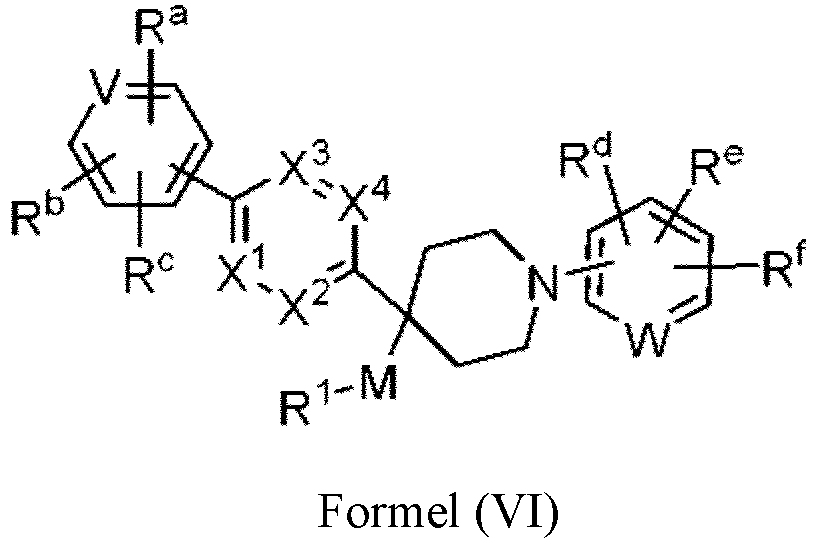
- Verbindung nach Anspruch 5 oder pharmazeutisch verträgliches Salz davon, wobei die Verbindung die Struktur der Formel (VIa), Formel (VIc), Formel (VIb), Formel (VId), Formel (VIIb) oder Formel (VIIe) aufweist, oder pharmazeutisch verträgliches Salz oder Solvat davon:
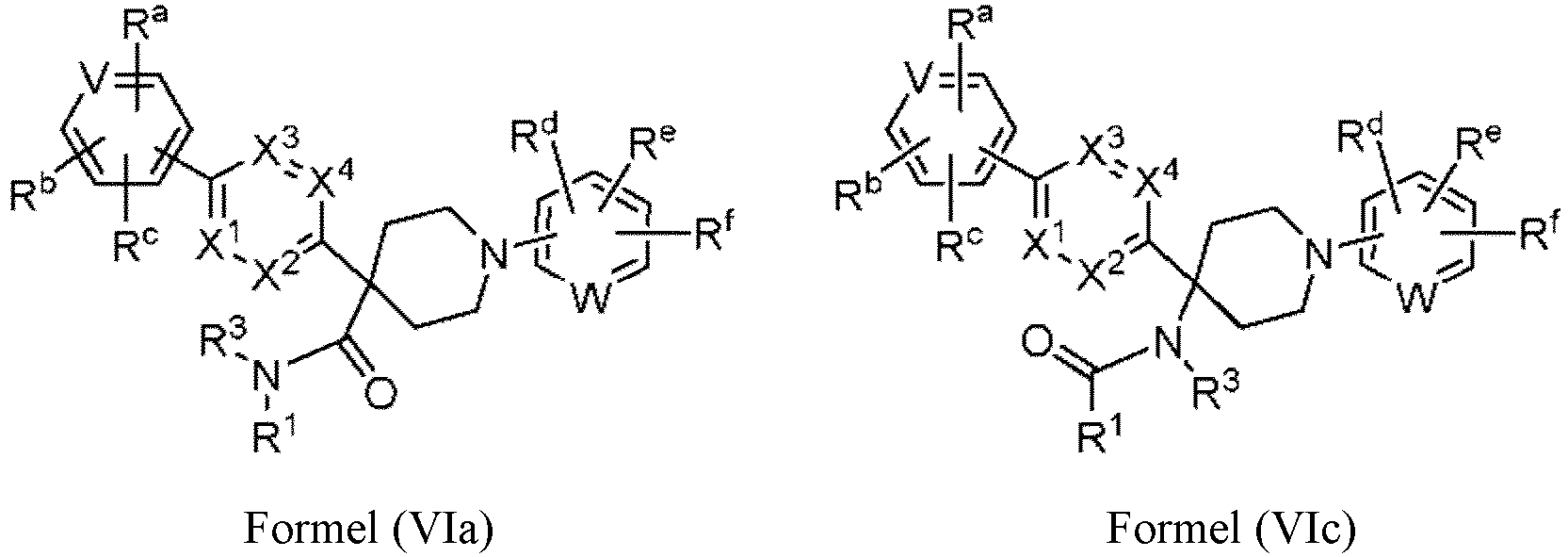


- Verbindung nach einem der Ansprüche 1-6 oder pharmazeutisch verträgliches Salz davon, wobei:R1 unsubstituiertes oder substituiertes C1-C6-Alkyl, unsubstituiertes oder substituiertes C1-C6-Heteroalkyl enthaltend 1 N-Atom ist, wobei eine beliebige substituierte Gruppe von R1 mit einem oder mehreren Halogen, unsubstituiertem oder substituiertem C1-C6-Alkyl, unsubstituiertem oder substituiertem monocyclischen Heterocyclus, -N(R4)2, -OR5, -CN, -CO2R5, -C(=O)N(R4)2, -SR5, -S(=O)R7, -S(=O)2R7, - NR4C(=O)R5, -NR4SO2R7, -SO2R7 oder -SO2N(R4)2 substituiert ist;oder R1 unsubstituierter oder substituierter monocyclischer 4-, 5- oder 6-gliedriger Heterocyclus enthaltend 1-4 N-Atome und 0 oder 1 O- oder S-Atome ist;oder R1 unsubstituiertes oder substituiertes überbrücktes C2-C7-Heterocycloalkyl enthaltend 1-2 N-Atome ist;oder R1 unsubstituiertes oder substituiertes -(C1-C6-Alkyl)-(C2-C7-heterocycloalkyl) ist, wobei das Heterocycloalkyl ein unsubstituiertes oder substituiertes monocyclisches 4-, 5- oder 6-gliedriges Heterocycloalkyl enthaltend 1-4 N-Atome und 0 oder 1 O- oder S-Atome ist.
- Verbindung nach Anspruch 7 oder pharmazeutisch verträgliches Salz davon, wobei:R1 unsubstituiertes oder substituiertes C1-C6-Heteroalkyl enthaltend 1 N-Atom ist;oder R1 unsubstituierter oder substituierter monocyclischer 4-, 5- oder 6-gliedriger Heterocyclus enthaltend 1-4 N-Atome und 0 oder 1 O- oder S-Atome ist;oder R1 unsubstituiertes oder substituiertes -(C1-C6-Alkyl)-(C2-C7-heterocycloalkyl) ist, wobei das Heterocycloalkyl ein unsubstituiertes oder substituiertes monocyclisches 4-, 5- oder 6-gliedriges Heterocycloalkyl enthaltend 1-4 N-Atome und 0 oder 1 O- oder S-Atome ist.
- Verbindung nach einem der Ansprüche 1-8 oder pharmazeutisch verträgliches Salz davon, wobei:X1 CH, CF oder N ist;X2 CH, CF oder N ist;X3 CH, CF oder N ist; undX4 CH, CF oder N ist;wobei bevorzugt:X1 N ist;X2 CH ist;X3 CH oder CF ist; undX4 CH ist.
- Verbindung nach einem der Ansprüche 1-9 oder pharmazeutisch verträgliches Salz davon, wobei:Ra ausgewählt ist aus der Gruppe bestehend aus Wasserstoff, Halogen, -OR4, -CN, -N(R4)2, -C(=O)R7, unsubstituiertem oder substituiertem C1-C6-Alkyl, unsubstituiertem oder substituiertem C1-C6-Fluoralkyl, unsubstituiertem oder substituiertem C1-C6-Heteroalkyl und unsubstituiertem oder substituiertem C3-C6-Cycloalkyl, wobei eine beliebige substituierte Gruppe von Ra mit einer oder mehreren R6-Gruppen substituiert ist;Rb und Rc unabhängig ausgewählt sind aus der Gruppe bestehend aus Wasserstoff, Halogen, -OR4, -CN, -N(R4)2, -C(=O)R7, unsubstituiertem oder substituiertem C1-C6-Alkyl, unsubstituiertem oder substituiertem C1-C6-Fluoralkyl und unsubstituiertem oder substituiertem C1-C6-Heteroalkyl, wobei eine beliebige substituierte Gruppe von Rb und Rc mit einer oder mehreren R6-Gruppen substituiert ist;wobei, wenn Ra, Rb oder Rc an das N-Atom eines Heteroaryls gebunden ist, es dann Wasserstoff, -C(=O)R7 oder unsubstituiertes oder substituiertes C1-C6-Alkyl ist;Rd ausgewählt ist aus der Gruppe bestehend aus Wasserstoff, Halogen, -OR4, -CN, -N(R4)2, unsubstituiertem oder substituiertem C1-C6-Alkyl, unsubstituiertem oder substituiertem C1-C6-Fluoralkyl, unsubstituiertem oder substituiertem C1-C6-Heteroalkyl, unsubstituiertem oder substituiertem C3-C6-Cycloalkyl, unsubstituiertem oder substituiertem C2-C7-Heterocycloalkyl, unsubstituiertem oder substituiertem Phenyl, unsubstituiertem oder substituiertem monocyclischen Heteroaryl und unsubstituiertem oder substituiertem bicyclischen Heteroaryl, wobei eine beliebige substituierte Gruppe von Rd mit einer oder mehreren R6-Gruppen substituiert ist; undRe und Rf unabhängig ausgewählt sind aus der Gruppe bestehend aus Wasserstoff, Halogen, -OR4, -CN, -N(R4)2, unsubstituiertem oder substituiertem C1-C6-Alkyl, unsubstituiertem oder substituiertem C1-C6-Fluoralkyl und unsubstituiertem oder substituiertem C1-C6-Heteroalkyl;wobei, wenn Rd, Re oder Rf an das N-Atom eines Heteroaryls gebunden ist, es dann Wasserstoff, -C(=O)R7 oder unsubstituiertes oder substituiertes C1-C6-Alkyl ist;wobei bevorzugt:Ra ausgewählt ist aus der Gruppe bestehend aus Wasserstoff, F, Cl, Br, -CN, -OH, -OCH3, -OCH2CH3, -C(O)CH3, -C(O)CH2CH3, -CH3, -CH2CH3, -CH2CH2CH3, -CH(CH3)2, - CH2CH2CH2CH3, -CH2CH(CH3)2, -CH(CH3)(CH2CH3), -C(CH3)3, -CH2CH2CH(CH3)2, -CH2OH, -CH2CN, -CH2F, -CHF2, -CF3, -CH2CH2OH, -CH2CH2CN, -CH2CH2F, -CH2CHF2, -CH2CF3, - CH2OCH3, -CH2CH2OCH3, -CH2NH2, -CH2NHCH3, -CH2N(CH3)2, -CH2CH2NH2, - CH2CH2NHCH3, -CH2CH2N(CH3)2, Cyclopropyl, Cyclobutyl, Cyclopentyl und Cyclohexyl;Rb und Rc unabhängig ausgewählt sind aus der Gruppe bestehend aus Wasserstoff, F, Cl, Br, -CN, -OH, -OCH3, -OCH2CH3, -C(O)CH3, -C(O)CH2CH3, -CH3, -CH2CH3, -CH2CH2CH3, - CH(CH3)2, -CH2CH2CH2CH3, -CH2CH(CH3)2, -CH(CH3)(CH2CH3), -C(CH3)3, - CH2CH2CH(CH3)2, -CH2OH, -CH2CN, -CH2F, -CHF2, -CF3, -CH2CH2OH, -CH2CH2CN, - CH2CH2F, -CH2CHF2, -CH2CF3, -CH2OCH3, -CH2CH2OCH3, -CH2NH2, -CH2NHCH3, - CH2N(CH3)2, -CH2CH2NH2, -CH2CH2NHCH3 und -CH2CH2N(CH3)2;wobei, wenn Ra, Rb oder Rc an das N-Atom eines Heteroaryls gebunden ist, es dann Wasserstoff, -C(O)CH3, -C(O)CH2CH3, -CH3, -CH2CH3, -CH2CH2CH3, -CH(CH3)2, - CH2CH2CH2CH3, -CH2CH(CH3)2, -CH(CH3)(CH2CH3), -C(CH3)3, -CH2CH2CH(CH3)2, -CH2OH, -CH2CN, -CH2F, -CHF2, -CF3, -CH2CH2OH, -CH2CH2CN, -CH2CH2F, -CH2CHF2, -CH2CF3, - CH2OCH3, -CH2CH2OCH3, -CH2NH2, -CH2NHCH3, -CH2N(CH3)2, -CH2CH2NH2, - CH2CH2NHCH3 und -CH2CH2N(CH3)2 ist;Rd ausgewählt ist aus der Gruppe bestehend aus Wasserstoff, F, Cl, Br, -CN, -OH, -OCH3, -OCH2CH3, -CH3, -CH2CH3, -CH2CH2CH3, -CH(CH3)2, -CH2CH2CH2CH3, -CH2CH(CH3)2, - CH(CH3)(CH2CH3), -C(CH3)3, -CH2CH2CH(CH3)2, -CH2OH, -CH2CN, -CH2F, -CHF2, -CF3, - CH2CH2OH, -CH2CH2CN, -CH2CH2F, -CH2CHF2, -CH2CF3, -CH2OCH3, -CH2CH2OCH3, - CH2NH2, -CH2NHCH3, -CH2N(CH3)2, -CH2CH2NH2, -CH2CH2NHCH3, -CH2CH2N(CH3)2, unsubstituiertem oder substituiertem Cyclopropyl, unsubstituiertem oder substituiertem Cyclobutyl, unsubstituiertem oder substituiertem Cyclopentyl, unsubstituiertem oder substituiertem Cyclohexyl, unsubstituiertem oder substituiertem C2-C7-Heterocycloalkyl, unsubstituiertem oder substituiertem Phenyl, unsubstituiertem oder substituiertem monocyclischen Heteroaryl und unsubstituiertem oder substituiertem bicyclischen Heteroaryl, wobei eine beliebige substituierte Gruppe von Rd mit einer oder mehreren R6-Gruppen substituiert ist; undRe und Rf unabhängig ausgewählt sind aus der Gruppe bestehend aus Wasserstoff, F, Cl, Br, -CH3, -CH2CH3, -CH2CH2CH3, -CH(CH3)2, -CH2CH2CH2CH3, -CH2CH(CH3)2, - CH(CH3)(CH2CH3), -C(CH3)3, -CH2CH2CH(CH3)2, -CH2OH, -CH2CN, -CH2F, -CHF2, -CF3, - CN, -OH, -OCH3 und -OCH2CH3;wobei, wenn Rd, Re oder Rf an das N-Atom eines Heteroaryls gebunden ist, es dann Wasserstoff, -C(O)CH3, -C(O)CH2CH3, -CH3, -CH2CH3, -CH2CH2CH3, -CH(CH3)2, - CH2CH2CH2CH3, -CH2CH(CH3)2, -CH(CH3)(CH2CH3), -C(CH3)3, -CH2CH2CH(CH3)2, -CH2OH, -CH2CN, -CH2F, -CHF2, -CF3, -CH2CH2OH, -CH2CH2CN, -CH2CH2F, -CH2CHF2, -CH2CF3, - CH2OCH3, -CH2CH2OCH3, -CH2NH2, -CH2NHCH3, -CH2N(CH3)2, -CH2CH2NH2, - CH2CH2NHCH3 und -CH2CH2N(CH3)2 ist.
- Verbindung nach Anspruch 1 oder pharmazeutisch verträgliches Salz davon, wobei:RA unsubstituiertes oder substituiertes Pyridinyl, unsubstituiertes oder substituiertes Phenyl oder unsubstituiertes oder substituiertes Pyrrolyl ist, wobei, wenn RA substituiert ist, dann RA mit 1 oder 2 Gruppen ausgewählt aus Ra, Rb und Rc substituiert ist;RB unsubstituiertes oder substituiertes Phenyl oder unsubstituiertes oder substituiertes Pyridinyl ist, wobei, wenn RB substituiert ist, dann RB mit 1, 2 oder 3 Gruppen ausgewählt aus Rd, Re und Rf substituiert ist;X1 CH oder N ist;X2 CH oder N ist;X3 CR13 oder N ist;X4 CH oder N ist;M *-NR3-(C=O)- oder *-(C=O)-NR3- ist, wobei * den Bindungspunkt an R1 angibt;R11, R12, R13 und R14 jeweils unabhängig Wasserstoff, F, Cl, -CH3, CF3, -CN, -OR4 oder - N(R4)2 sind;R1 unsubstituiertes oder substituiertes C1-C6-Heteroalkyl enthaltend 1 N-Atom ist, wobei eine beliebige substituierte Gruppe von R1 mit einem oder mehreren Halogen, C1-C4-Alkyl, - N(R4)2 oder -OR5 substituiert ist;oder R1 unsubstituiertes oder substituiertes Azetidinyl, unsubstituiertes oder substituiertes Pyrrolidinyl oder unsubstituiertes oder substituiertes Piperidinyl ist;oder R1 unsubstituiertes oder substituiertes überbrücktes C2-C7-Heterocycloalkyl enthaltend 1-2 N-Atome ist;oder R1 unsubstituiertes oder substituiertes -(C1-C6-Alkyl)-(C2-C7-heterocycloalkyl) ist, wobei das Heterocycloalkyl ein unsubstituiertes oder substituiertes monocyclisches 4-, 5- oder 6-gliedriges Heterocycloalkyl enthaltend 1-2 N-Atome ist;wobei bevorzugt:RA
 Ra ausgewählt ist aus der Gruppe bestehend aus Wasserstoff, F, Cl, Br, -CN, -OCH3, - OCH2CH3, -CH3, -CH2CH3, -CH2CH2CH3, -CH(CH3)2, -CH2CH2CH2CH3, -CH2CH(CH3)2, - CH(CH3)(CH2CH3), -C(CH3)3, -CH2F, -CHF2 und -CF3, undRb und Rc unabhängig ausgewählt sind aus der Gruppe bestehend aus Wasserstoff, F, Cl, - CH3, -CH2F, -CHF2, -CF3, -CN und -OCH3;RB
 Rd ausgewählt ist aus der Gruppe bestehend aus Wasserstoff, F, Cl, Br, -CN, -OCH3, - OCH2CH3, -CH3, -CH2CH3, -CH2CH2CH3, -CH(CH3)2, -CH2CH2CH2CH3, -CH2CH(CH3)2, - CH(CH3)(CH2CH3), -C(CH3)3, -CH2F, -CHF2 und -CF3,Re und Rf unabhängig ausgewählt sind aus der Gruppe bestehend aus Wasserstoff, F, Cl, Br, -CH3, -CH2F, -CHF2, -CF3, -CN, -OH und -OCH3;X1 CH oder N ist;X2 CH oder N ist;X3 CH, CF oder N ist;X4 CH oder N ist;M *-NH-(C=O)- oder *-(C=O)-NH- ist, wobei * den Bindungspunkt an R1 angibt;R1 unsubstituiertes oder substituiertes C1-C6-Alkyl, unsubstituiertes oder substituiertes C1-C6-Heteroalkyl enthaltend 1 N-Atom ist, wobei eine beliebige substituierte Gruppe von R1 mit einem oder mehreren Halogenen, unsubstituiertem oder substituiertem C1-C6-Alkyl, unsubstituiertem oder substituiertem monocyclischen Heterocyclus, -N(R4)2, -OR5, -CN, -CO2R5, -C(=O)N(R4)2, -SR5, -S(=O)R7, -S(=O)2R7, -NR4C(=O)R5, -NR4SO2R7, -SO2R7 oder -SO2N(R4)2 substituiert ist;oder R1 unsubstituierter oder substituierter monocyclischer 4-, 5- oder 6-gliedriger Heterocyclus enthaltend 1-4 N-Atome und 0 oder 1 O- oder S-Atome ist;oder R1 unsubstituiertes oder substituiertes überbrücktes C2-C7-Heterocycloalkyl enthaltend 1-2 N-Atome ist;oder R1 unsubstituiertes oder substituiertes -(C1-C6-Alkyl)-(C2-C7-heterocycloalkyl) ist, wobei das Heterocycloalkyl ein unsubstituiertes oder substituiertes monocyclisches 4-, 5- oder 6-gliedriges Heterocycloalkyl enthaltend 1-2 N-Atome ist.
 - Verbindung nach einem der Ansprüche 1-11 oder pharmazeutisch verträgliches Salz davon, wobei:R1 unsubstituiertes oder substituiertes C1-C6-Heteroalkyl enthaltend 1 N-Atom ist, wobei eine beliebige substituierte Gruppe von R1 mit einem oder mehreren Halogenen, C1-C4-Alkyl, - N(R4)2 oder -OR5 substituiert ist;oder R1 unsubstituiertes oder substituiertes Azetidinyl, unsubstituiertes oder substituiertes Pyrrolidinyl oder unsubstituiertes oder substituiertes Piperidinyl ist;oder R1 unsubstituiertes oder substituiertes -(C1-C6-Alkyl)-(C2-C7-heterocycloalkyl) ist, wobei das C2-C7-Heterocycloalkyl ein unsubstituiertes oder substituiertes Azetidinyl, unsubstituiertes oder substituiertes Pyrrolidinyl oder unsubstituiertes oder substituiertes Piperidinyl ist;wobei bevorzugt:R1 unsubstituiertes oder substituiertes Azetidinyl, unsubstituiertes oder substituiertes Pyrrolidinyl oder unsubstituiertes oder substituiertes Piperidinyl ist;oder R1 unsubstituiertes oder substituiertes C1-C6-Heteroalkyl enthaltend 1 N-Atom ist, wobei, wenn R1 unsubstituiert oder substituiert ist, es dann mit einem oder mehreren Halogenen, C1-C4-Alkyl, -N(R4)2 oder -OR5 substituiert ist.
- Verbindung nach Anspruch 1, die Folgendes ist:1-1: 1-[2-Cyano-4-(trifluormethyl)phenyl]-4-[4-(2-ethoxypyridin-3-yl)phenyl]-N-[(3R)-1-methylpyrrolidin-3-yl]piperidin-4-carboxamid;1-2: 1-[2-Cyano-4-(trifluormethyl)phenyl]-4-[4-(2-ethoxypyridin-3-yl)phenyl]-N-[(3R)-pyrrolidin-3-yl]piperidin-4-carboxamid,1-3: N-(2-Aminoethyl)-1-[2-cyano-4-(trifluormethyl)phenyl]-4-[4-(2-ethoxypyridin-3-yl)phenyl]piperidin-4-carboxamid;1-4: N-[(2R)-2-Aminopropyl]-1-[2-cyano-4-(trifluormethyl)phenyl]-4-[4-(2-ethoxypyridin-3-yl)phenyl]piperidin-4-carboxamid,1-5: N-(3-Aminopropyl)-1-[2-cyano-4-(trifluormethyl)phenyl]-4-[4-(2-ethoxypyridin-3-yl)phenyl]piperidin-4-carboxamid;1-6: N-[(2S)-2-Aminopropyl]-1-[2-cyano-4-(trifluormethyl)phenyl]-4-[4-(2-ethoxypyridin-3-yl)phenyl]piperidin-4-carboxamid,1-7: 1-[2-Cyano-4-(trifluormethyl)phenyl]-4-[4-(2-ethoxypyridin-3-yl)phenyl]-N-[2-(methylamino)ethyl]piperidin-4-carboxamid;1-8: 1-[2-Cyano-4-(trifluormethyl)phenyl]-N-[2-(dimethylamino)ethyl]-4-[4-(2-ethoxypyridin-3-yl)phenyl]piperidin-4-carboxamid,1-9:1-[2-Cyano-4-(trifluormethyl)phenyl]-4-{2'-ethoxy-[2,3'-bipyridin]-5-yl}-N-[(3R)-1-methylpyrrolidin-3-yl]piperidin-4-carboxamid,1-10: 1-[2-Cyano-4-(trifluormethyl)phenyl]-4-{2'-ethoxy-[2,3'-bipyridin]-5-yl}-N-[(3R)-pyrrolidin-3-yl]piperidin-4-carboxamid,1-11: 1-[2-Cyano-4-(trifluormethyl)phenyl]-4-{2'-ethoxy-[2,3'-bipyridin]-5-yl}-N-[(3S)-1-methylpyrrolidin-3-yl]piperidin-4-carboxamid;1-12: 1-[2-Cyano-4-(trifluormethyl)phenyl]-4-{2'-ethoxy-[2,3'-bipyridin]-5-yl}-N-[(3S)-pyrrolidin-3-yl]piperidin-4-carboxamid,1-13: N-(2-Aminoethyl)-1-[2-cyano-4-(trifluormethyl)phenyl]-4-{2'-ethoxy-[2,3'-bipyridin]-5-yl}piperidin-4-carboxamid;1-14: 1-[2-Cyano-4-(trifluormethyl)phenyl]-4-{2'-ethoxy-[2,3'-bipyridin]-5-yl}-N-[2-(methylamino)ethyl]piperidin-4-carboxamid;1-15: 1-[2-Cyano-4-(trifluormethyl)phenyl]-N-[2-(dimethylamino)ethyl]-4-{2'-ethoxy-[2,3'-bipyridin]-5-yl}piperidin-4-carboxamid;1-16: N-[(2S)-2-Aminopropyl]-1-[2-cyano-4-(trifluormethyl)phenyl]-4-{2'-ethoxy-[2,3'-bipyridin]-5-yl}piperidin-4-carboxamid;1-17: N-[(2R)-2-Amino-3-hydroxypropyl]-1-[2-cyano-4-(trifluormethyl)phenyl]-4-{2'-ethoxy-[2,3'-bipyridin]-5-yl}piperidin-4-carboxamid;1-18: 1-[2-Cyano-4-(trifluormethyl)phenyl]-4-{2'-ethoxy-[2,3'-bipyridin]-5-yl}-N-[(1-methylazetidin-3-yl)methyl]piperidin-4-carboxamid;1-19: 1-[2-Cyano-4-(trifluormethyl)phenyl]-4-{2'-ethoxy-[2,3'-bipyridin]-5-yl}-N-(1-methylazetidin-3-yl)piperidin-4-carboxamid;1-20: N-[(3S)-1-Azabicyclo[2.2.2]octan-3-yl]-1-[2-cyano-4-(trifluormethyl)phenyl]-4-{2'-ethoxy-[2,3'-bipyridin]-5-yl}piperidin-4-carboxamid;1-21: 1-[2-Cyano-4-(trifluormethyl)phenyl]-4-{2'-ethoxy-[3,3'-bipyridin]-6-yl}-N-[(3R)-pyrrolidin-3-yl]piperidin-4-carboxamid,1-22: 1-[2-Cyano-4-(trifluormethyl)phenyl]-4-{2'-ethoxy-[3,3'-bipyridin]-6-yl}-N-[(3R)-1-methylpyrrolidin-3-yl]piperidin-4-carboxamid;1-23: 1-[2-Cyano-6-(trifluormethyl)pyridin-3-yl]-4-[4-(2-ethoxypyridin-3-yl)phenyl]-N-[(3R)-1-methylpyrrolidin-3-yl]piperidin-4-carboxamid,1-24: 1-[2-Cyano-6-(trifluormethyl)pyridin-3-yl]-4-{2'-ethoxy-[2,3'-bipyridin]-5-yl}-N-[(3R)-1-methylpyrrolidin-3-yl]piperidin-4-carboxamid,1-25: 3-(4-{2'-Ethoxy-[2,3'-bipyridin]-5-yl}-4-{[(3R)-1-methylpyrrolidin-3-yl]carbamoyl}piperidin-1-yl)-6-(trifluormethyl)pyridin-2-carboxamid;1-26: 1-[2-Cyano-6-(trifluormethyl)pyridin-3-yl]-4-{2'-ethoxy-[2,3'-bipyridin]-5-yl}-N-[(3S)-1-methylpyrrolidin-3-yl]piperidin-4-carboxamid;1-27: 3-(4-{2'-Ethoxy-[2,3'-bipyridin]-5-yl}-4-{[(3S)-1-methylpyrrolidin-3-yl]carbamoyl}piperidin-1-yl)-6-(trifluormethyl)pyridin-2-carboxamid;1-28: N-[(2S)-2-Amino-3-hydroxypropyl]-1-[2-cyano-4-(trifluormethyl)phenyl]-4-{2'-ethoxy-[2,3'-bipyridin]-5-yl}piperidin-4-carboxamid;1-29: 1-[2-Chlor-6-cyano-4-(trifluormethyl)phenyl]-4-[4-(2-ethoxypyridin-3-yl)phenyl]-N-[(3R)-1-methylpyrrolidin-3-yl]piperidin-4-carboxamid,1-30: 1-[2-Cyano-4-(trifluormethyl)phenyl]-4-[6-(2-ethoxyphenyl)pyridin-3-yl]-N-[(3S)-1-methylpyrrolidin-3-yl]piperidin-4-carboxamid;1-31: 1-[2-Cyano-4-(trifluormethyl)phenyl]-4-[6-(2-ethoxyphenyl)pyridin-3-yl]-N-[(3R)-1-methylpyrrolidin-3-yl]piperidin-4-carboxamid;1-32: 1-(2-Cyanophenyl)-4-{2'-ethoxy-[2,3'-bipyridin]-5-yl}-N-[(3S)-1-methylpyrrolidin-3-yl]piperidin-4-carboxamid,1-33: 4-{2'-Ethoxy-[2,3'-bipyridin]-5-yl}-N-[(3S)-1-methylpyrrolidin-3-yl]-1-[4-(trifluormethyl)phenyl]piperidin-4-carboxamid;1-34: 1-(4-Chlor-2-cyanophenyl)-4-{2'-ethoxy-[2,3'-bipyridin]-5-yl}-N-[(3S)-1-methylpyrrolidin-3-yl]piperidin-4-carboxamid,1-35: 4-{2'-Ethoxy-[2,3'-bipyridin]-5-yl}-N-[(3S)-1-methylpyrrolidin-3-yl]-1-[5-(trifluormethyl)pyridin-2-yl]piperidin-4-carboxamid;1-36: 1-(4-Acetyl-2-cyanophenyl)-4-{2'-ethoxy-[2,3'-bipyridin]-5-yl}-N-[(3S)-1-methylpyrrolidin-3-yl]piperidin-4-carboxamid,1-37: 1-[2-Cyano-4-(difluormethyl)phenyl]-4-{2'-ethoxy-[2,3'-bipyridin]-5-yl}-N-[(3S)-1-methylpyrrolidin-3-yl]piperidin-4-carboxamid;1-38: 1-[4-Cyano-2-(trifluormethyl)phenyl]-4-{2'-ethoxy-[2,3'-bipyridin]-5-yl}-N-[(3S)-1-methylpyrrolidin-3-yl]piperidin-4-carboxamid;1-39: 1-[2-Cyano-4-(trifluormethoxy)phenyl]-4-{2'-ethoxy-[2,3'-bipyridin]-5-yl}-N-[(3S)-1-methylpyrrolidin-3-yl]piperidin-4-carboxamid;1-40: 1-(2,4-Dicyanophenyl)-4-{2'-ethoxy-[2,3'-bipyridin]-5-yl}-N-[(3S)-1-methylpyrrolidin-3-yl]piperidin-4-carboxamid,1-41: 1-[2-Cyano-4-(trifluormethyl)phenyl]-4-{2'-ethoxy-[2,3'-bipyridin]-5-yl}-N-[(3S,4S)*-4-hydroxy-1-methylpyrrolidin-3-yl]piperidin-4-carboxamid;1-42: 1-[3-Cyano-5-(trifluormethyl)pyridin-2-yl]-4-{2'-ethoxy-[2,3'-bipyridin]-5-yl}-N-[(3S)-1-methylpyrrolidin-3-yl]piperidin-4-carboxamid;1-43: 1-[2-Cyano-4-(trifluormethyl)phenyl]-4-[6-(1-methyl-1H-pyrazol-5-yl)pyridin-3-yl]-N-[(3R)-1-methylpyrrolidin-3-yl]piperidin-4-carboxamid,1-44: 1-[2-Cyano-4-(trifluormethyl)phenyl]-4-{2'-ethoxy-[2,3'-bipyridin]-5-yl}-N-[(2R)-3-hydroxy-2-(methylamino)propyl]piperidin-4-carboxamid;1-45: 1-[2-Cyano-4-(trifluormethyl)phenyl]-N-[(2R)-2-(dimethylamino)-3-hydroxypropyl]-4-{2'-ethoxy-[2,3'-bipyridin]-5-yl}piperidin-4-carboxamid;1-46: 1-[2-Cyano-4-(trifluormethyl)phenyl]-4-{2'-ethoxy-[2,3'-bipyridin]-5-yl}-N-[(3R,4R)*-4-hydroxy-1-methylpyrrolidin-3-yl]piperidin-4-carboxamid;1-47: 1-[2-Cyano-4-(trifluormethyl)phenyl]-4-{2'-ethoxy-[2,3'-bipyridin]-5-yl}-N-[(2S)-3-hydroxy-2-(methylamino)propyl]piperidin-4-carboxamid;1-48: 1-[2-Cyano-4-(trifluormethyl)phenyl]-N-[(2S)-2-(dimethylamino)-3-hydroxypropyl]-4-{2'-ethoxy-[2,3'-bipyridin]-5-yl}piperidin-4-carboxamid;1-51: 1-[2-Cyano-4-(trifluormethyl)phenyl]-4-[5-(2-ethoxypyridin-3-yl)pyrazin-2-yl]-N-[(3R)-1-methylpyrrolidin-3-yl]piperidin-4-carboxamid,1-52: 1-[2-Cyano-4-(trifluormethyl)phenyl]-4-[6-(2-methoxyphenyl)pyridin-3-yl]-N-[(3R)-1-methylpyrrolidin-3-yl]piperidin-4-carboxamid,1-53: 1-[2-Cyano-4-(trifluormethyl)phenyl]-4-[6-(2,3-dihydro-1-benzofuran-7-yl)pyridin-3-yl]-N-[(3R)-1-methylpyrrolidin-3-yl]piperidin-4-carboxamid,1-54: 4-[6-(1-Benzofuran-7-yl)pyridin-3-yl]-1-[2-cyano-4-(trifluormethyl)phenyl]-N-[(3R)-1-methylpyrrolidin-3-yl]piperidin-4-carboxamid,1-55: 1-[2-Cyano-4-(trifluormethyl)phenyl]-4-{6-[2-(hydroxymethyl)phenyl]pyridin-3-yl}-N-[(3R)-1-methylpyrrolidin-3-yl]piperidin-4-carboxamid;1-56: 1-[2-Cyano-4-(trifluormethyl)phenyl]-4-[6-(2-ethoxypyridin-3-yl)pyridazin-3-yl]-N-[(3S)-1-methylpyrrolidin-3-yl]piperidin-4-carboxamid;1-57: 1-[2-Cyano-4-(trifluormethyl)phenyl]-4-[6-(2-ethoxypyridin-3-yl)pyridazin-3-yl]-N-[(3R)-1-methylpyrrolidin-3-yl]piperidin-4-carboxamid;1-58: 1-[2-Cyano-4-(trifluormethyl)phenyl]-4-[5-(2-ethoxypyridin-3-yl)pyrazin-2-yl]-N-[(3S)-1-methylpyrrolidin-3-yl]piperidin-4-carboxamid;1-59: 1-[2-Cyano-4-(1,1-difluorethyl)phenyl]-4-{2'-ethoxy-[2,3'-bipyridin]-5-yl}-N-[(3S)-1-methylpyrrolidin-3-yl]piperidin-4-carboxamid;1-60: 1-[2-Cyano-4-(trifluormethyl)phenyl]-4-[6-(2-ethylphenyl)pyridin-3-yl]-N-[(3R)-1-methylpyrrolidin-3-yl]piperidin-4-carboxamid;1-61: 1-[2-Cyano-4-(trifluormethyl)phenyl]-4-[6-(2,3-difluorphenyl)pyridin-3-yl]-N-[(3R)-1-methylpyrrolidin-3-yl]piperidin-4-carboxamid;1-62: 1-[2-Cyano-4-(trifluormethyl)phenyl]-4-[6-(1-ethyl-1H-pyrazol-5-yl)pyridin-3-yl]-N-[(3R)-1-methylpyrrolidin-3-yl]piperidin-4-carboxamid;1-63: 1-[2-Cyano-4-(trifluormethyl)phenyl]-N-[(3R)-1-methylpyrrolidin-3-yl]-4-[6-(2-propoxyphenyl)pyridin-3-yl]piperidin-4-carboxamid;1-64: 1-[2-Cyano-4-(trifluormethyl)phenyl]-4-[6-(3-fluorphenyl)pyridin-3-yl]-N-[(3R)-1-methylpyrrolidin-3-yl]piperidin-4-carboxamid;1-65: 1-[2-Cyano-4-(trifluormethyl)phenyl]-4-[6-(3,5-difluorphenyl)pyridin-3-yl]-N-[(3R)-1-methylpyrrolidin-3-yl]piperidin-4-carboxamid;1-66: 1-[2-Cyano-4-(trifluormethyl)phenyl]-4-[6-(2-methylphenyl)pyridin-3-yl]-N-[(3R)-1-methylpyrrolidin-3-yl]piperidin-4-carboxamid;1-67: 1-[2-Cyano-4-(trifluormethyl)phenyl]-4-[6-(2,2-difluor-2H-1,3-benzodioxol-4-yl)pyridin-3-yl]-N-[(3R)-1-methylpyrrolidin-3-yl]piperidin-4-carboxamid;1-68: 1-[2-Cyano-4-(trifluormethyl)phenyl]-4-[6-(2,5-difluorphenyl)pyridin-3-yl]-N-[(3R)-1-methylpyrrolidin-3-yl]piperidin-4-carboxamid;1-69: 1-[2-Cyano-4-(trifluormethyl)phenyl]-4-[6-(2-ethoxy-5-fluorphenyl)pyridin-3-yl]-N-[(3R)-1-methylpyrrolidin-3-yl]piperidin-4-carboxamid;1-70: 1-[2-Cyano-4-(trifluormethyl)phenyl]-4-{6-[1-(3-methylbutyl)-1H-pyrazol-5-yl]pyridin-3-yl}-N-[(3R)-1-methylpyrrolidin-3-yl]piperidin-4-carboxamid;1-71: 1-[2-Cyano-4-(trifluormethyl)phenyl]-N-[(3R)-1-methylpyrrolidin-3-yl]-4-{6-[2-(trifluormethoxy)phenyl]pyridin-3-yl}piperidin-4-carboxamid;1-72: 1-[2-Cyano-4-(trifluormethyl)phenyl]-4-[6-(2-ethoxy-3-fluorphenyl)pyridin-3-yl]-N-[(3R)-1-methylpyrrolidin-3-yl]piperidin-4-carboxamid;1-73: 1-[2-Cyano-4-(trifluormethyl)phenyl]-4-[6-(1-methyl-1H-indazol-7-yl)pyridin-3-yl]-N-[(3R)-1-methylpyrrolidin-3-yl]piperidin-4-carboxamid;1-74: 1-[2-Cyano-4-(trifluormethyl)phenyl]-4-[6-(2-fluorphenyl)pyridin-3-yl]-N-[(3R)-1-methylpyrrolidin-3-yl]piperidin-4-carboxamid;1-75: 1-[2-Cyano-4-(trifluormethyl)phenyl]-4-[4-(2-ethoxypyridin-3-yl)-3-fluorphenyl]-N-[(3R)-1-methylpyrrolidin-3-yl]piperidin-4-carboxamid;1-76: 1-[2-Cyano-4-(trifluormethyl)phenyl]-4-[6-(2-ethoxyphenyl)pyridin-3-yl]-N-(1-methylazetidin-3-yl)piperidin-4-carboxamid;1-77: 1-[2-Cyano-4-(trifluormethyl)phenyl]-N-[(3R)-1-methylpyrrolidin-3-yl]-4-{6-[2-(trifluormethyl)phenyl]pyridin-3-yl}piperidin-4-carboxamid;1-78: 1-[2-Cyano-4-(trifluormethyl)phenyl]-4-[6-(2-cyanophenyl)pyridin-3-yl]-N-[(3R)-1-methylpyrrolidin-3-yl]piperidin-4-carboxamid;1-79: 1-[2-Cyano-4-(trifluormethyl)phenyl]-4-{6-[2-(methoxymethyl)phenyl]pyridin-3-yl}-N-[(3R)-1-methylpyrrolidin-3-yl]piperidin-4-carboxamid;1-80: 1-[2-Cyano-4-(trifluormethyl)phenyl]-4-[6-(3-methoxythiophen-2-yl)pyridin-3-yl]-N-[(3R)-1-methylpyrrolidin-3-yl]piperidin-4-carboxamid;1-81: 1-[2-Cyano-4-(trifluormethyl)phenyl]-4-[6-(5-fluor-2-methoxyphenyl)pyridin-3-yl]-N-[(3R)-1-methylpyrrolidin-3-yl]piperidin-4-carboxamid;1-82: 1-[2-Cyano-4-(trifluormethyl)phenyl]-4-[6-(3-fluor-2-methoxyphenyl)pyridin-3-yl]-N-[(3R)-1-methylpyrrolidin-3-yl]piperidin-4-carboxamid;1-83: 1-[2-Cyano-4-(trifluormethyl)phenyl]-4-[6-(2-methoxythiophen-3-yl)pyridin-3-yl]-N-[(3R)-1-methylpyrrolidin-3-yl]piperidin-4-carboxamid;1-84: 1-[2-Cyano-4-(trifluormethyl)phenyl]-4-{6-[2-(1,1-difluorethyl)phenyl]pyridin-3-yl}-N-[(3R)-1-methylpyrrolidin-3-yl]piperidin-4-carboxamid;1-85: 1-[2-Cyano-4-(trifluormethyl)phenyl]-4-[2'-(difluormethoxy)-[2,3'-bipyridin]-5-yl]-N-[(3R)-1-methylpyrrolidin-3-yl]piperidin-4-carboxamid;1-86: 1-[2-Cyano-4-(trifluormethyl)phenyl]-4-{5'-fluor-2'-methoxy-[2,3'-bipyridin]-5-yl}-N-[(3R)-1-methylpyrrolidin-3-yl]piperidin-4-carboxamid;1-87: 1-[2-Cyano-4-(trifluormethyl)phenyl]-4-[6-(3,5-difluor-2-methoxyphenyl)pyridin-3-yl]-N-[(3R)-1-methylpyrrolidin-3-yl]piperidin-4-carboxamid;1-88: 1-[2-Cyano-4-(trifluormethyl)phenyl]-4-[6-(1-methyl-1H-pyrrol-2-yl)pyridin-3-yl]-N-[(3R)-1-methylpyrrolidin-3-yl]piperidin-4-carboxamid;1-89: 1-[2-Cyano-4-(trifluormethyl)phenyl]-4-[6-(2-cyclopropoxyphenyl)pyridin-3-yl]-N-[(3R)-1-methylpyrrolidin-3-yl]piperidin-4-carboxamid;1-90: 1-(4-Chlor-2-cyanophenyl)-4-[6-(2-ethoxyphenyl)pyridin-3-yl]-N-[(3S)-1-methylpyrrolidin-3-yl]piperidin-4-carboxamid;1-91: 1-(4-Chlor-2-cyanophenyl)-4-[6-(2-methoxyphenyl)pyridin-3-yl]-N-[(3S)-1-methylpyrrolidin-3-yl]piperidin-4-carboxamid;1-92: 1-(4-Chlor-2-cyanophenyl)-4-[6-(2-methoxyphenyl)pyridin-3-yl]-N-(1-methylazetidin-3-yl)piperidin-4-carboxamid;1-93: 1-(4-Chlor-2-cyanophenyl)-4-[6-(2-ethoxyphenyl)pyridin-3-yl]-N-(1-methylazetidin-3-yl)piperidin-4-carboxamid;1-94: 1-[2-Cyano-4-(trifluormethyl)phenyl]-4-[6-(2-methoxyphenyl)pyridin-3-yl]-N-(1-methylazetidin-3-yl)piperidin-4-carboxamid;1-95: 1-(2,4-Dichlorphenyl)-4-[6-(2-ethoxyphenyl)pyridin-3-yl]-N-[(3S)-1-methylpyrrolidin-3-yl]piperidin-4-carboxamid;1-96: 1-(2-Cyano-4-fluorphenyl)-4-[6-(2-ethoxyphenyl)pyridin-3-yl]-N-[(3S)-1-methylpyrrolidin-3-yl]piperidin-4-carboxamid;1-97: 1-[2-Chlor-4-(trifluormethyl)phenyl]-4-[6-(2-ethoxyphenyl)pyridin-3-yl]-N-[(3S)-1-methylpyrrolidin-3-yl]piperidin-4-carboxamid;1-98: 1-[2-Cyano-4-(trifluormethyl)phenyl]-4-{2'-methoxy-[2,3'-bipyridin]-5-yl}-N-[(3R)-1-methylpyrrolidin-3-yl]piperidin-4-carboxamid;1-99: 1-[2-Cyano-4-(trifluormethyl)phenyl]-4-[6-(5-fluor-2-methylphenyl)pyridin-3-yl]-N-[(3R)-1-methylpyrrolidin-3-yl]piperidin-4-carboxamid;1-100: 1-[2-Cyano-4-(trifluormethyl)phenyl]-4-[6-(1-methyl-1H-pyrrol-2-yl)pyridin-3-yl]-N-[(3S)-1-methylpyrrolidin-3-yl]piperidin-4-carboxamid;1-101: 1-[2-Cyano-4-(trifluormethyl)phenyl]-4-[6-(3-fluor-2-methoxyphenyl)pyridin-3-yl]-N-[(3S)-1-methylpyrrolidin-3-yl]piperidin-4-carboxamid;1-102: 1-[2-Cyano-4-(trifluormethyl)phenyl]-4-[6-(5-fluor-2-methoxyphenyl)pyridin-3-yl]-N-[(3S)-1-methylpyrrolidin-3-yl]piperidin-4-carboxamid;1-103: 1-[2-Cyano-4-(trifluormethyl)phenyl]-4-{5'-fluor-2'-methoxy-[2,3'-bipyridin]-5-yl}-N-[(3S)-1-methylpyrrolidin-3-yl]piperidin-4-carboxamid;1-104: 1-[2-Cyano-4-(trifluormethyl)phenyl]-4-[6-(2-ethylphenyl)pyridin-3-yl]-N-[(3S)-1-methylpyrrolidin-3-yl]piperidin-4-carboxamid;1-105: 1-[2-Cyano-4-(trifluormethyl)phenyl]-4-[6-(4-methylpyrimidin-5-yl)pyridin-3-yl]-N-[(3R)-1-methylpyrrolidin-3-yl]piperidin-4-carboxamid;1-106: 1-[2-Cyano-4-(trifluormethyl)phenyl]-4-[2-(2-ethoxypyridin-3-yl)pyrimidin-5-yl]-N-[(3S)-1-methylpyrrolidin-3-yl]piperidin-4-carboxamid;1-107: 1-[2-Cyano-4-(trifluormethyl)phenyl]-4-[2-(2-ethoxypyridin-3-yl)pyrimidin-5-yl]-N-[(3R)-1-methylpyrrolidin-3-yl]piperidin-4-carboxamid;1-108: 1-[2-Cyano-4-(trifluormethyl)phenyl]-4-{2'-ethoxy-3-fluor-[2,3'-bipyridin]-5-yl}-N-[(3R)-1-methylpyrrolidin-3-yl]piperidin-4-carboxamid;1-109: 1-[2-Cyano-4-(trifluormethyl)phenyl]-4-{2'-ethoxy-3-fluor-[2,3'-bipyridin]-5-yl}-N-[(3S)-1-methylpyrrolidin-3-yl]piperidin-4-carboxamid;1-110: 1-[2-Cyano-6-(trifluormethyl)pyridin-3-yl]-4-{2'-ethoxy-3-fluor-[2,3'-bipyridin]-5-yl}-N-[(3S)-1-methylpyrrolidin-3-yl]piperidin-4-carboxamid;1-111: 1-(4-Chlor-2-cyano-6-fluorphenyl)-4-[6-(2-ethoxyphenyl)pyridin-3-yl]-N-[(3S)-1-methylpyrrolidin-3-yl]piperidin-4-carboxamid;1-112: 1-[2-Cyano-4-(trifluormethyl)phenyl]-N-[(3R)-1-methylpyrrolidin-3-yl]-4-[6-(2-methylthiophen-3-yl)pyridin-3-yl]piperidin-4-carboxamid;1-113: 1-[2-Cyano-4-(trifluormethyl)phenyl]-4-[6-(2-cyclopropylphenyl)pyridin-3-yl]-N-[(3R)-1-methylpyrrolidin-3-yl]piperidin-4-carboxamid;1-114: 1-[2-Cyano-4-(trifluormethyl)phenyl]-4-{6-[2-(difluormethoxy)phenyl]pyridin-3-yl}-N-[(3R)-1-methylpyrrolidin-3-yl]piperidin-4-carboxamid;1-115: 1-[2-Cyano-4-(trifluormethyl)phenyl]-4-[6-(1-methyl-1H-pyrrol-3-yl)pyridin-3-yl]-N-[(3R)-1-methylpyrrolidin-3-yl]piperidin-4-carboxamid;1-116: 1-[2-Cyano-4-(trifluormethyl)phenyl]-4-[6-(2-methylfuran-3-yl)pyridin-3-yl]-N-[(3R)-1-methylpyrrolidin-3-yl]piperidin-4-carboxamid;1-117: 1-[2-Cyano-4-(trifluormethyl)phenyl]-N-[(3R)-1-methylpyrrolidin-3-yl]-4-[6-(2-propylphenyl)pyridin-3-yl]piperidin-4-carboxamid;1-118: 1-[2-Cyano-4-(trifluormethyl)phenyl]-4-{2'-ethyl-[2,3'-bipyridin]-5-yl}-N-[(3R)-1-methylpyrrolidin-3-yl]piperidin-4-carboxamid;1-119: 1-[2-Cyano-4-(trifluormethyl)phenyl]-4-[6-(2-methoxythiophen-3-yl)pyridin-3-yl]-N-[(3S)-1-methylpyrrolidin-3-yl]piperidin-4-carboxamid;1-120: 1-[2-Cyano-4-(trifluormethyl)phenyl]-4-[6-(2-methylfuran-3-yl)pyridin-3-yl]-N-[(3S)-1-methylpyrrolidin-3-yl]piperidin-4-carboxamid;1-121: 1-[2-Cyano-4-(trifluormethyl)phenyl]-4-[6-(2-cyclopropylphenyl)pyridin-3-yl]-N-[(3S)-1-methylpyrrolidin-3-yl]piperidin-4-carboxamid;1-122: 1-[2-Cyano-4-(trifluormethyl)phenyl]-N-[(3S)-1-methylpyrrolidin-3-yl]-4-[6-(2-methylthiophen-3-yl)pyridin-3-yl]piperidin-4-carboxamid;1-123: 1-[2-Cyano-4-(trifluormethyl)phenyl]-4-[6-(2-ethoxyphenyl)-5-fluorpyridin-3-yl]-N-[(3R)-1-methylpyrrolidin-3-yl]piperidin-4-carboxamid;1-124: 1-[2-Cyano-4-(trifluormethyl)phenyl]-4-[6-(2-ethoxyphenyl)-5-fluorpyridin-3-yl]-N-[(3S)-1-methylpyrrolidin-3-yl]piperidin-4-carboxamid;1-125: 1-[2-Cyano-6-(trifluormethyl)pyridin-3-yl]-4-[6-(2-ethoxyphenyl)-5-fluorpyridin-3-yl]-N-[(3S)-1-methylpyrrolidin-3-yl]piperidin-4-carboxamid;1-126: 1-[2-Cyano-4-(trifluormethyl)phenyl]-4-[5-fluor-6-(2-methoxyphenyl)pyridin-3-yl]-N-[(3R)-1-methylpyrrolidin-3-yl]piperidin-4-carboxamid;1-127: 1-[2-Cyano-4-(trifluormethyl)phenyl]-4-[5-fluor-6-(2-methoxyphenyl)pyridin-3-yl]-N-[(3S)-1-methylpyrrolidin-3-yl]piperidin-4-carboxamid;1-128: 1-[2-Cyano-6-(trifluormethyl)pyridin-3-yl]-4-[5-fluor-6-(2-methoxyphenyl)pyridin-3-yl]-N-[(3S)-1-methylpyrrolidin-3-yl]piperidin-4-carboxamid;1-129: 1-[2-Cyano-4-(trifluormethyl)phenyl]-4-[6-(3-fluor-2-hydroxyphenyl)pyridin-3-yl]-N-[(3R)-1-methylpyrrolidin-3-yl]piperidin-4-carboxamid;1-130: 1-[2-Cyano-4-(trifluormethyl)phenyl]-4-[6-(2-methoxy-5-methylphenyl)pyridin-3-yl]-N-[(3R)-1-methylpyrrolidin-3-yl] piperidin-4-carboxamid;1-131: 1-[2-Cyano-4-(trifluormethyl)phenyl]-4-{3-fluor-2'-methoxy-[2,3'-bipyridin]-5-yl}-N-[(3R)-1-methylpyrrolidin-3-yl]piperidin-4-carboxamid;1-132: 1-[2-Cyano-4-(trifluormethyl)phenyl]-4-{3-fluor-2'-methoxy-[2,3'-bipyridin]-5-yl}-N-[(3S)-1-methylpyrrolidin-3-yl]piperidin-4-carboxamid;1-133: 1-[2-Cyano-6-(trifluormethyl)pyridin-3-yl]-4-{3-fluor-2'-methoxy-[2,3'-bipyridin]-5-yl}-N-[(3S)-1-methylpyrrolidin-3-yl] piperidin-4-carboxamid;1-134: 1-(4-Chlor-2-cyanophenyl)-4-[6-(2-ethoxyphenyl)pyridazin-3-yl]-N-[(3S)-1-methylpyrrolidin-3-yl]piperidin-4-carboxamid;1-135: 1-(4-Chlor-2-cyanophenyl)-4-[6-(2-ethoxyphenyl)pyridazin-3-yl]-N-(1-methylazetidin-3-yl)piperidin-4-carboxamid;1-136: 1-[2-Cyano-4-(trifluormethyl)phenyl]-4-[6-(2-ethoxyphenyl)pyridazin-3-yl]-N-(1-methylazetidin-3-yl)piperidin-4-carboxamid;1-137: 1-[2-Cyano-4-(trifluormethyl)phenyl]-4-{6-[2-(cyanomethyl)phenyl]pyridin-3-yl}-N-[(3R)-1-methylpyrrolidin-3-yl]piperidin-4-carboxamid;1-138: 1-[2-Cyano-4-(trifluormethyl)phenyl]-N-[(3R)-1-methylpyrrolidin-3-yl]-4-[6-(4-methylthiophen-3-yl)pyridin-3-yl]piperidin-4-carboxamid;1-139: 1-(4-Chlor-2-cyanophenyl)-4-[6-(2-ethoxypyridin-3-yl)pyridazin-3-yl]-N-[(3S)-1-methylpyrrolidin-3-yl]piperidin-4-carboxamid;1-140: 1-[2-Cyano-4-(trifluormethyl)phenyl]-4-[6-(2-ethoxypyridin-3-yl)pyridazin-3-yl]-N-(1-methylazetidin-3-yl)piperidin-4-carboxamid;1-141: 1-[2-Chlor-4-(trifluormethyl)phenyl]-4-{2'-ethoxy-[2,3'-bipyridin]-5-yl}-N-[(3S)-1-methylpyrrolidin-3-yl]piperidin-4-carboxamid;1-142: 1-[2-Chlor-4-(trifluormethyl)phenyl]-4-{2'-methoxy-[2,3'-bipyridin]-5-yl}-N-[(3S)-1-methylpyrrolidin-3-yl]piperidin-4-carboxamid;1-143: 1-[2-Cyano-4-(trifluormethyl)phenyl]-N-[(3S)-1-methylpyrrolidin-3-yl]-4-[6-(1H-pyrrol-2-yl)pyridin-3-yl]piperidin-4-carboxamid;1-144: 1-[2-Chlor-4-(trifluormethyl)phenyl]-4-[6-(2-methoxyphenyl)pyridin-3-yl]-N-[(3S)-1-methylpyrrolidin-3-yl]piperidin-4-carboxamid;1-145: 4-[6-(2-Ethoxyphenyl)pyridin-3-yl]-1-[2-fluor-4-(trifluormethyl)phenyl]-N-[(3S)-1-methylpyrrolidin-3-yl]piperidin-4-carboxamid;1-146: 4-[6-(2-Acetylthiophen-3-yl)pyridin-3-yl]-1-[2-cyano-4-(trifluormethyl)phenyl]-N-[(3S)-1-methylpyrrolidin-3-yl]piperidin-4-carboxamid;1-147: 1-[2-Cyano-4-(trifluormethyl)phenyl]-4-[6-(2-ethylthiophen-3-yl)pyridin-3-yl]-N-[(3S)-1-methylpyrrolidin-3-yl]piperidin-4-carboxamid,1-148: 4-[6-(2-Cyano-3-fluorphenyl)pyridin-3-yl]-1-[2-cyano-4-(trifluormethyl)phenyl]-N-[(3S)-1-methylpyrrolidin-3-yl]piperidin-4-carboxamid;1-149: 1-[2-Cyano-4-(trifluormethyl)phenyl]-4-[6-(3-methyl-1,2-oxazol-4-yl)pyridin-3-yl]-N-[(3S)-1-methylpyrrolidin-3-yl]piperidin-4-carboxamid;1-150: 1-[3-Chlor-5-(trifluormethyl)pyridin-2-yl]-4-{2'-ethoxy-[2,3'-bipyridin]-5-yl}-N-[(3S)-1-methylpyrrolidin-3-yl]piperidin-4-carboxamid,1-151: 1-[2-Cyano-4-(trifluormethyl)phenyl]-4-{6-[2-(difluormethyl)phenyl]pyridin-3-yl}-N-[(3S)-1-methylpyrrolidin-3-yl]piperidin-4-carboxamid;1-152: 1-[2-Cyano-4-(trifluormethyl)phenyl]-4-[6-(1-methyl-1H-pyrrol-2-yl)pyridin-3-yl]-N-[(3S)-pyrrolidin-3-yl]piperidin-4-carboxamid;1-153: 4-[6-(5-Cyano-1-methyl-1H-pyrrol-2-yl)pyridin-3-yl]-1-[2-cyano-4-(trifluormethyl)phenyl]-N-[(3R)-1-methylpyrrolidin-3-yl]piperidin-4-carboxamid;1-154: 1-[2-Chlor-4-(trifluormethyl)phenyl]-4-{5'-fluor-2'-methoxy-[2,3'-bipyridin]-5-yl}-N-[(3S)-1-methylpyrrolidin-3-yl]piperidin-4-carboxamid;1-155: 1-[2-Chlor-4-(trifluormethyl)phenyl]-4-[6-(5-fluor-2-methoxyphenyl)pyridin-3-yl]-N-[(3S)-1-methylpyrrolidin-3-yl]piperidin-4-carboxamid;1-156: 1-[2-Chlor-4-(trifluormethyl)phenyl]-4-[6-(2-ethylphenyl)pyridin-3-yl]-N-[(3S)-1-methylpyrrolidin-3-yl]piperidin-4-carboxamid;1-157: 1-[2-Cyano-4-(trifluormethyl)phenyl]-4-[6-(5-methyl-1,2-oxazol-4-yl)pyridin-3-yl]-N-[(3R)-1-methylpyrrolidin-3-yl]piperidin-4-carboxamid;1-158: 1-[2-Cyano-4-(trifluormethyl)phenyl]-4-[6-(1-cyclopropyl-1H-pyrrol-2-yl)pyridin-3-yl]-N-[(3S)-1-methylpyrrolidin-3-yl]piperidin-4-carboxamid;1-159: 4-[4-(2-Ethoxypyridin-3-yl)phenyl]-1-[2-methoxy-4-(trifluormethyl)phenyl]-N-[(3R)-1-methylpyrrolidin-3-yl]piperidin-4-carboxamid;1-160: 1-[2-Chlor-4-(trifluormethyl)phenyl]-4-[6-(1-methyl-1H-pyrrol-2-yl)pyridin-3-yl]-N-[(3S)-1-methylpyrrolidin-3-yl]piperidin-4-carboxamid;1-161: 1-[2-Cyano-4-(trifluormethyl)phenyl]-4-[5-fluor-6-(1-methyl-1H-pyrrol-2-yl)pyridin-3-yl]-N-[(3S)-1-methylpyrrolidin-3-yl]piperidin-4-carboxamid;1-162: 1-[2-Chlor-4-(trifluormethyl)phenyl]-4-[5-fluor-6-(1-methyl-1H-pyrrol-2-yl)pyridin-3-yl]-N-[(3S)-1-methylpyrrolidin-3-yl]piperidin-4-carboxamid;1-163: 1-(4-Chlor-2-cyanophenyl)-4-[5-fluor-6-(1-methyl-1H-pyrrol-2-yl)pyridin-3-yl]-N-[(3S)-1-methylpyrrolidin-3-yl]piperidin-4-carboxamid;1-164: 4-[4-(2-Ethoxypyridin-3-yl)phenyl]-1-[2-methyl-4-(trifluormethyl)phenyl]-N-[(3R)-1-methylpyrrolidin-3-yl]piperidin-4-carboxamid;1-165: 1-[3-Chlor-4-(trifluormethyl)phenyl]-4-[4-(2-ethoxypyridin-3-yl)phenyl]-N-[(3R)-1-methylpyrrolidin-3-yl]piperidin-4-carboxamid;1-166: 1-[2-Cyano-4-(trifluormethyl)phenyl]-4-[6-(2-methoxyphenyl)pyridin-3-yl]-N-[(3S)-1-methylpyrrolidin-3-yl]piperidin-4-carboxamid;1-167: 1-[2-Chlor-4-(trifluormethyl)phenyl]-4-[6-(2-methoxythiophen-3-yl)pyridin-3-yl]-N-[(3S)-1-methylpyrrolidin-3-yl]piperidin-4-carboxamid;1-168: 1-[2-Cyano-4-(trifluormethyl)phenyl]-4-[6-(1-methyl-1H-pyrrol-2-yl)pyridazin-3-yl]-N-[(3S)-1-methylpyrrolidin-3-yl]piperidin-4-carboxamid;1-169: 1-[2-Chlor-4-(trifluormethyl)phenyl]-4-[6-(1-methyl-1H-pyrrol-2-yl)pyridazin-3-yl]-N-[(3S)-1-methylpyrrolidin-3-yl]piperidin-4-carboxamid;1-170: 1-(4-Chlor-2-cyanophenyl)-4-[6-(1-methyl-1H-pyrrol-2-yl)pyridazin-3-yl]-N-[(3S)-1-methylpyrrolidin-3-yl]piperidin-4-carboxamid;1-171: 1-[2-Fluor-4-(trifluormethyl)phenyl]-4-[6-(1-methyl-1H-pyrrol-2-yl)pyridazin-3-yl]-N-[(3S)-1-methylpyrrolidin-3-yl]piperidin-4-carboxamid;1-172: 1-[2-Chlor-4-(trifluormethyl)phenyl]-4-{2'-ethyl-[2,3'-bipyridin]-5-yl}-N-[(3S)-1-methylpyrrolidin-3-yl]piperidin-4-carboxamid;1-173: 1-[2-Fluor-4-(trifluormethyl)phenyl]-4-[6-(1-methyl-1H-pyrrol-2-yl)pyridin-3-yl]-N-[(3S)-1-methylpyrrolidin-3-yl]piperidin-4-carboxamid;1-174: 4-[6-(2-Ethoxyphenyl)pyridazin-3-yl]-1-[2-fluor-4-(trifluormethyl)phenyl]-N-[(3S)-1-methylpyrrolidin-3-yl]piperidin-4-carboxamid;1-175: 1-[2-Chlor-4-(trifluormethyl)phenyl]-4-[6-(2-ethoxyphenyl)pyridazin-3-yl]-N-[(3S)-1-methylpyrrolidin-3-yl]piperidin-4-carboxamid;1-176: 4-{[2,2'-Bipyridin]-5-yl}-1-[2-cyano-4-(trifluormethyl)phenyl]-N-[(3S)-1-methylpyrrolidin-3-yl]piperidin-4-carboxamid;1-177: 1-[2-Cyano-4-(trifluormethyl)phenyl]-4-{3'-methyl-[2,2'-bipyridin]-5-yl}-N-[(3R)-1-methylpyrrolidin-3-yl]piperidin-4-carboxamid;1-178: 1-[2-Cyano-4-(trifluormethyl)phenyl]-4-{3'-methoxy-[2,2'-bipyridin]-5-yl}-N-[(3S)-1-methylpyrrolidin-3-yl]piperidin-4-carboxamid;1-179: 1-[2-Cyano-4-(trifluormethyl)phenyl]-4-{2'-methoxy-[2,3'-bipyridin]-5-yl}-N-[(3S)-1-methylpyrrolidin-3-yl]piperidin-4-carboxamid;1-180: 1-[2-Cyano-4-(trifluormethyl)phenyl]-4-{2'-cyclopropyl-[2,3'-bipyridin]-5-yl}-N-[(3S)-1-methylpyrrolidin-3-yl]piperidin-4-carboxamid;1-181: 1-[2-Cyano-4-(trifluormethyl)phenyl]-4-[2'-(difluormethyl)-[2,3'-bipyridin]-5-yl]-N-[(3S)-1-methylpyrrolidin-3-yl]piperidin-4-carboxamid;1-182: 1-[2-Cyano-4-(trifluormethyl)phenyl]-4-[6-(5-cyclopropyl-1,3-oxazol-4-yl)pyridin-3-yl]-N-[(3S)-1-methylpyrrolidin-3-yl]piperidin-4-carboxamid,1-183: 1-[2-Cyano-4-(trifluormethyl)phenyl]-4-[6-(2-methoxyphenyl)pyridazin-3-yl]-N-[(3S)-1-methylpyrrolidin-3-yl]piperidin-4-carboxamid;1-184: Ethyl(3S)-3-{1-[2-cyano-4-(trifluormethyl)phenyl]-4-[6-(1-methyl-1H-pyrrol-2-yl)pyridin-3-yl]piperidin-4-amido}pyrrolidin-1-carboxylat;1-185: N-[(3S)-1-Acetylpyrrolidin-3-yl]-1-[2-cyano-4-(trifluormethyl)phenyl]-4-[6-(1-methyl-1H-pyrrol-2-yl)pyridin-3-yl]piperidin-4-carboxamid;1-186: 4-{2'-Ethoxy-[2,3'-bipyridin]-5-yl}-1-[2-fluor-4-(trifluormethyl)phenyl]-N-[(3S)-1-methylpyrrolidin-3-yl]piperidin-4-carboxamid;1-187: N-[(3S)-1-Azabicyclo[2.2.2]octan-3-yl]-1-[2-cyano-4-(trifluormethyl)phenyl]-4-[6-(1-methyl-1H-pyrrol-2-yl)pyridin-3-yl]piperidin-4-carboxamid;1-188: N-[(3R)-1-Azabicyclo[2.2.2]octan-3-yl]-1-[2-cyano-4-(trifluormethyl)phenyl]-4-[6-(1-methyl-1H-pyrrol-2-yl)pyridin-3-yl]piperidin-4-carboxamid;1-189: 1-[2-Cyano-4-(trifluormethyl)phenyl]-4-[6-(2-methoxyquinolin-3-yl)pyridin-3-yl]-N-[(3R)-1-methylpyrrolidin-3-yl]piperidin-4-carboxamid;1-190: 1-[2-Cyano-4-(trifluormethyl)phenyl]-4-[6-(1-methyl-1H-indol-7-yl)pyridin-3-yl]-N-[(3R)-1-methylpyrrolidin-3-yl]piperidin-4-carboxamid;1-191: 1-[2-Cyano-4-(trifluormethyl)phenyl]-4-[6-(1-methyl-1H-indol-2-yl)pyridin-3-yl]-N-[(3R)-1-methylpyrrolidin-3-yl]piperidin-4-carboxamid;1-192: 1-[2-Fluor-4-(trifluormethyl)phenyl]-4-[5-fluor-6-(1-methyl-1H-pyrrol-2-yl)pyridin-3-yl]-N-[(3S)-1-methylpyrrolidin-3-yl]piperidin-4-carboxamid,1-193: 4-[6-(2-Ethoxypyridin-3-yl)pyridazin-3-yl]-1-[2-fluor-4-(trifluormethyl)phenyl]-N-[(3S)-1-methylpyrrolidin-3-yl]piperidin-4-carboxamid;1-194: 1-[2-Chlor-4-(trifluormethyl)phenyl]-4-[6-(2-ethoxypyridin-3-yl)pyridazin-3-yl]-N-[(3S)-1-methylpyrrolidin-3-yl]piperidin-4-carboxamid;1-195: 1-[2-Cyano-4-(trifluormethyl)phenyl]-4-[5-fluor-6-(5-fluor-2-methoxyphenyl)pyridin-3-yl]-N-[(3S)-1-methylpyrrolidin-3-yl]piperidin-4-carboxamid;1-196: 1-[2-Cyano-4-(trifluormethyl)phenyl]-4-[5-fluor-6-(2-methoxyphenyl)pyridin-3-yl]-N-[2-(methylamino)ethyl]piperidin-4-carboxamid;1-197: 1-[2-Cyano-4-(trifluormethyl)phenyl]-4-[5-fluor-6-(2-methoxyphenyl)pyridin-3-yl]-N-[3-(methylamino)propyl]piperidin-4-carboxamid;1-198: 1-[2-Cyano-4-(trifluormethyl)phenyl]-N-[2-(dimethylamino)ethyl]-4-[5-fluor-6-(2-methoxyphenyl)pyridin-3-yl]piperidin-4-carboxamid;1-199: 1-[2-Cyano-4-(trifluormethyl)phenyl]-N-[3-(dimethylamino)propyl]-4-[5-fluor-6-(2-methoxyphenyl)pyridin-3-yl]piperidin-4-carboxamid;1-200: 4-[6-(2-Ethoxyphenyl)-5-fluorpyridin-3-yl]-1-[2-fluor-4-(trifluormethyl)phenyl]-N-[(3S)-1-methylpyrrolidin-3-yl]piperidin-4-carboxamid;1-201: 4-{2'-Ethoxy-3-fluor-[2,3'-bipyridin]-5-yl}-1-[2-fluor-4-(trifluormethyl)phenyl]-N-[(3S)-1-methylpyrrolidin-3-yl]piperidin-4-carboxamid;1-202: 1-[2-Chlor-4-(trifluormethyl)phenyl]-4-[6-(2-ethoxyphenyl)-5-fluorpyridin-3-yl]-N-[(3S)-1-methylpyrrolidin-3-yl]piperidin-4-carboxamid;1-203: 1-[2-Chlor-4-(trifluormethyl)phenyl]-4-{2'-ethoxy-3-fluor-[2,3'-bipyridin]-5-yl}-N-[(3S)-1-methylpyrrolidin-3-yl]piperidin-4-carboxamid;1-204: 1-[2-Fluor-4-(trifluormethyl)phenyl]-4-[5-fluor-6-(5-fluor-2-methoxyphenyl)pyridin-3-yl]-N-[(3S)-1-methylpyrrolidin-3-yl]piperidin-4-carboxamid;1-205: N-(3-Aminopropyl)-1-[2-cyano-4-(trifluormethyl)phenyl]-4-[6-(1-methyl-1H-pyrrol-2-yl)pyridin-3-yl]piperidin-4-carboxamid;1-206: 1-[2-Cyano-4-(trifluormethyl)phenyl]-4-[6-(1-methyl-1H-pyrrol-2-yl)pyridin-3-yl]-N-[3-(methylamino)propyl]piperidin-4-carboxamid;1-207: 1-[2-Cyano-4-(trifluormethyl)phenyl]-N-[3-(dimethylamino)propyl]-4-[6-(1-methyl-1H-pyrrol-2-yl)pyridin-3-yl]piperidin-4-carboxamid;1-208: 1-[2-Cyano-4-(trifluormethyl)phenyl]-4-[6-(1-ethyl-1H-pyrrol-2-yl)pyridin-3-yl]-N-[(3S)-1-methylpyrrolidin-3-yl]piperidin-4-carboxamid;1-209: 1-[2-Cyano-4-(trifluormethyl)phenyl]-4-{3,5'-difluor-2'-methoxy-[2,3'-bipyridin]-5-yl}-N-[(3S)-1-methylpyrrolidin-3-yl]piperidin-4-carboxamid;1-210: 4-{3,5'-Difluor-2'-methoxy-[2,3'-bipyridin]-5-yl}-1-[2-fluor-4-(trifluormethyl)phenyl]-N-[(3S)-1-methylpyrrolidin-3-yl]piperidin-4-carboxamid;1-211: 1-[2-Cyano-4-(trifluormethyl)phenyl]-4-[6-(2-methoxyphenyl)pyridin-3-yl]-N-[(1-methylazetidin-3-yl)methyl]piperidin-4-carboxamid;1-212: 1-[2-Cyano-4-(trifluormethyl)phenyl]-N-[2-(dimethylamino)ethyl]-4-[6-(2-methoxyphenyl)pyridin-3-yl]piperidin-4-carboxamid;1-213: N-{[(2S)-Azetidin-2-yl]methyl}-1-[2-cyano-4-(trifluormethyl)phenyl]-4-[6-(2-methoxyphenyl)pyridin-3-yl]piperidin-4-carboxamid;1-214: 1-[2-Cyano-4-(trifluormethyl)phenyl]-4-[6-(2-methoxyphenyl)pyridin-3-yl]-N-[2-(methylamino)ethyl]piperidin-4-carboxamid;1-215: 1-[2-Cyano-4-(trifluormethyl)phenyl]-4-[6-(1-methyl-1H-pyrrol-2-yl)pyridin-3-yl]-N-[2-(methylamino)ethyl]piperidin-4-carboxamid;1-216: 1-[2-Cyano-4-(trifluormethyl)phenyl]-N-[2-(dimethylamino)ethyl]-4-[6-(1-methyl-1H-pyrrol-2-yl)pyridin-3-yl]piperidin-4-carboxamid;1-217: 1-[2-Cyano-4-(trifluormethyl)phenyl]-4-[6-(2-methoxyphenyl)pyridin-3-yl]-N-{[(2S)-1-methylazetidin-2-yl]methyl}piperidin-4-carboxamid;1-218: N-[(3S)-1-Azabicyclo[2.2.2]octan-3-yl]-1-[2-cyano-4-(trifluormethyl)phenyl]-4-[6-(2-methoxyphenyl)pyridin-3-yl]piperidin-4-carboxamid;1-219: 1-[2-Cyano-4-(trifluormethyl)phenyl]-4-[6-(1-methyl-1H-pyrrol-2-yl)pyridin-3-yl]-N-(1-methylazetidin-3-yl)piperidin-4-carboxamid;1-220: 1-[2-Cyano-4-(trifluormethyl)phenyl]-4-[6-(1-methyl-1H-pyrrol-2-yl)pyridin-3-yl]-N-[(1-methylazetidin-3-yl)methyl]piperidin-4-carboxamid;1-221: N-{1-Azabicyclo[2.2.1]heptan-4-yl}-1-[2-cyano-4-(trifluormethyl)phenyl]-4-[6-(1-methyl-1H-pyrrol-2-yl)pyridin-3-yl]piperidin-4-carboxamid;1-222: N-[2-(Dimethylamino)ethyl]-4-{2'-ethoxy-[2,3'-bipyridin]-5-yl}-1-[2-fluor-4-(trifluormethyl)phenyl]piperidin-4-carboxamid;1-223: 4-{2'-Ethoxy-[2,3'-bipyridin]-5-yl}-1-[2-fluor-4-(trifluormethyl)phenyl]-N-[2-(methylamino)ethyl]piperidin-4-carboxamid;1-224: 1-[2-Chlor-4-(trifluormethyl)phenyl]-N-[2-(dimethylamino)ethyl]-4-{2'-ethoxy-[2,3'-bipyridin]-5-yl}piperidin-4-carboxamid;1-225: 1-[2-Chlor-4-(trifluormethyl)phenyl]-4-{2'-ethoxy-[2,3'-bipyridin]-5-yl}-N-[2-(methylamino)ethyl]piperidin-4-carboxamid;1-226: N-[2-(Dimethylamino)ethyl]-4-[6-(2-ethoxyphenyl)pyridin-3-yl]-1-[2-fluor-4-(trifluormethyl)phenyl]piperidin-4-carboxamid;1-227: 4-[6-(2-Ethoxyphenyl)pyridin-3-yl]-1-[2-fluor-4-(trifluormethyl)phenyl]-N-[2-(methylamino)ethyl]piperidin-4-carboxamid;1-228: 1-[2-Chlor-4-(trifluormethyl)phenyl]-N-[2-(dimethylamino)ethyl]-4-[6-(2-ethoxyphenyl)pyridin-3-yl]piperidin-4-carboxamid;1-229: 1-[2-Cyano-4-(trifluormethyl)phenyl]-4-[6-(1-methyl-1H-pyrrol-2-yl)pyridin-3-yl]-N-{[(2S)-1-methylpyrrolidin-2-yl]methyl}piperidin-4-carboxamid;1-230: 1-[2-Chlor-4-(trifluormethyl)phenyl]-4-[6-(2-ethoxyphenyl)pyridin-3-yl]-N-[2-(methylamino)ethyl]piperidin-4-carboxamid;1-231: 1-[2-Cyano-4-(trifluormethyl)phenyl]-4-[6-(1-methyl-1H-pyrrol-2-yl)pyridin-3-yl]-N-{[(2R)-pyrrolidin-2-yl]methyl}piperidin-4-carboxamid;1-232: 1-[2-Cyano-4-(trifluormethyl)phenyl]-4-[6-(1-methyl-1H-pyrrol-2-yl)pyridin-3-yl]-N-{[(2R)-1-methylpyrrolidin-2-yl]methyl}piperidin-4-carboxamid;1-233: 1-[2-Cyano-4-(trifluormethyl)phenyl]-4-[6-(1-methyl-1H-pyrrol-2-yl)pyridin-3-yl]-N-[(1S,3S)-3-aminocyclobutyl]piperidin-4-carboxamid;1-234: 1-[2-Cyano-4-(trifluormethyl)phenyl]-4-[6-(1-methyl-1H-pyrrol-2-yl)pyridin-3-yl]-N-[(1R,3R)-3-aminocyclobutyl]piperidin-4-carboxamid;1-235: N-{[(2S)-Azetidin-2-yl]methyl}-1-[2-cyano-4-(trifluormethyl)phenyl]-4-[6-(1-methyl-1H-pyrrol-2-yl)pyridin-3-yl]piperidin-4-carboxamid;1-236: N-{[(2R)-Azetidin-2-yl]methyl}-1-[2-cyano-4-(trifluormethyl)phenyl]-4-[6-(2-methoxyphenyl)pyridin-3-yl]piperidin-4-carboxamid;1-237: 1-[2-Cyano-4-(trifluormethyl)phenyl]-N-[(3R,4S)-4-fluorpyrrolidin-3-yl]-4-[6-(2-methoxyphenyl)pyridin-3-yl]piperidin-4-carboxamid;1-238: 1-[2-Cyano-4-(trifluormethyl)phenyl]-N-[(3R,4R)-4-fluorpyrrolidin-3-yl]-4-[6-(2-methoxyphenyl)pyridin-3-yl]piperidin-4-carboxamid;1-239: 1-[2-Cyano-4-(trifluormethyl)phenyl]-4-[6-(1-methyl-1H-pyrrol-2-yl)pyridin-3-yl]-N-[(1S,3S)-3-(dimethylamino)cyclobutyl]piperidin-4-carboxamid;1-240: 1-[2-Cyano-4-(trifluormethyl)phenyl]-4-[6-(1-methyl-1H-pyrrol-2-yl)pyridin-3-yl]-N-[(1R,3R)-3-(dimethylamino)cyclobutyl]piperidin-4-carboxamid;1-241: 1-[2-Cyano-4-(trifluormethyl)phenyl]-4-[6-(1-methyl-1H-pyrrol-2-yl)pyridin-3-yl]-N-{[(2S)-1-methylazetidin-2-yl]methyl}piperidin-4-carboxamid;1-242: 1-[2-Cyano-4-(trifluormethyl)phenyl]-N-[(3R,4S)-4-fluor-1-methylpyrrolidin-3-yl]-4-[6-(2-methoxyphenyl)pyridin-3-yl]piperidin-4-carboxamid;1-243: 1-[2-Cyano-4-(trifluormethyl)phenyl]-N-[(3R,4R)-4-fluor-1-methylpyrrolidin-3-yl]-4-[6-(2-methoxyphenyl)pyridin-3-yl]piperidin-4-carboxamid;1-244: 1-[2-Cyano-4-(trifluormethyl)phenyl]-4-[6-(2-methoxyphenyl)pyridin-3-yl]-N-{[(2R)-1-methylazetidin-2-yl]methyl}piperidin-4-carboxamid;1-245: N-[2-(Azetidin-1-yl)ethyl]-1-[2-cyano-4-(trifluormethyl)phenyl]-4-[6-(2-methoxyphenyl)pyridin-3-yl]piperidin-4-carboxamid;1-246: 1-[2-Cyano-4-(trifluormethyl)phenyl]-N-{[(2S,4S)-4-fluorpyrrolidin-2-yl]methyl}-4-[6-(2-methoxyphenyl)pyridin-3-yl]piperidin-4-carboxamid;1-247: 1-[2-Cyano-4-(trifluormethyl)phenyl]-N-{[(2S,4R)-4-fluorpyrrolidin-2-yl]methyl}-4-[6-(2-methoxyphenyl)pyridin-3-yl]piperidin-4-carboxamid;1-248: N-[2-(Azetidin-1-yl)ethyl]-1-[2-cyano-4-(trifluormethyl)phenyl]-4-[6-(1-methyl-1H-pyrrol-2-yl)pyridin-3-yl]piperidin-4-carboxamid;1-249: 1-[2-Cyano-4-(trifluormethyl)phenyl]-N-{[(2S,4S)-4-fluor-1-methylpyrrolidin-2-yl]methyl}-4-[6-(2-methoxyphenyl)pyridin-3-yl]piperidin-4-carboxamid;1-250: 1-[2-Cyano-4-(trifluormethyl)phenyl]-N-{[(2S,4R)-4-fluor-1-methylpyrrolidin-2-yl]methyl}-4-[6-(2-methoxyphenyl)pyridin-3-yl]piperidin-4-carboxamid;1-251: rac-1-[2-Cyano-4-(trifluormethyl)phenyl]-4-[6-(1-methyl-1H-pyrrol-2-yl)pyridin-3-yl]-N-[(1S,2S,4R)-7-methyl-7-azabicyclo[2.2.1]heptan-2-yl]piperidin-4-carboxamid;1-252: rac-1-[2-Cyano-4-(trifluormethyl)phenyl]-4-[6-(2-methoxyphenyl)pyridin-3-yl]-N-[(1S,2S,4R)-7-methyl-7-azabicyclo[2.2.1]heptan-2-yl]piperidin-4-carboxamid;1-253: 1-[2-Cyano-4-(trifluormethyl)phenyl]-N-[(3S)-1,3-dimethylpyrrolidin-3-yl]-4-[6-(1-methyl-1H-pyrrol-2-yl)pyridin-3-yl]piperidin-4-carboxamid;1-254: N-[2-(Dimethylamino)ethyl]-1-[2-fluor-4-(trifluormethyl)phenyl]-4-[6-(2-methoxyphenyl)pyridin-3-yl]piperidin-4-carboxamid;1-255: 1-[2-Chlor-4-(trifluormethyl)phenyl]-N-[2-(dimethylamino)ethyl]-4-[6-(2-methoxyphenyl)pyridin-3-yl]piperidin-4-carboxamid;1-256: 1-[2-Fluor-4-(trifluormethyl)phenyl]-4-[6-(2-methoxyphenyl)pyridin-3-yl]-N-[2-(methylamino)ethyl]piperidin-4-carboxamid;1-257: 1-[2-Chlor-4-(trifluormethyl)phenyl]-4-[6-(2-methoxyphenyl)pyridin-3-yl]-N-[2-(methylamino)ethyl]piperidin-4-carboxamid;1-258: rac-N-[(1R,2S)-2-Aminocyclopropyl]-1-[2-cyano-4-(trifluormethyl)phenyl]-4-[6-(1-methyl-1H-pyrrol-2-yl)pyridin-3-yl]piperidin-4-carboxamid;1-259: rac-N-[(1R,2R)-2-Aminocyclopropyl]-1-[2-cyano-4-(trifluormethyl)phenyl]-4-[6-(1-methyl-1H-pyrrol-2-yl)pyridin-3-yl]piperidin-4-carboxamid;1-260: 1-[2-Cyano-4-(trifluormethyl)phenyl]-N-[(2R)-1-(dimethylamino)propan-2-yl]-4-[6-(1-methyl-1H-pyrrol-2-yl)pyridin-3-yl]piperidin-4-carboxamid;1-261: 1-[2-Cyano-4-(trifluormethyl)phenyl]-N-[(2S)-1-(dimethylamino)propan-2-yl]-4-[6-(1-methyl-1H-pyrrol-2-yl)pyridin-3-yl]piperidin-4-carboxamid;1-262: 1-[2-Cyano-4-(trifluormethyl)phenyl]-N-{3-[(dimethylamino)methyl]oxetan-3-yl}-4-[6-(1-methyl-1H-pyrrol-2-yl)pyridin-3-yl]piperidin-4-carboxamid;1-263: 1-[2-Cyano-4-(trifluormethyl)phenyl]-N-{[1-(dimethylamino)cyclopropyl]methyl}-4-[6-(1-methyl-1H-pyrrol-2-yl)pyridin-3-yl]piperidin-4-carboxamid;1-264: 1-[2-Cyano-4-(trifluormethyl)phenyl]-N-[(3S,4S)-4-(dimethylamino)oxolan-3-yl]-4-[6-(1-methyl-1H-pyrrol-2-yl)pyridin-3-yl]piperidin-4-carboxamid;1-265: 1-[2-Cyano-4-(trifluormethyl)phenyl]-N-{2-[ethyl(methyl)amino]ethyl}-4-[6-(1-methyl-1H-pyrrol-2-yl)pyridin-3-yl]piperidin-4-carboxamid;1-266: 1-[2-Cyano-4-(trifluormethyl)phenyl]-N-{2-[cyclopropyl(methyl)amino]ethyl}-4-[6-(1-methyl-1H-pyrrol-2-yl)pyridin-3-yl]piperidin-4-carboxamid;1-267: rac-1-[2-Cyano-4-(trifluormethyl)phenyl]-N-[(3S,4R)-4-methoxy-1-methylpyrrolidin-3-yl]-4-[6-(1-methyl-1H-pyrrol-2-yl)pyridin-3-yl]piperidin-4-carboxamid;1-268: rac-1-[2-Cyano-4-(trifluormethyl)phenyl]-N-[(3R,4R)-4-methoxy-1-methylpyrrolidin-3-yl]-4-[6-(1-methyl-1H-pyrrol-2-yl)pyridin-3-yl]piperidin-4-carboxamid;1-269: 1-[2-Cyano-4-(trifluormethyl)phenyl]-N-[(3R,4R)-4-hydroxy-1-methylpyrrolidin-3-yl]-4-[6-(1-methyl-1H-pyrrol-2-yl)pyridin-3-yl]piperidin-4-carboxamid;1-270: 1-[2-Cyano-4-(trifluormethyl)phenyl]-N-[(3 S,4S)-4-hydroxy-1-methylpyrrolidin-3-yl]-4-[6-(1-methyl-1H-pyrrol-2-yl)pyridin-3-yl]piperidin-4-carboxamid;1-271: N-[2-(Dimethylamino)ethyl]-1-[2-fluor-4-(trifluormethyl)phenyl]-4-{2'-methoxy-[2,3'-bipyridin]-5-yl}piperidin-4-carboxamid;1-272: 1-[2-Fluor-4-(trifluormethyl)phenyl]-4-{2'-methoxy-[2,3'-bipyridin]-5-yl}-N-[2-(methylamino)ethyl]piperidin-4-carboxamid;1-273: 1-[2-Chlor-4-(trifluormethyl)phenyl]-N-[2-(dimethylamino)ethyl]-4-{2'-methoxy-[2,3'-bipyridin]-5-yl}piperidin-4-carboxamid;1-274: 1-[2-Chlor-4-(trifluormethyl)phenyl]-4-{2'-methoxy-[2,3'-bipyridin]-5-yl}-N-[2-(methylamino)ethyl]piperidin-4-carboxamid;1-275: 1-[2-Cyano-4-(trifluormethyl)phenyl]-N-[(2R)-2-(dimethylamino)-3-hydroxypropyl]-4-[6-(1-methyl-1H-pyrrol-2-yl)pyridin-3-yl]piperidin-4-carboxamid;1-276: N-[2-(Dimethylamino)ethyl]-1-[2-fluor-4-(trifluormethyl)phenyl]-4-[6-(1-methyl-1H-pyrrol-2-yl)pyridin-3-yl]piperidin-4-carboxamid;1-277: 1-[2-Cyano-4-(trifluormethyl)phenyl]-N-{[(2S,4S)-4-fluor-1-methylpyrrolidin-2-yl]methyl}-4-[6-(1-methyl-1H-pyrrol-2-yl)pyridin-3-yl]piperidin-4-carboxamid;1-278: 1-[2-Cyano-4-(trifluormethyl)phenyl]-N-{[(2S,4R)-4-fluor-1-methylpyrrolidin-2-yl]methyl}-4-[6-(1-methyl-1H-pyrrol-2-yl)pyridin-3-yl]piperidin-4-carboxamid;1-279: 1-[2-Cyano-4-(trifluormethyl)phenyl]-N-{[(2S)-4,4-difluor-1-methylpyrrolidin-2-yl]methyl}-4-[6-(1-methyl-1H-pyrrol-2-yl)pyridin-3-yl]piperidin-4-carboxamid;1-280: 1-[2-Cyano-4-(trifluormethyl)phenyl]-N-{[(2R)-4,4-difluor-1-methylpyrrolidin-2-yl]methyl}-4-[6-(1-methyl-1H-pyrrol-2-yl)pyridin-3-yl]piperidin-4-carboxamid;1-281: 1-[2-Fluor-4-(trifluormethyl)phenyl]-4-[6-(1-methyl-1H-pyrrol-2-yl)pyridin-3-yl]-N-[2-(methylamino)ethyl]piperidin-4-carboxamid;1-282: 1-[2-Chlor-4-(trifluormethyl)phenyl]-N-[2-(dimethylamino)ethyl]-4-[6-(1-methyl-1H-pyrrol-2-yl)pyridin-3-yl]piperidin-4-carboxamid;1-283: 1-[2-Chlor-4-(trifluormethyl)phenyl]-4-[6-(1-methyl-1H-pyrrol-2-yl)pyridin-3-yl]-N-[2-(methylamino)ethyl]piperidin-4-carboxamid;1-284: N-[2-(Dimethylamino)ethyl]-4-{2'-ethoxy-3-fluor-[2,3'-bipyridin]-5-yl}-1-[2-fluor-4-(trifluormethyl)phenyl]piperidin-4-carboxamid;1-285: N-[2-(Dimethylamino)ethyl]-1-[2-fluor-4-(trifluormethyl)phenyl]-4-[5-fluor-6-(2-methoxyphenyl)pyridin-3-yl]piperidin-4-carboxamid;1-286: 1-[2-Chlor-4-(trifluormethyl)phenyl]-N-[2-(dimethylamino)ethyl]-4-[5-fluor-6-(2-methoxyphenyl)pyridin-3-yl]piperidin-4-carboxamid;1-287: 4-{2'-Ethoxy-3-fluor-[2,3'-bipyridin]-5-yl}-1-[2-fluor-4-(trifluormethyl)phenyl]-N-[2-(methylamino)ethyl]piperidin-4-carboxamid;1-288: 1-[2-Chlor-4-(trifluormethyl)phenyl]-N-[2-(dimethylamino)ethyl]-4-{2'-ethoxy-3-fluor-[2,3'-bipyridin]-5-yl}piperidin-4-carboxamid;1-289: N-[2-(Dimethylamino)ethyl]-4-[6-(2-ethoxyphenyl)-5-fluorpyridin-3-yl]-1-[2-fluor-4-(trifluormethyl)phenyl]piperidin-4-carboxamid;1-290: 4-[6-(2-Ethoxyphenyl)-5-fluorpyridin-3-yl]-1-[2-fluor-4-(trifluormethyl)phenyl]-N-[2-(methylamino)ethyl]piperidin-4-carboxamid;1-291: 1-[2-Chlor-4-(trifluormethyl)phenyl]-N-[2-(dimethylamino)ethyl]-4-[6-(2-ethoxyphenyl)-5-fluorpyridin-3-yl]piperidin-4-carboxamid;1-292: 1-[2-Chlor-4-(trifluormethyl)phenyl]-4-[6-(2-ethoxyphenyl)-5-fluorpyridin-3-yl]-N-[2-(methylamino)ethyl]piperidin-4-carboxamid;1-293: 1-[2-Fluor-4-(trifluormethyl)phenyl]-4-[5-fluor-6-(2-methoxyphenyl)pyridin-3-yl]-N-[2-(methylamino)ethyl]piperidin-4-carboxamid;1-294: 1-[2-Chlor-4-(trifluormethyl)phenyl]-4-[5-fluor-6-(2-methoxyphenyl)pyridin-3-yl]-N-[2-(methylamino)ethyl]piperidin-4-carboxamid;1-295: N-[(2S)-1-(Dimethylamino)propan-2-yl]-1-[2-fluor-4-(trifluormethyl)phenyl]-4-{2'-methoxy-[2,3'-bipyridin]-5-yl}piperidin-4-carboxamid;1-296: 1-[2-Chlor-4-(trifluormethyl)phenyl]-N-[(2S)-1-(dimethylamino)propan-2-yl]-4-{2'-methoxy-[2,3'-bipyridin]-5-yl}piperidin-4-carboxamid;1-297: N-[(2S)-1-(Dimethylamino)propan-2-yl]-1-[2-fluor-4-(trifluormethyl)phenyl]-4-[6-(1-methyl-1H-pyrrol-2-yl)pyridin-3-yl]piperidin-4-carboxamid;1-298: 1-[2-Fluor-4-(trifluormethyl)phenyl]-4-[6-(1-methyl-1H-pyrrol-2-yl)pyridin-3-yl]-N-[(2S)-1-(methylamino)propan-2-yl]piperidin-4-carboxamid;1-299: 1-[2-Chlor-4-(trifluormethyl)phenyl]-4-{2'-ethoxy-3-fluor-[2,3'-bipyridin]-5-yl}-N-[2-(methylamino)ethyl]piperidin-4-carboxamid;1-300: N-[2-(Dimethylamino)ethyl]-4-{3-fluor-2'-methoxy-[2,3'-bipyridin]-5-yl}-1-[2-fluor-4-(trifluormethyl)phenyl]piperidin-4-carboxamid;1-301: 4-{3-Fluor-2'-methoxy-[2,3'-bipyridin]-5-yl}-1-[2-fluor-4-(trifluormethyl)phenyl]-N-[2-(methylamino)ethyl]piperidin-4-carboxamid;1-302: 1-[2-Chlor-4-(trifluormethyl)phenyl]-N-[2-(dimethylamino)ethyl]-4-{3-fluor-2'-methoxy-[2,3'-bipyridin]-5-yl}piperidin-4-carboxamid;1-303: 1-[2-Chlor-4-(trifluormethyl)phenyl]-4-{3-fluor-2'-methoxy-[2,3'-bipyridin]-5-yl}-N-[2-(methylamino)ethyl]piperidin-4-carboxamid;1-304: N-[2-(Dimethylamino)ethyl]-1-[2-fluor-4-(trifluormethyl)phenyl]-4-[5-fluor-6-(1-methyl-1H-pyrrol-2-yl)pyridin-3-yl]piperidin-4-carboxamid;1-305: 1-[2-Fluor-4-(trifluormethyl)phenyl]-4-[5-fluor-6-(1-methyl-1H-pyrrol-2-yl)pyridin-3-yl]-N-[2-(methylamino)ethyl]piperidin-4-carboxamid;1-306: 1-[2-Fluor-4-(trifluormethyl)phenyl]-4-{2'-methoxy-[2,3'-bipyridin]-5-yl}-N-[(2S)-1-(methylamino)propan-2-yl]piperidin-4-carboxamid;1-307: 1-[2-Chlor-4-(trifluormethyl)phenyl]-4-{2'-methoxy-[2,3'-bipyridin]-5-yl}-N-[(2S)-1-(methylamino)propan-2-yl]piperidin-4-carboxamid;1-308: 1-[2-Cyano-4-(trifluormethyl)phenyl]-N-[2-(dimethylamino)ethyl]-4-{2'-ethoxy-3-fluor-[2,3'-bipyridin]-5-yl}piperidin-4-carboxamid;1-309: 1-[2-Chlor-4-(trifluormethyl)phenyl]-N-[2-(dimethylamino)ethyl]-4-[5-fluor-6-(1-methyl-1H-pyrrol-2-yl)pyridin-3-yl]piperidin-4-carboxamid;1-310: 1-[2-Chlor-4-(trifluormethyl)phenyl]-4-[5-fluor-6-(1-methyl-1H-pyrrol-2-yl)pyridin-3-yl]-N-[2-(methylamino)ethyl]piperidin-4-carboxamid;1-311: 1-[2-Cyano-4-(trifluormethyl)phenyl]-4-{2'-ethoxy-3-fluor-[2,3'-bipyridin]-5-yl}-N-[2-(methylamino)ethyl]piperidin-4-carboxamid;1-312: N-[(2S)-1-(Dimethylamino)propan-2-yl]-4-{2'-ethoxy-3-fluor-[2,3'-bipyridin]-5-yl}-1-[2-fluor-4-(trifluormethyl)phenyl]piperidin-4-carboxamid;1-313: 1-[2-Cyano-4-(trifluormethyl)phenyl]-N-[(2S)-1-(dimethylamino)propan-2-yl]-4-{2'-ethoxy-[2,3'-bipyridin]-5-yl}piperidin-4-carboxamid;1-314: 1-[2-Cyano-4-(trifluormethyl)phenyl]-4-{2'-ethoxy-[2,3'-bipyridin]-5-yl}-N-[(2S)-1-(methylamino)propan-2-yl]piperidin-4-carboxamid;1-315: 4-{2'-Ethoxy-3-fluor-[2,3'-bipyridin]-5-yl}-1-[2-fluor-4-(trifluormethyl)phenyl]-N-[(2S)-1-(methylamino)propan-2-yl]piperidin-4-carboxamid;1-316: 1-[2-Cyano-4-(trifluormethyl)phenyl]-4-[6-(1-methyl-1H-pyrrol-2-yl)pyridin-3-yl]-N-[(2S)-1-(methylamino)propan-2-yl]piperidin-4-carboxamid;1-317: N-[(2S)-1-(Dimethylamino)propan-2-yl]-4-{2'-ethoxy-[2,3'-bipyridin]-5-yl}-1-[2-fluor-4-(trifluormethyl)phenyl]piperidin-4-carboxamid;1-318: 1-(2,4-Dichlorphenyl)-N-[(2S)-1-(dimethylamino)propan-2-yl]-4-{2'-ethoxy-[2,3'-bipyridin]-5-yl}piperidin-4-carboxamid;1-319: 1-[2-Cyano-4-(trifluormethyl)phenyl]-N-[(2S)-1-(dimethylamino)propan-2-yl]-4-{2'-ethoxy-3-fluor-[2,3'-bipyridin]-5-yl}piperidin-4-carboxamid;1-320: 1-[2-Cyano-4-(trifluormethyl)phenyl]-4-{2'-ethoxy-3-fluor-[2,3'-bipyridin]-5-yl}-N-[(2S)-1-(methylamino)propan-2-yl]piperidin-4-carboxamid;1-321: 4-{2'-Ethoxy-[2,3'-bipyridin]-5-yl}-1-[2-fluor-4-(trifluormethyl)phenyl]-N-[(2S)-1-(methylamino)propan-2-yl]piperidin-4-carboxamid;1-322: 1-(2,4-Dichlorphenyl)-4-{2'-ethoxy-[2,3'-bipyridin]-5-yl}-N-[(2S)-1-(methylamino)propan-2-yl]piperidin-4-carboxamid;1-323: 1-(4-Chlor-2-cyanophenyl)-4-{2'-ethoxy-3-fluor-[2,3'-bipyridin]-5-yl}-N-[(2S)-1-(methylamino)propan-2-yl]piperidin-4-carboxamid;1-324: 1-[2-Cyano-4-(trifluormethyl)phenyl]-N-[(2S)-1-(dimethylamino)propan-2-yl]-4-[5-fluor-6-(1-methyl-1H-pyrrol-2-yl)pyridin-3-yl]piperidin-4-carboxamid;1-325: 1-(4-Chlor-2-cyanophenyl)-N-[(2S)-1-(dimethylamino)propan-2-yl]-4-{2'-ethoxy-3-fluor-[2,3'-bipyridin]-5-yl}piperidin-4-carboxamid;1-326: 1-[2-Cyano-4-(trifluormethyl)phenyl]-4-[5-fluor-6-(1-methyl-1H-pyrrol-2-yl)pyridin-3-yl]-N-[(2S)-1-(methylamino)propan-2-yl]piperidin-4-carboxamid;1-327: 1-[2-Cyano-4-(trifluormethyl)phenyl]-4-[6-(2-methoxyphenyl)pyridin-3-yl]-N-{[(2S)-4-methylmorpholin-2-yl]methyl}piperidin-4-carboxamid;1-328: 1-[2-Cyano-4-(trifluormethyl)phenyl]-4-[6-(2-methoxyphenyl)pyridin-3-yl]-N-{[(3S)-4-methylmorpholin-3-yl]methyl}piperidin-4-carboxamid;1-329: 1-[2-Cyano-4-(trifluormethyl)phenyl]-4-[6-(2-methoxyphenyl)pyridin-3-yl]-N-{[(3R)-4-methylmorpholin-3-yl]methyl}piperidin-4-carboxamid;1-330: 1-[2-Cyano-4-(trifluormethyl)phenyl]-4-[6-(2-methoxyphenyl)pyridin-3-yl]-N-{[(2R)-4-methylmorpholin-2-yl]methyl}piperidin-4-carboxamid;1-331: 1-[2-Cyano-4-(trifluormethyl)phenyl]-N-[2-(dimethylamino)ethyl]-4-[6-(2-ethoxypyridin-3-yl)pyridazin-3-yl]piperidin-4-carboxamid;1-332: 1-[2-Cyano-4-(trifluormethyl)phenyl]-N-[(2S)-2-(dimethylamino)propyl]-4-{2'-ethoxy-[2,3'-bipyridin]-5-yl}piperidin-4-carboxamid;1-333: 1-[2-Cyano-4-(trifluormethyl)phenyl]-N-[(2R)-2-(dimethylamino)propyl]-4-{2'-ethoxy-[2,3'-bipyridin]-5-yl}piperidin-4-carboxamid;1-334: 1-[2-Cyano-4-(trifluormethyl)phenyl]-N-[(2R)-2-(dimethylamino)-3-hydroxypropyl]-4-{2'-ethoxy-3-fluor-[2,3'-bipyridin]-5-yl}piperidin-4-carboxamid;1-335: N-[2-(Dimethylamino)ethyl]-4-[6-(2-ethoxypyridin-3-yl)pyridazin-3-yl]-1-[2-fluor-4-(trifluormethyl)phenyl]piperidin-4-carboxamid;2-1: 2-{4-[2-(Dimethylamino)ethoxy]-4-[4-(2-ethoxypyridin-3-yl)phenyl]piperidin-1-yl}-5-(trifluormethyl)benzonitril;2-2: 1-[2-Cyano-4-(trifluormethyl)phenyl]-4-[4-(2-ethoxypyridin-3-yl)phenyl]piperidin-4-yl-N-[2-(dimethylamino)ethyl]carbamat;2-3: 3-Amino-N-{1-[2-cyano-4-(trifluormethyl)phenyl]-4-[4-(2-ethoxypyridin-3-yl)phenyl]piperidin-4-yl}propanamid;2-4: 3-Amino-N-{1-[2-cyano-4-(trifluormethyl)phenyl]-4-{2'-ethoxy-[2,3'-bipyridin]-5-yl}piperidin-4-yl}propanamid;2-5: N-{ 1-[2-Cyano-4-(trifluormethyl)phenyl]-4-{2'-ethoxy-[2,3'-bipyridin]-5-yl}piperidin-4-yl}-3-(methylamino)propanamid;2-6: (3R)-N-{ 1-[2-Cyano-4-(trifluormethyl)phenyl]-4-{2'-ethoxy-[2,3'-bipyridin]-5-yl}piperidin-4-yl}pyrrolidin-3-carboxamid;2-7: (3R)-N-{1-[2-Cyano-4-(trifluormethyl)phenyl]-4-{2'-ethoxy-[2,3'-bipyridin]-5-yl}piperidin-4-yl}-1-methylpyrrolidin-3-carboxamid;2-8: (3S)-N-{1-[2-Cyano-4-(trifluormethyl)phenyl]-4-{2'-ethoxy-[2,3'-bipyridin]-5-yl}piperidin-4-yl}pyrrolidin-3-carboxamid;2-9: (3S)-N-{1-[2-Cyano-4-(trifluormethyl)phenyl]-4-{2'-ethoxy-[2,3'-bipyridin]-5-yl}piperidin-4-yl}-1-methylpyrrolidin-3-carboxamid;2-10: N-{1-[2-Cyano-4-(trifluormethyl)phenyl]-4-{2'-ethoxy-[2,3'-bipyridin]-5-yl}piperidin-4-yl}-3-(dimethylamino)propanamid;2-11: (2S)-N-{1-[2-Cyano-4-(trifluormethyl)phenyl]-4-[4-(2-ethoxypyridin-3-yl)phenyl]piperidin-4-yl}-1-methylpyrrolidin-2-carboxamid;2-12: (3R)-1-Methylpyrrolidin-3-yl N-{1-[2-cyano-4-(trifluormethyl)phenyl]-4-[4-(2-ethoxypyridin-3-yl)phenyl]piperidin-4-yl}carbamat;2-13: (3S)-1-Methylpyrrolidin-3-yl N-{1-[2-cyano-4-(trifluormethyl)phenyl]-4-[4-(2-ethoxypyridin-3-yl)phenyl]piperidin-4-yl}carbamat;2-14: 2-(4-{2'-Ethoxy-[2,3'-bipyridin]-5-yl}-4-[(2-hydroxyethyl)amino]piperidin-1-yl)-5-(trifluormethyl)benzonitril;2-15: 2-(4-{2'-Ethoxy-[2,3'-bipyridin]-5-yl}-4-{[2-(methylamino)ethyl]amino}piperidin-1-yl)-5-(trifluormethyl)benzonitril;2-16: N-{1-[2-Cyano-4-(trifluormethyl)phenyl]-4-[4-(2-ethoxypyridin-3-yl)phenyl]piperidin-4-yl}-1-methylazetidin-3-carboxamid;2-17: (2R)-N-{1-[2-Cyano-4-(trifluormethyl)phenyl]-4-[4-(2-ethoxypyridin-3-yl)phenyl]piperidin-4-yl}-1-methylpyrrolidin-2-carboxamid;2-18: (3S)-1-Methylpyrrolidin-3-yl N-{1-[2-cyano-4-(trifluormethyl)phenyl]-4-{2'-ethoxy-[2,3'-bipyridin]-5-yl}piperidin-4-yl}carbamat;2-19: 1-{1-[2-Cyano-4-(trifluormethyl)phenyl]-4-{2'-ethoxy-[2,3'-bipyridin]-5-yl}piperidin-4-yl}-3-[(3R)-1-methylpyrrolidin-3-yl]harnstoff;2-20: 1-{ 1-[2-Cyano-4-(trifluormethyl)phenyl]-4-{2'-ethoxy-[2,3'-bipyridin]-5-yl}piperidin-4-yl}-3-[(3S)-1-methylpyrrolidin-3-yl]harnstoff;2-21: (3R)-N-{ 1-[2-Cyano-4-(trifluormethyl)phenyl]-4-{2'-ethoxy-[2,3'-bipyridin]-5-yl}piperidin-4-yl}-3-(methylamino)pyrrolidin-1-carboxamid;2-22: (3R)-1-Methylpyrrolidin-3-yl N-{1-[2-cyano-4-(trifluormethyl)phenyl]-4-{2'-ethoxy-[2,3'-bipyridin]-5-yl}piperidin-4-yl}carbamat;2-23: N-{ 1-[2-Cyano-4-(trifluormethyl)phenyl]-4-{2'-ethoxy-[2,3'-bipyridin]-5-yl}piperidin-4-yl}-3-(methylamino)azetidin-1-carboxamid;2-24: (3S)-N-{1-[2-Cyano-4-(trifluormethyl)phenyl]-4-{2'-ethoxy-[2,3'-bipyridin]-5-yl}piperidin-4-yl}-3-(methylamino)pyrrolidin-1-carboxamid;2-25: N-[1-(4-Chlor-2-cyanophenyl)-4-[6-(2-ethoxyphenyl)pyridin-3-yl]piperidin-4-yl]-1-methylazetidin-3-carboxamid;2-26: N-{1-[2-Cyano-4-(trifluormethyl)phenyl]-4-{2'-ethoxy-[2,3'-bipyridin]-5-yl}piperidin-4-yl}-2-(dimethylamino)acetamid;2-27: (3S)-N-{1-[2-Cyano-4-(trifluormethyl)phenyl]-4-[6-(2-ethoxyphenyl)pyridin-3-yl]piperidin-4-yl}-1-methylpyrrolidin-3-carboxamid;2-28: (3S)-N-[1-(4-Chlor-2-cyanophenyl)-4-[6-(2-ethoxyphenyl)pyridin-3-yl]piperidin-4-yl]-1-methylpyrrolidin-3-carboxamid;2-29: (3R)-N-[1-(4-Chlor-2-cyanophenyl)-4-[6-(2-ethoxyphenyl)pyridin-3-yl]piperidin-4-yl]-1-methylpyrrolidin-3-carboxamid;2-30: N-[1-(4-Chlor-2-cyanophenyl)-4-[6-(2-ethoxyphenyl)pyridin-3-yl]piperidin-4-yl]-3-(dimethylamino)propanamid;2-31: N-[1-(4-Chlor-2-cyanophenyl)-4-[6-(2-ethoxyphenyl)pyridin-3-yl]piperidin-4-yl]-2-(dimethylamino)acetamid;2-32: N-{1-[2-Cyano-4-(trifluormethyl)phenyl]-4-{2'-ethoxy-[2,3'-bipyridin]-5-yl}piperidin-4-yl}-1-methylazetidin-3-carboxamid;2-33: (3R)-N-{1-[2-Cyano-4-(trifluormethyl)phenyl]-4-[6-(2-ethoxyphenyl)pyridin-3-yl]piperidin-4-yl}-1-methylpyrrolidin-3-carboxamid;2-34: N-{1-[2-Cyano-4-(trifluormethyl)phenyl]-4-[6-(2-ethoxyphenyl)pyridin-3-yl]piperidin-4-yl}-2-(dimethylamino)acetamid;2-35: N-{1-[2-Cyano-4-(trifluormethyl)phenyl]-4-[6-(2-ethoxyphenyl)pyridin-3-yl]piperidin-4-yl}-1-methylazetidin-3-carboxamid;2-36: N-{1-[2-Cyano-4-(trifluormethyl)phenyl]-4-[6-(2-ethoxyphenyl)pyridin-3-yl]piperidin-4-yl}-3-(dimethylamino)propanamid;2-37: N-[1-(4-Chlor-2-cyanophenyl)-4-{2'-ethoxy-[2,3'-bipyridin]-5-yl}piperidin-4-yl]-1-methylazetidin-3-carboxamid;2-38: N-[1-(4-Chlor-2-cyanophenyl)-4-{2'-ethoxy-[2,3'-bipyridin]-5-yl}piperidin-4-yl]-2-(dimethylamino)acetamid;2-39: (3S)-N-[1-(4-Chlor-2-cyanophenyl)-4-{2'-ethoxy-[2,3'-bipyridin]-5-yl}piperidin-4-yl]-1-methylpyrrolidin-3-carboxamid;2-40: N-{1-[2-Cyano-4-(trifluormethyl)phenyl]-4-{2'-methoxy-[2,3'-bipyridin]-5-yl}piperidin-4-yl}-1-methylazetidin-3-carboxamid;2-41: (3R)-1-Methylpyrrolidin-3-yl N-{1-[2-cyano-4-(trifluormethyl)phenyl]-4-[6-(1-methyl-1H-pyrrol-2-yl)pyridin-3-yl] piperidin-4-yl}carbamat;2-42: (3S)-1-Methylpyrrolidin-3-yl N-{1-[2-cyano-4-(trifluormethyl)phenyl]-4-[6-(1-methyl-1H-pyrrol-2-yl)pyridin-3-yl] piperidin-4-yl}carbamat;2-43: 1-{1-[2-Cyano-4-(trifluormethyl)phenyl]-4-[6-(1-methyl-1H-pyrrol-2-yl)pyridin-3-yl]piperidin-4-yl}-3-[(3S)-1-methylpyrrolidin-3-yl]harnstoff;2-44: (3S)-N-{1-[2-Cyano-4-(trifluormethyl)phenyl]-4-[6-(1-methyl-1H-pyrrol-2-yl)pyridin-3-yl] piperidin-4-yl}pyrrolidin-3-carboxamid;2-45: N-{1-[2-Cyano-4-(trifluormethyl)phenyl]-4-[6-(1-methyl-1H-pyrrol-2-yl)pyridin-3-yl]piperidin-4-yl}-1-methylazetidin-3-carboxamid;2-46: (3S)-N-{1-[2-Cyano-4-(trifluormethyl)phenyl]-4-[6-(1-methyl-1H-pyrrol-2-yl)pyridin-3-yl]piperidin-4-yl}-1-methylpyrrolidin-3-carboxamid; und2-47: (3R)-N-{1-[2-Cyano-4-(trifluormethyl)phenyl]-4-[6-(1-methyl-1H-pyrrol-2-yl)pyridin-3-yl] piperidin-4-yl}-1-methylpyrrolidin-3-carboxamid;2-48: 1-{1-[2-Cyano-4-(trifluormethyl)phenyl]-4-[6-(1-methyl-1H-pyrrol-2-yl)pyridin-3-yl]piperidin-4-yl}-3-[(3R)-1-methylpyrrolidin-3-yl]harnstoff;2-49: (3S)-1-Methylpyrrolidin-3-yl N-{1-[2-cyano-4-(trifluormethyl)phenyl]-4-[5-fluor-6-(2-methoxyphenyl)pyridin-3-yl]piperidin-4-yl}carbamat;2-50: (3R)-1-Methylpyrrolidin-3-yl N-{1-[2-cyano-4-(trifluormethyl)phenyl]-4-[5-fluor-6-(2-methoxyphenyl)pyridin-3-yl]piperidin-4-yl}carbamat;2-51: 1-{1-[2-Cyano-4-(trifluormethyl)phenyl]-4-[5-fluor-6-(2-methoxyphenyl)pyridin-3-yl]piperidin-4-yl}-3-[(3S)-1-methylpyrrolidin-3-yl]harnstoff;2-52: 1-{1-[2-Cyano-4-(trifluormethyl)phenyl]-4-[5-fluor-6-(2-methoxyphenyl)pyridin-3-yl]piperidin-4-yl}-3-[(3R)-1-methylpyrrolidin-3-yl]harnstoff;2-53: (3S)-1-Methylpyrrolidin-3-yl N-{1-[2-cyano-4-(trifluormethyl)phenyl]-4-[6-(2-methoxyphenyl)pyridin-3-yl]piperidin-4-yl}carbamat;2-54: (3R)-1-Methylpyrrolidin-3-yl N-{1-[2-cyano-4-(trifluormethyl)phenyl]-4-[6-(2-methoxyphenyl)pyridin-3-yl]piperidin-4-yl}carbamat;2-55: 1-{1-[2-Cyano-4-(trifluormethyl)phenyl]-4-[6-(2-methoxyphenyl)pyridin-3-yl]piperidin-4-yl}-3-[(3S)-1-methylpyrrolidin-3-yl]harnstoff;2-56: 1-{1-[2-Cyano-4-(trifluormethyl)phenyl]-4-[6-(2-methoxyphenyl)pyridin-3-yl]piperidin-4-yl}-3-[(3R)-1-methylpyrrolidin-3-yl]harnstoff;2-57: 2-(Dimethylamino)ethyl N-{1-[2-cyano-4-(trifluormethyl)phenyl]-4-[6-(2-methoxyphenyl)pyridin-3-yl]piperidin-4-yl}carbamat;2-58: 1-{1-[2-Cyano-4-(trifluormethyl)phenyl]-4-[6-(2-methoxyphenyl)pyridin-3-yl]piperidin-4-yl}-3-[2-(dimethylamino)ethyl]harnstoff;2-59: 1-{1-[2-Cyano-4-(trifluormethyl)phenyl]-4-[6-(2-methoxyphenyl)pyridin-3-yl]piperidin-4-yl}-3-(1-methylazetidin-3-yl)harnstoff;2-60: (3R)-N-{1-[2-Cyano-4-(trifluormethyl)phenyl]-4-[6-(2-methoxyphenyl)pyridin-3-yl]piperidin-4-yl}-1-methylpyrrolidin-3-carboxamid;2-61: N-{1-[2-Cyano-4-(trifluormethyl)phenyl]-4-[5-fluor-6-(2-methoxyphenyl)pyridin-3-yl]piperidin-4-yl}-2-(dimethylamino)acetamid;2-62: N-{1-[2-Cyano-4-(trifluormethyl)phenyl]-4-[5-fluor-6-(2-methoxyphenyl)pyridin-3-yl]piperidin-4-yl}-3-(dimethylamino)propanamid;2-63: N-{1-[2-Cyano-4-(trifluormethyl)phenyl]-4-[5-fluor-6-(2-methoxyphenyl)pyridin-3-yl]piperidin-4-yl}-3-(methylamino)propanamid;2-64: N-{1-[2-Cyano-4-(trifluormethyl)phenyl]-4-[6-(2-ethoxypyridin-3-yl)pyridazin-3-yl]piperidin-4-yl}-3-(dimethylamino)propanamid;oder pharmazeutisch verträgliches Salz davon.
- Verbindung, die N-{1-[2-Cyano-4-(trifluormethyl)phenyl]-4-[5-fluor-6-(2-methoxyphenyl)pyridin-3-yl]piperidin-4-yl}-3-(dimethylamino)propanamid ist, oder pharmazeutisch verträgliches Salz davon.
- Verbindung nach Anspruch 14, wobei die Verbindung N-{1-[2-Cyano-4-(trifluormethyl)phenyl]-4-[5-fluor-6-(2-methoxyphenyl)pyridin-3-yl]piperidin-4-yl}-3-(dimethylamino)propanamid ist.
- Verbindung nach Anspruch 14,
wobei die Verbindung ein pharmazeutisch verträgliches Salz von N-{ 1-[2-Cyano-4-(trifluormethyl)phenyl]-4-[5-fluor-6-(2-methoxyphenyl)pyridin-3-yl]piperidin-4-yl}-3-(dimethylamino)propanamid ist. - Pharmazeutische Zusammensetzung, umfassend eine Verbindung nach einem der Ansprüche 1-16 oder ein pharmazeutisch verträgliches Salz davon und zumindest einen pharmazeutisch verträglichen Hilfsstoff.
- Verbindung nach einem der Ansprüche 1-16 oder pharmazeutisch verträgliches Salz davon zur Verwendung bei der Behandlung von Cushing-Syndrom, ektopischem Cushing-Syndrom, angeborener Nebennierenhyperplasie (CAH) oder zum Reduzieren der Sekretion von adrenocorticotropem Hormon (ACTH) bei einem Säugetier.
Priority Applications (3)
| Application Number | Priority Date | Filing Date | Title |
|---|---|---|---|
| MA58049A MA58049B1 (fr) | 2019-12-18 | 2020-12-11 | Antagonistes du récepteur du sous-type 2 de la mélanocortine (mc2r) à pipéridine à double substitution gem et leurs utilisations |
| EP25154414.4A EP4556067A3 (de) | 2019-12-18 | 2020-12-11 | Gem-disubstituierte piperidin-melanocortin subtyp-2-rezeptor (mc2r)-antagonisten und deren verwendungen |
| SI202030618T SI4077307T1 (sl) | 2019-12-18 | 2020-12-11 | Antagonisti gem-disubstituiranega piperidinskega receptorja melanokortina podtipa 2 (mc2r) in njihova uporaba |
Applications Claiming Priority (2)
| Application Number | Priority Date | Filing Date | Title |
|---|---|---|---|
| US201962949854P | 2019-12-18 | 2019-12-18 | |
| PCT/US2020/064493 WO2021126693A1 (en) | 2019-12-18 | 2020-12-11 | Gem-disubstituted piperidine melanocortin subtype-2 receptor (mc2r) antagonists and uses thereof |
Related Child Applications (2)
| Application Number | Title | Priority Date | Filing Date |
|---|---|---|---|
| EP25154414.4A Division-Into EP4556067A3 (de) | 2019-12-18 | 2020-12-11 | Gem-disubstituierte piperidin-melanocortin subtyp-2-rezeptor (mc2r)-antagonisten und deren verwendungen |
| EP25154414.4A Division EP4556067A3 (de) | 2019-12-18 | 2020-12-11 | Gem-disubstituierte piperidin-melanocortin subtyp-2-rezeptor (mc2r)-antagonisten und deren verwendungen |
Publications (3)
| Publication Number | Publication Date |
|---|---|
| EP4077307A1 EP4077307A1 (de) | 2022-10-26 |
| EP4077307A4 EP4077307A4 (de) | 2024-01-17 |
| EP4077307B1 true EP4077307B1 (de) | 2025-03-12 |
Family
ID=76477827
Family Applications (2)
| Application Number | Title | Priority Date | Filing Date |
|---|---|---|---|
| EP25154414.4A Pending EP4556067A3 (de) | 2019-12-18 | 2020-12-11 | Gem-disubstituierte piperidin-melanocortin subtyp-2-rezeptor (mc2r)-antagonisten und deren verwendungen |
| EP20903163.2A Active EP4077307B1 (de) | 2019-12-18 | 2020-12-11 | Gem-disubstituierte piperidin-melanocortin subtyp-2-rezeptor (mc2r)-antagonisten und deren verwendungen |
Family Applications Before (1)
| Application Number | Title | Priority Date | Filing Date |
|---|---|---|---|
| EP25154414.4A Pending EP4556067A3 (de) | 2019-12-18 | 2020-12-11 | Gem-disubstituierte piperidin-melanocortin subtyp-2-rezeptor (mc2r)-antagonisten und deren verwendungen |
Country Status (19)
| Country | Link |
|---|---|
| EP (2) | EP4556067A3 (de) |
| JP (2) | JP7672406B2 (de) |
| KR (1) | KR20220129553A (de) |
| CN (1) | CN115335369B (de) |
| AU (1) | AU2020407016A1 (de) |
| BR (1) | BR112022012033A2 (de) |
| CA (1) | CA3164117A1 (de) |
| DK (1) | DK4077307T3 (de) |
| ES (1) | ES3031394T3 (de) |
| FI (1) | FI4077307T3 (de) |
| HU (1) | HUE071813T2 (de) |
| IL (2) | IL321386A (de) |
| MA (1) | MA58049B1 (de) |
| MD (1) | MD4077307T2 (de) |
| MX (1) | MX2022007439A (de) |
| PL (1) | PL4077307T3 (de) |
| PT (1) | PT4077307T (de) |
| SI (1) | SI4077307T1 (de) |
| WO (1) | WO2021126693A1 (de) |
Families Citing this family (8)
| Publication number | Priority date | Publication date | Assignee | Title |
|---|---|---|---|---|
| SG11202012071TA (en) | 2018-06-05 | 2021-01-28 | Crinetics Pharmaceuticals Inc | Melanocortin subtype-2 receptor (mc2r) antagonists and uses thereof |
| EP4054583A4 (de) | 2019-11-07 | 2023-10-25 | Crinetics Pharmaceuticals, Inc. | Melanocortin-subtyp-2-rezeptor(mc2r)-antagonisten und deren verwendungen |
| EP4603142A3 (de) | 2019-12-23 | 2025-08-27 | Crinetics Pharmaceuticals, Inc. | Antagonisten des spirocyclischen piperidinmelanocortinsubtyp-2-rezeptors (mc2r) und deren verwendungen |
| JP2024510260A (ja) | 2021-03-19 | 2024-03-06 | クリネティックス ファーマシューティカルズ,インク. | 疾患の治療のためのメラノコルチンサブタイプ-2受容体(mc2r)アンタゴニスト |
| WO2023219952A1 (en) * | 2022-05-10 | 2023-11-16 | Radionetics Oncology, Inc. | Melanocortin type 2 receptor (mc2r) targeted therapeutics and uses thereof |
| GB202302629D0 (en) | 2023-02-23 | 2023-04-12 | Omass Therapeutics Ltd | MC2R modulator compounds |
| WO2024175928A1 (en) | 2023-02-23 | 2024-08-29 | Omass Therapeutics Limited | Mc2r modulator compounds |
| GB202302618D0 (en) | 2023-02-23 | 2023-04-12 | Omass Therapeutics Ltd | MC2R modulator compounds |
Family Cites Families (9)
| Publication number | Priority date | Publication date | Assignee | Title |
|---|---|---|---|---|
| JP2003505435A (ja) | 1999-06-04 | 2003-02-12 | メルク エンド カムパニー インコーポレーテッド | メラノコルチン−4受容体ゴニストとしての置換ピペリジン |
| IL161717A0 (en) | 2001-11-26 | 2004-09-27 | Schering Corp | Piperidine-based mch antagonists for treatment of obesity and cns disorders |
| JP2005534632A (ja) * | 2002-05-10 | 2005-11-17 | ニューロクライン バイオサイエンセズ, インコーポレイテッド | メラノコルチンレセプターリガンドとしての置換ピペラジン |
| US20050192286A1 (en) * | 2003-10-22 | 2005-09-01 | Neurocrine Biosciences, Inc. | Ligands of melanocortin receptors and compositions and methods related thereto |
| WO2005047253A1 (en) | 2003-11-12 | 2005-05-26 | Lg Life Sciences Ltd. | Melanocortin receptor agonists |
| CA2606288A1 (en) * | 2005-04-18 | 2006-10-26 | Neurogen Corporation | Subtituted heteroaryl cb1 antagonists |
| SG11202012071TA (en) * | 2018-06-05 | 2021-01-28 | Crinetics Pharmaceuticals Inc | Melanocortin subtype-2 receptor (mc2r) antagonists and uses thereof |
| EP4054583A4 (de) * | 2019-11-07 | 2023-10-25 | Crinetics Pharmaceuticals, Inc. | Melanocortin-subtyp-2-rezeptor(mc2r)-antagonisten und deren verwendungen |
| EP4603142A3 (de) * | 2019-12-23 | 2025-08-27 | Crinetics Pharmaceuticals, Inc. | Antagonisten des spirocyclischen piperidinmelanocortinsubtyp-2-rezeptors (mc2r) und deren verwendungen |
-
2020
- 2020-12-11 AU AU2020407016A patent/AU2020407016A1/en active Pending
- 2020-12-11 PL PL20903163.2T patent/PL4077307T3/pl unknown
- 2020-12-11 SI SI202030618T patent/SI4077307T1/sl unknown
- 2020-12-11 CA CA3164117A patent/CA3164117A1/en active Pending
- 2020-12-11 JP JP2022534334A patent/JP7672406B2/ja active Active
- 2020-12-11 KR KR1020227024495A patent/KR20220129553A/ko active Pending
- 2020-12-11 MX MX2022007439A patent/MX2022007439A/es unknown
- 2020-12-11 CN CN202080096980.3A patent/CN115335369B/zh active Active
- 2020-12-11 IL IL321386A patent/IL321386A/en unknown
- 2020-12-11 EP EP25154414.4A patent/EP4556067A3/de active Pending
- 2020-12-11 HU HUE20903163A patent/HUE071813T2/hu unknown
- 2020-12-11 DK DK20903163.2T patent/DK4077307T3/da active
- 2020-12-11 FI FIEP20903163.2T patent/FI4077307T3/fi active
- 2020-12-11 MD MDE20221202T patent/MD4077307T2/ro unknown
- 2020-12-11 WO PCT/US2020/064493 patent/WO2021126693A1/en not_active Ceased
- 2020-12-11 ES ES20903163T patent/ES3031394T3/es active Active
- 2020-12-11 PT PT209031632T patent/PT4077307T/pt unknown
- 2020-12-11 BR BR112022012033A patent/BR112022012033A2/pt unknown
- 2020-12-11 MA MA58049A patent/MA58049B1/fr unknown
- 2020-12-11 EP EP20903163.2A patent/EP4077307B1/de active Active
-
2022
- 2022-06-14 IL IL293941A patent/IL293941B2/en unknown
-
2025
- 2025-04-21 JP JP2025069831A patent/JP2025124630A/ja active Pending
Also Published As
| Publication number | Publication date |
|---|---|
| KR20220129553A (ko) | 2022-09-23 |
| WO2021126693A1 (en) | 2021-06-24 |
| HUE071813T2 (hu) | 2025-09-28 |
| AU2020407016A1 (en) | 2022-07-07 |
| EP4077307A1 (de) | 2022-10-26 |
| ES3031394T3 (en) | 2025-07-08 |
| US20230135560A1 (en) | 2023-05-04 |
| PL4077307T3 (pl) | 2025-07-14 |
| IL321386A (en) | 2025-08-01 |
| MD4077307T2 (ro) | 2025-09-30 |
| EP4077307A4 (de) | 2024-01-17 |
| EP4556067A3 (de) | 2025-07-30 |
| BR112022012033A2 (pt) | 2022-10-11 |
| CA3164117A1 (en) | 2021-06-24 |
| EP4556067A2 (de) | 2025-05-21 |
| IL293941B2 (en) | 2025-11-01 |
| DK4077307T3 (da) | 2025-05-26 |
| MA58049B1 (fr) | 2025-06-30 |
| CN115335369B (zh) | 2024-07-02 |
| SI4077307T1 (sl) | 2025-07-31 |
| PT4077307T (pt) | 2025-06-03 |
| FI4077307T3 (fi) | 2025-05-25 |
| IL293941B1 (en) | 2025-07-01 |
| JP2023509310A (ja) | 2023-03-08 |
| IL293941A (en) | 2022-08-01 |
| JP2025124630A (ja) | 2025-08-26 |
| JP7672406B2 (ja) | 2025-05-07 |
| CN115335369A (zh) | 2022-11-11 |
| MX2022007439A (es) | 2022-07-19 |
Similar Documents
| Publication | Publication Date | Title |
|---|---|---|
| EP4077307B1 (de) | Gem-disubstituierte piperidin-melanocortin subtyp-2-rezeptor (mc2r)-antagonisten und deren verwendungen | |
| US12479828B2 (en) | Melanocortin subtype-2 receptor (MC2R) antagonists and uses thereof | |
| US11479540B2 (en) | Nonpeptide somatostatin type 5 receptor agonists and uses thereof | |
| US12479825B2 (en) | Melanocortin subtype-2 receptor (MC2R) antagonists and uses thereof | |
| US12492181B2 (en) | Gem-disubstituted piperidine melanocortin subtype-2 receptor (MC2R) antagonists and uses thereof | |
| HK40081495B (en) | Gem-disubstituted piperidine melanocortin subtype-2 receptor (mc2r) antagonists and uses thereof | |
| HK40081495A (en) | Gem-disubstituted piperidine melanocortin subtype-2 receptor (mc2r) antagonists and uses thereof | |
| EA048803B1 (ru) | Гем-дизамещенные пиперидиновые антагонисты меланокортинового рецептора 2 подтипа (mc2r) и их применения |
Legal Events
| Date | Code | Title | Description |
|---|---|---|---|
| STAA | Information on the status of an ep patent application or granted ep patent |
Free format text: STATUS: THE INTERNATIONAL PUBLICATION HAS BEEN MADE |
|
| PUAI | Public reference made under article 153(3) epc to a published international application that has entered the european phase |
Free format text: ORIGINAL CODE: 0009012 |
|
| STAA | Information on the status of an ep patent application or granted ep patent |
Free format text: STATUS: REQUEST FOR EXAMINATION WAS MADE |
|
| 17P | Request for examination filed |
Effective date: 20220706 |
|
| AK | Designated contracting states |
Kind code of ref document: A1 Designated state(s): AL AT BE BG CH CY CZ DE DK EE ES FI FR GB GR HR HU IE IS IT LI LT LU LV MC MK MT NL NO PL PT RO RS SE SI SK SM TR |
|
| REG | Reference to a national code |
Ref country code: HK Ref legal event code: DE Ref document number: 40081495 Country of ref document: HK |
|
| A4 | Supplementary search report drawn up and despatched |
Effective date: 20231215 |
|
| RIC1 | Information provided on ipc code assigned before grant |
Ipc: A61P 5/38 20060101ALI20231211BHEP Ipc: A61P 3/04 20060101ALI20231211BHEP Ipc: A61K 31/506 20060101ALI20231211BHEP Ipc: A61K 31/501 20060101ALI20231211BHEP Ipc: A61K 31/497 20060101ALI20231211BHEP Ipc: A61K 31/444 20060101ALI20231211BHEP Ipc: C07D 409/14 20060101ALI20231211BHEP Ipc: C07D 401/14 20060101ALI20231211BHEP Ipc: C07D 401/12 20060101ALI20231211BHEP Ipc: C07D 401/10 20060101AFI20231211BHEP |
|
| GRAP | Despatch of communication of intention to grant a patent |
Free format text: ORIGINAL CODE: EPIDOSNIGR1 |
|
| STAA | Information on the status of an ep patent application or granted ep patent |
Free format text: STATUS: GRANT OF PATENT IS INTENDED |
|
| RIC1 | Information provided on ipc code assigned before grant |
Ipc: A61P 5/38 20060101ALI20240919BHEP Ipc: A61P 3/04 20060101ALI20240919BHEP Ipc: A61K 31/506 20060101ALI20240919BHEP Ipc: A61K 31/501 20060101ALI20240919BHEP Ipc: A61K 31/497 20060101ALI20240919BHEP Ipc: A61K 31/444 20060101ALI20240919BHEP Ipc: C07D 409/14 20060101ALI20240919BHEP Ipc: C07D 401/14 20060101ALI20240919BHEP Ipc: C07D 401/12 20060101ALI20240919BHEP Ipc: C07D 401/10 20060101AFI20240919BHEP |
|
| INTG | Intention to grant announced |
Effective date: 20241009 |
|
| RAP3 | Party data changed (applicant data changed or rights of an application transferred) |
Owner name: CRINETICS PHARMACEUTICALS, INC. |
|
| P01 | Opt-out of the competence of the unified patent court (upc) registered |
Free format text: CASE NUMBER: APP_65295/2024 Effective date: 20241210 |
|
| GRAS | Grant fee paid |
Free format text: ORIGINAL CODE: EPIDOSNIGR3 |
|
| GRAA | (expected) grant |
Free format text: ORIGINAL CODE: 0009210 |
|
| STAA | Information on the status of an ep patent application or granted ep patent |
Free format text: STATUS: THE PATENT HAS BEEN GRANTED |
|
| AK | Designated contracting states |
Kind code of ref document: B1 Designated state(s): AL AT BE BG CH CY CZ DE DK EE ES FI FR GB GR HR HU IE IS IT LI LT LU LV MC MK MT NL NO PL PT RO RS SE SI SK SM TR |
|
| REG | Reference to a national code |
Ref country code: GB Ref legal event code: FG4D |
|
| REG | Reference to a national code |
Ref country code: CH Ref legal event code: EP |
|
| REG | Reference to a national code |
Ref country code: DE Ref legal event code: R096 Ref document number: 602020047757 Country of ref document: DE |
|
| REG | Reference to a national code |
Ref country code: IE Ref legal event code: FG4D |
|
| REG | Reference to a national code |
Ref country code: FI Ref legal event code: FGE |
|
| REG | Reference to a national code |
Ref country code: DK Ref legal event code: T3 Effective date: 20250521 |
|
| REG | Reference to a national code |
Ref country code: PT Ref legal event code: SC4A Ref document number: 4077307 Country of ref document: PT Date of ref document: 20250603 Kind code of ref document: T Free format text: AVAILABILITY OF NATIONAL TRANSLATION Effective date: 20250527 |
|
| REG | Reference to a national code |
Ref country code: NL Ref legal event code: FP |
|
| REG | Reference to a national code |
Ref country code: SE Ref legal event code: TRGR |
|
| REG | Reference to a national code |
Ref country code: MA Ref legal event code: VAGR Ref document number: 58049 Country of ref document: MA Kind code of ref document: B1 |
|
| PG25 | Lapsed in a contracting state [announced via postgrant information from national office to epo] |
Ref country code: RS Free format text: LAPSE BECAUSE OF FAILURE TO SUBMIT A TRANSLATION OF THE DESCRIPTION OR TO PAY THE FEE WITHIN THE PRESCRIBED TIME-LIMIT Effective date: 20250612 |
|
| REG | Reference to a national code |
Ref country code: ES Ref legal event code: FG2A Ref document number: 3031394 Country of ref document: ES Kind code of ref document: T3 Effective date: 20250708 |
|
| REG | Reference to a national code |
Ref country code: LT Ref legal event code: MG9D |
|
| PG25 | Lapsed in a contracting state [announced via postgrant information from national office to epo] |
Ref country code: HR Free format text: LAPSE BECAUSE OF FAILURE TO SUBMIT A TRANSLATION OF THE DESCRIPTION OR TO PAY THE FEE WITHIN THE PRESCRIBED TIME-LIMIT Effective date: 20250312 |
|
| PG25 | Lapsed in a contracting state [announced via postgrant information from national office to epo] |
Ref country code: LV Free format text: LAPSE BECAUSE OF FAILURE TO SUBMIT A TRANSLATION OF THE DESCRIPTION OR TO PAY THE FEE WITHIN THE PRESCRIBED TIME-LIMIT Effective date: 20250312 |
|
| REG | Reference to a national code |
Ref country code: SK Ref legal event code: T3 Ref document number: E 46569 Country of ref document: SK |
|
| REG | Reference to a national code |
Ref country code: GR Ref legal event code: EP Ref document number: 20250401097 Country of ref document: GR Effective date: 20250707 |
|
| REG | Reference to a national code |
Ref country code: EE Ref legal event code: FG4A Ref document number: E025144 Country of ref document: EE Effective date: 20250514 |
|
| REG | Reference to a national code |
Ref country code: HU Ref legal event code: AG4A Ref document number: E071813 Country of ref document: HU |
|
| REG | Reference to a national code |
Ref country code: MD Ref legal event code: VAGR Ref document number: 4077307 Country of ref document: MD Date of ref document: 20250930 Kind code of ref document: T2 |
|
| PG25 | Lapsed in a contracting state [announced via postgrant information from national office to epo] |
Ref country code: SM Free format text: LAPSE BECAUSE OF FAILURE TO SUBMIT A TRANSLATION OF THE DESCRIPTION OR TO PAY THE FEE WITHIN THE PRESCRIBED TIME-LIMIT Effective date: 20250312 |
|
| PG25 | Lapsed in a contracting state [announced via postgrant information from national office to epo] |
Ref country code: IS Free format text: LAPSE BECAUSE OF FAILURE TO SUBMIT A TRANSLATION OF THE DESCRIPTION OR TO PAY THE FEE WITHIN THE PRESCRIBED TIME-LIMIT Effective date: 20250712 |