EP4073774B1 - Système d'appel d'urgence intégré dans la planche de bord d'un véhicule automobile - Google Patents
Système d'appel d'urgence intégré dans la planche de bord d'un véhicule automobile Download PDFInfo
- Publication number
- EP4073774B1 EP4073774B1 EP20828537.9A EP20828537A EP4073774B1 EP 4073774 B1 EP4073774 B1 EP 4073774B1 EP 20828537 A EP20828537 A EP 20828537A EP 4073774 B1 EP4073774 B1 EP 4073774B1
- Authority
- EP
- European Patent Office
- Prior art keywords
- motor vehicle
- emergency call
- loudspeaker
- vehicle
- dashboard
- Prior art date
- Legal status (The legal status is an assumption and is not a legal conclusion. Google has not performed a legal analysis and makes no representation as to the accuracy of the status listed.)
- Active
Links
Images


Classifications
-
- B—PERFORMING OPERATIONS; TRANSPORTING
- B60—VEHICLES IN GENERAL
- B60R—VEHICLES, VEHICLE FITTINGS, OR VEHICLE PARTS, NOT OTHERWISE PROVIDED FOR
- B60R11/00—Arrangements for holding or mounting articles, not otherwise provided for
- B60R11/02—Arrangements for holding or mounting articles, not otherwise provided for for radio sets, television sets, telephones, or the like; Arrangement of controls thereof
- B60R11/0217—Arrangements for holding or mounting articles, not otherwise provided for for radio sets, television sets, telephones, or the like; Arrangement of controls thereof for loud-speakers
-
- G—PHYSICS
- G08—SIGNALLING
- G08B—SIGNALLING SYSTEMS, e.g. PERSONAL CALLING SYSTEMS; ORDER TELEGRAPHS; ALARM SYSTEMS
- G08B25/00—Alarm systems in which the location of the alarm condition is signalled to a central station, e.g. fire or police telegraphic systems
- G08B25/01—Alarm systems in which the location of the alarm condition is signalled to a central station, e.g. fire or police telegraphic systems characterised by the transmission medium
- G08B25/016—Personal emergency signalling and security systems
-
- G—PHYSICS
- G08—SIGNALLING
- G08B—SIGNALLING SYSTEMS, e.g. PERSONAL CALLING SYSTEMS; ORDER TELEGRAPHS; ALARM SYSTEMS
- G08B29/00—Checking or monitoring of signalling or alarm systems; Prevention or correction of operating errors, e.g. preventing unauthorised operation
- G08B29/18—Prevention or correction of operating errors
Definitions
- the invention relates to the field of motor vehicles, and, more particularly, to the integration of an emergency call system in a motor vehicle.
- a motor vehicle generally comprises at least one driver's seat and a passenger seat, the driver's seat comprising a vehicle control pedal.
- the driver's seat comprising a vehicle control pedal.
- a vehicle dashboard In front of the driver and passenger seats and above the pedals extends a vehicle dashboard, which includes various equipment depending on the model or range of the vehicle. The numerous equipment already present on this dashboard can make the installation of additional equipment difficult.
- European standards have also made it compulsory to have an emergency call system in vehicles.
- this system is located at the level of the dashboard or at the level of the front bay of the vehicle. This must be easy to access to allow a call to the emergency services.
- the published patent document DE 199 06 447 A1 discloses a support capable of containing, in the folded state, an inflatable bag for the knees, the support being positioned under a dashboard.
- This support comprises a box held above the knees by two fixing arms, the first arm attaching to a crosspiece extending at the front of the driver's seat; the second arm attaching to a front wing of the vehicle.
- the document DE102012020016 discloses the mounting of the speaker of an emergency call system under the dashboard of a vehicle.
- the invention aims to overcome at least one of the disadvantages of the aforementioned state of the art. More particularly, the invention aims to enable the installation of an emergency call system on a dashboard of a motor vehicle when the latter includes a knee airbag device for the driver, while respecting the safety constraints for both the emergency call system and the knee airbag system.
- the subject of the invention is a motor vehicle comprising: a driver's seat with a vehicle control pedal and a passenger seat; a dashboard extending transversely in front of the driver and passenger seats; an airbag device placed under the dashboard in front of the driver's seat and configured to deploy towards the driver's knees; remarkable in that the vehicle further comprises: a speaker of an emergency call system arranged under the dashboard and laterally to the pedals on the exterior lateral side of said pedals, the emergency call system comprising an avoidance ramp arranged laterally to the loudspeaker on the pedal board side, said avoidance ramp being configured to, in the event of a frontal impact moving the pedal board rearwardly, allow said pedal board to slide along the loudspeaker and move the speaker sideways outwards.
- the loudspeaker is housed in a housing forming an enclosure.
- the enclosure forms an opening directed downwards and housing the loudspeaker also directed downwards.
- the housing comprises, at an upper portion of said housing delimiting the bottom of the enclosure, a fixing tab.
- the lateral movement of the speaker is by pivoting around the fixing bracket.
- the avoidance ramp is integral with the housing.
- the avoidance ramp is formed on a mounting plate of the loudspeaker to the housing.
- the driver's seat is located on the right side of the vehicle.
- the accelerator pedal is configured to slide along the recess ramp.
- the measures of the invention are interesting in that they will allow the installation of an emergency call system on a dashboard of a motor vehicle already equipped with numerous accessories, such as a knee airbag device for the driver and possibly several speakers, while avoiding damage to the emergency call system and the knee airbag device when the pedals move in the event of a front impact.
- the emergency call system is installed on the driver's side in order to keep the same size of the storage compartment (passenger side), whether the vehicle is right-handed or left-handed.
- the location laterally and on the lateral side outside the pedal board of the emergency call system is particularly interesting because it takes advantage of an available space and presents minimal interference with the pedal board.
- the emergency call system In right-hand drive, the emergency call system is adjacent to the accelerator pedal and in left-hand drive, the emergency call system is adjacent to the pedal clutch (if present) or the brake pedal.
- the lower front portion of the housing which extends towards the front of the vehicle, receives and accommodates part of the accelerator pedal during a low-intensity front impact, so as not to damage the system. emergency call.
- the escape ramp of the emergency call system housing is oriented towards the pedal assembly, which allows said system, during an impact leading to the accelerator pedal to move backwards, to move laterally. towards the outside of the vehicle.
- This lateral movement of the housing is also facilitated by the attachment of said housing to the crosspiece via a fixing screw, thus allowing the housing to pivot around the fixing bracket, and avoiding damage to the emergency call system.
- the breakable portions of the dashboard make it easier to break in the event of a higher intensity impact, therefore helping the lateral movement of the system housing.
- the housing is easy to manufacture, using materials and methods known to those skilled in the art, and easy to mount on the vehicle. It is therefore inexpensive.
- the front and rear are defined in the figures below according to the direction of movement of the vehicle.
- the figures represent a motor vehicle whose steering is on the right, but the invention can also be applied to a motor vehicle whose steering is on the left.
- FIG. 1 represents a view of the interior of a motor vehicle according to the invention.
- a motor vehicle 1 generally comprises, in a passenger compartment 3, at least one passenger seat 5 and a driver seat 7 separated by a central console 9.
- This console 9 comprises various devices generally necessary for the proper functioning of the vehicle 1, such as a lever gear or a handbrake for example.
- the passenger seat 5 is positioned on the left, and the driver's seat 7 on the right.
- the places (5, 7) are therefore reversed in a left-hand drive vehicle 1.
- a control pedal 11 of the vehicle comprises at least one accelerator pedal 11A and a brake pedal 11B, and may optionally include a clutch pedal (not shown in these figures).
- Each pedal (11A, 11B) comprises at least one shoe (11A.1, 11B.1), the shoe (11A.1, 11B.1) of each pedal (11A, 11B) being actuated by the driver.
- a dashboard 13 It extends transversely between the central console 9 and a front wing 15 of the vehicle 1.
- control pedal 11 comprises a lateral side exterior 11C, positioned near the right front wing 15 of vehicle 1.
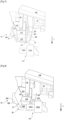
- FIG. 2 And 3 show two views of an emergency call system according to the invention.
- An emergency call system 19 serves the driver or passenger of the vehicle to contact the emergency services in the event of an accident.
- the system 19 comprises at least one housing 21 forming an enclosure.
- This housing 21 comprises an upper portion 21A and a lower front portion 21B, extending over the lower front third of the housing 21.
- the upper portion 21A of the housing 21 delimits a bottom 21C of the enclosure, on which is fixed a tab of fixing 23.
- the housing 21 further comprises fixing elements 21D, preferably pins 21D, positioned on a lower face 21E of the housing 21.
- the enclosure formed by the housing 21 also has an opening (not visible in these figures) directed downwards, which houses a loudspeaker 27 of the emergency call system 19. This loudspeaker 27 is also directed down.
- the speaker 27 has fixing lugs 27A, preferably three in number and regularly distributed around said loudspeaker 27, the lugs 27A each having a fixing orifice 27B to a mounting plate 29 of the loudspeaker 27 to the housing 21.
- the mounting plate 29 comprises a central orifice 29A receiving the loudspeaker 27 positioned in a main portion 29B of the plate 29. Laterally to the central orifice 29A and in the main portion 29B are fixing orifices 29C, complementary to the fixing holes 27B of the fixing lugs 27A of the speaker 27.
- the emergency call system 19 further comprises an avoidance ramp 25 integral with the housing 21, and forming an angle less than 45° relative to the side face of the housing 21.
- This ramp 25 comprises a first portion 25A, positioned laterally to the housing 21 and on the side of the crankset (visible at the figure 1 ) when the emergency call system 19 is mounted on the vehicle.
- the first portion 25A of the ramp 25 extends from the front of the lower portion 21B of the housing 21, towards the rear of said housing 21.
- the avoidance ramp 25 comprises a second portion 25B, positioned on a left lateral side of the mounting plate 29 when the emergency call system 19 is mounted in the vehicle, this second portion 25B having a wall 31 which facilitates avoidance of the accelerator pedal during an impact (see figures 7 to 9 ).
- Lateral portions 29D of the plate 29 also have fixing holes 29E of the plate 29 to the dashboard (visible at figures 4 to 6 ), these orifices 29E making it possible to receive fixing elements 33 which can be screws 33A, nuts 33B, or the fixing elements 21D of the housing 21. These fixing elements (33, 33A, 33B) are also used for fixing between the housing 21 and the mounting plate 29.
- the side portions 29D further comprise fixing elements 29F to the dashboard (visible in the figures 4 to 6 ).
- the loudspeaker 27 is mounted in the central orifice 29A of the mounting plate 29. Then the plate 29 and the loudspeaker 27 are attached to the housing 21, the loudspeaker 27 being housed in the housing 21.
- THE figures 4 , 5 and 6 show different views of the vehicle's dashboard-mounted emergency call system.
- the dashboard 13 also includes a crosspiece 13A, mounted at the top of said board 13 between the front wing and the central console of the vehicle (visible at the figure 1 ).
- This crosspiece 13A helps maintain the emergency call system 19 by means of a fixing part 35, which is attached to the fixing lug 23 of the housing 21.
- the dashboard 13 further comprises orifices 13B which will receive the fixing elements 29F of the emergency call system 19.
- the fixing elements 33A also serve to hold the dashboard 13 with the emergency call system 19, and more particularly, with the lateral portions 29D of the mounting plate 29 of said system 19.
- the board 13 also has breakable portions 13C capable of allowing the dashboard 13 to break in the event of an impact.
- the emergency call system 19 is positioned laterally on the pedal board ( figure 1 ), on the outer lateral side (visible at the figure 1 ) audit pedal board.
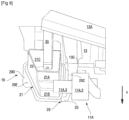
- THE figures 7 to 9 show the figures of the emergency call system during an impact.
- FIG. 7 shows a view of the system 19 mounted on the dashboard 13, prior to a frontal impact.
- the accelerator pedal 11A is positioned at the front of the system 19, and comprises a front portion 11A.2, with a lateral extension 11A.3 oriented towards the system 19.
- the accelerator pedal 11A pushes towards the passenger compartment of the vehicle (visible on the figure 1 ).
- a front portion 11A.2 of the pedal 11A comes into contact with the housing 21 and with the mounting plate 29 of the emergency call system 19.
- the pedal 11A comes into contact with the wall of the escape ramp 25 (shown in Figure 7 ), formed on the mounting plate 29, which allows the accelerator pedal 11A to slide laterally to the housing 21.
- the pedal 11A causes the breakable portions 13C of the dashboard 13 to break, facilitating the lateral movement of the loudspeaker and emergency call system 19, towards the outside.
- the fixing tab 23 of the housing 21 also allows the housing 21 to pivot around said tab 23.
- the accelerator pedal 11A and, more particularly, the front portion 11A.2 of said pedal 11A sinks towards the housing 21 of the emergency call system 19, the lateral extension 11A.3 of the pedal 11A being able to slide above the lower portion 21B of said housing 21, and to come into contact with the upper portion 21A.
- the breakable portions 13C of the dashboard 13 in this case do not break, and the fixing bracket 23 does not allow the housing 21 to pivot, due to the lack of force exerted by the impact.
Landscapes
- Engineering & Computer Science (AREA)
- Computer Security & Cryptography (AREA)
- Business, Economics & Management (AREA)
- Emergency Management (AREA)
- Physics & Mathematics (AREA)
- General Physics & Mathematics (AREA)
- Mechanical Engineering (AREA)
- Air Bags (AREA)
- Auxiliary Drives, Propulsion Controls, And Safety Devices (AREA)
- Body Structure For Vehicles (AREA)
- Mechanical Control Devices (AREA)
Description
- La présente invention revendique la priorité de la demande
française 1914095 déposée le 10 Décembre 2019 - L'invention a trait au domaine des véhicules automobiles, et, plus particulièrement, à l'intégration d'un système d'appel d'urgence dans un véhicule automobile.
- Un véhicule automobile comprend généralement au moins une place conducteur et une place passager, la place conducteur comprenant un pédalier de commande du véhicule. À l'avant des places conducteur et passager et au-dessus du pédalier s'étend une planche de bord du véhicule, qui comprend divers équipements selon le modèle ou la gamme du véhicule. Les nombreux équipements déjà présents sur cette planche de bord peuvent rendre difficile l'installation d'équipements supplémentaires.
- Récemment, les normes européennes ont rendu obligatoire l'installation, dans les nouveaux véhicules, d'un coussin gonflable adapté à la protection des genoux. De fait, la localisation de ce coussin, à l'état replié, est nécessairement au niveau de la planche de bord du véhicule, à l'arrière et en dessous du volant dans le cas de la place conducteur.
- De manière additionnelle, les normes européennes ont également rendu obligatoire la présence d'un système d'appel d'urgence dans les véhicules. De manière préférentielle, ce système est localisé au niveau de la planche de bord ou au niveau de la baie avant du véhicule. Celui-ci doit être facile d'accès pour permettre un appel aux services de secours.
- La présence d'un coussin gonflable genoux et d'autres équipements, comme par exemple de multiples haut-parleurs et un vide-poche d'une taille suffisante, réduit les zones disponibles pour placer le système d'appel d'urgence. Aussi, le système d'appel d'urgence doit rester opérationnel suite à un choc, notamment un choc avant susceptible de déplacer le pédalier. L'intégrité du coussin gonflable genoux doit également être conservée lors d'un choc avant.
- Le document de brevet publié
DE 199 06 447 A1 divulgue un support apte à contenir, à l'état replié, un coussin gonflable pour les genoux, le support étant positionné sous une planche de bord. Ce support comprend un boîtier maintenu au-dessus des genoux par deux bras de fixation, le premier bras s'attachant à une traverse s'étendant à l'avant de la place conducteur ; le deuxième bras s'attachant à une aile avant du véhicule. - Le document
DE102012020016 divulgue le montage de l'haut parleur d'un système d'appel d'urgence sous la planche de bord d'un véhicule. - L'invention a pour objectif de pallier au moins un des inconvénients de l'état de la technique susmentionné. Plus particulièrement, l'invention a pour objectif de permettre l'installation d'un système d'appel d'urgence sur une planche de bord de véhicule automobile lorsque celle-ci comprend un dispositif de coussin gonflable genoux pour le conducteur, tout en respectant les contraintes sécuritaires tant pour le système d'appel d'urgence que pour le dispositif de coussin gonflable genoux. L'invention a pour objet un véhicule automobile comprenant : une place conducteur avec un pédalier de commande du véhicule et une place passager ; une planche de bord s'étendant transversalement devant les places conducteur et passager ; un dispositif de coussin gonflable disposé sous la planche de bord en face de la place conducteur et configuré pour se déployer en direction des genoux du conducteur ; remarquable en ce que le véhicule comprend, en outre : un haut-parleur d'un système d'appel d'urgence disposé sous la planche de bord et latéralement au pédalier du côté latéral extérieur dudit pédalier, le système d'appel d'urgence comprenant une rampe d'évitement disposée latéralement au haut-parleur du côté du pédalier, ladite rampe d'évitement étant configurée pour, en cas de choc frontal déplaçant le pédalier vers l'arrière, permettre le glissement dudit pédalier le long du haut-parleur et déplacer latéralement vers l'extérieur le haut-parleur.
- Selon un mode avantageux de l'invention, le haut-parleur est logé dans un boîtier formant une enceinte.
- Selon un mode avantageux de l'invention, l'enceinte forme une ouverture dirigée vers le bas et logeant le haut-parleur également dirigé vers le bas.
- Selon un mode avantageux de l'invention, le boîtier comprend, à une portion supérieure dudit boîtier délimitant le fond de l'enceinte, une patte de fixation.
- Selon un mode avantageux de l'invention, le déplacement latéral du haut-parleur est par pivotement autour de la patte de fixation.
- Selon un mode avantageux de l'invention, la rampe d'évitement est solidaire du boîtier.
- Selon un mode avantageux de l'invention, la rampe d'évitement est formée sur une platine de montage du haut-parleur au boîtier.
- Selon un mode avantageux de l'invention, la place conducteur est située du côté droit du véhicule.
- Selon un mode avantageux de l'invention, la pédale d'accélérateur est configurée pour glisser le long de la rampe d'évidement.
- Les mesures de l'invention sont intéressantes en ce qu'elles vont permettre une installation d'un système d'appel d'urgence à une planche de bord de véhicule automobile déjà équipée de nombreux accessoires, comme un dispositif de coussin gonflable genoux pour le conducteur et éventuellement plusieurs haut-parleurs, tout en évitant une détérioration du système d'appel d'urgence et du dispositif de coussin gonflable genoux lors d'un déplacement du pédalier en cas de choc avant. Le système d'appel d'urgence est installé côté conducteur afin de garder une taille identique du vide poche (côté passager), que le véhicule ait une direction à droite ou une direction à gauche. L'emplacement latéralement et du côté latéral extérieur au pédalier du système d'appel d'urgence est particulièrement intéressant car il exploite une place disponible et présentant une interférence minimale avec le pédalier. Dans le cas d'une conduite à droite, le système d'appel d'urgence est adjacent à la pédale d'accélérateur et dans le cas d'une conduite à gauche, le système d'appel d'urgence est adjacent à la pédale d'embrayage (si présente) ou à la pédale de frein. De plus, la portion inférieure avant du boîtier, qui s'étend vers l'avant du véhicule, réceptionne et accueille une partie de la pédale d'accélérateur lors d'un choc avant de faible intensité, de manière à ne pas endommager le système d'appel d'urgence. La rampe d'évitement du boîtier du système d'appel d'urgence est orientée vers le pédalier, ce qui permet audit système, lors d'un choc conduisant au déplacement vers l'arrière de la pédale d'accélérateur, de se déplacer latéralement vers l'extérieur du véhicule. Ce déplacement latéral du boîtier est également facilité par le rattachement dudit boîtier à la traverse via une vis de fixation, permettant ainsi le pivotement du boîtier autour de la patte de fixation, et évitant des dommages au système d'appel d'urgence. Les portions sécables de la planche de bord facilitent sa rupture lors d'un choc de plus forte intensité, donc aident au déplacement latéral du boîtier du système. Enfin, le boîtier est facile à fabriquer, grâce à des matériaux et des méthodes connus de l'homme du métier, et facile à monter sur le véhicule. Il est donc peu coûteux. D'autres caractéristiques et avantages de la présente invention seront mieux compris à l'aide de la description et des dessins.
-
- [
Fig 1 ] est une vue de l'intérieur d'un véhicule automobile selon l'invention ; - [
Fig 2 ] représente une vue éclatée d'un système d'appel d'urgence selon l'invention ; - [
Fig 3 ] représente une vue du système d'appel d'urgence de lafigure 2 , après son assemblage ; - [
Fig 4 ] représente une vue de l'avant du système d'appel d'urgence de lafigure 3 , monté sur une planche de bord du véhicule ; - [
Fig 5 ] représente une vue du dessus du système d'appel d'urgence monté sur la planche de bord de lafigure 4 ; - [
Fig 6 ] représente une vue du dessous du système d'appel d'urgence monté sur la planche de bord desfigures 4 et5 ; - [
Fig 7 ] représente une vue de l'avant du système d'appel d'urgence monté sur le véhicule, avant un choc frontal ; - [
Fig 8 ] représente une vue de l'avant du système d'appel d'urgence monté sur le véhicule, après un choc frontal, lorsque le choc est de forte intensité ; - [
Fig 9 ] représente une vue de l'avant du système d'appel d'urgence monté sur le véhicule, après un choc frontal, lorsque le choc est de faible intensité. - L'avant et l'arrière sont définis dans les figures ci-dessous suivant le sens de déplacement du véhicule. Les figures représentent un véhicule automobile dont la direction se trouve à droite, mais l'invention peut également s'appliquer à un véhicule automobile dont la direction se trouve à gauche.
- La
figure 1 représente une vue de l'intérieur d'un véhicule automobile selon l'invention. - Un véhicule automobile 1 comprend généralement, dans un habitacle 3, au moins une place passager 5 et une place conducteur 7 séparées par une console centrale 9. Cette console 9 comprend divers dispositifs généralement nécessaires au bon fonctionnement du véhicule 1, tels qu'un levier de vitesse ou un frein à main par exemple. Sur cette figure, comme le véhicule 1 est un véhicule 1 à direction à droite, la place passager 5 est positionnée à gauche, et la place conducteur 7 à droite. Les places (5, 7) sont donc inversées dans un véhicule 1 à direction à gauche.
- À l'avant de la place conducteur 7 se trouve un pédalier de commande 11 du véhicule 1. Ce pédalier 11 comprend au moins une pédale d'accélérateur 11A et une pédale de frein 11B, et peut éventuellement comprendre une pédale d'embrayage (non représentée sur ces figures). Chaque pédale (11A, 11B) comprend au moins un patin (11A.1, 11B.1), le patin (11A.1, 11B.1) de chaque pédale (11A, 11B) étant actionné par le conducteur. À l'avant des places passager 5 et conducteur 7 se trouve également une planche de bord 13. Elle s'étend transversalement entre la console centrale 9 et une aile avant 15 du véhicule 1. En dessous de cette planche de bord 13 et devant la place conducteur 7 se trouve un dispositif de coussin gonflable 17, ce dispositif 17 étant configuré pour se déployer en direction des genoux du conducteur lors d'un choc à l'avant du véhicule 1. Avantageusement, le pédalier de commande 11 comprend un côté latéral extérieur 11C, positionné à proximité de l'aile avant 15 droite du véhicule 1.
- Les
figures 2 et3 montrent deux vues d'un système d'appel d'urgence selon l'invention. - Un système d'appel d'urgence 19 sert au conducteur ou au passager du véhicule à contacter les services de secours en cas d'accident. Le système 19 selon l'invention comprend au moins un boîtier 21 formant une enceinte. Ce boîtier 21 comprend une portion supérieure 21A et une portion inférieure 21B avant, s'étendant sur le tiers inférieur avant du boîtier 21. La portion supérieure 21A du boîtier 21 délimite un fond 21C de l'enceinte, sur lequel est fixé une patte de fixation 23. Le boîtier 21 comprend, en outre, des éléments de fixation 21D, préférentiellement des pions 21D, positionnés sur une face inférieure 21E du boîtier 21.
- L'enceinte formée par le boîtier 21 présente en outre une ouverture (non visible sur ces figures) dirigée vers le bas, qui loge un haut-parleur 27 du système d'appel d'urgence 19. Ce haut-parleur 27 est également dirigé vers le bas. Le haut-parleur 27 présente des pattes de fixation 27A, préférentiellement au nombre de trois et régulièrement réparties autour dudit haut-parleur 27, les pattes 27A présentant, chacune, un orifice de fixation 27B à une platine de montage 29 du haut-parleur 27 au boîtier 21.
- La platine de montage 29 comprend un orifice central 29A réceptionnant le haut-parleur 27 positionné dans une portion principale 29B de la platine 29. Latéralement à l'orifice central 29A et dans la portion principale 29B se trouvent des orifices de fixation 29C, complémentaires aux orifices de fixation 27B des pattes de fixation 27A du haut-parleur 27.
- Le système d'appel d'urgence 19 comprend, en outre, une rampe d'évitement 25 solidaire du boîtier 21, et formant un angle inférieur à 45° par rapport à la face latérale du boîtier 21. Cette rampe 25 comprend une première portion 25A, positionnée latéralement au boîtier 21 et du côté du pédalier (visible à la
figure 1 ) lorsque le système d'appel d'urgence 19 est monté sur le véhicule. La première portion 25A de la rampe 25 s'étend depuis l'avant de la portion inférieure 21B du boîtier 21, vers l'arrière dudit boîtier 21. La rampe d'évitement 25 comprend une deuxième portion 25B, positionnée sur un côté latéral gauche de la platine de montage 29 lorsque le système d'appel d'urgence 19 est monté dans le véhicule, cette deuxième portion 25B présentant une paroi 31 qui facilite l'évitement de la pédale d'accélérateur lors d'un choc (voirfigures 7 à 9 ). Des portions latérales 29D de la platine 29 présentent en outre des orifices de fixation 29E de la platine 29 à la planche de bord (visible auxfigures 4 à 6 ), ces orifices 29E permettant de réceptionner des éléments de fixation 33 pouvant être des vis 33A, des écrous 33B, ou les éléments de fixation 21D du boîtier 21. Ces éléments de fixation (33, 33A, 33B) servent également à la fixation entre le boîtier 21 et la platine de montage 29. Les portions latérales 29D comprennent en outre des éléments de fixation 29F à la planche de bord (visible auxfigures 4 à 6 ). - Ainsi, le haut-parleur 27 est monté dans l'orifice central 29A de la platine de montage 29. Puis la platine 29 et le haut-parleur 27 sont rattachés au boîtier 21, le haut-parleur 27 étant logé dans le boîtier 21.
- Les
figures 4 ,5 et 6 montrent différentes vues du système d'appel d'urgence monté sur la planche de bord du véhicule. - La planche de bord 13 comprend également une traverse 13A, montée en haut de ladite planche 13 entre l'aile avant et la console centrale du véhicule (visibles à la
figure 1 ). Cette traverse 13A aide au maintien du système d'appel d'urgence 19 par le biais d'une pièce de fixation 35, qui est rattachée à la patte de fixation 23 du boîtier 21. La planche de bord 13 comprend en outre des orifices 13B qui vont réceptionner les éléments de fixation 29F du système d'appel d'urgence 19. Les éléments de fixation 33A servent également au maintien de la planche de bord 13 avec le système d'appel d'urgence 19, et plus particulièrement, avec les portions latérales 29D de la platine de montage 29 dudit système 19. La planche 13 présente également des portions sécables 13C aptes à permettre la rupture de la planche de bord 13 en cas de choc. Le système d'appel d'urgence 19 est positionné latéralement au pédalier (figure 1 ), du côté latéral extérieur (visible à lafigure 1 ) audit pédalier. - Les
figures 7 à 9 reprennent les figures du système d'appel d'urgence lors d'un choc. - La
figure 7 montre une vue du système 19 monté sur la planche de bord 13, antérieurement à un choc frontal. La pédale d'accélérateur 11A est positionnée à l'avant du système 19, et comprend une portion avant 11A.2, avec une extension latérale 11A.3 orientée vers le système 19. - Lors d'un choc de forte intensité, tel que représenté à la
figure 8 , la pédale d'accélérateur 11A s'enfonce vers l'habitacle du véhicule (visible à lafigure 1 ). Une portion avant 11A.2 de la pédale 11A entre en contact avec le boîtier 21 et avec la platine de montage 29 du système d'appel d'urgence 19. Dans un premier temps, la pédale 11A entre en contact avec la paroi de la rampe d'évitement 25 (montrée à lafigure 7 ), formée sur la platine de montage 29, ce qui permet le glissement de la pédale d'accélérateur 11A latéralement au boîtier 21. Puis la pédale 11A provoque la rupture des portions sécables 13C de la planche de bord 13, facilitant le déplacement latéral du haut-parleur et du système d'appel d'urgence 19, vers l'extérieur. La patte de fixation 23 du boîtier 21 permet en outre le pivotement du boîtier 21 autour de ladite patte 23. Ces trois mécanismes facilitent le déplacement du système d'appel d'urgence 19, donc évitent son endommagement en cas de choc frontal. - Lors d'un choc de faible intensité, tel que représenté à la
figure 9 , la pédale d'accélérateur 11A et, plus particulièrement, la portion avant 11A.2 de ladite pédale 11A s'enfonce vers le boîtier 21 du système d'appel d'urgence 19, l'extension latérale 11A.3 de la pédale 11A étant apte à glisser au-dessus de la portion inférieure 21B dudit boîtier 21, et à venir au contact de la portion supérieure 21A. Les portions sécables 13C de la planche de bord 13 dans ce cas ne rompent pas, et la patte de fixation 23 ne permet pas le pivotement du boîtier 21, du fait du manque de force exercée par le choc.
Claims (9)
- Véhicule automobile (1) comprenant :- une place conducteur (7) avec un pédalier de commande (11) du véhicule (1) et une place passager (5) ;- une planche de bord (13) s'étendant transversalement devant les places conducteur (7) et passager (5) ;- un dispositif de coussin gonflable (17) disposé sous la planche de bord (13) en face de la place conducteur (7) et configuré pour se déployer en direction des genoux du conducteur ;caractérisé en ce que le véhicule (1) comprend, en outre :- un haut-parleur (27) d'un système d'appel d'urgence (19) disposé sous la planche de bord (13) et latéralement au pédalier (11) du côté latéral extérieur (11C) dudit pédalier (11), le système d'appel d'urgence (19) comprenant une rampe d'évitement (25) disposée latéralement au haut-parleur (27) du côté du pédalier (11), ladite rampe d'évitement (25) étant configurée pour, en cas de choc frontal déplaçant le pédalier (11) vers l'arrière, permettre le glissement dudit pédalier (11) le long du haut-parleur (27) et déplacer latéralement vers l'extérieur le haut-parleur (27).
- Véhicule automobile (1) selon la revendication 1, caractérisé en ce que le haut-parleur (27) est logé dans un boîtier (21) formant une enceinte.
- Véhicule automobile (1) selon la revendication 2, caractérisé en ce que l'enceinte forme une ouverture dirigée vers le bas et logeant le haut-parleur (27) également dirigé vers le bas.
- Véhicule automobile (1) selon la revendication 3, caractérisé en ce que le boîtier (21) comprend, à une portion supérieure (21A) dudit boîtier (21) délimitant le fond (21C) de l'enceinte, une patte de fixation (23).
- Véhicule automobile (1) selon les revendications de 1 à 4, caractérisé en ce que le déplacement latéral du haut-parleur (27) est par pivotement autour de la patte de fixation (23).
- Véhicule automobile (1) selon l'une des revendications 1 à 5, caractérisé en ce que la rampe d'évitement (25) est solidaire du boîtier (21).
- Véhicule automobile (1) selon l'une des revendications 1 à 6, caractérisé en ce que la rampe d'évitement (25) est formée sur une platine de montage (29) du haut-parleur (27) au boîtier (21).
- Véhicule automobile (1) selon l'une des revendications 1 à 7, caractérisé en ce que la place conducteur (7) est située du côté droit du véhicule (1).
- Véhicule automobile (1) selon la revendication 9, caractérisé en ce que la pédale d'accélérateur (11A) est configurée pour glisser le long de la rampe d'évidement (25).
Applications Claiming Priority (2)
| Application Number | Priority Date | Filing Date | Title |
|---|---|---|---|
| FR1914095A FR3104305B1 (fr) | 2019-12-10 | 2019-12-10 | Système d’appel d’urgence intégré dans la planche de bord d’un véhicule automobile |
| PCT/FR2020/052235 WO2021116559A1 (fr) | 2019-12-10 | 2020-12-01 | Système d'appel d'urgence intégré dans la planche de bord d'un véhicule automobile |
Publications (2)
| Publication Number | Publication Date |
|---|---|
| EP4073774A1 EP4073774A1 (fr) | 2022-10-19 |
| EP4073774B1 true EP4073774B1 (fr) | 2024-08-07 |
Family
ID=72266325
Family Applications (1)
| Application Number | Title | Priority Date | Filing Date |
|---|---|---|---|
| EP20828537.9A Active EP4073774B1 (fr) | 2019-12-10 | 2020-12-01 | Système d'appel d'urgence intégré dans la planche de bord d'un véhicule automobile |
Country Status (4)
| Country | Link |
|---|---|
| EP (1) | EP4073774B1 (fr) |
| CN (1) | CN114787884A (fr) |
| FR (1) | FR3104305B1 (fr) |
| WO (1) | WO2021116559A1 (fr) |
Families Citing this family (1)
| Publication number | Priority date | Publication date | Assignee | Title |
|---|---|---|---|---|
| FR3129332A1 (fr) * | 2021-11-24 | 2023-05-26 | Psa Automobiles Sa | Implantation d’une batterie de secours d’un boitier de connectivité dans un véhicule terrestre à moteur |
Family Cites Families (11)
| Publication number | Priority date | Publication date | Assignee | Title |
|---|---|---|---|---|
| GB2047179B (en) * | 1979-03-20 | 1983-06-15 | Fuji Heavy Ind Ltd | Automobile safety device |
| ES1039536Y (es) * | 1998-02-20 | 1999-05-01 | Magallon Arbizu Angel | Avisador para automoviles mal estacionados. |
| DE19906447B4 (de) | 1999-02-16 | 2008-08-21 | Delphi Technologies, Inc., Troy | Gehäuse zur Aufnahme eines gefalteten Luftsacks |
| JP4221160B2 (ja) * | 2001-01-19 | 2009-02-12 | 三菱自動車工業株式会社 | 操作ペダルの後退変位抑制機構 |
| JP4379433B2 (ja) * | 2006-05-15 | 2009-12-09 | トヨタ自動車株式会社 | 膝保護用エアバッグ装置 |
| CN104029665B (zh) * | 2014-06-28 | 2017-08-11 | 浙江吉利控股集团有限公司 | 一种真空助力器的推杆总成 |
| JP6119728B2 (ja) * | 2014-12-18 | 2017-04-26 | マツダ株式会社 | 車載機器の配設構造 |
| CN106080799A (zh) * | 2016-07-26 | 2016-11-09 | 浙江吉利控股集团有限公司 | 一种仪表板横梁连接结构及车辆 |
| CN206264799U (zh) * | 2016-12-02 | 2017-06-20 | 上海汽车集团股份有限公司 | 汽车仪表板结构及汽车 |
| CN108133584A (zh) * | 2017-12-20 | 2018-06-08 | 东风汽车集团有限公司 | 一种基于卫星导航系统的车载紧急呼叫系统 |
| CN208180914U (zh) * | 2018-01-30 | 2018-12-04 | 东风汽车集团有限公司 | 分体式车载紧急呼叫系统 |
-
2019
- 2019-12-10 FR FR1914095A patent/FR3104305B1/fr active Active
-
2020
- 2020-12-01 WO PCT/FR2020/052235 patent/WO2021116559A1/fr not_active Ceased
- 2020-12-01 EP EP20828537.9A patent/EP4073774B1/fr active Active
- 2020-12-01 CN CN202080086195.XA patent/CN114787884A/zh active Pending
Also Published As
| Publication number | Publication date |
|---|---|
| CN114787884A (zh) | 2022-07-22 |
| FR3104305A1 (fr) | 2021-06-11 |
| EP4073774A1 (fr) | 2022-10-19 |
| WO2021116559A1 (fr) | 2021-06-17 |
| FR3104305B1 (fr) | 2022-06-24 |
Similar Documents
| Publication | Publication Date | Title |
|---|---|---|
| EP1514768B1 (fr) | Utilisation d'une alle et d'un capot en combinaison avec un coussin gonflable, moyen de retenue et support d'aile, aile, module d'aile et capot d'un véhicule automobile | |
| FR2931420A1 (fr) | Dispositif de securite a sac gonflable en t pour un vehicule | |
| FR2761941A1 (fr) | Siege de vehicule dote d'un sac de securite gonflable lateral | |
| FR2931421A1 (fr) | Dispositif de securite a sac gonflable pour un vehicule | |
| WO2021116559A1 (fr) | Système d'appel d'urgence intégré dans la planche de bord d'un véhicule automobile | |
| FR2687629A1 (fr) | Dispositif d'installation d'une roue de secours sur un vehicule automobile et vehicule equipe de ce dispositif. | |
| FR2609958A1 (fr) | Dispositif de support pour roues arriere de motocyclettes | |
| EP3347244B1 (fr) | Dispositif éléctrique incliné au-dessus d'un passage de roue de véhicule | |
| EP1182092A1 (fr) | Agencement pour le montage d'une unité électrique d'un véhicule automobile | |
| EP4172006B1 (fr) | Dispositif de protection d'un panneau arrière de véhicule automobile, en cas de choc arrière supporté par le véhicule | |
| EP2443004A1 (fr) | Dispositif de protection de pied d'un conducteur de vehicule en cas de choc frontal. | |
| EP3924223B1 (fr) | Véhicule automobile à montants arrière à garniture et dispositif de protection à sac gonflable couplés | |
| EP4405234B1 (fr) | Traverse supérieure de façade avant pour véhicule automobile | |
| FR2886894A1 (fr) | Systeme de fixation d'une console centrale de vehicule | |
| FR3165842A1 (fr) | Volant de direction pour véhicule automobile comprenant un airbag déporté | |
| EP3419870B1 (fr) | Pédalier pour véhicule automobile | |
| EP1588896B1 (fr) | Tablette arrière de véhicule automobile. | |
| FR3082473A1 (fr) | Dispositif de protection pour un siege de vehicule, a sac gonflable protegeant la partie anterieure des jambes du passager | |
| FR3073183B1 (fr) | Vehicule a equipement comprenant un sac gonflable de protection des genoux d’un passager assis sur un siege desoriente | |
| FR3082472A1 (fr) | Vehicule a volant pivotant pour le passage d’un sac gonflable d’un dispositif de protection | |
| EP3165991B1 (fr) | Commande à main de freinage pour la double commande d'un véhicule | |
| FR3070147B1 (fr) | Dispositif de fixation d’un equipement sur un chassis de vehicule automobile ayant une cinematique de choc en rotation | |
| FR3094938A1 (fr) | Console de pavillon pour véhicule automobile | |
| FR3158687A1 (fr) | Ensemble pour planche de bord de véhicule automobile et véhicule automobile comprenant un tel ensemble | |
| FR3139072A1 (fr) | ensemble de tableau de bord |
Legal Events
| Date | Code | Title | Description |
|---|---|---|---|
| STAA | Information on the status of an ep patent application or granted ep patent |
Free format text: STATUS: UNKNOWN |
|
| STAA | Information on the status of an ep patent application or granted ep patent |
Free format text: STATUS: THE INTERNATIONAL PUBLICATION HAS BEEN MADE |
|
| PUAI | Public reference made under article 153(3) epc to a published international application that has entered the european phase |
Free format text: ORIGINAL CODE: 0009012 |
|
| STAA | Information on the status of an ep patent application or granted ep patent |
Free format text: STATUS: REQUEST FOR EXAMINATION WAS MADE |
|
| 17P | Request for examination filed |
Effective date: 20220614 |
|
| AK | Designated contracting states |
Kind code of ref document: A1 Designated state(s): AL AT BE BG CH CY CZ DE DK EE ES FI FR GB GR HR HU IE IS IT LI LT LU LV MC MK MT NL NO PL PT RO RS SE SI SK SM TR |
|
| DAV | Request for validation of the european patent (deleted) | ||
| DAX | Request for extension of the european patent (deleted) | ||
| RAP3 | Party data changed (applicant data changed or rights of an application transferred) |
Owner name: STELLANTIS AUTO SAS |
|
| GRAP | Despatch of communication of intention to grant a patent |
Free format text: ORIGINAL CODE: EPIDOSNIGR1 |
|
| STAA | Information on the status of an ep patent application or granted ep patent |
Free format text: STATUS: GRANT OF PATENT IS INTENDED |
|
| INTG | Intention to grant announced |
Effective date: 20240422 |
|
| GRAS | Grant fee paid |
Free format text: ORIGINAL CODE: EPIDOSNIGR3 |
|
| GRAA | (expected) grant |
Free format text: ORIGINAL CODE: 0009210 |
|
| STAA | Information on the status of an ep patent application or granted ep patent |
Free format text: STATUS: THE PATENT HAS BEEN GRANTED |
|
| AK | Designated contracting states |
Kind code of ref document: B1 Designated state(s): AL AT BE BG CH CY CZ DE DK EE ES FI FR GB GR HR HU IE IS IT LI LT LU LV MC MK MT NL NO PL PT RO RS SE SI SK SM TR |
|
| REG | Reference to a national code |
Ref country code: GB Ref legal event code: FG4D Free format text: NOT ENGLISH |
|
| REG | Reference to a national code |
Ref country code: CH Ref legal event code: EP |
|
| REG | Reference to a national code |
Ref country code: DE Ref legal event code: R096 Ref document number: 602020035474 Country of ref document: DE |
|
| REG | Reference to a national code |
Ref country code: IE Ref legal event code: FG4D Free format text: LANGUAGE OF EP DOCUMENT: FRENCH |
|
| REG | Reference to a national code |
Ref country code: DE Ref legal event code: R084 Ref document number: 602020035474 Country of ref document: DE |
|
| REG | Reference to a national code |
Ref country code: LT Ref legal event code: MG9D |
|
| REG | Reference to a national code |
Ref country code: NL Ref legal event code: MP Effective date: 20240807 |
|
| PG25 | Lapsed in a contracting state [announced via postgrant information from national office to epo] |
Ref country code: NO Free format text: LAPSE BECAUSE OF FAILURE TO SUBMIT A TRANSLATION OF THE DESCRIPTION OR TO PAY THE FEE WITHIN THE PRESCRIBED TIME-LIMIT Effective date: 20241107 |
|
| REG | Reference to a national code |
Ref country code: AT Ref legal event code: MK05 Ref document number: 1711840 Country of ref document: AT Kind code of ref document: T Effective date: 20240807 |
|
| PG25 | Lapsed in a contracting state [announced via postgrant information from national office to epo] |
Ref country code: NL Free format text: LAPSE BECAUSE OF FAILURE TO SUBMIT A TRANSLATION OF THE DESCRIPTION OR TO PAY THE FEE WITHIN THE PRESCRIBED TIME-LIMIT Effective date: 20240807 Ref country code: FI Free format text: LAPSE BECAUSE OF FAILURE TO SUBMIT A TRANSLATION OF THE DESCRIPTION OR TO PAY THE FEE WITHIN THE PRESCRIBED TIME-LIMIT Effective date: 20240807 Ref country code: PT Free format text: LAPSE BECAUSE OF FAILURE TO SUBMIT A TRANSLATION OF THE DESCRIPTION OR TO PAY THE FEE WITHIN THE PRESCRIBED TIME-LIMIT Effective date: 20241209 Ref country code: PL Free format text: LAPSE BECAUSE OF FAILURE TO SUBMIT A TRANSLATION OF THE DESCRIPTION OR TO PAY THE FEE WITHIN THE PRESCRIBED TIME-LIMIT Effective date: 20240807 Ref country code: GR Free format text: LAPSE BECAUSE OF FAILURE TO SUBMIT A TRANSLATION OF THE DESCRIPTION OR TO PAY THE FEE WITHIN THE PRESCRIBED TIME-LIMIT Effective date: 20241108 |
|
| PG25 | Lapsed in a contracting state [announced via postgrant information from national office to epo] |
Ref country code: BG Free format text: LAPSE BECAUSE OF FAILURE TO SUBMIT A TRANSLATION OF THE DESCRIPTION OR TO PAY THE FEE WITHIN THE PRESCRIBED TIME-LIMIT Effective date: 20240807 |
|
| PG25 | Lapsed in a contracting state [announced via postgrant information from national office to epo] |
Ref country code: LV Free format text: LAPSE BECAUSE OF FAILURE TO SUBMIT A TRANSLATION OF THE DESCRIPTION OR TO PAY THE FEE WITHIN THE PRESCRIBED TIME-LIMIT Effective date: 20240807 |
|
| PG25 | Lapsed in a contracting state [announced via postgrant information from national office to epo] |
Ref country code: IS Free format text: LAPSE BECAUSE OF FAILURE TO SUBMIT A TRANSLATION OF THE DESCRIPTION OR TO PAY THE FEE WITHIN THE PRESCRIBED TIME-LIMIT Effective date: 20241207 Ref country code: AT Free format text: LAPSE BECAUSE OF FAILURE TO SUBMIT A TRANSLATION OF THE DESCRIPTION OR TO PAY THE FEE WITHIN THE PRESCRIBED TIME-LIMIT Effective date: 20240807 |
|
| PG25 | Lapsed in a contracting state [announced via postgrant information from national office to epo] |
Ref country code: HR Free format text: LAPSE BECAUSE OF FAILURE TO SUBMIT A TRANSLATION OF THE DESCRIPTION OR TO PAY THE FEE WITHIN THE PRESCRIBED TIME-LIMIT Effective date: 20240807 |
|
| PG25 | Lapsed in a contracting state [announced via postgrant information from national office to epo] |
Ref country code: ES Free format text: LAPSE BECAUSE OF FAILURE TO SUBMIT A TRANSLATION OF THE DESCRIPTION OR TO PAY THE FEE WITHIN THE PRESCRIBED TIME-LIMIT Effective date: 20240807 Ref country code: RS Free format text: LAPSE BECAUSE OF FAILURE TO SUBMIT A TRANSLATION OF THE DESCRIPTION OR TO PAY THE FEE WITHIN THE PRESCRIBED TIME-LIMIT Effective date: 20241107 |
|
| PG25 | Lapsed in a contracting state [announced via postgrant information from national office to epo] |
Ref country code: RS Free format text: LAPSE BECAUSE OF FAILURE TO SUBMIT A TRANSLATION OF THE DESCRIPTION OR TO PAY THE FEE WITHIN THE PRESCRIBED TIME-LIMIT Effective date: 20241107 Ref country code: PT Free format text: LAPSE BECAUSE OF FAILURE TO SUBMIT A TRANSLATION OF THE DESCRIPTION OR TO PAY THE FEE WITHIN THE PRESCRIBED TIME-LIMIT Effective date: 20241209 Ref country code: PL Free format text: LAPSE BECAUSE OF FAILURE TO SUBMIT A TRANSLATION OF THE DESCRIPTION OR TO PAY THE FEE WITHIN THE PRESCRIBED TIME-LIMIT Effective date: 20240807 Ref country code: NO Free format text: LAPSE BECAUSE OF FAILURE TO SUBMIT A TRANSLATION OF THE DESCRIPTION OR TO PAY THE FEE WITHIN THE PRESCRIBED TIME-LIMIT Effective date: 20241107 Ref country code: NL Free format text: LAPSE BECAUSE OF FAILURE TO SUBMIT A TRANSLATION OF THE DESCRIPTION OR TO PAY THE FEE WITHIN THE PRESCRIBED TIME-LIMIT Effective date: 20240807 Ref country code: LV Free format text: LAPSE BECAUSE OF FAILURE TO SUBMIT A TRANSLATION OF THE DESCRIPTION OR TO PAY THE FEE WITHIN THE PRESCRIBED TIME-LIMIT Effective date: 20240807 Ref country code: IS Free format text: LAPSE BECAUSE OF FAILURE TO SUBMIT A TRANSLATION OF THE DESCRIPTION OR TO PAY THE FEE WITHIN THE PRESCRIBED TIME-LIMIT Effective date: 20241207 Ref country code: HR Free format text: LAPSE BECAUSE OF FAILURE TO SUBMIT A TRANSLATION OF THE DESCRIPTION OR TO PAY THE FEE WITHIN THE PRESCRIBED TIME-LIMIT Effective date: 20240807 Ref country code: GR Free format text: LAPSE BECAUSE OF FAILURE TO SUBMIT A TRANSLATION OF THE DESCRIPTION OR TO PAY THE FEE WITHIN THE PRESCRIBED TIME-LIMIT Effective date: 20241108 Ref country code: FI Free format text: LAPSE BECAUSE OF FAILURE TO SUBMIT A TRANSLATION OF THE DESCRIPTION OR TO PAY THE FEE WITHIN THE PRESCRIBED TIME-LIMIT Effective date: 20240807 Ref country code: ES Free format text: LAPSE BECAUSE OF FAILURE TO SUBMIT A TRANSLATION OF THE DESCRIPTION OR TO PAY THE FEE WITHIN THE PRESCRIBED TIME-LIMIT Effective date: 20240807 Ref country code: BG Free format text: LAPSE BECAUSE OF FAILURE TO SUBMIT A TRANSLATION OF THE DESCRIPTION OR TO PAY THE FEE WITHIN THE PRESCRIBED TIME-LIMIT Effective date: 20240807 Ref country code: AT Free format text: LAPSE BECAUSE OF FAILURE TO SUBMIT A TRANSLATION OF THE DESCRIPTION OR TO PAY THE FEE WITHIN THE PRESCRIBED TIME-LIMIT Effective date: 20240807 |
|
| PG25 | Lapsed in a contracting state [announced via postgrant information from national office to epo] |
Ref country code: DK Free format text: LAPSE BECAUSE OF FAILURE TO SUBMIT A TRANSLATION OF THE DESCRIPTION OR TO PAY THE FEE WITHIN THE PRESCRIBED TIME-LIMIT Effective date: 20240807 Ref country code: SM Free format text: LAPSE BECAUSE OF FAILURE TO SUBMIT A TRANSLATION OF THE DESCRIPTION OR TO PAY THE FEE WITHIN THE PRESCRIBED TIME-LIMIT Effective date: 20240807 |
|
| PG25 | Lapsed in a contracting state [announced via postgrant information from national office to epo] |
Ref country code: EE Free format text: LAPSE BECAUSE OF FAILURE TO SUBMIT A TRANSLATION OF THE DESCRIPTION OR TO PAY THE FEE WITHIN THE PRESCRIBED TIME-LIMIT Effective date: 20240807 |
|
| PG25 | Lapsed in a contracting state [announced via postgrant information from national office to epo] |
Ref country code: CZ Free format text: LAPSE BECAUSE OF FAILURE TO SUBMIT A TRANSLATION OF THE DESCRIPTION OR TO PAY THE FEE WITHIN THE PRESCRIBED TIME-LIMIT Effective date: 20240807 |
|
| PG25 | Lapsed in a contracting state [announced via postgrant information from national office to epo] |
Ref country code: SK Free format text: LAPSE BECAUSE OF FAILURE TO SUBMIT A TRANSLATION OF THE DESCRIPTION OR TO PAY THE FEE WITHIN THE PRESCRIBED TIME-LIMIT Effective date: 20240807 |
|
| REG | Reference to a national code |
Ref country code: DE Ref legal event code: R097 Ref document number: 602020035474 Country of ref document: DE |
|
| PLBE | No opposition filed within time limit |
Free format text: ORIGINAL CODE: 0009261 |
|
| STAA | Information on the status of an ep patent application or granted ep patent |
Free format text: STATUS: NO OPPOSITION FILED WITHIN TIME LIMIT |
|
| PG25 | Lapsed in a contracting state [announced via postgrant information from national office to epo] |
Ref country code: MC Free format text: LAPSE BECAUSE OF FAILURE TO SUBMIT A TRANSLATION OF THE DESCRIPTION OR TO PAY THE FEE WITHIN THE PRESCRIBED TIME-LIMIT Effective date: 20240807 |
|
| 26N | No opposition filed |
Effective date: 20250508 |
|
| REG | Reference to a national code |
Ref country code: CH Ref legal event code: PL |
|
| PG25 | Lapsed in a contracting state [announced via postgrant information from national office to epo] |
Ref country code: LU Free format text: LAPSE BECAUSE OF NON-PAYMENT OF DUE FEES Effective date: 20241201 |
|
| GBPC | Gb: european patent ceased through non-payment of renewal fee |
Effective date: 20241201 |
|
| PG25 | Lapsed in a contracting state [announced via postgrant information from national office to epo] |
Ref country code: SE Free format text: LAPSE BECAUSE OF FAILURE TO SUBMIT A TRANSLATION OF THE DESCRIPTION OR TO PAY THE FEE WITHIN THE PRESCRIBED TIME-LIMIT Effective date: 20240807 |
|
| REG | Reference to a national code |
Ref country code: BE Ref legal event code: MM Effective date: 20241231 |
|
| PG25 | Lapsed in a contracting state [announced via postgrant information from national office to epo] |
Ref country code: BE Free format text: LAPSE BECAUSE OF NON-PAYMENT OF DUE FEES Effective date: 20241231 Ref country code: GB Free format text: LAPSE BECAUSE OF NON-PAYMENT OF DUE FEES Effective date: 20241201 |
|
| PG25 | Lapsed in a contracting state [announced via postgrant information from national office to epo] |
Ref country code: CH Free format text: LAPSE BECAUSE OF NON-PAYMENT OF DUE FEES Effective date: 20241231 |
|
| PG25 | Lapsed in a contracting state [announced via postgrant information from national office to epo] |
Ref country code: IE Free format text: LAPSE BECAUSE OF NON-PAYMENT OF DUE FEES Effective date: 20241201 |
|
| PG25 | Lapsed in a contracting state [announced via postgrant information from national office to epo] |
Ref country code: RO Free format text: LAPSE BECAUSE OF FAILURE TO SUBMIT A TRANSLATION OF THE DESCRIPTION OR TO PAY THE FEE WITHIN THE PRESCRIBED TIME-LIMIT Effective date: 20240807 |
|
| PGFP | Annual fee paid to national office [announced via postgrant information from national office to epo] |
Ref country code: DE Payment date: 20251126 Year of fee payment: 6 |
|
| PGFP | Annual fee paid to national office [announced via postgrant information from national office to epo] |
Ref country code: FR Payment date: 20251119 Year of fee payment: 6 |
|
| PG25 | Lapsed in a contracting state [announced via postgrant information from national office to epo] |
Ref country code: IT Free format text: LAPSE BECAUSE OF FAILURE TO SUBMIT A TRANSLATION OF THE DESCRIPTION OR TO PAY THE FEE WITHIN THE PRESCRIBED TIME-LIMIT Effective date: 20240807 |
|
| PG25 | Lapsed in a contracting state [announced via postgrant information from national office to epo] |
Ref country code: CY Free format text: LAPSE BECAUSE OF FAILURE TO SUBMIT A TRANSLATION OF THE DESCRIPTION OR TO PAY THE FEE WITHIN THE PRESCRIBED TIME-LIMIT; INVALID AB INITIO Effective date: 20201201 |