EP4070823B1 - Antibakterielle implantatbeschichtungszusammensetzung, verfahren zum beschichten eines implantats und antibakteriell beschichtetes implantat - Google Patents
Antibakterielle implantatbeschichtungszusammensetzung, verfahren zum beschichten eines implantats und antibakteriell beschichtetes implantat Download PDFInfo
- Publication number
- EP4070823B1 EP4070823B1 EP22164499.0A EP22164499A EP4070823B1 EP 4070823 B1 EP4070823 B1 EP 4070823B1 EP 22164499 A EP22164499 A EP 22164499A EP 4070823 B1 EP4070823 B1 EP 4070823B1
- Authority
- EP
- European Patent Office
- Prior art keywords
- implant
- coating composition
- antibacterial
- composition according
- mol
- Prior art date
- Legal status (The legal status is an assumption and is not a legal conclusion. Google has not performed a legal analysis and makes no representation as to the accuracy of the status listed.)
- Active
Links
Images

Classifications
-
- A—HUMAN NECESSITIES
- A61—MEDICAL OR VETERINARY SCIENCE; HYGIENE
- A61L—METHODS OR APPARATUS FOR STERILISING MATERIALS OR OBJECTS IN GENERAL; DISINFECTION, STERILISATION OR DEODORISATION OF AIR; CHEMICAL ASPECTS OF BANDAGES, DRESSINGS, ABSORBENT PADS OR SURGICAL ARTICLES; MATERIALS FOR BANDAGES, DRESSINGS, ABSORBENT PADS OR SURGICAL ARTICLES
- A61L27/00—Materials for grafts or prostheses or for coating grafts or prostheses
- A61L27/50—Materials characterised by their function or physical properties, e.g. injectable or lubricating compositions, shape-memory materials, surface modified materials
- A61L27/54—Biologically active materials, e.g. therapeutic substances
-
- A—HUMAN NECESSITIES
- A61—MEDICAL OR VETERINARY SCIENCE; HYGIENE
- A61L—METHODS OR APPARATUS FOR STERILISING MATERIALS OR OBJECTS IN GENERAL; DISINFECTION, STERILISATION OR DEODORISATION OF AIR; CHEMICAL ASPECTS OF BANDAGES, DRESSINGS, ABSORBENT PADS OR SURGICAL ARTICLES; MATERIALS FOR BANDAGES, DRESSINGS, ABSORBENT PADS OR SURGICAL ARTICLES
- A61L27/00—Materials for grafts or prostheses or for coating grafts or prostheses
- A61L27/28—Materials for coating prostheses
- A61L27/34—Macromolecular materials
-
- C—CHEMISTRY; METALLURGY
- C08—ORGANIC MACROMOLECULAR COMPOUNDS; THEIR PREPARATION OR CHEMICAL WORKING-UP; COMPOSITIONS BASED THEREON
- C08L—COMPOSITIONS OF MACROMOLECULAR COMPOUNDS
- C08L33/00—Compositions of homopolymers or copolymers of compounds having one or more unsaturated aliphatic radicals, each having only one carbon-to-carbon double bond, and only one being terminated by only one carboxyl radical, or of salts, anhydrides, esters, amides, imides or nitriles thereof; Compositions of derivatives of such polymers
- C08L33/02—Homopolymers or copolymers of acids; Metal or ammonium salts thereof
-
- A—HUMAN NECESSITIES
- A61—MEDICAL OR VETERINARY SCIENCE; HYGIENE
- A61L—METHODS OR APPARATUS FOR STERILISING MATERIALS OR OBJECTS IN GENERAL; DISINFECTION, STERILISATION OR DEODORISATION OF AIR; CHEMICAL ASPECTS OF BANDAGES, DRESSINGS, ABSORBENT PADS OR SURGICAL ARTICLES; MATERIALS FOR BANDAGES, DRESSINGS, ABSORBENT PADS OR SURGICAL ARTICLES
- A61L2300/00—Biologically active materials used in bandages, wound dressings, absorbent pads or medical devices
- A61L2300/20—Biologically active materials used in bandages, wound dressings, absorbent pads or medical devices containing or releasing organic materials
- A61L2300/204—Biologically active materials used in bandages, wound dressings, absorbent pads or medical devices containing or releasing organic materials with nitrogen-containing functional groups, e.g. aminoxides, nitriles, guanidines
-
- A—HUMAN NECESSITIES
- A61—MEDICAL OR VETERINARY SCIENCE; HYGIENE
- A61L—METHODS OR APPARATUS FOR STERILISING MATERIALS OR OBJECTS IN GENERAL; DISINFECTION, STERILISATION OR DEODORISATION OF AIR; CHEMICAL ASPECTS OF BANDAGES, DRESSINGS, ABSORBENT PADS OR SURGICAL ARTICLES; MATERIALS FOR BANDAGES, DRESSINGS, ABSORBENT PADS OR SURGICAL ARTICLES
- A61L2300/00—Biologically active materials used in bandages, wound dressings, absorbent pads or medical devices
- A61L2300/40—Biologically active materials used in bandages, wound dressings, absorbent pads or medical devices characterised by a specific therapeutic activity or mode of action
- A61L2300/404—Biocides, antimicrobial agents, antiseptic agents
-
- A—HUMAN NECESSITIES
- A61—MEDICAL OR VETERINARY SCIENCE; HYGIENE
- A61L—METHODS OR APPARATUS FOR STERILISING MATERIALS OR OBJECTS IN GENERAL; DISINFECTION, STERILISATION OR DEODORISATION OF AIR; CHEMICAL ASPECTS OF BANDAGES, DRESSINGS, ABSORBENT PADS OR SURGICAL ARTICLES; MATERIALS FOR BANDAGES, DRESSINGS, ABSORBENT PADS OR SURGICAL ARTICLES
- A61L2420/00—Materials or methods for coatings medical devices
- A61L2420/02—Methods for coating medical devices
Definitions
- the invention relates to an antibacterial implant coating composition with very good antibacterial effect and adhesion to an implant.
- the present invention also relates to a method for coating an implant and an antibacterially coated implant.
- Implants are used in many medical disciplines to reconstruct organ and tissue functions. They consist of artificial materials to which bacteria can adhere and organize themselves into complex biofilm communities. The resulting inflammatory reactions and the associated progressive destructive processes in the surrounding tissue lead to loss of function of the implant and significant impairment of the patient. Particularly in dentistry, peri-implant infections are of great clinical importance with a prevalence of 30%. Due to the high resistance of bacterial biofilms to chemical therapeutic agents, biofilm removal in dentistry is primarily carried out mechanically, although many areas of the dental implant are only incompletely accessible due to the complex geometry.
- an object of the present invention to provide an antibacterial implant coating composition that is easy to apply, adheres well to the implant and is very cell compatible with a good antibacterial effect.
- a further object of the present invention is to provide a method for coating an implant with an antibacterial coating, which produces a uniformly covering coating that adheres well to the implant and thereby avoids a high level of technical effort while being simple to implement.
- an antibacterially coated implant which is characterized by very good antibacterial functionality with high cell compatibility.
- an antibacterial implant coating composition which comprises a specific graft copolymer.
- the graft copolymer has a backbone based on (meth)acrylic acid.
- (meth)acrylic acid-based backbone and the like are generally understood to mean both a compound based on propenoic acid, i.e. acrylic acid, and a compound based on 2-methylpropenoic acid, i.e. methacrylic acid, namely according to the above-mentioned example: “ acrylic acid based backbone” and “methacrylic acid based backbone”.
- acrylic acid based backbone and “methacrylic acid based backbone”.
- the abbreviation "(meth)acrylic acid" is used in the following description to represent “acrylic acid... and "methacrylic acid".
- Phosphonate side chains are arranged on the (meth)acrylic acid-based backbone.
- the phosphonate side chains do not have to have reacted directly with the acid groups or ester groups, but there can also be a divalent connecting group, such as, between the phosphorus atom of the phosphonate side chains and the single-bonded oxygen of the carboxyl group or ester group of the poly(meth)acrylic acid backbone in particular an alkylene group, which in particular comprises 1 to 8 carbon atoms and preferably 1 to 4 carbon atoms.
- the divalent linking group has no influence on the antibacterial functionality of the graft copolymer.
- guanidine oligomer is understood to mean derivatives of oligoguanidines can be synthesized in particular by reacting diamines with guanidine hydrochloride. Oligoguanidines and polyguanidines are known for combating microorganisms and are often used in disinfectants, detergents and cleaning agents or cosmetics. Due to their high water solubility, they are not suitable for coating implants in the form previously used.
- At least one phosphonate side chain is connected to a guanidine oligomer through an N-P bond.
- the N-P bond is a covalent bond between a nitrogen atom of the guanidine oligomer and the phosphorus atom of a phosphonate side chain.
- the resulting connecting group is in particular a phosphonamidate group. This means that a primary amine group is preferably reacted with the phosphonate group, resulting in the direct and covalent N-P bond described above.
- one or more phosphonate groups can be reacted and bonded with one or more guanidine oligomers.
- an antibacterial effect is obtained even with very small proportions of guanidine oligomer in the graft copolymer and, as explained, can be increased by a higher proportion of N-P-linked guanidine oligomer groups.
- the (meth)acrylic acid-based backbone serves, on the one hand, to ensure the stability of the implant coating composition and, on the other hand, to provide sufficient numbers of phosphonate side chains.
- the phosphonate side chains give the graft copolymer an anchoring function for binding to common implant materials such as titanium, stainless steel, zirconium, tantalum, zirconium oxide, PEEK and the like.
- the implant coating composition according to the invention is therefore self-binding. No additional adhesive component is required. This facilitates application of the implant coating composition to the implant and enables coatings even on geometrically complex implant surfaces.
- the antibacterial effect of the implant coating composition is achieved by the covalently bound guanidine oligomer residue(s), which are no longer water-soluble due to the covalent bond and therefore remain permanently there after application on an implant and develop their antibacterial effect.
- the implant coating composition according to the invention is therefore characterized by high functionality and yet has a simple structure, since it essentially contains the graft copolymer described above as a functional component.
- the antibacterial implant coating composition is therefore easy to process and, in particular, can be applied evenly with the desired layer thickness, adheres well and permanently to the implant and is highly cell compatible with a very good antibacterial effect.
- a proportion of phosphonate side chains that are connected to a guanidine oligomer by a (covalent) N-P bond, based on the total proportion of phosphonate side groups is Mol%, preferably 0.8 to 6 mol% and especially 0.9 to 5 mol%. Even very small proportions of phosphonate side chains, which are covalently linked to a guanidine oligomer, of 0.8 mol%, achieve a particularly good and long-lasting antibacterial effect due to the high antibacterial functionality of guanidine oligomers.
- the remaining phosphonate side chains which are not linked to a guanidine oligomer, can preferably serve to bind to the implant. This achieves a good balance between sufficient adhesion to an implant and very good antibacterial effectiveness while maintaining high cell compatibility.
- the phosphonate side chains not connected to the guanidine oligomer are not hydrolyzed, partially hydrolyzed so that they form hemi-phosphonic acid residues, or fully hydrolyzed so that they form phosphonic acid residues. This essentially does not affect the functionality of the graft copolymer. At best, the water dispersibility of the graft copolymer can be improved by a higher degree of hydrolysis of the phosphonate side chains.
- a proportion of partially hydrolysed and fully hydrolysed phosphonate side groups is 5 to 30 mol% and in particular 7 to 20 mol%. This makes it possible to achieve very good dispersing properties in polar solvents.
- a mol% proportion of 5 to 30 mol% of partially hydrolyzed and fully hydrolyzed phosphonate side groups, based on the total proportion of phosphonate side groups, corresponds to approximately 6 to 25% by mass, based on the total mass of all phosphonate side chains in the graft copolymer.
- the graft copolymer used according to the invention has a molecular weight (Mw) that satisfies the following equation: 5kDa ⁇ Mw ⁇ 40 kDa .
- the molecular weight can be determined mathematically from DOSY-NMR data.
- a molecular weight in the specified range has the advantage, on the one hand, of being high enough to enable a well-adhering film of the antibacterial implant coating composition on an implant, and, on the other hand, of being low enough to provide good processability, in particular high dispersibility in solvents, so that the antibacterial implant coating composition can be applied evenly with the desired layer thickness.
- the guanidine oligomer is preferably at least one compound represented by the following formulas, since these guanidine oligomers are characterized by very good connectivity with the phosphonate side chains and high antibacterial activity.
- only one specific guanidine oligomer or a combination of two or more guanidine oligomers of the following formulas can be used in the graft copolymer:
- n denotes an integer from 2 to 10, preferably from 3 to 6, and especially 5, and a wave, " ⁇ ", denotes a preferred bonding position of the corresponding nitrogen to the phosphorus atom of a phosphonate side chain.
- the guanidine oligomers sometimes have several primary and secondary amine groups that are in principle suitable for reacting with a phosphorus atom of a phosphonate side chain. However, a reaction preferably takes place on the nitrogen atom that is marked with a wave, " ⁇ ".
- the molecular weight of the guanidine oligomer is preferably 800 to 1300 g/mol.
- the guanidine oligomer residue is considered as attached to the phosphorus atom of the phosphonate side chain.
- the graft copolymer advantageously has the following structural unit: where P represents a phosphonate group which may not be hydrolyzed, partially or fully hydrolyzed, and wherein n represents an integer from 2 to 10, preferably from 3 to 6, and in particular 5.
- a wave in the (meth)acrylic acid-based backbone represents a binding position to further (meth)acrylic acid units. If the graft copolymer contains the above structural unit, a particularly good antibacterial effect, good adhesion to the implant and at the same time very good cell compatibility are obtained.
- the graft copolymer has at least one of the following structural units:
- n is in each case an integer from 2 to 10, preferably from 3 to 6, and is in particular 5.
- a wave in the (meth)acrylic acid-based backbone represents a binding position to further (meth)acrylic acid units.
- the antibacterial implant coating composition preferably contains only the graft copolymer disclosed above and possibly unreacted or incompletely reacted starting materials from the production of the graft copolymer. This represents the functional component of the antibacterial implant coating composition.
- the implant coating composition is therefore very durable and can be stored without suffering any loss of effectiveness.
- it may also contain a solvent or dispersant, such as water, ethanol, methanol or any mixtures of these substances.
- a solvent or dispersant such as water, ethanol, methanol or any mixtures of these substances.
- the graft copolymer is very easily soluble or at least dispersible in solvents and is therefore easy to process and apply.
- the antibacterial implant coating composition can also contain additional components if necessary, but these do not impair the effectiveness of the graft copolymer.
- a method for coating an implant with an antibacterial coating is also disclosed.
- the implant coating composition described above is dissolved or dispersed in a solvent in one process step. If a solution of the implant coating composition is obtained, it can also be colloidal. For example, water, ethanol or methanol or any mixtures of these substances can be used as a solvent.
- An implant is then provided, which should be degreased for further processing. Degreasing can be done, for example, by cleaning with solvents such as acetone, dichloromethane, methanol and the like or using plasma cleaning. If necessary, after drying, the dissolved or dispersed implant coating composition is then applied to the implant.
- the implant coating composition is in the form of a solution or dispersion, many simple, conventional application processes can be used, which keeps the technical effort for the process low. This also simplifies application on geometrically complex surfaces.
- the implant coating composition is bound to the implant. This is carried out by exposure to temperatures between 50 and 200 °C, for example in a drying cabinet or in a suitable oven. Through the binding step, the implant coating composition is absorbed onto the surface of the implant and covalently binds to the implant through the phosphonate groups. The bonding strength of the bond between the implant surface and the implant coating composition is high due to the high proportion of phosphonate side chains. This means there is no need to apply an adhesive. The process produces an implant with permanently high antimicrobial effectiveness and very good cell compatibility without much technical effort.
- a washing step and a drying step can follow after the implant coating composition has bonded.
- the implant can undergo usual preparation steps before coating, such as polishing the surface in order to obtain a desired surface roughness, for example a surface roughness of 0.013 ⁇ m or less.
- a further advantageous development of the method provides that the solution of the implant coating composition is applied by spin coating (particularly for planar substrates), a dipping or spraying process. This simplifies the process and results in a coating with a particularly uniform layer thickness.
- a very good reactivity of the implant coating composition with the implant surface to form a uniform layer thickness is advantageously achieved by a concentration of the implant coating composition in the solvent being 2 to 20 mg/ml and in particular 8 to 12 mg/ml.
- an antimicrobially coated implant is also described.
- the antimicrobial coated implant includes a coating formed from the implant coating composition described above.
- the coating can be produced using the method described above for coating an implant with an antibacterial coating.
- the implant according to the invention is made of titanium, zirconium, tantalum, stainless steel, zirconium oxide or PEEK and has an average layer thickness of the antimicrobial coating of 5 to 50 nm and in particular of 15 to 25 nm.
- the layer thickness is determined by ellipsometry.
- the layer thickness obtained by the method according to the invention in the implant according to the invention is approximately 10 nm higher than that obtained by alternative production methods of a coating composition under otherwise identical conditions.
- Exemplary implants according to the invention include dental implants, implants for hip and knee endoprostheses and cardiac pacemakers. Infection prophylaxis is of enormous importance, particularly in tumor therapy when immunocompromised patients receive large implants.
- the present invention is particularly suitable for dental implants, which are naturally in contact with the patient's oral cavity, which is heavily contaminated with bacteria, and are therefore exposed to a particular risk of infection.
- a graft copolymer used in the antibacterial implant coating composition according to the invention is described below: The synthesis was carried out in two stages. In the first stage, 2,2'-(ethylenedioxy)diethylamine and guanidine hydrochloride were condensed at 170 °C using a mechanical stirrer to give the oligomeric product poly-(2-(2-ethoxy)-ethoxyethyl-guanidine hydrochloride) (PEDBEG).
- PEDBEG poly-(2-(2-ethoxy)-ethoxyethyl-guanidine hydrochloride)
- the oligomeric guanidine comprised primary amines, which can undergo reactions as a functional group and form covalent NP bonds with phosphonate groups, as discussed in the next step.
- 2-(dimethoxyphosphoryl)ethyl methacrylate was polymerized in the presence of the PEDBEG oligomer obtained in the first stage for 14 h at 60 °C. 2,2'-Azobis(2-methylpropionitrile) served as the initiator.
- the poly(DMMEP) backbone was constructed and the phosphonate side chains reacted with the PEDBEG.
- the product of this reaction represented a graft copolymer that contained PEDBEG bound via a phosphorus-nitrogen bond as a side group.
- the phosphonate groups were hemi- or fully hydrolyzed to around 7-20 mol%.
- Fig. 1 shows in detail a schematic representation of an implant 1 coated with an antibacterial coating 10 according to an embodiment of the invention.
- the antibacterially coated implant 1 comprises a base body 2, which includes, for example, titanium, zirconium, tantalum, stainless steel, zirconium oxide or PEEK.
- the antibacterial coating 10 with an average layer thickness S of 5 to 50 nm and in particular 15 to 25 nm is arranged on a surface 3 of the base body 2.
- the antibacterial coating 10 is formed from an antibacterial implant coating composition comprising a graft copolymer with a (meth)acrylic acid based backbone and phosphonate side chains, wherein at least one phosphonate side chain is linked to a guanidine oligomer through an N-P bond. At least one further phosphonate side chain, which is not connected to a guanidine oligomer by an N-P bond, is bound to the implant surface 3 and thus ensures good adhesion of the graft copolymer to the base body 2.
- the antibacterial coating 10 on the base body 2 of the implant was obtained as follows: First, the implant coating composition described above was dissolved or dispersed in a solvent such as water, ethanol or methanol. An implant to be coated was then prepared and degreased. The solution or dispersion of the implant coating composition was then applied to the surface 3 of the base body 2 of the implant, for example by spin coating or a dipping or spraying process, and then the implant coating composition was applied to the implant under the influence of temperatures in a range from 50 to 200 ° C bonded, whereby the antibacterial coating 10 was formed between the surface 3 of the implant 10 and the implant coating composition by forming bonds between the surface 3 of the implant and the phosphonate side chains of the graft copolymer of the implant coating composition. The concentration of the implant coating composition in the solvent was 2 to 20 mg/ml.
- the antibacterially coated implant 1 was characterized by a permanently very good antibacterial functionality due to the antibacterial coating 10 with high cell compatibility.
- the implant was coated with the antibacterial coating 10 with even coverage and using technically conventional means.
Landscapes
- Health & Medical Sciences (AREA)
- Chemical & Material Sciences (AREA)
- Medicinal Chemistry (AREA)
- Life Sciences & Earth Sciences (AREA)
- General Health & Medical Sciences (AREA)
- Animal Behavior & Ethology (AREA)
- Dermatology (AREA)
- Oral & Maxillofacial Surgery (AREA)
- Transplantation (AREA)
- Epidemiology (AREA)
- Veterinary Medicine (AREA)
- Public Health (AREA)
- Engineering & Computer Science (AREA)
- Biomedical Technology (AREA)
- Molecular Biology (AREA)
- Chemical Kinetics & Catalysis (AREA)
- Organic Chemistry (AREA)
- Polymers & Plastics (AREA)
- Materials For Medical Uses (AREA)
Description
- Die Erfindung betrifft eine antibakterielle Implantatbeschichtungszusammensetzung mit sehr guter antibakterieller Wirkung und Haftung an einem Implantat. Darüber hinaus betrifft die vorliegende Erfindung auch ein Verfahren zum Beschichten eines Implantats sowie ein antibakteriell beschichtetes Implantat.
- Implantate werden in vielen medizinischen Disziplinen zur Rekonstruktion von Organ- und Gewebefunktionen eingesetzt. Sie bestehen aus artifiziellen Materialien, an denen Bakterien anhaften und sich in komplexen Biofilmgemeinschaften organisieren können. Die in der Folge entstehenden Entzündungsreaktionen und damit verbundenen fortschreitenden destruktiven Prozesse im umgebenden Gewebe führen zu Funktionsverlusten des Implantates und erheblichen Beeinträchtigungen des Patienten. Insbesondere in der Zahnmedizin sind periimplantäre Infektionen mit einer Prävalenz von 30 % von großer klinischer Bedeutung. Aufgrund der hohen Resistenz bakterieller Biofilme gegenüber chemischen Therapeutika erfolgt die Biofilmentfernung in der Zahnmedizin vorwiegend mechanisch, wobei viele Bereiche des zahnärztlichen Implantates aufgrund der komplexen Geometrie nur unvollständig erreichbar sind.
- Das Problem der implantatassoziierten Infektionen wird zurzeit durch eine Beschichtung des Implantats mit Silber bekämpft. Die Silberschicht verhindert eine Bakterienadhäsion, allerdings auch die Adhäsion von körpereigenen Zellen, und ist somit nicht selektiv. Eine weitere Neuentwicklung sind antibakterielle Polymere, die auf die Implantatmaterialien aufgebracht werden. Bisher entwickelte Polymere weisen aber entweder keine ausreichende Zellkompatibilität oder keine hinreichende antibakterielle Wirkung auf. Ein weiteres Problem ist die sichere und technisch umsetzbare Applikation der Polymere auf der Oberfläche.
- Ausgehend von diesem Stand der Technik ist es eine Aufgabe der vorliegenden Erfindung eine antibakterielle Implantatbeschichtungszusammensetzung anzugeben, die einfach applizierbar ist, auf dem Implantat gut haftet und bei guter antibakterieller Wirkung sehr gut zellkompatibel ist. Eine weitere Aufgabe der vorliegenden Erfindung ist es, ein Verfahren zum Beschichten eines Implantats mit einer antibakteriellen Beschichtung anzugeben, das eine gleichmäßig abdeckende, am Implantat gut anhaftende Beschichtung erzeugt und dabei einen hohen technischen Aufwand bei einfacher Umsetzung vermeidet. Darüber hinaus ist es eine Aufgabe der vorliegenden Erfindung ein antibakteriell beschichtetes Implantat anzugeben, das sich bei hoher Zellkompatibilität durch eine sehr gute antibakterielle Funktionalität auszeichnet.
- Die Lösung dieser Aufgaben erfolgt durch die Merkmale der unabhängigen Ansprüche. Die abhängigen Ansprüche haben vorteilhafte Weiterbildungen zum Inhalt.
- Demnach wird die Aufgabe durch eine antibakterielle Implantatbeschichtungszusammensetzung gelöst, die ein spezifisches Pfropfcopolymer umfasst. Das Pfropfcopolymer weist dabei ein auf (Meth)Acrylsäure basierendes Rückgrat auf.
- Unter allgemein "(Meth)Acrylsäure basierendes Rückgrat" und dergleichen, wird gemäß der vorliegenden Erfindung sowohl eine auf Propensäure, also Acrylsäure, basierte Verbindung als auch eine auf 2-Methylpropensäure, also Methacrylsäure, basierte Verbindung verstanden, nämlich gemäß dem o.g. Beispiel: "Acrylsäure basiertes Rückgrat" und "Methacrylsäure basiertes Rückgrat". Der Einfachheit halber wird in der nachfolgenden Beschreibung die Abkürzung "(Meth)Acrylsäure ..." in Vertretung für "Acrylsäure ... und "Methacrylsäure ..." verwendet.
- An dem (Meth)Acrylsäure basierten Rückgrat sind Phosphonat-Seitenketten angeordnet. Mit anderen Worten liegt in dem Pfropfcopolymer ein Poly(meth)acrylsäure-Rückgrat vor, wobei die Phosphonat-Seitenketten mit den Säuregruppen bzw. Estergruppen des Poly(meth)acrylsäure-Rückgrats verbunden sind. Hierbei müssen die Phosphonat-Seitenketten nicht direkt mit den Säuregruppen bzw. Estergruppen abreagiert sein, sondern es kann zwischen dem Phosphoratom der Phosphonat-Seitenketten und dem einfachgebundenen Sauerstoff der Carboxylgruppe bzw. Estergruppe des Poly(meth)acrylsäure-Rückgrats auch eine divalente Verbindungsgruppe, wie insbesondere eine Alkylengruppe, die insbesondere 1 bis 8 Kohlenstoffatome und vorzugsweise 1 bis 4 Kohlenstoffatome umfasst, vorliegen. Die divalente Verbindungsgruppe hat jedoch keinen Einfluss auf die antibakterielle Funktionalität des Pfropfcopolymers.
- Vielmehr geht die antibakterielle Funktionalität des Pfropfcopolymers von einem mit der Phosphonat-Seitenkette verbundenen Guanidin-Oligomer aus. Unter Guanidin-Oligomer werden im Sinne der vorliegenden Erfindung Derivate von Oligoguanidinen verstanden, die insbesondere durch Reaktion von Diaminen mit Guanidinhydrochlorid synthetisierbar sind. Oligoguanidine und Polyguanidine sind zur Bekämpfung von Mikroorganismen bekannt und werden oftmals in Desinfektionsmitteln, Wasch- und Reinigungsmitteln oder Kosmetika eingesetzt. Aufgrund ihrer hohen Wasserlöslichkeit eignen sie sich in der bisher angewendeten Form nicht zur Beschichtung von Implantaten.
- In dem erfindungsgemäß verwendeten Pfropfcopolymer ist mindestens eine Phosphonat-Seitenkette mit einem Guanidin-Oligomer durch eine N-P-Bindung verbunden. Bei der N-P-Bindung handelt es sich um eine kovalente Bindung zwischen einem Stickstoffatom des Guanidin-Oligomers und dem Phosphoratom einer Phosphonat-Seitenkette. Die hierbei entstehende Verbindungsgruppe ist insbesondere eine Phosphonamidatgruppe. Dies bedeutet, dass vorzugsweise eine primäre Amingruppe mit der Phosphonatgruppe umgesetzt ist, woraus sich die vorstehend beschriebene direkte und kovalente N-P-Bindung ergibt.
- In dem erfindungsgemäß verwendeten Pfropfcopolymer kann eine Phosphonatgruppe oder können mehrere Phosphonatgruppen mit einem oder mehreren Guanidin-Oligomeren umgesetzt und verbunden sein. Je höher der Anteil an Guanidin-Oligomer-Resten ist, desto höher ist die antibakterielle Schutzwirkung, die die antibakterielle Implantatbeschichtungszusammensetzung entfalten kann. Eine antibakterielle Wirkung wird jedoch auch schon bei sehr geringen Anteilen an Guanidin-Oligomer im Pfropfcopolymer erhalten und kann, wie dargelegt, durch einen höheren Anteil an N-P-verbundenen Guanidin-Oligomer-Gruppen erhöht werden.
- In dem für die antibakterielle Implantatbeschichtungszusammensetzung verwendeten Pfropfcopolymer dient das auf (Meth)Acrylsäure basierende Rückgrat zum einen der Stabilität der Implantatbeschichtungszusammensetzung, und zum anderen der Bereitstellung von Phosphonat-Seitenketten in ausreichender Anzahl. Durch die Phosphonat-Seitenketten erhält das Pfropfcopolymer eine Ankerfunktion zum Binden an übliche Implantatmaterialien wie z.B. Titan, Edelstahl, Zirkon, Tantal, Zirkonoxid, PEEK und dergleichen. Die erfindungsgemäße Implantatbeschichtungszusammensetzung ist somit selbstbindend. Es bedarf keiner zusätzlichen adhäsiven Komponente. Dies erleichtert eine Applikation der Implantatbeschichtungszusammensetzung auf dem Implantat und ermöglicht Beschichtungen auch auf geometrisch komplexen Implantatoberflächen.
- Die antibakterielle Wirkung der Implantatbeschichtungszusammensetzung wird durch das oder die kovalent gebundenen Guanidin-Oligomer-Reste erzielt, die aufgrund der kovalenten Bindung nicht mehr wasserlöslich sind und damit nach Applikation auf einem Implantat dauerhaft dort verweilen und ihre antibakterielle Wirkung entfalten.
- Die erfindungsgemäße Implantatbeschichtungszusammensetzung zeichnet sich somit durch eine hohe Funktionalität aus und ist dabei doch einfach strukturiert, da sie im Wesentlichen als funktionelle Komponente das vorstehend beschriebene Pfropfcopolymer enthält. Die antibakterielle Implantatbeschichtungszusammensetzung ist damit einfach verarbeitbar und insbesondere gleichmäßig mit gewünschter Schichtdicke applizierbar, haftet auf dem Implantat gut und dauerhaft an und ist bei sehr guter antibakterieller Wirkung hoch zellkompatibel.
- Zur Optimierung der antibakteriellen Eigenschaften der Implantatbeschichtungszusammensetzung bei gleichzeitig sehr guter Haftung auf einem Implantat, beträgt ein Anteil an Phosphonat-Seitenketten, die mit einem Guanidin-Oligomer durch eine (kovalent) N-P-Bindung verbunden sind, bezogen auf den Gesamtanteil an Phosphonat-Seitengruppen in Mol%, vorzugsweise 0,8 bis 6 Mol% und insbesondere 0,9 bis 5 Mol%. Bereits sehr geringe Anteile an Phosphonat-Seitenketten, die mit einem Guanidin-Oligomer kovalent verbunden sind, von 0,8 Mol% erzielen eine besonders gute und dauerhaft beständige antibakterielle Wirkung durch die hohe antibakterielle Funktionsfähigkeit von Guanidin-Oligomeren. Die restlichen Phosphonat-Seitenketten, die nicht mit einem Guanidin-Oligomer verbunden sind, können vorzugsweise der Bindung an das Implantat dienen. So wird eine gute Balance zwischen ausreichender Haftung an einem Implantat und sehr guter antibakterieller Wirksamkeit bei gleichzeitig hoher Zellkompatibilität erzielt. Ein wie vorstehend offenbarter Mol% Anteil von 0,8 bis 6 Mol% an Phosphonat-Seitenketten, die mit einem Guanidin-Oligomer durch eine N-P-Bindung verbunden sind, entspricht dabei in etwa einem Masseanteil von 4 bis 30 Masse%, bezogen auf die Gesamtmasse aller Phosphonat-Seitenketten in dem Pfropfcopolymer.
- Gemäß einer weiteren vorteilhaften Weiterbildung sind die nicht mit dem Guanidin-Oligomer verbundenen Phosphonat-Seitenketten nicht hydrolysiert, teilhydrolysiert, so dass sie hemi-Phosphonsäurereste bilden, oder vollhydrolysiert, so dass sie Phosphonsäurereste bilden. Hierdurch wird die Funktionalität des Pfropfcopolymers im Wesentlichen nicht beeinflusst. Allenfalls kann durch einen höheren Hydrolysegrad der Phosphonat-Seitenketten die Wasserdispergierbarkeit des Pfropfcopolymers verbessert werden.
- Vorzugsweise beträgt hierbei ein Anteil an teilhydrolysierten und vollhydrolysierten Phosphonat-Seitengruppen, bezogen auf den Gesamtanteil an Phosphonat-Seitengruppen in Mol%, 5 bis 30 Mol% und insbesondere 7 bis 20 Mol%. Hierdurch können sehr gute Dispergiereigenschaften in polaren Lösungsmitteln erzielt werden. Ein Mol% Anteil von 5 bis 30 Mol% an teilhydrolysierten und vollhydrolysierten Phosphonat-Seitengruppen, bezogen auf den Gesamtanteil an Phosphonat-Seitengruppen, entspricht dabei in etwa 6 bis 25 Masse%, bezogen auf die Gesamtmasse aller Phosphonat-Seitenketten im Pfropfcopolymer.
- Weiter vorteilhaft weist das erfindungsgemäß verwendete Pfropfcopolymer ein Molekulargewicht (Mw) auf, das nachfolgende Gleichung erfüllt:

- Das Molekulargewicht kann dabei aus DOSY-NMR-Daten rechnerisch ermittelt werden. Ein Molekulargewicht im angegebenen Bereich hat den Vorteil einerseits hoch genug zu sein, um einen gut haftenden Film der antibakteriellen Implantatbeschichtungszusammensetzung auf einem Implantat zu ermöglichen, und andererseits niedrig genug zu sein, um eine gute Verarbeitbarkeit, insbesondere eine hohe Dispergierfähigkeit in Lösungsmitteln bereitzustellen, so dass die antibakterielle Implantatbeschichtungszusammensetzung gleichmäßig mit gewünschter Schichtdicke applizierbar ist.
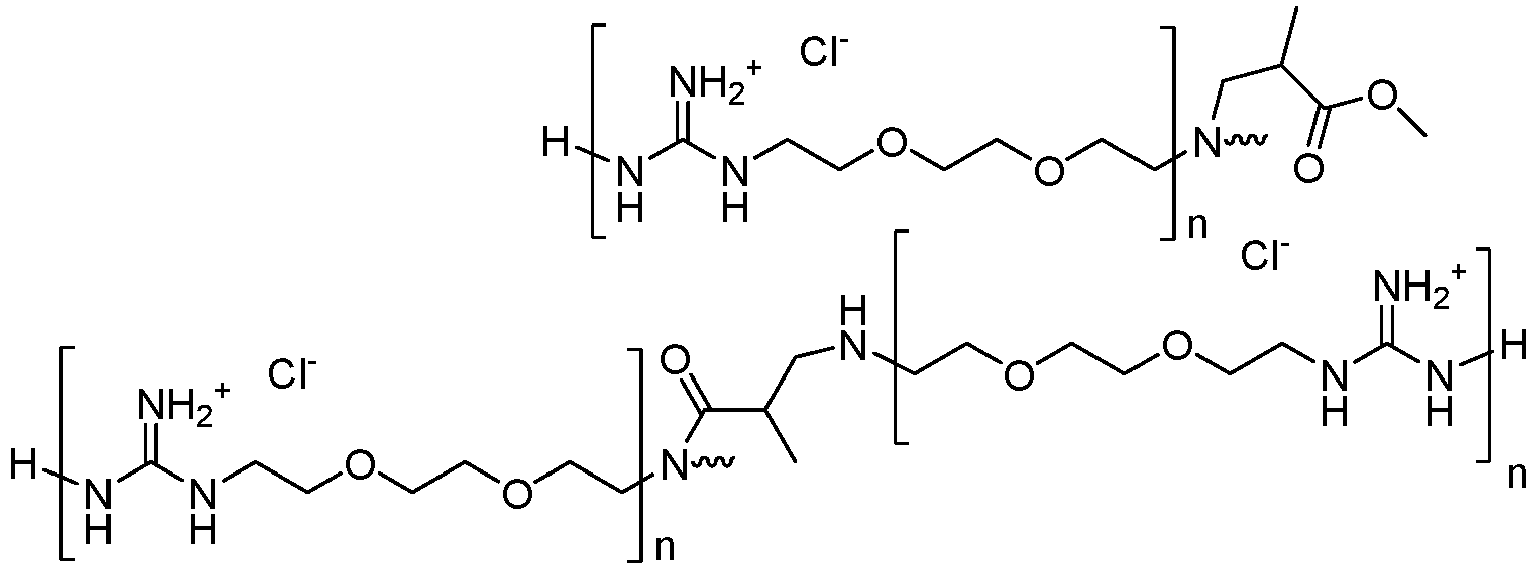
- Vorzugsweise ist das Guanidin-Oligomer mindestens eine durch die nachfolgenden Formeln dargestellte Verbindung, da sich diese Guanidin-Oligomere durch eine sehr gute Verbindbarkeit mit den Phosphonat-Seitenketten und hohe antibakterielle Wirksamkeit auszeichnen. Hierbei kann in dem Pfropfcopolymer lediglich ein spezifisches Guanidin-Oligomer verwendet werden oder aber eine Kombination von zwei oder mehreren Guanidin-Oligomeren der nachstehenden Formeln:
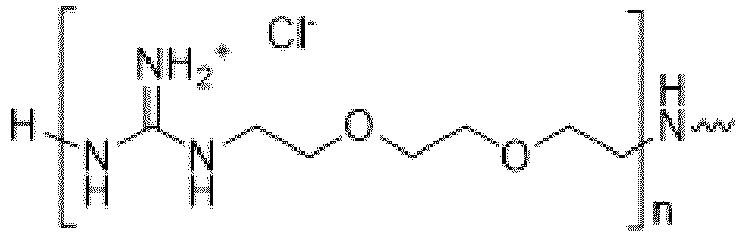


- In den vorstehend offenbarten Formeln bezeichnet n jeweils eine ganze Zahl von 2 bis 10, vorzugsweise von 3 bis 6, und insbesondere 5, und eine Welle, "~", bezeichnet eine bevorzugte Bindungsposition des entsprechenden Stickstoffs an das Phosphoratom einer Phosphonat-Seitenkette. Wie in den oben dargestellten Formeln gezeigt, verfügen die Guanidin-Oligomere teilweise über mehrere primäre und auch sekundäre Amingruppen, die prinzipiell geeignet sind, mit einem Phosphoratom einer Phosphonat-Seitenkette zu reagieren. Vorzugsweise findet aber eine Reaktion an demjenigen Stickstoffatom statt, das mit einer Welle, "~", gekennzeichnet ist.
- Ebenfalls im Lichte einer sehr guten Dispergierbarkeit des Pfropfcopolymers, beträgt das Molekulargewicht des Guanidin-Oligomers vorzugsweise 800 bis 1300 g/mol. Bei der Berechnung des Molekulargewichts des Guanidin-Oligomers wird der Guanidin-Oligomer-Rest betrachtet, wie er an dem Phosphoratom der Phosphonat-Seitenkette gebunden ist.
- Ferner vorteilhaft weist das Pfropfcopolymer nachfolgende Struktureinheit auf:

- Die vorstehend genannten Eigenschaften können noch weiter verbessert werden, wenn, wie gemäß einer weiteren Ausführungsform offenbart, das Pfropfcopolymer mindestens eine der nachfolgenden Struktureinheiten aufweist:

-

- In den angegebenen Struktureinheiten ist n jeweils eine ganze Zahl von 2 bis 10, vorzugsweise von 3 bis 6, und ist insbesondere 5. Eine Welle in dem (Meth)Acrylsäure basierten Rückgrat stellt eine Bindungsposition zu weiteren (Meth)Acrylsäure-Einheiten dar.
- Vorzugsweise enthält die antibakterielle Implantatbeschichtungszusammensetzung lediglich das vorstehend offenbarte Pfropfcopolymer und ggf. nicht oder nicht vollständig umgesetzte Edukte aus der Herstellung des Pfropfcopolymers. Dieses stellt die funktionelle Komponente der antibakteriellen Implantatbeschichtungszusammensetzung dar. Die Implantatbeschichtungszusammensetzung ist dadurch sehr gut haltbar und lagerbar, ohne dass sie einen Wirksamkeitsverlust erleidet. Um die antibakterielle Implantatbeschichtungszusammensetzung auf ein Implantat zu applizieren, kann sie jedoch ferner ein Lösungsmittel oder Dispergiermittel, wie z.B. Wasser, Ethanol, Methanol oder auch beliebige Mischungen dieser Substanzen enthalten. In den vorstehend genannten Lösungsmitteln ist das Pfropfcopolymer sehr gut lösbar oder zumindest dispergierbar und daher einfach zu verarbeiten und zu applizieren.
- Die antibakterielle Implantatbeschichtungszusammensetzung kann darüber hinaus, falls erforderlich, weitere Komponenten enthalten, die jedoch die Wirksamkeit des Pfropfcopolymers nicht beeinträchtigen.
- Ebenfalls erfindungsgemäß wird auch ein Verfahren zum Beschichten eines Implantats mit einer antibakteriellen Beschichtung offenbart. Hierzu wird in einem Verfahrensschritt die vorstehend beschriebene Implantatbeschichtungszusammensetzung in einem Lösungsmittel gelöst oder dispergiert. Sofern eine Lösung der Implantatbeschichtungszusammensetzung erhalten wird, so kann diese auch kolloidal sein. Als Lösungsmittel kann z.B. Wasser, Ethanol oder Methanol oder auch beliebige Mischungen dieser Substanzen eingesetzt werden. Sodann wird ein Implantat bereitgestellt, das für die Weiterbearbeitung entfettet sein sollte. Das Entfetten kann z.B. durch Reinigung mit Lösungsmitteln wie Aceton, Dichlormethan, Methanol und dergleichen oder mittels Plasmareinigung erfolgen. Ggf. nach Trocknung erfolgt anschließend das Aufbringen der gelösten oder dispergierten Implantatbeschichtungszusammensetzung auf das Implantat. Dadurch, dass die Implantatbeschichtungszusammensetzung in Form einer Lösung oder Dispersion vorliegt, können viele einfache, herkömmliche Applikationsprozesse Anwendung finden, was den technischen Aufwand für das Verfahren geringhält. Auch wird so eine Applikation auf geometrisch komplexen Oberflächen vereinfacht. Abschließend erfolgt ein Binden der Implantatbeschichtungszusammensetzung an das Implantat. Dies wird durch Einwirken von Temperaturen zwischen 50 und 200 °C z.B. in einem Trockenschrank oder in einem geeigneten Ofen ausgeführt. Durch den Bindeschritt zieht die Implantatbeschichtungszusammensetzung auf die Oberfläche des Implantats auf und bindet durch die Phosphonatgruppen kovalent an das Implantat. Die Bindungskraft der Bindung zwischen der Implantatoberfläche und der Implantatbeschichtungszusammensetzung ist aufgrund des hohen Anteils an Phosphonat-Seitenketten hoch. Das Aufbringen eines Adhäsivs kann somit entfallen. Durch das Verfahren wird ohne hohen technischen Aufwand ein Implantat mit dauerhaft hoher antimikrobieller Wirksamkeit bei sehr guter Zellkompatibilität erhalten.
- Die vorstehend für die antimikrobielle Implantatbeschichtungszusammensetzung dargelegten Vorteile, vorteilhaften Weiterbildungen und Ausgestaltungen finden auch Anwendung auf das erfindungsgemäße Verfahren zum Beschichten eines Implantats mit einer antibakteriellen Beschichtung.
- Zur Aufreinigung der Beschichtung können sich nach dem Binden der Implantatbeschichtungszusammensetzung ein Waschschritt und ein Trocknungsschritt anschließen.
- Des Weiteren kann das Implantat vor dem Beschichten übliche Vorbereitungsschritte durchlaufen, wie z.B. ein Polieren der Oberfläche, um eine gewünschte Oberflächenrauheit, beispielsweise eine Oberflächenrauheit von 0,013 µm oder darunter, zu erhalten.
- Eine weitere vorteilhafte Weiterbildung des Verfahrens sieht vor, dass das Aufbringen der Lösung der Implantatbeschichtungszusammensetzung durch Spin Coating (insbesondere bei planaren Substraten), ein Tauch- oder Sprühverfahren ausgeführt wird. Hierdurch wird die Verfahrensführung vereinfacht und eine Beschichtung mit besonders gleichmäßiger Schichtdicke erhalten.
- Eine sehr gute Reaktionsfähigkeit der Implantatbeschichtungszusammensetzung mit der Implantatoberfläche unter Ausbildung einer ebenmäßigen Schichtdicke wird vorteilhaft dadurch erhalten, dass eine Konzentration der Implantatbeschichtungszusammensetzung im Lösungsmittel 2 bis 20 mg/ml und insbesondere 8 bis 12 mg/ml beträgt.
- Des Weiteren erfindungsgemäß wird auch ein antimikrobiell beschichtetes Implantat beschrieben. Das antimikrobiell beschichtete Implantat umfasst eine aus der vorstehend beschriebenen Implantatbeschichtungszusammensetzung gebildete Beschichtung. Die Beschichtung kann dabei nach dem vorstehend beschriebenen Verfahren zum Beschichten eines Implantats mit einer antibakteriellen Beschichtung hergestellt sein. Das erfindungsgemäße Implantat ist aus Titan, Zirkon, Tantal, Edelstahl, Zirkonoxid oder PEEK gebildet und weist eine durchschnittliche Schichtdicke der antimikrobiellen Beschichtung von 5 bis 50 nm und insbesondere von 15 bis 25 nm auf. Die Schichtdicke wird dabei durch Ellipsometrie bestimmt. Die durch das erfindungsgemäße Verfahren im erfindungsgemäßen Implantat erhaltene Schichtdicke liegt um etwa 10 nm höher als diejenige, die durch alternative Herstellverfahren einer Beschichtungszusammensetzung unter sonst gleichen Bedingungen erhalten werden. Dies deutet darauf hin, dass die chemische Struktur der Implantatbeschichtungszusammensetzung nicht mit Strukturen herkömmlicher antibakterieller Beschichtungen vergleichbar ist. Beispielhafte erfindungsgemäße Implantate umfassen dentale Implantate, Implantate für Hüft- und Knieendoprothesen sowie Herzschrittmacher. Insbesondere in der Tumortherapie, wenn immunsupprimierte Patienten große Implantate erhalten, ist eine Infektionsprophylaxe von enormer Bedeutung. Insbesondere für dentale Implantate, die naturgemäß in Kontakt mit der bakteriell stark belasteten Mundhöhle des Patienten stehen und deshalb einem besonderen Infektionsrisiko ausgesetzt sind, ist die vorliegende Erfindung besonders geeignet.
- Nachstehend wird die Synthese eines in der erfindungsgemäßen antibakteriellen Implantatbeschichtungszusammensetzung verwendeten Pfropfcopolymers beschrieben:
Die Synthese wurde in zwei Stufen durchgeführt. In der ersten Stufe wurden 2,2'-(Ethylendioxy)diethylamin und Guanidinhydrochlorid bei 170 °C unter Verwendung eines mechanischen Rührers zu dem oligomeren Produkt Poly-(2-(2-ethoxy)-ethoxyethyl-guanidinhydrochlorid) (PEDBEG) kondensiert. Das oligomere Guanidin umfasste primäre Amine, die als funktionelle Gruppe Reaktionen eingehen und, wie im nächsten Schritt dargelegt, kovalente N-P-Bindungen mit Phosphonatgruppen eingehen können. - In der zweiten Stufe wurde 2-(Dimethoxyphosphoryl)ethyl methacrylat (DMMEP) in Gegenwart des in der ersten Stufe erhaltenen PEDBEG-Oligomers für 14 h bei 60 °C polymerisiert. Als Initiator diente 2,2'-Azobis(2-methylpropionitril). In dieser Reaktion erfolgte der Aufbau des Poly(DMMEP)-Rückgrats und die Reaktion der Phosphonat-Seitenketten mit dem PEDBEG. Das Produkt dieser Reaktion stellte neben reinem PEDBEG und Poly(2-(dimethoxyphosphoryl)ethylmethacrylat) ein Propfcopolymer dar, das über eine Phosphor-Stickstoff-Bindung gebundenes PEDBEG als Seitengruppe beinhaltete. Des Weiteren waren die Phosphonatgruppen zu etwa 7-20 Mol% hemi- bzw. vollhydrolysiert.
- Die nachfolgende Tabelle gibt eine prozentuale Zusammensetzung der Phosphoratome in den entsprechenden Gruppen für verschiedenen Chargen der Pfropfcopolymerherstellung an:
Phosphonat Phosphonamidat Phosphonsäure Hemi Phosphonsäure Charge AS1 78,66% 2,07% 13,01% 2,89% Charge AS2 78,07% 1,77% 14,01% 3,04% Charge AS3 75,37% 2,50% 13,08% 5,16% Charge LF1 82,94% 3,20% 12,24% 1,12% Gemittelt 79% 2,4% 13% 3,0% Von - bis 75 - 83% 1,8 - 3,2% 12 - 14% 1 - 5% Massenanteil* 78 8% 11% 3% * Der entsprechenden Strukturen, berechnet mit dem Mittelwert und unter Annahme eines mittleren Molekulargewichts von 537 g/mol für die verwendeten PEDBEG-Oligomere. - Weitere Einzelheiten, Vorteile und Merkmale der vorliegenden Erfindung ergeben sich aus nachfolgender Beschreibung von Ausführungsbeispielen anhand der Zeichnung. Es zeigt:
- Fig. 1
- eine schematische Darstellung eines mit einer antibakteriellen Beschichtung beschichteten Implantats gemäß einer Ausführungsform der Erfindung.
-
Fig. 1 zeigt im Detail eine schematische Darstellung eines mit einer antibakteriellen Beschichtung 10 beschichteten Implantats 1 gemäß einer Ausführungsform der Erfindung. Das antibakteriell beschichtete Implantat 1 umfasst einen Grundkörper 2, der beispielsweise Titan, Zirkon, Tantal, Edelstahl, Zirkonoxid oder PEEK umfasst. Auf eine Oberfläche 3 des Grundkörpers 2 ist die antibakterielle Beschichtung 10 mit einer durchschnittlichen Schichtdicke S von 5 bis 50 nm und insbesondere 15 bis 25 nm angeordnet. - Die antibakterielle Beschichtung 10 ist aus einer antibakteriellen Implantatbeschichtungszusammensetzung gebildet, die ein Pfropfcopolymer mit einem (Meth)Acrylsäure basierten Rückgrat und Phosphonat-Seitenketten umfasst, wobei mindestens eine Phosphonat-Seitenkette mit einem Guanidin-Oligomer durch eine N-P-Bindung verbunden ist. Mindestens eine weitere Phosphonat-Seitenkette, die nicht durch eine N-P-Bindung mit einem Guanidin-Oligomer verbunden ist, ist an die Implantatoberfläche 3 gebunden und sorgt somit für eine gute Haftung des Pfropfcopolymers am Grundkörper 2.
- Die antibakterielle Beschichtung 10 auf dem Grundkörper 2 des Implantats wurde wie folgt erhalten:
Zunächst wurde die vorstehend beschriebene Implantatbeschichtungszusammensetzung in einem Lösungsmittel, wie z.B. Wasser, Ethanol oder Methanol, gelöst oder dispergiert. Sodann wurde ein zu beschichtendes Implantat bereitgestellt und entfettet. Anschließend wurde die Lösung bzw. Dispersion der Implantatbeschichtungszusammensetzung auf die Oberfläche 3 des Grundkörpers 2 des Implantats z.B. durch Spin Coating oder ein Tauch- oder Sprühverfahren, aufgebracht und anschließend die Implantatbeschichtungszusammensetzung an das Implantat unter Einwirkung von Temperaturen in einem Bereich von 50 bis 200 °C gebunden, wodurch zwischen der Oberfläche 3 des Implantats 10 und der Implantatbeschichtungszusammensetzung durch Ausbilden von Bindungen zwischen der Oberfläche 3 des Implantats und den Phosphonat-Seitenketten des Pfropfcopolymers der Implantatbeschichtungszusammensetzung die antibakterielle Beschichtung 10 ausgebildet wurde. Hierbei betrugt eine Konzentration der Implantatbeschichtungszusammensetzung im Lösungsmittel 2 bis 20 mg/ml. - Das antibakteriell beschichtete Implantat 1 zeichnete sich aufgrund der antibakteriellen Beschichtung 10 bei hoher Zellkompatibilität durch eine dauerhaft sehr gute antibakterielle Funktionalität aus. Das Beschichten des Implantats mit der antibakteriellen Beschichtung 10 erfolgte gleichmäßig abdeckend und unter Anwendung technisch herkömmlicher Mittel.
- Neben der vorstehenden schriftlichen Beschreibung der Erfindung wird zu deren ergänzender Offenbarung hiermit explizit auf die zeichnerische Darstellung der Erfindung in
Fig. 1 Bezug genommen. -
- 1
- antibakteriell beschichtetes Implantat
- 2
- Grundkörper
- 3
- Oberfläche
- 10
- antibakterielle Beschichtung
Claims (16)
- Antibakterielle Implantatbeschichtungszusammensetzung umfassend ein Pfropfcopolymer umfassend:- ein (Meth)Acrylsäure basiertes Rückgrat und- Phosphonat-Seitenketten,wobei mindestens eine Phosphonat-Seitenkette mit einem Guanidin-Oligomer durch eine N-P-Bindung verbunden ist.
- Antibakterielle Implantatbeschichtungszusammensetzung nach Anspruch 1, wobei ein Anteil an Phosphonat-Seitenketten, die mit einem Guanidin-Oligomer durch eine N-P-Bindung verbunden sind, bezogen auf den Gesamtanteil an Phosphonat-Seitengruppen in Mol%, 0,8 bis 6 Mol% und insbesondere 0,9 bis 5 Mol% beträgt.
- Antibakterielle Implantatbeschichtungszusammensetzung nach Anspruch 1 oder 2, wobei die nicht mit dem Guanidin-Oligomer verbundenen Phosphonat-Seitenketten nicht hydrolysiert, teilhydrolysiert oder vollhydrolysiert sind.
- Antibakterielle Implantatbeschichtungszusammensetzung nach Anspruch 3, wobei ein Anteil an teilhydrolysierten und vollhydrolysierten Phosphonat-Seitengruppen, bezogen auf den Gesamtanteil an Phosphonat-Seitengruppen in Mol%, 5 bis 30 Mol% und insbesondere 7 bis 20 Mol% beträgt.
- Antibakterielle Implantatbeschichtungszusammensetzung nach einem der vorhergehenden Ansprüche, wobei das Molekulargewicht des Pfropfcopolymers (Mw) nachfolgende Gleichung erfüllt:

- Antibakterielle Implantatbeschichtungszusammensetzung nach einem der vorhergehenden Ansprüche, wobei das Guanidin-Oligomer mindestens eine durch die nachfolgenden Formeln dargestellte Verbindung ist:



- Antibakterielle Implantatbeschichtungszusammensetzung nach einem der vorhergehenden Ansprüche, wobei das Molekulargewicht des Guanidin-Oligomers 800 bis 1300 g/mol beträgt.
- Antibakterielle Implantatbeschichtungszusammensetzung nach einem der vorhergehenden Ansprüche, wobei das Pfropfcopolymer nachfolgende Struktureinheit aufweist:

- Antibakterielle Implantatbeschichtungszusammensetzung nach einem der vorhergehenden Ansprüche, wobei das Pfropfcopolymer mindestens eine der nachfolgenden Struktureinheiten aufweist:


wobei n jeweils eine ganze Zahl von 2 bis 10, vorzugsweise von 3 bis 6 darstellt, und insbesondere 5 ist, und wobei eine Welle im (Meth)Acrylsäure basierten Rückgrat eine Bindungsposition an eine benachbarte (Meth)Acrylsäure Einheit darstellt. - Antibakterielle Implantatbeschichtungszusammensetzung nach einem der vorhergehenden Ansprüche, ferner umfassend Wasser.
- Verfahren zum Beschichten eines Implantats mit einer antibakteriellen Beschichtung umfassend die Schritte:• Lösen oder Dispergieren der Implantatbeschichtungszusammensetzung nach einem der vorhergehenden Ansprüche in einem Lösungsmittel,• Bereitstellen und Entfetten eines Implantats,• Aufbringen der Lösung bzw. Dispersion der Implantatbeschichtungszusammensetzung auf das Implantat und• Binden der Implantatbeschichtungszusammensetzung an das Implantat unter Einwirkung von Temperaturen in einem Bereich von 50 bis 200 °C.
- Verfahren nach Anspruch 11, ferner umfassend einen Waschschritt und einen anschließenden Trocknungsschritt nach dem Binden der Implantatbeschichtungszusammensetzung.
- Verfahren nach Anspruch 11 oder 12, dadurch gekennzeichnet, dass das Aufbringen der Lösung bzw. der Dispersion der Implantatbeschichtungszusammensetzung durch Spin Coating oder ein Tauch- oder Sprühverfahren ausgeführt wird.
- Verfahren nach einem der Ansprüche 11 bis 13, dadurch gekennzeichnet, dass eine Konzentration der Implantatbeschichtungszusammensetzung im Lösungsmittel 2 bis 20 mg/ml und insbesondere 8 bis 12 mg/ml, beträgt.
- Antibakteriell beschichtetes Implantat umfassend eine aus der Implantatbeschichtungszusammensetzung nach einem der Ansprüche 1 bis 10 gebildete Beschichtung.
- Antibakteriell beschichtetes Implantat nach Anspruch 15, wobei das Implantat Titan, Zirkon, Tantal, Edelstahl, Zirkonoxid oder PEEK umfasst und/oder wobei eine durchschnittliche Schichtdicke der antibakteriellen Beschichtung 5 bis 50 nm und insbesondere 15 bis 25 nm beträgt.
Applications Claiming Priority (1)
| Application Number | Priority Date | Filing Date | Title |
|---|---|---|---|
| DE102021108936.0A DE102021108936B4 (de) | 2021-04-09 | 2021-04-09 | Antibakterielle Implantatbeschichtungszusammensetzung, Verfahren zum Beschichten eines Implantats und antibakteriell beschichtetes Implantat |
Publications (2)
| Publication Number | Publication Date |
|---|---|
| EP4070823A1 EP4070823A1 (de) | 2022-10-12 |
| EP4070823B1 true EP4070823B1 (de) | 2024-02-21 |
Family
ID=80952254
Family Applications (1)
| Application Number | Title | Priority Date | Filing Date |
|---|---|---|---|
| EP22164499.0A Active EP4070823B1 (de) | 2021-04-09 | 2022-03-25 | Antibakterielle implantatbeschichtungszusammensetzung, verfahren zum beschichten eines implantats und antibakteriell beschichtetes implantat |
Country Status (3)
| Country | Link |
|---|---|
| US (1) | US12296070B2 (de) |
| EP (1) | EP4070823B1 (de) |
| DE (1) | DE102021108936B4 (de) |
Family Cites Families (3)
| Publication number | Priority date | Publication date | Assignee | Title |
|---|---|---|---|---|
| EP1707601A1 (de) * | 2005-03-31 | 2006-10-04 | Institut Curie | Verfahren zur Behandlung von Oberflächen mit Copolymeren |
| DE102010054046B4 (de) * | 2010-12-10 | 2012-10-18 | Dot Gmbh | Antibakterielle Beschichtung für ein Implantat und Implantat. |
| DE102015219139B4 (de) | 2015-10-02 | 2017-09-28 | Gebr. Brasseler Gmbh & Co. Kg | Verfahren zur Herstellung einer antibakteriellen Beschichtungszusammensetzung für Implantate |
-
2021
- 2021-04-09 DE DE102021108936.0A patent/DE102021108936B4/de active Active
-
2022
- 2022-03-25 EP EP22164499.0A patent/EP4070823B1/de active Active
- 2022-04-06 US US17/714,594 patent/US12296070B2/en active Active
Also Published As
| Publication number | Publication date |
|---|---|
| US12296070B2 (en) | 2025-05-13 |
| DE102021108936A1 (de) | 2022-10-13 |
| DE102021108936B4 (de) | 2023-04-20 |
| US20220331494A1 (en) | 2022-10-20 |
| EP4070823A1 (de) | 2022-10-12 |
Similar Documents
| Publication | Publication Date | Title |
|---|---|---|
| DE60002227T2 (de) | Medizinische vorrichtung beschichtet mit stickstoffmonoxid modifizierte lineare polyethyleniminfasern und verfahren zu dessen herstellung | |
| DE69223902T2 (de) | Antimikrobielle polymerisierbare Zusammensetzung, das Polymer und daraus hergestellter Gegenstand | |
| DE69811666T2 (de) | Behandlung metallischer oberflächen zur verbesserung ihrer bioverträglichkeit und/oder ihrer physikalischen eigenschaften | |
| EP1019102B1 (de) | 32 p- polyphosphazen - radioaktiv markiertes antithrombogenes polymer | |
| DE112018000451B4 (de) | Verfahren zur Herstellung einer vernetzten Polyethylenimin-Beschichtung und Verwendung einer vernetzten Polyethylenimin-Beschichtung | |
| DE60103620T2 (de) | Verwendung von polyphosphazen-derivaten für antibakterielle beschichtungen | |
| EP4085893B1 (de) | Transparente, bruchzähe polymerisationsharze zur herstellung dentaler formkörper | |
| DE60109745T2 (de) | Polymere micellenartige struktur | |
| DE102006038231A1 (de) | Implantat aus einem biokorrodierbaren metallischen Werkstoff mit einer Beschichtung aus einer Organosiliziumverbindung | |
| DE10223310A1 (de) | Verfahren zum Beschichten von Implantaten mit einer Polysaccharid-Lage | |
| DE602004002231T2 (de) | Knochenkontaktierendes Implantat mit stossdämpfenden Eigenschaften und Verfahren zu dessen Herstellung | |
| DE102010054046A1 (de) | Antibakterielle Beschichtung für ein Implantat und Verfahren zur Herstellung dieser Beschichtung | |
| DE69422069T2 (de) | Oxidative Vorbehandlung zur Verbesserung der Haftung an Dentalamalgam | |
| DE3914670A1 (de) | Verfahren zur vebesserung der haftung eines klebstoffs an der oberflaeche eines harten gewebes, wie z.b. dentin | |
| DE102017118508A1 (de) | Verfahren zur Herstellung einer biokompatiblen Schicht auf einer Implantatoberfläche | |
| DE112019006000T5 (de) | Ein Zahndesensibilisierungsmittel zur tiefen Versiegelung von Dentinkanälchen und zur Verhinderung von Biofilmbildung | |
| EP3153186B1 (de) | Verfahren zur herstellung einer antibakteriellen beschichtungszusammensetzung für implantate | |
| DE102021108936B4 (de) | Antibakterielle Implantatbeschichtungszusammensetzung, Verfahren zum Beschichten eines Implantats und antibakteriell beschichtetes Implantat | |
| DE112018006058T5 (de) | Sternpolymere mit erhöhter antimikrobieller aktivität in antwort auf licht | |
| WO2009024121A2 (de) | Weichgewebe-implantat mit antibakterieller wirkung | |
| DE102005042078B4 (de) | Werkstoff für den überwiegend medizinischen, langfristigen in-vivo Einsatz und Verfahren zu seiner Herstellung | |
| EP3587456B1 (de) | Verfahren zur herstellung eines antibakteriellen chitosanhaltigen polymers für medizinische zwecke, insbesondere für die wundbehandlung | |
| WO2024094645A1 (de) | Antiadhäsive polymer-beschichtungen für kurzzeitimplantate | |
| DE102015014912B4 (de) | Beschichtung für ein medizinisches Instrument, Verfahren zu dessen Beschichten und mit diesem Verfahren beschichtetes medizinisches Instrument | |
| DE102008036520A1 (de) | Hydrogel-bildendes Polymer mit antibakterieller Wirkung |
Legal Events
| Date | Code | Title | Description |
|---|---|---|---|
| PUAI | Public reference made under article 153(3) epc to a published international application that has entered the european phase |
Free format text: ORIGINAL CODE: 0009012 |
|
| STAA | Information on the status of an ep patent application or granted ep patent |
Free format text: STATUS: THE APPLICATION HAS BEEN PUBLISHED |
|
| AK | Designated contracting states |
Kind code of ref document: A1 Designated state(s): AL AT BE BG CH CY CZ DE DK EE ES FI FR GB GR HR HU IE IS IT LI LT LU LV MC MK MT NL NO PL PT RO RS SE SI SK SM TR |
|
| STAA | Information on the status of an ep patent application or granted ep patent |
Free format text: STATUS: REQUEST FOR EXAMINATION WAS MADE |
|
| 17P | Request for examination filed |
Effective date: 20230405 |
|
| RBV | Designated contracting states (corrected) |
Designated state(s): AL AT BE BG CH CY CZ DE DK EE ES FI FR GB GR HR HU IE IS IT LI LT LU LV MC MK MT NL NO PL PT RO RS SE SI SK SM TR |
|
| GRAP | Despatch of communication of intention to grant a patent |
Free format text: ORIGINAL CODE: EPIDOSNIGR1 |
|
| STAA | Information on the status of an ep patent application or granted ep patent |
Free format text: STATUS: GRANT OF PATENT IS INTENDED |
|
| INTG | Intention to grant announced |
Effective date: 20231002 |
|
| GRAS | Grant fee paid |
Free format text: ORIGINAL CODE: EPIDOSNIGR3 |
|
| GRAA | (expected) grant |
Free format text: ORIGINAL CODE: 0009210 |
|
| STAA | Information on the status of an ep patent application or granted ep patent |
Free format text: STATUS: THE PATENT HAS BEEN GRANTED |
|
| P01 | Opt-out of the competence of the unified patent court (upc) registered |
Effective date: 20231214 |
|
| AK | Designated contracting states |
Kind code of ref document: B1 Designated state(s): AL AT BE BG CH CY CZ DE DK EE ES FI FR GB GR HR HU IE IS IT LI LT LU LV MC MK MT NL NO PL PT RO RS SE SI SK SM TR |
|
| REG | Reference to a national code |
Ref country code: GB Ref legal event code: FG4D Free format text: NOT ENGLISH |
|
| REG | Reference to a national code |
Ref country code: CH Ref legal event code: EP |
|
| REG | Reference to a national code |
Ref country code: DE Ref legal event code: R096 Ref document number: 502022000516 Country of ref document: DE |
|
| REG | Reference to a national code |
Ref country code: IE Ref legal event code: FG4D Free format text: LANGUAGE OF EP DOCUMENT: GERMAN |
|
| REG | Reference to a national code |
Ref country code: SE Ref legal event code: TRGR |
|
| REG | Reference to a national code |
Ref country code: LT Ref legal event code: MG9D |
|
| REG | Reference to a national code |
Ref country code: NL Ref legal event code: MP Effective date: 20240221 |
|
| PG25 | Lapsed in a contracting state [announced via postgrant information from national office to epo] |
Ref country code: IS Free format text: LAPSE BECAUSE OF FAILURE TO SUBMIT A TRANSLATION OF THE DESCRIPTION OR TO PAY THE FEE WITHIN THE PRESCRIBED TIME-LIMIT Effective date: 20240621 |
|
| PG25 | Lapsed in a contracting state [announced via postgrant information from national office to epo] |
Ref country code: LT Free format text: LAPSE BECAUSE OF FAILURE TO SUBMIT A TRANSLATION OF THE DESCRIPTION OR TO PAY THE FEE WITHIN THE PRESCRIBED TIME-LIMIT Effective date: 20240221 |
|
| PG25 | Lapsed in a contracting state [announced via postgrant information from national office to epo] |
Ref country code: GR Free format text: LAPSE BECAUSE OF FAILURE TO SUBMIT A TRANSLATION OF THE DESCRIPTION OR TO PAY THE FEE WITHIN THE PRESCRIBED TIME-LIMIT Effective date: 20240522 |
|
| PG25 | Lapsed in a contracting state [announced via postgrant information from national office to epo] |
Ref country code: RS Free format text: LAPSE BECAUSE OF FAILURE TO SUBMIT A TRANSLATION OF THE DESCRIPTION OR TO PAY THE FEE WITHIN THE PRESCRIBED TIME-LIMIT Effective date: 20240521 Ref country code: NL Free format text: LAPSE BECAUSE OF FAILURE TO SUBMIT A TRANSLATION OF THE DESCRIPTION OR TO PAY THE FEE WITHIN THE PRESCRIBED TIME-LIMIT Effective date: 20240221 Ref country code: HR Free format text: LAPSE BECAUSE OF FAILURE TO SUBMIT A TRANSLATION OF THE DESCRIPTION OR TO PAY THE FEE WITHIN THE PRESCRIBED TIME-LIMIT Effective date: 20240221 |
|
| PG25 | Lapsed in a contracting state [announced via postgrant information from national office to epo] |
Ref country code: ES Free format text: LAPSE BECAUSE OF FAILURE TO SUBMIT A TRANSLATION OF THE DESCRIPTION OR TO PAY THE FEE WITHIN THE PRESCRIBED TIME-LIMIT Effective date: 20240221 |
|
| PG25 | Lapsed in a contracting state [announced via postgrant information from national office to epo] |
Ref country code: RS Free format text: LAPSE BECAUSE OF FAILURE TO SUBMIT A TRANSLATION OF THE DESCRIPTION OR TO PAY THE FEE WITHIN THE PRESCRIBED TIME-LIMIT Effective date: 20240521 Ref country code: NO Free format text: LAPSE BECAUSE OF FAILURE TO SUBMIT A TRANSLATION OF THE DESCRIPTION OR TO PAY THE FEE WITHIN THE PRESCRIBED TIME-LIMIT Effective date: 20240521 Ref country code: NL Free format text: LAPSE BECAUSE OF FAILURE TO SUBMIT A TRANSLATION OF THE DESCRIPTION OR TO PAY THE FEE WITHIN THE PRESCRIBED TIME-LIMIT Effective date: 20240221 Ref country code: LT Free format text: LAPSE BECAUSE OF FAILURE TO SUBMIT A TRANSLATION OF THE DESCRIPTION OR TO PAY THE FEE WITHIN THE PRESCRIBED TIME-LIMIT Effective date: 20240221 Ref country code: IS Free format text: LAPSE BECAUSE OF FAILURE TO SUBMIT A TRANSLATION OF THE DESCRIPTION OR TO PAY THE FEE WITHIN THE PRESCRIBED TIME-LIMIT Effective date: 20240621 Ref country code: HR Free format text: LAPSE BECAUSE OF FAILURE TO SUBMIT A TRANSLATION OF THE DESCRIPTION OR TO PAY THE FEE WITHIN THE PRESCRIBED TIME-LIMIT Effective date: 20240221 Ref country code: GR Free format text: LAPSE BECAUSE OF FAILURE TO SUBMIT A TRANSLATION OF THE DESCRIPTION OR TO PAY THE FEE WITHIN THE PRESCRIBED TIME-LIMIT Effective date: 20240522 Ref country code: FI Free format text: LAPSE BECAUSE OF FAILURE TO SUBMIT A TRANSLATION OF THE DESCRIPTION OR TO PAY THE FEE WITHIN THE PRESCRIBED TIME-LIMIT Effective date: 20240221 Ref country code: ES Free format text: LAPSE BECAUSE OF FAILURE TO SUBMIT A TRANSLATION OF THE DESCRIPTION OR TO PAY THE FEE WITHIN THE PRESCRIBED TIME-LIMIT Effective date: 20240221 Ref country code: BG Free format text: LAPSE BECAUSE OF FAILURE TO SUBMIT A TRANSLATION OF THE DESCRIPTION OR TO PAY THE FEE WITHIN THE PRESCRIBED TIME-LIMIT Effective date: 20240221 |
|
| PG25 | Lapsed in a contracting state [announced via postgrant information from national office to epo] |
Ref country code: PT Free format text: LAPSE BECAUSE OF FAILURE TO SUBMIT A TRANSLATION OF THE DESCRIPTION OR TO PAY THE FEE WITHIN THE PRESCRIBED TIME-LIMIT Effective date: 20240621 Ref country code: PL Free format text: LAPSE BECAUSE OF FAILURE TO SUBMIT A TRANSLATION OF THE DESCRIPTION OR TO PAY THE FEE WITHIN THE PRESCRIBED TIME-LIMIT Effective date: 20240221 |
|
| PG25 | Lapsed in a contracting state [announced via postgrant information from national office to epo] |
Ref country code: PT Free format text: LAPSE BECAUSE OF FAILURE TO SUBMIT A TRANSLATION OF THE DESCRIPTION OR TO PAY THE FEE WITHIN THE PRESCRIBED TIME-LIMIT Effective date: 20240621 Ref country code: PL Free format text: LAPSE BECAUSE OF FAILURE TO SUBMIT A TRANSLATION OF THE DESCRIPTION OR TO PAY THE FEE WITHIN THE PRESCRIBED TIME-LIMIT Effective date: 20240221 Ref country code: LV Free format text: LAPSE BECAUSE OF FAILURE TO SUBMIT A TRANSLATION OF THE DESCRIPTION OR TO PAY THE FEE WITHIN THE PRESCRIBED TIME-LIMIT Effective date: 20240221 |
|
| PG25 | Lapsed in a contracting state [announced via postgrant information from national office to epo] |
Ref country code: DK Free format text: LAPSE BECAUSE OF FAILURE TO SUBMIT A TRANSLATION OF THE DESCRIPTION OR TO PAY THE FEE WITHIN THE PRESCRIBED TIME-LIMIT Effective date: 20240221 |
|
| PG25 | Lapsed in a contracting state [announced via postgrant information from national office to epo] |
Ref country code: SM Free format text: LAPSE BECAUSE OF FAILURE TO SUBMIT A TRANSLATION OF THE DESCRIPTION OR TO PAY THE FEE WITHIN THE PRESCRIBED TIME-LIMIT Effective date: 20240221 |
|
| PG25 | Lapsed in a contracting state [announced via postgrant information from national office to epo] |
Ref country code: EE Free format text: LAPSE BECAUSE OF FAILURE TO SUBMIT A TRANSLATION OF THE DESCRIPTION OR TO PAY THE FEE WITHIN THE PRESCRIBED TIME-LIMIT Effective date: 20240221 Ref country code: CZ Free format text: LAPSE BECAUSE OF FAILURE TO SUBMIT A TRANSLATION OF THE DESCRIPTION OR TO PAY THE FEE WITHIN THE PRESCRIBED TIME-LIMIT Effective date: 20240221 |
|
| PG25 | Lapsed in a contracting state [announced via postgrant information from national office to epo] |
Ref country code: SK Free format text: LAPSE BECAUSE OF FAILURE TO SUBMIT A TRANSLATION OF THE DESCRIPTION OR TO PAY THE FEE WITHIN THE PRESCRIBED TIME-LIMIT Effective date: 20240221 |
|
| PG25 | Lapsed in a contracting state [announced via postgrant information from national office to epo] |
Ref country code: SM Free format text: LAPSE BECAUSE OF FAILURE TO SUBMIT A TRANSLATION OF THE DESCRIPTION OR TO PAY THE FEE WITHIN THE PRESCRIBED TIME-LIMIT Effective date: 20240221 Ref country code: SK Free format text: LAPSE BECAUSE OF FAILURE TO SUBMIT A TRANSLATION OF THE DESCRIPTION OR TO PAY THE FEE WITHIN THE PRESCRIBED TIME-LIMIT Effective date: 20240221 Ref country code: RO Free format text: LAPSE BECAUSE OF FAILURE TO SUBMIT A TRANSLATION OF THE DESCRIPTION OR TO PAY THE FEE WITHIN THE PRESCRIBED TIME-LIMIT Effective date: 20240221 Ref country code: EE Free format text: LAPSE BECAUSE OF FAILURE TO SUBMIT A TRANSLATION OF THE DESCRIPTION OR TO PAY THE FEE WITHIN THE PRESCRIBED TIME-LIMIT Effective date: 20240221 Ref country code: DK Free format text: LAPSE BECAUSE OF FAILURE TO SUBMIT A TRANSLATION OF THE DESCRIPTION OR TO PAY THE FEE WITHIN THE PRESCRIBED TIME-LIMIT Effective date: 20240221 Ref country code: CZ Free format text: LAPSE BECAUSE OF FAILURE TO SUBMIT A TRANSLATION OF THE DESCRIPTION OR TO PAY THE FEE WITHIN THE PRESCRIBED TIME-LIMIT Effective date: 20240221 |
|
| PG25 | Lapsed in a contracting state [announced via postgrant information from national office to epo] |
Ref country code: LU Free format text: LAPSE BECAUSE OF NON-PAYMENT OF DUE FEES Effective date: 20240325 |
|
| PG25 | Lapsed in a contracting state [announced via postgrant information from national office to epo] |
Ref country code: MC Free format text: LAPSE BECAUSE OF FAILURE TO SUBMIT A TRANSLATION OF THE DESCRIPTION OR TO PAY THE FEE WITHIN THE PRESCRIBED TIME-LIMIT Effective date: 20240221 |
|
| REG | Reference to a national code |
Ref country code: DE Ref legal event code: R097 Ref document number: 502022000516 Country of ref document: DE |
|
| PG25 | Lapsed in a contracting state [announced via postgrant information from national office to epo] |
Ref country code: MC Free format text: LAPSE BECAUSE OF FAILURE TO SUBMIT A TRANSLATION OF THE DESCRIPTION OR TO PAY THE FEE WITHIN THE PRESCRIBED TIME-LIMIT Effective date: 20240221 Ref country code: LU Free format text: LAPSE BECAUSE OF NON-PAYMENT OF DUE FEES Effective date: 20240325 |
|
| REG | Reference to a national code |
Ref country code: BE Ref legal event code: MM Effective date: 20240331 |
|
| PLBE | No opposition filed within time limit |
Free format text: ORIGINAL CODE: 0009261 |
|
| STAA | Information on the status of an ep patent application or granted ep patent |
Free format text: STATUS: NO OPPOSITION FILED WITHIN TIME LIMIT |
|
| PG25 | Lapsed in a contracting state [announced via postgrant information from national office to epo] |
Ref country code: BE Free format text: LAPSE BECAUSE OF NON-PAYMENT OF DUE FEES Effective date: 20240331 |
|
| PG25 | Lapsed in a contracting state [announced via postgrant information from national office to epo] |
Ref country code: IE Free format text: LAPSE BECAUSE OF NON-PAYMENT OF DUE FEES Effective date: 20240325 |
|
| 26N | No opposition filed |
Effective date: 20241122 |
|
| PG25 | Lapsed in a contracting state [announced via postgrant information from national office to epo] |
Ref country code: IE Free format text: LAPSE BECAUSE OF NON-PAYMENT OF DUE FEES Effective date: 20240325 Ref country code: BE Free format text: LAPSE BECAUSE OF NON-PAYMENT OF DUE FEES Effective date: 20240331 |
|
| PG25 | Lapsed in a contracting state [announced via postgrant information from national office to epo] |
Ref country code: SI Free format text: LAPSE BECAUSE OF FAILURE TO SUBMIT A TRANSLATION OF THE DESCRIPTION OR TO PAY THE FEE WITHIN THE PRESCRIBED TIME-LIMIT Effective date: 20240221 |
|
| PGFP | Annual fee paid to national office [announced via postgrant information from national office to epo] |
Ref country code: IT Payment date: 20250331 Year of fee payment: 4 |
|
| PGFP | Annual fee paid to national office [announced via postgrant information from national office to epo] |
Ref country code: CH Payment date: 20250401 Year of fee payment: 4 |
|
| PG25 | Lapsed in a contracting state [announced via postgrant information from national office to epo] |
Ref country code: CY Free format text: LAPSE BECAUSE OF FAILURE TO SUBMIT A TRANSLATION OF THE DESCRIPTION OR TO PAY THE FEE WITHIN THE PRESCRIBED TIME-LIMIT; INVALID AB INITIO Effective date: 20220325 |
|
| PG25 | Lapsed in a contracting state [announced via postgrant information from national office to epo] |
Ref country code: TR Free format text: LAPSE BECAUSE OF FAILURE TO SUBMIT A TRANSLATION OF THE DESCRIPTION OR TO PAY THE FEE WITHIN THE PRESCRIBED TIME-LIMIT Effective date: 20240221 |
|
| REG | Reference to a national code |
Ref country code: CH Ref legal event code: U11 Free format text: ST27 STATUS EVENT CODE: U-0-0-U10-U11 (AS PROVIDED BY THE NATIONAL OFFICE) Effective date: 20260401 |
|
| PGFP | Annual fee paid to national office [announced via postgrant information from national office to epo] |
Ref country code: SE Payment date: 20260323 Year of fee payment: 5 |
|
| PGFP | Annual fee paid to national office [announced via postgrant information from national office to epo] |
Ref country code: DE Payment date: 20260327 Year of fee payment: 5 |
|
| PGFP | Annual fee paid to national office [announced via postgrant information from national office to epo] |
Ref country code: AT Payment date: 20260301 Year of fee payment: 5 |
|
| PGFP | Annual fee paid to national office [announced via postgrant information from national office to epo] |
Ref country code: FR Payment date: 20260324 Year of fee payment: 5 |