EP4069366B1 - Atm-kinasehemmer sowie zusammensetzungen und verfahren zur verwendung davon - Google Patents
Atm-kinasehemmer sowie zusammensetzungen und verfahren zur verwendung davon Download PDFInfo
- Publication number
- EP4069366B1 EP4069366B1 EP20825389.8A EP20825389A EP4069366B1 EP 4069366 B1 EP4069366 B1 EP 4069366B1 EP 20825389 A EP20825389 A EP 20825389A EP 4069366 B1 EP4069366 B1 EP 4069366B1
- Authority
- EP
- European Patent Office
- Prior art keywords
- compound
- halo
- alkyl
- disease
- optionally substituted
- Prior art date
- Legal status (The legal status is an assumption and is not a legal conclusion. Google has not performed a legal analysis and makes no representation as to the accuracy of the status listed.)
- Active
Links
Classifications
-
- C—CHEMISTRY; METALLURGY
- C07—ORGANIC CHEMISTRY
- C07D—HETEROCYCLIC COMPOUNDS
- C07D413/00—Heterocyclic compounds containing two or more hetero rings, at least one ring having nitrogen and oxygen atoms as the only ring hetero atoms
- C07D413/14—Heterocyclic compounds containing two or more hetero rings, at least one ring having nitrogen and oxygen atoms as the only ring hetero atoms containing three or more hetero rings
-
- C—CHEMISTRY; METALLURGY
- C07—ORGANIC CHEMISTRY
- C07D—HETEROCYCLIC COMPOUNDS
- C07D417/00—Heterocyclic compounds containing two or more hetero rings, at least one ring having nitrogen and sulfur atoms as the only ring hetero atoms, not provided for by group C07D415/00
- C07D417/14—Heterocyclic compounds containing two or more hetero rings, at least one ring having nitrogen and sulfur atoms as the only ring hetero atoms, not provided for by group C07D415/00 containing three or more hetero rings
-
- A—HUMAN NECESSITIES
- A61—MEDICAL OR VETERINARY SCIENCE; HYGIENE
- A61P—SPECIFIC THERAPEUTIC ACTIVITY OF CHEMICAL COMPOUNDS OR MEDICINAL PREPARATIONS
- A61P21/00—Drugs for disorders of the muscular or neuromuscular system
-
- A—HUMAN NECESSITIES
- A61—MEDICAL OR VETERINARY SCIENCE; HYGIENE
- A61P—SPECIFIC THERAPEUTIC ACTIVITY OF CHEMICAL COMPOUNDS OR MEDICINAL PREPARATIONS
- A61P25/00—Drugs for disorders of the nervous system
- A61P25/08—Antiepileptics; Anticonvulsants
-
- A—HUMAN NECESSITIES
- A61—MEDICAL OR VETERINARY SCIENCE; HYGIENE
- A61P—SPECIFIC THERAPEUTIC ACTIVITY OF CHEMICAL COMPOUNDS OR MEDICINAL PREPARATIONS
- A61P25/00—Drugs for disorders of the nervous system
- A61P25/14—Drugs for disorders of the nervous system for treating abnormal movements, e.g. chorea, dyskinesia
-
- A—HUMAN NECESSITIES
- A61—MEDICAL OR VETERINARY SCIENCE; HYGIENE
- A61P—SPECIFIC THERAPEUTIC ACTIVITY OF CHEMICAL COMPOUNDS OR MEDICINAL PREPARATIONS
- A61P25/00—Drugs for disorders of the nervous system
- A61P25/14—Drugs for disorders of the nervous system for treating abnormal movements, e.g. chorea, dyskinesia
- A61P25/16—Anti-Parkinson drugs
-
- A—HUMAN NECESSITIES
- A61—MEDICAL OR VETERINARY SCIENCE; HYGIENE
- A61P—SPECIFIC THERAPEUTIC ACTIVITY OF CHEMICAL COMPOUNDS OR MEDICINAL PREPARATIONS
- A61P27/00—Drugs for disorders of the senses
- A61P27/02—Ophthalmic agents
-
- C—CHEMISTRY; METALLURGY
- C07—ORGANIC CHEMISTRY
- C07D—HETEROCYCLIC COMPOUNDS
- C07D401/00—Heterocyclic compounds containing two or more hetero rings, having nitrogen atoms as the only ring hetero atoms, at least one ring being a six-membered ring with only one nitrogen atom
- C07D401/02—Heterocyclic compounds containing two or more hetero rings, having nitrogen atoms as the only ring hetero atoms, at least one ring being a six-membered ring with only one nitrogen atom containing two hetero rings
- C07D401/04—Heterocyclic compounds containing two or more hetero rings, having nitrogen atoms as the only ring hetero atoms, at least one ring being a six-membered ring with only one nitrogen atom containing two hetero rings directly linked by a ring-member-to-ring-member bond
-
- C—CHEMISTRY; METALLURGY
- C07—ORGANIC CHEMISTRY
- C07D—HETEROCYCLIC COMPOUNDS
- C07D401/00—Heterocyclic compounds containing two or more hetero rings, having nitrogen atoms as the only ring hetero atoms, at least one ring being a six-membered ring with only one nitrogen atom
- C07D401/14—Heterocyclic compounds containing two or more hetero rings, having nitrogen atoms as the only ring hetero atoms, at least one ring being a six-membered ring with only one nitrogen atom containing three or more hetero rings
-
- C—CHEMISTRY; METALLURGY
- C07—ORGANIC CHEMISTRY
- C07D—HETEROCYCLIC COMPOUNDS
- C07D403/00—Heterocyclic compounds containing two or more hetero rings, having nitrogen atoms as the only ring hetero atoms, not provided for by group C07D401/00
- C07D403/14—Heterocyclic compounds containing two or more hetero rings, having nitrogen atoms as the only ring hetero atoms, not provided for by group C07D401/00 containing three or more hetero rings
-
- C—CHEMISTRY; METALLURGY
- C07—ORGANIC CHEMISTRY
- C07D—HETEROCYCLIC COMPOUNDS
- C07D405/00—Heterocyclic compounds containing both one or more hetero rings having oxygen atoms as the only ring hetero atoms, and one or more rings having nitrogen as the only ring hetero atom
- C07D405/14—Heterocyclic compounds containing both one or more hetero rings having oxygen atoms as the only ring hetero atoms, and one or more rings having nitrogen as the only ring hetero atom containing three or more hetero rings
-
- C—CHEMISTRY; METALLURGY
- C07—ORGANIC CHEMISTRY
- C07D—HETEROCYCLIC COMPOUNDS
- C07D407/00—Heterocyclic compounds containing two or more hetero rings, at least one ring having oxygen atoms as the only ring hetero atoms, not provided for by group C07D405/00
- C07D407/14—Heterocyclic compounds containing two or more hetero rings, at least one ring having oxygen atoms as the only ring hetero atoms, not provided for by group C07D405/00 containing three or more hetero rings
-
- C—CHEMISTRY; METALLURGY
- C07—ORGANIC CHEMISTRY
- C07D—HETEROCYCLIC COMPOUNDS
- C07D409/00—Heterocyclic compounds containing two or more hetero rings, at least one ring having sulfur atoms as the only ring hetero atoms
- C07D409/14—Heterocyclic compounds containing two or more hetero rings, at least one ring having sulfur atoms as the only ring hetero atoms containing three or more hetero rings
-
- C—CHEMISTRY; METALLURGY
- C07—ORGANIC CHEMISTRY
- C07D—HETEROCYCLIC COMPOUNDS
- C07D413/00—Heterocyclic compounds containing two or more hetero rings, at least one ring having nitrogen and oxygen atoms as the only ring hetero atoms
- C07D413/02—Heterocyclic compounds containing two or more hetero rings, at least one ring having nitrogen and oxygen atoms as the only ring hetero atoms containing two hetero rings
- C07D413/04—Heterocyclic compounds containing two or more hetero rings, at least one ring having nitrogen and oxygen atoms as the only ring hetero atoms containing two hetero rings directly linked by a ring-member-to-ring-member bond
Definitions
- ATM ataxia telangiectasia mutated
- ATM is a serine/threonine protein kinase that is recruited and activated by DNA double-strand breaks. It phosphorylates several key proteins that initiate activation of the DNA damage checkpoint, leading to cell cycle arrest, DNA repair or apoptosis.
- the protein was named for the disorder ataxia-telangiectasia caused by mutations of ATM.
- ATM plays a central role in maintaining genome integrity by regulating the detection and repair of DNA double-strand breaks. Genetic and pharmacological reduction of ATM signaling can ameliorate mutant huntingtin ("mHTT") toxicity in cellular and animal models of Huntington's disease (“HD"). Additionally, ATM kinase signaling has been shown to be altered in the post-mortem brains of HD patients. Selective inhibition of ATM could therefore provide a novel clinical intervention strategy for the treatment of HD. Accordingly, there is a need for inhibitors of ATM kinase.
- Prior art ATM kinase inhibitors are disclosed in WO2016/155884 , WO2018/153365 and WO2017/162611 .
- WO2017/140843 discloses 6-heterocyclyl-4-morpholin-4-yl-pyridine-2-one compounds, pharmaceutical compositions containing such compounds, and methods for using such compounds in treatment of diseases including cancer, diabetes, inflammatory disease, neurodegenerative disorders, cardiovascular disorders and viral infections.
- composition comprising a compound, or a deuterated analog, pharmaceutically acceptable salt, solvate, prodrug, stereoisomer, or mixture of stereoisomers thereof, described herein and a pharmaceutically acceptable carrier.
- Also provided is a process for preparing a pharmaceutical composition comprising admixing a compound, or a deuterated analog, pharmaceutically acceptable salt, solvate, prodrug, stereoisomer, or mixture of stereoisomers thereof, described herein and a pharmaceutically acceptable carrier.
- Also provided is a method for treating a condition or disorder mediated by an ATM kinase in a patient in need thereof comprising administering to the patient a therapeutically effective amount of a compound, or a deuterated analog, pharmaceutically acceptable salt, solvate, prodrug, stereoisomer, or mixture of stereoisomers thereof, described herein.
- a dash (“-") that is not between two letters or symbols is used to indicate a point of attachment for a substituent.
- -C(O)NH 2 is attached through the carbon atom.
- an “optionally substituted” group is one that may be unsubstituted or may be substituted with the indicated or defined groups.
- “optionally substituted alkyl” encompasses both “alkyl” and “substituted alkyl” as defined below. It will be understood by those skilled in the art, with respect to any group containing one or more substituents, that such groups are not intended to introduce any substitution or substitution patterns that are sterically impractical, synthetically non-feasible and/or inherently unstable.
- Alkyl encompasses straight chain and branched chain hydrocarbon groups having the indicated number of carbon atoms, usually from 1 to 20 carbon atoms, for example 1 to 8 carbon atoms, such as 1 to 6 carbon atoms.
- C 1 -C 6 alkyl encompasses both straight and branched chain alkyl of from 1 to 6 carbon atoms.
- alkyl groups include methyl, ethyl, propyl, isopropyl, n-butyl, sec-butyl, tert-butyl, pentyl, 2-pentyl, isopentyl, neopentyl, hexyl, 2-hexyl, 3-hexyl, 3-methylpentyl, and the like.
- butyl is meant to include n-butyl, sec-butyl, isobutyl and t-butyl;
- propyl includes n-propyl and isopropyl.
- alkoxy is meant an alkyl group of the indicated number of carbon atoms attached through an oxygen atom. Examples include methoxy, ethoxy, propoxy, isopropoxy, n-butoxy, sec-butoxy, tert-butoxy, pentoxy, 2-pentyloxy, isopentoxy, neopentoxy, hexoxy, 2-hexoxy, 3-hexoxy, 3-methylpentoxy, and the like. Alkoxy groups will usually have from 1 to 6 carbon atoms.
- Aryl indicates an aromatic carbon ring having the indicated number of carbon atoms, for example, 6 to 12 or 6 to 10 carbon atoms.
- Aryl groups may be monocyclic or polycyclic (e.g., bicyclic, tricyclic). In some instances, both rings of a polycyclic aryl group are aromatic (e.g., naphthyl). In other instances, polycyclic aryl groups may include a non-aromatic ring (e.g., cycloalkyl, cycloalkenyl, heterocycloalkyl, heterocycloalkenyl) fused to an aromatic ring, provided the polycyclic aryl group is bound to the parent structure via an atom in the aromatic carbon ring.
- a 1,2,3,4-tetrahydronaphthalen-5-yl group (wherein the moiety is bound to the parent structure via an aromatic carbon atom) is considered an aryl group
- 1,2,3,4-tetrahydronaphthalen-1-yl (wherein the moiety is bound to the parent structure via a non-aromatic carbon atom) is not considered an aryl group.
- aryl does not encompass or overlap with "heteroaryl,” as defined herein, regardless of the point of attachment (e.g., both quinolin-5-yl and quinolin-2-yl are heteroaryl groups).
- aryl is phenyl or naphthyl. In certain instances, aryl is phenyl.
- Bivalent radicals formed from substituted benzene derivatives and having the free valences at ring atoms are named as substituted phenylene radicals.
- Bivalent radicals derived from univalent polycyclic hydrocarbon radicals whose names end in "-yl” by removal of one hydrogen atom from the carbon atom with the free valence are named by adding "-idene" to the name of the corresponding univalent radical, e.g., a naphthyl group with two points of attachment is termed naphthylidene.
- Cycloalkyl indicates a non-aromatic, fully saturated or partially unsaturated carbocyclic ring having the indicated number of carbon atoms, for example, 3 to 10, or 3 to 8, or 3 to 6 ring carbon atoms. Cycloalkyl groups may be monocyclic or polycyclic (e.g., bicyclic, tricyclic). Examples of cycloalkyl groups include cyclopropyl, cyclobutyl, cyclopentyl, cyclopentenyl and cyclohexyl, as well as bridged, spirocyclic, and caged ring groups (e.g., norbornane, bicyclo[2.2.2]octane).
- one ring of a polycyclic cycloalkyl group may be aromatic, provided the polycyclic cycloalkyl group is bound to the parent structure via a non-aromatic carbon.
- a 1,2,3,4-tetrahydronaphthalen-1-yl group (wherein the moiety is bound to the parent structure via a non-aromatic carbon atom) is a cycloalkyl group
- 1,2,3,4-tetrahydronaphthalen-5-yl is not considered a cycloalkyl group, i.e., it is considered an aryl group.
- Cycloalkoxy means a cycloalkyl group of the indicated number of carbon atoms attached through an oxygen atom. Examples include cyclopropoxy, cyclopentoxy, cyclohexoxy, and the like.
- halo includes fluoro, chloro, bromo, and iodo
- halogen includes fluorine, chlorine, bromine, and iodine
- haloalkyl denotes an C 1-6 alkyl group wherein the alkyl is substituted with one halogen up to a fully substituted (“perhaloalkyl”) group.
- a fully substituted C 1-6 haloalkyl can be represented by the formula C n L 2n+1 wherein L is a halogen and "n" is 1, 2, 3, 4, 5, or 6; when more than one halogen is present then each halogen may be the same or different and selected from the group consisting of F, Cl, Br and I, such as F.
- C 1-6 haloalkyl groups include, but are not limited to, fluoromethyl, difluoromethyl, trifluoromethyl, chlorodifluoromethyl, 2,2,2-trifluoroethyl, pentafluoroethyl, perfluoropentyl and the like.
- haloalkoxy denotes a haloalkyl which is attached to the parent structure through an oxygen atom. Examples include, but are not limited to, difluoromethoxy, trifluoromethoxy, 2,2,2-trifluoroethoxy, pentafluoroethoxy and the like.
- Heteroaryl indicates an aromatic ring containing the indicated number of atoms (e.g., 5 to 12, or 5 to 10 membered heteroaryl) made up of one or more heteroatoms (e.g., 1, 2, 3 or 4 heteroatoms) selected from N, O and S and with the remaining ring atoms being carbon. Heteroaryl groups do not contain adjacent S and O atoms. In some embodiments, the total number of S and O atoms in the heteroaryl group is not more than 2. In some embodiments, the total number of S and O atoms in the heteroaryl group is not more than 1. Unless otherwise indicated, heteroaryl groups may be bound to the parent structure by a carbon or nitrogen atom, as valency permits.
- pyridyl includes 2-pyridyl, 3-pyridyl and 4-pyridyl groups
- pyrrolyl includes 1-pyrrolyl, 2-pyrrolyl and 3-pyrrolyl groups.
- nitrogen is present in a heteroaryl ring, it may, where the nature of the adjacent atoms and groups permits, exist in an oxidized state (i.e., N + -O - ).
- sulfur when present in a heteroaryl ring, it may, where the nature of the adjacent atoms and groups permits, exist in an oxidized state (i.e., S + -O - or SO 2 ).
- Heteroaryl groups may be monocyclic or polycyclic (e.g., bicyclic, tricyclic).
- a heteroaryl group is monocyclic.
- examples include, but are not limited to, pyrrole, pyrazole, imidazole, triazole (e.g., 1,2,3-triazole, 1,2,4-triazole), tetrazole, furan, isoxazole, oxazole, oxadiazole (e.g., 1,2,3-oxadiazole, 1,2,4-oxadiazole, 1,3,4-oxadiazole), thiophene, isothiazole, thiazole, thiadiazole (e.g., 1,2,3-thiadiazole, 1,2,4-thiadiazole, 1,3,4-thiadiazole), pyridine, pyridazine, pyrimidine, pyrazine, triazine (e.g., 1,2,4-triazine, 1,3,5-triazine) and tetrazine.
- pyrrole pyrazole
- both rings of a polycyclic heteroaryl group are aromatic.
- examples include, but are not limited to, indole, isoindole, indazole, benzoimidazole, benzotriazole, benzofuran, benzoxazole, benzoisoxazole, benzoxadiazole, benzothiophene, benzothiazole, benzoisothiazole, benzothiadiazole, 1 H -pyrrolo[2,3- b ]pyridine, 1 H -pyrazolo[3,4- b ]pyridine, 3 H -imidazo[4,5- b ]pyridine, 3 H -[1,2,3]triazolo[4,5- b ]pyridine, 1 H -pyrrolo[3,2-b]pyridine, 1 H -pyrazolo[4,3- b ]pyridine, 1 H- imidazo[4,5- b ]pyridine, 1 H -[1,2,3]triazolo[4,5-
- polycyclic heteroaryl groups may include a non-aromatic ring (e.g., cycloalkyl, cycloalkenyl, heterocycloalkyl, heterocycloalkenyl) fused to a heteroaryl ring, provided the polycyclic heteroaryl group is bound to the parent structure via an atom in the aromatic ring.
- a non-aromatic ring e.g., cycloalkyl, cycloalkenyl, heterocycloalkyl, heterocycloalkenyl
- a 4,5,6,7-tetrahydrobenzo[ d ]thiazol-2-yl group (wherein the moiety is bound to the parent structure via an aromatic carbon atom) is considered a heteroaryl group
- 4,5,6,7-tetrahydrobenzo[ d ]thiazol-5-yl (wherein the moiety is bound to the parent structure via a non-aromatic carbon atom) is not considered a heteroaryl group.
- Heterocycloalkyl indicates a non-aromatic, saturated or partially unsaturated ring having the indicated number of atoms (e.g., 3 to 10, or 3 to 7, membered heterocycloalkyl) including one or more heteroatoms (e.g., 1, 2, 3 or 4 heteroatoms) selected from N, O and S, and with the remaining ring atoms being carbon.
- Heterocycloalkyl groups may be monocyclic (i.e., heteromonocyclic) or polycyclic (e.g., bicyclic (i.e., heterobicyclic), including spirocyclic and bridged ring systems).
- heterocycloalkyl encompasses ring systems wherein a ring is 1,2- or 1,3-fused to another cycloalkyl or heterocycloalkyl ring (where a carbon or nitrogen atom can form the ring junction (where the structure is chemically feasible)), as well as ring systems wherein a ring has a C 1 -C 2 alkyl bridge, as well as ring systems wherein a ring is 1,2-fused to an aromatic or heteroaromatic ring, provided that the moiety is bound to the parent structure via a non-aromatic carbon or nitrogen atom.
- heterocycloalkyl groups include oxiranyl, aziridinyl, azetidinyl, oxetanyl, pyrrolidinyl, imidazolidinyl, pyrazolidinyl, piperidinyl, piperazinyl, morpholinyl and thiomorpholinyl, 3-azabicyclo[3.1.0]hexan-3-yl, indolin-1-yl, isoindolin-2-yl, 1,2,3,4-tetrahydroquinolin-2-yl, 3,4-dihydroquinolin-1(2 H )-yl, and 7,8-dihydro-1,6-naphthyridin-6(5 H )-yl, 1-oxa-5-azaspiro[3.3]heptan-5-yl, 1-oxa-6-azaspiro[3.3]heptan-6-yl, 6-oxa-1-azaspiro[3.3]heptan-1-yl,
- nitrogen When nitrogen is present in a heterocycloalkyl ring, it may, where the nature of the adjacent atoms and groups permits, exist in an oxidized state (i.e., N + -O - ). Examples include pyridinyl N-oxide, piperidinyl N -oxide and morpholinyl- N -oxide. Additionally, when sulfur is present in a heterocycloalkyl ring, it may, where the nature of the adjacent atoms and groups permits, exist in an oxidized state (i.e., S + -O - or -SO 2 -). Examples include thiomorpholine S-oxide and thiomorpholine S,S-dioxide.
- a “solvate” refers to an association or complex of one or more solvent molecules and a compound described herein.
- solvents that form solvates include, but are not limited to, water, isopropanol, ethanol, methanol, dimethylsulfoxide, ethyl acetate, acetic acid and ethanolamine.
- Prodrugs means any compound which releases an active parent drug according to a structure described herein in vivo when such prodrug is administered to a mammalian subject.
- Prodrugs of a compound described herein are prepared by modifying functional groups present in the compound described herein in such a way that the modifications may be cleaved in vivo to release the parent compound.
- Prodrugs may be prepared by modifying functional groups present in the compounds in such a way that the modifications are cleaved, either in routine manipulation or in vivo, to the parent compounds.
- Prodrugs include compounds described herein wherein a hydroxy, amino, carboxyl, or sulfhydryl group in a compound described herein is bonded to any group that may be cleaved in vivo to regenerate the free hydroxy, amino, or sulfhydryl group, respectively.
- Examples of prodrugs include, but are not limited to esters (e.g., acetate, formate and benzoate derivatives at a hydroxy group), amides (e.g., at an amino group), guanidines (e.g., at an amino group), carbamates (e.g., N,N-dimethylaminocarbonyl at a hydroxy group) derived from functional groups in compounds described herein, and the like.
- prodrugs Preparation, selection and use of prodrugs is discussed in T. Higuchi and V. Stella, "Pro-drugs as Novel Delivery Systems,” Vol. 14 of the A.C.S. Symposium Series ; “ Design of Prodrugs,” ed. H. Bundgaard, Elsevier, 1985 ; and in Bioreversible Carriers in Drug Design, ed. Edward B. Roche, American Pharmaceutical Association and Pergamon Press, 1987 , each of which are hereby incorporated by reference in their entirety.
- substituted means that any one or more hydrogens on the designated atom or group is replaced with a moiety from the indicated group, provided that no atom's valence is exceeded.
- a stable compound or stable structure is meant to imply a compound that is sufficiently robust to survive isolation from a reaction mixture, and subsequent formulation as an agent having at least practical utility. It is to be understood that when (cycloalkyl)alkyl is listed as a possible substituent, the point of attachment of this substituent to the core structure is in the alkyl portion.
- a “stereoisomer” refers to one of a set of compounds made up of the same atoms bonded by the same bonds but having different three-dimensional structures, which are not interchangeable.
- the term “enantiomer” refers to one of a pair of stereoisomers that are nonsuperimposeable mirror images of one another. It is intended that a compound drawn as a single stereoisomer encompasses a mixture of stereoisomers.
- an asymmetric (“chiral") carbon center with respect to each such center in a compound, may be an enriched mixture or may be a racemic mixture.
- Compounds described herein include, but are not limited to, their optical isomers, racemates, and other mixtures thereof.
- the single enantiomers or diastereomers i.e., optically active forms
- Resolution of the racemates can be accomplished, for example, by conventional methods such as crystallization in the presence of a resolving agent, or chromatography, using, for example a chiral high-pressure liquid chromatography (HPLC) or supercritical fluid chromatograph (SFC) column.
- HPLC high-pressure liquid chromatography
- SFC supercritical fluid chromatograph
- such compounds include Z- and E- forms (or cis- and trans- forms) of compounds with carbon-carbon double bonds.
- the term "compound” is intended to include all tautomeric forms of the compound. Such compounds also include crystal forms including polymorphs and clathrates. Similarly, a “salt" of a compound is intended to include all tautomeric forms and crystal forms of the salt of the compound.
- “Pharmaceutically acceptable salts” include, but are not limited to salts with inorganic acids, such as hydrochloride, phosphate, diphosphate, hydrobromide, sulfate, sulfinate, nitrate, and like salts; as well as salts with an organic acid, such as malate, maleate, fumarate, tartrate, succinate, citrate, acetate, lactate, methanesulfonate, p-toluenesulfonate, 2-hydroxyethylsulfonate, benzoate, salicylate, stearate, and alkanoate such as acetate, HOOC-(CH 2 ) q -COOH where q is 0-4, and like salts.
- pharmaceutically acceptable cations include, but are not limited to sodium, potassium, calcium, aluminum, lithium, and ammonium.
- the free base can be obtained by basifying a solution of the acid salt.
- an addition salt particularly a pharmaceutically acceptable addition salt, may be produced by dissolving the free base in a suitable organic solvent and treating the solution with an acid, in accordance with conventional procedures for preparing acid addition salts from base compounds.
- Those skilled in the art will recognize various synthetic methodologies that may be used to prepare non-toxic pharmaceutically acceptable addition salts.
- group As used herein the terms "group,” “radical,” or “fragment” are synonymous and are intended to indicate a moiety or fragment that may be appended by a bond.
- the present disclosure includes all isotopes of atoms occurring in the compounds and pharmaceutically acceptable salts thereof described herein. Isotopes include those atoms having the same atomic number but different mass numbers. The present disclosure also includes every combination of one or more atoms in the compounds and pharmaceutically acceptable salts thereof described herein that is replaced with an atom having the same atomic number but a different mass number.
- One such example is the replacement of an atom that is the most naturally abundant isotope, such as 1 H or 12 C, found in one of the compounds and pharmaceutically acceptable salts thereof described herein, with a different atom that is not the most naturally abundant isotope, such as 2 H (i.e., deuterium) or 3 H replacing 1 H, or 11 C, 13 C, or 14 C replacing 12 C.
- a compound wherein such a replacement has taken place is commonly referred to as being isotopically-labeled.
- Isotopically labeled compounds and pharmaceutically acceptable salts thereof described herein can generally be prepared by following procedures analogous to those disclosed in the Examples infra, by substituting an isotopically labeled reagent for a non-isotopically labeled reagent.
- a compound in which one or more hydrogen atoms are replaced by deuterium atoms is termed a "deuterated analog" of the compound.
- a compound described herein is intended to encompass a deuterated analog, pharmaceutically acceptable salt, solvate, prodrug, stereoisomer, or mixture of stereoisomers thereof.
- terapéuticaally effective amount means an amount effective, when administered to a human or non-human patient, to provide a therapeutic benefit such as amelioration of symptoms, slowing of disease progression, or prevention of disease e.g., a therapeutically effective amount may be an amount sufficient to decrease the symptoms of a disease responsive to inhibition of ATM activity.
- ATM As used herein, the terms "ATM,” “ATM kinase” or “ATM serine/threonine kinase” and “ataxia-telangiectasia mutated protein” refer to a 350 kDa protein consisting of 3056 amino acids belonging to the family of phosphatidylinositol 3-kinase-related kinases (PIKKs).
- PIKKs phosphatidylinositol 3-kinase-related kinases
- ATM and its isoforms have sequences according to NP_000042, NP_000042.3, NP_001338763, NP_001338764, NP_001338765, and NP_031525.
- ATM kinase plays a role in cell cycle delay after DNA damage, especially after double-strand breaks (DSBs).
- ATM inhibitor and “inhibitor of ATM” are intended to mean a compound, or a deuterated analog, pharmaceutically acceptable salt, solvate, prodrug, stereoisomer, or mixture of stereoisomers thereof, described herein which is capable of interacting with an ATM kinase and inhibiting its enzymatic activity.
- a condition or disorder mediated by ATM refers to a condition or disorder in which ATM and/or the action of ATM is important or necessary, e.g., for the onset, progress, expression, etc. of that condition, or a condition which is known to be treated by ATM inhibitors.
- the term "inhibiting ATM enzymatic activity" is intended to mean reducing the enzymatic activity of ATM.
- the enzymatic activity may comprise phosphorylation of a target protein.
- the concentration of inhibitor which reduces the activity of an ATM protein to 50% of that of the uninhibited enzyme is determined as the IC 50 value.
- such reduction of an ATM protein activity is at least 50%, such as at least about 75%, for example, at least about 90%.
- an ATM protein activity is reduced by at least 95%, such as by at least 99%.
- the compounds and pharmaceutical acceptable salts thereof described herein have an IC 50 value less than 100 nanomolar.
- the compounds and pharmaceutical acceptable salts thereof described herein have an IC 50 value from 100 nanomolar to 1 micromolar.
- the compounds and pharmaceutical acceptable salts thereof described herein have an IC 50 value from 1 to 25 micromolar.
- Treatment or “treating” means any treatment of a disease state in a patient, including
- Subject or “patient” refers to an animal, such as a mammal, that has been or will be the object of treatment, observation or experiment.
- the methods described herein may be useful in both human therapy and veterinary applications.
- the subject is a mammal.
- the subject is human.
- a compound described herein refers to a compound, or a deuterated analog, pharmaceutically acceptable salt, solvate, prodrug, stereoisomer, or mixture of stereoisomers thereof, of any of Formula I, Formula II, Formula II(a), Formula II(b), Formula II(a)(i), Formula II(a)(ii), Formula II(b)(i), Formula II(b)(ii), or Formula IV, or a compound of the Examples, or a compound of Table 1.
- the compound of Formula II is a compound of Formula II(a): or a deuterated analog, pharmaceutically acceptable salt, solvate, prodrug, stereoisomer, or mixture of stereoisomers thereof.
- the compound of Formula II is a compound of Formula II(b): or a deuterated analog, pharmaceutically acceptable salt, solvate, prodrug, stereoisomer, or mixture of stereoisomers thereof.
- the compound of Formula II is a compound of Formula II(a)(i): or a deuterated analog, pharmaceutically acceptable salt, solvate, prodrug, stereoisomer, or mixture of stereoisomers thereof.
- the compound of Formula II is a compound of Formula II(a)(ii): or a deuterated analog, pharmaceutically acceptable salt, solvate, prodrug, stereoisomer, or mixture of stereoisomers thereof.
- the compound of Formula II is a compound of Formula II(b)(i): or a deuterated analog, pharmaceutically acceptable salt, solvate, prodrug, stereoisomer, or mixture of stereoisomers thereof.
- the compound of Formula II is a compound of Formula II(b)(ii): or a deuterated analog, pharmaceutically acceptable salt, solvate, prodrug, stereoisomer, or mixture of stereoisomers thereof.
- m is 1, and R 1 is methyl.
- m is 0.
- R 1 is H or methyl. In some embodiments, R 1 is methyl.
- R 1 is H.
- R 3 is H or methyl.
- R 3 is H.
- R 4 is H or fluoro.
- R 5 is aryl optionally substituted with 1 to 3 R 6 .
- R 5 is aryl
- R 5 is phenyl
- R 5 is phenyl optionally substituted with 1 to 3 R 6
- n is 2, 3, or 4. In some embodiment, n is 2. In some embodiment, n is 3. In some embodiment, n is 4.
- two R 2 together with the carbon atoms to which they are attached, join to form a ring optionally substituted with 1 to 3 halo.
- the ring is a saturated ring.
- the ring is a saturated 3- to 7-membered fused, bridged, or spiro ring that optionally contains 1 to 3 heteroatoms selected from N, O, and S.
- the ring is a saturated 3- to 7-membered fused, bridged, or spiro cycloalkyl ring.
- two R 2 together with the carbon atoms to which they are attached, join to form a 3- to-7-membered cycloalkyl ring optionally substituted with 1 to 3 halo.
- two R 2 together with the carbon atoms to which they are attached, join to form a 3- to-7-membered heterocycloalkyl ring optionally substituted with 1 to 3 halo, wherein the heterocycloalkyl ring contains 1 to 3 heteroatoms selected from N, O, and S.
- two R 2 together with the carbon atoms to which they are attached, join to form a bridging ring optionally substituted with 1 to 3 halo.
- the bridging ring is a 3- to 7-membered cycloalkyl ring.
- two R 2 together with the carbon atoms to which they are attached, join to form a cyclopropyl ring optionally substituted with 1 to 3 halo.
- a pharmaceutical composition comprising a compound described herein, or a deuterated analog, pharmaceutically acceptable salt, solvate, prodrug, stereoisomer, or mixture of stereoisomers thereof, and a pharmaceutically acceptable carrier.
- a method for treating a condition or disorder mediated by an ATM kinase in a patient in need thereof comprising administering to the patient a therapeutically effective amount of a compound, or a deuterated analog, pharmaceutically acceptable salt, solvate, prodrug, stereoisomer, or mixture of stereoisomers thereof, described herein.
- the condition or disorder is Huntington's disease, Alzheimer's disease, Parkinson's disease, neuronal intranuclear inclusion disease (NIID), dentatorubral pallidolusyian atrophy (DRPLA), Friedreich's ataxia, Rubenstein-Taubi syndrome, a polyglutamine disease such as Huntington's disease; spinocerebellar ataxia 1 (SCA 1), spinocerebellar ataxia 7 (SCA 7), seizures, striatonigral degeneration, progressive supranuclear palsy, torsion dystonia, spasmodic torticollis, dyskinesis, familial tremor, Gilles de la Tourette syndrome, diffuse Lewy body disease, progressive supranuclear palsy, Pick's disease, primary lateral sclerosis, progressive neural muscular atrophy, spinal muscular atrophy, hypertrophic interstitial polyneuropathy, retinitis pigmentosa, hereditary optic atrophy, hereditary spastic paraplegia
- the condition or disorder is Huntington's disease.
- the condition or disorder is cancer.
- a compound, or a deuterated analog, pharmaceutically acceptable salt, solvate, prodrug, stereoisomer, or mixture of stereoisomers thereof may be selected from those compounds described in one or more Examples.
- a compound, or a deuterated analog, pharmaceutically acceptable salt, solvate, prodrug, stereoisomer, or mixture of stereoisomers thereof selected from those in Table 1: Table 1 Example Structure 1 2 3 4 5 6 7 8 9 10 11 12 13 14 15 16 17 18 19 20 21 22 23 24 25 26 27 28 29 30 31 32 33 34 35 36 37 38 39 40 41 42 43 44 45 46 47 48 49 50 51 52 53 54 55 56 57 58 59 60 61 62 63 64 65 66 67 68 69 70 71 72 73 74 75 76 77 78 79 80 81 82 83 84 85 86 87 88 89 90 91 92 93 94 95 96 97 98 99 100 101 102 103 104 105 106 107 108 109 110 111 112 113 114 115 116 117 118 119 120 121 122 123 124 125 126 127 128 129 130 131 132 133 134 135 136 137
- a compound of formula for example, Example 100 or Example 101 has a structure selected from
- a compound of formula for example, Example 165 has a structure selected from
- a compound of formula for example, Example 166 has a structure selected from and
- a compound of formula for example, Example 246 or 247 has a structure selected from
- a compound of formula for example, Example 252 has a structure selected from
- a compound of formula for example, Example 320 or 321 has a structure selected from
- a compound of formula for example, Example 326, 327, or 328 has a structure selected from and
- a compound of formula for example, Example 329 or 330 has a structure selected from and
- a compound of formula for example, Example 333, 334, 335 or 336 has a structure selected from
- a compound of formula for example, Example 337 or 338 has a structure selected from
- a compound of formula for example, Example 339, 340, 341, or 342 has a structure selected from
- a compound of formula for example, Example 352, 353, 354, or 355 has a structure selected from
- condition or disorder involves a neurodegenerative pathology.
- condition or disorder is Huntington's disease.
- the condition or disorder mediated by ATM comprises a neurodegenerative disease.
- a method of treating a neurodegenerative disease mediated by ATM in a subject in need of such a treatment comprising administering to the subject a therapeutically effective amount of a compound, or pharmaceutically acceptable salt thereof, described herein.
- the neurodegenerative disease is Huntington's disease, Alzheimer's disease, Parkinson's disease, neuronal intranuclear inclusion disease (NIID), dentatorubral pallidolusyian atrophy (DRPLA), Friedreich's ataxia, Rubenstein-Taubi syndrome, a polyglutamine disease such as Huntington's disease; spinocerebellar ataxia 1 (SCA 1), spinocerebellar ataxia 7 (SCA 7), seizures, striatonigral degeneration, progressive supranuclear palsy, torsion dystonia, spasmodic torticollis, dyskinesis, familial tremor, Gilles de la Tourette syndrome, diffuse Lewy body disease, progressive supranuclear palsy, Pick's disease, primary lateral sclerosis, progressive neural muscular atrophy, spinal muscular atrophy, hypertrophic interstitial polyneuropathy, retinitis pigmentosa, hereditary optic atrophy, hereditary spastic paraplegi
- condition or disorder mediated by ATM comprises cancer. Accordingly, also provided is a method of treating cancer mediated by ATM in a subject in need of such a treatment, comprising administering to the subject a therapeutically effective amount of a compound, or pharmaceutically acceptable salt thereof, described herein.
- the cancer is lymphoma, pancreatic cancer, colorectal cancer, hepatocellular carcinoma, Waldenstrom macroglobulinemia, hormone refractory cancer of the prostate, leukemia, acute myeloid leukemia, breast cancer, lung cancer, ovarian cancer, prostate cancer, head and neck cancer, renal cancer, gastric cancer, brain cancer, head and neck squamous cell carcinoma, B-cell lymphoma, diffuse large B-cell lymphoma, peripheral T-cell lymphoma, or cutaneous T-cell lymphoma.
- the cancer is selected from the following types: Cardiac: sarcoma (angiosarcoma, fibrosarcoma, rhabdomyosarcoma, liposarcoma), myxoma, rhabdomyoma, fibroma, lipoma and teratoma; Lung: bronchogenic carcinoma (squamous cell, undifferentiated small cell, non-small cell, undifferentiated large cell, adenocarcinoma), alveolar (bronchiolar) carcinoma, bronchial adenoma, sarcoma, lymphoma, chondromatous hamartoma, mesothelioma; Gastrointestinal: esophagus (squamous cell carcinoma, adenocarcinoma, leiomyosarcoma, lymphoma), stomach (carcinoma, lymphoma, leiomyosarcoma), pancreas (ductal aden
- the compounds, or pharmaceutically acceptable salts thereof, described herein will be administered in a therapeutically effective amount by any of the accepted modes of administration for agents that serve similar utilities.
- the actual amount of the compound, i.e., the active ingredient will depend upon numerous factors such as the severity of the disease to be treated, the age and relative health of the subject, the potency of the compound used, the route and form of administration, and other factors well known to the skilled artisan.
- the drug can be administered at least once a day, such as once or twice a day.
- a compound, or a deuterated analog, pharmaceutically acceptable salt, solvate, prodrug, stereoisomer, or mixture of stereoisomers thereof, described herein, described herein are administered as a pharmaceutical composition.
- pharmaceutical compositions comprising a compound, or a deuterated analog, pharmaceutically acceptable salt, solvate, prodrug, stereoisomer, or mixture of stereoisomers thereof, described herein together with a pharmaceutically acceptable vehicle chosen from carriers, adjuvants, and excipients.
- a compound of the present disclosure can be formulated into pharmaceutical compositions using techniques well known to those in the art.
- Pharmaceutically acceptable vehicles must be of sufficiently high purity and sufficiently low toxicity to render them suitable for administration to the animal being treated.
- the vehicle can be inert or it can possess pharmaceutical benefits.
- the amount of vehicle employed in conjunction with the compound, or a deuterated analog, pharmaceutically acceptable salt, solvate, prodrug, stereoisomer, or mixture of stereoisomers thereof, is sufficient to provide a practical quantity of material for administration per unit dose of the compound, or a deuterated analog, pharmaceutically acceptable salt, solvate, prodrug, stereoisomer, or mixture of stereoisomers thereof.
- Exemplary pharmaceutically acceptable carriers or components thereof are sugars, such as lactose, glucose and sucrose; starches, such as corn starch and potato starch; cellulose and its derivatives, such as sodium carboxymethyl cellulose, ethyl cellulose, and methyl cellulose; powdered tragacanth; malt; gelatin; talc; solid lubricants, such as stearic acid and magnesium stearate; calcium sulfate; synthetic oils; vegetable oils, such as peanut oil, cottonseed oil, sesame oil, olive oil, and corn oil; polyols such as propylene glycol, glycerine, sorbitol, mannitol, and polyethylene glycol; alginic acid; phosphate buffer solutions; emulsifiers, such as the TWEENs ® ; wetting agents, such sodium lauryl sulfate; coloring agents; flavoring agents; tableting agents; stabilizers; antioxidants; preservatives; pyrogen-free water; is
- Optional active agents may be included in a pharmaceutical composition, which do not substantially interfere with the activity of the compound, or a deuterated analog, pharmaceutically acceptable salt, solvate, prodrug, stereoisomer, or mixture of stereoisomers thereof, described herein.
- Effective concentrations of a compound, or a deuterated analog, pharmaceutically acceptable salt, solvate, prodrug, stereoisomer, or mixture of stereoisomers thereof, described herein are mixed with a suitable pharmaceutically acceptable vehicle.
- a suitable pharmaceutically acceptable vehicle such as a pharmaceutically acceptable sulfate, a pharmaceutically acceptable salt, solvate, prodrug, stereoisomer, or mixture of stereoisomers thereof.
- methods for solubilizing compounds may be used. Such methods are known to those of skill in this art, and include, but are not limited to, using cosolvents, such as dimethylsulfoxide (DMSO), using surfactants, such as TWEEN ® , or dissolution in aqueous sodium bicarbonate.
- cosolvents such as dimethylsulfoxide (DMSO)
- surfactants such as TWEEN ®
- dissolution in aqueous sodium bicarbonate such as sodium bicarbonate.
- the resulting mixture may be a solution, suspension, emulsion or the like.
- the form of the resulting mixture depends upon a number of factors, including the intended mode of administration and the solubility of the compound, or a deuterated analog, pharmaceutically acceptable salt, solvate, prodrug, stereoisomer, or mixture of stereoisomers thereof, in the chosen vehicle.
- the effective concentration sufficient for ameliorating the symptoms of the disease treated may be empirically determined.
- a compound, or a deuterated analog, pharmaceutically acceptable salt, solvate, prodrug, stereoisomer, or mixture of stereoisomers thereof, described herein may be administered orally, topically, parenterally, intravenously, by intramuscular injection, by inhalation or spray, sublingually, transdermally, via buccal administration, rectally, as an ophthalmic solution, or by other means, in dosage unit formulations.
- compositions may be formulated for oral use, such as for example, tablets, troches, lozenges, aqueous or oily suspensions, dispersible powders or granules, emulsions, hard or soft capsules, or syrups or elixirs.
- Pharmaceutical compositions intended for oral use may be prepared according to any method known to the art for the manufacture of pharmaceutical compositions and such compositions may contain one or more agents, such as sweetening agents, flavoring agents, coloring agents and preserving agents, in order to provide pharmaceutically elegant and palatable preparations.
- oral pharmaceutical compositions contain from 0.1 to 99% of a compound, a deuterated analog, pharmaceutically acceptable salt, solvate, prodrug, stereoisomer, or mixture of stereoisomers thereof, described herein. In some embodiments, oral pharmaceutical compositions contain at least 5% (weight %) of a compound, or a deuterated analog, pharmaceutically acceptable salt, solvate, prodrug, stereoisomer, or mixture of stereoisomers thereof, described herein. Some embodiments contain from 25% to 50% or from 5% to 75% of a compound, or a deuterated analog, pharmaceutically acceptable salt, solvate, prodrug, stereoisomer, or mixture of stereoisomers thereof, described herein.
- Orally administered pharmaceutical compositions also include liquid solutions, emulsions, suspensions, powders, granules, elixirs, tinctures, syrups, and the like.
- the pharmaceutically acceptable carriers suitable for preparation of such compositions are well known in the art.
- Oral pharmaceutical compositions may contain preservatives, flavoring agents, sweetening agents, such as sucrose or saccharin, taste-masking agents, and coloring agents.
- Typical components of carriers for syrups, elixirs, emulsions and suspensions include ethanol, glycerol, propylene glycol, polyethylene glycol, liquid sucrose, sorbitol and water.
- Syrups and elixirs may be formulated with sweetening agents, for example glycerol, propylene glycol, sorbitol or sucrose.
- Such pharmaceutical compositions may also contain a demulcent.
- the compound, or a deuterated analog, pharmaceutically acceptable salt, solvate, prodrug, stereoisomer, or mixture of stereoisomers thereof, described herein can be incorporated into oral liquid preparations such as aqueous or oily suspensions, solutions, emulsions, syrups, or elixirs, for example.
- oral liquid preparations such as aqueous or oily suspensions, solutions, emulsions, syrups, or elixirs, for example.
- pharmaceutical compositions containing the compound, or a deuterated analog, pharmaceutically acceptable salt, solvate, prodrug, stereoisomer, or mixture of stereoisomers thereof, described herein can be presented as a dry product for constitution with water or other suitable vehicle before use.
- Such liquid preparations can contain conventional additives, such as suspending agents (e.g., sorbitol syrup, methyl cellulose, glucose/sugar, syrup, gelatin, hydroxyethyl cellulose, carboxymethyl cellulose, aluminum stearate gel, and hydrogenated edible fats), emulsifying agents (e.g., lecithin, sorbitan monooleate, or acacia), non-aqueous vehicles, which can include edible oils (e.g., almond oil, fractionated coconut oil, silyl esters, propylene glycol and ethyl alcohol), and preservatives (e.g., methyl or propyl p-hydroxybenzoate and sorbic acid).
- suspending agents e.g., sorbitol syrup, methyl cellulose, glucose/sugar, syrup, gelatin, hydroxyethyl cellulose, carboxymethyl cellulose, aluminum stearate gel, and hydrogenated edible fats
- emulsifying agents e.g
- typical suspending agents include methylcellulose, sodium carboxymethyl cellulose, Avicel ® RC-591, tragacanth and sodium alginate; typical wetting agents include lecithin and polysorbate 80; and typical preservatives include methyl paraben and sodium benzoate.
- Aqueous suspensions contain the active material(s) in admixture with excipients suitable for the manufacture of aqueous suspensions.
- excipients are suspending agents, for example sodium carboxymethylcellulose, methylcellulose, hydropropylmethylcellulose, sodium alginate, polyvinylpyrrolidone, gum tragacanth and gum acacia; dispersing or wetting agents; may be a naturally-occurring phosphatide, for example, lecithin, or condensation products of an alkylene oxide with fatty acids, for example polyoxyethylene stearate, or condensation products of ethylene oxide with long chain aliphatic alcohols, for example heptadecaethyleneoxycetanol, or condensation products of ethylene oxide with partial esters derived from fatty acids and a hexitol such as polyoxyethylene sorbitol substitute, or condensation products of ethylene oxide with partial esters derived from fatty acids and hexitol anhydrides, for example polyethylene sorbitan substitute.
- Oily suspensions may be formulated by suspending the active ingredients in a vegetable oil, for example peanut oil, olive oil, sesame oil or coconut oil, or in a mineral oil such as liquid paraffin.
- the oily suspensions may contain a thickening agent, for example beeswax, hard paraffin or cetyl alcohol. Sweetening agents such as those set forth above, and flavoring agents may be added to provide palatable oral preparations.
- These pharmaceutical compositions may be preserved by the addition of an anti-oxidant such as ascorbic acid.
- compositions may also be in the form of oil-in-water emulsions.
- the oily phase may be a vegetable oil, for example olive oil or peanut oil, or a mineral oil, for example liquid paraffin or mixtures of these.
- Suitable emulsifying agents may be naturally-occurring gums, for example gum acacia or gum tragacanth, naturally-occurring phosphatides, for example soy bean, lecithin, and esters or partial esters derived from fatty acids and hexitol, anhydrides, for example sorbitan monooleate, and condensation products of the said partial esters with ethylene oxide, for example polyoxyethylene sorbitan monooleate.
- Dispersible powders and granules suitable for preparation of an aqueous suspension by the addition of water provide the active ingredient in admixture with a dispersing or wetting agent, suspending agent and one or more preservatives.
- a dispersing or wetting agent e.g., kaolin, kaolin, kaolin, kaolin, kaolin, kaolin, kaolin, kaolin, kaolin, kaolin, kaolin, kaolin, kaolin, kaolin, kaolin, kaolin, kaolin, kaolin, kaolin, kaolin, kaolin, kaolin, kaolin, kaolin, kaolin, kaolin, kaolin, kaolin, kaolin, kaolin, kaolin, kaolin, kaolin, kaolin, kaolin, kaolin, kaolin, kaolin, kaolin, kaolin, kaolin, kaolin, kaolin, kaolin, ka
- Tablets typically comprise conventional pharmaceutically acceptable adjuvants as inert diluents, such as calcium carbonate, sodium carbonate, mannitol, lactose and cellulose; binders such as starch, gelatin and sucrose; disintegrants such as starch, alginic acid and croscarmellose; lubricants such as magnesium stearate, stearic acid and talc. Glidants such as silicon dioxide can be used to improve flow characteristics of the powder mixture. Coloring agents, such as the FD&C dyes, can be added for appearance. Sweeteners and flavoring agents, such as aspartame, saccharin, menthol, peppermint, and fruit flavors, can be useful adjuvants for chewable tablets. Capsules (including time release and sustained release formulations) typically comprise one or more solid diluents disclosed above. The selection of carrier components often depends on secondary considerations like taste, cost, and shelf stability.
- Such pharmaceutical compositions may also be coated by conventional methods, typically with pH or time-dependent coatings, such that the compound, or a deuterated analog, pharmaceutically acceptable salt, solvate, prodrug, stereoisomer, or mixture of stereoisomers thereof, is released in the gastrointestinal tract in the vicinity of the desired topical application, or at various times to extend the desired action.
- dosage forms typically include, but are not limited to, one or more of cellulose acetate phthalate, polyvinylacetate phthalate, hydroxypropyl methylcellulose phthalate, ethyl cellulose, Eudragit ® coatings, waxes and shellac.
- compositions for oral use may also be presented as hard gelatin capsules wherein the active ingredient is mixed with an inert solid diluent, for example, calcium carbonate, calcium phosphate or kaolin, or as soft gelatin capsules wherein the active ingredient is mixed with water or an oil medium, for example peanut oil, liquid paraffin or olive oil.
- an inert solid diluent for example, calcium carbonate, calcium phosphate or kaolin
- an oil medium for example peanut oil, liquid paraffin or olive oil.
- compositions may be in the form of a sterile injectable aqueous or oleaginous suspension.
- This suspension may be formulated according to the known art using those suitable dispersing or wetting agents and suspending agents that have been mentioned above.
- the sterile injectable preparation may also be sterile injectable solution or suspension in a non-toxic parentally acceptable vehicle, for example as a solution in 1,3-butanediol.
- a non-toxic parentally acceptable vehicle for example as a solution in 1,3-butanediol.
- the acceptable vehicles that may be employed are water, Ringer's solution, and isotonic sodium chloride solution.
- sterile, fixed oils are conventionally employed as a solvent or suspending medium.
- any bland fixed oil may be employed including synthetic mono- or diglycerides.
- fatty acids such as oleic acid can be useful in the preparation of injectables.
- the compound, or a deuterated analog, pharmaceutically acceptable salt, solvate, prodrug, stereoisomer, or mixture of stereoisomers thereof, described herein may be administered parenterally in a sterile medium.
- Parenteral administration includes subcutaneous injections, intravenous, intramuscular, intrathecal injection or infusion techniques.
- the compound, or a deuterated analog, pharmaceutically acceptable salt, solvate, prodrug, stereoisomer, or mixture of stereoisomers thereof, described herein, depending on the vehicle and concentration used, can either be suspended or dissolved in the vehicle.
- adjuvants such as local anesthetics, preservatives and buffering agents can be dissolved in the vehicle.
- the carrier comprises at least 90% by weight of the total composition.
- the carrier for parenteral administration is chosen from propylene glycol, ethyl oleate, pyrrolidone, ethanol, and sesame oil.
- the compound, or a deuterated analog, pharmaceutically acceptable salt, solvate, prodrug, stereoisomer, or mixture of stereoisomers thereof, described herein may also be administered in the form of suppositories for rectal administration of the drug.
- These pharmaceutical compositions can be prepared by mixing the drug with a suitable non-irritating excipient that is solid at ordinary temperatures but liquid at rectal temperature and will therefore melt in the rectum to release the drug.
- suitable non-irritating excipient that is solid at ordinary temperatures but liquid at rectal temperature and will therefore melt in the rectum to release the drug.
- Such materials include cocoa butter and polyethylene glycols.
- the compound, or a deuterated analog, pharmaceutically acceptable salt, solvate, prodrug, stereoisomer, or mixture of stereoisomers thereof, described herein may be formulated for local or topical application, such as for topical application to the skin and mucous membranes, such as in the eye, in the form of gels, creams, and lotions and for application to the eye.
- Topical pharmaceutical compositions may be in any form including, for example, solutions, creams, ointments, gels, lotions, milks, cleansers, moisturizers, sprays, skin patches, and the like.
- Such solutions may be formulated as 0.01% -10% isotonic solutions, pH 5-7, with appropriate salts.
- the compound, or a deuterated analog, pharmaceutically acceptable salt, solvate, prodrug, stereoisomer, or mixture of stereoisomers thereof, described herein may also be formulated for transdermal administration as a transdermal patch.
- Topical pharmaceutical compositions comprising a compound, or a deuterated analog, pharmaceutically acceptable salt, solvate, prodrug, stereoisomer, or mixture of stereoisomers thereof, described herein can be admixed with a variety of carrier materials well known in the art, such as, for example, water, alcohols, aloe vera gel, allantoin, glycerine, vitamin A and E oils, mineral oil, propylene glycol, PPG-2 myristyl propionate, and the like.
- carrier materials well known in the art, such as, for example, water, alcohols, aloe vera gel, allantoin, glycerine, vitamin A and E oils, mineral oil, propylene glycol, PPG-2 myristyl propionate, and the like.
- compositions suitable for use in topical carriers include, for example, emollients, solvents, humectants, thickeners and powders. Examples of each of these types of materials, which can be used singly or as mixtures of one or more materials, are as follows.
- Representative emollients include stearyl alcohol, glyceryl monoricinoleate, glyceryl monostearate, propane-1,2-diol, butane-1,3-diol, mink oil, cetyl alcohol, iso-propyl isostearate, stearic acid, iso-butyl palmitate, isocetyl stearate, oleyl alcohol, isopropyl laurate, hexyl laurate, decyl oleate, octadecan-2-ol, isocetyl alcohol, cetyl palmitate, dimethylpolysiloxane, di-n-butyl sebacate, iso-propyl myristate, iso-propyl palmitate, iso-propyl stearate, butyl stearate, polyethylene glycol, triethylene glycol, lanolin, sesame oil, coconut oil, arachis oil, castor oil, acety
- the compound, or a deuterated analog, pharmaceutically acceptable salt, solvate, prodrug, stereoisomer, or mixture of stereoisomers thereof, described herein may also be topically administered in the form of liposome delivery systems, such as small unilamellar vesicles, large unilamellar vesicles, and multilamellar vesicles.
- liposome delivery systems such as small unilamellar vesicles, large unilamellar vesicles, and multilamellar vesicles.
- Liposomes can be formed from a variety of phospholipids, such as cholesterol, stearylamine or phosphatidylcholines.
- compositions useful for attaining systemic delivery of the compound, or a deuterated analog, pharmaceutically acceptable salt, solvate, prodrug, stereoisomer, or mixture of stereoisomers thereof include sublingual, buccal and nasal dosage forms.
- Such pharmaceutical compositions typically comprise one or more of soluble filler substances such as sucrose, sorbitol and mannitol, and binders such as acacia, microcrystalline cellulose, carboxymethyl cellulose, and hydroxypropyl methylcellulose. Glidants, lubricants, sweeteners, colorants, antioxidants and flavoring agents disclosed above may also be included.
- compositions for inhalation typically can be provided in the form of a solution, suspension or emulsion that can be administered as a dry powder or in the form of an aerosol using a conventional propellant (e.g., dichlorodifluoromethane or trichlorofluoromethane).
- a conventional propellant e.g., dichlorodifluoromethane or trichlorofluoromethane.
- compositions may also optionally comprise an activity enhancer.
- the activity enhancer can be chosen from a wide variety of molecules that function in different ways to enhance or be independent of therapeutic effects of the compound, or a deuterated analog, pharmaceutically acceptable salt, solvate, prodrug, stereoisomer, or mixture of stereoisomers thereof, described herein.
- Particular classes of activity enhancers include skin penetration enhancers and absorption enhancers.
- compositions may also contain additional active agents that can be chosen from a wide variety of molecules, which can function in different ways to enhance the therapeutic effects of a compound, or a deuterated analog, pharmaceutically acceptable salt, solvate, prodrug, stereoisomer, or mixture of stereoisomers thereof, described herein.
- additional active agent may be an agent described herein, e.g., with respect to combination therapy. or as known in the art.
- packaged pharmaceutical compositions include a pharmaceutical composition comprising a compound, or a deuterated analog, pharmaceutically acceptable salt, solvate, prodrug, stereoisomer, or mixture of stereoisomers thereof, described herein, and instructions for using the composition to treat a subject (typically a human patient).
- the instructions are for using the pharmaceutical composition to treat a subject suffering a condition or disorder mediated by ATM.
- the packaged pharmaceutical composition can include providing prescribing information; for example, to a patient or health care provider, or as a label in a packaged pharmaceutical composition. Prescribing information may include for example efficacy, dosage and administration, contraindication and adverse reaction information pertaining to the pharmaceutical composition.
- the compound, or a deuterated analog, pharmaceutically acceptable salt, solvate, prodrug, stereoisomer, or mixture of stereoisomers thereof can be administered alone, as mixtures, or in combination with other active agents.
- the methods described herein include methods for treating Huntington's disease, including treating memory and/or cognitive impairment associated with Huntington's disease, comprising administering to a subject, simultaneously or sequentially, a compound, or a deuterated analog, pharmaceutically acceptable salt, solvate, prodrug, stereoisomer, or mixture of stereoisomers thereof, described herein and one or more additional agents used in the treatment of Huntington's disease such as, but not limited to, Amitriptyline, Imipramine, Desipramine, Nortriptyline, Paroxetine, Fluoxetine, Sertraline, Tetrabenazine, Haloperidol, Chlorpromazine, Thioridazine, Sulpride, Quetiapine, Clozapine, and Risperidone.
- additional agents used in the treatment of Huntington's disease such as, but not limited to, Amitriptyline, Imipramine, Desipramine, Nortriptyline, Paroxetine, Fluoxetine,
- the agents can be present in a combined composition or can be administered separately.
- pharmaceutical compositions comprising a compound, or pharmaceutically acceptable salt thereof, described herein and one or more additional pharmaceutical agents used in the treatment of Huntington's disease such as, but not limited to, Amitriptyline, Imipramine, Desipramine, Nortriptyline, Paroxetine, Fluoxetine, Setraline, Terabenazine, Haloperidol, Chlorpromazine, Thioridazine, Sulpride, Quetiapine, Clozapine, and Risperidone.
- Huntington's disease such as, but not limited to, Amitriptyline, Imipramine, Desipramine, Nortriptyline, Paroxetine, Fluoxetine, Setraline, Terabenazine, Haloperidol, Chlorpromazine, Thioridazine, Sulpride, Quetiapine, Clozapine, and Risperidone.
- compositions containing a pharmaceutical composition comprising a compound, or a deuterated analog, pharmaceutically acceptable salt, solvate, prodrug, stereoisomer, or mixture of stereoisomers thereof described herein, and another composition comprising one or more additional pharmaceutical agents used in the treatment of Huntington's disease such as, but not limited to, Amitriptyline, Imipramine, Desipramine, Nortriptyline, Paroxetine, Fluoxetine, Setraline, Terabenazine, Haloperidol, Chlorpromazine, Thioridazine, Sulpride, Quetiapine, Clozapine, and Risperidone.
- additional pharmaceutical agents used in the treatment of Huntington's disease such as, but not limited to, Amitriptyline, Imipramine, Desipramine, Nortriptyline, Paroxetine, Fluoxetine, Setraline, Terabenazine, Haloperidol, Chlorpromazine, Thioridazine,
- Also provided are methods for treating Alzheimer's disease including treating memory and/or cognitive impairment associated with Alzheimer's disease, comprising administering to a subject, simultaneously or sequentially, a compound, or a deuterated analog, pharmaceutically acceptable salt, solvate, prodrug, stereoisomer, or mixture of stereoisomers thereof, described herein and one or more additional agents used in the treatment of Alzheimer's disease such as, but not limited to, Reminyl ® , Cognex ® , Aricept ® , Exelon ® , Akatinol ® , Neotropin TM , Eldepryl ® , Estrogen and Clioquinol.
- the agents can be present in a combined composition or can be administered separately.
- compositions comprising a compound, or a deuterated analog, pharmaceutically acceptable salt, solvate, prodrug, stereoisomer, or mixture of stereoisomers thereof, described herein, and one or more additional pharmaceutical agents used in the treatment of Alzheimer's disease such as, but not limited to, Reminyl ® , Cognex ® , Aricept ® , Exelon ® , Akatinol ® , Neotropin TM , Eldepryl ® , Estrogen and Clioquinol.
- additional pharmaceutical agents used in the treatment of Alzheimer's disease such as, but not limited to, Reminyl ® , Cognex ® , Aricept ® , Exelon ® , Akatinol ® , Neotropin TM , Eldepryl ® , Estrogen and Clioquinol.
- compositions containing a pharmaceutical composition comprising a compound, or a deuterated analog, pharmaceutically acceptable salt, solvate, prodrug, stereoisomer, or mixture of stereoisomers thereof, described herein, and another composition comprising one or more additional pharmaceutical agents used in the treatment of Alzheimer's disease such as, but not limited to Reminyl ® , Cognex ® , Aricept ® , Exelon ® , Akatinol ® , Neotropin TM , Eldepryl ® , Estrogen and Clioquinol.
- additional pharmaceutical agents used in the treatment of Alzheimer's disease such as, but not limited to Reminyl ® , Cognex ® , Aricept ® , Exelon ® , Akatinol ® , Neotropin TM , Eldepryl ® , Estrogen and Clioquinol.
- Also provided are methods for treating cancer comprising administering to a subject, simultaneously or sequentially, a compound, or a deuterated analog, pharmaceutically acceptable salt, solvate, prodrug, stereoisomer, or mixture of stereoisomers thereof, described herein and one or more additional active agents used in the treatment of cancer such as, but not limited to, the following categories of anti-tumor agents:
- the agents can be present in a combined composition or can be administered separately.
- pharmaceutical compositions comprising a compound, or a deuterated analog, pharmaceutically acceptable salt, solvate, prodrug, stereoisomer, or mixture of stereoisomers thereof, described herein, and one or more anti-tumor agent as described herein.
- packaged pharmaceutical compositions containing a pharmaceutical composition comprising a compound, or a deuterated analog, pharmaceutically acceptable salt, solvate, prodrug, stereoisomer, or mixture of stereoisomers thereof, described herein, and another composition comprising one or more one or more anti-tumor agent as described herein.
- the compounds described herein may be administered prior to, concurrently with, or following administration of the additional pharmaceutical agent or agents.
- the compounds, or a deuterated analog, pharmaceutically acceptable salt, solvate, prodrug, stereoisomer, or mixture of stereoisomers thereof, described herein, are administered in conjunction with surgery or radiotherapy, optionally in combination with one or more additional agents used in the treatment of cancer.
- the dosages of the compounds described herein depend upon a variety of factors including the particular syndrome to be treated, the severity of the symptoms, the route of administration, the frequency of the dosage interval, the particular compound utilized, the efficacy, toxicology profile, pharmacokinetic profile of the compound, and the presence of any deleterious side-effects, among other considerations.
- the compound, or a deuterated analog, pharmaceutically acceptable salt, solvate, prodrug, stereoisomer, or mixture of stereoisomers thereof, described herein is typically administered at dosage levels and in a manner customary for ATM inhibitors.
- the compound, or a deuterated analog, pharmaceutically acceptable salt, solvate, prodrug, stereoisomer, or mixture of stereoisomers thereof can be administered, in single or multiple doses, by oral administration at a dosage level of generally 0.001-100 mg/kg/day, for example, 0.01-100 mg/kg/day, such as 0.1-70 mg/kg/day, for example, 0.5-10 mg/kg/day.
- Unit dosage forms can contain generally 0.01-1000 mg of a compound, or a deuterated analog, pharmaceutically acceptable salt, solvate, prodrug, stereoisomer, or mixture of stereoisomers thereof, described herein, for example, 0.1-50 mg of a compound, or a deuterated analog, pharmaceutically acceptable salt, solvate, prodrug, stereoisomer, or mixture of stereoisomers thereof, described herein.
- the compound or a deuterated analog, pharmaceutically acceptable salt, solvate, prodrug, stereoisomer, or mixture of stereoisomers thereof can be administered, in single or multiple dosages, at a dosage level of, for example, 0.001-50 mg/kg/day, such as 0.001-10 mg/kg/day, for example, 0.01-1 mg/kg/day.
- Unit dosage forms can contain, for example, 0.1-10 mg of a compound, or a deuterated analog, pharmaceutically acceptable salt, solvate, prodrug, stereoisomer, or mixture of stereoisomers thereof, described herein.
- the compounds may be prepared using the methods disclosed herein and routine modifications thereof, which will be apparent given the disclosure herein and methods well known in the art. Conventional and well-known synthetic methods may be used in addition to the teachings herein. The synthesis of typical compounds described herein may be accomplished as described in the following examples. If available, reagents may be purchased commercially, e.g., from Sigma Aldrich or other chemical suppliers.
- the compounds of this disclosure can be prepared from readily available starting materials using, for example, the following general methods and procedures. It will be appreciated that where typical or preferred process conditions (i.e., reaction temperatures, times, mole ratios of reactants, solvents, pressures, etc.) are given, other process conditions can also be used unless otherwise stated. Optimum reaction conditions may vary with the particular reactants or solvent used, but such conditions can be determined by one skilled in the art by routine optimization procedures.
- protecting groups may be necessary to prevent certain functional groups from undergoing undesired reactions.
- Suitable protecting groups for various functional groups as well as suitable conditions for protecting and deprotecting particular functional groups are well known in the art. For example, numerous protecting groups are described in Wuts, P. G. M., Greene, T. W., & Greene, T. W. (2006). Greene's protective groups in organic synthesis. Hoboken, N.J., Wiley-Interscience , and references cited therein.
- the compounds of this disclosure may contain one or more chiral centers. Accordingly, if desired, such compounds can be prepared or isolated as pure stereoisomers, i.e., as individual enantiomers or diastereomers or as stereoisomer-enriched mixtures. All such stereoisomers (and enriched mixtures) are included within the scope of this disclosure, unless otherwise indicated. Pure stereoisomers (or enriched mixtures) may be prepared using, for example, optically active starting materials or stereoselective reagents well-known in the art. Alternatively, racemic mixtures of such compounds can be separated using, for example, chiral column chromatography, supercritical fluid chromathography, chiral resolving agents, and the like.
- the starting materials for the following reactions are generally known compounds or can be prepared by known procedures or obvious modifications thereof.
- many of the starting materials are available from commercial suppliers such as Aldrich Chemical Co. (Milwaukee, Wisconsin, USA), Bachem (Torrance, California, USA), Emka-Chemce or Sigma (St. Louis, Missouri, USA).
- solvent refers to a solvent inert under the conditions of the reaction being described in conjunction therewith (including, for example, benzene, toluene, acetonitrile, tetrahydrofuran (“THF”), dimethylformamide (“DMF”), chloroform, methylene chloride (or dichloromethane), diethyl ether, methanol, pyridine and the like).
- solvents used in the reactions of the present disclosure are inert organic solvents, and the reactions are carried out under an inert gas, preferably nitrogen.
- q.s means adding a quantity sufficient to achieve a stated function, e.g., to bring a solution to the desired volume (i.e., 100%).
- q.s means adding a quantity sufficient to achieve a stated function, e.g., to bring a solution to the desired volume (i.e., 100%).
- Scheme 1 provides exemplary synthetic routes for the synthesis of compounds provided herein (e.g., compounds of Formula I).
- the compounds of Formula I, or other formulas or compounds disclosed herein, are typically prepared by first providing the core Formula X(a) and then attaching the desired substituents using suitable conditions (e.g., coupling).
- synthesis of a compound of Formula I proceeds according to Scheme 1.
- a compound of Formula X(a) is transformed into a compound of Formula X(b) or of Formula X(c).
- the compound of Formula X(b) or Formula X(c), respectively, can then be transformed into a compound of Formula X(d), and subsequently into a compound of Formula I.
- Compound X(a) may be obtained by known methods or by methods described herein, specifically as described with respect to synthesis of any of Scaffold 1, Scaffold 2, Scaffold 3, Scaffold 4, Scaffold 5, Scaffold 6, or Scaffold 7.
- X, Y, Z, m, and p are as defined in Formula I.
- LG 1 and LG 2 are independently a suitable leaving group, e.g., a halide (e.g., chloro, bromo, iodo) or a sulfur derivative (e.g., SCH 3 , S(O) 2 CH 3 ).
- a halide e.g., chloro, bromo, iodo
- a sulfur derivative e.g., SCH 3 , S(O) 2 CH 3
- the group may be activated by oxidation to a sulfone (e.g., by mCPBA).
- LG 1 or LG 2 may be displaced under nucleophilic aryl coupling conditions, for example, using a metal catalyst (e.g., Pd 2 (dba) 3 , RuPhos palladacycle G1 methyl tert- butyl ether adduct, RuPhos, Pd(OAc) 2 ) optionally in contact with a ligand (e.g., BINAP, 2,2'-bis(diphenylphosphino)-1,1'-binaphthyl) in an inert solvent (e.g., 1,4-dioxane, DMF, THF), in the presence of a base (e.g., Cs 2 CO 3 , NaOtBu, NaH, Na 2 CO 3 ).
- a metal catalyst e.g., Pd 2 (dba) 3 , RuPhos palladacycle G1 methyl tert- butyl ether adduct, RuPhos, Pd(OAc)
- LG 1 or LG 2 When the reaction is substantially complete, the product is isolated by conventional means.
- Examples of displacement of LG 1 or LG 2 include, but are not limited to, Method C and Method D.
- LG 1 or LG 2 may be displaced under nucleophilic displacement conditions, for example, in the presence of a base (e.g., DIPEA, triethylamine) in an inert solvent (e.g., DMSO, DMF), optionally in the presence of a fluoride source (e.g., TBAF) at a temperature of rt to 100 °C for 1 to 72 hours.
- a base e.g., DIPEA, triethylamine
- an inert solvent e.g., DMSO, DMF
- a fluoride source e.g., TBAF
- nucleophilic displacement of LG 1 or LG 2 include, but are not limited to, Method F and Method G.
- PG is a hydroxyl protecting group, for example, a para-methoxybenzyl or a tert-butyl.
- PG can be removed under suitable hydroxyl deprotection conditions, including hydrogenation in contact with a catalyst, for example, palladium on carbon in the presence of a reducing agent, e.g., hydrogen or 1-methylcyclohexa-1,4-diene.
- a catalyst for example, palladium on carbon
- a reducing agent e.g., hydrogen or 1-methylcyclohexa-1,4-diene.
- the reaction may be conducted in an inert solvent, e.g., an alcohol such as ethanol, or an ether such as tetrahydrofuran, at a temperature of rt to 150 °C for 5 minutes to 24 hours.
- an inert solvent e.g., an alcohol such as ethanol, or an ether such as tetrahydrofuran
- PG can be removed under suitable acidic conditions, for example, including an acid such as TiCl 4 in an inert solvent, for example, DCM, at a temperature of -78 °C to rt.
- suitable acidic conditions for example, including an acid such as TiCl 4 in an inert solvent, for example, DCM, at a temperature of -78 °C to rt.
- the product is isolated by conventional means. Examples of deprotection of PG include, but are not limited to, Method E.
- R 41 is hydrogen or R 4 . Where R 41 is hydrogen, R 4 may be appended by a standard synthetic transformation, e.g., nucleophilic displacement.
- R 31 is hydrogen or R 3 , or R 31 is absent. Where R 31 is hydrogen, R 3 may be appended by a standard synthetic transformation, e.g., nucleophilic displacement.
- Each R 11 is independently R 1 or a derivative of R 1 . Where R 11 is a derivative, R 1 may be obtained by standard synthetic transformations.
- Each R 21 is independently R 2 or a derivative of R 2 . Where R 21 is a derivative, R 2 may be obtained by standard synthetic transformations.
- R 51 is R 5 or a derivative of R 5 . Where R 51 is a derivative, R 5 may be obtained by standard synthetic transformations.
- L' is L or a derivative of L. Where L' is a derivative, L may be obtained by standard synthetic transformations.
- any of a compound of Formula X(a), X(b), X(c), or X(d) may be available from a commercial supplier for a particular embodiment.
- Alternative synthesis of a compound of Formula X(a), X(b), X(c), or X(d) may be as described herein or as known to those of skill in the art.
- Preparative HPLC purification was performed by reverse phase HPLC using a Waters Fractionlynx TM preparative HPLC system (2525 pump, 2996/2998 UV/VIS detector, 2767 liquid handler) or an equivalent HPLC system such as a Gilson Trilution ® UV directed system.
- the Waters ® 2767 liquid handler acted as both auto-sampler and fraction collector.
- the columns used for the preparative purification of the compounds were a Waters Sunfire ® OBD Phenomenex Luna ® Phenyl Hexyl or Waters Xbridge ® Phenyl at 10 ⁇ m 19 ⁇ 150 mm or Waters CSH TM Phenyl Hexyl, 19 ⁇ 150, 5 ⁇ m column.
- Appropriate focused gradients were selected based on acetonitrile and methanol solvent systems under either acidic or basic conditions.
- the modifiers used under acidic/basic conditions were formic acid or trifluoroacetic acid (0.1% V/V) and ammonium bicarbonate (10 mM) respectively.
- the purification was controlled by Waters Fractionlynx TM software through monitoring at 210-400 nm, and triggered a threshold collection value at 260 nm and, when using the Fractionlynx TM , the presence of target molecular ion as observed under APi conditions. Collected fractions were analysed by LCMS (Waters Acquity ® systems with Waters ® SQD).
- Analytical UPLC-MS was performed on a Waters Acquity I-Class UPLC with Waters Diode Array Detector (210-400 nm) coupled to a Waters SQD2 single quadrapole UPLC mass spectrometer using an HSS C18 column (1.8um 100 ⁇ 2.1mm plus guard).
- Method details are: 1) mobile phase: A: 0.1% formic acid (v/v) in water; B: 0.1% formic acid (v/v) in acetonitrile; 2) Gradient 0 - 1.2 min 95% A 5% B, 1.2 -3.5 min linear gradient to 0% A 100% B, 3.5-4.9 min 0% A 100% B, 4.9 - 5.0 min gradient to 95% A 5% B, 5.0 min - 6.0 min 95% A to 5% B. 3) Flow rate 0.5 mL/min.
- Analytical UPLC-MS was performed on a Waters Acquity I-Class UPLC with Waters Diode Array Detector (210-400 nm) coupled to a Waters SQD2 single quadrapole UPLC mass spectrometer using a BEH Shield RP18 column (1.7um 100 ⁇ 2.1mm. plus guard cartridge).
- Method details are: 1) mobile phase: A: 10mM ammonium bicarbonate in water; B: acetonitrile; 2) Gradient 0 - 1.2 min 95% A 5% B, 1.2 -3.5 min linear gradient to 0% A 100% B, 3.5-4.9 min 0% A 100% B, 4.9 - 5.0 min gradient to 95% A 5% B, 5.0 min - 6.0 min 95% A to 5% B. 3) Flow rate 0.5 mL/min.
- the compounds were purified using an appropriate column from YMC Amylose-C, YMC Cellulose-C, Phenomenex LUX Cellulose-3 and Phenomenex LUX Cellulose-4.
- Appropriate isocratic methods were selected based on methanol, ethanol or isopropanol solvent systems under un-modified or basic conditions.
- the standard method used was modifier / CO 2 , 100ml/min (or as appropriate), 120 Bar backpressure, 40°C column temperature were the specific modifier composition was as stated by the method development.
- the modifier used under basic conditions was diethyl amine (0.1% V/V).
- the purification was controlled either by Waters Fractionlynx or Waters Chromscope software through monitoring at 210-400nm and triggered a threshold collection value at an appropriate wavelength. Collected fractions were analysed by SFC (Waters/Thar SFC systems with Waters SQD or Waters UPCC with Waters QDa). The fractions that contained the desired product were concentrated by vacuum centrifugation.
- Gilson AutoPrep system Gilson 322 pump, Gilson 155 UV/VIS detector, GX-281 liquid handler.
- the Gilson GX-281 liquid handler acted as both auto-sampler and fraction collector.
- isocratic methods were selected based on ethanol or isopropanol solvent systems under acidic or basic conditions.
- the standard method used was modifier / Heptane, 20ml/min, room temperature where the specific modifier composition was as stated by the method development.
- the modifier used under basic conditions was diethyl amine (0.1% V/V).
- the modifier used under acidic conditions was formic acid (0.1% V/V).
- the purification was controlled by Gilson Trilution V2.1 through monitoring at a specified wavelength determined by method development and triggered a threshold collection value at an appropriate wavelength. Collected fractions were analysed by Agilent 1200 series HPLC system with DAD detector. The fractions that contained the desired product were concentrated by vacuum centrifugation.
- Method B A mixture of amine (1.0 eq.), 2,6-dichloro-4-iodopyridine (1.0 eq.), NaOtBu (2 eq.), PdCl 2 (tBu 2 Pferrocene) 2 (0.025 eq.) in toluene (0.3 M) was placed in a sealed reaction tube under nitrogen and heated at 50 °C for 20 h. The reaction mixture was cooled to rt and filtered through celite. The mixture was concentrated under reduced pressure and purified by silica gel chromatography.
- Scaffold 3 was prepared according to the route described in Bioorganic & Medicinal Chemistry Letters, 2012, 22(21), 6665-6670 .
- Step 1 4-chloro-6-((4-methoxybenzyl)oxy)-2-(methylthio)pyrimidine
- Step 3 ( R )-4-(6-((4-methoxybenzyl)oxy)-2-(methylsulfonyl)pyrimidin-4-yl)-2-methylmorpholine
- Step 1 4-Chloro-6-((4-methoxybenzyl)oxy)-2-(methylsulfonyl)pyrimidine
- Step 1 ( R )-2-Benzyl-1-(4-chloro-6-((4-methoxybenzyl)oxy)pyrimidin-2-yl)azepane
- Step 1 tert -butyl 3-azabicyclo[3.1.0]hexane-3-carboxylate
- Boc anhydride (2.6 g, 11.9 mmol) and a solution of NaHCO 3 (3.32 g, 39.5 mmol) in water (78 mL) was added to a suspension of the 3-azabicyclo[3.1.0]hexane hydrochloride (950 mg, 7.9 mmol) in THF (26 mL).
- the resulting biphasic mixture was stirred vigorously overnight at r.t..
- the reaction mixture was diluted with water and DCM. The layers were separated and the organic phase dried (phase separator) and concentrated under reduced pressure. The residue was purified by silica gel column chromatography (gradient elution, 0-10% EtOAc/iso-hexane) to afford the title compound.
- Step 2 tert- butyl (1 S *,2 S *,5 R *)-2-benzyl-3-azabicyclo[3.1.0]hexane-3-carboxylate and tert- butyl (1 S *,2 R *,5 R *)-2-benzyl-3-azabicyclo[3.1.0]hexane-3-carboxylate
- Step 1 tert- butyl (1 R* , 2 R *, 5 S *)-2-(4-fluorobenzyl)-3-azabicyclo[3.1.0]hexane-3-carboxylate and tert- butyl (1 R* , 2 S *, 5 S *)-2-(4-fluorobenzyl)-3-azabicyclo[3.1.0]hexane-3-carboxylate
- Step 1 tert -butyl (2 R *,3 S *)-2-benzyl-3-methylpyrrolidine-1-carboxylate
- the reaction mixture was extracted with EtOAc (x3).
- the organic extracts dried (phase separator) and concentrated under reduced pressure.
- the crude product was purified by silica gel column chromatography (gradient elution, 2-20% EtOAc / iso-hexane) to afford the title compound.
- Step 1 tert -butyl (2 R *,3 S *)-2-(2-methoxybenzyl)-3-methylpyrrolidine-1-carboxylate
- the reaction mixture was extracted with EtOAc (x3).
- the organic extracts dried (phase separator) and concentrated under reduced pressure.
- the crude product was purified by silica gel column chromatography (gradient elution, 2-20% EtOAc / iso -hexane) to afford the title compound.
- Step 1 tert -Butyl 2-((4-fluoro-2-methoxyphenyl)(hydroxy)methyl)azepane-1-carboxylate
- KOtBu (56 mg, 0.50 mmol) was added to a solution of tert -butyl 2-((4-fluoro-2-methoxyphenyl)(hydroxy)methyl)azepane-1-carboxylate (1.22 g, 3.46 mmol) in i -PrOH (20 mL). The reaction mixture was heated at reflux for 4 h and then cooled to r.t.. The solvent was removed in vacuo to give an oil residue, which was purified by silica gel column chromatography (gradient elution, 0-30% EtOAc/iso-hexane) to afford the title compound.
- Step 1 ( E )-2-(Thiophen-3-ylmethylene)cyclohexan-1-one
- Step 1 ( E )-4,4-Difluoro-2-(2-methoxybenzylidene)cyclohexan-1-one
- Step 1 tert -butyl (R)-2-benzyl-7-oxoazepane-1-carboxylate
- Step 2 tert-butyl (R)-7-benzyl-3,3-dimethyl-2-oxoazepane-1-carboxylate, tert-butyl (7 R )-7-benzyl-3-methyl-2-oxoazepane-1-carboxylate diastereomer 1 and tert-butyl (7 R )-7-benzyl-3-methyl-2-oxoazepane-1-carboxylate diastereomer 2
- tert-Butyl ( R )-2-benzyl-7-oxoazepane-1-carboxylate (960 mg, 3.17 mmol) was dissolved in THF, cooled to -78 °C, and LHMDS (7.9 mL, 7.9 mmol, 1M in THF) was added and the resulting mixture was stirred for 1h at -78 °C.
- MeI (490 ⁇ L, 7.9 mmol) was added and the reaction allowed to warm to rt over 19 h. Water and Et 2 O were added, the two phases separated and the aqueous phase was re-extracted with Et 2 O (x1).
- the second and third eluting compounds were tert-butyl (7R)- 7-benzyl-3-methyl-2-oxoazepane-1-carboxylate diastereomer 1 and tert-butyl (7R)-7-benzyl-3-methyl-2-oxoazepane-1-carboxylate diastereomer 2 repesctively.
- Lithium aluminium hydride (1.2 mL, 1.2 mmol, 1M solution in THF) was added to a solution of ( R )-2-benzyl-6,6-dimethylazepane (140 mg, 0.61 mmol) in THF (3mL) and heated to 70 °C for 3 h. The mixtures were carefully quenched with aqueous NaOH (15% solution) and the THF evaporated. The aqueous phase was extracted with EtOAc (x2). The organic phases were dried (MgSO 4 ) and evaporated to give the title compound which used without purification in the next step.
- Example 1 ( R )-6-(2-benzylpyrrolidin-1-yl)-4-morpholinopyridin-2(1 H )-one and Example 2: ( S )-6-(2-benzylpyrrolidin-1-yl)-4-morpholinopyridin-2(1 H )-one
- Step 1 4-(2-(2-benzylpyrrolidin-1-yl)-6-((4-methoxybenzyl)oxy)pyridin-4-yl)morpholine
- Example 3 ( R )-6-(2-benzylazepan-1-yl)-4-morpholinopyridin-2(1 H )-one and Example 4: ( S )-6-(2-benzylazepan-1-yl)-4-morpholinopyridin-2(1 H )-one
- step 5 A reference sample of chiral material from Example 3, step 5 was used to compare with the racemate and allow for chiral separation of the enantiomers by SFC and subsequently to provide enantiomerically pure 2-(R)-benzyl azepane.
- Lithium aluminium hydride (23.2 mL, 23.2 mmol, 1 M in THF) was added dropwise to a solution of 7-benzylazepan-2-one (2.36 g, 11.61 mmol) in anhydrous THF (85 mL) at 0 °C. After complete addition the reaction was allowed to warm to r.t.. The reaction was heated at reflux for 2 h and then cooled to r.t.. The reaction was cooled to 0°C and quenched by dropwise addition of water (care!). After effervescence had subsided, the THF was removed in vacuo. The mixture was dissolved in EtOAc / water and the layers separated. The organic layer was dried (MgSO 4 ) and the solvent removed in vacuo. The residue was purified by silica gel column chromatography (gradient 0-10% 7N ammonia in methanol / DCM) to give the title compound.
- Step 3 4-(3-(2-benzylazepan-1-yl)-5-((4-methoxybenzyl)oxy)phenyl)morpholine
- Step 4 ( R )-6-(2-benzylazepan-1-yl)-4-morpholinopyridin-2(1 H )-one and ( S )-6-(2-benzylazepan-1-yl)-4-morpholinopyridin-2(1 H )-one
- Example 5 (S)-7-benzyl-1-(4-morpholino-6-oxo-1,6-dihydropyridin-2-yl)azepan-2-one and Example 6: (R)-7-benzyl-1-(4-morpholino-6-oxo-1,6-dihydropyridin-2-yl)azepan-2-one
- Step 1 7-benzyl-1-(6-((4-methoxybenzyl)oxy)-4-morpholinopyridin-2-yl)azepan-2-one
- Step 2 ( S )-7-benzyl-1-(4-morpholino-6-oxo-1,6-dihydropyridin-2-yl)azepan-2-one and ( R )-7-benzyl-1-(4-morpholino-6-oxo-1,6-dihydropyridin-2-yl)azepan-2-one
- Example 12 (6-[(2S)-2-[(2,6-dimethyl-4-pyridyl)methyl]pyrro lidin-1-yl]-4-morpholino-1 H- pyridin-2-one 2,6-dimethyl-4-(pyrrolidin-2-ylmethyl) pyridine
- Example 88 6-((2 S ,3 R )-2-benzyl-3-methoxypyrrolidin-1-yl)-4-morpholinopyridin-2(1 H )-one and Example 89: 6-((2 R ,3 S )-2-benzyl-3-methoxypyrrolidin-1-yl)-4-morpholinopyridin-2(1 H )-one
- Step 1 Benzyl 2-benzyl-3-oxopyrrolidine-1-carboxylate
- KOtBu (1.58 g, 14.04 mmol) was added to a solution of ((benzyloxy)carbonyl)-L-phenylalanine (4.0 g, 12.7 mmol) in anhydrous THF (30 mL) at r.t.. After 15 min a solution of methyl acrylate (1.16 mL, 12.76 mmol) in anhydrous THF (5 mL) was added dropwise and the resultant solution heated at reflux for 2.5 h. The reaction mixture was cooled to rt and diluted with 1M aqueous HCl. The solvent was removed under reduced pressure and the aqueous extracted with EtOAc. The organic extracts were washed with brine and dried (MgSO 4 ).
- Step 2 benzyl (2S*,3S*)-2-benzyl-3-hydroxypyrrolidine-1-carboxylate
- Benzyl 2-benzyl-3-oxopyrrolidine-1-carboxylate (613 mg, 1.98 mmol) was dissolved in MeOH (0.2 M) and the resultant mixture cooled in an ice-bath.
- NaBH 4 (1.1 eg.) was added in one portion and the reaction allowed to warm to rt over 1 h. The reaction was quenched by careful addition of water and the MeOH was removed under reduced pressure. The aqueous layer was extracted with DCM and the layers separated. The organic extracts were dried (phase separator) and concentrated under reduced pressure. The mixture was purified by silica gel column chromatography eluting with gradient 0-50% EtOAc/i so -hexane to afford the title compound.
- Step 3 benzyl (2S*,3R*)-3-(benzoyloxy)-2-benzylpyrrolidine-1-carboxylate
- Step 4 benzyl (2 S *,3 R *)-2-benzyl-3-hydroxypyrrolidine-1-carboxylate
- Step 5 benzyl (2 S *,3 R *)-2-benzyl-3-methoxypyrrolidine-1-carboxylate
- Step 7 4-(2-((2S*,3R*)-2-benzyl-3-methoxypyrrolidin-1-yl)-6-((4-methoxybenzyl)oxy)pyridin-4-yl)morpholine
- Step 8 6-((2 S ,3 R )-2-benzyl-3-methoxypyrrolidin-1-yl)-4-morpholinopyridin-2(1 H )-one and 6-((2 R ,3 S )-2-benzyl-3-methoxypyrrolidin-1-yl)-4-morpholinopyridin-2(1H)-one
- Example 90 6-((2S,3R)-2-benzyl-3-(difluoromethoxy)pyrrolidin-1-yl)-4-morpholinopyridin-2(1 H )-one and
- Example 91 6-((2 R ,3 S )-2-benzyl-3-(difluoromethoxy)pyrrolidin-1-yl)-4-morpholinopyridin-2(1 H )-one
- Step 1 benzyl (2 S *,3 R *)-2-benzyl-3-(difluoromethoxy)pyrrolidine-1-carboxylate
- Step 3 4-(2-((2S*,3R*)-2-benzyl-3-(difluoromethoxy)pyrrolidin-1-yl)-6-((4-methoxybenzyl)oxy) pyridin-4-yl)morpholine
- Step 4 6-((2 S ,3 R )-2-benzyl-3-(difluoromethoxy)pyrrolidin-1-yl)-4-morpholinopyridin-2(1 H )-one and 6-((2 R ,3 S )-2-benzyl-3-(difluoromethoxy)pyrrolidin-1-yl)-4-morpholinopyridin-2(1 H )-one
- Step 1 benzyl (2 S *,3 S *)-2-benzyl-3-methoxypyrrolidine-1-carboxylate
- Example 88 step 4 Following the method described for the preparation of Example 88 step 4 from benzyl (2 S *,3 S *)-2-benzyl-3-hydroxypyrrolidine-1-carboxylate (338 mg, 1.09 mmol, Example 88 step 2). The mixture was purified by silica gel column chromatography (gradient 0-50% EtOAc/iso-hexane) to give the title compound.
- Step 3 4-(2-((2 S *,3 S *)-2-benzyl-3-methoxypyrrolidin-1-yl)-6-((4-methoxybenzyl)oxy)pyridin-4-yl) morpholine
- Step 4 6-((2 S ,3 S )-2-benzyl-3-methoxypyrrolidin-1-yl)-4-morpholinopyridin-2(1 H )-one and 6-((2 R ,3 R )-2-benzyl-3-methoxypyrrolidin-1-yl)-4-morpholinopyridin-2(1 H )-one
- Example 94 6-((2 S ,3 S )-2-benzyl-3-hydroxy-3-methylpyrrolidin-1-yl)-4-morpholinopyridin-2(1H)-one and Example 95: 6-((2 R ,3 R )-2-benzyl-3-hydroxy-3-methylpyrrolidin-1-yl)-4-morpholinopyridin-2(1H)-one
- Step 1 benzyl (2 S *,3 S *)-2-benzyl-3-hydroxy-3-methylpyrrolidine-1-carboxylate
- Methyl magnesium bromide (1.18 mL, 1.18 mmol, 3 M in diethyl ether) was added dropwise to a suspension of cerium(III) chloride (960 mg, 3.91 mmol) in dry THF (10 mL) at -78 °C; ensuring the temperature did not raise above -70 °C.
- a solution of benzyl 2-benzyl-3-oxopyrrolidine-1-carboxylate 500mg, 1.62 mmol, Example 88, step 1) in dry THF (10 mL) was added dropwise, keeping the temperature below -70 °C. After complete addition the reaction was stirred for a further 2 h, allowing the reaction to warm to 0 °C.
- Step 4 (2 S *,3 S *)-2-benzyl-1-(6-((4-methoxybenzyl)oxy)-4-morpholinopyridin-2-yl)-3-methyl pyrrolidin-3-ol
- Step 5 6-((2 S ,3 S )-2-benzyl-3-hydroxy-3-methylpyrrolidin-1-yl)-4-morpholinopyridin-2(1H)-one and 6-((2 R ,3 R )-2-benzyl-3-hydroxy-3-methylpyrrolidin-1-yl)-4-morpholinopyridin-2(1H)-one
- Step 1 benzyl (2 S *,3 R *)-2-benzyl-3-fluoropyrrolidine-1-carboxylate
- Step 3 4-(2-((2 S *,3 R *)-2-benzyl-3-fluoropyrrolidin-1-yl)-6-((4-methoxybenzyl)oxy)pyridin-4-yl)morpholine
- Step 4 6-((2 S ,3 R )-2-benzyl-3-fluoropyrrolidin-1-yl)-4-morpholinopyridin-2(1H)-one and 6-((2 R ,3 S )-2-benzyl-3-fluoropyrrolidin-1-yl)-4-morpholinopyridin-2(1H)-one
- Step 1 benzyl 2-benzyl-3,3-difluoropyrrolidine-1-carboxylate
- Step 3 4-(2-(2-benzyl-3,3-difluoropyrrolidin-1-yl)-6-((4-methoxybenzyl)oxy)pyridin-4-yl)morpholine
- Example 100 6-((2 R ,4 R *)-2-benzyl-4-methylpyrrolidin-1-yl)-4-morpholinopyridin-2(1H)-one stereoisomer 1 and Example 101: 6-((2 R ,4 R *)-2-benzyl-4-methylpyrrolidin-1-yl)-4-morpholinopyridin-2(1H)-one stereoisomer 2
- Step 1 tert -butyl ( S )-(1-(2,2-dimethyl-4,6-dioxo-1,3-dioxan-5-yl)-1-oxo-3-phenylpropan-2-yl)carbamate
- Step 2 tert- butyl (R)-(1-(2,2-dimethyl-4,6-dioxo-1,3-dioxan-5-yl)-3-phenylpropan-2-yl)carbamate
- Step 3 tert- butyl (S)-(1-phenyl-3-(2,2,5-trimethyl-4,6-dioxo-1,3-dioxan-5-yl)propan-2-yl)carbamate
- Step 4 tert- butyl (5 R )-5-benzyl-3-methyl-2-oxopyrrolidine-1-carboxylate
- Step 7 4-(2-((2 R )- 2-benzyl-4-methylpyrrolidin-1-yl)-6-((4-methoxybenzyl)oxy)pyridin-4-yl)morpholine
- Step 8 6-((2 R ,4 R *)-2-benzyl-4-methylpyrrolidin-1-yl)-4-morpholinopyridin-2(1H)-one stereoisomer 1 and 6-((2 R ,4 R *)-2-benzyl-4-methylpyrrolidin-1-yl)-4-morpholinopyridin-2(1H)-one stereoisomer 2
- Example 102 (S)-6-(2-benzyl-4,4-difluoropyrrolidin-1-yl)-4-morpholinopyridin-2(1H)-one and Example 103: (R)-6-(2-benzyl-4,4-difluoropyrrolidin-1-yl)-4-morpholinopyridin-2(1H)-one
- Step 1 tert -butyl 4,4-difluoro-2-formylpyrrolidine-1-carboxylate
- Dess-Martin periodinane (4.92 g, 11.60 mmol) was added portionwise to a solution of tert-butyl 4,4-difluoro-2-(hydroxymethyl)pyrrolidine-1-carboxylate (2.5 g, 10.55 mmol) in DCM (30 mL) at 0 °C. After complete addition the reaction was warmed to rt and stirred for 2 h. Saturated NaHCO 3 was added and the layers separated using a phase separator. The DCM was removed in vacuo to give a clear oil which was used to the next step without further purification.
- Step 2 tert- butyl 4,4-difluoro-2-(hydroxy(phenyl)methyl)pyrrolidine-1-carboxylate
- Phenylmagnesium bromide (9.4 mL, 9.40 mmol, 1M in THF) was added dropwise to a solution of tert -butyl 4,4-difluoro-2-formylpyrrolidine-1-carboxylate (1.7 g, 7.23 mmol) in THF (15 mL) at - 78°C.After 3 h the reaction was warmed to rt and quenched with water. The THF was removed in vacuo. The aqueous layer was extracted with EtOAc and the organic layer dried (MgSO 4 ). The solvent was removed in vacuo to give a residue, which was purified by silica gel column chromatography (gradient elution, 0-30% EtOAc/iso-hexane) yielded of the title compound.
- Step 5 4-(2-(2-benzyl-4,4-difluoropyrrolidin-1-yl)-6-((4-methoxybenzyl)oxy)pyridin-4-yl)morpholine
- Step 6 ( S )-6-(2-benzyl-4,4-difluoropyrrolidin-1-yl)-4-morpholinopyridin-2(1 H )-one and ( R )-6-(2-benzyl-4,4-difluoropyrrolidin-1-yl)-4-morpholinopyridin-2(1 H )-one
- Example 104 ( R )-6-(2-benzyl-3,3-difluoroazepan-1-yl)-4-morpholinopyridin-2(1 H )-one and Example 105: ( S )-6-(2-benzyl-3,3-difluoroazepan-1-yl)-4-morpholinopyridin-2(1 H )-one
- Step 1 tert -butyl (E)-2-benzylidene-3-oxoazepane-1-carboxylate
- tert-Butyl (E)-2-benzylidene-3-oxoazepane-1-carboxylate 300 mg, 1 mmol was dissolved in MeOH (100 mL) and the resultant solution passed through an H-Cube (30 bar, r.t., 1 mL/min) using a Pd/C (10%) cartridge. The collected solvent was concentrated under reduced pressure. The residue was purified by silica gel column chromatography (gradient elution, 0-20% EtOAc/iso-hexane) to give the title compound.
- Step 3 tert -butyl 2-benzyl-3,3-difluoroazepane-1-carboxylate
- step 2 Following the method described for the preparation of example 5 step 2 starting from tert- butyl 2-benzyl-3,3-difluoroazepane-1-carboxylate (15 mg, 0.046 mmol) to give the title compound. Used without further purification.
- Step 5 4-(2-(2-benzyl-3,3-difluoroazepan-1-yl)-6-((4-methoxybenzyl)oxy)pyridin-4-yl)morpholine
- Step 6 ( S )-6-(2-benzyl-3,3-difluoroazepan-1-yl)-4-morpholinopyridin-2(1 H )-one and (R)-6-(2-benzyl-3,3-difluoroazepan-1-yl)-4-morpholinopyridin-2(1 H )-one
- Example 106 6-((2 S *,3 S *)-2-benzyl-3-(difluoromethoxy)azepan-1-yl)-4-morpholinopyridin-2(1 H )-one
- Step 1 tert -butyl-(2 S *,3 S *)-2-benzyl-3-hydroxyazepane-1-carboxylate
- Example 88 step 2 Following the method described for the preparation of Example 88 step 2 starting from tert- butyl-2-Benzyl-3-oxoazepane-1-carboxylate (118 mg, 0.39 mmol, example 104, step 2). The residue was purified by silica gel column chromatography (gradient elution, 0-20% EtOAc/iso-hexane) to afford the title compound.
- Step 2 tert -butyl-(2 S *,3 S *)-2-benzyl-3-(difluoromethoxy)azepane-1-carboxylate
- Example 90 step 1 Following the method described for the preparation of Example 90 step 1 starting from tert- butyl-(2 S *,3 S *)-2-benzyl-3-hydroxyazepane-1-carboxylate (100 mg, 0.33 mmol). The mixture was purified by silica gel column chromatography (gradient elution, 0-20% EtOAc/iso-hexane) to afford the title compound.
- Step 4 4-(2-((2 S *,3 S *)-2-benzyl-3-(difluoromethoxy)azepan-1-yl)-6-((4-methoxybenzyl)oxy)pyridin-4-yl)morpholine
- Step 5 6-((2 S *,3 S *)-2-benzyl-3-(difluoromethoxy)azepan-1-yl)-4-morpholinopyridin-2(1 H )-one
- Example 107 6-((2 S ,*3 R *)-2-benzyl-3-methoxyazepan-1-yl)-4-morpholinopyridin-2(1H)-one, stereoisomer 1 and Example 108: 6-((2 S *,3 R *)-2-benzyl-3-methoxyazepan-1-yl)-4-morpholinopyridin-2(1H)-one, stereoisomer 2
- Step 1 tert -butyl-(2 S *,3 R *)-3-(benzoyloxy)-2-benzylazepane-1-carboxylate
- Example 106 step 3 Following the method described for the preparation of Example 88 step 3 starting from tert- butyl-(2 S *,3 S *)-2-benzyl-3-hydroxyazepane-1-carboxylate (1.19 g, 3.9 mmol, Example 106 step 1). Purification by silica gel column chromatography (gradient elution, 0-20% EtOAc/iso-hexane) yielded the title compound.
- Step 2 tert -butyl-(2 S *,3 R *)-2-benzyl-3-hydroxyazepane-1-carboxylate
- Example 88 step 4 Following the method described for the preparation of Example 88 step 4 starting from tert- butyl-(2 S *,3 R *)-3-(benzoyloxy)-2-benzylazepane-1-carboxylate (1.09 g, 2.66 mmol). Purification by silica gel column chromatography (gradient elution, 0-30% EtOAc/iso-hexane) yielded the title compound.
- Step 3 tert -butyl-(2 S *,3 R *)-2-benzyl-3-methoxyazepane-1-carboxylate
- Example 88 step 5 Following the method described for the preparation of Example 88 step 5 starting from tert- butyl-(2 S ,3 R )-2-Benzyl-3-hydroxyazepane-1-carboxylate (200 mg, 0.65 mmol). Purification by silica gel chromatography (gradient elution, 0-30% EtOAc/iso-hexane) yielded the title compound.
- Step 5 4-(2-((2 S *,3 R *)-2-benzyl-3-methoxyazepan-1-yl)-6-((4-methoxybenzyl)oxy)pyridin-4-yl)morpholine
- Step 6 6-((2 S *,3 R *)-2-benzyl-3-methoxyazepan-1-yl)-4-morpholinopyridin-2(1H)-one, stereoisomer 1 and 6-((2 S *,3 R *)-2-benzyl-3-methoxyazepan-1-yl)-4-morpholinopyridin-2(1H)-one, stereoisomer 2
- Example 109 6-((2 S *,3 R *)-2-benzyl-3-(difluoromethoxy)azepan-1-yl)-4-morpholinopyridin-2(1H)-one, stereoisomer 1 and Example 110: 6-((2S*,3R*)-2-benzyl-3-(difluoromethoxy)azepan-1-yl)-4-morpholinopyridin-2(1H)-one, stereoisomer 2
- Step 1 tert -butyl-(2 S *,3 R *)-2-benzyl-3-(difluoromethoxy)azepane-1-carboxylate
- Example 90 step 1 Following the method described for the preparation of Example 90 step 1 starting from using tert -butyl-(2 S *,3 R *)-2-benzyl-3-hydroxyazepane-1-carboxylate (250 mg, 0.82 mmol, Example 107 step 2 ). Purification by silica gel column chromatography (gradient elution, 0-30% EtOAc/iso-hexane) yielded the title compound.
- Step 3 4-(2-((2 S *,3 R *)-2-benzyl-3-(difluoromethoxy)azepan-1-yl)-6-((4-methoxybenzyl)oxy)pyridin-4-yl)morpholine
- Step 4 6-((2 S *,3 R *)-2-benzyl-3-(difluoromethoxy)azepan-1-yl)-4-morpholinopyridin-2(1H)-one, stereoisomer 1 and 6-((2 S *,3 R *)-2-benzyl-3-(difluoromethoxy)azepan-1-yl)-4-morpholinopyridin-2(1H)-one, stereoisomer 2
- Step 1 tert -butyl 2-((6-fluoropyridin-3-yl)methyl)pyrrolidine-1-carboxylate
- Step 3 4-(2-(2-((6-fluoropyridin-3-yl)methyl)pyrrolidin-1-yl)-6-((4-methoxybenzyl)oxy)pyridin-4-yl)morpholine
- Step 4 6-(2-((6-fluoropyridin-3-yl)methyl)pyrrolidin-1-yl)-4-morpholinopyridin-2(1H)-one
- Step 1 tert -butyl 3-azabicyclo[2.2.1]heptane-3-carboxylate
- Boc anhydride (1.05 eq.) and a solution of NaHCO 3 (5 eq.) in water (0.2 M) was added to a suspension of the 3-azabicyclo[2.2.1]heptane hydrochloride (2.0 g, 15.0 mmol) in THF (0.6 M).
- the resulting biphasic mixture was stirred vigorously overnight at r.t..
- the reaction mixture was diluted with water and DCM. The layers were separated and the organic phase dried (phase separator) and concentrated under reduced pressure to afford the title compound. Used without further purification in the next step.
- Step 4 ( R )-4-(2-((1 R ,3 R ,4 S )-3-benzyl-2-azabicyclo[2.2.1]heptan-2-yl)-6-((4-methoxybenzyl)oxy)pyridin-4-yl)-2-methylmorpholine, ( R )-4-(2-((1 R ,3 S ,4 S )-3-benzyl-2-azabicyclo[2.2.1]heptan-2-yl)-6-((4-methoxybenzyl)oxy)pyridin-4-yl)-2-methylmorpholine, (R)-4-(2-((1 S ,3 R ,4 R )-3-benzyl-2-azabicyclo[2.2.1]heptan-2-yl)-6-((4-methoxybenzyl)oxy)pyridin-4-yl)-2-methylmorpholine, ( R )-4-(2-((1 S ,3 R ,4 R )-3-benzyl-2
- Example 115 6-((1 S ,3 S ,4 R )-3-benzyl-2-azabicyclo[2.2.1]heptan-2-yl)-4-(( R )-2-methylmorpholino) pyridin-2(1 H )-one
- Example 116 6-((1 R ,3 R ,4 S )-3-benzyl-2-azabicyclo[2.2.1]heptan-2-yl)-4-((R)-2-methylmorpholino) pyridin-2(1 H )-one
- Example 118 6-((1 S ,3 R ,4 R )-3-benzyl-2-azabicyclo[2.2.1]heptan-2-yl)-4-(( R )-2-methylmorpholino)pyridin-2(1 H )-one
- Example 115 The following examples were prepared using a procedure analogous to that described for Example 115 starting from the listed Boc protected pyrrolidine and alkyl halide using Scaffolds 1 or 2 as required. Boc deprotection was achieved using 4M HCl in dioxane in place of TFA. For these examples the diastereomers were separated at the final step followed by the separation of the enantiomers of each diastereomer. The relative cis / trans stereochemistry was determined by NMR nOe experiments.
- Example 126 6-((1 R ,2 S ,5 S )-2-(2-methoxybenzyl)-3-azabicyclo[3.1.0]hexa n-3-yl)-4-morpholinopyridin-2(1 H )-one, tert -butyl 3-azabicyclo[3.
- Example 128 6-((1 S ,2 S ,5 R )-2-(2-methoxybenzyl)-3-azabicyclo[3.1.0]hexa n-3-yl)-4-morpholinopyridin-2(1 H )-one tert -butyl 3-azabicyclo[3.
- Example 135 6-((1 R ,2 S ,5 S )-2-benzyl-3-azabicyclo[3.2.1]octan -3-yl)-4-morpholinopyridin-2(1 H )-one 3-azabicyclo[3.
- Example 138 6-((1R,2S,5S)-2-benzyl-3-azabicyclo[3.2.1]octan -3-yl)-4-((R)-2-methylmorpholino)pyr idin-2(1H)-one 3-azabicyclo[3.
- Example 139 6-((1 S ,2 S ,5 R )-2-benzyl-3-azabicyclo[3.2.1]octan -3-yl)-4-(( R )-2-methylmorpholino)pyr idin-2(1 H )-one 3-azabicyclo[3.
- Example 140 6-((1 S ,2 R ,5 R )-2-benzyl-3-azabicyclo[3.2.1]octan -3-yl)-4-(( R )-2-methylmorpholino)pyr idin-2(1 H )-one 3-azabicyclo[3.
- Example 141 6-((1 R ,2 R ,5 S )-2-benzyl-3-azabicyclo[3.2.1]octan -3-yl)-4-(( R )-2-methylmorpholino)pyr idin-2(1 H )-one 3-azabicyclo[3.
- Example 142 6-((1 S ,2 R ,4 R ,5 R )-2-benzyl-4-methyl-3-azabicyclo[3.1.0]hexan-3-yl)-4-morpholinopyridin-2(1 H )-one and
- Example 143 6-((1 R ,2 S ,4 S ,5 S )-2-benzyl-4-methyl-3-azabicyclo[3.1.0]hexan-3-yl)-4-morpholinopyridin-2(1 H )-one
- Step 1 tert -butyl ( 1R *, 2S *, 5S *)-2-benzyl-4-methyl-3-azabicyclo[3.1.0]hexane-3-carboxylate
- Step 3 4-(2-(( 1R *, 2S *, 5S *)-2-benzyl-4-methyl-3-azabicyclo[3.1.0]hexan-3-yl)-6-((4-methoxybenzyl)oxy)pyridin-4-yl)morpholine
- Step 4 6-((1 S ,2 R ,4 R ,5 R )-2-benzyl-4-methyl-3-azabicyclo[3.1.0]hexan-3-yl)-4-morpholinopyridin-2(1H)-one and 6-((1 R ,2 S ,4 S ,5 S )-2-benzyl-4-methyl-3-azabicyclo[3.1.0]hexan-3-yl)-4-morpholinopyridin-2(1 H )-one
- 6-((1 R ,2 S ,4 S ,5 S )-2-benzyl-4-methyl-3-azabicyclo[3.1.0]hexan-3-yl)-4-morpholinopyridin-2(1H)-one was repurified by silica gel chromatography (gradient elution, 0-10% MeOH/EtOAc) and freeze dried from MECN/H 2 O to afford the title compound.
- Example 144 6-(( S )-2-(4-((( R )-1-methoxypropan-2-yl)oxy)benzyl)pyrrolidin-1-yl)-4-morpholinopyridin-2(1 H )-one and
- Example 145 6-(( R )-2-(4-(((R ) -1-methoxypropan-2-yl)oxy)benzyl)pyrrolidin-1-yl)-4-morpholinopyridin-2(1 H )-one
- Step 3 2,2,2-trifluoro-1-(2-(4-(((R)-1-methoxypropan-2-yl)oxy)benzyl)pyrrolidin-1-yl)ethan-1-one
- Step 4 2-(4-((( R )-1-methoxypropan-2-yl)oxy)benzyl)pyrrolidine
- Step 5 4-(2-((4-methoxybenzyl)oxy)-6-(2-(4-((( R )-1-methoxypropan-2-yl)oxy)benzyl)pyrrolidin-1-yl)pyridin-4-yl)morpholine
- Step 6 6-(( S )-2-(4-((( R )-1-methoxypropan-2-yl)oxy)benzyl)pyrrolidin-1-yl)-4-morpholinopyridin-2(1 H )-one and 6-(( R )-2-(4-((( R )-1-methoxypropan-2-yl)oxy)benzyl)pyrrolidin-1-yl)-4-morpholinopyridin-2(1 H )-one
- Example 146 (R)-4-morpholino-6-(2-(3-((tetrahydro-2H-pyran-4-yl)oxy)benzyl)pyrrolidin-1-yl)pyridin-2(1 H )-one and
- Example 147 ( S )-4-morpholino-6-(2-(3-((tetrahydro-2 H -pyran-4-yl)oxy)benzyl)pyrrolidin-1-yl)pyridin-2(1 H )-one
- DIPEA (4.4 mL, 25.3 mmol) was added to a solution of 2-(3-methoxybenzyl)pyrrolidinium hydrochloride (2.87 g mixture from previous step) in dry DCM (120 mL) at 0 °C.
- TFAA 3.5 mL, 25.2 mmol was added over 5 minutes and the reaction allowed to warm to rt over 16 h. After 17 hours TFAA (3.5 mL, 25.2 mL) was added. After a further 4 hours TFAA (1.3 mL) was added at r.t.. The reaction mixture was stirred at rt for a further 1.5 h before being cooled to 0 °C.
- reaction mixture was quenched with water (5 mL) and saturated aqueous NaHCO 3 solution (15 mL). The layers were separated and the organic extract dried (phase separator) and concentrated under reduced pressure. The residue was diluted with EtOAc (50 mL), washed with 1 M Na 2 CO 3 (2 x 30 mL) and 1 M HCl (30 mL), dried (Na 2 SO 4 ) and concentrated to give the title compound.
- step 2 Following the method described for the preparation of example 11 step 2 starting from 2,2,2-trifluoro-1-(2-(3-methoxybenzyl)pyrrolidin-1-yl)ethan-1-one (2.42 g, 8.42 mmol). The reaction mixture was quenched with 20 mL saturated aqueous NaHCO 3 solution. The residue was dried (phase separator) and concentrated to give the title compound.
- Step 4 2,2,2-trifluoro-1-(2-(3-((tetrahydro-2 H -pyran-4-yl)oxy)benzyl)pyrrolidin-1-yl)ethan-1-one
- step 3 Following the method described for the preparation of example 11 step 3 starting from 2,2,2-trifluoro-1-(2-(3-hydroxybenzyl)pyrrolidin-1-yl)ethan-1-one (550 mg mixture from previous step) and tetrahydro-2 H -pyran-4-ol (3.98 mmol). The mixture was concentrated and the residue purified by silica gel column chromatography (gradient elution, 0-100% EtOAc/ iso -hexane) to afford impure title compound, which was used without further purification.
- Step 5 2-(3-((tetrahydro-2 H -pyran-4-yl)oxy)benzyl)pyrrolidine
- step 4 Following the method described for the preparation of example 11 step 4 starting from 2,2,2-trifluoro-1-(2-(3-((tetrahydro-2 H -pyran-4-yl)oxy)benzyl) pyrrolidin-1-yl)ethan-1-one (564 mg mixture from previous step). Impure title compound was obtained, which was used without further purification.
- Step 6 4-(2-((4-methoxybenzyl)oxy)-6-(2-(3-((tetrahydro-2H-pyran-4-yl)oxy)benzyl)pyrrolidin-1-yl)pyridin-4-yl)morpholine
- Step 7 ( R )-4-morpholino-6-(2-(3-((tetrahydro-2 H -pyran-4-yl)oxy)benzyl)pyrrolidin-1-yl)pyridin-2(1 H )-one and ( S )-4-morpholino-6-(2-(3-((tetrahydro-2 H -pyran-4-yl)oxy)benzyl)pyrrolidin-1-yl)pyridin-2(1 H )-one
- Example 148 6-(( R )-2-(3-((( R )-1-methoxypropan-2-yl)oxy)benzyl)pyrrolidin-1-yl)-4-morpholinopyridin-2(1 H )-one and
- Example 149 6-(( S )-2-(3-((( R )-1-methoxypropan-2-yl)oxy)benzyl)pyrrolidin-1-yl)-4-morpholinopyridin-2(1 H )-one
- Step 1 2,2,2-trifluoro-1-(2-(3-((( R )-1-methoxypropan-2-yl)oxy)benzyl)pyrrolidin-1-yl)ethan-1-one
- Step 2 2-(3-((( R )-1-methoxypropan-2-yl)oxy)benzyl)pyrrolidine
- Step 3 4-(2-((4-methoxybenzyl)oxy)-6-(2-(3-((( R )-1-methoxypropan-2-yl)oxy)benzyl)pyrrolidin-1-yl)pyridin-4-yl)morpholine
- Step 4 6-(( R )-2-(3-((( R )-1-methoxypropan-2-yl)oxy)benzyl)pyrrolidin-1-yl)-4-morpholinopyridin-2(1 H )-one and 6-(( S )-2-(3-((( R )-1-methoxypropan-2-yl)oxy)benzyl)pyrrolidin-1-yl)-4-morpholinopyridin-2(1 H )-one
- Example 150 6-(( S )-2-(4-((( R )-1-methoxypropan-2-yl)oxy)benzyl)azepan-1-yl)-4-morpholinopyridin-2(1 H )-one and Example 151: 6-(( R )-2-(4-((( R )-1-methoxypropan-2-yl)oxy)benzyl)azepan-1-yl)-4-morpholinopyridin-2(1 H )-one
- TFAA (0.63 mL, 4.53 mmol) was added to a solution of 2-(4-methoxybenzyl)azepane oxalic acid salt (619 mg, 2.00 mmol) in dry DCM (25 mL) at 0°C under nitrogen. (NOTE: strongly exothermic). The mixture was stirred at rt for 18 h. DIPEA (3 x 199 ⁇ L, 3 x 1.14 mmol at 3-hourly intervals) was added until complete conversion observed. The reaction was quenched by cooling to 0 °C and treatment with 1 mL H 2 O, followed by 1 mL saturated aqueous solution of NaHCO 3 .
- step 2 Following the method described for the preparation of example 11 step 2 starting from 2,2,2-trifluoro-1-(2-(4-methoxybenzyl)azepan-1-yl)ethan-1-one. The organic layer was dried (phase separator) and concentrated under reduced pressure to afford the title compound.
- step 4 Following the method described for the preparation of example 11 step 4 starting from 2,2,2-trifluoro-1-(2-(4-(((R)-1-methoxypropan-2-yl)oxy)benzyl)azepan-1-yl)ethan-1-one (0.93 mmol). After 18 h H 2 O (2 mL) and KOH (3.70 mmol) were added and the reaction stirred at 60 °C. After 43 h the reaction mixture was concentrated, diluted with 20 mL H 2 O and 20 mL DCM, passed through a hydrophobic frit and the organic layer concentrated to yield the title compound.
- Step 5 4-(2-((4-methoxybenzyl)oxy)-6-(2-(4-((( R )-1-methoxypropan-2-yl)oxy)benzyl)azepan-1-yl)pyridin-4-yl)morpholine
- Step 6 6-((S)-2-(4-((( R )-1-methoxypropan-2-yl)oxy)benzyl)azepan-1-yl)-4-morpholinopyridin-2(1 H )-one and 6-((R)-2-(4-((( R )-1-methoxypropan-2-yl)oxy)benzyl)azepan-1-yl)-4-morpholinopyridin-2(1H)-one
- Example 152 6-[(2R)-2-Benzyl-2-(methoxymethyl)pyrrolidin-1-yl]-4-morpholino-1 H- pyridin-2-one and Example 153: 6-[(2S)-2-Benzyl-2-(methoxymethyl)pyrrolidin-1-yl]-4-morpholino-1H-pyridin-2-one
- Step 1 Methyl-1-[6-[(4-methoxyphenyl)methoxy]-4-morpholino-2-pyridyl]pyrrolidine-2-carboxylate
- Step 2 Methyl 2-benzyl-1-[6-[(4-methoxyphenyl)methoxy]-4-morpholino-2-pyridyl]pyrrolidine-2-carboxylate
- the reaction mixture was diluted with water (10 mL) and extracted with DCM (x 2). The organic extracts were dried (phase separator) and concentrated under reduced pressure. The mixture was purified by silica gel column chromatography (gradient elution, 0-20% EtOAc/iso-hexane) to give the title compound.
- Step 4 4-[2-[2-Benzyl-2-(methoxymethyl)pyrrolidin-1-yl]-6-[(4-methoxyphenyl)methoxy]-4-pyridyl]morpholine
- Example 154 ( S )-6-(2-benzyl-3,3-difluoropiperidin-1-yl)-4-morpholinopyridin-2(1 H )-one and Example 155: ( R )-6-(2-benzyl-3,3-difluoropiperidin-1-yl)-4-morpholinopyridin-2(1 H )-one
- Step 1 tert-butyl 5-(pyrrolidin-1-yl)-3,4-dihydropyridine-1(2H)-carboxylate
- Step 2 tert -butyl 2-benzyl-3-oxopiperidine-1-carboxylate
- Step 3 tert -butyl 2-benzyl-3,3-difluoropiperidine-1-carboxylate
- step 3 Following the method described for the preparation of example 40 step 3 starting from tert- butyl 2-benzyl-3-oxopiperidine-1-carboxylate (500 mg, 1.73 mmol). The crude material was purified by silica gel column chromatography (gradient 0-20% EtOAc/iso-hexane) to afford the title compound.
- step 2 Following the method described for the preparation of example 5 step 2 starting from tert-butyl 2-benzyl-3,3-difluoropiperidine-1-carboxylate (320 mg, 1.03 mmol) to afford the title compound. Used without further purification in the next step.
- Step 5 4-(2-(2-benzyl-3,3-difluoropiperidin-1-yl)-6-((4-methoxybenzyl)oxy)pyridin-4-yl)morpholine
- Step 6 ( S )-6-(2-benzyl-3,3-difluoropiperidin-1-yl)-4-morpholinopyridin-2(1 H )-one and ( R )-6-(2-benzyl-3,3-difluoropiperidin-1-yl)-4-morpholinopyridin-2(1 H )-one
- Example 156 (S)-6-(3,3-difluoro-2-(4-methoxybenzyl)piperidin-1-yl)-4-morpholinopyridin-2(1H)-one and Example 157: ( R )-6-(3,3-difluoro-2-(4-methoxybenzyl)piperidin-1-yl)-4-morpholinopyridin-2(1 H )-one
- Step 1 tert -butyl 2-(4-methoxybenzyl)-3-oxopiperidine-1-carboxylate
- Step 2 tert-butyl 3,3-difluoro-2-(4-methoxybenzyl)piperidine-1-carboxylate
- step 3 Following the method described for the preparation of example 40 step 3 starting from tert- butyl 2-(4-methoxybenzyl)-3-oxopiperidine-1-carboxylate (1.56 mmol). The mixture was purified by silica gel column chromatography (gradient elution 0-20% EtOAc / iso-hexane) to afford the title compound.
- step 3 Following the method described for the preparation of example 5 step 3 starting from from tert-butyl 3,3-difluoro-2-(4-methoxybenzyl)piperidine-1-carboxylate (313 mg, 0.92 mmol) to afford the title compound. Used without further purification in the next step.
- Step 4 4-(2-(2-benzyl-3,3-difluoropiperidin-1-yl)-6-((4-methoxybenzyl)oxy)pyridin-4-yl)morpholine
- Step 5 ( S )-6-(3,3-difluoro-2-(4-methoxybenzyl)piperidin-1-yl)-4-morpholinopyridin-2(1 H )-one and ( R )-6-(3,3-difluoro-2-(4-methoxybenzyl)piperidin-1-yl)-4-morpholinopyridin-2(1 H )-one
- Example 158 6-((2 S ,3 S )-2-benzyl-3-methoxypiperidin-1-yl)-4-morpholinopyridin-2(1 H )-one and
- Example 159 6-((2 R ,3 R )-2-benzyl-3-methoxypiperidin-1-yl)-4-morpholinopyridin-2(1 H )-one
- Step 1 tert-butyl (2R*,3R*)-2-benzyl-3-hydroxypiperidine-1-carboxylate
- step 2 Following the method described for the preparation of example 30 step 2 starting from tert- butyl 2-benzyl-3-oxopiperidine-1-carboxylate (1.0 g, 3.45 mmol, step 2).
- the reaction mixture was purified by silica gel column chromatography (gradient elution 10-80% EtOAc/iso-hexane) to afford the title compound.
- Step 2 tert- butyl (2 R *,3 R *)-2-benzyl-3-methoxypiperidine-1-carboxylate
- step 5 Following the method described for the preparation of example 30 step 5 starting from tert- butyl (2 R *,3 R *)-2-benzyl-3-hydroxypiperidine-1-carboxylate (150 mg, 0.51 mmol).
- the reaction mixture was purified by silica gel column chromatography (gradient elution 10-80% EtOAc/iso-hexane) to afford the title compound.
- Step 4 4-(2-((2R*,3R*)-2-benzyl-3-methoxypiperidin-1-yl)-6-((4-methoxybenzyl)oxy)pyridin-4-yl)morpholine
- Step 5 6-((2 S ,3 S )-2-benzyl-3-methoxypiperidin-1-yl)-4-morpholinopyridin-2(1 H )-one and 6-((2R,3R)-2-benzyl-3-methoxypiperidin-1-yl)-4-morpholinopyridin-2(1 H )-one
- Step 1 tert -butyl 2-benzyl-4,4-difluoropiperidine-1-carboxylate
- step 2 Following the method described for the preparation of example 5 step 2 starting from tert-butyl 2-benzyl-4,4-difluoropiperidine-1-carboxylate (360 mg, 1.16 mmol) and using 5 eq. TFA. The reaction mixture was concentrated under reduced pressure. The residue was dissolved in DCM, washed with saturated NaHCO 3 aqueous solution and dried (phase separator) to afford the product. Used without further purification in the next step.
- Step 3 4-(2-(2-benzyl-4,4-difluoropiperidin-1-yl)-6-((4-methoxybenzyl)oxy)pyridin-4-yl)morpholine
- Step 4 6-(2-benzyl-4,4-difluoropiperidin-1-yl)-4-morpholinopyridin-2(1 H )-one
- Example 161 ( R )-2-benzyl-4-methyl-1-(4-morpholino-6-oxo-1,6-dihydropyridin-2-yl)-1,4-diazepan-5-one
- Example 162 ( S )-2-benzyl-4-methyl-1-(4-morpholino-6-oxo-1,6-dihydropyridin-2-yl)-1,4-diazepan-5-one
- Example 163 7-benzyl-4-methyl-1-(4-morpholino-6-oxo-1,6-dihydropyridin-2-yl)-1,4-diazepan-5-one
- Step 1 tert -butyl 2-benzyl-4-(hydroxyimino)piperidine-1-carboxylate
- Step 2 tert- butyl 7-benzyl-5-oxo-1,4-diazepane-1-carboxylate and tert -butyl 2-benzyl-5-oxo-1,4-diazepane-1-carboxylate
- Step 3 tert-butyl 7-benzyl-4-methyl-5-oxo-1,4-diazepane-1-carboxylate and tert -butyl 2-benzyl-4-methyl-5-oxo-1,4-diazepane-1-carboxylate
- Step 4 7-benzyl-4-methyl-1,4-diazepan-5-one and 2-benzyl-4-methyl-1,4-diazepan-5-one
- step 5 Following the method described for the preparation of example 73 step 5 starting from impure tert-butyl 7-benzyl-4-methyl-5-oxo-1,4-diazepane-1-carboxylate and tert-butyl 2-benzyl-4-methyl-5-oxo-1,4-diazepane-1-carboxylate (1.64 mmol).
- the crude material was purified by 5g SCX cartridge eluting with 3 column volumes of DCM, 3 column volumes of methanol, 2 column volumes 9:1 DCM:7N NH3 in MeOH and 2 column volumes of 4:1 DCM:7N NH3 in MeOH.
- the ammonia fractions were combined and concentrated under reduced pressure to afford the title compounds. This is an inseparable mixture which was used without further purification in the next step.
- Step 5 2-benzyl-1-(6-((4-methoxybenzyl)oxy)-4-morpholinopyridin-2-yl)-4-methyl-1,4-diazepan-5-one and 7-benzyl-1-(6-((4-methoxybenzyl)oxy)-4-morpholinopyridin-2-yl)-4-methyl-1,4-diazepan-5-one
- First eluting compound was 7-benzyl-1-(6-((4-methoxybenzyl)oxy)-4-morpholinopyridin-2-yl)-4-methyl-1,4-diazepan-5-one
- second eluting compound was 2-benzyl-1-(6-((4-methoxybenzyl)oxy)-4-morpholinopyridin-2-yl)-4-methyl-1,4-diazepan-5-one.
- Step 6 ( S )-2-benzyl-4-methyl-1-(4-morpholino-6-oxo-1,6-dihydropyridin-2-yl)-1,4-diazepan-5-one and ( R )-2-benzyl-4-methyl-1-(4-morpholino-6-oxo-1,6-dihydropyridin-2-yl)-1,4-diazepan-5-one
- Step 7 7-benzyl-4-methyl-1-(4-morpholino-6-oxo-1,6-dihydropyridin-2-yl)-1,4-diazepan-5-one
- Step 1 tert-butyl (S)-3-(2-((tert-butoxycarbonyl)amino)-3-phenylpropoxy)propanoate
- tert-Butyl acrylate (2.52 mL, 17.19 mmol) was added to a solution of tert-butyl (S)-(1-hydroxy-3-phenylpropan-2-yl)carbamate (2.88 g, 11.45 mmol) in NaOH (445 ⁇ L, 5 M aqueous solution) and dioxane (3 mL). Dioxane (1.5 mL) was added after 30 min and stirring continued at rt for 18 h. NaOH (445 ⁇ L) and tert-butyl acrylate (0.5 mL) were added and stirring continued.
- the crude material was purified by SCX eluting with 3 column volumes of DCM, 3 column volumes of methanol, 2 column volumes 9:1 DCM:7N NH 3 in MeOH and 2 column volumes of 4:1 DCM:7N NH 3 in MeOH.
- the ammonia fractions were combined and concentrated under reduced pressure to afford the product.
- Step 6 ( S )-6-(3-benzyl-1,4-oxazepan-4-yl)-4-morpholinopyridin-2(1 H )-one
- Step 1 (2 R ,6 R )-4-(2,6-Dichloropyridin-4-yl)-2,6-dimethylmorpholine
- Step 3 (2 R ,6 R )-4-(2-(2-Benzylazepan-1-yl)-6-((4-methoxybenzyl)oxy)pyridin-4-yl)-2,6-dimethyl morpholine
- Step 4 6-(2-benzylazepan-1-yl)-4-((2R,6R)-2,6-dimethylmorpholino)pyridin-2(1H)-one stereoisomer 1
- Step 2 4-(2-Chloro-6-((4-methoxybenzyl)oxy)pyridin-4-yl)-2-(difluoromethyl)morpholine
- Step 3 4-(2-(2-benzylazepan-1-yl)-6-((4-methoxybenzyl)oxy)pyridin-4-yl)-2-(difluoromethyl) morpholine
- Step 4 6-(2-benzylazepan-1-yl)-4-(2-(difluoromethyl)morpholino)pyridin-2(1 H )-one mixture of two stereoisomers
- Example 167 ( R )-6-(2-benzylazepan-1-yl)-4-(3,6-dihydro-2 H -pyran-4-yl)pyridin-2(1 H )-one and Example 168: ( S )-6-(2-benzylazepan-1-yl)-4-(3,6-dihydro-2 H -pyran-4-yl)pyridin-2(1 H )-one
- Step 1 2-( tert -Butoxy)-6-chloro-4-iodopyridine
- Step 2 2-( tert -Butoxy)-6-chloro-4-(3,6-dihydro-2 H -pyran-4-yl)pyridine
- Step 3 2-Benzyl-1-(6-( tert -butoxy)-4-(3,6-dihydro-2 H -pyran-4-yl)pyridin-2-yl)azepane
- Step 4 ( R )-6-(2-Benzylazepan-1-yl)-4-(3,6-dihydro-2 H -pyran-4-yl)pyridin-2(1 H )-one and ( S )-6-(2-benzylazepan-1-yl)-4-(3,6-dihydro-2 H -pyran-4-yl)pyridin-2(1 H )-one
- the crude material was purified by silica gel column chromatography (gradient elution, 0-100% EtOAc/iso-hexane then 0-20% MeOH/DCM).
- the target material was further purified by reverse phase preparative HPLC followed by SFC to yield the title compounds.
- Step 2 (1 R ,5 S )-3-(2-Chloro-6-((4-methoxybenzyl)oxy)pyridin-4-yl)-8-oxa-3-azabicyclo[3.2.1]octane
- reaction mixture was diluted with DCM (40 mL) and water (20 mL). The layers were separated by passage through a hydrophobic frit and the DCM layer was concentrated. The residue was purified by silica gel column chromatography (gradient elution, 0-100% EtOAc/iso-hexane) to give the title compound.
- Step 3 (1 R ,5 S )-3-(2-(( R )-2-Benzylazepan-1-yl)-6-((4-methoxybenzyl)oxy)pyridin-4-yl)-8-oxa-3-azabicyclo[3.2.1]octane
- Step 4 ( R )-2-(2-(2-methoxybenzyl)piperidin-1-yl)-6-morpholinopyrimidin-4(3 H )-one
- Example 170 6-(( R )-2-Benzylazepan-1-yl)-4-((1 S ,4 S )-2-oxa-5-azabicyclo[2.2.1]heptan-5-yl)pyridin-2(1 H )-one
- a tube containing 2-chloro-4-iodo-6-((4-methoxybenzyl)oxy)pyridine (304 mg, 0.81 mmol, , step 1), (1S,4S)-2-oxa-5-azabicyclo[2.2.1]heptane hydrochloride (116 mg, 0.86 mmol), Pd(OAc) 2 (20.7 mg, 92 ⁇ mol), PPh 3 (44.8 mg, 0.17 mmol) and K 3 PO 4 (753 mg, 3.55 mmol) in dry DMF (5 mL) was evacuated and backfilled with N 2 three times. The reaction was stirred at 100 °C for 1 h.
Landscapes
- Chemical & Material Sciences (AREA)
- Organic Chemistry (AREA)
- Health & Medical Sciences (AREA)
- Engineering & Computer Science (AREA)
- Bioinformatics & Cheminformatics (AREA)
- Chemical Kinetics & Catalysis (AREA)
- Pharmacology & Pharmacy (AREA)
- Veterinary Medicine (AREA)
- Public Health (AREA)
- General Chemical & Material Sciences (AREA)
- Medicinal Chemistry (AREA)
- Nuclear Medicine, Radiotherapy & Molecular Imaging (AREA)
- Neurology (AREA)
- Life Sciences & Earth Sciences (AREA)
- Animal Behavior & Ethology (AREA)
- General Health & Medical Sciences (AREA)
- Biomedical Technology (AREA)
- Neurosurgery (AREA)
- Psychology (AREA)
- Orthopedic Medicine & Surgery (AREA)
- Pain & Pain Management (AREA)
- Ophthalmology & Optometry (AREA)
- Physical Education & Sports Medicine (AREA)
- Pharmaceuticals Containing Other Organic And Inorganic Compounds (AREA)
- Nitrogen Condensed Heterocyclic Rings (AREA)
- Plural Heterocyclic Compounds (AREA)
- Nitrogen And Oxygen Or Sulfur-Condensed Heterocyclic Ring Systems (AREA)
Claims (15)
- Verbindung der Formel I:
 oder ein deuteriertes Analogon, pharmazeutisch unbedenkliches Salz, Solvat, Stereoisomer oder Gemisch von Stereoisomeren davon;wobei:Ring B für einen Heterocycloalkylring steht, der gegebenenfalls 1 bis 3 zusätzliche Heteroatome, die aus O, N und S ausgewählt sind, aufweist;X für CH oder N steht;(i) Z für N steht und Y für -CH(R1)- oder -CH2- steht; oder(ii) Z-Y für -C=C(R1)- oder -C=C(H)- steht;L für C1-3-Alkylen, das gegebenenfalls durch C1-4-Alkoxy substituiert ist, steht;R1 jeweils unabhängig für C1-4-Alkyl, Halogen-C1-4-alkyl, C1-4-Alkoxy, Halogen-C1-4-alkoxy oder C3-6-Cycloalkyl steht;oder zwei R1 zusammen mit den Kohlenstoffatomen, an die sie gebunden sind, unter Bildung eines Cycloalkylrings miteinander verbunden sind;R2 jeweils unabhängig aus Hydroxy, Halogen, C1-4-Alkyl, das gegebenenfalls durch C1-4-Alkoxy substituiert ist, Halogen-C1-4-alkyl, das gegebenenfalls durch C1-4-Alkoxy substituiert ist, C1-4-Alkoxy, das gegebenenfalls durch Cycloalkyl substituiert ist, Halogen-C1-4-alkoxy, C3-6-Cycloalkyl und C3-6-Cycloalkoxy ausgewählt ist;oder zwei R2 dann, wenn sie an demselben Kohlenstoffatomen vorliegen, unter Bildung von Oxo miteinander verbunden sind;oder zwei R2 zusammen mit den Kohlenstoffatomen, an die sie gebunden sind, einen Ring bilden, der gegebenenfalls durch 1 bis 3 Halogen substituiert ist;R3 für H oder C1-6-Alkyl, das gegebenenfalls durch - N(R8)(R9), C1-4-Alkoxy oder C3-6-Cycloalkyl substituiert ist, steht;R4 für H oder Halogen steht;R5 für einen Aryl- oder Heteroarylring steht, wobei jeder dieser Ringe gegebenenfalls durch 1 bis 3 R6 substituiert ist;R6 jeweils unabhängig für Halogen, C1-6-Alkyl, Halogen-C1-6alkyl oder -OR7 steht;R7 jeweils unabhängig aus Heterocycloalkyl und C1-6-Alkyl, das gegebenenfalls durch C1-4-Alkoxy oder Halogen substituiert ist, ausgewählt ist;R8 und R9 jeweils unabhängig aus H und C1-6-Alkyl ausgewählt sind;p für 0, 1, 2 oder 3 steht; undm für 0, 1, 2 oder 3 steht.
 - Verbindung nach Anspruch 1, wobei es sich bei der Verbindung um eine Verbindung der Formel II handelt:
 oder ein deuteriertes Analogon, pharmazeutisch unbedenkliches Salz, Solvat, Stereoisomer oder Gemisch von Stereoisomeren davon;wobei:X für CH oder N steht;(i) Z für N steht und Y für -CH(R1)- oder -CH2- steht; oder(ii) Z-Y für -C=C(R1)- oder -C=C(H)- steht;L für C1-3-Alkylen, das gegebenenfalls durch C1-4-Alkoxy substituiert ist, steht;R1 jeweils unabhängig für C1-4-Alkyl, Halogen-C1-4-alkyl, C1-4-Alkoxy, Halogen-C1-4-alkoxy oder C3-6-Cycloalkyl steht;oder zwei R1 zusammen mit den Kohlenstoffatomen, an die sie gebunden sind, unter Bildung eines Cycloalkylrings miteinander verbunden sind;R2 jeweils unabhängig aus Hydroxy, Halogen, C1-4-Alkyl, das gegebenenfalls durch C1-4-Alkoxy substituiert ist, Halogen-C1-4-alkyl, das gegebenenfalls durch C1-4-Alkoxy substituiert ist, C1-4-Alkoxy, das gegebenenfalls durch Cycloalkyl substituiert ist, Halogen-C1-4-alkoxy, C3-6-Cycloalkyl und C3-6-Cycloalkoxy ausgewählt ist;oder zwei R2 dann, wenn sie an demselben Kohlenstoffatomen vorliegen, unter Bildung von Oxo miteinander verbunden sind;oder zwei R2 zusammen mit den Kohlenstoffatomen, an die sie gebunden sind, einen Ring bilden, der gegebenenfalls durch 1 bis 3 Halogen substituiert ist;R3 für H oder C1-6-Alkyl, das gegebenenfalls durch - N(R8) (R9), C1-4-Alkoxy oder C3-6-Cycloalkyl substituiert ist, steht;R4 für H oder Halogen steht;R5 für einen Aryl- oder Heteroarylring steht, wobei jeder dieser Ringe gegebenenfalls durch 1 bis 3 R6 substituiert ist;R6 jeweils unabhängig für Halogen, C1-6-Alkyl, Halogen-C1-6alkyl oder -OR7 steht;R7 jeweils unabhängig aus Heterocycloalkyl und C1-6-Alkyl, das gegebenenfalls durch C1-4-Alkoxy oder Halogen substituiert ist, ausgewählt ist;R8 und R9 jeweils unabhängig aus H und C1-6-Alkyl ausgewählt sind;p für 0, 1, 2 oder 3 steht;m für 0, 1, 2 oder 3 steht; undn für 0, 1, 2, 3 oder 4 steht.
 - Verbindung nach Anspruch 2, wobei es sich bei der Verbindung um eine Verbindung der Formel II(a) handelt:


- Verbindung nach Anspruch 1, wobei es sich bei der Verbindung um eine Verbindung der Formel IV handelt:
 oder ein deuteriertes Analogon, pharmazeutisch unbedenkliches Salz, Solvat, Stereoisomer oder Gemisch von Stereoisomeren davon;wobei:X für CH oder N steht;R1 für H oder C1-3-Alkyl steht;R2 jeweils unabhängig aus Hydroxy, Halogen, C1-4-Alkyl, das gegebenenfalls durch C1-4-Alkoxy substituiert ist, Halogen-C1-4-alkyl, das gegebenenfalls durch C1-4-Alkoxy substituiert ist, C1-4-Alkoxy, das gegebenenfalls durch Cycloalkyl substituiert ist, Halogen-C1-4-alkoxy, C3-6-Cycloalkyl und C3-6-Cycloalkoxy ausgewählt ist;oder zwei R2 dann, wenn sie an demselben Kohlenstoffatomen vorliegen, unter Bildung von Oxo miteinander verbunden sind;oder zwei R2 zusammen mit den Kohlenstoffatomen, an die sie gebunden sind, einen Ring bilden, der gegebenenfalls durch 1 bis 3 Halogen substituiert ist;R3 für H oder C1-3-Alkyl steht;R4 für H oder Halogen steht;R5 für einen Aryl- oder Heteroarylring steht, wobei jeder dieser Ringe gegebenenfalls durch 1 bis 3 R6 substituiert ist;R6 jeweils unabhängig für Halogen, C1-6-Alkyl, Halogen-C1-6alkyl oder -OR7 steht;R7 jeweils unabhängig aus Heterocycloalkyl und C1-6-Alkyl, das gegebenenfalls durch C1-4-Alkoxy oder Halogen substituiert ist, ausgewählt ist;R10 und R11 jeweils unabhängig aus H oder Methyl ausgewählt sind;p für 0, 1, 2 oder 3 steht; undn für 2, 3 oder 4 steht.
 - Verbindung nach einem der Ansprüche 1-3, wobei m für 1 steht und R1 für Methyl steht.
- Verbindung nach Anspruch 4, wobei R1 für H oder Methyl steht oder wobei R1 für H steht.
- Verbindung nach einem der vorhergehenden Ansprüche, wobei R3 für H oder Methyl steht.
- Verbindung nach einem der vorhergehenden Ansprüche, wobei R4 für H oder Fluor steht.
- Verbindung nach einem der vorhergehenden Ansprüche, wobei R5 für Aryl, das gegebenenfalls durch 1 bis 3 R6 substituiert ist, steht;gegebenenfalls wobei R5 für Aryl steht;gegebenenfalls wobei R5 für Phenyl, das gegebenenfalls durch 1 bis 3 R6 substituiert ist, steht;gegebenenfalls wobei R5 für Phenyl steht.
- Verbindung nach einem der Ansprüche 2-9, wobei n für 2, 3 oder 4 steht;gegebenenfalls wobei n für 2 steht;gegebenenfalls wobei n für 3 steht;gegebenenfalls wobei n für 4 steht.
- Verbindung nach Anspruch 1, ausgewählt aus:
Beispiel Struktur 1 
2 
3 
4 
5 
6 
7 
8 
9 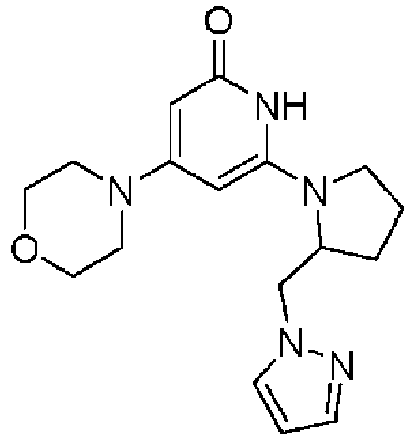
10 
11 
12 
13 
14 
15 
16 
17 
18 
19 
20 
21 
22 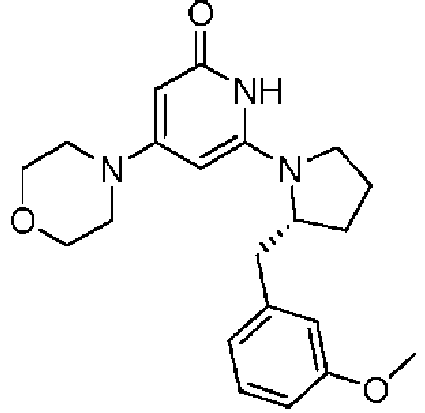
23 
24 
25 
26 
27 
28 
29 
30 
31 
32 
33 
34 
35 
36 
37 
38 
39 
40 
41 
42 
43 
44 
45 
46 
47 
48 
49 
50 
51 
52 
53 
54 
55 
56 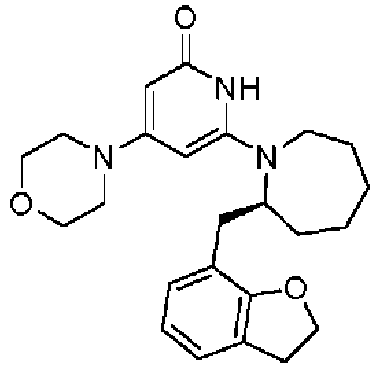
57 
58 
59 
60 
61 
62 
63 
64 
65 
66 
67 
68 
69 
70 
71 
72 
73 
74 
75 
76 
77 
78 
79 
80 
81 
82 
83 
84 
85 
86 
87 
88 
89 
90 
91 
92 
93 
94 
95 
96 
97 
98 
99 
100 
101 
102 
103 
104 
105 
106 
107 
108 
109 
110 
111 
112 
113 
114 
115 
116 
117 
118 
119 
120 
121 
122 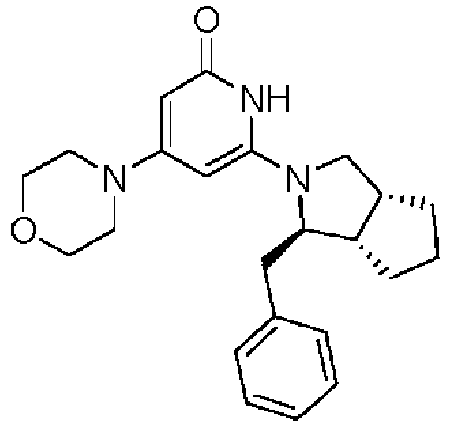
123 
124 
125 
126 
127 
128 
129 
130 
131 
132 
133 
134 
135 
136 
137 
138 
139 
140 
141 
142 
143 
144 
145 
146 
147 
148 
149 
150 
151 
152 
153 
154 
155 
156 
157 
158 
159 
160 
161 
162 
163 
164 
165 
166 
167 
168 
171 
172 
173 
174 
175 
176 
177 
178 
179 
180 
181 
182 
183 
184 
185 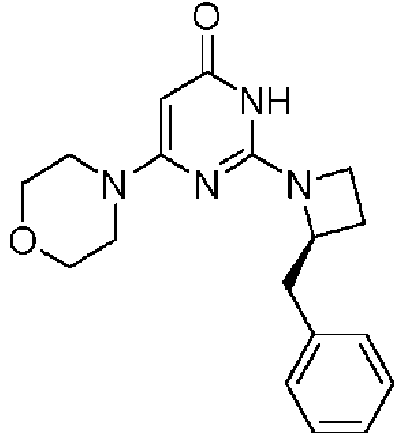
186 
187 
188 
189 
190 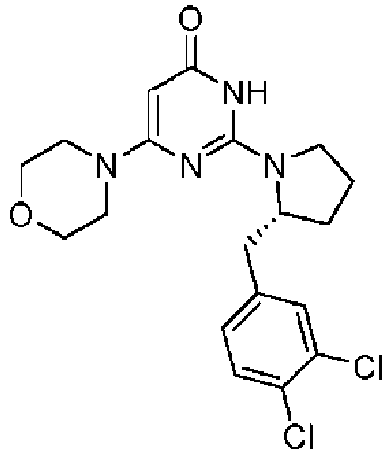
191 
192 
193 
194 
195 
196 
197 
198 
199 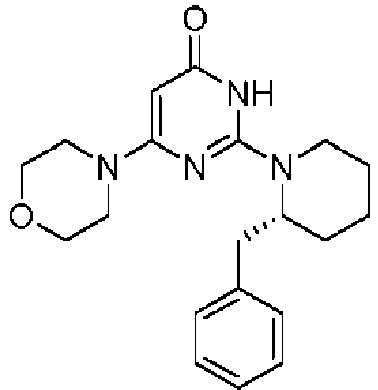
200 
201 
202 
203 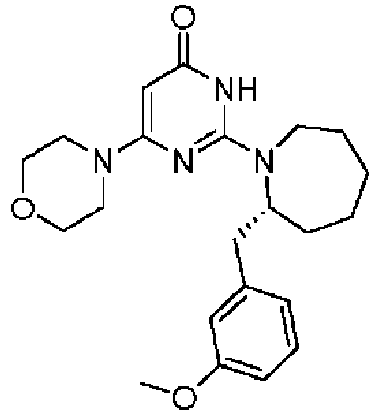
204 
205 
206 
207 
208 
209 
210 
211 
212 
213 
214 
215 
216 
217 
218 
219 
220 
221 
222 
223 
224 
225 
226 
227 
228 
229 
230 
231 
232 
233 
234 
235 
236 
237 
238 
239 
240 
241 
242 
243 
244 
245 
246 
247 
248 
249 
250 
251 
252 
253 
254 
255 
256 
257 
258 
259 
260 
261 
262 
263 
264 
265 
266 
267 
268 
269 
270 
271 
272 
273 
274 
275 
276 
277 
278 
279 
280 
281 
282 
283 
284 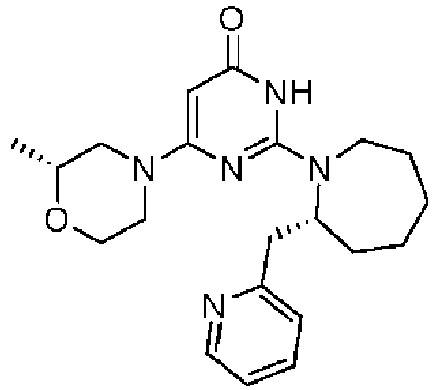
285 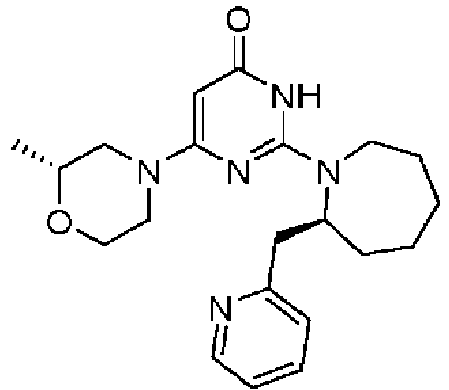
286 
287 
288 
289 
290 
291 
292 
293 
294 
295 
296 
297 
298 
299 
300 
301 
302 
303 
304 
305 
306 
307 
308 
309 
310 
311 
312 
313 
314 
315 
316 
317 
318 
319 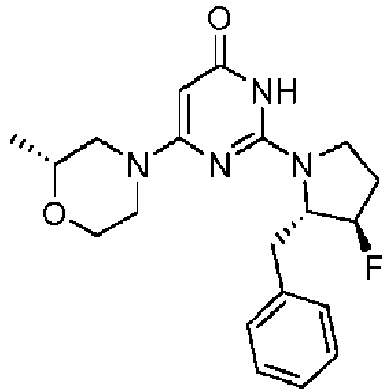
320 
321 
322 
323 
324 
325 
326 
327 
Stereoisomer 2 328 
Stereoisomer 3 329 
Enantiomerengemisch 1 & 2 330 
Enantiomerengemisch 3 & 4 331 
332 
333 
Stereoisomer 1 334 
Stereoisomer 2 335 
Stereoisomer 3 336 
Stereoisomer 4 337 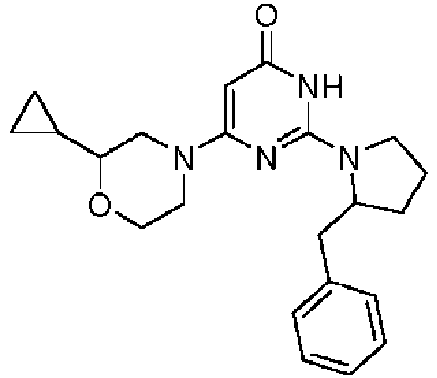
Stereoisomer 1 338 
Stereoisomer 2 339 
Stereoisomer 1 340 
Stereoisomer 2 341 
Stereoisomer 3 342 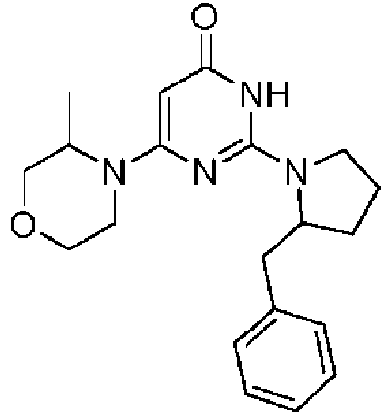
Stereoisomer 4 343 
344 
345 
346 
347 
348 
349 
350 
351 
352 
Stereoisomer 1 353 
Stereoisomer 2 354 
Stereoisomer 3 355 
Stereoisomer 4 und 356 
- Verbindung, ausgewählt aus:
169 
170 und 
- Pharmazeutische Zusammensetzung, umfassend eine Verbindung nach einem der vorhergehenden Ansprüche oder ein pharmazeutisch unbedenkliches Salz davon und einen pharmazeutisch unbedenklichen Träger.
- Verbindung nach einem der Ansprüche 1-12 oder pharmazeutische Zusammensetzung nach Anspruch 13 zur Verwendung bei einem Verfahren zur Behandlung eines Leidens oder einer Störung, das bzw. die durch eine ATM-Kinase vermittelt wird, bei einem Patienten, bei dem diesbezüglicher Bedarf besteht, umfassend das Verabreichen einer therapeutisch wirksamen Menge der Verbindung nach einem der Ansprüche 1-12 oder der pharmazeutischen Zusammensetzung nach Anspruch 13 an den Patienten.
- Verbindung oder pharmazeutische Zusammensetzung zur Verwendung nach Anspruch 14, wobei es sich bei dem Leiden bzw. der Störung um Chorea Huntington, Alzheimer-Krankheit, Parkinson-Krankheit, NIID (Neuronal Intranuclear Inclusion Disease), DRPLA (Dentatorubral Pallidolusyian Atrophy), Friedreich-Ataxie, Rubenstein-Taubi-Syndrom, eine Polyglutamin-Krankheit wie Chorea Huntington; spinozerebelläre Ataxie 1 (Spinocerebellar Ataxia 1, SCA 1), spinozerebelläre Ataxie 7 (Spinocerebellar Ataxia 7,SCA 7), Anfälle, striatonigrale Degeneration, progressive supranukleäre Lähmung, Torsionsdystonie, Torticollis spasmodicus, Dyskinesie, familiären Tremor, Gilles-de-la-Tourette-Syndrom, diffuse Lewy-Körperchen-Erkrankung, progressive supranukleäre Lähmung, Pick-Krankheit, primäre Lateralsklerose, progressive neurale Muskelathrophie, spinale Muskelathrophie, hypertrophe interstitielle Polyneuropathie, Retinitis pigmentosa, hereditäre Optikusatrophie, hereditäre spastische Paraplegie, Shy-Drager-Syndrom, Kennedy-Krankheit, proteinaggregationsbedingte Neurodegeneration, Machado-Joseph-Krankheit, spongiforme Enzephalopathie, eine prionenbedingte Erkrankung, multiple Sklerose (MS), progressive supranukleäre Lähmung (Steel-Richardson-Olszewski-Krankheit), Hallervorden-Spatz-Krankheit, progressive familiäre myoklonische Epilepsie, zerebelläre Degeneration, Motoneuronenerkrankung, Werdnig-Hoffman-Krankheit, Wohlfart-Kugelberg-Welander-Krankheit, Charcot-Marie-Tooth-Krankheit, Dejerine-Sottas-Krankheit, Retinitis pigmentosa, Morbus Leber, progressive systemische Sklerose, Dermatomyositis oder gemischte Bindegewebserkrankung handelt;gegebenenfalls wobei es sich bei dem Leiden bzw. der Störung um Chorea Huntington handelt;oder gegebenenfalls wobei es sich bei dem Leiden bzw. der Störung um Krebs handelt.
Applications Claiming Priority (2)
| Application Number | Priority Date | Filing Date | Title |
|---|---|---|---|
| US201962943694P | 2019-12-04 | 2019-12-04 | |
| PCT/US2020/063103 WO2021113506A1 (en) | 2019-12-04 | 2020-12-03 | Atm kinase inhibitors and compositions and methods of use thereof |
Publications (3)
| Publication Number | Publication Date |
|---|---|
| EP4069366A1 EP4069366A1 (de) | 2022-10-12 |
| EP4069366B1 true EP4069366B1 (de) | 2025-03-19 |
| EP4069366C0 EP4069366C0 (de) | 2025-03-19 |
Family
ID=73854981
Family Applications (1)
| Application Number | Title | Priority Date | Filing Date |
|---|---|---|---|
| EP20825389.8A Active EP4069366B1 (de) | 2019-12-04 | 2020-12-03 | Atm-kinasehemmer sowie zusammensetzungen und verfahren zur verwendung davon |
Country Status (6)
| Country | Link |
|---|---|
| US (1) | US11685734B2 (de) |
| EP (1) | EP4069366B1 (de) |
| JP (1) | JP7727627B2 (de) |
| AU (1) | AU2020398215A1 (de) |
| ES (1) | ES3023544T3 (de) |
| WO (1) | WO2021113506A1 (de) |
Families Citing this family (3)
| Publication number | Priority date | Publication date | Assignee | Title |
|---|---|---|---|---|
| GB202114704D0 (en) * | 2021-10-14 | 2021-12-01 | Univ Birmingham | ATM inhibition |
| CN116396201A (zh) * | 2023-04-17 | 2023-07-07 | 南京优氟医药科技有限公司 | 一种(2r,4r)-4-氟代吡咯烷-2-羧酸的制备方法 |
| CN116496195A (zh) * | 2023-05-10 | 2023-07-28 | 南京优氟医药科技有限公司 | 一种(r)-4,4-二氟代吡咯烷-2-羧酸的制备方法 |
Family Cites Families (10)
| Publication number | Priority date | Publication date | Assignee | Title |
|---|---|---|---|---|
| TW200813015A (en) * | 2006-03-15 | 2008-03-16 | Mitsubishi Pharma Corp | 2-(cyclic amino)-pyrimidone derivatives |
| US20100130496A1 (en) | 2007-04-12 | 2010-05-27 | F. Hoffmann-La Roche Ag | Pyrimidine derivatives as inhibitors of phosphatidylinositol-3-kinase |
| GB201004200D0 (en) * | 2010-03-15 | 2010-04-28 | Univ Basel | Spirocyclic compounds and their use as therapeutic agents and diagnostic probes |
| JP6074043B2 (ja) * | 2013-08-29 | 2017-02-01 | 富士フイルム株式会社 | 新規なモルホリン誘導体またはその塩 |
| PL3277681T3 (pl) * | 2015-04-02 | 2019-10-31 | Merck Patent Gmbh | Imidazolonylochinoliny i ich zastosowanie jako inhibitorów kinazy atm |
| PT3416957T (pt) | 2016-02-19 | 2020-09-25 | Sprint Bioscience Ab | Compostos 6-heterociclil-4-morfolin-4-ilpiridin-2-ona úteis para o tratamento do cancro e da diabetes |
| WO2017162611A1 (en) * | 2016-03-21 | 2017-09-28 | Astrazeneca Ab | Quinoline-3-carboxamide compounds and their use in treating cancer |
| WO2018153365A1 (zh) * | 2017-02-27 | 2018-08-30 | 上海瑛派药业有限公司 | 取代的稠合杂芳三环化合物作为激酶抑制剂及其应用 |
| PL3672948T3 (pl) * | 2017-08-23 | 2022-12-05 | Sprint Bioscience Ab | Związki pirydynoamino-pirydonu i pirymidynoamino-pirydonu |
| JP7235338B2 (ja) * | 2017-09-08 | 2023-03-08 | ニューウェーブ・ファーマスーティカル・インコーポレイテッド | Atr阻害剤としての置換ピロロピリジン |
-
2020
- 2020-12-03 AU AU2020398215A patent/AU2020398215A1/en not_active Abandoned
- 2020-12-03 JP JP2022533352A patent/JP7727627B2/ja active Active
- 2020-12-03 WO PCT/US2020/063103 patent/WO2021113506A1/en not_active Ceased
- 2020-12-03 US US17/111,307 patent/US11685734B2/en active Active
- 2020-12-03 EP EP20825389.8A patent/EP4069366B1/de active Active
- 2020-12-03 ES ES20825389T patent/ES3023544T3/es active Active
Also Published As
| Publication number | Publication date |
|---|---|
| US20210188827A1 (en) | 2021-06-24 |
| ES3023544T3 (en) | 2025-06-02 |
| US11685734B2 (en) | 2023-06-27 |
| EP4069366A1 (de) | 2022-10-12 |
| EP4069366C0 (de) | 2025-03-19 |
| JP7727627B2 (ja) | 2025-08-21 |
| AU2020398215A1 (en) | 2022-06-16 |
| WO2021113506A1 (en) | 2021-06-10 |
| JP2023505485A (ja) | 2023-02-09 |
Similar Documents
| Publication | Publication Date | Title |
|---|---|---|
| AU2021264916B2 (en) | Degradation of Bruton's tyrosine kinase (BTK) by conjugation of BTK inhibitors with E3 ligase ligand and methods of use | |
| EP3573987B1 (de) | Tyrosinkinase derivate als rho-kinase inhibitoren | |
| EP2118112B1 (de) | 3-aminopyrrolo[3,4-c]pyrazol-5(1h,4h,6h)carbaldehydderivate als pkc-inhibitoren | |
| US9556178B2 (en) | Imidazotriazinecarbonitriles useful as kinase inhibitors | |
| US20250368649A1 (en) | Tetrahydropyridopyrimidine pan-kras inhibitors | |
| EP4549438A1 (de) | Fünfgliedrige und sechsgliedrige stickstoffhaltige verbindung und zwischenprodukt, herstellungsverfahren und verwendung davon | |
| EP3681885B1 (de) | Tetrahydroimidazo-chinolin-zusammensetzungen als cbp/p300-inhibitoren | |
| EP3548484B1 (de) | Bicyclische amidverbindungen und verfahren zur verwendung davon | |
| US20120108588A1 (en) | Novel 3-amido-pyrrolo[3,4-c]pyrazole-5(1h, 4h,6h) carbaldehyde derivatives | |
| AU2016200970A1 (en) | Imidazotriazinone compounds | |
| US20240342292A1 (en) | Compounds for the Degradation of EGFR Kinase | |
| EP3844159B1 (de) | Neuartige pyrrolidinylamidverbindungen zur behandlung von autoimmunerkrankungen | |
| EP3546458B1 (de) | ((pyridin-2-yl)-amino)pyrido[3,4-d]pyrimidin- und ((pyridazin-3-yl)-amino)pyrido[3,4-d]pyrimidin-derivate als cdk4/6 inhibitoren zur behandlung von z.b. rheumatoider arthritis, arteriosklerose, lungenfibrose, schlaganfall oder krebs | |
| US11685734B2 (en) | ATM kinase inhibitors and compositions and methods of use thereof | |
| KR20200030558A (ko) | 이환형 케톤 화합물 및 이의 사용 방법 | |
| JP7545979B2 (ja) | UDPグリコシルトランスフェラーゼ阻害剤としてのチエノ[3,2-b]ピリジン誘導体および使用の方法 | |
| EP4722207A1 (de) | Oxoisoindolinylsubstituiertes tetrahydropyrimidindionderivat und verwendung davon | |
| HK40082036A (en) | Atm kinase inhibitors and compositions and methods of use thereof | |
| HK40082036B (en) | Atm kinase inhibitors and compositions and methods of use thereof | |
| EP4727945A1 (de) | 3-[3-amino-6-(2-hydroxyphenyl)pyridazin-4-yl!-3,8-diazabicyclo[3.2.1 octan-derivate als smarca2-abbauende protacs zur behandlung von krebs | |
| EA050708B1 (ru) | Деградация тирозинкиназы брутона (btk) посредством конъюгации ингибиторов btk с лигандом лигазы е3 и способы применения | |
| HK40031697B (en) | Tetrahydro-imidazo quinoline compositions as cbp/p300 inhibitors | |
| HK40031697A (en) | Tetrahydro-imidazo quinoline compositions as cbp/p300 inhibitors |
Legal Events
| Date | Code | Title | Description |
|---|---|---|---|
| STAA | Information on the status of an ep patent application or granted ep patent |
Free format text: STATUS: UNKNOWN |
|
| STAA | Information on the status of an ep patent application or granted ep patent |
Free format text: STATUS: THE INTERNATIONAL PUBLICATION HAS BEEN MADE |
|
| PUAI | Public reference made under article 153(3) epc to a published international application that has entered the european phase |
Free format text: ORIGINAL CODE: 0009012 |
|
| STAA | Information on the status of an ep patent application or granted ep patent |
Free format text: STATUS: REQUEST FOR EXAMINATION WAS MADE |
|
| 17P | Request for examination filed |
Effective date: 20220704 |
|
| AK | Designated contracting states |
Kind code of ref document: A1 Designated state(s): AL AT BE BG CH CY CZ DE DK EE ES FI FR GB GR HR HU IE IS IT LI LT LU LV MC MK MT NL NO PL PT RO RS SE SI SK SM TR |
|
| DAV | Request for validation of the european patent (deleted) | ||
| DAX | Request for extension of the european patent (deleted) | ||
| REG | Reference to a national code |
Ref country code: HK Ref legal event code: DE Ref document number: 40082036 Country of ref document: HK |
|
| P01 | Opt-out of the competence of the unified patent court (upc) registered |
Effective date: 20230523 |
|
| STAA | Information on the status of an ep patent application or granted ep patent |
Free format text: STATUS: EXAMINATION IS IN PROGRESS |
|
| 17Q | First examination report despatched |
Effective date: 20230712 |
|
| GRAP | Despatch of communication of intention to grant a patent |
Free format text: ORIGINAL CODE: EPIDOSNIGR1 |
|
| STAA | Information on the status of an ep patent application or granted ep patent |
Free format text: STATUS: GRANT OF PATENT IS INTENDED |
|
| INTG | Intention to grant announced |
Effective date: 20240507 |
|
| GRAJ | Information related to disapproval of communication of intention to grant by the applicant or resumption of examination proceedings by the epo deleted |
Free format text: ORIGINAL CODE: EPIDOSDIGR1 |
|
| STAA | Information on the status of an ep patent application or granted ep patent |
Free format text: STATUS: EXAMINATION IS IN PROGRESS |
|
| INTC | Intention to grant announced (deleted) | ||
| GRAP | Despatch of communication of intention to grant a patent |
Free format text: ORIGINAL CODE: EPIDOSNIGR1 |
|
| STAA | Information on the status of an ep patent application or granted ep patent |
Free format text: STATUS: GRANT OF PATENT IS INTENDED |
|
| INTG | Intention to grant announced |
Effective date: 20241015 |
|
| GRAS | Grant fee paid |
Free format text: ORIGINAL CODE: EPIDOSNIGR3 |
|
| GRAA | (expected) grant |
Free format text: ORIGINAL CODE: 0009210 |
|
| STAA | Information on the status of an ep patent application or granted ep patent |
Free format text: STATUS: THE PATENT HAS BEEN GRANTED |
|
| AK | Designated contracting states |
Kind code of ref document: B1 Designated state(s): AL AT BE BG CH CY CZ DE DK EE ES FI FR GB GR HR HU IE IS IT LI LT LU LV MC MK MT NL NO PL PT RO RS SE SI SK SM TR |
|
| REG | Reference to a national code |
Ref country code: GB Ref legal event code: FG4D |
|
| REG | Reference to a national code |
Ref country code: CH Ref legal event code: EP |
|
| REG | Reference to a national code |
Ref country code: IE Ref legal event code: FG4D |
|
| REG | Reference to a national code |
Ref country code: DE Ref legal event code: R096 Ref document number: 602020048041 Country of ref document: DE |
|
| U01 | Request for unitary effect filed |
Effective date: 20250417 |
|
| P04 | Withdrawal of opt-out of the competence of the unified patent court (upc) registered |
Free format text: CASE NUMBER: APP_19293/2025 Effective date: 20250423 |
|
| U07 | Unitary effect registered |
Designated state(s): AT BE BG DE DK EE FI FR IT LT LU LV MT NL PT RO SE SI Effective date: 20250424 |
|
| REG | Reference to a national code |
Ref country code: ES Ref legal event code: FG2A Ref document number: 3023544 Country of ref document: ES Kind code of ref document: T3 Effective date: 20250602 |
|
| PG25 | Lapsed in a contracting state [announced via postgrant information from national office to epo] |
Ref country code: RS Free format text: LAPSE BECAUSE OF FAILURE TO SUBMIT A TRANSLATION OF THE DESCRIPTION OR TO PAY THE FEE WITHIN THE PRESCRIBED TIME-LIMIT Effective date: 20250619 |
|
| PG25 | Lapsed in a contracting state [announced via postgrant information from national office to epo] |
Ref country code: NO Free format text: LAPSE BECAUSE OF FAILURE TO SUBMIT A TRANSLATION OF THE DESCRIPTION OR TO PAY THE FEE WITHIN THE PRESCRIBED TIME-LIMIT Effective date: 20250619 |
|
| PG25 | Lapsed in a contracting state [announced via postgrant information from national office to epo] |
Ref country code: HR Free format text: LAPSE BECAUSE OF FAILURE TO SUBMIT A TRANSLATION OF THE DESCRIPTION OR TO PAY THE FEE WITHIN THE PRESCRIBED TIME-LIMIT Effective date: 20250319 |
|
| PG25 | Lapsed in a contracting state [announced via postgrant information from national office to epo] |
Ref country code: GR Free format text: LAPSE BECAUSE OF FAILURE TO SUBMIT A TRANSLATION OF THE DESCRIPTION OR TO PAY THE FEE WITHIN THE PRESCRIBED TIME-LIMIT Effective date: 20250620 |
|
| PG25 | Lapsed in a contracting state [announced via postgrant information from national office to epo] |
Ref country code: SM Free format text: LAPSE BECAUSE OF FAILURE TO SUBMIT A TRANSLATION OF THE DESCRIPTION OR TO PAY THE FEE WITHIN THE PRESCRIBED TIME-LIMIT Effective date: 20250319 |
|
| PG25 | Lapsed in a contracting state [announced via postgrant information from national office to epo] |
Ref country code: PL Free format text: LAPSE BECAUSE OF FAILURE TO SUBMIT A TRANSLATION OF THE DESCRIPTION OR TO PAY THE FEE WITHIN THE PRESCRIBED TIME-LIMIT Effective date: 20250319 |
|
| PG25 | Lapsed in a contracting state [announced via postgrant information from national office to epo] |
Ref country code: CZ Free format text: LAPSE BECAUSE OF FAILURE TO SUBMIT A TRANSLATION OF THE DESCRIPTION OR TO PAY THE FEE WITHIN THE PRESCRIBED TIME-LIMIT Effective date: 20250319 |
|
| PG25 | Lapsed in a contracting state [announced via postgrant information from national office to epo] |
Ref country code: SK Free format text: LAPSE BECAUSE OF FAILURE TO SUBMIT A TRANSLATION OF THE DESCRIPTION OR TO PAY THE FEE WITHIN THE PRESCRIBED TIME-LIMIT Effective date: 20250319 |
|
| PG25 | Lapsed in a contracting state [announced via postgrant information from national office to epo] |
Ref country code: IS Free format text: LAPSE BECAUSE OF FAILURE TO SUBMIT A TRANSLATION OF THE DESCRIPTION OR TO PAY THE FEE WITHIN THE PRESCRIBED TIME-LIMIT Effective date: 20250719 |
|
| PGFP | Annual fee paid to national office [announced via postgrant information from national office to epo] |
Ref country code: GB Payment date: 20251229 Year of fee payment: 6 |
|
| PLBE | No opposition filed within time limit |
Free format text: ORIGINAL CODE: 0009261 |
|
| STAA | Information on the status of an ep patent application or granted ep patent |
Free format text: STATUS: NO OPPOSITION FILED WITHIN TIME LIMIT |
|
| REG | Reference to a national code |
Ref country code: CH Ref legal event code: L10 Free format text: ST27 STATUS EVENT CODE: U-0-0-L10-L00 (AS PROVIDED BY THE NATIONAL OFFICE) Effective date: 20260128 |
|
| U20 | Renewal fee for the european patent with unitary effect paid |
Year of fee payment: 6 Effective date: 20251229 |
|
| 26N | No opposition filed |
Effective date: 20251222 |
|
| PGFP | Annual fee paid to national office [announced via postgrant information from national office to epo] |
Ref country code: ES Payment date: 20260102 Year of fee payment: 6 |
|
| PG25 | Lapsed in a contracting state [announced via postgrant information from national office to epo] |
Ref country code: MC Free format text: LAPSE BECAUSE OF FAILURE TO SUBMIT A TRANSLATION OF THE DESCRIPTION OR TO PAY THE FEE WITHIN THE PRESCRIBED TIME-LIMIT Effective date: 20250319 |
|
| REG | Reference to a national code |
Ref country code: CH Ref legal event code: H13 Free format text: ST27 STATUS EVENT CODE: U-0-0-H10-H13 (AS PROVIDED BY THE NATIONAL OFFICE) Effective date: 20260723 |