EP4066956A1 - Manufacturing equipment and manufacturing method for steel plate - Google Patents
Manufacturing equipment and manufacturing method for steel plate Download PDFInfo
- Publication number
- EP4066956A1 EP4066956A1 EP20893260.8A EP20893260A EP4066956A1 EP 4066956 A1 EP4066956 A1 EP 4066956A1 EP 20893260 A EP20893260 A EP 20893260A EP 4066956 A1 EP4066956 A1 EP 4066956A1
- Authority
- EP
- European Patent Office
- Prior art keywords
- steel plate
- flattening
- temperature
- cooling
- flattening device
- Prior art date
- Legal status (The legal status is an assumption and is not a legal conclusion. Google has not performed a legal analysis and makes no representation as to the accuracy of the status listed.)
- Pending
Links
Images
Classifications
-
- C—CHEMISTRY; METALLURGY
- C21—METALLURGY OF IRON
- C21D—MODIFYING THE PHYSICAL STRUCTURE OF FERROUS METALS; GENERAL DEVICES FOR HEAT TREATMENT OF FERROUS OR NON-FERROUS METALS OR ALLOYS; MAKING METAL MALLEABLE, e.g. BY DECARBURISATION OR TEMPERING
- C21D9/00—Heat treatment, e.g. annealing, hardening, quenching or tempering, adapted for particular articles; Furnaces therefor
- C21D9/0056—Furnaces through which the charge is moved in a horizontal straight path
-
- B—PERFORMING OPERATIONS; TRANSPORTING
- B21—MECHANICAL METAL-WORKING WITHOUT ESSENTIALLY REMOVING MATERIAL; PUNCHING METAL
- B21B—ROLLING OF METAL
- B21B1/00—Metal-rolling methods or mills for making semi-finished products of solid or profiled cross-section; Sequence of operations in milling trains; Layout of rolling-mill plant, e.g. grouping of stands; Succession of passes or of sectional pass alternations
- B21B1/22—Metal-rolling methods or mills for making semi-finished products of solid or profiled cross-section; Sequence of operations in milling trains; Layout of rolling-mill plant, e.g. grouping of stands; Succession of passes or of sectional pass alternations for rolling plates, strips, bands or sheets of indefinite length
-
- B—PERFORMING OPERATIONS; TRANSPORTING
- B21—MECHANICAL METAL-WORKING WITHOUT ESSENTIALLY REMOVING MATERIAL; PUNCHING METAL
- B21B—ROLLING OF METAL
- B21B45/00—Devices for surface or other treatment of work, specially combined with or arranged in, or specially adapted for use in connection with, metal-rolling mills
- B21B45/02—Devices for surface or other treatment of work, specially combined with or arranged in, or specially adapted for use in connection with, metal-rolling mills for lubricating, cooling, or cleaning
-
- B—PERFORMING OPERATIONS; TRANSPORTING
- B21—MECHANICAL METAL-WORKING WITHOUT ESSENTIALLY REMOVING MATERIAL; PUNCHING METAL
- B21D—WORKING OR PROCESSING OF SHEET METAL OR METAL TUBES, RODS OR PROFILES WITHOUT ESSENTIALLY REMOVING MATERIAL; PUNCHING METAL
- B21D1/00—Straightening, restoring form or removing local distortions of sheet metal or specific articles made therefrom; Stretching sheet metal combined with rolling
- B21D1/05—Stretching combined with rolling
-
- C—CHEMISTRY; METALLURGY
- C21—METALLURGY OF IRON
- C21D—MODIFYING THE PHYSICAL STRUCTURE OF FERROUS METALS; GENERAL DEVICES FOR HEAT TREATMENT OF FERROUS OR NON-FERROUS METALS OR ALLOYS; MAKING METAL MALLEABLE, e.g. BY DECARBURISATION OR TEMPERING
- C21D1/00—General methods or devices for heat treatment, e.g. annealing, hardening, quenching or tempering
- C21D1/18—Hardening; Quenching with or without subsequent tempering
- C21D1/19—Hardening; Quenching with or without subsequent tempering by interrupted quenching
-
- C—CHEMISTRY; METALLURGY
- C21—METALLURGY OF IRON
- C21D—MODIFYING THE PHYSICAL STRUCTURE OF FERROUS METALS; GENERAL DEVICES FOR HEAT TREATMENT OF FERROUS OR NON-FERROUS METALS OR ALLOYS; MAKING METAL MALLEABLE, e.g. BY DECARBURISATION OR TEMPERING
- C21D1/00—General methods or devices for heat treatment, e.g. annealing, hardening, quenching or tempering
- C21D1/26—Methods of annealing
- C21D1/28—Normalising
-
- C—CHEMISTRY; METALLURGY
- C21—METALLURGY OF IRON
- C21D—MODIFYING THE PHYSICAL STRUCTURE OF FERROUS METALS; GENERAL DEVICES FOR HEAT TREATMENT OF FERROUS OR NON-FERROUS METALS OR ALLOYS; MAKING METAL MALLEABLE, e.g. BY DECARBURISATION OR TEMPERING
- C21D1/00—General methods or devices for heat treatment, e.g. annealing, hardening, quenching or tempering
- C21D1/56—General methods or devices for heat treatment, e.g. annealing, hardening, quenching or tempering characterised by the quenching agents
- C21D1/60—Aqueous agents
-
- C—CHEMISTRY; METALLURGY
- C21—METALLURGY OF IRON
- C21D—MODIFYING THE PHYSICAL STRUCTURE OF FERROUS METALS; GENERAL DEVICES FOR HEAT TREATMENT OF FERROUS OR NON-FERROUS METALS OR ALLOYS; MAKING METAL MALLEABLE, e.g. BY DECARBURISATION OR TEMPERING
- C21D1/00—General methods or devices for heat treatment, e.g. annealing, hardening, quenching or tempering
- C21D1/62—Quenching devices
- C21D1/63—Quenching devices for bath quenching
-
- C—CHEMISTRY; METALLURGY
- C21—METALLURGY OF IRON
- C21D—MODIFYING THE PHYSICAL STRUCTURE OF FERROUS METALS; GENERAL DEVICES FOR HEAT TREATMENT OF FERROUS OR NON-FERROUS METALS OR ALLOYS; MAKING METAL MALLEABLE, e.g. BY DECARBURISATION OR TEMPERING
- C21D8/00—Modifying the physical properties of ferrous metals or ferrous alloys by deformation combined with, or followed by, heat treatment
- C21D8/02—Modifying the physical properties of ferrous metals or ferrous alloys by deformation combined with, or followed by, heat treatment during manufacturing of plates or strips
-
- C—CHEMISTRY; METALLURGY
- C21—METALLURGY OF IRON
- C21D—MODIFYING THE PHYSICAL STRUCTURE OF FERROUS METALS; GENERAL DEVICES FOR HEAT TREATMENT OF FERROUS OR NON-FERROUS METALS OR ALLOYS; MAKING METAL MALLEABLE, e.g. BY DECARBURISATION OR TEMPERING
- C21D8/00—Modifying the physical properties of ferrous metals or ferrous alloys by deformation combined with, or followed by, heat treatment
- C21D8/02—Modifying the physical properties of ferrous metals or ferrous alloys by deformation combined with, or followed by, heat treatment during manufacturing of plates or strips
- C21D8/0221—Modifying the physical properties of ferrous metals or ferrous alloys by deformation combined with, or followed by, heat treatment during manufacturing of plates or strips characterised by the working steps
- C21D8/0236—Cold rolling
-
- C—CHEMISTRY; METALLURGY
- C21—METALLURGY OF IRON
- C21D—MODIFYING THE PHYSICAL STRUCTURE OF FERROUS METALS; GENERAL DEVICES FOR HEAT TREATMENT OF FERROUS OR NON-FERROUS METALS OR ALLOYS; MAKING METAL MALLEABLE, e.g. BY DECARBURISATION OR TEMPERING
- C21D8/00—Modifying the physical properties of ferrous metals or ferrous alloys by deformation combined with, or followed by, heat treatment
- C21D8/02—Modifying the physical properties of ferrous metals or ferrous alloys by deformation combined with, or followed by, heat treatment during manufacturing of plates or strips
- C21D8/0221—Modifying the physical properties of ferrous metals or ferrous alloys by deformation combined with, or followed by, heat treatment during manufacturing of plates or strips characterised by the working steps
- C21D8/0242—Flattening; Dressing; Flexing
-
- C—CHEMISTRY; METALLURGY
- C21—METALLURGY OF IRON
- C21D—MODIFYING THE PHYSICAL STRUCTURE OF FERROUS METALS; GENERAL DEVICES FOR HEAT TREATMENT OF FERROUS OR NON-FERROUS METALS OR ALLOYS; MAKING METAL MALLEABLE, e.g. BY DECARBURISATION OR TEMPERING
- C21D8/00—Modifying the physical properties of ferrous metals or ferrous alloys by deformation combined with, or followed by, heat treatment
- C21D8/02—Modifying the physical properties of ferrous metals or ferrous alloys by deformation combined with, or followed by, heat treatment during manufacturing of plates or strips
- C21D8/0247—Modifying the physical properties of ferrous metals or ferrous alloys by deformation combined with, or followed by, heat treatment during manufacturing of plates or strips characterised by the heat treatment
-
- C—CHEMISTRY; METALLURGY
- C21—METALLURGY OF IRON
- C21D—MODIFYING THE PHYSICAL STRUCTURE OF FERROUS METALS; GENERAL DEVICES FOR HEAT TREATMENT OF FERROUS OR NON-FERROUS METALS OR ALLOYS; MAKING METAL MALLEABLE, e.g. BY DECARBURISATION OR TEMPERING
- C21D9/00—Heat treatment, e.g. annealing, hardening, quenching or tempering, adapted for particular articles; Furnaces therefor
- C21D9/0062—Heat-treating apparatus with a cooling or quenching zone
-
- C—CHEMISTRY; METALLURGY
- C21—METALLURGY OF IRON
- C21D—MODIFYING THE PHYSICAL STRUCTURE OF FERROUS METALS; GENERAL DEVICES FOR HEAT TREATMENT OF FERROUS OR NON-FERROUS METALS OR ALLOYS; MAKING METAL MALLEABLE, e.g. BY DECARBURISATION OR TEMPERING
- C21D9/00—Heat treatment, e.g. annealing, hardening, quenching or tempering, adapted for particular articles; Furnaces therefor
- C21D9/46—Heat treatment, e.g. annealing, hardening, quenching or tempering, adapted for particular articles; Furnaces therefor for sheet metals
-
- C—CHEMISTRY; METALLURGY
- C21—METALLURGY OF IRON
- C21D—MODIFYING THE PHYSICAL STRUCTURE OF FERROUS METALS; GENERAL DEVICES FOR HEAT TREATMENT OF FERROUS OR NON-FERROUS METALS OR ALLOYS; MAKING METAL MALLEABLE, e.g. BY DECARBURISATION OR TEMPERING
- C21D9/00—Heat treatment, e.g. annealing, hardening, quenching or tempering, adapted for particular articles; Furnaces therefor
- C21D9/52—Heat treatment, e.g. annealing, hardening, quenching or tempering, adapted for particular articles; Furnaces therefor for wires; for strips ; for rods of unlimited length
- C21D9/54—Furnaces for treating strips or wire
- C21D9/56—Continuous furnaces for strip or wire
-
- B—PERFORMING OPERATIONS; TRANSPORTING
- B21—MECHANICAL METAL-WORKING WITHOUT ESSENTIALLY REMOVING MATERIAL; PUNCHING METAL
- B21B—ROLLING OF METAL
- B21B1/00—Metal-rolling methods or mills for making semi-finished products of solid or profiled cross-section; Sequence of operations in milling trains; Layout of rolling-mill plant, e.g. grouping of stands; Succession of passes or of sectional pass alternations
- B21B1/22—Metal-rolling methods or mills for making semi-finished products of solid or profiled cross-section; Sequence of operations in milling trains; Layout of rolling-mill plant, e.g. grouping of stands; Succession of passes or of sectional pass alternations for rolling plates, strips, bands or sheets of indefinite length
- B21B2001/221—Metal-rolling methods or mills for making semi-finished products of solid or profiled cross-section; Sequence of operations in milling trains; Layout of rolling-mill plant, e.g. grouping of stands; Succession of passes or of sectional pass alternations for rolling plates, strips, bands or sheets of indefinite length by cold-rolling
-
- B—PERFORMING OPERATIONS; TRANSPORTING
- B21—MECHANICAL METAL-WORKING WITHOUT ESSENTIALLY REMOVING MATERIAL; PUNCHING METAL
- B21D—WORKING OR PROCESSING OF SHEET METAL OR METAL TUBES, RODS OR PROFILES WITHOUT ESSENTIALLY REMOVING MATERIAL; PUNCHING METAL
- B21D1/00—Straightening, restoring form or removing local distortions of sheet metal or specific articles made therefrom; Stretching sheet metal combined with rolling
- B21D1/02—Straightening, restoring form or removing local distortions of sheet metal or specific articles made therefrom; Stretching sheet metal combined with rolling by rollers
Definitions
- the present invention relates to manufacturing equipment and a manufacturing method for a steel plate.
- cooling from a high temperature is often performed to adjust mechanical properties such as strength. Cooling is roughly divided into an online water cooling method and an offline water cooling method.
- the online water cooling method the steel plate after hot rolling is water-cooled by using a water cooling device connected online.
- the offline water cooling method the rolled material is once cooled to room temperature, and then heated and water-cooled again in a heat treatment furnace connected offline.
- the online water cooling method is advantageous, but since the steel plate is likely to warp or the like during rolling, it is not possible to dispose a cooling device near the rolling mill. As a result, since the temperature drops during transportation to the cooling device after rolling, there is a problem that water cooling cannot be performed at an appropriate temperature.
- the offline water cooling method is advantageous for adjusting the mechanical properties because the cooling device is disposed on the outlet side of the heating furnace and quenching can be performed from a temperature substantially equal to the heating temperature.
- a hot-rolled steel plate is likely to have temperature unevenness during cooling due to differences in the temperature distribution, shape, or surface condition of the steel plate immediately after rolling. Furthermore, the temperature unevenness of the steel plate may be caused by the performance of the cooling device. When the temperature unevenness of the steel plate occurs, deformation of the steel plate, residual stress, material variation, and the like occur after cooling.
- various cooling devices capable of uniform cooling have been developed. However, the method developed is only an improvement of the cooling device, and in particular, flattening of the steel plate after cooling is not completely achieved. Poor shape of the steel plate after cooling causes operational troubles such as a plate passage failure in the manufacturing line, and requires a precision treatment by a press or a flattening device in a subsequent step, resulting in high cost.
- temperature unevenness of the steel plate There are two types of temperature unevenness of the steel plate, one is due to the design of the cooling nozzle and the other is due to the shape of the steel plate during rolling. Depending on the design of a cooling nozzle, temperature deviation on the upper and lower surfaces and temperature non-uniformity in the width direction may occur. On the other hand, when the shape of the steel plate during rolling is poor, the cooling water does not flow evenly on the steel plate, and the cooling capacity changes depending on the location, resulting in temperature unevenness.
- PTLs 1 and 2 propose an online process of flattening with a first flattening device, accelerated cooling, and then final flattening with a second flattening device.
- a large effect cannot be obtained on the generation of temperature unevenness caused by the cooling nozzle and the cooling strain caused by the temperature unevenness, such as the temperature deviation on the upper and lower surfaces and the uniformity in the width direction described above.
- the offline heat treatment equipment in the related art is disposed in the order of a heating furnace, a quenching device, and a flattening device.
- the quenching device cools to 100°C or less, and even when the cooling uniformity is not ensured, the final cooling stop temperature of the steel plate is constant because it is cooled to a low temperature close to the water temperature of the cooling water. Therefore, the uniformity of cooling was not considered.
- cooling may be completed at a temperature higher than room temperature such as 100°C or higher. In that case, when the cooling is not uniform, since the temperature of the steel plate after cooling also varies, not only the predetermined quality cannot be ensured, but also the steel plate is distorted due to the difference in thermal expansion in the plane of the steel plate temperature.
- the present invention has been made in view of such circumstances, and it is an object of the present invention to provide manufacturing equipment and a manufacturing method for a steel plate capable of performing more uniform cooling during heat treatment of the steel plate and manufacturing a flat and homogeneous steel plate.
- manufacturing equipment for a steel plate in which the steel plate is heat-treated, the equipment including a heating furnace configured to heat the steel plate having a temperature of 100°C or lower, a first flattening device configured to flatten the heated steel plate, a quenching device configured to quench the flattened steel plate, and a second flattening device configured to flatten the quenched steel plate.
- a manufacturing method for a steel plate in which the steel plate is heat-treated, the method including a heating step of heating the steel plate having a temperature of 100°C or lower, a first flattening step of flattening the steel plate after the heating, a quenching step of quenching the steel plate after the first flattening step, and a second flattening step of flattening the steel plate after the quenching.
- manufacturing equipment and a manufacturing method for a steel plate capable of performing more uniform cooling during heat treatment of the steel plate and manufacturing a flat and homogeneous steel plate.
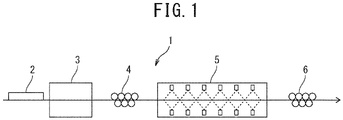
- FIG. 1 illustrates a schematic configuration of heat treatment equipment 1 for a steel plate 2, which is manufacturing equipment for a steel plate according to an embodiment of the present invention
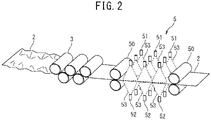
- FIG. 2 illustrates a detailed configuration of each of a first flattening device 4 and a quenching device 5 in the present embodiment.
- the heat treatment equipment 1 is equipment for heat-treating the steel plate 2, and is provided with a heating furnace 3, the first flattening device 4, the quenching device 5, and a second flattening device 6.
- FIG. 1 illustrates a schematic configuration of heat treatment equipment 1 for a steel plate 2, which is manufacturing equipment for a steel plate according to an embodiment of the present invention
- FIG. 2 illustrates a detailed configuration of each of a first flattening device 4 and a quenching device 5 in the present embodiment.
- the main focus is on adjusting the mechanical properties of the material with offline heat treatment equipment that is not directly connected to a rolling line, and the heat treatment equipment 1 is not directly connected to the rolling line.
- the heat treatment equipment 1 is equipment for heat-tre
- the heating furnace 3, the first flattening device 4, the quenching device 5, and the second flattening device 6 are disposed in this order from the upstream side in the transport direction of the steel plate 2. Furthermore, a transport roller (not illustrated) for transporting the steel plate 2 is provided between each of the heating furnace 3, the first flattening device 4, the quenching device 5, and the second flattening device 6.
- the heating furnace 3 heats the steel plate 2 having a temperature of 100°C or lower after hot rolling to the austenite temperature range.
- the steel plate 2 has a plate thickness of 4.0 mm or more.
- the first flattening device 4 is a device for flattening the steel plate 2 heated in the heating furnace 3, and is provided between the heating furnace 3 and the quenching device 5.
- a reduction type skin pass flattening device or a repeatedly bending type roller leveler flattening device can be used.
- the temperature of the steel plate 2 drops from the time when the steel plate 2 is extracted from the heating furnace 3 to the time when the steel plate 2 reaches the first flattening device 4.
- the smaller the temperature drop the smaller the increase in the deformation resistance of the steel plate 2, and the shape can be flattened with a small flattening force. Therefore, it is preferable that the distance from the heating furnace 3 to the first flattening device 4 is 4 m or less.
- the first flattening device 4 is preferably small in size and has a small installation space to shorten the transport time from the heating furnace 3 to the quenching device 5.
- the first flattening device 4 it is preferable to use a flattening device having a lower load capacity than that of the second flattening device 6 to flatten the steel plate 2 having a relatively low deformation resistance during heat.
- the first flattening device 4 may have a load capacity of at least 500 tons, and preferably approximately 3000 tons.
- ton indicates metric ton.
- the quenching device 5 is a device for quenching the steel plate 2 shape-flattened by the first flattening device 4 by water cooling. As illustrated in FIG. 2 , the quenching device 5 includes an upper cooling nozzle 51 and a lower cooling nozzle 52 as a device for rapidly cooling the steel plate 2 after flattening. A plurality of upper cooling nozzles 51 and a plurality of lower cooling nozzles 52 are provided in the width direction of the steel plate 2 in pairs in the vertical direction with respect to the transport line, and are arranged at a plurality of locations side by side at a predetermined pitch along the transport direction of the steel plate 2.
- Cooling water 53 is sprayed toward the steel plate 2 from each of the cooling nozzles of the upper cooling nozzles 51 and the lower cooling nozzles 52.
- each of restraint rolls 50 may be installed before and after the upper cooling nozzle 51 and the lower cooling nozzle 52.
- the second flattening device 6 is a device for flattening the steel plate 2 quenched by the quenching device 5, and is provided on the outlet side of the quenching device 5 (downstream side in the transport direction of the steel plate 2).
- a reduction type skin pass flattening device As the second flattening device 6, a reduction type skin pass flattening device, a repeatedly bending type roller leveler flattening device, or a press type flattening device can be used.
- the second flattening device 6 preferably has a high flattening reaction force in terms of performing flattening of the steel plate 2 near room temperature, and preferably has a load capacity of at least 2000 tons.
- a steel plate 2 having a predetermined thickness (for example, 30 mm) and width (for example, 2000 mm) is manufactured by hot rolling using a slab or the like as a material in a hot rolling line (not illustrated) different from the heat treatment equipment 1.
- a hot rolling line (not illustrated) different from the heat treatment equipment 1.
- the hot-rolled steel plate 2 is cooled to room temperature, and then the scale is removed by a surface scale removing device (not illustrated).
- the steel plate 2 from which the scale is removed is charged into the heating furnace 3 and heated to an austenite temperature range (for example, approximately 910°C) (heating step).
- an austenite temperature range for example, approximately 910°C
- the steel plate 2 is extracted from the heating furnace 3, is transported to the first flattening device 4 by a plurality of table rolls (not illustrated) installed on the outlet side of the heating furnace 3, and is flattened by the first flattening device 4 (first flattening step).
- the reason for installing the first flattening device 4 in front of the quenching device 5 (on the upstream side in the transport direction of the steel plate 2) will be described below.
- the steel plate 2 is hot-rolled in advance to a predetermined thickness and width on a hot rolling line different from the heat treatment equipment 1.
- a shape defect occurs after cooling.
- the heat treatment equipment 1 since the steel plate 2 is inserted into the heating furnace 3 with the shape defect occurring, the shape defect remains even when the steel plate 2 is uniformly heated in the heating furnace 3.
- the first flattening device 4 is preferably a roller leveler flattening device capable of repeated bending than a skin pass flattening device having a low flattening ability for the warp in the longitudinal direction generated at the tip tail end portion of the steel plate 2.
- the roller leveler flattening device is a flattening machine that repeatedly bends with a plurality of rolls (for example, four on the upper surface and three on the lower surface), and the flattening effect is relatively low at a distance corresponding to the roll pitch. Therefore, in a case where a roller leveler flattening device is used, it is more preferable to further provide a press type flattening mechanism or the like capable of correcting the warp of the tip tail end portion of the steel plate 2.
- the temperature of the steel plate 2 when flattening the shape by the first flattening device 4 is preferably in the range of the temperature Ar 3 temperature ⁇ 150°C at which the austenite of the steel plate 2 is transformed into ferrite.
- the yield stress of the steel plate 2 is sufficiently low, and the reaction force when flattening the shape can be reduced.
- the steel plate 2 is quenched by the quenching device 5 (quenching step).
- the steel plate 2 is flattened by the second flattening device 6 (second flattening step).
- second flattening step In quenching (cooling) by the quenching device 5, it is difficult to control the flow rates of the cooling water 53 ejected from the upper cooling nozzle 51 and the lower cooling nozzle 52 to be completely matched in the width direction. Therefore, there remains a risk of slight warpage due to temperature unevenness during quenching, and thus it is necessary to further flatten the steel plate 2 with the second flattening device 6.
- the temperature of the steel plate 2 is 100°C or lower when flattening by the second flattening device 6.
- the steel plate 2 has a plate thickness of 4.0 mm or more, and the present invention is not limited to this example.
- the steel plate may have a plate thickness of less than 4.0 mm.
- the present invention is suitable for a steel plate having a plate thickness of 4.0 mm or more, and is more suitable for a steel plate having a plate thickness of 6.0 mm or more.
- Manufacturing equipment (heat treatment equipment 1) for a steel plate is manufacturing equipment for a steel plate, in which the steel plate is heat-treated, and includes the heating furnace 3 configured to heat the steel plate having a temperature of 100°C or lower, the first flattening device 4 configured to flatten the heated steel plate, the quenching device 5 configured to quench the flattened steel plate, and the second flattening device 6 configured to flatten the quenched steel plate.
- the steel plate by flattening the steel plate with the first flattening device 4, cooling when quenching can be made uniform. Therefore, the steel plate can be made flat and homogeneous. In addition, by flattening the steel plate with the second flattening device 6 after quenching, the finally manufactured steel plate can be flattened even in a case where the cooling of the quenching device 5 is uneven.
- the load capacity of the first flattening device 4 is lower than the load capacity of the second flattening device 6.
- the load capacity can be optimized according to the difference in deformation resistance due to the difference in the temperature of the steel plate, and since the first flattening device 4 does not use a flattening device with a high load capacity, the initial equipment introduction cost is low.
- the temperature of the steel plate is in the range of Ar 3 temperature ⁇ 150°C when the steel plate is flattened by the first flattening device 4.
- the yield stress of the steel plate is sufficiently low, and the reaction force when flattening the shape can be reduced.
- a temperature of the steel plate is 100°C or lower when the steel plate is flattened by the second flattening device 6.
- the flattening temperature is substantially room temperature, and after flattening, re-deformation due to heat shrinkage due to a further temperature drop does not occur, a good shape can be obtained.
- the first flattening device 4 and the second flattening device 6 are roller leveler flattening devices.
- the quenching device quenches the steel plate by water cooling.
- a method for manufacturing a steel plate according to another aspect of the present invention is a manufacturing method for a steel plate, in which the steel plate is heat-treated, and includes a heating step of heating the steel plate 2 having a temperature of 100°C or lower, a first flattening step of flattening the steel plate after the heating, a quenching step of quenching the steel plate after the first flattening step, and a second flattening step of flattening the steel plate after the quenching.
- a temperature of the steel plate when flattening is in the range of Ar 3 temperature ⁇ 150°C.
- a temperature of the steel plate is 100°C or lower.
- a steel plate 2 (plate thickness 6 mm, 12 mm, 25 mm, 40 mm x plate width 3500 mm x plate length 7 m) in a room temperature state from which scale was removed by shot blasting in advance was heated in the heating furnace 3 to 900°C in a nitrogen atmosphere.
- the heated steel plate 2 was extracted, the steel plate 2 was flattened by the first flattening device 4 (roller leveler type), and quenched to 100°C or lower by the quenching device 5.
- the quenched steel plate 2 was shape-flattened again by the second flattening device 6.
- the quenching device 5 used a spray nozzle as the cooling nozzles 51 and 52.
- the temperature of Ar 3 of this material was 800°C, and the temperature of the steel plate 2 when extracted from the heating furnace 3 and flattened by the first flattening device 4 was approximately 860°C.
- the shape of the steel plate when the heat treatment of the steel plate 2 was performed with the above equipment arrangement was investigated.
- the results were as illustrated in Examples 1 to 4 in Table 1.
- the allowable value of the amount of warpage of the steel plate 2 is 5 mm or less.
- the amount of warpage was 5 mm or less, and the shape was good (evaluation: o).
- the heat treatment was performed under the condition that neither the first flattening device 4 nor the second flattening device 6 was used (Comparative Examples 1 to 4), the condition that only the second flattening device 6 was used for flattening without using the first flattening device 4 (Comparative Examples 5 to 8), and the condition that only the first flattening device 4 was used for flattening without using the second flattening device 6 (Comparative Examples 9 to 12).
- the shape of the steel plate for the heat-treated steel plate 2 was investigated in the same manner as in the examples. Except for the above conditions, the heat treatment was performed under the same conditions as in the examples.
Landscapes
- Chemical & Material Sciences (AREA)
- Engineering & Computer Science (AREA)
- Mechanical Engineering (AREA)
- Physics & Mathematics (AREA)
- Thermal Sciences (AREA)
- Crystallography & Structural Chemistry (AREA)
- Materials Engineering (AREA)
- Metallurgy (AREA)
- Organic Chemistry (AREA)
- Straightening Metal Sheet-Like Bodies (AREA)
- Heat Treatment Of Strip Materials And Filament Materials (AREA)
- Metal Rolling (AREA)
Abstract
Description
- The present invention relates to manufacturing equipment and a manufacturing method for a steel plate.
- In manufacturing a steel plate, cooling from a high temperature is often performed to adjust mechanical properties such as strength. Cooling is roughly divided into an online water cooling method and an offline water cooling method. In the online water cooling method, the steel plate after hot rolling is water-cooled by using a water cooling device connected online. In the offline water cooling method, the rolled material is once cooled to room temperature, and then heated and water-cooled again in a heat treatment furnace connected offline. In terms of energy cost, the online water cooling method is advantageous, but since the steel plate is likely to warp or the like during rolling, it is not possible to dispose a cooling device near the rolling mill. As a result, since the temperature drops during transportation to the cooling device after rolling, there is a problem that water cooling cannot be performed at an appropriate temperature.
- On the other hand, the offline water cooling method is advantageous for adjusting the mechanical properties because the cooling device is disposed on the outlet side of the heating furnace and quenching can be performed from a temperature substantially equal to the heating temperature.
- In general, a hot-rolled steel plate is likely to have temperature unevenness during cooling due to differences in the temperature distribution, shape, or surface condition of the steel plate immediately after rolling. Furthermore, the temperature unevenness of the steel plate may be caused by the performance of the cooling device. When the temperature unevenness of the steel plate occurs, deformation of the steel plate, residual stress, material variation, and the like occur after cooling. As a countermeasure, various cooling devices capable of uniform cooling have been developed. However, the method developed is only an improvement of the cooling device, and in particular, flattening of the steel plate after cooling is not completely achieved. Poor shape of the steel plate after cooling causes operational troubles such as a plate passage failure in the manufacturing line, and requires a precision treatment by a press or a flattening device in a subsequent step, resulting in high cost.
- There are two types of temperature unevenness of the steel plate, one is due to the design of the cooling nozzle and the other is due to the shape of the steel plate during rolling. Depending on the design of a cooling nozzle, temperature deviation on the upper and lower surfaces and temperature non-uniformity in the width direction may occur. On the other hand, when the shape of the steel plate during rolling is poor, the cooling water does not flow evenly on the steel plate, and the cooling capacity changes depending on the location, resulting in temperature unevenness.
- Here, many technologies are known as a method for suppressing temperature unevenness caused by a cooling nozzle such as temperature deviation on the upper and lower surfaces and uniformity in the width direction. On the other hand, there are not so many technologies for suppressing the temperature unevenness generated from the shape defect generated during rolling, and as a corresponding technology, a method of performing flattening in front of an accelerated cooling device to flatten the shape and ensure uniformity during cooling (PTLs 1 and 2) is known. In
PTLs 1 and 2, it is an object of a first flattening device to flatten the shape of a steel plate to such an extent that draining can be sufficiently performed by a draining roll in a cooling device. -
- PTL 1:
JP 2002-11515 A - PTL 2:
JP 2005-74480 A - Incidentally, in recent years, an increasing number of manufacturing lines are actually operating technologies such as those described in
PTLs 1 and 2 in which an online flattening device is installed in front of a cooling device. However, in the first place, in hot rolling, the temperature deviation is large in principle due to descaling during rolling and water cooling for temperature adjustment, and the temperature deviation generated in the plate surface is a difference in the heat shrinkage amount. Therefore, even when the shape is flattened in hot rolling, there is a problem that the shape is deformed again when the temperature drops. - Furthermore,
PTLs 1 and 2 propose an online process of flattening with a first flattening device, accelerated cooling, and then final flattening with a second flattening device. However, no matter which technology is used alone, a large effect cannot be obtained on the generation of temperature unevenness caused by the cooling nozzle and the cooling strain caused by the temperature unevenness, such as the temperature deviation on the upper and lower surfaces and the uniformity in the width direction described above. - The offline heat treatment equipment in the related art is disposed in the order of a heating furnace, a quenching device, and a flattening device. The quenching device cools to 100°C or less, and even when the cooling uniformity is not ensured, the final cooling stop temperature of the steel plate is constant because it is cooled to a low temperature close to the water temperature of the cooling water. Therefore, the uniformity of cooling was not considered. In recent years, there is an increasing need to reduce the variation in cooling rate within the plate surface during quenching from the viewpoint of quality improvement, and it is important to perform uniform cooling by offline heat treatment that can ensure temperature uniformity before quenching. Furthermore, even in the offline heat treatment, cooling may be completed at a temperature higher than room temperature such as 100°C or higher. In that case, when the cooling is not uniform, since the temperature of the steel plate after cooling also varies, not only the predetermined quality cannot be ensured, but also the steel plate is distorted due to the difference in thermal expansion in the plane of the steel plate temperature.
- The present invention has been made in view of such circumstances, and it is an object of the present invention to provide manufacturing equipment and a manufacturing method for a steel plate capable of performing more uniform cooling during heat treatment of the steel plate and manufacturing a flat and homogeneous steel plate.
- According to an aspect of the present invention, there is provided manufacturing equipment for a steel plate, in which the steel plate is heat-treated, the equipment including a heating furnace configured to heat the steel plate having a temperature of 100°C or lower, a first flattening device configured to flatten the heated steel plate, a quenching device configured to quench the flattened steel plate, and a second flattening device configured to flatten the quenched steel plate.
- According to another aspect of the present invention, there is provided a manufacturing method for a steel plate, in which the steel plate is heat-treated, the method including a heating step of heating the steel plate having a temperature of 100°C or lower, a first flattening step of flattening the steel plate after the heating, a quenching step of quenching the steel plate after the first flattening step, and a second flattening step of flattening the steel plate after the quenching.
- According to an aspect of the present invention, there is provided manufacturing equipment and a manufacturing method for a steel plate capable of performing more uniform cooling during heat treatment of the steel plate and manufacturing a flat and homogeneous steel plate.
-
-
FIG. 1 is a schematic configuration diagram of heat treatment equipment which is manufacturing equipment for a steel plate according to an embodiment of the present invention; and -
FIG. 2 is a perspective view illustrating a detailed configuration of a first flattening device and a quenching device. - Hereinafter, an embodiment of the present invention will now be described with reference to the drawings. The embodiment illustrated below exemplifies a device and a method for embodying the technical idea of the present invention, and the technical idea of the present invention does not specify the material, shape, structure, arrangement, and the like of the component parts in the following embodiment. In addition, the drawings are schematic. Therefore, it is required to be noted that a relationship, ratio, and the like between a thickness and a plane dimension are different from the actual ones, and there are parts where the relationship and ratio of the dimensions are different between the drawings.
-
FIG. 1 illustrates a schematic configuration of heat treatment equipment 1 for asteel plate 2, which is manufacturing equipment for a steel plate according to an embodiment of the present invention, andFIG. 2 illustrates a detailed configuration of each of a firstflattening device 4 and aquenching device 5 in the present embodiment. In the present embodiment, to secure a uniform temperature and shape, the main focus is on adjusting the mechanical properties of the material with offline heat treatment equipment that is not directly connected to a rolling line, and the heat treatment equipment 1 is not directly connected to the rolling line. The heat treatment equipment 1 is equipment for heat-treating thesteel plate 2, and is provided with aheating furnace 3, thefirst flattening device 4, thequenching device 5, and a secondflattening device 6. In addition, as illustrated inFIG. 1 , in the heat treatment equipment 1, theheating furnace 3, thefirst flattening device 4, thequenching device 5, and thesecond flattening device 6 are disposed in this order from the upstream side in the transport direction of thesteel plate 2. Furthermore, a transport roller (not illustrated) for transporting thesteel plate 2 is provided between each of theheating furnace 3, thefirst flattening device 4, thequenching device 5, and thesecond flattening device 6. - The
heating furnace 3 heats thesteel plate 2 having a temperature of 100°C or lower after hot rolling to the austenite temperature range. Thesteel plate 2 has a plate thickness of 4.0 mm or more. - The
first flattening device 4 is a device for flattening thesteel plate 2 heated in theheating furnace 3, and is provided between theheating furnace 3 and thequenching device 5. As thefirst flattening device 4, a reduction type skin pass flattening device or a repeatedly bending type roller leveler flattening device can be used. In addition, for the reason described later, it is preferable to use the roller leveler flattening device for thefirst flattening device 4. Furthermore, for the reason described later, in a case where the roller leveler flattening device is used, it is more preferable to further provide a press type flattening mechanism or the like capable of correcting the warp of a tip tail end portion of thesteel plate 2. - Here, the temperature of the
steel plate 2 drops from the time when thesteel plate 2 is extracted from theheating furnace 3 to the time when thesteel plate 2 reaches thefirst flattening device 4. The smaller the temperature drop, the smaller the increase in the deformation resistance of thesteel plate 2, and the shape can be flattened with a small flattening force. Therefore, it is preferable that the distance from theheating furnace 3 to thefirst flattening device 4 is 4 m or less. Furthermore, thefirst flattening device 4 is preferably small in size and has a small installation space to shorten the transport time from theheating furnace 3 to thequenching device 5. In addition, in thefirst flattening device 4, it is preferable to use a flattening device having a lower load capacity than that of thesecond flattening device 6 to flatten thesteel plate 2 having a relatively low deformation resistance during heat. Thefirst flattening device 4 may have a load capacity of at least 500 tons, and preferably approximately 3000 tons. In the present embodiment, ton indicates metric ton. - The
quenching device 5 is a device for quenching thesteel plate 2 shape-flattened by thefirst flattening device 4 by water cooling. As illustrated inFIG. 2 , thequenching device 5 includes anupper cooling nozzle 51 and alower cooling nozzle 52 as a device for rapidly cooling thesteel plate 2 after flattening. A plurality ofupper cooling nozzles 51 and a plurality oflower cooling nozzles 52 are provided in the width direction of thesteel plate 2 in pairs in the vertical direction with respect to the transport line, and are arranged at a plurality of locations side by side at a predetermined pitch along the transport direction of thesteel plate 2. Coolingwater 53 is sprayed toward thesteel plate 2 from each of the cooling nozzles of theupper cooling nozzles 51 and thelower cooling nozzles 52. In addition, in thequenching device 5, each of restraint rolls 50 may be installed before and after theupper cooling nozzle 51 and thelower cooling nozzle 52. By providing therestraint roll 50, even when thesteel plate 2 is distorted due to cooling unevenness or the like, since thesteel plate 2 can be restrained to some extent, out-of-plane deformation can be prevented. - The
second flattening device 6 is a device for flattening thesteel plate 2 quenched by thequenching device 5, and is provided on the outlet side of the quenching device 5 (downstream side in the transport direction of the steel plate 2). As thesecond flattening device 6, a reduction type skin pass flattening device, a repeatedly bending type roller leveler flattening device, or a press type flattening device can be used. In addition, for the same reason as thefirst flattening device 4, it is preferable to use a roller leveler flattening device for thesecond flattening device 6. Furthermore, for the same reason as that of thefirst flattening device 4, in a case where the roller leveler flattening device is used, it is more preferable to further provide a press type flattening mechanism or the like capable of correcting the warp of the tip tail end portion of thesteel plate 2. In addition, thesecond flattening device 6 preferably has a high flattening reaction force in terms of performing flattening of thesteel plate 2 near room temperature, and preferably has a load capacity of at least 2000 tons. - In the manufacturing method for a steel plate according to the present embodiment, first, a
steel plate 2 having a predetermined thickness (for example, 30 mm) and width (for example, 2000 mm) is manufactured by hot rolling using a slab or the like as a material in a hot rolling line (not illustrated) different from the heat treatment equipment 1. Next, the hot-rolledsteel plate 2 is cooled to room temperature, and then the scale is removed by a surface scale removing device (not illustrated). - Furthermore, the
steel plate 2 from which the scale is removed is charged into theheating furnace 3 and heated to an austenite temperature range (for example, approximately 910°C) (heating step). - Thereafter, the
steel plate 2 is extracted from theheating furnace 3, is transported to thefirst flattening device 4 by a plurality of table rolls (not illustrated) installed on the outlet side of theheating furnace 3, and is flattened by the first flattening device 4 (first flattening step). - Here, the reason for installing the
first flattening device 4 in front of the quenching device 5 (on the upstream side in the transport direction of the steel plate 2) will be described below. As described above, thesteel plate 2 is hot-rolled in advance to a predetermined thickness and width on a hot rolling line different from the heat treatment equipment 1. At this time, in a case where there is a temperature deviation in thesteel plate 2 during rolling, since the degree of heat shrinkage in the process of cooling to room temperature differs depending on the portion of thesteel plate 2, a shape defect occurs after cooling. In the heat treatment equipment 1, since thesteel plate 2 is inserted into theheating furnace 3 with the shape defect occurring, the shape defect remains even when thesteel plate 2 is uniformly heated in theheating furnace 3. Even when such asteel plate 2 is extracted from theheating furnace 3 and heat-treated by thequenching device 5, the shape defect does not disappear, but rather the way the cooling water is applied is not uniform, and thus non-uniformity in temperature is promoted. Therefore, after heating in theheating furnace 3 that guarantees uniform heating, by flattening thesteel plate 2 with thefirst flattening device 4 and cooling thesteel plate 2 with thequenching device 5, it is possible to manufacture thesteel plate 2 with high flatness. That is, it is necessary to flatten the shape (initial shape) of thesteel plate 2 before entering thequenching device 5 to obtain the effect of the present invention. - In addition, in a case where the tip end portion of the
steel plate 2 is warped, there is a risk that thesteel plate 2 collides with the nozzle or the like of thequenching device 5. Therefore, thefirst flattening device 4 is preferably a roller leveler flattening device capable of repeated bending than a skin pass flattening device having a low flattening ability for the warp in the longitudinal direction generated at the tip tail end portion of thesteel plate 2. The roller leveler flattening device is a flattening machine that repeatedly bends with a plurality of rolls (for example, four on the upper surface and three on the lower surface), and the flattening effect is relatively low at a distance corresponding to the roll pitch. Therefore, in a case where a roller leveler flattening device is used, it is more preferable to further provide a press type flattening mechanism or the like capable of correcting the warp of the tip tail end portion of thesteel plate 2. - Furthermore, the temperature of the
steel plate 2 when flattening the shape by thefirst flattening device 4 is preferably in the range of the temperature Ar3 temperature ± 150°C at which the austenite of thesteel plate 2 is transformed into ferrite. By setting such a temperature, the yield stress of thesteel plate 2 is sufficiently low, and the reaction force when flattening the shape can be reduced. - After the first flattening step, the
steel plate 2 is quenched by the quenching device 5 (quenching step). - After the quenching step, the
steel plate 2 is flattened by the second flattening device 6 (second flattening step). In quenching (cooling) by thequenching device 5, it is difficult to control the flow rates of the coolingwater 53 ejected from theupper cooling nozzle 51 and thelower cooling nozzle 52 to be completely matched in the width direction. Therefore, there remains a risk of slight warpage due to temperature unevenness during quenching, and thus it is necessary to further flatten thesteel plate 2 with thesecond flattening device 6. In addition, it is preferable that the temperature of thesteel plate 2 is 100°C or lower when flattening by thesecond flattening device 6. - Hereinbefore, the present invention is described with reference to a specific embodiment, but it is not intended to limit the invention by these descriptions. By reference to the description of the invention, other embodiments of the present invention including various modification examples are apparent to those skilled in the art as well as the disclosed embodiment. Therefore, it is required to be understood that the embodiment of the invention described in the claims also covers embodiments including these modification examples described in the present specification alone or in combination.
- For example, in the above embodiment, the
steel plate 2 has a plate thickness of 4.0 mm or more, and the present invention is not limited to this example. The steel plate may have a plate thickness of less than 4.0 mm. The present invention is suitable for a steel plate having a plate thickness of 4.0 mm or more, and is more suitable for a steel plate having a plate thickness of 6.0 mm or more. - (1) Manufacturing equipment (heat treatment equipment 1) for a steel plate according to an aspect of the present invention is manufacturing equipment for a steel plate, in which the steel plate is heat-treated, and includes the
heating furnace 3 configured to heat the steel plate having a temperature of 100°C or lower, thefirst flattening device 4 configured to flatten the heated steel plate, thequenching device 5 configured to quench the flattened steel plate, and thesecond flattening device 6 configured to flatten the quenched steel plate. - According to the above configuration of (1), by flattening the steel plate with the
first flattening device 4, cooling when quenching can be made uniform. Therefore, the steel plate can be made flat and homogeneous. In addition, by flattening the steel plate with thesecond flattening device 6 after quenching, the finally manufactured steel plate can be flattened even in a case where the cooling of thequenching device 5 is uneven. - (2) In the above configuration of (1), the load capacity of the
first flattening device 4 is lower than the load capacity of thesecond flattening device 6. - According to the above configuration of (2), the load capacity can be optimized according to the difference in deformation resistance due to the difference in the temperature of the steel plate, and since the
first flattening device 4 does not use a flattening device with a high load capacity, the initial equipment introduction cost is low. - (3) In the above configuration of (1) or (2), the temperature of the steel plate is in the range of Ar3 temperature ± 150°C when the steel plate is flattened by the
first flattening device 4. - According to the above configuration of (3), the yield stress of the steel plate is sufficiently low, and the reaction force when flattening the shape can be reduced.
- (4) In any one of the above configurations (1) to (3), a temperature of the steel plate is 100°C or lower when the steel plate is flattened by the
second flattening device 6. - According to the above configuration of (4), since the flattening temperature is substantially room temperature, and after flattening, re-deformation due to heat shrinkage due to a further temperature drop does not occur, a good shape can be obtained.
- (5) In any one of the above configurations (1) to (4), the
first flattening device 4 and thesecond flattening device 6 are roller leveler flattening devices. - According to the above configuration of (5), it is possible to flatten the warp at the tip tail end portion of the steel plate. Therefore, it is possible not only to suppress the warp of the steel plate itself, but also to prevent contact with equipment such as a cooling nozzle constituting the
quenching device 5 when quenching. - (6) In any one of the above configurations (1) to (5), the quenching device quenches the steel plate by water cooling.
- (7) A method for manufacturing a steel plate according to another aspect of the present invention is a manufacturing method for a steel plate, in which the steel plate is heat-treated, and includes a heating step of heating the
steel plate 2 having a temperature of 100°C or lower, a first flattening step of flattening the steel plate after the heating, a quenching step of quenching the steel plate after the first flattening step, and a second flattening step of flattening the steel plate after the quenching. - (8) In the above configuration of (7), in the first flattening step, a temperature of the steel plate when flattening is in the range of Ar3 temperature ± 150°C.
- (9) In the above configuration of (7) or (8), in the second flattening step, a temperature of the steel plate is 100°C or lower.
- According to the above configurations (7) to (9), the same effects as those of the above configurations (1), (3), and (4) can be obtained.
- The examples performed by the present inventors will be described. In the examples, in the heat treatment equipment 1 illustrated in
FIG. 1 , a steel plate 2 (plate thickness 6 mm, 12 mm, 25 mm, 40 mm x plate width 3500 mm x plate length 7 m) in a room temperature state from which scale was removed by shot blasting in advance was heated in theheating furnace 3 to 900°C in a nitrogen atmosphere. Next, theheated steel plate 2 was extracted, thesteel plate 2 was flattened by the first flattening device 4 (roller leveler type), and quenched to 100°C or lower by thequenching device 5. The quenchedsteel plate 2 was shape-flattened again by thesecond flattening device 6. Thequenching device 5 used a spray nozzle as the coolingnozzles steel plate 2 when extracted from theheating furnace 3 and flattened by thefirst flattening device 4 was approximately 860°C. - In the examples, the shape of the steel plate when the heat treatment of the
steel plate 2 was performed with the above equipment arrangement was investigated. In the investigation, when thesteel plate 2 was placed on the surface plate and the amount obtained by subtracting the plate thickness from the maximum height of thesteel plate 2 with respect to the surface plate surface (referred to as the amount of warpage) was measured, the results were as illustrated in Examples 1 to 4 in Table 1. The allowable value of the amount of warpage of thesteel plate 2 is 5 mm or less. For all thesteel plates 2 having a plate thickness of 6 mm, 12 mm, 25 mm, and 40 mm, the amount of warpage was 5 mm or less, and the shape was good (evaluation: o). - As comparative examples, the heat treatment was performed under the condition that neither the
first flattening device 4 nor thesecond flattening device 6 was used (Comparative Examples 1 to 4), the condition that only thesecond flattening device 6 was used for flattening without using the first flattening device 4 (Comparative Examples 5 to 8), and the condition that only thefirst flattening device 4 was used for flattening without using the second flattening device 6 (Comparative Examples 9 to 12). The shape of the steel plate for the heat-treatedsteel plate 2 was investigated in the same manner as in the examples. Except for the above conditions, the heat treatment was performed under the same conditions as in the examples. As illustrated in Table 1, in Comparative Examples 1 to 12, the amount of warpage was larger than 5 mm under any of the conditions, and sufficient flatness could not be obtained as a product (evaluation: ×).[Table 1] Plate thickness First flattening device Second flattening device Warpage height Evaluation mm mm Ex. 1 6 Used Used 4 ∘ Ex. 2 12 Used Used 5 ∘ Ex.3 24 Used Used 3 ∘ Ex.4 40 Used Used 4 ∘ Comp. Ex. 1 6 Not used Not used 25 × Comp. Ex. 2 12 Not used Not used 20 × Comp. Ex. 3 24 Not used Not used 18 × Comp. Ex. 4 40 Not used Not used 12 × Comp. Ex. 5 6 Not used Used 10 × Comp. Ex. 6 12 Not used Used 7 × Comp. Ex. 7 24 Not used Used 6 × Comp. Ex. 8 40 Not used Used 8 × Comp. Ex. 9 6 Used Not used 12 × Comp. Ex. 10 12 Used Not used 10 × Comp. Ex. 11 24 Used Not used 12 × Comp. Ex. 12 40 Used Not used 15 × -
- 1
- heat treatment equipment
- 2
- steel plate
- 3
- heating furnace
- 4
- first flattening device
- 5
- quenching device
- 50
- restraint roll
- 51
- upper cooling nozzle
- 52
- lower cooling nozzle
- 53
- cooling water
- 6
- second flattening device
Claims (9)
- Manufacturing equipment for a steel plate, in which the steel plate is heat-treated, the equipment comprising:a heating furnace configured to heat the steel plate having a temperature of 100°C or lower;a first flattening device configured to flatten the heated steel plate;a quenching device configured to quench the flattened steel plate; anda second flattening device configured to flatten the quenched steel plate.
- The manufacturing equipment for a steel plate according to claim 1, wherein
a load capacity of the first flattening device is lower than a load capacity of the second flattening device. - The manufacturing equipment for a steel plate according to claim 1 or 2, wherein
a temperature of the steel plate is in a range of Ar3 temperature ± 150°C when the steel plate is flattened by the first flattening device. - The manufacturing equipment for a steel plate according to any one of claims 1 to 3, wherein
a temperature of the steel plate is 100°C or lower when the steel plate is flattened by the second flattening device. - The manufacturing equipment for a steel plate according to any one of claims 1 to 4, wherein
the first flattening device and the second flattening device are roller leveler flattening devices. - The manufacturing equipment for a steel plate according to any one of claims 1 to 5, wherein
the quenching device quenches the steel plate by water cooling. - A manufacturing method for a steel plate, in which the steel plate is heat-treated, the method comprising:a heating step of heating the steel plate having a temperature of 100°C or lower;a first flattening step of flattening the steel plate after the heating;a quenching step of quenching the steel plate after the first flattening step; anda second flattening step of flattening the steel plate after the quenching.
- The manufacturing method for a steel plate according to claim 7, wherein
in the first flattening step, a temperature of the steel plate when flattening is in a range of Ar3 temperature ± 150°C. - The manufacturing method for a steel plate according to claim 7 or 8, wherein
in the second flattening step, a temperature of the steel plate is 100°C or lower.
Applications Claiming Priority (2)
| Application Number | Priority Date | Filing Date | Title |
|---|---|---|---|
| JP2019212625 | 2019-11-25 | ||
| PCT/JP2020/043061 WO2021106723A1 (en) | 2019-11-25 | 2020-11-18 | Manufacturing equipment and manufacturing method for steel plate |
Publications (2)
| Publication Number | Publication Date |
|---|---|
| EP4066956A1 true EP4066956A1 (en) | 2022-10-05 |
| EP4066956A4 EP4066956A4 (en) | 2023-01-11 |
Family
ID=76129339
Family Applications (1)
| Application Number | Title | Priority Date | Filing Date |
|---|---|---|---|
| EP20893260.8A Pending EP4066956A4 (en) | 2019-11-25 | 2020-11-18 | STEEL SHEET FABRICATION EQUIPMENT AND METHOD |
Country Status (5)
| Country | Link |
|---|---|
| EP (1) | EP4066956A4 (en) |
| JP (1) | JP7173377B2 (en) |
| KR (1) | KR102685815B1 (en) |
| CN (1) | CN114728320B (en) |
| WO (1) | WO2021106723A1 (en) |
Families Citing this family (1)
| Publication number | Priority date | Publication date | Assignee | Title |
|---|---|---|---|---|
| CN115055530B (en) * | 2022-05-31 | 2025-08-29 | 江苏省沙钢钢铁研究院有限公司 | High-flatness hot-rolled steel plate and production method thereof |
Family Cites Families (17)
| Publication number | Priority date | Publication date | Assignee | Title |
|---|---|---|---|---|
| JPS57116732A (en) * | 1981-01-13 | 1982-07-20 | Nippon Steel Corp | Continuous heat treatment device train for steel plate |
| JPS61126909A (en) * | 1984-11-21 | 1986-06-14 | Sumitomo Metal Ind Ltd | Working and heat treating installation in rolling line for thick plate |
| JPS61262418A (en) * | 1985-05-17 | 1986-11-20 | Sumitomo Metal Ind Ltd | Heat treating facility for processing thick steel plate |
| JPS6272430A (en) * | 1985-09-26 | 1987-04-03 | Sumitomo Metal Ind Ltd | Straightening equipment provided with induction heating device |
| JPH11267755A (en) * | 1998-03-18 | 1999-10-05 | Nkk Corp | Method of manufacturing thick steel plate and straightening device used for the same |
| JP2002011515A (en) * | 2001-05-23 | 2002-01-15 | Nkk Corp | Steel plate manufacturing line and steel plate manufacturing method |
| WO2003033185A1 (en) * | 2001-10-10 | 2003-04-24 | Jfe Steel Corporation | Method of manufacturing steel plate |
| JP2005074480A (en) | 2003-09-01 | 2005-03-24 | Sumitomo Metal Ind Ltd | Hot rolled steel sheet manufacturing equipment and manufacturing method |
| JP4360250B2 (en) * | 2004-03-29 | 2009-11-11 | Jfeスチール株式会社 | Steel plate manufacturing method and manufacturing equipment |
| JP4976906B2 (en) * | 2007-04-09 | 2012-07-18 | 株式会社神戸製鋼所 | Thick steel plate with excellent HAZ toughness, base material toughness, elongation, and strength-elongation balance |
| CN101633996B (en) * | 2008-07-25 | 2011-07-20 | 宝山钢铁股份有限公司 | 700MPa-grade high strength and high toughness hardened and tempered steel plate with low cost and manufacturing method thereof |
| JP5614040B2 (en) * | 2009-03-25 | 2014-10-29 | Jfeスチール株式会社 | Manufacturing equipment and manufacturing method for thick steel plate |
| JP6343842B2 (en) * | 2015-08-14 | 2018-06-20 | Jfeスチール株式会社 | Steel cooling method, steel manufacturing method, steel cooling device, and steel manufacturing equipment |
| JP6720894B2 (en) * | 2017-03-02 | 2020-07-08 | Jfeスチール株式会社 | Steel sheet cooling method, steel sheet cooling device, and steel sheet manufacturing method |
| JP6819469B2 (en) * | 2017-06-06 | 2021-01-27 | 日本製鉄株式会社 | Manufacturing method of heat-treated steel sheet |
| EP3653312B1 (en) * | 2017-09-28 | 2022-08-17 | JFE Steel Corporation | Steel plate manufacturing equipment and steel plate manufacturing method |
| CN115156314A (en) * | 2017-12-20 | 2022-10-11 | 杰富意钢铁株式会社 | Cooling device and cooling method for thick steel plate, and thick steel plate manufacturing facility and manufacturing method |
-
2020
- 2020-11-18 WO PCT/JP2020/043061 patent/WO2021106723A1/en not_active Ceased
- 2020-11-18 EP EP20893260.8A patent/EP4066956A4/en active Pending
- 2020-11-18 CN CN202080081150.3A patent/CN114728320B/en active Active
- 2020-11-18 JP JP2021561349A patent/JP7173377B2/en active Active
- 2020-11-18 KR KR1020227015900A patent/KR102685815B1/en active Active
Also Published As
| Publication number | Publication date |
|---|---|
| EP4066956A4 (en) | 2023-01-11 |
| KR102685815B1 (en) | 2024-07-16 |
| KR20220080174A (en) | 2022-06-14 |
| JPWO2021106723A1 (en) | 2021-06-03 |
| CN114728320B (en) | 2025-04-15 |
| JP7173377B2 (en) | 2022-11-16 |
| CN114728320A (en) | 2022-07-08 |
| WO2021106723A1 (en) | 2021-06-03 |
Similar Documents
| Publication | Publication Date | Title |
|---|---|---|
| EP2412455B1 (en) | Method of manufacturing a steel plate | |
| JP6720894B2 (en) | Steel sheet cooling method, steel sheet cooling device, and steel sheet manufacturing method | |
| EP3730633A1 (en) | Cooling device and cooling method for thick steel sheet, and production equipment and production method for thick steel sheet | |
| CN111194245B (en) | Steel sheet manufacturing facility and steel sheet manufacturing method | |
| KR20240096738A (en) | Quenching device and metal sheet manufacturing method | |
| EP4066956A1 (en) | Manufacturing equipment and manufacturing method for steel plate | |
| JP4360250B2 (en) | Steel plate manufacturing method and manufacturing equipment | |
| JP4289480B2 (en) | Straightening method to obtain steel plate with good shape with little variation in residual stress | |
| JP5760613B2 (en) | Thick steel plate descaling equipment and descaling method | |
| JP2001334306A (en) | Hot rolled steel strip manufacturing method | |
| JP2001105006A (en) | Method and apparatus for manufacturing thick steel plate | |
| JP4581418B2 (en) | Heat treatment method for thick steel plate | |
| JP5764935B2 (en) | Thick steel plate descaling equipment and descaling method | |
| JP3235784B2 (en) | Steel plate manufacturing line and steel plate manufacturing method | |
| JP4714628B2 (en) | Thick steel plate cooling equipment row and cooling method | |
| JP2008231476A (en) | Steel plate manufacturing method | |
| JP2002011515A (en) | Steel plate manufacturing line and steel plate manufacturing method | |
| JP3171326B2 (en) | Thick steel plate manufacturing method | |
| JP4923429B2 (en) | Setting the roller leveler |
Legal Events
| Date | Code | Title | Description |
|---|---|---|---|
| STAA | Information on the status of an ep patent application or granted ep patent |
Free format text: STATUS: THE INTERNATIONAL PUBLICATION HAS BEEN MADE |
|
| PUAI | Public reference made under article 153(3) epc to a published international application that has entered the european phase |
Free format text: ORIGINAL CODE: 0009012 |
|
| STAA | Information on the status of an ep patent application or granted ep patent |
Free format text: STATUS: REQUEST FOR EXAMINATION WAS MADE |
|
| 17P | Request for examination filed |
Effective date: 20220524 |
|
| AK | Designated contracting states |
Kind code of ref document: A1 Designated state(s): AL AT BE BG CH CY CZ DE DK EE ES FI FR GB GR HR HU IE IS IT LI LT LU LV MC MK MT NL NO PL PT RO RS SE SI SK SM TR |
|
| REG | Reference to a national code |
Ref country code: DE Ref legal event code: R079 Free format text: PREVIOUS MAIN CLASS: B21D0001050000 Ipc: C21D0001280000 |
|
| A4 | Supplementary search report drawn up and despatched |
Effective date: 20221209 |
|
| RIC1 | Information provided on ipc code assigned before grant |
Ipc: B21D 1/02 20060101ALN20221206BHEP Ipc: C21D 9/00 20060101ALI20221206BHEP Ipc: C21D 9/56 20060101ALI20221206BHEP Ipc: C21D 9/46 20060101ALI20221206BHEP Ipc: C21D 8/02 20060101ALI20221206BHEP Ipc: C21D 1/60 20060101ALI20221206BHEP Ipc: C21D 1/28 20060101AFI20221206BHEP |
|
| DAV | Request for validation of the european patent (deleted) | ||
| DAX | Request for extension of the european patent (deleted) |