EP4064849B1 - Composition d'huile de micro-organismes enrichie en acides gras polyinsatures - Google Patents
Composition d'huile de micro-organismes enrichie en acides gras polyinsatures Download PDFInfo
- Publication number
- EP4064849B1 EP4064849B1 EP20810999.1A EP20810999A EP4064849B1 EP 4064849 B1 EP4064849 B1 EP 4064849B1 EP 20810999 A EP20810999 A EP 20810999A EP 4064849 B1 EP4064849 B1 EP 4064849B1
- Authority
- EP
- European Patent Office
- Prior art keywords
- composition
- fatty acids
- triglycerides
- monoglycerides
- diglycerides
- Prior art date
- Legal status (The legal status is an assumption and is not a legal conclusion. Google has not performed a legal analysis and makes no representation as to the accuracy of the status listed.)
- Active
Links
Images
Classifications
-
- A—HUMAN NECESSITIES
- A23—FOODS OR FOODSTUFFS; TREATMENT THEREOF, NOT COVERED BY OTHER CLASSES
- A23D—EDIBLE OILS OR FATS, e.g. MARGARINES, SHORTENINGS OR COOKING OILS
- A23D9/00—Other edible oils or fats, e.g. shortenings or cooking oils
- A23D9/007—Other edible oils or fats, e.g. shortenings or cooking oils characterised by ingredients other than fatty acid triglycerides
- A23D9/013—Other fatty acid esters, e.g. phosphatides
-
- A—HUMAN NECESSITIES
- A23—FOODS OR FOODSTUFFS; TREATMENT THEREOF, NOT COVERED BY OTHER CLASSES
- A23D—EDIBLE OILS OR FATS, e.g. MARGARINES, SHORTENINGS OR COOKING OILS
- A23D9/00—Other edible oils or fats, e.g. shortenings or cooking oils
- A23D9/02—Other edible oils or fats, e.g. shortenings or cooking oils characterised by the production or working-up
- A23D9/04—Working-up
-
- C—CHEMISTRY; METALLURGY
- C11—ANIMAL OR VEGETABLE OILS, FATS, FATTY SUBSTANCES OR WAXES; FATTY ACIDS THEREFROM; DETERGENTS; CANDLES
- C11B—PRODUCING, e.g. BY PRESSING RAW MATERIALS OR BY EXTRACTION FROM WASTE MATERIALS, REFINING OR PRESERVING FATS, FATTY SUBSTANCES, e.g. LANOLIN, FATTY OILS OR WAXES; ESSENTIAL OILS; PERFUMES
- C11B3/00—Refining fats or fatty oils
- C11B3/12—Refining fats or fatty oils by distillation
- C11B3/14—Refining fats or fatty oils by distillation with the use of indifferent gases or vapours, e.g. steam
-
- C—CHEMISTRY; METALLURGY
- C11—ANIMAL OR VEGETABLE OILS, FATS, FATTY SUBSTANCES OR WAXES; FATTY ACIDS THEREFROM; DETERGENTS; CANDLES
- C11B—PRODUCING, e.g. BY PRESSING RAW MATERIALS OR BY EXTRACTION FROM WASTE MATERIALS, REFINING OR PRESERVING FATS, FATTY SUBSTANCES, e.g. LANOLIN, FATTY OILS OR WAXES; ESSENTIAL OILS; PERFUMES
- C11B5/00—Preserving by using additives, e.g. anti-oxidants
-
- C—CHEMISTRY; METALLURGY
- C11—ANIMAL OR VEGETABLE OILS, FATS, FATTY SUBSTANCES OR WAXES; FATTY ACIDS THEREFROM; DETERGENTS; CANDLES
- C11C—FATTY ACIDS FROM FATS, OILS OR WAXES; CANDLES; FATS, OILS OR FATTY ACIDS BY CHEMICAL MODIFICATION OF FATS, OILS, OR FATTY ACIDS OBTAINED THEREFROM
- C11C1/00—Preparation of fatty acids from fats, fatty oils, or waxes; Refining the fatty acids
- C11C1/005—Splitting up mixtures of fatty acids into their constituents
-
- C—CHEMISTRY; METALLURGY
- C11—ANIMAL OR VEGETABLE OILS, FATS, FATTY SUBSTANCES OR WAXES; FATTY ACIDS THEREFROM; DETERGENTS; CANDLES
- C11C—FATTY ACIDS FROM FATS, OILS OR WAXES; CANDLES; FATS, OILS OR FATTY ACIDS BY CHEMICAL MODIFICATION OF FATS, OILS, OR FATTY ACIDS OBTAINED THEREFROM
- C11C3/00—Fats, oils, or fatty acids by chemical modification of fats, oils, or fatty acids obtained therefrom
- C11C3/003—Fats, oils, or fatty acids by chemical modification of fats, oils, or fatty acids obtained therefrom by esterification of fatty acids with alcohols
-
- C—CHEMISTRY; METALLURGY
- C11—ANIMAL OR VEGETABLE OILS, FATS, FATTY SUBSTANCES OR WAXES; FATTY ACIDS THEREFROM; DETERGENTS; CANDLES
- C11C—FATTY ACIDS FROM FATS, OILS OR WAXES; CANDLES; FATS, OILS OR FATTY ACIDS BY CHEMICAL MODIFICATION OF FATS, OILS, OR FATTY ACIDS OBTAINED THEREFROM
- C11C3/00—Fats, oils, or fatty acids by chemical modification of fats, oils, or fatty acids obtained therefrom
- C11C3/02—Fats, oils, or fatty acids by chemical modification of fats, oils, or fatty acids obtained therefrom by esterification of fatty acids with glycerol
-
- A—HUMAN NECESSITIES
- A23—FOODS OR FOODSTUFFS; TREATMENT THEREOF, NOT COVERED BY OTHER CLASSES
- A23V—INDEXING SCHEME RELATING TO FOODS, FOODSTUFFS OR NON-ALCOHOLIC BEVERAGES AND LACTIC OR PROPIONIC ACID BACTERIA USED IN FOODSTUFFS OR FOOD PREPARATION
- A23V2002/00—Food compositions, function of food ingredients or processes for food or foodstuffs
-
- A—HUMAN NECESSITIES
- A23—FOODS OR FOODSTUFFS; TREATMENT THEREOF, NOT COVERED BY OTHER CLASSES
- A23V—INDEXING SCHEME RELATING TO FOODS, FOODSTUFFS OR NON-ALCOHOLIC BEVERAGES AND LACTIC OR PROPIONIC ACID BACTERIA USED IN FOODSTUFFS OR FOOD PREPARATION
- A23V2200/00—Function of food ingredients
- A23V2200/30—Foods, ingredients or supplements having a functional effect on health
- A23V2200/322—Foods, ingredients or supplements having a functional effect on health having an effect on the health of the nervous system or on mental function
-
- A—HUMAN NECESSITIES
- A23—FOODS OR FOODSTUFFS; TREATMENT THEREOF, NOT COVERED BY OTHER CLASSES
- A23V—INDEXING SCHEME RELATING TO FOODS, FOODSTUFFS OR NON-ALCOHOLIC BEVERAGES AND LACTIC OR PROPIONIC ACID BACTERIA USED IN FOODSTUFFS OR FOOD PREPARATION
- A23V2200/00—Function of food ingredients
- A23V2200/30—Foods, ingredients or supplements having a functional effect on health
- A23V2200/326—Foods, ingredients or supplements having a functional effect on health having effect on cardiovascular health
Definitions
- omega-3 such as eicosapentaenoic acid (EPA) and docosahexaenoic acid (DHA)
- DHA docosahexaenoic acid
- ARA arachidonic acid
- DHA and EPA have been the subject of numerous physiological studies, and their essential role in infants, children, and adults is now well known.
- DHA is known for its essential role in brain and retinal development and in preserving cognitive functions.
- EPA for its part, contributes to healthy heart function and has anti-inflammatory properties.
- the diets richest in polyunsaturated fatty acids are of marine origin, with regular consumption of fish. However, the amount of fish consumed must be significant to achieve the expected therapeutic effects.
- the French patent FR 2 955 459 describes for example a process for enriching a fish oil with DHA, which is essentially in the form of monoglycerides.
- the process comprises an enzymatic ethanolysis step carried out in the presence of an enzyme that specifically lyses fatty acids in the (1/3) position on glycerol. Since DHA is mainly in the sn2 position, the process makes it possible to eliminate the other polyunsaturated fatty acids. The fatty acid ethyl esters and ethanol are eliminated during a subsequent vacuum distillation step.
- Microalgae also have high levels of polyunsaturated fatty acids and therefore represent an interesting alternative source. Some of them can produce quantities of polyunsaturated fatty acids representing up to 40 to 50% of their biomass. In addition, they have the advantage of being able to be cultivated under controlled conditions. Marine microalgae do not have the negative odor and taste characteristics of fish oils. They also do not produce cholesterol. Microalgae belonging to the genus Thraustochytrium or Schizochytrium are rich sources of long-chain polyunsaturated omega-3 fatty acids.
- the microalga Schizochytrium sp can produce between 20% and 35% docosahexaenoic acid, by total fatty acid weight (Hadley et al., 2017) (Hammond et al., 2001).
- saturated fatty acid content Another important qualitative element of the oil, besides the polyunsaturated fatty acid content likely to be obtained, is the saturated fatty acid content. Indeed, several studies have demonstrated a link between the consumption of saturated fatty acids and the risks of cardiovascular disease or hypercholesterolemia. While their consumption should not be completely banned, it is nevertheless recommended to limit it in favor of unsaturated fatty acids.
- fatty acids are transferred as ethyl esters (fatty acid ethyl esters in English), or then undergo molecular distillation to concentrate the polyunsaturated fatty acid fraction to long chain. These fatty acids are then converted, enzymatically, into the form of glycerides, particularly triglycerides.
- oils concentrated in polyunsaturated fatty acids particularly omega-3, which are mainly in the form of triglycerides, diglycerides and monoglycerides.
- composition according to the invention therefore has an excellent fatty acid profile with a high omega-3 polyunsaturated fatty acid content and a very low saturated fatty acid content. It also has excellent bioavailability, favoring the most effective chemical forms.
- the saturated fatty acid content of the composition according to the invention is less than or equal to 30 mg/g of composition, and preferably less than or equal to 25 mg/g of composition.
- the oil composition can be obtained from microalgae of the genus Thraustochytrium, Schizochytrium, Nannochloropsis, Isochrysis, Phaeodactylum, Nitzchia, Staurosira, Crypthecodinium or Ulkenia.
- Microalgae of the genera Thraustochytrium and Schizochytrium will make it possible to obtain an oil composition enriched with docosahexaenoic acid (DHA).
- DHA docosahexaenoic acid
- Microalgae of the genera Nannochloropsis, Isochrysis, Phaeodactylum or Nitzchia will make it possible to obtain an oil composition enriched with eicosapentaenoic acid (EPA).
- EPA eicosapentaenoic acid
- enriched with polyunsaturated fatty acids means a composition comprising, after implementing suitable concentration processes, more than double the quantity of polyunsaturated fatty acids that the composition initially contained.
- the composition comprises a quantity of triglycerides of between 40 and 67%, more preferably between 55 and 65%, relative to the total quantity of monoglycerides, diglycerides, triglycerides and ethyl esters of fatty acids.
- the composition comprises between 25 and 35% of diglycerides relative to the total quantity of monoglycerides, diglycerides, triglycerides and ethyl esters of fatty acids.
- the composition comprises between 1 and 2% of monoglycerides relative to the total quantity of monoglycerides, diglycerides, triglycerides and ethyl esters of fatty acids.
- the quantity of ethyl esters is less than 2% relative to the total quantity of monoglycerides, diglycerides, triglycerides and ethyl esters of fatty acids.
- the composition comprises a DHA content greater than or equal to 600 mg/g of composition, more preferably greater than 700 mg/g of composition.
- the composition comprises an EPA content greater than or equal to 600 mg/g of composition, preferably greater than 700 mg/g of composition.
- the composition comprises at least 4 mg/g of omega-3 eicosatetraenoic acid composition, preferably between 4 and 8 mg/g of composition.
- omega-3 eicosatetraenoic acid ETA
- This fatty acid was identified almost 20 years ago through the studies of Careaga and Sprecher ( Metabolism of 8,11,14,17-eicosatetraenoic acid by human platelet lipoxygenase and cyclooxygenase. Biochemica and Biophysica Acta, Volume 920, p94-101 .) and Croset et al. (Inhibition of Prostaglandin H
- eicosatetraenoic acid would be a good alternative to nonsteroidal anti-inflammatory drugs such as aspirin or indomethacin.
- composition according to the invention is therefore clearly advantageous, because it provides a significant quantity of omega-3 eicosatetraenoic acid.
- the composition comprises a content of omega-6 docosapentaenoic acid (DPA) less than or equal to 140 mg/g of composition, preferably between 70 and 140 mg/g of composition.
- DPA omega-6 docosapentaenoic acid
- omega-3 polyunsaturated fatty acids are mainly in the form of triglycerides, i.e. esterified on the glycerol backbone.
- One method for concentrating these fatty acids is to first release them from the glycerol.
- Step (i) of reaction between the oil and an alcohol in the presence of a catalyst is a transesterification step which will allow the fatty acids to be obtained in the form of ethyl esters (EE).
- the transesterification reaction is carried out with ethanol as alcohol and sodium ethoxide as catalyst.
- the oil/ethanol/catalyst weight ratio is preferably 1: less than 0.5: less than 0.05.
- This reaction is carried out at a temperature between 40 and 120°C, preferably between 40 and 60°, for a time between 1 and 12 hours, preferably between 1 and 2 hours.
- the fatty acid ethyl esters formed can then be distilled by molecular distillation to collect the fraction concentrated in polyunsaturated fatty acids of interest during step (ii).
- High vacuum distillation allows the separation of ethyl esters based on their volatility. This depends on their molecular weight and the length of the fatty acid chains.
- this step will make it possible to eliminate as much as possible the fatty acids whose chain contains less than 20 carbon atoms.
- molecular distillation is carried out in a wiped film evaporator coupled to a rectification column with at least seven theoretical plates.
- the use of the rectification column makes it possible to reduce the amount of saturated fatty acids in the distillation residue and to improve the separating capacity.
- the fatty acid ethyl esters are then converted during a re-esterification step (iii) into triglycerides, monoglycerides and diglycerides, forms with better bioavailability as explained previously.
- the enzyme used during this step is a lipase, advantageously a lipase B from Candida antarctica.
- This reaction is carried out at a temperature between 40 and 60°C, for a time between 15 and 30 hours, preferably between 20 and 25 hours.
- Step (iii) of restructuring of monoglycerides, diglycerides and triglycerides is followed by a step (iv) of short-path molecular distillation under high vacuum to remove residual ethyl esters, volatile odorous compounds but also to inactivate any potential residual enzymatic activity. This step further concentrates the composition into monoglycerides, diglycerides and triglycerides.
- the method further comprises the following subsequent steps of (v) deodorization and/or (vi) addition of antioxidants.
- the deodorization step (v) is an optional step that takes place in the presence of steam. Its implementation follows the molecular distillation step (iv). The water vapor carries with it molecules that were not eliminated in the molecular distillation step (iv). Since the degree of polyunsaturation of the oils obtained is very high, the use of a scraped film evaporator with dry steam injection under vacuum of less than 1 mbar allows deodorization with a short residence time of less than one minute. The oxidation, peroxide (PI) and anisidine (lan) indices are also lowered by this process.
- Step (vi) of adding antioxidants is also an optional step which aims to improve the oxidation resistance of the composition.
- Antioxidants such as ascorbyl palmitate, rosemary extract, phospholipids, tocopherol or any other antioxidant known to those skilled in the art may be used.
- the present description also describes a food supplement or a pharmaceutical, nutraceutical or food composition, in particular an infant food composition, comprising a composition as described above.
- a dietary supplement may be a capsule, softgel, tablet, powder, gel, syrup or any other form known to those skilled in the art.
- a pharmaceutical, nutraceutical or food composition may be a solid, liquid or gel composition, suitable for adults, children or infants.
- Such a composition may include other compounds such as proteins and carbohydrates. The invention will be better understood by reading the examples which follow.
- Example 1 concentration of a microalgae oil in DHA mainly in the form of monoglycerides, diglycerides and triglycerides.
- This example illustrates the process described above and is carried out using a crude oil produced by the microalgae strain Schizochytrium sp T18 marketed by the company Mara Renewables Corporation.
- the oil initially contains 329 mg/g of DHA.
- the goal here is to at least double the DHA concentration.
- a transesterification reaction is carried out on a biomass of 1800 kg of microalgal oil using 450 kg of ethanol and 21.6 kg of sodium ethoxide, in a suitable reactor.
- the reaction temperature is 50°C and the reaction time is 1 hour.
- the excess ethanol is evaporated under vacuum, then the mixture is cooled to a temperature of approximately 30°C and then subjected to decantation for 1 hour.
- the light phase is recovered and then the glycerol is drained.
- a second decantation is carried out for 30 seconds. The residual glycerol and monoglycerides are drained.
- An acidic water wash is then carried out by adding 17% demineralized water containing 2.5% phosphoric acid (75%) while stirring for 20 seconds. The mixture is decanted for 20 seconds and the aqueous phase is drained. This is followed by vacuum drying (pressure ⁇ 90 mbar) at 60°C for a period of more than 2 hours.
- the oil contains 329 m/g of DHA in the form of ethyl esters.
- the oil is then passed through a degasser and then through a wiped film evaporator.
- the vapors are then distilled through a rectification column that is coupled to the evaporator supplied by UIC GmbH. Refluxing the distillate, i.e. reintroducing the distillate into the column, can increase the separation efficiency of the column.
- the column used contains approximately seven theoretical plates. The distillation residue is recovered and represents the DHA-enriched fraction.
- the operating conditions are as follows: Evaporator temperature: 225°C; Rectification column vacuum: 0.1 mbar; Reflux rate 75%, Temperature (top of column): 195°C.
- Table 1 below compares the fatty acid profile of the oil obtained after this step (ii) with the initial fatty acid profile before the first step (i). The quantities are expressed in mg of each fatty acid per g of oil.
- [Table.1] Fatty acid composition before step (i) Fatty acid composition after step (ii) C4:0 1,867 - C6:0 1,808 - C12:0 7,542 - C14:0 89,582 4,428 C15:0 2,478 - C16:0 153.76 10,206 C16:1 69,696 5,611 C18:0 6,133 - C18:1 n9 cis 19,555 8,442 C18:1 n7 cis 89,271 17,745 C18:2 n6 cis 10,651 3,487 C20:4 n3 3,055 5,572 EPA 11,294 18,856 C22:5 n6 55,904 125,453 DHA 329,162 757,958
- DHA More than 97% of the DHA is preserved in the recovered residue.
- the amount of DHA increased from 329 mg/g of DHA in the form of ethyl esters to 758 mg/g.
- the operating conditions were adjusted to maximize DHA retention and to cut off at C20 while maintaining the ETA C20:4 n-3 as much as possible.
- the omega-3 ETA then increases from 3 to more than 5 mg/g. Under these operating conditions, EPA is also concentrated but remains at relatively low values. DPA n-6, very close to DHA, is necessarily concentrated but the concentrations achieved remain limited.
- Palmitic acid C16:0 for example, is almost completely eliminated in the residue. It is noted that only 2.5% of its initial content is retained.
- the reaction takes place in a reactor in the presence of an immobilized enzyme.
- This is a lipase from fraction B of Candida antartica (marketed under the name Lipozym 435 by the company Novozym).
- the reaction takes place under moderate stirring, at a controlled temperature around 60°C, under vacuum with evaporation and condensation of the ethanol generated.
- the reaction time is 25 hours.
- the reaction yield is over 95%.
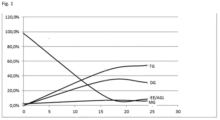
- FIG. 1 illustrates the kinetics of conversion of DHA from ethyl esters to mono-, di-, and triglycerides over time.
- the conditions are an evaporator wall temperature between 160 and 220°C and a vacuum of less than 0.02 mbar.
- the vacuum is 0.005 mbar to allow the distillation temperature to be lowered.
- the oil has the profile indicated in Table 3: [Table 3] Compounds Units Values (Example 1) DHA mg/g 758 Saturated fatty acids (SFA) mg/g 15 Triglycerides (TG) % 63 Diglycerides (DG) % 36 Monoglycerides (MG) % 2 Ethyl esters/free fatty acids (EE/FFA) mg/g 1.2 EPA mg/g 20 ETA n-3 mg/g 6 DPA n-6 mg/g 105
- the oil is fed into a wiped film evaporator into which dry steam is injected.
- the reaction takes place during a short residence time of less than one minute and under a vacuum of less than 1 mbar.
- the oil is made stable against oxidation by the addition of antioxidants such as ascorbyl palmitate, rosemary extract, phospholipids, tocopherol or any other antioxidant known to those skilled in the art.
- antioxidants such as ascorbyl palmitate, rosemary extract, phospholipids, tocopherol or any other antioxidant known to those skilled in the art.
Landscapes
- Chemical & Material Sciences (AREA)
- Life Sciences & Earth Sciences (AREA)
- Engineering & Computer Science (AREA)
- Oil, Petroleum & Natural Gas (AREA)
- Chemical Kinetics & Catalysis (AREA)
- Wood Science & Technology (AREA)
- Organic Chemistry (AREA)
- General Chemical & Material Sciences (AREA)
- Polymers & Plastics (AREA)
- Food Science & Technology (AREA)
- Microbiology (AREA)
- Fats And Perfumes (AREA)
- Preparation Of Compounds By Using Micro-Organisms (AREA)
- Acyclic And Carbocyclic Compounds In Medicinal Compositions (AREA)
- Coloring Foods And Improving Nutritive Qualities (AREA)
- Agricultural Chemicals And Associated Chemicals (AREA)
- Micro-Organisms Or Cultivation Processes Thereof (AREA)
- Medicines Containing Plant Substances (AREA)
- Edible Oils And Fats (AREA)
Description
- Depuis plusieurs années déjà, il est recommandé d'enrichir son régime alimentaire en acides gras polyinsaturés en raison de leur rôle bénéfique avéré dans bon nombre de réactions physiologiques et fonctions pharmaceutiques.
- Parmi les acides gras polyinsaturés d'intérêt on distingue ceux appartenant à la famille des omegas-3 tels que l'acide eicosapentaénoïque (EPA) et l'acide docosahexaénoïque (DHA) et ceux appartenant à la famille des omegas-6 tels que l'acide arachidonique (ARA).
- Le DHA et l'EPA ont fait l'objet de nombreuses études physiologiques et l'on connait aujourd'hui leur rôle essentiel à la fois chez le nourrisson, l'enfant et l'adulte. Le DHA est ainsi connu pour son rôle essentiel dans le développement du cerveau et de la rétine et dans la préservation des fonctions cognitives. L'EPA, quant à lui, contribue au bon fonctionnement cardiaque et possède des propriétés anti-inflammatoires.
- Les régimes alimentaires les plus riches en acides gras polyinsaturés sont d'origine marine, avec une consommation régulière de poissons. Cependant la quantité de poisson devant être consommée doit être importante pour obtenir les effets thérapeutiques attendus.
- Une manière d'augmenter l'apport en acides gras polyinsaturés est de consommer des suppléments alimentaires ou des concentrés à base d'huile de poisson. Ces produits se présentent sous la forme d'huiles naturelles ou d'huiles concentrées en DHA ou en EPA sous forme de triglycérides ou sous forme d'esters éthyliques.
- Dans les huiles de poisson, les acides gras polyinsaturés se trouvent principalement sous forme de triglycérides. Les méthodes de concentrations en DHA ou EPA des huiles de poissons font intervenir dans un premier temps la séparation des acides gras du glycérol par transestérification éthanolique à l'aide d'un catalyseur chimique ou par transestérification éthanolique enzymatique. Dans un second temps, l'enrichissement en DHA ou en EPA est réalisé par distillation moléculaire, permettant la séparation des composés en fonction de leur poids moléculaire.
- Le brevet français
FR 2 955 459 - Cependant, aux vues de la demande croissante en acides gras polyinsaturés, les huiles de poissons ne peuvent plus servir d'unique source. En outre, elles présentent des caractéristiques de goût et d'odeur déplaisantes pour de nombreux consommateurs, et des teneurs potentiellement élevées en cholestérol. Enfin, on constate une irrégularité en termes de production d'acides gras en fonction des saisons.
- Il est devenu nécessaire d'identifier des alternatives aux huiles de poissons pour la production d'acides gras.
- Les micro-algues présentent elles aussi des teneurs élevées en acides gras polyinsaturés et représentent donc une source alternative intéressante. Certaines d'entre elles peuvent produire des quantités d'acides gras polyinsaturés représentant jusqu'à 40 à 50 % de leur biomasse. De plus, elles présentent l'avantage de pouvoir être cultivées en conditions contrôlées. Les micro-algues marines ne présentent pas les caractéristiques négatives d'odeur et de goût des huiles de poisson. Elles ne produisent pas non plus de cholestérol. Les micro-algues appartenant au genre des Thraustochytrium ou des Schizochytrium sont des sources riches en acides gras polyinsaturés à longue chaîne oméga-3. Par exemple, la micro-algue Schizochytrium sp peut produire entre 20 % et 35 % d'acide docosahexaénoïque, en poids total d'acides gras (Hadley et al., 2017) (Hammond et al., 2001).
- A titre illustratif, on citera la demande de brevet internationale
WO 2013/178936 qui décrit un procédé d'enrichissement en DHA sous forme d'esters éthyliques d'une huile de micro-algues appartenant à la famille des Thraustochytriales sp. - D'autres documents tels que la demande de brevet internationale
WO 2011/074758 ou Zhaomin Sun et al. (Journal of aquatic food product technology, vol. 24, n°8, 2015) décrivent également des compositions d'huile de micro-organismes enrichies en acides gras polyinsaturés. - Un autre élément important qualitatif de l'huile, outre la teneur en acides gras polyinsaturés susceptible d'être obtenue, est la teneur en acides gras saturés. En effet, plusieurs études ont démontré un lien entre la consommation d'acides gras saturés et les risques de maladies cardiovasculaires ou d'hypercholestérolémie. Si leur consommation n'est pas totalement à bannir, il est toutefois recommandé de la limiter au profit des acides gras insaturés.
- Il apparait donc nécessaire de pouvoir proposer des huiles concentrées en acides gras polyinsaturés, notamment en oméga-3 tels que le DHA et l'EPA, qui présentent de plus une teneur limitée en acides gras saturés.
- Par ailleurs, la bonne supplémentation en une substance ne dépend pas uniquement de la quantité de cette substance, mais également de sa biodisponibilité. Des études ont prouvé que l'absorption des acides gras polyinsaturés à longue chaîne issus d'huile de poisson sous la forme de triglycérides dits reconstitués était supérieure à celle des acides gras sous la forme des triglycérides naturels ou sous la forme d'éthyl esters (Schuchardt et al. ; Prostaglandins, leukotrienes and essential fatty acids ; 89 (2013) 1-8). Les triglycérides reconstitués sont obtenus à partir des triglycérides naturels des huiles par des méthodes de transestérification/ré-estrérification. Dans ces méthodes, les acides gras sont transférés sous forme d'esters éthyliques (fatty acid ethyl esters en anglais), ou, puis subissent une distillation moléculaire de manière à concentrer la fraction en acides gras polyinsaturés à longue chaîne. Ces acides gras sont ensuite convertis, par voie enzymatique, sous la forme de glycérides, notamment de triglycérides.
- De plus, une étude réalisée par Fumiaki et al. (Lymphatic absorption of docosahexaenoic acid given as monoglyceride, diglyceride, triglyceride and ethyl ester in rats ; J. Nutr. Sci. Vitaminol ; 48, 30-35, 2002), a montré que le dosage lymphatique de DHA préalablement ingéré sous forme de mono et diglycérides était supérieur à celui obtenu avec du DHA préalablement ingéré sous forme de triglycérides et d'éthyl esters. La bonne biodisponibilité des acides gras polyinsaturés à longue chaîne sous forme de monoglycérides a également été vérifiée dans une autre étude (Valenzuleaa et al.). Cette étude montre que la supplémentation en monoglycérides de DHA permet de retrouver un contenu en DHA dans le plasma et les globules rouges plus élevé que ce qui est retrouvé lorsque le DHA est apporté sous forme d'esters éthyliques (Effect of Supplementation with Docosahexaenoic Acid Ethyl Ester and sn-2 Docosahexaenyl Monoacylglyceride on Plasma and Erythrocyte Fatty Acids in Rats, Ann Nutr Metab, 2005 ;49 :49-53).
- Il apparait donc également nécessaire de pouvoir proposer des huiles concentrées en acides gras polyinsaturés, notamment en oméga-3, qui se présentent essentiellement sous la forme de triglycérides, diglycérides et monoglycérides.
- La présente invention concerne ainsi une composition d'huile de micro-organismes enrichie en acides gras polyinsaturés, qui se caractérise en ce qu'elle présente :
- une teneur en acides gras saturés inférieure ou égale à 40 mg/g de composition,
- une teneur en acides gras polyinsaturés oméga-3 supérieure ou égale à 500 mg/g de composition,
- une quantité de triglycérides inférieure à 70 %,
- une quantité de diglycérides comprise entre 10 et 35 %,
- une quantité de monoglycérides comprise entre 1 et 5 %.
- La composition selon l'invention présente donc un excellent profil en acides gras avec une teneur en acides gras polyinsaturés oméga-3 élevée et une teneur en acides gras saturés très faible. Elle présente de plus une excellente biodisponibilité, en privilégiant les formes chimiques les plus efficaces.
- Avantageusement, la teneur en acides gras saturés de la composition selon l'invention est inférieure ou égale à 30 mg/g de composition, et préférentiellement inférieure ou égale à 25 mg/g de composition.
- La composition d'huile peut être obtenue à partir de micro-algues du genre Thraustochytrium, Schizochytrium, Nannochloropsis, Isochrysis, Phaeodactylum, Nitzchia, Staurosira, Crypthecodinium ou Ulkenia.
- Les micro-algues des genres Thraustochytrium et Schizochytrium permettront d'obtenir une composition d'huile enrichie en acide docosahexaénoïque (DHA).
- Les micro-algues des genres Nannochloropsis, Isochrysis, Phaeodactylum ou Nitzchia permettront d'obtenir une composition d'huile enrichie en acide eicosapentaénoïque (EPA).
- Au sens de l'invention, on entend par « enrichie en acides gras polyinsaturés » une composition comprenant, après mise en œuvre de procédés de concentration adaptés, plus du double de la quantité d'acides gras polyinsaturés que présentait la composition initialement.
- Préférentiellement, la composition comprend une quantité de triglycérides comprise entre 40 et 67 %, plus préférentiellement entre 55 et 65 %, par rapport à la quantité totale de monoglycérides, diglycérides, triglycérides et esters éthyliques d'acides gras.
- Préférentiellement encore, la composition comprend entre 25 et 35% de diglycérides par rapport à la quantité totale de monoglycérides, diglycérides, triglycérides et esters éthyliques d'acides gras.
- Préférentiellement encore, la composition comprend entre 1 et 2 % de monoglycérides par rapport à la quantité totale de monoglycérides, diglycérides, triglycérides et esters éthyliques d'acides gras.
- Dans le cadre de l'invention, la quantité d'esters éthyliques est inférieure à 2% par rapport à la quantité totale de monoglycérides, diglycérides, triglycérides et esters éthyliques d'acides gras.
- Selon un premier mode de réalisation, la composition comprend une teneur en DHA supérieure ou égale à 600 mg/g de composition, plus préférentiellement supérieure à 700 mg/g de composition.
- Selon un second mode de réalisation, la composition comprend une teneur en EPA supérieure ou égale à 600 mg/g de composition, préférentiellement supérieure à 700 mg/g de composition.
- Selon le premier mode de réalisation de l'invention, la composition comprend au moins 4 mg/g de composition d'acide eicosatétraénoïque oméga-3, préférentiellement entre 4 et 8 mg/g de composition.
- Si les acides gras polyinsaturés appartenant à la famille des omégas-3 ont fait l'objet de nombreuses études et publications scientifiques depuis plusieurs années, celles-ci ne concernaient en réalité que majoritairement l'EPA et le DHA. Aujourd'hui, l'intérêt de la communauté scientifique se tourne vers d'autres omégas-3, lesquels ont probablement des rôles clés et indépendants dans de nombreux mécanismes physiologiques. Ceci est par exemple le cas de l'acide eicosatétraénoïque oméga-3 (ETA). Cet acide gras a été identifié il y a près de 20 ans à travers les études de Careaga et Sprecher (Metabolism of 8,11,14,17-eicosatetraenoic acid by human platelet lipoxygenase and cyclooxygenase. Biochimica et Biophysica Acta, Volume 920, p94-101.) et de Croset et al. (Inhibition of Prostaglandin H
- Synthase and Activation of 12-Lipoxygenase by 8,11,14,17- Eicosatetraenoic Acid in Human Endothelial Cells and Platelets. Biochemical Pharmacology, Volume 57, p631-638). Ces études ont mis en évidence un effet anti-inflammatoire de l'acide eicosatétraénoïque, une réduction de la formation de composés pro-inflammatoires ainsi qu'un effet inhibiteur de l'agrégation plaquettaire.
- Il s'en suit que l'acide eicosatétraénoïque serait une bonne alternative aux inhibiteurs anti-inflammatoires non stéroïdiens tels que l'aspirine ou l'indometatacine.
- La composition selon l'invention est donc clairement avantageuse, car elle propose, une quantité non négligeable d'acide eicosatétraénoïque oméga-3.
- Selon le premier mode de réalisation de l'invention encore, la composition comprend une teneur en acide docosapentaénoïque (DPA) oméga-6 inférieure ou égale à 140 mg/g de composition, préférentiellement comprise entre 70 et 140 mg/g de composition.
- Une composition d'huile de micro-organismes présentant les caractéristiques décrites précédemment peut être préparée par un procédé comprenant
- (i) une étape de réaction entre une huile de micro-organismes comprenant des acides gras polyinsaturés oméga-3 sous forme de triglycérides et un alcool en présence d'un catalyseur chimique ou enzymatique,
- (ii) une étape de concentration en acide gras polyinsaturés oméga-3 par distillation moléculaire sous vide poussé dans un évaporateur à film raclé couplé à une colonne de rectification comportant au moins sept plateaux théoriques,
- (iii) une étape de restructuration de monoglycérides, diglycérides et triglycérides d'acide gras polyinsaturés oméga-3 en présence d'enzyme et de glycérol,
- (iv) une étape de distillation moléculaire court trajet sous vide.
- Dans les huiles naturelles, les acides gras polyinsaturés oméga-3 sont essentiellement sous la forme de triglycérides, c'est-à-dire estérifiés sur le squelette glycérol. Une méthode pour concentrer ces acides gras consiste alors dans un premier temps à les libérer du glycérol. L'étape (i) de réaction entre l'huile et un alcool en présence d'un catalyseur est une étape de transestérification qui va permettre l'obtention des acides gras sous une forme d'esters éthyliques (EE).
- De manière préférée, la réaction de transestérification est réalisée avec de l'éthanol à titre d'alcool et de l'éthylate de sodium à titre de catalyseur.
- Le rapport en poids huile/éthanol/catalyseur est préférentiellement de 1 : moins de 0,5 : moins de 0,05.
- Cette réaction se conduit à une température comprise entre 40 et 120 °C, préférentiellement entre 40 et 60°, durant un temps compris entre 1 et 12h, préférentiellement entre 1 à 2 h.
- A la fin de la réaction, plus de 95 % des acides gras sont sous la forme d'esters éthyliques.
- Les éthyles esters d'acides gras formés peuvent alors être distillés par distillation moléculaire pour en recueillir la fraction concentrée en acides gras polyinsaturés d'intérêt lors de l'étape (ii).
- La distillation sous vide poussé permet la séparation des esters éthyliques en fonction de leur volatilité. Celle-ci dépend de leur poids moléculaire et de la longueur des chaines des acides gras.
- Ainsi dans le but de concentrer la composition d'huile en acides gras polyinsaturés d'intérêt tel que le DHA ou l'EPA, cette étape va permettre d'éliminer au maximum les acides gras dont la chaine comporte moins de 20 atomes de carbone.
- De manière importante, la distillation moléculaire est réalisée dans un évaporateur à film raclé couplé à une colonne de rectification comportant au moins sept plateaux théoriques. L'utilisation de la colonne de rectification permet de diminuer la quantité d'acides gras saturés dans le résidu de distillation et d'améliorer la capacité séparative.
- D'autre part, en raison du haut degré de poly-insaturation des acides gras d'intérêt et donc de leur grande sensibilité à l'oxydation, une distillation sous vide poussé est nécessaire. Les paramètres appliqués doivent prévenir du risque d'isomérisation de l'EPA ou du DHA.
- Les paramètres de distillation sont donc généralement, dans le cadre de l'invention, les suivants :
- Vide de distillation de 0,01 à 0,20 mbar,
- Température dans l'évaporateur à film raclé de 190 à 240°,
- Température dans le haut de colonne de 130 à 200°C.
- A l'issue de cette étape, on obtient un raffinat riche en esters d'acides gras à chaines longues et un distillat riche en esters d'acides gras à chaines courtes.
- Les esters éthyliques d'acides gras sont ensuite convertis lors d'une étape (iii) de ré-estérification sous forme de triglycérides, de monoglycérides et de diglycérides, des formes présentant une meilleure biodisponibilité comme expliqué précédemment.
- Préférentiellement, l'enzyme utilisée lors de cette étape est une lipase, avantageusement une lipase B de Candida antarctica.
- Cette réaction se conduit à une température comprise entre 40 et 60°C, durant un temps compris entre 15 et 30h, préférentiellement entre 20 et 25 h.
- L'étape (iii) de restructuration des monoglycérides, diglycérides et triglycérides est suivie d'une étape (iv) de distillation moléculaire à court trajet et sous vide poussé pour éliminer les esters éthyliques résiduels, les composés volatiles odorant mais également pour inactiver une potentielle activité enzymatique résiduelle. Cette étape permet de concentrer d'avantage la composition en monoglycérides, diglycérides et triglycérides.
- Selon un mode de réalisation, le procédé comprend de plus, les étapes suivantes ultérieures de (v) désodorisation et/ou (vi) ajout d'antioxydants.
- L'étape de désodorisation (v) est une étape optionnelle qui se déroule en présence de vapeur. Sa mise en œuvre fait suite à l'étape (iv) de distillation moléculaire. La vapeur d'eau entraine des molécules qui n'ont pas été éliminées à l'étape (iv) de distillation moléculaire. Le degré de poly-insaturation des huiles obtenues étant très élevé, l'utilisation d'un évaporateur à film raclé avec injection de vapeur sèche sous vide de moins de 1 mbar permet une désodorisation avec un temps de résidence court de moins d'une minute. Les indices d'oxydation, de peroxydes (IP) et d'anisidine (lan) sont également abaissés par ce procédé.
- L'étape (vi) d'ajout d'antioxydants est une étape également optionnelle qui a pour but d'améliorer la résistance à l'oxydation de la composition. Des antioxydants tels que le palmitate d'ascorbyle, l'extrait de romarin, les phospholipides, le tocophérol ou tout autre antioxydant connu de l'homme du métier peuvent être utilisés.
- La présente description décrit également un complément alimentaire ou une composition pharmaceutique, nutraceutique ou alimentaire, en particulier une composition alimentaire infantile, comprenant une composition telle que décrite précédemment.
- Un complément alimentaire peut être une gélule, une capsule molle, un comprimé, une poudre, un gel, un sirop ou toute autre forme connue de l'homme du métier.
- Une composition pharmaceutique, nutraceutique ou alimentaire peut être une composition solide, liquide ou un gel, adapté à la personne adulte, à l'enfant ou au nourrisson. Une telle composition pourra comprendre d'autres composés tels que des protéines et des glucides. L'invention sera mieux comprise à la lecture des exemples qui suivent.
- Cet exemple illustre le procédé décrit ci-dessus et est mis en œuvre à partir d'une huile brute produite par la souche de micro-algues Schizochytrium sp T18 commercialisée par la société Mara Renewables Corporation.
- L'huile contient initialement 329 mg/g de DHA. L'objectif est ici d'au minimum doubler la concentration en DHA.
- Une réaction de transestérification est réalisée sur une biomasse de 1800 kg d'huile de micro-algues à l'aide de 450 kg d'éthanol et de 21,6 kg d'éthylate de sodium, dans un réacteur approprié.
- La température de réaction est de 50°C et le temps de réaction est de 1h. A l'issue de la réaction, l'excès d'éthanol est évaporé sous vide, puis le mélange est refroidi à une température d'environ 30°C puis soumis à décantation durant 1h. La phase légère est récupérée puis le glycérol est vidangé. Une seconde décantation est réalisée durant 30 sec. Le glycérol et les monoglycérides résiduels sont vidangés.
- Un lavage à l'eau acide est ensuite réalisé en ajoutant 17% d'eau déminéralisée contenant 2,5% d'acide phosphorique (75%) sous agitation durant 20 sec. Le mélange est décanté durant 20 sec et la phase aqueuse est vidangée. Il s'en suit un séchage sous vide (pression < 90 mbar) à 60°C durant un temps supérieur à 2h.
- A l'issue de cette étape l'huile contient 329 m/g de DHA sous forme d'esters éthyliques.
- L'huile est ensuite conduite dans un dégazeur puis traverse un évaporateur à film raclé. Les vapeurs sont ensuite distillées au travers d'une colonne de rectification qui est couplée à l'évaporateur fourni par la société UIC GmbH. Un reflux du distillat, c'est-à-dire une réintroduction du distillat dans la colonne peut permettre d'augmenter l'efficacité séparative de cette dernière. La colonne utilisée contient environ sept plateaux théoriques. Le résidu de distillation est récupéré et représente la fraction enrichie en DHA.
- Les conditions opérationnelles sont les suivantes : T° de l'évaporateur : 225°C ; Vide de la colonne de rectification : 0,1 mbar ; Taux de reflux 75%, T° (haut de colonne) : 195°C.
- Le Tableau 1 ci-dessous compare le profil en acides gras de l'huile obtenue après cette étape (ii) avec le profil en acides gras initial avant la première étape (i). Les quantités sont exprimées en mg de chaque acide gras par g d'huile.
[Table.1] Composition en acides gras avant étape (i) Composition en acides gras après étape (ii) C4 :0 1,867 - C6 :0 1,808 - C12 :0 7,542 - C14 :0 89,582 4,428 C15 :0 2,478 - C16 :0 153,76 10,206 C16 :1 69,696 5,611 C18 :0 6,133 - C18 :1 n9 cis 19,555 8,442 C18 :1 n7 cis 89,271 17,745 C18 :2 n6 cis 10,651 3,487 C20 :4 n3 3,055 5,572 EPA 11,294 18,856 C22 :5 n6 55,904 125,453 DHA 329,162 757,958 - Plus de 97% du DHA est conservé dans le résidu récupéré. La quantité de DHA est passée de 329 mg/g de DHA sous forme d'esters éthyliques à 758 mg/g. Les conditions opératoires ont été réglées en vue de conserver au maximum le DHA et de faire une coupure au C20 tout en conservant au mieux l'ETA C20 :4 n-3. L'ETA oméga-3 passe alors de 3 à plus de 5 mg/g. Dans ces conditions opératoires, L'EPA est également concentré mais reste à des valeurs relativement faibles. Le DPA n-6, très proche du DHA, est obligatoirement concentré mais cependant les concentrations atteintes restent limitées.
- La quantité d'acides gras saturés dans le résidu est minime. L'acide palmitique C16 :0 par exemple est quasiment éliminé dans le résidu. On note que seulement 2,5% de sa teneur initiale sont conservés.
- La réaction a lieu dans un réacteur en présence d'enzyme immobilisée. Il s'agit d'une lipase de la fraction B de Candida antartica (commercialisée sous le nom Lipozym 435 par la société Novozym).
- 480 g de résidu de distillation contenant environ 758mg/g de DHA, 33g de glycérol et 20g d'enzyme, sont introduits dans le réacteur.
- La réaction s'opère sous agitation modérée, à température contrôlée autour de 60°C, sous vide avec évaporation et condensation de l'éthanol généré. Le temps de réaction est de 25h.
- Le rendement de la réaction est de plus de 95%.
- A l'issue de cette étape, l'huile présente le profil glycéridique suivant (Tableau 2) :
[Table.2] Ethyls esters Monoglycérides Diglycérides Triglycérides 8.6% 5.7% 35.8% 49.9% - [
Fig. 1 ] illustre la cinétique de conversion du DHA sous forme d'esters éthyliques en mono, di, et triglycérides au cours du temps. - Après synthèse, le produit est repris pour passage en distillateur à court trajet (commercialisé par la société UIC GmbH) pour éliminer les esters éthyliques résiduels, les volatiles odorant mais également pour inactiver une potentielle activité enzymatique résiduelle.
- Les conditions sont une température des parois de l'évaporateur comprise entre 160 et 220° C et un vide inférieur à 0,02 mbar. De préférence le vide est de 0,005 mbar pour permettre d'abaisser la température de distillation.
- A l'issue de cette étape, l'huile présente le profil indiqué dans le Tableau 3 :
[Table.3] Composés Unités Valeurs (Exemple 1) DHA mg/g 758 Acides gras saturés (AGS) mg/g 15 Triglycérides (TG) % 63 Diglycérides (DG) % 36 Monoglycérides (MG) % 2 Ethyles esters/acides gras libres (EE/AGL) mg/g 1,2 EPA mg/g 20 ETA n-3 mg/g 6 DPA n-6 mg/g 105 - L'huile est acheminée dans un évaporateur à film raclé dans lequel de la vapeur sèche est injectée. La réaction se déroule durant un temps de résidence court de moins d'une minute et sous un vide de moins de 1mbar.
- L'huile est rendue stable face à l'oxydation par l'ajout d'antioxydant tels que le palmitate d'ascorbyle, extrait de romarin, phospholipides, tocophérol ou tout autre antioxydant connu de l'homme du métier.
Claims (10)
- Composition d'huile de micro-organismes enrichie en acides gras polyinsaturés, caractériséeen ce qu'elle présente :- une teneur en acides gras saturés inférieure ou égale à 40 mg/g de composition,- une teneur en acides gras polyinsaturés oméga-3 supérieure ou égale à 500 mg/g de composition,et en ce qu'elle comprend, par rapport à la quantité totale de monoglycérides, diglycérides, triglycérides et esters éthyliques d'acides gras :- une quantité de triglycérides comprise entre 40 et 67 %,- une quantité de diglycérides comprise entre 10 et 35 %,- une quantité de monoglycérides comprise entre 1 et 5 %.
- Composition selon la revendication 1, caractérisée en ce que la teneur en acides gras saturés est inférieure ou égale à 30 mg/g de composition, préférentiellement inférieure ou égale à 25 mg/g de composition.
- Composition selon l'une des revendications précédentes, caractérisée en ce qu'elle comprend une quantité de triglycérides comprise entre 55 et 65 %, par rapport à la quantité totale de monoglycérides, diglycérides, triglycérides et esters éthyliques d'acides gras.
- Composition selon l'une des revendications précédentes, caractérisée en ce qu'elle comprend entre 25 et 35% de diglycérides par rapport à la quantité totale de monoglycérides, diglycérides, triglycérides et esters éthyliques d'acides gras.
- Composition selon l'une des revendications précédentes, caractérisée en ce qu'elle comprend entre 1 et 2 % de monoglycérides par rapport à la quantité totale de monoglycérides, diglycérides, triglycérides et esters éthyliques d'acides gras.
- Composition selon l'une des revendications précédentes, caractérisée en ce qu'elle comprend une teneur en acide docosahexaénoïque supérieure ou égale à 600 mg/g de composition, plus préférentiellement supérieure à 700 mg/g de composition.
- Composition selon l'une des revendications 1 à 5, caractérisée en ce qu'elle comprend une teneur en acide eicosapentaénoïque supérieure ou égale à 600 mg/g de composition, préférentiellement supérieure à 700 mg/g de composition.
- Composition selon l'une des revendications 1 à 6, caractérisée en ce qu'elle comprend au moins 4 mg/g de composition d'acide eicosatétraénoïque oméga-3, préférentiellement entre 4 et 8 mg/g de composition.
- Composition selon l'une des revendications 1 à 6 et 8 caractérisée en ce qu'elle comprend une teneur en acide docosapentaénoïque oméga-6 inférieure ou égale à 140 mg/g de composition, préférentiellement comprise entre 70 et 140 mg/g de composition.
- Composition selon l'une des revendications précédentes, caractérisée en ce qu'elle se présente sous la forme d'un complément alimentaire, d'une composition pharmaceutique, nutraceutique, alimentaire, notamment infantile.
Applications Claiming Priority (2)
| Application Number | Priority Date | Filing Date | Title |
|---|---|---|---|
| FR1913255A FR3103355B1 (fr) | 2019-11-26 | 2019-11-26 | Composition d’huile de micro-organismes enrichie en acides gras polyinsaturés |
| PCT/EP2020/083475 WO2021105267A1 (fr) | 2019-11-26 | 2020-11-26 | Composition d'huile de micro-organismes enrichie en acides gras polyinsatures |
Publications (3)
| Publication Number | Publication Date |
|---|---|
| EP4064849A1 EP4064849A1 (fr) | 2022-10-05 |
| EP4064849B1 true EP4064849B1 (fr) | 2025-04-16 |
| EP4064849C0 EP4064849C0 (fr) | 2025-04-16 |
Family
ID=70613845
Family Applications (1)
| Application Number | Title | Priority Date | Filing Date |
|---|---|---|---|
| EP20810999.1A Active EP4064849B1 (fr) | 2019-11-26 | 2020-11-26 | Composition d'huile de micro-organismes enrichie en acides gras polyinsatures |
Country Status (7)
| Country | Link |
|---|---|
| US (1) | US20220408751A1 (fr) |
| EP (1) | EP4064849B1 (fr) |
| JP (1) | JP2023503200A (fr) |
| KR (1) | KR20220107225A (fr) |
| ES (1) | ES3031391T3 (fr) |
| FR (1) | FR3103355B1 (fr) |
| WO (1) | WO2021105267A1 (fr) |
Families Citing this family (3)
| Publication number | Priority date | Publication date | Assignee | Title |
|---|---|---|---|---|
| FR3132430B1 (fr) | 2022-02-09 | 2025-04-25 | Polaris | Composition comprenant un melange de dha et/ou d’epa et d’un phospholipide d’orgine vegetale |
| KR102904402B1 (ko) * | 2022-12-06 | 2025-12-26 | 대봉엘에스 주식회사 | 고형 유지 조성물 및 이의 용도 |
| JP2025079778A (ja) * | 2023-11-10 | 2025-05-22 | ダイドーグループホールディングス株式会社 | 生理機能改善用の組成物 |
Citations (9)
| Publication number | Priority date | Publication date | Assignee | Title |
|---|---|---|---|---|
| WO1997019601A1 (fr) | 1995-11-24 | 1997-06-05 | Loders Croklaan B.V. | Composition a base d'huiles de poisson |
| WO2010147907A1 (fr) | 2009-06-16 | 2010-12-23 | E. I. Du Pont De Nemours And Company | Huiles à teneur élevée en acide éicosapentaénoïque à partir de souches optimisées améliorées de yarrowia lipolytica |
| WO2011074758A1 (fr) | 2009-12-17 | 2011-06-23 | Chemport Inc. | Procédé de préparation d'huile de triglycérides à haute teneur en acides gras polyinsaturés |
| US20150218484A1 (en) | 2011-02-11 | 2015-08-06 | E I Du Pont De Nemours And Company | Method for obtaining a lipid-containing composition from microbial biomass |
| WO2015188046A1 (fr) | 2014-06-06 | 2015-12-10 | Marine Ingredients, Llc | Compositions d'oméga -3, formes posologiques et procédés d'utilisation |
| CN103880672B (zh) | 2014-03-20 | 2016-05-04 | 江苏中邦制药有限公司 | 高纯度dha藻油乙酯及其转化为甘油酯的制备方法 |
| WO2019201478A1 (fr) | 2018-04-20 | 2019-10-24 | Nano Algae Solutions Ag | Nouveau procédé pour fournir des compositions d'huile eicosapentaénoïques |
| US20190345524A1 (en) | 2007-07-12 | 2019-11-14 | Dsm Nutritional Products Ag | Enzymatic modification of oil |
| EP2734626B1 (fr) | 2011-07-21 | 2020-12-16 | DSM IP Assets B.V. | Huiles microbiennes enrichies en acides gras polyinsaturés |
Family Cites Families (5)
| Publication number | Priority date | Publication date | Assignee | Title |
|---|---|---|---|---|
| EP2251412A3 (fr) * | 1996-03-28 | 2011-09-28 | DSM IP Assets B.V. | Preparation d'acide gras polyinsature microbien a partir d'huile contenant une biomasse pasteurisee |
| CA2273570A1 (fr) * | 1999-05-31 | 2000-11-30 | Jfs Envirohealth Ltd. | Concentration et purification d'ester d'acides gras polyinsatures par distillation-transesterification enzymatique |
| FR2955459B1 (fr) | 2010-01-28 | 2013-11-22 | Polaris | Composition huileuse riche en monoglycerides de dha |
| FR2991337B1 (fr) | 2012-05-29 | 2016-09-02 | Roquette Freres | Procede continu d'enrichissement en esters ethyliques de dha d'une huile produite par des microalgues |
| HK1258568A1 (zh) * | 2015-10-05 | 2019-11-15 | Dsm Ip Assets B.V. | 油组合物和制备方法 |
-
2019
- 2019-11-26 FR FR1913255A patent/FR3103355B1/fr active Active
-
2020
- 2020-11-26 KR KR1020227021172A patent/KR20220107225A/ko active Pending
- 2020-11-26 ES ES20810999T patent/ES3031391T3/es active Active
- 2020-11-26 JP JP2022557204A patent/JP2023503200A/ja active Pending
- 2020-11-26 EP EP20810999.1A patent/EP4064849B1/fr active Active
- 2020-11-26 WO PCT/EP2020/083475 patent/WO2021105267A1/fr not_active Ceased
- 2020-11-26 US US17/780,305 patent/US20220408751A1/en active Pending
Patent Citations (9)
| Publication number | Priority date | Publication date | Assignee | Title |
|---|---|---|---|---|
| WO1997019601A1 (fr) | 1995-11-24 | 1997-06-05 | Loders Croklaan B.V. | Composition a base d'huiles de poisson |
| US20190345524A1 (en) | 2007-07-12 | 2019-11-14 | Dsm Nutritional Products Ag | Enzymatic modification of oil |
| WO2010147907A1 (fr) | 2009-06-16 | 2010-12-23 | E. I. Du Pont De Nemours And Company | Huiles à teneur élevée en acide éicosapentaénoïque à partir de souches optimisées améliorées de yarrowia lipolytica |
| WO2011074758A1 (fr) | 2009-12-17 | 2011-06-23 | Chemport Inc. | Procédé de préparation d'huile de triglycérides à haute teneur en acides gras polyinsaturés |
| US20150218484A1 (en) | 2011-02-11 | 2015-08-06 | E I Du Pont De Nemours And Company | Method for obtaining a lipid-containing composition from microbial biomass |
| EP2734626B1 (fr) | 2011-07-21 | 2020-12-16 | DSM IP Assets B.V. | Huiles microbiennes enrichies en acides gras polyinsaturés |
| CN103880672B (zh) | 2014-03-20 | 2016-05-04 | 江苏中邦制药有限公司 | 高纯度dha藻油乙酯及其转化为甘油酯的制备方法 |
| WO2015188046A1 (fr) | 2014-06-06 | 2015-12-10 | Marine Ingredients, Llc | Compositions d'oméga -3, formes posologiques et procédés d'utilisation |
| WO2019201478A1 (fr) | 2018-04-20 | 2019-10-24 | Nano Algae Solutions Ag | Nouveau procédé pour fournir des compositions d'huile eicosapentaénoïques |
Non-Patent Citations (20)
| Title |
|---|
| ABEDI ELAHE, SAHARI MOHAMMAD ALI: "Long‐chain polyunsaturated fatty acid sources and evaluation of their nutritional and functional properties", FOOD SCIENCE & NUTRITION, JOHN WILEY & SONS, INC, vol. 2, no. 5, 1 September 2014 (2014-09-01), pages 443 - 463, XP093362387, ISSN: 2048-7177, DOI: 10.1002/fsn3.121 |
| ANONYMOUS: "Application for the authorization of DHA and EPA-rich Algal Oil from Schizochytrium sp. - Submitted pursuant to Regulation (EC) No 258/97 of the European Parliament and of the Council of 27th January 1997 concerning novel foods and novel food ingredients", 15 December 2010 (2010-12-15), XP093362408, Retrieved from the Internet <URL:https://acnfp.food.gov.uk/sites/default/files/mnt/drupal_data/sources/files/multimedia/pdfs/dhaoapplicdossier.pdf> |
| ANONYMOUS: "GRAS Notice for DHA Algal Oils from Schizochytrium sp. FC-3204 for Use in Select Food Categories", 1 February 2019 (2019-02-01), XP093362423 |
| APPLICATION FOR THE AUTHORIZATION OF DHA AND EPA-RICH ALGAL OIL FROM SCHIZOCHYTRIUM SP.), DATED 15.12.2010, MARTEK BIOSCIENCES CORPORATION |
| BANNO FUMIAKI; ET AL: "LYMPHATIC ABSORPTION OF DOCOSAHEXAENOIC ACID GIVEN AS MONOGLYCERIDE, DIGLYCERIDE, TRIGLYCERIDE, AND ETHYL ESTER IN RATS", JOURNAL OF NUTRITIONAL SCIENCE AND VITAMINOLOGY, vol. 48, no. 1, 1 February 2002 (2002-02-01), pages 30 - 35, XP002395871, ISSN: 0301-4800 |
| CAREAGA, M.M. ; SPRECHER, H.: "Metabolism of 8,11,14,17-eicosatetraenoic acid by human platelet lipoxygenase and cyclooxygenase", BIOCHIMICA ET BIOPHYSICA ACTA - LIPIDS AND LIPID METABOLISM., ELSEVIER SCIENCE BV. AMSTERDAM., NL, vol. 920, no. 1, 13 July 1987 (1987-07-13), NL , pages 94 - 101, XP023374166, ISSN: 0005-2760, DOI: 10.1016/0005-2760(87)90315-8 |
| CROSET MARTINE, BORDET JEAN CLAUDE, LAGARDE MICHEL: "Inhibition of prostaglandin H synthase and activation of 12-lipoxygenase by 8,11,14,17-eicosatetraenoic acid in human endothelial cells and platelets", BIOCHEMICAL PHARMACOLOGY, ELSEVIER, US, vol. 57, no. 6, 1 March 1999 (1999-03-01), US , pages 631 - 638, XP093362390, ISSN: 0006-2952, DOI: 10.1016/S0006-2952(98)00334-7 |
| D12 - DHA-RICH ALGAL OIL FROM SCHIZOCHYTRIUM SP.ONC-T18 - A SUBMISSION TO THE UK FOOD STANDARDS AGENCY REQUESTING CONSIDERATION OF SUBSTANTIAL EQUIVALENCE TO DHA-RICH ALGAL OIL FROM SCHIZOCHYTRIUM SP. AUTHORISED IN ACCORDANCE WITH REGULATION (EC) NO |
| D16 - WIKIPEDIA ARTICLE "OMEGA-3 FATTY ACID" |
| D19 - EUROPEAN PHARMACOPEIA 7.0, OMEGA-3-ACID TRIGLYCERIDES, P. 2619 - 2620 |
| D20 - DETERMINATION OF COMPOSITION CONTENT VALUES FROM GRAPHS OF D1 (SUN ET AL. 2015) |
| DULCE MARTINS, CUSTÓDIO LUÍSA, BARREIRA LUÍSA, PEREIRA HUGO, BEN-HAMADOU RADHOUAN, VARELA JOÃO, ABU-SALAH KHALID: "Alternative Sources of n-3 Long-Chain Polyunsaturated Fatty Acids in Marine Microalgae", MARINE DRUGS, vol. 11, no. 7, pages 2259 - 2281, XP055185025, DOI: 10.3390/md11072259 |
| MORENO-PEREZ S.; LUNA P.; SEÑORANS F.J.; GUISAN J.M.; FERNANDEZ-LORENTE G. : "Enzymatic synthesis of triacylglycerols of docosahexaenoic acid: Transesterification of its ethyl esters with glycerol", FOOD CHEMISTRY, ELSEVIER LTD., NL, vol. 187, 23 April 2015 (2015-04-23), NL , pages 225 - 229, XP029233880, ISSN: 0308-8146, DOI: 10.1016/j.foodchem.2015.04.095 |
| MRCP AMMAR WAKIL, MIR MIQUEL, MELLOR BSC DUANE D, MELLOR BSC STEPHEN F, ATKIN STEPHEN L, WAKIL AMMAR, : "The bioavailability of eicosapentaenoic acid from reconstituted triglyceride fish oil is higher than that obtained from the triglyceride and monoglyceride forms", ASIA PACIFIC JOURNAL OF CLINICAL NUTRITION 19(4), 1 December 2010 (2010-12-01), pages 499 - 505, XP093295786, DOI: 10.3316/ielapa.631807771037066 |
| ROBLES MEDINA, A. ESTEBAN CERDAN, L. GIMENEZ GIMENEZ, A. CAMACHO PAEZ, B. IBANEZ GONZALEZ, M.J. MOLINA GRIMA, E.: "Lipase-catalyzed esterification of glycerol and polyunsaturated fatty acids from fish and microalgae oils", JOURNAL OF BIOTECHNOLOGY, ELSEVIER, AMSTERDAM NL, vol. 70, no. 1-3, 30 April 1999 (1999-04-30), Amsterdam NL , pages 379 - 391, XP004173418, ISSN: 0168-1656, DOI: 10.1016/S0168-1656(99)00091-7 |
| T CATALINA ADARME-VEGA;DAVID K Y LIM;MATTHEW TIMMINS;FELICITAS VERNEN;YAN LI;PEER M SCHENK: "Microalgal biofactories: a promising approach towards sustainable omega-3 fatty acid production", MICROBIAL CELL FACTORIES, SPRINGER, vol. 11, no. 1, 25 July 2012 (2012-07-25), pages 96, XP021107330, ISSN: 1475-2859, DOI: 10.1186/1475-2859-11-96 |
| VALENZUELA A; VALENZUELA V; SANHUEZA J; NIETO S: "Effect of Supplementation with Docosahexaenoic Acid Ethyl Ester and sn-2 Docosahexaenyl Monoacylglyceride on Plasma and Erythrocyte Fatty Acids in Rats", ANNALS OF NUTRITION AND METABOLISM: EUROPEAN JOURNAL OF NUTRITION, METABOLIC DISEASES AND DIETETICS, S. KARGER AG, SWITZERLAND, vol. 49, no. 1, 1 January 2005 (2005-01-01), Switzerland , pages 49, XP008107933, ISSN: 0250-6807, DOI: 10.1159/000084177 |
| WANG XIUMEI, LI DAOMING, WANG WEIFEI, YANG BO, WANG YONGHUA: "A highly efficient immobilized MAS1 lipase for the glycerolysis reaction of n-3 PUFA-rich ethyl esters", JOURNAL OF MOLECULAR CATALYSIS B : ENZYMATIC, vol. 134, 1 December 2016 (2016-12-01), pages 25 - 31, XP093362394, ISSN: 1381-1177, DOI: 10.1016/j.molcatb.2016.09.012 |
| WARD O P, SINGH A: "Omega-3/6 fatty acids: Alternative sources of production", PROCESS BIOCHEMISTRY, ELSEVIER LTD, GB, vol. 40, no. 12, 1 December 2005 (2005-12-01), GB , pages 3627 - 3652, XP002454689, ISSN: 1359-5113, DOI: 10.1016/j.procbio.2005.02.020 |
| ZHAOMIN SUN, LU YANG, CHANGHU XUE, ZHENGXIA GUO, HAIHUA CONG, YUMING WANG, YONG XUE, JINGFENG WANG: "Preparation of Triacylglycerols Enriched in DHA from Single Cell Glycerides via Molecular Distillation and Enzymatic Glycerolysis", JOURNAL OF AQUATIC FOOD PRODUCT TECHNOLOGY, FOOD PRODUCTS PRESS, BINGHAMTON,, US, vol. 24, no. 8, 17 November 2015 (2015-11-17), US , pages 796 - 806, XP055402850, ISSN: 1049-8850, DOI: 10.1080/10498850.2013.813613 |
Also Published As
| Publication number | Publication date |
|---|---|
| WO2021105267A1 (fr) | 2021-06-03 |
| ES3031391T3 (en) | 2025-07-08 |
| FR3103355B1 (fr) | 2024-05-31 |
| KR20220107225A (ko) | 2022-08-02 |
| US20220408751A1 (en) | 2022-12-29 |
| FR3103355A1 (fr) | 2021-05-28 |
| EP4064849A1 (fr) | 2022-10-05 |
| EP4064849C0 (fr) | 2025-04-16 |
| JP2023503200A (ja) | 2023-01-26 |
Similar Documents
| Publication | Publication Date | Title |
|---|---|---|
| Zhang et al. | Synthesis and concentration of 2-monoacylglycerols rich in polyunsaturated fatty acids | |
| EP2854558B1 (fr) | Procédé continu d'enrichissement en esters éthyliques de dha d'une huile produite par des microalgues | |
| TWI343418B (en) | Process for production of transesterified oils/fats or triglycerides | |
| CA2899231C (fr) | Biomasse de la microalgue schizochytrium mangrovei et son procede de preparation | |
| FR2955459A1 (fr) | Composition huileuse riche en monoglycerides de dha | |
| JP2014511406A (ja) | エイコサペンタエン酸濃縮物 | |
| EP4064849A1 (fr) | Composition d'huile de micro-organismes enrichie en acides gras polyinsatures | |
| EP4281573A1 (fr) | Composition d'huile de microorganismes enrichis en diglycerides de dha ou d'epa | |
| JP6175198B2 (ja) | Dha含有グリセリド含有組成物の製造方法 | |
| CA3007749C (fr) | Procede d'enrichissement de protistes en lipides riches en acides gras polyinsatures, en particulier de classe omega 3, et sa mise en oeuvre pour la production de ces protistes enrichis ou de ces lipides | |
| WO2021191385A1 (fr) | Procede de fractionnement d'acides gras a deux carbones de difference par distillation moleculaire | |
| EP4475829A1 (fr) | Composition comprenant un melange de dna et/ou d'epa et d'un phospholipide d'orgine vegetale | |
| CN110004190A (zh) | 一种制备卵磷脂型多不饱和脂肪酸的方法 | |
| AU2023329693B2 (en) | Cetoleic acid composition | |
| US20260069563A1 (en) | Cetoleic acid composition |
Legal Events
| Date | Code | Title | Description |
|---|---|---|---|
| STAA | Information on the status of an ep patent application or granted ep patent |
Free format text: STATUS: UNKNOWN |
|
| STAA | Information on the status of an ep patent application or granted ep patent |
Free format text: STATUS: THE INTERNATIONAL PUBLICATION HAS BEEN MADE |
|
| PUAI | Public reference made under article 153(3) epc to a published international application that has entered the european phase |
Free format text: ORIGINAL CODE: 0009012 |
|
| STAA | Information on the status of an ep patent application or granted ep patent |
Free format text: STATUS: REQUEST FOR EXAMINATION WAS MADE |
|
| 17P | Request for examination filed |
Effective date: 20220524 |
|
| AK | Designated contracting states |
Kind code of ref document: A1 Designated state(s): AL AT BE BG CH CY CZ DE DK EE ES FI FR GB GR HR HU IE IS IT LI LT LU LV MC MK MT NL NO PL PT RO RS SE SI SK SM TR |
|
| DAV | Request for validation of the european patent (deleted) | ||
| DAX | Request for extension of the european patent (deleted) | ||
| STAA | Information on the status of an ep patent application or granted ep patent |
Free format text: STATUS: EXAMINATION IS IN PROGRESS |
|
| 17Q | First examination report despatched |
Effective date: 20240311 |
|
| GRAP | Despatch of communication of intention to grant a patent |
Free format text: ORIGINAL CODE: EPIDOSNIGR1 |
|
| STAA | Information on the status of an ep patent application or granted ep patent |
Free format text: STATUS: GRANT OF PATENT IS INTENDED |
|
| INTG | Intention to grant announced |
Effective date: 20241112 |
|
| TPAC | Observations filed by third parties |
Free format text: ORIGINAL CODE: EPIDOSNTIPA |
|
| TPAC | Observations filed by third parties |
Free format text: ORIGINAL CODE: EPIDOSNTIPA |
|
| TPAC | Observations filed by third parties |
Free format text: ORIGINAL CODE: EPIDOSNTIPA |
|
| GRAS | Grant fee paid |
Free format text: ORIGINAL CODE: EPIDOSNIGR3 |
|
| GRAA | (expected) grant |
Free format text: ORIGINAL CODE: 0009210 |
|
| STAA | Information on the status of an ep patent application or granted ep patent |
Free format text: STATUS: THE PATENT HAS BEEN GRANTED |
|
| AK | Designated contracting states |
Kind code of ref document: B1 Designated state(s): AL AT BE BG CH CY CZ DE DK EE ES FI FR GB GR HR HU IE IS IT LI LT LU LV MC MK MT NL NO PL PT RO RS SE SI SK SM TR |
|
| REG | Reference to a national code |
Ref country code: GB Ref legal event code: FG4D Free format text: NOT ENGLISH |
|
| REG | Reference to a national code |
Ref country code: CH Ref legal event code: EP |
|
| REG | Reference to a national code |
Ref country code: IE Ref legal event code: FG4D Free format text: LANGUAGE OF EP DOCUMENT: FRENCH |
|
| U01 | Request for unitary effect filed |
Effective date: 20250416 |
|
| U07 | Unitary effect registered |
Designated state(s): AT BE BG DE DK EE FI FR IT LT LU LV MT NL PT RO SE SI Effective date: 20250424 |
|
| REG | Reference to a national code |
Ref country code: ES Ref legal event code: FG2A Ref document number: 3031391 Country of ref document: ES Kind code of ref document: T3 Effective date: 20250708 |
|
| PG25 | Lapsed in a contracting state [announced via postgrant information from national office to epo] |
Ref country code: GR Free format text: LAPSE BECAUSE OF FAILURE TO SUBMIT A TRANSLATION OF THE DESCRIPTION OR TO PAY THE FEE WITHIN THE PRESCRIBED TIME-LIMIT Effective date: 20250717 |
|
| PG25 | Lapsed in a contracting state [announced via postgrant information from national office to epo] |
Ref country code: PL Free format text: LAPSE BECAUSE OF FAILURE TO SUBMIT A TRANSLATION OF THE DESCRIPTION OR TO PAY THE FEE WITHIN THE PRESCRIBED TIME-LIMIT Effective date: 20250416 |
|
| PG25 | Lapsed in a contracting state [announced via postgrant information from national office to epo] |
Ref country code: HR Free format text: LAPSE BECAUSE OF FAILURE TO SUBMIT A TRANSLATION OF THE DESCRIPTION OR TO PAY THE FEE WITHIN THE PRESCRIBED TIME-LIMIT Effective date: 20250416 |
|
| PG25 | Lapsed in a contracting state [announced via postgrant information from national office to epo] |
Ref country code: RS Free format text: LAPSE BECAUSE OF FAILURE TO SUBMIT A TRANSLATION OF THE DESCRIPTION OR TO PAY THE FEE WITHIN THE PRESCRIBED TIME-LIMIT Effective date: 20250716 |
|
| PG25 | Lapsed in a contracting state [announced via postgrant information from national office to epo] |
Ref country code: IS Free format text: LAPSE BECAUSE OF FAILURE TO SUBMIT A TRANSLATION OF THE DESCRIPTION OR TO PAY THE FEE WITHIN THE PRESCRIBED TIME-LIMIT Effective date: 20250816 |
|
| U20 | Renewal fee for the european patent with unitary effect paid |
Year of fee payment: 6 Effective date: 20251127 |
|
| PGFP | Annual fee paid to national office [announced via postgrant information from national office to epo] |
Ref country code: GB Payment date: 20251121 Year of fee payment: 6 |
|
| PGFP | Annual fee paid to national office [announced via postgrant information from national office to epo] |
Ref country code: NO Payment date: 20251125 Year of fee payment: 6 |
|
| PG25 | Lapsed in a contracting state [announced via postgrant information from national office to epo] |
Ref country code: SM Free format text: LAPSE BECAUSE OF FAILURE TO SUBMIT A TRANSLATION OF THE DESCRIPTION OR TO PAY THE FEE WITHIN THE PRESCRIBED TIME-LIMIT Effective date: 20250416 |
|
| PG25 | Lapsed in a contracting state [announced via postgrant information from national office to epo] |
Ref country code: CZ Free format text: LAPSE BECAUSE OF FAILURE TO SUBMIT A TRANSLATION OF THE DESCRIPTION OR TO PAY THE FEE WITHIN THE PRESCRIBED TIME-LIMIT Effective date: 20250416 |
|
| PLBI | Opposition filed |
Free format text: ORIGINAL CODE: 0009260 |
|
| PG25 | Lapsed in a contracting state [announced via postgrant information from national office to epo] |
Ref country code: SK Free format text: LAPSE BECAUSE OF FAILURE TO SUBMIT A TRANSLATION OF THE DESCRIPTION OR TO PAY THE FEE WITHIN THE PRESCRIBED TIME-LIMIT Effective date: 20250416 |
|
| REG | Reference to a national code |
Ref country code: CH Ref legal event code: L10 Free format text: ST27 STATUS EVENT CODE: U-0-0-L10-L00 (AS PROVIDED BY THE NATIONAL OFFICE) Effective date: 20260128 |
|
| PGFP | Annual fee paid to national office [announced via postgrant information from national office to epo] |
Ref country code: ES Payment date: 20251229 Year of fee payment: 6 |
|
| PLAX | Notice of opposition and request to file observation + time limit sent |
Free format text: ORIGINAL CODE: EPIDOSNOBS2 |
|
| 26 | Opposition filed |
Opponent name: CAMULON LIMITED Effective date: 20260116 Opponent name: KILIAN, CHRISTOPH Effective date: 20260116 |