EP4060029B1 - Neue proteinvariante und verfahren zur herstellung von l-lysin damit - Google Patents
Neue proteinvariante und verfahren zur herstellung von l-lysin damit Download PDFInfo
- Publication number
- EP4060029B1 EP4060029B1 EP21737531.0A EP21737531A EP4060029B1 EP 4060029 B1 EP4060029 B1 EP 4060029B1 EP 21737531 A EP21737531 A EP 21737531A EP 4060029 B1 EP4060029 B1 EP 4060029B1
- Authority
- EP
- European Patent Office
- Prior art keywords
- polypeptide
- present disclosure
- polynucleotide
- strain
- sequence
- Prior art date
- Legal status (The legal status is an assumption and is not a legal conclusion. Google has not performed a legal analysis and makes no representation as to the accuracy of the status listed.)
- Active
Links
Images
Classifications
-
- C—CHEMISTRY; METALLURGY
- C12—BIOCHEMISTRY; BEER; SPIRITS; WINE; VINEGAR; MICROBIOLOGY; ENZYMOLOGY; MUTATION OR GENETIC ENGINEERING
- C12N—MICROORGANISMS OR ENZYMES; COMPOSITIONS THEREOF; PROPAGATING, PRESERVING, OR MAINTAINING MICROORGANISMS; MUTATION OR GENETIC ENGINEERING; CULTURE MEDIA
- C12N9/00—Enzymes; Proenzymes; Compositions thereof; Processes for preparing, activating, inhibiting, separating or purifying enzymes
- C12N9/0004—Oxidoreductases (1.)
- C12N9/0051—Oxidoreductases (1.) acting on a sulfur group of donors (1.8)
-
- C—CHEMISTRY; METALLURGY
- C12—BIOCHEMISTRY; BEER; SPIRITS; WINE; VINEGAR; MICROBIOLOGY; ENZYMOLOGY; MUTATION OR GENETIC ENGINEERING
- C12N—MICROORGANISMS OR ENZYMES; COMPOSITIONS THEREOF; PROPAGATING, PRESERVING, OR MAINTAINING MICROORGANISMS; MUTATION OR GENETIC ENGINEERING; CULTURE MEDIA
- C12N1/00—Microorganisms; Compositions thereof; Processes of propagating, maintaining or preserving microorganisms or compositions thereof; Processes of preparing or isolating a composition containing a microorganism; Culture media therefor
- C12N1/20—Bacteria; Culture media therefor
- C12N1/205—Bacterial isolates
-
- C—CHEMISTRY; METALLURGY
- C12—BIOCHEMISTRY; BEER; SPIRITS; WINE; VINEGAR; MICROBIOLOGY; ENZYMOLOGY; MUTATION OR GENETIC ENGINEERING
- C12P—FERMENTATION OR ENZYME-USING PROCESSES TO SYNTHESISE A DESIRED CHEMICAL COMPOUND OR COMPOSITION OR TO SEPARATE OPTICAL ISOMERS FROM A RACEMIC MIXTURE
- C12P13/00—Preparation of nitrogen-containing organic compounds
- C12P13/04—Alpha- or beta- amino acids
- C12P13/08—Lysine; Diaminopimelic acid; Threonine; Valine
-
- C—CHEMISTRY; METALLURGY
- C12—BIOCHEMISTRY; BEER; SPIRITS; WINE; VINEGAR; MICROBIOLOGY; ENZYMOLOGY; MUTATION OR GENETIC ENGINEERING
- C12R—INDEXING SCHEME ASSOCIATED WITH SUBCLASSES C12C - C12Q, RELATING TO MICROORGANISMS
- C12R2001/00—Microorganisms ; Processes using microorganisms
- C12R2001/01—Bacteria or Actinomycetales ; using bacteria or Actinomycetales
- C12R2001/15—Corynebacterium
Definitions
- the present disclosure relates to a novel polypeptide, a Corynebacterium glutamicum strain comprising the polypeptide and a method for producing L-lysine using the strain.
- An object of the present disclosure is to provide a polypeptide consisting of an amino acid sequence represented by SEQ ID NO: 1, in which cysteine (Cys, or C), which is an amino acid corresponding to position 33 of an amino acid sequence of SEQ ID NO: 3, is substituted with serine (Ser, or S).
- Another object of the present disclosure is to provide a polynucleotide encoding the polypeptide of the present disclosure.
- Still another object of the present disclosure is to provide a polypeptide Corynebacterium glutamicum strain that comprises the polypeptide of the present disclosure or a polynucleotide encoding the polypeptide and has L-lysine production capacity.
- Still another object of the present disclosure is to provide a method for producing L-lysine, which comprises culturing a Corynebacterium glutamicum strain that comprises a polypeptide of the present disclosure or a polynucleotide encoding the polypeptide and has L-lysine production capacity in a medium.
- An aspect of the present invention provides a polypeptide consisting of an amino acid sequence represented by SEQ ID NO: 1, in which cysteine (Cys, or C), which is an amino acid corresponding to position 33 of an amino acid sequence of SEQ ID NO: 3, is substituted with serine (Ser, or S).
- polypeptide of the present invention consists of the amino acid sequence represented by SEQ ID NO: 1.
- the amino acid corresponding to position 33 based on the amino acid sequence of SEQ ID NO: 3 in the amino acid sequence represented by SEQ ID NO: 1 is serine.
- the variant is a polypeptide comprising an amino acid sequence represented by SEQ ID NO: 1, in which cysteine, which is an amino acid corresponding to position 33 of the amino acid sequence of SEQ ID NO: 3, is substituted with serine.
- the variant may be conjugated with other sequences or linkers so as to be identified, purified, or synthesized.
- homology means the degree of similarity between two given amino acid sequences or base sequences and may be expressed as a percentage.
- homology and identity may often be used interchangeably.
- sequence homology or identity of a conserved polynucleotide or polypeptide is determined by standard alignment algorithms, and the default gap penalty established by a program used may be used together.
- Substantially, homologous or identical sequences are generally capable of being hybridized with the entirety or a part of the sequence in moderately or highly stringent conditions. It is apparent that hybridization also includes hybridization of a polynucleotide with a polynucleotide comprising a general codon or a codon in consideration of codon degeneracy.
- Whether any two polynucleotide or polypeptide sequences have homology, similarity, or identity may be determined using known computer algorithms such as the "FASTA" program, for example, using default parameters as in Pearson et al., (1988) Proc. Natl. Acad. Sci. USA 85:2444 .
- the homology, similarity, or identity may be determined using Needleman-Wunsch algorithm ( Needleman and Wunsch, 1970, J. Mol. Biol. 48:443-453 ) as performed in the Needleman program of the EMBOSS package ( EMBOSS: The European Molecular Biology Open Software Suite, Rice et al., 2000, Trends Genet.
- the homology, similarity, or identity of polynucleotides or polypeptides may be determined by comparing sequence information using, for example, a GAP computer program such as Needleman et al. (1970), J Mol Biol. 48:443 as announced in, for example, Smith and Waterman, Adv. Appl. Math (1981) 2:482 .
- the GAP program may be defined as the value acquired by dividing the number of similarly aligned symbols (namely, nucleotides or amino acids) by the total number of symbols in the shorter of two sequences.
- the default parameters for the GAP program may include (1) a binary comparison matrix (including values of 1 for identity and 0 for non-identity) and a weighted comparison matrix of Gribskov et al., (1986) Nucl. Acids Res. 14:6745 (or EDNAFULL (EMBOSS version of NCBI NUC4.4) substitution matrix) as disclosed in Schwartz and Dayhoff, eds., Atlas Of Protein Sequence And Structure, National Biomedical Research Foundation, pp. 353-358 (1979 ); (2) a penalty of 3.0 for each gap and an additional 0.10 penalty for each symbol in each gap (or gap opening penalty of 10, gap extension penalty of 0.5); and (3) no penalty for end gaps.
- a binary comparison matrix including values of 1 for identity and 0 for non-identity
- a weighted comparison matrix of Gribskov et al., (1986) Nucl. Acids Res. 14:6745 (or EDNAFULL (EMBOSS version of NCBI NUC4.4) substitution matrix) as disclosed in Schwartz
- polypeptide comprising the amino acid sequence of SEQ ID NO: 3 and/or the variant of the present disclosure may exhibit an activity of a protein encoded by NCgl3069 gene, but not be limited thereto.
- the variant of the present disclosure may exhibit an activity so as to have increased L-lysine production capacity as compared to a wild-type polypeptide.
- corresponding to refers to amino acid residues at positions listed in the polypeptide or amino acid residues that are similar, identical, or homologous to those listed in the polypeptide. Identifying the amino acid at the corresponding position may be determining a specific amino acid in a sequence that refers to a specific sequence.
- corresponding region generally refers to a similar or corresponding position in a related protein or a reference protein.
- an arbitrary amino acid sequence is aligned with SEQ ID NO: 3, and based on this, each amino acid residue of the amino acid sequence may be numbered with reference to the amino acid residue of SEQ ID NO: 3 and the numerical position of the corresponding amino acid residue.
- a sequence alignment algorithm as described in the present disclosure may determine the position of an amino acid or a position at which modification such as substitution, insertion, or deletion occurs through comparison with that in a query sequence (also referred to as a "reference sequence").
- Needleman-Wunsch algorithm Needleman and Wunsch, 1970, J. Mol. Biol. 48:443-453
- Needleman program of the EMBOSS package EMBOSS: The European Molecular Biology Open Software Suite, Rice et al., 2000, Trends Genet. 16:276-277
- program and algorithm are not limited thereto, and a sequence alignment program, a pairwise sequence comparison algorithm, and the like known in the art may be appropriately used.
- Another aspect of the present invention is to provide a polynucleotide encoding the polypeptide of the present invention, as defined in the claims.
- polynucleotide is a DNA or RNA strand having a certain length or more as a polymer of nucleotides in which nucleotide monomers are connected in a long chain by covalent bonds, and more specifically means a polynucleotide fragment encoding the variant.
- the polynucleotide encoding the variant of the present disclosure may comprise a base sequence encoding the amino acid sequence represented by SEQ ID NO: 1.
- the polynucleotide of the present disclosure may have or comprise the sequence of SEQ ID NO: 2.
- the polynucleotide of the present disclosure may consist of or consist essentially of the sequence of SEQ ID NO: 2.
- the base corresponding to position 97 based on the nucleic acid sequence of SEQ ID NO: 4 in the nucleic acid sequence represented by SEQ ID NO: 2 is A
- the polynucleotide may comprise an nucleic acid sequence having at least 70%, 75%, 80%, 85%, 90%, 95%, 96%, 97%, 98%, 99%, 99.5%, 99.7% or 99.9% or more homology or identity to the nucleic acid sequence represented by SEQ ID NO: 2.
- nucleic acid sequences having amino acid sequences in which some sequences are deleted, modified, substituted, conservatively substituted, or added are also included in the scope of the present disclosure as long as the nucleic acid sequences have such homology or identity and encode a polypeptide or protein exhibiting efficacy corresponding to that of the variant of the present disclosure.
- the polynucleotide of the present disclosure has or comprises a base sequence having 70% or more, 75% or more, 80% or more, 85% or more, 90% or more, 95% or more, 96% or more, 97% or more, 98% or more, but less than 100% homology or identity to the sequence of SEQ ID NO: 2 or may consist of or consist essentially of a base sequence having 70% or more, 75% or more, 80% or more, 85% or more, 90% or more, 95% or more, 96% or more, 97% or more, 98% or more, but less than 100% homology or identity to the sequence of SEQ ID NO: 2, but is not limited thereto.
- the codon encoding the amino acid corresponding to position 33 of SEQ ID NO: 1 is one of the codons encoding serine.
- the polynucleotide of the present disclosure may comprise a probe that can be prepared from a known gene sequence, for example, a sequence without limitation as long as it is a sequence that can hybridize with a complementary sequence to the entirety or a part of the polynucleotide sequence of the present disclosure under stringent conditions.
- stringent conditions mean conditions that enable specific hybridization between polynucleotides. These conditions are specifically described in documents (see J. Sambrook et al., Molecular Cloning, A Laboratory Manual, 2nd Edition, Cold Spring Harbor Laboratory press, Cold Spring Harbor, New York, 1989 ; F.M.
- Hybridization requires that two nucleic acids have complementary sequences, although mismatches between bases are allowed depending on the stringency of hybridization.
- complementary is used to describe the relation between nucleotide bases capable of being hybridized with each other.
- adenine is complementary to thymine
- cytosine is complementary to guanine.
- the polynucleotide of the present disclosure may also comprise substantially similar nucleic acid sequences as well as isolated nucleic acid fragments that are complementary to the entire sequence.
- a polynucleotide having homology or identity to the polynucleotide of the present disclosure may be detected using a hybridization condition including a hybridization step at a T m value of 55°C and the above-described conditions.
- the T m value may be 60°C, 63°C, or 65°C, but is not limited thereto, and may be appropriately adjusted by those skilled in the art according to the purpose.
- the appropriate stringency to hybridize the polynucleotide depends on the length and degree of complementarity of the polynucleotide, and the variables are well known in the art (for example, J. Sambrook et al., Molecular Cloning, A Laboratory Manual, 2nd Edition, Cold Spring Harbor Laboratory press, Cold Spring Harbor, New York, 1989 ).
- Another aspect of the present disclosure is to provide a vector comprising the polynucleotide of the present disclosure.
- the vector may be an expression vector for expressing the polynucleotide in a host cell, but is not limited thereto.
- the vector of the present disclosure may include a DNA construct comprising a polynucleotide sequence encoding a polypeptide of interest operably linked to a suitable expression control region (or expression control sequence) so that the polypeptide of interest may be expressed in a suitable host.
- the expression control region may contain a promoter capable of initiating transcription, any operator sequence for controlling the transcription, a sequence encoding a suitable mRNA ribosome binding site, and a sequence controlling termination of transcription and translation.
- the vector may be transformed into a suitable host cell and then replicated or function independently of the host genome, or may be integrated into the genome itself.
- the vector used in the present disclosure is not particularly limited, but any vector known in the art may be used.
- Examples of commonly used vectors include natural or recombinant plasmids, cosmids, viruses, and bacteriophages.
- pWE15, M13, MBL3, MBL4, IXII, ASHII, APII, t10, t11, Charon4A, Charon21A, and the like may be used as a phage vector or a cosmid vector
- pDZ system, pBR system, pUC system, pBluescript II system, pGEM system, pTZ system, pCL system, pET system, and the like may be used as a plasmid vector.
- pDZ, pDC, pDCM2, pACYC177, pACYC184, pCL, pECCG117, pUC19, pBR322, pMW118, and pCC1BAC vectors and the like may be used.
- a polynucleotide encoding a polypeptide of interest may be inserted into a chromosome through a vector for intracellular chromosome insertion. Insertion of the polynucleotide into the chromosome may be performed by any method known in the art, for example, homologous recombination, but is not limited thereto.
- the vector may further contain a selection marker for the confirmation of chromosome insertion.
- the selection marker is for selecting the cells transformed with vectors, that is, for confirming the insertion of a nucleic acid molecule of interest, and markers that confer selectable phenotypes such as drug resistance, auxotrophy, resistance to cytotoxic agents, or expression of surface polypeptides may be used. In an environment treated with a selective agent, only cells expressing the selection marker survive or exhibit other phenotypic traits, and thus transformed cells can be selected.
- the term "transformation" means that a vector comprising a polynucleotide encoding a target polypeptide is introduced into a host cell or a microorganism so that the polypeptide encoded by the polynucleotide can be expressed in the host cell.
- the transformed polynucleotide may be located by being inserted into the chromosome of the host cell or located outside the chromosome as long as it can be expressed in the host cell.
- the polynucleotide comprises DNA and/or RNA encoding a polypeptide of interest.
- the polynucleotide may be introduced in any form as long as it can be introduced into a host cell and expressed.
- the polynucleotide may be introduced into a host cell in the form of an expression cassette, which is a gene construct containing all elements required for self-expression.
- the expression cassette may usually contain a promoter operably linked to the polynucleotide, a transcription termination signal, a ribosome binding site, and a translation termination signal.
- the expression cassette may be in the form of an expression vector capable of self-replicating.
- the polynucleotide may be introduced into a host cell in its own form and operably linked to a sequence required for expression in the host cell, but is not limited thereto.
- operably linked means that the polynucleotide sequence is functionally linked to a promoter sequence that initiates and mediates transcription of the polynucleotide encoding the variant of interest of the present disclosure.
- Still another aspect of the present invention is to provide a Corynebacterium glutamicum strain that comprises the polypeptide of the present invention or the polynucleotide of the present invention, as defined in the claims.
- the strain of the present disclosure may comprise a modified polypeptide of the present disclosure, a polynucleotide encoding the polypeptide, or a vector comprising the polynucleotide of the present disclosure.
- the "strain (or microorganism)" includes all wild-type microorganisms or naturally or artificially genetically modified microorganisms, and it may be a microorganism in which a specific mechanism is weakened or strengthened due to a insertion of an external gene or an activity enhancement or inactivation of an endogenous gene, and it may be a microorganism comprising genetic modification for production of a polypeptide, protein, or product of interest.
- the strain of the present disclosure may be a strain comprising any one or more of the variant of the present disclosure, the polynucleotide of the present disclosure, or a vector comprising the polynucleotide of the present disclosure; a strain modified to express the variant of the present disclosure or the polynucleotide of the present disclosure; a strain (for example, a recombinant strain) expressing the variant of the present disclosure or the polynucleotide of the present disclosure; or a strain (for example, a recombinant strain) exhibiting the activity of the variant of the present disclosure, but is not limited thereto.
- the strain of the present invention is a strain having increased L-lysine production capacity, as defined in the claims.
- the strain of the present disclosure may be a microorganism naturally expressing a wild-type protein of SEQ ID NO: 3 and/or having L-lysine production capacity, or a microorganism in which the variant of the present disclosure or a polynucleotide encoding the variant (or a vector comprising the polynucleotide) is introduced into a parent strain that does not express the wild-type protein of SEQ ID NO: 3 and/or does not having L-lysine production capacity, and/or in which L-lysine production capacity is conferred on the parent strain, but is not limited thereto.
- the strain of the present disclosure is a cell or microorganism that is transformed with a vector comprising the polynucleotide of the present disclosure or a polynucleotide encoding the variant of the present disclosure and expresses the variant of the present disclosure.
- the strain of the present disclosure may include all microorganisms that comprise the variant of the present disclosure and can produce L-lysine.
- the strain of the present disclosure may be a recombinant strain in which a polynucleotide encoding the variant of the present disclosure is introduced into a natural wild-type microorganism or a microorganism producing L-lysine to thus express the protein variant and having increased L-lysine production capacity.
- the recombinant strain having increased L-lysine production capacity may be a microorganism having increased L-lysine production capacity as compared to a natural wild-type microorganism or a unmodified microorganism (namely, a microorganism expressing wild-type protein), but is not limited thereto.
- the unmodified microorganism that is a target strain for comparison of the increase in L-lysine production capacity may be a Corynebaterium glutamicum ATCC13032 strain and/or Corynebacterium glutamicum CJ3P( US 9556463 B2 , but is not limited thereto.
- the recombinant strain having increased production capacity may have L-lysine production capacity (or productivity) increased by about 1% or more, about 2.5% or more, about 5% or more, about 6% or more, about 7% or more, about 8% or more, about 9% or more, about 10% or more, about 10.5% or more, about 11% or more, about 11.5% or more, about 12% or more, about 12.5% or more, about 13% or more, about 13.5% or more, about 14% or more, about 14.5% or more, about 15% or more, about 15.5% or more, about 16% or more, about 16.5% or more, about 17% or more, about 17.5% or more, about 18% or more, about 18.5% or more, about 19% or more, about 19.5% or more, about 20% or more, about 20.5% or more, about 21% or more, about 21.5% or more, about 22% or more, about 22.5% or more, about 23% or more, about 23.5% or more, about 24% or more, about 24.5% or more, about 25%
- the recombinant strain having increased production capacity may have L-lysine production capacity increased by about 1.1 times or more, about 1.12 times or more, about 1.13 times or more, about 1.15 times or more, about 1.16 times or more, about 1.17 times or more, about 1.18 times or more, about 1.19 times or more, about 1.2 times or more, about 1.25 times or more, or about 1.3 times or more (the upper limit is not particularly limited and may be, for example, about 10 times or less, about 5 times or less, about 3 times or less, or about 2 times or less) as compared to the L-lysine production capacity of the parent strain before being varied or an unmodified microorganism, but the rate of increase is not limited thereto.
- the recombinant strain having increased production capacity may have L-lysine production capacity increased by about 13.75% (or about 1.14 times) compared to the L-lysine production capacity of the parent strain before being varied or an unmodified microorganism, but rate of increase is not limited thereto.
- the term "about” is a range including all of ⁇ 0.5, ⁇ 0.4, ⁇ 0.3, ⁇ 0.2, ⁇ 0.1, and the like, includes all values in a range equal to or similar to the value following the term "about”, but is not limited thereto.
- the "unmodified microorganism” does not exclude strains comprising mutation that may occur naturally in microorganisms, and may be a wild-type strain or a natural strain itself or may be a strain before the trait is changed by genetic variation due to natural or artificial factors.
- the unmodified microorganism may be a strain into which the protein variant described in the present specification is not introduced or has not yet been introduced.
- the term "unmodified microorganism” may be used interchangeably with "strain before being modified", “microorganism before being modified”, “unvaried strain”, “unmodified strain”, “unvaried microorganism”, or "reference microorganism".
- the microorganism of the present invention is Corynebacterium glutamicum
- the term "enhancement" of polypeptide activity means that the activity of a polypeptide is increased as compared to the intrinsic activity.
- the enhancement may be used interchangeably with terms such as activation, up-regulation, overexpression, and increase.
- activation, enhancement, up-regulation, overexpression, and increase may include both exhibiting activity that was not originally possessed and exhibiting improved activity as compared to the intrinsic activity or activity before modification.
- intrinsic activity means the activity of a specific polypeptide originally possessed by the parent strain before the trait is changed or an unmodified microorganism when the trait is changed by genetic variation due to natural or artificial factors. This may be used interchangeably with "activity before modification”.
- the fact that the activity of a polypeptide is "enhanced”, “up-regulated”, “overexpressed”, or “increased” as compared to the intrinsic activity means that the activity of a polypeptide is improved as compared to the activity and/or concentration (expression level) of a specific polypeptide originally possessed by the parent strain before the trait is changed or an unmodified microorganism.
- the enhancement may be achieved through the introduction of a foreign polypeptide or the enhancement of intrinsic activity and/or concentration (expression level) of the polypeptide.
- the enhancement of the activity of a polypeptide may be confirmed by an increase in the degree of activity and the expression level of the polypeptide or in the amount of the product produced from the polypeptide.
- polypeptide of interest For the enhancement of the activity of a polypeptide, various methods well known in the art may be applied, and the method is not limited as long as the activity of the polypeptide of interest can be enhanced as compared to that of the microorganism before being modified.
- genetic engineering and/or protein engineering well known to those skilled in the art, which are routine methods of molecular biology, may be used, but the method is not limited thereto (for example, Sitnicka et al., Functional Analysis of Genes. Advances in Cell Biology. 2010, Vol. 2. 1-16 ; Sambrook et al., Molecular Cloning 2012 ; and the like).
- the enhancement of the activity of a polypeptide of the present disclosure may be:
- Such enhancement of the polypeptide activity may be an increase in the activity or concentration expression level of the corresponding polypeptide based on the activity or concentration of the polypeptide expressed in a wild-type microbial strain or a microbial strain before being modified or an increase in the amount of a product produced from the polypeptide, but is not limited thereto.
- partial or entire modification of a polynucleotide may be induced by (a) homologous recombination using a vector for chromosome insertion in the microorganism or genome editing using engineered nuclease (e.g., CRISPR-Cas9) and/or (b) treatment with light such as ultraviolet rays and radiation and/or chemicals, but is not limited thereto.
- a method for modifying a part or the entirety of the gene may include a method using DNA recombination technology.
- a part or the entirety of the gene may be deleted.
- the injected nucleotide sequence or vector may contain a dominant selection marker, but is not limited thereto.
- the variant, polynucleotide, L-lysine, and the like are as described in the other aspects.
- Still another aspect of the present invention provides a method for producing lysine, which includes culturing the Corynebacterium glutamicum strain of the present invention in a medium, as defined in the claims.
- the L-amino acid of the present disclosure is L-lysine.
- the term "culture” means growing the Corynebacterium glutamicum strain of the present disclosure under appropriately controlled environmental conditions.
- the culture process of the present disclosure may be performed according to suitable medium and culture conditions known in the art. Such a culture process may be easily adjusted and used by those skilled in the art according to the selected strain.
- the culture may be a batch type, continuous type, and/or fed-batch type, but is not limited thereto.
- the term "medium” means a mixed substance containing nutrients required to culture the Corynebacterium glutamicum strain of the present disclosure as a main component, and the medium supplies nutrients, growth factors, and the like including water that are indispensable for survival and development.
- the medium and other culture conditions used for culture of the Corynebacterium glutamicum strain of the present disclosure any one may be used without particular limitation as long as it is a medium used for common culture of microorganisms.
- the Corynebacterium glutamicum strain of the present disclosure may be cultured in a common medium containing proper carbon sources, nitrogen sources, phosphorus sources, inorganic compounds, amino acids and/or vitamins, and the like while controlling the temperature, pH, and the like under aerobic conditions.
- the culture medium for the strain of the genus Corynebacterium may be found in the document " Manual of Methods for General Bacteriology” by the American Society for Bacteriology (Washington, D.C., USA, 1981 ).
- the carbon sources include carbohydrates such as glucose, saccharose, lactose, fructose, sucrose, and maltose; sugar alcohols such as mannitol and sorbitol, organic acids such as pyruvic acid, lactic acid, and citric acid; amino acids such as glutamic acid, methionine, and lysine; and the like.
- carbohydrates such as glucose, saccharose, lactose, fructose, sucrose, and maltose
- sugar alcohols such as mannitol and sorbitol
- organic acids such as pyruvic acid, lactic acid, and citric acid
- amino acids such as glutamic acid, methionine, and lysine
- Natural organic nutrients such as starch hydrolysate, molasses, blackstrap molasses, rice bran, cassava, sugarcane residue, and corn steep liquor may be used.
- carbohydrates such as glucose and sterilized pretreated molasses (namely, molasses converted to reducing sugar) may be used, and appropriate amounts of other carbon sources may be used in various manners without limitation. These carbon sources may be used singly or in a combination of two or more, but are not limited thereto.
- inorganic nitrogen sources such as ammonia, ammonium sulfate, ammonium chloride, ammonium acetate, ammonium phosphate, ammonium carbonate, and ammonium nitrate
- organic nitrogen sources such as amino acids such as glutamic acid, methionine, and glutamine, peptone, NZ-amine, meat extract, yeast extract, malt extract, corn steep liquor, casein hydrolysate, fish or decomposition products thereof, and skim soybean cake or decomposition products thereof may be used.
- These nitrogen sources may be used singly or in a combination of two or more, but are not limited thereto.
- the phosphorus sources may include monopotassium phosphate, dipotassium phosphate, or sodium-containing salts corresponding thereto.
- sodium chloride, calcium chloride, iron chloride, magnesium sulfate, iron sulfate, manganese sulfate, calcium carbonate, and the like may be used.
- amino acids, vitamins and/or suitable precursors, and the like may be contained. These components or precursors may be added to the medium batchwise or continuously, but the manner of addition is not limited thereto.
- the pH of the medium may be adjusted by adding compounds such as ammonium hydroxide, potassium hydroxide, ammonia, phosphoric acid, and sulfuric acid to the medium in a proper manner.
- foaming may be suppressed by using an antifoaming agent such as fatty acid polyglycol ester.
- Oxygen or oxygen-containing gas may be injected into the medium in order to maintain the aerobic state of the medium, or gas may not be injected or nitrogen, hydrogen, or carbon dioxide gas may be injected in order to maintain the anaerobic and microaerobic states, but the method for maintaining the state is not limited thereto.
- the culture temperature may be maintained at 20°C to 45°C, specifically 25°C to 40°C, and the strain may be cultured for about 10 to 160 hours, but the culture conditions are not limited thereto.
- L-amino acid produced through the culture of the present disclosure may be secreted into the medium or may remain in the cells.
- the method for producing L-amino acid of the present disclosure may further comprise a step of preparing the Corynebacterium glutamicum strain of the present disclosure, a step of preparing a medium for culture of the strain, or a combination of these (in any order), for example, prior to the culture step.
- the method for producing L-amino acid of the present disclosure may further include a step of recovering L-amino acid from the medium according to the culture (the medium subjected to the culture) or from the Corynebacterium glutamicum strain.
- the recovery step may be further included after the culture step.
- the recovery may be to collect the L-amino acid of interest by way of a suitable method known in the art according to the method for culturing the microorganism of the present disclosure, for example, a batch, continuous, or fed-batch culture method.
- a suitable method known in the art according to the method for culturing the microorganism of the present disclosure, for example, a batch, continuous, or fed-batch culture method.
- centrifugation, filtration, treatment with a crystallized protein precipitant (salting out), extraction, ultrasonic disintegration, ultrafiltration, dialysis, various forms of chromatography such as molecular-sieve chromatography (gel filtration), adsorption chromatography, ion-exchange chromatography, and affinity chromatography, HPLC, or a combination thereof may be used.
- the L-amino acid of interest may be recovered from the medium or microorganism by way of a suitable method known in the art.
- the method for producing L-amino acid of the present disclosure may further include a purification step.
- the purification may be performed by way of a suitable method known in the art.
- the recovery step and the purification step may be performed continuously or discontinuously regardless of the order, or may be performed simultaneously or by being combined into one step, but the manner to perform the steps is not limited thereto.
- the variant, polynucleotide, vector, strain and the like are as described in the other aspects.
- Still another aspect of the present disclosure is to provide a composition for L-amino acid production, which comprises a Corynebacterium glutamicum strain comprising the variant of the present disclosure, a polynucleotide encoding the variant, a vector comprising the polynucleotide, or the polynucleotide of the present disclosure; a medium in which this Corynebacterium glutamicum strain has been cultured; or a combination of two or more of these.
- composition of the present disclosure may further comprise arbitrary suitable excipients to be commonly used in compositions for amino acid production.
- excipients may be, for example, a preservative, a wetting agent, a dispersing agent, a suspending agent, a buffering agent, a stabilizer, or an isotonic agent, but are not limited thereto.
- composition of the present disclosure the variant, polynucleotide, vector, strain, medium, L-amino acid, and the like are as described in the other aspects.
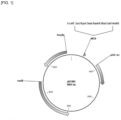
- FIG. 1 is a schematic diagram of pDCM2 plasmid.
- a plasmid (pDCM2, FIG. 1 , SEQ ID NO: 11) for the insertion and replacement of genes in the Corynebacterium chromosome was designed and synthesized using the Gene-synthesis service of BIONICS Co., Ltd.
- the plasmid was designed to contain a restriction enzyme site to be easily used for cloning by referring to a commonly known paper on the sacB system ( Gene, 145 (1994) 69-73 ).
- the pDCM2 plasmid thus synthesized has the following properties:
- PCR was performed using gDNA (genomic DNA) of wild-type Corynebacterium glutamicum ATCC13032 as a template and a pair of primers having sequences of SEQ ID NOs: 5 and 6 or a pair of primers having sequences of SEQ ID NOs: 7 and 8. Overlapping PCR was performed again using the mixture of two fragments obtained above as a template and a pair of primers having sequences of SEQ ID NO: 5 and SEQ ID NO: 8 to obtain a fragment. After denaturation for 5 minutes at 94°C, PCR was repeated 30 times for 30 seconds at 94°C, for 30 seconds at 55°C, and for 1 minute 30 seconds at 72°C, and then PCR was performed for 5 minutes at 72°C.
- the pDCM2 vector was treated with smal, and the PCR product obtained above was subjected to fusion cloning. Fusion cloning was performed using an InFusion ® HD cloning kit (Clontech). The resulting plasmid was named pDCM2-NCgl3069(C33S).
- the sequences of primers used in this example are described in following Table 1: [Table 1] Name Sequence (5'->3') SEQ ID NO NCgl3069_1F SEQ ID NO: 5 NCgl3069_2R SEQ ID NO: 6 NCgl3069_3F SEQ ID NO: 7 NCgl3069_4R SEQ ID NO: 8
- Example 3 Evaluation on L-lysine production capacity of microorganism expressing protein variant
- Example 2 The vector constructed in Example 2 was transformed into Corynebacterium glutamicum CJ3P( US 9556463 B2 ).
- the strain into which the variant was introduced was selected from the strains in which homologous recombination took place using SEQ ID NOs: 9 and 10.
- the selected strain was named CJ3P_NCgl3069_C33S (or CA01-7533), deposited with the Korea Culture Center of Microorganisms, a depository institution under the Budapest Treaty, on December 22, 2020, and given the accession number KCCM12905P.
- the sequences of primers used in this example are described in following Table 2: [Table 2] Name Sequence (5'->3') SEQ ID NO NCgl3069_5F TGCCAGCCAATCACATGGGA SEQ ID NO: 9 NCgl3069_6R AGGCCGGGACACTACGTGTG SEQ ID NO: 10
- the L-lysine production capacity was analyzed through flask fermentation titer evaluation of each strain constructed in Example 3-1 and a control parent strain.
- each strain was inoculated to a 250 mL corner-baffled flask containing 25 ml of seed medium, and subjected to shaking culture at 200rpm, at 30°C for 20 hours.
- Seed culture medium of 1ml was inoculated to a 250 mL corner-baffled flask containing 24 mL of production medium, and subjected to shaking culture at 200rpm, at 30°C for 72 hours.
- the productivity of L-lysine was measured by HPLC.
- the concentration of L-lysine and the concentration increase rate in the culture medium for each strain experimented are shown in Table 3 below.
Landscapes
- Chemical & Material Sciences (AREA)
- Life Sciences & Earth Sciences (AREA)
- Health & Medical Sciences (AREA)
- Organic Chemistry (AREA)
- Engineering & Computer Science (AREA)
- Zoology (AREA)
- Wood Science & Technology (AREA)
- Genetics & Genomics (AREA)
- Bioinformatics & Cheminformatics (AREA)
- Biotechnology (AREA)
- General Engineering & Computer Science (AREA)
- General Health & Medical Sciences (AREA)
- Biochemistry (AREA)
- Microbiology (AREA)
- Biomedical Technology (AREA)
- Medicinal Chemistry (AREA)
- Molecular Biology (AREA)
- Chemical Kinetics & Catalysis (AREA)
- General Chemical & Material Sciences (AREA)
- Tropical Medicine & Parasitology (AREA)
- Virology (AREA)
- Micro-Organisms Or Cultivation Processes Thereof (AREA)
- Biophysics (AREA)
- Gastroenterology & Hepatology (AREA)
- Proteomics, Peptides & Aminoacids (AREA)
- Physics & Mathematics (AREA)
- Plant Pathology (AREA)
- Preparation Of Compounds By Using Micro-Organisms (AREA)
Claims (4)
- Ein Polypeptid bestehend aus einer Aminosäuresequenz, die durch SEQ ID NO: 1 dargestellt ist, wobei Cystein, welches einer Aminosäure an Position 33 von SEQ ID NO: 3 entspricht, durch Serin ausgetauscht ist.
- Ein Polynukleotid, das das Polypeptid gemäß Anspruch 1 codiert.
- Ein Corynebacterium glutamicum-Stamm, der das Polypeptid gemäß Anspruch 1 oder ein Polynukleotid, das das Polypeptid codiert, umfasst, wobei der Corynebacterium glutamicum-Stamm eine erhöhte L-Lysin-Produktionskapazität hat im Vergleich zu Corynebacterium glutamicum, das ein Polypeptid gemäß SEQ ID NO: 3 oder ein Polynukleotid, das das Polypeptid gemäß SEQ ID NO: 3 codiert, enthält.
- Ein Verfahren zur Produktion von L-Lysin, wobei das Verfahren das Kultivieren des Corynebacterium glutamicum-Stamms gemäß Anspruch 3 in einem Medium.
Applications Claiming Priority (2)
| Application Number | Priority Date | Filing Date | Title |
|---|---|---|---|
| KR1020210013622A KR102344057B1 (ko) | 2021-01-29 | 2021-01-29 | 신규한 단백질 변이체 및 이를 이용한 l-라이신 생산 방법 |
| PCT/KR2021/004095 WO2022163909A1 (ko) | 2021-01-29 | 2021-04-01 | 신규한 단백질 변이체 및 이를 이용한 l-라이신 생산 방법 |
Publications (3)
| Publication Number | Publication Date |
|---|---|
| EP4060029A1 EP4060029A1 (de) | 2022-09-21 |
| EP4060029A4 EP4060029A4 (de) | 2022-09-21 |
| EP4060029B1 true EP4060029B1 (de) | 2025-01-01 |
Family
ID=78821099
Family Applications (1)
| Application Number | Title | Priority Date | Filing Date |
|---|---|---|---|
| EP21737531.0A Active EP4060029B1 (de) | 2021-01-29 | 2021-04-01 | Neue proteinvariante und verfahren zur herstellung von l-lysin damit |
Country Status (4)
| Country | Link |
|---|---|
| EP (1) | EP4060029B1 (de) |
| KR (1) | KR102344057B1 (de) |
| CN (1) | CN114981289B (de) |
| WO (1) | WO2022163909A1 (de) |
Families Citing this family (1)
| Publication number | Priority date | Publication date | Assignee | Title |
|---|---|---|---|---|
| CN119562962A (zh) * | 2023-07-24 | 2025-03-04 | Cj第一制糖株式会社 | 蛋白质变体及使用其生产l-赖氨酸的方法 |
Family Cites Families (13)
| Publication number | Priority date | Publication date | Assignee | Title |
|---|---|---|---|---|
| JP4623825B2 (ja) * | 1999-12-16 | 2011-02-02 | 協和発酵バイオ株式会社 | 新規ポリヌクレオチド |
| KR100620092B1 (ko) | 2004-12-16 | 2006-09-08 | 씨제이 주식회사 | 코리네박테리움 속 세포로부터 유래된 신규한 프로모터서열, 그를 포함하는 발현 카세트 및 벡터, 상기 벡터를포함하는 숙주 세포 및 그를 이용하여 유전자를 발현하는방법 |
| KR100838038B1 (ko) | 2006-12-29 | 2008-06-12 | 씨제이제일제당 (주) | L-라이신 생산능이 향상된 코리네박테리움 속 미생물 및그를 이용한 l-라이신 생산 방법 |
| KR101594156B1 (ko) * | 2013-06-25 | 2016-02-15 | 씨제이제일제당 주식회사 | L-라이신 생산능이 향상된 미생물 및 그를 이용하여 l-라이신을 생산하는 방법 |
| KR101582008B1 (ko) | 2013-10-15 | 2015-12-31 | 씨제이제일제당 (주) | 생물막 형성 억제 활성을 가지는 유전자 및 이 유전자가 불활성화된 균주를 이용한 l-라이신 생산 방법 |
| KR101632642B1 (ko) | 2015-01-29 | 2016-06-22 | 씨제이제일제당 주식회사 | 신규한 프로모터 및 그의 용도 |
| KR101766964B1 (ko) * | 2015-08-27 | 2017-08-09 | 씨제이제일제당 (주) | L-라이신 생산능을 가지는 코리네박테리움 속 미생물 및 이를 이용한 l-라이신 생산방법 |
| MY186296A (en) | 2016-08-31 | 2021-07-06 | Cj Cheiljedang Corp | Novel promoter and use thereof |
| KR101863456B1 (ko) * | 2016-11-15 | 2018-06-01 | 씨제이제일제당 (주) | L-라이신을 생산하는 코리네박테리움 속 미생물 및 이를 이용한 l-라이신의 생산방법 |
| KR101904666B1 (ko) * | 2017-08-02 | 2018-11-29 | 씨제이제일제당 (주) | Atp 포스포리보실기 전이효소 변이체 및 이를 이용한 l-히스티딘 생산방법 |
| KR101916622B1 (ko) * | 2018-01-04 | 2018-11-07 | 씨제이제일제당 (주) | 신규 폴리펩타이드 및 이를 이용한 imp 생산방법 |
| CN110195087B (zh) * | 2019-05-16 | 2020-12-01 | 黑龙江伊品生物科技有限公司 | 用改变ppc基因的细菌发酵生产L-赖氨酸的方法 |
| KR102147776B1 (ko) * | 2019-09-20 | 2020-08-26 | 대상 주식회사 | L-라이신 생산능력이 향상된 코리네박테리움속 미생물 및 이를 이용한 라이신의 생산 방법 |
-
2021
- 2021-01-29 KR KR1020210013622A patent/KR102344057B1/ko active Active
- 2021-04-01 CN CN202180002619.4A patent/CN114981289B/zh active Active
- 2021-04-01 WO PCT/KR2021/004095 patent/WO2022163909A1/ko not_active Ceased
- 2021-04-01 EP EP21737531.0A patent/EP4060029B1/de active Active
Also Published As
| Publication number | Publication date |
|---|---|
| KR102344057B1 (ko) | 2021-12-27 |
| WO2022163909A1 (ko) | 2022-08-04 |
| EP4060029A1 (de) | 2022-09-21 |
| CN114981289B (zh) | 2023-08-08 |
| EP4060029A4 (de) | 2022-09-21 |
| CN114981289A (zh) | 2022-08-30 |
Similar Documents
| Publication | Publication Date | Title |
|---|---|---|
| EP4059951B1 (de) | Neuartige membranproteinvariante und verfahren zum produzieren von l-lysin unter verwendung derselben | |
| EP4056695B1 (de) | Neuartige atp-phosporibosyltransferase-variante und verfahren zum produzieren von l-valin unter verwendung derselben | |
| EP4059947B1 (de) | Neuartige proteinvariante und verfahren zum produzieren von l-valin unter verwendung derselben | |
| EP4056689B1 (de) | Neuartige asparaginesynthasevariante und verfahren zur herstellung von l-valin damit | |
| EP4060029B1 (de) | Neue proteinvariante und verfahren zur herstellung von l-lysin damit | |
| EP4063502B1 (de) | Neuartige cysteinsulfinat-desulfinase-variante und verfahren zum produzieren von l-valin unter verwendung derselben | |
| EP4059952B1 (de) | Neue variante eines primosomen-anordnungsproteins und verfahren zur herstellung von l-lysin damit | |
| EP4098658B1 (de) | Neue proteinvariante und verfahren zur herstellung von l-lysin damit | |
| EP4098749B1 (de) | Neuartige zellteilungsmembranproteinvariante und verfahren zur herstellung von l-lysin unter verwendung derselben | |
| EP4060031B1 (de) | Neue dahp-synthase-variante und verfahren zur herstellung von l-ysin damit | |
| EP4067484B1 (de) | Neuartige galaktosid-o-acetyltransferasevariante und verfahren zur herstellung von l-glutaminsäure unter verwendung derselben | |
| EP4101926B1 (de) | Neue glyceraldehyd-3-phosphat-dehydrogenase-variante und verfahren zur herstellung von l-valin damit | |
| EP4063499B1 (de) | Neue mycothionreduktasevariante und verfahren zur herstellung von l-lysin damit | |
| EP4095242B1 (de) | Neuartige permeasevariante der major-facilitator-superfamilie und verfahren zur herstellung von l-lysin damit | |
| EP4095244B1 (de) | Neue zuckerphosphat-isomerase/epimerase-variante und verfahren zur herstellung von l-lysin damit | |
| EP4056692B1 (de) | Neuartige 5,10-methylentetrahydrofolat-reduktase-variante und verfahren zum produzieren von l-valin unter verwendung derselben | |
| EP4050023B1 (de) | Neuartige abc-transporter-atp-bindende proteinvariante und verfahren zur herstellung von l-lysin damit | |
| EP4056691B1 (de) | Neuartige malat-dehydrogenase-variante und verfahren zur herstellung von l-lysin damit | |
| EP4092123B1 (de) | Neuartige transkriptionsreglervariante und verfahren zur herstellung von l-valin unter verwendung derselben | |
| EP4059953B1 (de) | Neuartige proteinvariante und verfahren zum produzieren von l-valin unter verwendung derselben | |
| EP4092114B1 (de) | Neuartige 2-isopropylmalatsynthasevariante und verfahren zur herstellung von l-valin damit | |
| EP4056693B1 (de) | Neuartige prolin-dehydrenase-variante und verfahren zum produzieren von l-valin unter verwendung derselben | |
| EP4050101B1 (de) | Neuartige phytoensynthasevariante und verfahren zur herstellung von xmp oder gmp unter verwendung derselben | |
| EP4050104B1 (de) | Neuartige variante der dns-polymerase-iii-untereinheiten gamma und tau und verfahren zum produzieren von l-lysin unter verwendung derselben | |
| EP4056698B1 (de) | Neuartige ureasehilfsproteinvariante und verfahren zur herstellung von l-valin unter verwendung derselben |
Legal Events
| Date | Code | Title | Description |
|---|---|---|---|
| STAA | Information on the status of an ep patent application or granted ep patent |
Free format text: STATUS: UNKNOWN |
|
| STAA | Information on the status of an ep patent application or granted ep patent |
Free format text: STATUS: THE INTERNATIONAL PUBLICATION HAS BEEN MADE |
|
| PUAI | Public reference made under article 153(3) epc to a published international application that has entered the european phase |
Free format text: ORIGINAL CODE: 0009012 |
|
| STAA | Information on the status of an ep patent application or granted ep patent |
Free format text: STATUS: REQUEST FOR EXAMINATION WAS MADE |
|
| STAA | Information on the status of an ep patent application or granted ep patent |
Free format text: STATUS: EXAMINATION IS IN PROGRESS |
|
| 17P | Request for examination filed |
Effective date: 20210716 |
|
| A4 | Supplementary search report drawn up and despatched |
Effective date: 20220525 |
|
| AK | Designated contracting states |
Kind code of ref document: A1 Designated state(s): AL AT BE BG CH CY CZ DE DK EE ES FI FR GB GR HR HU IE IS IT LI LT LU LV MC MK MT NL NO PL PT RO RS SE SI SK SM TR |
|
| 17Q | First examination report despatched |
Effective date: 20220831 |
|
| P01 | Opt-out of the competence of the unified patent court (upc) registered |
Effective date: 20230606 |
|
| DAV | Request for validation of the european patent (deleted) | ||
| DAX | Request for extension of the european patent (deleted) | ||
| RAP3 | Party data changed (applicant data changed or rights of an application transferred) |
Owner name: CJ CHEILJEDANG CORPORATION |
|
| GRAP | Despatch of communication of intention to grant a patent |
Free format text: ORIGINAL CODE: EPIDOSNIGR1 |
|
| STAA | Information on the status of an ep patent application or granted ep patent |
Free format text: STATUS: GRANT OF PATENT IS INTENDED |
|
| INTG | Intention to grant announced |
Effective date: 20240830 |
|
| GRAS | Grant fee paid |
Free format text: ORIGINAL CODE: EPIDOSNIGR3 |
|
| GRAA | (expected) grant |
Free format text: ORIGINAL CODE: 0009210 |
|
| STAA | Information on the status of an ep patent application or granted ep patent |
Free format text: STATUS: THE PATENT HAS BEEN GRANTED |
|
| AK | Designated contracting states |
Kind code of ref document: B1 Designated state(s): AL AT BE BG CH CY CZ DE DK EE ES FI FR GB GR HR HU IE IS IT LI LT LU LV MC MK MT NL NO PL PT RO RS SE SI SK SM TR |
|
| REG | Reference to a national code |
Ref country code: GB Ref legal event code: FG4D |
|
| REG | Reference to a national code |
Ref country code: CH Ref legal event code: EP |
|
| REG | Reference to a national code |
Ref country code: DE Ref legal event code: R096 Ref document number: 602021024279 Country of ref document: DE |
|
| REG | Reference to a national code |
Ref country code: IE Ref legal event code: FG4D |
|
| REG | Reference to a national code |
Ref country code: NL Ref legal event code: FP |
|
| REG | Reference to a national code |
Ref country code: LT Ref legal event code: MG9D |
|
| REG | Reference to a national code |
Ref country code: AT Ref legal event code: MK05 Ref document number: 1756265 Country of ref document: AT Kind code of ref document: T Effective date: 20250101 |
|
| PG25 | Lapsed in a contracting state [announced via postgrant information from national office to epo] |
Ref country code: FI Free format text: LAPSE BECAUSE OF FAILURE TO SUBMIT A TRANSLATION OF THE DESCRIPTION OR TO PAY THE FEE WITHIN THE PRESCRIBED TIME-LIMIT Effective date: 20250101 |
|
| PG25 | Lapsed in a contracting state [announced via postgrant information from national office to epo] |
Ref country code: PL Free format text: LAPSE BECAUSE OF FAILURE TO SUBMIT A TRANSLATION OF THE DESCRIPTION OR TO PAY THE FEE WITHIN THE PRESCRIBED TIME-LIMIT Effective date: 20250101 |
|
| PGFP | Annual fee paid to national office [announced via postgrant information from national office to epo] |
Ref country code: DE Payment date: 20250425 Year of fee payment: 5 |
|
| PG25 | Lapsed in a contracting state [announced via postgrant information from national office to epo] |
Ref country code: ES Free format text: LAPSE BECAUSE OF FAILURE TO SUBMIT A TRANSLATION OF THE DESCRIPTION OR TO PAY THE FEE WITHIN THE PRESCRIBED TIME-LIMIT Effective date: 20250101 |
|
| PG25 | Lapsed in a contracting state [announced via postgrant information from national office to epo] |
Ref country code: IS Free format text: LAPSE BECAUSE OF FAILURE TO SUBMIT A TRANSLATION OF THE DESCRIPTION OR TO PAY THE FEE WITHIN THE PRESCRIBED TIME-LIMIT Effective date: 20250501 Ref country code: NO Free format text: LAPSE BECAUSE OF FAILURE TO SUBMIT A TRANSLATION OF THE DESCRIPTION OR TO PAY THE FEE WITHIN THE PRESCRIBED TIME-LIMIT Effective date: 20250401 |
|
| PG25 | Lapsed in a contracting state [announced via postgrant information from national office to epo] |
Ref country code: HR Free format text: LAPSE BECAUSE OF FAILURE TO SUBMIT A TRANSLATION OF THE DESCRIPTION OR TO PAY THE FEE WITHIN THE PRESCRIBED TIME-LIMIT Effective date: 20250101 |
|
| PG25 | Lapsed in a contracting state [announced via postgrant information from national office to epo] |
Ref country code: PT Free format text: LAPSE BECAUSE OF FAILURE TO SUBMIT A TRANSLATION OF THE DESCRIPTION OR TO PAY THE FEE WITHIN THE PRESCRIBED TIME-LIMIT Effective date: 20250502 Ref country code: LV Free format text: LAPSE BECAUSE OF FAILURE TO SUBMIT A TRANSLATION OF THE DESCRIPTION OR TO PAY THE FEE WITHIN THE PRESCRIBED TIME-LIMIT Effective date: 20250101 |
|
| PG25 | Lapsed in a contracting state [announced via postgrant information from national office to epo] |
Ref country code: BG Free format text: LAPSE BECAUSE OF FAILURE TO SUBMIT A TRANSLATION OF THE DESCRIPTION OR TO PAY THE FEE WITHIN THE PRESCRIBED TIME-LIMIT Effective date: 20250101 Ref country code: GR Free format text: LAPSE BECAUSE OF FAILURE TO SUBMIT A TRANSLATION OF THE DESCRIPTION OR TO PAY THE FEE WITHIN THE PRESCRIBED TIME-LIMIT Effective date: 20250402 |
|
| PG25 | Lapsed in a contracting state [announced via postgrant information from national office to epo] |
Ref country code: AT Free format text: LAPSE BECAUSE OF FAILURE TO SUBMIT A TRANSLATION OF THE DESCRIPTION OR TO PAY THE FEE WITHIN THE PRESCRIBED TIME-LIMIT Effective date: 20250101 |
|
| PG25 | Lapsed in a contracting state [announced via postgrant information from national office to epo] |
Ref country code: CZ Free format text: LAPSE BECAUSE OF FAILURE TO SUBMIT A TRANSLATION OF THE DESCRIPTION OR TO PAY THE FEE WITHIN THE PRESCRIBED TIME-LIMIT Effective date: 20250101 |
|
| PG25 | Lapsed in a contracting state [announced via postgrant information from national office to epo] |
Ref country code: SE Free format text: LAPSE BECAUSE OF FAILURE TO SUBMIT A TRANSLATION OF THE DESCRIPTION OR TO PAY THE FEE WITHIN THE PRESCRIBED TIME-LIMIT Effective date: 20250101 |
|
| REG | Reference to a national code |
Ref country code: DE Ref legal event code: R097 Ref document number: 602021024279 Country of ref document: DE |
|
| PG25 | Lapsed in a contracting state [announced via postgrant information from national office to epo] |
Ref country code: SM Free format text: LAPSE BECAUSE OF FAILURE TO SUBMIT A TRANSLATION OF THE DESCRIPTION OR TO PAY THE FEE WITHIN THE PRESCRIBED TIME-LIMIT Effective date: 20250101 |
|
| PG25 | Lapsed in a contracting state [announced via postgrant information from national office to epo] |
Ref country code: DK Free format text: LAPSE BECAUSE OF FAILURE TO SUBMIT A TRANSLATION OF THE DESCRIPTION OR TO PAY THE FEE WITHIN THE PRESCRIBED TIME-LIMIT Effective date: 20250101 |
|
| PG25 | Lapsed in a contracting state [announced via postgrant information from national office to epo] |
Ref country code: IT Free format text: LAPSE BECAUSE OF FAILURE TO SUBMIT A TRANSLATION OF THE DESCRIPTION OR TO PAY THE FEE WITHIN THE PRESCRIBED TIME-LIMIT Effective date: 20250101 |
|
| PG25 | Lapsed in a contracting state [announced via postgrant information from national office to epo] |
Ref country code: EE Free format text: LAPSE BECAUSE OF FAILURE TO SUBMIT A TRANSLATION OF THE DESCRIPTION OR TO PAY THE FEE WITHIN THE PRESCRIBED TIME-LIMIT Effective date: 20250101 |
|
| PG25 | Lapsed in a contracting state [announced via postgrant information from national office to epo] |
Ref country code: RO Free format text: LAPSE BECAUSE OF FAILURE TO SUBMIT A TRANSLATION OF THE DESCRIPTION OR TO PAY THE FEE WITHIN THE PRESCRIBED TIME-LIMIT Effective date: 20250101 |
|
| PG25 | Lapsed in a contracting state [announced via postgrant information from national office to epo] |
Ref country code: SK Free format text: LAPSE BECAUSE OF FAILURE TO SUBMIT A TRANSLATION OF THE DESCRIPTION OR TO PAY THE FEE WITHIN THE PRESCRIBED TIME-LIMIT Effective date: 20250101 |
|
| PLBE | No opposition filed within time limit |
Free format text: ORIGINAL CODE: 0009261 |
|
| STAA | Information on the status of an ep patent application or granted ep patent |
Free format text: STATUS: NO OPPOSITION FILED WITHIN TIME LIMIT |
|
| REG | Reference to a national code |
Ref country code: CH Ref legal event code: L10 Free format text: ST27 STATUS EVENT CODE: U-0-0-L10-L00 (AS PROVIDED BY THE NATIONAL OFFICE) Effective date: 20251112 |
|
| REG | Reference to a national code |
Ref country code: CH Ref legal event code: H13 Free format text: ST27 STATUS EVENT CODE: U-0-0-H10-H13 (AS PROVIDED BY THE NATIONAL OFFICE) Effective date: 20251125 |
|
| 26N | No opposition filed |
Effective date: 20251002 |
|
| PG25 | Lapsed in a contracting state [announced via postgrant information from national office to epo] |
Ref country code: LU Free format text: LAPSE BECAUSE OF NON-PAYMENT OF DUE FEES Effective date: 20250401 |
|
| PG25 | Lapsed in a contracting state [announced via postgrant information from national office to epo] |
Ref country code: MC Free format text: LAPSE BECAUSE OF FAILURE TO SUBMIT A TRANSLATION OF THE DESCRIPTION OR TO PAY THE FEE WITHIN THE PRESCRIBED TIME-LIMIT Effective date: 20250101 |
|
| REG | Reference to a national code |
Ref country code: BE Ref legal event code: MM Effective date: 20250430 |
|
| PG25 | Lapsed in a contracting state [announced via postgrant information from national office to epo] |
Ref country code: BE Free format text: LAPSE BECAUSE OF NON-PAYMENT OF DUE FEES Effective date: 20250430 |
|
| PG25 | Lapsed in a contracting state [announced via postgrant information from national office to epo] |
Ref country code: CH Free format text: LAPSE BECAUSE OF NON-PAYMENT OF DUE FEES Effective date: 20250430 |
|
| PGFP | Annual fee paid to national office [announced via postgrant information from national office to epo] |
Ref country code: NL Payment date: 20260220 Year of fee payment: 6 |
|
| PGFP | Annual fee paid to national office [announced via postgrant information from national office to epo] |
Ref country code: GB Payment date: 20260224 Year of fee payment: 6 |
|
| PG25 | Lapsed in a contracting state [announced via postgrant information from national office to epo] |
Ref country code: IE Free format text: LAPSE BECAUSE OF NON-PAYMENT OF DUE FEES Effective date: 20250401 |
|
| PGFP | Annual fee paid to national office [announced via postgrant information from national office to epo] |
Ref country code: FR Payment date: 20260224 Year of fee payment: 6 |