EP4056397B1 - Module d'entraînement pour un véhicule - Google Patents
Module d'entraînement pour un véhicule Download PDFInfo
- Publication number
- EP4056397B1 EP4056397B1 EP22159626.5A EP22159626A EP4056397B1 EP 4056397 B1 EP4056397 B1 EP 4056397B1 EP 22159626 A EP22159626 A EP 22159626A EP 4056397 B1 EP4056397 B1 EP 4056397B1
- Authority
- EP
- European Patent Office
- Prior art keywords
- housing
- subregion
- brake
- drive module
- wheel shaft
- Prior art date
- Legal status (The legal status is an assumption and is not a legal conclusion. Google has not performed a legal analysis and makes no representation as to the accuracy of the status listed.)
- Active
Links
Images

Classifications
-
- B—PERFORMING OPERATIONS; TRANSPORTING
- B60—VEHICLES IN GENERAL
- B60K—ARRANGEMENT OR MOUNTING OF PROPULSION UNITS OR OF TRANSMISSIONS IN VEHICLES; ARRANGEMENT OR MOUNTING OF PLURAL DIVERSE PRIME-MOVERS IN VEHICLES; AUXILIARY DRIVES FOR VEHICLES; INSTRUMENTATION OR DASHBOARDS FOR VEHICLES; ARRANGEMENTS IN CONNECTION WITH COOLING, AIR INTAKE, GAS EXHAUST OR FUEL SUPPLY OF PROPULSION UNITS IN VEHICLES
- B60K7/00—Disposition of motor in, or adjacent to, traction wheel
- B60K7/0007—Disposition of motor in, or adjacent to, traction wheel the motor being electric
-
- B—PERFORMING OPERATIONS; TRANSPORTING
- B60—VEHICLES IN GENERAL
- B60K—ARRANGEMENT OR MOUNTING OF PROPULSION UNITS OR OF TRANSMISSIONS IN VEHICLES; ARRANGEMENT OR MOUNTING OF PLURAL DIVERSE PRIME-MOVERS IN VEHICLES; AUXILIARY DRIVES FOR VEHICLES; INSTRUMENTATION OR DASHBOARDS FOR VEHICLES; ARRANGEMENTS IN CONNECTION WITH COOLING, AIR INTAKE, GAS EXHAUST OR FUEL SUPPLY OF PROPULSION UNITS IN VEHICLES
- B60K17/00—Arrangement or mounting of transmissions in vehicles
- B60K17/04—Arrangement or mounting of transmissions in vehicles characterised by arrangement, location or kind of gearing
- B60K17/14—Arrangement or mounting of transmissions in vehicles characterised by arrangement, location or kind of gearing the motor of fluid or electric gearing being disposed in, or adjacent to, traction wheel
- B60K17/145—Arrangement or mounting of transmissions in vehicles characterised by arrangement, location or kind of gearing the motor of fluid or electric gearing being disposed in, or adjacent to, traction wheel the electric gearing being disposed in or adjacent to traction wheel
Definitions
- the present invention relates to a drive assembly for a vehicle, in particular for a road vehicle such as a car, a truck or a bus.
- Fully or partially electrically driven vehicles have a drive device with an electric motor, which is kinematically coupled to at least one axle or to at least one wheel of the vehicle in order to drive it.
- a gear is provided to establish a kinematic connection between the wheel and the electric motor.
- An electrical energy storage device for example an accumulator, can be provided as an electrical energy source for the motor, with the electric motor being electrically connected to the energy storage device via power electronics.
- a drive assembly in which an electrical machine, a gearbox and power electronics are housed in a common housing. Furthermore, a friction brake system, which brakes a drive axle connected to the transmission, is housed in a partial space that is encapsulated from the rest of the housing in order to prevent fine dust from penetrating into the rest of the housing and fine dust from escaping to the outside.
- a drive assembly according to the invention for a vehicle comprises a housing, an electrical machine accommodated in a first portion of the housing and a transmission accommodated in a second portion of the housing, which is kinematically coupled to the electrical machine, the second portion of the housing forming a lubricating fluid reservoir, into which the gearbox protrudes.
- the drive assembly comprises a wheel shaft that is kinematically coupled to the transmission for connection to a wheel of the vehicle, which protrudes in the second portion of the housing and from the second portion of the housing onto an outside of the housing, and a friction brake system with a braking device, which has a has a brake body attached to the wheel shaft and a brake actuator for exerting a frictional force on the brake body.
- the brake body is arranged in the second portion of the housing and projects into the lubricant reservoir.
- One idea underlying the invention is to provide a highly integrated drive assembly in which an electric machine, a transmission and a brake system are combined into one assembly, the brake system comprising a friction brake which is either arranged on the outside of the housing or within a housing in this way is arranged so that it runs in an oil bath or lubricant reservoir of the housing.
- the friction brake comprises a brake body, such as a brake disc or a brake drum, which is connected in a rotationally fixed manner to a wheel shaft coupled to the electric machine via the transmission.
- the case defines you Interior in which the electrical machine, for example a three-phase machine such as a synchronous or asynchronous machine, is accommodated in a first sub-area and the transmission is accommodated in a second sub-area.
- the first and second subregions are sealed against each other in a fluid-tight manner.
- the brake body protrudes into the lubricant reservoir, this offers the advantage that the brake body is cooled very efficiently. At the same time, fine dust particles are bound in the lubricating fluid. In particular, the maintenance effort of the braking device can be significantly reduced in this way. Furthermore, the brake system can be easily installed together with the wheel shaft. In particular, no portion of the housing has to be provided exclusively for the braking device, but rather this can be integrated into the portion provided for the transmission.
- the friction brake system has a hydraulic switching unit that is hydraulically connected to the braking device and is set up to vary the frictional force exerted by the brake actuator, the switching unit being accommodated in the housing, in particular in the second portion of the housing.
- the switching unit can, for example, have one or more valves, for example to drain or supply brake fluid to the brake actuator.
- a first wheel shaft and a second wheel shaft are kinematically coupled to the transmission, wherein the friction brake system has a first braking device with a first brake body attached to the first wheel shaft and a first brake actuator for exerting a frictional force on the first brake body, and a second braking device with a second brake body attached to the second wheel shaft and a second brake actuator for exerting a frictional force has the second brake body, and wherein the switching unit is connected to the first and second braking devices and is set up to vary the frictional force exerted by the brake actuators on an individual shaft basis.
- the switching unit can, for example, be set up to carry out an anti-lock function.
- a pressure generating device for example in the form of a pump, can also be integrated into the switching unit.
- the drive assembly has a steering system accommodated in a third portion of the housing.
- the third subregion is preferably designed to be fluid-tight to the first and/or the second subregion.
- the steering system can, for example, have an electric steering drive or servo motor, a steering gear connected to the steering drive motor and handlebars coupled to the steering gear, which protrude from the third portion onto the outside of the housing. This further increases the degree of integration of the drive assembly.
- the drive assembly has an electronic control device accommodated in a fourth portion of the housing, which is electrically connected to the electric machine and the friction brake system and is set up to control operation of the electric machine and the friction brake system.
- the control device can in particular have a power electronic circuit, such as an inverter circuit, and a signal electronic circuit.
- the signal electronic circuit can, for example, have one or more processors, for example in the form of a CPU, an FPGA or an ASIC, and one or more memory components, for example in the form of non-volatile memories such as flash memories or hard drives.
- the signal electronic circuit is set up to generate brake actuation signals in order to actuate the braking device, for example in order to generate a brake pressure for applying the frictional force to the brake piece by the brake actuator and/or to actuate the switching unit, for example in order to carry out an anti-locking function.
- the signal electronic circuit is set up to control the power electronic circuit, for example to operate the electrical machine as a motor or as a generator.
- a common control unit is thus provided for the brake system, the electric machine and, optionally, for operating the steering device.
- This control device is housed in a fluid-tight fourth portion of the housing, which can be located, for example, adjacent to the first portion.
- walls of the housing defining the first subregion and the second subregion are formed in one piece. Furthermore, it can be provided that walls of the housing defining the first subregion, the second subregion and the third subregion are formed in one piece. Further optionally, it can be provided that walls of the housing defining the first subregion, the second subregion and the fourth subregion are formed in one piece. In addition, it is also conceivable that the walls of the housing defining the first subregion, the second subregion, the third subregion and the fourth subregion are formed in one piece.
- the various subregions can be integrated as cavities in a monolithic housing. For example, it is conceivable to design the housing as a cast part. The one-piece design of the housing offers the advantage that it can be produced cost-effectively and the assembly effort is reduced.
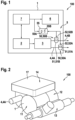
- Fig. 1 shows a schematic block diagram of a drive assembly 100 for a vehicle.
- the drive assembly 100 includes a housing 1, an electric machine 2, a transmission 3, a wheel shaft 4 and a friction brake system 5.
- a steering system 6 and/or a control device 7 can optionally be provided.
- the drive assembly 100 described below can be used in particular to drive a road vehicle, such as a car, a truck or a bus.
- Fig. 1 is shown schematically, the electric machine 2, the transmission 3 and the friction brake system 5 are accommodated in the housing 1.
- the control device 7 and the steering system 6 are optionally also accommodated in the housing 1.
- the transmission 3 is kinematically coupled to the electrical machine 2.
- the first and second wheel shafts 4A, 4B are in turn kinematically coupled to the transmission 3.
- the electrical machine 2 can in particular be a three-phase machine, for example a synchronous machine or an asynchronous machine.
- the friction brake system 5 has a braking device 50.
- a first braking device 50A can be provided for braking the first wheel shaft 50A and a second braking device 50B for braking the second wheel shaft 50B, as shown in FIG Fig. 1 is shown as an example.
- the friction brake system 5 can also have a hydraulic switching unit 55.
- each switching unit 50 can each have a brake body 51 and a brake actuator 52.
- the brake body 51 can be, for example, a brake disc or a brake drum and is connected to the wheel shaft 50 in a rotationally fixed manner.
- the brake actuator 52 which can be a hydraulically actuated brake cylinder, for example, has a friction body (not shown) which can be applied to the brake body 51 in order to generate a frictional force.
- the brake actuator 52 can be actuated, for example, via a manually operable master brake cylinder (not shown) and/or a pressure generating device (not shown), such as a plunger.
- a manually operable master brake cylinder not shown
- a pressure generating device not shown
- the first braking device 50A has a first brake body 51A attached to the first wheel shaft 4A and a first brake actuator 52A for exerting a frictional force on the first brake body 51A.
- the second braking device 50B includes a second brake body 51B attached to the second wheel shaft 4B and a second brake actuator 52B for exerting a frictional force on the second brake body 51B.
- the switching unit 55 is in Fig. 1 shown only symbolically and is hydraulically connected to the first and second braking devices 50A, 50B.
- the switching unit 55 can in particular have different valves 55A, 55B, which selectively connect or separate the respective brake actuator 52A, 52B from a pressure source for brake fluid, in particular in order to individually adjust a frictional force on each wheel shaft 4A, 4B to be able to, for example to carry out an anti-locking function.
- the switching unit 55 is thus set up to vary the frictional force exerted by the brake actuator 52.
- the optional control device 7 can, for example, have a power electronic circuit (not shown) and a signal or control electronic circuit (not shown).
- the control device 7, in particular the power electronic circuit is electrically connected to the electrical machine.
- the power electronic circuit can have an inverter circuit.
- the signal electronic circuit can, for example, have one or more processor units, for example CPUs, FPGAs, ASICs or the like, and one or more data memories, for example SD memory, HD memory or the like.
- the signal-electronic circuit is signal-connected to the power-electronic circuit and is set up to control it in order to operate the electrical machine 2, for example as a motor or as a generator.
- the control device 7, in particular the signal-electronic circuit is also signal-connected to the switching unit 55 in order to control it, for example to switch the valves 55A, 55B.
- the optional steering device 6 can, for example, be a steering drive (in Fig. 1 not shown), for example in the form of an electric motor, a steering gear connected to the steering drive (in Fig. 1 not shown) and handlebars or actuators (in Fig. 1 not shown) which are kinematically coupled to the steering gear.
- the steering device 6 can, as in Fig. 1 shown as an example, be signal-connected to the control device 7, in particular the signal-electronic circuit, the control device 7 being set up to actuate the steering device 6, for example by generating a control signal which causes an actuation of the steering drive.
- Fig. 2 shows schematically and purely by way of example an external view of the housing 1 of the drive assembly 100.
- the housing 1 has several partial areas 11, 12, 13, 14.
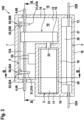
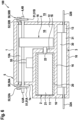
- Fig. 3 shows schematically a sectional view of the drive assembly 100.
- Fig. 4 shows a sectional view of the in Fig. 3 shown drive assembly 100, which is when cut along the in Fig. 3 drawn line AA results.
- Fig. 5 shows a sectional view of the in Fig. 3 Drive assembly shown, which is when cut along the in Fig. 3 drawn line BB results.
- the housing 1 has a defined interior 10.
- the interior 10 is delimited by walls 16 and divided into at least a first portion 11 and a second portion 12.
- Fig. 3 to 5 is shown purely by way of example that the interior 10 is additionally divided into a third sub-area 13 and a fourth sub-area 14.
- the walls 16, which define the partial areas 11, 12, 13, 14, can in particular be designed or manufactured in one piece, for example in a casting process. However, it is also conceivable that only a part of the walls 16 is formed in one piece, and one or more of the partial areas 11, 12, 13, 14 are defined by separate walls that are fastened to the one-piece walls 16, for example flanged to them.
- the electric machine 2 is in Fig. 3 shown only schematically and generally has a stator 20 and a rotor 21 which can be rotated by the stator 20 about a rotor axis of rotation and which can be arranged, for example, within the stator 20, as in Fig. 3 shown as an example.
- the electrical machine 2 can be arranged in the first subregion 11.
- the first portion 11 can in particular be a cylindrical cavity which encloses a longitudinal axis, as is particularly the case in FIG Fig. 3 and 5 is recognizable.
- a rotor shaft 22 that is firmly connected to the rotor 21 can protrude into the second portion 12 of the housing 1 through a recess in a wall 16 delimiting the first portion 11.
- the first and second portions 11, 12 are sealed in a fluid-tight manner relative to one another, for example by means of sealing rings (not shown) or the like.
- the gearbox 3 is in Fig. 3 shown only symbolically as a block and can in particular have several transmission members, such as gears, which mesh with one another in order to convert a first torque present on the rotor shaft 22 at a first speed into a second torque at a second To convert the speed on the wheel shaft 4 or the wheel shafts 4A, 4B.
- the transmission 3 is accommodated in the second portion 12 of the housing 1 and is kinematically coupled to the electric machine 2, in particular to the rotor shaft 22.
- the second subregion 12 can adjoin the first subregion 12 in particular in a direction along the longitudinal axis of the first subregion 12 and can further extend laterally of the first subregion 12.
- Fig. 3 shown only symbolically as a block and can in particular have several transmission members, such as gears, which mesh with one another in order to convert a first torque present on the rotor shaft 22 at a first speed into a second torque at a second To convert the speed on the wheel shaft 4 or the wheel shafts 4A, 4B.
- the second portion 12 forms a lubricating fluid reservoir 12A, i.e. a trough in which lubricating fluid such as oil can be accommodated or received.
- a level FL of the lubricating fluid is shown as a dashed line.
- the transmission 3 is arranged in the second portion 12 in such a way that it protrudes into the lubricating fluid reservoir 12A or into the lubricating fluid, as shown in FIG Fig. 4 is shown schematically.
- the ones in the Fig. 3 to 5 Drive assembly 100 shown as an example has, as described above with reference to Fig. 1 described, a first and a second wheel shaft 4A, 4B.
- the wheel shafts 4A, 4B can extend in particular parallel to the rotor shaft 21.
- the wheel shafts 4A, 4B extend within the second portion 12 of the housing 1 and each protrude from the second portion 12 onto an outside 15 of the housing 1.
- the wheel shafts 4A, 4B can each extend through a recess in an end wall 16 of the housing 1, as shown in FIG Fig. 4 is shown schematically.
- the wheel shafts 4A, 4B are each kinematically coupled to the transmission 3, as has already been explained above and in the Fig. 3 and 4 is shown schematically.
- the first and second braking devices 50A, 50B of the friction brake system 5 are each arranged in the second portion 12 of the housing 1.
- the first brake body 51A of the first braking device 50A and the second brake body 51B of the second braking device 50B can each be implemented as brake disks, which are connected in a rotationally fixed manner to the respective wheel shaft 4A, 4B.
- other designs are also conceivable, for example in the form of brake drums.
- the first brake actuator 52A of the first brake device 50A and the second brake actuator 52B of the second Braking device 50B can, for example, be implemented as a hydraulic brake cylinder, as described above, and in particular be attached to a wall 16 of the housing 1, as shown in FIG Fig. 3 and 4 shown schematically.
- the wheel shafts 4A, 4B and the brake bodies 51A, 51B attached thereto are arranged in the second portion 12 of the housing 1 in such a way that the brake bodies 51A, 51B protrude into the lubricating fluid reservoir 12A or into the lubricating fluid 12A.
- the brake bodies 51A, 51B are cooled very well by the lubricating fluid 12A and abrasion resulting from the friction between the brake bodies 51A, 51B and the friction piece of the brake actuator 52A, 52B is bound in the lubricating fluid.
- the lubricating liquid can be circulated through a filter device (not shown) by means of a conveying device (not shown) such as a pump in order to separate particles from the lubricating liquid.
- the optional hydraulic switching unit 55 is in Fig. 3 shown only symbolically as a block and can be arranged, for example, in the second portion 12 of the housing 1. However, it would also be conceivable to accommodate the switching unit 55 in another of the subareas 11, 13, 14.
- the steering system 6 is optionally accommodated in the third section 13, as shown in Fig. 3 is shown schematically.
- the third portion 13 can, for example, be a substantially cylindrical cavity which extends parallel to the first portion 11, as in Fig. 3 shown as an example and schematically.
- the third sub-area 13 can in particular be completely spatially separated from the first and second sub-areas 11, 12, as shown in Fig. 3 is shown schematically.
- the steering system 6 is in Fig. 3 also shown only schematically, with the steering drive 30 and the steering gear 31 being shown as a block.
- the handlebars 32A, 32B can protrude from the third portion 13 onto the outside 15 of the housing 1, as in Fig. 3 shown schematically.
- the optional control device 7 is symbolically represented as a block in Fig. 5 shown and can be constructed in the manner described above. As in Fig. 4 can be seen, the control device 7 is in the fourth sub-area 14 of the housing 1 arranged.
- the fourth subregion 14 can, for example, be arranged adjacent to the first subregion 11 with respect to a radial direction which extends perpendicular to the longitudinal axis of the first subregion 11, as shown in FIG Fig. 4 is shown as an example.
- the fourth subregion 14 can be delimited by a substantially flat floor and several side walls extending from it, as shown in FIG Fig. 5 is shown schematically.
- the fourth subregion 14 is preferably sealed in a fluid-tight manner relative to the first subregion 11 and/or the second subregion 12 and/or the third subregion 13.
- the fourth portion 14 can be closed by a cover 17.
- FIG. 6 Another drive assembly 100 is shown as an example.
- Drive assembly 100 shown differs from that in the Fig. 3 to 5 illustrated drive assembly 100 only in that the first and second braking devices 50A, 50B are arranged on the outside 15, that is, outside the interior 10 of the housing 1.
- the brake bodies 51A, 51B are arranged on the outside 15 of the housing 1 and are therefore accessible from the outside and cooled by ambient air.
- the brake actuators 52A, 52B can, for example, be attached to an outer surface 1a of the housing 1, as shown in FIG Fig. 6 is shown schematically.
Landscapes
- Engineering & Computer Science (AREA)
- Chemical & Material Sciences (AREA)
- Combustion & Propulsion (AREA)
- Transportation (AREA)
- Mechanical Engineering (AREA)
- Arrangement Or Mounting Of Propulsion Units For Vehicles (AREA)
Claims (8)
- Module d'entraînement (100) pour un véhicule, présentant :un carter (1) ;une machine électrique (2) logée dans une première zone partielle (11) du carter (1) ;une transmission (3) logée dans une deuxième zone partielle (12) du carter (1) et qui est couplée de manière cinématique à la machine électrique (2), dans lequel la deuxième zone partielle (12) du carter (1) réalise un réservoir de liquide de lubrification (12A) dans lequel la transmission (3) fait saillie ;un arbre de roue (4) couplé de manière cinématique à la transmission (3) pour la connexion avec une roue du véhicule, qui s'étend dans la deuxième zone partielle (12) du carter (1) et qui fait saillie à l'extérieur de la deuxième zone partielle (12) du carter (1) sur un côté extérieur (15) du carter (1) ; etun système de frein à friction (5) pourvu d'un dispositif de freinage (50) qui présente un corps de frein (51) fixé à l'arbre de roue (4) et un actionneur de frein (52) pour exercer une force de friction sur le corps de frein (51) ;caractérisé en ce que le corps de frein (51) est disposé dans la deuxième zone partielle (12) du carter (1) et fait saillie dans le réservoir de liquide de lubrification (12A).
- Module d'entraînement (100) selon la revendication 1, dans lequel le système de frein à friction (5) présente une unité de commutation hydraulique (55) reliée hydrauliquement au dispositif de freinage (50), qui est conçue pour faire varier la force de friction exercée par l'actionneur de frein (52), dans lequel l'unité de commutation (55) est reçue dans le carter (1), en particulier dans la deuxième zone partielle (12) du carter (1).
- Module d'entraînement (100) selon la revendication 2, dans lequel un premier arbre de roue (4A) et un deuxième arbre de roue (4B) sont couplés de manière cinématique à la transmission (3), dans lequel le système de frein à friction (5) présente un premier dispositif de freinage (50A) pourvu d'un premier corps de frein (51A) fixé au premier arbre de roue (4A) et d'un premier actionneur de frein (52A) pour exercer une force de friction sur le premier corps de frein (51A) et un deuxième dispositif de freinage (50B) pourvu d'un deuxième corps de frein (51B) fixé au deuxième arbre de roue (4B) et d'un deuxième actionneur de freinage (52B) pour exercer une force de friction sur le deuxième corps de frein (51B), et dans lequel l'unité de commutation (55) est reliée au premier et au deuxième dispositif de freinage (50A, 50B) et est conçue pour faire varier la force de friction exercée par les actionneurs de frein (52A, 52B) individuellement pour chaque arbre.
- Module d'entraînement (100) selon l'une quelconque des revendications précédentes, présentant en outre :
un système de direction (6) logé dans une troisième zone partielle (13) du carter (1). - Module d'entraînement (100) selon l'une quelconque des revendications précédentes, présentant en outre :
un dispositif de commande électronique (7) logé dans une quatrième zone partielle (14) du carter (1), qui est relié de manière électriquement conductrice à la machine électrique (2) et au système de frein à friction (5) et est conçu pour commander un fonctionnement de la machine électrique (2) et du système de frein à friction (5). - Module d'entraînement (100) selon l'une quelconque des revendications précédentes, dans lequel des parois du carter (1) définissant la première zone partielle (11) et la deuxième zone partielle (12) sont réalisées d'un seul tenant.
- Module d'entraînement (100) selon l'une quelconque des revendications 4 et 6, dans lequel des parois du carter (1) définissant la première zone partielle (11), la deuxième zone partielle (12) et la troisième zone partielle (13) sont réalisées d'un seul tenant.
- Module d'entraînement (100) selon l'une quelconque des revendications 5 et 6, dans lequel des parois du carter (1) définissant la première zone partielle (11), la deuxième zone partielle (12) et la quatrième zone partielle (14) sont réalisées d'un seul tenant.
Applications Claiming Priority (1)
| Application Number | Priority Date | Filing Date | Title |
|---|---|---|---|
| DE102021202447.5A DE102021202447A1 (de) | 2021-03-12 | 2021-03-12 | Antriebsbaugruppe für ein Fahrzeug |
Publications (2)
| Publication Number | Publication Date |
|---|---|
| EP4056397A1 EP4056397A1 (fr) | 2022-09-14 |
| EP4056397B1 true EP4056397B1 (fr) | 2023-09-20 |
Family
ID=80623773
Family Applications (1)
| Application Number | Title | Priority Date | Filing Date |
|---|---|---|---|
| EP22159626.5A Active EP4056397B1 (fr) | 2021-03-12 | 2022-03-02 | Module d'entraînement pour un véhicule |
Country Status (2)
| Country | Link |
|---|---|
| EP (1) | EP4056397B1 (fr) |
| DE (1) | DE102021202447A1 (fr) |
Family Cites Families (9)
| Publication number | Priority date | Publication date | Assignee | Title |
|---|---|---|---|---|
| US3302739A (en) * | 1963-11-19 | 1967-02-07 | Goodman Mfg Co | Shuttle cars with six driven wheels |
| US3892300A (en) * | 1973-08-22 | 1975-07-01 | Gen Electric | Motorized wheel brake system |
| JP3440082B2 (ja) * | 2001-02-19 | 2003-08-25 | 科学技術振興事業団 | 電気自動車用インホイールモーター |
| JP4656999B2 (ja) * | 2005-04-22 | 2011-03-23 | トヨタ自動車株式会社 | 電動輪 |
| ITUD20050135A1 (it) * | 2005-08-23 | 2007-02-24 | Pro Mec S R L | Elettromotoriduttore con freno integrato per trasmissione diretta alla ruota di veicolo a trazione elettrica |
| DE102010017991A1 (de) | 2010-04-21 | 2011-10-27 | Fachhochschule Südwestfalen | Autonomes Achsmodul für ein Kraftfahrzeug |
| DE102011113198B4 (de) | 2011-09-10 | 2024-11-28 | Volkswagen Aktiengesellschaft | Querträger zur Befestigung einer elektrischen Maschine in einem Motorraum eines Fahrzeugs und Fahrzeug |
| JP6796421B2 (ja) * | 2016-07-22 | 2020-12-09 | Ntn株式会社 | 潤滑油の供給構造 |
| WO2018150009A1 (fr) | 2017-02-20 | 2018-08-23 | Thyssenkrupp Ag | Unité d'entraînement d'essieu dotée d'un système de direction, essieu moteur et véhicule à moteur |
-
2021
- 2021-03-12 DE DE102021202447.5A patent/DE102021202447A1/de active Pending
-
2022
- 2022-03-02 EP EP22159626.5A patent/EP4056397B1/fr active Active
Also Published As
| Publication number | Publication date |
|---|---|
| EP4056397A1 (fr) | 2022-09-14 |
| DE102021202447A1 (de) | 2022-09-15 |
Similar Documents
| Publication | Publication Date | Title |
|---|---|---|
| DE10238278B4 (de) | Elektronisches Bremssystem ohne Pumpeneinheit | |
| EP3263378B1 (fr) | Véhicule utilitaire à batterie électrique, en particulier poids lourd | |
| DE102020202843A1 (de) | Elektromechanischer Bremsdruckerzeuger mit einer Gewindetriebanordnung | |
| DE102017206798A1 (de) | Elektromechanische Bremse für Kraftfahrzeuge | |
| EP3350046A1 (fr) | Servofrein électromécanique | |
| WO2023117288A1 (fr) | Module d'essieu électrique d'un véhicule à propulsion électrique | |
| EP4269836A1 (fr) | Essieu directeur à entraînement électrique et véhicule | |
| DE102013217745A1 (de) | Bremsbetätigungseinheit und Bremsanlage | |
| DE102019205958A1 (de) | Elektromechanisch antreibbarer Bremsdruckerzeuger für ein hydraulisches Bremssystem eines Fahrzeugs sowie Fahrzeug umfassend einen elektromechanischen Bremsdruckerzeuger | |
| EP4056397B1 (fr) | Module d'entraînement pour un véhicule | |
| DE10017786B4 (de) | Anordnung von elektrischen Maschinen, deren Rotoren jeweils mit einem Rad eines Kraftfahrzeuges zu verbinden sind | |
| WO2021110330A1 (fr) | Générateur de pression de frein à entraînement électromécanique | |
| WO2021099080A1 (fr) | Générateur de pression de freinage à entraînement électromécanique | |
| DE102015012124A1 (de) | Elektromechanischer Bremskraftverstärker | |
| WO2004058552A1 (fr) | Systeme de freinage et procede pour faire fonctionner un systeme de freinage pour vehicules electriques | |
| EP3768561B1 (fr) | Dispositif de freinage | |
| DE102019212344B3 (de) | Elektromechanisch antreibbarer Bremsdruckerzeuger | |
| DE102009029538A1 (de) | Lenkvorrichtung, insbesondere elektrische Servolenkvorrichtung für ein Kraftfahrzeug | |
| DE102019205975A1 (de) | Elektromechanisch antreibbarer Bremsdruckerzeuger für ein hydraulisches Bremssystem eines Fahrzeuges sowie Fahrzeug, umfassend einen elektromechanischen Bremsdruckerzeuger | |
| DE102007012392A1 (de) | Hilfskraftlenkung | |
| EP4532280B1 (fr) | Piston primaire pour maitre-cylindre de frein ou dispositif de transmission | |
| WO2020216487A1 (fr) | Générateur électromécanique de pression de freinage pourvu d'une transmission et procédé de fabrication d'une transmission pour un générateur électromécanique de pression de freinage | |
| EP4126612B1 (fr) | Arrangement hydraulique dans un système de freins d'un véhicule et véhicule | |
| DE10320846A1 (de) | Lenkungsvorrichtung für Kraftfahrzeuge | |
| DE102023203304A1 (de) | Hydraulikaggregat eines Fahrzeug-Bremssystems |
Legal Events
| Date | Code | Title | Description |
|---|---|---|---|
| PUAI | Public reference made under article 153(3) epc to a published international application that has entered the european phase |
Free format text: ORIGINAL CODE: 0009012 |
|
| STAA | Information on the status of an ep patent application or granted ep patent |
Free format text: STATUS: THE APPLICATION HAS BEEN PUBLISHED |
|
| AK | Designated contracting states |
Kind code of ref document: A1 Designated state(s): AL AT BE BG CH CY CZ DE DK EE ES FI FR GB GR HR HU IE IS IT LI LT LU LV MC MK MT NL NO PL PT RO RS SE SI SK SM TR |
|
| STAA | Information on the status of an ep patent application or granted ep patent |
Free format text: STATUS: REQUEST FOR EXAMINATION WAS MADE |
|
| 17P | Request for examination filed |
Effective date: 20230314 |
|
| RBV | Designated contracting states (corrected) |
Designated state(s): AL AT BE BG CH CY CZ DE DK EE ES FI FR GB GR HR HU IE IS IT LI LT LU LV MC MK MT NL NO PL PT RO RS SE SI SK SM TR |
|
| GRAP | Despatch of communication of intention to grant a patent |
Free format text: ORIGINAL CODE: EPIDOSNIGR1 |
|
| STAA | Information on the status of an ep patent application or granted ep patent |
Free format text: STATUS: GRANT OF PATENT IS INTENDED |
|
| RIC1 | Information provided on ipc code assigned before grant |
Ipc: B60K 17/14 20060101ALI20230508BHEP Ipc: B60K 7/00 20060101AFI20230508BHEP |
|
| INTG | Intention to grant announced |
Effective date: 20230606 |
|
| GRAS | Grant fee paid |
Free format text: ORIGINAL CODE: EPIDOSNIGR3 |
|
| GRAA | (expected) grant |
Free format text: ORIGINAL CODE: 0009210 |
|
| STAA | Information on the status of an ep patent application or granted ep patent |
Free format text: STATUS: THE PATENT HAS BEEN GRANTED |
|
| AK | Designated contracting states |
Kind code of ref document: B1 Designated state(s): AL AT BE BG CH CY CZ DE DK EE ES FI FR GB GR HR HU IE IS IT LI LT LU LV MC MK MT NL NO PL PT RO RS SE SI SK SM TR |
|
| REG | Reference to a national code |
Ref country code: GB Ref legal event code: FG4D Free format text: NOT ENGLISH |
|
| REG | Reference to a national code |
Ref country code: CH Ref legal event code: EP |
|
| REG | Reference to a national code |
Ref country code: IE Ref legal event code: FG4D Free format text: LANGUAGE OF EP DOCUMENT: GERMAN |
|
| REG | Reference to a national code |
Ref country code: DE Ref legal event code: R096 Ref document number: 502022000142 Country of ref document: DE |
|
| REG | Reference to a national code |
Ref country code: LT Ref legal event code: MG9D |
|
| PG25 | Lapsed in a contracting state [announced via postgrant information from national office to epo] |
Ref country code: GR Free format text: LAPSE BECAUSE OF FAILURE TO SUBMIT A TRANSLATION OF THE DESCRIPTION OR TO PAY THE FEE WITHIN THE PRESCRIBED TIME-LIMIT Effective date: 20231221 |
|
| REG | Reference to a national code |
Ref country code: NL Ref legal event code: MP Effective date: 20230920 |
|
| PG25 | Lapsed in a contracting state [announced via postgrant information from national office to epo] |
Ref country code: SE Free format text: LAPSE BECAUSE OF FAILURE TO SUBMIT A TRANSLATION OF THE DESCRIPTION OR TO PAY THE FEE WITHIN THE PRESCRIBED TIME-LIMIT Effective date: 20230920 Ref country code: RS Free format text: LAPSE BECAUSE OF FAILURE TO SUBMIT A TRANSLATION OF THE DESCRIPTION OR TO PAY THE FEE WITHIN THE PRESCRIBED TIME-LIMIT Effective date: 20230920 Ref country code: NO Free format text: LAPSE BECAUSE OF FAILURE TO SUBMIT A TRANSLATION OF THE DESCRIPTION OR TO PAY THE FEE WITHIN THE PRESCRIBED TIME-LIMIT Effective date: 20231220 Ref country code: LV Free format text: LAPSE BECAUSE OF FAILURE TO SUBMIT A TRANSLATION OF THE DESCRIPTION OR TO PAY THE FEE WITHIN THE PRESCRIBED TIME-LIMIT Effective date: 20230920 Ref country code: LT Free format text: LAPSE BECAUSE OF FAILURE TO SUBMIT A TRANSLATION OF THE DESCRIPTION OR TO PAY THE FEE WITHIN THE PRESCRIBED TIME-LIMIT Effective date: 20230920 Ref country code: HR Free format text: LAPSE BECAUSE OF FAILURE TO SUBMIT A TRANSLATION OF THE DESCRIPTION OR TO PAY THE FEE WITHIN THE PRESCRIBED TIME-LIMIT Effective date: 20230920 Ref country code: GR Free format text: LAPSE BECAUSE OF FAILURE TO SUBMIT A TRANSLATION OF THE DESCRIPTION OR TO PAY THE FEE WITHIN THE PRESCRIBED TIME-LIMIT Effective date: 20231221 Ref country code: FI Free format text: LAPSE BECAUSE OF FAILURE TO SUBMIT A TRANSLATION OF THE DESCRIPTION OR TO PAY THE FEE WITHIN THE PRESCRIBED TIME-LIMIT Effective date: 20230920 |
|
| PG25 | Lapsed in a contracting state [announced via postgrant information from national office to epo] |
Ref country code: NL Free format text: LAPSE BECAUSE OF FAILURE TO SUBMIT A TRANSLATION OF THE DESCRIPTION OR TO PAY THE FEE WITHIN THE PRESCRIBED TIME-LIMIT Effective date: 20230920 |
|
| PG25 | Lapsed in a contracting state [announced via postgrant information from national office to epo] |
Ref country code: IS Free format text: LAPSE BECAUSE OF FAILURE TO SUBMIT A TRANSLATION OF THE DESCRIPTION OR TO PAY THE FEE WITHIN THE PRESCRIBED TIME-LIMIT Effective date: 20240120 |
|
| PG25 | Lapsed in a contracting state [announced via postgrant information from national office to epo] |
Ref country code: ES Free format text: LAPSE BECAUSE OF FAILURE TO SUBMIT A TRANSLATION OF THE DESCRIPTION OR TO PAY THE FEE WITHIN THE PRESCRIBED TIME-LIMIT Effective date: 20230920 |
|
| PG25 | Lapsed in a contracting state [announced via postgrant information from national office to epo] |
Ref country code: SM Free format text: LAPSE BECAUSE OF FAILURE TO SUBMIT A TRANSLATION OF THE DESCRIPTION OR TO PAY THE FEE WITHIN THE PRESCRIBED TIME-LIMIT Effective date: 20230920 Ref country code: RO Free format text: LAPSE BECAUSE OF FAILURE TO SUBMIT A TRANSLATION OF THE DESCRIPTION OR TO PAY THE FEE WITHIN THE PRESCRIBED TIME-LIMIT Effective date: 20230920 Ref country code: IS Free format text: LAPSE BECAUSE OF FAILURE TO SUBMIT A TRANSLATION OF THE DESCRIPTION OR TO PAY THE FEE WITHIN THE PRESCRIBED TIME-LIMIT Effective date: 20240120 Ref country code: ES Free format text: LAPSE BECAUSE OF FAILURE TO SUBMIT A TRANSLATION OF THE DESCRIPTION OR TO PAY THE FEE WITHIN THE PRESCRIBED TIME-LIMIT Effective date: 20230920 Ref country code: EE Free format text: LAPSE BECAUSE OF FAILURE TO SUBMIT A TRANSLATION OF THE DESCRIPTION OR TO PAY THE FEE WITHIN THE PRESCRIBED TIME-LIMIT Effective date: 20230920 Ref country code: CZ Free format text: LAPSE BECAUSE OF FAILURE TO SUBMIT A TRANSLATION OF THE DESCRIPTION OR TO PAY THE FEE WITHIN THE PRESCRIBED TIME-LIMIT Effective date: 20230920 Ref country code: SK Free format text: LAPSE BECAUSE OF FAILURE TO SUBMIT A TRANSLATION OF THE DESCRIPTION OR TO PAY THE FEE WITHIN THE PRESCRIBED TIME-LIMIT Effective date: 20230920 Ref country code: PT Free format text: LAPSE BECAUSE OF FAILURE TO SUBMIT A TRANSLATION OF THE DESCRIPTION OR TO PAY THE FEE WITHIN THE PRESCRIBED TIME-LIMIT Effective date: 20240122 |
|
| PG25 | Lapsed in a contracting state [announced via postgrant information from national office to epo] |
Ref country code: PL Free format text: LAPSE BECAUSE OF FAILURE TO SUBMIT A TRANSLATION OF THE DESCRIPTION OR TO PAY THE FEE WITHIN THE PRESCRIBED TIME-LIMIT Effective date: 20230920 Ref country code: IT Free format text: LAPSE BECAUSE OF FAILURE TO SUBMIT A TRANSLATION OF THE DESCRIPTION OR TO PAY THE FEE WITHIN THE PRESCRIBED TIME-LIMIT Effective date: 20230920 |
|
| REG | Reference to a national code |
Ref country code: DE Ref legal event code: R097 Ref document number: 502022000142 Country of ref document: DE |
|
| PG25 | Lapsed in a contracting state [announced via postgrant information from national office to epo] |
Ref country code: DK Free format text: LAPSE BECAUSE OF FAILURE TO SUBMIT A TRANSLATION OF THE DESCRIPTION OR TO PAY THE FEE WITHIN THE PRESCRIBED TIME-LIMIT Effective date: 20230920 |
|
| PLBE | No opposition filed within time limit |
Free format text: ORIGINAL CODE: 0009261 |
|
| STAA | Information on the status of an ep patent application or granted ep patent |
Free format text: STATUS: NO OPPOSITION FILED WITHIN TIME LIMIT |
|
| PG25 | Lapsed in a contracting state [announced via postgrant information from national office to epo] |
Ref country code: DK Free format text: LAPSE BECAUSE OF FAILURE TO SUBMIT A TRANSLATION OF THE DESCRIPTION OR TO PAY THE FEE WITHIN THE PRESCRIBED TIME-LIMIT Effective date: 20230920 |
|
| 26N | No opposition filed |
Effective date: 20240621 |
|
| PG25 | Lapsed in a contracting state [announced via postgrant information from national office to epo] |
Ref country code: SI Free format text: LAPSE BECAUSE OF FAILURE TO SUBMIT A TRANSLATION OF THE DESCRIPTION OR TO PAY THE FEE WITHIN THE PRESCRIBED TIME-LIMIT Effective date: 20230920 |
|
| PG25 | Lapsed in a contracting state [announced via postgrant information from national office to epo] |
Ref country code: SI Free format text: LAPSE BECAUSE OF FAILURE TO SUBMIT A TRANSLATION OF THE DESCRIPTION OR TO PAY THE FEE WITHIN THE PRESCRIBED TIME-LIMIT Effective date: 20230920 |
|
| PG25 | Lapsed in a contracting state [announced via postgrant information from national office to epo] |
Ref country code: BG Free format text: LAPSE BECAUSE OF FAILURE TO SUBMIT A TRANSLATION OF THE DESCRIPTION OR TO PAY THE FEE WITHIN THE PRESCRIBED TIME-LIMIT Effective date: 20230920 |
|
| PG25 | Lapsed in a contracting state [announced via postgrant information from national office to epo] |
Ref country code: LU Free format text: LAPSE BECAUSE OF NON-PAYMENT OF DUE FEES Effective date: 20240302 |
|
| PG25 | Lapsed in a contracting state [announced via postgrant information from national office to epo] |
Ref country code: MC Free format text: LAPSE BECAUSE OF FAILURE TO SUBMIT A TRANSLATION OF THE DESCRIPTION OR TO PAY THE FEE WITHIN THE PRESCRIBED TIME-LIMIT Effective date: 20230920 |
|
| PG25 | Lapsed in a contracting state [announced via postgrant information from national office to epo] |
Ref country code: MC Free format text: LAPSE BECAUSE OF FAILURE TO SUBMIT A TRANSLATION OF THE DESCRIPTION OR TO PAY THE FEE WITHIN THE PRESCRIBED TIME-LIMIT Effective date: 20230920 Ref country code: LU Free format text: LAPSE BECAUSE OF NON-PAYMENT OF DUE FEES Effective date: 20240302 Ref country code: BG Free format text: LAPSE BECAUSE OF FAILURE TO SUBMIT A TRANSLATION OF THE DESCRIPTION OR TO PAY THE FEE WITHIN THE PRESCRIBED TIME-LIMIT Effective date: 20230920 |
|
| REG | Reference to a national code |
Ref country code: BE Ref legal event code: MM Effective date: 20240331 |
|
| PG25 | Lapsed in a contracting state [announced via postgrant information from national office to epo] |
Ref country code: BE Free format text: LAPSE BECAUSE OF NON-PAYMENT OF DUE FEES Effective date: 20240331 |
|
| PG25 | Lapsed in a contracting state [announced via postgrant information from national office to epo] |
Ref country code: FR Free format text: LAPSE BECAUSE OF NON-PAYMENT OF DUE FEES Effective date: 20240331 |
|
| PG25 | Lapsed in a contracting state [announced via postgrant information from national office to epo] |
Ref country code: IE Free format text: LAPSE BECAUSE OF NON-PAYMENT OF DUE FEES Effective date: 20240302 |
|
| PG25 | Lapsed in a contracting state [announced via postgrant information from national office to epo] |
Ref country code: IE Free format text: LAPSE BECAUSE OF NON-PAYMENT OF DUE FEES Effective date: 20240302 Ref country code: FR Free format text: LAPSE BECAUSE OF NON-PAYMENT OF DUE FEES Effective date: 20240331 Ref country code: BE Free format text: LAPSE BECAUSE OF NON-PAYMENT OF DUE FEES Effective date: 20240331 |
|
| PGFP | Annual fee paid to national office [announced via postgrant information from national office to epo] |
Ref country code: DE Payment date: 20250522 Year of fee payment: 4 |
|
| PG25 | Lapsed in a contracting state [announced via postgrant information from national office to epo] |
Ref country code: CY Free format text: LAPSE BECAUSE OF FAILURE TO SUBMIT A TRANSLATION OF THE DESCRIPTION OR TO PAY THE FEE WITHIN THE PRESCRIBED TIME-LIMIT; INVALID AB INITIO Effective date: 20220302 |
|
| REG | Reference to a national code |
Ref country code: CH Ref legal event code: H13 Free format text: ST27 STATUS EVENT CODE: U-0-0-H10-H13 (AS PROVIDED BY THE NATIONAL OFFICE) Effective date: 20251023 |
|
| PG25 | Lapsed in a contracting state [announced via postgrant information from national office to epo] |
Ref country code: TR Free format text: LAPSE BECAUSE OF FAILURE TO SUBMIT A TRANSLATION OF THE DESCRIPTION OR TO PAY THE FEE WITHIN THE PRESCRIBED TIME-LIMIT Effective date: 20230920 |
|
| PG25 | Lapsed in a contracting state [announced via postgrant information from national office to epo] |
Ref country code: CH Free format text: LAPSE BECAUSE OF NON-PAYMENT OF DUE FEES Effective date: 20250331 |
|
| PGFP | Annual fee paid to national office [announced via postgrant information from national office to epo] |
Ref country code: AT Payment date: 20260301 Year of fee payment: 5 |