EP4055592B1 - Systeme und verfahren für kundenauthentifizierung auf der basis von audio von interesse - Google Patents
Systeme und verfahren für kundenauthentifizierung auf der basis von audio von interesse Download PDFInfo
- Publication number
- EP4055592B1 EP4055592B1 EP20799898.0A EP20799898A EP4055592B1 EP 4055592 B1 EP4055592 B1 EP 4055592B1 EP 20799898 A EP20799898 A EP 20799898A EP 4055592 B1 EP4055592 B1 EP 4055592B1
- Authority
- EP
- European Patent Office
- Prior art keywords
- customer
- interest
- audio
- call
- voiceprints
- Prior art date
- Legal status (The legal status is an assumption and is not a legal conclusion. Google has not performed a legal analysis and makes no representation as to the accuracy of the status listed.)
- Active
Links
Images

Classifications
-
- G—PHYSICS
- G06—COMPUTING OR CALCULATING; COUNTING
- G06F—ELECTRIC DIGITAL DATA PROCESSING
- G06F21/00—Security arrangements for protecting computers, components thereof, programs or data against unauthorised activity
- G06F21/30—Authentication, i.e. establishing the identity or authorisation of security principals
- G06F21/31—User authentication
- G06F21/32—User authentication using biometric data, e.g. fingerprints, iris scans or voiceprints
-
- G—PHYSICS
- G06—COMPUTING OR CALCULATING; COUNTING
- G06Q—INFORMATION AND COMMUNICATION TECHNOLOGY [ICT] SPECIALLY ADAPTED FOR ADMINISTRATIVE, COMMERCIAL, FINANCIAL, MANAGERIAL OR SUPERVISORY PURPOSES; SYSTEMS OR METHODS SPECIALLY ADAPTED FOR ADMINISTRATIVE, COMMERCIAL, FINANCIAL, MANAGERIAL OR SUPERVISORY PURPOSES, NOT OTHERWISE PROVIDED FOR
- G06Q20/00—Payment architectures, schemes or protocols
- G06Q20/38—Payment protocols; Details thereof
- G06Q20/40—Authorisation, e.g. identification of payer or payee, verification of customer or shop credentials; Review and approval of payers, e.g. check credit lines or negative lists
- G06Q20/401—Transaction verification
- G06Q20/4014—Identity check for transactions
- G06Q20/40145—Biometric identity checks
-
- G—PHYSICS
- G10—MUSICAL INSTRUMENTS; ACOUSTICS
- G10L—SPEECH ANALYSIS TECHNIQUES OR SPEECH SYNTHESIS; SPEECH RECOGNITION; SPEECH OR VOICE PROCESSING TECHNIQUES; SPEECH OR AUDIO CODING OR DECODING
- G10L17/00—Speaker identification or verification techniques
-
- G—PHYSICS
- G10—MUSICAL INSTRUMENTS; ACOUSTICS
- G10L—SPEECH ANALYSIS TECHNIQUES OR SPEECH SYNTHESIS; SPEECH RECOGNITION; SPEECH OR VOICE PROCESSING TECHNIQUES; SPEECH OR AUDIO CODING OR DECODING
- G10L17/00—Speaker identification or verification techniques
- G10L17/06—Decision making techniques; Pattern matching strategies
- G10L17/14—Use of phonemic categorisation or speech recognition prior to speaker recognition or verification
-
- G—PHYSICS
- G10—MUSICAL INSTRUMENTS; ACOUSTICS
- G10L—SPEECH ANALYSIS TECHNIQUES OR SPEECH SYNTHESIS; SPEECH RECOGNITION; SPEECH OR VOICE PROCESSING TECHNIQUES; SPEECH OR AUDIO CODING OR DECODING
- G10L17/00—Speaker identification or verification techniques
- G10L17/22—Interactive procedures; Man-machine interfaces
-
- H—ELECTRICITY
- H04—ELECTRIC COMMUNICATION TECHNIQUE
- H04L—TRANSMISSION OF DIGITAL INFORMATION, e.g. TELEGRAPHIC COMMUNICATION
- H04L63/00—Network architectures or network communication protocols for network security
- H04L63/08—Network architectures or network communication protocols for network security for authentication of entities
- H04L63/0861—Network architectures or network communication protocols for network security for authentication of entities using biometrical features, e.g. fingerprint, retina-scan
-
- H—ELECTRICITY
- H04—ELECTRIC COMMUNICATION TECHNIQUE
- H04M—TELEPHONIC COMMUNICATION
- H04M3/00—Automatic or semi-automatic exchanges
- H04M3/42—Systems providing special services or facilities to subscribers
- H04M3/42025—Calling or Called party identification service
- H04M3/42034—Calling party identification service
- H04M3/42059—Making use of the calling party identifier
- H04M3/42068—Making use of the calling party identifier where the identifier is used to access a profile
-
- H—ELECTRICITY
- H04—ELECTRIC COMMUNICATION TECHNIQUE
- H04M—TELEPHONIC COMMUNICATION
- H04M3/00—Automatic or semi-automatic exchanges
- H04M3/42—Systems providing special services or facilities to subscribers
- H04M3/50—Centralised arrangements for answering calls; Centralised arrangements for recording messages for absent or busy subscribers ; Centralised arrangements for recording messages
- H04M3/51—Centralised call answering arrangements requiring operator intervention, e.g. call or contact centers for telemarketing
-
- H—ELECTRICITY
- H04—ELECTRIC COMMUNICATION TECHNIQUE
- H04M—TELEPHONIC COMMUNICATION
- H04M2203/00—Aspects of automatic or semi-automatic exchanges
- H04M2203/60—Aspects of automatic or semi-automatic exchanges related to security aspects in telephonic communication systems
- H04M2203/6054—Biometric subscriber identification
Definitions
- Customer authentication and identification is important to a variety of industries.
- customers are identified based on the telephone phone number or account number that they used to contact the call center and/or based on the name that they provided to an agent.
- the customers are then authenticated (i.e., is the customer who they say they are) by asking the customers to answer secret questions, or by using two factor authentication.
- WO2014/205227 A2 discloses customer authentication by matching a voice sample from a call to a voiceprint. The voiceprint belongs to a customer associated with the call.
- certain words or phrases spoken by customers during calls to a call center are used to identify or authenticate the user.
- Words or phases such as a customer's name, or an account number or telephone number, are selected for a customer. Recordings of the selected words or phrases spoken by the customer during previous calls are used to generate voiceprints that are stored and associated with the customer. Later, when the customer calls the call center, instances of the customer speaking the selected words are extracted from the call (referred to herein as "audio-of-interest") and are compared against the voiceprints stored for the customer. If the voiceprints match the audio-of-interest the customer is authenticated.
- the extracted audio-of-interest can be further used to identify the customer by matching the extracted audio-of-interest against voiceprints stored for multiple customers.
- the extracted audio-of-interest can be further compared against voiceprints stored for known bad actors or "fraudsters" to identify and prevent fraud.
- the embodiments described herein provide many benefits for authentication and identification.
- the overall call experience for customers is improved, the average call length is reduced, and the detection of fraudulent activities is improved.
- a system for authenticating and identifying customers is provided according to claim 1.
- the interest module may further include instructions that when executed by the one or more processors cause the one or more processors to: detect that audio-of-interest is being spoken by the customer; and extract the audio-of-interest from the received call in response to detecting that the audio-of-interest is being spoken.
- the interest module may further include instructions that when executed by the one or more processors cause the one or more processors to: determine that audio-of-interest is likely to be spoken by the customer based on a workflow associated with the call; and extract the audio-of-interest from the received call in response to determining that the audio of interest is likely to be spoken by the customer.
- the audio-of-interest may include one or more words or phrases spoken by the customer during the call.
- the audio-of-interest may include a non-consecutive sequence of words or phrases spoken by the customer during the call.
- the biometrics module may further include instructions that when executed by the one or more processors cause the one or more processors to: receive the audio-of-interest; retrieve one or more voiceprints associated with each customer of a plurality of customers; based on the one or more voiceprints and the audio-of-interest, identify the customer associated with the call from among the plurality of customers; and transmit a message that the customer is identified.
- the biometrics module may further include instructions that when executed by the one or more processors cause the one or more processors to: receive the audio-of-interest; retrieve one or more voiceprints associated with fraudulent customers of a plurality of customers; based on the one or more voiceprints and the audio-of-interest, identify the customer associated with the call as a fraudulent customer; and transmit a message that the customer is a fraudulent customer.
- Extracting audio-of-interest from the received call may include extracting audio-of-interest from a recording of the received call. Extracting audio-of-interest from the received call comprises extracting audio-of-interest from the received call in real time.
- a method for authenticating and identifying customers is provided according to claim 12.
- Embodiments may include some or all of the following features.
- the method may further include: if it is determined that the customer is not authenticated, performing a secondary authentication. Determining if the customer is authenticated may include: determining that one or more of the one or more voiceprints associated with the customer matches at least a portion of the audio-of interest with a confidence that satisfies a threshold confidence; and determining that the customer is authenticated in response to determining that the confidence satisfies the threshold confidence.
- the method may further include: detecting that audio-of-interest is being spoken by the customer; and extracting the audio-of-interest from the received call in response to detecting that the audio-of-interest is being spoken.
- the method may further include: determining that audio-of-interest is likely to be spoken by the customer based on a workflow associated with the call; and extracting the audio-of-interest from the received call in response to determining that the audio of interest is likely to be spoken by the customer.
- the audio-of-interest may include one or more words or phrases spoken by the customer during the call.
- the audio-of-interest may include a non-consecutive sequence of words or phrases spoken by the customer during the call.
- the method may further include: receiving the audio-of-interest; retrieving one or more voiceprints associated with each customer of a plurality of customers; based on the one or more voiceprints and the audio-of-interest, identifying the customer associated with the call from among the plurality of customers; and transmitting a message that the customer is identified.
- a non-transitory computer-readable medium includes instructions stored thereon that when executed by a processor cause the processor to: receive a call, wherein the call is associated with a customer; extract audio-of-interest from the received call; retrieve one or more voiceprints associated with the customer; based on the one or more voiceprints and the audio-of-interest, determine if the customer is authenticated; and if it is determined that the customer is authenticated, transmit a message that the customer is authenticated.
- a system for authenticating and identifying customers includes an interest module and a biometrics module.
- the biometrics module receives the audio-of-interest; receives zero or more voiceprints for a customer; creates or enhances the voiceprints for said customer to include additional audio-of-interest; and stores the voiceprint for later usage.
- Embodiments may include some or all of the following features.
- the voiceprint may not become active for verification until the associated customer is verified and not a fraudulent actor.
- the voiceprint may be originally created on passive biometrics using the audio-of-interest comprising of the whole call and later enhanced to include other more specific audio-of-interest voiceprints.
- the voiceprint may become active for verification based on a 2-factor authentication or other secondary authentication method.
- the voiceprint may become active after it passes a threshold for accuracy and performance measure.
- the added voiceprint may be enhanced with audio specific to a device or medium with different audio qualities.
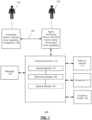
- FIG. 1 is an illustration of an environment 100 for authenticating and identifying callers.
- the environment 100 may be implemented by a call center or any other entity that receives calls from customers or clients.
- a customer 102 may use a computing device 105 (or a telephone 106) to initiate a call with an agent 152 associated with the environment 100.
- the agent 152 may receive the call via a channel 108 such as a VOIP line, POTS line, or a cellular channel. Any channel suitable for voice communication may be used.
- Note as used herein call may refer to the call received from the customer or a copy of the call received from the customer.
- the agent 152 may receive the call from the customer 102 on an agent computing device 155.
- the agent computing device 155 may be equipped with both human and virtual voice agent capabilities.
- the call may also be received (at the same time or later) by a computing device 110 associated with the call center environment 100.
- the computing device 110 may provide one or more call center services to the customer 102 such as interactive voice response services ("IVR") where the user may be presented with an automated system that may determine the optimal agent 152 to direct the call, may determine the identity of the customer 102, or may retrieve other information from the customer in an automated way.
- IVR interactive voice response services
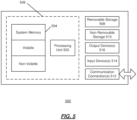
- the computing device 105, agent computing device 155, and the computing device 110 may each be implemented by one or more general purpose computing devices such as the computing device 500 illustrated with respect to FIG. 5 .
- the computing device 110 may be part of a voice recorder or other device performing functions in a call center.
- the computing device 110 may include one or more modules. As illustrated, these modules include an interest module 115 and a biometrics module 120. More or fewer modules may be supported. Depending on the implementation, some or all of the modules 115 and 120 may be implemented the same computing device 110, or by some combination of computing devices 110. In addition, some or all of the modules 115 and 120 may be implemented by a cloud-based computing system.
- active voice authentication In general, one way to authenticate a customer 102 using voice is referred to as active voice authentication.
- active voice authentication one or more voiceprints 121 are generated for a customer 102 by having the customer 102 train the system by repeatedly speaking one or more words or phrases to the call center during a training phase. Later, when the customer 102 calls the call center the customer 102 is asked to repeat the one or more words or phrases in order to authenticate the user. While active voice authentication is effective, requiring the user to train the system is burdensome and leads to a low participation rate.
- passive voice authentication Another common way to authenticate a customer 102 using voice is referred to as passive voice authentication.
- passive voice authentication a recording of the customer 102 speaking is used to create a general representation of how the customer 102 speaks that is unrelated to any particular word or phrase.
- Passive voice authentication does not require an active training phase where the customer 102 is required to speak certain words or phrases which is an improvement on active voice authentication.
- passive voice authentication requires a large amount of spoken voice data from a customer 102 to authenticate, which may result in a significant delay from when a call begins and when the customer 102 is authenticated.
- an audio-of-interest 117 may be a word or phrase that is typically spoken by a customer 102 during a call. Examples include the name of the customer, the city or address associated with the customer, a telephone number associated with a customer, or an account number associated with a customer. Other examples of audio-of-interest 117 may include common words such as "yes", “no", "thank you", or "okay.” The audio-of-interest may not be words in the spoken language. Phonemes (or a basic unit of sound) may be pulled from words matching. English has a finite number (44) of phonemes which all words are made up from. Using this the training words for a voiceprint need not be the same words used for verification.
- the audio-of-interest 117 may be used to quickly authenticate and/or identify a customer 102 on a call based on the voice of the customer 102.
- the audios-of-interest 117 may be selected to be a word or phrase that is typically spoken by a customer 102 at around the beginning of a call. This may ensure that the customer 102 can be quickly authenticated or identified at the beginning of the call.
- the audios-of-interest 117 may be consecutive or non-consecutive words or phrases.
- a consecutive audio-of-interest 117 may be an account number
- a non-consecutive audio-of-interest 117 may be the first, third, and fifth digit of the account number.
- the audio-of-interest 117 may be most of, or a large portion of, the call. In such embodiments, the audio-of-interest 117 may function similarly as a passive biometric voiceprint.
- each customer 102 may use the same audio-of-interest 117.
- each customer 102 may use their name as their associated audio-of-interest 117 or may use their account number as their audio-of-interest 117.
- customers 102 may have different audios-of-interest 117.
- one customer 102 may use their first name as their audio-of-interest 117, while another customer 102 may use their last name as their audio-of-interest 117.
- the particular audio-of-interest 117 used by a customer 102 may be identified in a customer profile 123 associated with the customer 102, for example.
- the interest module 115 may identify and extract voice data from the call corresponding to the audio-of-interest 117. For example, if the audio-of-interest 117 is the name of the customer 102, the interest module 115 may extract the audio-of-interest 117 from the call at or around the time that the customer 102 is saying their name. Depending on the embodiment, the interest module 115 may extract the voice data (and audio-of-interest 117) from the call in real-time, or near-real time. Alternatively, the interest module 115 may extract the voice data from a recording, or partial recording, of the call.
- the audio-of-interest 117 is extracted from the normal back and forth conversation associated with the call. There is no explicit or required training phase where the customer 102 is asked to repeat the audio-of-interest 117.
- the interest module 115 may process the extracted audio-of-interest 117 for a customer 102 and may generate and store one or more voiceprints 121 for the customer 102.
- a voiceprint 121 is a digital structure that is unique to a customer 102 and that can be later used to identify or authenticate the customer 102 when the customer 102 speaks the word or phase that corresponds to the audio-of-interest 117 that was used to create the voiceprint 121. Any method or technique for creating voiceprints 121 may be used.
- the interest module 115 may identify where in a particular recording of a call the audio-of-interest 117 is located. A pointer to the audio-of-interest 117 may then be stored by the interest module 115 along with some or all of the recording of the call.
- voiceprints 121 associated with a customer 102 or account may relate to behavioral characteristics about how the customer 102 speaks or says certain phrases. For example, a customer 102 may have the behavior characteristics of always speaking each number of their phone number (i.e., "three", “zero”, “zero”, “eight”, “zero”, five”, “six”). Another customer may have the behavior characteristic of grouping certain digits of their phone number into larger numbers (i.e., "three-hundred”, “eight”, “zero”, five”, “six”). As another example, a customer 102 may always say their zip code first when speaking their address. Other types of behavioral characteristics may be included.
- each audio-of-interest 117 for a customer 102 or account may be associated with a separate voice print 121.
- a single voiceprint 121 may be used that includes all of the audios-of-interest 117 that may be used for a customer 102.
- the voiceprint 121 may also include behavioral characteristics and any other information that may be used to authenticate a customer 102 such as face biometrics, fingerprints, etc.
- the interest module 115 may use the stored voiceprints 121 to authenticate and/or identify customers 102.
- the agent 152 or an interactive voice response system ("IVR")
- IVR interactive voice response system
- the customer 102 may be identified based on the telephone number that they used to place the call, or based on the name, address, or customer number that they provided to the agent 152 or IVR system.
- the interest module 115 may continuously update or improve on the stored voiceprints 121 for each customer 102. After a customer 102 is authenticated using audio-of-interest 117, the interest module 115 may update some or all of the stored voiceprints 121 based on the audio-of-interest 117. As may be appreciated, overtime the voice associated with a customer 102 may change slightly. By continuously updating the stored voiceprints 121 using recent audios-of-interest 117 these changes may be reflected in the stored voiceprints 121.
- the interest module 115 may extract the audio-of-interest 117 from the call. Depending on the embodiment and type of audio-of-interest 117, the interest module 115 may extract the audio-of-interest 117 based on a script or workflow associated with the call. As may be appreciated, most agents 152 and IVR systems use a workflow or script that specifies how the agent 152 and IVR system interact with the customer 102 including the questions that are asked during the call. Accordingly, the interest module 115 may use the script or workflow to determine a time or place in the call when the audio-of-interest 117 is likely to appear in the call and may extract the audio-of-interest 117 at the determined time and place. Any method may be used.
- the workflow may indicate that the agent 152 asks the customer 102 to speak their name as the first question during the call. Accordingly, the interest module 115 may look at or around the time of the first question in the call for audio-of-interest 117 that corresponds to the customer 102 speaking their name. In another example, the interest module 115 may detect that agent computing device 155 has just displayed a text box that the agent 152 uses to enter the account number of the customer 102. Accordingly, the interest module 115 may determine that the customer has likely been asked their account number and may begin extracting audio-of-interest 117 from the call.
- the interest module 115 may process the call using speech recognition to identify one or more portions of the call that likely correspond to the audio-of-interest 117. For example, where the audio-of-interest 117 is the customer number, the interest module 115 may use speech recognition to identify portions of the call where the customer is speaking numbers. The interest module 115 may extract the audio-of-interest 117 from the identified portions.
- interest module 115 may use the workflow-based extraction in combination with the speech-recognition-based extraction. For example, where the audio-of-interest 117 is a customer number, the workflow may indicate that the customer 102 is asked to recite their customer number as the third question. Accordingly, the interest module 115 may use the speech recognition to identify portions of the call where the customer is speaking numbers after the third question.
- the computing device 110 may include an optional speech module 125.
- the speech module 125 may work with the interest module 125 to process audio and identify the audio-of-interest 117.
- the speech module 125 may use speech recognition to determine what questions are being asked by the agent 152 and may then determine when to extract the audio-of-interest 117 from the audio.
- the speech module 125 may recognize when the specific numbers are being spoken by the customer 102 and may extract the numbers from the audio as the audio-of-interest 117.
- the biometrics module 120 may receive the extracted audio-of-interest 117 from the interest module 115 and may use the extracted audio-of-interest 117 to authenticate the customer 102 associated with the call. In some embodiments, the biometrics module 120 may retrieve one or more voiceprints 121 associated with the customer 102 and may determine if the extracted audio-of-interest 117 matches any of the retrieved one or more voiceprints 121 associated with the customer 102. If the extracted audio-of-interest 117 matches any of the retrieved one or more voiceprints 121 associated with the customer 102, the biometrics module 120 may determine that the customer 102 is authenticated.
- the biometrics module 120 may determine if the extracted audio-of-interest 117 matches all of the retrieved one or more voiceprints 121 associated with the customer 102. And only when the extracted audio-of-interest 117 matches all of the retrieved one or more voiceprints 121 associated with the customer 102, may the biometrics module 120 determine that the customer 102 is authenticated.
- the biometrics module 120 may calculate a confidence that the extracted audio-of-interest 117 matches a voiceprint 121. If the calculated confidence satisfies a threshold confidence (e.g., is greater than or equal to the threshold confidence), then the biometrics module 120 may determine that the extracted audio-of-interest 117 matches the voiceprint 121. Else, the biometrics module 120 may determine the that the extracted-audio-of-interest 117 does not match the voiceprint 121.
- the threshold confidence may be set by a user or administrator, for example.
- the biometrics module 120 may generate and transmit a message 118 indicating whether the customer 102 was authenticated based on the extracted audio-of-interest 117.
- the message 118 may be transmitted to the agent computing device 155 and displayed to the agent 152.
- the agent 152 may attempt to authenticate the customer 102 using other methods such as two factor authentication or by using security questions. Any method for authenticating a customer 102 may be used.
- the interest module 115 and biometrics module 120 may further perform customer 102 identification using the stored voiceprints 121.
- the interest module 115 may extract the audio-of-interest from the call as described above and may provide the extracted audio-of-interest 117 to the biometrics module 120.
- the biometrics module 120 may then identify the customer 102 by comparing the extracted audio-of-interest 117 with the stored voiceprints 121 associated with some or all of the known customers 120. If the extracted audio-of-interest 117 matches a voiceprint 121, then the biometrics module 120 may identify the customer 102 associated with the call as the customer 102 associated with the matching voiceprint 121.
- the biometrics module 120 may then send a message 118 to the agent 152 or IVR system indicating whether the customer 102 was identified, and if so, the identity of the customer 102. If the customer 102 could not be identified the agent 152 or IVR system may identify the customer 102 using different methods.
- one benefit of identifying the customer 102 using the audio-of-interest 117 and the voiceprints 121 is that after the customer 102 is identified they are also authenticated. Accordingly, the amount of time required to both identify and authenticate the customer 102 is reduced, which may result in a reduced call time and an increased call experience for the customer 102. Reduced call times increases the overall number of calls that a call center can handle and may also reduce the overall number of agents 152 needed at the call center.
- the interest module 115 and biometrics module 120 may further perform fraud detection using the stored voiceprints 121.
- the biometrics module 120 may determine if a customer 102 is likely a fraudulent customer 102 (i.e., a customer 102 or other individual that was previously associated with fraud or fraudulent activities).
- the interest module 115 may extract the audio-of-interest 117 from the call as described above and may provide the extracted audio-of-interest 117 to the biometrics module 120.
- the biometrics module 120 may then compare the extracted audio-of-interest 117 with stored voiceprints 121 associated with known bad actors or fraudulent customers 102.
- the biometrics module 120 may identify the customer 102 as a fraudulent customer 102. The biometrics module 120 may then send a message 118 to the agent 152 or IVR system indicating that the customer 102 is likely a fraudulent customer 102. The agent 152 or IVR system may then take actions such as escalating the call to a fraud specialist, terminating the call, or what ever actions may be specified for fraudulent calls by the call center.
- any voiceprints 121 associated with the customer 102 may be considered by the biometrics module 120 when detecting fraud. While the customer 102 may not be a known fraudulent customer, the authentication failure may indicate that the customer 102 may be attempting to breech one or more accounts. If the biometrics module 120 recognizes the customer 102 attempting to access another account at a later time, the voiceprints 121 associated with the customer 102 may be added by the biometrics module 120 to the list of known bad actors or fraudulent customers 102.
- the audio-of-interest 117 is passive biometric voiceprint
- different thresholds may be used by the biometrics module 120 for verification, identification, and fraud detection or prevention.
- the authentication and fraud detection processes described above may not be performed in any particular order with respect to each other and may in fact be performed at approximately the same time. Accordingly, when a customer 102 calls the agent computing device 155, the computing device 110 may begin the authentication process while the computing device 110 also begins the fraud detection process.
- the use of the computing device 110 is not specifically limited to use within call centers.
- a user may use a banking app on their smartphone.
- the banking app may include a biometrics module 120 that has access to, or stores, one or more voiceprints 121 associated with the user.
- the voice prints 121 may have been learned by the computing device 110 at the call center as described above.
- the interest module 115 also included in the app may prompt the user to speak or say the audio-of-interest 117.
- the biometrics module 120 may then authenticate the user using the voiceprints 121 and the audio-of-interest 117. The user may then be allowed or denied access to the app based on the authentication.
- a customer may go to a bank branch to speak with a teller. As the customer speaks with the teller, a microphone records audio from the conversation. An interest module 115 associated with the bank branch or a computing device 110 of the teller may extract the audio-of-interest 117 from the recorded audio, and the biometrics module 120 may authenticate the customer using the audio-of-interest 117 and one or more stored voiceprints 121 of the customer. Once the customer is authenticated, the computing device 110 may display a message to the teller.
- the authentication system described herein may be incorporated into a variety of applications and scenarios where authenticating users based on voice may be useful.
- the system could be used to authenticate users before they enter airplanes, trains, buses, or other public transportation systems.
- the system could similarly be used to authenticate residents of a building, or office workers, before the enter the building.
- the system could be used to authenticate credit card or ATM transactions.
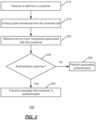
- FIG. 2 is an illustration of a method 200 for authenticating a customer 102.
- the method 200 may be performed by the interest module 115 and/or the biometrics module 130 of the computing device 110.
- a call is received from a customer.
- the call may be received from a customer 102 by an agent 152, or IVR system, associated with an agent computing device 155.
- the agent 152 or IVR system may have identified the customer 102 using information such as the telephone number associated with the call or using information provided by the customer 102 such as a name, address, or account number, for example.
- audio-of-interest 118 is extracted from the call.
- the audio-of-interest 118 may be extracted from the call by the interest module 115.
- the audio-of-interest 118 may be extracted from the call in real-time or may be extracted from a recording of the call that was provided to the interest module 115.
- the audio-of-interest 118 may comprise a recording of the customer 102 speaking a particular word or phrase that may be used to authenticate the customer 102.
- one or more voiceprints associated with the customer 102 are retrieved.
- the one or more voiceprints 121 may be retrieved by the biometrics module 130.
- Each voiceprint 121 may have been generated by the biometrics module 130 from previous interactions with the associated customer 102.
- the voiceprints 121 may have been generated by an active voiceprint 121 generation process.
- a message that the customer is authenticated is transmitted.
- the message 118 may be transmitted to the agent 152 or IVR system by the biometrics module 130. After receiving the message 118 the agent 152, or IVR system, may proceed as if the customer 102 has been authenticated.
- secondary authentication is performed.
- the secondary authentication may be performed by the agent 152 or the IVR system.
- the secondary authentication may include performing two step authentication or asking one or more security questions.
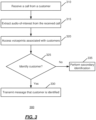
- FIG. 3 is an illustration of a method 300 for identifying a customer 102.
- the method 300 may be performed by the interest module 115 and/or the biometrics module 130 of the computing device 110.
- a call is received from a customer.
- the call may be received from a customer 102 by an agent 152, or IVR system, associated with an agent computing device 155.
- the customer 102 may not have been identified by the agent 152 or IVR system.
- audio-of-interest 118 is extracted from the call.
- the audio-of-interest 118 may be extracted from the call by the interest module 115.
- the audio-of-interest 118 may be extracted from the call in real-time or may be extracted from a recording of the call that was provided to the interest module 115.
- the audio-of-interest 118 may comprise a recording of the customer 102 speaking a particular word or phrase that may be used to authenticate the customer 102.
- voiceprints associated with customers 102 are accessed.
- the voiceprints 121 may be accessed by the biometrics module 120.
- the voiceprints 121 may have been generated by the biometrics module 120 for each of the customers 120.
- a message that the customer is identified is transmitted.
- the message 118 may be transmitted to the agent 152 or IVR system by the biometrics module 130. Because the customer 102 was also authenticated by virtue of the matching voiceprint 121, the message 118 may further indicate that the customer 102 was also authenticated.
- the secondary identification may be performed by the agent 152, the IVR system, or other modules or systems.
- the secondary identification may include asking the customer 102 to state their name or account number.
- the secondary identification may include passive voice biometrics and face biometrics. Other methods for customer identification and/or verification may be used.
- FIG. 4 is an illustration of a method 400 for determining if a customer is a fraudulent customer.
- the method 400 may be performed by the interest module 115 and/or the biometrics module 130 of the computing device 110.
- a call is received from a customer.
- the call may be received from a customer 102 by an agent 152, or IVR system, associated with an agent computing device 155.
- the agent 152 or IVR system may have identified the customer 102 using information such as the telephone number associated with the call or using information provided by the customer 102 such as a name, address, or account number, for example.
- audio-of-interest 118 is extracted from the call.
- the audio-of-interest 118 may be extracted from the call by the interest module 115.
- the audio-of-interest 118 may be extracted from the call in real-time, or may be extracted from a recording of the call that was provided to the interest module 115.
- the audio-of-interest 118 may comprise a recording of the customer 102 speaking a particular word or phrase that may be used to authenticate the customer 102.
- the one or more voiceprints 121 may be retrieved by the biometrics module 130.
- Each voiceprint 121 may have been generated by the biometrics module 130 from interactions with known fraudulent customers 102.
- the biometrics module 130 may maintain a "blacklist" of fraudulent customers 102 along with one or more voiceprints 121 generated for each fraudulent customer 102. After a call associated with a customer 102 is determined to be fraudulent, any voiceprints 121 associated with the customer 102 may be added to the blacklist. If no such voiceprints 121 exist, the biometrics module 130 may generate voiceprints 121 for the customer 102 from the last call recorded for the customer 102.
- a message that the customer is a fraudulent customer is transmitted.
- the message 118 may be transmitted to the agent 152 or IVR system by the biometrics module 130. After receiving the message 118 the agent 152, or IVR system, may end the call, or may escalate the call to an agent 152 specializing in fraud.
- a message that the customer is not a fraudulent customer is transmitted.
- the message 118 may be transmitted to the agent 152 or IVR system by the biometrics module 130. After receiving the message 118 the agent 152, or IVR system, may proceed with the call.
- Numerous other general purpose or special purpose computing devices environments or configurations may be used. Examples of well-known computing devices, environments, and/or configurations that may be suitable for use include, but are not limited to, personal computers, server computers, handheld or laptop devices, multiprocessor systems, microprocessor-based systems, network personal computers (PCs), minicomputers, mainframe computers, embedded systems, distributed computing environments that include any of the above systems or devices, and the like.
- Computer-executable instructions such as program modules, being executed by a computer may be used.
- program modules include routines, programs, objects, components, data structures, etc. that perform particular tasks or implement particular abstract data types.
- Distributed computing environments may be used where tasks are performed by remote processing devices that are linked through a communications network or other data transmission medium.
- program modules and other data may be located in both local and remote computer storage media including memory storage devices.
- an exemplary system for implementing aspects described herein includes a computing device, such as computing device 500.
- computing device 500 typically includes at least one processing unit 502 and memory 504.
- memory 504 may be volatile (such as random access memory (RAM)), non-volatile (such as read-only memory (ROM), flash memory, etc.), or some combination of the two.
- RAM random access memory
- ROM read-only memory
- flash memory etc.
- Computing device 500 may have additional features/functionality.
- computing device 500 may include additional storage (removable and/or non-removable) including, but not limited to, magnetic or optical disks or tape.
- additional storage is illustrated in FIG. 5 by removable storage 508 and non-removable storage 510.
- Computing device 500 typically includes a variety of computer readable media.
- Computer readable media can be any available media that can be accessed by the device 500 and includes both volatile and non-volatile media, removable and non-removable media.
- Computer storage media include volatile and non-volatile, and removable and non-removable media implemented in any method or technology for storage of information such as computer readable instructions, data structures, program modules or other data.
- Memory 504, removable storage 508, and non-removable storage 510 are all examples of computer storage media.
- Computer storage media include, but are not limited to, RAM, ROM, electrically erasable program read-only memory (EEPROM), flash memory or other memory technology, CD-ROM, digital versatile disks (DVD) or other optical storage, magnetic cassettes, magnetic tape, magnetic disk storage or other magnetic storage devices, or any other medium which can be used to store the desired information and which can be accessed by computing device 600. Any such computer storage media may be part of computing device 500.
- Computing device 500 may contain communication connection(s) 512 that allow the device to communicate with other devices.
- Computing device 500 may also have input device(s) 514 such as a keyboard, mouse, pen, voice input device, touch input device, etc.
- Output device(s) 516 such as a display, speakers, printer, etc. may also be included. All these devices are well known in the art and need not be discussed at length here.
- FPGAs Field-programmable Gate Arrays
- ASICs Application-specific Integrated Circuits
- ASSPs Application-specific Standard Products
- SOCs System-on-a-chip systems
- CPLDs Complex Programmable Logic Devices
- exemplary implementations may refer to utilizing aspects of the presently disclosed subject matter in the context of one or more stand-alone computer systems, the subject matter is not so limited, but rather may be implemented in connection with any computing environment, such as a network or distributed computing environment. Still further, aspects of the presently disclosed subject matter may be implemented in or across a plurality of processing chips or devices, and storage may similarly be effected across a plurality of devices. Such devices might include personal computers, network servers, and handheld devices, for example.
Landscapes
- Engineering & Computer Science (AREA)
- Physics & Mathematics (AREA)
- Business, Economics & Management (AREA)
- Computer Security & Cryptography (AREA)
- Theoretical Computer Science (AREA)
- Health & Medical Sciences (AREA)
- Human Computer Interaction (AREA)
- Multimedia (AREA)
- Acoustics & Sound (AREA)
- Audiology, Speech & Language Pathology (AREA)
- General Physics & Mathematics (AREA)
- Signal Processing (AREA)
- General Engineering & Computer Science (AREA)
- Computer Hardware Design (AREA)
- Accounting & Taxation (AREA)
- Software Systems (AREA)
- Computer Vision & Pattern Recognition (AREA)
- Game Theory and Decision Science (AREA)
- Strategic Management (AREA)
- Finance (AREA)
- General Business, Economics & Management (AREA)
- Marketing (AREA)
- Biomedical Technology (AREA)
- General Health & Medical Sciences (AREA)
- Computing Systems (AREA)
- Computer Networks & Wireless Communication (AREA)
- Telephonic Communication Services (AREA)
Claims (15)
- Ein System zum Authentifizieren und Identifizieren von Kunden:ein oder mehrere Prozessoren;ein Speicher, der mit dem einen oder den mehreren Prozessoren verbunden ist und speichert:ein Interest-Modul mit Anweisungen, die beim Ausführen durch den einen oder die mehreren Prozessoren veranlassen, dass das Systemeinen Anruf empfängt, wobei der Anruf einem Kunden aus mehreren Kunden zugeordnet ist;abrufen eines dem Kunden zugeordneten Kundenprofils; bestimmen eines Audio-of-Interest, das dem Kunden zugeordnet ist, auf Grundlage des Kundenprofils, wobei jeder Kunde einer anderen Art von Audio-of-Interest zugeordnet ist;identifizieren, wo das Audio-of-Interest von dem Kunden in dem empfangenen Anruf gesprochen wird; und speichern eines Zeigers auf dem Audio-of-Interest mit einer Aufzeichnung des empfangenen Anrufs; undein Biometriemodul, das Anweisungen beinhaltet, die, wenn sie von dem einen oder den mehreren Prozessoren ausgeführt werden, das System zu Folgendem veranlassen:empfangen des Audio-of-Interest von dem empfangenen Anruf unter Verwendung des gespeicherten Zeigers;abrufen eines oder mehrerer Stimmabdrücke, die dem Kunden zugeordnet sind;auf Grundlage des einen oder der mehreren Stimmabdrücke und des Audio-of-Interest bestimmen, ob der Kunde authentifiziert ist; undwenn bestimmt wird, dass der Kunde authentifiziert ist, übertragen einer Nachricht, dass der Kunde authentifiziert ist, und das Interest-Modul, um die abgerufenen Stimmabdrücke mit dem Audio-of-Interest zu aktualisieren.
- System nach Anspruch 1, wobei das biometrische Modul ferner Anweisungen enthält, die, wenn sie von dem einen oder den mehreren Prozessoren ausgeführt werden, das System veranlassen,
eine sekundäre Authentifizierung durchzuführen, wenn festgestellt wird, dass der Kunde nicht authentifiziert ist, - System nach Anspruch 1, wobei das biometrische Modul ferner Anweisungen enthält, die, wenn sie von dem einen oder den mehreren Prozessoren ausgeführt werden, das System veranlassen:bestimmen, dass einer oder mehrere der Stimmabdrücke, die dem Kunden zugeordnet sind, zumindest teilweise mit dem Audio-of-Interest übereinstimmen, und zwar mit einer Konfidenz, die eine Schwellenwert-Konfidenz erfüllt; undbestimmen, dass der Kunde als Reaktion auf das Bestimmen, dass die Konfidenz die Schwellenwert-Konfidenz erfüllt, authentifiziert ist.
- System nach Anspruch 1, wobei das Interest-Modul ferner Anweisungen enthält, die, wenn sie von dem einen oder den mehreren Prozessoren ausgeführt werden, das System veranlassen:zu erkennen, dass das Audio-of-Interest vom Kunden gesprochen wird; unddas Audio-of-Interest aus dem empfangenen Anruf extrahieren, wenn erkannt wird, dass das Audio-of-Interest gesprochen wird.
- System nach Anspruch 1, wobei das Interest-Modul ferner Anweisungen enthält, die, wenn sie von dem einen oder den mehreren Prozessoren ausgeführt werden, das System veranlassen:auf der Grundlage eines mit dem Anruf verbundenen Skripts zu bestimmen, dass das Audio-of-Interest wahrscheinlich vom Kunden während des Anrufs gesprochen wird; undDas Audio-of-Interest aus dem empfangenen Anruf extrahieren, wenn festgestellt wird, dass das Audio-of-Interest wahrscheinlich vom Kunden gesprochen wird.
- System nach Anspruch 1, wobei das Audio-of-Interest ein oder mehrere Wörter oder Phrasen umfasst, die vom Kunden während des Anrufs gesprochen werden.
- System nach Anspruch 1, wobei das Audio-of-Interest eine nicht aufeinanderfolgende Ziffernfolge einer dem Kunden zugeordneten Kontonummer umfasst.
- System nach Anspruch 1, wobei das biometrische Modul ferner Anweisungen enthält, die, wenn sie von dem einen oder den mehreren Prozessoren ausgeführt werden, das System veranlassen:das Audio-of-Interest zu empfangen;einen oder mehrere Stimmabdrücke, die jedem Kunden, der mehreren Kunden zugeordnet sind, abruft;auf der Grundlage des einen oder der mehreren Stimmabdrücke und des Audio-of-Interest den Kunden, dem der Anruf zugeordnet ist, aus den mehreren Kunden zu identifizieren; undeine Nachricht zu übermitteln, dass der Kunde identifiziert ist.
- System nach Anspruch 1, wobei das biometrische Modul ferner Anweisungen enthält, die, wenn sie von dem einen oder den mehreren Prozessoren ausgeführt werden, das System veranlassen:das Audio-of-Interest zu empfangen;einen oder mehrere Stimmabdrücke abzurufen, die mit betrügerischen Kunden von den mehreren Kunden in Verbindung stehen;auf der Grundlage des einen oder der mehreren Stimmabdrücke und des Audio-of-Interest den mit dem Anruf verbundenen Kunden als betrügerischen Kunden zu identifizieren; undeine Nachricht zu übermitteln, dass der Kunde ein betrügerischer Kunde ist.
- System nach Anspruch 1, wobei jeder Stimmabdruck, der dem Kunden zugeordnet ist, eine unterschiedliche Qualität aufweist, die es ermöglicht, dass ein oder mehrere Schwellenwerte automatisch auf der Grundlage der Qualität des Stimmabdrucks angepasst werden.
- Das System nach Anspruch 1, wobei das Audio-of-Interest ein oder mehrere Phoneme umfasst.
- Verfahren zum Authentifizieren und Identifizieren von Kunden umfassend:abrufen ein dem Kunden zugeordnetes Kundenprofil;bestimmen eines Audio-of-Interest, das dem Kunden zugeordnet ist, basierend auf dem Kundenprofil, wobei jedem Kunden eine andere Art von Audio-of-Interest zugeordnet ist;identifizieren, wo das Audio-of-Interest von dem Kunden in dem empfangenen Anruf gesprochen wird;speichern eines Zeigers auf das Audio-of-Interest mit einer Aufzeichnung des empfangenen Anrufs;abrufen des Audio-of-Interest von dem empfangenen Anruf unter Verwendung des gespeicherten Zeigers;abrufen eines oder mehrerer Stimmabdrücke, die dem Kunden zugeordnet sind;auf der Grundlage eines oder mehrerer Stimmabdrücke und des Audio-of-Interest bestimmen, ob der Kunde authentifiziert ist; undwenn festgestellt wird, dass der Kunde authentifiziert ist, eine Nachricht zu übermitteln, dass der Kunde authentifiziert ist, und Aktualisieren der abgerufenen ein oder mehreren Stimmabdrücke unter Verwendung des Audio-of-Interest.
- Verfahren nach Anspruch 12, das ferner Folgendes umfasst:
wenn festgestellt wird, dass der Kunde nicht authentifiziert ist, durchführen einer sekundären Authentifizierung. - Verfahren nach Anspruch 12, wobei das Bestimmen, ob der Kunde authentifiziert ist, umfasst:bestimmen, dass einer oder mehrere der einen oder mehreren Stimmabdrücke, die dem Kunden zugeordnet sind, mit mindestens einem Teil des Audio-of-Interest übereinstimmen, mit einer Konfidenz, die eine Schwellenwert-Konfidenz erfüllt; undbestimmen, dass der Kunde authentifiziert ist, als Reaktion auf das Bestimmen, dass die Konfidenz die Schwellenwert-Konfidenz erfüllt.
- Verfahren nach Anspruch 14, wobei es mehrere Schwellenwerte für die Zuverlässigkeit gibt und jede Schwellenwert-Konfidenz einer anderen zulässigen Aktion zugeordnet ist.
Applications Claiming Priority (2)
| Application Number | Priority Date | Filing Date | Title |
|---|---|---|---|
| US16/676,690 US11868453B2 (en) | 2019-11-07 | 2019-11-07 | Systems and methods for customer authentication based on audio-of-interest |
| PCT/US2020/054678 WO2021091645A1 (en) | 2019-11-07 | 2020-10-08 | Systems and methods for customer authentication based on audio-of-interest |
Publications (2)
| Publication Number | Publication Date |
|---|---|
| EP4055592A1 EP4055592A1 (de) | 2022-09-14 |
| EP4055592B1 true EP4055592B1 (de) | 2024-10-09 |
Family
ID=73038412
Family Applications (1)
| Application Number | Title | Priority Date | Filing Date |
|---|---|---|---|
| EP20799898.0A Active EP4055592B1 (de) | 2019-11-07 | 2020-10-08 | Systeme und verfahren für kundenauthentifizierung auf der basis von audio von interesse |
Country Status (4)
| Country | Link |
|---|---|
| US (1) | US11868453B2 (de) |
| EP (1) | EP4055592B1 (de) |
| IL (1) | IL292804B2 (de) |
| WO (1) | WO2021091645A1 (de) |
Families Citing this family (6)
| Publication number | Priority date | Publication date | Assignee | Title |
|---|---|---|---|---|
| US11606461B2 (en) * | 2020-12-04 | 2023-03-14 | Nice Ltd. | Method for training a spoofing detection model using biometric clustering |
| US11451658B1 (en) * | 2021-05-14 | 2022-09-20 | Nice Ltd. | Systems and methods for proactive fraudster exposure in a customer service channel |
| US11882239B2 (en) * | 2021-05-19 | 2024-01-23 | Mcafee, Llc | Fraudulent call detection |
| US12073839B2 (en) * | 2022-03-24 | 2024-08-27 | Capital One Services, Llc | Authentication by speech at a machine |
| US12278926B2 (en) * | 2023-05-09 | 2025-04-15 | Bank Of America Corporation | Call center voice system for use with a real-time complaint identification system |
| US12598253B2 (en) * | 2023-11-03 | 2026-04-07 | Infobip Ltd. | Systems and methods for media analysis for call state detection |
Family Cites Families (176)
| Publication number | Priority date | Publication date | Assignee | Title |
|---|---|---|---|---|
| JPS58129682A (ja) | 1982-01-29 | 1983-08-02 | Toshiba Corp | 個人照合装置 |
| US4864566A (en) | 1986-09-26 | 1989-09-05 | Cycomm Corporation | Precise multiplexed transmission and reception of analog and digital data through a narrow-band channel |
| US5027407A (en) | 1987-02-23 | 1991-06-25 | Kabushiki Kaisha Toshiba | Pattern recognition apparatus using a plurality of candidates |
| US4823380A (en) | 1987-03-27 | 1989-04-18 | Chaim Kohen | Voice changer |
| DE3737972A1 (de) | 1987-11-07 | 1989-05-24 | Messerschmitt Boelkow Blohm | Helm-lagedarstellungsgeraet |
| US5222147A (en) | 1989-04-13 | 1993-06-22 | Kabushiki Kaisha Toshiba | Speech recognition LSI system including recording/reproduction device |
| US5293452A (en) | 1991-07-01 | 1994-03-08 | Texas Instruments Incorporated | Voice log-in using spoken name input |
| EP0598469A3 (en) | 1992-10-27 | 1996-07-10 | Daniel P Dunlevy | Interactive credit card fraud control process. |
| US6643362B2 (en) | 1998-11-19 | 2003-11-04 | Global Crossing, Ltd. | Call-processing system and method |
| US5590181A (en) | 1993-10-15 | 1996-12-31 | Link Usa Corporation | Call-processing system and method |
| US5841978A (en) | 1993-11-18 | 1998-11-24 | Digimarc Corporation | Network linking method using steganographically embedded data objects |
| US7106843B1 (en) | 1994-04-19 | 2006-09-12 | T-Netix, Inc. | Computer-based method and apparatus for controlling, monitoring, recording and reporting telephone access |
| US5805674A (en) | 1995-01-26 | 1998-09-08 | Anderson, Jr.; Victor C. | Security arrangement and method for controlling access to a protected system |
| EP0818103B1 (de) | 1995-03-30 | 2004-02-25 | Azure Solutions Limited | Erfassung von möglichem betrügerischen gebrauch von kommunikation |
| US6601048B1 (en) | 1997-09-12 | 2003-07-29 | Mci Communications Corporation | System and method for detecting and managing fraud |
| US6044382A (en) | 1995-05-19 | 2000-03-28 | Cyber Fone Technologies, Inc. | Data transaction assembly server |
| US7006605B1 (en) | 1996-06-28 | 2006-02-28 | Ochopee Big Cypress Llc | Authenticating a caller before providing the caller with access to one or more secured resources |
| US6266640B1 (en) | 1996-08-06 | 2001-07-24 | Dialogic Corporation | Data network with voice verification means |
| US5999525A (en) | 1996-11-18 | 1999-12-07 | Mci Communications Corporation | Method for video telephony over a hybrid network |
| WO1998022936A1 (en) | 1996-11-22 | 1998-05-28 | T-Netix, Inc. | Subword-based speaker verification using multiple classifier fusion, with channel, fusion, model, and threshold adaptation |
| US5963908A (en) | 1996-12-23 | 1999-10-05 | Intel Corporation | Secure logon to notebook or desktop computers |
| WO1998034216A2 (en) | 1997-01-31 | 1998-08-06 | T-Netix, Inc. | System and method for detecting a recorded voice |
| US5946654A (en) | 1997-02-21 | 1999-08-31 | Dragon Systems, Inc. | Speaker identification using unsupervised speech models |
| US7403922B1 (en) | 1997-07-28 | 2008-07-22 | Cybersource Corporation | Method and apparatus for evaluating fraud risk in an electronic commerce transaction |
| US6145083A (en) | 1998-04-23 | 2000-11-07 | Siemens Information And Communication Networks, Inc. | Methods and system for providing data and telephony security |
| US6421453B1 (en) * | 1998-05-15 | 2002-07-16 | International Business Machines Corporation | Apparatus and methods for user recognition employing behavioral passwords |
| FI107983B (fi) | 1998-12-23 | 2001-10-31 | Nokia Networks Oy | Vilpillisen käytön havaitseminen ja estäminen tietoliikenneverkossa |
| IL129451A (en) | 1999-04-15 | 2004-05-12 | Eli Talmor | System and method for authentication of a speaker |
| GB9913773D0 (en) | 1999-06-14 | 1999-08-11 | Simpson Mark C | Speech signal processing |
| US6427137B2 (en) | 1999-08-31 | 2002-07-30 | Accenture Llp | System, method and article of manufacture for a voice analysis system that detects nervousness for preventing fraud |
| US6275806B1 (en) | 1999-08-31 | 2001-08-14 | Andersen Consulting, Llp | System method and article of manufacture for detecting emotion in voice signals by utilizing statistics for voice signal parameters |
| US7630986B1 (en) | 1999-10-27 | 2009-12-08 | Pinpoint, Incorporated | Secure data interchange |
| US7130800B1 (en) | 2001-09-20 | 2006-10-31 | West Corporation | Third party verification system |
| GB2360166A (en) * | 2000-03-07 | 2001-09-12 | Mitel Corp | Telephone call blocking using voice recognition |
| EP1132797A3 (de) | 2000-03-08 | 2005-11-23 | Aurora Wireless Technologies, Ltd. | Sichere Benutzeridentifikation in einem On-line Transaktionssystem |
| JP3825222B2 (ja) | 2000-03-24 | 2006-09-27 | 松下電器産業株式会社 | 本人認証装置および本人認証システムならびに電子決済システム |
| US7263506B2 (en) | 2000-04-06 | 2007-08-28 | Fair Isaac Corporation | Identification and management of fraudulent credit/debit card purchases at merchant ecommerce sites |
| US7236954B1 (en) | 2000-05-22 | 2007-06-26 | Verizon Business Global Llc | Fraud detection based on call attempt velocity on terminating number |
| US7039951B1 (en) | 2000-06-06 | 2006-05-02 | International Business Machines Corporation | System and method for confidence based incremental access authentication |
| US6597775B2 (en) | 2000-09-29 | 2003-07-22 | Fair Isaac Corporation | Self-learning real-time prioritization of telecommunication fraud control actions |
| US6850606B2 (en) | 2001-09-25 | 2005-02-01 | Fair Isaac Corporation | Self-learning real-time prioritization of telecommunication fraud control actions |
| US8677505B2 (en) | 2000-11-13 | 2014-03-18 | Digital Doors, Inc. | Security system with extraction, reconstruction and secure recovery and storage of data |
| US7016833B2 (en) | 2000-11-21 | 2006-03-21 | The Regents Of The University Of California | Speaker verification system using acoustic data and non-acoustic data |
| US8812319B2 (en) | 2001-01-31 | 2014-08-19 | Ibiometrics, Inc. | Dynamic pass phrase security system (DPSS) |
| US6587552B1 (en) | 2001-02-15 | 2003-07-01 | Worldcom, Inc. | Fraud library |
| US6915259B2 (en) | 2001-05-24 | 2005-07-05 | Matsushita Electric Industrial Co., Ltd. | Speaker and environment adaptation based on linear separation of variability sources |
| US7865427B2 (en) | 2001-05-30 | 2011-01-04 | Cybersource Corporation | Method and apparatus for evaluating fraud risk in an electronic commerce transaction |
| US7668718B2 (en) | 2001-07-17 | 2010-02-23 | Custom Speech Usa, Inc. | Synchronized pattern recognition source data processed by manual or automatic means for creation of shared speaker-dependent speech user profile |
| US20030050816A1 (en) | 2001-08-09 | 2003-03-13 | Givens George R. | Systems and methods for network-based employment decisioning |
| US7096428B2 (en) | 2001-09-28 | 2006-08-22 | Fuji Xerox Co., Ltd. | Systems and methods for providing a spatially indexed panoramic video |
| JP3983035B2 (ja) | 2001-11-19 | 2007-09-26 | 富士通株式会社 | ユーザ端末認証プログラム |
| US7054811B2 (en) | 2002-11-06 | 2006-05-30 | Cellmax Systems Ltd. | Method and system for verifying and enabling user access based on voice parameters |
| US20030203730A1 (en) | 2002-04-11 | 2003-10-30 | Dadong Wan | Location-based remote monitoring |
| AU2002326879A1 (en) * | 2002-06-05 | 2003-12-22 | Vas International, Inc. | Biometric identification system |
| GB2391373A (en) | 2002-07-31 | 2004-02-04 | David Toms | A system for the automatic detection of a fraudulent transaction |
| US7333798B2 (en) | 2002-08-08 | 2008-02-19 | Value Added Communications, Inc. | Telecommunication call management and monitoring system |
| US20040029087A1 (en) | 2002-08-08 | 2004-02-12 | Rodney White | System and method for training and managing gaming personnel |
| US6931113B2 (en) | 2002-11-08 | 2005-08-16 | Verizon Services Corp. | Facilitation of a conference call |
| US6791603B2 (en) | 2002-12-03 | 2004-09-14 | Sensormatic Electronics Corporation | Event driven video tracking system |
| JP4231286B2 (ja) | 2002-12-11 | 2009-02-25 | 日本放送協会 | コンテンツ送信装置、コンテンツ送信プログラム、コンテンツ受信装置、及びコンテンツ受信プログラム |
| US7151454B2 (en) | 2003-01-02 | 2006-12-19 | Covi Technologies | Systems and methods for location of objects |
| US7634063B2 (en) | 2003-01-02 | 2009-12-15 | Technology Patents, Llc | System and method for monitoring individuals |
| US7302250B2 (en) | 2003-01-13 | 2007-11-27 | Lucent Technologies Inc. | Method of recognizing fraudulent wireless emergency service calls |
| GB2382900A (en) | 2003-01-15 | 2003-06-11 | Gfi Software Ltd | Regulating receipt of electronic mail with a whitelist based on outgoing email addresses |
| US7249162B2 (en) | 2003-02-25 | 2007-07-24 | Microsoft Corporation | Adaptive junk message filtering system |
| US6998987B2 (en) | 2003-02-26 | 2006-02-14 | Activseye, Inc. | Integrated RFID and video tracking system |
| US7299177B2 (en) | 2003-05-30 | 2007-11-20 | American Express Travel Related Services Company, Inc. | Speaker recognition in a multi-speaker environment and comparison of several voice prints to many |
| JP4195991B2 (ja) | 2003-06-18 | 2008-12-17 | パナソニック株式会社 | 監視映像モニタリングシステム、監視映像生成方法、および監視映像モニタリングサーバ |
| US20050010411A1 (en) | 2003-07-09 | 2005-01-13 | Luca Rigazio | Speech data mining for call center management |
| US7212613B2 (en) | 2003-09-18 | 2007-05-01 | International Business Machines Corporation | System and method for telephonic voice authentication |
| US7257564B2 (en) | 2003-10-03 | 2007-08-14 | Tumbleweed Communications Corp. | Dynamic message filtering |
| US20050125226A1 (en) | 2003-10-29 | 2005-06-09 | Paul Magee | Voice recognition system and method |
| US7398925B2 (en) | 2003-12-09 | 2008-07-15 | First Data Corporation | Systems and methods for assessing the risk of a financial transaction using biometric information |
| US7660715B1 (en) | 2004-01-12 | 2010-02-09 | Avaya Inc. | Transparent monitoring and intervention to improve automatic adaptation of speech models |
| US8781975B2 (en) | 2004-05-21 | 2014-07-15 | Emc Corporation | System and method of fraud reduction |
| US8204884B2 (en) | 2004-07-14 | 2012-06-19 | Nice Systems Ltd. | Method, apparatus and system for capturing and analyzing interaction based content |
| US7406159B2 (en) | 2004-07-15 | 2008-07-29 | Tekelec | Methods, systems, and computer program products for automatically populating signaling-based access control database |
| JP2006038955A (ja) | 2004-07-22 | 2006-02-09 | Docomo Engineering Tohoku Inc | 声紋認識システム |
| US20060106605A1 (en) | 2004-11-12 | 2006-05-18 | Saunders Joseph M | Biometric record management |
| US20060107296A1 (en) | 2004-11-16 | 2006-05-18 | Motorola, Inc. | Remote image tracking and methods thereof |
| WO2006062998A2 (en) | 2004-12-07 | 2006-06-15 | Farsheed Atef | System and method for identity verification and management |
| WO2006063392A1 (en) | 2004-12-13 | 2006-06-22 | Securicom (Nsw) Pty Ltd | Enhancing the response of biometric access systems |
| WO2006087799A1 (ja) | 2005-02-18 | 2006-08-24 | Fujitsu Limited | 音声認証システム |
| EP1856640A2 (de) | 2005-03-02 | 2007-11-21 | Markmonitor, Inc. | Systeme und verfahren zur vertrauensbeurteilung |
| US20060212407A1 (en) | 2005-03-17 | 2006-09-21 | Lyon Dennis B | User authentication and secure transaction system |
| US9113001B2 (en) | 2005-04-21 | 2015-08-18 | Verint Americas Inc. | Systems, methods, and media for disambiguating call data to determine fraud |
| US8510215B2 (en) | 2005-04-21 | 2013-08-13 | Victrio, Inc. | Method and system for enrolling a voiceprint in a fraudster database |
| US8639757B1 (en) * | 2011-08-12 | 2014-01-28 | Sprint Communications Company L.P. | User localization using friend location information |
| US20070280436A1 (en) | 2006-04-14 | 2007-12-06 | Anthony Rajakumar | Method and System to Seed a Voice Database |
| US20060248019A1 (en) | 2005-04-21 | 2006-11-02 | Anthony Rajakumar | Method and system to detect fraud using voice data |
| US9571652B1 (en) * | 2005-04-21 | 2017-02-14 | Verint Americas Inc. | Enhanced diarization systems, media and methods of use |
| US20150381801A1 (en) | 2005-04-21 | 2015-12-31 | Verint Americas Inc. | Systems, methods, and media for disambiguating call data to determine fraud |
| US8073691B2 (en) | 2005-04-21 | 2011-12-06 | Victrio, Inc. | Method and system for screening using voice data and metadata |
| US20120253805A1 (en) | 2005-04-21 | 2012-10-04 | Anthony Rajakumar | Systems, methods, and media for determining fraud risk from audio signals |
| US8924285B2 (en) | 2005-04-21 | 2014-12-30 | Verint Americas Inc. | Building whitelists comprising voiceprints not associated with fraud and screening calls using a combination of a whitelist and blacklist |
| US8793131B2 (en) | 2005-04-21 | 2014-07-29 | Verint Americas Inc. | Systems, methods, and media for determining fraud patterns and creating fraud behavioral models |
| US20120053939A9 (en) | 2005-04-21 | 2012-03-01 | Victrio | Speaker verification-based fraud system for combined automated risk score with agent review and associated user interface |
| US8930261B2 (en) | 2005-04-21 | 2015-01-06 | Verint Americas Inc. | Method and system for generating a fraud risk score using telephony channel based audio and non-audio data |
| EP1875653B1 (de) | 2005-04-29 | 2018-12-12 | Oracle International Corporation | System und verfahren zur überwachung, entdeckung und abgestuften authentifizierung von betrugshandlungen |
| US7386105B2 (en) * | 2005-05-27 | 2008-06-10 | Nice Systems Ltd | Method and apparatus for fraud detection |
| US20060277043A1 (en) | 2005-06-06 | 2006-12-07 | Edward Tomes | Voice authentication system and methods therefor |
| US20060293891A1 (en) | 2005-06-22 | 2006-12-28 | Jan Pathuel | Biometric control systems and associated methods of use |
| US9300790B2 (en) | 2005-06-24 | 2016-03-29 | Securus Technologies, Inc. | Multi-party conversation analyzer and logger |
| US7940897B2 (en) | 2005-06-24 | 2011-05-10 | American Express Travel Related Services Company, Inc. | Word recognition system and method for customer and employee assessment |
| US20070041517A1 (en) | 2005-06-30 | 2007-02-22 | Pika Technologies Inc. | Call transfer detection method using voice identification techniques |
| GB0519424D0 (en) | 2005-09-23 | 2005-11-02 | Smithies Christopher P K | Method and system for verification of personal identity |
| US7668769B2 (en) | 2005-10-04 | 2010-02-23 | Basepoint Analytics, LLC | System and method of detecting fraud |
| US7340042B2 (en) | 2005-10-21 | 2008-03-04 | Voiceverified, Inc. | System and method of subscription identity authentication utilizing multiple factors |
| US7567795B1 (en) | 2005-10-31 | 2009-07-28 | At&T Mobility Ii Llc | Systems and methods for restricting the use of stolen devices on a wireless network |
| US7716048B2 (en) | 2006-01-25 | 2010-05-11 | Nice Systems, Ltd. | Method and apparatus for segmentation of audio interactions |
| US7877255B2 (en) | 2006-03-31 | 2011-01-25 | Voice Signal Technologies, Inc. | Speech recognition using channel verification |
| US7693717B2 (en) | 2006-04-12 | 2010-04-06 | Custom Speech Usa, Inc. | Session file modification with annotation using speech recognition or text to speech |
| US7774202B2 (en) | 2006-06-12 | 2010-08-10 | Lockheed Martin Corporation | Speech activated control system and related methods |
| WO2008022157A2 (en) | 2006-08-15 | 2008-02-21 | Vxv Solutions, Inc. | Adaptive tuning of biometric engines |
| US7711620B2 (en) | 2006-08-22 | 2010-05-04 | Transaction Wireless, Inc. | Gift card services for mobile devices |
| US7822605B2 (en) | 2006-10-19 | 2010-10-26 | Nice Systems Ltd. | Method and apparatus for large population speaker identification in telephone interactions |
| US20080114612A1 (en) | 2006-11-13 | 2008-05-15 | Needham Frank A | Responder route and site-specific critical data system |
| US8253797B1 (en) | 2007-03-05 | 2012-08-28 | PureTech Systems Inc. | Camera image georeferencing systems |
| DE102007021772B4 (de) | 2007-05-09 | 2013-01-24 | Voicecash Ip Gmbh | Digitales Verfahren und Anordnung zur Authentifizierung eines Nutzers einer Datenbasis |
| US8320886B2 (en) * | 2007-05-23 | 2012-11-27 | Verint Americas, Inc. | Integrating mobile device based communication session recordings |
| US7692558B2 (en) | 2007-08-01 | 2010-04-06 | Hewlett-Packard Development Company, L.P. | Apparatus, and an associated method, for forming a traffic route visualization |
| GB2452512B (en) | 2007-09-05 | 2012-02-29 | Sony Corp | Apparatus and method of object tracking |
| US8666841B1 (en) | 2007-10-09 | 2014-03-04 | Convergys Information Management Group, Inc. | Fraud detection engine and method of using the same |
| US20090106846A1 (en) | 2007-10-23 | 2009-04-23 | Identity Rehab Corporation | System and method for detection and mitigation of identity theft |
| US8189878B2 (en) | 2007-11-07 | 2012-05-29 | Verizon Patent And Licensing Inc. | Multifactor multimedia biometric authentication |
| US20090157454A1 (en) * | 2007-12-14 | 2009-06-18 | Bank Of America Corporation | Transaction control methods for use in financial transactions and information banking |
| US8401155B1 (en) * | 2008-05-23 | 2013-03-19 | Verint Americas, Inc. | Systems and methods for secure recording in a customer center environment |
| DE202008007520U1 (de) | 2008-06-05 | 2008-08-21 | Fraunhofer-Gesellschaft zur Förderung der angewandten Forschung e.V. | Vorrichtung zur Verfolgung eines beweglichen Objekts |
| US20090319269A1 (en) | 2008-06-24 | 2009-12-24 | Hagai Aronowitz | Method of Trainable Speaker Diarization |
| US9099085B2 (en) * | 2008-07-21 | 2015-08-04 | Auraya Pty. Ltd. | Voice authentication systems and methods |
| US8537978B2 (en) | 2008-10-06 | 2013-09-17 | International Business Machines Corporation | Method and system for using conversational biometrics and speaker identification/verification to filter voice streams |
| US8332223B2 (en) * | 2008-10-24 | 2012-12-11 | Nuance Communications, Inc. | Speaker verification methods and apparatus |
| US8117106B2 (en) | 2008-10-30 | 2012-02-14 | Telesign Corporation | Reputation scoring and reporting system |
| US8442824B2 (en) | 2008-11-26 | 2013-05-14 | Nuance Communications, Inc. | Device, system, and method of liveness detection utilizing voice biometrics |
| US8145562B2 (en) | 2009-03-09 | 2012-03-27 | Moshe Wasserblat | Apparatus and method for fraud prevention |
| IL198100A (en) | 2009-04-07 | 2016-08-31 | Intucell Ltd | METHOD AND SYSTEM FOR GETTING INFORMATION ON A RADIO ACCESS NETWORK OF A MOBILE COMMUNICATION NETWORK |
| US8194975B2 (en) | 2009-06-29 | 2012-06-05 | Tandent Vision Science, Inc. | Use of an intrinsic image in face recognition |
| US8774372B2 (en) | 2009-07-30 | 2014-07-08 | Felix Call, LLC | Telephone call inbox |
| IL201131A (en) | 2009-09-23 | 2014-08-31 | Verint Systems Ltd | Location-based multimedia monitoring systems and methods |
| CN101673544B (zh) | 2009-10-10 | 2012-07-04 | 上海电虹软件有限公司 | 一种基于声纹识别和定位跟踪的交叉监控方法和系统 |
| US9258715B2 (en) | 2009-12-14 | 2016-02-09 | Apple Inc. | Proactive security for mobile devices |
| US8566904B2 (en) | 2009-12-14 | 2013-10-22 | Ceelox Patents, LLC | Enterprise biometric authentication system for a windows biometric framework |
| FR2959331B1 (fr) | 2010-04-22 | 2013-03-29 | St Microelectronics Rousset | Procede et dispositif d'authentification d'un utilisateur a l'aide de donnees biometriques. |
| US8306814B2 (en) | 2010-05-11 | 2012-11-06 | Nice-Systems Ltd. | Method for speaker source classification |
| EP2437477A1 (de) | 2010-09-30 | 2012-04-04 | British Telecommunications public limited company | Betrugserkennung |
| US9262612B2 (en) * | 2011-03-21 | 2016-02-16 | Apple Inc. | Device access using voice authentication |
| US20120284026A1 (en) | 2011-05-06 | 2012-11-08 | Nexidia Inc. | Speaker verification system |
| JP2013122679A (ja) | 2011-12-12 | 2013-06-20 | Hitachi Ltd | 安全性の高い生体認証システム |
| US8654948B2 (en) | 2011-12-22 | 2014-02-18 | Cox Communications, Inc. | Systems and methods of detecting communications fraud |
| JP5810946B2 (ja) | 2012-01-31 | 2015-11-11 | 富士通株式会社 | 特定通話検出装置、特定通話検出方法及び特定通話検出用コンピュータプログラム |
| US20130266127A1 (en) * | 2012-04-10 | 2013-10-10 | Raytheon Bbn Technologies Corp | System and method for removing sensitive data from a recording |
| US9298912B2 (en) | 2012-04-24 | 2016-03-29 | Behaviometrics Ab | System and method for distinguishing human swipe input sequence behavior and using a confidence value on a score to detect fraudsters |
| US9001976B2 (en) | 2012-05-03 | 2015-04-07 | Nexidia, Inc. | Speaker adaptation |
| US20130300939A1 (en) | 2012-05-11 | 2013-11-14 | Cisco Technology, Inc. | System and method for joint speaker and scene recognition in a video/audio processing environment |
| US8515025B1 (en) | 2012-08-30 | 2013-08-20 | Google Inc. | Conference call voice-to-name matching |
| US8923490B2 (en) * | 2012-12-17 | 2014-12-30 | Capital One Financial Corporation | Systems and methods for providing searchable customer call indexes |
| US20140214676A1 (en) | 2013-01-29 | 2014-07-31 | Dror Bukai | Automatic Learning Fraud Prevention (LFP) System |
| US8694315B1 (en) | 2013-02-05 | 2014-04-08 | Visa International Service Association | System and method for authentication using speaker verification techniques and fraud model |
| US9143506B2 (en) | 2013-02-13 | 2015-09-22 | Daniel Duncan | Systems and methods for identifying biometric information as trusted and authenticating persons using trusted biometric information |
| US9172808B2 (en) | 2013-02-22 | 2015-10-27 | Verint Americas Inc. | Systems and methods for identifying a caller |
| US9237232B1 (en) * | 2013-03-14 | 2016-01-12 | Verint Americas Inc. | Recording infrastructure having biometrics engine and analytics service |
| US9236052B2 (en) | 2013-06-20 | 2016-01-12 | Bank Of America Corporation | Utilizing voice biometrics |
| US20150256677A1 (en) * | 2014-03-07 | 2015-09-10 | Genesys Telecommunications Laboratories, Inc. | Conversation assistant |
| US9185219B2 (en) * | 2014-03-31 | 2015-11-10 | Angel.Com Incorporated | Recording user communications |
| US10121488B1 (en) * | 2015-02-23 | 2018-11-06 | Sprint Communications Company L.P. | Optimizing call quality using vocal frequency fingerprints to filter voice calls |
| US9721571B2 (en) * | 2015-06-14 | 2017-08-01 | Nice Ltd. | System and method for voice print generation |
| US9940934B2 (en) * | 2015-11-18 | 2018-04-10 | Uniphone Software Systems | Adaptive voice authentication system and method |
| US10303425B2 (en) * | 2016-03-21 | 2019-05-28 | Patient Prism LLC | Interactive keyword cloud |
| US10867025B2 (en) | 2016-05-19 | 2020-12-15 | UnifyID, Inc. | Opportunistically collecting sensor data from a mobile device to facilitate user identification |
| US10771969B2 (en) | 2016-07-11 | 2020-09-08 | T-Mobile Usa, Inc. | Voice control and telecommunications service integration |
| WO2018053537A1 (en) * | 2016-09-19 | 2018-03-22 | Pindrop Security, Inc. | Improvements of speaker recognition in the call center |
| CN106506524B (zh) | 2016-11-30 | 2019-01-11 | 百度在线网络技术(北京)有限公司 | 用于验证用户的方法和装置 |
| US10360916B2 (en) * | 2017-02-22 | 2019-07-23 | Plantronics, Inc. | Enhanced voiceprint authentication |
| US10091349B1 (en) | 2017-07-11 | 2018-10-02 | Vail Systems, Inc. | Fraud detection system and method |
| US10623581B2 (en) * | 2017-07-25 | 2020-04-14 | Vail Systems, Inc. | Adaptive, multi-modal fraud detection system |
| US10592649B2 (en) * | 2017-08-09 | 2020-03-17 | Nice Ltd. | Authentication via a dynamic passphrase |
-
2019
- 2019-11-07 US US16/676,690 patent/US11868453B2/en active Active
-
2020
- 2020-10-08 WO PCT/US2020/054678 patent/WO2021091645A1/en not_active Ceased
- 2020-10-08 IL IL292804A patent/IL292804B2/en unknown
- 2020-10-08 EP EP20799898.0A patent/EP4055592B1/de active Active
Also Published As
| Publication number | Publication date |
|---|---|
| IL292804B2 (en) | 2025-07-01 |
| EP4055592A1 (de) | 2022-09-14 |
| IL292804B1 (en) | 2025-03-01 |
| IL292804A (en) | 2022-07-01 |
| US20210141879A1 (en) | 2021-05-13 |
| US11868453B2 (en) | 2024-01-09 |
| WO2021091645A1 (en) | 2021-05-14 |
Similar Documents
| Publication | Publication Date | Title |
|---|---|---|
| EP4055592B1 (de) | Systeme und verfahren für kundenauthentifizierung auf der basis von audio von interesse | |
| US11983259B2 (en) | Authentication via a dynamic passphrase | |
| US11210461B2 (en) | Real-time privacy filter | |
| US8775187B2 (en) | Voice authentication system and methods | |
| US8095372B2 (en) | Digital process and arrangement for authenticating a user of a database | |
| US11652917B2 (en) | Systems and methods for authentication and fraud detection | |
| US20160365095A1 (en) | System and method for voice print generation | |
| EP4170526B1 (de) | Authentifizierungssystem und -verfahren | |
| US9646613B2 (en) | Methods and systems for splitting a digital signal | |
| WO2020077885A1 (zh) | 身份验证方法、装置、计算机设备和存储介质 | |
| US6246987B1 (en) | System for permitting access to a common resource in response to speaker identification and verification | |
| CN108510290A (zh) | 通话中客户信息修改方法、装置、计算机设备及存储介质 | |
| US20210366489A1 (en) | Voice authentication system and method | |
| US20140095169A1 (en) | Voice authentication system and methods | |
| US6499012B1 (en) | Method and apparatus for hierarchical training of speech models for use in speaker verification | |
| CN114726635B (zh) | 权限验证方法、装置、电子设备及介质 | |
| US20250245384A1 (en) | Systems and methods for automating sensitive data masking using generative ai | |
| US12347418B2 (en) | Systems and methods for training natural language processing models in a contact center | |
| CN112565242A (zh) | 基于声纹识别的远程授权方法、系统、设备及存储介质 | |
| CN114299919B (zh) | 文字转语音方法、装置、存储介质及计算机设备 | |
| US20250046317A1 (en) | Methods and systems for authenticating users | |
| EP4506838A1 (de) | Verfahren und systeme zur authentifizierung von benutzern | |
| CN117909958A (zh) | 一种登录方法、装置、设备和存储介质 | |
| CN104320255A (zh) | 生成账户认证数据的方法、账户认证的方法以及装置 |
Legal Events
| Date | Code | Title | Description |
|---|---|---|---|
| STAA | Information on the status of an ep patent application or granted ep patent |
Free format text: STATUS: UNKNOWN |
|
| STAA | Information on the status of an ep patent application or granted ep patent |
Free format text: STATUS: THE INTERNATIONAL PUBLICATION HAS BEEN MADE |
|
| PUAI | Public reference made under article 153(3) epc to a published international application that has entered the european phase |
Free format text: ORIGINAL CODE: 0009012 |
|
| STAA | Information on the status of an ep patent application or granted ep patent |
Free format text: STATUS: REQUEST FOR EXAMINATION WAS MADE |
|
| 17P | Request for examination filed |
Effective date: 20220510 |
|
| AK | Designated contracting states |
Kind code of ref document: A1 Designated state(s): AL AT BE BG CH CY CZ DE DK EE ES FI FR GB GR HR HU IE IS IT LI LT LU LV MC MK MT NL NO PL PT RO RS SE SI SK SM TR |
|
| DAV | Request for validation of the european patent (deleted) | ||
| DAX | Request for extension of the european patent (deleted) | ||
| REG | Reference to a national code |
Ref country code: DE Ref legal event code: R079 Free format text: PREVIOUS MAIN CLASS: G10L0017000000 Ipc: H04L0009400000 Ref country code: DE Ref legal event code: R079 Ref document number: 602020039200 Country of ref document: DE Free format text: PREVIOUS MAIN CLASS: G10L0017000000 Ipc: H04L0009400000 |
|
| GRAP | Despatch of communication of intention to grant a patent |
Free format text: ORIGINAL CODE: EPIDOSNIGR1 |
|
| STAA | Information on the status of an ep patent application or granted ep patent |
Free format text: STATUS: GRANT OF PATENT IS INTENDED |
|
| RIC1 | Information provided on ipc code assigned before grant |
Ipc: H04M 3/51 20060101ALI20240422BHEP Ipc: G06Q 20/40 20120101ALI20240422BHEP Ipc: G06F 21/32 20130101ALI20240422BHEP Ipc: G10L 17/22 20130101ALI20240422BHEP Ipc: G10L 17/00 20130101ALI20240422BHEP Ipc: H04L 9/40 20220101AFI20240422BHEP |
|
| INTG | Intention to grant announced |
Effective date: 20240507 |
|
| RAP3 | Party data changed (applicant data changed or rights of an application transferred) |
Owner name: VERINT AMERICAS INC. |
|
| GRAS | Grant fee paid |
Free format text: ORIGINAL CODE: EPIDOSNIGR3 |
|
| GRAA | (expected) grant |
Free format text: ORIGINAL CODE: 0009210 |
|
| STAA | Information on the status of an ep patent application or granted ep patent |
Free format text: STATUS: THE PATENT HAS BEEN GRANTED |
|
| AK | Designated contracting states |
Kind code of ref document: B1 Designated state(s): AL AT BE BG CH CY CZ DE DK EE ES FI FR GB GR HR HU IE IS IT LI LT LU LV MC MK MT NL NO PL PT RO RS SE SI SK SM TR |
|
| REG | Reference to a national code |
Ref country code: CH Ref legal event code: EP |
|
| REG | Reference to a national code |
Ref country code: DE Ref legal event code: R096 Ref document number: 602020039200 Country of ref document: DE |
|
| REG | Reference to a national code |
Ref country code: IE Ref legal event code: FG4D |
|
| REG | Reference to a national code |
Ref country code: LT Ref legal event code: MG9D |
|
| REG | Reference to a national code |
Ref country code: NL Ref legal event code: MP Effective date: 20241009 |
|
| REG | Reference to a national code |
Ref country code: AT Ref legal event code: MK05 Ref document number: 1731792 Country of ref document: AT Kind code of ref document: T Effective date: 20241009 |
|
| PG25 | Lapsed in a contracting state [announced via postgrant information from national office to epo] |
Ref country code: NL Free format text: LAPSE BECAUSE OF FAILURE TO SUBMIT A TRANSLATION OF THE DESCRIPTION OR TO PAY THE FEE WITHIN THE PRESCRIBED TIME-LIMIT Effective date: 20241009 |
|
| PG25 | Lapsed in a contracting state [announced via postgrant information from national office to epo] |
Ref country code: NL Free format text: LAPSE BECAUSE OF FAILURE TO SUBMIT A TRANSLATION OF THE DESCRIPTION OR TO PAY THE FEE WITHIN THE PRESCRIBED TIME-LIMIT Effective date: 20241009 |
|
| PG25 | Lapsed in a contracting state [announced via postgrant information from national office to epo] |
Ref country code: IS Free format text: LAPSE BECAUSE OF FAILURE TO SUBMIT A TRANSLATION OF THE DESCRIPTION OR TO PAY THE FEE WITHIN THE PRESCRIBED TIME-LIMIT Effective date: 20250209 Ref country code: PT Free format text: LAPSE BECAUSE OF FAILURE TO SUBMIT A TRANSLATION OF THE DESCRIPTION OR TO PAY THE FEE WITHIN THE PRESCRIBED TIME-LIMIT Effective date: 20250210 Ref country code: HR Free format text: LAPSE BECAUSE OF FAILURE TO SUBMIT A TRANSLATION OF THE DESCRIPTION OR TO PAY THE FEE WITHIN THE PRESCRIBED TIME-LIMIT Effective date: 20241009 |
|
| PG25 | Lapsed in a contracting state [announced via postgrant information from national office to epo] |
Ref country code: FI Free format text: LAPSE BECAUSE OF FAILURE TO SUBMIT A TRANSLATION OF THE DESCRIPTION OR TO PAY THE FEE WITHIN THE PRESCRIBED TIME-LIMIT Effective date: 20241009 |
|
| PG25 | Lapsed in a contracting state [announced via postgrant information from national office to epo] |
Ref country code: BG Free format text: LAPSE BECAUSE OF FAILURE TO SUBMIT A TRANSLATION OF THE DESCRIPTION OR TO PAY THE FEE WITHIN THE PRESCRIBED TIME-LIMIT Effective date: 20241009 |
|
| PG25 | Lapsed in a contracting state [announced via postgrant information from national office to epo] |
Ref country code: ES Free format text: LAPSE BECAUSE OF FAILURE TO SUBMIT A TRANSLATION OF THE DESCRIPTION OR TO PAY THE FEE WITHIN THE PRESCRIBED TIME-LIMIT Effective date: 20241009 |
|
| PG25 | Lapsed in a contracting state [announced via postgrant information from national office to epo] |
Ref country code: NO Free format text: LAPSE BECAUSE OF FAILURE TO SUBMIT A TRANSLATION OF THE DESCRIPTION OR TO PAY THE FEE WITHIN THE PRESCRIBED TIME-LIMIT Effective date: 20250109 |
|
| PG25 | Lapsed in a contracting state [announced via postgrant information from national office to epo] |
Ref country code: LV Free format text: LAPSE BECAUSE OF FAILURE TO SUBMIT A TRANSLATION OF THE DESCRIPTION OR TO PAY THE FEE WITHIN THE PRESCRIBED TIME-LIMIT Effective date: 20241009 Ref country code: AT Free format text: LAPSE BECAUSE OF FAILURE TO SUBMIT A TRANSLATION OF THE DESCRIPTION OR TO PAY THE FEE WITHIN THE PRESCRIBED TIME-LIMIT Effective date: 20241009 Ref country code: GR Free format text: LAPSE BECAUSE OF FAILURE TO SUBMIT A TRANSLATION OF THE DESCRIPTION OR TO PAY THE FEE WITHIN THE PRESCRIBED TIME-LIMIT Effective date: 20250110 |
|
| PG25 | Lapsed in a contracting state [announced via postgrant information from national office to epo] |
Ref country code: PL Free format text: LAPSE BECAUSE OF FAILURE TO SUBMIT A TRANSLATION OF THE DESCRIPTION OR TO PAY THE FEE WITHIN THE PRESCRIBED TIME-LIMIT Effective date: 20241009 |
|
| PG25 | Lapsed in a contracting state [announced via postgrant information from national office to epo] |
Ref country code: RS Free format text: LAPSE BECAUSE OF FAILURE TO SUBMIT A TRANSLATION OF THE DESCRIPTION OR TO PAY THE FEE WITHIN THE PRESCRIBED TIME-LIMIT Effective date: 20250109 |
|
| PG25 | Lapsed in a contracting state [announced via postgrant information from national office to epo] |
Ref country code: SM Free format text: LAPSE BECAUSE OF FAILURE TO SUBMIT A TRANSLATION OF THE DESCRIPTION OR TO PAY THE FEE WITHIN THE PRESCRIBED TIME-LIMIT Effective date: 20241009 |
|
| PG25 | Lapsed in a contracting state [announced via postgrant information from national office to epo] |
Ref country code: DK Free format text: LAPSE BECAUSE OF FAILURE TO SUBMIT A TRANSLATION OF THE DESCRIPTION OR TO PAY THE FEE WITHIN THE PRESCRIBED TIME-LIMIT Effective date: 20241009 |
|
| REG | Reference to a national code |
Ref country code: DE Ref legal event code: R097 Ref document number: 602020039200 Country of ref document: DE |
|
| PG25 | Lapsed in a contracting state [announced via postgrant information from national office to epo] |
Ref country code: EE Free format text: LAPSE BECAUSE OF FAILURE TO SUBMIT A TRANSLATION OF THE DESCRIPTION OR TO PAY THE FEE WITHIN THE PRESCRIBED TIME-LIMIT Effective date: 20241009 |
|
| PG25 | Lapsed in a contracting state [announced via postgrant information from national office to epo] |
Ref country code: RO Free format text: LAPSE BECAUSE OF FAILURE TO SUBMIT A TRANSLATION OF THE DESCRIPTION OR TO PAY THE FEE WITHIN THE PRESCRIBED TIME-LIMIT Effective date: 20241009 |
|
| PG25 | Lapsed in a contracting state [announced via postgrant information from national office to epo] |
Ref country code: SK Free format text: LAPSE BECAUSE OF FAILURE TO SUBMIT A TRANSLATION OF THE DESCRIPTION OR TO PAY THE FEE WITHIN THE PRESCRIBED TIME-LIMIT Effective date: 20241009 |
|
| PG25 | Lapsed in a contracting state [announced via postgrant information from national office to epo] |
Ref country code: CZ Free format text: LAPSE BECAUSE OF FAILURE TO SUBMIT A TRANSLATION OF THE DESCRIPTION OR TO PAY THE FEE WITHIN THE PRESCRIBED TIME-LIMIT Effective date: 20241009 |
|
| PG25 | Lapsed in a contracting state [announced via postgrant information from national office to epo] |
Ref country code: IT Free format text: LAPSE BECAUSE OF FAILURE TO SUBMIT A TRANSLATION OF THE DESCRIPTION OR TO PAY THE FEE WITHIN THE PRESCRIBED TIME-LIMIT Effective date: 20241009 |
|
| PLBE | No opposition filed within time limit |
Free format text: ORIGINAL CODE: 0009261 |
|
| STAA | Information on the status of an ep patent application or granted ep patent |
Free format text: STATUS: NO OPPOSITION FILED WITHIN TIME LIMIT |
|
| PG25 | Lapsed in a contracting state [announced via postgrant information from national office to epo] |
Ref country code: SE Free format text: LAPSE BECAUSE OF FAILURE TO SUBMIT A TRANSLATION OF THE DESCRIPTION OR TO PAY THE FEE WITHIN THE PRESCRIBED TIME-LIMIT Effective date: 20241009 |
|
| 26N | No opposition filed |
Effective date: 20250710 |
|
| PGFP | Annual fee paid to national office [announced via postgrant information from national office to epo] |
Ref country code: GB Payment date: 20251031 Year of fee payment: 6 |