EP4049901B1 - Stromschiene und anordnung, die eine solche stromschiene umfasst - Google Patents
Stromschiene und anordnung, die eine solche stromschiene umfasst Download PDFInfo
- Publication number
- EP4049901B1 EP4049901B1 EP22157959.2A EP22157959A EP4049901B1 EP 4049901 B1 EP4049901 B1 EP 4049901B1 EP 22157959 A EP22157959 A EP 22157959A EP 4049901 B1 EP4049901 B1 EP 4049901B1
- Authority
- EP
- European Patent Office
- Prior art keywords
- busbar
- conductor
- core
- supporting body
- busbar according
- Prior art date
- Legal status (The legal status is an assumption and is not a legal conclusion. Google has not performed a legal analysis and makes no representation as to the accuracy of the status listed.)
- Active
Links
Images
Classifications
-
- B—PERFORMING OPERATIONS; TRANSPORTING
- B60—VEHICLES IN GENERAL
- B60R—VEHICLES, VEHICLE FITTINGS, OR VEHICLE PARTS, NOT OTHERWISE PROVIDED FOR
- B60R16/00—Electric or fluid circuits specially adapted for vehicles and not otherwise provided for; Arrangement of elements of electric or fluid circuits specially adapted for vehicles and not otherwise provided for
- B60R16/02—Electric or fluid circuits specially adapted for vehicles and not otherwise provided for; Arrangement of elements of electric or fluid circuits specially adapted for vehicles and not otherwise provided for electric constitutive elements
- B60R16/023—Electric or fluid circuits specially adapted for vehicles and not otherwise provided for; Arrangement of elements of electric or fluid circuits specially adapted for vehicles and not otherwise provided for electric constitutive elements for transmission of signals between vehicle parts or subsystems
- B60R16/0239—Electronic boxes
-
- H—ELECTRICITY
- H02—GENERATION; CONVERSION OR DISTRIBUTION OF ELECTRIC POWER
- H02G—INSTALLATION OF ELECTRIC CABLES OR LINES, OR OF COMBINED OPTICAL AND ELECTRIC CABLES OR LINES
- H02G5/00—Installations of bus-bars
- H02G5/06—Totally-enclosed installations, e.g. in metal casings
-
- B—PERFORMING OPERATIONS; TRANSPORTING
- B60—VEHICLES IN GENERAL
- B60R—VEHICLES, VEHICLE FITTINGS, OR VEHICLE PARTS, NOT OTHERWISE PROVIDED FOR
- B60R16/00—Electric or fluid circuits specially adapted for vehicles and not otherwise provided for; Arrangement of elements of electric or fluid circuits specially adapted for vehicles and not otherwise provided for
- B60R16/02—Electric or fluid circuits specially adapted for vehicles and not otherwise provided for; Arrangement of elements of electric or fluid circuits specially adapted for vehicles and not otherwise provided for electric constitutive elements
- B60R16/0207—Wire harnesses
- B60R16/0215—Protecting, fastening and routing means therefor
-
- H—ELECTRICITY
- H01—ELECTRIC ELEMENTS
- H01B—CABLES; CONDUCTORS; INSULATORS; SELECTION OF MATERIALS FOR THEIR CONDUCTIVE, INSULATING OR DIELECTRIC PROPERTIES
- H01B17/00—Insulators or insulating bodies characterised by their form
- H01B17/26—Lead-in insulators; Lead-through insulators
- H01B17/30—Sealing
- H01B17/301—Sealing of insulators to support
-
- H—ELECTRICITY
- H01—ELECTRIC ELEMENTS
- H01B—CABLES; CONDUCTORS; INSULATORS; SELECTION OF MATERIALS FOR THEIR CONDUCTIVE, INSULATING OR DIELECTRIC PROPERTIES
- H01B17/00—Insulators or insulating bodies characterised by their form
- H01B17/26—Lead-in insulators; Lead-through insulators
- H01B17/30—Sealing
- H01B17/303—Sealing of leads to lead-through insulators
-
- H—ELECTRICITY
- H02—GENERATION; CONVERSION OR DISTRIBUTION OF ELECTRIC POWER
- H02G—INSTALLATION OF ELECTRIC CABLES OR LINES, OR OF COMBINED OPTICAL AND ELECTRIC CABLES OR LINES
- H02G5/00—Installations of bus-bars
- H02G5/002—Joints between bus-bars for compensating thermal expansion
-
- H—ELECTRICITY
- H05—ELECTRIC TECHNIQUES NOT OTHERWISE PROVIDED FOR
- H05K—PRINTED CIRCUITS; CASINGS OR CONSTRUCTIONAL DETAILS OF ELECTRIC APPARATUS; MANUFACTURE OF ASSEMBLAGES OF ELECTRICAL COMPONENTS
- H05K5/00—Casings, cabinets or drawers for electric apparatus
- H05K5/06—Hermetically-sealed casings
- H05K5/069—Other details of the casing, e.g. wall structure, passage for a connector, a cable, a shaft
-
- H—ELECTRICITY
- H01—ELECTRIC ELEMENTS
- H01R—ELECTRICALLY-CONDUCTIVE CONNECTIONS; STRUCTURAL ASSOCIATIONS OF A PLURALITY OF MUTUALLY-INSULATED ELECTRICAL CONNECTING ELEMENTS; COUPLING DEVICES; CURRENT COLLECTORS
- H01R13/00—Details of coupling devices of the kinds covered by groups H01R12/70 or H01R24/00 - H01R33/00
- H01R13/46—Bases; Cases
- H01R13/52—Dustproof, splashproof, drip-proof, waterproof, or flameproof cases
- H01R13/521—Sealing between contact members and housing, e.g. sealing insert
Definitions
- the invention relates to a busbar and an assembly comprising such a busbar.
- the busbar comprises a supporting body made of a tough material and at least one electrical conductor, wherein the conductor is connected to the supporting body, wherein the supporting body comprises a seal made of a rubber-elastic material that sealingly encloses the conductor on the outer circumference with an annular sealing region, wherein the supporting body comprises a core and a collar-shaped fastening flange, and wherein the core is enclosed on the outer circumference by the fastening flange.
- Busbars are widely known and are used, for example, in the field of e-mobility. Busbars are already state-of-the-art in a wide variety of designs.
- busbars are only used for "dry" interfaces of the power transfer.
- the conductor is embedded directly into a support body made of a tough, hard plastic.
- the conductor is directly enclosed by the plastic of the support body.
- the disadvantage is that the transition from the conductor to the supporting body is not permanently sealed.
- the supporting body which is made of a tough plastic
- the conductor have different coefficients of thermal expansion, which means that they expand or contract to different degrees when the temperature changes, and this often leads to undesirable leaks in the transition area between the supporting body and the conductor.
- a busbar as described above, is made of DE 10 2015 213 439 A1
- the electrical conductors are designed as plugs and extend from the core of the support body to the outside. Outside the support body, each of the electrical conductors is provided with a sheath designed as a sealing element, with each sheath sealingly enclosing the corresponding conductor.
- a busbar which comprises a supporting body made of a tough material and at least one electrical conductor, wherein the conductor is connected to the supporting body and wherein the support body comprises a seal made of a rubber-elastic material which seals the conductor on the outer circumference with an annular sealing area.
- An electrical feedthrough for hermetic compressors is known, wherein the feedthrough comprises an electrically conductive connecting pin and an electrical insulation element, which are arranged in a housing opening and can be clamped in a pressure-tight manner by means of a fastening element.
- the connecting pin and the insulation element are materially connected to each other by vulcanization.
- the invention is based on the object of further developing a busbar and an arrangement of the type mentioned above in such a way that the busbar can also be used in an environment with a liquid medium and/or be exposed to temperature fluctuations and still exhibit good performance characteristics over a long service life.
- the transition area between the support body and the conductor should be permanently sealed even in such a case.
- the seal is provided with a flange region in addition to the sealing region, which, viewed in cross-section, is L-shaped and transitions from the fastening flange into the outer circumference of the core and encloses the core in a self-contained, sealing manner.
- the transition area between the support body and the conductor is always sealed, regardless of temperature changes and regardless of whether the busbar is exposed to gaseous or liquid media.
- the differing thermal expansion coefficients of the support body and conductor no longer play a role, even under the previously described ambient conditions of the busbar. Different thermal expansion coefficients are always functionally compensated for by the seal. The risk of leakage in the transition area between the support body and the conductor is eliminated due to their only indirect connection, namely the connection via the seal made of a rubber-elastic material.
- the busbar described above is particularly well-suited for use in e-mobility applications.
- the busbar is used in a cooled environment and is treated with a special hydrocarbon coolant that is electrically non-conductive.
- the support body comprises a core and a collar-shaped mounting flange, with the core being enclosed by the mounting flange on its outer circumference.
- This design allows the busbar to be easily attached to a machine element, such as a housing, using the mounting flange.
- the busbar is attached, for example, over the opening of a housing using the mounting flange, sealing the opening.
- the core is thicker than the mounting flange.
- the conductor leg is located within the core, with one of the legs penetrating the core.
- the mounting flange may contain fastening/centering means to secure and/or center the busbar on the housing.
- the seal In addition to the sealing area, which encloses the conductor on its outer circumference and seals it in a ring, the seal also includes a flange area, which, viewed in cross-section, is L-shaped and transitions from the mounting flange into the outer circumference of the core, sealingly enclosing the core.
- the flange area of the seal for example, seals the previously described opening in the housing from the outside of the housing. A medium located inside the housing is thus kept within the housing and prevented from unwanted leakage into the environment.
- the sealing area and the flange area are preferably formed integrally and made of the same material. This is advantageous because the sealing area and the flange area are joined to the support body in a single operation. This makes the production of the busbar simple and cost-effective.
- the support body is preferably made of a polymer material. This has the advantage that such support bodies can be manufactured easily and cost-effectively, even with complex geometries. Another advantage is that the support body is electrically non-conductive, making it particularly suitable for use in e-mobility applications.
- the seal can be made of an elastomeric material.
- Elastomeric materials for seals are available in a wide variety with a variety of They are available with varying specifications. This makes adaptation to the specific conditions of the application particularly easy. Many elastomer sealing materials are also available at low cost.
- the support body and the seal are preferably bonded together. Such a bond can be achieved by overmolding the conductor positioned in the support body with the elastomeric material of the seal to achieve a permanently sealed connection in the transition area between the support body and the conductor.
- the conductor can be formed as a copper-metal part. Such a part exhibits good electrical conductivity.
- the conductor can be designed as a plug. Depending on the application in which the busbar is used, several conductors can be connected to a common support body. For example, three conductors per support body can be used.
- the conductor may be substantially L-shaped in cross-section and have a first and a second leg.
- Such L-shaped conductors are simple and cost-effective to manufacture and easy to arrange in a support body.
- Each of the conductor's legs can have a contact at the opposite free ends.
- a contact can be formed, for example, by an opening.
- Connectors of other electrical cables can be inserted into the opening, or other electrical connections can be made to the respective leg in the openings.
- the conductor can penetrate the support body with one of its legs.
- one leg penetrates the support body, while the other leg rests on the surface of the support body, preferably flush with the surface. This allows for particularly precise and easy positioning of the leg penetrating the support body.
- the invention relates to an arrangement comprising a busbar as described above and a housing with an opening which is sealed by the busbar, wherein a medium to be sealed is arranged in the housing.
- the medium to be sealed can be a liquid medium, in particular a coolant.
- a coolant is, for example, a special hydrocarbon coolant used in the field of e-mobility.
- the busbar comprises the support body 1 made of a tough, polymeric material and three electrical conductors 2.1, 2.1, 2.3, which are arranged in the support body 1.
- the conductors 2.1, 2.2, 2.3 each consist of a copper-metal part, whereby the conductors 2.1, 2.2, 2.3 are each designed as a plug 5.
- conductors 2.1, 2.2, and 2.3 are essentially L-shaped and each have a first leg 6 and a second leg 7, which are arranged essentially at right angles to one another.
- the free ends 8, 9 of legs 6, 7 each have a contact 10, 11, to which additional electrical conductors can be connected for supplying or dissipating current.
- a housing 16 with an opening 17 is schematically indicated, wherein the opening 17 is sealed by the busbar according to the invention.
- a liquid medium 18 to be sealed Within the housing 16 is a liquid medium 18 to be sealed.
- the first legs 6 of the busbar can be acted upon by this medium 18.
- the seal 3 made of rubber-elastic material is arranged between the support body 1 and the conductors 2.1, 2.2, 2.3, which seal 3 seals the conductors 2.1, 2.2, 2.3 on the outer circumference with an annular sealing area 4.
- the sealing area 4 ensures that in the transition area between the support body 1 and the conductors 2.1, 2.2, 2.3, no medium 18 to be sealed can escape from the interior of the housing 16 past the conductors 2.1, 2.2, 2.3 into the vicinity of the busbar.
- the annular sealing area 4 is formed integrally and of the same material as the flange area 14, which is also encompassed by the seal 3.
- the flange area 14 is L-shaped when viewed in cross-section.
- the support body 1 comprises the core 12, which is enclosed on the outer circumference by the collar-shaped mounting flange 13.
- the shape of the flange region 14 is determined by the fact that the flange region 14 extends in a closed and sealing manner around the core 12 on the outer circumference.
- One of the legs of the flange region 14 seals the boundary of the opening 17 on the housing 16, while the other leg seals the facing surfaces of the housing 16 and the mounting flange 13.
- the busbar is shown as a single part in a perspective view from below.
- the conductors 2.1, 2.2, 2.3 penetrate the core 12 of the Supporting body 1 with its legs 6, wherein the legs 6 are sealed against the core 12 by the sealing area 4 (not visible here).
- the flange area 14 of the seal 3 encloses the core 12 on the outer circumference in a closed and sealing manner.
Landscapes
- Engineering & Computer Science (AREA)
- Mechanical Engineering (AREA)
- Microelectronics & Electronic Packaging (AREA)
- Connector Housings Or Holding Contact Members (AREA)
- Installation Of Indoor Wiring (AREA)
Description
- Die Erfindung betrifft eine Stromschiene und eine Anordnung, die eine solche Stromschiene umfasst. Die Stromschiene umfasst einen Tragkörper aus einem zähharten Werkstoff und zumindest einen elektrischen Leiter, wobei der Leiter mit dem Tragkörper verbunden ist wobei der Tragkörper eine Dichtung aus einem gummielastischen Werkstoff umfasst, die den Leiter außenumfangsseitig mit einem ringförmigen Dichtbereich dichtend umschließt, wobei der Tragkörper einen Kern und einen kragenförmigen Befestigungsflansch umfasst und wobei der Kern außenumfangseitig von dem Befestigungsflansch umschlossen ist.
- Stromschienen sind allgemein bekannt und gelangen zum Beispiel im Bereich "E-Mobility" zur Anwendung. Stromschienen sind in vielfältigen Ausführungen bereits Stand der Technik.
- Dabei ist jedoch zu beachten, dass die vorbekannten Stromschienen nur bei "trocknen" Schnittstellen der Stromübergabe verwendet werden.
- Bei den vorbekannten Stromschienen ist der Leiter direkt in einen aus einem zähharten Kunststoff bestehenden Tragkörper eingebettet. Der Leiter wird vom Kunststoff des Tragkörpers unmittelbar anliegend umschlossen.
- Dabei ist jedoch von Nachteil, dass der Übergang vom Leiter zum Tragkörper nicht dauerhaft dicht ist.
- Das liegt primär daran, dass der aus einem zähharten Kunststoff bestehende Tragkörper und der Leiter voneinander abweichende Wärmeausdehnungskoeffizienten aufweisen, sich dadurch bei Temperaturwechseln unterschiedlich stark ausdehnen oder zusammenziehen und es deshalb im Übergangsbereich zwischen dem Tragkörper und dem Leiter häufig zu unerwünschten Undichtigkeiten kommt.
- Ist die Schnittstelle der Stromübergabe, wie zuvor beschrieben, trocken, ist ein solcher Nachteil weniger gravierend.
- Gelangt die vorbekannte Stromschiene jedoch in einer Umgebung mit einem flüssigen Medium zur Anwendung, sind derartige Undichtigkeiten nicht akzeptabel. Die Undichtigkeiten führen in einem solchen Fall dazu, dass eine unerwünschte Leckage zwischen dem Tragkörper und dem Leiter entsteht.
- Eine Stromschiene, wie eingangs beschrieben, ist aus der
DE 10 2015 213 439 A1 bekannt. Die elektrischen Leiter sind als Stecker ausgebildet und aus dem Kern des Tragkörpers nach außen geführt. Außerhalb des Tragkörpers ist jeder der elektrischen Leiter mit einer als Dichtelement ausgebildeten Ummantelung versehen, wobei jede Ummantelung den entsprechenden Leiter dichtend umschließt. - Auch aus der
DE 10 2018 109 863 A1 , derEP 0 944 101 A1 , derDE 10 2007 034 478 A1 und derDE 10 2017 113 992 A1 ist jeweils eine Stromschiene bekannt, die einen Tragkörper aus einem zähharten Werkstoff und zumindest einen elektrischen Leiter umfasst, wobei der Leiter mit dem Tragkörper verbunden ist und wobei der Tragkörper eine Dichtung aus einem gummielastischen Werkstoff umfasst, die den Leiter außenumfangsseitig mit einem ringförmigen Dichtbereich dichtend umschließt. - Aus der
DE 10 2010 043 773 A1 ist eine elektrische Durchführung für Hermetik-Verdichter bekannt, wobei die Durchführung einen elektrisch leitenden Anschlussstift und ein elektrisches Isolationselement umfasst, die in einer Gehäuseöffnung mittels eines Befestigungselements druckdicht verspannbar angeordnet sind. Der Anschlussstift und das Isolationselement sind stofflich durch Aufvulkanisieren miteinander verbunden. - Der Erfindung liegt die Aufgabe zu Grunde, eine Stromschiene und eine Anordnung der eingangs genannten Art derart weiterzuentwickeln, dass die Stromschiene auch in einer Umgebung mit einem flüssigen Medium zur Anwendung gelangen und/oder Temperaturwechseln ausgesetzt sein kann und trotzdem gute Gebrauchseigenschaften während einer langen Gebrauchsdauer aufweist. Insbesondere soll der Übergangsbereich zwischen Tragkörper und Leiter auch dann dauerhaft dicht sein.
- Diese Aufgabe wird erfindungsgemäß durch eine Stromschiene gemäß Anspruch 1 und eine Anordnung gemäß Anspruch 12 gelöst.
- Auf vorteilhafte Ausgestaltungen nehmen die auf die zuvor genannten Ansprüche direkt oder indirekt rückbezogenen Ansprüche Bezug.
- Zur Lösung der Aufgabe ist es vorgesehen, dass die Dichtung zusätzlich zum Dichtbereich einen Flanschbereich umfasst, der im Querschnitt betrachtet L-förmig und vom Befestigungsflansch in den Außenumfang des Kerns übergehend ausgebildet ist und den Kern in sich geschlossen dichtend umschließt.
- Durch die dauerelastischen Eigenschaften des gummielastischen Werkstoffs der Dichtung ist der Übergangsbereich zwischen dem Tragkörper und dem Leiter stets dicht, unabhängig von Temperaturwechseln und unabhängig davon, ob die Stromschiene mit gasförmigen oder flüssigen Medien beaufschlagt ist.
- Die voneinander abweichenden, unterschiedlichen Wärmeausdehnungskoeffizienten von Tragkörper und Leiter spielen auch bei den zuvor beschriebenen Umgebungsbedingungen der Stromschiene keine Rolle mehr. Unterschiedliche Wärmeausdehnungskoeffizienten werden durch die Dichtung stets funktional ausgeglichen. Die Gefahr einer Leckage im Übergangsbereich zwischen dem Tragkörper und dem Leiter besteht durch deren nur mittelbare Verbindung, nämlich die Verbindung mittels der Dichtung aus einem gummielastischen Werkstoff, nicht.
- Die zuvor beschriebene Stromschiene ist besonders gut für die Verwendung im Bereich "E-Mobility" geeignet. In einem solchen Fall wird die Stromschiene in einem gekühlten Umfeld eingesetzt und mit einem speziellen Kohlenwasserstoff-Kühlmittel, das elektrisch nichtleitend ist, beaufschlagt.
- Der Tragkörper umfasst einen Kern und einen kragenförmigen Befestigungsflansch, wobei der Kern außenumfangsseitig von dem Befestigungsflansch umschlossen ist. Durch eine solche Ausgestaltung lässt sich die Stromschiene mittels des Befestigungsflanschs gut an einem Maschinenelement, zum Beispiel an einem Gehäuse, befestigen. Die Stromschiene wird mittels des Befestigungsflanschs zum Beispiel über der Öffnung eines Gehäuses befestigt und verschließt die Öffnung dichtend.
- Der Kern hat dabei eine größere Dicke als der Befestigungsflansch. Im Kern ist in einem solchen Fall der Schenkel des Leiters angeordnet, wobei der Kern von einem der Schenkel durchdrungen ist.
- Im Befestigungsflansch können Befestigungs-/ Zentriermittel vorgesehen sein, um die Stromschiene auf dem Gehäuse zu befestigen und/oder zu zentrieren.
- Die Dichtung umfasst zusätzlich zum Dichtbereich, der den Leiter außenumfangsseitig und ringförmig dichtend umschließt, einen Flanschbereich, der im Querschnitt betrachtet L-förmig und vom Befestigungsflansch in den Außenumfang des Kerns übergehend ausgebildet ist und den Kern in sich geschlossen dichtend umschließt. Der Flanschbereich der Dichtung dichtet zum Beispiel die zuvor beschriebene Öffnung des Gehäuses gegen die Umgebung des Gehäuses ab. Ein innerhalb des Gehäuses befindliches Medium wird dadurch innerhalb des Gehäuses gehalten und daran gehindert, unerwünscht in die Umgebung auszutreten.
- Der Dichtbereich und der Flanschbereich sind bevorzugt einstückig ineinander übergehend und materialeinheitlich ausgebildet. Hierbei ist von Vorteil, dass der Dichtbereich und der Flanschbereich in einem Arbeitsgang gemeinsam mit dem Tragkörper verbunden werden. Dadurch ist die Herstellung der Stromschiene einfach und kostengünstig.
- Der Tragkörper besteht bevorzugt aus einem polymeren Werkstoff. Hierbei ist von Vorteil, dass solche Tragkörper auch mit komplizierten Geometrien einfach und kostengünstig herstellbar sind. Außerdem ist von Vorteil, dass der Tragkörper elektrisch nichtleitend ist und deshalb im Bereich E-Mobilität besonders gut eingesetzt werden kann.
- Die Dichtung kann aus einem elastomeren Werkstoff bestehen. Elastomere Werkstoffe für Dichtungen sind in einer großen Vielzahl mit einer Vielzahl voneinander abweichender Spezifikationen verfügbar. Die Anpassung an die jeweiligen Gegebenheiten des Anwendungsfalles sind dadurch besonders einfach möglich. Viele elastomere Dichtungswerkstoffe sind außerdem kostengünstig verfügbar.
- Der Tragkörper und die Dichtung sind bevorzugt stoffschlüssig miteinander verbunden. Eine solche stoffschlüssige Verbindung kann dadurch hergestellt werden, dass der im Tragkörper positionierte Leiter mit elastomerem Werkstoff der Dichtung umspritzt wird, um eine dauerhaft dichtende Verbindung im Übergangsbereich zwischen Tragkörper und Leiter zu erzielen.
- Davon abweichend besteht generell auch die Möglichkeit, zum Beispiel eine kraft- und/oder formschlüssige Verbindung vorzusehen. Eine solche Verbindung dauerhaft dicht zu halten, wäre jedoch nicht unproblematisch. Eine Vielzahl von Parametern müsste dabei berücksichtigt werden, beispielsweise die elastische Verpressung der Dichtung zwischen dem Tragkörper und dem Leiter.
- Der Leiter kann als Kupfer-Metall-Teil ausgebildet sein. Ein solches Teil weist eine gute elektrische Leitfähigkeit auf.
- Der Leiter kann als Stecker ausgebildet sein. Abhängig vom Anwendungsfall, in dem die Stromschiene zur Anwendung gelangt, können mehrere Leiter mit einem gemeinsamen Tragkörper verbunden sein. Es können zum Beispiel drei Leiter pro Tragkörper zur Anwendung gelangen.
- Der Leiter kann, im Querschnitt betrachtet, im Wesentlichen L-förmig ausgebildet sein und einen ersten und einen zweiten Schenkel aufweisen. Solche L-förmigen Leiter sind einfach und kostengünstig herstellbar und einfach in einem Tragkörper anzuordnen.
- Jeder der Schenkel des Leiters kann an den jeweils einander abgewandten freien Enden eine Kontaktierung aufweisen. Eine solche Kontaktierung kann beispielsweise durch eine Durchbrechung gebildet sein. In die Durchbrechung können zum Beispiel Stecker anderer elektrischer Leitungen eingesteckt oder in den Durchbrechungen mit dem jeweiligen Schenkel anders elektrisch kontaktiert werden.
- Der Leiter kann den Tragkörper mit einem seiner Schenkel durchdringen. In einem solchen Fall durchdringt der eine Schenkel den Tragkörper und der andere Schenkel liegt, bevorzugt oberflächenbündig, auf der Oberfläche des Tragkörpers auf. Dadurch ist die Positionierung des den Tragkörper durchdringenden Schenkels besonders genau und einfach möglich.
- Bei der gebrauchsfertigen Stromschiene stehen alle Schenkel von allen zur Anwendung gelangenden Leitern zum Beispiel gleich weit aus dem Tragkörper heraus.
- Außerdem betrifft die Erfindung eine Anordnung, umfassend eine Stromschiene, wie zuvor beschrieben, und ein Gehäuse mit einer Öffnung, die von der Stromschiene dichtend verschlossen ist, wobei im Gehäuse ein abzudichtendes Medium angeordnet ist.
- Das abzudichtende Medium kann durch ein flüssiges Medium, insbesondere ein Kühlmittel gebildet sein. Ein solches Kühlmittel ist zum Beispiel durch ein spezielles Kohlenwasserstoff-Kühlmittel gebildet, das im Bereich "E-Mobility" zur Anwendung gelangt.
- Ein Ausführungsbeispiel der erfindungsgemäßen Stromschiene und der erfindungsgemäßen Anordnung, in der die erfindungsgemäße Stromschiene zur Anwendung gelangt, werden nachfolgend anhand der
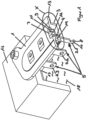
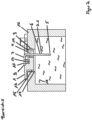
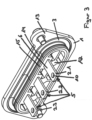
Figuren 1 bis 3 näher beschrieben. Diese zeigen jeweils in schematischer Darstellung: - Figur 1
- einen perspektivischen Schnitt durch eine Stromschiene,
- Figur 2
- einen vergrößerten Ausschnitt x aus
Figur 1 und - Figur 3
- eine perspektivische Ansicht der Stromschiene aus
Figur 1 von unten, aus Richtung eines abzudichtenden Gehäuses. - In
Figur 1 ist ein Ausführungsbeispiel einer Stromschiene gezeigt. Die Stromschiene umfasst den Tragkörper 1 aus einem polymeren, zähharten Werkstoff und drei elektrische Leiter 2.1, 2.1, 2.3, die im Tragkörper 1 angeordnet sind. - Die Leiter 2.1, 2.2, 2.3 bestehen im gezeigten Ausführungsbeispiel jeweils aus einem Kupfer-Metall-Teil, wobei die Leiter 2.1, 2.2, 2.3 jeweils als Stecker 5 ausgebildet sind.
- Die Stromübergabe erfolgt mittels der Leiter 2.1, 2.2., 2.3. Die Leiter 2.1, 2.2, 2.3 sind, wie hier gezeigt, im Wesentlichen L-förmig ausgebildet und weisen jeweils einen ersten 6 und einen zweiten Schenkel 7 auf, die einander im Wesentlichen rechtwinklig zugeordnet sind. Die freien Enden 8, 9 der Schenkel 6,7 weisen jeweils eine Kontaktierung 10, 11 auf, an die weitere elektrische Leiter zur Stromzu- oder -abfuhr anschließbar sind.
- In den
Figuren 1 und2 ist außerdem ein Gehäuse 16 mit einer Öffnung 17 schematisch angedeutet, wobei die Öffnung 17 durch die erfindungsgemäße Stromschiene dichtend verschlossen ist. Innerhalb des Gehäuses 16 befindet sich ein flüssiges abzudichtendes Medium 18. Durch dieses Medium 18 sind die ersten Schenkel 6 der Stromschiene beaufschlagbar. - Um eine gute Abdichtung des Gehäuses 16 und insbesondere eine gute Abdichtung zwischen dem Tragkörper 1 und den Leitern 2.1, 2.2, 2.3 zu erzielen, ist zwischen dem Tragkörper 1 und den Leitern 2.1, 2.2, 2.3 die Dichtung 3 aus gummielastischen Werkstoff angeordnet, die die Leiter 2.1, 2.2, 2.3 außenumfangsseitig mit einem ringförmigen Dichtbereich 4 dichtend umschließt. Der Dichtbereich 4 bewirkt, dass im Übergangsbereich zwischen dem Tragkörper 1 und den Leitern 2.1, 2.2., 2.3 kein abzudichtendes Medium 18 vom Inneren des Gehäuses 16 an den Leiter 2.1, 2.2, 2.3 vorbei in die Umgebung der Stromschiene austreten kann.
- Der ringförmige Dichtbereich 4 ist einstückig ineinander übergehend und materialeinheitlich mit dem Flanschbereich 14 ausgebildet, der ebenfalls von der Dichtung 3 umfasst ist. Der Flanschbereich 14 ist, im Querschnitt betrachtet, L-förmig ausgebildet.
- Dadurch ist er an die Gestalt des Tragkörpers 1 mit Kern 12 und Befestigungsflansch 13 angepasst.
- Der Tragkörper 1 umfasst den Kern 12, der außenumfangsseitig von dem kragenförmigen Befestigungsflansch 13 umschlossen ist. Dadurch, dass sich der Flanschbereich 14 außenumfangsseitig in sich geschlossen und dichtend um den Kern 12 erstreckt, ergibt sich die Gestalt des Flanschbereichs 14. Einer der Schenkel des Flanschbereichs 14 dichtet die Begrenzung der Öffnung 17 am Gehäuse 16 ab, der andere Schenkel demgegenüber die einander zugewandten Oberflächen von Gehäuse 16 und Befestigungsflansch 13.
- In
Figur 3 ist die Stromschiene als Einzelteil in einer perspektivischen Ansicht von unten gezeigt. Die Leiter 2.1, 2.2, 2.3 durchdringen den Kern 12 des Tragkörpers 1 mit ihren Schenkeln 6, wobei die Schenkel 6 durch den hier nicht zu sehenden Dichtbereich 4 gegenüber dem Kern 12 abgedichtet sind. Der Flanschbereich 14 der Dichtung 3 umschließt den Kern 12 außenumfangsseitig in sich geschlossen und dichtend.
Claims (13)
- Stromschiene, umfassend einen Tragkörper (1) aus einem zähharten Werkstoff und zumindest einen elektrischen Leiter (2.1, 2.2, 2.3, ...), wobei der Leiter (2.1, 2.2, 2.3, ...) mit dem Tragkörper (1) verbunden ist, wobei der Tragkörper (1) eine Dichtung (3) aus einem gummielastischen Werkstoff umfasst, die den Leiter (2.1, 2.2, 2.3, ...) außenumfangsseitig mit einem ringförmigen Dichtbereich (4) dichtend umschließt, wobei der Tragkörper (1) einen Kern (12) und einen kragenförmigen Befestigungsflansch (13) umfasst und wobei der Kern (12) außenumfangseitig von dem Befestigungsflansch (13) umschlossen ist, dadurch gekennzeichnet, dass die Dichtung (3) zusätzlich zum Dichtbereich (4) einen Flanschbereich (14) umfasst, der im Querschnitt betrachtet L-förmig und vom Befestigungsflansch (13) in den Außenumfang (15) des Kerns (12) übergehend ausgebildet ist und den Kern (12) in sich geschlossen dichtend umschließt.
- Stromschiene nach Anspruch 1, dadurch gekennzeichnet, dass der Dichtbereich (4) und der Flanschbereich (14) einstückig ineinander übergehend und materialeinheitlich ausgebildet sind.
- Stromschiene nach einem der Ansprüche 1 oder 2, dadurch gekennzeichnet, dass der Tragkörper (1) aus einem polymeren Werkstoff besteht.
- Stromschiene nach einem der Ansprüche 1 oder 2, dadurch gekennzeichnet, dass die Dichtung (3) aus einem elastomeren Werkstoff besteht.
- Stromschiene nach einem der Ansprüche 1 bis 4, dadurch gekennzeichnet, dass der Tragkörper (1) und die Dichtung (3) stoffschlüssig miteinander verbunden sind.
- Stromschiene nach Anspruch 1, dadurch gekennzeichnet, dass der Leiter (2.1, 2.2, 2.3, ...) als Kupfer-Metall-Teil ausgebildet ist.
- Stromschiene nach einem der Ansprüche 1 oder 6, dadurch gekennzeichnet, dass der Leiter (2.1, 2.2, 2.3, ...) als Stecker (5) ausgebildet ist.
- Stromschiene nach einem der Ansprüche 1, 6 oder 7, dadurch gekennzeichnet, dass der Leiter (2.1, 2.2, 2.3, ...), im Querschnitt betrachtet, im wesentlichen L-förmig ausgebildet ist und einen ersten (6) und einen zweiten Schenkel (7) aufweist.
- Stromschiene nach Anspruch 8, dadurch gekennzeichnet, dass jeder der Schenkel (6, 7) an den jeweils einander abgewandten freien Enden (8, 9) eine Kontaktierung (10, 11) aufweist.
- Stromschiene nach einem der Ansprüche 1 oder 6 bis 9, dadurch gekennzeichnet, dass der Leiter (2.1, 2.2, 2.3, ...) den Tragkörper (1) mit einem der Schenkel (6) durchdringt.
- Stromschiene nach einem der Ansprüche 1 bis 10, dadurch gekennzeichnet, dass der Kern (12) von dem Schenkel (6) durchdrungen ist.
- Anordnung, umfassend eine Stromschiene nach einem der Ansprüche 1 bis 11 und ein Gehäuse (16) mit einer Öffnung (17), die von der Stromschiene dichten verschlossen ist, wobei im Gehäuse (16) ein abzudichtendes Medium (18) angeordnet ist.
- Anordnung nach Anspruch 12, dadurch gekennzeichnet, dass das abzudichtende Medium (18) durch ein flüssiges Kühlmittel gebildet ist.
Applications Claiming Priority (1)
| Application Number | Priority Date | Filing Date | Title |
|---|---|---|---|
| DE102021104624.6A DE102021104624A1 (de) | 2021-02-26 | 2021-02-26 | Stromschiene und Anordnung, die eine solche Stromschiene umfasst |
Publications (2)
| Publication Number | Publication Date |
|---|---|
| EP4049901A1 EP4049901A1 (de) | 2022-08-31 |
| EP4049901B1 true EP4049901B1 (de) | 2025-04-02 |
Family
ID=80447103
Family Applications (1)
| Application Number | Title | Priority Date | Filing Date |
|---|---|---|---|
| EP22157959.2A Active EP4049901B1 (de) | 2021-02-26 | 2022-02-22 | Stromschiene und anordnung, die eine solche stromschiene umfasst |
Country Status (3)
| Country | Link |
|---|---|
| US (1) | US12142905B2 (de) |
| EP (1) | EP4049901B1 (de) |
| DE (1) | DE102021104624A1 (de) |
Families Citing this family (1)
| Publication number | Priority date | Publication date | Assignee | Title |
|---|---|---|---|---|
| DE102023103874A1 (de) | 2023-02-16 | 2024-08-22 | Carl Freudenberg Kg | Dichtungsanordnung und deren Verwendung |
Family Cites Families (19)
| Publication number | Priority date | Publication date | Assignee | Title |
|---|---|---|---|---|
| US3599170A (en) * | 1969-08-29 | 1971-08-10 | Us Navy | Flexible hermetically sealed connector |
| DE2623156B2 (de) | 1976-05-22 | 1980-05-22 | Transformatoren Union Ag, 7000 Stuttgart | Elektrische Durchführung mit Gieliharzstützer und Metallbefestigungsflansch |
| FR2776419B1 (fr) * | 1998-03-18 | 2000-06-16 | Pioch Sa | Dispositif passe-barre et traversee electrique de paroi |
| EP1806523B1 (de) * | 2006-01-10 | 2008-04-09 | Carl Freudenberg KG | Dichtung |
| US7540779B2 (en) * | 2007-03-23 | 2009-06-02 | Coherent, Inc. | RF shielded, series inductor, high RF power impedance matching interconnector for CO2 slab laser |
| DE102007034478A1 (de) | 2007-07-20 | 2009-01-22 | Thermo Fisher Scientific (Bremen) Gmbh | Vakuum-Gehäuse und Verfahren zur Herstellung eines Einsatzes für ein Vakuum-Gehäuse |
| DE102010043773B4 (de) | 2010-01-29 | 2014-05-22 | Halla Visteon Climate Control Corporation 95 | Elektrische Durchführung für Hermetikverdichter |
| DE202011110163U1 (de) | 2011-04-08 | 2013-02-11 | Kromberg & Schubert Kg | Elektrische Kontakteinrichtung |
| DE102013201424B4 (de) | 2013-01-29 | 2021-08-05 | Robert Bosch Gmbh | Steuergerät |
| JP5660148B2 (ja) * | 2013-02-22 | 2015-01-28 | Tdk株式会社 | 端子台及びそれを含む電子機器 |
| JP2015011949A (ja) * | 2013-07-02 | 2015-01-19 | 矢崎総業株式会社 | 防水コネクタ |
| DE102015213439A1 (de) * | 2015-07-17 | 2017-01-19 | Zf Friedrichshafen Ag | Leistungsanschluss für ein elektrisches Gerät, insbesondere für eine elektrische Maschine zum Antreiben eines Kraftfahrzeuges |
| DE102017113992A1 (de) | 2016-08-10 | 2018-02-15 | Sma Solar Technology Ag | Stromschienenanordnung zur dichtenden montage in einer ausnehmung einer trennwand, elektrisches und/oder elektronisches gerät mit einer derartigen stromschienenanordnung und verfahren zu deren herstellung |
| JP6709513B2 (ja) | 2017-07-04 | 2020-06-17 | 住友電装株式会社 | 端子台 |
| JP2019178696A (ja) * | 2018-03-30 | 2019-10-17 | 矢崎総業株式会社 | Oリング、oリング係止構造、端子台及び車載機器 |
| DE102018109863B4 (de) | 2018-04-24 | 2020-01-16 | Lisa Dräxlmaier GmbH | Mehrkomponentendichtung zum Abdichten einer Schiene, insbesondere einer Stromschiene für ein Bordnetz eines Kraftfahrzeugs, gegenüber einem Gehäuse |
| JP6936203B2 (ja) * | 2018-10-23 | 2021-09-15 | 矢崎総業株式会社 | 端子台、三連端子台、及び車載機器 |
| DE102019219377B4 (de) | 2019-12-11 | 2022-03-10 | Zf Friedrichshafen Ag | Anordnung zum Abdichten einer Stromschiene, insbesondere einer Stromschiene für ein Bordnetz eines Kraftfahrzeugs, gegenüber einem Gehäuse |
| DE102020201419A1 (de) | 2020-02-05 | 2021-08-05 | Volkswagen Aktiengesellschaft | Elektrisches Kontaktiermodul, Kraftfahrzeug und Verfahren zur Herstellung eines elektrischen Kontaktiermoduls |
-
2021
- 2021-02-26 DE DE102021104624.6A patent/DE102021104624A1/de active Pending
-
2022
- 2022-02-22 EP EP22157959.2A patent/EP4049901B1/de active Active
- 2022-02-24 US US17/679,130 patent/US12142905B2/en active Active
Also Published As
| Publication number | Publication date |
|---|---|
| EP4049901A1 (de) | 2022-08-31 |
| US12142905B2 (en) | 2024-11-12 |
| DE102021104624A1 (de) | 2022-09-01 |
| US20220278518A1 (en) | 2022-09-01 |
Similar Documents
| Publication | Publication Date | Title |
|---|---|---|
| DE10332298B4 (de) | Wasserdichter Druckkontakt-Steckverbinder, Kontaktelement für einen wasserdichten Druckkontakt-Steckverbinder und Verfahren zur Herstellung eines Kontaktelements | |
| EP3745541B1 (de) | Steckdose für eine kombinierte elektrische verbindung und datenverbindung | |
| DE2350287C2 (de) | Kabelendverschluß | |
| DE69802414T2 (de) | Elektrische verbindungsvorrichtung mit einem fluidischen isolierstoff | |
| DE102010043655B4 (de) | Überspannungsableiter mit dehnbarer Manschette | |
| EP3439117B1 (de) | Verfahren zur überprüfung einer abdichtung einer steckerverbindung sowie steckerverbindung | |
| DE202009003592U1 (de) | Abdichtung eines gefederten Kontaktstiftes | |
| EP0533729B1 (de) | Kabelzugentlastung | |
| DE112014001079T5 (de) | Kabelstrang | |
| DE4225267C3 (de) | Abdichtungsvorrichtung für ein elektronisches Schaltgerät | |
| EP1158638B1 (de) | Anordnung zum elektrisch leitenden Verbinden der Leiter von zwei Hochspanungskabeln | |
| EP4049901A1 (de) | Stromschiene und anordnung, die eine solche stromschiene umfasst | |
| DE69503515T2 (de) | Elektrische vorrichtung | |
| EP2099099B1 (de) | Elektrisches Kupplungsteil mit angeschlossener elektrischer Leitung | |
| EP3340392B1 (de) | Anordnung zum verbinden von elektrischen leitungen | |
| DE102022122506A1 (de) | Universell einsetzbares Gehäuse zur Abdeckung von Kontaktelementen | |
| EP3477777B1 (de) | Elektrische leitung mit schirmausleitung | |
| EP1870909A1 (de) | Flachbandkabel | |
| DE102008031085A1 (de) | Kupplungsteil für eine elektrische Leitung | |
| AT517416B1 (de) | Kabel und verfahren zur herstellung eines kabels | |
| EP0017953B1 (de) | Garnitur für das Ende eines Mittelspannungs- oder Hochspannungskabels | |
| WO2006108412A1 (de) | Zwei- oder mehrteilig aufgebautes isolierkörpersystem zur herstellung von mittelspannungskabelgarnituren | |
| DE102008031252A1 (de) | Isolierkörper zum abgedichteten Abdecken einer elektrischen Kabelendverschlussverbindung | |
| DE2525221A1 (de) | Elektrische reihenverbindungsanordnung | |
| DE2252026A1 (de) | Anschlusseinrichtung fuer koaxialkabel |
Legal Events
| Date | Code | Title | Description |
|---|---|---|---|
| PUAI | Public reference made under article 153(3) epc to a published international application that has entered the european phase |
Free format text: ORIGINAL CODE: 0009012 |
|
| STAA | Information on the status of an ep patent application or granted ep patent |
Free format text: STATUS: THE APPLICATION HAS BEEN PUBLISHED |
|
| AK | Designated contracting states |
Kind code of ref document: A1 Designated state(s): AL AT BE BG CH CY CZ DE DK EE ES FI FR GB GR HR HU IE IS IT LI LT LU LV MC MK MT NL NO PL PT RO RS SE SI SK SM TR |
|
| STAA | Information on the status of an ep patent application or granted ep patent |
Free format text: STATUS: REQUEST FOR EXAMINATION WAS MADE |
|
| 17P | Request for examination filed |
Effective date: 20220909 |
|
| RBV | Designated contracting states (corrected) |
Designated state(s): AL AT BE BG CH CY CZ DE DK EE ES FI FR GB GR HR HU IE IS IT LI LT LU LV MC MK MT NL NO PL PT RO RS SE SI SK SM TR |
|
| GRAP | Despatch of communication of intention to grant a patent |
Free format text: ORIGINAL CODE: EPIDOSNIGR1 |
|
| STAA | Information on the status of an ep patent application or granted ep patent |
Free format text: STATUS: GRANT OF PATENT IS INTENDED |
|
| INTG | Intention to grant announced |
Effective date: 20241127 |
|
| RIN1 | Information on inventor provided before grant (corrected) |
Inventor name: MALL, JUERGEN Inventor name: CLEMENS, MARKUS Inventor name: ZIEGLER, GUENTER Inventor name: HELDMANN, RALF Inventor name: RATFISCH, ROUVEN |
|
| GRAS | Grant fee paid |
Free format text: ORIGINAL CODE: EPIDOSNIGR3 |
|
| GRAA | (expected) grant |
Free format text: ORIGINAL CODE: 0009210 |
|
| STAA | Information on the status of an ep patent application or granted ep patent |
Free format text: STATUS: THE PATENT HAS BEEN GRANTED |
|
| AK | Designated contracting states |
Kind code of ref document: B1 Designated state(s): AL AT BE BG CH CY CZ DE DK EE ES FI FR GB GR HR HU IE IS IT LI LT LU LV MC MK MT NL NO PL PT RO RS SE SI SK SM TR |
|
| P01 | Opt-out of the competence of the unified patent court (upc) registered |
Free format text: CASE NUMBER: APP_9179/2025 Effective date: 20250224 |
|
| REG | Reference to a national code |
Ref country code: GB Ref legal event code: FG4D Free format text: NOT ENGLISH |
|
| REG | Reference to a national code |
Ref country code: CH Ref legal event code: EP |
|
| REG | Reference to a national code |
Ref country code: IE Ref legal event code: FG4D Free format text: LANGUAGE OF EP DOCUMENT: GERMAN |
|
| REG | Reference to a national code |
Ref country code: DE Ref legal event code: R096 Ref document number: 502022003380 Country of ref document: DE |
|
| REG | Reference to a national code |
Ref country code: NL Ref legal event code: MP Effective date: 20250402 |
|
| PG25 | Lapsed in a contracting state [announced via postgrant information from national office to epo] |
Ref country code: NL Free format text: LAPSE BECAUSE OF FAILURE TO SUBMIT A TRANSLATION OF THE DESCRIPTION OR TO PAY THE FEE WITHIN THE PRESCRIBED TIME-LIMIT Effective date: 20250402 |
|
| PG25 | Lapsed in a contracting state [announced via postgrant information from national office to epo] |
Ref country code: ES Free format text: LAPSE BECAUSE OF FAILURE TO SUBMIT A TRANSLATION OF THE DESCRIPTION OR TO PAY THE FEE WITHIN THE PRESCRIBED TIME-LIMIT Effective date: 20250402 Ref country code: PT Free format text: LAPSE BECAUSE OF FAILURE TO SUBMIT A TRANSLATION OF THE DESCRIPTION OR TO PAY THE FEE WITHIN THE PRESCRIBED TIME-LIMIT Effective date: 20250804 Ref country code: FI Free format text: LAPSE BECAUSE OF FAILURE TO SUBMIT A TRANSLATION OF THE DESCRIPTION OR TO PAY THE FEE WITHIN THE PRESCRIBED TIME-LIMIT Effective date: 20250402 |
|
| REG | Reference to a national code |
Ref country code: LT Ref legal event code: MG9D |
|
| PG25 | Lapsed in a contracting state [announced via postgrant information from national office to epo] |
Ref country code: NO Free format text: LAPSE BECAUSE OF FAILURE TO SUBMIT A TRANSLATION OF THE DESCRIPTION OR TO PAY THE FEE WITHIN THE PRESCRIBED TIME-LIMIT Effective date: 20250702 Ref country code: GR Free format text: LAPSE BECAUSE OF FAILURE TO SUBMIT A TRANSLATION OF THE DESCRIPTION OR TO PAY THE FEE WITHIN THE PRESCRIBED TIME-LIMIT Effective date: 20250703 |
|
| PG25 | Lapsed in a contracting state [announced via postgrant information from national office to epo] |
Ref country code: PL Free format text: LAPSE BECAUSE OF FAILURE TO SUBMIT A TRANSLATION OF THE DESCRIPTION OR TO PAY THE FEE WITHIN THE PRESCRIBED TIME-LIMIT Effective date: 20250402 |
|
| PG25 | Lapsed in a contracting state [announced via postgrant information from national office to epo] |
Ref country code: BG Free format text: LAPSE BECAUSE OF FAILURE TO SUBMIT A TRANSLATION OF THE DESCRIPTION OR TO PAY THE FEE WITHIN THE PRESCRIBED TIME-LIMIT Effective date: 20250402 |
|
| PG25 | Lapsed in a contracting state [announced via postgrant information from national office to epo] |
Ref country code: HR Free format text: LAPSE BECAUSE OF FAILURE TO SUBMIT A TRANSLATION OF THE DESCRIPTION OR TO PAY THE FEE WITHIN THE PRESCRIBED TIME-LIMIT Effective date: 20250402 |
|
| PG25 | Lapsed in a contracting state [announced via postgrant information from national office to epo] |
Ref country code: RS Free format text: LAPSE BECAUSE OF FAILURE TO SUBMIT A TRANSLATION OF THE DESCRIPTION OR TO PAY THE FEE WITHIN THE PRESCRIBED TIME-LIMIT Effective date: 20250702 |
|
| PG25 | Lapsed in a contracting state [announced via postgrant information from national office to epo] |
Ref country code: IS Free format text: LAPSE BECAUSE OF FAILURE TO SUBMIT A TRANSLATION OF THE DESCRIPTION OR TO PAY THE FEE WITHIN THE PRESCRIBED TIME-LIMIT Effective date: 20250802 |
|
| PG25 | Lapsed in a contracting state [announced via postgrant information from national office to epo] |
Ref country code: LV Free format text: LAPSE BECAUSE OF FAILURE TO SUBMIT A TRANSLATION OF THE DESCRIPTION OR TO PAY THE FEE WITHIN THE PRESCRIBED TIME-LIMIT Effective date: 20250402 |
|
| REG | Reference to a national code |
Ref country code: DE Ref legal event code: R097 Ref document number: 502022003380 Country of ref document: DE |
|
| PG25 | Lapsed in a contracting state [announced via postgrant information from national office to epo] |
Ref country code: DK Free format text: LAPSE BECAUSE OF FAILURE TO SUBMIT A TRANSLATION OF THE DESCRIPTION OR TO PAY THE FEE WITHIN THE PRESCRIBED TIME-LIMIT Effective date: 20250402 Ref country code: SM Free format text: LAPSE BECAUSE OF FAILURE TO SUBMIT A TRANSLATION OF THE DESCRIPTION OR TO PAY THE FEE WITHIN THE PRESCRIBED TIME-LIMIT Effective date: 20250402 |
|
| PG25 | Lapsed in a contracting state [announced via postgrant information from national office to epo] |
Ref country code: CZ Free format text: LAPSE BECAUSE OF FAILURE TO SUBMIT A TRANSLATION OF THE DESCRIPTION OR TO PAY THE FEE WITHIN THE PRESCRIBED TIME-LIMIT Effective date: 20250402 |
|
| PG25 | Lapsed in a contracting state [announced via postgrant information from national office to epo] |
Ref country code: EE Free format text: LAPSE BECAUSE OF FAILURE TO SUBMIT A TRANSLATION OF THE DESCRIPTION OR TO PAY THE FEE WITHIN THE PRESCRIBED TIME-LIMIT Effective date: 20250402 |
|
| PG25 | Lapsed in a contracting state [announced via postgrant information from national office to epo] |
Ref country code: SK Free format text: LAPSE BECAUSE OF FAILURE TO SUBMIT A TRANSLATION OF THE DESCRIPTION OR TO PAY THE FEE WITHIN THE PRESCRIBED TIME-LIMIT Effective date: 20250402 |
|
| PG25 | Lapsed in a contracting state [announced via postgrant information from national office to epo] |
Ref country code: IT Free format text: LAPSE BECAUSE OF FAILURE TO SUBMIT A TRANSLATION OF THE DESCRIPTION OR TO PAY THE FEE WITHIN THE PRESCRIBED TIME-LIMIT Effective date: 20250402 |
|
| PLBE | No opposition filed within time limit |
Free format text: ORIGINAL CODE: 0009261 |
|
| STAA | Information on the status of an ep patent application or granted ep patent |
Free format text: STATUS: NO OPPOSITION FILED WITHIN TIME LIMIT |
|
| REG | Reference to a national code |
Ref country code: CH Ref legal event code: L10 Free format text: ST27 STATUS EVENT CODE: U-0-0-L10-L00 (AS PROVIDED BY THE NATIONAL OFFICE) Effective date: 20260211 |
|
| REG | Reference to a national code |
Ref country code: CH Ref legal event code: U11 Free format text: ST27 STATUS EVENT CODE: U-0-0-U10-U11 (AS PROVIDED BY THE NATIONAL OFFICE) Effective date: 20260301 |
|
| 26N | No opposition filed |
Effective date: 20260105 |
|
| PGFP | Annual fee paid to national office [announced via postgrant information from national office to epo] |
Ref country code: LU Payment date: 20260220 Year of fee payment: 5 |
|
| PGFP | Annual fee paid to national office [announced via postgrant information from national office to epo] |
Ref country code: GB Payment date: 20260223 Year of fee payment: 5 |
|
| PGFP | Annual fee paid to national office [announced via postgrant information from national office to epo] |
Ref country code: MC Payment date: 20260219 Year of fee payment: 5 |
|
| PGFP | Annual fee paid to national office [announced via postgrant information from national office to epo] |
Ref country code: IE Payment date: 20260219 Year of fee payment: 5 Ref country code: DE Payment date: 20260220 Year of fee payment: 5 |
|
| PGFP | Annual fee paid to national office [announced via postgrant information from national office to epo] |
Ref country code: AT Payment date: 20260301 Year of fee payment: 5 |
|
| PGFP | Annual fee paid to national office [announced via postgrant information from national office to epo] |
Ref country code: BE Payment date: 20260220 Year of fee payment: 5 |
|
| PGFP | Annual fee paid to national office [announced via postgrant information from national office to epo] |
Ref country code: FR Payment date: 20260227 Year of fee payment: 5 |
|
| PGFP | Annual fee paid to national office [announced via postgrant information from national office to epo] |
Ref country code: CH Payment date: 20260301 Year of fee payment: 5 |