EP4048897B1 - Turbomachine munie d'une pompe electromagnetique a flux magnetique axial - Google Patents
Turbomachine munie d'une pompe electromagnetique a flux magnetique axial Download PDFInfo
- Publication number
- EP4048897B1 EP4048897B1 EP20803218.5A EP20803218A EP4048897B1 EP 4048897 B1 EP4048897 B1 EP 4048897B1 EP 20803218 A EP20803218 A EP 20803218A EP 4048897 B1 EP4048897 B1 EP 4048897B1
- Authority
- EP
- European Patent Office
- Prior art keywords
- coils
- pump
- magnets
- electromagnetic pump
- turbomachine
- Prior art date
- Legal status (The legal status is an assumption and is not a legal conclusion. Google has not performed a legal analysis and makes no representation as to the accuracy of the status listed.)
- Active
Links
Images





Classifications
-
- F—MECHANICAL ENGINEERING; LIGHTING; HEATING; WEAPONS; BLASTING
- F04—POSITIVE - DISPLACEMENT MACHINES FOR LIQUIDS; PUMPS FOR LIQUIDS OR ELASTIC FLUIDS
- F04C—ROTARY-PISTON, OR OSCILLATING-PISTON, POSITIVE-DISPLACEMENT MACHINES FOR LIQUIDS; ROTARY-PISTON, OR OSCILLATING-PISTON, POSITIVE-DISPLACEMENT PUMPS
- F04C2/00—Rotary-piston machines or pumps
- F04C2/08—Rotary-piston machines or pumps of intermeshing-engagement type, i.e. with engagement of co-operating members similar to that of toothed gearing
- F04C2/10—Rotary-piston machines or pumps of intermeshing-engagement type, i.e. with engagement of co-operating members similar to that of toothed gearing of internal-axis type with the outer member having more teeth or tooth-equivalents, e.g. rollers, than the inner member
-
- F—MECHANICAL ENGINEERING; LIGHTING; HEATING; WEAPONS; BLASTING
- F04—POSITIVE - DISPLACEMENT MACHINES FOR LIQUIDS; PUMPS FOR LIQUIDS OR ELASTIC FLUIDS
- F04C—ROTARY-PISTON, OR OSCILLATING-PISTON, POSITIVE-DISPLACEMENT MACHINES FOR LIQUIDS; ROTARY-PISTON, OR OSCILLATING-PISTON, POSITIVE-DISPLACEMENT PUMPS
- F04C15/00—Component parts, details or accessories of machines, pumps or pumping installations, not provided for in groups F04C2/00 - F04C14/00
- F04C15/0057—Driving elements, brakes, couplings, transmission specially adapted for machines or pumps
- F04C15/008—Prime movers
-
- F—MECHANICAL ENGINEERING; LIGHTING; HEATING; WEAPONS; BLASTING
- F02—COMBUSTION ENGINES; HOT-GAS OR COMBUSTION-PRODUCT ENGINE PLANTS
- F02C—GAS-TURBINE PLANTS; AIR INTAKES FOR JET-PROPULSION PLANTS; CONTROLLING FUEL SUPPLY IN AIR-BREATHING JET-PROPULSION PLANTS
- F02C7/00—Features, components parts, details or accessories, not provided for in, or of interest apart form groups F02C1/00 - F02C6/00; Air intakes for jet-propulsion plants
- F02C7/32—Arrangement, mounting, or driving, of auxiliaries
-
- F—MECHANICAL ENGINEERING; LIGHTING; HEATING; WEAPONS; BLASTING
- F04—POSITIVE - DISPLACEMENT MACHINES FOR LIQUIDS; PUMPS FOR LIQUIDS OR ELASTIC FLUIDS
- F04C—ROTARY-PISTON, OR OSCILLATING-PISTON, POSITIVE-DISPLACEMENT MACHINES FOR LIQUIDS; ROTARY-PISTON, OR OSCILLATING-PISTON, POSITIVE-DISPLACEMENT PUMPS
- F04C15/00—Component parts, details or accessories of machines, pumps or pumping installations, not provided for in groups F04C2/00 - F04C14/00
- F04C15/0057—Driving elements, brakes, couplings, transmission specially adapted for machines or pumps
- F04C15/0061—Means for transmitting movement from the prime mover to driven parts of the pump, e.g. clutches, couplings, transmissions
- F04C15/0069—Magnetic couplings
-
- F—MECHANICAL ENGINEERING; LIGHTING; HEATING; WEAPONS; BLASTING
- F04—POSITIVE - DISPLACEMENT MACHINES FOR LIQUIDS; PUMPS FOR LIQUIDS OR ELASTIC FLUIDS
- F04C—ROTARY-PISTON, OR OSCILLATING-PISTON, POSITIVE-DISPLACEMENT MACHINES FOR LIQUIDS; ROTARY-PISTON, OR OSCILLATING-PISTON, POSITIVE-DISPLACEMENT PUMPS
- F04C2/00—Rotary-piston machines or pumps
- F04C2/08—Rotary-piston machines or pumps of intermeshing-engagement type, i.e. with engagement of co-operating members similar to that of toothed gearing
- F04C2/10—Rotary-piston machines or pumps of intermeshing-engagement type, i.e. with engagement of co-operating members similar to that of toothed gearing of internal-axis type with the outer member having more teeth or tooth-equivalents, e.g. rollers, than the inner member
- F04C2/102—Rotary-piston machines or pumps of intermeshing-engagement type, i.e. with engagement of co-operating members similar to that of toothed gearing of internal-axis type with the outer member having more teeth or tooth-equivalents, e.g. rollers, than the inner member the two members rotating simultaneously around their respective axes
-
- F—MECHANICAL ENGINEERING; LIGHTING; HEATING; WEAPONS; BLASTING
- F04—POSITIVE - DISPLACEMENT MACHINES FOR LIQUIDS; PUMPS FOR LIQUIDS OR ELASTIC FLUIDS
- F04C—ROTARY-PISTON, OR OSCILLATING-PISTON, POSITIVE-DISPLACEMENT MACHINES FOR LIQUIDS; ROTARY-PISTON, OR OSCILLATING-PISTON, POSITIVE-DISPLACEMENT PUMPS
- F04C7/00—Rotary-piston machines or pumps with fluid ring or the like
-
- F—MECHANICAL ENGINEERING; LIGHTING; HEATING; WEAPONS; BLASTING
- F04—POSITIVE - DISPLACEMENT MACHINES FOR LIQUIDS; PUMPS FOR LIQUIDS OR ELASTIC FLUIDS
- F04C—ROTARY-PISTON, OR OSCILLATING-PISTON, POSITIVE-DISPLACEMENT MACHINES FOR LIQUIDS; ROTARY-PISTON, OR OSCILLATING-PISTON, POSITIVE-DISPLACEMENT PUMPS
- F04C2240/00—Components
- F04C2240/40—Electric motor
-
- Y—GENERAL TAGGING OF NEW TECHNOLOGICAL DEVELOPMENTS; GENERAL TAGGING OF CROSS-SECTIONAL TECHNOLOGIES SPANNING OVER SEVERAL SECTIONS OF THE IPC; TECHNICAL SUBJECTS COVERED BY FORMER USPC CROSS-REFERENCE ART COLLECTIONS [XRACs] AND DIGESTS
- Y02—TECHNOLOGIES OR APPLICATIONS FOR MITIGATION OR ADAPTATION AGAINST CLIMATE CHANGE
- Y02T—CLIMATE CHANGE MITIGATION TECHNOLOGIES RELATED TO TRANSPORTATION
- Y02T50/00—Aeronautics or air transport
- Y02T50/60—Efficient propulsion technologies, e.g. for aircraft
Definitions
- the present invention relates to the field of turbomachines of the type comprising a rotating body comprising a motor shaft delivering mechanical power.
- the invention applies to all types of turbomachines, in particular those used in aircraft such as turbojets, turboprops, and turbomachines with unducted fans, also known by the Anglo-Saxon term "Open Rotor”.
- a conventional turbomachine comprises one or more rotating bodies in a known manner.
- Each rotating body includes a compressor, a turbine, and a motor shaft connecting the turbine to the compressor to drive the compressor to rotate.
- Part of the power generated by the turbomachine is used to drive various accessories (or auxiliary machines), necessary for the operation of the turbojet or the aircraft, such as for example a lubrication pump or a fuel pump.
- the turbomachine generally includes an accessory gear box (Accessory Gear Box) connecting the motor shaft to the pumps.
- an accessory gear box Accessory Gear Box
- the accessory gearbox transmits the rotational movement to the various accessories.
- the mechanical energy produced by the motor shaft is transmitted to the pumps through the accessory gearbox.
- the document US 2010/0003148 A1 discloses a turbomachine comprising a fuel pump driven by an electric motor and as a backup, by an air turbine.
- the invention aims in particular to provide a turbomachine which does not have the aforementioned drawbacks.
- a turbomachine comprising a rotating body comprising a motor shaft delivering mechanical power, characterized in that it comprises at least one electromagnetic pump mechanically decoupled from the motor shaft, each electromagnetic pump comprising at least one stator delimiting an annular internal volume in which is present a rotor capable of driving a fluid, a plurality of magnets distributed annularly on the rotor and at least a plurality of coils distributed annularly inside the stator, the coils of the plurality of coils facing the magnets in an axial direction.
- the turbomachine according to the invention is thus equipped with one or more pumps which are mechanically decoupled from the motor shaft and which are controlled independently of the engine speed. It is thus possible to have greater freedom in the choice of the rotation speed of the pump and in the possibilities of installing the pump(s) in the turbomachine.
- the radial bulk of the pump is greatly optimized. This results in a very compact pump.
- the rotor comprises a wheel provided with a plurality of blades, the magnets of the plurality of magnets being held at the level of the external periphery of the wheel.
- each electromagnetic pump comprises first and second pluralities of coils present respectively on one side and on the other side of the wheel, the coils of the first and second pluralities of coils being facing the magnets in the axial direction.
- Two pluralities of coils ensure redundancy in the event of breakdown or failure of a plurality of coils. The redundancy of the plurality of coils can also be used to double the strength of the electromagnetic fields to which the permanent magnets are subjected.
- the rotor comprises an internal pinion cooperating with an external crown with internal teeth, the magnets of the plurality of magnets being held at the level of the external periphery of the external crown.
- each electromagnetic pump comprises first and second pluralities of coils present respectively on one side and on the other side of the outer ring, the coils of the first and second pluralities of coils being opposite the magnets in the axial direction.
- the use of two pluralities of coils makes it possible to ensure redundancy in the event of breakdown or failure of a plurality of coils and/or to double the power of the electromagnetic fields to which the permanent magnets are subjected.
- the rotor comprises an internal pinion cooperating with an external ring gear with internal teeth, the magnets of the plurality of magnets being held on the internal pinion.
- each electromagnetic pump comprises first and second pluralities of coils present respectively on one side and on the other side of the pinion, the coils of the first and second pluralities of coils being in with respect to the magnets in the axial direction.
- the use of two pluralities of coils makes it possible to ensure redundancy in the event of breakdown or failure of a plurality of coil and/or to double the power of the electromagnetic fields to which permanent magnets are subjected.
- the magnets of the plurality of magnets are arranged in an annular manner according to a Halbach structure.
- This particular arrangement makes it possible to increase the magnetic field on the external side of the rotor while the magnetic field on the internal side of the rotor is substantially canceled. This reduces the loss of the magnetic field, which improves the control of the rotor by the coils.
- the invention also relates to an aircraft comprising at least one turboprop or a turbojet comprising a turbomachine according to the invention.
- the invention generally applies to any turbomachine equipped with at least one pump controlled independently of the engine speed of the turbomachine. It applies in particular, but not exclusively, to pumps of the liquid ring, side channel or regenerative and gerotor type.
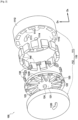
- the electromagnetic pump 100 is a liquid ring type pump comprising a fixed pump body or stator 110 consisting of a casing 111 and a flange 112.
- the casing 111 comprises a solid cylindrical central part 1110 provided with a suction/discharge port 1111 and a circular outer wall 1112 extending concentrically around the central part 1110, annular housings 1113 being delimited between the central part 1110 and the outer wall 1112.
- the flange 112 comprises a discharge/suction port 1120.
- the electromagnetic pump 100 also comprises a bladed wheel or rotor 120 comprising a wheel 121 provided with a plurality of blades 122 extending from the wheel in a radial direction D R , a ring 123 being present at the external periphery of the wheel.
- the ring 123 is fixed on the radially external ends of the blades 122.
- the blade wheel 120 comprises a rotation shaft 124 intended to be supported by bearings 1114 and 1124 present respectively on the casing 111 and the flange 112.
- the shaft is placed eccentrically on the impeller 120, for example by means of a spacer (not shown on the figures 1 And 2 ) so as to create inter-blade (or inter-blade) volume variations which make it possible to suck in the pumped fluid, for example through port 1111, then evacuate it under pressure, for example through port 1120.
- the pump 100 can also be a side channel pump, also called a regenerative pump. In this case and in known manner, a side channel 1125 (dotted on the figure 1 ) present here on the flange 112 extends between ports 1111 and 1120.
- the electromagnetic pump 100 further comprises a plurality of permanent magnets 130 distributed in an annular manner on the impeller or rotor 120 and a plurality of coils 140 distributed in an annular manner inside the fixed pump body or stator 110. More precisely, in the example described here, the permanent magnets 130 are held in housings 1230 present in the ring 123 while the coils 140 are held in the annular housing 1113 present in the casing 111.
- the coils 140 are located opposite the permanent magnets 130 in an axial direction D A.
- the control of the electromagnetic pump 100 is carried out by controlling the current circulating in the coils.
- part of the pump drive means is integrated directly within the moving elements, which makes it possible to obtain a high level of integration of the means of drive and therefore reduced bulk for the pump.
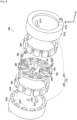
- THE figures 3 And 4 illustrate another embodiment of an electromagnetic pump 200 which differs from the electromagnetic pump 100 described in relation to the figures 1 And 2 in that it includes a double coil. More precisely, as for the pump 100, the pump 200 comprises a bladed wheel or rotor 220 comprising a wheel 221 provided with a plurality of blades 222 extending from the wheel in a radial direction D R , a fixed ring 223 on the radially external ends of the blades 222.
- the electromagnetic pump 200 also comprising a fixed pump body or stator 210 consisting of a first casing 211 and a second casing 212.
- the casings 211 and 212 each respectively comprise a solid cylindrical central part 2110, 2120 provided with a port suction/discharge 2111, 2121 and a circular external wall 2112, 2122 extending concentrically around the central part 2110, 2120.
- First annular housings 2113 are delimited in the first casing 211 between the central part 2110 and the external wall 2112.
- Second annular housings 2123 are delimited in the second casing 212 between the central part 2120 and the external wall 2122.
- the electromagnetic pump 200 further comprises a plurality of permanent magnets 230 held in an annular manner in housings 2230 present in the ring 223 and first and second pluralities of coils 240 and 250.
- the first plurality of coils 240 is distributed in an annular manner in the first annular housings 2113 while the second plurality of coils 250 is distributed annularly in the second annular housings 2123.
- the rotation shaft 224 of the impeller 220 is supported by bearings 2214 and 2224 present respectively on the first and second casings 211 and 212 while the first and second pluralities of coils 240 and 250 are present respectively on one side and on the other side of the wheel 220 and opposite the magnets in an axial direction D A.
- the electromagnetic pump 200 comprises two pluralities of coils which make it possible to ensure redundancy in the event of breakdown or failure of a plurality of coils, each plurality of coil having its own connections to the piloting system.
- the redundancy of the plurality of coils can also be used to double the strength of the electromagnetic fields to which the permanent magnets are subjected. It should also be noted that, always in the interest of optimizing the size of the pump, only the plurality of coils is redundant, and this as close as possible to the permanent magnets.
- the pump 200 can also be a side channel pump, also called a regenerative pump as explained previously in relation to the pump 100.
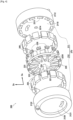
- the pump 300 is a gerotor type pump comprising a fixed pump body or stator 310 consisting of a casing 311 and a flange 312.
- the casing 311 comprises a solid cylindrical central part 3110 and a wall circular external 3112 extending concentrically around the central part 3110, annular housings 3113 being delimited between the central part 3110 and the external wall 3112.
- the flange 312 comprises a suction port 3120 and a discharge port 3121.
- the electromagnetic pump 300 also comprises a rotor 320 comprising an inner pinion 321 and an outer ring gear 322 present around the inner pinion 321 in a radial direction D R.
- the inner pinion comprises external teeth consisting here of six teeth 3210 while the outer crown 322 comprises internal teeth consisting here of 7 teeth 3220.
- the inner pinion 321 comprises a rotation shaft 324 intended to be supported by bearings 3114 and 3124 present respectively on the casing 311 and the flange 312.
- a fluid is sucked in from port 3120 and delivered via port 3121 by capsules created between the teeth 3210 and 3220 respectively of the internal pinion 321 and the outer ring 322 during the rotation of these two elements.
- the electromagnetic pump 300 further comprises a plurality of permanent magnets 330 distributed in an annular manner on the external periphery of the outer ring 322 and a plurality of coils 340 distributed in an annular manner inside the fixed pump body or stator 310. More precisely, in the example described here, the permanent magnets 330 are held in housings 3221 present in the outer ring 322 while the coils 340 are held in the annular housings 3113 present in the casing 311.
- the coils 340 are located opposite the permanent magnets 330 in an axial direction D A.
- the control of the electromagnetic pump 300 is carried out by controlling the current circulating in the coils.
- part of the pump drive means is integrated directly within the moving elements, which makes it possible to obtain a high level of integration of the drive means. and therefore reduced bulk for the pump.
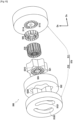
- THE figures 7 And 8 illustrate another embodiment of an electromagnetic pump 400 which differs from the electromagnetic pump 300 described in relation to the figures 5 And 6 in that it includes a double coil. More precisely, as for the pump 300, the pump 400 comprises a rotor 420 comprising an internal pinion 421 having external teeth consisting here of six teeth 4210 and an external crown 422 having internal teeth consisting here of 7 teeth 4220, the external crown 422 being present around the internal pinion 421 in a radial direction D R.
- the electromagnetic pump 400 also comprises a fixed pump body or stator 410 consisting of a first casing 411 and a second casing 412.
- the casings 411 and 412 each respectively comprise a solid cylindrical central part 4110, 4120 and a circular outer wall 4112, 4122 extending concentrically around the central part 4110, 4120, the central part 4120 of the casing 412 comprising a suction port 4121 and a discharge port 4124.
- First annular housings 4113 are delimited in the first casing 411 between the central part 4110 and the external wall 4112.
- a second annular housing 4123 is delimited in the second casing 412 between the central part 4120 and the external wall 4122.
- the electromagnetic pump 400 further comprises a plurality of permanent magnets 430 held in an annular manner in housings 4221 present in the outer ring 422 and first and second pluralities of coils 440 and 450.
- the first plurality of coils 440 is distributed annularly in the first annular housings 4113 while the second plurality of coils 450 is distributed annularly in the second annular housings 4123.
- the rotation shaft 424 of the internal pinion 421 is supported by bearings 4114 and 4124 present respectively on the first and second casings 411 and 412 while the first and second pluralities of coils 440 and 450 are present respectively on one side and on the other side of the outer ring 422 and opposite the magnets in an axial direction D A.
- the electromagnetic pump 400 comprises two pluralities of coils which make it possible to ensure redundancy in the event of breakdown or failure of a plurality of coils, each plurality of coils having their own connections to the control system.
- the redundancy of the plurality of coils can also be used to double the strength of the electromagnetic fields to which the permanent magnets are subjected. It should also be noted that, always in the interest of optimizing the size of the pump, only the plurality of coils is redundant, and this as close as possible to the permanent magnets.
- the gerotor type pump 500 comprises a fixed pump body or stator 510 consisting of a casing 511 and a flange 512.
- the casing 511 comprises annular housings 5113.
- the flange 512 comprises a 5120 suction port and a 5121 discharge port.
- the electromagnetic pump 500 also comprises a rotor 520 comprising an inner pinion 521 and an outer ring gear 522 present around the inner pinion 521 in a radial direction D R.
- the inner gear includes a external teeth consisting here of six teeth 5210 while the external crown 522 comprises internal teeth consisting here of 7 teeth 5220.
- the internal pinion 521 comprises a rotation shaft 524 intended to be supported by bearings 5114 and 5124 present respectively on the casing 511 and the flask 512.
- the electromagnetic pump 500 further comprises a plurality of permanent magnets 530 held in an annular manner in the internal pinion 521 around the rotation shaft 524 and a plurality of coils 540 held in the annular housings 5113 present in the casing 511.
- the coils 540 are located opposite the permanent magnets 530 in an axial direction D A.
- the control of the electromagnetic pump 500 is carried out by controlling the current circulating in the coils.
- part of the pump drive means is integrated directly within the moving elements, which makes it possible to obtain a high level of integration of the drive means. and therefore reduced bulk for the pump.
- the electromagnetic pump 500 can be equipped with a double winding, namely comprising first and second pluralities of coils present respectively on one side and on the other side of the internal pinion, the coils first and second pluralities of coils facing the magnets in the axial direction.
- the permanent magnets present on the external ring of the impeller for the embodiments described above in relation to the figures 1 to 4 , or on the outer crown for the embodiments described above in relation to the figures 5 to 8 , or on the internal pinion for the embodiment described above in relation to the figures 9 And 10 can be arranged following a Halbach structure.
- FIG. 11 illustrates an example of arrangement of permanent magnets following a Halbach structure.
- permanent magnets 10 are distributed in an annular manner as in the rotors described previously by reversing the polarity of the magnets in the radial direction and in the circumferential direction as represented by the arrows indicated on the Figure 11 .
- This particular arrangement makes it possible to increase the magnetic field 20 on the external side of the rotor while the magnetic field on the internal side of the rotor is substantially canceled. This reduces the loss of the magnetic field, which improves the control of the rotor by the coils.
- the electromagnetic pump according to the invention can be used in particular to supply fuel or lubricant to the turbomachine.
- FIG. 12 illustrates an example of a turbomachine which comprises a fuel supply line composed here of a fuel tank 10, a low pressure pump 11, a filter 12, a high pressure pump 13, a device metering device 14 and an oil/fuel heat exchanger 15.
- the turbomachine also includes an accessories box 17 (“gear box”) to which is connected a motor shaft 18 intended to deliver mechanical power in the turbomachine.
- the low pressure pump 11 and the high pressure pump 13 consist of an electromagnetic pump, for example of the liquid ring type or of the lateral or regenerative channel type.
- the low pressure pump 11 and the high pressure pump 13 are mechanically decoupled from the motor shaft 18 and are each controlled independently, for example the digital computer 16 integrated into the turbomachine control device.
- the low and/or high pressure supply pumps can also be replaced partly or entirely by electromagnetic pumps controlled independently of the engine speed.
- gerotor type pumps are preferably but not exclusively used.
Landscapes
- Engineering & Computer Science (AREA)
- Mechanical Engineering (AREA)
- General Engineering & Computer Science (AREA)
- Chemical & Material Sciences (AREA)
- Combustion & Propulsion (AREA)
- Structures Of Non-Positive Displacement Pumps (AREA)
- Connection Of Motors, Electrical Generators, Mechanical Devices, And The Like (AREA)
Description
- La présente invention concerne le domaine des turbomachines du type comprenant un corps rotatif comprenant un arbre moteur délivrant une puissance mécanique. L'invention s'applique à tout type de turbomachines, en particulier celles utilisées dans les aéronefs comme les turboréacteurs, turbopropulseurs, et turbomachines à soufflantes non carénées, aussi connues sous le vocable anglo-saxon de « Open Rotor ».
- Une turbomachine conventionnelle comporte de manière connue un ou plusieurs corps rotatifs. Chaque corps rotatif comprend un compresseur, une turbine et un arbre moteur reliant la turbine au compresseur pour entraîner le compresseur en rotation. Une partie de la puissance générée par la turbomachine est utilisée pour entraîner différents accessoires (ou machines auxiliaires), nécessaires au fonctionnement du turboréacteur ou de l'aéronef, tels que par exemple une pompe de lubrification ou une pompe à carburant.
- A cet effet, la turbomachine comprend généralement une boîte d'engrenage d'accessoire (Accessory Gear Box) reliant l'arbre moteur aux pompes. Lorsque l'arbre moteur est entraîné en rotation, la boîte d'engrenage d'accessoires transmet le mouvement de rotation aux différents accessoires. En d'autres termes, l'énergie mécanique produite par l'arbre moteur est transmise aux pompes par la boîte d'engrenage d'accessoires.
- Cette solution technique présente toutefois les inconvénients suivants :
- une partie de la puissance mécanique délivrée par le corps rotatif est prélevée pour entraîner la ou les pompes,
- la vitesse de rotation de la ou des pompes est dépendante de la vitesse de rotation de l'arbre moteur, la ou les pompes ne pouvant alors pas être pilotées selon un régime moteur indépendant,
- la liaison mécanique entre l'arbre moteur et la ou les pompes nécessite des étanchéités dynamiques qui sont difficiles à réaliser,
- la liaison mécanique entre l'arbre moteur et la ou les pompes requière de placer la ou les pompes au voisinage de la boîte d'engrenage d'accessoires, ce qui limite grandement les possibilités d'implantation de la ou des pompes dans une turbomachine.
- Le document
US 2010/0003148 A1 divulgue une turbomachine comprenant une pompe à carburant entraînée par un moteur électrique et en secours, par une turbine à air. - L'invention a notamment pour but de fournir une turbomachine ne présentant pas les inconvénients précités.
- Ce but est atteint grâce à une turbomachine comprenant un corps rotatif comprenant un arbre moteur délivrant une puissance mécanique, caractérisée en ce qu'elle comprend au moins une pompe électromagnétique découplée mécaniquement de l'arbre moteur, chaque pompe électromagnétique comprenant au moins un stator délimitant un volume interne annulaire dans lequel est présent un rotor apte à entraîner un fluide, une pluralité d'aimants répartis de manière annulaire sur le rotor et au moins une pluralité de bobines réparties de manière annulaire à l'intérieur du stator, les bobines de la pluralité de bobines étant en vis-à-vis des aimants suivant une direction axiale.
- La turbomachine selon l'invention est ainsi équipée d'une ou plusieurs pompes qui sont découplées mécaniquement de l'arbre moteur et qui sont pilotées indépendamment du régime moteur. Il est ainsi possible d'avoir une plus grande liberté sur le choix de la vitesse de rotation de la pompe et sur les possibilités d'implantation de la ou les pompes dans la turbomachine.
- En outre, en plaçant la pluralité d'aimants permanents et la pluralité de bobines en vis-à-vis suivant la direction axiale, on optimise grandement l'encombrement radial de la pompe. On obtient ainsi une pompe très compacte.
- Selon une caractéristique particulière de la turbomachine de l'invention, le rotor comprend une roue munie d'une pluralité d'aubes, les aimants de la pluralité d'aimants étant maintenus au niveau de la périphérie externe de la roue.
- Selon une autre caractéristique particulière de la turbomachine de l'invention, chaque pompe électromagnétique comprend des première et deuxième pluralités de bobines présentes respectivement d'un côté et de l'autre côté de la roue, les bobines des première et deuxième pluralités de bobines étant en vis-à-vis des aimants suivant la direction axiale. Deux pluralités de bobines permettent d'assurer une redondance en cas de panne ou de défaillance d'une pluralité de bobine. La redondance de la pluralité de bobine peut également être utilisée pour doubler la puissance des champs électromagnétiques auxquels sont soumis les aimants permanents.
- Selon une autre caractéristique particulière de la turbomachine de l'invention, le rotor comprend un pignon intérieur coopérant avec une couronne extérieure à denture intérieure, les aimants de la pluralité d'aimants étant maintenus au niveau de la périphérie externe de la couronne extérieure.
- Selon une autre caractéristique particulière de la turbomachine de l'invention, chaque pompe électromagnétique comprend des première et deuxième pluralités de bobines présentes respectivement d'un côté et de l'autre côté de la couronne extérieure, les bobines des première et deuxième pluralités de bobines étant en vis-à-vis des aimants suivant la direction axiale. L'utilisation de deux pluralités de bobines permet d'assurer une redondance en cas de panne ou de défaillance d'une pluralité de bobine et/ou de doubler la puissance des champs électromagnétiques auxquels sont soumis les aimants permanents.
- Selon une autre caractéristique particulière de la turbomachine de l'invention, le rotor comprend un pignon intérieur coopérant avec une couronne extérieure à denture intérieure, les aimants de la pluralité d'aimants étant maintenus sur le pignon intérieur.
- Selon une autre caractéristique particulière de la turbomachine de l'invention, chaque pompe électromagnétique comprend des première et deuxième pluralités de bobines présentes respectivement d'un côté et de l'autre côté du pignon, les bobines des première et deuxième pluralités de bobines étant en vis-à-vis des aimants suivant la direction axiale. L'utilisation de deux pluralités de bobines permet d'assurer une redondance en cas de panne ou de défaillance d'une pluralité de bobine et/ou de doubler la puissance des champs électromagnétiques auxquels sont soumis les aimants permanents.
- Selon une autre caractéristique particulière de la turbomachine de l'invention, les aimants de la pluralité d'aimant sont disposés de manière annulaire selon une structure de Halbach. Cette disposition particulière permet d'augmenter le champ magnétique du côté externe du rotor tandis que le champ magnétique du côté interne du rotor est sensiblement annulé. On réduit ainsi la déperdition du champ magnétique, ce qui améliore le pilotage du rotor par les bobines.
- L'invention a encore pour objet un aéronef comprenant au moins un turbopropulseur ou un turboréacteur comprenant une turbomachine selon l'invention.
-
- [
Fig. 1 ] Lafigure 1 est une vue schématique en perspective éclatée d'une pompe électromagnétique conformément à un premier mode de réalisation de l'invention, - [
Fig.2 ] Lafigure 2 est une autre vue schématique en perspective éclatée d'une pompe électromagnétique conformément au premier mode de réalisation de l'invention, - [
Fig. 3 ] Lafigure 3 est une vue schématique en perspective éclatée d'une pompe électromagnétique conformément à un deuxième mode de réalisation de l'invention, - [
Fig.4 ] Lafigure 4 est une autre vue schématique en perspective éclatée d'une pompe électromagnétique conformément au deuxième mode de réalisation de l'invention, - [
Fig. 5 ] Lafigure 5 est une vue schématique en perspective éclatée d'une pompe électromagnétique conformément à un troisième mode de réalisation de l'invention, - [
Fig.6 ] Lafigure 6 est une autre vue schématique en perspective éclatée d'une pompe électromagnétique conformément au troisième mode de réalisation de l'invention, - [
Fig. 7 ] Lafigure 7 est une vue schématique en perspective éclatée d'une pompe électromagnétique conformément à un quatrième mode de réalisation de l'invention, - [
Fig.8 ] Lafigure 8 est une autre vue schématique en perspective éclatée d'une pompe électromagnétique conformément au quatrième mode de réalisation de l'invention, - [
Fig. 9 ] Lafigure 7 est une vue schématique en perspective éclatée d'une pompe électromagnétique conformément à un cinquième mode de réalisation de l'invention, - [
Fig.10 ] Lafigure 8 est une autre vue schématique en perspective éclatée d'une pompe électromagnétique conformément au cinquième mode de réalisation de l'invention, - [
Fig.11 ] Lafigure 11 représente une disposition annulaire d'aimants permanents suivant une structure d'Halbach, - [
Fig.12 ] Lafigure 12 est une représentation schématique d'une turbomachine selon l'invention. - L'invention s'applique d'une manière générale à toute turbomachine équipée d'au moins une pompe pilotée indépendamment du régime moteur de la turbomachine. Elle s'applique notamment, mais pas exclusivement, aux pompes du type à anneau liquide, à canal latéral ou régénérative et gérotor.
- Les
figures 1 et2 illustrent une pompe électromagnétique 100 conformément à un mode de réalisation de l'invention. Dans l'exemple décrit ici, la pompe électromagnétique 100 est une pompe du type à anneau liquide comprenant un corps de pompe fixe ou stator 110 constitué d'un carter 111 et d'un flasque 112. Le carter 111 comporte une partie centrale cylindrique pleine 1110 munie d'un port d'aspiration/refoulement 1111 et une paroi externe circulaire 1112 s'étendant concentriquement autour de la partie centrale 1110, des logements annulaires 1113 étant délimités entre la partie centrale 1110 et la paroi externe 1112. Le flasque 112 comporte un port de refoulement/aspiration 1120. - La pompe électromagnétique 100 comprend également une roue à aubes ou rotor 120 comprenant une roue 121 muni d'une pluralité d'aubes 122 s'étendant depuis la roue suivant une direction radiale DR, un anneau 123 étant présent au niveau de la périphérie externe de la roue. Dans l'exemple décrit ici, l'anneau 123 est fixé sur les extrémités radialement externes des aubes 122. La roue à aubes 120 comporte un arbre de rotation 124 destiné à être supporté par des paliers 1114 et 1124 présents respectivement sur le carter 111 et le flasque 112. De manière connue dans les pompes de type à anneau liquide, l'arbre est placé de façon excentrique sur la roue à aube 120, par exemple au moyen d'une entretoise (non représentée sur les
figures 1 et2 ) de manière à créer des variations de volume inter-aubes (ou inter-pales) qui permettent d'aspirer le fluide pompé, par exemple par le port 1111 puis de l'évacuer sous pression, par exemple par le port 1120. La pompe 100 peut être également une pompe à canal latéral, encore appelée pompe régénérative. Dans ce cas et de façon connue, un canal latéral 1125 (en pointillés sur lafigure 1 ) présent ici sur le flasque 112 s'étend entre les ports 1111 et 1120. L'évolution des variations de volume inter-aubes (ou inter-pales), associée au champ de vitesse (vortex) présent dans le canal latéral 1125, permet d'aspirer le fluide, par exemple par le port 1111, puis de l'évacuer sous pression, par exemple par le port 1120. La pompe électromagnétique 100 comprend encore une pluralité d'aimants permanents 130 répartis de manière annulaire sur la roue à aube ou rotor 120 et une pluralité de bobines 140 réparties de manière annulaire à l'intérieur du corps de pompe fixe ou stator 110. Plus précisément, dans l'exemple décrit ici, les aimants permanents 130 sont maintenus dans des logements 1230 présents dans l'anneau 123 tandis que les bobines 140 sont maintenues dans le logement annulaire 1113 présents dans le carter 111. - Une fois tous les éléments constitutifs de la pompe 100 assemblés, les bobines 140 se trouvent en vis-à-vis des aimants permanents 130 suivant une direction axiale DA. De façon connue, le pilotage de la pompe électromagnétique 100 (couple et vitesse de rotation) est réalisé par contrôle du courant circulant dans les bobines.
- En fixant les aimants permanents directement 130 sur la roue à aube 120, on intègre une partie des moyens d'entraînement de la pompe directement au sein des éléments en mouvement, ce qui permet d'obtenir un haut niveau d'intégration des moyens d'entraînement et donc un encombrement réduit pour la pompe.
- En outre, en plaçant la pluralité d'aimants permanents et la pluralité de bobines en vis-à-vis suivant la direction axiale, on optimise grandement l'encombrement radial de la pompe. On obtient ainsi une pompe très compacte qui peut être pilotée de manière indépendante par rapport au régime moteur de la turbomachine avec laquelle elle est associée.
- Les
figures 3 et4 illustrent un autre mode de réalisation d'une pompe électromagnétique 200 qui diffère de la pompe électromagnétique 100 décrite en relation avec lesfigures 1 et2 en ce qu'elle comprend un double bobinage. Plus précisément, comme pour la pompe 100, la pompe 200 comprend une roue à aubes ou rotor 220 comprenant une roue 221 muni d'une pluralité d'aubes 222 s'étendant depuis la roue suivant une direction radiale DR, un anneau 223 fixé sur les extrémités radialement externes des aubes 222. - La pompe électromagnétique 200 comprenant également un corps de pompe fixe ou stator 210 constitué d'un premier carter 211 et d'un deuxième carter 212. Les carters 211 et 212 comportent chacun respectivement une partie centrale cylindrique pleine 2110, 2120 munie d'un port d'aspiration/refoulement 2111, 2121 et une paroi externe circulaire 2112, 2122 s'étendant concentriquement autour de la partie centrale 2110, 2120. Des premiers logements annulaires 2113 sont délimités dans le premier carter 211 entre la partie centrale 2110 et la paroi externe 2112. Des deuxièmes logements annulaires 2123 sont délimités dans le deuxième carter 212 entre la partie centrale 2120 et la paroi externe 2122.
- La pompe électromagnétique 200 comprend encore une pluralité d'aimants permanents 230 maintenus de manière annulaire dans des logements 2230 présents dans l'anneau 223 et des première et deuxième pluralités de bobines 240 et 250. La première pluralité de bobines 240 est répartie de manière annulaire dans les premiers logements annulaires 2113 tandis que la deuxième pluralité de bobines 250 est répartie de manière annulaire dans les deuxièmes logements annulaires 2123.
- Une fois la pompe 200 assemblée, l'arbre de rotation 224 de la roue à aube 220 est supporté par des paliers 2214 et 2224 présents respectivement sur les premier et deuxième carters 211 et 212 tandis que les première et deuxième pluralités de bobines 240 et 250 sont présentes respectivement d'un côté et de l'autre côté de la roue 220 et en vis-à-vis des aimants suivant une direction axiale DA.
- En outre des avantages d'intégration et de compacité déjà énoncés ci-avant pour la pompe 100, la pompe électromagnétique 200 comprend deux pluralités de bobines qui permettent d'assurer une redondance en cas de panne ou de défaillance d'une pluralité de bobine, chaque pluralité de bobine ayant ses propres connexions au système de pilotage. La redondance de la pluralité de bobine peut également être utilisée pour doubler la puissance des champs électromagnétiques auxquels sont soumis les aimants permanents. On notera aussi que toujours dans un souci d'optimisation de l'encombrement de la pompe, seule la pluralité de bobine est redondée, et ce au plus près des aimants permanents.
- La pompe 200 peut être également une pompe à canal latéral, encore appelée pompe régénérative comme expliqué précédemment en relation avec la pompe 100.
- Les
figures 5 et6 montrent une pompe électromagnétique 300 conformément à un autre mode de réalisation de l'invention. Dans ce mode de réalisation, la pompe 300 est une pompe du type gérotor comprenant un corps de pompe fixe ou stator 310 constitué d'un carter 311 et d'un flasque 312. Le carter 311 comporte une partie centrale cylindrique pleine 3110 et une paroi externe circulaire 3112 s'étendant concentriquement autour de la partie centrale 3110, des logements annulaires 3113 étant délimités entre la partie centrale 3110 et la paroi externe 3112. Le flasque 312 comporte un port d'aspiration 3120 et un port de refoulement 3121. - La pompe électromagnétique 300 comprend également un rotor 320 comprenant un pignon intérieur 321 et une couronne extérieure 322 présente autour du pignon intérieur 321 suivant une direction radiale DR. Le pignon intérieur comprend une denture extérieure constituée ici de six dents 3210 tandis que la couronne extérieure 322 comprend une denture interne constituée ici de 7 dents 3220. Le pignon intérieur 321 comporte un arbre de rotation 324 destiné à être supporté par des paliers 3114 et 3124 présents respectivement sur le carter 311 et le flasque 312. De manière connue dans les pompes de type gérotor, un fluide est aspiré depuis le port 3120 et refoulé via le port 3121 par des capsules crées entre les dents 3210 et 3220 respectivement du pignon intérieur 321 et de la couronne extérieure 322 lors de la rotation de ces deux éléments.
- La pompe électromagnétique 300 comprend encore une pluralité d'aimants permanents 330 répartis de manière annulaire sur la périphérie externe de la couronne extérieure 322 et une pluralité de bobines 340 réparties de manière annulaire à l'intérieur du corps de pompe fixe ou stator 310. Plus précisément, dans l'exemple décrit ici, les aimants permanents 330 sont maintenus dans des logements 3221 présents dans la couronne extérieure 322 tandis que les bobines 340 sont maintenues dans les logements annulaires 3113 présents dans le carter 311.
- Une fois tous les éléments constitutifs de la pompe 300 assemblés, les bobines 340 se trouvent en vis-à-vis des aimants permanents 330 suivant une direction axiale DA. De façon connue, le pilotage de la pompe électromagnétique 300 (couple et vitesse de rotation) est réalisé par contrôle du courant circulant dans les bobines.
- En fixant les aimants permanents directement 330 sur la couronne extérieure 322, on intègre une partie des moyens d'entraînement de la pompe directement au sein des éléments en mouvement, ce qui permet d'obtenir un haut niveau d'intégration des moyens d'entraînement et donc un encombrement réduit pour la pompe.
- En outre, en plaçant la pluralité d'aimants permanents et la pluralité de bobines en vis-à-vis suivant la direction axiale, on optimise grandement l'encombrement radial de la pompe. On obtient ainsi une pompe très compacte qui peut être pilotée de manière indépendante par rapport au régime moteur de la turbomachine avec laquelle elle est associée.
- Les
figures 7 et8 illustrent un autre mode de réalisation d'une pompe électromagnétique 400 qui diffère de la pompe électromagnétique 300 décrite en relation avec lesfigures 5 et6 en ce qu'elle comprend un double bobinage. Plus précisément, comme pour la pompe 300, la pompe 400 comprend un rotor 420 comprenant un pignon intérieur 421 ayant une denture extérieure constituée ici de six dents 4210 et une couronne extérieure 422 ayant une denture interne constituée ici de 7 dents 4220, la couronne extérieure 422 étant présente autour du pignon intérieur 421 suivant une direction radiale DR. La pompe électromagnétique 400 comprend également un corps de pompe fixe ou stator 410 constitué d'un premier carter 411 et d'un deuxième carter 412. Les carters 411 et 412 comportent chacun respectivement une partie centrale cylindrique pleine 4110, 4120 et une paroi externe circulaire 4112, 4122 s'étendant concentriquement autour de la partie centrale 4110, 4120, la partie centrale 4120 du carter 412 comportant un port d'aspiration 4121 et un port de refoulement 4124. Des premiers logements annulaires 4113 sont délimités dans le premier carter 411 entre la partie centrale 4110 et la paroi externe 4112. Un deuxième logement annulaire 4123 est délimité dans le deuxième carter 412 entre la partie centrale 4120 et la paroi externe 4122. - La pompe électromagnétique 400 comprend encore une pluralité d'aimants permanents 430 maintenus de manière annulaire dans des logements 4221 présents dans la couronne extérieure 422 et des première et deuxième pluralités de bobines 440 et 450.
- La première pluralité de bobines 440 est répartie de manière annulaire dans les premiers logements annulaires 4113 tandis que la deuxième pluralité de bobines 450 est répartie de manière annulaire dans les deuxièmes logements annulaires 4123.
- Une fois la pompe 400 assemblée, l'arbre de rotation 424 du pignon interne 421 est supporté par des paliers 4114 et 4124 présents respectivement sur les premier et deuxième carters 411 et 412 tandis que les première et deuxième pluralités de bobines 440 et 450 sont présentes respectivement d'un côté et de l'autre côté de la couronne extérieure 422 et en vis-à-vis des aimants suivant une direction axiale DA.
- En outre des avantages d'intégration et de compacité déjà énoncés ci-avant pour la pompe 300, la pompe électromagnétique 400 comprend deux pluralités de bobines qui permettent d'assurer une redondance en cas de panne ou de défaillance d'une pluralité de bobine, chaque pluralité de bobine ayant ses propres connexions au système de pilotage. La redondance de la pluralité de bobine peut également être utilisée pour doubler la puissance des champs électromagnétiques auxquels sont soumis les aimants permanents. On notera aussi que toujours dans un souci d'optimisation de l'encombrement de la pompe, seule la pluralité de bobine est redondée, et ce au plus près des aimants permanents.
- Les
figures 9 et10 illustrent un autre mode de réalisation d'une pompe électromagnétique 500 qui diffère de la pompe électromagnétique 300 décrite en relation avec lesfigures 5 et6 en ce que les aimants permanents sont maintenus sur le pignon intérieur. Plus précisément, comme pour la pompe 300, la pompe 500 de type gérotor comprend un corps de pompe fixe ou stator 510 constitué d'un carter 511 et d'un flasque 512. Le carter 511 comporte des logements annulaires 5113. Le flasque 512 comporte un port d'aspiration 5120 et un port de refoulement 5121. - La pompe électromagnétique 500 comprend également un rotor 520 comprenant un pignon intérieur 521 et une couronne extérieure 522 présente autour du pignon intérieur 521 suivant une direction radiale DR. Le pignon intérieur comprend une denture extérieure constituée ici de six dents 5210 tandis que la couronne extérieure 522 comprend une denture interne constituée ici de 7 dents 5220. Le pignon intérieur 521 comporte un arbre de rotation 524 destiné à être supporté par des paliers 5114 et 5124 présents respectivement sur le carter 511 et le flasque 512.
- La pompe électromagnétique 500 comprend encore une pluralité d'aimants permanents 530 maintenus de manière annulaire dans le pignon intérieur 521 autour de l'arbre de rotation 524 et une pluralité de bobines 540 maintenues dans les logements annulaires 5113 présents dans le carter 511.
- Une fois tous les éléments constitutifs de la pompe 500 assemblés, les bobines 540 se trouvent en vis-à-vis des aimants permanents 530 suivant une direction axiale DA. De façon connue, le pilotage de la pompe électromagnétique 500 (couple et vitesse de rotation) est réalisé par contrôle du courant circulant dans les bobines.
- En fixant les aimants permanents directement 530 sur le pignon intérieur 321, on intègre une partie des moyens d'entraînement de la pompe directement au sein des éléments en mouvement, ce qui permet d'obtenir un haut niveau d'intégration des moyens d'entraînement et donc un encombrement réduit pour la pompe.
- En outre, en plaçant la pluralité d'aimants permanents et la pluralité de bobines en vis-à-vis suivant la direction axiale, on optimise grandement l'encombrement radial de la pompe. On obtient ainsi une pompe très compacte qui peut être pilotée de manière indépendante par rapport au régime moteur de la turbomachine avec laquelle elle est associée.
- De même que pour les pompes décrites précédemment, la pompe électromagnétique 500 peut être équipée d'un double bobinage, à savoir comprendre des première et deuxième pluralités de bobines présentes respectivement d'un côté et de l'autre côté du pignon intérieur, les bobines des première et deuxième pluralités de bobines étant en vis-à-vis des aimants suivant la direction axiale.
- Selon une caractéristique additionnelle de l'invention, les aimants permanents présents sur l'anneau externe de la roue à aube pour les modes de réalisation décrits ci-avant en relation avec les
figures 1 à 4 , ou sur la couronne extérieure pour les modes de réalisation décrits ci-avant en relation avec lesfigures 5 à 8 , ou sur le pignon intérieur pour le mode de réalisation décrit ci-avant en relation avec lesfigures 9 et10 , peuvent être disposés suivant une structure de Halbach. Lafigure 11 illustre un exemple de disposition des aimants permanents suivant une structure de Halbach. Dans cet exemple, des aimants permanents 10 sont répartis de manière annulaire comme dans les rotors décrits précédemment en inversant la polarité des aimants dans le sens radial et dans le sens circonférentiel comme représenté par les flèches indiquées sur lafigure 11 . Cette disposition particulière permet d'augmenter le champ magnétique 20 du côté externe du rotor tandis que le champ magnétique du côté interne du rotor est sensiblement annulé. On réduit ainsi la déperdition du champ magnétique, ce qui améliore le pilotage du rotor par les bobines. - La pompe électromagnétique selon l'invention peut être notamment utilisée pour alimenter en carburant ou en lubrifiant la turbomachine.
- La
figure 12 illustre un exemple de turbomachine qui comporte une ligne d'alimentation en carburant composée ici d'un réservoir de carburant 10, d'une pompe basse pression 11, d'un filtre 12, d'une pompe haute pression 13, d'un dispositif de dosage 14 et d'un échangeur de chaleur huile/carburant 15. La turbomachine comprend également une boîte d'accessoires 17 (« gear box ») à laquelle est relié un arbre moteur 18 destiné à délivrer une puissance mécanique dans la turbomachine. Conformément à l'invention, la pompe basse pression 11 et la pompe haute pression 13 sont constituées d'une pompe électromagnétique, par exemple du type à anneau liquide ou du type à canal latéral ou régénérative. La pompe basse pression 11 et la pompe haute pression 13 sont découplées mécaniquement de l'arbre moteur 18 et sont pilotées chacune de manière indépendante, par exemple le calculateur numérique 16 intégré au dispositif de pilotage de la turbomachine. - Concernant le circuit d'alimentation en huile d'une turbomachine, les pompes d'alimentation basse et/ou haute pression peuvent être également remplacées en partie ou en totalité par des pompes électromagnétiques pilotées indépendamment du régime moteur. Dans ce cas, on utilise de préférence mais non exclusivement des pompes de type gérotor.
Claims (8)
- Turbomachine comprenant un corps rotatif comprenant un arbre moteur délivrant une puissance mécanique, caractérisée en ce qu'elle comprend au moins une pompe électromagnétique (100) découplée mécaniquement de l'arbre moteur, chaque pompe électromagnétique comprenant au moins un stator (110) délimitant un volume interne annulaire dans lequel est présent un rotor (120) apte à entraîner un fluide, une pluralité d'aimants (130) répartis de manière annulaire sur le rotor (120) et au moins une pluralité de bobines (140) réparties de manière annulaire à l'intérieur du stator (110), les bobines de la pluralité de bobines (140) étant en vis-à-vis des aimants (130) suivant une direction axiale (DA).
- Turbomachine selon la revendication 1, dans laquelle le rotor (120) comprend une roue (121) munie d'une pluralité d'aubes (122), les aimants de la pluralité d'aimants (130) étant maintenus au niveau de la périphérie externe de la roue.
- Turbomachine selon la revendication 2, dans laquelle chaque pompe électromagnétique (200) comprend des première et deuxième pluralités de bobines (240, 250) présentes respectivement d'un côté et de l'autre côté de la roue (221), les bobines des première et deuxième pluralités de bobines étant en vis-à-vis des aimants suivant la direction axiale.
- Turbomachine selon la revendication 1, dans laquelle le rotor (320) comprend un pignon intérieur (321) coopérant avec une couronne extérieure (322) à denture intérieure, les aimants de la pluralité d'aimants (330) étant maintenus au niveau de la périphérie externe de la couronne extérieure.
- Turbomachine selon la revendication 4, dans laquelle chaque pompe électromagnétique (400) comprend des première et deuxième pluralités de bobines (440, 450) présentes respectivement d'un côté et de l'autre côté de la couronne extérieure (422), les bobines des première et deuxième pluralités de bobines (440, 450) étant en vis-à-vis des aimants (430) suivant la direction axiale (DA).
- Turbomachine selon la revendication 1, dans laquelle le rotor (520) comprend un pignon intérieur (521) coopérant avec une couronne extérieure (522) à denture intérieure, les aimants de la pluralité d'aimants (530) étant maintenus sur le pignon intérieur (521).
- Turbomachine selon la revendication 6, dans laquelle chaque pompe électromagnétique (500) comprend des première et deuxième pluralités de bobines présentes respectivement d'un côté et de l'autre côté du pignon (521), les bobines des première et deuxième pluralités de bobines étant en vis-à-vis des aimants suivant la direction axiale.
- Turbomachine selon l'une quelconque des revendications 1 à 7, dans laquelle les aimants de la pluralité d'aimants (130) sont disposés de manière annulaire selon une structure de Halbach.
Applications Claiming Priority (2)
| Application Number | Priority Date | Filing Date | Title |
|---|---|---|---|
| FR1911967A FR3102510B1 (fr) | 2019-10-25 | 2019-10-25 | Turbomachine munie d’une pompe électromagnétique à flux magnétique axial |
| PCT/FR2020/051855 WO2021079048A1 (fr) | 2019-10-25 | 2020-10-16 | Turbomachine munie d'une pompe electromagnetique a flux magnetique axial |
Publications (2)
| Publication Number | Publication Date |
|---|---|
| EP4048897A1 EP4048897A1 (fr) | 2022-08-31 |
| EP4048897B1 true EP4048897B1 (fr) | 2023-11-29 |
Family
ID=69375536
Family Applications (1)
| Application Number | Title | Priority Date | Filing Date |
|---|---|---|---|
| EP20803218.5A Active EP4048897B1 (fr) | 2019-10-25 | 2020-10-16 | Turbomachine munie d'une pompe electromagnetique a flux magnetique axial |
Country Status (5)
| Country | Link |
|---|---|
| US (1) | US20220372973A1 (fr) |
| EP (1) | EP4048897B1 (fr) |
| CN (1) | CN114616393A (fr) |
| FR (1) | FR3102510B1 (fr) |
| WO (1) | WO2021079048A1 (fr) |
Families Citing this family (2)
| Publication number | Priority date | Publication date | Assignee | Title |
|---|---|---|---|---|
| FR3123688B1 (fr) | 2021-06-03 | 2023-05-26 | Safran Helicopter Engines | Turbomachine équipée d’une pompe à entrainement magnétique |
| US20230417240A1 (en) * | 2022-06-27 | 2023-12-28 | Schaeffler Technologies AG & Co. KG | Hybrid module with multi-gerotor pump |
Family Cites Families (23)
| Publication number | Priority date | Publication date | Assignee | Title |
|---|---|---|---|---|
| IT1245466B (it) * | 1991-03-19 | 1994-09-20 | Iveco Fiat | Elettropompa per la circolazione di un liquido, ad esempio in un motore a combustione interna |
| FR2686657B1 (fr) * | 1992-01-14 | 1994-08-12 | Mitsubishi Heavy Ind Ltd | Pompe motorisee, notamment pour carburant. |
| DE4221184A1 (de) * | 1992-06-27 | 1994-01-05 | Bosch Gmbh Robert | Aggregat zum Fördern von Kraftstoff aus einem Vorratstank zur Brennkraftmaschine eines Kraftfahrzeuges |
| DE4336090C2 (de) * | 1993-10-22 | 2001-10-04 | Bosch Gmbh Robert | Aggregat zum Fördern von Kraftstoff aus einem Vorratsbehälter zur Brennkraftmaschine eines Kraftfahrzeuges |
| DE19805777A1 (de) * | 1998-02-12 | 1999-08-26 | Bosch Gmbh Robert | Förderaggregat für Kraftstoff |
| DE19844802A1 (de) * | 1998-09-30 | 2000-04-13 | Pierburg Ag | Elektrische Brennstoffpumpe für Brennkraftmaschinen |
| JP2007332855A (ja) * | 2006-06-14 | 2007-12-27 | Fuji Heavy Ind Ltd | 燃料蒸気処理装置 |
| FR2919673B1 (fr) * | 2007-07-30 | 2014-02-28 | Hispano Suiza Sa | Assistance et secours a l'entrainement electrique d'une pompe a carburant dans un turbomoteur |
| US20100218747A1 (en) * | 2007-09-27 | 2010-09-02 | Johannes Deichmann | Fuel Pump for Delivering Fuel from a Reservoir to an Internal Combusion Engine |
| KR100916572B1 (ko) * | 2007-10-26 | 2009-09-11 | 하나로테크 주식회사 | 차량용 유압식 공기과급장치 및 그 설치구조 |
| DE102008011385A1 (de) * | 2008-02-27 | 2009-09-03 | Linnig Trucktec Gmbh | Flüssigkeitspumpe für einen Verbrennungsmotor und Vorrichtung zum Aufheizen von Flüssigkeit |
| US20100047088A1 (en) * | 2008-08-20 | 2010-02-25 | Protonex Technology Corporation | Roller vane pump with integrated motor |
| US8632449B2 (en) * | 2009-04-16 | 2014-01-21 | Bivacor Pty Ltd | Heart pump controller |
| KR101237023B1 (ko) * | 2010-05-19 | 2013-02-25 | 주식회사 아모텍 | 완전 방수구조를 갖는 유체 펌프 |
| EP2888483A4 (fr) * | 2012-08-24 | 2016-08-17 | Clarcor Engine Mobile Solutions Llc | Moteur à courant continu sans balais et pompe de levage intégrés |
| DE102014106440A1 (de) * | 2014-05-08 | 2015-11-12 | Gebr. Becker Gmbh | Laufrad, insbesondere für eine Seitenkanalmaschine |
| US9512783B2 (en) * | 2014-11-14 | 2016-12-06 | Hamilton Sundstrand Corporation | Aircraft fuel system |
| DE102015207748A1 (de) * | 2015-04-28 | 2016-11-03 | Gkn Sinter Metals Engineering Gmbh | Fluidpumpe |
| US20180045119A1 (en) * | 2016-08-09 | 2018-02-15 | United Technologies Corporation | Geared turbofan with low spool power extraction |
| DE102017214998A1 (de) * | 2017-08-28 | 2019-02-28 | Mahle International Gmbh | Fluidpumpe und Verfahren zur Montage der Fluidpumpe |
| DE102017222754A1 (de) * | 2017-12-14 | 2019-06-19 | Magna Powertrain Bad Homburg GmbH | Gerotor Pumpe |
| CN108825311B (zh) * | 2018-06-14 | 2021-01-29 | 中国航空发动机研究院 | 具有液态金属主动冷却的航空发动机高压涡轮导叶 |
| US11560902B2 (en) * | 2019-01-25 | 2023-01-24 | Pentair Flow Technologies, Llc | Self-priming assembly for use in a multi-stage pump |
-
2019
- 2019-10-25 FR FR1911967A patent/FR3102510B1/fr active Active
-
2020
- 2020-10-16 US US17/755,170 patent/US20220372973A1/en active Pending
- 2020-10-16 WO PCT/FR2020/051855 patent/WO2021079048A1/fr not_active Ceased
- 2020-10-16 EP EP20803218.5A patent/EP4048897B1/fr active Active
- 2020-10-16 CN CN202080074853.3A patent/CN114616393A/zh active Pending
Also Published As
| Publication number | Publication date |
|---|---|
| US20220372973A1 (en) | 2022-11-24 |
| CN114616393A (zh) | 2022-06-10 |
| EP4048897A1 (fr) | 2022-08-31 |
| WO2021079048A1 (fr) | 2021-04-29 |
| FR3102510A1 (fr) | 2021-04-30 |
| FR3102510B1 (fr) | 2021-11-12 |
Similar Documents
| Publication | Publication Date | Title |
|---|---|---|
| EP1382802B1 (fr) | Démarreur-générateur intégré pour turbomachine | |
| EP3864299B1 (fr) | Turbomachine comprenant un rotor portant des pales a calage variable | |
| EP1604115B1 (fr) | Groupe compresseur centrifuge | |
| EP4097343B1 (fr) | Circuit d'alimentation en carburant d'un moteur d'aeronef | |
| EP2444675B1 (fr) | Groupe compresseur centrifuge | |
| FR2572769A1 (fr) | Moyen de support d'aube | |
| EP4048897B1 (fr) | Turbomachine munie d'une pompe electromagnetique a flux magnetique axial | |
| EP4073366B1 (fr) | Système propulsif aéronautique à faible débit de fuite et rendement propulsif amélioré | |
| WO2022069835A1 (fr) | Module de turbomachine equipe d'une helice et d'aubes de stator deportees | |
| EP0494008A1 (fr) | Turbopompe à gavage intégré en flux axial | |
| EP1803938A1 (fr) | Groupe motopompe hautement intégré à moteur électrique | |
| WO2023198987A1 (fr) | Module pour une turbomachine d'aeronef | |
| FR3102509A1 (fr) | Turbomachine munie d’une pompe électromagnétique à flux magnétique radial | |
| EP4111042B1 (fr) | Turbomachine a double flux comprenant au moins un accessoire ou equipement | |
| EP4348018B1 (fr) | Turbomachine équipée d'une pompe a entraînement magnétique | |
| FR3127532A1 (fr) | Module pour une turbomachine d’aeronef | |
| FR3123694A1 (fr) | Pompe electromagnétique pour turbomachine | |
| BE1027453A1 (fr) | Pompe a engrenage | |
| WO2023156741A1 (fr) | Système de régulation de carburant | |
| FR3161711A1 (fr) | Pompe électronique à huile | |
| WO2025109265A1 (fr) | Motoreducteur pour un aeronef | |
| FR3112369A1 (fr) | Compresseur contrarotatif de turbomachine | |
| FR3137940A1 (fr) | Traitement de carter à calage variable par multidisques co-axiaux | |
| JPS58197497A (ja) | タ−ボ分子ポンプ |
Legal Events
| Date | Code | Title | Description |
|---|---|---|---|
| STAA | Information on the status of an ep patent application or granted ep patent |
Free format text: STATUS: UNKNOWN |
|
| STAA | Information on the status of an ep patent application or granted ep patent |
Free format text: STATUS: THE INTERNATIONAL PUBLICATION HAS BEEN MADE |
|
| PUAI | Public reference made under article 153(3) epc to a published international application that has entered the european phase |
Free format text: ORIGINAL CODE: 0009012 |
|
| STAA | Information on the status of an ep patent application or granted ep patent |
Free format text: STATUS: REQUEST FOR EXAMINATION WAS MADE |
|
| 17P | Request for examination filed |
Effective date: 20220511 |
|
| AK | Designated contracting states |
Kind code of ref document: A1 Designated state(s): AL AT BE BG CH CY CZ DE DK EE ES FI FR GB GR HR HU IE IS IT LI LT LU LV MC MK MT NL NO PL PT RO RS SE SI SK SM TR |
|
| DAV | Request for validation of the european patent (deleted) | ||
| DAX | Request for extension of the european patent (deleted) | ||
| GRAP | Despatch of communication of intention to grant a patent |
Free format text: ORIGINAL CODE: EPIDOSNIGR1 |
|
| STAA | Information on the status of an ep patent application or granted ep patent |
Free format text: STATUS: GRANT OF PATENT IS INTENDED |
|
| INTG | Intention to grant announced |
Effective date: 20230628 |
|
| GRAS | Grant fee paid |
Free format text: ORIGINAL CODE: EPIDOSNIGR3 |
|
| GRAA | (expected) grant |
Free format text: ORIGINAL CODE: 0009210 |
|
| STAA | Information on the status of an ep patent application or granted ep patent |
Free format text: STATUS: THE PATENT HAS BEEN GRANTED |
|
| AK | Designated contracting states |
Kind code of ref document: B1 Designated state(s): AL AT BE BG CH CY CZ DE DK EE ES FI FR GB GR HR HU IE IS IT LI LT LU LV MC MK MT NL NO PL PT RO RS SE SI SK SM TR |
|
| REG | Reference to a national code |
Ref country code: GB Ref legal event code: FG4D Free format text: NOT ENGLISH |
|
| REG | Reference to a national code |
Ref country code: CH Ref legal event code: EP |
|
| REG | Reference to a national code |
Ref country code: DE Ref legal event code: R096 Ref document number: 602020022041 Country of ref document: DE |
|
| REG | Reference to a national code |
Ref country code: IE Ref legal event code: FG4D Free format text: LANGUAGE OF EP DOCUMENT: FRENCH |
|
| REG | Reference to a national code |
Ref country code: LT Ref legal event code: MG9D |
|
| REG | Reference to a national code |
Ref country code: NL Ref legal event code: MP Effective date: 20231129 |
|
| PG25 | Lapsed in a contracting state [announced via postgrant information from national office to epo] |
Ref country code: GR Free format text: LAPSE BECAUSE OF FAILURE TO SUBMIT A TRANSLATION OF THE DESCRIPTION OR TO PAY THE FEE WITHIN THE PRESCRIBED TIME-LIMIT Effective date: 20240301 |
|
| PG25 | Lapsed in a contracting state [announced via postgrant information from national office to epo] |
Ref country code: IS Free format text: LAPSE BECAUSE OF FAILURE TO SUBMIT A TRANSLATION OF THE DESCRIPTION OR TO PAY THE FEE WITHIN THE PRESCRIBED TIME-LIMIT Effective date: 20240329 |
|
| PG25 | Lapsed in a contracting state [announced via postgrant information from national office to epo] |
Ref country code: LT Free format text: LAPSE BECAUSE OF FAILURE TO SUBMIT A TRANSLATION OF THE DESCRIPTION OR TO PAY THE FEE WITHIN THE PRESCRIBED TIME-LIMIT Effective date: 20231129 |
|
| PG25 | Lapsed in a contracting state [announced via postgrant information from national office to epo] |
Ref country code: ES Free format text: LAPSE BECAUSE OF FAILURE TO SUBMIT A TRANSLATION OF THE DESCRIPTION OR TO PAY THE FEE WITHIN THE PRESCRIBED TIME-LIMIT Effective date: 20231129 |
|
| PG25 | Lapsed in a contracting state [announced via postgrant information from national office to epo] |
Ref country code: LT Free format text: LAPSE BECAUSE OF FAILURE TO SUBMIT A TRANSLATION OF THE DESCRIPTION OR TO PAY THE FEE WITHIN THE PRESCRIBED TIME-LIMIT Effective date: 20231129 Ref country code: IS Free format text: LAPSE BECAUSE OF FAILURE TO SUBMIT A TRANSLATION OF THE DESCRIPTION OR TO PAY THE FEE WITHIN THE PRESCRIBED TIME-LIMIT Effective date: 20240329 Ref country code: GR Free format text: LAPSE BECAUSE OF FAILURE TO SUBMIT A TRANSLATION OF THE DESCRIPTION OR TO PAY THE FEE WITHIN THE PRESCRIBED TIME-LIMIT Effective date: 20240301 Ref country code: ES Free format text: LAPSE BECAUSE OF FAILURE TO SUBMIT A TRANSLATION OF THE DESCRIPTION OR TO PAY THE FEE WITHIN THE PRESCRIBED TIME-LIMIT Effective date: 20231129 Ref country code: BG Free format text: LAPSE BECAUSE OF FAILURE TO SUBMIT A TRANSLATION OF THE DESCRIPTION OR TO PAY THE FEE WITHIN THE PRESCRIBED TIME-LIMIT Effective date: 20240229 |
|
| REG | Reference to a national code |
Ref country code: AT Ref legal event code: MK05 Ref document number: 1636376 Country of ref document: AT Kind code of ref document: T Effective date: 20231129 |
|
| PG25 | Lapsed in a contracting state [announced via postgrant information from national office to epo] |
Ref country code: NL Free format text: LAPSE BECAUSE OF FAILURE TO SUBMIT A TRANSLATION OF THE DESCRIPTION OR TO PAY THE FEE WITHIN THE PRESCRIBED TIME-LIMIT Effective date: 20231129 |
|
| PG25 | Lapsed in a contracting state [announced via postgrant information from national office to epo] |
Ref country code: SE Free format text: LAPSE BECAUSE OF FAILURE TO SUBMIT A TRANSLATION OF THE DESCRIPTION OR TO PAY THE FEE WITHIN THE PRESCRIBED TIME-LIMIT Effective date: 20231129 Ref country code: RS Free format text: LAPSE BECAUSE OF FAILURE TO SUBMIT A TRANSLATION OF THE DESCRIPTION OR TO PAY THE FEE WITHIN THE PRESCRIBED TIME-LIMIT Effective date: 20231129 Ref country code: PL Free format text: LAPSE BECAUSE OF FAILURE TO SUBMIT A TRANSLATION OF THE DESCRIPTION OR TO PAY THE FEE WITHIN THE PRESCRIBED TIME-LIMIT Effective date: 20231129 Ref country code: NO Free format text: LAPSE BECAUSE OF FAILURE TO SUBMIT A TRANSLATION OF THE DESCRIPTION OR TO PAY THE FEE WITHIN THE PRESCRIBED TIME-LIMIT Effective date: 20240229 Ref country code: NL Free format text: LAPSE BECAUSE OF FAILURE TO SUBMIT A TRANSLATION OF THE DESCRIPTION OR TO PAY THE FEE WITHIN THE PRESCRIBED TIME-LIMIT Effective date: 20231129 Ref country code: LV Free format text: LAPSE BECAUSE OF FAILURE TO SUBMIT A TRANSLATION OF THE DESCRIPTION OR TO PAY THE FEE WITHIN THE PRESCRIBED TIME-LIMIT Effective date: 20231129 Ref country code: HR Free format text: LAPSE BECAUSE OF FAILURE TO SUBMIT A TRANSLATION OF THE DESCRIPTION OR TO PAY THE FEE WITHIN THE PRESCRIBED TIME-LIMIT Effective date: 20231129 |
|
| PG25 | Lapsed in a contracting state [announced via postgrant information from national office to epo] |
Ref country code: DK Free format text: LAPSE BECAUSE OF FAILURE TO SUBMIT A TRANSLATION OF THE DESCRIPTION OR TO PAY THE FEE WITHIN THE PRESCRIBED TIME-LIMIT Effective date: 20231129 |
|
| PG25 | Lapsed in a contracting state [announced via postgrant information from national office to epo] |
Ref country code: CZ Free format text: LAPSE BECAUSE OF FAILURE TO SUBMIT A TRANSLATION OF THE DESCRIPTION OR TO PAY THE FEE WITHIN THE PRESCRIBED TIME-LIMIT Effective date: 20231129 Ref country code: AT Free format text: LAPSE BECAUSE OF FAILURE TO SUBMIT A TRANSLATION OF THE DESCRIPTION OR TO PAY THE FEE WITHIN THE PRESCRIBED TIME-LIMIT Effective date: 20231129 |
|
| PG25 | Lapsed in a contracting state [announced via postgrant information from national office to epo] |
Ref country code: SK Free format text: LAPSE BECAUSE OF FAILURE TO SUBMIT A TRANSLATION OF THE DESCRIPTION OR TO PAY THE FEE WITHIN THE PRESCRIBED TIME-LIMIT Effective date: 20231129 |
|
| PG25 | Lapsed in a contracting state [announced via postgrant information from national office to epo] |
Ref country code: SM Free format text: LAPSE BECAUSE OF FAILURE TO SUBMIT A TRANSLATION OF THE DESCRIPTION OR TO PAY THE FEE WITHIN THE PRESCRIBED TIME-LIMIT Effective date: 20231129 Ref country code: SK Free format text: LAPSE BECAUSE OF FAILURE TO SUBMIT A TRANSLATION OF THE DESCRIPTION OR TO PAY THE FEE WITHIN THE PRESCRIBED TIME-LIMIT Effective date: 20231129 Ref country code: RO Free format text: LAPSE BECAUSE OF FAILURE TO SUBMIT A TRANSLATION OF THE DESCRIPTION OR TO PAY THE FEE WITHIN THE PRESCRIBED TIME-LIMIT Effective date: 20231129 Ref country code: IT Free format text: LAPSE BECAUSE OF FAILURE TO SUBMIT A TRANSLATION OF THE DESCRIPTION OR TO PAY THE FEE WITHIN THE PRESCRIBED TIME-LIMIT Effective date: 20231129 Ref country code: EE Free format text: LAPSE BECAUSE OF FAILURE TO SUBMIT A TRANSLATION OF THE DESCRIPTION OR TO PAY THE FEE WITHIN THE PRESCRIBED TIME-LIMIT Effective date: 20231129 Ref country code: DK Free format text: LAPSE BECAUSE OF FAILURE TO SUBMIT A TRANSLATION OF THE DESCRIPTION OR TO PAY THE FEE WITHIN THE PRESCRIBED TIME-LIMIT Effective date: 20231129 Ref country code: CZ Free format text: LAPSE BECAUSE OF FAILURE TO SUBMIT A TRANSLATION OF THE DESCRIPTION OR TO PAY THE FEE WITHIN THE PRESCRIBED TIME-LIMIT Effective date: 20231129 Ref country code: AT Free format text: LAPSE BECAUSE OF FAILURE TO SUBMIT A TRANSLATION OF THE DESCRIPTION OR TO PAY THE FEE WITHIN THE PRESCRIBED TIME-LIMIT Effective date: 20231129 |
|
| PG25 | Lapsed in a contracting state [announced via postgrant information from national office to epo] |
Ref country code: PT Free format text: LAPSE BECAUSE OF FAILURE TO SUBMIT A TRANSLATION OF THE DESCRIPTION OR TO PAY THE FEE WITHIN THE PRESCRIBED TIME-LIMIT Effective date: 20240401 |
|
| PG25 | Lapsed in a contracting state [announced via postgrant information from national office to epo] |
Ref country code: PT Free format text: LAPSE BECAUSE OF FAILURE TO SUBMIT A TRANSLATION OF THE DESCRIPTION OR TO PAY THE FEE WITHIN THE PRESCRIBED TIME-LIMIT Effective date: 20240401 |
|
| REG | Reference to a national code |
Ref country code: DE Ref legal event code: R097 Ref document number: 602020022041 Country of ref document: DE |
|
| PLBE | No opposition filed within time limit |
Free format text: ORIGINAL CODE: 0009261 |
|
| STAA | Information on the status of an ep patent application or granted ep patent |
Free format text: STATUS: NO OPPOSITION FILED WITHIN TIME LIMIT |
|
| PG25 | Lapsed in a contracting state [announced via postgrant information from national office to epo] |
Ref country code: SI Free format text: LAPSE BECAUSE OF FAILURE TO SUBMIT A TRANSLATION OF THE DESCRIPTION OR TO PAY THE FEE WITHIN THE PRESCRIBED TIME-LIMIT Effective date: 20231129 |
|
| PG25 | Lapsed in a contracting state [announced via postgrant information from national office to epo] |
Ref country code: SI Free format text: LAPSE BECAUSE OF FAILURE TO SUBMIT A TRANSLATION OF THE DESCRIPTION OR TO PAY THE FEE WITHIN THE PRESCRIBED TIME-LIMIT Effective date: 20231129 |
|
| 26N | No opposition filed |
Effective date: 20240830 |
|
| REG | Reference to a national code |
Ref country code: CH Ref legal event code: PL |
|
| PG25 | Lapsed in a contracting state [announced via postgrant information from national office to epo] |
Ref country code: MC Free format text: LAPSE BECAUSE OF FAILURE TO SUBMIT A TRANSLATION OF THE DESCRIPTION OR TO PAY THE FEE WITHIN THE PRESCRIBED TIME-LIMIT Effective date: 20231129 |
|
| PG25 | Lapsed in a contracting state [announced via postgrant information from national office to epo] |
Ref country code: LU Free format text: LAPSE BECAUSE OF NON-PAYMENT OF DUE FEES Effective date: 20241016 Ref country code: BE Free format text: LAPSE BECAUSE OF NON-PAYMENT OF DUE FEES Effective date: 20241031 |
|
| PG25 | Lapsed in a contracting state [announced via postgrant information from national office to epo] |
Ref country code: CH Free format text: LAPSE BECAUSE OF NON-PAYMENT OF DUE FEES Effective date: 20241031 |
|
| REG | Reference to a national code |
Ref country code: BE Ref legal event code: MM Effective date: 20241031 |
|
| PG25 | Lapsed in a contracting state [announced via postgrant information from national office to epo] |
Ref country code: FI Free format text: LAPSE BECAUSE OF FAILURE TO SUBMIT A TRANSLATION OF THE DESCRIPTION OR TO PAY THE FEE WITHIN THE PRESCRIBED TIME-LIMIT Effective date: 20231129 |
|
| PG25 | Lapsed in a contracting state [announced via postgrant information from national office to epo] |
Ref country code: IE Free format text: LAPSE BECAUSE OF NON-PAYMENT OF DUE FEES Effective date: 20241016 |
|
| PGFP | Annual fee paid to national office [announced via postgrant information from national office to epo] |
Ref country code: DE Payment date: 20251020 Year of fee payment: 6 |
|
| PGFP | Annual fee paid to national office [announced via postgrant information from national office to epo] |
Ref country code: GB Payment date: 20251029 Year of fee payment: 6 |
|
| PGFP | Annual fee paid to national office [announced via postgrant information from national office to epo] |
Ref country code: FR Payment date: 20251022 Year of fee payment: 6 |
|
| PG25 | Lapsed in a contracting state [announced via postgrant information from national office to epo] |
Ref country code: CY Free format text: LAPSE BECAUSE OF FAILURE TO SUBMIT A TRANSLATION OF THE DESCRIPTION OR TO PAY THE FEE WITHIN THE PRESCRIBED TIME-LIMIT; INVALID AB INITIO Effective date: 20201016 |
|
| PG25 | Lapsed in a contracting state [announced via postgrant information from national office to epo] |
Ref country code: HU Free format text: LAPSE BECAUSE OF FAILURE TO SUBMIT A TRANSLATION OF THE DESCRIPTION OR TO PAY THE FEE WITHIN THE PRESCRIBED TIME-LIMIT; INVALID AB INITIO Effective date: 20201016 |