EP4048142B1 - Vorrichtung zum messen der dynamischen visuellen, vestibulären und somatosensorischen fähigkeit - Google Patents
Vorrichtung zum messen der dynamischen visuellen, vestibulären und somatosensorischen fähigkeit Download PDFInfo
- Publication number
- EP4048142B1 EP4048142B1 EP20884178.3A EP20884178A EP4048142B1 EP 4048142 B1 EP4048142 B1 EP 4048142B1 EP 20884178 A EP20884178 A EP 20884178A EP 4048142 B1 EP4048142 B1 EP 4048142B1
- Authority
- EP
- European Patent Office
- Prior art keywords
- user
- headset
- response
- platform
- vestibular
- Prior art date
- Legal status (The legal status is an assumption and is not a legal conclusion. Google has not performed a legal analysis and makes no representation as to the accuracy of the status listed.)
- Active
Links
Images




Classifications
-
- A—HUMAN NECESSITIES
- A61—MEDICAL OR VETERINARY SCIENCE; HYGIENE
- A61B—DIAGNOSIS; SURGERY; IDENTIFICATION
- A61B5/00—Measuring for diagnostic purposes; Identification of persons
- A61B5/0048—Detecting, measuring or recording by applying mechanical forces or stimuli
- A61B5/0057—Detecting, measuring or recording by applying mechanical forces or stimuli by applying motion other than vibrations, e.g. rolling, rubbing, applying a torque, tribometry
-
- A—HUMAN NECESSITIES
- A61—MEDICAL OR VETERINARY SCIENCE; HYGIENE
- A61B—DIAGNOSIS; SURGERY; IDENTIFICATION
- A61B5/00—Measuring for diagnostic purposes; Identification of persons
- A61B5/103—Measuring devices for testing the shape, pattern, colour, size or movement of the body or parts thereof, for diagnostic purposes
- A61B5/11—Measuring movement of the entire body or parts thereof, e.g. head or hand tremor or mobility of a limb
- A61B5/1113—Local tracking of patients, e.g. in a hospital or private home
- A61B5/1114—Tracking parts of the body
-
- A—HUMAN NECESSITIES
- A61—MEDICAL OR VETERINARY SCIENCE; HYGIENE
- A61B—DIAGNOSIS; SURGERY; IDENTIFICATION
- A61B5/00—Measuring for diagnostic purposes; Identification of persons
- A61B5/103—Measuring devices for testing the shape, pattern, colour, size or movement of the body or parts thereof, for diagnostic purposes
- A61B5/11—Measuring movement of the entire body or parts thereof, e.g. head or hand tremor or mobility of a limb
- A61B5/1121—Determining geometric values, e.g. centre of rotation or angular range of movement
-
- A—HUMAN NECESSITIES
- A61—MEDICAL OR VETERINARY SCIENCE; HYGIENE
- A61B—DIAGNOSIS; SURGERY; IDENTIFICATION
- A61B5/00—Measuring for diagnostic purposes; Identification of persons
- A61B5/16—Devices for psychotechnics; Testing reaction times ; Devices for evaluating the psychological state
- A61B5/163—Devices for psychotechnics; Testing reaction times ; Devices for evaluating the psychological state by tracking eye movement, gaze, or pupil change
-
- A—HUMAN NECESSITIES
- A61—MEDICAL OR VETERINARY SCIENCE; HYGIENE
- A61B—DIAGNOSIS; SURGERY; IDENTIFICATION
- A61B5/00—Measuring for diagnostic purposes; Identification of persons
- A61B5/40—Detecting, measuring or recording for evaluating the nervous system
- A61B5/4005—Detecting, measuring or recording for evaluating the nervous system for evaluating the sensory system
-
- A—HUMAN NECESSITIES
- A61—MEDICAL OR VETERINARY SCIENCE; HYGIENE
- A61B—DIAGNOSIS; SURGERY; IDENTIFICATION
- A61B5/00—Measuring for diagnostic purposes; Identification of persons
- A61B5/40—Detecting, measuring or recording for evaluating the nervous system
- A61B5/4005—Detecting, measuring or recording for evaluating the nervous system for evaluating the sensory system
- A61B5/4023—Evaluating sense of balance
-
- A—HUMAN NECESSITIES
- A61—MEDICAL OR VETERINARY SCIENCE; HYGIENE
- A61B—DIAGNOSIS; SURGERY; IDENTIFICATION
- A61B5/00—Measuring for diagnostic purposes; Identification of persons
- A61B5/45—For evaluating or diagnosing the musculoskeletal system or teeth
- A61B5/4538—Evaluating a particular part of the muscoloskeletal system or a particular medical condition
- A61B5/4595—Evaluating the ankle
-
- A—HUMAN NECESSITIES
- A61—MEDICAL OR VETERINARY SCIENCE; HYGIENE
- A61B—DIAGNOSIS; SURGERY; IDENTIFICATION
- A61B5/00—Measuring for diagnostic purposes; Identification of persons
- A61B5/68—Arrangements of detecting, measuring or recording means, e.g. sensors, in relation to patient
- A61B5/6801—Arrangements of detecting, measuring or recording means, e.g. sensors, in relation to patient specially adapted to be attached to or worn on the body surface
- A61B5/6802—Sensor mounted on worn items
- A61B5/6803—Head-worn items, e.g. helmets, masks, headphones or goggles
-
- A—HUMAN NECESSITIES
- A61—MEDICAL OR VETERINARY SCIENCE; HYGIENE
- A61B—DIAGNOSIS; SURGERY; IDENTIFICATION
- A61B5/00—Measuring for diagnostic purposes; Identification of persons
- A61B5/68—Arrangements of detecting, measuring or recording means, e.g. sensors, in relation to patient
- A61B5/6887—Arrangements of detecting, measuring or recording means, e.g. sensors, in relation to patient mounted on external non-worn devices, e.g. non-medical devices
-
- A—HUMAN NECESSITIES
- A61—MEDICAL OR VETERINARY SCIENCE; HYGIENE
- A61B—DIAGNOSIS; SURGERY; IDENTIFICATION
- A61B5/00—Measuring for diagnostic purposes; Identification of persons
- A61B5/70—Means for positioning the patient in relation to the detecting, measuring or recording means
- A61B5/702—Posture restraints
-
- A—HUMAN NECESSITIES
- A61—MEDICAL OR VETERINARY SCIENCE; HYGIENE
- A61B—DIAGNOSIS; SURGERY; IDENTIFICATION
- A61B5/00—Measuring for diagnostic purposes; Identification of persons
- A61B5/74—Details of notification to user or communication with user or patient; User input means
- A61B5/742—Details of notification to user or communication with user or patient; User input means using visual displays
- A61B5/7445—Display arrangements, e.g. multiple display units
-
- A—HUMAN NECESSITIES
- A61—MEDICAL OR VETERINARY SCIENCE; HYGIENE
- A61B—DIAGNOSIS; SURGERY; IDENTIFICATION
- A61B5/00—Measuring for diagnostic purposes; Identification of persons
- A61B5/74—Details of notification to user or communication with user or patient; User input means
- A61B5/7475—User input or interface means, e.g. keyboard, pointing device, joystick
-
- G—PHYSICS
- G16—INFORMATION AND COMMUNICATION TECHNOLOGY [ICT] SPECIALLY ADAPTED FOR SPECIFIC APPLICATION FIELDS
- G16H—HEALTHCARE INFORMATICS, i.e. INFORMATION AND COMMUNICATION TECHNOLOGY [ICT] SPECIALLY ADAPTED FOR THE HANDLING OR PROCESSING OF MEDICAL OR HEALTHCARE DATA
- G16H40/00—ICT specially adapted for the management or administration of healthcare resources or facilities; ICT specially adapted for the management or operation of medical equipment or devices
- G16H40/60—ICT specially adapted for the management or administration of healthcare resources or facilities; ICT specially adapted for the management or operation of medical equipment or devices for the operation of medical equipment or devices
- G16H40/63—ICT specially adapted for the management or administration of healthcare resources or facilities; ICT specially adapted for the management or operation of medical equipment or devices for the operation of medical equipment or devices for local operation
-
- G—PHYSICS
- G16—INFORMATION AND COMMUNICATION TECHNOLOGY [ICT] SPECIALLY ADAPTED FOR SPECIFIC APPLICATION FIELDS
- G16H—HEALTHCARE INFORMATICS, i.e. INFORMATION AND COMMUNICATION TECHNOLOGY [ICT] SPECIALLY ADAPTED FOR THE HANDLING OR PROCESSING OF MEDICAL OR HEALTHCARE DATA
- G16H40/00—ICT specially adapted for the management or administration of healthcare resources or facilities; ICT specially adapted for the management or operation of medical equipment or devices
- G16H40/60—ICT specially adapted for the management or administration of healthcare resources or facilities; ICT specially adapted for the management or operation of medical equipment or devices for the operation of medical equipment or devices
- G16H40/67—ICT specially adapted for the management or administration of healthcare resources or facilities; ICT specially adapted for the management or operation of medical equipment or devices for the operation of medical equipment or devices for remote operation
-
- G—PHYSICS
- G16—INFORMATION AND COMMUNICATION TECHNOLOGY [ICT] SPECIALLY ADAPTED FOR SPECIFIC APPLICATION FIELDS
- G16H—HEALTHCARE INFORMATICS, i.e. INFORMATION AND COMMUNICATION TECHNOLOGY [ICT] SPECIALLY ADAPTED FOR THE HANDLING OR PROCESSING OF MEDICAL OR HEALTHCARE DATA
- G16H50/00—ICT specially adapted for medical diagnosis, medical simulation or medical data mining; ICT specially adapted for detecting, monitoring or modelling epidemics or pandemics
- G16H50/20—ICT specially adapted for medical diagnosis, medical simulation or medical data mining; ICT specially adapted for detecting, monitoring or modelling epidemics or pandemics for computer-aided diagnosis, e.g. based on medical expert systems
-
- G—PHYSICS
- G16—INFORMATION AND COMMUNICATION TECHNOLOGY [ICT] SPECIALLY ADAPTED FOR SPECIFIC APPLICATION FIELDS
- G16H—HEALTHCARE INFORMATICS, i.e. INFORMATION AND COMMUNICATION TECHNOLOGY [ICT] SPECIALLY ADAPTED FOR THE HANDLING OR PROCESSING OF MEDICAL OR HEALTHCARE DATA
- G16H50/00—ICT specially adapted for medical diagnosis, medical simulation or medical data mining; ICT specially adapted for detecting, monitoring or modelling epidemics or pandemics
- G16H50/30—ICT specially adapted for medical diagnosis, medical simulation or medical data mining; ICT specially adapted for detecting, monitoring or modelling epidemics or pandemics for calculating health indices; for individual health risk assessment
-
- A—HUMAN NECESSITIES
- A61—MEDICAL OR VETERINARY SCIENCE; HYGIENE
- A61B—DIAGNOSIS; SURGERY; IDENTIFICATION
- A61B2503/00—Evaluating a particular growth phase or type of persons or animals
- A61B2503/10—Athletes
-
- A—HUMAN NECESSITIES
- A61—MEDICAL OR VETERINARY SCIENCE; HYGIENE
- A61B—DIAGNOSIS; SURGERY; IDENTIFICATION
- A61B2560/00—Constructional details of operational features of apparatus; Accessories for medical measuring apparatus
- A61B2560/02—Operational features
- A61B2560/0266—Operational features for monitoring or limiting apparatus function
- A61B2560/0271—Operational features for monitoring or limiting apparatus function using a remote monitoring unit
-
- A—HUMAN NECESSITIES
- A61—MEDICAL OR VETERINARY SCIENCE; HYGIENE
- A61B—DIAGNOSIS; SURGERY; IDENTIFICATION
- A61B2560/00—Constructional details of operational features of apparatus; Accessories for medical measuring apparatus
- A61B2560/02—Operational features
- A61B2560/0295—Operational features adapted for recording user messages or annotations
-
- A—HUMAN NECESSITIES
- A61—MEDICAL OR VETERINARY SCIENCE; HYGIENE
- A61B—DIAGNOSIS; SURGERY; IDENTIFICATION
- A61B2560/00—Constructional details of operational features of apparatus; Accessories for medical measuring apparatus
- A61B2560/04—Constructional details of apparatus
- A61B2560/0431—Portable apparatus, e.g. comprising a handle or case
-
- A—HUMAN NECESSITIES
- A61—MEDICAL OR VETERINARY SCIENCE; HYGIENE
- A61B—DIAGNOSIS; SURGERY; IDENTIFICATION
- A61B2560/00—Constructional details of operational features of apparatus; Accessories for medical measuring apparatus
- A61B2560/04—Constructional details of apparatus
- A61B2560/0462—Apparatus with built-in sensors
-
- A—HUMAN NECESSITIES
- A61—MEDICAL OR VETERINARY SCIENCE; HYGIENE
- A61B—DIAGNOSIS; SURGERY; IDENTIFICATION
- A61B2562/00—Details of sensors; Constructional details of sensor housings or probes; Accessories for sensors
- A61B2562/02—Details of sensors specially adapted for in-vivo measurements
- A61B2562/0219—Inertial sensors, e.g. accelerometers, gyroscopes, tilt switches
-
- A—HUMAN NECESSITIES
- A61—MEDICAL OR VETERINARY SCIENCE; HYGIENE
- A61B—DIAGNOSIS; SURGERY; IDENTIFICATION
- A61B5/00—Measuring for diagnostic purposes; Identification of persons
- A61B5/0002—Remote monitoring of patients using telemetry, e.g. transmission of vital signals via a communication network
-
- A—HUMAN NECESSITIES
- A61—MEDICAL OR VETERINARY SCIENCE; HYGIENE
- A61B—DIAGNOSIS; SURGERY; IDENTIFICATION
- A61B5/00—Measuring for diagnostic purposes; Identification of persons
- A61B5/72—Signal processing specially adapted for physiological signals or for diagnostic purposes
- A61B5/7235—Details of waveform analysis
- A61B5/7264—Classification of physiological signals or data, e.g. using neural networks, statistical classifiers, expert systems or fuzzy systems
- A61B5/7267—Classification of physiological signals or data, e.g. using neural networks, statistical classifiers, expert systems or fuzzy systems involving training the classification device
-
- A—HUMAN NECESSITIES
- A61—MEDICAL OR VETERINARY SCIENCE; HYGIENE
- A61B—DIAGNOSIS; SURGERY; IDENTIFICATION
- A61B5/00—Measuring for diagnostic purposes; Identification of persons
- A61B5/74—Details of notification to user or communication with user or patient; User input means
- A61B5/742—Details of notification to user or communication with user or patient; User input means using visual displays
-
- A—HUMAN NECESSITIES
- A61—MEDICAL OR VETERINARY SCIENCE; HYGIENE
- A61H—PHYSICAL THERAPY APPARATUS, e.g. DEVICES FOR LOCATING OR STIMULATING REFLEX POINTS IN THE BODY; ARTIFICIAL RESPIRATION; MASSAGE; BATHING DEVICES FOR SPECIAL THERAPEUTIC OR HYGIENIC PURPOSES OR SPECIFIC PARTS OF THE BODY
- A61H1/00—Apparatus for passive exercising; Vibrating apparatus; Chiropractic devices, e.g. body impacting devices, external devices for briefly extending or aligning unbroken bones
- A61H1/005—Moveable platforms, e.g. vibrating or oscillating platforms for standing, sitting, laying or leaning
-
- A—HUMAN NECESSITIES
- A61—MEDICAL OR VETERINARY SCIENCE; HYGIENE
- A61H—PHYSICAL THERAPY APPARATUS, e.g. DEVICES FOR LOCATING OR STIMULATING REFLEX POINTS IN THE BODY; ARTIFICIAL RESPIRATION; MASSAGE; BATHING DEVICES FOR SPECIAL THERAPEUTIC OR HYGIENIC PURPOSES OR SPECIFIC PARTS OF THE BODY
- A61H2201/00—Characteristics of apparatus not provided for in the preceding codes
- A61H2201/12—Driving means
- A61H2201/1207—Driving means with electric or magnetic drive
- A61H2201/1215—Rotary drive
-
- A—HUMAN NECESSITIES
- A61—MEDICAL OR VETERINARY SCIENCE; HYGIENE
- A61H—PHYSICAL THERAPY APPARATUS, e.g. DEVICES FOR LOCATING OR STIMULATING REFLEX POINTS IN THE BODY; ARTIFICIAL RESPIRATION; MASSAGE; BATHING DEVICES FOR SPECIAL THERAPEUTIC OR HYGIENIC PURPOSES OR SPECIFIC PARTS OF THE BODY
- A61H2201/00—Characteristics of apparatus not provided for in the preceding codes
- A61H2201/14—Special force transmission means, i.e. between the driving means and the interface with the user
- A61H2201/1418—Cam
-
- A—HUMAN NECESSITIES
- A61—MEDICAL OR VETERINARY SCIENCE; HYGIENE
- A61H—PHYSICAL THERAPY APPARATUS, e.g. DEVICES FOR LOCATING OR STIMULATING REFLEX POINTS IN THE BODY; ARTIFICIAL RESPIRATION; MASSAGE; BATHING DEVICES FOR SPECIAL THERAPEUTIC OR HYGIENIC PURPOSES OR SPECIFIC PARTS OF THE BODY
- A61H2201/00—Characteristics of apparatus not provided for in the preceding codes
- A61H2201/16—Physical interface with patient
- A61H2201/1602—Physical interface with patient kind of interface, e.g. head rest, knee support or lumbar support
- A61H2201/164—Feet or leg, e.g. pedal
-
- A—HUMAN NECESSITIES
- A61—MEDICAL OR VETERINARY SCIENCE; HYGIENE
- A61H—PHYSICAL THERAPY APPARATUS, e.g. DEVICES FOR LOCATING OR STIMULATING REFLEX POINTS IN THE BODY; ARTIFICIAL RESPIRATION; MASSAGE; BATHING DEVICES FOR SPECIAL THERAPEUTIC OR HYGIENIC PURPOSES OR SPECIFIC PARTS OF THE BODY
- A61H2201/00—Characteristics of apparatus not provided for in the preceding codes
- A61H2201/50—Control means thereof
- A61H2201/5023—Interfaces to the user
-
- A—HUMAN NECESSITIES
- A61—MEDICAL OR VETERINARY SCIENCE; HYGIENE
- A61H—PHYSICAL THERAPY APPARATUS, e.g. DEVICES FOR LOCATING OR STIMULATING REFLEX POINTS IN THE BODY; ARTIFICIAL RESPIRATION; MASSAGE; BATHING DEVICES FOR SPECIAL THERAPEUTIC OR HYGIENIC PURPOSES OR SPECIFIC PARTS OF THE BODY
- A61H2201/00—Characteristics of apparatus not provided for in the preceding codes
- A61H2201/50—Control means thereof
- A61H2201/5058—Sensors or detectors
- A61H2201/5069—Angle sensors
-
- A—HUMAN NECESSITIES
- A61—MEDICAL OR VETERINARY SCIENCE; HYGIENE
- A61H—PHYSICAL THERAPY APPARATUS, e.g. DEVICES FOR LOCATING OR STIMULATING REFLEX POINTS IN THE BODY; ARTIFICIAL RESPIRATION; MASSAGE; BATHING DEVICES FOR SPECIAL THERAPEUTIC OR HYGIENIC PURPOSES OR SPECIFIC PARTS OF THE BODY
- A61H2201/00—Characteristics of apparatus not provided for in the preceding codes
- A61H2201/50—Control means thereof
- A61H2201/5058—Sensors or detectors
- A61H2201/5084—Acceleration sensors
-
- A—HUMAN NECESSITIES
- A61—MEDICAL OR VETERINARY SCIENCE; HYGIENE
- A61H—PHYSICAL THERAPY APPARATUS, e.g. DEVICES FOR LOCATING OR STIMULATING REFLEX POINTS IN THE BODY; ARTIFICIAL RESPIRATION; MASSAGE; BATHING DEVICES FOR SPECIAL THERAPEUTIC OR HYGIENIC PURPOSES OR SPECIFIC PARTS OF THE BODY
- A61H2201/00—Characteristics of apparatus not provided for in the preceding codes
- A61H2201/50—Control means thereof
- A61H2201/5097—Control means thereof wireless
-
- A—HUMAN NECESSITIES
- A61—MEDICAL OR VETERINARY SCIENCE; HYGIENE
- A61H—PHYSICAL THERAPY APPARATUS, e.g. DEVICES FOR LOCATING OR STIMULATING REFLEX POINTS IN THE BODY; ARTIFICIAL RESPIRATION; MASSAGE; BATHING DEVICES FOR SPECIAL THERAPEUTIC OR HYGIENIC PURPOSES OR SPECIFIC PARTS OF THE BODY
- A61H2203/00—Additional characteristics concerning the patient
- A61H2203/04—Position of the patient
- A61H2203/0406—Standing on the feet
Definitions
- This present invention relates to an apparatus for making combined vestibular and somatosensory function assessment of a user of the apparatus. More particularly, but by no means exclusively, assessments made by the apparatus can be used to predict a user's athletic ability and the potential for future soft-tissue injury. Embodiments of the present invention can also be used as a rehabilitation tool for increasing vestibular and somatosensory acuity ability.
- the somatosensory system is a part of the sensory nervous system, concerned with the conscious perception of touch, pressure, pain, temperature, position, movement, and vibration. Somatosensory ability, which includes both proprioception and tactile senses, underlies all human movement activity and can be a critical component of human motor performance.
- Somatosensory ability has been shown to be: affected by injury and rehabilitation (it is worse after injury and changes with rehabilitation); indicative of falls risk in older persons (poorer somatosensory scores are associated with increased falls risk); and can be indicative of sporting performance talent (better scores in athletes are associated with better performance rankings).
- the Ankle Movement Extent Discrimination Assessment (AMEDA) system was developed by one of the present inventors, Gordon Waddington, in 1995 for assessing somatosensory ability.
- the AMEDA system enables assessment of human somatosensory ability by assessment of the individual's ability to detect small differences in the extent of movements undertaken at the ankle without visual input.
- the AMEDA method has been shown to have better ecological validity and relatively better test validity and data validity than existing methods of somatosensory assessment.
- US 10 231 662 B1 discloses a force measurement system including a force measurement assembly configured to receive a subject thereon, a visual display device having an output screen, and one or more data processing devices operatively coupled to the force measurement assembly and the visual display device.
- US 6 063 046 A discloses an apparatus for diagnosing balance correction abnormalities in a subject, comprising a rotatable support surface for supporting the subject and capable of rotation in pitch and roll directions, support surface control means responsive to support surface control signals for rotating the support surface in the pitch and roll directions.
- support surface control means responsive to support surface control signals for rotating the support surface in the pitch and roll directions.
- US 2006/030793 A1 discloses a device for assessing musculoskeletal dynamics of a joint of a patient in a weight-bearing posture, comprising a platform to support a patient in a weight-bearing posture, a drive mechanism to impart pulse movement to said platform. a position sensor to sense a position of said platform, a force or torque sensor to sense a force or torque on said platform and a control system to determine musculoskeletal dynamics based on outputs from said displacement sensor and said force or torque sensor.
- US 6 162 189 A discloses an ankle rehabilitation system for rehabilitating an ankle of a user comprising a mobile platform adapted to be coupled to a foot of the user, a fixed platform coupled to said mobile platform, six linear actuator assemblies to determine a measured position of said mobile platform in relation to said fixed platform in six degrees of freedom each, of said linear actuator assemblies having an upper attachment end attached to said mobile platform and a lower attachment end attached to said fixed platform, means for measuring force exerted by said foot against said mobile platform in six degrees of freedom; and means for controlling said mobile platform receiving said measured position of said mobile platform and said measured force exerted by said foot against said mobile platform and applying desired force feedback in six degrees of freedom to said mobile platform.
- WO 2018/136386 A1 discloses a device for assessing the balance impairment of a subject comprising a head-mounted display comprising a set of at least one display panels, an orientation sensor, a computing device, and a non-transitory computer readable medium with instructions stored thereon, that when executed by a processor, performs a method comprising presenting a sequence of scene protocols to the set of at least one display panels, recording a set of measurements from the orientation sensor and a set of time indices during the sequence of scene protocols, and calculating a balance score by referencing the set of measurements from the orientation sensors and the set of time indices to the sequence of scene protocols.
- an apparatus for assessing ankle movement extent discrimination of a user comprising: a portable base unit comprising: a fixed platform; a movable platform disposed adjacent the fixed platform and being at least partially rotatable about an axis of rotation; in use, the user stands on the portable base unit in an even weight bearing stance with a first foot placed on the fixed platform and the other foot placed on the movable platform such that a long axis of the other foot is aligned with the axis of rotation of the movable platform; an adjustable stopping mechanism for adjusting an extent to which the movable platform can rotate in at least one direction with respect to a horizontal plane; and a controller for controlling the adjustable stopping mechanism to selectively adjust the extent to which the movable platform is rotated by one of a plurality of discrete predefined amounts based on a control signal; and a visual occlusion headset worn by the user, the visual occlusion headset comprising a sensing device for sensing a user response following an
- the sensing device comprises one or more sensors for determining a predefined visual response effected by the user, the predetermined visual response representative of the user's recognition of the extent of the rotation effected by the adjustable stopping mechanism.
- the headset is further configured with a display for presenting instructions to the user responsive to the adjustment made by the adjustable stopping mechanism.
- the full visual occlusion headset further comprises a vestibular function response recording device for recording a vestibular function response of the user following an adjustment made by the adjustable stopping mechanism, or in response to a test instructed via the headset.
- the vestibular function response recording device comprises an inclinometer and or accelerometer for recording the position of the wearers head relative to the gravitational horizontal.
- the portable base unit further comprises an inclinometer for measuring an angle of incline of the movable platform.
- an apparatus for making combined vestibular and somatosensory function assessments comprising: a portable base unit comprising: a fixed platform; a movable platform being at least partially rotatable about an axis of rotation; in use, a user stands on the portable base unit in an even weight bearing stance with a first foot placed on the fixed platform and the other foot placed on the movable platform such that a long axis of the other foot is aligned with the axis of rotation for the movable platform; an adjustable stopping mechanism for adjusting an angle of rotation for the movable platform with respect to a horizontal plane; and a controller for controlling the adjustable stopping mechanism to selectively adjust the extent to which the movable platform is rotated by one of a plurality of discrete measurable amounts; a visual occlusion headset worn by the user, the headset comprising a device for recording a vestibular function response of the user associated with a vestibular function test.
- the vestibular function response recording device comprises an inclinometer and/or an accelerometer.
- the vestibular function test comprises presenting the user with a stimulus either through the headset or movable platform and wherein outputs of the inclinometer and/or accelerometer are utilised to determine a deviation of the user's head from true vertical.
- the full occlusion headset comprises a display for displaying instructions and/or feedback associated with the vestibular function test.
- the vestibular function test is associated with an adjustment made by the adjustable stopping mechanism.
- an apparatus for making combined vestibular and somatosensory function assessments comprising: a portable base unit comprising: a movable platform being at least partially rotatable about an axis of rotation; in use, a user stands with both feet on the movable platform; an adjustable stopping mechanism for adjusting an extent to which the movable platform can rotate in at least one direction with respect to a horizontal plane; and a controller for controlling the adjustable stopping mechanism to selectively adjust the extent to which the movable platform is rotated by one of a plurality of discrete measurable amounts based on a control signal; a visual occlusion headset worn by the user, the headset comprising a device for facilitating a vestibular function test.
- the device comprises an inclinometer and/or an accelerometer.
- the full occlusion headset comprises a display for displaying instructions and/or feedback associated with the vestibular function test.
- the vestibular function test is associated with an adjustment made by the adjustable stopping mechanism.
- an apparatus for assessing ankle movement extent discrimination of a user comprising: a portable base unit comprising: a fixed platform; a movable platform disposed adjacent the fixed platform and being at least partially rotatable about an axis of rotation; in use, the user stands on the portable base unit in an even weight bearing stance with a first foot placed on the fixed platform and the other foot placed on the movable platform such that a long axis of the other foot is aligned with the axis of rotation for the movable platform; an adjustable stopping mechanism for adjusting an extent to which the movable platform can rotate in a single direction with respect to a horizontal plane; and a controller for controlling the adjustable stopping mechanism to selectively adjust the extent to which the movable platform is rotated by one of a plurality of discrete measurable amounts based on a control signal for making a somatosensory assessment.
- the apparatus further comprises a handheld device for receiving a user input and/or response associated with the vestibular function test.
- an apparatus for making a vestibular assessment comprising: a portable base unit comprising: a movable platform being at least partially rotatable about an axis of rotation, in use, a user stands with both feet on the movable platform; an inclinometer coupled to the movable platform and being able to record data representative of an angle of rotation for the movable platform; a controller for receiving data output by the inclinometer and for recording a time that the user is able to maintain their balance on the movable platform without exceeding a predefined angle of rotation during an assessment period, the data received and recorded by the controller utilised for generating a vestibular response score; a visual occlusion headset worn by the user.
- the headset comprises a display device for displaying data to the user during the assessment period for use in generating a visual response score.
- the user in one stage of the vestibular assessment, stands with both feet shoulder width apart and positioned directly over the rotational axis of the movable platform. In another stage of the vestibular assessment, the user stands on the movable platform with both feet shoulder width apart and astride the axis of rotation for the movable platform.
- the apparatus further comprises a handheld device for receiving a user input and/or response related to a vestibular function assessment utilising the visual occlusion headset and wherein the user input and/or response is additionally utilised in generating the vestibular response score.
- an apparatus for assessing ankle movement extent discrimination of a user comprising: a base unit comprising: a fixed platform; a movable platform disposed adjacent the fixed platform and being at least partially rotatable about an axis of rotation; in use, the user stands on the portable base unit in an even weight bearing stance with a first foot placed on the fixed platform and the other foot placed on the movable platform such that a long axis of the other foot is aligned with the axis of rotation for the movable platform; an adjustable stopping mechanism for adjusting an extent to which the movable platform can rotate with respect to a horizontal plane; and a controller for controlling the adjustable stopping mechanism to selectively adjust the extent to which the movable platform is rotated; and a visual device worn by the user.
- the apparatus further comprises a device for recording a user response following an adjustment made by the adjustable stopping mechanism, the user response comprising an indication of the adjustment sensed by the user following a rotational adjustment made to the movable platform and wherein the user response is utilised to assess ankle movement discrimination of the user.
- the device for recording a user response may comprise a handheld device operated by the user.
- the device may alternatively be incorporated into the visual occlusion device worn by the user and configured such that it senses the user response based on an eye movement made by the user.
- FIG. 1 With reference to Figure 1 there is shown a schematic illustration of a system 1 implementing an apparatus 10, in accordance with an embodiment of the invention.
- the apparatus 10 enables assessment of various visual, vestibular and somatosensory parameters. Assessments made by the apparatus 10 can advantageously be used for measuring a somatosensory contribution to human motor performance ability, that in turn can be evaluated to provide an indication of a user's athletic ability, as well as their potential for injury.
- the apparatus 10 comprises a base unit 12 for performing the somatosensory assessment.
- a headset 14 is wearable by the user for registering user responses associated with the somatosensory assessment, as well as for performing vestibular function assessments relevant to the somatosensory assessment (as will be described in more detail in subsequent paragraphs).
- a remote control unit 16 is provided for receiving sensor output data from the base unit 12 and headset 14, as well as for generating control signals for controlling moveable platform stopping position within the base unit 12, a display of the headset 14, etc.
- the remote control unit 16 may additionally be communicable with a hand-held remote 15 that allows the user to register responses to various assessments (i.e. in addition, or as an alternative to, aural responses or responses registered via the headset 14).
- the hand-held remote 15 may include any suitable input means for registering a user response.
- the remote includes depressible buttons assigned to predefined responses.
- the sensor data, user responses and control signals are wirelessly communicated by way of a Bluetooth connection, although it will be understood that these communications can be made using any suitable wired or wireless connection/communication protocol.
- the base unit 12 comprises an elongate outer housing 18. According to the illustrated embodiment, the base unit 12 is preferably sized and shaped so as to be readily portable. Fixed platform portions 20 are located adjacent first and second ends 21, 23 of the housing 18. To facilitate grip, a non-slip pad 20a is provided in a correspondingly shaped recess defined in an upper surface of the platform portion 20 at each end 21, 23. A movable platform 22 (also referred to as a "wobble board assembly”) is located adjacent in the centre of the unit 12 and has a rubberised textured upper surface that sits flush with the upper surface of the platform portion 20.
- the movable platform 22 has a rectangular profile of aluminium construction, but may be comprised of any material with suitable properties. As shown, a longitudinal axis of the movable platform 22 is aligned with a longitudinal axis of the outer housing 18. The movable platform 22 is configured to seat within a recessed upper portion 24 of the outer housing 18 which has the same rectangular profile as the movable platform 22. An upper surface of the recessed portion slopes downwardly away from its midpoint (i.e. toward each end of the recess), thus creating voids 25 under corresponding portions of the movable platform 22. A gimble 26 mounted within the recessed portion 24 is centrally disposed under the movable platform 22 allowing it to pivot into either void 25 (i.e. to rotate about the platform's lateral axis in either direction).
- An inclinometer 27 and accelerometer 28 are attached to, or disposed within, the movable platform 22. Readings from the inclinometer 27 and accelerometer 28 are wirelessly communicated to the remote control unit 16 by way of an electrically coupled Bluetooth module 29. It will be understood that the inclinometer output can be used to determine a relative position of the board, while the accelerometer output can be used to determine a change in velocity from one position to another.
- An adjustable stopping mechanism is located in a subframe 13 of the base unit 12 for adjusting an extent to which the movable platform 22 can rotate into either void 25.
- the stopping mechanism comprises a pair of cams 30 that are mounted to the subframe 13 and which are each rotatable into and out of a corresponding void 25 through an opening 31.
- Each cam 30 is coupled to a servo motor assembly 32 for effecting its rotation.
- the cams 30 are rotatable to allow various discrete stopping points to be set for the movable platform 22, thus providing a suite of predefined ankle movement ranges when the movable platform is rotated from the horizontal (as will be described in more detail in subsequent paragraphs).
- the servo motor assemblies 32 are electrically connected to the Bluetooth module 29 for receiving wireless control signals from the remote control unit 16.
- the remote control unit 16 is controlled to issue a control signal for selectively adjusting the rotation of either cam 30 to achieve a desired stop position for the movable platform 22.
- the desired stop position can be manually entered via the remote control unit 16, or automatically selected based on a control sequence.
- the headset 14 worn by the user takes the form of a visual occlusion headset comprising a visual display 14a and sensing device 14b for sensing a user response following a rotational adjustment of the movable platform 22.
- the sensing device comprises an eye tracker 14b having one or more sensors for determining a predefined visual response effected by the user (i.e. which is representative of the user's recognition of the movable board position). For example, the user might direct their gaze to a particular point on the display screen which registers a predefined movable board angle with respect to the horizontal (e.g. 1 degree, 2 degrees, 3 degrees, etc.).
- the user may to look to a particular point of the display screen 14a to indicate a lesser or greater angle of adjustment with respect to the previous adjustment.
- the remote control unit 16 may be programmed with a computer program that iteratively creates a sequence of stop positions in response to the number of correct answers supplied by a user to enable dynamic movement sequences to be generated, thus optimising somatosensory testing functionality.
- the headset 14 may serve primarily to block out external stimulus, in which case the user may simply verbalise the adjustment/angle that they have sensed, which verbalised output is then recorded (either manually by the assessor or automatically by speech recognition software and hardware implemented by the headset or other suitable apparatus).
- the user may register their response via the hand-held remote 15.
- the headset 14 may additionally be configured with an inclinometer and/or accelerometer for recording a position of the user's head relative to the gravitational horizontal.
- a basic somatosensory assessment involves the user standing on the portable base unit 12 in an even weight bearing stance, with one foot placed on one of the fixed platforms 20 and the other foot placed on the midline of the movable platform 22 such that a long axis of each foot is aligned with the lateral axis of the movable platform 22.
- the cams 30 can be controlled so as to set a maximum angle of rotation for the movable platform 22 in either direction. It will be understood that the cams 30 may be controlled so that the movable platform 22 can only rotate in a single direction, depending on the particular assessment being carried out.
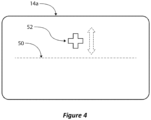
- the contribution of visual function to upright stance can additionally be assessed by having the user maintain a cursor within a field of the headset display 14a, aligned as closely as possible to a fixed target line displayed in the centre of the headset display field.
- An example field of display is shown in Figure 4 , where the target line is denoted by reference numeral 50 and the curser denoted by reference numeral 52.
- the headset 14 is programmed such that the relative position of the cursor 52 within the headset display field is linked simultaneously to the position of the inclinometer 27 attached to the movable platform 22 of the portable base unit 12.
- the headset background display and target line 50 is referenced to the horizontal of the surface of the base unit 12.
- a form of combined vestibular, somatosensory assessment is performed in two stages.
- a first stage for anterior-posterior assessment, the user stands on the movable platform 22 with both feet shoulder width apart and positioned directly over the axis of rotation of the movable platform 22 (i.e. such the long axis of each foot is aligned perpendicular to the axis of rotation of the movable platform, in this instance the lateral axis).
- This is best shown in Figure 5 .
- the user's body is undertaking a pitch movement.
- the user is required to balance on the platform 22 to maintain its position as close to horizontal as possible, within predefined limits, for some predefined time, e.g. 20 seconds.
- the remote control unit 16 records a stability metric for the first assessment.
- the stability metric is the time that the user was able to maintain the movable platform 22 within 2.5 degrees of the horizontal (determined based on data output from the inclinometer 27). Data output from the accelerometer may also be recorded and evaluated.
- a second assessment stage the user is instructed to stand on the movable platform 22 with both feet shoulder width apart and astride the axis of rotation such that their feet are aligned with the axis of rotation of the movable platform 22 (see Figure 6 ). In this position the user's body is undertaking a roll movement.
- the remote control unit 16 then records the same stability metric as for the first stage (i.e. the time the user is able to maintain the movable platform within 2.5 degrees of horizontal). Again, acceleration data may be recorded for the second stage.
- the remote control unit 16 determines an average stability measure for the two stages (using the data output from the inclinometer and accelerometer) and provides a feedback score against a normative data set. It will be understood that the feedback score may be based on only one of the stage assessment metrics, although this may result in a less meaningful output.
- the headset 14 is configured to measure a form of vestibular function.
- the sensor device 14b comprises InfraRed (IR) eye tracking cameras within the headset which are calibrated to each user.
- Calibration software may, for example, involve the user looking at a green dot in four key directions; right, up, left and down.
- one form of vestibular function may be assessed by making eye gaze evaluations, examples of which are described below.
- eye gaze evaluations examples of which are described below.
- the assessment begins with a dark background displayed on the headset display 14a.
- a moving target is displayed on the headset display 14a and the movement of the subject's pupils in response to a change in the location of the target is recorded by the IR cameras 14b and communicated to the remote control unit 16 for subsequent evaluation.
- the headset 14 may also be configured to measure an additional form of vestibular function.
- the sensor device comprises an inclinometer and/or accelerometer coupled to the headset 14 which measures the position of the user's head. The user is presented with a stimulus which could be visual through the headset display, or somatosensory through the platform, and asked to maintain their head in an upright position. The deviation of the head position from true vertical is measured and communicated to the remote control unit 16 for subsequent evaluation.
- the hand-held remote 15 may be utilised for recording a user input associated with a test presented via the headset 14. For example, the user may be asked to use the remote 15 to orient a line shown in the headset display so that it aligns with earth horizontal. For a combined vestibular somatosensory assessment, the user may be asked to use the hand-held remote 15 to orient a line shown in the headset display to be equal to the position of the moveable platform 22.
- the visual, vestibular and somatosensory assessment data output using one or more of the above assessments may be combined to create a single Composite Performance Score (CPS), using a data reduction process as schematically illustrated in Figure 7 .
- CPS Composite Performance Score
- Step S1 the visual, vestibular and somatosensory data is gathered and input to a data reduction process, where the data gets condensed (step S2).
- a Principal Component Analysis may be used to reduce the raw input data.
- PCA is a technique used to identify patterns in data, by mapping the raw data into a lower dimensional space.
- the resultant reduced data is provided as the input to a Support Vector Machine (SVM) machine learning classifier which, at step S4, calculates the CPS.
- SVM Support Vector Machine
- the headset 14 occludes the user's vision, thereby preventing external stimulus that can adversely impact on the assessment.
- the headset 14 also allows the user to stand upright during the somatosensory assessment and discourages the user from looking at the portable base unit 12, which again can adversely impact on assessment.
- the headset 14 also provides an efficient and speedy interface for recording the user response.
- a computer or controller such as those described herein, includes at least one processor or processing unit and a system memory.
- the computer or controller typically has at least some form of computer readable media.
- computer readable media include computer storage media and communication media.
- Computer storage media include volatile and non-volatile, removable and non-removable media implemented in any method or technology for storage of information such as computer readable instructions, data structures, program modules, or other data.
- Communication media typically embody computer readable instructions, data structures, program modules, or other data in a modulated data signal such as a carrier wave or other transport mechanism and include any information delivery media.
- modulated data signal such as a carrier wave or other transport mechanism and include any information delivery media.
Landscapes
- Health & Medical Sciences (AREA)
- Life Sciences & Earth Sciences (AREA)
- Engineering & Computer Science (AREA)
- Biomedical Technology (AREA)
- Medical Informatics (AREA)
- Public Health (AREA)
- General Health & Medical Sciences (AREA)
- Pathology (AREA)
- Physics & Mathematics (AREA)
- Surgery (AREA)
- Animal Behavior & Ethology (AREA)
- Veterinary Medicine (AREA)
- Molecular Biology (AREA)
- Heart & Thoracic Surgery (AREA)
- Biophysics (AREA)
- Physiology (AREA)
- Epidemiology (AREA)
- Primary Health Care (AREA)
- Oral & Maxillofacial Surgery (AREA)
- Dentistry (AREA)
- Neurosurgery (AREA)
- Neurology (AREA)
- Physical Education & Sports Medicine (AREA)
- Databases & Information Systems (AREA)
- Data Mining & Analysis (AREA)
- General Business, Economics & Management (AREA)
- Business, Economics & Management (AREA)
- Orthopedic Medicine & Surgery (AREA)
- Rheumatology (AREA)
- Geometry (AREA)
- Child & Adolescent Psychology (AREA)
- Developmental Disabilities (AREA)
- Educational Technology (AREA)
- Hospice & Palliative Care (AREA)
- Psychiatry (AREA)
- Psychology (AREA)
- Social Psychology (AREA)
- Measurement Of The Respiration, Hearing Ability, Form, And Blood Characteristics Of Living Organisms (AREA)
- Eye Examination Apparatus (AREA)
Claims (6)
- Vorrichtung (10) zur Durchführung kombinierter vestibulärer und somatosensorischer Funktionsbewertungen eines Benutzers der Vorrichtung, umfassend:eine tragbare Basiseinheit (12), die Folgendes umfasst:eine feste Plattform (20);eine drehbare Plattform (22), die zumindest teilweise frei um eine horizontale Drehachse ohne Hilfe eines externen Antriebs drehbar ist;wobei diese Drehung nur durch die Kraft der Knöchelbewegung eines auf der Plattform (22) stehenden Benutzers ausgeführt wird;im Gebrauch steht ein Benutzer auf der tragbaren Basiseinheit (12) in einer gleichmäßig belasteten Haltung, wobei ein erster Fuß auf der festen Plattform (20) und der andere Fuß auf der drehbaren Plattform (22) platziert ist, so dass eine Längsachse des anderen Fußes mit der Drehachse der drehbaren Plattform (22) ausgerichtet ist;einen einstellbaren Stoppmechanismus, der so konfiguriert ist, dass er einen Drehwinkel für die drehbare Plattform (22) in Bezug auf eine Horizontale einstellt, gegenüber der die drehbare Plattform (22) durch den Benutzer der Vorrichtung (10) gedreht werden kann; undeine Steuereinrichtung (16), die so konfiguriert ist, dass sie verschiedene diskrete Haltepositionen der drehbaren Plattform (22) steuert, indem sie den einstellbaren Stoppmechanismus steuert, um das Ausmaß, in dem die drehbare Plattform (22) durch den Benutzer gedreht werden kann, selektiv um einen von mehreren diskreten messbaren Beträgen einzustellen;ein visuelles Okklusions-Headset (14), das von dem Benutzer getragen wird, wobei das Headset (14) eine Einrichtung umfasst, die so konfiguriert ist, dass sie eine vestibuläre Funktionsreaktion des Benutzers aufzeichnet, die mit einem vestibulären Funktionstest assoziiert ist, wobei das visuelle Okklusions-Headset (14) eine Erfassungsvorrichtung (14b) umfasst, die so konfiguriert ist, dass sie eine Benutzerreaktion nach einer durch den einstellbaren Stoppmechanismus vorgenommenen Einstellung erfasst, und wobei die Erfassungsvorrichtung (14b) einen Eye-Tracker umfasst, der einen oder mehrere Sensoren aufweist, die so konfiguriert sind, dass sie eine vordefinierte visuelle Reaktion bestimmen, die von dem Benutzer bewirkt wird, wobei die vordefinierte visuelle Reaktion repräsentativ für die Wahrnehmung des Benutzers des Ausmaßes der Drehung der drehbaren Plattform (22) nach einer durch den einstellbaren Stoppmechanismus vorgenommenen Einstellung ist, wobei die Steuereinrichtung (16) ferner so konfiguriert ist, dass sie die vordefinierte visuelle Reaktion von dem visuellen Okklusions-Headset (14) empfängt und verwendet, um eine Bewertung des Ausmaßes der Knöchelbewegung des Benutzers als eine somatosensorische Funktionsbewertung durchzuführen.
- Vorrichtung (10) nach Anspruch 1, wobei das visuelle Okklusions-Headset (14) ferner mit einem Display (14a) konfiguriert ist, um dem Benutzer als Reaktion auf die durch den einstellbaren Stoppmechanismus vorgenommene Einstellung Anweisungen zu präsentieren.
- Vorrichtung (10) nach Anspruch 2, wobei die Vorrichtung zur Aufzeichnung der vestibulären Funktionsreaktion einen Neigungsmesser (27) und/oder einen Beschleunigungsmesser (28) zur Aufzeichnung der Position des Kopfes des Trägers relativ zur Schwerkrafthorizontalen umfasst.
- Vorrichtung (10) nach Anspruch 3, ferner umfassend eine Einrichtung zum Aufzeichnen einer Benutzerreaktion nach einer durch den einstellbaren Stoppmechanismus vorgenommenen Einstellung, wobei die Benutzerreaktion eine Anzeige des Ausmaßes des durch die Einstellung begrenzten Bewegungsbereichs der drehbaren Plattform (22) umfasst, wie sie vom Benutzer nach einer an der drehbaren Plattform (22) vorgenommenen Dreheinstellung wahrgenommen wird, und wobei die Benutzerreaktion verwendet wird, um die Knöchelbewegungsunterscheidung des Benutzers zu bewerten, und wobei die Einrichtung entweder eine vom Benutzer betriebene Handvorrichtung (15) oder eine in dem visuellen Okklusions-Headset (14) eingebaute Einrichtung ist und so konfiguriert ist, dass sie die Benutzerreaktion auf der Grundlage einer vom Benutzer ausgeführten Augenbewegung erfasst.
- Vorrichtung (10) nach Anspruch 4, wobei der vestibuläre Funktionstest umfasst, dass dem Benutzer ein Reiz entweder durch das Headset (15) oder die bewegliche Plattform dargeboten wird und wobei die Ausgaben des Neigungsmessers (27) und/oder des Beschleunigungsmessers (28) verwendet werden, um eine Abweichung des Kopfes des Benutzers von der wahren Vertikalen zu bestimmen.
- Vorrichtung (10) nach Anspruch 5, wobei das visuelle Okklusions-Headset (15) ein Display (14a) zur Anzeige von Anweisungen und/oder Rückmeldungen umfasst, die mit dem vestibulären Funktionstest verbunden sind, und wobei der vestibuläre Funktionstest mit einer Einstellung verbunden ist, die durch den einstellbaren Stoppmechanismus vorgenommen wird.
Applications Claiming Priority (3)
| Application Number | Priority Date | Filing Date | Title |
|---|---|---|---|
| AU2019904174A AU2019904174A0 (en) | 2019-11-06 | A system, apparatus and method for measuring dynamic visual, vestibular and somatosensory ability | |
| AU2020901897A AU2020901897A0 (en) | 2020-06-09 | A system, apparatus and method for measuring dynamic visual, vestibular and somatosensory ability | |
| PCT/AU2020/051205 WO2021087564A1 (en) | 2019-11-06 | 2020-11-06 | A system, apparatus and method for measuring dynamic visual, vestibular and somatosensory ability |
Publications (4)
| Publication Number | Publication Date |
|---|---|
| EP4048142A1 EP4048142A1 (de) | 2022-08-31 |
| EP4048142A4 EP4048142A4 (de) | 2024-02-14 |
| EP4048142B1 true EP4048142B1 (de) | 2025-03-26 |
| EP4048142C0 EP4048142C0 (de) | 2025-03-26 |
Family
ID=75848007
Family Applications (1)
| Application Number | Title | Priority Date | Filing Date |
|---|---|---|---|
| EP20884178.3A Active EP4048142B1 (de) | 2019-11-06 | 2020-11-06 | Vorrichtung zum messen der dynamischen visuellen, vestibulären und somatosensorischen fähigkeit |
Country Status (7)
| Country | Link |
|---|---|
| US (1) | US20220386936A1 (de) |
| EP (1) | EP4048142B1 (de) |
| JP (1) | JP7555404B2 (de) |
| CN (1) | CN114901135A (de) |
| AU (1) | AU2020381017B2 (de) |
| CA (1) | CA3157599A1 (de) |
| WO (1) | WO2021087564A1 (de) |
Families Citing this family (4)
| Publication number | Priority date | Publication date | Assignee | Title |
|---|---|---|---|---|
| CA3223394A1 (en) * | 2021-07-01 | 2023-01-05 | Elizabeth McGrath | A system, apparatus and method for enhancing human sensorimotor ability |
| AU2022358741A1 (en) * | 2021-10-07 | 2024-03-21 | Prism Neuro Pty Ltd | Multimodal method and system for evaluating and improving neuromotor control ability |
| KR102804276B1 (ko) * | 2023-01-17 | 2025-05-08 | 한국 한의학 연구원 | 확장 현실에 기반한 균형 능력 평가 시스템 및 방법 |
| US20260000342A1 (en) * | 2024-06-26 | 2026-01-01 | Cognuro, LLC | Vestibular and oculomotor assessment utilizing videonystagmography data and posturography data |
Family Cites Families (17)
| Publication number | Priority date | Publication date | Assignee | Title |
|---|---|---|---|---|
| JP2528891Y2 (ja) * | 1990-10-16 | 1997-03-12 | 株式会社スギノマシン | 床反力計 |
| US5897464A (en) * | 1994-08-22 | 1999-04-27 | Mcleod; Max O. | Method and apparatus for ankle exercise |
| US6063046A (en) * | 1997-04-11 | 2000-05-16 | Allum; John H. | Method and apparatus for the diagnosis and rehabilitation of balance disorders |
| JP3896665B2 (ja) * | 1998-01-05 | 2007-03-22 | ソニー株式会社 | 脊椎動物若しくはこれを模倣したロボットに関する数値モデルの作成方法 |
| US6162189A (en) * | 1999-05-26 | 2000-12-19 | Rutgers, The State University Of New Jersey | Ankle rehabilitation system |
| JP2002291706A (ja) | 2001-03-30 | 2002-10-08 | Toshiba Corp | ウェアラブルコンピュータ、ウェアラブルコンピュータ用プログラム、及びウェアラブルコンピュータを利用した医療診断システム |
| JP2003175085A (ja) | 2001-12-11 | 2003-06-24 | Hitachi Kiden Kogyo Ltd | 関節屈伸運動装置 |
| JP3899403B2 (ja) | 2002-08-27 | 2007-03-28 | 独立行政法人産業技術総合研究所 | バランス訓練装置 |
| WO2004058359A2 (en) * | 2002-12-20 | 2004-07-15 | University Of Virginia Patent Foundation | Musculoskeletal dynamics assessment under weight-bearing conditions |
| JP2005224513A (ja) | 2004-02-16 | 2005-08-25 | Hitachi Kiden Kogyo Ltd | バランスメーター |
| ITMI20091252A1 (it) * | 2009-07-14 | 2011-01-15 | Danilo Mantovani | Tavola propriocettiva modulare provvista di mezzi per la rilevazione dell'inclinazione e rotazione |
| US9681835B2 (en) * | 2010-11-15 | 2017-06-20 | Massachusetts Eye & Ear Infirmary | Detection of vestibular disorders based on vestibular noise |
| US10231662B1 (en) | 2013-01-19 | 2019-03-19 | Bertec Corporation | Force measurement system |
| US9782116B2 (en) * | 2014-05-01 | 2017-10-10 | Justin Michael Lonis | Stability-assessing system |
| US10729370B2 (en) * | 2014-12-10 | 2020-08-04 | Rosalind Franklin University Of Medicine And Science | Mobile sensor system and methods for use |
| US10499842B2 (en) * | 2016-09-27 | 2019-12-10 | Diversified Healthcare Development, Llc | Clinical assessment of balance on a platform with controlled stability |
| US12207934B2 (en) * | 2017-01-20 | 2025-01-28 | Temple University-Of The Commonwealth System Of Higher Education | System and method for assessment and rehabilitation of balance impairment using virtual reality |
-
2020
- 2020-11-06 CA CA3157599A patent/CA3157599A1/en active Pending
- 2020-11-06 AU AU2020381017A patent/AU2020381017B2/en active Active
- 2020-11-06 WO PCT/AU2020/051205 patent/WO2021087564A1/en not_active Ceased
- 2020-11-06 CN CN202080091735.3A patent/CN114901135A/zh active Pending
- 2020-11-06 JP JP2022526100A patent/JP7555404B2/ja active Active
- 2020-11-06 EP EP20884178.3A patent/EP4048142B1/de active Active
- 2020-11-06 US US17/774,905 patent/US20220386936A1/en active Pending
Also Published As
| Publication number | Publication date |
|---|---|
| JP7555404B2 (ja) | 2024-09-24 |
| EP4048142A4 (de) | 2024-02-14 |
| US20220386936A1 (en) | 2022-12-08 |
| AU2020381017B2 (en) | 2025-11-13 |
| WO2021087564A1 (en) | 2021-05-14 |
| CN114901135A (zh) | 2022-08-12 |
| JP2022554361A (ja) | 2022-12-28 |
| AU2020381017A1 (en) | 2022-06-09 |
| EP4048142A1 (de) | 2022-08-31 |
| CA3157599A1 (en) | 2021-05-14 |
| EP4048142C0 (de) | 2025-03-26 |
Similar Documents
| Publication | Publication Date | Title |
|---|---|---|
| AU2020381017B2 (en) | A system, apparatus and method for measuring dynamic visual, vestibular and somatosensory ability | |
| US10722114B1 (en) | System and method for vision testing and/or training | |
| US10966606B1 (en) | System and method for measuring the head position and postural sway of a subject | |
| US10945599B1 (en) | System and method for vision testing and/or training | |
| US10342473B1 (en) | System and method for measuring eye movement and/or eye position and postural sway of a subject | |
| US9517008B1 (en) | System and method for testing the vision of a subject | |
| US9656121B2 (en) | Methods for analyzing and providing feedback for improved power generation in a golf swing | |
| US9814430B1 (en) | System and method for measuring eye movement and/or eye position and postural sway of a subject | |
| US7127376B2 (en) | Method and apparatus for reducing errors in screening-test administration | |
| US20130171596A1 (en) | Augmented reality neurological evaluation method | |
| KR101739647B1 (ko) | 관성 센서를 이용한 경직 및 간대성 경련 평가 보조 장치 및 방법 | |
| EP1145682A2 (de) | Gangrehabilitationsvorrichtung eines Patienten | |
| KR101578200B1 (ko) | 균형 능력의 향상 및 정량적 평가를 위한 기능성 게임 시스템 | |
| WO2012039467A1 (ja) | 運動支援システム | |
| CA2562599A1 (en) | Isolating and quantifying functional impairments of the gaze stabilization system | |
| KR101185575B1 (ko) | 균형 감각 측정장치 | |
| US20170268953A1 (en) | System and method for estimating center of gravity of walking rehabilitation robot | |
| KR101651429B1 (ko) | 피트니스 모니터링 시스템 | |
| CN102228379A (zh) | 平衡检测系统 | |
| US8257284B2 (en) | Training device for muscle activation patterns | |
| KR102446989B1 (ko) | 낙상 위험 평가 체중계 및 낙상 위험 평가 방법 | |
| KR101795474B1 (ko) | 골프자세 교정방법 및 이를 이용한 골프자세 교정시스템 | |
| EP2023816A1 (de) | Gleichgewichtsmonitor | |
| KR102062389B1 (ko) | 보행분석이 가능한 가상현실 원격 보행 재활훈련 시스템 | |
| KR101916763B1 (ko) | 다중 생체센서와 사용자 감응형 능동제어기술을 이용하여 사용자 맞춤형 운동프로그램을 제공하는 복합기능 트레이닝 로봇 시스템 및 이를 이용하는 방법 |
Legal Events
| Date | Code | Title | Description |
|---|---|---|---|
| STAA | Information on the status of an ep patent application or granted ep patent |
Free format text: STATUS: THE INTERNATIONAL PUBLICATION HAS BEEN MADE |
|
| PUAI | Public reference made under article 153(3) epc to a published international application that has entered the european phase |
Free format text: ORIGINAL CODE: 0009012 |
|
| STAA | Information on the status of an ep patent application or granted ep patent |
Free format text: STATUS: REQUEST FOR EXAMINATION WAS MADE |
|
| 17P | Request for examination filed |
Effective date: 20220523 |
|
| AK | Designated contracting states |
Kind code of ref document: A1 Designated state(s): AL AT BE BG CH CY CZ DE DK EE ES FI FR GB GR HR HU IE IS IT LI LT LU LV MC MK MT NL NO PL PT RO RS SE SI SK SM TR |
|
| DAV | Request for validation of the european patent (deleted) | ||
| DAX | Request for extension of the european patent (deleted) | ||
| RIC1 | Information provided on ipc code assigned before grant |
Ipc: A61H 1/00 20060101ALN20231024BHEP Ipc: G16H 50/30 20180101ALI20231024BHEP Ipc: G16H 50/20 20180101ALI20231024BHEP Ipc: G16H 40/67 20180101ALI20231024BHEP Ipc: G16H 40/63 20180101ALI20231024BHEP Ipc: A61B 5/16 20060101ALI20231024BHEP Ipc: A61B 5/00 20060101AFI20231024BHEP |
|
| RAP1 | Party data changed (applicant data changed or rights of an application transferred) |
Owner name: MCGRATH, BRADEN Owner name: WARRINGTON, GORDON |
|
| RIN1 | Information on inventor provided before grant (corrected) |
Inventor name: MCGRATH, BRADEN Inventor name: WARRINGTON, GORDON |
|
| A4 | Supplementary search report drawn up and despatched |
Effective date: 20240112 |
|
| RIC1 | Information provided on ipc code assigned before grant |
Ipc: A61H 1/00 20060101ALN20240108BHEP Ipc: G16H 50/30 20180101ALI20240108BHEP Ipc: G16H 50/20 20180101ALI20240108BHEP Ipc: G16H 40/67 20180101ALI20240108BHEP Ipc: G16H 40/63 20180101ALI20240108BHEP Ipc: A61B 5/16 20060101ALI20240108BHEP Ipc: A61B 5/00 20060101AFI20240108BHEP |
|
| RAP3 | Party data changed (applicant data changed or rights of an application transferred) |
Owner name: MCGRATH, BRADEN Owner name: WADDINGTON, GORDON |
|
| RIN1 | Information on inventor provided before grant (corrected) |
Inventor name: MCGRATH, BRADEN Inventor name: WADDINGTON, GORDON |
|
| GRAP | Despatch of communication of intention to grant a patent |
Free format text: ORIGINAL CODE: EPIDOSNIGR1 |
|
| STAA | Information on the status of an ep patent application or granted ep patent |
Free format text: STATUS: GRANT OF PATENT IS INTENDED |
|
| RIC1 | Information provided on ipc code assigned before grant |
Ipc: A61H 1/00 20060101ALN20240930BHEP Ipc: G16H 50/30 20180101ALI20240930BHEP Ipc: G16H 50/20 20180101ALI20240930BHEP Ipc: G16H 40/67 20180101ALI20240930BHEP Ipc: G16H 40/63 20180101ALI20240930BHEP Ipc: A61B 5/16 20060101ALI20240930BHEP Ipc: A61B 5/00 20060101AFI20240930BHEP |
|
| RIC1 | Information provided on ipc code assigned before grant |
Ipc: A61H 1/00 20060101ALN20241011BHEP Ipc: G16H 50/30 20180101ALI20241011BHEP Ipc: G16H 50/20 20180101ALI20241011BHEP Ipc: G16H 40/67 20180101ALI20241011BHEP Ipc: G16H 40/63 20180101ALI20241011BHEP Ipc: A61B 5/16 20060101ALI20241011BHEP Ipc: A61B 5/00 20060101AFI20241011BHEP |
|
| RIC1 | Information provided on ipc code assigned before grant |
Ipc: A61H 1/00 20060101ALN20241022BHEP Ipc: G16H 50/30 20180101ALI20241022BHEP Ipc: G16H 50/20 20180101ALI20241022BHEP Ipc: G16H 40/67 20180101ALI20241022BHEP Ipc: G16H 40/63 20180101ALI20241022BHEP Ipc: A61B 5/16 20060101ALI20241022BHEP Ipc: A61B 5/00 20060101AFI20241022BHEP |
|
| INTG | Intention to grant announced |
Effective date: 20241030 |
|
| GRAS | Grant fee paid |
Free format text: ORIGINAL CODE: EPIDOSNIGR3 |
|
| GRAA | (expected) grant |
Free format text: ORIGINAL CODE: 0009210 |
|
| STAA | Information on the status of an ep patent application or granted ep patent |
Free format text: STATUS: THE PATENT HAS BEEN GRANTED |
|
| AK | Designated contracting states |
Kind code of ref document: B1 Designated state(s): AL AT BE BG CH CY CZ DE DK EE ES FI FR GB GR HR HU IE IS IT LI LT LU LV MC MK MT NL NO PL PT RO RS SE SI SK SM TR |
|
| REG | Reference to a national code |
Ref country code: GB Ref legal event code: FG4D |
|
| REG | Reference to a national code |
Ref country code: CH Ref legal event code: EP |
|
| REG | Reference to a national code |
Ref country code: DE Ref legal event code: R096 Ref document number: 602020048512 Country of ref document: DE |
|
| REG | Reference to a national code |
Ref country code: IE Ref legal event code: FG4D |
|
| U01 | Request for unitary effect filed |
Effective date: 20250407 |
|
| U07 | Unitary effect registered |
Designated state(s): AT BE BG DE DK EE FI FR IT LT LU LV MT NL PT RO SE SI Effective date: 20250411 |
|
| PG25 | Lapsed in a contracting state [announced via postgrant information from national office to epo] |
Ref country code: RS Free format text: LAPSE BECAUSE OF FAILURE TO SUBMIT A TRANSLATION OF THE DESCRIPTION OR TO PAY THE FEE WITHIN THE PRESCRIBED TIME-LIMIT Effective date: 20250626 |
|
| PG25 | Lapsed in a contracting state [announced via postgrant information from national office to epo] |
Ref country code: NO Free format text: LAPSE BECAUSE OF FAILURE TO SUBMIT A TRANSLATION OF THE DESCRIPTION OR TO PAY THE FEE WITHIN THE PRESCRIBED TIME-LIMIT Effective date: 20250626 |
|
| PG25 | Lapsed in a contracting state [announced via postgrant information from national office to epo] |
Ref country code: HR Free format text: LAPSE BECAUSE OF FAILURE TO SUBMIT A TRANSLATION OF THE DESCRIPTION OR TO PAY THE FEE WITHIN THE PRESCRIBED TIME-LIMIT Effective date: 20250326 |
|
| PG25 | Lapsed in a contracting state [announced via postgrant information from national office to epo] |
Ref country code: GR Free format text: LAPSE BECAUSE OF FAILURE TO SUBMIT A TRANSLATION OF THE DESCRIPTION OR TO PAY THE FEE WITHIN THE PRESCRIBED TIME-LIMIT Effective date: 20250627 |
|
| PG25 | Lapsed in a contracting state [announced via postgrant information from national office to epo] |
Ref country code: SM Free format text: LAPSE BECAUSE OF FAILURE TO SUBMIT A TRANSLATION OF THE DESCRIPTION OR TO PAY THE FEE WITHIN THE PRESCRIBED TIME-LIMIT Effective date: 20250326 |
|
| PG25 | Lapsed in a contracting state [announced via postgrant information from national office to epo] |
Ref country code: ES Free format text: LAPSE BECAUSE OF FAILURE TO SUBMIT A TRANSLATION OF THE DESCRIPTION OR TO PAY THE FEE WITHIN THE PRESCRIBED TIME-LIMIT Effective date: 20250326 |
|
| PG25 | Lapsed in a contracting state [announced via postgrant information from national office to epo] |
Ref country code: PL Free format text: LAPSE BECAUSE OF FAILURE TO SUBMIT A TRANSLATION OF THE DESCRIPTION OR TO PAY THE FEE WITHIN THE PRESCRIBED TIME-LIMIT Effective date: 20250326 |
|
| PG25 | Lapsed in a contracting state [announced via postgrant information from national office to epo] |
Ref country code: SK Free format text: LAPSE BECAUSE OF FAILURE TO SUBMIT A TRANSLATION OF THE DESCRIPTION OR TO PAY THE FEE WITHIN THE PRESCRIBED TIME-LIMIT Effective date: 20250326 |
|
| PG25 | Lapsed in a contracting state [announced via postgrant information from national office to epo] |
Ref country code: IS Free format text: LAPSE BECAUSE OF FAILURE TO SUBMIT A TRANSLATION OF THE DESCRIPTION OR TO PAY THE FEE WITHIN THE PRESCRIBED TIME-LIMIT Effective date: 20250726 |
|
| U20 | Renewal fee for the european patent with unitary effect paid |
Year of fee payment: 6 Effective date: 20251126 |
|
| PG25 | Lapsed in a contracting state [announced via postgrant information from national office to epo] |
Ref country code: CZ Free format text: LAPSE BECAUSE OF FAILURE TO SUBMIT A TRANSLATION OF THE DESCRIPTION OR TO PAY THE FEE WITHIN THE PRESCRIBED TIME-LIMIT Effective date: 20250326 |
|
| PLBE | No opposition filed within time limit |
Free format text: ORIGINAL CODE: 0009261 |
|
| STAA | Information on the status of an ep patent application or granted ep patent |
Free format text: STATUS: NO OPPOSITION FILED WITHIN TIME LIMIT |
|
| REG | Reference to a national code |
Ref country code: CH Ref legal event code: L10 Free format text: ST27 STATUS EVENT CODE: U-0-0-L10-L00 (AS PROVIDED BY THE NATIONAL OFFICE) Effective date: 20260211 |
|
| 26N | No opposition filed |
Effective date: 20260105 |
|
| PGFP | Annual fee paid to national office [announced via postgrant information from national office to epo] |
Ref country code: GB Payment date: 20260324 Year of fee payment: 6 |