EP4047466B1 - Host-speichersystem mit einem befehlswarteschlangenverfahren und verfahren zum einstellen der verarbeitungsgeschwindigkeit mehrerer warteschlangen - Google Patents
Host-speichersystem mit einem befehlswarteschlangenverfahren und verfahren zum einstellen der verarbeitungsgeschwindigkeit mehrerer warteschlangen Download PDFInfo
- Publication number
- EP4047466B1 EP4047466B1 EP21207632.7A EP21207632A EP4047466B1 EP 4047466 B1 EP4047466 B1 EP 4047466B1 EP 21207632 A EP21207632 A EP 21207632A EP 4047466 B1 EP4047466 B1 EP 4047466B1
- Authority
- EP
- European Patent Office
- Prior art keywords
- virtual time
- command
- priority class
- vta
- host
- Prior art date
- Legal status (The legal status is an assumption and is not a legal conclusion. Google has not performed a legal analysis and makes no representation as to the accuracy of the status listed.)
- Active
Links
Images



Classifications
-
- G—PHYSICS
- G06—COMPUTING OR CALCULATING; COUNTING
- G06F—ELECTRIC DIGITAL DATA PROCESSING
- G06F3/00—Input arrangements for transferring data to be processed into a form capable of being handled by the computer; Output arrangements for transferring data from processing unit to output unit, e.g. interface arrangements
- G06F3/06—Digital input from, or digital output to, record carriers, e.g. RAID, emulated record carriers or networked record carriers
- G06F3/0601—Interfaces specially adapted for storage systems
- G06F3/0628—Interfaces specially adapted for storage systems making use of a particular technique
- G06F3/0655—Vertical data movement, i.e. input-output transfer; data movement between one or more hosts and one or more storage devices
- G06F3/0659—Command handling arrangements, e.g. command buffers, queues, command scheduling
-
- G—PHYSICS
- G06—COMPUTING OR CALCULATING; COUNTING
- G06F—ELECTRIC DIGITAL DATA PROCESSING
- G06F3/00—Input arrangements for transferring data to be processed into a form capable of being handled by the computer; Output arrangements for transferring data from processing unit to output unit, e.g. interface arrangements
- G06F3/06—Digital input from, or digital output to, record carriers, e.g. RAID, emulated record carriers or networked record carriers
- G06F3/0601—Interfaces specially adapted for storage systems
- G06F3/0668—Interfaces specially adapted for storage systems adopting a particular infrastructure
- G06F3/0671—In-line storage system
- G06F3/0673—Single storage device
- G06F3/0679—Non-volatile semiconductor memory device, e.g. flash memory, one time programmable memory [OTP]
-
- G—PHYSICS
- G06—COMPUTING OR CALCULATING; COUNTING
- G06F—ELECTRIC DIGITAL DATA PROCESSING
- G06F13/00—Interconnection of, or transfer of information or other signals between, memories, input/output devices or central processing units
- G06F13/14—Handling requests for interconnection or transfer
- G06F13/16—Handling requests for interconnection or transfer for access to memory bus
- G06F13/18—Handling requests for interconnection or transfer for access to memory bus based on priority control
-
- G—PHYSICS
- G06—COMPUTING OR CALCULATING; COUNTING
- G06F—ELECTRIC DIGITAL DATA PROCESSING
- G06F13/00—Interconnection of, or transfer of information or other signals between, memories, input/output devices or central processing units
- G06F13/14—Handling requests for interconnection or transfer
- G06F13/16—Handling requests for interconnection or transfer for access to memory bus
- G06F13/1605—Handling requests for interconnection or transfer for access to memory bus based on arbitration
- G06F13/1642—Handling requests for interconnection or transfer for access to memory bus based on arbitration with request queuing
-
- G—PHYSICS
- G06—COMPUTING OR CALCULATING; COUNTING
- G06F—ELECTRIC DIGITAL DATA PROCESSING
- G06F13/00—Interconnection of, or transfer of information or other signals between, memories, input/output devices or central processing units
- G06F13/14—Handling requests for interconnection or transfer
- G06F13/16—Handling requests for interconnection or transfer for access to memory bus
- G06F13/1668—Details of memory controller
-
- G—PHYSICS
- G06—COMPUTING OR CALCULATING; COUNTING
- G06F—ELECTRIC DIGITAL DATA PROCESSING
- G06F13/00—Interconnection of, or transfer of information or other signals between, memories, input/output devices or central processing units
- G06F13/38—Information transfer, e.g. on bus
- G06F13/42—Bus transfer protocol, e.g. handshake; Synchronisation
- G06F13/4204—Bus transfer protocol, e.g. handshake; Synchronisation on a parallel bus
- G06F13/4221—Bus transfer protocol, e.g. handshake; Synchronisation on a parallel bus being an input/output bus, e.g. ISA bus, EISA bus, PCI bus, SCSI bus
-
- G—PHYSICS
- G06—COMPUTING OR CALCULATING; COUNTING
- G06F—ELECTRIC DIGITAL DATA PROCESSING
- G06F3/00—Input arrangements for transferring data to be processed into a form capable of being handled by the computer; Output arrangements for transferring data from processing unit to output unit, e.g. interface arrangements
- G06F3/06—Digital input from, or digital output to, record carriers, e.g. RAID, emulated record carriers or networked record carriers
- G06F3/0601—Interfaces specially adapted for storage systems
- G06F3/0602—Interfaces specially adapted for storage systems specifically adapted to achieve a particular effect
- G06F3/0604—Improving or facilitating administration, e.g. storage management
-
- G—PHYSICS
- G06—COMPUTING OR CALCULATING; COUNTING
- G06F—ELECTRIC DIGITAL DATA PROCESSING
- G06F3/00—Input arrangements for transferring data to be processed into a form capable of being handled by the computer; Output arrangements for transferring data from processing unit to output unit, e.g. interface arrangements
- G06F3/06—Digital input from, or digital output to, record carriers, e.g. RAID, emulated record carriers or networked record carriers
- G06F3/0601—Interfaces specially adapted for storage systems
- G06F3/0602—Interfaces specially adapted for storage systems specifically adapted to achieve a particular effect
- G06F3/061—Improving I/O performance
-
- G—PHYSICS
- G06—COMPUTING OR CALCULATING; COUNTING
- G06F—ELECTRIC DIGITAL DATA PROCESSING
- G06F3/00—Input arrangements for transferring data to be processed into a form capable of being handled by the computer; Output arrangements for transferring data from processing unit to output unit, e.g. interface arrangements
- G06F3/06—Digital input from, or digital output to, record carriers, e.g. RAID, emulated record carriers or networked record carriers
- G06F3/0601—Interfaces specially adapted for storage systems
- G06F3/0602—Interfaces specially adapted for storage systems specifically adapted to achieve a particular effect
- G06F3/061—Improving I/O performance
- G06F3/0611—Improving I/O performance in relation to response time
-
- G—PHYSICS
- G06—COMPUTING OR CALCULATING; COUNTING
- G06F—ELECTRIC DIGITAL DATA PROCESSING
- G06F3/00—Input arrangements for transferring data to be processed into a form capable of being handled by the computer; Output arrangements for transferring data from processing unit to output unit, e.g. interface arrangements
- G06F3/06—Digital input from, or digital output to, record carriers, e.g. RAID, emulated record carriers or networked record carriers
- G06F3/0601—Interfaces specially adapted for storage systems
- G06F3/0668—Interfaces specially adapted for storage systems adopting a particular infrastructure
- G06F3/0671—In-line storage system
- G06F3/0673—Single storage device
Definitions
- Embodiments of the present disclosure are directed to a host-storage system that includes a command queuing method and a method of adjusting the processing speed of multiple queues.
- a host is an entity that can interact with a controller by sending commands that depend on NVMe specifications.
- the NVMe or NVMHCI (Non-Volatile Memory Host Controller Interface Specification) specification is a logical device interface specification for accessing a non-volatile storage medium connected through a PCIe bus.
- the NVMe is an extensible host controller interface that addresses the demands of enterprise and client system. Multiple interfaces, such as administrative (Admin) or input/output (I/O) queues, can exist for data transfer between a host and a storage controller (NVMe controller).
- the NVMe controller is associated with a PCIe function that processes commands from the host, and sends the appropriate response to the host, depending on the NVMe specifications.
- an NVMe subsystem may include a single PCIe port and multi-namespaces.
- US2018293101A1 discloses a method for operating a data storage device, which comprises enqueuing requests, received from a host device, in a first queue, determining whether a starvation time of a request is reaching to a predetermined response time and enqueuing, based on a determination result, the request in a second queue.
- Embodiments of the present disclosure provide a command queuing method that reduces a utilization rate of the host core.
- Embodiments of the present disclosure also provide a host-storage system that reduces the utilization rate of the host core.
- a host-storage system as defined by claim 8.
- FIG. 1 is a block diagram of a host-storage system according to some embodiments.
- a host-storage system 10 includes a host 100 and a storage device 200.
- the storage device 200 includes a storage controller 210 and a non-volatile memory (NVM) 220.
- the host 100 includes a host controller 110 and a host memory 120.
- the host memory 120 functions as a buffer memory that temporarily stores data to be transmitted to the storage device 200 or receives data transmitted from the storage device 200.
- the host controller 110 further includes an I/O scheduler 111.
- the I/O scheduler 111 selectively or dynamically sends I/O commands to a WRR arbitration unit 219.
- the storage device 200 includes storage medium that stores data in response to a request from the host 100.
- the storage device 200 may include at least one of a SSD (Solid State Drive), an embedded memory, or a detachable external memory. If the storage device 200 is an SSD, the storage device 200 complies with an NVMe (non-volatile memory express) standard. If the storage device 200 is an embedded memory or an external memory, the storage device 200 complies with a UFS (universal flash storage) or an eMMC (embedded multi-media card) standard. The host 100 and the storage device 200 each generate and transmit packets according to the adopted standard protocol.
- a SSD Solid State Drive
- NVMe non-volatile memory express
- UFS universal flash storage
- eMMC embedded multi-media card
- the flash memory when the non-volatile memory 220 of the storage device 200 includes a flash memory, the flash memory may include a 2D NAND memory array or a 3D (or vertical) NAND (VNAND) memory array.
- the storage device 200 also includes various other types of non-volatile memories.
- a MRAM Magnetic RAM
- a Spin-Transfer Torque MRAM a conductive bridging RAM (CBRAM)
- a FeRAM Feroelectric RAM
- PRAM Phase RAM
- resistive RAM resistive RAM
- various other types of memory may be used as the storage device 200,.
- the host controller 110 and host memory 120 are implemented as separate semiconductor chips. Alternatively, in some embodiments, the host controller 110 and the host memory 120 are integrated on the same semiconductor chip.
- the host controller 110 is one of a plurality of modules provided in an application processor, and the application processor is implemented as a system on chip (SoC).
- SoC system on chip
- the host memory 120 may be an embedded memory provided inside the application processor, or may be a non-volatile memory or a memory module disposed outside the application processor.
- the host controller 110 manages the operation of storing data, such as recorded data, of a buffer area of the host memory 120 in the non-volatile memory 220, or storing data, such as read data, of the non-volatile memory 220 in the buffer area.
- the storage controller 210 includes a host interface 211, a memory interface 212, and a core. Further, the storage controller 210 furthers include a flash translation layer (FTL) 214, a packet manager 215, a buffer memory 216, an ECC (error correction code) engine 217, an AES (advanced encryption standard) engine 218, and a WRR (Weighted Round Robin) arbitration unit 219.
- FTL flash translation layer
- ECC error correction code
- AES advanced encryption standard
- WRR Weighted Round Robin
- the storage controller 210 further includes a working memory into which the flash translation layer 214 is loaded, and when the core of storage controller 210 executes the flash translation layer, the core of storage controller 210 controls data recording and reading operations of the non-volatile memory 220.
- the host interface 211 transmits and receives packets to and from the host 100. Packets transmitted from the host 100 to the host interface 211 include command CMD or data to be recorded in the non-volatile memory 220, and packets transmitted from the host interface 211 to the host 100 include responses to commands, data read from the non-volatile memory 220, etc.
- the host interface 211 includes an interface according to NVM-Express/v1.4/section 4.13.2 - Weighted Round Robin with Urgent Priority Class Arbitration specification.
- the memory interface 212 transmits data to be recorded in the non-volatile memory 220 to the non-volatile memory 220 or receives data read from the non-volatile memory 220.
- the memory interface 212 complies with standard conventions such as Toggle or ONFI (Open NAND Flash Interface).
- the core receives the command CMD from the host 100.
- the core sends the transmitted command CMD to the I/O scheduler 111.
- the core determines the priority class queues 219a to 219c of the WRR arbitration unit 219 for the command CMD.
- the flash translation layer 214 performs various functions such as address mapping, wear-leveling, and garbage collection.
- Address mapping changes a logical address received from the host 100 into a physical address which is used for actually storing the data in the nonvolatile memory 220.
- Wear-leveling ensures that blocks in the nonvolatile memory 220 are uniformly used to prevent excessive degradation of a particular block, and may be implemented, for example, through a firmware technique that balances the erasure counts of the physical blocks.
- Garbage collection ensures an available capacity in the nonvolatile memory 220 by copying valid data of an existing block to a new block and then erasing the existing block.
- the packet manager 215 generates a packet according to the protocol of the interface discussed with the host 100, or parses various types of information from the packet received from the host 100.
- the buffer memory 216 temporarily stores data to be recorded in the nonvolatile memory 220 or data that has been read from the nonvolatile memory 220.
- the buffer memory 216 may provided inside the storage controller 210, but may also be placed outside the storage controller 210.
- an ECC engine 217 performs error detection and correction functions on the read data that is read from the nonvolatile memory 220. More specifically, the ECC engine 217 generates parity bits on the write data to be written to the nonvolatile memory 220, and the generated parity bits are stored in the nonvolatile memory 220 together with the write data. When reading the data from the nonvolatile memory 220, the ECC engine 217 uses the parity bits that are read from the nonvolatile memory 220 together with the read data to detect and correct errors of the read data, and outputs the corrected read data.
- the AES engine 218 performs at least one of encrypting or decrypting data that is input to the storage controller 210 using a symmetric-key algorithm.
- the WRR arbitration unit 219 includes a first priority class queue 219a, a second priority class queue 219b and a third priority class queue 219c.
- the WRR arbitration unit 219 receives a command CMD from the core into one of the first to third priority class queues 219a to 219c.
- the WRR arbitration unit 219 adjusts the processing speed of commands or queues on the basis of a processing frequency value.
- the first priority class queue 219a queues commands CMD to be processed at the fastest speed
- the third priority class queue 219c queues commands CMD to be processed at the slowest speed
- the second priority class queue 219b queues commands CMD to be processed at an intermediate speed between the fastest speed and the slowest speed.
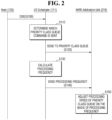
- FIG. 2 is a flowchart of an operation of a host-storage system according to some embodiments.
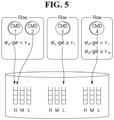
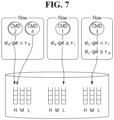
- FIGS. 3 to 7 illustrate the operation of a host-storage system according to some embodiments.
- a command is transmitted from the host to the I/O scheduler (S100).
- the host controller 110 receives the command CMD that requests execution of an operation of the I/O scheduler 111.
- the command CMD may be a command in one flow, or may be commands of flows that differ from each other.
- the operation includes, for example, an operation of inputting the data into the non-volatile memory cell of the non-volatile memory 220 addressed to a logical or physical address, or an operation of outputting the data stored in the non-volatile memory cell of the non-volatile memory 220 addressed to the logical or physical address.
- embodiments are not limited thereto, and the examples of operations of the memory of the non-volatile memory 220 may be modified as many times as necessary.
- the I/O scheduler 111 determines to which of the priority class queues the received command is sent (S 110).
- the I/O scheduler 111 generates the inputs and outputs of the command CMD to be transmitted to the non-volatile memory 220 that correspond to the command CMD received from the host 100. Further, the I/O scheduler 111 determines to which of the priority class queues of the WRR arbitration unit 219 the generated commands are sent.
- the I/O scheduler sends the command to the priority class queue of the WRR arbitration (S120).
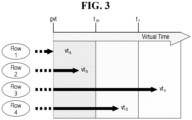
- FIG. 3 shows 4 flows: Flow1, Flow2, Flow3 and Flow4.
- the I/O scheduler 111 determines a global virtual time (gvt) from virtual times of the first to fourth flows (Flow1 to Flow4).
- the virtual time refers to a value determined by dividing a total amount of provided input/output services of the flows by weights of each flow and then leveling.
- the I/O scheduler 111 determines the priority class queue for queuing first to fourth commands (CMD1 to CMD4) in consideration of each of the first to fourth flows (Flow1 to Flow4) and/or the virtual times (vta to vtd) of the commands (CMD1 to CMD4) of the first to fourth flows (Flow1 to Flow4), on the basis of the determined global virtual time (gvt).
- Flow may be associated with various commands CMD, or various commands CMD may be associated with various flows (Flow), embodiments are not limited thereto.
- the I/O scheduler 111 when a difference between the first to fourth flows (Flow1 to Flow4) or the virtual times (vta to vtd) of the first to fourth commands (CMD1 to CMD4) of the first to fourth flows (Flow1 to Flow4) and the global virtual time (gvt) is greater than a first threshold tl, the I/O scheduler 111 sends the command of the flow to the third priority class queue 219c.
- the I/O scheduler 111 when a difference between the first to fourth flows (Flow1 to Flow4) or the virtual times (vta to vtd) of the first to fourth commands (CMD1 to CMD4) of the first to fourth flows (Flow1 to Flow4) and the global virtual time (gvt) is less than a second threshold (tm), the I/O scheduler 111 sends that command to the first priority class queue 219a.
- the second threshold (tm) may be less than the first threshold (tl).
- the I/O scheduler 111 when a difference between the first to fourth flows (Flow1 to Flow4) or the virtual times (vta to vtd) of the first to fourth commands (CMD1 to CMD4) of the first to fourth flows (Flow1 to Flow4) and the global virtual time (gvt) is less than the first threshold (tl) and greater than the second threshold (tm), the I/O scheduler 111 sends that command to the second priority class queue 219b.
- each of the first to third priority class queues 219a to 219c have processing speeds that differ from each other.
- each of the first to fourth commands has first to fourth virtual times (vta to vtd), respectively.
- the I/O scheduler 111 compares the first to fourth virtual times (vta to vtd) to determine a standard global virtual time (gvt).
- the global virtual time (gvt) is a minimum of the first to fourth virtual times (vta to vtd).
- the global virtual time (gvt) is a first virtual time (vta).
- the I/O scheduler 111 compares the second to fourth virtual times (vtb to vtd) to the first virtual time (vta), which is the global virtual time (gvt), and sends each of the second to fourth commands (CMD2 to CMD4) to one of the first to third priority class queues 219a to 219c.
- the I/O scheduler 111 since the first virtual time (vta) is the global virtual time (gvt), the I/O scheduler 111 sends the first command CMD1 to the first priority class queue 219a.
- the I/O scheduler 111 when comparing the second virtual time (vtb) with the global virtual time (gvt), because a value obtained by subtracting the global virtual time (gvt) from the second virtual time (vtb) is less than the second threshold (tm), the I/O scheduler 111 sends the second command CMD2 to the first priority class queue 219a.
- the I/O scheduler 111 when comparing the third virtual time (vtc) with the global virtual time (gvt), because the value obtained by subtracting the global virtual time (gvt) from the third virtual time (vtb) is greater than the first threshold (tl), the I/O scheduler 111 sends the third command CMD3 to the third priority class queue 219c.
- the I/O scheduler 111 when comparing the fourth virtual time (vtd) with the global virtual time (gvt), because a value obtained by subtracting the global virtual time (gvt) from the fourth virtual time (vtd) is greater than the second threshold (tm) and less than the first threshold (tl), the I/O scheduler 111 sends the fourth command CMD4 to the second priority class queue 219b.
- the global virtual time (gvt) is the second virtual time (vtb) of the second command CMD2.
- the I/O scheduler 111 compares the first to fourth virtual times (vta to vtd) with the second virtual time (vtb), which is the global virtual time (gvt), and sends each of the first to fourth commands (CMD1 to CMD4) to one of the first to third priority class queues 219a to 219c.
- the I/O scheduler 111 when comparing the first virtual time (vta) with the global virtual time (gvt), because the value obtained by subtracting the global virtual time (gvt) from the first virtual time (vta) is greater than the first threshold (tl), the I/O scheduler 111 sends the first command CMD1 to the third priority class queue 219c.
- the I/O scheduler 111 since the second virtual time (vtb) is the global virtual time (gvt), the I/O scheduler 111 sends the second command CMD2 to the first priority class queue 219a.
- the I/O scheduler 111 when comparing the third virtual time (vtc) with the global virtual time (gvt), since the value obtained by subtracting the global virtual time (gvt) from the third virtual time (vtc) is greater than the second threshold (tm) and less than the first threshold (tl), the I/O scheduler 111 sends the third command CMD3 to the second priority class queue 219b.
- the I/O scheduler 111 may send the fourth command CMD4 to the first priority class queue 219a.
- the I/O scheduler 111 calculates the processing frequency (S130). Further, the I/O scheduler 111 sends the calculated processing frequency (S140) to the WRR arbitration unit 219.
- the WRR arbitration unit 219 performs the command in the queue in a weighted round robin manner on the basis of the processing frequency. Further, the WRR arbitration unit 219 adjusts the processing speed of multiple queues on the basis of the processing frequency (S150).
- the I/O scheduler 111 calculates a first processing frequency value hn, where n is a natural number, of the first to third priority class queues 219a to 219c. Further, the WRR arbitration unit 219 adjusts the processing speeds of the first to third priority class queues 219a to 219c on the basis of the first processing frequency value (hn) and an amount of an increase in the virtual time of the command.
- the first processing frequency value (hn) is obtained by dividing the processing speed of the currently set first priority class queue 219a by the processing speed of the third priority class queue 219c.
- the I/O scheduler 111 calculates a second processing frequency value (hn+1) of the first to third priority class queues 219a to 219c of the WRR arbitration unit 219 on the basis of the first processing frequency value (hn). Further, the WRR arbitration unit 219 adjusts the processing speed of the first to third priority class queues 219a to 219c on the basis of the second processing frequency value (hn+1).
- the second processing frequency value (hn+1) is calculated by multiplying a ratio of a virtual time increase amount ⁇ vt max of the first command CMD1 and a virtual time increase amount ⁇ vt min of the third command CMD3 by the first processing frequency value (hn).
- the first command CMD1 is that having the greatest virtual time
- the third command CMD3 is that having the least virtual time.
- the second processing frequency values (hn+1) is calculated from the following Formula 1.
- h n + 1 ⁇ vt max ⁇ vt min ⁇ h n + 1 .
- h n + 1 is a second processing frequency value
- h n is a first processing frequency value
- ⁇ vt max is a virtual time increase amount of the first command
- ⁇ vt min is a virtual time increase amount of the third command.
- the process of calculating the second processing frequency value (hn+1) includes a process of calculating a slowdown value (slowdown (f)), and the calculated slowdown value (slowdown (f)) becomes the second processing frequency value (hn+1).
- slowdown (f) The slowdown value (slowdown (f)) is calculated from the following Formula 3.
- slowdown f ⁇ l f , h ⁇ P h P h + ⁇ l f , m ⁇ P h P m + ⁇ l f , l ⁇ P h P l ⁇ l f , h + ⁇ l f , m + ⁇ l f , l .
- ⁇ l f , h is a total number of all commands sent to the first priority class queue by the flow f
- ⁇ l f , m is a total number of all commands sent to the second priority class queue by the flow f
- ⁇ l f , l is a total number of all commands sent to the third priority class queue by the flow f
- P h is a processing frequency value of the first priority class queue
- P m is a processing frequency value of the second priority class queue
- P l is a processing frequency value of the third priority class queue.
- the I/O scheduler 111 calculates the processing frequency of the first to third priority class queues 219a to 219c and transmits the processing frequency to the WRR arbitration unit 219 to adjust the processing speeds of the multiple queues, thereby ensuring fairness of the processing speeds.
- the I/O scheduler 111 calculates the second processing frequency value (hn+1) from the processing frequency of the first priority class queue 219a, calculates a square root of the second processing frequency value (hn+1) from the processing frequency of the second priority class queue 219b, and calculates the natural number 1 for the processing frequency of the third priority class queue 219c, and sends the values to the WRR arbitration unit 219.
- Setting the queue processing speed is not necessarily limited to the three priority class queues, but can be set in any form for adjusting the processing speed difference of two or more priority class queues.
Landscapes
- Engineering & Computer Science (AREA)
- Theoretical Computer Science (AREA)
- Physics & Mathematics (AREA)
- General Engineering & Computer Science (AREA)
- General Physics & Mathematics (AREA)
- Human Computer Interaction (AREA)
- Bus Control (AREA)
- Memory System Of A Hierarchy Structure (AREA)
- Data Exchanges In Wide-Area Networks (AREA)
- Memory System (AREA)
Claims (11)
- Verfahren zum Einreihen in eine Warteschlange eines von einem ersten Programm angeforderten ersten Befehls (CMD1) und eines von einem zweiten Programm angeforderten zweiten Befehls (CMD2), wobei das erste Programm einer ersten virtuellen Zeit (vta) und das zweite Programm einer zweiten virtuellen Zeit (vtb) zugeordnet ist, wobei sich jede virtuelle Zeit (vta, vtb) auf einen Wert bezieht, der bestimmt wird, indem eine Gesamtmenge an bereitgestellten Eingabe-/Ausgabediensten des jeweiligen Programms durch jeweilige Gewichte jedes Programms geteilt und dann abgeglichen wird, wobei das Verfahren Folgendes umfasst:Vergleichen der ersten virtuellen Zeit (vta) des ersten Befehls (CMD1) mit der zweiten virtuellen Zeit (vtb) des zweiten Befehls (CMD2), und Erhalten eines Vergleichsergebnisses;Bestimmen einer globalen virtuellen Standardzeit (vtg) aus der ersten virtuellen Zeit (vta) und der zweiten virtuellen Zeit (vtb), wobei die globale virtuelle Zeit (vtg) ein Minimum der ersten virtuellen Zeit (vta) und der zweiten virtuellen Zeit (vtb) ist; undSenden jedes des ersten (CMD1) und zweiten (CMD2) Befehls an eine von einer ersten Prioritätsklassen-Warteschlange, einer zweiten Prioritätsklassen-Warteschlange oder einer dritten Prioritätsklassen-Warteschlange, basierend auf einem Vergleich einer Differenz zwischen der ersten virtuellen Zeit (vta) und der globalen virtuellen Zeit (vtg) mit einem ersten Schwellenwert, und einem Vergleich einer Differenz zwischen der zweiten virtuellen Zeit (vtb) und der globalen virtuellen Zeit (vtg) mit dem ersten Schwellenwert,wobei jede der ersten bis dritten Prioritätsklassen-Warteschlangen Verarbeitungsgeschwindigkeiten aufweist, die sich voneinander unterscheiden, und wobei Befehle in jeder der ersten bis dritten Prioritätsklassen-Warteschlangen auf der Grundlage der jeweiligen Verarbeitungsgeschwindigkeit durchgeführt werden.
- Verfahren zum Einreihen von Befehlen in eine Warteschlange nach Anspruch 1, wobeiwenn die Differenz zwischen der ersten virtuellen Zeit (vta) und der globalen virtuellen Zeit (vtg) größer als der erste Schwellenwert ist, der erste Befehl (CMD1) an die dritte Prioritätsklassen-Warteschlange gesendet wird, undwenn die Differenz zwischen der ersten virtuellen Zeit (vta) und der globalen virtuellen Zeit (vtg) kleiner als der erste Schwellenwert und kleiner als ein zweiter Schwellenwert ist, der erste Befehl (CMD1) an die erste Prioritätsklassen-Warteschlange gesendet wird.
- Verfahren zum Einreihen von Befehlen in eine Warteschlange nach Anspruch 2, wobei wenn die Differenz zwischen der ersten virtuellen Zeit (vta) und der globalen virtuellen Zeit (vtg) größer als der zweite Schwellenwert und kleiner als der erste Schwellenwert ist, der erste Befehl (CMD1) an die zweite Prioritätsklassen-Warteschlange gesendet wird.
- Verfahren zum Einreihen von Befehlen in eine Warteschlange nach einem der vorhergehenden Ansprüche, ferner umfassend:Vergleichen der ersten virtuellen Zeit (vta) des ersten Befehls (CMD1) mit einer dritten virtuellen Zeit (vtc) eines dritten Befehls (CMD3); undVergleichen der zweiten virtuellen Zeit (vtb) des zweiten Befehls (CMD2) mit der dritten virtuellen Zeit (vtc) des dritten Befehls (CMD3),wobei das Bestimmen der globalen virtuellen Zeit (vtg) das Bestimmen einer minimalen virtuellen Zeit von der ersten bis zur dritten virtuellen Zeit einschließt.
- Verfahren nach Anspruch 1, ferner umfassend:Berechnen eines ersten Verarbeitungsfrequenzwertes der ersten bis dritten Prioritätsklassen-Warteschlangen; undAnpassen der Verarbeitungsgeschwindigkeiten der ersten bis dritten Prioritätsklassen-Warteschlangen auf der Grundlage des ersten Verarbeitungsfrequenzwertes.
- Verfahren zum Anpassen der Verarbeitungsgeschwindigkeiten mehrerer Warteschlangen nach Anspruch 5, wobei der erste Verarbeitungsfrequenzwert erhalten wird, indem die Verarbeitungsgeschwindigkeit der ersten Prioritätsklassen-Warteschlange durch die Verarbeitungsgeschwindigkeit der dritten Prioritätsklassen-Warteschlange dividiert wird.
- Verfahren zum Anpassen der Verarbeitungsgeschwindigkeiten mehrerer Warteschlangen nach Anspruch 5 oder 6, ferner umfassend:Berechnen eines zweiten Verarbeitungsfrequenzwertes der ersten bis dritten Prioritätsklassen-Warteschlange aus dem ersten Verarbeitungsfrequenzwert, und durch Berechnen von virtuellen Zeitzunahmebeträgen des ersten Befehls und des zweiten Befehls, undweiteres Anpassen der Verarbeitungsgeschwindigkeiten der ersten bis dritten Prioritätsklassen-Warteschlangen auf der Grundlage des zweiten Verarbeitungsfrequenzwerts.
- Host-Speichersystem, umfassend:eine Hostschnittstelle (211), die konfiguriert ist, um einen ersten Befehl (CMD1), der von einem ersten Programm angefordert wird, und einen zweiten Befehl, der von einem zweiten Programm angefordert wird, von einem Host (100) über eine NVMe (Non-Volatile Memory Express)-Schnittstelle zu empfangen, wobei das erste Programm einer ersten virtuellen Zeit (vta) und das zweite Programm einer zweiten virtuellen Zeit (vtb) zugeordnet ist, wobei sich jede virtuelle Zeit (vta, vtb) auf einen Wert bezieht, der bestimmt wird, indem ein Gesamtbetrag von bereitgestellten Eingabe-/Ausgabediensten des jeweiligen Programms durch die jeweiligen Gewichte jedes Programms geteilt und dann abgeglichen wird.eine WRR-Arbitrierungseinheit (219), die erste bis dritte Prioritätsklassen-Warteschlangen einschließt; undeinen E/A-Planer (111), der so konfiguriert ist, dass er eine standardmäßige globale virtuelle Zeit (vtg) aus einer ersten virtuellen Zeit (vta) des ersten Befehls und einer zweiten virtuellen Zeit (vtb) des zweiten Befehls bestimmt, wobei die globale virtuelle Zeit (vtg) ein Minimum aus der ersten virtuellen Zeit (vta) und der zweiten virtuellen Zeit (vtb) ist, undSenden jedes des ersten und zweiten Befehls an eine der ersten bis dritten Prioritätsklassen-Warteschlangen. unter Verwendung eines Vergleichs einer Differenz zwischen der ersten virtuellen Zeit (vta) und der globalen virtuellen Zeit (vtg) mit einem ersten Schwellenwert, und eines Vergleichs einer Differenz zwischen der zweiten virtuellen Zeit (vtb) und der globalen virtuellen Zeit (vtg) mit dem ersten Schwellenwert,wobei die WRR-Arbitrierungseinheit (219) konfiguriert ist, um eine Verarbeitungsfrequenz zu empfangen, die für jede der Prioritätsklassen-Warteschlangen von dem E/A-Planer (111) berechnet wird, und um den Befehl in der Warteschlange auf der Grundlage der Verarbeitungsfrequenz in einer gewichteten Round-Robin-Weise durchzuführen.
- Host-Speichersystem nach Anspruch 8, wobei die globale virtuelle Zeit (vtg) ein Minimum der ersten virtuellen Zeit (vta) und der zweiten virtuellen Zeit (vtb) ist.
- Host-Speichersystem nach Anspruch 8 oder 9, wobei der E/A-Planer (111) so konfiguriert ist, dass er erste Verarbeitungsfrequenzwerte der ersten bis dritten Prioritätsklassen-Warteschlangen berechnet, und
wobei die WRR-Arbitrierungseinheit (219) konfiguriert ist, um Verarbeitungsgeschwindigkeiten der ersten bis dritten Prioritätsklassen-Warteschlangen auf der Grundlage der ersten Verarbeitungsfrequenzwerte anzupassen. - Host-Speichersystem nach Anspruch 10, wobei der E/A-Planer (111) konfiguriert ist, um zweite Verarbeitungsfrequenzwerte der ersten bis dritten Prioritätsklassen-Warteschlangen zu berechnen, und
wobei die WRR-Arbitrierungseinheit (219) ferner konfiguriert ist, um die Verarbeitungsgeschwindigkeiten der ersten bis dritten Prioritätsklassen-Warteschlangen auf der Grundlage der zweiten Verarbeitungsfrequenzwerte anzupassen.
Applications Claiming Priority (1)
| Application Number | Priority Date | Filing Date | Title |
|---|---|---|---|
| KR1020210024161A KR102899092B1 (ko) | 2021-02-23 | 2021-02-23 | 커맨드 큐잉 방법 및 복수의 큐의 처리 속도를 조절하는 방법을 포함하는 호스트-스토리지 시스템 |
Publications (3)
| Publication Number | Publication Date |
|---|---|
| EP4047466A2 EP4047466A2 (de) | 2022-08-24 |
| EP4047466A3 EP4047466A3 (de) | 2022-09-14 |
| EP4047466B1 true EP4047466B1 (de) | 2024-03-13 |
Family
ID=78695491
Family Applications (1)
| Application Number | Title | Priority Date | Filing Date |
|---|---|---|---|
| EP21207632.7A Active EP4047466B1 (de) | 2021-02-23 | 2021-11-10 | Host-speichersystem mit einem befehlswarteschlangenverfahren und verfahren zum einstellen der verarbeitungsgeschwindigkeit mehrerer warteschlangen |
Country Status (4)
| Country | Link |
|---|---|
| US (1) | US12197781B2 (de) |
| EP (1) | EP4047466B1 (de) |
| KR (1) | KR102899092B1 (de) |
| CN (1) | CN114968859A (de) |
Cited By (1)
| Publication number | Priority date | Publication date | Assignee | Title |
|---|---|---|---|---|
| US20230153031A1 (en) * | 2021-11-16 | 2023-05-18 | Samsung Electronics Co., Ltd. | Storage device supporting multi-host and operation method thereof |
Families Citing this family (4)
| Publication number | Priority date | Publication date | Assignee | Title |
|---|---|---|---|---|
| US12449977B2 (en) * | 2021-05-21 | 2025-10-21 | Samsung Electronics Co., Ltd. | Low latency multiple storage device system |
| US12067254B2 (en) | 2021-05-21 | 2024-08-20 | Samsung Electronics Co., Ltd. | Low latency SSD read architecture with multi-level error correction codes (ECC) |
| KR20240100083A (ko) | 2022-12-22 | 2024-07-01 | 삼성전자주식회사 | 스토리지 장치, 스토리지 컨트롤러 및 스토리지 컨트롤러의 동작 방법 |
| CN115904631A (zh) * | 2022-12-27 | 2023-04-04 | 上海交通大学 | 拥有即时处理能力的NVMe虚拟化方法、系统、介质及设备 |
Family Cites Families (11)
| Publication number | Priority date | Publication date | Assignee | Title |
|---|---|---|---|---|
| US8090903B2 (en) | 2008-01-18 | 2012-01-03 | Microsoft Corporation | Fair and dynamic disk input/output bandwidth distribution |
| US8732339B2 (en) | 2009-03-24 | 2014-05-20 | Hewlett-Packard Development Company, L.P. | NPIV at storage devices |
| US8468318B2 (en) | 2010-09-15 | 2013-06-18 | Pure Storage Inc. | Scheduling of I/O writes in a storage environment |
| KR101652324B1 (ko) | 2014-06-13 | 2016-08-31 | 고려대학교 산학협력단 | 요구 성능 보장 방법 및 요구 성능 보장 장치 |
| KR101730991B1 (ko) | 2014-10-28 | 2017-04-28 | 삼성전자주식회사 | 스토리지 장치 및 스토리지 장치의 동작 방법 |
| KR102505855B1 (ko) | 2016-01-11 | 2023-03-03 | 삼성전자 주식회사 | 가중치 기반 멀티-큐 가능 리소스 공유 방법 |
| WO2017158799A1 (ja) | 2016-03-17 | 2017-09-21 | 株式会社日立製作所 | ストレージ装置および情報処理方法 |
| CN108009006B (zh) | 2016-11-02 | 2022-02-18 | 华为技术有限公司 | I/o请求的调度方法及装置 |
| KR20180114972A (ko) | 2017-04-11 | 2018-10-22 | 에스케이하이닉스 주식회사 | 데이터 저장 장치 및 그것의 동작 방법 |
| KR102670097B1 (ko) | 2018-03-27 | 2024-05-27 | 삼성전자주식회사 | NVMe 컨트롤러에 의한 명령 인출 관리 방법 및 시스템 |
| US10776013B2 (en) | 2018-04-27 | 2020-09-15 | International Business Machines Corporation | Performing workload balancing of tracks in storage areas assigned to processing units |
-
2021
- 2021-02-23 KR KR1020210024161A patent/KR102899092B1/ko active Active
- 2021-08-16 US US17/403,876 patent/US12197781B2/en active Active
- 2021-11-10 EP EP21207632.7A patent/EP4047466B1/de active Active
- 2021-12-28 CN CN202111635866.6A patent/CN114968859A/zh active Pending
Cited By (2)
| Publication number | Priority date | Publication date | Assignee | Title |
|---|---|---|---|---|
| US20230153031A1 (en) * | 2021-11-16 | 2023-05-18 | Samsung Electronics Co., Ltd. | Storage device supporting multi-host and operation method thereof |
| US12197784B2 (en) * | 2021-11-16 | 2025-01-14 | Samsung Electronics Co., Ltd. | Storage device supporting multi-host and operation method thereof |
Also Published As
| Publication number | Publication date |
|---|---|
| CN114968859A (zh) | 2022-08-30 |
| US12197781B2 (en) | 2025-01-14 |
| EP4047466A2 (de) | 2022-08-24 |
| US20220269442A1 (en) | 2022-08-25 |
| KR102899092B1 (ko) | 2025-12-10 |
| KR20220120277A (ko) | 2022-08-30 |
| EP4047466A3 (de) | 2022-09-14 |
Similar Documents
| Publication | Publication Date | Title |
|---|---|---|
| US12197781B2 (en) | Host-storage system that includes a command queuing method and a method of adjusting the processing speed of multiple queues | |
| CN108628777B (zh) | 动态和自适应中断合并的系统和方法 | |
| US12072246B2 (en) | Adaptive throttling | |
| CN106067321B (zh) | 适于存储器编程暂停-恢复的控制器 | |
| CN107402718B (zh) | 用于存储器系统的节流及其操作方法 | |
| US10643711B1 (en) | Workload based dynamic erase suspend adaptation | |
| CN112602049A (zh) | 优化对存储器系统的信息请求 | |
| US20170322897A1 (en) | Systems and methods for processing a submission queue | |
| CN112148211B (zh) | 可预测时延模式下的管理操作 | |
| US20170255550A1 (en) | Data storage device and the operating method thereof | |
| US11081187B2 (en) | Erase suspend scheme in a storage device | |
| US10346052B2 (en) | Memory system with priority processing and operating method thereof | |
| CN113874942B (zh) | 一种数据读取方法、存储控制器及电子设备 | |
| KR20210060253A (ko) | 메모리 컨트롤러, 메모리 시스템 및 이의 동작 방법 | |
| US20250342260A1 (en) | Storage device, host device and data transfer method thereof | |
| CN110489056A (zh) | 控制器以及包括该控制器的存储器系统 | |
| US11269528B2 (en) | Data storage device with reduced memory access operation method thereof and controller therefor | |
| CN106055488A (zh) | 数据储存设备及其操作方法 | |
| EP4220374B1 (de) | Speichervorrichtung und betriebsverfahren für die speichervorrichtung | |
| US12596501B2 (en) | Systems and methods for allocating read buffers based on read data sizes in non-volatile storage devices | |
| Huang et al. | An Efficient Independent Read Scheme for Contemporary QLC SSDs | |
| KR20210152760A (ko) | 컨트롤러 및 메모리 시스템 | |
| KR20210004613A (ko) | 데이터 저장 장치 및 그 동작 방법 |
Legal Events
| Date | Code | Title | Description |
|---|---|---|---|
| PUAI | Public reference made under article 153(3) epc to a published international application that has entered the european phase |
Free format text: ORIGINAL CODE: 0009012 |
|
| STAA | Information on the status of an ep patent application or granted ep patent |
Free format text: STATUS: REQUEST FOR EXAMINATION WAS MADE |
|
| PUAL | Search report despatched |
Free format text: ORIGINAL CODE: 0009013 |
|
| 17P | Request for examination filed |
Effective date: 20211110 |
|
| AK | Designated contracting states |
Kind code of ref document: A2 Designated state(s): AL AT BE BG CH CY CZ DE DK EE ES FI FR GB GR HR HU IE IS IT LI LT LU LV MC MK MT NL NO PL PT RO RS SE SI SK SM TR |
|
| STAA | Information on the status of an ep patent application or granted ep patent |
Free format text: STATUS: EXAMINATION IS IN PROGRESS |
|
| AK | Designated contracting states |
Kind code of ref document: A3 Designated state(s): AL AT BE BG CH CY CZ DE DK EE ES FI FR GB GR HR HU IE IS IT LI LT LU LV MC MK MT NL NO PL PT RO RS SE SI SK SM TR |
|
| RIC1 | Information provided on ipc code assigned before grant |
Ipc: G06F 3/06 20060101AFI20220805BHEP |
|
| 17Q | First examination report despatched |
Effective date: 20220906 |
|
| GRAP | Despatch of communication of intention to grant a patent |
Free format text: ORIGINAL CODE: EPIDOSNIGR1 |
|
| STAA | Information on the status of an ep patent application or granted ep patent |
Free format text: STATUS: GRANT OF PATENT IS INTENDED |
|
| INTG | Intention to grant announced |
Effective date: 20230926 |
|
| GRAS | Grant fee paid |
Free format text: ORIGINAL CODE: EPIDOSNIGR3 |
|
| GRAA | (expected) grant |
Free format text: ORIGINAL CODE: 0009210 |
|
| STAA | Information on the status of an ep patent application or granted ep patent |
Free format text: STATUS: THE PATENT HAS BEEN GRANTED |
|
| AK | Designated contracting states |
Kind code of ref document: B1 Designated state(s): AL AT BE BG CH CY CZ DE DK EE ES FI FR GB GR HR HU IE IS IT LI LT LU LV MC MK MT NL NO PL PT RO RS SE SI SK SM TR |
|
| REG | Reference to a national code |
Ref country code: GB Ref legal event code: FG4D |
|
| REG | Reference to a national code |
Ref country code: CH Ref legal event code: EP |
|
| REG | Reference to a national code |
Ref country code: DE Ref legal event code: R096 Ref document number: 602021010355 Country of ref document: DE |
|
| REG | Reference to a national code |
Ref country code: IE Ref legal event code: FG4D |
|
| PG25 | Lapsed in a contracting state [announced via postgrant information from national office to epo] |
Ref country code: LT Free format text: LAPSE BECAUSE OF FAILURE TO SUBMIT A TRANSLATION OF THE DESCRIPTION OR TO PAY THE FEE WITHIN THE PRESCRIBED TIME-LIMIT Effective date: 20240313 |
|
| REG | Reference to a national code |
Ref country code: NL Ref legal event code: FP Ref country code: LT Ref legal event code: MG9D |
|
| PG25 | Lapsed in a contracting state [announced via postgrant information from national office to epo] |
Ref country code: GR Free format text: LAPSE BECAUSE OF FAILURE TO SUBMIT A TRANSLATION OF THE DESCRIPTION OR TO PAY THE FEE WITHIN THE PRESCRIBED TIME-LIMIT Effective date: 20240614 |
|
| PG25 | Lapsed in a contracting state [announced via postgrant information from national office to epo] |
Ref country code: RS Free format text: LAPSE BECAUSE OF FAILURE TO SUBMIT A TRANSLATION OF THE DESCRIPTION OR TO PAY THE FEE WITHIN THE PRESCRIBED TIME-LIMIT Effective date: 20240613 Ref country code: HR Free format text: LAPSE BECAUSE OF FAILURE TO SUBMIT A TRANSLATION OF THE DESCRIPTION OR TO PAY THE FEE WITHIN THE PRESCRIBED TIME-LIMIT Effective date: 20240313 |
|
| PG25 | Lapsed in a contracting state [announced via postgrant information from national office to epo] |
Ref country code: ES Free format text: LAPSE BECAUSE OF FAILURE TO SUBMIT A TRANSLATION OF THE DESCRIPTION OR TO PAY THE FEE WITHIN THE PRESCRIBED TIME-LIMIT Effective date: 20240313 |
|
| PG25 | Lapsed in a contracting state [announced via postgrant information from national office to epo] |
Ref country code: RS Free format text: LAPSE BECAUSE OF FAILURE TO SUBMIT A TRANSLATION OF THE DESCRIPTION OR TO PAY THE FEE WITHIN THE PRESCRIBED TIME-LIMIT Effective date: 20240613 Ref country code: NO Free format text: LAPSE BECAUSE OF FAILURE TO SUBMIT A TRANSLATION OF THE DESCRIPTION OR TO PAY THE FEE WITHIN THE PRESCRIBED TIME-LIMIT Effective date: 20240613 Ref country code: LT Free format text: LAPSE BECAUSE OF FAILURE TO SUBMIT A TRANSLATION OF THE DESCRIPTION OR TO PAY THE FEE WITHIN THE PRESCRIBED TIME-LIMIT Effective date: 20240313 Ref country code: HR Free format text: LAPSE BECAUSE OF FAILURE TO SUBMIT A TRANSLATION OF THE DESCRIPTION OR TO PAY THE FEE WITHIN THE PRESCRIBED TIME-LIMIT Effective date: 20240313 Ref country code: GR Free format text: LAPSE BECAUSE OF FAILURE TO SUBMIT A TRANSLATION OF THE DESCRIPTION OR TO PAY THE FEE WITHIN THE PRESCRIBED TIME-LIMIT Effective date: 20240614 Ref country code: FI Free format text: LAPSE BECAUSE OF FAILURE TO SUBMIT A TRANSLATION OF THE DESCRIPTION OR TO PAY THE FEE WITHIN THE PRESCRIBED TIME-LIMIT Effective date: 20240313 Ref country code: ES Free format text: LAPSE BECAUSE OF FAILURE TO SUBMIT A TRANSLATION OF THE DESCRIPTION OR TO PAY THE FEE WITHIN THE PRESCRIBED TIME-LIMIT Effective date: 20240313 Ref country code: BG Free format text: LAPSE BECAUSE OF FAILURE TO SUBMIT A TRANSLATION OF THE DESCRIPTION OR TO PAY THE FEE WITHIN THE PRESCRIBED TIME-LIMIT Effective date: 20240313 |
|
| REG | Reference to a national code |
Ref country code: AT Ref legal event code: MK05 Ref document number: 1666383 Country of ref document: AT Kind code of ref document: T Effective date: 20240313 |
|
| PG25 | Lapsed in a contracting state [announced via postgrant information from national office to epo] |
Ref country code: SE Free format text: LAPSE BECAUSE OF FAILURE TO SUBMIT A TRANSLATION OF THE DESCRIPTION OR TO PAY THE FEE WITHIN THE PRESCRIBED TIME-LIMIT Effective date: 20240313 Ref country code: LV Free format text: LAPSE BECAUSE OF FAILURE TO SUBMIT A TRANSLATION OF THE DESCRIPTION OR TO PAY THE FEE WITHIN THE PRESCRIBED TIME-LIMIT Effective date: 20240313 |
|
| PG25 | Lapsed in a contracting state [announced via postgrant information from national office to epo] |
Ref country code: IS Free format text: LAPSE BECAUSE OF FAILURE TO SUBMIT A TRANSLATION OF THE DESCRIPTION OR TO PAY THE FEE WITHIN THE PRESCRIBED TIME-LIMIT Effective date: 20240713 |
|
| PG25 | Lapsed in a contracting state [announced via postgrant information from national office to epo] |
Ref country code: SM Free format text: LAPSE BECAUSE OF FAILURE TO SUBMIT A TRANSLATION OF THE DESCRIPTION OR TO PAY THE FEE WITHIN THE PRESCRIBED TIME-LIMIT Effective date: 20240313 Ref country code: PT Free format text: LAPSE BECAUSE OF FAILURE TO SUBMIT A TRANSLATION OF THE DESCRIPTION OR TO PAY THE FEE WITHIN THE PRESCRIBED TIME-LIMIT Effective date: 20240715 |
|
| PG25 | Lapsed in a contracting state [announced via postgrant information from national office to epo] |
Ref country code: EE Free format text: LAPSE BECAUSE OF FAILURE TO SUBMIT A TRANSLATION OF THE DESCRIPTION OR TO PAY THE FEE WITHIN THE PRESCRIBED TIME-LIMIT Effective date: 20240313 Ref country code: CZ Free format text: LAPSE BECAUSE OF FAILURE TO SUBMIT A TRANSLATION OF THE DESCRIPTION OR TO PAY THE FEE WITHIN THE PRESCRIBED TIME-LIMIT Effective date: 20240313 |
|
| PG25 | Lapsed in a contracting state [announced via postgrant information from national office to epo] |
Ref country code: AT Free format text: LAPSE BECAUSE OF FAILURE TO SUBMIT A TRANSLATION OF THE DESCRIPTION OR TO PAY THE FEE WITHIN THE PRESCRIBED TIME-LIMIT Effective date: 20240313 |
|
| PG25 | Lapsed in a contracting state [announced via postgrant information from national office to epo] |
Ref country code: PL Free format text: LAPSE BECAUSE OF FAILURE TO SUBMIT A TRANSLATION OF THE DESCRIPTION OR TO PAY THE FEE WITHIN THE PRESCRIBED TIME-LIMIT Effective date: 20240313 |
|
| PG25 | Lapsed in a contracting state [announced via postgrant information from national office to epo] |
Ref country code: SK Free format text: LAPSE BECAUSE OF FAILURE TO SUBMIT A TRANSLATION OF THE DESCRIPTION OR TO PAY THE FEE WITHIN THE PRESCRIBED TIME-LIMIT Effective date: 20240313 |
|
| PG25 | Lapsed in a contracting state [announced via postgrant information from national office to epo] |
Ref country code: SM Free format text: LAPSE BECAUSE OF FAILURE TO SUBMIT A TRANSLATION OF THE DESCRIPTION OR TO PAY THE FEE WITHIN THE PRESCRIBED TIME-LIMIT Effective date: 20240313 Ref country code: SK Free format text: LAPSE BECAUSE OF FAILURE TO SUBMIT A TRANSLATION OF THE DESCRIPTION OR TO PAY THE FEE WITHIN THE PRESCRIBED TIME-LIMIT Effective date: 20240313 Ref country code: RO Free format text: LAPSE BECAUSE OF FAILURE TO SUBMIT A TRANSLATION OF THE DESCRIPTION OR TO PAY THE FEE WITHIN THE PRESCRIBED TIME-LIMIT Effective date: 20240313 Ref country code: PT Free format text: LAPSE BECAUSE OF FAILURE TO SUBMIT A TRANSLATION OF THE DESCRIPTION OR TO PAY THE FEE WITHIN THE PRESCRIBED TIME-LIMIT Effective date: 20240715 Ref country code: PL Free format text: LAPSE BECAUSE OF FAILURE TO SUBMIT A TRANSLATION OF THE DESCRIPTION OR TO PAY THE FEE WITHIN THE PRESCRIBED TIME-LIMIT Effective date: 20240313 Ref country code: IS Free format text: LAPSE BECAUSE OF FAILURE TO SUBMIT A TRANSLATION OF THE DESCRIPTION OR TO PAY THE FEE WITHIN THE PRESCRIBED TIME-LIMIT Effective date: 20240713 Ref country code: EE Free format text: LAPSE BECAUSE OF FAILURE TO SUBMIT A TRANSLATION OF THE DESCRIPTION OR TO PAY THE FEE WITHIN THE PRESCRIBED TIME-LIMIT Effective date: 20240313 Ref country code: CZ Free format text: LAPSE BECAUSE OF FAILURE TO SUBMIT A TRANSLATION OF THE DESCRIPTION OR TO PAY THE FEE WITHIN THE PRESCRIBED TIME-LIMIT Effective date: 20240313 Ref country code: AT Free format text: LAPSE BECAUSE OF FAILURE TO SUBMIT A TRANSLATION OF THE DESCRIPTION OR TO PAY THE FEE WITHIN THE PRESCRIBED TIME-LIMIT Effective date: 20240313 |
|
| PG25 | Lapsed in a contracting state [announced via postgrant information from national office to epo] |
Ref country code: IT Free format text: LAPSE BECAUSE OF FAILURE TO SUBMIT A TRANSLATION OF THE DESCRIPTION OR TO PAY THE FEE WITHIN THE PRESCRIBED TIME-LIMIT Effective date: 20240313 |
|
| REG | Reference to a national code |
Ref country code: DE Ref legal event code: R097 Ref document number: 602021010355 Country of ref document: DE |
|
| PG25 | Lapsed in a contracting state [announced via postgrant information from national office to epo] |
Ref country code: IT Free format text: LAPSE BECAUSE OF FAILURE TO SUBMIT A TRANSLATION OF THE DESCRIPTION OR TO PAY THE FEE WITHIN THE PRESCRIBED TIME-LIMIT Effective date: 20240313 |
|
| PG25 | Lapsed in a contracting state [announced via postgrant information from national office to epo] |
Ref country code: DK Free format text: LAPSE BECAUSE OF FAILURE TO SUBMIT A TRANSLATION OF THE DESCRIPTION OR TO PAY THE FEE WITHIN THE PRESCRIBED TIME-LIMIT Effective date: 20240313 |
|
| PLBE | No opposition filed within time limit |
Free format text: ORIGINAL CODE: 0009261 |
|
| STAA | Information on the status of an ep patent application or granted ep patent |
Free format text: STATUS: NO OPPOSITION FILED WITHIN TIME LIMIT |
|
| PG25 | Lapsed in a contracting state [announced via postgrant information from national office to epo] |
Ref country code: DK Free format text: LAPSE BECAUSE OF FAILURE TO SUBMIT A TRANSLATION OF THE DESCRIPTION OR TO PAY THE FEE WITHIN THE PRESCRIBED TIME-LIMIT Effective date: 20240313 |
|
| 26N | No opposition filed |
Effective date: 20241216 |
|
| PG25 | Lapsed in a contracting state [announced via postgrant information from national office to epo] |
Ref country code: SI Free format text: LAPSE BECAUSE OF FAILURE TO SUBMIT A TRANSLATION OF THE DESCRIPTION OR TO PAY THE FEE WITHIN THE PRESCRIBED TIME-LIMIT Effective date: 20240313 |
|
| REG | Reference to a national code |
Ref country code: CH Ref legal event code: PL |
|
| PG25 | Lapsed in a contracting state [announced via postgrant information from national office to epo] |
Ref country code: MC Free format text: LAPSE BECAUSE OF FAILURE TO SUBMIT A TRANSLATION OF THE DESCRIPTION OR TO PAY THE FEE WITHIN THE PRESCRIBED TIME-LIMIT Effective date: 20240313 |
|
| PG25 | Lapsed in a contracting state [announced via postgrant information from national office to epo] |
Ref country code: LU Free format text: LAPSE BECAUSE OF NON-PAYMENT OF DUE FEES Effective date: 20241110 |
|
| REG | Reference to a national code |
Ref country code: CH Ref legal event code: PL |
|
| PG25 | Lapsed in a contracting state [announced via postgrant information from national office to epo] |
Ref country code: CH Free format text: LAPSE BECAUSE OF NON-PAYMENT OF DUE FEES Effective date: 20241130 |
|
| REG | Reference to a national code |
Ref country code: BE Ref legal event code: MM Effective date: 20241130 |
|
| PGFP | Annual fee paid to national office [announced via postgrant information from national office to epo] |
Ref country code: NL Payment date: 20250924 Year of fee payment: 5 |
|
| PG25 | Lapsed in a contracting state [announced via postgrant information from national office to epo] |
Ref country code: BE Free format text: LAPSE BECAUSE OF NON-PAYMENT OF DUE FEES Effective date: 20241130 |
|
| PGFP | Annual fee paid to national office [announced via postgrant information from national office to epo] |
Ref country code: GB Payment date: 20250925 Year of fee payment: 5 |
|
| PG25 | Lapsed in a contracting state [announced via postgrant information from national office to epo] |
Ref country code: FR Free format text: LAPSE BECAUSE OF NON-PAYMENT OF DUE FEES Effective date: 20241130 |
|
| PG25 | Lapsed in a contracting state [announced via postgrant information from national office to epo] |
Ref country code: IE Free format text: LAPSE BECAUSE OF NON-PAYMENT OF DUE FEES Effective date: 20241110 |
|
| PGFP | Annual fee paid to national office [announced via postgrant information from national office to epo] |
Ref country code: DE Payment date: 20250923 Year of fee payment: 5 |
|
| PG25 | Lapsed in a contracting state [announced via postgrant information from national office to epo] |
Ref country code: HU Free format text: LAPSE BECAUSE OF FAILURE TO SUBMIT A TRANSLATION OF THE DESCRIPTION OR TO PAY THE FEE WITHIN THE PRESCRIBED TIME-LIMIT; INVALID AB INITIO Effective date: 20211110 |
|
| PG25 | Lapsed in a contracting state [announced via postgrant information from national office to epo] |
Ref country code: CY Free format text: LAPSE BECAUSE OF FAILURE TO SUBMIT A TRANSLATION OF THE DESCRIPTION OR TO PAY THE FEE WITHIN THE PRESCRIBED TIME-LIMIT; INVALID AB INITIO Effective date: 20211110 |