EP4044441B1 - Multiplexschaltung, schnittstellenschaltungssystem und mobiles endgerät - Google Patents
Multiplexschaltung, schnittstellenschaltungssystem und mobiles endgerät Download PDFInfo
- Publication number
- EP4044441B1 EP4044441B1 EP20886977.6A EP20886977A EP4044441B1 EP 4044441 B1 EP4044441 B1 EP 4044441B1 EP 20886977 A EP20886977 A EP 20886977A EP 4044441 B1 EP4044441 B1 EP 4044441B1
- Authority
- EP
- European Patent Office
- Prior art keywords
- coupled
- transistor
- voltage
- transmission end
- circuit
- Prior art date
- Legal status (The legal status is an assumption and is not a legal conclusion. Google has not performed a legal analysis and makes no representation as to the accuracy of the status listed.)
- Active
Links
Images




Classifications
-
- H—ELECTRICITY
- H03—ELECTRONIC CIRCUITRY
- H03H—IMPEDANCE NETWORKS, e.g. RESONANT CIRCUITS; RESONATORS
- H03H11/00—Networks using active elements
- H03H11/02—Multiple-port networks
- H03H11/34—Networks for connecting several sources or loads working on different frequencies or frequency bands, to a common load or source
-
- H—ELECTRICITY
- H04—ELECTRIC COMMUNICATION TECHNIQUE
- H04M—TELEPHONIC COMMUNICATION
- H04M1/00—Substation equipment, e.g. for use by subscribers
- H04M1/72—Mobile telephones; Cordless telephones, i.e. devices for establishing wireless links to base stations without route selection
- H04M1/724—User interfaces specially adapted for cordless or mobile telephones
- H04M1/72403—User interfaces specially adapted for cordless or mobile telephones with means for local support of applications that increase the functionality
- H04M1/72409—User interfaces specially adapted for cordless or mobile telephones with means for local support of applications that increase the functionality by interfacing with external accessories
-
- H—ELECTRICITY
- H04—ELECTRIC COMMUNICATION TECHNIQUE
- H04B—TRANSMISSION
- H04B3/00—Line transmission systems
- H04B3/02—Details
-
- G—PHYSICS
- G06—COMPUTING OR CALCULATING; COUNTING
- G06F—ELECTRIC DIGITAL DATA PROCESSING
- G06F3/00—Input arrangements for transferring data to be processed into a form capable of being handled by the computer; Output arrangements for transferring data from processing unit to output unit, e.g. interface arrangements
- G06F3/16—Sound input; Sound output
- G06F3/165—Management of the audio stream, e.g. setting of volume, audio stream path
-
- H—ELECTRICITY
- H02—GENERATION; CONVERSION OR DISTRIBUTION OF ELECTRIC POWER
- H02J—ELECTRIC POWER NETWORKS; CIRCUIT ARRANGEMENTS OR SYSTEMS FOR SUPPLYING OR DISTRIBUTING ELECTRIC POWER; SYSTEMS FOR STORING ELECTRIC ENERGY
- H02J7/00—Circuit arrangements for charging or discharging batteries or for supplying loads from batteries
-
- H—ELECTRICITY
- H02—GENERATION; CONVERSION OR DISTRIBUTION OF ELECTRIC POWER
- H02J—ELECTRIC POWER NETWORKS; CIRCUIT ARRANGEMENTS OR SYSTEMS FOR SUPPLYING OR DISTRIBUTING ELECTRIC POWER; SYSTEMS FOR STORING ELECTRIC ENERGY
- H02J7/00—Circuit arrangements for charging or discharging batteries or for supplying loads from batteries
- H02J7/90—Regulation of charging or discharging current or voltage
- H02J7/96—Regulation of charging or discharging current or voltage in response to battery voltage
-
- H—ELECTRICITY
- H04—ELECTRIC COMMUNICATION TECHNIQUE
- H04M—TELEPHONIC COMMUNICATION
- H04M1/00—Substation equipment, e.g. for use by subscribers
- H04M1/60—Substation equipment, e.g. for use by subscribers including speech amplifiers
- H04M1/6033—Substation equipment, e.g. for use by subscribers including speech amplifiers for providing handsfree use or a loudspeaker mode in telephone sets
- H04M1/6041—Portable telephones adapted for handsfree use
- H04M1/6058—Portable telephones adapted for handsfree use involving the use of a headset accessory device connected to the portable telephone
-
- H—ELECTRICITY
- H02—GENERATION; CONVERSION OR DISTRIBUTION OF ELECTRIC POWER
- H02J—ELECTRIC POWER NETWORKS; CIRCUIT ARRANGEMENTS OR SYSTEMS FOR SUPPLYING OR DISTRIBUTING ELECTRIC POWER; SYSTEMS FOR STORING ELECTRIC ENERGY
- H02J2207/00—Details of circuit arrangements for charging or discharging batteries or supplying loads from batteries
- H02J2207/30—Charge provided using DC bus or data bus of a computer
-
- H—ELECTRICITY
- H02—GENERATION; CONVERSION OR DISTRIBUTION OF ELECTRIC POWER
- H02J—ELECTRIC POWER NETWORKS; CIRCUIT ARRANGEMENTS OR SYSTEMS FOR SUPPLYING OR DISTRIBUTING ELECTRIC POWER; SYSTEMS FOR STORING ELECTRIC ENERGY
- H02J7/00—Circuit arrangements for charging or discharging batteries or for supplying loads from batteries
- H02J7/80—Circuit arrangements for charging or discharging batteries or for supplying loads from batteries including monitoring or indicating arrangements
- H02J7/82—Control of state of charge [SOC]
Definitions
- This application relates to the field of electronic and communications technologies, and in particular, to a multiplexing circuit, an interface circuit system, and a mobile terminal.
- interfaces that are on some mobile terminals such as mobile phones and that are used to be coupled to external devices need to have relatively high compatibility.
- a data cable is connected to the interface
- the mobile phone may be charged through the data cable and the interface.
- an analog headset is connected to the interface
- audio signals in the mobile phone may be transmitted to the headset.
- both the data cable and the analog headset may be coupled to the interface of the mobile phone by using a one-to-two adapter.
- the mobile phone automatically identifies that the devices connected to the interface are mainly used to transmit audio data rather than charging.
- a charging current is greatly reduced when the mobile phone is connected to both the headset and the charger by using the one-to-two adapter. As a result, a charging speed significantly decreases.
- CN 109 491 942 A provides a multiplexing circuit and a mobile terminal, to resolve a problem that product costs are high when an integrated switch is configured to switch, in a mobile phone, a circuit coupled to an interface;
- CN 103 997 552 A provides a mobile phone mobile terminal and a control method of the mobile phone mobile terminal.
- the mobile phone mobile terminal comprises a Micro USB interface module, an audio changeover switch module, a control module, an audio transcoder, a disconnecting switch module, a charging module and a battery.
- the audio changeover switch module When the control module judges that a headset is connected, the audio changeover switch module is controlled to be switched on to make an audio signal output end of the audio transcoder communicated with audio input end of the headset, the disconnecting switch module in a switch-off state when the headset is connected, and then an access between the charging module and the Micro USB interface module are switched off.
- the charging channel independent of the changeover switch module is independently arranged and the disconnecting switch module is arranged in the charging channel.
- This application provides a multiplexing circuit, an interface circuit system, and a mobile terminal, to resolve a problem that a charging current significantly decreases when a headset function is used during charging of the mobile terminal, compared with a case in which the mobile terminal is charged independently.
- the present application discloses a multiplexing circuit, comprising a first switch circuit, a second switch circuit, a third switch circuit, and an isolation circuit, wherein the multiplexing circuit has a first external transmission end, a second external transmission end, a right-channel transmission end, a left-channel transmission end, a first internal transmission end, a second internal transmission end, a first on voltage end, a ground end, and a second on voltage end, wherein the first switch circuit is separately coupled to the first external transmission end, the right-channel transmission end, and the first on voltage end, and the first switch circuit is configured to: receive a first on voltage output by the first on voltage end, and transmit, to the first external transmission end, a right-channel audio signal provided by the right-channel transmission end; the second switch circuit is separately coupled to the second external transmission end, the left-channel transmission end, and the first on voltage end, and the second switch circuit is configured to receive the first on voltage, and transmit, to the second external transmission end, a left-channel audio signal provided by the left-channel transmission
- the first on voltage end provides the first on voltage to the first switch circuit, the second switch circuit, and the isolation circuit simultaneously.
- both the first switch circuit and the second switch circuit are in a closed state, and the right-channel audio signal provided by the right-channel transmission end and the left-channel audio signal provided by the left-channel transmission end are respectively transmitted to the analog headset by using the first switch circuit and the second switch circuit.
- the second on voltage end provides the second on voltage to the isolation circuit, and the isolation circuit pulls down the third switch circuit under the effect of the first on voltage and the second on voltage, so that the third switch circuit is in an open state.
- the first external transmission end can be disconnected from the first internal transmission end, and the second external transmission end can be disconnected from the second internal transmission end.
- an SoC and a pin D+ and a pin D- of an external interface are in a floating state.
- the SoC may fail to detect a category of a charger coupled to the external interface, and therefore consider that the charger is a non-standard charger.
- the SoC may control the external device to provide a charging voltage such as 5 V and a charging current such as 1.2 A in a non-standard charging mode to a VBUS pin of the external interface. Therefore, when the analog headset is used during charging, a charging speed of the mobile terminal can be improved.
- the audio signals output by the right-channel transmission end and the left-channel output end are alternating current signals, which have a positive voltage and a negative voltage.
- the third switch circuit when the analog headset is used during charging, the third switch circuit is in an open state under the pull-down effect of the isolation circuit, to disconnect the first external transmission end from the first internal transmission end, and disconnect the second external transmission end from the second internal transmission end.
- the negative voltage in the audio signal is not transmitted, by using the third switch circuit, to a charging conversion chip and the SoC that have a relatively weak negative voltage resistance capability, so that damage caused by the negative voltage to the charging conversion chip and the SoC can be avoided.
- the third switch circuit when the analog headset is used during charging, the third switch circuit is in an open state under the pull-down effect of the isolation circuit, and the SoC is disconnected from the pin D+ and the pin D- of the external interface. Therefore, the SoC does not clamp the negative voltage in the audio signal by using the pin D+ and the pin D-. In other words, the SoC absorbs the negative voltage in the audio signal, thereby avoiding impact on the audio signal.
- the isolation circuit includes an isolation transistor and a first resistor.
- a gate of the isolation transistor is coupled to the first on voltage end, a first electrode of the isolation transistor is coupled to the third switch circuit, and a second electrode of the isolation transistor is coupled to the ground end.
- a first end of the first resistor is coupled to the first electrode of the isolation transistor, and a second end of the first resistor is coupled to the second on voltage end.
- the pin D+ and the pin D- of the external interface are in a floating state, thereby increasing the charging speed.
- the first resistor may isolate the second voltage end from the third switch circuit, to prevent the ground end from pulling down the second voltage end, and avoid affecting the charging process.
- the third switch circuit includes a fourth transistor and a fourth transistor.
- a gate of the third transistor is coupled to the first electrode of the isolation transistor, a first electrode of the third transistor is coupled to the first internal transmission end, and a second electrode of the third transistor is coupled to the first external transmission end.
- a gate of the fourth transistor is coupled to the first electrode of the isolation transistor, a first electrode of the fourth transistor is coupled to the second internal transmission end, and a second electrode of the fourth transistor is coupled to the second external transmission end.
- the third transistor is turned on, and a signal path is formed between the first external transmission end and the first internal transmission end.
- the fourth transistor is turned on, and a signal path is formed between the second external transmission end and the second internal transmission end.
- the third switch circuit is further coupled to the right-channel transmission end and the left-channel transmission end.
- the third switch circuit further includes a third capacitor and a fourth capacitor. A first end of the third capacitor is coupled to the right-channel transmission end, and a second end of the third capacitor is coupled to the gate of the third transistor. In this case, the right-channel audio signal on the right-channel transmission end is transmitted to the gate of the third transistor by using the third capacitor.
- a voltage difference between the gate and the second electrode of the third transistor is zero, and the third transistor is still in a cut-off state, to avoid forming a signal path between the first external transmission end and the first internal transmission end, so that a negative voltage in the audio-right-channel signal is transmitted to a circuit structure coupled to the first internal transmission end.
- a first end of the fourth capacitor is coupled to the left-channel transmission end, and a second end of the fourth capacitor is coupled to the gate of the fourth transistor. In this case, the left-channel audio signal on the left-channel transmission end is transmitted to the gate of the fourth transistor by using the fourth capacitor.
- the isolation circuit further includes a second resistor and a third resistor.
- a first end of the second resistor is coupled to the gate of the third transistor, and a second end of the second resistor is coupled to the first electrode of the isolation transistor.
- the first electrode of the isolation transistor is isolated from the gate of the third transistor by using the second resistor, so that it can be avoided that the isolation transistor directly pulls the gate of the third transistor down to a voltage of the ground end, and that a voltage of the gate of the third transistor cannot change based on a change of the right-channel audio signal on the right-channel transmission end.
- a first end of the third resistor is coupled to the gate of the fourth transistor, and a second end of the third resistor is coupled to the first electrode of the isolation transistor.
- the first electrode of the isolation transistor is isolated from the gate of the fourth transistor by using the third resistor, so that it can be ensured that the isolation transistor directly pulls the gate of the fourth transistor down to the voltage of the ground end, and that a voltage of the gate of the fourth transistor cannot change based on a change of the left-channel audio signal on the left-channel transmission end.
- a resistance of the first resistor ranges from 20 k ⁇ to 60 k ⁇ .
- the resistance of the first resistor is less than 20 k ⁇ , power consumption is affected, and an isolation effect of the first resistor is not obvious.
- the ground end easily pulls down an REGN end of the charging conversion chip, and normal charging of a battery of the mobile terminal by the charging conversion chip is affected.
- the second on voltage provided by the REGN end of the charging conversion chip can be transmitted to the gate of the third transistor only after passing through the first resistor and the second resistor, and can be transmitted to the gate of the fourth transistor only after passing through the first resistor and the third resistor.
- the resistance of the first resistor when the resistance of the first resistor is greater than 60 k ⁇ , an impedance of the signal path is relatively large, and an on time of the transistor is affected. As a result, the transistor can be turned on only after a relatively long time, which may lead to a data communication failure.
- the resistance of the first resistor may range from 20 k ⁇ to 60 kQ, the on time of the transistor can be ensured while power consumption is not affected and a better isolation effect of the first resistor is ensured.
- a resistance of the second resistor ranges from 20 k ⁇ to 60 k ⁇
- a resistance of the third resistor ranges from 20 k ⁇ to 60 k ⁇ .
- the third switch circuit further includes a first magnetic bead and a second magnetic bead.
- a first end of the first magnetic bead is coupled to the first switch circuit, and a second end of the first magnetic bead is coupled to the second electrode of the third transistor.
- a signal transmitted on the signal path formed between the first external transmission end and the first internal transmission end is a high-frequency signal.
- the first magnetic bead is in a high-resistance state, so that the first electrode of the first transistor may be isolated from the second electrode of the third transistor, to prevent a parasitic capacitance of the first transistor from affecting a signal passing through the third transistor.
- the signal passing through the first transistor is a low-frequency signal.
- the first magnetic bead is in a low-resistance state, so that the right-channel audio signal on the right-channel transmission end can be transmitted to the first external transmission end by using the first transistor and the first magnetic bead.
- a first end of the second magnetic bead is coupled to the second switch circuit, and a second end of the second magnetic bead is coupled to the second electrode of the fourth transistor.
- the third switch circuit further includes a third magnetic bead and a fourth magnetic bead.
- a first end of the third magnetic bead is coupled to the first switch circuit, and a second end of the third magnetic bead is coupled to the gate of the third transistor.
- the third magnetic bead may isolate the second electrode of the first transistor from the gate of the third transistor, thereby further reducing impact of the parasitic capacitance of the first transistor on the signal transmitted on the signal path formed between the first external transmission end and the first internal transmission end.
- a first end of the fourth magnetic bead is coupled to the second switch circuit, and a second end of the fourth magnetic bead is coupled to the gate of the fourth transistor.
- a technical effect of the fourth magnetic bead can be obtained in the same way, and details are not described herein again.
- the first switch circuit includes a first transistor and a first constant-voltage control circuit.
- a gate of the first transistor is coupled to the first on voltage end, a first electrode of the first transistor is coupled to the first external transmission end, and a second electrode of the first transistor is coupled to the right-channel transmission end.
- the gate of the first transistor After receiving the first on voltage provided by the first on voltage end, the gate of the first transistor is in an on state, so that the right-channel transmission end can transmit the right-channel audio signal in the mobile phone to the first external transmission end by using the first transistor.
- the first constant-voltage control circuit is coupled to the gate and the second electrode of the first transistor, and the first constant-voltage control circuit is configured to transmit the right-channel audio signal to the gate of the first transistor, so that a probability that an impedance of the first transistor changes can be reduced in the audio signal transmission process.
- the second switch circuit includes a second transistor and a second constant-voltage control circuit. A gate of the second transistor is coupled to the first on voltage end, a first electrode of the second transistor is coupled to the second external transmission end, and a second electrode of the second transistor is coupled to the left-channel transmission end.
- the gate of the second transistor After receiving the first on voltage provided by the first on voltage end, the gate of the second transistor is in an on state, so that the left-channel transmission end can transmit the left-channel audio signal in the mobile phone to the second external transmission end by using the second transistor.
- the second constant-voltage control circuit is coupled to the gate and the second electrode of the second transistor, and the second constant-voltage control circuit is configured to transmit the left-channel audio signal to the gate of the second transistor.
- the first constant-voltage control circuit includes a first capacitor.
- a first end of the first capacitor is coupled to the gate of the first transistor, and a second end of the first capacitor is coupled to the second electrode of the first transistor.
- the first capacitor has a characteristic of passing an alternating current and resisting a direct current, so that the right-channel audio signal on the right-channel transmission end can be transmitted to the gate of the first transistor by using the first capacitor.
- the first voltage of a direct current voltage cannot be transmitted to the right-channel transmission end by using the first capacitor.
- the second constant-voltage control circuit includes a second capacitor. A first end of the second capacitor is coupled to the gate of the second transistor, and a second end of the second capacitor is coupled to the second electrode of the second transistor. A technical effect of the second capacitor is the same as that described above, and details are not described herein again.
- the first switch circuit further includes a fourth resistor.
- a first end of the fourth resistor is coupled to the gate of the first transistor, and a second end of the fourth resistor is coupled to the first on voltage end.
- the fourth resistor can prevent an alternating current audio signal loaded to the gate of the first transistor.
- the right-channel audio signal is transmitted to a power supply coupled to the first on voltage end, thereby affecting other circuit structures coupled to the power supply.
- the second switch circuit further includes a fifth resistor. A first end of the fifth resistor is coupled to the gate of the second transistor, and a second end of the fifth resistor is coupled to the first on voltage end. A technical effect of the fifth resistor is the same as that described above, and details are not described herein again.
- a second aspect of the embodiments of this application provides an interface circuit system.
- the interface circuit system includes an external interface configured to be coupled to an external device, a charging conversion chip, an audio processing chip, and the any multiplexing circuit described above.
- the external interface is a Type-C interface.
- the external interface includes a pin D+, a pin D-, and a VBUS pin.
- a first external transmission end of the multiplexing circuit is coupled to the pin D+
- a second external transmission end of the multiplexing circuit is coupled to the pin D-
- a right-channel transmission end and a left-channel transmission end of the multiplexing circuit are separately coupled to the audio processing chip.
- the audio processing chip is configured to: provide a right-channel audio signal to the right-channel transmission end, and provide a left-channel audio signal to the left-channel transmission end.
- a second on voltage end of the multiplexing circuit is coupled to the VBUS pin.
- the charging conversion chip is separately coupled to the VBUS pin, and a first internal transmission end and a second internal transmission end of the multiplexing circuit.
- the charging conversion chip is configured to adjust, based on voltages of the first internal transmission end and the second internal transmission end, a charging voltage provided by the VBUS pin.
- the interface circuit system has a same technical effect as the multiplexing circuit provided in the foregoing embodiment, and details are not described herein again.
- the interface circuit system further includes a wireless charging circuit and a wireless isolation switch.
- the wireless charging circuit is coupled to the charging conversion chip, and the wireless charging circuit is configured to: receive a wireless charging signal, and provide a charging voltage to the charging conversion chip.
- the wireless isolation switch is coupled to the charging conversion chip and the VBUS pin, and the wireless isolation switch is configured to disconnect the charging conversion chip from the VBUS pin when the wireless charging circuit receives the wireless charging signal. In this way, an analog headset can be used while the mobile terminal is wirelessly charged.
- the interface circuit system further includes a low dropout regulator.
- An input end of the low dropout regulator is configured to receive the charging voltage provided by the VBUS pin, and an output end of the low dropout regulator is coupled to the second on voltage end.
- the low dropout regulator is configured to: perform voltage regulation on the charging voltage provided by the VBUS pin, and provide the charging voltage to the second on voltage end. In this way, when the voltage provided by the VBUS pin of the external interface changes based on a charging type, the low dropout regulator may provide a stable voltage to the second on voltage end.
- the interface circuit system further includes a system on chip.
- the system on chip is separately coupled to the first internal transmission end and the second internal transmission end of the multiplexing circuit.
- the system on chip is configured to identify, based on the voltages of the first internal transmission end and the second internal transmission end according to a charging protocol, the external device connected to the external interface, so that the mobile terminal can be charged in a non-standard charger mode when the first internal transmission end and the second internal transmission end are in a floating state.
- a third aspect of the embodiments of this application provides a mobile terminal, including a battery and the any the interface circuit system described above.
- a first on voltage end of a multiplexing circuit in the interface circuit system is coupled to the battery.
- the battery is configured to provide a first on voltage to the first on voltage end.
- a charging conversion chip in the interface circuit system is coupled to the battery.
- the charging conversion chip is configured to: convert a charging voltage provided by a VBUS pin of an external interface in the interface circuit system, and provide the charging voltage to the battery.
- the mobile terminal has a same technical effect as the interface circuit system provided in the foregoing embodiment, and details are not described herein again.
- 10 interface circuit system
- 100 multiplexing circuit
- 101 first switch circuit
- 102 second switch circuit
- 103 third switch circuit
- 104 isolation circuit
- 200 external interface
- 300 audio processing chip
- 400 charging conversion chip
- 500 SoC
- 600 analog switching switch
- 11 first constant-voltage control circuit
- 12 second constant-voltage control circuit
- 800 wireless charging circuit
- 900 wireless isolation switch.
- first and second are merely intended for a purpose of descriptions, and shall not be understood as an indication or implication of relative importance or implicit indication of a quantity of indicated technical features. Therefore, a feature limited by “first” or “second” may explicitly or implicitly include one or more features. In the descriptions of this application, unless otherwise stated, "a plurality of" means two or more.
- orientation terms such as “upper”, “lower”, “left”, and “right” may be defined by, but are not limited to, orientations of components schematically placed in the accompanying drawings. It should be understood that these orientation terms may be relative concepts, are used for description and clarification, and may vary accordingly based on the changes in the orientations of the components in the accompanying drawings.
- connection should be understood in a broad sense.
- connection may be a fixed connection, a detachable connection, or may be integrated, or may be a direct connection or an indirect connection through an intermediate medium.
- coupling may be a manner of implementing an electrical connection for signal transmission.
- the mobile terminal may be, for example, a product having a display interface, such as a mobile phone, a display, a tablet computer, or a vehicle-mounted device, an intelligent display wearable product, such as a smart watch or a smart band, or another electronic device that can be connected to a charger and a headset.
- a display interface such as a mobile phone, a display, a tablet computer, or a vehicle-mounted device
- an intelligent display wearable product such as a smart watch or a smart band
- another electronic device that can be connected to a charger and a headset.
- the specific form of the mobile terminal is not specially limited in this embodiment of this application.
- the mobile terminal may include an interface circuit system 10 shown in FIG. 1 .
- the interface circuit system 10 is configured to electrically connect an external device to an internal component of the mobile terminal.
- the interface circuit system 10 includes a multiplexing circuit 100 and an external interface 200.
- the external interface 200 may be a Type-C interface.
- the external interface 200 may include a pin CC shown in FIG. 2 .
- the type of the external device coupled to the Type-C interface may be identified by using the pin CC.
- a signal path used to transmit audio in the multiplexing circuit 100 is closed, so that an audio signal inside the mobile terminal is transmitted to the external device, for example, the analog headset.
- the signal path used to transmit the audio signal may include a first switch circuit 101 and a second switch circuit 102 shown in FIG. 1 .
- the multiplexing circuit 100 further includes a first external transmission end USB_DP, a second external transmission end USB_DN, a right-channel transmission end HSR, a left-channel transmission end HSL, a first on voltage end VOUT1, and a second on voltage end VOUT2.
- the interface circuit system 10 further includes an external interface 200 and an audio processing chip 300, for example, a codec (codec).
- codec codec
- the right-channel transmission end HSR and the left-channel transmission end HSL of the multiplexing circuit 100 may be coupled to the audio processing chip 300.
- the audio processing chip 300 is coupled to a system on chip (system on chip, SoC) 500 by using a serial low-power inter-chip media bus (the serial low-power inter-chip media bus, SLIM bus) and an inter-integrated circuit (inter-integrated circuit, I 2 C) bus.
- SoC system on chip
- the analog headset is coupled to a pin D+ and a pin D- of the external interface 200.
- the audio processing chip 300 may decode an audio signal output by the SoC 500, provide a right-channel audio signal to the right-channel transmission end HSR, and provide a left-channel audio signal to the left-channel transmission end HSL, so that the analog headset can hear a sound made by the mobile terminal.
- the first switch circuit 101 in the multiplexing circuit 100 is coupled to the first external transmission end USB_DP, the right-channel transmission end HSR, and the first on voltage end VOUT1.
- the first switch circuit 101 is configured to receive a first on voltage V1 output by the first on voltage end VOUT1, and is in a closed state under control of the first on voltage V1, to transmit the right-channel audio signal provided by the right-channel transmission end HSR to the first external transmission end USB_DP.
- the second switch circuit 102 in the multiplexing circuit 100 is coupled to the second external transmission end USB_DN, the left-channel transmission end HSL, and the first on voltage end VOUT1.
- the second switch circuit 102 is configured to receive the first on voltage V1, and is in a closed state under control of the first on voltage V1, to transmit the left-channel audio signal provided by the left-channel transmission end HSL to the second external transmission end USB_DN.
- the analog headset may be inserted into the external interface 200 in the interface circuit system 10.
- the external interface 200 may further include the pin D+ and the pin D- that are shown in FIG. 2 and that are specified based on a Type-C interface protocol.
- the first external transmission end USB_DP of the multiplexing circuit 100 may be coupled to the pin D+
- the second external transmission end USB_DN may be coupled to the pin D-.
- the analog headset may receive the right-channel audio signal transmitted by the first external transmission end USB_DP, and the left-channel audio signal transmitted by the second external transmission end USB_DN.
- a microphone (Microphone, MIC) on the analog headset is coupled to an SBU1 pin shown in FIG. 2 in the Type-C interface
- a ground end on the analog headset is coupled to an SBU2 pin in the Type-C interface.
- a signal at an MIC end on the analog headset can be transmitted to the audio processing chip 300 shown in FIG. 3 , and then transmitted to the SoC 500 after being encoded by the audio processing chip 300.
- the SBU1 pin and the SBU2 pin in the Type-C interface are respectively located on side A and side B of the Type-C interface.
- the MIC end on the headset is coupled to the SBU1 pin
- an analog ground end AGND is coupled to the SBU2 pin
- the signal at the MIC end can be normally input to the audio processing chip 300.
- the interface circuit system further includes an analog switching switch 600.
- the analog switching switch 600 may be used to switch a manner of coupling the SBU1 pin and the SBU2 pin to the headset, so that regardless of whether the headset is in a forward or reverse insertion manner, it can be ensured that the MIC end on the headset is coupled to the SBU1 pin, and the ground end is coupled to the SBU2 pin.
- the pin CC when the pin CC identifies that the external device is a non-headset device such as a charger, a mobile phone, a computer, or a removable storage device, a signal path that is in the multiplexing circuit 100 and that is used to transmit a charging voltage or external data is closed, to transmit the charging voltage or external data to the inside of the mobile terminal.
- a non-headset device such as a charger, a mobile phone, a computer, or a removable storage device
- the signal path used to transmit the charging voltage or external data may include a third switch circuit 103 shown in FIG. 3 .
- the multiplexing circuit 100 further includes a first internal transmission end USB_DP_1 and a second internal transmission end USB_DN_1.
- the third switch circuit 103 is further coupled to the first external transmission end USB_DP, the second external transmission end USB_DN, the first internal transmission end USB_DP_1, and the second internal transmission end USB_DN_1.
- the first external transmission end USB_DP may be coupled to the first internal transmission end USB_DP_1, so that signal transmission can be implemented between the first external transmission end USB_DP and the first internal transmission end USB_DP_1.
- the second external transmission end USB_DN may be coupled to the second internal transmission end USB_DN_1, so that signal transmission can be implemented between the second external transmission end USB_DN and the second internal transmission end USB DN 1.
- the first external transmission end USB_DP may be disconnected from the first internal transmission end USB_DP_1, so that signal transmission cannot be performed between the first external transmission end USB_DP and the first internal transmission end USB_DP_1.
- the second external transmission end USB_DN may be disconnected from the second internal transmission end USB_DN_1, so that signal transmission cannot be performed between the second external transmission end USB_DN and the second internal transmission end USB_DN_1.
- signals transmitted by the first external transmission end USB_DP and the second external transmission end USB_DN to the first internal transmission end USB_DP_1 and the second internal transmission end USB_DN_1 respectively may be data signals provided by the external device.
- a computer or a removable storage device for example, a USB flash drive or a removable hard disk
- the SoC 500 may be coupled to the first internal transmission end USB_DP_1 and the second internal transmission end USB_DN_1, so that a data signal provided by the external device can be transmitted to the SoC 500, to process the data signal by using the SoC 500.
- the interface circuit system 10 may further include a charging conversion chip 400 shown in FIG. 1 , and the external interface 200 has a VBUS pin shown in FIG. 2 . As shown in FIG. 1 , the charging conversion chip 400 is coupled to the VBUS pin, the first internal transmission end USB_DP_1, and the second internal transmission end USB_DN_1.
- the charging conversion chip 400 may receive voltage signals transmitted by the first external transmission end USB_DP and the second external transmission end USB_DN to the first internal transmission end USB_DP_1 and the second internal transmission end USB_DN_1 respectively, and detect a charging type based on the voltages of the first internal transmission end USB_DP_1 and the second internal transmission end USB_DN_1, to control the charger to provide a charging voltage to the VBUS pin.
- the charging conversion chip 400 is further coupled to a battery inside the mobile terminal, so that a charging voltage of the VBUS pin can be converted by using the charging conversion chip 400, and provided to the battery, to perform fast charging (for example, a power supply voltage is 9 V, and a power supply current is 2 A) or slow charging (for example, a power supply voltage is 5 V and a power supply current is 1.2 A).
- fast charging for example, a power supply voltage is 9 V, and a power supply current is 2 A
- slow charging for example, a power supply voltage is 5 V and a power supply current is 1.2 A.
- the SoC 500 may be coupled to the first internal transmission end USB_DP_1 and the second internal transmission end USB_DN_1, the SoC 500 may receive voltages transmitted by the first external transmission end USB_DP and the second external transmission end USB_DN to the first internal transmission end USB_DP_1 and the second internal transmission end USB_DN_1 respectively, and detects, according to the BC1.2 charging protocol, whether the type of the external device connected to the external interface 200 is a charger or a personal computer (personal compute, PC).
- PC personal compute
- the first switch circuit 101 and the second switch circuit 102 in the multiplexing circuit 100 are in a closed state, so that the right-channel audio signal provided by the right-channel transmission end HSR and the left-channel audio signal provided by the left-channel transmission end HSL can be transmitted to the analog headset by using the first switch circuit 101 and the second switch circuit 102 respectively.
- the third switch circuit 103 in the multiplexing circuit 100 is in a closed state, so that the charging conversion chip 400 can receive voltage signals transmitted by the first external transmission end USB_DP and the second external transmission end USB_DN to the first internal transmission end USB_DP_1 and the second internal transmission end USB_DN_1 respectively, to determine a charging type. Therefore, a charging voltage and a charging current that are provided by the VBUS pin of the external interface 200 are controlled.
- the external interface 200 may further be connected to a one-to-two adapter 201 shown in FIG. 4 .
- the one-to-two adapter 201 has a first input interface IN1, a second input interface IN2, and an output interface OP.
- the first input interface IN1 is used to be coupled to the charger
- the second input interface IN2 is used to be coupled to the analog headset
- the output interface OP is used to be coupled to the external interface 200.
- both the charger and the analog headset can be coupled to the external interface 200 by using the one-to-two adapter 201, so that the mobile terminal can be charged while the analog headset is used.
- the first switch circuit 101, the second switch circuit 102, and the third switch circuit 103 all need to be in a closed state.
- the pin D+ and the pin D- of the external interface 200 are coupled to the right-channel transmission end HSR and the left-channel output end HSL respectively.
- the SoC 500 may be coupled to the pin D+ and the pin D- of the external interface 200 by using the third switch circuit 103.
- the SoC 500 can detect, according to the BC1.2 charging protocol, that the right-channel transmission end HSR and the left-channel output end HSL are independently pulled down. Therefore, it is considered that the external device connected to the external interface 200 is a PC. In this case, the SoC 500 considers that data transmission rather than charging is performed between the external device and the mobile terminal. In this case, the SoC 500 can control the external device to provide a very small charging current, for example, a 500 mA charging current, to the VBUS pin of the external interface 200. As a result, a problem of a slow charging speed is caused.
- a very small charging current for example, a 500 mA charging current
- the multiplexing circuit 100 may further include an isolation circuit 104 shown in FIG. 1 , FIG. 3 , or FIG. 5 .
- the isolation circuit 104 is coupled to the third switch circuit 103, the first on voltage end VOUT1, the ground end GND, and the second on voltage end VOUT2.
- the isolation circuit 104 is configured to: when a second on voltage V2 output by the second on voltage end VOUT2 is received, but the first on voltage V1 output by the first on voltage end VOUT1 is not received, transmit the second on voltage V2 to the third switch circuit 103, so that the third switch circuit 103 that receives the second on voltage V2 is in a closed state.
- the third switch circuit 103 can enable signal transmission between the first external transmission end USB_DP and the first internal transmission end USB_DP_1, and enable signal transmission between the second external transmission end USB_DN and the second internal transmission end USB_DN_1.
- the isolation circuit 104 is further configured to pull down the third switch circuit 103 when the first on voltage V1 output by the first on voltage end VOUT1 and the second on voltage V2 output by the second on voltage end VOUT2 are received, so that the third switch circuit 103 is in an open state. Therefore, the first external transmission end USB_DP can be disconnected from the first internal transmission end USB_DP_1, so that signal transmission cannot be performed between the first external transmission end USB_DP and the first internal transmission end USB_DP_1.
- the second external transmission end USB_DN may be disconnected from the second internal transmission end USB_DN_1, so that signal transmission cannot be performed between the second external transmission end USB_DN and the second internal transmission end USB_DN_1.
- the first on voltage end VOUT1 provides the first on voltage V1 to the first switch circuit 101, the second switch circuit 102, and the isolation circuit 104.
- both the first switch circuit 101 and the second switch circuit 102 are in a closed state, and the right-channel audio signal provided by the right-channel transmission end HSR and the left-channel audio signal provided by the left-channel transmission end HSL are transmitted to the analog headset by using the first switch circuit 101 and the second switch circuit 102 respectively.
- the second on voltage end VOUT2 provides the second on voltage V2 to the isolation circuit 104, and the isolation circuit 104 pulls down the third switch circuit 103 under the effect of the first on voltage V1 and the second on voltage V2, so that the third switch circuit 103 is in an open state. Therefore, the first external transmission end USB_DP can be disconnected from the first internal transmission end USB_DP_1, and the second external transmission end USB_DN can be disconnected from the second internal transmission end USB DN 1.
- the SoC 500 and the pin D+ and the pin D- of the external interface 200 are in a floating state.
- the SoC 500 may fail to detect, according to the BC1.2 charging protocol, a category of a charger coupled to the external interface 200. Therefore, it is considered that the charger is a non-standard charger.
- the SoC 500 can control the external device to provide a charging voltage (for example, 5 V) and a charging current (for example, 1.2 A, greater than 500 mA in a PC mode) in a non-standard charging mode to the VBUS pin of the external interface 200. Therefore, when the analog headset is used during charging, a charging speed of the mobile terminal is improved.
- the audio signals output by the right-channel transmission end HSR and the left-channel output end HSL are alternating current signals, which have a positive voltage and a negative voltage.
- the third switch circuit 103 is in an open state under the pull-down effect of the isolation circuit 104, to disconnect the first external transmission end USB_DP from the first internal transmission end USB_DP_1, and disconnect the second external transmission end USB_DN from the second internal transmission end USB_DN_1.
- the negative voltage in the audio signal is not transmitted to the charging conversion chip 400 and the SoC 500 that have a relatively weak negative voltage resistance capability by using the third switch circuit 103, so that damage caused by the negative voltage to the charging conversion chip 400 and the SoC 500 can be avoided.
- the third switch circuit 103 when the analog headset is used during charging, the third switch circuit 103 is in an open state under the pull-down effect of the isolation circuit 104, and the SoC 500 is disconnected from the pin D+ and the pin D- of the external interface 200. Therefore, the SoC 500 does not clamp the negative voltage in the audio signal by using the pin D+ and the pin D-. In other words, the SoC 500 absorbs the negative voltage in the audio signal, thereby avoiding impact on the audio signal.
- the second on voltage end VOUT2 may be coupled to the VBUS pin of the external interface 200.
- the VBUS pin can provide a charging voltage to the second on voltage end VOUT2, so that the second on voltage end VOUT2 can provide the second on voltage V2 to the isolation circuit 104.
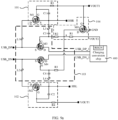
- the interface circuit system 10 may further include a low dropout regulator (low dropout regulator, LDO) 700 shown in FIG. 6b .
- LDO low dropout regulator
- An input end of the LDO 700 may be coupled to the VBUS pin of the external interface 200, to receive a charging voltage output by the VBUS pin.
- an output end of the LDO 700 is coupled to the second on voltage end VOUT2.
- the LDO 700 is configured to: perform voltage regulation on the charging voltage provided by the VBUS pin, and provide the charging voltage to the second on voltage end VOUT2. In this way, when the voltage provided by the VBUS pin of the external interface 200 changes based on the charging type, the LDO 700 may provide a stable voltage to the second on voltage end VOUT2.
- the LDO 700 may be integrated into the charging conversion chip 400, and a voltage obtained after voltage regulation by the LDO 700 is provided to the second on voltage end VOUT2 by using an REGN pin shown in FIG. 6c in the charging conversion chip 400.
- the VBUS pin may provide a charging voltage to the charging conversion chip 400.
- the charging conversion chip 400 may provide the voltage to the battery inside the mobile terminal, and may provide the voltage to the second on voltage end VOUT2 by using the REGN pin after the voltage regulation by the LDO 700, so that the second on voltage end VOUT2 can provide the second on voltage V2 to the isolation circuit 104.
- the second on voltage end VOUT2 may directly receive the voltage provided by the VBUS pin of the external interface 200, or receive the voltage obtained after the voltage of the VBUS pin is processed by the LDO 700. Therefore, there is a coupling between the second on voltage end VOUT2 and the VBUS pin, to implement electrical signal transmission.
- the isolation circuit 104 when the isolation circuit 104 receives the first on voltage V1 output by the first on voltage end VOUT1 and the second on voltage V2 output by the second on voltage end VOUT2, and the isolation circuit 104 pulls down the third switch circuit 103, the isolation circuit 104 is further configured to isolate the ground end GND from the second on voltage end VOUT2, so that it can be ensured that the ground end DND pulls down the second on voltage end VOUT2, and that the voltage on the VBUS pin is pulled down, thereby avoiding affecting charging.
- the external interface 200 is coupled to the one-to-two adapter 201, to implement using an analog headset during charging.
- using an analog headset during charging can be implemented by using a wireless charging solution.
- the interface circuit system 10 further includes a wireless charging circuit 800 and a wireless isolation switch 900.
- the wireless charging circuit 800 is coupled to the charging conversion chip 400.
- An antenna is disposed in the wireless charging circuit 800, and the antenna is configured to receive a wireless charging signal used by a wireless charging cradle (not shown in the figure).
- a component configured to generate a charging current based on electromagnetic induction is further disposed in the wireless charging circuit 800. The component may perform electromagnetic conversion and provide a charging voltage to the charging conversion chip 400 to implement wireless charging.
- the wireless isolation switch 900 is coupled to the charging conversion chip 400 and the VBUS pin of the external interface 200.
- the wireless isolation switch 900 is configured to disconnect the charging conversion chip 400 from the VBUS pin when the antenna in the wireless charging circuit 800 receives the wireless charging signal. This prevents the voltage signal on the VBUS pin from affecting wireless charging.
- the third switch circuit 103 may be in an open state, so that the first external transmission end USB_DP may be disconnected from the first internal transmission end USB_DP_1, and the second external transmission end USB_DN may be disconnected from the second internal transmission end USB_DN_1.
- the SoC 500 and the pin D+ and the pin D- of the external interface 200 are in a floating state.
- the SoC 500 identifies that a wireless charging device is a non-standard charger, and provides a charging voltage in a non-standard charging mode, for example, 5 V and a charging current, for example, 1.2 A (greater than 500 mA in a PC mode) to the charging conversion chip 400 by using the wireless charging circuit 800, to improve a charging speed of the mobile terminal when an analog headset is used during charging.
- a non-standard charging mode for example, 5 V
- a charging current for example, 1.2 A (greater than 500 mA in a PC mode)
- the third switch circuit 103 may be in an open state, the negative voltage in the audio signal is not transmitted to the charging conversion chip 400 and the SoC 500 that have a relatively weak negative voltage resistance capability by using the third switch circuit 103, so that damage caused by the negative voltage to the charging conversion chip 400 and the SoC 500 can be avoided.
- the SoC 500 is disconnected from the pin D+ and the pin D- of the external interface 200. Therefore, the SoC 500 does not clamp the negative voltage in the audio signal by using the pin D+ and the pin D-, to reduce a probability that quality of the audio signal deteriorates.
- the following describes in detail specific structures of the first switch circuit 101, the second switch circuit 102, the third switch circuit 103, and the isolation circuit 104 in the multiplexing circuit 100 by using examples.
- the first switch circuit includes a first transistor M1.
- a gate (Gate, G) of the first transistor M1 is coupled to the first on voltage end VOUT1, and may receive the first on voltage V1 provided by the first on voltage end VOUT1.
- a first electrode (for example, a drain (drain, D)) of the first transistor M1 is coupled to the first external transmission end USB_DP, and a second electrode (for example, a source (source, D)) of the first transistor M1 is coupled to the right-channel transmission end HSR.
- the gate G of the first transistor M1 is in an on state, so that the right-channel transmission end HSR can transmit the right-channel audio signal in the mobile phone to the first external transmission end USB_DP by using the first transistor M1.
- the audio signal is an alternating current signal
- the audio signal fluctuates.
- a voltage loaded to the second electrode (for example, the source S) of the first transistor M1 fluctuates.
- the first on voltage V1 that is used to control the first transistor M1 to be turned on and that is provided by the first on voltage end VOUT1 is a direct current voltage, for example, 3 V
- a voltage difference Vgs between the gate G and the second electrode (for example, the source S) of the first transistor M1 changes as the right-channel audio signal fluctuates, so that an impedance of the first transistor M1 changes, which further affects a total harmonic distortion-noise (Total Harmonic Distortion-Noise, THD-N) indicator of the audio.
- THD-N Total Harmonic Distortion-Noise
- the first switch circuit 101 further includes a first constant-voltage control circuit 11.
- the first constant-voltage control circuit 11 is coupled to the gate G and the second electrode (for example, the source S) of the first transistor M1. As shown in FIG. 8b , the first constant-voltage control circuit 11 is configured to load the right-channel audio signal (represented by a sine wave in the figure) to the gate G of the first transistor M1. In this case, the gate G of the first transistor M1 also has the right-channel audio signal that fluctuates.
- the first constant-voltage control circuit 11 may include a first capacitor C1 shown in FIG. 8c .
- One end of the first capacitor C1 is coupled to the gate G of the first transistor M1, and the other end is coupled to the second electrode (for example, the source S) of the first transistor M2.
- an alternating current signal on the right-channel transmission end HSR namely, the right-channel audio signal
- the first capacitor C1 a voltage difference between the gate G and the second electrode (for example, the source S) of the first transistor M1 is equal to V1.
- the first on voltage V1 of the direct current voltage cannot be transmitted to the right-channel transmission end HSR by using the first capacitor C1.
- the second switch circuit includes a second transistor M2 shown in FIG. 8a .
- a gate G of the second transistor M2 is coupled to the first on voltage end VOUT1, and may receive the first on voltage V1 provided by the first on voltage end VOUT1.
- a first electrode (for example, a drain D) of the second transistor M2 is coupled to the second external transmission end USB_DN, and a second electrode (for example, a source S) of the second transistor M2 is coupled to the left-channel transmission end HSL.
- the gate G of the second transistor M2 is in an on state, so that the left-channel transmission end HSL can transmit the left-channel audio signal in the mobile phone to the second external transmission end USB_DN by using the second transistor M2.
- the second constant-voltage control circuit 12 is coupled to the gate G and the second electrode (for example, the source S) of the second transistor M2, and the second constant-voltage control circuit 12 is configured to transmit the left-channel audio signal HSL to the gate G of the second transistor M2.
- the second constant-voltage control circuit 12 may include a second capacitor C2 shown in FIG. 8c .
- One end of the second capacitor C2 is coupled to the gate G of the second transistor M2, and the other end is coupled to the second electrode (for example, source S) of the second transistor M2.
- the left-channel audio signal on the left-channel transmission end HSL may be transmitted to the gate G of the second transistor M2 by using the second capacitor C2, so that a voltage difference Vgs between the gate G and the second electrode (for example, the source S) of the second transistor M2 is equal to V1.
- the first voltage V2 of the direct current voltage cannot be transmitted to the left-channel transmission end HSL by using the second capacitor C2.
- capacitances of the first capacitor C1 and the second capacitor C2 may range from 4 ⁇ F to 10 ⁇ F.
- a resistance of the capacitor is less than 4 ⁇ F, because the capacitance is relatively small, a blocking effect on the direct current voltage is relatively poor.
- an audio signal on the right-channel transmission end HSR or the left-channel transmission end HSL has relatively large noise.
- the resistance of the capacitor is greater than 10 ⁇ F, the capacitor has a good characteristic of passing an alternating current and resisting a direct current.
- the capacitor has a relatively large size, and occupies relatively large wiring space on the mobile phone.
- the first constant-voltage control circuit 11 may further include an inductor connected in parallel to the first capacitor C1.
- the second constant-voltage control circuit 12 may also include an inductor connected in parallel to the second capacitor C2. The noise on the gate G of the first transistor M1 and the second transistor M2 can be reduced by using a filtering effect of the inductor.
- the first transistor M1 and the second transistor M2 may be a metal oxide semiconductor (Metal Oxide Semiconductor, MOS) field-effect transistor, a thin film transistor (Thin Film Transistor, TFT), or a triode. This is not limited in this application.
- MOS Metal Oxide Semiconductor
- TFT Thin Film Transistor
- the first electrode of the transistor may be a source, and the second electrode is a drain, or the first electrode is a drain, and the second electrode is a source.
- the transistor is an NMOS transistor (N-channel MOS transistor)
- the first electrode is a drain
- the second electrode is a source
- a direct current power supply for example, a battery of the mobile phone, may be disposed in the mobile phone, and is configured to provide the first on voltage V1 that can control the first transistor M1 and the second transistor M2 to be turned on to the first on voltage end VOUT1.
- the first transistor M1 and the second transistor M2 are N-channel transistors.
- a chip having a control function in the mobile phone may be separately coupled to the Type-C interface and the battery, so that when the pin CC in the Type-C interface identifies that an external device coupled to the Type-C interface is an analog headset, the SoC 500 can control a first on voltage V1 provided by the battery to the first on voltage end VOUT1 to be a high level.
- an LDO may be disposed between the battery and the first on voltage end VOUT1, to provide the stable first on voltage V1 to the first on voltage end VOUT1 through a voltage regulation effect of the LDO.
- the first switch circuit 101 further includes a fourth resistor R4 shown in FIG. 8c .
- a first end of the fourth resistor R4 is coupled to the gate G of the first transistor M1, and a second end is coupled to the first on voltage end VOUT1.
- the fourth resistor R4 can prevent an alternating current audio signal loaded to the gate of the first transistor M1, namely, the right-channel audio signal, from being transmitted to a power supply coupled to the first on voltage end VOUT1, thereby avoiding affecting other circuit structures coupled to the power supply.
- the second switch circuit 102 further includes a fifth resistor R4.
- a first end of the fifth resistor R4 is coupled to the gate G of the second transistor M2, and a second end is coupled to the first on voltage end VOUT1.
- a technical effect of the fifth resistor R4 is the same as that of the fourth resistor R4, and details are not described herein again.
- the isolation circuit 104 includes an isolation transistor M0.
- a gate G of the isolation transistor M0 is coupled to the first on voltage end VOUT1, to receive the first on voltage V1 provided by the first on voltage end VOUT1.
- a first electrode, for example, a drain D, of the isolation transistor M0 is coupled to the third switch circuit 103, and a second electrode, for example, a source S, of the isolation transistor M0 is coupled to the ground end GND.
- the third switch circuit 103 includes a third transistor M3 and a fourth transistor M4, a gate G of the third transistor M3 is coupled to the first electrode, for example, the drain D, of the isolation transistor M0.
- a first electrode, for example, a drain D, of the third transistor M3 is coupled to the first internal transmission end USB_DP_1, and a second electrode, for example, a source S, of the third transistor M3 is coupled to the first external transmission end USB_DP.
- a gate of the fourth transistor M4 is coupled to the first electrode, for example, the drain D, of the isolation transistor M0.
- a first electrode, for example, a drain D, of the fourth transistor M4 is coupled to the second internal transmission end USB_DN_1, and a second electrode, for example, a source S, of the fourth transistor M4 is coupled to the second external transmission end USB_DN.
- the isolation circuit 104 further includes a first resistor R1, a second resistor R2, and a third resistor R3.
- a first end of the first resistor R1 is coupled to the second electrode, for example, the source S, of the isolation transistor M0, and a second end of the first resistor R1 is coupled to the second on voltage end VOUT2.
- a first end of the second resistor R2 is coupled to the gate G of the third transistor M3, and a second end of the second resistor R2 is coupled to the first electrode, for example, the drain D, of the isolation transistor M0, so that the first electrode, for example, the drain D, of the isolation transistor M0 is coupled to the gate G of the third transistor M3 by using the second resistor R2.
- a first end of the third resistor R3 is coupled to the gate G of the fourth transistor M4, and a second end of the third resistor R3 is coupled to the first electrode, for example, the drain D, of the isolation transistor M0, so that the first electrode, for example, the drain D, of the isolation transistor M0 is coupled to the gate G of the fourth transistor M4 by using the third resistor R3.
- the pin CC in the Type-C interface of the mobile phone identifies that an external device coupled to the Type-C interface is the analog headset.
- the first on voltage end VOUT1 provides the first on voltage V1 to the gate G of the first transistor M1, the gate G of the second transistor M2, and the gate G of the isolation transistor M0, to turn on the first transistor M1, the second transistor M2, and the isolation transistor M0.
- the right-channel transmission end HSR transmits the right-channel audio signal in the mobile phone to the first external transmission end USB_DP by using the first transistor M1.
- the left-channel transmission end HSL transmits the left-channel audio signal in the mobile phone to the second external transmission end USB_DN by using the second transistor M2, so that the analog headset can hear the audio signal sent by the mobile phone.
- the REGN of the charging conversion chip 400 does not serve as the second on voltage end VOUT2 to provide the second on voltage V2 to the gate G of the third transistor M3 and the gate G of the fourth transistor M4. Therefore, the third transistor M3 and the fourth transistor M4 are in a cut-off state.
- the third transistor M3 and the fourth transistor M4 may be cut off, and the first transistor M1 and the second transistor M2 are turned on.
- the negative voltage of the right-channel audio signal transmitted to the first external transmission end USB_DP through the right-channel transmission end HSR and the negative voltage of the left-channel audio signal transmitted to the second external transmission end USB_DN through the left-channel transmission end HSL are respectively applied to the second electrodes (for example, the source S) of the third transistor M3 and the fourth transistor M4, which causes a voltage difference between the gate G and the second electrode (for example, the source S) of the third transistor M3 and a voltage difference between the gate G and the second electrode (for example, the source S) of the fourth transistor M4.
- the third transistor M3 and the fourth transistor M4 that are originally cut off are turned on.
- the negative voltages in the right-channel audio signal and the left-channel audio signal are respectively output to the first internal transmission end USB_DP_1 and the second internal transmission end USB_DP_1 by using the third transistor M3 and the fourth transistor M4, and damage is caused to other circuit structures coupled to the first internal transmission end USB_DP_1 and the second internal transmission end USB_DP_1, for example, the charging conversion chip 400 and the SoC 500.
- the third switch circuit 103 is further coupled to the right-channel transmission end HSR and the left-channel transmission end HSL.
- the third switch circuit 103 further includes a third capacitor C3 and a fourth capacitor C4.
- a first end of the third capacitor C3 is coupled to the right-channel transmission end HSR, and a second end of the third capacitor C3 is coupled to the gate G of the third transistor M3.
- the right-channel audio signal on the right-channel transmission end HSR is transmitted to the gate G of the third transistor M3 by using the third capacitor C3.
- a first end of the fourth capacitor C4 is coupled to the left-channel transmission end HSL, and a second end of the fourth capacitor C4 is coupled to the gate G of the fourth transistor M4.
- the left-channel audio signal on the left-channel transmission end HSL is transmitted to the gate G of the fourth transistor M4 by using the fourth capacitor C4.
- a charger when a user performs charging independently, when a charger is connected to the mobile terminal, for example, a mobile phone, by using an external interface 200 (for example, a Type-C interface), a pin CC in the Type-C interface of the mobile phone identifies that an external device coupled to the Type-C interface is the charger.
- an external interface 200 for example, a Type-C interface
- the REGN end of the charging conversion chip 400 may serve as the second on voltage end VOUT2 to provide the second on voltage V2 to the gate of the third transistor M3 and the gate of the fourth transistor M4, to turn on the third transistor M3 and the fourth transistor M4.
- the charging conversion chip 400 may determine, by using voltages of the first internal transmission end USB_DP_1 and the second internal transmission end USB_DN_1, whether the charging type is fast charging or slow charging. Therefore, a voltage provided by the charger to the charging conversion chip 400 may be adjusted, so that the charging conversion chip 400 can perform fast charging or slow charging on the battery of the mobile terminal after converting the voltage provided by the charger.
- the first on voltage end VOUT1 does not output the first on voltage V1. Therefore, the first transistor M1, the second transistor M2, and the isolation transistor M0 are all in a cut-off state.
- the data cable may transmit external data to the first external transmission end USB_DP, and then the third transistor M3 transmits the external data to the SoC 500 by using the first internal transmission end USB_DP_1.
- the data cable coupled to the external interface 200 further transmits the external data to the second external transmission end USB_DN, and then the fourth transistor M4 transmits the external data to the SoC 500 by using the second internal transmission end USB_DN_1. Therefore, the SoC 500 can process the external data provided by the data cable.
- the SoC 500 may further transmit, through the first internal transmission end USB_DP_1 by using the third transistor M3, the processed data to a data cable coupled to the first external transmission end USB_DP.
- the second internal transmission end USB_DN_1 is transmitted to a data cable coupled to the second external transmission end USB_DN by using the fourth transistor M4. Therefore, data in the mobile terminal can be transmitted to an external device coupled to the data cable.
- the third switch circuit 103 further includes a first magnetic bead (bead) L1.
- a first end of the first magnetic bead L1 is coupled to the first switch circuit 101, namely, the first electrode, for example, the drain D, of the first transistor M1 in the first switch circuit 101.
- a second end of the first magnetic bead L1 is coupled to the second electrode, for example, the source S, of the third transistor M3.
- a signal transmitted on the signal path formed between the first external transmission end USB_DP and the first internal transmission end USB_DP_1 is a high-frequency signal, and a frequency may reach a GHz level
- the first magnetic bead L1 is in a high-resistance state, so that the drain D of the first transistor M1 may be isolated from the source S of the third transistor M3, to prevent the parasitic capacitance of the first transistor M1 from affecting the signal passing through the third transistor M3.
- the first transistor M1 when the first transistor M1 is turned on and the third transistor M3 is cut off, because a signal passing through the first transistor M1 is a low-frequency signal and a frequency is at a kHz level, the first magnetic bead L1 is in a low-resistance state, so that the right-channel audio signal on the right-channel transmission end HSR can be transmitted to the first external transmission end USB_DP by using the first transistor M1 and the first magnetic bead L1.
- the third switch circuit 103 may further include a third magnetic bead L3 shown in FIG. 9a .
- a first end of the third magnetic bead L3 is coupled to the first switch circuit 101, that is, the source S of the first transistor M1 in the first switch circuit 101, and a second end of the third magnetic bead L3 is coupled to the gate G of the third transistor M3.
- the third switch circuit 101 further includes a second magnetic bead L2.
- a first end of the second magnetic bead L2 is coupled to the second switch circuit 102, namely, the first electrode, for example, the drain D, of the second transistor M2 in the second switch circuit 102, and a second end of the second magnetic bead L2 is coupled to the second electrode, for example, the source S, of the fourth transistor M4.
- the second magnetic bead L2 is in a high-resistance state, so that the drain D of the second transistor M2 may be isolated from the source S of the fourth transistor M4, to prevent the parasitic capacitance of the second transistor M2 from affecting a signal passing through the fourth transistor M4.
- the second transistor M2 is turned on and the fourth transistor M4 is cut off, the right-channel audio signal on the right-channel transmission end HSR can be transmitted to the second external transmission end USB_DN by using the second transistor M2 and the second magnetic bead L2.
- the third switch circuit 103 may further include a fourth magnetic bead L4 shown in FIG. 9a .
- a first end of the fourth magnetic bead L4 is coupled to the second switch circuit 102, namely, the second electrode (for example, the source S) of the second transistor M2 in the second switch circuit 102, and a second end of the fourth magnetic bead L4 is coupled to the gate G of the fourth transistor M4.
- the first magnetic bead L1, the second magnetic bead L2, the third magnetic bead L3, and the fourth magnetic bead L4 form a daisy-chain arrangement manner, to reduce impact of the parasitic capacitances of the first transistor M1 and the second transistor M2 on data transmission on the signal path between the first external transmission end USB_DP and the first internal transmission end USB_DP_1, and on the signal path between the second external transmission end USB_DN and the second internal transmission end USB_DN_1, thereby improving eye pattern quality of a USB.
- a one-to-two adapter 201 shown in FIG. 4 may further be connected to the external interface 200 (for example, the Type-C interface).
- the one-to-two adapter 201 may be coupled to both the charger and the analog headset.
- the analog headset may be connected to the external interface 200 by using a common adapter. Therefore, the mobile terminal can be charged while the analog headset is used.
- the first on voltage end VOUT1 in FIG. 9a outputs the first on voltage V1.
- the first transistor M1 is turned on, and the right-channel transmission end HSR transmits the right-channel audio signal in the mobile phone to the first external transmission end USB_DP by using the first transistor M1.
- the left-channel transmission end HSL transmits the left-channel audio signal in the mobile phone to the second external transmission end USB_DN by using the second transistor M2.
- the REGN end of the charging conversion chip 400 can be used as the second on voltage end VOUT2 to output the second on voltage VOUT2.
- the SoC 500 considers, according to the BC1.2 charging protocol, that the external device connected to the external interface 200 is a PC. Therefore, the phenomenon that the external device provides a very small charging current, for example, a 500 mA charging current, to the VBUS pin of the external interface 200 is controlled.
- the gate G of the isolation transistor M0 is in an on state.
- the isolation transistor M0 may pull down the gate of the third transistor M3 and the gate of the fourth transistor M4 by using the ground end GND, so that the third transistor M3 and the fourth transistor M4 are in a cut-off state. Therefore, the first external transmission end USB_DP is disconnected from the first internal transmission end USB_DP_1, and the second external transmission end USB_DN is disconnected from the second internal transmission end USB_DN_1. In this way, the SoC 500 detects, according to the BC1.2 charging protocol, that the first internal transmission end USB_DP_1 and the second internal transmission end USB_DN_1 are in a floating state.
- the SoC 500 considers that a charger or a wireless charging device connected to the external interface 200 (for example, the Type-C interface) is a non-standard charger.
- the SoC 500 may control the external device to provide a charging voltage, for example, 5 V and a charging current, for example, 1.2 A (greater than 500 mA in a PC mode) in a non-standard charging mode to the VBUS pin of the external interface 200. Therefore, when the analog headset is used during charging, a charging speed of the mobile terminal is improved.
- the isolation transistor M0 pulls down the third switch circuit 103 means that the isolation transistor M0 pulls down voltages of gates of the third transistor M3 and the fourth transistor M4 in the third switch circuit 103 by using the ground end GND, so that the voltages of the gates of the third transistor M3 and the fourth transistor M4 are reduced until the third transistor M3 and the fourth transistor M4 are in a cut-off state.
- the ground end GND may be coupled to a reference ground disposed on a PCB in the mobile terminal.
- node a in FIG. 9b is pulled down to a voltage of the ground end GND.
- node a may be isolated from the second voltage end VOUT2 by using the first resistor R1, so that it can be avoided that the ground end GND pulls down the REGN end (as the second voltage end VOUT2) of the charging conversion chip 400. Therefore, the charging conversion chip 400 can normally charge the battery of the mobile terminal.
- the isolation transistor M0 when the isolation transistor M0 is turned on, because the first electrode (for example, the drain D) of the isolation transistor M0 is isolated from the gate G of the third transistor M3 by using the second resistor R2, it can be avoided that the isolation transistor M0 directly pulls the gate G of the third transistor M3 down to the voltage of the ground end GND, and that the voltage of the gate G of the third transistor M3 cannot change based on a change of the right-channel audio signal on the right-channel transmission end HSR.
- the first electrode (for example, the drain D) of the isolation transistor M0 is isolated from the gate G of the fourth transistor M4 by using the third resistor R3, it can be avoided that the isolation transistor M0 directly pulls the gate G of the fourth transistor M4 down to the voltage of the ground end GND, and that the voltage of the gate G of the fourth transistor M4 cannot change based on a change of the left-channel audio signal on the left-channel transmission end HSL.
- a resistance of the first resistor R1 may range from 20 k ⁇ to 60 k ⁇ .
- the resistance of the first resistor R1 is less than 20 k ⁇ , power consumption is affected, and an isolation effect of the first resistor R1 is not obvious.
- the ground end GND easily pulls down the REGN end of the charging conversion chip 400, and normal charging of the battery of the mobile terminal by the charging conversion chip 400 is affected.
- the second on voltage V2 provided by the REGN end of the charging conversion chip 400 can be transmitted to the gate G of the third transistor M3 only after passing through the first resistor R1 and the second resistor R2, and transmitted to the gate G of the fourth transistor M4 only after passing through the first resistor R1 and the third resistor R3. Therefore, when the resistance of the first resistor R1 is greater than 60 k ⁇ , an impedance of the signal path is relatively large, and an on time of the transistor is affected. As a result, the transistor needs a relatively long time to be turned on, which may lead to a data communication failure.
- the resistance of the first resistor R1 may range from 20 k ⁇ to 60 k ⁇ , power consumption is not affected, a better isolation effect of the first resistor R1 can be ensured, and an on time of the transistor can be ensured.
- the resistance of the first resistor R1 may be 20 kS2, 25 kS2, 30 kS2, 35 kS2, 40 kS2, 45 kS2, 50 kS2, 55 kS2, or 60 kS2.
- resistances of the second resistor R2 and the third resistor R3 may range from 20 k ⁇ to 60 k ⁇ . In some embodiments of this application, resistances of the second resistor R2 and the third resistor R3 may be the same.
- the mobile terminal having the interface circuit system provided in this embodiment of this application can be independently connected to an analog headset, and can be charged independently, or an analog headset can be used while the mobile terminal is charged in a non-standard charger mode.
Landscapes
- Engineering & Computer Science (AREA)
- Signal Processing (AREA)
- Computer Networks & Wireless Communication (AREA)
- Power Engineering (AREA)
- Human Computer Interaction (AREA)
- Theoretical Computer Science (AREA)
- Audiology, Speech & Language Pathology (AREA)
- Physics & Mathematics (AREA)
- General Engineering & Computer Science (AREA)
- General Physics & Mathematics (AREA)
- General Health & Medical Sciences (AREA)
- Health & Medical Sciences (AREA)
- Multimedia (AREA)
- Telephone Function (AREA)
- Charge And Discharge Circuits For Batteries Or The Like (AREA)
- Transceivers (AREA)
- Power Sources (AREA)
Claims (15)
- Multiplexing-Schaltung (100), umfassend eine erste Umschaltschaltung (101), eine zweite Umschaltschaltung (102), eine dritte Umschaltschaltung (103) und eine Isolationsschaltung (104), wobei die Multiplexing-Schaltung (100) ein erstes externes Übertragungsende (USB_DP), ein zweites externes Übertragungsende (USB_DN), ein Übertragungsende des rechten Kanals (HSR), ein Übertragungsende des linken Kanals (HSL), ein erstes internes Übertragungsende (USB_DP_1), ein zweites internes Übertragungsende (USB_DN_1), ein erstes Einschaltspannungsende (VOUT1), ein Masseende (GND) und ein zweites Einschaltspannungsende (VOUT2) aufweist, wobei
die erste Umschaltschaltung (101) separat mit dem ersten externen Übertragungsende (USB_DP), dem Übertragungsende des rechten Kanals (HSR) und dem ersten Einschaltspannungsende (VOUT1) gekoppelt ist und die erste Umschaltschaltung (101) zu Folgendem ausgelegt ist:Empfangen einer durch das erste Einschaltspannungsende (VOUT1) ausgegebenen ersten Einschaltspannung und Übertragen, an das erste externe Übertragungsende (USB_DP), eines durch das Übertragungsende des rechten Kanals (HSR) gelieferten Audiosignals des rechten Kanals;die zweite Umschaltschaltung (102) separat mit dem zweiten externen Übertragungsende (USB_DN), dem Übertragungsende des linken Kanals (HSL) und dem ersten Einschaltspannungsende (VOUT2) gekoppelt ist und die zweite Umschaltschaltung (102) zu Folgendem ausgelegt ist: Empfangen der ersten Einschaltspannung und Übertragen, an das zweite externe Übertragungsende (USB_DN), eines durch das Übertragungsende des linken Kanals (HSL) gelieferten Audiosignals des linken Kanals; und dadurch gekennzeichnet, dassdie Isolationsschaltung (104) separat mit der dritten Umschaltschaltung (103), dem ersten Einschaltspannungsende (VOUT1), dem Masseende (GND) und dem zweiten Einschaltspannungsende (VOUT2) gekoppelt ist und die Isolationsschaltung (104) zu Folgendem ausgelegt ist: wenn eine durch das zweite Einschaltspannungsende (VOUT2) ausgegebene zweite Einschaltspannung empfangen wird, jedoch die durch das erste Einschaltspannungsende (VOUT1) ausgegebene erste Einschaltspannung nicht empfangen wird, Übertragen der zweiten Einschaltspannung an die dritte Umschaltschaltung (103); und die Isolationsschaltung (104) ferner zu Folgendem ausgelegt ist: wenn die erste Einschaltspannung und die zweite Einschaltspannung empfangen werden, Herunterziehen der dritten Umschaltschaltung (103) und Isolieren des Masseendes (GND) von dem zweiten Einschaltspannungsende (VOUT2); unddie dritte Umschaltschaltung (103) ferner separat mit dem ersten externen Übertragungsende (USB_DP), dem zweiten externen Übertragungsende (USB_DN), dem ersten internen Übertragungsende (USB_DP_1) und dem zweiten internen Übertragungsende (USB_DN_1) gekoppelt ist und die dritte Umschaltschaltung (103) zu Folgendem ausgelegt ist: wenn die zweite Einschaltspannung empfangen wird, Koppeln des ersten externen Übertragungsendes (USB_DP) mit dem ersten internen Übertragungsende (USB_DP_1) und Koppeln des zweiten externen Übertragungsendes (USB_DN) mit dem zweiten internen Übertragungsende (USB_DN_1); und die dritte Umschaltschaltung (103) ferner zu Folgendem ausgelegt ist: unter der Heruntersetzwirkung der Isolationsschaltung (104), Trennen des ersten externen Übertragungsendes (USB_DP) von dem ersten internen Übertragungsende (USB_DP_1) und Trennen des zweiten externen Übertragungsendes (USB_DN) von dem zweiten internen Übertragungsende (USB_DN_1). - Multiplexing-Schaltung (100) nach Anspruch 1, wobei die Isolationsschaltung (104) Folgendes umfasst:einen Isolationstransistor (M0), wobei ein Gate des Isolationstransistors (M0) mit dem ersten Einschaltspannungsende (VOUT1) gekoppelt ist, eine erste Elektrode des Isolationstransistors (M0) mit der dritten Umschaltschaltung (103) gekoppelt ist und eine zweite Elektrode des Isolationstransistors (M0) mit dem Masseende (GND) gekoppelt ist; undeinen ersten Widerstand (R1), wobei ein erstes Ende des ersten Widerstands (R1) mit der ersten Elektrode des Isolationstransistors (M0) gekoppelt ist und ein zweites Ende des ersten Widerstands (R1) mit dem zweiten Einschaltspannungsende (VOUT2) gekoppelt ist.
- Multiplexing-Schaltung (100) nach Anspruch 2, wobei die dritte Umschaltschaltung (103) Folgendes umfasst:einen dritten Transistor (M3), wobei ein Gate des dritten Transistors (M3) mit der ersten Elektrode des Isolationstransistors (M0) gekoppelt ist, eine erste Elektrode des dritten Transistors (M3) mit dem ersten internen Übertragungsende (USB_DP_1) gekoppelt ist und eine zweite Elektrode des dritten Transistors (M3) mit dem ersten externen Übertragungsende (USB_DP) gekoppelt ist; undeinen vierten Transistor (M4), wobei ein Gate des vierten Transistors (M4) mit der ersten Elektrode des Isolationstransistors (M0) gekoppelt ist, eine erste Elektrode des vierten Transistors (M4) mit dem zweiten internen Übertragungsende (USB_DN_1) gekoppelt ist und eine zweite Elektrode des vierten Transistors (M4) mit dem zweiten externen Übertragungsende (USB_DN) gekoppelt ist.
- Multiplexing-Schaltung (100) nach Anspruch 3, wobei die dritte Umschaltschaltung (103) ferner mit dem Übertragungsende des rechten Kanals (HSR) und dem Übertragungsende des linken Kanals (HSL) gekoppelt ist; und
die dritte Umschaltschaltung (103) ferner Folgendes umfasst:einen dritten Kondensator (C3), wobei ein erstes Ende des dritten Kondensators (C3) mit dem Übertragungsende des rechten Kanals (HSR) gekoppelt ist und ein zweites Ende des dritten Kondensators (C3) mit dem Gate des dritten Transistors (M3) gekoppelt ist; undeinen vierten Kondensator (C4), wobei ein erstes Ende des vierten Kondensators (C4) mit dem Übertragungsende des linken Kanals (HSL) gekoppelt ist und ein zweites Ende des vierten Kondensators (C4) mit dem Gate des vierten Transistors (M4) gekoppelt ist. - Multiplexing-Schaltung (100) nach Anspruch 4, wobei die Isolationsschaltung (104) ferner Folgendes umfasst:einen zweiten Widerstand (R2), wobei ein erstes Ende des zweiten Widerstands (R2) mit dem Gate des dritten Transistors (M3) gekoppelt ist und ein zweites Ende des zweiten Widerstands (R2) mit der ersten Elektrode des Isolationstransistors (M0) gekoppelt ist; undeinen dritten Widerstand (R3), wobei ein erstes Ende des dritten Widerstands (R3) mit dem Gate des vierten Transistors (M4) gekoppelt ist und ein zweites Ende des dritten Widerstands (R3) mit der ersten Elektrode des Isolationstransistors (M0) gekoppelt ist.
- Multiplexing-Schaltung (100) nach Anspruch 5, wobeiein Widerstandswert des ersten Widerstands (R1) 20 kΩ bis 60 kΩ beträgt;ein Widerstandswert des zweiten Widerstands (R2) 20 kΩ bis 60 kΩ beträgt; undein Widerstandswert des dritten Widerstands (R3) 20 kΩ bis 60 kΩ beträgt.
- Multiplexing-Schaltung (100) nach Anspruch 3, wobei die dritte Umschaltschaltung (103) ferner Folgendes umfasst:ein erstes magnetisches Kügelchen (L1), wobei ein erstes Ende des ersten magnetischen Kügelchens (L1) mit der ersten Umschaltschaltung (101) gekoppelt ist und ein zweites Ende des ersten magnetischen Kügelchens (L1) mit der zweiten Elektrode des dritten Transistors (M3) gekoppelt ist; undein zweites magnetisches Kügelchen (L2), wobei ein erstes Ende des zweiten magnetischen Kügelchens (L2) mit der zweiten Umschaltschaltung (102) gekoppelt ist und ein zweites Ende des zweiten magnetischen Kügelchens (L2) mit der zweiten Elektrode des vierten Transistors (M4) gekoppelt ist.
- Multiplexing-Schaltung (100) nach Anspruch 7, wobei die dritte Umschaltschaltung (103) ferner Folgendes umfasst:ein drittes magnetisches Kügelchen (L3), wobei ein erstes Ende des dritten magnetischen Kügelchens (L3) mit der ersten Umschaltschaltung (101) gekoppelt ist und ein zweites Ende des dritten magnetischen Kügelchens (L3) mit dem Gate des dritten Transistors (M3) gekoppelt ist; undein viertes magnetisches Kügelchen (L4), wobei ein erstes Ende des vierten magnetischen Kügelchens (L4) mit der zweiten Umschaltschaltung (102) gekoppelt ist und ein zweites Ende des vierten magnetischen Kügelchens (L4) mit dem Gate des vierten Transistors (M4) gekoppelt ist.
- Multiplexing-Schaltung (100) nach einem der Ansprüche 2 bis 7, wobeidie erste Umschaltschaltung (101) Folgendes umfasst:einen ersten Transistor (M1), wobei ein Gate des ersten Transistors (M1) mit dem ersten Einschaltspannungsende (VOUT1) gekoppelt ist,eine erste Elektrode des ersten Transistors (M1) mit dem ersten externen Übertragungsende (USB_DP) gekoppelt ist und eine zweite Elektrode des ersten Transistors (M1) mit dem Übertragungsende des rechten Kanals (HSR) gekoppelt ist; undeine erste Konstantspannungssteuerschaltung (11), die mit dem Gate und der zweiten Elektrode des ersten Transistors (M1) gekoppelt ist, wobei die erste Konstantspannungssteuerschaltung (11) dazu ausgelegt ist, das Audiosignal des rechten Kanals an das Gate des ersten Transistors (M1) zu übertragen; unddie zweite Umschaltschaltung (102) Folgendes umfasst:einen zweiten Transistor (M2), wobei ein Gate des zweiten Transistors (M2) mit dem ersten Einschaltspannungsende (VOUT1) gekoppelt ist, eine erste Elektrode des zweiten Transistors (M2) mit dem zweiten externen Übertragungsende (USB_DN) gekoppelt ist und eine zweite Elektrode des zweiten Transistors (M2) mit dem Übertragungsende des linken Kanals (HSL) gekoppelt ist; undeine zweite Konstantspannungssteuerschaltung (12), die mit dem Gate und der zweiten Elektrode des zweiten Transistors (M2) gekoppelt ist, wobei die zweite Konstantspannungssteuerschaltung (12) dazu ausgelegt ist, das Audiosignal des linken Kanals an das Gate des zweiten Transistors (M2) zu übertragen.
- Multiplexing-Schaltung (100) nach Anspruch 9, wobeidie erste Konstantspannungssteuerschaltung (11) einen ersten Kondensator (C1) umfasst, wobei ein erstes Ende des ersten Kondensators (C1) mit dem Gate des ersten Transistors (M1) gekoppelt ist und ein zweites Ende des ersten Kondensators (C1) mit der zweiten Elektrode des ersten Transistors (M1) gekoppelt ist; unddie zweite Konstantspannungssteuerschaltung (12) einen zweiten Kondensator (C2) umfasst, wobei ein erstes Ende des zweiten Kondensators (C2) mit dem Gate des zweiten Transistors (M2) gekoppelt ist und ein zweites Ende des zweiten Kondensators (C2) mit der zweiten Elektrode des zweiten Transistors (M2) gekoppelt ist.
- Multiplexing-Schaltung (100) nach Anspruch 9, wobeidie erste Umschaltschaltung (101) ferner einen vierten Widerstand umfasst, wobei ein erstes Ende des vierten Widerstands mit dem Gate des ersten Transistors (M1) gekoppelt ist und ein zweites Ende des vierten Widerstands mit dem ersten Einschaltspannungsende (VOUT1) gekoppelt ist; unddie zweite Umschaltschaltung (102) ferner einen fünften Widerstand umfasst, wobei ein erstes Ende des fünften Widerstands mit dem Gate des zweiten Transistors (M2) gekoppelt ist und ein zweites Ende des fünften Widerstands mit dem ersten Einschaltspannungsende gekoppelt ist.
- Schnittstellenschaltungssystem (10), umfassend eine externe Schnittstelle (200), die dazu ausgelegt ist, mit einer externen Vorrichtung gekoppelt zu werden, einen Ladeumwandlungschip (400), einen Audioverarbeitungschip (300) und die Multiplexing-Schaltung (100) nach einem der Ansprüche 1 bis 11, wobei die externe Schnittstelle (200) eine Typ-C-Schnittstelle ist und die externe Schnittstelle (200) einen Pin D+, einen Pin D- und einen VBUS-Pin umfasst;ein erstes externes Übertragungsende (USB_DP) der Multiplexing-Schaltung (100) mit dem Pin D+ gekoppelt ist, ein zweites externes Übertragungsende (USB_DN) der Multiplexing-Schaltung (100) mit dem Pin D- gekoppelt ist und ein Übertragungsende des rechten Kanals (HSR) und ein Übertragungsende des linken Kanals (HSL) der Multiplexing-Schaltung (100) separat mit dem Audioverarbeitungschip (300) gekoppelt sind; und der Audioverarbeitungschip (300) zu Folgendem ausgelegt ist: Liefern eines Audiosignals des rechten Kanals an das Übertragungsende des rechten Kanals (HSR) und Liefern eines Audiosignals des linken Kanals an das Übertragungsende des linken Kanals (HSL);ein zweites Einschaltspannungsende (VOUT2) der Multiplexing-Schaltung (100) mit dem VBUS-Pin gekoppelt ist; undder Ladeumwandlungschip (400) separat mit dem VBUS-Pin und einem ersten internen Übertragungsende (USB_DP_1) und einem zweiten internen Übertragungsende (USB_DN_1) der Multiplexing-Schaltung (100) gekoppelt ist; und der Ladeumwandlungschip (400) zu Folgendem ausgelegt ist: Anpassen, basierend auf Spannungen des ersten internen Übertragungsendes (USB_DP_1) und des zweiten internen Übertragungsendes (USB_DN_1), einer durch den VBUS-Pin gelieferten Ladespannung;wobei das Schnittstellenschaltungssystem (10) ferner ein System-On-Chip (500) umfasst; wobei das System-on-Chip (500) separat mit dem ersten internen Übertragungsende (USB_DP_1) und dem zweiten internen Übertragungsende (USB_DN_1) der Multiplexing-Schaltung (100) gekoppelt ist; und das System-On-Chip (500) dazu ausgelegt ist, basierend auf den Spannungen des ersten internen Übertragungsendes (USB_DP_1) und des zweiten internen Übertragungsendes (USB_DN_1) gemäß einem Ladeprotokoll die mit der externen Schnittstelle (200) verbundene externe Vorrichtung zu identifizieren.
- Schnittstellenschaltungssystem (10) nach Anspruch 12, wobei das Schnittstellenschaltungssystem (10) ferner eine Drahtlosladeschaltung (800) und einen Drahtlosisolationsschalter (900) umfasst, wobeidie Drahtlosladeschaltung (800) mit dem Ladeumwandlungschip (400) gekoppelt ist und die Drahtloseladeschaltung (800) zu Folgendem ausgelegt ist: Empfangen eines Drahtlosladesignals und Liefern einer Ladespannung an den Ladeumwandlungschip (400); undder Drahtlosisolationsschalter (900) mit dem Ladeumwandlungschip (400) und dem VBUS-Pin gekoppelt ist und der Drahtlosisolationsschalter (900) zu Folgendem ausgelegt ist: Trennen des Ladeumwandlungschips (400) von dem VBUS-Pin, wenn die Drahtlosladeschaltung (800) das Drahtlosladesignal empfängt.
- Schnittstellenschaltungssystem (10) nach Anspruch 12, wobei das Schnittstellenschaltungssystem (10) ferner einen Low-Dropout-Regler (700) umfasst, wobei
ein Eingangsende des Low-Dropout-Reglers (700) dazu ausgelegt ist, die durch den VBUS-Pin gelieferte Ladespannung zu empfangen, und ein Ausgangsende des Low-Dropout-Reglers (700) mit dem zweiten Einschaltspannungsende (VOUT2) gekoppelt ist; und der Low-Dropout-Regler (700) zu Folgendem ausgelegt ist: Durchführen von Spannungsregelung an der durch den VBUS-Pin gelieferten Ladespannung und Liefern der Ladespannung an das zweite Einschaltspannungsende (VOUT2). - Mobiles Endgerät, umfassend eine Batterie und das Schnittstellenschaltungssystem (10) nach einem der Ansprüche 12 bis 14, wobei ein erstes Einschaltspannungsende (VOUT1) einer Multiplexing-Schaltung (100) in dem Schnittstellenschaltungssystem (10) mit der Batterie gekoppelt ist; die Batterie dazu ausgelegt ist, eine erste Einschaltspannung an das erste Einschaltspannungsende (VOUT1) zu liefern; ein Ladeumwandlungschip (400) in dem Schnittstellenschaltungssystem (10) mit der Batterie gekoppelt ist; und der Ladeumwandlungschip (400) zu Folgendem ausgelegt ist: Umwandeln einer durch einen VBUS-Pin einer externen Schnittstelle (200) in dem Schnittstellenschaltungssystem (10) gelieferten Ladespannung und Liefern der Ladespannung an die Batterie.
Applications Claiming Priority (2)
| Application Number | Priority Date | Filing Date | Title |
|---|---|---|---|
| CN201911115273.XA CN111130596B (zh) | 2019-11-14 | 2019-11-14 | 一种复用电路、接口电路系统以及移动终端 |
| PCT/CN2020/127178 WO2021093683A1 (zh) | 2019-11-14 | 2020-11-06 | 一种复用电路、接口电路系统以及移动终端 |
Publications (3)
| Publication Number | Publication Date |
|---|---|
| EP4044441A1 EP4044441A1 (de) | 2022-08-17 |
| EP4044441A4 EP4044441A4 (de) | 2022-11-09 |
| EP4044441B1 true EP4044441B1 (de) | 2023-07-05 |
Family
ID=70495666
Family Applications (1)
| Application Number | Title | Priority Date | Filing Date |
|---|---|---|---|
| EP20886977.6A Active EP4044441B1 (de) | 2019-11-14 | 2020-11-06 | Multiplexschaltung, schnittstellenschaltungssystem und mobiles endgerät |
Country Status (8)
| Country | Link |
|---|---|
| US (1) | US12273087B2 (de) |
| EP (1) | EP4044441B1 (de) |
| JP (1) | JP7339444B2 (de) |
| CN (1) | CN111130596B (de) |
| AU (1) | AU2020384113B2 (de) |
| BR (1) | BR112022009033A2 (de) |
| MX (1) | MX2022005880A (de) |
| WO (1) | WO2021093683A1 (de) |
Families Citing this family (13)
| Publication number | Priority date | Publication date | Assignee | Title |
|---|---|---|---|---|
| CN111130596B (zh) * | 2019-11-14 | 2021-08-03 | 荣耀终端有限公司 | 一种复用电路、接口电路系统以及移动终端 |
| CN111509815B (zh) * | 2020-05-29 | 2022-02-08 | 维沃移动通信有限公司 | 数据线和充电设备 |
| CN111864854B (zh) * | 2020-08-03 | 2021-04-06 | 珠海智融科技有限公司 | 引脚复用电路及其工作方法、快充芯片及其工作方法 |
| CN114124079B (zh) * | 2020-08-31 | 2025-07-25 | 华为技术有限公司 | 接口电路、接口电路的保护方法及终端设备 |
| CN112737566B (zh) * | 2021-04-02 | 2021-06-22 | 荣耀终端有限公司 | 一种接口转换电路及电子设备 |
| CN115604388B (zh) * | 2021-07-12 | 2024-07-19 | 荣耀终端有限公司 | 电子设备的耳机接口的接入检测方法、电子设备及介质 |
| US11689201B2 (en) | 2021-07-26 | 2023-06-27 | Qualcomm Incorporated | Universal serial bus (USB) host data switch with integrated equalizer |
| CN115422102B (zh) * | 2021-10-08 | 2023-10-27 | 无锡宇宁智能科技有限公司 | USB、type-C接口电路及驱动板 |
| US20240162718A1 (en) * | 2022-11-14 | 2024-05-16 | Qualcomm Incorporated | Negative Transient Voltage Suppression in a Wireless Communication Device |
| US12362717B2 (en) * | 2022-11-16 | 2025-07-15 | Qualcomm Incorporated | Second-order equalizer for high-speed data lines |
| US12457451B2 (en) * | 2022-11-30 | 2025-10-28 | Qualcomm Incorporated | Linearizer circuits and methods for audio switches |
| US12585420B2 (en) * | 2022-11-30 | 2026-03-24 | Qualcomm Incorporated | Audio switch with turn-off helper for digital interface |
| CN117708012B (zh) * | 2023-06-09 | 2024-11-05 | 荣耀终端有限公司 | 电子设备 |
Family Cites Families (25)
| Publication number | Priority date | Publication date | Assignee | Title |
|---|---|---|---|---|
| CN101184994B (zh) | 2005-04-05 | 2010-11-17 | 能量控制系统工程公司 | 复用器和基于开关的电化学电池监测器以及管理系统和方法 |
| WO2008065659A2 (en) | 2006-11-29 | 2008-06-05 | Walletex Microelectronics Ltd. | Male data communication connector having contacts of different height |
| WO2009011621A1 (en) | 2007-07-13 | 2009-01-22 | Telefonaktiebolaget L M Ericsson (Publ) | Method for reducing the control signaling in handover situations |
| WO2009011624A1 (en) | 2007-07-13 | 2009-01-22 | Volvo Lastvagnar Ab | Electric wire protection arrangement |
| US8840017B2 (en) * | 2010-04-27 | 2014-09-23 | BBPOS Limited | Power management circuitry in peripheral accessories of audio devices |
| CN102096651B (zh) * | 2010-12-22 | 2016-03-30 | 努比亚技术有限公司 | 基于标准Micro USB接口的手机接口复用电路 |
| US8708745B2 (en) | 2011-11-07 | 2014-04-29 | Apple Inc. | Dual orientation electronic connector |
| US9431841B2 (en) * | 2014-03-24 | 2016-08-30 | Nokia Technologies Oy | Device to device charging via USB type-C interfaces |
| CN103997552B (zh) * | 2014-05-22 | 2017-04-19 | 广东欧珀移动通信有限公司 | 一种手机移动终端及其控制方法 |
| CN104035357B (zh) * | 2014-06-27 | 2017-04-19 | 广东欧珀移动通信有限公司 | 基于usb插座的耳机、充电和otg设备的电路设计 |
| CN104158251B (zh) * | 2014-08-13 | 2016-08-24 | 宇龙计算机通信科技(深圳)有限公司 | 终端、充电器和充电方法 |
| CN104639147A (zh) * | 2015-02-06 | 2015-05-20 | 深圳桑菲消费通信有限公司 | 一种接口复用电路及装置 |
| KR102391100B1 (ko) * | 2015-06-10 | 2022-04-27 | 삼성전자주식회사 | 인터페이스 제공 방법 및 장치 |
| CN105071795A (zh) * | 2015-08-17 | 2015-11-18 | 广东欧珀移动通信有限公司 | 一种基于usb接口的复用电路 |
| JP6561810B2 (ja) | 2015-12-08 | 2019-08-21 | 富士通クライアントコンピューティング株式会社 | 情報処理装置、拡張ユニット及び情報処理システム |
| CN108268397B (zh) * | 2016-12-30 | 2020-03-06 | 维沃移动通信有限公司 | 一种接入设备的处理方法及移动终端 |
| CN108666826B (zh) | 2017-03-31 | 2020-06-23 | 中兴通讯股份有限公司 | 一种转接头、终端设备和转接头系统 |
| CN107205189B (zh) * | 2017-06-27 | 2019-11-08 | 芯海科技(深圳)股份有限公司 | 一种基于type-c耳机模块及识别方法 |
| CN107546808B (zh) * | 2017-09-27 | 2020-11-10 | 努比亚技术有限公司 | 一种充电识别电路、识别方法及终端设备 |
| CN108093329B (zh) * | 2018-01-17 | 2024-01-30 | 歌尔科技有限公司 | 基于共用接口的外设类型检测电路及移动终端 |
| US10338656B1 (en) * | 2018-04-11 | 2019-07-02 | Cypress Semiconductor Corporation | USB type-C signal interface circuit |
| CN208707885U (zh) * | 2018-09-04 | 2019-04-05 | 广州由我科技股份有限公司 | 一种蓝牙耳机及其充电舱、充电系统 |
| CN109491942B (zh) * | 2018-09-26 | 2020-11-06 | 华为技术有限公司 | 一种复用电路及移动终端 |
| CN109862457A (zh) * | 2018-12-25 | 2019-06-07 | 维沃移动通信有限公司 | 终端设备、转接器及充电方法 |
| CN111130596B (zh) | 2019-11-14 | 2021-08-03 | 荣耀终端有限公司 | 一种复用电路、接口电路系统以及移动终端 |
-
2019
- 2019-11-14 CN CN201911115273.XA patent/CN111130596B/zh active Active
-
2020
- 2020-11-06 WO PCT/CN2020/127178 patent/WO2021093683A1/zh not_active Ceased
- 2020-11-06 MX MX2022005880A patent/MX2022005880A/es unknown
- 2020-11-06 US US17/772,239 patent/US12273087B2/en active Active
- 2020-11-06 JP JP2022527896A patent/JP7339444B2/ja active Active
- 2020-11-06 BR BR112022009033A patent/BR112022009033A2/pt unknown
- 2020-11-06 EP EP20886977.6A patent/EP4044441B1/de active Active
- 2020-11-06 AU AU2020384113A patent/AU2020384113B2/en active Active
Also Published As
| Publication number | Publication date |
|---|---|
| US12273087B2 (en) | 2025-04-08 |
| US20220376679A1 (en) | 2022-11-24 |
| MX2022005880A (es) | 2022-06-14 |
| CN111130596A (zh) | 2020-05-08 |
| AU2020384113A1 (en) | 2022-05-26 |
| AU2020384113B2 (en) | 2023-02-02 |
| JP2023503824A (ja) | 2023-02-01 |
| EP4044441A1 (de) | 2022-08-17 |
| JP7339444B2 (ja) | 2023-09-05 |
| EP4044441A4 (de) | 2022-11-09 |
| WO2021093683A1 (zh) | 2021-05-20 |
| CN111130596B (zh) | 2021-08-03 |
| BR112022009033A2 (pt) | 2022-08-02 |
Similar Documents
| Publication | Publication Date | Title |
|---|---|---|
| EP4044441B1 (de) | Multiplexschaltung, schnittstellenschaltungssystem und mobiles endgerät | |
| US11445276B2 (en) | Multiplexing circuit and mobile terminal | |
| KR101682386B1 (ko) | 휴대용 충전 장치 및 그의 충전 방법 및 충전 시스템 | |
| CN114865804B (zh) | 一种电子设备及智能功率放大器的供电方法 | |
| CN102457793B (zh) | 耳机接口电路及具有该耳机接口电路的电子装置 | |
| CN104917880B (zh) | 一种移动终端及其控制方法 | |
| CN103997552B (zh) | 一种手机移动终端及其控制方法 | |
| CN210721446U (zh) | 接口检测控制装置及接口转换器 | |
| WO2023011278A1 (zh) | 无线耳机充电电路及充电盒 | |
| CN104811866B (zh) | 一种移动终端及其控制方法 | |
| CN210868122U (zh) | 隔离装置、无线耳机充电盒和无线耳机系统 | |
| US12261472B2 (en) | Rechargeable device and charging method | |
| CN114006446B (zh) | 一种tws耳机充电电路和tws耳机 | |
| CN212628411U (zh) | 一种骨传导助听器 | |
| HK40071117B (en) | Multiplexing circuit, interface circuit system and mobile terminal | |
| HK40071117A (en) | Multiplexing circuit, interface circuit system and mobile terminal | |
| RU2792883C1 (ru) | Схема мультиплексирования, система интерфейсных схем и мобильный терминал | |
| CN115426591B (zh) | 耳机插拔噪音消除电路以及移动设备 | |
| CN120266399A (zh) | 具有数字接口的关断辅助器的音频开关 | |
| WO2023216787A1 (zh) | 电子设备、上拉电路和抑制耳机pop音的方法 | |
| CN113823971B (zh) | 接口转换系统及其控制方法 | |
| CN211266514U (zh) | 一种带数据传输和多媒体功能的一体化移动电源 | |
| CN218103457U (zh) | 通讯充电状态切换电路和蓝牙耳机 | |
| CN219247082U (zh) | Usb增程装置、连接线及电子设备 | |
| CN115687208A (zh) | 接口扩展模组及终端设备 |
Legal Events
| Date | Code | Title | Description |
|---|---|---|---|
| STAA | Information on the status of an ep patent application or granted ep patent |
Free format text: STATUS: THE INTERNATIONAL PUBLICATION HAS BEEN MADE |
|
| PUAI | Public reference made under article 153(3) epc to a published international application that has entered the european phase |
Free format text: ORIGINAL CODE: 0009012 |
|
| STAA | Information on the status of an ep patent application or granted ep patent |
Free format text: STATUS: REQUEST FOR EXAMINATION WAS MADE |
|
| 17P | Request for examination filed |
Effective date: 20220429 |
|
| AK | Designated contracting states |
Kind code of ref document: A1 Designated state(s): AL AT BE BG CH CY CZ DE DK EE ES FI FR GB GR HR HU IE IS IT LI LT LU LV MC MK MT NL NO PL PT RO RS SE SI SK SM TR |
|
| RIN1 | Information on inventor provided before grant (corrected) |
Inventor name: QIU, YUPENG Inventor name: ZHU, CHEN Inventor name: HUANG, TING |
|
| REG | Reference to a national code |
Ref country code: HK Ref legal event code: DE Ref document number: 40071117 Country of ref document: HK |
|
| A4 | Supplementary search report drawn up and despatched |
Effective date: 20221010 |
|
| RIC1 | Information provided on ipc code assigned before grant |
Ipc: G06F 13/40 20060101ALI20221004BHEP Ipc: H02J 7/00 20060101ALI20221004BHEP Ipc: H04B 3/02 20060101AFI20221004BHEP |
|
| DAV | Request for validation of the european patent (deleted) | ||
| DAX | Request for extension of the european patent (deleted) | ||
| GRAP | Despatch of communication of intention to grant a patent |
Free format text: ORIGINAL CODE: EPIDOSNIGR1 |
|
| STAA | Information on the status of an ep patent application or granted ep patent |
Free format text: STATUS: GRANT OF PATENT IS INTENDED |
|
| INTG | Intention to grant announced |
Effective date: 20230411 |
|
| GRAS | Grant fee paid |
Free format text: ORIGINAL CODE: EPIDOSNIGR3 |
|
| GRAA | (expected) grant |
Free format text: ORIGINAL CODE: 0009210 |
|
| STAA | Information on the status of an ep patent application or granted ep patent |
Free format text: STATUS: THE PATENT HAS BEEN GRANTED |
|
| AK | Designated contracting states |
Kind code of ref document: B1 Designated state(s): AL AT BE BG CH CY CZ DE DK EE ES FI FR GB GR HR HU IE IS IT LI LT LU LV MC MK MT NL NO PL PT RO RS SE SI SK SM TR |
|
| REG | Reference to a national code |
Ref country code: CH Ref legal event code: EP |
|
| REG | Reference to a national code |
Ref country code: AT Ref legal event code: REF Ref document number: 1585764 Country of ref document: AT Kind code of ref document: T Effective date: 20230715 |
|
| REG | Reference to a national code |
Ref country code: DE Ref legal event code: R096 Ref document number: 602020013465 Country of ref document: DE |
|
| REG | Reference to a national code |
Ref country code: IE Ref legal event code: FG4D |
|
| REG | Reference to a national code |
Ref country code: NL Ref legal event code: FP |
|
| REG | Reference to a national code |
Ref country code: LT Ref legal event code: MG9D |
|
| REG | Reference to a national code |
Ref country code: AT Ref legal event code: MK05 Ref document number: 1585764 Country of ref document: AT Kind code of ref document: T Effective date: 20230705 |
|
| PG25 | Lapsed in a contracting state [announced via postgrant information from national office to epo] |
Ref country code: GR Free format text: LAPSE BECAUSE OF FAILURE TO SUBMIT A TRANSLATION OF THE DESCRIPTION OR TO PAY THE FEE WITHIN THE PRESCRIBED TIME-LIMIT Effective date: 20231006 |
|
| PG25 | Lapsed in a contracting state [announced via postgrant information from national office to epo] |
Ref country code: ES Free format text: LAPSE BECAUSE OF FAILURE TO SUBMIT A TRANSLATION OF THE DESCRIPTION OR TO PAY THE FEE WITHIN THE PRESCRIBED TIME-LIMIT Effective date: 20230705 |
|
| PG25 | Lapsed in a contracting state [announced via postgrant information from national office to epo] |
Ref country code: IS Free format text: LAPSE BECAUSE OF FAILURE TO SUBMIT A TRANSLATION OF THE DESCRIPTION OR TO PAY THE FEE WITHIN THE PRESCRIBED TIME-LIMIT Effective date: 20231105 |
|
| PG25 | Lapsed in a contracting state [announced via postgrant information from national office to epo] |
Ref country code: SE Free format text: LAPSE BECAUSE OF FAILURE TO SUBMIT A TRANSLATION OF THE DESCRIPTION OR TO PAY THE FEE WITHIN THE PRESCRIBED TIME-LIMIT Effective date: 20230705 Ref country code: RS Free format text: LAPSE BECAUSE OF FAILURE TO SUBMIT A TRANSLATION OF THE DESCRIPTION OR TO PAY THE FEE WITHIN THE PRESCRIBED TIME-LIMIT Effective date: 20230705 Ref country code: PT Free format text: LAPSE BECAUSE OF FAILURE TO SUBMIT A TRANSLATION OF THE DESCRIPTION OR TO PAY THE FEE WITHIN THE PRESCRIBED TIME-LIMIT Effective date: 20231106 Ref country code: NO Free format text: LAPSE BECAUSE OF FAILURE TO SUBMIT A TRANSLATION OF THE DESCRIPTION OR TO PAY THE FEE WITHIN THE PRESCRIBED TIME-LIMIT Effective date: 20231005 Ref country code: LV Free format text: LAPSE BECAUSE OF FAILURE TO SUBMIT A TRANSLATION OF THE DESCRIPTION OR TO PAY THE FEE WITHIN THE PRESCRIBED TIME-LIMIT Effective date: 20230705 Ref country code: LT Free format text: LAPSE BECAUSE OF FAILURE TO SUBMIT A TRANSLATION OF THE DESCRIPTION OR TO PAY THE FEE WITHIN THE PRESCRIBED TIME-LIMIT Effective date: 20230705 Ref country code: IS Free format text: LAPSE BECAUSE OF FAILURE TO SUBMIT A TRANSLATION OF THE DESCRIPTION OR TO PAY THE FEE WITHIN THE PRESCRIBED TIME-LIMIT Effective date: 20231105 Ref country code: HR Free format text: LAPSE BECAUSE OF FAILURE TO SUBMIT A TRANSLATION OF THE DESCRIPTION OR TO PAY THE FEE WITHIN THE PRESCRIBED TIME-LIMIT Effective date: 20230705 Ref country code: GR Free format text: LAPSE BECAUSE OF FAILURE TO SUBMIT A TRANSLATION OF THE DESCRIPTION OR TO PAY THE FEE WITHIN THE PRESCRIBED TIME-LIMIT Effective date: 20231006 Ref country code: FI Free format text: LAPSE BECAUSE OF FAILURE TO SUBMIT A TRANSLATION OF THE DESCRIPTION OR TO PAY THE FEE WITHIN THE PRESCRIBED TIME-LIMIT Effective date: 20230705 Ref country code: ES Free format text: LAPSE BECAUSE OF FAILURE TO SUBMIT A TRANSLATION OF THE DESCRIPTION OR TO PAY THE FEE WITHIN THE PRESCRIBED TIME-LIMIT Effective date: 20230705 Ref country code: AT Free format text: LAPSE BECAUSE OF FAILURE TO SUBMIT A TRANSLATION OF THE DESCRIPTION OR TO PAY THE FEE WITHIN THE PRESCRIBED TIME-LIMIT Effective date: 20230705 |
|
| PG25 | Lapsed in a contracting state [announced via postgrant information from national office to epo] |
Ref country code: PL Free format text: LAPSE BECAUSE OF FAILURE TO SUBMIT A TRANSLATION OF THE DESCRIPTION OR TO PAY THE FEE WITHIN THE PRESCRIBED TIME-LIMIT Effective date: 20230705 |
|
| REG | Reference to a national code |
Ref country code: DE Ref legal event code: R097 Ref document number: 602020013465 Country of ref document: DE |
|
| PG25 | Lapsed in a contracting state [announced via postgrant information from national office to epo] |
Ref country code: SM Free format text: LAPSE BECAUSE OF FAILURE TO SUBMIT A TRANSLATION OF THE DESCRIPTION OR TO PAY THE FEE WITHIN THE PRESCRIBED TIME-LIMIT Effective date: 20230705 Ref country code: RO Free format text: LAPSE BECAUSE OF FAILURE TO SUBMIT A TRANSLATION OF THE DESCRIPTION OR TO PAY THE FEE WITHIN THE PRESCRIBED TIME-LIMIT Effective date: 20230705 Ref country code: EE Free format text: LAPSE BECAUSE OF FAILURE TO SUBMIT A TRANSLATION OF THE DESCRIPTION OR TO PAY THE FEE WITHIN THE PRESCRIBED TIME-LIMIT Effective date: 20230705 Ref country code: DK Free format text: LAPSE BECAUSE OF FAILURE TO SUBMIT A TRANSLATION OF THE DESCRIPTION OR TO PAY THE FEE WITHIN THE PRESCRIBED TIME-LIMIT Effective date: 20230705 Ref country code: CZ Free format text: LAPSE BECAUSE OF FAILURE TO SUBMIT A TRANSLATION OF THE DESCRIPTION OR TO PAY THE FEE WITHIN THE PRESCRIBED TIME-LIMIT Effective date: 20230705 Ref country code: SK Free format text: LAPSE BECAUSE OF FAILURE TO SUBMIT A TRANSLATION OF THE DESCRIPTION OR TO PAY THE FEE WITHIN THE PRESCRIBED TIME-LIMIT Effective date: 20230705 |
|
| PLBE | No opposition filed within time limit |
Free format text: ORIGINAL CODE: 0009261 |
|
| STAA | Information on the status of an ep patent application or granted ep patent |
Free format text: STATUS: NO OPPOSITION FILED WITHIN TIME LIMIT |
|
| PG25 | Lapsed in a contracting state [announced via postgrant information from national office to epo] |
Ref country code: IT Free format text: LAPSE BECAUSE OF FAILURE TO SUBMIT A TRANSLATION OF THE DESCRIPTION OR TO PAY THE FEE WITHIN THE PRESCRIBED TIME-LIMIT Effective date: 20230705 |
|
| 26N | No opposition filed |
Effective date: 20240408 |
|
| REG | Reference to a national code |
Ref country code: CH Ref legal event code: PL |
|
| PG25 | Lapsed in a contracting state [announced via postgrant information from national office to epo] |
Ref country code: MC Free format text: LAPSE BECAUSE OF FAILURE TO SUBMIT A TRANSLATION OF THE DESCRIPTION OR TO PAY THE FEE WITHIN THE PRESCRIBED TIME-LIMIT Effective date: 20230705 |
|
| PG25 | Lapsed in a contracting state [announced via postgrant information from national office to epo] |
Ref country code: LU Free format text: LAPSE BECAUSE OF NON-PAYMENT OF DUE FEES Effective date: 20231106 |
|
| PG25 | Lapsed in a contracting state [announced via postgrant information from national office to epo] |
Ref country code: CH Free format text: LAPSE BECAUSE OF NON-PAYMENT OF DUE FEES Effective date: 20231130 |
|
| PG25 | Lapsed in a contracting state [announced via postgrant information from national office to epo] |
Ref country code: MC Free format text: LAPSE BECAUSE OF FAILURE TO SUBMIT A TRANSLATION OF THE DESCRIPTION OR TO PAY THE FEE WITHIN THE PRESCRIBED TIME-LIMIT Effective date: 20230705 Ref country code: LU Free format text: LAPSE BECAUSE OF NON-PAYMENT OF DUE FEES Effective date: 20231106 Ref country code: CH Free format text: LAPSE BECAUSE OF NON-PAYMENT OF DUE FEES Effective date: 20231130 Ref country code: SI Free format text: LAPSE BECAUSE OF FAILURE TO SUBMIT A TRANSLATION OF THE DESCRIPTION OR TO PAY THE FEE WITHIN THE PRESCRIBED TIME-LIMIT Effective date: 20230705 |
|
| REG | Reference to a national code |
Ref country code: BE Ref legal event code: MM Effective date: 20231130 |
|
| REG | Reference to a national code |
Ref country code: IE Ref legal event code: MM4A |
|
| PG25 | Lapsed in a contracting state [announced via postgrant information from national office to epo] |
Ref country code: IE Free format text: LAPSE BECAUSE OF NON-PAYMENT OF DUE FEES Effective date: 20231106 |
|
| PG25 | Lapsed in a contracting state [announced via postgrant information from national office to epo] |
Ref country code: BE Free format text: LAPSE BECAUSE OF NON-PAYMENT OF DUE FEES Effective date: 20231130 |
|
| PG25 | Lapsed in a contracting state [announced via postgrant information from national office to epo] |
Ref country code: FR Free format text: LAPSE BECAUSE OF NON-PAYMENT OF DUE FEES Effective date: 20231130 |
|
| PG25 | Lapsed in a contracting state [announced via postgrant information from national office to epo] |
Ref country code: IE Free format text: LAPSE BECAUSE OF NON-PAYMENT OF DUE FEES Effective date: 20231106 Ref country code: FR Free format text: LAPSE BECAUSE OF NON-PAYMENT OF DUE FEES Effective date: 20231130 Ref country code: BE Free format text: LAPSE BECAUSE OF NON-PAYMENT OF DUE FEES Effective date: 20231130 |
|
| PG25 | Lapsed in a contracting state [announced via postgrant information from national office to epo] |
Ref country code: BG Free format text: LAPSE BECAUSE OF FAILURE TO SUBMIT A TRANSLATION OF THE DESCRIPTION OR TO PAY THE FEE WITHIN THE PRESCRIBED TIME-LIMIT Effective date: 20230705 |
|
| PG25 | Lapsed in a contracting state [announced via postgrant information from national office to epo] |
Ref country code: BG Free format text: LAPSE BECAUSE OF FAILURE TO SUBMIT A TRANSLATION OF THE DESCRIPTION OR TO PAY THE FEE WITHIN THE PRESCRIBED TIME-LIMIT Effective date: 20230705 |
|
| PG25 | Lapsed in a contracting state [announced via postgrant information from national office to epo] |
Ref country code: CY Free format text: LAPSE BECAUSE OF FAILURE TO SUBMIT A TRANSLATION OF THE DESCRIPTION OR TO PAY THE FEE WITHIN THE PRESCRIBED TIME-LIMIT; INVALID AB INITIO Effective date: 20201106 |
|
| PG25 | Lapsed in a contracting state [announced via postgrant information from national office to epo] |
Ref country code: HU Free format text: LAPSE BECAUSE OF FAILURE TO SUBMIT A TRANSLATION OF THE DESCRIPTION OR TO PAY THE FEE WITHIN THE PRESCRIBED TIME-LIMIT; INVALID AB INITIO Effective date: 20201106 |
|
| PGFP | Annual fee paid to national office [announced via postgrant information from national office to epo] |
Ref country code: GB Payment date: 20250930 Year of fee payment: 6 |
|
| PGFP | Annual fee paid to national office [announced via postgrant information from national office to epo] |
Ref country code: NL Payment date: 20251003 Year of fee payment: 6 |
|
| PG25 | Lapsed in a contracting state [announced via postgrant information from national office to epo] |
Ref country code: TR Free format text: LAPSE BECAUSE OF FAILURE TO SUBMIT A TRANSLATION OF THE DESCRIPTION OR TO PAY THE FEE WITHIN THE PRESCRIBED TIME-LIMIT Effective date: 20230705 |
|
| PGFP | Annual fee paid to national office [announced via postgrant information from national office to epo] |
Ref country code: DE Payment date: 20250930 Year of fee payment: 6 |