EP4041630B1 - Unterbringungseinheit für flugzeugpassagiere - Google Patents
Unterbringungseinheit für flugzeugpassagiere Download PDFInfo
- Publication number
- EP4041630B1 EP4041630B1 EP20793057.9A EP20793057A EP4041630B1 EP 4041630 B1 EP4041630 B1 EP 4041630B1 EP 20793057 A EP20793057 A EP 20793057A EP 4041630 B1 EP4041630 B1 EP 4041630B1
- Authority
- EP
- European Patent Office
- Prior art keywords
- door
- seat
- opening
- shell
- rotation
- Prior art date
- Legal status (The legal status is an assumption and is not a legal conclusion. Google has not performed a legal analysis and makes no representation as to the accuracy of the status listed.)
- Active
Links
Images



Classifications
-
- B—PERFORMING OPERATIONS; TRANSPORTING
- B64—AIRCRAFT; AVIATION; COSMONAUTICS
- B64D—EQUIPMENT FOR FITTING IN OR TO AIRCRAFT; FLIGHT SUITS; PARACHUTES; ARRANGEMENT OR MOUNTING OF POWER PLANTS OR PROPULSION TRANSMISSIONS IN AIRCRAFT
- B64D11/00—Passenger or crew accommodation; Flight-deck installations not otherwise provided for
- B64D11/06—Arrangements of seats, or adaptations or details specially adapted for aircraft seats
- B64D11/0606—Arrangements of seats, or adaptations or details specially adapted for aircraft seats with privacy shells, screens, separators or the like
-
- B—PERFORMING OPERATIONS; TRANSPORTING
- B64—AIRCRAFT; AVIATION; COSMONAUTICS
- B64D—EQUIPMENT FOR FITTING IN OR TO AIRCRAFT; FLIGHT SUITS; PARACHUTES; ARRANGEMENT OR MOUNTING OF POWER PLANTS OR PROPULSION TRANSMISSIONS IN AIRCRAFT
- B64D11/00—Passenger or crew accommodation; Flight-deck installations not otherwise provided for
- B64D11/0023—Movable or removable cabin dividers, e.g. for class separation
-
- E—FIXED CONSTRUCTIONS
- E06—DOORS, WINDOWS, SHUTTERS, OR ROLLER BLINDS IN GENERAL; LADDERS
- E06B—FIXED OR MOVABLE CLOSURES FOR OPENINGS IN BUILDINGS, VEHICLES, FENCES OR LIKE ENCLOSURES IN GENERAL, e.g. DOORS, WINDOWS, BLINDS, GATES
- E06B11/00—Means for allowing passage through fences, barriers or the like, e.g. stiles
- E06B11/02—Gates; Doors
- E06B11/022—Gates; Doors characterised by the manner of movement
- E06B11/023—Gates; Doors characterised by the manner of movement where the gate opens within the plane of the gate
- E06B11/025—Gates; Doors characterised by the manner of movement where the gate opens within the plane of the gate vertically
-
- E—FIXED CONSTRUCTIONS
- E06—DOORS, WINDOWS, SHUTTERS, OR ROLLER BLINDS IN GENERAL; LADDERS
- E06B—FIXED OR MOVABLE CLOSURES FOR OPENINGS IN BUILDINGS, VEHICLES, FENCES OR LIKE ENCLOSURES IN GENERAL, e.g. DOORS, WINDOWS, BLINDS, GATES
- E06B3/00—Window sashes, door leaves, or like elements for closing wall or like openings; Layout of fixed or moving closures, e.g. windows in wall or like openings; Features of rigidly-mounted outer frames relating to the mounting of wing frames
- E06B3/32—Arrangements of wings characterised by the manner of movement; Arrangements of movable wings in openings; Features of wings or frames relating solely to the manner of movement of the wing
- E06B3/34—Arrangements of wings characterised by the manner of movement; Arrangements of movable wings in openings; Features of wings or frames relating solely to the manner of movement of the wing with only one kind of movement
- E06B3/42—Sliding wings; Details of frames with respect to guiding
- E06B3/46—Horizontally-sliding wings
- E06B3/4654—Horizontally-sliding wings disappearing in pockets in the wall; Pockets therefor
Definitions
- the present disclosure relates to an aircraft passenger accommodation unit.
- the present invention concerns aircraft passenger accommodation units. More particularly, but not exclusively, this invention concerns an aircraft passenger accommodation unit for location adjacent to an aisle in an aircraft cabin, the unit comprising a seat, having a seat pan and a seat back, a shell, at least partially surrounding the seat, wherein the shell defines an opening that allows a passenger egress between the aisle and the seat through the opening, and a door assembly, for providing variable access through the opening between the aisle and the seat.
- the invention also concerns methods of opening or closing a door assembly of an aircraft passenger accommodation unit.
- Business class and first class seating generally aims to provide aircraft passengers with as much privacy as possible.
- safety restrictions require that passengers are visible to cabin crew in some circumstances, and require that passengers can easily access the aisle in event of emergency.
- US 2019/210733 discloses an aircraft passenger seat unit comprising a privacy door that can be movable in a rotational manner.
- US2018/281963A1 and GB254890A each disclose examples of doors of aircraft passenger accommodation units, which improve a seat occupant's privacy.
- US 2017/0283064 is an example of a seat unit with a door assembly including a door that slides fore and aft of a base in a primary mode of operation. The door is formed of two parts, the two parts being pivotally hinged to each other at a vertical pivot joint. A secondary mode involves a pivoting along the vertical joint.
- Pivotable doors such as in US 2017/0283064 , often pivot outwardly into an aisle, causing an obstruction. It is desirable to maximise available space in the aircraft cabin and it is important to avoid obstructing the aisle, to allow other passengers and cabin crew to safely move about the plane.
- privacy doors generally use a straightforward pivoting or sliding mechanism to move between open and closed configurations. If this mechanism were to fail, passenger access to the aisle may be blocked, which is undesirable. In addition, it is desirable to enable disabled passengers to be able to access seats of such units.
- the present invention seeks to mitigate the above-mentioned problems. Alternatively, or additionally, the present invention seeks to provide an improved aircraft passenger accommodation unit.
- WO 2014/147449 A1 published 25 September 2014 discloses a multi-functional seat comprising a seat pan, a seat back which has a front side enabled to support a back of a person to be seated and a rear side opposite to the front side, first pivoting means that mount the seat back and enable for pivotal movements of the seat back relative to the seat pan, between an upright position, wherein the seat back extends substantially vertically upwardly relative to the seat pan, and a horizontal bedding position, wherein the seat back extends substantially in a same plane as that defined by a sitting surface of the seat pan.
- an aircraft passenger accommodation unit for location adjacent to an aisle in an aircraft cabin, the unit comprising a seat, having a seat pan and a seat back, a shell, at least partially surrounding the seat, wherein the shell defines an opening that allows a passenger egress between the aisle and the seat through the opening, and a door assembly, for providing variable access through the opening between the aisle and the seat, wherein the door assembly comprises a door rotatably mounted relative to the shell, such that the door is rotatable between an open position which allows passenger egress through the opening, and a closed position in which passenger egress through the opening is at least partially blocked, wherein the door is rotatable between the open and closed positions in a plane of rotation of the door, the plane of rotation extending across the opening, characterised in that the door assembly further comprises a privacy screen movably mounted to the door, the privacy screen being moveable across the opening between a retracted position, which allows passenger egress between the seat and the aisle through the opening, and
- the plane of rotation extends in a direction corresponding to a direction across the opening.
- a door is provided that moves between open and closed positions by rotating across the opening, for example without rotating into or impinging on the aisle or the inside of the unit.
- the door is rotatably mounted relative to the shell and rotatable in a plane of the door extending across the opening, this allows the door to be easily rotated in relation to the opening.
- the door may have a length longer than 50cm, 100cm, 120cm, 130cm or 140cm.
- the door may have a length between 100cm and 200cm, between 120 to 170cm, or more preferably between 130cm to 160cm.
- the door may have a width of wider than 40cm, 50cm, 60cm or 70cm.
- the door may have a width between 50 and 90cm, or more preferably between 60cm and 80cm.
- the door may have a thickness of less than 10cm, 5cm or 2.5cm.
- the door may provide variable privacy for a passenger in the seat. For example, in the closed position, it provides additional/further privacy.
- the door is generally planar and wherein a plane of the door is substantially parallel to the plane of rotation of the door. This means that the door rotates substantially within (or parallel to) the plane of the door and the door rotates within a plane that extends across the opening. This minimises the aisle (or inside of the unit) impingement by the door.
- the door is rotatable about an axis of rotation that intersects the door. This provides a compact arrangement where the axis of rotation is not distal from the door.
- the door may be rotatable about a single axis of rotation.
- the door defines a width, when in the closed position, the width extending across the opening in between two sides of the door, and wherein the axis of rotation intersects the door at a point less than 40% along the width of the door measured from one side of the door, and preferably at a point less than 25% along the width of the door measured from the side of the door.
- the point may be less than 15%, or even less than 10% along the width of the door.
- This provides an axis of rotation near to one side of the door. This provides an effective rotational movement between the open and closed positions, providing a door able to block passenger egress in the closed position but provide passenger egress in the open position.
- the side of the door may be the side of the door towards the direction of rotation of the door from the closed to the open position.
- the width is measured substantially horizontally across the door when the door is in the closed position.
- the door defines a length, when in the closed position, the length extending along the opening between two ends of the door, and wherein the axis of rotation intersects the door at a point less than 40% along the length of the door measured from one end of the door, and preferably at a point less than 25% along the length of the door measured from the end of the door.
- the point may be less than 15%, or even less than 10% along the length of the door.
- This provides an axis of rotation near to one end of the door. This provides an effective rotational movement between the open and closed positions, providing a door able to block passenger egress in the closed position but provide passenger egress in the open position.
- the end of the door may be a lower end (e.g. away from the direction of rotation of the door from the closed to the open position).
- the length is measured substantially vertically along the door, when the door is in the closed position.
- the length is orthogonal to the width.
- the door is rotatable about an axis of rotation that intersects the shell behind a pivotal mounting joint of the seat back and seat pan.
- "behind” means in the opposite direction to the seat facing direction.
- the axis of rotation intersects away from a front face (the surface used by passenger in the seat) of the seat back. This provides a door that, when in the open position, is substantially behind the seat back. This allows easy access to the seat from the aisle.
- the door is rotatable about an axis of rotation that intersects the shell beneath an upper surface (the surface used by passenger in the seat) of the seat pan of the seat.
- This provides a door that, when in the open position, is substantially beneath the seat pan. This allows easy access to the seat from the aisle.
- a side of the seat (including the seat pan and seat back) is at least partially exposed, to allow passenger egress between the aisle and the side of the seat.
- the upper surface of the seat pan is at least partially and ideally substantially or fully exposed from the side.
- the front face of the seat back is at least partially and ideally substantially or fully exposed from the side.
- the door When in the open position, the door at least partially overlaps the shell to define a first overlap area of the shell, and in the closed position, a second overlap area of the shell is defined, the first overlap area being larger than the second overlap area.
- the second overlap area may be zero.
- the door may overlap an outer surface of the shell (facing away from the seat).
- the door may overlap an inner surface of the shell (facing into the seat).
- the door may be at least partially housed (in the open position) in a cavity of the shell (in between inner and outer surfaces of the shell).
- the access provided through the opening is at least 15cm wider, and preferably at least 25cm wider, across the opening, than in the closed position.
- the access width is measured across the opening between shell edges and/or door sides/ends. In other words, it is the dimension (for example, in the substantially horizontal direction) across the opening that allow passenger egress and is not obstructed by the shell or the door.
- the access may be at least 30cm, at least 33cm or even at least 35cm wider in the open position.
- the access provided through the opening is at least 10% wider, and preferably at least 20% wider, across the opening, than in the closed position.
- the access may be at least 30%, or even at least 40% wider in the open position.
- the door when the door is in the open position, the door is located, at least partially, behind a pivotal mounting joint of the seat back and seat pan. More preferably, when the door is in the open position, the door is located substantially or fully behind a pivotal mounting joint of the seat back and seat pan.
- a lower end of the door is located at or below an upper surface of the seat pan. This allows a passengers lap, upper legs and above to be covered by the door, providing effective privacy.
- the door is rotatable between the open and closed positions through an angle of at least 75 degrees, and preferably through an angle of at least 85 degrees.
- the door is rotatable between the open and closed positions through an angle of up to 95 degrees.
- the door is rotatable through an angle of (approximately) 90 degrees.
- the door (for example, an upper end of the door) may extend past an end of the shell in the open position. In other words, the door may partially overlap with an aircraft passenger accommodation unit behind (or in front).
- Movement of the privacy screen (especially towards the extended position or away from the retracted position) in relation to the door is preferably only possible when the door is in the closed position.
- the privacy screen may be translatable between extended and retracted positions.
- the privacy screen may be moved away from the axis of rotation of the door when moved towards the extended position.
- the privacy screen at least partially overlaps the door to define a first overlap area of the door, and in the extended position a second overlap area of the door is defined, the second overlap area being smaller than the first overlap area.
- the second overlap area may be zero.
- the privacy screen effectively acts to widen the door when the privacy screen is in the extended position.
- the unit comprises a securement mechanism operable to secure the privacy screen in the retracted position with respect to the door.
- the door assembly comprises a stop mechanism configured to prevent movement of the door between the closed position and the open position when the privacy screen is not in the retracted position. This prevents the door moving from the closed position to the open position if the privacy screen is not retracted.
- a stop mechanism configured to prevent movement of the door between the closed position and the open position when the privacy screen is not in the retracted position. This prevents the door moving from the closed position to the open position if the privacy screen is not retracted.
- the seat further comprises an armrest, and wherein the armrest is moveably mounted relative to the seat pan, such that it can be moved between a deployed position, in which an upper surface of the armrest is above an upper surface of the seat pan, and a stowed position, in which the upper surface of the armrest is at or below the upper surface of the seat pan.
- the armrest may be translatable between deployed and stowed positions.
- the door is rotatably mounted to the shell by a rotation mechanism, the rotation mechanism comprising a first part fixedly connected to the shell and a second part fixedly connected to the door, the first and second parts forming a kinematic pair comprising a female cavity, and a corresponding male member, wherein the male member is rotatably mounted within the female cavity.
- the rotation mechanism comprising a first part fixedly connected to the shell and a second part fixedly connected to the door, the first and second parts forming a kinematic pair comprising a female cavity, and a corresponding male member, wherein the male member is rotatably mounted within the female cavity.
- the female cavity is provided on the shell and wherein the female cavity is provided within a spar tube of the shell.
- the door assembly comprises a handle portion mounted to the door, to aid movement of the door between the open and closed positions, wherein the handle portion extends beyond an end or side of the door.
- this increases a distance between the axis of rotation of the door (that may be near a corner/end/side of the door) and where the movement of the door is initiated from (the handle). This provides a longer moment arm and makes rotational movement of the door easier.
- the handle portion may extend below a lower end of the door when the door is in the closed position. Hence, the handle portion may extend sideways from the lower end when door is in the open position.
- the handle portion provides an arc-shaped handle and wherein a centre of the arc is provided adjacent an end or side of the door, that may correspond, or be near, to the location of the axis of rotation of the door.
- all points on the arc-shaped handle may be substantially the same distance from, and hence provide substantially the same moment arm to, the axis of rotation of the door.
- the centre of the arc may also be close to or adjacent the lower end of door.
- a method of opening or closing a door assembly of an aircraft passenger accommodation unit comprising the step of rotating a door of the door assembly between an open position which allows passenger egress through an opening defined by a shell of the aircraft passenger accommodation unit, and a closed position in which passenger egress through the opening is at least partially blocked, wherein the door is rotated between the open and closed positions in a plane of rotation of the door, the plane of rotation extending across the opening.
- the method further comprises the step of, when the door is in the closed configuration, moving a privacy screen mounted to the door, the privacy screen being moved across the opening between a retracted position, which allows passenger egress through the opening, and an extended position, in which passenger egress through the opening is at least partially blocked by the privacy screen.
- Figure 1a shows a perspective view of part of an aircraft passenger accommodation unit 1000, according to a first embodiment of the invention, the unit having a door 410 in a closed position.
- Figure 1b shows the door 410 in a partially open position.
- Figure 1c shows the door 410 in a fully open position.
- the unit 1000 has a seat 100.
- the seat 100 is a conventional aircraft seat with a seat back 101 and seat pan 102, pivotally joined to each other so the seat back 101 can recline in relation to the seat pan 102 about pivot j oint axis 103 (shown in Figure 1c ).
- the seat 100 also has a leg rest 104 pivotally mounted to a front of the seat pan 102.
- the leg rest 104 can pivot up to provide an extra support surface for a passenger in the seat 100.
- the seat 100 is fully reclineable into a lie-flat bed configuration.
- the seat face direction 106 is shown, pointing in the direction a passenger would face if sat on the seat 100.
- a shell 200 partially surrounds the seat 100. As shown in Figure 1a , the shell comprises a rear shell wall 201, extending behind a rear of the seat 100. Other parts of the shell 200 are not shown.
- the door assembly 400 comprises a door 410 and a privacy screen 440 (shown in Figure 1d ).
- the door 410 is a generally rectangular panel with a top end 411, bottom end 412, left side 414 and right side 413 (as viewed from the aisle and as viewed in the Figures).
- the door 410 is pivotally mounted to the shell 200 about an axis of rotation 416.
- the door has a width (between the two sides) of 71cm.
- the axis 416 is substantially perpendicular to the seat facing direction 106 and substantially parallel with the pivot joint 103.
- the axis of rotation 416 intersects the door 410 5cm from the bottom end 412 of the door 410 and near to (20cm from) the right hand side 413.
- the door 410 rotates about the axis of rotation 416 in the plane of the door so that it can be rotated from the closed position of Figure 1a , through the partially open position of Figure 1b to the fully open position of Figure 1c . This involves a rotation of 90 degrees.
- Arrow 415 shows this planar rotational movement of the door 410.
- the door 410 In the closed position of the door 410 (as in Figure 1a ), the door 410 is upright with the side edges 413, 414 being vertical and the top and bottom ends 411, 412 being horizontal.
- the top end 411 is above the head level (i.e. where a passengers head may go) of the seat 100.
- the bottom end 412 is slightly below the level of the seat pan 102, at 30cm above a cabin floor.
- the right side 413 of the door 410 is slightly behind the seat 100 (and seat back 101) and the left side 414 is approximately halfway along the depth (side dimension) of the seat pan 102.
- the door 410 In the open position of the door 410 (as in Figure 1c ), the door 410 has been rotated by 90 degrees and is now horizontal, with the side edges 413, 414 being horizontal and the top and bottom ends 411, 412 being vertical.
- the top end 411 is a long way behind the seat back 101 of the seat 100.
- the bottom end 412 is slightly behind the pivot joint 103, such that most of the door 410 is behind a front face of the seat back 101.
- the right side 413 of the door 410 is slightly below the seat pan 102 and the left side 414 is at a shoulder level of the seat 100.
- an additional 35cm of access width is provided to the seat 100.
- An arc-shaped handle 420 is provided at the bottom end 412 of the door 410.
- the centre of the arc is vertically (when in the closed position) in line with the axis of rotation 416.
- the centre of the arc is horizontally (when in the closed position) in line with the bottom end 412 of the door 410.
- Figure 1d shows a perspective view similar to Figures 1a, 1b and 1c , with the door 410 in the closed position and a privacy screen 440 in an extended position.
- the privacy screen 440 is translatably mounted to the door 410 such that it can move from the retracted position (of Figures 1a to 1c ) in front of the door 410, to the extended positon (of Figure 1d ).
- the privacy screen 440 is also a generally rectangular panel with a top end 441, bottom end 442, left side 444 and right side 443 (as viewed from the aisle and as viewed in the Figures).
- the privacy screen 440 is mounted such that, when in the retracted position, its right side 443 approximately lines up with the right side 413 of the door 410 and the left side of the privacy screen 444 approximately lines up with the left side 414 of the door 410.
- the privacy screen 440 When in the extended position, the privacy screen 440 has been moved to the left (see movement arrow 445) such that the left side 444 of the privacy screen 440 is to the left of the left side 414 of the door 410.
- an overlap area i.e. an area of overlap of the privacy screen 440 and the door 410
- the overlap area is much less; approximately a third of the area of the privacy screen 440.
- the privacy screen 440 can only move to the extended position when the door 410 is in the closed position. Similarly, the door 410 cannot be moved from the closed position, when the privacy screen 440 is partially or fully extended.
- FIG. 2a shows a side view of an aircraft passenger accommodation unit, 1000 according to a second embodiment of the invention.
- the unit 1000 is similar to the unit 1000 described above and only significant differences will be described.
- the same reference numerals will be used for like elements.
- the door 410 is in a fully open position.
- the door assembly 400 is located on the right hand side of the seat 100 (in relation to the seat facing direction 106), rather than the left hand side (as in Figures 1a to 1d ).
- the shell 200 comprises a rear shell wall 201 as before. Also shown is a far shell wall 202 on the far side of the shell 200 from the door 410.
- the shell 200 also comprises a lower section wall 203 located adjacent the side of the seat 100 below the door 410.
- the unit 1000 is provided with a console 300 on the left hand side of the seat 100 (in relation to the seat facing direction 106).
- the end of the rear wall 201 has a latch mechanism 205 used to latch to the door 410 when the door is in the closed position.
- the door 410 does not have an arc-shaped handle, and instead has a finger notch 420' on its right side edge 414 (the side edge furthest away from the seat 100 in the closed configuration).
- the seat 100 also comprises an armrest 105 that can be translated up and down in relation to the seat pan 102 between the raised position (in Figure 2a ) and a lowered position (slightly below the level of the upper surface of the seat pan 102).
- FIG. 2a Also shown in Figure 2a is the aisle 500 running parallel to the seat facing direction 106.
- a shell opening 204 is also labelled. This is the width in the aisle direction for passenger access and extends from the door assembly 400 to the shell of a unit 2000 in front.
- the opening 204 is 105cm wide. With the door in the open position (as shown in Figure 2a ), the access width provided is 98cm wide (7cm being blocked by the bottom end 412 of the door 410). With the door 410 closed, and the privacy screen 440 retracted, the opening 204 would be 44cm wide.
- Figure 2b shows a perspective view of the unit 1000 of Figure 2a , with the door 410 in a closed position and the privacy screen 440 in an extended position.
- the privacy screen 440 has been extended to fully close off the opening 204 so there is no access width between the door assembly 400 and the shell of the unit in front 2000.
- This Figure also shows the cabin floor 600.
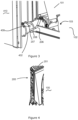
- Figure 2c is a perspective view of the unit of Figures 2a and 2b , with the door 410 in the fully open position. This figure shows a rotation mechanism that allows the door 410 to open and close.
- FIG 3 is an enlarged view of the door rotation mechanism shown in Figure 2c .
- the rotation mechanism comprises a pivot rod 430 extending from the back of the door 410.
- the axis of the pivot rod 430 corresponds to the axis of rotation 416 of the door.
- the pivot rod is mounted in a cavity 207 in a spar tube 206 attached to the shell 200.
- the spar tube 206 is mounted behind and slightly below the pivot joint 103 of the seat back 101 and seat pan 102.
- the pivot rod 430 can move in and out of the cavity 207 by a certain amount (see movement arrows 431 in Figure 2c ).
- the abutment ring 432 abuts against a front edge 208 of the spar tube 206.
- the pivot rod 430 When the pivot rod 430 is pulled out of the cavity 207 (to the maximum extent), the pivot rod 430 can rotate within the cavity 207 such that the door 410 can rotate between the closed and open positions.
- FIG 4 is an enlarged view of the latch mechanism 205 shown in Figures 2a and 2c .
- the latch mechanism 205 comprises a number of raised “buttons” that are able to catch with corresponding pins on the door 410. This retains the door 410 in the closed position.
- FIG 5 is an enlarged view of the back of the door of Figures 2a to 2c , showing a running mechanism of the privacy screen 440.
- the running mechanism comprises a guide follower (not shown) on the back of the door 410.
- the guide follower is contained within a C-shaped slider runner 447.
- This slider runner 447 is secured to the privacy screen 430 by a tab 446 (and screws). Hence, the slider runner 447 moves back and forth over the guide follower to slide the privacy screen 440 in relation to the door 410.
- the slider runner 447 and guide follower are biased to secure the privacy screen 440 in the retracted position in relation to the door 410.
- the privacy screen 440 can only move to the extended position when the door 410 is in the closed position. Similarly, the door 410 cannot be moved from the closed position, when the privacy screen 440 is partially or fully extended. This is achieved by a stop mechanism (not shown).
- a passenger or other user can move the door 410 between closed, partially open and open positions. This is done by rotating the door 410 (including pulling the door 410 and pivot rod 430 away from the spar tub 206, as necessary).
- the open position of the door 410 (and optional moving of the armrest 105) allows disabled passenger access to the seat 100 from the aisle 500.
- the closed position may provide a suitable amount of privacy for the passenger. If the passenger requires additional privacy, the privacy screen 440 may be extended out from the door 410 to the extended position.
- Any suitable shell 200 and seat 100 design may be used.
- a moveable arm-rest 105 it may be able to move in any suitable manner, for example by pivoting or by fore-aft movement.
- the plane of rotation of the door 410 may not be in the exact same direction as the opening width 204, aisle 500 and/or seat facing direction 106.
- the door 410 and/or privacy screen 440 may be any suitable size or shape.
- Any suitable stop mechanism, door rotation mechanism, running mechanism and/or latch mechanism 205 may be used, or not used.
Landscapes
- Engineering & Computer Science (AREA)
- Aviation & Aerospace Engineering (AREA)
- Civil Engineering (AREA)
- Structural Engineering (AREA)
- Hinges (AREA)
- Seats For Vehicles (AREA)
Claims (14)
- Flugzeugpassagier-Platzeinheit (1000) zur Anordnung neben einem Gang in einer Flugzeugkabine, wobei die Einheit (1000) umfasst:- einen Sitz (100) mit einer Sitzschale (102) und einer Sitzlehne (101),- eine Schale (200), die den Sitz (100) zumindest teilweise umgibt, wobei die Schale (200) eine Öffnung definiert, die einem Passagier den Austritt zwischen dem Gang und dem Sitz (100) durch die Öffnung ermöglicht, und- eine Türanordnung (400), um einen variablen Zugang durch die Öffnung zwischen dem Gang und dem Sitz (100) bereitzustellen, wobei die Türanordnung (400) eine Tür (410) umfasst, die relativ zu der Schale (200) drehbar befestigt ist, so dass die Tür (410) zwischen einer offenen Position, die einem Passagier den Austritt durch die Öffnung ermöglicht, und einer geschlossenen Position, in der der Passagieraustritt durch die Öffnung zumindest teilweise blockiert ist, drehbar ist,wobei die Tür (410) zwischen der offenen und der geschlossenen Position in einer Drehebene der Tür (410) drehbar ist, wobei sich die Drehebene über die Öffnung erstreckt, wobei die Türanordnung (400) ferner einen Sichtschutz (440) umfasst, der beweglich an der Tür (410) befestigt ist, wobei der Sichtschutz (440) über die Öffnung hinweg zwischen einer eingefahrenen Position, die dem Passagier den Austritt zwischen dem Sitz (100) und dem Gang durch die Öffnung ermöglicht, und einer ausgefahrenen Position, in der der Fahrgastaustritt zwischen dem Gang und dem Sitz (100) durch die Öffnung zumindest teilweise durch den Sichtschutz (440) blockiert ist, beweglich ist.
- Flugzeugpassagier-Platzeinheit (1000) nach Anspruch 1, wobei die Tür (410) im Allgemeinen planar ist und wobei eine Ebene der Tür (410) im Wesentlichen parallel zur Drehebene der Tür (410) ist.
- Flugzeugpassagier-Platzeinheit (1000) nach Anspruch 1 oder Anspruch 2, wobei die Tür (410) um eine Drehachse drehbar ist, die die Tür (410) schneidet.
- Flugzeugpassagier-Platzeinheit (1000) nach einem der vorhergehenden Ansprüche, wobei die Tür (410) um eine Drehachse drehbar ist, die die Schale (200) hinter einer schwenkbaren Befestigungsverbindung (103) der Sitzlehne (101) und der Sitzschale (102) schneidet.
- Flugzeugpassagier-Platzeinheit (1000) nach einem der vorhergehenden Ansprüche, wobei die Tür (410) um eine Drehachse drehbar ist, die die Schale (200) unterhalb einer oberen Fläche der Sitzschale (102) des Sitzes (100) schneidet.
- Flugzeugpassagier-Platzeinheit (1000) nach einem der vorhergehenden Ansprüche, wobei die Tür (410), wenn die Tür (410) sich in der geöffneten Position befindet, zumindest teilweise hinter einer schwenkbaren Befestigungsverbindung (103) der Sitzlehne (101) und der Sitzschale (102) angeordnet ist.
- Flugzeugpassagier-Platzeinheit (1000) nach einem der vorhergehenden Ansprüche, wobei, wenn sich die Tür (410) in der geschlossenen Position befindet, ein unteres Ende der Tür (410) an oder unterhalb einer oberen Fläche der Sitzschale (102) angeordnet ist.
- Flugzeugpassagier-Einheit (1000) nach einem der vorhergehenden Ansprüche, wobei in der eingefahrenen Position der Sichtschutz (440) die Tür (410) zumindest teilweise überlappt, um einen ersten Überlappungsbereich der Tür (410) zu definieren, und in der ausgefahrenen Position ein zweiter Überlappungsbereich der Tür (410) definiert ist, wobei der zweite Überlappungsbereich kleiner als der erste Überlappungsbereich ist.
- Flugzeugpassagier-Platzeinheit (1000) nach einem der vorhergehenden Ansprüche, wobei die Einheit einen Sicherungsmechanismus (447) umfasst, der betätigt werden kann, um den Sichtschutz (440) in der eingefahrenen Position in Bezug auf die Tür (410) zu sichern.
- Flugzeugpassagier-Platzeinheit (1000) nach einem der vorhergehenden Ansprüche, wobei die Türanordnung (400) einen Stopp-Mechanismus (205) umfasst, der so konfiguriert ist, dass er eine Bewegung der Tür (410) zwischen der geschlossenen Position und der geöffneten Position verhindert, wenn sich der Sichtschutz (440) nicht in der eingefahrenen Position befindet.
- Flugzeugpassagier-Platzeinheit (1000) nach einem der vorhergehenden Ansprüche, wobei der Sitz (100) ferner eine Armlehne (105) umfasst, und wobei die Armlehne relativ zur Sitzschale (102) beweglich angebracht ist, so dass die Armlehne zwischen einer ausgefahrenen Position, in der sich eine obere Fläche der Armlehne über einer oberen Fläche der Sitzschale (102) befindet, und einer verstauten Position, in der sich die obere Fläche der Armlehne an oder unter der oberen Fläche der Sitzschale (102) befindet, bewegt werden kann.
- Flugzeugpassagier-Platzeinheit (1000) nach einem der vorhergehenden Ansprüche, wobei die Tür (410) durch einen Drehmechanismus (206, 207, 430) drehbar an der Schale (200) angebracht ist, wobei der Drehmechanismus einen ersten Teil, der fest mit der Schale (200) verbunden ist, und einen zweiten Teil, der fest mit der Tür (410) verbunden ist, umfasst, wobei der erste und der zweite Teil ein kinematisches Paar bilden, das Folgendes umfasst:- einen weiblichen Hohlraum (207), und- ein entsprechendes männliches Element (430),wobei das männliche Element drehbar innerhalb des weiblichen Hohlraums angebracht ist, undwobei der weibliche Hohlraum an der Schale (200) vorgesehen ist, und wobei der weibliche Hohlraum innerhalb eines Holmrohrs der Schale (200) vorgesehen ist.
- Verfahren zum Öffnen oder Schließen einer Türbaugruppe (400) einer Flugzeugpassagier-Platzeinheit (1000) nach einem der vorhergehenden Ansprüche, wobei das Verfahren den Schritt des Drehens einer Tür (410) der Türbaugruppe (400) zwischen einer geöffneten Position, die den Passagieraustritt durch eine von einer Schale (200) der Flugzeugpassagier-Platzeinheit definierte Öffnung ermöglicht, und einer geschlossenen Position, in der der Passagieraustritt durch die Öffnung zumindest teilweise blockiert ist, umfasst, wobei die Tür (410) zwischen der geöffneten und der geschlossenen Position in einer Drehebene der Tür gedreht wird, wobei sich die Drehebene über die Öffnung hinweg erstreckt.
- Verfahren nach Anspruch 13, wobei das Verfahren ferner den Schritt umfasst, dass, wenn sich die Tür (410) in der geschlossenen Konfiguration befindet, ein an der Tür angebrachter Sichtschutz (440) bewegt wird, wobei der Sichtschutz (440) über die Öffnung zwischen einer eingefahrenen Position, die den Fahrgastaustritt durch die Öffnung ermöglicht, und einer ausgefahrenen Position, in der der Fahrgastaustritt durch die Öffnung zumindest teilweise durch den Sichtschutz (440) blockiert ist, bewegt wird.
Applications Claiming Priority (2)
| Application Number | Priority Date | Filing Date | Title |
|---|---|---|---|
| GB1914495.5A GB2588121B (en) | 2019-10-08 | 2019-10-08 | An aircraft passenger accommodation unit |
| PCT/GB2020/052470 WO2021069883A1 (en) | 2019-10-08 | 2020-10-07 | An aircraft passenger accommodation unit |
Publications (2)
| Publication Number | Publication Date |
|---|---|
| EP4041630A1 EP4041630A1 (de) | 2022-08-17 |
| EP4041630B1 true EP4041630B1 (de) | 2024-06-12 |
Family
ID=68541440
Family Applications (1)
| Application Number | Title | Priority Date | Filing Date |
|---|---|---|---|
| EP20793057.9A Active EP4041630B1 (de) | 2019-10-08 | 2020-10-07 | Unterbringungseinheit für flugzeugpassagiere |
Country Status (3)
| Country | Link |
|---|---|
| EP (1) | EP4041630B1 (de) |
| GB (1) | GB2588121B (de) |
| WO (1) | WO2021069883A1 (de) |
Families Citing this family (10)
| Publication number | Priority date | Publication date | Assignee | Title |
|---|---|---|---|---|
| US11299274B1 (en) * | 2020-01-31 | 2022-04-12 | B/E Aerospace, Inc. | Aircraft passenger compartment with an accessibility door |
| US12377980B2 (en) * | 2020-12-02 | 2025-08-05 | Safran Seats Usa Llc | Passenger seat headrest divider assembly |
| GB2605994B (en) * | 2021-04-21 | 2024-02-07 | Thompson Aero Seating Ltd | Door assembly for passenger seating |
| FR3125506B1 (fr) * | 2021-07-23 | 2024-09-13 | Safran Seats | Unité de siege munie d'une coque d'intimite escamotable |
| CN113513244A (zh) * | 2021-07-23 | 2021-10-19 | 赵欣豪 | 一种防爆式人防门 |
| US12187434B2 (en) * | 2022-05-10 | 2025-01-07 | B/E Aerospace, Inc. | Persons with reduced mobility (PRM) suite access wall assembly |
| FR3137662B1 (fr) * | 2022-07-05 | 2024-10-11 | Safran Seats | Unité de siège munie d'une coque d'intimité escamotable |
| US12280877B2 (en) | 2022-10-19 | 2025-04-22 | Safran Seats Usa Llc | Swivel backrest with adjustable headrest |
| FR3152491A1 (fr) * | 2023-09-06 | 2025-03-07 | Safran Seats | Ouvrant facilitant l'accès à un siège pour une personne à mobilité réduite ou a forte corpulence |
| US12522360B2 (en) * | 2024-03-28 | 2026-01-13 | Elevate Aircraft Seating Llc | Passenger suite access feature |
Family Cites Families (10)
| Publication number | Priority date | Publication date | Assignee | Title |
|---|---|---|---|---|
| GB254890A (en) | 1925-08-01 | 1926-07-15 | Ariel Works Ltd | Improvements relating to the lubrication systems of internal combustion and other engines |
| JPS5812901Y2 (ja) * | 1978-08-30 | 1983-03-12 | 三菱重工業株式会社 | 扉装置 |
| US6644736B2 (en) * | 2002-02-01 | 2003-11-11 | The Boeing Company | Privacy seat divider for transport vehicles |
| WO2014147449A1 (en) * | 2013-03-22 | 2014-09-25 | Yasava Solutions Sa | Multi-function seat and method for converting seat |
| FR3049577B1 (fr) * | 2016-03-31 | 2019-08-16 | Stelia Aerospace | Siege convertible en couchage elargi |
| GB2548901B (en) * | 2016-04-01 | 2018-07-25 | Thompson Aero Seating Ltd | Aircraft passenger seating with dual-mode privacy door |
| FR3055128A1 (fr) | 2016-08-17 | 2018-02-23 | Zodiac Seats France | Agencement de sieges permettant d'augmenter l'intimite des passagers, notamment d'un avion |
| EP3541654B1 (de) * | 2016-11-15 | 2023-08-16 | Safran Seats USA LLC | Notausgangslösungen für mini-suiten |
| US10421546B2 (en) | 2017-04-04 | 2019-09-24 | Rockwell Collins, Inc. | Aircraft door and privacy panel assemblies |
| FR3078946B1 (fr) * | 2018-03-15 | 2022-03-04 | Zodiac Seats France | Arrangement de sieges, notamment d'un avion |
-
2019
- 2019-10-08 GB GB1914495.5A patent/GB2588121B/en active Active
-
2020
- 2020-10-07 WO PCT/GB2020/052470 patent/WO2021069883A1/en not_active Ceased
- 2020-10-07 EP EP20793057.9A patent/EP4041630B1/de active Active
Also Published As
| Publication number | Publication date |
|---|---|
| GB201914495D0 (en) | 2019-11-20 |
| GB2588121B (en) | 2023-12-20 |
| EP4041630A1 (de) | 2022-08-17 |
| WO2021069883A1 (en) | 2021-04-15 |
| GB2588121A (en) | 2021-04-21 |
Similar Documents
| Publication | Publication Date | Title |
|---|---|---|
| WO2021069883A1 (en) | An aircraft passenger accommodation unit | |
| EP3741677B1 (de) | Positionsverstellbare armlehnenanordnungen für passagiersitze | |
| EP4013679B1 (de) | Flugzeugkabine | |
| CA3110924C (en) | Exit row table for an aircraft | |
| CN105338859B (zh) | 具有下降扶手组件的乘客座位 | |
| EP3129289B1 (de) | Sitzeinheit | |
| CA2465972C (en) | Seat for aircraft | |
| EP2825461B1 (de) | Armlehnenanordnung mit ausfahrbarer bettverlängerung | |
| US8091945B2 (en) | Vehicle seating system | |
| US20200101867A1 (en) | Set of seats and motor vehicle comprising such a set of seats | |
| US20250340300A1 (en) | Seat unit with a movable privacy shield | |
| CN107108037A (zh) | 飞机座椅 | |
| US12617325B2 (en) | Support device for an aircraft cabin interior layout assembly, related assembly and method | |
| US20240239491A1 (en) | Passenger seat tray table | |
| EP2353931B1 (de) | Sitzeinheit mit Klapptischanordnung | |
| EP4015386B1 (de) | Flugbegleitersitz mit höhenverstellbarer sitzschale | |
| US11548643B2 (en) | Cabin attendant seat with height adjustable seat pan | |
| JP2689059B2 (ja) | 身体障害者用座席 |
Legal Events
| Date | Code | Title | Description |
|---|---|---|---|
| STAA | Information on the status of an ep patent application or granted ep patent |
Free format text: STATUS: UNKNOWN |
|
| STAA | Information on the status of an ep patent application or granted ep patent |
Free format text: STATUS: THE INTERNATIONAL PUBLICATION HAS BEEN MADE |
|
| PUAI | Public reference made under article 153(3) epc to a published international application that has entered the european phase |
Free format text: ORIGINAL CODE: 0009012 |
|
| STAA | Information on the status of an ep patent application or granted ep patent |
Free format text: STATUS: REQUEST FOR EXAMINATION WAS MADE |
|
| 17P | Request for examination filed |
Effective date: 20220425 |
|
| AK | Designated contracting states |
Kind code of ref document: A1 Designated state(s): AL AT BE BG CH CY CZ DE DK EE ES FI FR GB GR HR HU IE IS IT LI LT LU LV MC MK MT NL NO PL PT RO RS SE SI SK SM TR |
|
| DAV | Request for validation of the european patent (deleted) | ||
| DAX | Request for extension of the european patent (deleted) | ||
| GRAP | Despatch of communication of intention to grant a patent |
Free format text: ORIGINAL CODE: EPIDOSNIGR1 |
|
| STAA | Information on the status of an ep patent application or granted ep patent |
Free format text: STATUS: GRANT OF PATENT IS INTENDED |
|
| INTG | Intention to grant announced |
Effective date: 20240214 |
|
| GRAS | Grant fee paid |
Free format text: ORIGINAL CODE: EPIDOSNIGR3 |
|
| GRAA | (expected) grant |
Free format text: ORIGINAL CODE: 0009210 |
|
| STAA | Information on the status of an ep patent application or granted ep patent |
Free format text: STATUS: THE PATENT HAS BEEN GRANTED |
|
| AK | Designated contracting states |
Kind code of ref document: B1 Designated state(s): AL AT BE BG CH CY CZ DE DK EE ES FI FR GB GR HR HU IE IS IT LI LT LU LV MC MK MT NL NO PL PT RO RS SE SI SK SM TR |
|
| REG | Reference to a national code |
Ref country code: GB Ref legal event code: FG4D |
|
| REG | Reference to a national code |
Ref country code: CH Ref legal event code: EP |
|
| REG | Reference to a national code |
Ref country code: DE Ref legal event code: R096 Ref document number: 602020032377 Country of ref document: DE |
|
| REG | Reference to a national code |
Ref country code: IE Ref legal event code: FG4D |
|
| PG25 | Lapsed in a contracting state [announced via postgrant information from national office to epo] |
Ref country code: BG Free format text: LAPSE BECAUSE OF FAILURE TO SUBMIT A TRANSLATION OF THE DESCRIPTION OR TO PAY THE FEE WITHIN THE PRESCRIBED TIME-LIMIT Effective date: 20240612 |
|
| PG25 | Lapsed in a contracting state [announced via postgrant information from national office to epo] |
Ref country code: FI Free format text: LAPSE BECAUSE OF FAILURE TO SUBMIT A TRANSLATION OF THE DESCRIPTION OR TO PAY THE FEE WITHIN THE PRESCRIBED TIME-LIMIT Effective date: 20240612 Ref country code: HR Free format text: LAPSE BECAUSE OF FAILURE TO SUBMIT A TRANSLATION OF THE DESCRIPTION OR TO PAY THE FEE WITHIN THE PRESCRIBED TIME-LIMIT Effective date: 20240612 |
|
| REG | Reference to a national code |
Ref country code: LT Ref legal event code: MG9D |
|
| PG25 | Lapsed in a contracting state [announced via postgrant information from national office to epo] |
Ref country code: GR Free format text: LAPSE BECAUSE OF FAILURE TO SUBMIT A TRANSLATION OF THE DESCRIPTION OR TO PAY THE FEE WITHIN THE PRESCRIBED TIME-LIMIT Effective date: 20240913 |
|
| REG | Reference to a national code |
Ref country code: NL Ref legal event code: MP Effective date: 20240612 |
|
| PG25 | Lapsed in a contracting state [announced via postgrant information from national office to epo] |
Ref country code: ES Free format text: LAPSE BECAUSE OF FAILURE TO SUBMIT A TRANSLATION OF THE DESCRIPTION OR TO PAY THE FEE WITHIN THE PRESCRIBED TIME-LIMIT Effective date: 20240612 |
|
| PG25 | Lapsed in a contracting state [announced via postgrant information from national office to epo] |
Ref country code: LV Free format text: LAPSE BECAUSE OF FAILURE TO SUBMIT A TRANSLATION OF THE DESCRIPTION OR TO PAY THE FEE WITHIN THE PRESCRIBED TIME-LIMIT Effective date: 20240612 |
|
| PG25 | Lapsed in a contracting state [announced via postgrant information from national office to epo] |
Ref country code: NO Free format text: LAPSE BECAUSE OF FAILURE TO SUBMIT A TRANSLATION OF THE DESCRIPTION OR TO PAY THE FEE WITHIN THE PRESCRIBED TIME-LIMIT Effective date: 20240912 Ref country code: LV Free format text: LAPSE BECAUSE OF FAILURE TO SUBMIT A TRANSLATION OF THE DESCRIPTION OR TO PAY THE FEE WITHIN THE PRESCRIBED TIME-LIMIT Effective date: 20240612 Ref country code: HR Free format text: LAPSE BECAUSE OF FAILURE TO SUBMIT A TRANSLATION OF THE DESCRIPTION OR TO PAY THE FEE WITHIN THE PRESCRIBED TIME-LIMIT Effective date: 20240612 Ref country code: GR Free format text: LAPSE BECAUSE OF FAILURE TO SUBMIT A TRANSLATION OF THE DESCRIPTION OR TO PAY THE FEE WITHIN THE PRESCRIBED TIME-LIMIT Effective date: 20240913 Ref country code: FI Free format text: LAPSE BECAUSE OF FAILURE TO SUBMIT A TRANSLATION OF THE DESCRIPTION OR TO PAY THE FEE WITHIN THE PRESCRIBED TIME-LIMIT Effective date: 20240612 Ref country code: ES Free format text: LAPSE BECAUSE OF FAILURE TO SUBMIT A TRANSLATION OF THE DESCRIPTION OR TO PAY THE FEE WITHIN THE PRESCRIBED TIME-LIMIT Effective date: 20240612 Ref country code: BG Free format text: LAPSE BECAUSE OF FAILURE TO SUBMIT A TRANSLATION OF THE DESCRIPTION OR TO PAY THE FEE WITHIN THE PRESCRIBED TIME-LIMIT Effective date: 20240612 Ref country code: RS Free format text: LAPSE BECAUSE OF FAILURE TO SUBMIT A TRANSLATION OF THE DESCRIPTION OR TO PAY THE FEE WITHIN THE PRESCRIBED TIME-LIMIT Effective date: 20240912 |
|
| PG25 | Lapsed in a contracting state [announced via postgrant information from national office to epo] |
Ref country code: NL Free format text: LAPSE BECAUSE OF FAILURE TO SUBMIT A TRANSLATION OF THE DESCRIPTION OR TO PAY THE FEE WITHIN THE PRESCRIBED TIME-LIMIT Effective date: 20240612 |
|
| REG | Reference to a national code |
Ref country code: AT Ref legal event code: MK05 Ref document number: 1694045 Country of ref document: AT Kind code of ref document: T Effective date: 20240612 |
|
| PG25 | Lapsed in a contracting state [announced via postgrant information from national office to epo] |
Ref country code: NL Free format text: LAPSE BECAUSE OF FAILURE TO SUBMIT A TRANSLATION OF THE DESCRIPTION OR TO PAY THE FEE WITHIN THE PRESCRIBED TIME-LIMIT Effective date: 20240612 |
|
| PG25 | Lapsed in a contracting state [announced via postgrant information from national office to epo] |
Ref country code: PT Free format text: LAPSE BECAUSE OF FAILURE TO SUBMIT A TRANSLATION OF THE DESCRIPTION OR TO PAY THE FEE WITHIN THE PRESCRIBED TIME-LIMIT Effective date: 20241014 |
|
| PG25 | Lapsed in a contracting state [announced via postgrant information from national office to epo] |
Ref country code: PT Free format text: LAPSE BECAUSE OF FAILURE TO SUBMIT A TRANSLATION OF THE DESCRIPTION OR TO PAY THE FEE WITHIN THE PRESCRIBED TIME-LIMIT Effective date: 20241014 |
|
| PG25 | Lapsed in a contracting state [announced via postgrant information from national office to epo] |
Ref country code: PL Free format text: LAPSE BECAUSE OF FAILURE TO SUBMIT A TRANSLATION OF THE DESCRIPTION OR TO PAY THE FEE WITHIN THE PRESCRIBED TIME-LIMIT Effective date: 20240612 |
|
| PG25 | Lapsed in a contracting state [announced via postgrant information from national office to epo] |
Ref country code: EE Free format text: LAPSE BECAUSE OF FAILURE TO SUBMIT A TRANSLATION OF THE DESCRIPTION OR TO PAY THE FEE WITHIN THE PRESCRIBED TIME-LIMIT Effective date: 20240612 |
|
| PG25 | Lapsed in a contracting state [announced via postgrant information from national office to epo] |
Ref country code: IS Free format text: LAPSE BECAUSE OF FAILURE TO SUBMIT A TRANSLATION OF THE DESCRIPTION OR TO PAY THE FEE WITHIN THE PRESCRIBED TIME-LIMIT Effective date: 20241012 Ref country code: AT Free format text: LAPSE BECAUSE OF FAILURE TO SUBMIT A TRANSLATION OF THE DESCRIPTION OR TO PAY THE FEE WITHIN THE PRESCRIBED TIME-LIMIT Effective date: 20240612 |
|
| PG25 | Lapsed in a contracting state [announced via postgrant information from national office to epo] |
Ref country code: CZ Free format text: LAPSE BECAUSE OF FAILURE TO SUBMIT A TRANSLATION OF THE DESCRIPTION OR TO PAY THE FEE WITHIN THE PRESCRIBED TIME-LIMIT Effective date: 20240612 |
|
| PG25 | Lapsed in a contracting state [announced via postgrant information from national office to epo] |
Ref country code: RO Free format text: LAPSE BECAUSE OF FAILURE TO SUBMIT A TRANSLATION OF THE DESCRIPTION OR TO PAY THE FEE WITHIN THE PRESCRIBED TIME-LIMIT Effective date: 20240612 Ref country code: SK Free format text: LAPSE BECAUSE OF FAILURE TO SUBMIT A TRANSLATION OF THE DESCRIPTION OR TO PAY THE FEE WITHIN THE PRESCRIBED TIME-LIMIT Effective date: 20240612 |
|
| PG25 | Lapsed in a contracting state [announced via postgrant information from national office to epo] |
Ref country code: SM Free format text: LAPSE BECAUSE OF FAILURE TO SUBMIT A TRANSLATION OF THE DESCRIPTION OR TO PAY THE FEE WITHIN THE PRESCRIBED TIME-LIMIT Effective date: 20240612 |
|
| PG25 | Lapsed in a contracting state [announced via postgrant information from national office to epo] |
Ref country code: SM Free format text: LAPSE BECAUSE OF FAILURE TO SUBMIT A TRANSLATION OF THE DESCRIPTION OR TO PAY THE FEE WITHIN THE PRESCRIBED TIME-LIMIT Effective date: 20240612 Ref country code: SK Free format text: LAPSE BECAUSE OF FAILURE TO SUBMIT A TRANSLATION OF THE DESCRIPTION OR TO PAY THE FEE WITHIN THE PRESCRIBED TIME-LIMIT Effective date: 20240612 Ref country code: RO Free format text: LAPSE BECAUSE OF FAILURE TO SUBMIT A TRANSLATION OF THE DESCRIPTION OR TO PAY THE FEE WITHIN THE PRESCRIBED TIME-LIMIT Effective date: 20240612 Ref country code: PL Free format text: LAPSE BECAUSE OF FAILURE TO SUBMIT A TRANSLATION OF THE DESCRIPTION OR TO PAY THE FEE WITHIN THE PRESCRIBED TIME-LIMIT Effective date: 20240612 Ref country code: IS Free format text: LAPSE BECAUSE OF FAILURE TO SUBMIT A TRANSLATION OF THE DESCRIPTION OR TO PAY THE FEE WITHIN THE PRESCRIBED TIME-LIMIT Effective date: 20241012 Ref country code: EE Free format text: LAPSE BECAUSE OF FAILURE TO SUBMIT A TRANSLATION OF THE DESCRIPTION OR TO PAY THE FEE WITHIN THE PRESCRIBED TIME-LIMIT Effective date: 20240612 Ref country code: CZ Free format text: LAPSE BECAUSE OF FAILURE TO SUBMIT A TRANSLATION OF THE DESCRIPTION OR TO PAY THE FEE WITHIN THE PRESCRIBED TIME-LIMIT Effective date: 20240612 Ref country code: AT Free format text: LAPSE BECAUSE OF FAILURE TO SUBMIT A TRANSLATION OF THE DESCRIPTION OR TO PAY THE FEE WITHIN THE PRESCRIBED TIME-LIMIT Effective date: 20240612 |
|
| PG25 | Lapsed in a contracting state [announced via postgrant information from national office to epo] |
Ref country code: IT Free format text: LAPSE BECAUSE OF FAILURE TO SUBMIT A TRANSLATION OF THE DESCRIPTION OR TO PAY THE FEE WITHIN THE PRESCRIBED TIME-LIMIT Effective date: 20240612 |
|
| REG | Reference to a national code |
Ref country code: DE Ref legal event code: R097 Ref document number: 602020032377 Country of ref document: DE |
|
| PG25 | Lapsed in a contracting state [announced via postgrant information from national office to epo] |
Ref country code: DK Free format text: LAPSE BECAUSE OF FAILURE TO SUBMIT A TRANSLATION OF THE DESCRIPTION OR TO PAY THE FEE WITHIN THE PRESCRIBED TIME-LIMIT Effective date: 20240612 |
|
| PLBE | No opposition filed within time limit |
Free format text: ORIGINAL CODE: 0009261 |
|
| STAA | Information on the status of an ep patent application or granted ep patent |
Free format text: STATUS: NO OPPOSITION FILED WITHIN TIME LIMIT |
|
| 26N | No opposition filed |
Effective date: 20250313 |
|
| REG | Reference to a national code |
Ref country code: CH Ref legal event code: PL |
|
| PG25 | Lapsed in a contracting state [announced via postgrant information from national office to epo] |
Ref country code: MC Free format text: LAPSE BECAUSE OF FAILURE TO SUBMIT A TRANSLATION OF THE DESCRIPTION OR TO PAY THE FEE WITHIN THE PRESCRIBED TIME-LIMIT Effective date: 20240612 |
|
| PG25 | Lapsed in a contracting state [announced via postgrant information from national office to epo] |
Ref country code: BE Free format text: LAPSE BECAUSE OF NON-PAYMENT OF DUE FEES Effective date: 20241031 Ref country code: LU Free format text: LAPSE BECAUSE OF NON-PAYMENT OF DUE FEES Effective date: 20241007 |
|
| PG25 | Lapsed in a contracting state [announced via postgrant information from national office to epo] |
Ref country code: CH Free format text: LAPSE BECAUSE OF NON-PAYMENT OF DUE FEES Effective date: 20241031 |
|
| REG | Reference to a national code |
Ref country code: BE Ref legal event code: MM Effective date: 20241031 |
|
| PG25 | Lapsed in a contracting state [announced via postgrant information from national office to epo] |
Ref country code: SE Free format text: LAPSE BECAUSE OF FAILURE TO SUBMIT A TRANSLATION OF THE DESCRIPTION OR TO PAY THE FEE WITHIN THE PRESCRIBED TIME-LIMIT Effective date: 20240612 |
|
| PG25 | Lapsed in a contracting state [announced via postgrant information from national office to epo] |
Ref country code: IE Free format text: LAPSE BECAUSE OF NON-PAYMENT OF DUE FEES Effective date: 20241007 |
|
| PGFP | Annual fee paid to national office [announced via postgrant information from national office to epo] |
Ref country code: DE Payment date: 20251020 Year of fee payment: 6 |
|
| PGFP | Annual fee paid to national office [announced via postgrant information from national office to epo] |
Ref country code: GB Payment date: 20251029 Year of fee payment: 6 |
|
| PGFP | Annual fee paid to national office [announced via postgrant information from national office to epo] |
Ref country code: FR Payment date: 20251022 Year of fee payment: 6 |
|
| PG25 | Lapsed in a contracting state [announced via postgrant information from national office to epo] |
Ref country code: CY Free format text: LAPSE BECAUSE OF FAILURE TO SUBMIT A TRANSLATION OF THE DESCRIPTION OR TO PAY THE FEE WITHIN THE PRESCRIBED TIME-LIMIT; INVALID AB INITIO Effective date: 20201007 |
|
| PG25 | Lapsed in a contracting state [announced via postgrant information from national office to epo] |
Ref country code: HU Free format text: LAPSE BECAUSE OF FAILURE TO SUBMIT A TRANSLATION OF THE DESCRIPTION OR TO PAY THE FEE WITHIN THE PRESCRIBED TIME-LIMIT; INVALID AB INITIO Effective date: 20201007 |