EP4037277B1 - System zur authentisierung und steuerung des netzzugriffs eines endgerätes und verfahren dafür - Google Patents
System zur authentisierung und steuerung des netzzugriffs eines endgerätes und verfahren dafür Download PDFInfo
- Publication number
- EP4037277B1 EP4037277B1 EP20868832.5A EP20868832A EP4037277B1 EP 4037277 B1 EP4037277 B1 EP 4037277B1 EP 20868832 A EP20868832 A EP 20868832A EP 4037277 B1 EP4037277 B1 EP 4037277B1
- Authority
- EP
- European Patent Office
- Prior art keywords
- terminal
- authentication
- information
- access
- tunnel
- Prior art date
- Legal status (The legal status is an assumption and is not a legal conclusion. Google has not performed a legal analysis and makes no representation as to the accuracy of the status listed.)
- Active
Links
Images







Classifications
-
- H—ELECTRICITY
- H04—ELECTRIC COMMUNICATION TECHNIQUE
- H04L—TRANSMISSION OF DIGITAL INFORMATION, e.g. TELEGRAPHIC COMMUNICATION
- H04L63/00—Network architectures or network communication protocols for network security
- H04L63/10—Network architectures or network communication protocols for network security for controlling access to devices or network resources
-
- H—ELECTRICITY
- H04—ELECTRIC COMMUNICATION TECHNIQUE
- H04L—TRANSMISSION OF DIGITAL INFORMATION, e.g. TELEGRAPHIC COMMUNICATION
- H04L47/00—Traffic control in data switching networks
- H04L47/10—Flow control; Congestion control
- H04L47/20—Traffic policing
-
- H—ELECTRICITY
- H04—ELECTRIC COMMUNICATION TECHNIQUE
- H04L—TRANSMISSION OF DIGITAL INFORMATION, e.g. TELEGRAPHIC COMMUNICATION
- H04L47/00—Traffic control in data switching networks
- H04L47/10—Flow control; Congestion control
- H04L47/24—Traffic characterised by specific attributes, e.g. priority or QoS
-
- H—ELECTRICITY
- H04—ELECTRIC COMMUNICATION TECHNIQUE
- H04L—TRANSMISSION OF DIGITAL INFORMATION, e.g. TELEGRAPHIC COMMUNICATION
- H04L63/00—Network architectures or network communication protocols for network security
- H04L63/02—Network architectures or network communication protocols for network security for separating internal from external traffic, e.g. firewalls
- H04L63/0227—Filtering policies
- H04L63/0236—Filtering by address, protocol, port number or service, e.g. IP-address or URL
-
- H—ELECTRICITY
- H04—ELECTRIC COMMUNICATION TECHNIQUE
- H04L—TRANSMISSION OF DIGITAL INFORMATION, e.g. TELEGRAPHIC COMMUNICATION
- H04L63/00—Network architectures or network communication protocols for network security
- H04L63/02—Network architectures or network communication protocols for network security for separating internal from external traffic, e.g. firewalls
- H04L63/0227—Filtering policies
- H04L63/0263—Rule management
-
- H—ELECTRICITY
- H04—ELECTRIC COMMUNICATION TECHNIQUE
- H04L—TRANSMISSION OF DIGITAL INFORMATION, e.g. TELEGRAPHIC COMMUNICATION
- H04L63/00—Network architectures or network communication protocols for network security
- H04L63/02—Network architectures or network communication protocols for network security for separating internal from external traffic, e.g. firewalls
- H04L63/0272—Virtual private networks
-
- H—ELECTRICITY
- H04—ELECTRIC COMMUNICATION TECHNIQUE
- H04L—TRANSMISSION OF DIGITAL INFORMATION, e.g. TELEGRAPHIC COMMUNICATION
- H04L63/00—Network architectures or network communication protocols for network security
- H04L63/02—Network architectures or network communication protocols for network security for separating internal from external traffic, e.g. firewalls
- H04L63/029—Firewall traversal, e.g. tunnelling or, creating pinholes
-
- H—ELECTRICITY
- H04—ELECTRIC COMMUNICATION TECHNIQUE
- H04L—TRANSMISSION OF DIGITAL INFORMATION, e.g. TELEGRAPHIC COMMUNICATION
- H04L63/00—Network architectures or network communication protocols for network security
- H04L63/04—Network architectures or network communication protocols for network security for providing a confidential data exchange among entities communicating through data packet networks
- H04L63/0428—Network architectures or network communication protocols for network security for providing a confidential data exchange among entities communicating through data packet networks wherein the data content is protected, e.g. by encrypting or encapsulating the payload
-
- H—ELECTRICITY
- H04—ELECTRIC COMMUNICATION TECHNIQUE
- H04L—TRANSMISSION OF DIGITAL INFORMATION, e.g. TELEGRAPHIC COMMUNICATION
- H04L63/00—Network architectures or network communication protocols for network security
- H04L63/08—Network architectures or network communication protocols for network security for authentication of entities
-
- H—ELECTRICITY
- H04—ELECTRIC COMMUNICATION TECHNIQUE
- H04L—TRANSMISSION OF DIGITAL INFORMATION, e.g. TELEGRAPHIC COMMUNICATION
- H04L63/00—Network architectures or network communication protocols for network security
- H04L63/12—Applying verification of the received information
- H04L63/126—Applying verification of the received information the source of the received data
-
- H—ELECTRICITY
- H04—ELECTRIC COMMUNICATION TECHNIQUE
- H04L—TRANSMISSION OF DIGITAL INFORMATION, e.g. TELEGRAPHIC COMMUNICATION
- H04L63/00—Network architectures or network communication protocols for network security
- H04L63/14—Network architectures or network communication protocols for network security for detecting or protecting against malicious traffic
- H04L63/1441—Countermeasures against malicious traffic
- H04L63/1483—Countermeasures against malicious traffic service impersonation, e.g. phishing, pharming or web spoofing
Definitions
- Embodiments disclosed in this specification relate to a technology for authenticating and controlling network access of a terminal in a network environment.
- a plurality of devices may access data over a network.
- a smartphone may transmit or receive data with a server on the Internet.
- the network may include a private network such as the intranet as well as a public network such as the Internet.
- a technology for restricting access to the network based on transmission control protocol (TCP)/Internet protocol (IP) is being applied to control indiscriminate access to a network.
- TCP transmission control protocol
- IP Internet protocol
- a network access controller (NAC) allows an authorized terminal to access a network by receiving the authorized IP address and blocks an unauthorized terminal by using address resolution protocol spoofing (ARP spoofing) when the unauthorized terminal uses an unauthorized IP address.
- a firewall refers to a method of determining whether to allow transmission of a data packet, based on source IP, destination IP, and port information, which are included in IP header information, and a policy.
- a virtual private network refers to a method that guarantees the integrity and confidentiality of data packets by using a tunnel, to which encryption is applied, on the TCP/IP protocol.
- NAC Network Access
- firewall a firewall
- VPN virtual private network
- a key-in method e.g., entering an ID and a password
- a multi-factor authentication method is used to authenticate a user's identity during the first network access.
- US Patent US 9,148,408 B1 discloses a system allowing to protect network devices from an unauthorized access on basis of a client.
- International patent application WO 2017 / 016 473 A1 discloses a tunnel detection method
- ARP spoofing may be a load on a network. Recently, a technology for bypassing the ARP spoofing has been developed. The firewall may be used to control the flow of data packets, and thus may not be directly involved in a process of generating a connection between two nodes.
- VPN is vulnerable to managing the flow of data packets after a tunnel is generated.
- advanced persistent threat uses a method of hiding malware capable of taking control of a terminal by executing a key logger in the terminal.
- a method of authenticating a user's identity is not performed after the first network access. Accordingly, credential stuffing using an ID and a password, which are obtained by using a key logger during VPN or NAC-based access, may occur frequently.
- the technologies are based on TCP/IP, and thus may be vulnerable to security on another layer (e.g., an application layer) among open system interconnection (OSI) layers.
- OSI open system interconnection
- Various embodiments disclosed in the specification provide a system for solving the above-described problems in a network environment, and a method therefor.
- a terminal is defined according to claim 1 .
- a is defined according to claim 10.
- a gateway is defined according to claim 17.
- embodiments disclosed in the specification may block a man-in-the-middle (MITM) attack in a zero trust network environment, and thus tunnel-based access control may be performed as compared to VPN that provides only section protection.
- MITM man-in-the-middle
- embodiments disclosed in the specification may block an access trial of a detour data packet to a destination network when enhanced authentication is not performed at the time of network access, by blocking the network access at the stage of a terminal and gateway.
- an access control application may perform enhanced authentication incapable of being collected by a key logger while accessing a network depending on a controller's instructions, and may allow the network access only through valid authentication, thereby providing a secure security element.
- module used herein may include a unit, which is implemented with hardware, software, or firmware, and may be interchangeably used with the terms “logic”, “logical block”, “part”, or “circuit”.
- the “module” may be a minimum unit of an integrated part or may be a minimum unit of the part for performing one or more functions or a part thereof.
- the module may be implemented in the form of an application-specific integrated circuit (ASIC).
- ASIC application-specific integrated circuit
- Various embodiments of the present disclosure may be implemented with software (e.g., a program or an application) including one or more instructions stored in a storage medium (e.g., a memory) readable by a machine.
- a storage medium e.g., a memory
- the processor of a machine may call at least one instruction of the stored one or more instructions from a storage medium and then may execute the at least one instruction. This enables the machine to operate to perform at least one function depending on the called at least one instruction.
- the one or more instructions may include a code generated by a complier or a code executable by an interpreter.
- the machine-readable storage medium may be provided in the form of a non-transitory storage medium.
- 'non-transitory' just means that the storage medium is a tangible device and does not include a signal (e.g., electromagnetic waves), and this term does not distinguish between the case where data is semipermanently stored in the storage medium and the case where the data is stored temporarily.
- a signal e.g., electromagnetic waves
- a method may be provided to be included in a computer program product.
- the computer program product may be traded between a seller and a buyer as a product.
- the computer program product may be distributed in the form of a machine-readable storage medium (e.g., compact disc read only memory (CD-ROM)) or may be distributed (e.g., downloaded or uploaded), through an application store (e.g., PlayStore TM ), directly between two user devices (e.g., smartphones), or online.
- an application store e.g., PlayStore TM
- at least part of the computer program product may be at least temporarily stored in the machine-readable storage medium such as the memory of a manufacturer's server, an application store's server, or a relay server or may be generated temporarily.
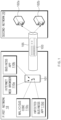
- FIG. 1 illustrates an environment including a plurality of networks.
- a first network 10 and a second network 20 may be different networks from each other.
- the first network 10 may be a public network such as Internet
- the second network 20 may be a private network such as an intranet or VPN.
- the first network 10 may include a terminal 101.
- 'terminal(s)' may be various types of devices capable of performing data communication.
- the terminal 101 may include a portable device such as a smartphone or tablet, a computer device such as a desktop or laptop, a multimedia device, a medical device, a camera, a wearable device, a virtual reality (VR) device, or a home appliance device, but is not limited to the devices described above.
- the terminal 101 may also be referred to as an 'electronic device' or a 'node'.
- the terminal 101 may attempt to access the second network 20 and may transmit data to servers 102a and 102b included in the second network 20.
- the terminal 101 may transmit data to the servers 102a and 102b through a gateway 103 and a tunnel 105.
- FIG. 1 illustrates an example in which the second network 20 includes only a server.
- the second network 20 may further include an electronic device such as the terminal 101 or a terminal.
- the terminal 101 may communicate with all servers included in the first network 10, and thus the terminal 101 may be exposed from attacks by malicious programs. For example, in addition to trusted and/or secure applications such as an Internet web browser 110a and a business application 110b, the terminal 101 may receive data of untrusted or unsecured applications such as a malicious code 110c and an infected business application 110d.
- trusted and/or secure applications such as an Internet web browser 110a and a business application 110b
- the terminal 101 may receive data of untrusted or unsecured applications such as a malicious code 110c and an infected business application 110d.
- the terminal 101 infected by a malicious program may attempt to access the second network 20 and/or to transmit data.
- the second network 20 is formed based on IP, such as VPN, it may be difficult for the second network 20 to individually monitor a plurality of devices included in the second network 20.
- the second network 20 may be vulnerable to security for an application layer or a transport layer in an OSI layer.
- the terminal 101 includes a malicious application after a tunnel has already been generated, the data of the malicious application may be delivered to another electronic device in the second network 20.
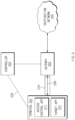
- FIG. 2 illustrates architecture in a network environment, according to various embodiments.
- the number of a terminal 201, a gateway 203, and a destination network 205 is not limited to the number shown in FIG. 2 .
- the terminal 201 may transmit data to a plurality of destination networks through a plurality of gateways, and a controller 202 may manage a plurality of terminals and a gateway.
- the terminal 201 may perform a function identical or similar to that of the terminal 101 shown in FIG. 1 ;
- the gateway 203 may perform a function identical or similar to that of the gateway 103 shown in FIG. 1 ;
- the destination network 205 may have a structure identical or similar to that of the first network 10 or the second network 20 of FIG. 1 .
- the controller 202 may be a server (or a cloud server).
- the controller 202 may guarantee reliable data transmission in a network environment by managing data transmission between the terminal 201, the gateway 203, and another network (e.g., the destination network 205).
- the controller 202 may manage access of the terminal 201 to the destination network 205 through policy information or blacklist information, may relay the generation of an authorized tunnel 210 between the terminal 201 and the gateway 203, or may remove the tunnel 210 depending on the security event collected from the terminal 201 or the gateway 203.
- the terminal 201 may communicate with the destination network 205 only through the tunnel 210 authorized by the controller 202. When the authorized tunnel 210 is not present, the terminal 201 may be blocked from accessing the destination network 205.
- the controller 202 may transmit or receive control data packets to or from the terminal 201 to perform various operations (e.g., registration, approval, authentication, update, and termination) associated with network access of the terminal 201.
- a flow e.g., 220
- a control flow through which a control data packet is transmitted may be referred to as a control flow.
- the gateway 203 may be positioned on the boundary of the network, to which the terminal 201 belongs, or on the boundary of the destination network 205.
- the plurality of gateways 203 may be present.
- the gateway 203 may forward only a data packet, which is received through the authorized tunnel 210, from among data packets received from the terminal 201 to the destination network 205.
- a flow (e.g., 230) through which a data packet is transmitted between the terminal 201 and the gateway 203 or between the gateway 203 and the destination network 205 may be referred to as a "data flow".
- the gateway 203 may be connected to the controller 202 based on a cloud.
- the gateway 203 may generate the tunnel 210, which is authorized and which is connected to the terminal 201, under the control of the controller 202. According to an embodiment, even though a data packet transmitted from terminal 201 is received through the authorized tunnel, the gateway 203 may control the forwarding of the data packet depending on whether the data packet requires authentication.
- the terminal 201 may include an access control application 211, which manages network access of an application stored in the terminal 201, and a network driver (not shown). For example, when an event that a target application 221 (e.g., an application (one of 110a to 110d) of FIG. 1 ) included in the terminal 201 accesses the destination network 205 occurs, the access control application 211 may determine whether access of the target application 221 is possible. When the access of the target application 221 is possible, the access control application 211 may transmit a data packet to the gateway 203 through the tunnel 210. As another example, the access control application 211 may determine whether authentication is required depending on the target application 221 and the destination network 205 (e.g., IP or port information). When the authentication is required, the access control application 211 may not transmit a data packet until the authentication is completed. The access control application 211 may control the transmission of a data packet through a kernel including an operating system and a network driver within the terminal 201.
- a kernel including an operating system and a
- FIG. 3 is a functional block diagram illustrating a database stored in a controller (e.g., the controller 202 of FIG. 2 ), according to various embodiments.
- a controller may further include a communication circuit (e.g., a communication circuit 430 of FIG. 4 ) for communicating with an external electronic device (e.g., the terminal 201 or the gateway 203 in FIG. 2 ) and a processor (e.g., a processor 410 of FIG. 4 ) for controlling overall operations of the controller.
- a communication circuit e.g., a communication circuit 430 of FIG. 4
- an external electronic device e.g., the terminal 201 or the gateway 203 in FIG. 2
- a processor e.g., a processor 410 of FIG. 4
- the controller may store, in the memory 330, databases 311 to 317 for controlling network access and data transmission.
- the access policy database 311 may include information associated with a network, service, and/or authentication that an identified network, an identified terminal, an identified user, an identified application, or an unidentified user (e.g., a guest) is capable of accessing. For example, when a request for access to the destination network is received from the terminal, the controller may determine whether the identified network (e.g., a network to which the terminal belongs), terminal, user (e.g., a user of the terminal), and/or application (e.g., an application included in the terminal) is capable of accessing a destination network, whether the authentication for them is required, and an authentication method, based on the access policy database 311.
- the identified network e.g., a network to which the terminal belongs
- terminal e.g., a user of the terminal
- application e.g., an application included in the terminal
- the tunnel policy database 312 may include an encryption method, encryption level information, and the type of a tunnel, which is to be connected between a source node (e.g., a terminal) and a gateway present on the boundary of a network on a connection path. For example, when a request for the access to the destination network is received from a terminal, the controller may provide the terminal with an optimal tunnel for accessing the destination network and information about the optimal tunnel based on the tunnel policy database 312.
- the blacklist policy database 313 may include a policy for permanently or temporarily blocking the access of a specific terminal.
- the blacklist policy database 313 may be generated based on information (e.g., at least one of a terminal identifier (ID), an IP address, a media access control (MAC) address, or a user ID) identified through the risk level, occurrence period, and/or behavioral analysis of a security event among security events periodically collected at a terminal or gateway.
- ID terminal identifier
- IP address IP address
- MAC media access control
- the control flow may have an expiration time.
- the terminal needs to update the expiration time of the control flow.
- the control flow (or the control flow information) may be removed.
- the controller may remove the control flow depending on an access termination request of the terminal. Because the pre-generated tunnel and data flow are also removed when the control flow is removed, the terminal may be blocked from accessing to the network.
- a terminal may include the processor 410, a memory 420, and the communication circuit 430. According to an embodiment, the terminal may further include a display 440 for interfacing with a user.
- the processor 410 may control overall operations of the terminal.
- the processor 410 may include a single processor core or may include a plurality of processor cores.
- the processor 410 may include a multi-core such as a dual-core, a quad-core, a hexa-core, or the like.
- the processor 410 may further include a cache memory positioned inside or outside the processor 410.
- the processor 410 may be configured with one or more processors.
- the processor 410 may include at least one of an application processor, a communication processor, or a graphical processing unit (GPU).
- GPU graphical processing unit
- All or part of the processor 410 may be electrically or operatively coupled with or connected to another component (e.g., the memory 420, the communication circuit 430, or the display 440) within the terminal.
- the processor 410 may receive a command from other components of the terminal, may interpret the received command, and may perform calculations or process data depending on the interpreted command.
- the processor 410 may interpret and process messages, data, instructions, or signals received from the memory 420, the communication circuit 430, or the display 440.
- the processor 410 may generate new messages, data, instructions, or signals based on the received messages, data, instructions, or signals.
- the processor 410 may provide the processed or generated messages, data, instructions, or signals to the memory 420, the communication circuit 430, or the display 440.
- the processor 410 may process data or signals, which is generated by a program and occurs in a program. For example, the processor 410 may request instructions, data, or signals from the memory 420 to execute or control a program. The processor 410 may write (or store) or update instructions, data, or signals to the memory 420 to execute or control the program.
- the memory 420 may store instructions for controlling the terminal, control command codes, control data, or user data.
- the memory 420 may include at least one of an application program, an operating system (OS), middleware, or a device driver.
- OS operating system
- middleware middleware
- device driver a device driver
- the memory 420 may include one or more of a volatile memory or a non-volatile memory.
- the volatile memory may include a dynamic random access memory (DRAM), a static RAM (SRAM), a synchronous DRAM (SDRAM), a phase-change RAM (PRAM), a magnetic RAM (MRAM), a resistive RAM (RRAM), a ferroelectric RAM (FeRAM), and the like.
- the non-volatile memory may include a read only memory (ROM), a programmable ROM (PROM), an electrically programmable ROM (EPROM), an electrically erasable programmable ROM (EEPROM), a flash memory, and the like.
- the memory 420 may further include nonvolatile media (medium) such as a hard disk drive (HDD), a solid state disk (SSD), an embedded multimedia card (eMMC), and universal flash storage (UFS).
- nonvolatile media such as a hard disk drive (HDD), a solid state disk (SSD), an embedded multimedia card (eMMC), and universal flash storage (UFS).
- HDD hard disk drive
- SSD solid state disk
- eMMC embedded multimedia card
- UFS universal flash storage
- the memory 420 may store some of information included in a memory (e.g., the memory 330 of FIG. 3 ) of the controller.
- the memory 420 may store the tunnel table 316 and the data flow table 317 that are described with reference to FIG. 3 .
- the communication circuit 430 may establish a wired or wireless communication connection between the terminal and an external electronic device (e.g., the controller 202 or the gateway 203 of FIG. 2 ) and may support communication execution through the established communication connection.
- the communication circuit 430 may include a wireless communication circuit (e.g., a cellular communication circuit, a short-range wireless communication circuit, or a global navigation satellite system (GNSS) communication circuit) or a wired communication module (e.g., a local area network (LAN) communication circuit or a power line communication circuit) and may communicate with the external electronic device by using a corresponding communication circuit among them through the short-range communication network such as a Bluetooth, a WiFi direct, or an infrared data association (IrDA)) or the long-distance communication network such as a cellular network, an Internet, or a computer network.
- the above-mentioned various communication circuits 430 may be implemented into one chip or may be respectively implemented into separate chips.
- the display 440 may output content, data, or a signal.
- the display 440 may display image data processed by the processor 410.
- the display 440 may be configured with an integrated touch screen by being coupled with a plurality of touch sensors (not shown) capable of receiving a touch input or the like.
- the plurality of touch sensors may be disposed above the display 440 or below the display 440.
- FIG. 5 illustrates an operation of controlling transmission of a data packet, according to various embodiments.
- the access control application 211 may detect a request for access to the destination network 205 of the target application 221 and then may determine whether the terminal 201 or the target application 221 is connected to the controller 202. When the terminal 201 or the target application 221 is not connected to the controller 202, the access control application 211 may block transmission of a data packet from a kernel including an operating system or network driver (operation 510). The terminal 201 may block the access of a malicious application in the application layer of an OSI layer in advance through the access control application 211.
- an unauthorized data packet may be transmitted from the terminal 201.
- the gateway 203 which is present on the boundary of a network, blocks data packets received through an unauthorized tunnel (operation 520), a data packet (e.g., a data packet for generating a TCP session) transmitted from the terminal 201 may not reach the destination network 205.
- the terminal 201 may be isolated from the destination network 205.
- FIGS. 6 and 7 illustrate an operation of accessing a controller, according to various embodiments.
- FIG. 6 shows a signal flow diagram for accessing a controller.
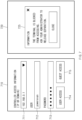
- FIG. 7 shows a user interface screen for accessing a controller.
- the access control application 211 of the terminal 201 may attempt to access a controller of the terminal 201, by requesting the controller 202 to generate a control flow.
- the terminal 201 may detect a controller access event.
- the access control application 211 is installed and executed within the terminal 201, and then the terminal 201 may detect that access to the controller 202 is requested, through the access control application 211.
- the terminal 201 may display a user interface screen 710 for receiving information necessary to access a controller.
- the user interface screen 710 may include an input window 711 for entering an IP or domain of the controller 202, an input window 712 for entering a user ID, and/or an input window 713 for entering a password.
- the terminal 201 may detect a controller access event by receiving a button 714 that allows an authenticated user to access the controller.
- the terminal 201 may detect the controller access event by receiving a button 715 that allows an unauthorized user (i.e., a guest) to access the controller.
- the terminal 201 may make a request for controller access to the controller 202 in response to detecting the controller access event.
- the terminal 201 may request controller access through the access control application 211.
- the access control application 211 may transmit, to the controller 202, identification information (e.g., a terminal ID, an IP address, or an MAC address) of the terminal 201, the type of the terminal 201, the location of the terminal 201, the environment of the terminal 201, identification information of a network to which the terminal 201 belongs, and/or identification information of the access control application 211.
- identification information e.g., a terminal ID, an IP address, or an MAC address
- the controller 202 may identify whether the terminal 201 is accessible, in response to the received request. According to an embodiment, the controller 202 may determine whether the terminal 201 is accessible, based on a database included in a memory (e.g., the memory 330 in FIG. 3 ) of the controller 202. For example, the controller 202 may determine whether the terminal 201 is accessible, based on whether the information received from the access control application 211 is included in the access policy database and whether the identification information of the terminal 201 and/or a network to which the terminal 201 belongs is included in a blacklist database.
- a memory e.g., the memory 330 in FIG. 3
- the controller 202 may generate a control flow between the terminal 201 and the controller 202.
- the controller 202 may generate control flow identification information in a form of random numbers and then may store the identification information of the terminal 201 and/or the network, to which the terminal 201 belongs, in a control flow table.
- Information e.g., control flow identification information and/or control flow information
- stored in the control flow table may be used for user authentication of the terminal 201, information update of the terminal 201, policy check for network access of the terminal 201, and/or a validity check.
- the controller 202 may transmit, to the terminal 201, a response to the controller access request. In this case, the controller 202 may transmit the generated control flow identification information to the terminal 201.
- the terminal 201 may process a result value depending on the received response.
- the access control application 211 may store the received control flow identification information and then may display a user interface screen indicating that controller access is completed, to the user.
- a request for network access of the terminal 201 to a destination network may be controlled by the controller 202.
- the controller 202 may determine that access of the terminal 201 is impossible. For example, when the identification information of the terminal 201 and/or the network to which the terminal 201 belongs is included in a blacklist database, the controller 202 may determine that access of the terminal 201 is impossible. In this case, in operation 620, the controller 202 may transmit a response indicating that the access of the terminal 201 is impossible, without generating a control flow in operation 615.
- the terminal 201 may output a user interface screen indicating that the access of the terminal 201 is impossible, to the user.
- the terminal 201 may display a user interface screen 720 through the access control application 211.
- the user interface screen 720 indicates that access of the terminal 201 is blocked, and may include a user interface 725 for guiding the release of isolation through an administrator (e.g., the controller 202).
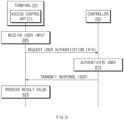
- FIG. 8 illustrates a signal flow diagram for user authentication, according to various embodiments.
- the access control application 211 of the terminal 201 may receive authentication for a user of the terminal 201 from the controller 202.
- the user authentication shown in FIG. 8 may be performed independently of the authentication described with reference to FIGS. 9 and 13 .
- user authentication shown in FIG. 8 may be performed before network access.
- the terminal 201 may receive an input for user authentication.
- the input for user authentication may be a user input for entering a user ID and password.
- the input for user authentication may be a user input (e.g., biometric information or multi-factor authentication) for more enhanced authentication.
- the terminal 201 may make a request for user authentication to the controller 202.
- the access control application 211 may transmit input information for user authentication to the controller 202.
- the access control application 211 may transmit the input information for user authentication together with control flow identification information.
- the controller 202 may authenticate a user based on information received from the terminal 201. For example, the controller 202 may determine whether the user is accessible depending on an access policy and whether the user is included in a blacklist, based on a user ID, a password, and/or enhanced authentication information, which are included in the received information, and a database (e.g., the access policy database 311 or the blacklist database 314 of FIG. 3 ) included in a memory of the controller 202.
- a database e.g., the access policy database 311 or the blacklist database 314 of FIG. 3
- the controller 202 may add identification information (e.g., user ID) of the user to identification information of a control flow.
- identification information e.g., user ID
- the added user identification information may be used for the authenticated user's controller access or network access.
- the controller 202 may transmit information indicating that the user is authenticated, as a response to a user authentication request to the terminal 201.
- the terminal 201 may process a result value for user authentication.
- the terminal 201 may display a user interface screen indicating that the user authentication is completed, to the user.
- the controller 202 may determine that user authentication is impossible. For example, when identification information of the user is included in a blacklist database, the controller 202 may determine that the user authentication is impossible. In this case, in operation 820, the controller 202 may transmit, to the terminal 201, information indicating that user authentication is impossible. In operation 825, the terminal 201 may display a user interface screen indicating that user authentication has failed.
- FIGS. 9 , 10A , 10B , and 10C describe an operation of controlling network access, according to various embodiments.
- FIG. 9 illustrates a flowchart of a signal for controlling network access.
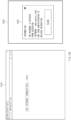
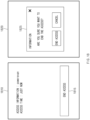
- FIG. 10A illustrates a user interface screen when network access is blocked.
- FIG. 10B illustrates a user interface screen when network access is permitted.
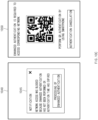
- FIG. 10C illustrates a user interface screen for enhanced authentication.
- the terminal 201 may guarantee reliable data transmission by controlling network access of other applications stored in the terminal 201 through the access control application 211 of the terminal 201.
- the terminal 201 may guarantee more enhanced security by controlling network access of other applications further based on not only an authorized tunnel, but also whether a data flow is authenticated.
- the access control application 211 may make a request for network access of the target application to the controller 202.
- the access control application 211 may transmit, to the controller 202, identification information of a target application, an IP of an access target, and/or service port information together with identification information of the control flow generated between the terminal 201 and the controller 202.
- the controller 202 may determine whether a target application is accessible, whether authentication is required, and/or whether a valid tunnel (or an authorized tunnel) for accessing the destination network is present, based on the request received from the access control application 211.
- the controller 202 may determine whether the target application is accessible, based on whether information (e.g., an ID of the target application, an access target ID, and/or service port information) received from the access control application 211 satisfies an access policy corresponding to information (e.g., information of a terminal, a user, and/or a source network) identified in the control flow.
- information e.g., an ID of the target application, an access target ID, and/or service port information
- the controller 202 may transmit, to the terminal 201, a response indicating that access is impossible.
- the access control application 211 may drop a data packet of the target application and may display a user interface screen indicating that access to the network is impossible.
- the controller 202 may generate authentication request information depending on the enhanced authentication method (e.g., virtual keypad input-based authentication, two-factor authentication between a PC and a smartphone, or two-factor authentication using ARS and SMS) included in the authentication policy and, in operation 925, may transmit a response requesting enhanced authentication to the terminal 201.
- the enhanced authentication method e.g., virtual keypad input-based authentication, two-factor authentication between a PC and a smartphone, or two-factor authentication using ARS and SMS
- the controller 202 may determine whether an authorized tunnel is present between the terminal 201 and the gateway 203. For example, the controller 202 may identify a TEP and/or a tunnel type in a tunnel policy corresponding to a destination network and then may determine whether an authorized tunnel corresponding to the identified TEP is present in a tunnel table. When the authorized tunnel is present, the controller 202 may generate data flow information including information for using a pre-generated tunnel.
- the data flow information may include a tunnel ID of the pre-generated tunnel, an ID of an application (e.g., an access control application or a target application) authorized to manage access between a terminal, which is TSP, and a gateway, which is TEP, an IP or service port of a destination network, and/or header information to be used for an authenticated data packet.
- the controller 202 may transmit the generated data flow information to the terminal 201 and the gateway 203 (in operation 920 and operation 925).
- the controller 202 may generate data flow information including information (e.g., a tunnel type, a method, authentication information, and/or the IP and port of TEP) and then may transmit the generated information to the gateway 203 and the terminal 201 (in operation 920 and operation 925).
- information e.g., a tunnel type, a method, authentication information, and/or the IP and port of TEP
- the controller 202 may notify the terminal 201 that network access is impossible.
- the access control application 211 may drop a data packet of the target application and may display a user interface screen indicating that network access is impossible.
- the access control application 211 may process a result value depending on the response received in operation 925.
- the access control application 211 may drop the data packet and may output a user interface screen indicating that the network access is impossible.
- the terminal 201 may output a user interface screen 1010 or 1020 indicating that the access to the destination network is blocked, through the display.
- the user interface screen 1010 or 1020 may include a text 1015 or a pop-up window 1025, which indicates that access is blocked.
- the access control application 211 may generate a tunnel to be connected to the gateway 203 in operation 935 and then may transmit the data packet of the target application through the generated tunnel in operation 940.
- the access control application 211 may receive a data packet from the destination network and may process data provided by the destination network.
- the terminal 201 may output the screen 1030 provided from the destination network (e.g., a website), where access is allowed, through a display.
- the access control application 211 may drop a data packet and may display a user interface screen indicating that network access is impossible.
- the access control application 211 may transmit a data packet of the target application to the gateway 203 through a tunnel corresponding to the tunnel ID in operation 940 without performing an additional tunnel generation procedure.
- the access control application 211 may perform enhanced authentication.
- the terminal 201 may output a user interface screen 1040 indicating that enhanced authentication is required, through a display. Because the enhanced authentication has not been performed or the authentication time has expired, the user interface screen 1040 may include a pop-up window 1045 indicating that network access is blocked.
- the terminal 201 may make a request for the enhanced authentication to a user.
- the terminal 201 may output a user interface screen 1050 that requires authentication (e.g., QR authentication) according to a specified authentication method through a display.
- the terminal 201 may make a request for various types of authentication (e.g., a key-in method, a biometric information input, or multi-factor authentication) in addition to the QR authentication to the user.
- the access control application 211 and the gateway 203 may add data flow information received from the controller 202 to the data flow table and then may add information about the newly-generated tunnel to a tunnel table.
- FIG. 9 illustrates an embodiment in which the access control application 211 directly makes a request for network access to the controller 202 in response to detecting a network access event.
- the access control application 211 may determine whether valid data flow information is present before the access control application 211 requests network access, whether authentication for data flow is valid, and/or whether an authorized tunnel is present, or may check validity of the target application.
- the access control application 211 may transmit or drop a data packet depending on the determination result and check result. This will be more fully described with reference to FIGS. 11 and 12 .
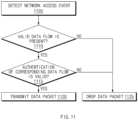
- FIG. 11 illustrates a flowchart of an operation for controlling network access in a terminal, according to various embodiments. Operations described below may be performed through the terminal 201 of FIG. 9 .
- a terminal may perform operations of FIG. 11 by executing instructions stored in a memory through a processor.
- the instructions stored in the memory may be software or programs such as the access control application 211 of FIG. 9 .
- the terminal may detect a network access event. For example, when a user attempts to access a destination network through a target application such as a specific web browser, the terminal may detect the network access event.
- the terminal may determine whether a valid data flow is present. For example, the terminal may identify the IP and service port information of a target application requesting access and a destination (or a destination network) and then may determine whether data flow information corresponding to the information identified is present in the data flow table. When there is no valid data flow (i.e., when there is no data flow information corresponding to the identified information), in operation 1125, the terminal may drop a data packet.
- the terminal may determine whether the authentication of the corresponding data flow is valid. For example, the terminal may identify the authentication state of the identified data flow (or data flow information). When data flow authentication is required, or the authentication time of a data flow has expired, the terminal may determine that authentication of a data flow is not valid. In this case, in operation 1125, the terminal may drop the data packet.
- the terminal may transmit a data packet depending on a data flow policy.
- FIG. 11 illustrates an operation in which the terminal identifies the validity of a data flow and the validity of the data flow authentication.
- the terminal may determine whether an authorized tunnel is present between the terminal and a gateway positioned on the boundary of the destination network.
- the access control application may determine whether a tunnel corresponding to identification information of the target application and a destination network (e.g., destination IP) is present in the data flow table stored in the terminal.
- the authorized tunnel may be a tunnel authorized by an external server (e.g., the controller 202 in FIG. 9 ).
- the terminal may transmit a data packet of the target application through the authorized tunnel.
- the terminal may drop the data packet.
- FIG. 12 is a flowchart illustrating another operation for controlling network access in a terminal, according to various embodiments.
- the operation flowchart shown in FIG. 12 may be performed after operation 1125 of FIG. 11 .
- the terminal may guarantee the integrity and stability of a target application by performing the validity check of the target application.
- the access control application may determine whether the target application is forged or tampered, or may test a code signing check and/or a fingerprint check.
- the access control application may determine whether a target application, an access target IP, and a service port are accessible, based on an access policy database received from an external server.
- the external server may be a server that manages the network access of a terminal as shown in the controller 202 of FIG. 9 .
- the terminal may drop a data packet without requesting network access.
- the terminal may make a request for network access to an external server.
- the terminal may be registered in the external server through the controller access of FIG. 6 or the user authentication procedure of FIG. 8 .
- a control flow between the terminal and the external server may be generated.
- the terminal may transmit, to the external server, identification information of a target application, IP of an access target, and identification information of a control flow between the terminal and the external server for a network access request.
- the terminal may receive data flow information from an external server.
- the data flow information may include tunnel information required to transmit a data packet, control flow information allocated to the terminal, information indicating whether authentication is required, identification information for checking whether network access is authenticated, and authentication request information (e.g., an authentication method, an authentication token, and/or an authentication target) required for authentication.
- authentication request information e.g., an authentication method, an authentication token, and/or an authentication target
- the data flow information may not include authentication information.
- the data flow information may include information (e.g., a tunnel ID, an ID of an application authorized to manage access between a terminal, which is TSP, and a gateway, which is TEP, an IP or service port of a destination network, and/or header information to be used for an authenticated data packet) associated with the pre-generated tunnel.
- the data flow information may include information (e.g., a tunnel type, a method, authentication information, and/or IP and port of TEP) required to generate a tunnel.
- the terminal may perform authentication (or enhanced authentication) for data flow based on the received data flow information. For example, the terminal may make a request for a series of information to a user based on an authentication method indicated by the data flow information and then may obtain enhanced authentication information from the user. For example, virtual keypad input-based authentication, two-factor authentication between a PC and a smartphone, and two-factor authentication using ARS and SMS may be used for the enhanced authentication.
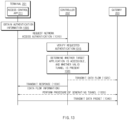
- FIG. 13 illustrates a signal flow diagram for authenticating network access, according to various embodiments.
- the access control application 211 included in the terminal 201 may obtain enhanced authentication information (e.g., operation 1220 of FIG. 12 ).
- the access control application 211 may request network access authentication from the controller 202. For example, the access control application 211 may transmit enhanced authentication information to the controller 202. Additionally, the access control application 211 may transmit the IP and/or service port information of a target application and an access target. Additionally, the access control application 211 may transmit control flow identification information allocated to the terminal 201 together with enhanced authentication information.
- the controller 202 may verify the requested authentication. For example, the controller 202 may determine whether the authentication information obtained from the access control application 211 is valid, based on the authentication method matched with information (e.g., the IP and/or service port information of the target application and the access target) identified on a control flow. When authentication information is not valid, in operation 1330, the controller 202 may transmit information indicating that authentication fails, as a response.
- information e.g., the IP and/or service port information of the target application and the access target
- the controller 202 may determine whether a target application is accessible and/or whether a valid tunnel (or an authorized tunnel) for accessing the destination network is present, from the access control application 211.
- the controller 202 may determine whether the target application is accessible, based on whether information (e.g., an ID of the target application, an access target ID, and/or service port information) received from the access control application 211 satisfies an access policy corresponding to information (e.g., information of a terminal, a user, and/or a source network) identified in the control flow.
- information e.g., an ID of the target application, an access target ID, and/or service port information
- information e.g., information of a terminal, a user, and/or a source network
- the controller 202 may determine whether an authorized tunnel is present between the terminal 201 and the gateway 203. For example, the controller 202 may identify a TEP and/or a tunnel type in a tunnel policy corresponding to a destination network and then may determine whether an authorized tunnel corresponding to the identified TEP is present in a tunnel table. When the authorized tunnel is present, the controller 202 may generate data flow information including information for using a pre-generated tunnel.
- the data flow information may include a tunnel ID of the pre-generated tunnel, an ID of an application (e.g., an access control application or a target application) authorized to manage access between a terminal, which is TSP, and a gateway, which is TEP, an IP or service port of a destination network, and/or header information to be used for an authenticated data packet.
- the controller 202 may transmit the generated data flow information to the terminal 201 and the gateway 203 (in operation 1330 and operation 1325).
- the controller 202 may generate data flow information including information (e.g., a tunnel type, a method, authentication information, and/or the IP and port of TEP) and then may transmit the generated information to the gateway 203 and the terminal 201 (in operation 1330 and operation 1325).
- information e.g., a tunnel type, a method, authentication information, and/or the IP and port of TEP
- the controller 202 may notify the terminal 201 that network access is impossible.
- the access control application 211 may process a result value depending on the response received in operation 1330.
- the access control application 211 may drop the data packet and may output a user interface screen indicating that the network access is impossible.
- the access control application 211 may generate a tunnel to be connected to the gateway 203 in operation 1335 and then may transmit the data packet of the target application through the generated tunnel in operation 1340.
- the access control application 211 may drop a data packet and may display a user interface screen indicating that network access is impossible.
- the access control application 211 may transmit a data packet of the target application to the gateway 203 through a tunnel corresponding to the tunnel ID in operation 1340 without performing an additional tunnel generation procedure.
- the access control application 211 and the gateway 203 may add data flow information received from the controller 202 to the data flow table and then may add information about the newly-generated tunnel to a tunnel table.
- FIGS. 14 to 15 describe an operation for transmitting a packet into which header information is inserted, according to various embodiments.
- FIG. 14 illustrates a structure of a data packet.
- FIG. 15 illustrates a flowchart of an operation for transmitting a data packet in a terminal.
- a terminal may manipulate a packet based on the authentication request information, which is received from an external server (e.g., a controller) and which is included in the data flow information.
- the authentication request information may include whether a data flow header (or header information) that is authentication information is inserted and/or an insertion method.
- a data packet may include an IP header, a tunnel header, a TCP header, and a payload.
- the data packet may have a unique tunnel header and location depending on a tunneling algorithm and type.
- the determination of TCP access and access release may be determined through the TCP header.
- Whether a data packet is authorized (or valid) may be determined through the data flow header included in the payload.
- the data flow header may be inserted at a location (e.g., an IP header) that is advantageous to transmit a data packet.
- the payload in which the data flow header is inserted may be encapsulated and encrypted.
- the terminal may identify a header insertion method (or an authentication information insertion method) depending on a data flow rule.
- the header insertion method may be one of a header insertion method for TCP session authentication and a header insertion method for data packet authentication.
- the current header insertion method may be a header insertion method for TCP session authentication.
- the current header insertion method may be a header insertion method for a data packet.
- the terminal may insert a header into a payload of each of an SYN packet and an ACK packet.
- the SYN packet and the ACK packet may be used in the 3-way handshake process for the first TCP access.
- the terminal may insert a header into the payload of the data packet.
- the terminal may insert header information included in the data flow information received from the external server into the data packet.
- the terminal may enable the gateway to determine whether the data packet is valid, by inserting a header into the encrypted data packet.
- the terminal may perform fragmentation depending on a maximum transmission unit (MTU) value.
- the terminal may transmit the encapsulated and encrypted packet (or data packet) to the destination network.
- MTU maximum transmission unit
- FIG. 16 illustrates a flowchart of an operation for controlling forwarding (or routing) of a data packet in a gateway, according to various embodiments.
- a gateway may receive a data packet from a terminal.
- the gateway may determine whether the data packet is received through a tunnel authorized by an external server (e.g., a controller). When the data packet is not received through the authorized tunnel, in operation 1625, the gateway may drop the data packet.
- an external server e.g., a controller
- the gateway may determine whether the received data packet is valid.
- the gateway may determine whether data flow information corresponding to a destination IP and port information, which are included in the received data packet, is present in the data flow table of the gateway.
- the data flow table may be based on the data flow information received by the gateway from the controller.
- the gateway may determine whether the identified data flow is an enhanced authentication target. When data flow is not an enhanced authentication target, in operation 1620, the gateway may forward a data packet.
- the gateway may identify the authentication method.
- the authentication check method may be based on source IP, based on a TCP header, or based on a payload header.
- the gateway may determine whether the data flow information matching the source IP of the data packet is present.
- the gateway may determine whether a header is present in the payload of each of the SYN packet and the ACK packet for the 3-way handshaker, and then may determine whether the identified header matches the found data flow information.
- the gateway may determine whether a header is present in the payload of the data packet, and then may determine whether the identified header matches the found data flow information.
- the gateway may determine that the received data packet is invalid. In this case, in operation 1625, the gateway may drop the data packet.
- the gateway may identify an authentication expiration time of the data flow information. When the authentication expiration time has expired, the gateway may determine that the data packet is invalid.
- the gateway may forward the received data packet to a destination network.
- FIGS. 17 to 18 describe an operation for releasing network access, according to various embodiments.
- FIG. 17 illustrates a signal flow diagram for releasing network access.
- FIG. 18 illustrates a user interface screen for releasing network access.
- the terminal 201 may make a request for releasing network access to the controller 202.
- the terminal 201 may transmit, to the controller 202, identification information of a control flow between the terminal 201 and the controller 202 together with information requesting the release of the network access.
- the terminal 201 may attempt to release the network access in response to a network access release event, such as a user's request, the restart of the terminal 201, or a request of the access control application 211.
- a network access release event such as a user's request, the restart of the terminal 201, or a request of the access control application 211.
- the terminal 201 may receive a user input for selecting an access end button 1815 from a user interface screen 1810 output through a display.
- the terminal 201 may identify access termination to the user again by outputting a user interface screen 1820 including a pop-up window 1825.
- the terminal 201 may promptly perform operation 1705 without outputting the user interface screen 1520.
- the controller 202 may remove (or release) a control flow corresponding to the received identification information in response to a request of the terminal 201.
- the control flow When the control flow is removed, all tunnels and data flows that are dependent on the control flow may be removed.
- the controller 202 may request the gateway 203 to remove a tunnel and a data flow, which are dependent on the removed control flow.
- the controller 202 may transmit tunnel information and data flow information that are to be removed.
- the gateway 203 may remove the tunnel and data flow in response to the request of the controller 202.
- the terminal may no longer transmit data packets to a destination network.
Landscapes
- Engineering & Computer Science (AREA)
- Computer Security & Cryptography (AREA)
- Computer Networks & Wireless Communication (AREA)
- Signal Processing (AREA)
- Computer Hardware Design (AREA)
- Computing Systems (AREA)
- General Engineering & Computer Science (AREA)
- Business, Economics & Management (AREA)
- General Business, Economics & Management (AREA)
- Data Exchanges In Wide-Area Networks (AREA)
Claims (20)
- Endgerät (201), Folgendes umfassend:• eine Kommunikationsschaltung (430),• einen Prozessor (410), der funktionsmäßig mit der Kommunikationsschaltung (430) verbunden ist, und• einen Speicher (420), der funktionsmäßig mit dem Prozessor (410) verbunden und dafür konfiguriert ist, eine Zielanwendung und eine Zugriffssteuerungsanwendung (211) zu speichern,• wobei der Speicher (420) Anweisungen speichert, die bei Ausführung durch den Prozessor (410) das Endgerät (201) zu Folgendem veranlassen:• Erkennen eines Netzwerk-Zugriffsereignisses für ein Bestimmungsnetzwerk (205) der Zielanwendung durch die Zugriffssteuerungsanwendung (211),• Bestimmen, ob Datenstrominformationen vorhanden sind, die Identifizierungsinformationen der Zielanwendung und des Bestimmungsnetzwerks (205) entsprechen und von einem externen Server erzeugt werden, durch die Zugriffssteuerungsanwendung (211),• Bestimmen, ob eine Authentifizierung des Datenstroms gültig ist, basierend auf einer Authentifizierungsinformation, die in den Datenstrominformationen enthalten ist, durch die Zugriffssteuerungsanwendung (211),• wenn∘ kein gültiger Datenstrom vorhanden ist oder∘ die Authentifizierung eines Datenstroms nicht gültig ist oder∘ kein Authentifizierungstunnel vorhanden ist,• Ausführen einer Netzwerkverbindungsanfrage an den externen Server und• Empfangen des Datenstroms, der Authentifizierungsinformationen enthält, die von dem externen Server übertragen werden, und Verarbeiten eines Datenpakets der Zielanwendung, wenn die Datenstrominformationen nicht vorhanden sind oder die Authentifizierung des Datenstroms ungültig ist, und• Übertragen eines Datenpakets der Zielanwendung, wenn die Datenstrominformationen vorhanden sind und die Authentifizierung des Datenstroms gültig ist, und• die Authentifizierungsinformationen Informationen zum Durchführen einer Authentifizierungsanfrage beinhalten, die ein Authentifizierungsverfahren oder ein Authentifizierungszielt beinhalten.
- Endgerät (201) nach Anspruch 1, wobei die Anweisungen das Endgerät (201) zu Folgendem veranlassen:• Stellen einer Anfrage nach Netzwerkzugriff für das Bestimmungsnetzwerk (205) an einen externen Server (202) unter Verwendung der Kommunikationsschaltung (430), wenn die Datenstrominformationen nicht vorhanden sind oder die Authentifizierung des Datenstroms nicht gültig ist,• Empfangen einer ersten Antwort auf die Anfrage nach Netzwerkzugriff von dem externen Server (202),• Beziehen erweiterter Authentifizierungsinformationen von einem Benutzer durch die Zugriffssteuerungsanwendung (211), basierend auf einem Authentifizierungsverfahren, das durch die erste Antwort angegeben wird,• Übertragen der erweiterten Authentifizierungsinformationen an den externen Server (202) unter Verwendung der Kommunikationsschaltung (430),• Empfangen einer zweiten Antwort, die angibt, dass die erweiterten Authentifizierungsinformationen gültig sind, von dem externen Server (202) und• Übertragen des Datenpakets der Zielanwendung basierend auf der zweiten Antwort.
- Endgerät (201) nach Anspruch 1, wobei die Anweisungen das Endgerät (201) zu Folgendem veranlassen:• Bestimmen, ob ein Tunnel vorhanden ist, der den Identifizierungsinformationen der Zielanwendung und dem Bestimmungsnetzwerk (205) entspricht und der von einem externen Server (202) autorisiert ist, durch die Zugriffssteuerungsanwendung (211), wenn die Datenstrominformationen vorhanden sind und die Authentifizierung des Datenstroms gültig ist, und• Übertragen des Datenpakets der Zielanwendung, wenn der autorisierte Tunnel vorhanden ist, oder Verwerfen des Datenpakets der Zielanwendung, wenn der autorisierte Tunnel nicht vorhanden ist.
- Endgerät (201) nach Anspruch 3, wobei die Anweisungen das Endgerät (201) zu Folgendem veranlassen:• Stellen einer Anfrage nach Netzwerkzugriff für das Bestimmungsnetzwerk (205) an den externen Server (202) unter Verwendung der Kommunikationsschaltung (430), wenn der autorisierte Tunnel nicht vorhanden ist,• Empfangen einer dritten Antwort auf die Anfrage nach Netzwerkzugriff von dem externen Server (202),• Bestimmen, ob ein verfügbarer Tunnel vorhanden ist, basierend auf der dritten Antwort,• Übertragen des Datenpakets der Zielanwendung unter Verwendung der Kommunikationsschaltung (430) durch den verfügbaren Tunnel, wenn der verfügbare Tunnel vorhanden ist, oder Verwerfen des Datenpakets der Zielanwendung, wenn der verfügbare Tunnel nicht vorhanden ist.
- Endgerät (201) nach Anspruch 4, wobei die Anweisungen das Endgerät (201) zu Folgendem veranlassen:• Erzeugen eines Tunnels unter Verwendung der empfangenen Informationen derart, dass er mit einem Gateway (203) verbunden ist, das an einer Grenze des Bestimmungsnetzwerks (205) positioniert ist, wenn die Informationen zum Erzeugen des verfügbaren Tunnels von dem externen Server (202) empfangen werden, und• Übertragen des Datenpakets der Zielanwendung durch den erzeugten Tunnel unter Verwendung der Kommunikationsschaltung (430).
- Endgerät (201) nach Anspruch 1, ferner Folgendes umfassend:• eine Anzeige, die funktionsmäßig mit dem Prozessor (410) verbunden ist,• wobei die Anweisungen das Endgerät (201) zu Folgendem veranlassen:• Erkennen eines Steuerungszugriffsereignisses für einen externen Server (202) durch die Zugriffssteuerungsanwendung (211),• Stellen einer Anfrage nach Steuerungszugriff an den externen Server (202) unter Verwendung der Kommunikationsschaltung (430) als Antwort auf das erkannte Steuerungszugriffsereignis,• Empfangen einer vierten Antwort auf die Anfrage nach Steuerungszugriff von dem externen Server (202) und• Ausgeben eines Benutzerschnittstellen-Bildschirms, der angibt, dass der Zugriff auf den externen Server (202) abgeschlossen ist, oder angibt, dass der Zugriff auf den externen Server (202) gesperrt ist, durch die Anzeige, basierend auf der vierten Antwort.
- Endgerät (201) nach Anspruch 1, ferner Folgendes umfassend:• eine Anzeige, die funktionsmäßig mit dem Prozessor (410) verbunden ist,• wobei die Anweisungen das Endgerät (201) zu Folgendem veranlassen:• Empfangen einer ersten Benutzereingabe zum Anfragen nach einer Benutzerauthentifizierung durch die Zugriffssteuerungsanwendung (211) und• Stellen einer Anfrage nach Benutzerauthentifizierung für einen Benutzer des Endgeräts (201) an den externen Server (202) unter Verwendung der Kommunikationsschaltung (430), wobei die Anfrage nach Benutzerauthentifizierung Informationen beinhaltet, die der ersten Benutzereingabe entsprechen,• Empfangen einer fünften Antwort auf die Anfrage nach der Benutzerauthentifizierung von dem externen Server (202) und• Ausgeben eines Benutzerschnittstellen-Bildschirms, der angibt, dass die Benutzerauthentifizierung abgeschlossen ist, oder angibt, dass die Benutzerauthentifizierung fehlgeschlagen ist, durch die Anzeige, basierend auf der fünften Antwort.
- Endgerät (201) nach Anspruch 1,• Empfangen einer zweiten Benutzereingabe zum Anfragen nach Freigabe eines Netzwerkzugriffs und• Stellen einer Anfrage nach Freigabe des Netzwerkzugriffs an einen externen Server (202) durch die Kommunikationsschaltung (430) als Antwort auf die zweite Benutzereingabe.
- Endgerät (201) nach Anspruch 1, wobei die Anweisungen das Endgerät (201) zu Folgendem veranlassen:• Identifizieren eines Header-Einfügeverfahrens für ein zu übertragendes Paket,• Einfügen eines Headers in eine Nutzlast von jedem von einem SYN-Paket und einem ACK-Paket, wenn das Header-Einfügeverfahren für eine TCP-Sitzungsauthentifizierung verwendet wird, und• Einfügen eines Headers des Datenstroms in eine Nutzlast eines Datenpakets, wenn das Header-Einfügeverfahren verwendet wird, um das Datenpaket zu authentifizieren.
- Server (202), Folgendes umfassend:• eine Kommunikationsschaltung (430),• einen Speicher (330), der dafür konfiguriert ist, eine Datenbank (311 ... 317) zu speichern, und• einen Prozessor, der funktionsmäßig mit der Kommunikationsschaltung und dem Speicher verbunden ist,• wobei der Prozessor für Folgendes konfiguriert ist:• Empfangen einer ersten Anfrage nach Netzwerkzugriff für eine Zielanwendung, die in einem Endgerät (201) gespeichert ist, an ein Bestimmungsnetzwerk (205) von einer Zugriffssteuerungsanwendung (211) des Endgeräts (201), wobei die erste Anfrage Identifizierungsinformationen eines Steuerstroms, Identifizierungsinformationen der Zielanwendung und Identifizierungsinformationen des Bestimmungsnetzwerks (205) beinhaltet,• Bestimmen, ob auf die Zielanwendung zugegriffen werden kann, basierend auf Informationen, die in der ersten Anfrage und der Datenbank enthalten sind,• Bestimmen, ob eine Authentifizierung eines Datenstroms, welcher der Zielanwendung und dem Bestimmungsnetzwerk (205) entspricht, erforderlich ist, basierend auf der Datenbank, den Identifizierungsinformationen der Zielanwendung und den Identifizierungsinformationen des Bestimmungsnetzwerks (205), wenn auf die Zielanwendung zugegriffen werden kann,• wenn∘ kein gültiger Datenstrom vorhanden ist oder∘ die Authentifizierung des Datenstroms nicht gültig ist oder∘ kein Authentifizierungstunnel vorhanden ist,• Erzeugen von Authentifizierungsinformationen, basierend auf der Datenbank, und• Erzeugen eines Datenstroms, der die Authentifizierungsinformationen beinhaltet, und• Übertragen des Datenstroms an die Zugriffssteuerungsanwendung und das Gateway unter Verwendung der Kommunikationsschaltung und• die Authentifizierungsinformationen Informationen zum Durchführen einer Authentifizierungsanfrage beinhalten, die ein Authentifizierungsverfahren oder ein Authentifizierungsziel beinhalten.
- Server (202) nach Anspruch 10, wobei der Prozessor für Folgendes konfiguriert ist:• Übertragen einer Antwort, die ein Authentifizierungsverfahren angibt, an die Zugriffssteuerungsanwendung durch die Kommunikationsschaltung, wenn die Authentifizierung des Datenstroms erforderlich ist.
- Server (202) nach Anspruch 11, wobei der Prozessor für Folgendes konfiguriert ist:• Empfangen von Authentifizierungsinformationen, die durch das Authentifizierungsverfahren von dem Endgerät (201) bezogen werden,• Bestimmen, ob die Authentifizierungsinformationen gültig sind, basierend auf der Datenbank,• Übertragen einer Antwort, die angibt, dass der Netzwerkzugriff unmöglich ist, an die Zugriffssteuerungsanwendung durch die Kommunikationsschaltung, wenn die Authentifizierungsinformationen nicht gültig sind.
- Server (202) nach Anspruch 10, wobei der Prozessor für Folgendes konfiguriert ist:• Bestimmen, ob zwischen der Zielanwendung und einem Gateway (203) des Bestimmungsnetzwerks (205) ein autorisierter Tunnel vorhanden ist, basierend auf der Datenbank, den Identifizierungsinformationen der Zielanwendung und den Identifizierungsinformationen des Bestimmungsnetzwerks (205), wenn die Authentifizierungsinformationen gültig sind, und• Übertragen von Identifizierungsinformationen des autorisierten Tunnels, wenn der autorisierte Tunnel vorhanden ist,• Übertragen von Informationen die zum Erzeugen eines Tunnels erforderlich sind, wenn der autorisierte Tunnel nicht vorhanden ist, oder• Übertragen von Informationen, die angeben, dass der Netzwerkzugriff der Zielanwendung auf das Bestimmungsnetzwerk (205) unmöglich ist, wenn kein Tunnel vorhanden ist, der eine Richtlinie erfüllt, die in der Datenbank enthalten ist.
- Server (202) nach Anspruch 13, wobei der Prozessor für Folgendes konfiguriert ist:• Empfangen einer zweiten Anfrage nach Steuerungszugriff an den Server (202) von der Zugriffssteuerungsanwendung, wobei die zweite Anfrage Identifizierungsinformationen von mindestens einem von dem Endgerät (201), der Zugriffssteuerungsanwendung oder einem Netzwerk beinhaltet, zu dem das Endgerät (201) gehört,• Bestimmen, ob auf das Endgerät (201) zugegriffen werden kann, basierend auf den Identifizierungsinformationen, die in der zweiten Anfrage enthalten sind, und der Datenbank,• Erzeugen des Steuerstroms, wenn auf das Endgerät (201) zugegriffen werden kann, und• Übertragen von Identifizierungsinformationen des erzeugten Steuerstroms an das Endgerät (201) unter Verwendung der Kommunikationsschaltung.
- Server (202) nach Anspruch 14, wobei der Prozessor für Folgendes konfiguriert ist:• Empfangen einer dritten Anfrage zur Benutzerauthentifizierung für einen Benutzer des Endgeräts (201) von der Zugriffssteuerungsanwendung durch den Steuerstrom, wobei die dritte Anfrage Identifizierungsinformationen des Benutzers beinhaltet, der zu der Benutzerauthentifizierung gehört,• Authentifizieren des Benutzers des Endgeräts (201), basierend auf den Informationen, die in der dritten Anfrage enthalten sind, und der Datenbank, und• Übertragen eines Ergebnisses der Benutzerauthentifizierung an die Zugriffssteuerungsanwendung durch den Steuerstrom unter Verwendung der Kommunikationsschaltung.
- Server (202) nach Anspruch 15, wobei der Prozessor für Folgendes konfiguriert ist:• Empfangen einer vierten Anfrage nach Freigabe des Netzwerkzugriffs von der Zugriffssteuerungsanwendung,• Entfernen des Steuerstroms als Antwort auf die vierte Anfrage und• Stellen einer Anfrage zum Entfernen eines Datenstroms, der von dem Steuerstrom abhängig ist, an das Gateway (203) unter Verwendung der Kommunikationsschaltung.
- Gateway (203), für Folgendes konfiguriert:• Empfangen eines Datenpakets von einem Endgerät (201),• Bestimmen, ob das empfangene Datenpaket durch einen Tunnel empfangen wurde, der von einem externen Server (202) autorisiert wurde,• Bestimmen, ob ein Datenstrom vorhanden ist, der dem Datenpaket entspricht und von dem externen Server (202) empfangen wurde,• Bestimmen, ob das Datenpaket gültig ist, basierend auf Authentifizierungsinformationen, die in dem Datenpaket und dem Datenstrom enthalten sind,• Verwerfen des Datenpakets, wenn das Datenpaket nicht über den autorisierten Tunnel empfangen wurde oder das Datenpaket nicht gültig ist, oder Weiterleiten des Datenpakets an ein Bestimmungsnetzwerk (205), wenn das Datenpaket über den autorisierten Tunnel empfangen wurde und das Datenpaket gültig ist,• die Authentifizierungsinformationen basierend auf Authentifizierungsinformationen, die in Datenstrominformationen enthalten sind, die von dem externen Server erzeugt werden, an dem Endgerät in das Datenpaket eingefügt werden und• die Authentifizierungsinformationen Informationen zum Durchführen einer Authentifizierungsanfrage beinhalten, die ein Authentifizierungsverfahren oder ein Authentifizierungsziel beinhalten.
- Gateway (203) nach Anspruch 17, wobei das Gateway (203) für Folgendes konfiguriert ist:• Identifizieren einer Authentifizierungsverfallszeit der in dem Datenpaket enthaltenen Authentifizierungsinformationen und• Verwerfen des Datenpakets, wenn die Authentifizierungsverfallszeit verstrichen ist.
- Gateway (203) nach Anspruch 17, wobei das Gateway (203) für Folgendes konfiguriert ist:• Empfangen von Informationen, die zum Erzeugen des autorisierten Tunnels erforderlich sind, von dem externen Server (202) und• Erzeugen eines autorisierten Tunnels zwischen dem Endgerät (201) und dem Gateway (203) basierend auf den vom externen Server (202) empfangenen Informationen.
- Gateway (203) nach Anspruch 17, wobei das Gateway (203) für Folgendes konfiguriert ist:• Empfangen einer ersten Anfrage zum Entfernen eines Datenstroms zwischen dem Endgerät (201) und dem Bestimmungsnetzwerk (205) von dem externen Server (202) und• Entfernen des Datenstroms als Antwort auf die erste Anfrage.
Applications Claiming Priority (4)
| Application Number | Priority Date | Filing Date | Title |
|---|---|---|---|
| US16/580,866 US11190494B2 (en) | 2019-09-24 | 2019-09-24 | Application whitelist using a controlled node flow |
| US16/580,974 US11381557B2 (en) | 2019-09-24 | 2019-09-24 | Secure data transmission using a controlled node flow |
| KR1020200100062A KR102223827B1 (ko) | 2019-09-24 | 2020-08-10 | 단말의 네트워크 접속을 인증 및 제어하기 위한 시스템 및 그에 관한 방법 |
| PCT/KR2020/012929 WO2021060859A1 (ko) | 2019-09-24 | 2020-09-24 | 단말의 네트워크 접속을 인증 및 제어하기 위한 시스템 및 그에 관한 방법 |
Publications (4)
| Publication Number | Publication Date |
|---|---|
| EP4037277A1 EP4037277A1 (de) | 2022-08-03 |
| EP4037277A4 EP4037277A4 (de) | 2022-11-30 |
| EP4037277B1 true EP4037277B1 (de) | 2025-05-07 |
| EP4037277C0 EP4037277C0 (de) | 2025-05-07 |
Family
ID=75166745
Family Applications (1)
| Application Number | Title | Priority Date | Filing Date |
|---|---|---|---|
| EP20868832.5A Active EP4037277B1 (de) | 2019-09-24 | 2020-09-24 | System zur authentisierung und steuerung des netzzugriffs eines endgerätes und verfahren dafür |
Country Status (4)
| Country | Link |
|---|---|
| US (1) | US12267304B2 (de) |
| EP (1) | EP4037277B1 (de) |
| JP (2) | JP7395211B2 (de) |
| WO (1) | WO2021060859A1 (de) |
Families Citing this family (6)
| Publication number | Priority date | Publication date | Assignee | Title |
|---|---|---|---|---|
| CN112511569B (zh) * | 2021-02-07 | 2021-05-11 | 杭州筋斗腾云科技有限公司 | 网络资源访问请求的处理方法、系统及计算机设备 |
| US20230013489A1 (en) * | 2021-07-16 | 2023-01-19 | Vmware, Inc. | Managing l4 ports |
| KR102407135B1 (ko) | 2021-10-20 | 2022-06-10 | 프라이빗테크놀로지 주식회사 | 컨트롤러 기반의 네트워크 접속을 제어하기 위한 시스템 및 그에 관한 방법 |
| KR102407136B1 (ko) | 2021-11-15 | 2022-06-13 | 프라이빗테크놀로지 주식회사 | 컨트롤러 기반 네트워크 접속을 제어하기 위한 시스템 및 그에 관한 방법 |
| CN114390436B (zh) * | 2021-12-21 | 2024-04-02 | 深圳Tcl新技术有限公司 | 设备控制方法、装置、存储介质及电子设备 |
| US12401644B2 (en) * | 2023-08-22 | 2025-08-26 | Cisco Technology, Inc. | Enforcing conditional access to network services based on authorization statuses associated with network flows |
Family Cites Families (297)
| Publication number | Priority date | Publication date | Assignee | Title |
|---|---|---|---|---|
| JP3747520B2 (ja) | 1996-01-30 | 2006-02-22 | 富士ゼロックス株式会社 | 情報処理装置及び情報処理方法 |
| US6076168A (en) | 1997-10-03 | 2000-06-13 | International Business Machines Corporation | Simplified method of configuring internet protocol security tunnels |
| US6317837B1 (en) * | 1998-09-01 | 2001-11-13 | Applianceware, Llc | Internal network node with dedicated firewall |
| US6738909B1 (en) | 1999-09-02 | 2004-05-18 | International Business Machines Corporation | Method and apparatus for automatic configuration for internet protocol security tunnels in a distributed data processing system |
| US6963982B1 (en) | 1999-10-28 | 2005-11-08 | Lucent Technologies Inc. | Method and apparatus for application-independent end-to-end security in shared-link access networks |
| JP2001168913A (ja) | 1999-12-10 | 2001-06-22 | Hitachi Ltd | ネットワークポリシー転送方法および分散ルールベースプログラム転送方法 |
| US20020010800A1 (en) * | 2000-05-18 | 2002-01-24 | Riley Richard T. | Network access control system and method |
| US7139276B1 (en) | 2001-02-27 | 2006-11-21 | Cisco Technology, Inc. | Load sharing between L2TP tunnels |
| US7533409B2 (en) | 2001-03-22 | 2009-05-12 | Corente, Inc. | Methods and systems for firewalling virtual private networks |
| FI110464B (fi) | 2001-04-26 | 2003-01-31 | Nokia Corp | IP-tietoturva ja liikkuvat verkkoyhteydet |
| US7061899B2 (en) | 2001-05-01 | 2006-06-13 | Hewlett-Packard Development Company, L.P. | Method and apparatus for providing network security |
| KR100415554B1 (ko) | 2001-05-21 | 2004-01-24 | 한국전자통신연구원 | 정보 보호 인터넷 프로토콜 패킷의 송수신 방법 |
| US7085850B2 (en) | 2001-08-22 | 2006-08-01 | International Business Machines Corporation | Stateless message processing scheme for network processors interactions |
| US20030055978A1 (en) | 2001-09-18 | 2003-03-20 | Microsoft Corporation | Methods and systems for enabling outside-initiated traffic flows through a network address translator |
| US7215667B1 (en) | 2001-11-30 | 2007-05-08 | Corrent Corporation | System and method for communicating IPSec tunnel packets with compressed inner headers |
| US20030110379A1 (en) | 2001-12-07 | 2003-06-12 | Tatu Ylonen | Application gateway system, and method for maintaining security in a packet-switched information network |
| US7318234B1 (en) | 2002-02-19 | 2008-01-08 | Microsoft Corporation | Request persistence during session authentication |
| KR20030075810A (ko) | 2002-03-20 | 2003-09-26 | 유디에스 주식회사 | 공인네트워크와 비공인네트워크 사이에서의 데이터 통신시스템 및 그 방법 |
| US7185365B2 (en) | 2002-03-27 | 2007-02-27 | Intel Corporation | Security enabled network access control |
| US20030212900A1 (en) | 2002-05-13 | 2003-11-13 | Hsin-Yuo Liu | Packet classifying network services |
| TWI220344B (en) | 2002-10-23 | 2004-08-11 | Winbond Electronics Corp | Manufacture and method for accelerating network address translation |
| US7346770B2 (en) | 2002-10-31 | 2008-03-18 | Microsoft Corporation | Method and apparatus for traversing a translation device with a security protocol |
| US20040088385A1 (en) | 2002-11-01 | 2004-05-06 | Hexago Inc. | Method and apparatus for connecting IPV4 devices through an IPV6 network using a tunnel setup protocol |
| US7302496B1 (en) | 2002-11-12 | 2007-11-27 | Cisco Technology, Inc. | Arrangement for discovering a localized IP address realm between two endpoints |
| CN100431295C (zh) | 2002-11-26 | 2008-11-05 | 松下电器产业株式会社 | 数据加密、解密方法及装置 |
| US8027473B2 (en) | 2003-01-13 | 2011-09-27 | Conexant Systems, Inc. | System and method for improved data protection in PONs |
| JP4257151B2 (ja) | 2003-02-28 | 2009-04-22 | 富士通株式会社 | パケット制御システム、パケット制御装置、パケット中継装置およびパケット制御プログラム |
| US7468947B2 (en) | 2003-03-31 | 2008-12-23 | International Business Machines Corporation | Controlling data packet flows by manipulating data packets according to an actual manipulation rate |
| ATE391385T1 (de) | 2003-07-11 | 2008-04-15 | Ibm | Verfahren und system zur benutzerauthentifizierung in einer benutzer- anbieterumgebung |
| EP1658700B1 (de) | 2003-08-29 | 2008-06-25 | Nokia Corporation | Persönliche abgesetzte firewall |
| US20050111399A1 (en) * | 2003-11-25 | 2005-05-26 | Telefonaktiebolaget Lm Ericsson (Publ) | System and method providing secure access and roaming support for mobile subscribers in a semi-connected mode |
| US7610627B1 (en) | 2004-01-23 | 2009-10-27 | Acxiom Corporation | Secure data exchange technique |
| US7760636B1 (en) | 2004-01-26 | 2010-07-20 | Cisco Technology, Inc. | Retransmission and flow control in a logical network tunnel |
| US20050273853A1 (en) | 2004-05-24 | 2005-12-08 | Toshiba America Research, Inc. | Quarantine networking |
| US20050273609A1 (en) | 2004-06-04 | 2005-12-08 | Nokia Corporation | Setting up a short-range wireless data transmission connection between devices |
| US20050283604A1 (en) | 2004-06-21 | 2005-12-22 | Ipolicy Networks, Inc., A Delaware Corporation | Security association configuration in virtual private networks |
| US7840217B2 (en) | 2004-07-23 | 2010-11-23 | Cisco Technology, Inc. | Methods and apparatus for achieving route optimization and location privacy in an IPV6 network |
| US8291119B2 (en) | 2004-07-23 | 2012-10-16 | Citrix Systems, Inc. | Method and systems for securing remote access to private networks |
| US7512063B2 (en) | 2004-12-14 | 2009-03-31 | Cisco Technology, Inc. | Border router protection with backup tunnel stitching in a computer network |
| US8473750B2 (en) | 2004-12-15 | 2013-06-25 | Nvidia Corporation | Chipset security offload engine |
| US7920701B1 (en) | 2004-12-15 | 2011-04-05 | Nvidia Corporation | System and method for digital content protection |
| US8077632B2 (en) * | 2005-01-20 | 2011-12-13 | Citrix Systems, Inc. | Automatic LAN/WAN port detection |
| US7280826B2 (en) | 2005-02-01 | 2007-10-09 | Telefonaktiebolaget Lm Ericsson (Publ) | Method, system and apparatus for providing security in an unlicensed mobile access network or a generic access network |
| EP1694034B1 (de) | 2005-02-16 | 2014-05-21 | Alcatel Lucent | Methode zum Aufbau einer Peer-to-Peer Verbindung zwischen zwei Benutzer-Agenten die hinter symmetrischen NATs angeordnet sind |
| US8024488B2 (en) * | 2005-03-02 | 2011-09-20 | Cisco Technology, Inc. | Methods and apparatus to validate configuration of computerized devices |
| US7350074B2 (en) | 2005-04-20 | 2008-03-25 | Microsoft Corporation | Peer-to-peer authentication and authorization |
| US20060262808A1 (en) | 2005-04-21 | 2006-11-23 | Victor Lin | Methods and Systems for Fragmentation and Reassembly for IP Tunnels in Hardware Pipelines |
| US9009778B2 (en) | 2005-07-29 | 2015-04-14 | Rpx Clearinghouse Llc | Segmented network identity management |
| KR100692653B1 (ko) | 2005-11-15 | 2007-03-13 | 주식회사 케이티프리텔 | 무선 인터넷 데이터 중계 방법 및 이를 이용한 무선 인터넷데이터를 위한 액세스 게이트웨이 시스템 |
| KR100803273B1 (ko) | 2005-12-27 | 2008-02-13 | 삼성전자주식회사 | 패킷 터널링하는 isatap 라우터 및 그 방법 |
| JP2007208693A (ja) | 2006-02-02 | 2007-08-16 | Toshiba Corp | 通信装置、通信システム、通信方法および通信プログラム |
| JP4592611B2 (ja) | 2006-02-03 | 2010-12-01 | 富士通株式会社 | パケット通信システム |
| JP4727460B2 (ja) | 2006-03-09 | 2011-07-20 | 株式会社エヌ・ティ・ティ・データ | Vpn管理装置、プログラム及びvpn管理方法 |
| KR100748698B1 (ko) | 2006-03-17 | 2007-08-13 | 삼성전자주식회사 | 보안 통신 시스템의 패킷 처리 방법 및 그 장치 |
| US8923853B1 (en) | 2006-05-04 | 2014-12-30 | At&T Mobility Ii Llc | Dynamic provisioning system for policy-based traffic navigation for roaming traffic |
| US8000327B1 (en) | 2006-09-29 | 2011-08-16 | Juniper Networks, Inc. | Quality of service (QoS)-aware forwarding in an MPLS network with tactical traffic engineering |
| US7907595B2 (en) | 2006-09-29 | 2011-03-15 | Avaya, Inc. | Method and apparatus for learning endpoint addresses of IPSec VPN tunnels |
| US7706373B2 (en) * | 2006-11-01 | 2010-04-27 | Nuvoiz, Inc. | Session initiation and maintenance while roaming |
| US7995500B2 (en) | 2006-11-30 | 2011-08-09 | Cisco Technology, Inc. | Managing an amount of tunnels in a computer network |
| US7926098B2 (en) | 2006-12-29 | 2011-04-12 | Airvana, Corp. | Handoff of a secure connection among gateways |
| US7639625B2 (en) | 2007-03-02 | 2009-12-29 | Cisco Technology, Inc. | Tracing connection paths through transparent proxies |
| JP4888553B2 (ja) | 2007-03-30 | 2012-02-29 | 富士通株式会社 | 電子データ認証方法、電子データ認証プログラムおよび電子データ認証システム |
| US20080313240A1 (en) | 2007-06-18 | 2008-12-18 | Freking Ronald E | Method for Creating Data Transfer Packets With Embedded Management Information |
| JP5239341B2 (ja) | 2008-01-08 | 2013-07-17 | 日本電気株式会社 | ゲートウェイ、中継方法及びプログラム |
| EP2107848B1 (de) | 2008-03-31 | 2013-03-13 | Mitsubishi Electric R&D Centre Europe B.V. | Verfahren und Vorrichtung zur Durchführung der Weiterreichung zwischen Basisstationen eines mobilen Telekommunikationsnetzwerks für mobile Endgeräte |
| JP5074290B2 (ja) | 2008-05-13 | 2012-11-14 | 株式会社日立国際電気 | 冗長切替システム、冗長管理装置およびアプリケーション処理装置 |
| US8391834B2 (en) | 2009-01-28 | 2013-03-05 | Headwater Partners I Llc | Security techniques for device assisted services |
| JP2010011122A (ja) | 2008-06-27 | 2010-01-14 | Fujitsu Ltd | 暗号化パケット処理システム |
| US10033820B2 (en) | 2008-07-09 | 2018-07-24 | Alcatel-Lucent Usa Inc. | Method and system for opportunistic delivery of less-than-best-effort application data over communication networks |
| KR101541911B1 (ko) | 2008-07-16 | 2015-08-06 | 삼성전자주식회사 | 사용자 인터페이스에서 보안 서비스를 제공하는 장치 및 방법 |
| US8385199B1 (en) | 2009-01-26 | 2013-02-26 | Radisys Corporation | Adaptive traffic shaping for wireless communication systems |
| CN102282806B (zh) | 2009-03-30 | 2014-12-31 | 华为技术有限公司 | 实现数据转发的方法、网络系统及设备 |
| US9301191B2 (en) | 2013-09-20 | 2016-03-29 | Telecommunication Systems, Inc. | Quality of service to over the top applications used with VPN |
| US20100278338A1 (en) | 2009-05-04 | 2010-11-04 | Mediatek Singapore Pte. Ltd. | Coding device and method with reconfigurable and scalable encryption/decryption modules |
| US8806572B2 (en) | 2009-05-30 | 2014-08-12 | Cisco Technology, Inc. | Authentication via monitoring |
| JP2011015327A (ja) | 2009-07-06 | 2011-01-20 | Fujitsu Ltd | 通信管理装置および通信管理プログラム |
| US8391211B2 (en) | 2009-08-04 | 2013-03-05 | Mediatek Inc. | Methods for handling data transmission by a mobile station with multiple radio frequency transceivers and systems utilizing the same |
| WO2011043379A1 (ja) | 2009-10-06 | 2011-04-14 | 日本電気株式会社 | ネットワークシステムとコントローラと方法とプログラム |
| US20130232263A1 (en) | 2009-12-18 | 2013-09-05 | Morningside Analytics | System and method for classifying a contagious phenomenon propagating on a network |
| WO2011082150A1 (en) | 2009-12-28 | 2011-07-07 | Interdigital Patent Holdings, Inc. | Machine-to-machine gateway architecture |
| US8699488B2 (en) | 2009-12-30 | 2014-04-15 | Verizon Patent And Licensing Inc. | Modification of peer-to-peer based feature network based on changing conditions / session signaling |
| US8326929B2 (en) | 2009-12-30 | 2012-12-04 | Verizon Patent And Licensing Inc. | Peer-to-peer based feature network |
| JP5413737B2 (ja) | 2010-02-15 | 2014-02-12 | 日本電気株式会社 | ネットワークシステム、及び経路情報更新方法 |
| US8504818B2 (en) | 2010-04-15 | 2013-08-06 | Microsoft Corporation | Method and system for reliable protocol tunneling over HTTP |
| RU2562438C2 (ru) | 2010-09-09 | 2015-09-10 | Нек Корпорейшн | Сетевая система и способ управления сетью |
| KR101020470B1 (ko) | 2010-09-29 | 2011-03-08 | 주식회사 엔피코어 | 네트워크 침입차단 방법 및 장치 |
| US20120084368A1 (en) | 2010-10-05 | 2012-04-05 | Research In Motion Limited | Data channel set up latency reduction |
| US8289968B1 (en) | 2010-10-27 | 2012-10-16 | Juniper Networks, Inc. | Distributed network address translation in computer networks |
| KR101730954B1 (ko) | 2010-11-01 | 2017-04-27 | 에스케이텔레콤 주식회사 | 애플리케이션을 통한 보안 서비스 제공 시스템 및 방법, 그리고 이에 적용되는 장치 |
| CN101984574B (zh) | 2010-11-29 | 2012-09-05 | 北京卓微天成科技咨询有限公司 | 一种数据加解密方法及装置 |
| CN102130910B (zh) | 2011-02-28 | 2015-04-29 | 华为技术有限公司 | Tcp代理插入和卸载方法及业务网关设备 |
| US9716659B2 (en) | 2011-03-23 | 2017-07-25 | Hughes Network Systems, Llc | System and method for providing improved quality of service over broadband networks |
| US8873398B2 (en) | 2011-05-23 | 2014-10-28 | Telefonaktiebolaget L M Ericsson (Publ) | Implementing EPC in a cloud computer with openflow data plane |
| US8490172B2 (en) | 2011-05-25 | 2013-07-16 | Genband Us Llc | Methods, systems, and computer readable media for adaptive assignment of an active security association instance in a redundant gateway configuration |
| US8843998B2 (en) | 2011-06-27 | 2014-09-23 | Cliqr Technologies, Inc. | Apparatus, systems and methods for secure and selective access to services in hybrid public-private infrastructures |
| US9167501B2 (en) | 2011-08-29 | 2015-10-20 | Telefonaktiebolaget L M Ericsson (Publ) | Implementing a 3G packet core in a cloud computer with openflow data and control planes |
| US8762501B2 (en) | 2011-08-29 | 2014-06-24 | Telefonaktiebolaget L M Ericsson (Publ) | Implementing a 3G packet core in a cloud computer with openflow data and control planes |
| US8612612B1 (en) | 2011-09-28 | 2013-12-17 | Juniper Networks, Inc. | Dynamic policy control for application flow processing in a network device |
| US9529996B2 (en) | 2011-10-11 | 2016-12-27 | Citrix Systems, Inc. | Controlling mobile device access to enterprise resources |
| US8817815B2 (en) * | 2011-12-22 | 2014-08-26 | Cisco Technology, Inc. | Traffic optimization over network link |
| EP2753030A4 (de) | 2012-02-03 | 2015-01-21 | Huawei Tech Co Ltd | Flussidentifizierungsverfahren, vorrichtung und system |
| KR101173583B1 (ko) | 2012-02-22 | 2012-08-13 | 트루인연구소(주) | 모바일단말기에 설치된 어플리케이션 데이터 보안방법 |
| US9319439B2 (en) | 2012-05-10 | 2016-04-19 | Tangome, Inc. | Secured wireless session initiate framework |
| EP2847947B1 (de) | 2012-05-10 | 2020-12-23 | Samsung Electronics Co., Ltd. | Verfahren und system für verbindungslose übertragung bei der aufwärts- und abwärtsübermittlung von datenpaketen |
| US9300570B2 (en) | 2012-05-22 | 2016-03-29 | Harris Corporation | Multi-tunnel virtual private network |
| CN102694820B (zh) | 2012-06-13 | 2015-01-21 | 华为技术有限公司 | 签名规则的处理方法、服务器及入侵防御系统 |
| US8855014B2 (en) | 2012-06-15 | 2014-10-07 | Cisco Technology, Inc. | Distributed stateful path computation element overlay architecture |
| US20140059356A1 (en) | 2012-08-24 | 2014-02-27 | Iron Mountain Incorporated | Technique for reconfigurable data storage media encryption |
| US9973501B2 (en) | 2012-10-09 | 2018-05-15 | Cupp Computing As | Transaction security systems and methods |
| CN104904178B (zh) | 2012-10-15 | 2018-09-25 | 思杰系统有限公司 | 提供虚拟专用网络隧道的方法和设备及计算机可读介质 |
| US9584523B2 (en) * | 2012-10-30 | 2017-02-28 | Hewlett Packard Enterprise Development Lp | Virtual private network access control |
| KR20140055857A (ko) | 2012-11-01 | 2014-05-09 | 주식회사 케이티 | 이종망간 이동성 제공 시스템 및 방법 |
| US20140153577A1 (en) | 2012-12-03 | 2014-06-05 | Aruba Networks, Inc. | Session-based forwarding |
| US9252972B1 (en) | 2012-12-20 | 2016-02-02 | Juniper Networks, Inc. | Policy control using software defined network (SDN) protocol |
| EP2750349A1 (de) * | 2012-12-31 | 2014-07-02 | British Telecommunications public limited company | Verfahren und Vorrichtung zum sicheren Netzwerkzugang |
| US10341086B2 (en) | 2013-01-29 | 2019-07-02 | Nec Corporation | Method and system for providing encrypted data for searching of information therein and a method and system for searching of information on encrypted data |
| US8934489B2 (en) | 2013-01-31 | 2015-01-13 | Gemtek Technology Co., Ltd. | Routing device and method for processing network packet thereof |
| CN103152267B (zh) | 2013-02-04 | 2017-02-22 | 华为技术有限公司 | 路由管理方法及路由方法及网络控制器及路由器 |
| US9088564B1 (en) | 2013-02-07 | 2015-07-21 | Intuit Inc. | Transitioning a logged-in state from a native application to any associated web resource |
| US20140237137A1 (en) | 2013-02-18 | 2014-08-21 | Cisco Technology, Inc. | System for distributing flow to distributed service nodes using a unified application identifier |
| US9154484B2 (en) | 2013-02-21 | 2015-10-06 | Cisco Technology, Inc. | Identity propagation |
| US10484334B1 (en) | 2013-02-26 | 2019-11-19 | Zentera Systems, Inc. | Distributed firewall security system that extends across different cloud computing networks |
| US9397836B2 (en) | 2014-08-11 | 2016-07-19 | Fisher-Rosemount Systems, Inc. | Securing devices to process control systems |
| US9143942B2 (en) | 2013-03-14 | 2015-09-22 | Tekelec Global, Inc. | Methods, systems, and computer readable media for providing a multi-network equipment identity register |
| KR20140122335A (ko) | 2013-04-09 | 2014-10-20 | 한국전자통신연구원 | 가상사설망 구성 방법, 패킷 포워딩 방법 및 이를 이용하는 게이트웨이 장치 |
| US9246799B2 (en) | 2013-05-10 | 2016-01-26 | Cisco Technology, Inc. | Data plane learning of bi-directional service chains |
| US20140359159A1 (en) | 2013-05-29 | 2014-12-04 | Microsoft Corporation | Facilitating utilization of datagram-based protocols |
| US9143481B2 (en) * | 2013-06-06 | 2015-09-22 | Apple Inc. | Systems and methods for application-specific access to virtual private networks |
| CN104284385B (zh) | 2013-07-05 | 2018-02-23 | 华为技术有限公司 | 用于数据转发的设备和方法 |
| CN103581018B (zh) | 2013-07-26 | 2017-08-11 | 北京华为数字技术有限公司 | 报文发送方法、路由器以及业务交换器 |
| US9240938B2 (en) | 2013-09-23 | 2016-01-19 | Calix, Inc. | Distributed system and method for flow identification in an access network |
| US9609492B2 (en) | 2013-10-17 | 2017-03-28 | Openet Telecom Ltd. | Method and system for dynamically creating tunnels suitable for metering and managing usage data for applications and services |
| CN105580023B (zh) | 2013-10-24 | 2019-08-16 | 迈克菲股份有限公司 | 网络环境中的代理辅助的恶意应用阻止 |
| KR101481337B1 (ko) | 2013-11-25 | 2015-01-21 | 숭실대학교산학협력단 | 소프트웨어 정의 네트워크 기반 이동통신 시스템 및 이의 단말 접속 처리 방법 |
| WO2015094261A1 (en) | 2013-12-19 | 2015-06-25 | Intel Corporation | Policy-based trusted inspection of rights managed content |
| US20150188949A1 (en) | 2013-12-31 | 2015-07-02 | Lookout, Inc. | Cloud-based network security |
| US9356866B1 (en) | 2014-01-10 | 2016-05-31 | Juniper Networks, Inc. | Receive packet steering for virtual networks |
| KR102245362B1 (ko) | 2014-01-24 | 2021-04-28 | 엘지전자 주식회사 | 서로 다른 통신 프로토콜을 사용하는 디바이스들 간 무선 네트워크 연결을 제어하기 위한 방법 및 이를 위한 프로그램이 기록된 컴퓨터로 읽을 수 있는 기록 매체 |
| WO2015137745A1 (en) | 2014-03-12 | 2015-09-17 | Samsung Electronics Co., Ltd. | System and method of encrypting folder in device |
| US9930008B2 (en) | 2014-03-25 | 2018-03-27 | Cisco Technology, Inc. | Dynamic service chain with network address translation detection |
| US9338091B2 (en) | 2014-03-27 | 2016-05-10 | Nicira, Inc. | Procedures for efficient cloud service access in a system with multiple tenant logical networks |
| IN2014CH01654A (de) | 2014-03-28 | 2015-10-09 | Tejas Networks Ltd | |
| KR101561108B1 (ko) | 2014-05-07 | 2015-10-16 | 성균관대학교산학협력단 | 소프트웨어 정의 네트워크에 기반한 프록시 모바일 IPv6환경에서의 데이터 통신 방법 및 핸드오버 방법 |
| WO2015176257A1 (zh) | 2014-05-21 | 2015-11-26 | 华为技术有限公司 | OpenFlow设备与IP网络设备通信的方法、装置和系统 |
| CN105359470B (zh) | 2014-05-27 | 2019-05-24 | 华为技术有限公司 | 流表管理方法及相关设备和系统 |
| KR102263880B1 (ko) | 2014-06-19 | 2021-06-11 | 삼성전자주식회사 | 호스트 컨트롤러 및 시스템-온-칩 |
| US20230247003A1 (en) | 2014-06-20 | 2023-08-03 | Zscaler, Inc. | Zero trust private application access for government applications |
| US20160071040A1 (en) | 2014-09-05 | 2016-03-10 | Openpeak Inc. | Method and system for enabling data usage accounting through a relay |
| KR101755829B1 (ko) | 2014-09-05 | 2017-07-07 | 주식회사 케이티 | Sdn 환경에서 arp 처리 방법 및 장치 |
| US9715597B2 (en) | 2014-09-25 | 2017-07-25 | Mcafee, Inc. | Data verification using enclave attestation |
| CN106576039B (zh) | 2014-09-30 | 2020-07-28 | Nec实验室欧洲有限公司 | 用于至少部分更新使用全或无加密方案加密的数据的方法和系统 |
| US10122703B2 (en) | 2014-09-30 | 2018-11-06 | Citrix Systems, Inc. | Federated full domain logon |
| US10129077B2 (en) | 2014-09-30 | 2018-11-13 | Nicira, Inc. | Configuring and operating a XaaS model in a datacenter |
| US9860208B1 (en) | 2014-09-30 | 2018-01-02 | Palo Alto Networks, Inc. | Bridging a virtual clone of a target device in a honey network to a suspicious device in an enterprise network |
| US9148408B1 (en) * | 2014-10-06 | 2015-09-29 | Cryptzone North America, Inc. | Systems and methods for protecting network devices |
| US9906497B2 (en) * | 2014-10-06 | 2018-02-27 | Cryptzone North America, Inc. | Multi-tunneling virtual network adapter |
| JP6721166B2 (ja) | 2014-10-14 | 2020-07-08 | ミド ホールディングス リミテッド | 仮想ネットワークにおける分散型フロー状態p2p設定のためのシステムおよび方法 |
| JP5727661B2 (ja) | 2014-10-30 | 2015-06-03 | 株式会社 ディー・エヌ・エー | 認証方法、認証システム、サービス提供サーバ、および認証サーバ |
| KR102272838B1 (ko) | 2014-11-11 | 2021-07-06 | 삼성전자주식회사 | 이동통신 네트워크를 통한 데이터 서비스 제공 방법 및 장치 |
| US10541916B2 (en) | 2014-12-17 | 2020-01-21 | Google Llc | Tunneled routing |
| US10834109B2 (en) | 2014-12-23 | 2020-11-10 | Mcafee, Llc | Determining a reputation for a process |
| US20160180092A1 (en) | 2014-12-23 | 2016-06-23 | Mcafee, Inc. | Portable secure storage |
| KR101578193B1 (ko) | 2014-12-31 | 2015-12-16 | (주)넷비젼텔레콤 | 소프트웨어 정의 네트워크 기술을 사용하는 엑세스 게이트웨이 제어시스템 및 그 제어방법 |
| US9942130B2 (en) | 2015-01-07 | 2018-04-10 | Cisco Technology, Inc. | Selective routing of network traffic for remote inspection in computer networks |
| US10339303B2 (en) | 2015-01-22 | 2019-07-02 | Mcafee, Llc | Detection of malicious invocation of application program interface calls |
| JP2016144088A (ja) | 2015-02-03 | 2016-08-08 | 富士通株式会社 | 配信制御プログラム、配信制御方法および配信制御装置 |
| BR112017016634A2 (pt) | 2015-02-05 | 2018-06-19 | Cryptzone North America Inc | adaptador de rede virtual de multitunelamento |
| US9647982B2 (en) | 2015-03-03 | 2017-05-09 | Oracle International Corporation | Peer tunneling for real-time communications |
| US10129088B2 (en) | 2015-06-17 | 2018-11-13 | Extreme Networks, Inc. | Configuration of rules in a network visibility system |
| US20160285735A1 (en) | 2015-03-23 | 2016-09-29 | Brocade Communications Systems, Inc. | Techniques for efficiently programming forwarding rules in a network system |
| US9875370B2 (en) | 2015-03-26 | 2018-01-23 | Microsoft Technology Licensing, Llc | Database server and client for query processing on encrypted data |
| JP6281516B2 (ja) * | 2015-03-27 | 2018-02-21 | 日本電気株式会社 | ネットワーク認証システム、ネットワーク認証方法および認証サーバ |
| JP6519273B2 (ja) | 2015-03-30 | 2019-05-29 | 日本電気株式会社 | 仮想マシン及びリモートデスクトップシステム |
| US10482263B2 (en) | 2015-04-01 | 2019-11-19 | Microsoft Technology Licensing, Llc | Computing on encrypted data using deferred evaluation |
| US10645013B2 (en) | 2015-04-02 | 2020-05-05 | Nicira, Inc | Data flow identifiers |
| KR20160123069A (ko) * | 2015-04-15 | 2016-10-25 | 한국전자통신연구원 | 단말의 통합 인증 방법 및 그 장치 |
| US9686186B2 (en) | 2015-04-22 | 2017-06-20 | Cisco Technology, Inc. | Traffic flow identifiers resistant to traffic analysis |
| US10432592B2 (en) | 2015-05-10 | 2019-10-01 | Citrix Systems, Inc. | Password encryption for hybrid cloud services |
| US9735943B2 (en) | 2015-05-11 | 2017-08-15 | Citrix Systems, Inc. | Micro VPN tunneling for mobile platforms |
| US10321358B2 (en) | 2015-05-22 | 2019-06-11 | Lg Electronics Inc. | Method for transmitting and receiving data in wireless communication system, and device therefor |
| KR101679578B1 (ko) | 2015-05-27 | 2016-11-25 | 주식회사 윈스 | IoT 보안을 위한 제어 서비스 제공 장치 및 방법 |
| US10033766B2 (en) * | 2015-06-05 | 2018-07-24 | Cisco Technology, Inc. | Policy-driven compliance |
| US10536357B2 (en) | 2015-06-05 | 2020-01-14 | Cisco Technology, Inc. | Late data detection in data center |
| US10206082B2 (en) | 2015-06-07 | 2019-02-12 | Apple Inc. | Priority based routing of data on an electronic device |
| US9984230B2 (en) | 2015-06-26 | 2018-05-29 | Mcafee, Llc | Profiling event based exploit detection |
| US10691476B2 (en) | 2015-06-27 | 2020-06-23 | Mcafee, Llc | Protection of sensitive data |
| US10162767B2 (en) | 2015-06-27 | 2018-12-25 | Mcafee, Llc | Virtualized trusted storage |
| US20160381051A1 (en) | 2015-06-27 | 2016-12-29 | Mcafee, Inc. | Detection of malware |
| US10362011B2 (en) | 2015-07-12 | 2019-07-23 | Qualcomm Incorporated | Network security architecture |
| US10341311B2 (en) | 2015-07-20 | 2019-07-02 | Schweitzer Engineering Laboratories, Inc. | Communication device for implementing selective encryption in a software defined network |
| US10129207B1 (en) | 2015-07-20 | 2018-11-13 | Juniper Networks, Inc. | Network address translation within network device having multiple service units |
| CN106713057B (zh) | 2015-07-30 | 2019-11-29 | 华为技术有限公司 | 用于进行隧道检测的方法、装置及系统 |
| US9819581B2 (en) | 2015-07-31 | 2017-11-14 | Nicira, Inc. | Configuring a hardware switch as an edge node for a logical router |
| US9402002B1 (en) | 2015-08-11 | 2016-07-26 | Verizon Patent And Licensing Inc. | Open API for toll free data on demand |
| US9894103B2 (en) | 2015-08-28 | 2018-02-13 | Nicira, Inc. | Performing source network address translation based on remote device management attributes |
| US20170063927A1 (en) | 2015-08-28 | 2017-03-02 | Microsoft Technology Licensing, Llc | User-Aware Datacenter Security Policies |
| US10057084B2 (en) | 2015-10-06 | 2018-08-21 | Citrix Systems, Inc. | Systems and methods of extending on premise network into the cloud |
| US9967372B2 (en) | 2015-10-13 | 2018-05-08 | Cisco Technology, Inc. | Multi-hop WAN MACsec over IP |
| EP3375224B1 (de) | 2015-11-10 | 2024-02-14 | NEC Corporation | Kommunikationssystem |
| US10225149B2 (en) | 2015-12-15 | 2019-03-05 | Nicira, Inc. | Method and tool for diagnosing logical networks |
| CN105471748B (zh) | 2015-12-29 | 2019-03-26 | 北京神州绿盟信息安全科技股份有限公司 | 一种应用分流方法和装置 |
| JP2019050435A (ja) | 2016-01-19 | 2019-03-28 | シャープ株式会社 | 端末装置、c−sgnおよび通信制御方法 |
| US11089102B2 (en) | 2016-01-20 | 2021-08-10 | Telefonaktiebolaget Lm Ericsson (Publ) | Advertising network resource sharing status in SDN |
| US10298627B2 (en) | 2016-02-01 | 2019-05-21 | Oracle International Corporation | Concentration of independent tunneled encapsulated media |
| US10708285B2 (en) | 2016-02-17 | 2020-07-07 | Ziften Technologies, Inc. | Supplementing network flow analysis with endpoint information |
| US10491691B2 (en) | 2016-03-11 | 2019-11-26 | Gilat Satellite Networks Ltd. | Methods and apparatus for optimizing service discovery |
| US9560015B1 (en) | 2016-04-12 | 2017-01-31 | Cryptzone North America, Inc. | Systems and methods for protecting network devices by a firewall |
| US10333849B2 (en) | 2016-04-28 | 2019-06-25 | Nicira, Inc. | Automatic configuration of logical routers on edge nodes |
| US11277439B2 (en) | 2016-05-05 | 2022-03-15 | Neustar, Inc. | Systems and methods for mitigating and/or preventing distributed denial-of-service attacks |
| US10122725B2 (en) | 2016-05-19 | 2018-11-06 | Centurylink Intellectual Property Llc | System and method for implementing community wireless communications service |
| KR102055911B1 (ko) | 2016-05-24 | 2020-01-22 | 주식회사 케이티 | 세션 연결을 위한 시그널링 방법, 그리고 이를 구현한 장치 |
| US10038627B2 (en) | 2016-05-31 | 2018-07-31 | Brocade Communications Systems LLC | Selective rule management based on traffic visibility in a tunnel |
| US10205650B2 (en) | 2016-06-01 | 2019-02-12 | Moxa Inc. | Routing system with learning functions and routing method thereof |
| US10402577B2 (en) | 2016-06-03 | 2019-09-03 | Honeywell International Inc. | Apparatus and method for device whitelisting and blacklisting to override protections for allowed media at nodes of a protected system |
| US10237165B2 (en) | 2016-06-13 | 2019-03-19 | Jason Dixon | Data traffic management system and method |
| US20170374025A1 (en) | 2016-06-28 | 2017-12-28 | Fortinet, Inc. | Internet protocol security (ipsec) interface configuration and management |
| KR102598613B1 (ko) * | 2016-07-21 | 2023-11-07 | 삼성전자주식회사 | 개인 인증 및 차량 인증 기반으로 차량 정보를 제공하는 시스템 및 방법 |
| KR101861201B1 (ko) * | 2016-08-16 | 2018-05-25 | 아토리서치(주) | 소프트웨어 정의 네트워킹에서의 서버 은닉 방법, 시스템 및 컴퓨터 프로그램 |
| US10681131B2 (en) | 2016-08-29 | 2020-06-09 | Vmware, Inc. | Source network address translation detection and dynamic tunnel creation |
| KR101743559B1 (ko) | 2016-09-20 | 2017-06-05 | 주식회사 아라드네트웍스 | 가상 사설 네트워크 시스템, 그를 이용하는 pc방 네트워크, 및 그를 위한 매니저 장치 |
| KR20180032864A (ko) | 2016-09-23 | 2018-04-02 | 주식회사 윈스 | 사용자 인증을 통한 비정상 네트워크 트래픽 제어 장치 및 방법 |
| FR3057123A1 (fr) | 2016-09-30 | 2018-04-06 | Orange | Procede et systeme de detection d'intrusions sur un reseau |
| US10237090B2 (en) | 2016-10-28 | 2019-03-19 | Avago Technologies International Sales Pte. Limited | Rule-based network identifier mapping |
| US20180124183A1 (en) | 2016-11-03 | 2018-05-03 | Futurewei Technologies, Inc. | Method and Apparatus for Stateful Control of Forwarding Elements |
| JP2018082310A (ja) | 2016-11-16 | 2018-05-24 | 富士通株式会社 | PaaS接続プログラム、PaaS接続方法及びPaaS接続装置 |
| KR102050089B1 (ko) | 2016-12-01 | 2019-11-28 | 엑사비스 주식회사 | 적응적 룰셋 세팅을 수행하는 네트워크 보안 시스템 및 그 방법 |
| WO2018116123A1 (en) | 2016-12-19 | 2018-06-28 | Bremler Barr Anat | Protecting against unauthorized access to iot devices |
| KR101924712B1 (ko) | 2017-01-24 | 2018-12-03 | 건국대학교 산학협력단 | 패킷 전송 방법 및 오픈플로우 스위치 |
| US10516550B2 (en) | 2017-02-27 | 2019-12-24 | Futurewei Technologies, Inc. | Traffic engineering service mapping |
| US10594664B2 (en) | 2017-03-13 | 2020-03-17 | At&T Intellectual Property I, L.P. | Extracting data from encrypted packet flows |
| US10812526B2 (en) | 2017-04-24 | 2020-10-20 | Caligo Systems Ltd. | Moving target defense for securing internet of things (IoT) |
| US10785111B2 (en) | 2017-05-22 | 2020-09-22 | Netscout Systems, Inc | Fault-tolerant monitoring of tunneled IP flows |
| CN108989194B (zh) | 2017-05-31 | 2021-07-09 | 微软技术许可有限责任公司 | 分布式IPSec网关 |
| US10609008B2 (en) | 2017-06-08 | 2020-03-31 | Nxp Usa, Inc. | Securing an electronically transmitted communication |
| KR101910605B1 (ko) | 2017-06-19 | 2018-10-23 | 주식회사 케이티 | 무선 단말의 네트워크 접속 제어 시스템 및 방법 |
| US10546018B2 (en) | 2017-06-29 | 2020-01-28 | Arista Networks, Inc. | System and method of coalescing writes to a hardware table in a non-disruptive fashion |
| US10560482B2 (en) | 2017-07-08 | 2020-02-11 | Vmware, Inc. | Network access by applications in an enterprise managed device system |
| CN107330337B (zh) | 2017-07-19 | 2022-05-24 | 腾讯科技(深圳)有限公司 | 混合云的数据存储方法、装置、相关设备及云系统 |
| US11283624B2 (en) | 2017-07-31 | 2022-03-22 | Verisign, Inc. | Systems and methods for preserving privacy of a registrant in a domain name system (“DNS”) |
| CN107445011A (zh) | 2017-09-19 | 2017-12-08 | 上海爱登堡电梯江苏有限公司 | 升降电梯的保护装置 |
| US9948612B1 (en) | 2017-09-27 | 2018-04-17 | Citrix Systems, Inc. | Secure single sign on and conditional access for client applications |
| KR102523416B1 (ko) | 2017-09-28 | 2023-04-19 | 삼성전자주식회사 | 이미지에 대한 보안 기능을 제공하는 보안 장치, 이를 포함하는 카메라 장치 및 카메라 장치를 제어하는 시스템 온 칩 |
| CN109587518B (zh) | 2017-09-28 | 2022-06-07 | 三星电子株式会社 | 图像传输装置、操作图像传输装置的方法以及片上系统 |
| US10367811B2 (en) | 2017-10-06 | 2019-07-30 | Stealthpath, Inc. | Methods for internet communication security |
| US10630642B2 (en) | 2017-10-06 | 2020-04-21 | Stealthpath, Inc. | Methods for internet communication security |
| KR20190052541A (ko) | 2017-11-08 | 2019-05-16 | 한국전자통신연구원 | 서비스 서버와 사용자 단말간의 네트워크 경로 제공 방법 및 장치 |
| US10764249B1 (en) | 2017-11-30 | 2020-09-01 | Juniper Networks, Inc. | Anti-spoofing techniques for overlay networks |
| US11095617B2 (en) | 2017-12-04 | 2021-08-17 | Nicira, Inc. | Scaling gateway to gateway traffic using flow hash |
| US11102053B2 (en) | 2017-12-05 | 2021-08-24 | Cisco Technology, Inc. | Cross-domain assurance |
| KR20190073114A (ko) | 2017-12-18 | 2019-06-26 | 주식회사 케이티 | 단말, 상기 단말의 동작 방법 및 다중경로 통신 시스템 |
| US10826722B2 (en) | 2017-12-18 | 2020-11-03 | Futurewei Technologies, Inc. | Controller based service policy mapping to establish different tunnels for different applications |
| US10749667B2 (en) | 2017-12-29 | 2020-08-18 | Hughes Network Systems, Llc | System and method for providing satellite GTP acceleration for secure cellular backhaul over satellite |
| US10963167B2 (en) * | 2017-12-29 | 2021-03-30 | Thales Dis France Sa | Method, first device, second device and system for managing access to data |
| US10893023B2 (en) | 2018-01-12 | 2021-01-12 | Vmware, Inc. | Per-application VPN in container based environments |
| US20190246148A1 (en) | 2018-02-05 | 2019-08-08 | Digicap Co., Ltd. | Method and system for scrambling broadcast with low latency |
| US10797946B2 (en) | 2018-03-29 | 2020-10-06 | Adtran, Inc. | Provisioning a network device |
| CN113630827B (zh) | 2018-04-04 | 2023-12-29 | 北京三星通信技术研究有限公司 | 支持切换的方法及对应的基站和网络节点 |
| US10721124B2 (en) | 2018-04-06 | 2020-07-21 | Cisco Technology, Inc. | Cloud management connectivity assurance |
| US10805439B2 (en) | 2018-04-30 | 2020-10-13 | Xaptum, Inc. | Communicating data messages utilizing a proprietary network |
| US11263305B2 (en) | 2018-05-09 | 2022-03-01 | Netflix, Inc. | Multilayered approach to protecting cloud credentials |
| CN108777622B (zh) | 2018-05-11 | 2021-03-26 | 吉林大学 | 一种二进制流散列取模加密解密方法 |
| TWI692950B (zh) | 2018-05-11 | 2020-05-01 | 瑞昱半導體股份有限公司 | 功能擴展式有線網路裝置 |
| US20190372948A1 (en) | 2018-06-01 | 2019-12-05 | Nokia Solutions And Networks Oy | Scalable flow based ipsec processing |
| US10999080B2 (en) * | 2018-06-22 | 2021-05-04 | Okta, Inc. | Dynamically analyzing third-party application website certificates across users to detect malicious activity |
| US11165891B2 (en) | 2018-08-27 | 2021-11-02 | Dh2I Company | Highly available transmission control protocol tunnels |
| US10700972B2 (en) | 2018-08-29 | 2020-06-30 | ColorTokens, Inc. | Computer implemented system and method for preserving mapping information in IP-options |
| US11005764B2 (en) | 2018-08-31 | 2021-05-11 | The Board Of Regents Of The Nevada System Of Higher Education On Behalf Of The University Of Nevada, Las Vegas | Methods and systems for transmission control protocol (TCP) communications |
| US10924593B2 (en) | 2018-08-31 | 2021-02-16 | Xaptum, Inc. | Virtualization with distributed adaptive message brokering |
| US10999251B2 (en) | 2018-09-28 | 2021-05-04 | Juniper Networks, Inc. | Intent-based policy generation for virtual networks |
| US10938777B2 (en) | 2018-10-09 | 2021-03-02 | ColorTokens, Inc. | Computer implemented system and method for snooping PCP packets |
| US11362889B2 (en) | 2018-10-15 | 2022-06-14 | Cdw Llc | System and method for automated information technology services management |
| US11012475B2 (en) | 2018-10-26 | 2021-05-18 | Valtix, Inc. | Managing computer security services for cloud computing platforms |
| US12563395B2 (en) * | 2018-11-16 | 2026-02-24 | Lenovo (Singapore) Pte. Ltd. | Accessing a denied network resource |
| US11411967B2 (en) | 2018-11-30 | 2022-08-09 | Cisco Technology, Inc. | Synergistic DNS security update |
| US11201854B2 (en) | 2018-11-30 | 2021-12-14 | Cisco Technology, Inc. | Dynamic intent-based firewall |
| US10938877B2 (en) | 2018-11-30 | 2021-03-02 | Xaptum, Inc. | Optimizing data transmission parameters of a proprietary network |
| US11100254B2 (en) | 2018-12-05 | 2021-08-24 | Micron Technology, Inc. | Processors with security levels adjustable per applications |
| US11258635B2 (en) | 2018-12-28 | 2022-02-22 | Alibaba Group Holding Limited | Overlay network routing using a programmable switch |
| CN109639727A (zh) | 2019-01-16 | 2019-04-16 | 厦门亿联网络技术股份有限公司 | 一种实现嵌入式设备网卡底层驱动局域网网络加密方法 |
| US11206242B2 (en) | 2019-01-24 | 2021-12-21 | International Business Machines Corporation | Secure communication tunnels specific to network resource |
| US10912053B2 (en) | 2019-01-31 | 2021-02-02 | Xaptum, Inc. | Enforcing geographic restrictions for multitenant overlay networks |
| US20200274851A1 (en) | 2019-02-22 | 2020-08-27 | Juniper Networks, Inc. | Full featured packet-based automotive network security gateway |
| US11212262B2 (en) | 2019-03-04 | 2021-12-28 | Cyxtera Cybersecurity, Inc. | Management of network access request based on source address of device |
| US10812576B1 (en) | 2019-05-31 | 2020-10-20 | Microsoft Technology Licensing, Llc | Hardware load balancer gateway on commodity switch hardware |
| US11277337B2 (en) | 2019-06-06 | 2022-03-15 | Cisco Technology, Inc. | Systems and methods for routing network traffic using labels |
| US11379611B1 (en) | 2019-07-25 | 2022-07-05 | Intuit Inc. | Method and system for privacy-protected execution of a workflow in a software application using encrypted inputs |
| KR102119257B1 (ko) | 2019-09-24 | 2020-06-26 | 프라이빗테크놀로지 주식회사 | 터널에 기반하여 단말의 네트워크 접속을 제어하기 위한 시스템 및 그에 관한 방법 |
| US11271777B2 (en) | 2019-09-24 | 2022-03-08 | Pribit Technology, Inc. | System for controlling network access of terminal based on tunnel and method thereof |
| US12519754B2 (en) | 2019-09-24 | 2026-01-06 | Pribit Technology, Inc. | System for controlling network access of node on basis of tunnel and data flow, and method therefor |
| US11190494B2 (en) | 2019-09-24 | 2021-11-30 | Pribit Technology, Inc. | Application whitelist using a controlled node flow |
| US11381557B2 (en) | 2019-09-24 | 2022-07-05 | Pribit Technology, Inc. | Secure data transmission using a controlled node flow |
| US11445035B2 (en) | 2020-01-24 | 2022-09-13 | Enterpriseweb, Llc | Graph knowledge base for modeling and processing stateful cloud-native applications |
| US11502834B2 (en) | 2020-02-26 | 2022-11-15 | International Business Machines Corporation | Refreshing keys in a computing environment that provides secure data transfer |
| US11184160B2 (en) | 2020-02-26 | 2021-11-23 | International Business Machines Corporation | Channel key loading in a computing environment |
| US20200213280A1 (en) | 2020-03-11 | 2020-07-02 | Intel Corporation | Switch-based data anonymization |
| US10903990B1 (en) | 2020-03-11 | 2021-01-26 | Cloudflare, Inc. | Establishing a cryptographic tunnel between a first tunnel endpoint and a second tunnel endpoint where a private key used during the tunnel establishment is remotely located from the second tunnel endpoint |
| KR102381150B1 (ko) | 2020-10-07 | 2022-03-31 | 주식회사 쏘마 | 원격 근무 환경을 위한 보안 관리 시스템 및 방법 |
-
2020
- 2020-09-24 EP EP20868832.5A patent/EP4037277B1/de active Active
- 2020-09-24 WO PCT/KR2020/012929 patent/WO2021060859A1/ko not_active Ceased
- 2020-09-24 JP JP2022515499A patent/JP7395211B2/ja active Active
- 2020-09-24 US US17/656,172 patent/US12267304B2/en active Active
-
2023
- 2023-08-24 JP JP2023136154A patent/JP7489147B2/ja active Active
Also Published As
| Publication number | Publication date |
|---|---|
| WO2021060859A1 (ko) | 2021-04-01 |
| US12267304B2 (en) | 2025-04-01 |
| EP4037277A1 (de) | 2022-08-03 |
| JP7395211B2 (ja) | 2023-12-11 |
| JP2022539435A (ja) | 2022-09-08 |
| JP2023162313A (ja) | 2023-11-08 |
| JP7489147B2 (ja) | 2024-05-23 |
| EP4037277A4 (de) | 2022-11-30 |
| EP4037277C0 (de) | 2025-05-07 |
| US20220247721A1 (en) | 2022-08-04 |
Similar Documents
| Publication | Publication Date | Title |
|---|---|---|
| KR102223827B1 (ko) | 단말의 네트워크 접속을 인증 및 제어하기 위한 시스템 및 그에 관한 방법 | |
| US12519754B2 (en) | System for controlling network access of node on basis of tunnel and data flow, and method therefor | |
| US12519762B2 (en) | System for controlling controller-based network connection and method therefor | |
| US11082256B2 (en) | System for controlling network access of terminal based on tunnel and method thereof | |
| EP4037277B1 (de) | System zur authentisierung und steuerung des netzzugriffs eines endgerätes und verfahren dafür | |
| US11271777B2 (en) | System for controlling network access of terminal based on tunnel and method thereof | |
| KR102460691B1 (ko) | 컨트롤러 기반의 네트워크 접속을 제어하기 위한 시스템 및 그에 관한 방법 | |
| KR102749334B1 (ko) | 네트워크 노드에 연결된 노드의 네트워크 접속을 제어하기 위한 시스템 및 그에 관한 방법 | |
| KR102333553B1 (ko) | 컨트롤러 기반의 네트워크 접속을 제어하기 위한 시스템 및 그에 관한 방법 | |
| KR102460692B1 (ko) | 컨트롤러 기반의 네트워크 접속을 제어하기 위한 시스템 및 그에 관한 방법 | |
| KR102439881B1 (ko) | 컨트롤러 기반의 네트워크 접속을 제어하기 위한 시스템 및 그에 관한 방법 | |
| KR102377247B1 (ko) | 컨트롤러 기반의 네트워크 접속을 제어하기 위한 시스템 및 그에 관한 방법 | |
| US11652801B2 (en) | Network access control system and method therefor | |
| US20240244044A1 (en) | System for controlling network connection based on controller, and method for same | |
| KR102460695B1 (ko) | 컨트롤러 기반의 네트워크 접속을 제어하기 위한 시스템 및 그에 관한 방법 | |
| KR102333554B1 (ko) | 컨트롤러 기반의 네트워크 접속을 제어하기 위한 시스템 및 그에 관한 방법 | |
| US12592894B2 (en) | System for controlling network connection based on controller, and method therefor | |
| EP4037278B1 (de) | Knoten und system zur steuerung des netzzugriffs eines knotens auf basis von tunnel und datenfluss | |
| KR102593271B1 (ko) | 네트워크 접속을 제어하기 위한 시스템 및 그에 관한 방법 | |
| KR102472554B1 (ko) | 컨트롤러 기반 네트워크 접속을 제어하기 위한 시스템 및 그에 관한 방법 | |
| KR102609368B1 (ko) | 네트워크 접속을 제어하기 위한 시스템 및 그에 관한 방법 |
Legal Events
| Date | Code | Title | Description |
|---|---|---|---|
| STAA | Information on the status of an ep patent application or granted ep patent |
Free format text: STATUS: THE INTERNATIONAL PUBLICATION HAS BEEN MADE |
|
| PUAI | Public reference made under article 153(3) epc to a published international application that has entered the european phase |
Free format text: ORIGINAL CODE: 0009012 |
|
| STAA | Information on the status of an ep patent application or granted ep patent |
Free format text: STATUS: REQUEST FOR EXAMINATION WAS MADE |
|
| 17P | Request for examination filed |
Effective date: 20220308 |
|
| AK | Designated contracting states |
Kind code of ref document: A1 Designated state(s): AL AT BE BG CH CY CZ DE DK EE ES FI FR GB GR HR HU IE IS IT LI LT LU LV MC MK MT NL NO PL PT RO RS SE SI SK SM TR |
|
| REG | Reference to a national code |
Ref country code: DE Ref legal event code: R079 Free format text: PREVIOUS MAIN CLASS: H04L0029060000 Ipc: H04L0012460000 Ref document number: 602020051049 Country of ref document: DE |
|
| A4 | Supplementary search report drawn up and despatched |
Effective date: 20221028 |
|
| RIC1 | Information provided on ipc code assigned before grant |
Ipc: H04L 9/40 20220101ALI20221024BHEP Ipc: H04L 12/46 20060101AFI20221024BHEP |
|
| DAV | Request for validation of the european patent (deleted) | ||
| DAX | Request for extension of the european patent (deleted) | ||
| STAA | Information on the status of an ep patent application or granted ep patent |
Free format text: STATUS: EXAMINATION IS IN PROGRESS |
|
| 17Q | First examination report despatched |
Effective date: 20230629 |
|
| GRAP | Despatch of communication of intention to grant a patent |
Free format text: ORIGINAL CODE: EPIDOSNIGR1 |
|
| STAA | Information on the status of an ep patent application or granted ep patent |
Free format text: STATUS: GRANT OF PATENT IS INTENDED |
|
| INTG | Intention to grant announced |
Effective date: 20250103 |
|
| GRAS | Grant fee paid |
Free format text: ORIGINAL CODE: EPIDOSNIGR3 |
|
| GRAA | (expected) grant |
Free format text: ORIGINAL CODE: 0009210 |
|
| STAA | Information on the status of an ep patent application or granted ep patent |
Free format text: STATUS: THE PATENT HAS BEEN GRANTED |
|
| AK | Designated contracting states |
Kind code of ref document: B1 Designated state(s): AL AT BE BG CH CY CZ DE DK EE ES FI FR GB GR HR HU IE IS IT LI LT LU LV MC MK MT NL NO PL PT RO RS SE SI SK SM TR |
|
| REG | Reference to a national code |
Ref country code: GB Ref legal event code: FG4D |
|
| REG | Reference to a national code |
Ref country code: CH Ref legal event code: EP |
|
| REG | Reference to a national code |
Ref country code: DE Ref legal event code: R096 Ref document number: 602020051049 Country of ref document: DE |
|
| REG | Reference to a national code |
Ref country code: IE Ref legal event code: FG4D |
|
| U01 | Request for unitary effect filed |
Effective date: 20250507 |
|
| U07 | Unitary effect registered |
Designated state(s): AT BE BG DE DK EE FI FR IT LT LU LV MT NL PT RO SE SI Effective date: 20250514 |
|
| U20 | Renewal fee for the european patent with unitary effect paid |
Year of fee payment: 6 Effective date: 20250903 |
|
| PG25 | Lapsed in a contracting state [announced via postgrant information from national office to epo] |
Ref country code: ES Free format text: LAPSE BECAUSE OF FAILURE TO SUBMIT A TRANSLATION OF THE DESCRIPTION OR TO PAY THE FEE WITHIN THE PRESCRIBED TIME-LIMIT Effective date: 20250507 |
|
| PG25 | Lapsed in a contracting state [announced via postgrant information from national office to epo] |
Ref country code: GR Free format text: LAPSE BECAUSE OF FAILURE TO SUBMIT A TRANSLATION OF THE DESCRIPTION OR TO PAY THE FEE WITHIN THE PRESCRIBED TIME-LIMIT Effective date: 20250808 Ref country code: NO Free format text: LAPSE BECAUSE OF FAILURE TO SUBMIT A TRANSLATION OF THE DESCRIPTION OR TO PAY THE FEE WITHIN THE PRESCRIBED TIME-LIMIT Effective date: 20250807 |
|
| PG25 | Lapsed in a contracting state [announced via postgrant information from national office to epo] |
Ref country code: PL Free format text: LAPSE BECAUSE OF FAILURE TO SUBMIT A TRANSLATION OF THE DESCRIPTION OR TO PAY THE FEE WITHIN THE PRESCRIBED TIME-LIMIT Effective date: 20250507 |
|
| PG25 | Lapsed in a contracting state [announced via postgrant information from national office to epo] |
Ref country code: HR Free format text: LAPSE BECAUSE OF FAILURE TO SUBMIT A TRANSLATION OF THE DESCRIPTION OR TO PAY THE FEE WITHIN THE PRESCRIBED TIME-LIMIT Effective date: 20250507 |
|
| PG25 | Lapsed in a contracting state [announced via postgrant information from national office to epo] |
Ref country code: RS Free format text: LAPSE BECAUSE OF FAILURE TO SUBMIT A TRANSLATION OF THE DESCRIPTION OR TO PAY THE FEE WITHIN THE PRESCRIBED TIME-LIMIT Effective date: 20250807 |
|
| PG25 | Lapsed in a contracting state [announced via postgrant information from national office to epo] |
Ref country code: IS Free format text: LAPSE BECAUSE OF FAILURE TO SUBMIT A TRANSLATION OF THE DESCRIPTION OR TO PAY THE FEE WITHIN THE PRESCRIBED TIME-LIMIT Effective date: 20250907 |
|
| PG25 | Lapsed in a contracting state [announced via postgrant information from national office to epo] |
Ref country code: SM Free format text: LAPSE BECAUSE OF FAILURE TO SUBMIT A TRANSLATION OF THE DESCRIPTION OR TO PAY THE FEE WITHIN THE PRESCRIBED TIME-LIMIT Effective date: 20250507 |
|
| PG25 | Lapsed in a contracting state [announced via postgrant information from national office to epo] |
Ref country code: CZ Free format text: LAPSE BECAUSE OF FAILURE TO SUBMIT A TRANSLATION OF THE DESCRIPTION OR TO PAY THE FEE WITHIN THE PRESCRIBED TIME-LIMIT Effective date: 20250507 |
|
| PG25 | Lapsed in a contracting state [announced via postgrant information from national office to epo] |
Ref country code: SK Free format text: LAPSE BECAUSE OF FAILURE TO SUBMIT A TRANSLATION OF THE DESCRIPTION OR TO PAY THE FEE WITHIN THE PRESCRIBED TIME-LIMIT Effective date: 20250507 |
|
| PLBE | No opposition filed within time limit |
Free format text: ORIGINAL CODE: 0009261 |
|
| STAA | Information on the status of an ep patent application or granted ep patent |
Free format text: STATUS: NO OPPOSITION FILED WITHIN TIME LIMIT |
|
| REG | Reference to a national code |
Ref country code: CH Ref legal event code: L10 Free format text: ST27 STATUS EVENT CODE: U-0-0-L10-L00 (AS PROVIDED BY THE NATIONAL OFFICE) Effective date: 20260318 |
|
| 26N | No opposition filed |
Effective date: 20260210 |