EP4033340B1 - Sitzungsanzeigeverfahren und -vorrichtung, elektronische vorrichtung und speichermedium - Google Patents
Sitzungsanzeigeverfahren und -vorrichtung, elektronische vorrichtung und speichermedium Download PDFInfo
- Publication number
- EP4033340B1 EP4033340B1 EP20888387.6A EP20888387A EP4033340B1 EP 4033340 B1 EP4033340 B1 EP 4033340B1 EP 20888387 A EP20888387 A EP 20888387A EP 4033340 B1 EP4033340 B1 EP 4033340B1
- Authority
- EP
- European Patent Office
- Prior art keywords
- message
- session
- user
- identifier
- session message
- Prior art date
- Legal status (The legal status is an assumption and is not a legal conclusion. Google has not performed a legal analysis and makes no representation as to the accuracy of the status listed.)
- Active
Links
Images





Classifications
-
- G—PHYSICS
- G06—COMPUTING OR CALCULATING; COUNTING
- G06F—ELECTRIC DIGITAL DATA PROCESSING
- G06F3/00—Input arrangements for transferring data to be processed into a form capable of being handled by the computer; Output arrangements for transferring data from processing unit to output unit, e.g. interface arrangements
- G06F3/01—Input arrangements or combined input and output arrangements for interaction between user and computer
- G06F3/048—Interaction techniques based on graphical user interfaces [GUI]
- G06F3/0481—Interaction techniques based on graphical user interfaces [GUI] based on specific properties of the displayed interaction object or a metaphor-based environment, e.g. interaction with desktop elements like windows or icons, or assisted by a cursor's changing behaviour or appearance
-
- G—PHYSICS
- G06—COMPUTING OR CALCULATING; COUNTING
- G06F—ELECTRIC DIGITAL DATA PROCESSING
- G06F3/00—Input arrangements for transferring data to be processed into a form capable of being handled by the computer; Output arrangements for transferring data from processing unit to output unit, e.g. interface arrangements
- G06F3/01—Input arrangements or combined input and output arrangements for interaction between user and computer
- G06F3/048—Interaction techniques based on graphical user interfaces [GUI]
- G06F3/0481—Interaction techniques based on graphical user interfaces [GUI] based on specific properties of the displayed interaction object or a metaphor-based environment, e.g. interaction with desktop elements like windows or icons, or assisted by a cursor's changing behaviour or appearance
- G06F3/04817—Interaction techniques based on graphical user interfaces [GUI] based on specific properties of the displayed interaction object or a metaphor-based environment, e.g. interaction with desktop elements like windows or icons, or assisted by a cursor's changing behaviour or appearance using icons
-
- G—PHYSICS
- G06—COMPUTING OR CALCULATING; COUNTING
- G06F—ELECTRIC DIGITAL DATA PROCESSING
- G06F3/00—Input arrangements for transferring data to be processed into a form capable of being handled by the computer; Output arrangements for transferring data from processing unit to output unit, e.g. interface arrangements
- G06F3/01—Input arrangements or combined input and output arrangements for interaction between user and computer
- G06F3/048—Interaction techniques based on graphical user interfaces [GUI]
- G06F3/0481—Interaction techniques based on graphical user interfaces [GUI] based on specific properties of the displayed interaction object or a metaphor-based environment, e.g. interaction with desktop elements like windows or icons, or assisted by a cursor's changing behaviour or appearance
- G06F3/0482—Interaction with lists of selectable items, e.g. menus
-
- H—ELECTRICITY
- H04—ELECTRIC COMMUNICATION TECHNIQUE
- H04L—TRANSMISSION OF DIGITAL INFORMATION, e.g. TELEGRAPHIC COMMUNICATION
- H04L51/00—User-to-user messaging in packet-switching networks, transmitted according to store-and-forward or real-time protocols, e.g. e-mail
- H04L51/04—Real-time or near real-time messaging, e.g. instant messaging [IM]
-
- H—ELECTRICITY
- H04—ELECTRIC COMMUNICATION TECHNIQUE
- H04L—TRANSMISSION OF DIGITAL INFORMATION, e.g. TELEGRAPHIC COMMUNICATION
- H04L51/00—User-to-user messaging in packet-switching networks, transmitted according to store-and-forward or real-time protocols, e.g. e-mail
- H04L51/21—Monitoring or handling of messages
- H04L51/23—Reliability checks, e.g. acknowledgments or fault reporting
-
- H—ELECTRICITY
- H04—ELECTRIC COMMUNICATION TECHNIQUE
- H04M—TELEPHONIC COMMUNICATION
- H04M1/00—Substation equipment, e.g. for use by subscribers
- H04M1/72—Mobile telephones; Cordless telephones, i.e. devices for establishing wireless links to base stations without route selection
- H04M1/724—User interfaces specially adapted for cordless or mobile telephones
- H04M1/72403—User interfaces specially adapted for cordless or mobile telephones with means for local support of applications that increase the functionality
- H04M1/7243—User interfaces specially adapted for cordless or mobile telephones with means for local support of applications that increase the functionality with interactive means for internal management of messages
- H04M1/72436—User interfaces specially adapted for cordless or mobile telephones with means for local support of applications that increase the functionality with interactive means for internal management of messages for text messaging, e.g. short messaging services [SMS] or e-mails
Definitions
- the present application relates to the field of instant messaging technologies, and to a session message display method, an electronic device, and a storage medium.
- Instant messaging is a popular manner of communication, and various instant messaging application programs emerge in endlessly.
- an instant messaging client it is generally designed in a tertiary model of session list-session-message, where the message is the content of information, the session is a collection of messages, the session list is a centralized location of sessions, and all sessions in the session list are arranged according to the generation time of the latest message of the corresponding session in a reverse chronological order.
- all message sessions are displayed in the session list.
- a user A sends a message M to a user B by using the session
- the user B if the user B does not immediately read and respond to the message M, the user A temporarily leaves the session and processes a message of other sessions in the session list.
- the user A wants to know whether the message M is read or whether there is a responded emoji message, the user A needs to enter the session of the user A and the user B again for checking. If the message M is not read or there is no responded emoji message, the user A needs to leave the session of the user A and the user B, and then repeatedly enters and exits the session for checking.
- US 2018/331996 A1 relates to display methods and devices.
- JP 2019 514083 A & US 2022/150195 A1 discloses an electronic device for displaying a messaging user interface of a message application.
- US 2011/145744 A1 relates to an abbreviated user interface for instant messaging (or other type of communications occurring in a graphical user interface environment permitting concurrent running of multiple application).
- the present disclosure provides a session message display method, an electronic device, and a storage medium to optimize the session message display scheme, reduce duplicative and inefficient operations that a user needs to repeatedly enter and exit a session for checking in order to obtain the communication progress of the session, and improve the processing efficiency of a session message.
- the term “include” and its variants are open-ended, that is, “including but not limited to”.
- the term “based on” is “at least partially based on”.
- the term “one embodiment” means “at least one embodiment”; the term “another embodiment” means “at least one further embodiment”; and the term “some embodiments” means “at least some embodiments”.
- Related definitions for other terms will be given in the following description.
- FIG. 1 is a flowchart of a session message display method according to an example outside the subject-matter of the claims but useful for understanding the present disclosure.
- the method is applicable to the case of determining a message display content in a message entry in a session list page according to a session message in a session, the method may be executed by a session message display apparatus, and the apparatus may be implemented by adopting software and/or hardware.
- the apparatus may be configured in an instant messaging application client mounted in an electronic device. As shown in FIG. 1 , the method may include steps described below.
- step 101 a first session message input by a first user for one or more second users is received on a session page, and the first session message is sent to the one or more second users.
- the session is generally divided into a single-chat session and a group-chat session.
- a single chat refers to a session in which there are only 2 participants in the session.
- a group chat refers to a session in which there may be 2 or more participants.
- the session message has an unread state and a read state.
- the session message is sent to the session, if other session participants except a sender do not read the message, the session message is in the unread state, and if all other session participants read the message except the sender, then the session message is in the read state.
- the session message is divided into an independent message and a response message.
- the independent message refers to a session message containing main elements such as a sender, a message content, a session to which the message is sent, and sending time.
- the response message refers to a session message containing main elements such as a sender, a message content, a session to which this message is sent, sending time, and a response target message.
- the response message includes a response content message and a response emoji message.
- the response content message may take any form of character, picture, file or the like as the body of a response.
- the response emoji message may only take one emoji symbol as the body of the response.
- the session is the single-chat session.
- Session participants of the session are a first user and one second user.
- a first session message input by the first user for the one second user is received on a session page, and the first session message is sent to the second user.
- An instant messaging application client of the first user acquires the first session message input by the first user for the single-chat session, and sends the first session message to an instant messaging application client of the one second user.
- the first session message may contain main elements such as the sender, the message content, the session to which this message is sent, and the sending time.
- the sender of the first session message is the first user.
- the session is the group-chat session.
- Session participants of the session are a first user and multiple second users.
- a first session message input by the first user for the multiple second users is received on a session page, and the first session message is sent to the multiple second users.
- An instant messaging application client of the first user acquires the first session message input by the first user for the group-chat session, and sends the first session message to instant messaging application clients of the multiple second users.
- a message display content is generated in a message entry of a session list page of the first user according to a reading action and/or a reply action of the one or more second users on the first session message.
- the message display content includes the first session message and message state information of the first session message, and the message entry is associated with the second user.
- the message state information includes a read state and an emoji response for the first session message.
- That the message display content is generated in the message entry of the session list page of the first user according to the reading action and/or the reply action of the second user on the first session message may include that: before the second user reads the first session message, the message display content is generated in the message entry of the session list page of the first user, and the message display content includes an unread identifier and the first session message.
- the first user may determine that, only in the message entry associated with the second user of the session list page, the second user has received the first session message and does not read the first session message without entering the session.
- that the message display content is generated in the message entry of the session list page of the first user according to the reading action and/or the reply action of the second user on the first session message may include that: after the second user reads the first session message, the message display content is updated, and the unread identifier is updated into a read identifier.
- the first user may determine that, only in the message entry associated with the second user of the session list page, the second user has read the first session message without entering the session.
- that the message display content is generated in the message entry of the session list page of the first user according to the reading action and/or the reply action of the second user on the first session message may include that: when an emoji response of the second user to the first session message is received, the message display content is updated, and the read identifier is replaced with an emoji icon replied by the second user.
- the first user may determine, only in the message entry associated with the second user of the session list page, whether the second user replies the emoji icon without entering the session.
- the message display content is generated in the message entry of the session list page of the first user according to the reading action and/or the reply action of the second user on the first session message, the message display content includes the first session message and the message state information, and the message entry is associated with the second user, so that the message state information of the session message may be intuitively provided through the message display content in the message entry of the session list page, duplicative and inefficient operations that the user needs to repeatedly enter and exit the session for checking a message state in order to obtain the communication progress of the session are avoided, and the processing efficiency of the session message is improved.
- FIG. 2A is a flowchart of another session message display method provided in an embodiment of the present disclosure.
- An embodiment of the present disclosure may be combined with alternative schemes in one or more embodiments described above.
- that the message display content is generated in the message entry of the session list page of the first user according to the reading action and/or the reply action of the second user on the first session message includes that: before the second user reads the first session message, the message display content is generated in the message entry of the session list page of the first user, where the message display content includes an unread identifier and the first session message.
- That the message display content is generated in the message entry of the session list page of the first user according to the reading action and/or the reply action of the second user on the first session message includes that: after the second user reads the first session message, the message display content is updated, and the unread identifier is updated into a read identifier.
- That the message display content is generated in the message entry of the session list page of the first user according to the reading action and/or the reply action of the second user on the first session message includes that: when an emoji response of the second user to the first session message is received, the message display content is updated, and a read identifier is replaced with an emoji icon replied by the second user.
- the method includes steps described below.
- step 201 a first session message input by a first user for one or more second users is received on a session page, and the first session message is sent to the one or more second users.
- FIG. 2B is a schematic diagram of a session page provided in an embodiment of the present disclosure.
- the session is a single-chat session.
- Session participants of the session are the first user and one second user.
- the first user enters the session, and inputs a first session message that "80% has completed, and there is still one question waiting for confirmation, I will reply to you before the end of the day, is that OK?" in the session.
- FIG. 2C is a schematic diagram of another session page provided in an embodiment of the present disclosure.
- An instant messaging application client of the first user acquires a first session message input by the first user for the session, and sends the first session message to an instant messaging application client of one second user "Zhao XX".
- the first session message that "80% has completed, and there is still one question waiting for confirmation, I will reply to you before the end of the day, is that OK?" is in the in-sending state.
- FIG. 2D is a schematic diagram of a session list page provided in an embodiment of the present disclosure.
- the in-sending identifier 21 is displayed before the first session message, which represents that the first session message "80% has completed, and there is still one question waiting for confirmation, I will reply to you before the end of the day, is that OK?" is being sent.
- step 202 before the second user reads the first session message, the message display content is generated in the message entry of the session list page of the first user, and the message display content includes an unread identifier and the first session message.
- the message display content includes the unread identifier and the first session message.
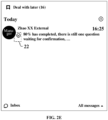
- the unread identifier 22 is displayed before the first session message, which represents that the first session message "80% has completed, and there is still one question waiting for confirmation, I will reply to you before the end of the work, is that OK?" is sent successfully, and the second user "Zhao XX" has received the first session message and does not read the first session message.
- step 203 after the second user reads the first session message, the message display content is updated, and the unread identifier is updated into a read identifier.
- updating the unread identifier into the read identifier may include that the color and/or the brightness of the unread identifier is changed to generate the read identifier.
- the read identifier 23 is displayed before the first session message, which represents that the first session message "80% has completed, and there is still one question waiting for confirmation, I will reply to you before the end of the day, is that OK?" is sent successfully, the second user "Zhao XX" has read the first session message.
- the read identifier 23 in FIG. 2F is generated by changing the color and/or the brightness of the unread identifier 22 in FIG. 2E .
- step 204 when an emoji response of the second user to the first session message is received, the message display content is updated, and the read identifier is replaced with an emoji icon replied by the second user.
- the second user feeds back session information containing the emoji icon for the first session message.
- the emoji icon may be any graphic and is used for quickly expressing the attitude and feedback of the second user on the first session message.
- the message display content includes the first session message and the emoji icon replied by the second user.
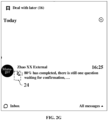
- that the message display content is updated and the read identifier is replaced with the emoji icon replied by the second user may further include that: a separation identifier is added between the emoji icon and the first session message.
- the emoji icon 24 replied by the second user "Zhao XX" is displayed before the first session message, the separation identifier "I” is provided between the emoji icon 24 and the first session message that "80% has completed, and there is still one question waiting for confirmation, I will reply to you before the end of the day, is that OK?", which represents that the first session message that "80% has completed, and there is still one question waiting for confirmation, I will reply to you before the end of the day, is that OK?" is sent successfully, and the second user "Zhao XX" has read the first session message and replies the emoji icon 24.
- the session list page of the embodiments of the present disclosure information that is important for the communication progress within the session is refined, and the information is reorganized in a limited space and displayed to the user.
- the simplest page elements are adopted, in the message entry associated with the second user of the session list page, various message state information is provided to the maximum extent, so that the disorder of page layout is avoided, and meanwhile, the waste of time for the user to repeatedly enter the session is avoided, the user may intuitively know the state of the session message, and a plan for further communication is facilitated. If the user performs multiple single-chat-session communications with multiple persons at the same time, the effect of efficiency improvement is more obvious. Communication work, which may only be performed in series previously, may now be performed in parallel.
- the message display content is generated in the message entry of the session list page of the first user, where the message display content includes the unread identifier and the first session message; after the second user reads the first session message, the message display content is updated, and the unread identifier is updated into the read identifier; when the emoji response of the second user to the first session message is received, the message display content is updated, and the read identifier is replaced with the emoji icon replied by the second user, so that various message state information may be provided in the message entry associated with the second user of the session list page, therefore, the user may directly know information within the session only by keeping the session list page open, and the emoji icon replied by the second user is displayed in the message entry associated with the second user of the session list page, duplicative and ineffective operations that the user needs to repeatedly enter and exit the session for checking whether the opposite side feeds back the emoji icon are avoided, and
- FIG. 3A is a flowchart of another session message display method provided in an embodiment of the present disclosure.
- An embodiment of the present disclosure may be combined with alternative schemes in one or more embodiments described above.
- the method before a first session message input by a first user for one or more second users is received, the method may further include that: a second session message input by one or more second users for the first user is received; and the message display content is generated in the message entry of the session list page of the first user according to the reading action of the first user on the second session message, where the message display content includes the second session message and message state information of the second session message, and the message entry is associated with the second user.
- the method may include steps described below.
- step 301 a second session message input by one or more second users for a first user is received.
- the instant messaging application client of the first user receives the second session message input by the one or more second users for the first user.
- step 302 the message display content is generated in the message entry of the session list page of the first user according to a reading action of the first user on the second session message.
- the message display content includes the second session message and message state information of the second session message, and the message entry is associated with the second user.
- that the message display content is generated in the message entry of the session list page of the first user according to the reading action of the first user on the second session message may include that: before the first user reads the second session message, the message display content is generated in the message entry of the session list page of the first user, where the message display content includes a received unread identifier and the second session message.
- the first user may determine that, only in the message entry associated with the second user of the session list page, the second session message sent by the second user is received and the second session message is not read.
- FIG. 3B is a schematic diagram of another session list page provided in an embodiment of the present disclosure.
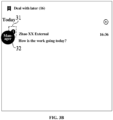
- a second session message of "how is the work going today?" input for a session by the second user "Zhao XX" is received.
- the received unread identifier 31 is displayed on the session identifier 32 in the message entry associated with the second user "Zhao XX" of the session list page.
- that the message display content is generated in the message entry of the session list page of the first user according to the reading action of the first user on the second session message may include that: after the first user reads the second session message, the message display content is updated, and the received unread identifier is updated into a read identifier.
- that the received unread identifier is updated into the received read identifier includes deleting the received unread identifier.
- the first user may determine that, only in the message entry associated with the second user of the session list page, the second session message sent by the second user has been read.
- FIG. 3C is a schematic diagram of another session list page provided in an embodiment of the present disclosure.
- the unread identifier 31 is not displayed on the session identifier 32 in the message entry associated with the second user "Zhao XX" of the session list page, which represents that the first user has read the second session message "how is the work going today?".
- step 303 a first session message input by the first user for the one or more second users is received on the session page, and the first session message is sent to the one or more second users.
- step 304 the message display content is generated in the message entry of the session list page of the first user according to a reading action and/or a reply action of the second user on the first session message.
- the message display content includes the first session message and message state information of the first session message, and the message entry is associated with the second user.
- the second session message input by the one or more second users for the first user is received, and then the message display content is generated in the message entry of the session list page of the first user according to the reading action of the first user on the second session message; where the message display content includes the second session message and the message state information, and the message entry is associated with the second user, so that the message state information of the session message may be intuitively provided through the message display content in the message entry associated with the second user of the session list page, duplicative and inefficient operations that the user needs to repeatedly enter and exit the session for checking the message state in order to obtain the communication progress of the session are avoided, and the processing efficiency of the session message is improved.
- FIG. 4 is a schematic structural diagram of a session message display apparatus provided in an embodiment of the present disclosure.
- the embodiments of the present disclosure may be suitable for the case of determining a message display content in a message entry on a session list page according to a session message in a session.
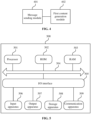
- This apparatus may be implemented in the software and/or hardware manner, and may be configured in an instant messaging application client mounted in an electronic device. As shown in FIG. 4 , the apparatus may include a message sending module 401 and a first content generation module 402.
- the message sending module 401 is configured to receive a first session message input by a first user for one or more second users on a session page, and send the first session message to the one or more second users.
- the first content generation module 402 is configured to generate a message display content in a message entry of a session list page of the first user according to a reading action and/or a reply action of the one or more second users on the first session message.
- the message display content includes the first session message and message state information of the first session message, and the message entry is associated with the one or more second users.
- the message display content is generated in the message entry of the session list page of the first user according to the reading action and/or the reply action of the second user on the first session message, and the message display content includes the first session message and the message state information, and the message entry is associated with the second user, so that the message state information of the session message may be intuitively provided through the message display content in the message entry of the session list page, duplicative and inefficient operations that the user needs to repeatedly enter and exit the session for checking a message state in order to obtain the communication progress of the session are avoided, and the processing efficiency of the session message is improved.
- the first content generation module 402 includes a first content generation unit, and the first content generation unit is configured to generate the message display content in the message entry of the session list page of the first user before the second user reads the first session message, where the message display content includes an unread identifier and the first session message.
- the first content generation module 402 includes a first content updating unit, and the first content updating unit is configured to update the message display content and update the unread identifier into a read identifier after the second user reads the first session message.
- the first content generation module 402 includes a second content updating unit, and the second content updating unit is configured to update the message display content and replace the read identifier with an emoji icon replied by the second user when an emoji response of the second user to the first session message is received.
- the second content updating unit may further include an identifier addition sub-unit, and the identifier addition sub-unit is configured to add a separation identifier between the emoji icon and the first session message.
- the first content updating unit may include an identifier changing sub-unit, and the identifier changing sub-unit is configured to change the color and/or brightness of the unread identifier to generate the read identifier.
- the session message display apparatus may further include a message receiving module and a second content generation module.
- the message receiving module is configured to receive a second session message input by the one or more second users for the first user.
- the second content generation module is configured to generate a message display content in a message entry of a session list page of the first user according to a reading action of the first user on the second session message.
- the message display content includes the second session message and message state information of the second session message, and the message entry is associated with the one or more second users.
- the session message display apparatus provided in the embodiments of the present disclosure may execute the session message display method provided in the embodiments of the present disclosure, and has function modules and effects corresponding to the execution method.
- FIG. 5 shows a schematic structural diagram of an electronic device 500 suitable for use in implementing embodiments of the present disclosure.
- the electronic device in the embodiments of the present disclosure may include, but is not limited to, such as a mobile phone, a notebook computer, a digital broadcast receiver, a personal digital assistant (PDA), a portable android device (PAD), a portable media player (PMP), an in-vehicle terminal (such as an in-vehicle navigation terminal).
- PDA personal digital assistant
- PAD portable android device
- PMP portable media player
- FIG. 5 is merely one example and should not place any limitation on the functionality and the usage scope of the embodiments of the present disclosure.
- the electronic device 500 may include a processor (such as a central processor, a graphics processor) 501, the processor 501 may perform multiple appropriate actions and processes according to a program stored in a read-only memory (ROM) 502 or a program loaded into a random access memory (RAM) 503 from a storage apparatus 508. In the RAM 503, multiple programs and data required for the operation of the electronic device 500 are also stored.
- a processor such as a central processor, a graphics processor
- the processor 501 may perform multiple appropriate actions and processes according to a program stored in a read-only memory (ROM) 502 or a program loaded into a random access memory (RAM) 503 from a storage apparatus 508.
- ROM read-only memory
- RAM random access memory
- multiple programs and data required for the operation of the electronic device 500 are also stored.
- the processor 501, the ROM 502, and the RAM 503 are connected via a bus 504.
- An input/output (I/O) interface 505 is also connected to the bus 504.
- the following apparatuses may be connected to the I/O interface 505: an input apparatus 506 including, such as a touchscreen, a touchpad, a keyboard, a mouse, a camera, a microphone, an accelerometer, a gyroscope; an output apparatus 507 including, such as a liquid crystal display (LCD), a speaker, a vibrator; a storage apparatus 508 including, such as a tape, a hard disk; and a communication apparatus 509.
- the communication apparatus 509 may allow the electronic device 500 to communicate wirelessly or wired with other apparatuses to exchange data.
- FIG. 5 shows an electronic device 500 with a variety of apparatuses, not all shown apparatuses need to be implemented or provided. More or fewer apparatuses may alternatively be implemented or provided.
- a process described above with reference to the flowcharts may be implemented as a computer software program.
- the embodiments of the present disclosure include a computer program product including a computer program carried on a non-transitory computer-readable medium, the computer program contains a program code for performing the methods shown in the flowcharts.
- the computer program may be downloaded and installed from a network through the communication apparatus 509, or installed from the storage apparatus 508, or installed from the ROM 502.
- this computer program is executed by the processor 501, the above-described functions defined in the methods of the embodiments of the present disclosure are executed.
- the above-described computer-readable medium of the present disclosure may be a computer-readable signal medium, or a computer-readable storage medium, or any combination of the computer-readable signal medium and the computer-readable storage medium.
- the computer-readable storage medium may be, for example, but not limited to, an electronic, magnetic, optical, electromagnetic, infrared, or semiconductor system, apparatus, or device, or any combination thereof.
- the computer-readable storage medium may include, but is not limited to, a portable computer magnetic disk in an electrical connection with one or more wires, a hard disk, a RAM, a ROM, an erasable programmable read-only memory (EPROM or a flash), an optical fiber, a compact disc read-only memory (CD-ROM), an optical storage device, a magnetic storage device, or any suitable combination thereof.
- the computer-readable storage medium may be any tangible medium that contains or stores a program, which may be used by or in combination with an instruction execution system, apparatus, or device.
- the computer-readable signal medium may include a data signal that is contained in a baseband or propagated as a part of a carrier wave, and the data signal carries a computer-readable program code.
- a propagated data signal may take many forms, including but not limited to an electromagnetic signal, an optical signal, or any suitable combination thereof.
- the computer-readable signal medium may also be any computer-readable medium other than the computer-readable storage medium, and the computer-readable signal medium may send, propagate, or transmit a program for being used by or in combination with the instruction execution system, apparatus, or device.
- the program code contained in the computer-readable medium may be transmitted by using any appropriate medium, including but not limited to an electric wire, an optical cable, a radio frequency (RF), etc., or any suitable combination thereof.
- RF radio frequency
- the client and the server may communicate by utilizing any known or future developed network protocol, such as hypertext transfer protocol (HTTP), and may be interconnected with any form or medium of digital data communication (such as a communication network).
- HTTP hypertext transfer protocol
- Examples of communication networks include a local area network (LAN), a wide area network (WAN), an inter-network (such as the Internet), and a peer-to-peer network (such as ad hoc peer-to-peer network), as well as any known or future developed network.
- the above-described computer-readable medium may be included in the above-described electronic device, and it may also be separate and not fitted into the electronic device.
- the computer-readable medium carries one or more programs, when the one or more programs are executed by the electronic device, the electronic device is enabled to: receive a first session message input by a first user for one or more second users on a session page, and send the first session message to the one or more second users; generate a message display content in a message entry of the session list page of the first user according to a reading action and/or a reply action of the one or more second users on the first session message, where the message display content includes the first session message and message state information of the first session message, and the message entry is associated with the one or more second users.
- a computer program code for performing the operations of the present disclosure may be written in one or more programming languages or combinations thereof, the above-described programming languages include, but are not limited to, an object-oriented programming language-such as Java, Smalltalk, C++, and further include a conventional procedural programming language-such as a "C" language or similar programming language.
- the program code may be executed in the following manners: executed entirely on a user's computer, executed partly on the user's computer, executed as an independent software package, executed partly on the user's computer and partly on a remote computer, or executed entirely on the remote computer or a server.
- the remote computer may be connected to the user's computer through any kind of network, including a local area network (LAN) or a wide area network (WAN), or may be connected to an external computer (for example, connected to the external computer through an internet provided by an internet service provider).
- LAN local area network
- WAN wide area network
- an external computer for example, connected to the external computer through an internet provided by an internet service provider.
- each block in the flowchart or block diagram may represent a module, a program segment, or a part of codes, which includes one or more executable instructions for implementing a specified logical function.
- the functions noted in the blocks may occur out of the order noted in the drawings. For example, two blocks shown in succession may, in fact, be executed substantially concurrently, or the two blocks may sometimes be executed in a reverse order, which depends upon the involved functionality.
- each block of the block diagram and/or the flowchart, and combinations of blocks of the block diagram and/or the flowchart may be implemented by a dedicated hardware-based system that performs a specified function or operation, or by a combination of a dedicated hardware and a computer instruction.
- the module, the unit, and the sub-unit described in the embodiments of the present disclosure may be implemented in a software manner or in a hardware manner. Names of the modules, the units, and the sub-units do not constitute the limitation of the module or unit itself in one case, for example, the message receiving module may also be described as "a module that receives the second session message input by the one or more second users for the first user", the first content updating unit may also be described as "a unit that after the second user reads the first session message, the message display content is updated, and the unread identifier is updated into the read identifier", and the identifier changing sub-unit may also be described as "a sub-unit that the color and/or the brightness of the unread identifier is changed to generate the read identifier".
- exemplary types of hardware logic components include a field programmable gate array (FPGA), an application specific integrated circuit (ASIC), an application specific standard part (ASSP), a system-on-a-chip (SOC), a complex programmable logic device (CPLD), etc.
- FPGA field programmable gate array
- ASIC application specific integrated circuit
- ASSP application specific standard part
- SOC system-on-a-chip
- CPLD complex programmable logic device
- a machine readable medium may be a tangible medium that may contain or store programs for use by an instruction execution system, an apparatus, a device, or a combination thereof.
- the machine readable medium may be a machine readable signal medium or a machine readable storage medium.
- the machine readable medium may include, but is not limited to, an electronic, magnetic, optical, electromagnetic, infrared, or semiconductor system, apparatus, or device, or any suitable combination of the foregoing.
- Examples of the machine-readable storage medium include a portable computer diskette in an electrical connection with one or more wires, a hard disk, a RAM, a ROM, an EPROM, a flash memory, an optical fiber, a CD-ROM, an optical storage device, a magnetic storage device, or any suitable combination of the foregoing.
Landscapes
- Engineering & Computer Science (AREA)
- General Engineering & Computer Science (AREA)
- Theoretical Computer Science (AREA)
- Human Computer Interaction (AREA)
- Physics & Mathematics (AREA)
- General Physics & Mathematics (AREA)
- Computer Networks & Wireless Communication (AREA)
- Signal Processing (AREA)
- Information Transfer Between Computers (AREA)
- User Interface Of Digital Computer (AREA)
Claims (7)
- Sitzungsnachrichtenanzeigeverfahren für eine elektronische Vorrichtung, umfassend:Empfangen (201, 303), an der elektronischen Vorrichtung, einer ersten Sitzungsnachricht, die durch einen ersten Benutzer für mindestens einen zweiten Benutzer auf einer Sitzungsseite eingegeben wird, und Senden der ersten Sitzungsnachricht an einen Direktnachrichtanwendungsclient jedes zweiten Benutzers des mindestens einen zweiten Benutzers;als Reaktion auf einen Erfolg des Sendens der ersten Sitzungsnachricht und wobei sich die erste Sitzungsnachricht in einem Ungelesen-Zustand befindet, Erzeugen (202) eines Nachrichtenanzeigeinhalts in einem Nachrichteneintrag einer Sitzungslistenseite des ersten Benutzers, wobei sich die Nachricht in einem Ungelesen-Zustand befindet, falls mindestens einer des mindestens einen zweiten Benutzers die Nachricht nicht gelesen hat, und wobei der Nachrichtenanzeigeinhalt die erste Sitzungsnachricht und eine Ungelesen-Kennung umfasst und der Nachrichteneintrag mit dem mindestens einen zweiten Benutzer verknüpft ist;als Reaktion darauf, dass sich die erste Sitzungsnachricht in einem Gelesen-Zustand befindet, Aktualisieren (203) des Nachrichtenanzeigeinhalts durch das Aktualisieren der Ungelesen-Kennung in eine Gelesen-Kennung, wobei sich die Nachricht in einem Gelesen-Zustand befindet, falls jeder zweite Benutzer des mindestens einen zweiten Benutzers die Nachricht gelesen hat; undin einem Fall des Empfangens eines Emoji-Symbols, das durch den mindestens einen zweiten Benutzer für die erste Sitzungsnachricht geantwortet wird, Aktualisieren (204) des Nachrichtenanzeigeinhalts durch ein Ersetzen der Gelesen-Kennung durch das Emoji-Symbol.
- Verfahren nach Anspruch 1, wobei in dem Fall des Empfangens des Emoji-Symbols, das durch den mindestens einen zweiten Benutzer für die erste Sitzungsnachricht geantwortet wird, das Aktualisieren (204) des Nachrichtenanzeigeinhalts durch das Ersetzen der Gelesen-Kennung durch das Emoji-Symbol umfasst:
Anzeigen der ersten Sitzungsnachricht und des Emoji-Symbols in dem Nachrichteneintrag der Sitzungslistenseite des ersten Benutzers. - Verfahren nach Anspruch 1, wobei das Ersetzen der Gelesen-Kennung durch das Emoji-Symbol umfasst:
Hinzufügen einer Trennungskennung zwischen dem Emoji-Symbol und der ersten Sitzungsnachricht. - Verfahren nach Anspruch 1, wobei das Aktualisieren der Ungelesen-Kennung in die Gelesen-Kennung umfasst:
Ändern von mindestens einem einer Farbe oder einer Helligkeit der Ungelesen-Kennung, um die Gelesen-Kennung zu erzeugen. - Verfahren nach Anspruch 1, wobei vor dem Empfangen (201, 303) der ersten Sitzungsnachricht, die durch den ersten Benutzer für den mindestens einen zweiten Benutzer eingegebenen wird, das Verfahren ferner umfasst:Empfangen (301) einer zweiten Sitzungsnachricht, die durch den mindestens einen zweiten Benutzer für den ersten Benutzer eingegeben wird; undals Reaktion darauf, dass sich die zweite Sitzungsnachricht in einem Ungelesen-Zustand befindet, Erzeugen (302) des Nachrichtenanzeigeinhalts in dem Nachrichteneintrag der Sitzungslistenseite des ersten Benutzers;wobei der Nachrichtenanzeigeinhalt die zweite Sitzungsnachricht und eine empfangene Ungelesen-Kennung umfasst und der Nachrichteneintrag mit dem mindestens einen zweiten Benutzer verknüpft ist.
- Elektronische Vorrichtung, umfassend:mindestens ein Prozessor; undeine Speichereinrichtung, die konfiguriert ist, um mindestens ein Programm zu speichern;wobei das mindestens eine Programm, wenn es durch den mindestens einen Prozessor ausgeführt wird, den mindestens einen Prozessor veranlasst, das Sitzungsnachrichtenanzeigeverfahren nach einem der Ansprüche 1 bis 5 zu implementieren.
- Computerlesbares Speichermedium, das ein Computerprogramm speichert, wobei das Computerprogramm, wenn es durch eine elektronische Vorrichtung nach Anspruch 6 ausgeführt wird,
das Sitzungsnachrichtenanzeigeverfahren nach einem der Ansprüche 1 bis 5 implementiert.
Applications Claiming Priority (2)
| Application Number | Priority Date | Filing Date | Title |
|---|---|---|---|
| CN201911102853.5A CN110851035B (zh) | 2019-11-12 | 2019-11-12 | 一种会话消息显示方法、装置、电子设备及存储介质 |
| PCT/CN2020/128163 WO2021093777A1 (zh) | 2019-11-12 | 2020-11-11 | 会话消息显示方法、装置、电子设备及存储介质 |
Publications (3)
| Publication Number | Publication Date |
|---|---|
| EP4033340A1 EP4033340A1 (de) | 2022-07-27 |
| EP4033340A4 EP4033340A4 (de) | 2022-12-07 |
| EP4033340B1 true EP4033340B1 (de) | 2024-10-30 |
Family
ID=69601810
Family Applications (1)
| Application Number | Title | Priority Date | Filing Date |
|---|---|---|---|
| EP20888387.6A Active EP4033340B1 (de) | 2019-11-12 | 2020-11-11 | Sitzungsanzeigeverfahren und -vorrichtung, elektronische vorrichtung und speichermedium |
Country Status (6)
| Country | Link |
|---|---|
| US (2) | US20220247707A1 (de) |
| EP (1) | EP4033340B1 (de) |
| JP (1) | JP7398558B2 (de) |
| CN (2) | CN113325982A (de) |
| CA (1) | CA3155247A1 (de) |
| WO (1) | WO2021093777A1 (de) |
Families Citing this family (11)
| Publication number | Priority date | Publication date | Assignee | Title |
|---|---|---|---|---|
| CN113325982A (zh) | 2019-11-12 | 2021-08-31 | 北京字节跳动网络技术有限公司 | 一种会话消息显示方法、装置、电子设备及存储介质 |
| CN112350924B (zh) * | 2020-11-06 | 2022-09-27 | 北京字跳网络技术有限公司 | 通信方法、装置、终端和存储介质 |
| WO2022095969A1 (zh) | 2020-11-06 | 2022-05-12 | 北京字跳网络技术有限公司 | 信息处理方法、装置、终端和存储介质 |
| CN114003326B (zh) * | 2021-10-22 | 2023-10-13 | 北京字跳网络技术有限公司 | 消息处理方法、装置、设备及存储介质 |
| CN114401240B (zh) * | 2022-01-10 | 2024-05-28 | 维沃移动通信有限公司 | 一种消息处理方法及装置 |
| CN114500432B (zh) * | 2022-02-25 | 2024-11-26 | 维沃移动通信有限公司 | 会话消息收发方法及装置、电子设备、可读存储介质 |
| CN114780190B (zh) * | 2022-04-13 | 2023-12-22 | 脸萌有限公司 | 消息处理方法、装置、电子设备及存储介质 |
| CN114900803A (zh) * | 2022-05-31 | 2022-08-12 | 深圳市智信科技有限公司 | 一种基于计算机云平台分布式短信验证消息发送方法 |
| CN116032867A (zh) * | 2023-01-06 | 2023-04-28 | 北京达佳互联信息技术有限公司 | 会话处理方法、装置、电子设备及存储介质 |
| CN118984314B (zh) * | 2024-10-18 | 2025-04-01 | 北京达佳互联信息技术有限公司 | 信息展示方法、装置、电子设备及存储介质 |
| CN118972432A (zh) * | 2024-10-21 | 2024-11-15 | 太平金融科技服务(上海)有限公司 | 一种会话业务处理方法、装置、设备及介质 |
Family Cites Families (50)
| Publication number | Priority date | Publication date | Assignee | Title |
|---|---|---|---|---|
| JP2001175550A (ja) * | 1999-12-07 | 2001-06-29 | Kizna.Com Inc | クライアントサーバシステム及びクライアントサーバシステムのデータ伝送方法並びにそのプログラムを記録した媒体 |
| US8171084B2 (en) * | 2004-01-20 | 2012-05-01 | Microsoft Corporation | Custom emoticons |
| US7984381B2 (en) * | 2005-03-18 | 2011-07-19 | Nokia Corporation | User interface |
| US20060248150A1 (en) * | 2005-04-29 | 2006-11-02 | International Business Machines Corporation | Methods and apparatus for managing and distinguishing instant messaging sessions and threads |
| US7734704B2 (en) * | 2006-07-28 | 2010-06-08 | International Business Machines Corporation | Method and system for identifying and automatically redisplaying unread instant messages |
| US8233885B2 (en) * | 2006-09-08 | 2012-07-31 | Hewlett-Packard Development Company, L.P. | Apparatus and methods for providing enhanced mobile messaging services |
| US8190754B2 (en) * | 2006-12-14 | 2012-05-29 | Verizon Patent And Licensing Inc. | Parental controls in a media network |
| US7895277B2 (en) * | 2007-10-17 | 2011-02-22 | International Business Machines Corporation | Conditional reminders for conveyed electronic messages |
| US20140096033A1 (en) * | 2008-03-06 | 2014-04-03 | Software Hot-House Ltd. | Enhancements to unified communications and messaging systems |
| US8762862B2 (en) * | 2008-06-05 | 2014-06-24 | Microsoft Corporation | Initiating a support chat session in response to the occurrence of a support event with transmission of detailed event information |
| US7886015B2 (en) * | 2008-07-08 | 2011-02-08 | International Business Machines Corporation | Method and system for future defined email recipient |
| US9177298B2 (en) * | 2009-12-15 | 2015-11-03 | International Business Machines Corporation | Abbreviated user interface for instant messaging to minimize active window focus changes |
| EP2369820B1 (de) * | 2010-03-22 | 2016-04-06 | BlackBerry Limited | Verwaltung und anzeige von gruppierten nachrichten in einer kommunikationsvorrichtung |
| US20130097526A1 (en) * | 2011-10-17 | 2013-04-18 | Research In Motion Limited | Electronic device and method for reply message composition |
| US9185248B2 (en) * | 2012-02-29 | 2015-11-10 | Blackberry Limited | Method and device for sharing a camera feature |
| US10824297B2 (en) * | 2012-11-26 | 2020-11-03 | Google Llc | System for and method of accessing and selecting emoticons, content, and mood messages during chat sessions |
| US9304665B2 (en) * | 2013-04-05 | 2016-04-05 | Yahoo! Inc. | Method and apparatus for facilitating message selection and organization |
| CN104780093B (zh) * | 2014-01-15 | 2018-05-01 | 阿里巴巴集团控股有限公司 | 即时通讯过程中的表情信息处理方法及装置 |
| US10482163B2 (en) * | 2014-04-23 | 2019-11-19 | Klickafy, Llc | Clickable emoji |
| CN104967550B (zh) * | 2014-05-19 | 2018-01-30 | 腾讯科技(深圳)有限公司 | 未读消息显示方法及装置 |
| US9680761B2 (en) * | 2014-08-14 | 2017-06-13 | Dropbox, Inc. | Consolidating messages in a message queue |
| US9350943B2 (en) * | 2014-09-15 | 2016-05-24 | Microsoft Technology Licensing, Llc | Video picker |
| TWI614711B (zh) * | 2015-02-25 | 2018-02-11 | 三竹資訊股份有限公司 | 企業行動訊息系統與方法 |
| US9277015B1 (en) * | 2015-04-29 | 2016-03-01 | Yallo Technologies (Israel) Ltd. | Communication sequences based on user rules |
| CN105119799B (zh) * | 2015-06-15 | 2019-11-19 | 阿里巴巴集团控股有限公司 | 即时通讯消息处理方法及客户端 |
| KR20170017289A (ko) * | 2015-08-06 | 2017-02-15 | 삼성전자주식회사 | 콘텐츠를 송수신하는 전자 장치 및 방법 |
| JP6555060B2 (ja) * | 2015-09-30 | 2019-08-07 | ブラザー工業株式会社 | 中継装置及び通信システム |
| CN105515957A (zh) * | 2016-01-06 | 2016-04-20 | 北京百度网讯科技有限公司 | 聊天的回复方法和装置 |
| CN106953790B (zh) * | 2016-01-07 | 2020-12-15 | 钉钉控股(开曼)有限公司 | 多人信息交流方法和装置 |
| CN105553834B (zh) * | 2016-01-21 | 2020-12-01 | 腾讯科技(深圳)有限公司 | 消息发送方法和装置 |
| KR102338357B1 (ko) * | 2016-05-18 | 2021-12-13 | 애플 인크. | 그래픽 메시징 사용자 인터페이스 내의 확인응답 옵션들의 적용 |
| CN106100972B (zh) * | 2016-06-02 | 2019-02-01 | 腾讯科技(深圳)有限公司 | 一种消息处理方法、系统、第一终端及第二终端 |
| US10387571B2 (en) * | 2016-07-20 | 2019-08-20 | Vidicons LLC | Networked device with suggested response to incoming message |
| JP2018032329A (ja) * | 2016-08-26 | 2018-03-01 | Line株式会社 | 表示方法、情報処理端末およびプログラム |
| WO2018042604A1 (ja) * | 2016-09-01 | 2018-03-08 | 株式会社ゴールドアイピー | サーバ装置、通信方法およびプログラム |
| CN107846345A (zh) * | 2016-09-18 | 2018-03-27 | 阿里巴巴集团控股有限公司 | 通讯方法及装置 |
| US11042256B2 (en) * | 2016-10-05 | 2021-06-22 | Fuji Xerox Co., Ltd. | Systems and methods for chat message management and document generation on devices |
| US10725626B2 (en) * | 2016-10-05 | 2020-07-28 | Fuji Xerox Co., Ltd. | Systems and methods for chat message management and document generation on devices |
| CN108173738B (zh) * | 2016-12-08 | 2021-07-06 | 阿里巴巴集团控股有限公司 | 展示方法及装置 |
| CN106775262A (zh) * | 2017-02-06 | 2017-05-31 | 腾讯科技(深圳)有限公司 | 一种未读图标显示管理的方法和系统 |
| TWI782955B (zh) * | 2017-05-12 | 2022-11-11 | 香港商阿里巴巴集團服務有限公司 | 展示方法及裝置 |
| CN107566255A (zh) * | 2017-09-06 | 2018-01-09 | 叶进蓉 | 未读消息摘要生成方法及装置 |
| CN109561198A (zh) * | 2017-09-27 | 2019-04-02 | 阿里巴巴集团控股有限公司 | 消息展示方法及装置 |
| CN109842541B (zh) * | 2017-11-24 | 2022-02-08 | 腾讯科技(深圳)有限公司 | 信息处理方法、装置及存储介质 |
| CN109725975B (zh) * | 2018-12-29 | 2021-10-12 | 天津字节跳动科技有限公司 | 消息被读状态的提示方法、装置和电子设备 |
| CN109871165B (zh) | 2019-02-01 | 2022-03-01 | 天津字节跳动科技有限公司 | 表情回应的显示方法、装置、终端设备和服务器 |
| CN110134484B (zh) * | 2019-05-21 | 2024-02-13 | 腾讯科技(深圳)有限公司 | 消息图标的显示方法、装置、终端及存储介质 |
| CN110191231B (zh) * | 2019-05-31 | 2022-06-07 | 北京字节跳动网络技术有限公司 | 一种未读消息提醒方法、装置、终端设备及存储介质 |
| KR20190096304A (ko) * | 2019-07-29 | 2019-08-19 | 엘지전자 주식회사 | 대화 내용에 대한 요약문 생성 장치 및 방법 |
| CN113325982A (zh) * | 2019-11-12 | 2021-08-31 | 北京字节跳动网络技术有限公司 | 一种会话消息显示方法、装置、电子设备及存储介质 |
-
2019
- 2019-11-12 CN CN202110679052.6A patent/CN113325982A/zh active Pending
- 2019-11-12 CN CN201911102853.5A patent/CN110851035B/zh active Active
-
2020
- 2020-11-11 JP JP2022522328A patent/JP7398558B2/ja active Active
- 2020-11-11 CA CA3155247A patent/CA3155247A1/en active Pending
- 2020-11-11 EP EP20888387.6A patent/EP4033340B1/de active Active
- 2020-11-11 WO PCT/CN2020/128163 patent/WO2021093777A1/zh not_active Ceased
-
2022
- 2022-04-22 US US17/727,354 patent/US20220247707A1/en not_active Abandoned
- 2022-08-03 US US17/880,340 patent/US12250190B2/en active Active
Also Published As
| Publication number | Publication date |
|---|---|
| US12250190B2 (en) | 2025-03-11 |
| WO2021093777A1 (zh) | 2021-05-20 |
| EP4033340A1 (de) | 2022-07-27 |
| CN110851035B (zh) | 2021-06-18 |
| JP2022551742A (ja) | 2022-12-13 |
| US20220377040A1 (en) | 2022-11-24 |
| JP7398558B2 (ja) | 2023-12-14 |
| CN113325982A (zh) | 2021-08-31 |
| CN110851035A (zh) | 2020-02-28 |
| CA3155247A1 (en) | 2021-05-20 |
| US20220247707A1 (en) | 2022-08-04 |
| EP4033340A4 (de) | 2022-12-07 |
Similar Documents
| Publication | Publication Date | Title |
|---|---|---|
| EP4033340B1 (de) | Sitzungsanzeigeverfahren und -vorrichtung, elektronische vorrichtung und speichermedium | |
| US12182503B2 (en) | Method and apparatus for displaying online document, and storage medium | |
| US11716299B2 (en) | Information interaction method and apparatus, server, system and storage medium | |
| JP7430821B2 (ja) | 情報インタラクションの方法、装置、サーバー、システム及び記憶媒体 | |
| US20240291683A1 (en) | Information interaction method and apparatus, and electronic device | |
| CN110781373B (zh) | 榜单更新方法、装置、可读介质和电子设备 | |
| CN110658961B (zh) | 信息显示方法、装置和电子设备 | |
| CN111506376A (zh) | 反馈信息显示方法、装置、可读介质及电子设备 | |
| EP4340323A1 (de) | Verfahren und vorrichtung zum senden von nachrichten sowie vorrichtung und speichermedium | |
| CN110910469A (zh) | 一种绘制笔迹的方法、装置、介质和电子设备 | |
| CN116954433A (zh) | 一种内容发布方法、装置、电子设备及存储介质 | |
| CN111367689A (zh) | 在线文档的互动提示信息发送方法、装置及电子设备 | |
| CN110928428B (zh) | 一种输入电子邮件信息的方法、装置、介质和电子设备 | |
| CN114638197B (zh) | 信息处理方法、装置、电子设备和存储介质 | |
| CN115314456B (zh) | 交互方法、装置和电子设备 | |
| CN115550160A (zh) | 配置信息发送、配置信息更新方法、业务请求处理方法 | |
| CN119376580A (zh) | 信息交互方法、装置和电子设备 | |
| CN114417905B (zh) | 信息发送方法、装置、设备和计算机可读介质 | |
| CN111240718A (zh) | 主题更新方法、装置、电子设备及介质 | |
| CN111552705A (zh) | 基于图表的数据处理方法、装置、电子设备及介质 | |
| CN114006880B (zh) | 一种消息回执的获取方法、装置、电子设备和存储介质 | |
| CN119690597A (zh) | 一种数据处理方法、装置、设备及存储介质 | |
| CN115114051A (zh) | 节点通信方法、装置、设备及存储介质 |
Legal Events
| Date | Code | Title | Description |
|---|---|---|---|
| STAA | Information on the status of an ep patent application or granted ep patent |
Free format text: STATUS: THE INTERNATIONAL PUBLICATION HAS BEEN MADE |
|
| PUAI | Public reference made under article 153(3) epc to a published international application that has entered the european phase |
Free format text: ORIGINAL CODE: 0009012 |
|
| STAA | Information on the status of an ep patent application or granted ep patent |
Free format text: STATUS: REQUEST FOR EXAMINATION WAS MADE |
|
| 17P | Request for examination filed |
Effective date: 20220419 |
|
| AK | Designated contracting states |
Kind code of ref document: A1 Designated state(s): AL AT BE BG CH CY CZ DE DK EE ES FI FR GB GR HR HU IE IS IT LI LT LU LV MC MK MT NL NO PL PT RO RS SE SI SK SM TR |
|
| A4 | Supplementary search report drawn up and despatched |
Effective date: 20221104 |
|
| RIC1 | Information provided on ipc code assigned before grant |
Ipc: H04M 1/72436 20210101ALI20221028BHEP Ipc: G06F 3/0481 20220101AFI20221028BHEP |
|
| DAV | Request for validation of the european patent (deleted) | ||
| DAX | Request for extension of the european patent (deleted) | ||
| STAA | Information on the status of an ep patent application or granted ep patent |
Free format text: STATUS: EXAMINATION IS IN PROGRESS |
|
| 17Q | First examination report despatched |
Effective date: 20230714 |
|
| GRAP | Despatch of communication of intention to grant a patent |
Free format text: ORIGINAL CODE: EPIDOSNIGR1 |
|
| STAA | Information on the status of an ep patent application or granted ep patent |
Free format text: STATUS: GRANT OF PATENT IS INTENDED |
|
| INTG | Intention to grant announced |
Effective date: 20240528 |
|
| GRAS | Grant fee paid |
Free format text: ORIGINAL CODE: EPIDOSNIGR3 |
|
| GRAA | (expected) grant |
Free format text: ORIGINAL CODE: 0009210 |
|
| STAA | Information on the status of an ep patent application or granted ep patent |
Free format text: STATUS: THE PATENT HAS BEEN GRANTED |
|
| AK | Designated contracting states |
Kind code of ref document: B1 Designated state(s): AL AT BE BG CH CY CZ DE DK EE ES FI FR GB GR HR HU IE IS IT LI LT LU LV MC MK MT NL NO PL PT RO RS SE SI SK SM TR |
|
| REG | Reference to a national code |
Ref country code: GB Ref legal event code: FG4D |
|
| REG | Reference to a national code |
Ref country code: CH Ref legal event code: EP |
|
| P01 | Opt-out of the competence of the unified patent court (upc) registered |
Free format text: CASE NUMBER: APP_53177/2024 Effective date: 20240924 |
|
| REG | Reference to a national code |
Ref country code: IE Ref legal event code: FG4D |
|
| REG | Reference to a national code |
Ref country code: DE Ref legal event code: R096 Ref document number: 602020040563 Country of ref document: DE |
|
| PGFP | Annual fee paid to national office [announced via postgrant information from national office to epo] |
Ref country code: FR Payment date: 20241228 Year of fee payment: 6 |
|
| REG | Reference to a national code |
Ref country code: LT Ref legal event code: MG9D |
|
| REG | Reference to a national code |
Ref country code: NL Ref legal event code: MP Effective date: 20241030 |
|
| PG25 | Lapsed in a contracting state [announced via postgrant information from national office to epo] |
Ref country code: PT Free format text: LAPSE BECAUSE OF FAILURE TO SUBMIT A TRANSLATION OF THE DESCRIPTION OR TO PAY THE FEE WITHIN THE PRESCRIBED TIME-LIMIT Effective date: 20250228 Ref country code: HR Free format text: LAPSE BECAUSE OF FAILURE TO SUBMIT A TRANSLATION OF THE DESCRIPTION OR TO PAY THE FEE WITHIN THE PRESCRIBED TIME-LIMIT Effective date: 20241030 Ref country code: IS Free format text: LAPSE BECAUSE OF FAILURE TO SUBMIT A TRANSLATION OF THE DESCRIPTION OR TO PAY THE FEE WITHIN THE PRESCRIBED TIME-LIMIT Effective date: 20250228 |
|
| PG25 | Lapsed in a contracting state [announced via postgrant information from national office to epo] |
Ref country code: FI Free format text: LAPSE BECAUSE OF FAILURE TO SUBMIT A TRANSLATION OF THE DESCRIPTION OR TO PAY THE FEE WITHIN THE PRESCRIBED TIME-LIMIT Effective date: 20241030 Ref country code: NL Free format text: LAPSE BECAUSE OF FAILURE TO SUBMIT A TRANSLATION OF THE DESCRIPTION OR TO PAY THE FEE WITHIN THE PRESCRIBED TIME-LIMIT Effective date: 20241030 |
|
| REG | Reference to a national code |
Ref country code: AT Ref legal event code: MK05 Ref document number: 1737548 Country of ref document: AT Kind code of ref document: T Effective date: 20241030 |
|
| PG25 | Lapsed in a contracting state [announced via postgrant information from national office to epo] |
Ref country code: BG Free format text: LAPSE BECAUSE OF FAILURE TO SUBMIT A TRANSLATION OF THE DESCRIPTION OR TO PAY THE FEE WITHIN THE PRESCRIBED TIME-LIMIT Effective date: 20241030 |
|
| PG25 | Lapsed in a contracting state [announced via postgrant information from national office to epo] |
Ref country code: ES Free format text: LAPSE BECAUSE OF FAILURE TO SUBMIT A TRANSLATION OF THE DESCRIPTION OR TO PAY THE FEE WITHIN THE PRESCRIBED TIME-LIMIT Effective date: 20241030 |
|
| PG25 | Lapsed in a contracting state [announced via postgrant information from national office to epo] |
Ref country code: NO Free format text: LAPSE BECAUSE OF FAILURE TO SUBMIT A TRANSLATION OF THE DESCRIPTION OR TO PAY THE FEE WITHIN THE PRESCRIBED TIME-LIMIT Effective date: 20250130 |
|
| PG25 | Lapsed in a contracting state [announced via postgrant information from national office to epo] |
Ref country code: LV Free format text: LAPSE BECAUSE OF FAILURE TO SUBMIT A TRANSLATION OF THE DESCRIPTION OR TO PAY THE FEE WITHIN THE PRESCRIBED TIME-LIMIT Effective date: 20241030 Ref country code: GR Free format text: LAPSE BECAUSE OF FAILURE TO SUBMIT A TRANSLATION OF THE DESCRIPTION OR TO PAY THE FEE WITHIN THE PRESCRIBED TIME-LIMIT Effective date: 20250131 Ref country code: AT Free format text: LAPSE BECAUSE OF FAILURE TO SUBMIT A TRANSLATION OF THE DESCRIPTION OR TO PAY THE FEE WITHIN THE PRESCRIBED TIME-LIMIT Effective date: 20241030 |
|
| PG25 | Lapsed in a contracting state [announced via postgrant information from national office to epo] |
Ref country code: PL Free format text: LAPSE BECAUSE OF FAILURE TO SUBMIT A TRANSLATION OF THE DESCRIPTION OR TO PAY THE FEE WITHIN THE PRESCRIBED TIME-LIMIT Effective date: 20241030 |
|
| PG25 | Lapsed in a contracting state [announced via postgrant information from national office to epo] |
Ref country code: RS Free format text: LAPSE BECAUSE OF FAILURE TO SUBMIT A TRANSLATION OF THE DESCRIPTION OR TO PAY THE FEE WITHIN THE PRESCRIBED TIME-LIMIT Effective date: 20250130 |
|
| REG | Reference to a national code |
Ref country code: CH Ref legal event code: PL |
|
| PG25 | Lapsed in a contracting state [announced via postgrant information from national office to epo] |
Ref country code: SM Free format text: LAPSE BECAUSE OF FAILURE TO SUBMIT A TRANSLATION OF THE DESCRIPTION OR TO PAY THE FEE WITHIN THE PRESCRIBED TIME-LIMIT Effective date: 20241030 |
|
| PG25 | Lapsed in a contracting state [announced via postgrant information from national office to epo] |
Ref country code: MC Free format text: LAPSE BECAUSE OF FAILURE TO SUBMIT A TRANSLATION OF THE DESCRIPTION OR TO PAY THE FEE WITHIN THE PRESCRIBED TIME-LIMIT Effective date: 20241030 |
|
| PG25 | Lapsed in a contracting state [announced via postgrant information from national office to epo] |
Ref country code: DK Free format text: LAPSE BECAUSE OF FAILURE TO SUBMIT A TRANSLATION OF THE DESCRIPTION OR TO PAY THE FEE WITHIN THE PRESCRIBED TIME-LIMIT Effective date: 20241030 |
|
| PG25 | Lapsed in a contracting state [announced via postgrant information from national office to epo] |
Ref country code: LU Free format text: LAPSE BECAUSE OF NON-PAYMENT OF DUE FEES Effective date: 20241111 |
|
| REG | Reference to a national code |
Ref country code: CH Ref legal event code: PL |
|
| PG25 | Lapsed in a contracting state [announced via postgrant information from national office to epo] |
Ref country code: EE Free format text: LAPSE BECAUSE OF FAILURE TO SUBMIT A TRANSLATION OF THE DESCRIPTION OR TO PAY THE FEE WITHIN THE PRESCRIBED TIME-LIMIT Effective date: 20241030 |
|
| PG25 | Lapsed in a contracting state [announced via postgrant information from national office to epo] |
Ref country code: CH Free format text: LAPSE BECAUSE OF NON-PAYMENT OF DUE FEES Effective date: 20241130 |
|
| PG25 | Lapsed in a contracting state [announced via postgrant information from national office to epo] |
Ref country code: RO Free format text: LAPSE BECAUSE OF FAILURE TO SUBMIT A TRANSLATION OF THE DESCRIPTION OR TO PAY THE FEE WITHIN THE PRESCRIBED TIME-LIMIT Effective date: 20241030 |
|
| PG25 | Lapsed in a contracting state [announced via postgrant information from national office to epo] |
Ref country code: SK Free format text: LAPSE BECAUSE OF FAILURE TO SUBMIT A TRANSLATION OF THE DESCRIPTION OR TO PAY THE FEE WITHIN THE PRESCRIBED TIME-LIMIT Effective date: 20241030 |
|
| PG25 | Lapsed in a contracting state [announced via postgrant information from national office to epo] |
Ref country code: CZ Free format text: LAPSE BECAUSE OF FAILURE TO SUBMIT A TRANSLATION OF THE DESCRIPTION OR TO PAY THE FEE WITHIN THE PRESCRIBED TIME-LIMIT Effective date: 20241030 |
|
| PG25 | Lapsed in a contracting state [announced via postgrant information from national office to epo] |
Ref country code: IT Free format text: LAPSE BECAUSE OF FAILURE TO SUBMIT A TRANSLATION OF THE DESCRIPTION OR TO PAY THE FEE WITHIN THE PRESCRIBED TIME-LIMIT Effective date: 20241030 |
|
| REG | Reference to a national code |
Ref country code: DE Ref legal event code: R097 Ref document number: 602020040563 Country of ref document: DE |
|
| REG | Reference to a national code |
Ref country code: BE Ref legal event code: MM Effective date: 20241130 |
|
| PLBE | No opposition filed within time limit |
Free format text: ORIGINAL CODE: 0009261 |
|
| STAA | Information on the status of an ep patent application or granted ep patent |
Free format text: STATUS: NO OPPOSITION FILED WITHIN TIME LIMIT |
|
| PG25 | Lapsed in a contracting state [announced via postgrant information from national office to epo] |
Ref country code: SE Free format text: LAPSE BECAUSE OF FAILURE TO SUBMIT A TRANSLATION OF THE DESCRIPTION OR TO PAY THE FEE WITHIN THE PRESCRIBED TIME-LIMIT Effective date: 20241030 |
|
| 26N | No opposition filed |
Effective date: 20250731 |
|
| PG25 | Lapsed in a contracting state [announced via postgrant information from national office to epo] |
Ref country code: BE Free format text: LAPSE BECAUSE OF NON-PAYMENT OF DUE FEES Effective date: 20241130 |
|
| PG25 | Lapsed in a contracting state [announced via postgrant information from national office to epo] |
Ref country code: IE Free format text: LAPSE BECAUSE OF NON-PAYMENT OF DUE FEES Effective date: 20241111 |
|
| PGFP | Annual fee paid to national office [announced via postgrant information from national office to epo] |
Ref country code: DE Payment date: 20251118 Year of fee payment: 6 |
|
| PGFP | Annual fee paid to national office [announced via postgrant information from national office to epo] |
Ref country code: GB Payment date: 20251010 Year of fee payment: 6 |