EP4033074B1 - Sheet metal turbine housing - Google Patents
Sheet metal turbine housing Download PDFInfo
- Publication number
- EP4033074B1 EP4033074B1 EP21215459.5A EP21215459A EP4033074B1 EP 4033074 B1 EP4033074 B1 EP 4033074B1 EP 21215459 A EP21215459 A EP 21215459A EP 4033074 B1 EP4033074 B1 EP 4033074B1
- Authority
- EP
- European Patent Office
- Prior art keywords
- sheet metal
- metal structure
- tongue member
- inlet
- volute
- Prior art date
- Legal status (The legal status is an assumption and is not a legal conclusion. Google has not performed a legal analysis and makes no representation as to the accuracy of the status listed.)
- Active
Links
Images






Classifications
-
- F—MECHANICAL ENGINEERING; LIGHTING; HEATING; WEAPONS; BLASTING
- F02—COMBUSTION ENGINES; HOT-GAS OR COMBUSTION-PRODUCT ENGINE PLANTS
- F02B—INTERNAL-COMBUSTION PISTON ENGINES; COMBUSTION ENGINES IN GENERAL
- F02B37/00—Engines characterised by provision of pumps driven at least for part of the time by exhaust
-
- F—MECHANICAL ENGINEERING; LIGHTING; HEATING; WEAPONS; BLASTING
- F04—POSITIVE - DISPLACEMENT MACHINES FOR LIQUIDS; PUMPS FOR LIQUIDS OR ELASTIC FLUIDS
- F04D—NON-POSITIVE-DISPLACEMENT PUMPS
- F04D29/00—Details, component parts, or accessories
- F04D29/40—Casings; Connections of working fluid
- F04D29/42—Casings; Connections of working fluid for radial or helico-centrifugal pumps
- F04D29/4206—Casings; Connections of working fluid for radial or helico-centrifugal pumps especially adapted for elastic fluid pumps
-
- F—MECHANICAL ENGINEERING; LIGHTING; HEATING; WEAPONS; BLASTING
- F01—MACHINES OR ENGINES IN GENERAL; ENGINE PLANTS IN GENERAL; STEAM ENGINES
- F01D—NON-POSITIVE DISPLACEMENT MACHINES OR ENGINES, e.g. STEAM TURBINES
- F01D25/00—Component parts, details, or accessories, not provided for in, or of interest apart from, other groups
- F01D25/24—Casings; Casing parts, e.g. diaphragms, casing fastenings
-
- F—MECHANICAL ENGINEERING; LIGHTING; HEATING; WEAPONS; BLASTING
- F01—MACHINES OR ENGINES IN GENERAL; ENGINE PLANTS IN GENERAL; STEAM ENGINES
- F01D—NON-POSITIVE DISPLACEMENT MACHINES OR ENGINES, e.g. STEAM TURBINES
- F01D25/00—Component parts, details, or accessories, not provided for in, or of interest apart from, other groups
- F01D25/24—Casings; Casing parts, e.g. diaphragms, casing fastenings
- F01D25/243—Flange connections; Bolting arrangements
-
- F—MECHANICAL ENGINEERING; LIGHTING; HEATING; WEAPONS; BLASTING
- F01—MACHINES OR ENGINES IN GENERAL; ENGINE PLANTS IN GENERAL; STEAM ENGINES
- F01D—NON-POSITIVE DISPLACEMENT MACHINES OR ENGINES, e.g. STEAM TURBINES
- F01D9/00—Stators
- F01D9/02—Nozzles; Nozzle boxes; Stator blades; Guide conduits, e.g. individual nozzles
-
- F—MECHANICAL ENGINEERING; LIGHTING; HEATING; WEAPONS; BLASTING
- F01—MACHINES OR ENGINES IN GENERAL; ENGINE PLANTS IN GENERAL; STEAM ENGINES
- F01D—NON-POSITIVE DISPLACEMENT MACHINES OR ENGINES, e.g. STEAM TURBINES
- F01D9/00—Stators
- F01D9/02—Nozzles; Nozzle boxes; Stator blades; Guide conduits, e.g. individual nozzles
- F01D9/026—Scrolls for radial machines or engines
-
- F—MECHANICAL ENGINEERING; LIGHTING; HEATING; WEAPONS; BLASTING
- F04—POSITIVE - DISPLACEMENT MACHINES FOR LIQUIDS; PUMPS FOR LIQUIDS OR ELASTIC FLUIDS
- F04D—NON-POSITIVE-DISPLACEMENT PUMPS
- F04D17/00—Radial-flow pumps, e.g. centrifugal pumps; Helico-centrifugal pumps
-
- F—MECHANICAL ENGINEERING; LIGHTING; HEATING; WEAPONS; BLASTING
- F05—INDEXING SCHEMES RELATING TO ENGINES OR PUMPS IN VARIOUS SUBCLASSES OF CLASSES F01-F04
- F05D—INDEXING SCHEME FOR ASPECTS RELATING TO NON-POSITIVE-DISPLACEMENT MACHINES OR ENGINES, GAS-TURBINES OR JET-PROPULSION PLANTS
- F05D2220/00—Application
- F05D2220/40—Application in turbochargers
-
- F—MECHANICAL ENGINEERING; LIGHTING; HEATING; WEAPONS; BLASTING
- F05—INDEXING SCHEMES RELATING TO ENGINES OR PUMPS IN VARIOUS SUBCLASSES OF CLASSES F01-F04
- F05D—INDEXING SCHEME FOR ASPECTS RELATING TO NON-POSITIVE-DISPLACEMENT MACHINES OR ENGINES, GAS-TURBINES OR JET-PROPULSION PLANTS
- F05D2230/00—Manufacture
- F05D2230/20—Manufacture essentially without removing material
- F05D2230/23—Manufacture essentially without removing material by permanently joining parts together
- F05D2230/232—Manufacture essentially without removing material by permanently joining parts together by welding
-
- F—MECHANICAL ENGINEERING; LIGHTING; HEATING; WEAPONS; BLASTING
- F05—INDEXING SCHEMES RELATING TO ENGINES OR PUMPS IN VARIOUS SUBCLASSES OF CLASSES F01-F04
- F05D—INDEXING SCHEME FOR ASPECTS RELATING TO NON-POSITIVE-DISPLACEMENT MACHINES OR ENGINES, GAS-TURBINES OR JET-PROPULSION PLANTS
- F05D2230/00—Manufacture
- F05D2230/50—Building or constructing in particular ways
- F05D2230/54—Building or constructing in particular ways by sheet metal manufacturing
-
- Y—GENERAL TAGGING OF NEW TECHNOLOGICAL DEVELOPMENTS; GENERAL TAGGING OF CROSS-SECTIONAL TECHNOLOGIES SPANNING OVER SEVERAL SECTIONS OF THE IPC; TECHNICAL SUBJECTS COVERED BY FORMER USPC CROSS-REFERENCE ART COLLECTIONS [XRACs] AND DIGESTS
- Y02—TECHNOLOGIES OR APPLICATIONS FOR MITIGATION OR ADAPTATION AGAINST CLIMATE CHANGE
- Y02T—CLIMATE CHANGE MITIGATION TECHNOLOGIES RELATED TO TRANSPORTATION
- Y02T10/00—Road transport of goods or passengers
- Y02T10/10—Internal combustion engine [ICE] based vehicles
- Y02T10/12—Improving ICE efficiencies
Definitions
- the subject matter described herein relates generally to flow control systems, and more particularly, to turbine housings for use in turbocharger systems.
- Turbocharger systems are frequently used to improve the efficiency of internal combustion engines, for example, to achieve fuel economy targets or other environmental goals.
- the turbine housing experiences thermal and mechanical stress, and as a result, is often the most expensive component of a turbocharger system due to its size, complexity and material. In some situations, the added financial cost in conjunction with the size, packaging, assembly, or installation constraints may be prohibitive.
- introducing turbines into the exhaust gas flow can reduce the temperature of the exhaust gas and may reduce the effectiveness of downstream emissions control devices, such as a catalytic converter. Accordingly, it is desirable to provide a turbine housing having lower thermal inertia while also achieving other performance objectives and maintaining structural integrity.
- US 10 494 955 B2 discloses a known prior art turbine housing assembly comprising several sheet members which define an inlet for a volute and a tongue member which defines an air gap to a sheet metal structure for purposes of thermal expansion.
- a turbine housing assembly as defined in claim 1 is provided.
- Embodiments of the subject matter described herein relate to turbines or turbocharger systems that include a turbine stage having a multilayer sheet metal housing made up of standardizable subcomponents to provide flexibility and extensibility to accommodate different applications or installations.
- the turbine housing assembly includes an inlet sheet metal piece that is joined to a tongue member and a flange having an opening for receiving a turbine wheel (alternatively referred to herein as a bearing flange or center housing flange) to define an inner contour of an inlet.
- An inner sheet metal shell that includes an inlet portion that defines an outer contour of the inlet and a volute portion defining an outer contour of a volute is joined to the bearing flange, the tongue member and the inlet sheet metal piece to define the inlet in fluid communication with the volute.
- An outer containment sheet metal shell surrounds the volute portion of the inner sheet metal shell and is joined to the bearing flange.
- the outer containment sheet metal shell is separated from the inner sheet metal shell by an air gap which may be occupied by a layer of thermal insulation or other thermal insulating material to minimize heat loss from the volute (which conducts relatively hotter exhaust gases) into the environment between the inner sheet metal shell and the containment sheet metal shell, thereby maintaining a relatively lower temperature for the containment shell and increasing efficiency of the turbine.
- Embodiments of the turbine housing assemblies described herein may be designed for and utilized with any sort of vehicle, such as, for example, heavy-duty or performance automotive vehicles to light-duty automotive vehicles.
- a turbine wheel disposed within a turbine housing assembly may be mounted or otherwise coupled to a compressor wheel (or impeller) via a common rotary shaft to function as a turbocharger.
- the turbine inlet may be configured to receive exhaust gas flow from the cylinders of an internal combustion engine (e.g., from the exhaust manifold), which subsequently exits or bypasses the turbine wheel to a catalytic converter or other downstream emissions arrangement (e.g., via ducting or another conduit).
- the catalytic converter or other emissions control device may have an efficacy that is influenced by the temperature of the exhaust gas at its inlet, and accordingly, it is desirable to minimize the thermal inertia associated with the turbine housing assembly downstream of the exhaust manifold(s) of the engine to facilitate a higher exhaust gas temperature at the inlet of the emissions arrangement.
- the term “axial” refers to a direction that is generally parallel to or coincident with an axis of rotation, axis of symmetry, or centerline of a component or components.
- the "axial" direction may refer to the direction that generally extends in parallel to the centerline between the opposite ends or faces.
- the term “axial” may be utilized with respect to components that are not cylindrical (or otherwise radially symmetric).
- the "axial" direction for a rectangular housing containing a rotating shaft may be viewed as a direction that is generally parallel to or coincident with the rotational axis of the shaft.
- radially may refer to a direction or a relationship of components with respect to a line extending outward from a shared centerline, axis, or similar reference, for example in a plane of a cylinder or disc that is perpendicular to the centerline or axis.
- components may be viewed as “radially” aligned even though one or both of the components may not be cylindrical (or otherwise radially symmetric).
- axial and radial (and any derivatives) may encompass directional relationships that are other than precisely aligned with (e.g., oblique to) the true axial and radial dimensions, provided the relationship is predominately in the respective nominal axial or radial direction.
- the term “inner” may be utilized herein to refer to elements, features, or surfaces that are relatively closer to or generally face, in the axial direction, the turbine wheel or rotating assembly that the turbine housing is mounted or otherwise joined to, while the term “outer” may be utilized herein to refer to elements, features, or surfaces that are relatively farther from or generally face away from the turbine wheel or rotating assembly in the axial direction.
- the term “interior” may be utilized herein to refer to elements, features, or surfaces that are relatively closer to the axis of rotation associated with the turbine wheel or generally face radially inward, while the term “peripheral” may be utilized herein to refer to elements, features, or surfaces that are relatively farther from or generally face away from axis of rotation.
- the drawings are merely illustrative and may not be drawn to scale.
- the figures shown herein depict an example with certain arrangements of elements, additional intervening elements, devices, features, or components may be present in an actual embodiment.
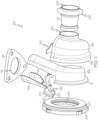
- FIGS. 1-7 depict an exemplary embodiment of a turbine housing assembly 100 suitable for use in a turbocharger system.
- the turbine housing assembly 100 includes a tongue member 102 and sheet metal structures 104, 106 that are cooperatively configured to define boundaries of a radial inlet 200 tangential to a volute 700 ( FIG. 7 ).
- the tongue member 102 and sheet metal structures 104, 106 are coupled or joined to a bearing flange 108 for mounting the turbine housing assembly 100 to a rotating assembly.
- the bearing flange 108 includes a substantially circular interior opening 109 configured to receive a turbine wheel to be disposed within the volute 700 defined by the sheet metal structure 106.
- the inner surface of a volute portion 110 of the sheet metal structure 106 that faces the turbine wheel in the axial direction is contoured to define the outer contour of the volute 700, which is a voided region providing a scroll-shaped exhaust gas passageway.
- the sheet metal structure 106 may alternatively be referred to herein as the inner sheet metal shell, the volute sheet metal shell, or variants thereof.
- An inner surface of the inlet portion 112 of the inner sheet metal shell 106 is contoured to define the outer contour of the inlet 200 in fluid communication with the volute 700 defined by the volute portion 110, and the surface 114 of the sheet metal structure 104 that faces the inlet portion 112 of the inner sheet metal shell 106 is contoured and configured in concert with the inlet portion 112 to define the inlet 200.
- the inlet portion 112 of the inner sheet metal shell 106 cooperates with the sheet metal structure 104 to define the inlet passage 200, which is fluidly coupled to or in fluid communication with the volute 700.
- the sheet metal structure 104 may alternatively be referred to herein as the inlet sheet metal structure 104.
- the tongue member 102 is physically distinct from the sheet metal structures 104, 106 and includes a protruding divider portion 130 that extends axially from the tongue member 102.
- the protruding divider portion 130 is disposed radially between the inlet sheet metal structure 104 and the volute portion 110 of the inner sheet metal shell 106 at the interface between the inlet 200 and the volute 700.
- the tongue member 102 directs exhaust gas received via the inlet 200 defined by the sheet metal structures 104, 106 tangentially into the volute 700 at the fluid interface between the inlet 200 and the volute 700.
- the cast tongue member 102 achieves better thermomechanical reliability, performance (e.g., tongue shape) and high-cycle fatigue (HCF) behavior (e.g., tongue position) relative to turbine housing designs having additional welding at or near the tongue.
- HCF high-cycle fatigue
- the divider portion 130 may radially separate the inlet exit end 105 of the inlet sheet metal structure 104 from the volute portion 110 of the inner sheet metal shell 106.
- the inner surface of the volute portion 110 of the sheet metal shell 106 is contoured to define the outer contour of the scroll-shaped voided region of the volute passage 700.
- the volute passage 700 narrows as gas flows radially starting from the interface with the inlet passage 200 at one end portion 132 of the tongue member 102 until reaching the divider portion 130 at the opposing end of the tongue member 102, with the divider portion 130 separating the volute 700 from the inlet passage 200.
- the volute portion 110 of the inner sheet metal shell 106 includes a voided or cutout region 113 corresponding to the tongue member 102, with the edges of the cutout region being welded, joined, brazed or otherwise affixed to the radially outer edges of the end portions 130, 132 of the tongue member 102 to hermetically seal the volute portion 110 to the tongue member 102.
- the protruding portions 130, 132 of the tongue member 102 are joined to the volute portion 110.
- the bearing flange 108 is realized as a substantially annular unitary cast metal structure having a central opening 109 for receiving or otherwise accommodating a turbine wheel.
- the bearing flange 108 includes a recessed rim 107 or a similar contoured feature about its peripheral circumference on the surface that faces the sheet metal shell 106 in the axial direction in order to support coupling, joining or otherwise mounting the sheet metal shell 106 to the bearing flange 108.
- the recessed mounting feature 107 on the bearing flange 108 may correspond to the outer circumference of the opening of the sheet metal shell 106 facing the bearing flange 108 to mate with the sheet metal shell 106 and establish a welding seam or joint in a radial plane about the interface between the sheet metal shell 106 and the bearing flange 108.
- the end of the volute portion 110 proximate the bearing flange 108 may include a corresponding rim 111 about the outer circumference of the opening in the inner sheet metal structure 106 that faces the bearing flange 108, with the rim 111 extending in the axial direction towards the bearing flange 108 to mate with the corresponding recessed feature 107 of the bearing flange 108.
- the end of the rim 111 of the sheet metal shell 106 proximate the bearing flange 108 may be joined circumferentially to the corresponding mounting feature 107 of the bearing flange 108 by welding, brazing, etc. to hermetically seal the sheet metal shell 106 to the flange 108 in the axial direction at the interface defined between the corresponding mounting features 107, 111.
- the tongue member 102 is integrated with, integrally formed with, monolithic or one-piece with the bearing flange 108 and realized as a cast feature of the cast bearing flange 108. That said, in other embodiments, the tongue member 102 may be realized as a separate or discrete sheet metal structure that is welded, brazed, joined or otherwise affixed to the bearing flange 108 to establish a hermetic seal between the sheet metal tongue member 102 and the cast bearing flange 108, as depicted in FIG. 1 and described in greater detail below in the context of FIGS. 11-12 . Referring to FIG.
- the tongue member 102 independent of whether the tongue member 102 is realized by casting or sheet metal, the tongue member 102 includes a voided or inlet cutout portion 103 that corresponds to or otherwise mates with an end 105 of the inlet sheet metal structure 104 proximate the volute 700 to allow the exit end 105 of the inlet sheet metal structure 104 to be welded, joined or otherwise affixed to the tongue member 102 to hermetically seal the inlet sheet metal structure 104 to the tongue member 102.
- the shape and dimensions of the inlet cutout portion 103 correspond to the shape and dimensions of the inlet exit end 105 of the inlet sheet metal structure 104 to mate or otherwise fit with the inlet exit end 105 of the inlet sheet metal structure 104.
- the tongue member 102 Adj acent to the inlet cutout portion 103, the tongue member 102 includes a divider portion 130 that extends in an axial direction to separate or otherwise divide the inlet 200 from the volute 700. In this regard, the distance or dimension of the extension of the divider portion 130 in the axial direction is greater than the axial dimension of the inlet exit end 105 to physically separate the inlet exit end 105 of the inlet sheet metal structure 104 from the volute portion 110 of the inner sheet metal shell 106.
- the tongue member 102 On the other side of the inlet cutout portion 103, the tongue member 102 includes an extending portion 132 that extends in an axial direction tangentially to the volute portion 110 at the interface between the inlet sheet metal structure 104 and the volute portion 110.
- the peripheral edge of the base portion of the tongue member 102 includes a rim 121 or similar mounting feature that corresponds to the recessed feature 107 of the bearing flange 108 to mate with the bearing flange 108 similar to the rim 111 of the volute portion 110.
- the inlet sheet metal structure 104 is contoured or otherwise pressed to provide a substantially U-shaped cross-section that cooperates with the inlet portion 112 of the sheet metal shell 106 to define the contour of the inlet gas passageway.
- the illustrated inlet sheet metal structure 104 is substantially frustoconical in shape such that the diameter of the exhaust gas passageway for the inlet 200 is tapered and decreases towards the interface with the volute 700 at the tongue member 102 from a larger diameter or opening of the inlet 200 opening 116 at the inlet 200 flange 118 to encourage flow tangential to the volute 700 at the interface with the volute 700.
- the shape and dimensions of the inlet sheet metal structure 104 can vary depending on the needs of a particular embodiment.
- the opening end of the inlet sheet metal structure 104 opposite the inlet exit end 105 of the inlet sheet metal structure 104 is cooperatively configured to define the opening of the inlet 200 in concert with the corresponding end of the inlet portion 112 of the sheet metal shell 106.
- the ends of the inlet sheet metal structure 104 and the inlet portion 112 of the sheet metal shell 106 are welded, joined or otherwise affixed to an inlet flange 118 about the circumference of an inlet opening 116 in the flange 118 to hermetically seal the sheet metal structures 104, 106 to the inlet flange 118 about the opening 116.
- edges of the sheet metal structure 104 that face corresponding edges of the inlet portion 112 of the inner sheet metal shell 106 in the axial direction are welded, joined or otherwise affixed to the corresponding edges of the inlet portion 112 to hermetically seal the inlet 200.
- the length of the extension of the inlet portion 112 from the volute portion 110 corresponds to the length or longitudinal dimension of the inlet sheet metal structure 104, and the inlet portion 112 is similarly contoured or otherwise pressed to provide a substantially U-shaped cross-section that cooperates with the inlet sheet metal structure 104 to define boundaries of the inlet passage for tangentially directing fluid flow into a volute 700 defined by the volute portion 110.
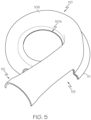
- the volute portion 110 is realized as a substantially spiral structure formed into the body of the inner sheet metal shell 106, for example, by contouring or otherwise pressing the inner sheet metal structure 106 to provide a substantially U-shaped cross-section that defines the volute passage for radially directing a tangential flow received at an interface with the inlet 200 towards a turbine wheel disposed within the volute portion.
- the depth or dimension of the U-shaped cross-section progressively decreases from the interface with the inlet 200 at a first tongue portion 132 towards the opposing end of the tongue portion 130 to decrease the flow area and thereby direct flow received via the inlet 200 towards the turbine wheel, with the volute portion 110 also being configured to provide clearance for the turbine wheel to rotate and extract energy from the exhaust gas fluid flow within the volute passage.
- the peripheral radial edges of the volute portion 110 include or are realized as a rim, lip, or similar feature 111 that provide a surface for joining the volute portion 110 to a corresponding feature 107 of the bearing flange 108 and provide a substantially circumferential joint aligned in a substantially radial plane, as discussed previously.
- an outer containment sheet metal structure 124 (alternatively referred to herein as the outer containment shell) includes a substantially circular opening that is circumferentially joined to the bearing flange 108 to substantially enclose or surround the volute portion 110 of the inner sheet metal shell 106 in the axial direction.
- a diameter of an opening defined through the outer containment shell 124 from the first shell end 125 to the opposite, second shell end varies along the axis of the assembly.
- the diameter of the opening at the first shell end 125 of the containment shell 124 proximate the bearing flange 108 is different and greater than the circumference of the volute portion 110 to substantially circumscribe the volute portion 110 of the inner sheet metal shell 106, and thereby, substantially enclose or surround the volute portion 110 of the inner sheet metal shell 106 in the radial as well as axial direction.
- the bearing end 125 of the containment shell 124 extends towards the bearing flange 108 in the axial direction by a greater distance than the rim 111 of the inner sheet metal shell 106 to radially overlap the rim 111 of the inner sheet metal shell 106.
- the diameter of the opening at the first shell end 125 of the containment shell 124 is different and greater than an outer circumference about the mounting feature 107 to receive at least a portion of the bearing flange 108 within the opening.
- the first shell end 125 is welded, joined or otherwise affixed to a peripheral surface of the bearing flange 108 to couple the outer containment shell 124 to the bearing flange 108 such that the outer containment shell 124 substantially surrounds the volute portion 110.
- double welding of the volute portion 110 to the containment shell 124 is avoided by joining the containment shell 124 to the bearing flange 108 via a separate welding procedure.
- the outer containment sheet metal shell 124 is realized as a unitary sheet metal structure that is contoured or otherwise pressed to correspond to the volute portion 110 of the inner sheet metal shell 106.
- the inner or interior dimensions of the outer containment shell 124 are greater than the dimensions of the volute portion 110 to provide a space or air gap between the outer containment shell 124 and the inner sheet metal shell 124, which helps provide physical and thermal isolation between the volute portion 110 and the outer containment shell 124.
- the outer containment shell 124 also includes an inlet cutout region 126 that extends in the axial direction from the bearing end 125 by a dimension that is greater than the axial dimension of the inlet portion 112.
- the inlet cutout region 126 corresponds to the inlet portion 112 of the inner sheet metal shell 106 and allows the inlet portion 112 to extend from the interface of the volute portion 110 within the interior of the containment shell 124 to beyond the exterior of the containment shell 124 such that the inlet region 112 is not positioned within or is external to the outer containment shell 124.
- the containment shell 124 also includes an outlet opening 128 opposite the bearing end 125 to define the axial outlet of the turbine assembly 100.
- the outlet opening 128 in the containment shell 124 is substantially circular and coaxially aligned with the interior opening 504 ( FIG. 5 ) in the inner sheet metal shell 106.
- a substantially cylindrical outlet pipe 122 is disposed within the outlet opening 128.
- the outlet pipe 122 extends in an axial direction from the interior opening 504 in the volute portion 110 of the inner sheet metal shell 106 to an exterior of the turbine assembly 100 for coupling the turbine assembly 100 to a fluid conduit for carrying exhaust gas axially exiting the turbine wheel (e.g., to a downstream emissions device such as a catalytic converter).
- the outlet pipe 122 is realized as a unitary sheet metal structure that is inserted into the outlet opening 128 and welded, joined or otherwise affixed about the interior opening 504 in the inner sheet metal shell 106 to hermetically seal the axial outlet pipe 122 to the volute portion 110 such that all gas axially exits the turbine wheel via the outlet pipe 122.
- the outer circumference of the end of the outlet pipe 122 proximate to the turbine wheel may be substantially the same diameter as or otherwise correspond to the circumference of the opening 504 to support welding the outlet pipe 122 to the volute portion 110 circumferentially about the opening 504.
- the outlet pipe 122 is formed to include an intermediary collar portion 129 having a circumference or diameter greater than the circumference in the outlet opening 128 to prevent over- or under-insertion of the outlet pipe 122 into outlet opening 128 and ensure alignment of the bearing end of the outlet pipe 122 with the interior opening 504 in a radial plane.
- the outlet pipe 122 is also welded, joined or otherwise affixed to the containment shell 124 circumferentially about the outlet opening 128.
- the outlet pipe 122 functions to control the exhaust gas flow exiting the turbine assembly 100, with the collar portion 129 facilitating a V-band clamp or similar connection to ducting or another fluid conduit between the exit end of the outlet pipe 122 and an exhaust system. Welding or joining the outlet pipe 122 about both the interior outlet opening 504 of the volute portion 110 and the corresponding outlet opening 128 of the containment shell 124 supports the mechanical integrity of the turbine assembly 100 and maintains sealing of the volute 700.
- an insulating material 750 is provided within an air gap 740 defined by the space between the outer containment shell 124 and the inner sheet metal shell 106.
- a layer of a thermally-insulating fabric material may be conformably installed on or overlying the volute portion 110 of the inner sheet metal shell 106 from the interface with the bearing flange 108 until reaching the axial outlet opening 504.
- the thermally-insulating material 750 surrounds or otherwise encompasses the volute portion 110 of the inner sheet metal shell 106 to minimize heat loss from the volute 700 within the air gap 740 between the volute portion 110 and the containment shell 124, which increases efficiency of the turbine while reducing the temperature of the containment shell 124.
- thermally-insulating material may be provided on an interior surface of the containment shell 124, in lieu of or in addition to providing the thermally-insulating material 750 on the surface of the volute portion 110.
- thermally-insulating fabric material any suitable insulating material or layer or combination thereof may be utilized within the gap between shells 106, 124 to achieve improved thermal isolation between the shells 106, 124.
- the inlet flange 118 may include bores or other features configured to support mounting or otherwise coupling the inlet flange 118 to the exhaust manifold of an internal combustion engine or other conduit or ducting to receive exhaust gas from the engine.
- the bearing flange 108 may include bores or other features configured to support mounting or otherwise coupling the bearing flange 108 to a rotating assembly that includes a turbine wheel, a rotary shaft, and/or the like.
- the rotating assembly when the rotating assembly is mounted to the bearing flange 108, at least a portion of the blades of the turbine wheel are disposed within the volute 700 defined by the sheet metal shell 106, with the interior opening 504 in the inner sheet metal shell 106 being substantially circular and coaxially aligned with the rotational axis of the turbine wheel to receive or otherwise accommodate a nose of the turbine wheel and define the axial outlet 120 for the turbine.
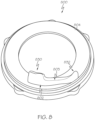
- the cast metal structure 800 includes a cast tongue portion 802 corresponding to the tongue member 102 that is integral with an annular body portion 804 corresponding to the bearing flange 108.
- the cast tongue member 802 protrudes from the bearing flange body portion 804 in an axial direction and includes a raised divider portion 830 (e.g., divider portion 130) that extends axially from the base of the tongue member 802 to separate or otherwise divide the inlet passage from the volute.
- the opposing end of the cast tongue member 802 also includes a raised portion 832 (e.g., portion 132) that is oriented tangential to the volute.
- the cutout portion 803 of the tongue member 802 extends from the bearing flange body portion 804 between the raised portions 830, 832 is configured to receive and support the inlet exit end 105 of the inlet sheet metal structure 104, as depicted in FIG. 9 .
- the cutout portion 803 elevates the inlet exit end 105 of the inlet sheet metal structure 104 such that the inlet sheet metal structure 104 is spaced apart from and does not contact the bearing flange body portion 804.
- the inlet exit end 105 of the inlet sheet metal structure 104 is initially welded, joined or otherwise affixed to the tongue portion 802 of the cast metal structure 800 about the interface to the volute defined by the edges of the cutout portion 803 that mate with or are otherwise configured to receive the inlet exit end 105. Stated another way, the inlet exit end 105 of the inlet sheet metal structure 104 is coupled to or received within the cut-out portion of the tongue portion 802, and the sides of the end 105 are coupled, joined or fixed to the sides of the recess. Referring to FIG.
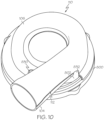
- the inner sheet metal shell 106 is positioned over the assembled structures 104, 800 and then welded, joined or otherwise affixed to the cast bearing flange portion 804 about the periphery of the bearing flange portion 804 (e.g., by welding the rim 111 of the volute portion 110 of the inner sheet metal shell 106 to a corresponding feature 107 of the bearing flange 804), with the edges of the cutout region 113 of the volute portion 110 being concurrently welded or joined to the raised tongue portions 830, 832 to hermetically seal the volute between the inner sheet metal shell 106 and the bearing flange 800.
- the tongue member 802 is disposed within the cutout region 113 of the volute portion 110, with the raised portions 830, 832 of the tongue member 802 radially separating the volute portion 110 from contacting the inlet exit end 105 of the inlet sheet metal structure 104.
- the axially outward facing edges of the inlet sheet metal structure 104 and the inner facing edges of the inlet portion 112 of the inner sheet metal shell 106 are also welded, joined or otherwise affixed together to hermetically seal the inlet 200.
- a thermally-insulating material may be provided on the outer surface of the volute portion 110 or the inner surface of the containment shell 124 before positioning the containment shell 124 over the volute portion 110 and inserting the outlet pipe 122 within the axial outlet openings 128, 304.
- the outlet pipe 122 is disposed within the axial outlet openings 128, 504 of the sheet metal shells 106, 124 and welded, joined or otherwise affixed about the respective axial outlet openings 128, 304 of the sheet metal shells 106, 124.
- the inlet flange 118 is welded, joined or otherwise affixed to the inlet sheet metal structure 104 and the inlet portion 112 of the inner sheet metal shell 106 about the inlet opening 116 to complete fabrication of the turbine housing assembly 100.
- the turbine housing assembly 100 may then be installed or otherwise mounted to a rotating assembly and the appropriate ducting or conduits for fluid flow to/from the turbine housing assembly 100, the details or which are not germane to disclosure.
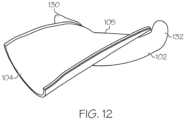
- the inlet exit end 105 of the inlet sheet metal structure 104 is initially welded, joined or otherwise affixed to the tongue member 102 about the interface to the volute defined by the edge of the cutout portion 103, as shown in FIG. 12 .
- the inner sheet metal shell 106 is positioned over the assembled structures 102, 104 and then welded, joined or otherwise affixed to the raised tongue portions 130, 132 and the facing edges of the inlet sheet metal structure 104 as shown in FIG.
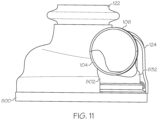
- the periphery of the volute portion 110 of the inner sheet metal shell 106 and the tongue member 102 are welded, joined or otherwise affixed to the bearing flange 108, for example, by welding the rim 111 of the volute portion 110 of the inner sheet metal shell 106 and the rim 121 of the tongue member 102 to the corresponding mounting feature 107 of the bearing flange 108.
- fabrication of the turbine housing assembly 100 may be completed in a similar manner as described above (e.g., applying a thermal insulation layer to the volute portion 110 or the containment shell 124, positioning the containment shell 124 over the volute portion 110 to define the gap and welding the containment shell 124 to the bearing flange 108, assembling the outlet pipe 122 within the sheet metal shells 106, 124, and welding the outlet pipe 122 about the corresponding openings 128, 304 in the sheet metal shells 106, 124, etc.).
- the subject matter described herein provides a sheet metal turbine housing assembly capable of being manufactured using standardized turbine housing subcomponents to provide improved flexibility while also reducing costs compared to cast turbine housings, which are often the most expensive component of a turbocharger due to their size, complexity and material requirements.
- Cast turbine housings may also require specialized casting hardware for variations in the size, shape, and/or packaging constraints for the turbine housing to accommodate different applications or installations, while also requiring greater minimum wall thicknesses that increase costs while also increasing the mass and thermal inertia of the turbine housing.
- the sheet metal structures described herein may be designed or otherwise configured to support multiple different configurations or applications.
- the inlet cutout opening 126 in the outer containment shell 124 may be configured to provide clearance with respect to the inlet 200 that allows the orientation of the outer containment shell 124 to be rotatably adjusted with respect to the bearing flange 108 and the volute portion 110 according to final assembly requirements for installing the turbine housing assembly 100 in a vehicle to provide flexibility across different applications or installations. Additionally, the thickness of the outer containment shell 124 may be minimized by the sheet metal forming process to reduce weight and material costs and lower thermal inertia while maintaining containment capability.
- the thermal insulation layer 750 is provided on the inner surface of the containment shell 124 (e.g., from the bottom inner edge to the upper inner edge to cover the entire interior surface) to minimize heat loss and reduce the temperature of the outer surface of the containment shell 124 to increase efficiency by reducing thermal losses (and improving the efficiency of a downstream catalytic converter or other emission controls by maintaining available energy and higher temperature for the exhaust gas flow).
- the design of the containment shell 124 can be standardized for compatibility with standardized designs of the other sheet metal structures 104, 106 via a standardized connection component (e.g., outlet pipe 122), which allows the containment shell 124 to be utilized across a wide range of turbocharger applications that share a common or standardized volute design.
- the volute portion 110 of the inner sheet metal shell 106 may be designed and manufactured as a standardized component capable of use across a range of turbocharger applications sharing the same aerodynamic volute definition (with a corresponding cost reduction attendant to component standardization).
- the inlet portion 112 of the inner sheet metal shell 106 and the inlet sheet metal structure 104 may be designed and manufactured to accommodate different application-specific packaging requirements and varied across different instances of the volute portion 110.
- the shape, size, and other physical characteristics of the volute portion 110 and the tongue member 102 may be standardized and maintained substantially constant across different applications, while the dimensions of the inlet sheet metal structure 104 and the inlet portion 112 vary to suit the needs of a particular application or installation.
- the tongue member 102, the volute portion 110, the outer containment shell 124 and/or the outlet pipe 122 may be designed for universal use, while the shape and/or dimensions of the inlet sheet metal structure 104 and the inlet portion 112 may be varied depending on the application.
- the sheet metal turbine housing assembly provides a flexible entrance adjustment capable of accommodating different installations.
- the thicknesses of the inner sheet metal shell 106 and the inlet sheet metal structure 104 may similarly be minimized by the sheet metal forming process to achieve low thermal inertia, with the thermal insulation layer 750 within the gap between the volute portion 110 and the outer containment shell 124 minimizing thermal losses.
Landscapes
- Engineering & Computer Science (AREA)
- Mechanical Engineering (AREA)
- General Engineering & Computer Science (AREA)
- Chemical & Material Sciences (AREA)
- Combustion & Propulsion (AREA)
- Supercharger (AREA)
Description
- The subject matter described herein relates generally to flow control systems, and more particularly, to turbine housings for use in turbocharger systems.
- Turbocharger systems are frequently used to improve the efficiency of internal combustion engines, for example, to achieve fuel economy targets or other environmental goals. During operation, the turbine housing experiences thermal and mechanical stress, and as a result, is often the most expensive component of a turbocharger system due to its size, complexity and material. In some situations, the added financial cost in conjunction with the size, packaging, assembly, or installation constraints may be prohibitive. Additionally, introducing turbines into the exhaust gas flow can reduce the temperature of the exhaust gas and may reduce the effectiveness of downstream emissions control devices, such as a catalytic converter. Accordingly, it is desirable to provide a turbine housing having lower thermal inertia while also achieving other performance objectives and maintaining structural integrity.
US 10 494 955 B2 - According to the present invention, a turbine housing assembly, as defined in claim 1 is provided.
- Further embodiments are defined in the dependent claims.
- Embodiments of the subject matter will hereinafter be described in conjunction with the following drawing figures, wherein like numerals denote like elements, and:
-
FIG. 1 is an exploded view of a turbine housing assembly in one or more exemplary embodiments; -
FIG. 2 is a perspective view of the turbine housing assembly ofFIG. 1 ; -
FIG. 3 is a perspective view of a tongue member of the turbine housing assembly inFIGS. 1-2 ; -
FIG. 4 is a perspective view of an inlet sheet metal structure of the turbine housing assembly inFIGS. 1-2 ; -
FIG. 5 is a perspective view of an inner sheet metal shell of the turbine housing assembly inFIGS. 1-2 ; -
FIG. 6 is a perspective view of an outer sheet metal shell of the turbine housing assembly inFIGS. 1-2 ; -
FIG. 7 is a cross-sectional view of the turbine housing assembly ofFIGS. 1-2 along the line 7-7 inFIG. 2 in one or more exemplary embodiments; -
FIG. 8 is a perspective view of a flange including an integrated tongue member suitable for use in a turbine housing assembly in one or more exemplary embodiments; -
FIG. 9 is a perspective view of the flange ofFIG. 8 assembled with the inlet sheet metal structure ofFIG. 4 in one or more exemplary embodiments; -
FIG. 10 is a perspective view of the inner sheet metal shell ofFIG. 5 assembled with the flange and the inlet sheet metal structure after assembling the flange with the inlet sheet metal structure as depicted inFIG. 9 in one or more exemplary embodiments; -
FIG. 11 is a plan view of the outer sheet metal shell ofFIG. 6 assembled with the flange after assembling the inner sheet metal shell with the flange and the inlet sheet metal structure as depicted inFIG. 10 in one or more exemplary embodiments; -
FIG. 12 is a perspective view of the tongue member ofFIG. 3 assembled with the inlet sheet metal structure ofFIG. 4 in one or more exemplary embodiments; and -
FIG. 13 is a perspective view of the inner sheet metal shell ofFIG. 5 assembled with the tongue member and the inlet sheet metal structure after assembling the tongue member with the inlet sheet metal structure as depicted inFIG. 12 in one or more exemplary embodiments. - Embodiments of the subject matter described herein relate to turbines or turbocharger systems that include a turbine stage having a multilayer sheet metal housing made up of standardizable subcomponents to provide flexibility and extensibility to accommodate different applications or installations. As described in greater detail below, the turbine housing assembly includes an inlet sheet metal piece that is joined to a tongue member and a flange having an opening for receiving a turbine wheel (alternatively referred to herein as a bearing flange or center housing flange) to define an inner contour of an inlet. An inner sheet metal shell that includes an inlet portion that defines an outer contour of the inlet and a volute portion defining an outer contour of a volute is joined to the bearing flange, the tongue member and the inlet sheet metal piece to define the inlet in fluid communication with the volute. An outer containment sheet metal shell surrounds the volute portion of the inner sheet metal shell and is joined to the bearing flange. The outer containment sheet metal shell is separated from the inner sheet metal shell by an air gap which may be occupied by a layer of thermal insulation or other thermal insulating material to minimize heat loss from the volute (which conducts relatively hotter exhaust gases) into the environment between the inner sheet metal shell and the containment sheet metal shell, thereby maintaining a relatively lower temperature for the containment shell and increasing efficiency of the turbine.
- Embodiments of the turbine housing assemblies described herein may be designed for and utilized with any sort of vehicle, such as, for example, heavy-duty or performance automotive vehicles to light-duty automotive vehicles. In this regard, a turbine wheel disposed within a turbine housing assembly may be mounted or otherwise coupled to a compressor wheel (or impeller) via a common rotary shaft to function as a turbocharger. The turbine inlet may be configured to receive exhaust gas flow from the cylinders of an internal combustion engine (e.g., from the exhaust manifold), which subsequently exits or bypasses the turbine wheel to a catalytic converter or other downstream emissions arrangement (e.g., via ducting or another conduit). In practice, the catalytic converter or other emissions control device may have an efficacy that is influenced by the temperature of the exhaust gas at its inlet, and accordingly, it is desirable to minimize the thermal inertia associated with the turbine housing assembly downstream of the exhaust manifold(s) of the engine to facilitate a higher exhaust gas temperature at the inlet of the emissions arrangement.
- As used herein, the term "axial" refers to a direction that is generally parallel to or coincident with an axis of rotation, axis of symmetry, or centerline of a component or components. For example, in a cylinder or disc with a centerline and generally circular ends or opposing faces, the "axial" direction may refer to the direction that generally extends in parallel to the centerline between the opposite ends or faces. In certain instances, the term "axial" may be utilized with respect to components that are not cylindrical (or otherwise radially symmetric). For example, the "axial" direction for a rectangular housing containing a rotating shaft may be viewed as a direction that is generally parallel to or coincident with the rotational axis of the shaft. Furthermore, the term "radially" as used herein may refer to a direction or a relationship of components with respect to a line extending outward from a shared centerline, axis, or similar reference, for example in a plane of a cylinder or disc that is perpendicular to the centerline or axis. In certain instances, components may be viewed as "radially" aligned even though one or both of the components may not be cylindrical (or otherwise radially symmetric). Furthermore, the terms "axial" and "radial" (and any derivatives) may encompass directional relationships that are other than precisely aligned with (e.g., oblique to) the true axial and radial dimensions, provided the relationship is predominately in the respective nominal axial or radial direction.
- Additionally, for purposes of explanation, the term "inner" may be utilized herein to refer to elements, features, or surfaces that are relatively closer to or generally face, in the axial direction, the turbine wheel or rotating assembly that the turbine housing is mounted or otherwise joined to, while the term "outer" may be utilized herein to refer to elements, features, or surfaces that are relatively farther from or generally face away from the turbine wheel or rotating assembly in the axial direction. The term "interior" may be utilized herein to refer to elements, features, or surfaces that are relatively closer to the axis of rotation associated with the turbine wheel or generally face radially inward, while the term "peripheral" may be utilized herein to refer to elements, features, or surfaces that are relatively farther from or generally face away from axis of rotation. It should also be understood that the drawings are merely illustrative and may not be drawn to scale. In addition, while the figures shown herein depict an example with certain arrangements of elements, additional intervening elements, devices, features, or components may be present in an actual embodiment.
-
FIGS. 1-7 depict an exemplary embodiment of aturbine housing assembly 100 suitable for use in a turbocharger system. Theturbine housing assembly 100 includes atongue member 102 andsheet metal structures radial inlet 200 tangential to a volute 700 (FIG. 7 ). Thetongue member 102 andsheet metal structures bearing flange 108 for mounting theturbine housing assembly 100 to a rotating assembly. In this regard, thebearing flange 108 includes a substantially circularinterior opening 109 configured to receive a turbine wheel to be disposed within thevolute 700 defined by thesheet metal structure 106. The inner surface of avolute portion 110 of thesheet metal structure 106 that faces the turbine wheel in the axial direction is contoured to define the outer contour of thevolute 700, which is a voided region providing a scroll-shaped exhaust gas passageway. For purposes of explanation, thesheet metal structure 106 may alternatively be referred to herein as the inner sheet metal shell, the volute sheet metal shell, or variants thereof. An inner surface of theinlet portion 112 of the innersheet metal shell 106 is contoured to define the outer contour of theinlet 200 in fluid communication with thevolute 700 defined by thevolute portion 110, and thesurface 114 of thesheet metal structure 104 that faces theinlet portion 112 of the innersheet metal shell 106 is contoured and configured in concert with theinlet portion 112 to define theinlet 200. Stated another way, theinlet portion 112 of the innersheet metal shell 106 cooperates with thesheet metal structure 104 to define theinlet passage 200, which is fluidly coupled to or in fluid communication with thevolute 700. For purposes of explanation, thesheet metal structure 104 may alternatively be referred to herein as the inletsheet metal structure 104. - With reference to
FIG. 3 , thetongue member 102 is physically distinct from thesheet metal structures protruding divider portion 130 that extends axially from thetongue member 102. The protrudingdivider portion 130 is disposed radially between the inletsheet metal structure 104 and thevolute portion 110 of the innersheet metal shell 106 at the interface between theinlet 200 and thevolute 700. Thetongue member 102 directs exhaust gas received via theinlet 200 defined by thesheet metal structures volute 700 at the fluid interface between theinlet 200 and thevolute 700. As described in greater detail below, in embodiments where thetongue member 102 is realized as a cast metal portion of thebearing flange 108, thecast tongue member 102 achieves better thermomechanical reliability, performance (e.g., tongue shape) and high-cycle fatigue (HCF) behavior (e.g., tongue position) relative to turbine housing designs having additional welding at or near the tongue. - Still referring to
FIG. 1 , thedivider portion 130 may radially separate theinlet exit end 105 of the inletsheet metal structure 104 from thevolute portion 110 of the innersheet metal shell 106. The inner surface of thevolute portion 110 of thesheet metal shell 106 is contoured to define the outer contour of the scroll-shaped voided region of thevolute passage 700. Thevolute passage 700 narrows as gas flows radially starting from the interface with theinlet passage 200 at oneend portion 132 of thetongue member 102 until reaching thedivider portion 130 at the opposing end of thetongue member 102, with thedivider portion 130 separating thevolute 700 from theinlet passage 200. Thevolute portion 110 of the innersheet metal shell 106 includes a voided orcutout region 113 corresponding to thetongue member 102, with the edges of the cutout region being welded, joined, brazed or otherwise affixed to the radially outer edges of theend portions tongue member 102 to hermetically seal thevolute portion 110 to thetongue member 102. In this regard, the protrudingportions tongue member 102 are joined to thevolute portion 110. - In exemplary embodiments, the bearing
flange 108 is realized as a substantially annular unitary cast metal structure having acentral opening 109 for receiving or otherwise accommodating a turbine wheel. The bearingflange 108 includes a recessedrim 107 or a similar contoured feature about its peripheral circumference on the surface that faces thesheet metal shell 106 in the axial direction in order to support coupling, joining or otherwise mounting thesheet metal shell 106 to the bearingflange 108. The recessedmounting feature 107 on the bearingflange 108 may correspond to the outer circumference of the opening of thesheet metal shell 106 facing the bearingflange 108 to mate with thesheet metal shell 106 and establish a welding seam or joint in a radial plane about the interface between thesheet metal shell 106 and the bearingflange 108. In this regard, the end of thevolute portion 110 proximate the bearingflange 108 may include acorresponding rim 111 about the outer circumference of the opening in the innersheet metal structure 106 that faces the bearingflange 108, with therim 111 extending in the axial direction towards the bearingflange 108 to mate with the corresponding recessedfeature 107 of the bearingflange 108. The end of therim 111 of thesheet metal shell 106 proximate the bearingflange 108 may be joined circumferentially to the corresponding mountingfeature 107 of the bearingflange 108 by welding, brazing, etc. to hermetically seal thesheet metal shell 106 to theflange 108 in the axial direction at the interface defined between the corresponding mounting features 107, 111. - As described in greater detail below in the context of
FIGS. 7-10 , in some exemplary embodiments, thetongue member 102 is integrated with, integrally formed with, monolithic or one-piece with the bearingflange 108 and realized as a cast feature of thecast bearing flange 108. That said, in other embodiments, thetongue member 102 may be realized as a separate or discrete sheet metal structure that is welded, brazed, joined or otherwise affixed to the bearingflange 108 to establish a hermetic seal between the sheetmetal tongue member 102 and thecast bearing flange 108, as depicted inFIG. 1 and described in greater detail below in the context ofFIGS. 11-12 . Referring toFIG. 3 , independent of whether thetongue member 102 is realized by casting or sheet metal, thetongue member 102 includes a voided orinlet cutout portion 103 that corresponds to or otherwise mates with anend 105 of the inletsheet metal structure 104 proximate thevolute 700 to allow theexit end 105 of the inletsheet metal structure 104 to be welded, joined or otherwise affixed to thetongue member 102 to hermetically seal the inletsheet metal structure 104 to thetongue member 102. In this regard, the shape and dimensions of theinlet cutout portion 103 correspond to the shape and dimensions of theinlet exit end 105 of the inletsheet metal structure 104 to mate or otherwise fit with theinlet exit end 105 of the inletsheet metal structure 104. Adj acent to theinlet cutout portion 103, thetongue member 102 includes adivider portion 130 that extends in an axial direction to separate or otherwise divide theinlet 200 from thevolute 700. In this regard, the distance or dimension of the extension of thedivider portion 130 in the axial direction is greater than the axial dimension of theinlet exit end 105 to physically separate theinlet exit end 105 of the inletsheet metal structure 104 from thevolute portion 110 of the innersheet metal shell 106. On the other side of theinlet cutout portion 103, thetongue member 102 includes an extendingportion 132 that extends in an axial direction tangentially to thevolute portion 110 at the interface between the inletsheet metal structure 104 and thevolute portion 110. When thetongue member 102 is realized as a separate sheet metal structure as depicted inFIGS. 1-3 , the peripheral edge of the base portion of thetongue member 102 includes arim 121 or similar mounting feature that corresponds to the recessedfeature 107 of the bearingflange 108 to mate with the bearingflange 108 similar to therim 111 of thevolute portion 110. - Referring to
FIG. 4 , with continued reference toFIGS. 1-3 , in exemplary embodiments, the inletsheet metal structure 104 is contoured or otherwise pressed to provide a substantially U-shaped cross-section that cooperates with theinlet portion 112 of thesheet metal shell 106 to define the contour of the inlet gas passageway. The illustrated inletsheet metal structure 104 is substantially frustoconical in shape such that the diameter of the exhaust gas passageway for theinlet 200 is tapered and decreases towards the interface with thevolute 700 at thetongue member 102 from a larger diameter or opening of theinlet 200opening 116 at theinlet 200flange 118 to encourage flow tangential to thevolute 700 at the interface with thevolute 700. That said, it should be appreciated the shape and dimensions of the inletsheet metal structure 104 can vary depending on the needs of a particular embodiment. The opening end of the inletsheet metal structure 104 opposite theinlet exit end 105 of the inletsheet metal structure 104 is cooperatively configured to define the opening of theinlet 200 in concert with the corresponding end of theinlet portion 112 of thesheet metal shell 106. In this regard, the ends of the inletsheet metal structure 104 and theinlet portion 112 of thesheet metal shell 106 are welded, joined or otherwise affixed to aninlet flange 118 about the circumference of aninlet opening 116 in theflange 118 to hermetically seal thesheet metal structures inlet flange 118 about theopening 116. In a similar manner, the edges of thesheet metal structure 104 that face corresponding edges of theinlet portion 112 of the innersheet metal shell 106 in the axial direction are welded, joined or otherwise affixed to the corresponding edges of theinlet portion 112 to hermetically seal theinlet 200. - Referring to
FIG. 5 , with continued reference toFIGS. 1-4 , in exemplary embodiments, the length of the extension of theinlet portion 112 from thevolute portion 110 corresponds to the length or longitudinal dimension of the inletsheet metal structure 104, and theinlet portion 112 is similarly contoured or otherwise pressed to provide a substantially U-shaped cross-section that cooperates with the inletsheet metal structure 104 to define boundaries of the inlet passage for tangentially directing fluid flow into avolute 700 defined by thevolute portion 110. In this regard, thevolute portion 110 is realized as a substantially spiral structure formed into the body of the innersheet metal shell 106, for example, by contouring or otherwise pressing the innersheet metal structure 106 to provide a substantially U-shaped cross-section that defines the volute passage for radially directing a tangential flow received at an interface with theinlet 200 towards a turbine wheel disposed within the volute portion. In this regard, the depth or dimension of the U-shaped cross-section progressively decreases from the interface with theinlet 200 at afirst tongue portion 132 towards the opposing end of thetongue portion 130 to decrease the flow area and thereby direct flow received via theinlet 200 towards the turbine wheel, with thevolute portion 110 also being configured to provide clearance for the turbine wheel to rotate and extract energy from the exhaust gas fluid flow within the volute passage. The peripheral radial edges of thevolute portion 110 include or are realized as a rim, lip, orsimilar feature 111 that provide a surface for joining thevolute portion 110 to acorresponding feature 107 of the bearingflange 108 and provide a substantially circumferential joint aligned in a substantially radial plane, as discussed previously. - Referring to
FIG. 6 , with continued reference toFIGS. 1-5 , an outer containment sheet metal structure 124 (alternatively referred to herein as the outer containment shell) includes a substantially circular opening that is circumferentially joined to the bearingflange 108 to substantially enclose or surround thevolute portion 110 of the innersheet metal shell 106 in the axial direction. In this regard, a diameter of an opening defined through theouter containment shell 124 from thefirst shell end 125 to the opposite, second shell end varies along the axis of the assembly. In one example, the diameter of the opening at thefirst shell end 125 of thecontainment shell 124 proximate the bearingflange 108 is different and greater than the circumference of thevolute portion 110 to substantially circumscribe thevolute portion 110 of the innersheet metal shell 106, and thereby, substantially enclose or surround thevolute portion 110 of the innersheet metal shell 106 in the radial as well as axial direction. In exemplary embodiments, thebearing end 125 of thecontainment shell 124 extends towards the bearingflange 108 in the axial direction by a greater distance than therim 111 of the innersheet metal shell 106 to radially overlap therim 111 of the innersheet metal shell 106. In the illustrated embodiment, the diameter of the opening at thefirst shell end 125 of thecontainment shell 124 is different and greater than an outer circumference about the mountingfeature 107 to receive at least a portion of the bearingflange 108 within the opening. Thefirst shell end 125 is welded, joined or otherwise affixed to a peripheral surface of the bearingflange 108 to couple theouter containment shell 124 to the bearingflange 108 such that theouter containment shell 124 substantially surrounds thevolute portion 110. In this regard, double welding of thevolute portion 110 to thecontainment shell 124 is avoided by joining thecontainment shell 124 to the bearingflange 108 via a separate welding procedure. - In exemplary embodiments, the outer containment
sheet metal shell 124 is realized as a unitary sheet metal structure that is contoured or otherwise pressed to correspond to thevolute portion 110 of the innersheet metal shell 106. In exemplary embodiments, the inner or interior dimensions of theouter containment shell 124 are greater than the dimensions of thevolute portion 110 to provide a space or air gap between theouter containment shell 124 and the innersheet metal shell 124, which helps provide physical and thermal isolation between thevolute portion 110 and theouter containment shell 124. Theouter containment shell 124 also includes aninlet cutout region 126 that extends in the axial direction from thebearing end 125 by a dimension that is greater than the axial dimension of theinlet portion 112. IN this regard, theinlet cutout region 126 corresponds to theinlet portion 112 of the innersheet metal shell 106 and allows theinlet portion 112 to extend from the interface of thevolute portion 110 within the interior of thecontainment shell 124 to beyond the exterior of thecontainment shell 124 such that theinlet region 112 is not positioned within or is external to theouter containment shell 124. Thecontainment shell 124 also includes anoutlet opening 128 opposite thebearing end 125 to define the axial outlet of theturbine assembly 100. In exemplary embodiments, the outlet opening 128 in thecontainment shell 124 is substantially circular and coaxially aligned with the interior opening 504 (FIG. 5 ) in the innersheet metal shell 106. - Referring to
FIG. 7 , and with continued reference toFIGS. 1-6 , a substantiallycylindrical outlet pipe 122 is disposed within theoutlet opening 128. Theoutlet pipe 122 extends in an axial direction from theinterior opening 504 in thevolute portion 110 of the innersheet metal shell 106 to an exterior of theturbine assembly 100 for coupling theturbine assembly 100 to a fluid conduit for carrying exhaust gas axially exiting the turbine wheel (e.g., to a downstream emissions device such as a catalytic converter). In exemplary embodiments, theoutlet pipe 122 is realized as a unitary sheet metal structure that is inserted into theoutlet opening 128 and welded, joined or otherwise affixed about theinterior opening 504 in the innersheet metal shell 106 to hermetically seal theaxial outlet pipe 122 to thevolute portion 110 such that all gas axially exits the turbine wheel via theoutlet pipe 122. For example, the outer circumference of the end of theoutlet pipe 122 proximate to the turbine wheel may be substantially the same diameter as or otherwise correspond to the circumference of theopening 504 to support welding theoutlet pipe 122 to thevolute portion 110 circumferentially about theopening 504. In the illustrated embodiments, theoutlet pipe 122 is formed to include anintermediary collar portion 129 having a circumference or diameter greater than the circumference in theoutlet opening 128 to prevent over- or under-insertion of theoutlet pipe 122 intooutlet opening 128 and ensure alignment of the bearing end of theoutlet pipe 122 with theinterior opening 504 in a radial plane. Theoutlet pipe 122 is also welded, joined or otherwise affixed to thecontainment shell 124 circumferentially about theoutlet opening 128. Theoutlet pipe 122 functions to control the exhaust gas flow exiting theturbine assembly 100, with thecollar portion 129 facilitating a V-band clamp or similar connection to ducting or another fluid conduit between the exit end of theoutlet pipe 122 and an exhaust system. Welding or joining theoutlet pipe 122 about both the interior outlet opening 504 of thevolute portion 110 and the corresponding outlet opening 128 of thecontainment shell 124 supports the mechanical integrity of theturbine assembly 100 and maintains sealing of thevolute 700. - Referring to
FIG. 7 , in one or more exemplary embodiments, an insulatingmaterial 750 is provided within anair gap 740 defined by the space between theouter containment shell 124 and the innersheet metal shell 106. For example, a layer of a thermally-insulating fabric material may be conformably installed on or overlying thevolute portion 110 of the innersheet metal shell 106 from the interface with the bearingflange 108 until reaching theaxial outlet opening 504. In such an embodiment, the thermally-insulatingmaterial 750 surrounds or otherwise encompasses thevolute portion 110 of the innersheet metal shell 106 to minimize heat loss from thevolute 700 within theair gap 740 between thevolute portion 110 and thecontainment shell 124, which increases efficiency of the turbine while reducing the temperature of thecontainment shell 124. In alternative embodiments, thermally-insulating material may be provided on an interior surface of thecontainment shell 124, in lieu of or in addition to providing the thermally-insulatingmaterial 750 on the surface of thevolute portion 110. It should be noted that the subject matter described herein is not limited to a thermally-insulating fabric material, and any suitable insulating material or layer or combination thereof may be utilized within the gap betweenshells shells - Referring again to
FIGS. 1-2 , depending on the particular embodiment, theinlet flange 118 may include bores or other features configured to support mounting or otherwise coupling theinlet flange 118 to the exhaust manifold of an internal combustion engine or other conduit or ducting to receive exhaust gas from the engine. Likewise, depending on the embodiment, the bearingflange 108 may include bores or other features configured to support mounting or otherwise coupling the bearingflange 108 to a rotating assembly that includes a turbine wheel, a rotary shaft, and/or the like. In this regard, when the rotating assembly is mounted to the bearingflange 108, at least a portion of the blades of the turbine wheel are disposed within thevolute 700 defined by thesheet metal shell 106, with theinterior opening 504 in the innersheet metal shell 106 being substantially circular and coaxially aligned with the rotational axis of the turbine wheel to receive or otherwise accommodate a nose of the turbine wheel and define theaxial outlet 120 for the turbine. - Referring now to
FIGS. 8-11 , fabrication of theturbine assembly 100 will now be described in the context of embodiments where the bearingflange 108 and thetongue member 102 are integral and realized as a unitarycast metal structure 800. In this regard, thecast metal structure 800 includes acast tongue portion 802 corresponding to thetongue member 102 that is integral with anannular body portion 804 corresponding to the bearingflange 108. In a similar manner as described above, thecast tongue member 802 protrudes from the bearingflange body portion 804 in an axial direction and includes a raised divider portion 830 (e.g., divider portion 130) that extends axially from the base of thetongue member 802 to separate or otherwise divide the inlet passage from the volute. The opposing end of thecast tongue member 802 also includes a raised portion 832 (e.g., portion 132) that is oriented tangential to the volute. Thecutout portion 803 of thetongue member 802 extends from the bearingflange body portion 804 between the raisedportions inlet exit end 105 of the inletsheet metal structure 104, as depicted inFIG. 9 . In this regard, thecutout portion 803 elevates theinlet exit end 105 of the inletsheet metal structure 104 such that the inletsheet metal structure 104 is spaced apart from and does not contact the bearingflange body portion 804. - Referring to
FIG. 9 , theinlet exit end 105 of the inletsheet metal structure 104 is initially welded, joined or otherwise affixed to thetongue portion 802 of thecast metal structure 800 about the interface to the volute defined by the edges of thecutout portion 803 that mate with or are otherwise configured to receive theinlet exit end 105. Stated another way, theinlet exit end 105 of the inletsheet metal structure 104 is coupled to or received within the cut-out portion of thetongue portion 802, and the sides of theend 105 are coupled, joined or fixed to the sides of the recess. Referring toFIG. 10 , after welding theinlet exit end 105 of the inletsheet metal structure 104 to thecutout portion 803 of thecast tongue member 802, the innersheet metal shell 106 is positioned over the assembledstructures flange portion 804 about the periphery of the bearing flange portion 804 (e.g., by welding therim 111 of thevolute portion 110 of the innersheet metal shell 106 to acorresponding feature 107 of the bearing flange 804), with the edges of thecutout region 113 of thevolute portion 110 being concurrently welded or joined to the raisedtongue portions sheet metal shell 106 and the bearingflange 800. In this regard, thetongue member 802 is disposed within thecutout region 113 of thevolute portion 110, with the raisedportions tongue member 802 radially separating thevolute portion 110 from contacting theinlet exit end 105 of the inletsheet metal structure 104. The axially outward facing edges of the inletsheet metal structure 104 and the inner facing edges of theinlet portion 112 of the innersheet metal shell 106 are also welded, joined or otherwise affixed together to hermetically seal theinlet 200. After assembling thesheet metal structures cast metal structure 800, a thermally-insulating material may be provided on the outer surface of thevolute portion 110 or the inner surface of thecontainment shell 124 before positioning thecontainment shell 124 over thevolute portion 110 and inserting theoutlet pipe 122 within theaxial outlet openings 128, 304. - After assembling the inner
sheet metal shell 106 within thecontainment shell 124 such that the gap is defined betweensheet metal shells outer containment shell 124 is welded, joined or otherwise affixed to the bearingflange portion 804, resulting in the turbine housing assembly depicted inFIG. 11 . Thereafter, theoutlet pipe 122 is disposed within theaxial outlet openings sheet metal shells axial outlet openings 128, 304 of thesheet metal shells inlet flange 118 is welded, joined or otherwise affixed to the inletsheet metal structure 104 and theinlet portion 112 of the innersheet metal shell 106 about the inlet opening 116 to complete fabrication of theturbine housing assembly 100. Theturbine housing assembly 100 may then be installed or otherwise mounted to a rotating assembly and the appropriate ducting or conduits for fluid flow to/from theturbine housing assembly 100, the details or which are not germane to disclosure. - Referring now to
FIGS. 12-13 , fabrication of theturbine housing assembly 100 will now be described in the context of embodiments where thetongue member 102 is realized as a separate sheet metal structure as depicted inFIG. 1 . In a similar manner as described above, theinlet exit end 105 of the inletsheet metal structure 104 is initially welded, joined or otherwise affixed to thetongue member 102 about the interface to the volute defined by the edge of thecutout portion 103, as shown inFIG. 12 . Thereafter, the innersheet metal shell 106 is positioned over the assembledstructures tongue portions sheet metal structure 104 as shown inFIG. 13 , in a similar manner as described above. After assembling thesheet metal structures volute portion 110 of the innersheet metal shell 106 and thetongue member 102 are welded, joined or otherwise affixed to the bearingflange 108, for example, by welding therim 111 of thevolute portion 110 of the innersheet metal shell 106 and therim 121 of thetongue member 102 to the corresponding mountingfeature 107 of the bearingflange 108. After joining thetongue member 102 and thevolute portion 110 to the bearingflange 108, fabrication of theturbine housing assembly 100 may be completed in a similar manner as described above (e.g., applying a thermal insulation layer to thevolute portion 110 or thecontainment shell 124, positioning thecontainment shell 124 over thevolute portion 110 to define the gap and welding thecontainment shell 124 to the bearingflange 108, assembling theoutlet pipe 122 within thesheet metal shells outlet pipe 122 about the correspondingopenings 128, 304 in thesheet metal shells - To briefly summarize, the subject matter described herein provides a sheet metal turbine housing assembly capable of being manufactured using standardized turbine housing subcomponents to provide improved flexibility while also reducing costs compared to cast turbine housings, which are often the most expensive component of a turbocharger due to their size, complexity and material requirements. Cast turbine housings may also require specialized casting hardware for variations in the size, shape, and/or packaging constraints for the turbine housing to accommodate different applications or installations, while also requiring greater minimum wall thicknesses that increase costs while also increasing the mass and thermal inertia of the turbine housing. In contrast, the sheet metal structures described herein may be designed or otherwise configured to support multiple different configurations or applications.
- For example, referring to
FIGS. 1-2 and6 , the inlet cutout opening 126 in theouter containment shell 124 may be configured to provide clearance with respect to theinlet 200 that allows the orientation of theouter containment shell 124 to be rotatably adjusted with respect to the bearingflange 108 and thevolute portion 110 according to final assembly requirements for installing theturbine housing assembly 100 in a vehicle to provide flexibility across different applications or installations. Additionally, the thickness of theouter containment shell 124 may be minimized by the sheet metal forming process to reduce weight and material costs and lower thermal inertia while maintaining containment capability. In some embodiments, thethermal insulation layer 750 is provided on the inner surface of the containment shell 124 (e.g., from the bottom inner edge to the upper inner edge to cover the entire interior surface) to minimize heat loss and reduce the temperature of the outer surface of thecontainment shell 124 to increase efficiency by reducing thermal losses (and improving the efficiency of a downstream catalytic converter or other emission controls by maintaining available energy and higher temperature for the exhaust gas flow). The design of thecontainment shell 124 can be standardized for compatibility with standardized designs of the othersheet metal structures containment shell 124 to be utilized across a wide range of turbocharger applications that share a common or standardized volute design. - Referring to
FIGS. 1-2 and5 , thevolute portion 110 of the innersheet metal shell 106 may be designed and manufactured as a standardized component capable of use across a range of turbocharger applications sharing the same aerodynamic volute definition (with a corresponding cost reduction attendant to component standardization). Theinlet portion 112 of the innersheet metal shell 106 and the inletsheet metal structure 104 may be designed and manufactured to accommodate different application-specific packaging requirements and varied across different instances of thevolute portion 110. In this regard, the shape, size, and other physical characteristics of thevolute portion 110 and thetongue member 102 may be standardized and maintained substantially constant across different applications, while the dimensions of the inletsheet metal structure 104 and theinlet portion 112 vary to suit the needs of a particular application or installation. For example, thetongue member 102, thevolute portion 110, theouter containment shell 124 and/or theoutlet pipe 122 may be designed for universal use, while the shape and/or dimensions of the inletsheet metal structure 104 and theinlet portion 112 may be varied depending on the application. In this manner, the sheet metal turbine housing assembly provides a flexible entrance adjustment capable of accommodating different installations. The thicknesses of the innersheet metal shell 106 and the inletsheet metal structure 104 may similarly be minimized by the sheet metal forming process to achieve low thermal inertia, with thethermal insulation layer 750 within the gap between thevolute portion 110 and theouter containment shell 124 minimizing thermal losses. - For the sake of brevity, conventional techniques related to turbines, compressors, turbochargers, wastegates, bypass valves, ducting, catalytic converters, emissions controls, and other functional aspects of the systems (and the individual operating components of the systems) may not be described in detail herein. Furthermore, the various figures contained herein are intended to represent exemplary functional relationships and/or physical couplings between the various elements. It should be noted that many alternative or additional functional relationships or physical connections may be present in an embodiment of the subject matter.
- The foregoing description may refer to elements or components or features being "coupled" together. As used herein, unless expressly stated otherwise, "coupled" means that one element/node/feature is directly or indirectly joined to (or directly or indirectly communicates with) another element/node/feature, and not necessarily mechanically. Thus, although the drawings may depict one exemplary arrangement of elements, additional intervening elements, devices, features, or components may be present in an embodiment of the depicted subject matter. In addition, certain terminology may also be used in the following description for the purpose of reference only, and thus are not intended to be limiting. For example, the terms "first," "second," and other such numerical terms referring to structures do not imply a sequence or order unless clearly indicated by the context. Similarly, terms such as "upper", "lower", "top", and "bottom" refer to directions in the drawings to which reference is made.
- It should be noted that many alternative or additional functional relationships or physical connections may be present in an embodiment of the present disclosure. In addition, while the figures shown herein depict an example with certain arrangements of elements, additional intervening elements, devices, features, or components may be present in an actual embodiment. It should also be understood that the drawings are merely illustrative and may not be drawn to scale.
- The foregoing detailed description is merely illustrative in nature and is not intended to limit the embodiments of the subject matter or the application and uses of such embodiments. As used herein, the word "exemplary" means "serving as an example, instance, or illustration." Any implementation described herein as exemplary is not necessarily to be construed as preferred or advantageous over other implementations. Furthermore, there is no intention to be bound by any theory presented in the preceding background, brief summary, or the detailed description.
- While at least one exemplary embodiment has been presented in the foregoing detailed description, it should be appreciated that a vast number of variations exist. It should also be appreciated that the exemplary embodiment or exemplary embodiments are only examples, and are not intended to limit the scope, applicability, or configuration of the subject matter in any way. Rather, the foregoing detailed description will provide those skilled in the art with a convenient road map for implementing an exemplary embodiment of the subject matter. It should be understood that various changes may be made in the function and arrangement of elements described in an exemplary embodiment without departing from the scope of the subject matter as set forth in the appended claims. Accordingly, details of the exemplary embodiments or other limitations described above should not be read into the claims absent a clear intention to the contrary.
Claims (14)
- A turbine housing assembly comprising:a bearing flange (108);a tongue member (102, 802) coupled to or integrally formed with the bearing flange;a first sheet metal structure (104) joined to the tongue member, the first sheet metal structure providing an inner contour of an inlet passage (200); anda second sheet metal structure (106) including an inlet portion (112) providing an outer contour of the inlet passage and a volute portion (110) providing an outer contour of a volute (700) in fluid communication with the inlet passage, wherein:the volute portion is joined to the tongue member to define the volute; andthe inlet portion of the second sheet metal structure is joined to the first sheet metal structure to define the inlet passage, characterized in that the tongue member is coupled to the bearing flange so as to establish a hermetic seal between the bearing flange and the tongue member.
- The turbine housing assembly of claim 1, further comprising a cast metal structure (800), wherein:the bearing flange comprises an annular portion of the cast metal structure; andthe tongue member comprises a protruding portion (130, 132) of the cast metal structure that extends in an axial direction towards the first sheet metal structure.
- The turbine housing assembly of any preceding claim, wherein the tongue member (102, 802) comprises a discrete sheet metal structure coupled to the bearing flange (108).
- The turbine housing assembly of any preceding claim, wherein the first sheet metal structure includes a cutout region corresponding to the tongue member.
- The turbine housing assembly of any preceding claim, wherein the second sheet metal structure (106) includes a cutout region (113) corresponding to the tongue member, wherein, optionally,the tongue member is disposed within the cutout region and radially separates the volute portion of the second sheet metal structure from an end of the first sheet metal structure; andthe end of the first sheet metal structure is joined to the tongue member.
- The turbine housing assembly of any preceding claim, wherein the tongue member includes a cutout region corresponding to an end of the first sheet metal structure and a divider portion (130) adjacent to the cutout region and disposed between the end of the first sheet metal structure and the volute portion of the second sheet metal structure.
- The turbine housing assembly of any preceding claim, further comprising a third sheet metal structure encompassing at least a portion of the volute portion of the second sheet metal structure, wherein:the third sheet metal structure includes a cutout region corresponding to the inlet portion; andthe third sheet metal structure and the second sheet metal structure are spaced apart by an air gap.
- The turbine housing assembly of claim 7, further comprising a layer of insulating material (750) disposed on the second sheet metal structure within the air gap between the second sheet metal structure and the third sheet metal structure.
- The turbine housing assembly of claim 7 or 8, further comprising an outlet pipe, wherein:the second sheet metal structure includes a first interior opening coaxially aligned with a turbine wheel rotational axis;the third sheet metal structure includes a second interior opening coaxially aligned with the turbine wheel rotational axis;the outlet pipe is disposed within the first interior opening and the second interior opening;a first end of the outlet pipe is joined to the second sheet metal structure about the first interior opening; andthe outlet pipe is joined to the third sheet metal structure about the second interior opening.
- The turbine housing assembly of any preceding claim, wherein the tongue member includes a divider portion that radially separates the first sheet metal structure from the volute portion of the second sheet metal structure.
- The turbine housing assembly of claim 1, further comprising:
an outer containment sheet metal shell surrounding at least a portion of the volute portion, wherein the outer containment sheet metal shell is coupled to the bearing flange and spaced apart from the second sheet metal structure. - The turbine housing assembly of claim 11, wherein the tongue member comprises
a sheet metal structure joined to the bearing flange. - The turbine housing assembly of claim 11, wherein the tongue member is integral with the bearing flange.
- The turbine housing assembly of claim 13, wherein:the bearing flange comprises a cast metal structure; andthe tongue member comprises a protruding portion of the cast metal structure, wherein, optionally, the protruding portion radially separates the end of the first sheet metal structure from the volute portion of the second sheet metal structure.
Applications Claiming Priority (1)
| Application Number | Priority Date | Filing Date | Title |
|---|---|---|---|
| US17/248,462 US11732729B2 (en) | 2021-01-26 | 2021-01-26 | Sheet metal turbine housing |
Publications (2)
| Publication Number | Publication Date |
|---|---|
| EP4033074A1 EP4033074A1 (en) | 2022-07-27 |
| EP4033074B1 true EP4033074B1 (en) | 2024-08-07 |
Family
ID=78957123
Family Applications (1)
| Application Number | Title | Priority Date | Filing Date |
|---|---|---|---|
| EP21215459.5A Active EP4033074B1 (en) | 2021-01-26 | 2021-12-17 | Sheet metal turbine housing |
Country Status (3)
| Country | Link |
|---|---|
| US (1) | US11732729B2 (en) |
| EP (1) | EP4033074B1 (en) |
| CN (1) | CN114790935B (en) |
Family Cites Families (81)
| Publication number | Priority date | Publication date | Assignee | Title |
|---|---|---|---|---|
| US2801043A (en) | 1954-08-24 | 1957-07-30 | Thompson Prod Inc | Turbine supercharger |
| GB1199158A (en) | 1966-11-25 | 1970-07-15 | Cav Ltd | Casings for Radial Flow Fluid Turbines e.g. of Turbo-Superchargers for I.C. Engines |
| GB1263932A (en) | 1969-06-27 | 1972-02-16 | Cav Ltd | Turbo superchargers |
| US3965681A (en) | 1975-06-30 | 1976-06-29 | General Motors Corporation | Internal combustion engine and turbosupercharger therefor with heat pipe for intake mixture heating |
| DE4413392C1 (en) | 1994-04-18 | 1995-06-08 | Freudenberg Carl Fa | Elastic attachment of supercharger to IC engine |
| DE19625990A1 (en) | 1996-06-28 | 1998-01-02 | Daimler Benz Ag | Arrangement of exhaust gas turbocharger and exhaust manifold on an internal combustion engine |
| US6908595B1 (en) | 1999-01-22 | 2005-06-21 | Benteler Automotive Corporation | Vacuum-insulated exhaust treatment devices, such as catalytic converters, with passive controls |
| DE29909018U1 (en) | 1999-05-26 | 2000-09-28 | Heinrich Gillet GmbH & Co. KG, 67480 Edenkoben | Turbine housing for exhaust gas turbochargers |
| JP3597758B2 (en) | 2000-04-19 | 2004-12-08 | アイシン高丘株式会社 | Turbocharger turbine housing |
| DE10028160C2 (en) | 2000-06-07 | 2003-03-27 | Borgwarner Inc | Housing group for the turbine of an exhaust gas turbocharger |
| US7074009B2 (en) * | 2000-06-07 | 2006-07-11 | Borgwarner, Inc. | Casing assembly for the turbine of an exhaust turbochanger |
| AU2000265774A1 (en) | 2000-07-19 | 2002-01-30 | Alliedsignal Turbo S.A. | Variable nozzle turbocharger with sheet metal shroud |
| JP2002054447A (en) | 2000-08-09 | 2002-02-20 | Aisin Takaoka Ltd | Turbine housing |
| DE10061846B4 (en) | 2000-12-12 | 2004-09-09 | Daimlerchrysler Ag | Exhaust gas turbocharger for an internal combustion engine |
| JP2002349276A (en) | 2001-05-25 | 2002-12-04 | Aisin Takaoka Ltd | Turbine housing |
| JP2003293779A (en) | 2002-03-29 | 2003-10-15 | Toyota Motor Corp | Turbine housing |
| JP2003293780A (en) | 2002-03-29 | 2003-10-15 | Toyota Motor Corp | Turbine housing |
| DE10218436C1 (en) | 2002-04-25 | 2003-08-14 | Benteler Automobiltechnik Gmbh | Exhaust gas turbine for IC engine turbocharger has double-walled housing enclosing turbine wheel provided by inner and outer mantles each having 2 half shells |
| EP1426557B1 (en) | 2002-12-03 | 2013-07-17 | BorgWarner, Inc. | Casing for turbo charger |
| DE10307028B3 (en) | 2003-02-20 | 2004-05-13 | Benteler Automobiltechnik Gmbh | Exhaust gas manifold for automobile IC engine has channels feeding exhaust gas received from engine cylinders to turbine wheel of exhaust gas turbine of turbocharger |
| US6682321B1 (en) | 2003-02-26 | 2004-01-27 | Honeywell International Inc. | Thermally decoupled flange for mounting to a turbine housing |
| DE10325649B4 (en) | 2003-06-06 | 2014-10-23 | Ihi Charging Systems International Gmbh | Exhaust gas turbine for an exhaust gas turbocharger |
| EP1500788A1 (en) | 2003-07-23 | 2005-01-26 | BorgWarner Inc. | Double flow scroll |
| AU2003279321A1 (en) | 2003-10-24 | 2005-05-19 | Honeywell International Inc. | Turbocharger with a thin-walled turbine housing having a floating flange attachment to the centre housing |
| DE10352960B4 (en) | 2003-11-13 | 2006-06-14 | Benteler Automobiltechnik Gmbh | Housing arrangement for the turbocharger of an internal combustion engine |
| ATE356925T1 (en) | 2003-12-13 | 2007-04-15 | Ford Global Tech Llc | TURBOCHARGER |
| DE102004039477B4 (en) | 2004-08-14 | 2015-01-08 | Ihi Charging Systems International Gmbh | Turbine housing for an exhaust gas turbocharger |
| JP2006161573A (en) | 2004-12-02 | 2006-06-22 | Toyota Motor Corp | Turbocharger turbine housing |
| JP2006161579A (en) | 2004-12-02 | 2006-06-22 | Toyota Motor Corp | Turbocharger turbine housing |
| JP4779898B2 (en) | 2006-09-12 | 2011-09-28 | トヨタ自動車株式会社 | Turbine housing |
| US9151208B2 (en) | 2008-03-13 | 2015-10-06 | Borgwarner Inc. | Exhaust manifold of an internal combustion engine |
| DE102008052552B4 (en) | 2008-10-21 | 2015-06-11 | Benteler Automobiltechnik Gmbh | Turbine housing and method for its production |
| JP2010168969A (en) | 2009-01-21 | 2010-08-05 | Toyota Motor Corp | Turbine housing |
| DE102009011379B4 (en) | 2009-03-05 | 2012-07-05 | Benteler Automobiltechnik Gmbh | exhaust assembly |
| DE102009025054B4 (en) | 2009-06-10 | 2015-12-03 | Benteler Automobiltechnik Gmbh | turbine housing |
| DE102009030482A1 (en) | 2009-06-24 | 2011-03-24 | Benteler Automobiltechnik Gmbh | exhaust assembly |
| DE102009031980C5 (en) | 2009-07-06 | 2017-12-14 | Benteler Automobiltechnik Gmbh | Method and device for fastening an exhaust gas converter module |
| DE102009042260B4 (en) | 2009-09-22 | 2015-12-10 | Benteler Automobiltechnik Gmbh | turbocharger |
| DE102009058047A1 (en) | 2009-12-14 | 2011-06-16 | Benteler Automobiltechnik Gmbh | Exhaust manifold with guide plate |
| JP5357738B2 (en) | 2009-12-21 | 2013-12-04 | 三菱重工業株式会社 | Turbine housing |
| JP5012915B2 (en) | 2010-01-15 | 2012-08-29 | トヨタ自動車株式会社 | Turbocharger and wheel housing thereof |
| DE102010005761A1 (en) | 2010-01-25 | 2011-07-28 | Benteler Automobiltechnik GmbH, 33102 | exhaust assembly |
| JP5769407B2 (en) * | 2010-02-01 | 2015-08-26 | 三菱重工業株式会社 | Sheet metal turbine housing |
| JP4905565B2 (en) * | 2010-02-04 | 2012-03-28 | トヨタ自動車株式会社 | Turbocharger and its wheel housing |
| DE102010019404B4 (en) | 2010-05-04 | 2012-01-05 | Benteler Automobiltechnik Gmbh | Method for producing a turbocharger housing |
| DE102010021114A1 (en) | 2010-05-20 | 2011-11-24 | Benteler Automobiltechnik Gmbh | turbocharger |
| DE102010022218A1 (en) | 2010-05-21 | 2011-11-24 | Benteler Automobiltechnik Gmbh | turbocharger |
| US9021802B2 (en) | 2010-08-26 | 2015-05-05 | Honeywell International Inc. | Turbine housing assembly with wastegate |
| US9097120B2 (en) | 2010-08-26 | 2015-08-04 | Honeywell International Inc. | Turbine housing assembly |
| WO2012105004A1 (en) | 2011-02-02 | 2012-08-09 | 三菱重工業株式会社 | Sheet metal turbine housing |
| DE102011050506B4 (en) | 2011-05-19 | 2013-04-18 | Benteler Automobiltechnik Gmbh | turbocharger |
| US8667794B2 (en) | 2011-06-01 | 2014-03-11 | Honeywell International Inc. | Valve seat and gasket for exhaust bypass valve |
| JP5299574B2 (en) | 2011-07-06 | 2013-09-25 | トヨタ自動車株式会社 | Turbine housing and exhaust turbine supercharger |
| JP5338991B1 (en) | 2011-11-02 | 2013-11-13 | トヨタ自動車株式会社 | Turbine housing and exhaust turbine supercharger |
| JP5986767B2 (en) | 2012-03-23 | 2016-09-06 | 三菱重工業株式会社 | Turbine housing assembly |
| JP5984446B2 (en) * | 2012-03-23 | 2016-09-06 | 三菱重工業株式会社 | Turbine housing assembly and method of manufacturing turbine housing assembly |
| JP5794945B2 (en) | 2012-03-30 | 2015-10-14 | 新日鐵住金ステンレス株式会社 | Heat resistant austenitic stainless steel sheet |
| DE102012009090A1 (en) | 2012-05-09 | 2013-11-14 | Benteler Automobiltechnik Gmbh | Connection of a double-walled turbocharger housing |
| DE102012109807A1 (en) | 2012-10-15 | 2014-04-17 | Benteler Automobiltechnik Gmbh | turbocharger |
| DE102012110707B4 (en) | 2012-11-08 | 2015-11-19 | Benteler Automobiltechnik Gmbh | Exhaust gas turbocharger assembly with integrated insulating layer |
| DE102013202073A1 (en) * | 2013-02-08 | 2014-08-14 | Bosch Mahle Turbo Systems Gmbh & Co. Kg | Turbine housing for radial turbine wheel, particularly for turbocharger, has inlet channel and guide surface arranged on inlet channel near end of spiral chamber or arc chamber to introduce flow layer into input flow |
| US8925515B2 (en) | 2013-02-27 | 2015-01-06 | Deere & Company | Power system comprising a turbocharger bypass passage |
| DE102013109446B4 (en) | 2013-08-30 | 2015-11-26 | Benteler Automobiltechnik Gmbh | Exhaust manifold with insulation sleeve |
| US10077679B2 (en) * | 2013-12-27 | 2018-09-18 | Mitsubishi Heavy Industries, Ltd. | Turbine housing |
| DE102014103809A1 (en) | 2014-03-20 | 2015-12-03 | Benteler Automobiltechnik Gmbh | Exhaust manifold for an exhaust system of an internal combustion engine |
| NL1040828B1 (en) | 2014-06-02 | 2016-05-12 | Mitsubishi Turbocharger And Engine Europe B V | A spiral turbine casing of a turbocharger. |
| US9702266B2 (en) | 2014-06-30 | 2017-07-11 | Honeywell International Inc. | Turbocharger turbine housing |
| JP6300675B2 (en) | 2014-07-28 | 2018-03-28 | 株式会社三五 | Turbine housing |
| WO2016071959A1 (en) * | 2014-11-04 | 2016-05-12 | 三菱重工業株式会社 | Turbine housing and method for manufacturing turbine housing |
| DE102014116445B4 (en) | 2014-11-11 | 2016-08-11 | Benteler Automobiltechnik Gmbh | Turbine housing for an exhaust gas turbocharger |
| DE102014226885B4 (en) | 2014-12-22 | 2018-01-18 | Continental Automotive Gmbh | Valve |
| DE102015100517A1 (en) | 2015-01-14 | 2016-07-14 | Benteler Automobiltechnik Gmbh | Turbine housing for an exhaust gas turbocharger |
| CN107407198B (en) | 2015-03-05 | 2020-07-28 | 三菱重工发动机和增压器株式会社 | Turbocharger |
| JP6204398B2 (en) | 2015-03-23 | 2017-09-27 | カルソニックカンセイ株式会社 | Turbine housing |
| US10519806B2 (en) | 2015-11-06 | 2019-12-31 | Calsonic Kansei Corporation | Turbine housing |
| US10472988B2 (en) * | 2017-01-30 | 2019-11-12 | Garrett Transportation I Inc. | Sheet metal turbine housing and related turbocharger systems |
| US10494955B2 (en) * | 2017-01-30 | 2019-12-03 | Garrett Transportation I Inc. | Sheet metal turbine housing with containment dampers |
| US10544703B2 (en) * | 2017-01-30 | 2020-01-28 | Garrett Transportation I Inc. | Sheet metal turbine housing with cast core |
| US10436069B2 (en) * | 2017-01-30 | 2019-10-08 | Garrett Transportation I Inc. | Sheet metal turbine housing with biaxial volute configuration |
| US10690144B2 (en) * | 2017-06-27 | 2020-06-23 | Garrett Transportation I Inc. | Compressor housings and fabrication methods |
| JP6667488B2 (en) * | 2017-11-08 | 2020-03-18 | アイシン高丘株式会社 | Turbine housing |
-
2021
- 2021-01-26 US US17/248,462 patent/US11732729B2/en active Active
- 2021-12-17 EP EP21215459.5A patent/EP4033074B1/en active Active
-
2022
- 2022-01-26 CN CN202210093329.1A patent/CN114790935B/en active Active
Also Published As
| Publication number | Publication date |
|---|---|
| US20220235793A1 (en) | 2022-07-28 |
| EP4033074A1 (en) | 2022-07-27 |
| CN114790935B (en) | 2024-07-19 |
| US11732729B2 (en) | 2023-08-22 |
| CN114790935A (en) | 2022-07-26 |
Similar Documents
| Publication | Publication Date | Title |
|---|---|---|
| EP3354864B1 (en) | Sheet metal turbine housing with containment dampers | |
| EP3354855B1 (en) | Sheet metal turbine housing for a turbocharger | |
| EP3354861B1 (en) | Sheet metal turbine housing for a turbine housing system | |
| US11035254B2 (en) | Sheet metal turbine housing with cast core | |
| EP3388686B1 (en) | Stationary-blade-type rotating machine | |
| US11231047B2 (en) | Turbocharger | |
| US20200200073A1 (en) | Turbocharger | |
| EP3121412B1 (en) | Turbocharger systems with direct turbine interfaces | |
| US9797409B2 (en) | Turbocharger bearing housing with integrated heat shield | |
| EP3121413B1 (en) | Turbocharger systems with direct turbine interfaces | |
| US11174868B2 (en) | Turbocharger | |
| US11808163B2 (en) | Turbine housing and turbocharger | |
| EP4033074B1 (en) | Sheet metal turbine housing | |
| US11300041B2 (en) | Turbocharger | |
| CN107476835B (en) | Assembled turbine casing |
Legal Events
| Date | Code | Title | Description |
|---|---|---|---|
| PUAI | Public reference made under article 153(3) epc to a published international application that has entered the european phase |
Free format text: ORIGINAL CODE: 0009012 |
|
| STAA | Information on the status of an ep patent application or granted ep patent |
Free format text: STATUS: REQUEST FOR EXAMINATION WAS MADE |
|
| 17P | Request for examination filed |
Effective date: 20211217 |
|
| AK | Designated contracting states |
Kind code of ref document: A1 Designated state(s): AL AT BE BG CH CY CZ DE DK EE ES FI FR GB GR HR HU IE IS IT LI LT LU LV MC MK MT NL NO PL PT RO RS SE SI SK SM TR |
|
| P01 | Opt-out of the competence of the unified patent court (upc) registered |
Effective date: 20230424 |
|
| GRAP | Despatch of communication of intention to grant a patent |
Free format text: ORIGINAL CODE: EPIDOSNIGR1 |
|
| STAA | Information on the status of an ep patent application or granted ep patent |
Free format text: STATUS: GRANT OF PATENT IS INTENDED |
|
| INTG | Intention to grant announced |
Effective date: 20240524 |
|
| GRAS | Grant fee paid |
Free format text: ORIGINAL CODE: EPIDOSNIGR3 |
|
| GRAA | (expected) grant |
Free format text: ORIGINAL CODE: 0009210 |
|
| STAA | Information on the status of an ep patent application or granted ep patent |
Free format text: STATUS: THE PATENT HAS BEEN GRANTED |
|
| AK | Designated contracting states |
Kind code of ref document: B1 Designated state(s): AL AT BE BG CH CY CZ DE DK EE ES FI FR GB GR HR HU IE IS IT LI LT LU LV MC MK MT NL NO PL PT RO RS SE SI SK SM TR |
|
| REG | Reference to a national code |
Ref country code: GB Ref legal event code: FG4D |
|
| REG | Reference to a national code |
Ref country code: CH Ref legal event code: EP |
|
| REG | Reference to a national code |
Ref country code: IE Ref legal event code: FG4D |
|
| REG | Reference to a national code |
Ref country code: DE Ref legal event code: R096 Ref document number: 602021016769 Country of ref document: DE |
|
| REG | Reference to a national code |
Ref country code: LT Ref legal event code: MG9D |
|
| REG | Reference to a national code |
Ref country code: NL Ref legal event code: MP Effective date: 20240807 |
|
| PG25 | Lapsed in a contracting state [announced via postgrant information from national office to epo] |
Ref country code: NO Free format text: LAPSE BECAUSE OF FAILURE TO SUBMIT A TRANSLATION OF THE DESCRIPTION OR TO PAY THE FEE WITHIN THE PRESCRIBED TIME-LIMIT Effective date: 20241107 |
|
| REG | Reference to a national code |
Ref country code: AT Ref legal event code: MK05 Ref document number: 1711155 Country of ref document: AT Kind code of ref document: T Effective date: 20240807 |
|
| PG25 | Lapsed in a contracting state [announced via postgrant information from national office to epo] |
Ref country code: PT Free format text: LAPSE BECAUSE OF FAILURE TO SUBMIT A TRANSLATION OF THE DESCRIPTION OR TO PAY THE FEE WITHIN THE PRESCRIBED TIME-LIMIT Effective date: 20241209 Ref country code: NL Free format text: LAPSE BECAUSE OF FAILURE TO SUBMIT A TRANSLATION OF THE DESCRIPTION OR TO PAY THE FEE WITHIN THE PRESCRIBED TIME-LIMIT Effective date: 20240807 Ref country code: PL Free format text: LAPSE BECAUSE OF FAILURE TO SUBMIT A TRANSLATION OF THE DESCRIPTION OR TO PAY THE FEE WITHIN THE PRESCRIBED TIME-LIMIT Effective date: 20240807 Ref country code: GR Free format text: LAPSE BECAUSE OF FAILURE TO SUBMIT A TRANSLATION OF THE DESCRIPTION OR TO PAY THE FEE WITHIN THE PRESCRIBED TIME-LIMIT Effective date: 20241108 Ref country code: FI Free format text: LAPSE BECAUSE OF FAILURE TO SUBMIT A TRANSLATION OF THE DESCRIPTION OR TO PAY THE FEE WITHIN THE PRESCRIBED TIME-LIMIT Effective date: 20240807 |
|
| PG25 | Lapsed in a contracting state [announced via postgrant information from national office to epo] |
Ref country code: BG Free format text: LAPSE BECAUSE OF FAILURE TO SUBMIT A TRANSLATION OF THE DESCRIPTION OR TO PAY THE FEE WITHIN THE PRESCRIBED TIME-LIMIT Effective date: 20240807 |
|
| PG25 | Lapsed in a contracting state [announced via postgrant information from national office to epo] |
Ref country code: LV Free format text: LAPSE BECAUSE OF FAILURE TO SUBMIT A TRANSLATION OF THE DESCRIPTION OR TO PAY THE FEE WITHIN THE PRESCRIBED TIME-LIMIT Effective date: 20240807 |
|
| PG25 | Lapsed in a contracting state [announced via postgrant information from national office to epo] |
Ref country code: AT Free format text: LAPSE BECAUSE OF FAILURE TO SUBMIT A TRANSLATION OF THE DESCRIPTION OR TO PAY THE FEE WITHIN THE PRESCRIBED TIME-LIMIT Effective date: 20240807 Ref country code: IS Free format text: LAPSE BECAUSE OF FAILURE TO SUBMIT A TRANSLATION OF THE DESCRIPTION OR TO PAY THE FEE WITHIN THE PRESCRIBED TIME-LIMIT Effective date: 20241207 |
|
| PG25 | Lapsed in a contracting state [announced via postgrant information from national office to epo] |
Ref country code: HR Free format text: LAPSE BECAUSE OF FAILURE TO SUBMIT A TRANSLATION OF THE DESCRIPTION OR TO PAY THE FEE WITHIN THE PRESCRIBED TIME-LIMIT Effective date: 20240807 |
|
| PG25 | Lapsed in a contracting state [announced via postgrant information from national office to epo] |
Ref country code: RS Free format text: LAPSE BECAUSE OF FAILURE TO SUBMIT A TRANSLATION OF THE DESCRIPTION OR TO PAY THE FEE WITHIN THE PRESCRIBED TIME-LIMIT Effective date: 20241107 Ref country code: ES Free format text: LAPSE BECAUSE OF FAILURE TO SUBMIT A TRANSLATION OF THE DESCRIPTION OR TO PAY THE FEE WITHIN THE PRESCRIBED TIME-LIMIT Effective date: 20240807 |
|
| PG25 | Lapsed in a contracting state [announced via postgrant information from national office to epo] |
Ref country code: RS Free format text: LAPSE BECAUSE OF FAILURE TO SUBMIT A TRANSLATION OF THE DESCRIPTION OR TO PAY THE FEE WITHIN THE PRESCRIBED TIME-LIMIT Effective date: 20241107 Ref country code: PT Free format text: LAPSE BECAUSE OF FAILURE TO SUBMIT A TRANSLATION OF THE DESCRIPTION OR TO PAY THE FEE WITHIN THE PRESCRIBED TIME-LIMIT Effective date: 20241209 Ref country code: PL Free format text: LAPSE BECAUSE OF FAILURE TO SUBMIT A TRANSLATION OF THE DESCRIPTION OR TO PAY THE FEE WITHIN THE PRESCRIBED TIME-LIMIT Effective date: 20240807 Ref country code: NO Free format text: LAPSE BECAUSE OF FAILURE TO SUBMIT A TRANSLATION OF THE DESCRIPTION OR TO PAY THE FEE WITHIN THE PRESCRIBED TIME-LIMIT Effective date: 20241107 Ref country code: NL Free format text: LAPSE BECAUSE OF FAILURE TO SUBMIT A TRANSLATION OF THE DESCRIPTION OR TO PAY THE FEE WITHIN THE PRESCRIBED TIME-LIMIT Effective date: 20240807 Ref country code: LV Free format text: LAPSE BECAUSE OF FAILURE TO SUBMIT A TRANSLATION OF THE DESCRIPTION OR TO PAY THE FEE WITHIN THE PRESCRIBED TIME-LIMIT Effective date: 20240807 Ref country code: IS Free format text: LAPSE BECAUSE OF FAILURE TO SUBMIT A TRANSLATION OF THE DESCRIPTION OR TO PAY THE FEE WITHIN THE PRESCRIBED TIME-LIMIT Effective date: 20241207 Ref country code: HR Free format text: LAPSE BECAUSE OF FAILURE TO SUBMIT A TRANSLATION OF THE DESCRIPTION OR TO PAY THE FEE WITHIN THE PRESCRIBED TIME-LIMIT Effective date: 20240807 Ref country code: GR Free format text: LAPSE BECAUSE OF FAILURE TO SUBMIT A TRANSLATION OF THE DESCRIPTION OR TO PAY THE FEE WITHIN THE PRESCRIBED TIME-LIMIT Effective date: 20241108 Ref country code: FI Free format text: LAPSE BECAUSE OF FAILURE TO SUBMIT A TRANSLATION OF THE DESCRIPTION OR TO PAY THE FEE WITHIN THE PRESCRIBED TIME-LIMIT Effective date: 20240807 Ref country code: ES Free format text: LAPSE BECAUSE OF FAILURE TO SUBMIT A TRANSLATION OF THE DESCRIPTION OR TO PAY THE FEE WITHIN THE PRESCRIBED TIME-LIMIT Effective date: 20240807 Ref country code: BG Free format text: LAPSE BECAUSE OF FAILURE TO SUBMIT A TRANSLATION OF THE DESCRIPTION OR TO PAY THE FEE WITHIN THE PRESCRIBED TIME-LIMIT Effective date: 20240807 Ref country code: AT Free format text: LAPSE BECAUSE OF FAILURE TO SUBMIT A TRANSLATION OF THE DESCRIPTION OR TO PAY THE FEE WITHIN THE PRESCRIBED TIME-LIMIT Effective date: 20240807 |
|
| PG25 | Lapsed in a contracting state [announced via postgrant information from national office to epo] |
Ref country code: SM Free format text: LAPSE BECAUSE OF FAILURE TO SUBMIT A TRANSLATION OF THE DESCRIPTION OR TO PAY THE FEE WITHIN THE PRESCRIBED TIME-LIMIT Effective date: 20240807 Ref country code: DK Free format text: LAPSE BECAUSE OF FAILURE TO SUBMIT A TRANSLATION OF THE DESCRIPTION OR TO PAY THE FEE WITHIN THE PRESCRIBED TIME-LIMIT Effective date: 20240807 |
|
| PG25 | Lapsed in a contracting state [announced via postgrant information from national office to epo] |
Ref country code: EE Free format text: LAPSE BECAUSE OF FAILURE TO SUBMIT A TRANSLATION OF THE DESCRIPTION OR TO PAY THE FEE WITHIN THE PRESCRIBED TIME-LIMIT Effective date: 20240807 |
|
| PG25 | Lapsed in a contracting state [announced via postgrant information from national office to epo] |
Ref country code: CZ Free format text: LAPSE BECAUSE OF FAILURE TO SUBMIT A TRANSLATION OF THE DESCRIPTION OR TO PAY THE FEE WITHIN THE PRESCRIBED TIME-LIMIT Effective date: 20240807 |
|
| PG25 | Lapsed in a contracting state [announced via postgrant information from national office to epo] |
Ref country code: SK Free format text: LAPSE BECAUSE OF FAILURE TO SUBMIT A TRANSLATION OF THE DESCRIPTION OR TO PAY THE FEE WITHIN THE PRESCRIBED TIME-LIMIT Effective date: 20240807 |
|
| REG | Reference to a national code |
Ref country code: DE Ref legal event code: R097 Ref document number: 602021016769 Country of ref document: DE |
|
| PLBE | No opposition filed within time limit |
Free format text: ORIGINAL CODE: 0009261 |
|
| STAA | Information on the status of an ep patent application or granted ep patent |
Free format text: STATUS: NO OPPOSITION FILED WITHIN TIME LIMIT |
|
| PG25 | Lapsed in a contracting state [announced via postgrant information from national office to epo] |
Ref country code: MC Free format text: LAPSE BECAUSE OF FAILURE TO SUBMIT A TRANSLATION OF THE DESCRIPTION OR TO PAY THE FEE WITHIN THE PRESCRIBED TIME-LIMIT Effective date: 20240807 |
|
| 26N | No opposition filed |
Effective date: 20250508 |
|
| REG | Reference to a national code |
Ref country code: CH Ref legal event code: PL |
|
| PG25 | Lapsed in a contracting state [announced via postgrant information from national office to epo] |
Ref country code: LU Free format text: LAPSE BECAUSE OF NON-PAYMENT OF DUE FEES Effective date: 20241217 |
|
| PG25 | Lapsed in a contracting state [announced via postgrant information from national office to epo] |
Ref country code: SE Free format text: LAPSE BECAUSE OF FAILURE TO SUBMIT A TRANSLATION OF THE DESCRIPTION OR TO PAY THE FEE WITHIN THE PRESCRIBED TIME-LIMIT Effective date: 20240807 |
|
| REG | Reference to a national code |
Ref country code: BE Ref legal event code: MM Effective date: 20241231 |
|
| PG25 | Lapsed in a contracting state [announced via postgrant information from national office to epo] |
Ref country code: BE Free format text: LAPSE BECAUSE OF NON-PAYMENT OF DUE FEES Effective date: 20241231 |
|
| PG25 | Lapsed in a contracting state [announced via postgrant information from national office to epo] |
Ref country code: CH Free format text: LAPSE BECAUSE OF NON-PAYMENT OF DUE FEES Effective date: 20241231 |
|
| PG25 | Lapsed in a contracting state [announced via postgrant information from national office to epo] |
Ref country code: IE Free format text: LAPSE BECAUSE OF NON-PAYMENT OF DUE FEES Effective date: 20241217 |
|
| PG25 | Lapsed in a contracting state [announced via postgrant information from national office to epo] |
Ref country code: RO Free format text: LAPSE BECAUSE OF FAILURE TO SUBMIT A TRANSLATION OF THE DESCRIPTION OR TO PAY THE FEE WITHIN THE PRESCRIBED TIME-LIMIT Effective date: 20240807 |
|
| PGFP | Annual fee paid to national office [announced via postgrant information from national office to epo] |
Ref country code: GB Payment date: 20251223 Year of fee payment: 5 |
|
| PGFP | Annual fee paid to national office [announced via postgrant information from national office to epo] |
Ref country code: FR Payment date: 20251230 Year of fee payment: 5 |
|
| PG25 | Lapsed in a contracting state [announced via postgrant information from national office to epo] |
Ref country code: IT Free format text: LAPSE BECAUSE OF FAILURE TO SUBMIT A TRANSLATION OF THE DESCRIPTION OR TO PAY THE FEE WITHIN THE PRESCRIBED TIME-LIMIT Effective date: 20240807 |
|
| PGFP | Annual fee paid to national office [announced via postgrant information from national office to epo] |
Ref country code: DE Payment date: 20251229 Year of fee payment: 5 |