EP4032932B1 - Verfahren zur herstellung von polycarbonatharz und formkörper - Google Patents
Verfahren zur herstellung von polycarbonatharz und formkörper Download PDFInfo
- Publication number
- EP4032932B1 EP4032932B1 EP20866213.0A EP20866213A EP4032932B1 EP 4032932 B1 EP4032932 B1 EP 4032932B1 EP 20866213 A EP20866213 A EP 20866213A EP 4032932 B1 EP4032932 B1 EP 4032932B1
- Authority
- EP
- European Patent Office
- Prior art keywords
- formula
- compound represented
- polycarbonate resin
- raw material
- production method
- Prior art date
- Legal status (The legal status is an assumption and is not a legal conclusion. Google has not performed a legal analysis and makes no representation as to the accuracy of the status listed.)
- Active
Links
Images
Classifications
-
- C—CHEMISTRY; METALLURGY
- C08—ORGANIC MACROMOLECULAR COMPOUNDS; THEIR PREPARATION OR CHEMICAL WORKING-UP; COMPOSITIONS BASED THEREON
- C08G—MACROMOLECULAR COMPOUNDS OBTAINED OTHERWISE THAN BY REACTIONS ONLY INVOLVING UNSATURATED CARBON-TO-CARBON BONDS
- C08G64/00—Macromolecular compounds obtained by reactions forming a carbonic ester link in the main chain of the macromolecule
- C08G64/04—Aromatic polycarbonates
-
- C—CHEMISTRY; METALLURGY
- C08—ORGANIC MACROMOLECULAR COMPOUNDS; THEIR PREPARATION OR CHEMICAL WORKING-UP; COMPOSITIONS BASED THEREON
- C08G—MACROMOLECULAR COMPOUNDS OBTAINED OTHERWISE THAN BY REACTIONS ONLY INVOLVING UNSATURATED CARBON-TO-CARBON BONDS
- C08G64/00—Macromolecular compounds obtained by reactions forming a carbonic ester link in the main chain of the macromolecule
- C08G64/04—Aromatic polycarbonates
- C08G64/06—Aromatic polycarbonates not containing aliphatic unsaturation
-
- C—CHEMISTRY; METALLURGY
- C08—ORGANIC MACROMOLECULAR COMPOUNDS; THEIR PREPARATION OR CHEMICAL WORKING-UP; COMPOSITIONS BASED THEREON
- C08G—MACROMOLECULAR COMPOUNDS OBTAINED OTHERWISE THAN BY REACTIONS ONLY INVOLVING UNSATURATED CARBON-TO-CARBON BONDS
- C08G64/00—Macromolecular compounds obtained by reactions forming a carbonic ester link in the main chain of the macromolecule
- C08G64/20—General preparatory processes
- C08G64/22—General preparatory processes using carbonyl halides
- C08G64/24—General preparatory processes using carbonyl halides and phenols
-
- C—CHEMISTRY; METALLURGY
- C08—ORGANIC MACROMOLECULAR COMPOUNDS; THEIR PREPARATION OR CHEMICAL WORKING-UP; COMPOSITIONS BASED THEREON
- C08G—MACROMOLECULAR COMPOUNDS OBTAINED OTHERWISE THAN BY REACTIONS ONLY INVOLVING UNSATURATED CARBON-TO-CARBON BONDS
- C08G64/00—Macromolecular compounds obtained by reactions forming a carbonic ester link in the main chain of the macromolecule
- C08G64/40—Post-polymerisation treatment
- C08G64/406—Purifying; Drying
-
- C—CHEMISTRY; METALLURGY
- C08—ORGANIC MACROMOLECULAR COMPOUNDS; THEIR PREPARATION OR CHEMICAL WORKING-UP; COMPOSITIONS BASED THEREON
- C08J—WORKING-UP; GENERAL PROCESSES OF COMPOUNDING; AFTER-TREATMENT NOT COVERED BY SUBCLASSES C08B, C08C, C08F, C08G or C08H
- C08J5/00—Manufacture of articles or shaped materials containing macromolecular substances
- C08J5/18—Manufacture of films or sheets
-
- C—CHEMISTRY; METALLURGY
- C08—ORGANIC MACROMOLECULAR COMPOUNDS; THEIR PREPARATION OR CHEMICAL WORKING-UP; COMPOSITIONS BASED THEREON
- C08J—WORKING-UP; GENERAL PROCESSES OF COMPOUNDING; AFTER-TREATMENT NOT COVERED BY SUBCLASSES C08B, C08C, C08F, C08G or C08H
- C08J2369/00—Characterised by the use of polycarbonates; Derivatives of polycarbonates
Definitions
- the present invention relates to a method for producing a polycarbonate resin and the like.
- Patent literature 2 discloses a process for preparing polycarbonates having improve colour tone.
- the present invention provides a method for producing a polycarbonate resin and the like as follows.
- a method for producing a polycarbonate resin of the present invention is capable of producing a polycarbonate resin having superior properties.
- the production method of the present invention comprises a polymerization step for polymerizing an aromatic dihydroxy compound which contains a specific kind of impurity at a low concentration, thereby ensuring production of a polycarbonate resin having superior properties.
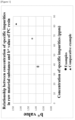
- FIG. 1 A graph showing relationship between the concentration of the specific impurities in the raw material substances and the b* value of the generated polycarbonate resin of each of the examples and the comparative example.
- a method for producing a polycarbonate resin of the present invention comprises a polymerization step for polymerizing an aromatic dihydroxy compound represented by Formula (1) described above, where the produced polycarbonate resin contains a structural unit derived from the aromatic dihydroxy compound represented by Formula (1).
- the concentration of the compound represented by Formula (2) above is 80 ppm or less relative to the total weight of the aromatic dihydroxy compound and the compound represented by Formula (2).
- a raw material substance is used for forming a structural unit of a polymer chain of the polycarbonate resin.
- the raw material substance preferably contains an aromatic dihydroxy compound represented by Formula (1) shown below as a raw material monomer, where the aromatic dihydroxy compound represented by Formula (1) shown below is preferably the main component of the raw material substance.
- R 1 and R 2 each independently represent a hydrogen atom, a halogen atom, an optionally substituted and optionally branched C1-C20 alkyl group, or an optionally substituted C6-C30 aryl group.
- R 1 and R 2 are:
- R 1 and R 2 specifically include a hydrogen atom, a methyl group, an isopropyl group, a phenyl group and a hydroxyphenyl group, where a hydrogen atom is favorable among others.
- Examples of the substituent of R 1 and R 2 include a halogen atom and a hydroxy group. Moreover, the number of the carbons mentioned above is the total number of carbons including the carbons of the substituent.
- R 3 represents a hydrogen atom, an optionally substituted and optionally branched C1-C20 alkyl group, or an optionally substituted C6-C30 aryl group.
- R 3 is:
- R 3 specifically include a hydrogen atom, a methyl group and a phenyl group, where a phenyl group is favorable among others.
- examples of a substituent of R 3 include a halogen atom and a hydroxy group.
- the number of the carbons mentioned above is the total number of carbons including the carbons of the substituent.
- X represents an optionally branched C1-C20 alkyl group, C1-C20 alkynyl group, C1-C20 alkenyl group or C6-C30 aryl group, which may be substituted with a halogen atom.
- X is:
- preferable X specifically include a methyl group and a phenyl group, where a methyl group is favorable among others.
- examples of a substituent of X include a halogen atom and a hydroxy group.
- the number of the carbons mentioned above is the total number of carbons including the carbons of the substituent.
- n and n each independently represent an integer of 0-2.
- m and n are each independently 0 or 1, and more preferably 1.
- Examples of a preferable embodiment of the aromatic dihydroxy compound represented by Formula (1) include those represented by Formula (1-a) below.
- R 1 , R 2 and X are identical to those in Formula (1) above, respectively.
- the polycarbonate resin may be either a homopolymer or a copolymer.
- a branching agent such as 1,1,1-tris(4-hydroxyphenyl)ethane and the like may be contained in the raw material substance, as a raw material monomer for resulting a structural unit to be contained in the polymer chain of the polycarbonate resin.
- the aromatic dihydroxy compound is preferably contained in the raw material substance in an amount of 95 mass% or more, more preferably 98 mass% or more, and particularly preferably 99 mass% or more, relative to the total weight of the raw material substance.
- the branching agent is contained in the raw material substance in an amount of, for example, less than 5 mass%, preferably less than 2 mass% and more preferably less than 1 mass%, relative to the total weight of the raw material substance.
- the raw material substance preferably contains a reduced amount of impurities.
- Impurities as used herein refer to components other than the raw material monomers used for forming the structural units of the polycarbonate resin to be produced and components intentionally added for desired purposes (e.g., additives) which are contained in the raw material substance in a minute amount.
- R 1 -R 3 and X in Formula (2) are each independently identical to those in Formula (1) above, respectively.
- a and b in Formula (2) each independently represent an integer of 0-3, provided that not both of a and b are 0.
- a and b in Formula (2) are preferably each independently 1-3 and more preferably 2 or 3.
- the impurities represented by Formula (2) with abundant phenolic hydroxy groups partly remain unreacted after the polymerization step, where ketonization of such free hydroxy groups may cause coloring or unintentional formation of a branch chain. Therefore, it is particularly preferable to decrease the content of the impurities represented by Formula (2) with abundant phenolic hydroxy groups (for example, a triol or a polyol containing a greater number of phenolic hydroxy groups) in the raw material monomer.
- the sum of (a + m) is an integer of 4 or less and the sum of (b + n) is an integer of 4 or less.
- the sum of (a + m) and the sum of (b + n) are preferably each independently 3 or less, and more preferably 2 or less.
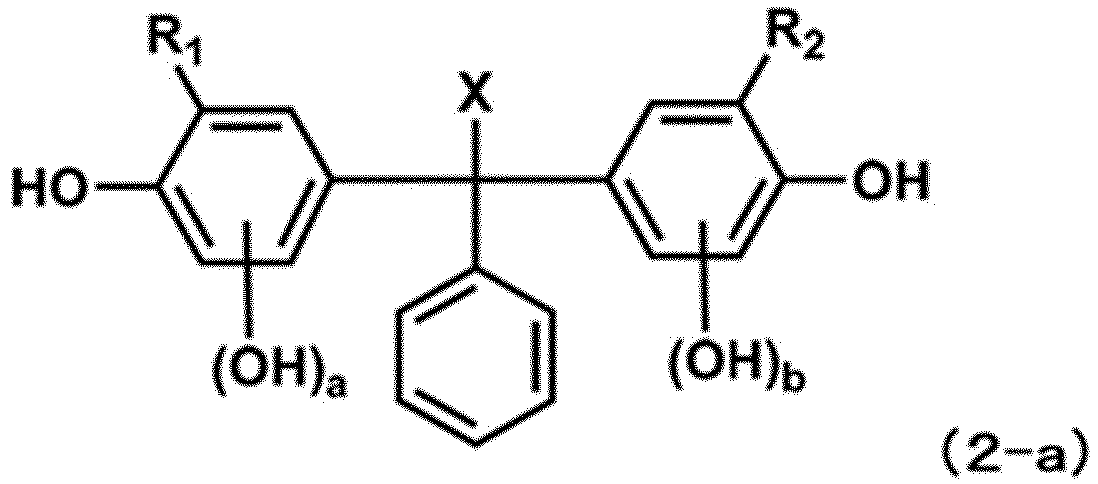
- examples of the compounds represented by Formula (2) as impurities include compounds represented by Formula (2-a) below.
- R 1 , R 2 , a, b and X are identical to those in Formula (2), respectively.
- the concentration of the specific impurities contained in the raw material substance in the polymerization step is 80 mass ppm or less relative to the total weight of the aromatic dihydroxy compound represented by Formula (1) and the specific impurities, i.e., the compound represented by Formula (2).
- the concentration of the specific impurities is preferably 75 mass ppm or less, more preferably 72 mass ppm or less, and still more preferably 70 mass ppm or less, relative to the total weight of the aromatic dihydroxy compound represented by Formula (1) and the specific impurities.
- the concentration of the above-described specific impurities is, for example, 60 mass ppm or less, or 50 mass ppm or less.
- the concentration of the specific impurities is preferably 80 ppm or less, more preferably 75 mass ppm or less, still more preferably 72 mass ppm or less and particularly preferably 70 mass ppm or less, relative to the total weight of the raw material substance.
- the concentration of the above-described specific impurities is, for example, 60 mass ppm or less, or 50 mass ppm or less.
- the specific impurities may cause coloring of the polycarbonate resin as described above, it is preferable to reduce the concentration thereof in the raw material substance. Therefore, setting a minimum concentration of the specific impurities in the raw material substance is not particularly meaningful, but when a raw material substance completely free of specific impurities is used to produce a polycarbonate resin, the melt tension upon shaping a film or the like from said resin may be poor. From this point of view, the minimum concentration of the specific impurities in the raw material substance is, for example, 0.01 mass ppm, 0.1 mass ppm, 1.0 mass ppm or the like.
- the concentration of the specific impurities in the raw material substance is, for example, 0.01-70 mass ppm, preferably 0.1 ppm-50 mass ppm, and more preferably 1-40 mass ppm.
- the raw material substance may also contain impurities other than the above-described specific impurities.
- impurities other than the specific impurities include those represented by Formulae (3)-(6) below.
- i is an integer of 0-5.
- i is an integer of 0-5.
- the concentration of the compound represented by Formula (3) in the raw material substance is preferably 400 mass ppm or less, more preferably 300 mass ppm or less, still more preferably 250 mass ppm or less, and particularly preferably 200 mass ppm or less, for example, 150 mass ppm or less or 120 mass ppm or less.
- the compound represented by Formula (4) which may be contained in the raw material substance is as follows.
- k is an integer of 0-5.
- the concentration of the compound represented by Formula (4) in the raw material substance is preferably 500 mass ppm or less, more preferably 400 mass ppm or less, still more preferably 300 mass ppm or less, and particularly preferably 250 mass ppm or less, for example, 200 mass ppm or less or 180 mass ppm or less.
- the compound represented by Formula (5) which may be contained in the raw material substance is as follows.
- j is an integer of 1-5.
- the concentration of the compound represented by Formula (5) in the raw material substance is preferably 300 mass ppm or less, more preferably 250 mass ppm or less, still more preferably 200 mass ppm or less, and particularly preferably 150 mass ppm or less, for example, 120 mass ppm or less or 100 mass ppm or less.
- the compound represented by Formula (6) which may be contained in the raw material substance is either one of or a mixture of the following two compounds.
- the concentration of the compound represented by Formula (6) in the raw material substance is preferably 30 mass ppm or less, more preferably 25 mass ppm or less, still more preferably 20 mass ppm or less, and particularly preferably 15 mass ppm or less, for example, 12 mass ppm or less or 10 mass ppm or less.
- the concentrations of the impurities other than the specific impurities are also preferably decreased in the raw material substance. Therefore, the total concentration of the impurities in the raw material substance, that is, the total concentration of the specific impurities and other impurities in the raw material substance, is preferably 2.0 mass% or less, more preferably 1.5 mass% or less, still more preferably 1.0 mass% or less, and particularly preferably 0.8 mass% (or 8,000 mass ppm) or lower, for example, 0.6 mass% (or 6,000 mass ppm) or lower or 0.5 mass% (or 5,000 mass ppm) or lower, relative to the total weight of the raw material substance.
- the purity of the raw material substance i.e., the weight obtained by subtracting the total weight of the impurities (total weight of the specific impurities and other impurities) from the weight of the raw material substance
- the purity of the raw material substance is preferably higher than 98.0 mass%, more preferably higher than 98.5 mass%, still more preferably higher than 99.0 mass%, and particularly preferably higher than 99.2 mass%, for example, higher than 99.4 mass% or higher than 99.5 mass%, relative to the total weight of the raw material substance.
- the minimum total concentration of the impurities is, for example, 0.01 mass ppm, 0.1 mass ppm or 1.0 mass ppm.
- the impurities other than the specific impurities it is preferable to similarly decrease the content of those with abundant phenolic hydroxy groups (for example, a triol or a polyol containing a greater number of phenolic hydroxy groups) in the raw material monomer.
- those with abundant phenolic hydroxy groups for example, a triol or a polyol containing a greater number of phenolic hydroxy groups
- a carbonate binder, a chain terminator, a phase transfer catalyst and the like can also be used as components other than the raw material substance.
- Examples of the carbonate binder include phosgene, triphosgene, carbonic acid diester, and carbonyl-based compounds such as carbon monoxide and carbon dioxide.
- Examples of the carbonic acid diester include dialkyl carbonate compounds such as dimethyl carbonate, diethyl carbonate and di-tert-butyl carbonate, diphenyl carbonate, and substituted diphenyl carbonates such as di-p-tolyl carbonate, phenyl-p-tolyl carbonate and di-p-chlorophenyl carbonate. Among them, diphenyl carbonate and substituted diphenyl carbonates are favorable, and diphenyl carbonate is particularly favorable. One or more of these carbonic acid diester compounds may be used alone or as a mixture.
- the carbonate binder can be used in an excessive amount with respect to the raw material substance (raw material monomer) upon producing a polycarbonate resin
- the mole ratio between the raw material substance and the carbonate binder is preferably in a range of 1:1.1 to 1:5, more preferably 1:1.2 to 1:3, and still more preferably 1:1.3 to 1:2, for example, 1:1.4.
- the chain terminator is used for terminating the polymerization reaction of the raw material monomer by forming an end group of the polymer chain of the polycarbonate resin.
- a monohydric phenol can favorably be used.
- chain terminator examples include alkylphenols such as phenol, p-cresol, o-cresol, 2,4-xylenol, p-t-butyl phenol, o-allylphenol, p-allylphenol, p-hydroxystyrene, p-hydroxy- ⁇ -methylstyrene, p-propylphenol, p-cumylphenol, p-phenylphenol, o-phenylphenol, p-trifluoromethylphenol, p-nonylphenol, p-dodecylphenol, eugenol, amylphenol, hexylphenol, heptylphenol, octylphenol, nonylphenol, decylphenol, dodecylphenol, myristylphenol, palmitylphenol, stearylphenol and behenylphenol, and alkyl parahydroxybenzoates such as methyl ester, ethyl ester, propyl ester,
- the amount of the chain terminator to be used can suitably be determined according to the desired molecular weight of the polycarbonate resin, the mole ratio between the raw material substance and the chain terminator is preferably in a range of 100:1 to 10:1, more preferably 50:1 to 15:1, and still more preferably 40:1 to 20:1, for example, 25:1.
- phase transfer catalyst is preferably used in the polymerization step of the interfacial polycondensation process.
- the phase transfer catalyst is mixed with the raw material monomer and the carbonate binder to give a solution, for example, an aqueous solution, to be used for the polymerization reaction.
- Specific examples of the phase transfer catalyst include a nitrogen-containing compound represented by Formula (7) below.
- Such a nitrogen-containing compound examples include benzyltriethylammonium chloride (TEBAC) and benzyltributylammonium chloride (TBBAC), where benzyltriethylammonium chloride (TEBAC) is favorable for use.
- TEBAC benzyltriethylammonium chloride
- TBBAC benzyltributylammonium chloride
- the phase transfer catalyst such as a nitrogen-containing compound represented by Formula (7) above is preferably used in a small amount.
- the phase transfer catalyst is preferably used in an amount of less than 0.10 mass%, more preferably less than 0.05 mass%, and particularly preferably less than 0.02 mass%, relative to the total weight of the raw material substance (raw material monomer) and the phase transfer catalyst.
- the minimum amount of the phase transfer catalyst is preferably 0.001 mass% or more, more preferably 0.005 mass% or more, and particularly preferably 0.01 mass% or more, relative to the total weight of the raw material substance (raw material monomer) and the phase transfer catalyst.
- a polycarbonate resin can also be produced by a transesterification process.
- a carbonic acid diester, a catalyst such as a basic compound catalyst or a transesterification catalyst and the like are additionally used as components other than the raw material substance.
- Examples of the carbonic acid diester include diphenyl carbonate, ditolyl carbonate, bis(chlorophenyl)carbonate, m-cresyl carbonate, dimethyl carbonate, diethyl carbonate, dibutyl carbonate and dicyclohexyl carbonate.
- diphenyl carbonate is particularly favorable in terms of reactivity and purity.
- the carbonic acid diester is preferably used at a ratio of 0.60-1.30 moles, more preferably 0.70-1.20 moles and particularly preferably 1.00-1.20 moles per mole of the raw material substance (raw material monomer). This mole ratio can be adjusted to control the molecular weight of the polyester carbonate resin to lie within a favorable range.
- Examples of the basic compound catalyst include an alkali metal compound, an alkaline earth metal compound and a nitrogen-containing compound.
- alkali metal compound examples include an organic acid salt, an inorganic salt, an oxide, a hydroxide, a hydride or an alkoxide of an alkali metal.
- catalyst effect cost, distribution quantity, effect on the hue of the resin and the like, sodium carbonate and sodium bicarbonate are favorable.
- alkaline earth metal compound examples include an organic acid salt, an inorganic salt, an oxide, a hydroxide, a hydride or an alkoxide of an alkaline earth metal compound.
- nitrogen-containing compound examples include quaternary ammonium hydroxides, and salts, amines and the like thereof.
- a salt of zinc, tin, zirconium or lead is preferably used, which may be used alone or in combination. They may also be used in combination with the above-described alkali metal compound or alkaline earth metal compound.
- examples of the transesterification catalyst include zinc acetate, zinc benzoate, zinc 2-ethylhexanoate, tin(II) chloride, tin(IV) chloride, tin(II) acetate, tin(IV) acetate, dibutyltin dilaurate, dibutyltin oxide, dibutyltin dimethoxide, zirconium acetylacetonate, zirconium oxyacetate, zirconium tetrabutoxide, lead(II) acetate, lead(IV) acetate, zirconium acetate, and titanium tetrabutoxide.
- zinc acetate, zirconium acetate and titanium tetrabutoxide are favorable, and titanium tetrabutoxide is more favorable.
- the basic compound catalyst and the transesterification catalyst are used in a total amount of 1 x 10 -9 to 1 x 10 -3 moles and preferably 1 x 10 -7 to 1 x 10 -4 per total mole of the raw material substance (raw material monomer).
- the raw material monomer namely, the main component of the raw material substance
- the raw material substance contains the above-described aromatic dihydroxy compound, at least the aromatic dihydroxy compound is polymerized in the polymerization step.
- a transesterification process can be employed for the polymerization step, in which the aromatic dihydroxy compound is reacted with a carbonic acid diester in the presence of a catalyst.
- the temperature of the polymerization reaction in the interfacial polycondensation process is in a range of 5°C-60°C, more preferably 15°C-50°C, and still more preferably 20°C-40°C, for example, 30°C.
- the polymerization reaction in the interfacial polycondensation process is preferably carried out at normal pressure.
- an alkyl amine or the like can be used as the catalyst for the polymerization reaction in the interfacial polycondensation process.
- triethylamine can favorably be used as such an alkyl amine.
- examples of the catalyst used for the polymerization reaction in the transesterification process include an alkali metal compound and an alkaline earth metal compound, where, for example, sodium bicarbonate, cesium carbonate and sodium carbonate can favorably be used.
- the polymerization reaction in the transesterification process is preferably carried out under the following conditions. Specifically, the polymerization reaction in the transesterification process is carried out at a temperature of 120°C-350°C, preferably 180°C-260°C for 0.1-5 hours, preferably 0.5-3 hours. Subsequently, the reaction temperature is increased while increasing the degree of pressure reduction in the reaction system to allow reaction between the diol compound and the carbonic acid diester, so that polycondensation reaction eventually takes place at a reduced pressure of 1 mmHg or lower and a temperature of 200°C-350°C for 0.05-2 hours. Such reaction may be carried out in either continuous or batch mode.
- the reactor used for the polymerization reaction in the transesterification process may be a vertical reactor equipped with an anchor stirring blade, a Maxblend stirring blade, a helical ribbon stirring blade or the like, a horizontal reactor equipped with a paddle blade, a lattice blade, a spectacle-shaped blade or the like, or an extruder reactor equipped with a screw. Moreover, these reactors are preferably used in a suitable combination in accordance with the viscosity of the polycarbonate resin of interest to be polymerized.
- the interfacial polycondensation process (interfacial process, interfacial polymerization process) is preferably employed. This is because when a raw material monomer containing the above-described aromatic dihydroxy compound represented by Formula (1) above is polymerized by the interfacial polycondensation process, the hue of the generated polycarbonate resin is likely to be improved compared to a polycarbonate resin generated by other production method, for example, a melting method.
- the concentrations of the raw material substance and the impurities are preferably determined prior to the polymerization step.
- a concentration determining step for determining the concentration of the aromatic dihydroxy compound in the raw material substance namely, the purity of the raw material substance and the concentration of the specific impurities (the compound represented by Formula (2)), is preferably carried out prior to the polymerization step.
- the purity of the raw material substance and the concentration of the specific impurities are determined based on the masses of the raw material substance, the raw material monomer and the specific impurities measured by a known method, and preferably determined in mass% or mass ppm relative to the mass of the raw material substance.
- the concentration of preferably at least the aromatic dihydroxy compound represented by Formula (1) of the raw material monomer is determined. Furthermore, the concentration of the impurities other than the specific impurities contained in the raw material substance is preferably determined.
- an impurity removal step for at least partly removing the specific impurities (i.e., the compound represented by Formula (2)) from the raw material substance is preferably carried out prior to the polymerization reaction of the raw material monomer.
- the specific impurities are removed from the raw material substance based on crystallization of the raw material substance or the like.
- the impurity removal step further comprises washing crystals resulting from crystallization of the raw material substance, where the steps of crystallization and washing are preferably repeated.
- the impurity removal step may also comprise a step of decreasing the concentration of the impurities by mixing a certain raw material substance with a raw material substance having the specific impurities at a lower concentration based on the results obtained in the above-described concentration determining step.
- the impurities other than the specific impurities are also preferably removed in the impurity removal step.
- the above-described impurity removal step can enhance purity of the raw material monomer in the raw material substance, thereby improving the hue of the polycarbonate resin to be produced.
- the polycarbonate resin generated by the polymerization reaction can be purified, sufficient hue improvement may not be achieved even by such a purification step if the above-described impurities are incorporated into the polymer chains.
- the impurity removal step that targets the raw material substance can ensure removal of the impurities which may be causative of hue deterioration.
- impurities can be removed efficiently by referring to the purity and the concentration of the respective components determined in the concentration determining step.
- a polycarbonate resin produced by polymerization reaction of a raw material substance containing at least an aromatic dihydroxy compound represented by Formula (1) contains a structural unit represented by Formula (1-b) below derived from said aromatic dihydroxy compound represented by Formula (1).
- Formula (1-b) R 1 -R 3 , m, n and X are identical to those in Formula (1), respectively).
- the polycarbonate resin may comprise structural units derived from a plurality of kinds of aromatic dihydroxy compounds represented by Formula (1), or may additionally comprise a structural unit other than the structural unit derived from the aromatic dihydroxy compound represented by Formula (1).
- the polycarbonate resin may be either a random copolymer or a block copolymer.
- the polycarbonate resin preferably has an intrinsic viscosity of 0.2 dl/g to 1.0 dl/g (inclusive) as measured by a method following JIS K-7367-1 which will be described below.
- the intrinsic viscosity of the polycarbonate resin is more preferably 0.3 dl/g to 0.7 dl/g (inclusive), still more preferably 0.4 dl/g to 0.5 dl/g (inclusive), and particularly preferably 0.41 dl/g to 0.49 dl/g (inclusive).
- the polycarbonate resin preferably has a viscosity average molecular weight (Mv) in a range of 10,000-60,000, more preferably 14,000-40,000 and still more preferably 16,000-25,000.
- Mv viscosity average molecular weight
- the viscosity-average molecular weight (Mv) of the above-described polycarbonate resin is measured under the following measurement conditions.
- the polycarbonate resin preferably has a glass transition temperature in a range of 100°C-250°C.
- the glass transition temperature of the polycarbonate resin is more preferably 140°C-200°C and still more preferably 160°C-190°C.
- the glass transition temperature of the above-described polycarbonate resin is measured using a differential scanning calorimeter under the following conditions.
- a molded body of the present invention comprises a polycarbonate resin obtained by the above-described production method.
- the molded body include sheets and films, as well as heat molded bodies.
- examples of the heat molded body include electric and electronic devices, office automation equipment, information terminal devices, mechanical parts, household appliances, vehicle parts, building material parts, various containers, recreational equipment and goods, parts of lighting apparatuses and the like, parts of various household electric appliances and the like, housings, containers, cover, storage and casings of electric apparatuses, and covers and cases of lighting apparatuses.
- Examples of the electric and electronic devices include personal computers, game consoles, television receivers, display devices such as liquid crystal display devices and plasma display devices, printers, copying machines, scanners, facsimile machines, electronic organizers, PDAs, electronic calculators, electronic dictionaries, cameras, video cameras, cell phones, smartphones, tablets, battery packs, storage drivers, storage readers, computer mice, numeric keypads, CD players, MD players, portable radios, and audio players.
- Examples of the molded body also include illuminated signboards, liquid crystal device backlight, lighting display, traffic signboards, signboards, screens, car parts such as reflection plates and gauge parts, toys and accessories.
- the concentration of the impurities in each of the following examples and comparative example was determined as a concentration with respect to bisphenol AP, based on the calibration curves obtained by the above-described method.
- the intrinsic viscosity was measured in accordance with JIS K-7367-1. Specifically, the polycarbonate resin was dissolved in dichloromethane at a concentration of 5.0 g/L to determine the intrinsic viscosity using an Ubbelohde viscometer at a temperature of 25°C and a Huggins constant of 0.45.
- bisphenol AP samples bisphenol AP synthesized from phenol and acetophenone, as well as commercially available bisphenol AP were used.
- the bisphenol AP was synthesized by the method described in Japanese patent No. 4168646 ( Japanese unexamined patent application publication No., 2003-286213 ). Specifically, acetophenone, phenol and butyl mercaptan as a catalyst were loaded into an autoclave equipped with a thermometer and a stirrer, and the resultant was heated while slowly stirring to maintain the temperature at 50°C-60°C. Subsequently, the stirring speed was increased and hydrogen chloride gas was fed into the autoclave to allow reaction at an internal pressure of 0.05 MPa-0.10 MPa for 6 hours. The solvent was removed from the reaction solution to give a bisphenol AP sample.
- PTBP p-tert-butyl phenol
- the polymerization solution was separated into an aqueous phase and an organic phase.
- the organic phase was neutralized with phosphoric acid and repeatedly washed with pure water until pH of the rinsing solution became 7.0.
- the organic solvent was evaporated away from the purified polycarbonate resin, thereby obtaining polycarbonate resin powder.
- the polycarbonate resin powder was dried at 120°C for 24 hours to completely distill the solvent away.
- the resulting polycarbonate resin had an intrinsic viscosity and a b* value of 0.431 dl/g and 0.84, respectively. Moreover, it had a viscosity average molecular weight (Mv) and a glass transition temperature of 20,600 and 182°C, respectively.
- a polycarbonate resin was synthesized in the same manner as Example 1 except that the amount of PTBP was changed to 2.21 g.
- the resulting polycarbonate resin had an intrinsic viscosity and a b* value of 0.405 dl/g and 0.91, respectively. Moreover, it had a viscosity average molecular weight (Mv) and a glass transition temperature of 19,200 and 181°C, respectively.
- the polycarbonate resin obtained in Example 3 had a viscosity average molecular weight (Mv) and a glass transition temperature of 20,000 and 184°C, respectively. Moreover, the polycarbonate resin obtained in Comparative example had a viscosity average molecular weight (Mv) and a glass transition temperature of 19,200 and 178°C, respectively.
Landscapes
- Chemical & Material Sciences (AREA)
- Health & Medical Sciences (AREA)
- Chemical Kinetics & Catalysis (AREA)
- Medicinal Chemistry (AREA)
- Polymers & Plastics (AREA)
- Organic Chemistry (AREA)
- Engineering & Computer Science (AREA)
- Manufacturing & Machinery (AREA)
- Materials Engineering (AREA)
- Polyesters Or Polycarbonates (AREA)
Claims (12)
- Verfahren zur Herstellung eines Polycarbonatharzes, enthaltend eine Struktureinheit, die von einer aromatischen Dihydroxyverbindung der nachstehenden Formel (1) abgeleitet ist, wobei das Verfahren umfassteinen Polymerisationsschritt zum Polymerisieren der aromatischen Dihydroxyverbindung der Formel (1),wobei eine Rohmaterialsubstanz, in der die Konzentration einer Verbindung der nachstehenden Formel (2) als Verunreinigung 80 ppm oder weniger beträgt, bezogen auf das Gesamtgewicht der aromatischen Dihydroxyverbindung der Formel (1) und der Verbindung der Formel (2), im Polymerisationsschritt verwendet wird:
 (in Formel (1)bedeuten R1 und R2 jeweils unabhängig ein Wasserstoffatom, ein Halogenatom, eine optional substituierte und optional verzweigte C1-C20-Alkylgruppe oder eine optional substituierte C6-C30-Arylgruppe,bedeutet R3 ein Wasserstoffatom, eine optional substituierte und optional verzweigte C1-C20-Alkylgruppe oder eine optional substituierte C6-C30-Arylgruppe,bedeutet X eine optional verzweigte C1-C20-Alkylgruppe, C1-C20-Alkinylgruppe, C1-C20-Alkenylgruppe oder C6-C30-Arylgruppe, die mit einem Halogenatom substituiert sein kann, undbedeuten m und n jeweils unabhängig eine ganze Zahl von 0-2);
 bedeuten R1 und R2 jeweils unabhängig ein Wasserstoffatom, ein Halogenatom, eine optional substituierte und optional verzweigte C1-C20-Alkylgruppe oder eine optional substituierte C6-C30-Arylgruppe,bedeutet R3 ein Wasserstoffatom, eine optional substituierte und optional verzweigte C1-C20-Alkylgruppe oder eine optional substituierte C6-C30-Arylgruppe,bedeutet X eine optional verzweigte C1-C20-Alkylgruppe, C1-C20-Alkinylgruppe, C1-C20-Alkenylgruppe oder C6-C30-Arylgruppe, die mit einem Halogenatom substituiert sein kann,bedeuten a und b jeweils unabhängig eine ganze Zahl von 0-3 (mit der Maßgabe, dass nicht beide von a und b 0 sind), undbedeuten m und n jeweils unabhängig eine ganze Zahl von 0-2,mit der Maßgabe, dass die Summe von (a + m) eine ganze Zahl von 4 oder weniger ist, und die Summe von (b + n) eine ganze Zahl von 4 oder weniger ist),wobei der b*-Wert in einer 5 cm-Lösung einer 7 massenprozentigen Dichlormethanlösung des Polycarbonatharzes 2,3 oder weniger beträgt, undwobei der b*-Wert gemäß JIS K7136 wie in der Beschreibung angegeben gemessen wird.
 - Herstellungsverfahren gemäß Anspruch 1, wobei die aromatische Dihydroxyverbindung der Formel (1) durch die nachstehende Formel (1-a) dargestellt wird:

sind R1, R2 und X jeweils identisch mit denen in Formel (1)). - Herstellungsverfahren gemäß Anspruch 1, wobei die Verbindung der Formel (2) durch die nachstehende Formel (2-a) dargestellt wird:
sind R1, R2, a, b und X jeweils identisch mit denen in Formel (2)). - Herstellungsverfahren gemäß Anspruch 1, wobei in den obigen Formeln (1) und (2) R1 und R2 Wasserstoff sind und X eine Methylgruppe ist, und
in der obigen Formel (2) a 1 ist und b 0 ist. - Herstellungsverfahren gemäß Anspruch 1, wobei in den obigen Formeln (1) und (2) R3 eine Phenylgruppe ist.
- Herstellungsverfahren gemäß mindestens einem der Ansprüche 1-5, wobei die Grenzviskosität des Polycarbonatharzes 0,2 dl/g bis (einschließlich) 1,0 dl/g beträgt,
wobei die Grenzviskosität gemäß JIS K-7367-1 gemessen wird, indem das Polycarbonatharz in Dichlormethan in einer Konzentration von 5,0 g/L gelöst und die Grenzviskosität unter Verwendung eines Ubbelohde-Viskosimeters bei einer Temperatur von 25°C und einer Huggins-Konstante von 0,45 bestimmt wird. - Herstellungsverfahren gemäß mindestens einem der Ansprüche 1-6, wobei der b*-Wert in einer 5 cm-Lösung einer 7 massenprozentigen Dichlormethanlösung des Polycarbonatharzes 2,0 oder weniger beträgt, bestimmt unter Verwendung des Verfahrens wie in der Beschreibung angegeben.
- Herstellungsverfahren gemäß mindestens einem der Ansprüche 1-7, ferner umfassend vor dem Polymerisationsschritt einen Konzentrationsbestimmungsschritt zum Bestimmen der Konzentration der aromatischen Dihydroxyverbindung der Formel (1) und der Konzentration der Verbindung der Formel (2).
- Herstellungsverfahren gemäß mindestens einem der Ansprüche 1-8, ferner umfassend einen Verunreinigungsentfernungsschritt zum zumindest teilweisen Entfernen der durch die Formel (2) dargestellten Verbindung aus der Rohmaterialsubstanz.
- Herstellungsverfahren gemäß mindestens einem der Ansprüche 1-9, wobei in dem Polymerisationsschritt die aromatische Dihydroxyverbindung der Formel (1) durch ein Grenzflächenpolykondensationsverfahren polymerisiert wird.
- Formkörper, umfassend ein Polycarbonatharz, erhalten durch das Herstellungsverfahren gemäß mindestens einem der Ansprüche 1-10.
- Formkörper gemäß Anspruch 11, wobei der Formkörper eine Folie ist.
Applications Claiming Priority (2)
| Application Number | Priority Date | Filing Date | Title |
|---|---|---|---|
| JP2019169653 | 2019-09-18 | ||
| PCT/JP2020/034809 WO2021054300A1 (ja) | 2019-09-18 | 2020-09-15 | ポリカーボネート樹脂の製造方法、及び、成形体 |
Publications (3)
| Publication Number | Publication Date |
|---|---|
| EP4032932A1 EP4032932A1 (de) | 2022-07-27 |
| EP4032932A4 EP4032932A4 (de) | 2022-10-12 |
| EP4032932B1 true EP4032932B1 (de) | 2025-05-28 |
Family
ID=74883800
Family Applications (1)
| Application Number | Title | Priority Date | Filing Date |
|---|---|---|---|
| EP20866213.0A Active EP4032932B1 (de) | 2019-09-18 | 2020-09-15 | Verfahren zur herstellung von polycarbonatharz und formkörper |
Country Status (7)
| Country | Link |
|---|---|
| US (1) | US12371530B2 (de) |
| EP (1) | EP4032932B1 (de) |
| JP (1) | JP7616057B2 (de) |
| KR (1) | KR102917475B1 (de) |
| CN (1) | CN114391027A (de) |
| TW (1) | TWI862680B (de) |
| WO (1) | WO2021054300A1 (de) |
Families Citing this family (2)
| Publication number | Priority date | Publication date | Assignee | Title |
|---|---|---|---|---|
| EP4345127A4 (de) * | 2022-04-13 | 2025-07-30 | Lg Chemical Ltd | Monomerzusammensetzung zur synthese von recyceltem kunststoff, verfahren zur herstellung davon und recycelter kunststoff und formprodukt damit |
| EP4345126A4 (de) * | 2022-04-13 | 2025-07-30 | Lg Chemical Ltd | Monomerzusammensetzung zur synthese von recyceltem kunststoff, verfahren zur herstellung davon und recycelter kunststoff und formprodukt damit |
Family Cites Families (11)
| Publication number | Priority date | Publication date | Assignee | Title |
|---|---|---|---|---|
| US4533722A (en) * | 1981-04-13 | 1985-08-06 | General Electric Company | Interfacial polycondensation polycarbonate process with quaternary phosphonium amino halide catalyst |
| US5409975A (en) | 1992-11-02 | 1995-04-25 | The Furukawa Electric Co., Ltd. | Aromatic polycarbonate copolymer, a process for producing the same, and a plastic optical waveguide using the same |
| JP4168646B2 (ja) | 2002-03-27 | 2008-10-22 | エア・ウォーター株式会社 | 4,4’−(1−フェニルエチリデン)ビスフェノールの製造方法 |
| CN1315907C (zh) * | 2002-11-14 | 2007-05-16 | 帝人化成株式会社 | 聚碳酸酯共聚物、树脂组合物及成型品 |
| JP4267344B2 (ja) | 2003-02-19 | 2009-05-27 | Sabicイノベーティブプラスチックスジャパン合同会社 | 芳香族ポリカーボネートおよびその製造方法 |
| TWI395767B (zh) * | 2006-08-02 | 2013-05-11 | Mitsubishi Gas Chemical Co | 聚碳酸酯樹脂及使用該聚碳酸酯樹脂的電子照像感光體 |
| JP2011219636A (ja) | 2010-04-09 | 2011-11-04 | Mitsubishi Chemicals Corp | ポリカーボネート樹脂の製造方法およびポリカーボネート樹脂 |
| EP2578636B2 (de) * | 2010-05-27 | 2022-06-22 | Idemitsu Kosan Co., Ltd. | Polycarbonatharzzusammensetzung und polycarbonatharzformartikel |
| TWI549986B (zh) | 2011-05-19 | 2016-09-21 | 三菱瓦斯化學股份有限公司 | A high-flow polycarbonate copolymer, a method for producing a high molecular weight aromatic polycarbonate resin, and an aromatic polycarbonate compound |
| EP2949686B1 (de) * | 2013-01-24 | 2019-08-14 | Mitsubishi Gas Chemical Company, Inc. | Polyarylat und daraus geformter artikel |
| JP6834539B2 (ja) | 2017-01-30 | 2021-02-24 | 三菱ケミカル株式会社 | 電子写真感光体用のポリカーボネートの製造方法 |
-
2020
- 2020-09-15 EP EP20866213.0A patent/EP4032932B1/de active Active
- 2020-09-15 US US17/642,458 patent/US12371530B2/en active Active
- 2020-09-15 KR KR1020227011323A patent/KR102917475B1/ko active Active
- 2020-09-15 CN CN202080064678.XA patent/CN114391027A/zh active Pending
- 2020-09-15 JP JP2021546660A patent/JP7616057B2/ja active Active
- 2020-09-15 WO PCT/JP2020/034809 patent/WO2021054300A1/ja not_active Ceased
- 2020-09-16 TW TW109131797A patent/TWI862680B/zh active
Also Published As
| Publication number | Publication date |
|---|---|
| EP4032932A4 (de) | 2022-10-12 |
| TWI862680B (zh) | 2024-11-21 |
| JPWO2021054300A1 (de) | 2021-03-25 |
| JP7616057B2 (ja) | 2025-01-17 |
| CN114391027A (zh) | 2022-04-22 |
| KR102917475B1 (ko) | 2026-01-23 |
| WO2021054300A1 (ja) | 2021-03-25 |
| TW202124518A (zh) | 2021-07-01 |
| KR20220065787A (ko) | 2022-05-20 |
| US12371530B2 (en) | 2025-07-29 |
| EP4032932A1 (de) | 2022-07-27 |
| US20220298300A1 (en) | 2022-09-22 |
Similar Documents
| Publication | Publication Date | Title |
|---|---|---|
| EP2712880B1 (de) | Polycarbonatcopolymer mit hoher fliessfähigkeit, verfahren zur herstellung eines aromatischem polycarbonatharzes mit hohem molekulargewicht und aromatische polycarbonatverbindung | |
| US8674053B2 (en) | Process for production of highly polymerized aromatic polycarbonate resin | |
| EP2921515B1 (de) | Herstellungsverfahren für aromatisches polycarbonatharz mit erhöhtem molekulargewicht | |
| EP2674445B1 (de) | Verfahren zur herstellung eines verzweigten aromatischen polycarbonatharzes mit einem gewünschten verzweigungsgrad | |
| EP4071194A1 (de) | Polycarbonat/polyorganosiloxan-copolymer und dieses copolymer einschliessende harzzusammensetzung | |
| EP4071196A1 (de) | Polycarbonat/polyorganosiloxan-copolymer und dieses copolymer einschliessende harzzusammensetzung | |
| EP4032932B1 (de) | Verfahren zur herstellung von polycarbonatharz und formkörper | |
| US9458290B2 (en) | Process for preparing highly polymerized aromatic polycarbonate resin | |
| EP4032931B1 (de) | Polycarbonatharz, verfahren zu seiner herstellung, polycarbonatharzzusammensetzung und formkörper | |
| US9428608B2 (en) | Aromatic polycarbonate resin composition | |
| EP1153955B1 (de) | Polycarbonatharz und verfahren zu seiner herstellung | |
| EP3351578A1 (de) | Polycarbonatharz, verfahren zur herstellung davon, formkörper, folie und daraus geformte folie sowie verfahren zur herstellung davon | |
| JP6176066B2 (ja) | ポリカーボネート樹脂組成物 | |
| EP4538311A1 (de) | Polycarbonat-polyorganosiloxan-copolymer | |
| HK1176632A (en) | Process for production of highly polymerized aromatic polycarbonate resin | |
| HK1176632B (en) | Process for production of highly polymerized aromatic polycarbonate resin | |
| HK1193836A (en) | Polycarbonate copolymer having high fluidity, method for producing aromatic polycarbonate resin having high molecular weight, and aromatic polycarbonate compound | |
| HK1190743B (en) | Process for manufacturing branched aromatic polycarbonate resin with desired degree of branching |
Legal Events
| Date | Code | Title | Description |
|---|---|---|---|
| STAA | Information on the status of an ep patent application or granted ep patent |
Free format text: STATUS: THE INTERNATIONAL PUBLICATION HAS BEEN MADE |
|
| PUAI | Public reference made under article 153(3) epc to a published international application that has entered the european phase |
Free format text: ORIGINAL CODE: 0009012 |
|
| STAA | Information on the status of an ep patent application or granted ep patent |
Free format text: STATUS: REQUEST FOR EXAMINATION WAS MADE |
|
| 17P | Request for examination filed |
Effective date: 20220328 |
|
| AK | Designated contracting states |
Kind code of ref document: A1 Designated state(s): AL AT BE BG CH CY CZ DE DK EE ES FI FR GB GR HR HU IE IS IT LI LT LU LV MC MK MT NL NO PL PT RO RS SE SI SK SM TR |
|
| A4 | Supplementary search report drawn up and despatched |
Effective date: 20220913 |
|
| RIC1 | Information provided on ipc code assigned before grant |
Ipc: C08G 64/20 20060101ALI20220907BHEP Ipc: C08G 64/04 20060101AFI20220907BHEP |
|
| DAV | Request for validation of the european patent (deleted) | ||
| DAX | Request for extension of the european patent (deleted) | ||
| GRAP | Despatch of communication of intention to grant a patent |
Free format text: ORIGINAL CODE: EPIDOSNIGR1 |
|
| STAA | Information on the status of an ep patent application or granted ep patent |
Free format text: STATUS: GRANT OF PATENT IS INTENDED |
|
| RIC1 | Information provided on ipc code assigned before grant |
Ipc: C08G 64/40 20060101ALI20250219BHEP Ipc: C08G 64/24 20060101ALI20250219BHEP Ipc: C08G 64/04 20060101AFI20250219BHEP |
|
| INTG | Intention to grant announced |
Effective date: 20250227 |
|
| GRAS | Grant fee paid |
Free format text: ORIGINAL CODE: EPIDOSNIGR3 |
|
| GRAA | (expected) grant |
Free format text: ORIGINAL CODE: 0009210 |
|
| STAA | Information on the status of an ep patent application or granted ep patent |
Free format text: STATUS: THE PATENT HAS BEEN GRANTED |
|
| P01 | Opt-out of the competence of the unified patent court (upc) registered |
Free format text: CASE NUMBER: APP_15316/2025 Effective date: 20250328 |
|
| AK | Designated contracting states |
Kind code of ref document: B1 Designated state(s): AL AT BE BG CH CY CZ DE DK EE ES FI FR GB GR HR HU IE IS IT LI LT LU LV MC MK MT NL NO PL PT RO RS SE SI SK SM TR |
|
| REG | Reference to a national code |
Ref country code: GB Ref legal event code: FG4D |
|
| REG | Reference to a national code |
Ref country code: CH Ref legal event code: EP |
|
| REG | Reference to a national code |
Ref country code: IE Ref legal event code: FG4D Ref country code: DE Ref legal event code: R096 Ref document number: 602020052091 Country of ref document: DE |
|
| REG | Reference to a national code |
Ref country code: NL Ref legal event code: FP |
|
| PGFP | Annual fee paid to national office [announced via postgrant information from national office to epo] |
Ref country code: NL Payment date: 20250814 Year of fee payment: 6 |
|
| PG25 | Lapsed in a contracting state [announced via postgrant information from national office to epo] |
Ref country code: FI Free format text: LAPSE BECAUSE OF FAILURE TO SUBMIT A TRANSLATION OF THE DESCRIPTION OR TO PAY THE FEE WITHIN THE PRESCRIBED TIME-LIMIT Effective date: 20250528 Ref country code: ES Free format text: LAPSE BECAUSE OF FAILURE TO SUBMIT A TRANSLATION OF THE DESCRIPTION OR TO PAY THE FEE WITHIN THE PRESCRIBED TIME-LIMIT Effective date: 20250528 |
|
| PGFP | Annual fee paid to national office [announced via postgrant information from national office to epo] |
Ref country code: DE Payment date: 20250730 Year of fee payment: 6 |
|
| REG | Reference to a national code |
Ref country code: LT Ref legal event code: MG9D |
|
| PG25 | Lapsed in a contracting state [announced via postgrant information from national office to epo] |
Ref country code: NO Free format text: LAPSE BECAUSE OF FAILURE TO SUBMIT A TRANSLATION OF THE DESCRIPTION OR TO PAY THE FEE WITHIN THE PRESCRIBED TIME-LIMIT Effective date: 20250828 Ref country code: GR Free format text: LAPSE BECAUSE OF FAILURE TO SUBMIT A TRANSLATION OF THE DESCRIPTION OR TO PAY THE FEE WITHIN THE PRESCRIBED TIME-LIMIT Effective date: 20250829 |
|
| PG25 | Lapsed in a contracting state [announced via postgrant information from national office to epo] |
Ref country code: PL Free format text: LAPSE BECAUSE OF FAILURE TO SUBMIT A TRANSLATION OF THE DESCRIPTION OR TO PAY THE FEE WITHIN THE PRESCRIBED TIME-LIMIT Effective date: 20250528 |
|
| PG25 | Lapsed in a contracting state [announced via postgrant information from national office to epo] |
Ref country code: BG Free format text: LAPSE BECAUSE OF FAILURE TO SUBMIT A TRANSLATION OF THE DESCRIPTION OR TO PAY THE FEE WITHIN THE PRESCRIBED TIME-LIMIT Effective date: 20250528 |
|
| PGFP | Annual fee paid to national office [announced via postgrant information from national office to epo] |
Ref country code: BE Payment date: 20250818 Year of fee payment: 6 |
|
| PG25 | Lapsed in a contracting state [announced via postgrant information from national office to epo] |
Ref country code: HR Free format text: LAPSE BECAUSE OF FAILURE TO SUBMIT A TRANSLATION OF THE DESCRIPTION OR TO PAY THE FEE WITHIN THE PRESCRIBED TIME-LIMIT Effective date: 20250528 |
|
| PG25 | Lapsed in a contracting state [announced via postgrant information from national office to epo] |
Ref country code: RS Free format text: LAPSE BECAUSE OF FAILURE TO SUBMIT A TRANSLATION OF THE DESCRIPTION OR TO PAY THE FEE WITHIN THE PRESCRIBED TIME-LIMIT Effective date: 20250828 |
|
| PG25 | Lapsed in a contracting state [announced via postgrant information from national office to epo] |
Ref country code: IS Free format text: LAPSE BECAUSE OF FAILURE TO SUBMIT A TRANSLATION OF THE DESCRIPTION OR TO PAY THE FEE WITHIN THE PRESCRIBED TIME-LIMIT Effective date: 20250928 |
|
| PG25 | Lapsed in a contracting state [announced via postgrant information from national office to epo] |
Ref country code: LV Free format text: LAPSE BECAUSE OF FAILURE TO SUBMIT A TRANSLATION OF THE DESCRIPTION OR TO PAY THE FEE WITHIN THE PRESCRIBED TIME-LIMIT Effective date: 20250528 |
|
| REG | Reference to a national code |
Ref country code: AT Ref legal event code: MK05 Ref document number: 1798605 Country of ref document: AT Kind code of ref document: T Effective date: 20250528 |
|
| PG25 | Lapsed in a contracting state [announced via postgrant information from national office to epo] |
Ref country code: DK Free format text: LAPSE BECAUSE OF FAILURE TO SUBMIT A TRANSLATION OF THE DESCRIPTION OR TO PAY THE FEE WITHIN THE PRESCRIBED TIME-LIMIT Effective date: 20250528 Ref country code: SM Free format text: LAPSE BECAUSE OF FAILURE TO SUBMIT A TRANSLATION OF THE DESCRIPTION OR TO PAY THE FEE WITHIN THE PRESCRIBED TIME-LIMIT Effective date: 20250528 Ref country code: AT Free format text: LAPSE BECAUSE OF FAILURE TO SUBMIT A TRANSLATION OF THE DESCRIPTION OR TO PAY THE FEE WITHIN THE PRESCRIBED TIME-LIMIT Effective date: 20250528 |
|
| PG25 | Lapsed in a contracting state [announced via postgrant information from national office to epo] |
Ref country code: CZ Free format text: LAPSE BECAUSE OF FAILURE TO SUBMIT A TRANSLATION OF THE DESCRIPTION OR TO PAY THE FEE WITHIN THE PRESCRIBED TIME-LIMIT Effective date: 20250528 |
|
| PG25 | Lapsed in a contracting state [announced via postgrant information from national office to epo] |
Ref country code: EE Free format text: LAPSE BECAUSE OF FAILURE TO SUBMIT A TRANSLATION OF THE DESCRIPTION OR TO PAY THE FEE WITHIN THE PRESCRIBED TIME-LIMIT Effective date: 20250528 |
|
| PG25 | Lapsed in a contracting state [announced via postgrant information from national office to epo] |
Ref country code: SK Free format text: LAPSE BECAUSE OF FAILURE TO SUBMIT A TRANSLATION OF THE DESCRIPTION OR TO PAY THE FEE WITHIN THE PRESCRIBED TIME-LIMIT Effective date: 20250528 |
|
| PG25 | Lapsed in a contracting state [announced via postgrant information from national office to epo] |
Ref country code: IT Free format text: LAPSE BECAUSE OF FAILURE TO SUBMIT A TRANSLATION OF THE DESCRIPTION OR TO PAY THE FEE WITHIN THE PRESCRIBED TIME-LIMIT Effective date: 20250528 |
|
| REG | Reference to a national code |
Ref country code: DE Ref legal event code: R097 Ref document number: 602020052091 Country of ref document: DE |
|
| PG25 | Lapsed in a contracting state [announced via postgrant information from national office to epo] |
Ref country code: RO Free format text: LAPSE BECAUSE OF FAILURE TO SUBMIT A TRANSLATION OF THE DESCRIPTION OR TO PAY THE FEE WITHIN THE PRESCRIBED TIME-LIMIT Effective date: 20250528 |
|
| PLBE | No opposition filed within time limit |
Free format text: ORIGINAL CODE: 0009261 |
|
| STAA | Information on the status of an ep patent application or granted ep patent |
Free format text: STATUS: NO OPPOSITION FILED WITHIN TIME LIMIT |
|
| REG | Reference to a national code |
Ref country code: CH Ref legal event code: L10 Free format text: ST27 STATUS EVENT CODE: U-0-0-L10-L00 (AS PROVIDED BY THE NATIONAL OFFICE) Effective date: 20260409 |