EP4025795B1 - Antriebsvorrichtung für ein fahrzeug - Google Patents
Antriebsvorrichtung für ein fahrzeug Download PDFInfo
- Publication number
- EP4025795B1 EP4025795B1 EP20774976.3A EP20774976A EP4025795B1 EP 4025795 B1 EP4025795 B1 EP 4025795B1 EP 20774976 A EP20774976 A EP 20774976A EP 4025795 B1 EP4025795 B1 EP 4025795B1
- Authority
- EP
- European Patent Office
- Prior art keywords
- shaft
- transmission
- bearing
- rotor shaft
- transmission drive
- Prior art date
- Legal status (The legal status is an assumption and is not a legal conclusion. Google has not performed a legal analysis and makes no representation as to the accuracy of the status listed.)
- Active
Links
Images



Classifications
-
- F—MECHANICAL ENGINEERING; LIGHTING; HEATING; WEAPONS; BLASTING
- F16—ENGINEERING ELEMENTS AND UNITS; GENERAL MEASURES FOR PRODUCING AND MAINTAINING EFFECTIVE FUNCTIONING OF MACHINES OR INSTALLATIONS; THERMAL INSULATION IN GENERAL
- F16H—GEARING
- F16H57/00—General details of gearing
- F16H57/04—Features relating to lubrication or cooling or heating
- F16H57/042—Guidance of lubricant
- F16H57/043—Guidance of lubricant within rotary parts, e.g. axial channels or radial openings in shafts
-
- B—PERFORMING OPERATIONS; TRANSPORTING
- B60—VEHICLES IN GENERAL
- B60K—ARRANGEMENT OR MOUNTING OF PROPULSION UNITS OR OF TRANSMISSIONS IN VEHICLES; ARRANGEMENT OR MOUNTING OF PLURAL DIVERSE PRIME-MOVERS IN VEHICLES; AUXILIARY DRIVES FOR VEHICLES; INSTRUMENTATION OR DASHBOARDS FOR VEHICLES; ARRANGEMENTS IN CONNECTION WITH COOLING, AIR INTAKE, GAS EXHAUST OR FUEL SUPPLY OF PROPULSION UNITS IN VEHICLES
- B60K1/00—Arrangement or mounting of electrical propulsion units
-
- F—MECHANICAL ENGINEERING; LIGHTING; HEATING; WEAPONS; BLASTING
- F16—ENGINEERING ELEMENTS AND UNITS; GENERAL MEASURES FOR PRODUCING AND MAINTAINING EFFECTIVE FUNCTIONING OF MACHINES OR INSTALLATIONS; THERMAL INSULATION IN GENERAL
- F16D—COUPLINGS FOR TRANSMITTING ROTATION; CLUTCHES; BRAKES
- F16D1/00—Couplings for rigidly connecting two coaxial shafts or other movable machine elements
- F16D1/10—Quick-acting couplings in which the parts are connected by simply bringing them together axially
- F16D1/101—Quick-acting couplings in which the parts are connected by simply bringing them together axially without axial retaining means rotating with the coupling
-
- F—MECHANICAL ENGINEERING; LIGHTING; HEATING; WEAPONS; BLASTING
- F16—ENGINEERING ELEMENTS AND UNITS; GENERAL MEASURES FOR PRODUCING AND MAINTAINING EFFECTIVE FUNCTIONING OF MACHINES OR INSTALLATIONS; THERMAL INSULATION IN GENERAL
- F16D—COUPLINGS FOR TRANSMITTING ROTATION; CLUTCHES; BRAKES
- F16D1/00—Couplings for rigidly connecting two coaxial shafts or other movable machine elements
- F16D1/10—Quick-acting couplings in which the parts are connected by simply bringing them together axially
- F16D2001/103—Quick-acting couplings in which the parts are connected by simply bringing them together axially the torque is transmitted via splined connections
-
- F—MECHANICAL ENGINEERING; LIGHTING; HEATING; WEAPONS; BLASTING
- F16—ENGINEERING ELEMENTS AND UNITS; GENERAL MEASURES FOR PRODUCING AND MAINTAINING EFFECTIVE FUNCTIONING OF MACHINES OR INSTALLATIONS; THERMAL INSULATION IN GENERAL
- F16D—COUPLINGS FOR TRANSMITTING ROTATION; CLUTCHES; BRAKES
- F16D2300/00—Special features for couplings or clutches
- F16D2300/06—Lubrication details not provided for in group F16D13/74
-
- F—MECHANICAL ENGINEERING; LIGHTING; HEATING; WEAPONS; BLASTING
- F16—ENGINEERING ELEMENTS AND UNITS; GENERAL MEASURES FOR PRODUCING AND MAINTAINING EFFECTIVE FUNCTIONING OF MACHINES OR INSTALLATIONS; THERMAL INSULATION IN GENERAL
- F16H—GEARING
- F16H57/00—General details of gearing
- F16H57/02—Gearboxes; Mounting gearing therein
- F16H2057/02034—Gearboxes combined or connected with electric machines
Definitions
- the invention relates to a drive device for a vehicle according to the preamble of claim 1 and a method for producing a transmission drive shaft in such a drive device according to claim 8.
- an electrically driven front axle can have an electric machine, for example. This can optionally be arranged axially parallel to the stub shafts leading to the vehicle wheels.
- the electric motor can drive via a single or double spur gear stage to a front axle differential and further to the stub shafts of the vehicle front axle that lead to the vehicle wheels.
- a rotor shaft of an electric machine is designed as a hollow shaft with internal teeth, into which a coaxial transmission drive shaft with external teeth is inserted, specifically with the formation of a torque-transmitting spline.
- the rotor shaft is guided to the outside through a bearing opening in the electric machine housing with the interposition of a rotor shaft rotary bearing.
- a centering seat is assigned to the external toothing of the transmission drive shaft in order to avoid a misalignment between the transmission drive shaft and the rotor shaft.
- the centering seat is a smooth-cylindrical surface running around the outer circumference of the transmission drive shaft, which has a tight clearance fit with the inner circumference of the rotor shaft.
- the centering seat formed on the transmission drive shaft is spaced apart from the rotor shaft pivot bearing in the axial direction by a lever arm length. It has been shown that during driving operation with a rotating and radially loaded transmission drive shaft, a shaft deflection occurs, especially due to the lever arm length mentioned above. Such shaft deflection can result in an excessive load on the rotor shaft pivot bearing, generation of noise, and a reduction in the life of the rotor shaft pivot bearing.
- a drive of a rail-bound electric traction vehicle is known.
- EP 1 433 975 B1 a power transmission device is known.
- DE 10 2010 050 217 A1 an electric axle for a motor vehicle is known.
- U.S. 2007/0131475 A1 an electric steering device is known.
- the U.S. 2017/067512 A1 discloses a generic power transmission device for a vehicle. From the US 2019/0006923 A1 an electric drive unit is known.
- the object of the invention is to provide a drive device for a vehicle in which the transmission drive shaft rotates in a structurally simple manner when driving with improved running smoothness compared to the prior art.
- the invention is based on the fact that a shaft deflection of the transmission drive shaft in the prior art occurs primarily due to a lever arm length between the rotor shaft pivot bearing and the centering seat formed on the transmission drive shaft.
- its centering seat is arranged without axial offset (i.e. without lever arm length) relative to the rotor shaft pivot bearing in axial alignment with the rotor shaft pivot bearing.
- the length of the lever arm is between the centering seat of the transmission drive shaft and the rotor shaft pivot bearing reduced to zero, which means that radial forces can be introduced directly from the transmission drive shaft via its centering seat into the rotor shaft pivot bearing (i.e. without bending stress).
- the deflection of the rotor shaft is limited in the overlapping area of the two shafts.
- the rotor shaft pivot bearing is not implemented as a fixed bearing, but rather as an axially displaceable, in particular spring-loaded, floating bearing.
- the reduction in deflection also works if a fixed bearing is used instead of the floating bearing.
- the spring preload is for the defined loading of the rolling elements at all times, so that there is no load-free state, which would reduce smooth running.
- the external toothing formed on the transmission drive shaft can be arranged offset to the pivot bearing via an axial offset.
- the transmission drive shaft protrudes into the rotor shaft with its shaft end face on the electric machine side.
- the centering seat terminates directly at the end face of the shaft on the electric machine side. In this way, the greatest possible axial spacing is achieved between the centering seat and a bearing seat of the transmission drive shaft, which will be described later, which limits the deflection of the rotor shaft, specifically in the overlapping area of the two shafts.
- the centering seat arranged directly on the shaft end face on the electric machine side transitions in the direction of a shaft end face on the transmission side first into a shaft section with reduced diameter and in the further axial course into the outer toothing with a larger diameter.
- the transmission drive shaft is rotatably mounted in a transmission housing with the interposition of a transmission pivot bearing (in particular a fixed bearing).
- the gearbox housing pivot bearing sits on a corresponding bearing seat of the gearbox input shaft.
- the bearing seat of the transmission drive shaft is preferably arranged directly on the transmission-side shaft end face, as a result of which the axial bearing distance is as large as possible is provided between the bearing seat and the centering seat of the transmission input shaft.
- the transmission drive shaft and the rotor shaft preferably form a shaft assembly which is rotatably mounted overall in a three-point bearing in the drive device.
- the three-point bearing preferably includes bearing points on the two end faces of the composite shaft, at which the composite shaft is rotatably mounted via a fixed bearing on the electric machine housing and on the gearbox housing, while the rotor shaft pivot bearing is positioned in the middle of the composite shaft as a central floating bearing.
- Such a three-point bearing is associated with significantly lower costs and reduced production costs compared to conventional four-point bearings.
- the rotor shaft is part of an internal rotor cooling system in which a tubular oil lance protrudes into the cavity of the rotor shaft.
- the oil lance can delimit an annular gap together with the inner circumference of the rotor shaft.
- a lubricant and/or coolant volume flow can be conducted via a pressure pump through the oil lance at an overflow opening into the annular gap. From there, the lubricant and/or coolant volume flow can be guided further in the direction of the centering seat of the transmission drive shaft.
- the centering seat of the transmission drive shaft can have an axial flow passage.
- the diameter-reduced shaft section of the transmission drive shaft can delimit an axial flow groove together with the inner circumference of the rotor shaft.
- the annular gap can be fluidically connected to the fitting teeth via the centering seat flow passage and via the axial flow groove. Due to the backlash, a low volume flow of lubricant and/or coolant can flow through the splines in order to ensure that fretting corrosion particles are removed.
- the transmission drive shaft can preferably be designed as a hollow shaft.
- a shaft blank made of hardenable steel can first be provided.
- the shaft blank can both the centering seat and the bearing seat can already be formed.
- a heat treatment step in which the shaft blank is hardened, with component distortion and corresponding shaft deflection.
- an alignment process step takes place in which the hardened shaft blank is clamped using clamping tools at two clamping points that are axially spaced apart from each other.
- the shaft blank is plastically deformed with a process force in order to reduce component distortion. The process force acts between the two axially spaced clamping points.
- the two clamping points that are axially spaced apart from one another are spaced apart from one another by as large an axial distance as possible.
- the two clamping points are the bearing and centering seats formed on the shaft end faces of the transmission drive shaft.
- a drive device is shown, by means of which the front axle VA of a two-track vehicle can be driven.
- the front axle VA has an electric machine 1 which is arranged axially parallel to the stub shafts 3 leading to the vehicle wheels.
- the rotor shaft 5 of the electric machine 1 is connected via a gear 7 ( figure 3 ) in driving connection with the two flanged shafts 3.
- the rotor shaft 5 is connected with a rotor shaft rotary bearing 9 ( figure 1 or 3 ) out of a bearing opening 11 of an electric machine housing 13 and connected to a coaxially arranged transmission drive shaft 17 via a torque-transmitting spline 15 .
- a fixed gear wheel 19 of a gear stage St1 of the gear mechanism 7 is arranged on the transmission drive shaft 17 and meshes with an input-side gear wheel 21 of an axle differential 23 .
- the axle differential 23 drives off on both sides of the stub shafts 3 leading to the vehicle wheels.
- the rotor shaft 5 is designed as a hollow shaft with internal teeth, in which the coaxial transmission drive shaft 17 with external teeth 16 ( Figure 4 or 5 ) is plugged in, resulting in the splines 19.
- the transmission drive shaft 17 protrudes into the rotor shaft 5 with its shaft end face 25 on the electric machine side.
- a centering seat 27 terminates immediately at the end face 25 of the shaft on the electric machine side, which centering seat 27 has a peripheral, smooth-cylindrical surface that is a tight loose fit with the inner circumference of the rotor shaft, which is also smooth-cylindrical.
- the centering seat 27 goes in the direction of a transmission-side shaft end face 29 ( Figure 4 or 5 ) into a diameter-reduced shaft section 31, to which the larger-diameter external toothing 16 connects in the further axial course.
- a transmission-side shaft end face 29 Figure 4 or 5
- a diameter-reduced shaft section 31 to which the larger-diameter external toothing 16 connects in the further axial course.
- Comparative form shown is formed on the transmission drive shaft 17 centering seat 27 via a Lever arm length h spaced from the rotor shaft pivot bearing 9. It has been shown that during driving operation with a rotating transmission drive shaft 17 and when a radial force F R acts on the transmission drive shaft 17 due to the lever arm length h, a shaft deflection D ( figure 2 ) sets, which leads to an excessively large load on the rotor shaft pivot bearing 9 and leads to noise.
- the gear drive shaft 17 and the rotor shaft 5 form a shaft assembly W ( figure 1 ), which is rotatably mounted in a structurally simple three-point bearing in the drive device, namely on the two shaft assembly front sides via a fixed bearing 33 on the electric machine housing and via a further fixed bearing 35 on the gearbox housing 37.
- a tubular oil lance 39 protrudes into the cavity of the rotor shaft 5, which is part of an internal rotor cooling system.
- the oil lance 39 delimits an annular gap 41 together with the inner circumference of the rotor shaft.
- a pressure pump 43 delivers a lubricant and/or coolant volume flow m from a pump sump 45 through the oil lance 39 and via its overflow opening 47 into the annular gap 41.
- the lubricant and/or coolant volume flow m is fed into the interior of the electric machine via an outlet opening 49 in the rotor shaft 5 promoted.
- the lubricant and/or coolant volume flow m is controlled via a centering seat 27 trained flow passage 51 and promoted via an axial flow groove 53 to the spline 15.
- the axial flow groove 53 is delimited between the diameter-reduced shaft section 31 and the inner circumference of the rotor shaft.
- a shaft blank 57 made of hardenable steel is first provided.
- the shaft blank 57 has both the centering seat 27 and the bearing seat 30 .
- the bearing seat 30 is in the Figure 4 and 5 arranged directly on the transmission-side shaft end face 29 of the transmission drive shaft 17 .
- the shaft blank 57 is then hardened in a heat treatment step, specifically with component distortion, as a result of which a shaft deflection D results.
- the shaft deflection D is in the Figure 4 and 5 indicated by bending lines.
- the shaft blank 57 is clamped by means of clamping tools 55 at two clamping points that are axially spaced apart from one another and plastically deformed with a process force F until the component distortion is reduced.
- the two clamping points are each formed on the shaft end faces 25, 29 bearing and centering seats 27, 30. In this way, in the figure 5 the two clamping points are spaced apart from one another over the greatest possible axial distance.
- the centering seat 27 of the transmission drive shaft 17 is not formed directly on the shaft end face 25 on the electric machine side, but rather positioned offset therefrom by an axial offset a.
- the shaft end face 25 on the electric machine side protrudes with a projection beyond the (in the figure 5 left) clamping point addition, whereby a component distortion remains in the transmission drive shaft 17 even after the alignment step has been carried out.
Landscapes
- Engineering & Computer Science (AREA)
- General Engineering & Computer Science (AREA)
- Mechanical Engineering (AREA)
- Chemical & Material Sciences (AREA)
- Combustion & Propulsion (AREA)
- Transportation (AREA)
- General Details Of Gearings (AREA)
- Gear Transmission (AREA)
- Motor Or Generator Frames (AREA)
Description
- Die Erfindung betrifft eine Antriebsvorrichtung für ein Fahrzeug nach dem Oberbegriff des Anspruches 1 sowie ein Verfahren zur Herstellung einer Getriebe-Antriebswelle in einer solchen Antriebsvorrichtung nach Anspruch 8.
- Bei einem elektrisch betriebenen, zweispurigen Fahrzeug kann beispielhaft eine elektrisch angetriebene Vorderachse eine Elektromaschine aufweisen. Diese kann gegebenenfalls achsparallel zu den, zu den Fahrzeugrädern geführten Flanschwellen angeordnet sein. In diesem Fall kann die Elektromaschine über eine einfache oder doppelte Stirnrad-Getriebestufe auf ein Vorderachsdifferenzial und weiter auf die zu den Fahrzeugrädern geführten Flanschwellen der Fahrzeug-Vorderachse abtreiben.
- In einer beispielhaften Antriebsvorrichtung ist eine Rotorwelle einer Elektromaschine als Hohlwelle mit Innenverzahnung ausgebildet, in die eine dazu koaxiale Getriebe-Antriebswelle mit Außenverzahnung gesteckt ist, und zwar unter Bildung einer momentenübertragenden Passverzahnung. Die Rotorwelle ist unter Zwischenschaltung eines Rotorwellen-Drehlagers durch eine Lageröffnung des Elektromaschinen-Gehäuses nach außen geführt. Zudem ist der Außenverzahnung der Getriebe-Antriebswelle ein Zentriersitz zugeordnet, um eine Schiefstellung zwischen der Getriebe-Antriebswelle und der Rotorwelle zu vermeiden. Der Zentriersitz ist eine am Außenumfang der Getriebe-Antriebswelle umlaufende, glattzylindrische Fläche, die in enger Spielpassung mit dem Rotorwellen-Innenumfang in Anlage ist.
- Im Stand der Technik ist der auf der Getriebe-Antriebswelle ausgebildete Zentriersitz in der Axialrichtung über eine Hebelarmlänge von dem Rotorwellen-Drehlager beabstandet. Es hat sich gezeigt, dass im Fahrbetrieb bei rotierender sowie radial belasteter Getriebe-Antriebswelle speziell aufgrund der oben erwähnten Hebelarmlänge sich eine Wellen-Durchbiegung einstellt. Eine solche Wellen-Durchbiegung kann zu einer übermäßig großen Belastung des Rotorwellen-Drehlagers, zu einer Geräuschentwicklung und zu einer Reduzierung der Standzeit des Rotorwellen-Drehlagers führen.
- Aus der
DE 23 54 301 A1 ist ein Antrieb eines schienengebundenen elektrischen Triebfahrzeugs bekannt. Aus derEP 1 433 975 B1 ist eine Kraftübertragungsvorrichtung bekannt. Aus derDE 10 2010 050 217 A1 ist eine elektrische Achse für ein Kraftfahrzeug bekannt. Aus derUS 2007/0131475 A1 ist eine elektrische Lenkvorrichtung bekannt. DieUS 2017/067512 A1 offenbart eine gattungsgemäße Kraftübertragungsvorrichtung für ein Fahrzeug. Aus derUS 2019/0006923 A1 ist eine elektrische Antriebseinheit bekannt. - Die Aufgabe der Erfindung besteht darin, eine Antriebsvorrichtung für ein Fahrzeug bereitzustellen, bei der die Getriebe-Antriebswelle im Vergleich zum Stand der Technik in konstruktiv einfacher Weise im Fahrbetrieb mit verbesserter Laufruhe rotiert.
- Die Aufgabe ist durch die Merkmale des Anspruches 1 und 8 gelöst. Bevorzugte Weiterbildungen der Erfindung sind in den Unteransprüchen offenbart.
- Die Erfindung beruht auf dem Sachverhalt, dass sich eine Wellen-Durchbiegung der Getriebe-Antriebswelle im Stand der Technik vorrangig aufgrund einer Hebelarmlänge zwischen dem Rotorwellen-Drehlager und dem auf der Getriebe-Antriebswelle ausgebildeten Zentriersitz einstellt. Vor diesem Hintergrund ist gemäß dem Anspruch 1 zur Reduzierung der Biegebeanspruchung der Getriebe-Antriebswelle deren Zentriersitz ohne Axialversatz (das heißt ohne Hebelarmlänge) zum Rotorwellen-Drehlager in Axialflucht zum Rotorwellen-Drehlager angeordnet. Erfindungsgemäß ist also die Hebelarmlänge zwischen dem Zentriersitz der Getriebe-Antriebswelle und dem Rotorwellen-Drehlager auf null reduziert, wodurch Radialkräfte in direkter Krafteinleitung (das heißt ohne Biegebeanspruchung) von der Getriebe-Antriebswelle über deren Zentriersitz in das Rotorwellen-Drehlager einleitbar sind. Erfindungsgemäß wird insbesondere die Durchbiegung der Rotorwelle im Überlappungsbereich der beiden Wellen begrenzt.
- Zur weiteren Reduzierung der Wellen-Biegebeanspruchung ist es besonders bevorzugt, wenn das Rotorwellen-Drehlager nicht als ein Festlager, sondern vielmehr als ein axial verschiebbares, insbesondere federvorgespanntes Loslager realisiert ist. Die Reduzierung der Durchbiegung funktioniert auch, wenn an Stelle des Loslagers ein Festlager sitzt. Die Federvorspannung ist zur jederzeitigen definierten Belastung der Wälzkörper, damit kein lastloser Zustand entsteht, was die Laufruhe reduzieren würde.
- In einer technischen Umsetzung kann die auf der Getriebe-Antriebswelle ausgebildete Außenverzahnung über einen Axialversatz versetzt zum Drehlager angeordnet sein. Die Getriebe-Antriebswelle ragt erfindungsgemäß mit ihrer elektromaschinenseitigen Wellen-Stirnseite in die Rotorwelle ein. Erfindungsgemäß schließt der Zentriersitz unmittelbar an der elektromaschinenseitigen Wellen-Stirnseite ab. Auf diese Weise wird ein möglichst großer Axialabstand zwischen dem Zentriersitz und einem später beschriebenen Lagersitz der Getriebe-Antriebswelle erzielt, was die Durchbiegung der Rotorwelle begrenzt, und zwar im Überlappungsbereich der beiden Wellen. Der unmittelbar an der elektromaschinenseitigen Wellen-Stirnseite angeordnete Zentriersitz geht erfindungsgemäß in Richtung auf eine getriebeseitige Wellen-Stirnseite zunächst in einen durchmesserreduzierten Wellenabschnitt über sowie im weiteren Axialverlauf in die durchmessergrößere Außenverzahnung über.
- Die Getriebe-Antriebswelle ist in einer technischen Realisierung unter Zwischenschaltung eines Getriebe-Drehlagers (insbesondere ein Festlager) in einem Getriebegehäuse drehgelagert. Das Getriebegehäuse-Drehlager sitzt auf einem entsprechenden Lagersitz der Getriebe-Antriebswelle. Bevorzugt ist der Lagersitz der Getriebe-Antriebswelle unmittelbar an der getriebeseitigen Wellen-Stirnseite angeordnet, wodurch ein möglichst großer axialer Lagerabstand zwischen dem Lagersitz und dem Zentriersitz der Getriebe-Antriebswelle bereitgestellt ist.
- Bevorzugt bilden die Getriebe-Antriebswelle und die Rotorwelle einen Wellenverbund, der insgesamt in einer Drei-Punkt-Lagerung in der Antriebsvorrichtung drehgelagert ist. Die Drei-Punkt-Lagerung umfasst bevorzugt an den beiden Wellenverbund-Stirnseiten jeweils Lagerstellen, an denen der Wellenverbund über ein Festlager am Elektromaschinen-Gehäuse und am Getriebe-Gehäuse drehgelagert ist, während in der Wellenverbund-Mitte das Rotorwellen-Drehlager als ein mittleres Loslager positioniert ist. Eine solche Drei-Punkt-Lagerung ist im Vergleich zu herkömmlichen Vier-Punkt-Lagerungen mit wesentlich geringeren Kosten sowie reduziertem Fertigungsaufwand verbunden.
- In einer besonders bevorzugten Ausführungsvariante ist die Rotorwelle Bestandteil einer Rotorinnenkühlung, bei der in den Hohlraum der Rotorwelle eine rohrförmige Öllanze einragt. Die Öllanze kann zusammen mit dem Rotorwellen-Innenumfang einen Ringspalt begrenzen. Im Fahrbetrieb kann ein Schmier- und/oder Kühlmittel-Volumenstrom über eine Druckpumpe durch die Öllanze an einer Überströmöffnung in den Ringspalt geführt werden. Von dort kann der Schmier- und/oder Kühlmittel-Volumenstrom weiter in Richtung auf den Zentriersitz der Getriebe-Antriebswelle geführt werden. In diesem Fall kann der Zentriersitz der Getriebe-Antriebswelle einen axialen Strömungsdurchlass aufweisen. Der durchmesserreduzierte Wellenabschnitt der Getriebe-Antriebswelle kann zusammen mit dem Rotorwellen-Innenumfang eine axiale Strömungsnut begrenzen. Auf diese Weise kann der Ringspalt über den Zentriersitz-Strömungsdurchlass sowie über die axiale Strömungsnut mit der Passverzahnung in strömungstechnischer Verbindung sein. Die Passverzahnung kann aufgrund von Verzahnungsspiel mit einem geringen Schmier- und/oder Kühlmittel-Volumenstrom durchströmt werden, um einen Abtransport von Passungsrost-Partikeln zu gewährleisten.
- Die Getriebe-Antriebswelle kann bevorzugt als eine Hohlwelle ausgeführt sein. Zur Herstellung der Getriebe-Antriebswelle kann zunächst ein Wellen-Rohling aus einem härtbaren Stahl bereitgestellt werden. Im Wellen-Rohling können sowohl der Zentriersitz als auch der Lagersitz bereits ausgebildet sein. Anschließend erfolgt ein Wärmebehandlungsschritt, bei dem der Wellen-Rohling gehärtet wird, und zwar unter Bauteilverzug mit entsprechender Wellen-Durchbiegung. Um den Bauteilverzug zu minimieren, erfolgt ein Ausricht-Prozessschritt, bei dem der gehärtete Wellen-Rohling mittels Spannwerkzeugen an zwei axial voneinander beabstandeten Einspannstellen eingespannt wird. Im eingespannten Zustand wird der Wellen-Rohling mit einer Prozesskraft plastisch verformt, um den Bauteilverzug zu reduzieren. Die Prozesskraft greift zwischen den beiden axial voneinander beabstandeten Einspannstellen an.
- Im Hinblick auf eine einwandfreie Ausrichtung des Wellen-Rohlings ist es bevorzugt, wenn die beiden voneinander axial beabstandeten Einspannstellen über einen möglichst großen Axialabstand voneinander beabstandet sind. Vor diesem Hintergrund ist es besonders bevorzugt, wenn die beiden Einspannstellen die jeweils an den Wellen-Stirnseiten der Getriebe-Antriebswelle ausgebildeten Lager- und Zentriersitze sind.
- Nachfolgend ist ein Ausführungsbeispiel der Erfindung anhand der beigefügten Figuren beschrieben.
- Es zeigen:
- Figur 1
- eine Getriebestruktur einer Antriebsvorrichtung;
- Figur 2
- in einer Halbschnitt-Teilansicht einen Wellenverbund aus Getriebe-Antriebswelle und Rotorwelle gemäß einer nicht von der Erfindung umfassten Vergleichsform;
- Figur 3
- eine Ansicht entsprechend der
Figur 1 ; - Figur 4
- eine Ausricht-Station, in der eine Getriebe-Antriebswelle gemäß einer nicht von der Erfindung umfassten Vergleichsform eingespannt ist; und
- Figur 5
- eine Ansicht entsprechend der
Figur 4 gemäß der Erfindung. - In der
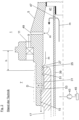
Figur 1 ist eine Antriebsvorrichtung gezeigt, mittels der Vorderachse VA eines zweispurigen Fahrzeugs antreibbar ist. Die Vorderachse VA weist eine Elektromaschine 1 auf, die achsparallel zu den, zu den Fahrzeugrädern geführten Flanschwellen 3 angeordnet ist. Die Rotorwelle 5 der Elektromaschine 1 ist über ein Getriebe 7 (Figur 3 ) in trieblicher Verbindung mit den beiden Flanschwellen 3. Die Rotorwelle 5 ist unter Zwischenschaltung eines Rotorwellen-Drehlagers 9 (Figur 1 oder3 ) aus einer Lageröffnung 11 eines Elektromaschinen-Gehäuses 13 nach außen geführt und über eine momentenübertragende Passverzahnung 15 an einer koaxial angeordneten Getriebe-Antriebswelle 17 angebunden. Auf der Getriebe-Antriebswelle 17 ist ein Festzahnrad 19 einer Zahnradstufe St1 des Getriebes 7 angeordnet, das mit einem eingangsseitigen Zahnrad 21 eines Achsdifferenzials 23 kämmt. Das Achsdifferenzial 23 treibt beidseitig auf die zu den Fahrzeugrädern geführten Flanschwellen 3 ab. - Im Hinblick auf ein einfaches Verständnis der Erfindung wird zunächst ein nicht von der Erfindung umfasster Wellenverbund gemäß der
Figur 2 beschrieben. Demzufolge ist die Rotorwelle 5 als eine Hohlwelle mit Innenverzahnung ausgebildet, in die die dazu koaxiale Getriebe-Antriebswelle 17 mit Außenverzahnung 16 (Figur 4 oder 5 ) gesteckt ist, wodurch sich die Passverzahnung 19 ergibt. Gemäß derFigur 2 ragt die Getriebe-Antriebswelle 17 mit ihrer elektromaschinenseitigen Wellen-Stirnseite 25 in die Rotorwelle 5 ein. Unmittelbar an der elektromaschinenseitigen Wellen-Stirnseite 25 schließt ein Zentriersitz 27 ab, der eine umlaufende, glattzylindrische Oberfläche aufweist, die in enger Spielpassung mit dem ebenfalls glattzylindrischen Rotorwellen-Innenumfang ist. - Der Zentriersitz 27 geht in Richtung auf eine getriebeseitige Wellen-Stirnseite 29 (
Figur 4 oder 5 ) in einen durchmesserreduzierten Wellenabschnitt 31 über, an dem sich im weiteren Axialverlauf die durchmessergrößere Außenverzahnung 16 anschließt. In der in derFigur 2 gezeigten Vergleichsform ist der auf der Getriebe-Antriebswelle 17 ausgebildete Zentriersitz 27 über eine Hebelarmlänge h von dem Rotorwellen-Drehlager 9 beabstandet. Es hat sich gezeigt, dass im Fahrbetrieb bei rotierender Getriebe-Antriebswelle 17 sowie bei Einwirkung einer Radialkraft FR auf die Getriebe-Antriebswelle 17 aufgrund der Hebelarmlänge h sich eine Wellen-Durchbiegung D (Figur 2 ) einstellt, die zu einer übermäßig großen Belastung des Rotorwellen-Drehlagers 9 führt sowie zu einer Geräuschentwicklung führt. - Vor diesem Hintergrund sind in der
Figur 3 zur Reduzierung einer Wellen-Durchbiegung D die folgenden Maßnahmen getroffen: Im Unterschied zur Figur 2 ist in derFigur 3 der Zentriersitz 27 der Getriebe-Antriebswelle 17 nicht mehr über eine Hebelarmlänge h von dem Rotorwellen-Drehlager 9 beabstandet, sondern vielmehr ohne Axialversatz sowie in Axialflucht zum Rotorwellen-Drehlager 9 angeordnet. Dadurch reduziert sich die Biegebeanspruchung der Getriebe-Antriebswelle 17. Zusätzlich ist das Rotorwellen-Drehlager 9 als ein axial verschiebbares federvorgespanntes Loslager realisiert. - Die Getriebe-Antriebswelle 17 und die Rotorwelle 5 bilden einen Wellenverbund W (
Figur 1 ), der in einer konstruktiv einfachen Drei-Punkt-Lagerung in der Antriebsvorrichtung drehgelagert ist, und zwar an den beiden Wellenverbund-Stirnseiten jeweils über ein Festlager 33 am Elektromaschinen-Gehäuse und über ein weiteres Festlager 35 am Getriebe-Gehäuse 37. In der Wellenverbund-Mitte befindet sich das als Loslager realisierte Rotorwellen-Drehlager 9. - Wie aus der
Figur 3 weiter hervorgeht, ragt in den Hohlraum der Rotorwelle 5 eine rohrförmige Öllanze 39 ein, die Bestandteil einer Rotorinnenkühlung ist. Die Öllanze 39 begrenzt zusammen mit dem Rotorwellen-Innenumfang einen Ringspalt 41. Bei aktivierter Rotorinnenkühlung fördert eine Druckpumpe 43 einen Schmier- und/oder Kühlmittel-Volumenstrom m von einem Pumpensumpf 45 durch die Öllanze 39 und über deren Überströmöffnung 47 in den Ringspalt 41. Ausgehend vom Ringspalt 41 wird der Schmier- und/oder Kühlmittel-Volumenstrom m über eine Auslassöffnung 49 der Rotorwelle 5 in den Elektromaschinen-Innenraum gefördert. Außerdem wird der Schmier- und/oder Kühlmittel-Volumenstrom m über einen im Zentriersitz 27 ausgebildeten Strömungsdurchlass 51 sowie über eine axiale Strömungsnut 53 bis zur Passverzahnung 15 gefördert. Die axiale Strömungsnut 53 ist zwischen dem durchmesserreduzierten Wellenabschnitt 31 und dem Rotorwellen-Innenumfang begrenzt. - Nachfolgend wird anhand der
Figur 4 und 5 eine Prozessabfolge zur Herstellung der Getriebe-Antriebswelle 17 beschrieben: Demzufolge wird zunächst ein Wellen-Rohling 57 aus einem härtbaren Stahl bereitgestellt. Der Wellen-Rohling 57 weist sowohl den Zentriersitz 27 als auch den Lagersitz 30 auf. Der Lagersitz 30 ist in derFigur 4 und 5 unmittelbar an der getriebeseitigen Wellen-Stirnseite 29 der Getriebe-Antriebswelle 17 angeordnet. - Der Wellen-Rohling 57 wird anschließend in einem Wärmebehandlungsschritt gehärtet, und zwar unter Bauteilverzug, wodurch sich eine Wellen-Durchbiegung D ergibt. Die Wellen-Durchbiegung D ist in der
Figur 4 und 5 mittels Biegelinien angedeutet. In einem nachfolgenden Ausricht-Schritt wird der Wellen-Rohling 57 mittels Spannwerkzeuge 55 an zwei axial voneinander beabstandeten Einspannstellen eingespannt und mit einer Prozesskraft F plastisch verformt, bis sich der Bauteilverzug reduziert. Je größer der Abstand zwischen den beiden Einspannstellen ist, desto einfacher lässt sich der Bauteilverzug (und die damit einhergehende Wellen-Durchbiegung) reduzieren. Vor diesem Hintergrund sind in derFigur 5 die beiden Einspannstellen jeweils die an den Wellen-Stirnseiten 25, 29 ausgebildeten Lager- und Zentriersitze 27, 30. Auf diese Weise sind in derFigur 5 die beiden Einspannstellen über einen größtmöglichen Axialabstand voneinander beabstandet. - Demgegenüber ist in der, in der
Figur 5 gezeigten Vergleichsform der Zentriersitz 27 der Getriebe-Antriebswelle 17 nicht unmittelbar an der elektromaschinenseitigen Wellen-Stirnseite 25 ausgebildet, sondern vielmehr um einen Achsversatz a versetzt davon positioniert. Auf diese Weise ragt die elektromaschinenseitige Wellen-Stirnseite 25 mit einem Überstand über die (in derFigur 5 linke) Einspannstelle hinaus, wodurch auch nach Durchführung des Ausricht-Schrittes ein Bauteilverzug in der Getriebe-Antriebswelle 17 verbleibt. -
- 1
- Elektromaschine
- 3
- Flanschwellen
- 5
- Rotorwelle
- 7
- Getriebe
- St1
- Zahnradstufe
- 9
- Rotorwellen-Drehlager
- 10
- Vorspannfeder
- 11
- Lageröffnung
- 13
- Elektromaschinen-Gehäuse
- 15
- Passverzahnung
- 17
- Getriebe-Antriebswelle
- 19
- Festzahnrad
- 21
- eingangsseitiges Zahnrad
- 23
- Achsdifferenzial
- 25
- elektromaschinenseitige Wellen-Stirnseite
- 27
- Zentriersitz
- 29
- getriebeseitige Wellen-Stirnseite
- 30
- Lagersitz
- 31
- durchmesserreduzierter Wellenabschnitt
- 33
- Festlager
- 35
- Festlager
- 37
- Getriebegehäuse
- 39
- Öllanze
- 41
- Ringspalt
- 43
- Druckpumpe
- 45
- Pumpensumpf
- 47
- Überströmöffnung
- 49
- Auslassöffnung
- 51
- Zentriersitz-Strömungsdurchlass
- 53
- axiale Strömungsnut
- 55
- Spannwerkzeug
- 57
- Wellenrohling
- D
- Wellen-Durchbiegung
- W
- Wellenverbund
- h
- Hebelarmlänge
- a
- Axialversatz
- F
- Prozesskraft
- FR
- Radialkraft
- m
- Kühlmittel-Volumenstrom
Claims (8)
- Antriebsvorrichtung für ein Fahrzeug, mit einer Getriebe-Antriebswelle (17) und mit einer Elektromaschine (1) mit einer Rotorwelle (5), wobei die Rotorwelle (5) als Hohlwelle mit Innenverzahnung ausgebildet ist, in die die dazu koaxiale Getriebe-Antriebswelle (17) mit Außenverzahnung (16) gesteckt ist, und zwar unter Bildung einer momentenübertragenden Passverzahnung (15), wobei die Rotorwelle (5) unter Zwischenschaltung eines Rotorwellen-Drehlagers (9) durch eine Lageröffnung (11) eines Elektromaschinen-Gehäuses (13) nach außen geführt ist, wobei die Getriebe-Antriebswelle (17) einen Zentriersitz (27) aufweist, der in Spielpassung mit dem Innenumfang der Rotorwelle (5) in Anlage ist, wobei die Getriebe-Antriebswelle (17) im Fahrbetrieb aufgrund von radial einwirkenden Betriebs-Kräften (FR) auf Biegung (D) beansprucht ist, dadurch gekennzeichnet, dass zur Reduzierung der Biegebeanspruchung (D) der Zentriersitz (27) der Getriebe-Antriebswelle (17) ohne Axialversatz zum Rotorwellen-Drehlager (9) in Axialflucht zum Rotorwellen-Drehlager (9) angeordnet ist, dass die Getriebe-Antriebswelle (17) mit ihrer elektromaschinenseitigen Wellen-Stirnseite (25) in die Rotorwelle (5) einragt, und dass der Zentriersitz (27) unmittelbar, das heißt ohne Zwischenlage der Außenverzahnung (16), an der elektromaschinenseitigen Wellen-Stirnseite (25) abschließt, und dass der Zentriersitz (27) in Richtung auf eine getriebeseitige Wellen-Stirnseite (29) in einen durchmesserreduzierten Wellenabschnitt (31) übergeht sowie im weiteren Axialverlauf in die durchmessergrößere Außenverzahnung (16) übergeht.
- Antriebsvorrichtung nach Anspruch 1, dadurch gekennzeichnet, dass zur weiteren Reduzierung der Wellen-Biegebeanspruchung das Rotorwellen-Drehlager (9) als ein axial verschiebbares, federvorgespanntes Loslager realisiert ist.
- Antriebsvorrichtung nach Anspruch 1 oder 2, dadurch gekennzeichnet, dass die auf der Getriebe-Antriebswelle (17) ausgebildete Außenverzahnung (16) über einen Axialversatz (a) versetzt zum Rotorwellen-Drehlager (9) angeordnet ist.
- Antriebsvorrichtung nach einem der vorhergehenden Ansprüche, dadurch gekennzeichnet, dass die Getriebe-Antriebswelle (17) unter Zwischenschaltung eines Getriebe-Drehlagers (35), und zwar eines Festlagers, in einem Getriebegehäuse (37) drehgelagert ist, und dass ein dem Getriebe-Drehlager (35) zugeordneter Lagersitz (30) der Getriebe-Antriebswelle (17) unmittelbar, das heißt ohne Zwischenlage einer Verzahnung oder eines anderen Funktionsabschnittes, an der getriebeseitigen Wellen-Stirnseite (29) abschließt.
- Antriebsvorrichtung nach einem der vorhergehenden Ansprüche, dadurch gekennzeichnet, dass in den Hohlraum der Rotorwelle (5) eine rohrförmige Öllanze (39) einragt, die Bestandteil einer Rotorinnenkühlung ist, und dass die Öllanze (39) zusammen mit dem Rotorwellen-Innenumfang einen Ringspalt (41) begrenzt, und dass ein Schmier- und/oder Kühlmittel-Volumenstrom (m) durch die Öllanze (39) über eine Überströmöffnung (47) in den Ringspalt (41) führbar ist.
- Antriebsvorrichtung nach Anspruch 5, dadurch gekennzeichnet, dass im Zentriersitz (27) der Getriebe-Antriebswelle (17) ein axialer Strömungsdurchlass (51) ausgebildet ist, und dass der durchmesserreduzierte Wellenabschnitt (31) der Getriebe-Antriebswelle (17) zusammen mit dem Rotorwellen-Innenumfang eine axiale Strömungsnut (53) begrenzt, so dass der Ringspalt (41) über den, am Zentriersitz (27) ausgebildeten Strömungsdurchlass (51) sowie über die axiale Strömungsnut (53) mit der Passverzahnung (15) in strömungstechnischer Verbindung ist.
- Antriebsvorrichtung nach einem der vorhergehenden Ansprüche, dadurch gekennzeichnet, dass die Getriebe-Antriebswelle (17) und die Rotorwelle (5) einen Wellenverbund bilden, der in einer Drei-Punkt-Lagerung in der Antriebsvorrichtung drehgelagert ist, und zwar an den Wellenverbund-Stirnseiten (25, 29) jeweils über ein Festlager (33, 35) am Elektromaschinen-Gehäuse (13) und am Getriebe-Gehäuse (37) sowie in der Wellenverbund-Mitte über ein mittleres Loslager (9).
- Verfahren zur Herstellung einer Getriebe-Antriebswelle (17) für eine Antriebsvorrichtung nach einem der vorhergehenden Ansprüche, bei dem ein Wellen-Rohling (57) aus einem härtbaren Stahl bereitgestellt wird, in dem sowohl der Zentriersitz (27) und der Lagersitz (30) ausgebildet sind, wobei in einem Wärmebehandlungsschritt der Wellen-Rohling (57) gehärtet wird, und zwar unter Bauteilverzug mit Wellen-Durchbiegung, und in einem nachfolgenden Ausricht-Schritt der gehärtete Wellen-Rohling (57) mittels Spannwerkzeuge (55) an zwei axial voneinander beabstandeten Einspannstellen eingespannt wird und mit einer Prozesskraft (F) plastisch verformt wird zur Reduzierung des Bauteilverzugs.
Applications Claiming Priority (2)
| Application Number | Priority Date | Filing Date | Title |
|---|---|---|---|
| DE102019132590.0A DE102019132590B4 (de) | 2019-12-02 | 2019-12-02 | Antriebsvorrichtung für ein Fahrzeug |
| PCT/EP2020/076039 WO2021110298A1 (de) | 2019-12-02 | 2020-09-17 | Antriebsvorrichtung für ein fahrzeug |
Publications (2)
| Publication Number | Publication Date |
|---|---|
| EP4025795A1 EP4025795A1 (de) | 2022-07-13 |
| EP4025795B1 true EP4025795B1 (de) | 2023-07-26 |
Family
ID=72560611
Family Applications (1)
| Application Number | Title | Priority Date | Filing Date |
|---|---|---|---|
| EP20774976.3A Active EP4025795B1 (de) | 2019-12-02 | 2020-09-17 | Antriebsvorrichtung für ein fahrzeug |
Country Status (5)
| Country | Link |
|---|---|
| US (1) | US11971094B2 (de) |
| EP (1) | EP4025795B1 (de) |
| CN (1) | CN114729688B (de) |
| DE (1) | DE102019132590B4 (de) |
| WO (1) | WO2021110298A1 (de) |
Families Citing this family (10)
| Publication number | Priority date | Publication date | Assignee | Title |
|---|---|---|---|---|
| DE102019132590B4 (de) | 2019-12-02 | 2023-01-26 | Audi Ag | Antriebsvorrichtung für ein Fahrzeug |
| WO2022032088A1 (en) * | 2020-08-06 | 2022-02-10 | Linamar Corporation | Stepped planetary single bearing carrier support |
| WO2023048134A1 (ja) * | 2021-09-24 | 2023-03-30 | 株式会社アイシン | 車両用駆動装置 |
| EP4180679A1 (de) * | 2021-11-16 | 2023-05-17 | Valeo eAutomotive Germany GmbH | Verbesserter elektrischer antriebsstrang |
| DE102022202912A1 (de) | 2022-03-24 | 2023-09-28 | Zf Friedrichshafen Ag | Elektrische Achsantriebsvorrichtung für ein Kraftfahrzeug |
| DE102022110036A1 (de) | 2022-04-26 | 2023-10-26 | Schaeffler Technologies AG & Co. KG | Elektrisch betreibbarer Achsantriebsstrang |
| DE102022112873B4 (de) | 2022-05-23 | 2025-11-20 | Dr. Ing. H.C. F. Porsche Aktiengesellschaft | Wellenanordnung für ein Kraftfahrzeug |
| DE102022208109A1 (de) * | 2022-08-04 | 2024-02-15 | Robert Bosch Gesellschaft mit beschränkter Haftung | Antriebsanordnung und Fahrzeug mit einer solchen Antriebsanordnung |
| DE102023202319A1 (de) * | 2023-03-15 | 2024-09-19 | Zf Friedrichshafen Ag | Elektrischer Achsantrieb für ein Fahrzeug |
| DE102024120089A1 (de) * | 2024-07-15 | 2026-01-15 | Bayerische Motoren Werke Aktiengesellschaft | Antriebseinheit für ein Kraftfahrzeug sowie Kraftfahrzeug |
Family Cites Families (22)
| Publication number | Priority date | Publication date | Assignee | Title |
|---|---|---|---|---|
| DE2354301A1 (de) | 1973-10-26 | 1975-05-07 | Siemens Ag | Antrieb eines schienengebundenen elektrischen triebfahrzeuges |
| EP1077522B1 (de) | 1999-08-10 | 2005-02-02 | The Swatch Group Management Services AG | Antriebsvorrichtung mit einem flüssigkeitsgekühlten elektrischen Motor und Planetengetriebe |
| JP4121262B2 (ja) | 2001-10-02 | 2008-07-23 | カヤバ工業株式会社 | 動力伝達装置の製造方法および電動パワーステアリング装置の製造方法 |
| JP2005138670A (ja) | 2003-11-05 | 2005-06-02 | Koyo Seiko Co Ltd | 電動パワーステアリング装置および電動モータの組立方法 |
| US20070131375A1 (en) | 2005-12-09 | 2007-06-14 | Husky Injection Molding Systems Ltd. | Thixo-molding shot located downstream of blockage |
| EP2120315B1 (de) * | 2008-05-15 | 2014-02-26 | Siemens Aktiengesellschaft | Antriebseinrichtung |
| JP5671829B2 (ja) | 2010-03-31 | 2015-02-18 | アイシン・エィ・ダブリュ株式会社 | ロータ軸の支持構造 |
| DE102010050217A1 (de) | 2010-11-04 | 2012-05-10 | Getrag Getriebe- Und Zahnradfabrik Hermann Hagenmeyer Gmbh & Cie Kg | Elektrische Achse für ein Kraftfahrzeug |
| DE102011007255A1 (de) * | 2011-04-13 | 2012-10-18 | Schaeffler Technologies AG & Co. KG | Antriebsvorrichtung mit einer kühlbaren Rotoranordnung |
| JP2012233511A (ja) * | 2011-04-28 | 2012-11-29 | Toyota Motor Corp | 車両用駆動装置 |
| WO2015104980A1 (ja) * | 2014-01-08 | 2015-07-16 | Ntn株式会社 | インホイールモータ駆動装置 |
| JP2015129570A (ja) * | 2014-01-09 | 2015-07-16 | Ntn株式会社 | 電気自動車用駆動装置 |
| FR3035934B1 (fr) * | 2015-05-05 | 2017-06-02 | Moteurs Leroy-Somer | Ensemble electromecanique comportant une machine electrique couplee a un reducteur |
| DE102015214339A1 (de) * | 2015-07-29 | 2017-02-02 | Volkswagen Aktiengesellschaft | Antriebsanordnung für ein Kraftfahrzeug |
| DE102015214309A1 (de) * | 2015-07-29 | 2017-02-02 | Bayerische Motoren Werke Aktiengesellschaft | Hohlwellenkühlung für einen Antrieb eines Elektrofahrzeugs |
| JP6372455B2 (ja) * | 2015-09-07 | 2018-08-15 | トヨタ自動車株式会社 | 車両用動力伝達装置 |
| JP6588280B2 (ja) | 2015-09-07 | 2019-10-09 | 株式会社Soken | 動力伝達構造 |
| JP6583307B2 (ja) * | 2017-02-21 | 2019-10-02 | トヨタ自動車株式会社 | フリクションダンパ |
| US10781909B2 (en) | 2017-06-30 | 2020-09-22 | Tesla, Inc. | Windage tray for advanced lubrication and enhanced performance |
| DE102017123586A1 (de) * | 2017-10-11 | 2019-04-11 | Dr. Ing. H.C. F. Porsche Aktiengesellschaft | Elektrofahrzeug |
| JP2020183769A (ja) * | 2019-04-26 | 2020-11-12 | トヨタ自動車株式会社 | 動力伝達装置 |
| DE102019132590B4 (de) | 2019-12-02 | 2023-01-26 | Audi Ag | Antriebsvorrichtung für ein Fahrzeug |
-
2019
- 2019-12-02 DE DE102019132590.0A patent/DE102019132590B4/de active Active
-
2020
- 2020-09-17 WO PCT/EP2020/076039 patent/WO2021110298A1/de not_active Ceased
- 2020-09-17 CN CN202080075975.4A patent/CN114729688B/zh active Active
- 2020-09-17 US US17/781,525 patent/US11971094B2/en active Active
- 2020-09-17 EP EP20774976.3A patent/EP4025795B1/de active Active
Also Published As
| Publication number | Publication date |
|---|---|
| WO2021110298A1 (de) | 2021-06-10 |
| US11971094B2 (en) | 2024-04-30 |
| DE102019132590B4 (de) | 2023-01-26 |
| EP4025795A1 (de) | 2022-07-13 |
| CN114729688A (zh) | 2022-07-08 |
| US20230003293A1 (en) | 2023-01-05 |
| CN114729688B (zh) | 2025-09-23 |
| DE102019132590A1 (de) | 2021-06-02 |
Similar Documents
| Publication | Publication Date | Title |
|---|---|---|
| EP4025795B1 (de) | Antriebsvorrichtung für ein fahrzeug | |
| EP2499388B1 (de) | System umfassend eine Lenkhilfepumpe, eine Antriebswelle und eine Vorrichtung zum Koppeln der Antriebswelle mit der Lenkhilfepumpe und Verfahren zur Herstellung dieses Systems | |
| EP4193071B1 (de) | Antriebseinheit für ein fahrzeug | |
| EP1470013A1 (de) | Direkt angetriebene antriebsachse mit zwei antriebsmotoren | |
| WO2008122271A1 (de) | Lageranordnung einer über ein drehgelenk antreibbaren radnabe eines kraftfahrzeuges | |
| DE102019118187A1 (de) | Differenzialgetriebe | |
| EP2155532B1 (de) | Kugelgewindetrieb | |
| DE3410866C2 (de) | ||
| DE102022003206A1 (de) | Elektrisches Antriebssystem für ein Kraftfahrzeug sowie Kraftfahrzeuge | |
| DE102012100503A1 (de) | Verfahren zum Herstellen eines Lagerrings für ein Kugellager für ein Servogetriebe | |
| DE102018126153A1 (de) | Zahnradverbund für einen Stufenplaneten eines Planetengetriebes | |
| DE102020207991A1 (de) | Elektrischer Antrieb | |
| WO2024037809A1 (de) | Wälzgelagerte kraftfahrzeugantriebsvorrichtung | |
| EP3964726B1 (de) | Steckverzahnung und verfahren zur herstellung eines achszapfens einer steckverzahnung | |
| WO2007128359A1 (de) | Verfahren zur herstellung eines getriebebauteils | |
| DE102022004132A1 (de) | Elektrische Antriebsvorrichtung für ein elektrifiziertes Kraftfahrzeug | |
| DE102018123116A1 (de) | System aus Rotorwelle und Abtriebswelle, Abtriebswelle und Verfahren zum Herstellen eines Systems aus Rotorwelle und Abtriebswelle | |
| DE102018216856A1 (de) | Getriebe für ein lenkbares Antriebsrad eines Flurförderfahrzeugs | |
| DE102013008658A1 (de) | Antriebselement mit einem Kegelrad für einen Kraftwagen sowie Verfahren zum Herstellen eines solchen Antriebselements | |
| EP4028672B1 (de) | Drehmoment-übertragungssystem mit konzentrisch angeordneten wälzlagern, antriebseinheit und antriebsanordnung | |
| EP3006298A1 (de) | Kupplungshohlwelle eines antriebs eines schienenfahrzeuges und verfahren zu ihrer herstellung | |
| DE102023209862B3 (de) | Kraftfahrzeuggetriebe für ein zumindest teilweise elektrisch angetriebenes Kraftfahrzeug | |
| WO2018137954A1 (de) | Anordnung einer achse oder einer welle an einem bauelement, insbesondere für ein fahrzeug, sowie fahrzeug mit einer solchen anordnung | |
| EP4638989A1 (de) | Geräuschoptimierte drehmomenteinleitung | |
| DE102024104336A1 (de) | Antriebsstrang für ein Kraftfahrzeug sowie Kraftfahrzeug |
Legal Events
| Date | Code | Title | Description |
|---|---|---|---|
| STAA | Information on the status of an ep patent application or granted ep patent |
Free format text: STATUS: UNKNOWN |
|
| STAA | Information on the status of an ep patent application or granted ep patent |
Free format text: STATUS: THE INTERNATIONAL PUBLICATION HAS BEEN MADE |
|
| PUAI | Public reference made under article 153(3) epc to a published international application that has entered the european phase |
Free format text: ORIGINAL CODE: 0009012 |
|
| STAA | Information on the status of an ep patent application or granted ep patent |
Free format text: STATUS: REQUEST FOR EXAMINATION WAS MADE |
|
| 17P | Request for examination filed |
Effective date: 20220404 |
|
| AK | Designated contracting states |
Kind code of ref document: A1 Designated state(s): AL AT BE BG CH CY CZ DE DK EE ES FI FR GB GR HR HU IE IS IT LI LT LU LV MC MK MT NL NO PL PT RO RS SE SI SK SM TR |
|
| STAA | Information on the status of an ep patent application or granted ep patent |
Free format text: STATUS: EXAMINATION IS IN PROGRESS |
|
| 17Q | First examination report despatched |
Effective date: 20220922 |
|
| GRAP | Despatch of communication of intention to grant a patent |
Free format text: ORIGINAL CODE: EPIDOSNIGR1 |
|
| STAA | Information on the status of an ep patent application or granted ep patent |
Free format text: STATUS: GRANT OF PATENT IS INTENDED |
|
| DAV | Request for validation of the european patent (deleted) | ||
| DAX | Request for extension of the european patent (deleted) | ||
| INTG | Intention to grant announced |
Effective date: 20230222 |
|
| GRAS | Grant fee paid |
Free format text: ORIGINAL CODE: EPIDOSNIGR3 |
|
| GRAA | (expected) grant |
Free format text: ORIGINAL CODE: 0009210 |
|
| STAA | Information on the status of an ep patent application or granted ep patent |
Free format text: STATUS: THE PATENT HAS BEEN GRANTED |
|
| P01 | Opt-out of the competence of the unified patent court (upc) registered |
Effective date: 20230529 |
|
| AK | Designated contracting states |
Kind code of ref document: B1 Designated state(s): AL AT BE BG CH CY CZ DE DK EE ES FI FR GB GR HR HU IE IS IT LI LT LU LV MC MK MT NL NO PL PT RO RS SE SI SK SM TR |
|
| REG | Reference to a national code |
Ref country code: CH Ref legal event code: EP |
|
| REG | Reference to a national code |
Ref country code: IE Ref legal event code: FG4D Free format text: LANGUAGE OF EP DOCUMENT: GERMAN |
|
| REG | Reference to a national code |
Ref country code: DE Ref legal event code: R096 Ref document number: 502020004415 Country of ref document: DE |
|
| REG | Reference to a national code |
Ref country code: LT Ref legal event code: MG9D |
|
| REG | Reference to a national code |
Ref country code: NL Ref legal event code: MP Effective date: 20230726 |
|
| PG25 | Lapsed in a contracting state [announced via postgrant information from national office to epo] |
Ref country code: NL Free format text: LAPSE BECAUSE OF FAILURE TO SUBMIT A TRANSLATION OF THE DESCRIPTION OR TO PAY THE FEE WITHIN THE PRESCRIBED TIME-LIMIT Effective date: 20230726 |
|
| PG25 | Lapsed in a contracting state [announced via postgrant information from national office to epo] |
Ref country code: GR Free format text: LAPSE BECAUSE OF FAILURE TO SUBMIT A TRANSLATION OF THE DESCRIPTION OR TO PAY THE FEE WITHIN THE PRESCRIBED TIME-LIMIT Effective date: 20231027 |
|
| PG25 | Lapsed in a contracting state [announced via postgrant information from national office to epo] |
Ref country code: IS Free format text: LAPSE BECAUSE OF FAILURE TO SUBMIT A TRANSLATION OF THE DESCRIPTION OR TO PAY THE FEE WITHIN THE PRESCRIBED TIME-LIMIT Effective date: 20231126 |
|
| PG25 | Lapsed in a contracting state [announced via postgrant information from national office to epo] |
Ref country code: SE Free format text: LAPSE BECAUSE OF FAILURE TO SUBMIT A TRANSLATION OF THE DESCRIPTION OR TO PAY THE FEE WITHIN THE PRESCRIBED TIME-LIMIT Effective date: 20230726 Ref country code: RS Free format text: LAPSE BECAUSE OF FAILURE TO SUBMIT A TRANSLATION OF THE DESCRIPTION OR TO PAY THE FEE WITHIN THE PRESCRIBED TIME-LIMIT Effective date: 20230726 Ref country code: PT Free format text: LAPSE BECAUSE OF FAILURE TO SUBMIT A TRANSLATION OF THE DESCRIPTION OR TO PAY THE FEE WITHIN THE PRESCRIBED TIME-LIMIT Effective date: 20231127 Ref country code: NO Free format text: LAPSE BECAUSE OF FAILURE TO SUBMIT A TRANSLATION OF THE DESCRIPTION OR TO PAY THE FEE WITHIN THE PRESCRIBED TIME-LIMIT Effective date: 20231026 Ref country code: LV Free format text: LAPSE BECAUSE OF FAILURE TO SUBMIT A TRANSLATION OF THE DESCRIPTION OR TO PAY THE FEE WITHIN THE PRESCRIBED TIME-LIMIT Effective date: 20230726 Ref country code: LT Free format text: LAPSE BECAUSE OF FAILURE TO SUBMIT A TRANSLATION OF THE DESCRIPTION OR TO PAY THE FEE WITHIN THE PRESCRIBED TIME-LIMIT Effective date: 20230726 Ref country code: IS Free format text: LAPSE BECAUSE OF FAILURE TO SUBMIT A TRANSLATION OF THE DESCRIPTION OR TO PAY THE FEE WITHIN THE PRESCRIBED TIME-LIMIT Effective date: 20231126 Ref country code: HR Free format text: LAPSE BECAUSE OF FAILURE TO SUBMIT A TRANSLATION OF THE DESCRIPTION OR TO PAY THE FEE WITHIN THE PRESCRIBED TIME-LIMIT Effective date: 20230726 Ref country code: GR Free format text: LAPSE BECAUSE OF FAILURE TO SUBMIT A TRANSLATION OF THE DESCRIPTION OR TO PAY THE FEE WITHIN THE PRESCRIBED TIME-LIMIT Effective date: 20231027 Ref country code: FI Free format text: LAPSE BECAUSE OF FAILURE TO SUBMIT A TRANSLATION OF THE DESCRIPTION OR TO PAY THE FEE WITHIN THE PRESCRIBED TIME-LIMIT Effective date: 20230726 |
|
| PG25 | Lapsed in a contracting state [announced via postgrant information from national office to epo] |
Ref country code: PL Free format text: LAPSE BECAUSE OF FAILURE TO SUBMIT A TRANSLATION OF THE DESCRIPTION OR TO PAY THE FEE WITHIN THE PRESCRIBED TIME-LIMIT Effective date: 20230726 |
|
| PG25 | Lapsed in a contracting state [announced via postgrant information from national office to epo] |
Ref country code: ES Free format text: LAPSE BECAUSE OF FAILURE TO SUBMIT A TRANSLATION OF THE DESCRIPTION OR TO PAY THE FEE WITHIN THE PRESCRIBED TIME-LIMIT Effective date: 20230726 |
|
| REG | Reference to a national code |
Ref country code: DE Ref legal event code: R097 Ref document number: 502020004415 Country of ref document: DE |
|
| PG25 | Lapsed in a contracting state [announced via postgrant information from national office to epo] |
Ref country code: SM Free format text: LAPSE BECAUSE OF FAILURE TO SUBMIT A TRANSLATION OF THE DESCRIPTION OR TO PAY THE FEE WITHIN THE PRESCRIBED TIME-LIMIT Effective date: 20230726 Ref country code: RO Free format text: LAPSE BECAUSE OF FAILURE TO SUBMIT A TRANSLATION OF THE DESCRIPTION OR TO PAY THE FEE WITHIN THE PRESCRIBED TIME-LIMIT Effective date: 20230726 Ref country code: ES Free format text: LAPSE BECAUSE OF FAILURE TO SUBMIT A TRANSLATION OF THE DESCRIPTION OR TO PAY THE FEE WITHIN THE PRESCRIBED TIME-LIMIT Effective date: 20230726 Ref country code: EE Free format text: LAPSE BECAUSE OF FAILURE TO SUBMIT A TRANSLATION OF THE DESCRIPTION OR TO PAY THE FEE WITHIN THE PRESCRIBED TIME-LIMIT Effective date: 20230726 Ref country code: DK Free format text: LAPSE BECAUSE OF FAILURE TO SUBMIT A TRANSLATION OF THE DESCRIPTION OR TO PAY THE FEE WITHIN THE PRESCRIBED TIME-LIMIT Effective date: 20230726 Ref country code: CZ Free format text: LAPSE BECAUSE OF FAILURE TO SUBMIT A TRANSLATION OF THE DESCRIPTION OR TO PAY THE FEE WITHIN THE PRESCRIBED TIME-LIMIT Effective date: 20230726 Ref country code: SK Free format text: LAPSE BECAUSE OF FAILURE TO SUBMIT A TRANSLATION OF THE DESCRIPTION OR TO PAY THE FEE WITHIN THE PRESCRIBED TIME-LIMIT Effective date: 20230726 |
|
| REG | Reference to a national code |
Ref country code: CH Ref legal event code: PL |
|
| PG25 | Lapsed in a contracting state [announced via postgrant information from national office to epo] |
Ref country code: LU Free format text: LAPSE BECAUSE OF NON-PAYMENT OF DUE FEES Effective date: 20230917 |
|
| REG | Reference to a national code |
Ref country code: BE Ref legal event code: MM Effective date: 20230930 |
|
| PG25 | Lapsed in a contracting state [announced via postgrant information from national office to epo] |
Ref country code: LU Free format text: LAPSE BECAUSE OF NON-PAYMENT OF DUE FEES Effective date: 20230917 Ref country code: IT Free format text: LAPSE BECAUSE OF FAILURE TO SUBMIT A TRANSLATION OF THE DESCRIPTION OR TO PAY THE FEE WITHIN THE PRESCRIBED TIME-LIMIT Effective date: 20230726 Ref country code: MC Free format text: LAPSE BECAUSE OF FAILURE TO SUBMIT A TRANSLATION OF THE DESCRIPTION OR TO PAY THE FEE WITHIN THE PRESCRIBED TIME-LIMIT Effective date: 20230726 |
|
| PLBE | No opposition filed within time limit |
Free format text: ORIGINAL CODE: 0009261 |
|
| STAA | Information on the status of an ep patent application or granted ep patent |
Free format text: STATUS: NO OPPOSITION FILED WITHIN TIME LIMIT |
|
| 26N | No opposition filed |
Effective date: 20240429 |
|
| REG | Reference to a national code |
Ref country code: IE Ref legal event code: MM4A |
|
| PG25 | Lapsed in a contracting state [announced via postgrant information from national office to epo] |
Ref country code: IE Free format text: LAPSE BECAUSE OF NON-PAYMENT OF DUE FEES Effective date: 20230917 |
|
| PG25 | Lapsed in a contracting state [announced via postgrant information from national office to epo] |
Ref country code: CH Free format text: LAPSE BECAUSE OF NON-PAYMENT OF DUE FEES Effective date: 20230930 |
|
| PG25 | Lapsed in a contracting state [announced via postgrant information from national office to epo] |
Ref country code: IE Free format text: LAPSE BECAUSE OF NON-PAYMENT OF DUE FEES Effective date: 20230917 Ref country code: CH Free format text: LAPSE BECAUSE OF NON-PAYMENT OF DUE FEES Effective date: 20230930 Ref country code: SI Free format text: LAPSE BECAUSE OF FAILURE TO SUBMIT A TRANSLATION OF THE DESCRIPTION OR TO PAY THE FEE WITHIN THE PRESCRIBED TIME-LIMIT Effective date: 20230726 |
|
| PG25 | Lapsed in a contracting state [announced via postgrant information from national office to epo] |
Ref country code: BE Free format text: LAPSE BECAUSE OF NON-PAYMENT OF DUE FEES Effective date: 20230930 |
|
| PG25 | Lapsed in a contracting state [announced via postgrant information from national office to epo] |
Ref country code: BG Free format text: LAPSE BECAUSE OF FAILURE TO SUBMIT A TRANSLATION OF THE DESCRIPTION OR TO PAY THE FEE WITHIN THE PRESCRIBED TIME-LIMIT Effective date: 20230726 |
|
| PG25 | Lapsed in a contracting state [announced via postgrant information from national office to epo] |
Ref country code: BG Free format text: LAPSE BECAUSE OF FAILURE TO SUBMIT A TRANSLATION OF THE DESCRIPTION OR TO PAY THE FEE WITHIN THE PRESCRIBED TIME-LIMIT Effective date: 20230726 |
|
| PG25 | Lapsed in a contracting state [announced via postgrant information from national office to epo] |
Ref country code: CY Free format text: LAPSE BECAUSE OF FAILURE TO SUBMIT A TRANSLATION OF THE DESCRIPTION OR TO PAY THE FEE WITHIN THE PRESCRIBED TIME-LIMIT; INVALID AB INITIO Effective date: 20200917 |
|
| PG25 | Lapsed in a contracting state [announced via postgrant information from national office to epo] |
Ref country code: HU Free format text: LAPSE BECAUSE OF FAILURE TO SUBMIT A TRANSLATION OF THE DESCRIPTION OR TO PAY THE FEE WITHIN THE PRESCRIBED TIME-LIMIT; INVALID AB INITIO Effective date: 20200917 |
|
| PGFP | Annual fee paid to national office [announced via postgrant information from national office to epo] |
Ref country code: DE Payment date: 20250930 Year of fee payment: 6 |
|
| PGFP | Annual fee paid to national office [announced via postgrant information from national office to epo] |
Ref country code: GB Payment date: 20250923 Year of fee payment: 6 |
|
| PGFP | Annual fee paid to national office [announced via postgrant information from national office to epo] |
Ref country code: FR Payment date: 20250924 Year of fee payment: 6 Ref country code: AT Payment date: 20251020 Year of fee payment: 5 |
|
| PG25 | Lapsed in a contracting state [announced via postgrant information from national office to epo] |
Ref country code: TR Free format text: LAPSE BECAUSE OF FAILURE TO SUBMIT A TRANSLATION OF THE DESCRIPTION OR TO PAY THE FEE WITHIN THE PRESCRIBED TIME-LIMIT Effective date: 20230726 |