EP4017889B1 - Ionisches copolymer, härtbare membranvorläuferzusammensetzung, membranzusammensetzung und elektronische vorrichtung - Google Patents
Ionisches copolymer, härtbare membranvorläuferzusammensetzung, membranzusammensetzung und elektronische vorrichtung Download PDFInfo
- Publication number
- EP4017889B1 EP4017889B1 EP20757962.4A EP20757962A EP4017889B1 EP 4017889 B1 EP4017889 B1 EP 4017889B1 EP 20757962 A EP20757962 A EP 20757962A EP 4017889 B1 EP4017889 B1 EP 4017889B1
- Authority
- EP
- European Patent Office
- Prior art keywords
- membrane
- monomer units
- mole percent
- percent
- copolymer
- Prior art date
- Legal status (The legal status is an assumption and is not a legal conclusion. Google has not performed a legal analysis and makes no representation as to the accuracy of the status listed.)
- Active
Links
Images
Classifications
-
- C—CHEMISTRY; METALLURGY
- C08—ORGANIC MACROMOLECULAR COMPOUNDS; THEIR PREPARATION OR CHEMICAL WORKING-UP; COMPOSITIONS BASED THEREON
- C08G—MACROMOLECULAR COMPOUNDS OBTAINED OTHERWISE THAN BY REACTIONS ONLY INVOLVING UNSATURATED CARBON-TO-CARBON BONDS
- C08G61/00—Macromolecular compounds obtained by reactions forming a carbon-to-carbon link in the main chain of the macromolecule
- C08G61/02—Macromolecular compounds containing only carbon atoms in the main chain of the macromolecule, e.g. polyxylylenes
- C08G61/10—Macromolecular compounds containing only carbon atoms in the main chain of the macromolecule, e.g. polyxylylenes only aromatic carbon atoms, e.g. polyphenylenes
-
- C—CHEMISTRY; METALLURGY
- C08—ORGANIC MACROMOLECULAR COMPOUNDS; THEIR PREPARATION OR CHEMICAL WORKING-UP; COMPOSITIONS BASED THEREON
- C08F—MACROMOLECULAR COMPOUNDS OBTAINED BY REACTIONS ONLY INVOLVING CARBON-TO-CARBON UNSATURATED BONDS
- C08F212/00—Copolymers of compounds having one or more unsaturated aliphatic radicals, each having only one carbon-to-carbon double bond, and at least one being terminated by an aromatic carbocyclic ring
- C08F212/02—Monomers containing only one unsaturated aliphatic radical
- C08F212/04—Monomers containing only one unsaturated aliphatic radical containing one ring
- C08F212/06—Hydrocarbons
- C08F212/08—Styrene
-
- C—CHEMISTRY; METALLURGY
- C08—ORGANIC MACROMOLECULAR COMPOUNDS; THEIR PREPARATION OR CHEMICAL WORKING-UP; COMPOSITIONS BASED THEREON
- C08F—MACROMOLECULAR COMPOUNDS OBTAINED BY REACTIONS ONLY INVOLVING CARBON-TO-CARBON UNSATURATED BONDS
- C08F8/00—Chemical modification by after-treatment
- C08F8/30—Introducing nitrogen atoms or nitrogen-containing groups
- C08F8/32—Introducing nitrogen atoms or nitrogen-containing groups by reaction with amines
-
- C—CHEMISTRY; METALLURGY
- C08—ORGANIC MACROMOLECULAR COMPOUNDS; THEIR PREPARATION OR CHEMICAL WORKING-UP; COMPOSITIONS BASED THEREON
- C08G—MACROMOLECULAR COMPOUNDS OBTAINED OTHERWISE THAN BY REACTIONS ONLY INVOLVING UNSATURATED CARBON-TO-CARBON BONDS
- C08G61/00—Macromolecular compounds obtained by reactions forming a carbon-to-carbon link in the main chain of the macromolecule
- C08G61/12—Macromolecular compounds containing atoms other than carbon in the main chain of the macromolecule
- C08G61/122—Macromolecular compounds containing atoms other than carbon in the main chain of the macromolecule derived from five- or six-membered heterocyclic compounds, other than imides
- C08G61/123—Macromolecular compounds containing atoms other than carbon in the main chain of the macromolecule derived from five- or six-membered heterocyclic compounds, other than imides derived from five-membered heterocyclic compounds
-
- C—CHEMISTRY; METALLURGY
- C08—ORGANIC MACROMOLECULAR COMPOUNDS; THEIR PREPARATION OR CHEMICAL WORKING-UP; COMPOSITIONS BASED THEREON
- C08J—WORKING-UP; GENERAL PROCESSES OF COMPOUNDING; AFTER-TREATMENT NOT COVERED BY SUBCLASSES C08B, C08C, C08F, C08G or C08H
- C08J5/00—Manufacture of articles or shaped materials containing macromolecular substances
- C08J5/20—Manufacture of shaped structures of ion-exchange resins
- C08J5/22—Films, membranes or diaphragms
- C08J5/2206—Films, membranes or diaphragms based on organic and/or inorganic macromolecular compounds
- C08J5/2218—Synthetic macromolecular compounds
- C08J5/2231—Synthetic macromolecular compounds based on macromolecular compounds obtained by reactions involving unsaturated carbon-to-carbon bonds
- C08J5/2243—Synthetic macromolecular compounds based on macromolecular compounds obtained by reactions involving unsaturated carbon-to-carbon bonds obtained by introduction of active groups capable of ion-exchange into compounds of the type C08J5/2231
-
- C—CHEMISTRY; METALLURGY
- C25—ELECTROLYTIC OR ELECTROPHORETIC PROCESSES; APPARATUS THEREFOR
- C25B—ELECTROLYTIC OR ELECTROPHORETIC PROCESSES FOR THE PRODUCTION OF COMPOUNDS OR NON-METALS; APPARATUS THEREFOR
- C25B13/00—Diaphragms; Spacing elements
- C25B13/04—Diaphragms; Spacing elements characterised by the material
- C25B13/08—Diaphragms; Spacing elements characterised by the material based on organic materials
-
- H—ELECTRICITY
- H01—ELECTRIC ELEMENTS
- H01M—PROCESSES OR MEANS, e.g. BATTERIES, FOR THE DIRECT CONVERSION OF CHEMICAL ENERGY INTO ELECTRICAL ENERGY
- H01M8/00—Fuel cells; Manufacture thereof
- H01M8/10—Fuel cells with solid electrolytes
- H01M8/1016—Fuel cells with solid electrolytes characterised by the electrolyte material
- H01M8/1018—Polymeric electrolyte materials
- H01M8/102—Polymeric electrolyte materials characterised by the chemical structure of the main chain of the ion-conducting polymer
- H01M8/1023—Polymeric electrolyte materials characterised by the chemical structure of the main chain of the ion-conducting polymer having only carbon, e.g. polyarylenes, polystyrenes or polybutadiene-styrenes
-
- H—ELECTRICITY
- H01—ELECTRIC ELEMENTS
- H01M—PROCESSES OR MEANS, e.g. BATTERIES, FOR THE DIRECT CONVERSION OF CHEMICAL ENERGY INTO ELECTRICAL ENERGY
- H01M8/00—Fuel cells; Manufacture thereof
- H01M8/10—Fuel cells with solid electrolytes
- H01M8/1016—Fuel cells with solid electrolytes characterised by the electrolyte material
- H01M8/1018—Polymeric electrolyte materials
- H01M8/102—Polymeric electrolyte materials characterised by the chemical structure of the main chain of the ion-conducting polymer
- H01M8/103—Polymeric electrolyte materials characterised by the chemical structure of the main chain of the ion-conducting polymer having nitrogen, e.g. sulfonated polybenzimidazoles [S-PBI], polybenzimidazoles with phosphoric acid, sulfonated polyamides [S-PA] or sulfonated polyphosphazenes [S-PPh]
-
- C—CHEMISTRY; METALLURGY
- C08—ORGANIC MACROMOLECULAR COMPOUNDS; THEIR PREPARATION OR CHEMICAL WORKING-UP; COMPOSITIONS BASED THEREON
- C08J—WORKING-UP; GENERAL PROCESSES OF COMPOUNDING; AFTER-TREATMENT NOT COVERED BY SUBCLASSES C08B, C08C, C08F, C08G or C08H
- C08J2325/00—Characterised by the use of homopolymers or copolymers of compounds having one or more unsaturated aliphatic radicals, each having only one carbon-to-carbon double bond, and at least one being terminated by an aromatic carbocyclic ring; Derivatives of such polymers
- C08J2325/02—Homopolymers or copolymers of hydrocarbons
- C08J2325/04—Homopolymers or copolymers of styrene
- C08J2325/08—Copolymers of styrene
-
- H—ELECTRICITY
- H01—ELECTRIC ELEMENTS
- H01M—PROCESSES OR MEANS, e.g. BATTERIES, FOR THE DIRECT CONVERSION OF CHEMICAL ENERGY INTO ELECTRICAL ENERGY
- H01M8/00—Fuel cells; Manufacture thereof
- H01M8/10—Fuel cells with solid electrolytes
- H01M2008/1095—Fuel cells with polymeric electrolytes
-
- H—ELECTRICITY
- H01—ELECTRIC ELEMENTS
- H01M—PROCESSES OR MEANS, e.g. BATTERIES, FOR THE DIRECT CONVERSION OF CHEMICAL ENERGY INTO ELECTRICAL ENERGY
- H01M2300/00—Electrolytes
- H01M2300/0017—Non-aqueous electrolytes
- H01M2300/0065—Solid electrolytes
- H01M2300/0082—Organic polymers
-
- Y—GENERAL TAGGING OF NEW TECHNOLOGICAL DEVELOPMENTS; GENERAL TAGGING OF CROSS-SECTIONAL TECHNOLOGIES SPANNING OVER SEVERAL SECTIONS OF THE IPC; TECHNICAL SUBJECTS COVERED BY FORMER USPC CROSS-REFERENCE ART COLLECTIONS [XRACs] AND DIGESTS
- Y02—TECHNOLOGIES OR APPLICATIONS FOR MITIGATION OR ADAPTATION AGAINST CLIMATE CHANGE
- Y02E—REDUCTION OF GREENHOUSE GAS [GHG] EMISSIONS, RELATED TO ENERGY GENERATION, TRANSMISSION OR DISTRIBUTION
- Y02E60/00—Enabling technologies; Technologies with a potential or indirect contribution to GHG emissions mitigation
- Y02E60/30—Hydrogen technology
- Y02E60/50—Fuel cells
Definitions
- Anion exchange membranes are useful in various electrochemical cells such as, for example, fuel cells, electrolyzers, batteries, and electrodialysis cells.
- Previous anion exchange membranes have been prepared from various copolymers having cationic, nitrogen-containing groups. These copolymers have been prepared, for example, by reacting styrene- co -vinylbenzyl chloride copolymers with various nitrogen-containing bases to provide corresponding quaternary ammonium groups.
- Typical membranes formed in this manner have inadequate mechanical strength for uses such as those described above. For example, the membranes often are brittle and have low tensile strength. Moreover, some membranes are prone to hydrolytic degradation.
- the present invention provides ionic copolymers suitable for inclusion in anion-exchange membranes that may overcome the above-referenced deficiencies of prior anion exchange membranes.
- the present invention provides materials and methods of making ionic membranes that have good strength and hydrolytic stability.
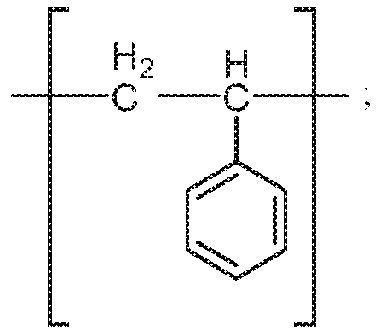
- the present invention provides a cationic copolymer comprising the divalent monomer units (hereinafter “monomer units”):
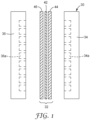
- FIG. 1 is a schematic exploded side view of an exemplary electrochemical device according to the present disclosure.
- Ionic copolymers according to the present disclosure can be prepared from corresponding precursor copolymers.
- the precursor copolymers typically contain monomer units derived from styrene as well as monomer units derived from a vinylbenzyl halide (i.e., a halomethylstyrene), which is usually a vinylbenzyl chloride.
- Other optional monomer units can be included, if desired; for example, to modify ionic conductivity, solubility, mechanical strength, and swelling characteristics.
- the precursor copolymer is typically a random copolymer and is often linear.
- the precursor copolymer is a random copolymer formed from styrene and a vinylbenzyl halide such as vinylbenzyl chloride.
- a precursor copolymer has monomer units derived from styrene as in Formula II-1 (below) and monomer units derived from vinylbenzyl halide as in Formula II-2A (below) where X is Cl, Br, or I (preferably Cl) and wherein the -CH 2 X can be attached to any aromatic ring carbon.
- the resulting precursor copolymer is usually of Formula III, below.
- variable n is the mole percentage of monomer units derived from styrene and the variable m is the mole percentage of monomer units derived from vinylbenzyl halide in the precursor copolymer.
- the monomer units are typically arranged in a random manner. That is, monomer units of the same type are not all together in a block.
- an asterisk (*) indicates attachment to another group such as, for example, an end group and/or initiator residue.
- the sum of the variables n and m is equal to 100 mole percent. That is, the precursor copolymer contains only two types of monomer units as in Formula (III).
- the sum of n and m is often at least 80 mole percent, at least 85 mole percent, at least 90 mole percent, at least 95 mole percent, at least 98 mole percent, at least 99 mole percent, at least 99.5 mole percent, at least 99.8 mole percent, or at least 99.9 mole percent based on the total moles of monomer units in the precursor copolymer.
- the mole percentage of cationic monomer units derived from vinylbenzyl halide in the precursor copolymer is selected to provide a suitable amount of cationic, nitrogen-containing groups in the resultant cationic copolymer.
- the cationic nitrogen-containing groups may be introduced into cationic copolymer by reaction of nitrogen-containing bases (e.g., tertiary amines, tertiary vinylamines, pyridines, N -vinylimidazole, an N -alkylimidazole, a N,N -dialkylamino-alkylstyrene, a N , N -dialkylaminoalkylbenzene, and combinations thereof) with the monomer units derived from vinylbenzyl halide in the precursor copolymer.
- nitrogen-containing bases e.g., tertiary amines, tertiary vinylamines, pyridines, N -vinylimidazole, an N -alkylimidazole, a N,N -dialkylamino-alkylstyrene, a N , N -dialkylaminoalkylbenzene, and combinations thereof
- the precursor copolymer typically contains at least 20 mole percent, at least 25 mole percent, at least 30 mole percent, at least 35 mole percent, at least 40 mole percent and up to 50 mole percent, up to 45 mole percent, or up to 40 mole percent monomer units derived from vinylbenzyl halide based on the total moles of monomer units in the precursor copolymer.
- the mole percentage of styrene monomer units in the precursor copolymer, and hence also the resulting cationic copolymer is chosen such that the cationic copolymer is insoluble in water or a water-based solution, or any electrolyte solution such as that used within the electrochemical device. If the amount is too great, however, there may not be enough cationically charged monomer units (e.g., monomer units (b) and (c)) for the cationic copolymer to be sufficiently ionically conductive.
- the precursor copolymer contains at least 50 mole percent such as, for example, 50 to 80 mole percent monomer units derived from styrene based on the total moles of monomer units in the precursor copolymer; however, this is not a requirement.
- the amount is often at least 50 mole percent, at least 55 mole percent, at least 60 mole percent, at least 65 mole percent, at least 70 mole percent and up to 80 mole percent, up to 75 mole percent, up to 70 mole percent, or up to 65 mole percent based on the total moles of monomer units in the precursor copolymer.
- the precursor copolymers may be prepared by mixing the monomers with a thermal free-radical initiator (hereinafter "thermal initiator”); for example, according to methods known in the art.
- thermal initiators include azo compounds such as 2,2'-azobis(isobutyronitrile), 2,2'-azobis(2,4-dimethylpentanenitrile), and 2,2'-azobis(2-methylbutyronitrile), and organic peroxides (e.g., benzoyl peroxide and lauroyl peroxide), and mixtures thereof.
- the polymerization reaction to form the precursor copolymer can occur with or without organic solvent and/or water being present in the reaction mixture. That is, the solids content of the precursor reaction mixture can be up to 100 weight percent. The solids content is equal to the percentage of all components in the precursor reaction mixture that are not an organic solvent and/or water.
- An organic solvent refers to a non-reactive, organic, liquid component. The organic solvent can be added to lower the viscosity of the precursor reaction mixture, to allow suitable mixing of the components, and to facilitate handling of the final polymeric solution. If the solids content is too low, however, the excess organic solvent and/or water needs to be removed. This adds additional cost and time to the preparation of the precursor copolymer.
- Organic solvent if added to the precursor reaction mixture, is typically selected based on its ability to form a single phase with the monomers and with the resulting precursor copolymer.
- the organic solvent can be, for example, a ketone (e.g., acetone, methyl ethyl ketone, methyl iso-butyl ketone, and cyclohexanone), an ester such as an alkyl acetate (e.g., ethyl acetate and butyl acetate), or an aromatic hydrocarbon that optionally can be halogenated (e.g., toluene and chlorobenzene).
- a ketone e.g., acetone, methyl ethyl ketone, methyl iso-butyl ketone, and cyclohexanone
- an ester such as an alkyl acetate (e.g., ethyl acetate and butyl acetate)
- an aromatic hydrocarbon
- the molecular weight (e.g., number average molecular weight, MW n ) of the precursor copolymer is typically in a range of 20,000 to 100,000 Daltons, although this is not a requirement. If the weight average molecular weight is below 20,000 Daltons, the cationic copolymer formed from the precursor copolymer may not be sufficiently robust to be used as anion exchange membranes in electrochemical cells. On the other hand, if the weight average molecular weight is greater than 100,000 Daltons, the resulting cationic copolymer solutions may have a viscosity that is too high for easy processing.
- the weight average molecular weight can be at least 20,000 Daltons, at least 30,000 Daltons, at least 40,000 Daltons, or at least 50,000 Daltons and up to 100,000 Daltons, up to 90,000 Daltons, up to 80,000 Daltons, up to 70,000 Daltons, or up to 60,000 Daltons.
- the weight average molecular weight can be in a range of 40,000 to 100,000 Daltons, in a range of 40,000 to 80,000 Daltons, in a range of 50,000 to 80,000 Daltons, in a range of 40,000 to 70,000 Daltons, or in a range of 50,000 to 70,000 Daltons.
- the cationic copolymer can be formed from the precursor copolymer. More specifically, the precursor copolymer can be reacted with corresponding nitrogen-containing bases (e.g., tertiary amines, pyridines, N -alkylimidazoles), that can nucleophilically disnlace the benzylic halide to produce monomer units (b) and (c) as corresponding halide salts.
- the halide anions can be subsequently exchanged with and replaced by other non-interfering monovalent anions that are not reactive with the cationic polymer under normal ambient or intended use conditions. Examples may include other halide ions (e.g., Cl, Br, I), hydroxide, bicarbonate, methane sulfonate, trifluoroacetate, acetate, and nitrate.
- Nitrogen-containing bases are typically added to the precursor copolymer in the presence of one or more organic solvents. Water may also be present.
- the solvent system is selected so that the final product (i.e., the cationic, nitrogen-containing copolymer, which is the cationic copolymer) is dissolved.
- the solvent system may or may not dissolve the precursor copolymer. That is, the initial reaction mixture can be either a solution or a slurry. If the initial reaction mixture is a slurry, the solvent system is usually selected so that resulting cationic copolymer is dissolved.
- Suitable solvents that can dissolve both the precursor copolymer as well as the cationic copolymer include N,N -dimethylformamide, N,N- dimethylacetamide, N -methyl-2-pyrrolidinone, and dimethyl sulfoxide.
- Suitable solvents that can dissolve the cationic copolymer but not the precursor copolymer include, but are not limited to, methanol, ethanol, 1-methoxy-2-propanol, and blends of these with toluene.
- the reaction mixture is often heated at an elevated temperature for at least 30 minutes, at least 1 hour, or even more.
- the weight percent solids are often in a range of 10 to 60 weight percent, 20 to 50 weight percent, or 20 to 40 weight percent.
- R 1 independently represents an alkyl group having 1 to 4 carbon atoms (e.g., methyl, ethyl, propyl, or butyl), preferably methyl.
- Each R 2 independently represents an alkylene group having from 1 to 6 carbon atoms (e.g., methylene, ethylene, 1,3-propanediyl, 1,4-butanediyl, 1,5-pentanediyl, or 1,6-hexanediyl), preferably methylene, ethylene, or 1,3-propanediyl.
- 1 to 6 carbon atoms e.g., methylene, ethylene, 1,3-propanediyl, 1,4-butanediyl, 1,5-pentanediyl, or 1,6-hexanediyl
- Each Ar 2 independently represents an optionally substituted divalent aryl ring such as, for example: o-, m-, or p- phenylene; imidazole-1,3-diyl; 2,4,5-trimethylimidazole-1,3-diyl; 2,5-dimethylimidazole-1,3-diyl; or 2,4-dimethylimidazole-1,3-diyl.
- Ar 2 is generally selected such that it does not contain or contribute to an N-H bond.
- Each R 3 independently represents H or an alkyl group having 1 to 6 carbon atoms (e.g., methyl, ethyl, propyl, butyl, isobutyl, pentyl, hexyl). Generally, R 3 is selected such that when R 3 is H, it is not bonded to nitrogen.
- Still other suitable optional nitrogen-containing bases that can be reacted with the precursor copolymer include unsaturated heterocyclic compounds with a five-membered ring such as pyrrole, pyrazole, triazole, and tetrazole as well as unsaturated compounds with a six-membered ring such as pyrimidine, pyrazine, pyridazine, and triazine.
- Saturated nitrogen-containing bases such as piperidine and piperazine can also be used. Any of these compounds can be substituted with one or more alkyl groups.
- Examples include, but are not limited to, pentamethylguanidine, 2-tert-butyl-1,1,2,2-tetramethylguanadine, and N,N- diethyl- N , N ', N '-trimethylguanidine as well as cyclic and polycyclic compounds such as 2-methylimino-1,3-dimethylimidazolidine and 7-methyl-1,5,7-triazabicyclo[4.4.0]dec-5-ene.
- the cationic copolymer can contain at least 20 mole percent, at least 25 mole percent, at least 30 mole percent, at least 35 mole percent, or at least 40 mole percent and up to 50 mole percent, up to 45 mole percent, up to 40 mole percent, up to 35 mole percent, or up to 30 mole percent cationic, nitrogen-containing monomer units.
- all the nitrogen-containing monomer units are monomer units (b) or (c).
- the present disclosure also provides a curable membrane precursor composition comprising a cationic copolymer according to the present disclosure and a free-radical initiator.
- Useful free-radical initiators may include thermal initiators and/or photoinitiators. For rapid curing during continuous manufacturing processes photoinitiators are typically preferred. In some cases, electron beam radiation may be used to effect curing/crosslinking.
- photoinitiators include, for example, pivaloin ethyl ether, anisoin ethyl ether, anthraquinones (e.g., anthraquinone, 2-ethylanthraquinone, 1-chloroanthraquinone, 1,4-dimethylanthraquinone, 1-methoxyanthraquinone, or benzanthraquinone), halomethyltriazines, benzophenone and its derivatives, iodonium salts and sulfonium salts, titanium complexes such as bis( ⁇ 5-2,4-cyclopentadien-1-yl)-bis[2,6-difluoro-3-( 1H -pyrrol-1-yl]phenyl]titanium; halonitrobenzenes (e.g., 4-bromomethylnitrobenzene), mono- and bis-acylphosphines, and mono- and bis-acyl
- Combinations of photoinitiators may be used.
- One or more spectral sensitizers e.g., dyes
- the photoinitiator(s) may be used in conjunction with the photoinitiator(s), for example, in order to increase sensitivity of the photoinitiator to a specific source of actinic radiation.
- the amount of the free-radical initiator is typically in a range of 0.01 to 5 weight percent based on the total weight of the membrane precursor composition.
- the amount can be at least 0.01 weight percent, at least 0.05 weight percent, at least 0.1 weight percent, at least 0.5 weight percent, at least 1 weight percent and up to 5 weight percent, up to 4 weight percent, up to 3 weight percent, up to 2 weight percent, or up to 1 weight percent; however, higher amounts may also be used.
- Useful sources of actinic radiation include, lasers, arc lamps (e.g., medium pressure mercury arc lamps), xenon flash lamps, microwave-driven lamps (e.g., equipped with H-type bulb or D-type bulb). Selection of appropriate exposure conditions will be within the capability of those skilled in the art.
- electrochemical devices include, but are not limited to, fuel cells, electrolyzers, batteries, or electrodialysis cells.
- Electrode materials can include, for example, graphitic carbon, glassy carbon, titanium, or any of the following "catalytically active elements”: V, Cr, Mn, Fe, Co, Ni, Cu, Zn, Sn, Zr, Nb, Mo, Ru, Rh, Pd, Ag, Cd, Hf, Ta, W, Re, Ir, Pt, Au, Hg, Al, Si, In, Tl, Pb, Bi, Sb, Te, U, Sm, Tb, La, Ce, Nd, and alloys or combinations thereof.
- the cathode of the electrochemical device comprises a catalytically active species comprising silver, gold, copper, nickel, iron, or combinations thereof.
- the anode of the electrochemical device comprises a catalytically active species comprising ruthenium, iridium, platinum, titanium, nickel, iron, cobalt, or combinations thereof.
- the electrochemical device is substantially free of platinum, meaning the electrodes comprise less than 0.1 weight percent, less than 0.01 weight percent or even less than 0.001 weight percent platinum based on the total weight of the electrode.
- a 250-mL two-necked round bottom flask equipped with magnetic stirring, an oil bath heating, and an inlet tube for nitrogen blanketing was charged with 25.5 g of TMIm and 26.36 g of acetonitrile. Swirling the flask produced endothermic dissolution of the solid. When the endotherm had subsided, 36.0 g of VBC was added, turning the reaction mixture bright yellow. The flask was heated 60 °C at using an oil bath, with stirring as 300 rpm, for 18 hours leaving a light amber, clear reaction mixture.
- Membranes were prepared using a BYK BYKO-drive automatic applicator to coat 30-35 weight percent solids crosslinkable copolymer solutions prepared in Examples 5-7 onto a release liner with a polyethylene terephthalate backing coated with an acrylic-based release layer as described in U.S. Patent 7,816,477 (Suwa et al. ). Membranes were coated using a BYKO-drive automatic applicator (BYK-Gardner GmbH, Geretsried, Germany) at a speed setting of 1 inch/sec (2.54 cm/sec) and with a notch bar applicator having a 10 mil (0.01 inch, 0.254 mm) gap, and then dried in a forced air oven at 80 °C for 30 minutes. Measured dry coating thicknesses were in the range of 45-52 microns.
- Ionic conductivity was measured using a 4-probe BekkTech BT-110 conductivity clamp (Scribner Associates, Inc., Southern Pines, North Carolina) and a VMP3 Multi-channel potentiostat (BioLogic Science Instruments, Seyssinet-Pariset, France).
- a dry membrane sample in the chloride form (1.4.0 cm x 4.00 cm) was assembled under two platinum wires, and the clamp was immersed into 18 megaohms deionized water for 2 hours before measurement to hydrate and swell the membrane.
- a current-voltage curve was recorded by applying a linear voltage sweep from an open circuit voltage (OCV) to 0.3 V first, then to -0.3 V, and finally back to OCV at 10 mV/second scan rate.
- OCV open circuit voltage
Landscapes
- Chemical & Material Sciences (AREA)
- Chemical Kinetics & Catalysis (AREA)
- Organic Chemistry (AREA)
- Engineering & Computer Science (AREA)
- Polymers & Plastics (AREA)
- Medicinal Chemistry (AREA)
- Health & Medical Sciences (AREA)
- Electrochemistry (AREA)
- Manufacturing & Machinery (AREA)
- General Chemical & Material Sciences (AREA)
- Sustainable Energy (AREA)
- Sustainable Development (AREA)
- Life Sciences & Earth Sciences (AREA)
- Crystallography & Structural Chemistry (AREA)
- Materials Engineering (AREA)
- Metallurgy (AREA)
- Inorganic Chemistry (AREA)
- Addition Polymer Or Copolymer, Post-Treatments, Or Chemical Modifications (AREA)
Claims (14)
- Ein kationisches Copolymer, umfassend die zweiwertigen Monomereinheiten:(a)
 (b)
(b) (c)wobei:
 jedes Ar1 unabhängig Phenylen darstellt;jedes L unabhängig eine direkte Bindung darstellt oder
 wobei jedes R1 unabhängig eine Alkylgruppe darstellt, die 1 bis 4 Kohlenstoffatome aufweist, und jedes R2 unabhängig eine Alkylengruppe darstellt, die von 1 bis 6 Kohlenstoffatome aufweist, und jedes Z- ein nicht störendes einwertiges Anion darstellt;jedes Ar2 unabhängig einen gegebenenfalls substituierten zweiwertigen Arylring darstellt, mit der Maßgabe, dass, falls L eine direkte Bindung darstellt, dann Ar2 einen gegebenenfalls substituierten kationischen zweiwertigen Arylring, begleitet von Z-, darstellt;jedes R3 unabhängig H oder eine Alkylgruppe darstellt, die 1 bis 6 Kohlenstoffatome aufweist; undjedes D stellt unabhängig eine direkte Bindung oder Ar2 darstellt, wobei benachbarte D und L nicht beide direkte Bindungen sind, und wobei, falls L eine direkte Bindung ist, D Ar2 ist.
 - Das kationische Copolymer nach Anspruch 1, wobei das Verhältnis von Molen der Monomereinheit a) zu der Summe von Molen der Monomereinheiten b) und c) 1 : 1 bis 4 : 1 beträgt.
- Das kationische Copolymer nach Anspruch 1, wobei für mindestens einige der Monomereinheiten b) mindestens einige Ar1 p-Phenylen sind.
- Das kationische Copolymer nach Anspruch 1, wobei für mindestens einige der Monomereinheiten b) L eine direkte Bindung ist und Ar2 dargestellt wird durch

- Das kationische Copolymer nach Anspruch 1, wobei für mindestens einige der Monomereinheiten b) jedes L unabhängig darstellt

- Das kationische Copolymer nach Anspruch 5, wobei jedes R1 Methyl ist, R2 Methylen ist und Ar2 Phenylen ist.
- Das kationische Copolymer nach Anspruch 6, wobei Ar2 p-Phenylen ist.
- Eine härtbare Membranvorläuferzusammensetzung, umfassend:i) das kationische Copolymer nach Anspruch 1; undii) einen Radikalinitiator.
- Eine härtbare Membranvorläuferzusammensetzung, umfassend:i) das kationische Copolymer nach Anspruch 4; undii) einen Radikalinitiator.
- Eine härtbare Membranvorläuferzusammensetzung, umfassend:i) das kationische Copolymer nach Anspruch 5; undii) einen Radikalinitiator.
- Eine Membranzusammensetzung, umfassend eine mindestens teilweise ausgehärtete, härtbare Membranzusammensetzung nach Anspruch 8.
- Eine Membranzusammensetzung, umfassend eine mindestens teilweise ausgehärtete, härtbare Membranzusammensetzung nach Anspruch 9.
- Eine Membranzusammensetzung, umfassend eine mindestens teilweise ausgehärtete, härtbare Membranzusammensetzung nach Anspruch 10.
- Eine elektrochemische Vorrichtung, umfassend: eine Anode;eine Kathode; undeine Membran, die zwischen der Anode und der Kathode positioniert ist, wobei die Membran die Membranzusammensetzung nach einem der Ansprüche 11 bis 13 umfasst.
Applications Claiming Priority (2)
| Application Number | Priority Date | Filing Date | Title |
|---|---|---|---|
| US201962891056P | 2019-08-23 | 2019-08-23 | |
| PCT/IB2020/057454 WO2021038342A1 (en) | 2019-08-23 | 2020-08-06 | Ionic copolymer, curable membrane precursor composition, membrane composition, and electronic device |
Publications (2)
| Publication Number | Publication Date |
|---|---|
| EP4017889A1 EP4017889A1 (de) | 2022-06-29 |
| EP4017889B1 true EP4017889B1 (de) | 2025-06-25 |
Family
ID=72145432
Family Applications (1)
| Application Number | Title | Priority Date | Filing Date |
|---|---|---|---|
| EP20757962.4A Active EP4017889B1 (de) | 2019-08-23 | 2020-08-06 | Ionisches copolymer, härtbare membranvorläuferzusammensetzung, membranzusammensetzung und elektronische vorrichtung |
Country Status (4)
| Country | Link |
|---|---|
| US (1) | US12552896B2 (de) |
| EP (1) | EP4017889B1 (de) |
| CN (1) | CN114341208B (de) |
| WO (1) | WO2021038342A1 (de) |
Families Citing this family (2)
| Publication number | Priority date | Publication date | Assignee | Title |
|---|---|---|---|---|
| US12018104B2 (en) | 2018-12-11 | 2024-06-25 | 3M Innovative Properties Company | Copolymers with cationic, nitrogen-containing groups and anion exchange membranes made therefrom |
| WO2020254930A1 (en) | 2019-06-17 | 2020-12-24 | 3M Innovative Properties Company | Organosilane, ionic organosilane, membrane composition, and membrane |
Family Cites Families (10)
| Publication number | Priority date | Publication date | Assignee | Title |
|---|---|---|---|---|
| US3377303A (en) | 1966-05-03 | 1968-04-09 | Gen Mills Inc | Polyamide composition |
| JP4436030B2 (ja) | 2002-05-10 | 2010-03-24 | スリーエム イノベイティブ プロパティズ カンパニー | アクリル系剥離剤前駆体、剥離剤物品及び剥離剤物品の製造方法 |
| US9849450B2 (en) * | 2010-07-04 | 2017-12-26 | Dioxide Materials, Inc. | Ion-conducting membranes |
| US9943841B2 (en) | 2012-04-12 | 2018-04-17 | Dioxide Materials, Inc. | Method of making an anion exchange membrane |
| CN105980418A (zh) * | 2014-02-14 | 2016-09-28 | 德山株式会社 | 部分季铵化苯乙烯系共聚物、离子传导性赋予剂、催化剂电极层、膜-电极组件及其制造方法、气体扩散电极及其制造方法以及阴离子交换膜型燃料电池 |
| JP6550453B2 (ja) * | 2015-03-13 | 2019-07-24 | 日東電工株式会社 | アイオノマー樹脂、それを含むアイオノマー溶液、積層体、部材、電気化学素子及び電気化学デバイス |
| CA3019139C (en) * | 2016-04-04 | 2020-12-29 | Dioxide Materials, Inc. | Water electrolyzers |
| US12018104B2 (en) | 2018-12-11 | 2024-06-25 | 3M Innovative Properties Company | Copolymers with cationic, nitrogen-containing groups and anion exchange membranes made therefrom |
| US12103994B2 (en) | 2019-06-10 | 2024-10-01 | 3M Innovative Properties Company | Cationic copolymers with pendant N-allylimidazolium groups |
| WO2020254930A1 (en) | 2019-06-17 | 2020-12-24 | 3M Innovative Properties Company | Organosilane, ionic organosilane, membrane composition, and membrane |
-
2020
- 2020-08-06 EP EP20757962.4A patent/EP4017889B1/de active Active
- 2020-08-06 CN CN202080059573.5A patent/CN114341208B/zh active Active
- 2020-08-06 US US17/634,419 patent/US12552896B2/en active Active
- 2020-08-06 WO PCT/IB2020/057454 patent/WO2021038342A1/en not_active Ceased
Also Published As
| Publication number | Publication date |
|---|---|
| CN114341208B (zh) | 2025-11-04 |
| WO2021038342A1 (en) | 2021-03-04 |
| CN114341208A (zh) | 2022-04-12 |
| EP4017889A1 (de) | 2022-06-29 |
| US20220332887A1 (en) | 2022-10-20 |
| US12552896B2 (en) | 2026-02-17 |
Similar Documents
| Publication | Publication Date | Title |
|---|---|---|
| EP1828278B1 (de) | Verzweigtes und sulfoniertes mehrblockcopolymer und elektrolytmembran damit | |
| EP2800192B1 (de) | Redox-flusssekundärbatterie und elektrolytmembran für redox-flusssekundärbatterien | |
| KR102284854B1 (ko) | 카바졸계 음이온 교환 소재, 그의 제조방법 및 용도 | |
| US4384941A (en) | Process for electrolyzing water | |
| Bai et al. | Anion-exchange membrane with ion-nanochannels to beat trade-off between membrane conductivity and acid blocking performance for waste acid reclamation | |
| EP4017889B1 (de) | Ionisches copolymer, härtbare membranvorläuferzusammensetzung, membranzusammensetzung und elektronische vorrichtung | |
| US20230038279A1 (en) | Novel polyfluorene-based ionomer, anion exchange membrane, method for preparing the polyfluorene-based ionomer and method for fabricating the anion exchange membrane | |
| JP2010533222A (ja) | 陰イオン交換膜およびポリマーイオノマーを含む電気化学的装置 | |
| EP3894452B1 (de) | Copolymere mit kationischen, stickstoffhaltigen gruppen und daraus hergestellte anionenaustauschmembranen | |
| EP2750233A1 (de) | Ionenaustauschmembran für vanadium-redoxbatterien, verbundkörper und vanadium-redoxbatterie | |
| EP2447953A1 (de) | Feststoffpolymer-elektrolytzusammensetzung, ionenaustauschmembran, membran-elektroden-anordnung und brennstoffzelle | |
| JP3149247B2 (ja) | イオン導伝性ポリマー電解質 | |
| Wang et al. | Highly conductive and dimensionally stable anion exchange membranes enabled by rigid poly (arylene alkylene) backbones | |
| US12103994B2 (en) | Cationic copolymers with pendant N-allylimidazolium groups | |
| EP4484455A1 (de) | Anionenaustauschharz, anionenaustauschmembran, anionenaustauschgruppenhaltiges monomer und monomer mit quaternärer imidazolgruppe | |
| EP1847556B1 (de) | Polymer, vernetztes polymer, zusammensetzung für ein feststoffpolymer-elektrolyt, feststoffpolymer-elektrolyt und klebstoffzusammensetzung | |
| Ge et al. | Constructing lamellar micromorphology in fluorinated, block anion exchange membranes from photocontrolled RAFT polymerization | |
| EP4574854A1 (de) | Polymerelektrolyte und verfahren zu ihrer herstellung | |
| DE102013216706B4 (de) | Verfahren zur Herstellung einer ionenleitenden Membran für Brennstoffzellen | |
| JP4752318B2 (ja) | オキソカーボン基を有する高分子及びその用途 | |
| JP4313973B2 (ja) | 高分子電解質及び燃料電池 | |
| EP4491766A1 (de) | Elektroden mit polyionischen flüssigkeiten für co2-elektrochemische umwandlung, elektrolytische co2-reduktionszellen und verwendung davon zur herstellung von co2-reduktionsprodukten | |
| WO2005064620A1 (ja) | 高分子固体電解質 | |
| CN118895004B (zh) | 一种支化聚芳基哌啶阴离子交换膜及其制备方法 | |
| JP2018073810A (ja) | 高分子電解質膜、その製造方法、およびそれを含む膜/電極接合体と燃料電池 |
Legal Events
| Date | Code | Title | Description |
|---|---|---|---|
| STAA | Information on the status of an ep patent application or granted ep patent |
Free format text: STATUS: UNKNOWN |
|
| STAA | Information on the status of an ep patent application or granted ep patent |
Free format text: STATUS: THE INTERNATIONAL PUBLICATION HAS BEEN MADE |
|
| PUAI | Public reference made under article 153(3) epc to a published international application that has entered the european phase |
Free format text: ORIGINAL CODE: 0009012 |
|
| STAA | Information on the status of an ep patent application or granted ep patent |
Free format text: STATUS: REQUEST FOR EXAMINATION WAS MADE |
|
| 17P | Request for examination filed |
Effective date: 20220216 |
|
| AK | Designated contracting states |
Kind code of ref document: A1 Designated state(s): AL AT BE BG CH CY CZ DE DK EE ES FI FR GB GR HR HU IE IS IT LI LT LU LV MC MK MT NL NO PL PT RO RS SE SI SK SM TR |
|
| DAV | Request for validation of the european patent (deleted) | ||
| DAX | Request for extension of the european patent (deleted) | ||
| GRAP | Despatch of communication of intention to grant a patent |
Free format text: ORIGINAL CODE: EPIDOSNIGR1 |
|
| STAA | Information on the status of an ep patent application or granted ep patent |
Free format text: STATUS: GRANT OF PATENT IS INTENDED |
|
| INTG | Intention to grant announced |
Effective date: 20250116 |
|
| P01 | Opt-out of the competence of the unified patent court (upc) registered |
Free format text: CASE NUMBER: APP_4475/2025 Effective date: 20250127 |
|
| GRAS | Grant fee paid |
Free format text: ORIGINAL CODE: EPIDOSNIGR3 |
|
| GRAA | (expected) grant |
Free format text: ORIGINAL CODE: 0009210 |
|
| STAA | Information on the status of an ep patent application or granted ep patent |
Free format text: STATUS: THE PATENT HAS BEEN GRANTED |
|
| AK | Designated contracting states |
Kind code of ref document: B1 Designated state(s): AL AT BE BG CH CY CZ DE DK EE ES FI FR GB GR HR HU IE IS IT LI LT LU LV MC MK MT NL NO PL PT RO RS SE SI SK SM TR |
|
| REG | Reference to a national code |
Ref country code: GB Ref legal event code: FG4D |
|
| REG | Reference to a national code |
Ref country code: CH Ref legal event code: EP |
|
| REG | Reference to a national code |
Ref country code: DE Ref legal event code: R096 Ref document number: 602020053348 Country of ref document: DE |
|
| REG | Reference to a national code |
Ref country code: CH Ref legal event code: EP |
|
| REG | Reference to a national code |
Ref country code: IE Ref legal event code: FG4D |
|
| PG25 | Lapsed in a contracting state [announced via postgrant information from national office to epo] |
Ref country code: FI Free format text: LAPSE BECAUSE OF FAILURE TO SUBMIT A TRANSLATION OF THE DESCRIPTION OR TO PAY THE FEE WITHIN THE PRESCRIBED TIME-LIMIT Effective date: 20250625 |
|
| PGFP | Annual fee paid to national office [announced via postgrant information from national office to epo] |
Ref country code: DE Payment date: 20250724 Year of fee payment: 6 |
|
| REG | Reference to a national code |
Ref country code: LT Ref legal event code: MG9D |
|
| PG25 | Lapsed in a contracting state [announced via postgrant information from national office to epo] |
Ref country code: NO Free format text: LAPSE BECAUSE OF FAILURE TO SUBMIT A TRANSLATION OF THE DESCRIPTION OR TO PAY THE FEE WITHIN THE PRESCRIBED TIME-LIMIT Effective date: 20250925 Ref country code: GR Free format text: LAPSE BECAUSE OF FAILURE TO SUBMIT A TRANSLATION OF THE DESCRIPTION OR TO PAY THE FEE WITHIN THE PRESCRIBED TIME-LIMIT Effective date: 20250926 |
|
| PG25 | Lapsed in a contracting state [announced via postgrant information from national office to epo] |
Ref country code: BG Free format text: LAPSE BECAUSE OF FAILURE TO SUBMIT A TRANSLATION OF THE DESCRIPTION OR TO PAY THE FEE WITHIN THE PRESCRIBED TIME-LIMIT Effective date: 20250625 |
|
| PG25 | Lapsed in a contracting state [announced via postgrant information from national office to epo] |
Ref country code: HR Free format text: LAPSE BECAUSE OF FAILURE TO SUBMIT A TRANSLATION OF THE DESCRIPTION OR TO PAY THE FEE WITHIN THE PRESCRIBED TIME-LIMIT Effective date: 20250625 |
|
| PG25 | Lapsed in a contracting state [announced via postgrant information from national office to epo] |
Ref country code: RS Free format text: LAPSE BECAUSE OF FAILURE TO SUBMIT A TRANSLATION OF THE DESCRIPTION OR TO PAY THE FEE WITHIN THE PRESCRIBED TIME-LIMIT Effective date: 20250925 |
|
| PG25 | Lapsed in a contracting state [announced via postgrant information from national office to epo] |
Ref country code: LV Free format text: LAPSE BECAUSE OF FAILURE TO SUBMIT A TRANSLATION OF THE DESCRIPTION OR TO PAY THE FEE WITHIN THE PRESCRIBED TIME-LIMIT Effective date: 20250625 |
|
| REG | Reference to a national code |
Ref country code: NL Ref legal event code: MP Effective date: 20250625 |
|
| PG25 | Lapsed in a contracting state [announced via postgrant information from national office to epo] |
Ref country code: NL Free format text: LAPSE BECAUSE OF FAILURE TO SUBMIT A TRANSLATION OF THE DESCRIPTION OR TO PAY THE FEE WITHIN THE PRESCRIBED TIME-LIMIT Effective date: 20250625 |
|
| PG25 | Lapsed in a contracting state [announced via postgrant information from national office to epo] |
Ref country code: PT Free format text: LAPSE BECAUSE OF FAILURE TO SUBMIT A TRANSLATION OF THE DESCRIPTION OR TO PAY THE FEE WITHIN THE PRESCRIBED TIME-LIMIT Effective date: 20251027 |
|
| REG | Reference to a national code |
Ref country code: AT Ref legal event code: MK05 Ref document number: 1806382 Country of ref document: AT Kind code of ref document: T Effective date: 20250625 |
|
| PG25 | Lapsed in a contracting state [announced via postgrant information from national office to epo] |
Ref country code: IS Free format text: LAPSE BECAUSE OF FAILURE TO SUBMIT A TRANSLATION OF THE DESCRIPTION OR TO PAY THE FEE WITHIN THE PRESCRIBED TIME-LIMIT Effective date: 20251025 |
|
| PG25 | Lapsed in a contracting state [announced via postgrant information from national office to epo] |
Ref country code: AT Free format text: LAPSE BECAUSE OF FAILURE TO SUBMIT A TRANSLATION OF THE DESCRIPTION OR TO PAY THE FEE WITHIN THE PRESCRIBED TIME-LIMIT Effective date: 20250625 Ref country code: SM Free format text: LAPSE BECAUSE OF FAILURE TO SUBMIT A TRANSLATION OF THE DESCRIPTION OR TO PAY THE FEE WITHIN THE PRESCRIBED TIME-LIMIT Effective date: 20250625 |
|
| PG25 | Lapsed in a contracting state [announced via postgrant information from national office to epo] |
Ref country code: CZ Free format text: LAPSE BECAUSE OF FAILURE TO SUBMIT A TRANSLATION OF THE DESCRIPTION OR TO PAY THE FEE WITHIN THE PRESCRIBED TIME-LIMIT Effective date: 20250625 |
|
| PG25 | Lapsed in a contracting state [announced via postgrant information from national office to epo] |
Ref country code: PL Free format text: LAPSE BECAUSE OF FAILURE TO SUBMIT A TRANSLATION OF THE DESCRIPTION OR TO PAY THE FEE WITHIN THE PRESCRIBED TIME-LIMIT Effective date: 20250625 |
|
| PG25 | Lapsed in a contracting state [announced via postgrant information from national office to epo] |
Ref country code: EE Free format text: LAPSE BECAUSE OF FAILURE TO SUBMIT A TRANSLATION OF THE DESCRIPTION OR TO PAY THE FEE WITHIN THE PRESCRIBED TIME-LIMIT Effective date: 20250625 |
|
| PG25 | Lapsed in a contracting state [announced via postgrant information from national office to epo] |
Ref country code: SK Free format text: LAPSE BECAUSE OF FAILURE TO SUBMIT A TRANSLATION OF THE DESCRIPTION OR TO PAY THE FEE WITHIN THE PRESCRIBED TIME-LIMIT Effective date: 20250625 |
|
| PG25 | Lapsed in a contracting state [announced via postgrant information from national office to epo] |
Ref country code: ES Free format text: LAPSE BECAUSE OF FAILURE TO SUBMIT A TRANSLATION OF THE DESCRIPTION OR TO PAY THE FEE WITHIN THE PRESCRIBED TIME-LIMIT Effective date: 20250625 |
|
| PG25 | Lapsed in a contracting state [announced via postgrant information from national office to epo] |
Ref country code: RO Free format text: LAPSE BECAUSE OF FAILURE TO SUBMIT A TRANSLATION OF THE DESCRIPTION OR TO PAY THE FEE WITHIN THE PRESCRIBED TIME-LIMIT Effective date: 20250625 |
|
| REG | Reference to a national code |
Ref country code: CH Ref legal event code: H13 Free format text: ST27 STATUS EVENT CODE: U-0-0-H10-H13 (AS PROVIDED BY THE NATIONAL OFFICE) Effective date: 20260324 |