EP4017708B1 - Verfahren zum schweissen von profilen an einen riemen - Google Patents
Verfahren zum schweissen von profilen an einen riemen Download PDFInfo
- Publication number
- EP4017708B1 EP4017708B1 EP20765042.5A EP20765042A EP4017708B1 EP 4017708 B1 EP4017708 B1 EP 4017708B1 EP 20765042 A EP20765042 A EP 20765042A EP 4017708 B1 EP4017708 B1 EP 4017708B1
- Authority
- EP
- European Patent Office
- Prior art keywords
- profile
- belt
- top layer
- thermoplastic
- welding
- Prior art date
- Legal status (The legal status is an assumption and is not a legal conclusion. Google has not performed a legal analysis and makes no representation as to the accuracy of the status listed.)
- Active
Links
Images

Classifications
-
- B—PERFORMING OPERATIONS; TRANSPORTING
- B29—WORKING OF PLASTICS; WORKING OF SUBSTANCES IN A PLASTIC STATE IN GENERAL
- B29D—PRODUCING PARTICULAR ARTICLES FROM PLASTICS OR FROM SUBSTANCES IN A PLASTIC STATE
- B29D29/00—Producing belts or bands
- B29D29/06—Conveyor belts
-
- B—PERFORMING OPERATIONS; TRANSPORTING
- B29—WORKING OF PLASTICS; WORKING OF SUBSTANCES IN A PLASTIC STATE IN GENERAL
- B29C—SHAPING OR JOINING OF PLASTICS; SHAPING OF MATERIAL IN A PLASTIC STATE, NOT OTHERWISE PROVIDED FOR; AFTER-TREATMENT OF THE SHAPED PRODUCTS, e.g. REPAIRING
- B29C65/00—Joining or sealing of preformed parts, e.g. welding of plastics materials; Apparatus therefor
- B29C65/02—Joining or sealing of preformed parts, e.g. welding of plastics materials; Apparatus therefor by heating, with or without pressure
- B29C65/18—Joining or sealing of preformed parts, e.g. welding of plastics materials; Apparatus therefor by heating, with or without pressure using heated tools
-
- B—PERFORMING OPERATIONS; TRANSPORTING
- B29—WORKING OF PLASTICS; WORKING OF SUBSTANCES IN A PLASTIC STATE IN GENERAL
- B29C—SHAPING OR JOINING OF PLASTICS; SHAPING OF MATERIAL IN A PLASTIC STATE, NOT OTHERWISE PROVIDED FOR; AFTER-TREATMENT OF THE SHAPED PRODUCTS, e.g. REPAIRING
- B29C65/00—Joining or sealing of preformed parts, e.g. welding of plastics materials; Apparatus therefor
- B29C65/02—Joining or sealing of preformed parts, e.g. welding of plastics materials; Apparatus therefor by heating, with or without pressure
- B29C65/18—Joining or sealing of preformed parts, e.g. welding of plastics materials; Apparatus therefor by heating, with or without pressure using heated tools
- B29C65/22—Heated wire resistive ribbon, resistive band or resistive strip
- B29C65/221—Heated wire resistive ribbon, resistive band or resistive strip characterised by the type of heated wire, resistive ribbon, band or strip
- B29C65/224—Heated wire resistive ribbon, resistive band or resistive strip characterised by the type of heated wire, resistive ribbon, band or strip being a resistive ribbon, a resistive band or a resistive strip
-
- B—PERFORMING OPERATIONS; TRANSPORTING
- B29—WORKING OF PLASTICS; WORKING OF SUBSTANCES IN A PLASTIC STATE IN GENERAL
- B29C—SHAPING OR JOINING OF PLASTICS; SHAPING OF MATERIAL IN A PLASTIC STATE, NOT OTHERWISE PROVIDED FOR; AFTER-TREATMENT OF THE SHAPED PRODUCTS, e.g. REPAIRING
- B29C65/00—Joining or sealing of preformed parts, e.g. welding of plastics materials; Apparatus therefor
- B29C65/02—Joining or sealing of preformed parts, e.g. welding of plastics materials; Apparatus therefor by heating, with or without pressure
- B29C65/18—Joining or sealing of preformed parts, e.g. welding of plastics materials; Apparatus therefor by heating, with or without pressure using heated tools
- B29C65/24—Joining or sealing of preformed parts, e.g. welding of plastics materials; Apparatus therefor by heating, with or without pressure using heated tools characterised by the means for heating the tool
- B29C65/30—Electrical means
-
- B—PERFORMING OPERATIONS; TRANSPORTING
- B29—WORKING OF PLASTICS; WORKING OF SUBSTANCES IN A PLASTIC STATE IN GENERAL
- B29C—SHAPING OR JOINING OF PLASTICS; SHAPING OF MATERIAL IN A PLASTIC STATE, NOT OTHERWISE PROVIDED FOR; AFTER-TREATMENT OF THE SHAPED PRODUCTS, e.g. REPAIRING
- B29C65/00—Joining or sealing of preformed parts, e.g. welding of plastics materials; Apparatus therefor
- B29C65/02—Joining or sealing of preformed parts, e.g. welding of plastics materials; Apparatus therefor by heating, with or without pressure
- B29C65/38—Impulse heating
-
- B—PERFORMING OPERATIONS; TRANSPORTING
- B29—WORKING OF PLASTICS; WORKING OF SUBSTANCES IN A PLASTIC STATE IN GENERAL
- B29C—SHAPING OR JOINING OF PLASTICS; SHAPING OF MATERIAL IN A PLASTIC STATE, NOT OTHERWISE PROVIDED FOR; AFTER-TREATMENT OF THE SHAPED PRODUCTS, e.g. REPAIRING
- B29C65/00—Joining or sealing of preformed parts, e.g. welding of plastics materials; Apparatus therefor
- B29C65/82—Testing the joint
- B29C65/8207—Testing the joint by mechanical methods
- B29C65/8223—Peel tests
-
- B—PERFORMING OPERATIONS; TRANSPORTING
- B29—WORKING OF PLASTICS; WORKING OF SUBSTANCES IN A PLASTIC STATE IN GENERAL
- B29C—SHAPING OR JOINING OF PLASTICS; SHAPING OF MATERIAL IN A PLASTIC STATE, NOT OTHERWISE PROVIDED FOR; AFTER-TREATMENT OF THE SHAPED PRODUCTS, e.g. REPAIRING
- B29C66/00—General aspects of processes or apparatus for joining preformed parts
- B29C66/004—Preventing sticking together, e.g. of some areas of the parts to be joined
- B29C66/0042—Preventing sticking together, e.g. of some areas of the parts to be joined of the joining tool and the parts to be joined
-
- B—PERFORMING OPERATIONS; TRANSPORTING
- B29—WORKING OF PLASTICS; WORKING OF SUBSTANCES IN A PLASTIC STATE IN GENERAL
- B29C—SHAPING OR JOINING OF PLASTICS; SHAPING OF MATERIAL IN A PLASTIC STATE, NOT OTHERWISE PROVIDED FOR; AFTER-TREATMENT OF THE SHAPED PRODUCTS, e.g. REPAIRING
- B29C66/00—General aspects of processes or apparatus for joining preformed parts
- B29C66/01—General aspects dealing with the joint area or with the area to be joined
- B29C66/02—Preparation of the material, in the area to be joined, prior to joining or welding
- B29C66/024—Thermal pre-treatments
- B29C66/0242—Heating, or preheating, e.g. drying
-
- B—PERFORMING OPERATIONS; TRANSPORTING
- B29—WORKING OF PLASTICS; WORKING OF SUBSTANCES IN A PLASTIC STATE IN GENERAL
- B29C—SHAPING OR JOINING OF PLASTICS; SHAPING OF MATERIAL IN A PLASTIC STATE, NOT OTHERWISE PROVIDED FOR; AFTER-TREATMENT OF THE SHAPED PRODUCTS, e.g. REPAIRING
- B29C66/00—General aspects of processes or apparatus for joining preformed parts
- B29C66/01—General aspects dealing with the joint area or with the area to be joined
- B29C66/05—Particular design of joint configurations
- B29C66/10—Particular design of joint configurations particular design of the joint cross-sections
- B29C66/11—Joint cross-sections comprising a single joint-segment, i.e. one of the parts to be joined comprising a single joint-segment in the joint cross-section
- B29C66/112—Single lapped joints
-
- B—PERFORMING OPERATIONS; TRANSPORTING
- B29—WORKING OF PLASTICS; WORKING OF SUBSTANCES IN A PLASTIC STATE IN GENERAL
- B29C—SHAPING OR JOINING OF PLASTICS; SHAPING OF MATERIAL IN A PLASTIC STATE, NOT OTHERWISE PROVIDED FOR; AFTER-TREATMENT OF THE SHAPED PRODUCTS, e.g. REPAIRING
- B29C66/00—General aspects of processes or apparatus for joining preformed parts
- B29C66/01—General aspects dealing with the joint area or with the area to be joined
- B29C66/05—Particular design of joint configurations
- B29C66/10—Particular design of joint configurations particular design of the joint cross-sections
- B29C66/11—Joint cross-sections comprising a single joint-segment, i.e. one of the parts to be joined comprising a single joint-segment in the joint cross-section
- B29C66/112—Single lapped joints
- B29C66/1122—Single lap to lap joints, i.e. overlap joints
-
- B—PERFORMING OPERATIONS; TRANSPORTING
- B29—WORKING OF PLASTICS; WORKING OF SUBSTANCES IN A PLASTIC STATE IN GENERAL
- B29C—SHAPING OR JOINING OF PLASTICS; SHAPING OF MATERIAL IN A PLASTIC STATE, NOT OTHERWISE PROVIDED FOR; AFTER-TREATMENT OF THE SHAPED PRODUCTS, e.g. REPAIRING
- B29C66/00—General aspects of processes or apparatus for joining preformed parts
- B29C66/01—General aspects dealing with the joint area or with the area to be joined
- B29C66/05—Particular design of joint configurations
- B29C66/10—Particular design of joint configurations particular design of the joint cross-sections
- B29C66/13—Single flanged joints; Fin-type joints; Single hem joints; Edge joints; Interpenetrating fingered joints; Other specific particular designs of joint cross-sections not provided for in groups B29C66/11 - B29C66/12
- B29C66/131—Single flanged joints, i.e. one of the parts to be joined being rigid and flanged in the joint area
-
- B—PERFORMING OPERATIONS; TRANSPORTING
- B29—WORKING OF PLASTICS; WORKING OF SUBSTANCES IN A PLASTIC STATE IN GENERAL
- B29C—SHAPING OR JOINING OF PLASTICS; SHAPING OF MATERIAL IN A PLASTIC STATE, NOT OTHERWISE PROVIDED FOR; AFTER-TREATMENT OF THE SHAPED PRODUCTS, e.g. REPAIRING
- B29C66/00—General aspects of processes or apparatus for joining preformed parts
- B29C66/01—General aspects dealing with the joint area or with the area to be joined
- B29C66/343—Making tension-free or wrinkle-free joints
-
- B—PERFORMING OPERATIONS; TRANSPORTING
- B29—WORKING OF PLASTICS; WORKING OF SUBSTANCES IN A PLASTIC STATE IN GENERAL
- B29C—SHAPING OR JOINING OF PLASTICS; SHAPING OF MATERIAL IN A PLASTIC STATE, NOT OTHERWISE PROVIDED FOR; AFTER-TREATMENT OF THE SHAPED PRODUCTS, e.g. REPAIRING
- B29C66/00—General aspects of processes or apparatus for joining preformed parts
- B29C66/40—General aspects of joining substantially flat articles, e.g. plates, sheets or web-like materials; Making flat seams in tubular or hollow articles; Joining single elements to substantially flat surfaces
- B29C66/47—Joining single elements to sheets, plates or other substantially flat surfaces
- B29C66/474—Joining single elements to sheets, plates or other substantially flat surfaces said single elements being substantially non-flat
-
- B—PERFORMING OPERATIONS; TRANSPORTING
- B29—WORKING OF PLASTICS; WORKING OF SUBSTANCES IN A PLASTIC STATE IN GENERAL
- B29C—SHAPING OR JOINING OF PLASTICS; SHAPING OF MATERIAL IN A PLASTIC STATE, NOT OTHERWISE PROVIDED FOR; AFTER-TREATMENT OF THE SHAPED PRODUCTS, e.g. REPAIRING
- B29C66/00—General aspects of processes or apparatus for joining preformed parts
- B29C66/50—General aspects of joining tubular articles; General aspects of joining long products, i.e. bars or profiled elements; General aspects of joining single elements to tubular articles, hollow articles or bars; General aspects of joining several hollow-preforms to form hollow or tubular articles
- B29C66/51—Joining tubular articles, profiled elements or bars; Joining single elements to tubular articles, hollow articles or bars; Joining several hollow-preforms to form hollow or tubular articles
- B29C66/52—Joining tubular articles, bars or profiled elements
- B29C66/524—Joining profiled elements
-
- B—PERFORMING OPERATIONS; TRANSPORTING
- B29—WORKING OF PLASTICS; WORKING OF SUBSTANCES IN A PLASTIC STATE IN GENERAL
- B29C—SHAPING OR JOINING OF PLASTICS; SHAPING OF MATERIAL IN A PLASTIC STATE, NOT OTHERWISE PROVIDED FOR; AFTER-TREATMENT OF THE SHAPED PRODUCTS, e.g. REPAIRING
- B29C66/00—General aspects of processes or apparatus for joining preformed parts
- B29C66/70—General aspects of processes or apparatus for joining preformed parts characterised by the composition, physical properties or the structure of the material of the parts to be joined; Joining with non-plastics material
- B29C66/72—General aspects of processes or apparatus for joining preformed parts characterised by the composition, physical properties or the structure of the material of the parts to be joined; Joining with non-plastics material characterised by the structure of the material of the parts to be joined
- B29C66/721—Fibre-reinforced materials
- B29C66/7214—Fibre-reinforced materials characterised by the length of the fibres
- B29C66/72141—Fibres of continuous length
-
- B—PERFORMING OPERATIONS; TRANSPORTING
- B29—WORKING OF PLASTICS; WORKING OF SUBSTANCES IN A PLASTIC STATE IN GENERAL
- B29C—SHAPING OR JOINING OF PLASTICS; SHAPING OF MATERIAL IN A PLASTIC STATE, NOT OTHERWISE PROVIDED FOR; AFTER-TREATMENT OF THE SHAPED PRODUCTS, e.g. REPAIRING
- B29C66/00—General aspects of processes or apparatus for joining preformed parts
- B29C66/70—General aspects of processes or apparatus for joining preformed parts characterised by the composition, physical properties or the structure of the material of the parts to be joined; Joining with non-plastics material
- B29C66/72—General aspects of processes or apparatus for joining preformed parts characterised by the composition, physical properties or the structure of the material of the parts to be joined; Joining with non-plastics material characterised by the structure of the material of the parts to be joined
- B29C66/723—General aspects of processes or apparatus for joining preformed parts characterised by the composition, physical properties or the structure of the material of the parts to be joined; Joining with non-plastics material characterised by the structure of the material of the parts to be joined being multi-layered
-
- B—PERFORMING OPERATIONS; TRANSPORTING
- B29—WORKING OF PLASTICS; WORKING OF SUBSTANCES IN A PLASTIC STATE IN GENERAL
- B29C—SHAPING OR JOINING OF PLASTICS; SHAPING OF MATERIAL IN A PLASTIC STATE, NOT OTHERWISE PROVIDED FOR; AFTER-TREATMENT OF THE SHAPED PRODUCTS, e.g. REPAIRING
- B29C66/00—General aspects of processes or apparatus for joining preformed parts
- B29C66/70—General aspects of processes or apparatus for joining preformed parts characterised by the composition, physical properties or the structure of the material of the parts to be joined; Joining with non-plastics material
- B29C66/72—General aspects of processes or apparatus for joining preformed parts characterised by the composition, physical properties or the structure of the material of the parts to be joined; Joining with non-plastics material characterised by the structure of the material of the parts to be joined
- B29C66/729—Textile or other fibrous material made from plastics
- B29C66/7292—Textile or other fibrous material made from plastics coated
-
- B—PERFORMING OPERATIONS; TRANSPORTING
- B29—WORKING OF PLASTICS; WORKING OF SUBSTANCES IN A PLASTIC STATE IN GENERAL
- B29C—SHAPING OR JOINING OF PLASTICS; SHAPING OF MATERIAL IN A PLASTIC STATE, NOT OTHERWISE PROVIDED FOR; AFTER-TREATMENT OF THE SHAPED PRODUCTS, e.g. REPAIRING
- B29C66/00—General aspects of processes or apparatus for joining preformed parts
- B29C66/70—General aspects of processes or apparatus for joining preformed parts characterised by the composition, physical properties or the structure of the material of the parts to be joined; Joining with non-plastics material
- B29C66/73—General aspects of processes or apparatus for joining preformed parts characterised by the composition, physical properties or the structure of the material of the parts to be joined; Joining with non-plastics material characterised by the intensive physical properties of the material of the parts to be joined, by the optical properties of the material of the parts to be joined, by the extensive physical properties of the parts to be joined, by the state of the material of the parts to be joined or by the material of the parts to be joined being a thermoplastic or a thermoset
- B29C66/739—General aspects of processes or apparatus for joining preformed parts characterised by the composition, physical properties or the structure of the material of the parts to be joined; Joining with non-plastics material characterised by the intensive physical properties of the material of the parts to be joined, by the optical properties of the material of the parts to be joined, by the extensive physical properties of the parts to be joined, by the state of the material of the parts to be joined or by the material of the parts to be joined being a thermoplastic or a thermoset characterised by the material of the parts to be joined being a thermoplastic or a thermoset
- B29C66/7392—General aspects of processes or apparatus for joining preformed parts characterised by the composition, physical properties or the structure of the material of the parts to be joined; Joining with non-plastics material characterised by the intensive physical properties of the material of the parts to be joined, by the optical properties of the material of the parts to be joined, by the extensive physical properties of the parts to be joined, by the state of the material of the parts to be joined or by the material of the parts to be joined being a thermoplastic or a thermoset characterised by the material of the parts to be joined being a thermoplastic or a thermoset characterised by the material of at least one of the parts being a thermoplastic
- B29C66/73921—General aspects of processes or apparatus for joining preformed parts characterised by the composition, physical properties or the structure of the material of the parts to be joined; Joining with non-plastics material characterised by the intensive physical properties of the material of the parts to be joined, by the optical properties of the material of the parts to be joined, by the extensive physical properties of the parts to be joined, by the state of the material of the parts to be joined or by the material of the parts to be joined being a thermoplastic or a thermoset characterised by the material of the parts to be joined being a thermoplastic or a thermoset characterised by the material of at least one of the parts being a thermoplastic characterised by the materials of both parts being thermoplastics
-
- B—PERFORMING OPERATIONS; TRANSPORTING
- B29—WORKING OF PLASTICS; WORKING OF SUBSTANCES IN A PLASTIC STATE IN GENERAL
- B29C—SHAPING OR JOINING OF PLASTICS; SHAPING OF MATERIAL IN A PLASTIC STATE, NOT OTHERWISE PROVIDED FOR; AFTER-TREATMENT OF THE SHAPED PRODUCTS, e.g. REPAIRING
- B29C66/00—General aspects of processes or apparatus for joining preformed parts
- B29C66/80—General aspects of machine operations or constructions and parts thereof
- B29C66/81—General aspects of the pressing elements, i.e. the elements applying pressure on the parts to be joined in the area to be joined, e.g. the welding jaws or clamps
- B29C66/812—General aspects of the pressing elements, i.e. the elements applying pressure on the parts to be joined in the area to be joined, e.g. the welding jaws or clamps characterised by the composition, by the structure, by the intensive physical properties or by the optical properties of the material constituting the pressing elements, e.g. constituting the welding jaws or clamps
- B29C66/8122—General aspects of the pressing elements, i.e. the elements applying pressure on the parts to be joined in the area to be joined, e.g. the welding jaws or clamps characterised by the composition, by the structure, by the intensive physical properties or by the optical properties of the material constituting the pressing elements, e.g. constituting the welding jaws or clamps characterised by the composition of the material constituting the pressing elements, e.g. constituting the welding jaws or clamps
-
- B—PERFORMING OPERATIONS; TRANSPORTING
- B29—WORKING OF PLASTICS; WORKING OF SUBSTANCES IN A PLASTIC STATE IN GENERAL
- B29C—SHAPING OR JOINING OF PLASTICS; SHAPING OF MATERIAL IN A PLASTIC STATE, NOT OTHERWISE PROVIDED FOR; AFTER-TREATMENT OF THE SHAPED PRODUCTS, e.g. REPAIRING
- B29C66/00—General aspects of processes or apparatus for joining preformed parts
- B29C66/80—General aspects of machine operations or constructions and parts thereof
- B29C66/81—General aspects of the pressing elements, i.e. the elements applying pressure on the parts to be joined in the area to be joined, e.g. the welding jaws or clamps
- B29C66/814—General aspects of the pressing elements, i.e. the elements applying pressure on the parts to be joined in the area to be joined, e.g. the welding jaws or clamps characterised by the design of the pressing elements, e.g. of the welding jaws or clamps
- B29C66/8141—General aspects of the pressing elements, i.e. the elements applying pressure on the parts to be joined in the area to be joined, e.g. the welding jaws or clamps characterised by the design of the pressing elements, e.g. of the welding jaws or clamps characterised by the surface geometry of the part of the pressing elements, e.g. welding jaws or clamps, coming into contact with the parts to be joined
- B29C66/81411—General aspects of the pressing elements, i.e. the elements applying pressure on the parts to be joined in the area to be joined, e.g. the welding jaws or clamps characterised by the design of the pressing elements, e.g. of the welding jaws or clamps characterised by the surface geometry of the part of the pressing elements, e.g. welding jaws or clamps, coming into contact with the parts to be joined characterised by its cross-section, e.g. transversal or longitudinal, being non-flat
- B29C66/81415—General aspects of the pressing elements, i.e. the elements applying pressure on the parts to be joined in the area to be joined, e.g. the welding jaws or clamps characterised by the design of the pressing elements, e.g. of the welding jaws or clamps characterised by the surface geometry of the part of the pressing elements, e.g. welding jaws or clamps, coming into contact with the parts to be joined characterised by its cross-section, e.g. transversal or longitudinal, being non-flat being bevelled
- B29C66/81419—General aspects of the pressing elements, i.e. the elements applying pressure on the parts to be joined in the area to be joined, e.g. the welding jaws or clamps characterised by the design of the pressing elements, e.g. of the welding jaws or clamps characterised by the surface geometry of the part of the pressing elements, e.g. welding jaws or clamps, coming into contact with the parts to be joined characterised by its cross-section, e.g. transversal or longitudinal, being non-flat being bevelled and flat
-
- B—PERFORMING OPERATIONS; TRANSPORTING
- B29—WORKING OF PLASTICS; WORKING OF SUBSTANCES IN A PLASTIC STATE IN GENERAL
- B29C—SHAPING OR JOINING OF PLASTICS; SHAPING OF MATERIAL IN A PLASTIC STATE, NOT OTHERWISE PROVIDED FOR; AFTER-TREATMENT OF THE SHAPED PRODUCTS, e.g. REPAIRING
- B29C66/00—General aspects of processes or apparatus for joining preformed parts
- B29C66/80—General aspects of machine operations or constructions and parts thereof
- B29C66/81—General aspects of the pressing elements, i.e. the elements applying pressure on the parts to be joined in the area to be joined, e.g. the welding jaws or clamps
- B29C66/814—General aspects of the pressing elements, i.e. the elements applying pressure on the parts to be joined in the area to be joined, e.g. the welding jaws or clamps characterised by the design of the pressing elements, e.g. of the welding jaws or clamps
- B29C66/8141—General aspects of the pressing elements, i.e. the elements applying pressure on the parts to be joined in the area to be joined, e.g. the welding jaws or clamps characterised by the design of the pressing elements, e.g. of the welding jaws or clamps characterised by the surface geometry of the part of the pressing elements, e.g. welding jaws or clamps, coming into contact with the parts to be joined
- B29C66/81431—General aspects of the pressing elements, i.e. the elements applying pressure on the parts to be joined in the area to be joined, e.g. the welding jaws or clamps characterised by the design of the pressing elements, e.g. of the welding jaws or clamps characterised by the surface geometry of the part of the pressing elements, e.g. welding jaws or clamps, coming into contact with the parts to be joined comprising a single cavity, e.g. a groove
-
- B—PERFORMING OPERATIONS; TRANSPORTING
- B29—WORKING OF PLASTICS; WORKING OF SUBSTANCES IN A PLASTIC STATE IN GENERAL
- B29C—SHAPING OR JOINING OF PLASTICS; SHAPING OF MATERIAL IN A PLASTIC STATE, NOT OTHERWISE PROVIDED FOR; AFTER-TREATMENT OF THE SHAPED PRODUCTS, e.g. REPAIRING
- B29C66/00—General aspects of processes or apparatus for joining preformed parts
- B29C66/80—General aspects of machine operations or constructions and parts thereof
- B29C66/83—General aspects of machine operations or constructions and parts thereof characterised by the movement of the joining or pressing tools
- B29C66/832—Reciprocating joining or pressing tools
- B29C66/8324—Joining or pressing tools pivoting around one axis
-
- B—PERFORMING OPERATIONS; TRANSPORTING
- B65—CONVEYING; PACKING; STORING; HANDLING THIN OR FILAMENTARY MATERIAL
- B65G—TRANSPORT OR STORAGE DEVICES, e.g. CONVEYORS FOR LOADING OR TIPPING, SHOP CONVEYOR SYSTEMS OR PNEUMATIC TUBE CONVEYORS
- B65G15/00—Conveyors having endless load-conveying surfaces, i.e. belts and like continuous members, to which tractive effort is transmitted by means other than endless driving elements of similar configuration
- B65G15/30—Belts or like endless load-carriers
- B65G15/32—Belts or like endless load-carriers made of rubber or plastics
- B65G15/42—Belts or like endless load-carriers made of rubber or plastics having ribs, ridges, or other surface projections
- B65G15/44—Belts or like endless load-carriers made of rubber or plastics having ribs, ridges, or other surface projections for impelling the loads
-
- B—PERFORMING OPERATIONS; TRANSPORTING
- B29—WORKING OF PLASTICS; WORKING OF SUBSTANCES IN A PLASTIC STATE IN GENERAL
- B29C—SHAPING OR JOINING OF PLASTICS; SHAPING OF MATERIAL IN A PLASTIC STATE, NOT OTHERWISE PROVIDED FOR; AFTER-TREATMENT OF THE SHAPED PRODUCTS, e.g. REPAIRING
- B29C66/00—General aspects of processes or apparatus for joining preformed parts
- B29C66/01—General aspects dealing with the joint area or with the area to be joined
- B29C66/03—After-treatments in the joint area
- B29C66/034—Thermal after-treatments
- B29C66/0342—Cooling, e.g. transporting through welding and cooling zone
-
- B—PERFORMING OPERATIONS; TRANSPORTING
- B29—WORKING OF PLASTICS; WORKING OF SUBSTANCES IN A PLASTIC STATE IN GENERAL
- B29C—SHAPING OR JOINING OF PLASTICS; SHAPING OF MATERIAL IN A PLASTIC STATE, NOT OTHERWISE PROVIDED FOR; AFTER-TREATMENT OF THE SHAPED PRODUCTS, e.g. REPAIRING
- B29C66/00—General aspects of processes or apparatus for joining preformed parts
- B29C66/70—General aspects of processes or apparatus for joining preformed parts characterised by the composition, physical properties or the structure of the material of the parts to be joined; Joining with non-plastics material
- B29C66/71—General aspects of processes or apparatus for joining preformed parts characterised by the composition, physical properties or the structure of the material of the parts to be joined; Joining with non-plastics material characterised by the composition of the plastics material of the parts to be joined
-
- B—PERFORMING OPERATIONS; TRANSPORTING
- B29—WORKING OF PLASTICS; WORKING OF SUBSTANCES IN A PLASTIC STATE IN GENERAL
- B29C—SHAPING OR JOINING OF PLASTICS; SHAPING OF MATERIAL IN A PLASTIC STATE, NOT OTHERWISE PROVIDED FOR; AFTER-TREATMENT OF THE SHAPED PRODUCTS, e.g. REPAIRING
- B29C66/00—General aspects of processes or apparatus for joining preformed parts
- B29C66/70—General aspects of processes or apparatus for joining preformed parts characterised by the composition, physical properties or the structure of the material of the parts to be joined; Joining with non-plastics material
- B29C66/73—General aspects of processes or apparatus for joining preformed parts characterised by the composition, physical properties or the structure of the material of the parts to be joined; Joining with non-plastics material characterised by the intensive physical properties of the material of the parts to be joined, by the optical properties of the material of the parts to be joined, by the extensive physical properties of the parts to be joined, by the state of the material of the parts to be joined or by the material of the parts to be joined being a thermoplastic or a thermoset
- B29C66/731—General aspects of processes or apparatus for joining preformed parts characterised by the composition, physical properties or the structure of the material of the parts to be joined; Joining with non-plastics material characterised by the intensive physical properties of the material of the parts to be joined, by the optical properties of the material of the parts to be joined, by the extensive physical properties of the parts to be joined, by the state of the material of the parts to be joined or by the material of the parts to be joined being a thermoplastic or a thermoset characterised by the intensive physical properties of the material of the parts to be joined
- B29C66/7311—Thermal properties
- B29C66/73113—Thermal conductivity
-
- B—PERFORMING OPERATIONS; TRANSPORTING
- B29—WORKING OF PLASTICS; WORKING OF SUBSTANCES IN A PLASTIC STATE IN GENERAL
- B29C—SHAPING OR JOINING OF PLASTICS; SHAPING OF MATERIAL IN A PLASTIC STATE, NOT OTHERWISE PROVIDED FOR; AFTER-TREATMENT OF THE SHAPED PRODUCTS, e.g. REPAIRING
- B29C66/00—General aspects of processes or apparatus for joining preformed parts
- B29C66/70—General aspects of processes or apparatus for joining preformed parts characterised by the composition, physical properties or the structure of the material of the parts to be joined; Joining with non-plastics material
- B29C66/73—General aspects of processes or apparatus for joining preformed parts characterised by the composition, physical properties or the structure of the material of the parts to be joined; Joining with non-plastics material characterised by the intensive physical properties of the material of the parts to be joined, by the optical properties of the material of the parts to be joined, by the extensive physical properties of the parts to be joined, by the state of the material of the parts to be joined or by the material of the parts to be joined being a thermoplastic or a thermoset
- B29C66/735—General aspects of processes or apparatus for joining preformed parts characterised by the composition, physical properties or the structure of the material of the parts to be joined; Joining with non-plastics material characterised by the intensive physical properties of the material of the parts to be joined, by the optical properties of the material of the parts to be joined, by the extensive physical properties of the parts to be joined, by the state of the material of the parts to be joined or by the material of the parts to be joined being a thermoplastic or a thermoset characterised by the extensive physical properties of the parts to be joined
- B29C66/7352—Thickness, e.g. very thin
-
- B—PERFORMING OPERATIONS; TRANSPORTING
- B29—WORKING OF PLASTICS; WORKING OF SUBSTANCES IN A PLASTIC STATE IN GENERAL
- B29C—SHAPING OR JOINING OF PLASTICS; SHAPING OF MATERIAL IN A PLASTIC STATE, NOT OTHERWISE PROVIDED FOR; AFTER-TREATMENT OF THE SHAPED PRODUCTS, e.g. REPAIRING
- B29C66/00—General aspects of processes or apparatus for joining preformed parts
- B29C66/90—Measuring or controlling the joining process
- B29C66/91—Measuring or controlling the joining process by measuring or controlling the temperature, the heat or the thermal flux
- B29C66/919—Measuring or controlling the joining process by measuring or controlling the temperature, the heat or the thermal flux characterised by specific temperature, heat or thermal flux values or ranges
-
- B—PERFORMING OPERATIONS; TRANSPORTING
- B29—WORKING OF PLASTICS; WORKING OF SUBSTANCES IN A PLASTIC STATE IN GENERAL
- B29C—SHAPING OR JOINING OF PLASTICS; SHAPING OF MATERIAL IN A PLASTIC STATE, NOT OTHERWISE PROVIDED FOR; AFTER-TREATMENT OF THE SHAPED PRODUCTS, e.g. REPAIRING
- B29C66/00—General aspects of processes or apparatus for joining preformed parts
- B29C66/90—Measuring or controlling the joining process
- B29C66/91—Measuring or controlling the joining process by measuring or controlling the temperature, the heat or the thermal flux
- B29C66/919—Measuring or controlling the joining process by measuring or controlling the temperature, the heat or the thermal flux characterised by specific temperature, heat or thermal flux values or ranges
- B29C66/9192—Measuring or controlling the joining process by measuring or controlling the temperature, the heat or the thermal flux characterised by specific temperature, heat or thermal flux values or ranges in explicit relation to another variable, e.g. temperature diagrams
- B29C66/91921—Measuring or controlling the joining process by measuring or controlling the temperature, the heat or the thermal flux characterised by specific temperature, heat or thermal flux values or ranges in explicit relation to another variable, e.g. temperature diagrams in explicit relation to another temperature, e.g. to the softening temperature or softening point, to the thermal degradation temperature or to the ambient temperature
- B29C66/91931—Measuring or controlling the joining process by measuring or controlling the temperature, the heat or the thermal flux characterised by specific temperature, heat or thermal flux values or ranges in explicit relation to another variable, e.g. temperature diagrams in explicit relation to another temperature, e.g. to the softening temperature or softening point, to the thermal degradation temperature or to the ambient temperature in explicit relation to the fusion temperature or melting point of the material of one of the parts to be joined
- B29C66/91935—Measuring or controlling the joining process by measuring or controlling the temperature, the heat or the thermal flux characterised by specific temperature, heat or thermal flux values or ranges in explicit relation to another variable, e.g. temperature diagrams in explicit relation to another temperature, e.g. to the softening temperature or softening point, to the thermal degradation temperature or to the ambient temperature in explicit relation to the fusion temperature or melting point of the material of one of the parts to be joined lower than said fusion temperature
-
- B—PERFORMING OPERATIONS; TRANSPORTING
- B29—WORKING OF PLASTICS; WORKING OF SUBSTANCES IN A PLASTIC STATE IN GENERAL
- B29C—SHAPING OR JOINING OF PLASTICS; SHAPING OF MATERIAL IN A PLASTIC STATE, NOT OTHERWISE PROVIDED FOR; AFTER-TREATMENT OF THE SHAPED PRODUCTS, e.g. REPAIRING
- B29C66/00—General aspects of processes or apparatus for joining preformed parts
- B29C66/90—Measuring or controlling the joining process
- B29C66/92—Measuring or controlling the joining process by measuring or controlling the pressure, the force, the mechanical power or the displacement of the joining tools
- B29C66/929—Measuring or controlling the joining process by measuring or controlling the pressure, the force, the mechanical power or the displacement of the joining tools characterized by specific pressure, force, mechanical power or displacement values or ranges
-
- B—PERFORMING OPERATIONS; TRANSPORTING
- B29—WORKING OF PLASTICS; WORKING OF SUBSTANCES IN A PLASTIC STATE IN GENERAL
- B29C—SHAPING OR JOINING OF PLASTICS; SHAPING OF MATERIAL IN A PLASTIC STATE, NOT OTHERWISE PROVIDED FOR; AFTER-TREATMENT OF THE SHAPED PRODUCTS, e.g. REPAIRING
- B29C66/00—General aspects of processes or apparatus for joining preformed parts
- B29C66/90—Measuring or controlling the joining process
- B29C66/94—Measuring or controlling the joining process by measuring or controlling the time
- B29C66/949—Measuring or controlling the joining process by measuring or controlling the time characterised by specific time values or ranges
-
- B—PERFORMING OPERATIONS; TRANSPORTING
- B29—WORKING OF PLASTICS; WORKING OF SUBSTANCES IN A PLASTIC STATE IN GENERAL
- B29K—INDEXING SCHEME ASSOCIATED WITH SUBCLASSES B29B, B29C OR B29D, RELATING TO MOULDING MATERIALS OR TO MATERIALS FOR MOULDS, REINFORCEMENTS, FILLERS OR PREFORMED PARTS, e.g. INSERTS
- B29K2021/00—Use of unspecified rubbers as moulding material
- B29K2021/003—Thermoplastic elastomers
-
- B—PERFORMING OPERATIONS; TRANSPORTING
- B29—WORKING OF PLASTICS; WORKING OF SUBSTANCES IN A PLASTIC STATE IN GENERAL
- B29K—INDEXING SCHEME ASSOCIATED WITH SUBCLASSES B29B, B29C OR B29D, RELATING TO MOULDING MATERIALS OR TO MATERIALS FOR MOULDS, REINFORCEMENTS, FILLERS OR PREFORMED PARTS, e.g. INSERTS
- B29K2075/00—Use of PU, i.e. polyureas or polyurethanes or derivatives thereof, as moulding material
-
- B—PERFORMING OPERATIONS; TRANSPORTING
- B29—WORKING OF PLASTICS; WORKING OF SUBSTANCES IN A PLASTIC STATE IN GENERAL
- B29K—INDEXING SCHEME ASSOCIATED WITH SUBCLASSES B29B, B29C OR B29D, RELATING TO MOULDING MATERIALS OR TO MATERIALS FOR MOULDS, REINFORCEMENTS, FILLERS OR PREFORMED PARTS, e.g. INSERTS
- B29K2101/00—Use of unspecified macromolecular compounds as moulding material
- B29K2101/12—Thermoplastic materials
-
- B—PERFORMING OPERATIONS; TRANSPORTING
- B29—WORKING OF PLASTICS; WORKING OF SUBSTANCES IN A PLASTIC STATE IN GENERAL
- B29L—INDEXING SCHEME ASSOCIATED WITH SUBCLASS B29C, RELATING TO PARTICULAR ARTICLES
- B29L2031/00—Other particular articles
- B29L2031/709—Articles shaped in a closed loop, e.g. conveyor belts
- B29L2031/7092—Conveyor belts
Definitions
- the present invention relates to a process for the manufacture of belts, in particular conveyor belts, having a profiled conveying surface and to a device for carrying out the process.
- Continuous conveyor belts need for some applications a profiled conveying surface in order to impart a more tight guidance to the conveyed goods.
- Such applications are e.g. steep inclined conveyor belts wherein the conveyed good is to be transported between locations of strongly different height, and the normal adhesion of the conveyed good to an unprofiled conveying surface is no longer sufficient to prevent slipping of the conveyed good.
- Commonly known examples of such surface-profiled conveyor belts are chevron belts, fishbone belts and ruff top belts.
- a surface profiling may also be advantageous on the pulley side of a conveyor belt, to prevent slipping of the conveyor belt over the driving pulley(s) in case of excessive torque applied by said driving pulley(s).
- Conveyor belts of this profiled type would normally be designated as toothed belts.
- a customarily used method for welding profiles to a conveyor belt surface is high frequency welding (or radio frequency welding).
- the welding heat is supplied directly to the plastic materials to be welded together by supplying electromagnetic HF energy (typically at 10-100 MHz) and pressure to the material surfaces to be joined.
- the HF energy causes the material to heat up by itself due to dielectric molecular vibrations induced therein.
- the dielectric heating causes the parts that are in intimate contact to melt, and the liquid polymers diffuse into each other at the interface.
- thermal impulse welding sometimes also called bar sealing.
- heat is intermittently created by an electrical current in a high electrical resistance conductor, such as a wire, typically made of nickel-chromium alloy.
- the intermittent current causes the conductor or wire to heat up rapidly, which heat is transferred to the materials to be welded together.
- composite polyolefin laminates were used e.g. for food packaging (see WO 98/38035 A1 ).
- US 4,104,094 A discloses a method for simultaneous securement of a given number of cleats to belting and an apparatus or affixing cleats to belting.
- an apparatus electrical heating means are used to heat up a cleat-forming die.
- the cleats are affixed to the belting in particular by simultaneous pressure-forming and heat-bonding.
- FR 2 481 642 A1 discloses a setup for high-frequency welding of a moulded plastic part onto a sheet or a supporting tape.
- US 3,373,067 A discloses a method of making cleated conveyor belts, wherein the surface of the belt is of cured rubber and the cleats are initially of an uncured cleat stock, such as neoprene cement. Cured cleats are formed on the belt surface by heat and pressure. No details about specifically the heating are given; the example uses a vulcanizing press.
- US 5,552,005 A discloses a method of constructing a seamed flexible imaging sheet for use in an electrophotographic imaging apparatus. First and second marginal end regions of the imaging sheet are overlapped to form an overlap region which is then joined and shaped. The joining of the overlap region may be done by any suitable heating technique, such as by ultrasonic welding or by impulse welding.
- the invention seeks to provide a new method for welding profiles to the conveying surface or the pulley surface of a conveyor belt, which is particularly also suitable for belt surface material / profile material pairs in which both materials are of low permittivity, such as when both materials are a polyolefin, in particular a TPO.
- the invention thus provides a process for welding a profile to a conveyor belt comprising a top layer with a top layer surface and an opposing surface opposite to the top layer surface, wherein the profile comprises or consists of a first thermoplastic or first thermoplastic elastomer, the top layer comprises or consists of a second thermoplastic or second thermoplastic elastomer, and the profile is welded to a first location on the top layer surface using heat and pressure, characterised in that
- the inventive process applies the welding heat to the belt surface which is opposite to the surface onto which the profile shall be welded to, and which is accordingly herein termed "opposing surface". That is, for instance, if the profiles are to be welded to the conveying surface of a conveyor belt then the welding heat is applied to the belt's pulley side which eventually will contact belt supporting and transporting means, such as pulleys. The welding heat is thus carried from that opposing surface through the belt to the surface where the profile is welded to.
- the overall belt thickness (that is, before applying the profiles) is at the most about 3 mm, more preferably at the most about 2.5 mm, to allow sufficient heat flow through the belt.
- all isotropic materials incorporated into the belt have a thermal conductivity of at least 0.1 Wm -1 K -1 at any temperature in the range of 20°C to 250°C and/or that all anisotropic materials incorporated into the belt (such as fabrics) have said minimum thermal conductivity at least in that direction which, once the anisotropic material is included in the belt, is parallel to the belt thickness.
- this thermal conductivity is at least 0.2 Wm -1 K -1 and more preferably at least 0.3 Wm -1 K -1 .
- any layers in the belt are essentially (that is, at the most 3 vol%, more preferably at the most 1 vol%, based on the volume of the layer in question) devoid of entrapped gas. More preferably any such layer is completely (that, is, at the most 0.5 vol%, based on the volume of the layer in question) devoid of entrapped gas.
- This preferred feature entails that any fabric layers contained in the belt are preferably completely (that, is, at the most 0.5 vol%, based on the volume of the fabric layer in question, of residual entrapped gas) impregnated with a thermoplastic, thermoplastic elastomer or elastomer as exemplified above. This preferred feature still furthermore entails that any layers contained in the belt are preferably unfoamed.
- the first thermoplastic (or thermoplastic elastomer) and the second thermoplastic (or thermoplastic elastomer) form a pair of polymers to be welded together.
- the two polymers of a material pair are both thermoplastics or are both thermoplastic elastomers. More preferably the two polymers of the pair are of the same polymer type, e.g. both are a TPO, both are PVC, or both are a TPU. Most preferably both polymers of the pair are a TPU or a TPO.
- the preferred TPU's are generally obtainable by reacting diisocyanate-containing hard block segments with polyester diol soft block segments in such amounts that the molar ratio of isocyanate groups to isocyanate reactive hydroxy groups "NNCO"/'NOH" present in the reaction mixture is between 0.9 and 1.1, preferably between 0.95 and 1.05, and most preferably between 0.99 and 1.01.
- NNCO is the number of isocyanate groups in the mixture, obtainable by amine titration and back-titrating excess amine with standard acid and expressed in mmol isocyanate groups per g of dry (or neat, solvent-free) weight of mixture
- NOH is the hydroxyl value of the compound mixture, expressed in mmol hydroxyl groups per g of dry (or neat, solvent-free) weight of mixture.
- the diisocyanate-containing hard blocks are obtainable by reacting a diisocyanate with a diol chain extender.
- the diisocyanate may be a pure compound or a mixture of diisocyanates.
- the diisocyanate is an aromatic diisocyanate, more preferably one of the isomeric 2,2'-, 2,4' or, preferably, 4,4'-diphenylmethane diisocyanates.
- Suitable diol chain extenders include aliphatic C 2 -C 6 -diols, such as ethylene glycol, 1,3-propanediol, 1,4-butanediol, 1,5-pentanediol, 1,6-hexanediol, 1,2-propanediol, 2-methylpropanediol, 1,3-butanediol, 2,3-butanediol, 1,3-pentanediol, 1,2-hexanediol and 3-methylpentane-1,5-diol, or glycol ethers, such as diethylene glycol, dipropylene glycol and tripropylene glycol, and aminoalcohols such as ethanol
- the polyester diol soft segments used preferably have a molecular weight of between 500 and 20000. They may be prepared by reaction of a diol with a dicarboxylic acid, or, more conveniently, by reaction of a diol with the dimethyl ester of the dicarboxylic acid (transesterification) and boiling off the low-boiling methanol. Diols for the polyester diol are aliphatic linear or branched C 2 -C 8 diols which optionally may contain a carbocyclic saturated C 5 -C 6 ring.
- polyester diol examples therefor are ethylene glycol, propylene glycol, diethylene glycol, 1,4-butanediol, neopentyl glycol, 2-methylpropanediol, 3-methylpentane-1,5-diol, 1,6-hexanediol or cyclohexane dimethanol, and mixtures of such diols.
- the dicarboxylic acids for the polyester diol are aliphatic linear or branched C 2 -C 8 dicarboxylic acids.
- Examples therefor are oxalic, malonic, succinic, glutaric and adipic acids or their dimethyl esters, sebacic acid, phthalic anhydride, tetrachlorophthalic anhydride or dimethyl terephthalate or mixtures thereof.
- the preferred TPO's may be either purely aliphatic, mixed aliphatic/aromatic or purely aromatic. Preferably they are purely aliphatic.
- TPO's are purely aliphatic and are selected from:
- thermosets of crosslinked or crosslinking materials may however be added to the first and/or second thermoplastic and/or the first and/or second thermoplastic elastomer, of a type and amount that does not impair their thermoplastic behaviour.
- Such additives may alter the mechanical properties of the thermoplastic or thermoplastic elastomer to which they are added, and would be added for this purpose in amounts customary in the art for the thermoplastic or thermoplastic elastomer and additive in question.
- a typical maximum amount of such additives may be 20% by weight, based on the thermoplastic or thermoplastic elastomer. It is however preferred that such additives are present in less than 2% by weight, based on the thermoplastic or thermoplastic elastomer.
- the first and second thermoplastic and the first and second thermoplastic elastomer are devoid of thermosets and of crosslinking or crosslinked materials.
- the two polymers of a pair preferably have a similar melting temperature or a similar lower boundary temperature of their melting intervals, wherein "similar” preferably means there is less than 10°C difference between the two temperatures, more preferably less than 5°C difference.
- the two polymers of the pair are preferably also chemically compatible with each other.
- chemically compatible is meant that the two polymers, when blended together, exhibit only one glass transition temperature in differential scanning calorimetry (DSC).
- the first thermoplastic (or thermoplastic elastomer) and/or the second thermoplastic (or thermoplastic elastomer) may optionally contain additives, such as pigments, dyes, antimicrobials, antistatics, or plasticizers, provided that the properties and amounts of these additive(s) do not adversely affect the weldability of the first and/or second thermoplastic or thermoplastic elastomer.
- additives such as pigments, dyes, antimicrobials, antistatics, or plasticizers
- the shape of the profiles to be welded to the belt is not limited, except that they must have a lower socket with a profile surface which is essentially, preferably fully planar and which which will contact the top layer surface.
- the term "essentially, preferably fully planar" allows for a certain roughness of the profile surface, provided that the clefts and asperities forming that roughness are levelled out when the material at the lower face melts during welding. Also any clefts at the profile surface should be of such shape that upon its melting any gas residing in these clefts is completely expelled out to the environment without leaving entrapped gas bubbles at the interface profile surface / top layer surface which might lower the adhesion between the two parts.
- the socket preferably somewhat widens in cross-section near and towards the profile surface, such as to increase the latter somewhat.
- Such increased profile surface also improves the adhesion of the welded profile to the top layer surface.
- the profiles have a cross-section which mostly is rectangular except for the socket which in cross-section widens in a form similar to, or identical to, a trapezoid, or more preferably, to an isosceles trapezoid.
- the profile may also taper at a top portion thereof towards its apex, such that the cross-section of the top portion looks like a triangle or a triangle with a rounded top corner.
- the profiles have a cross-section which altogether is a trapezoid, in particular an isosceles trapezoid.
- the profiles have a cross-section in the shape of, or similar to, an "L” or an upside-down "T", wherein the lower horizontal dash therein represents the cross-section through the profile socket.
- the profiles are preferably such that they retain a constant cross-section, as exemplified above, along essentially their entire length, that means, their entire length except for optional bends with essentially zero radius of curvature at the inner, concave side of the bend.
- the remainder of the length of the profiles, including any optional curved parts with non-zero radius of curvature over the entire length of their inner, concave side, may be considered having said constant cross-section.
- the profile 1 has a profile surface 11 which is preferably planar, but which in one embodiment may be curved, such as in the form of a cylinder.
- the size and shape of the profile surface 11 defines, and is identical to, the size and shape of the first location 311, and the profile 1 will be welded to the top layer surface 31 over the profile surface 11.
- the socket 111 widens towards the bottom such as to allow for an enlarged profile surface 11, to enhance adhesion of the profile 1 to the top layer surface 31 after welding.
- the support 6 is rigid enough such as to support the belt 2 and to withstand the pressure exerted onto it by the holding and pressing tool 5.
- the support 6 has a supporting surface 61 onto which the belt 2 is laid.
- the supporting surface 61 may in one embodiment be planar as shown in the figure. In another embodiment it may have a slight curvature, such as a section of a cylinder.
- a part of the support 6 is configured as a thermal impulse heating element 7, e.g. in the form of a bar, strip, flat wire or ribbon embedded in the support 6, which provides the welding heat.
- This thermal impulse heating element 7 is made of one of the known high electrical resistance materials mentioned in the introduction. Such thermal impulse heating elements 7 are even commercially available and are marketed e.g.
- the thermal impulse heating element 7 has an upper surface 71 which may be either exposed to the environment or covered with a teflon strip, in which case that teflon strip is exposed to the environment. Either the exposed upper surface 71 itself or the surface of the teflon strip, if present, is flush with the supporting surface 61 and comes into direct contact with the opposing surface 21. The mentioned teflon cover of the upper surface 71 lowers the risk that the thermal impulse heating element 7 sticks to the lower surface 21 when hot.
- the size and shape of the optionally teflon-covered upper surface 71 defines, and is identical to, the size and shape of the second location 211. Therefore, in order to ensure a complete welding of the profile surface 11 to the top layer surface 31, the size and shape of the optionally teflon-covered upper surface 71 should at least match the size and shape of the of the profile surface 11. Preferably the optionally teflon-covered upper surface 71 should have a larger size that the profile surface 11.
- matching size and shape is meant that it is possible to place the profile 1 with its profile surface 11 directly onto the optionally teflon-covered upper surface 71 such that any straight line running from the geometric centre of the profile surface 11 to its perimeter has an intersection with the perimeter of the profile surface 11 and also an intersection with the perimeter of the optionally teflon-covered upper surface 71, and the latter intersection is at equal distance from the geometric centre of the profile surface 11 as the former intersection, when measured along that straight line.
- the “geometric centre” is meant and calculated as the commonly understood “centroid" of the profile surface 11. More preferably the optionally teflon-covered upper surface 71 is larger that the profile surface 11.
- any straight line running from said geometric centre of the profile surface 11 to its perimeter has an intersection with the perimeter of the profile surface 11 and also an intersection with the perimeter of the optionally teflon-covered upper surface 71, and the latter intersection is farther away from said geometric centre of the profile surface 11 than the former intersection, when measured along that straight line.
- the second location 211 is chosen first. This is typically done by laying the belt 2 onto the support 6 as per above exemplary step a). Once the belt lies on the support 6, the portion of the opposing surface 21 that comes into direct contact with the optionally teflon-covered upper surface 71 will automatically be the second location 211 that is heated. Then, the profile 1, inserted into and held by the holding and pressing tool 5, is lowered onto and brought into contact with the top layer surface 31 in such a way that the profile surface 11 touches the top layer surface 31. This is as per above exemplary steps b) and c).
- the profile surface 11 When seen in an X-ray view in a direction opposite to said lowering direction, the profile surface 11 shall be completely eclipsed by the optionally teflon-covered upper surface 71.
- the contact area of the profile surface 11 with the top layer surface 31 is then a first location 311 opposite to the second location 211. Consequently, that second location 211 is automatically also opposite to that first location 311.
- the pressure by which the profile 1 is pressed during the welding onto the top layer surface 31 as per above exemplary step c) and c) of Fig. 1 is not critical. It should on the one hand be sufficient to allow am intimate welding of profile surface 11 to the top layer surface 31. On the other hand it should be low enough such as to not significantly deform the profile 1, in particular the molten parts thereof. A typical range for the applied overpressure (that is above ambient pressure) may be from 1 to 5 bars.
- the extent and duration of heating by the thermal impulse heating element 7 as per above exemplary step c) and c) of Fig. 1 cannot be indicated in advance by a general teaching.
- the current which flows through the thermal impulse heating element 7 may be chosen in advance for a given belt 2 resting on it at the above chosen overpressure, such that the heat does not alter or degrade appreciably the second location 211 on the opposing surface 21, irrespective of the duration of the current pulse, wherein such duration may e.g. be up to 100 seconds.
- the holding and pressing tool 5 is either in the form of a gripper with two movable jaws which is the preferred form for profiles 1 with arbitrary cross-section.
- the two jaws allow to grab the profile by closing the jaws as per above exemplary step b), to hold it during welding as per above step c) and to subsequently release the welded profile by opening the jaws as per above exemplary step d).
- the holding and pressing tool 5 is in the form of a one part or integral block with a slit 51 shaped into it. The orientation and opening of the slit is towards the support 6. This embodiment is particularly advantageous in the case of profiles with an cross-section having essentially straight lateral edges, such as in the above mentioned three preferred embodiments of the profiles.
- the profile snugly fits at least with its upper part above the socket, preferably entirely, into the said slit.
- the profile 1 to be welded is then simply slided with its upper part into to the slit 51 of the holding and pressing tool 5 before welding as per above step b) and b) of Fig. 1 ; during welding the profile 1 is retained in the slit as per above step c) and c) of Fig. 1 , and after welding the profile is released from the holding and pressing tool simply by withdrawing the holding and pressing tool from the belt as per above step d) and d) of Fig. 1 , so that the welded profile 1 slides out of the slit 51.
- the holding and pressing tool 5 may optionally and preferably be pivotally connected to the support 6 such as to enable easy and precise forward and backward motion of the holding and pressing tool 5 with respect to the support 6.
- This embodiment is especially advantageous for the above discussed preferred embodiments of the profile where the pressing and holding tool is simply in the form of a block with a slit formed therein into which slit the profile is slided in and out. It is also particularly advantageous for straight profiles.
- the holding and pressing tool 5 itself is heated, and accordingly it is not necessary that the holding and pressing tool 5 comprises heating means.
- the holding and pressing tool 5 does comprise such heating means, which may be of any type, such as electrical constant or impulse heating, induction, infrared radiation or hot air.
- Heating means in the form of an electrical constant heating are exemplified in Fig. 1 by reference numerals 52,53. These heating means comprised in the holding and pressing tool 5 are by themselves neither designed nor intended to weld the profile 1 to the top layer surface 31.
- a typical pre-heating temperature to be achieved in the profile by said heating means of the holding and pressing tool might be in the range of 60°C to 100°C, preferably 70°C to 90°C, whereby the softening behaviour of the first thermoplastic or first thermoplastic elastomer at elevated temperatures may be considered; the pre-heating temperature should chosen such as to be well below the melting temperature or well below the lower boundary value of the melting range of the first thermoplastic or first thermoplastic elastomer in question. "Well below” may mean here "50°C to 100°C lower".
- the pre-heating of the profile 1 by said optional heating means in the holding and pressing tool 5 may be during any of abovementioned steps b) and/or c). In addition thereto or instead it may also be after step c) and before step d), to allow a delayed or slower cooling down of the welded profile 1 which again might be beneficial in view of avoiding build-up of internal tensions in the profile 1 and might improve the quality of the weld between profile surface 11 and first location 311 after complete cooling down.
- the process of the invention allows to reliably weld profiles, in particular of a TPO, to the surface of a top layer of a belt, wherein the top layer is again preferably of a TPO.
- the belt so profiled may e.g. be a conveyor belt or a chevron belt, fishbone belt or rufftop belt; preferably it is a conveyor belt.
- the profile(s) is(are) preferably welded to the intended conveying surface which then will be simultaneously the top layer surface 1.
- conveyor belts have by themselves a surface modifying layer, which, if made from one of the materials suitable for the welding process of the invention, will then simultaneously be the top layer 3.
- the heating will be applied onto the conveyor belts intended pulley-contacting surface, which in many cases simply is a fabric or an impregnated fabric.
- the profiles welded to a belt's top layer surface 31 using the inventive process exhibit excellent adhesion to the belt and cannot be peeled off the belt under normal use conditions thereof.
- a device for welding profiles 1 to a top layer surface 31 of a conveyor belt 2 using thermal impulse heating is also part of the invention.
- This device comprises a support 6 including a thermal impulse heating means 7 and a holding and pressing means 5 with a slit 51 formed therein for holding and pressing the profile 1 down onto the belt 2 during the welding.
- the device also preferably has a holding and pressing means 5 pivotally mounted onto the support 6.
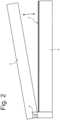
- This pivotal mounting of holding and pressing means 5 onto the support 6 is schematically shown in Fig. 2 .
- This figure shows the device in a form where the holding and pressing means 5 is rotated upwards by an angle of about 10° arount the pivot 8 to facilitate insertion of the profile to be welded into the slit 51 (these are not shown in this figure).
- the belt 2 is shown in its transverse direction; the belt's travel direction would typically be perpendicular to the paper plane of the figure.
- a custom built thermal impulse heater similar as the one depicted in Fig.1 was used.
- This heater consisted of a support 6 with a teflon-covered thermal impulse heating means 7 in the form of a strip.
- the supporting surface 61 of the support and the teflon-covered upper surface 71 of the thermal impulse heating means 7 together formed a plan surface onto which the belt to be processed was supported.
- the profiles 1 to be welded to the belts had a cross section similar as the one depicted in Fig.1 , with a profile socket 111 and a profile surface 11 that was enlarged thereby.
- the profile surface 11 was also plan.
- the profiles 1 had an essentially rectangular cross-sectional shape, except for a top portion that tapered towards its apex.
- the profiles 1 consisted of the same thermoplastic or the same thermoplastic elastomer as the thermoplastic or thermoplastic elastomer present in the top layer 3 of the belt 2 to be processed (see table below).
- the profiles were straight, with a length of about 50 cm, and had a constant cross-section over that entire length.
- the holding and pressing means 5 consisted of a one part or integral block with a slit shaped into it. The profiles fitted entirely and snugly into this slit.
- the holding and pressing means 5 comprised heating means in the form of an electrical constant heating 52,53.
- These heating means were used to hold the holding and pressing means 5 at a constant temperature of about 80°C during the welding time and the subsequent cooling time (see the table below).
- the support 6 and the holding and pressing means 5 were connected over a pivot such as to allow a pivotal rotation of the holding and pressing means 5 with respect to the fixed support, to allow easy forward and backward movement of the former with respect to the latter.
- Example 2 Welding of a TPO profile 1 onto a belt with a TPO top layer 3
- the TPO profile 1 had a similar cross-section as the profiles used in the preceding example.
- the width at the profile socket 111 was 10 mm (giving thus a contact area width of profile socket 111 and top layer surface 31 of 10 mm) and the length of the profiles was about 3 m.
- the welding setup was as described in example 1.
- the belt specimen with the profile 1 welded to its top layer surface 31 was subject to a peel strength testing in order to determine the bonding strength of the profile socket to belt surface.
- a Zwick / Roell tabletop testing machine Z020 was used. The testing temperature was 23°C.
- the welded profile was peeled off from the belt surface over a test length of 200 mm at a testing speed of 100 mm/min .
- the peel strength required to further peel off the profile from the belt surface was recorded as a function of the travelled test length. Over this entire travelled and recorded test length, which was about 170 mm, the recorded graph indicated peel strengths between 78 N/cm and 93 N/cm. This is about three times the peel strength that is typically observed between individual layers of the belt itself, such as between a TPO cover layer and a fabric traction layer.
- the welding process of the invention thus leads to an excellent bonding between profile and belt surface.
Landscapes
- Engineering & Computer Science (AREA)
- Mechanical Engineering (AREA)
- Physics & Mathematics (AREA)
- Thermal Sciences (AREA)
- Textile Engineering (AREA)
- High Energy & Nuclear Physics (AREA)
- Plasma & Fusion (AREA)
- Lining Or Joining Of Plastics Or The Like (AREA)
- Belt Conveyors (AREA)
Claims (12)
- Verfahren zum Schweißen eines Profils (1) an einen Riemen (2), der eine oberste Schicht (3) mit einer Oberfläche (31) der obersten Schicht und einer der Oberfläche (31) der obersten Schicht gegenüberliegenden Oberfläche (21) umfasst, wobei das Profil (1) einen ersten Thermoplasten oder ein erstes thermoplastisches Elastomer umfasst oder daraus besteht, die oberste Schicht (3) einen zweiten Thermoplasten oder ein zweites thermoplastisches Elastomer umfasst oder daraus besteht und das Profil (1) an einer ersten Stelle (311) auf der Oberfläche (31) der oberen Schicht unter Verwendung von Wärme und Druck angeschweißt wird, dadurch gekennzeichnet, dassi) die Schweißwärme durch Wärmeimpuls-Erhitzung zugeführt wird; undii) die Wärmeimpuls-Erhitzung an einer zweiten Stelle (211) auf der gegenüberliegenden Oberfläche (21) zugeführt wird, die der ersten Stelle (311) gegenüberliegt.
- Verfahren nach Anspruch 1, wobei:- das Profil (1) ein erstes thermoplastisches Elastomer, vorzugsweise ein TPU, umfasst oder daraus besteht; und die obere Schicht (3) ein zweites thermoplastisches Elastomer, vorzugsweise ein TPU, umfasst oder daraus besteht; oder- das Profil (1) einen ersten Thermoplasten, vorzugsweise ein TPO, umfasst oder daraus besteht; und die obere Schicht (3) einen zweiten Thermoplasten, vorzugsweise ein TPO, umfasst oder daraus besteht.
- Verfahren nach Anspruch 2, wobei das erste thermoplastische Elastomer mit dem zweiten thermoplastischen Elastomer identisch ist oder der erste Thermoplast mit dem zweiten Thermoplasten identisch ist.
- Verfahren nach irgend einem der Ansprüche 1 bis 3, bei dem während des Schweißens kein Schmelzklebstoff oder vernetzender Klebstoff verwendet wird.
- Verfahren nach irgend einem der vorstehenden Ansprüche, wobei der Riemen (2) aus der obersten Schicht (3) besteht.
- Verfahren nach irgend einem der Ansprüche 1 bis 4, wobei der Riemen (2) die oberste Schicht (3) und eine Zugschicht (4) umfasst, die ein Gewebe umfasst oder daraus besteht, das mit einem dritten Thermoplasten oder einem dritten thermoplastischen Elastomer imprägniert ist.
- Verfahren nach irgend einem der vorhergehenden Ansprüche, wobei während des Schweißens der Druck auf das Profil (1) mittels zweier Greiferbacken (51, 52) ausgeübt wird, die entweder- keine Heizvorrichtung umfassen und nicht beheizt werden, oder- eine Heizvorrichtung umfassen und damit optional beheizt werden.
- Verfahren nach irgend einem der vorstehenden Ansprüche, wobei das Profil (1) aus einem ersten Thermoplast oder einem ersten thermoplastischen Elastomer besteht und/oder die oberste Schicht (3) aus einem zweiten Thermoplast oder einem zweiten thermoplastischen Elastomer besteht.
- Verfahren nach irgend einem der vorstehenden Ansprüche, wobei der Riemen (2) ein Förderband ist.
- Verfahren nach Anspruch 9, wobei die Oberfläche (31) der obersten Schicht die Förderfläche des Förderbandes ist und die gegenüberliegende Oberfläche (21) die der Riemenscheibe zugewandte Oberfläche des Förderriemens ist.
- Vorrichtung zur Durchführung des Verfahrens nach Anspruch 1, umfassend1) eine Stütze (6) mit einer Stützfläche (61) zum Stützen des Riemens (2) und mit einer Wärmeimpuls-Heizeinrichtung (7) mit einer oberen Fläche (71);2) ein Mittel (5) zum Halten und Pressen mit einer darin ausgebildeten Aussparung oder einem Schlitz (51) zum Halten des Profils (1); wobei das Mittel (5) zum Halten und Pressen in Richtung der Stütze (6) bewegbar ist.
- Vorrichtung nach Anspruch 11, wobei das Mittel (5) zum Halten und Pressen schwenkbar (8) an der Stütze (6) angebracht ist.
Applications Claiming Priority (2)
| Application Number | Priority Date | Filing Date | Title |
|---|---|---|---|
| EP19196118.4A EP3789189A1 (de) | 2019-09-09 | 2019-09-09 | Verfahren zum schweissen von profilen an einen riemen |
| PCT/EP2020/074999 WO2021048079A1 (en) | 2019-09-09 | 2020-09-08 | Process for welding profiles to a belt |
Publications (3)
| Publication Number | Publication Date |
|---|---|
| EP4017708A1 EP4017708A1 (de) | 2022-06-29 |
| EP4017708C0 EP4017708C0 (de) | 2025-04-30 |
| EP4017708B1 true EP4017708B1 (de) | 2025-04-30 |
Family
ID=67902352
Family Applications (2)
| Application Number | Title | Priority Date | Filing Date |
|---|---|---|---|
| EP19196118.4A Withdrawn EP3789189A1 (de) | 2019-09-09 | 2019-09-09 | Verfahren zum schweissen von profilen an einen riemen |
| EP20765042.5A Active EP4017708B1 (de) | 2019-09-09 | 2020-09-08 | Verfahren zum schweissen von profilen an einen riemen |
Family Applications Before (1)
| Application Number | Title | Priority Date | Filing Date |
|---|---|---|---|
| EP19196118.4A Withdrawn EP3789189A1 (de) | 2019-09-09 | 2019-09-09 | Verfahren zum schweissen von profilen an einen riemen |
Country Status (7)
| Country | Link |
|---|---|
| US (1) | US12246499B2 (de) |
| EP (2) | EP3789189A1 (de) |
| JP (1) | JP7493031B2 (de) |
| KR (1) | KR20220074891A (de) |
| CN (1) | CN114364516B (de) |
| ES (1) | ES3032386T3 (de) |
| WO (1) | WO2021048079A1 (de) |
Families Citing this family (2)
| Publication number | Priority date | Publication date | Assignee | Title |
|---|---|---|---|---|
| DE102021108126A1 (de) * | 2021-03-31 | 2022-10-06 | Multivac Sepp Haggenmüller Se & Co. Kg | Tiefziehverpackungsmaschine mit Impulssiegelschienen und Impulssiegelverfahren |
| WO2024112488A1 (en) * | 2022-11-23 | 2024-05-30 | Laitram, L.L.C. | Tracking-guide bonder and method for bonding tracking guides to thermoplastic belts |
Family Cites Families (21)
| Publication number | Priority date | Publication date | Assignee | Title |
|---|---|---|---|---|
| US3373067A (en) * | 1965-02-19 | 1968-03-12 | Goodyear Rubber & Supply Compa | Method of making cleated conveyor belts |
| FR2307647A1 (fr) * | 1975-04-14 | 1976-11-12 | Alexandre Jean Pierre | Procede d'assemblage de pieces a base de caoutchouc, de complexe caoutchouc p.v.c. ou de p.v.c. et appareil pour la mise en oeuvre du procede |
| US4104094A (en) * | 1976-12-17 | 1978-08-01 | Peterson Soren E | Apparatus for forming cleats on belting |
| FR2481642B1 (fr) * | 1980-04-30 | 1985-06-28 | Tech Radio Meca | Dispositif de soudage a haute frequence d'un profile ou d'une piece moulee en matiere plastique, a section droite sensiblement en forme de t, sur une bande ou feuille egalement en matiere plastique |
| JPS6153026A (ja) * | 1984-08-22 | 1986-03-15 | Tokai Rubber Ind Ltd | 熱可塑性樹脂製ベルトへの桟接合方法 |
| US5552005A (en) * | 1991-12-27 | 1996-09-03 | Xerox Corporation | Method of constructing a seamed flexible imaging sheet |
| JPH0659749A (ja) * | 1992-08-06 | 1994-03-04 | Toyo Jidoki Co Ltd | インパルスシール装置の温度制御方法 |
| DE69605021T2 (de) * | 1996-04-19 | 2000-06-08 | Chiorino S.P.A., Biella | Verfahren und Vorrichtung zum Herstellen eines Fördergurtes mit gewellten Seitenwänden |
| US5928740A (en) | 1997-02-28 | 1999-07-27 | Viskase Corporation | Thermoplastic C2 -α-olefin copolymer blends and films |
| JP3027350B2 (ja) * | 1997-07-18 | 2000-04-04 | バンドー化学株式会社 | ガイド付き搬送ベルト及びその製造方法 |
| US6576078B2 (en) | 2001-04-11 | 2003-06-10 | Xerox Corporation | Flashless hot melt bonding of adhesives for imageable seamed belts |
| US7244485B2 (en) | 2001-04-11 | 2007-07-17 | Xerox Corporation | Imageable seamed belts having polyamide adhesive between interlocking seaming members |
| US6558767B2 (en) | 2001-06-20 | 2003-05-06 | Xerox Corporation | Imageable seamed belts having polyvinylbutyral and isocyanate outer layer |
| US6602156B2 (en) | 2001-12-06 | 2003-08-05 | Xerox Corporation | Imageable seamed belts having polyamide and doped metal oxide adhesive between interlocking seaming members |
| JP2009155104A (ja) | 2007-12-28 | 2009-07-16 | Mitsuboshi Belting Ltd | 搬送用ベルト |
| NL2006848C2 (en) * | 2011-05-25 | 2012-11-27 | Univ Delft Technology | Method for bonding a thermoplastic polymer to a thermosetting polymer component. |
| CN106120700B (zh) * | 2016-08-24 | 2018-10-19 | 泰安现代塑料有限公司 | 基于注焊凸起节点的土工格栅和制备方法 |
| WO2018071139A2 (en) | 2016-10-11 | 2018-04-19 | Laitram, L.L.C. | Sidewall bonder and method for bonding sidewalls to thermoplastic belts |
| JP6860408B2 (ja) | 2017-04-19 | 2021-04-14 | Nok株式会社 | プロフィル及びプロフィル付きベルト並びにその製造方法 |
| CN108556367B (zh) * | 2018-05-14 | 2020-05-19 | 山东龙口三维电器有限责任公司 | 高频塑料件连接成型装置 |
| CN208977047U (zh) * | 2018-06-20 | 2019-06-14 | 佛山艾麦工业皮带有限公司 | 一种传送带焊接机 |
-
2019
- 2019-09-09 EP EP19196118.4A patent/EP3789189A1/de not_active Withdrawn
-
2020
- 2020-09-08 CN CN202080063121.4A patent/CN114364516B/zh active Active
- 2020-09-08 EP EP20765042.5A patent/EP4017708B1/de active Active
- 2020-09-08 ES ES20765042T patent/ES3032386T3/es active Active
- 2020-09-08 KR KR1020227011585A patent/KR20220074891A/ko active Pending
- 2020-09-08 JP JP2022515599A patent/JP7493031B2/ja active Active
- 2020-09-08 WO PCT/EP2020/074999 patent/WO2021048079A1/en not_active Ceased
- 2020-09-08 US US17/641,800 patent/US12246499B2/en active Active
Also Published As
| Publication number | Publication date |
|---|---|
| US12246499B2 (en) | 2025-03-11 |
| CN114364516B (zh) | 2024-07-26 |
| ES3032386T3 (en) | 2025-07-18 |
| US20220379573A1 (en) | 2022-12-01 |
| BR112022004147A2 (pt) | 2022-05-31 |
| EP3789189A1 (de) | 2021-03-10 |
| EP4017708C0 (de) | 2025-04-30 |
| KR20220074891A (ko) | 2022-06-03 |
| JP2022546857A (ja) | 2022-11-09 |
| JP7493031B2 (ja) | 2024-05-30 |
| EP4017708A1 (de) | 2022-06-29 |
| WO2021048079A1 (en) | 2021-03-18 |
| CN114364516A (zh) | 2022-04-15 |
Similar Documents
| Publication | Publication Date | Title |
|---|---|---|
| US8859100B2 (en) | Barrier structure and method for making | |
| US12246499B2 (en) | Process for welding profiles to a belt | |
| US8859101B2 (en) | Multi-layer article | |
| KR101488007B1 (ko) | 용기용 밀봉재 | |
| WO2016209762A1 (en) | Ultrasonically sealed thin film seam, related methods and systems for the manufacture thereof | |
| WO2004067249A2 (en) | Decorative system composite and method | |
| EP4506163A1 (de) | Folie und aufblasbares produkt | |
| US3300370A (en) | Polyurethane-polyamide article and method of preparation | |
| CN110802908A (zh) | 一种可调多层夹布复合型传送带及其制造方法 | |
| TW201201631A (en) | Manufacturing method for face-shaped heater and manufacturing device for face-shaped heater | |
| US20170265501A1 (en) | Method and Apparatus for Batch Processing of Chicken Parts | |
| CN117884797A (zh) | 一种光伏电池串焊设备和串焊方法 | |
| EP2611539B1 (de) | Bondingverfahren | |
| BR112022004147B1 (pt) | Processo para soldar um perfil a uma correia, e, dispositivo para realizar o processo | |
| JP4602114B2 (ja) | 防水シートの固定方法および加圧治具 | |
| JP7849797B2 (ja) | フッ素樹脂フィルム、ゴム成形体及びゴム成形体の製造方法 | |
| KR20120020267A (ko) | 합성수지 필름 융착장치와 이를 이용한 융착방법 및 그 방법으로 가공한 봉투 | |
| JP5011449B2 (ja) | フィルムカーリング装置、これを含むフィルム接合装置、及びこれを利用したフィルムの接合方法 | |
| JPS6358695B2 (de) | ||
| JPH07205297A (ja) | 樹脂シートの接着方法及び装置 | |
| US20260109504A1 (en) | Thermal bonding method for plastic bag and method of manufacturing plastic bag | |
| US20090211702A1 (en) | Film extrusion method | |
| KR20170128722A (ko) | 차량내장 천연가죽시트재 제조용 지그 장치 및 상기 차량내장 천연가죽시트재 제조용 지그 장치에 적용되는 차량내장 천연가죽시트재용 습기경화형 폴리우레탄 접착제 | |
| KR20180096967A (ko) | 웨더스트립 융착용 필름 및 이를 이용한 웨더스트립 제조 방법 | |
| JP2008087183A (ja) | 変性ポリ四フッ化エチレン成形体の溶着方法並びに変性ポリ四フッ化エチレン成形体及びこれを使用したガスケット |
Legal Events
| Date | Code | Title | Description |
|---|---|---|---|
| STAA | Information on the status of an ep patent application or granted ep patent |
Free format text: STATUS: UNKNOWN |
|
| STAA | Information on the status of an ep patent application or granted ep patent |
Free format text: STATUS: THE INTERNATIONAL PUBLICATION HAS BEEN MADE |
|
| PUAI | Public reference made under article 153(3) epc to a published international application that has entered the european phase |
Free format text: ORIGINAL CODE: 0009012 |
|
| STAA | Information on the status of an ep patent application or granted ep patent |
Free format text: STATUS: REQUEST FOR EXAMINATION WAS MADE |
|
| 17P | Request for examination filed |
Effective date: 20220323 |
|
| AK | Designated contracting states |
Kind code of ref document: A1 Designated state(s): AL AT BE BG CH CY CZ DE DK EE ES FI FR GB GR HR HU IE IS IT LI LT LU LV MC MK MT NL NO PL PT RO RS SE SI SK SM TR |
|
| DAV | Request for validation of the european patent (deleted) | ||
| DAX | Request for extension of the european patent (deleted) | ||
| REG | Reference to a national code |
Ref country code: DE Ref legal event code: R079 Free format text: PREVIOUS MAIN CLASS: B29C0065380000 Ipc: B29C0065180000 Ref country code: DE Ref legal event code: R079 Ref document number: 602020050447 Country of ref document: DE Free format text: PREVIOUS MAIN CLASS: B29C0065380000 Ipc: B29C0065180000 |
|
| GRAP | Despatch of communication of intention to grant a patent |
Free format text: ORIGINAL CODE: EPIDOSNIGR1 |
|
| STAA | Information on the status of an ep patent application or granted ep patent |
Free format text: STATUS: GRANT OF PATENT IS INTENDED |
|
| RIC1 | Information provided on ipc code assigned before grant |
Ipc: B29L 9/00 20060101ALN20250123BHEP Ipc: B65G 15/44 20060101ALN20250123BHEP Ipc: B29C 65/38 20060101ALI20250123BHEP Ipc: B29C 65/18 20060101AFI20250123BHEP |
|
| INTG | Intention to grant announced |
Effective date: 20250207 |
|
| GRAS | Grant fee paid |
Free format text: ORIGINAL CODE: EPIDOSNIGR3 |
|
| GRAA | (expected) grant |
Free format text: ORIGINAL CODE: 0009210 |
|
| STAA | Information on the status of an ep patent application or granted ep patent |
Free format text: STATUS: THE PATENT HAS BEEN GRANTED |
|
| AK | Designated contracting states |
Kind code of ref document: B1 Designated state(s): AL AT BE BG CH CY CZ DE DK EE ES FI FR GB GR HR HU IE IS IT LI LT LU LV MC MK MT NL NO PL PT RO RS SE SI SK SM TR |
|
| REG | Reference to a national code |
Ref country code: CH Ref legal event code: EP Ref country code: GB Ref legal event code: FG4D |
|
| REG | Reference to a national code |
Ref country code: DE Ref legal event code: R096 Ref document number: 602020050447 Country of ref document: DE |
|
| REG | Reference to a national code |
Ref country code: IE Ref legal event code: FG4D |
|
| U01 | Request for unitary effect filed |
Effective date: 20250430 |
|
| U07 | Unitary effect registered |
Designated state(s): AT BE BG DE DK EE FI FR IT LT LU LV MT NL PT RO SE SI Effective date: 20250508 |
|
| REG | Reference to a national code |
Ref country code: ES Ref legal event code: FG2A Ref document number: 3032386 Country of ref document: ES Kind code of ref document: T3 Effective date: 20250718 |
|
| REG | Reference to a national code |
Ref country code: CH Ref legal event code: U11 Free format text: ST27 STATUS EVENT CODE: U-0-0-U10-U11 (AS PROVIDED BY THE NATIONAL OFFICE) Effective date: 20251001 |
|
| U20 | Renewal fee for the european patent with unitary effect paid |
Year of fee payment: 6 Effective date: 20250902 |
|
| PG25 | Lapsed in a contracting state [announced via postgrant information from national office to epo] |
Ref country code: NO Free format text: LAPSE BECAUSE OF FAILURE TO SUBMIT A TRANSLATION OF THE DESCRIPTION OR TO PAY THE FEE WITHIN THE PRESCRIBED TIME-LIMIT Effective date: 20250730 Ref country code: GR Free format text: LAPSE BECAUSE OF FAILURE TO SUBMIT A TRANSLATION OF THE DESCRIPTION OR TO PAY THE FEE WITHIN THE PRESCRIBED TIME-LIMIT Effective date: 20250731 |
|
| PG25 | Lapsed in a contracting state [announced via postgrant information from national office to epo] |
Ref country code: PL Free format text: LAPSE BECAUSE OF FAILURE TO SUBMIT A TRANSLATION OF THE DESCRIPTION OR TO PAY THE FEE WITHIN THE PRESCRIBED TIME-LIMIT Effective date: 20250430 |
|
| PGFP | Annual fee paid to national office [announced via postgrant information from national office to epo] |
Ref country code: GB Payment date: 20250919 Year of fee payment: 6 |
|
| PG25 | Lapsed in a contracting state [announced via postgrant information from national office to epo] |
Ref country code: HR Free format text: LAPSE BECAUSE OF FAILURE TO SUBMIT A TRANSLATION OF THE DESCRIPTION OR TO PAY THE FEE WITHIN THE PRESCRIBED TIME-LIMIT Effective date: 20250430 |
|
| PG25 | Lapsed in a contracting state [announced via postgrant information from national office to epo] |
Ref country code: RS Free format text: LAPSE BECAUSE OF FAILURE TO SUBMIT A TRANSLATION OF THE DESCRIPTION OR TO PAY THE FEE WITHIN THE PRESCRIBED TIME-LIMIT Effective date: 20250731 |
|
| PG25 | Lapsed in a contracting state [announced via postgrant information from national office to epo] |
Ref country code: IS Free format text: LAPSE BECAUSE OF FAILURE TO SUBMIT A TRANSLATION OF THE DESCRIPTION OR TO PAY THE FEE WITHIN THE PRESCRIBED TIME-LIMIT Effective date: 20250830 |
|
| PG25 | Lapsed in a contracting state [announced via postgrant information from national office to epo] |
Ref country code: SM Free format text: LAPSE BECAUSE OF FAILURE TO SUBMIT A TRANSLATION OF THE DESCRIPTION OR TO PAY THE FEE WITHIN THE PRESCRIBED TIME-LIMIT Effective date: 20250430 |
|
| PGFP | Annual fee paid to national office [announced via postgrant information from national office to epo] |
Ref country code: TR Payment date: 20251206 Year of fee payment: 6 |
|
| PGFP | Annual fee paid to national office [announced via postgrant information from national office to epo] |
Ref country code: CH Payment date: 20251001 Year of fee payment: 6 |
|
| PG25 | Lapsed in a contracting state [announced via postgrant information from national office to epo] |
Ref country code: CZ Free format text: LAPSE BECAUSE OF FAILURE TO SUBMIT A TRANSLATION OF THE DESCRIPTION OR TO PAY THE FEE WITHIN THE PRESCRIBED TIME-LIMIT Effective date: 20250430 |
|
| PG25 | Lapsed in a contracting state [announced via postgrant information from national office to epo] |
Ref country code: SK Free format text: LAPSE BECAUSE OF FAILURE TO SUBMIT A TRANSLATION OF THE DESCRIPTION OR TO PAY THE FEE WITHIN THE PRESCRIBED TIME-LIMIT Effective date: 20250430 |
|
| PGFP | Annual fee paid to national office [announced via postgrant information from national office to epo] |
Ref country code: ES Payment date: 20251030 Year of fee payment: 6 |
|
| PLBE | No opposition filed within time limit |
Free format text: ORIGINAL CODE: 0009261 |
|
| STAA | Information on the status of an ep patent application or granted ep patent |
Free format text: STATUS: NO OPPOSITION FILED WITHIN TIME LIMIT |
|
| REG | Reference to a national code |
Ref country code: CH Ref legal event code: L10 Free format text: ST27 STATUS EVENT CODE: U-0-0-L10-L00 (AS PROVIDED BY THE NATIONAL OFFICE) Effective date: 20260311 |
|
| 26N | No opposition filed |
Effective date: 20260202 |