EP4011944A1 - Pièce en matériau recyclable pour véhicule - Google Patents
Pièce en matériau recyclable pour véhicule Download PDFInfo
- Publication number
- EP4011944A1 EP4011944A1 EP21214291.3A EP21214291A EP4011944A1 EP 4011944 A1 EP4011944 A1 EP 4011944A1 EP 21214291 A EP21214291 A EP 21214291A EP 4011944 A1 EP4011944 A1 EP 4011944A1
- Authority
- EP
- European Patent Office
- Prior art keywords
- recyclable
- coating
- resin
- substrate
- vehicle
- Prior art date
- Legal status (The legal status is an assumption and is not a legal conclusion. Google has not performed a legal analysis and makes no representation as to the accuracy of the status listed.)
- Pending
Links
Images
Classifications
-
- C—CHEMISTRY; METALLURGY
- C08—ORGANIC MACROMOLECULAR COMPOUNDS; THEIR PREPARATION OR CHEMICAL WORKING-UP; COMPOSITIONS BASED THEREON
- C08J—WORKING-UP; GENERAL PROCESSES OF COMPOUNDING; AFTER-TREATMENT NOT COVERED BY SUBCLASSES C08B, C08C, C08F, C08G or C08H
- C08J7/00—Chemical treatment or coating of shaped articles made of macromolecular substances
- C08J7/04—Coating
- C08J7/042—Coating with two or more layers, where at least one layer of a composition contains a polymer binder
-
- B—PERFORMING OPERATIONS; TRANSPORTING
- B29—WORKING OF PLASTICS; WORKING OF SUBSTANCES IN A PLASTIC STATE IN GENERAL
- B29C—SHAPING OR JOINING OF PLASTICS; SHAPING OF MATERIAL IN A PLASTIC STATE, NOT OTHERWISE PROVIDED FOR; AFTER-TREATMENT OF THE SHAPED PRODUCTS, e.g. REPAIRING
- B29C39/00—Shaping by casting, i.e. introducing the moulding material into a mould or between confining surfaces without significant moulding pressure; Apparatus therefor
- B29C39/003—Shaping by casting, i.e. introducing the moulding material into a mould or between confining surfaces without significant moulding pressure; Apparatus therefor characterised by the choice of material
-
- B—PERFORMING OPERATIONS; TRANSPORTING
- B29—WORKING OF PLASTICS; WORKING OF SUBSTANCES IN A PLASTIC STATE IN GENERAL
- B29C—SHAPING OR JOINING OF PLASTICS; SHAPING OF MATERIAL IN A PLASTIC STATE, NOT OTHERWISE PROVIDED FOR; AFTER-TREATMENT OF THE SHAPED PRODUCTS, e.g. REPAIRING
- B29C39/00—Shaping by casting, i.e. introducing the moulding material into a mould or between confining surfaces without significant moulding pressure; Apparatus therefor
- B29C39/02—Shaping by casting, i.e. introducing the moulding material into a mould or between confining surfaces without significant moulding pressure; Apparatus therefor for making articles of definite length, i.e. discrete articles
- B29C39/12—Making multilayered or multicoloured articles
- B29C39/123—Making multilayered articles
-
- C—CHEMISTRY; METALLURGY
- C08—ORGANIC MACROMOLECULAR COMPOUNDS; THEIR PREPARATION OR CHEMICAL WORKING-UP; COMPOSITIONS BASED THEREON
- C08G—MACROMOLECULAR COMPOUNDS OBTAINED OTHERWISE THAN BY REACTIONS ONLY INVOLVING UNSATURATED CARBON-TO-CARBON BONDS
- C08G59/00—Polycondensates containing more than one epoxy group per molecule; Macromolecules obtained by polymerising compounds containing more than one epoxy group per molecule using curing agents or catalysts which react with the epoxy groups
- C08G59/18—Macromolecules obtained by polymerising compounds containing more than one epoxy group per molecule using curing agents or catalysts which react with the epoxy groups ; e.g. general methods of curing
- C08G59/40—Macromolecules obtained by polymerising compounds containing more than one epoxy group per molecule using curing agents or catalysts which react with the epoxy groups ; e.g. general methods of curing characterised by the curing agents used
-
- C—CHEMISTRY; METALLURGY
- C08—ORGANIC MACROMOLECULAR COMPOUNDS; THEIR PREPARATION OR CHEMICAL WORKING-UP; COMPOSITIONS BASED THEREON
- C08J—WORKING-UP; GENERAL PROCESSES OF COMPOUNDING; AFTER-TREATMENT NOT COVERED BY SUBCLASSES C08B, C08C, C08F, C08G or C08H
- C08J5/00—Manufacture of articles or shaped materials containing macromolecular substances
- C08J5/04—Reinforcing macromolecular compounds with loose or coherent fibrous material
-
- C—CHEMISTRY; METALLURGY
- C08—ORGANIC MACROMOLECULAR COMPOUNDS; THEIR PREPARATION OR CHEMICAL WORKING-UP; COMPOSITIONS BASED THEREON
- C08J—WORKING-UP; GENERAL PROCESSES OF COMPOUNDING; AFTER-TREATMENT NOT COVERED BY SUBCLASSES C08B, C08C, C08F, C08G or C08H
- C08J7/00—Chemical treatment or coating of shaped articles made of macromolecular substances
- C08J7/04—Coating
- C08J7/0427—Coating with only one layer of a composition containing a polymer binder
-
- C—CHEMISTRY; METALLURGY
- C08—ORGANIC MACROMOLECULAR COMPOUNDS; THEIR PREPARATION OR CHEMICAL WORKING-UP; COMPOSITIONS BASED THEREON
- C08J—WORKING-UP; GENERAL PROCESSES OF COMPOUNDING; AFTER-TREATMENT NOT COVERED BY SUBCLASSES C08B, C08C, C08F, C08G or C08H
- C08J7/00—Chemical treatment or coating of shaped articles made of macromolecular substances
- C08J7/04—Coating
- C08J7/05—Forming flame retardant coatings or fire resistant coatings
-
- C—CHEMISTRY; METALLURGY
- C09—DYES; PAINTS; POLISHES; NATURAL RESINS; ADHESIVES; COMPOSITIONS NOT OTHERWISE PROVIDED FOR; APPLICATIONS OF MATERIALS NOT OTHERWISE PROVIDED FOR
- C09D—COATING COMPOSITIONS, e.g. PAINTS, VARNISHES OR LACQUERS; FILLING PASTES; CHEMICAL PAINT OR INK REMOVERS; INKS; CORRECTING FLUIDS; WOODSTAINS; PASTES OR SOLIDS FOR COLOURING OR PRINTING; USE OF MATERIALS THEREFOR
- C09D163/00—Coating compositions based on epoxy resins; Coating compositions based on derivatives of epoxy resins
-
- C—CHEMISTRY; METALLURGY
- C09—DYES; PAINTS; POLISHES; NATURAL RESINS; ADHESIVES; COMPOSITIONS NOT OTHERWISE PROVIDED FOR; APPLICATIONS OF MATERIALS NOT OTHERWISE PROVIDED FOR
- C09D—COATING COMPOSITIONS, e.g. PAINTS, VARNISHES OR LACQUERS; FILLING PASTES; CHEMICAL PAINT OR INK REMOVERS; INKS; CORRECTING FLUIDS; WOODSTAINS; PASTES OR SOLIDS FOR COLOURING OR PRINTING; USE OF MATERIALS THEREFOR
- C09D5/00—Coating compositions, e.g. paints, varnishes or lacquers, characterised by their physical nature or the effects produced; Filling pastes
- C09D5/18—Fireproof paints including high temperature resistant paints
- C09D5/185—Intumescent paints
-
- B—PERFORMING OPERATIONS; TRANSPORTING
- B29—WORKING OF PLASTICS; WORKING OF SUBSTANCES IN A PLASTIC STATE IN GENERAL
- B29K—INDEXING SCHEME ASSOCIATED WITH SUBCLASSES B29B, B29C OR B29D, RELATING TO MOULDING MATERIALS OR TO MATERIALS FOR MOULDS, REINFORCEMENTS, FILLERS OR PREFORMED PARTS, e.g. INSERTS
- B29K2067/00—Use of polyesters or derivatives thereof, as moulding material
-
- B—PERFORMING OPERATIONS; TRANSPORTING
- B29—WORKING OF PLASTICS; WORKING OF SUBSTANCES IN A PLASTIC STATE IN GENERAL
- B29K—INDEXING SCHEME ASSOCIATED WITH SUBCLASSES B29B, B29C OR B29D, RELATING TO MOULDING MATERIALS OR TO MATERIALS FOR MOULDS, REINFORCEMENTS, FILLERS OR PREFORMED PARTS, e.g. INSERTS
- B29K2105/00—Condition, form or state of moulded material or of the material to be shaped
- B29K2105/06—Condition, form or state of moulded material or of the material to be shaped containing reinforcements, fillers or inserts
-
- B—PERFORMING OPERATIONS; TRANSPORTING
- B29—WORKING OF PLASTICS; WORKING OF SUBSTANCES IN A PLASTIC STATE IN GENERAL
- B29L—INDEXING SCHEME ASSOCIATED WITH SUBCLASS B29C, RELATING TO PARTICULAR ARTICLES
- B29L2031/00—Other particular articles
- B29L2031/30—Vehicles, e.g. ships or aircraft, or body parts thereof
- B29L2031/3064—Trains
-
- C—CHEMISTRY; METALLURGY
- C08—ORGANIC MACROMOLECULAR COMPOUNDS; THEIR PREPARATION OR CHEMICAL WORKING-UP; COMPOSITIONS BASED THEREON
- C08J—WORKING-UP; GENERAL PROCESSES OF COMPOUNDING; AFTER-TREATMENT NOT COVERED BY SUBCLASSES C08B, C08C, C08F, C08G or C08H
- C08J2363/00—Characterised by the use of epoxy resins; Derivatives of epoxy resins
-
- C—CHEMISTRY; METALLURGY
- C08—ORGANIC MACROMOLECULAR COMPOUNDS; THEIR PREPARATION OR CHEMICAL WORKING-UP; COMPOSITIONS BASED THEREON
- C08J—WORKING-UP; GENERAL PROCESSES OF COMPOUNDING; AFTER-TREATMENT NOT COVERED BY SUBCLASSES C08B, C08C, C08F, C08G or C08H
- C08J2467/00—Characterised by the use of polyesters obtained by reactions forming a carboxylic ester link in the main chain; Derivatives of such polymers
Definitions
- the present invention relates to a part made of recyclable material for a vehicle, in particular for a railway vehicle.
- the present invention also relates to a method of manufacturing a part made of recyclable material for a vehicle, in particular a railway vehicle.
- US 2016/0347902 describes for example a cured and chemically decomposable epoxy resin comprising at least one epoxy resin and at least one hardening agent comprising at least one cyanate function.
- LaRosa et al. (Materials, 2018, 11, 353 ) describes a process for recycling a composite material obtained from an epoxy resin and an amine hardening agent.
- An object of the present invention is to provide a part made of recyclable material that can be used in a vehicle, in particular a railway vehicle.
- the present invention therefore relates to a part for a vehicle, in particular for a railway vehicle, comprising a substrate and a coating, characterized in that the said substrate comprises a recyclable resin and reinforcing fibers, and in that the substrate comprises a surface covered partially or completely by said coating, said coating comprising at least one intumescent filler.
- the surface of the substrate represents all of the outer surfaces of the substrate.
- the term “railway vehicle” is understood to mean any vehicle designed to travel on a railway track, of the metro, regional train, tram, freight train, high-speed train and other type.
- recyclable resin is meant a chemically decomposable resin.
- the recyclable resin is chemically decomposable into a thermoplastic polymer, said thermoplastic polymer itself being able to be used as a manufacturing material, for example as a matrix in a composite material.
- surface partially covered by the coating it is meant that at least 75%, preferably at least 90%, of the surface is covered by the coating.
- the part according to the invention is characterized in that the substrate is completely covered by the coating.
- the part is either fully visible to a traveler located inside the vehicle, or comprises at least one part visible to a traveler located inside the vehicle and at least one part invisible to a traveler located inside the vehicle and also presents a risk of being exposed to a source of ignition.
- substrate completely covered by the coating it is meant that the entire outer surface of the substrate is covered by the coating.
- source of fire outbreak any object that may be the source of a fire outbreak.
- this may be, for example, an electrical installation or a heating device such as a radiator.
- Part visible to a traveler located inside the vehicle means the part(s) of the part whose appearance is accessible to the passenger.
- part with a risk of being exposed to a source of ignition it is meant that the part is located at a height of less than 200 millimeters from the source of ignition and/or at a horizontal distance of less 20 mm from the source of the fire.
- the fire can also come from a malicious act.
- the part according to the invention is characterized in that it comprises at least one part visible to a traveler located inside the vehicle and at least one part invisible to a traveler located inside of the vehicle, the invisible part of the part being free of coating.
- the part according to the invention is characterized in that it comprises at least one part visible to a traveler located inside the vehicle and at least one part invisible to a traveler located outside. inside the vehicle, the visible part of the part comprising a first part of the substrate and the invisible part of the part comprising a second part of the substrate, the coating covering only the first part of the substrate of the visible part of the part.
- the part according to the invention does not present a risk of being exposed to a source of fire starting.
- the part according to the invention is characterized in that the substrate comprises from 20% to 80% by mass of reinforcing fibers with respect to the total mass of said substrate.
- the part according to the invention is characterized in that the substrate comprises from 20% to 30% by mass of reinforcing fibers with respect to the total mass of said substrate.
- the part is obtained by transfer molding (Resin transfer molding or RTM according to the English terminology).
- the part according to the invention is characterized in that the substrate comprises from 65% to 75% by mass of reinforcing fibers with respect to the total mass of said substrate.
- the part is obtained by infusion molding.
- the part according to the invention is characterized in that the substrate comprises from 25% to 35% by mass of reinforcing fibers per relative to the total mass of said substrate.
- the part is obtained by contact molding (hand lay-up according to the English terminology).
- the part according to the invention is characterized in that the substrate comprises from 20% to 80% by mass of recyclable resin with respect to the total mass of said substrate.
- the part according to the invention is characterized in that the substrate comprises from 70% to 80% by mass of recyclable resin with respect to the total mass of said substrate.
- the part is obtained by transfer molding (Resin transfer molding or RTM according to the English terminology).
- the part according to the invention is characterized in that the substrate comprises from 25% to 35% by mass of resin with respect to the total mass of said substrate.
- the part is obtained by infusion molding.
- the part according to the invention is characterized in that the substrate comprises from 65% to 75% by mass of resin with respect to the total mass of said substrate.
- the part is obtained by contact molding (hand lay-up according to the English terminology).
- the part according to the invention is characterized in that the reinforcing fibers are chosen from glass fibers and carbon fibers.
- the part according to the invention is characterized in that the recyclable resin comprises at least one epoxy resin and one recyclable hardening agent, said epoxy resin comprising at least two epoxy functions, and said recyclable hardening agent being a polyamine comprising at least two amine functions.
- an “epoxide resin” is a polymer comprising at least two epoxy functions and capable of reacting with a hardening agent in order to form a three-dimensional crosslinked material.
- the recyclable hardening agent comprises a chemically cleavable group.
- said amine functions included in the recyclable hardening agent are linked together by a chemically cleavable group.
- chemically cleavable group any chemical group comprising at least one bond between two atoms which can be cut under the action of a chemical compound, for example under the action of an acid.
- the recyclable hardening agent can be chosen from commercial hardening agents available under the name Recyclamine ® or ReRez System ® from the company Connora or Cleavamine ® from the company Adesso Advanced Materials.
- the recyclable resin has a mass proportion between the epoxy resin and the recyclable hardening agent of between 100:20 and 100:40.
- the epoxy resin can be chosen from the commercial epoxy resins available under the name ReRez ® Epoxy Resin E1903, ReRez ® Epoxy Resin E2930 from Connora, Recycloset ® rAFL-1001 Laminating Resin System, Recycloset ® rAFL- 1001.1 Laminating Resin System, Recycloset ® rAFM-1001 System, Recycloset ® rAFV-1001.2 Infusion System from Adesso Advanced Materials, SR GreenPoxy 28 / SD 3304, SR GreenPoxy 33 / SD 499x, SR GreenPoxy 56 / SD 7561 from Sicomin .
- the part according to the invention is characterized in that the recyclable resin comprises from 70% to 84% by mass of epoxy resin, and from 16% to 30% by mass of recyclable hardening agent with respect to the total mass of recyclable resin.
- the part according to the invention is characterized in that the recyclable resin also comprises at least one flame retardant filler, preferably aluminum trihydroxide.
- the recyclable resin comprises from 0% to 50% by mass of flame retardant filler relative to the total mass of recyclable resin.
- the part according to the invention is characterized in that the coating is a gel coat, also designated by the name gelcoat, comprising at least one intumescent filler and at least one polyester or vinylester resin.
- the polyester resin is chosen from polyester resins of isophthalic acid and the polyester resins of orthophthalic acid and neopentyl glycol.
- the intumescent filler comprises mineral intumescents, a blowing agent and a charring agent.
- the gelcoat further comprises at least one additive.
- the additive included in the gelcoat is chosen from pigments and anti-smoke additives.
- the gel coat can be chosen from the commercial gel coats available under the name Büfa® Firestop GC SV 285 from the company Büfa, or under the name Crystic BP 90-78PA from the company Scott Bader.
- the part according to the invention is characterized in that the thickness of the coating varies from 0.8 mm to 1 mm.
- the part according to the invention comprises at least one layer of paint totally or partially covering the coating.
- coating partially covered by a layer of paint is meant that at least 75%, preferably at least 90%, of the surface of the coating is covered by the layer of paint.
- the part according to the invention comprises at least one part visible to a traveler located inside the vehicle and at least one part invisible to a traveler located inside the vehicle, the invisible part of the part being free coat of paint.
- Part visible to a traveler located inside the vehicle means the part(s) of the part whose appearance is accessible to the passenger.
- the paint can be chosen from the commercial paints available under the name Arthane 51FR, Arthane 101 or Arthane Barniz from the company Gurder, HS113-69, PUR 401-6A or PUR Clearcoat 460-5A from the company Mankiewicz , or PP06013CM, XD06000BV or varnish JA06001V from Beckers.
- the part according to the invention is characterized in that it complies with the fire/smoke test as defined by standard EN 45545-2 in force since May 2016 (classification index: F 16-001-2, ICS: 13.220.20;13.220.40; 45.060.01).
- This standard specifies the requirements in terms of performance of materials and products used on board railway vehicles in the event of fire, in particular to minimize the possibility of ignition of the materials installed or the effects of their combustion in terms of heat, smoke and toxic gases.
- the HL x risk levels used as the basis for the classification system are determined from the categories defined in standard EN 45545-1 (in force since April 2013, classification index: F 16-001-1, ICS: 13.220.20 ; 45.060.01).
- the EN 45545-2 standard specifies the test methods as well as the performance requirements R x for the reaction to fire of the materials present on board railway vehicles.
- the level of risk HL x depends in particular on the type of railway vehicle concerned, and the requirements R x depend on the part of the railway vehicle in which the part concerned is located.
- standard EN 45545-2 specifies that the three main requirements for parts made of composite materials are classified as follows: R1 for internal parts, R7 for external parts and R17 for front ends.
- the first test makes it possible to define the critical heat flow on extinction (parameter CFE).
- This test is defined by the ISO 5658-2/A1:2011 standard (November 2011 version modifying the ISO 5658-2:2006 standard in force since September 2006).
- the second test is used to determine the quantity of heat released (ON parameter) during the combustion of the part.
- This test is defined by the ISO 5660-1:2015 standard (version in force since March 2015).
- the third test makes it possible to evaluate the optical density (parameters D s (4) or D s (max), and VOF 4 ) as well as the toxicity of the fumes produced (parameter CIT G ) during the combustion of the part.
- This test is defined by the ISO 5659-2:2017 standard (version in force since May 2017).
- the part according to the invention is a part for a railway vehicle.
- the part according to the invention is the end of the train, the interior trim of a cabin such as pillars, a driving console, the interior trim of passenger cars such as door pillars, side walls , the gangway
- step a) of applying a layer of a gelcoat is carried out by spraying at the bottom of the mold
- step b) of hardening the gelcoat layer of step a) is carried out at room temperature with a chemical catalyst, or optionally under a UV lamp with a photo-initiator and a photo catalyst.
- step c) of applying at least one layer of reinforcing fibers to the coating obtained in step b) is carried out manually by an operator.
- step d) of adding a recyclable resin to said at least one layer of reinforcing fibers obtained in step c) comprises closing by a second rigid mold, under reduced pressure, typically between -0.5 and 0.4 bar, of the mold comprising said layer of reinforcing fibers, followed by the injection of a recyclable resin by a pump, into said closed mold under reduced pressure.
- step d) of adding a recyclable resin to said at least one layer of reinforcing fibers obtained in step c) comprises closing with a flexible membrane, for example a tarpaulin vacuum, and under reduced pressure, typically between -0.8 and -0.9 bar, of the mold comprising said layer of reinforcing fibers, followed by the injection of a recyclable resin by suction thanks to the vacuum present in said mold closed under reduced pressure.
- a flexible membrane for example a tarpaulin vacuum
- step d) of adding a recyclable resin to said at least one layer of reinforcing fibers obtained in step c) comprises manual impregnation, preferably using of a roller, a brush, a brush or a squeegee, by a recyclable resin of said layer of reinforcing fibers obtained in step c), and obtaining a layer of reinforcing fibers impregnated of recyclable resin, followed by the elimination of air inclusions comprised in said layer of reinforcing fibers impregnated with recyclable resin.
- step e) of curing the recyclable resin is carried out at room temperature
- the process for manufacturing a part according to the invention comprises a post-curing step subsequent to the demolding step, said post-curing step being carried out at 50° C. for 6 hours.
- the process for manufacturing a part according to the invention comprises a finishing step subsequent to the demolding step, and optionally to the post-curing step when the latter is present, said step finishing comprising, for example, a sub-step of reworking the parts to eliminate molding defects and a sub-step of sanding joint planes.
- the process for manufacturing a part according to the invention comprises a step g) of adding at least one layer of paint totally or partially covering the surface of the coating, said step g) being subsequent in step f) of demoulding, and optionally in the post-curing step and/or in the finishing step when the latter is (are) present.
- step g) of adding at least one coat of paint is carried out by spray application.
- the present invention also relates to a vehicle, in particular a railway vehicle, comprising at least one part as defined above.
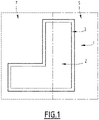
- the figure 1 is a schematic cross-sectional view of a part (1) made of recyclable composite material for a railway vehicle.
- the part (1) is formed from a substrate (2) and a coating (3).
- the part (1) comprises a visible part (5) by a traveler located inside the vehicle and an invisible part (7) by a traveler located inside the vehicle.
- the part (1) presents a risk of being exposed to a source of ignition, and the coating (3) completely covers the substrate (2).
- the part (1) does not present a risk of being exposed to a source of fire starting, the visible part (5) of the part comprising a first part of the substrate and the invisible part (7) of the part comprising a second part of the substrate, and the coating (3) covers only the first part of the substrate of the visible part (5) of the part.
- the substrate (2) is made of a recyclable composite material comprising glass or carbon reinforcing fibers which are arranged in a recyclable resin.
- This recyclable resin is obtained for example from an epoxy resin and a recyclable hardening agent, for example one among those available under the name Recyclamine ® .
- the coating (3) consists of a vinyl ester resin comprising intumescent fillers. The presence of the coating (3) ensures protection of the substrate (2) in the event of fire.
- the presence of the coating (3) totally or partially covering the substrate (2) makes it possible to obtain a part (1) made of recyclable composite material meeting standard EN 45545 concerning the requirements in terms of performance of materials used on board railway vehicles in case of fire.
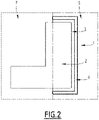
- the picture 2 is a schematic cross-sectional view of a part (1) made of recyclable composite material for a railway vehicle according to another embodiment.
- the part (1) is formed from a substrate (2), a coating (3) and a layer of paint (9).
- the part (1) comprises a visible part (5) by a traveler located inside the vehicle and an invisible part (7) by a traveler located inside the vehicle.
- the visible part (5) comprises a first part of the substrate (2), said first part of the substrate (2) being covered by the coating (3), and a layer of paint (9) covering the coating (3).
- the part (1) does not present a risk of being exposed to a source of ignition, and the invisible part (7) comprises a second part of the substrate (2) and is free of coating (3) and layer of paint (9).
- the part (1) presents a risk of being exposed to a source of fire, and the coating (3) completely covers the substrate (2), and the paint layer (9 ) covers only the coating part (3) included in the visible part (5) of the part (1).
- the part (1) presents a risk of being exposed to a source of fire starting, and the coating (3) completely covers the substrate (2), and the paint layer ( 9) covers the entire surface of the coating (3).
- the presence of the paint layer (9) makes it possible to improve the aesthetic appearance of the part according to the invention.
- the layer of paint 9 also plays a role in protecting the part against bad weather (rain for example). It improves the part's resistance to detergents, abrasion, scratches, UV rays or voluntary degradation (graffiti).
Landscapes
- Chemical & Material Sciences (AREA)
- Organic Chemistry (AREA)
- Health & Medical Sciences (AREA)
- Chemical Kinetics & Catalysis (AREA)
- Medicinal Chemistry (AREA)
- Polymers & Plastics (AREA)
- Engineering & Computer Science (AREA)
- Materials Engineering (AREA)
- Life Sciences & Earth Sciences (AREA)
- Wood Science & Technology (AREA)
- Manufacturing & Machinery (AREA)
- Laminated Bodies (AREA)
- Paints Or Removers (AREA)
Abstract
Description
- La présente invention concerne une pièce en matériau recyclable pour véhicule, notamment pour un véhicule ferroviaire. La présente invention concerne également un procédé de fabrication d'une pièce en matériau recyclable pour véhicule, notamment un véhicule ferroviaire.
- Actuellement, un très grand nombre de pièces présentes dans les véhicules de transport sont fabriquées avec des matériaux composites. Ces matériaux offrent de nombreux avantages, notamment en terme de performances mécaniques ou de stabilité dans le temps. Cependant, un des inconvénients majeurs de ces matériaux est la difficulté de leur recyclage, car la matrice qui les compose comprend le plus souvent une résine réticulée, qui forme un réseau tridimensionnel qui ne peut être ni fondu ni dissous.
- Les enjeux environnementaux liés au recyclage des matériaux composites ont favorisé le développement de nouvelles résines permettant d'obtenir des matériaux composites recyclables.
-
US 2016/0347902 décrit par exemple une résine époxyde durcie et chimiquement décomposable comprenant au moins une résine époxyde et au moins un agent durcissant comprenant au moins une fonction cyanate. - La Rosa et al. (Materials, 2018, 11, 353) décrit un procédé de recyclage d'un matériau composite obtenu à partir d'une résine époxyde et d'un agent durcissant aminé.
- Cependant, la fabrication de pièces pour véhicule, et notamment pour véhicule ferroviaire, ne peut se faire avec n'importe quel matériau. En particulier, ces pièces doivent répondre à des normes de sécurité liées au risque d'incendie. A ce jour, les matériaux composites recyclables disponibles ne permettent pas la fabrication de pièces répondant à ces normes de sécurité incendie.
- Il existe donc un besoin pour des pièces pour véhicule, notamment utilisables dans le domaine ferroviaire, qui peuvent être recyclables tout en étant compatibles avec les normes de sécurité imposées par ce domaine, liées en particulier aux risques d'incendie.
- Un objectif de la présente invention est de fournir une pièce en matériau recyclable et utilisable dans un véhicule, notamment un véhicule ferroviaire.
- La présente invention concerne donc une pièce pour véhicule, notamment pour véhicule ferroviaire, comprenant un substrat et un revêtement, caractérisée en ce que ledit substrat comprend une résine recyclable et des fibres de renforcement, et en ce que le substrat comprend une surface recouverte partiellement ou totalement par ledit revêtement, ledit revêtement comprenant au moins une charge intumescente.
- Selon l'invention, la surface du substrat représente l'ensemble des surfaces extérieures du substrat.
- Selon la présente invention, on entend par « véhicule ferroviaire » tout véhicule conçu pour se déplacer sur une voie ferrée, du type métro, train régional, tramway, train de marchandises, train à grande vitesse et autres.
- Par « résine recyclable », on entend une résine chimiquement décomposable. En particulier, la résine recyclable est chimiquement décomposable en un polymère thermoplastique, ledit polymère thermoplastique pouvant lui-même être utilisé comme matériau de fabrication, par exemple comme matrice dans un matériau composite.
- Par « surface recouverte partiellement par le revêtement », on entend qu'au moins 75%, de préférence au moins 90%, de la surface est recouverte par le revêtement.
- Selon un mode de réalisation, la pièce selon l'invention est caractérisée en ce que le substrat est totalement recouvert par le revêtement.
- Dans ce mode de réalisation, la pièce est soit entièrement visible par un voyageur situé à l'intérieur du véhicule, soit comprend au moins une partie visible par un voyageur situé à l'intérieur du véhicule et au moins une partie invisible par un voyageur situé à l'intérieur du véhicule et présente en outre un risque d'être exposée à une source de départ de feu.
- Par « substrat totalement recouvert par le revêtement », on entend que la totalité de la surface extérieure du substrat est recouverte par le revêtement.
- Par « source de départ de feu », on entend tout objet pouvant être à l'origine d'un départ de feu. Dans un véhicule ferroviaire, il peut s'agir, par exemple, d'une installation électrique ou d'un appareil chauffant tel qu'un radiateur.
- Par « partie visible par un voyageur situé à l'intérieur du véhicule », on entend le ou les parties(s) de la pièce dont l'aspect est accessible au regard du passager.
- Par « pièce ayant un risque d'être exposée à une source de départ de feu », on entend que la pièce est située à une hauteur de moins de 200 millimètres de la source de départ de feu et/ou à une distance horizontale de moins de 20 mm de la source de départ de feu.
- Le feu peut aussi provenir d'un acte de malveillance.
- Selon un autre mode de réalisation, la pièce selon l'invention est caractérisée en ce qu'elle comprend au moins une partie visible par un voyageur situé à l'intérieur du véhicule et au moins une partie invisible par un voyageur situé à l'intérieur du véhicule, la partie invisible de la pièce étant exempte de revêtement.
- Formulé autrement, selon ce mode de réalisation, la pièce selon l'invention est caractérisée en ce qu'elle comprend au moins une partie visible par un voyageur situé à l'intérieur du véhicule et au moins une partie invisible par un voyageur situé à l'intérieur du véhicule, la partie visible de la pièce comprenant une première partie du substrat et la partie invisible de la pièce comprenant une deuxième partie du substrat, le revêtement recouvrant uniquement la première partie du substrat de la partie visible de la pièce.
- Selon ce mode de réalisation, la pièce selon l'invention ne présente pas un risque d'être exposée à une source de départ de feu.
- Selon un mode de réalisation, la pièce selon l'invention est caractérisée en ce que le substrat comprend de 20% à 80% en masse de fibres de renforcement par rapport à la masse totale dudit substrat.
- Selon une première alternative, la pièce selon l'invention est caractérisée en ce que le substrat comprend de 20% à 30% en masse de fibres de renforcement par rapport à la masse totale dudit substrat. De préférence selon cette première alternative, la pièce est obtenue par moulage par transfert (Resin transfer molding ou RTM selon la terminologie anglaise).
- Selon une deuxième alternative, la pièce selon l'invention est caractérisée en ce que le substrat comprend de 65% à 75% en masse de fibres de renforcement par rapport à la masse totale dudit substrat. De préférence selon cette deuxième alternative, la pièce est obtenue par moulage par infusion.
- Selon une troisième alternative, la pièce selon l'invention est caractérisée en ce que le substrat comprend de 25% à 35% en masse de fibres de renforcement par rapport à la masse totale dudit substrat. De préférence selon cette troisième alternative, la pièce est obtenue par moulage au contact (hand lay-up selon la terminologie anglaise).
- Selon un mode de réalisation, la pièce selon l'invention est caractérisée en ce que le substrat comprend de 20% à 80% en masse de résine recyclable par rapport à la masse totale dudit substrat.
- Selon une première alternative, la pièce selon l'invention est caractérisée en ce que le substrat comprend de 70% à 80% en masse résine recyclable par rapport à la masse totale dudit substrat. De préférence selon cette première alternative, la pièce est obtenue par moulage par transfert (Resin transfer molding ou RTM selon la terminologie anglaise).
- Selon une deuxième alternative, la pièce selon l'invention est caractérisée en ce que le substrat comprend de 25% à 35% en masse de résine par rapport à la masse totale dudit substrat. De préférence selon cette deuxième alternative, la pièce est obtenue par moulage par infusion.
- Selon une troisième alternative, la pièce selon l'invention est caractérisée en ce que le substrat comprend de 65% à 75% en masse de résine par rapport à la masse totale dudit substrat. De préférence selon cette troisième alternative, la pièce est obtenue par moulage au contact (hand lay-up selon la terminologie anglaise).
- Selon un mode de réalisation, la pièce selon l'invention est caractérisée en ce que les fibres de renforcement sont choisies parmi les fibres de verre et les fibres de carbone.
- Selon un mode de réalisation, la pièce selon l'invention est caractérisée en ce que la résine recyclable comprend au moins une résine époxyde et un agent durcissant recyclable, ladite résine époxyde comprenant au moins deux fonctions époxydes, et ledit agent durcissant recyclable étant une polyamine comprenant au moins deux fonctions aminés.
- Selon la présente invention, une « résine époxyde » est un polymère comprenant au moins deux fonctions époxydes et capable de réagir avec un agent durcissant afin de former un matériau réticulé tridimensionnel.
- De préférence, l'agent durcissant recyclable comprend un groupement chimiquement clivable.
- De préférence, lesdites fonctions amines comprises dans l'agent durcissant recyclable sont reliées entre elles par un groupement chimiquement clivable.
- Par « groupement chimiquement clivable », on entend tout groupement chimique comprenant au moins une liaison entre deux atomes pouvant être coupée sous l'action d'un composé chimique, par exemple sous l'action d'un acide.
- A titre d'exemple, l'agent durcissant recyclable peut être choisi parmi les agents durcissants commerciaux disponibles sous la dénomination Recyclamine® ou ReRez System® de la société Connora ou Cleavamine® de la société Adesso Advanced Materials.
- De préférence, la résine recyclable présente une proportion en masse entre la résine époxyde et l'agent durcissant recyclable compris entre 100 : 20 et 100 : 40.
- A titre d'exemple, la résine époxyde peut être choisie parmi les résines époxydes commerciales disponibles sous la dénomination ReRez® Epoxy Resin E1903, ReRez® Epoxy Resin E2930 de la société Connora, Recycloset® rAFL-1001 Laminating Resin System, Recycloset® rAFL-1001.1 Laminating Resin System, Recycloset® rAFM-1001 System, Recycloset® rAFV-1001.2 Infusion System de la société Adesso Advanced Materials, SR GreenPoxy 28 / SD 3304, SR GreenPoxy 33 / SD 499x, SR GreenPoxy 56 / SD 7561 de la société Sicomin.
- Selon un mode de réalisation, la pièce selon l'invention est caractérisée en ce que la résine recyclable comprend de 70% à 84% en masse de résine époxyde, et de 16% à 30% en masse d'agent durcissant recyclable par rapport à la masse totale de la résine recyclable.
- Selon un mode de réalisation, la pièce selon l'invention est caractérisée en ce que la résine recyclable comprend en outre au moins une charge ignifuge, de préférence du trihydroxyde d'aluminium. De préférence, la résine recyclable comprend de 0% à 50% en masse de charge ignifuge par rapport à la masse totale de résine recyclable.
- Selon un mode de réalisation, la pièce selon l'invention est caractérisée en ce que le revêtement est un enduit gélifié, aussi désigné par l'appellation gelcoat comprenant au moins une charge intumescente et au moins une résine polyester ou vinylester. De préférence, la résine polyester est choisie parmi les résines polyester d'acide isophtalique et les résines polyester d'acide orthophtalique et de néopentyle glycol.
- De préférence, la charge intumescente comprend des intumescents minéraux, un agent gonflant et un agent charbonisant.
- Selon un mode de réalisation, le gelcoat comprend en outre au moins un additif. De préférence, l'additif compris dans le gelcoat est choisi parmi les pigments et les additifs anti-fumée.
- A titre d'exemple, l'enduit gélifié peut être choisi parmi les enduits gélifiés commerciaux disponibles sous la dénomination Büfa® Firestop GC SV 285 de la société Büfa, ou sous la dénomination Crystic BP 90-78PA de la société Scott Bader.
- Selon un mode de réalisation, la pièce selon l'invention est caractérisée en ce que l'épaisseur du revêtement varie de 0,8 mm à 1 mm.
- Selon un mode de réalisation, la pièce selon l'invention comprend au moins une couche de peinture recouvrant totalement ou partiellement le revêtement.
- Par « revêtement recouvert partiellement par une couche de peinture », on entend qu'au moins 75%, de préférence au moins 90%, de la surface du revêtement est recouverte par la couche de peinture.
- De préférence, la pièce selon l'invention comprend au moins une partie visible par un voyageur situé à l'intérieur du véhicule et au moins une partie invisible par un voyageur situé à l'intérieur du véhicule, la partie invisible de la pièce étant exempte de couche de peinture.
- Par « partie visible par un voyageur situé à l'intérieur du véhicule », on entend le ou les parties(s) de la pièce dont l'aspect est accessible au regard du passager.
- A titre d'exemple, la peinture peut être choisie parmi les peintures commerciales disponibles sous la dénomination Arthane 51FR, Arthane 101 ou Arthane Barniz de la société Mäder, HS113-69, PUR 401-6A ou PUR Clearcoat 460-5A de la société Mankiewicz, ou PP06013CM, XD06000BV ou vernis JA06001V de la société Beckers.
- De préférence, la pièce selon l'invention est caractérisée en ce qu'elle est conforme au test feu/fumée tel que défini par la norme EN 45545-2 en vigueur depuis mai 2016 (indice de classement : F 16-001-2, ICS : 13.220.20 ; 13.220.40 ; 45.060.01). Cette norme spécifie les exigences en terme de performances des matériaux et produits utilisés à bord de véhicules ferroviaires en cas d'incendie, afin notamment de minimiser la possibilité d'allumage des matériaux installés ou les effets de leur combustion en terme de chaleur, fumée et gaz toxiques.
- Les niveaux de risque HLx servant de base au système de classification sont déterminées à partir des catégories définies dans la norme EN 45545-1 (en vigueur depuis avril 2013, indice de classement : F 16-001-1, ICS : 13.220.20 ; 45.060.01).
- Pour chaque niveau de risque HLx, la norme EN 45545-2 spécifie les méthodes des tests ainsi que les exigences de performance Rx de réaction au feu des matériaux présents à bord des véhicules ferroviaires. Le niveau de risque HLx dépend notamment du type de véhicule ferroviaire concerné, et les exigences Rx dépendent de la partie du véhicule ferroviaire dans laquelle se situe la pièce concernée.
- En particulier, la norme EN 45545-2 précise que les trois exigences principales pour des pièces en matériaux composites sont classifiées comme suit : R1 pour des parties internes, R7 pour des parties externes et R17 pour des extrémités avant.
- Trois tests permettent de déterminer si une pièce en matériaux composites répond à ces exigences.
- Le premier test permet de définir le flux de chaleur critique à l'extinction (paramètre CFE). Ce test est défini par la norme ISO 5658-2/A1 :2011 (version de novembre 2011 modifiant la norme ISO 5658-2:2006 en vigueur depuis septembre 2006). Le deuxième test permet de déterminer la quantité de chaleur dégagée (paramètre MARHE) durant la combustion de la pièce. Ce test est défini par la norme ISO 5660-1:2015 (version en vigueur depuis mars 2015). Le troisième test permet d'évaluer la densité optique (paramètres Ds(4) ou Ds(max), et VOF4) ainsi que la toxicité des fumées produites (paramètre CITG) durant la combustion de la pièce. Ce test est défini par la norme ISO 5659-2:2017 (version en vigueur depuis mai 2017).
- Les résultats des tests à obtenir afin de répondre aux exigences R1, R7 et R17, en fonction du niveau de risque HLx, sont résumés dans le tableau suivant :
[Tableau 1] Paramètre (unité) Norme Exigence Maximum ou minimum HL1 HL2 HL3 CFE (kW/m2) ISO 5658-2 R1 Minimum 20 20 20 R7 Minimum 20 20 20 R17 Minimum 13 13 13 MARHE (kW/m2) ISO 5660-1 R1 Maximum - 90 60 R7 Maximum - 90 60 R17 Maximum - 90 60 Ds(4) (sans unité) ISO 5659-2 R1 Maximum 600 300 150 Ds(max) (sans unité) ISO 5659-2 R7 Maximum - 600 300 R17 Maximum - 600 300 VOF4 (min) ISO 5659-2 R1 Maximum 1 200 600 300 CITG (sans unité) ISO 5659-2 R1 Maximum 1,2 0,9 0,75 R7 Maximum - 1,8 1,5 R17 Maximum - 1,8 1,5 - De préférence, la pièce selon l'invention est une pièce pour véhicule ferroviaire. De manière préférentielle, la pièce selon l'invention est l'extrémité de train, le garnissage intérieur d'une cabine tel que des montants, un pupitre de conduite, le garnissage intérieur des voitures passager tel que des montant de porte, des parois latérales, l'intercirculation
- La présente invention concerne également un procédé de fabrication d'une pièce selon l'invention, comprenant les étapes suivantes :
- a) une étape d'application d'une couche d'un enduit gélifié sur une surface interne d'un moule de la forme de ladite pièce,
- b) une étape de durcissement de la couche d'enduit gélifié de l'étape a) pour obtenir un revêtement,
- c) une étape d'application d'au moins une couche de fibres de renforcement sur le revêtement obtenu à l'étape b),
- d) une étape d'ajout d'une résine recyclable sur ladite au moins une couche de fibres de renforcement obtenue à l'étape c),
- e) une étape de durcissement de la résine recyclable et obtention d'un substrat, et
- f) une étape de démoulage pour obtenir ladite pièce.
- De préférence, l'étape a) d'application d'une couche d'un gelcoat s'effectue par pistolage en fond de moule
- De préférence, l'étape b) de durcissement de la couche de gelcoat de l'étape a) s'effectue à température ambiante avec un catalyseur chimique, ou éventuellement sous lampe UV avec un photo-initiateur et un photo catalyseur.
- De préférence, l'étape c) d'application d'au moins une couche de fibres de renforcement sur le revêtement obtenu à l'étape b) s'effectue manuellement par un opérateur.
- Selon un mode de réalisation, l'étape d) d'ajout d'une résine recyclable sur ladite au moins une couche de fibres de renforcement obtenue à l'étape c) comprend la fermeture par un deuxième moule rigide, sous pression réduite, typiquement entre -0,5 et 0,4 bar, du moule comprenant ladite couche de fibres de renforcement, suivie de l'injection d'une résine recyclable par une pompe, dans ledit moule fermé sous pression réduite.
- Selon un autre mode de réalisation, l'étape d) d'ajout d'une résine recyclable sur ladite au moins une couche de fibres de renforcement obtenue à l'étape c) comprend la fermeture par une membrane souple, par exemple une bâche à vide, et sous pression réduite, typiquement entre -0,8 et -0,9 bar, du moule comprenant ladite couche de fibres de renforcement, suivie de l'injection d'une résine recyclable par aspiration grâce à la dépression présente dans ledit moule fermé sous pression réduite.
- Selon un autre mode de réalisation encore, l'étape d) d'ajout d'une résine recyclable sur ladite au moins une couche de fibres de renforcement obtenue à l'étape c) comprend l'imprégnation manuelle, de préférence à l'aide d'un rouleau, d'un pinceau, d'une brosse ou d'une raclette, par une résine recyclable de ladite couche de fibres de renforcement obtenue à l'étape c), et obtention d'une couche de fibres de renforcement imprégnée de résine recyclable, suivie de l'élimination des inclusions d'air comprises dans ladite couche de fibres de renforcement imprégnée de résine recyclable.
- De préférence, l'étape e) de durcissement de la résine recyclable s'effectue à température ambiante,
- Selon un mode de réalisation, le procédé de fabrication d'une pièce selon l'invention comprend une étape de post-cuisson postérieure à l'étape de démoulage, ladite étape de post-cuisson étant effectuée à 50°C pendant 6h.
- Selon un mode de réalisation, le procédé de fabrication d'une pièce selon l'invention comprend une étape de finition postérieure à l'étape de démoulage, et éventuellement à l'étape de post-cuisson lorsque celle-ci est présente, ladite étape de finition comprenant par exemple une sous-étape de reprise des pièces pour éliminer les défauts de moulage et une sous-étape de ponçage de plans de joints.
- Selon un mode de réalisation préférentiel, le procédé de fabrication d'une pièce selon l'invention comprend une étape g) d'ajout d'au moins une couche de peinture recouvrant totalement ou partiellement la surface du revêtement, ladite étape g) étant postérieure à l'étape f) de démoulage, et éventuellement à l'étape de post-cuisson et/ou à l'étape de finition lorsque celle(s)-ci est(sont) présente(s).
- De préférence, l'étape g) d'ajout d'au moins une couche de peinture s'effectue par application au pistolet.
- La présente invention concerne également un véhicule, notamment un véhicule ferroviaire, comprenant au moins une pièce telle que définie ci-dessus.
- [
Fig 1 ] Lafigure 1 est une vue schématique et en coupe d'une pièce (1) en matériau composite recyclable pour véhicule ferroviaire. La pièce (1) est formée d'un substrat (2) et d'un revêtement (3). La pièce (1) comprend une partie visible (5) par un voyageur situé à l'intérieur du véhicule et une partie invisible (7) par un voyageur situé à l'intérieur du véhicule. Selon le mode de réalisation représenté sur lafigure 1 , la pièce (1) présente un risque d'être exposée à une source de départ de feu, et le revêtement (3) recouvre entièrement le substrat (2). - Selon un autre mode de réalisation non représenté, la pièce (1) ne présente pas un risque d'être exposée à une source de départ de feu, la partie visible (5) de la pièce comprenant une première partie du substrat et la partie invisible (7) de la pièce comprenant une deuxième partie du substrat, et le revêtement (3) recouvre uniquement la première partie du substrat de la partie visible (5) de la pièce.
- Le substrat (2) est réalisé en un matériau composite recyclable comprenant des fibres de renforcement en verre ou en carbone qui sont agencées dans une résine recyclable. Cette résine recyclable est obtenue par exemple à partir d'une résine époxyde et d'un agent durcissant recyclable, par exemple un parmi ceux disponibles sous la dénomination Recyclamine®. Le revêtement (3) est constitué d'une résine vinylester comprenant des charges intumescentes. La présence du revêtement (3) assure une protection du substrat (2) en cas d'incendie.
- La présence du revêtement (3) recouvrant totalement ou partiellement le substrat (2) permet d'obtenir une pièce (1) en matériau composite recyclable répondant à la norme EN 45545 concernant les exigences en terme de performances des matériaux utilisés à bord de véhicules ferroviaires en cas d'incendie.
- [
Fig 2 ] Lafigure 2 est une vue schématique et en coupe d'une pièce (1) en matériau composite recyclable pour véhicule ferroviaire selon un autre mode de réalisation. La pièce (1) est formée d'un substrat (2), d'un revêtement (3) et d'une couche de peinture (9). La pièce (1) comprend une partie visible (5) par un voyageur situé à l'intérieur du véhicule et une partie invisible (7) par un voyageur situé à l'intérieur du véhicule. La partie visible (5) comprend une première partie du substrat (2), ladite première partie du substrat (2) étant recouvert par le revêtement (3), et une couche de peinture (9) recouvrant le revêtement (3). Selon le mode de réalisation représenté sur lafigure 1 , la pièce (1) ne présente pas un risque d'être exposée à une source de départ de feu, et la partie invisible (7) comprend une deuxième partie du substrat (2) et est exempte de revêtement (3) et de couche de peinture (9). Selon un autre mode de réalisation non représenté, la pièce (1) présente un risque d'être exposée à une source de départ de feu, et le revêtement (3) recouvre entièrement le substrat (2), et la couche de peinture (9) recouvre uniquement la partie de revêtement (3) compris dans la partie visible (5) de la pièce (1). Selon encore un autre mode de réalisation non représenté, la pièce (1) présente un risque d'être exposée à une source de départ de feu, et le revêtement (3) recouvre entièrement le substrat (2), et la couche de peinture (9) recouvre toute la surface du revêtement (3). - La présence de la couche de peinture (9) permet d'améliorer l'aspect esthétique de la pièce selon l'invention. La couche de peinture 9 joue également un rôle de protection de la pièce face aux intempéries (pluie par exemple). Elle améliore la résistance de la pièce face aux produits lessiviels, à l'abrasion, aux rayures, aux UVs ou aux dégradations volontaires (graffitis).
Claims (9)
- Pièce (1) pour véhicule, notamment pour véhicule ferroviaire, comprenant un substrat (2) et un revêtement (3), caractérisée en ce que ledit substrat (2) comprend une résine recyclable et des fibres de renforcement, la résine recyclable comprenant au moins une résine époxyde et un agent durcissant recyclable, ladite résine époxyde comprenant au moins deux fonctions époxydes, et ledit agent durcissant recyclable étant une polyamine comprenant au moins deux fonctions aminés, et en ce que le substrat (2) comprend une surface recouverte partiellement ou totalement par ledit revêtement (3), ledit revêtement (3) comprenant au moins une charge intumescente comprenant des intumescents minéraux, un agent gonflant et un agent charbonisant.
- Pièce selon la revendication 1, caractérisée en ce qu'elle comprend au moins une partie visible (5) par un voyageur situé à l'intérieur du véhicule et au moins une partie invisible (7) par un voyageur situé à l'intérieur du véhicule, la partie invisible de la pièce étant exempte de revêtement (3).
- Pièce selon l'une des revendications précédentes, caractérisée en ce que le substrat (2) comprend de 20% à 80% en masse de fibres de renforcement par rapport à la masse totale dudit substrat (2).
- Pièce selon l'une des revendications précédentes, caractérisée en ce que les fibres de renforcement sont choisies parmi les fibres de verre et les fibres de carbone.
- Pièce selon l'une des revendications précédentes, caractérisée en ce que la résine recyclable comprend de 70% à 84% en masse de résine époxyde et de 16% à 30% en masse d'agent durcissant recyclable par rapport à la masse totale de la résine recyclable.
- Pièce selon l'une des revendications précédentes, caractérisée en ce que le revêtement (3) est un enduit gélifié comprenant au moins une charge intumescente et au moins une résine polyester ou vinylester, la résine polyester étant choisie de préférence parmi les résines polyester d'acide isophtalique et les résines polyester d'acide orthophtalique et de néopentyle glycol.
- Pièce selon l'une des revendications précédentes, caractérisée en ce qu'elle comprend au moins une couche de peinture (9) recouvrant totalement ou partiellement le revêtement (3).
- Procédé de fabrication d'une pièce selon l'une des revendications 1 à 7, comprenant les étapes suivantes :a) une étape d'application d'une couche d'un enduit gélifié sur une surface interne d'un moule de la forme de ladite pièce,b) une étape de durcissement de la couche d'enduit gélifié de l'étape a) pour obtenir un revêtement,c) une étape d'application d'au moins une couche de fibres de renforcement sur le revêtement obtenu à l'étape b),d) une étape d'ajout d'une résine recyclable sur ladite couche de fibres de renforcement obtenue à l'étape c),e) une étape de durcissement de la résine recyclable et obtention d'un substrat, etf) une étape de démoulage pour obtenir ladite pièce.
- Véhicule, notamment véhicule ferroviaire, comprenant au moins une pièce telle que définie selon l'une des revendications 1 à 7.
Applications Claiming Priority (1)
| Application Number | Priority Date | Filing Date | Title |
|---|---|---|---|
| FR2013157A FR3117495B1 (fr) | 2020-12-14 | 2020-12-14 | Pièce en matériau recyclable pour véhicule |
Publications (1)
| Publication Number | Publication Date |
|---|---|
| EP4011944A1 true EP4011944A1 (fr) | 2022-06-15 |
Family
ID=74554070
Family Applications (1)
| Application Number | Title | Priority Date | Filing Date |
|---|---|---|---|
| EP21214291.3A Pending EP4011944A1 (fr) | 2020-12-14 | 2021-12-14 | Pièce en matériau recyclable pour véhicule |
Country Status (2)
| Country | Link |
|---|---|
| EP (1) | EP4011944A1 (fr) |
| FR (1) | FR3117495B1 (fr) |
Citations (7)
| Publication number | Priority date | Publication date | Assignee | Title |
|---|---|---|---|---|
| GB1354497A (en) * | 1970-08-11 | 1974-06-05 | Halmatic Ltd | Fire-proof systems |
| US7601426B1 (en) * | 2006-01-31 | 2009-10-13 | The University Of Tulsa | Intumescent substrate coating |
| US20110318983A1 (en) * | 2004-12-17 | 2011-12-29 | Flexform Technologies, Llc | Fire retardant panel compositions |
| US20140221510A1 (en) * | 2011-07-08 | 2014-08-07 | Adesso Advanced Materials Wuxi Co., Ltd. | Reinforced composite and method for recycling the same |
| US20160347902A1 (en) | 2014-02-05 | 2016-12-01 | Fraunhofer-Gesellschaft zur Förderung der angewandten Forschung e.V. | Chemically Decomposable Epoxide Resin System |
| WO2020025845A1 (fr) * | 2018-07-30 | 2020-02-06 | Polynt Composites Spain, S.L. | Matériau composite, son procédé de fabrication et son utilisation |
| WO2020247549A1 (fr) * | 2019-06-04 | 2020-12-10 | Arkema Inc. | Revêtement de gel thermoplastique |
-
2020
- 2020-12-14 FR FR2013157A patent/FR3117495B1/fr active Active
-
2021
- 2021-12-14 EP EP21214291.3A patent/EP4011944A1/fr active Pending
Patent Citations (7)
| Publication number | Priority date | Publication date | Assignee | Title |
|---|---|---|---|---|
| GB1354497A (en) * | 1970-08-11 | 1974-06-05 | Halmatic Ltd | Fire-proof systems |
| US20110318983A1 (en) * | 2004-12-17 | 2011-12-29 | Flexform Technologies, Llc | Fire retardant panel compositions |
| US7601426B1 (en) * | 2006-01-31 | 2009-10-13 | The University Of Tulsa | Intumescent substrate coating |
| US20140221510A1 (en) * | 2011-07-08 | 2014-08-07 | Adesso Advanced Materials Wuxi Co., Ltd. | Reinforced composite and method for recycling the same |
| US20160347902A1 (en) | 2014-02-05 | 2016-12-01 | Fraunhofer-Gesellschaft zur Förderung der angewandten Forschung e.V. | Chemically Decomposable Epoxide Resin System |
| WO2020025845A1 (fr) * | 2018-07-30 | 2020-02-06 | Polynt Composites Spain, S.L. | Matériau composite, son procédé de fabrication et son utilisation |
| WO2020247549A1 (fr) * | 2019-06-04 | 2020-12-10 | Arkema Inc. | Revêtement de gel thermoplastique |
Non-Patent Citations (8)
| Title |
|---|
| CICALA G ET AL: "Hybrid composites manufactured by resin infusion with a fully recyclable bioepoxy resin", COMPOSITES PART B, vol. 132, 31 August 2017 (2017-08-31), pages 69 - 76, XP085214958, ISSN: 1359-8368, DOI: 10.1016/J.COMPOSITESB.2017.08.015 * |
| KANDOLA BALJINDER ET AL: "The Effects of Thermophysical Properties and Environmental Conditions on Fire Performance of Intumescent Coatings on Glass Fibre-Reinforced Epoxy Composites", MATERIALS, vol. 8, no. 8, 11 August 2015 (2015-08-11), pages 5216 - 5237, XP093319932, ISSN: 1996-1944, DOI: 10.3390/ma8085216 * |
| KANDOLA BALJINDER K. ET AL: "A comparative study on the efficacy of varied surface coatings in fireproofing glass/epoxy composites", POLYMER DEGRADATION AND STABILITY, vol. 97, no. 11, 20 July 2012 (2012-07-20), GB, pages 2418 - 2427, XP093319956, ISSN: 0141-3910, DOI: 10.1016/j.polymdegradstab.2012.07.023 * |
| LA ROSA A D ET AL: "Recycling treatment of carbon fibre/epoxy composites: Materials recovery and characterization and environmental impacts through life cycle assessment", COMPOSITES: PART B, ELSEVIER, AMSTERDAM , NL, vol. 104, 20 August 2016 (2016-08-20), pages 17 - 25, XP029717460, ISSN: 1359-8368, DOI: 10.1016/J.COMPOSITESB.2016.08.015 * |
| LA ROSA ET AL., MATERIALS, vol. 11, 2018, pages 353 |
| LUANGTRIRATANA PIYANUCH ET AL: "Quantification of Thermal Barrier Efficiency of Intumescent Coatings on Glass Fibre-Reinforced Epoxy Composites", COATINGS, vol. 8, no. 10, 29 September 2018 (2018-09-29), CH, pages 347, XP093319957, ISSN: 2079-6412, DOI: 10.3390/coatings8100347 * |
| MOURITZ A P ET AL: "Fire Properties of Polymer Composite Materials", 31 December 2006 (2006-12-31), pages 1 - 392, XP093320293, ISBN: 978-1-4020-5356-6, Retrieved from the Internet <URL:http://ndl.ethernet.edu.et/bitstream/123456789/58821/1/2006_Book_FirePropertiesOfPolymerComposi.pdf> * |
| POM�ZI �KOS ET AL: "Development of fire retardant epoxy-based gelcoats for carbon fibre reinforced epoxy resin composites", PROGRESS IN ORGANIC COATINGS, ELSEVIER BV, NL, vol. 151, 29 November 2020 (2020-11-29), XP086462775, ISSN: 0300-9440, [retrieved on 20201129], DOI: 10.1016/J.PORGCOAT.2020.106015 * |
Also Published As
| Publication number | Publication date |
|---|---|
| FR3117495A1 (fr) | 2022-06-17 |
| FR3117495B1 (fr) | 2024-03-08 |
Similar Documents
| Publication | Publication Date | Title |
|---|---|---|
| US6327954B1 (en) | Lightweight armored vehicle and method of making same | |
| CN1081523C (zh) | 覆盖有整体铸塑光稳定包覆材料的汽车内饰制件及其制造方法 | |
| WO2008062231A2 (fr) | Améliorations apportées à ou associées à des composites polymères | |
| LU85932A1 (fr) | Produit de vitrage enchasse | |
| US9999988B2 (en) | Formed fiber composite sheet with improved edge detail and anti-bonding coatings for manufacturing fiber composite sheets | |
| EP0445213A1 (fr) | Stratifies, panneaux et moyens pour les assembler | |
| JP2005536370A (ja) | レゾルシノールアリーレートポリエステルを含む多層物品及びその製造方法 | |
| FR2553083A1 (fr) | Vitrage et son procede de fabrication | |
| JP2014520905A (ja) | 難燃性組成物、難燃性組成物を含む繊維強化ポリウレタン系複合材物品およびその使用 | |
| CA2185120A1 (fr) | Composition adhesive de polyether durcissable contenant du silicium | |
| JP2019011243A (ja) | 自動車のフロントドア用窓ガラス及びフロントドア構造 | |
| CN1172526A (zh) | 改进的轻型装甲的车辆及其制造方法 | |
| EP2440604A1 (fr) | Revetement de surface multicouche avec couche barriere | |
| FR3117495A1 (fr) | Pièce en matériau recyclable pour véhicule | |
| JP2008500204A (ja) | 耐候性多層物品及びその製造方法 | |
| CN105462205A (zh) | 一种新型复合材料豪华仿木模压门及制作方法 | |
| US20180020759A1 (en) | Helmets including spray on materials | |
| CA2269401C (fr) | Technique pour application d'un revetement polyurethane aux panneaux de particules modifies | |
| CN113002084A (zh) | 防粘复合型防水卷材及其防粘涂层的涂布方法 | |
| KR101684995B1 (ko) | 자외선 경화형 하드코팅 도료 조성물 | |
| CN105965983A (zh) | 碳纤维复合板的制作方法及碳纤维复合板 | |
| EP3719227B1 (fr) | Procédé d'étanchéite comprenant une étape de projection simultanée de résine époxy et de fibres | |
| KR20190128839A (ko) | 방화문 제조용 실크스크린 잉크 조성물 및 이를 이용한 방화문 제조방법 | |
| CN115123456B (zh) | 一种水下观光窗的安装方法 | |
| KR101055461B1 (ko) | 친환경 방음벽 |
Legal Events
| Date | Code | Title | Description |
|---|---|---|---|
| PUAI | Public reference made under article 153(3) epc to a published international application that has entered the european phase |
Free format text: ORIGINAL CODE: 0009012 |
|
| STAA | Information on the status of an ep patent application or granted ep patent |
Free format text: STATUS: THE APPLICATION HAS BEEN PUBLISHED |
|
| STAA | Information on the status of an ep patent application or granted ep patent |
Free format text: STATUS: REQUEST FOR EXAMINATION WAS MADE |
|
| AK | Designated contracting states |
Kind code of ref document: A1 Designated state(s): AL AT BE BG CH CY CZ DE DK EE ES FI FR GB GR HR HU IE IS IT LI LT LU LV MC MK MT NL NO PL PT RO RS SE SI SK SM TR |
|
| 17P | Request for examination filed |
Effective date: 20220524 |
|
| RBV | Designated contracting states (corrected) |
Designated state(s): AL AT BE BG CH CY CZ DE DK EE ES FI FR GB GR HR HU IE IS IT LI LT LU LV MC MK MT NL NO PL PT RO RS SE SI SK SM TR |
|
| P01 | Opt-out of the competence of the unified patent court (upc) registered |
Effective date: 20230823 |
|
| STAA | Information on the status of an ep patent application or granted ep patent |
Free format text: STATUS: EXAMINATION IS IN PROGRESS |
|
| 17Q | First examination report despatched |
Effective date: 20251008 |