EP4004565B1 - Elektronische überwachungsschaltung zur erfassung der von mindestens einer zu testenden elektronischen schaltung aufgenommenen leistungs- oder stromänderung und elektronisches system zum testen des betriebs der mindestens einen elektronischen schaltung - Google Patents
Elektronische überwachungsschaltung zur erfassung der von mindestens einer zu testenden elektronischen schaltung aufgenommenen leistungs- oder stromänderung und elektronisches system zum testen des betriebs der mindestens einen elektronischen schaltung Download PDFInfo
- Publication number
- EP4004565B1 EP4004565B1 EP20757403.9A EP20757403A EP4004565B1 EP 4004565 B1 EP4004565 B1 EP 4004565B1 EP 20757403 A EP20757403 A EP 20757403A EP 4004565 B1 EP4004565 B1 EP 4004565B1
- Authority
- EP
- European Patent Office
- Prior art keywords
- electronic
- resistor
- under test
- terminal
- capacitor
- Prior art date
- Legal status (The legal status is an assumption and is not a legal conclusion. Google has not performed a legal analysis and makes no representation as to the accuracy of the status listed.)
- Active
Links
Images


Classifications
-
- G—PHYSICS
- G01—MEASURING; TESTING
- G01R—MEASURING ELECTRIC VARIABLES; MEASURING MAGNETIC VARIABLES
- G01R19/00—Arrangements for measuring currents or voltages or for indicating presence or sign thereof
- G01R19/0092—Measuring current only
-
- G—PHYSICS
- G01—MEASURING; TESTING
- G01R—MEASURING ELECTRIC VARIABLES; MEASURING MAGNETIC VARIABLES
- G01R31/00—Arrangements for testing electric properties; Arrangements for locating electric faults; Arrangements for electrical testing characterised by what is being tested not provided for elsewhere
- G01R31/28—Testing of electronic circuits, e.g. by signal tracer
- G01R31/282—Testing of electronic circuits specially adapted for particular applications not provided for elsewhere
-
- G—PHYSICS
- G01—MEASURING; TESTING
- G01R—MEASURING ELECTRIC VARIABLES; MEASURING MAGNETIC VARIABLES
- G01R1/00—Details of instruments or arrangements of the types included in groups G01R5/00 - G01R13/00 and G01R31/00
- G01R1/02—General constructional details
- G01R1/04—Housings; Supporting members; Arrangements of terminals
- G01R1/0408—Test fixtures or contact fields; Connectors or connecting adaptors; Test clips; Test sockets
- G01R1/0416—Connectors, terminals
-
- G—PHYSICS
- G01—MEASURING; TESTING
- G01R—MEASURING ELECTRIC VARIABLES; MEASURING MAGNETIC VARIABLES
- G01R21/00—Arrangements for measuring electric power or power factor
- G01R21/06—Arrangements for measuring electric power or power factor by measuring current and voltage
- G01R21/07—Arrangements for measuring electric power or power factor by measuring current and voltage in circuits having distributed constants
-
- G—PHYSICS
- G01—MEASURING; TESTING
- G01R—MEASURING ELECTRIC VARIABLES; MEASURING MAGNETIC VARIABLES
- G01R21/00—Arrangements for measuring electric power or power factor
- G01R21/127—Arrangements for measuring electric power or power factor by using pulse modulation
-
- H—ELECTRICITY
- H02—GENERATION; CONVERSION OR DISTRIBUTION OF ELECTRIC POWER
- H02J—ELECTRIC POWER NETWORKS; CIRCUIT ARRANGEMENTS OR SYSTEMS FOR SUPPLYING OR DISTRIBUTING ELECTRIC POWER; SYSTEMS FOR STORING ELECTRIC ENERGY
- H02J7/00—Circuit arrangements for charging or discharging batteries or for supplying loads from batteries
- H02J7/855—Circuit arrangements for charging or discharging batteries or for supplying loads from batteries with circuits adapted for supplying loads from the battery
-
- H—ELECTRICITY
- H02—GENERATION; CONVERSION OR DISTRIBUTION OF ELECTRIC POWER
- H02M—APPARATUS FOR CONVERSION BETWEEN AC AND AC, BETWEEN AC AND DC, OR BETWEEN DC AND DC, AND FOR USE WITH MAINS OR SIMILAR POWER SUPPLY SYSTEMS; CONVERSION OF DC OR AC INPUT POWER INTO SURGE OUTPUT POWER; CONTROL OR REGULATION THEREOF
- H02M3/00—Conversion of DC power input into DC power output
- H02M3/02—Conversion of DC power input into DC power output without intermediate conversion into AC
- H02M3/04—Conversion of DC power input into DC power output without intermediate conversion into AC by static converters
- H02M3/10—Conversion of DC power input into DC power output without intermediate conversion into AC by static converters using discharge tubes with control electrode or semiconductor devices with control electrode
- H02M3/145—Conversion of DC power input into DC power output without intermediate conversion into AC by static converters using discharge tubes with control electrode or semiconductor devices with control electrode using devices of a triode or transistor type requiring continuous application of a control signal
- H02M3/155—Conversion of DC power input into DC power output without intermediate conversion into AC by static converters using discharge tubes with control electrode or semiconductor devices with control electrode using devices of a triode or transistor type requiring continuous application of a control signal using semiconductor devices only
- H02M3/156—Conversion of DC power input into DC power output without intermediate conversion into AC by static converters using discharge tubes with control electrode or semiconductor devices with control electrode using devices of a triode or transistor type requiring continuous application of a control signal using semiconductor devices only with automatic control of output voltage or current, e.g. switching regulators
-
- H—ELECTRICITY
- H02—GENERATION; CONVERSION OR DISTRIBUTION OF ELECTRIC POWER
- H02J—ELECTRIC POWER NETWORKS; CIRCUIT ARRANGEMENTS OR SYSTEMS FOR SUPPLYING OR DISTRIBUTING ELECTRIC POWER; SYSTEMS FOR STORING ELECTRIC ENERGY
- H02J2207/00—Details of circuit arrangements for charging or discharging batteries or supplying loads from batteries
- H02J2207/20—Charging or discharging characterised by the power electronics converter
Definitions
- the present invention generally relates to the field of testing and diagnostics of the operation of electronic devices, for example in the automotive field.
- the present invention concerns an electronic monitoring circuit for detecting the variation in the power or current absorbed by one or more electronic devices under test and relates to an electronic system for testing the correct operation of the one or more electronic devices by means of said detection of the variation in the power or current absorbed by the one or more electronic devices.
- the present invention relates to an electronic monitoring circuit for detecting the variation in the power or current absorbed by at least one electronic circuit under test as defined in the enclosed claim 1 and its preferred embodiments described in dependent claims 2 to 4.
- the basic idea is to use a PWM (Pulse Width Modulation) control signal already present in the switch mode power supply supplying the at least one electronic circuit under test, then the variation of the pulse width (or the variation of the duty cycle) of said PWM control signal is measured (for example, when the electronic circuit under test is switched on), then by means of said measurement of the variation of the pulse width (or of the duty cycle) it is detected if the at least one electronic circuit under test is not operating correctly (for example, because a fault is present in one of its components).
- PWM Pulse Width Modulation
- the electronic monitoring circuit according to the present invention has the advantage of using a circuit to perform the test of the at least one electronic circuit which is very simple and takes up little space, as it reuses the pulse-width modulation control signal which is already present in the switch mode power supply supplying the at least one electronic circuit under test.
- the electronic monitoring circuit according to the invention does not require the use of current reading resistors along the power supply connection, which could alter the system design parameters.
- the same electronic monitoring circuit according to the invention may be used to test two or more electronic circuits of different type, provided that they are supplied by a switch mode power supply.
- the electronic system for testing the operation of an electronic circuit comprises an electronic monitoring circuit for detecting a variation in the power or current absorbed by the electronic circuit under test, comprises a control device connected to the electronic monitoring circuit and adapted to generate a pulse-width modulation control signal, comprises the electronic circuit under test, comprises a switch mode power supply connected at the input with the electronic driving device and at the output with the electronic circuit under test, and comprises a processing unit connected to the electronic monitoring circuit, wherein:
- the electronic monitoring circuit comprises a first RC branch composed of said resistor connected in series to said capacitor and comprises a second RC branch composed of a further resistor connected in series to a further capacitor, wherein said output signal is a function of the difference between the value of the voltage drop at the ends of the first capacitor and the value of the voltage drop at the ends of the second capacitor.
- FIG. 1 it shows a block diagram of an electronic system 10 for testing the operation of an electronic circuit 2 according to the invention, in which said test is performed in an operating condition of the electronic circuit 2 which is defined (i.e., a known operating condition).
- the test of the operation of the electronic circuit 2 under test is carried out when the electronic circuit 2 under test is activated, i.e., when it switches from a condition in which it is not powered to a condition in which it is powered (e.g., in the automotive field when the motor vehicle is switched on after a condition in which it is switched off).
- the electronic system 10 has the function of performing a self-diagnosis of the electronic circuit 2 under test in a defined (i.e., known) operating condition, such as when it is activated.
- the electronic circuit 2 under test is for example used in the automotive field and thus it is a component mounted on a motor vehicle, in particular it could be for example one of the following components: a driving circuit for a power converter, a voltage or current sensor, a control logic circuit.
- the electronic system 10 is such to generate a diagnosis signal S_d representative of a correct operation or of an incorrect operation of the electronic circuit 2 under test.
- the electronic system 10 comprises:
- the electronic driving device 6 has the function of generating the control signal S_pwm_ctrl of the pulse-width modulation (PWM) type, which is used by the switch mode power supply 3 to control the periodic opening and closing of one or more power switches inside the switch mode power supply 3.
- PWM pulse-width modulation
- control signal S_pwm_ctrl is a periodic pulsed signal (with a typically square wave trend, see Figures 3A and 3B ) and having a duty cycle which can vary over time (both increasing and decreasing), in which the duty cycle refers to the ratio between the temporal width of the portion of each pulse when it is active (i.e., when the pulse of the control signal S_pwm_ctrl has a high value) and the total duration of the same period of the control signal S_pwm_ctrl.
- the driving device 6 is positioned inside the DC/DC battery charger.
- control signal S_pwm_ctrl is also used by the electronic monitoring circuit 4, as will be explained in more detail later.
- the switch mode power supply 3 has the function of providing the supply voltage and current of the electronic circuit 2 under test.
- switch mode power supply means an electronic device which provides supply voltage and current to another electronic device or circuit using one or more power switches which periodically switch between an open position (where they are substantially equivalent to an open circuit) and a closed position (where they are substantially equivalent to a short circuit) as a function of suitable pulse-width modulation (PWM) control signals, wherein the output voltage generated is controlled by means of the variation of the duty cycle of said PWM control signals.
- PWM pulse-width modulation
- the power switches are typically implemented with MOSFET-type or bipolar junction transistors.
- the switch mode power supply 3 is connected at the input to the electronic driving device 6 and at the output to the electronic circuit 2 under test.
- the switch mode power supply 3 comprises an input terminal adapted to receive a control signal S_pwm_ctrl of the pulse-width modulation type, having a periodic trend such as for example shown in Figures 3A and 3B in which the period is indicated with T1 and the pulse width is indicated with ⁇ T1, ⁇ T2, ⁇ T3.
- the switch mode power supply 3 further comprises an output terminal adapted to generate a voltage signal VDD for supplying the electronic circuit 2 under test.
- the switch mode power supply 3 comprises at least one or more switches which are configured to switch between an open and a closed position, as a function of the value of the pulse-width modulation control signal S_pwm_ctrl.
- the switch mode power supply 3 further comprises one or more electrical (e.g., capacitors) or magnetic (e.g., inductors, transformers) energy storage components which have the function of storing electrical or magnetic energy and then transferring it in output, generating the desired voltage and/or current value.
- electrical e.g., capacitors
- magnetic e.g., inductors, transformers
- Said switches of the switch mode power supply 3 are typically implemented with power transistors, for example of the MOSFET or bipolar junction type.
- the switch mode power supply 3 is for example a direct-direct voltage converter adapted to receive a direct voltage as input and to generate a direct voltage as output having a different value (for example lower) with respect to that input.
- the switch mode power supply 3 is a direct-direct voltage converter which receives the battery voltage equal to 12 Volts as input and generates a supply voltage equal to 5 Volts or 3.3 Volts as output, which is used to supply the electronic circuits mounted in the motor vehicle, in particular the circuits positioned inside the DC/DC battery charger.
- the electronic monitoring circuit 4 has the function of detecting a variation in the power or current absorbed by the electronic circuit 2 under test, in order to detect if the electronic circuit 2 under test operates correctly or if it operates incorrectly (e.g., because there is a fault of one of its components).
- the electronic monitoring circuit 4 is such to detect said variation in the power or current absorbed by the electronic circuit 2 under test by measuring the variation of the pulse width (i.e., the variation of the duty cycle) of the pulse-width modulation control signal S_pwm_ctrl received as input to the switch mode power supply 3: said variation of the pulse width (i.e., the variation of the duty cycle) of the control signal S_pwm_ctrl has been indicated with ⁇ T+ and ⁇ T- in Figures 3A-3B , respectively.
- the electronic monitoring circuit 4 is connected at the input to the electronic driving device 6 and at the output to the processing unit 5.
- the electronic monitoring circuit 4 comprises an input terminal adapted to receive the pulse-width modulation control signal S_pwm_ctrl and comprises an output terminal adapted to generate an output signal S_ ⁇ T representative of a variation of the pulse width (or of its duty cycle) of the pulse-width modulation control signal S_pwm_ctrl (see Figures 3A and 3B , diagram below), in which said variation of the duty cycle is a function of the power or current absorbed by the electronic circuit 2 under test.
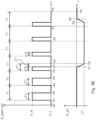
- Figure 3A shows that at the instant t3 the pulse of the pulse-width modulation control signal S_pwm_ctrl has a width ⁇ T1 (time interval of the portion of the period T1 in which it has a high value), then in the period following the instant t10 the pulse of the pulse-width modulation control signal S_pwm_ctrl has a width ⁇ T2 greater than ⁇ T1, i.e., at the instant t10 the pulse of the pulse-width modulation control signal S_pwm_ctrl has had an increase equal to ⁇ T+ (i.e., the duty cycle has increased by ⁇ T+/T1): this represents the condition in which an increase in power or current absorbed by the electronic circuit 2 under test has occurred and such an increase may be indicative of a condition of incorrect operation of the electronic circuit 2 under test, in the case in which said increase ⁇ T+ is greater than an expected value in a defined (i.e., known) operating condition.
- ⁇ T+
- Figure 3A shows at the bottom the trend of the output signal S_ ⁇ T which has a zero value between the instants t0 and t11 (as it is assumed that there are no variations in the power absorbed by the electronic circuit 2 under test), so at the instant t11 the output signal S_ ⁇ T begins to have an increasing trend due to the detected increase in the width of the control signal S_pwm_ctrl (caused by an increase in the power absorbed by the electronic circuit 2 under test), then between the instants t11 and t12 the output signal S_ ⁇ T continues to have an increasing trend until reaching the positive value ⁇ T+ at the instant t12, finally between the instants t12 and t22 the output signal S_ ⁇ T maintains the constant value equal to ⁇ T+ as it is assumed that no further increases or decreases in the pulse width of the control signal S_pwm_ctrl occur (i.e., no variations in the power absorbed by the electronic circuit 2 under test).
- the output signal S_ ⁇ T returns to having at the instant t23 the same value that it had between the instants t0 and t11 prior to the occurrence of the increase ⁇ T+ (i.e., the output signal S_ ⁇ T returns to the zero value), since the outputs of the two RC circuits reached the same final value at full speed: in this way, the variation in the power or current absorbed by the electronic circuit 2 under test was detected.
- Figure 3B shows that at the instant t33 the pulse of the pulse-width modulation control signal S_pwm_ctrl has a width ⁇ T1 (time interval of the portion of the period T1 in which it has a high value), then in the period following the instant t40 the pulse of the pulse -width modulation control signal S_pwm_ctrl has a width ⁇ T3 less than ⁇ T1, i.e., between the instant t40 and t41 the pulse of the pulse-width modulation control signal S_pwm_ctrl has had a decrease equal to ⁇ T- (i.e., the duty cycle has decreased by ⁇ T-/T1): this represents the condition in which a decrease in the power or current absorbed by the electronic circuit 2 under test has occurred and such decrease may be indicative of a condition of incorrect operation of the electronic circuit 2 under test, in case said decrease ⁇ T- is greater (in absolute value) than an expected value in a defined (i.e.,
- Figure 3B shows at the bottom the trend of the output signal S_ ⁇ T which has a zero value between the instants t30 and t41 (since it is assumed that there are no variations in the power absorbed by the electronic circuit 2 under test), then at the instant t41 the output signal S_ ⁇ T begins to have a decreasing trend due to the detected decrease in the width of the control signal S_pwm_ctrl (caused by a decrease in the power absorbed by the electronic circuit 2 under test), then between the instants t41 and t42 the output signal S_ ⁇ T continues to have a decreasing trend until reaching the negative value ⁇ T- at the instant t42, finally between the instants t42 and t52 the output signal S_ ⁇ T maintains the constant value equal to ⁇ T- since it is assumed that no further increases or decreases in the pulse width of the control signal or S_pwm_ctrl occur (i.e., no variations in the power absorbed by the electronic circuit 2 under test).
- the output signal S_ ⁇ T returns to having at the instant t53 the same value that it had between the instants t30 and t41 prior to the occurrence of the decrease ⁇ T-(that is, the output signal S_ ⁇ T returns to the zero value), since the outputs of the two RC circuits reached the same final value at full speed: in this way, the variation in the power or current absorbed by the electronic circuit 2 under test was detected.
- the processing unit 5 e.g., a microprocessor or programmable electronic device
- the processing unit 5 is connected to the electronic monitoring circuit 4 and is such to receive therefrom a signal S_ ⁇ T representative of the variation of the pulse width (or of the duty cycle) of the pulse-width modulation control signal S_pwm_ctrl, in which said variation of the pulse width (or of the duty cycle) is a function of the power or current absorbed by the electronic circuit 2 under test.
- the processing unit 5 has the function of generating the diagnosis signal S_d representative of a correct operation or of an incorrect operation of the electronic circuit 2 under test, as a function of the comparison between the signal S_ ⁇ T representative of the variation of the pulse width (or of its duty cycle) of the control signal S_pwm_ctlr and an expected value P_ex associated with the power or current absorbed by the electronic device 2 in a defined (i.e. known) operating condition of the electronic circuit 2 under test.
- diagnosis signal S_d is a logic signal which has a low logic value indicating a correct operation of the electronic circuit 2 under test and a high logic value indicating an incorrect operation of the electronic circuit 2 under test.
- An example of the expected value P_ex is that of a range of expected values defined as a function of the maximum variation in the power absorbed by the electronic circuit 2 under test, that is, the maximum variation in power that the electronic circuit 2 under test can absorb under a defined (i.e., known) operating condition: in this case, the processing unit 5 generates the diagnosis signal S_d having a value indicative of a correct operation of the electronic circuit 2 under test (e.g., a low logic value) in the case in which the value of the variation ⁇ T+/ ⁇ T- of the signal S_ ⁇ T has a value which is within said range of expected values, while the processing unit 5 generates the diagnosis signal S_d having a value indicative of an incorrect operation of the electronic circuit 2 under test (e.g., a high logic value) in the case in which the value of the variation ⁇ T+/ ⁇ T- of the signal S_ ⁇ T has a value which is outside said range of expected values.
- a correct operation of the electronic circuit 2 under test e.g.,
- the electronic monitoring circuit 4 comprises the following components, which are electrically connected as shown in Figure 2 :
- the first RC circuit (i.e., a first RC branch) comprises the connection in series of a resistor 4-3 and of a first capacitor 4-1, in which said series connection is connected between the input terminal and the ground reference voltage.
- the second RC circuit (i.e., a second RC branch) comprises the connection in series of a resistor 4-4 and a second capacitor 4-2, in which said series connection is connected between the input terminal and the ground reference voltage.
- the output of the first RC circuit is the voltage drop at the ends of the first capacitor 4-1 (i.e., the terminal voltage common to the resistor 4-3 and the capacitor 4-1) and the output of the first RC circuit is connected to the first input terminal of the differential amplifier 4-5 by means of the resistor 4-6.
- the output of the second RC circuit is the voltage drop at the ends of the second capacitor 4-2 (i.e., the terminal voltage common to the resistor 4-4 and the second capacitor 4-2) and the output of the second RC circuit is connected to the second input terminal of the differential amplifier 4-5 by means of the resistor 4-7.
- the set of the first RC circuit, of the second RC circuit and of the differential amplifier 4-5 have the function of processing, during a transitory phase, the variation ⁇ T+/ ⁇ T- of the pulse width (or of its duty cycle) of the control signal S_pwm_ctrl with different timings between the first RC circuit and the second RC circuit, in order to effectively catch (during the transitory phase) the difference of the variation of the pulse width (or of its duty cycle) detected by means of the first and second RC circuits as it occurs in a short interval of time (in the order of hundreds of microseconds), according to the following two possible solutions:
- the resistor 4-6 is connected between the terminal common to the first capacitor 4-1 and to the resistor 4-3 and the first input terminal of the differential amplifier 4-5.
- the resistor 4-7 is connected between the terminal common to the second capacitor 4-2 and to the resistor 4-4 and the second input terminal of the differential amplifier 4-5.
- the value of the resistance R9 of the resistor 4-6 is for example equal to 1 Kilo Ohm and the value of the resistance R11 of the resistor 4-7 is for example equal to 1 Kilo Ohm.
- the differential amplifier 4-5 is supplied with a first supply voltage VCC1, equal for example to 5 Volts.
- the differential amplifier 4-5 comprises a first input terminal connected to the resistor 4-6, comprises a second input terminal connected to the resistor 4-7, and comprises an output terminal adapted to generate an amplified voltage signal V_ampl as a function of the difference between the voltage of the first and of the second input terminals.
- the differential amplifier 4-5 has the function of amplifying the difference between the voltage of the first and of the second input terminals.
- the differential amplifier 4-5 is made for example as an operational amplifier.
- the resistor 4-8 is connected between a reference voltage V_ref (e.g., equal to 1.65 Volts) and the first input terminal of the differential amplifier 4-5.
- V_ref e.g., equal to 1.65 Volts
- the value of the resistance R28 of the resistor 4-8 is equal to 100 Kilo Ohm.
- the feedback resistor 4-9 is connected between the second input terminal and the output terminal of the differential amplifier 4-5.
- the value of the resistance R29 of the feedback resistor 4-9 is for example equal to 100 Kilo Ohm.
- the resistor 4-10 comprises a first terminal connected to the output terminal of the differential amplifier 4-5.
- the value of the resistance R12 of the resistor 4-10 is equal to 200 Ohms.
- the capacitor 4-11 is connected between the second terminal of the resistor 4-10 and the ground reference voltage.
- the value of the capacitance C3 of the capacitor 4-11 is for example equal to 220 nano Farad.
- the resistor 4-12 is connected between the second terminal of the resistor 4-10 and the output terminal.
- the resistor 4-13 is connected between the second terminal of the resistor 4-12 and the ground reference voltage.
- a Zener diode 4-15 is connected between a second supply voltage VCC2 and the terminal common to the resistors 4-10 and 4-12.
- the electronic monitoring circuit 4 comprises a diode 4-14 interposed between the input terminal and the resistors 4-3, 4-4; the diode 4-14 comprises the anode terminal connected to the input terminal of the electronic monitoring circuit 4 and the cathode terminal connected to the resistor 4-6 and to the resistor 4-7.
- Figure 2 shows an electronic monitoring circuit 4 in which there are two RC circuits, in order to detect (during the transitory phase) the difference between the variation (measured by the voltage drop at the ends of the first capacitor 4-1 of the first RC circuit) of the pulse width (or of its duty cycle) of the control signal S_pwm_ctrl and the variation (measured by the voltage drop at the ends of the second capacitor 4-2 of the second RC circuit) of the pulse width (or of its duty cycle) of the control signal S_pwm_ctrl.
- a non-claimed circuit can also be implemented using a single RC circuit (for example, the connection in series of the resistor 4-3 and of the capacitor 4-1, i.e., without the capacitor 4-2 and the resistor 4-4), thus detecting the absolute value at full speed of the variation ⁇ T+ (increase) or ⁇ T- (decrease) of the pulse width (or of its duty cycle) of the control signal S_pwm_ctrl.
- the invention is also applicable to two or more electronic circuits under test (i.e., to two or more portions of the same electronic circuit): in this case the two or more circuits (or two or more circuit portions) are activated in sequence and for each of them the variation of the pulse width (or of its duty cycle) of the respective pulse-width modulation control signals is measured under respective defined operating conditions (i.e., known).
- the invention can also be made entirely in software, using a microprocessor instead of the electronic monitoring circuit 4, provided that a microprocessor with a sufficiently high computing power is available which is able to catch, in each period of the control signal S_pwm_ctrl, the variation of the pulse width (or of its duty cycle) of the pulse-width modulation control signal S_pwm_ctrl.
Landscapes
- Physics & Mathematics (AREA)
- General Physics & Mathematics (AREA)
- Engineering & Computer Science (AREA)
- Power Engineering (AREA)
- General Engineering & Computer Science (AREA)
- Dc-Dc Converters (AREA)
- Logic Circuits (AREA)
Claims (9)
- Elektronische Überwachungsschaltung (4) zur Erfassung einer von einer zu testenden elektronischen Schaltung (2) aufgenommenen Leistungs- oder Stromänderung, wobei die Schaltung Folgendes umfasst:- einen Eingangsanschluss, der dazu ausgelegt ist, ein Impulsbreitenmodulationssteuersignal (S_pwm_ctrl) zu empfangen, wobei das Steuersignal dazu ausgelegt ist, das Öffnen und Schließen mindestens eines Leistungsschalters eines Schaltmodusnetzteils (3) der zu testenden elektronischen Schaltung (2) zu steuern;- einen Widerstand (4-3) mit einem ersten Anschluss, der mit dem Eingangsanschluss verbunden ist;- einen Kondensator (4-1) mit einem ersten Anschluss, der mit einem zweiten Anschluss des Widerstands (4-3) verbunden ist, und mit einem zweiten Anschluss, der mit einer niedrigen Referenzspannung verbunden ist;- einen Ausgangsanschluss, der ausgelegt ist, um ein Ausgangssignal (S_ΔT) als Funktion des Werts des Spannungsabfalls an den Enden des Kondensators zu erzeugen, wobei das Ausgangssignal (S_ΔT) repräsentativ für eine Änderung (ΔT+, ΔT-) der Impulsbreite des Impulsbreitenmodulationssteuersignals (S_pwm_ctrl) ist, wobei die Änderung der Impulsbreite eine Funktion der Leistung oder des Stroms ist, die/der von der zu testenden elektronischen Schaltung aufgenommen wird, dadurch gekennzeichnet, dass die elektronische Überwachungsschaltung (4) umfasst:- einen weiteren Widerstand (4-4) mit einem ersten Anschluss, der mit dem Eingangsanschluss verbunden ist;- einen weiteren Kondensator (4-2) mit einem ersten Anschluss, der mit einem zweiten Anschluss des weiteren Widerstands (4-4) verbunden ist, und mit einem zweiten Anschluss, der mit der niedrigen Referenzspannung verbunden ist;wobei:- der Ausgangsanschluss der elektronischen Überwachungsschaltung ausgelegt ist, um das Ausgangssignal (S_ΔT) als Funktion der Differenz zwischen dem Wert des Spannungsabfalls an den Enden des Kondensators (4-1) und dem Wert des Spannungsabfalls an den Enden des weiteren Kondensators (4-2) zu erzeugen; und wobei alternativ:- der Widerstandswert für den Widerstand und den weiteren Widerstand gleich ist und sich der Kapazitätswert zwischen dem Kondensator und dem weiteren Kondensator unterscheidet;- sich der Widerstandswert zwischen dem Widerstand und dem weiteren Widerstand unterscheidet und der Kapazitätswert für den Kondensator und den weiteren Kondensator gleich ist.
- Elektronische Überwachungsschaltung nach Anspruch 1, umfassend einen Differenzverstärker (4-5) aufweisend:• einen ersten Eingangsanschluss, der mit einem dem Kondensator (4-1) und dem Widerstand (4-3) gemeinsamen Anschluss verbunden ist;• einen zweiten Eingangsanschluss, der mit einem dem weiteren Kondensator (4-2) und dem weiteren Widerstand (4-4) gemeinsamen Anschluss verbunden ist;• einen Ausgangsanschluss, der dazu ausgelegt ist, ein verstärktes Spannungssignal (V_ampl) zu erzeugen, das gleich der Differenz zwischen dem Spannungsabfall an den Enden des ersten Kondensators und dem Spannungsabfall an den Enden des zweiten Kondensators ist;wobei der Ausgangsanschluss der elektronischen Überwachungsschaltung ausgelegt ist, um das Ausgangssignal (S_ΔT) als Funktion des verstärkten Spannungssignals zu erzeugen.
- Elektronische Überwachungsschaltung nach Anspruch 2, wobei der Differenzverstärker (4-5) ein Operationsverstärker ist, wobei die elektronische Überwachungsschaltung ferner Folgendes umfasst:- einen ersten Widerstand (4-6), der zwischen dem dem Widerstand (4-3) und dem Kondensator (4-1) gemeinsamen Anschluss und dem ersten Eingangsanschluss des Operationsverstärkers verbunden ist;- einen zweiten Widerstand (4-7), der zwischen dem dem weiteren Widerstand (4-4) und dem weiteren Kondensator (4-2) gemeinsamen Anschluss und dem zweiten Eingangsanschluss des Operationsverstärkers verbunden ist;- einen Vorspannungswiderstand (4-8), der zwischen dem ersten Eingangsanschluss des Operationsverstärkers und einer Referenzspannung (V_ref) verbunden ist;- einen Rückkopplungswiderstand (4-9), der zwischen dem Ausgangsanschluss und dem zweiten Eingangsanschluss des Operationsverstärkers verbunden ist.
- Elektronische Überwachungsschaltung nach Anspruch 3, ferner umfassend:- einen dritten Widerstand (4-10) mit einem ersten Anschluss, der mit dem Ausgangsanschluss des Verstärkers verbunden ist;- einen Kondensator (4-11), der zwischen einem zweiten Anschluss des dritten Widerstands und der niedrigen Referenzspannung verbunden ist;- einen vierten Widerstand (4-12), der zwischen dem zweiten Anschluss des dritten Widerstands und dem Ausgangsanschluss verbunden ist;- einen fünften Widerstand (4-13), der zwischen dem Ausgangsanschluss und der niedrigen Referenzspannung verbunden ist.
- Elektronisches System (10) zum Testen des Betriebs einer elektronischen Schaltung (2), wobei das System Folgendes umfasst:- eine elektronische Überwachungsschaltung (4) nach einem der vorhergehenden Ansprüche;- eine Antriebsvorrichtung (6), die mit der elektronischen Überwachungsschaltung verbunden und dazu ausgelegt ist, das Impulsbreitenmodulationssteuersignal (S_pwm_ctrl) zu erzeugen;- die zu testende elektronische Schaltung (2);- ein Schaltmodusnetzteil (3), das am Eingang mit der elektronischen Antriebsvorrichtung und am Ausgang mit der zu testenden elektronischen Schaltung verbunden ist, wobei das Schaltmodusnetzteil Folgendes umfasst:• einen Eingangsanschluss, der ausgelegt ist, um das Impulsbreitenmodulationssteuersignal (S_pwm_ctrl) zu empfangen;• einen Ausgangsanschluss, der ausgelegt ist, um ein Stromversorgungssignal der zu testenden elektronischen Schaltung zu erzeugen;• mindestens einen Leistungsschalter, der ausgelegt ist, um als Funktion des Werts des Impulsbreitenmodulationssteuersignals (S_pwm_ctrl) zwischen einer offenen und einer geschlossenen Position umzuschalten;- eine Verarbeitungseinheit (5), die mit der elektronischen Überwachungsschaltung verbunden ist, wobei die Verarbeitungseinheit ausgelegt ist, um als Eingang das Signal (S_ΔT) zu empfangen, das für die Änderung (ΔT+, ΔT-) der Impulsbreite repräsentativ ist, und als Funktion des Vergleichs zwischen dem Signal, das für die Änderung der Impulsbreite repräsentativ ist, und einem Erwartungswert ein Diagnosesignal (S_d) zu erzeugen, das für einen korrekten Betrieb oder einen fehlerhaften Betrieb der zu testenden elektronischen Schaltung repräsentativ ist, wobei der Erwartungswert mit der Leistung oder dem Strom assoziiert ist, die/der von der zu testenden elektronischen Schaltung unter einer definierten Betriebsbedingung der zu testenden elektronischen Schaltung aufgenommen wird (P_ex).
- Elektronisches System nach Anspruch 5, wobei- die Änderung der Impulsbreite eine Zunahme (ΔT+) ist, die für einen Anstieg der Leistung oder des Stroms repräsentativ ist, die/der von der zu testenden elektronischen Schaltung aufgenommen wird;- die Änderung der Impulsbreite eine Abnahme (ΔT-) ist, die für eine Verringerung der Leistung oder des Stroms repräsentativ ist, die/der von der zu testenden elektronischen Schaltung aufgenommen wird.
- Elektronisches System nach Anspruch 5 oder 6, wobei der Erwartungswert unter einer Bedingung der Aktivierung der zu testenden elektronischen Schaltung berechnet wird.
- Elektronisches System nach einem der Ansprüche 5 bis 7, wobei die Leistungsschaltung ein DC-DC-Spannungswandler ist, umfassend:- mindestens einen Schalter, der als Funktion des Werts des Impulsbreitenmodulationssteuersignals (S_pwm_ctrl) periodisch aus einer offenen und einer geschlossenen Position schaltet;- mindestens einen Induktor (3-1), der dazu ausgelegt ist, einen Stromversorgungsstrom der zu testenden elektronischen Schaltung zu erzeugen.
- Elektronisches System nach einem der Ansprüche 5 bis 8, umfassend eine Vielzahl von zu testenden elektronischen Schaltungen,
und wobei die Verarbeitungseinheit konfiguriert ist, um:- sequentiell die elektronischen Schaltungen der Vielzahl zu aktivieren;- für eine jede zu testende elektronische Schaltung der Vielzahl, als Eingang das Signal (S_ΔT) zu empfangen, das für die Änderung (ΔT +, ΔT-) der Impulsbreite repräsentativ ist und als Funktion des Vergleichs zwischen dem Signal, das für die Änderung der Impulsbreite repräsentativ ist, und einem jeweiligen Erwartungswert ein Diagnosesignal (S_d) zu erzeugen, das für einen korrekten Betrieb oder einen fehlerhaften Betrieb der jeweiligen zu testenden elektronischen Schaltung repräsentativ ist, wobei der jeweilige Erwartungswert mit der Leistung oder dem Strom assoziiert ist, die/der von der jeweiligen zu testenden elektronischen Schaltung unter einer definierten Betriebsbedingung der jeweiligen zu testenden elektronischen Schaltung aufgenommen wird (P_ex).
Applications Claiming Priority (2)
| Application Number | Priority Date | Filing Date | Title |
|---|---|---|---|
| IT102019000012984A IT201900012984A1 (it) | 2019-07-26 | 2019-07-26 | Circuito elettronico di monitoraggio per rilevare la variazione della potenza o corrente assorbita da almeno un circuito elettronico da testare e sistema elettronico per testare il funzionamento dell’almeno un circuito elettronico |
| PCT/IB2020/057003 WO2021019396A1 (en) | 2019-07-26 | 2020-07-24 | Electronic monitoring circuit for detecting the variation in the power or current absorbed by at least one electronic circuit under test and electronic system for testing the operation of the at least one electronic circuit |
Publications (2)
| Publication Number | Publication Date |
|---|---|
| EP4004565A1 EP4004565A1 (de) | 2022-06-01 |
| EP4004565B1 true EP4004565B1 (de) | 2024-08-28 |
Family
ID=68733508
Family Applications (1)
| Application Number | Title | Priority Date | Filing Date |
|---|---|---|---|
| EP20757403.9A Active EP4004565B1 (de) | 2019-07-26 | 2020-07-24 | Elektronische überwachungsschaltung zur erfassung der von mindestens einer zu testenden elektronischen schaltung aufgenommenen leistungs- oder stromänderung und elektronisches system zum testen des betriebs der mindestens einen elektronischen schaltung |
Country Status (5)
| Country | Link |
|---|---|
| US (1) | US11860218B2 (de) |
| EP (1) | EP4004565B1 (de) |
| CN (1) | CN114424071B (de) |
| IT (1) | IT201900012984A1 (de) |
| WO (1) | WO2021019396A1 (de) |
Family Cites Families (15)
| Publication number | Priority date | Publication date | Assignee | Title |
|---|---|---|---|---|
| US6646450B2 (en) * | 2001-10-16 | 2003-11-11 | Koninklijke Philips Electronics N.V. | Method and apparatus for near losslessly measuring inductor current |
| US7489489B2 (en) * | 2003-08-11 | 2009-02-10 | Jm Electronics Ltd. Llc | Load current sensing technique |
| JP4430531B2 (ja) * | 2004-12-28 | 2010-03-10 | 株式会社日立製作所 | 双方向絶縁型dc−dcコンバータ |
| US8253405B2 (en) * | 2008-12-31 | 2012-08-28 | Malay Trivedi | High speed voltage regulator with integrated loseless current sensing |
| CN201528321U (zh) * | 2009-10-16 | 2010-07-14 | 西安英洛华微电子有限公司 | 脉宽信号占空比检测器 |
| JP5586211B2 (ja) * | 2009-11-17 | 2014-09-10 | 株式会社東芝 | Dc−dcコンバータおよび半導体集積回路 |
| US8278895B2 (en) * | 2009-12-24 | 2012-10-02 | Linear Technology Corporation | Efficiency measuring circuit for DC-DC converter which calculates internal resistance of switching inductor based on duty cycle |
| CN101964647B (zh) * | 2010-09-14 | 2012-10-24 | 日银Imp微电子有限公司 | 一种脉宽信号占空比检测电路 |
| US8552700B2 (en) * | 2010-10-06 | 2013-10-08 | Freescale Semiconductor, Inc. | Switched mode voltage regulator and method of operation |
| JP2012124669A (ja) * | 2010-12-07 | 2012-06-28 | Asahi Kasei Electronics Co Ltd | D/a変換器 |
| RU2445738C1 (ru) * | 2011-03-14 | 2012-03-20 | Евгений Михайлович Плышевский | Радиоприемник |
| US9596724B2 (en) * | 2013-08-27 | 2017-03-14 | Texas Instruments Incorporated | Method and apparatus for calculating an average value of an inaccessible current from an accessible current |
| CN103997206B (zh) * | 2014-05-20 | 2017-04-12 | 华为技术有限公司 | 一种开关电源 |
| CN107211499B (zh) * | 2015-02-03 | 2019-07-05 | 飞利浦照明控股有限公司 | 能够监测浪涌保护布置的使用的驱动器电路 |
| CN108475984B (zh) * | 2016-11-25 | 2021-05-07 | 瑞尼斯股份有限公司 | Dc-dc转换器 |
-
2019
- 2019-07-26 IT IT102019000012984A patent/IT201900012984A1/it unknown
-
2020
- 2020-07-24 EP EP20757403.9A patent/EP4004565B1/de active Active
- 2020-07-24 WO PCT/IB2020/057003 patent/WO2021019396A1/en not_active Ceased
- 2020-07-24 CN CN202080065472.9A patent/CN114424071B/zh active Active
- 2020-07-24 US US17/597,824 patent/US11860218B2/en active Active
Also Published As
| Publication number | Publication date |
|---|---|
| US20220260628A1 (en) | 2022-08-18 |
| WO2021019396A1 (en) | 2021-02-04 |
| CN114424071B (zh) | 2024-12-13 |
| CN114424071A (zh) | 2022-04-29 |
| US11860218B2 (en) | 2024-01-02 |
| IT201900012984A1 (it) | 2021-01-26 |
| EP4004565A1 (de) | 2022-06-01 |
Similar Documents
| Publication | Publication Date | Title |
|---|---|---|
| US10340908B2 (en) | Half-bridge driver fault diagnostic system and method | |
| US11280844B2 (en) | Device and method for monitoring a reliability of a cell impedance measurement of a battery cell | |
| US10094883B2 (en) | Voltage detecting device and battery pack monitoring system | |
| US8598897B2 (en) | Isolation monitoring system and method utilizing a variable emulated inductance | |
| US10698033B2 (en) | Sensor fault detection using paired sample correlation | |
| US9436193B2 (en) | Electric system comprising a load driving apparatus by auto-recovery mode, and method of operating the apparatus | |
| US20160193926A1 (en) | Multifunctional monitoring of electrical systems | |
| US10530250B2 (en) | Multiphase converter | |
| JP5716601B2 (ja) | 絶縁抵抗低下検出装置 | |
| US11860196B2 (en) | Detection system for detecting capacitance degradation in inverters | |
| WO2022038019A1 (en) | Battery soh determination circuit | |
| JP2016520927A (ja) | 回路、および電気機械的消費装置用電流の調整方法 | |
| EP4004565B1 (de) | Elektronische überwachungsschaltung zur erfassung der von mindestens einer zu testenden elektronischen schaltung aufgenommenen leistungs- oder stromänderung und elektronisches system zum testen des betriebs der mindestens einen elektronischen schaltung | |
| JP2007068249A (ja) | 電気自動車用リーク検出装置 | |
| US10374597B2 (en) | Circuit state sensing | |
| JP2011010512A (ja) | 昇降圧コンバータ | |
| CN107107850A (zh) | 用于车辆的人员保护装置的至少一个点火电路的监测装置和用于运行监测装置的方法 | |
| US11500035B2 (en) | Devices, systems and processes for capacitor testing | |
| EP3646039B1 (de) | Prüfen eines kondensators oder kapazitiven sensors | |
| Li et al. | Detection and Identification of Switching Faults in Boost Converters Using an HSVG Sensing Circuit | |
| CN120660281A (zh) | 用于激活和停用y电容器的控制设备、变流器及电力驱动系统 | |
| JP2017122662A (ja) | 地絡検出回路 |
Legal Events
| Date | Code | Title | Description |
|---|---|---|---|
| STAA | Information on the status of an ep patent application or granted ep patent |
Free format text: STATUS: UNKNOWN |
|
| STAA | Information on the status of an ep patent application or granted ep patent |
Free format text: STATUS: THE INTERNATIONAL PUBLICATION HAS BEEN MADE |
|
| PUAI | Public reference made under article 153(3) epc to a published international application that has entered the european phase |
Free format text: ORIGINAL CODE: 0009012 |
|
| STAA | Information on the status of an ep patent application or granted ep patent |
Free format text: STATUS: REQUEST FOR EXAMINATION WAS MADE |
|
| 17P | Request for examination filed |
Effective date: 20220127 |
|
| AK | Designated contracting states |
Kind code of ref document: A1 Designated state(s): AL AT BE BG CH CY CZ DE DK EE ES FI FR GB GR HR HU IE IS IT LI LT LU LV MC MK MT NL NO PL PT RO RS SE SI SK SM TR |
|
| DAV | Request for validation of the european patent (deleted) | ||
| DAX | Request for extension of the european patent (deleted) | ||
| GRAP | Despatch of communication of intention to grant a patent |
Free format text: ORIGINAL CODE: EPIDOSNIGR1 |
|
| STAA | Information on the status of an ep patent application or granted ep patent |
Free format text: STATUS: GRANT OF PATENT IS INTENDED |
|
| INTG | Intention to grant announced |
Effective date: 20240318 |
|
| GRAS | Grant fee paid |
Free format text: ORIGINAL CODE: EPIDOSNIGR3 |
|
| GRAA | (expected) grant |
Free format text: ORIGINAL CODE: 0009210 |
|
| STAA | Information on the status of an ep patent application or granted ep patent |
Free format text: STATUS: THE PATENT HAS BEEN GRANTED |
|
| AK | Designated contracting states |
Kind code of ref document: B1 Designated state(s): AL AT BE BG CH CY CZ DE DK EE ES FI FR GB GR HR HU IE IS IT LI LT LU LV MC MK MT NL NO PL PT RO RS SE SI SK SM TR |
|
| REG | Reference to a national code |
Ref country code: CH Ref legal event code: EP |
|
| REG | Reference to a national code |
Ref country code: DE Ref legal event code: R096 Ref document number: 602020036699 Country of ref document: DE |
|
| REG | Reference to a national code |
Ref country code: IE Ref legal event code: FG4D |
|
| REG | Reference to a national code |
Ref country code: LT Ref legal event code: MG9D |
|
| PG25 | Lapsed in a contracting state [announced via postgrant information from national office to epo] |
Ref country code: NO Free format text: LAPSE BECAUSE OF FAILURE TO SUBMIT A TRANSLATION OF THE DESCRIPTION OR TO PAY THE FEE WITHIN THE PRESCRIBED TIME-LIMIT Effective date: 20241128 |
|
| REG | Reference to a national code |
Ref country code: AT Ref legal event code: MK05 Ref document number: 1718511 Country of ref document: AT Kind code of ref document: T Effective date: 20240828 |
|
| PG25 | Lapsed in a contracting state [announced via postgrant information from national office to epo] |
Ref country code: NL Free format text: LAPSE BECAUSE OF FAILURE TO SUBMIT A TRANSLATION OF THE DESCRIPTION OR TO PAY THE FEE WITHIN THE PRESCRIBED TIME-LIMIT Effective date: 20240828 Ref country code: PL Free format text: LAPSE BECAUSE OF FAILURE TO SUBMIT A TRANSLATION OF THE DESCRIPTION OR TO PAY THE FEE WITHIN THE PRESCRIBED TIME-LIMIT Effective date: 20240828 Ref country code: PT Free format text: LAPSE BECAUSE OF FAILURE TO SUBMIT A TRANSLATION OF THE DESCRIPTION OR TO PAY THE FEE WITHIN THE PRESCRIBED TIME-LIMIT Effective date: 20241230 Ref country code: GR Free format text: LAPSE BECAUSE OF FAILURE TO SUBMIT A TRANSLATION OF THE DESCRIPTION OR TO PAY THE FEE WITHIN THE PRESCRIBED TIME-LIMIT Effective date: 20241129 Ref country code: FI Free format text: LAPSE BECAUSE OF FAILURE TO SUBMIT A TRANSLATION OF THE DESCRIPTION OR TO PAY THE FEE WITHIN THE PRESCRIBED TIME-LIMIT Effective date: 20240828 |
|
| PG25 | Lapsed in a contracting state [announced via postgrant information from national office to epo] |
Ref country code: BG Free format text: LAPSE BECAUSE OF FAILURE TO SUBMIT A TRANSLATION OF THE DESCRIPTION OR TO PAY THE FEE WITHIN THE PRESCRIBED TIME-LIMIT Effective date: 20240828 |
|
| PG25 | Lapsed in a contracting state [announced via postgrant information from national office to epo] |
Ref country code: LV Free format text: LAPSE BECAUSE OF FAILURE TO SUBMIT A TRANSLATION OF THE DESCRIPTION OR TO PAY THE FEE WITHIN THE PRESCRIBED TIME-LIMIT Effective date: 20240828 |
|
| REG | Reference to a national code |
Ref country code: NL Ref legal event code: MP Effective date: 20240828 |
|
| PG25 | Lapsed in a contracting state [announced via postgrant information from national office to epo] |
Ref country code: IS Free format text: LAPSE BECAUSE OF FAILURE TO SUBMIT A TRANSLATION OF THE DESCRIPTION OR TO PAY THE FEE WITHIN THE PRESCRIBED TIME-LIMIT Effective date: 20241228 Ref country code: AT Free format text: LAPSE BECAUSE OF FAILURE TO SUBMIT A TRANSLATION OF THE DESCRIPTION OR TO PAY THE FEE WITHIN THE PRESCRIBED TIME-LIMIT Effective date: 20240828 |
|
| PG25 | Lapsed in a contracting state [announced via postgrant information from national office to epo] |
Ref country code: HR Free format text: LAPSE BECAUSE OF FAILURE TO SUBMIT A TRANSLATION OF THE DESCRIPTION OR TO PAY THE FEE WITHIN THE PRESCRIBED TIME-LIMIT Effective date: 20240828 |
|
| PG25 | Lapsed in a contracting state [announced via postgrant information from national office to epo] |
Ref country code: RS Free format text: LAPSE BECAUSE OF FAILURE TO SUBMIT A TRANSLATION OF THE DESCRIPTION OR TO PAY THE FEE WITHIN THE PRESCRIBED TIME-LIMIT Effective date: 20241128 Ref country code: ES Free format text: LAPSE BECAUSE OF FAILURE TO SUBMIT A TRANSLATION OF THE DESCRIPTION OR TO PAY THE FEE WITHIN THE PRESCRIBED TIME-LIMIT Effective date: 20240828 |
|
| PG25 | Lapsed in a contracting state [announced via postgrant information from national office to epo] |
Ref country code: RS Free format text: LAPSE BECAUSE OF FAILURE TO SUBMIT A TRANSLATION OF THE DESCRIPTION OR TO PAY THE FEE WITHIN THE PRESCRIBED TIME-LIMIT Effective date: 20241128 Ref country code: PT Free format text: LAPSE BECAUSE OF FAILURE TO SUBMIT A TRANSLATION OF THE DESCRIPTION OR TO PAY THE FEE WITHIN THE PRESCRIBED TIME-LIMIT Effective date: 20241230 Ref country code: PL Free format text: LAPSE BECAUSE OF FAILURE TO SUBMIT A TRANSLATION OF THE DESCRIPTION OR TO PAY THE FEE WITHIN THE PRESCRIBED TIME-LIMIT Effective date: 20240828 Ref country code: NO Free format text: LAPSE BECAUSE OF FAILURE TO SUBMIT A TRANSLATION OF THE DESCRIPTION OR TO PAY THE FEE WITHIN THE PRESCRIBED TIME-LIMIT Effective date: 20241128 Ref country code: NL Free format text: LAPSE BECAUSE OF FAILURE TO SUBMIT A TRANSLATION OF THE DESCRIPTION OR TO PAY THE FEE WITHIN THE PRESCRIBED TIME-LIMIT Effective date: 20240828 Ref country code: LV Free format text: LAPSE BECAUSE OF FAILURE TO SUBMIT A TRANSLATION OF THE DESCRIPTION OR TO PAY THE FEE WITHIN THE PRESCRIBED TIME-LIMIT Effective date: 20240828 Ref country code: IS Free format text: LAPSE BECAUSE OF FAILURE TO SUBMIT A TRANSLATION OF THE DESCRIPTION OR TO PAY THE FEE WITHIN THE PRESCRIBED TIME-LIMIT Effective date: 20241228 Ref country code: HR Free format text: LAPSE BECAUSE OF FAILURE TO SUBMIT A TRANSLATION OF THE DESCRIPTION OR TO PAY THE FEE WITHIN THE PRESCRIBED TIME-LIMIT Effective date: 20240828 Ref country code: GR Free format text: LAPSE BECAUSE OF FAILURE TO SUBMIT A TRANSLATION OF THE DESCRIPTION OR TO PAY THE FEE WITHIN THE PRESCRIBED TIME-LIMIT Effective date: 20241129 Ref country code: FI Free format text: LAPSE BECAUSE OF FAILURE TO SUBMIT A TRANSLATION OF THE DESCRIPTION OR TO PAY THE FEE WITHIN THE PRESCRIBED TIME-LIMIT Effective date: 20240828 Ref country code: ES Free format text: LAPSE BECAUSE OF FAILURE TO SUBMIT A TRANSLATION OF THE DESCRIPTION OR TO PAY THE FEE WITHIN THE PRESCRIBED TIME-LIMIT Effective date: 20240828 Ref country code: BG Free format text: LAPSE BECAUSE OF FAILURE TO SUBMIT A TRANSLATION OF THE DESCRIPTION OR TO PAY THE FEE WITHIN THE PRESCRIBED TIME-LIMIT Effective date: 20240828 Ref country code: AT Free format text: LAPSE BECAUSE OF FAILURE TO SUBMIT A TRANSLATION OF THE DESCRIPTION OR TO PAY THE FEE WITHIN THE PRESCRIBED TIME-LIMIT Effective date: 20240828 |
|
| PG25 | Lapsed in a contracting state [announced via postgrant information from national office to epo] |
Ref country code: RO Free format text: LAPSE BECAUSE OF FAILURE TO SUBMIT A TRANSLATION OF THE DESCRIPTION OR TO PAY THE FEE WITHIN THE PRESCRIBED TIME-LIMIT Effective date: 20240828 Ref country code: SM Free format text: LAPSE BECAUSE OF FAILURE TO SUBMIT A TRANSLATION OF THE DESCRIPTION OR TO PAY THE FEE WITHIN THE PRESCRIBED TIME-LIMIT Effective date: 20240828 Ref country code: DK Free format text: LAPSE BECAUSE OF FAILURE TO SUBMIT A TRANSLATION OF THE DESCRIPTION OR TO PAY THE FEE WITHIN THE PRESCRIBED TIME-LIMIT Effective date: 20240828 |
|
| PG25 | Lapsed in a contracting state [announced via postgrant information from national office to epo] |
Ref country code: EE Free format text: LAPSE BECAUSE OF FAILURE TO SUBMIT A TRANSLATION OF THE DESCRIPTION OR TO PAY THE FEE WITHIN THE PRESCRIBED TIME-LIMIT Effective date: 20240828 |
|
| PG25 | Lapsed in a contracting state [announced via postgrant information from national office to epo] |
Ref country code: CZ Free format text: LAPSE BECAUSE OF FAILURE TO SUBMIT A TRANSLATION OF THE DESCRIPTION OR TO PAY THE FEE WITHIN THE PRESCRIBED TIME-LIMIT Effective date: 20240828 |
|
| PG25 | Lapsed in a contracting state [announced via postgrant information from national office to epo] |
Ref country code: SK Free format text: LAPSE BECAUSE OF FAILURE TO SUBMIT A TRANSLATION OF THE DESCRIPTION OR TO PAY THE FEE WITHIN THE PRESCRIBED TIME-LIMIT Effective date: 20240828 |
|
| REG | Reference to a national code |
Ref country code: DE Ref legal event code: R097 Ref document number: 602020036699 Country of ref document: DE |
|
| PLBE | No opposition filed within time limit |
Free format text: ORIGINAL CODE: 0009261 |
|
| STAA | Information on the status of an ep patent application or granted ep patent |
Free format text: STATUS: NO OPPOSITION FILED WITHIN TIME LIMIT |
|
| 26N | No opposition filed |
Effective date: 20250530 |
|
| PG25 | Lapsed in a contracting state [announced via postgrant information from national office to epo] |
Ref country code: SE Free format text: LAPSE BECAUSE OF FAILURE TO SUBMIT A TRANSLATION OF THE DESCRIPTION OR TO PAY THE FEE WITHIN THE PRESCRIBED TIME-LIMIT Effective date: 20240828 |
|
| PGFP | Annual fee paid to national office [announced via postgrant information from national office to epo] |
Ref country code: DE Payment date: 20250728 Year of fee payment: 6 |
|
| PGFP | Annual fee paid to national office [announced via postgrant information from national office to epo] |
Ref country code: IT Payment date: 20250728 Year of fee payment: 6 |
|
| REG | Reference to a national code |
Ref country code: CH Ref legal event code: H13 Free format text: ST27 STATUS EVENT CODE: U-0-0-H10-H13 (AS PROVIDED BY THE NATIONAL OFFICE) Effective date: 20260224 |
|
| PG25 | Lapsed in a contracting state [announced via postgrant information from national office to epo] |
Ref country code: LU Free format text: LAPSE BECAUSE OF NON-PAYMENT OF DUE FEES Effective date: 20250724 |
|
| GBPC | Gb: european patent ceased through non-payment of renewal fee |
Effective date: 20250724 |
|
| REG | Reference to a national code |
Ref country code: BE Ref legal event code: MM Effective date: 20250731 |
|
| PG25 | Lapsed in a contracting state [announced via postgrant information from national office to epo] |
Ref country code: GB Free format text: LAPSE BECAUSE OF NON-PAYMENT OF DUE FEES Effective date: 20250724 |
|
| PG25 | Lapsed in a contracting state [announced via postgrant information from national office to epo] |
Ref country code: BE Free format text: LAPSE BECAUSE OF NON-PAYMENT OF DUE FEES Effective date: 20250731 |
|
| PG25 | Lapsed in a contracting state [announced via postgrant information from national office to epo] |
Ref country code: FR Free format text: LAPSE BECAUSE OF NON-PAYMENT OF DUE FEES Effective date: 20250731 |
|
| PG25 | Lapsed in a contracting state [announced via postgrant information from national office to epo] |
Ref country code: CH Free format text: LAPSE BECAUSE OF NON-PAYMENT OF DUE FEES Effective date: 20250731 |