EP3992803B1 - Speichervorrichtung und betriebsverfahren einer speichervorrichtung - Google Patents
Speichervorrichtung und betriebsverfahren einer speichervorrichtung Download PDFInfo
- Publication number
- EP3992803B1 EP3992803B1 EP21185065.6A EP21185065A EP3992803B1 EP 3992803 B1 EP3992803 B1 EP 3992803B1 EP 21185065 A EP21185065 A EP 21185065A EP 3992803 B1 EP3992803 B1 EP 3992803B1
- Authority
- EP
- European Patent Office
- Prior art keywords
- controller
- link
- host device
- storage device
- area
- Prior art date
- Legal status (The legal status is an assumption and is not a legal conclusion. Google has not performed a legal analysis and makes no representation as to the accuracy of the status listed.)
- Active
Links
Images




Classifications
-
- G—PHYSICS
- G06—COMPUTING OR CALCULATING; COUNTING
- G06F—ELECTRIC DIGITAL DATA PROCESSING
- G06F13/00—Interconnection of, or transfer of information or other signals between, memories, input/output devices or central processing units
- G06F13/14—Handling requests for interconnection or transfer
- G06F13/16—Handling requests for interconnection or transfer for access to memory bus
- G06F13/1668—Details of memory controller
- G06F13/1689—Synchronisation and timing concerns
-
- G—PHYSICS
- G06—COMPUTING OR CALCULATING; COUNTING
- G06F—ELECTRIC DIGITAL DATA PROCESSING
- G06F13/00—Interconnection of, or transfer of information or other signals between, memories, input/output devices or central processing units
- G06F13/14—Handling requests for interconnection or transfer
- G06F13/16—Handling requests for interconnection or transfer for access to memory bus
- G06F13/1668—Details of memory controller
- G06F13/1678—Details of memory controller using bus width
-
- G—PHYSICS
- G11—INFORMATION STORAGE
- G11C—STATIC STORES
- G11C16/00—Erasable programmable read-only memories
- G11C16/02—Erasable programmable read-only memories electrically programmable
- G11C16/06—Auxiliary circuits, e.g. for writing into memory
- G11C16/10—Programming or data input circuits
-
- G—PHYSICS
- G11—INFORMATION STORAGE
- G11C—STATIC STORES
- G11C16/00—Erasable programmable read-only memories
- G11C16/02—Erasable programmable read-only memories electrically programmable
- G11C16/06—Auxiliary circuits, e.g. for writing into memory
- G11C16/32—Timing circuits
-
- G—PHYSICS
- G11—INFORMATION STORAGE
- G11C—STATIC STORES
- G11C7/00—Arrangements for writing information into, or reading information out from, a digital store
- G11C7/22—Read-write [R-W] timing or clocking circuits; Read-write [R-W] control signal generators or management
- G11C7/222—Clock generating, synchronizing or distributing circuits within memory device
-
- G—PHYSICS
- G06—COMPUTING OR CALCULATING; COUNTING
- G06F—ELECTRIC DIGITAL DATA PROCESSING
- G06F2213/00—Indexing scheme relating to interconnection of, or transfer of information or other signals between, memories, input/output devices or central processing units
- G06F2213/0026—PCI express
-
- G—PHYSICS
- G11—INFORMATION STORAGE
- G11C—STATIC STORES
- G11C2207/00—Indexing scheme relating to arrangements for writing information into, or reading information out from, a digital store
- G11C2207/22—Control and timing of internal memory operations
- G11C2207/2236—Copy
-
- G—PHYSICS
- G11—INFORMATION STORAGE
- G11C—STATIC STORES
- G11C2211/00—Indexing scheme relating to digital stores characterized by the use of particular electric or magnetic storage elements; Storage elements therefor
- G11C2211/56—Indexing scheme relating to G11C11/56 and sub-groups for features not covered by these groups
- G11C2211/564—Miscellaneous aspects
- G11C2211/5641—Multilevel memory having cells with different number of storage levels
-
- G—PHYSICS
- G11—INFORMATION STORAGE
- G11C—STATIC STORES
- G11C7/00—Arrangements for writing information into, or reading information out from, a digital store
- G11C7/04—Arrangements for writing information into, or reading information out from, a digital store with means for avoiding disturbances due to temperature effects
-
- Y—GENERAL TAGGING OF NEW TECHNOLOGICAL DEVELOPMENTS; GENERAL TAGGING OF CROSS-SECTIONAL TECHNOLOGIES SPANNING OVER SEVERAL SECTIONS OF THE IPC; TECHNICAL SUBJECTS COVERED BY FORMER USPC CROSS-REFERENCE ART COLLECTIONS [XRACs] AND DIGESTS
- Y02—TECHNOLOGIES OR APPLICATIONS FOR MITIGATION OR ADAPTATION AGAINST CLIMATE CHANGE
- Y02D—CLIMATE CHANGE MITIGATION TECHNOLOGIES IN INFORMATION AND COMMUNICATION TECHNOLOGIES [ICT], I.E. INFORMATION AND COMMUNICATION TECHNOLOGIES AIMING AT THE REDUCTION OF THEIR OWN ENERGY USE
- Y02D10/00—Energy efficient computing, e.g. low power processors, power management or thermal management
Definitions
- Example embodiments of the present disclosure relate to a semiconductor device, and more particularly, relate to a system including a host device and a storage device reducing power consumption by adjusting a transmission rate.
- a storage device may include a nonvolatile memory device and a controller to control the nonvolatile memory device.
- the controller may communicate with an external host device based on a given communication protocol. As association technologies develop, a speed at which the controller communicates with the external host device may increase.
- the amount of power consumption according to the communication of the storage device is increasing. Accordingly, the overall power consumption of the storage device is increasing. The increase of power consumption may cause the reduction of quality of the storage device.
- a composite memory device including discrete memory devices and a bridge device for controlling the discrete memory devices.
- a configurable clock controller receives a system clock and generates a memory clock having a frequency that is a predetermined ratio of the system clock.
- the system clock frequency is dynamically variable between a maximum and a minimum value, and the ratio of the memory clock frequency relative to the system clock frequency is set by loading a frequency register with a Frequency Divide Ratio (FDR) code any time during operation of the composite memory device.
- FDR Frequency Divide Ratio
- An interface system includes a receiver, a first clock generator, a second clock generator, and a sampling circuit.
- the receiver is configured to receive a first clock and serial data from a host.
- the first clock generator includes a first voltage controlled oscillator (VCO) and is configured to generate a second clock on the basis of the first clock.
- the second clock generator includes a second voltage controlled oscillator (VCO) and is configured to generate a third clock on the basis of the serial data.
- the sampling circuit is configured to sample reception data on the basis of the third clock and the serial data.
- Embodiments of the present disclosure provide a system comprising a host device and a storage device reducing power consumption according to a communication while communicating with the host device at an improved communication speed.
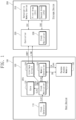
- FIG. 1 illustrates a host device 100 and a storage device 200 according to an embodiment.
- the host device 100 may be implemented with one of various electronic devices such as a computer, a notebook computer, a smartphone, a smart pad, and a smart watch.
- the host device 100 includes a clock generator 110, a central processing unit (CPU) 120, and a random access memory 130.
- CPU central processing unit
- the clock generator 110 may generate a first clock signal CLK1.
- the first clock signal CLK1 may be supplied to the central processing unit 120.
- the central processing unit 120 includes a clock multiplier 121, a core 122, a memory controller 123, and an interface circuit 124.
- the clock multiplier 121 may receive the first clock signal CLK1.
- the clock multiplier 121 generates a second clock signal CLK2, a third clock signal CLK3, a fourth clock signal CLK4, and a reference clock signal CREF through frequency multiplication of the first clock signal CLK1.
- the core 122 may receive the second clock signal CLK2 from the clock multiplier 121.
- the core 122 may operate in response to the second clock signal CLK2.
- the core 122 may control operations of the central processing unit 120 and may execute an operating system and applications.
- the core 122 may include two or more cores.
- the memory controller 123 may receive the third clock signal CLK3 from the clock multiplier 121. Depending on a request of the core 122, the memory controller 123 may access the random access memory 130 based on the third clock signal CLK3. For example, the memory controller 123 may transmit a command and address CA and the fourth clock signal CLK4 to the random access memory 130. The memory controller 123 may exchange a data signal DQ with the random access memory 130.
- the interface circuit 124 receives the fourth clock signal CLK4 and the reference clock signal CREF from the clock multiplier 121.
- the interface circuit 124 provides the reference clock signal CREF to the storage device 200.
- the interface circuit 124 may establish a link LINK with the storage device 200. Depending on a request of the core 122, the interface circuit 124 may exchange a signal with the storage device 200 through the link LINK.
- the random access memory 130 may be used as a working memory of the host device 100.
- the central processing unit 120 may load codes for executing the operating system or the applications onto the random access memory 130.
- the central processing unit 120 may store data of the random access memory 130 in the storage device 200 or may load data read from the storage device 200 onto the random access memory 130.
- the storage device 200 includes a nonvolatile memory device 210 and a controller 220.
- the nonvolatile memory device 210 may be implemented with at least one of various nonvolatile memory devices such as a NAND flash memory device, a phase change memory device, a ferroelectric memory device, a magnetic memory device, and a resistive memory device.
- the nonvolatile memory device 210 may include a first area 211 and a second area 212.
- the controller 220 receives the reference clock signal CREF from the external host device 100.
- the controller 220 includes a clock multiplier 228.
- the clock multiplier 228 generates an internal clock signal through frequency multiplication of the reference clock signal CREF.
- a frequency of the internal clock signal may be the same as a frequency of the fourth clock signal CLK4.
- the controller 220 may establish the link LINK with the host device 100 by using the internal clock signal.
- the controller 220 accesses the nonvolatile memory device 210 depending on a request transmitted from the host device 100 through the link LINK or depending on an internally defined schedule.
- the controller 220 may access the nonvolatile memory device 210 through a first channel CH1 and a second channel CH2. For example, the controller 220 may transmit a command and an address to the nonvolatile memory device 210 through the first channel CH1. The controller 220 may exchange data with the nonvolatile memory device 210 through the first channel CH1.
- the controller 220 may transmit a first control signal to the nonvolatile memory device 210 through the second channel CH2.
- the controller 220 may receive a second control signal from the nonvolatile memory device 210 through the second channel CH2.
- the controller 220 may use the first area 211 to perform a high-speed write operation.
- the controller 220 may use the second area 212 to perform a normal write operation.
- a write speed of the first area 211 may be higher than a write speed of the second area 212.
- the controller 220 may use memory cells of the first area 211 as single level cells (SLCs), and may use memory cells of the second area 212 as multi-level cells (MLCs), triple level cells (TLCs), quadruple level cells (QLCs), or k-th level cells (k being an integer more than 4).
- the controller 220 may open the second area 212 to the host device 100 as a storage capacity of the storage device 200.
- the first area 211 may not open the first area 211 to the host device 100 as a storage capacity of the storage device 200.
- the controller 220 may first write the write data into the first area 211.
- the controller 220 may allow the data written in the first area 211 to migrate to the second area 212.
- the controller 220 may directly write the write data into the second area 212.
- a speed at which write data are written into the second area 212 may be slower than a speed at which write data are written into the first area 211.
- the controller 220 may make a transmission rate of the link LINK for the communication with the host device 100 low, and thus, power consumption of the link LINK may decrease.
- the communication between the host device 100 and the storage device 200 may establish the link LINK based on one of various communication protocols such as a peripheral component interconnection (PCI) protocol, a PCI-express (PCI-e) protocol, a nonvolatile memory-express (NVM-e) protocol, an advanced technology attachment (ATA) protocol, a serial advanced technology attachment (SATA) protocol, a serial attached SCSI (SAS), a universal flash storage (UFS) protocol, a universal serial bus (USB) protocol, an embedded multimedia card (eMMC) protocol, a small computer small interface (SCSI) protocol, a secure digital (SD) card protocol, a multi-media card (MMC) protocol, an embedded UFS (eUFS) protocol, and a compact flash card protocol.
- PCI peripheral component interconnection
- PCI-e PCI-express
- NVM-e nonvolatile memory-express
- ATA advanced technology attachment
- SATA serial advanced technology attachment
- SAS serial attached SCSI
- UFS universal flash storage
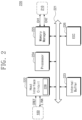
- FIG. 2 illustrates the controller 220 of the storage device 200 of FIG. 1 .
- the controller 220 receives the reference clock signal CREF and may establish the link LINK with the external host device 100.
- the controller 220 receives various requests for writing data in the nonvolatile memory device 210 or reading data from the nonvolatile memory device 210, from the external host device 100 through the link LINK.
- the controller 220 may access the nonvolatile memory device 210 through the first channel CH1 and the second channel CH2. For example, the controller 220 may transmit a command and an address to the nonvolatile memory device 210 through the first channel CH1. The controller 220 may exchange data with the nonvolatile memory device 210 through the first channel CH1.
- the controller 220 may transmit a first control signal to the nonvolatile memory device 210 through the second channel CH2.
- the controller 220 may receive a second control signal from the nonvolatile memory device 210 through the second channel CH2.
- the controller 220 may be configured to control two or more nonvolatile memory devices.
- the controller 220 may provide first different channels and second different channels to two or more nonvolatile memory devices.
- the controller 220 may provide one first channel so as to be shared by two or more nonvolatile memory devices.
- the controller 220 may provide a part of second channels so to be shared by two or more nonvolatile memory devices and may separately provide the remaining part thereof.
- the controller 220 may include a bus 221, a host interface circuit 222, an internal buffer 223, a processor 224, a memory manager 225, and an error correction code (ECC) block 226.
- ECC error correction code
- the bus 221 may provide communication channels between components in the controller 220.
- the host interface circuit 222 may receive various requests from the external host device 100 and may parse the received requests.
- the host interface circuit 222 may store the parsed requests in the internal buffer 223.
- the host interface circuit 222 may store data received from the external host device 100 in the internal buffer 223.
- the host interface circuit 222 may transmit data stored in the internal buffer 223 to the external host device 100.
- the host interface circuit 222 may transmit various responses to the external host device 100.
- the host interface circuit 222 may exchange signals with the external host device 100 in compliance with a given communication protocol.
- the host interface circuit 222 may include the clock multiplier 228.
- the clock multiplier 228 generates an internal clock signal for establishing the link LINK and communicating with the host device 100, based on the reference clock signal CREF.
- the internal buffer 223 may include a random access memory.
- the internal buffer 223 may include a static random access memory or a dynamic random access memory.
- the processor 224 may drive an operating system or firmware for driving the controller 220.
- the processor 224 may read the parsed requests stored in the internal buffer 223 and may generate commands and addresses for controlling the nonvolatile memory device 210.
- the processor 224 may provide the generated commands and addresses to the memory manager 225.
- the processor 224 may store various metadata for managing the storage device 200 in the internal buffer 223.
- the processor 224 may temporarily store data, which are received from the host device 100 and are to be written in the nonvolatile memory device 210, or data, which are read from the nonvolatile memory device 210 and are to be transmitted to the host device 100, in the internal buffer 223.
- the processor 224 may control the host interface circuit 222 such that the data stored in the internal buffer 223 are transmitted to the external host device 100.
- the processor 224 may control the memory manager 225 such that data received from the nonvolatile memory device 210 are stored in the internal buffer 223.
- the processor 224 may control the host interface circuit 222 such that data received from the external host device 100 are stored in the internal buffer 223.
- the error correction code block 226 may perform error correction encoding on data to be transmitted to the nonvolatile memory device 210 by using an error correction code ECC.
- the error correction code block 226 may perform error correction decoding on data received from the nonvolatile memory device 210 by using the error correction code ECC.
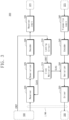
- FIG. 3 illustrates a host interface circuit 300.
- the host interface circuit 300 may correspond to the host interface circuit 222 of FIG. 2 .
- the host interface circuit 300 may include a locking circuit 310, a receiver 320, a deserializer 325, a decoder 330, receiver logic 335, transmitter logic 340, an encoder 345, a serializer 350, and a driver 355.
- the host interface circuit 300 includes a clock multiplier 315.
- the locking circuit 310 receives the reference clock signal CREF and outputs an internal reference clock signal iCREF synchronized with the reference clock signal CREF.
- the locking circuit 310 may include a delay locked loop or a phase locked loop.
- the clock multiplier 315 receives the internal reference clock signal iCREF from the locking circuit 310.
- the clock multiplier 315 generates a fifth clock signal CLK5 through frequency multiplication of the internal reference clock signal iCREF.
- the clock multiplier 315 may correspond to the clock multiplier 228 of FIG. 1 and 2 .
- the receiver 320 may receive a signal from the host device 100 through the link LINK.
- the receiver 320 may receive a signal in synchronization with the fifth clock signal CLK5.
- the signal received by the receiver 320 may be a signal of a first type (e.g., a serial type).
- the signal received by the receiver 320 may be a portion of a packet or a portion of a symbol.
- the receiver 320 may amplify the received signal and may provide the amplified signal to the deserializer 325.
- the deserializer 325 may receive a signal from the receiver 320.
- the deserializer 325 may deserialize the received signal.
- the deserializer 325 may provide the decoder 330 with a deserialized signal of a second type (e.g., a parallel type).
- the decoder 330 may receive a signal of the second type from the deserializer 325.
- the decoder 330 may perform decoding on the signal of the second type. For example, the decoder 330 may perform symbol decoding to extract bits from a symbol.
- the decoder 330 may extract 8-bit data from a 10-bit symbol. Alternatively, the decoder 330 may extract 128-bit data from a 130-bit symbol.
- the decoder 330 may provide the decoded signal to the receiver logic 335.
- the receiver logic 335 may receive the decoded signal from the decoder 330.
- the receiver logic 335 may perform pattern check on the decoded signal to determine compliance. For example, the receiver logic 335 may determine whether the decoded signal coincides with a communication protocol (e.g., a PCIe); when the decoded signal coincides with the communication protocol (e.g., a PCIe), the receiver logic 335 may determine which generation corresponds to a generation of the communication protocol coinciding with the decoded signal. When the pattern check is successful, the receiver logic 335 may provide the decoded signal to the processor 224 through the bus 221.
- a communication protocol e.g., a PCIe
- the receiver logic 335 may determine which generation corresponds to a generation of the communication protocol coinciding with the decoded signal.
- the receiver logic 335 may provide the decoded signal to the processor 224 through the bus 221.
- the transmitter logic 340 may receive a signal of the second type (e.g., a parallel type) from the processor 224 through the bus 221.
- the transmitter logic 340 may combine the signal of the second type and a pattern.
- the pattern may indicate which generation corresponds to the communication protocol (e.g., a PCIe).
- the transmitter logic 340 may provide the combined signal to the encoder 345.
- the encoder 345 may receive the combined signal from the transmitter logic 340.
- the encoder 345 may perform encoding on the combined signal. For example, the encoder 345 may perform symbol encoding to generate a symbol from bits of the combined signal.
- the encoder 345 may generate a 10-bit symbol from 8-bit data. Alternatively, the encoder 345 may generate a 130-bit symbol from 128-bit data.
- the encoder 345 may provide the encoded signal to the serializer 350.
- the serializer 350 may receive the encoded signal from the encoder 345.
- the serializer 350 may receive the fifth clock signal CLK5 from the clock multiplier 315.
- the serializer 350 may generate a signal of the first type (e.g., a serial type) by performing serialization on the encoded signal based on the fifth clock signal CLK5.
- the serializer 350 may provide the signal of the first type to the driver 355.
- the driver 355 may receive the signal of the first type from the serializer 350. The driver 355 may transmit the signal of the first type to the host device 100.
- the interface circuit 124 of the host device 100 and the host interface circuit 222 of the controller 220 in the storage device 200 may match a frequency multiplication ratio at which the clock multiplier 121 generates the fourth clock signal CLK4 and a frequency multiplication ratio at which the clock multiplier 228 or 315 generates the fifth clock signal CLK5.
- a frequency multiplication ratio may be selected as a value including 25 times, 50 times, 80 times, 160 times, or 320 times.
- the power consumption of the clock multiplier 121 of the host device 100 and the clock multiplier 228 or 315 of the storage device 200 may increase.
- the power consumption of the clock multiplier 121 of the host device 100 and the clock multiplier 228 or 315 of the storage device 200 may decrease.
- the storage device 200 may request the host device 100 to decrease the multiplication ratios of the clock multiplier 121 of the host device 100 and the clock multiplier 228 or 315 of the storage device 200.
- a speed at which the storage device 200 processes the received data may be low.
- An example of the storage device 200 processing data being low is performing a background operation (e.g., an urgent background operation) such as a migration operation of data from the first area 211 to the second area 212, from the second area 212 to the first area 211, inside the first area 211 or inside the second area, a garbage collection operation, a scrubbing operation, etc.
- a background operation e.g., an urgent background operation
- Another example of the storage device 200 processing data being low may be described below. That is, an actual speed at which data are processed may place a limit on an operating speed of the storage device 200.
- the power consumption of the host device 100 and the storage device 200 may be reduced while processing data at an optimum speed.
- FIG. 4 illustrates a first example of an operating method of the storage device 200 according to an example embodiment.
- the controller 220 may receive a write request from the host device 100.
- the controller 220 may write write-requested data into the first area 211 of the nonvolatile memory device 210.
- the controller 220 may determine whether a free capacity of the first area 211 is smaller than or equal to a first threshold value TV1.
- the first threshold value TV1 may be determined as a ratio of a total capacity of the first area 211.
- the first threshold value TV1 may be variously determined, for example, as 5%, 10%, 15%, 20%, etc.
- the determination that the free capacity of the first area 211 (faster area) is smaller than or equal to the first threshold value TV1 may lead to the following congestion event.
- the congestion event is that additional data received from the host device 100 cause a direct write operation to the second area 212 (slower area).
- a write speed of the second area 212 may be slower than a write speed of the first area 211. That is, when the free capacity of the first area 211 is smaller than or equal to the first threshold value TV1, a write speed at which the controller 220 writes data into the nonvolatile memory device 210 may decrease, a speed at which the controller 220 accesses the nonvolatile memory device 210 may decrease, and an operating speed of the storage device 200 may decrease.
- the congestion event causes the operating speed of the storage device 200 to decrease.
- the controller 220 may request the host device 100 to decrease a link speed.
- the controller 220 may request the host device 100 to decrease the multiplication ratios of the clock multiplier 121 of the host device 100 and the clock multiplier 228 or 315 of the storage device 200.
- the adjustment of multiplication ratios may be requested such that a data transfer rate of the link LINK is similar to a speed at which the controller 220 writes data into the second area 212 (slower area).
- the controller 220 may detect the reduction of an operating speed in response to the free capacity of the first area 211 decreasing. In response to the operating speed decrease, the controller 220 may request the host device 100 to decrease a link speed. Accordingly, the power consumption of the host device 100 and the storage device 200 may be reduced to a state in which a speed of processing write data is not hindered.
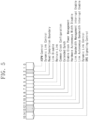
- FIG. 5 illustrates an example of a register of the controller 220.
- the register illustrated in FIG. 5 may be, for example, a link control register for a control of the link LINK.
- the bits of the register are labelled from right to left (0,1), 2, 3, 4, 5, 6, 7, 8, 9, 10, 11, (12,13), and (14,15). Parentheses are used to indicate where two bits together are used for control or configuration of something. Also, the three bits (2, 12, and 13) jointly form a control configuration. The roles of the register bits are described below.
- a 0-th bit and a first bit of the register may be used for active state power management (ASPM) control.
- a third bit of the register may be used for read completion boundary.
- a fourth bit of the register may be used for link disable.
- a fifth bit of the register may be used to retrain the link LINK.
- a retrain may refer to redoing some parts of a transmitter equalization process of the link LINK.
- a sixth bit of the register may be used for common clock configuration.
- a seventh bit of the register may be used for extended synch.
- An eighth bit of the register may be used to enable clock power management.
- a ninth bit of the register may be used for hardware autonomous width disable.
- a tenth bit of the register may be used for a link bandwidth management interrupt enable.
- An eleventh bit of the register may be used for a link autonomous bandwidth interrupt enable.
- a fourteenth bit and a fifteenth bit of the register may be used for device readiness status (DRS) signaling control.
- DRS device readiness status
- a second bit, a twelfth bit, and a thirteenth bit of the register may be used for dynamic link control.
- the dynamic link control may include a technical feature that the storage device 200 requests the host device 100 to change a transmission rate of the link LINK in response to a change of an operating speed.
- the dynamic link control may be a feature of the example embodiments described above and the example embodiments described below.
- At least one of the second bit, the twelfth bit, and the thirteenth bit of the register may be used to indicate an enable or disable of the dynamic link control.
- the controller 220 may set at least one of the second bit, the twelfth bit, and the thirteenth bit of the register to a first value (e.g., "0").
- the controller 220 may set at least one of the second bit, the twelfth bit, and the thirteenth bit of the register to a second value (e.g., "1"). Also, in response to the operating speed decrease, the controller 220 may request a retrain operation from the host device 100 by setting the fifth bit of the register to a specific value.
- a second value e.g., "1"
- the controller 220 may transmit an interrupt to the host device 100.
- the host device 100 may read the register in response to the interrupt. Afterwards, the host device 100 and the storage device 200 may decrease multiplication ratios through the retrain operation.
- the host device 100 may perform polling to read the register periodically. After reading the register, the host device 100 and the storage device 200 may decrease multiplication ratios through the retrain operation.
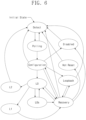
- FIG. 6 illustrates a process in which the storage device 200 establishes the link LINK with the host device 100.
- an initial state may be a detect state.
- the detect state when a connection with any other device (e.g., the host device 100) is detected, the storage device 200 may enter a polling state.
- a generation version of a protocol (e.g., a PCIe) of the host device 100 and a generation version of a protocol (e.g., a PCIe) of the storage device 200 may be checked, and a data transfer rate may be determined based on the highest generation version compatible with each other.
- the controller 220 may set a bit lock, a symbol lock, a block lock, and a lane polarity.
- the controller 220 may transmit TS1 and TS2 being an ordered set at a transmission rate of 2.5 GT/s (gigatransfers per second).
- a transfer may refer to one data transfer event in a given data-transfer channel.
- the storage device 200 may enter a configuration state.
- the controller 220 may set the number of lanes of the link LINK, that is, a link width.
- the controller 220 may exchange TS1 and TS2 with the host device 100 at a transmission rate of 2.5 GT/s.
- the controller 220 may allocate a lane number and may check and calibrate a lane reversal.
- the controller 220 may de-skew a lane-to-lane timing difference (reduce a time skew between lanes).
- the controller 220 may enter an L0 state.
- the L0 state may be a normal state.
- the controller 220 may communicate with the host device 100 through the link LINK.
- An L0s state may be an ASPM state.
- the controller 220 may reduce power consumption in the L0s state until the controller 220 enters the L0 state.
- An L1 state may be a power saving state in which power consumption is reduced more than in the L0s state.
- a voltage low enough to detect a wake-up event may be used.
- Entering a disabled state may be made when the controller 220 disables the link LINK.
- a loopback state may be a state that the controller 220 uses for test and fault isolation.
- a hot reset state may be used when the controller 220 resets the link LINK through in-band signaling.
- a recovery state is used for the controller 220 to adjust a data transfer rate.
- the controller 220 adjusts the frequency multiplication ratios of the clock multiplier 121 of the host device 100 and the clock multiplier 228 or 315 of the storage device 200.
- a recovery may occur if an error occurs on the link LINK and it is necessary to re-initialize the link LINK so that transfers can resume.
- the link LINK may be said to be recovered. If the link LINK is operating at a first operating speed and an error occurs, recovery may be performed. The first operating speed may then be said to be a recovered operating speed. Also see the discussion of FIG. 6 below, in which a transition is made from a recovery state to the normal state L0.
- the controller 220 adjusts the frequency multiplication ratios of the clock multiplier 121 of the host device 100 and the clock multiplier 228 or 315 of the storage device 200.
- FIG. 7 illustrates a second example of an operating method of the storage device 200.
- the controller 220 may allow data written in the first area 211 of the nonvolatile memory device 210 to migrate to the second area 212.
- the data that migrate to the second area 212 may be removed from the first area 211. That is, the free capacity of the first area 211 may increase.
- the controller 220 may determine whether the free capacity of the first area 211 is greater than or equal to a second threshold value TV2.
- the second threshold value TV2 may be determined as a ratio of a total capacity of the first area 211.
- the second threshold value TV2 may be variously determined, for example, as 25%, 30%, 35%, 40%, etc.
- the determination that the free capacity of the first area 211 (faster area) is greater than or equal to the second threshold value TV2 may indicate the following speed-up opportunity. Recognizing the speed-up opportunity improves operating speed when additional data is received from the host device 100, the additional data causing a write operation to the first area 211. Specifically, A write speed of the first area 211 may be higher than a write speed of the second area 212 (slower area).
- a write speed at which the controller 220 writes data into the nonvolatile memory device 210 may increase (or may be recovered), a speed at which the controller 220 accesses the nonvolatile memory device 210 may increase (or may be recovered), and an operating speed of the storage device 200 may increase (or may be recovered).
- making use of the speed-up opportunity allows the operating speed of the storage device 200 to increase.
- the controller 220 may increase (or recover) a data transfer rate of the link LINK.
- the controller 220 may increase a link speed.
- the controller 220 may request an increase of a link speed by setting (or recovering) the dynamic link control bit of the register to the first value and requesting the retrain operation as described with reference to FIG. 5 .
- the host device 100 may read the register in response to an interrupt from the controller 220 or based on the polling. As described with reference to FIG. 6 , the host device 100 and the controller 220 may increase (or recover) a link speed through the recovery state.
- the operating speed of the storage device 200 may stepwise decrease.
- the nonvolatile memory device 210 may include three or more areas having different access (or write) speeds.
- the controller 220 may stepwise increase or decrease a data transfer rate of the link LINK. That is, multiplication ratios of the clock multiplier 121 of the host device 100 and the clock multiplier 228 or 315 of the storage device 200 may be stepwise adjusted.
- the multiplication ratios of the clock multiplier 121 of the host device 100 and the clock multiplier 228 or 315 of the storage device 200 may decrease to a second step.
- the multiplication ratios of the clock multiplier 121 of the host device 100 and the clock multiplier 228 or 315 of the storage device 200 may be recovered to the first step.
- the multiplication ratios of the clock multiplier 121 of the host device 100 and the clock multiplier 228 or 315 of the storage device 200 may be recovered to the second step.
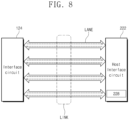
- FIG. 8 illustrates an example of the link LINK established between the interface circuit 124 of the host device 100 and the host interface circuit 222 of the storage device 200.
- the link LINK may include at least one lane LANE.
- the link LINK may include lanes LANE, the number of lanes corresponds to a number selected from numbers of 1, 2, 4, 8, and 16. In an example embodiment, it is assumed that four lanes LANE are included in the link LINK.
- the lanes LANE may transmit or receive signals at the same time.
- the lanes LANE may correspond to parallel signal lines. For example, each lane may contain two pairs of wires, one pair to send and one pair to receive. A link including one lane is thus made up of four wires.
- the lanes LANE may be set to have the same link speed.
- a data transfer rate of the link LINK may be determined by a product of the number of lanes LANE included in the link LINK, that is, a link width and a link speed of each of the lanes LANE.
- the storage device 200 may adjust a link width, that is, the number of lanes LANE included in the link LINK.
- Each of the lanes LANE may include a transmit channel and a receive channel.
- the transmit channel of the host interface circuit 222 may correspond to a dotted arrow facing toward the interface circuit 124 from the host interface circuit 222.
- the receive channel of the host interface circuit 222 may correspond to a dotted arrow facing toward the host interface circuit 222 from the interface circuit 124.
- Each of the transmit channel and the receive channel may include complementary signal lines.
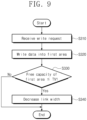
- FIG. 9 illustrates a third example of an operating method of the storage device 200.
- the controller 220 may receive a write request from the host device 100.
- the controller 220 may write write-requested data into the first area 211 of the nonvolatile memory device 210.
- the controller 220 may determine whether a free capacity of the first area 211 is smaller than or equal to the first threshold value TV1.
- the first threshold value TV1 may be determined as a ratio of a total capacity of the first area 211.
- the first threshold value TV1 may be variously determined, for example, as 5%, 10%, 15%, 20%, etc.
- a write speed at which the controller 220 writes data in the nonvolatile memory device 210 may decrease, a speed at which the controller 220 accesses the nonvolatile memory device 210 may decrease, and an operating speed of the storage device 200 may decrease (a congestion event).
- the controller 220 may request the host device 100 to decrease a link width, that is, the number of lanes LANE included in the link LINK.
- a link width that is, the number of lanes LANE included in the link LINK.
- the adjustment of the number of lanes LANE e.g., the number of enabled lanes and the number of disabled lanes
- the controller 220 may detect the reduction of an operating speed in response to the free capacity of the first area 211 decreasing. In response to the operating speed decrease, the controller 220 may request the host device 100 to decrease a link width. Accordingly, the power consumption of the host device 100 and the storage device 200 may be reduced while a speed at which write data are processed by the storage device 200 is not hindered.
- the controller 220 may adjust the number of enabled lanes of the link LINK (or the number of disabled lanes thereof) by setting the dynamic link control bit of the register in the L0 state and requesting the retrain operation.
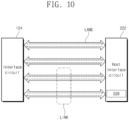
- FIG. 10 illustrates an example not covered by the claims in which a width of the link LINK is reduced compared to FIG. 8 .
- a width of the link LINK may decrease from 4 to 2.
- the interface circuit 124 and the host interface circuit 222 may maintain two of four lanes at a disable state and may set the remaining lanes, that is, two lanes to an enable state so as be included in the link LINK.
- FIG. 10 illustrates that a host and storage device may be physically connected by a fixed number of wires which generally do not change with time. Also, in FIG. 10 the number of wires in an enable state can be configured dynamically; that is the number of wires in an enable state can be generally changed at different times.
- the expression "LINK" refers to a configuration of wires in an enable state at a given point in time.
- FIG. 11 illustrates a fourth example of an operating method of the storage device 200.
- the controller 220 may allow data written into the first area 211 of the nonvolatile memory device 210 to migrate to the second area 212.
- the data that migrate to the second area 212 may be removed from the first area 211. That is, the free capacity of the first area 211 may increase.
- the controller 220 may determine whether the free capacity of the first area 211 is greater than or equal to the second threshold value TV2.
- the second threshold value TV2 may be determined as a ratio of a total capacity of the first area 211.
- the second threshold value TV2 may be variously determined, for example, as 25%, 30%, 35%, 40%, etc.
- a write speed at which the controller 220 writes data into the nonvolatile memory device 210 may increase (or may be recovered), a speed at which the controller 220 accesses the nonvolatile memory device 210 may increase (or may be recovered), and an operating speed of the storage device 200 may increase (or may be recovered).
- the controller 220 may increase (or recover) a data transfer rate of the link LINK.
- the controller 220 may increase a link speed.
- the controller 220 may request an increase of a link speed by setting (or recovering) the dynamic link control bit of the register to the first value and requesting the retrain operation as described with reference to FIG. 5 .
- the host device 100 may read the register in response to an interrupt from the controller 220 or based on the polling. As described with reference to FIG. 6 , the host device 100 and the controller 220 may increase (or recover) a link speed through the recovery state.
- the operating speed of the storage device 200 may stepwise decrease.
- the nonvolatile memory device 210 may include three or more areas having different access (or write) speeds.
- the controller 220 may stepwise increase or decrease a data transfer rate of the link LINK. That is, in an example not covered by the claims, the number of enabled lanes of the link LINK and the number of disabled lanes of the link LINK may be stepwise adjusted.
- the number of disabled lanes of the link LINK may decrease to the first step.
- the number of disabled lanes of the link LINK may decrease to the second step.
- the number of enabled lanes of the link LINK may be recovered to the first step.
- the number of enabled lanes of the link LINK may be recovered to the second step.
- FIG. 12 illustrates a storage device 200' according to another embodiment establishing the link LINK with the host device 100.
- the host device 100 corresponds to the host device 100 of FIG. 1 .
- additional description will be omitted to avoid redundancy.
- the storage device 200' includes the same components as the storage device 200 of FIG. 1 except that the storage device 200' further includes a temperature sensor 230. Thus, additional description will be omitted to avoid redundancy.
- the controller 220 may receive temperature information indicating a current temperature (e.g., an internal temperature or a case temperature) of the storage device 200' from the temperature sensor 230.
- the controller 220 may perform dynamic temperature throttling based on a temperature that the temperature information indicates.
- the controller 220 may decrease a frequency of a clock signal used in the processor 224 or the bus 221. That is, in response to a temperature increase, the controller 220 may decrease an operating speed of the storage device 200'. In response to the operating speed decrease of the storage device 200', the controller 220 may decrease a data transfer rate of the link LINK.
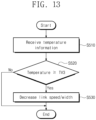
- FIG. 13 illustrates a first example of an operating method of the storage device 200' according to an example embodiment.
- the controller 220 may receive temperature information from the temperature sensor 230.
- the controller 220 may determine whether a temperature is greater than or equal to a third threshold value TV3.
- an operating speed of the storage device 200' may be decreased (dynamic temperature throttling).
- the controller 220 may request the host device 100 to decrease a link speed or a link width.
- the controller 220 may request the host device 100 to decrease multiplication ratios of the clock multiplier 121 of the host device 100 and the clock multiplier 228 or 315 of the storage device 200'.
- the controller 220 may request the host device 100 to decrease the number of lanes LANE included in the link LINK.
- the controller 220 may detect the reduction of an operating speed in response to a temperature increase. In response to the operating speed decrease, the controller 220 may request the host device 100 to decrease a link speed. Accordingly, the power consumption of the host device 100 and the storage device 200' may be reduced in a state where a speed at which write data are processed is not hindered.
- the controller 220 adjusts the multiplication ratios of the clock multiplier 121 of the host device 100 and the clock multiplier 228 or 315 of the storage device 200'. In an alternative example not covered by the claims, the controller 220 adjusts the number of enabled lanes of the link LINK (or the number of disabled lanes thereof). Both adjustments may be by setting the dynamic link control bit of the register in the L0 state and requesting the retrain operation.
- the host device 100 may read the register in response to an interrupt from the controller 220 or based on the polling. As described with reference to FIG. 6 , the host device 100 and the controller 220 may decrease a link speed or, in an example not covered by the claims, a link width through the recovery state.
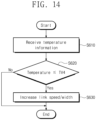
- FIG. 14 illustrates a second example of an operating method of the storage device 200'.
- the controller 220 may receive temperature information from the temperature sensor 230.
- the controller 220 may determine whether a temperature is smaller than or equal to a fourth threshold value TV4.
- the fourth threshold value TV4 may be the same as or different from the third threshold value TV3.
- the controller 220 may release the dynamic temperature throttling. That is, when the temperature is smaller than or equal to the fourth threshold value TV4, a write speed at which the controller 220 writes data into the nonvolatile memory device 210 may be increased (or may be recovered), a speed at which the controller 220 accesses the nonvolatile memory device 210 may be increased (or may be recovered), and an operating speed of the storage device 200' may be increased (or may be recovered).
- the controller 220 may increase (or recover) a data transfer rate of the link LINK.
- the controller 220 may increase a link speed or, in an example not covered by the claims, a link width.
- the controller 220 may request an increase of a link speed or, in an example not covered by the claims, a link width by setting (or recovering) the dynamic link control bit of the register to the first value and requesting the retrain operation as described with reference to FIG. 5 .
- the host device 100 may read the register in response to an interrupt from the controller 220 or based on the polling. As described with reference to FIG. 6 , the host device 100 and the controller 220 may increase (or recover) a link speed or, in an example not covered by the claims, a link width through the recovery state.
- the operating speed of the storage device 200' may stepwise decrease.
- the controller 220 may compare a temperature with two or more different threshold values and may stepwise adjust a link speed or, in an example not covered by the claims, a link width based on the different threshold values.
- a data transfer rate of the link LINK may decrease to the first step.
- the data transfer rate of the link LINK may decrease to the second step.
- the data transfer rate of the link LINK may be recovered to the first step.
- the data transfer rate of the link LINK may be recovered to the second step.
- the embodiment of the storage device 200 of FIG. 1 and the embodiment of the storage device 200' of FIG. 12 may be combined.
- the storage device 200' may adjust a data transfer rate of the link LINK based on a free capacity of the first area 211 and/or based on a temperature.
- the storage device 200 or 200' selectively adjusts a link speed and a link width for the purpose of adjusting a data transfer rate.
- the controller 220 selects at least the adjustment of a link speed among the adjustment of a link speed and the adjustment of a link width.
- the controller 220 selects at least the adjustment of a link speed among the adjustment of a link speed and the adjustment of a link width depending on a desired decrease step of an operating speed
- the storage device 200 of FIG. 1 and the storage device 200' of FIG. 12 may further include a buffer memory disposed outside the nonvolatile memory device 210 and the controller 220.
- the controller 220 may write data provided from the host device 100 into the buffer memory and may write the data written into the buffer memory into the nonvolatile memory device 210.
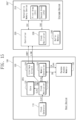
- FIG. 15 illustrates a storage device 200" according to another embodiment establishing the link LINK with the host device 100.
- the host device 100 is the same as the host device 100 of FIG. 1 .
- the storage device 200" includes the same components as the storage device 200 of FIG. 1 except that the storage device 200" further includes a buffer memory 240. Thus, repeated description will be omitted.
- the controller 220 may store data received from the host device 100 in the buffer memory 240.
- the controller 220 may support a write-back scheme to report a write completion to the host device 100 when the data are written into the buffer memory 240.
- the controller 220 may perform a flush operation of writing data stored in the buffer memory 240 into the nonvolatile memory device 210. While the flush operation is performed, the controller 220 may not process a request of the host device 100. That is, the performance of operation of the storage device 200" may be reduced. In response to an operating speed of the storage device 200" decreasing, the controller 220 may decrease a data transfer rate of the link LINK.
- the controller 220 may decrease a data transfer rate of the link LINK in response to the free capacity of the buffer memory 240 being smaller than or equal to a fifth threshold value.
- the controller 220 may perform the flush operation in response to the free capacity of the buffer memory 240 being smaller than or equal to a sixth threshold value.
- the fifth threshold value may be greater than the sixth threshold value. That is, when a decrease of an operating speed of the storage device 200" is expected, the controller 220 may decrease a data transfer rate of the link LINK.
- the storage device 200" may further include the temperature sensor 230.
- the storage device 200" may be further configured to adjust a data transfer rate of the link LINK in response to the dynamic temperature throttling being enabled.
- components according to the present disclosure are described by using the terms “first”, “second”, “third”, and the like.
- first”, “second”, “third”, and the like may be used to distinguish components from each other and do not limit the present disclosure.
- first, “second”, “third”, and the like do not involve an order or a numerical meaning of any form.
- the blocks may be implemented with various hardware devices, such as an integrated circuit, an application specific IC (ASIC), a field programmable gate array (FPGA), and a complex programmable logic device (CPLD), firmware driven in hardware devices, software such as an application, or a combination of a hardware device and software.
- ASIC application specific IC
- FPGA field programmable gate array
- CPLD complex programmable logic device
- the blocks may include circuits implemented with semiconductor elements in an integrated circuit or circuits enrolled as intellectual property (IP).
- IP intellectual property
- a storage device may adjust a transmission rate, at which the storage device communicates with an external host device, based on an internal operating speed. Accordingly, a system comprising a host device and a storage device reducing power consumption according to a communication while communicating with the host device at an improved communication speed is ereprovided.
Landscapes
- Engineering & Computer Science (AREA)
- Theoretical Computer Science (AREA)
- Physics & Mathematics (AREA)
- General Engineering & Computer Science (AREA)
- General Physics & Mathematics (AREA)
- Read Only Memory (AREA)
- Information Transfer Systems (AREA)
- Power Sources (AREA)
Claims (12)
- System, aufweisend:eine Hostvorrichtung (100), aufweisend einen Taktmultiplikator (121), der dafür ausgelegt ist, ein erstes Taktsignal (CREF) zu erzeugen, undeine Speichervorrichtung (200), aufweisend:eine nichtflüchtige Speichervorrichtung (210); undeinen Controller (220), der dafür ausgelegt ist:auf die nichtflüchtige Speichervorrichtung (210) auf Basis einer Anfrage von der Hostvorrichtung (100) zuzugreifen,das erste Taktsignal (CREF) von der Hostvorrichtung (100) zu empfangen,ein zweites Taktsignal (CLK5) durch Frequenzmultiplikation des ersten Taktsignals (CREF) zu erzeugen, undmit der Hostvorrichtung (100) auf Basis des zweiten Taktsignals (CLK5) zu kommunizieren,wobei der Controller (220) dafür ausgelegt ist, ein Multiplikationsverhältnis für die Frequenzmultiplikation des ersten Taktsignals (CREF) sowie ein Multiplikationsverhältnis des Taktmultiplikators (121) einzustellen.
- System nach Anspruch 1, wobei der Controller (220) ferner dafür ausgelegt ist, die Hostvorrichtung (100) aufzufordern, die Multiplikationsverhältnisse als Reaktion auf das Erfassen einer Abnahme einer Geschwindigkeit, mit der auf die nichtflüchtige Speichervorrichtung (210) zugegriffen wird, zu verringern.
- System nach Anspruch 1, wobei der Controller (220) ferner dafür ausgelegt ist, die Hostvorrichtung (100) aufzufordern, die Multiplikationsverhältnisse als Reaktion auf das Erfassen einer Abnahme einer Schreibgeschwindigkeit in die nichtflüchtige Speichervorrichtung (210) zu verringern.
- System nach Anspruch 1, wobei die nichtflüchtige Speichervorrichtung (210) einen ersten Bereich (211) und einen zweiten Bereich (212) aufweist, und
wobei der Controller (220) ferner dafür ausgelegt ist, die Hostvorrichtung (100) aufzufordern, die Multiplikationsverhältnisse als Reaktion darauf, dass eine freie Kapazität des ersten Bereichs (211) gleich oder geringer ist als ein erster Schwellenwert, zu verringern. - System nach Anspruch 4, wobei der Controller (220) ferner dafür ausgelegt ist:es Daten des ersten Bereichs (211) der nichtflüchtigen Speichervorrichtung (210) zu ermöglichen, in den zweiten Bereich (212) zu migrieren, unddie Hostvorrichtung (100) zu veranlassen, die Multiplikationsverhältnisse als Reaktion darauf, dass die freie Kapazität des ersten Bereichs (211) gleich oder größer ist als ein zweiter Schwellenwert, wiederherzustellen.
- System nach Anspruch 1, ferner aufweisend:einen Temperatursensor (230), der dafür ausgelegt ist, Temperaturinformationen auszugeben,wobei der Controller (220) ferner dafür ausgelegt ist:die Temperaturinformationen von dem Temperatursensor (230) zu empfangen; undeine Betriebsgeschwindigkeit der Speichervorrichtung (200) als Reaktion darauf zu begrenzen, dass eine durch die Temperaturinformationen angezeigte Temperatur gleich oder größer ist als ein erster Schwellenwert, undwobei der Controller (220) ferner dafür ausgelegt ist, die Hostvorrichtung (100) aufzufordern, die Multiplikationsverhältnisse als Reaktion darauf, dass die Temperatur gleich oder größer ist als der erste Schwellenwert, zu verringern.
- System nach Anspruch 6, wobei die Speichervorrichtung (200) ferner dafür ausgelegt ist, die Betriebsgeschwindigkeit der Speichervorrichtung (200) als Reaktion darauf, dass die Temperatur gleich oder geringer als ein zweiter Schwellenwert ist, wiederherzustellen, und
wobei der Controller (220) ferner dafür ausgelegt ist, die Hostvorrichtung (100) aufzufordern, die Multiplikationsverhältnisse als Reaktion darauf, dass die Temperatur gleich oder geringer als der zweite Schwellenwert ist, wiederherzustellen. - System nach Anspruch 1, wobei der Controller (220) ferner dafür ausgelegt ist, Informationen in ein Link-Steuerregister zu schreiben, um die Multiplikationsverhältnisse einzustellen.
- System nach Anspruch 1, wobei der Controller (220) ferner dafür ausgelegt ist, dass er, indem er Neutrainierinformationen in ein Steuerregister schreibt, einen Neutrainiervorgang zur Einstellung der Multiplikationsverhältnisse anfragt.
- System nach Anspruch 1, wobei der Controller (220) ferner dafür ausgelegt ist, die Hostvorrichtung (100) aufzufordern, die Multiplikationsverhältnisse durch Übertragen eines Interrupts an die Hostvorrichtung (100) oder durch Antworten auf eine durch die Hostvorrichtung (100) gesendete Befragung einzustellen.
- System nach Anspruch 1, wobei der Controller (220) ferner dafür ausgelegt ist, mit der Hostvorrichtung (100) auf Basis eines Peripheral-Component-Interconnect-Express-, PCIe-, -Protokolls zu kommunizieren.
- System nach Anspruch 11, wobei das Multiplikationsverhältnis für die Frequenzmultiplikation des ersten Taktsignals aus einer Gruppe von Multiplikationsverhältnissen ausgewählt ist, die 25 mal, 50 mal, 80 mal, 160 mal und 320 mal beinhaltet.
Applications Claiming Priority (2)
| Application Number | Priority Date | Filing Date | Title |
|---|---|---|---|
| KR1020200144166A KR102910362B1 (ko) | 2020-11-02 | 2020-11-02 | 스토리지 장치 및 스토리지 장치의 동작 방법 |
| US17/360,099 US11829626B2 (en) | 2020-11-02 | 2021-06-28 | Storage device and operating method of storage device |
Publications (3)
| Publication Number | Publication Date |
|---|---|
| EP3992803A2 EP3992803A2 (de) | 2022-05-04 |
| EP3992803A3 EP3992803A3 (de) | 2022-05-11 |
| EP3992803B1 true EP3992803B1 (de) | 2025-05-21 |
Family
ID=76890886
Family Applications (1)
| Application Number | Title | Priority Date | Filing Date |
|---|---|---|---|
| EP21185065.6A Active EP3992803B1 (de) | 2020-11-02 | 2021-07-12 | Speichervorrichtung und betriebsverfahren einer speichervorrichtung |
Country Status (1)
| Country | Link |
|---|---|
| EP (1) | EP3992803B1 (de) |
Family Cites Families (2)
| Publication number | Priority date | Publication date | Assignee | Title |
|---|---|---|---|---|
| US8504789B2 (en) * | 2009-06-29 | 2013-08-06 | Mosaid Technologies Incorporated | Bridging device having a frequency configurable clock domain |
| JP6640696B2 (ja) * | 2016-10-20 | 2020-02-05 | キオクシア株式会社 | インターフェースシステム |
-
2021
- 2021-07-12 EP EP21185065.6A patent/EP3992803B1/de active Active
Also Published As
| Publication number | Publication date |
|---|---|
| EP3992803A2 (de) | 2022-05-04 |
| EP3992803A3 (de) | 2022-05-11 |
Similar Documents
| Publication | Publication Date | Title |
|---|---|---|
| US11829626B2 (en) | Storage device and operating method of storage device | |
| KR101747797B1 (ko) | 사타 인터페이스 및 그것의 전원 관리 방법 | |
| US7266633B2 (en) | System and method for communicating the synchronization status of memory modules during initialization of the memory modules | |
| US8166221B2 (en) | Low-power USB superspeed device with 8-bit payload and 9-bit frame NRZI encoding for replacing 8/10-bit encoding | |
| US10503239B2 (en) | Electronic device and power management method | |
| US8200862B2 (en) | Low-power USB flash card reader using bulk-pipe streaming with UAS command re-ordering and channel separation | |
| JP6517243B2 (ja) | リンクレイヤ/物理レイヤ(phy)シリアルインターフェース | |
| US12314584B2 (en) | UFS device, method of operating the UFS device, and system including the UFS device | |
| TWI911384B (zh) | 快捷週邊組件互連(pcie)介面裝置及其操作方法 | |
| US10120590B2 (en) | Method for providing read data flow control or error reporting using a read data strobe | |
| US10181975B2 (en) | Override subsystems for rapid recovery from serial-link errors | |
| US20150092065A1 (en) | Link training in a video processing system | |
| EP2207101A1 (de) | Methode und Vorrichtung für eine parallele Schnittstelle | |
| JP3134819B2 (ja) | データ処理装置 | |
| CN115437983A (zh) | 高速外围组件互连(PCIe)接口装置及其操作方法 | |
| US10216421B2 (en) | Method of operating storage device using serial interface and method of operating data processing system including the same | |
| EP3992803B1 (de) | Speichervorrichtung und betriebsverfahren einer speichervorrichtung | |
| TW202528945A (zh) | 記憶體系統中使用主動重新訓練引擎之封閉迴路時序控制 | |
| KR20250162305A (ko) | 듀티 사이클 보정 회로를 포함하는 반도체 장치, 메모리 시스템 및 동작 방법 | |
| CN117955583A (zh) | 用于互连协议的通道同步的方法、控制器以及存储装置 | |
| JP2006065632A (ja) | 通信制御装置及び通信制御方法 |
Legal Events
| Date | Code | Title | Description |
|---|---|---|---|
| PUAI | Public reference made under article 153(3) epc to a published international application that has entered the european phase |
Free format text: ORIGINAL CODE: 0009012 |
|
| STAA | Information on the status of an ep patent application or granted ep patent |
Free format text: STATUS: REQUEST FOR EXAMINATION WAS MADE |
|
| PUAL | Search report despatched |
Free format text: ORIGINAL CODE: 0009013 |
|
| STAA | Information on the status of an ep patent application or granted ep patent |
Free format text: STATUS: EXAMINATION IS IN PROGRESS |
|
| 17P | Request for examination filed |
Effective date: 20210712 |
|
| AK | Designated contracting states |
Kind code of ref document: A2 Designated state(s): AL AT BE BG CH CY CZ DE DK EE ES FI FR GB GR HR HU IE IS IT LI LT LU LV MC MK MT NL NO PL PT RO RS SE SI SK SM TR |
|
| AK | Designated contracting states |
Kind code of ref document: A3 Designated state(s): AL AT BE BG CH CY CZ DE DK EE ES FI FR GB GR HR HU IE IS IT LI LT LU LV MC MK MT NL NO PL PT RO RS SE SI SK SM TR |
|
| RIC1 | Information provided on ipc code assigned before grant |
Ipc: G11C 16/32 20060101ALI20220404BHEP Ipc: G11C 16/10 20060101ALI20220404BHEP Ipc: G11C 7/04 20060101ALI20220404BHEP Ipc: G06F 13/16 20060101AFI20220404BHEP |
|
| 17Q | First examination report despatched |
Effective date: 20220422 |
|
| P01 | Opt-out of the competence of the unified patent court (upc) registered |
Effective date: 20230520 |
|
| GRAP | Despatch of communication of intention to grant a patent |
Free format text: ORIGINAL CODE: EPIDOSNIGR1 |
|
| STAA | Information on the status of an ep patent application or granted ep patent |
Free format text: STATUS: GRANT OF PATENT IS INTENDED |
|
| INTG | Intention to grant announced |
Effective date: 20241217 |
|
| RIC1 | Information provided on ipc code assigned before grant |
Ipc: G11C 16/32 20060101ALI20241206BHEP Ipc: G11C 16/10 20060101ALI20241206BHEP Ipc: G11C 7/22 20060101ALI20241206BHEP Ipc: G11C 7/04 20060101ALI20241206BHEP Ipc: G06F 13/16 20060101AFI20241206BHEP |
|
| RIN1 | Information on inventor provided before grant (corrected) |
Inventor name: JUN, WALTER Inventor name: YOU, DAEHUN Inventor name: KIM, JAE EUN Inventor name: KIM, SUNG-WOOK Inventor name: LIM, JAEHWAN |
|
| GRAS | Grant fee paid |
Free format text: ORIGINAL CODE: EPIDOSNIGR3 |
|
| GRAA | (expected) grant |
Free format text: ORIGINAL CODE: 0009210 |
|
| STAA | Information on the status of an ep patent application or granted ep patent |
Free format text: STATUS: THE PATENT HAS BEEN GRANTED |
|
| AK | Designated contracting states |
Kind code of ref document: B1 Designated state(s): AL AT BE BG CH CY CZ DE DK EE ES FI FR GB GR HR HU IE IS IT LI LT LU LV MC MK MT NL NO PL PT RO RS SE SI SK SM TR |
|
| REG | Reference to a national code |
Ref country code: GB Ref legal event code: FG4D |
|
| REG | Reference to a national code |
Ref country code: CH Ref legal event code: EP |
|
| REG | Reference to a national code |
Ref country code: DE Ref legal event code: R096 Ref document number: 602021031028 Country of ref document: DE |
|
| PGFP | Annual fee paid to national office [announced via postgrant information from national office to epo] |
Ref country code: NL Payment date: 20250526 Year of fee payment: 5 |
|
| REG | Reference to a national code |
Ref country code: IE Ref legal event code: FG4D |
|
| REG | Reference to a national code |
Ref country code: NL Ref legal event code: FP |
|
| PGFP | Annual fee paid to national office [announced via postgrant information from national office to epo] |
Ref country code: GB Payment date: 20250522 Year of fee payment: 5 |
|
| PG25 | Lapsed in a contracting state [announced via postgrant information from national office to epo] |
Ref country code: PT Free format text: LAPSE BECAUSE OF FAILURE TO SUBMIT A TRANSLATION OF THE DESCRIPTION OR TO PAY THE FEE WITHIN THE PRESCRIBED TIME-LIMIT Effective date: 20250922 Ref country code: FI Free format text: LAPSE BECAUSE OF FAILURE TO SUBMIT A TRANSLATION OF THE DESCRIPTION OR TO PAY THE FEE WITHIN THE PRESCRIBED TIME-LIMIT Effective date: 20250521 Ref country code: ES Free format text: LAPSE BECAUSE OF FAILURE TO SUBMIT A TRANSLATION OF THE DESCRIPTION OR TO PAY THE FEE WITHIN THE PRESCRIBED TIME-LIMIT Effective date: 20250521 |
|
| PGFP | Annual fee paid to national office [announced via postgrant information from national office to epo] |
Ref country code: DE Payment date: 20250528 Year of fee payment: 5 |
|
| REG | Reference to a national code |
Ref country code: LT Ref legal event code: MG9D |
|
| PG25 | Lapsed in a contracting state [announced via postgrant information from national office to epo] |
Ref country code: GR Free format text: LAPSE BECAUSE OF FAILURE TO SUBMIT A TRANSLATION OF THE DESCRIPTION OR TO PAY THE FEE WITHIN THE PRESCRIBED TIME-LIMIT Effective date: 20250822 Ref country code: NO Free format text: LAPSE BECAUSE OF FAILURE TO SUBMIT A TRANSLATION OF THE DESCRIPTION OR TO PAY THE FEE WITHIN THE PRESCRIBED TIME-LIMIT Effective date: 20250821 |
|
| PG25 | Lapsed in a contracting state [announced via postgrant information from national office to epo] |
Ref country code: PL Free format text: LAPSE BECAUSE OF FAILURE TO SUBMIT A TRANSLATION OF THE DESCRIPTION OR TO PAY THE FEE WITHIN THE PRESCRIBED TIME-LIMIT Effective date: 20250521 |
|
| PG25 | Lapsed in a contracting state [announced via postgrant information from national office to epo] |
Ref country code: BG Free format text: LAPSE BECAUSE OF FAILURE TO SUBMIT A TRANSLATION OF THE DESCRIPTION OR TO PAY THE FEE WITHIN THE PRESCRIBED TIME-LIMIT Effective date: 20250521 |
|
| PG25 | Lapsed in a contracting state [announced via postgrant information from national office to epo] |
Ref country code: HR Free format text: LAPSE BECAUSE OF FAILURE TO SUBMIT A TRANSLATION OF THE DESCRIPTION OR TO PAY THE FEE WITHIN THE PRESCRIBED TIME-LIMIT Effective date: 20250521 |
|
| PG25 | Lapsed in a contracting state [announced via postgrant information from national office to epo] |
Ref country code: RS Free format text: LAPSE BECAUSE OF FAILURE TO SUBMIT A TRANSLATION OF THE DESCRIPTION OR TO PAY THE FEE WITHIN THE PRESCRIBED TIME-LIMIT Effective date: 20250821 |
|
| PG25 | Lapsed in a contracting state [announced via postgrant information from national office to epo] |
Ref country code: IS Free format text: LAPSE BECAUSE OF FAILURE TO SUBMIT A TRANSLATION OF THE DESCRIPTION OR TO PAY THE FEE WITHIN THE PRESCRIBED TIME-LIMIT Effective date: 20250921 |
|
| PG25 | Lapsed in a contracting state [announced via postgrant information from national office to epo] |
Ref country code: LV Free format text: LAPSE BECAUSE OF FAILURE TO SUBMIT A TRANSLATION OF THE DESCRIPTION OR TO PAY THE FEE WITHIN THE PRESCRIBED TIME-LIMIT Effective date: 20250521 |
|
| REG | Reference to a national code |
Ref country code: AT Ref legal event code: MK05 Ref document number: 1797358 Country of ref document: AT Kind code of ref document: T Effective date: 20250521 |
|
| PG25 | Lapsed in a contracting state [announced via postgrant information from national office to epo] |
Ref country code: AT Free format text: LAPSE BECAUSE OF FAILURE TO SUBMIT A TRANSLATION OF THE DESCRIPTION OR TO PAY THE FEE WITHIN THE PRESCRIBED TIME-LIMIT Effective date: 20250521 Ref country code: DK Free format text: LAPSE BECAUSE OF FAILURE TO SUBMIT A TRANSLATION OF THE DESCRIPTION OR TO PAY THE FEE WITHIN THE PRESCRIBED TIME-LIMIT Effective date: 20250521 Ref country code: SM Free format text: LAPSE BECAUSE OF FAILURE TO SUBMIT A TRANSLATION OF THE DESCRIPTION OR TO PAY THE FEE WITHIN THE PRESCRIBED TIME-LIMIT Effective date: 20250521 |
|
| PG25 | Lapsed in a contracting state [announced via postgrant information from national office to epo] |
Ref country code: CZ Free format text: LAPSE BECAUSE OF FAILURE TO SUBMIT A TRANSLATION OF THE DESCRIPTION OR TO PAY THE FEE WITHIN THE PRESCRIBED TIME-LIMIT Effective date: 20250521 |
|
| PG25 | Lapsed in a contracting state [announced via postgrant information from national office to epo] |
Ref country code: EE Free format text: LAPSE BECAUSE OF FAILURE TO SUBMIT A TRANSLATION OF THE DESCRIPTION OR TO PAY THE FEE WITHIN THE PRESCRIBED TIME-LIMIT Effective date: 20250521 |
|
| PG25 | Lapsed in a contracting state [announced via postgrant information from national office to epo] |
Ref country code: RO Free format text: LAPSE BECAUSE OF FAILURE TO SUBMIT A TRANSLATION OF THE DESCRIPTION OR TO PAY THE FEE WITHIN THE PRESCRIBED TIME-LIMIT Effective date: 20250521 Ref country code: SK Free format text: LAPSE BECAUSE OF FAILURE TO SUBMIT A TRANSLATION OF THE DESCRIPTION OR TO PAY THE FEE WITHIN THE PRESCRIBED TIME-LIMIT Effective date: 20250521 |
|
| PG25 | Lapsed in a contracting state [announced via postgrant information from national office to epo] |
Ref country code: IT Free format text: LAPSE BECAUSE OF FAILURE TO SUBMIT A TRANSLATION OF THE DESCRIPTION OR TO PAY THE FEE WITHIN THE PRESCRIBED TIME-LIMIT Effective date: 20250521 |
|
| REG | Reference to a national code |
Ref country code: CH Ref legal event code: H13 Free format text: ST27 STATUS EVENT CODE: U-0-0-H10-H13 (AS PROVIDED BY THE NATIONAL OFFICE) Effective date: 20260224 Ref country code: DE Ref legal event code: R097 Ref document number: 602021031028 Country of ref document: DE |
|
| PG25 | Lapsed in a contracting state [announced via postgrant information from national office to epo] |
Ref country code: LU Free format text: LAPSE BECAUSE OF NON-PAYMENT OF DUE FEES Effective date: 20250712 |
|
| REG | Reference to a national code |
Ref country code: BE Ref legal event code: MM Effective date: 20250731 |
|
| PLBE | No opposition filed within time limit |
Free format text: ORIGINAL CODE: 0009261 |
|
| STAA | Information on the status of an ep patent application or granted ep patent |
Free format text: STATUS: NO OPPOSITION FILED WITHIN TIME LIMIT |
|
| REG | Reference to a national code |
Ref country code: CH Ref legal event code: L10 Free format text: ST27 STATUS EVENT CODE: U-0-0-L10-L00 (AS PROVIDED BY THE NATIONAL OFFICE) Effective date: 20260402 |
|
| PGFP | Annual fee paid to national office [announced via postgrant information from national office to epo] |
Ref country code: AT Payment date: 20260410 Year of fee payment: 5 |
|
| PG25 | Lapsed in a contracting state [announced via postgrant information from national office to epo] |
Ref country code: BE Free format text: LAPSE BECAUSE OF NON-PAYMENT OF DUE FEES Effective date: 20250731 |
|
| PG25 | Lapsed in a contracting state [announced via postgrant information from national office to epo] |
Ref country code: FR Free format text: LAPSE BECAUSE OF NON-PAYMENT OF DUE FEES Effective date: 20250721 |