EP3985777A1 - Secondary battery - Google Patents
Secondary battery Download PDFInfo
- Publication number
- EP3985777A1 EP3985777A1 EP20823607.5A EP20823607A EP3985777A1 EP 3985777 A1 EP3985777 A1 EP 3985777A1 EP 20823607 A EP20823607 A EP 20823607A EP 3985777 A1 EP3985777 A1 EP 3985777A1
- Authority
- EP
- European Patent Office
- Prior art keywords
- negative electrode
- electrolytic solution
- positive electrode
- secondary battery
- aqueous solvent
- Prior art date
- Legal status (The legal status is an assumption and is not a legal conclusion. Google has not performed a legal analysis and makes no representation as to the accuracy of the status listed.)
- Granted
Links
Images

Classifications
-
- H—ELECTRICITY
- H01—ELECTRIC ELEMENTS
- H01M—PROCESSES OR MEANS, e.g. BATTERIES, FOR THE DIRECT CONVERSION OF CHEMICAL ENERGY INTO ELECTRICAL ENERGY
- H01M10/00—Secondary cells; Manufacture thereof
- H01M10/05—Accumulators with non-aqueous electrolyte
- H01M10/056—Accumulators with non-aqueous electrolyte characterised by the materials used as electrolytes, e.g. mixed inorganic/organic electrolytes
- H01M10/0564—Accumulators with non-aqueous electrolyte characterised by the materials used as electrolytes, e.g. mixed inorganic/organic electrolytes the electrolyte being constituted of organic materials only
- H01M10/0566—Liquid materials
- H01M10/0569—Liquid materials characterised by the solvents
-
- H—ELECTRICITY
- H01—ELECTRIC ELEMENTS
- H01M—PROCESSES OR MEANS, e.g. BATTERIES, FOR THE DIRECT CONVERSION OF CHEMICAL ENERGY INTO ELECTRICAL ENERGY
- H01M10/00—Secondary cells; Manufacture thereof
- H01M10/05—Accumulators with non-aqueous electrolyte
- H01M10/052—Li-accumulators
-
- H—ELECTRICITY
- H01—ELECTRIC ELEMENTS
- H01M—PROCESSES OR MEANS, e.g. BATTERIES, FOR THE DIRECT CONVERSION OF CHEMICAL ENERGY INTO ELECTRICAL ENERGY
- H01M10/00—Secondary cells; Manufacture thereof
- H01M10/05—Accumulators with non-aqueous electrolyte
- H01M10/052—Li-accumulators
- H01M10/0525—Rocking-chair batteries, i.e. batteries with lithium insertion or intercalation in both electrodes; Lithium-ion batteries
-
- H—ELECTRICITY
- H01—ELECTRIC ELEMENTS
- H01M—PROCESSES OR MEANS, e.g. BATTERIES, FOR THE DIRECT CONVERSION OF CHEMICAL ENERGY INTO ELECTRICAL ENERGY
- H01M10/00—Secondary cells; Manufacture thereof
- H01M10/05—Accumulators with non-aqueous electrolyte
- H01M10/056—Accumulators with non-aqueous electrolyte characterised by the materials used as electrolytes, e.g. mixed inorganic/organic electrolytes
- H01M10/0564—Accumulators with non-aqueous electrolyte characterised by the materials used as electrolytes, e.g. mixed inorganic/organic electrolytes the electrolyte being constituted of organic materials only
- H01M10/0566—Liquid materials
-
- H—ELECTRICITY
- H01—ELECTRIC ELEMENTS
- H01M—PROCESSES OR MEANS, e.g. BATTERIES, FOR THE DIRECT CONVERSION OF CHEMICAL ENERGY INTO ELECTRICAL ENERGY
- H01M10/00—Secondary cells; Manufacture thereof
- H01M10/05—Accumulators with non-aqueous electrolyte
- H01M10/056—Accumulators with non-aqueous electrolyte characterised by the materials used as electrolytes, e.g. mixed inorganic/organic electrolytes
- H01M10/0564—Accumulators with non-aqueous electrolyte characterised by the materials used as electrolytes, e.g. mixed inorganic/organic electrolytes the electrolyte being constituted of organic materials only
- H01M10/0566—Liquid materials
- H01M10/0567—Liquid materials characterised by the additives
-
- H—ELECTRICITY
- H01—ELECTRIC ELEMENTS
- H01M—PROCESSES OR MEANS, e.g. BATTERIES, FOR THE DIRECT CONVERSION OF CHEMICAL ENERGY INTO ELECTRICAL ENERGY
- H01M10/00—Secondary cells; Manufacture thereof
- H01M10/05—Accumulators with non-aqueous electrolyte
- H01M10/056—Accumulators with non-aqueous electrolyte characterised by the materials used as electrolytes, e.g. mixed inorganic/organic electrolytes
- H01M10/0564—Accumulators with non-aqueous electrolyte characterised by the materials used as electrolytes, e.g. mixed inorganic/organic electrolytes the electrolyte being constituted of organic materials only
- H01M10/0566—Liquid materials
- H01M10/0568—Liquid materials characterised by the solutes
-
- H—ELECTRICITY
- H01—ELECTRIC ELEMENTS
- H01M—PROCESSES OR MEANS, e.g. BATTERIES, FOR THE DIRECT CONVERSION OF CHEMICAL ENERGY INTO ELECTRICAL ENERGY
- H01M10/00—Secondary cells; Manufacture thereof
- H01M10/05—Accumulators with non-aqueous electrolyte
- H01M10/058—Construction or manufacture
-
- H—ELECTRICITY
- H01—ELECTRIC ELEMENTS
- H01M—PROCESSES OR MEANS, e.g. BATTERIES, FOR THE DIRECT CONVERSION OF CHEMICAL ENERGY INTO ELECTRICAL ENERGY
- H01M4/00—Electrodes
- H01M4/02—Electrodes composed of, or comprising, active material
- H01M4/04—Processes of manufacture in general
- H01M4/0402—Methods of deposition of the material
- H01M4/0404—Methods of deposition of the material by coating on electrode collectors
-
- H—ELECTRICITY
- H01—ELECTRIC ELEMENTS
- H01M—PROCESSES OR MEANS, e.g. BATTERIES, FOR THE DIRECT CONVERSION OF CHEMICAL ENERGY INTO ELECTRICAL ENERGY
- H01M4/00—Electrodes
- H01M4/02—Electrodes composed of, or comprising, active material
- H01M4/13—Electrodes for accumulators with non-aqueous electrolyte, e.g. for lithium-accumulators; Processes of manufacture thereof
- H01M4/131—Electrodes based on mixed oxides or hydroxides, or on mixtures of oxides or hydroxides, e.g. LiCoOx
-
- H—ELECTRICITY
- H01—ELECTRIC ELEMENTS
- H01M—PROCESSES OR MEANS, e.g. BATTERIES, FOR THE DIRECT CONVERSION OF CHEMICAL ENERGY INTO ELECTRICAL ENERGY
- H01M4/00—Electrodes
- H01M4/02—Electrodes composed of, or comprising, active material
- H01M4/36—Selection of substances as active materials, active masses, active liquids
- H01M4/38—Selection of substances as active materials, active masses, active liquids of elements or alloys
- H01M4/386—Silicon or alloys based on silicon
-
- H—ELECTRICITY
- H01—ELECTRIC ELEMENTS
- H01M—PROCESSES OR MEANS, e.g. BATTERIES, FOR THE DIRECT CONVERSION OF CHEMICAL ENERGY INTO ELECTRICAL ENERGY
- H01M4/00—Electrodes
- H01M4/02—Electrodes composed of, or comprising, active material
- H01M4/36—Selection of substances as active materials, active masses, active liquids
- H01M4/38—Selection of substances as active materials, active masses, active liquids of elements or alloys
- H01M4/387—Tin or alloys based on tin
-
- H—ELECTRICITY
- H01—ELECTRIC ELEMENTS
- H01M—PROCESSES OR MEANS, e.g. BATTERIES, FOR THE DIRECT CONVERSION OF CHEMICAL ENERGY INTO ELECTRICAL ENERGY
- H01M4/00—Electrodes
- H01M4/02—Electrodes composed of, or comprising, active material
- H01M4/36—Selection of substances as active materials, active masses, active liquids
- H01M4/38—Selection of substances as active materials, active masses, active liquids of elements or alloys
- H01M4/46—Alloys based on magnesium or aluminium
-
- H—ELECTRICITY
- H01—ELECTRIC ELEMENTS
- H01M—PROCESSES OR MEANS, e.g. BATTERIES, FOR THE DIRECT CONVERSION OF CHEMICAL ENERGY INTO ELECTRICAL ENERGY
- H01M4/00—Electrodes
- H01M4/02—Electrodes composed of, or comprising, active material
- H01M4/36—Selection of substances as active materials, active masses, active liquids
- H01M4/38—Selection of substances as active materials, active masses, active liquids of elements or alloys
- H01M4/46—Alloys based on magnesium or aluminium
- H01M4/463—Aluminium based
-
- H—ELECTRICITY
- H01—ELECTRIC ELEMENTS
- H01M—PROCESSES OR MEANS, e.g. BATTERIES, FOR THE DIRECT CONVERSION OF CHEMICAL ENERGY INTO ELECTRICAL ENERGY
- H01M4/00—Electrodes
- H01M4/02—Electrodes composed of, or comprising, active material
- H01M4/36—Selection of substances as active materials, active masses, active liquids
- H01M4/48—Selection of substances as active materials, active masses, active liquids of inorganic oxides or hydroxides
- H01M4/50—Selection of substances as active materials, active masses, active liquids of inorganic oxides or hydroxides of manganese
- H01M4/505—Selection of substances as active materials, active masses, active liquids of inorganic oxides or hydroxides of manganese of mixed oxides or hydroxides containing manganese for inserting or intercalating light metals, e.g. LiMn2O4 or LiMn2OxFy
-
- H—ELECTRICITY
- H01—ELECTRIC ELEMENTS
- H01M—PROCESSES OR MEANS, e.g. BATTERIES, FOR THE DIRECT CONVERSION OF CHEMICAL ENERGY INTO ELECTRICAL ENERGY
- H01M4/00—Electrodes
- H01M4/02—Electrodes composed of, or comprising, active material
- H01M4/36—Selection of substances as active materials, active masses, active liquids
- H01M4/48—Selection of substances as active materials, active masses, active liquids of inorganic oxides or hydroxides
- H01M4/52—Selection of substances as active materials, active masses, active liquids of inorganic oxides or hydroxides of nickel, cobalt or iron
- H01M4/525—Selection of substances as active materials, active masses, active liquids of inorganic oxides or hydroxides of nickel, cobalt or iron of mixed oxides or hydroxides containing iron, cobalt or nickel for inserting or intercalating light metals, e.g. LiNiO2, LiCoO2 or LiCoOxFy
-
- H—ELECTRICITY
- H01—ELECTRIC ELEMENTS
- H01M—PROCESSES OR MEANS, e.g. BATTERIES, FOR THE DIRECT CONVERSION OF CHEMICAL ENERGY INTO ELECTRICAL ENERGY
- H01M4/00—Electrodes
- H01M4/02—Electrodes composed of, or comprising, active material
- H01M4/36—Selection of substances as active materials, active masses, active liquids
- H01M4/58—Selection of substances as active materials, active masses, active liquids of inorganic compounds other than oxides or hydroxides, e.g. sulfides, selenides, tellurides, halogenides or LiCoFy; of polyanionic structures, e.g. phosphates, silicates or borates
-
- H—ELECTRICITY
- H01—ELECTRIC ELEMENTS
- H01M—PROCESSES OR MEANS, e.g. BATTERIES, FOR THE DIRECT CONVERSION OF CHEMICAL ENERGY INTO ELECTRICAL ENERGY
- H01M4/00—Electrodes
- H01M4/02—Electrodes composed of, or comprising, active material
- H01M4/64—Carriers or collectors
-
- H—ELECTRICITY
- H01—ELECTRIC ELEMENTS
- H01M—PROCESSES OR MEANS, e.g. BATTERIES, FOR THE DIRECT CONVERSION OF CHEMICAL ENERGY INTO ELECTRICAL ENERGY
- H01M4/00—Electrodes
- H01M4/02—Electrodes composed of, or comprising, active material
- H01M4/64—Carriers or collectors
- H01M4/66—Selection of materials
- H01M4/661—Metal or alloys, e.g. alloy coatings
-
- H—ELECTRICITY
- H01—ELECTRIC ELEMENTS
- H01M—PROCESSES OR MEANS, e.g. BATTERIES, FOR THE DIRECT CONVERSION OF CHEMICAL ENERGY INTO ELECTRICAL ENERGY
- H01M4/00—Electrodes
- H01M4/02—Electrodes composed of, or comprising, active material
- H01M2004/026—Electrodes composed of, or comprising, active material characterised by the polarity
- H01M2004/027—Negative electrodes
-
- H—ELECTRICITY
- H01—ELECTRIC ELEMENTS
- H01M—PROCESSES OR MEANS, e.g. BATTERIES, FOR THE DIRECT CONVERSION OF CHEMICAL ENERGY INTO ELECTRICAL ENERGY
- H01M4/00—Electrodes
- H01M4/02—Electrodes composed of, or comprising, active material
- H01M2004/026—Electrodes composed of, or comprising, active material characterised by the polarity
- H01M2004/028—Positive electrodes
-
- H—ELECTRICITY
- H01—ELECTRIC ELEMENTS
- H01M—PROCESSES OR MEANS, e.g. BATTERIES, FOR THE DIRECT CONVERSION OF CHEMICAL ENERGY INTO ELECTRICAL ENERGY
- H01M2300/00—Electrolytes
- H01M2300/0017—Non-aqueous electrolytes
-
- H—ELECTRICITY
- H01—ELECTRIC ELEMENTS
- H01M—PROCESSES OR MEANS, e.g. BATTERIES, FOR THE DIRECT CONVERSION OF CHEMICAL ENERGY INTO ELECTRICAL ENERGY
- H01M2300/00—Electrolytes
- H01M2300/0017—Non-aqueous electrolytes
- H01M2300/0025—Organic electrolyte
- H01M2300/0028—Organic electrolyte characterised by the solvent
-
- H—ELECTRICITY
- H01—ELECTRIC ELEMENTS
- H01M—PROCESSES OR MEANS, e.g. BATTERIES, FOR THE DIRECT CONVERSION OF CHEMICAL ENERGY INTO ELECTRICAL ENERGY
- H01M2300/00—Electrolytes
- H01M2300/0017—Non-aqueous electrolytes
- H01M2300/0025—Organic electrolyte
- H01M2300/0028—Organic electrolyte characterised by the solvent
- H01M2300/0034—Fluorinated solvents
-
- Y—GENERAL TAGGING OF NEW TECHNOLOGICAL DEVELOPMENTS; GENERAL TAGGING OF CROSS-SECTIONAL TECHNOLOGIES SPANNING OVER SEVERAL SECTIONS OF THE IPC; TECHNICAL SUBJECTS COVERED BY FORMER USPC CROSS-REFERENCE ART COLLECTIONS [XRACs] AND DIGESTS
- Y02—TECHNOLOGIES OR APPLICATIONS FOR MITIGATION OR ADAPTATION AGAINST CLIMATE CHANGE
- Y02E—REDUCTION OF GREENHOUSE GAS [GHG] EMISSIONS, RELATED TO ENERGY GENERATION, TRANSMISSION OR DISTRIBUTION
- Y02E60/00—Enabling technologies; Technologies with a potential or indirect contribution to GHG emissions mitigation
- Y02E60/10—Energy storage using batteries
Definitions
- the present invention relates to a secondary battery.
- Patent Literature 1 discloses a lithium ion secondary battery capable of attaining good cycle characteristics, in which the lithium ion secondary battery includes a negative electrode containing a silicon material that is a high-capacity negative electrode active material.
- Patent Literature 1 WO 2018/221346
- One aspect of the present invention aims at suppressing a decrease in discharge capacity in a secondary battery using a negative electrode active material containing silicon, tin, or aluminum as a constituent element.
- An aspect of the present invention is a secondary battery including: a positive electrode current collector; a negative electrode current collector; an electrolyte layer disposed between the positive electrode current collector and the negative electrode current collector; a positive electrode electrolytic solution filling part partitioned by the positive electrode current collector and the electrolyte layer; and a negative electrode electrolytic solution filling part partitioned by the negative electrode current collector and the electrolyte layer, wherein the negative electrode electrolytic solution filling part includes: a conductive member having a mesh structure and disposed so as to bring the negative electrode current collector and the electrolyte layer into conduction; a negative electrode active material retained in the conductive member; an electrolyte salt; and a non-aqueous solvent dissolving the electrolyte salt, and the negative electrode active material contains at least one selected from the group consisting of silicon, tin, and aluminum, as a constituent element.
- the negative electrode active material coexists with the negative electrode electrolytic solution in a state of being retained in the conductive member, and thereby this secondary battery functions as a secondary battery. Then, in this secondary battery, since the negative electrode active material is retained in the conductive member, even in a case where the negative electrode active material containing silicon, tin, or aluminum as a constituent element is micronized by charging and discharging of the secondary battery, the negative electrode active material is easily captured by the mesh structure of the conductive member, and subsequently, this negative electrode active material may function as a negative electrode active material. Therefore, in this secondary battery, as compared to a conventional secondary battery in which the negative electrode active material is retained on the negative electrode current collector, a decrease in discharge capacity caused by the micronization of the negative electrode active material can be suppressed.
- this secondary battery is provided with the positive electrode electrolytic solution filling part and the negative electrode electrolytic solution filling part separately, electrolytic solutions having compositions suitable for respective electrodes can be separately used as the positive electrode electrolytic solution and the negative electrode electrolytic solution. Therefore, as compared to a conventional secondary battery using a common electrolytic solution in the positive electrode and the negative electrode, the performance of the secondary battery can be improved.
- the conductive member may be formed of a carbon material.
- the non-aqueous solvent may contain 10% by mass or more of fluoroethylene carbonate on a basis of a total amount of the non-aqueous solvent and may be composed only of fluoroethylene carbonate.
- the non-aqueous solvent may contain 10% by mass or more of vinylene carbonate on a basis of a total amount of the non-aqueous solvent and may be composed only of vinylene carbonate.
- the non-aqueous solvent may contain 10% by mass or more of at least one selected from the group consisting of 12-crown-4, 18-crown-6, 1,2-dimethoxyethane, tetraethylene glycol dimethyl ether, ⁇ -butyrolactone, 1-methyl-2-pyrrolidinone, ethyl heptanoate, tetrahydrofuran, ethylene glycol bis(propionitrile)ether, 2-(methylamino)ethanol, and diaminohexane, on a basis of a total amount of the non-aqueous solvent, and may be composed only of the at least one.
- the negative electrode active material may contain 10% by mass or more of silicon on a basis of a total amount of the negative electrode active material, as a constituent element.
- the negative electrode active material may contain 10% by mass or more of tin on a basis of a total amount of the negative electrode active material, as a constituent element.
- the negative electrode active material may contain 10% by mass or more of aluminum on a basis of a total amount of the negative electrode active material, as a constituent element.
- the positive electrode electrolytic solution filling part may include: a conductive member having a mesh structure and disposed so as to bring the positive electrode current collector and the electrolyte layer into conduction; a positive electrode active material retained in the conductive member; an electrolyte salt; and a non-aqueous solvent dissolving the electrolyte salt.
- the non-aqueous solvent contained in the positive electrode electrolytic solution filling part may be a non-aqueous solvent that is different from the non-aqueous solvent contained in the negative electrode electrolytic solution filling part.
- a content of fluoroethylene carbonate in the positive electrode electrolytic solution filling part may be 0.1% by mass or less on a basis of a total amount of the non-aqueous solvent contained in the positive electrode electrolytic solution filling part.
- the positive electrode electrolytic solution filling part may not contain fluoroethylene carbonate.
- a content of vinylene carbonate in the positive electrode electrolytic solution filling part may be 0.1% by mass or less on a basis of a total amount of the non-aqueous solvent contained in the positive electrode electrolytic solution filling part.
- the positive electrode electrolytic solution filling part may not contain vinylene carbonate.
- a decrease in discharge capacity can be suppressed.
- FIG. 1 is a perspective view illustrating a secondary battery according to an embodiment.
- a secondary battery 1 according to an embodiment is a so-called laminate type secondary battery that includes an electrode group 2 and a pouch-shaped battery outer casing body 3 accommodating the electrode group 2.
- a positive electrode current collector tab 4 and a negative electrode current collector tab 5 are provided in the electrode group 2.
- the positive electrode current collector tab 4 and the negative electrode current collector tab 5 protrude from the inside of the battery outer casing body 3 to the outside so that each of a positive electrode current collector and a negative electrode current collector (details thereof will be described below) can be electrically connected to the outside of the secondary battery 1.
- the secondary battery 1 may be a secondary battery having a shape (a coin shape, a cylindrical shape, or the like) other than the laminate type.
- the battery outer casing body 3 may be, for example, a container formed of a laminate film.
- the laminate film may be, for example, a laminate film in which a polymer film such as a polyethylene terephthalate (PET) film, a metallic foil such as aluminum, copper, or stainless steel, and a sealant layer such as polypropylene are laminated in this order.
- PET polyethylene terephthalate
- metallic foil such as aluminum, copper, or stainless steel
- sealant layer such as polypropylene
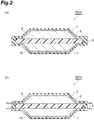
- FIG. 2 is a cross-sectional view taken along line II-II in FIG. 1 .
- the secondary battery 1 includes: in the battery outer casing body 3, a positive electrode current collector 6; a negative electrode current collector 7; an electrolyte layer 8 disposed between the positive electrode current collector 6 and the negative electrode current collector 7; a positive electrode electrolytic solution filling part 9 partitioned by the positive electrode current collector 6 and the electrolyte layer 8; and a negative electrode electrolytic solution filling part 10 partitioned by the negative electrode current collector 7 and the electrolyte layer 8.
- the battery outer casing body 3 is sealed so that the positive electrode electrolytic solution and the negative electrode electrolytic solution are not caused to leak out from the positive electrode electrolytic solution filling part 9 and the negative electrode electrolytic solution filling part 10, respectively.
- the entirety of the positive electrode current collector 6 and the negative electrode current collector 7 may be accommodated inside the battery outer casing body 3.
- both end portions of the positive electrode current collector 6 and the negative electrode current collector 7 may protrude to the outside of the battery outer casing body 3.
- the positive electrode current collector 6 is formed, for example, of aluminum, titanium, stainless steel, nickel, baked carbon, an electrically conductive polymer, electrically conductive glass, or the like.
- the thickness of the positive electrode current collector 6 may be 1 ⁇ m or more and may be 50 ⁇ m or less, for example.
- the negative electrode current collector 7 is formed, for example, of copper, stainless steel, nickel, aluminum, titanium, baked carbon, an electrically conductive polymer, electrically conductive glass, an aluminum-cadmium alloy, or the like.
- the thickness of the negative electrode current collector 7 may be 1 ⁇ m or more and may be 50 ⁇ m or less, for example.
- the electrolyte layer 8 is a layer that allows cations derived from the electrolyte salt (for example, lithium cations) contained in the positive electrode electrolytic solution filling part 9 and the negative electrode electrolytic solution filling part 10 to pass through the layer and does not allow active materials (the positive electrode active material and the negative electrode active material) and components other than the cations (for example, the above-described non-aqueous solvent) contained in the positive electrode electrolytic solution filling part 9 and the negative electrode electrolytic solution filling part 10 to pass through the layer.
- the electrolyte layer 8 may be, for example, an electrolyte layer 8 that is non-porous (the electrolyte layer 8 having no pores).
- the thickness of the electrolyte layer 8 is preferably 1 ⁇ m or more from the viewpoint of obtaining superior strength, and is preferably 500 ⁇ m or less from the viewpoint that the resistance of ion conduction in the electrolyte layer 8 is reduced, and as a result, the resistance of the secondary battery 1 can be reduced.
- Such an electrolyte layer 8 may be a solid electrolyte material showing lithium ion conductivity, may be formed of, for example, an oxide-based solid electrolyte, and may be formed of a polymer.
- the electrolyte layer 8 may be, for example, a perfluorosulfonic acid-based ion-exchange membrane.
- the perfluorosulfonic acid-based ion-exchange membrane is, for example, composed of a polymer having a structural unit represented by Formula (1) below.
- x, y, m, and n represent an integer of 1 to 20, an integer of 1 to 1000, an integer of 0 or 1, and an integer of 1 to 10, respectively, and X represents a hydrogen atom, an alkali metal atom, or an alkali earth metal atom.
- Such a polymer can be synthesized, for example, by a known method and can also be purchased as Nafion (registered trademark, manufactured by DowDuPont, Inc.), Dow Film (manufactured by DowDuPont, Inc.), Aciplex (registered trademark, manufactured by Asahi Kasei Corp.), or Flemion (registered trademark, manufactured by AGC Inc.).
- Nafion registered trademark, manufactured by DowDuPont, Inc.
- Dow Film manufactured by DowDuPont, Inc.
- Aciplex registered trademark, manufactured by Asahi Kasei Corp.
- Flemion registered trademark, manufactured by AGC Inc.
- the polymer constituting the electrolyte layer 8 may be, for example, polyvinyl alcohol, polyacrylamide, polyvinylpyrrolidone, polyethylene oxide, polyacrylic acid, polymethacrylic acid, sulfonated polyimide, sulfonated poly(etheretherketone), sulfonated poly(ether sulfone), or sulfonated poly(p-phenylene). These polymers are preferably ion-exchanged for use.
- a conductive member is disposed so as to bring the positive electrode current collector 6 and the electrolyte layer 8 into conduction.
- the conductive member has a mesh structure.
- the conductive member may be provided in a part of the positive electrode electrolytic solution filling part 9 or may be provided to embed the whole positive electrode electrolytic solution filling part 9.
- the thickness of the positive electrode electrolytic solution filling part 9 may be 5 ⁇ m or more and may be 2000 ⁇ m or less, for example.
- the conductive member may have, for example, a sheet shape.
- the conductive member is formed of an electrically conductive material.
- Examples of the electrically conductive material include a carbon material, a metal material, and an electrically conductive polymer material.
- Examples of the carbon material include carbon black, graphite, soft carbon, hard carbon, carbon nanotube, carbon nanofiber, graphene, carbon nanohorn, glassy carbon, and expanded graphite.
- Examples of the metal material include nickel, aluminum, copper, stainless steel, gold, and silver.
- Examples of the electrically conductive polymer material include materials with which polymer compounds such as polyacetylene, poly(p-phenylenevinylene), polypyrrole, polythiophene, polyaniline, and poly(p-phenylenesulfide) are doped.
- the doping method is not particularly limited, but may be a method of adding a compound of an electron acceptor (acceptor) such as iodine or arsenic pentafluoride, an electron donor (donor) such as an alkali metal, or the like to the polymer compound.
- a member formed in a mesh structure in advance may be used as the conductive member.
- a conductive member include a conductive member formed of a carbon material such as carbon felt, carbon paper, or carbon cloth and a conductive member formed of a metal material such as punching metal (a metal plate in which a mesh structure is formed by punching).
- the positive electrode electrolytic solution filling part 9 contains a positive electrode electrolytic solution, and specifically contains, for example, a positive electrode active material, an electrolyte salt, and a non-aqueous solvent.
- the positive electrode active material preferably exists in a state of being dispersed in the positive electrode electrolytic solution (a non-aqueous solvent).
- the positive electrode active material is not retained (fixed) in the positive electrode current collector 6, and the positive electrode electrolytic solution filling part 9 preferably does not contain a binder for retaining (fixing) the positive electrode active material in the positive electrode current collector 6.
- the positive electrode active material may be, for example, a lithium oxide.
- the positive electrode active material may be, for example, a phosphoric salt of lithium.
- the phosphoric salt of lithium include lithium manganese phosphate (LiMnPO 4 ), lithium iron phosphate (LiFePO 4 ), lithium cobalt phosphate (LiCoPO 4 ), and lithium vanadium phosphate (Li 3 V 2 (PO 4 ) 3 ).
- a content of the positive electrode active material may be 10 parts by mass or more and may be 80 parts by mass or less, with respect to 100 parts by mass of a total mass of the positive electrode active material, the non-aqueous solvent, and the conductive member contained in the positive electrode electrolytic solution filling part 9.
- the electrolyte salt may be, for example, a lithium salt.
- the lithium salt may be, for example, at least one selected from the group consisting of LiPF 6 , LiBF 4 , LiClO 4 , LiB(C 6 H 5 ) 4 , LiCH 3 SO 3 , CF 3 SO 2 OLi, LiN(SO 2 F) 2 (Li[FSI], lithium bisfluorosulfonyl imide), LiN(SO 2 CF 3 ) 2 (Li[TFSI], lithium bistrifluoromethanesulfonyl imide), and LiN(SO 2 CF 2 CF 3 ) 2 .
- a content of the electrolyte salt may be 0.5 mol/L or more, 0.7 mol/L or more, or 0.8 mol/L or more, and may be 1.5 mol/L or less, 1.3 mol/L or less, or 1.2 mol/L or less, on a basis of a total amount of the non-aqueous solvent.
- the non-aqueous solvent is a solvent that can dissolve an electrolyte salt contained in the positive electrode electrolytic solution filling part 9.
- the non-aqueous solvent include a non-aqueous solvent that can be suitably used in both the positive electrode electrolytic solution and the negative electrode electrolytic solution, and a non-aqueous solvent that can be suitably used only in the positive electrode electrolytic solution (that is not suitable for the negative electrode electrolytic solution).
- the non-aqueous solvent is used singly or in combination of two or more types thereof.
- the non-aqueous solvent that can be suitably used in both the positive electrode electrolytic solution and the negative electrode electrolytic solution may be, for example, an aprotic solvent that is suitable for both the positive electrode electrolytic solution and the negative electrode electrolytic solution.
- an aprotic solvent include diethyl carbonate, dimethyl ether, diethyl ether, dioxolane, 4-methyl dioxolane, sulfolane, dimethyl sulfoxide, propionitrile, benzonitrile, N,N-dimethylacetamide, and diethylene glycol.
- the non-aqueous solvent that can be suitably used only in the positive electrode electrolytic solution may be a solvent that is excellent in oxidation resistance but is not excellent in reduction resistance (when the solvent is contained in the negative electrode electrolytic solution, decomposition is promoted, and thus the film resistance is increased).
- Examples of such a solvent include ethylene carbonate, hexafluoroisopropyl-ethylene carbonate, trans-difluoroethylene carbonate, cis-difluoroethylene carbonate, trishexafluoroisopropyl phosphate, tris(2,2,2-trifluoroethyl)phosphate, 1,1,2,2-tetrafluoroethyl-2,2,3,3-tetrafluoropropyl ether, acetonitrile, succinonitrile, glutaronitrile, adiponitrile, chloroethylene carbonate, and nitromethane.
- the non-aqueous solvent that can be suitably used only in the positive electrode electrolytic solution may be at least one selected from the group consisting of tris(2,2,2-trifluoroethyl)phosphate, acetonitrile, succinonitrile, adiponitrile, chloroethylene carbonate, nitromethane, and ethylene carbonate.
- a content of the non-aqueous solvent that can be suitably used in both the positive electrode electrolytic solution and the negative electrode electrolytic solution may be 1% by mass or more, 3% by mass or more, or 5% by mass or more, and may be 95% by mass or less, 90% by mass or less, or 80% by mass or less, on a basis of a total amount of the non-aqueous solvent contained in the positive electrode electrolytic solution filling part 9.
- a content of the non-aqueous solvent that can be suitably used only in the positive electrode electrolytic solution may be 0.1% by mass or more, 1% by mass or more, 10% by mass or more, 15% by mass or more, or 20% by mass or more, and may be 100% by mass or less, 95% by mass or less, or 90% by mass or less, on a basis of a total amount of the non-aqueous solvent contained in the positive electrode electrolytic solution filling part 9.
- the positive electrode electrolytic solution filling part 9 may not contain a non-aqueous solvent described below that can be suitably used only in the negative electrode electrolytic solution (that is not suitable for the positive electrode electrolytic solution).
- the positive electrode electrolytic solution filling part 9 may not contain fluoroethylene carbonate or may not contain vinylene carbonate, and may not contain at least one selected from the group consisting of 12-crown-4, 18-crown-6, 1,2-dimethoxyethane, tetraethylene glycol dimethyl ether, ⁇ -butyrolactone, 1-methyl-2-pyrrolidinone, ethyl heptanoate, tetrahydrofuran, ethylene glycol bis(propionitrile)ether, 2-(methylamino)ethanol, and diaminohexane.
- a content of the non-aqueous solvent that can be suitably used only in the negative electrode electrolytic solution (that is not suitable for the positive electrode electrolytic solution), the fluoroethylene carbonate, the vinylene carbonate, or at least one selected from the group consisting of 12-crown-4, 18-crown-6, 1,2-dimethoxyethane, tetraethylene glycol dimethyl ether, ⁇ -butyrolactone, 1-methyl-2-pyrrolidinone, ethyl heptanoate, tetrahydrofuran, ethylene glycol bis(propionitrile)ether, 2-(methylamino)ethanol, and diaminohexane may be 0.1% by mass or less on a basis of a total amount of the non-aqueous solvent contained in the positive electrode electrolytic solution filling part 9.
- the positive electrode electrolytic solution filling part 9 and the negative electrode electrolytic solution filling part 10 are independently provided, in the positive electrode electrolytic solution filling part 9, the non-aqueous solvent that is suitable only for the positive electrode electrolytic solution can be used and the non-aqueous solvent that is suitable only for the negative electrode electrolytic solution may not be used. As a result, properties of the whole secondary battery 1 can be further improved.
- the positive electrode electrolytic solution filling part 9 may further include an electrical conducting material.
- the electrical conducting material may be, for example, a carbon material such as carbon black such as acetylene black or ketjen black, graphite, graphene, carbon nanotube, or carbon nanofiber. These electrical conducting materials may be dispersed in the positive electrode electrolytic solution to form an electron conduction network.
- the electrical conducting material has preferably a particle shape and more preferably a bulky particle shape.
- a content of the electrical conducting material may be 5 parts by mass or more and may be 50 parts by mass or less, with respect to 100 parts by mass of a total mass of the positive electrode active material, the non-aqueous solvent, and the conductive member contained in the positive electrode electrolytic solution filling part 9.
- a conductive member is disposed so as to bring the negative electrode current collector 7 and the electrolyte layer 8 into conduction.
- the conductive member has a mesh structure.
- the conductive member may be provided in a part of the negative electrode electrolytic solution filling part 10 or may be provided to embed the whole negative electrode electrolytic solution filling part 10.
- the thickness of the negative electrode electrolytic solution filling part 10 may be 5 ⁇ m or more and may be 2000 ⁇ m or less, for example.
- the conductive member in the negative electrode electrolytic solution filling part 10 may be the same as the material described as the conductive member in the positive electrode electrolytic solution filling part 9.
- the negative electrode electrolytic solution filling part 10 includes a negative electrode electrolytic solution, and specifically includes, for example, a negative electrode active material, an electrolyte salt, and a non-aqueous solvent.
- the negative electrode active material preferably exists in a state of being dispersed in the negative electrode electrolytic solution (a non-aqueous solvent).
- the negative electrode active material is not retained (fixed) in the negative electrode current collector 7, and the negative electrode electrolytic solution filling part 10 preferably does not contain a binder for retaining (fixing) the negative electrode active material in the negative electrode current collector 7.
- the negative electrode active material contains at least one selected from the group consisting of silicon, tin, and aluminum, as a constituent element.
- a content of silicon may be 10% by mass or more, 15% by mass or more, or 20% by mass or more, and may be 100% by mass or less, 95% by mass or less, or 90% by mass or less, on a basis of a total amount of the negative electrode active material.
- a content of tin may be 10% by mass or more, 15% by mass or more, or 20% by mass or more, and may be 100% by mass or less, 95% by mass or less, or 90% by mass or less, on the basis of the total amount of the negative electrode active material.
- a content of aluminum may be 10% by mass or more, 15% by mass or more, or 20% by mass or more, and may be 100% by mass or less, 95% by mass or less, or 90% by mass or less, on the basis of the total amount of the negative electrode active material.
- the negative electrode active material containing silicon as a constituent element may contain an elemental silicon, or may contain a compound containing silicon as a constituent element (silicon-containing compound).
- the negative electrode active material containing tin as a constituent element may contain an elemental tin, and may contain a compound containing tin as a constituent element (tin-containing compound).
- the silicon-containing compound or the tin-containing compound may be, for example, an alloy (a silicon alloy or a tin alloy) containing silicon or tin and at least one selected from the group consisting of nickel, copper, iron, cobalt, manganese, zinc, indium, silver, titanium, germanium, bismuth, antimony, and chromium as a constituent element.
- the silicon-containing compound or the tin-containing compound may be an oxide, a nitride, or a carbide. Examples of such a silicon-containing compound include a silicon oxide such as SiO, SiO 2 , or LiSiO, a silicon nitride such as Si 3 N 4 or Si 2 N 2 O, and a silicon carbide such as SiC. Examples of such a tin-containing compound include a tin oxide such as SnO, SnO 2 , or LiSnO.
- the negative electrode active material containing aluminum as a constituent element may be, for example, an aluminum alloy such as a lithium aluminum alloy.
- a content of the negative electrode active material may be 10 parts by mass or more and may be 80 parts by mass or less, with respect to 100 parts by mass of a total mass of the negative electrode active material, the non-aqueous solvent, and the conductive member contained in the negative electrode electrolytic solution filling part 10.
- the electrolyte salt may be, for example, a lithium salt.
- the lithium salt may be the same as the lithium salt described as the electrolyte salt contained in the positive electrode electrolytic solution filling part 9.
- a content of the electrolyte salt may be 0.5 mol/L or more, 0.7 mol/L or more, or 0.8 mol/L or more, and may be 5 mol/L or less, 3 mol/L or less, or 2 mol/L or less, on a basis of a total amount of the non-aqueous solvent.
- the non-aqueous solvent is a solvent that can dissolve an electrolyte salt contained in the negative electrode electrolytic solution filling part 10.
- the non-aqueous solvent include the non-aqueous solvent that can be suitably used in both the positive electrode electrolytic solution and the negative electrode electrolytic solution, and the non-aqueous solvent that can be suitably used only in the positive electrode electrolytic solution (that is not suitable for the negative electrode electrolytic solution) which are mentioned above.
- the non-aqueous solvent is used singly or in combination of two or more types thereof.
- the non-aqueous solvent that can be suitably used only in the negative electrode electrolytic solution may be a solvent that is excellent in reduction resistance but is not excellent in oxidation resistance (when the solvent is contained in the positive electrode electrolytic solution (particularly, the positive electrode electrolytic solution using a 4-V class positive electrode such as lithium cobaltate as the positive electrode active material), oxidative decomposition is promoted, and thus the resistance is increased).
- non-aqueous solvent examples include ⁇ -butyrolactone, ethyl acetate, ethyl pentanoate, dimethyl malonate, diethyl malonate, diethyl methylmalonate, diethyl succinate, diethyl glutarate, diethyl azelate, ethyl heptanoate, heptanoic acid, tetrahydrofuran, 1,2-dimethoxyethane, ethyl propyl ether, tetraethylene glycol dimethyl ether, ethylene glycol bis(3-aminopropyl)ether, diethylene glycol bis(3-aminopropyl)ether, ethylene glycol bis(propionitrile)ether, bis[2-(2-methoxyethoxy)ethyl ether], 12-crown-4, 18-crown-6,
- the non-aqueous solvent that can be suitably used only in the negative electrode electrolytic solution may be at least one selected from the group consisting of 12-crown-4, 18-crown-6, 1,2-dimethoxyethane, tetraethylene glycol dimethyl ether, ⁇ -butyrolactone, 1-methyl-2-pyrrolidinone, ethyl heptanoate, tetrahydrofuran, ethylene glycol bis(propionitrile)ether, 2-(methylamino)ethanol, and diaminohexane.
- examples of the non-aqueous solvent that can be suitably used only in the negative electrode electrolytic solution also include vinylene carbonate, propane sultone, 1,4-butane sultone, 1,3-propene sultone, ethylmethane sultone, ethylene sulfite, trifluoromethane ethylene carbonate, fluorobenzene, and fluoroethylene carbonate.
- the non-aqueous solvent that can be suitably used only in the negative electrode electrolytic solution may be vinylene carbonate or fluoroethylene carbonate.
- a content of the non-aqueous solvent that can be suitably used in both the positive electrode electrolytic solution and the negative electrode electrolytic solution may be 1% by mass or more, 3% by mass or more, or 5% by mass or more, and may be 95% by mass or less, 90% by mass or less, or 80% by mass or less, on a basis of a total amount of the non-aqueous solvent contained in the negative electrode electrolytic solution filling part 10.
- a content of the non-aqueous solvent that can be suitably used only in the negative electrode electrolytic solution may be 0.1% by mass or more, 1% by mass or more, 10% by mass or more, 15% by mass or more, or 20% by mass or more, and may be 100% by mass or less, 95% by mass or less, or 90% by mass or less, on a basis of a total amount of the non-aqueous solvent contained in the negative electrode electrolytic solution filling part 10.
- the non-aqueous solvent may contain 0.1% by mass or more, 1% by mass or more, 10% by mass or more, 15% by mass or more, or 20% by mass or more of vinylene carbonate, on a basis of a total amount of the non-aqueous solvent, and more preferably may be composed only of vinylene carbonate.
- the non-aqueous solvent may contain 0.1% by mass or more, 1% by mass or more, 10% by mass or more, 15% by mass or more, or 20% by mass or more of fluoroethylene carbonate, on a basis of a total amount of the non-aqueous solvent, and more preferably may be composed only of fluoroethylene carbonate.
- the non-aqueous solvent may contain 0.1% by mass or more, 1% by mass or more, 10% by mass or more, 15% by mass or more, or 20% by mass or more of at least one selected from the group consisting of 12-crown-4, 18-crown-6, 1,2-dimethoxyethane, tetraethylene glycol dimethyl ether, ⁇ -butyrolactone, 1-methyl-2-pyrrolidinone, ethyl heptanoate, tetrahydrofuran, ethylene glycol bis(propionitrile)ether, 2-(methylamino)ethanol, and diaminohexane, on a basis of a total amount of the non-aqueous solvent, and more preferably may be composed only of the at least one.
- the negative electrode electrolytic solution filling part 10 may not contain the aforementioned non-aqueous solvent that can be suitably used only in the negative electrode electrolytic solution (that is not suitable for the positive electrode electrolytic solution).
- a content of the non-aqueous solvent that can be suitably used only in the negative electrode electrolytic solution (that is not suitable for the positive electrode electrolytic solution) may be 0.1% by mass or less on a basis of a total amount of the non-aqueous solvent contained in the negative electrode electrolytic solution filling part 10.
- the negative electrode electrolytic solution filling part 10 may employ the non-aqueous solvent that is suitable only for the positive electrode electrolytic solution and may not employ the non-aqueous solvent that is suitable only for the negative electrode electrolytic solution.
- the generation of a film, which is called a SEI is suppressed to a minimum.
- the SEI is a factor that influences the lifetime characteristics of the secondary battery, and the SEI grows during repeating charging and discharging hundreds of times, so that the battery resistance is increased and the initial capacity may not be attained. Therefore, by using the non-aqueous solvent, which can suppress the formation of the SEI, only in the negative electrode electrolytic solution, the reduction resistance of the negative electrode electrolytic solution is improved, and the lifetime of the secondary battery 1 is further improved.
- the negative electrode electrolytic solution filling part 10 may further contain an electrical conducting material.
- the electrical conducting material may be the same as the material described as the electrical conducting material contained in the positive electrode electrolytic solution filling part 9.
- a content of the electrical conducting material may be 5 parts by mass or more and may be 50 parts by mass or less, with respect to 100 parts by mass of a total mass of the negative electrode active material, the non-aqueous solvent, and the conductive member contained in the negative electrode electrolytic solution filling part 10.
- the negative electrode active material coexists with the negative electrode electrolytic solution in a state of being retained in the conductive member, and thereby this secondary battery functions as a secondary battery. Then, in this secondary battery, since the negative electrode active material is retained in the conductive member, even in a case where the negative electrode active material containing silicon, tin, or aluminum as a constituent element is micronized by charging and discharging of the secondary battery, the negative electrode active material is easily captured by the mesh structure of the conductive member, and subsequently, this negative electrode active material may function as a negative electrode active material.
- this secondary battery is provided with the positive electrode electrolytic solution filling part 9 and the negative electrode electrolytic solution filling part 10 separately, electrolytic solutions having compositions suitable for respective electrodes can be separately used as the positive electrode electrolytic solution and the negative electrode electrolytic solution.
- electrolytic solutions having compositions suitable for respective electrodes can be separately used as the positive electrode electrolytic solution and the negative electrode electrolytic solution.
- a conventional secondary battery using the common electrolytic solution in the positive electrode and the negative electrode for example, in the case of adding a component suitable for the negative electrode to the electrolytic solution, when this component is not suitable for the positive electrode, the addition amount or the like may be restricted so that the performance of the whole secondary battery is not degraded. Therefore, in the secondary battery of the present embodiment in which such a restriction does not occur, as compared to the conventional secondary battery using the common electrolytic solution in the positive electrode and the negative electrode, the performance of the secondary battery can be improved.
- An electrolyte layer having a size of 10 cm ⁇ 10 cm (manufactured by DowDuPont, Inc., trade name Nafion 212) was prepared, and carbon felt (manufactured by AvCarb Material Solutions, AvCarb G100 Soft Graphite Battery Felt) was disposed as a conductive member on both surfaces of the electrolyte layer.
- carbon felt manufactured by AvCarb Material Solutions, AvCarb G100 Soft Graphite Battery Felt
- an aluminum foil having a thickness of 20 ⁇ m positive electrode current collector
- a copper foil having a thickness of 20 ⁇ m negative electrode current collector
- the above-described positive electrode electrolytic solution was injected between the positive electrode current collector and the electrolyte layer
- the above-described negative electrode electrolytic solution was injected between the negative electrode current collector and the electrolyte layer
- the laminate was hot-pressed at 40°C.
- the laminate was covered with an aluminum laminate bag (outer casing body) so that parts of the positive electrode current collector and the negative electrode current collector protruded to the outside and the bag was sealed, thereby obtaining a secondary battery.
- the obtained secondary battery was charged at 25°C at a current corresponding to 0.1 C to 4.2 V and then discharged at a current corresponding to 0.1 C to 2.5 V, and an initial (first cycle) discharge capacity X was measured.
- This cycle of charging and discharging was performed twice, and then a cycle of charging at a current corresponding to 0.5 C and discharging at a current corresponding to 0.5 C was performed 100 times.
- LiNi 0.5 Mn 1.5 O 2 and 20 parts by mass of acetylene black were dispersed in 30 parts by mass of acetonitrile (dehydration grade) and 3 parts by mass of LiBF 4 (manufactured by KISHIDA CHEMICAL Co., Ltd.) by a ball mill, thereby producing a positive electrode electrolytic solution.
- Lithium ion conduction glass (manufactured by OHARA INC., LICGC) was prepared as the electrolyte layer. Carbon felt (manufactured by AvCarb Material Solutions, AvCarb G100 Soft Graphite Battery Felt) was disposed as the conductive member on both surfaces of the electrolyte layer. Next, an aluminum foil having a thickness of 20 ⁇ m (positive electrode current collector) was disposed on the conductive member of the electrolyte layer on one side and a copper foil having a thickness of 20 ⁇ m (negative electrode current collector) was disposed on the conductive member on the other side, thereby obtaining a laminate.
- the above-described positive electrode electrolytic solution was injected between the positive electrode current collector and the electrolyte layer
- the above-described negative electrode electrolytic solution was injected between the negative electrode current collector and the electrolyte layer
- the laminate was hot-pressed at 40°C.
- the laminate was covered with an aluminum laminate bag (outer casing body) so that parts of the positive electrode current collector and the negative electrode current collector protruded to the outside, a glass plate was then interposed between both surfaces, and an external pressure of 0.3 MP was applied thereto so as to seal the bag, thereby obtaining a secondary battery.
- the obtained secondary battery was charged at 25°C at a current corresponding to 0.1 C to 5.0 V and then discharged at a current corresponding to 0.1 C to 3.0 V, and an initial (first cycle) discharge capacity X was measured.
- This cycle of charging and discharging was performed twice, and then a cycle of charging at a current corresponding to 0.5 C and discharging at a current corresponding to 0.5 C was performed 100 times.
- the secondary battery according to an aspect of the present invention (the secondary battery using a negative electrode active material containing silicon, tin, or aluminum as a constituent element) can suppress a decrease in discharge capacity.
- 1 secondary battery
- 2 electrode group
- 3 battery outer casing body
- 4 positive electrode current collector tab
- 5 negative electrode current collector tab
- 6 positive electrode current collector
- 7 negative electrode current collector
- 8 electrolyte layer
- 9 positive electrode electrolytic solution filling part
- 10 negative electrode electrolytic solution filling part.
Landscapes
- Chemical & Material Sciences (AREA)
- General Chemical & Material Sciences (AREA)
- Chemical Kinetics & Catalysis (AREA)
- Electrochemistry (AREA)
- Engineering & Computer Science (AREA)
- Manufacturing & Machinery (AREA)
- Inorganic Chemistry (AREA)
- General Physics & Mathematics (AREA)
- Condensed Matter Physics & Semiconductors (AREA)
- Physics & Mathematics (AREA)
- Materials Engineering (AREA)
- Secondary Cells (AREA)
- Battery Electrode And Active Subsutance (AREA)
Abstract
Description
- The present invention relates to a secondary battery.
- In recent years, according to a spread of portable electronic devices, electric vehicles, and the like, in secondary batteries typified by lithium ion secondary batteries, further improvement in performance is required. For example,
Patent Literature 1 discloses a lithium ion secondary battery capable of attaining good cycle characteristics, in which the lithium ion secondary battery includes a negative electrode containing a silicon material that is a high-capacity negative electrode active material. - Patent Literature 1:
WO 2018/221346 - However, in the case of using the negative electrode active material containing silicon as a constituent element, as also described in
Patent Literature 1, since expansion and contraction of the negative electrode active material attributable to charging and discharging of the secondary battery are large, the micronization (collapse) of the negative electrode active material is likely to occur. Furthermore, also in the case of using the negative electrode active material containing tin or aluminum as a constituent element, the same phenomenon is likely to occur. As a result, the negative electrode active material is dropped out from the negative electrode, and the discharge capacity or the like of the secondary battery may be decreased. - One aspect of the present invention aims at suppressing a decrease in discharge capacity in a secondary battery using a negative electrode active material containing silicon, tin, or aluminum as a constituent element.
- An aspect of the present invention is a secondary battery including: a positive electrode current collector; a negative electrode current collector; an electrolyte layer disposed between the positive electrode current collector and the negative electrode current collector; a positive electrode electrolytic solution filling part partitioned by the positive electrode current collector and the electrolyte layer; and a negative electrode electrolytic solution filling part partitioned by the negative electrode current collector and the electrolyte layer, wherein the negative electrode electrolytic solution filling part includes: a conductive member having a mesh structure and disposed so as to bring the negative electrode current collector and the electrolyte layer into conduction; a negative electrode active material retained in the conductive member; an electrolyte salt; and a non-aqueous solvent dissolving the electrolyte salt, and the negative electrode active material contains at least one selected from the group consisting of silicon, tin, and aluminum, as a constituent element.
- In this secondary battery, while the conductive member secures conduction between the negative electrode current collector and the electrolyte layer, in the negative electrode electrolytic solution filling part, the negative electrode active material coexists with the negative electrode electrolytic solution in a state of being retained in the conductive member, and thereby this secondary battery functions as a secondary battery. Then, in this secondary battery, since the negative electrode active material is retained in the conductive member, even in a case where the negative electrode active material containing silicon, tin, or aluminum as a constituent element is micronized by charging and discharging of the secondary battery, the negative electrode active material is easily captured by the mesh structure of the conductive member, and subsequently, this negative electrode active material may function as a negative electrode active material. Therefore, in this secondary battery, as compared to a conventional secondary battery in which the negative electrode active material is retained on the negative electrode current collector, a decrease in discharge capacity caused by the micronization of the negative electrode active material can be suppressed.
- In addition, since this secondary battery is provided with the positive electrode electrolytic solution filling part and the negative electrode electrolytic solution filling part separately, electrolytic solutions having compositions suitable for respective electrodes can be separately used as the positive electrode electrolytic solution and the negative electrode electrolytic solution. Therefore, as compared to a conventional secondary battery using a common electrolytic solution in the positive electrode and the negative electrode, the performance of the secondary battery can be improved.
- The conductive member may be formed of a carbon material.
- The non-aqueous solvent may contain 10% by mass or more of fluoroethylene carbonate on a basis of a total amount of the non-aqueous solvent and may be composed only of fluoroethylene carbonate.
- The non-aqueous solvent may contain 10% by mass or more of vinylene carbonate on a basis of a total amount of the non-aqueous solvent and may be composed only of vinylene carbonate.
- The non-aqueous solvent may contain 10% by mass or more of at least one selected from the group consisting of 12-crown-4, 18-crown-6, 1,2-dimethoxyethane, tetraethylene glycol dimethyl ether, γ-butyrolactone, 1-methyl-2-pyrrolidinone, ethyl heptanoate, tetrahydrofuran, ethylene glycol bis(propionitrile)ether, 2-(methylamino)ethanol, and diaminohexane, on a basis of a total amount of the non-aqueous solvent, and may be composed only of the at least one.
- The negative electrode active material may contain 10% by mass or more of silicon on a basis of a total amount of the negative electrode active material, as a constituent element. The negative electrode active material may contain 10% by mass or more of tin on a basis of a total amount of the negative electrode active material, as a constituent element. The negative electrode active material may contain 10% by mass or more of aluminum on a basis of a total amount of the negative electrode active material, as a constituent element.
- The positive electrode electrolytic solution filling part may include: a conductive member having a mesh structure and disposed so as to bring the positive electrode current collector and the electrolyte layer into conduction; a positive electrode active material retained in the conductive member; an electrolyte salt; and a non-aqueous solvent dissolving the electrolyte salt.
- The non-aqueous solvent contained in the positive electrode electrolytic solution filling part may be a non-aqueous solvent that is different from the non-aqueous solvent contained in the negative electrode electrolytic solution filling part.
- A content of fluoroethylene carbonate in the positive electrode electrolytic solution filling part may be 0.1% by mass or less on a basis of a total amount of the non-aqueous solvent contained in the positive electrode electrolytic solution filling part. The positive electrode electrolytic solution filling part may not contain fluoroethylene carbonate.
- A content of vinylene carbonate in the positive electrode electrolytic solution filling part may be 0.1% by mass or less on a basis of a total amount of the non-aqueous solvent contained in the positive electrode electrolytic solution filling part. The positive electrode electrolytic solution filling part may not contain vinylene carbonate.
- According to an aspect of the present invention, in a secondary battery using a negative electrode active material containing silicon, tin, or aluminum as a constituent element, a decrease in discharge capacity can be suppressed.
-
-
FIG. 1 is a perspective view illustrating a secondary battery according to an embodiment. -
FIG. 2 is a cross-sectional view taken along line II-II inFIG. 1 .FIG. 2(a) is a schematic cross-sectional view illustrating an embodiment of the secondary battery, andFIG. 2(b) is a schematic cross-sectional view illustrating another embodiment of the secondary battery. - Hereinafter, embodiments of the present invention will be described with reference to the drawings as appropriate. However, the present invention is not limited to the embodiments described below.
-
FIG. 1 is a perspective view illustrating a secondary battery according to an embodiment. As illustrated inFIG. 1 , asecondary battery 1 according to an embodiment is a so-called laminate type secondary battery that includes anelectrode group 2 and a pouch-shaped batteryouter casing body 3 accommodating theelectrode group 2. A positive electrode current collector tab 4 and a negative electrodecurrent collector tab 5 are provided in theelectrode group 2. The positive electrode current collector tab 4 and the negative electrodecurrent collector tab 5 protrude from the inside of the batteryouter casing body 3 to the outside so that each of a positive electrode current collector and a negative electrode current collector (details thereof will be described below) can be electrically connected to the outside of thesecondary battery 1. In another embodiment, thesecondary battery 1 may be a secondary battery having a shape (a coin shape, a cylindrical shape, or the like) other than the laminate type. - The battery
outer casing body 3 may be, for example, a container formed of a laminate film. The laminate film may be, for example, a laminate film in which a polymer film such as a polyethylene terephthalate (PET) film, a metallic foil such as aluminum, copper, or stainless steel, and a sealant layer such as polypropylene are laminated in this order. -
FIG. 2 is a cross-sectional view taken along line II-II inFIG. 1 . As illustrated inFIG. 2 , thesecondary battery 1 includes: in the batteryouter casing body 3, a positiveelectrode current collector 6; a negativeelectrode current collector 7; anelectrolyte layer 8 disposed between the positiveelectrode current collector 6 and the negative electrodecurrent collector 7; a positive electrode electrolytic solution filling part 9 partitioned by the positiveelectrode current collector 6 and theelectrolyte layer 8; and a negative electrode electrolyticsolution filling part 10 partitioned by the negative electrodecurrent collector 7 and theelectrolyte layer 8. - The battery
outer casing body 3 is sealed so that the positive electrode electrolytic solution and the negative electrode electrolytic solution are not caused to leak out from the positive electrode electrolytic solution filling part 9 and the negative electrode electrolyticsolution filling part 10, respectively. In an embodiment, as illustrated inFIG. 2(a) , the entirety of the positive electrodecurrent collector 6 and the negative electrodecurrent collector 7 may be accommodated inside the batteryouter casing body 3. In another embodiment, as illustrated inFIG. 2(b) , both end portions of the positive electrodecurrent collector 6 and the negative electrodecurrent collector 7 may protrude to the outside of the batteryouter casing body 3. - The positive electrode
current collector 6 is formed, for example, of aluminum, titanium, stainless steel, nickel, baked carbon, an electrically conductive polymer, electrically conductive glass, or the like. The thickness of the positive electrodecurrent collector 6 may be 1 µm or more and may be 50 µm or less, for example. - The negative electrode
current collector 7 is formed, for example, of copper, stainless steel, nickel, aluminum, titanium, baked carbon, an electrically conductive polymer, electrically conductive glass, an aluminum-cadmium alloy, or the like. The thickness of the negative electrodecurrent collector 7 may be 1 µm or more and may be 50 µm or less, for example. - The
electrolyte layer 8 is a layer that allows cations derived from the electrolyte salt (for example, lithium cations) contained in the positive electrode electrolytic solution filling part 9 and the negative electrode electrolyticsolution filling part 10 to pass through the layer and does not allow active materials (the positive electrode active material and the negative electrode active material) and components other than the cations (for example, the above-described non-aqueous solvent) contained in the positive electrode electrolytic solution filling part 9 and the negative electrode electrolyticsolution filling part 10 to pass through the layer. Theelectrolyte layer 8 may be, for example, anelectrolyte layer 8 that is non-porous (theelectrolyte layer 8 having no pores). The thickness of theelectrolyte layer 8 is preferably 1 µm or more from the viewpoint of obtaining superior strength, and is preferably 500 µm or less from the viewpoint that the resistance of ion conduction in theelectrolyte layer 8 is reduced, and as a result, the resistance of thesecondary battery 1 can be reduced. - Such an
electrolyte layer 8 may be a solid electrolyte material showing lithium ion conductivity, may be formed of, for example, an oxide-based solid electrolyte, and may be formed of a polymer. In an embodiment, theelectrolyte layer 8 may be, for example, a perfluorosulfonic acid-based ion-exchange membrane. The perfluorosulfonic acid-based ion-exchange membrane is, for example, composed of a polymer having a structural unit represented by Formula (1) below.
- Such a polymer can be synthesized, for example, by a known method and can also be purchased as Nafion (registered trademark, manufactured by DowDuPont, Inc.), Dow Film (manufactured by DowDuPont, Inc.), Aciplex (registered trademark, manufactured by Asahi Kasei Corp.), or Flemion (registered trademark, manufactured by AGC Inc.).
- In another embodiment, the polymer constituting the
electrolyte layer 8 may be, for example, polyvinyl alcohol, polyacrylamide, polyvinylpyrrolidone, polyethylene oxide, polyacrylic acid, polymethacrylic acid, sulfonated polyimide, sulfonated poly(etheretherketone), sulfonated poly(ether sulfone), or sulfonated poly(p-phenylene). These polymers are preferably ion-exchanged for use. - In the positive electrode electrolytic solution filling part 9, a conductive member is disposed so as to bring the positive electrode
current collector 6 and theelectrolyte layer 8 into conduction. The conductive member has a mesh structure. The conductive member may be provided in a part of the positive electrode electrolytic solution filling part 9 or may be provided to embed the whole positive electrode electrolytic solution filling part 9. The thickness of the positive electrode electrolytic solution filling part 9 may be 5 µm or more and may be 2000 µm or less, for example. - The conductive member may have, for example, a sheet shape. The conductive member is formed of an electrically conductive material. Examples of the electrically conductive material include a carbon material, a metal material, and an electrically conductive polymer material.
- Examples of the carbon material include carbon black, graphite, soft carbon, hard carbon, carbon nanotube, carbon nanofiber, graphene, carbon nanohorn, glassy carbon, and expanded graphite.
- Examples of the metal material include nickel, aluminum, copper, stainless steel, gold, and silver.
- Examples of the electrically conductive polymer material include materials with which polymer compounds such as polyacetylene, poly(p-phenylenevinylene), polypyrrole, polythiophene, polyaniline, and poly(p-phenylenesulfide) are doped. The doping method is not particularly limited, but may be a method of adding a compound of an electron acceptor (acceptor) such as iodine or arsenic pentafluoride, an electron donor (donor) such as an alkali metal, or the like to the polymer compound.
- In an embodiment, a member formed in a mesh structure in advance may be used as the conductive member. Examples of such a conductive member include a conductive member formed of a carbon material such as carbon felt, carbon paper, or carbon cloth and a conductive member formed of a metal material such as punching metal (a metal plate in which a mesh structure is formed by punching).
- The positive electrode electrolytic solution filling part 9 contains a positive electrode electrolytic solution, and specifically contains, for example, a positive electrode active material, an electrolyte salt, and a non-aqueous solvent.
- In the positive electrode electrolytic solution filling part 9, the positive electrode active material preferably exists in a state of being dispersed in the positive electrode electrolytic solution (a non-aqueous solvent). In other words, the positive electrode active material is not retained (fixed) in the positive electrode
current collector 6, and the positive electrode electrolytic solution filling part 9 preferably does not contain a binder for retaining (fixing) the positive electrode active material in the positive electrodecurrent collector 6. - The positive electrode active material may be, for example, a lithium oxide. Examples of the lithium oxide include LixCoO2, LixNiO2, LixMnO2, LixCoyNi1-yO2, LixCoyM1-yOz, LixNi1-yMyOz, LixMn2O4, and LixMn2-yMyO4 (in each formula, M represents at least one element selected from the group consisting of Na, Mg, Sc, Y, Mn, Fe, Co, Cu, Zn, Al, Cr, Pb, Sb, V, and B (provided that, M is an element different from other elements in each formula); and x = 0 to 1.2, y = 0 to 0.9, and z = 2.0 to 2.3). The lithium oxide represented by LixNi1-yMyOz may be LixNi1-(y1+y2)Coy1Mny2Oz (provided that, x and z are the same as those described above, y1 = 0 to 0.9, y2 = 0 to 0.9, and y1 + y2 = 0 to 0.9) and may be, for example, LiNi1/3Co1/3Mn1/3O2, LiNi0.5Co0.2Mn0.3O2, LiNi0.6Co0.2Mn0.2O2, or LiNi0.8Co0.1Mn0.1O2. The lithium oxide represented by LixNi1-yMyOz may be LixNi1-(y3+y4)Coy3Aly4Oz (provided that, x and z are the same as those described above, y3 = 0 to 0.9, y4 = 0 to 0.9, and y3 + y4 = 0 to 0.9), and may be, for example, LiNi0.8Co0.15Al0.05O2.
- The positive electrode active material may be, for example, a phosphoric salt of lithium. Examples of the phosphoric salt of lithium include lithium manganese phosphate (LiMnPO4), lithium iron phosphate (LiFePO4), lithium cobalt phosphate (LiCoPO4), and lithium vanadium phosphate (Li3V2(PO4)3).
- A content of the positive electrode active material may be 10 parts by mass or more and may be 80 parts by mass or less, with respect to 100 parts by mass of a total mass of the positive electrode active material, the non-aqueous solvent, and the conductive member contained in the positive electrode electrolytic solution filling part 9.
- The electrolyte salt may be, for example, a lithium salt. The lithium salt may be, for example, at least one selected from the group consisting of LiPF6, LiBF4, LiClO4, LiB(C6H5)4, LiCH3SO3, CF3SO2OLi, LiN(SO2F)2 (Li[FSI], lithium bisfluorosulfonyl imide), LiN(SO2CF3)2 (Li[TFSI], lithium bistrifluoromethanesulfonyl imide), and LiN(SO2CF2CF3)2.
- A content of the electrolyte salt may be 0.5 mol/L or more, 0.7 mol/L or more, or 0.8 mol/L or more, and may be 1.5 mol/L or less, 1.3 mol/L or less, or 1.2 mol/L or less, on a basis of a total amount of the non-aqueous solvent.
- The non-aqueous solvent is a solvent that can dissolve an electrolyte salt contained in the positive electrode electrolytic solution filling part 9. Examples of the non-aqueous solvent include a non-aqueous solvent that can be suitably used in both the positive electrode electrolytic solution and the negative electrode electrolytic solution, and a non-aqueous solvent that can be suitably used only in the positive electrode electrolytic solution (that is not suitable for the negative electrode electrolytic solution). The non-aqueous solvent is used singly or in combination of two or more types thereof.
- The non-aqueous solvent that can be suitably used in both the positive electrode electrolytic solution and the negative electrode electrolytic solution may be, for example, an aprotic solvent that is suitable for both the positive electrode electrolytic solution and the negative electrode electrolytic solution. Examples of such an aprotic solvent include diethyl carbonate, dimethyl ether, diethyl ether, dioxolane, 4-methyl dioxolane, sulfolane, dimethyl sulfoxide, propionitrile, benzonitrile, N,N-dimethylacetamide, and diethylene glycol.
- The non-aqueous solvent that can be suitably used only in the positive electrode electrolytic solution (that is not suitable for the negative electrode electrolytic solution) may be a solvent that is excellent in oxidation resistance but is not excellent in reduction resistance (when the solvent is contained in the negative electrode electrolytic solution, decomposition is promoted, and thus the film resistance is increased). Examples of such a solvent include ethylene carbonate, hexafluoroisopropyl-ethylene carbonate, trans-difluoroethylene carbonate, cis-difluoroethylene carbonate, trishexafluoroisopropyl phosphate, tris(2,2,2-trifluoroethyl)phosphate, 1,1,2,2-tetrafluoroethyl-2,2,3,3-tetrafluoropropyl ether, acetonitrile, succinonitrile, glutaronitrile, adiponitrile, chloroethylene carbonate, and nitromethane. Among these, the non-aqueous solvent that can be suitably used only in the positive electrode electrolytic solution (that is not suitable for the negative electrode electrolytic solution) may be at least one selected from the group consisting of tris(2,2,2-trifluoroethyl)phosphate, acetonitrile, succinonitrile, adiponitrile, chloroethylene carbonate, nitromethane, and ethylene carbonate.
- A content of the non-aqueous solvent that can be suitably used in both the positive electrode electrolytic solution and the negative electrode electrolytic solution may be 1% by mass or more, 3% by mass or more, or 5% by mass or more, and may be 95% by mass or less, 90% by mass or less, or 80% by mass or less, on a basis of a total amount of the non-aqueous solvent contained in the positive electrode electrolytic solution filling part 9. A content of the non-aqueous solvent that can be suitably used only in the positive electrode electrolytic solution (that is not suitable for the negative electrode electrolytic solution) may be 0.1% by mass or more, 1% by mass or more, 10% by mass or more, 15% by mass or more, or 20% by mass or more, and may be 100% by mass or less, 95% by mass or less, or 90% by mass or less, on a basis of a total amount of the non-aqueous solvent contained in the positive electrode electrolytic solution filling part 9.
- In an embodiment, the positive electrode electrolytic solution filling part 9 may not contain a non-aqueous solvent described below that can be suitably used only in the negative electrode electrolytic solution (that is not suitable for the positive electrode electrolytic solution). In an embodiment, the positive electrode electrolytic solution filling part 9 may not contain fluoroethylene carbonate or may not contain vinylene carbonate, and may not contain at least one selected from the group consisting of 12-crown-4, 18-crown-6, 1,2-dimethoxyethane, tetraethylene glycol dimethyl ether, γ-butyrolactone, 1-methyl-2-pyrrolidinone, ethyl heptanoate, tetrahydrofuran, ethylene glycol bis(propionitrile)ether, 2-(methylamino)ethanol, and diaminohexane. In another embodiment, a content of the non-aqueous solvent that can be suitably used only in the negative electrode electrolytic solution (that is not suitable for the positive electrode electrolytic solution), the fluoroethylene carbonate, the vinylene carbonate, or at least one selected from the group consisting of 12-crown-4, 18-crown-6, 1,2-dimethoxyethane, tetraethylene glycol dimethyl ether, γ-butyrolactone, 1-methyl-2-pyrrolidinone, ethyl heptanoate, tetrahydrofuran, ethylene glycol bis(propionitrile)ether, 2-(methylamino)ethanol, and diaminohexane may be 0.1% by mass or less on a basis of a total amount of the non-aqueous solvent contained in the positive electrode electrolytic solution filling part 9.
- As described above, in the
secondary battery 1 according to the present embodiment, since the positive electrode electrolytic solution filling part 9 and the negative electrode electrolyticsolution filling part 10 are independently provided, in the positive electrode electrolytic solution filling part 9, the non-aqueous solvent that is suitable only for the positive electrode electrolytic solution can be used and the non-aqueous solvent that is suitable only for the negative electrode electrolytic solution may not be used. As a result, properties of the wholesecondary battery 1 can be further improved. - The positive electrode electrolytic solution filling part 9 may further include an electrical conducting material. The electrical conducting material may be, for example, a carbon material such as carbon black such as acetylene black or ketjen black, graphite, graphene, carbon nanotube, or carbon nanofiber. These electrical conducting materials may be dispersed in the positive electrode electrolytic solution to form an electron conduction network. The electrical conducting material has preferably a particle shape and more preferably a bulky particle shape. A content of the electrical conducting material may be 5 parts by mass or more and may be 50 parts by mass or less, with respect to 100 parts by mass of a total mass of the positive electrode active material, the non-aqueous solvent, and the conductive member contained in the positive electrode electrolytic solution filling part 9.
- In the negative electrode electrolytic
solution filling part 10, a conductive member is disposed so as to bring the negative electrodecurrent collector 7 and theelectrolyte layer 8 into conduction. The conductive member has a mesh structure. The conductive member may be provided in a part of the negative electrode electrolyticsolution filling part 10 or may be provided to embed the whole negative electrode electrolyticsolution filling part 10. The thickness of the negative electrode electrolyticsolution filling part 10 may be 5 µm or more and may be 2000 µm or less, for example. The conductive member in the negative electrode electrolyticsolution filling part 10 may be the same as the material described as the conductive member in the positive electrode electrolytic solution filling part 9. - The negative electrode electrolytic
solution filling part 10 includes a negative electrode electrolytic solution, and specifically includes, for example, a negative electrode active material, an electrolyte salt, and a non-aqueous solvent. - In the negative electrode electrolytic
solution filling part 10, the negative electrode active material preferably exists in a state of being dispersed in the negative electrode electrolytic solution (a non-aqueous solvent). In other words, the negative electrode active material is not retained (fixed) in the negative electrodecurrent collector 7, and the negative electrode electrolyticsolution filling part 10 preferably does not contain a binder for retaining (fixing) the negative electrode active material in the negative electrodecurrent collector 7. - The negative electrode active material contains at least one selected from the group consisting of silicon, tin, and aluminum, as a constituent element. A content of silicon may be 10% by mass or more, 15% by mass or more, or 20% by mass or more, and may be 100% by mass or less, 95% by mass or less, or 90% by mass or less, on a basis of a total amount of the negative electrode active material. A content of tin may be 10% by mass or more, 15% by mass or more, or 20% by mass or more, and may be 100% by mass or less, 95% by mass or less, or 90% by mass or less, on the basis of the total amount of the negative electrode active material. A content of aluminum may be 10% by mass or more, 15% by mass or more, or 20% by mass or more, and may be 100% by mass or less, 95% by mass or less, or 90% by mass or less, on the basis of the total amount of the negative electrode active material.
- The negative electrode active material containing silicon as a constituent element may contain an elemental silicon, or may contain a compound containing silicon as a constituent element (silicon-containing compound). The negative electrode active material containing tin as a constituent element may contain an elemental tin, and may contain a compound containing tin as a constituent element (tin-containing compound).
- The silicon-containing compound or the tin-containing compound may be, for example, an alloy (a silicon alloy or a tin alloy) containing silicon or tin and at least one selected from the group consisting of nickel, copper, iron, cobalt, manganese, zinc, indium, silver, titanium, germanium, bismuth, antimony, and chromium as a constituent element. The silicon-containing compound or the tin-containing compound may be an oxide, a nitride, or a carbide. Examples of such a silicon-containing compound include a silicon oxide such as SiO, SiO2, or LiSiO, a silicon nitride such as Si3N4 or Si2N2O, and a silicon carbide such as SiC. Examples of such a tin-containing compound include a tin oxide such as SnO, SnO2, or LiSnO.
- The negative electrode active material containing aluminum as a constituent element may be, for example, an aluminum alloy such as a lithium aluminum alloy.
- A content of the negative electrode active material may be 10 parts by mass or more and may be 80 parts by mass or less, with respect to 100 parts by mass of a total mass of the negative electrode active material, the non-aqueous solvent, and the conductive member contained in the negative electrode electrolytic
solution filling part 10. - The electrolyte salt may be, for example, a lithium salt. The lithium salt may be the same as the lithium salt described as the electrolyte salt contained in the positive electrode electrolytic solution filling part 9. A content of the electrolyte salt may be 0.5 mol/L or more, 0.7 mol/L or more, or 0.8 mol/L or more, and may be 5 mol/L or less, 3 mol/L or less, or 2 mol/L or less, on a basis of a total amount of the non-aqueous solvent.
- The non-aqueous solvent is a solvent that can dissolve an electrolyte salt contained in the negative electrode electrolytic
solution filling part 10. Examples of the non-aqueous solvent include the non-aqueous solvent that can be suitably used in both the positive electrode electrolytic solution and the negative electrode electrolytic solution, and the non-aqueous solvent that can be suitably used only in the positive electrode electrolytic solution (that is not suitable for the negative electrode electrolytic solution) which are mentioned above. The non-aqueous solvent is used singly or in combination of two or more types thereof. - The non-aqueous solvent that can be suitably used only in the negative electrode electrolytic solution (that is not suitable for the positive electrode electrolytic solution) may be a solvent that is excellent in reduction resistance but is not excellent in oxidation resistance (when the solvent is contained in the positive electrode electrolytic solution (particularly, the positive electrode electrolytic solution using a 4-V class positive electrode such as lithium cobaltate as the positive electrode active material), oxidative decomposition is promoted, and thus the resistance is increased).
- Examples of the non-aqueous solvent that can be suitably used only in the negative electrode electrolytic solution (that is not suitable for the positive electrode electrolytic solution) include γ-butyrolactone, ethyl acetate, ethyl pentanoate, dimethyl malonate, diethyl malonate, diethyl methylmalonate, diethyl succinate, diethyl glutarate, diethyl azelate, ethyl heptanoate, heptanoic acid, tetrahydrofuran, 1,2-dimethoxyethane, ethyl propyl ether, tetraethylene glycol dimethyl ether, ethylene glycol bis(3-aminopropyl)ether, diethylene glycol bis(3-aminopropyl)ether, ethylene glycol bis(propionitrile)ether, bis[2-(2-methoxyethoxy)ethyl ether], 12-crown-4, 18-crown-6, taurine, N-methyltaurine, 2-(methylamino)ethanol, diaminohexane, methylenebis(2-chloroaniline), 1-methyl-2-pyrrolidinone, 1,3-dimethyl-2-imidazolidinone, N,N-dimethylformacetamide, N-methyl-piperazine, trimethylamine, triethylamine, N,N-dimethylpropylamine, dimethylformamide, diethylformamide, 1,1,3,3-tetramethylurea, N,N-dimethyl-propyleneurea, cyclohexane, piperidine, cyclopentane, decahydronaphthalene, tetrahydronaphthalene, pyrrolidine, quinoline, and 3-pyrroline. Among these, the non-aqueous solvent that can be suitably used only in the negative electrode electrolytic solution (that is not suitable for the positive electrode electrolytic solution) may be at least one selected from the group consisting of 12-crown-4, 18-crown-6, 1,2-dimethoxyethane, tetraethylene glycol dimethyl ether, γ-butyrolactone, 1-methyl-2-pyrrolidinone, ethyl heptanoate, tetrahydrofuran, ethylene glycol bis(propionitrile)ether, 2-(methylamino)ethanol, and diaminohexane.
- Furthermore, examples of the non-aqueous solvent that can be suitably used only in the negative electrode electrolytic solution (that is not suitable for the positive electrode electrolytic solution) also include vinylene carbonate, propane sultone, 1,4-butane sultone, 1,3-propene sultone, ethylmethane sultone, ethylene sulfite, trifluoromethane ethylene carbonate, fluorobenzene, and fluoroethylene carbonate. Among these, the non-aqueous solvent that can be suitably used only in the negative electrode electrolytic solution (that is not suitable for the positive electrode electrolytic solution) may be vinylene carbonate or fluoroethylene carbonate.
- A content of the non-aqueous solvent that can be suitably used in both the positive electrode electrolytic solution and the negative electrode electrolytic solution may be 1% by mass or more, 3% by mass or more, or 5% by mass or more, and may be 95% by mass or less, 90% by mass or less, or 80% by mass or less, on a basis of a total amount of the non-aqueous solvent contained in the negative electrode electrolytic
solution filling part 10. A content of the non-aqueous solvent that can be suitably used only in the negative electrode electrolytic solution (that is not suitable for the positive electrode electrolytic solution) may be 0.1% by mass or more, 1% by mass or more, 10% by mass or more, 15% by mass or more, or 20% by mass or more, and may be 100% by mass or less, 95% by mass or less, or 90% by mass or less, on a basis of a total amount of the non-aqueous solvent contained in the negative electrode electrolyticsolution filling part 10. - In an embodiment, from the viewpoint that the generation of a film, which is called a solid-electrolyte-interface (SEI), on the surface of the negative electrode active material can be further suitably suppressed, the non-aqueous solvent may contain 0.1% by mass or more, 1% by mass or more, 10% by mass or more, 15% by mass or more, or 20% by mass or more of vinylene carbonate, on a basis of a total amount of the non-aqueous solvent, and more preferably may be composed only of vinylene carbonate.
- In an embodiment, from the viewpoint that the generation and loss of the SEI on the surface of the negative electrode active material can be suitably suppressed, the non-aqueous solvent may contain 0.1% by mass or more, 1% by mass or more, 10% by mass or more, 15% by mass or more, or 20% by mass or more of fluoroethylene carbonate, on a basis of a total amount of the non-aqueous solvent, and more preferably may be composed only of fluoroethylene carbonate.
- In an embodiment, from the viewpoint that the generation and loss of the SEI on the surface of the negative electrode active material can be suitably suppressed, the non-aqueous solvent may contain 0.1% by mass or more, 1% by mass or more, 10% by mass or more, 15% by mass or more, or 20% by mass or more of at least one selected from the group consisting of 12-crown-4, 18-crown-6, 1,2-dimethoxyethane, tetraethylene glycol dimethyl ether, γ-butyrolactone, 1-methyl-2-pyrrolidinone, ethyl heptanoate, tetrahydrofuran, ethylene glycol bis(propionitrile)ether, 2-(methylamino)ethanol, and diaminohexane, on a basis of a total amount of the non-aqueous solvent, and more preferably may be composed only of the at least one.
- In an embodiment, the negative electrode electrolytic
solution filling part 10 may not contain the aforementioned non-aqueous solvent that can be suitably used only in the negative electrode electrolytic solution (that is not suitable for the positive electrode electrolytic solution). In another embodiment, a content of the non-aqueous solvent that can be suitably used only in the negative electrode electrolytic solution (that is not suitable for the positive electrode electrolytic solution) may be 0.1% by mass or less on a basis of a total amount of the non-aqueous solvent contained in the negative electrode electrolyticsolution filling part 10. - As described above, in the
secondary battery 1 according to the present embodiment, since the positive electrode electrolytic solution filling part 9 and the negative electrode electrolyticsolution filling part 10 are independently provided, the negative electrode electrolyticsolution filling part 10 may employ the non-aqueous solvent that is suitable only for the positive electrode electrolytic solution and may not employ the non-aqueous solvent that is suitable only for the negative electrode electrolytic solution. As a result, the generation of a film, which is called a SEI, on the surface of the negative electrode active material is suppressed to a minimum. The SEI is a factor that influences the lifetime characteristics of the secondary battery, and the SEI grows during repeating charging and discharging hundreds of times, so that the battery resistance is increased and the initial capacity may not be attained. Therefore, by using the non-aqueous solvent, which can suppress the formation of the SEI, only in the negative electrode electrolytic solution, the reduction resistance of the negative electrode electrolytic solution is improved, and the lifetime of thesecondary battery 1 is further improved. - The negative electrode electrolytic
solution filling part 10 may further contain an electrical conducting material. The electrical conducting material may be the same as the material described as the electrical conducting material contained in the positive electrode electrolytic solution filling part 9. A content of the electrical conducting material may be 5 parts by mass or more and may be 50 parts by mass or less, with respect to 100 parts by mass of a total mass of the negative electrode active material, the non-aqueous solvent, and the conductive member contained in the negative electrode electrolyticsolution filling part 10. - Concerning this secondary battery as described above, while the conductive member secures conduction between the negative electrode
current collector 7 and theelectrolyte layer 8, in the negative electrode electrolyticsolution filling part 10, the negative electrode active material coexists with the negative electrode electrolytic solution in a state of being retained in the conductive member, and thereby this secondary battery functions as a secondary battery. Then, in this secondary battery, since the negative electrode active material is retained in the conductive member, even in a case where the negative electrode active material containing silicon, tin, or aluminum as a constituent element is micronized by charging and discharging of the secondary battery, the negative electrode active material is easily captured by the mesh structure of the conductive member, and subsequently, this negative electrode active material may function as a negative electrode active material. - On the other hand, concerning a conventional secondary battery in which the negative electrode active material is retained on the negative electrode
current collector 7, when the negative electrode active material is micronized by charging and discharging of the secondary battery, the negative electrode active material is dropped out from the negative electrodecurrent collector 7, and thus the electrode containing the negative electrode active material cannot function, so that the discharge capacity or the like of the secondary battery may be decreased. - Therefore, in this
secondary battery 1, since the negative electrode active material is not fixed to the negative electrodecurrent collector 7 through a binder and is dispersed in the negative electrode electrolytic solution, as compared to the conventional secondary battery in which the negative electrode active material is retained on the negative electrode current collector, a decrease in discharge capacity caused by the micronization of the negative electrode active material can be suppressed. - In addition, since this secondary battery is provided with the positive electrode electrolytic solution filling part 9 and the negative electrode electrolytic
solution filling part 10 separately, electrolytic solutions having compositions suitable for respective electrodes can be separately used as the positive electrode electrolytic solution and the negative electrode electrolytic solution. On the other hand, in a conventional secondary battery using the common electrolytic solution in the positive electrode and the negative electrode, for example, in the case of adding a component suitable for the negative electrode to the electrolytic solution, when this component is not suitable for the positive electrode, the addition amount or the like may be restricted so that the performance of the whole secondary battery is not degraded. Therefore, in the secondary battery of the present embodiment in which such a restriction does not occur, as compared to the conventional secondary battery using the common electrolytic solution in the positive electrode and the negative electrode, the performance of the secondary battery can be improved. - Hereinafter, the present invention will be described in detail by means of Examples; however, the present invention is not limited to Examples.
- 50 parts by mass of lithium cobaltate and 20 parts by mass of acetylene black were dispersed in 30 parts by mass of acetonitrile (dehydration grade, manufactured by FUJIFILM Wako Pure Chemical Corporation) and 3 parts by mass of LiBF4 (manufactured by KISHIDA CHEMICAL Co., Ltd.) by a ball mill, thereby producing a positive electrode electrolytic solution. Furthermore, 50 parts by mass of Si (manufactured by Aldrich, Inc., nano silicon (100 nm or less)) and 20 parts by mass of acetylene black were dispersed in 30 parts by mass of 1-methyl-2-pyrrolidinone (dehydration grade, manufactured by FUJIFILM Wako Pure Chemical Corporation) and 3 parts by mass of LiBF4 while being pulverized by a bead mill, thereby producing a negative electrode electrolytic solution.
- An electrolyte layer having a size of 10 cm × 10 cm (manufactured by DowDuPont, Inc., trade name Nafion 212) was prepared, and carbon felt (manufactured by AvCarb Material Solutions, AvCarb G100 Soft Graphite Battery Felt) was disposed as a conductive member on both surfaces of the electrolyte layer. Next, an aluminum foil having a thickness of 20 µm (positive electrode current collector) was disposed on the conductive member of the electrolyte layer on one side and a copper foil having a thickness of 20 µm (negative electrode current collector) was disposed on the conductive member on the other side, thereby obtaining a laminate. Subsequently, the above-described positive electrode electrolytic solution was injected between the positive electrode current collector and the electrolyte layer, the above-described negative electrode electrolytic solution was injected between the negative electrode current collector and the electrolyte layer, and then the laminate was hot-pressed at 40°C. The laminate was covered with an aluminum laminate bag (outer casing body) so that parts of the positive electrode current collector and the negative electrode current collector protruded to the outside and the bag was sealed, thereby obtaining a secondary battery.
- The obtained secondary battery was charged at 25°C at a current corresponding to 0.1 C to 4.2 V and then discharged at a current corresponding to 0.1 C to 2.5 V, and an initial (first cycle) discharge capacity X was measured. This cycle of charging and discharging was performed twice, and then a cycle of charging at a current corresponding to 0.5 C and discharging at a current corresponding to 0.5 C was performed 100 times. A discharge capacity Y after 100 cycles was measured and a capacity retention rate (= Y/X × 100 (%)) was calculated to be 91%.
- 50 parts by mass of LiNi0.5Mn1.5O2 and 20 parts by mass of acetylene black were dispersed in 30 parts by mass of acetonitrile (dehydration grade) and 3 parts by mass of LiBF4 (manufactured by KISHIDA CHEMICAL Co., Ltd.) by a ball mill, thereby producing a positive electrode electrolytic solution. Furthermore, 50 parts by mass of Si (manufactured by Aldrich, Inc., nano silicon (100 nm or less)) and 20 parts by mass of acetylene black were dispersed in 30 parts by mass of 1,2-dimethoxyethane (manufactured by KISHIDA CHEMICAL Co., Ltd.) and 3 parts by mass of LiBF4 while being pulverized by a bead mill, thereby producing a negative electrode electrolytic solution.
- Lithium ion conduction glass (manufactured by OHARA INC., LICGC) was prepared as the electrolyte layer. Carbon felt (manufactured by AvCarb Material Solutions, AvCarb G100 Soft Graphite Battery Felt) was disposed as the conductive member on both surfaces of the electrolyte layer. Next, an aluminum foil having a thickness of 20 µm (positive electrode current collector) was disposed on the conductive member of the electrolyte layer on one side and a copper foil having a thickness of 20 µm (negative electrode current collector) was disposed on the conductive member on the other side, thereby obtaining a laminate. Subsequently, the above-described positive electrode electrolytic solution was injected between the positive electrode current collector and the electrolyte layer, the above-described negative electrode electrolytic solution was injected between the negative electrode current collector and the electrolyte layer, and then the laminate was hot-pressed at 40°C. The laminate was covered with an aluminum laminate bag (outer casing body) so that parts of the positive electrode current collector and the negative electrode current collector protruded to the outside, a glass plate was then interposed between both surfaces, and an external pressure of 0.3 MP was applied thereto so as to seal the bag, thereby obtaining a secondary battery.
- The obtained secondary battery was charged at 25°C at a current corresponding to 0.1 C to 5.0 V and then discharged at a current corresponding to 0.1 C to 3.0 V, and an initial (first cycle) discharge capacity X was measured. This cycle of charging and discharging was performed twice, and then a cycle of charging at a current corresponding to 0.5 C and discharging at a current corresponding to 0.5 C was performed 100 times. A discharge capacity Y after 100 cycles was measured and a discharge capacity retention rate (= Y/X × 100 (%)) was calculated to be 91%.
- Production of a secondary battery and evaluation of the secondary battery were performed in the same manner as in Example 2-1, except that the solvent of the positive electrode electrolytic solution and the solvent of the negative electrode electrolytic solution were changed to solvents shown in Table 1. Note that, the electrolytic solution solvent was used after being subjected to a dehydration treatment as necessary. Results of the capacity retention rate are shown in Table 1.
Table 1 Non-aqueous solvent of positive electrode electrolytic solution Non-aqueous solvent of negative electrode electrolytic solution Discharge capacity retention rate [%] after 100 cycles Exam. 2-1 Acetonitrile 1,2-Dimethoxyethane 92 Exam. 2-2 Tris(2,2,2-trifluoroethyl)phosphate 12-Crown-4 94 Exam. 2-3 Adiponitrile 18-Crown-6 95 Exam. 2-4 Chloroethylene carbonate Bis[2-(2-methoxyethoxy) ethyl ether] 96 Exam. 2-5 Nitromethane Ethyl heptanoate 90 Exam. 2-6 Ethylene carbonate Tetrahydrofuran 91 Exam. 2-7 Tris(2,2,2-trifluoroethyl)phosphate Ethylene glycol bis(propionitrile)ether 93 Exam. 2-8 Tris(2,2,2-trifluoroethyl)phosphate 2-(Methylamino)ethanol 81 Exam. 2-9 Tris(2,2,2-trifluoroethyl)phosphate Diaminohexane 87 - From the above description, it was confirmed that the secondary battery according to an aspect of the present invention (the secondary battery using a negative electrode active material containing silicon, tin, or aluminum as a constituent element) can suppress a decrease in discharge capacity.
- 1: secondary battery, 2: electrode group, 3: battery outer casing body, 4: positive electrode current collector tab, 5: negative electrode current collector tab, 6: positive electrode current collector, 7: negative electrode current collector, 8: electrolyte layer, 9: positive electrode electrolytic solution filling part, 10: negative electrode electrolytic solution filling part.
Claims (16)
- A secondary battery comprising:a positive electrode current collector;a negative electrode current collector;an electrolyte layer disposed between the positive electrode current collector and the negative electrode current collector;a positive electrode electrolytic solution filling part partitioned by the positive electrode current collector and the electrolyte layer; anda negative electrode electrolytic solution filling part partitioned by the negative electrode current collector and the electrolyte layer, whereinthe negative electrode electrolytic solution filling part comprises:a conductive member having a mesh structure and disposed so as to bring the negative electrode current collector and the electrolyte layer into conduction;a negative electrode active material retained in the conductive member;an electrolyte salt; anda non-aqueous solvent dissolving the electrolyte salt, andthe negative electrode active material comprises at least one selected from the group consisting of silicon, tin, and aluminum, as a constituent element.
- The secondary battery according to claim 1, wherein the conductive member is formed of a carbon material.
- The secondary battery according to claim 1 or 2, wherein the non-aqueous solvent comprises 10% by mass or more of fluoroethylene carbonate on a basis of a total amount of the non-aqueous solvent.
- The secondary battery according to claim 3, wherein the non-aqueous solvent consists of fluoroethylene carbonate.
- The secondary battery according to claim 1 or 2, wherein the non-aqueous solvent comprises 10% by mass or more of vinylene carbonate on a basis of a total amount of the non-aqueous solvent.
- The secondary battery according to claim 5, wherein the non-aqueous solvent consists of vinylene carbonate.
- The secondary battery according to claim 1 or 2, wherein the non-aqueous solvent comprises 10% by mass or more of at least one selected from the group consisting of 12-crown-4, 18-crown-6, 1,2-dimethoxyethane, tetraethylene glycol dimethyl ether, γ-butyrolactone, 1-methyl-2-pyrrolidinone, ethyl heptanoate, tetrahydrofuran, ethylene glycol bis(propionitrile)ether, 2-(methylamino)ethanol, and diaminohexane, on a basis of a total amount of the non-aqueous solvent.
- The secondary battery according to any one of claims 1 to 7, wherein the negative electrode active material comprises 10% by mass or more of silicon on a basis of a total amount of the negative electrode active material, as a constituent element.
- The secondary battery according to any one of claims 1 to 8, wherein the negative electrode active material comprises 10% by mass or more of tin on a basis of a total amount of the negative electrode active material, as a constituent element.
- The secondary battery according to any one of claims 1 to 9, wherein the negative electrode active material comprises 10% by mass or more of aluminum on a basis of a total amount of the negative electrode active material, as a constituent element.
- The secondary battery according to any one of claims 1 to 10, wherein the positive electrode electrolytic solution filling part comprises:a conductive member having a mesh structure and disposed so as to bring the positive electrode current collector and the electrolyte layer into conduction;a positive electrode active material retained in the conductive member;an electrolyte salt; anda non-aqueous solvent dissolving the electrolyte salt.
- The secondary battery according to claim 11, wherein the non-aqueous solvent contained in the positive electrode electrolytic solution filling part is a non-aqueous solvent that is different from the non-aqueous solvent contained in the negative electrode electrolytic solution filling part.
- The secondary battery according to claim 11 or 12, wherein a content of fluoroethylene carbonate in the positive electrode electrolytic solution filling part is 0.1% by mass or less on a basis of a total amount of the non-aqueous solvent contained in the positive electrode electrolytic solution filling part.
- The secondary battery according to any one of claims 11 to 13, wherein the positive electrode electrolytic solution filling part does not comprise fluoroethylene carbonate.
- The secondary battery according to any one of claims 11 to 14, wherein a content of vinylene carbonate in the positive electrode electrolytic solution filling part is 0.1% by mass or less on a basis of a total amount of the non-aqueous solvent contained in the positive electrode electrolytic solution filling part.
- The secondary battery according to any one of claims 11 to 15, wherein the positive electrode electrolytic solution filling part does not comprise vinylene carbonate.
Applications Claiming Priority (2)
| Application Number | Priority Date | Filing Date | Title |
|---|---|---|---|
| PCT/JP2019/023562 WO2020250394A1 (en) | 2019-06-13 | 2019-06-13 | Secondary battery |
| PCT/JP2020/022705 WO2020250892A1 (en) | 2019-06-13 | 2020-06-09 | Secondary battery |
Publications (3)
| Publication Number | Publication Date |
|---|---|
| EP3985777A1 true EP3985777A1 (en) | 2022-04-20 |
| EP3985777A4 EP3985777A4 (en) | 2022-08-03 |
| EP3985777B1 EP3985777B1 (en) | 2025-09-03 |
Family
ID=73780745
Family Applications (2)
| Application Number | Title | Priority Date | Filing Date |
|---|---|---|---|
| EP20823607.5A Active EP3985777B1 (en) | 2019-06-13 | 2020-06-09 | Secondary battery |
| EP20822391.7A Active EP3985760B1 (en) | 2019-06-13 | 2020-06-09 | Secondary battery |
Family Applications After (1)
| Application Number | Title | Priority Date | Filing Date |
|---|---|---|---|
| EP20822391.7A Active EP3985760B1 (en) | 2019-06-13 | 2020-06-09 | Secondary battery |
Country Status (7)
| Country | Link |
|---|---|
| US (2) | US12237472B2 (en) |
| EP (2) | EP3985777B1 (en) |
| JP (2) | JPWO2020250890A1 (en) |
| CN (2) | CN113994504B (en) |
| ES (2) | ES3056137T3 (en) |
| TW (2) | TWI851736B (en) |
| WO (3) | WO2020250394A1 (en) |
Families Citing this family (8)
| Publication number | Priority date | Publication date | Assignee | Title |
|---|---|---|---|---|
| CN116888797A (en) * | 2021-03-25 | 2023-10-13 | 株式会社Lg新能源 | Lithium-ion secondary battery, separator and manufacturing method thereof |
| CN116888796A (en) * | 2021-03-25 | 2023-10-13 | 株式会社Lg新能源 | Lithium-ion secondary battery, separator and manufacturing method thereof |
| JP2026500241A (en) * | 2023-02-15 | 2026-01-06 | 輝能科技股▲分▼有限公司 | Lithium secondary batteries capable of self-poisoning |
| CN119654742A (en) * | 2023-02-20 | 2025-03-18 | 宁德时代新能源科技股份有限公司 | Separator, secondary battery and electrical device |
| CN120035896A (en) * | 2023-05-31 | 2025-05-23 | 宁德时代新能源科技股份有限公司 | Secondary battery and electric device containing same |
| CN116970953B (en) * | 2023-07-31 | 2025-10-03 | 上海华峰铝业股份有限公司 | Microporous aluminum alloy foil for battery positive electrode current collector and preparation method thereof |
| CN120513538A (en) * | 2024-01-17 | 2025-08-19 | 宁德新能源科技有限公司 | Electrochemical device, preparation method thereof and electronic device |
| CN118335888A (en) * | 2024-03-06 | 2024-07-12 | 广东省豪鹏新能源科技有限公司 | Negative electrode sheet, battery cell and lithium ion battery |
Family Cites Families (44)
| Publication number | Priority date | Publication date | Assignee | Title |
|---|---|---|---|---|
| JP3239267B2 (en) * | 1990-05-21 | 2001-12-17 | 日本電池株式会社 | Organic electrolyte battery |
| JP3154719B2 (en) * | 1990-11-28 | 2001-04-09 | 東芝電池株式会社 | Non-aqueous electrolyte secondary battery |
| JPH0722068A (en) * | 1993-06-29 | 1995-01-24 | Nippon Telegr & Teleph Corp <Ntt> | Secondary battery having non-aqueous solvent electrolyte |
| JP3434677B2 (en) * | 1997-08-04 | 2003-08-11 | 日本電信電話株式会社 | Secondary battery with non-aqueous solvent electrolyte |
| JP2002158038A (en) * | 2000-11-17 | 2002-05-31 | Sharp Corp | Lithium secondary battery |
| JP2002280070A (en) * | 2001-03-19 | 2002-09-27 | Sanyo Electric Co Ltd | Nonaqueous electrolyte secondary battery and its producing method |
| JP4027615B2 (en) | 2001-04-20 | 2007-12-26 | シャープ株式会社 | Lithium polymer secondary battery |
| JP4186463B2 (en) | 2001-12-27 | 2008-11-26 | ソニー株式会社 | Nonaqueous electrolyte secondary battery |
| JP5121127B2 (en) * | 2004-05-11 | 2013-01-16 | 株式会社デンソー | Non-aqueous electrolyte composition and non-aqueous electrolyte secondary battery using the composition |
| JP2005322597A (en) * | 2004-05-11 | 2005-11-17 | Sony Corp | Battery and manufacturing method thereof |
| KR100684733B1 (en) * | 2005-07-07 | 2007-02-20 | 삼성에스디아이 주식회사 | Lithium secondary battery |
| JP4963186B2 (en) | 2006-03-31 | 2012-06-27 | パナソニック株式会社 | Nonaqueous electrolyte secondary battery |
| JP4904950B2 (en) * | 2006-07-04 | 2012-03-28 | ダイキン工業株式会社 | Electric double layer capacitor |
| CN101601150B (en) * | 2006-12-04 | 2015-02-18 | 赛昂能源有限公司 | Separation of electrolytes |
| KR101072068B1 (en) * | 2007-12-13 | 2011-10-10 | 주식회사 엘지화학 | Secondary battery |
| WO2010054261A1 (en) * | 2008-11-07 | 2010-05-14 | Seeo, Inc | Multiple electrolyte electrochemical cells |
| JP2010192255A (en) * | 2009-02-18 | 2010-09-02 | Nissan Motor Co Ltd | Electrode structure, and lithium-ion secondary battery |
| IN2011KN04872A (en) * | 2009-05-28 | 2015-04-17 | Nissan Motor | |
| KR101084077B1 (en) * | 2009-10-14 | 2011-11-16 | 삼성에스디아이 주식회사 | Anode active material for lithium secondary battery, manufacturing method thereof and lithium secondary battery comprising same |
| EP2497133B1 (en) | 2009-11-05 | 2018-12-26 | Field Upgrading USA, Inc. | Solid-state sodium-based secondary cell having a sodium ion conductive ceramic separator |
| KR101741666B1 (en) * | 2010-09-14 | 2017-05-30 | 히다치 막셀 가부시키가이샤 | Non-aqueous secondary battery |
| JP5614590B2 (en) * | 2011-01-12 | 2014-10-29 | トヨタ自動車株式会社 | Lithium ion secondary battery |
| JP5720952B2 (en) * | 2011-01-12 | 2015-05-20 | トヨタ自動車株式会社 | Lithium ion secondary battery |
| JP5553170B2 (en) * | 2011-01-12 | 2014-07-16 | トヨタ自動車株式会社 | Lithium ion secondary battery |
| JP5553169B2 (en) * | 2011-01-12 | 2014-07-16 | トヨタ自動車株式会社 | Lithium ion secondary battery |
| WO2012161989A1 (en) * | 2011-05-24 | 2012-11-29 | Sion Power Corporation | Electrochemical cell, components thereof, and methods of making and using same |
| JP6190101B2 (en) * | 2011-08-23 | 2017-08-30 | 株式会社日本触媒 | Gel electrolyte or negative electrode mixture, and battery using the gel electrolyte or negative electrode mixture |
| JP5430021B2 (en) * | 2011-11-30 | 2014-02-26 | 日立マクセル株式会社 | Non-aqueous secondary battery |
| US20150303520A1 (en) | 2012-10-30 | 2015-10-22 | Sanyo Electric Co., Ltd. | Non-aqueous electrolyte secondary cell |
| CN103346349B (en) * | 2013-06-27 | 2017-09-29 | 宁德新能源科技有限公司 | Lithium ion battery and its electrolyte |
| US11721831B2 (en) * | 2013-08-30 | 2023-08-08 | Sila Nanotechnologies, Inc. | Electrolyte or electrode additives for increasing metal content in metal-ion batteries |
| WO2015093411A1 (en) * | 2013-12-20 | 2015-06-25 | 三洋化成工業株式会社 | Electrode for lithium-ion cell, lithium-ion cell, and method for manufacturing electrode for lithium-ion cell |
| JP6279713B2 (en) | 2014-03-20 | 2018-02-14 | 株式会社クレハ | Carbonaceous molded body for electrode and method for producing the same |
| US10497935B2 (en) * | 2014-11-03 | 2019-12-03 | 24M Technologies, Inc. | Pre-lithiation of electrode materials in a semi-solid electrode |
| HK1248925A1 (en) | 2015-02-25 | 2018-10-19 | Ses Holdings Pte. Ltd | Electrolte system for high voltage lithium ion battery |
| KR20170008475A (en) * | 2015-07-14 | 2017-01-24 | 주식회사 엘지화학 | Electrolyte solution and lithium secondary battery comprising the same |
| CN106532094B (en) | 2015-09-11 | 2019-08-16 | 中科派思储能技术有限公司 | A kind of lithium sulphur flow battery |
| EP3364490B1 (en) * | 2015-10-14 | 2021-03-03 | GS Yuasa International Ltd. | Nonaqueous electrolyte secondary battery |
| US11152639B2 (en) * | 2016-01-15 | 2021-10-19 | Global Graphene Group, Inc. | Alkali metal-sulfur batteries having high volumetric and gravimetric energy densities |
| JP2018078103A (en) * | 2016-11-02 | 2018-05-17 | 株式会社豊田自動織機 | Non-aqueous secondary battery and gassing inhibitor used for same, and non-aqueous electrolyte solution |
| EP3598558A4 (en) | 2017-03-17 | 2021-09-01 | Asahi Kasei Kabushiki Kaisha | Nonaqueous electrolyte, nonaqueous secondary battery, cell pack, and hybrid system |
| JP6874472B2 (en) * | 2017-03-30 | 2021-05-19 | Tdk株式会社 | Lithium ion secondary battery |
| WO2018221346A1 (en) | 2017-05-29 | 2018-12-06 | 日本電気株式会社 | Lithium ion secondary cell |
| JP2019040676A (en) * | 2017-08-22 | 2019-03-14 | 三菱ケミカル株式会社 | Nonaqueous electrolytic solution and nonaqueous electrolyte secondary battery |
-
2019
- 2019-06-13 WO PCT/JP2019/023562 patent/WO2020250394A1/en not_active Ceased
-
2020
- 2020-06-09 US US17/617,588 patent/US12237472B2/en active Active
- 2020-06-09 JP JP2021526095A patent/JPWO2020250890A1/ja active Pending
- 2020-06-09 JP JP2021526097A patent/JP7618332B2/en active Active
- 2020-06-09 WO PCT/JP2020/022705 patent/WO2020250892A1/en not_active Ceased
- 2020-06-09 WO PCT/JP2020/022702 patent/WO2020250890A1/en not_active Ceased
- 2020-06-09 ES ES20823607T patent/ES3056137T3/en active Active
- 2020-06-09 US US17/617,589 patent/US20220246988A1/en active Pending
- 2020-06-09 EP EP20823607.5A patent/EP3985777B1/en active Active
- 2020-06-09 CN CN202080042659.7A patent/CN113994504B/en active Active
- 2020-06-09 CN CN202080042655.9A patent/CN113939939A/en active Pending
- 2020-06-09 ES ES20822391T patent/ES3056158T3/en active Active
- 2020-06-09 EP EP20822391.7A patent/EP3985760B1/en active Active
- 2020-06-10 TW TW109119407A patent/TWI851736B/en active
- 2020-06-10 TW TW109119446A patent/TWI905101B/en active
Also Published As
| Publication number | Publication date |
|---|---|
| CN113994504A (en) | 2022-01-28 |
| ES3056158T3 (en) | 2026-02-18 |
| EP3985760B1 (en) | 2025-09-03 |
| US20220246897A1 (en) | 2022-08-04 |
| ES3056137T3 (en) | 2026-02-18 |
| EP3985777A4 (en) | 2022-08-03 |
| JP7618332B2 (en) | 2025-01-21 |
| US20220246988A1 (en) | 2022-08-04 |
| CN113939939A (en) | 2022-01-14 |
| TWI851736B (en) | 2024-08-11 |
| EP3985777B1 (en) | 2025-09-03 |
| US12237472B2 (en) | 2025-02-25 |
| TW202107761A (en) | 2021-02-16 |
| TW202114284A (en) | 2021-04-01 |
| JPWO2020250892A1 (en) | 2020-12-17 |
| EP3985760A4 (en) | 2022-08-10 |
| WO2020250394A1 (en) | 2020-12-17 |
| TWI905101B (en) | 2025-11-21 |
| WO2020250890A1 (en) | 2020-12-17 |
| JPWO2020250890A1 (en) | 2020-12-17 |
| EP3985760A1 (en) | 2022-04-20 |
| WO2020250892A1 (en) | 2020-12-17 |
| CN113994504B (en) | 2026-02-13 |
Similar Documents
| Publication | Publication Date | Title |
|---|---|---|
| EP3985777B1 (en) | Secondary battery | |
| KR101596496B1 (en) | Charging device | |
| JP5158193B2 (en) | Lithium air battery | |
| US9640840B2 (en) | Sodium secondary battery | |
| JP3959708B2 (en) | Method for producing positive electrode for lithium battery and positive electrode for lithium battery | |
| US9225015B2 (en) | Lithium air battery | |
| JP2009123385A (en) | Power storage device | |
| JP2009188037A (en) | Power storage device | |
| JP6218413B2 (en) | Pre-doping agent, power storage device using the same, and manufacturing method thereof | |
| EP3859861A1 (en) | Lithium secondary battery | |
| KR20150045328A (en) | Coated separator and electrochemical device including the same | |
| JP5723186B2 (en) | Non-aqueous electrolyte and lithium ion secondary battery | |
| CN112005422B (en) | Non-aqueous electrolyte secondary battery | |
| JP2018067501A (en) | Nonaqueous electrolyte power storage device | |
| JP2006228741A (en) | Organic electrolyte and lithium battery using the same | |
| JP2011096575A (en) | Electrode for secondary battery, manufacturing method for the same and nonaqueous electrolyte secondary battery | |
| JP2004158286A (en) | Positive electrode material conjugate containing poly (3, 4-ethylenedioxy thiophene) and lithium secondary battery having positive electrode composed of this conjugate | |
| JP5487442B2 (en) | Lithium ion secondary battery | |
| JP2014017136A (en) | Nonaqueous electrolyte secondary battery | |
| JP6894751B2 (en) | Non-aqueous electrolyte for batteries, additives for batteries, and lithium secondary batteries | |
| JP2016146238A (en) | Non-aqueous electrolyte and lithium ion secondary battery using the same | |
| US20240283019A1 (en) | Solid electrolyte, electricity storage device and method for producing solid electrolyte | |
| JP2025011564A (en) | Positive electrode for lithium ion secondary battery and lithium ion secondary battery using the same | |
| JP2692956B2 (en) | Rechargeable battery | |
| CN119585908A (en) | Storage element |
Legal Events
| Date | Code | Title | Description |
|---|---|---|---|
| STAA | Information on the status of an ep patent application or granted ep patent |
Free format text: STATUS: THE INTERNATIONAL PUBLICATION HAS BEEN MADE |
|
| PUAI | Public reference made under article 153(3) epc to a published international application that has entered the european phase |
Free format text: ORIGINAL CODE: 0009012 |
|
| STAA | Information on the status of an ep patent application or granted ep patent |
Free format text: STATUS: REQUEST FOR EXAMINATION WAS MADE |
|
| 17P | Request for examination filed |
Effective date: 20211220 |
|
| AK | Designated contracting states |
Kind code of ref document: A1 Designated state(s): AL AT BE BG CH CY CZ DE DK EE ES FI FR GB GR HR HU IE IS IT LI LT LU LV MC MK MT NL NO PL PT RO RS SE SI SK SM TR |
|
| STAA | Information on the status of an ep patent application or granted ep patent |
Free format text: STATUS: EXAMINATION IS IN PROGRESS |
|
| A4 | Supplementary search report drawn up and despatched |
Effective date: 20220705 |
|
| RIC1 | Information provided on ipc code assigned before grant |
Ipc: H01M 10/0567 20100101ALI20220629BHEP Ipc: H01M 4/64 20060101ALI20220629BHEP Ipc: H01M 4/46 20060101ALI20220629BHEP Ipc: H01M 10/0569 20100101ALI20220629BHEP Ipc: H01M 10/0565 20100101ALI20220629BHEP Ipc: H01M 10/0562 20100101ALI20220629BHEP Ipc: H01M 10/052 20100101ALI20220629BHEP Ipc: H01M 4/62 20060101ALI20220629BHEP Ipc: H01M 4/38 20060101ALI20220629BHEP Ipc: H01M 10/058 20100101AFI20220629BHEP |
|
| 17Q | First examination report despatched |
Effective date: 20220715 |
|
| DAV | Request for validation of the european patent (deleted) | ||
| DAX | Request for extension of the european patent (deleted) | ||
| RAP1 | Party data changed (applicant data changed or rights of an application transferred) |
Owner name: LG ENERGY SOLUTION, LTD. |
|
| GRAP | Despatch of communication of intention to grant a patent |
Free format text: ORIGINAL CODE: EPIDOSNIGR1 |
|
| STAA | Information on the status of an ep patent application or granted ep patent |
Free format text: STATUS: GRANT OF PATENT IS INTENDED |
|
| GRAS | Grant fee paid |
Free format text: ORIGINAL CODE: EPIDOSNIGR3 |
|
| INTG | Intention to grant announced |
Effective date: 20250626 |
|
| GRAA | (expected) grant |
Free format text: ORIGINAL CODE: 0009210 |
|
| STAA | Information on the status of an ep patent application or granted ep patent |
Free format text: STATUS: THE PATENT HAS BEEN GRANTED |
|
| AK | Designated contracting states |
Kind code of ref document: B1 Designated state(s): AL AT BE BG CH CY CZ DE DK EE ES FI FR GB GR HR HU IE IS IT LI LT LU LV MC MK MT NL NO PL PT RO RS SE SI SK SM TR |
|
| REG | Reference to a national code |
Ref country code: CH Ref legal event code: EP |
|
| REG | Reference to a national code |
Ref country code: DE Ref legal event code: R096 Ref document number: 602020058144 Country of ref document: DE |
|
| REG | Reference to a national code |
Ref country code: IE Ref legal event code: FG4D |
|
| P01 | Opt-out of the competence of the unified patent court (upc) registered |
Free format text: CASE NUMBER: UPC_APP_6364_3985777/2025 Effective date: 20250909 |
|
| REG | Reference to a national code |
Ref country code: NL Ref legal event code: MP Effective date: 20250903 |
|
| PG25 | Lapsed in a contracting state [announced via postgrant information from national office to epo] |
Ref country code: NO Free format text: LAPSE BECAUSE OF FAILURE TO SUBMIT A TRANSLATION OF THE DESCRIPTION OR TO PAY THE FEE WITHIN THE PRESCRIBED TIME-LIMIT Effective date: 20251203 |
|
| REG | Reference to a national code |
Ref country code: LT Ref legal event code: MG9D |
|
| PG25 | Lapsed in a contracting state [announced via postgrant information from national office to epo] |
Ref country code: FI Free format text: LAPSE BECAUSE OF FAILURE TO SUBMIT A TRANSLATION OF THE DESCRIPTION OR TO PAY THE FEE WITHIN THE PRESCRIBED TIME-LIMIT Effective date: 20250903 |
|
| PG25 | Lapsed in a contracting state [announced via postgrant information from national office to epo] |
Ref country code: HR Free format text: LAPSE BECAUSE OF FAILURE TO SUBMIT A TRANSLATION OF THE DESCRIPTION OR TO PAY THE FEE WITHIN THE PRESCRIBED TIME-LIMIT Effective date: 20250903 |
|
| PG25 | Lapsed in a contracting state [announced via postgrant information from national office to epo] |
Ref country code: GR Free format text: LAPSE BECAUSE OF FAILURE TO SUBMIT A TRANSLATION OF THE DESCRIPTION OR TO PAY THE FEE WITHIN THE PRESCRIBED TIME-LIMIT Effective date: 20251204 |
|
| PG25 | Lapsed in a contracting state [announced via postgrant information from national office to epo] |
Ref country code: SE Free format text: LAPSE BECAUSE OF FAILURE TO SUBMIT A TRANSLATION OF THE DESCRIPTION OR TO PAY THE FEE WITHIN THE PRESCRIBED TIME-LIMIT Effective date: 20250903 |
|
| PG25 | Lapsed in a contracting state [announced via postgrant information from national office to epo] |
Ref country code: LV Free format text: LAPSE BECAUSE OF FAILURE TO SUBMIT A TRANSLATION OF THE DESCRIPTION OR TO PAY THE FEE WITHIN THE PRESCRIBED TIME-LIMIT Effective date: 20250903 |
|
| PG25 | Lapsed in a contracting state [announced via postgrant information from national office to epo] |
Ref country code: BG Free format text: LAPSE BECAUSE OF FAILURE TO SUBMIT A TRANSLATION OF THE DESCRIPTION OR TO PAY THE FEE WITHIN THE PRESCRIBED TIME-LIMIT Effective date: 20250903 Ref country code: PL Free format text: LAPSE BECAUSE OF FAILURE TO SUBMIT A TRANSLATION OF THE DESCRIPTION OR TO PAY THE FEE WITHIN THE PRESCRIBED TIME-LIMIT Effective date: 20250903 |
|
| PG25 | Lapsed in a contracting state [announced via postgrant information from national office to epo] |
Ref country code: RS Free format text: LAPSE BECAUSE OF FAILURE TO SUBMIT A TRANSLATION OF THE DESCRIPTION OR TO PAY THE FEE WITHIN THE PRESCRIBED TIME-LIMIT Effective date: 20251203 |
|
| REG | Reference to a national code |
Ref country code: AT Ref legal event code: MK05 Ref document number: 1834262 Country of ref document: AT Kind code of ref document: T Effective date: 20250903 |
|
| PG25 | Lapsed in a contracting state [announced via postgrant information from national office to epo] |
Ref country code: NL Free format text: LAPSE BECAUSE OF FAILURE TO SUBMIT A TRANSLATION OF THE DESCRIPTION OR TO PAY THE FEE WITHIN THE PRESCRIBED TIME-LIMIT Effective date: 20250903 |
|
| REG | Reference to a national code |
Ref country code: ES Ref legal event code: FG2A Ref document number: 3056137 Country of ref document: ES Kind code of ref document: T3 Effective date: 20260218 |
|
| PG25 | Lapsed in a contracting state [announced via postgrant information from national office to epo] |
Ref country code: SM Free format text: LAPSE BECAUSE OF FAILURE TO SUBMIT A TRANSLATION OF THE DESCRIPTION OR TO PAY THE FEE WITHIN THE PRESCRIBED TIME-LIMIT Effective date: 20250903 |
|
| PG25 | Lapsed in a contracting state [announced via postgrant information from national office to epo] |
Ref country code: AT Free format text: LAPSE BECAUSE OF FAILURE TO SUBMIT A TRANSLATION OF THE DESCRIPTION OR TO PAY THE FEE WITHIN THE PRESCRIBED TIME-LIMIT Effective date: 20250903 |
|
| PG25 | Lapsed in a contracting state [announced via postgrant information from national office to epo] |
Ref country code: IT Free format text: LAPSE BECAUSE OF FAILURE TO SUBMIT A TRANSLATION OF THE DESCRIPTION OR TO PAY THE FEE WITHIN THE PRESCRIBED TIME-LIMIT Effective date: 20250903 |
|
| PG25 | Lapsed in a contracting state [announced via postgrant information from national office to epo] |
Ref country code: IS Free format text: LAPSE BECAUSE OF FAILURE TO SUBMIT A TRANSLATION OF THE DESCRIPTION OR TO PAY THE FEE WITHIN THE PRESCRIBED TIME-LIMIT Effective date: 20260103 |
|
| PG25 | Lapsed in a contracting state [announced via postgrant information from national office to epo] |
Ref country code: CZ Free format text: LAPSE BECAUSE OF FAILURE TO SUBMIT A TRANSLATION OF THE DESCRIPTION OR TO PAY THE FEE WITHIN THE PRESCRIBED TIME-LIMIT Effective date: 20250903 Ref country code: PT Free format text: LAPSE BECAUSE OF FAILURE TO SUBMIT A TRANSLATION OF THE DESCRIPTION OR TO PAY THE FEE WITHIN THE PRESCRIBED TIME-LIMIT Effective date: 20260105 |
|
| PG25 | Lapsed in a contracting state [announced via postgrant information from national office to epo] |
Ref country code: SK Free format text: LAPSE BECAUSE OF FAILURE TO SUBMIT A TRANSLATION OF THE DESCRIPTION OR TO PAY THE FEE WITHIN THE PRESCRIBED TIME-LIMIT Effective date: 20250903 Ref country code: EE Free format text: LAPSE BECAUSE OF FAILURE TO SUBMIT A TRANSLATION OF THE DESCRIPTION OR TO PAY THE FEE WITHIN THE PRESCRIBED TIME-LIMIT Effective date: 20250903 |