EP3980554B1 - Hybridisierung von all-lna-oligonukleotide - Google Patents
Hybridisierung von all-lna-oligonukleotide Download PDFInfo
- Publication number
- EP3980554B1 EP3980554B1 EP20730280.3A EP20730280A EP3980554B1 EP 3980554 B1 EP3980554 B1 EP 3980554B1 EP 20730280 A EP20730280 A EP 20730280A EP 3980554 B1 EP3980554 B1 EP 3980554B1
- Authority
- EP
- European Patent Office
- Prior art keywords
- oligonucleotide
- lna
- duplex
- oligonucleotides
- seq
- Prior art date
- Legal status (The legal status is an assumption and is not a legal conclusion. Google has not performed a legal analysis and makes no representation as to the accuracy of the status listed.)
- Active
Links
Images

















Classifications
-
- C—CHEMISTRY; METALLURGY
- C12—BIOCHEMISTRY; BEER; SPIRITS; WINE; VINEGAR; MICROBIOLOGY; ENZYMOLOGY; MUTATION OR GENETIC ENGINEERING
- C12Q—MEASURING OR TESTING PROCESSES INVOLVING ENZYMES, NUCLEIC ACIDS OR MICROORGANISMS; COMPOSITIONS OR TEST PAPERS THEREFOR; PROCESSES OF PREPARING SUCH COMPOSITIONS; CONDITION-RESPONSIVE CONTROL IN MICROBIOLOGICAL OR ENZYMOLOGICAL PROCESSES
- C12Q1/00—Measuring or testing processes involving enzymes, nucleic acids or microorganisms; Compositions therefor; Processes of preparing such compositions
- C12Q1/68—Measuring or testing processes involving enzymes, nucleic acids or microorganisms; Compositions therefor; Processes of preparing such compositions involving nucleic acids
- C12Q1/6804—Nucleic acid analysis using immunogens
-
- C—CHEMISTRY; METALLURGY
- C12—BIOCHEMISTRY; BEER; SPIRITS; WINE; VINEGAR; MICROBIOLOGY; ENZYMOLOGY; MUTATION OR GENETIC ENGINEERING
- C12Q—MEASURING OR TESTING PROCESSES INVOLVING ENZYMES, NUCLEIC ACIDS OR MICROORGANISMS; COMPOSITIONS OR TEST PAPERS THEREFOR; PROCESSES OF PREPARING SUCH COMPOSITIONS; CONDITION-RESPONSIVE CONTROL IN MICROBIOLOGICAL OR ENZYMOLOGICAL PROCESSES
- C12Q1/00—Measuring or testing processes involving enzymes, nucleic acids or microorganisms; Compositions therefor; Processes of preparing such compositions
- C12Q1/68—Measuring or testing processes involving enzymes, nucleic acids or microorganisms; Compositions therefor; Processes of preparing such compositions involving nucleic acids
- C12Q1/6813—Hybridisation assays
- C12Q1/6816—Hybridisation assays characterised by the detection means
-
- C—CHEMISTRY; METALLURGY
- C07—ORGANIC CHEMISTRY
- C07H—SUGARS; DERIVATIVES THEREOF; NUCLEOSIDES; NUCLEOTIDES; NUCLEIC ACIDS
- C07H21/00—Compounds containing two or more mononucleotide units having separate phosphate or polyphosphate groups linked by saccharide radicals of nucleoside groups, e.g. nucleic acids
- C07H21/04—Compounds containing two or more mononucleotide units having separate phosphate or polyphosphate groups linked by saccharide radicals of nucleoside groups, e.g. nucleic acids with deoxyribosyl as saccharide radical
-
- C—CHEMISTRY; METALLURGY
- C12—BIOCHEMISTRY; BEER; SPIRITS; WINE; VINEGAR; MICROBIOLOGY; ENZYMOLOGY; MUTATION OR GENETIC ENGINEERING
- C12Q—MEASURING OR TESTING PROCESSES INVOLVING ENZYMES, NUCLEIC ACIDS OR MICROORGANISMS; COMPOSITIONS OR TEST PAPERS THEREFOR; PROCESSES OF PREPARING SUCH COMPOSITIONS; CONDITION-RESPONSIVE CONTROL IN MICROBIOLOGICAL OR ENZYMOLOGICAL PROCESSES
- C12Q1/00—Measuring or testing processes involving enzymes, nucleic acids or microorganisms; Compositions therefor; Processes of preparing such compositions
- C12Q1/68—Measuring or testing processes involving enzymes, nucleic acids or microorganisms; Compositions therefor; Processes of preparing such compositions involving nucleic acids
- C12Q1/6813—Hybridisation assays
- C12Q1/6827—Hybridisation assays for detection of mutation or polymorphism
-
- C—CHEMISTRY; METALLURGY
- C12—BIOCHEMISTRY; BEER; SPIRITS; WINE; VINEGAR; MICROBIOLOGY; ENZYMOLOGY; MUTATION OR GENETIC ENGINEERING
- C12N—MICROORGANISMS OR ENZYMES; COMPOSITIONS THEREOF; PROPAGATING, PRESERVING, OR MAINTAINING MICROORGANISMS; MUTATION OR GENETIC ENGINEERING; CULTURE MEDIA
- C12N2310/00—Structure or type of the nucleic acid
- C12N2310/30—Chemical structure
- C12N2310/32—Chemical structure of the sugar
- C12N2310/323—Chemical structure of the sugar modified ring structure
- C12N2310/3231—Chemical structure of the sugar modified ring structure having an additional ring, e.g. LNA, ENA
-
- C—CHEMISTRY; METALLURGY
- C12—BIOCHEMISTRY; BEER; SPIRITS; WINE; VINEGAR; MICROBIOLOGY; ENZYMOLOGY; MUTATION OR GENETIC ENGINEERING
- C12Q—MEASURING OR TESTING PROCESSES INVOLVING ENZYMES, NUCLEIC ACIDS OR MICROORGANISMS; COMPOSITIONS OR TEST PAPERS THEREFOR; PROCESSES OF PREPARING SUCH COMPOSITIONS; CONDITION-RESPONSIVE CONTROL IN MICROBIOLOGICAL OR ENZYMOLOGICAL PROCESSES
- C12Q2525/00—Reactions involving modified oligonucleotides, nucleic acids, or nucleotides
- C12Q2525/10—Modifications characterised by
- C12Q2525/117—Modifications characterised by incorporating modified base
-
- C—CHEMISTRY; METALLURGY
- C12—BIOCHEMISTRY; BEER; SPIRITS; WINE; VINEGAR; MICROBIOLOGY; ENZYMOLOGY; MUTATION OR GENETIC ENGINEERING
- C12Q—MEASURING OR TESTING PROCESSES INVOLVING ENZYMES, NUCLEIC ACIDS OR MICROORGANISMS; COMPOSITIONS OR TEST PAPERS THEREFOR; PROCESSES OF PREPARING SUCH COMPOSITIONS; CONDITION-RESPONSIVE CONTROL IN MICROBIOLOGICAL OR ENZYMOLOGICAL PROCESSES
- C12Q2525/00—Reactions involving modified oligonucleotides, nucleic acids, or nucleotides
- C12Q2525/10—Modifications characterised by
- C12Q2525/204—Modifications characterised by specific length of the oligonucleotides
-
- C—CHEMISTRY; METALLURGY
- C12—BIOCHEMISTRY; BEER; SPIRITS; WINE; VINEGAR; MICROBIOLOGY; ENZYMOLOGY; MUTATION OR GENETIC ENGINEERING
- C12Q—MEASURING OR TESTING PROCESSES INVOLVING ENZYMES, NUCLEIC ACIDS OR MICROORGANISMS; COMPOSITIONS OR TEST PAPERS THEREFOR; PROCESSES OF PREPARING SUCH COMPOSITIONS; CONDITION-RESPONSIVE CONTROL IN MICROBIOLOGICAL OR ENZYMOLOGICAL PROCESSES
- C12Q2527/00—Reactions demanding special reaction conditions
- C12Q2527/101—Temperature
-
- C—CHEMISTRY; METALLURGY
- C12—BIOCHEMISTRY; BEER; SPIRITS; WINE; VINEGAR; MICROBIOLOGY; ENZYMOLOGY; MUTATION OR GENETIC ENGINEERING
- C12Q—MEASURING OR TESTING PROCESSES INVOLVING ENZYMES, NUCLEIC ACIDS OR MICROORGANISMS; COMPOSITIONS OR TEST PAPERS THEREFOR; PROCESSES OF PREPARING SUCH COMPOSITIONS; CONDITION-RESPONSIVE CONTROL IN MICROBIOLOGICAL OR ENZYMOLOGICAL PROCESSES
- C12Q2527/00—Reactions demanding special reaction conditions
- C12Q2527/119—Reactions demanding special reaction conditions pH
-
- C—CHEMISTRY; METALLURGY
- C12—BIOCHEMISTRY; BEER; SPIRITS; WINE; VINEGAR; MICROBIOLOGY; ENZYMOLOGY; MUTATION OR GENETIC ENGINEERING
- C12Q—MEASURING OR TESTING PROCESSES INVOLVING ENZYMES, NUCLEIC ACIDS OR MICROORGANISMS; COMPOSITIONS OR TEST PAPERS THEREFOR; PROCESSES OF PREPARING SUCH COMPOSITIONS; CONDITION-RESPONSIVE CONTROL IN MICROBIOLOGICAL OR ENZYMOLOGICAL PROCESSES
- C12Q2527/00—Reactions demanding special reaction conditions
- C12Q2527/137—Concentration of a component of medium
-
- C—CHEMISTRY; METALLURGY
- C12—BIOCHEMISTRY; BEER; SPIRITS; WINE; VINEGAR; MICROBIOLOGY; ENZYMOLOGY; MUTATION OR GENETIC ENGINEERING
- C12Q—MEASURING OR TESTING PROCESSES INVOLVING ENZYMES, NUCLEIC ACIDS OR MICROORGANISMS; COMPOSITIONS OR TEST PAPERS THEREFOR; PROCESSES OF PREPARING SUCH COMPOSITIONS; CONDITION-RESPONSIVE CONTROL IN MICROBIOLOGICAL OR ENZYMOLOGICAL PROCESSES
- C12Q2537/00—Reactions characterised by the reaction format or use of a specific feature
- C12Q2537/10—Reactions characterised by the reaction format or use of a specific feature the purpose or use of
- C12Q2537/113—Heteroduplex formation
-
- C—CHEMISTRY; METALLURGY
- C12—BIOCHEMISTRY; BEER; SPIRITS; WINE; VINEGAR; MICROBIOLOGY; ENZYMOLOGY; MUTATION OR GENETIC ENGINEERING
- C12Q—MEASURING OR TESTING PROCESSES INVOLVING ENZYMES, NUCLEIC ACIDS OR MICROORGANISMS; COMPOSITIONS OR TEST PAPERS THEREFOR; PROCESSES OF PREPARING SUCH COMPOSITIONS; CONDITION-RESPONSIVE CONTROL IN MICROBIOLOGICAL OR ENZYMOLOGICAL PROCESSES
- C12Q2565/00—Nucleic acid analysis characterised by mode or means of detection
- C12Q2565/50—Detection characterised by immobilisation to a surface
- C12Q2565/519—Detection characterised by immobilisation to a surface characterised by the capture moiety being a single stranded oligonucleotide
Definitions
- the present report relates to hybridizing single-stranded (ss-) oligonucleotides which entirely consist of locked nucleic acid (LNA) monomers.
- the present document shows hybridization experiments with pairs of entirely complementary ss-oligonucleotides which fail to form a duplex within a given time interval.
- the present report provides methods to identify such incompatible oligonucleotide pairs.
- the present report provides pairs of complementary ss-oligonucleotides which are capable of rapid duplex formation.
- the present report also provides methods to identify and select compatible oligonucleotide pairs.
- the present report provides use of compatible oligonucleotide pairs as binding partners in binding assays, e.g. immunoassays. Specific embodiments are discussed in which compatible LNA oligonucleotide pairs are employed for immobilizing an analyte-specific capture molecule, in an assay to detect or determine the analyte in a sample.
- biotin:(strept)avidin binding pair is used to immobilize an analyte-specific capture receptor to a solid phase.
- the present report conceptualizes, explains and details applications such as immunoassays with alternative binding pairs.
- an alternative binding pair made of two single-stranded LNA oligonucleotides capable of forming a duplex by way of hybridization provides a technical alternative to the biotin:(strept)avidin binding pair.
- a focus of the present disclosure is the means with which in the course of an immunoassay the capture receptor is anchored on the solid phase.
- the present disclosure focuses on a binding pair which facilitates immobilization of an analyte-specific capture receptor in the presence of a sample containing the analyte, and/or which is capable of anchoring a detection complex after the complex has formed.
- a binding pair in an immunoassay is required to have specific technical features. Firstly, the interaction of the two binding partners has to be specific. Furthermore, the kinetics of forming the connection of the binding partners has to ensure high speed with which the two separate partners of the binding pair interact and eventually associate, i.e. bind to each other. In addition, the connection of the two binding partners is desired to be stable once formed. Moreover, the binding partners must be amenable to chemical conjugation with other molecules such as analyte-specific receptors and solid phase surfaces, for their application in immunoassays.
- receptors and typically also the analytes to be detected retain their conformation and function only under certain conditions. Such conditions may differ depending on the particular receptor or analyte under consideration; thus, a receptor molecule or an analyte may tolerate only limited deviation from these conditions.
- Such conditions may comprise (but are not limited to) a buffered aqueous solution with a pH in the range of about pH 6 to about pH 8, one or more dissolved salts, one or more helper substances (e.g.
- ком ⁇ онентs selected from stabilizers, oxygen scavengers, preservatives, detergents), a total amount of solutes from about 200 to about 500 mosm/kg, absence of denaturing compounds such as certain non-aqueous solvents, helix destabilizers such as formamide and chaotropes, and a preferred storage and/or assay temperature in the range of 0 °C to 40 °C, to name but a few.
- Essential are any ingredients and/or conditions which can cause denaturation of the analyte to be assayed, or the analyte-specific receptor to be used in a particular assay.
- the separate partners of a binding pair are required to be amenable to conjugation, specifically conjugation with capture molecules i.e. receptors, and conjugation with solid phase surfaces, without losing their ability to specifically associate with, and bind, each other.
- each separate binding partner of the alternative binding pair must be functional under the assay conditions.
- the same reasoning applies to all other desired materials for conjugation with a binding partner, such as, but not limited to, an analyte, a carrier material, a solid phase, and other substances or compounds that may be present during the course of an assay.
- oligonucleotides with complementary sequences i.e. oligonucleotides capable of forming a duplex by way of hybridization have been proposed earlier as binding pair means to connect macromolecules, or to attach molecules to a solid phase.
- EP 0488152 discloses a heterogeneous immunoassay with a solid phase on which an analyte-specific capture antibody is immobilized by a nucleic acid duplex which connects the antibody and the solid phase. An embodiment is shown where one hybridized oligonucleotide is attached to the antibody and the complementary oligonucleotide is attached to the solid phase, thereby forming a connecting duplex.
- WO 2013/188756 discloses methods of flow cytometry and a composition comprising an antibody conjugated to a first oligonucleotide, an oligosphere conjugated to a second oligonucleotide having a sequence identical to that of the first oligonucleotide, and an oligonucleotide probe with a label and a third sequence that is complementary to the first and the second oligonucleotides.
- the oligosphere is magnetic.
- oligonucleotides such as peptide nucleic acid (PNA) and locked nucleic acid (LNA) have been explored for a range of primarily biochemical applications.
- LNA possesses a methylene linker between the 2'-oxygen and 4'-carbon atom of the ribose moiety that consequently locks the sugar into a C3- endo conformation, hence the name "locked nucleic acid”.
- This chemical modification confers nuclease resistance as well as higher affinity and greater specificity for oligonucleotide targets in applications which involve duplex formation by hybridization of LNA monomer-containing oligonucleotides with complementary target sequences.
- LNA monomers are provided as 2'- O ,4'-C-methylene-(D-ribofuranosyl) nucleoside monomers ( Singh S.K. et al. Chem. Commun. 4 (1998) 455-456 ; Koskin A.A. et al. Tetrahedron 54 (1998) 3607-3630 ; Wengel J. Acc. Chem. Res. 32 (1999) 301-310 ). Further, WO 1998/39352 discloses locked nucleic acid (LNA) structures. By way of chemical synthesis, single strands consisting of LNA nucleoside analog monomers only (“all-LNA”) can be synthesized.
- LNA Mixed DNA-LNA oligonucleotides that contain DNA and LNA monomers have enhanced thermal stability when hybridized to complementary DNA and RNA.
- LNA displays exceptional binding affinities.
- Hybridization kinetics of LNA-DNA mixed oligonucleotides, also known as "mixmers” were reported by Christensen U. et al. (Biochem J 354 (2001) 481-484 ).
- the octamer was heated to a temperature of 68 °C followed by cooling to 37 °C.
- the annealed LNA oligomer was found to perturb the tertiary structure of the intron, thereby affecting its biological function.
- WO2000/066604 and WO2000/056746 disclose certain stereoisomers of LNA nucleoside monomers.
- WO 1999/14226 suggests the use of oligonucleotides with LNA monomers in the construction of affinity pairs for attachment to molecules of interest and solid supports.
- hybridization of complementary all-LNA single strands poses technical problems.
- An LNA-related user manual authored by Jesper Wengel and published by Exiqon mentions a tendency of single-stranded LNA-containing oligonucleotides to form intramolecular LNA:LNA duplexes, also referred to as self-hybridization.
- the document deems secondary structures as application-limiting, i.e.
- thermodynamic analysis of hybridization of oligonucleotide analogues consisting only of LNA is largely empirical, and sequence prediction of hybridizing pairs of complementary all-LNA oligomers in the absence of a prior denaturation step (e.g. heating prior to hybridization to remove intramolecular secondary structures) does not appear to be possible, so far.
- the present report demonstrates that complementary single-stranded oligonucleotides solely consisting of LNA monomers can indeed be unpredictable with regards to their ability to form duplex molecules with Watson-Crick base pairing.
- biotin:(strept)avdin binding pair in applications that make specific use of such molecular recognition, there is a need for technical means to select and provide alternative binding pairs; for the purpose of the present report, such binding pairs are desired to consist of complementary single-stranded oligonucleotides which solely contain LNA monomers, wherein
- a general objective of the present report is therefore the identification and provision of binding pairs of single-stranded all-LNA oligonucleotides which in the absence of a prior denaturation step are capable of hybridizing, thereby being capable of forming duplex molecules with Watson-Crick base pairing as a binding pair in analyte detection assays under suitable assay conditions.
- binding pairs are sought which are capable of duplex formation under non-denaturing conditions, more specifically under conditions which are compatible with the function of analyte-specific receptors in an analyte detection assay (such as, but not limited to, an immunoassay).
- single-stranded all-LNA oligonucleotides are sought which can be stored under ambient conditions or even refrigerated without forming inter or intramolecular secondary structures that could inhibit hybridization and duplex formation of complementary oligonucleotides.
- single-stranded all-LNA oligonucleotides are sought which without prior denaturation can be hybridized with each other under assay conditions, such like in aqueous solution at ambient temperatures (e.g. room temperature). Absence of denaturation specifically means an intermittent step to remove any inter or intramolecular secondary structures which could inhibit hybridization and duplex formation of the complementary oligonucleotides used as binding pair in the analyte detection assay.
- the present invention relates to the subject matter of claims 1, 8, 10, 11, 12, 13, and 14. Specifically, the present invention relates to a pair of separate complementary ss-oligonucleotides according to claim 1.
- a generic disclosure in a first aspect being related to all other aspects and embodiments as disclosed herein, unexpectedly provides a pair of separate ss-oligonucleotides, each oligonucleotide consisting of 5 to 15 LNA monomers, the separate ss-oligonucleotides in aqueous solution being capable of forming with each other an antiparallel duplex in the absence of denaturing conditions prior to duplex formation or during duplex formation.
- the present report further generically discloses the embodiment being a pair of separate ss-oligonucleotides, each oligonucleotide consisting of 5 to 15 LNA monomers, the separate ss-oligonucleotides in aqueous solution being capable of forming with each other an antiparallel duplex comprising 5 to 15 consecutive base pairs in the absence of denaturing conditions prior to duplex formation or during duplex formation.
- the present report further generically discloses the embodiment being a pair of separate ss-oligonucleotides, each oligonucleotide consisting of 5 to 15 LNA monomers, the separate ss-oligonucleotides in aqueous solution being capable of forming with each other an antiparallel duplex comprising 5 to 7 consecutive base pairs in the absence of denaturing conditions prior to duplex formation or during duplex formation.
- the present report further generically discloses the embodiment being a pair of separate ss-oligonucleotides, each oligonucleotide consisting of 5 to 7 LNA monomers, the separate ss-oligonucleotides in aqueous solution being capable of forming with each other an antiparallel duplex comprising 5 to 7 consecutive base pairs in the absence of denaturing conditions prior to duplex formation or during duplex formation.
- the present invention further relates to a method according to claim 1.
- a generic disclosure in a second aspect being related to all other aspects and embodiments as disclosed herein, provides a method for selecting and providing a binding pair of single-stranded all-LNA oligonucleotides capable of forming in aqueous solution at a temperature from 0 °C to 40 °C an antiparallel duplex with 5 to 15 consecutive base pairs, the method comprising the steps of
- the present disclosure in a second aspect not encompassed by the wording of the claims, provides a liquid composition comprising an aqueous solvent and a binding pair consisting of a first single-stranded oligonucleotide and a second single-stranded oligonucleotide,
- an item means one item (one single item) or more than one item (a plurality of the item).
- a relates to a member that is part of a pair of two members, “a” denotes either one member of the pair or the plurality of both members, i.e. one single member of the pair or the two members altogether.
- the terms “comprises,” “comprising,”, “contains”, “containing”, “includes,” “including,” “has,” “having” or any other variation thereof, are intended to cover a non-exclusive inclusion, i.e. indicate an open list of features.
- a process, method, article, or apparatus that comprises a list of features is not necessarily limited only to those features but may include other features not expressly listed or inherent to such process, method, article, or apparatus.
- “consists of”, “consisting of” or any other variation thereof specify a closed list of features.
- the closed list of given features is understood as representing a specific embodiment of an open list of these features.
- references to “one embodiment”, “an embodiment”, or “in embodiments” mean that the feature being referred to is included in at least one embodiment of the technology with regards to all its aspects according to present disclosure. Moreover, separate references to “one embodiment”, “an embodiment”, or “embodiments” do not necessarily refer to the same embodiment; however, neither are such embodiments mutually exclusive, unless so stated, and except as will be readily apparent to those skilled in the art. Thus, the technology in all its aspects according to present disclosure can include any variety of combinations and/or integrations of the embodiments described herein.
- solid phase refers to a wide variety of materials including solids, semi-solids, gels, films, membranes, meshes, felts, composites, particles, papers and the like typically used by those of skill in the art to sequester molecules.
- the solid phase can be non-porous or porous. Suitable solid phases include those developed and/or used as solid phases in solid phase binding assays. See, e.g., chapter 9 of Immunoassay, E. P. Dianiandis and T. K. Christopoulos eds., Academic Press: New York, 1996 , hereby incorporated by reference.
- suitable solid phases include membrane filters, cellulose-based papers, beads (including polymeric, latex and paramagnetic particles), glass, silicon wafers, microparticles, nanoparticles, TentaGels, AgroGels, PEGA gels, SPOCC gels, and multiple-well plates. See, e.g., Leon et al., Bioorg. Med. Chem. Lett. 8: 2997, 1998 ; Kessler et al., Agnew. Chem. Int. Ed. 40: 165, 2001 ; Smith et al., J. Comb. Med. 1: 326, 1999 ; Orain et al., Tetrahedron Lett.
- Solid phases as those described above may be modified to provide linkage sites, for example by bromoacetylation, silation, addition of amino groups using nitric acid, and attachment of intermediary proteins, dendrimers and/or star polymers. This list is not meant to be limiting, and any method known to those of skill in the art may be employed.
- Particle-based analyte-specific binding assays are widely used in e.g. certain nephelometric assays, certain latex agglutination assays and many sensitive sandwich type assays employing a broad variety of labeling or detection techniques.
- a particle is an embodiment of a solid phase.
- a "particle” as used herein means a small, localized object to which can be ascribed a physical property such as volume, mass or average size. Microparticles may accordingly be of a symmetrical, globular, essentially globular or spherical shape, or be of an irregular, asymmetric shape or form.
- the size of a particle envisaged by the present invention may vary. In one embodiment used are of globular shape, e.g. microparticles with a diameter in the nanometer and micrometer range. In one embodiment the microparticles used in a method according to the present disclosure have a diameter of 50 nanometers to 20 micrometers.
- the microparticles have a diameter of between 100 nm and 10 ⁇ m. In one embodiment the microparticles used in a method according to the present disclosure have a diameter of 200 nm to 5 ⁇ m or from 750 nm to 5 ⁇ m.
- Microparticles as defined herein above may comprise or consist of any suitable material known to the person skilled in the art, e.g. they may comprise or consist of or essentially consist of inorganic or organic material. Typically, they may comprise or consist of or essentially consist of metal or an alloy of metals, or an organic material, or comprise or consist of or essentially consist of carbohydrate elements. Examples of envisaged material for microparticles include agarose, polystyrene, latex, polyvinyl alcohol, silica and ferromagnetic metals, alloys or composition materials. In one embodiment the microparticles are magnetic or ferromagnetic metals, alloys or compositions. In further embodiments, the material may have specific properties and e.g. be hydrophobic, or hydrophilic. Such microparticles typically are dispersed in aqueous solutions and retain a small negative surface charge keeping the microparticles separated and avoiding nonspecific clustering.
- the microparticles are paramagnetic microparticles and the separation of such particles in the measurement method according to the present disclosure is facilitated by magnetic forces. Magnetic forces are applied to pull the paramagnetic or magnetic particles out of the solution/suspension and to retain them as desired while liquid of the solution/suspension can be removed and the particles can e.g. be washed.
- the microparticles used in a method according to the present invention are coated with the first member of a specific binding pair.
- the term "receptor” denotes any compound or composition capable of recognizing a particular spatial and polar organization of a target molecule i.e. an epitopic site of an analyte.
- analyte-specific receptor as referred to herein includes analyte-specific reactants capable of binding to or complexing an analyte. This includes but is not limited to antibodies, specifically monoclonal antibodies or antibody fragments. Such a receptor can act as a catcher of the analyte, e.g. to immobilize the analyte. An epitope recognized by the antibody is bound, followed by labeled antibodies specific to another epitope of the analyte. Other receptors are known to those of skill in the art. The particular use of various receptors in a receptor-based assay will be understood by those of skill in the art with reference to this disclosure.
- an “analyte” can be any molecule which can be bound by an analyte-specific receptor.
- an analyte within the context of the present disclosure is a nucleic acid (DNA or RNA) molecule, a peptide, a protein, a drug molecule, a hormone or a vitamin.
- an analyte within the context of the present disclosure is a peptide, a protein, a drug molecule, a hormone or a vitamin.
- an analyte comprises several variants, in an embodiment different genotypes, isoenzymes, isoforms, serotypes or mutants of an analyte.
- an analyte is an antigen of an infectious agent.
- infectious agents are viruses, bacteria and protozoic pathogens that infect humans.
- an analyte is a viral antigen, in an embodiment a hepatitis virus antigen or a human retroviral antigen.
- an analyte is a hepatitis C virus or hepatitis B virus or HIV antigen.
- the term "antibody” relates to full immunoglobulin molecules, specifically IgMs, IgDs, IgEs, IgAs or IgGs, as well as to parts of such immunoglobulin molecules, like Fab-fragments or V L -, V H - or CDR-regions. Furthermore, the term relates to modified and/or altered antibody, like chimeric and humanized antibodies. The term also relates to modified or altered monoclonal or polyclonal antibodies as well as to recombinantly or synthetically generated/synthesized antibodies.
- antibody also comprises antibody derivatives, bifunctional antibodies and antibody constructs, like single chain Fvs (scFv), bispecific scFvs or antibody-fusion proteins.
- a “detectable label” includes a moiety that is detectable or that can be rendered detectable.
- a label as a compound or composition capable of providing a detectable signal in conjunction with physical activation (or excitation) or chemical reagents and capable of being modified, so that the particular signal is diminished or increased.
- a detectable label include labels which are detectable by a number of commercially available instruments that utilize electrochemiluminescence (ECL) for analytical measurements.
- ECL electrochemiluminescence
- Species that can be induced to emit ECL (ECL-active species) have been used as ECL labels.
- ECL labels include: i) organometallic compounds where the metal is from, for example, the noble metals of group VIII, including Ru-containing and Os containing organometallic compounds such as the tris-bipyridyl-ruthenium (RuBpy) moiety and ii) luminol and related compounds.
- RuBpy tris-bipyridyl-ruthenium
- luminol and related compounds Species that participate with the ECL label in the ECL process are referred to herein as ECL coreactants.
- ECL labels can be used as a reporter signal in diagnostic procedures ( Bard et al., US5,238,808 ).
- an ECL label can be covalently coupled to a binding agent such as an antibody, nucleic acid probe, receptor or ligand; the participation of the binding reagent in a binding interaction can be monitored by measuring ECL emitted from the ECL label.
- the ECL signal from an ECL-active compound may be indicative of the chemical environment (see, e.g., US5,641,623 which describes ECL assays that monitor the formation or destruction of ECL coreactants).
- ECL labels, ECL assays and instrumentation for conducting ECL assays see US5,093,268 ; US5,147,806 ; US5,324,457 ; US5,591,581 ; US5,597,910 ; US5,641,623 ; US5,643,713 ; US5,679,519 ; US5,705,402 ; US5,846,485 ; US5,866,434 ; US5,786,141 ; US5,731,147 ; US6,066,448 ; US6,136,268 ; US5,776,672 ; US5,308,754 ; US5,240,863 ; US6,207,369 and US5,589,136 ; and WO99/63347 , WO00/
- a "binding pair” is understood as being a set of two different partners, i.e. a first and a second partner or species of the partners or partner species, or a first and a second member of the pair, or a first and a second species.
- a partner is capable of specifically recognizing the partner of the other species on the molecular level.
- the partners of the binding pair form a stable non-covalent intermolecular bond connecting the first partner with the second partner.
- partner species to create a binding pair it is important that each partner does not form a bond with another partner of the same species. That is to say no stable intramolecular bond between two first partners or two second partners should be formed.
- the punctuation mark can be used to denote the specific connection, or the capability to form such a specific connection, of a first member and a second member of a binding pair, thus being represented by “member1:member2".
- the first and the second member belong to different species, i.e. first member and the second member are not identical compounds.
- “member1:member2” can mean that member and member2 can form a binding pair, and that member] is capable of specifically recognizing and bind to member2; or, depending on context, “member1:member2” can mean that member1 and member2 are a connected pair.
- a member includes not only the member as an isolated compound but also the member being attached to another entity, e.g. forming a moiety of the other entity.
- a biotin or a biotin moiety on the one hand and (strept)avidin or (strept)avidin coupled to another structure on the other hand represent the two members of this exemplary binding pair.
- a single-stranded "nucleic acid” is a polymer composed of monomeric units of nucleotides. Each nucleotide that makes up a nucleic acid is comprised of phosphoric acid, sugar, and nucleobase. The chains of nucleotides in a nucleic acid are linked by 3', 5' phosphodiester linkages. This means that the 5'-phosphoric group of one nucleotide is esterified with the 3'-hydroxyl of the adjoining nucleotide.
- oligonucleotide is a short nucleic-acid usually consisting of up to approximately 15 nucleotide monomers which are connected by phosphodiester bonds between the 3' carbon atom of one sugar molecule and the 5' carbon atom of another.
- the monomers comprised in an oligonucleotide can not only be naturally occurring monomers but also non-naturally occurring monomers, also referred to as nucleotide analogs.
- exemplary analogs comprise sugar moieties other than ribose or deoxyribose, particularly a ribose in which the ring of the sugar is "locked" by a methylene bridge connecting the 2'-O atom and the 4'-C atom.
- nucleotide encompasses naturally and non-naturally occurring nucleotides as monomers in an oligonucleotide.
- an oligonucleotide according to this definition can be composed of naturally or non-naturally occurring monomers exclusively, or it can be composed of a mixture thereof.
- different classes of non-naturally occurring monomers e.g.
- PNA, D-LNA, L-LNA, homo-DNA (with hexose sugar), HNA (with hexitol sugar, hexitol nucleic acid), L-DNA, etc.) can be comprised in an oligonucleotide, if not stated otherwise.
- a non-naturally occurring monomer can include a nucleobase which itself can be a naturally-occurring nucleobase or a non-naturally occurring analog thereof.
- a "nucleobase” is a nitrogen-containing unsaturated hydrocarbon compound and includes a planar heterocyclic moiety.
- the naturally occurring nucleobases can be grouped into two major forms: purines and pyrimidines. While both purines and pyrimidines are heterocyclic aromatic compounds, they can be distinguished from each other based on the chemical structure. The purines occur as two carbon rings whereas the pyrimidines occur as one carbon ring. The purine has a pyrimidine ring fused to an imidazole ring.
- the pyrimidine has only a pyrimidine ring, and the purine has four nitrogen atoms whereas the pyrimidine has two.
- a nucleobase forms a nucleoside when it is attached to a sugar moiety which typically is a five-carbon ribose or deoxyribose, or a derivative thereof (e.g. a locked ribose).
- nucleosides are glycosylamines and include e.g. cytidine, uridine, adenosine, guanosine, thymidine and inosine.
- the anomeric carbon of the five-carbon sugar is linked through a glycosidic bond to the N9 of a purine or the N1 of a pyrimidine.
- a nucleoside is a component of a nucleotide which further includes a phosphate moiety or a derivative or functional analog thereof.
- a nucleotide is the monomeric unit of a single-stranded nucleic acid. In double-stranded nucleic acids like DNA, the nucleobases are paired. The two nucleobases that are complementary are connected by a hydrogen bond.
- nucleobase comprises canonical and non-canonical naturally occurring nucleobases and analogs thereof.
- a large number of non-naturally occurring nucleobases are known.
- nucleobase analogs are specifically considered as embodiments, wherein a nucleobase analog being part of a first oligonucleotide strand can form one or more hydrogen bonds with another adjacent nucleobase in a second oligonucleotide strand, wherein the two oligonucleotide strands are paired and form a duplex, specifically an antiparallel duplex.
- the nucleobases of a base pair in a duplex are in planar orientation.
- a non-limiting compilation of nucleobases includes a compound selected from the group consisting of N 4 -acetylcytosine, 5-acetyluracil, 4-amino-6-chloropyrimidine, 4-amino-5-fluoro-2-methoxypyrimidine, 6-amino-1-methyluracil, 5-aminoorotic acid, 5-aminouracil, 6-aminouracil, 6-azauracil, N 4 -benzoylcytosine, 5-bromouracil, 5-chlorouracil, 6-chlorouracil, 6-chloromethyluracil, 6-chloro-3-methyluracil, cytosine, 5,6-dimethyluracil, 5-ethyluracil, 5-ethynyluracil, 5-fluorocytosine, 5-fluoroorotic acid, 5-fluorouracil, 5-iodo-2,4-dimethoxypyrimidine, 5-iodour
- Complementary single-stranded oligo- or polynucleotides can form a double-stranded ("duplex") nucleic acid.
- Duplex formation is also known by the term “hybridization” denoting the formation of a partially or completely double-stranded (duplex) nucleic acid (e.g. DNA:DNA, DNA:RNA, RNA:RNA, LNA:DNA, LNA:LNA, etc.) by sequence-specific interaction of two at least partially complementary single-stranded nucleic acids as embodiments of a binding pair.
- Association of complementary single-stranded nucleic acids or renaturation of separated (denatured) double strands are often used to describe hybridization between completely complementary strands.
- Hybridization in aqueous solution also known as "annealing" is an integral part of the present disclosure.
- annealing is an integral part of the present disclosure.
- duplex molecules of hybridized oligo- or polynucleotides including the analogs thereof
- melting temperatures, hybridization rates, and dissociation rates and temperatures are interrelated.
- duplex double-stranded nucleic acid helix
- the two oligonucleotide strands are cross-linked by pairs of purine and pyrimidine bases projecting inward from the oligonucleotide backbone sugars, and joined by hydrogen bonds with e.g. adenine paired with thymine and with cytosine paired with guanine.
- a nucleobase can be a naturally occurring nucleobase or an analog thereof, as long as long as a pair of nucleobases can complementarily interact, thereby forming a single non-covalent cross-link in a double-stranded nucleic acid helix (duplex).
- a certain folded structure can be thermodynamically favoured, wherein the folded structure then interferes with unencumbered presentation of the nucleobase sequence to that of a complementary second oligonucleotide.
- the secondary structure at a targeted binding site may also impair hybridization.
- evaluation of the secondary structures of both partners of a binding pair consisting of oligonucleotides is necessary.
- oligonucleotide species i.e. oligonucleotides sharing identical nucleobase sequence
- intramolecular interactions among members of a first single-stranded oligonucleotide can result in thermodynamically favoured structures, wherein such structures then interfere with unencumbered presentation of the nucleobase sequence to that of a complementary second oligonucleotide.
- ss-oligonucleotides in technical field of polymerase chain reaction (PCR) it is known that an annealing step is typically preceded by a step of heating, whereby in the heating step the oligonucleotides are denatured, i.e. intramolecular secondary structures are broken up. Upon the heating step typically follows a gradual and controlled temperature reduction intended to provide suitable conditions of annealing between oligonucleotide and target sequence.
- PCR is a process which involves sufficiently thermostable reaction partners, e.g.
- oligonucleotide primers nucleoside triphosphates, salts, buffers, and thermostable polymerase enzymes.
- annealing of oligonucleotides could play a role are prohibitive to applying heat or other kinds of denaturing treatment because such processes may include denaturation-sensitive components which might irreversibly degrade.
- denaturation-sensitive components which might irreversibly degrade.
- This is particularly (but not exclusively) the case for analyte detection assays in which proteinaceous analyte-specific receptors such as antibodies play a key functional role.
- the present disclosure and report of surprising findings therefore specifically deal with technical settings in which application of heat, specifically incubation at a temperature above 68 °C (as in Childs J.L.
- DNA denaturation of nucleic acids including oligonucleotides
- oligonucleotides are known to the skilled person from reports on DNA.
- Several methods of DNA denaturation are known to the art, including heating, incubation under alkaline conditions equivalent to more than 0.01 mol/L NaOH in water (pH 12 or higher), incubation in the presence of dimethyl sulfoxide (DMSO), incubation in the presence of formamide, incubation in the presence of a chaotropic compound, incubation in the presence of sonication.
- DMSO dimethyl sulfoxide
- a "denaturing condition" which on the one hand might be capable of counteracting an undesired intra- and intermolecular structure in a species of an all-LNA ss-oligonucleotide in aqueous solution, but which on the other hand is to be avoided in any aspect and embodiment of the technical approach presented in the present report, is selected from the group consisting of application of a temperature higher than 40 °C, application of a temperature higher than 68 °C (heat), application of sonication, incubation under alkaline conditions equivalent to more than 0.01 mol/L NaOH in water, incubation in the presence of dimethyl sulfoxide (DMSO) at a concentration capable of breaking the intra- and intermolecular structure, incubation in the presence of formamide at a concentration capable of breaking the intra- and intermolecular structure, incubation in the presence of a chaotropic compound at a concentration capable of breaking the intra- and intermolecular structure, and a mixture thereof.
- an embodiment of the absence of a denaturing condition is the absence and/or lack of any of application of a temperature higher than 40 °C, application of a temperature higher than 68 °C (heat), application of sonication, incubation under alkaline conditions equivalent to more than 0.01 mol/L NaOH in water, incubation in the presence of dimethyl sulfoxide (DMSO) at a concentration capable of breaking the intra- and intermolecular structure, incubation in the presence of formamide at a concentration capable of breaking the intra- and intermolecular structure, incubation in the presence of a chaotropic compound at a concentration capable of breaking the intra- and intermolecular structure, and a mixture thereof.
- DMSO dimethyl sulfoxide
- each partner of the binding pair is desired not to form any intramolecular bond which would render it incapable of forming a bond with a partner of the other species.
- intramolecular folding and stabilization of a certain fold in a partner species would lead to a secondary structure which under non-denaturing conditions would be stable enough to inhibit or prevent the desired intramolecular bonding of the two different species of the binding pair.
- All-LNA ss-oligonucleotides comprising 5 or more monomers have features which cannot be reliably predicted by the present tools that are available to the skilled person, taking into account non-denaturing conditions, and specifically excluding any application of a denaturing treatment detailed herein.
- the present study was limited to ss-oligonucleotides consisting of up to 15 LNA monomers to identify those ss-oligonucleotides which in the absence of denaturing conditions are capable of forming a hybridized duplex from two separate single-stranded species. That is to say, each member of a binding pair must be sufficiently devoid of any inter- or intramolecular structures. That such a case cannot be taken for granted regarding complementary all-LNA oligonucleotides is shown in the present report.
- the present invention relates to a pair of separate complementary ss-oligonucleotides according to claim 8; further generic disclosure, in a first aspect being related to all other aspects and embodiments as disclosed herein, unexpectedly provides a pair of separate ss-oligonucleotides, each oligonucleotide consisting of 5 to 15 LNA monomers, the separate ss-oligonucleotides in aqueous solution being capable of forming with each other an antiparallel duplex in the absence of denaturing conditions prior to duplex formation.
- a pair can unexpectedly be identified and provided by a method of the second aspect as follows. To the knowledge of the authors of this report, such a method has not been shown or even suggested previously.
- the present invention also relates to a method according to claim 1; a generic disclosure, in a second aspect being related to all other aspects and embodiments as disclosed herein, provides a method for selecting and providing a binding pair of single-stranded all-LNA oligonucleotides capable of forming in aqueous solution at a temperature from 0 °C to 40 °C an antiparallel duplex with 5 to 15 consecutive base pairs, the method comprising the steps of
- steps (c) and (d) are performed in the absence of a condition specified as a "denaturing condition" as described above.
- a specific embodiment of this second aspect provides a method for selecting and providing a binding pair of single-stranded all-LNA oligonucleotides capable of forming in aqueous solution at a temperature from 0 °C to 40 °C an antiparallel duplex with 5 to 7 consecutive base pairs, the method comprising the steps of
- steps (c) and (d) are performed in the absence of a condition specified as a "denaturing condition" as described above.
- Each single-stranded oligonucleotide consists of monomers, wherein each monomer is a ribonucleoside analog, wherein in the ribose moiety of the ribonucleoside analog a methylene connects the 2'-oxygen and 4'-carbon atom and thereby locks the ribose into C3- endo conformation.
- An all-LNA ss-oligonucleotides according to the present disclosure can be chemically synthesized using building blocks such as protected phosphoramidites of single LNA nucleosides using standard techniques.
- Each LNA monomer comprises a nucleobase, wherein the nucleobase is selected from a canonical or non-canonical naturally occurring nucleobase and a nucleobase which does not naturally occur.
- a LNA monomer comprises a nucleobase selected from the group consisting of N 4 -acetylcytosine, 5-acetyluracil, 4-amino-6-chloropyrimidine, 4-amino-5-fluoro-2-methoxypyrimidine, 6-amino-1-methyluracil, 5-aminoorotic acid, 5-aminouracil, 6-aminouracil, 6-azauracil, N 4 -benzoylcytosine, 5-bromouracil, 5-chlorouracil, 6-chlorouracil, 6-chloromethyluracil, 6-chloro-3-methyluracil, cytosine, 5,6-dimethyluracil, 5-ethyluracil, 5-ethynyluracil,
- An all-LNA ss-oligonucleotide according to all aspects and embodiments as disclosed herein may contain a number of monomers, the number being selected from the group consisting of 5, 6, 7, 8, 9, 10, 11, 12, 13, 14, and 15.
- the first ss-oligonucleotide consists of 8 to 15 monomers (i.e. a number selected from 8, 9, 10, 11, 12, 13, 14, and 15 monomers).
- the first ss-oligonucleotide consists of 9 to 11 monomers (i.e. a number selected from 9, 10, and 11 monomers), and in a more specific embodiment of all aspects and embodiments as disclosed herein, the first ss-oligonucleotide consists of 9 monomers.
- Another specific embodiment that is related to all other aspects and embodiments disclosed herein is a pair of separate ss-oligonucleotides, each oligonucleotide consisting of 5 to 7 LNA monomers, the separate ss-oligonucleotides in aqueous solution being capable of forming with each other an antiparallel duplex in the absence of denaturing conditions prior to duplex formation.
- Another embodiment related to all other aspects is a pair of ss-oligonucleotides sharing a complementary nucleobase sequence of 5, 6, or 7 LNA monomers comprised in each ss-oligonucleotide, the binding pair being capable of forming in aqueous solution and in the absence of denaturing conditions an all-LNA duplex.
- Shorter LNA oligomers can be less complex and are more economical to synthesize, and they provide an ideal source of complementary binding partners for molecular recognition in aqueous solution.
- a member of the binding pair is an all-LNA ss-oligonucleotide, wherein the all-LNA ss-oligonucleotide is a fragment of a larger all-LNA ss-oligonucleotide, the larger ss-oligonucleotide being one member, partner or species of a binding pair which is selected and provided by a method for selecting and providing a binding pair of single-stranded all-LNA, according to the second aspect as provided herein.
- the larger oligonucleotide comprises 8 to 15 LNA monomers
- the fragment comprises a contiguous nucleobase sub-sequence of the larger fragment, wherein the fragment comprises 5 to 7 LNA monomers.
- a binding pair in an embodiment consists of a first and a second all-LNA ss-oligonucleotide, each comprising 5, 6 or 7 LNA monomers, the nucleobase sequences of the first and second all-LNA ss-oligonucleotide being complementary thereby being capable of forming an antiparallel duplex with 5, 6 or 7 base pairs, wherein each member of the binding pair is a fragment of a larger all-LNA ss-oligonucleotide selected and provided by a method according to the second aspect as provided herein.
- the first and the second all-LNA ss-oligonucleotides consist of 5 monomers, each. In another specific embodiment, the first and the second all-LNA ss-oligonucleotides consist of 6 monomers, each. In yet another specific embodiment, the first and the second all-LNA ss-oligonucleotides consist of 7 monomers, each.
- the present disclosure in a third aspect being related to particularly the second aspect but also to all other aspects and embodiments as disclosed herein, provides a method for selecting and providing a binding pair of single-stranded all-LNA oligonucleotides capable of forming in aqueous solution at a temperature from 0 °C to 40 °C an antiparallel duplex with 5 to 7 consecutive base pairs, the method comprising the steps of
- steps (c) and (d) are performed in the absence of a condition specified as a "denaturing condition" as described above.
- the method includes the additional steps of
- the present report provides single-stranded all-LNA oligonucleotides as binding pairs, capable of replacing other binding pairs such as biotin and (strept)avidin. That is to say, related to all aspects and embodiments herein, all binding pairs of ss-oligonucleotides (including the binding pairs which are fragments thereof) which are consisting of LNA monomers and which are obtainable by a method according to the second and/or third aspect presented above, are capable of duplex formation under non-denaturing conditions, specifically. Accordingly, each such ss-oligonucleotide which is provided and optionally stored under non-denaturing conditions is capable of hybridization with its binding partner, under non-denaturing conditions, and retain this quality under non-denaturing conditions.
- a denaturing condition in the context of the present disclosure includes as an embodiment any presence or addition of a denaturant which would be capable of lowering the melting temperature of a DNA duplex of 20 base pairs in length and with a G+C content of 50% by 15 °C or more.
- Denaturing conditions exclude the conditions under which an assay for detection of a target analyte using a proteinacious analyte-specific receptor must be performed, in order to maintain the required capabilities and functions of these compounds. I.e. the required capabilities and functions of these compounds would be likely lost in the presence of a denaturing condition.
- these non-denaturing conditions exclude any of a temperature higher than 68 °C, application of sonication, incubation under alkaline conditions equivalent to more than 0.01 mol/L NaOH in water, incubation in the presence of dimethyl sulfoxide (DMSO), incubation in the presence of formamide, incubation in the presence of a chaotropic compound, and a mixture thereof, wherein any of these conditions are applied to an extent being capable of breaking an intra- and intermolecular structure of a single all-LNA ss-oligonucleotide, if present, and wherein the intra- and intermolecular structure would be capable of preventing hybridization and duplex formation of the oligonucleotide with a complementary single all-LNA ss-oligonucleotide.
- DMSO dimethyl sulfoxide
- the all-LNA ss-oligonucleotides taught by the present report do not require any of such denaturing conditions, neither the oligonucleotides in isolated form, nor the oligonucleotides as a binding pair, i.e while one member is contacted with the other.
- the first and the second ss-oligonucleotide do not need to be of equal size, i.e. need not consist of an equal number of monomers. However, an equal number of monomers making up the first and the second ss-oligonucleotide is a specific embodiment of all aspects and embodiments as disclosed herein.
- oligonucleotides are antiparallel if they run parallel to each other but with opposite alignments.
- a specifc example is given by the two complementary strands of a duplex, which run in opposite directions alongside each other. As a consequence, each end of the duplex comprises the 5' end of the first strand next to/aligned with the 3' end of the opposite second strand.
- LNA exhibits Watson-Crick base pairing ( Koshkin, A. A. et al. J Am Chem Soc 120 (1998) 13252-13260 ).
- Watson-Crick base pairing involving hydrogen-bridge forming bases on complementary opposite strands is a feature well known to the skilled person and widely published in the art. Examples include the canonical base pairs adenine:thymine, adenine:uracil, and cytosine:guanine. Other Watson-Crick base pairs include 5-methylcytosine:guanine, 5-hydroxymethylcytosine:guanine, 7-deazaguanine:cytosine, and 5-chlorouracil:7-deazaadenine. Many more are known to the art.
- step (d) of the method as reported herein specifies incubation for a time interval of 20 min or less. That is to say, duplex formation is rapid and, to the extent duplex can be formed, this process is substantially completed within 20 min or less.
- the single-stranded all-LNA binding partners are capable of binding to each other under conditions comparable to biotin and (strept)avidin, with specific reference to molecular recognition and binding.
- the time interval for duplex formation i.e. following the contacting step
- a very much desired and advantageous time interval is selected from 1 s to 10 s, and 1 s to 5 s.
- the first ss-oligonucleotide and the second ss-oligonucleotide do not require denaturing treatment but can be stored or kept under non-denaturing conditions, specifically at a non-denaturing temperature and at the same time undesired consequences are avoided.
- the ss-oligonucleotides as reported in here are characterized by an exceptionally low, if not absent, tendency to stably fold into secondary structures which could interfere with the capability of complementary all-LNA oligonucleotides to form a duplex.
- the first ss-oligonucleotide and the second ss-oligonucleotide are stored and/or kept at a temperature from -80 °C to 40 °C, specifically from 0 °C to 40 °C, more specifically from 25 °C to 37 °C.
- a non-denaturing temperature for a single-stranded all-LNA oligonucleotide comprising 5 to 15 monomers is a temperature lower than 68 °C, more specifically lower than 40 °C.
- step (c) and/or in step (d) the temperature is lower than 68 °C, more specifically the temperature is lower than 40 °C, even more specifically the temperature is from 0 °C to 37 °C.
- step (c) the temperature is selected independently from the temperature in step (d), and vice versa.
- the temperatures in step (c) and (d) do not differ by more than 5 °C, or both steps are performed at the same temperature.
- the temperature is from 25 °C to 40 °C, yet more specifically from 25 °C to 37 °C.
- the first ss-oligonucleotide and the second ss-oligonucleotide are stored and/or kept at a temperature from -80 °C to 40 °C, specifically from 0 °C to 40 °C, more specifically from 25 °C to 37 °C.
- the first ss-oligonucleotide and the second ss-oligonucleotide are stored and/or kept in aqueous solution comprising a buffer maintaining the pH of the solution from pH 6 to pH 8, more specifically from pH 6.5 to pH 7.5.
- the aqueous solution contains a buffer maintaining the pH of the solution from pH 6 to pH 8, more specifically from pH 6.5 to pH 7.5.
- the aqueous solution contains an aggregate amount of dissolved substances from 10 mmol/L to 500 mmol/L, more specifically from 200 mmol/L to 300 mmol/L, more specifically from 10 mmol/L to 150 mmol/L, more specifically from 50 mmol/L to 200 mmol/L.
- each ss-oligonucleotide of any of the steps (a) and (b) is kept in the absence of denaturing conditions prior to step (c).
- each ss-oligonucleotide of any of the steps (a) and (b) is pre-incubated in the absence of denaturing conditions prior to step (c).
- each ss-oligonucleotide of any of the steps (a) and (b) is kept in aqueous solution at a temperature from -80 °C to 40 °C, specifically from 0 °C to 40 °C, more specifically from 25 °C to 37 °C .
- each ss-oligonucleotide of any of the steps (a) and (b) is kept in aqueous solution in the absence of a denaturant compound, specifically in the absence of any of formamide and DMSO.
- step (d) provides conditions of duplex formation with the proviso that the two complementary all-LNA ss-oligonucleotides are in fact capable of molecularly recognizing each other. Further above inter- and intramolecular structures within one or both species of a suspected binding pair are discussed. In case there are e.g. secondary structures in one species prior to step (c), duplex formation in step (d) may be inhibited. The following step (e) is required to find out whether or not duplex formation has occurred in the absence of denaturation. Step (e) detecting and quantifying in the mixture obtained in step (d) ss-oligonucleotides and duplex oligonucleotides.
- step (e) comprises subjecting the incubated mixture of step (d) to column chromatography with an aqueous solvent as mobile phase.
- column chromatography can be used advantageously to separate duplex molecules from ss-oligonucleotides.
- Suitable column chromatography methods such as HPLC are well known to the skilled person in this regard.
- any alternative method capable of differentiating and quantifying ss-oligonucleotides and duplex is suitable, too.
- Such an alternative method includes SPR (Surface plasmon resonance; e.g. Biacore) and electrophoresis.
- step (c) which is mixing in an aqueous solution about equal molar amounts of the first and second ss-oligonucleotide
- duplex formation is inhibited. If inhibition is complete, only ss-oligonucleotides will be detectably present after step (d) (which is incubating the mixture). However, inhibition may be incomplete. Thus, depending on the strength of the inter- and intramolecular structures, these may temporarily undergo "unfolding", i.e. certain changes causing the nucleobases of an inhibited first ss-oligonucleotide become sufficiently exposed.
- the first ss-oligonucleotide is then capable of forming a duplex with the complementary second ss-oligonucleotide.
- the same requirement of unfolding may apply to the complementary second ss-oligonucleotide, too.
- the amount of duplex formed reflects the number of unfolding events during the time of incubation, i.e. the incubation time applied in step (d). In the ideal case, following step (d), substantially no ss-oligonucleotides are detectably present, anymore, and only duplex is detectable.
- the K d value is the equilibrium dissociation constant between the first and the second member of the binding pair. This value provides a quantitative measurement characterizing the affinity of the binding partners of a binding pair.
- the equilibrium dissociation constant K d is the ratio of k off /k on , between the first and the second member of the binding pair.
- K d and affinity are inversely related.
- the K d value relates to the concentration of a member that is still sufficient to molecularly interact and bind to the other member; the lower the K d value (lower concentration), the higher the affinity of the first member for the other member.
- the affinity K d of the binding partners as selected by a method herein, the binding partners consisting of a first and a second single-stranded oligonucleotide, each consisting of 5 to 15 locked nucleic acid monomers for each other is from ⁇ 1x 10 -15 M to > 1 ⁇ 10 -5 M.
- the affinity K d of the binding partners as selected by a method herein, the binding partners consisting of a first and a second single-stranded oligonucleotide, each consisting of 5 to 15 locked nucleic acid monomers for each other is from ⁇ 1 ⁇ 10 -12 M to > 1 ⁇ 10 -5 M.
- the affinity K d of the binding partners as selected by a method herein, the binding partners consisting of a first and a second single-stranded oligonucleotide, each consisting of 8 to 15 locked nucleic acid monomers for each other is from from 2x 10 -12 M to 1 ⁇ 10 -15 M.
- the affinity K d of the binding partners as selected by a method herein, the binding partners consisting of a first and a second single-stranded oligonucleotide, each consisting of 5 to 7 locked nucleic acid monomers for each other is from 1 ⁇ 10 -l2 M to 2 ⁇ 10 -5 M.
- the K d of the binding partners is substantially influenced by the G+C content in the binding pair. That is to say, for a binding pair with a given number of complementary base pairs generally the affinity of the binding partners becomes with an increasing G+C content.
- stereoisomers of LNA monomers are advantageously used as building blocks in the synthesis of all-LNA ss-oligonucleotides.
- the first and second ss-oligonucleotides consist of beta-D-LNA monomers. That is to say, the first ss-oligonucleotide entirely consists of beta-D-LNA monomers, and the second ss-oligonucleotide entirely consists of beta-D-LNA monomers. In yet another embodiment of all aspects and embodiments as disclosed herein, the first and second ss-oligonucleotides (and any fragments thereof) consist of beta-L-LNA monomers.
- the first ss-oligonucleotide entirely consists of beta-L-LNA monomers
- the second ss-oligonucleotide entirely consists of beta-L-LNA monomers.
- Use of beta-L-LNA revealed to be advantageous as duplex formation is not disturbed in the presence of naturally occurring nucleic acids.
- the wealth of technical experience with hybridization conditions for all-D-LNA and all-L-LNA oligonucleotide pairs is rather limited.
- the present report discloses a pair of separate ss-oligonucleotides each oligonucleotide consisting of 5 to 15 LNA monomers, the separate ss-oligonucleotides in aqueous solution being capable of forming with each other an antiparallel duplex in the absence of denaturing conditions prior to duplex formation or during duplex formation.
- the teachings of the present report conveniently and advantageously allow to select and provide such ss-oligonucleotides, the monomers of which are LNA monomers.
- the methods described herein represent the first successful approach to overcome the limitations of the algorithms known to the art in predicting hybridization features of all-LNA ss-oligonucleotides.
- the nucleobase sequence of the first ss-oligonucleotide is complementary to the nucleobase sequence of the second ss-oligonucleotide, in order to allow pairing of the two ss-oligonucleotides in an antiparallel orientation to be capable of forming a duplex.
- a pair of separate ss-oligonucleotides each oligonucleotide consisting of 5 to 15 LNA monomers, the separate ss-oligonucleotides in aqueous solution being capable of forming with each other an antiparallel duplex in the absence of denaturing conditions prior to duplex formation or during duplex formation
- the pair of ss-oligonucleotides is obtainable and/or obtained by performing a method for selecting and providing a binding pair of single-stranded all-LNA oligonucleotides capable of forming in aqueous solution at a temperature from 0 °C to 40 °C an antiparallel duplex with 5 to 15 consecutive base pairs, the method comprising the steps of
- a pair of separate ss-oligonucleotides each oligonucleotide consisting of 5 to 7 LNA monomers, the separate ss-oligonucleotides in aqueous solution being capable of forming with each other an antiparallel duplex in the absence of denaturing conditions prior to duplex formation or during duplex formation
- the pair of ss-oligonucleotides is obtainable and/or obtained by performing a method for selecting and providing a binding pair of single-stranded all-LNA oligonucleotides capable of forming in aqueous solution at a temperature from 0 °C to 40 °C an antiparallel duplex with 5 to 7 consecutive base pairs, the method comprising the steps of
- Each single-stranded all-LNA oligonucleotide can contain four different nucleobases. In an embodiment of all aspects and embodiments as disclosed herein, each ss-oligonucleotide contains three different nucleobases. In another embodiment of all aspects and embodiments as disclosed herein, each ss-oligonucleotide contains two different nucleobases. In yet another embodiment of all aspects and embodiments as disclosed herein, each ss-oligonucleotide contains just one nucleobase. In this latter embodiment, all nucleobases in a ss-oligonucleotide are the same.
- each LNA monomer in the binding pair comprises a nucleobase selected from the group consisting of adenine, thymine, uracil, guanine, cytosine, and 5-methylcytosine.
- each cytosine is replaced by a 5-methylcytosine.
- a binding pair of two separate compatible binding partners is a pair of all-LNA ss-oligonucleotides selected from the group consisting of
- the monomers of the ss-oligonucleotides in any selected pair of the foregoing group are all beta-D-LNA monomers. In yet another specific embodiment, the monomers of the ss-oligonucleotides in any selected pair of the foregoing group are all beta-L-LNA monomers.
- Table 1 SEQ ID NO: first member SEQ ID NO: second member 33 cttcc 34 ggaag 42 gctcc 43 ggagc 16 gttggt 46 ccaac 16 gttggt 19 caccaac 16 gttggt 17 caacacaccaac 16 gttggt 18 acacaccaac 16 gttggt 14 acaccaac 16 gttggt 20 accaac 40 ctgtca 41 tgacag 44 tgctcc 45 ggagca 35 tcttcc 36 ggaaga 21 gttggtg 17 caacacaccaac 21 gttggtg 18 acacaccaac 21 gttggtg 14 acaccaac 21 gttggtg 19 caccaac 21 gttggtg 20 accaac 1 tgctcctg 2 caggagca
- binding pairs given in Table 1 reflect generic disclsoure. It is understood that any reference to a “first” and a “second” member of the binding pair is arbitrary in that the “second” member can equally be regarded as the first member, as long as the second member is in such a case replaced by the "first” member. I.e. references as “first” and “second” presented in the table are arbitrary and the way how they are denoted can be changed. Accordingly and exemplarily, a binding pair (SEQ ID NO:16) : (SEQ ID NO:20) is the same as (SEQ ID NO:20) : (SEQ ID NO:16). According to the invention, a binding pair of two separate compatible binding partners is a pair of all-LNA ss-oligonucleotides selected from the group consisting of
- the binding pair of two separate compatible binding partners is the pair of all-LNA ss-oligonucleotides of SEQ ID NO:16 and SEQ ID NO:20.
- the binding pair is gttggt : accaac.
- the monomers of the ss-oligonucleotides in any selected pair of the foregoing group are beta-D-LNA monomers. In yet another specific embodiment, the monomers of the ss-oligonucleotides in any selected pair of the foregoing group are beta-L-LNA monomers.
- Table 2 provides a non-limiting compilation thereof.
- Table 2 SEQ ID NO: first member SEQ ID NO: second member 3 gcctgacg 4 cgtcaggc 5 ctgcctgacg 6 cgtcaggcag 7 gactgcctgacg 8 cgtcaggcagtc 47 cgtcaggcagttcag 48 ctgaactgcctgacg 29 ttt 39 aaaaaaaa
- the pair given by SEQ ID NO:29 and SEQ ID NO:39 exemplifies a case in which the sequence complexity is minimal, and in which one member of the binding pair comprises only 4 monomers.
- the binding properties characterizing this particular binding pair were found to be insufficient.
- One possible interpretation could be that a 4-mer is simply too short and thus only provides insufficient intramolecular interaction with the corresponding single strand. This finding is in marked contrast to the setting in which the 4-mer is replaced by a 6-mer (SEQ ID NO:27 combined with SEQ ID NO:39).
- a further generic disclosure is a pair of separate ss-oligonucleotides, each oligonucleotide consisting of 8 to 15 LNA monomers, the separate ss-oligonucleotides in aqueous solution being capable of forming with each other an antiparallel duplex in the absence of denaturing conditions prior to duplex formation or during duplex formation, wherein the pair of ss-oligonucleotides is obtainable and/or obtained by performing a method for selecting and providing a binding pair of single-stranded all-LNA oligonucleotides capable of forming in aqueous solution at a temperature from 0 °C to 40 °C an antiparallel duplex with 8 to 15 consecutive base pairs, the method comprising the steps of
- the present disclosure provides an antiparallel all-LNA duplex which is formed, obtainable and/or obtained under non-denaturing conditions at a pre-selected temperature from 25 °C to 40 °C from a non-denatured pair of complementary single-stranded all-LNA oligonucleotides.
- Each oligonucleotide strand in the duplex comprises LNA monomers, the number of LNA monomers being selected from the group consisting of 5, 6, 7, 8, 9, 10, 11, 12, 13, 14, and 15, more specifically the number being selected the group consisting of 5, 6, and 7.
- the duplex is formed by complementary Watson-Crick base pairing, and the number of base pairs in the duplex is a number selected from the group consisting of 5, 6, 7, 8, 9, 10, 11, 12, 13, 14, and 15, more specifically a number selected either selected from any of 8 to 15, or from any of 5 to 7.
- each oligonucleotide consists of 5 to 15 LNA monomers, wherein the first nucleobase sequence and the second nucleobase sequence are selected that the first oligonucleotide and the second oligonucleotide are capable of forming an antiparallel duplex of 5 or more consecutive Watson-Crick base pairs at a temperature from 0 °C to 40 °C, and wherein the binding pair is obtainable or obtained by a method according to a method of the second or third aspect and an embodiment thereof.
- steps (c) and (d) are performed in the absence of a condition specified as a "denaturing condition" as described above.
- a sandwich complex is formed once the respective analyte is bound by a first and a second receptor (receptor-1:analyte:receptor-2).
- the sandwich complex is also referred to as "detection complex".
- the analyte is sandwiched between the receptors, i.e. in such a complex the analyte represents a connecting element between the first receptor and a second receptor.
- heterogeneous denotes two essential and separate steps in the assay procedure.
- a detection complex containing label is formed and immobilized, however with unbound label still surrounding the complexes.
- unbound label Prior to determination of a label-dependent signal unbound label is washed away from immobilized detection complex, thus representing the second step.
- a homogeneous assay produces an analyte-dependent detectable signal by way of single-step incubation and does not require a washing step.
- the solid phase is functionalized such that it may have bound to its surface the functional capture receptor (the first receptor), prior to being contacted with the analyte; or the surface of the solid phase is functionalized in order to be capable of anchoring a first receptor, after it has reacted with (i.e. bound to) the analyte. In the latter case the anchoring process must not interfere with the receptor's ability to specifically capture and bind the analyte.
- a second analyte-specific receptor present in the liquid phase is used for detection of bound analyte, i.e. analyte that has been immobilized or which becomes immobilized on the solid phase.
- the analyte is allowed to bind to the first (capture) and second (detector) receptors.
- a "detection complex” is formed wherein the analyte is sandwiched between the capture receptor and the detector receptor.
- the detector receptor is labeled prior to being contacted with the analyte; alternatively a label is specifically attached to the detector receptor after analyte binding.
- the detection complexes being immobilized on the solid phase the amount of label detectable on the solid phase corresponds to the amount of sandwiched analyte. After removal of unbound label with a washing step, immobilized label indicating presence and amount of analyte can be detected.
- any washing step(s) necessary in a heterogeneous immunoassay require(s) the non-covalent connection of the first binding partner and the second binding partner to be sufficiently stable.
- the extent of required stability of the connection depends on the strength of the washing step(s) to be applied.
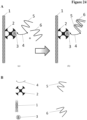
- a binding pair as demonstrated herein is exceptionally well suited to facilitate the immobilization step in an immunoassay. That is to say, in an immunoassay a first binding partner of the binding pair of all-LNA oligonucleotides which is attached to a solid phase, and a second binding partner of the binding pair which is attached to the analyte-specific capture receptor are well suited to facilitate immobilization of the receptor on the solid phase. Likewise such immobilization advantageously works for the capture receptor having bound a target analyte, and for a detection complex, too.
- Another well-known disclosure not encompassed by the wording of the claims is a competitive immunoassay which in its simplest form differs from the sandwich-type format by the lack of a second detector receptor.
- the sample with the analyte is mixed with an artificially produced labeled analogon that is capable of cross-reacting with the analyte-specific receptor.
- the analyte and the analogon compete for binding to a capture receptor which is or becomes immobilized.
- the higher the amount of immobilized label the smaller the amount of the non-labeled analyte that was capable of competing for the capture receptor.
- Immobilized label is determined after a washing step. So the amount of label that is detectable on the solid phase inversely corresponds to the amount of analyte that was initially present in the sample.
- the binding force in the duplex formed by the pair of all-LNA oligonucleotides will exceed the any of the binding forces holding together the analyte and any of the analyte-specific (capture and/or detection) receptors which are used in an assay for analyte detection (such as, but not limited to, an immunoassay).
- binding pairs can be selected such that Watson-Crick pairing regions of different lengths and/or with different base pair composition can be provided.
- pairs of complementary single-stranded all-LNA oligonucleotides can be provided and selected according to specific technical needs, with respect to a first and a second component to be attached to one another by means of an all-LNA binding pair.
- the binding forces in a duplex of Watson-Crick-paired complementary all-LNA oligonucleotides with a given number of paired nucleobases can be fine-tuned by changing individual base pairs in the duplex (e.g. by replacing an A:T base pair with a C:G base pair), or by lengthening or shortening the duplex.
- the fine-tuned pair of single-stranded all-LNA needs to be subjected to a method for selecting and providing a binding pair of single-stranded all-LNA oligonucleotides capable of forming in aqueous solution at a temperature from 0 °C to 40 °C an antiparallel duplex with 5 to 15 consecutive base pairs, as disclosed elsewhere in this document.
- kits according to claim 13 further generic disclosure relates to a kit for performing a receptor-based assay for determining an analyte, the kit comprising in a first container an analyte-specific receptor having attached thereto a first member of a pair of separate ss-oligonucleotides according to the first aspect as disclosed herein, or a first member of a pair of separate ss-oligonucleotides obtained by a method according to the secod or the third aspect as disclosed herein, the kit further comprising in a second container a solid phase having attached thereto a second member of the pair.
- kits for non-covalently connecting a first and a second component comprises in a first separate compartment the first component having attached thereto a first member of a pair of separate ss-oligonucleotides according to the first aspect as disclosed herein, or a first member of a obtained by a method according to the secod or the third aspect as disclosed herein, the kit further comprising in a second container the second component having attached thereto a second member of the pair.
- the binding pairs disclosed in the present report can serve as a general replacement for established binding pairs such as biotin:(strept)avidin.
- the all-LNA binding pairs can serve to connect a first and a second component attached respectively to a first and a second member of a complementary pair of ss-oligonucleotides capable of forming a duplex under non-denaturing conditions.
- the skilled person is well aware of a plethora of applications which go beyond analyte detection assays as described herein in more detail, buit which also extend to e.g. in situ analysis of target antigens in tissue samples.
- the binding pairs of the present disclosure also make it possible to provide separate different binding pairs in the same aqueous solution, thereby opening the way to multiplexed assays.
- the binding pairs of the present disclosure also make it possible to provide separate different binding pairs in the same aqueous solution, thereby opening the way to multiplexed assays.
- an analyte-specific receptor specifically includes an antibody or an antibody fragment.
- LNA oligonucleotides were synthesized in a 1 ⁇ mole scale synthesis on an ABI 394 DNA synthesizer using standard automated solid phase DNA synthesis procedure and applying phosphoramidite chemistry.
- Glen UnySupport PS (Glen Research cat no. 26-5040) and LNA phosphoramidites (Qiagen/Exiqon cat. No.
- beta-L-LNA analogues were synthesized analogously to D-beta-LNA phosphoramidites starting from L-glucose (Carbosynth, cat. No. MG05247) according to A.A. Koshkin et al., J.Org. Chem 2001, 66, 8504-8512 ) as well as spacer phosphoramidte 18 (Glen Research cat. No. 10-1918) and 5'-Biotin phosphoramidte (Glen Research cat. No.
- Residual protecting groups were cleaved by treatment with conc. ammonia (8 h at 56 °C).
- Crude LNA oligonucleotides were evaporated and purified by RP HPLC (column: PRP-1, 7 ⁇ m, 250 x 21.5 mm (Hamilton, part no. 79352) or XBridge BEH C18 OBD, 5 ⁇ m, 10 x 250 mm (Waters part no. 186008167) using a 0.1 M triethylammonium acetate pH 7 / acetonitrile gradient.
- Product fractions were combined and desalted by dialysis (MWCO 1000, SpectraPor 6, part no. 132638) against water for 3 days, thereby also cleaving DMT group of DMTon purified oligonucleotides. Finally, the LNA oligonucleotides were lyophilized.
- LNA oligonucleotides were analyzed by RP18 HPLC (Chromolith RP18e, Merck part no. 1.02129.0001) using a 0.1 M triethylammonium acetate pH 7 / acetonitrile gradient. Typical purities were ⁇ 90%. Identity of LNA oligonucleotides were confirmed by LC-MS analysis.
- LNA oligonucleotides from example 1 were dissolved in buffer (0.01 M Hepes pH 7.4, 0.15 M NaCl) and analyzed on RP18 HPLC (Chromolith RP18e, Merck part no. 1.02129.0001) using a 0.1 M triethylammonium acetate pH 7 / acetonitrile gradient (8-24% acetonitrile in 10 min; detection at 260 nm).
- Strand and corresponding counterstrand LNA oligonucleotides were mixed at equimolar concentration at r.t. (room temperature) and immediately analyzed on RP18 HPLC (Chromolith RP18e, Merck part no. 1.02129.0001) using a 0.1 M triethylammonium acetate pH 7 / acetonitrile gradient (8-24% B in 10 min; detection at 260 nm).
- strand and corresponding counterstrand LNA oligonucleotides were mixed at equimolar concentration at r.t., incubated 1 h at r.t. and thereafter analyzed on RP18 HPLC (Chromolith RP18e, Merck part no. 1.02129.0001) using a 0.1 M triethylammonium acetate pH 7 / acetonitrile gradient (8-25% acetonitrile in 10 min; detection at 260 nm).
- Duplex formation can be detected if new peak at different retention time compared to the individual single stranded LNA oligonucleotides is formed.
- mixed strand and counterstrand are thermally denaturated prior to injection yielding duplex.
- time dependent injection after mixing strand and counterstrand LNA at r.t. without prior denaturation kinetics of duplex formation can be monitored.
- LNA sequences are determined to be capable of quickly forming duplex if the HPLC% ratio of formed duplex and one of both single stranded LNA (corrected by extinction coefficient; in case both strands are not exactly equimolar higher ratio value is considered) is ⁇ 0.9 after tempering 5-60 min at r.t. without prior denaturation (HPLC% corrected by extinction coefficients; hyperchromicity of duplex not considered).
- LNA oligonucleotides from Example 1 were dissolved in buffer (0.01 M Hepes pH 7.4, 0.15 M NaCl) and analyzed on RP18 HPLC (Chromolith RP18e, Merck part no. 1.02129.0001) using a 0.1 M triethylammonium acetate pH 7 / acetonitrile gradient (8-24% acetonitrile in 10 min; detection at 260 nm).
- Strand and corresponding counterstrand LNA oligonucleotides i.e. first and second oligonucleotides
- r.t. room temperature
- a temperature selected from 0 °C to 40 °C a temperature selected from 0 °C to 40 °C
- RP18 HPLC Chromolith RP18e, Merck part no. 1.02129.0001
- a 0.1 M triethylammonium acetate pH 7 / acetonitrile gradient 8-24% B in 10 min; detection at 260 nm).
- strand and corresponding counterstrand LNA oligonucleotides were mixed at equimolar concentration at r.t., incubated 1 h at r.t. and thereafter analyzed on RP18 HPLC (Chromolith RP18e, Merck part no. 1.02129.0001) using a 0.1 M triethylammonium acetate pH 7 / acetonitrile gradient (8-25% acetonitrile in 10 min; detection at 260 nm). Other experiments were made at different temperatures.
- strand and corresponding counterstrand LNA oligonucleotides were mixed at equimolar concentration at r.t., thermally denaturated at 95 °C (10 min), and, after having cooled down again to room temperature, analyzed on RP18 HPLC (Chromolith RP18e, Merck part no. 1.02129.0001) using a 0.1 M triethylammonium acetate pH 7 / acetonitrile gradient (8-24% acetonitrile in 10 min; detection at 260 nm).
- Duplex formation is detected if a new peak appears, at a different retention time compared to a peak corresponding to individual single stranded LNA oligonucleotides.
- positive control control experiment, see above
- mixed strand and counterstrand were thermally denaturated prior to injection, threby disrupting any structures that could be poresent and capable of preventing duplex formation.
- duplex was obtained.
- time dependent injection after mixing strand and counterstrand LNA at room temperature without prior denaturation kinetics of duplex formation was monitored.
- LNA sequences were analyzed regarding their capability of quickly forming duplex.
- a positive result was obtained if the HPLC% ratio of formed duplex and one of both single stranded LNA (corrected by extinction coefficient; in case both strands are not exactly equimolar higher ratio value is considered) was ⁇ 0.9 after tempering 5-60 min at r.t. without prior denaturation (HPLC% corrected by extinction coefficients; hyperchromicity of duplex not considered).
- HEG moiety was found to be without impact on the hybridization properties of the respective oligonucleotide.
- nucleobase sequences and hybridization properties no differences were found with respect to beta-D-LNA oligonucleotide pairs and beta-L-LNA oligonucleotide pairs.
- oligonucleotide pairs which can be kept separately under non-denaturing conditions, and when contacted with each other are capable of forming a duplex under non-denaturing conditions.
- the 15-mer 5' caccaacacaccaac 3' (SEQ ID NO 32, tested as 5'-modified Bi-Heg molecule) and 15-mer 5' gttggtgtgttggtg 3' (SEQ ID NO 31) showed fast duplex formation upon being contacted with each other.
- the first oligo of a binding pair as mentioned in the foregoing was used as a Bi-Heg conjugate as described for the initial experiments.
- Figure 20 illustrates identification of a binding pair showing slow hybridization.
- a Biacore Biotin Capture Kit, Series S sensor (Cat.-No.28-9202-34) was mounted into the instrument and was hydrodynamically addressed and preconditioned according to the manufacturer's instructions.
- the system buffer was HBS-T (10 mM HEPES pH 7.4, 150 mM NaCl, 0.05 % TWEEN 20).
- the sample buffer was the system buffer.
- the Biotin Capture Reagent as provided by the manufacturer GE Healthcare, was diluted 1:50 in system buffer and was injected at 10 ⁇ l/min for 60 sec into all measurement flow cells. The reference cells were not immobilized and remained blanc controls.
- Motif 2-LNA-binding with varying length showed comparable complex formation for 6-8mers, and only slightly slower complex formation for the 12mer.
- Motif 2 was estimated to be superior to motif 1
- the 5' modified poly-A Sequence (HEG) 4 -MH-5' sequence 5' aaaaaaaaa 3' (SEQ ID NO:28) '' was used as negative control. This control did n'ot show any binding to any of the biotinylated Sequences 1 and 2. However, specific binding was detected with complementary Poly-T-Sequences from "group 3".
- All-LNA oligonucleotide duplex with 4 to 5 complementary LNA nucleobase pairings representing motif "Sequence 2" meet the demands for a desired binding pair in that they show fast association into saturation and high complex stability.
- the binding pair is desired to be as short as possible to circumvent time consuming "mispriming" intermediates.
- the four different 5'-modified LNA oligonucleotides as given above, and oligonucleotides with the same respective sequences but comprised in F(ab') 2 ⁇ TSH> conjugates represented sequence "motif 2" with 6-, 7-, 8- & 12-mer length. All were analyzed for binding their complementary Bi-LNA-Sequence at 25°/37°C.
- TSH-binding (TSH being the analyte ) to hybridized LNA-Fab ⁇ TSH> conjugates was analyzed, too.
- Bi-LNAs of varying length showed comparable complex formation, the complex stabilities range from t /2 diss 154 to >232 minutes with pM affinity range ( K D 3 - 10 pM) at 25 °C. At 37 °C, the complex formations are in the pM affinity range ( K D 11-26 pM).
- Hybridization kinetics of the free oligos are mass-transport limited (data depicted in red) at 25 °C & 37 °C, correction for MTL was performed using SW Scrubber.
- Molar Ratios (MR) 0.8 - 1.1 indicated stoichiometric 1:1 hybridization at both temperatures. Oversaturation of 12-mer association phase at 25°C.
- the LNA-Fab ⁇ TSH> conjugates showed a factor 2-4 slowed down complex formation in comparison to the unconjugated LNA oligonucleotides.
- Complex stabilities t /2 diss > 232 minutes, resulting in pM affinity range ( K D 22 -11 pM) at 25°C.
- At 37°C FAb ⁇ TSH>-LNA-conjugates (7-, 8- & 12mer) showed no signifiant differences in complex formation when compared to free LNA of same length, complex stabilities t /2 diss > 232 minutes, ranging in the pM affinity range (K D ⁇ 12-14 pM).
- the binding constants are in the known affinity range for this interaction.
- MR EA 1, fully independent epitope, MR EA ⁇ 1 overlapping epitopes.
- Antibody A is able to form immunocomplexes with 23C11, 6C6 and 4H4. 23C11, 6C6 and 4H4 share the same epitope.
- MR Molar Ratios
- MR 1.1/1.2 indicate stoichiometric 1:1 hybridization at both temperatures for the 6mer pair; MR 1.3/1.5 indicate over-stoichiometric binding for the 9mer-pair.
- the Bi-LNA 15mer shows slowed down hybridization kinetics compared to 6 & 9mers, resulting in slightly lower affinities.
- K D 24/53 pM at both temperatures; MR 1.3 indicates slightly over-stoichiometric binding.
- “Motif 4" (2387/L04-L06) 5-, 6- or 9mer 5'-Bi-Heg-GGA AG-3', 5'-Bi-Heg-GGA AGA-3', or 5'-Bi-Heg-GGA AGA GAA-3' are inferior to "motif 2" when binding to their complementary LNAs, complex half-lifes t /2 diss between 20-65 minutes with resulting 2-3 digit pM affinities at 25°C.
- Both Bi-LNA 5'-Bi-Heg-ACC AAC-3' and 5'-Bi-Heg-CAC ACC AAC-3' show high-affinity binding to their complementary LNAs 6mer 3'-TGG TTG-5' resp. 9mer 3'-GTG TGG TTG-5'.
- the Molar Ratio indicates fully functional 1:1 LNA-hybridization.
- 5'-Bi-Heg-ACC AAC-3' / 3'-TGG TTG-5' shows slightly improved hybridization kinetics in comparison to 5'-Bi-(HEG)4-ACCAAC-3' / 3'-TGG-TTG-5'- Heg4-MH-5', due to 2-fold improved complex stability.
Landscapes
- Chemical & Material Sciences (AREA)
- Life Sciences & Earth Sciences (AREA)
- Organic Chemistry (AREA)
- Health & Medical Sciences (AREA)
- Engineering & Computer Science (AREA)
- Zoology (AREA)
- Wood Science & Technology (AREA)
- Proteomics, Peptides & Aminoacids (AREA)
- Molecular Biology (AREA)
- Biochemistry (AREA)
- Analytical Chemistry (AREA)
- Immunology (AREA)
- Biotechnology (AREA)
- General Health & Medical Sciences (AREA)
- Genetics & Genomics (AREA)
- Microbiology (AREA)
- Biophysics (AREA)
- Physics & Mathematics (AREA)
- Bioinformatics & Cheminformatics (AREA)
- General Engineering & Computer Science (AREA)
- Pathology (AREA)
- Measuring Or Testing Involving Enzymes Or Micro-Organisms (AREA)
Claims (14)
- Verfahren zum Auswählen und Bereitstellen eines Bindungspaares von einzelsträngigen all-LNA-Oligonukleotiden, die in wässriger Lösung bei einer Temperatur von 0 °C bis 40 °C einen antiparallelen Doppelstrang mit 5 bis 15 aufeinanderfolgenden Basenpaaren bilden können, wobei das Verfahren die folgenden Schritte umfasst(a) Bereitstellen eines ersten einzelsträngigen (= ss-) Oligonukleotids, bestehend aus 5 bis 15 Monomeren von verbrückter Nukleinsäure (= LNA), wobei jedes Monomer eine Nukleobase umfasst, wobei die Nukleobasen des ersten ss-Oligonukleotids eine erste Nukleobasensequenz bilden;(b) Bereitstellen eines zweiten ss-Oligonukleotids, bestehend aus 5 bis 15 LNA-Monomeren, wobei das zweite ss-Oligonukleotid mindestens die gleiche Anzahl an Monomeren wie das erste ss-Oligonukleotid umfasst, wobei jedes Monomer des zweiten ss-Oligonukleotids eine Nukleobase umfasst, wobei die Nukleobasen des zweiten ss-Oligonukleotids eine zweite Nukleobasensequenz bilden, wobei die zweite Nukleobasensequenz eine Nukleobasensequenz, die in antiparalleler Orientierung komplementär ist zu der ersten Nukleobasensequenz, umfasst oder aus einer solchen besteht, und Vorhersagen der Fähigkeit des ersten und zweiten ss-Oligonukleotids, einen antiparallelen Doppelstrang miteinander zu bilden, wobei der vorhergesagte Doppelstrang 5 bis 15 aufeinanderfolgende Basenpaare umfasst oder aus solchen besteht, wobei die zwei Basen jedes Basenpaares durch Wasserstoffbrückenbindungen aneinander gebunden sind;(c) Mischen etwa gleicher molarer Mengen des ersten und zweiten ss-Oligonukleotids in einer wässrigen Lösung;(d) Inkubieren des Gemisches von (c) für ein Zeitintervall von 20 min oder weniger, wodurch ein Gemisch, das nach wie vor das erste und zweite Oligonukleotid als ss-Oligonukleotide umfasst, oder ein Gemisch, das das erste und zweite Oligonukleotid als Doppelstrang enthält oder aus solchen besteht, erhalten wird;(e) Nachweisen und Quantifizieren von ss-Oligonukleotiden und Doppelstrang-Oligonukleotiden in dem in Schritt (d) erhaltenen Gemisch; gefolgt von(f) Auswählen des Bindungspaares, wenn in Schritt (e) nachgewiesen wird, dass ein Doppelstrang vorliegt, und die molare Menge an Doppelstrang höher ist als die molare Menge an ss-Oligonukleotiden;(g) gegebenenfalls separates Synthetisieren des ersten und des zweiten ss-Oligonukleotids eines in Schritt (f) ausgewählten Bindungspaares;wodurch das Bindungspaar von einzelsträngigen all-LNA-Oligonukleotiden ausgewählt und bereitgestellt wird,wobei Schritte (c) und (d) bei einer nicht denaturierenden Temperatur ausgeführt werden, die aus der Gruppe ausgewählt ist, die aus 0 °C bis 5 °C, 5 °C bis 10 °C, 10 °C bis 15 °C, 15 °C bis 20 °C, 20 °C bis 25 °C, 25 °C bis 30 °C, 30 °C bis 35 °C und 35 °C bis 40 °C besteht.
- Verfahren nach Anspruch 1, wobei vor Schritt (e) das in Schritt (d) erhaltene Gemisch dem zusätzlichen Schritt des Trennens von ss-Oligonukleotiden und Doppelstrang-Oligonukleotiden unterzogen wird.
- Verfahren nach einem der Ansprüche 1 bis 2, wobei vor Schritt (c) jedes ss-Oligonukleotid aus einem der Schritte (a) und (b) in der Abwesenheit denaturierender Bedingungen gehalten wird, vorzugsweise wobei vor Schritt (c) jedes ss-Oligonukleotid aus einem der Schritte (a) und (b) in wässriger Lösung bei einer Temperatur von -80 °C bis 40 °C, speziell von 0 °C bis 40 °C, noch spezieller von 25 °C bis 37 °C gehalten wird.
- Verfahren nach einem der Ansprüche 1 bis 3, wobei in Schritt (d) das Zeitintervall aus der Gruppe ausgewählt ist, die aus 1 s bis 20 min, 1 s bis 5 min, 1 s bis 60 s und 1 s bis 30 s besteht.
- Verfahren nach einem der Ansprüche 1 bis 4, wobei Schritte (c) und (d) in der Abwesenheit einer Denaturierungsmittelverbindung, die die Schmelztemperatur eines 20 Basenpaare langen DNA-Doppelstranges mit einem G+C-Gehalt von 50 % um mindestens 15 °C senken kann, noch spezieller in der Abwesenheit von Formamid und Dimethylsulfoxid ausgeführt werden.
- Verfahren nach einem der Ansprüche 1 bis 5, wobei jedes LNA-Monomer eine Nukleobase umfasst, die aus der Gruppe ausgewählt ist, die aus N4-Acetylcytosin, 5-Acetyluracil, 4-Amino-6-chlorpyrimidin, 4-Amino-5-fluor-2-methoxypyrimidin, 6-Amino-1-methyluracil, 5-Aminoorotsäure, 5-Aminouracil, 6-Aminouracil, 6-Azauracil, N4-Benzoylcytosin, 5-Bromuracil, 5-Chloruracil, 6-Chloruracil, 6-Chlormethyluracil, 6-Chlor-3-methyluracil, Cytosin, 5,6-Dimethyluracil, 5-Ethyluracil, 5-Ethinyluracil, 5-Fluorcytosin, 5-Fluororotsäure, 5-Fluoruracil, 5-Iod-2,4-dimethoxypyrimidin, 5-Ioduracil, Isocytosin, 5-Methylcytosin, 6-Methyl-5-nitrouracil, 2-Methylthio-4-pyrimidinol, 5-Methyl-2-thiouracil, 6-Methyl-2-thiouracil, 6-Methyluracil, 5-Nitrouracil, Orotsäure, 6-Phenyl-2-thiouracil, 6-Propyl-2-thiouracil, 2-Thiouracil, 4-Thiouracil, Thymin, 5-(Trifluormethyl)uracil, Uracil, Adenin, 8-Azahypoxanthin, 8-Azaguanin, Allopurinol, 4-Aminopyrazolo[3,4-d]pyrimidin, 2-Aminopurin, 2-Acetamido-6-hydroxypurin, 2-Amino-6-chlorpurin, 2-Amino-6-iodpurin, Azathioprin, 4-Amino-6-hydroxypyrazolo[3,4-d]pyrimidin, Aminophyllin, N6-Benzyladenin, N6-Benzoyladenin, 6-Benzyloxypurin, 8-Bromtheophyllin, 8-Brom-3-methylxanthin, 8-Brom-7-(2-butin-1-yl)-3-methylxanthin, 6-Chlorpurin, 8-Chlortheophyllin, 6-Chlor-2-fluorpurin, 6-Chlor-7-deazapurin, 2-Chloradenin, 6-Chlor-7-iod-7-deazapurin, 2,6-Diaminopurin, 2,6-Dichlorpurin, 6-(Dimethylamino)purin, 2,6-Dichlor-7-deazapurin, 5,6-Dichlorbenzimidazol-hydrochlorid, 7-Deazahypoxanthin, 2-Fluoradenin, Guanin, Hypoxanthin, 9-(2-Hydroxyethyl)adenin, Isoguanin, 3-Iod-1H-pyrazolo-[3,4-d]pyrimidin-4-amin, Kinetin, 6-Mercaptopurin, 6-Methoxypurin, 3-Methylxanthin, 1-Methylxanthin, 3-Methyladenin, O6-(Cyclohexylmethyl)guanin, 6-Thioguanin, 2-Thioxanthin, Xanthin, 5-Propinyluracil, 5-Propinylcytidin, 7-Deazaadenin, 7-Deazaguanin, 7-Propinyl-7-deazaadenin, 7-Propinyl-7-deazaguanin und einem Derivat davon besteht, vorzugsweise wobei jedes LNA-Monomer eine Nukleobase umfasst, die aus der Gruppe ausgewählt ist, die aus Adenin, Thymin, Uracil, Guanin, Cytosin und 5-Methylcytosin besteht.
- Verfahren nach Anspruch 6, wobei ein oder mehrere Cytosin(e), sofern vorhanden, durch 5-Methylcytosin ausgetauscht ist/sind, vorzugsweise wobei jedes Cytosin durch 5-Methylcytosin ausgetauscht ist.
- Paar von getrennten komplementären ss-Oligonukleotiden, wobei jedes ss-Oligonukleotid aus 5 bis 15 LNA-Monomeren besteht, wobei die getrennten ss-Oligonukleotide in wässriger Lösung in der Abwesenheit von denaturierenden Bedingungen vor der Doppelstrangbildung oder während der Doppelstrangbildung einen antiparallelen Doppelstrang miteinander bilden können, wobei das Paar aus der Gruppe ausgewählt ist, die aus Folgendem besteht(SEQ ID NO:1) : (SEQ ID NO:2),(SEQ ID NO:9) : (SEQ ID NO:10),(SEQ ID NO:11) : (SEQ ID NO:12),(SEQ ID NO:13) : (SEQ ID NO:14),(SEQ ID NO:15) : (SEQ ID NO:9),(SEQ ID NO:16) : (SEQ ID NO:20),(SEQIDNO:21) : (SEQ ID NO:18),(SEQ ID NO:21) : (SEQ ID NO:20),(SEQ ID NO:21) : (SEQ ID NO:19),(SEQ ID NO:23): (SEQ ID NO:17) und(SEQ ID NO:25) : (SEQ ID NO:28).
- Paar von getrennten komplementären ss-Oligonukleotiden nach Anspruch 8, wobei das erste ss-Oligonukleotid des Paares an ein erstes Ziel gebunden ist und das zweite ss-Oligonukleotid an ein zweites Ziel gebunden ist, vorzugsweise wobei ein Ziel unabhängig voneinander aus der Gruppe ausgewählt ist, die aus einer Festphase, einem Biomolekül und einer chemisch synthetisierten Verbindung besteht.
- Verfahren zum Bilden eines antiparallelen all-LNA-Doppelstranges in der Abwesenheit von denaturierenden Bedingungen, wobei das Verfahren die folgenden Schritte umfasst(a) separates Bereitstellen des ersten und des zweiten Partners eines Paares von einzelsträngigen all-LNA-Oligonukleotiden nach Anspruch 8, wobei jedes einzelsträngige all-LNA-Oligonukleotid separat in wässriger Lösung in der Abwesenheit eines Denaturierungsmittels gelöst und bei einer Temperatur von 0 °C bis 40 °C gehalten wird;(b) Inkontaktbringen der einzelsträngigen all-LNA-Oligonukleotide des Paares miteinander bei einer Temperatur von 0 °C bis 40 °C in der Abwesenheit eines Denaturierungsmittels;wodurch der antiparallele all-LNA-Doppelstrang gebildet wird.
- Antiparalleler Doppelstrang, gebildet aus einem ersten und dem zweiten Partner eines Paares von einzelsträngigen all-LNA-Oligonukleotiden, wobei der antiparallele Doppelstrang durch ein Verfahren nach Anspruch 10 erhalten wird.
- Verwendung eines Paares von separaten ss-Oligonukleotiden nach einem der Ansprüche 8 bis 9 in einem rezeptorbasierten Assay zum Bestimmen eines Analyten, wobei der rezeptorbasierte Assay einen analytspezifischen Rezeptor und eine Festphase zum Immobilisieren des Analyten auf der Festphase umfasst, wobei das erste ss-Oligonukleotid des Paares an den analytspezifischen Rezeptor gekoppelt ist und das zweite ss-Oligonukleotid des Paares an die Festphase gekoppelt ist.
- Kit zum Durchführen eines rezeptorbasierten Assays zum Bestimmen eines Analyten, wobei der Kit in einem ersten Behälter einen analytspezifischen Rezeptor mit einem daran gebundenen ersten Partner eines Paares von getrennten ss-Oligonukleotiden nach einem der Ansprüche 8 bis 9 umfasst, wobei der Kit ferner in einem zweiten Behälter eine Festphase mit einem daran gebundenen zweiten Partner des Paares umfasst.
- Verfahren zum Durchführen eines rezeptorbasierten Assays zum Bestimmen eines Analyten, wobei das Verfahren die Schritte des Inkontaktbringens des Analyten mit einem analytspezifischen Rezeptor mit einem daran gebundenen ersten Partner eines Paares von getrennten ss-Oligonukleotiden nach einem der Ansprüche 8 bis 9 und mit einer Festphase mit einem daran gebundenen zweiten Partner des Paares, des Inkubierens unter Bildung eines Komplexes, der die Festphase, den an die Festphase gebundenen analytspezifischen Rezeptor und den an den analytspezifischen Rezeptor gebundenen Analyten umfasst, wobei ein antiparalleler Doppelstrang gebildet wird, wobei der Doppelstrang aus dem ersten und dem zweiten Partner des Paares besteht, wobei der Doppelstrang den analytspezifischen Rezeptor und die Festphase in dem Komplex verbindet, gefolgt vom Nachweisen von in dem Komplex gebundenem Analyten, wodurch der Analyt bestimmt wird, umfasst.
Priority Applications (1)
| Application Number | Priority Date | Filing Date | Title |
|---|---|---|---|
| EP25165683.1A EP4560315A3 (de) | 2019-06-07 | 2020-06-05 | Hybridisierung von allen-lna-oligonukleotiden |
Applications Claiming Priority (2)
| Application Number | Priority Date | Filing Date | Title |
|---|---|---|---|
| EP19179046 | 2019-06-07 | ||
| PCT/EP2020/065654 WO2020245377A1 (en) | 2019-06-07 | 2020-06-05 | Hybridizing all-lna oligonucleotides |
Related Child Applications (1)
| Application Number | Title | Priority Date | Filing Date |
|---|---|---|---|
| EP25165683.1A Division EP4560315A3 (de) | 2019-06-07 | 2020-06-05 | Hybridisierung von allen-lna-oligonukleotiden |
Publications (2)
| Publication Number | Publication Date |
|---|---|
| EP3980554A1 EP3980554A1 (de) | 2022-04-13 |
| EP3980554B1 true EP3980554B1 (de) | 2025-03-26 |
Family
ID=66793858
Family Applications (2)
| Application Number | Title | Priority Date | Filing Date |
|---|---|---|---|
| EP20730280.3A Active EP3980554B1 (de) | 2019-06-07 | 2020-06-05 | Hybridisierung von all-lna-oligonukleotide |
| EP25165683.1A Pending EP4560315A3 (de) | 2019-06-07 | 2020-06-05 | Hybridisierung von allen-lna-oligonukleotiden |
Family Applications After (1)
| Application Number | Title | Priority Date | Filing Date |
|---|---|---|---|
| EP25165683.1A Pending EP4560315A3 (de) | 2019-06-07 | 2020-06-05 | Hybridisierung von allen-lna-oligonukleotiden |
Country Status (7)
| Country | Link |
|---|---|
| US (1) | US20220195497A1 (de) |
| EP (2) | EP3980554B1 (de) |
| JP (4) | JP2022535580A (de) |
| KR (1) | KR102995758B1 (de) |
| CN (2) | CN120665985A (de) |
| BR (1) | BR112021024624A2 (de) |
| WO (1) | WO2020245377A1 (de) |
Families Citing this family (4)
| Publication number | Priority date | Publication date | Assignee | Title |
|---|---|---|---|---|
| EP4430031A1 (de) | 2021-11-10 | 2024-09-18 | F. Hoffmann-La Roche AG | Hydrophile azadibenzocyclooctynderivate und metallfreie click-reaktionen mit diesen hydrophilen azadibenzocyclooctynderivaten |
| EP4201430A1 (de) | 2021-12-23 | 2023-06-28 | F. Hoffmann-La Roche AG | Modifizierter antikörper zur ortsspezifischen konjugation und seine diagnostische verwendung |
| CN122138968A (zh) | 2023-11-09 | 2026-06-02 | 罗氏诊断公司 | 用于标记的转谷氨酰胺酶底物 |
| WO2025108930A1 (en) | 2023-11-20 | 2025-05-30 | F. Hoffmann-La Roche Ag | Detection zone of a lateral flow immunoassay device comprising a polyion multilayer |
Family Cites Families (42)
| Publication number | Priority date | Publication date | Assignee | Title |
|---|---|---|---|---|
| US5238808A (en) | 1984-10-31 | 1993-08-24 | Igen, Inc. | Luminescent metal chelate labels and means for detection |
| US5310687A (en) | 1984-10-31 | 1994-05-10 | Igen, Inc. | Luminescent metal chelate labels and means for detection |
| US6165729A (en) | 1986-04-30 | 2000-12-26 | Hyperion Catalysis International, Inc. | Electrochemiluminescent reaction utilizing amine-derived reductant |
| US5147806A (en) | 1988-04-29 | 1992-09-15 | Igen, Inc. | Method and apparatus for conducting electrochemiluminescence measurements |
| US5591581A (en) | 1986-04-30 | 1997-01-07 | Igen, Inc. | Electrochemiluminescent rhenium moieties and methods for their use |
| US5308754A (en) | 1988-03-21 | 1994-05-03 | Kankare Jouko J | Electrogenerated luminescence in solution |
| US5093268A (en) | 1988-04-28 | 1992-03-03 | Igen, Inc. | Apparatus for conducting a plurality of simultaneous measurements of electrochemiluminescent phenomena |
| US5705402A (en) | 1988-11-03 | 1998-01-06 | Igen International, Inc. | Method and apparatus for magnetic microparticulate based luminescence assay including plurality of magnets |
| US5324457A (en) | 1989-10-02 | 1994-06-28 | Board Of Regents, The University Of Tx System | Devices and methods for generating electrogenerated chemiluminescence |
| US5776672A (en) | 1990-09-28 | 1998-07-07 | Kabushiki Kaisha Toshiba | Gene detection method |
| EP0488152A3 (en) * | 1990-11-30 | 1992-11-25 | Hitachi, Ltd. | Method for immunoassay and apparatus therefor |
| JPH04273065A (ja) * | 1991-02-28 | 1992-09-29 | Hitachi Ltd | 免疫分析方法およびその分析装置 |
| JPH0534345A (ja) | 1991-02-19 | 1993-02-09 | Tdk Corp | 化学発光を利用する抗原・抗体の測定方法 |
| ZA929351B (en) | 1991-12-11 | 1993-06-04 | Igen Inc | Electrochemiluminescent label for DNA assays. |
| WO1994027150A1 (fr) | 1993-05-10 | 1994-11-24 | Nissui Pharmaceutical Co., Ltd. | Procede de dosage de plus d'un ligand immunologique, reactif de dosage et kit utilise a cet effet |
| GB9404709D0 (en) * | 1994-03-11 | 1994-04-27 | Multilyte Ltd | Binding assay |
| US5786141A (en) | 1994-08-26 | 1998-07-28 | Bard; Allen J. | Electrogenerated chemiluminescence labels for analysis and/or referencing |
| US5866434A (en) | 1994-12-08 | 1999-02-02 | Meso Scale Technology | Graphitic nanotubes in luminescence assays |
| US5643713A (en) | 1995-06-07 | 1997-07-01 | Liang; Pam | Electrochemiluminescent monitoring of compounds |
| US5641623A (en) | 1995-01-04 | 1997-06-24 | Martin; Mark T. | Electrochemiluminescence assay |
| NZ306051A (en) | 1995-03-10 | 1999-11-29 | Meso Scale Technologies Llc | Testing using electrochemiluminescence |
| US6207369B1 (en) | 1995-03-10 | 2001-03-27 | Meso Scale Technologies, Llc | Multi-array, multi-specific electrochemiluminescence testing |
| US6319670B1 (en) | 1995-05-09 | 2001-11-20 | Meso Scale Technology Llp | Methods and apparatus for improved luminescence assays using microparticles |
| US5679519A (en) | 1995-05-09 | 1997-10-21 | Oprandy; John J. | Multi-label complex for enhanced sensitivity in electrochemiluminescence assay |
| US5589136A (en) | 1995-06-20 | 1996-12-31 | Regents Of The University Of California | Silicon-based sleeve devices for chemical reactions |
| GB9606850D0 (en) | 1996-04-01 | 1996-06-05 | Univ Liverpool | An assay system and novel labelled compounds for use therwith |
| WO1998029736A1 (en) | 1996-12-31 | 1998-07-09 | Genometrix Incorporated | Multiplexed molecular analysis apparatus and method |
| JP3756313B2 (ja) | 1997-03-07 | 2006-03-15 | 武 今西 | 新規ビシクロヌクレオシド及びオリゴヌクレオチド類縁体 |
| JPH10253632A (ja) | 1997-03-10 | 1998-09-25 | Nissui Pharm Co Ltd | 分析方法、キット及び装置 |
| FR2764381A1 (fr) | 1997-06-09 | 1998-12-11 | Univ De Neuchatel | Detecteur electrochimioluminescent |
| EP1015469B2 (de) | 1997-09-12 | 2015-11-18 | Exiqon A/S | Bi- und tri-zyklische - nukleosid, nukleotid und oligonukleotid-analoga |
| US6413783B1 (en) | 1997-09-18 | 2002-07-02 | Meso Scale Technologies, Llc | Assay sonication apparatus and methodology |
| US6200531B1 (en) | 1998-05-11 | 2001-03-13 | Igen International, Inc. | Apparatus for carrying out electrochemiluminescence test measurements |
| EP0962773A1 (de) | 1998-06-03 | 1999-12-08 | Mark Howard Jones | Prüfverfahren, Vorrichtung und Markierungsmittel basierend auf Elektrochemie |
| GB9815042D0 (en) | 1998-07-10 | 1998-09-09 | Imperial College | Detector |
| AU3274600A (en) * | 1999-03-18 | 2000-10-09 | Exiqon A/S | One step sample preparation and detection of nucleic acids in complex biologicalsamples |
| IL145496A0 (en) | 1999-03-24 | 2002-06-30 | Exiqon As | Improved synthesis of [2.2.1] bicyclo nucleosides |
| ATE356824T1 (de) | 1999-05-04 | 2007-04-15 | Santaris Pharma As | L-ribo-lna analoge |
| US6136268A (en) | 1999-08-17 | 2000-10-24 | Orion Diagnostica | Method for luminescence measurements |
| EP1546404A2 (de) * | 2002-09-11 | 2005-06-29 | Exiqon A/S | Nukleinsäurepopulation mit teilpopulation aus lna-oligomeren |
| WO2013188756A1 (en) | 2012-06-15 | 2013-12-19 | The University Of Chicago | Oligonucleotide-mediated quantitative multiplexed immunoassays |
| JP7595464B2 (ja) * | 2018-06-21 | 2024-12-06 | エフ. ホフマン-ラ ロシュ アーゲー | 全lnaオリゴヌクレオチドのハイブリダイズ |
-
2020
- 2020-06-05 CN CN202510658282.2A patent/CN120665985A/zh active Pending
- 2020-06-05 CN CN202080042051.4A patent/CN113939599B/zh active Active
- 2020-06-05 EP EP20730280.3A patent/EP3980554B1/de active Active
- 2020-06-05 EP EP25165683.1A patent/EP4560315A3/de active Pending
- 2020-06-05 BR BR112021024624A patent/BR112021024624A2/pt not_active IP Right Cessation
- 2020-06-05 JP JP2021572424A patent/JP2022535580A/ja active Pending
- 2020-06-05 KR KR1020217039943A patent/KR102995758B1/ko active Active
- 2020-06-05 WO PCT/EP2020/065654 patent/WO2020245377A1/en not_active Ceased
-
2021
- 2021-12-07 US US17/544,110 patent/US20220195497A1/en active Pending
-
2023
- 2023-11-06 JP JP2023189130A patent/JP2024020299A/ja active Pending
-
2025
- 2025-06-04 JP JP2025093121A patent/JP7751151B2/ja active Active
- 2025-09-25 JP JP2025159073A patent/JP2026001091A/ja active Pending
Non-Patent Citations (1)
| Title |
|---|
| BEHLING KATJA ET AL: "Crystallization and X-ray diffraction analysis of an `all-locked' nucleic acid duplex derived from a tRNA Ser microhelix", ACTA CRYSTALLOGRAPHICA SECTION F STRUCTURAL BIOLOGY AND CRYSTALLIZATION COMMUNICATIONS, vol. 65, no. 8, 1 August 2009 (2009-08-01), pages 809 - 812, XP093028704, Retrieved from the Internet <URL:https://www.ncbi.nlm.nih.gov/pmc/articles/PMC2720340/pdf/f-65-00809.pdf> DOI: 10.1107/S1744309109026281 * |
Also Published As
| Publication number | Publication date |
|---|---|
| JP2026001091A (ja) | 2026-01-06 |
| EP4560315A2 (de) | 2025-05-28 |
| JP2025131703A (ja) | 2025-09-09 |
| JP2022535580A (ja) | 2022-08-09 |
| CN120665985A (zh) | 2025-09-19 |
| EP3980554A1 (de) | 2022-04-13 |
| CN113939599B (zh) | 2025-06-06 |
| JP2024020299A (ja) | 2024-02-14 |
| US20220195497A1 (en) | 2022-06-23 |
| WO2020245377A1 (en) | 2020-12-10 |
| JP7751151B2 (ja) | 2025-10-07 |
| BR112021024624A2 (pt) | 2022-01-18 |
| KR20220005571A (ko) | 2022-01-13 |
| CN113939599A (zh) | 2022-01-14 |
| KR102995758B1 (ko) | 2026-07-24 |
| EP4560315A3 (de) | 2025-08-27 |
Similar Documents
| Publication | Publication Date | Title |
|---|---|---|
| JP7751151B2 (ja) | 全lnaオリゴヌクレオチドのハイブリダイズ | |
| Jayasena | Aptamers: an emerging class of molecules that rival antibodies in diagnostics | |
| EP1994182B1 (de) | Abgleit-nucleobase-analoga | |
| US6573048B1 (en) | Degradable nucleic acid probes and nucleic acid detection methods | |
| JP7595464B2 (ja) | 全lnaオリゴヌクレオチドのハイブリダイズ | |
| JP2644419B2 (ja) | 核酸の固定化 | |
| CN112424371B (zh) | 蛋白质-多核苷酸缀合物的检测测定 | |
| EP1251183A2 (de) | Verbesserte Helfersonden zur Detektion einer Zielsequenz mittels Fangoligonukleotid | |
| JP7307793B2 (ja) | 結合対のメンバーを有するストレプトアビジン被覆固相 | |
| US8399194B2 (en) | Heteropolynucleotide duplexes with purine—purine base pairing | |
| Ishiyama et al. | Homo-N-oligonucleotides (N1/N9− C1 ‘Methylene Bridge Oligonucleotides): Nucleic Acids with Left-Handed Helicity | |
| EP2432796B1 (de) | Universaltags mit nicht-natürlichen nukleobasen | |
| US20080207885A1 (en) | Method for site-specific labeling of RNA using a deoxyribozyme | |
| AU2001259096A1 (en) | Degradable nucleic acid probes and nucleic acid detection methods |
Legal Events
| Date | Code | Title | Description |
|---|---|---|---|
| STAA | Information on the status of an ep patent application or granted ep patent |
Free format text: STATUS: UNKNOWN |
|
| STAA | Information on the status of an ep patent application or granted ep patent |
Free format text: STATUS: THE INTERNATIONAL PUBLICATION HAS BEEN MADE |
|
| PUAI | Public reference made under article 153(3) epc to a published international application that has entered the european phase |
Free format text: ORIGINAL CODE: 0009012 |
|
| STAA | Information on the status of an ep patent application or granted ep patent |
Free format text: STATUS: REQUEST FOR EXAMINATION WAS MADE |
|
| 17P | Request for examination filed |
Effective date: 20211222 |
|
| AK | Designated contracting states |
Kind code of ref document: A1 Designated state(s): AL AT BE BG CH CY CZ DE DK EE ES FI FR GB GR HR HU IE IS IT LI LT LU LV MC MK MT NL NO PL PT RO RS SE SI SK SM TR |
|
| DAV | Request for validation of the european patent (deleted) | ||
| DAX | Request for extension of the european patent (deleted) | ||
| STAA | Information on the status of an ep patent application or granted ep patent |
Free format text: STATUS: EXAMINATION IS IN PROGRESS |
|
| 17Q | First examination report despatched |
Effective date: 20230316 |
|
| GRAP | Despatch of communication of intention to grant a patent |
Free format text: ORIGINAL CODE: EPIDOSNIGR1 |
|
| STAA | Information on the status of an ep patent application or granted ep patent |
Free format text: STATUS: GRANT OF PATENT IS INTENDED |
|
| INTG | Intention to grant announced |
Effective date: 20240702 |
|
| GRAJ | Information related to disapproval of communication of intention to grant by the applicant or resumption of examination proceedings by the epo deleted |
Free format text: ORIGINAL CODE: EPIDOSDIGR1 |
|
| STAA | Information on the status of an ep patent application or granted ep patent |
Free format text: STATUS: EXAMINATION IS IN PROGRESS |
|
| GRAP | Despatch of communication of intention to grant a patent |
Free format text: ORIGINAL CODE: EPIDOSNIGR1 |
|
| STAA | Information on the status of an ep patent application or granted ep patent |
Free format text: STATUS: GRANT OF PATENT IS INTENDED |
|
| INTC | Intention to grant announced (deleted) | ||
| INTG | Intention to grant announced |
Effective date: 20241108 |
|
| GRAS | Grant fee paid |
Free format text: ORIGINAL CODE: EPIDOSNIGR3 |
|
| GRAA | (expected) grant |
Free format text: ORIGINAL CODE: 0009210 |
|
| STAA | Information on the status of an ep patent application or granted ep patent |
Free format text: STATUS: THE PATENT HAS BEEN GRANTED |
|
| AK | Designated contracting states |
Kind code of ref document: B1 Designated state(s): AL AT BE BG CH CY CZ DE DK EE ES FI FR GB GR HR HU IE IS IT LI LT LU LV MC MK MT NL NO PL PT RO RS SE SI SK SM TR |
|
| REG | Reference to a national code |
Ref country code: GB Ref legal event code: FG4D |
|
| REG | Reference to a national code |
Ref country code: CH Ref legal event code: EP |
|
| REG | Reference to a national code |
Ref country code: DE Ref legal event code: R096 Ref document number: 602020048301 Country of ref document: DE |
|
| REG | Reference to a national code |
Ref country code: IE Ref legal event code: FG4D |
|
| PG25 | Lapsed in a contracting state [announced via postgrant information from national office to epo] |
Ref country code: RS Free format text: LAPSE BECAUSE OF FAILURE TO SUBMIT A TRANSLATION OF THE DESCRIPTION OR TO PAY THE FEE WITHIN THE PRESCRIBED TIME-LIMIT Effective date: 20250626 |
|
| PG25 | Lapsed in a contracting state [announced via postgrant information from national office to epo] |
Ref country code: FI Free format text: LAPSE BECAUSE OF FAILURE TO SUBMIT A TRANSLATION OF THE DESCRIPTION OR TO PAY THE FEE WITHIN THE PRESCRIBED TIME-LIMIT Effective date: 20250326 |
|
| REG | Reference to a national code |
Ref country code: LT Ref legal event code: MG9D |
|
| PG25 | Lapsed in a contracting state [announced via postgrant information from national office to epo] |
Ref country code: NO Free format text: LAPSE BECAUSE OF FAILURE TO SUBMIT A TRANSLATION OF THE DESCRIPTION OR TO PAY THE FEE WITHIN THE PRESCRIBED TIME-LIMIT Effective date: 20250626 |
|
| PG25 | Lapsed in a contracting state [announced via postgrant information from national office to epo] |
Ref country code: HR Free format text: LAPSE BECAUSE OF FAILURE TO SUBMIT A TRANSLATION OF THE DESCRIPTION OR TO PAY THE FEE WITHIN THE PRESCRIBED TIME-LIMIT Effective date: 20250326 |
|
| PG25 | Lapsed in a contracting state [announced via postgrant information from national office to epo] |
Ref country code: LV Free format text: LAPSE BECAUSE OF FAILURE TO SUBMIT A TRANSLATION OF THE DESCRIPTION OR TO PAY THE FEE WITHIN THE PRESCRIBED TIME-LIMIT Effective date: 20250326 |
|
| PG25 | Lapsed in a contracting state [announced via postgrant information from national office to epo] |
Ref country code: GR Free format text: LAPSE BECAUSE OF FAILURE TO SUBMIT A TRANSLATION OF THE DESCRIPTION OR TO PAY THE FEE WITHIN THE PRESCRIBED TIME-LIMIT Effective date: 20250627 Ref country code: BG Free format text: LAPSE BECAUSE OF FAILURE TO SUBMIT A TRANSLATION OF THE DESCRIPTION OR TO PAY THE FEE WITHIN THE PRESCRIBED TIME-LIMIT Effective date: 20250326 |
|
| REG | Reference to a national code |
Ref country code: NL Ref legal event code: MP Effective date: 20250326 |
|
| PG25 | Lapsed in a contracting state [announced via postgrant information from national office to epo] |
Ref country code: NL Free format text: LAPSE BECAUSE OF FAILURE TO SUBMIT A TRANSLATION OF THE DESCRIPTION OR TO PAY THE FEE WITHIN THE PRESCRIBED TIME-LIMIT Effective date: 20250326 |
|
| PG25 | Lapsed in a contracting state [announced via postgrant information from national office to epo] |
Ref country code: SE Free format text: LAPSE BECAUSE OF FAILURE TO SUBMIT A TRANSLATION OF THE DESCRIPTION OR TO PAY THE FEE WITHIN THE PRESCRIBED TIME-LIMIT Effective date: 20250326 |
|
| REG | Reference to a national code |
Ref country code: AT Ref legal event code: MK05 Ref document number: 1779030 Country of ref document: AT Kind code of ref document: T Effective date: 20250326 |
|
| PG25 | Lapsed in a contracting state [announced via postgrant information from national office to epo] |
Ref country code: SM Free format text: LAPSE BECAUSE OF FAILURE TO SUBMIT A TRANSLATION OF THE DESCRIPTION OR TO PAY THE FEE WITHIN THE PRESCRIBED TIME-LIMIT Effective date: 20250326 |
|
| PG25 | Lapsed in a contracting state [announced via postgrant information from national office to epo] |
Ref country code: ES Free format text: LAPSE BECAUSE OF FAILURE TO SUBMIT A TRANSLATION OF THE DESCRIPTION OR TO PAY THE FEE WITHIN THE PRESCRIBED TIME-LIMIT Effective date: 20250326 Ref country code: PT Free format text: LAPSE BECAUSE OF FAILURE TO SUBMIT A TRANSLATION OF THE DESCRIPTION OR TO PAY THE FEE WITHIN THE PRESCRIBED TIME-LIMIT Effective date: 20250728 |
|
| PG25 | Lapsed in a contracting state [announced via postgrant information from national office to epo] |
Ref country code: PL Free format text: LAPSE BECAUSE OF FAILURE TO SUBMIT A TRANSLATION OF THE DESCRIPTION OR TO PAY THE FEE WITHIN THE PRESCRIBED TIME-LIMIT Effective date: 20250326 Ref country code: IT Free format text: LAPSE BECAUSE OF FAILURE TO SUBMIT A TRANSLATION OF THE DESCRIPTION OR TO PAY THE FEE WITHIN THE PRESCRIBED TIME-LIMIT Effective date: 20250326 |
|
| PG25 | Lapsed in a contracting state [announced via postgrant information from national office to epo] |
Ref country code: AT Free format text: LAPSE BECAUSE OF FAILURE TO SUBMIT A TRANSLATION OF THE DESCRIPTION OR TO PAY THE FEE WITHIN THE PRESCRIBED TIME-LIMIT Effective date: 20250326 |
|
| PG25 | Lapsed in a contracting state [announced via postgrant information from national office to epo] |
Ref country code: EE Free format text: LAPSE BECAUSE OF FAILURE TO SUBMIT A TRANSLATION OF THE DESCRIPTION OR TO PAY THE FEE WITHIN THE PRESCRIBED TIME-LIMIT Effective date: 20250326 |
|
| PG25 | Lapsed in a contracting state [announced via postgrant information from national office to epo] |
Ref country code: RO Free format text: LAPSE BECAUSE OF FAILURE TO SUBMIT A TRANSLATION OF THE DESCRIPTION OR TO PAY THE FEE WITHIN THE PRESCRIBED TIME-LIMIT Effective date: 20250326 |
|
| PG25 | Lapsed in a contracting state [announced via postgrant information from national office to epo] |
Ref country code: SK Free format text: LAPSE BECAUSE OF FAILURE TO SUBMIT A TRANSLATION OF THE DESCRIPTION OR TO PAY THE FEE WITHIN THE PRESCRIBED TIME-LIMIT Effective date: 20250326 |
|
| PG25 | Lapsed in a contracting state [announced via postgrant information from national office to epo] |
Ref country code: IS Free format text: LAPSE BECAUSE OF FAILURE TO SUBMIT A TRANSLATION OF THE DESCRIPTION OR TO PAY THE FEE WITHIN THE PRESCRIBED TIME-LIMIT Effective date: 20250726 |
|
| REG | Reference to a national code |
Ref country code: DE Ref legal event code: R097 Ref document number: 602020048301 Country of ref document: DE |
|
| PG25 | Lapsed in a contracting state [announced via postgrant information from national office to epo] |
Ref country code: DK Free format text: LAPSE BECAUSE OF FAILURE TO SUBMIT A TRANSLATION OF THE DESCRIPTION OR TO PAY THE FEE WITHIN THE PRESCRIBED TIME-LIMIT Effective date: 20250326 |
|
| PG25 | Lapsed in a contracting state [announced via postgrant information from national office to epo] |
Ref country code: CZ Free format text: LAPSE BECAUSE OF FAILURE TO SUBMIT A TRANSLATION OF THE DESCRIPTION OR TO PAY THE FEE WITHIN THE PRESCRIBED TIME-LIMIT Effective date: 20250326 |
|
| REG | Reference to a national code |
Ref country code: CH Ref legal event code: H13 Free format text: ST27 STATUS EVENT CODE: U-0-0-H10-H13 (AS PROVIDED BY THE NATIONAL OFFICE) Effective date: 20260127 |
|
| PG25 | Lapsed in a contracting state [announced via postgrant information from national office to epo] |
Ref country code: MC Free format text: LAPSE BECAUSE OF FAILURE TO SUBMIT A TRANSLATION OF THE DESCRIPTION OR TO PAY THE FEE WITHIN THE PRESCRIBED TIME-LIMIT Effective date: 20250326 |
|
| PLBE | No opposition filed within time limit |
Free format text: ORIGINAL CODE: 0009261 |
|
| STAA | Information on the status of an ep patent application or granted ep patent |
Free format text: STATUS: NO OPPOSITION FILED WITHIN TIME LIMIT |
|
| REG | Reference to a national code |
Ref country code: CH Ref legal event code: L10 Free format text: ST27 STATUS EVENT CODE: U-0-0-L10-L00 (AS PROVIDED BY THE NATIONAL OFFICE) Effective date: 20260211 |
|
| PG25 | Lapsed in a contracting state [announced via postgrant information from national office to epo] |
Ref country code: LU Free format text: LAPSE BECAUSE OF NON-PAYMENT OF DUE FEES Effective date: 20250605 |
|
| REG | Reference to a national code |
Ref country code: BE Ref legal event code: MM Effective date: 20250630 |
|
| 26N | No opposition filed |
Effective date: 20260105 |
|
| PG25 | Lapsed in a contracting state [announced via postgrant information from national office to epo] |
Ref country code: IE Free format text: LAPSE BECAUSE OF NON-PAYMENT OF DUE FEES Effective date: 20250605 |
|
| PG25 | Lapsed in a contracting state [announced via postgrant information from national office to epo] |
Ref country code: BE Free format text: LAPSE BECAUSE OF NON-PAYMENT OF DUE FEES Effective date: 20250630 |
|
| PG25 | Lapsed in a contracting state [announced via postgrant information from national office to epo] |
Ref country code: CH Free format text: LAPSE BECAUSE OF NON-PAYMENT OF DUE FEES Effective date: 20250630 |
|
| PG25 | Lapsed in a contracting state [announced via postgrant information from national office to epo] |
Ref country code: LT Free format text: LAPSE BECAUSE OF FAILURE TO SUBMIT A TRANSLATION OF THE DESCRIPTION OR TO PAY THE FEE WITHIN THE PRESCRIBED TIME-LIMIT Effective date: 20250326 |
|
| PGFP | Annual fee paid to national office [announced via postgrant information from national office to epo] |
Ref country code: GB Payment date: 20260520 Year of fee payment: 7 |
|
| PGFP | Annual fee paid to national office [announced via postgrant information from national office to epo] |
Ref country code: DE Payment date: 20260520 Year of fee payment: 7 |
|
| PGFP | Annual fee paid to national office [announced via postgrant information from national office to epo] |
Ref country code: FR Payment date: 20260521 Year of fee payment: 7 |
|
| PG25 | Lapsed in a contracting state [announced via postgrant information from national office to epo] |
Ref country code: CY Free format text: LAPSE BECAUSE OF FAILURE TO SUBMIT A TRANSLATION OF THE DESCRIPTION OR TO PAY THE FEE WITHIN THE PRESCRIBED TIME-LIMIT Effective date: 20250326 |