EP3980358B1 - Zurückweisungsmechanismus für ein fördersystem - Google Patents
Zurückweisungsmechanismus für ein fördersystem Download PDFInfo
- Publication number
- EP3980358B1 EP3980358B1 EP20815630.7A EP20815630A EP3980358B1 EP 3980358 B1 EP3980358 B1 EP 3980358B1 EP 20815630 A EP20815630 A EP 20815630A EP 3980358 B1 EP3980358 B1 EP 3980358B1
- Authority
- EP
- European Patent Office
- Prior art keywords
- paddle
- conveyor
- lateral wall
- wall portion
- rejection
- Prior art date
- Legal status (The legal status is an assumption and is not a legal conclusion. Google has not performed a legal analysis and makes no representation as to the accuracy of the status listed.)
- Active
Links
Images



Classifications
-
- B—PERFORMING OPERATIONS; TRANSPORTING
- B65—CONVEYING; PACKING; STORING; HANDLING THIN OR FILAMENTARY MATERIAL
- B65G—TRANSPORT OR STORAGE DEVICES, e.g. CONVEYORS FOR LOADING OR TIPPING, SHOP CONVEYOR SYSTEMS OR PNEUMATIC TUBE CONVEYORS
- B65G47/00—Article or material-handling devices associated with conveyors; Methods employing such devices
- B65G47/74—Feeding, transfer, or discharging devices of particular kinds or types
- B65G47/82—Rotary or reciprocating members for direct action on articles or materials, e.g. pushers, rakes, shovels
-
- B—PERFORMING OPERATIONS; TRANSPORTING
- B65—CONVEYING; PACKING; STORING; HANDLING THIN OR FILAMENTARY MATERIAL
- B65G—TRANSPORT OR STORAGE DEVICES, e.g. CONVEYORS FOR LOADING OR TIPPING, SHOP CONVEYOR SYSTEMS OR PNEUMATIC TUBE CONVEYORS
- B65G47/00—Article or material-handling devices associated with conveyors; Methods employing such devices
- B65G47/34—Devices for discharging articles or materials from conveyor
- B65G47/44—Arrangements or applications of hoppers or chutes
-
- B—PERFORMING OPERATIONS; TRANSPORTING
- B65—CONVEYING; PACKING; STORING; HANDLING THIN OR FILAMENTARY MATERIAL
- B65G—TRANSPORT OR STORAGE DEVICES, e.g. CONVEYORS FOR LOADING OR TIPPING, SHOP CONVEYOR SYSTEMS OR PNEUMATIC TUBE CONVEYORS
- B65G47/00—Article or material-handling devices associated with conveyors; Methods employing such devices
- B65G47/74—Feeding, transfer, or discharging devices of particular kinds or types
- B65G47/90—Devices for picking-up and depositing articles or materials
- B65G47/91—Devices for picking-up and depositing articles or materials incorporating pneumatic, e.g. suction, grippers
- B65G47/914—Devices for picking-up and depositing articles or materials incorporating pneumatic, e.g. suction, grippers provided with drive systems incorporating rotary and rectilinear movements
-
- B—PERFORMING OPERATIONS; TRANSPORTING
- B65—CONVEYING; PACKING; STORING; HANDLING THIN OR FILAMENTARY MATERIAL
- B65G—TRANSPORT OR STORAGE DEVICES, e.g. CONVEYORS FOR LOADING OR TIPPING, SHOP CONVEYOR SYSTEMS OR PNEUMATIC TUBE CONVEYORS
- B65G47/00—Article or material-handling devices associated with conveyors; Methods employing such devices
- B65G47/74—Feeding, transfer, or discharging devices of particular kinds or types
- B65G47/90—Devices for picking-up and depositing articles or materials
- B65G47/91—Devices for picking-up and depositing articles or materials incorporating pneumatic, e.g. suction, grippers
- B65G47/917—Devices for picking-up and depositing articles or materials incorporating pneumatic, e.g. suction, grippers control arrangements
-
- B—PERFORMING OPERATIONS; TRANSPORTING
- B65—CONVEYING; PACKING; STORING; HANDLING THIN OR FILAMENTARY MATERIAL
- B65G—TRANSPORT OR STORAGE DEVICES, e.g. CONVEYORS FOR LOADING OR TIPPING, SHOP CONVEYOR SYSTEMS OR PNEUMATIC TUBE CONVEYORS
- B65G2201/00—Indexing codes relating to handling devices, e.g. conveyors, characterised by the type of product or load being conveyed or handled
- B65G2201/02—Articles
- B65G2201/0285—Postal items, e.g. letters, parcels
Definitions
- the present invention relates to the handling of parcels within a sorting or similar facility.
- a sorting facility for parcels various parcels are unloaded from trucks or other vehicles at unloading locations, sorted, and then loaded onto trucks or other vehicles at loading locations for delivery to the intended recipients.
- trucks or other vehicles at unloading locations, sorted, and then loaded onto trucks or other vehicles at loading locations for delivery to the intended recipients.
- the first step is often to transform the bulk flow into a singulated flow of parcels in which the parcels are positioned at substantially equal intervals and aligned (i.e., in a single file line) along a conveyor for subsequent processing.
- singulators exist in the art, many of which employ various combinations of belt conveyors and/or roller conveyors to achieve the desired singulation of the parcels.
- a surge in the volume of parcels may overwhelm the mechanical systems, and parcels may not be fully singulated. Non-singulated parcels may then interfere with subsequent processing, including downstream sorting.
- U.S. Patent No. 10,646,898 thus describes a system and method for identifying and transferring parcels from a bulk flow on the first conveyor (or "pick conveyor") to a singulated stream of parcels on the second conveyor (or “place conveyor”).
- a robot singulator or robot receives parcels via the first conveyor, engages each parcel, and then places it onto the second conveyor.
- the robot singulator thus includes an end effector with a means for engaging the selected parcel.
- the end effector may include one or more vacuum cups for engaging the selected parcel.
- the end effector is mounted on a framework, which is controlled to move and position the end effector.
- the system also includes a vision and control subsystem associated with the robot.
- the vison and control subsystem includes one or more cameras that are operably connected to a computer for receiving and processing image data. Specifically, the one or more cameras are used to generate a three- dimensional representation of the parcels. Parcels are identified in the three-dimensional representation, and the computer then communicates instructions to position the robot such that the end effector can engage and manipulate each parcel.
- US9950878 discloses a case manipulator receives cases from an infeed conveyer and manipulates individual cases or groups of cases and transfers the manipulated cases to a row accumulator platform in a desired and pre-determined orientation and positioned on the accumulator platform to a desired and pre-determined location.
- the manipulation of individual cases, or groups of cases, is continued in a sequential operation until a complete row is formed on the accumulator platform according to a pre-determined build menu.
- the case manipulator includes a swing plate pivotal on a first axis and a paddle arm that is attached to the swing plate and pivotal on a second axis that is transverse to the first axis.
- US9950878 discloses a rejection mechanism according to the preamble of claim 1.
- certain parcels may exceed size and/or weight limitations or otherwise may be characterized as "unconveyable.”
- the vision and control subsystem may not be able to accurately identify a parcel because of a "hidden" edge or other anomaly that makes it difficult to identify the parcel.
- a rejection mechanism to handle those parcels that cannot be readily transferred from the first conveyor to the second conveyor.
- a rejection mechanism for a conveyor system generally includes a linear actuator and a paddle mounted to the linear actuator for movement between a first position and a second position.
- the paddle includes a lower bracket portion for mounting the paddle to the linear actuator, an upright portion that extends upward from the bracket portion, and a lateral wall portion that extends from the upright portion.
- the lateral wall portion of the paddle maintains a substantially horizontal orientation relative to the upright portion of the paddle as the paddle is moved from the first position to the second position.
- the rejection mechanism can thus be mounted relative to a target surface (or"rejection zone") of a conveyor, such that, as the linear actuator is actuated to move the paddle from the first position to the second position, the lateral wall portion of the paddle moves across the rejection zone. Parcels located in the rejection zone are thus pushed across the rejection zone and off of the conveyor by the lateral wall portion as the paddle is moved from the first position to the second position.
- the rejection mechanism further includes a way cover having a first end fixed in position and a second end that is mounted to the lateral wall portion of the paddle.
- the way cover expands and contracts with movement of the paddle, such that the way cover provides a trailing wall that fills in the space behind the lateral wall portion as the paddle moves from the first position to the second position.
- the way cover thus prevents parcels from falling behind the lateral wall portion of the paddle as the paddle is moved between the first position and the second position.
- the paddle further includes a brush mounted to the lateral wall portion of the paddle, which fills in any gap existing between the lateral wall portion of the paddle and an underlying surface, such as an upper surface of a conveyor, thereby ensuring smaller or flatter parcels are engaged by the paddle as it is moved from the first position to the second position.
- a brush mounted to the lateral wall portion of the paddle, which fills in any gap existing between the lateral wall portion of the paddle and an underlying surface, such as an upper surface of a conveyor, thereby ensuring smaller or flatter parcels are engaged by the paddle as it is moved from the first position to the second position.
- the lateral wall portion of the paddle is configured to transition between an engaged position and a disengaged position.
- the engaged position the lateral wall portion of the paddle is in a substantially horizontal orientation for engaging parcels in the rejection zone as the paddle is moved from the first position to the second position.
- the disengaged position the lateral wall portion is in a substantially vertical orientation, such that the paddle is able to move from the second position to the first position without moving over the rejection zone and engaging any parcels positioned thereon, thereby ensuring no parcels become trapped behind the lateral wall portion of the paddle.
- the upright portion of the paddle includes an upper section and a lower section connected by a hinge.
- the hinge defines an axis of rotation about which the lateral wall portion of the paddle can rotate to move between the engaged position and the disengaged position.
- the rejection mechanism further includes a first pushing mechanism, such as a linear actuator.
- the rejection mechanism further includes a second pushing mechanism, such as a linear actuator.
- the lateral wall portion of the paddle is operably connected to the upright portion of the paddle by a hinge.
- the hinge defines an axis of rotation about which the lateral wall portion of the paddle can rotate between the engaged position and the disengaged position.
- the first rejection mechanism further includes a first linkage that is operably connected the lateral wall portion of the paddle and mounted for sliding movement in a channel defined by a guide that is mounted to a surface of the upright portion of the paddle.
- a cam follower is mounted to and extends from the first linkage and is received within a track along which the cam follower moves as the linear actuator moves the paddle between the first position and the second position.
- the track may be defined by, and thus be characterized as including: an upper track portion; a lower track portion; a first inclined ramp interconnecting the upper track portion and the lower track portion; and a second inclined ramp that also interconnects the upper track portion and the lower track portion.
- the track is designed such that as the cam follower moves along the first inclined ramp, the lateral portion of the paddle is transitioned from the engaged position to the disengaged position, and, as the cam follower moves along the second inclined ramp, the lateral wall portion of the paddle is transitioned from the disengaged position to the engaged position.
- the rejection mechanism of the present invention can be combined with a conveyor for conveying a flow of parcels to provide an improved conveyor system for processing and sorting parcels.
- the conveyor system can further include a rejection chute, a robot singulator, an additional conveyor, and/or a control subsystem which regulates certain operations of one or more components of the conveyor system.
- the present invention is a rejection mechanism for a conveyor system, which pushes parcels across a surface, such as an upper surface of a conveyor.
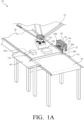
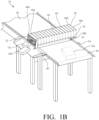
- FIGS. 1 A and IB are perspective views of a conveyor system 10 for conveying and transferring parcels 12a, 12b, 12c, which includes an exemplary rejection mechanism 50 made in accordance with the present invention.
- the conveyor system 10 further includes a first conveyor (or "pick conveyor") 20, a second conveyor (or “place conveyor') 30 downstream of the first conveyor 20, and a robot singulator (or robot) 35 for transferring parcels from the first conveyor 20 to the second conveyor 30.
- a first conveyor or "pick conveyor" 20
- second conveyor or "place conveyor'
- robot singulator or robot
- Parcels 12b, 12c which cannot be readily transferred by the robot singulator 35 end up in a rejection zone 20a (indicated in dashed lines in FIG. 1A ) near a leading edge 20b of the first conveyor 20.
- the rejection zone 20a corresponds with a portion of an upper surface of the first conveyor 20, which is in the path of a paddle 52 of the rejection mechanism 50, as further described below.
- parcels can also be accessed and engaged by the robot singulator 35 in the rejection zone 20a; in other words, parcels are not exclusively engaged by the rejection mechanism 50 in this area, as should become clear in the discussion that follows.
- the rejection mechanism 50 is selectively activated to push parcels 12b, 12c located in the rejection zone 20a off of the first conveyor 20 and onto a rejection chute 40 positioned to the side of the first conveyor 20 for subsequent sorting or recirculation back to the first conveyor 20.
- the rejection mechanism 50 is returned to its home position, and the first conveyor 20 is indexed forward to facilitate subsequent sorting of any remaining parcels located on the first conveyor 20.
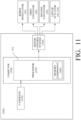
- operation of the first conveyor 20, second conveyor 30, and/or the robot singulator 35 are, in at least some embodiments, regulated by a control subsystem 300.
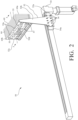
- FIG. 2 is a perspective view of the exemplary rejection mechanism 50, in isolation from the other components of the conveyor system 10 shown in FIGS. 1A and 1B .
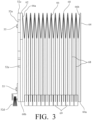
- FIG. 3 is a sectional view of the paddle of the exemplary rejection mechanism of FIG. 2 taken along line 3-3 of FIG. 2 .
- the rejection mechanism 50 includes a paddle 52 that is mounted on a linear actuator 54, such that the paddle 52 can be moved between a first (or home) position, as shown in FIG. 1A , and a second position, as shown in FIG. 1B , via the linear actuator 54.
- the linear actuator 54 is a motor-controlled actuator, with a carriage 54a that moves between the first position and the second position.
- suitable linear actuators are commercially available. For example, one suitable linear actuator for this purpose is manufactured and distributed by Schneider Electric USA of Andover, Massachusetts, Model. No. PAS42BB.
- the linear actuator 54 may be a rod-less pneumatic actuator, such as that manufactured and distributed by Festo Corporation of Hauppauge, New York, Model No. DGC-32-1200-KF-YSRW-A ZUB-F-M.
- operation of the linear actuator 54 i.e., movement of the carriage 54a
- the paddle 52 has a unitary construction.
- the paddle includes: a lower bracket portion 52a; an upright portion 52b that extends from the lower bracket portion 52a; and a lateral wall portion 52c that extends from the upright portion 52b.
- the lateral wall portion 52c extends horizontally from the upright portion 52b and is in a perpendicular orientation relative to the upright portion 52b of the paddle 52.
- the lower bracket portion 52a is mounted to the carriage 54a of the linear actuator 54 by one or more fasteners 56, such as bolts or similar conventional fasteners.
- the rejection mechanism 50 is positioned relative to the first conveyor 20, such that, as the paddle 52 moves from the first position to the second position, the paddle 52 moves across the rejection zone 20a toward the rejection chute 40.
- the movement of the lateral wall portion 52c of the paddle 52 across the rejection zone 20a thus pushes any parcels 12b, 12c located in the rejection zone 20a off of the first conveyor 20 and onto the rejection chute 40.
- the linear actuator 54 of the rejection mechanism 50 can thus be selectively activated to discharge parcels 12b, 12c from the first conveyor 20.
- the linear actuator 54 in this embodiment, is mounted below the leading edge 20b of the first conveyor 20, such that the upright portion 52b of the paddle 52 extends upward and adjacent to the leading edge 20b of the first conveyor 20, and the lateral wall portion 52c of the paddle 52 is thus positioned over the upper surface of the first conveyor 20.
- the second conveyor 30 is positioned downstream of and adjacent to the first conveyor 20, such that the upright portion 52b of the paddle 52 extends upward through a gap between the first conveyor 20 and the second conveyor 30.
- the linear actuator 54 may alternatively be mounted to the second conveyor 30 and still enable the exemplary rejection mechanism 50 to function in the manner described herein.
- this vertical gap may be approximately 10mm.
- the paddle 52 includes a brush 52d mounted to the front face of the lateral wall portion 52c, such that the bristles of the brush 52d extend below the bottom edge of the lateral wall portion 52c to engage the upper surface of the first conveyor 20.
- the brush 52d thus substantially eliminates the gap existing between the lateral wall portion 52c and the upper surface of the first conveyor 20.
- the brush 52d provides a sweeping force across the upper surface of the first conveyor 20, which ensures that smaller parcels 12a, 12b, 12c, such as flat mailers, are engaged by the paddle 52 and do not pass under the lateral wall portion 52c of the paddle 52.
- the brush 52d is removably mounted to the lateral wall portion 52c by one or more fasteners 57, such as bolts or similar conventional fasteners.
- the components of the paddle 52 are constructed of steel or another suitable metal to prevent or limit the extent to which the paddle 52 is deformed or broken down as a result of repeated trips across the rejection zone 20a and engagement with parcels 12a, 12b, 12c located thereon.
- a plurality of openings 52e are defined by, and thus can be characterized as being present within, the lateral wall portion 52c. Such openings 52e reduce the overall weight of the lateral wall portion 52c.
- the rejection mechanism 50 further includes a way cover 60.
- the way cover 60 has a first end 60a fixed in position relative to the conveyor system 10 and a second end 60b mounted to the lateral wall portion 52c of the paddle 52.
- the first end 60a of the way cover 60 is mounted to a bracket 22 mounted to the first conveyor 20 by one or more fasteners (not shown), such as bolts or similar conventional fasteners
- the second end 60b of the way cover 60 is mounted to a rear face of the lateral wall portion 52c of the paddle 52 by one or more fasteners 55, such as bolts or similar conventional fasteners.
- the way cover 60 is configured to expand and contract with movement of the paddle 52.
- the way cover 60 gradually expands from a contracted configuration (as shown in FIG. 1A ) to an expanded configuration (as shown in FIG. 1B ).
- the way cover 60 is designed and configured such that, upon the paddle 52 reaching the second position ( FIG. 1B ), the way cover 60 is fully expanded, resulting in a substantially flat upper surface of the way cover 60.
- the way cover 60 thus provides a trailing wall behind the lateral wall portion 52c of the paddle 52, which fill in the space behind the lateral wall portion 52c of the paddle 52 as the paddle 52 moves from the first position to the second positon, thereby preventing any parcels located on the first conveyor 20 from falling behind the lateral wall portion 52c of the paddle 52 as the paddle 52 moves between the first position and the second position.
- the way cover 60 prevents parcels from becoming trapped behind the lateral wall portion 52c of the paddle 52 during operation of the rejection mechanism 50.
- a parcel could flip over the lateral wall portion 52c of the paddle 52 as the paddle 52 moves from the first position and the second position, which could hinder or prevent the paddle 52 from returning back to the first position.
- the conveyor system 10 may include a wall surface positioned above the way cover 60, which would push any parcels 12a, 12b, 12c having fallen on top of the way cover 60 off of the way cover 60 as the paddle 52 is returned by the linear actuator 54 to the first position.
- any parcels flip over the lateral wall portion 52c of the paddle 52 and onto the upper surface of the way cover 60, they would be pushed off the upper surface of the way cover 60 as the paddle 52 returns back to the first position.
- FIG. 4 is an enlarged front view of the way cover 60 in isolation.
- the way cover 60 is comprised of a first face plate 62, a second face plate 64, a cover 66, and a plurality of stiffeners 68.
- the first face plate 62 which is at the second end 60b of the way cover 60, is mounted to the lateral wall portion 52c of the paddle 52.
- the first face plate 62 defines a plurality of openings 63 corresponding to a plurality of openings defined by the lateral wall portion 52c, so that the first face plate 62 can be mounted to the lateral wall portion 52c via one or more fasteners 55, such as bolts or similar conventional fasteners.
- the first face plate 62 can be characterized as including three sections: a first side section 62a; a second side section 62b; and a top section 62c extending between the first and second side sections 62a, 62b. Furthermore, in this exemplary embodiment, the width and the height of the first face plate 62 substantially corresponds to that of the lateral wall portion 52c of the paddle 52.
- the second face plate 64 is mounted to a component of the conveyor system 10 to hold the first end 60a of the way cover 60 in a fixed position as the paddle 52 moves the first face plate 62, and thus the second end 60b of the way cover 60, across the rejection zone 20a.
- the second face plate 64 is mounted to the bracket 22, which is shown in FIGS. 1A and 1B .
- the shape of the second face plate 64 preferably corresponds to that of the first face plate 62, and thus, in this exemplary embodiment, the lateral wall portion 52c of the paddle 52.
- the second face plate 64 thus also defines a plurality of openings corresponding to a plurality of openings defined by the bracket 22, so that the second face plate 64 can be mounted to the bracket 22 via one or more fasteners (not shown), such as bolts or similar conventional fasteners
- the opposing ends 66a, 66b of the cover 66 are mounted to the first face plate 62 and the second face plate 64, and the cover 66 is comprised of a flexible fabric or similar material that can readily expand or contract as the paddle 52 is moved between the first position and the second position.
- Multiple stiffeners 68 are positioned along the length of the cover 66 between the opposing ends 66a, 66b of the cover 66, and these stiffeners 68 are mounted to and enclosed by the cover 66.
- the stiffeners 68 maintain the shape of the trailing wall established by the way cover 60 as the paddle 52 moves between the first position and the second position.
- each stiffener 68 is constructed of a metal plate having a shape corresponding to that of the first face plate 62 and the lateral wall portion 52c of the paddle 52. Accordingly, like the first face plate 62, each stiffener 68 can be characterized as including three sections: a first side section; a second side section; and a top section extending between the first and second side sections.
- the cover 66 extends along and fully covers the first side section, the second side section, and the top section of each stiffener 68.
- the cover 66 establishes a three-sided wall (two side walls and a top wall), which expands and contracts with movement of the paddle 52.
- the flexible material of the cover 66 is configured to fold in an accordion-like manner as the paddle 52 is moved from the second position to the first position and the way cover 60 contracts.
- the way cover 60 may also be referred to as a "bellows.”
- each stiffener 68 includes a tip 69 on at least one of its sides. Specifically, in this exemplary embodiment, each side (only one of which is shown in FIG. 3 ) of each stiffener 68 terminates at a tip 69. Each tip 69 is configured to engage and move along an upper surface of the first conveyor 20 as the paddle 52 moves across the rejection zone 20a. In this exemplary embodiment, the lowermost portion of each tip 69 and the lowermost portion of the brush 52d reside in substantially the same plane.
- each tip 69 maintain the lateral wall portion 52c of the paddle 52 in a generally parallel orientation relative to the upper surface of the first conveyor 20 and reduce the strain imposed on the upright portion 52b caused by the weight of the lateral wall portion 52c.
- each tip 69 is preferably constructed from a material with a low coefficient of friction and high durability, such as an ultra-high molecular weight polyethylene (UHMW).
- UHMW ultra-high molecular weight polyethylene
- the way cover 60 may further include a plurality of lamellas (or plates) provided along each wall of the cover 66.
- each lamella would be mounted to a respective wall of the cover 66, such that the lamellas effectively stack upon each other as the way cover 60 contracts.
- the lamellas effectively cover the"valleys" resulting from the cover 66 being folded into an accordion-like construction, thereby preventing parcels 12a, 12b, 12c from becoming caught or trapped in the way cover 60 as it is contracted.
- the way cover may be constructed as to transition between a rolled-up configuration and an extended (or unrolled) configuration.
- the way cover would have a first end fixed in position relative to the conveyor system and a second end mounted to the lateral wall portion of the paddle.
- the way cover would not include any of the plates 62, 64 or stiffeners 68 described above with reference to FIGS. 3-4 .
- the way cover would include a single length of material that is rolled onto a rod, much like a roll-up window shade. When the paddle 52 is in the first position, the material would be stored on the rod in the rolled- up configuration.
- the rod would rotate, and the material would unfurl from the rod until the way cover is in the extended (or unrolled) configuration.
- the way cover would again provide a wall extending across the rejection zone 20a of the first conveyor 20.
- FIGS. 5 A and 5B are perspective views of another conveyor system 100 for conveying and transferring parcels 12a, 12b, 12c, which includes another exemplary rejection mechanism 150 falling outside the literal scope of Claim 1.
- the conveyor system 100 includes each of the components (i.e., the first conveyor 20, the second conveyor 30, robot singulator 35, and rejection chute 40) of the conveyor system 10 illustrated and described above with reference to FIGS. 1 A and IB , where each respective component includes the same features and provides the same functionality as described above.
- the rejection mechanism 150 is selectively activated to push parcels 12b, 12c located in the rejection zone 20a off of the first conveyor 20 and onto a rejection chute 40 positioned to the side of the first conveyor 20 for subsequent sorting or recirculation back to the first conveyor 20.
- the rejection mechanism 150 can be returned to its home position, and the first conveyor 20 is indexed forward to facilitate subsequent sorting of any remaining parcels located on the first conveyor 20.
- movement of the first conveyor 20, second conveyor 30, and/or the robot singulator 35 are, in at least some embodiments, regulated by a control subsystem 400.
- FIG. 6 is a perspective view of the exemplary rejection mechanism 150, in isolation from the other components of the conveyor system 100 shown in FIGS. 5A and 5B .
- the rejection mechanism 150 includes a paddle 152 that is mounted on a linear actuator 154, such that the paddle 152 can be moved between a first (or home) position, as shown in FIG. 5 A , and a second position, as shown in FIG. 5B , via the linear actuator 154.
- the linear actuator 154 is a motor-controlled actuator, with a carriage 154a that moves between the first position and the second position.
- suitable linear actuators are commercially available.
- one suitable linear actuator for this purpose is manufactured and distributed by Schneider Electric USA of Andover, Massachusetts, Model. No. PAS42BB.
- the linear actuator 154 may be a rod-less pneumatic actuator, such as that manufactured and distributed by Festo Corporation of Hauppauge, New York, Model No. DGC- 32-1200-KF-YSRW-A ZUB-F-M.
- operation of the linear actuator 154 i.e., movement of the carriage 154a
- the paddle 152 includes: a lower bracket portion 152a; an upright portion 152b that extends from the lower bracket portion 152a; and a lateral wall portion 152c that extends from the upright portion 152b.
- the respective components of the paddle 152 may be constructed from the same materials as those of the paddle 52 of the rejection mechanism 50 described above with reference to FIGS.1A , IB, and 2.
- the lateral wall portion 152c of the paddle 152 may also define a plurality of openings for weight reduction, like the rejection mechanism 50 described above with reference to FIGS. 1A , IB, and 2.
- the lower bracket portion 152a is mounted to the carriage 154a of the linear actuator by one or more fasteners 156, such as bolts or similar conventional fasteners.
- the upright portion 152b of the paddle 152 includes an upper section 153a and a lower section 153b connected together by a hinge 153c.
- the lateral wall portion 152c is operably connected to and extends from the upper section 153a of the upright portion 152b, while the lower section 153b of the upright portion 152b is operably connected to the lower bracket portion 152a of the paddle 152.
- the lower section 153b of the upright portion 152b and the lower bracket portion 152a are formed from a single piece of material, i.e., have a unitary construction.
- the upper section 153a of the upright portion 152b can thus effectively rotate about an axis of rotation defined by the hinge 153c to transition the lateral wall portion 152c of the paddle 152 between: (i) an engaged position, in which the lateral wall portion 152c of the paddle is in a substantially horizontal orientation (i.e., extends perpendicular relative to the lower section 153b of the upright portion 152b); and (ii) a disengaged position, in which the lateral wall portion 152c of the paddle is in a substantially vertical orientation (i.e., extends vertically relative to the lower section 153b of the upright portion 152b).
- the paddle 152 also includes a stop 153d mounted to the lower section 153b of the upright portion 152b, which prevents rotation of the upper section 153a of the upright portion 152b beyond a predefined limit when the lateral wall portion 152c of the paddle 152 is transitioned to a disengaged position.
- the rejection mechanism 150 is positioned relative to the first conveyor 20, such that, as the paddle 152 moves from the first position to the second position while the lateral wall portion 152c is in the engaged position, the paddle 152 moves across the rejection zone 20a toward the rejection chute 40.
- the movement of the lateral wall portion 152c of the paddle 152 across the rejection zone 20a, while in the engaged position, thus pushes any parcels 12b, 12c located in the rejection zone 20a off of the first conveyor 20 and onto the rejection chute 40.
- the linear actuator 154 of the rejection mechanism 150 can thus be selectively activated while the lateral wall portion 152c is in the engaged position to discharge parcels 12b, 12c from the first conveyor 20.
- the linear actuator 154 (only a portion of which is shown in FIGS. 5A and 5B ) is mounted below the leading edge 20b of the first conveyor 20, such that both the upper section 153a and the lower section 153b of the upright portion 152b of the paddle 152 extend upward and adjacent to the leading edge 20b of the first conveyor 20 when the lateral wall portion 152c is in the engaged position.
- the second conveyor 30 is positioned downstream of and adjacent to the first conveyor 20, such that the upright portion 152b of the paddle 152 extends upward through a gap between the first conveyor 20 and the second conveyor 30.
- the linear actuator 154 may alternatively be mounted to the second conveyor 30 and still enable the exemplary rejection mechanism 150 to function in the manner described herein.
- this vertical gap may be approximately 10mm.
- the lateral wall portion 152c of the paddle 152 can be rotated from the engaged position to the disengaged position about the hinge 153c. Accordingly, when the linear actuator 154 returns the paddle 152 from the second position to the first position, the lateral wall portion 152c of the paddle 152 does not pass back over the rejection zone 20a. Rather, the lateral wall portion 152c is in a substantially vertical orientation during its return to the first position.
- the conveyor system 100 further includes a first pushing mechanism 160 and a second pushing mechanism 162.
- the first pushing mechanism 160 is a motor-controlled linear actuator, which includes an arm 160a that can be extended to engage the lateral wall portion 152c of the paddle 152, rotating it about the hinge 153c from the disengaged position to the engaged position.
- the first pushing mechanism 160 is a motor-controlled linear actuator, which includes an arm 160a that can be extended to engage the lateral wall portion 152c of the paddle 152, rotating it about the hinge 153c from the disengaged position to the engaged position.
- the second pushing mechanism 162 is a motor-controlled linear actuator, which includes an arm 162a that can be extended to engage the lateral wall portion 152c of the paddle 152, rotating it about the hinge 153c from the engaged position to the disengaged position.
- a motor-controlled linear actuator which includes an arm 162a that can be extended to engage the lateral wall portion 152c of the paddle 152, rotating it about the hinge 153c from the engaged position to the disengaged position.
- many different types of linear actuators or other similar mechanisms may provide the desired rotation (or flipping) of the lateral wall portion 152c of the paddle 152 between the engaged position and the disengaged position.
- the first pushing mechanism 160 is mounted such that the arm 160a of the first pushing mechanism 160 can be extended in a substantially horizontal direction to engage the lateral wall portion 152c of the paddle 152 when the paddle 152 is in the first position.
- the lateral wall portion 152c rotates about the axis of rotation defined by the hinge 153c from the disengaged position to the engaged position.
- the first pushing mechanism 160 flips the lateral wall portion 152c from the disengaged position to the engaged position.
- the first pushing mechanism 160 is mounted to the second conveyor 30 by a bracket 32.
- the first pushing mechanism 160 may be mounted in any suitable orientation which permits the arm 160a to extend and engage the lateral wall portion 152c of the paddle 152 in the manner described above.
- the second pushing mechanism 162 is mounted such that the arm 162a of the second pushing mechanism 162 can be extended in a substantially vertical direction to engage the lateral wall portion 152c of the paddle 152 when the paddle 152 is in the second position.
- the lateral wall portion 152c rotates about the axis of rotation defined by the hinge 153c from the engaged position to the disengaged position.
- the second pushing mechanism 162 flips the lateral wall portion 152c from the engaged position to the disengaged position.
- the second pushing mechanism 162 is mounted to the first conveyor 20 below the rejection chute 40.
- the rejection chute 40 defines an opening 40a through which the arm 162a of the second pushing mechanism 162 can extend to engage the lateral wall portion 152c of the paddle 152.
- the second pushing mechanism 162 may be mounted in any suitable orientation which permits the arm 162a of the second pushing mechanism 162 to extend and engage the lateral wall portion 152c of the paddle 152 in the manner described above.
- operation of the linear actuator 154, the first pushing mechanism 160, and/or the second pushing mechanism 162 are, in at least some embodiments, regulated by a control subsystem 400.
- FIGS. 7 A and 7B are perspective views of another conveyor system 200 for conveying and transferring parcels 12a, 12b, 12c, which includes another exemplary rejection mechanism 250 outside the literal scope of Claim 1.
- the conveyor system 200 includes each of the components (i.e., the first conveyor 20, the second conveyor 30, robot singulator 35, and rejection chute 40) of the conveyor system 10 illustrated and described above with reference to FIGS. 1 A and IB , where each respective component includes the same features and provides the same functionality as described above.
- the exemplary rejection mechanism 250 is selectively activated to push parcels 12b, 12c located in the rejection zone 20a off of the first conveyor 20 and onto a rejection chute 40 positioned to the side of the first conveyor 20 for subsequent sorting or recirculation back to the first conveyor 20.
- the rejection mechanism 250 can be returned to its home position, and the first conveyor 20 is indexed forward to facilitate subsequent sorting of any remaining parcels located on the first conveyor 20.
- operation of the first conveyor 20, second conveyor 30, and/or the robot singulator 35 are, in at least some embodiments, regulated by a control subsystem 300.
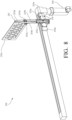
- FIG. 8 is a perspective view of the exemplary rejection mechanism 250, in isolation from the other components of the conveyor system 200 shown in FIGS. 7 A and 7B .
- the rejection mechanism 250 includes a paddle 252 that is mounted on a linear actuator 254, such that the paddle 252 can be moved between a first (or home) position, as shown in FIG. 7A , and a second position, as shown in FIG. 7B , via the linear actuator 254.
- the linear actuator 254 is a motor-controlled actuator, with a carriage 254a that moves between the first position and the second position.
- suitable linear actuators are commercially available. For example, one suitable linear actuator for this purpose is manufactured and distributed by Schneider Electric USA of Andover, Massachusetts, Model. No. PAS42BB.
- the linear actuator 254 may be a rod-less pneumatic actuator, such as that manufactured and distributed by Festo Corporation of Hauppauge, New York, Model No. DGC-32-1200-KF-YSRW-A ZUB-F-M.
- operation of the linear actuator 254 i.e., movement of the carriage 254a
- a control subsystem 300 i.e., movement of the carriage 254a
- the paddle 252 includes: a lower bracket portion 252a; an upright portion 252b that extends from the lower bracket portion 252a; and a lateral wall portion 252c that extends from the upright portion 252b.
- the respective components of the paddle 252 may be constructed from the same materials as those of the paddles 52, 152 of the rejection mechanisms 50, 150 described above.
- the lateral wall portion 252c of the paddle 252 may also define a plurality of openings for weight reduction, like the rejection mechanisms 50, 150 described above.
- the lower bracket portion 252a is mounted to the carriage 254a of the linear actuator by one or more fasteners 256, such as bolts or similar conventional fasteners.
- the lower bracket portion 252a and the upright portion 252b are formed from a single piece of material, i.e., have a unitary construction.
- the lateral wall portion 252c is connected to the upright portion 252b by a hinge 253a.
- the lateral wall portion 252c is able to rotate about an axis of rotation defined by the hinge 253a between: (i) an engaged position, in which the lateral wall portion 252c of the paddle 252 is in a substantially horizontal orientation (i.e., extends perpendicular relative to the upright portion 252b of the of the paddle 252); and (ii) a disengaged position, in which the lateral wall portion 252c is in a substantially vertical orientation (i.e., extends vertically relative to the upright portion 252b of the paddle).
- the upright portion 252b defines a slit 252d in which the lateral wall portion 252c can travel through and rest within, as further described below.
- a first linkage 253b (or “linear slide") is mounted for sliding movement in a channel defined by a guide 253c, which, is mounted to a surface of the upright portion 252b of the paddle 252.
- a distal end of the first linkage 253b is operably connected to the lateral wall portion 252c of the paddle 252, such that the first linkage 253b can be manipulated to slide the first linkage 253b within the guide 253c and move the lateral wall portion 252c between the engaged and disengaged position.
- a distal end of the first linkage 253b is pivotally connected to a proximal end of a second linkage 253d (or “connector linkage”), preferably via a pin connection.
- a distal end of the second linkage 253d is then pivotally connected to the lateral wall portion 252c of the paddle 252.
- a cam follower 253e is mounted for rotation with respect to, and extends from, the first linkage 253b to control movement of the first linkage 253b within the guide 253c, as further described below.
- the linear actuator 254 (only a portion of which is shown in FIGS. 7A and 7B ) is mounted below the leading edge 20b of the first conveyor 20, such that the upright portion 252b of the paddle 252 extends upward and adjacent to the leading edge 20b of the first conveyor 20.
- the second conveyor 30 is positioned downstream and adjacent to the first conveyor 20, such that the upright portion 252b of the paddle 252 extends upward through a gap between the first conveyor 20 and the second conveyor 30.
- the linear actuator 254 may alternatively be mounted to the second conveyor 30 and still enable the exemplary rejection mechanism 250 to function in the manner described herein.
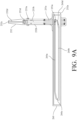
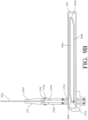
- FIGS. 9A and 9B are various side views of the paddle 252 at different positions along a track.
- the cam follower 253e is positioned within a track 260 (or “linear cam"), such that, as the linear actuator 254 moves the paddle 252 between the first position ( FIG. 7A ) and the second position ( FIG. 7B ), the cam follower 253e is moved along the track 260 to transition the lateral wall portion 252c of the paddle between the engaged and disengaged position, as further described below.
- the track 260 is mounted below the leading edge of the first conveyor 20.
- the track 260 may alternatively be mounted to the second conveyor 30 and still enable the exemplary rejection mechanism 250 to function in the manner described herein.
- the track 260 is defined by, and can be characterized as including: an upper track portion 260a; a lower track portion 260b; a first inclined ramp 260c, which interconnects the upper track portion 260a and the lower track portion 260b; and a second inclined ramp 260d, which also interconnects the upper track portion 260a and the lower track portion 260b.
- the track 260 is a closed loop.
- the cam follower 253e is correspondingly moved from a first portion of the track 260 ( FIG. 9A ), which, in this embodiment, is an upper-right portion of the track 260, to a second portion of the track 260, which, in this embodiment, is lower-left portion of the track 260.
- the lateral wall portion 252c of the paddle 252 is in the engaged position, and the weight of the lateral wall portion 252c of the paddle 252 causes it to remain in the engaged position.
Landscapes
- Engineering & Computer Science (AREA)
- Mechanical Engineering (AREA)
- Discharge Of Articles From Conveyors (AREA)
- Sorting Of Articles (AREA)
- Chain Conveyers (AREA)
Claims (5)
- Ein Zurückweisungsmechanismus (50) für ein Fördersystem (10) mit einem Förderband zur Beförderung von Paketen, umfassend:einen Linearantrieb (54);ein Paddel (52), das so am Linearantrieb (54) befestigt ist, dass es sich zwischen einer ersten Position und einer zweiten Position bewegt, wobei das Paddel (52) (i) einen unteren Halterungsteil (52a) zur Befestigung des Paddels (52) am Linearantrieb (54), (ii) einen senkrechten Teil (52b), der sich nach oben erstreckt und an einer Kante des Förderbands positioniert ist, und (iii) einen seitlichen Wandteil (52c), der sich vom senkrechten Teil (52b) weg erstreckt, einschließt;und wobei im Betrieb der seitliche Wandteil (52c) über einem Teil der Oberfläche des Förderbands positioniert ist, während sich das Paddel (52) von der ersten Position in die zweite Position bewegt, so dass Pakete, die sich im Pfad des seitlichen Wandteils (52c) auf dem Förderband befinden, von dem seitlichen Wandteil (52c) angeschoben werden, während sich das Paddel (52) von der ersten Position in die zweite Position bewegt;dadurch gekennzeichnet, dassder Zurückweisungsmechanismus (50) weiter eine Balgabdeckung (60) mit einem ortsfesten ersten Ende (60a) und einem an dem seitlichen Wandteil (52c) des Paddels (52) befestigten zweiten Ende (60b) hat; undwobei sich die Balgabdeckung (60) mit der Bewegung des Paddels (52) ausdehnt und zusammenzieht.
- Der Zurückweisungsmechanismus nach Anspruch 1, wobei die Balgabdeckung (60) mehrere Versteifungen (68) und eine flexible Abdeckung (66) über den mehreren Versteifungen Versteifungen enthält.
- Ein Fördersystem (10) umfassend:ein erstes Förderband (20) zur Beförderung eines Flusses von mehreren Paketen (12a-c);eine Zurückweisungsrutsche (40); undeinen Zurückweisungsmechanismus (50) nach Anspruch 1 oder Anspruch 2.
- Das Fördersystem (10) nach Anspruch 3, weiter umfassend:
einen robotischen Vereinzeler (35), der darauf ausgelegt ist, einzelne Pakete in dem Fluss mehrerer Paketen (12a-c) auf dem ersten Förderband (20) aufzugreifen und sie auf ein zweites Förderband (30) zu transferieren. - Das Fördersystem nach Anspruch 4, wobei sich der senkrechte Teil (52b) des Paddels (52) nach oben durch den Spalt zwischen dem ersten Förderband (10) und dem zweiten Förderband (20) erstreckt.
Applications Claiming Priority (3)
| Application Number | Priority Date | Filing Date | Title |
|---|---|---|---|
| US201962854434P | 2019-05-30 | 2019-05-30 | |
| US201962863348P | 2019-06-19 | 2019-06-19 | |
| PCT/US2020/035201 WO2020243480A1 (en) | 2019-05-30 | 2020-05-29 | Rejection mechanism for a conveyor system |
Publications (4)
| Publication Number | Publication Date |
|---|---|
| EP3980358A1 EP3980358A1 (de) | 2022-04-13 |
| EP3980358A4 EP3980358A4 (de) | 2023-07-19 |
| EP3980358C0 EP3980358C0 (de) | 2024-10-02 |
| EP3980358B1 true EP3980358B1 (de) | 2024-10-02 |
Family
ID=73549587
Family Applications (1)
| Application Number | Title | Priority Date | Filing Date |
|---|---|---|---|
| EP20815630.7A Active EP3980358B1 (de) | 2019-05-30 | 2020-05-29 | Zurückweisungsmechanismus für ein fördersystem |
Country Status (6)
| Country | Link |
|---|---|
| US (1) | US11014767B2 (de) |
| EP (1) | EP3980358B1 (de) |
| CA (1) | CA3137543C (de) |
| ES (1) | ES3000448T3 (de) |
| MX (1) | MX394139B (de) |
| WO (1) | WO2020243480A1 (de) |
Families Citing this family (6)
| Publication number | Priority date | Publication date | Assignee | Title |
|---|---|---|---|---|
| US10625956B2 (en) * | 2017-02-10 | 2020-04-21 | Symbotic, LLC | Palletizer-depalletizer system for distribution facilities |
| US11155424B2 (en) * | 2019-11-07 | 2021-10-26 | Cnh Industrial America Llc | Pneumatically inflated pillow for grain bin unload |
| US11753256B2 (en) | 2020-06-22 | 2023-09-12 | Material Handling Systems, Inc. | Conveyor system with multiple robot singulators |
| WO2022246068A1 (en) | 2021-05-20 | 2022-11-24 | Material Handling Systems, Inc. | Trapdoor rejection subsystem for a conveyor system |
| FR3131233B1 (fr) | 2021-12-28 | 2023-12-08 | Solystic | Procédé de tri de colis pour alimenter un convoyeur d’injection depuis un convoyeur d’alimentation rétractable et installation de tri de colis pour la mise en œuvre d’un tel procédé |
| EP4486517A4 (de) * | 2022-02-28 | 2026-01-14 | Fortna Systems Inc | System und verfahren zur paketübertragung |
Family Cites Families (18)
| Publication number | Priority date | Publication date | Assignee | Title |
|---|---|---|---|---|
| US4103789A (en) * | 1977-03-28 | 1978-08-01 | Adolph Coors Company | Unitized loading system |
| IT1122898B (it) | 1979-08-30 | 1986-04-30 | Francesco Canziani | Apparecchiatura di selezione e smistamento per oggetti |
| US5894918A (en) * | 1997-01-06 | 1999-04-20 | United Parcel Service Of America, Inc. | Conveyor having serpentine capabilities |
| US5868239A (en) | 1997-01-27 | 1999-02-09 | United Parcel Service Of America, Inc. | Conveyor including controlled package ejection capabilities |
| US5950798A (en) | 1997-02-26 | 1999-09-14 | United Parcel Services Of America | Air distribution systems for shoe sorter |
| US6409451B1 (en) * | 2000-04-13 | 2002-06-25 | Ibp, Inc. | Item handler and method for flow through storage |
| US6446782B1 (en) * | 2000-06-16 | 2002-09-10 | Rapistan Systems Advertising Corp. | Shuttle top diverter |
| US7261198B2 (en) * | 2002-02-19 | 2007-08-28 | Lockheed Martin Corporation | Bi-directional package divert mechanism and method of use |
| US6516937B1 (en) * | 2002-05-17 | 2003-02-11 | Lockheed Martin Corporation | Under roller conveyor pusher assembly |
| NL1028578C1 (nl) * | 2005-03-21 | 2006-09-25 | Cologic B V | Inrichting en werkwijze voor het overbrengen van producten. |
| FR2910879B1 (fr) * | 2006-12-29 | 2009-04-03 | Michel Lamamy | Dispositif pour suremballer en lot au moins un objet |
| DE102009049174A1 (de) | 2009-10-13 | 2011-04-21 | Kuka Roboter Gmbh | Transportsystem für Stückgüter und Verfahren zum Entladen von Stückgütern |
| FR2954285B1 (fr) * | 2009-12-22 | 2012-02-03 | Automatisation Et Renovation Du Conditionnement Dans Les Ind Laitieres Arcil | Procede et machine de suremballage d'articles pour former des lots d'articles, du type comprenant une certaine pluralite d'articles et un suremballage en carton. |
| US9950878B2 (en) * | 2016-09-09 | 2018-04-24 | Top Tier, Llc | Case manipulator for a palletizer system |
| CN110199231B (zh) * | 2016-11-08 | 2023-12-15 | 伯克希尔格雷运营股份有限公司 | 用于处理物体的系统和方法 |
| EP4299490A3 (de) * | 2016-11-28 | 2024-03-20 | Berkshire Grey Operating Company, Inc. | System zur vereinzelung von objekten zur verarbeitung |
| WO2018226773A1 (en) * | 2017-06-06 | 2018-12-13 | Material Handling Systems, Inc. | System and method for identifying and transferring parcels from a first conveyor to a second conveyor |
| JP6734306B2 (ja) * | 2018-01-25 | 2020-08-05 | ファナック株式会社 | 物品搬送システムおよびロボットシステム |
-
2020
- 2020-05-29 MX MX2021013256A patent/MX394139B/es unknown
- 2020-05-29 WO PCT/US2020/035201 patent/WO2020243480A1/en not_active Ceased
- 2020-05-29 US US16/887,286 patent/US11014767B2/en active Active
- 2020-05-29 EP EP20815630.7A patent/EP3980358B1/de active Active
- 2020-05-29 CA CA3137543A patent/CA3137543C/en active Active
- 2020-05-29 ES ES20815630T patent/ES3000448T3/es active Active
Also Published As
| Publication number | Publication date |
|---|---|
| EP3980358C0 (de) | 2024-10-02 |
| ES3000448T3 (en) | 2025-02-28 |
| MX2021013256A (es) | 2022-07-21 |
| EP3980358A1 (de) | 2022-04-13 |
| US11014767B2 (en) | 2021-05-25 |
| CA3137543C (en) | 2022-04-26 |
| EP3980358A4 (de) | 2023-07-19 |
| WO2020243480A1 (en) | 2020-12-03 |
| US20200377309A1 (en) | 2020-12-03 |
| CA3137543A1 (en) | 2020-12-03 |
| MX394139B (es) | 2025-03-24 |
Similar Documents
| Publication | Publication Date | Title |
|---|---|---|
| EP3980358B1 (de) | Zurückweisungsmechanismus für ein fördersystem | |
| CN108516338B (zh) | 机器人纸箱卸载机 | |
| US20080093554A1 (en) | Dual band imager with visible or SWIR detectors combined with uncooled LWIR detectors | |
| US9540191B2 (en) | Systems and methods for processing stackable articles | |
| US11148172B2 (en) | Item sorting system and method of sorting | |
| JPH09510172A (ja) | 機械化された積み卸し方法および装置 | |
| US11352227B2 (en) | System for transferring articles from a container | |
| US6814210B1 (en) | Self-storing material sortation deflector system | |
| RS56391B1 (sr) | Uređaj za obradu kablova sa prostorom za odlaganje | |
| US12337350B2 (en) | Correcting misplacements on a sorter element | |
| US20240327144A1 (en) | Systems and methods for processing objects using an articulated unloader | |
| US12091270B2 (en) | System for transferring articles from a container | |
| DE102009050901A1 (de) | Verfahren und Vorrichtung zur kontrollierten Entleerung eines Stückgüter aufnehmenden Sammel-oder Transportbehälters | |
| WO2020126641A1 (de) | Entladen von stückgut aus einem seitlich geöffneten grossbehälter | |
| US20080247859A1 (en) | Streamlined Pallet Handling Apparatus and Method | |
| DE19717141C2 (de) | Vorrichtung zum Sortieren und Verteilen von Stückgütern | |
| JP3621527B2 (ja) | 農産物の仕分コンベア装置 | |
| EP4412935A1 (de) | Systeme und verfahren zur dynamischen verarbeitung von objekten in fahrzeugen mit hindernisbeseitigung | |
| US11278936B2 (en) | Mail sorting installation with a shuttle robot for injecting trays onto a conveyor | |
| DE102024110999A1 (de) | Verfahren zur Handhabung von zumindest einem Zielstückgut und Vorrichtung zur Handhabung von zumindest einem Zielstückgut | |
| CH719878A1 (de) | Vorrichtung, Verfahren und System zur Kommissionierung von Stückgütern. | |
| DE102024116906A1 (de) | Vorrichtung zum Vereinzeln und Orientieren von Verpackungen | |
| DE102012206779A1 (de) | Verfahren und Vorrichtung zum Abladen eines Gegenstands auf eine Unterlage |
Legal Events
| Date | Code | Title | Description |
|---|---|---|---|
| STAA | Information on the status of an ep patent application or granted ep patent |
Free format text: STATUS: THE INTERNATIONAL PUBLICATION HAS BEEN MADE |
|
| PUAI | Public reference made under article 153(3) epc to a published international application that has entered the european phase |
Free format text: ORIGINAL CODE: 0009012 |
|
| STAA | Information on the status of an ep patent application or granted ep patent |
Free format text: STATUS: REQUEST FOR EXAMINATION WAS MADE |
|
| 17P | Request for examination filed |
Effective date: 20220103 |
|
| AK | Designated contracting states |
Kind code of ref document: A1 Designated state(s): AL AT BE BG CH CY CZ DE DK EE ES FI FR GB GR HR HU IE IS IT LI LT LU LV MC MK MT NL NO PL PT RO RS SE SI SK SM TR |
|
| DAV | Request for validation of the european patent (deleted) | ||
| DAX | Request for extension of the european patent (deleted) | ||
| A4 | Supplementary search report drawn up and despatched |
Effective date: 20230616 |
|
| RIC1 | Information provided on ipc code assigned before grant |
Ipc: B65G 47/90 20060101ALI20230612BHEP Ipc: B65G 47/44 20060101ALI20230612BHEP Ipc: B65G 47/82 20060101AFI20230612BHEP |
|
| GRAP | Despatch of communication of intention to grant a patent |
Free format text: ORIGINAL CODE: EPIDOSNIGR1 |
|
| STAA | Information on the status of an ep patent application or granted ep patent |
Free format text: STATUS: GRANT OF PATENT IS INTENDED |
|
| INTG | Intention to grant announced |
Effective date: 20240508 |
|
| GRAS | Grant fee paid |
Free format text: ORIGINAL CODE: EPIDOSNIGR3 |
|
| GRAA | (expected) grant |
Free format text: ORIGINAL CODE: 0009210 |
|
| STAA | Information on the status of an ep patent application or granted ep patent |
Free format text: STATUS: THE PATENT HAS BEEN GRANTED |
|
| AK | Designated contracting states |
Kind code of ref document: B1 Designated state(s): AL AT BE BG CH CY CZ DE DK EE ES FI FR GB GR HR HU IE IS IT LI LT LU LV MC MK MT NL NO PL PT RO RS SE SI SK SM TR |
|
| REG | Reference to a national code |
Ref country code: GB Ref legal event code: FG4D |
|
| REG | Reference to a national code |
Ref country code: CH Ref legal event code: EP |
|
| REG | Reference to a national code |
Ref country code: DE Ref legal event code: R096 Ref document number: 602020038780 Country of ref document: DE |
|
| REG | Reference to a national code |
Ref country code: IE Ref legal event code: FG4D |
|
| U01 | Request for unitary effect filed |
Effective date: 20241031 |
|
| U07 | Unitary effect registered |
Designated state(s): AT BE BG DE DK EE FI FR IT LT LU LV MT NL PT RO SE SI Effective date: 20241107 |
|
| RAP4 | Party data changed (patent owner data changed or rights of a patent transferred) |
Owner name: FORTNA SYSTEMS, INC. |
|
| U1H | Name or address of the proprietor changed after the registration of the unitary effect |
Owner name: FORTNA SYSTEMS, INC.; US |
|
| REG | Reference to a national code |
Ref country code: ES Ref legal event code: FG2A Ref document number: 3000448 Country of ref document: ES Kind code of ref document: T3 Effective date: 20250228 |
|
| REG | Reference to a national code |
Ref country code: ES Ref legal event code: PC2A Owner name: FORTNA SYSTEMS, INC Effective date: 20250320 |
|
| PG25 | Lapsed in a contracting state [announced via postgrant information from national office to epo] |
Ref country code: IS Free format text: LAPSE BECAUSE OF FAILURE TO SUBMIT A TRANSLATION OF THE DESCRIPTION OR TO PAY THE FEE WITHIN THE PRESCRIBED TIME-LIMIT Effective date: 20250202 Ref country code: HR Free format text: LAPSE BECAUSE OF FAILURE TO SUBMIT A TRANSLATION OF THE DESCRIPTION OR TO PAY THE FEE WITHIN THE PRESCRIBED TIME-LIMIT Effective date: 20241002 |
|
| PG25 | Lapsed in a contracting state [announced via postgrant information from national office to epo] |
Ref country code: NO Free format text: LAPSE BECAUSE OF FAILURE TO SUBMIT A TRANSLATION OF THE DESCRIPTION OR TO PAY THE FEE WITHIN THE PRESCRIBED TIME-LIMIT Effective date: 20250102 |
|
| PG25 | Lapsed in a contracting state [announced via postgrant information from national office to epo] |
Ref country code: GR Free format text: LAPSE BECAUSE OF FAILURE TO SUBMIT A TRANSLATION OF THE DESCRIPTION OR TO PAY THE FEE WITHIN THE PRESCRIBED TIME-LIMIT Effective date: 20250103 |
|
| PG25 | Lapsed in a contracting state [announced via postgrant information from national office to epo] |
Ref country code: CZ Free format text: LAPSE BECAUSE OF FAILURE TO SUBMIT A TRANSLATION OF THE DESCRIPTION OR TO PAY THE FEE WITHIN THE PRESCRIBED TIME-LIMIT Effective date: 20241002 Ref country code: PL Free format text: LAPSE BECAUSE OF FAILURE TO SUBMIT A TRANSLATION OF THE DESCRIPTION OR TO PAY THE FEE WITHIN THE PRESCRIBED TIME-LIMIT Effective date: 20241002 |
|
| PG25 | Lapsed in a contracting state [announced via postgrant information from national office to epo] |
Ref country code: RS Free format text: LAPSE BECAUSE OF FAILURE TO SUBMIT A TRANSLATION OF THE DESCRIPTION OR TO PAY THE FEE WITHIN THE PRESCRIBED TIME-LIMIT Effective date: 20250102 |
|
| U20 | Renewal fee for the european patent with unitary effect paid |
Year of fee payment: 6 Effective date: 20250527 |
|
| PG25 | Lapsed in a contracting state [announced via postgrant information from national office to epo] |
Ref country code: SM Free format text: LAPSE BECAUSE OF FAILURE TO SUBMIT A TRANSLATION OF THE DESCRIPTION OR TO PAY THE FEE WITHIN THE PRESCRIBED TIME-LIMIT Effective date: 20241002 |
|
| PGFP | Annual fee paid to national office [announced via postgrant information from national office to epo] |
Ref country code: GB Payment date: 20250527 Year of fee payment: 6 Ref country code: ES Payment date: 20250602 Year of fee payment: 6 |
|
| PG25 | Lapsed in a contracting state [announced via postgrant information from national office to epo] |
Ref country code: SK Free format text: LAPSE BECAUSE OF FAILURE TO SUBMIT A TRANSLATION OF THE DESCRIPTION OR TO PAY THE FEE WITHIN THE PRESCRIBED TIME-LIMIT Effective date: 20241002 |
|
| PLBE | No opposition filed within time limit |
Free format text: ORIGINAL CODE: 0009261 |
|
| STAA | Information on the status of an ep patent application or granted ep patent |
Free format text: STATUS: NO OPPOSITION FILED WITHIN TIME LIMIT |
|
| 26N | No opposition filed |
Effective date: 20250703 |
|
| REG | Reference to a national code |
Ref country code: CH Ref legal event code: H13 Free format text: ST27 STATUS EVENT CODE: U-0-0-H10-H13 (AS PROVIDED BY THE NATIONAL OFFICE) Effective date: 20251223 |
|
| PG25 | Lapsed in a contracting state [announced via postgrant information from national office to epo] |
Ref country code: CH Free format text: LAPSE BECAUSE OF NON-PAYMENT OF DUE FEES Effective date: 20250531 |
|
| PG25 | Lapsed in a contracting state [announced via postgrant information from national office to epo] |
Ref country code: MC Free format text: LAPSE BECAUSE OF FAILURE TO SUBMIT A TRANSLATION OF THE DESCRIPTION OR TO PAY THE FEE WITHIN THE PRESCRIBED TIME-LIMIT Effective date: 20241002 |