EP3974940B1 - Stützschiene für elektronische vorrichtung - Google Patents
Stützschiene für elektronische vorrichtung Download PDFInfo
- Publication number
- EP3974940B1 EP3974940B1 EP20863207.5A EP20863207A EP3974940B1 EP 3974940 B1 EP3974940 B1 EP 3974940B1 EP 20863207 A EP20863207 A EP 20863207A EP 3974940 B1 EP3974940 B1 EP 3974940B1
- Authority
- EP
- European Patent Office
- Prior art keywords
- display
- electronic device
- disposed
- cover
- rotation shaft
- Prior art date
- Legal status (The legal status is an assumption and is not a legal conclusion. Google has not performed a legal analysis and makes no representation as to the accuracy of the status listed.)
- Active
Links
Images





Classifications
-
- G—PHYSICS
- G09—EDUCATION; CRYPTOGRAPHY; DISPLAY; ADVERTISING; SEALS
- G09F—DISPLAYING; ADVERTISING; SIGNS; LABELS OR NAME-PLATES; SEALS
- G09F9/00—Indicating arrangements for variable information in which the information is built-up on a support by selection or combination of individual elements
- G09F9/30—Indicating arrangements for variable information in which the information is built-up on a support by selection or combination of individual elements in which the desired character or characters are formed by combining individual elements
- G09F9/301—Indicating arrangements for variable information in which the information is built-up on a support by selection or combination of individual elements in which the desired character or characters are formed by combining individual elements flexible foldable or roll-able electronic displays, e.g. thin LCD, OLED
-
- H—ELECTRICITY
- H05—ELECTRIC TECHNIQUES NOT OTHERWISE PROVIDED FOR
- H05K—PRINTED CIRCUITS; CASINGS OR CONSTRUCTIONAL DETAILS OF ELECTRIC APPARATUS; MANUFACTURE OF ASSEMBLAGES OF ELECTRICAL COMPONENTS
- H05K5/00—Casings, cabinets or drawers for electric apparatus
- H05K5/02—Details
- H05K5/0217—Mechanical details of casings
-
- G—PHYSICS
- G05—CONTROLLING; REGULATING
- G05B—CONTROL OR REGULATING SYSTEMS IN GENERAL; FUNCTIONAL ELEMENTS OF SUCH SYSTEMS; MONITORING OR TESTING ARRANGEMENTS FOR SUCH SYSTEMS OR ELEMENTS
- G05B15/00—Systems controlled by a computer
- G05B15/02—Systems controlled by a computer electric
-
- G—PHYSICS
- G06—COMPUTING OR CALCULATING; COUNTING
- G06F—ELECTRIC DIGITAL DATA PROCESSING
- G06F1/00—Details not covered by groups G06F3/00 - G06F13/00 and G06F21/00
- G06F1/16—Constructional details or arrangements
- G06F1/1613—Constructional details or arrangements for portable computers
- G06F1/1615—Constructional details or arrangements for portable computers with several enclosures having relative motions, each enclosure supporting at least one I/O or computing function
- G06F1/1624—Constructional details or arrangements for portable computers with several enclosures having relative motions, each enclosure supporting at least one I/O or computing function with sliding enclosures, e.g. sliding keyboard or display
-
- G—PHYSICS
- G06—COMPUTING OR CALCULATING; COUNTING
- G06F—ELECTRIC DIGITAL DATA PROCESSING
- G06F1/00—Details not covered by groups G06F3/00 - G06F13/00 and G06F21/00
- G06F1/16—Constructional details or arrangements
- G06F1/1613—Constructional details or arrangements for portable computers
- G06F1/1633—Constructional details or arrangements of portable computers not specific to the type of enclosures covered by groups G06F1/1615 - G06F1/1626
- G06F1/1637—Details related to the display arrangement, including those related to the mounting of the display in the housing
- G06F1/1652—Details related to the display arrangement, including those related to the mounting of the display in the housing the display being flexible, e.g. mimicking a sheet of paper, or rollable
-
- G—PHYSICS
- G06—COMPUTING OR CALCULATING; COUNTING
- G06F—ELECTRIC DIGITAL DATA PROCESSING
- G06F1/00—Details not covered by groups G06F3/00 - G06F13/00 and G06F21/00
- G06F1/16—Constructional details or arrangements
- G06F1/1613—Constructional details or arrangements for portable computers
- G06F1/1633—Constructional details or arrangements of portable computers not specific to the type of enclosures covered by groups G06F1/1615 - G06F1/1626
- G06F1/1675—Miscellaneous details related to the relative movement between the different enclosures or enclosure parts
- G06F1/1677—Miscellaneous details related to the relative movement between the different enclosures or enclosure parts for detecting open or closed state or particular intermediate positions assumed by movable parts of the enclosure, e.g. detection of display lid position with respect to main body in a laptop, detection of opening of the cover of battery compartment
-
- G—PHYSICS
- G06—COMPUTING OR CALCULATING; COUNTING
- G06F—ELECTRIC DIGITAL DATA PROCESSING
- G06F1/00—Details not covered by groups G06F3/00 - G06F13/00 and G06F21/00
- G06F1/16—Constructional details or arrangements
- G06F1/1613—Constructional details or arrangements for portable computers
- G06F1/1633—Constructional details or arrangements of portable computers not specific to the type of enclosures covered by groups G06F1/1615 - G06F1/1626
- G06F1/1675—Miscellaneous details related to the relative movement between the different enclosures or enclosure parts
- G06F1/1681—Details related solely to hinges
-
- H—ELECTRICITY
- H05—ELECTRIC TECHNIQUES NOT OTHERWISE PROVIDED FOR
- H05K—PRINTED CIRCUITS; CASINGS OR CONSTRUCTIONAL DETAILS OF ELECTRIC APPARATUS; MANUFACTURE OF ASSEMBLAGES OF ELECTRICAL COMPONENTS
- H05K5/00—Casings, cabinets or drawers for electric apparatus
- H05K5/0017—Casings, cabinets or drawers for electric apparatus with operator interface units
- H05K5/0018—Casings, cabinets or drawers for electric apparatus with operator interface units having an electronic display
-
- H—ELECTRICITY
- H02—GENERATION; CONVERSION OR DISTRIBUTION OF ELECTRIC POWER
- H02K—DYNAMO-ELECTRIC MACHINES
- H02K7/00—Arrangements for handling mechanical energy structurally associated with dynamo-electric machines, e.g. structural association with mechanical driving motors or auxiliary dynamo-electric machines
- H02K7/10—Structural association with clutches, brakes, gears, pulleys or mechanical starters
- H02K7/116—Structural association with clutches, brakes, gears, pulleys or mechanical starters with gears
-
- H—ELECTRICITY
- H04—ELECTRIC COMMUNICATION TECHNIQUE
- H04M—TELEPHONIC COMMUNICATION
- H04M1/00—Substation equipment, e.g. for use by subscribers
- H04M1/02—Constructional features of telephone sets
- H04M1/0202—Portable telephone sets, e.g. cordless phones, mobile phones or bar type handsets
- H04M1/0206—Portable telephones comprising a plurality of mechanically joined movable body parts, e.g. hinged housings
- H04M1/0208—Portable telephones comprising a plurality of mechanically joined movable body parts, e.g. hinged housings characterized by the relative motions of the body parts
- H04M1/0235—Slidable or telescopic telephones, i.e. with a relative translation movement of the body parts; Telephones using a combination of translation and other relative motions of the body parts
- H04M1/0237—Sliding mechanism with one degree of freedom
-
- H—ELECTRICITY
- H04—ELECTRIC COMMUNICATION TECHNIQUE
- H04M—TELEPHONIC COMMUNICATION
- H04M1/00—Substation equipment, e.g. for use by subscribers
- H04M1/02—Constructional features of telephone sets
- H04M1/0202—Portable telephone sets, e.g. cordless phones, mobile phones or bar type handsets
- H04M1/026—Details of the structure or mounting of specific components
- H04M1/0266—Details of the structure or mounting of specific components for a display module assembly
- H04M1/0268—Details of the structure or mounting of specific components for a display module assembly including a flexible display panel
-
- H—ELECTRICITY
- H05—ELECTRIC TECHNIQUES NOT OTHERWISE PROVIDED FOR
- H05K—PRINTED CIRCUITS; CASINGS OR CONSTRUCTIONAL DETAILS OF ELECTRIC APPARATUS; MANUFACTURE OF ASSEMBLAGES OF ELECTRICAL COMPONENTS
- H05K5/00—Casings, cabinets or drawers for electric apparatus
- H05K5/0086—Casings, cabinets or drawers for electric apparatus portable, e.g. battery operated apparatus
Definitions
- the invention relates to an electronic device for supporting sliding.
- Various examples disclosed in the present disclosure provide an electronic device for supporting sliding, which is capable of preventing damage to a display while maintaining flatness of the display.
- the term user may refer to a person using an electronic device or a device using the electronic device (e.g., an artificial intelligence electronic device).
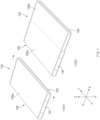
- an electronic device 100 includes display 160 (e.g., a flexible display having at least a portion of flexibility), a first cover 181, and a second cover 182.
- the first cover 181 may serve as a fixed cover to which one side of the display 160 is fixed.
- the second cover 182 may be moved in a first direction (e.g., x-axis direction) or in a second direction (e.g., -x-axis direction opposite to the first direction), based on the first cover 181.
- a first display region 160a of the first size may be disposed to be directed upward (z-axis direction).
- the display 160 may include the first display region 160a of the first size that is exposed to the outside.
- the first cover 181 may be disposed to surround at least a portion of one side edge of the first display region 160a (e.g., based on the illustrated drawing, at least a portion of the first display region 160a in the second direction (-x-axis direction), at least a portion in a third direction (y-axis direction), at least a portion in a fourth direction (-y-axis direction), and at least a portion in a fifth direction (-z-axis direction, which is opposite to the z-axis direction)).
- the first display region 160a and at least a portion of a second display region 160b to be extended may be disposed to be wound on the inner side of at least one of the first cover 181 and the second cover 182, or may be disposed to be unfolded.
- pixels of the first display region 160a may be disposed such that the surface thereof emitting light is directed toward the front (z-axis direction), and at least a portion of the upper surface of the second display region 160b on which pixels are disposed is directed toward the back (-z-axis direction).
- a portion of the second display region 160b may be disposed to be bent.
- the exposed region of the display 160 may be expanded.
- a state 103 e.g., a state in which the second cover 182 has slid in order to expand the region of the display 160
- the display 160 may include the first display region 160a of the first size and the second display region 160b of a second size, which are exposed to the outside (directed upward (z-axis direction)).
- the first size of the first display region 160a and the second size of the second display region 160b may be the same.
- the first size may be larger than the second size.
- the second size may vary according to a sliding distance or a moving distance of the second cover 182.
- the display 160 maintains a partially wound state in the state 101, and in the state 103, at least a portion that has been in the wound state may have an unfolded state.
- the second cover 182 may be disposed to surround at least a portion of the second display region 160b in the first direction (x-axis direction), at least a portion in the third direction (y-axis direction), at least a portion in the fourth direction (-y-axis direction), and at least a portion in the fifth direction (-z-axis direction).
- the second cover 182 is at least partially connected to the inside of the first cover 181, and slides along the inner surface of the first cover 181 in any one of the first direction (x-axis direction) and the second direction (-x-axis direction).
- the first cover 181 and the second cover 182 may be disposed to surround an edge of the display 160 while the first cover 181 and the second cover 182 are sliding.
- Various electronic elements related to driving the display 160, electronic elements related to various user functions supported by the electronic device 100, batteries, and so on may be disposed on the inner side of the first cover 181 and the second cover 182.
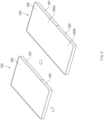
- FIG. 2 is a diagram illustrating an exploded perspective view of configurations of an electronic device based on a first direction according to an example of the disclosure.
- FIG. 3 is a diagram illustrating an exploded perspective view of configurations of an electronic device based on a second direction according to an example of the disclosure.
- FIG. 2 is a diagram illustrating a structure in which the display 160 is disposed on the covers 181 and 182 from the fifth direction (-z-axis direction) to a sixth direction (z-axis direction)
- FIG. 3 is a diagram illustrating a structure in which the covers 181 and 182 and the display 160 are disposed in a direction opposite to that in FIG. 2 .
- the electronic device 100 may include the display 160, a first display support member 140, a sliding structure 150, a first sliding support member 121a, a first sliding member 121b, a second sliding support member 122a, a second sliding member 122b, an actuator 130, an actuator support member 131, the first cover 181, and the second cover 182.
- the display 160 may have a plurality of pixels arranged in a matrix form, and at least a portion of the display 160 may be provided in a flexible form.
- the display 160 may include a panel layer on which a plurality of pixels are arranged and a screen is displayed, and an outer protective layer over the panel layer.
- the outer protective layer may be formed of a polymer structure (e.g., polyimide) or glass.
- the display 160 may further include a touch panel layer. As described in FIG. 1 , the display 160 may include the first display region 160a and the second display region 160b.
- At least a portion of the second display region 160b may be disposed to be wound on the inner side of the second cover 182 in the state 101, and may be exposed outside the second cover 182 in the state 103. While at least a portion of the second display region 160b is disposed to be wound and thus to be bent relative to a first rotation shaft 155 (or a rolling gear part or a rotation shaft member), the remaining portion may be disposed on the back surface of the first display region 160a.
- One side of the display 160 (e.g., at least a portion of the second display region 160b) may be mounted on the inner side of at least one of the first cover 181 and the second cover 182. In this state, one side end of the display 160 disposed on the inner side of the electronic device 100 may be coupled (or fastened, or connected, or engaged)) to an elastic member.
- the elastic force of the elastic member acts on the display 160 as a tension while the second display region 160b of the display 160 is exposed to the outside, and thus the repulsive force in the bent portion of the display 160 is canceled out. In this way, the wound portion of the display 160 may be maintained uniformly.
- the first display support member 140 may have a specified rigidity and may support the display 160.
- at least a portion of the first display support member 140 may be provided as aluminum or an aluminum alloy, and a surface thereof facing the display 160 may be formed to be flat.
- at least a portion of the first display support member 140 may be provided as an injection material (e.g., a structure containing magnesium).
- a first surface of the first display support member 140 e.g., a surface observed in the z-axis direction
- may face the back surface of the first display region 160a e.g., a surface observed in the -z-axis direction).
- a second surface of the first display support member 140 may be disposed to face the upper surface of the sliding structure 150 (e.g., a surface observed in the z-axis direction).
- the first display support member 140 may have a sidewall 140a formed on one side, and may include a flat region 140b perpendicular to the sidewall 140a and supporting the portion of the display 160. Accordingly, a cross-section of the first display support member 140 may be provided in an "L" shape.
- the sidewall 140a may be coupled with at least one of a guard member 120 of the first cover 181 and a fixing part 151 of the sliding structure 150.
- additional sidewalls for supporting the first sliding member 121b and the second sliding member 122b may be disposed on both side edges of the first display support member 140 (e.g., both side edges adjacent to the sidewall 140a), respectively.
- At least one guide rail 140c may be formed on the back surface of the first display support member 140 (a surface observed in the -z-axis direction).
- the guide rail 140c may be provided as a groove having a predetermined length on the back surface of the first display support member 140. At least portions of the first sliding support member 121a and the second sliding support member 122a may be seated on the guide rail 140c.
- At least a portion of the sliding structure 150 may be coupled with the second cover 182, and may be slid with sliding of the second cover 182.
- the sliding structure 150 may be moved by an actuator.
- a separate physical button capable of instructing the driving of the actuator may be disposed in the electronic device 100 or a menu related to driving the actuator may be output on the display screen of the display 160.
- the disposition direction of the second display region 160b of the display 160 fixed to the sliding structure 150 may be changed from the sixth direction (-z-axis direction) to the fifth direction (z-axis direction).
- the sliding structure 150 may include the fixing part 151, a second display support member 152, a first panel support 170, the first rotation shaft 155, and a connecting part 153.
- the fixing part 151 may be formed to have a predetermined length in the third direction (y-axis direction) (e.g., a length corresponding to the long axis of the sidewall 140a of the first display support member 140).
- the fixing part 151 may be disposed side by side with the guard member 120 of the second cover 182.
- the fixing part 151 may be disposed side by side with the sidewall 140a of the first display support member 140.
- At least a portion of the fixing part 151 may be coupled with at least one of the guard member 120 and the sidewall 140a.
- at least one hole penetrating the front and back surfaces (e.g., from the y-axis direction to the -y-axis direction) may be disposed on one side of the fixing part 151.
- the second display support member 152 may be disposed such that the upper surface (e.g., a surface observed in the z-axis) faces the lower surface (e.g., a surface observed in the -z-axis) of the first display support member 140 in the state 101.
- the lower surface of the second display support member 152 e.g., the surface observed in the -z-axis
- At least one hardware e.g., a printed circuit board and a battery
- driving the electronic device 100 may be disposed on the inner side of the second display support member 152.
- the second display support member 152 may be moved together with the movement of the second cover 182. While the second display support member 152 is moved in the first direction (x-axis direction), at least a portion of the first panel support 170, which has been in a state of being disposed on the lower surface of the second display support member 152, may be moved to the upper surface of the second display support member 152.
- the first panel support 170 may have a shape in which a plurality of protrusions (or pillars, long bars, or slates) with a predetermined length in the third direction (y-axis direction) are disposed at certain intervals. At least a portion of the first panel support 170 may form a track, and may move (or slide) a portion of the display (e.g., the second display region 160b) disposed on the track. The length of one side of the protrusions may correspond to the length of one side of the display 160.
- the first panel support 170 may be disposed to surround at least a portion of the second display support member 152.
- the plurality of protrusions constituting the first panel support 170 may be disposed such that the surface facing the back surface of the display 160 is flat, and the part disposed to be directed toward the inner side of the sliding structure 150 (e.g., the part facing the first rotation shaft 155) may be formed to protrude.
- the lower surface (e.g., one surface of the protrusions facing the sliding structure) of the first panel support 170 peaks and troughs of gear may be repeatedly formed.
- the protrusions disposed on the upper surface of the second display support member 152 may be continuously disposed with other neighboring protrusions, forming a flat surface.
- protrusions disposed at the position facing the first rotation shaft 155 may be disposed to be spaced apart from neighboring protrusions at certain intervals.
- the first panel support 170 may include a connecting chain or connecting shaft connecting a plurality of protrusions. At least one of the plurality of protrusions may be provided as a material that reacts to magnetic force (e.g., a magnetic material (an object that forms an attractive force in reaction to magnetic force) or a magnet).
- the first rotation shaft 155 (or a rolling gear part, or the rotation shaft member) may have a length similar to the length of one side of the second display support member 152 and may be disposed side by side with one side edge of the second display support member 152.
- the first rotation shaft 155 may be provided in a cylindrical rod shape.
- the centers of both sides of the first rotation shaft 155 may be formed to protrude more than the surroundings.
- the protruding centers of both sides of the first rotation shaft 155 may be mounted on one side of the second cover 182. Accordingly, the first rotation shaft 155 may rotate while the second cover 182 is moved in the first direction (x-axis direction). At least a portion of the first rotation shaft 155 may be geared with the first panel support 170.
- the first rotation shaft 155 may contact at least a portion of the first panel support 170.
- the disposition form of the first panel support 170 may be changed while the first rotation shaft 155 rotates.
- the first rotation shaft 155 rotates in the first rotating direction (e.g., the right hand winding direction)
- at least a portion of the first panel support 170 may be moved to the upper surface (the surface observed in the z-axis direction) of the second display support member 152.
- the first rotation shaft 155 rotates in the second rotating direction (e.g., the left hand winding direction)
- at least a portion of the first panel support 170 may be moved between the lower surface of the second display support member 152 (or second display support member 152) and the second cover 182.
- the connecting part 153 may connect the fixing part 151 and the second display support member 152.
- one side of the connecting part 153 may be fixed to a certain position of the fixing part 151 (e.g., the center of the fixing part 151), and the other side may be coupled (or fastened, or connected, or engaged) to the lower surface of the second display support member 152 (e.g., surface that may be observed in the z-axis).
- the connecting part 153 may include a gear pattern having at least one peak and trough.
- the connecting part 153 may be implemented in a rack form.
- the second display support member 152 may be moved in the first direction (x-axis direction) and the second direction (-x-axis direction) with being coupled (or fastened, or connected, or engaged) to the connecting part 153.
- the first sliding support member 121a may be mounted on one side of the first display support member 140 and may be coupled to the first sliding member 121b such that the first sliding member 121b is movable.
- the first sliding support member 121a may be disposed side by side with one side of the second display support member 152 (e.g., a side surface observed in the -y-axis direction) and may include a support part seated on the guide rail 140c and a protruding part protruding from the support part to allow at least a portion to fasten to the first sliding member 121b.
- At least a portion of the first sliding member 121b may be coupled to the first sliding support member (121a) seated on the guide rail (140c), and may be coupled with the second display support member 152.
- the first sliding member 121b may be formed to correspond at least partially to the shape of one side of the second display support member 152 (e.g., a side surface observed in the -y-axis direction).
- the second sliding support member 122a has the same shape as the first sliding support member 121a, but may be disposed at a position spaced apart from the first sliding support member 121a by a predetermined distance.
- the second sliding support member 122a may be disposed at a position opposite to the first sliding support member 121a based on the sliding structure 150.
- the second sliding support member 122a may be seated at least partially on the guide rail 140c formed on the first display support member 140 and may be coupled to the second sliding member 122b.
- the second sliding member 122b may be coupled to one side of the second sliding support member 122a and may be coupled with the second display support member 152.
- the second sliding member 122b may be disposed at a position opposite to the first sliding member 121b based on the sliding structure 150.
- the actuator 130 may generate power by receiving electric power from a battery included in the electronic device 100.
- a pinion gear may be disposed on one side of the actuator 130, and the pinion gear may operate on a rack formed on one side of the sliding structure 150. Accordingly, according to the operation, the actuator 130 may operate to be disposed close to the guard member 120 in the state 101, and may operate to be moved in a direction away from the guard member 120 (or a direction toward the second cover 182) in the state 103.
- the actuator 130 may be disposed in the longitudinal direction (e.g., y-axis or -y-axis direction) of the sliding structure 150. In the illustrated drawing, two actuators are illustrated as being arranged on the same axis.
- the actuator support member 131 may support one side of the body of the actuator 130.
- the actuator support member 131 may be moved together with the movement of the actuator 130.
- the first cover 181 may include a cover base 181a including a bottom surface on which at least a portion of the sliding structure 150 is seated and sidewalls disposed to surround edges of the sliding structure 150 (e.g., side portions disposed at the ends in the y-axis direction and the -y-axis direction), the guard member 120 fixing the first display support member 140 and the fixing part 151 in a state where the sidewall 140a of the first display support member 140 and the fixing part 151 are disposed, and a fastening part 181b fastening the guard member 120.
- a cover base 181a including a bottom surface on which at least a portion of the sliding structure 150 is seated and sidewalls disposed to surround edges of the sliding structure 150 (e.g., side portions disposed at the ends in the y-axis direction and the -y-axis direction), the guard member 120 fixing the first display support member 140 and the fixing part 151 in a state where the sidewall 140a of the first display support member 140 and the fixing part
- the fastening part 181b is disposed on the side of the first cover 181 in the second direction (-x-axis direction), and at least a portion of the first cover 181 in the second direction (-x-axis direction) may be closed as the guard member 120 is coupled to the fastening part 181b.
- the first cover 181 may be in an open state in the first direction (x-axis direction), and the second cover 182 may be coupled to the first cover 181 in the first direction (x-axis direction).
- the second cover 182 may be coupled to the first cover 181 in the first direction (x-axis direction).
- the second cover 182 may include a bottom surface on which at least a portion of the sliding structure 150 is seated and sidewalls (e.g., sidewalls disposed in the x-direction, the y-axis direction, and the -y-axis direction) that surround side surfaces of the sliding structure 150.
- the second cover 182 may be moved in the first direction (x-axis direction) or the second direction (-x-axis direction) in a state in which the sliding structure 150 is seated thereon. In this case, the disposition form and position of the second cover 182 may be changed according to the actuator operation.
- At least some of the plurality of protrusions constituting the first panel support 170 may include a magnet member or a magnetic material. Further, at least a portion of the first rotation shaft 155 may include a magnet member or a magnetic material. Accordingly, the first panel support 170 on which the display 160 of the electronic device 100 is seated may prevent the display 160 from being lifted by magnetic force in the process of coming into contact with the first rotation shaft 155 (or offset the repulsive force caused by warping of the display). As a result, the flatness of the display 160 around the first rotation shaft 155 may be maintained within a specified range.
- the electronic device 100 may include a display, a first cover surrounding one side of the display, a panel support disposed on one side of the display, a rotation shaft contacting the panel support, and a second cover coupled to the first cover and the rotation shaft, and other components may be added or excluded as necessary.
- the elastic members, magnetic force-related members (at least one of a magnetic material that reacts to magnetic force or a magnet), and gear structures described in FIGS. 4A to 8 may be selectively further added or excluded.
- the electronic device 100 described above may include an actuator, and may operate such that the second display region 160b is automatically expanded or reduced according to the actuator control.
- the sliding structure 150 and the first rotation shaft 155 which are engaged with the second cover 182, may be rotated, which may, in turn, make the second display region 160b expanded or reduced in a manual manner.
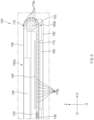
- FIG. 4A is a diagram illustrating a portion of an internal structure of an electronic device according to an example of the disclosure.
- FIG. 4B is a diagram illustrating at least a portion of a cross-section of an electronic device taken along line A-A' of FIG. 4A according to an example of the disclosure.
- FIG. 4A is a diagram illustrating at least a portion of the back surface of the electronic device with the cover removed.
- the electronic device 100 may include at least the first display support member 140, the first panel support 170, the actuator 130, and the first rotation shaft 155, and an elastic member 159. According to various examples of the disclosure, the electronic device 100 may further include the display 160, the first cover 181, and the second cover 182, as described above with reference to FIGS. 2 and 3 .
- a fixing groove 141 allowing one side of the elastic member 159 to be fixed may be disposed.
- the elastic member 159 is provided in a spring shape
- at least a portion of the fixing groove 141 may have a ring shape on which one side of the elastic member is mounted to fix one side of the elastic member 159.
- the fixing groove 141 may also be provided in a hole shape including a ring.
- One side of the elastic member 159 may be fixed to the first display support member 140, and the other side of the elastic member 159 may be fixed to one side of the first panel support 170.
- the elastic member 159 may have a stretched state. In this way, the stretched elastic member 159 may exert a greater elastic force to the first panel support 170.
- the elastic force of the elastic member 159 acts such that one side end of the first panel support 170 is directed in the second direction (-x-axis direction), at least a portion of the display 160 and the first panel support 170 may maintain a predetermined flatness.
- One or more elastic members 159 may be disposed based on at least one of the size of the first panel support 170 and the stretching characteristics of the first panel support 170 (e.g., the magnitude of the stretching force or the amount of the tension). For example, two elastic members 159 may be disposed on both side edges of the first panel support 170, respectively, as illustrated. Alternatively, one elastic member 159 may be disposed at a central position of the first panel support 170. Alternatively, three or more elastic members 159 may be connected to the first panel support 170.
- the elastic member 159 may be formed of at least one of various materials capable of providing an elastic force of a specified magnitude or more, such as spring and rubber.
- the first panel support 170 may include connecting holes 171 through which the elastic member 159 is possible to be connected.
- the first panel support 170 may be constituted by a plurality of protrusions which are sequentially disposed.
- protrusions disposed on one side e.g., an end in the -x-axis direction
- the number of connecting holes 171 may be formed to correspond to the number of elastic members 159. For example, if a plurality of the elastic members 159 are disposed, a plurality of the connecting holes 171 may also be disposed.
- FIG. 5 is a diagram illustrating a portion of a configuration of an electronic device related to maintenance of flatness according to an example of the disclosure.
- the electronic device 100 may include the display 160, the first panel support 170, and the first rotation shaft 155.
- FIG. 5 illustrates only a portion of the configuration of the electronic device 100, and may further include at least some of other configurations of the electronic device described with reference to FIGS. 2 and 3 .
- the display 160 may correspond to the display 160 described with reference to FIGS. 1 to 3 .
- the display 160 may include the first display region 160a whose disposition state is fixed regardless of sliding of the second cover 182, and the second display region 160b whose the disposition state is changed with sliding of the second cover 182.
- the first panel support 170 may be disposed under the second display region 160b of the display 160 to support the second display region 160b.
- the first panel support 170 may include a plurality of protrusions 170a, ..., and 170b.
- the plurality of protrusions 170a, ..., and 170b may be formed such that the upper surface (the surface facing the second display region 160b) and the lower surface (the surface opposite to the second display region 160b) have the same area.
- the plurality of protrusions 170a, ..., and 170b may be disposed to be spaced apart at certain intervals.
- the upper surface in the plurality of protrusions 170a, ..., and 170b, the upper surface may have a relatively wide surface as compared to the lower surface.
- the first gap 501a between individual upper surfaces of the plurality of protrusions 170a, ..., and 170b may be formed to be smaller than a second gap 501b between individual lower surfaces.
- the lower surfaces of the plurality of protrusions 170a, ..., and 170b may move while contacting the first rotation shaft 155.
- At least some of the plurality of protrusions 170a, ..., and 170b included in the first panel support 170 may be formed of a magnetic material (e.g., an iron, an iron alloy, or an object magnetized to a magnet, which forms an attractive force in reaction to a magnetic force).
- a magnetic material e.g., an iron, an iron alloy, or an object magnetized to a magnet, which forms an attractive force in reaction to a magnetic force.
- at least one protrusion disposed adjacent to the boundary between the first display region 160a and the second display region 160b may be formed of a magnetic material.
- a first protrusion group 170a (or at least one first protrusion) disposed close to the side edge of the first display region 160a in the first direction (x-axis direction) may be formed of a magnetic material. Accordingly, in the rolled state (e.g., the state 101 of FIG. 1 ), where the electronic device 100 is disposed such that only the first display region 160a is exposed, the first protrusion group 170a may maintain the contact state with the first rotation shaft 155. As the first protrusion group 170a maintains the contact state with the first rotation shaft 155 based on the magnetic force, the first display region 160a may maintain flatness within a specified size.
- the first protrusion group 170a and a second protrusion group 170b are illustrated in a form including a plurality of protrusions, respectively; however, the disclosure is not limited thereto. At least one of the first protrusion group 170a and the second protrusion group 170b may include a plurality of protrusions, respectively, or may include only one protrusion, respectively, and when the first protrusion group 170a (or the second protrusion group 170b) includes one protrusion, the second protrusion group 170b (or the first protrusion group 170a) may include a plurality of protrusions.
- the second protrusion group 170b including at least one protrusion disposed on one side edge of the second display region 160b (e.g., an end edge in the opposite direction based on a boundary with the first display region 160a) may maintain the contact state with the first rotation shaft 155.
- the second protrusion group 170b may maintain flatness within a specified range.
- At least a portion of the first rotation shaft 155 may be in contact with at least some of the plurality of protrusions of the first panel support 170.
- the first rotation shaft 155 may rotate with the operation of the actuator 130.
- the first rotation shaft 155 may rotate with the movement of the second cover 182 in the x-axis direction. While the first rotation shaft 155 rotates, the positions of the protrusions of the first panel support 170 contacting the first rotation shaft 155 may be changed.
- At least a portion of the first rotation shaft 155 may be formed of a magnetic member (or permanent magnet or electromagnet).
- the first rotation shaft 155 may be provided in a cylindrical rod shape.
- the first rotation shaft 155 may at least partially include a magnet member that contacts an upper end (end in the y-axis direction) and a lower end (end in the -y-axis direction) of the second display region 160b.
- a certain portion 155a disposed close to the end of the second display region 160b in the y-axis direction, a certain portion 155b disposed close to the end of the second display region 160b in the -y-axis direction, and the central part 155c of the second display region 160b may include a magnet member of a specified size.
- the first rotation shaft 155 may be provided in a cylindrical rod shape, may include a coil wound a certain number of times on the inner side, and may become an electromagnet by using electric power supplied from a battery of the electronic device 100.
- the processor of the electronic device 100 may perform control such that at least a portion of the first rotation shaft 155 becomes an electromagnet by supplying electric power to the first rotation shaft 155 in at least one of a state in which the second display region 160b is wound (e.g., the state 101 in FIG. 1 ) and a state in which the second display region 160b is unfolded (e.g., the state 103 of FIG. 1 ).
- the first panel support 170 including a plurality of protrusions, at least a portion of which is formed of a magnetic material, contacts the first rotation shaft 155 based on the magnetic force in the state 101 and the state 103, respectively, thereby making it possible to maintain the flatness of the specified size.
- the plurality of protrusions are divided into the first protrusion group 170a and a second protrusion group 170b; however, the number of protrusions belonging to each protrusion group is not limited.
- the first protrusion group 170a may include protrusions disposed relatively close to the first display region 160a
- the second protrusion group 170b may include protrusions disposed relatively far away from the first display region 160a.
- the first protrusion group 170a and the second protrusion group 170b may be described as including all the plurality of protrusions, or additional protrusions may be disposed between the first protrusion group 170a and the second protrusion group 170b.
- protrusions at least partially contacting the first rotation shaft 155 may belong to the first protrusion group 170a. Accordingly, the number of protrusions belonging to the first protrusion group 170a may be changed according to the size of the first rotation shaft 155 or the size of the protrusions and the interval between the protrusions.
- the first panel support 170 described with reference to FIG. 5 may further include at least one elastic member 159, which has been described with reference to FIGS. 4A and 4B .
- the elastic member 159 pulls the first panel support 170 in the second direction (-x-axis direction)
- the lifting of the second display region 160b is eliminated (or the bending repulsion is eliminated), and thus the display 160 may maintain flatness within a specified size.
- at least one of the plurality of protrusions contacts the first rotation shaft 155 by magnetic force, and as a result, the flatness of the display 160 may be further enhanced in addition to the elasticity of the elastic member 159.
- the first protrusion group 170a disposed close to the first display region 160a and the second protrusion group 170b disposed far away from the first display region 160a (or relatively close to the elastic member 159) are formed of a magnetic material; however, the disclosure is not limited thereto.
- all the protrusions included in the first panel support 170 may be formed of a magnetic material, or when a protrusion disclosed closet to the first display region 160a among a plurality of continuously disposed protrusions is designated as first, odd-numbered (or even-numbered) or the N-th protrusions may be formed of a magnetic material and the remaining protrusions may be formed of a non-magnetic material.
- the first rotation shaft 155 may be formed of a magnetic material, and at least some of the plurality of protrusions disposed on the first panel support 170 may be formed of a magnetic member (e.g., permanent magnet).
- At least a portion of at least one of the first rotation shaft 155 and the first panel support 170 may be provided as a magnetic member (e.g., a magnet), and at least a portion of at least one of the rests one may be a magnetic material that generates an attractive force with the magnetic material.
- a magnetic member e.g., a magnet
- at least a portion of the first rotation shaft 155 is formed of a magnetic member
- at least a portion of the first panel support 170 may be formed of a magnetic material.
- at least one of the protrusions constituting the first panel support 170 or at least some of specific protrusions may be formed of a magnetic material.
- At least a portion of the first rotation shaft 155 is formed of a magnetic material
- at least a portion of the first panel support 170 may be formed of a magnetic member.
- at least portions of the first rotation shaft 155 and the first panel support 170 may be all a magnetic member.
- FIG. 6 is a diagram illustrating a portion of a configuration of an electronic device related to prevention of display damage according to an example of the disclosure.
- the electronic device 100 may include the display 160, the first display support member 140, the sliding structure 150, the first panel support 170, and the first rotation shaft 155, the second cover 182, the elastic member 159, and the first magnetic force-related member 158. Furthermore, the electronic device 100 may further include the first cover 181 and the protective member 175.
- the display 160 may include the first display region 160a and the second display region 160b.
- the first display region 160a may include, for example, as illustrated, a region exposed upward (e.g., in the z-axis direction)
- the second display region 160b may include a region disposed between the sliding structure 150 and the second cover 182.
- the first protrusion group 170a disposed at one side end of the first panel support 170 may be disposed to be in contact with the first rotation shaft 155.
- at least one of the one or more protrusions included in the first protrusion group 170a may be formed of a magnetic material, and the first rotation shaft 155 may be formed of a magnet member.
- at least one of one or more protrusions included in the first protrusion group 170a may be formed of a magnetic member and the first rotation shaft 155 may be formed of a magnetic material, as described above with reference to FIG. 5 .
- the first magnetic force-related member 158 is disposed on one side of the sliding structure 150, and, may be disposed at a position adjacent to the back portion of the first panel support 170 in a wound state.
- the first magnetic force-related member 158 may include, for example, a member capable of generating an attractive force to at least some of the plurality of protrusions included in the first panel support 170 (e.g., the second protrusion group 170b).
- the first magnetic force-related member 158 may be formed of a permanent magnet.
- the first magnetic force-related member 158 may move the second display region 160b upward (e.g., the z-axis direction) while the second display region 160b is disposed between the sliding structure 150 and the second cover 182, which makes it possible to prevent at least a portion of the second display region 160b from contacting the second cover 182. Accordingly, the electronic device 100 may prevent the second display region 160b from being damaged by the second cover 182.
- the plurality of protrusions disposed in the second display region 160b may be provided in a configuration capable of forming an attractive force to the first magnetic force-related member 158 (e.g., a magnetic material (an object that forms an attractive force in reaction to magnetic force) or a magnet (an object that directly generates magnetic force)).
- the second protrusion group 170b may include at least some of the remaining protrusions other than those of the first protrusion group 170a.
- the elastic member 159 pulls the second display region 160b in a second direction (-x-axis direction), thereby providing tension to the second display region 160b while reducing friction between the second display region 160b and the second cover 182, which makes it possible to provide support such that the display region of the part on which the first rotation shaft 155 is disposed has a flatness of a specified size or more.
- the protective member 175 may be disposed between the sliding structure 150 and the second cover 182 or between the second display region 160b and the second cover 182. Alternatively, the protective member 175 is formed on at least a portion of the inner surface of the second cover 182 (e.g., a surface observed in the z-side direction), and may be disposed in a region facing the second display region 160b. The protective member 175 may protect at least a portion of the second display region 160b when the display 160 of the electronic device 100 is wound (e.g., the state 101 of FIG. 1 ).
- the protective member 175 may be formed of a material having a friction force equal to or less than a specified size, such as velvet, leather, paper, and wool.
- At least one component 190 (e.g., battery or printed circuit board (PCB)) related to driving the electronic device 100 may be disposed under the protective member 175 (e.g., in the -z-axis direction).
- the at least one component 190 related to driving the electronic device 100 may be disposed in the inner side of the sliding structure 150.
- the protective member 175 may be disposed between the second display region 160b and the at least one component 190 of the electronic device, which makes it possible to prevent at least one of damage to the second display region 160b or damage to the at least one component 190 of the electronic device, caused by friction between the second display region 160b and the at least one component 190 of the electronic device.
- FIG. 7 is a diagram illustrating a portion of a configuration of an electronic device related to maintenance of flatness according to an example of the disclosure.
- the electronic device 100 includes the first display support member 140, the sliding structure 150, the display 160, a second panel support 170a, a second rotation shaft 155a, and may include a second magnetic force-related member 158a.
- the electronic device 100 may further include the protective member 175.
- the electronic device 100 may further include at least one of the components described with reference to FIGS. 1 to 3 .
- the protective member 175 may be disposed between the second display region 160b and the at least one component 190 of the electronic device, which makes it possible to prevent damage caused by friction between the second display region 160b and the at least one component 190 of the electronic device.
- the display 160 includes the first display region 160a whose position is fixed, and the second display region 160b whose position is changed.
- An upper surface (e.g., a surface directed to the z-axis) of the first display support member 140 may be disposed under the display 160.
- the second panel support 170a including a plurality of protrusions is disposed under the second display region 160b of the display 160.
- each protrusion included in the second panel support 170a includes a hook pattern.
- the hook pattern includes a hook ring 170a_1 protruding in a direction opposite to the protruding direction of the hook pattern formed on the second rotation shaft 155a.
- the hook ring 170a_1 of the second panel support 170a may be disposed in the second direction (-x axis) based on the upper surface (e.g., the surface exposed in the z-axis) of the second display region 160b.
- the hook ring 170a_1 of the second panel support 170a disposed in the second display region 160b may be disposed to be directed in the first direction (the x-axis direction).
- the hook ring 170a_1 may be formed on one side of the lower surface of the corresponding protrusion.
- the second rotation shaft 155a is provided in a cylindrical rod shape, and at least one hook pattern 155a_1 may be regularly disposed on the outer surface at certain intervals.
- the hook pattern 155a_1 is formed to correspond to the hook ring 170a_1 formed on the second panel support 170a.
- the hook pattern 155a_1 may be partially disposed on the second rotation shaft 155a.
- the hook pattern 155a_1 may be formed on at least one of one side edge, the other side edge, and the center of the second rotation shaft 155a provided in a cylindrical rod shape.
- the second magnetic force-related member 158a may play the same role as the first magnetic force-related member 158 described above with reference to FIG. 6 .
- the second magnetic force-related member 158a may be disposed adjacent to the second panel support 170a, and may generate an attractive force to at least one of the plurality of protrusions disposed on the second panel support 170a.
- the second magnetic force-related member 158a may be provided as a magnet or a magnetic material, and at least a portion of the second panel support 170a may be provided as a magnetic material or a magnet.
- both the second magnetic force-related member 158a and the second panel support 170a may be formed of a magnet.
- the second magnetic force-related member 158a may include a plurality of magnetic materials or magnets spaced apart at specified intervals.
- the second magnetic force-related member 158a may be provided in a plate shape with a relatively long length in the longitudinal direction (e.g., the longitudinal direction of the rod of the second rotation shaft 155a).
- the second panel support 170a and the second rotation shaft 155a are temporarily ring-coupled in the process of contacting each other, making them to come into close contact with each other. Accordingly, as the second panel support 170a maintains a stable contact state with the second rotation shaft 155a, the second display region 160b in the vicinity of the second rotation shaft 155a does not protrude or bend outward (e.g., z-axis direction), and thus flatness may be kept constant.
- the shape of the hook pattern 155a_1 protruding from the surface of the cylindrical rod includes hook grooves (or recesses) that are cut into a surface of the outside of the cylindrical rod. At least some of the hook grooves are temporarily coupled to hook rings disposed on the panel support while the display 160 is expanded or returned to its original state. Alternatively, when the expansion or reduction of the display 160 is stopped, at least some of the hook holes may maintain a fastened state with the hook rings of the panel support.
- FIG. 8 is a diagram illustrating a portion of a configuration of an electronic device related to maintenance of flatness according to an example of the disclosure.
- the electronic device 100 may include the sliding structure 150, a third panel support 170b, and a third rotation shaft 155b. Furthermore, the electronic device 100 may further include at least one of the components of the electronic device 100 described with reference to FIGS. 1 to 3 .
- the third panel support 170b may include peaks protruding at a specified interval and troughs recessed at a specified interval, below the display 160.
- a substrate portion 170b_1 and protrusions 170b_2 may be integrated with each other.
- at least a portion of the third panel support 170b may be formed of a rubber material or a polymer material.
- the substrate portion 170b_1 of the third panel support 170b maintains a constant thickness, it is possible to prevent the issue that the third panel support 170b is viewed when the display 160 is seen from the outside of the second display region 160b (in the z-axis direction). For example, as described with reference to FIG.
- the gear patterns when the gear patterns are disposed at certain intervals directly on a lower portion of the display 160, the certain intervals are visually recognized as a stripe when viewed from the outside, which may result in deterioration in quality of the display 160 in uniformity.
- the third panel support 170b illustrated in FIG. 8 if the protrusions 170b_2 are integrally formed with the substrate portion 170b_1, the above-mentioned uniformity quality may be improved.
- the third rotation shaft 155b may be provided in a form corresponding to the pattern of the protrusions 170b_2 of the third panel support 170b.
- the third rotation shaft 155b may be provided in a cylindrical rod shape, and a plurality of stripe-shaped protrusions may be disposed on the rod surface. The plurality of stripe-shaped protrusions may be partially formed for each position of the rod.
- At least portions of the third panel support 170b and the third rotation shaft 155b may have magnetism.
- at least portions of the third panel support 170b and the third rotation shaft 155b may be formed of a rubber magnet. Based on this, as the third panel support 170b comes in close contact to the third rotation shaft 155b by magnetic force, the bending of the third panel support 170b on the part of the third rotation shaft 155b is removed, which makes it possible to maintain the flatness of the display 160.
- FIG. 9 is a diagram illustrating a structure of an electronic device related to maintenance of flatness according to an example of the disclosure.
- an electronic device 200 may include a first cover 281, a second cover 282, and a display 260.
- the second cover 282 may be moved in a vertical axis (e.g., an arrow direction in the illustrated drawing).
- the display 260 may be expanded and thus a second display region 260b may be secured in addition to an initial first display region 260a.
- the above-described electronic device 200 may employ structures of the panel support and the rotation shaft described above with reference to FIGS. 4A to 8 . Accordingly, the electronic device 200 may be a roll-type electronic device capable of being expanded in a vertical direction.
- the electronic device 200 may further include at least one of the protective member, the magnetic force-related member, the panel support made of rubber or polymer, and the elastic member mentioned in the above drawings.
- FIG. 10 is a diagram illustrating different structures of extension and reduction of an electronic device according to an example of the disclosure.
- an electronic device 1000 may include at least a display 1160, a first cover 1081, a second cover 1082, a display support member 1140, a sliding structure 1150, a panel support 1170, a first driving unit 1030 (or configuration including the actuators described in FIGS. 2 and 3 ), and a second driving unit 1055 (or configuration including the rotation shaft described in FIGS. 2 and 3 ).
- a display 1160 may have a configuration substantially the same as or similar to the display 160 described above with reference to FIGS. 2 and 3 .
- the display 1160 may be provided in a flexible form, may include a panel layer on which a screen is displayed and an outer protective layer (e.g., a polymer structure or ultra-thin glass) disposed over the panel layer, and additionally, may further include a touch panel layer.
- the display 1160 may include a first display region 1160a whose region size and position are fixed, and a second display region 1160b whose region size and position are changed. One side edge of the first display region 1160a and one side edge of the second display region 1160b may be continuously disposed.
- the second display region 1160b may disposed to extend from one side edge of the first display region 1160a.
- the second display region 1160b may be disposed to be at least partially rolled into the inner side of the second cover 1082 or to be taken out from the inner side of the second cover 1082 to be directed in the same direction as the first display region 1160.
- the display support member 1140 may be disposed under the first display region 1160a, and the panel support 1170 may be disposed at a back surface of the second display region 1160b.
- the first cover 1081 may include a bottom surface on which at least a portion of the sliding structure 1150 is seated and sidewalls disposed to surround side edges of the sliding structure 1150.
- the first cover 1081 may have substantially the same configuration as the first cover 181 described above with reference to FIGS. 2 and 3 .
- the first cover 1081 may have an open state in the first direction (e.g., the right direction in the illustrated drawing), and the second cover 182 may be coupled to the first cover 1081 in the first direction so as to be slidable.
- the second cover 1082 may be coupled to the first cover 1081 in the first direction.
- the second cover 1082 may have substantially the same configuration as the second cover 182 described above with reference to FIGS. 2 and 3 .
- the second cover 1082 may include a bottom surface on which at least a portion of the sliding structure 1150 is seated and sidewalls surrounding the side surfaces of the sliding structure 1150.
- the second cover 1082 may be moved in a first direction or in a second direction opposite to the first direction (e.g., the left direction based on the illustrated drawing) in a state in which the sliding structure 1150 is seated.
- the disposition form or position of the second cover 1082 may be changed according to the operations of the first driving unit 1030 and the second driving unit 1055.
- the display support member 1140 may have a specified rigidity and may support the display 1160. For example, as at least a portion of the surface of the display support member 1140 facing the display 1160 is formed to be flat, the display support member 1140 may be disposed to face the back surface of the display 1160. At least a portion of the display support member 1140 may be seated and fixed in the first cover 1081. For example, the display support member 1140 may be disposed and fixed between the first cover 1081 and the back surface of the display 1160. At least a portion of such a display support member 1140 may be formed of a metal material (e.g., aluminum or aluminum alloy).
- a metal material e.g., aluminum or aluminum alloy
- At least one guide rail 1140c may be formed on the back surface of the display support member 1140 (e.g., at least a portion of the display support member 1140 facing the first driving unit 1030).
- the at least one guide rail 1140c may be provided in a repeated pattern of peaks and troughs of a gear having a predetermined length on the back surface of the display support member 1140.
- At least a portion of a ring gear of the first driving unit 1030 having gear grooves on the outer surface may be seated on the at least one guide rail 1140c.
- the at least one guide rail 1140c may be disposed on at least a portion of the back surface of the display support member 1140 (e.g., a surface opposite to the surface directed toward the display 1160).
- two guide rails may be disposed biasedly toward both edges of the display support member 1140.
- the width of the at least one guide rail 1140c may have a size corresponding to the width of the ring gear of the first driving unit 1030 (e.g., size equal to or greater than the size of the ring gear).
- the length of the at least one guide rail 1140c may have a length corresponding to the maximum extension length of the second cover 1082.
- At least a portion of the sliding structure 1150 may be coupled with the second cover 1082, and may be slid with the sliding of the second cover 1082.
- the sliding structure 1150 may be moved by the operation of the first driving unit 1030.
- a separate physical button capable of instructing the driving of the first driving unit 1030 may be disposed in the electronic device 1000 or a menu related to driving the first driving unit 1030 may be output on the display screen of the display 1160.
- the disposition direction of the second display region 1160b of the display 1160 fixed to the sliding structure 1150 may be changed from a display back surface direction (e.g., a direction opposite to the direction in which the first display region 1160a is directed) to a display front surface direction (e.g., a direction in which the first display region 1160a is directed).
- the sliding structure 1150 may be disposed between the display support member 1140 and the first cover 1081 or at least partially side by side with the display support member 1140, and may have at least some of various structures related to driving the electronic device 1000 disposed inside.
- a portion of the sliding structure 1150 may have an upper surface facing the back surface of the display support member 1140, and may have at least one of a battery, a printed circuit board, a camera, and a sensor disposed inside.
- the sliding structure 1150 may move together with the second cover 1082 in the first direction or in the second direction opposite to the first direction, with the operation of the first driving unit 1030.
- the sliding structure 1150 may have the same structure as at least a portion of the sliding structure 1150 described above with reference to FIGS. 2 and 3 .
- the panel support 1170 may have a shape in which a plurality of protrusions (or pillars, long bars, or slates) having a predetermined length in the third direction, which is opposite to the direction in which the first display region 1160a is directed, are disposed at certain intervals. At least a portion of the panel support 1170 may form a track, and may move (or slide) a portion of the display (e.g., the second display region 1160b) disposed on the track.
- the plurality of protrusions constituting the panel support 1170 may be disposed such that the surface facing the back surface of the display 1160 is flat, and the part disposed to be directed toward the inner side of the sliding structure 1150 (e.g., the part contacting the gear pattern of the second driving unit 1055) may be formed to protrude.
- the lower surface (e.g., one surface of the protrusions facing the sliding structure 1150) of the panel support 1170 peaks and troughs of the gear may be repeatedly formed.
- protrusions disposed at the position facing the gear pattern of the second driving unit 1055 may be disposed to be spaced apart from neighboring protrusions at certain intervals.
- the panel support 1170 may include a connecting chain or connecting shaft connecting a plurality of protrusions. As described above, at least one of the plurality of protrusions of the panel support 1170 may be provided as a material that reacts to magnetic force (e.g., a magnetic material (an object that forms an attractive force in reaction to magnetic force) or a magnet).
- a magnetic material an object that forms an attractive force in reaction to magnetic force
- a magnet e.g., a magnet
- the first driving unit 1030 may generate power by receiving electric power from a battery included in the electronic device 1000.
- the first driving unit 1030 may be at least partially coupled to the at least one guide rail 1140c formed on the back surface of the display support member 1140, and may use the generated power to make the gear work for movement along the at least one guide rail 1140c in the first direction (or the second direction opposite to the first direction).
- the first driving unit 1030 may operate in conjunction with the second driving unit 1055. For example, at least some operations of the first driving unit 1030 may include an operation of rotating the gear in the same direction as the second driving unit 1055.
- the second driving unit 1055 may be disposed to be at least partially coupled to the panel support 1170. Accordingly, at least a portion of the second driving unit 1055 may be disposed under the display 1160 and an operation for extending and winding the second display region 1160b may be performed. In this regard, at least a portion of the second driving unit 1055 may include a gear pattern, and the gear pattern may be coupled (or fastened) to at least a portion of the panel support 1170.
- the second driving unit 1055 may receive electric power from a battery, rotate a body including the gear pattern, and move the panel support 1170 coupled (or fastened) to the gear pattern in the first direction or the second direction, thereby making it possible to control the extension and reduction of the second display region 1160b.
- the second driving unit 1055 may operate in conjunction with the first driving unit 1030. For example, at least some operations of the second driving unit 1055 may operate in the same direction as some operations of the first driving unit 1030.
- the electronic device 1000 may include the first driving unit 1030 and the second driving unit 1055, and while the electronic device 1000 changes from the state 1001 to the state 1003, the first driving unit 1030 may rotate in a first rotation direction (e.g., a rotating direction causing the second cover 1082 to move in the first direction) and the second driving unit 1055 may also rotate in the first rotation direction in the same manner. Accordingly, the electronic device 1000 more stably extends the second cover 1082 by receiving the force required for the extension of the second cover 1082 from the first driving unit 1030 and the second driving unit 1055.
- a first rotation direction e.g., a rotating direction causing the second cover 1082 to move in the first direction
- the second driving unit 1055 may also rotate in the first rotation direction in the same manner. Accordingly, the electronic device 1000 more stably extends the second cover 1082 by receiving the force required for the extension of the second cover 1082 from the first driving unit 1030 and the second driving unit 1055.
- the second driving unit 1055 may also rotate in a second rotation direction. Accordingly, the electronic device 1000 according to an example may provide enough power to move the second cover 1082 while changing from the extended state to the reduced state, thereby making it possible to provide more stable support for winding of the display 1160 and moving of the second cover 1082.
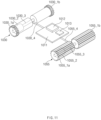
- FIG. 11 is a diagram illustrating at least some of components related to driving units among components of an electronic device according to an example of the disclosure.
- the electronic device 1000 may include the first driving unit 1030, the second driving unit 1055, a printed circuit board 1011, a processor 1012, and a memory 1013.
- the first driving unit 1030 may include a first ring gear 1030_1a, a second ring gear 1030_1b, a first motor 1030_2, a first connecting shaft 1030_3, and a first wire 1030_4. Additionally, a first ring gear body 1030_5a connected to the first ring gear 1030_1a and a second ring gear body 1030_5b connected to the second ring gear 1030_1b may be included.
- the first ring gear 1030_1a is provided in a circular band shape having a predetermined thickness, and may have a shape in which irregularities are regularly arranged on an outer circumferential surface.
- the first motor 1030_2 may be connected to a side surface of the first ring gear 1030_1a. Accordingly, the first ring gear 1030_1a may rotate in the clockwise direction or in the counterclockwise direction, according to the operating direction of the first motor 1030_2.
- the irregularities formed on the outer circumferential surface of the first ring gear 1030_1a may be coupled (or fastened) to the at least one guide rail 1140c formed on the back surface of the display support member 1140 as described above. Accordingly, when the first motor 1030_2 is operated and the first ring gear 1030_1a rotates in the counterclockwise direction, the first ring gear 1030_1a may rotate in the first direction.
- one side of the central shaft may be coupled with one side surface of the first ring gear 1030_1a.
- the first motor 1030_2 may operate by receiving electrical power from a battery (not illustrated) connected to the printed circuit board 1011 via the first wire 1030_4. In this case, the first motor 1030_2 may rotate in the clockwise direction or in the counterclockwise direction according to the operation of the processor 1012.
- the other side of the central shaft of the first motor 1030_2 may be connected to the first connecting shaft 1030_3.
- the first connecting shaft 1030_3 may be connected to the other side of the central shaft of the first motor 1030_2 and one side surface of the second ring gear 1030_1b.
- the first connecting shaft 1030_3 may serve to transmit, to the second ring gear 1030_1b, the force generated while the first motor 1030_2 rotates.
- first wire 1030_4 may be connected to the first motor 1030_2 via the first connecting shaft 1030_3.
- the other side of the first wire 1030_4 may be connected to one side of the printed circuit board 1011.
- the first wire 1030_4 may transmit, to the first motor 1030_2, electric power from the battery of the electronic device 1000. Further, the first wire 1030_4 may transmit, to the first motor 1030_2, a control signal of the processor 1012 mounted on the printed circuit board 1011.
- the first wire 1030_4 may be provided in various forms, such as a cable or an FPCB.
- the second ring gear 1030_1b may be disposed at a position symmetrical to the first ring gear 1030_1a based on a point where the first wire 1030_4 and the first connecting shaft 1030_3 are connected.
- the second ring gear 1030_1b may be provided in substantially the same shape as or similar shape to the first ring gear 1030_1a.
- the second ring gear 1030_1b may be provided in a disc-belt shape having a predetermined width, and irregularities may be regularly formed on the outer circumferential surface.
- the irregularity pattern of the second ring gear 1030_1b may be coupled (or fastened) to the at least one guide rail 1140c formed on the back surface of the display support member 1140.
- the second ring gear 1030_1b may receive, via the first connecting shaft 1030_3, power according to the operation of the first motor 1030_2, and may rotate in the same direction as the first ring gear 1030_1a.
- the second driving unit 1055 may be driven in conjunction with the first driving unit 1030.
- the second driving unit 1055 may include a first gear part 1055_1a, a second gear part 1055_1b, a second motor 1055_2, a second connecting shaft 1055_3, and a second wire 1055_4.
- the outer surface of the first gear part 1055_1a may be formed in a gear pattern.
- the second motor 1055_2 may be disposed inside the first gear part 1055_1a.
- the second motor 1055_2 is connected inside the first gear part 1055_1a, and may be disposed to rotate in a specific direction according to the operation of the second motor 1055_2.
- the second motor 1055_2 includes a central shaft, and the central shaft of the second motor 1055_2 may be fastened to or coupled with an inner end of the first gear part 1055_1a.
- the second motor 1055_2 may be disposed inside the first gear part 1055_1a, and the central shaft of the second motor 1055_2 may be coupled (or fastened) to the first gear part 1055_1a.
- the other side of the second motor 1055_2 may be connected to the second connecting shaft 1055_3.
- the second motor 1055_2 may operate depending on electric power transmitted via the second wire 1055_4, and may transmit power generated according to the operation to the first gear part 1055_1a.
- the second connecting shaft 1055_3 may have one end connected to the central shaft of the second motor 1055_2, and the other end connected to one end of the second gear part 1055_1b.
- the second wire 1055_4 may be disposed in at least either inside or outside the second connecting shaft 1055_3.
- the second wire 1055_4 has one end connected to the second motor 1055_2 via the second connecting shaft 1055_3, and the other end connected to the printed circuit board 1011.
- the second wire 1055_4 may transmit, to the second motor 1055_2, electric power from the battery of the electronic device 1000, and may transmit, to the second motor 1055_2, a control signal of the processor 1012, which is similar to the first wire 1030_4.
- the first motor 1030_2 is disposed on the inner side of the first ring gear 1030_1a, and the second motor 1055_2 is disposed inside the first gear part 1055_1a has been described; however, the disclosure is not limited thereto.
- the first motor 1030_2 may be disposed outside the first ring gear 1030_1a and may be disposed in a structure in which a rotating force is transmitted to the first ring gear 1030_1a.
- the second motor 1055_2 may also be disposed outside the first gear part 1055_1a, and may be disposed in a structure in which the force generated by the operation is transmitted to the first gear part 1055_1a.
- the printed circuit board 1011 may be disposed between the first driving unit 1030 and the second driving unit 1055. According to an example of the disclosure, the printed circuit board 1011 may be connected to the first wire 1030_4 for supplying electric power and control signals to the first driving unit 1030. In addition, the printed circuit board 1011 may be connected to the second wire 1055_4 for supplying electric power and control signals to the second driving unit 1055. According to various examples of the disclosure, the printed circuit board 1011 may be at least partially disposed in the sliding structure 1150 described above, and may move in the first direction or in the second direction opposite to the first direction with the movement of the sliding structure 1150. The processor 1012 and the memory 1013 may be mounted on the printed circuit board 1011.
- the processor 1012 may be mounted on the printed circuit board 1011, generate a control signal according to a user input, and transmit the generated signal to the first motor 1030_2 and the second motor 1055_2.
- the processor 1012 may generate control signals for controlling the rotation speed and direction of the first motor 1030_2, and the rotation speed and direction of the second motor 1055_2, and transmit the generated control signals to the first motor 1030_2 and the second motor 1055_2 via the first wire 1030_4 and the second wire 1055_4, respectively.
- the processor 1012 may generate control signals for controlling the first motor 1030_2 and the second motor 1055_2 to rotate in the same direction to transmit the control signals to the first motor 1030_2 and the second motor 1055_2, respectively.
- the processor 1012 may generate a control signal for making the rotation direction of one of the first motor 1030_2 or the second motor 1055_2 different, and supply the generated control signal to the first motor 1030_2 and the second motor 1055_2.
- FIG. 12 is a flowchart illustrating a method of operating an electronic device according to an example of the disclosure.
- the processor 1012 of the electronic device 1000 may maintain a reduced state of the display 1160 in operation 1201.
- the processor 1012 may adjust the rotation directions of the first motor 1030_2 and the second motor 1055_2 such that the second display region 1160b moves to the inner side of the second cover 1082.
- the processor 1012 may control the first motor 1030_2 and the second motor 1055_2 such that they rotate in the clockwise direction.
- the processor 1012 may determine the number of rotations of the first motor 1030_2 and the second motor 1055_2.
- the processor 1012 may determine, according to the user setting, the first number of rotations used to perform control such that the whole second display region 1160b is displayed on the inner side of the second cover 1082, or the numbers of rotations of at least one of the first motor 1030_2 and the second motor 1055_2 used such that a portion of the second display region 1160b is disposed to be directed in the same direction as the first display region 1160a and only a portion is disposed on the inner side of the second cover 1082.
- the processor 1012 may adjust the numbers of rotations of the first motor 1030_2 and the second motor 1055_2 corresponding to receiving the user input.
- the display 1160 may output a screen interface related to size adjustment of the second display region 1160b.
- the processor 1012 may determine the size adjustment of the second display region 1160b corresponding to the touch input of the user, and may determine the numbers of rotations of the motors corresponding to the size adjustment.
- the processor 1012 may fix the first motor 1030_2 and the second motor 1055_2 after the size adjustment of the second display region 1160b is determined.
- the processor 1012 may perform control such that the first motor 1030_2 is fixed and the second motor 1055_2 further rotates by a predetermined angle in a direction opposite to the reduction direction of the second display region 1160b.
- the processor 1012 may perform control such that the first motor 1030_2 and the second motor 1055_2 rotates by the same number of rotations, and then the second motor 1055_2 further rotates by a predetermined angle in the clockwise direction.
- the processor 1012 may perform control such that the second display region 1160b maintain the flat state without lifting.
- the electronic device 1000 may further include a stopper for fixing the second driving unit 1055 after the second driving unit 1055 is driven by the additional angle in the clockwise direction.
- the stopper may serve to temporarily fix the second driving unit 1055 after the second driving unit 1055 is further rotated by the additional angle. If the electronic device 1000 is extended, the stopper may be disposed to temporarily release the fixing of the second driving unit 1055.
- the processor 1012 may identify whether or not an input signal for extending the display 1160 is generated. If there is no reception of the input signal for extending the display 1160, the processor 1012 may perform control to maintain the state 1201. If the input signal (e.g., a user input) requesting extension of the display 1160 is generated, the processor 1012 may control the first driving unit 1030 and the second driving unit 1055 to be driven in the counterclockwise direction for a first time period in operation 1205. Alternatively, the processor 1012 may control the numbers of rotations of the first motor 1030_2 of the first driving unit 1030 and the second motor 1055_2 of the second driving unit 1055 such that they are rotated by a specified number of rotations.
- the processor 1012 may control the numbers of rotations of the first motor 1030_2 of the first driving unit 1030 and the second motor 1055_2 of the second driving unit 1055 such that they are rotated by a specified number of rotations.
- first driving unit 1030 and the second driving unit 1055 operate for the first time period (or by a first number of rotations)
- the first driving unit 1030 moves in the first direction
- the second driving unit 1055 also moves in the first direction as in the first driving unit 1030, rotating the panel support 1170, which, in turn, the second display region 1160b positioned on the panel support 1170 may be repositioned to be directed in the same direction as that of the first display region 1160a.
- the processor 1012 may stop the first driving unit 1030 and drive the second driving unit 1055 by a first angle in a clockwise direction.
- the first angle may vary depending on the tension of the second display region 1160b.
- the processor 1012 may increase the overall tension of the display 1160 by driving the second driving unit 1055 by the first angle in the clockwise direction, which makes it possible to provide support for maintaining a more flat state.
- the processor 1012 may drive the second driving unit 1055 by the first angle in the counterclockwise direction, and drive the first driving unit 1030 and the second driving unit 1055 for a second time (or by a second number of rotations) in the clockwise direction, thereby changing the display 1160 into the reduced state.
- the second time (or the second number of rotations) may include, for example, a time period substantially the same as the first time period (or the first number of rotations) described above.
- the control method of the electronic device 1000 may process the movement of the second display region 1160b and the second cover 1082 covering it more smoothly by generating and operating power required to expand or reduce the second display region 1160b using the first driving unit 1030 and the second driving unit 1055.
- the electronic device 1000 increases the tension of the display 1160 by fixing the first driving unit 1030 and further rotating the second driving unit 1055 (or the second motor 1055_2) by a specified angle in a clockwise direction in the process of extending or reducing the display 1160, which makes it possible to control the display 1160 to maintain a more flat state.
- an electronic device may include a first cover, a second cover coupled (or fastened) to the first cover to slide, a display in which a size of an exposed region is changed corresponding to the sliding of the second cover, a display support member supporting a first region of the display, a sliding structure at least partially disposed under the display support member, a first driving unit at least partially coupled (or fastened) to a guide rail formed on the bottom of the display support member and moving the sliding structure in a first direction or a second direction opposite to the first direction, a panel support including a plurality of protrusions disposed on a back surface of a second region of the display based on a front surface of the display on which a screen is displayed, a second driving unit contacting at least a portion of the panel support and performing a rotation required for winding of the panel support, and at least one processor configured to control operations of the first driving unit and the second driving unit.
- the processor may control the first driving unit and the second driving unit to operate in a counterclockwise direction for a same time or by a same number of rotations when an event requesting extension of the display occurs.
- the processor may be configured to control the first driving unit to be fixed and the second driving unit to further rotate by the first angle in a clockwise direction, after completing the extension of the display.
- the processor may control the first driving unit and the second driving unit to operate in a clockwise direction for a same time or by a same number of rotations when an event requesting reduction of the display occurs.
- the processor may be configured to control extension or reduction of the display according to a user input or a request to execute a specified application.
Landscapes
- Engineering & Computer Science (AREA)
- Theoretical Computer Science (AREA)
- Physics & Mathematics (AREA)
- Computer Hardware Design (AREA)
- General Physics & Mathematics (AREA)
- General Engineering & Computer Science (AREA)
- Human Computer Interaction (AREA)
- Microelectronics & Electronic Packaging (AREA)
- Mathematical Physics (AREA)
- Automation & Control Theory (AREA)
- Signal Processing (AREA)
- Devices For Indicating Variable Information By Combining Individual Elements (AREA)
- Casings For Electric Apparatus (AREA)
Claims (13)
- Elektronische Vorrichtung zum Unterstützen von Verschiebung, wobei die elektronische Vorrichtung Folgendes umfasst:eine erste Abdeckung (181);eine zweite Abdeckung (182), die an die erste Abdeckung (181) zum Verschieben gekoppelt ist;eine Anzeige (160), bei der eine Größe eines freiliegenden Bereichs gemäß der Verschiebung der zweiten Abdeckung geändert wird;eine Plattenstütze (170a), die auf einer Seite einer Rückfläche der Anzeige in Bezug auf eine Vorderfläche der Anzeige, auf der ein Bildschirm angezeigt ist, angeordnet ist; undeine Drehwelle (155a), die sich gemäß der Verschiebung der zweiten Abdeckung dreht, während ein Teil der Drehwelle (155a) zumindest einen Teil der Plattenstütze (170a) kontaktiert,wobei der Teil der Plattenstütze (170a) eine Vielzahl von Vorsprüngen umfasst, undwobei eine Anziehungskraft zwischen dem Teil der Drehwelle und zumindest einigen aus der Vielzahl von Vorsprüngen gebildet ist,dadurch gekennzeichnet, dass:die Drehwelle (155a) Hakennuten (155a_1) umfasst, die temporär mit der Vielzahl von Vorsprüngen gekoppelt sind, wenn sie die eine Seite der Plattenstütze (170a) kontaktieren, während sich der freiliegende Bereich der Anzeige (160) ändert,wobei die Vielzahl von Vorsprüngen einen Hakenring (170a_1) beinhaltet, der in einer Richtung entgegengesetzt zu der Vorsprungsrichtung der Hakennuten (155a_1) vorspringt, die an der Drehwelle (155a) gebildet sind.
- Elektronische Vorrichtung nach Anspruch 1, wobei in einem Zustand, in dem ein Teil der Anzeige (160) um die Drehwelle (155a) gebogen ist, die Anziehungskraft zwischen dem Teil der Drehwelle und Vorsprüngen, welche die Drehwelle kontaktieren, unter der Vielzahl von Vorsprüngen, die auf der Plattenstütze (170a) angeordnet sind, gebildet ist.
- Elektronische Vorrichtung nach Anspruch 2, wobei in einem Zustand, in dem sich die zweite Abdeckung (182) verschoben hat, sodass eine Größe der Anzeige (160) erweitert ist, die Anziehungskraft zwischen dem Teil der Drehwelle (155a) und zumindest einigen der Vorsprünge, welche die Drehwelle (155a) kontaktieren, gebildet ist.
- Elektronische Vorrichtung nach Anspruch 3, wobei die zumindest einigen aus der Vielzahl von Vorsprüngen aus einem magnetischen Material oder einem ferromagnetischen Material, das auf Magnetkraft reagiert, oder einem Permanentmagneten gebildet sind.
- Elektronische Vorrichtung nach Anspruch 4, wobei der Teil der Drehwelle (155a) ein Material, das auf Magnetkraft reagiert, oder einen Permanentmagneten umfasst.
- Elektronische Vorrichtung nach Anspruch 5, wobei die Anzeige (160) Folgendes umfasst:einen ersten Anzeigebereich (160a) mit einer festen Anordnungsform; undeinen zweiten Anzeigebereich (160b), in dem ein freiliegender Bereich mit einer Bewegung der Plattenstütze geändert wird.
- Elektronische Vorrichtung nach Anspruch 6, wobei die Drehwelle (155a) wie folgt arbeitet:als Elektromagnet, der von elektrischer Leistung abhängt, die basierend auf einer Spule zugeführt wird, die an einer Innenseite angeordnet ist,als Elektromagnet, wenn der zweite Anzeigebereich (160b) auf ein Maximum erweitert ist, oderals Elektromagnet, wenn der zweite Anzeigebereich (160b) auf ein Minimum gebildet ist.
- Elektronische Vorrichtung nach Anspruch 7, wobei die erste Plattenstütze (170a) Folgendes umfasst:
die Vielzahl von Vorsprüngen, die den Hakenring (170a_1) beinhaltet, der in einer Richtung parallel zu der Anzeige vorsteht, auf zumindest einer Seite von den zumindest einigen aus der Vielzahl von Vorsprüngen. - Elektronische Vorrichtung nach Anspruch 1, ferner umfassend ein Schutzelement (175), das zwischen zumindest einem von der ersten Abdeckung (181) oder der zweiten Abdeckung (182) und der Plattenstütze (170a) angeordnet ist, um einen Teil der Anzeige (160) zu schützen.
- Elektronische Vorrichtung nach Anspruch 9, ferner umfassend ein elastisches Element (159), dessen eines Ende an einer Seite innerhalb der elektronischen Vorrichtung befestigt ist und dessen anderes Ende mit einem Ende der Plattenstütze (170a) verbunden ist.
- Elektronische Vorrichtung nach Anspruch 10,
wobei der Teil der Plattenstütze (170a) aus einem elastischen Material gebildet ist. - Elektronische Vorrichtung nach Anspruch 11,
ferner umfassend ein magnetkraftbezogenes Element (158), das an einer Position benachbart zu einer Innenfläche der Plattenstütze angeordnet ist. - Elektronische Vorrichtung nach Anspruch 12,
wobei das magnetkraftbezogene Element (158) zwischen dem Teil des ersten Anzeigebereichs (160a), der in einem Zustand, in dem die Anzeige (160) aufgewickelt ist, nach außen freiliegt und dem Teil des zweiten Anzeigebereichs (160b), der innerhalb der elektronischen Vorrichtung angeordnet ist, angeordnet ist.
Applications Claiming Priority (3)
| Application Number | Priority Date | Filing Date | Title |
|---|---|---|---|
| KR20190113144 | 2019-09-11 | ||
| KR1020200002378A KR102684574B1 (ko) | 2019-09-11 | 2020-01-08 | 슬라이딩 동작을 지원하는 전자 장치 |
| PCT/KR2020/011385 WO2021049785A1 (ko) | 2019-09-11 | 2020-08-26 | 슬라이딩 동작을 지원하는 전자 장치 |
Publications (3)
| Publication Number | Publication Date |
|---|---|
| EP3974940A1 EP3974940A1 (de) | 2022-03-30 |
| EP3974940A4 EP3974940A4 (de) | 2022-08-10 |
| EP3974940B1 true EP3974940B1 (de) | 2024-10-09 |
Family
ID=74867114
Family Applications (1)
| Application Number | Title | Priority Date | Filing Date |
|---|---|---|---|
| EP20863207.5A Active EP3974940B1 (de) | 2019-09-11 | 2020-08-26 | Stützschiene für elektronische vorrichtung |
Country Status (3)
| Country | Link |
|---|---|
| US (1) | US11910549B2 (de) |
| EP (1) | EP3974940B1 (de) |
| WO (1) | WO2021049785A1 (de) |
Families Citing this family (21)
| Publication number | Priority date | Publication date | Assignee | Title |
|---|---|---|---|---|
| US12267447B2 (en) * | 2019-12-23 | 2025-04-01 | Lg Electronics Inc. | Mobile terminal |
| US12284307B2 (en) * | 2020-01-09 | 2025-04-22 | Lg Electronics Inc. | Mobile terminal |
| US12526355B2 (en) * | 2020-03-30 | 2026-01-13 | Lg Electronics Inc. | Electronic device comprising flexible display |
| CN111862822B (zh) * | 2020-08-25 | 2025-03-18 | 京东方科技集团股份有限公司 | 柔性显示装置及其滑卷方法 |
| KR102875433B1 (ko) * | 2020-09-01 | 2025-10-24 | 삼성전자주식회사 | 플렉서블 디스플레이를 가지는 전자 장치 |
| WO2022050544A1 (ko) * | 2020-09-03 | 2022-03-10 | 삼성전자 주식회사 | 슬라이더블 전자 장치 및 상기 전자 장치에서 투명 디스플레이를 이용하는 방법 |
| EP4227760A4 (de) * | 2020-11-19 | 2024-04-10 | Samsung Electronics Co., Ltd. | Elektronische vorrichtung mit flexibler anzeige |
| EP4239444B1 (de) * | 2020-12-04 | 2025-02-26 | Samsung Electronics Co., Ltd. | Verschiebbare elektronische vorrichtung |
| CN112767840B (zh) * | 2021-01-29 | 2023-01-20 | 昆山国显光电有限公司 | 显示模组及显示装置 |
| CN113114821B (zh) * | 2021-04-29 | 2023-03-10 | 维沃移动通信有限公司 | 电子设备 |
| CN113194180B (zh) * | 2021-05-07 | 2023-08-08 | 维沃移动通信有限公司 | 电子设备 |
| KR20230017621A (ko) * | 2021-07-28 | 2023-02-06 | 엘지디스플레이 주식회사 | 롤-슬라이드 표시 장치 |
| CN114138059B (zh) * | 2021-08-02 | 2024-07-23 | 联想(北京)有限公司 | 电子设备 |
| EP4386327A4 (de) * | 2021-11-02 | 2025-02-26 | Samsung Electronics Co., Ltd. | Elektronische vorrichtung mit struktur zur erfassung der rotationsmenge eines motors |
| CN114078427B (zh) * | 2021-11-11 | 2022-09-27 | 武汉华星光电半导体显示技术有限公司 | 一种可拉伸显示模组及其控制方法和检测方法 |
| CN117501206A (zh) * | 2021-11-11 | 2024-02-02 | 三星电子株式会社 | 可卷曲电子装置 |
| EP4350473B1 (de) * | 2021-12-20 | 2025-09-24 | Samsung Electronics Co., Ltd. | Rollbare elektronische vorrichtung mit getriebeanordnung |
| KR20230094027A (ko) | 2021-12-20 | 2023-06-27 | 삼성전자주식회사 | 플렉서블 디스플레이 및 디스플레이 지지 구조를 포함하는 전자 장치, 및 디스플레이 지지 구조의 제조 방법 |
| EP4276577A4 (de) | 2022-04-01 | 2024-08-21 | Samsung Electronics Co., Ltd. | Elektronische vorrichtung mit flexibler anzeige |
| CN115691340B (zh) * | 2022-11-15 | 2025-03-04 | 合肥维信诺科技有限公司 | 滑卷机构及滑卷显示装置 |
| KR20240081166A (ko) * | 2022-11-30 | 2024-06-07 | 엘지디스플레이 주식회사 | 표시 장치 |
Family Cites Families (20)
| Publication number | Priority date | Publication date | Assignee | Title |
|---|---|---|---|---|
| US7440265B2 (en) * | 2005-12-27 | 2008-10-21 | Lite-On Technology Corporation | Variable-sized screen |
| US9286812B2 (en) * | 2011-06-07 | 2016-03-15 | Microsoft Technology Licensing, Llc | Flexible display extendable assembly |
| US8711566B2 (en) | 2011-09-02 | 2014-04-29 | Microsoft Corporation | Expandable mobile device |
| CN104378936A (zh) | 2013-08-16 | 2015-02-25 | 鸿富锦精密工业(深圳)有限公司 | 电子设备 |
| US20150153777A1 (en) | 2013-12-03 | 2015-06-04 | Nvidia Corporation | Electronic device with both inflexible display screen and flexible display screen |
| KR102344282B1 (ko) | 2015-03-17 | 2021-12-30 | 삼성디스플레이 주식회사 | 표시장치 |
| KR102372173B1 (ko) | 2015-07-07 | 2022-03-08 | 엘지전자 주식회사 | 이동 단말기 |
| KR102387115B1 (ko) * | 2015-11-18 | 2022-04-18 | 삼성전자주식회사 | 전자 장치 및 이의 제어 방법 |
| KR20170089664A (ko) | 2016-01-27 | 2017-08-04 | 엘지전자 주식회사 | 롤러블 이동 단말기 및 이의 제어 방법 |
| KR102484505B1 (ko) | 2016-06-20 | 2023-01-05 | 엘지디스플레이 주식회사 | 롤러블 표시장치 |
| KR102547146B1 (ko) * | 2016-07-07 | 2023-06-23 | 삼성디스플레이 주식회사 | 롤러블 디스플레이 장치 |
| KR102631840B1 (ko) * | 2016-10-06 | 2024-01-31 | 삼성디스플레이 주식회사 | 확장형 표시 장치 |
| KR102627801B1 (ko) * | 2016-10-10 | 2024-01-22 | 삼성디스플레이 주식회사 | 확장형 표시 장치 |
| KR102471920B1 (ko) * | 2017-05-26 | 2022-12-01 | 삼성디스플레이 주식회사 | 전자 장치 |
| KR102389189B1 (ko) | 2017-11-29 | 2022-04-22 | 삼성전자주식회사 | 확장가능한 디스플레이 영역을 갖는 플렉시블 디스플레이를 구비한 전자 장치 |
| KR102266152B1 (ko) * | 2018-02-22 | 2021-06-17 | 삼성전자주식회사 | 디스플레이 영역의 크기 변경이 가능한 플렉시블 디스플레이를 포함하는 전자 장치 및 그 제어 방법 |
| KR102269604B1 (ko) * | 2018-02-23 | 2021-06-28 | 삼성전자주식회사 | 이동 가능한 플렉서블 디스플레이를 포함하는 전자 장치 |
| WO2020019939A1 (en) * | 2018-07-23 | 2020-01-30 | Guangdong Oppo Mobile Telecommunications Corp., Ltd. | Portable electronic apparatus and flexible display device thereof |
| KR102657401B1 (ko) * | 2018-08-20 | 2024-04-17 | 삼성디스플레이 주식회사 | 표시 장치 |
| WO2021015310A1 (ko) * | 2019-07-19 | 2021-01-28 | 엘지전자 주식회사 | 디스플레이 장치 |
-
2020
- 2020-08-26 EP EP20863207.5A patent/EP3974940B1/de active Active
- 2020-08-26 WO PCT/KR2020/011385 patent/WO2021049785A1/ko not_active Ceased
- 2020-08-26 US US17/042,636 patent/US11910549B2/en active Active
Also Published As
| Publication number | Publication date |
|---|---|
| US20230124270A1 (en) | 2023-04-20 |
| WO2021049785A1 (ko) | 2021-03-18 |
| US11910549B2 (en) | 2024-02-20 |
| EP3974940A4 (de) | 2022-08-10 |
| EP3974940A1 (de) | 2022-03-30 |
Similar Documents
| Publication | Publication Date | Title |
|---|---|---|
| EP3974940B1 (de) | Stützschiene für elektronische vorrichtung | |
| KR102684574B1 (ko) | 슬라이딩 동작을 지원하는 전자 장치 | |
| KR102845086B1 (ko) | 이동 단말기 | |
| US11056025B2 (en) | Display device | |
| EP3396929B1 (de) | Mobiles endgerät | |
| US12111693B2 (en) | Foldable display device | |
| US10127778B2 (en) | Haptic actuator including flexure bearing having flexible arm including a bend coupling anchor members and related methods | |
| US10321583B2 (en) | Display device | |
| EP3493511B1 (de) | Kameraanordnung und elektronische vorrichtung | |
| US8830603B2 (en) | Electromagnetic driving device for lens having an anti-tilt mechanism | |
| EP4152121B1 (de) | Elektronische vorrichtung mit flexibler anzeige | |
| US11989061B2 (en) | Electronic device including flexible display | |
| CN111970392A (zh) | 电子设备 | |
| KR20170006089A (ko) | 이동 단말기 | |
| KR102858646B1 (ko) | 전자기기 | |
| CN109413306A (zh) | 相机模块 | |
| US11622173B2 (en) | Lens driving device | |
| KR20160141255A (ko) | 슬라이더블 디스플레이 | |
| US20180059791A1 (en) | Electronic device including halbach array based haptic actuator and related methods | |
| US12464657B2 (en) | Display device | |
| KR20180005299A (ko) | 롤러블 표시 장치 및 이를 포함하는 전자 기기 | |
| JP6636125B1 (ja) | 携帯用情報機器 | |
| JP2009171085A (ja) | 電子機器 | |
| WO2023182799A1 (ko) | 플렉서블 디스플레이를 포함하는 슬라이더블 전자 장치 | |
| KR102108152B1 (ko) | 카메라 팝업 장치 및 이를 포함하는 전자기기 |
Legal Events
| Date | Code | Title | Description |
|---|---|---|---|
| STAA | Information on the status of an ep patent application or granted ep patent |
Free format text: STATUS: THE INTERNATIONAL PUBLICATION HAS BEEN MADE |
|
| PUAI | Public reference made under article 153(3) epc to a published international application that has entered the european phase |
Free format text: ORIGINAL CODE: 0009012 |
|
| STAA | Information on the status of an ep patent application or granted ep patent |
Free format text: STATUS: REQUEST FOR EXAMINATION WAS MADE |
|
| 17P | Request for examination filed |
Effective date: 20211220 |
|
| AK | Designated contracting states |
Kind code of ref document: A1 Designated state(s): AL AT BE BG CH CY CZ DE DK EE ES FI FR GB GR HR HU IE IS IT LI LT LU LV MC MK MT NL NO PL PT RO RS SE SI SK SM TR |
|
| A4 | Supplementary search report drawn up and despatched |
Effective date: 20220713 |
|
| RIC1 | Information provided on ipc code assigned before grant |
Ipc: G09F 9/30 20060101ALI20220707BHEP Ipc: H04M 1/02 20060101ALI20220707BHEP Ipc: G06F 1/16 20060101AFI20220707BHEP |
|
| DAV | Request for validation of the european patent (deleted) | ||
| DAX | Request for extension of the european patent (deleted) | ||
| GRAP | Despatch of communication of intention to grant a patent |
Free format text: ORIGINAL CODE: EPIDOSNIGR1 |
|
| STAA | Information on the status of an ep patent application or granted ep patent |
Free format text: STATUS: GRANT OF PATENT IS INTENDED |
|
| INTG | Intention to grant announced |
Effective date: 20240723 |
|
| GRAS | Grant fee paid |
Free format text: ORIGINAL CODE: EPIDOSNIGR3 |
|
| GRAA | (expected) grant |
Free format text: ORIGINAL CODE: 0009210 |
|
| STAA | Information on the status of an ep patent application or granted ep patent |
Free format text: STATUS: THE PATENT HAS BEEN GRANTED |
|
| AK | Designated contracting states |
Kind code of ref document: B1 Designated state(s): AL AT BE BG CH CY CZ DE DK EE ES FI FR GB GR HR HU IE IS IT LI LT LU LV MC MK MT NL NO PL PT RO RS SE SI SK SM TR |
|
| REG | Reference to a national code |
Ref country code: CH Ref legal event code: EP |
|
| REG | Reference to a national code |
Ref country code: DE Ref legal event code: R096 Ref document number: 602020039302 Country of ref document: DE |
|
| REG | Reference to a national code |
Ref country code: IE Ref legal event code: FG4D |
|
| REG | Reference to a national code |
Ref country code: LT Ref legal event code: MG9D |
|
| REG | Reference to a national code |
Ref country code: NL Ref legal event code: MP Effective date: 20241009 |
|
| REG | Reference to a national code |
Ref country code: AT Ref legal event code: MK05 Ref document number: 1731267 Country of ref document: AT Kind code of ref document: T Effective date: 20241009 |
|
| PG25 | Lapsed in a contracting state [announced via postgrant information from national office to epo] |
Ref country code: NL Free format text: LAPSE BECAUSE OF FAILURE TO SUBMIT A TRANSLATION OF THE DESCRIPTION OR TO PAY THE FEE WITHIN THE PRESCRIBED TIME-LIMIT Effective date: 20241009 |
|
| PG25 | Lapsed in a contracting state [announced via postgrant information from national office to epo] |
Ref country code: NL Free format text: LAPSE BECAUSE OF FAILURE TO SUBMIT A TRANSLATION OF THE DESCRIPTION OR TO PAY THE FEE WITHIN THE PRESCRIBED TIME-LIMIT Effective date: 20241009 |
|
| PG25 | Lapsed in a contracting state [announced via postgrant information from national office to epo] |
Ref country code: IS Free format text: LAPSE BECAUSE OF FAILURE TO SUBMIT A TRANSLATION OF THE DESCRIPTION OR TO PAY THE FEE WITHIN THE PRESCRIBED TIME-LIMIT Effective date: 20250209 Ref country code: HR Free format text: LAPSE BECAUSE OF FAILURE TO SUBMIT A TRANSLATION OF THE DESCRIPTION OR TO PAY THE FEE WITHIN THE PRESCRIBED TIME-LIMIT Effective date: 20241009 Ref country code: PT Free format text: LAPSE BECAUSE OF FAILURE TO SUBMIT A TRANSLATION OF THE DESCRIPTION OR TO PAY THE FEE WITHIN THE PRESCRIBED TIME-LIMIT Effective date: 20250210 |
|
| PG25 | Lapsed in a contracting state [announced via postgrant information from national office to epo] |
Ref country code: FI Free format text: LAPSE BECAUSE OF FAILURE TO SUBMIT A TRANSLATION OF THE DESCRIPTION OR TO PAY THE FEE WITHIN THE PRESCRIBED TIME-LIMIT Effective date: 20241009 |
|
| PG25 | Lapsed in a contracting state [announced via postgrant information from national office to epo] |
Ref country code: BG Free format text: LAPSE BECAUSE OF FAILURE TO SUBMIT A TRANSLATION OF THE DESCRIPTION OR TO PAY THE FEE WITHIN THE PRESCRIBED TIME-LIMIT Effective date: 20241009 |
|
| PG25 | Lapsed in a contracting state [announced via postgrant information from national office to epo] |
Ref country code: ES Free format text: LAPSE BECAUSE OF FAILURE TO SUBMIT A TRANSLATION OF THE DESCRIPTION OR TO PAY THE FEE WITHIN THE PRESCRIBED TIME-LIMIT Effective date: 20241009 |
|
| PG25 | Lapsed in a contracting state [announced via postgrant information from national office to epo] |
Ref country code: NO Free format text: LAPSE BECAUSE OF FAILURE TO SUBMIT A TRANSLATION OF THE DESCRIPTION OR TO PAY THE FEE WITHIN THE PRESCRIBED TIME-LIMIT Effective date: 20250109 |
|
| PG25 | Lapsed in a contracting state [announced via postgrant information from national office to epo] |
Ref country code: GR Free format text: LAPSE BECAUSE OF FAILURE TO SUBMIT A TRANSLATION OF THE DESCRIPTION OR TO PAY THE FEE WITHIN THE PRESCRIBED TIME-LIMIT Effective date: 20250110 Ref country code: LV Free format text: LAPSE BECAUSE OF FAILURE TO SUBMIT A TRANSLATION OF THE DESCRIPTION OR TO PAY THE FEE WITHIN THE PRESCRIBED TIME-LIMIT Effective date: 20241009 Ref country code: AT Free format text: LAPSE BECAUSE OF FAILURE TO SUBMIT A TRANSLATION OF THE DESCRIPTION OR TO PAY THE FEE WITHIN THE PRESCRIBED TIME-LIMIT Effective date: 20241009 |
|
| PG25 | Lapsed in a contracting state [announced via postgrant information from national office to epo] |
Ref country code: PL Free format text: LAPSE BECAUSE OF FAILURE TO SUBMIT A TRANSLATION OF THE DESCRIPTION OR TO PAY THE FEE WITHIN THE PRESCRIBED TIME-LIMIT Effective date: 20241009 |
|
| PG25 | Lapsed in a contracting state [announced via postgrant information from national office to epo] |
Ref country code: RS Free format text: LAPSE BECAUSE OF FAILURE TO SUBMIT A TRANSLATION OF THE DESCRIPTION OR TO PAY THE FEE WITHIN THE PRESCRIBED TIME-LIMIT Effective date: 20250109 |
|
| PG25 | Lapsed in a contracting state [announced via postgrant information from national office to epo] |
Ref country code: SM Free format text: LAPSE BECAUSE OF FAILURE TO SUBMIT A TRANSLATION OF THE DESCRIPTION OR TO PAY THE FEE WITHIN THE PRESCRIBED TIME-LIMIT Effective date: 20241009 |
|
| PG25 | Lapsed in a contracting state [announced via postgrant information from national office to epo] |
Ref country code: DK Free format text: LAPSE BECAUSE OF FAILURE TO SUBMIT A TRANSLATION OF THE DESCRIPTION OR TO PAY THE FEE WITHIN THE PRESCRIBED TIME-LIMIT Effective date: 20241009 |
|
| REG | Reference to a national code |
Ref country code: DE Ref legal event code: R097 Ref document number: 602020039302 Country of ref document: DE |
|
| PG25 | Lapsed in a contracting state [announced via postgrant information from national office to epo] |
Ref country code: EE Free format text: LAPSE BECAUSE OF FAILURE TO SUBMIT A TRANSLATION OF THE DESCRIPTION OR TO PAY THE FEE WITHIN THE PRESCRIBED TIME-LIMIT Effective date: 20241009 |
|
| PG25 | Lapsed in a contracting state [announced via postgrant information from national office to epo] |
Ref country code: RO Free format text: LAPSE BECAUSE OF FAILURE TO SUBMIT A TRANSLATION OF THE DESCRIPTION OR TO PAY THE FEE WITHIN THE PRESCRIBED TIME-LIMIT Effective date: 20241009 |
|
| PG25 | Lapsed in a contracting state [announced via postgrant information from national office to epo] |
Ref country code: SK Free format text: LAPSE BECAUSE OF FAILURE TO SUBMIT A TRANSLATION OF THE DESCRIPTION OR TO PAY THE FEE WITHIN THE PRESCRIBED TIME-LIMIT Effective date: 20241009 |
|
| PG25 | Lapsed in a contracting state [announced via postgrant information from national office to epo] |
Ref country code: CZ Free format text: LAPSE BECAUSE OF FAILURE TO SUBMIT A TRANSLATION OF THE DESCRIPTION OR TO PAY THE FEE WITHIN THE PRESCRIBED TIME-LIMIT Effective date: 20241009 |
|
| PG25 | Lapsed in a contracting state [announced via postgrant information from national office to epo] |
Ref country code: IT Free format text: LAPSE BECAUSE OF FAILURE TO SUBMIT A TRANSLATION OF THE DESCRIPTION OR TO PAY THE FEE WITHIN THE PRESCRIBED TIME-LIMIT Effective date: 20241009 |
|
| PLBE | No opposition filed within time limit |
Free format text: ORIGINAL CODE: 0009261 |
|
| STAA | Information on the status of an ep patent application or granted ep patent |
Free format text: STATUS: NO OPPOSITION FILED WITHIN TIME LIMIT |
|
| PG25 | Lapsed in a contracting state [announced via postgrant information from national office to epo] |
Ref country code: SE Free format text: LAPSE BECAUSE OF FAILURE TO SUBMIT A TRANSLATION OF THE DESCRIPTION OR TO PAY THE FEE WITHIN THE PRESCRIBED TIME-LIMIT Effective date: 20241009 |
|
| 26N | No opposition filed |
Effective date: 20250710 |
|
| PGFP | Annual fee paid to national office [announced via postgrant information from national office to epo] |
Ref country code: DE Payment date: 20250721 Year of fee payment: 6 |
|
| PGFP | Annual fee paid to national office [announced via postgrant information from national office to epo] |
Ref country code: GB Payment date: 20250722 Year of fee payment: 6 |
|
| REG | Reference to a national code |
Ref country code: CH Ref legal event code: H13 Free format text: ST27 STATUS EVENT CODE: U-0-0-H10-H13 (AS PROVIDED BY THE NATIONAL OFFICE) Effective date: 20260324 |
|
| PG25 | Lapsed in a contracting state [announced via postgrant information from national office to epo] |
Ref country code: MC Free format text: LAPSE BECAUSE OF FAILURE TO SUBMIT A TRANSLATION OF THE DESCRIPTION OR TO PAY THE FEE WITHIN THE PRESCRIBED TIME-LIMIT Effective date: 20241009 |
|
| PG25 | Lapsed in a contracting state [announced via postgrant information from national office to epo] |
Ref country code: LU Free format text: LAPSE BECAUSE OF NON-PAYMENT OF DUE FEES Effective date: 20250826 |