EP3974209B1 - Tire - Google Patents
Tire Download PDFInfo
- Publication number
- EP3974209B1 EP3974209B1 EP21192510.2A EP21192510A EP3974209B1 EP 3974209 B1 EP3974209 B1 EP 3974209B1 EP 21192510 A EP21192510 A EP 21192510A EP 3974209 B1 EP3974209 B1 EP 3974209B1
- Authority
- EP
- European Patent Office
- Prior art keywords
- protrusion
- sipe
- tire
- sipes
- cross
- Prior art date
- Legal status (The legal status is an assumption and is not a legal conclusion. Google has not performed a legal analysis and makes no representation as to the accuracy of the status listed.)
- Active
Links
Images


Classifications
-
- B—PERFORMING OPERATIONS; TRANSPORTING
- B60—VEHICLES IN GENERAL
- B60C—VEHICLE TYRES; TYRE INFLATION; TYRE CHANGING; CONNECTING VALVES TO INFLATABLE ELASTIC BODIES IN GENERAL; DEVICES OR ARRANGEMENTS RELATED TO TYRES
- B60C11/00—Tyre tread bands; Tread patterns; Anti-skid inserts
- B60C11/03—Tread patterns
- B60C11/13—Tread patterns characterised by the groove cross-section, e.g. for buttressing or preventing stone-trapping
-
- B—PERFORMING OPERATIONS; TRANSPORTING
- B60—VEHICLES IN GENERAL
- B60C—VEHICLE TYRES; TYRE INFLATION; TYRE CHANGING; CONNECTING VALVES TO INFLATABLE ELASTIC BODIES IN GENERAL; DEVICES OR ARRANGEMENTS RELATED TO TYRES
- B60C11/00—Tyre tread bands; Tread patterns; Anti-skid inserts
- B60C11/03—Tread patterns
- B60C11/12—Tread patterns characterised by the use of narrow slits or incisions, e.g. sipes
- B60C11/1204—Tread patterns characterised by the use of narrow slits or incisions, e.g. sipes with special shape of the sipe
- B60C11/1218—Three-dimensional shape with regard to depth and extending direction
-
- B—PERFORMING OPERATIONS; TRANSPORTING
- B60—VEHICLES IN GENERAL
- B60C—VEHICLE TYRES; TYRE INFLATION; TYRE CHANGING; CONNECTING VALVES TO INFLATABLE ELASTIC BODIES IN GENERAL; DEVICES OR ARRANGEMENTS RELATED TO TYRES
- B60C11/00—Tyre tread bands; Tread patterns; Anti-skid inserts
- B60C11/03—Tread patterns
- B60C11/0306—Patterns comprising block rows or discontinuous ribs
-
- B—PERFORMING OPERATIONS; TRANSPORTING
- B60—VEHICLES IN GENERAL
- B60C—VEHICLE TYRES; TYRE INFLATION; TYRE CHANGING; CONNECTING VALVES TO INFLATABLE ELASTIC BODIES IN GENERAL; DEVICES OR ARRANGEMENTS RELATED TO TYRES
- B60C11/00—Tyre tread bands; Tread patterns; Anti-skid inserts
- B60C11/03—Tread patterns
- B60C11/12—Tread patterns characterised by the use of narrow slits or incisions, e.g. sipes
- B60C11/1272—Width of the sipe
- B60C11/1281—Width of the sipe different within the same sipe, i.e. enlarged width portion at sipe bottom or along its length
-
- B—PERFORMING OPERATIONS; TRANSPORTING
- B60—VEHICLES IN GENERAL
- B60C—VEHICLE TYRES; TYRE INFLATION; TYRE CHANGING; CONNECTING VALVES TO INFLATABLE ELASTIC BODIES IN GENERAL; DEVICES OR ARRANGEMENTS RELATED TO TYRES
- B60C11/00—Tyre tread bands; Tread patterns; Anti-skid inserts
- B60C11/03—Tread patterns
- B60C11/12—Tread patterns characterised by the use of narrow slits or incisions, e.g. sipes
- B60C11/1204—Tread patterns characterised by the use of narrow slits or incisions, e.g. sipes with special shape of the sipe
- B60C2011/1209—Tread patterns characterised by the use of narrow slits or incisions, e.g. sipes with special shape of the sipe straight at the tread surface
-
- B—PERFORMING OPERATIONS; TRANSPORTING
- B60—VEHICLES IN GENERAL
- B60C—VEHICLE TYRES; TYRE INFLATION; TYRE CHANGING; CONNECTING VALVES TO INFLATABLE ELASTIC BODIES IN GENERAL; DEVICES OR ARRANGEMENTS RELATED TO TYRES
- B60C11/00—Tyre tread bands; Tread patterns; Anti-skid inserts
- B60C11/03—Tread patterns
- B60C11/12—Tread patterns characterised by the use of narrow slits or incisions, e.g. sipes
- B60C11/1236—Tread patterns characterised by the use of narrow slits or incisions, e.g. sipes with special arrangements in the tread pattern
- B60C2011/1254—Tread patterns characterised by the use of narrow slits or incisions, e.g. sipes with special arrangements in the tread pattern with closed sipe, i.e. not extending to a groove
-
- B—PERFORMING OPERATIONS; TRANSPORTING
- B60—VEHICLES IN GENERAL
- B60C—VEHICLE TYRES; TYRE INFLATION; TYRE CHANGING; CONNECTING VALVES TO INFLATABLE ELASTIC BODIES IN GENERAL; DEVICES OR ARRANGEMENTS RELATED TO TYRES
- B60C11/00—Tyre tread bands; Tread patterns; Anti-skid inserts
- B60C11/03—Tread patterns
- B60C11/12—Tread patterns characterised by the use of narrow slits or incisions, e.g. sipes
- B60C2011/129—Sipe density, i.e. the distance between the sipes within the pattern
-
- B—PERFORMING OPERATIONS; TRANSPORTING
- B60—VEHICLES IN GENERAL
- B60C—VEHICLE TYRES; TYRE INFLATION; TYRE CHANGING; CONNECTING VALVES TO INFLATABLE ELASTIC BODIES IN GENERAL; DEVICES OR ARRANGEMENTS RELATED TO TYRES
- B60C11/00—Tyre tread bands; Tread patterns; Anti-skid inserts
- B60C11/03—Tread patterns
- B60C11/13—Tread patterns characterised by the groove cross-section, e.g. for buttressing or preventing stone-trapping
- B60C11/1307—Tread patterns characterised by the groove cross-section, e.g. for buttressing or preventing stone-trapping with special features of the groove walls
- B60C2011/1338—Tread patterns characterised by the groove cross-section, e.g. for buttressing or preventing stone-trapping with special features of the groove walls comprising protrusions
Definitions
- the invention relates to a tire.
- JP H11 105512 A describes a pneumatic tire in which sipes are formed on a ground-contacting part. On at least one surface of groove wall surfaces of the sipe, protrusions that come into contact with the other opposite surface are formed. It is said that this type of protrusion contacts the opposite wall surface when the ground-contacting part touches the road surface to suppress the displacement between the wall surfaces and suppresses uneven wear.
- JP 2010 064699 A , JP 2017 185851 A , US 2011/315290 A1 , and US 2015/191051 A1 disclose sipes having hemispherical protrusions.
- JP 2017 185851 A also discloses protrusions with cylindrical base parts and truncated cone-shaped tip parts.
- WO 2008/065947 A1 discloses conical protrusions with pointed ends.
- WO 2019/123561 A1 discloses protrusions with a trapezoid shape.
- US 2011/277896 A1 discloses protrusions including portions with a cylindrical shape and ends with a truncated conical shape.
- JP 2004 262285 A discloses protrusions with truncated cone-shaped taper parts and tip parts protruding from the taper parts in a cylindrical shape.
- JP 2002 316517 A discloses a tire as specified in the preamble of claim 1.
- a protrusion has a truncated cone shape and protrudes at a taper angle of 10 to 30 degrees, preferably 12 to 20 degrees from one sipe wall toward the other sipe wall.
- An area of an upper surface of the protrusion is 2 to 20 mm 2 , and a distance between the pair of sipe walls facing each other is 0.3 to 1.0 mm, preferably 0.3 to 0.8 mm.
- EP 2 465 709 A1 also discloses a tire as specified in the preamble of claim 1.
- a sipe wall has a recess to be engaged with a protrusion.
- a base diameter of a truncated cone forming the recess is 3 to 7 mm, and a tip diameter is 1 to 7 mm but at least 10% smaller than the base diameter.
- winter studless tires and the like are provided with a plurality of sipes in blocks divided by lateral grooves.
- Each of the sipes is arranged in the thickness direction thereof.
- it has been required to suppress wear of the blocks.
- the invention has been made in view of the above circumstances, and provides a tire capable of improving the wear resistance without impairing the on-ice performance.
- the invention provides a tire as specified in claim 1.
- the protrusion is provided on only one of the pair of sipe walls and no protrusion is provided on the other of the pair of sipe walls.
- a cross section of the protrusion is circular.
- the protrusion is one of a plurality of the protrusions provided on the one of the pair of sipe walls.
- the tire of the invention is capable of improving the wear resistance without impairing the on-ice performance by adopting the above configurations.
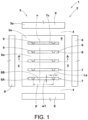
- FIG. 1 is an enlarged plan view of a tread part 2 of a tire 1 showing an embodiment of the invention.
- the tire 1 of the embodiment is, for example, a pneumatic tire for a passenger vehicle, particularly for a passenger vehicle suitable for running in winter.
- the invention is also adopted for pneumatic tires for heavy loads and non-pneumatic tires in which compressed air is not filled.
- the tread part 2 of the embodiment is provided with a ground-contacting part 3 and a lateral groove 4. Further, the tread part 2 may be provided with, for example, a vertical groove 5.
- the ground-contacting part 3 has a tread surface 3a in contact with the road surface.
- the lateral groove 4 extends in the tire axial direction.
- the vertical groove 5 extends in the tire circumferential direction. "Extending in the tire axial direction” means extending at an angle of less than or equal to 45 degrees with respect to the tire axial direction. Further, "extending in the tire circumferential direction” means extending at an angle of greater than 45 degrees with respect to the tire axial direction.
- the ground-contacting part 3 of the embodiment is provided with a plurality of blocks 6 divided by the lateral groove 4.
- the blocks 6 are arranged, for example, in the tire circumferential direction.
- the blocks 6 may be arranged in the tire axial direction.
- the block 6 is divided by a pair of lateral grooves 4 separated in the tire circumferential direction and a pair of vertical grooves 5 separated in the tire axial direction.
- the block 6 is not limited to such an implementation, and various implementations are adopted.
- At least one of the plurality of blocks 6 is provided with a plurality of sipes 7.
- the sipe 7 is a notched recess having a width w1 of less than or equal to 1.5 mm, and can be clearly distinguished from the lateral groove 4 and the vertical groove 5 having a groove width of greater than 1.5 mm.
- the plurality of sipes 7 means two or more sipes 7, and for example, about two to five sipes 7 are preferable.
- the "regular rim” is a rim defined for each tire in a standard system including a standard on which the tire 1 is based, and is, for example, a standard rim in the case of JATMA, a "Design Rim” in the case of TRA, and a “Measuring Rim” in the case of ETRTO.
- the "regular internal pressure” is an air pressure defined for each tire in a standard system including a standard on which the tire 1 is based, and is the maximum air pressure in the case of JATMA, the maximum value described in the "TIRE LOAD LIMITS AT VARIOUS COLD INFLATION PRESSURES" table in the case of TRA, and the "INFLATION PRESSURE" in the case of ETRTO.
- the plurality of sipes 7 are arranged in a thickness direction (width direction) of the sipes 7. As a result, the block 6 exhibits a high edge effect and has excellent on-ice performance.
- the "thickness direction" is a direction orthogonal to a center line 7c of the sipe 7. Being “arranged in the thickness direction” means that other sipes 7 are arranged on a virtual straight line n orthogonal to the center line 7c of one sipe 7.
- Each sipe 7 has a pair of sipe walls 8 that are separated in the thickness direction.
- the pair of sipe walls 8 include a first sipe wall 8A on one side in the thickness direction (upper side in the drawing) and a second sipe wall 8B on the other side in the thickness direction (lower side in the drawing).
- FIG. 2 is a cross-sectional perspective view taken along the line A-A of FIG. 1 .
- FIG. 3 is a cross-sectional view of the sipe 7.
- the protrusion 9 is provided on only one of the pair of sipe walls 8.
- the protrusion 9 is provided on, for example, only the first sipe wall 8A.
- the protrusion 9 may be provided on only the second sipe wall 8B.
- the cross-sectional area S of the protrusion 9 is greater than or equal to 1.0 mm 2 . In this way, the effect of suppressing the collapse of the block 6 is well achieved.
- the cross-sectional area S of the protrusion 9 is less than or equal to 5.0 mm 2 . If the cross-sectional area S of the protrusion 9 is greater than 5.0 mm 2 , the suction amount of melted water on the ice road into the sipe 7 becomes small, and the on-ice performance may deteriorate. From this point of view, the cross-sectional area S of the protrusion 9 is preferably greater than or equal to 1.5 mm 2 , and preferably less than or equal to 3.5 mm 2 .
- the protrusion 9 is required to have a maximum cross-sectional area Sa of greater than or equal to 1.0 mm 2 .
- the ratio (Sb/Sa) of the minimum cross-sectional area Sb of the protrusion 9 to the maximum cross-sectional area Sa of the protrusion 9 is 0.5 to 0.8. Since the ratio (Sb/Sa) is greater than or equal to 0.5, the collapse of the block is suppressed. Since the ratio (Sb/Sa) is less than or equal to 0.8, a high suction amount of the water is ensured.
- the maximum cross-sectional area Sa is formed on the first sipe wall 8A. In other words, the maximum cross-sectional area Sa is formed at the base of the protrusion 9.
- the minimum cross-sectional area Sb is formed closest to the second sipe wall 8B side on the protrusion 9. In other words, the minimum cross-sectional area Sb is formed at the tip of the protrusion 9.
- a plurality of the protrusions 9 are provided on, for example, one sipe wall 8. In this way, the collapse of the block 6 may be further suppressed.
- each protrusion 9 is provided on only the first sipe wall 8A.
- Two protrusions 9 are provided on the first sipe wall 8A.
- the ratio (p/La) of the pitch p between the protrusions 9 to the length La of the protrusion 9 is preferably greater than or equal to 2, more preferably greater than or equal to 4, and preferably less than or equal to 10, and more preferably less than or equal to 6. In this way, the wear resistance and the on-ice performance are improved in a well-balanced manner.
- the length La of the protrusion 9 is the length along the longitudinal direction of the sipe 7.
- the protrusion 9 has a substantially truncated cone shape. In this way, since the rigidity of the protrusion 9 can be maintained high, good wear resistance can be exhibited.
- the cross section of the protrusion 9 is, for example, circular.
- the term "circular" includes a circular shape or an elliptical shape.
- the cross section of the protrusion 9 is formed in an elliptical shape.
- the cross section of the protrusion 9 is, for example, an elliptical shape whose major axis is arranged parallel to the longitudinal direction of the sipe 7.
- the protrusion 9 may have an elliptical shape whose major axis is arranged parallel to the depth direction of the sipe 7 (not shown).
- the protrusion 9 is provided on the tread surface 3a side with respect to the bottom of the sipe 7. In this way, when the block 6 touches the ground, the collapse or slippage of the block piece 6a may be firmly suppressed. From this point of view, it is preferable that the disposition position of the protrusion 9 is in a region R of 25% of the depth d of the sipe 7 from the tread surface 3a to the bottom side of the sipe 7.
- each sipe 7 extends in the tire axial direction.
- Each sipe 7 extends, for example, parallel to the lateral groove 4.
- ends 7e on both sides are arranged within the block 6.
- Each sipe 7 is not limited to such an implementation, and may cross the block 6, or may have only one end 7e arranged within the block 6 (not shown).
- FIG. 4 is a cross-sectional view of the block 6 of another embodiment.
- the same components as those of the above embodiment are denoted by the same reference numerals, and detailed descriptions thereof will be omitted.
- the protrusions 9 provided on the sipes 7 adjacent to each other in the thickness direction are arranged in opposite directions.
- the protrusion 9 of one sipe 7 is provided on only the first sipe wall 8A
- the protrusion 9 of another sipe 7 adjacent to the one sipe is provided on only the second sipe wall 8B.
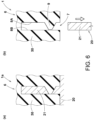
- FIG. 5 is a perspective view of a part of a vulcanization mold 20 for vulcanizing a raw tire 1a (shown in FIG. 6 ), and (b) of FIG. 5 is a cross-sectional view taken along the line B-B of (a).
- the tire 1 is formed by vulcanizing the raw tire 1a by using the vulcanization mold 20.
- the vulcanization mold 20 includes a tread molding surface 20a for molding the tread part 2 of the tire 1.
- the tread molding surface 20a is provided with a thin plate-shaped knife blade 21 for molding the sipe 7.
- the knife blade 21 protrudes outward from the tread molding surface 20a.
- Sample tires having the block shown in FIG. 1 were manufactured. Then, the wear resistance and the on-ice performance of each sample tire were tested.
- the common specifications and test methods for each sample tire are as follows.
Landscapes
- Engineering & Computer Science (AREA)
- Mechanical Engineering (AREA)
- Tires In General (AREA)
Description
- The invention relates to a tire.
-
JP H11 105512 A -
JP 2010 064699 A JP 2017 185851 A US 2011/315290 A1 , andUS 2015/191051 A1 disclose sipes having hemispherical protrusions.JP 2017 185851 A -
WO 2008/065947 A1 discloses conical protrusions with pointed ends.WO 2019/123561 A1 discloses protrusions with a trapezoid shape.US 2011/277896 A1 discloses protrusions including portions with a cylindrical shape and ends with a truncated conical shape.JP 2004 262285 A -
JP 2002 316517 A claim 1. A protrusion has a truncated cone shape and protrudes at a taper angle of 10 to 30 degrees, preferably 12 to 20 degrees from one sipe wall toward the other sipe wall. An area of an upper surface of the protrusion is 2 to 20 mm2, and a distance between the pair of sipe walls facing each other is 0.3 to 1.0 mm, preferably 0.3 to 0.8 mm. -
EP 2 465 709 A1claim 1. A sipe wall has a recess to be engaged with a protrusion. A base diameter of a truncated cone forming the recess is 3 to 7 mm, and a tip diameter is 1 to 7 mm but at least 10% smaller than the base diameter. - For example, in order to improve on-ice performance, winter studless tires and the like are provided with a plurality of sipes in blocks divided by lateral grooves. Each of the sipes is arranged in the thickness direction thereof. In recent years, in such tires, it has been required to suppress wear of the blocks.
- The invention has been made in view of the above circumstances, and provides a tire capable of improving the wear resistance without impairing the on-ice performance.
- The invention provides a tire as specified in
claim 1. - In the tire according to the invention, the pair of sipe walls include a first sipe wall on one side in the thickness direction and a second sipe wall on the other side in the thickness direction, and the protrusion of each of the plurality of sipes protrudes from the first sipe wall toward the second sipe wall. A taper shape of the protrusion is a truncated cone shape. A maximum cross-sectional area of the protrusion is greater than or equal to 1 mm2 and is less than or equal to 5.00 mm2. A ratio (Sb/Sa) of a minimum cross-sectional area Sb of the protrusion to the maximum cross-sectional area Sa of the protrusion is 0.5 to 0.8.
- In the tire according to the invention, the protrusion is provided on only one of the pair of sipe walls and no protrusion is provided on the other of the pair of sipe walls.
- In the tire according to the invention, it is preferable that a cross section of the protrusion is circular.
- In the tire according to the invention, it is preferable that the protrusion is one of a plurality of the protrusions provided on the one of the pair of sipe walls.
- The tire of the invention is capable of improving the wear resistance without impairing the on-ice performance by adopting the above configurations.
-
-
FIG. 1 is an enlarged plan view showing an embodiment of a tread part of a tire of the invention. -
FIG. 2 is a cross-sectional perspective view taken along the line A-A ofFIG. 1 . -
FIG. 3 is a cross-sectional view of the sipe of this embodiment. -
FIG. 4 is a plan view of the block having the sipe of another embodiment. - In
FIG. 5, (a) is a perspective view of a part of a vulcanization mold for forming the sipe, and (b) is a cross-sectional view of the knife blade of (a). - In
FIG. 6, (a) and (b) are cross-sectional views of the knife blade for describing a method of molding the sipe of the embodiment. - Hereinafter, embodiments of the invention will be described with reference to the drawings.
FIG. 1 is an enlarged plan view of atread part 2 of atire 1 showing an embodiment of the invention. Thetire 1 of the embodiment is, for example, a pneumatic tire for a passenger vehicle, particularly for a passenger vehicle suitable for running in winter. However, the invention is also adopted for pneumatic tires for heavy loads and non-pneumatic tires in which compressed air is not filled. - As shown in
FIG. 1 , thetread part 2 of the embodiment is provided with a ground-contactingpart 3 and alateral groove 4. Further, thetread part 2 may be provided with, for example, avertical groove 5. The ground-contactingpart 3 has atread surface 3a in contact with the road surface. Thelateral groove 4 extends in the tire axial direction. Thevertical groove 5 extends in the tire circumferential direction. "Extending in the tire axial direction" means extending at an angle of less than or equal to 45 degrees with respect to the tire axial direction. Further, "extending in the tire circumferential direction" means extending at an angle of greater than 45 degrees with respect to the tire axial direction. - The ground-contacting
part 3 of the embodiment is provided with a plurality ofblocks 6 divided by thelateral groove 4. Theblocks 6 are arranged, for example, in the tire circumferential direction. In addition, theblocks 6 may be arranged in the tire axial direction. In the embodiment, theblock 6 is divided by a pair oflateral grooves 4 separated in the tire circumferential direction and a pair ofvertical grooves 5 separated in the tire axial direction. In addition, theblock 6 is not limited to such an implementation, and various implementations are adopted. - At least one of the plurality of
blocks 6 is provided with a plurality ofsipes 7. Thesipe 7 is a notched recess having a width w1 of less than or equal to 1.5 mm, and can be clearly distinguished from thelateral groove 4 and thevertical groove 5 having a groove width of greater than 1.5 mm. Further, the plurality ofsipes 7 means two ormore sipes 7, and for example, about two to fivesipes 7 are preferable. - Unless otherwise specified, the dimensions and the like of each part of the
tire 1 are values measured in a regular state. The "regular state" is a no-load state in which thetire 1 is rim-assembled on a regular rim (not shown) and is filled with a regular internal pressure. - The "regular rim" is a rim defined for each tire in a standard system including a standard on which the
tire 1 is based, and is, for example, a standard rim in the case of JATMA, a "Design Rim" in the case of TRA, and a "Measuring Rim" in the case of ETRTO. - The "regular internal pressure" is an air pressure defined for each tire in a standard system including a standard on which the
tire 1 is based, and is the maximum air pressure in the case of JATMA, the maximum value described in the "TIRE LOAD LIMITS AT VARIOUS COLD INFLATION PRESSURES" table in the case of TRA, and the "INFLATION PRESSURE" in the case of ETRTO. - The plurality of
sipes 7 are arranged in a thickness direction (width direction) of thesipes 7. As a result, theblock 6 exhibits a high edge effect and has excellent on-ice performance. The "thickness direction" is a direction orthogonal to acenter line 7c of thesipe 7. Being "arranged in the thickness direction" means thatother sipes 7 are arranged on a virtual straight line n orthogonal to thecenter line 7c of onesipe 7. - Each
sipe 7 has a pair ofsipe walls 8 that are separated in the thickness direction. The pair ofsipe walls 8 include afirst sipe wall 8A on one side in the thickness direction (upper side in the drawing) and asecond sipe wall 8B on the other side in the thickness direction (lower side in the drawing). - Each
sipe 7 includes aprotrusion 9 that protrudes in a taper shape from one toward the other of the pair ofsipe walls 8. Such aprotrusion 9 is able to immediately contact theother sipe wall 8 when theblock 6 touches the ground, suppress ablock piece 6a between thesipes 7 from collapsing or slipping, and improve the wear resistance of theblock 6 while exhibiting good on-ice performance. Further, since such aprotrusion 9 alleviates the impact at the time of touching the ground and suppresses chipping and the like, the wear resistance is further improved. In the embodiment, eachprotrusion 9 of eachsipe 7 protrudes from thefirst sipe wall 8A toward thesecond sipe wall 8B. -
FIG. 2 is a cross-sectional perspective view taken along the line A-A ofFIG. 1 .FIG. 3 is a cross-sectional view of thesipe 7. As shown inFIGs. 1 to 3 , in the embodiment, theprotrusion 9 is provided on only one of the pair ofsipe walls 8. Theprotrusion 9 is provided on, for example, only thefirst sipe wall 8A. In addition, theprotrusion 9 may be provided on only thesecond sipe wall 8B. - The cross-sectional area S of the
protrusion 9 is greater than or equal to 1.0 mm2. In this way, the effect of suppressing the collapse of theblock 6 is well achieved. The cross-sectional area S of theprotrusion 9 is less than or equal to 5.0 mm2. If the cross-sectional area S of theprotrusion 9 is greater than 5.0 mm2, the suction amount of melted water on the ice road into thesipe 7 becomes small, and the on-ice performance may deteriorate. From this point of view, the cross-sectional area S of theprotrusion 9 is preferably greater than or equal to 1.5 mm2, and preferably less than or equal to 3.5 mm2. Theprotrusion 9 is required to have a maximum cross-sectional area Sa of greater than or equal to 1.0 mm2. - The ratio (Sb/Sa) of the minimum cross-sectional area Sb of the
protrusion 9 to the maximum cross-sectional area Sa of theprotrusion 9 is 0.5 to 0.8. Since the ratio (Sb/Sa) is greater than or equal to 0.5, the collapse of the block is suppressed. Since the ratio (Sb/Sa) is less than or equal to 0.8, a high suction amount of the water is ensured. In the embodiment, the maximum cross-sectional area Sa is formed on thefirst sipe wall 8A. In other words, the maximum cross-sectional area Sa is formed at the base of theprotrusion 9. In the embodiment, the minimum cross-sectional area Sb is formed closest to thesecond sipe wall 8B side on theprotrusion 9. In other words, the minimum cross-sectional area Sb is formed at the tip of theprotrusion 9. - A plurality of the
protrusions 9 are provided on, for example, onesipe wall 8. In this way, the collapse of theblock 6 may be further suppressed. In the embodiment, eachprotrusion 9 is provided on only thefirst sipe wall 8A. Twoprotrusions 9 are provided on thefirst sipe wall 8A. - The ratio (p/La) of the pitch p between the
protrusions 9 to the length La of theprotrusion 9 is preferably greater than or equal to 2, more preferably greater than or equal to 4, and preferably less than or equal to 10, and more preferably less than or equal to 6. In this way, the wear resistance and the on-ice performance are improved in a well-balanced manner. The length La of theprotrusion 9 is the length along the longitudinal direction of thesipe 7. - In the embodiment, the
protrusion 9 has a substantially truncated cone shape. In this way, since the rigidity of theprotrusion 9 can be maintained high, good wear resistance can be exhibited. The cross section of theprotrusion 9 is, for example, circular. The term "circular" includes a circular shape or an elliptical shape. In the embodiment, the cross section of theprotrusion 9 is formed in an elliptical shape. The cross section of theprotrusion 9 is, for example, an elliptical shape whose major axis is arranged parallel to the longitudinal direction of thesipe 7. In addition, theprotrusion 9 may have an elliptical shape whose major axis is arranged parallel to the depth direction of the sipe 7 (not shown). - In the embodiment, the
protrusion 9 is provided on thetread surface 3a side with respect to the bottom of thesipe 7. In this way, when theblock 6 touches the ground, the collapse or slippage of theblock piece 6a may be firmly suppressed. From this point of view, it is preferable that the disposition position of theprotrusion 9 is in a region R of 25% of the depth d of thesipe 7 from thetread surface 3a to the bottom side of thesipe 7. - In the embodiment, each
sipe 7 extends in the tire axial direction. Eachsipe 7 extends, for example, parallel to thelateral groove 4. In eachsipe 7, for example, ends 7e on both sides are arranged within theblock 6. Eachsipe 7 is not limited to such an implementation, and may cross theblock 6, or may have only oneend 7e arranged within the block 6 (not shown). -
FIG. 4 is a cross-sectional view of theblock 6 of another embodiment. The same components as those of the above embodiment are denoted by the same reference numerals, and detailed descriptions thereof will be omitted. As shown inFIG. 4 , in this embodiment, theprotrusions 9 provided on thesipes 7 adjacent to each other in the thickness direction are arranged in opposite directions. In other words, theprotrusion 9 of onesipe 7 is provided on only thefirst sipe wall 8A, and theprotrusion 9 of anothersipe 7 adjacent to the one sipe is provided on only thesecond sipe wall 8B. - Next, a method for molding such a
protrusion 9 will be described. (a) ofFIG. 5 is a perspective view of a part of avulcanization mold 20 for vulcanizing araw tire 1a (shown inFIG. 6 ), and (b) ofFIG. 5 is a cross-sectional view taken along the line B-B of (a). Thetire 1 is formed by vulcanizing theraw tire 1a by using thevulcanization mold 20. As shown inFIG. 5 , thevulcanization mold 20 includes atread molding surface 20a for molding thetread part 2 of thetire 1. Thetread molding surface 20a is provided with a thin plate-shapedknife blade 21 for molding thesipe 7. Theknife blade 21 protrudes outward from thetread molding surface 20a. - The
knife blade 21 of the embodiment has a pair oflongitudinal surfaces 22 separated in the width direction and a throughhole 23 for forming theprotrusion 9. The throughhole 23 extends, for example, between the pair oflongitudinal surfaces 22. - (a) of
FIG. 6 is a cross-sectional view near theknife blade 21 of theraw tire 1a being vulcanized, and (b) ofFIG. 6 is a cross-sectional view showing a state where thetire 1 has been detached from thevulcanization mold 20 after vulcanization is completed. As shown inFIG. 6 , when theraw tire 1a is put into such avulcanization mold 20 and an internal pressure is applied, arubber material 30 forming theblock 6 enters the throughhole 23. When the vulcanization is completed and the vulcanizedtire 1 is separated from thevulcanization mold 20, therubber material 30 that has entered the throughhole 23 is cut by theknife blade 21 to form theprotrusion 9. - In order to form the
protrusion 9 of the embodiment as shown inFIG. 2 , as shown in (b) ofFIG. 5 , the throughhole 23 has a continuously smaller cross-sectional area from onelongitudinal surface 22A toward the otherlongitudinal surface 22B, and has a circular cross section. In other words, the throughhole 23 is formed in a truncated cone shape. The ratio (Sd/Sc) of the opening area Sd of the throughhole 23 on the otherlongitudinal surface 22B to the opening area Sc of the throughhole 23 on the onelongitudinal surface 22A is, for example, preferably greater than or equal to 0.5, more preferably greater than or equal to 0.6, and preferably less than or equal to 0.8, and more preferably less than or equal to 0.7. - Although the particularly preferable embodiments of the invention have been described in detail above, the invention is not limited to the illustrated embodiments, and may be modified into various implementations.
- Sample tires having the block shown in
FIG. 1 were manufactured. Then, the wear resistance and the on-ice performance of each sample tire were tested. The common specifications and test methods for each sample tire are as follows. - Tire size: 205/55R16
- Rim size: 16 x 7.0
- Knife blade width (thickness): 0.6 mm
- Number of sipes of block: 2
- Each sample tire was mounted on all wheels of a passenger vehicle under the following conditions. Then, after the test driver actually ran the vehicle on a test course on a dry asphalt road surface, the wear condition of the block provided with the sipes was evaluated by senses. The results are shown with a score of 100 for the comparative example. The greater the value, the smaller the wear amount and the better the wear resistance.
- Running distance: 20000 km
- Internal pressure: 230 kPa
- Using the above test vehicle, the test driver actually ran the vehicle on a test course on an icy road surface, and evaluated the properties related to stability and ease of running at that time by senses. The results are shown with a score of 100 for the comparative example. The greater the value, the better the on-ice performance. The test results are shown in Table 1.
[Table 1] Comparative example Example 1 Example 2 Example 3 Example 4 Example 5 Example 6 Example 7 Example 8 Shape of protrusion Circular column Taper (truncated cone) Taper (truncated cone) Taper (truncated cone) Taper (truncated cone) Taper (truncated cone) Taper (truncated cone) Taper (truncated cone) Taper (truncated cone) Figure showing arrangement of protrusion FIG. 1 FIG. 1 FIG. 1 FIG. 1 FIG. 1 FIG. 1 FIG. 1 FIG. 5 FIG. 1 Cross-sectional area S (mm2) of protrusion 1.5 1.5 3.0 1.5 1.5 1.5 1.5 1.5 0.78 Sb/Sa (times) 1.0 0.6 0.6 0.4 0.5 0.8 0.9 0.6 0.6 Wear resistance [score: the greater the better] 100 120 125 110 120 120 125 115 110 On-ice performance [score: the greater the better] 100 110 100 115 110 110 100 120 110 - By the tests, it is understood that the tires of the examples are superior in the wear resistance as compared with the tire of the comparative example. It is also understood that the tires of the examples maintain good on-ice performance. Please note that Examples 3 and 6 are outside the terms of
claim 1.
Claims (4)
- A tire (1), comprising:a tread part (2),wherein the tread part (2) comprises a ground-contacting part (3),the ground-contacting part (3) is provided with a plurality of blocks (6) divided by a lateral groove (4),at least one of the plurality of blocks (6) is provided with a plurality of sipes (7),the plurality of sipes (7) are arranged in a thickness direction of the sipes (7), meaning that other sipes (7) are arranged on a virtual straight line (n) orthogonal to a center line (7c) of one of the plurality of sipes (7), andeach of the plurality of sipes (7) comprises a pair of sipe walls (8) that are separated in the thickness direction, and comprises a protrusion (9) that protrudes in a taper shape from one toward the other of the pair of sipe walls (8), whereinthe taper shape of the protrusion (9) is a truncated cone shape,characterized in thatthe protrusion (9) is provided on only one of the pair of sipe walls (8) and no protrusion is provided on the other of the pair of sipe walls (8),a maximum cross-sectional area of the protrusion (9) is greater than or equal to 1 mm2 and is less than or equal to 5 mm2, anda ratio (Sb/Sa) of a minimum cross-sectional area Sb of the protrusion (9) to the maximum cross-sectional area Sa of the protrusion (9) is 0.5 to 0.8.
- The tire (1) according to claim 1, whereinthe pair of sipe walls (8) comprises a first sipe wall (8A) on one side in the thickness direction and a second sipe wall (8B) on the other side in the thickness direction, andthe protrusion (9) of each of the plurality of sipes (7) protrudes from the first sipe wall (8A) toward the second sipe wall (8B).
- The tire (1) according to claim 1, wherein a cross section of the protrusion (9) is circular.
- The tire (1) according to claim 1, wherein the protrusion is one of a plurality of the protrusions (9) provided on the one of the pair of sipe walls (8).
Applications Claiming Priority (1)
| Application Number | Priority Date | Filing Date | Title |
|---|---|---|---|
| JP2020158827A JP2022052431A (en) | 2020-09-23 | 2020-09-23 | tire |
Publications (2)
| Publication Number | Publication Date |
|---|---|
| EP3974209A1 EP3974209A1 (en) | 2022-03-30 |
| EP3974209B1 true EP3974209B1 (en) | 2025-04-30 |
Family
ID=77447753
Family Applications (1)
| Application Number | Title | Priority Date | Filing Date |
|---|---|---|---|
| EP21192510.2A Active EP3974209B1 (en) | 2020-09-23 | 2021-08-23 | Tire |
Country Status (4)
| Country | Link |
|---|---|
| US (1) | US20220088971A1 (en) |
| EP (1) | EP3974209B1 (en) |
| JP (1) | JP2022052431A (en) |
| CN (1) | CN114248584A (en) |
Family Cites Families (19)
| Publication number | Priority date | Publication date | Assignee | Title |
|---|---|---|---|---|
| JP4319261B2 (en) * | 1997-10-02 | 2009-08-26 | 株式会社ブリヂストン | Pneumatic tire |
| JP4711373B2 (en) * | 2001-04-24 | 2011-06-29 | 東洋ゴム工業株式会社 | Pneumatic tire |
| JP4307866B2 (en) * | 2003-02-28 | 2009-08-05 | 東洋ゴム工業株式会社 | Pneumatic tire, pneumatic tire molding die and pneumatic tire molding method |
| JP2005262973A (en) * | 2004-03-17 | 2005-09-29 | Bridgestone Corp | Pneumatic tire, sipe forming blade, and tire forming mold including the sipe forming blade |
| JP2006168501A (en) * | 2004-12-15 | 2006-06-29 | Bridgestone Corp | Pneumatic tire |
| JP2007137110A (en) * | 2005-11-15 | 2007-06-07 | Bridgestone Corp | Pneumatic tire |
| JP4316603B2 (en) * | 2006-11-27 | 2009-08-19 | 東洋ゴム工業株式会社 | Pneumatic tire |
| JP4740301B2 (en) * | 2008-09-12 | 2011-08-03 | 東洋ゴム工業株式会社 | Pneumatic tire |
| JP5516492B2 (en) * | 2010-05-11 | 2014-06-11 | 横浜ゴム株式会社 | Pneumatic tire |
| JP5516500B2 (en) * | 2010-06-25 | 2014-06-11 | 横浜ゴム株式会社 | Pneumatic tire |
| FI125054B (en) * | 2010-12-15 | 2015-05-15 | Nokian Renkaat Oyj | Vehicle tires and treadmills |
| JP4894968B1 (en) * | 2011-01-19 | 2012-03-14 | 横浜ゴム株式会社 | Pneumatic tire |
| JP5790199B2 (en) * | 2011-06-27 | 2015-10-07 | 横浜ゴム株式会社 | studless tire |
| JP5851275B2 (en) * | 2012-02-17 | 2016-02-03 | 株式会社ブリヂストン | Pneumatic tire |
| CN104334373B (en) * | 2012-06-29 | 2018-07-06 | 横滨橡胶株式会社 | Pneumatic tire |
| JP6015249B2 (en) * | 2012-08-30 | 2016-10-26 | 横浜ゴム株式会社 | Pneumatic tire |
| JP2017185851A (en) * | 2016-04-01 | 2017-10-12 | 横浜ゴム株式会社 | Pneumatic tire |
| WO2019123561A1 (en) * | 2017-12-20 | 2019-06-27 | Compagnie Generale Des Etablissements Michelin | A tread with sipe for multi performance |
| JP2019181848A (en) * | 2018-04-13 | 2019-10-24 | Toyo Tire株式会社 | Tire vulcanization mold, production method of tire and pneumatic tire |
-
2020
- 2020-09-23 JP JP2020158827A patent/JP2022052431A/en active Pending
-
2021
- 2021-08-23 EP EP21192510.2A patent/EP3974209B1/en active Active
- 2021-09-08 US US17/468,700 patent/US20220088971A1/en not_active Abandoned
- 2021-09-10 CN CN202111065767.9A patent/CN114248584A/en not_active Withdrawn
Also Published As
| Publication number | Publication date |
|---|---|
| US20220088971A1 (en) | 2022-03-24 |
| JP2022052431A (en) | 2022-04-04 |
| EP3974209A1 (en) | 2022-03-30 |
| CN114248584A (en) | 2022-03-29 |
Similar Documents
| Publication | Publication Date | Title |
|---|---|---|
| EP3539798B1 (en) | Tyre | |
| EP1864830B1 (en) | Pneumatic tire | |
| US9085201B2 (en) | Pneumatic tire | |
| EP3081397B1 (en) | Pneumatic tire | |
| EP2100753B1 (en) | Studless tire | |
| EP3199375B1 (en) | Pneumatic tire | |
| EP3549791B1 (en) | Tyre | |
| EP3042792B1 (en) | Pneumatic tire | |
| EP3263366B1 (en) | Tire | |
| EP4173849B1 (en) | Tire | |
| EP3925796B1 (en) | Tire | |
| EP3549790B1 (en) | Tyre | |
| EP3530488B1 (en) | Tyre for winter | |
| EP3695988B1 (en) | Pneumatic tyre, tyre mold and method for manufacturing pneumatic tyre using the same | |
| EP3828011B1 (en) | Tyre tread | |
| EP4151431B1 (en) | Tire | |
| JP2018134992A (en) | Pneumatic tire | |
| EP3974209B1 (en) | Tire | |
| EP3842262B1 (en) | Tire | |
| JP7207166B2 (en) | tire | |
| JP2018027763A (en) | Pneumatic tire | |
| EP3936351A1 (en) | Pneumatic tire |
Legal Events
| Date | Code | Title | Description |
|---|---|---|---|
| PUAI | Public reference made under article 153(3) epc to a published international application that has entered the european phase |
Free format text: ORIGINAL CODE: 0009012 |
|
| STAA | Information on the status of an ep patent application or granted ep patent |
Free format text: STATUS: THE APPLICATION HAS BEEN PUBLISHED |
|
| AK | Designated contracting states |
Kind code of ref document: A1 Designated state(s): AL AT BE BG CH CY CZ DE DK EE ES FI FR GB GR HR HU IE IS IT LI LT LU LV MC MK MT NL NO PL PT RO RS SE SI SK SM TR |
|
| STAA | Information on the status of an ep patent application or granted ep patent |
Free format text: STATUS: REQUEST FOR EXAMINATION WAS MADE |
|
| 17P | Request for examination filed |
Effective date: 20220411 |
|
| STAA | Information on the status of an ep patent application or granted ep patent |
Free format text: STATUS: EXAMINATION IS IN PROGRESS |
|
| 17Q | First examination report despatched |
Effective date: 20230130 |
|
| P01 | Opt-out of the competence of the unified patent court (upc) registered |
Effective date: 20230510 |
|
| GRAP | Despatch of communication of intention to grant a patent |
Free format text: ORIGINAL CODE: EPIDOSNIGR1 |
|
| STAA | Information on the status of an ep patent application or granted ep patent |
Free format text: STATUS: GRANT OF PATENT IS INTENDED |
|
| GRAS | Grant fee paid |
Free format text: ORIGINAL CODE: EPIDOSNIGR3 |
|
| INTG | Intention to grant announced |
Effective date: 20250219 |
|
| GRAA | (expected) grant |
Free format text: ORIGINAL CODE: 0009210 |
|
| STAA | Information on the status of an ep patent application or granted ep patent |
Free format text: STATUS: THE PATENT HAS BEEN GRANTED |
|
| AK | Designated contracting states |
Kind code of ref document: B1 Designated state(s): AL AT BE BG CH CY CZ DE DK EE ES FI FR GB GR HR HU IE IS IT LI LT LU LV MC MK MT NL NO PL PT RO RS SE SI SK SM TR |
|
| REG | Reference to a national code |
Ref country code: CH Ref legal event code: EP Ref country code: GB Ref legal event code: FG4D |
|
| REG | Reference to a national code |
Ref country code: IE Ref legal event code: FG4D |
|
| REG | Reference to a national code |
Ref country code: DE Ref legal event code: R096 Ref document number: 602021029903 Country of ref document: DE |
|
| REG | Reference to a national code |
Ref country code: NL Ref legal event code: MP Effective date: 20250430 |
|
| REG | Reference to a national code |
Ref country code: AT Ref legal event code: MK05 Ref document number: 1789717 Country of ref document: AT Kind code of ref document: T Effective date: 20250430 |
|
| PG25 | Lapsed in a contracting state [announced via postgrant information from national office to epo] |
Ref country code: ES Free format text: LAPSE BECAUSE OF FAILURE TO SUBMIT A TRANSLATION OF THE DESCRIPTION OR TO PAY THE FEE WITHIN THE PRESCRIBED TIME-LIMIT Effective date: 20250430 Ref country code: PT Free format text: LAPSE BECAUSE OF FAILURE TO SUBMIT A TRANSLATION OF THE DESCRIPTION OR TO PAY THE FEE WITHIN THE PRESCRIBED TIME-LIMIT Effective date: 20250901 Ref country code: FI Free format text: LAPSE BECAUSE OF FAILURE TO SUBMIT A TRANSLATION OF THE DESCRIPTION OR TO PAY THE FEE WITHIN THE PRESCRIBED TIME-LIMIT Effective date: 20250430 |
|
| PGFP | Annual fee paid to national office [announced via postgrant information from national office to epo] |
Ref country code: DE Payment date: 20250828 Year of fee payment: 5 |
|
| REG | Reference to a national code |
Ref country code: LT Ref legal event code: MG9D |
|
| PG25 | Lapsed in a contracting state [announced via postgrant information from national office to epo] |
Ref country code: GR Free format text: LAPSE BECAUSE OF FAILURE TO SUBMIT A TRANSLATION OF THE DESCRIPTION OR TO PAY THE FEE WITHIN THE PRESCRIBED TIME-LIMIT Effective date: 20250731 Ref country code: NO Free format text: LAPSE BECAUSE OF FAILURE TO SUBMIT A TRANSLATION OF THE DESCRIPTION OR TO PAY THE FEE WITHIN THE PRESCRIBED TIME-LIMIT Effective date: 20250730 |
|
| PG25 | Lapsed in a contracting state [announced via postgrant information from national office to epo] |
Ref country code: NL Free format text: LAPSE BECAUSE OF FAILURE TO SUBMIT A TRANSLATION OF THE DESCRIPTION OR TO PAY THE FEE WITHIN THE PRESCRIBED TIME-LIMIT Effective date: 20250430 Ref country code: PL Free format text: LAPSE BECAUSE OF FAILURE TO SUBMIT A TRANSLATION OF THE DESCRIPTION OR TO PAY THE FEE WITHIN THE PRESCRIBED TIME-LIMIT Effective date: 20250430 |
|
| PG25 | Lapsed in a contracting state [announced via postgrant information from national office to epo] |
Ref country code: BG Free format text: LAPSE BECAUSE OF FAILURE TO SUBMIT A TRANSLATION OF THE DESCRIPTION OR TO PAY THE FEE WITHIN THE PRESCRIBED TIME-LIMIT Effective date: 20250430 |
|
| PG25 | Lapsed in a contracting state [announced via postgrant information from national office to epo] |
Ref country code: HR Free format text: LAPSE BECAUSE OF FAILURE TO SUBMIT A TRANSLATION OF THE DESCRIPTION OR TO PAY THE FEE WITHIN THE PRESCRIBED TIME-LIMIT Effective date: 20250430 |
|
| PG25 | Lapsed in a contracting state [announced via postgrant information from national office to epo] |
Ref country code: AT Free format text: LAPSE BECAUSE OF FAILURE TO SUBMIT A TRANSLATION OF THE DESCRIPTION OR TO PAY THE FEE WITHIN THE PRESCRIBED TIME-LIMIT Effective date: 20250430 |
|
| PGFP | Annual fee paid to national office [announced via postgrant information from national office to epo] |
Ref country code: FR Payment date: 20250821 Year of fee payment: 5 |
|
| PG25 | Lapsed in a contracting state [announced via postgrant information from national office to epo] |
Ref country code: RS Free format text: LAPSE BECAUSE OF FAILURE TO SUBMIT A TRANSLATION OF THE DESCRIPTION OR TO PAY THE FEE WITHIN THE PRESCRIBED TIME-LIMIT Effective date: 20250731 |
|
| PG25 | Lapsed in a contracting state [announced via postgrant information from national office to epo] |
Ref country code: IS Free format text: LAPSE BECAUSE OF FAILURE TO SUBMIT A TRANSLATION OF THE DESCRIPTION OR TO PAY THE FEE WITHIN THE PRESCRIBED TIME-LIMIT Effective date: 20250830 |
|
| PG25 | Lapsed in a contracting state [announced via postgrant information from national office to epo] |
Ref country code: LV Free format text: LAPSE BECAUSE OF FAILURE TO SUBMIT A TRANSLATION OF THE DESCRIPTION OR TO PAY THE FEE WITHIN THE PRESCRIBED TIME-LIMIT Effective date: 20250430 |
|
| PG25 | Lapsed in a contracting state [announced via postgrant information from national office to epo] |
Ref country code: DK Free format text: LAPSE BECAUSE OF FAILURE TO SUBMIT A TRANSLATION OF THE DESCRIPTION OR TO PAY THE FEE WITHIN THE PRESCRIBED TIME-LIMIT Effective date: 20250430 Ref country code: SM Free format text: LAPSE BECAUSE OF FAILURE TO SUBMIT A TRANSLATION OF THE DESCRIPTION OR TO PAY THE FEE WITHIN THE PRESCRIBED TIME-LIMIT Effective date: 20250430 |
|
| PG25 | Lapsed in a contracting state [announced via postgrant information from national office to epo] |
Ref country code: CZ Free format text: LAPSE BECAUSE OF FAILURE TO SUBMIT A TRANSLATION OF THE DESCRIPTION OR TO PAY THE FEE WITHIN THE PRESCRIBED TIME-LIMIT Effective date: 20250430 |
|
| PG25 | Lapsed in a contracting state [announced via postgrant information from national office to epo] |
Ref country code: EE Free format text: LAPSE BECAUSE OF FAILURE TO SUBMIT A TRANSLATION OF THE DESCRIPTION OR TO PAY THE FEE WITHIN THE PRESCRIBED TIME-LIMIT Effective date: 20250430 |
|
| PG25 | Lapsed in a contracting state [announced via postgrant information from national office to epo] |
Ref country code: RO Free format text: LAPSE BECAUSE OF FAILURE TO SUBMIT A TRANSLATION OF THE DESCRIPTION OR TO PAY THE FEE WITHIN THE PRESCRIBED TIME-LIMIT Effective date: 20250430 Ref country code: SK Free format text: LAPSE BECAUSE OF FAILURE TO SUBMIT A TRANSLATION OF THE DESCRIPTION OR TO PAY THE FEE WITHIN THE PRESCRIBED TIME-LIMIT Effective date: 20250430 |
|
| PG25 | Lapsed in a contracting state [announced via postgrant information from national office to epo] |
Ref country code: IT Free format text: LAPSE BECAUSE OF FAILURE TO SUBMIT A TRANSLATION OF THE DESCRIPTION OR TO PAY THE FEE WITHIN THE PRESCRIBED TIME-LIMIT Effective date: 20250430 |
|
| REG | Reference to a national code |
Ref country code: DE Ref legal event code: R097 Ref document number: 602021029903 Country of ref document: DE |
|
| PLBE | No opposition filed within time limit |
Free format text: ORIGINAL CODE: 0009261 |
|
| STAA | Information on the status of an ep patent application or granted ep patent |
Free format text: STATUS: NO OPPOSITION FILED WITHIN TIME LIMIT |
|
| REG | Reference to a national code |
Ref country code: CH Ref legal event code: L10 Free format text: ST27 STATUS EVENT CODE: U-0-0-L10-L00 (AS PROVIDED BY THE NATIONAL OFFICE) Effective date: 20260311 |
|
| REG | Reference to a national code |
Ref country code: CH Ref legal event code: H13 Free format text: ST27 STATUS EVENT CODE: U-0-0-H10-H13 (AS PROVIDED BY THE NATIONAL OFFICE) Effective date: 20260324 |
|
| PG25 | Lapsed in a contracting state [announced via postgrant information from national office to epo] |
Ref country code: MC Free format text: LAPSE BECAUSE OF FAILURE TO SUBMIT A TRANSLATION OF THE DESCRIPTION OR TO PAY THE FEE WITHIN THE PRESCRIBED TIME-LIMIT Effective date: 20250430 |
|
| 26N | No opposition filed |
Effective date: 20260202 |
|
| PG25 | Lapsed in a contracting state [announced via postgrant information from national office to epo] |
Ref country code: LU Free format text: LAPSE BECAUSE OF NON-PAYMENT OF DUE FEES Effective date: 20250823 |
|
| PG25 | Lapsed in a contracting state [announced via postgrant information from national office to epo] |
Ref country code: CH Free format text: LAPSE BECAUSE OF NON-PAYMENT OF DUE FEES Effective date: 20250831 |