EP3970083B1 - System und verfahren zur multiplexierten optischen adressierung von atomspeichern - Google Patents
System und verfahren zur multiplexierten optischen adressierung von atomspeichern Download PDFInfo
- Publication number
- EP3970083B1 EP3970083B1 EP20731641.5A EP20731641A EP3970083B1 EP 3970083 B1 EP3970083 B1 EP 3970083B1 EP 20731641 A EP20731641 A EP 20731641A EP 3970083 B1 EP3970083 B1 EP 3970083B1
- Authority
- EP
- European Patent Office
- Prior art keywords
- optical
- optically
- optical channels
- array
- waveguide
- Prior art date
- Legal status (The legal status is an assumption and is not a legal conclusion. Google has not performed a legal analysis and makes no representation as to the accuracy of the status listed.)
- Active
Links
Images




Classifications
-
- G—PHYSICS
- G02—OPTICS
- G02F—OPTICAL DEVICES OR ARRANGEMENTS FOR THE CONTROL OF LIGHT BY MODIFICATION OF THE OPTICAL PROPERTIES OF THE MEDIA OF THE ELEMENTS INVOLVED THEREIN; NON-LINEAR OPTICS; FREQUENCY-CHANGING OF LIGHT; OPTICAL LOGIC ELEMENTS; OPTICAL ANALOGUE/DIGITAL CONVERTERS
- G02F1/00—Devices or arrangements for the control of the intensity, colour, phase, polarisation or direction of light arriving from an independent light source, e.g. switching, gating or modulating; Non-linear optics
- G02F1/01—Devices or arrangements for the control of the intensity, colour, phase, polarisation or direction of light arriving from an independent light source, e.g. switching, gating or modulating; Non-linear optics for the control of the intensity, phase, polarisation or colour
- G02F1/21—Devices or arrangements for the control of the intensity, colour, phase, polarisation or direction of light arriving from an independent light source, e.g. switching, gating or modulating; Non-linear optics for the control of the intensity, phase, polarisation or colour by interference
- G02F1/212—Mach-Zehnder type
-
- G—PHYSICS
- G02—OPTICS
- G02F—OPTICAL DEVICES OR ARRANGEMENTS FOR THE CONTROL OF LIGHT BY MODIFICATION OF THE OPTICAL PROPERTIES OF THE MEDIA OF THE ELEMENTS INVOLVED THEREIN; NON-LINEAR OPTICS; FREQUENCY-CHANGING OF LIGHT; OPTICAL LOGIC ELEMENTS; OPTICAL ANALOGUE/DIGITAL CONVERTERS
- G02F1/00—Devices or arrangements for the control of the intensity, colour, phase, polarisation or direction of light arriving from an independent light source, e.g. switching, gating or modulating; Non-linear optics
-
- G—PHYSICS
- G06—COMPUTING OR CALCULATING; COUNTING
- G06N—COMPUTING ARRANGEMENTS BASED ON SPECIFIC COMPUTATIONAL MODELS
- G06N10/00—Quantum computing, i.e. information processing based on quantum-mechanical phenomena
- G06N10/40—Physical realisations or architectures of quantum processors or components for manipulating qubits, e.g. qubit coupling or qubit control
-
- H—ELECTRICITY
- H04—ELECTRIC COMMUNICATION TECHNIQUE
- H04B—TRANSMISSION
- H04B10/00—Transmission systems employing electromagnetic waves other than radio-waves, e.g. infrared, visible or ultraviolet light, or employing corpuscular radiation, e.g. quantum communication
- H04B10/60—Receivers
- H04B10/61—Coherent receivers
- H04B10/614—Coherent receivers comprising one or more polarization beam splitters, e.g. polarization multiplexed [PolMux] X-PSK coherent receivers, polarization diversity heterodyne coherent receivers
-
- H—ELECTRICITY
- H04—ELECTRIC COMMUNICATION TECHNIQUE
- H04B—TRANSMISSION
- H04B10/00—Transmission systems employing electromagnetic waves other than radio-waves, e.g. infrared, visible or ultraviolet light, or employing corpuscular radiation, e.g. quantum communication
- H04B10/70—Photonic quantum communication
Definitions
- Scalable optical control of many-body quantum systems such as arrays of atoms, or arrays of defects or trapped ions (e.g ., nitrogen-vacancies in diamond) in solids, requires precise modulation of many optical channels at specific wavelengths.
- optical systems cannot fulfill the desired performance requirements that include delivery of tens to hundreds of laser beams to closely spaced (e.g ., 3 ⁇ m) atoms at required wavelengths ( e.g ., 370 nm, 420 nm, 780 nm, and 1013 nm), on-off amplitude modulation contrast on each channel in excess of 50 dB, phase modulation contrast, up to 1 mW of optical power per beam at wavelengths of 370 nm, 420 nm, and 780 nm, and up to 10 mW at 1013 nm.
- required wavelengths e.g 370 nm, 420 nm, 780 nm, and 1013 nm
- phase modulation contrast up to 1 mW of optical power per beam at wavelengths of 370 nm, 420 nm, and 780 nm, and up to 10 mW at 1013 nm.
- the present disclosure provides a system for optically modulating a plurality of optical channels, the system comprising a power delivery module adapted to convert a coherent light beam into a plurality of optical channels, and at least one optical modulator, optically coupled to the power delivery module, the at least one optical modulator adapted to optically modulate each of the plurality of the optical channels.
- the system further includes a vacuum chamber having a trapping plane therein, the vacuum chamber adapted to generate an addressable array of trapped particles at the trapping plane, wherein each of the plurality of optical channels is optically coupled to at least one of the trapped particles of the addressable array.
- the at least one optical modulator comprises a plurality of electro-optically controlled Mach-Zehnder Interferometers (MZI), each of the plurality of the MZIs adapted to modulate one of the optical channels.
- MZI Mach-Zehnder Interferometers
- the present disclosure provides a method for optically modulating a plurality of optical channels, the method comprising converting a coherent light beam into a plurality of optical channels, delivering the plurality of optical channels to at least one optical modulator, the at least one optical modulator adapted to optically modulate each of the plurality of optical channels, optically modulating at least one of the plurality of optical channels, and optically coupling at least one of the plurality of optical channels to at least one of a plurality of trapped particles disposed at a trapping plane of a vacuum chamber adapted to generate an addressable array of the plurality of trapped particles therein.
- Optically modulating at least one of the plurality of optical channels includes modulating a signal amplitude on each of the plurality of optical channels by electro-optically controlling a plurality of Mach-Zehnder Interferometers (MZI), each of the plurality of the MZIs modulating one of the optical channels.
- MZI Mach-Zehnder Interferometers
- the present disclosure describes methods and systems for precision laser delivery to a large number of atoms or atom-like systems for applications in quantum information processing.
- photonic integrated circuit (PIC) systems including arrays of nanophotonic optical modulators enable high-speed simultaneous control of 1D and 2D arrays of atoms.
- Arrays of nanophotonic optical modulators in PICs for high-speed simultaneous control of 1D and 2D arrays of atoms are described herein, starting with PICs based on lithium niobate-on-insulator technology, followed by active UV-visible-infrared photonics in wide-bandgap materials such as lithium niobate (LN) and aluminum nitride-on-sapphire for controlling the Rydberg transitions of individual Rubidium atoms in an array of optical traps.
- LN lithium niobate
- AlN aluminum nitride-on-sapphire
- FIG. 1A is a schematic diagram representing an example embodiment of an optical train of a system 100 for optically modulating a plurality of optical channels, according to some embodiments described herein.
- a power delivery module 130 is adapted to convert a coherent light beam 120 into a plurality of optical channels (e.g., 16 channels, of which optical channels 140a, 140b, and 140c are shown in FIG. 1B ).
- the coherent light beam 120 is produced by a coherent light source 110 that is optically coupled to the power delivery module 130 via an optic fiber array 125 that is optically coupled into the plurality of optical channels 140a, 140b, 140c, etc.
- the power delivery module comprises at least one beam splitter (not shown) in addition to, optically coupled to, or as a part of an optic fiber array 125.
- the power delivery module comprises at least one electrically controlled optical modulator adapted to modulate the at least one beam splitter (not shown).
- Optical system 100 also includes at least one optical modulator (150a, 150b, 150c, etc., shown in FIG. 1B ) that are optically coupled to the power delivery module 130.
- Optical modulators 150a, 150b, 150c, etc. are adapted to optically modulate each of the plurality of optical channels 140a, 140b, 140c, etc. In an example embodiment shown in FIG.
- optical channels 140 can be fanned out into an array of output waveguides 155a, 155b, 155c, etc. at the edge 159 of a photonic integrated circuit (PIC) 160, described in detail hereinbelow.
- PIC photonic integrated circuit
- the light from the array of waveguides 155a, 155b, 155c, etc. is collected by objective 189 ( FIG. 1A ), e.g., a high ( e.g., 0.9) numerical aperture (NA) objective.
- NA numerical aperture
- the light from the array of waveguides 155a, 155b, 155c, etc. is typically polarized in one direction, and therefore, as shown in FIG.
- beam 175 produced by objective 189 includes optical signals carried by waveguides 155a, 155b, 155c, etc.
- Beam 175 can be guided by lenses 176 and 178 through a pinhole 177, a cleanup polarizer 180 to remove stray light polarized in the other direction, an optical cleanup filter (e.g ., dichroic mirror) 182 to remove stray non-linear conversion 187, and then converted to a desired (e.g ., circular) polarization with a halfwave ( ⁇ /2) plate 179 and a quarter wave ( ⁇ /4) plate 181, followed by being imaged by mirror 186 and objective 185 onto an array of trapped particles (e.g ., atoms) 190 inside vacuum chamber 195.
- FIG. 1A A flip mirror 183 and alignment camera 184 are also shown in FIG. 1A .
- the vacuum chamber 195 has a trapping plane 191 therein, and the vacuum chamber 195 is adapted so that array 190 of trapped particles is addressable.
- the optical train shown in FIG. 1A is configured so that each of the plurality of optical channels 140a, 140b, 140c, etc, shown in FIG. 1B , is optically coupled to at least one of the trapped particles of array 190.
- FIG. 1C an example embodiment of photonic integrated circuit (PIC) 160 is shown.
- PIC photonic integrated circuit
- PIC 160 includes optical modulators 150a, 150b, 150c, etc., and the array of output waveguides 155a, 155b, 155c, etc., and can be fabricated on substrate 105 that is optically transparent (i.e., Abs ⁇ 0.1) at wavelengths in a range of between 400 nm and 1600 nm.
- Suitable materials for substrate 105 include lithium niobate, lithium tantalate, Al x Ga 1-x N, silicon nitride (SiN), titanium dioxide (TiO 2 ), barium titanate (BTO), or alumina.
- Lithium niobate particularly MgO-doped lithium niobate, has excellent electro-optic properties that enable fabrication of millimeter-scale electro-optically controlled optical modulators, as described further below.
- the power delivery module 130 and the plurality of optical channels 140a, 140b, 140c, etc. can also be fabricated on the substrate 105.
- the optical modulators 150a, 150b, 150c, etc. each comprise an electro-optically controlled Mach-Zehnder interferometer (MZI), each of the plurality of the MZIs adapted to modulate one of the optical channels 140a, 140b, 140c, etc.
- MZI Mach-Zehnder interferometer
- the components of one MZI, the one controlling optical channel 140a, are labeled in FIG. 1B for clarity.
- two 50:50 directional couplers 151a and 151b are connected by two input arms 152a and 152b.
- a relative phase shift between the two input arms 152a and 152b is induced by a voltage V 0 applied on input arm 152a that changes the refractive index (phase) on input arm 152a due to the electro-optic (EO) effect.
- the phase difference changes the coupling ratio of the input arm 152a and output arm 153b. Controlling the coupling ratio switches optical power output from one output port 153a of the output directional coupler 151b to the other output port 153b that is connected to the output waveguide 155a, thereby modulating the signal amplitude of each of the plurality of optical channels 140a.
- optical modulators that can be employed by the systems described herein includes an MZI-coupled tunable resonator.
- This embodiment harnesses resonance effects to use the relatively weak electro-optic (EO) phase shift, such as the EO phase shift in aluminum nitride (AlN), to produce a much larger effect.
- EO electro-optic
- AlN aluminum nitride
- FIG. 2A optical modulator 200 is shown.
- optical modulator 200 can also be adapted to modulate one of the optical channels 140a, 140b, 140c, etc.
- Optical modulator 200 comprises resonator 215 that includes loop 210 coupled to waveguide 220.
- critical coupling When a condition called critical coupling is satisfied, that is, when the loss in loop 210 is equal to the input, and when the loop 210 is resonant at the wavelength of the optical input 204, optical power is completely removed from waveguide 204, creating a perfect off switch. To quickly turn the optical power back on, the EO effect can be used to slightly detune the loop 210 from resonance. This optical modulation scheme works well when the precise value of the wavelength is arbitrary. When the modulated wavelengths are defined by specific atomic transitions, then additional tuning is required, because, for example, random fabrication errors can affect both the resonance and critical coupling conditions, and the EO effect is not likely to fully correct for these errors.
- the critical coupling condition can further be tuned by replacing a coupling junction with MZI 230.
- Both the resonance and critical coupling conditions can be tuned with local heaters, using the thermo-optic effect that is relatively slow, typically on the order of microseconds, because of the time required for materials to heat up.
- the critical coupling condition is tuned by replacing the coupling with an MZI 230, one arm 250 of which is equipped with MZI heater 245.
- Resonator 215 is also equipped with resonator heater 247.
- the standard geometry for AlN tuning is shown in FIG. 2A : two ground electrodes 225a and 225b straddling the waveguides 220a and 220 b, with an EO signal electrode 235 buffered by dielectric from the waveguides 220a and 220b.
- This geometry produces a field in the z-direction, the direction of the EO effect in AlN.
- Current is injected through DC electrodes 240a and 240b into higher resistance metal electrodes (e.g ., titanium) serving resonator heater 247 and MZI heater 245 and into ground electrodes 225a and 225b for thermo-optic tuning.
- the low resistance (e.g ., Au) upper electrodes 240a and 240b are also used to bus the current to the device with minimized non-local heating.
- insulation trenches can be etched (air having a much lower thermal conductivity than the substrate) into the substrate, placing each heater on its own island. Bridges remain to support the waveguides and electrical connections.
- Diffraction grating 260 redirects the modulated output signal traveling through waveguide 206.
- FIG. 2B Device 290 that includes an array of MZI-coupled tunable resonators 200a, 200b, 200c, etc. is shown in FIG. 2B .
- An output of each diffraction grating (not shown in FIG. 2B , labeled 260 in FIG. 2A ) can be converted to a high-NA beam using microlens array 275.
- Each diffraction grating has its own lens 276a, 276b, 276c, etc. for NA conversion. Points on the surface of each microlens 276a, 276b, 276c etc. outside of the optical axis are collimated in different directions that can be blocked.
- metal can be fabricated around the diffraction gratings (not shown) to inhibit stray light that is close enough to the focal point of each microlens.
- Metal e.g ., chrome
- microlenses can be fabricated on the bottom surface of the substrate 205 (not shown), producing a completely integrated device.
- PICs 160a, 160b, 160c, etc. can be manufactured so that their edges 159a, 159b, 159c, etc. are polished to a fine angle (e.g., angle ⁇ 10°), and arranged so that a combination of unidimensional arrays of output waveguides 155a, 155b, 155c, etc. for each PIC forms a a two-dimensional (2D) output array.
- a single PIC 160 can be optically coupled to an array of waveguides 156a, 156b, 156c, etc. to form a 2D output array 157.
- optical modulator array 300 that comprises optical modulators 320a, 320b, 320c, etc.
- modulated output signals carried by waveguides 330a, 330b, 330c, etc. are outputted through diffraction gratings array 310.
- Diffraction gratings 310a, 310b, 310c, etc. can be arranged in a 2D or 1D pattern.
- optical modulator array 350 is shown. In array 350, each optical modulator 355a, 355b, 355c, etc.
- single pump waveguide 340 can supply optical power to each optical modulator 355a, 355b, 355c, etc. via waveguides 351a, 351b, 351c, etc.
- single pump waveguide 340 can supply each row, with pickoff couplers (not shown) taking a fraction of the optical power for each grating-coupled modulator 355a, 355b, 355c, etc.
- SOI PIC technology such as the SOI PIC 410 shown in FIG. 4 , is available to modulate tens to hundreds of input waveguides 420, and SOI carrier depletion modulations can have high speed (in excess of 20 GHz) and can modulate relatively high power (in excess of 10 mW). See e.g., Elenion Technologies, New York, NY.
- the modulated output beams 430 can be used for controlling atomic optical transitions above a wavelength of 1,100 nm.
- the modulated output beams 430 can be subsequently frequency-converted to, for example, 420 nm, by coupling the SOI PIC 410 to a frequency-conversion module 440.
- a PIC of AlN or LN waveguides 440 can be adapted to convert an optical signal having a first frequency to an optical signal having a second frequency.
- two cascaded second harmonic generation (SHG) steps from 1,680 nm to 840 nm and then to 420 nm can be performed, or, as shown in FIG. 4 , sum-frequency generation (SFG) from 1550 nm (modulated SOI PIC output 430 ) to 420 nm output 450 can be performed using a yellow (e.g., dye) laser (input 445) at about 570 nm, or by combining approximately 1,300 nm modulated SOI PIC output 430 with a 620 nm pump (also shown as input 445 ) to produce output at 420 nm (beams 450 ).
- the waveguides 440 can be periodically poled or width modulated for phase matching in frequency conversion.
- the output of a PIC is imaged onto the addressable array of trapped particles located inside the vacuum chamber.
- This arrangement has several advantages. First, optical and electrical access to the PIC does not have to cross the vacuum seal of the vacuum chamber, improving the vacuum performance of the vacuum chamber and reducing its complexity. Second, during operation, the surface of the PIC can produce undesirable electric and magnetic fields that can negatively affect the performance of the addressable array of trapped particles. Third, during operation, the PIC can produce thermal fluctuations that can degrade the vacuum inside the vacuum chamber and the performance of the addressable array as a quantum memory.
- the PIC of present invention solves the problem of a possible relative movement of the photonic hardware and the vacuum chamber that contains trapped particles.
- This problem can be solved by allowing the same PIC to control beams of multiple wavelengths, such as trapping (tweezer) beams and gate (control) beams, that are then jointly projected onto the atom array.
- trapping tweezer
- gate control
- Such an arrangement beneficially allows to account for small movements of the photonic hardware handling the two types of beams, so that atoms are dragged along with any small motion of the tweezer beams while remaining within the optical field of the gate beam.
- vibrational movements of the PIC can be additionally damped to be less than tens of Hz so that the atoms are not heated.
- Nearby wavelengths i.e., wavelengths that are within about 20-30% of the center wavelengths
- wavelength division multiplexing devices such as arrayed waveguide gratings, unbalanced Mach-Zehnder interferometer add-drop multiplexers, or resonator-based add-drop filters.
- the 780 nm (D2 line) and 795 nm (D1 line) channels, together with trapping beams at about 800-810 nm can all be controlled using the same layer of the photonic integrated circuit.
- the two-photon Rydberg transition employs additional laser fields at 420 nm and 1013 nm.
- the 1013 nm wavelength can be combined with the approximately 800 nm wavelengths on the same waveguide, as single-mode waveguide operation is still assured, although the 1013 nm laser field has a slightly larger evanescent field than the 800 nm wavelengths.
- the 420 nm laser field is too short in wavelength to be readily controlled in the same waveguide layer.
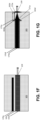
- an additional (second) layer of gate waveguides configured to carry a gate beam of a second wavelength, such as the 420 nm Rydberg laser field (only one second layer gate waveguide 170a is shown) can be added onto substrate 105, separated from the first layer trapping waveguides that are optically coupled to at least one of the trapped particles of the addressable array ( i.e. waveguides 155a, b, c, etc.; only one first layer waveguide, 155d, is shown in FIG. 1F and FIG. 1G ). Second layer gate waveguides 170a, etc. can be disposed on PIC 160 shown in FIG.
- second layer gate waveguides 170a, etc. can be added to the PIC during the fabrication of substrate 105. As shown in FIG. 1F and FIG. 1G , second layer gate waveguides 170a, etc. can be separated from the first layer waveguides 155a, b, c, d etc., by cladding 106, as shown schematically and not to scale in FIG. 1F . In an example embodiment, the cladding can be at least 2 ⁇ m of silicon dioxide (SiO 2 ). Two adjacent waveguides (such as 155d and 170a, shown in FIG. 1F and FIG. 1G ), each having a cross section diameter that is approximately equal to half the respective wavelength inside the waveguide material, as shown in FIG.
- FIG. 1F can be optically coupled into one channel through a staggered adiabatic tapering of the two waveguides, as illustrated in FIG. 1G with respect to waveguides 155d and 170a.
- the tapered portion 171a of the thinner waveguide 170a begins, along the length of waveguide 170a, closer to edge 159 than the tapered portion 161d of the thicker waveguide 155d, as shown in FIG. 1G .
- evanescently transfer shorter wavelength evanescent field 172a (e.g ., blue light) from a second layer waveguide, such as waveguide 170a, using only a single-mode section of a first layer waveguide, such as waveguide 155d, and both the short wavelength evanescent field 172a and the slightly larger longer wavelength evanescent field 162d exit the PIC at the same point at the edge 159 of the PIC, thereby producing a combined multiplexed gate/trapping beam.
- shorter wavelength evanescent field 172a e.g ., blue light
- the present invention is a system for optically modulating a plurality of optical channels.
- the system comprises a power delivery module adapted to convert a coherent light beam into a plurality of optical channels; at least one optical modulator, optically coupled to the power delivery module, the at least one optical modulator adapted to optically modulate each of the plurality of the optical channels; and a vacuum chamber having a trapping plane therein, the vacuum chamber adapted to generate an addressable array of trapped particles at the trapping plane, wherein each of the plurality of optical channels is optically coupled to at least one of the trapped particles of the addressable array.
- system further comprises a coherent light source optically coupled to the power delivery module.
- the power delivery module comprises at least one beam splitter and an optic fiber array.
- Other features and example features of the system are as described above with respect to the 1 st through the 2 nd aspects of the first example embodiments.
- the power delivery module comprises at least one electrically controlled optical modulator adapted to modulate the at least one beam splitter.
- the power delivery module comprises at least one electrically controlled optical modulator adapted to modulate the at least one beam splitter.
- the at least one optical modulator is configured to modulate a signal amplitude on each of the plurality of optical channels.
- Other features and example features of the system are as described above with respect to the 1 st through the 4 th aspects of the first example embodiments.
- the at least one optical modulator is a photonic integrated circuit (PIC).
- PIC photonic integrated circuit
- the at least one optical modulator comprises a plurality of electro-optically controlled Mach-Zehnder Interferometers (MZI), each of the plurality of the MZIs adapted to modulate one of the optical channels.
- MZI Mach-Zehnder Interferometers
- each of the plurality of MZIs comprise waveguides comprising a material selected from lithium niobate, lithium tantalate, Al x Ga 1-x N, SiN, titanium dioxide (TiO 2 ), barium titanate (BTO), or alumina.
- the material is lithium niobate.
- the at least one optical modulator comprises a plurality of tunable resonators, each of the plurality of tunable resonators adapted to modulate one of the optical channels.
- Other features and example features of the system are as described above with respect to the 1 st through the 6 th aspects of the first example embodiments.
- each of the plurality of tunable resonators is a Mach-Zehnder Interferometer (MZI)-coupled resonator comprising a waveguide loop and an MZI.
- MZI Mach-Zehnder Interferometer
- each waveguide loop includes an electro-optically controlled section adapted to modulate the waveguide loop's refractive index.
- Other features and example features of the system are as described above with respect to the 1 st through 6 th , and the 9 th through the 10 th aspects of the first example embodiments.
- the tunable resonator includes a waveguide heating element adapted to modulate the waveguide loop's refractive index.
- Other features and example features of the system are as described above with respect to the 1 st through the 6 th and the 9 th through the 11 th aspects of the first example embodiments.
- the MZI includes a first arm and a second arm
- the tunable resonator includes an MZI heating element adapted to modulate a refractive index of at least the first or the second arm.
- the at least one optical modulator comprises a Silicon-on-Insulator (SOI) photonic integrated circuit (PIC), said SOI PIC adapted to optically modulate each of the plurality of the optical channels.
- SOI Silicon-on-Insulator
- PIC photonic integrated circuit
- the system further comprises a frequency-conversion module optically coupled to the SOI PIC, the frequency-conversion module adapted to convert an optical signal having a first frequency to an optical signal having a second frequency.
- a frequency-conversion module optically coupled to the SOI PIC, the frequency-conversion module adapted to convert an optical signal having a first frequency to an optical signal having a second frequency.
- the at least one optical modulator is disposed on a substrate, and wherein each of the plurality of optical channels comprises an output waveguide.
- Other features and example features of the system are as described above with respect to the 1 st through the 15 th aspects of the first example embodiments.
- the plurality of output waveguides is configured to form a one-dimensional output array.
- the system comprises a plurality of stacked optical modulators configured to form a two-dimensional output array.
- Other features and example features of the system are as described above with respect to the first through the 18 th aspects of the first example embodiments.
- each of the plurality of output waveguides is optically coupled to an auxiliary waveguide, the auxiliary waveguides configured to form a two-dimensional output array.
- auxiliary waveguides configured to form a two-dimensional output array.
- each output waveguide is optically coupled to a diffraction grating.
- Other features and example features of the system are as described above with respect to the first through the 19 th aspects of the first example embodiments.
- the diffraction gratings are configured to form a two-dimensional output array.
- Other features and example features of the system are as described above with respect to the first through the 21 st aspects of the first example embodiments.
- the system further comprises a microlens array, wherein each microlens of the array is optically coupled to one of the diffraction gratings.
- a microlens array wherein each microlens of the array is optically coupled to one of the diffraction gratings.
- each output waveguide is configured to carry a trapping beam of a first wavelength
- the substrate further includes a plurality of gate waveguides, each trapping waveguide being optically coupled to at least one of the trapped particles of the addressable array, and each gate waveguide being configured to carry a gate beam of a second wavelength, different from the first wavelength.
- Other features and example features of the system are as described above with respect to the first through the 22 nd aspects of the first example embodiments.
- at least one output waveguide and at least one gate waveguide are configured to optically couple, thereby producing a combined wavelength-multiplexed gate/trapping beam.
- Other features and example features of the system are as described above with respect to the first through the 23 rd aspects of the first example embodiments.
- the present invention is a method 500 for optically modulating a plurality of optical channels.
- the method comprises converting 510 a coherent light beam into a plurality of optical channels; delivering 520 the plurality of optical channels to at least one optical modulator, the at least one optical modulator adapted to optically modulate each of the plurality of optical channels; optically modulating 530 at least one of the plurality of optical channels; and optically coupling 540 at least one of the plurality of optical channels to at least one of a plurality of trapped particles disposed at a trapping plane of a vacuum chamber adapted to generate an addressable array of the plurality of trapped particles therein.
Landscapes
- Physics & Mathematics (AREA)
- Engineering & Computer Science (AREA)
- General Physics & Mathematics (AREA)
- Nonlinear Science (AREA)
- Optics & Photonics (AREA)
- Electromagnetism (AREA)
- Computer Networks & Wireless Communication (AREA)
- Signal Processing (AREA)
- Theoretical Computer Science (AREA)
- Evolutionary Computation (AREA)
- General Engineering & Computer Science (AREA)
- Condensed Matter Physics & Semiconductors (AREA)
- Mathematical Analysis (AREA)
- Mathematical Optimization (AREA)
- Pure & Applied Mathematics (AREA)
- Computing Systems (AREA)
- Data Mining & Analysis (AREA)
- Mathematical Physics (AREA)
- Software Systems (AREA)
- Computational Mathematics (AREA)
- Artificial Intelligence (AREA)
- Optical Modulation, Optical Deflection, Nonlinear Optics, Optical Demodulation, Optical Logic Elements (AREA)
- Optical Integrated Circuits (AREA)
Claims (15)
- System (100) zum optischen Modulieren einer Vielzahl von optischen Kanälen, das System umfassend:ein Leistungsabgabemodul (130), das angepasst ist, um einen kohärenten Lichtstrahl (120) in eine Vielzahl von optischen Kanälen (140) umzuwandeln;mindestens einen optischen Modulator (150), der mit dem Leistungsabgabemodul (130) optisch gekoppelt ist, wobei der mindestens eine optische Modulator (150) angepasst ist, um jeden der Vielzahl der optischen Kanäle (140) optisch zu modulieren; undeine Vakuumkammer (195), die eine Einfangebene (191) darin aufweist, wobei die Vakuumkammer (195) angepasst ist, um ein adressierbares Array (190) von eingefangenen Teilchen in der Einfangebene (191) zu erzeugen, wobei jeder der Vielzahl von optischen Kanälen (140) mit mindestens einem der eingefangenen Teilchen des adressierbaren Arrays (190) optisch gekoppelt ist, dadurch gekennzeichnet, dass der mindestens eine optische Modulator (150) eine Vielzahl von elektrooptisch gesteuerten Mach-Zehnder-Interferometern, MZI, umfasst, wobei jeder der Vielzahl der MZIs angepasst ist, um einen der optischen Kanäle (140) zu modulieren.
- System nach Anspruch 1, ferner umfassend eine kohärente Lichtquelle (110), die mit dem Leistungsabgabemodul (130) optisch gekoppelt ist.
- System nach einem der Ansprüche 1 oder 2, wobei das Leistungsabgabemodul (130) mindestens einen Strahlteiler und ein optisches Faserarray (125) umfasst.
- System nach Anspruch 3, wobei das Leistungsabgabemodul (130) mindestens einen elektrisch gesteuerten optischen Modulator umfasst, der angepasst ist, um den mindestens einen Strahlteiler zu modulieren.
- System nach einem der Ansprüche 1 bis 4, wobei der mindestens eine optische Modulator (150) konfiguriert ist, um eine Signalamplitude auf jedem der Vielzahl von optischen Kanälen (140) zu modulieren.
- System nach einem der Ansprüche 1 bis 5, wobei der mindestens eine optische Modulator (150) eine photonische integrierte Schaltung, PIC, (160) ist.
- System nach einem der vorstehenden Ansprüche, wobei jeder der Vielzahl von MZIs Wellenleiter umfasst, umfassend ein Material, das aus Lithiumniobat, Lithiumtantalat, AlxGa1-xN, SiN, Titandioxid, Bariumtitanat oder Aluminiumoxid ausgewählt ist; und vorzugsweise wobei das Material Lithiumniobat ist.
- System nach einem der Ansprüche 1 bis 6, wobei der mindestens eine optische Modulator (150) eine photonische integrierte Schaltung, PIC (160), eines Siliziums auf einem Isolator, SOI, umfasst, wobei die SOI-PIC angepasst ist, um jeden der Vielzahl der optischen Kanäle (140) optisch zu modulieren; und optional, ferner umfassend ein Frequenzumwandlungsmodul, das mit der SOI-PIC optisch gekoppelt ist, wobei das Frequenzumwandlungsmodul angepasst ist, um ein optisches Signal, das eine erste Frequenz aufweist, in ein optisches Signal, das eine zweite Frequenz aufweist, umzuwandeln.
- System nach einem der vorstehenden Ansprüche, wobei der mindestens eine optische Modulator (150) auf einem Substrat (105) angeordnet ist und wobei jeder der Vielzahl von optischen Kanälen (140) einen Ausgabewellenleiter (155) umfasst.
- System nach Anspruch 9, wobei die Vielzahl von Ausgabewellenleitern (155) konfiguriert ist, um ein eindimensionales Ausgabearray zu bilden.
- System nach Anspruch 10, wobei entwederdas System eine Vielzahl von gestapelten optischen Modulatoren umfasst, die konfiguriert sind, um ein zweidimensionales Ausgabearray zu bilden; oderwobei jeder der Vielzahl von Ausgangswellenleitern mit einem Hilfswellenleiter optisch gekoppelt ist, wobei die Hilfswellenleiter konfiguriert sind, um ein zweidimensionales Ausgabearray zu bilden.
- System nach Anspruch 9, wobei jeder Ausgabewellenleiter mit einem Beugungsgitter optisch gekoppelt ist; undoptional, wobei die Beugungsgitter konfiguriert sind, um ein zweidimensionales Ausgabearray zu bilden; undferner optional, das System ferner umfassend ein Mikrolinsenarray, wobei jede Mikrolinse des Arrays mit einem der Beugungsgitter optisch gekoppelt ist.
- System nach einem der Ansprüche 9 bis 12, wobei jeder Ausgabewellenleiter (155) konfiguriert ist, um einen Einfangstrahl einer ersten Wellenlänge zu tragen, und wobei das Substrat ferner eine Vielzahl von Gate-Wellenleitern (170) einschließt, wobei jeder Einfangwellenleiter mit mindestens einem der eingefangenen Teilchen des adressierbaren Arrays (190) optisch gekoppelt ist und jeder Gate-Wellenleiter (170) konfiguriert ist, um einen Gate-Strahl einer zweiten Wellenlänge zu tragen, die sich von der ersten Wellenlänge unterscheidet; und
optional, wobei mindestens ein Ausgabewellenleiter (155) und mindestens ein Gate-Wellenleiter (170) konfiguriert sind, um optisch zu koppeln, wodurch ein kombinierter Wellenlängenmultiplex-Gate-/Einfangstrahl hergestellt wird. - Verfahren zum optischen Modulieren einer Vielzahl von optischen Kanälen, umfassend:Umwandeln eines kohärenten Lichtstrahls (120) in eine Vielzahl von optischen Kanälen (140);Abgeben der Vielzahl von optischen Kanälen (140) an mindestens einen optischen Modulator (150), wobei der mindestens eine optische Modulator (150) angepasst ist, um jeden der Vielzahl von optischen Kanälen (140) optisch zu modulieren;optisches Modulieren mindestens eines der Vielzahl von optischen Kanälen (140); undoptisches Koppeln mindestens eines der Vielzahl von optischen Kanälen (140) mit mindestens einem einer Vielzahl von eingefangenen Teilchen, die an einer Einfangebene (191) einer Vakuumkammer (195) angeordnet sind, die angepasst ist, um ein adressierbares Array (190) der Vielzahl von eingefangenen Teilchen darin zu erzeugen, dadurch gekennzeichnet, dass das optische Modulieren mindestens eines der Vielzahl von optischen Kanälen (140) das Modulieren einer Signalamplitude auf jedem der Vielzahl von optischen Kanälen (140) durch elektrooptisches Steuern einer Vielzahl von Mach-Zehnder-Interferometern, MZI, einschließt, wobei jeder der Vielzahl von MZIs einen der optischen Kanäle (140) moduliert.
- Verfahren nach Anspruch 14, das ferner ein Frequenzumwandeln eines optischen Signals, das eine erste Frequenz aufweist, in ein optisches Signal, das eine zweite Frequenz aufweist, einschließt.
Applications Claiming Priority (2)
| Application Number | Priority Date | Filing Date | Title |
|---|---|---|---|
| US201962849278P | 2019-05-17 | 2019-05-17 | |
| PCT/US2020/033100 WO2020236574A1 (en) | 2019-05-17 | 2020-05-15 | System and method for multiplexed optical addressing of atomic memories |
Publications (3)
| Publication Number | Publication Date |
|---|---|
| EP3970083A1 EP3970083A1 (de) | 2022-03-23 |
| EP3970083B1 true EP3970083B1 (de) | 2024-04-24 |
| EP3970083C0 EP3970083C0 (de) | 2024-04-24 |
Family
ID=71069948
Family Applications (1)
| Application Number | Title | Priority Date | Filing Date |
|---|---|---|---|
| EP20731641.5A Active EP3970083B1 (de) | 2019-05-17 | 2020-05-15 | System und verfahren zur multiplexierten optischen adressierung von atomspeichern |
Country Status (5)
| Country | Link |
|---|---|
| US (1) | US12282242B2 (de) |
| EP (1) | EP3970083B1 (de) |
| JP (1) | JP7551654B2 (de) |
| CA (1) | CA3138309A1 (de) |
| WO (1) | WO2020236574A1 (de) |
Families Citing this family (26)
| Publication number | Priority date | Publication date | Assignee | Title |
|---|---|---|---|---|
| IL315535A (en) | 2017-07-13 | 2024-11-01 | Harvard College | Neutral atom quantum information processor |
| CA3108560A1 (en) | 2018-08-31 | 2020-03-05 | President And Fellows Of Harvard College | Quantum computing for combinatorial optimization problems using programmable atom arrays |
| CA3112817A1 (en) | 2018-10-05 | 2020-04-09 | President And Fellows Of Harvard College | Quantum convolutional neural networks |
| US11580435B2 (en) | 2018-11-13 | 2023-02-14 | Atom Computing Inc. | Scalable neutral atom based quantum computing |
| US10504033B1 (en) | 2018-11-13 | 2019-12-10 | Atom Computing Inc. | Scalable neutral atom based quantum computing |
| US11995512B2 (en) | 2018-11-13 | 2024-05-28 | Atom Computing Inc. | Scalable neutral atom based quantum computing |
| JP7410959B2 (ja) | 2019-02-22 | 2024-01-10 | プレジデント アンド フェローズ オブ ハーバード カレッジ | 位相空間光変調器を用いた大スケールの一様な光学的焦点アレイ生成 |
| CA3138309A1 (en) | 2019-05-17 | 2020-11-26 | President And Fellows Of Harvard College | System and method for multiplexed optical addressing of atomic memories |
| JP7612652B2 (ja) | 2019-07-11 | 2025-01-14 | プレジデント アンド フェローズ オブ ハーバード カレッジ | 多キュービット量子ゲートの並行実行のための系および方法 |
| JP7732994B2 (ja) | 2020-03-02 | 2025-09-02 | アトム コンピューティング インク. | スケーラブルな中性原子ベースの量子コンピューティング |
| AU2020432930A1 (en) | 2020-03-02 | 2022-09-29 | Atom Computing Inc. | Scalable neutral atom based quantum computing |
| US12462946B2 (en) * | 2020-05-12 | 2025-11-04 | Quera Computing Incorporated | Methods and apparatus for arranging atoms in arrays |
| US11892744B2 (en) | 2020-06-10 | 2024-02-06 | Quantinuum Llc | Beam delivery system |
| EP4248373B1 (de) * | 2020-11-20 | 2025-12-31 | President and Fellows of Harvard College | Topologische qubits in einer quanten-spin-flüssigkeit |
| US11989622B2 (en) * | 2020-12-01 | 2024-05-21 | ColdQuanta, Inc. | Under-resolved quantum-array state mapping |
| US12057242B2 (en) | 2021-02-18 | 2024-08-06 | ColdQuanta, Inc. | Quantum system with multi-wavelength array trap |
| US12141655B2 (en) * | 2021-02-18 | 2024-11-12 | ColdQuanta, Inc. | Quantum system with multiple-wavelength array trap |
| EP4341867A1 (de) | 2021-05-18 | 2024-03-27 | Quera Computing Incorporated | Verfahren und vorrichtung zur optischen adressierung |
| CN115826135A (zh) * | 2021-09-18 | 2023-03-21 | 华为技术有限公司 | 一种激光传输装置及离子阱系统 |
| US12353955B2 (en) | 2022-02-11 | 2025-07-08 | ColdQuanta, Inc. | Time-multiplexed superpixel-based quantum-array readout system |
| US12443870B2 (en) | 2022-03-10 | 2025-10-14 | Massachusetts Institute Of Technology | High-speed spatial light modulation and quantum control |
| EP4526813A1 (de) | 2022-05-19 | 2025-03-26 | Atom Computing Inc. | Vorrichtungen und verfahren für hohlraumbasierte berechnung |
| US12499382B2 (en) | 2022-10-13 | 2025-12-16 | International Business Machines Corporation | Selective optical tuning of qubit two-level system interactions using bandpass filters |
| US12468087B2 (en) | 2023-03-28 | 2025-11-11 | United States Of America As Represented By The Secretary Of The Air Force | Apparatus and methods for reduction of crosstalk in integrated photonics applied to addressing quantum memories |
| US12523822B2 (en) | 2023-08-22 | 2026-01-13 | United States Of America As Represented By The Secretary Of The Air Force | Apparatus and method for holding optical fiber and fiber arrays via vacuum for fiber alignment and attaching |
| KR102859166B1 (ko) * | 2024-12-05 | 2025-09-12 | 서울대학교 산학협력단 | 비선형 유니터리 광학 소자 |
Citations (2)
| Publication number | Priority date | Publication date | Assignee | Title |
|---|---|---|---|---|
| US20160161685A1 (en) | 2013-03-15 | 2016-06-09 | Finisar Corporation | Multi-channel transceiver with laser array and photonic integrated circuit |
| WO2020236574A1 (en) | 2019-05-17 | 2020-11-26 | President And Fellows Of Harvard College | System and method for multiplexed optical addressing of atomic memories |
Family Cites Families (62)
| Publication number | Priority date | Publication date | Assignee | Title |
|---|---|---|---|---|
| GB205011A (en) | 1923-02-17 | 1923-10-11 | Hermann Bollmann | Improvements in or relating to the production of lecithin from vegetable matters |
| US3872470A (en) | 1973-04-18 | 1975-03-18 | Airco Inc | Audible signal generating apparatus having selectively controlled audible output |
| US4479199A (en) | 1981-03-23 | 1984-10-23 | Friedlander Marc A | Information storage system using a photon echo medium |
| JPH01158413A (ja) * | 1987-09-29 | 1989-06-21 | Nippon Telegr & Teleph Corp <Ntt> | 光導波路装置 |
| US5684621A (en) | 1995-05-08 | 1997-11-04 | Downing; Elizabeth Anne | Method and system for three-dimensional display of information based on two-photon upconversion |
| US6988058B1 (en) | 1998-12-16 | 2006-01-17 | The Regents Of The University Of California | Quantum computation with quantum dots and terahertz cavity quantum electrodynamics |
| US6332055B1 (en) | 1999-03-02 | 2001-12-18 | Sumitomo Electric Industries, Ltd. | Optical attenuator, plane waveguide type optical circuit having the same and optical attenuation system having the same |
| DE60000829D1 (de) | 1999-04-01 | 2003-01-02 | Optical Technologies Usa Corp | Vorrichtung und verfahren zur kompensation von polarisationsmodendispersion in einem optischen übertragungssystem |
| WO2001076026A1 (en) | 2000-03-30 | 2001-10-11 | National Institute Of Standards And Technology ('nist') | Mode-locked pulsed laser system and method |
| FR2818838A1 (fr) | 2000-12-21 | 2002-06-28 | Cit Alcatel | Generateur de retard de groupe differentiel ajustable et compensateur de dispersion de polarisation l'incorporant |
| US7307275B2 (en) | 2002-04-04 | 2007-12-11 | D-Wave Systems Inc. | Encoding and error suppression for superconducting quantum computers |
| US20040184711A1 (en) * | 2002-06-20 | 2004-09-23 | Kenneth Bradley | Optical switches and routers and optical filters |
| JP2004045453A (ja) * | 2002-07-08 | 2004-02-12 | Sumitomo Electric Ind Ltd | 導波路型光部品およびその製造方法 |
| US7369778B2 (en) | 2002-12-30 | 2008-05-06 | Lucent Technologies Inc. | Dispersion compensation method and apparatus |
| GB0329012D0 (en) | 2003-12-15 | 2004-01-14 | Univ Cambridge Tech | Hologram viewing device |
| JP4113161B2 (ja) * | 2004-07-02 | 2008-07-09 | 日本電信電話株式会社 | 光導波路型スイッチ |
| US7533068B2 (en) | 2004-12-23 | 2009-05-12 | D-Wave Systems, Inc. | Analog processor comprising quantum devices |
| JP4819531B2 (ja) | 2006-03-01 | 2011-11-24 | 日本電信電話株式会社 | 量子演算装置及び量子演算方法 |
| US7984012B2 (en) | 2006-11-02 | 2011-07-19 | D-Wave Systems Inc. | Graph embedding techniques |
| US7870087B2 (en) | 2006-11-02 | 2011-01-11 | D-Wave Systems Inc. | Processing relational database problems using analog processors |
| JP5008954B2 (ja) | 2006-11-28 | 2012-08-22 | 浜松ホトニクス株式会社 | 光ビーム発生装置 |
| JP4994826B2 (ja) | 2006-12-25 | 2012-08-08 | オリンパス株式会社 | レーザ顕微鏡 |
| US7966549B2 (en) | 2007-03-01 | 2011-06-21 | Qucor Pty. Ltd. | Error corrected quantum computer |
| US7985965B2 (en) | 2007-03-29 | 2011-07-26 | Raytheon Company | Quantum computing device and method including qubit arrays of entangled states using negative refractive index lenses |
| US20080313430A1 (en) | 2007-06-12 | 2008-12-18 | Bunyk Paul I | Method and system for increasing quantum computer processing speed using digital co-processor |
| US8151174B2 (en) | 2008-02-13 | 2012-04-03 | Sunrise IP, LLC | Block modulus coding (BMC) systems and methods for block coding with non-binary modulus |
| US8229863B2 (en) | 2008-05-28 | 2012-07-24 | D-Wave Systems Inc. | Method and apparatus for evolving a quantum system using a mixed initial hamiltonian comprising both diagonal and off-diagonal terms |
| WO2012082938A2 (en) | 2010-12-14 | 2012-06-21 | President And Fellows Of Harvard College | Scalable room temperature quantum information processor |
| GB2498170B (en) | 2011-10-26 | 2014-01-08 | Two Trees Photonics Ltd | Frame inheritance |
| WO2014051886A1 (en) | 2012-08-22 | 2014-04-03 | President And Fellows Of Harvard College | Nanoscale scanning sensors |
| JP6143325B2 (ja) | 2013-01-11 | 2017-06-07 | 大学共同利用機関法人情報・システム研究機構 | イジングモデルの量子計算装置及びイジングモデルの量子計算方法 |
| JP6094750B2 (ja) | 2013-03-29 | 2017-03-15 | セイコーエプソン株式会社 | 量子干渉装置、原子発振器、磁気センサー及び量子干渉装置の製造方法 |
| US9858531B1 (en) | 2013-08-02 | 2018-01-02 | University Of Maryland | Fault tolerant scalable modular quantum computer architecture with an enhanced control of multi-mode couplings between trapped ion qubits |
| CA2952594C (en) | 2014-05-01 | 2023-08-01 | Lockheed Martin Corporation | Quantum-assisted training of neural networks |
| US9355750B2 (en) | 2014-09-02 | 2016-05-31 | Wisconsin Alumni Research Foundation | System and method for optical confinement of atomic particles |
| AU2015252051B2 (en) | 2014-11-03 | 2020-10-15 | Newsouth Innovations Pty Limited | A quantum processor |
| KR102141274B1 (ko) | 2015-05-05 | 2020-08-04 | 킨디 인코포레이티드 | 고전적 프로세서 상에서 양자-유사 계산을 에뮬레이트하기 위한 퀀톤 표현 |
| EP3113084B1 (de) | 2015-06-29 | 2020-12-09 | Parity Quantum Computing GmbH | Quantumverarbeitungsvorrichtung und -verfahren |
| GB2542622A (en) | 2015-09-28 | 2017-03-29 | Cambridge Entpr Ltd | Method and apparatus for performing complex fourier transforms |
| JP6551149B2 (ja) | 2015-10-22 | 2019-07-31 | 株式会社ジェイテクト | 微粒子捕捉方法及び光ピンセット装置 |
| US10789540B2 (en) | 2016-04-18 | 2020-09-29 | D-Wave Systems Inc. | Systems and methods for embedding problems into an analog processor |
| JP2017211504A (ja) | 2016-05-26 | 2017-11-30 | 住友大阪セメント株式会社 | 光変調器 |
| CN109661612B (zh) | 2016-07-22 | 2023-04-04 | 光子系统股份有限公司 | 具有可定制的性能的固有宽带线性化电光调制器 |
| US11120357B2 (en) | 2017-03-10 | 2021-09-14 | Rigetti & Co, Inc. | Quantum approximate optimization |
| CN106980178B (zh) | 2017-03-24 | 2019-05-31 | 浙江大学 | 一种位相型LCoS图像信号处理方法以及近眼显示系统 |
| IL315535A (en) | 2017-07-13 | 2024-11-01 | Harvard College | Neutral atom quantum information processor |
| GB2567408B (en) | 2017-08-02 | 2020-12-02 | Dualitas Ltd | Holographic projector |
| US11100418B2 (en) | 2018-02-28 | 2021-08-24 | D-Wave Systems Inc. | Error reduction and, or, correction in analog computing including quantum processor-based computing |
| CA3108560A1 (en) | 2018-08-31 | 2020-03-05 | President And Fellows Of Harvard College | Quantum computing for combinatorial optimization problems using programmable atom arrays |
| WO2020069253A1 (en) * | 2018-09-27 | 2020-04-02 | Massachusetts Institute Of Technology | Strained germanium silicon modulators for integrated high-speed broadband modulation |
| CA3112817A1 (en) | 2018-10-05 | 2020-04-09 | President And Fellows Of Harvard College | Quantum convolutional neural networks |
| JP7410959B2 (ja) | 2019-02-22 | 2024-01-10 | プレジデント アンド フェローズ オブ ハーバード カレッジ | 位相空間光変調器を用いた大スケールの一様な光学的焦点アレイ生成 |
| JP7612652B2 (ja) | 2019-07-11 | 2025-01-14 | プレジデント アンド フェローズ オブ ハーバード カレッジ | 多キュービット量子ゲートの並行実行のための系および方法 |
| CA3157925A1 (en) | 2020-01-06 | 2021-07-15 | Dominik S. WILD | System and method for quantum sampling from a probability distribution |
| US12321821B2 (en) | 2020-10-30 | 2025-06-03 | Massachusetts Institute Of Technology | All-connected, cavity-mediated quantum computing with local quantum processors |
| WO2022132388A2 (en) | 2020-11-20 | 2022-06-23 | President And Fellows Of Harvard College | Topological qubits in a quantum spin liquid |
| EP4248373B1 (de) | 2020-11-20 | 2025-12-31 | President and Fellows of Harvard College | Topologische qubits in einer quanten-spin-flüssigkeit |
| CA3204993A1 (en) | 2021-02-12 | 2022-08-18 | Wenchao XU | Ultrafast detector of rydberg atoms |
| JP2024520487A (ja) | 2021-05-27 | 2024-05-24 | プレジデント アンド フェローズ オブ ハーバード カレッジ | フォールトトレラント量子コンピューター計算 |
| EP4371042A2 (de) | 2021-07-16 | 2024-05-22 | President and Fellows of Harvard College | Dispersive optik zur skalierbaren raman-ansteuerung hyperfeiner qubits |
| US20240346352A1 (en) | 2021-08-03 | 2024-10-17 | President And Fellows Of Harvard College | Dynamically reconfigurable architectures for quantum information and simulation |
| CA3259126A1 (en) | 2022-07-01 | 2024-07-25 | President And Fellows Of Harvard College | Modular Rydberg Architectures for Fault-Tolerant Quantum Computing |
-
2020
- 2020-05-15 CA CA3138309A patent/CA3138309A1/en active Pending
- 2020-05-15 JP JP2021568239A patent/JP7551654B2/ja active Active
- 2020-05-15 US US17/611,679 patent/US12282242B2/en active Active
- 2020-05-15 WO PCT/US2020/033100 patent/WO2020236574A1/en not_active Ceased
- 2020-05-15 EP EP20731641.5A patent/EP3970083B1/de active Active
Patent Citations (2)
| Publication number | Priority date | Publication date | Assignee | Title |
|---|---|---|---|---|
| US20160161685A1 (en) | 2013-03-15 | 2016-06-09 | Finisar Corporation | Multi-channel transceiver with laser array and photonic integrated circuit |
| WO2020236574A1 (en) | 2019-05-17 | 2020-11-26 | President And Fellows Of Harvard College | System and method for multiplexed optical addressing of atomic memories |
Non-Patent Citations (13)
| Title |
|---|
| ANONYMOUS: "Electro-optic modulator", WIKIPEDIA, 14 May 2019 (2019-05-14), pages 1 - 4, XP093257239 |
| BRUZEWICZ COLIN D. ET AL: "Trapped-ion quantum computing: Progress and challenges", APPLIED PHYSICS REVIEWS, AMERICAN INSTITUTE OF PHYSICS, 2 HUNTINGTON QUADRANGLE, MELVILLE, NY 11747, vol. 6, no. 2, 29 May 2019 (2019-05-29), 2 Huntington Quadrangle, Melville, NY 11747 , XP012238166, DOI: 10.1063/1.5088164 |
| D15: US PROVISIONAL APPLICATION "MULTIPLEXED OPTICAL ADDRESSING OF ATOMIC MEMORIES" |
| D16: STRUCTURE OF CLAIM 1 |
| KIELPINSKI D. ET AL: "Integrated optics architecture for trapped-ion quantum information processing", QUANTUM INFORMATION PROCESSING, SPRINGER US, NEW YORK, vol. 15, no. 12, 23 November 2015 (2015-11-23), New York, pages 5315 - 5338, XP036105505, ISSN: 1570-0755, DOI: 10.1007/s11128-015-1162-2 |
| M SAFFMAN: "Quantum computing with atomic qubits and Rydberg interactions: progress and challenges", JOURNAL OF PHYSICS B, ATOMIC MOLECULAR AND OPTICAL PHYSICS, INSTITUTE OF PHYSICS PUBLISHING, BRISTOL, GB, vol. 49, no. 20, 4 October 2016 (2016-10-04), GB , pages 202001, XP020309686, ISSN: 0953-4075, DOI: 10.1088/0953-4075/49/20/202001 |
| QI YIFAN, LI YANG: "Integrated lithium niobate photonics", NANOPHOTONICS, DE GRUYTER, DE, vol. 9, no. 6, 1 June 2020 (2020-06-01), DE , pages 1287 - 1320, XP093042016, ISSN: 2192-8606, DOI: 10.1515/nanoph-2020-0013 |
| QUINT STEPHAN: "Formung von Laserlichtimpulsen für die Quanteninformationsverarbeitung mit 40Ca+", DIPLOMARBEIT, INSTITUT FÜR PHYSIK JOHANNES GUTENBERG-UNIVERSITÄT MAINZ, 1 May 2011 (2011-05-01), pages 1 - 94, XP093257215 |
| RICCARDO MARCHETTI ET AL.: "Coupling strategies for silicon photonics integrated chips [Invited]", PHOTONICS RESEARCH, vol. 7, February 2019 (2019-02-01), pages 2, XP055893568, DOI: 10.1364/PRJ.7.000201 |
| RICKERT JULIAN: "Simultaneous and individual ion addressing for quantum information processing", LEOPOLD-FRANZENS-UNIVERSITÄT INNSBRUCK, 1 November 2018 (2018-11-01), pages 1 - 89, XP055979503, Retrieved from the Internet <URL:https://www.quantumoptics.at/images/publications/diploma/master_rickert.pdf> [retrieved on 20221109] |
| S. DEBNATH ET AL: "Demonstration of a small programmable quantum computer with atomic qubits", NATURE, vol. 536, no. 7614, 1 August 2016 (2016-08-01), pages 63 - 66, XP055451676, DOI: 10.1038/nature18648 |
| T. G. TIECKE ET AL: "Nanophotonic quantum phase switch with a single atom", NATURE, vol. 508, no. 7495, pages 241 - 244, XP055572992, DOI: 10.1038/nature13188 |
| WANG CHENG ET AL: "Second harmonic generation in nano-structured thin-film lithium niobate waveguides", OPTICS EXPRESS, OPTICAL SOCIETY OF AMERICA, US, vol. 25, no. 6, 20 March 2017 (2017-03-20), US, pages 1 - 11, XP093257224, ISSN: 1094-4087, DOI: 10.1364/OE.25.006963 |
Also Published As
| Publication number | Publication date |
|---|---|
| CA3138309A1 (en) | 2020-11-26 |
| US20220197102A1 (en) | 2022-06-23 |
| JP7551654B2 (ja) | 2024-09-17 |
| EP3970083A1 (de) | 2022-03-23 |
| JP2022532234A (ja) | 2022-07-13 |
| EP3970083C0 (de) | 2024-04-24 |
| WO2020236574A1 (en) | 2020-11-26 |
| US12282242B2 (en) | 2025-04-22 |
Similar Documents
| Publication | Publication Date | Title |
|---|---|---|
| EP3970083B1 (de) | System und verfahren zur multiplexierten optischen adressierung von atomspeichern | |
| Eldada | Optical communication components | |
| JPWO2020236574A5 (de) | ||
| Boes et al. | Status and potential of lithium niobate on insulator (LNOI) for photonic integrated circuits | |
| Janner et al. | Micro‐structured integrated electro‐optic LiNbO3 modulators | |
| US11429009B2 (en) | Integrated electro-optic devices for classical and quantum microwave photonics | |
| US7215842B2 (en) | Light control element and light control device | |
| JPH10507281A (ja) | 極化構造を用いて光学エネルギーを操作する方法 | |
| JPH10509246A (ja) | 極化構造を使用する制御可能なビーム・ディレクタ | |
| WO2004023174A2 (en) | Photorefractive devices | |
| US12443870B2 (en) | High-speed spatial light modulation and quantum control | |
| EP3108296B1 (de) | Polarisationsunabhängiger elektrooptisch induzierter wellenleiter | |
| Poveda et al. | Semiconductor optical waveguide devices modulated by surface acoustic waves | |
| Kielpinski et al. | Integrated optics architecture for trapped-ion quantum information processing | |
| US6614947B1 (en) | Digital optical switch using an integrated mach-zehnder interferometer having a movable phase shifter | |
| JP2765529B2 (ja) | 導波路形光デバイス | |
| Nishihara et al. | Optical integrated circuits | |
| Mancinelli | Linear and non linear coupling effects in sequence of microresonators | |
| WO2001040849A2 (en) | Electro-optic switching assembly and method | |
| US6563965B1 (en) | Analog optical switch using an integrated Mach-Zehnder interferometer having a moveable phase shifter | |
| Ghoumid et al. | Wavelength-Selective Ti: LiNbO $ _ {3} $ Multiple Y-Branch Coupler Based on Focused Ion Beam Milled Bragg Reflectors | |
| Abe et al. | A silicon microring resonator with a nanolatch mechanism | |
| Poon et al. | Photonics filters, switches and subsystems for next-generation optical networks | |
| Gautam | Silicon microring resonator loaded mach-zehnder interferometer for low power optical modulation, switching and bio-sensing | |
| JP2015191111A (ja) | 光分岐挿入装置、光スイッチおよび製造方法 |
Legal Events
| Date | Code | Title | Description |
|---|---|---|---|
| STAA | Information on the status of an ep patent application or granted ep patent |
Free format text: STATUS: UNKNOWN |
|
| STAA | Information on the status of an ep patent application or granted ep patent |
Free format text: STATUS: THE INTERNATIONAL PUBLICATION HAS BEEN MADE |
|
| PUAI | Public reference made under article 153(3) epc to a published international application that has entered the european phase |
Free format text: ORIGINAL CODE: 0009012 |
|
| STAA | Information on the status of an ep patent application or granted ep patent |
Free format text: STATUS: REQUEST FOR EXAMINATION WAS MADE |
|
| 17P | Request for examination filed |
Effective date: 20211117 |
|
| AK | Designated contracting states |
Kind code of ref document: A1 Designated state(s): AL AT BE BG CH CY CZ DE DK EE ES FI FR GB GR HR HU IE IS IT LI LT LU LV MC MK MT NL NO PL PT RO RS SE SI SK SM TR |
|
| REG | Reference to a national code |
Ref country code: DE Ref legal event code: R079 Free format text: PREVIOUS MAIN CLASS: G06N0010000000 Ipc: G02F0001000000 Ref document number: 602020029605 Country of ref document: DE |
|
| GRAP | Despatch of communication of intention to grant a patent |
Free format text: ORIGINAL CODE: EPIDOSNIGR1 |
|
| STAA | Information on the status of an ep patent application or granted ep patent |
Free format text: STATUS: GRANT OF PATENT IS INTENDED |
|
| RIC1 | Information provided on ipc code assigned before grant |
Ipc: G06N 10/00 20220101ALN20231017BHEP Ipc: G02F 1/00 20060101AFI20231017BHEP |
|
| DAV | Request for validation of the european patent (deleted) | ||
| DAX | Request for extension of the european patent (deleted) | ||
| INTG | Intention to grant announced |
Effective date: 20231102 |
|
| GRAS | Grant fee paid |
Free format text: ORIGINAL CODE: EPIDOSNIGR3 |
|
| TPAC | Observations filed by third parties |
Free format text: ORIGINAL CODE: EPIDOSNTIPA |
|
| GRAA | (expected) grant |
Free format text: ORIGINAL CODE: 0009210 |
|
| STAA | Information on the status of an ep patent application or granted ep patent |
Free format text: STATUS: THE PATENT HAS BEEN GRANTED |
|
| AK | Designated contracting states |
Kind code of ref document: B1 Designated state(s): AL AT BE BG CH CY CZ DE DK EE ES FI FR GB GR HR HU IE IS IT LI LT LU LV MC MK MT NL NO PL PT RO RS SE SI SK SM TR |
|
| REG | Reference to a national code |
Ref country code: GB Ref legal event code: FG4D |
|
| REG | Reference to a national code |
Ref country code: CH Ref legal event code: EP |
|
| REG | Reference to a national code |
Ref country code: DE Ref legal event code: R096 Ref document number: 602020029605 Country of ref document: DE |
|
| REG | Reference to a national code |
Ref country code: IE Ref legal event code: FG4D |
|
| U01 | Request for unitary effect filed |
Effective date: 20240520 |
|
| U07 | Unitary effect registered |
Designated state(s): AT BE BG DE DK EE FI FR IT LT LU LV MT NL PT SE SI Effective date: 20240529 |
|
| U20 | Renewal fee for the european patent with unitary effect paid |
Year of fee payment: 5 Effective date: 20240528 |
|
| PG25 | Lapsed in a contracting state [announced via postgrant information from national office to epo] |
Ref country code: IS Free format text: LAPSE BECAUSE OF FAILURE TO SUBMIT A TRANSLATION OF THE DESCRIPTION OR TO PAY THE FEE WITHIN THE PRESCRIBED TIME-LIMIT Effective date: 20240824 |
|
| PG25 | Lapsed in a contracting state [announced via postgrant information from national office to epo] |
Ref country code: HR Free format text: LAPSE BECAUSE OF FAILURE TO SUBMIT A TRANSLATION OF THE DESCRIPTION OR TO PAY THE FEE WITHIN THE PRESCRIBED TIME-LIMIT Effective date: 20240424 |
|
| PG25 | Lapsed in a contracting state [announced via postgrant information from national office to epo] |
Ref country code: GR Free format text: LAPSE BECAUSE OF FAILURE TO SUBMIT A TRANSLATION OF THE DESCRIPTION OR TO PAY THE FEE WITHIN THE PRESCRIBED TIME-LIMIT Effective date: 20240725 |
|
| PG25 | Lapsed in a contracting state [announced via postgrant information from national office to epo] |
Ref country code: ES Free format text: LAPSE BECAUSE OF FAILURE TO SUBMIT A TRANSLATION OF THE DESCRIPTION OR TO PAY THE FEE WITHIN THE PRESCRIBED TIME-LIMIT Effective date: 20240424 |
|
| PG25 | Lapsed in a contracting state [announced via postgrant information from national office to epo] |
Ref country code: PL Free format text: LAPSE BECAUSE OF FAILURE TO SUBMIT A TRANSLATION OF THE DESCRIPTION OR TO PAY THE FEE WITHIN THE PRESCRIBED TIME-LIMIT Effective date: 20240424 |
|
| PG25 | Lapsed in a contracting state [announced via postgrant information from national office to epo] |
Ref country code: PL Free format text: LAPSE BECAUSE OF FAILURE TO SUBMIT A TRANSLATION OF THE DESCRIPTION OR TO PAY THE FEE WITHIN THE PRESCRIBED TIME-LIMIT Effective date: 20240424 Ref country code: NO Free format text: LAPSE BECAUSE OF FAILURE TO SUBMIT A TRANSLATION OF THE DESCRIPTION OR TO PAY THE FEE WITHIN THE PRESCRIBED TIME-LIMIT Effective date: 20240724 Ref country code: IS Free format text: LAPSE BECAUSE OF FAILURE TO SUBMIT A TRANSLATION OF THE DESCRIPTION OR TO PAY THE FEE WITHIN THE PRESCRIBED TIME-LIMIT Effective date: 20240824 Ref country code: HR Free format text: LAPSE BECAUSE OF FAILURE TO SUBMIT A TRANSLATION OF THE DESCRIPTION OR TO PAY THE FEE WITHIN THE PRESCRIBED TIME-LIMIT Effective date: 20240424 Ref country code: GR Free format text: LAPSE BECAUSE OF FAILURE TO SUBMIT A TRANSLATION OF THE DESCRIPTION OR TO PAY THE FEE WITHIN THE PRESCRIBED TIME-LIMIT Effective date: 20240725 Ref country code: ES Free format text: LAPSE BECAUSE OF FAILURE TO SUBMIT A TRANSLATION OF THE DESCRIPTION OR TO PAY THE FEE WITHIN THE PRESCRIBED TIME-LIMIT Effective date: 20240424 Ref country code: RS Free format text: LAPSE BECAUSE OF FAILURE TO SUBMIT A TRANSLATION OF THE DESCRIPTION OR TO PAY THE FEE WITHIN THE PRESCRIBED TIME-LIMIT Effective date: 20240724 |
|
| REG | Reference to a national code |
Ref country code: CH Ref legal event code: PL |
|
| PG25 | Lapsed in a contracting state [announced via postgrant information from national office to epo] |
Ref country code: CZ Free format text: LAPSE BECAUSE OF FAILURE TO SUBMIT A TRANSLATION OF THE DESCRIPTION OR TO PAY THE FEE WITHIN THE PRESCRIBED TIME-LIMIT Effective date: 20240424 |
|
| REG | Reference to a national code |
Ref country code: DE Ref legal event code: R026 Ref document number: 602020029605 Country of ref document: DE |
|
| PG25 | Lapsed in a contracting state [announced via postgrant information from national office to epo] |
Ref country code: SK Free format text: LAPSE BECAUSE OF FAILURE TO SUBMIT A TRANSLATION OF THE DESCRIPTION OR TO PAY THE FEE WITHIN THE PRESCRIBED TIME-LIMIT Effective date: 20240424 Ref country code: RO Free format text: LAPSE BECAUSE OF FAILURE TO SUBMIT A TRANSLATION OF THE DESCRIPTION OR TO PAY THE FEE WITHIN THE PRESCRIBED TIME-LIMIT Effective date: 20240424 |
|
| PG25 | Lapsed in a contracting state [announced via postgrant information from national office to epo] |
Ref country code: SM Free format text: LAPSE BECAUSE OF FAILURE TO SUBMIT A TRANSLATION OF THE DESCRIPTION OR TO PAY THE FEE WITHIN THE PRESCRIBED TIME-LIMIT Effective date: 20240424 |
|
| PG25 | Lapsed in a contracting state [announced via postgrant information from national office to epo] |
Ref country code: SM Free format text: LAPSE BECAUSE OF FAILURE TO SUBMIT A TRANSLATION OF THE DESCRIPTION OR TO PAY THE FEE WITHIN THE PRESCRIBED TIME-LIMIT Effective date: 20240424 Ref country code: SK Free format text: LAPSE BECAUSE OF FAILURE TO SUBMIT A TRANSLATION OF THE DESCRIPTION OR TO PAY THE FEE WITHIN THE PRESCRIBED TIME-LIMIT Effective date: 20240424 Ref country code: RO Free format text: LAPSE BECAUSE OF FAILURE TO SUBMIT A TRANSLATION OF THE DESCRIPTION OR TO PAY THE FEE WITHIN THE PRESCRIBED TIME-LIMIT Effective date: 20240424 Ref country code: CZ Free format text: LAPSE BECAUSE OF FAILURE TO SUBMIT A TRANSLATION OF THE DESCRIPTION OR TO PAY THE FEE WITHIN THE PRESCRIBED TIME-LIMIT Effective date: 20240424 Ref country code: CH Free format text: LAPSE BECAUSE OF NON-PAYMENT OF DUE FEES Effective date: 20240531 Ref country code: MC Free format text: LAPSE BECAUSE OF FAILURE TO SUBMIT A TRANSLATION OF THE DESCRIPTION OR TO PAY THE FEE WITHIN THE PRESCRIBED TIME-LIMIT Effective date: 20240424 |
|
| PLBI | Opposition filed |
Free format text: ORIGINAL CODE: 0009260 |
|
| PLAX | Notice of opposition and request to file observation + time limit sent |
Free format text: ORIGINAL CODE: EPIDOSNOBS2 |
|
| 26 | Opposition filed |
Opponent name: SCHWARZ & PARTNER PATENTANWAELTE GMBH Effective date: 20250124 |
|
| PG25 | Lapsed in a contracting state [announced via postgrant information from national office to epo] |
Ref country code: IE Free format text: LAPSE BECAUSE OF NON-PAYMENT OF DUE FEES Effective date: 20240515 |
|
| PLBB | Reply of patent proprietor to notice(s) of opposition received |
Free format text: ORIGINAL CODE: EPIDOSNOBS3 |
|
| U20 | Renewal fee for the european patent with unitary effect paid |
Year of fee payment: 6 Effective date: 20250527 |
|
| PGFP | Annual fee paid to national office [announced via postgrant information from national office to epo] |
Ref country code: GB Payment date: 20250527 Year of fee payment: 6 |
|
| PG25 | Lapsed in a contracting state [announced via postgrant information from national office to epo] |
Ref country code: CY Free format text: LAPSE BECAUSE OF FAILURE TO SUBMIT A TRANSLATION OF THE DESCRIPTION OR TO PAY THE FEE WITHIN THE PRESCRIBED TIME-LIMIT; INVALID AB INITIO Effective date: 20200515 |
|
| PG25 | Lapsed in a contracting state [announced via postgrant information from national office to epo] |
Ref country code: HU Free format text: LAPSE BECAUSE OF FAILURE TO SUBMIT A TRANSLATION OF THE DESCRIPTION OR TO PAY THE FEE WITHIN THE PRESCRIBED TIME-LIMIT; INVALID AB INITIO Effective date: 20200515 |
|
| U1N | Appointed representative for the unitary patent procedure changed after the registration of the unitary effect |
Representative=s name: PETERREINS SCHLEY; DE |