EP3969554B1 - Laundry composition - Google Patents
Laundry composition Download PDFInfo
- Publication number
- EP3969554B1 EP3969554B1 EP20724868.3A EP20724868A EP3969554B1 EP 3969554 B1 EP3969554 B1 EP 3969554B1 EP 20724868 A EP20724868 A EP 20724868A EP 3969554 B1 EP3969554 B1 EP 3969554B1
- Authority
- EP
- European Patent Office
- Prior art keywords
- composition
- laundry
- perfume
- ancillary
- laundry composition
- Prior art date
- Legal status (The legal status is an assumption and is not a legal conclusion. Google has not performed a legal analysis and makes no representation as to the accuracy of the status listed.)
- Active
Links
Classifications
-
- C—CHEMISTRY; METALLURGY
- C11—ANIMAL OR VEGETABLE OILS, FATS, FATTY SUBSTANCES OR WAXES; FATTY ACIDS THEREFROM; DETERGENTS; CANDLES
- C11D—DETERGENT COMPOSITIONS; USE OF SINGLE SUBSTANCES AS DETERGENTS; SOAP OR SOAP-MAKING; RESIN SOAPS; RECOVERY OF GLYCEROL
- C11D1/00—Detergent compositions based essentially on surface-active compounds; Use of these compounds as a detergent
- C11D1/66—Non-ionic compounds
- C11D1/72—Ethers of polyoxyalkylene glycols
-
- C—CHEMISTRY; METALLURGY
- C11—ANIMAL OR VEGETABLE OILS, FATS, FATTY SUBSTANCES OR WAXES; FATTY ACIDS THEREFROM; DETERGENTS; CANDLES
- C11D—DETERGENT COMPOSITIONS; USE OF SINGLE SUBSTANCES AS DETERGENTS; SOAP OR SOAP-MAKING; RESIN SOAPS; RECOVERY OF GLYCEROL
- C11D1/00—Detergent compositions based essentially on surface-active compounds; Use of these compounds as a detergent
- C11D1/66—Non-ionic compounds
-
- C—CHEMISTRY; METALLURGY
- C11—ANIMAL OR VEGETABLE OILS, FATS, FATTY SUBSTANCES OR WAXES; FATTY ACIDS THEREFROM; DETERGENTS; CANDLES
- C11D—DETERGENT COMPOSITIONS; USE OF SINGLE SUBSTANCES AS DETERGENTS; SOAP OR SOAP-MAKING; RESIN SOAPS; RECOVERY OF GLYCEROL
- C11D3/00—Other compounding ingredients of detergent compositions covered in group C11D1/00
- C11D3/0005—Other compounding ingredients characterised by their effect
- C11D3/001—Softening compositions
-
- C—CHEMISTRY; METALLURGY
- C11—ANIMAL OR VEGETABLE OILS, FATS, FATTY SUBSTANCES OR WAXES; FATTY ACIDS THEREFROM; DETERGENTS; CANDLES
- C11D—DETERGENT COMPOSITIONS; USE OF SINGLE SUBSTANCES AS DETERGENTS; SOAP OR SOAP-MAKING; RESIN SOAPS; RECOVERY OF GLYCEROL
- C11D3/00—Other compounding ingredients of detergent compositions covered in group C11D1/00
- C11D3/0005—Other compounding ingredients characterised by their effect
- C11D3/0036—Soil deposition preventing compositions; Antiredeposition agents
-
- C—CHEMISTRY; METALLURGY
- C11—ANIMAL OR VEGETABLE OILS, FATS, FATTY SUBSTANCES OR WAXES; FATTY ACIDS THEREFROM; DETERGENTS; CANDLES
- C11D—DETERGENT COMPOSITIONS; USE OF SINGLE SUBSTANCES AS DETERGENTS; SOAP OR SOAP-MAKING; RESIN SOAPS; RECOVERY OF GLYCEROL
- C11D3/00—Other compounding ingredients of detergent compositions covered in group C11D1/00
- C11D3/16—Organic compounds
- C11D3/37—Polymers
-
- C—CHEMISTRY; METALLURGY
- C11—ANIMAL OR VEGETABLE OILS, FATS, FATTY SUBSTANCES OR WAXES; FATTY ACIDS THEREFROM; DETERGENTS; CANDLES
- C11D—DETERGENT COMPOSITIONS; USE OF SINGLE SUBSTANCES AS DETERGENTS; SOAP OR SOAP-MAKING; RESIN SOAPS; RECOVERY OF GLYCEROL
- C11D3/00—Other compounding ingredients of detergent compositions covered in group C11D1/00
- C11D3/50—Perfumes
-
- C—CHEMISTRY; METALLURGY
- C11—ANIMAL OR VEGETABLE OILS, FATS, FATTY SUBSTANCES OR WAXES; FATTY ACIDS THEREFROM; DETERGENTS; CANDLES
- C11D—DETERGENT COMPOSITIONS; USE OF SINGLE SUBSTANCES AS DETERGENTS; SOAP OR SOAP-MAKING; RESIN SOAPS; RECOVERY OF GLYCEROL
- C11D3/00—Other compounding ingredients of detergent compositions covered in group C11D1/00
- C11D3/50—Perfumes
- C11D3/502—Protected perfumes
- C11D3/505—Protected perfumes encapsulated or adsorbed on a carrier, e.g. zeolite or clay
-
- C—CHEMISTRY; METALLURGY
- C11—ANIMAL OR VEGETABLE OILS, FATS, FATTY SUBSTANCES OR WAXES; FATTY ACIDS THEREFROM; DETERGENTS; CANDLES
- C11D—DETERGENT COMPOSITIONS; USE OF SINGLE SUBSTANCES AS DETERGENTS; SOAP OR SOAP-MAKING; RESIN SOAPS; RECOVERY OF GLYCEROL
- C11D2111/00—Cleaning compositions characterised by the objects to be cleaned; Cleaning compositions characterised by non-standard cleaning or washing processes
- C11D2111/10—Objects to be cleaned
- C11D2111/12—Soft surfaces, e.g. textile
Definitions
- the present invention relates to an ancillary laundry composition providing improved perfuming to fabrics.
- Perfumes are an important aspect of the laundry process for consumers. Fragrances can be an indication to the consumer that their washing is clean or simply provide a pleasurable experience. Accordingly, may products comprise perfumes. However, this presents a problem in that different consumers like different fragrances and different intensities of perfumes. Consumers are known to over or under dose a product to achieve the desired level of perfume. However, this has a negative impact on the effectiveness of the primary purpose of the laundry product (cleaning or softening).
- WO2017174251 discloses alkoxylated polyethylene imine polymer and surfactant formulation for use in domestic laundry.
- ancillary laundry compositions have been developed, to allow the consumer to select their desired fragrance and add this to the laundry at their desired dosing level.
- ancillary laundry products there is a need to improve the efficacy of these ancillary laundry products.
- One aspect of the present invention relates to an ancillary laundry composition
- an ancillary laundry composition comprising:
- a second aspect of the present invention relates to a method of improving the perfume intensity of a dry fabric comprising the steps of:
- a third aspect of the present invention relates a method of reducing malodour of synthetic fabrics comprising the steps of:
- a forth aspect of the present invention relates to a use of an ancillary laundry composition as described herein, to improve the perfume intensity of a dry fabric.
- a fifth aspect of the present invention relates to a use of an ancillary laundry composition as described herein, to reduce malodour on synthetic fabrics.
- 'ancillary laundry composition' is used to refer to a specific format of laundry product. This is a liquid product which is intended to be used in addition to a laundry detergent and/or the fabric conditioner to provide an additional or improved benefit to the materials in the wash or rinse cycle.
- the formulations may also be used instead of a fabric conditioner formulation.
- Ancillary laundry compositions may also be referred to as a serum.
- This particular format provides an improved benefit delivery. It also provides consumers with a simple additive product which can be used in addition to their usual fabric conditioner.
- compositions of the present invention comprise soil release polymers.
- Soil release polymers provide multiple benefits to the present invention. Soil release polymers improve perfume intensity of the dry fabrics. Without wishing to be bound by theory, it is believed that this is due to improved hedonics. Soil release polymers also reduce malodour of synthetic fabrics such as polyesters. The malodour reduction can contribute to the improved perfume intensity, since the perfume is not required to mask the malodour.
- Suitable soil release polymers can be synthesised by conventional techniques well-known the skilled person, such as those described in US 2013/0200290 .
- Soil release polymers may be present at a level selected from: less than 30 %, less than 20 %, and less than 10 %, by weight of the laundry composition. Soil release polymers may be present at a level selected from: more than 0.5 %, preferably more than 1 %, by weight of the composition. Suitably Soil release polymers is present in the composition in an amount selected from the range of from about 0.5 % to about 30 %, preferably from about 0.5 % to about 20 %, more preferably from about 1 % to about 10 %, by weight of the composition.
- the soil release polymer has one or more fabric-binding regions, to provide fabric substantively.
- the soil release polymer may include a fabric-binding region capped by one or more hydrophilic regions.
- the fabric-binding region forms the central portion of the molecule (the "midblock") and is capped by hydrophilic groups.
- the anionic substituents are provided on the fabric-binding region and/or on the end cap, since these disrupt surfactant interaction with the soil release polymer.
- the weight average molecular weight of the polymeric soil release polymer may be at least 1,000, at least 2,000, at least 5,000, at least 10,000, at least 15,000, at least 20,000 or at least 25,000.
- the upper limit for the weight average molecular weight may be, for example, 100,000; 75,000; 60,000; 55,000; 50,000; 40,000 or 30,000.
- the weight average molecular weight may be between about 5,000 to about 50,000, such as between about 1,200 to 12,000.
- the soil release polymers of the present invention are polymers according to the following generic formula: X 1 - R 1 - Z - R 2 - X 2 Formula (I) Wherein:
- R 1 and R 2 are independently, preferably blocks consisting of one or more nonionic hydrophilic components selected from:
- Z preferably consists of one or more anionic hydrophobic components selected from:
- the Z is a polyester polymer or comprises a polyester copolymer region.
- the soil release polymer may be according to the following formula (II) wherein
- X of R 1 and R 2 is preferably methyl.
- the -(OC 3 H 6 ) groups of R 1 and R 2 is preferably bound to a COO group.
- variable "n" based on a molar average preferably is a number of from 40 to 50, more preferably is a number of from 43 to 47 and even more preferably is 44 to 46 and most preferably 45.
- variable "m" based on a molar average preferably is a number of from 1 to 7, more preferably a number from 2 to 6.
- variable "a" based on a molar average preferably is a number of from 5 to 8 and more preferably is a number of from 6 to 7.
- the groups -O-C 2 H 4 - in the structural units "X-(OC 2 H 4 ) n -(OC 3 H 6 ) m " or "H 3 C-(OC 2 H 4 ) n -(OC 3 H 6 ) m " are of the formula -O-CH 2 -CH 2 -.
- polyesters of component A) of the inventive compositions are according to the following formula (I)
- polyesters of component A) of the inventive compositions are according to the following formula (I)
- the soil release polymers comprise copolymers having random blocks of ethylene terephthalate and polyethylene oxide (PEO) terephthalate.
- the molecular weight of this polymeric soil release agent is in the range of from about 25,000 to about 55,000. See U.S. Pat. No. 3,959,230 to Hays, issued May 25, 1976 and U.S. Pat. No. 3,893,929 to Basadur issued Jul. 8, 1975 .
- the soil release polymer is a polyester with repeat units of ethylene terephthalate units contains 10-15% by weight of ethylene terephthalate units together with 90-80% by weight of polyoxyethylene terephthalate units, derived from a polyoxyethylene glycol of average molecular weight 300-5,000.
- this polymer include the commercially available material ZELCON 5126 (from DuPont) and MILEASE T (from ICI). See also U.S. Pat. No. 4,702,857, issued Oct. 27, 1987 to Gosselink .
- soil release polymers are terephthalic acid / glycol copolymers sold under the tradenames Texcare ® , Repel-o-tex ® , Gerol ® , Marloquest ® and, Cirrasol ® .
- the soil release polymer is a sulfonated product of a substantially linear ester oligomer comprised of an oligomeric ester backbone of terephthaloyl and oxyalkyleneoxy repeat units and terminal moieties covalently attached to the backbone.
- soil release agents are described fully in U.S. Pat. No. 4,968,451, issued Nov. 6, 1990 to J.J. Scheibel and E. P. Gosselink .
- Other suitable polymeric soil release agents include the terephthalate polyesters of U.S. Pat. No. 4,711,730, issued Dec. 8, 1987 to Gosselink et al , the anionic end-capped oligomeric esters of U.S. Pat. No. 4,721,580, issued Jan. 26, 1988 to Gosselink , and the block polyester oligomeric compounds of U.S. Pat. No. 4,702,857, issued Oct. 27, 1987 to Gosselink .
- Preferred polymeric soil release polymers also include the soil release agents of U.S. Pat. No. 4,877,896, issued Oct. 31, 1989 to Maldonado et al , which discloses anionic, especially sulfoarolyl, end-capped terephthalate esters.
- the soil release agent is an oligomer with repeat units of terephthaloyl units, sulfoisoterephthaloyl units, oxyethyleneoxy and oxy-1,2-propylene units.
- the repeat units form the backbone of the oligomer and are preferably terminated with modified isethionate end-caps.
- a particularly preferred soil release agent of this type comprises about one sulfoisophthaloyl unit, 5 terephthaloyl units, oxyethyleneoxy and oxy-1,2-propyleneoxy units in a ratio of from about 1.7 to about 1.8, and two end-cap units of sodium 2-(2-hydroxyethoxy)-ethanesulfonate.
- Said soil release agent also comprises from about 0.5% to about 20%, by weight of the oligomer, of a crystalline-reducing stabilizer, preferably selected from the group consisting of xylene sulfonate, cumene sulfonate, toluene sulfonate, and mixtures thereof.
- a crystalline-reducing stabilizer preferably selected from the group consisting of xylene sulfonate, cumene sulfonate, toluene sulfonate, and mixtures thereof.
- the soil release polymers comprise polymers of aromatic dicarboxylic acids and alkylene glycols (including polymers containing polyalkylene glycols).
- the soil release polymer may comprise a fabric-binding region formed from aromatic dicarboxylic acid/ester monomer units.
- the anionic soil release polymer is formed from aromatic dicarboxylic acid/ester and alkylene glycol units (including polymers containing polyalkylene glycols), such as those described in US 2013/0200290 .
- suitable polymers include Texcare ® SRA 100N or Texcare ® SRA 300F marketed by Clariant ® .
- the soil release polymer may be according to the following formula (III): X-[(EO) q1 -block-(PO) p ]-[(A-G 1 -A-G 2 )n]-B-G 1 -B-[(PO) p -block-(EO) q2 ]-X Formula (III)
- n, p, q1 and q2 are not necessarily a whole number for the polymer in bulk.
- moieties G2 are all ethylene of formula (IV) wherein G3 and G4 are selected from Hydrogen, C1-4 alkyl and C1-4 alkoxy, provided that at least one of G3 and G4 is not hydrogen and that at least 10% of the groups G2 have neither G3 nor G4 as hydrogen.
- G3 and G4 are not hydrogen then they are methyl moieties.
- the non H substituents, more preferably the methyl moieties are arranged in syn configuration on the ethylene backbone -CH-CH- of moieties G2.
- compositions of the present invention comprises0.5 % to about 20%, by weight of the garment refreshing composition free perfume.
- Free perfume may be present at a level selected from: less than 20%, less than 15%, and less than 10%, by weight of the composition. Free perfume may be present at a level selected from: more than 0.5%, more than 1%, and more than 2%, by weight of the composition. Suitably free perfume is present in the composition in an amount selected from the range of preferably from about 1% to about 15%, more preferably from about 2% to about 10%, by weight of the garment refreshing composition.
- Useful perfume components may include materials of both natural and synthetic origin. They include single compounds and mixtures. Specific examples of such components may be found in the current literature, e.g., in Fenaroli's Handbook of Flavor Ingredients, 1975, CRC Press ; Synthetic Food Adjuncts, 1947 by M. B. Jacobs, edited by Van Nostr and; or Perfume and Flavor Chemicals by S. Arctander 1969, Montclair, N.J. (USA ). These substances are well known to the person skilled in the art of perfuming, flavouring, and/or aromatizing consumer products.
- perfume use includes materials such as aldehydes, ketones, esters and the like. More commonly, naturally occurring plant and animal oils and exudates comprising complex mixtures of various chemical components are known for use as perfume, and such materials can be used herein.
- Typical perfumes can comprise e.g. woody/earthy bases containing exotic materials such as sandalwood oil, civet and patchouli oil.
- the perfume also can be of a light floral fragrance e.g. rose or violet extract. Further the perfume can be formulated to provide desirable fruity odours e.g. lime, limon or orange.
- perfume components and compositions are anetole, benzaldehyde, benzyl acetate, benzyl alcohol, benzyl formate, iso-bornyl acetate, camphene, cis-citral (neral), citronellal, citronellol, citronellyl acetate, paracymene, decanal, dihydrolinalool, dihydromyrcenol, dimethyl phenyl carbinol, eucalyptol, geranial, geraniol, geranyl acetate, geranyl nitrile, cis-3-hexenyl acetate, hydroxycitronellal, d-limonene, linalool, linalool oxide, linalyl acetate, linalyl propionate, methyl anthranilate, alpha-methyl ionone, methyl nonyl acetaldehyde, methyl phen
- the free perfume compositions of the present compositions comprise blooming perfume ingredients. Blooming perfume components are defined by a boiling point less than 250°C and a LogP or greater than 2.5.
- the free perfume compositions of the present invention comprise at least 10 w.t.% blooming perfume ingredients, more preferably at least 20 w.t.% blooming perfume ingredients, most preferably at least 25 w.t.% blooming perfume ingredients.
- the free perfume compositions of the present comprise less than 58 w.t.% blooming perfume ingredients, more preferably less than 50 w.t.% blooming perfume ingredients, most preferably less than 45 w.t.% blooming perfume ingredients.
- the free perfume compositions of the present compositions comprise 10 to 58 w.t.% blooming perfume ingredients, preferably 20 to 50 w.t.% blooming perfume ingredients, more preferably 25 to 45 w.t.% blooming perfume ingredients.
- suitable blooming perfume ingredient examples include: Allo-ocimene, Allyl heptanoate, trans-Anethole, Benzyl butyrate, Camphene, Carvacrol, cis-3-Hexenyl tiglate, Citronellol, Citronellyl acetate, Citronellyl nitrile, Cyclohexylethyl acetate, Decyl Aldehyde (Capraldehyde), Dihydromyrcenol, Dihydromyrcenyl acetate, 3,7-Dimethyl-1-octanol, Fenchyl Acetate, Geranyl acetate, Geranyl formate, Geranyl nitrile, cis-3-Hexenyl isobutyrate, Hexyl Neopentanoate, Hexyl tiglate, alpha-lonone, Isobornyl acetate, Isobutyl benzoate, Isononyl acetate, I
- perfume ingredients include substantive perfume components.
- Substantive perfume components are defined by a boiling point greater than 250°C and a LogP greater than 2.5.
- the free perfume composition further comprises substantive perfume ingredients.
- Boiling point is measured at standard pressure (760 mm Hg).
- a perfume composition will comprise a mixture of blooming and substantive perfume components.
- the perfume composition may comprise other perfume components.
- the logP of many perfume ingredients have been reported; for example, the Pomona92 database, available from Daylight Chemical Information Systems, Inc. (Daylight CIS), Irvine, Calif., contains many, along with citations to the original literature. However, the logP values are most conveniently calculated by the "CLOGP” program, also available from Daylight CIS. This program also lists experimental logP values when they are available in the Pomona92 database.
- the "calculated logp" (ClogP) is determined by the fragment approach of Hansch and Leo (cf., A Leo, in Comprehensive Medicinal Chemistry, Vol. 4, C. Hansch, P. G. Sammens, J. B. Taylor and C. A. Ramsden, Eds., p.
- the fragment approach is based on the chemical structure of each perfume ingredient, and takes into account the numbers and types of atoms, the atom connectivity, and chemical bonding.
- the ClogP values which are the most reliable and widely used estimates for this physicochemical property, are used instead of the experimental logP values in the selection of perfume ingredients herein.
- perfume components it is commonplace for a plurality of perfume components to be present in a free oil perfume composition.
- compositions for use in the present invention it is envisaged that there will be three or more, preferably four or more, more preferably five or more, most preferably six or more different perfume components.
- An upper limit of 300 perfume components may be applied.
- the free perfume of the present invention is in the form of an emulsion.
- the particle size of the emulsion can be in the range from about 1 nm to 30 microns and preferably from about 100 nm to about 20 microns.
- the particle size is measured as a volume mean diameter, D[4,3], this can be measured using a Malvern Mastersizer 2000 from Malvern instruments.
- Free oil perfume forms an emulsion in the present compositions.
- the emulsions may be formed outside of the composition or in situ.
- at least one emulsifier is preferably added with the free oil perfume to stabilise the emulsion.
- the emulsifier is anionic or non-ionic.
- alkylarylsulphonates e.g., sodium dodecylbenzene sulphonate
- alkyl sulphates e.g., sodium lauryl sulphate
- alkyl ether sulphates e.g., sodium lauryl ether sulphate nEO
- n is from 1 to 20 alkylphenol ether sulphates, e.g., octylphenol ether sulphate nEO where n is from 1 to 20, and sulphosuccinates, e.g., sodium dioctylsulphosuccinate.
- nonionic surfactants used as emulsifiers for the free oil perfume are alkylphenol ethoxylates, e.g., nonylphenol ethoxylate nEO, where n is from 1 to 50, alcohol ethoxylates, e.g., lauryl alcohol nEO, where n is from 1 to 50, ester ethoxylates, e.g., polyoxyethylene monostearate where the number of oxyethylene units is from 1 to 30 and PEG-40 hydrogenated castor oil. Any non-ionic surfactant included in the free perfume is counted in the overall non-ionic surfactant amount.
- the ancillary laundry composition of the present invention preferably comprise encapsulated perfumes. These may also be referred to as perfume microcapsules.
- the ancillary laundry compositions preferably comprise 0.1 to 20 wt.% perfume microcapsules, more preferably 0.5 to 12 wt. % perfume microcapsules, most preferably 1 to 8 wt.% perfume microcapsules.
- the weight of microcapsules is of the material as supplied.
- suitable encapsulating materials may comprise, but are not limited to; aminoplasts, proteins, polyurethanes, polyacrylates, polymethacrylates, polysaccharides, polyamides, polyolefins, gums, silicones, lipids, modified cellulose, polyphosphate, polystyrene, polyesters or combinations thereof.
- Particularly preferred materials are aminoplast microcapsules, such as melamine formaldehyde or urea formaldehyde microcapsules.
- Perfume microcapsules of the present invention can be friable microcapsules and/or moisture activated microcapsules.
- friable it is meant that the perfume microcapsule will rupture when a force is exerted.
- moisture activated it is meant that the perfume is released in the presence of water.
- the ancillary laundry compositions of the present invention preferably comprises friable microcapsules. Moisture activated microcapsules may additionally be present. Examples of a microcapsules which can be friable include aminoplast microcapsules.
- Perfume components contained in a microcapsule may comprise odiferous materials and/or pro-fragrance materials.
- Particularly preferred perfume components contained in a microcapsule are blooming perfume components and substantive perfume components. Blooming perfume components are defined by a boiling point less than 250°C and a LogP greater than 2.5.
- Substantive perfume components are defined by a boiling point greater than 250°C and a LogP greater than 2.5. Boiling point is measured at standard pressure (760 mm Hg).
- a perfume composition will comprise a mixture of blooming and substantive perfume components.
- the perfume composition may comprise other perfume components.
- perfume components it is commonplace for a plurality of perfume components to be present in a microcapsule.
- compositions for use in the present invention it is envisaged that there will be three or more, preferably four or more, more preferably five or more, most preferably six or more different perfume components in a microcapsule.
- An upper limit of 300 perfume components may be applied.
- the microcapsules may comprise perfume components and a carrier for the perfume ingredients, such as zeolites or cyclodextrins.
- the ancillary laundry compositions of the present invention preferably comprise less than 12 wt.%, more preferably less than 8 wt.% and most preferably less than 5 wt.% non-ionic surfactant.
- the ancillary laundry compositions of the present invention preferably comprise more than 0.5 wt.% non-ionic surfactant.
- the ancillary laundry compositions of the present invention preferably comprise 0.5 to 12 wt.%, more preferably 0.5 to 8 wt.% and most preferably 0.5 to 5 wt.% non-ionic surfactant.
- the correct amount of non-ionic surfactant is important to achieve the desired delivery of the benefit agent.
- the ancillary laundry composition requires sufficient surfactant to carry the benefit agent, however too much surfactant will interfere with the action of the laundry liquid or powder with which it is used and will prevent release of the benefit agent due to insufficient dilution.
- the non-ionic surfactants will preferably have an HLB value of 12 to 20, more preferably 14 to 18.
- non-ionic surfactant materials include: ethoxylated materials, polyols such as polyhydric alcohols and polyol esters, alkyl polyglucosides, EO-PO block copolymers (Poloxamers).
- the non-ionic surfactant is selected from ethoxylated materials.
- Preferred ethoxylated materials include: fatty acid ethoxylates, fatty amine ethoxylates, fatty alcohol ethoxylates, nonylphenol ethoxylates, alkyl phenol ethoxylate, amide ethoxylates, Sorbitan(ol) ester ethoxylates, glyceride ethoxylates (castor oil or hydrogenated castor oil ethoxylates) and mixtures thereof.
- the non-ionic surfactant is selected from ethoxylated surfactants having a general formula: R 1 O(R 2 O) x H
- R1 preferably comprises 8 to 25 carbon atoms and mixtures thereof, more preferably 10 to 20 carbon atoms and mixtures thereof most preferably 12 to 18 carbon atoms and mixtures thereof.
- R is selected from the group consisting of primary, secondary and branched chain saturated and/or unsaturated hydrocarbon groups comprising an alcohol, carboxy or phenolic group.
- R is a natural or synthetic alcohol.
- R2 preferably comprises at least 50% C2H4, more preferably 75% C2H4, most preferably R2 is C2H4.
- x is preferably 8 to 90 and most preferably 10 to 60.
- non-ionic surfactants examples include: Genapol C200 ex. Clariant and Eumulgin CO40 ex. BASF.
- the ancillary laundry composition of the present invention is not a traditional laundry detergent or fabric conditioning composition.
- the present invention preferably comprises low levels or no anionic or cationic surfactant.
- the liquid ancillary composition of the present invention comprises less than 2 w.t. % anionic and cationic surfactant, more preferably less than 1 w.t.% surfactant, even more preferably less than 0.85 w.t.% anionic and cationic surfactant and most preferably less than 0.5 w.t.% anionic and cationic surfactant.
- composition can be completely free of anionic and cationic surfactants.
- compositions comprise 0 to 2 w.t.% anionic and cationic surfactant, more preferably, 0 to 1 w.t.% anionic and cationic surfactant, even more preferably 0 to 0.85 w.t. % and most preferably 0 to 0.5 w.t. % anionic and cationic surfactant.
- the composition can be completely free of anionic and cationic surfactant.
- a structurant may be required, non-limiting examples of suitable structurants include: pectine, alginate, arabinogalactan, carageenan, gellan gum, polysaccharides such as xanthum gum, guar gum, acrylates/acrylic polymers, water-swellable clays, fumed silicas, acrylate/aminoacrylate copolymers, and mixtures thereof.
- Preferred dispersants herein include those selected from the group consisting of acrylate/acrylic polymers, gellan gum, fumed silicas, acrylate/aminoacrylate copolymers, water-swellable clays, polysaccharides such as xanthum gum and mixtures thereof.
- the structurant is selected from polysaccharides such as xanthum gum, acrylate/acrylic polymers, acrylate/aminoacrylate copolymers, and water-swellable clays.
- Most preferred structurants are polysaccharides such as xanthum gum.
- a structurant is preferably present in an amount of 0.001-10 w.t.% percent, preferably from 0.005-5 w.t.%, more preferably 0.01-3 w.t.%.
- the ancillary laundry composition of the present invention may comprise rheology modifiers. These may be inorganic or organic, polymeric or non polymeric. A preferred type of rheology modifiers are salts.
- the ancillary laundry composition of the present invention preferably comprises preservatives.
- Preservatives are preferably present in an amount of 0.001 to 1 wt.% of the composition. More Preferably 0.005 to 0.5 w.t %, most preferably 0.01 to 0.1 wt.% of the composition.
- Preservatives can include anti-microbial agents such as isothiazolinone-based chemicals (in particular isothiazol-3-one biocides) or glutaraldehyde-based products.
- anti-microbial agents such as isothiazolinone-based chemicals (in particular isothiazol-3-one biocides) or glutaraldehyde-based products.
- suitable preservatives include Benzisothiazoline, Cloro-methyl-isothiazol-3-one, Methyl-isothiazol-3-one and mixtures thereof.
- Suitable preservatives are commercially available as Kathon CG ex. Dow and Proxel ex Lonza.
- the ancillary laundry composition of the present invention may comprise further benefit agents.
- suitable further benefit agents include:
- Preferred further benefit agents may be selected from: silicones, malodour agents, dye transfer inhibitors, fluorescent agents / optical brighteners, shading dyes, anti-microbials.
- Suitable silicones for the present invention are fabric softening silicones.
- Non-limiting examples of such silicones include:
- the products of the invention may further comprise other optional laundry ingredients known to the person skilled in the art, such as antifoams, insect, pH buffering agents, perfume carriers, hydrotropes, polyelectrolytes, anti-oxidants, dyes, colorants, sunscreens, anti-corrosion agents and sequestrants.
- the products of the invention may contain pearlisers and/or opacifiers.
- the viscosity of the ancillary laundry composition is preferably 20 - 15000 mPa.s, more preferably 50 to 15000 mPa.s, most preferably 100 to 10000 mPa.s. This viscosity provides the benefit that the laundry liquid carries the ancillary laundry composition into the laundry process.
- the characteristic viscosity is taken as being the viscosity at a shear stress of 0.3Pa.
- the characteristic viscosity is taken as being the viscosity at a shear rate of 21 s-1.
- the ancillary laundry composition floats on a, laundry liquid with which it is used.
- float it is meant that the ancillary laundry composition will remain at the surface of the laundry liquid for a period of at least 5 minutes, preferably 10 minutes and most preferably at least 15 minutes. Floating provides the benefit the laundry liquid carries the ancillary laundry composition into the laundry process.
- the ancillary laundry composition To enable the ancillary laundry composition to float, it is not essential that it is less dense than the laundry liquid with which it is being used, however it is preferred that the ancillary laundry composition is less dense than the laundry liquid with which it is used. This density provides the benefit the laundry liquid carries the ancillary laundry composition into the laundry process.
- the ancillary laundry composition is preferably not miscible with a laundry liquid with which it is used.
- the in-admissibility prevents mixing of the ancillary laundry composition and laundry liquid and ensures maximum performance.
- compositions of the present invention may be used in a method for improving perfume intensity of dry fabric or for reducing malodour of synthetic fabrics.
- the ancillary laundry composition is added to the rinse stage of the washing process.
- the composition is used in addition a laundry detergent and/or a fabric conditioner.
- a preferred method steps for either of the above methods include:
- washing receptacle any vessel in which washing is performed. This may be for example the drum of a front or top loading washing machine or a bowl/sink in which hand washing is performed.
- drawer it as meant any one of the compartments in the washing machine drawer.
- dosing ball is meant any form of container which would usually hold a laundry detergent composition and be placed directly in a washing machine.
- laundry product it is meant a detergent or fabric conditioning composition.
- a laundry product is poured into a washing machine drawer or a dosing ball, and then the ancillary laundry composition is poured on top of the laundry product in the drawer or dosing ball.
- the ancillary laundry composition on top of the laundry product provides the benefit that the laundry liquid carries the serum into the wash or rinse without mixing with the two compositions.
- the ancillary laundry composition may be added to the wash separately to any other laundry products being used in the wash process. e.g. at a different stage, in a separate compartment of a washing machine drawer, in a separate dosing ball etc.
- the ancillary laundry composition is added to the laundry process in a volume of 2-30ml, most preferably 2-20ml.
- This dose is typically used with a 4-8kg load of fabric, preferably and 5-6 kg load of fabric.
- compositions of the present invention may be used for two different purposes.
- compositions may be used to improve the perfume intensity on a dry fabric, without wishing to be bound by theory, it is understood that this is achieved by improved hedonics. Improved perfume intensity can be measured for example by consumers, smelling the garments and rating on a scale of 1 to 10 or using analytical apparatus such as Headspace Gas Chromatography / Mass Spectroscopy.
- the composition may be used to reduce malodour on synthetic fabrics, in particular polyester fabric. Reduced malodour can be easily detected by the human nose, and can be assessed by a consumer panel.
- Example compositions of the present invention Ingredient 1 (wt.%) 2 (wt.%) Non-ionic surfactant 1 3 5 Soil release polymer 2 7 3 Free perfume 10 8 Encapsulated perfume - 4 Water To 100 To 100 Non-ionic surfactant 1 - Eumulgin CO40 ex. BASF Soil release polymer 2 - Texcare 260 ex. Clariant
- compositions provide whiteness maintenance benefits to white fabrics.
Landscapes
- Chemical & Material Sciences (AREA)
- Life Sciences & Earth Sciences (AREA)
- Engineering & Computer Science (AREA)
- Chemical Kinetics & Catalysis (AREA)
- Oil, Petroleum & Natural Gas (AREA)
- Wood Science & Technology (AREA)
- Organic Chemistry (AREA)
- Dispersion Chemistry (AREA)
- Detergent Compositions (AREA)
Description
- The present invention relates to an ancillary laundry composition providing improved perfuming to fabrics.
- Perfumes are an important aspect of the laundry process for consumers. Fragrances can be an indication to the consumer that their washing is clean or simply provide a pleasurable experience. Accordingly, may products comprise perfumes. However, this presents a problem in that different consumers like different fragrances and different intensities of perfumes. Consumers are known to over or under dose a product to achieve the desired level of perfume. However, this has a negative impact on the effectiveness of the primary purpose of the laundry product (cleaning or softening).
-
WO2017174251 discloses alkoxylated polyethylene imine polymer and surfactant formulation for use in domestic laundry. - Accordingly, ancillary laundry compositions have been developed, to allow the consumer to select their desired fragrance and add this to the laundry at their desired dosing level. However, there is a need to improve the efficacy of these ancillary laundry products.
- One aspect of the present invention relates to an ancillary laundry composition comprising:
- a. Soil release polymer;
- b. 0.5 to 20 wt.% free perfume;
- c. 0.5 - 12 wt.% non-ionic surfactant; and
- d. Water.
- A second aspect of the present invention relates to a method of improving the perfume intensity of a dry fabric comprising the steps of:
- a. adding an ancillary laundry composition as described herein into the wash or rinse stage of the laundry process.
- A third aspect of the present invention relates a method of reducing malodour of synthetic fabrics comprising the steps of:
- a. adding an ancillary laundry composition as described herein into the wash or rinse stage of the laundry process.
- A forth aspect of the present invention relates to a use of an ancillary laundry composition as described herein, to improve the perfume intensity of a dry fabric.
- A fifth aspect of the present invention relates to a use of an ancillary laundry composition as described herein, to reduce malodour on synthetic fabrics.
- These and other aspects, features and advantages will become apparent to those of ordinary skill in the art from a reading of the following detailed description and the appended claims. For the avoidance of doubt, any feature of one aspect of the present invention may be utilised in any other aspect of the invention. The word "comprising" is intended to mean "including" but not necessarily "consisting of" or "composed of." In other words, the listed steps or options need not be exhaustive. It is noted that the examples given in the description below are intended to clarify the invention and are not intended to limit the invention to those examples per se. Similarly, all percentages are weight/weight percentages unless otherwise indicated. Except in the operating and comparative examples, or where otherwise explicitly indicated, all numbers in this description indicating amounts of material or conditions of reaction, physical properties of materials and/or use are to be understood as modified by the word "about". Numerical ranges expressed in the format "from x to y" are understood to include x and y. When for a specific feature multiple preferred ranges are described in the format "from x to y", it is understood that all ranges combining the different endpoints are also contemplated.
- The term 'ancillary laundry composition' is used to refer to a specific format of laundry product. This is a liquid product which is intended to be used in addition to a laundry detergent and/or the fabric conditioner to provide an additional or improved benefit to the materials in the wash or rinse cycle. However, the formulations may also be used instead of a fabric conditioner formulation. Ancillary laundry compositions may also be referred to as a serum.
- This particular format provides an improved benefit delivery. It also provides consumers with a simple additive product which can be used in addition to their usual fabric conditioner.
- The compositions of the present invention comprise soil release polymers. Soil release polymers provide multiple benefits to the present invention. Soil release polymers improve perfume intensity of the dry fabrics. Without wishing to be bound by theory, it is believed that this is due to improved hedonics. Soil release polymers also reduce malodour of synthetic fabrics such as polyesters. The malodour reduction can contribute to the improved perfume intensity, since the perfume is not required to mask the malodour.
- Suitable soil release polymers can be synthesised by conventional techniques well-known the skilled person, such as those described in
US 2013/0200290 . - Soil release polymers may be present at a level selected from: less than 30 %, less than 20 %, and less than 10 %, by weight of the laundry composition. Soil release polymers may be present at a level selected from: more than 0.5 %, preferably more than 1 %, by weight of the composition. Suitably Soil release polymers is present in the composition in an amount selected from the range of from about 0.5 % to about 30 %, preferably from about 0.5 % to about 20 %, more preferably from about 1 % to about 10 %, by weight of the composition.
- The soil release polymer has one or more fabric-binding regions, to provide fabric substantively. For example, the soil release polymer may include a fabric-binding region capped by one or more hydrophilic regions. Typically, the fabric-binding region forms the central portion of the molecule (the "midblock") and is capped by hydrophilic groups. The anionic substituents are provided on the fabric-binding region and/or on the end cap, since these disrupt surfactant interaction with the soil release polymer.
- The weight average molecular weight of the polymeric soil release polymer may be at least 1,000, at least 2,000, at least 5,000, at least 10,000, at least 15,000, at least 20,000 or at least 25,000. The upper limit for the weight average molecular weight may be, for example, 100,000; 75,000; 60,000; 55,000; 50,000; 40,000 or 30,000. For example, the weight average molecular weight may be between about 5,000 to about 50,000, such as between about 1,200 to 12,000.
- Preferably the soil release polymers of the present invention are polymers according to the following generic formula:
X1 - R1 - Z - R2 - X2 Formula (I)
Wherein: - X1 and X2 are independently capping moieties
- R1 and R2 are independently one or more nonionic hydrophilic blocks
- Z is one or more anionic hydrophobic blocks
- X1 and X2 are independently, preferably, alkyl groups, more preferably C1-4 alkyl branched or unbranched moieties.
- R1 and R2 are independently, preferably blocks consisting of one or more nonionic hydrophilic components selected from:
- (i) polyoxyethylene segments with a degree of polymerization of at least 2, preferably from 3 to about 150, more preferably from 6 to about 100 or
- (ii) polyoxypropylene segments with a degree of polymerization of at least 2, or
- (iii) oxypropylene or polyoxypropylene segments with a degree of polymerization of from 2 to 10, wherein said hydrophile segment does not encompass any oxypropylene unit unless it is bonded to adjacent moieties at each end by ether linkages, or
- (iv) a mixture of oxyalkylene units comprising oxyethylene and from 1 to about 30 oxypropylene units wherein said mixture contains a sufficient amount of oxyethylene units such that the hydrophile component has hydrophilicity great enough to increase the hydrophilicity of conventional polyester synthetic fiber surfaces upon deposit of the soil release agent on such surface, said hydrophile segments preferably comprising at least about 25% oxyethylene units and more preferably, especially for such components having about 20 to 30 oxypropylene units, at least about 50% oxyethylene units; or
- (v) oxypropylene and/or polyoxypropylene segments in the terminal positions of the polymer chain.
- Z preferably consists of one or more anionic hydrophobic components selected from:
- (i) C3 oxyalkylene terephthalate segments, wherein, if said hydrophobe components also comprise oxyethylene terephthalate, the ratio of oxyethylene terephthalate:C3 oxyalkylene terephthalate units is about 2:1 or lower, where the terephthalate segments are at least partially sulphonated
- (ii) C4 -C6 alkylene or oxy C4 -C6 alkylene segments, or mixtures therein, preferably these segments include, but are not limited to, end-caps of polymeric soil release agents such as MO3 S(CH2)n OCH2 CH2 O--, where M is sodium and n is an integer from 4-6, as disclosed in
U.S. Pat. No. 4,721,580, issued Jan. 26, 1988 to Gosselink ., - (iii) poly (vinyl ester) segments, preferably polyvinyl acetate), having a degree of polymerization of at least 2, or (iv) C1 -C4 alkyl ether or C4 hydroxyalkyl ether substituents, or mixtures therein, wherein said substituents are present in the form of C1 -C4 alkyl ether or C4 hydroxyalkyl ether cellulose derivatives, or mixtures therein, and such cellulose derivatives are amphiphilic, whereby they have a sufficient level of C1 -C4 alkyl ether and/or C4 hydroxyalkyl ether units to deposit upon conventional polyester synthetic fiber surfaces and retain a sufficient level of hydroxyls, once adhered to such conventional synthetic fiber surface, to increase fiber surface hydrophilicity, or a combination of (a) and (b). preferably these segements include graft copolymers of poly(vinyl ester), e.g., C1 -C6 vinyl esters, preferably poly(vinyl acetate) grafted onto polyalkylene oxide backbones, such as polyethylene oxide backbones. See
European Patent Application 0 219 048, published Apr. 22, 1987 by Kud, et al. Commercially available soil release agents of this kind include the SOKALAN type of material, e.g., SOKALAN HP-22, available from BASF (West Germany). - (iv) isophthalate groups, such as a 1, 4-phenylene moiety or a 1, 3-phenylene moiety having 0 to 4 anionic substituents (such as carboxylate, phosphonate, phosphate or, preferably sulphonate), preferably 1, 4-phenylene moiety having 0 to 4 anionic substituents.
- Preferably, the Z is a polyester polymer or comprises a polyester copolymer region.
- In one preferred example, the soil release polymer may be according to the following formula (II)
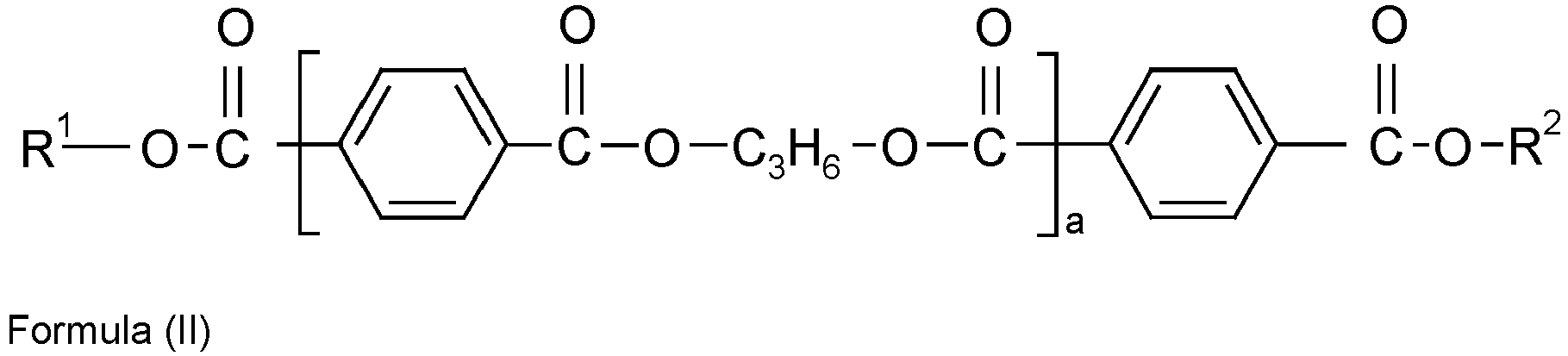
- R1 and R2
- independently of one another are X-(OC2H4)n-(OC3H6)m wherein X is C1-4 alkyl, the -(OC2H4) groups and the -(OC3H6) groups are arranged blockwise and the block consisting of the -(OC3H6) groups is bound to a COO group or are HO-(C3H6),
- n
- is based on a molar average a number of from 12 to 120 and preferably of from 40 to 50,
- m
- is based on a molar average a number of from 1 to 10, and
- a
- is based on a molar average a number of from 4 to 9 and
- In the polymer of formula (I), "X" of R1 and R2 is preferably methyl.
- In the polymer of formula (I), the -(OC3H6) groups of R1 and R2 is preferably bound to a COO group.
- In the polymer of formula (I), the variable "n" based on a molar average preferably is a number of from 40 to 50, more preferably is a number of from 43 to 47 and even more preferably is 44 to 46 and most preferably 45.
- In the polymer of formula (I), the variable "m" based on a molar average preferably is a number of from 1 to 7, more preferably a number from 2 to 6.
- In the polymer of formula (I), the variable "a" based on a molar average preferably is a number of from 5 to 8 and more preferably is a number of from 6 to 7.
- The groups -O-C2H4- in the structural units "X-(OC2H4)n-(OC3H6)m" or "H3C-(OC2H4)n-(OC3H6)m" are of the formula -O-CH2-CH2-.
- The groups -O-C3H6- in the structural units indexed with "a", in the structural units "X-(OC2H4)n-(OC3H6)m" or "H3C-(OC2H4)n-(OC3H6)m" and in the structural units HO-(C3H6) are of the formula -O-CH(CH3)-CH2- or -O-CH2-CH(CH3)-, i.e. are of the formula

- In one particularly preferred embodiment of the invention the polyesters of component A) of the inventive compositions are according to the following formula (I)
- R1 and R2
- independently of one another are H3C-(OC2H4)n-(OC3H6)m wherein the -(OC2H4) groups and the -(OC3H6) groups are arranged blockwise and the block consisting of the -(OC3H6) groups is bound to a COO group,
- n
- is based on a molar average a number of from 44 to 46,
- m
- is based on a molar average 2, and
- a
- is based on a molar average a number of from 5 to 8.
- And more preferably:
- R1 and R2
- independently of one another are H3C-(OC2H4)n-(OC3H6)m wherein the -(OC2H4) groups and the -(OC3H6) groups are arranged blockwise and the block consisting of the -(OC3H6) groups is bound to a COO group,
- n
- is based on a molar average 45,
- m
- is based on a molar average 2, and
- a
- is based on a molar average a number of from 6 to 7
- In an alternate particularly preferred embodiment of the invention the polyesters of component A) of the inventive compositions are according to the following formula (I)
- R1 and R2
- independently of one another are H3C-(OC2H4)n-(OC3H6)m wherein the -(OC2H4) groups and the -(OC3H6) groups are arranged blockwise and the block consisting of the -(OC3H6) groups is bound to a COO group,
- n
- is based on a molar average a number of from 44 to 46,
- m
- is based on a molar average 5, and
- a
- is based on a molar average a number of from 5 to 8.
- And more preferably:
- R1 and R2
- independently of one another are H3C-(OC2H4)n-(OC3H6)m wherein the -(OC2H4) groups and the -(OC3H6) groups are arranged blockwise and the block consisting of the -(OC3H6) groups is bound to a COO group,
- n
- is based on a molar average 45,
- m
- is based on a molar average 5, and
- a
- is based on a molar average a number of from 6 to 7
- In an alternative preferred example, the soil release polymers comprise copolymers having random blocks of ethylene terephthalate and polyethylene oxide (PEO) terephthalate. The molecular weight of this polymeric soil release agent is in the range of from about 25,000 to about 55,000. See
U.S. Pat. No. 3,959,230 to Hays, issued May 25, 1976 andU.S. Pat. No. 3,893,929 to Basadur issued Jul. 8, 1975 . - In an alternative preferred example, the soil release polymer is a polyester with repeat units of ethylene terephthalate units contains 10-15% by weight of ethylene terephthalate units together with 90-80% by weight of polyoxyethylene terephthalate units, derived from a polyoxyethylene glycol of average molecular weight 300-5,000. Examples of this polymer include the commercially available material ZELCON 5126 (from DuPont) and MILEASE T (from ICI). See also
U.S. Pat. No. 4,702,857, issued Oct. 27, 1987 to Gosselink . Further examples of soil release polymers are terephthalic acid / glycol copolymers sold under the tradenames Texcare®, Repel-o-tex®, Gerol®, Marloquest® and, Cirrasol®. - In an alternative preferred example, the soil release polymer is a sulfonated product of a substantially linear ester oligomer comprised of an oligomeric ester backbone of terephthaloyl and oxyalkyleneoxy repeat units and terminal moieties covalently attached to the backbone. These soil release agents are described fully in
U.S. Pat. No. 4,968,451, issued Nov. 6, 1990 to J.J. Scheibel and E. P. Gosselink . Other suitable polymeric soil release agents include the terephthalate polyesters ofU.S. Pat. No. 4,711,730, issued Dec. 8, 1987 to Gosselink et al , the anionic end-capped oligomeric esters ofU.S. Pat. No. 4,721,580, issued Jan. 26, 1988 to Gosselink , and the block polyester oligomeric compounds ofU.S. Pat. No. 4,702,857, issued Oct. 27, 1987 to Gosselink . - Preferred polymeric soil release polymers also include the soil release agents of
U.S. Pat. No. 4,877,896, issued Oct. 31, 1989 to Maldonado et al , which discloses anionic, especially sulfoarolyl, end-capped terephthalate esters. - In an alternative preferred example, the soil release agent is an oligomer with repeat units of terephthaloyl units, sulfoisoterephthaloyl units, oxyethyleneoxy and oxy-1,2-propylene units. The repeat units form the backbone of the oligomer and are preferably terminated with modified isethionate end-caps. A particularly preferred soil release agent of this type comprises about one sulfoisophthaloyl unit, 5 terephthaloyl units, oxyethyleneoxy and oxy-1,2-propyleneoxy units in a ratio of from about 1.7 to about 1.8, and two end-cap units of sodium 2-(2-hydroxyethoxy)-ethanesulfonate. Said soil release agent also comprises from about 0.5% to about 20%, by weight of the oligomer, of a crystalline-reducing stabilizer, preferably selected from the group consisting of xylene sulfonate, cumene sulfonate, toluene sulfonate, and mixtures thereof.
- In an alternative preferred example, the soil release polymers comprise polymers of aromatic dicarboxylic acids and alkylene glycols (including polymers containing polyalkylene glycols). For example, the soil release polymer may comprise a fabric-binding region formed from aromatic dicarboxylic acid/ester monomer units. Most preferably, the anionic soil release polymer is formed from aromatic dicarboxylic acid/ester and alkylene glycol units (including polymers containing polyalkylene glycols), such as those described in
US 2013/0200290 . Examples of suitable polymers include Texcare® SRA 100N or Texcare® SRA 300F marketed by Clariant®. - In a more preferred example, the soil release polymer may be according to the following formula (III):
X-[(EO)q1-block-(PO)p]-[(A-G1-A-G2)n]-B-G1-B-[(PO)p-block-(EO)q2]-X Formula (III)
- wherein EO is ethylene oxide (CH2CH2O) and PO is at least 80 wt% propylene oxide (CH2CH(CH3)O), and preferably 100% PO units;
- where p is a number from 0 to 60, and when p is not zero is preferably from 2 to 50, more preferably from 5 to 45, even more preferably from 6 to 40, yet more preferably from 7 to 40 and most preferably from 8 to 40, even from 11 to 35;
- where q1 and q2 is a number from 6 to 120, preferably 18 to 80, most preferably 40 to 70, provided that q2 is greater than p and preferably q2 is at least 1.5 times as large as p;
- where n is a number from 2 to 26; preferably 5 to 15;
- Because they are an average, n, p, q1 and q2 are not necessarily a whole number for the polymer in bulk.
- where X is a capping moiety, preferably selected from C1-4 alkyl, branched and unbranched;
- A and B are selected from ester, amide and urethane moieties, preferably the moieties A and B nearest to any PO blocks are esters, A and B may be different or may be the same;
- when the moieties A and B adjacent to the PO blocks are esters then it is preferred that p is not zero,
- alternatively, it is preferred that the ratio of (q1+q2):n is from 4 to 10 and that q2 is from 40 to 120;
- G1 comprises 1,4 phenylene;
- G2 is ethylene, which may be substituted;
- It is preferred that moieties G2 are all ethylene of formula (IV)

- The compositions of the present invention comprises0.5 % to about 20%, by weight of the garment refreshing composition free perfume.
- Free perfume may be present at a level selected from: less than 20%, less than 15%, and less than 10%, by weight of the composition. Free perfume may be present at a level selected from: more than 0.5%, more than 1%, and more than 2%, by weight of the composition. Suitably free perfume is present in the composition in an amount selected from the range of preferably from about 1% to about 15%, more preferably from about 2% to about 10%, by weight of the garment refreshing composition.
- Useful perfume components may include materials of both natural and synthetic origin. They include single compounds and mixtures. Specific examples of such components may be found in the current literature, e.g., in Fenaroli's Handbook of Flavor Ingredients, 1975, CRC Press; Synthetic Food Adjuncts, 1947 by M. B. Jacobs, edited by Van Nostrand; or Perfume and Flavor Chemicals by S. Arctander 1969, Montclair, N.J. (USA). These substances are well known to the person skilled in the art of perfuming, flavouring, and/or aromatizing consumer products.
- A wide variety of chemicals are known for perfume use including materials such as aldehydes, ketones, esters and the like. More commonly, naturally occurring plant and animal oils and exudates comprising complex mixtures of various chemical components are known for use as perfume, and such materials can be used herein. Typical perfumes can comprise e.g. woody/earthy bases containing exotic materials such as sandalwood oil, civet and patchouli oil. The perfume also can be of a light floral fragrance e.g. rose or violet extract. Further the perfume can be formulated to provide desirable fruity odours e.g. lime, limon or orange.
- Particular examples of useful perfume components and compositions are anetole, benzaldehyde, benzyl acetate, benzyl alcohol, benzyl formate, iso-bornyl acetate, camphene, cis-citral (neral), citronellal, citronellol, citronellyl acetate, paracymene, decanal, dihydrolinalool, dihydromyrcenol, dimethyl phenyl carbinol, eucalyptol, geranial, geraniol, geranyl acetate, geranyl nitrile, cis-3-hexenyl acetate, hydroxycitronellal, d-limonene, linalool, linalool oxide, linalyl acetate, linalyl propionate, methyl anthranilate, alpha-methyl ionone, methyl nonyl acetaldehyde, methyl phenyl carbinyl acetate, laevo-menthyl acetate, menthone, iso-menthone, myrcene, myrcenyl acetate, myrcenol, nerol, neryl acetate, nonyl acetate, phenyl ethyl alcohol, alpha-pinene, beta-pinene, gamma-terpinene, alpha-terpineol, beta-terpineol, terpinyl acetate, vertenex (para-tertiary-butyl cyclohexyl acetate), amyl cinnamic aldehyde, iso-amyl salicylate, beta-caryophyllene, cedrene, cinnamic alcohol, couramin, dimethyl benzyl carbinyl acetate, ethyl vanillin, eugenol, iso-eugenol, flor acetate, heliotrophine, 3-cis-hexenyl salicylate, hexyl salicylate, lilial (para-tertiarybutyl-alpha-methyl hydrocinnamic aldehyde), gamma-methyl ionone, nerolidol, patchouli alcohol, phenyl hexanol, beta-selinene, trichloromethyl phenyl carbinyl acetate, triethyl citrate, vanillin, veratraldehyde, alpha-cedrene, beta-cedrene, C15H24sesquiterpenes, benzophenone, benzyl salicylate, ethylene brassylate, galaxolide (1,3,4,6,7,8-hexahydro-4,6,6,7,8,8,-hexamethyl-cyclo-penta-gamma-2-benzopyran), hexyl cinnamic aldehyde, lyral (4-(4-hydroxy-4-methyl pentyl)-3-cyclohexene-10-carboxaldehyde), methyl cedrylone, methyl dihydro jasmonate, methyl-beta-naphthyl ketone, musk ambrette, musk idanone, musk ketone, musk tibetine, musk xylol, aurantiol and phenylethyl phenyl acetate.
- The free perfume compositions of the present compositions comprise blooming perfume ingredients. Blooming perfume components are defined by a boiling point less than 250°C and a LogP or greater than 2.5. Preferably the free perfume compositions of the present invention comprise at least 10 w.t.% blooming perfume ingredients, more preferably at least 20 w.t.% blooming perfume ingredients, most preferably at least 25 w.t.% blooming perfume ingredients. Preferably the free perfume compositions of the present comprise less than 58 w.t.% blooming perfume ingredients, more preferably less than 50 w.t.% blooming perfume ingredients, most preferably less than 45 w.t.% blooming perfume ingredients. Suitably the free perfume compositions of the present compositions comprise 10 to 58 w.t.% blooming perfume ingredients, preferably 20 to 50 w.t.% blooming perfume ingredients, more preferably 25 to 45 w.t.% blooming perfume ingredients.
- Examples of suitable blooming perfume ingredient include: Allo-ocimene, Allyl heptanoate, trans-Anethole, Benzyl butyrate, Camphene, Carvacrol, cis-3-Hexenyl tiglate, Citronellol, Citronellyl acetate, Citronellyl nitrile, Cyclohexylethyl acetate, Decyl Aldehyde (Capraldehyde), Dihydromyrcenol, Dihydromyrcenyl acetate, 3,7-Dimethyl-1-octanol, Fenchyl Acetate, Geranyl acetate, Geranyl formate, Geranyl nitrile, cis-3-Hexenyl isobutyrate, Hexyl Neopentanoate, Hexyl tiglate, alpha-lonone, Isobornyl acetate, Isobutyl benzoate, Isononyl acetate, Isononyl alcohol, Isopulegyl acetate, Lauraldehyde, Linalyl acetate, Lorysia, D-limonene, Lymolene, (-)-L-Menthyl acetate, Methyl Chavicol (Estragole), Methyl n-nonly acetaldehyde, Methyl octyl acetaldehyde, Beta-Myrcene, Neryl acetate, Nonyl acetate, Nonaldehyde, Para-Cymene, alpha-Pinene, beta-Pinene, alpha-Terpinene, gamma-Terpinene, Terpineolene, alpha-Terpinyl acetate, Tetrahydrolinalool, Tetrahydromyrcenol, 2-Undecenal, Verdox (o-t-Butylcyclohexyl acetate), and Vertenex(4-tert.Butylcyclohexyl acetate).
- Other useful perfume ingredients include substantive perfume components. Substantive perfume components are defined by a boiling point greater than 250°C and a LogP greater than 2.5. Preferably the free perfume composition further comprises substantive perfume ingredients.
- Boiling point is measured at standard pressure (760 mm Hg). Preferably a perfume composition will comprise a mixture of blooming and substantive perfume components. The perfume composition may comprise other perfume components.
- The logP of many perfume ingredients have been reported; for example, the Pomona92 database, available from Daylight Chemical Information Systems, Inc. (Daylight CIS), Irvine, Calif., contains many, along with citations to the original literature. However, the logP values are most conveniently calculated by the "CLOGP" program, also available from Daylight CIS. This program also lists experimental logP values when they are available in the Pomona92 database. The "calculated logp" (ClogP) is determined by the fragment approach of Hansch and Leo (cf., A Leo, in Comprehensive Medicinal Chemistry, Vol. 4, C. Hansch, P. G. Sammens, J. B. Taylor and C. A. Ramsden, Eds., p. 295, Pergamon Press, 1990, incorporated herein by reference). The fragment approach is based on the chemical structure of each perfume ingredient, and takes into account the numbers and types of atoms, the atom connectivity, and chemical bonding. The ClogP values, which are the most reliable and widely used estimates for this physicochemical property, are used instead of the experimental logP values in the selection of perfume ingredients herein.
- It is commonplace for a plurality of perfume components to be present in a free oil perfume composition. In the compositions for use in the present invention it is envisaged that there will be three or more, preferably four or more, more preferably five or more, most preferably six or more different perfume components. An upper limit of 300 perfume components may be applied.
- The free perfume of the present invention is in the form of an emulsion. The particle size of the emulsion can be in the range from about 1 nm to 30 microns and preferably from about 100 nm to about 20 microns. The particle size is measured as a volume mean diameter, D[4,3], this can be measured using a Malvern Mastersizer 2000 from Malvern instruments.
- Free oil perfume forms an emulsion in the present compositions. The emulsions may be formed outside of the composition or in situ. When formed in situ, at least one emulsifier is preferably added with the free oil perfume to stabilise the emulsion. Preferably the emulsifier is anionic or non-ionic. Examples suitable anionic emulsifiers for the free oil perfume are alkylarylsulphonates, e.g., sodium dodecylbenzene sulphonate, alkyl sulphates e.g., sodium lauryl sulphate, alkyl ether sulphates, e.g., sodium lauryl ether sulphate nEO, where n is from 1 to 20 alkylphenol ether sulphates, e.g., octylphenol ether sulphate nEO where n is from 1 to 20, and sulphosuccinates, e.g., sodium dioctylsulphosuccinate. Examples of suitable nonionic surfactants used as emulsifiers for the free oil perfume are alkylphenol ethoxylates, e.g., nonylphenol ethoxylate nEO, where n is from 1 to 50, alcohol ethoxylates, e.g., lauryl alcohol nEO, where n is from 1 to 50, ester ethoxylates, e.g., polyoxyethylene monostearate where the number of oxyethylene units is from 1 to 30 and PEG-40 hydrogenated castor oil. Any non-ionic surfactant included in the free perfume is counted in the overall non-ionic surfactant amount.
- The ancillary laundry composition of the present invention preferably comprise encapsulated perfumes. These may also be referred to as perfume microcapsules. The ancillary laundry compositions preferably comprise 0.1 to 20 wt.% perfume microcapsules, more preferably 0.5 to 12 wt. % perfume microcapsules, most preferably 1 to 8 wt.% perfume microcapsules. The weight of microcapsules is of the material as supplied.
- When perfume components are encapsulated, suitable encapsulating materials, may comprise, but are not limited to; aminoplasts, proteins, polyurethanes, polyacrylates, polymethacrylates, polysaccharides, polyamides, polyolefins, gums, silicones, lipids, modified cellulose, polyphosphate, polystyrene, polyesters or combinations thereof. Particularly preferred materials are aminoplast microcapsules, such as melamine formaldehyde or urea formaldehyde microcapsules.
- Perfume microcapsules of the present invention can be friable microcapsules and/or moisture activated microcapsules. By friable, it is meant that the perfume microcapsule will rupture when a force is exerted. By moisture activated, it is meant that the perfume is released in the presence of water. The ancillary laundry compositions of the present invention preferably comprises friable microcapsules. Moisture activated microcapsules may additionally be present. Examples of a microcapsules which can be friable include aminoplast microcapsules.
- Perfume components contained in a microcapsule may comprise odiferous materials and/or pro-fragrance materials.
- Particularly preferred perfume components contained in a microcapsule are blooming perfume components and substantive perfume components. Blooming perfume components are defined by a boiling point less than 250°C and a LogP greater than 2.5.
- Substantive perfume components are defined by a boiling point greater than 250°C and a LogP greater than 2.5. Boiling point is measured at standard pressure (760 mm Hg). Preferably a perfume composition will comprise a mixture of blooming and substantive perfume components. The perfume composition may comprise other perfume components.
- It is commonplace for a plurality of perfume components to be present in a microcapsule. In the compositions for use in the present invention it is envisaged that there will be three or more, preferably four or more, more preferably five or more, most preferably six or more different perfume components in a microcapsule. An upper limit of 300 perfume components may be applied.
- The microcapsules may comprise perfume components and a carrier for the perfume ingredients, such as zeolites or cyclodextrins.
- The ancillary laundry compositions of the present invention preferably comprise less than 12 wt.%, more preferably less than 8 wt.% and most preferably less than 5 wt.% non-ionic surfactant. The ancillary laundry compositions of the present invention preferably comprise more than 0.5 wt.% non-ionic surfactant. Suitably, the ancillary laundry compositions of the present invention preferably comprise 0.5 to 12 wt.%, more preferably 0.5 to 8 wt.% and most preferably 0.5 to 5 wt.% non-ionic surfactant. The correct amount of non-ionic surfactant is important to achieve the desired delivery of the benefit agent. The ancillary laundry composition requires sufficient surfactant to carry the benefit agent, however too much surfactant will interfere with the action of the laundry liquid or powder with which it is used and will prevent release of the benefit agent due to insufficient dilution.
- The non-ionic surfactants will preferably have an HLB value of 12 to 20, more preferably 14 to 18.
- Examples of non-ionic surfactant materials include: ethoxylated materials, polyols such as polyhydric alcohols and polyol esters, alkyl polyglucosides, EO-PO block copolymers (Poloxamers). Preferably, the non-ionic surfactant is selected from ethoxylated materials. Preferred ethoxylated materials include: fatty acid ethoxylates, fatty amine ethoxylates, fatty alcohol ethoxylates, nonylphenol ethoxylates, alkyl phenol ethoxylate, amide ethoxylates, Sorbitan(ol) ester ethoxylates, glyceride ethoxylates (castor oil or hydrogenated castor oil ethoxylates) and mixtures thereof.
- More preferably, the non-ionic surfactant is selected from ethoxylated surfactants having a general formula:
R1O(R2O)xH
- R1 = hydrophobic moiety.
- R2 = C2H4 or mixture of C2H4 and C3H6 units
- x = 4 to 120
- R1 preferably comprises 8 to 25 carbon atoms and mixtures thereof, more preferably 10 to 20 carbon atoms and mixtures thereof most preferably 12 to 18 carbon atoms and mixtures thereof. Preferably, R is selected from the group consisting of primary, secondary and branched chain saturated and/or unsaturated hydrocarbon groups comprising an alcohol, carboxy or phenolic group. Preferably R is a natural or synthetic alcohol.
- R2 preferably comprises at least 50% C2H4, more preferably 75% C2H4, most preferably R2 is C2H4.
- x is preferably 8 to 90 and most preferably 10 to 60.
- Examples of commercially available, suitable non-ionic surfactants include: Genapol C200 ex. Clariant and Eumulgin CO40 ex. BASF.
- The ancillary laundry composition of the present invention is not a traditional laundry detergent or fabric conditioning composition. The present invention preferably comprises low levels or no anionic or cationic surfactant.
- The liquid ancillary composition of the present invention comprises less than 2 w.t. % anionic and cationic surfactant, more preferably less than 1 w.t.% surfactant, even more preferably less than 0.85 w.t.% anionic and cationic surfactant and most preferably less than 0.5 w.t.% anionic and cationic surfactant.
- The composition can be completely free of anionic and cationic surfactants.
- In other words, the compositions comprise 0 to 2 w.t.% anionic and cationic surfactant, more preferably, 0 to 1 w.t.% anionic and cationic surfactant, even more preferably 0 to 0.85 w.t. % and most preferably 0 to 0.5 w.t. % anionic and cationic surfactant. The composition can be completely free of anionic and cationic surfactant.
- If the ancillary laundry composition comprises microcapsules, a structurant may be required, non-limiting examples of suitable structurants include: pectine, alginate, arabinogalactan, carageenan, gellan gum, polysaccharides such as xanthum gum, guar gum, acrylates/acrylic polymers, water-swellable clays, fumed silicas, acrylate/aminoacrylate copolymers, and mixtures thereof.
- Preferred dispersants herein include those selected from the group consisting of acrylate/acrylic polymers, gellan gum, fumed silicas, acrylate/aminoacrylate copolymers, water-swellable clays, polysaccharides such as xanthum gum and mixtures thereof. Most preferably the structurant is selected from polysaccharides such as xanthum gum, acrylate/acrylic polymers, acrylate/aminoacrylate copolymers, and water-swellable clays. Most preferred structurants are polysaccharides such as xanthum gum.
- When present, a structurant is preferably present in an amount of 0.001-10 w.t.% percent, preferably from 0.005-5 w.t.%, more preferably 0.01-3 w.t.%.
- In some embodiments of the present invention, the ancillary laundry composition of the present invention may comprise rheology modifiers. These may be inorganic or organic, polymeric or non polymeric. A preferred type of rheology modifiers are salts.
- The ancillary laundry composition of the present invention preferably comprises preservatives. Preservatives are preferably present in an amount of 0.001 to 1 wt.% of the composition. More Preferably 0.005 to 0.5 w.t %, most preferably 0.01 to 0.1 wt.% of the composition.
- Preservatives can include anti-microbial agents such as isothiazolinone-based chemicals (in particular isothiazol-3-one biocides) or glutaraldehyde-based products. Examples of suitable preservatives include Benzisothiazoline, Cloro-methyl-isothiazol-3-one, Methyl-isothiazol-3-one and mixtures thereof. Suitable preservatives are commercially available as Kathon CG ex. Dow and Proxel ex Lonza.
- The ancillary laundry composition of the present invention may comprise further benefit agents. Examples of suitable further benefit agents include:
- silicone oils, resins, emulsions and modifications thereof such as linear and cyclic polydimethylsiloxanes, amino-modified, allcyl, aryl, and alkylaryl silicone oils
- malodour agents for example: uncomplexed cyclodextrin; odor blockers; reactive aldehydes; flavanoids; zeolites; activated carbon; and mixtures thereof
- dye transfer inhibitors
- shading dyes
- fluorescent agents / optical brighteners
- insect repellents
- organic sunscreen actives, for example, octylmethoxy cinnamate;
- antimicrobial agents, for example, 2-hydroxy-4, 2,4- trichlorodiphenylether;
- ester solvents; for example, isopropyl myristate;
- anti redeposition agents
- lipids and lipid like substance, for example, cholesterol;
- hydrocarbons such as paraffins, petrolatum, and mineral oil
- fish and vegetable oils;
- hydrophobic plant extracts;
- waxes;
- pigments including inorganic compounds with hydrophobically- modified surface and/ or dispersed in an oil or a hydrophobic liquid;
- sugar-esters, such as sucrose polyester (SPE);
- Preferred further benefit agents may be selected from: silicones, malodour agents, dye transfer inhibitors, fluorescent agents / optical brighteners, shading dyes, anti-microbials.
- Examples of suitable silicones for the present invention are fabric softening silicones.
- Non-limiting examples of such silicones include:
- Non-functionalised silicones such as polydimethylsiloxane (PDMS),
- Functionalised silicones such as alkyl (or alkoxy) functionalised, alkylene oxide functionalised, amino functionalised, phenyl functionalised, hydroxy functionalised, polyether functionalised, acrylate functionalised, siliconhydride functionalised, carboxy functionalised, phosphate functionalised, sulphate functionalised, phosphonate functionalised, sulphonic functionalised, betaine functionalised, quarternized nitrogen functionalised and mixtures thereof.
- Copolymers, graft co-polymers and block co-polymers with one or more different types of functional groups such as alkyl, alkylene oxide, amino, phenyl, hydroxy, polyether, acrylate, siliconhydride, carboxy,
- The products of the invention may further comprise other optional laundry ingredients known to the person skilled in the art, such as antifoams, insect, pH buffering agents, perfume carriers, hydrotropes, polyelectrolytes, anti-oxidants, dyes, colorants, sunscreens, anti-corrosion agents and sequestrants. The products of the invention may contain pearlisers and/or opacifiers.
- The viscosity of the ancillary laundry composition is preferably 20 - 15000 mPa.s, more preferably 50 to 15000 mPa.s, most preferably 100 to 10000 mPa.s. This viscosity provides the benefit that the laundry liquid carries the ancillary laundry composition into the laundry process.
- Throughout this specification viscosity measurements were carried out at 25°C, using a 4cm diameter 2°cone and plate geometry on a DHR-2 rheometer ex. TA instruments.
- In detail, all measurements were conducted using a TA-Instruments DHR-2 rheometer with a 4cm diameter 2 degree angle cone and plate measuring system. The lower Peltier plate was used to control the temperature of the measurement to 25°C. The measurement protocol was a 'flow curve' where the applied shear stress is varied logarithmically from 0.01 Pa to 400 Pa with 10 measurement points per decade of stress. At each stress the shear strain rate is measured over the last 5 seconds of the 10 second period over which the stress is applied with the viscosity at that stress being calculated as the quotient of the shear stress and shear rate.
- For those systems which exhibit a low shear viscosity plateau over large shear stress ranges, to at least 1 Pa, the characteristic viscosity is taken as being the viscosity at a shear stress of 0.3Pa. For those systems where the viscosity response is shear thinning from low shear stress the characteristic viscosity is taken as being the viscosity at a shear rate of 21 s-1.
- Preferably, the ancillary laundry composition floats on a, laundry liquid with which it is used. By float it is meant that the ancillary laundry composition will remain at the surface of the laundry liquid for a period of at least 5 minutes, preferably 10 minutes and most preferably at least 15 minutes. Floating provides the benefit the laundry liquid carries the ancillary laundry composition into the laundry process.
- To enable the ancillary laundry composition to float, it is not essential that it is less dense than the laundry liquid with which it is being used, however it is preferred that the ancillary laundry composition is less dense than the laundry liquid with which it is used. This density provides the benefit the laundry liquid carries the ancillary laundry composition into the laundry process.
- The ancillary laundry composition is preferably not miscible with a laundry liquid with which it is used. The in-admissibility prevents mixing of the ancillary laundry composition and laundry liquid and ensures maximum performance.
- The compositions of the present invention may be used in a method for improving perfume intensity of dry fabric or for reducing malodour of synthetic fabrics.
- In one aspect of the present invention is a method of improving the perfume intensity of a dry fabric comprising the steps of:
- a. adding the ancillary laundry composition of any preceding claim into the wash or rinse stage of the laundry process.
- In a second aspect is a method of reducing malodour of synthetic fabrics comprising the steps of:
- a. adding the ancillary laundry composition of any preceding claim into the wash or rinse stage of the laundry process.
- Preferably, for either of the above methods, the ancillary laundry composition is added to the rinse stage of the washing process.
- Preferably, for either of the above methods, the composition is used in addition a laundry detergent and/or a fabric conditioner.
- A preferred method steps for either of the above methods include:
- a. Pouring a laundry product into a washing receptacle, a washing machine drawer, or a dosing shuttle
- b. Pouring a laundry serum composition according to any preceding claim on top of the laundry product.
- By washing receptacle, it is meant any vessel in which washing is performed. This may be for example the drum of a front or top loading washing machine or a bowl/sink in which hand washing is performed. By drawer it as meant any one of the compartments in the washing machine drawer. By dosing ball is meant any form of container which would usually hold a laundry detergent composition and be placed directly in a washing machine. By laundry product it is meant a detergent or fabric conditioning composition.
- Preferably a laundry product is poured into a washing machine drawer or a dosing ball, and then the ancillary laundry composition is poured on top of the laundry product in the drawer or dosing ball. Pouring the ancillary laundry composition on top of the laundry product provides the benefit that the laundry liquid carries the serum into the wash or rinse without mixing with the two compositions.
- Alternatively, the ancillary laundry composition may be added to the wash separately to any other laundry products being used in the wash process. e.g. at a different stage, in a separate compartment of a washing machine drawer, in a separate dosing ball etc.
- Preferably the ancillary laundry composition is added to the laundry process in a volume of 2-30ml, most preferably 2-20ml. This dose is typically used with a 4-8kg load of fabric, preferably and 5-6 kg load of fabric.
- The compositions of the present invention may be used for two different purposes.
- The compositions may be used to improve the perfume intensity on a dry fabric, without wishing to be bound by theory, it is understood that this is achieved by improved hedonics. Improved perfume intensity can be measured for example by consumers, smelling the garments and rating on a scale of 1 to 10 or using analytical apparatus such as Headspace Gas Chromatography / Mass Spectroscopy.
- Alternatively, the composition may be used to reduce malodour on synthetic fabrics, in particular polyester fabric. Reduced malodour can be easily detected by the human nose, and can be assessed by a consumer panel.
-
Table 1: Example compositions of the present invention Ingredient 1 (wt.%) 2 (wt.%) Non-ionic surfactant1 3 5 Soil release polymer2 7 3 Free perfume 10 8 Encapsulated perfume - 4 Water To 100 To 100 Non-ionic surfactant1 - Eumulgin CO40 ex. BASF
Soil release polymer2 - Texcare 260 ex. Clariant - These compositions provide whiteness maintenance benefits to white fabrics.
Claims (13)
- An ancillary laundry composition comprising:a. Soil release polymer;b. 0.5 to 20 wt.% free perfume;c. 0.5 - 12 wt.% non-ionic surfactant; andd. Waterwherein the composition comprises less than 2 wt.% anionic and/or cationic surfactant.
- An ancillary laundry composition according to Claim 1, wherein the composition further comprises 0.1 to 20 wt.% encapsulated perfume.
- An ancillary laundry composition according to any preceding claim, wherein the soil release polymer is selected from polymers according to the formula:
X1 - R1 - Z - R2 - X2
Wherein:X1 and X2 are independently capping moietiesR1 and R2 are independently one or more nonionic hydrophilic blocksZ is one or more anionic hydrophobic blocks. - An ancillary laundry composition according to any preceding claim, wherein the non-ionic surfactant comprises ethoxylated non-ionic surfactant.
- An ancillary laundry composition according to any preceding claim, wherein the composition further comprises a structurant.
- An ancillary laundry composition according to any preceding claim, wherein the ancillary laundry composition has a viscosity of 20 - 15000 mPa.s at 25°C, using a 4cm diameter 2°cone and plate geometry on a DHR-2 rheometer.
- A method of improving the perfume intensity of a dry fabric comprising the steps of:a. adding the ancillary laundry composition of any preceding claim into the wash or rinse stage of the laundry process.
- A method of reducing malodour of synthetic fabrics comprising the steps of:a. adding the ancillary laundry composition of any preceding claim into the wash or rinse stage of the laundry process.
- A method according to claims 7 or 8, wherein the composition is added to the rinse stage of the washing process.
- A method according to claims 7 to 9, wherein the composition is used in addition to a laundry detergent and/or a fabric conditioner.
- A method according to claims 7 to 10, wherein 2 to 30 ml of ancillary laundry composition is added to the laundry process.
- Use of the ancillary laundry composition according to claims 1 to 6, to improve the perfume intensity of a dry fabric.
- Use of the ancillary laundry composition according to claims 1 to 6, to reduce malodour on synthetic fabrics.
Applications Claiming Priority (2)
| Application Number | Priority Date | Filing Date | Title |
|---|---|---|---|
| EP19174840 | 2019-05-16 | ||
| PCT/EP2020/063617 WO2020229661A1 (en) | 2019-05-16 | 2020-05-15 | Laundry composition |
Publications (2)
| Publication Number | Publication Date |
|---|---|
| EP3969554A1 EP3969554A1 (en) | 2022-03-23 |
| EP3969554B1 true EP3969554B1 (en) | 2023-03-15 |
Family
ID=66589293
Family Applications (1)
| Application Number | Title | Priority Date | Filing Date |
|---|---|---|---|
| EP20724868.3A Active EP3969554B1 (en) | 2019-05-16 | 2020-05-15 | Laundry composition |
Country Status (5)
| Country | Link |
|---|---|
| US (1) | US12371635B2 (en) |
| EP (1) | EP3969554B1 (en) |
| CN (1) | CN113874484A (en) |
| PL (1) | PL3969554T3 (en) |
| WO (1) | WO2020229661A1 (en) |
Families Citing this family (10)
| Publication number | Priority date | Publication date | Assignee | Title |
|---|---|---|---|---|
| US12371635B2 (en) * | 2019-05-16 | 2025-07-29 | Conopco, Inc. | Laundry composition |
| CN117280018A (en) * | 2021-04-15 | 2023-12-22 | 联合利华知识产权控股有限公司 | Fabric size composition |
| WO2024013173A1 (en) * | 2022-07-12 | 2024-01-18 | Unilever Ip Holdings B.V. | Laundry composition |
| WO2024013171A1 (en) * | 2022-07-12 | 2024-01-18 | Unilever Ip Holdings B.V. | Laundry composition |
| WO2024013175A1 (en) * | 2022-07-12 | 2024-01-18 | Unilever Ip Holdings B.V. | Laundry composition |
| WO2024013174A1 (en) * | 2022-07-12 | 2024-01-18 | Unilever Ip Holdings B.V. | Laundry composition |
| WO2024013172A1 (en) * | 2022-07-12 | 2024-01-18 | Unilever Ip Holdings B.V. | Laundry composition |
| WO2024256257A1 (en) * | 2023-06-15 | 2024-12-19 | Unilever Ip Holdings B.V. | Laundry fragrance booster composition comprising perfume and cellulose beads |
| WO2025213357A1 (en) | 2024-04-09 | 2025-10-16 | The Procter & Gamble Company | Particulate fabric care composition |
| WO2025217909A1 (en) | 2024-04-19 | 2025-10-23 | The Procter & Gamble Company | Particulate fabric care product |
Citations (2)
| Publication number | Priority date | Publication date | Assignee | Title |
|---|---|---|---|---|
| WO2017167800A1 (en) | 2016-03-31 | 2017-10-05 | Henkel Ag & Co. Kgaa | Textile treatment agent without cationic surfactants |
| WO2020005879A1 (en) | 2018-06-28 | 2020-01-02 | The Procter & Gamble Company | Fabric treatment compositions with polymer system and related processes |
Family Cites Families (121)
| Publication number | Priority date | Publication date | Assignee | Title |
|---|---|---|---|---|
| GB1296839A (en) | 1969-05-29 | 1972-11-22 | ||
| GB1372034A (en) | 1970-12-31 | 1974-10-30 | Unilever Ltd | Detergent compositions |
| CA989557A (en) | 1971-10-28 | 1976-05-25 | The Procter And Gamble Company | Compositions and process for imparting renewable soil release finish to polyester-containing fabrics |
| US3959230A (en) | 1974-06-25 | 1976-05-25 | The Procter & Gamble Company | Polyethylene oxide terephthalate polymers |
| DK187280A (en) | 1980-04-30 | 1981-10-31 | Novo Industri As | RUIT REDUCING AGENT FOR A COMPLETE LAUNDRY |
| US4760025A (en) | 1984-05-29 | 1988-07-26 | Genencor, Inc. | Modified enzymes and methods for making same |
| US4861512A (en) | 1984-12-21 | 1989-08-29 | The Procter & Gamble Company | Sulfonated block polyesters useful as soil release agents in detergent compositions |
| US4702857A (en) * | 1984-12-21 | 1987-10-27 | The Procter & Gamble Company | Block polyesters and like compounds useful as soil release agents in detergent compositions |
| WO1987000859A1 (en) | 1985-08-09 | 1987-02-12 | Gist-Brocades N.V. | Novel lipolytic enzymes and their use in detergent compositions |
| DE3536530A1 (en) | 1985-10-12 | 1987-04-23 | Basf Ag | USE OF POLYALKYLENE OXIDES AND VINYL ACETATE GRAFT COPOLYMERISATS AS GRAY INHIBITORS IN THE WASHING AND TREATMENT OF TEXTILE GOODS CONTAINING SYNTHESIS FIBERS |
| GB2187749B (en) | 1986-03-11 | 1990-08-08 | Procter & Gamble | Stable liquid detergent composition hydrophobic brightener |
| US4711730A (en) * | 1986-04-15 | 1987-12-08 | The Procter & Gamble Company | Capped 1,2-propylene terephthalate-polyoxyethylene terephthalate polyesters useful as soil release agents |
| EP0258068B1 (en) | 1986-08-29 | 1994-08-31 | Novo Nordisk A/S | Enzymatic detergent additive |
| NZ221627A (en) | 1986-09-09 | 1993-04-28 | Genencor Inc | Preparation of enzymes, modifications, catalytic triads to alter ratios or transesterification/hydrolysis ratios |
| US4721580A (en) | 1987-01-07 | 1988-01-26 | The Procter & Gamble Company | Anionic end-capped oligomeric esters as soil release agents in detergent compositions |
| DE3854249T2 (en) | 1987-08-28 | 1996-02-29 | Novonordisk As | Recombinant Humicola Lipase and Process for the Production of Recombinant Humicola Lipases. |
| US4877896A (en) | 1987-10-05 | 1989-10-31 | The Procter & Gamble Company | Sulfoaroyl end-capped ester of oligomers suitable as soil-release agents in detergent compositions and fabric-conditioner articles |
| DK6488D0 (en) | 1988-01-07 | 1988-01-07 | Novo Industri As | ENZYMES |
| EP0394352B1 (en) | 1988-01-07 | 1992-03-11 | Novo Nordisk A/S | Enzymatic detergent |
| JP3079276B2 (en) | 1988-02-28 | 2000-08-21 | 天野製薬株式会社 | Recombinant DNA, Pseudomonas sp. Containing the same, and method for producing lipase using the same |
| JP2728531B2 (en) | 1988-03-24 | 1998-03-18 | ノボ ノルディスク アクティーゼルスカブ | Cellulase preparation |
| US5648263A (en) | 1988-03-24 | 1997-07-15 | Novo Nordisk A/S | Methods for reducing the harshness of a cotton-containing fabric |
| US4968451A (en) | 1988-08-26 | 1990-11-06 | The Procter & Gamble Company | Soil release agents having allyl-derived sulfonated end caps |
| US4956447A (en) | 1989-05-19 | 1990-09-11 | The Procter & Gamble Company | Rinse-added fabric conditioning compositions containing fabric sofening agents and cationic polyester soil release polymers and preferred cationic soil release polymers therefor |
| GB8915658D0 (en) | 1989-07-07 | 1989-08-23 | Unilever Plc | Enzymes,their production and use |
| DK0528828T4 (en) | 1990-04-14 | 1998-08-31 | Genencor Internat Gmbh | Alkaline bacillus lipases, encoding DNA sequences, and bacilli producing such lipases |
| DK0548228T3 (en) | 1990-09-13 | 1999-05-10 | Novo Nordisk As | lipase variants |
| AU666660B2 (en) | 1991-04-30 | 1996-02-22 | Procter & Gamble Company, The | Built liquid detergents with boric-polyol complex to inhibit proteolytic enzyme |
| EP0511456A1 (en) | 1991-04-30 | 1992-11-04 | The Procter & Gamble Company | Liquid detergents with aromatic borate ester to inhibit proteolytic enzyme |
| DK28792D0 (en) | 1992-03-04 | 1992-03-04 | Novo Nordisk As | NEW ENZYM |
| DK72992D0 (en) | 1992-06-01 | 1992-06-01 | Novo Nordisk As | ENZYME |
| DK88892D0 (en) | 1992-07-06 | 1992-07-06 | Novo Nordisk As | CONNECTION |
| EP0598973A1 (en) | 1992-11-26 | 1994-06-01 | The Procter & Gamble Company | Multi-purpose liquid cleaning composition |
| ES2144515T5 (en) | 1993-03-01 | 2006-03-16 | THE PROCTER & GAMBLE COMPANY | BIODEGRADABLE CONCENTRATED COMPOSITIONS OF SUBSTITUTING FABRIC AMMONIUM OF FABRICS, AND COMPOUNDS CONTAINING CHAINS OF Unsaturated FATTY ACIDS OF MIDDLE IODINE INDEX. |
| DE69434242T2 (en) | 1993-04-27 | 2006-01-12 | Genencor International, Inc., Palo Alto | Novel lipase variants for use in detergents |
| DK52393D0 (en) | 1993-05-05 | 1993-05-05 | Novo Nordisk As | |
| US5599786A (en) | 1993-08-12 | 1997-02-04 | The Procter & Gamble Company | Cellulase fabric-conditioning compositions |
| JP2859520B2 (en) | 1993-08-30 | 1999-02-17 | ノボ ノルディスク アクティーゼルスカブ | Lipase, microorganism producing the same, method for producing lipase, and detergent composition containing lipase |
| EP0724631A1 (en) | 1993-10-13 | 1996-08-07 | Novo Nordisk A/S | H 2?o 2?-stable peroxidase variants |
| DE69434962T2 (en) | 1993-10-14 | 2008-01-17 | The Procter & Gamble Company, Cincinnati | PROTEASE-CONTAINING DETERGENTS |
| JPH07143883A (en) | 1993-11-24 | 1995-06-06 | Showa Denko Kk | Lipase gene and mutant lipase |
| MX9603542A (en) | 1994-02-22 | 1997-03-29 | Novo Nordisk As | A method of preparing a variant of a lipolytic enzyme. |
| CA2186592C (en) | 1994-03-29 | 2008-02-19 | Helle Outtrup | Alkaline bacillus amylase |
| USH1468H (en) | 1994-04-28 | 1995-08-01 | Costa Jill B | Detergent compositions containing cellulase enzyme and selected perfumes for improved odor and stability |
| WO1995030744A2 (en) | 1994-05-04 | 1995-11-16 | Genencor International Inc. | Lipases with improved surfactant resistance |
| EP0686691B1 (en) | 1994-06-10 | 2001-08-08 | The Procter & Gamble Company | Aqueous emulsions with brighteners |
| AU2884595A (en) | 1994-06-20 | 1996-01-15 | Unilever Plc | Modified pseudomonas lipases and their use |
| AU2884695A (en) | 1994-06-23 | 1996-01-19 | Unilever Plc | Modified pseudomonas lipases and their use |
| US5510042A (en) | 1994-07-08 | 1996-04-23 | The Procter & Gamble Company | Fabric softening bar compositions containing fabric softener, nonionic phase mofifier and water |
| BE1008998A3 (en) | 1994-10-14 | 1996-10-01 | Solvay | Lipase, microorganism producing the preparation process for the lipase and uses thereof. |
| CN1167503A (en) | 1994-10-26 | 1997-12-10 | 诺沃挪第克公司 | an enzyme with lipolytic activity |
| JPH08228778A (en) | 1995-02-27 | 1996-09-10 | Showa Denko Kk | Novel lipase gene and method for producing lipase using the same |
| CN1182451A (en) | 1995-03-17 | 1998-05-20 | 诺沃挪第克公司 | Novel endoglucanases |
| EP0839186B1 (en) | 1995-07-14 | 2004-11-10 | Novozymes A/S | A modified enzyme with lipolytic activity |
| JP4068142B2 (en) | 1995-08-11 | 2008-03-26 | ノボザイムス アクティーゼルスカブ | Novel lipolytic enzyme |
| US5789373A (en) | 1996-01-31 | 1998-08-04 | Baker; Ellen Schmidt | Laundry additive compositions including dispersible polyolefin |
| MA25183A1 (en) * | 1996-05-17 | 2001-07-02 | Arthur Jacques Kami Christiaan | DETERGENT COMPOSITIONS |
| BR9711479B1 (en) | 1996-09-17 | 2009-08-11 | cellulase variant having increased resistance to anion voltage. | |
| AU730286B2 (en) | 1996-10-08 | 2001-03-01 | Novo Nordisk A/S | Diaminobenzoic acid derivatives as dye precursors |
| EP0841391A1 (en) | 1996-11-07 | 1998-05-13 | The Procter & Gamble Company | Perfume compositions |
| CN1268164A (en) | 1997-07-11 | 2000-09-27 | 普罗格特-甘布尔公司 | Detergent compositions comprising a specific cellulase and alkyl poly glucoside surfactant |
| US5904735A (en) * | 1997-08-04 | 1999-05-18 | Lever Brothers Company | Detergent compositions containing polyethyleneimines for enhanced stain removal |
| FR2769161B1 (en) | 1997-10-01 | 1999-12-24 | Univ Neuchatel | METHOD FOR CONTROLLING THE RATE OF COMPRESSION OF DIGITAL IMAGES |
| AR016969A1 (en) | 1997-10-23 | 2001-08-01 | Procter & Gamble | PROTEASE VARIANTE, ADN, EXPRESSION VECTOR, GUEST MICROORGANISM, CLEANING COMPOSITION, ANIMAL FOOD AND COMPOSITION TO TREAT A TEXTILE |
| DE19751860C1 (en) | 1997-11-22 | 1999-08-19 | Henkel Ecolab Gmbh & Co Ohg | Washing process and preparation for its implementation |
| CA2343267A1 (en) | 1998-09-30 | 2000-04-06 | The Procter & Gamble Company | Laundry detergent and/or fabric care compositions comprising chemical components linked to a cellulose binding domain |
| ES2532606T3 (en) | 1999-03-31 | 2015-03-30 | Novozymes A/S | Polypeptides with alkaline alpha-amylase activity and nucleic acids encoding them |
| KR20010108379A (en) | 1999-03-31 | 2001-12-07 | 피아 스타르 | Lipase variant |
| AU781532B2 (en) * | 1999-05-26 | 2005-05-26 | Rhodia Inc. | Block polymers, compositions and methods of use for foams, laundry detergents, shower rinses and coagulants |
| NZ517409A (en) | 1999-08-31 | 2004-05-28 | Novozymes As | RP-II properties with amino acid substitutions used in detergent compositions and additives |
| CN1337553A (en) | 2000-08-05 | 2002-02-27 | 李海泉 | Underground sightseeing amusement park |
| WO2002016547A2 (en) | 2000-08-21 | 2002-02-28 | Novozymes A/S | Subtilase enzymes |
| DE10162728A1 (en) | 2001-12-20 | 2003-07-10 | Henkel Kgaa | New alkaline protease from Bacillus gibsonii (DSM 14393) and washing and cleaning agents containing this new alkaline protease |
| WO2005040372A1 (en) | 2003-10-23 | 2005-05-06 | Novozymes A/S | Protease with improved stability in detergents |
| BRPI0416797A (en) | 2003-11-19 | 2007-04-17 | Genencor Int | serine proteases, nucleic acids encoding serine enzymes and vectors and host cells incorporating them |
| KR101253657B1 (en) | 2004-08-30 | 2013-04-10 | 시바 홀딩 인코포레이티드 | Shading Process |
| US7686892B2 (en) | 2004-11-19 | 2010-03-30 | The Procter & Gamble Company | Whiteness perception compositions |
| DE102005018243A1 (en) * | 2005-04-19 | 2006-10-26 | Henkel Kgaa | Process for the preparation of liquid preparations with solids content |
| DE102005061058A1 (en) | 2005-12-21 | 2007-07-05 | Clariant Produkte (Deutschland) Gmbh | New polyester compounds useful in detergents and cleaning agents e.g. color detergents, bar soaps and dishwash detergents, as soil releasing agents, fabric care agents and means for the equipments of textiles |
| EP2046932A2 (en) * | 2006-08-03 | 2009-04-15 | Ciba Holding Inc. | Composition for improving wettability of surfaces |
| ES2372328T3 (en) | 2007-01-26 | 2012-01-18 | Unilever N.V. | COMPOSITION OF MATIZED. |
| DE102007037430A1 (en) | 2007-08-08 | 2009-02-12 | Henkel Ag & Co. Kgaa | Color-protecting detergent or cleaner with optical brightener |
| DE102007038031A1 (en) | 2007-08-10 | 2009-06-04 | Henkel Ag & Co. Kgaa | Agents containing proteases |
| RU2470070C2 (en) | 2008-01-04 | 2012-12-20 | Дзе Проктер Энд Гэмбл Компани | Enzyme-containing compositions and fabric dyeing agent |
| EP2085070A1 (en) | 2008-01-11 | 2009-08-05 | Procter & Gamble International Operations SA. | Cleaning and/or treatment compositions |
| EP2247720A2 (en) | 2008-02-29 | 2010-11-10 | The Procter & Gamble Company | Detergent composition comprising lipase |
| BRPI0909707A2 (en) | 2008-02-29 | 2015-08-25 | Procter & Gamble | Detergent composition comprising lipase. |
| MY159940A (en) | 2008-06-06 | 2017-02-15 | Procter & Gamble | Detergent composition comprising a variant of a family 44 xyloglucanase |
| CN102257116B (en) | 2008-12-22 | 2013-02-06 | 荷兰联合利华有限公司 | Laundry compositions |
| JP5721737B2 (en) | 2009-11-27 | 2015-05-20 | クラリアント・ファイナンス・(ビーブイアイ)・リミテッド | Polyester concentrates with high dissolution stability and anti-greying effect |
| EP2553072B1 (en) | 2010-04-01 | 2015-05-06 | Unilever PLC | Structuring detergent liquids with hydrogenated castor oil |
| EP2674477B1 (en) * | 2010-04-01 | 2018-09-12 | The Procter and Gamble Company | Cationic polymer stabilized microcapsule composition |
| EP2476743B1 (en) * | 2011-04-04 | 2013-04-24 | Unilever Plc, A Company Registered In England And Wales under company no. 41424 of Unilever House | Method of laundering fabric |
| TR201900214T4 (en) | 2012-03-19 | 2019-02-21 | Milliken & Co | Carboxylate Dyes |
| ES2593825T3 (en) * | 2012-07-31 | 2016-12-13 | Unilever N.V. | Alkaline liquid laundry detergent compositions comprising polyesters |
| WO2015078766A1 (en) | 2013-11-27 | 2015-06-04 | Unilever Plc | Laundry compositions |
| EP3167033B1 (en) | 2014-07-09 | 2020-04-29 | Unilever Plc. | Process for making a laundry liquid composition |
| HUE042647T2 (en) * | 2014-08-07 | 2019-07-29 | Procter & Gamble | Detergent Composition |
| EP2995321B1 (en) * | 2014-09-15 | 2017-07-26 | Procter & Gamble International Operations SA | A consumer goods product comprising chitin nanofibrils, lignin and a polymer or co-polymer |
| EP3194546B1 (en) | 2014-09-18 | 2019-09-04 | Unilever Plc, A Company Registered In England And Wales under company no. 41424 of Unilever House | Whitening composition |
| EP3221440B1 (en) * | 2014-11-17 | 2020-09-23 | Unilever PLC | Fabric treatment composition |
| WO2016096323A1 (en) | 2014-12-19 | 2016-06-23 | Henkel Ag & Co. Kgaa | Pearly liquid detergent composition |
| US20160244698A1 (en) * | 2015-02-20 | 2016-08-25 | The Procter & Gamble Company | Fabric care composition comprising metathesized unsaturated polyol esters |
| EP3101102B2 (en) | 2015-06-05 | 2023-12-13 | The Procter & Gamble Company | Compacted liquid laundry detergent composition |
| EP3334813A4 (en) * | 2015-08-14 | 2019-04-10 | Henkel IP & Holding GmbH | Sulfate-free liquid laundry detergent |
| WO2017102402A1 (en) * | 2015-12-14 | 2017-06-22 | Unilever N.V. | Isotropic detergent composition comprising weight-efficient polymers |
| WO2017174358A1 (en) | 2016-04-06 | 2017-10-12 | Henkel Ag & Co. Kgaa | Liquid detergent composition containing dye transfer inhibitors and optical brighteners |
| WO2017174251A1 (en) * | 2016-04-08 | 2017-10-12 | Unilever Plc | Laundry detergent composition |
| EP3272846B1 (en) | 2016-07-21 | 2020-07-08 | The Procter & Gamble Company | Laundry detergent composition comprising branched alkyl alkoxylated sulphate |
| IT201600094646A1 (en) | 2016-09-21 | 2018-03-21 | Bolton Manitoba S P A | ADDITIVE COMPOSITION WITH INTEGRATED ACTION |
| US10093884B2 (en) | 2016-10-14 | 2018-10-09 | The Clorox Company | Peroxide-free polymer and surfactant liquid laundry additive compositions |
| US20190376007A1 (en) * | 2017-02-13 | 2019-12-12 | Conopco, Inc., D/B/A Unilever | Use of laundry serum |
| EP3580317B1 (en) * | 2017-02-13 | 2021-10-13 | Unilever IP Holdings B.V. | Laundry composition additive |
| WO2018145897A1 (en) | 2017-02-13 | 2018-08-16 | Unilever Plc | Laundry composition |
| CN108315102A (en) | 2018-01-17 | 2018-07-24 | 深圳市芭格美生物科技有限公司 | A kind of color bleaching agent and preparation method thereof |
| PL3759206T3 (en) * | 2018-03-02 | 2024-07-29 | Unilever Ip Holdings B.V. | Method of softening a laundry composition |
| WO2019166477A1 (en) | 2018-03-02 | 2019-09-06 | Unilever Plc | Laundry composition |
| US11326129B2 (en) | 2018-06-26 | 2022-05-10 | The Procter & Gamble Company | Fabric care compositions that include a graft copolymer and related methods |
| US12371635B2 (en) * | 2019-05-16 | 2025-07-29 | Conopco, Inc. | Laundry composition |
| BR112021022167A2 (en) | 2019-05-16 | 2022-01-18 | Unilever Ip Holdings B V | Laundry auxiliary composition, method of delivering enzymes to fabrics, method of enhancing the softening benefit of a fabric conditioner, and use of an auxiliary laundry composition |
| CN116096847A (en) * | 2020-09-09 | 2023-05-09 | 联合利华知识产权控股有限公司 | Laundry compositions |
-
2020
- 2020-05-15 US US17/610,034 patent/US12371635B2/en active Active
- 2020-05-15 PL PL20724868.3T patent/PL3969554T3/en unknown
- 2020-05-15 WO PCT/EP2020/063617 patent/WO2020229661A1/en not_active Ceased
- 2020-05-15 CN CN202080035456.5A patent/CN113874484A/en active Pending
- 2020-05-15 EP EP20724868.3A patent/EP3969554B1/en active Active
Patent Citations (2)
| Publication number | Priority date | Publication date | Assignee | Title |
|---|---|---|---|---|
| WO2017167800A1 (en) | 2016-03-31 | 2017-10-05 | Henkel Ag & Co. Kgaa | Textile treatment agent without cationic surfactants |
| WO2020005879A1 (en) | 2018-06-28 | 2020-01-02 | The Procter & Gamble Company | Fabric treatment compositions with polymer system and related processes |
Also Published As
| Publication number | Publication date |
|---|---|
| WO2020229661A1 (en) | 2020-11-19 |
| BR112021022151A2 (en) | 2022-01-18 |
| CN113874484A (en) | 2021-12-31 |
| US12371635B2 (en) | 2025-07-29 |
| US20220220422A1 (en) | 2022-07-14 |
| PL3969554T3 (en) | 2023-07-17 |
| EP3969554A1 (en) | 2022-03-23 |
Similar Documents
| Publication | Publication Date | Title |
|---|---|---|
| US12371635B2 (en) | Laundry composition | |
| EP3837337B1 (en) | Laundry additive or ancillary composition | |
| EP1928992A1 (en) | Consumer products having varying odors | |
| EP1922398A1 (en) | Consumer products having varying odor patterns | |
| JP2019504216A (en) | Treatment composition | |
| WO2020237258A1 (en) | Liquid compositions that include delivery particles | |
| EP3969556A1 (en) | Laundry composition | |
| US20110021409A1 (en) | Detergents and Cleaning Agents Comprising Porous Polyamide Particles | |
| WO2018145895A1 (en) | Ancillary laundry composition | |
| EP2046927A1 (en) | Esterquats containing oh groups for improved fragrance effect | |
| EP3759203B1 (en) | Laundry method | |
| EP4448703B1 (en) | Detergent compositions | |
| AU2002254365B2 (en) | Fragrance-containing gel for delivering fragrance from structured liquid detergent compositions | |
| BR112021022151B1 (en) | Auxiliary laundry composition, method for enhancing the fragrance intensity of a dry fabric, method for reducing bad odor from synthetic fabrics, and use of the auxiliary laundry composition. | |
| JP2000186296A (en) | Liquid detergent composition | |
| AU2002254365A1 (en) | Fragrance-containing gel for delivering fragrance from structured liquid detergent compositions | |
| EP3837336B1 (en) | Method of dosing laundry composition | |
| JP2025091835A (en) | Liquid fabric softener composition | |
| JP2000234099A (en) | Liquid detergent composition | |
| JP2000178584A (en) | Bathroom cleaning composition |
Legal Events
| Date | Code | Title | Description |
|---|---|---|---|
| STAA | Information on the status of an ep patent application or granted ep patent |
Free format text: STATUS: UNKNOWN |
|
| STAA | Information on the status of an ep patent application or granted ep patent |
Free format text: STATUS: THE INTERNATIONAL PUBLICATION HAS BEEN MADE |
|
| PUAI | Public reference made under article 153(3) epc to a published international application that has entered the european phase |
Free format text: ORIGINAL CODE: 0009012 |
|
| STAA | Information on the status of an ep patent application or granted ep patent |
Free format text: STATUS: REQUEST FOR EXAMINATION WAS MADE |
|
| 17P | Request for examination filed |
Effective date: 20211029 |
|
| AK | Designated contracting states |
Kind code of ref document: A1 Designated state(s): AL AT BE BG CH CY CZ DE DK EE ES FI FR GB GR HR HU IE IS IT LI LT LU LV MC MK MT NL NO PL PT RO RS SE SI SK SM TR |
|
| DAV | Request for validation of the european patent (deleted) | ||
| DAX | Request for extension of the european patent (deleted) | ||
| GRAP | Despatch of communication of intention to grant a patent |
Free format text: ORIGINAL CODE: EPIDOSNIGR1 |
|
| STAA | Information on the status of an ep patent application or granted ep patent |
Free format text: STATUS: GRANT OF PATENT IS INTENDED |
|
| INTG | Intention to grant announced |
Effective date: 20220825 |
|
| GRAJ | Information related to disapproval of communication of intention to grant by the applicant or resumption of examination proceedings by the epo deleted |
Free format text: ORIGINAL CODE: EPIDOSDIGR1 |
|
| STAA | Information on the status of an ep patent application or granted ep patent |
Free format text: STATUS: REQUEST FOR EXAMINATION WAS MADE |
|
| GRAP | Despatch of communication of intention to grant a patent |
Free format text: ORIGINAL CODE: EPIDOSNIGR1 |
|
| STAA | Information on the status of an ep patent application or granted ep patent |
Free format text: STATUS: GRANT OF PATENT IS INTENDED |
|
| INTC | Intention to grant announced (deleted) | ||
| INTG | Intention to grant announced |
Effective date: 20221121 |
|
| GRAS | Grant fee paid |
Free format text: ORIGINAL CODE: EPIDOSNIGR3 |
|
| GRAA | (expected) grant |
Free format text: ORIGINAL CODE: 0009210 |
|
| STAA | Information on the status of an ep patent application or granted ep patent |
Free format text: STATUS: THE PATENT HAS BEEN GRANTED |
|
| AK | Designated contracting states |
Kind code of ref document: B1 Designated state(s): AL AT BE BG CH CY CZ DE DK EE ES FI FR GB GR HR HU IE IS IT LI LT LU LV MC MK MT NL NO PL PT RO RS SE SI SK SM TR |
|
| REG | Reference to a national code |
Ref country code: CH Ref legal event code: EP Ref country code: GB Ref legal event code: FG4D |
|
| REG | Reference to a national code |
Ref country code: DE Ref legal event code: R096 Ref document number: 602020008897 Country of ref document: DE |
|
| REG | Reference to a national code |
Ref country code: IE Ref legal event code: FG4D |
|
| REG | Reference to a national code |
Ref country code: AT Ref legal event code: REF Ref document number: 1554027 Country of ref document: AT Kind code of ref document: T Effective date: 20230415 |
|
| P01 | Opt-out of the competence of the unified patent court (upc) registered |
Effective date: 20230428 |
|
| REG | Reference to a national code |
Ref country code: LT Ref legal event code: MG9D |
|
| REG | Reference to a national code |
Ref country code: NL Ref legal event code: MP Effective date: 20230315 |
|
| PG25 | Lapsed in a contracting state [announced via postgrant information from national office to epo] |
Ref country code: RS Free format text: LAPSE BECAUSE OF FAILURE TO SUBMIT A TRANSLATION OF THE DESCRIPTION OR TO PAY THE FEE WITHIN THE PRESCRIBED TIME-LIMIT Effective date: 20230315 Ref country code: NO Free format text: LAPSE BECAUSE OF FAILURE TO SUBMIT A TRANSLATION OF THE DESCRIPTION OR TO PAY THE FEE WITHIN THE PRESCRIBED TIME-LIMIT Effective date: 20230615 Ref country code: LV Free format text: LAPSE BECAUSE OF FAILURE TO SUBMIT A TRANSLATION OF THE DESCRIPTION OR TO PAY THE FEE WITHIN THE PRESCRIBED TIME-LIMIT Effective date: 20230315 Ref country code: LT Free format text: LAPSE BECAUSE OF FAILURE TO SUBMIT A TRANSLATION OF THE DESCRIPTION OR TO PAY THE FEE WITHIN THE PRESCRIBED TIME-LIMIT Effective date: 20230315 Ref country code: HR Free format text: LAPSE BECAUSE OF FAILURE TO SUBMIT A TRANSLATION OF THE DESCRIPTION OR TO PAY THE FEE WITHIN THE PRESCRIBED TIME-LIMIT Effective date: 20230315 |
|
| REG | Reference to a national code |
Ref country code: AT Ref legal event code: MK05 Ref document number: 1554027 Country of ref document: AT Kind code of ref document: T Effective date: 20230315 |
|
| PG25 | Lapsed in a contracting state [announced via postgrant information from national office to epo] |
Ref country code: SE Free format text: LAPSE BECAUSE OF FAILURE TO SUBMIT A TRANSLATION OF THE DESCRIPTION OR TO PAY THE FEE WITHIN THE PRESCRIBED TIME-LIMIT Effective date: 20230315 Ref country code: NL Free format text: LAPSE BECAUSE OF FAILURE TO SUBMIT A TRANSLATION OF THE DESCRIPTION OR TO PAY THE FEE WITHIN THE PRESCRIBED TIME-LIMIT Effective date: 20230315 Ref country code: GR Free format text: LAPSE BECAUSE OF FAILURE TO SUBMIT A TRANSLATION OF THE DESCRIPTION OR TO PAY THE FEE WITHIN THE PRESCRIBED TIME-LIMIT Effective date: 20230616 Ref country code: FI Free format text: LAPSE BECAUSE OF FAILURE TO SUBMIT A TRANSLATION OF THE DESCRIPTION OR TO PAY THE FEE WITHIN THE PRESCRIBED TIME-LIMIT Effective date: 20230315 |
|
| PG25 | Lapsed in a contracting state [announced via postgrant information from national office to epo] |
Ref country code: SM Free format text: LAPSE BECAUSE OF FAILURE TO SUBMIT A TRANSLATION OF THE DESCRIPTION OR TO PAY THE FEE WITHIN THE PRESCRIBED TIME-LIMIT Effective date: 20230315 Ref country code: RO Free format text: LAPSE BECAUSE OF FAILURE TO SUBMIT A TRANSLATION OF THE DESCRIPTION OR TO PAY THE FEE WITHIN THE PRESCRIBED TIME-LIMIT Effective date: 20230315 Ref country code: PT Free format text: LAPSE BECAUSE OF FAILURE TO SUBMIT A TRANSLATION OF THE DESCRIPTION OR TO PAY THE FEE WITHIN THE PRESCRIBED TIME-LIMIT Effective date: 20230717 Ref country code: ES Free format text: LAPSE BECAUSE OF FAILURE TO SUBMIT A TRANSLATION OF THE DESCRIPTION OR TO PAY THE FEE WITHIN THE PRESCRIBED TIME-LIMIT Effective date: 20230315 Ref country code: EE Free format text: LAPSE BECAUSE OF FAILURE TO SUBMIT A TRANSLATION OF THE DESCRIPTION OR TO PAY THE FEE WITHIN THE PRESCRIBED TIME-LIMIT Effective date: 20230315 Ref country code: CZ Free format text: LAPSE BECAUSE OF FAILURE TO SUBMIT A TRANSLATION OF THE DESCRIPTION OR TO PAY THE FEE WITHIN THE PRESCRIBED TIME-LIMIT Effective date: 20230315 Ref country code: AT Free format text: LAPSE BECAUSE OF FAILURE TO SUBMIT A TRANSLATION OF THE DESCRIPTION OR TO PAY THE FEE WITHIN THE PRESCRIBED TIME-LIMIT Effective date: 20230315 |
|
| PG25 | Lapsed in a contracting state [announced via postgrant information from national office to epo] |
Ref country code: SK Free format text: LAPSE BECAUSE OF FAILURE TO SUBMIT A TRANSLATION OF THE DESCRIPTION OR TO PAY THE FEE WITHIN THE PRESCRIBED TIME-LIMIT Effective date: 20230315 Ref country code: IS Free format text: LAPSE BECAUSE OF FAILURE TO SUBMIT A TRANSLATION OF THE DESCRIPTION OR TO PAY THE FEE WITHIN THE PRESCRIBED TIME-LIMIT Effective date: 20230715 |
|
| REG | Reference to a national code |
Ref country code: DE Ref legal event code: R026 Ref document number: 602020008897 Country of ref document: DE |
|
| PLBI | Opposition filed |
Free format text: ORIGINAL CODE: 0009260 |
|
| REG | Reference to a national code |
Ref country code: CH Ref legal event code: PL |
|
| PLAX | Notice of opposition and request to file observation + time limit sent |
Free format text: ORIGINAL CODE: EPIDOSNOBS2 |
|
| 26 | Opposition filed |
Opponent name: THE PROCTER & GAMBLE COMPANY Effective date: 20231211 |
|
| PG25 | Lapsed in a contracting state [announced via postgrant information from national office to epo] |
Ref country code: MC Free format text: LAPSE BECAUSE OF FAILURE TO SUBMIT A TRANSLATION OF THE DESCRIPTION OR TO PAY THE FEE WITHIN THE PRESCRIBED TIME-LIMIT Effective date: 20230315 |
|
| REG | Reference to a national code |
Ref country code: BE Ref legal event code: MM Effective date: 20230531 |
|
| PG25 | Lapsed in a contracting state [announced via postgrant information from national office to epo] |
Ref country code: SI Free format text: LAPSE BECAUSE OF FAILURE TO SUBMIT A TRANSLATION OF THE DESCRIPTION OR TO PAY THE FEE WITHIN THE PRESCRIBED TIME-LIMIT Effective date: 20230315 Ref country code: MC Free format text: LAPSE BECAUSE OF FAILURE TO SUBMIT A TRANSLATION OF THE DESCRIPTION OR TO PAY THE FEE WITHIN THE PRESCRIBED TIME-LIMIT Effective date: 20230315 Ref country code: LU Free format text: LAPSE BECAUSE OF NON-PAYMENT OF DUE FEES Effective date: 20230515 Ref country code: LI Free format text: LAPSE BECAUSE OF NON-PAYMENT OF DUE FEES Effective date: 20230531 Ref country code: DK Free format text: LAPSE BECAUSE OF FAILURE TO SUBMIT A TRANSLATION OF THE DESCRIPTION OR TO PAY THE FEE WITHIN THE PRESCRIBED TIME-LIMIT Effective date: 20230315 Ref country code: CH Free format text: LAPSE BECAUSE OF NON-PAYMENT OF DUE FEES Effective date: 20230531 |
|
| REG | Reference to a national code |
Ref country code: IE Ref legal event code: MM4A |
|
| PG25 | Lapsed in a contracting state [announced via postgrant information from national office to epo] |
Ref country code: IE Free format text: LAPSE BECAUSE OF NON-PAYMENT OF DUE FEES Effective date: 20230515 |
|
| PG25 | Lapsed in a contracting state [announced via postgrant information from national office to epo] |
Ref country code: IE Free format text: LAPSE BECAUSE OF NON-PAYMENT OF DUE FEES Effective date: 20230515 |
|
| PLBB | Reply of patent proprietor to notice(s) of opposition received |
Free format text: ORIGINAL CODE: EPIDOSNOBS3 |
|
| PG25 | Lapsed in a contracting state [announced via postgrant information from national office to epo] |
Ref country code: BE Free format text: LAPSE BECAUSE OF NON-PAYMENT OF DUE FEES Effective date: 20230531 |
|
| PG25 | Lapsed in a contracting state [announced via postgrant information from national office to epo] |
Ref country code: BG Free format text: LAPSE BECAUSE OF FAILURE TO SUBMIT A TRANSLATION OF THE DESCRIPTION OR TO PAY THE FEE WITHIN THE PRESCRIBED TIME-LIMIT Effective date: 20230315 |
|
| PG25 | Lapsed in a contracting state [announced via postgrant information from national office to epo] |
Ref country code: BG Free format text: LAPSE BECAUSE OF FAILURE TO SUBMIT A TRANSLATION OF THE DESCRIPTION OR TO PAY THE FEE WITHIN THE PRESCRIBED TIME-LIMIT Effective date: 20230315 |
|
| PGFP | Annual fee paid to national office [announced via postgrant information from national office to epo] |
Ref country code: PL Payment date: 20250506 Year of fee payment: 6 Ref country code: DE Payment date: 20250521 Year of fee payment: 6 |
|
| PGFP | Annual fee paid to national office [announced via postgrant information from national office to epo] |
Ref country code: GB Payment date: 20250527 Year of fee payment: 6 |
|
| PGFP | Annual fee paid to national office [announced via postgrant information from national office to epo] |
Ref country code: IT Payment date: 20250521 Year of fee payment: 6 |
|
| PGFP | Annual fee paid to national office [announced via postgrant information from national office to epo] |
Ref country code: FR Payment date: 20250528 Year of fee payment: 6 |
|
| PG25 | Lapsed in a contracting state [announced via postgrant information from national office to epo] |
Ref country code: CY Free format text: LAPSE BECAUSE OF FAILURE TO SUBMIT A TRANSLATION OF THE DESCRIPTION OR TO PAY THE FEE WITHIN THE PRESCRIBED TIME-LIMIT; INVALID AB INITIO Effective date: 20200515 |
|
| PGFP | Annual fee paid to national office [announced via postgrant information from national office to epo] |
Ref country code: TR Payment date: 20250506 Year of fee payment: 6 |
|
| APBP | Date of receipt of notice of appeal recorded |
Free format text: ORIGINAL CODE: EPIDOSNNOA2O |
|
| APAH | Appeal reference modified |
Free format text: ORIGINAL CODE: EPIDOSCREFNO |
|
| APAW | Appeal reference deleted |
Free format text: ORIGINAL CODE: EPIDOSDREFNO |
|
| PLAB | Opposition data, opponent's data or that of the opponent's representative modified |
Free format text: ORIGINAL CODE: 0009299OPPO |
|
| PG25 | Lapsed in a contracting state [announced via postgrant information from national office to epo] |
Ref country code: HU Free format text: LAPSE BECAUSE OF FAILURE TO SUBMIT A TRANSLATION OF THE DESCRIPTION OR TO PAY THE FEE WITHIN THE PRESCRIBED TIME-LIMIT; INVALID AB INITIO Effective date: 20200515 |
|
| R26 | Opposition filed (corrected) |
Opponent name: THE PROCTER & GAMBLE COMPANY Effective date: 20231211 |
|
| RAP4 | Party data changed (patent owner data changed or rights of a patent transferred) |
Owner name: UNILEVER GLOBAL IP LIMITED Owner name: UNILEVER IP HOLDINGS B.V. |
|
| APBQ | Date of receipt of statement of grounds of appeal recorded |
Free format text: ORIGINAL CODE: EPIDOSNNOA3O |
|
| APAH | Appeal reference modified |
Free format text: ORIGINAL CODE: EPIDOSCREFNO |