EP3966051B1 - Fahrzeug mit luftfederanlage - Google Patents
Fahrzeug mit luftfederanlage Download PDFInfo
- Publication number
- EP3966051B1 EP3966051B1 EP20722525.1A EP20722525A EP3966051B1 EP 3966051 B1 EP3966051 B1 EP 3966051B1 EP 20722525 A EP20722525 A EP 20722525A EP 3966051 B1 EP3966051 B1 EP 3966051B1
- Authority
- EP
- European Patent Office
- Prior art keywords
- vehicle
- bellows
- pressure
- air
- air springs
- Prior art date
- Legal status (The legal status is an assumption and is not a legal conclusion. Google has not performed a legal analysis and makes no representation as to the accuracy of the status listed.)
- Active
Links
Images

Classifications
-
- B—PERFORMING OPERATIONS; TRANSPORTING
- B60—VEHICLES IN GENERAL
- B60G—VEHICLE SUSPENSION ARRANGEMENTS
- B60G17/00—Resilient suspensions having means for adjusting the spring or vibration-damper characteristics, for regulating the distance between a supporting surface and a sprung part of vehicle or for locking suspension during use to meet varying vehicular or surface conditions, e.g. due to speed or load
- B60G17/02—Spring characteristics, e.g. mechanical springs and mechanical adjusting means
- B60G17/04—Spring characteristics, e.g. mechanical springs and mechanical adjusting means fluid spring characteristics
- B60G17/052—Pneumatic spring characteristics
- B60G17/0521—Pneumatic spring characteristics the spring having a flexible wall
-
- B—PERFORMING OPERATIONS; TRANSPORTING
- B60—VEHICLES IN GENERAL
- B60G—VEHICLE SUSPENSION ARRANGEMENTS
- B60G11/00—Resilient suspensions characterised by arrangement, location or kind of springs
- B60G11/26—Resilient suspensions characterised by arrangement, location or kind of springs having fluid springs only, e.g. hydropneumatic springs
- B60G11/27—Resilient suspensions characterised by arrangement, location or kind of springs having fluid springs only, e.g. hydropneumatic springs wherein the fluid is a gas
-
- B—PERFORMING OPERATIONS; TRANSPORTING
- B60—VEHICLES IN GENERAL
- B60G—VEHICLE SUSPENSION ARRANGEMENTS
- B60G17/00—Resilient suspensions having means for adjusting the spring or vibration-damper characteristics, for regulating the distance between a supporting surface and a sprung part of vehicle or for locking suspension during use to meet varying vehicular or surface conditions, e.g. due to speed or load
- B60G17/015—Resilient suspensions having means for adjusting the spring or vibration-damper characteristics, for regulating the distance between a supporting surface and a sprung part of vehicle or for locking suspension during use to meet varying vehicular or surface conditions, e.g. due to speed or load the regulating means comprising electric or electronic elements
- B60G17/019—Resilient suspensions having means for adjusting the spring or vibration-damper characteristics, for regulating the distance between a supporting surface and a sprung part of vehicle or for locking suspension during use to meet varying vehicular or surface conditions, e.g. due to speed or load the regulating means comprising electric or electronic elements characterised by the type of sensor or the arrangement thereof
-
- B—PERFORMING OPERATIONS; TRANSPORTING
- B60—VEHICLES IN GENERAL
- B60G—VEHICLE SUSPENSION ARRANGEMENTS
- B60G17/00—Resilient suspensions having means for adjusting the spring or vibration-damper characteristics, for regulating the distance between a supporting surface and a sprung part of vehicle or for locking suspension during use to meet varying vehicular or surface conditions, e.g. due to speed or load
- B60G17/02—Spring characteristics, e.g. mechanical springs and mechanical adjusting means
- B60G17/04—Spring characteristics, e.g. mechanical springs and mechanical adjusting means fluid spring characteristics
- B60G17/052—Pneumatic spring characteristics
- B60G17/0523—Regulating distributors or valves for pneumatic springs
-
- G—PHYSICS
- G01—MEASURING; TESTING
- G01L—MEASURING FORCE, STRESS, TORQUE, WORK, MECHANICAL POWER, MECHANICAL EFFICIENCY, OR FLUID PRESSURE
- G01L19/00—Details of, or accessories for, apparatus for measuring steady or quasi-steady pressure of a fluent medium insofar as such details or accessories are not special to particular types of pressure gauges
- G01L19/06—Means for preventing overload or deleterious influence of the measured medium on the measuring device or vice versa
- G01L19/0609—Pressure pulsation damping arrangements
-
- G—PHYSICS
- G01—MEASURING; TESTING
- G01M—TESTING STATIC OR DYNAMIC BALANCE OF MACHINES OR STRUCTURES; TESTING OF STRUCTURES OR APPARATUS, NOT OTHERWISE PROVIDED FOR
- G01M17/00—Testing of vehicles
- G01M17/007—Wheeled or endless-tracked vehicles
- G01M17/04—Suspension or damping
-
- B—PERFORMING OPERATIONS; TRANSPORTING
- B60—VEHICLES IN GENERAL
- B60G—VEHICLE SUSPENSION ARRANGEMENTS
- B60G2202/00—Indexing codes relating to the type of spring, damper or actuator
- B60G2202/10—Type of spring
- B60G2202/15—Fluid spring
- B60G2202/152—Pneumatic spring
-
- B—PERFORMING OPERATIONS; TRANSPORTING
- B60—VEHICLES IN GENERAL
- B60G—VEHICLE SUSPENSION ARRANGEMENTS
- B60G2400/00—Indexing codes relating to detected, measured or calculated conditions or factors
- B60G2400/50—Pressure
- B60G2400/51—Pressure in suspension unit
- B60G2400/512—Pressure in suspension unit in spring
- B60G2400/5122—Fluid spring
- B60G2400/51222—Pneumatic
-
- B—PERFORMING OPERATIONS; TRANSPORTING
- B60—VEHICLES IN GENERAL
- B60G—VEHICLE SUSPENSION ARRANGEMENTS
- B60G2401/00—Indexing codes relating to the type of sensors based on the principle of their operation
-
- B—PERFORMING OPERATIONS; TRANSPORTING
- B60—VEHICLES IN GENERAL
- B60G—VEHICLE SUSPENSION ARRANGEMENTS
- B60G2500/00—Indexing codes relating to the regulated action or device
- B60G2500/20—Spring action or springs
- B60G2500/201—Air spring system type
- B60G2500/2012—Open systems
-
- B—PERFORMING OPERATIONS; TRANSPORTING
- B60—VEHICLES IN GENERAL
- B60G—VEHICLE SUSPENSION ARRANGEMENTS
- B60G2500/00—Indexing codes relating to the regulated action or device
- B60G2500/20—Spring action or springs
- B60G2500/203—Distributor valve units comprising several elements, e.g. valves, pump or accumulators
-
- B—PERFORMING OPERATIONS; TRANSPORTING
- B60—VEHICLES IN GENERAL
- B60G—VEHICLE SUSPENSION ARRANGEMENTS
- B60G2600/00—Indexing codes relating to particular elements, systems or processes used on suspension systems or suspension control systems
- B60G2600/60—Signal noise suppression; Electronic filtering means
- B60G2600/604—Signal noise suppression; Electronic filtering means low pass
Definitions
- the invention relates to a vehicle with an air suspension system.
- the air suspension system of a vehicle usually has a switching valve, preferably designed as a 3/2-way solenoid valve, for the air springs of a vehicle axle or several adjacent tandem axles, and a shut-off valve, preferably designed as a 2/2-way solenoid valve, for the air spring of each vehicle wheel of the vehicle axle or for the air springs of each vehicle side of the tandem axles.
- a working pressure line can be alternately connected to a vent outlet or a pressurized supply line via the switching valve.
- the two shut-off valves are connected to the working pressure line, for example by means of a T-line piece, via which a connecting line leading to the spring bellows of the associated air spring or to the spring bellows of the associated air springs can be alternately connected to the working pressure line or can be shut off from it.
- the working pressure line When the changeover valve is not actuated, i.e. not energized, the working pressure line is connected to the vent outlet and is therefore pressureless. When the changeover valve is actuated, i.e. energized, the working pressure line is connected to the supply line and is therefore available from a compressed air system under a set supply pressure.
- the shut-off valves When the shut-off valves are not actuated, i.e. not energized, they are each closed and the connecting lines are shut off from the working pressure line. To reduce the bellows pressure in the bellows of the assigned air spring or in the bellows of the assigned air springs, all that is required is to open the relevant shut-off valve, which vents the respective bellows or vents the respective bellows.
- a height or level sensor is arranged on each vehicle axle or, in the case of adjacent tandem axles, at least on one of the tandem axles on both sides, which is connected to an electronic control unit via a sensor line.
- a pressure sensor is connected to the connecting line of each bellows of a vehicle axle or, in the case of tandem axles, the bellows of one vehicle side, which is connected to the electronic control unit via a sensor line.
- the changeover and shut-off valves are controlled by the electronic control unit via electrical control lines in order to maintain or set a specified height of the vehicle body by ventilating or venting the bellows of the air springs in question.
- the pressure sensors can be connected to the respective connecting cable directly next to the air springs. This has the advantage that the respective bellows pressure in the bellows of the adjacent air spring can be measured largely without distortion even in the event of dynamic pressure changes.
- the disadvantage of such a decentralized arrangement of the pressure sensors is the long sensor cables required. the increased assembly effort and the exposure of the pressure sensors and their electrical connectors to dirt and splash water.
- a decentralized arrangement of the pressure sensors close to the air springs is, for example, DE 36 38 849 A1 described air suspension system.
- the pressure sensors can also be arranged away from the air springs in or on the respective valve block and connected to the connection line at the outlet of the associated shut-off valve.
- the advantages of such a central arrangement of the pressure sensors are the short sensor lines required, the lower installation effort and the position of the pressure sensors and their electrical plugs that is largely protected from dirt and splash water.
- this arrangement away from the air springs has the disadvantage that the respective bellows pressure in the bellows of the adjacent air spring is recorded incorrectly by the pressure sensors, especially during the dynamic pressure changes when the associated shut-off valve is opened and closed.
- a central arrangement of the pressure sensors in a control block of an air suspension system that includes not only the control valves but also an electronic control unit is known, for example, from the DE 195 46 324 C2
- Another air suspension device for vehicles with pressure measuring devices for measuring pressures on air springs is known from EP 0 170 794 A2 known.
- EN 10 2005 013 914 A1 discloses a device for measuring the pressure of a flowing gas, the gas being corrosive.
- a pressure sensor is arranged in a housing and protected against the gas by means of a protective gel, the housing being connected to means carrying the flowing gas via a pressure line.
- the device is intended to be used for measuring the pressure in exhaust gases that have a pulsating flow. Such flow pulses lead to increased gas transport in the direction of the pressure sensor, which is thereby exposed to a greater degree to a corrosive effect of the gas. This is reduced by forming a pneumatic low-pass filter in the pressure line, the cut-off frequency of which is lower than a pulsation frequency of the gas flow.
- US 2013/206255 A1 discloses a hydraulic low-pass filter for a pressure sensor. Since it has not been possible to precisely control the ventilation and de-ventilation of the spring bellows using the air pressures detected by sensors, the object of the invention was to present a sensor arrangement of an air suspension system of a vehicle of the type mentioned at the beginning, with which the bellows pressure in the spring bellows of the air springs can nevertheless be precisely determined.
- the air suspension system has air springs, each with a bellows on a vehicle wheel on the vehicle axle or on one side of the vehicle on the tandem axles, the air suspension system having a changeover valve for the air springs on the vehicle axle or the tandem axles and a shut-off valve for the air spring of each vehicle wheel on the vehicle axle or for the air springs on each side of the tandem axles.
- the respective changeover valve and the shut-off valves are structurally combined in a valve block arranged away from the air springs, the air suspension system having a pressure sensor for measuring the bellows pressures in the bellows of the air springs, which are arranged in or on the valve block.
- the pressure sensors are each connected at the output of the shut-off valve assigned to them to a connecting line of the bellows of the assigned air spring or the bellows of the assigned air springs.
- the pressure sensors are each connected via a filter arrangement acting as a low-pass filter to the connecting line of the spring bellows of the associated air spring or the spring bellows of the associated air springs.
- the filter arrangements preferably consist of a throttle and a smaller pressure vessel, which are each arranged in series between the associated connecting line and the relevant pressure sensor.
- the volume of the pressure vessel is smaller than the smallest possible volume of the associated bellows.
- the throttles are preferably designed to be adjustable with regard to their opening cross-section.
- the throttle and the pressure vessel of the filter arrangements are each dimensioned such that the ratio of the square of the largest possible opening diameter d DR_max of the throttle and the volume V DB of the pressure vessel is at least as large as the ratio of the square of the line diameter d AL of the associated connecting line and the smallest possible volume V B_min of the bellows of the associated air spring or the bellows of the associated air springs (d DR_max 2 / V DB ⁇ d AL 2 / V B_min ).
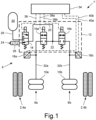
- the schematically illustrated air suspension system 6 for a vehicle axle 2 of a vehicle comprises one air spring 8a, 8b with a bellows 10a, 10b per vehicle wheel 4a, 4b of the vehicle axle 2, a valve block 12 with a changeover valve 14 designed as a 3/2-way solenoid valve, one shut-off valve 16a, 16b designed as a 2/2-way solenoid valve for the air spring 8a, 8b of each vehicle wheel 4a, 4b and one pressure sensor 18a, 18b for measuring the bellows pressure in each of the bellows 10a, 10b of the air springs 8a, 8b.
- the pressure sensors 18a, 18b are pressure-voltage sensors and form a sensor arrangement 1'.
- a working pressure line 20 can be alternately connected to a vent outlet 24 provided with a silencer 26 or to a pressurized supply line 28.
- a storage tank 30 in which compressed air is stored under a supply pressure is connected to the supply line 28.
- a connecting line 32a, 32b leading to the bellows 10a, 10b of the associated air spring 8a, 8b can be alternately connected to the working pressure line 20 or shut off from it.
- the working pressure line 20 When the changeover valve 14 is not actuated, i.e. not energized, the working pressure line 20 is connected to the vent outlet 24 and is therefore depressurized. When the changeover valve 14 is actuated, i.e. energized, the working pressure line 20 is connected to the supply line 28 and is therefore subject to the supply pressure of the storage tank 30.
- shut-off valves 16a, 16b When the shut-off valves 16a, 16b are not actuated, i.e. not energized, they are each closed and the connecting lines 32a, 32b are shut off from the working pressure line 20. To reduce the bellows pressure in the bellows 10a, 10b of the associated air spring 8a, 8b, only the relevant shut-off valve 16a, 16b needs to be opened, whereby the respective bellows 10a, 10b is vented. To increase the bellows pressure in the bellows 10a, 10b of the associated air spring 8a, 8b, on the other hand, the switching valve 14 needs to be switched and the relevant shut-off valve 16a, 16b needs to be opened, whereby the respective bellows 10a, 10b is ventilated.
- the pressure sensors 18a, 18b are arranged in or on the valve block 12 and are each connected to the outlet of the associated shut-off valve 16a, 16b to the connecting line 32a, 32b of the bellows 10a, 10b of the associated air spring 8a, 8b.
- the Pressure sensors 18a, 18b are each connected to the electronic control unit 34 via an electrical sensor line 40a, 40b.
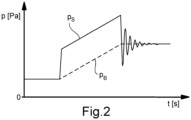
- the bellows pressure p B present in the relevant bellows 10a, 10b and the air pressure p S detected by the associated pressure sensor 18a, 18b at the outlet of the associated shut-off valve 16a, 16b differ relatively strongly from one another during the ventilation process, since pressure peaks and pressure oscillations occur at the outlet of the relevant shut-off valve 16a, 16b due to the opening and closing of the relevant shut-off valve 16a, 16b.
- Precise control of the ventilation and venting of the bellows 10a, 10b based on the air pressures p S detected by the sensors is possible with the sensor arrangement 1' according to Fig.1 therefore not possible so far.
- a sensor arrangement 1 which in the schematic illustration of a corresponding air suspension system 6' for a vehicle axle 2 of a vehicle in Fig. 3 is shown.
- the pressure sensors 18a, 18b are now each connected to the connecting line 32a, 32b of the bellows 10a, 10b of the associated air spring 8a, 8b via a filter arrangement 42a, 42b acting as a low-pass filter.
- the filter arrangements 42a, 42b each consist of a pneumatic throttle 44a, 44b and a smaller pressure vessel 46a, 46b, which are each arranged in series between the associated connecting line 32a, 32b and the relevant pressure sensor 18a, 18b.
- the volume of the respective pressure vessels 46a, 46b is smaller than the smallest possible adjustable volume of the respective associated bellows 10a, 10b.
- the pressure sensors 18a, 18b By connecting the pressure sensors 18a, 18b via a filter arrangement 42a, 42b acting as a low-pass filter to the connecting line 32a, 32b of the bellows 10a, 10b of the associated air spring 8a, 8b, the pressure peaks and pressure fluctuations occurring in particular through the opening and closing of the associated shut-off valve 16a, 16b are dampened and filtered out in such a way that the air pressures p S measured via the connected pressure sensors 18a, 18b largely correspond to the bellows pressures p B in the bellows 10a, 10b of the associated air springs 8a, 8b.
- the throttles 44a, 44b of the filter arrangements 42a, 42b are designed to be adjustable with regard to their opening cross-section, so that a precise adaptation of the filter arrangements 42a, 42b to the dimensions of the respective connecting line 32a, 32b and the bellows 10a, 10b of the associated air spring 8a, 8b is possible.
- the throttle 44a, 44b and the pressure vessel 46a, 46b of the filter arrangements 42a, 42b are each dimensioned such that the ratio of the square of the largest possible opening diameter d DR_max of the throttle 44a, 44b and the volume V DB of the pressure vessel 46a, 46b is at least as large as the ratio of the square of the line diameter d AL of the associated connecting line 32a, 32b and the smallest possible volume V B_min of the bellows 10a, 10b of the associated air spring 8a, 8b (d DR_max 2 / V DB ⁇ d AL 2 / V B_min ).
Landscapes
- Engineering & Computer Science (AREA)
- Mechanical Engineering (AREA)
- Physics & Mathematics (AREA)
- General Physics & Mathematics (AREA)
- Vehicle Body Suspensions (AREA)
Description
- Die Erfindung betrifft ein Fahrzeug mit einer Luftfederungsanlage.
- Die Luftfederungsanlage eines Fahrzeugs weist üblicherweise für Luftfedern einer Fahrzeugachse oder mehrerer benachbarter Tandemachsen jeweils ein bevorzugt als ein 3/2-Wege-Magnetschaltventil ausgebildetes Umschaltventil und für die Luftfeder jedes Fahrzeugrades der Fahrzeugachse beziehungsweise für die Luftfedern jeder Fahrzeugseite der Tandemachsen jeweils ein bevorzugt als ein 2/2-Wege-Magnetschaltventil ausgebildetes Absperrventil auf. Über das Umschaltventil ist eine Arbeitsdruckleitung wechselweise mit einem Entlüftungsausgang oder einer druckführenden Vorratsleitung verbindbar. An die Arbeitsdruckleitung sind, zum Beispiel mittels eines T-Leitungsstücks, die beiden Absperrventile angeschlossen, über die jeweils eine zu dem Federbalg der zugeordneten Luftfeder beziehungsweise zu den Federbälgen der zugeordneten Luftfedern führende Anschlussleitung wechselweise mit der Arbeitsdruckleitung verbindbar oder gegenüber dieser absperrbar ist.
- Im unbetätigten, also unbestromten Zustand des Umschaltventils ist die Arbeitsdruckleitung mit dem Entlüftungsausgang verbunden und somit drucklos. Im betätigten, also bestromten Zustand des Umschaltventils ist die Arbeitsdruckleitung mit der Vorratsleitung verbunden und steht somit unter einem von einer Druckluftanlage zur Verfügung gestellten Vorratsdruck. Im unbetätigten, also unbestromten Zustand der Absperrventile sind diese jeweils geschlossen und die Anschlussleitungen gegenüber der Arbeitsdruckleitung abgesperrt. Zur Absenkung des Balgdruckes in dem Federbalg der zugeordneten Luftfeder beziehungsweise in den Federbälgen der zugeordneten Luftfedern ist nur das Öffnen des betreffenden Absperrventils erforderlich, wodurch der jeweilige Federbalg entlüftet wird beziehungsweise die jeweiligen Federbälge entlüftet werden. Zur Erhöhung des Balgdruckes in dem Federbalg der zugeordneten Luftfeder beziehungsweise in den Federbälgen der zugeordneten Luftfedern ist dagegen das Umschalten des Umschaltventils und das Öffnen des betreffenden Absperrventils erforderlich, wodurch der jeweilige Federbalg belüftet wird beziehungsweise die jeweiligen Federbälge belüftet werden.
- Zur Ermittlung der Höhe beziehungsweise des Niveaus des Fahrzeugaufbaus gegenüber einer Fahrzeugachse ist an jeder Fahrzeugachse beziehungsweise bei benachbarten Tandemachsen zumindest an einer der Tandemachsen beidseitig jeweils ein Höhen- oder Niveausensor angeordnet, der über eine Sensorleitung mit einem elektronischen Steuergerät verbunden ist. Zur Ermittlung der Balgdrücke in den Federbälgen der Luftfedern ist an die Anschlussleitung jedes Federbalgs einer Fahrzeugachse beziehungsweise bei Tandemachsen der Federbälge einer Fahrzeugseite ein Drucksensor angeschlossen, der über eine Sensorleitung mit dem elektronischen Steuergerät verbunden ist. Abhängig von den Sensorsignalen der Höhensensoren und der Drucksensoren sowie von einem Steuerungsprogramm vorgegebenen oder manuell durch einen Fahrer eingegebenen Solldaten werden die Umschalt- und Absperrventile von dem elektronischen Steuergerät über elektrische Steuerleitungen angesteuert, um durch die Belüftung oder Entlüftung der Federbälge der betreffenden Luftfedern eine vorgegebene Höhe des Fahrzeugaufbaus beizubehalten oder einzustellen.
- Die Drucksensoren können unmittelbar benachbart zu den Luftfedern an die jeweilige Anschlussleitung angeschlossen sein. Dies hat den Vorteil, dass der jeweilige Balgdruck in dem Federbalg der benachbarten Luftfeder auch bei dynamischen Druckänderungen weitgehend unverfälscht messbar ist. Nachteilig an einer derartigen dezentralen Anordnung der Drucksensoren sind jedoch die erforderlichen langen Sensorleitungen, der erhöhte Montageaufwand und die Beaufschlagung der Drucksensoren sowie ihrer elektrischen Stecker mit Schmutz und Spritzwasser. Eine dezentrale Anordnung der Drucksensoren nahe den Luftfedern ist beispielsweise von einer in der
DE 36 38 849 A1 beschriebenen Luftfederungsanlage bekannt. - Alternativ dazu können die Drucksensoren auch entfernt von den Luftfedern in oder an dem jeweiligen Ventilblock angeordnet und am Ausgang des zugeordneten Absperrventils an die Anschlussleitung angeschlossen sein. Vorteilhaft an einer derartigen zentralen Anordnung der Drucksensoren sind die erforderlichen kurzen Sensorleitungen, der geringere Montageaufwand und die vor Schmutz und Spritzwasser weitgehend geschützte Lage der Drucksensoren und ihrer elektrischen Stecker. Diese von den Luftfedern entfernte Anordnung hat jedoch den Nachteil, dass der jeweilige Balgdruck in dem Federbalg der benachbarten Luftfeder, insbesondere während der dynamischen Druckänderungen beim Öffnen und Schließen des zugeordneten Absperrventils, von den Drucksensoren verfälscht erfasst wird. Eine zentrale Anordnung der Drucksensoren in einem neben den Steuerventilen auch ein elektronisches Steuergerät umfassenden Steuerblock einer Luftfederungsanlage ist beispielsweise aus der
DE 195 46 324 C2 bekannt. Eine weitere Luftfederungseinrichtung für Fahrzeuge mit Druckmesseinrichtungen für eine Messung von Drücken an Luftfedern ist aus derEP 0 170 794 A2 bekannt. -
DE 10 2005 013 914 A1 offenbart eine Vorrichtung zur Druckmessung bei einem strömenden Gas, wobei das Gas korrosiv ist. Ein Drucksensor ist in einem Gehäuse angeordnet und mittels eines Schutzgels gegen das Gas geschützt, wobei das Gehäuse über eine Druckleitung mit das strömende Gas führenden Mitteln verbunden ist. Die Vorrichtung soll bei einer Druckmessung in Abgasen zum Einsatz kommen, die eine pulsierende Strömung aufweisen. Solche Strömungspulse führen zu einem erhöhten Gastransport in Richtung zu dem Drucksensor, der dadurch in erhöhtem Maße einer korrodierenden Wirkung des Gases ausgesetzt wird. Dies wird dadurch vermindert, dass ein pneumatischer Tiefpass in der Druckleitung ausgebildet ist, dessen Grenzfrequenz geringer als eine Pulsationsfrequenz des Gasstroms ist. -
US 2013/206255 A1 offenbart einen hydraulischen Tiefpassfilter für einen Drucksensor. Da eine genaue Steuerung der Belüftung und Entlüftung der Federbälge anhand der sensorisch erfassten Luftdrücke bislang nicht möglich ist, lag der Erfindung die Aufgabe zugrunde, eine Sensoranordnung einer Luftfederungsanlage eines Fahrzeugs der eingangs genannten Bauart vorzustellen, mit welcher der Balgdruck in den Federbälgen der Luftfedern dennoch exakt ermittelt werden kann. - Diese Aufgabe ist durch eine Sensoranordnung mit den Merkmalen des Anspruchs 1 gelöst. Vorteilhafte Weiterbildungen dieses Verfahrens sind in den abhängigen Ansprüchen definiert.
- ein Fahrzeug mit einer Luftfederungsanlage, wobei das Fahrzeug eine Fahrzeugachse mit Fahrzeugrädern oder mehrere benachbarte Tandemachsen aufweist. Die Luftfederungsanlage weist hierbei Luftfedern mit jeweils einem Federbalg an jeweils einem Fahrzeugrad an der Fahrzeugachse oder an jeweils einer Fahrzeugseite des Fahrzeugs an den Tandemachsen auf, wobei die Luftfederungsanlage für die Luftfedern der Fahrzeugachse oder der Tandemachsen jeweils ein Umschaltventil sowie für die Luftfeder jedes Fahrzeugrades der Fahrzeugachse beziehungsweise für die Luftfedern jeder Fahrzeugseite der Tandemachsen jeweils ein Absperrventil aufweist. Das jeweilige Umschaltventil sowie die Absperrventile sind in einem entfernt von den Luftfedern angeordneten Ventilblock baulich zusammengefasst, wobei die Luftfederungsanlage für die Messung der Balgdrücke in den Federbälgen der Luftfedern jeweils einen Drucksensor aufweist, welche in oder an dem Ventilblock angeordnet sind. Hierbei sind die Drucksensoren jeweils am Ausgang des ihnen zugeordneten Absperrventils an eine Anschlussleitung des Federbalgs der zugeordneten Luftfeder beziehungsweise der Federbälge der zugeordneten Luftfedern angeschlossen.
- Gemäß der Erfindung ist vorgesehen, dass die Drucksensoren jeweils über eine als Tiefpassfilter wirksame Filteranordnung an die Anschlussleitung des Federbalgs der zugeordneten Luftfeder beziehungsweise der Federbälge der zugeordneten Luftfedern angeschlossen sind. Durch den Anschluss der Drucksensoren über jeweils eine als Tiefpassfilter wirksame Filteranordnung an die Anschlussleitung des Federbalgs der zugeordneten Luftfeder beziehungsweise der Federbälge der zugeordneten Luftfedern werden die insbesondere durch das Öffnen und Schließen des zugeordneten Absperrventils auftretenden Druckspitzen und Druckschwankungen derart gedämpft und ausgefiltert, dass die über die angeschlossenen Drucksensoren erfassten Luftdrücke pS weitgehend den Balgdrücken pB in den Federbälgen der zugeordneten Luftfedern entsprechen (pS = pB).
- Die Filteranordnungen bestehen jeweils bevorzugt aus einer Drossel und einem kleineren Druckbehälter, die jeweils seriell zwischen der zugeordneten Anschlussleitung und dem betreffenden Drucksensor angeordnet sind. Das Volumen der Druckbehälter ist kleiner ist als das kleinstmögliche Volumen der jeweils zugeordneten Federbälge.
- Um eine genaue Anpassung der Filteranordnungen an die Abmessungen der jeweiligen Anschlussleitung und des Federbalgs der zugeordneten Luftfeder beziehungsweise der Federbälge der zugeordneten Luftfedern vornehmen zu können, sind die Drossein der Filteranordnungen hinsichtlich ihres Öffnungsquerschnittes bevorzugt einstellbar ausgebildet.
- Um die gewünschte Wirkung als Tiefpassfilter zu erzielen ist bevorzugt vorgesehen, dass die Drossel und der Druckbehälter der Filteranordnungen jeweils derart dimensioniert sind, dass das Verhältnis aus dem Quadrat des größtmöglichen Öffnungsdurchmessers dDR_max der Drossel und dem Volumen VDB des Druckbehälters mindestens so groß ist wie das Verhältnis aus dem Quadrat des Leitungsdurchmessers dAL der zugeordneten Anschlussleitung und dem kleinstmöglichen Volumen VB_min des Federbalgs der zugeordneten Luftfeder beziehungsweise der Federbälge der zugeordneten Luftfedern (dDR_max 2 / VDB ≥ dAL 2 / VB_min).
- Die Erfindung wird nachstehend anhand eines in der beigefügten Zeichnung dargestellten Ausführungsbeispiels näher erläutert. In der Zeichnung zeigt
-
Fig. 1 eine Luftfederungsanlage für eine Fahrzeugachse eines Fahrzeugs mit einer zentralen Anordnung von Drucksensoren in einer schematischen Ansicht, -
Fig. 2 die Druckverläufe des Balgdruckes eines Federbalgs und des von einem Drucksensor erfassten Druckes während eines Belüftungsvorgangs in einem Diagramm, und -
Fig. 3 eine Luftfederungsanlage für eine Fahrzeugachse eines Fahrzeugs mit einer erfindungsgemäßen Sensoranordnung in einer schematischen Ansicht. - Eine in
Fig. 1 schematisch abgebildete Luftfederungsanlage 6 für eine Fahrzeugachse 2 eines Fahrzeugs umfasst jeweils eine Luftfeder 8a, 8b mit einem Federbalg 10a, 10b pro Fahrzeugrad 4a, 4b der Fahrzeugachse 2, einen Ventilblock 12 mit einem als ein 3/2-Wege-Magnetschaltventil ausgebildeten Umschaltventil 14, jeweils einem als ein 2/2-Wege-Magnetschaltventil ausgebildeten Absperrventil 16a, 16b für die Luftfeder 8a, 8b jedes Fahrzeugrades 4a, 4b sowie jeweils einen Drucksensor 18a, 18b für die Messung des Balgdruckes in jedem der Federbälge 10a, 10b der Luftfedern 8a, 8b. Die Drucksensoren 18a, 18b sind dabei Druck-Spannungs-Sensoren und bilden eine Sensoranordnung 1'. - Mittels des Umschaltventils 14, welches über eine elektrische Steuerleitung 36 mit einem elektronischen Steuergerät 34 in Verbindung steht, ist eine Arbeitsdruckleitung 20 wechselweise mit einem mit einem Schalldämpfer 26 versehenen Entlüftungsausgang 24 oder einer druckführenden Vorratsleitung 28 verbindbar. An die Vorratsleitung 28 ist ein Speicherbehälter 30 angeschlossen, in dem Druckluft unter einem Vorratsdruck gespeichert ist. Über die beiden Absperrventile 16a, 16b, die eingangsseitig über ein T-Stück 22 an die Arbeitsdruckleitung 20 angeschlossen sind und jeweils über eine elektrische Steuerleitung 38a, 38b mit dem elektronischen Steuergerät 34 signaltechnisch in Verbindung sind, ist jeweils eine zu dem Federbalg 10a, 10b der zugeordneten Luftfeder 8a, 8b führende Anschlussleitung 32a, 32b wechselweise mit der Arbeitsdruckleitung 20 verbindbar oder gegenüber dieser absperrbar.
- Im unbetätigten, also unbestromten Zustand des Umschaltventils 14 ist die Arbeitsdruckleitung 20 mit dem Entlüftungsausgang 24 verbunden und somit drucklos. Im betätigten, also bestromten Zustand des Umschaltventils 14 ist die Arbeitsdruckleitung 20 mit der Vorratsleitung 28 verbunden und steht somit unter dem Vorratsdruck des Speicherbehälters 30.
- Im unbetätigten, also unbestromten Zustand der Absperrventile 16a, 16b sind diese jeweils geschlossen und die Anschlussleitungen 32a, 32b gegenüber der Arbeitsdruckleitung 20 abgesperrt. Zur Absenkung des Balgdruckes in dem Federbalg 10a, 10b der zugeordneten Luftfeder 8a, 8b ist nur das Öffnen des betreffenden Absperrventils 16a, 16b erforderlich, wodurch der jeweilige Federbalg 10a, 10b entlüftet wird. Zur Erhöhung des Balgdruckes in dem Federbalg 10a, 10b der zugeordneten Luftfeder 8a, 8b ist dagegen das Umschalten des Umschaltventils 14 und das Öffnen des betreffenden Absperrventils 16a, 16b erforderlich, wodurch der jeweilige Federbalg 10a, 10b belüftet wird.
- Die Drucksensoren 18a, 18b sind in oder an dem Ventilblock 12 angeordnet und jeweils am Ausgang des zugeordneten Absperrventils 16a, 16b an die Anschlussleitung 32a, 32b des Federbalgs 10a, 10b der zugeordneten Luftfeder 8a, 8b angeschlossen. Die Drucksensoren 18a, 18b stehen über jeweils eine elektrische Sensorleitung 40a, 40b mit dem elektronischen Steuergerät 34 in Verbindung.
- Wie in dem Diagramm der
Fig. 2 beispielhaft für eine Belüftung des Federbalgs 10a, 10b einer Luftfeder 8a, 8b veranschaulicht ist, weichen der in dem betreffenden Federbalg 10a, 10b vorliegende Balgdruck pB und der von dem zugeordneten Drucksensor 18a, 18b erfasste, am Ausgang des zugeordneten Absperrventils 16a, 16b vorliegende Luftdruck pS während des Belüftungsvorgangs relativ stark voneinander ab, da sich durch das Öffnen und Schließen des betreffenden Absperrventils 16a, 16b an dessen Ausgang Druckspitzen und Druckschwingungen einstellen. Eine genaue Steuerung der Belüftung und Entlüftung der Federbälge 10a, 10b anhand der sensorisch erfassten Luftdrücke pS ist mit der Sensoranordnung 1' gemäßFig. 1 somit bislang nicht möglich. - Zur Lösung dieses Problems ist eine erfindungsgemäße Sensoranordnung 1 vorgesehen, welche in der schematischen Abbildung einer entsprechenden Luftfederungsanlage 6' für eine Fahrzeugachse 2 eines Fahrzeugs in
Fig. 3 dargestellt ist. Die Drucksensoren 18a, 18b sind nun jeweils über eine als Tiefpassfilter wirksame Filteranordnung 42a, 42b an die Anschlussleitung 32a, 32b des Federbalgs 10a, 10b der zugeordneten Luftfeder 8a, 8b angeschlossen. Die Filteranordnungen 42a, 42b bestehen jeweils aus einer pneumatischen Drossel 44a, 44b und einem kleineren Druckbehälter 46a, 46b, die jeweils seriell zwischen der zugeordneten Anschlussleitung 32a, 32b und dem betreffenden Drucksensor 18a, 18b angeordnet sind. Das Volumen der jeweiligen Druckbehälter 46a, 46b ist dabei kleiner als das kleinstmöglich einstellbare Volumen der jeweils zugeordneten Federbälge 10a, 10b. - Durch den Anschluss der Drucksensoren 18a, 18b über jeweils eine als Tiefpassfilter wirksame Filteranordnung 42a, 42b an die Anschlussleitung 32a, 32b des Federbalgs 10a, 10b der zugeordneten Luftfeder 8a, 8b werden die insbesondere durch das Öffnen und Schließen des zugeordneten Absperrventils 16a, 16b auftretenden Druckspitzen und Druckschwankungen derart gedämpft und ausgefiltert, dass die über die angeschlossenen Drucksensoren 18a, 18b gemessenen Luftdrücke pS weitgehend den Balgdrücken pB in den Federbälgen 10a, 10b der zugeordneten Luftfedern 8a, 8b ent
- Die Drosseln 44a, 44b der Filteranordnungen 42a, 42b sind hinsichtlich ihres Öffnungsquerschnittes justierbar ausgebildet, so dass eine genaue Anpassung der Filteranordnungen 42a, 42b an die Abmessungen der jeweiligen Anschlussleitung 32a, 32b und des Federbalgs 10a, 10b der zugeordneten Luftfeder 8a, 8b möglich ist. Um die gewünschte Wirkung als Tiefpassfilter zu erzielen, sind die Drossel 44a, 44b und der Druckbehälter 46a, 46b der Filteranordnungen 42a, 42b jeweils derart dimensioniert, dass das Verhältnis aus dem Quadrat des größtmöglichen Öffnungsdurchmessers dDR_max der Drossel 44a, 44b und dem Volumen VDB des Druckbehälters 46a, 46b mindestens so groß ist wie das Verhältnis aus dem Quadrat des Leitungsdurchmessers dAL der zugeordneten Anschlussleitung 32a, 32b und dem kleinstmöglichen Volumen VB_min des Federbalgs 10a, 10b der zugeordneten Luftfeder 8a, 8b (dDR_max 2 / VDB ≥ dAL 2 / VB_min).
-
- 1
- Sensoranordnung (erfindungsgemäß)
- 1'
- Sensoranordnung
- 2
- Fahrzeugachse
- 4a, 4b
- Fahrzeugräder
- 6, 6'
- Luftfederungsanlagen
- 8a, 8b
- Luftfedern
- 10a, 10b
- Federbälge
- 12
- Ventilblock
- 14
- Umschaltventil
- 16a, 16b
- Absperrventile
- 18a, 18b
- Drucksensoren
- 20
- Arbeitsdruckleitung
- 22
- T-Stück
- 24
- Entlüftungsausgang
- 26
- Schalldämpfer
- 28
- Vorratsleitung
- 30
- Speicherbehälter
- 32a, 32b
- Anschlussleitung
- 34
- Elektronisches Steuergerät
- 36
- Steuerleitung
- 38a, 38b
- Steuerleitung
- 40a, 40b
- Sensorleitung
- 42a, 42b
- Filteranordnung
- 44a, 44b
- Drossel
- 46a, 46b
- Druckbehälter
- d
- Durchmesser
- dAL
- Durchmesser der Anschlussleitung
- dDR
- Öffnungsdurchmesser der Drossel
- dDR_max
- Größtmöglicher Öffnungsdurchmesser der Drossel
- p
- Druck
- pB
- Balgdruck
- pS
- Sensorisch erfasster Luftdruck
- V
- Volumen
- VB
- Volumen des Federbalgs beziehungsweise der Federbälge
- VB_min
- Kleinstmögliches Volumen des Federbalgs bzw. der Federbälge
- VDB
- Volumen des Druckbehälters
Claims (5)
- Fahrzeug mit einer Luftfederungsanlage (6'), wobei das Fahrzeug- eine Fahrzeugachse (2) mit Fahrzeugrädern (4a, 4b) oder- mehrere benachbarte Tandemachsen aufweist,
wobei- die Luftfederungsanlage (6') Luftfedern (8a, 8b) mit jeweils einem Federbalg (10a, 10b) an jeweils einem Fahrzeugrad (4a, 4b) an der Fahrzeugachse (2) oder an jeweils einer Fahrzeugseite des Fahrzeugs an den Tandemachsen aufweist,- die Luftfederungsanlage (6')- für die Luftfedern (8a, 8b) der Fahrzeugachse (2) oder der Tandemachsen jeweils ein Umschaltventil (14) sowie- für die Luftfeder (8a, 8b) jedes Fahrzeugrades (4a, 4b) der Fahrzeugachse (2) beziehungsweise für die Luftfedern jeder Fahrzeugseite der Tandemachsen jeweils ein Absperrventil (16a, 16b) aufweist,- das jeweilige Umschaltventil (14) sowie die Absperrventile (16a, 16b) in einem entfernt von den Luftfedern (8a, 8b) angeordneten Ventilblock (12) baulich zusammengefasst sind,- die Luftfederungsanlage (6') für die Messung der Balgdrücke in den Federbälgen (10a, 10b) der Luftfedern (8a, 8b) jeweils einen Drucksensor (18a, 18b) aufweist, welche in oder an dem Ventilblock (12) angeordnet sind, und- die Drucksensoren (18a, 18b) jeweils am Ausgang des ihnen zugeordneten Absperrventils (16a, 16b) an eine Anschlussleitung (32a, 32b) des Federbalgs (10a, 10b) der zugeordneten Luftfeder (8a, 8b) beziehungsweise der Federbälge der zugeordneten Luftfedern angeschlossen sind,dadurch gekennzeichnet, dass die Drucksensoren (18a, 18b) jeweils über eine als Tiefpassfilter wirksame Filteranordnung (42a, 42b) an die Anschlussleitung (32a, 32b) des Federbalgs (10a, 10b) der zugeordneten Luftfeder (8a, 8b) beziehungsweise der Federbälge der zugeordneten Luftfedern angeschlossen sind. - Fahrzeug nach Anspruch 1, dadurch gekennzeichnet, dass die Filteranordnungen (42a, 42b) jeweils aus einer Drossel (44a, 44b) und einem Druckbehälter (46a, 46b) bestehen, die jeweils seriell zwischen der zugeordneten Anschlussleitung (32a, 32b) und dem betreffenden Drucksensor (18a, 18b) angeordnet sind.
- Fahrzeug nach Anspruch 2, dadurch gekennzeichnet, dass das Volumen der Druckbehälter (46a, 46b) kleiner ist als das kleinstmögliche Volumen der jeweils zugeordneten Federbälge (10a, 10b).
- Fahrzeug nach einem der Ansprüche 2 bis 3, dadurch gekennzeichnet, dass die Drosseln (44a, 44b) der Filteranordnungen (42a, 42b) hinsichtlich ihres Öffnungsquerschnittes einstellbar ausgebildet sind.
- Fahrzeug nach einem der Ansprüche 2 bis 4, dadurch gekennzeichnet, dass die Drossel (44a, 44b) und der Druckbehälter (46a, 46b) der Filteranordnungen (42a, 42b) jeweils derart dimensioniert sind, dass das Verhältnis aus dem Quadrat des größtmöglichen Öffnungsdurchmessers (dDR_max) der Drossel (44a, 44b) und dem Volumen (VDB) des Druckbehälters (46a, 46b) mindestens so groß ist wie das Verhältnis aus dem Quadrat des Leitungsdurchmessers (dAL) der zugeordneten Anschlussleitung (32a, 32b) und dem kleinstmöglichen Volumen (VB_min) des Federbalgs (10a, 10b) der zugeordneten Luftfeder (8a, 8b) beziehungsweise der Federbälge der zugeordneten Luftfedern (dDR_max 2 / VDB ≥ dAL 2 / VB_min).
Applications Claiming Priority (2)
| Application Number | Priority Date | Filing Date | Title |
|---|---|---|---|
| DE102019112215.5A DE102019112215A1 (de) | 2019-05-10 | 2019-05-10 | Sensoranordnung einer Luftfederungsanlage eines Fahrzeugs |
| PCT/EP2020/061431 WO2020229138A1 (de) | 2019-05-10 | 2020-04-24 | Sensoranordnung einer luftfederungsanlage eines fahrzeugs |
Publications (2)
| Publication Number | Publication Date |
|---|---|
| EP3966051A1 EP3966051A1 (de) | 2022-03-16 |
| EP3966051B1 true EP3966051B1 (de) | 2024-06-26 |
Family
ID=70476198
Family Applications (1)
| Application Number | Title | Priority Date | Filing Date |
|---|---|---|---|
| EP20722525.1A Active EP3966051B1 (de) | 2019-05-10 | 2020-04-24 | Fahrzeug mit luftfederanlage |
Country Status (5)
| Country | Link |
|---|---|
| US (1) | US12227051B2 (de) |
| EP (1) | EP3966051B1 (de) |
| CN (1) | CN114174084B (de) |
| DE (1) | DE102019112215A1 (de) |
| WO (1) | WO2020229138A1 (de) |
Families Citing this family (2)
| Publication number | Priority date | Publication date | Assignee | Title |
|---|---|---|---|---|
| DE102019112214A1 (de) * | 2019-05-10 | 2020-11-12 | Wabco Gmbh | Verfahren zur Steuerung einer Luftfederungsanlage eines Fahrzeugs |
| CN116733623B (zh) * | 2023-06-12 | 2026-01-02 | 中国第一汽车股份有限公司 | 车辆的空气悬架的排气控制方法、车辆及存储介质 |
Family Cites Families (12)
| Publication number | Priority date | Publication date | Assignee | Title |
|---|---|---|---|---|
| DE3428867A1 (de) * | 1984-08-04 | 1986-02-13 | Wabco Westinghouse Fahrzeugbremsen GmbH, 3000 Hannover | Luftfedereinrichtung fuer fahrzeuge |
| DE3638849A1 (de) | 1986-11-13 | 1988-05-19 | Bosch Gmbh Robert | Luftfederung fuer fahrzeug mit doppelachse |
| DE19546324C2 (de) | 1995-12-12 | 1998-10-29 | Grau Gmbh | Steuerblock für eine Luftfederungsanlage |
| DE102004028325B4 (de) * | 2004-06-11 | 2006-04-27 | Knorr-Bremse Systeme für Nutzfahrzeuge GmbH | Luftfederungseinrichtung für Fahrzeuge, insbesondere für Nutzfahrzeuge |
| DE102004052765B4 (de) * | 2004-10-30 | 2018-05-17 | Continental Teves Ag & Co. Ohg | Verfahren und Vorrichtung zur Gasmengenermittlung in Gasfederniveauregelanlagen |
| DE102005013914A1 (de) * | 2005-03-24 | 2006-07-20 | Siemens Ag | Vorrichtung zur Druckmessung |
| DE102010018606A1 (de) * | 2010-04-28 | 2011-11-03 | Wabco Gmbh | Vorrichtung und Verfahren zum Sensieren von mehreren Drücken |
| DE102011121755A1 (de) * | 2011-12-21 | 2013-06-27 | Wabco Gmbh | Luftfederungsanlage eines Kraftfahrzeugs und Verfahren zu deren Steuerung |
| US20130206255A1 (en) * | 2012-02-15 | 2013-08-15 | Caterpillar Global Mining Llc | Hydraulic low-pass filter for pressure sensors |
| DE102014009420B4 (de) * | 2014-06-25 | 2023-03-23 | Zf Cv Systems Hannover Gmbh | Druckluftversorgungsanlage, pneumatisches System und Verfahren zum Steuern einer Druckluftversorgungsanlage |
| CN108312798B (zh) * | 2017-01-17 | 2023-11-17 | 宇通客车股份有限公司 | 空气悬架及使用该空气悬架的车辆 |
| CN209208397U (zh) * | 2018-09-07 | 2019-08-06 | 陕西中航气弹簧有限责任公司 | 一种车身高度调节装置 |
-
2019
- 2019-05-10 DE DE102019112215.5A patent/DE102019112215A1/de active Pending
-
2020
- 2020-04-24 EP EP20722525.1A patent/EP3966051B1/de active Active
- 2020-04-24 WO PCT/EP2020/061431 patent/WO2020229138A1/de not_active Ceased
- 2020-04-24 CN CN202080033317.9A patent/CN114174084B/zh active Active
-
2021
- 2021-10-18 US US17/504,146 patent/US12227051B2/en active Active
Also Published As
| Publication number | Publication date |
|---|---|
| DE102019112215A1 (de) | 2020-11-12 |
| US20220032717A1 (en) | 2022-02-03 |
| EP3966051A1 (de) | 2022-03-16 |
| US12227051B2 (en) | 2025-02-18 |
| WO2020229138A1 (de) | 2020-11-19 |
| CN114174084B (zh) | 2025-07-08 |
| CN114174084A (zh) | 2022-03-11 |
Similar Documents
| Publication | Publication Date | Title |
|---|---|---|
| EP3966052B1 (de) | Verfahren zum betreiben eines fahrzeugs und zur steuerung einer luftfederungsanlage für das fahrzeugs | |
| DE102011017118B4 (de) | Vorrichtung zur Anpassung des Ist-Reifendrucks wenigstens eines Reifens eines Fahrzeugs an einen aktuellen Soll-Reifendruck während der Fahrt | |
| WO1999039928B1 (de) | Vorrichtung und verfahren zur einstellung des reifendrucks an einem fahrzeug | |
| DE102008062072A1 (de) | Reifendruckregelsystem und Verfahren zur Reifendruckregelung | |
| EP3966051B1 (de) | Fahrzeug mit luftfederanlage | |
| DE102016106793A1 (de) | Hydraulische Lenkung | |
| DE102005024120A1 (de) | Parkbremseinrichtung eines Fahrzeugs mit elektro-pneumatischer Notlöseeinrichtung | |
| DE102012007365A1 (de) | Luftaufbereitungsanlage für die Druckluftversorgung von Nutzkraftfahzeugen | |
| DE19918070B4 (de) | Druckregelvorrichtung für elektro-pneumatische Bremsanlagen von Fahrzeugen, insbesondere Nutzfahrzeugen | |
| DE102015115082B4 (de) | Ventileinheit für pneumatische Anwendungen sowie Luftfederungsanlage | |
| EP1651491B1 (de) | Vorrichtung zum wiederbefüllen von bremskreisen nach einem starken druckluftverbrauch und vorrichtung zur durchführung des verfahrens | |
| EP1807296B1 (de) | Druckluftversrogungseinrichtung und verfahren zum betreiben einer durchluftversorgungseinrichtung | |
| DE2918481C2 (de) | ||
| DE102004012100B4 (de) | Aus mindestens zwei Wagen bestehender Schienenfahrzeugverband mit direkter elektro-pneumatischer Bremseinrichtung | |
| EP1738940B1 (de) | Luftfederungseinrichtung mit Drossel für Fahrzeuge | |
| DE102004028325B4 (de) | Luftfederungseinrichtung für Fahrzeuge, insbesondere für Nutzfahrzeuge | |
| EP1647425B1 (de) | Steuervorrichtung für eine Luftfederungsanlage für ein Kraftfahrzeug | |
| EP1647473B1 (de) | Anlage für Kraftfahrzeuge mit Luftfederung und Liftachse | |
| DE102007060271B3 (de) | Bremssystem eines Fahrzeugs beinhaltend eine Fahrdynamikregelung | |
| DE3908807A1 (de) | Einrichtung zur aenderung des druckes im reifen eines fahrzeuges | |
| DE102008062065A1 (de) | Reifendruckregelsystem und Verfahren zur Reifendruckregelung | |
| DE3832059C2 (de) | ||
| DE102009011236A1 (de) | Verfahren zur Reifendruckregelung und Reifendruckregelanlage | |
| DE102008021648A1 (de) | Niveauregelanordnung eines Fahrzeugaufbaus luftgefederter Fahrzeuge | |
| DE3805575A1 (de) | Druckausgleichs- und/oder sicherheitsvorrichtung fuer fluidsysteme, insbesondere fuer kraftfahrzeugreifen |
Legal Events
| Date | Code | Title | Description |
|---|---|---|---|
| STAA | Information on the status of an ep patent application or granted ep patent |
Free format text: STATUS: UNKNOWN |
|
| STAA | Information on the status of an ep patent application or granted ep patent |
Free format text: STATUS: THE INTERNATIONAL PUBLICATION HAS BEEN MADE |
|
| PUAI | Public reference made under article 153(3) epc to a published international application that has entered the european phase |
Free format text: ORIGINAL CODE: 0009012 |
|
| STAA | Information on the status of an ep patent application or granted ep patent |
Free format text: STATUS: REQUEST FOR EXAMINATION WAS MADE |
|
| 17P | Request for examination filed |
Effective date: 20211210 |
|
| AK | Designated contracting states |
Kind code of ref document: A1 Designated state(s): AL AT BE BG CH CY CZ DE DK EE ES FI FR GB GR HR HU IE IS IT LI LT LU LV MC MK MT NL NO PL PT RO RS SE SI SK SM TR |
|
| DAV | Request for validation of the european patent (deleted) | ||
| DAX | Request for extension of the european patent (deleted) | ||
| STAA | Information on the status of an ep patent application or granted ep patent |
Free format text: STATUS: EXAMINATION IS IN PROGRESS |
|
| 17Q | First examination report despatched |
Effective date: 20221116 |
|
| GRAP | Despatch of communication of intention to grant a patent |
Free format text: ORIGINAL CODE: EPIDOSNIGR1 |
|
| STAA | Information on the status of an ep patent application or granted ep patent |
Free format text: STATUS: GRANT OF PATENT IS INTENDED |
|
| INTG | Intention to grant announced |
Effective date: 20230914 |
|
| GRAJ | Information related to disapproval of communication of intention to grant by the applicant or resumption of examination proceedings by the epo deleted |
Free format text: ORIGINAL CODE: EPIDOSDIGR1 |
|
| STAA | Information on the status of an ep patent application or granted ep patent |
Free format text: STATUS: EXAMINATION IS IN PROGRESS |
|
| INTC | Intention to grant announced (deleted) | ||
| GRAP | Despatch of communication of intention to grant a patent |
Free format text: ORIGINAL CODE: EPIDOSNIGR1 |
|
| STAA | Information on the status of an ep patent application or granted ep patent |
Free format text: STATUS: GRANT OF PATENT IS INTENDED |
|
| INTG | Intention to grant announced |
Effective date: 20240205 |
|
| GRAS | Grant fee paid |
Free format text: ORIGINAL CODE: EPIDOSNIGR3 |
|
| GRAA | (expected) grant |
Free format text: ORIGINAL CODE: 0009210 |
|
| STAA | Information on the status of an ep patent application or granted ep patent |
Free format text: STATUS: THE PATENT HAS BEEN GRANTED |
|
| AK | Designated contracting states |
Kind code of ref document: B1 Designated state(s): AL AT BE BG CH CY CZ DE DK EE ES FI FR GB GR HR HU IE IS IT LI LT LU LV MC MK MT NL NO PL PT RO RS SE SI SK SM TR |
|
| REG | Reference to a national code |
Ref country code: GB Ref legal event code: FG4D Free format text: NOT ENGLISH |
|
| REG | Reference to a national code |
Ref country code: CH Ref legal event code: EP |
|
| REG | Reference to a national code |
Ref country code: DE Ref legal event code: R096 Ref document number: 502020008374 Country of ref document: DE |
|
| PG25 | Lapsed in a contracting state [announced via postgrant information from national office to epo] |
Ref country code: BG Free format text: LAPSE BECAUSE OF FAILURE TO SUBMIT A TRANSLATION OF THE DESCRIPTION OR TO PAY THE FEE WITHIN THE PRESCRIBED TIME-LIMIT Effective date: 20240626 |
|
| PG25 | Lapsed in a contracting state [announced via postgrant information from national office to epo] |
Ref country code: FI Free format text: LAPSE BECAUSE OF FAILURE TO SUBMIT A TRANSLATION OF THE DESCRIPTION OR TO PAY THE FEE WITHIN THE PRESCRIBED TIME-LIMIT Effective date: 20240626 Ref country code: HR Free format text: LAPSE BECAUSE OF FAILURE TO SUBMIT A TRANSLATION OF THE DESCRIPTION OR TO PAY THE FEE WITHIN THE PRESCRIBED TIME-LIMIT Effective date: 20240626 |
|
| REG | Reference to a national code |
Ref country code: LT Ref legal event code: MG9D |
|
| PG25 | Lapsed in a contracting state [announced via postgrant information from national office to epo] |
Ref country code: GR Free format text: LAPSE BECAUSE OF FAILURE TO SUBMIT A TRANSLATION OF THE DESCRIPTION OR TO PAY THE FEE WITHIN THE PRESCRIBED TIME-LIMIT Effective date: 20240927 |
|
| PG25 | Lapsed in a contracting state [announced via postgrant information from national office to epo] |
Ref country code: LV Free format text: LAPSE BECAUSE OF FAILURE TO SUBMIT A TRANSLATION OF THE DESCRIPTION OR TO PAY THE FEE WITHIN THE PRESCRIBED TIME-LIMIT Effective date: 20240626 |
|
| REG | Reference to a national code |
Ref country code: NL Ref legal event code: MP Effective date: 20240626 |
|
| PG25 | Lapsed in a contracting state [announced via postgrant information from national office to epo] |
Ref country code: NO Free format text: LAPSE BECAUSE OF FAILURE TO SUBMIT A TRANSLATION OF THE DESCRIPTION OR TO PAY THE FEE WITHIN THE PRESCRIBED TIME-LIMIT Effective date: 20240926 Ref country code: LV Free format text: LAPSE BECAUSE OF FAILURE TO SUBMIT A TRANSLATION OF THE DESCRIPTION OR TO PAY THE FEE WITHIN THE PRESCRIBED TIME-LIMIT Effective date: 20240626 Ref country code: HR Free format text: LAPSE BECAUSE OF FAILURE TO SUBMIT A TRANSLATION OF THE DESCRIPTION OR TO PAY THE FEE WITHIN THE PRESCRIBED TIME-LIMIT Effective date: 20240626 Ref country code: GR Free format text: LAPSE BECAUSE OF FAILURE TO SUBMIT A TRANSLATION OF THE DESCRIPTION OR TO PAY THE FEE WITHIN THE PRESCRIBED TIME-LIMIT Effective date: 20240927 Ref country code: FI Free format text: LAPSE BECAUSE OF FAILURE TO SUBMIT A TRANSLATION OF THE DESCRIPTION OR TO PAY THE FEE WITHIN THE PRESCRIBED TIME-LIMIT Effective date: 20240626 Ref country code: BG Free format text: LAPSE BECAUSE OF FAILURE TO SUBMIT A TRANSLATION OF THE DESCRIPTION OR TO PAY THE FEE WITHIN THE PRESCRIBED TIME-LIMIT Effective date: 20240626 Ref country code: RS Free format text: LAPSE BECAUSE OF FAILURE TO SUBMIT A TRANSLATION OF THE DESCRIPTION OR TO PAY THE FEE WITHIN THE PRESCRIBED TIME-LIMIT Effective date: 20240926 |
|
| PG25 | Lapsed in a contracting state [announced via postgrant information from national office to epo] |
Ref country code: NL Free format text: LAPSE BECAUSE OF FAILURE TO SUBMIT A TRANSLATION OF THE DESCRIPTION OR TO PAY THE FEE WITHIN THE PRESCRIBED TIME-LIMIT Effective date: 20240626 |
|
| PG25 | Lapsed in a contracting state [announced via postgrant information from national office to epo] |
Ref country code: NL Free format text: LAPSE BECAUSE OF FAILURE TO SUBMIT A TRANSLATION OF THE DESCRIPTION OR TO PAY THE FEE WITHIN THE PRESCRIBED TIME-LIMIT Effective date: 20240626 |
|
| PG25 | Lapsed in a contracting state [announced via postgrant information from national office to epo] |
Ref country code: PT Free format text: LAPSE BECAUSE OF FAILURE TO SUBMIT A TRANSLATION OF THE DESCRIPTION OR TO PAY THE FEE WITHIN THE PRESCRIBED TIME-LIMIT Effective date: 20241028 |
|
| PG25 | Lapsed in a contracting state [announced via postgrant information from national office to epo] |
Ref country code: PT Free format text: LAPSE BECAUSE OF FAILURE TO SUBMIT A TRANSLATION OF THE DESCRIPTION OR TO PAY THE FEE WITHIN THE PRESCRIBED TIME-LIMIT Effective date: 20241028 |
|
| PG25 | Lapsed in a contracting state [announced via postgrant information from national office to epo] |
Ref country code: PL Free format text: LAPSE BECAUSE OF FAILURE TO SUBMIT A TRANSLATION OF THE DESCRIPTION OR TO PAY THE FEE WITHIN THE PRESCRIBED TIME-LIMIT Effective date: 20240626 |
|
| PG25 | Lapsed in a contracting state [announced via postgrant information from national office to epo] |
Ref country code: EE Free format text: LAPSE BECAUSE OF FAILURE TO SUBMIT A TRANSLATION OF THE DESCRIPTION OR TO PAY THE FEE WITHIN THE PRESCRIBED TIME-LIMIT Effective date: 20240626 |
|
| PG25 | Lapsed in a contracting state [announced via postgrant information from national office to epo] |
Ref country code: IS Free format text: LAPSE BECAUSE OF FAILURE TO SUBMIT A TRANSLATION OF THE DESCRIPTION OR TO PAY THE FEE WITHIN THE PRESCRIBED TIME-LIMIT Effective date: 20241026 |
|
| PG25 | Lapsed in a contracting state [announced via postgrant information from national office to epo] |
Ref country code: CZ Free format text: LAPSE BECAUSE OF FAILURE TO SUBMIT A TRANSLATION OF THE DESCRIPTION OR TO PAY THE FEE WITHIN THE PRESCRIBED TIME-LIMIT Effective date: 20240626 |
|
| PG25 | Lapsed in a contracting state [announced via postgrant information from national office to epo] |
Ref country code: RO Free format text: LAPSE BECAUSE OF FAILURE TO SUBMIT A TRANSLATION OF THE DESCRIPTION OR TO PAY THE FEE WITHIN THE PRESCRIBED TIME-LIMIT Effective date: 20240626 Ref country code: SK Free format text: LAPSE BECAUSE OF FAILURE TO SUBMIT A TRANSLATION OF THE DESCRIPTION OR TO PAY THE FEE WITHIN THE PRESCRIBED TIME-LIMIT Effective date: 20240626 |
|
| PG25 | Lapsed in a contracting state [announced via postgrant information from national office to epo] |
Ref country code: ES Free format text: LAPSE BECAUSE OF FAILURE TO SUBMIT A TRANSLATION OF THE DESCRIPTION OR TO PAY THE FEE WITHIN THE PRESCRIBED TIME-LIMIT Effective date: 20240626 Ref country code: SM Free format text: LAPSE BECAUSE OF FAILURE TO SUBMIT A TRANSLATION OF THE DESCRIPTION OR TO PAY THE FEE WITHIN THE PRESCRIBED TIME-LIMIT Effective date: 20240626 |
|
| PG25 | Lapsed in a contracting state [announced via postgrant information from national office to epo] |
Ref country code: SM Free format text: LAPSE BECAUSE OF FAILURE TO SUBMIT A TRANSLATION OF THE DESCRIPTION OR TO PAY THE FEE WITHIN THE PRESCRIBED TIME-LIMIT Effective date: 20240626 Ref country code: SK Free format text: LAPSE BECAUSE OF FAILURE TO SUBMIT A TRANSLATION OF THE DESCRIPTION OR TO PAY THE FEE WITHIN THE PRESCRIBED TIME-LIMIT Effective date: 20240626 Ref country code: RO Free format text: LAPSE BECAUSE OF FAILURE TO SUBMIT A TRANSLATION OF THE DESCRIPTION OR TO PAY THE FEE WITHIN THE PRESCRIBED TIME-LIMIT Effective date: 20240626 Ref country code: PL Free format text: LAPSE BECAUSE OF FAILURE TO SUBMIT A TRANSLATION OF THE DESCRIPTION OR TO PAY THE FEE WITHIN THE PRESCRIBED TIME-LIMIT Effective date: 20240626 Ref country code: IS Free format text: LAPSE BECAUSE OF FAILURE TO SUBMIT A TRANSLATION OF THE DESCRIPTION OR TO PAY THE FEE WITHIN THE PRESCRIBED TIME-LIMIT Effective date: 20241026 Ref country code: ES Free format text: LAPSE BECAUSE OF FAILURE TO SUBMIT A TRANSLATION OF THE DESCRIPTION OR TO PAY THE FEE WITHIN THE PRESCRIBED TIME-LIMIT Effective date: 20240626 Ref country code: EE Free format text: LAPSE BECAUSE OF FAILURE TO SUBMIT A TRANSLATION OF THE DESCRIPTION OR TO PAY THE FEE WITHIN THE PRESCRIBED TIME-LIMIT Effective date: 20240626 Ref country code: CZ Free format text: LAPSE BECAUSE OF FAILURE TO SUBMIT A TRANSLATION OF THE DESCRIPTION OR TO PAY THE FEE WITHIN THE PRESCRIBED TIME-LIMIT Effective date: 20240626 |
|
| PG25 | Lapsed in a contracting state [announced via postgrant information from national office to epo] |
Ref country code: IT Free format text: LAPSE BECAUSE OF FAILURE TO SUBMIT A TRANSLATION OF THE DESCRIPTION OR TO PAY THE FEE WITHIN THE PRESCRIBED TIME-LIMIT Effective date: 20240626 |
|
| REG | Reference to a national code |
Ref country code: DE Ref legal event code: R097 Ref document number: 502020008374 Country of ref document: DE |
|
| PG25 | Lapsed in a contracting state [announced via postgrant information from national office to epo] |
Ref country code: DK Free format text: LAPSE BECAUSE OF FAILURE TO SUBMIT A TRANSLATION OF THE DESCRIPTION OR TO PAY THE FEE WITHIN THE PRESCRIBED TIME-LIMIT Effective date: 20240626 |
|
| PGFP | Annual fee paid to national office [announced via postgrant information from national office to epo] |
Ref country code: FR Payment date: 20250310 Year of fee payment: 6 |
|
| PGFP | Annual fee paid to national office [announced via postgrant information from national office to epo] |
Ref country code: GB Payment date: 20250306 Year of fee payment: 6 |
|
| PLBE | No opposition filed within time limit |
Free format text: ORIGINAL CODE: 0009261 |
|
| STAA | Information on the status of an ep patent application or granted ep patent |
Free format text: STATUS: NO OPPOSITION FILED WITHIN TIME LIMIT |
|
| 26N | No opposition filed |
Effective date: 20250327 |
|
| PGFP | Annual fee paid to national office [announced via postgrant information from national office to epo] |
Ref country code: DE Payment date: 20250305 Year of fee payment: 6 |
|
| PG25 | Lapsed in a contracting state [announced via postgrant information from national office to epo] |
Ref country code: SE Free format text: LAPSE BECAUSE OF FAILURE TO SUBMIT A TRANSLATION OF THE DESCRIPTION OR TO PAY THE FEE WITHIN THE PRESCRIBED TIME-LIMIT Effective date: 20240626 |
|
| REG | Reference to a national code |
Ref country code: CH Ref legal event code: H13 Free format text: ST27 STATUS EVENT CODE: U-0-0-H10-H13 (AS PROVIDED BY THE NATIONAL OFFICE) Effective date: 20251125 |
|
| PG25 | Lapsed in a contracting state [announced via postgrant information from national office to epo] |
Ref country code: LU Free format text: LAPSE BECAUSE OF NON-PAYMENT OF DUE FEES Effective date: 20250424 |
|
| PG25 | Lapsed in a contracting state [announced via postgrant information from national office to epo] |
Ref country code: MC Free format text: LAPSE BECAUSE OF FAILURE TO SUBMIT A TRANSLATION OF THE DESCRIPTION OR TO PAY THE FEE WITHIN THE PRESCRIBED TIME-LIMIT Effective date: 20240626 |
|
| REG | Reference to a national code |
Ref country code: BE Ref legal event code: MM Effective date: 20250430 |
|
| PG25 | Lapsed in a contracting state [announced via postgrant information from national office to epo] |
Ref country code: BE Free format text: LAPSE BECAUSE OF NON-PAYMENT OF DUE FEES Effective date: 20250430 |
|
| PG25 | Lapsed in a contracting state [announced via postgrant information from national office to epo] |
Ref country code: CH Free format text: LAPSE BECAUSE OF NON-PAYMENT OF DUE FEES Effective date: 20250430 |
|
| PG25 | Lapsed in a contracting state [announced via postgrant information from national office to epo] |
Ref country code: IE Free format text: LAPSE BECAUSE OF NON-PAYMENT OF DUE FEES Effective date: 20250424 |