EP3964603A1 - Method for producing a scandium aluminum nitride target for pld - Google Patents
Method for producing a scandium aluminum nitride target for pld Download PDFInfo
- Publication number
- EP3964603A1 EP3964603A1 EP20194369.3A EP20194369A EP3964603A1 EP 3964603 A1 EP3964603 A1 EP 3964603A1 EP 20194369 A EP20194369 A EP 20194369A EP 3964603 A1 EP3964603 A1 EP 3964603A1
- Authority
- EP
- European Patent Office
- Prior art keywords
- scandium
- scandium aluminum
- particles
- aluminum nitride
- target body
- Prior art date
- Legal status (The legal status is an assumption and is not a legal conclusion. Google has not performed a legal analysis and makes no representation as to the accuracy of the status listed.)
- Granted
Links
Images

Classifications
-
- C—CHEMISTRY; METALLURGY
- C04—CEMENTS; CONCRETE; ARTIFICIAL STONE; CERAMICS; REFRACTORIES
- C04B—LIME, MAGNESIA; SLAG; CEMENTS; COMPOSITIONS THEREOF, e.g. MORTARS, CONCRETE OR LIKE BUILDING MATERIALS; ARTIFICIAL STONE; CERAMICS; REFRACTORIES; TREATMENT OF NATURAL STONE
- C04B35/00—Shaped ceramic products characterised by their composition; Ceramics compositions; Processing powders of inorganic compounds preparatory to the manufacturing of ceramic products
- C04B35/515—Shaped ceramic products characterised by their composition; Ceramics compositions; Processing powders of inorganic compounds preparatory to the manufacturing of ceramic products based on non-oxide ceramics
- C04B35/58—Shaped ceramic products characterised by their composition; Ceramics compositions; Processing powders of inorganic compounds preparatory to the manufacturing of ceramic products based on non-oxide ceramics based on borides, nitrides, i.e. nitrides, oxynitrides, carbonitrides or oxycarbonitrides or silicides
-
- B—PERFORMING OPERATIONS; TRANSPORTING
- B22—CASTING; POWDER METALLURGY
- B22F—WORKING METALLIC POWDER; MANUFACTURE OF ARTICLES FROM METALLIC POWDER; MAKING METALLIC POWDER; APPARATUS OR DEVICES SPECIALLY ADAPTED FOR METALLIC POWDER
- B22F3/00—Manufacture of workpieces or articles from metallic powder characterised by the manner of compacting or sintering; Apparatus specially adapted therefor ; Presses and furnaces
- B22F3/02—Compacting only
- B22F3/04—Compacting only by applying fluid pressure, e.g. by cold isostatic pressing [CIP]
-
- B—PERFORMING OPERATIONS; TRANSPORTING
- B22—CASTING; POWDER METALLURGY
- B22F—WORKING METALLIC POWDER; MANUFACTURE OF ARTICLES FROM METALLIC POWDER; MAKING METALLIC POWDER; APPARATUS OR DEVICES SPECIALLY ADAPTED FOR METALLIC POWDER
- B22F9/00—Making metallic powder or suspensions thereof
- B22F9/02—Making metallic powder or suspensions thereof using physical processes
- B22F9/04—Making metallic powder or suspensions thereof using physical processes starting from solid material, e.g. by crushing, grinding or milling
-
- C—CHEMISTRY; METALLURGY
- C01—INORGANIC CHEMISTRY
- C01B—NON-METALLIC ELEMENTS; COMPOUNDS THEREOF; METALLOIDS OR COMPOUNDS THEREOF NOT COVERED BY SUBCLASS C01C
- C01B21/00—Nitrogen; Compounds thereof
- C01B21/06—Binary compounds of nitrogen with metals, with silicon, or with boron, or with carbon, i.e. nitrides; Compounds of nitrogen with more than one metal, silicon or boron
- C01B21/0602—Binary compounds of nitrogen with metals, with silicon, or with boron, or with carbon, i.e. nitrides; Compounds of nitrogen with more than one metal, silicon or boron with two or more other elements chosen from metals, silicon or boron
-
- C—CHEMISTRY; METALLURGY
- C04—CEMENTS; CONCRETE; ARTIFICIAL STONE; CERAMICS; REFRACTORIES
- C04B—LIME, MAGNESIA; SLAG; CEMENTS; COMPOSITIONS THEREOF, e.g. MORTARS, CONCRETE OR LIKE BUILDING MATERIALS; ARTIFICIAL STONE; CERAMICS; REFRACTORIES; TREATMENT OF NATURAL STONE
- C04B35/00—Shaped ceramic products characterised by their composition; Ceramics compositions; Processing powders of inorganic compounds preparatory to the manufacturing of ceramic products
- C04B35/515—Shaped ceramic products characterised by their composition; Ceramics compositions; Processing powders of inorganic compounds preparatory to the manufacturing of ceramic products based on non-oxide ceramics
- C04B35/58—Shaped ceramic products characterised by their composition; Ceramics compositions; Processing powders of inorganic compounds preparatory to the manufacturing of ceramic products based on non-oxide ceramics based on borides, nitrides, i.e. nitrides, oxynitrides, carbonitrides or oxycarbonitrides or silicides
- C04B35/581—Shaped ceramic products characterised by their composition; Ceramics compositions; Processing powders of inorganic compounds preparatory to the manufacturing of ceramic products based on non-oxide ceramics based on borides, nitrides, i.e. nitrides, oxynitrides, carbonitrides or oxycarbonitrides or silicides based on aluminium nitride
-
- C—CHEMISTRY; METALLURGY
- C04—CEMENTS; CONCRETE; ARTIFICIAL STONE; CERAMICS; REFRACTORIES
- C04B—LIME, MAGNESIA; SLAG; CEMENTS; COMPOSITIONS THEREOF, e.g. MORTARS, CONCRETE OR LIKE BUILDING MATERIALS; ARTIFICIAL STONE; CERAMICS; REFRACTORIES; TREATMENT OF NATURAL STONE
- C04B35/00—Shaped ceramic products characterised by their composition; Ceramics compositions; Processing powders of inorganic compounds preparatory to the manufacturing of ceramic products
- C04B35/622—Forming processes; Processing powders of inorganic compounds preparatory to the manufacturing of ceramic products
-
- C—CHEMISTRY; METALLURGY
- C04—CEMENTS; CONCRETE; ARTIFICIAL STONE; CERAMICS; REFRACTORIES
- C04B—LIME, MAGNESIA; SLAG; CEMENTS; COMPOSITIONS THEREOF, e.g. MORTARS, CONCRETE OR LIKE BUILDING MATERIALS; ARTIFICIAL STONE; CERAMICS; REFRACTORIES; TREATMENT OF NATURAL STONE
- C04B35/00—Shaped ceramic products characterised by their composition; Ceramics compositions; Processing powders of inorganic compounds preparatory to the manufacturing of ceramic products
- C04B35/622—Forming processes; Processing powders of inorganic compounds preparatory to the manufacturing of ceramic products
- C04B35/626—Preparing or treating the powders individually or as batches ; preparing or treating macroscopic reinforcing agents for ceramic products, e.g. fibres; mechanical aspects section B
- C04B35/62605—Treating the starting powders individually or as mixtures
- C04B35/62695—Granulation or pelletising
-
- C—CHEMISTRY; METALLURGY
- C04—CEMENTS; CONCRETE; ARTIFICIAL STONE; CERAMICS; REFRACTORIES
- C04B—LIME, MAGNESIA; SLAG; CEMENTS; COMPOSITIONS THEREOF, e.g. MORTARS, CONCRETE OR LIKE BUILDING MATERIALS; ARTIFICIAL STONE; CERAMICS; REFRACTORIES; TREATMENT OF NATURAL STONE
- C04B35/00—Shaped ceramic products characterised by their composition; Ceramics compositions; Processing powders of inorganic compounds preparatory to the manufacturing of ceramic products
- C04B35/622—Forming processes; Processing powders of inorganic compounds preparatory to the manufacturing of ceramic products
- C04B35/64—Burning or sintering processes
- C04B35/645—Pressure sintering
-
- C—CHEMISTRY; METALLURGY
- C22—METALLURGY; FERROUS OR NON-FERROUS ALLOYS; TREATMENT OF ALLOYS OR NON-FERROUS METALS
- C22C—ALLOYS
- C22C28/00—Alloys based on a metal not provided for in groups C22C5/00 - C22C27/00
-
- C—CHEMISTRY; METALLURGY
- C22—METALLURGY; FERROUS OR NON-FERROUS ALLOYS; TREATMENT OF ALLOYS OR NON-FERROUS METALS
- C22C—ALLOYS
- C22C29/00—Alloys based on carbides, oxides, nitrides, borides, or silicides, e.g. cermets, or other metal compounds, e.g. oxynitrides, sulfides
- C22C29/16—Alloys based on carbides, oxides, nitrides, borides, or silicides, e.g. cermets, or other metal compounds, e.g. oxynitrides, sulfides based on nitrides
-
- C—CHEMISTRY; METALLURGY
- C23—COATING METALLIC MATERIAL; COATING MATERIAL WITH METALLIC MATERIAL; CHEMICAL SURFACE TREATMENT; DIFFUSION TREATMENT OF METALLIC MATERIAL; COATING BY VACUUM EVAPORATION, BY SPUTTERING, BY ION IMPLANTATION OR BY CHEMICAL VAPOUR DEPOSITION, IN GENERAL; INHIBITING CORROSION OF METALLIC MATERIAL OR INCRUSTATION IN GENERAL
- C23C—COATING METALLIC MATERIAL; COATING MATERIAL WITH METALLIC MATERIAL; SURFACE TREATMENT OF METALLIC MATERIAL BY DIFFUSION INTO THE SURFACE, BY CHEMICAL CONVERSION OR SUBSTITUTION; COATING BY VACUUM EVAPORATION, BY SPUTTERING, BY ION IMPLANTATION OR BY CHEMICAL VAPOUR DEPOSITION, IN GENERAL
- C23C14/00—Coating by vacuum evaporation, by sputtering or by ion implantation of the coating forming material
- C23C14/06—Coating by vacuum evaporation, by sputtering or by ion implantation of the coating forming material characterised by the coating material
- C23C14/0641—Nitrides
-
- C—CHEMISTRY; METALLURGY
- C23—COATING METALLIC MATERIAL; COATING MATERIAL WITH METALLIC MATERIAL; CHEMICAL SURFACE TREATMENT; DIFFUSION TREATMENT OF METALLIC MATERIAL; COATING BY VACUUM EVAPORATION, BY SPUTTERING, BY ION IMPLANTATION OR BY CHEMICAL VAPOUR DEPOSITION, IN GENERAL; INHIBITING CORROSION OF METALLIC MATERIAL OR INCRUSTATION IN GENERAL
- C23C—COATING METALLIC MATERIAL; COATING MATERIAL WITH METALLIC MATERIAL; SURFACE TREATMENT OF METALLIC MATERIAL BY DIFFUSION INTO THE SURFACE, BY CHEMICAL CONVERSION OR SUBSTITUTION; COATING BY VACUUM EVAPORATION, BY SPUTTERING, BY ION IMPLANTATION OR BY CHEMICAL VAPOUR DEPOSITION, IN GENERAL
- C23C14/00—Coating by vacuum evaporation, by sputtering or by ion implantation of the coating forming material
- C23C14/22—Coating by vacuum evaporation, by sputtering or by ion implantation of the coating forming material characterised by the process of coating
- C23C14/24—Vacuum evaporation
- C23C14/28—Vacuum evaporation by wave energy or particle radiation
-
- C—CHEMISTRY; METALLURGY
- C23—COATING METALLIC MATERIAL; COATING MATERIAL WITH METALLIC MATERIAL; CHEMICAL SURFACE TREATMENT; DIFFUSION TREATMENT OF METALLIC MATERIAL; COATING BY VACUUM EVAPORATION, BY SPUTTERING, BY ION IMPLANTATION OR BY CHEMICAL VAPOUR DEPOSITION, IN GENERAL; INHIBITING CORROSION OF METALLIC MATERIAL OR INCRUSTATION IN GENERAL
- C23C—COATING METALLIC MATERIAL; COATING MATERIAL WITH METALLIC MATERIAL; SURFACE TREATMENT OF METALLIC MATERIAL BY DIFFUSION INTO THE SURFACE, BY CHEMICAL CONVERSION OR SUBSTITUTION; COATING BY VACUUM EVAPORATION, BY SPUTTERING, BY ION IMPLANTATION OR BY CHEMICAL VAPOUR DEPOSITION, IN GENERAL
- C23C14/00—Coating by vacuum evaporation, by sputtering or by ion implantation of the coating forming material
- C23C14/22—Coating by vacuum evaporation, by sputtering or by ion implantation of the coating forming material characterised by the process of coating
- C23C14/34—Sputtering
- C23C14/3485—Sputtering using pulsed power to the target
-
- C—CHEMISTRY; METALLURGY
- C23—COATING METALLIC MATERIAL; COATING MATERIAL WITH METALLIC MATERIAL; CHEMICAL SURFACE TREATMENT; DIFFUSION TREATMENT OF METALLIC MATERIAL; COATING BY VACUUM EVAPORATION, BY SPUTTERING, BY ION IMPLANTATION OR BY CHEMICAL VAPOUR DEPOSITION, IN GENERAL; INHIBITING CORROSION OF METALLIC MATERIAL OR INCRUSTATION IN GENERAL
- C23C—COATING METALLIC MATERIAL; COATING MATERIAL WITH METALLIC MATERIAL; SURFACE TREATMENT OF METALLIC MATERIAL BY DIFFUSION INTO THE SURFACE, BY CHEMICAL CONVERSION OR SUBSTITUTION; COATING BY VACUUM EVAPORATION, BY SPUTTERING, BY ION IMPLANTATION OR BY CHEMICAL VAPOUR DEPOSITION, IN GENERAL
- C23C8/00—Solid state diffusion of only non-metal elements into metallic material surfaces; Chemical surface treatment of metallic material by reaction of the surface with a reactive gas, leaving reaction products of surface material in the coating, e.g. conversion coatings, passivation of metals
- C23C8/06—Solid state diffusion of only non-metal elements into metallic material surfaces; Chemical surface treatment of metallic material by reaction of the surface with a reactive gas, leaving reaction products of surface material in the coating, e.g. conversion coatings, passivation of metals using gases
- C23C8/08—Solid state diffusion of only non-metal elements into metallic material surfaces; Chemical surface treatment of metallic material by reaction of the surface with a reactive gas, leaving reaction products of surface material in the coating, e.g. conversion coatings, passivation of metals using gases only one element being applied
- C23C8/24—Nitriding
-
- C—CHEMISTRY; METALLURGY
- C04—CEMENTS; CONCRETE; ARTIFICIAL STONE; CERAMICS; REFRACTORIES
- C04B—LIME, MAGNESIA; SLAG; CEMENTS; COMPOSITIONS THEREOF, e.g. MORTARS, CONCRETE OR LIKE BUILDING MATERIALS; ARTIFICIAL STONE; CERAMICS; REFRACTORIES; TREATMENT OF NATURAL STONE
- C04B2235/00—Aspects relating to ceramic starting mixtures or sintered ceramic products
- C04B2235/02—Composition of constituents of the starting material or of secondary phases of the final product
- C04B2235/30—Constituents and secondary phases not being of a fibrous nature
- C04B2235/32—Metal oxides, mixed metal oxides, or oxide-forming salts thereof, e.g. carbonates, nitrates, (oxy)hydroxides, chlorides
- C04B2235/3224—Rare earth oxide or oxide forming salts thereof, e.g. scandium oxide
-
- C—CHEMISTRY; METALLURGY
- C04—CEMENTS; CONCRETE; ARTIFICIAL STONE; CERAMICS; REFRACTORIES
- C04B—LIME, MAGNESIA; SLAG; CEMENTS; COMPOSITIONS THEREOF, e.g. MORTARS, CONCRETE OR LIKE BUILDING MATERIALS; ARTIFICIAL STONE; CERAMICS; REFRACTORIES; TREATMENT OF NATURAL STONE
- C04B2235/00—Aspects relating to ceramic starting mixtures or sintered ceramic products
- C04B2235/02—Composition of constituents of the starting material or of secondary phases of the final product
- C04B2235/30—Constituents and secondary phases not being of a fibrous nature
- C04B2235/38—Non-oxide ceramic constituents or additives
- C04B2235/3852—Nitrides, e.g. oxynitrides, carbonitrides, oxycarbonitrides, lithium nitride, magnesium nitride
- C04B2235/3865—Aluminium nitrides
-
- C—CHEMISTRY; METALLURGY
- C04—CEMENTS; CONCRETE; ARTIFICIAL STONE; CERAMICS; REFRACTORIES
- C04B—LIME, MAGNESIA; SLAG; CEMENTS; COMPOSITIONS THEREOF, e.g. MORTARS, CONCRETE OR LIKE BUILDING MATERIALS; ARTIFICIAL STONE; CERAMICS; REFRACTORIES; TREATMENT OF NATURAL STONE
- C04B2235/00—Aspects relating to ceramic starting mixtures or sintered ceramic products
- C04B2235/60—Aspects relating to the preparation, properties or mechanical treatment of green bodies or pre-forms
- C04B2235/602—Making the green bodies or pre-forms by moulding
-
- C—CHEMISTRY; METALLURGY
- C04—CEMENTS; CONCRETE; ARTIFICIAL STONE; CERAMICS; REFRACTORIES
- C04B—LIME, MAGNESIA; SLAG; CEMENTS; COMPOSITIONS THEREOF, e.g. MORTARS, CONCRETE OR LIKE BUILDING MATERIALS; ARTIFICIAL STONE; CERAMICS; REFRACTORIES; TREATMENT OF NATURAL STONE
- C04B2235/00—Aspects relating to ceramic starting mixtures or sintered ceramic products
- C04B2235/70—Aspects relating to sintered or melt-casted ceramic products
- C04B2235/74—Physical characteristics
- C04B2235/77—Density
Definitions
- the invention relates to a method for producing a scandium aluminum nitride (ScAlN) target body for pulsed laser deposition (PLD).
- ScAlN scandium aluminum nitride
- PLD pulsed laser deposition
- a film can be arranged on a substrate by irradiating a target material with a laser beam. Due to the high energy of the laser beam a plasma will be generated from the target material. This plasma is then deposited onto a substrate, such that a film of the target material is formed.
- Aluminium Nitride is a well-known piezoelectric thin film material.
- the piezoelectric performance can be significantly improved by doping with Scandium as high as 50 at%.
- a scandium aluminum nitride film is suitable as piezoelectric layers in acoustic filters for radiofrequency filter applications and in micro-electro-mechanical systems such as miniature microphones and ultrasound transducers.
- a target body by hot pressing a mixture of a powder of scandium nitride and a powder of aluminum nitride.
- the film formed on a substrate by PLD will be ScAlN as during the plasma generation of the target material, the scandium nitride and aluminum nitride will mix in the plasma and deposit as a ScAlN film.
- the target body formed out of the mixture of a powder of scandium nitride and a powder of aluminum nitride results in difference in optical absorption of the laser in the PLD process.
- a mixture of both powders has a relative low density. This is caused by differences in the particle size of the two powders, which make it difficult to obtain a homogeneous mixture of the powders and which prevent the mixture to be compressed at high pressures. When the mixture is compressed at high pressure, the difference in particle size and thermal expansion of both powders will result in local stresses with cracks in the target body as result.
- a shift in the composition of the ScAlN deposited film can occur because the scandium nitride particles may slightly behave differently when irradiated by a laser beam to generate a plasma than the aluminum nitride particles in the target body.
- the bandgap for optical absorption of scandium nitride in the target body is 2.0 eV, whereas the bandgap for aluminium nitride is 6.15 eV.
- the energy of an ultra-voilet laser used in a PLD process is typically between 4 to 6 eV. So clearly, the PLD process is therefore not efficient for a target body composed out of two different material, as the laser absorption is significantly different for both materials.A As a result many droplets will be ejected from the target body, which is undesired.
- scandium aluminum particles are converted into scandium aluminum nitride particles by the nitridizing process.
- a single type of particles is then used to hot press a target body, it is possible to use higher pressure to obtain a target body of higher density compared to the prior art method in which a target body is hot pressed out of a mixture of two types of particles.
- the resulting target body is composed out of true scandium aluminium nitride.
- This single phase material will have one single bandgap.
- the exact bandgap depends on the amount of Scandium, but will certainly be lower than the energy of UV lasers for scandium doping up to 50 at%.
- the UV laser absorption is highly efficient and a prolonged usage of the target body in a PLD process without droplet formation is obtained.
- the nitridizing of the scandium aluminum particles comprises the step of feeding the scandium aluminum particles in a gas stream of nitrogen or ammonia (NH 3 ), while maintaining a temperature of the gas and scandium aluminum particles mixture of over 500°C.
- the scandium aluminum nitride particles are hot pressed in an isostatic hot press.
- An isostatic hot press allows to subject a pressure in all directions onto the particles. This allows for a more uniform density within the produced target body.
- the powder of scandium aluminum nitride particles is for example arranged in a flexible mould, which is then positioned within a pressure vessel, which is supplied with a pressurized fluid.
- the flexible mould is able to deform such that the pressurized fluid can act directly on the powder and compress the scandium aluminum nitride particles into a target body.
- the scandium aluminum nitride particles are hot pressed at a pressure of over 90 MPa, preferably at a pressure of 150 - 250 MPa.
- the scandium aluminum nitride particles are hot pressed at a temperature of over 1600 degree C, preferably at a temperature of 1750 - 2200 degree C.
- the scandium aluminum alloy body is pulverized by grinding said body.
- the scandium aluminum particles after the pulverizing step have a particle size smaller than 10 micrometer, more preferably smaller than 1 micrometer.
- Such a particle size ensures that the nitridizing step of the scandium aluminum particles results in scandium aluminium nitride particles.
- the scandium aluminum nitride target body comprises at least 20 at% scandium.
- the scandium aluminum nitride particles are hot pressed into a scandium aluminum nitride target body with a relative density of above 80%, more preferably above 98%.
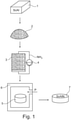
- a scandium aluminum (ScAl) alloy body 1 is provided. This ScAl body 1 is then pulverized, for example by grinding, into a powder 2 of scandium aluminium particles.
- the ScAl powder 2 is then fed to a fluidized bed reactor 3, in which ammonia (NH 3 ) is pumped by a pump 4, while maintaining the temperature at for example 500°C. This allows for the particles of the ScAl powder 2 to be nitridized into scandium aluminium nitride particles.
- a fluidized bed reactor 3 in which ammonia (NH 3 ) is pumped by a pump 4, while maintaining the temperature at for example 500°C.
- the nitridized particles are removed from the fluidized bed reactor 3 and arranged in a flexible mould 5, which is placed in a pressure vessel 6, which is supplied with a suitable pressure P, such that the mould 5 is subjected to an isostatic pressure.
- a suitable pressure P such that the mould 5 is subjected to an isostatic pressure.
- Figure 2A shows schematically a target body 10 according to the prior art with separate scandium nitride particles 11 and aluminum nitride particles 12. Due to the different type of particles 11, 12 voids 13 are present in the target body 10.
- FIG. 2B shows schematically a target body 20 produced with the method according to the invention.
- the target body 20 is composed out of a single type of particles 21, in particular scandium aluminum nitride particles.
- the density of the target body 20 is considerably higher than the prior art target body 10. This already improves the absorption of the laser beam 22, which generates the plasma plume 23.
- the laser beam 22 can more easily, more reliably and without generation of droplets transfer the target body material into a plasma plume 23.
Landscapes
- Chemical & Material Sciences (AREA)
- Engineering & Computer Science (AREA)
- Organic Chemistry (AREA)
- Materials Engineering (AREA)
- Ceramic Engineering (AREA)
- Mechanical Engineering (AREA)
- Metallurgy (AREA)
- Manufacturing & Machinery (AREA)
- Chemical Kinetics & Catalysis (AREA)
- Structural Engineering (AREA)
- Inorganic Chemistry (AREA)
- Health & Medical Sciences (AREA)
- Toxicology (AREA)
- Physics & Mathematics (AREA)
- Fluid Mechanics (AREA)
- Physical Vapour Deposition (AREA)
- Powder Metallurgy (AREA)
Abstract
- providing a scandium aluminum alloy body;
- pulverizing the scandium aluminum alloy body into scandium aluminum particles;
- nitridizing the scandium aluminum particles into scandium aluminium nitride particles;
- hot pressing the scandium aluminum nitride particles into a scandium aluminum nitride target body.
Description
- The invention relates to a method for producing a scandium aluminum nitride (ScAlN) target body for pulsed laser deposition (PLD).
- With PLD a film can be arranged on a substrate by irradiating a target material with a laser beam. Due to the high energy of the laser beam a plasma will be generated from the target material. This plasma is then deposited onto a substrate, such that a film of the target material is formed.
- Aluminium Nitride (AlN) is a well-known piezoelectric thin film material. The piezoelectric performance can be significantly improved by doping with Scandium as high as 50 at%. In particular a scandium aluminum nitride film is suitable as piezoelectric layers in acoustic filters for radiofrequency filter applications and in micro-electro-mechanical systems such as miniature microphones and ultrasound transducers.
- It is known to compose a target body by hot pressing a mixture of a powder of scandium nitride and a powder of aluminum nitride. Although the produced target body is not composed out of ScAlN, the film formed on a substrate by PLD will be ScAlN as during the plasma generation of the target material, the scandium nitride and aluminum nitride will mix in the plasma and deposit as a ScAlN film.
- However, the target body formed out of the mixture of a powder of scandium nitride and a powder of aluminum nitride results in difference in optical absorption of the laser in the PLD process. Furthermore, a mixture of both powders has a relative low density. This is caused by differences in the particle size of the two powders, which make it difficult to obtain a homogeneous mixture of the powders and which prevent the mixture to be compressed at high pressures. When the mixture is compressed at high pressure, the difference in particle size and thermal expansion of both powders will result in local stresses with cracks in the target body as result.
- If such a target body is used for prolonged time in a PLD process a shift in the composition of the ScAlN deposited film can occur because the scandium nitride particles may slightly behave differently when irradiated by a laser beam to generate a plasma than the aluminum nitride particles in the target body. The bandgap for optical absorption of scandium nitride in the target body is 2.0 eV, whereas the bandgap for aluminium nitride is 6.15 eV. The energy of an ultra-voilet laser used in a PLD process is typically between 4 to 6 eV. So clearly, the PLD process is therefore not efficient for a target body composed out of two different material, as the laser absorption is significantly different for both materials.A As a result many droplets will be ejected from the target body, which is undesired.
- It is an object of the invention to reduce or even remove the above mentioned disadvantages.
- This object is achieved according to the invention with a method according to the preamble, which method comprises the steps of:
- providing a scandium aluminum alloy body;
- pulverizing the scandium aluminum alloy body into scandium aluminum particles;
- nitridizing the scandium aluminum particles into scandium aluminium nitride particles;
- hot pressing the scandium aluminum nitride particles into a scandium aluminum nitrdte target body.
- With the method according to the invention scandium aluminum particles are converted into scandium aluminum nitride particles by the nitridizing process. As a single type of particles is then used to hot press a target body, it is possible to use higher pressure to obtain a target body of higher density compared to the prior art method in which a target body is hot pressed out of a mixture of two types of particles.
- The resulting target body is composed out of true scandium aluminium nitride. This single phase material will have one single bandgap. The exact bandgap depends on the amount of Scandium, but will certainly be lower than the energy of UV lasers for scandium doping up to 50 at%. As a result the UV laser absorption is highly efficient and a prolonged usage of the target body in a PLD process without droplet formation is obtained.
- In a preferred method according to the invention the nitridizing of the scandium aluminum particles comprises the step of feeding the scandium aluminum particles in a gas stream of nitrogen or ammonia (NH3), while maintaining a temperature of the gas and scandium aluminum particles mixture of over 500°C.
- By feeding the scandium aluminum particles to a gas stream of ammonia, a good contact between the scandium aluminum particles and the ammonia is obtained, which ensures a reliable transition of the particles into scandium aluminum nitride particles.
- In another preferred embodiment of the method according to the invention the scandium aluminum nitride particles are hot pressed in an isostatic hot press. An isostatic hot press allows to subject a pressure in all directions onto the particles. This allows for a more uniform density within the produced target body.
- With an isostatic hot press, the powder of scandium aluminum nitride particles is for example arranged in a flexible mould, which is then positioned within a pressure vessel, which is supplied with a pressurized fluid. The flexible mould is able to deform such that the pressurized fluid can act directly on the powder and compress the scandium aluminum nitride particles into a target body.
- Preferably, the scandium aluminum nitride particles are hot pressed at a pressure of over 90 MPa, preferably at a pressure of 150 - 250 MPa.
- It is furthermore preferred that the scandium aluminum nitride particles are hot pressed at a temperature of over 1600 degree C, preferably at a temperature of 1750 - 2200 degree C.
- This will result in a target body composed out of ScAlN having a high density and homogeneous particle distribution.
- In yet another embodiment of the method according to the invention the scandium aluminum alloy body is pulverized by grinding said body.
- In still a further embodiment of the method according to the invention after the pulverizing step the scandium aluminum particles have a particle size smaller than 10 micrometer, more preferably smaller than 1 micrometer.
- Such a particle size ensures that the nitridizing step of the scandium aluminum particles results in scandium aluminium nitride particles.
- In yet another embodiment of the method according to the invention the scandium aluminum nitride target body comprises at least 20 at% scandium.
- In still a further embodiment of the method according to the invention the scandium aluminum nitride particles are hot pressed into a scandium aluminum nitride target body with a relative density of above 80%, more preferably above 98%.
- With such a high density a good absorption of the laser beam of a PLD process is achieved allowing for a prolonged use of the target body in the PLD process to deposit a scandium aluminum nitride film on a substrate.
- These and other features of the invention are schematically shown in the accompanying drawings.
-
Figure 1 shows schematically the steps of an embodiment of the method according to the invention. -
Figure 2A and 2B show the difference between a target body according to the prior art and a target body produced with the method according to the invention in a PLD process. - In
figure 1 first a scandium aluminum (ScAl) alloy body 1 is provided. This ScAl body 1 is then pulverized, for example by grinding, into apowder 2 of scandium aluminium particles. - The
ScAl powder 2 is then fed to a fluidizedbed reactor 3, in which ammonia (NH3) is pumped by apump 4, while maintaining the temperature at for example 500°C. This allows for the particles of theScAl powder 2 to be nitridized into scandium aluminium nitride particles. - After a certain amount of time, the nitridized particles are removed from the fluidized
bed reactor 3 and arranged in aflexible mould 5, which is placed in apressure vessel 6, which is supplied with a suitable pressure P, such that themould 5 is subjected to an isostatic pressure. As a result the scandium aluminium nitride particles in themould 5 will be compressed into atarget body 7. -
Figure 2A shows schematically atarget body 10 according to the prior art with separatescandium nitride particles 11 andaluminum nitride particles 12. Due to the different type ofparticles voids 13 are present in thetarget body 10. - When such a prior
art target body 10 is irradiated with alaser beam 14 only part of the energy is absorbed by theparticles scandium nitride particles 11 will more easily be transferred into a plasma than thealuminum nitride particles 12, which tend to break loose from thetarget body 10 asundesired droplets 15. -
Figure 2B shows schematically atarget body 20 produced with the method according to the invention. Thetarget body 20 is composed out of a single type ofparticles 21, in particular scandium aluminum nitride particles. As a single type of particles can be better compressed into a target body, the density of thetarget body 20 is considerably higher than the priorart target body 10. This already improves the absorption of thelaser beam 22, which generates theplasma plume 23. - As scandium aluminum nitride has a bandgap lower than aluminum nitride, the
laser beam 22 can more easily, more reliably and without generation of droplets transfer the target body material into aplasma plume 23.
Claims (9)
- Method for producing a scandium aluminum nitride (ScAlN) target body for pulsed laser deposition (PLD), which method comprises the steps of:- providing a scandium aluminum alloy body;- pulverizing the scandium aluminum alloy body into scandium aluminum particles;- nitridizing the scandium aluminum particles into scandium aluminium nitride particles;- hot pressing the scandium aluminum nitride particles into a scandium aluminum nitride target body.
- Method according to claim 1, wherein the nitridizing of the scandium aluminum particles comprises the step of feeding the scandium aluminum particles in a gas stream of nitrogen or ammonia (NH3), while maintaining a temperature of the ammonia gas and scandium aluminum particles mixture of over 500°C.
- Method according to claim 1 or 2, wherein the scandium aluminum nitride particles are hot pressed in an isostatic hot press.
- Method according to any of the preceding claims, wherein the scandium aluminum nitride particles are hot pressed at a pressure of over 90 MPa, preferably at a pressure of 150 - 250 MPa.
- Method according to any of the preceding claims, wherein the scandium aluminum nitride particles are hot pressed at a temperature of over 1600 degree C, preferably at a temperature of 1750 - 2200 degree C.
- Method according to any of the preceding claims, wherein the scandium aluminum alloy body is pulverized by grinding said body.
- Method according to any of the preceding claims, wherein after the pulverizing step the scandium aluminum particles have a particle size smaller than 10 micrometer, more preferably smaller than 1 micrometer.
- Method according to any of the preceding claims, wherein the scandium aluminum nitride target body comprises at least 20 at% scandium.
- Method according to any of the preceding claims, wherein the scandium aluminum nitride particles are hot pressed into a scandium aluminum nitride target body with a relative density of above 80%, more preferably above 98%.
Priority Applications (7)
| Application Number | Priority Date | Filing Date | Title |
|---|---|---|---|
| EP20194369.3A EP3964603B1 (en) | 2020-09-03 | 2020-09-03 | Method for producing a scandium aluminum nitride target for pld |
| US17/411,140 US12018358B2 (en) | 2020-09-03 | 2021-08-25 | Method for manufacturing ScAIN target |
| TW110131524A TWI918702B (en) | 2020-09-03 | 2021-08-25 | Method for producing a scandium aluminum nitride target for pld |
| KR1020210115392A KR20220030900A (en) | 2020-09-03 | 2021-08-31 | Method for producing a scandium aluminum nitride target for pld |
| CN202111023279.1A CN114133249A (en) | 2020-09-03 | 2021-09-02 | Method for producing scandium-aluminum nitride target for PLD |
| JP2021143205A JP2022046440A (en) | 2020-09-03 | 2021-09-02 | Method of manufacturing scandium aluminum nitride target for pld |
| US18/747,743 US20240337006A1 (en) | 2020-09-03 | 2024-06-19 | Method for Manufacturing ScAlN Target |
Applications Claiming Priority (1)
| Application Number | Priority Date | Filing Date | Title |
|---|---|---|---|
| EP20194369.3A EP3964603B1 (en) | 2020-09-03 | 2020-09-03 | Method for producing a scandium aluminum nitride target for pld |
Publications (2)
| Publication Number | Publication Date |
|---|---|
| EP3964603A1 true EP3964603A1 (en) | 2022-03-09 |
| EP3964603B1 EP3964603B1 (en) | 2023-07-26 |
Family
ID=72355915
Family Applications (1)
| Application Number | Title | Priority Date | Filing Date |
|---|---|---|---|
| EP20194369.3A Active EP3964603B1 (en) | 2020-09-03 | 2020-09-03 | Method for producing a scandium aluminum nitride target for pld |
Country Status (5)
| Country | Link |
|---|---|
| US (2) | US12018358B2 (en) |
| EP (1) | EP3964603B1 (en) |
| JP (1) | JP2022046440A (en) |
| KR (1) | KR20220030900A (en) |
| CN (1) | CN114133249A (en) |
Families Citing this family (1)
| Publication number | Priority date | Publication date | Assignee | Title |
|---|---|---|---|---|
| CN115990669B (en) * | 2023-03-24 | 2023-06-27 | 湖南东方钪业股份有限公司 | Scandium-aluminum alloy powder for additive manufacturing and preparation method thereof |
Citations (2)
| Publication number | Priority date | Publication date | Assignee | Title |
|---|---|---|---|---|
| CN110562936A (en) * | 2019-10-13 | 2019-12-13 | 江西科泰新材料有限公司 | Aluminum scandium nitride material |
| CN111599915A (en) * | 2020-05-28 | 2020-08-28 | 重庆大学 | A kind of preparation method and product of high-performance aluminum nitride scandium based on seed layer structure |
Family Cites Families (8)
| Publication number | Priority date | Publication date | Assignee | Title |
|---|---|---|---|---|
| US7153586B2 (en) * | 2003-08-01 | 2006-12-26 | Vapor Technologies, Inc. | Article with scandium compound decorative coating |
| US20140246305A1 (en) * | 2010-01-22 | 2014-09-04 | Avago Technologies General Ip (Singapore) Pte. Ltd. | Method of fabricating rare-earth element doped piezoelectric material with various amounts of dopants and a selected c-axis orientation |
| JP6461543B2 (en) * | 2013-10-08 | 2019-01-30 | 株式会社フルヤ金属 | Alloy target of aluminum and rare earth element and method for producing the same |
| EP3467142B1 (en) * | 2016-06-07 | 2022-08-03 | JX Nippon Mining & Metals Corporation | Sputtering target and production method therefor |
| JP7151096B2 (en) * | 2018-02-21 | 2022-10-12 | 株式会社デンソー | Piezoelectric film, manufacturing method thereof, piezoelectric film laminate, manufacturing method thereof |
| CN208368511U (en) * | 2018-06-15 | 2019-01-11 | 苏州汉骅半导体有限公司 | Semiconductor devices |
| GB201815216D0 (en) * | 2018-09-18 | 2018-10-31 | Spts Technologies Ltd | Apparatus and a method of controlling thickness variation in a material layer formed using physical vapour deposition |
| JP7369046B2 (en) * | 2020-01-30 | 2023-10-25 | 株式会社アルバック | Method for manufacturing scandium aluminum nitride powder and method for manufacturing target |
-
2020
- 2020-09-03 EP EP20194369.3A patent/EP3964603B1/en active Active
-
2021
- 2021-08-25 US US17/411,140 patent/US12018358B2/en active Active
- 2021-08-31 KR KR1020210115392A patent/KR20220030900A/en active Pending
- 2021-09-02 CN CN202111023279.1A patent/CN114133249A/en active Pending
- 2021-09-02 JP JP2021143205A patent/JP2022046440A/en active Pending
-
2024
- 2024-06-19 US US18/747,743 patent/US20240337006A1/en active Pending
Patent Citations (2)
| Publication number | Priority date | Publication date | Assignee | Title |
|---|---|---|---|---|
| CN110562936A (en) * | 2019-10-13 | 2019-12-13 | 江西科泰新材料有限公司 | Aluminum scandium nitride material |
| CN111599915A (en) * | 2020-05-28 | 2020-08-28 | 重庆大学 | A kind of preparation method and product of high-performance aluminum nitride scandium based on seed layer structure |
Also Published As
| Publication number | Publication date |
|---|---|
| KR20220030900A (en) | 2022-03-11 |
| US12018358B2 (en) | 2024-06-25 |
| EP3964603B1 (en) | 2023-07-26 |
| US20240337006A1 (en) | 2024-10-10 |
| CN114133249A (en) | 2022-03-04 |
| JP2022046440A (en) | 2022-03-23 |
| TW202210410A (en) | 2022-03-16 |
| US20220064782A1 (en) | 2022-03-03 |
Similar Documents
| Publication | Publication Date | Title |
|---|---|---|
| Rabinskiy et al. | Fabrication of porous silicon nitride ceramics using binder jetting technology | |
| US20240337006A1 (en) | Method for Manufacturing ScAlN Target | |
| JP2018508393A (en) | Reactive additive manufacturing | |
| KR102473123B1 (en) | Structure, laminate thereof, manufacturing method and manufacturing apparatus therefor | |
| JP4182205B2 (en) | Method for changing crystal structure of group 13 nitride | |
| US20080236738A1 (en) | Bonded sputtering target and methods of manufacture | |
| Seal et al. | Manufacturing nanocomposite parts: present status and future challenges | |
| WO2022034810A1 (en) | Laminate for circuit board | |
| WO2021173968A1 (en) | Methods to create structures with engineered internal features, pores, and/or connected channels utilizing cold spray particle deposition | |
| CN109482881A (en) | A kind of selective laser sintering preparation SiC/Al composite material structural member method | |
| TWI918702B (en) | Method for producing a scandium aluminum nitride target for pld | |
| US4844323A (en) | Method for joining ceramics | |
| JP2007522063A (en) | Sinterable nano-powder ceramic material and manufacturing method thereof | |
| JP2821081B2 (en) | Method for producing multi-component powder laminate | |
| KR101336755B1 (en) | Thin film coating method of hard metal | |
| JP7267086B2 (en) | Sputtering target manufacturing method | |
| JP4626829B2 (en) | Method for producing porous composite structure and porous fine particles used for the production | |
| US6982070B2 (en) | Process for synthesizing spinel type silicon nitride powders | |
| JP2005089826A (en) | Composite structure production device | |
| RU2707307C1 (en) | Method of forming semi-finished articles of complex shape from silicon powder | |
| JPH04331798A (en) | Method of forming diamond film | |
| JP4405038B2 (en) | Method for producing porous sintered compact | |
| JP2018059145A (en) | Aerosol film forming apparatus and aerosol film forming method | |
| US7179718B2 (en) | Structure and method of manufacturing the same | |
| US20260048438A1 (en) | Methods of forming three-dimensional structures by additive manufacturing |
Legal Events
| Date | Code | Title | Description |
|---|---|---|---|
| PUAI | Public reference made under article 153(3) epc to a published international application that has entered the european phase |
Free format text: ORIGINAL CODE: 0009012 |
|
| STAA | Information on the status of an ep patent application or granted ep patent |
Free format text: STATUS: THE APPLICATION HAS BEEN PUBLISHED |
|
| AK | Designated contracting states |
Kind code of ref document: A1 Designated state(s): AL AT BE BG CH CY CZ DE DK EE ES FI FR GB GR HR HU IE IS IT LI LT LU LV MC MK MT NL NO PL PT RO RS SE SI SK SM TR |
|
| STAA | Information on the status of an ep patent application or granted ep patent |
Free format text: STATUS: REQUEST FOR EXAMINATION WAS MADE |
|
| 17P | Request for examination filed |
Effective date: 20220908 |
|
| RBV | Designated contracting states (corrected) |
Designated state(s): AL AT BE BG CH CY CZ DE DK EE ES FI FR GB GR HR HU IE IS IT LI LT LU LV MC MK MT NL NO PL PT RO RS SE SI SK SM TR |
|
| RAP1 | Party data changed (applicant data changed or rights of an application transferred) |
Owner name: LAM RESEARCH CORPORATION |
|
| GRAP | Despatch of communication of intention to grant a patent |
Free format text: ORIGINAL CODE: EPIDOSNIGR1 |
|
| STAA | Information on the status of an ep patent application or granted ep patent |
Free format text: STATUS: GRANT OF PATENT IS INTENDED |
|
| RIC1 | Information provided on ipc code assigned before grant |
Ipc: C04B 35/645 20060101ALI20230117BHEP Ipc: C04B 35/626 20060101ALI20230117BHEP Ipc: C04B 35/581 20060101ALI20230117BHEP Ipc: C23C 14/28 20060101ALI20230117BHEP Ipc: C23C 14/06 20060101AFI20230117BHEP |
|
| INTG | Intention to grant announced |
Effective date: 20230213 |
|
| GRAS | Grant fee paid |
Free format text: ORIGINAL CODE: EPIDOSNIGR3 |
|
| GRAA | (expected) grant |
Free format text: ORIGINAL CODE: 0009210 |
|
| STAA | Information on the status of an ep patent application or granted ep patent |
Free format text: STATUS: THE PATENT HAS BEEN GRANTED |
|
| AK | Designated contracting states |
Kind code of ref document: B1 Designated state(s): AL AT BE BG CH CY CZ DE DK EE ES FI FR GB GR HR HU IE IS IT LI LT LU LV MC MK MT NL NO PL PT RO RS SE SI SK SM TR |
|
| REG | Reference to a national code |
Ref country code: CH Ref legal event code: EP |
|
| REG | Reference to a national code |
Ref country code: DE Ref legal event code: R096 Ref document number: 602020014346 Country of ref document: DE |
|
| REG | Reference to a national code |
Ref country code: IE Ref legal event code: FG4D |
|
| REG | Reference to a national code |
Ref country code: LT Ref legal event code: MG9D |
|
| P01 | Opt-out of the competence of the unified patent court (upc) registered |
Effective date: 20231021 |
|
| REG | Reference to a national code |
Ref country code: NL Ref legal event code: MP Effective date: 20230726 |
|
| REG | Reference to a national code |
Ref country code: AT Ref legal event code: MK05 Ref document number: 1591994 Country of ref document: AT Kind code of ref document: T Effective date: 20230726 |
|
| PG25 | Lapsed in a contracting state [announced via postgrant information from national office to epo] |
Ref country code: NL Free format text: LAPSE BECAUSE OF FAILURE TO SUBMIT A TRANSLATION OF THE DESCRIPTION OR TO PAY THE FEE WITHIN THE PRESCRIBED TIME-LIMIT Effective date: 20230726 |
|
| PG25 | Lapsed in a contracting state [announced via postgrant information from national office to epo] |
Ref country code: GR Free format text: LAPSE BECAUSE OF FAILURE TO SUBMIT A TRANSLATION OF THE DESCRIPTION OR TO PAY THE FEE WITHIN THE PRESCRIBED TIME-LIMIT Effective date: 20231027 |
|
| PG25 | Lapsed in a contracting state [announced via postgrant information from national office to epo] |
Ref country code: IS Free format text: LAPSE BECAUSE OF FAILURE TO SUBMIT A TRANSLATION OF THE DESCRIPTION OR TO PAY THE FEE WITHIN THE PRESCRIBED TIME-LIMIT Effective date: 20231126 |
|
| PG25 | Lapsed in a contracting state [announced via postgrant information from national office to epo] |
Ref country code: SE Free format text: LAPSE BECAUSE OF FAILURE TO SUBMIT A TRANSLATION OF THE DESCRIPTION OR TO PAY THE FEE WITHIN THE PRESCRIBED TIME-LIMIT Effective date: 20230726 Ref country code: RS Free format text: LAPSE BECAUSE OF FAILURE TO SUBMIT A TRANSLATION OF THE DESCRIPTION OR TO PAY THE FEE WITHIN THE PRESCRIBED TIME-LIMIT Effective date: 20230726 Ref country code: PT Free format text: LAPSE BECAUSE OF FAILURE TO SUBMIT A TRANSLATION OF THE DESCRIPTION OR TO PAY THE FEE WITHIN THE PRESCRIBED TIME-LIMIT Effective date: 20231127 Ref country code: NO Free format text: LAPSE BECAUSE OF FAILURE TO SUBMIT A TRANSLATION OF THE DESCRIPTION OR TO PAY THE FEE WITHIN THE PRESCRIBED TIME-LIMIT Effective date: 20231026 Ref country code: LV Free format text: LAPSE BECAUSE OF FAILURE TO SUBMIT A TRANSLATION OF THE DESCRIPTION OR TO PAY THE FEE WITHIN THE PRESCRIBED TIME-LIMIT Effective date: 20230726 Ref country code: LT Free format text: LAPSE BECAUSE OF FAILURE TO SUBMIT A TRANSLATION OF THE DESCRIPTION OR TO PAY THE FEE WITHIN THE PRESCRIBED TIME-LIMIT Effective date: 20230726 Ref country code: IS Free format text: LAPSE BECAUSE OF FAILURE TO SUBMIT A TRANSLATION OF THE DESCRIPTION OR TO PAY THE FEE WITHIN THE PRESCRIBED TIME-LIMIT Effective date: 20231126 Ref country code: HR Free format text: LAPSE BECAUSE OF FAILURE TO SUBMIT A TRANSLATION OF THE DESCRIPTION OR TO PAY THE FEE WITHIN THE PRESCRIBED TIME-LIMIT Effective date: 20230726 Ref country code: GR Free format text: LAPSE BECAUSE OF FAILURE TO SUBMIT A TRANSLATION OF THE DESCRIPTION OR TO PAY THE FEE WITHIN THE PRESCRIBED TIME-LIMIT Effective date: 20231027 Ref country code: FI Free format text: LAPSE BECAUSE OF FAILURE TO SUBMIT A TRANSLATION OF THE DESCRIPTION OR TO PAY THE FEE WITHIN THE PRESCRIBED TIME-LIMIT Effective date: 20230726 Ref country code: AT Free format text: LAPSE BECAUSE OF FAILURE TO SUBMIT A TRANSLATION OF THE DESCRIPTION OR TO PAY THE FEE WITHIN THE PRESCRIBED TIME-LIMIT Effective date: 20230726 |
|
| PG25 | Lapsed in a contracting state [announced via postgrant information from national office to epo] |
Ref country code: PL Free format text: LAPSE BECAUSE OF FAILURE TO SUBMIT A TRANSLATION OF THE DESCRIPTION OR TO PAY THE FEE WITHIN THE PRESCRIBED TIME-LIMIT Effective date: 20230726 |
|
| PG25 | Lapsed in a contracting state [announced via postgrant information from national office to epo] |
Ref country code: ES Free format text: LAPSE BECAUSE OF FAILURE TO SUBMIT A TRANSLATION OF THE DESCRIPTION OR TO PAY THE FEE WITHIN THE PRESCRIBED TIME-LIMIT Effective date: 20230726 |
|
| REG | Reference to a national code |
Ref country code: DE Ref legal event code: R097 Ref document number: 602020014346 Country of ref document: DE |
|
| PG25 | Lapsed in a contracting state [announced via postgrant information from national office to epo] |
Ref country code: SM Free format text: LAPSE BECAUSE OF FAILURE TO SUBMIT A TRANSLATION OF THE DESCRIPTION OR TO PAY THE FEE WITHIN THE PRESCRIBED TIME-LIMIT Effective date: 20230726 Ref country code: RO Free format text: LAPSE BECAUSE OF FAILURE TO SUBMIT A TRANSLATION OF THE DESCRIPTION OR TO PAY THE FEE WITHIN THE PRESCRIBED TIME-LIMIT Effective date: 20230726 Ref country code: ES Free format text: LAPSE BECAUSE OF FAILURE TO SUBMIT A TRANSLATION OF THE DESCRIPTION OR TO PAY THE FEE WITHIN THE PRESCRIBED TIME-LIMIT Effective date: 20230726 Ref country code: EE Free format text: LAPSE BECAUSE OF FAILURE TO SUBMIT A TRANSLATION OF THE DESCRIPTION OR TO PAY THE FEE WITHIN THE PRESCRIBED TIME-LIMIT Effective date: 20230726 Ref country code: DK Free format text: LAPSE BECAUSE OF FAILURE TO SUBMIT A TRANSLATION OF THE DESCRIPTION OR TO PAY THE FEE WITHIN THE PRESCRIBED TIME-LIMIT Effective date: 20230726 Ref country code: CZ Free format text: LAPSE BECAUSE OF FAILURE TO SUBMIT A TRANSLATION OF THE DESCRIPTION OR TO PAY THE FEE WITHIN THE PRESCRIBED TIME-LIMIT Effective date: 20230726 Ref country code: SK Free format text: LAPSE BECAUSE OF FAILURE TO SUBMIT A TRANSLATION OF THE DESCRIPTION OR TO PAY THE FEE WITHIN THE PRESCRIBED TIME-LIMIT Effective date: 20230726 |
|
| REG | Reference to a national code |
Ref country code: CH Ref legal event code: PL |
|
| PG25 | Lapsed in a contracting state [announced via postgrant information from national office to epo] |
Ref country code: LU Free format text: LAPSE BECAUSE OF NON-PAYMENT OF DUE FEES Effective date: 20230903 |
|
| REG | Reference to a national code |
Ref country code: BE Ref legal event code: MM Effective date: 20230930 |
|
| PG25 | Lapsed in a contracting state [announced via postgrant information from national office to epo] |
Ref country code: IT Free format text: LAPSE BECAUSE OF FAILURE TO SUBMIT A TRANSLATION OF THE DESCRIPTION OR TO PAY THE FEE WITHIN THE PRESCRIBED TIME-LIMIT Effective date: 20230726 Ref country code: LU Free format text: LAPSE BECAUSE OF NON-PAYMENT OF DUE FEES Effective date: 20230903 Ref country code: MC Free format text: LAPSE BECAUSE OF FAILURE TO SUBMIT A TRANSLATION OF THE DESCRIPTION OR TO PAY THE FEE WITHIN THE PRESCRIBED TIME-LIMIT Effective date: 20230726 |
|
| PLBE | No opposition filed within time limit |
Free format text: ORIGINAL CODE: 0009261 |
|
| STAA | Information on the status of an ep patent application or granted ep patent |
Free format text: STATUS: NO OPPOSITION FILED WITHIN TIME LIMIT |
|
| 26N | No opposition filed |
Effective date: 20240429 |
|
| REG | Reference to a national code |
Ref country code: IE Ref legal event code: MM4A |
|
| PG25 | Lapsed in a contracting state [announced via postgrant information from national office to epo] |
Ref country code: IE Free format text: LAPSE BECAUSE OF NON-PAYMENT OF DUE FEES Effective date: 20230903 |
|
| PG25 | Lapsed in a contracting state [announced via postgrant information from national office to epo] |
Ref country code: CH Free format text: LAPSE BECAUSE OF NON-PAYMENT OF DUE FEES Effective date: 20230930 |
|
| PG25 | Lapsed in a contracting state [announced via postgrant information from national office to epo] |
Ref country code: IE Free format text: LAPSE BECAUSE OF NON-PAYMENT OF DUE FEES Effective date: 20230903 Ref country code: FR Free format text: LAPSE BECAUSE OF NON-PAYMENT OF DUE FEES Effective date: 20230926 Ref country code: CH Free format text: LAPSE BECAUSE OF NON-PAYMENT OF DUE FEES Effective date: 20230930 Ref country code: SI Free format text: LAPSE BECAUSE OF FAILURE TO SUBMIT A TRANSLATION OF THE DESCRIPTION OR TO PAY THE FEE WITHIN THE PRESCRIBED TIME-LIMIT Effective date: 20230726 |
|
| PG25 | Lapsed in a contracting state [announced via postgrant information from national office to epo] |
Ref country code: BE Free format text: LAPSE BECAUSE OF NON-PAYMENT OF DUE FEES Effective date: 20230930 |
|
| PG25 | Lapsed in a contracting state [announced via postgrant information from national office to epo] |
Ref country code: BG Free format text: LAPSE BECAUSE OF FAILURE TO SUBMIT A TRANSLATION OF THE DESCRIPTION OR TO PAY THE FEE WITHIN THE PRESCRIBED TIME-LIMIT Effective date: 20230726 |
|
| PG25 | Lapsed in a contracting state [announced via postgrant information from national office to epo] |
Ref country code: BG Free format text: LAPSE BECAUSE OF FAILURE TO SUBMIT A TRANSLATION OF THE DESCRIPTION OR TO PAY THE FEE WITHIN THE PRESCRIBED TIME-LIMIT Effective date: 20230726 |
|
| GBPC | Gb: european patent ceased through non-payment of renewal fee |
Effective date: 20240903 |
|
| PG25 | Lapsed in a contracting state [announced via postgrant information from national office to epo] |
Ref country code: GB Free format text: LAPSE BECAUSE OF NON-PAYMENT OF DUE FEES Effective date: 20240903 |
|
| PG25 | Lapsed in a contracting state [announced via postgrant information from national office to epo] |
Ref country code: CY Free format text: LAPSE BECAUSE OF FAILURE TO SUBMIT A TRANSLATION OF THE DESCRIPTION OR TO PAY THE FEE WITHIN THE PRESCRIBED TIME-LIMIT; INVALID AB INITIO Effective date: 20200903 |
|
| PG25 | Lapsed in a contracting state [announced via postgrant information from national office to epo] |
Ref country code: HU Free format text: LAPSE BECAUSE OF FAILURE TO SUBMIT A TRANSLATION OF THE DESCRIPTION OR TO PAY THE FEE WITHIN THE PRESCRIBED TIME-LIMIT; INVALID AB INITIO Effective date: 20200903 |
|
| PGFP | Annual fee paid to national office [announced via postgrant information from national office to epo] |
Ref country code: DE Payment date: 20250929 Year of fee payment: 6 |
|
| PG25 | Lapsed in a contracting state [announced via postgrant information from national office to epo] |
Ref country code: TR Free format text: LAPSE BECAUSE OF FAILURE TO SUBMIT A TRANSLATION OF THE DESCRIPTION OR TO PAY THE FEE WITHIN THE PRESCRIBED TIME-LIMIT Effective date: 20230726 |