EP3950425B1 - Holding structure for cylinder trailers - Google Patents
Holding structure for cylinder trailers Download PDFInfo
- Publication number
- EP3950425B1 EP3950425B1 EP20189977.0A EP20189977A EP3950425B1 EP 3950425 B1 EP3950425 B1 EP 3950425B1 EP 20189977 A EP20189977 A EP 20189977A EP 3950425 B1 EP3950425 B1 EP 3950425B1
- Authority
- EP
- European Patent Office
- Prior art keywords
- holding
- ogival
- travel
- cylinder
- holding structure
- Prior art date
- Legal status (The legal status is an assumption and is not a legal conclusion. Google has not performed a legal analysis and makes no representation as to the accuracy of the status listed.)
- Active
Links
Images





Classifications
-
- B—PERFORMING OPERATIONS; TRANSPORTING
- B60—VEHICLES IN GENERAL
- B60P—VEHICLES ADAPTED FOR LOAD TRANSPORTATION OR TO TRANSPORT, TO CARRY, OR TO COMPRISE SPECIAL LOADS OR OBJECTS
- B60P3/00—Vehicles adapted to transport, to carry or to comprise special loads or objects
- B60P3/055—Vehicles adapted to transport, to carry or to comprise special loads or objects for transporting bottles
-
- B—PERFORMING OPERATIONS; TRANSPORTING
- B60—VEHICLES IN GENERAL
- B60P—VEHICLES ADAPTED FOR LOAD TRANSPORTATION OR TO TRANSPORT, TO CARRY, OR TO COMPRISE SPECIAL LOADS OR OBJECTS
- B60P7/00—Securing or covering of load on vehicles
- B60P7/06—Securing of load
- B60P7/08—Securing to the vehicle floor or sides
- B60P7/12—Securing to the vehicle floor or sides the load being tree-trunks, beams, drums, tubes, or the like
-
- F—MECHANICAL ENGINEERING; LIGHTING; HEATING; WEAPONS; BLASTING
- F17—STORING OR DISTRIBUTING GASES OR LIQUIDS
- F17C—VESSELS FOR CONTAINING OR STORING COMPRESSED, LIQUEFIED OR SOLIDIFIED GASES; FIXED-CAPACITY GAS-HOLDERS; FILLING VESSELS WITH, OR DISCHARGING FROM VESSELS, COMPRESSED, LIQUEFIED, OR SOLIDIFIED GASES
- F17C13/00—Details of vessels or of the filling or discharging of vessels
- F17C13/08—Mounting arrangements for vessels
- F17C13/083—Mounting arrangements for vessels for medium-sized mobile storage vessels, e.g. tank vehicles or railway tank vehicles
-
- F—MECHANICAL ENGINEERING; LIGHTING; HEATING; WEAPONS; BLASTING
- F17—STORING OR DISTRIBUTING GASES OR LIQUIDS
- F17C—VESSELS FOR CONTAINING OR STORING COMPRESSED, LIQUEFIED OR SOLIDIFIED GASES; FIXED-CAPACITY GAS-HOLDERS; FILLING VESSELS WITH, OR DISCHARGING FROM VESSELS, COMPRESSED, LIQUEFIED, OR SOLIDIFIED GASES
- F17C2201/00—Vessel construction, in particular geometry, arrangement or size
- F17C2201/01—Shape
- F17C2201/0104—Shape cylindrical
-
- F—MECHANICAL ENGINEERING; LIGHTING; HEATING; WEAPONS; BLASTING
- F17—STORING OR DISTRIBUTING GASES OR LIQUIDS
- F17C—VESSELS FOR CONTAINING OR STORING COMPRESSED, LIQUEFIED OR SOLIDIFIED GASES; FIXED-CAPACITY GAS-HOLDERS; FILLING VESSELS WITH, OR DISCHARGING FROM VESSELS, COMPRESSED, LIQUEFIED, OR SOLIDIFIED GASES
- F17C2201/00—Vessel construction, in particular geometry, arrangement or size
- F17C2201/03—Orientation
- F17C2201/035—Orientation with substantially horizontal main axis
-
- F—MECHANICAL ENGINEERING; LIGHTING; HEATING; WEAPONS; BLASTING
- F17—STORING OR DISTRIBUTING GASES OR LIQUIDS
- F17C—VESSELS FOR CONTAINING OR STORING COMPRESSED, LIQUEFIED OR SOLIDIFIED GASES; FIXED-CAPACITY GAS-HOLDERS; FILLING VESSELS WITH, OR DISCHARGING FROM VESSELS, COMPRESSED, LIQUEFIED, OR SOLIDIFIED GASES
- F17C2201/00—Vessel construction, in particular geometry, arrangement or size
- F17C2201/05—Size
- F17C2201/054—Size medium (>1 m3)
-
- F—MECHANICAL ENGINEERING; LIGHTING; HEATING; WEAPONS; BLASTING
- F17—STORING OR DISTRIBUTING GASES OR LIQUIDS
- F17C—VESSELS FOR CONTAINING OR STORING COMPRESSED, LIQUEFIED OR SOLIDIFIED GASES; FIXED-CAPACITY GAS-HOLDERS; FILLING VESSELS WITH, OR DISCHARGING FROM VESSELS, COMPRESSED, LIQUEFIED, OR SOLIDIFIED GASES
- F17C2205/00—Vessel construction, in particular mounting arrangements, attachments or identifications means
- F17C2205/01—Mounting arrangements
- F17C2205/0103—Exterior arrangements
- F17C2205/0107—Frames
-
- F—MECHANICAL ENGINEERING; LIGHTING; HEATING; WEAPONS; BLASTING
- F17—STORING OR DISTRIBUTING GASES OR LIQUIDS
- F17C—VESSELS FOR CONTAINING OR STORING COMPRESSED, LIQUEFIED OR SOLIDIFIED GASES; FIXED-CAPACITY GAS-HOLDERS; FILLING VESSELS WITH, OR DISCHARGING FROM VESSELS, COMPRESSED, LIQUEFIED, OR SOLIDIFIED GASES
- F17C2205/00—Vessel construction, in particular mounting arrangements, attachments or identifications means
- F17C2205/01—Mounting arrangements
- F17C2205/0123—Mounting arrangements characterised by number of vessels
- F17C2205/013—Two or more vessels
-
- F—MECHANICAL ENGINEERING; LIGHTING; HEATING; WEAPONS; BLASTING
- F17—STORING OR DISTRIBUTING GASES OR LIQUIDS
- F17C—VESSELS FOR CONTAINING OR STORING COMPRESSED, LIQUEFIED OR SOLIDIFIED GASES; FIXED-CAPACITY GAS-HOLDERS; FILLING VESSELS WITH, OR DISCHARGING FROM VESSELS, COMPRESSED, LIQUEFIED, OR SOLIDIFIED GASES
- F17C2205/00—Vessel construction, in particular mounting arrangements, attachments or identifications means
- F17C2205/01—Mounting arrangements
- F17C2205/0153—Details of mounting arrangements
- F17C2205/0157—Details of mounting arrangements for transport
-
- F—MECHANICAL ENGINEERING; LIGHTING; HEATING; WEAPONS; BLASTING
- F17—STORING OR DISTRIBUTING GASES OR LIQUIDS
- F17C—VESSELS FOR CONTAINING OR STORING COMPRESSED, LIQUEFIED OR SOLIDIFIED GASES; FIXED-CAPACITY GAS-HOLDERS; FILLING VESSELS WITH, OR DISCHARGING FROM VESSELS, COMPRESSED, LIQUEFIED, OR SOLIDIFIED GASES
- F17C2205/00—Vessel construction, in particular mounting arrangements, attachments or identifications means
- F17C2205/01—Mounting arrangements
- F17C2205/0153—Details of mounting arrangements
- F17C2205/0192—Details of mounting arrangements with external bearing means
-
- F—MECHANICAL ENGINEERING; LIGHTING; HEATING; WEAPONS; BLASTING
- F17—STORING OR DISTRIBUTING GASES OR LIQUIDS
- F17C—VESSELS FOR CONTAINING OR STORING COMPRESSED, LIQUEFIED OR SOLIDIFIED GASES; FIXED-CAPACITY GAS-HOLDERS; FILLING VESSELS WITH, OR DISCHARGING FROM VESSELS, COMPRESSED, LIQUEFIED, OR SOLIDIFIED GASES
- F17C2221/00—Handled fluid, in particular type of fluid
- F17C2221/01—Pure fluids
- F17C2221/011—Oxygen
-
- F—MECHANICAL ENGINEERING; LIGHTING; HEATING; WEAPONS; BLASTING
- F17—STORING OR DISTRIBUTING GASES OR LIQUIDS
- F17C—VESSELS FOR CONTAINING OR STORING COMPRESSED, LIQUEFIED OR SOLIDIFIED GASES; FIXED-CAPACITY GAS-HOLDERS; FILLING VESSELS WITH, OR DISCHARGING FROM VESSELS, COMPRESSED, LIQUEFIED, OR SOLIDIFIED GASES
- F17C2221/00—Handled fluid, in particular type of fluid
- F17C2221/01—Pure fluids
- F17C2221/012—Hydrogen
-
- F—MECHANICAL ENGINEERING; LIGHTING; HEATING; WEAPONS; BLASTING
- F17—STORING OR DISTRIBUTING GASES OR LIQUIDS
- F17C—VESSELS FOR CONTAINING OR STORING COMPRESSED, LIQUEFIED OR SOLIDIFIED GASES; FIXED-CAPACITY GAS-HOLDERS; FILLING VESSELS WITH, OR DISCHARGING FROM VESSELS, COMPRESSED, LIQUEFIED, OR SOLIDIFIED GASES
- F17C2221/00—Handled fluid, in particular type of fluid
- F17C2221/03—Mixtures
- F17C2221/032—Hydrocarbons
- F17C2221/033—Methane, e.g. natural gas, CNG, LNG, GNL, GNC, PLNG
-
- F—MECHANICAL ENGINEERING; LIGHTING; HEATING; WEAPONS; BLASTING
- F17—STORING OR DISTRIBUTING GASES OR LIQUIDS
- F17C—VESSELS FOR CONTAINING OR STORING COMPRESSED, LIQUEFIED OR SOLIDIFIED GASES; FIXED-CAPACITY GAS-HOLDERS; FILLING VESSELS WITH, OR DISCHARGING FROM VESSELS, COMPRESSED, LIQUEFIED, OR SOLIDIFIED GASES
- F17C2223/00—Handled fluid before transfer, i.e. state of fluid when stored in the vessel or before transfer from the vessel
- F17C2223/01—Handled fluid before transfer, i.e. state of fluid when stored in the vessel or before transfer from the vessel characterised by the phase
- F17C2223/0107—Single phase
- F17C2223/0123—Single phase gaseous, e.g. CNG, GNC
-
- F—MECHANICAL ENGINEERING; LIGHTING; HEATING; WEAPONS; BLASTING
- F17—STORING OR DISTRIBUTING GASES OR LIQUIDS
- F17C—VESSELS FOR CONTAINING OR STORING COMPRESSED, LIQUEFIED OR SOLIDIFIED GASES; FIXED-CAPACITY GAS-HOLDERS; FILLING VESSELS WITH, OR DISCHARGING FROM VESSELS, COMPRESSED, LIQUEFIED, OR SOLIDIFIED GASES
- F17C2223/00—Handled fluid before transfer, i.e. state of fluid when stored in the vessel or before transfer from the vessel
- F17C2223/03—Handled fluid before transfer, i.e. state of fluid when stored in the vessel or before transfer from the vessel characterised by the pressure level
- F17C2223/035—High pressure (>10 bar)
-
- F—MECHANICAL ENGINEERING; LIGHTING; HEATING; WEAPONS; BLASTING
- F17—STORING OR DISTRIBUTING GASES OR LIQUIDS
- F17C—VESSELS FOR CONTAINING OR STORING COMPRESSED, LIQUEFIED OR SOLIDIFIED GASES; FIXED-CAPACITY GAS-HOLDERS; FILLING VESSELS WITH, OR DISCHARGING FROM VESSELS, COMPRESSED, LIQUEFIED, OR SOLIDIFIED GASES
- F17C2270/00—Applications
- F17C2270/01—Applications for fluid transport or storage
- F17C2270/0165—Applications for fluid transport or storage on the road
- F17C2270/0168—Applications for fluid transport or storage on the road by vehicles
- F17C2270/0171—Trucks
-
- Y—GENERAL TAGGING OF NEW TECHNOLOGICAL DEVELOPMENTS; GENERAL TAGGING OF CROSS-SECTIONAL TECHNOLOGIES SPANNING OVER SEVERAL SECTIONS OF THE IPC; TECHNICAL SUBJECTS COVERED BY FORMER USPC CROSS-REFERENCE ART COLLECTIONS [XRACs] AND DIGESTS
- Y02—TECHNOLOGIES OR APPLICATIONS FOR MITIGATION OR ADAPTATION AGAINST CLIMATE CHANGE
- Y02E—REDUCTION OF GREENHOUSE GAS [GHG] EMISSIONS, RELATED TO ENERGY GENERATION, TRANSMISSION OR DISTRIBUTION
- Y02E60/00—Enabling technologies; Technologies with a potential or indirect contribution to GHG emissions mitigation
- Y02E60/30—Hydrogen technology
- Y02E60/32—Hydrogen storage
Definitions
- the present invention relates to a holding structure for cylinder trailers.
- the cylinder trailer by definition according to ADR (European Agreement concerning the international carriage of Dangerous goods by Road), is a battery-vehicle provided with a plurality of storage tanks connected to each other by a collector.
- ADR European Agreement concerning the international carriage of Dangerous goods by Road
- the cylinder trailer comprises a supporting surface, on which the storage tanks are fixed in a stable manner, and movement means, such as e.g. wheels, associated with the supporting surface itself.
- the cylinder trailer is intended to transport a plurality of storage tanks of a fluid along at least one direction of travel.
- the cylinder trailer is associable with a driving cab intended to move it along the direction of travel.
- Each of the storage tanks is of the type, e.g., of a gas cylinder under pressure and the fluid may be of the type of natural gas, hydrogen, oxygen or other types of gas.
- the cylinder trailer is generally used to transport the fluid to supply additional storage tanks or, in the case of natural gas, to feed areas not supplied by the national distribution network or in an emergency situation.
- the storage tank generally contains a volume of fluid comprised between 40 and 5000 liters, at a pressure comprised between 200 and 300 bar.
- the storage tank comprises at least one main body of elongated conformation, extending along a corresponding longitudinal axis and at least one pair of fittings to take the fluid, arranged at the ends of the main body.
- the main body is provided with a central portion having a substantially cylindrical shape and with a pair of ogival portions, typically ellipsoidal oblate or spheroidal in shape, associated with the ends of the central portion.
- the storage tanks are arranged on the cylinder trailer so that the corresponding longitudinal axes are substantially parallel to the supporting surface and to the direction of travel.
- Each storage tank therefore, comprises a first ogival portion positioned behind the cylinder trailer with respect to the direction of travel and a second ogival portion positioned in front of the cylinder trailer with respect to the direction of travel.
- the fittings are associated with the ogival portions and, in particular, a first fitting is associated with the first ogival portion and a second fitting is associated with the second ogival portion.
- first fittings are arranged behind the cylinder trailer and the second fittings are arranged in front of the cylinder trailer itself.
- the first fittings can be connected to a collector system, not shown in the figures, which is adapted to convey the inlet and/or outlet fluid flows from the first fittings themselves and to transfer them to other means of fluid treatment/storage, of the type e.g. of reduction and measurement cabins or storage depots, such as e.g. tank pipes.
- a collector system not shown in the figures, which is adapted to convey the inlet and/or outlet fluid flows from the first fittings themselves and to transfer them to other means of fluid treatment/storage, of the type e.g. of reduction and measurement cabins or storage depots, such as e.g. tank pipes.
- the cylinder trailer is also provided with anchoring means, of the type e.g. of saddles, which are adapted to support the storage tanks and to prevent these from moving along at least one direction transverse to the direction of travel.
- anchoring means of the type e.g. of saddles, which are adapted to support the storage tanks and to prevent these from moving along at least one direction transverse to the direction of travel.
- the anchoring means of known type are not shaped in such a way as to effectively prevent the storage tanks from sliding along a direction parallel to the direction of travel.
- the cylinder trailers of known type are provided with holding means, of the type of a metal plate, which are positioned in front of the cylinder trailer itself and that abut against the front ogival part of the tanks, thus preventing the storage tanks from sliding along a direction parallel to the direction of travel.
- a holding structure of the known type is also disclosed in document RU2138411C1 .
- the main aim of the present invention is to devise a holding structure for cylinder trailers that allows effectively holding the storage tanks along at least one direction parallel to the direction of travel.
- a further object of the present invention is to devise a holding structure for cylinder trailers that allows taking the fluid also through the second fittings of the storage tanks.
- Yet another object of the present invention is to devise a holding structure for cylinder trailers that allows effectively supporting the storage tanks along a direction transverse to the direction of travel.
- Another object of the present invention is to devise a holding structure for cylinder trailers that allows overcoming the aforementioned drawbacks of the prior art in a simple, rational, easy, effective to use and low-cost solution.
- reference numeral 1 globally indicates a holding structure for cylinder trailers.
- the holding structure 1 comprises at least one load-bearing frame 2 that can be attached to the cylinder trailer C.
- cylinder trailer means a road vehicle comprising a supporting surface P and movement means, such as e.g. wheels, associated with the latter.
- the supporting surface P is substantially parallel to the ground.
- the cylinder trailer C is intended for the transport of a plurality of storage tanks B of a fluid along at least one direction of travel D.
- the cylinder trailer C is associable with a driving cab M intended to move it along the direction of travel D.
- Each of the storage tanks B is of the type, e.g., of a gas cylinder under pressure and the fluid may be of the type of natural gas, hydrogen, oxygen or other types of gas.
- the storage tank B contains a volume of fluid comprised between approximately 500 and 4000 liters, at a pressure comprised between 200 and 300 bar.
- Each of the storage tanks B comprises at least one main body E, G1, G2 of elongated conformation, extending along a corresponding longitudinal axis L, and at least one pair of fittings R1, R2 for taking the fluid, arranged at the ends of the main body E, G1, G2.
- the main body E, G1, G2 is provided with:
- the storage tanks B are arranged on the cylinder trailer C so that the corresponding longitudinal axes L are substantially parallel to the supporting surface P and to the direction of travel D.
- Each storage tank B comprises, therefore, a first ogival portion G1 positioned behind the cylinder trailer C with respect to the direction of travel D and a second ogival portion G2 positioned in front of the cylinder trailer C with respect to the direction of travel D.
- the fittings R1, R2 are associated with the ogival portions G1, G2.
- a first fitting R1 is associated with the first ogival portion G1 and a second fitting R2 is associated with the second ogival portion G2.
- first fittings R1 are arranged behind the cylinder trailer C and the second fittings R2 are arranged in front of the cylinder trailer itself.
- the first fittings R1 are connectable to a collector system, not shown in the figures, which is adapted to convey the inlet and outlet fluid flows from the first fittings themselves and to transfer them to additional treatment/storage means of the fluid.
- the treatment/storage means can be of the type of reduction cabins or storage depots, such as e.g. tank pipes.
- the cylinder trailer C is also provided with anchoring means H, such as e.g. of the type of saddles, adapted to sustain the storage tanks B and to prevent these from moving along at least one direction transverse to the direction of travel D.
- anchoring means H such as e.g. of the type of saddles, adapted to sustain the storage tanks B and to prevent these from moving along at least one direction transverse to the direction of travel D.
- the load-bearing frame 2 can be associated in front of the cylinder trailer C, on the supporting surface P.
- the load-bearing frame 2 comprises a plurality of framing elements 2a, such as e.g. of the type of metal bars, arranged together to form a grid.
- the holding structure 1 comprises at least one holding element 3, 13, 23, 33, 43, 53 associated with the load-bearing frame 2 and adapted to hold at least one corresponding storage tank B.
- the holding structure 1 comprises a plurality of holding elements 3, 13, 23, 33, 43, 53 associated with the load-bearing frame 2, each adapted to hold at least one of the storage tanks B.
- Each holding element 3, 13, 23, 33, 43, 53 is locked together with the framing elements 2a.
- the holding element 3, 13, 23, 33, 43, 53 has the function of keeping the corresponding storage tank B stationary during the transit of the cylinder trailer C along the direction of travel D.
- the holding element 3, 13, 23, 33, 43, 53 defines at least one work surface 4 adapted to abut against at least a corresponding second ogival portion G2 and to prevent the corresponding storage tank B from shifting along at least one direction of sliding S substantially parallel to the direction of travel D.
- the direction of sliding S matches the direction of travel D.
- the holding element 3, 13, 23, 33, 43, 53 prevents the storage tank B from sliding forward, e.g. in the event of an abrupt stop of the cylinder trailer C.
- the holding element 3, 13, 23, 33, 43, 53 is, therefore, shaped so as to contact the second ogival portion G2 and keep the second fitting R2 free.
- the second fittings R2 are therefore accessible and can also be connected to a collector system, not shown in the figures, adapted to convey the outlet fluid flows from the second fittings themselves and to transfer them to other treatment/storage means of the fluid.
- the second fittings R2 can be connected to a safety system, such as e.g. of the type of a plurality of vent valves, adapted to allow the possible leakage of the fluid being in overpressure.
- the work surface 4 is made of an anti-slip material.
- anti-slip material means a material, preferably of the plastic and/or polymeric type, able to increase the friction between the work surface 4 and the surface of the second ogival portion G2, helping to keep the latter stationary.
- the holding element 3 is of the slab-shaped type and lies on an inclined plane of development I with respect to the direction of travel D.
- This embodiment provides that the work surface 4 is substantially flat.
- the second ogival portion G2 contacts the work surface 4 in a substantially punctiform manner.
- substantially punctiform means that the contact area between the surface of the second ogival portion G2 and the work surface 4 is reduced, being one flat and the other curved.
- the holding element 3 is conveniently shaped so as to hold a plurality of storage tanks B.
- the holding element 3 is of the type of a metal flat bar with a length at least twice the diameter F.
- the holding element 3 is, therefore, able to hold at least two storage tanks B placed one on top of the other.
- the holding structure 1 comprises at least one pair of holding elements 3 each lying on a corresponding plane of development I, arranged inclined and converging to each other with respect to the direction of sliding S.
- This layout makes it possible to prevent further movements of the second ogival portion G2 along directions transverse to the direction of sliding S.
- each of the holding elements 3 is arranged at an angle substantially equal to 45° with respect to the direction of sliding S.
- the holding elements 3 are arranged on planes of development I substantially orthogonal to each other.
- the plane of development I is substantially vertical.
- the pair of holding elements 3 therefore allows preventing the second ogival portion G2 from displacing along a substantially horizontal and perpendicular direction to the direction of sliding S.
- the minimum distance between the holding elements 3 is less than the diameter F of the central portion E and more than the width of the second fitting R2.
- width of the second fitting means a dimension of the second fitting R2 transverse to the longitudinal axis L of the storage tank B.
- the width corresponds to the diameter of such a cylinder.
- each storage tank B is arranged in such a way that the second fitting R2 is inserted between the pair of holding elements 3 and that the second ogival portion G2 is placed in contact with the work surface 4.
- the second fitting R2 is, therefore, placed in front of the holding elements 3 with respect to the direction of travel D and accessible to an operator.
- Figures 5 to 19 show further embodiments wherein the holding element 13, 23, 33, 43, 53 is shaped to wrap at least partly the second ogival portion G2.
- the work surface 4 is curved.
- the work surface 4 can be made of an anti-slip material.
- the holding element 13, 23, 33, 43, 53 defines at least one work surface 4 having a shape at least partly substantially complementary to the shape of the second ogival portion G2.
- substantially complementary means that the two surfaces are complementary in shape net of construction inaccuracies.
- each holding element 13, 23, 33, 43 is adapted to hold a single storage tank B.
- the holding element 13 is of the type of a metal band and almost completely wraps the second ogival portion G2.
- the work surface 4 is defined inside the holding element 13.
- the holding element 13 is adapted to prevent the storage tank B from moving along the direction of sliding S and, at the same time, the second ogival portion G2 from moving along further directions transverse to the latter.
- the holding element 13 comprises an upper portion and a lower portion, with respect to a horizontal plane J passing through the longitudinal axis L.
- the lower portion has a larger surface area than the corresponding upper portion, meaning that the lower portion wraps the second ogival portion G2 by a larger contact area than the upper portion.
- This shape of the holding element 13 gives a vertical support to the second ogival portion G2 and, at the same time, facilitates the insertion thereof during the installation phase of the cylinder trailer C.
- the holding element 23, 33, 43 is ring-shaped and lies on a lying plane K transverse to the direction of sliding S.
- the center of the holding element 23, 33, 43 lies on the longitudinal axis L of the storage tank B.
- the work surface 4 is defined inside the holding element 23, 33, 43.
- the holding element 23, 33, 43 is shaped so as to wrap at least partly the second ogival portion G2 and the work surface 4 is at least partly substantially complementary to the latter.
- the work surface 4 is substantially truncated-ogival in shape, converging with respect to the direction of travel D.
- the expression "converging with respect to the direction of travel” means that the work surface 4 defines a portion of ogive, the ideal vertex of which is arranged in front of the second ogival portion G2 with respect to the direction of travel D. In addition, this vertex lies on the longitudinal axis L of the storage tank B.
- the minimum diameter of the holding element 23, 33, 43 is smaller than the diameter F of the central portion E and larger than the width of the second fitting R2.
- the lying plane K of the holding element 23 is substantially perpendicular to the longitudinal axis L.
- Figures 9 and 10 show a fourth embodiment in which the holding element 33 lies on a lying plane K which is inclined with respect to the horizontal plane J passing through the longitudinal axis L.
- the holding element 33 comprises an upper portion and a lower portion, with respect to the horizontal plane J, in which the upper portion is arranged in front of the lower portion with respect to the direction of travel D.
- This shape allows giving an effective support to the second ogival portion G2 and at the same time facilitates the insertion thereof inside the holding element 33 during the installation of the cylinder trailer C.
- the holding structure 1 comprises at least two holding elements 43 arranged in succession to each other with respect to the direction of travel D and in which the respective centers lie on the longitudinal axis L.
- This embodiment provides greater vertical support to the second ogival portion G2 and ensures effective holding of the storage tank B, especially in the case of large storage tanks.
- the holding elements 43 are ring-shaped and are substantially similar to the holding elements 23 and 33, to the detailed description of which reference should be made.
- Figures 11 and 12 show an embodiment wherein both the holding elements 43 lie on the corresponding lying planes K substantially perpendicular to the longitudinal axis L.
- Embodiments cannot however be ruled out wherein the lying planes K are inclined with respect to the horizontal plane J passing through the longitudinal axis L.
- Embodiments cannot however be ruled out wherein one of the holding elements 43 lies on a corresponding lying plane K perpendicular to the direction of sliding S and the other of the holding elements 43 lies on a lying plane K which is inclined with respect to the horizontal plane passing through the longitudinal axis L.
- the holding structure 1 may comprise more than two holding elements 43, arranged in succession to each other with respect to the direction of travel D and in which the respective centers lie on the longitudinal axis L.
- Figures 13 to 18 show further embodiments wherein the holding structure 1 comprises a plurality of holding elements 53 arranged discontinuously on the second ogival portion G2.
- the corresponding work surfaces 4 are curved and partly complementary in shape to the shape of the second ogival portion G2.
- each of the holding elements 53 partly covers the second ogival portion G2.
- each second ogival portion G2 is held by a plurality of holding elements 53.
- the holding elements 53 are arranged in a ring pattern that lies on a lying plane K transverse to the direction of sliding S.
- the center of the ring lies on the longitudinal axis L.
- the minimum diameter of the ring is smaller than the diameter F of the central portion E and larger than the width of the second fitting R2.
- the lying plane K of the ring is substantially perpendicular to the direction of sliding S.
- the holding elements 53 are therefore arranged substantially equidistant from the center of the ring, i.e. from the longitudinal axis L.
- the lying plane K of the ring is inclined with respect to the horizontal plane J passing through the longitudinal axis L.
- some holding elements 53 are arranged in a ring pattern, while an additional holding element 53 is placed below the second ogival portion G2, with respect to the horizontal plane J, in order to give greater vertical support to the second ogival portion itself.
- the holding elements 53 are substantially circular in shape and the corresponding work surfaces 4 are, in turn, substantially circular.
- Figure 19 shows further possible conformations of the work surface 4 by way of example.
- the work surface 4 can be toroidal ( Figure 19(a) ), square ( Figure 19(b) ), oval ( Figure 19(c) ), rectangular ( Figure 19(d) ) or formed by a plurality of holding portions 5 associated with each other ( Figure 19(e) ).
- each of the holding elements 53 is different in shape to the other holding elements 53.
- the holding structure according to the present invention allows effectively holding the storage tanks along at least the direction of sliding and allows taking the fluid also through the second fittings of the storage tanks.
- the present holding structure allows the storage tanks to be effectively supported along a direction transverse to the direction of travel.
Landscapes
- Engineering & Computer Science (AREA)
- Mechanical Engineering (AREA)
- Transportation (AREA)
- General Engineering & Computer Science (AREA)
- Health & Medical Sciences (AREA)
- Public Health (AREA)
- Filling Or Discharging Of Gas Storage Vessels (AREA)
Description
- The present invention relates to a holding structure for cylinder trailers.
- The cylinder trailer, by definition according to ADR (European Agreement concerning the international carriage of Dangerous goods by Road), is a battery-vehicle provided with a plurality of storage tanks connected to each other by a collector.
- The cylinder trailer comprises a supporting surface, on which the storage tanks are fixed in a stable manner, and movement means, such as e.g. wheels, associated with the supporting surface itself.
- The cylinder trailer is intended to transport a plurality of storage tanks of a fluid along at least one direction of travel.
- Specifically, the cylinder trailer is associable with a driving cab intended to move it along the direction of travel.
- Each of the storage tanks is of the type, e.g., of a gas cylinder under pressure and the fluid may be of the type of natural gas, hydrogen, oxygen or other types of gas.
- The cylinder trailer is generally used to transport the fluid to supply additional storage tanks or, in the case of natural gas, to feed areas not supplied by the national distribution network or in an emergency situation.
- The storage tank generally contains a volume of fluid comprised between 40 and 5000 liters, at a pressure comprised between 200 and 300 bar.
- The storage tank comprises at least one main body of elongated conformation, extending along a corresponding longitudinal axis and at least one pair of fittings to take the fluid, arranged at the ends of the main body.
- In detail, the main body is provided with a central portion having a substantially cylindrical shape and with a pair of ogival portions, typically ellipsoidal oblate or spheroidal in shape, associated with the ends of the central portion.
- Generally, the storage tanks are arranged on the cylinder trailer so that the corresponding longitudinal axes are substantially parallel to the supporting surface and to the direction of travel.
- Each storage tank, therefore, comprises a first ogival portion positioned behind the cylinder trailer with respect to the direction of travel and a second ogival portion positioned in front of the cylinder trailer with respect to the direction of travel.
- The fittings are associated with the ogival portions and, in particular, a first fitting is associated with the first ogival portion and a second fitting is associated with the second ogival portion.
- In other words, the first fittings are arranged behind the cylinder trailer and the second fittings are arranged in front of the cylinder trailer itself.
- The first fittings can be connected to a collector system, not shown in the figures, which is adapted to convey the inlet and/or outlet fluid flows from the first fittings themselves and to transfer them to other means of fluid treatment/storage, of the type e.g. of reduction and measurement cabins or storage depots, such as e.g. tank pipes.
- The cylinder trailer is also provided with anchoring means, of the type e.g. of saddles, which are adapted to support the storage tanks and to prevent these from moving along at least one direction transverse to the direction of travel.
- The anchoring means of known type, however, are not shaped in such a way as to effectively prevent the storage tanks from sliding along a direction parallel to the direction of travel.
- In case of a sudden stop of the cylinder trailer, which causes acceleration along the direction of travel beyond a certain threshold, the tanks can slide forward, up to the driver's cab of the engine, thus being extremely dangerous for the operators driving.
- For this reason, the cylinder trailers of known type are provided with holding means, of the type of a metal plate, which are positioned in front of the cylinder trailer itself and that abut against the front ogival part of the tanks, thus preventing the storage tanks from sliding along a direction parallel to the direction of travel.
- However, this solution makes the second fittings inaccessible and unusable and considerably limits the possibilities of use of the cylinder trailer, in which it is possible, therefore, to take the fluid only at the rear, i.e. from the first fittings, making the transfer times of the fluid itself rather long.
- This drawback is particularly felt when the cylinder trailer is used to supply areas in emergency situations where it may be essential to supply the fluid quickly to meet the needs.
- A holding structure of the known type is also disclosed in document
RU2138411C1 - The main aim of the present invention is to devise a holding structure for cylinder trailers that allows effectively holding the storage tanks along at least one direction parallel to the direction of travel.
- A further object of the present invention is to devise a holding structure for cylinder trailers that allows taking the fluid also through the second fittings of the storage tanks.
- Yet another object of the present invention is to devise a holding structure for cylinder trailers that allows effectively supporting the storage tanks along a direction transverse to the direction of travel.
- Another object of the present invention is to devise a holding structure for cylinder trailers that allows overcoming the aforementioned drawbacks of the prior art in a simple, rational, easy, effective to use and low-cost solution.
- The objects set out above are achieved by the present holding structure for cylinder trailers having the characteristics of
claim 1. - Other characteristics and advantages of the present invention will be more evident from the description of a preferred, but not exclusive, embodiment of a holding structure for cylinder trailers, illustrated by way of an indicative, yet non-limiting example, in the attached tables of drawings in which:
-
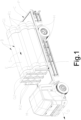
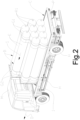
Figures 1 and2 are axonometric views of a first embodiment of the holding structure according to the invention, associated with a cylinder trailer, from different angles; -
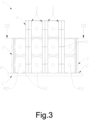
Figure 3 is a front view of the holding structure ofFigures 1 and2 ; -
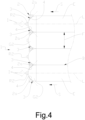
Figure 4 is a sectional view of the holding structure according to the IV-IV plane ofFigure 3 ; -
Figures 5 and 6 are schematic representations, axonometric and lateral, respectively, of a second embodiment; -
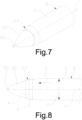
Figures 7 and 8 are schematic representations, axonometric and lateral, respectively, of a third embodiment; -
Figures 9 and 10 are schematic representations, axonometric and lateral, respectively, of a fourth embodiment; -
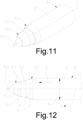
Figures 11 and 12 are schematic representations, axonometric and lateral, respectively, of a fifth embodiment; -
Figures 13 and 14 are schematic representations, axonometric and lateral, respectively, of a sixth embodiment; -
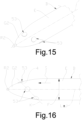
Figures 15 and 16 are schematic representations, axonometric and lateral, respectively, of a seventh embodiment; -
Figures 17 and 18 are schematic representations, axonometric and lateral, respectively, of an eight embodiment; -
Figure 19 is a schematic representation that shows some possible conformations of the work surfaces of the holding element ofFigures 13 to 18 . - With particular reference to these figures,
reference numeral 1 globally indicates a holding structure for cylinder trailers. - The
holding structure 1 comprises at least one load-bearingframe 2 that can be attached to the cylinder trailer C. - In the context of the present discussion, the term "cylinder trailer" means a road vehicle comprising a supporting surface P and movement means, such as e.g. wheels, associated with the latter.
- The supporting surface P is substantially parallel to the ground.
- The cylinder trailer C is intended for the transport of a plurality of storage tanks B of a fluid along at least one direction of travel D.
- Specifically, the cylinder trailer C is associable with a driving cab M intended to move it along the direction of travel D.
- Each of the storage tanks B is of the type, e.g., of a gas cylinder under pressure and the fluid may be of the type of natural gas, hydrogen, oxygen or other types of gas.
- The storage tank B contains a volume of fluid comprised between approximately 500 and 4000 liters, at a pressure comprised between 200 and 300 bar.
- Each of the storage tanks B comprises at least one main body E, G1, G2 of elongated conformation, extending along a corresponding longitudinal axis L, and at least one pair of fittings R1, R2 for taking the fluid, arranged at the ends of the main body E, G1, G2.
- The main body E, G1, G2 is provided with:
- a central portion E substantially cylindrical in shape and having a diameter F; and
- a pair of ogival portions G1, G2 associated with the ends of the central portion E.
- As shown in the
Figures 1 and2 , the storage tanks B are arranged on the cylinder trailer C so that the corresponding longitudinal axes L are substantially parallel to the supporting surface P and to the direction of travel D. - Each storage tank B comprises, therefore, a first ogival portion G1 positioned behind the cylinder trailer C with respect to the direction of travel D and a second ogival portion G2 positioned in front of the cylinder trailer C with respect to the direction of travel D.
- The fittings R1, R2 are associated with the ogival portions G1, G2.
- In particular, a first fitting R1 is associated with the first ogival portion G1 and a second fitting R2 is associated with the second ogival portion G2.
- In other words, the first fittings R1 are arranged behind the cylinder trailer C and the second fittings R2 are arranged in front of the cylinder trailer itself.
- The first fittings R1 are connectable to a collector system, not shown in the figures, which is adapted to convey the inlet and outlet fluid flows from the first fittings themselves and to transfer them to additional treatment/storage means of the fluid.
- For example, the treatment/storage means can be of the type of reduction cabins or storage depots, such as e.g. tank pipes.
- The cylinder trailer C is also provided with anchoring means H, such as e.g. of the type of saddles, adapted to sustain the storage tanks B and to prevent these from moving along at least one direction transverse to the direction of travel D. The load-bearing
frame 2 can be associated in front of the cylinder trailer C, on the supporting surface P. - The load-
bearing frame 2 comprises a plurality of framing elements 2a, such as e.g. of the type of metal bars, arranged together to form a grid. - According to the invention, the holding
structure 1 comprises at least one holdingelement bearing frame 2 and adapted to hold at least one corresponding storage tank B. - More in detail, the holding
structure 1 comprises a plurality of holdingelements bearing frame 2, each adapted to hold at least one of the storage tanks B. - Each holding
element - The holding
element - The holding
element work surface 4 adapted to abut against at least a corresponding second ogival portion G2 and to prevent the corresponding storage tank B from shifting along at least one direction of sliding S substantially parallel to the direction of travel D. - More in detail, the direction of sliding S matches the direction of travel D. In other words, the holding
element - The holding
element - The second fittings R2 are therefore accessible and can also be connected to a collector system, not shown in the figures, adapted to convey the outlet fluid flows from the second fittings themselves and to transfer them to other treatment/storage means of the fluid. Alternatively or in combination, the second fittings R2 can be connected to a safety system, such as e.g. of the type of a plurality of vent valves, adapted to allow the possible leakage of the fluid being in overpressure.
- Conveniently, the
work surface 4 is made of an anti-slip material. - The expression "anti-slip material" means a material, preferably of the plastic and/or polymeric type, able to increase the friction between the
work surface 4 and the surface of the second ogival portion G2, helping to keep the latter stationary. - According to the invention, shown in
Figures 1 to 4 , the holdingelement 3 is of the slab-shaped type and lies on an inclined plane of development I with respect to the direction of travel D. - This embodiment provides that the
work surface 4 is substantially flat. - The second ogival portion G2 contacts the
work surface 4 in a substantially punctiform manner. - In the context of the present discussion, the expression "substantially punctiform" means that the contact area between the surface of the second ogival portion G2 and the
work surface 4 is reduced, being one flat and the other curved. - The holding
element 3 is conveniently shaped so as to hold a plurality of storage tanks B. - As shown in
Figures 1 to 4 , in fact, the holdingelement 3 is of the type of a metal flat bar with a length at least twice the diameter F.The holding element 3 is, therefore, able to hold at least two storage tanks B placed one on top of the other. - Preferably, the holding
structure 1 comprises at least one pair of holdingelements 3 each lying on a corresponding plane of development I, arranged inclined and converging to each other with respect to the direction of sliding S. - The expression "converging to each other with respect to the direction of sliding" means that the planes of development I ideally meet on an axis arranged in front of the second ogival portion G2.
- This layout makes it possible to prevent further movements of the second ogival portion G2 along directions transverse to the direction of sliding S.
- Preferably, each of the holding
elements 3 is arranged at an angle substantially equal to 45° with respect to the direction of sliding S. - In other words, the holding
elements 3 are arranged on planes of development I substantially orthogonal to each other. - With particular reference to
Figures 1 to 4 , the plane of development I is substantially vertical. - The pair of holding
elements 3 therefore allows preventing the second ogival portion G2 from displacing along a substantially horizontal and perpendicular direction to the direction of sliding S. - Conveniently, the minimum distance between the holding
elements 3 is less than the diameter F of the central portion E and more than the width of the second fitting R2. - In the context of the present discussion, the term "width of the second fitting" means a dimension of the second fitting R2 transverse to the longitudinal axis L of the storage tank B. For example, if the second fitting R2 is substantially cylindrical in shape, as shown in the figures, the width corresponds to the diameter of such a cylinder.
- During the installation of the cylinder trailer C, each storage tank B is arranged in such a way that the second fitting R2 is inserted between the pair of holding
elements 3 and that the second ogival portion G2 is placed in contact with thework surface 4. - As shown in
Figure 4 , the second fitting R2 is, therefore, placed in front of the holdingelements 3 with respect to the direction of travel D and accessible to an operator. -
Figures 5 to 19 show further embodiments wherein the holdingelement - In such embodiments, the
work surface 4 is curved. - Similarly to what has been described above, the
work surface 4 can be made of an anti-slip material. - Conveniently, the holding
element work surface 4 having a shape at least partly substantially complementary to the shape of the second ogival portion G2. - In the context of the present discussion, the expression "substantially complementary" means that the two surfaces are complementary in shape net of construction inaccuracies.
- With particular reference to the embodiments shown in
Figures 5 to 12 , each holdingelement - In a second embodiment shown in
Figures 5 and 6 , the holdingelement 13 is of the type of a metal band and almost completely wraps the second ogival portion G2. - The
work surface 4 is defined inside the holdingelement 13. - The holding
element 13 is adapted to prevent the storage tank B from moving along the direction of sliding S and, at the same time, the second ogival portion G2 from moving along further directions transverse to the latter. - The holding
element 13 comprises an upper portion and a lower portion, with respect to a horizontal plane J passing through the longitudinal axis L. The lower portion has a larger surface area than the corresponding upper portion, meaning that the lower portion wraps the second ogival portion G2 by a larger contact area than the upper portion. - This shape of the holding
element 13 gives a vertical support to the second ogival portion G2 and, at the same time, facilitates the insertion thereof during the installation phase of the cylinder trailer C. - In accordance with further embodiments shown in
Figures 7 to 12 , the holdingelement - The center of the holding
element - In these embodiments, the
work surface 4 is defined inside the holdingelement - Similarly to the above, the holding
element work surface 4 is at least partly substantially complementary to the latter. - More in detail, the
work surface 4 is substantially truncated-ogival in shape, converging with respect to the direction of travel D. - The expression "converging with respect to the direction of travel" means that the
work surface 4 defines a portion of ogive, the ideal vertex of which is arranged in front of the second ogival portion G2 with respect to the direction of travel D. In addition, this vertex lies on the longitudinal axis L of the storage tank B. - Advantageously, the minimum diameter of the holding
element - In accordance with a third embodiment shown in
Figures 7 and 8 , the lying plane K of the holdingelement 23 is substantially perpendicular to the longitudinal axis L. -
Figures 9 and 10 , on the other hand, show a fourth embodiment in which the holdingelement 33 lies on a lying plane K which is inclined with respect to the horizontal plane J passing through the longitudinal axis L. - The holding
element 33 comprises an upper portion and a lower portion, with respect to the horizontal plane J, in which the upper portion is arranged in front of the lower portion with respect to the direction of travel D. - This shape allows giving an effective support to the second ogival portion G2 and at the same time facilitates the insertion thereof inside the holding
element 33 during the installation of the cylinder trailer C. - In accordance with a fifth embodiment shown in
Figures 11 and 12 , the holdingstructure 1 comprises at least two holdingelements 43 arranged in succession to each other with respect to the direction of travel D and in which the respective centers lie on the longitudinal axis L. - This embodiment provides greater vertical support to the second ogival portion G2 and ensures effective holding of the storage tank B, especially in the case of large storage tanks.
- The holding
elements 43 are ring-shaped and are substantially similar to the holdingelements - In particular,
Figures 11 and 12 show an embodiment wherein both the holdingelements 43 lie on the corresponding lying planes K substantially perpendicular to the longitudinal axis L. - Embodiments cannot however be ruled out wherein the lying planes K are inclined with respect to the horizontal plane J passing through the longitudinal axis L.
- Embodiments cannot however be ruled out wherein one of the holding
elements 43 lies on a corresponding lying plane K perpendicular to the direction of sliding S and the other of the holdingelements 43 lies on a lying plane K which is inclined with respect to the horizontal plane passing through the longitudinal axis L. - It cannot also be ruled out that the holding
structure 1 may comprise more than two holdingelements 43, arranged in succession to each other with respect to the direction of travel D and in which the respective centers lie on the longitudinal axis L. -
Figures 13 to 18 show further embodiments wherein the holdingstructure 1 comprises a plurality of holdingelements 53 arranged discontinuously on the second ogival portion G2. - The
corresponding work surfaces 4 are curved and partly complementary in shape to the shape of the second ogival portion G2. - In other words, each of the holding
elements 53 partly covers the second ogival portion G2. - These embodiments provide, therefore, that each second ogival portion G2 is held by a plurality of holding
elements 53. - With particular reference to the embodiments shown in
Figures 13 to 16 , the holdingelements 53 are arranged in a ring pattern that lies on a lying plane K transverse to the direction of sliding S. - The center of the ring lies on the longitudinal axis L.
- Conveniently, the minimum diameter of the ring is smaller than the diameter F of the central portion E and larger than the width of the second fitting R2.
- In particular, according to a sixth embodiment, shown in
Figures 13 and 14 , the lying plane K of the ring is substantially perpendicular to the direction of sliding S. - The holding
elements 53 are therefore arranged substantially equidistant from the center of the ring, i.e. from the longitudinal axis L. - In accordance with a seventh embodiment shown in
Figures 15 and 16 , on the other hand, the lying plane K of the ring is inclined with respect to the horizontal plane J passing through the longitudinal axis L. - Again, in accordance with an eighth embodiment, shown in
Figures 17 and 18 , some holdingelements 53 are arranged in a ring pattern, while anadditional holding element 53 is placed below the second ogival portion G2, with respect to the horizontal plane J, in order to give greater vertical support to the second ogival portion itself. - In
Figures 13 to 18 , the holdingelements 53 are substantially circular in shape and thecorresponding work surfaces 4 are, in turn, substantially circular. - It cannot however be ruled out that the
work surface 4 is of different conformation. -
Figure 19 shows further possible conformations of thework surface 4 by way of example. - The
work surface 4 can be toroidal (Figure 19(a) ), square (Figure 19(b) ), oval (Figure 19(c) ), rectangular (Figure 19(d) ) or formed by a plurality of holdingportions 5 associated with each other (Figure 19(e) ). - It cannot also be ruled out that each of the holding
elements 53 is different in shape to the other holdingelements 53. - It has in practice been ascertained that the described invention achieves the intended objects and in particular it is emphasized the fact that the holding structure according to the present invention allows effectively holding the storage tanks along at least the direction of sliding and allows taking the fluid also through the second fittings of the storage tanks.
- This result is obtained thanks to the particular conformation and/or layout of the holding elements that allows preventing the storage tank from sliding and, at the same time, keeps the corresponding second fitting free and accessible.
- In addition, the present holding structure allows the storage tanks to be effectively supported along a direction transverse to the direction of travel.
Claims (5)
- Holding structure (1) for cylinder trailers, comprising at least one load-bearing frame (2) that can be attached to a cylinder trailer (C) intended to transport a plurality of storage tanks (B) of a fluid along at least one direction of travel (D), each of said storage tanks (B) comprising:- at least one main body (E, G1, G2) of elongated conformation extending along a corresponding longitudinal axis (L) and comprising:- a central portion (E) substantially cylindrical in shape having a diameter (F); and- a pair of ogival portions (G1, G2) associated with the ends of said central portion (E), wherein a first ogival portion (G1) is positioned behind said cylinder trailer (C) with respect to said direction of travel (D) and a second ogival portion (G2) is positioned in front of said cylinder trailer (C) with respect to said direction of travel (D);- at least one pair of fittings (R1, R2) for taking and/or loading said fluid, arranged at the ends of said main body (E, G1, G2), wherein a first fitting (R1) is associated with said first ogival portion (G1) and a second fitting (R2) is associated with said second ogival portion (G2);- at least one holding element (3) associated with said load-bearing frame (2), adapted to hold at least one corresponding storage tank (B) and defining at least one work surface (4) adapted to abut against at least one corresponding second ogival portion (G2) and to prevent the storage tank itself from shifting along at least one direction of sliding (S) substantially parallel to said direction of travel (D);characterized by the fact that said holding element (3) is of the slab-shaped type and lies on a plane of development (I) which is inclined with respect to said direction of sliding (S), said work surface (4) being substantially flat.
- Holding structure (1) according to claim 1, characterized by the fact that said holding element (3) is of the type of a metal flat bar having a length at least twice said diameter (F).
- Holding structure (1) according to one or more of the preceding claims, characterized by the fact that it comprises at least one pair of said holding elements (3) each lying on a corresponding plane of development (I), arranged inclined and converging to each other with respect to said direction of sliding (S).
- Holding structure (1) according to one or more of the preceding claims, characterized by the fact that said plane of development (I) is substantially vertical.
- Holding structure (1) according to one or more of the preceding claims, characterized by the fact that the minimum distance between said holding elements (3) is less than said diameter (F) of the central portion (E) and more than the width of said second fitting (R2).
Priority Applications (2)
| Application Number | Priority Date | Filing Date | Title |
|---|---|---|---|
| EP20189977.0A EP3950425B1 (en) | 2020-08-07 | 2020-08-07 | Holding structure for cylinder trailers |
| ES20189977T ES2973103T3 (en) | 2020-08-07 | 2020-08-07 | Clamping structure for cylinder trailers |
Applications Claiming Priority (1)
| Application Number | Priority Date | Filing Date | Title |
|---|---|---|---|
| EP20189977.0A EP3950425B1 (en) | 2020-08-07 | 2020-08-07 | Holding structure for cylinder trailers |
Publications (2)
| Publication Number | Publication Date |
|---|---|
| EP3950425A1 EP3950425A1 (en) | 2022-02-09 |
| EP3950425B1 true EP3950425B1 (en) | 2023-12-06 |
Family
ID=72560311
Family Applications (1)
| Application Number | Title | Priority Date | Filing Date |
|---|---|---|---|
| EP20189977.0A Active EP3950425B1 (en) | 2020-08-07 | 2020-08-07 | Holding structure for cylinder trailers |
Country Status (2)
| Country | Link |
|---|---|
| EP (1) | EP3950425B1 (en) |
| ES (1) | ES2973103T3 (en) |
Families Citing this family (1)
| Publication number | Priority date | Publication date | Assignee | Title |
|---|---|---|---|---|
| JP2023150486A (en) * | 2022-03-31 | 2023-10-16 | 株式会社三井E&S | Tank and tank structure and manufacturing method thereof |
Family Cites Families (3)
| Publication number | Priority date | Publication date | Assignee | Title |
|---|---|---|---|---|
| US3479043A (en) * | 1968-06-19 | 1969-11-18 | Bill Piehl | Gas transport apparatus |
| US4784399A (en) * | 1987-03-23 | 1988-11-15 | Finn John F | Modular tube trailer |
| RU2138411C1 (en) * | 1997-07-02 | 1999-09-27 | Производственное объединение "Баррикады" | Gas servicing truck |
-
2020
- 2020-08-07 ES ES20189977T patent/ES2973103T3/en active Active
- 2020-08-07 EP EP20189977.0A patent/EP3950425B1/en active Active
Also Published As
| Publication number | Publication date |
|---|---|
| EP3950425A1 (en) | 2022-02-09 |
| ES2973103T3 (en) | 2024-06-18 |
Similar Documents
| Publication | Publication Date | Title |
|---|---|---|
| US10718469B2 (en) | Modular fuel storage system | |
| WO2017031520A1 (en) | Water storage and transport system | |
| EP3950425B1 (en) | Holding structure for cylinder trailers | |
| US10195937B2 (en) | Modular fuel storage system | |
| CA2959888C (en) | Cargo tank assemblies with ground level access | |
| US9150349B2 (en) | Storage apparatus having tank with tapered bottom and axle assembly | |
| EP2223005B1 (en) | Pressure tank | |
| US3419310A (en) | Pressure-retentive receptacle, especially for bulk-carrying vehicles | |
| US11333301B2 (en) | Pressure vessel for the storage of pressurized fluids and vehicle comprising such a pressure vessel | |
| US10435089B2 (en) | Anti-rollover trailer | |
| US12496991B2 (en) | Side mounted air supply for wheel lift independent of vehicle air brake | |
| KR20140001368A (en) | Tank for carrying liquied gas | |
| US20130049342A1 (en) | Trailer chassis hold down system | |
| ES1174784U (en) | Tank truck for the transport anti-hit of ariete of cryogenic fluids, liquefied gases, hydrocarbons to high pressure or low pressure. (Machine-translation by Google Translate, not legally binding) | |
| DK1364832T3 (en) | reinforced container | |
| MX2009011110A (en) | Multi purpose anti-roll bar. | |
| AU2022100185A4 (en) | Fluid container | |
| ES2695648B1 (en) | CISTERNA TRUCK FOR THE ANTI-EXPLOSIVE TRANSPORTATION OF CRIOGENIC FLUIDS, LIQUID GASES, HYDROCARBONS AT HIGH PRESSURE OR LOW PRESSURE. | |
| RU49503U1 (en) | SEMI-TRAILER-TANK | |
| US20110148090A1 (en) | Low profile Tank Trailer | |
| SE1851231A1 (en) | An arrangement for facilitating evacuating evaporated liquefied gas of a liquefied gas fuel system of a vehicle | |
| ES2695624B1 (en) | CISTERNA TRUCK FOR THE ANTI-CORROSIVE TRANSPORTATION OF CRIOGENIC FLUIDS, LIQUID GASES, HYDROCARBONS AT HIGH PRESSURE OR LOW PRESSURE. | |
| ES1174617U (en) | Tank truck for the transport anti-algae of cryogenic fluids, liquefied gases, hydrocarbons at high pressure or low pressure. (Machine-translation by Google Translate, not legally binding) | |
| KR101842640B1 (en) | Tank lorry for lowering setting center of gravity | |
| ES2695623B1 (en) | CISTERNA TRUCK FOR THE ANTI-ALGAE TRANSPORT OF CRIOGENIC FLUIDS, LIQUID GASES, HYDROCARBONS AT HIGH PRESSURE OR LOW PRESSURE. |
Legal Events
| Date | Code | Title | Description |
|---|---|---|---|
| PUAI | Public reference made under article 153(3) epc to a published international application that has entered the european phase |
Free format text: ORIGINAL CODE: 0009012 |
|
| STAA | Information on the status of an ep patent application or granted ep patent |
Free format text: STATUS: THE APPLICATION HAS BEEN PUBLISHED |
|
| AK | Designated contracting states |
Kind code of ref document: A1 Designated state(s): AL AT BE BG CH CY CZ DE DK EE ES FI FR GB GR HR HU IE IS IT LI LT LU LV MC MK MT NL NO PL PT RO RS SE SI SK SM TR |
|
| STAA | Information on the status of an ep patent application or granted ep patent |
Free format text: STATUS: REQUEST FOR EXAMINATION WAS MADE |
|
| 17P | Request for examination filed |
Effective date: 20220804 |
|
| RBV | Designated contracting states (corrected) |
Designated state(s): AL AT BE BG CH CY CZ DE DK EE ES FI FR GB GR HR HU IE IS IT LI LT LU LV MC MK MT NL NO PL PT RO RS SE SI SK SM TR |
|
| GRAP | Despatch of communication of intention to grant a patent |
Free format text: ORIGINAL CODE: EPIDOSNIGR1 |
|
| STAA | Information on the status of an ep patent application or granted ep patent |
Free format text: STATUS: GRANT OF PATENT IS INTENDED |
|
| INTG | Intention to grant announced |
Effective date: 20230428 |
|
| GRAJ | Information related to disapproval of communication of intention to grant by the applicant or resumption of examination proceedings by the epo deleted |
Free format text: ORIGINAL CODE: EPIDOSDIGR1 |
|
| STAA | Information on the status of an ep patent application or granted ep patent |
Free format text: STATUS: REQUEST FOR EXAMINATION WAS MADE |
|
| GRAP | Despatch of communication of intention to grant a patent |
Free format text: ORIGINAL CODE: EPIDOSNIGR1 |
|
| STAA | Information on the status of an ep patent application or granted ep patent |
Free format text: STATUS: GRANT OF PATENT IS INTENDED |
|
| INTC | Intention to grant announced (deleted) | ||
| INTG | Intention to grant announced |
Effective date: 20230629 |
|
| GRAS | Grant fee paid |
Free format text: ORIGINAL CODE: EPIDOSNIGR3 |
|
| GRAA | (expected) grant |
Free format text: ORIGINAL CODE: 0009210 |
|
| STAA | Information on the status of an ep patent application or granted ep patent |
Free format text: STATUS: THE PATENT HAS BEEN GRANTED |
|
| AK | Designated contracting states |
Kind code of ref document: B1 Designated state(s): AL AT BE BG CH CY CZ DE DK EE ES FI FR GB GR HR HU IE IS IT LI LT LU LV MC MK MT NL NO PL PT RO RS SE SI SK SM TR |
|
| REG | Reference to a national code |
Ref country code: GB Ref legal event code: FG4D |
|
| REG | Reference to a national code |
Ref country code: DE Ref legal event code: R096 Ref document number: 602020022203 Country of ref document: DE |
|
| REG | Reference to a national code |
Ref country code: CH Ref legal event code: EP |
|
| REG | Reference to a national code |
Ref country code: IE Ref legal event code: FG4D |
|
| REG | Reference to a national code |
Ref country code: LT Ref legal event code: MG9D |
|
| PG25 | Lapsed in a contracting state [announced via postgrant information from national office to epo] |
Ref country code: GR Free format text: LAPSE BECAUSE OF FAILURE TO SUBMIT A TRANSLATION OF THE DESCRIPTION OR TO PAY THE FEE WITHIN THE PRESCRIBED TIME-LIMIT Effective date: 20240307 |
|
| P01 | Opt-out of the competence of the unified patent court (upc) registered |
Effective date: 20240305 |
|
| REG | Reference to a national code |
Ref country code: NL Ref legal event code: MP Effective date: 20231206 |
|
| PG25 | Lapsed in a contracting state [announced via postgrant information from national office to epo] |
Ref country code: LT Free format text: LAPSE BECAUSE OF FAILURE TO SUBMIT A TRANSLATION OF THE DESCRIPTION OR TO PAY THE FEE WITHIN THE PRESCRIBED TIME-LIMIT Effective date: 20231206 |
|
| PG25 | Lapsed in a contracting state [announced via postgrant information from national office to epo] |
Ref country code: LT Free format text: LAPSE BECAUSE OF FAILURE TO SUBMIT A TRANSLATION OF THE DESCRIPTION OR TO PAY THE FEE WITHIN THE PRESCRIBED TIME-LIMIT Effective date: 20231206 Ref country code: GR Free format text: LAPSE BECAUSE OF FAILURE TO SUBMIT A TRANSLATION OF THE DESCRIPTION OR TO PAY THE FEE WITHIN THE PRESCRIBED TIME-LIMIT Effective date: 20240307 |
|
| REG | Reference to a national code |
Ref country code: AT Ref legal event code: MK05 Ref document number: 1638086 Country of ref document: AT Kind code of ref document: T Effective date: 20231206 |
|
| PG25 | Lapsed in a contracting state [announced via postgrant information from national office to epo] |
Ref country code: NL Free format text: LAPSE BECAUSE OF FAILURE TO SUBMIT A TRANSLATION OF THE DESCRIPTION OR TO PAY THE FEE WITHIN THE PRESCRIBED TIME-LIMIT Effective date: 20231206 |
|
| PG25 | Lapsed in a contracting state [announced via postgrant information from national office to epo] |
Ref country code: SE Free format text: LAPSE BECAUSE OF FAILURE TO SUBMIT A TRANSLATION OF THE DESCRIPTION OR TO PAY THE FEE WITHIN THE PRESCRIBED TIME-LIMIT Effective date: 20231206 Ref country code: RS Free format text: LAPSE BECAUSE OF FAILURE TO SUBMIT A TRANSLATION OF THE DESCRIPTION OR TO PAY THE FEE WITHIN THE PRESCRIBED TIME-LIMIT Effective date: 20231206 Ref country code: NO Free format text: LAPSE BECAUSE OF FAILURE TO SUBMIT A TRANSLATION OF THE DESCRIPTION OR TO PAY THE FEE WITHIN THE PRESCRIBED TIME-LIMIT Effective date: 20240306 Ref country code: NL Free format text: LAPSE BECAUSE OF FAILURE TO SUBMIT A TRANSLATION OF THE DESCRIPTION OR TO PAY THE FEE WITHIN THE PRESCRIBED TIME-LIMIT Effective date: 20231206 Ref country code: LV Free format text: LAPSE BECAUSE OF FAILURE TO SUBMIT A TRANSLATION OF THE DESCRIPTION OR TO PAY THE FEE WITHIN THE PRESCRIBED TIME-LIMIT Effective date: 20231206 Ref country code: HR Free format text: LAPSE BECAUSE OF FAILURE TO SUBMIT A TRANSLATION OF THE DESCRIPTION OR TO PAY THE FEE WITHIN THE PRESCRIBED TIME-LIMIT Effective date: 20231206 |
|
| REG | Reference to a national code |
Ref country code: ES Ref legal event code: FG2A Ref document number: 2973103 Country of ref document: ES Kind code of ref document: T3 Effective date: 20240618 |
|
| PG25 | Lapsed in a contracting state [announced via postgrant information from national office to epo] |
Ref country code: IS Free format text: LAPSE BECAUSE OF FAILURE TO SUBMIT A TRANSLATION OF THE DESCRIPTION OR TO PAY THE FEE WITHIN THE PRESCRIBED TIME-LIMIT Effective date: 20240406 |
|
| PG25 | Lapsed in a contracting state [announced via postgrant information from national office to epo] |
Ref country code: CZ Free format text: LAPSE BECAUSE OF FAILURE TO SUBMIT A TRANSLATION OF THE DESCRIPTION OR TO PAY THE FEE WITHIN THE PRESCRIBED TIME-LIMIT Effective date: 20231206 Ref country code: AT Free format text: LAPSE BECAUSE OF FAILURE TO SUBMIT A TRANSLATION OF THE DESCRIPTION OR TO PAY THE FEE WITHIN THE PRESCRIBED TIME-LIMIT Effective date: 20231206 |
|
| PG25 | Lapsed in a contracting state [announced via postgrant information from national office to epo] |
Ref country code: SK Free format text: LAPSE BECAUSE OF FAILURE TO SUBMIT A TRANSLATION OF THE DESCRIPTION OR TO PAY THE FEE WITHIN THE PRESCRIBED TIME-LIMIT Effective date: 20231206 |
|
| PG25 | Lapsed in a contracting state [announced via postgrant information from national office to epo] |
Ref country code: SM Free format text: LAPSE BECAUSE OF FAILURE TO SUBMIT A TRANSLATION OF THE DESCRIPTION OR TO PAY THE FEE WITHIN THE PRESCRIBED TIME-LIMIT Effective date: 20231206 Ref country code: SK Free format text: LAPSE BECAUSE OF FAILURE TO SUBMIT A TRANSLATION OF THE DESCRIPTION OR TO PAY THE FEE WITHIN THE PRESCRIBED TIME-LIMIT Effective date: 20231206 Ref country code: RO Free format text: LAPSE BECAUSE OF FAILURE TO SUBMIT A TRANSLATION OF THE DESCRIPTION OR TO PAY THE FEE WITHIN THE PRESCRIBED TIME-LIMIT Effective date: 20231206 Ref country code: IS Free format text: LAPSE BECAUSE OF FAILURE TO SUBMIT A TRANSLATION OF THE DESCRIPTION OR TO PAY THE FEE WITHIN THE PRESCRIBED TIME-LIMIT Effective date: 20240406 Ref country code: EE Free format text: LAPSE BECAUSE OF FAILURE TO SUBMIT A TRANSLATION OF THE DESCRIPTION OR TO PAY THE FEE WITHIN THE PRESCRIBED TIME-LIMIT Effective date: 20231206 Ref country code: CZ Free format text: LAPSE BECAUSE OF FAILURE TO SUBMIT A TRANSLATION OF THE DESCRIPTION OR TO PAY THE FEE WITHIN THE PRESCRIBED TIME-LIMIT Effective date: 20231206 Ref country code: AT Free format text: LAPSE BECAUSE OF FAILURE TO SUBMIT A TRANSLATION OF THE DESCRIPTION OR TO PAY THE FEE WITHIN THE PRESCRIBED TIME-LIMIT Effective date: 20231206 |
|
| PG25 | Lapsed in a contracting state [announced via postgrant information from national office to epo] |
Ref country code: PL Free format text: LAPSE BECAUSE OF FAILURE TO SUBMIT A TRANSLATION OF THE DESCRIPTION OR TO PAY THE FEE WITHIN THE PRESCRIBED TIME-LIMIT Effective date: 20231206 Ref country code: PT Free format text: LAPSE BECAUSE OF FAILURE TO SUBMIT A TRANSLATION OF THE DESCRIPTION OR TO PAY THE FEE WITHIN THE PRESCRIBED TIME-LIMIT Effective date: 20240408 |
|
| PG25 | Lapsed in a contracting state [announced via postgrant information from national office to epo] |
Ref country code: PT Free format text: LAPSE BECAUSE OF FAILURE TO SUBMIT A TRANSLATION OF THE DESCRIPTION OR TO PAY THE FEE WITHIN THE PRESCRIBED TIME-LIMIT Effective date: 20240408 Ref country code: PL Free format text: LAPSE BECAUSE OF FAILURE TO SUBMIT A TRANSLATION OF THE DESCRIPTION OR TO PAY THE FEE WITHIN THE PRESCRIBED TIME-LIMIT Effective date: 20231206 |
|
| REG | Reference to a national code |
Ref country code: DE Ref legal event code: R097 Ref document number: 602020022203 Country of ref document: DE |
|
| PG25 | Lapsed in a contracting state [announced via postgrant information from national office to epo] |
Ref country code: DK Free format text: LAPSE BECAUSE OF FAILURE TO SUBMIT A TRANSLATION OF THE DESCRIPTION OR TO PAY THE FEE WITHIN THE PRESCRIBED TIME-LIMIT Effective date: 20231206 |
|
| PLBE | No opposition filed within time limit |
Free format text: ORIGINAL CODE: 0009261 |
|
| STAA | Information on the status of an ep patent application or granted ep patent |
Free format text: STATUS: NO OPPOSITION FILED WITHIN TIME LIMIT |
|
| PG25 | Lapsed in a contracting state [announced via postgrant information from national office to epo] |
Ref country code: SI Free format text: LAPSE BECAUSE OF FAILURE TO SUBMIT A TRANSLATION OF THE DESCRIPTION OR TO PAY THE FEE WITHIN THE PRESCRIBED TIME-LIMIT Effective date: 20231206 |
|
| PG25 | Lapsed in a contracting state [announced via postgrant information from national office to epo] |
Ref country code: SI Free format text: LAPSE BECAUSE OF FAILURE TO SUBMIT A TRANSLATION OF THE DESCRIPTION OR TO PAY THE FEE WITHIN THE PRESCRIBED TIME-LIMIT Effective date: 20231206 Ref country code: DK Free format text: LAPSE BECAUSE OF FAILURE TO SUBMIT A TRANSLATION OF THE DESCRIPTION OR TO PAY THE FEE WITHIN THE PRESCRIBED TIME-LIMIT Effective date: 20231206 |
|
| 26N | No opposition filed |
Effective date: 20240909 |
|
| REG | Reference to a national code |
Ref country code: DE Ref legal event code: R119 Ref document number: 602020022203 Country of ref document: DE |
|
| REG | Reference to a national code |
Ref country code: CH Ref legal event code: PL |
|
| PG25 | Lapsed in a contracting state [announced via postgrant information from national office to epo] |
Ref country code: LU Free format text: LAPSE BECAUSE OF NON-PAYMENT OF DUE FEES Effective date: 20240807 |
|
| GBPC | Gb: european patent ceased through non-payment of renewal fee |
Effective date: 20240807 |
|
| PG25 | Lapsed in a contracting state [announced via postgrant information from national office to epo] |
Ref country code: MC Free format text: LAPSE BECAUSE OF FAILURE TO SUBMIT A TRANSLATION OF THE DESCRIPTION OR TO PAY THE FEE WITHIN THE PRESCRIBED TIME-LIMIT Effective date: 20231206 Ref country code: CH Free format text: LAPSE BECAUSE OF NON-PAYMENT OF DUE FEES Effective date: 20240831 |
|
| REG | Reference to a national code |
Ref country code: BE Ref legal event code: MM Effective date: 20240831 |
|
| PG25 | Lapsed in a contracting state [announced via postgrant information from national office to epo] |
Ref country code: DE Free format text: LAPSE BECAUSE OF NON-PAYMENT OF DUE FEES Effective date: 20250301 |
|
| PG25 | Lapsed in a contracting state [announced via postgrant information from national office to epo] |
Ref country code: GB Free format text: LAPSE BECAUSE OF NON-PAYMENT OF DUE FEES Effective date: 20240807 |
|
| PG25 | Lapsed in a contracting state [announced via postgrant information from national office to epo] |
Ref country code: BE Free format text: LAPSE BECAUSE OF NON-PAYMENT OF DUE FEES Effective date: 20240831 |
|
| PG25 | Lapsed in a contracting state [announced via postgrant information from national office to epo] |
Ref country code: FR Free format text: LAPSE BECAUSE OF NON-PAYMENT OF DUE FEES Effective date: 20240831 |
|
| PG25 | Lapsed in a contracting state [announced via postgrant information from national office to epo] |
Ref country code: IE Free format text: LAPSE BECAUSE OF NON-PAYMENT OF DUE FEES Effective date: 20240807 |
|
| PG25 | Lapsed in a contracting state [announced via postgrant information from national office to epo] |
Ref country code: FI Free format text: LAPSE BECAUSE OF FAILURE TO SUBMIT A TRANSLATION OF THE DESCRIPTION OR TO PAY THE FEE WITHIN THE PRESCRIBED TIME-LIMIT Effective date: 20231207 |
|
| PGFP | Annual fee paid to national office [announced via postgrant information from national office to epo] |
Ref country code: ES Payment date: 20250901 Year of fee payment: 6 |
|
| PGFP | Annual fee paid to national office [announced via postgrant information from national office to epo] |
Ref country code: IT Payment date: 20250825 Year of fee payment: 6 |
|
| PGFP | Annual fee paid to national office [announced via postgrant information from national office to epo] |
Ref country code: BG Payment date: 20250820 Year of fee payment: 6 |
|
| PG25 | Lapsed in a contracting state [announced via postgrant information from national office to epo] |
Ref country code: CY Free format text: LAPSE BECAUSE OF FAILURE TO SUBMIT A TRANSLATION OF THE DESCRIPTION OR TO PAY THE FEE WITHIN THE PRESCRIBED TIME-LIMIT; INVALID AB INITIO Effective date: 20200807 |
|
| PG25 | Lapsed in a contracting state [announced via postgrant information from national office to epo] |
Ref country code: HU Free format text: LAPSE BECAUSE OF FAILURE TO SUBMIT A TRANSLATION OF THE DESCRIPTION OR TO PAY THE FEE WITHIN THE PRESCRIBED TIME-LIMIT; INVALID AB INITIO Effective date: 20200807 |