EP3947019B1 - Selbstausrichtende werkzeugführung - Google Patents
Selbstausrichtende werkzeugführung Download PDFInfo
- Publication number
- EP3947019B1 EP3947019B1 EP20712571.7A EP20712571A EP3947019B1 EP 3947019 B1 EP3947019 B1 EP 3947019B1 EP 20712571 A EP20712571 A EP 20712571A EP 3947019 B1 EP3947019 B1 EP 3947019B1
- Authority
- EP
- European Patent Office
- Prior art keywords
- tool guide
- tool
- axis
- drive
- lifting
- Prior art date
- Legal status (The legal status is an assumption and is not a legal conclusion. Google has not performed a legal analysis and makes no representation as to the accuracy of the status listed.)
- Active
Links
Images


Classifications
-
- B—PERFORMING OPERATIONS; TRANSPORTING
- B25—HAND TOOLS; PORTABLE POWER-DRIVEN TOOLS; MANIPULATORS
- B25D—PERCUSSIVE TOOLS
- B25D17/00—Details of, or accessories for, portable power-driven percussive tools
- B25D17/28—Supports; Devices for holding power-driven percussive tools in working position
-
- B—PERFORMING OPERATIONS; TRANSPORTING
- B60—VEHICLES IN GENERAL
- B60L—PROPULSION OF ELECTRICALLY-PROPELLED VEHICLES; SUPPLYING ELECTRIC POWER FOR AUXILIARY EQUIPMENT OF ELECTRICALLY-PROPELLED VEHICLES; ELECTRODYNAMIC BRAKE SYSTEMS FOR VEHICLES IN GENERAL; MAGNETIC SUSPENSION OR LEVITATION FOR VEHICLES; MONITORING OPERATING VARIABLES OF ELECTRICALLY-PROPELLED VEHICLES; ELECTRIC SAFETY DEVICES FOR ELECTRICALLY-PROPELLED VEHICLES
- B60L50/00—Electric propulsion with power supplied within the vehicle
- B60L50/50—Electric propulsion with power supplied within the vehicle using propulsion power supplied by batteries or fuel cells
-
- B—PERFORMING OPERATIONS; TRANSPORTING
- B25—HAND TOOLS; PORTABLE POWER-DRIVEN TOOLS; MANIPULATORS
- B25H—WORKSHOP EQUIPMENT, e.g. FOR MARKING-OUT WORK; STORAGE MEANS FOR WORKSHOPS
- B25H1/00—Work benches; Portable stands or supports for positioning portable tools or work to be operated on thereby
- B25H1/0021—Stands, supports or guiding devices for positioning portable tools or for securing them to the work
- B25H1/0035—Extensible supports, e.g. telescopic
-
- B—PERFORMING OPERATIONS; TRANSPORTING
- B25—HAND TOOLS; PORTABLE POWER-DRIVEN TOOLS; MANIPULATORS
- B25J—MANIPULATORS; CHAMBERS PROVIDED WITH MANIPULATION DEVICES
- B25J5/00—Manipulators mounted on wheels or on carriages
- B25J5/007—Manipulators mounted on wheels or on carriages mounted on wheels
-
- B—PERFORMING OPERATIONS; TRANSPORTING
- B28—WORKING CEMENT, CLAY, OR STONE
- B28D—WORKING STONE OR STONE-LIKE MATERIALS
- B28D1/00—Working stone or stone-like materials, e.g. brick, concrete or glass, not provided for elsewhere; Machines, devices, tools therefor
- B28D1/14—Working stone or stone-like materials, e.g. brick, concrete or glass, not provided for elsewhere; Machines, devices, tools therefor by boring or drilling
-
- B—PERFORMING OPERATIONS; TRANSPORTING
- B60—VEHICLES IN GENERAL
- B60L—PROPULSION OF ELECTRICALLY-PROPELLED VEHICLES; SUPPLYING ELECTRIC POWER FOR AUXILIARY EQUIPMENT OF ELECTRICALLY-PROPELLED VEHICLES; ELECTRODYNAMIC BRAKE SYSTEMS FOR VEHICLES IN GENERAL; MAGNETIC SUSPENSION OR LEVITATION FOR VEHICLES; MONITORING OPERATING VARIABLES OF ELECTRICALLY-PROPELLED VEHICLES; ELECTRIC SAFETY DEVICES FOR ELECTRICALLY-PROPELLED VEHICLES
- B60L50/00—Electric propulsion with power supplied within the vehicle
- B60L50/50—Electric propulsion with power supplied within the vehicle using propulsion power supplied by batteries or fuel cells
- B60L50/60—Electric propulsion with power supplied within the vehicle using propulsion power supplied by batteries or fuel cells using power supplied by batteries
-
- B—PERFORMING OPERATIONS; TRANSPORTING
- B25—HAND TOOLS; PORTABLE POWER-DRIVEN TOOLS; MANIPULATORS
- B25H—WORKSHOP EQUIPMENT, e.g. FOR MARKING-OUT WORK; STORAGE MEANS FOR WORKSHOPS
- B25H1/00—Work benches; Portable stands or supports for positioning portable tools or work to be operated on thereby
- B25H1/0021—Stands, supports or guiding devices for positioning portable tools or for securing them to the work
- B25H1/0028—Tool balancers
-
- B—PERFORMING OPERATIONS; TRANSPORTING
- B60—VEHICLES IN GENERAL
- B60L—PROPULSION OF ELECTRICALLY-PROPELLED VEHICLES; SUPPLYING ELECTRIC POWER FOR AUXILIARY EQUIPMENT OF ELECTRICALLY-PROPELLED VEHICLES; ELECTRODYNAMIC BRAKE SYSTEMS FOR VEHICLES IN GENERAL; MAGNETIC SUSPENSION OR LEVITATION FOR VEHICLES; MONITORING OPERATING VARIABLES OF ELECTRICALLY-PROPELLED VEHICLES; ELECTRIC SAFETY DEVICES FOR ELECTRICALLY-PROPELLED VEHICLES
- B60L2200/00—Type of vehicles
- B60L2200/16—Single-axle vehicles
-
- B—PERFORMING OPERATIONS; TRANSPORTING
- B60—VEHICLES IN GENERAL
- B60L—PROPULSION OF ELECTRICALLY-PROPELLED VEHICLES; SUPPLYING ELECTRIC POWER FOR AUXILIARY EQUIPMENT OF ELECTRICALLY-PROPELLED VEHICLES; ELECTRODYNAMIC BRAKE SYSTEMS FOR VEHICLES IN GENERAL; MAGNETIC SUSPENSION OR LEVITATION FOR VEHICLES; MONITORING OPERATING VARIABLES OF ELECTRICALLY-PROPELLED VEHICLES; ELECTRIC SAFETY DEVICES FOR ELECTRICALLY-PROPELLED VEHICLES
- B60L2200/00—Type of vehicles
- B60L2200/40—Working vehicles
-
- B—PERFORMING OPERATIONS; TRANSPORTING
- B60—VEHICLES IN GENERAL
- B60L—PROPULSION OF ELECTRICALLY-PROPELLED VEHICLES; SUPPLYING ELECTRIC POWER FOR AUXILIARY EQUIPMENT OF ELECTRICALLY-PROPELLED VEHICLES; ELECTRODYNAMIC BRAKE SYSTEMS FOR VEHICLES IN GENERAL; MAGNETIC SUSPENSION OR LEVITATION FOR VEHICLES; MONITORING OPERATING VARIABLES OF ELECTRICALLY-PROPELLED VEHICLES; ELECTRIC SAFETY DEVICES FOR ELECTRICALLY-PROPELLED VEHICLES
- B60L2260/00—Operating Modes
- B60L2260/20—Drive modes; Transition between modes
- B60L2260/34—Stabilising upright position of vehicles, e.g. of single axle vehicles
-
- Y—GENERAL TAGGING OF NEW TECHNOLOGICAL DEVELOPMENTS; GENERAL TAGGING OF CROSS-SECTIONAL TECHNOLOGIES SPANNING OVER SEVERAL SECTIONS OF THE IPC; TECHNICAL SUBJECTS COVERED BY FORMER USPC CROSS-REFERENCE ART COLLECTIONS [XRACs] AND DIGESTS
- Y02—TECHNOLOGIES OR APPLICATIONS FOR MITIGATION OR ADAPTATION AGAINST CLIMATE CHANGE
- Y02T—CLIMATE CHANGE MITIGATION TECHNOLOGIES RELATED TO TRANSPORTATION
- Y02T10/00—Road transport of goods or passengers
- Y02T10/60—Other road transportation technologies with climate change mitigation effect
- Y02T10/70—Energy storage systems for electromobility, e.g. batteries
Definitions
- the invention relates to a self-aligning tool guide and a control method for the tool guide.
- the drilling machine includes a base plate that rests on a floor of a mine shaft and supports the weight of a drill rod assembly.
- Suspended ceilings are a common design element in large buildings, particularly industrial and office buildings.
- Technical installations e.g. electrical installations, ventilation systems, lighting and sound insulation
- Load-bearing substructures of the installations and the suspended ceiling are attached with dowels, screws or similar elements anchored in the ceiling of the shell.
- dowels, screws or similar elements anchored in the ceiling of the shell.
- holes are drilled into the ceiling of the shell into which the dowels can be inserted or the screws can be screwed. A lateral position of the holes is dictated by the supporting substructure.
- Drilling the holes is time consuming.
- the user can only reach the high-hanging ceiling of the shell with a ladder or scaffolding.
- the ladder must be placed below the specified position, the user climbs the ladder, drills the hole, descends the ladder and moves the ladder to the next position.
- DE 33 28 582 A1 describes a mobile ceiling drilling and assembly device for installing impact dowels in a ceiling.
- the ceiling drill is based on an impact drill mounted on a telescopic column.
- the telescopic column is suspended on a trolley.
- the user can move the ceiling drill below a desired location, point the impact drill to the ceiling using the column and drill a hole in the ceiling.
- a control of the Impact drill can be done via a control cabinet. To transport it over stairwells, the device must be dismantled into four parts - trolley, telescopic column, impact drill and control cabinet.
- US 2017/080558 A1 discloses robot with self-balancing chassis, with wheels, with drive, with steering, with center of gravity sensor, with tilt sensor, with swivel joint and swivel drive; and with a tilt control that is set up to control the swivel drive in such a way that the tilt is minimized.
- WO 2016/066615 A2 discloses a self-aligning tool guide with a holder, lifting gear and chassis, the holder being for fixing a hand-held power tool.
- the invention relates to a self-aligning tool guide.
- the tool guide has a holder, a lifting gear and a chassis.
- the holder is for fixing a hand tool.
- the bracket is mounted on the hoist.
- the hoist has a propulsion mechanism for vertically lifting the holder.
- the chassis has two wheels on one wheel axle, a drive coupled to the wheels and steering.
- the hoist is rigidly mounted on the chassis.
- a center of gravity sensor is set up to detect a lateral deflection of the center of gravity of the hoist relative to the wheel axle.
- the steering is set up to control the drive and to deliver a torque that counteracts the deflection.
- An inclination sensor (37) is used to detect an inclination (36) of the elevator (7) relative to gravity in a frontal plane.
- the frontal plane is parallel to the wheel axis (28) and parallel to the lifting axis (25).
- the lifting gear (7) is mounted on the chassis (8) by means of a swivel joint, with a swivel axis (94) of the swivel joint (93) being inclined relative to the frontal plane or perpendicular to the frontal plane.
- a swivel drive (100) is coupled to the swivel joint (93) for adjusting an inclination (36) of the lifting axle (25) relative to the wheel axle (28) in the frontal plane.
- An inclination control (103) is set up to control the swivel drive (100) in such a way that the inclination (36) is minimized.
- the tool guide is equipped with a tool. The tool guide is set up to check whether the tool is still in contact with a ceiling before starting.
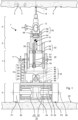
- Fig. 1 and Fig. 2 show an exemplary self-aligning tool guide 1 for installation work in a shell.
- installing a ventilation pipe requires several holes 2 in a ceiling 3 of the shell.
- the holes 2 should be at predetermined positions 4 , for example in alignment.
- the holes 2 should be parallel to one another, for example oriented vertically.
- position 4 is recorded on a plan.
- a foreman can mark position 4 with colored markings on the ceiling 3 of the shell.
- Other installation work on the ceiling 3 may include setting nails, driving screws, sanding, etc.
- Fig. 1 and Fig. 2 show schematically an embodiment of the self-aligning tool guide 1 .
- the tool guide 1 has a holder 5 for a hand-held power tool 6 , a motorized lifting mechanism 7 , a motorized swivel joint 8 , a motorized chassis 9 , a control 10 and a console 11 .
- the user can equip the tool guide 1 with a suitable hand tool 6 and a suitable tool 12 according to the application.
- a suitable hand tool 6 for drilling holes 2 in a shell, this would be, for example, a hammer drill with a percussion mechanism 13 and a drill with a sintered hard metal tip.
- the hand tool 6 can be inserted into the holder 5 on the elevator 7 .
- a lock 14 secures the hand-held power tool 6 in the holder 5 .
- the lock 14 can preferably be released without tools.
- the hand-held power tool can be permanently connected to the holder 5 , for example screwed.
- the hammer drill is just one example of a hand-held power tool 6 .
- Other examples are an electric screwdriver, a nail gun, an angle grinder, a glue gun, a paint gun, etc.
- One type of hand tool 6 drives a replaceable one Tool 12 , for example the drill, a chisel, a screwdriver bit, a cutting disc, etc. for its function.
- Another type of hand tool 6 directly processes a consumable, for example nails, screws, paint, glue.
- the hand-held power tools 6 are characterized by their own drive, with which the tool 12 is driven or the consumables are driven in or applied. The user does not have to apply any manual force to use the hand-held power tool 6 .
- the hand-held machine tools are referred to as power tools.
- the power source 15 can be electrical, fuel-driven. Examples are an electric motor, an electric pump, a gas-fed combustion chamber, a powder-driven piston, etc.
- the power source 15 is coupled to a (trigger) button 16 . When the trigger button 16 is pressed, the power source 15 is activated.
- the trigger button 16 can preferably be triggered remotely or locked.
- the hand-held power tool 6 can be a commercially available, hand-held hand-held power tool 6 .
- the hand-held hand tool 6 has a handle 17 and typically a housing section 18 for attaching an additional handle.
- the hand-held power tool 6 can be designed without a handle.
- the holder 5 can also be designed for non-handheld handheld power tools.
- the hand-held power tool 6 has a working axis 19 defined by its structure.
- a tip of the tool 12 or a tip of the consumable lies on the working axis 19 .
- the tip is moved along the working axis 19 .
- the tip first touches the surface to be worked on, for example the ceiling 3 .
- a status diagram of tool guide 1 is in Fig. 4 shown.
- the user activates the tool guide 1 using the console 11 .
- the chassis 9 is in a (driving) mode S1 , in which the user can move the tool guide 1 on the floor 20 through the room.
- the control 10 activates a steering system 21 of the tool guide 1 .
- the user can specify the direction of travel and speed via the console 11 .
- the user directs the tool guide 1 to one of the marked positions 4 .
- the chassis 9 has a drive 22 , which moves the chassis 9 over the ground 20 under its own power.
- the direction and speed of the movement of the chassis 9 are controlled by the steering 21 of the tool guide 1 .
- the steering 21 processes, among other things, the speed and direction of travel specifications entered via the console 11 .
- the console 11 uses the console 11 to put the chassis 9 into a (stationary) mode S2 .
- the control 10 blocks the steering 21 is blocked for the user or switches the steering 21 inactive.
- the steering 21 ignores specifications regarding speed and direction entered via the console 11 .
- the tool guide 1 remains in the currently occupied position 4 .
- the steering 21 can capture the current position 4 . If the chassis 9 leaves the current position 4 or is moved out of it, the steering 21 automatically generates control signals to move the chassis 9 back to the detected position 4 .
- the user can activate a (lifting) mode S3 via the console 11 in order to lift the hand-held power tool 6 with the elevator 7 .
- the controller 10 forces the stand mode S2 for the chassis 9 before the lifting mode can be activated.
- the controller 10 can delay the activation of the lifting mode until the chassis 9 is stationary.
- a control station 23 is enabled or activated for the user.
- the user can use the console 11 to specify the direction of movement 24 , ie up or down, the lifting speed and the position of the elevator 7 .
- the holder 5 is moved accordingly by the elevator 7 .
- the control center 23 controls a propulsion 25 of the hoist 7 , taking into account the vertical direction of movement and lifting speed specified via the console 11 .
- the elevator 7 raises or lowers the holder 5 and, if applicable, the hand-held power tool 6 inserted therein along a fixed lifting axis 26 .
- the elevator 7 is limited to a uniaxial, translational movement on the lifting axis 26 .
- the working axis 19 of the hand-held power tool 6 is parallel to the lifting axis 26 .
- the construction of the holder 5 forces the parallel alignment.
- the hand-held power tool 6 can be used in the holder 5 in only a defined manner, for example due to a fit of the holder 5 to a housing of the hand-held power tool 6 .
- the holder 5 can be pivoted about a (pivoting) axis inclined to the lifting axis 26 in order to align the alignment of the working axis 19 with the lifting axis 26 .
- the lifting axis 26 and thus the working axis 19 are aligned dynamically with respect to the ceiling 3 by the chassis 9 .
- the chassis 9 aligns the lifting axis 26 vertically, ie parallel to gravity, at least insofar as the chassis 9 stands on a horizontal floor 20 .
- the hand-held power tool 6 can preferably be switched on via the control center 23 .
- the tool 12 can process the ceiling 3 , for example drill a hole 2 .
- the controller 10 can have a (processing) mode S4 , which automatically controls the propulsion 25 of the elevator 7 while the ceiling 3 is being processed.
- the editing mode can For example, it can be activated manually on the console 11 .
- the control center 23 adapts the lifting speed of the elevator 7 to a processing progress of the tool 12 .
- the elevator 7 and the tool 12 can be protected from excessive loads.
- a processing target for example a borehole depth, can be specified for the control station 23 . After reaching the processing target, the control center 23 can automatically stop the advance 25 . In addition, the control center 23 can automatically lower the elevator 7 to such an extent that the tool 12 is out of engagement with the ceiling 3 .
- the user can now steer the tool guide 1 to a next marked position 4 .
- the user switches tool guide 1 to driving mode S1 .
- the control center 23 is blocked for the user.
- the hand-held power tool 6 is forcibly switched off.
- the tool guide 1 is set up to check whether the tool 12 is still in engagement with the ceiling 3 before starting.
- the steering 21 moves the chassis 9 by a small predetermined distance in a direction 27 and checks whether an opposing torque is acting on the chassis 9 .
- the steering 21 moves the chassis 9 back to the previous position 4 , switches to stationary mode and causes the control center 23 to lower the hoist 7 .
- the chassis 9 has two wheels 28 coupled to the drive 22 .
- the two wheels 28 are arranged offset from one another on a transverse axis or wheel axle 29 .
- the wheel axle 29 runs through the middle of the two wheels 28 .
- the wheels 28 can be parallel to each other; or the wheels 28 are inclined to each other by a few degrees due to camber and/or toe angle.
- the two wheels 28 essentially rotate around the wheel axle 29 .
- Each of the wheels 28 is coupled to the drive 22 .
- the drive 22 can, for example, contain two electric motors 30 .
- the wheels 28 each sit directly on a rotor 31 of one of the electric motors 30 .
- the wheels 28 can be coupled to a central electric motor 30 via clutches and gears.
- the drive 22 exerts a torque acting around the wheel axis 29 on the wheels 28 .
- the rotationally driven wheels 28 move the chassis 9 over the ground 20.
- the chassis 9 moves straight ahead when the two wheels 28 rotate at the same speed.
- the wheels 28 can be driven individually by the drive 22 . Different torque and different speeds of the wheels 28 allow the chassis to move around a curve.
- the wheels 28 can be driven in opposite directions in order to rotate the chassis 9 about its vertical axis.
- the drive 22 receives control signals for the speed and torque of the two wheels 28 from the steering 21.
- the steering 21 generates the control signals in response to predetermined steering movements, for example those specified by the user Steering movements.
- the drive 22 can have a sensor system for detecting the torque and speed emitted by the wheels 28 .
- the recorded measurement data can be transmitted to the steering 21 in order to correct the deviations from the steering movement.
- the chassis 9 and the tool guide 1 only stand on the ground 20 with the two wheels 28 .
- the two contact points P1 , P2 lie on a line parallel to the wheel axis 29 .
- the steering 21 achieves a dynamic equilibrium by permanently balancing the center of gravity G of the elevator 7 . Based on a detection of the center of gravity G, the steering 21 controls the drive 22 to generate a torque that counteracts the falling.
- the hoist 7 is mounted on the chassis 9 via the swivel joint 8 .
- the hoist 7 can only be tilted relative to the chassis 9 about a single pivot axis 32 , which is specified by the pivot joint 8 .
- the pivot axis 32 is preferably oriented perpendicular to the wheel axis 29 .
- the elevator 7 is arranged immovably relative to the chassis 9 , in particular the drive 22 and the wheel axle 29 , in relation to the plane perpendicular to the wheel axle 29.
- the elevator 7 is preferably rigidly connected to a stator 33 of the drive 22 .
- the drive 22 basically generates a torque and a retroactive torque in pairs, of the same size and opposite direction of rotation.
- the torque acts on the wheels 28 via the rotor 31 of the drive 22 .
- the retroactive torque acts on the elevator 7 via the stator 33 of the drive 22 .
- the weight of the tool guide 1 is made up of the weight of the chassis 9 and the weight of the lifting gear 7 . To simplify matters, the weight of the hand-held power tool 6 is added to the weight of the hoist 7 .
- the center of gravity of the chassis 9 lies approximately on the wheel axle 29.
- the wheels 28 , the drive 22 and batteries 34 are arranged symmetrically around the wheel axle 29 .
- the center of gravity G of the elevator 7 lies above the wheel axle 29 .
- the tool guide 1 is, although only metastable, when the center of gravity G is vertically above the wheel axis 29 (equilibrium, Fig. 5 ).
- a lateral deflection x is zero.
- the tool guide 1 falls when the center of gravity G is offset in the lateral direction 35 relative to the wheel axis 29 , ie the lateral deflection x is not equal to zero ( Fig. 6 ).
- the steering 21 has a (center of gravity) sensor 36 for detecting the lateral deflection x of the center of gravity G of the elevator 7.
- the lateral deflection x of the center of gravity G outside of equilibrium results in various measurable quantities.
- the elevator 7 is inclined relative to gravity; the center of gravity sensor 36 can accordingly contain an inclination sensor. The falling movement leads to a characteristic acceleration;
- the center of gravity sensor 36 can include a gyro sensor, an acceleration sensor, a yaw rate sensor, etc. for determining speed, acceleration, yaw rate and/or rotational movement about the wheel axis 29 .
- the inclined elevator 7 exerts a torque on the drive 22 ;
- the center of gravity sensor 36 may include a torque sensor, a force sensor, etc. for detecting a torque, a non-vertical force, etc.
- the sensors can detect the quantities listed above based on mechanical, optical, magnetic or electrical effects.
- the steering 21 includes a control sequence that determines a torque for raising the elevator 7 based on the deflection x .
- the steering 21 can specify a torque that is proportional to the deflection x .
- the steering 21 transmits the torque in the form of a control signal to the drive 22 , which generates the torque.
- the control process can include a control loop that regulates the deflection x to zero. Control parameters such as the gain factor and the integral component are preferably adaptable, for example in order to adapt the control process to the different weight of the hand-held power tools 6 .
- the elevator 7 is aligned vertically by the motor power of the drive 22 .
- the elevator 7 can oscillate around the vertical orientation several times, triggered by disturbances in the balance and in response to the control process. After the swinging out, the user can no longer detect any movement.
- the torque acting on the elevator 7 is opposed to the torque acting on the wheels 28 .
- the wheels 28 rotate accordingly, whereby the chassis 9 moves in the direction 27 of the deflection x ( Fig. 6 ).
- the chassis 9 oscillates around a middle position in the same way as the elevator 7 . Friction and adhesion of the wheels 28 to the floor 20 dampen the oscillation.
- the statically unstable position of the chassis 9 and the balancing are used to vertically align the lifting axis 26 .
- the center of gravity G lies vertically above the wheel axle 29 .
- the elevator 7 is arranged in relation to the wheel axle 29 in such a way that a line that runs through the center of gravity G and the wheel axle 29 is parallel to the lifting axis 26 .
- the exemplary hoist 7 has a counterweight 37 on the holder 5 to adjust the position 4 of the center of gravity G for different hand power tools 6 .
- the balancing weight 37 can be locked at different distances from the lifting axis 26 .
- the control can regulate the deflection x to a predetermined offset. The offset preferably takes into account the position of the elevator 7. Regardless of the height of the elevator 7 , the dynamic balancing aligns the lifting axis 26 vertically.
- Dynamic balancing ensures vertical alignment when the wheel axle 29 is horizontal.
- the deflection x lies in a plane perpendicular to the wheel axis 29 .
- the wheel axle 29 can be inclined to the horizontal plane ( Fig. 7 ).
- the inclination 38 of the wheel axle 29 is transferred to a similar inclination of the elevator 7 .
- the inclination 38 lies in the frontal plane of the tool guide 1 .
- the frontal plane is spanned by the wheel axle 29 and the lifting axle 26 .
- the inclination 38 of the wheel axle 29 cannot be immediately compensated for by dynamic balancing.
- the inclination 38 is preferably also compensated.
- the exemplary controller 10 provides for the inclination 38 to be triggered when the lifting mode S3 is activated.
- the user or an external controller 10 will activate the lifting mode S3 when the tool guide 1 is positioned at the predetermined position 4 .
- the compensation can also be triggered in another mode. For example, a specific mode for compensation can be provided, which is triggered automatically when position 4 is reached, for example, or upon request from the user.
- the tool guide 1 can compensate for the inclination 38 by specifically pivoting the elevator 7 relative to the chassis 9 .
- the hoist 7 is attached to the chassis 9 by means of the swivel joint 8 .
- the swivel joint 8 enables the elevator 7 to be swiveled in the frontal plane.
- a tilt control 39 and a (swivel) drive 40 align the elevator 7 parallel to the direction of gravity by pivoting the elevator 7 about the pivot joint 8 .
- the swivel joint 8 has a single swivel axis 32 about which the elevator 7 can be swiveled relative to the chassis 9 .
- the pivot axis 32 is preferably perpendicular to the frontal plane or is at an angle of at least 45 degrees to the frontal plane.
- the orientation of the pivot axis 32 to the wheel axis 29 decouples the movements perpendicular to the wheel axis 29 for the dynamic balancing of the chassis 9 and the movement for aligning the hoist 7 along the wheel axis 29.
- the swivel drive 40 is preferably arranged near the swivel joint 8 .
- the exemplary pivot drive 40 includes an electric motor 41 and a belt drive 42 .
- the electric motor 41 has a stator 43 , which is mounted on the chassis 9 , and a rotor 44 , which is coupled to the elevator 7 .
- the stator can be mounted on the elevator 7 and the rotor can be coupled to the chassis 9 .
- the coupling of the rotor 31 is solved by a belt drive 42 .
- the belt drive 42 transmits a torque of the rotor 44 to the elevator 7 suspended on the pivot joint 8 and also a torque exerted by the elevator 7 to the rotor 44 .
- gears with gears such as planetary gears, can only transmit torque from a drive spindle to an output spindle and inhibit movement in the opposite direction from the output spindle to the drive spindle. Simple gears with gears are not suitable for adjusting the swivel joint due to their play.
- the exemplary belt drive 42 has a drive roller 45 and a belt 46 .
- the drive roller 45 is rigidly connected to the rotor 44 .
- the drive roller 45 can be placed on a shaft 47 of the rotor 44 .
- the belt 46 is guided over the drive roller 45 .
- a torque from the drive roller 45 is introduced into the belt 46 .
- the belt 46 is attached to the elevator 7 .
- the exemplary belt 46 is attached at two locations 48 in order to be able to transmit a torque in one direction of rotation about the pivot axis 32 and a torque in an opposite direction of rotation about the pivot axis 32 .
- the two points can also coincide, with the belt attacking from two opposite directions.
- Additional auxiliary rollers 49 can guide and tension the belt.
- the tilt control 39 includes a tilt sensor 50 .
- the inclination sensor 50 can determine the inclination 38 of the elevator 7 relative to the direction of gravity 51 in the frontal plane.
- the inclination sensor 50 can be implemented, for example, by the center of gravity sensor 36 or analogously.
- the inclination sensor 50 can directly determine the inclination 38 of the elevator 7 relative to gravity or the inclination 38 indirectly via the inclination of the wheel axle 29 relative to the horizontal plane.
- the inclination control 39 regulates the swivel drive 40 in such a way that the inclination 38 becomes minimal.
- the steering 21 includes, for example, a console 11 with input elements for driving direction and speed.
- An exemplary console 11 is based on a two-axis joystick.
- other consoles may have a steering wheel for driving direction and a slider for speed.
- the console 11 is preferably removable from the tool guide 1 .
- the control signals generated by the console 11 are transmitted to the drive 22 in a radio-based, optical or line-based manner.
- the steering 21 can detect a pushing or pulling force exerted by the user on the chassis 9 . Under the influence of the force, the chassis 9 tilts in the direction 27 of the pushing or pulling force.
- the steering 21 detects the deflection x of the chassis 9.
- a speed of the chassis 9 can, for example, be proportional to the deflection x .
- the exemplary hoist 7 is based on a linear rail guide 52.
- Two parallel profile rails 53 are attached to the chassis 9 .
- the two profile rails 53 define the lifting axis 26.
- a runner 54 engages in the two profile rails 53 .
- the rotor 54 can be moved on the profile rails 53 along the lifting axis 26 .
- An electric motor 55 and a spindle 56 form the propulsion 25 for the rotor 54.
- the spindle 56 is rotatably mounted between the two profile rails 53 .
- the rotor 54 has a thread 57 which engages in the spindle 56.
- the electric motor 55 rotates the spindle 56 about its longitudinal axis; the thread 57 converts the rotary movement into a movement along the lifting axis 26 .
- the hoist 7 shown is an example of a telescoping hoist. Instead of or in addition to profile rails and runners 54, tubes placed one inside the other can be used in the same way.
- Another propulsion 25 is based on a rack and a pinion driven by the motor. Alternatively, a hydraulic or pneumatic press can also lift the elevator 7 .
- the exemplary elevator 7 can contain a manually telescopic platform 58 in addition to the power-driven elevator 7 .
- the platform 58 can be constructed comparatively compactly.
- the power-driven section can be brought to a basic height using the platform.
- the platform 58 can be single or multi-stage.
- the exemplary platform 58 is based on a rail guide.
- An exemplary holder 5 has a trough-shaped shell 59 with a tension band 60.
- the handle 17 can be positioned in the shell 59 and fixed in the shell 59 with the tension band 60 .
- the housing can be Hand tool 6 can be lashed to the holder 5 .
- the holder 5 is preferably displaceable perpendicular to the lifting axis 26 .
- the holder 5 can be displaceable on a dovetail guide 62 , for example.
- the user can position the working axis 19 vertically to the wheel axle 29 .
- the holder 5 can include an angle adjustment that enables precise alignment of the working axis 19 parallel to the lifting axis 26 .
- the angle adjustment includes, for example, a joint and an adjusting screw.
- the elevator 7 is preferably equipped with a sensor 63 for determining the contact pressure on the ceiling 3 .
- the holder 5 is supported on a spring 64 in the vertical direction 27 .
- the contact force presses the spring 64 together.
- a displacement sensor 65 for example a sliding potentiometer. determines the distance by which the spring 64 is compressed. With a known spring constant, the sensor 63 determines the contact force.
- Other sensors for determining contact force can be based on piezoelectric effects, stretch marks, etc. Other configurations indirectly determine the contact pressure.
- the sensor 63 contains an evaluation of the power consumption, for example the current consumption, of the propulsion unit 25 .
- a correlation of the power consumption and a measure of the contact force are stored in a table in the sensor.
- the sensor 63 detects it as a jump in the contact pressure.
- the sensor 63 reports to the control center 23 in a control signal that the tool 12 is in contact with the ceiling 3 .
- the control center 23 can stop manual control of the elevator 7 and switch to processing mode.
- a setpoint for the contact pressure is stored in the control center 23 .
- the setpoint can be previously entered or selected by the user.
- the target value depends on the tool 12 , for example a diameter of the drill.
- the propulsion 25 is adjusted to a constant contact pressure.
- the sensor 63 can provide a measured value for the contact pressure as part of a protective circuit 66 .
- the protective circuit stops 66 lifting of the elevator 7 if the measured value exceeds a threshold value.
- the tool guide 1 can suspend dynamic balancing when the tool 12 touches the ceiling 3 . With the contact point on the ceiling 3 , the tool guide 1 can stand statically. The tool guide 1 can switch to a stop mode S5 , in which the wheels 28 are blocked by a brake 67 ( Fig. 9 ). Balancing and the associated slight pendulum movement stop.
- the tool guide 1 has a (contact) sensor 68 , which detects contact with the ceiling 3 .
- the tool 12 consumables or the hand-held power tool 6 touches the ceiling 3.
- the holder 5 indirectly touches the ceiling 3.
- the contact sensor 68 outputs a (contact) signal to the controller 10 , in which it is coded whether the tool 12 is in There is contact with the ceiling 3 .
- the contact sensor 68 can, for example, evaluate the contact force of the elevator 7 or a measure of the contact force.
- the contact sensor 68 reports a contact when the contact pressure exceeds a threshold value or a rate of change in the contact pressure exceeds a threshold value.
- the threshold value is preferably dimensioned such that the associated contact pressure is sufficient to keep the tool guide 1 in a statically stable position via the two wheels 28 and the contact point on the ceiling 3 .
- the contact sensor 68 can be implemented, for example, by the sensor 63 or an analog sensor 63 .
- the controller 10 preferably suspends the balancing of the chassis 9 when the contact signal is applied.
- the controller 10 can delay the suspension until the contact signal is present for a minimum duration.
- the steering 21 checks whether the elevator 7 is vertically aligned. If the steering 21 detects a deviation from the vertical alignment, the control center 23 lowers the elevator 7 in response.
- the lowering can take place by a predetermined stroke, for example 1 cm.
- the stroke can be determined based on the deviation from the vertical orientation and/or the height of the elevator 7 . For example, the stroke is proportional to the product of the deviation in an angular measure and the current height of the elevator 7.
- the tool 12 detaches from the ceiling 3. As a result, the contact sensor 68 no longer reports any contact with the ceiling 3.
- the control 10 activates immediately balancing again using the steering 21.
- the steering 21 aligns the lifting mechanism 7 vertically.
- the controller 10 can iteratively repeat the method described in the paragraph until the elevator 7 is aligned vertically.
- the controller 10 then raises the elevator 7 , at least preferably until a contact signal is present.
- the tool guide 1 is now aligned vertically.
- the chassis 9 preferably has a brake 67 .
- the brake 67 is preferably activated as soon as the tool guide 1 is vertically aligned and the contact signal is applied.
- the brake 67 is a parking brake which permanently blocks the wheels 28 of the chassis 9 .
- the brake 67 is implemented, for example, as a motor brake.
- the brake 67 generates an electromagnetic force that counteracts movement of the wheels 28 .
- the brake 67 can be passive.
- the electric motors 30 can generate an electric current in the stator 33 according to a generator principle when their rotor 31 is rotated. Examples for the electric motors 30 with the generator principle are direct current motors, universal motors, etc.
- the generator-generated current is short-circuited by the brake 67 via a load resistor.
- the retroactive magnetic field counteracts the rotational movement of the rotor 31 .
- a speed sensor or motion sensor can detect movement.
- the steering 21 determines a corresponding control signal in order to counter-steer the propulsion 25 of the movement.
- the brake 67 can also be implemented by a mechanical brake in the chassis 9 , for example a disc brake, drum brake.
- the mechanical brake 67 can support the engine brake.
- the tool guide 1 has one or more batteries 34 , 69 .
- the batteries 69 supply the steering 21 , the control center 23 , the electric motors 30 of the drive 22 , the electric motor 55 of the propulsion and possibly the hand-held power tool 6 with electricity.
- the batteries 69 may include a stationary battery 34 and one or more removable batteries 69 .
- the stationary battery 34 is preferably integrated into the chassis 9 .
- the tool guide 1 has corresponding electromechanical interfaces for the removable batteries 69. The interfaces correspond, for example, to the interfaces of hand-held power tools 6.
- the user can replace discharged batteries 69 with charged batteries 69 and charge the discharged batteries 69 in a separate charging station.
- the power consumption of the hand-held power tool 6 is typically well over 200 watts.
- the stationary battery 34 is electrically connected to the other batteries 69 .
- a charge controller 70 charges the stationary battery 34 with the other batteries 69 .
- the charging control 70 preferably maintains a charge level of the stationary battery 34 above an emergency value. The user can remove the other batteries 69 without risk. Due to the emergency value, the stationary battery 34 has a sufficient charge level to balance the chassis 9 for at least 10 minutes, preferably at least half an hour.
- the tool guide 1 falls into an (emergency) mode S9 when the charge level of the batteries 34 , 69 falls below the emergency value.
- the emergency mode ensures that the tool guide 1 remains secure.
- the chassis 9 and the steering 21 are supplied with power.
- the user can drive the tool guide 1 to a charging station or another desired location.
- Other consumers are preferably deactivated, in particular the elevator 7 and the hand-held power tool 6 are deactivated.
- the control center 23 can be blocked for user input. The user can no longer lift the control station 23 .
- the hand-held power tool 6 can be separated from the batteries using a switch.
- the elevator 7 can be in the Emergency mode can be automatically retracted to the lowest height.
- the tool guide 1 can indicate the emergency mode visually or acoustically in the emergency mode.
Landscapes
- Engineering & Computer Science (AREA)
- Mechanical Engineering (AREA)
- Life Sciences & Earth Sciences (AREA)
- Sustainable Development (AREA)
- Sustainable Energy (AREA)
- Power Engineering (AREA)
- Transportation (AREA)
- Mining & Mineral Resources (AREA)
- Robotics (AREA)
- Handcart (AREA)
- Toys (AREA)
- Drilling And Boring (AREA)
- Portable Power Tools In General (AREA)
- Electric Propulsion And Braking For Vehicles (AREA)
- Conveying And Assembling Of Building Elements In Situ (AREA)
- Workshop Equipment, Work Benches, Supports, Or Storage Means (AREA)
Description
- Die Erfindung betrifft eine selbstausrichtende Werkzeugführung und ein Steuerungsverfahren für die Werkzeugführung.
- Aus der
WO 98 / 10171 A1 - Abgehängte Decken sind ein häufig anzutreffendes Gestaltungselement in Großgebäuden, insbesondere in Industrie- und Bürogebäuden. Technische Installationen, z.B. Elektroinstallationen, Lüftungsanlagen, Beleuchtung und Schalldämmung, lassen sich zwischen der Decke des Rohbaus und der abgehängten Decke verlegen und sind für eine nachträgliche Inspektion und Wartung zugänglich. Tragende Unterkonstruktionen der Installationen und der abgehängten Decke sind mit in der Decke des Rohbaus verankerten Dübeln, Schrauben oder ähnlichen Elementen befestigt. Zum Aufbauen der abgehängten Decke werden Löcher in die Decke des Rohbaus gebohrt, in welche die Dübel eingesetzt bzw. die Schrauben eingeschraubt werden können. Eine laterale Position der Löcher ist durch die tragende Unterkonstruktion vorgegeben.
- Das Bohren der Löcher ist zeitaufwändig. Der Anwender kann die hoch hängende Decke des Rohbaus nur mit einer Leiter oder einem Gerüst erreichen. Die Leiter muss unterhalb der vorgegebenen Position aufgestellt werden, der Anwender steigt die Leiter hinauf, bohrt das Loch, steigt die Leiter ab und verschiebt die Leiter zu der nächsten Position.
-
DE 33 28 582 A1 beschreibt ein fahrbares Deckenbohr- und Montagegerät für die Montage von Schlagdübeln in einer Zimmerdecke. Das Deckenbohrgerät basiert auf einer Schlagbohrmaschine, welche auf einer Teleskopsäule montiert ist. Die Teleskopsäule ist auf einem Fahrwagen pendelnd aufgehängt. Der Anwender kann das Deckenbohrgerät unterhalb eine gewünschten Stelle fahren, die Schlagbohrmaschine mittels der Säule zu der Zimmerdecke angeben lassen und ein Loch in die Decke bohren lassen. Eine Steuerung der Schlagbohrmaschine kann über einen Schaltschrank erfolgen. Zum Transportieren über Treppenhäuser muss das Gerät in vier Teile - Fahrwagen, Teleskopsäule, Schlagbohrmaschine und Schaltschrank - zerlegt werden.US 2017/080558 A1 offenbart Robot mit selbst-balancierendem Fahrwerk, mit Rädern, mit Antrieb, mit Lenkung, mit Schwerpunktsensor, mit Neigungssensor, mit Schwenkgelenk und Schwenkantrieb; und mit einer Neigungssteuerung, die eingerichtet ist, den Schwenk-Antrieb derart anzusteuern, dass die Neigung minimiert ist. -
WO 2016/066615 A2 offenbart eine selbstausrichtende Werkzeugführung mit Halterung, Hebewerk und Fahrwerk, wobei die Halterung zum Fixieren einer Handwerkzeugmaschine ist. - Die Erfindung betrifft eine selbstausrichtende Werkzeugführung. Die Werkzeugführung hat eine Halterung, ein Hebewerk und ein Fahrwerk. Die Halterung ist zum Fixieren einer Handwerkzeugmaschine. Auf dem Hebewerk ist die Halterung montiert. Das Hebewerk hat einen Vortrieb zum vertikalen Anheben der Halterung. Das Fahrwerk hat zwei Räder auf einer Radachse, einen mit den Rädern gekoppelten Antrieb und eine Lenkung. Das Hebewerk ist auf dem Fahrwerk starr montiert. Ein Schwerpunktsensor ist zum Erfassen einer lateralen Auslenkung des Schwerpunkts des Hebewerks gegenüber der Radachse eingerichtet. Die Lenkung ist eingerichtet, den Antrieb anzusteuern, ein der Auslenkung entgegenwirkendes Drehmoment abzugeben. Ein Neigungssensor (37) dient zum Erfassen einer Neigung (36) des Hebewerks (7) gegenüber der Schwerkraft in einer frontalen Ebene. Die frontale Ebene ist parallel zu der Radachse (28) und parallel zu der Hubachse (25). Mittels eines Schwenkgelenks ist das Hebewerk (7) auf dem Fahrwerk (8) montiert, wobei eine Schwenkachse (94) des Schwenkgelenks (93) gegenüber der frontalen Ebene geneigt oder zu der frontalen Ebene senkrecht ist. Ein Schwenkantrieb (100) ist mit dem Schwenkgelenk (93) zum Einstellen einer Neigung (36) der Hubachse (25) gegenüber der Radachse (28) in der frontalen Ebene gekoppelt. Eine Neigungssteuerung (103) ist eingerichtet, den Schwenk-Antrieb (100) derart anzusteuern, dass die Neigung (36) minimiert ist. Die Werkzeugführung ist mit einem Werkzeug gerüstet. Die Werkzeugführung ist eingerichtet, vor einem Anfahren zu prüfen, ob das Werkzeug noch im Eingriff mit einer Decke steht.
- Die nachfolgende Beschreibung erläutert die Erfindung anhand von exemplarischen Ausführungsformen und Figuren. In den Figuren zeigen:
- Fig. 1
- selbstausrichtenden Werkzeugführung von vorne
- Fig. 2
- selbstausrichtenden Werkzeugführung im Schnitt I-I
- Fig. 3
- selbstausrichtenden Werkzeugführung bei Bearbeitung einer Decke im Schnitt I-I
- Fig. 4
- Statusdiagramm
- Fig. 5
- Diagramm zur Erläuterung zum Ausrichten (Gleichgewicht)
- Fig. 6
- Diagramm zur Erläuterung zum Ausrichten in Vor- Rück Richtung
- Fig. 7
- Diagramm zur Erläuterung zum Ausrichten in Querrichtung
- Fig. 8
- Diagramm zur Erläuterung zum Ausrichten in Querrichtung
- Fig. 9
- Statusdiagramm
- Gleiche oder funktionsgleiche Elemente werden durch gleiche Bezugszeichen in den Figuren indiziert, soweit nicht anders angegeben. Vertikal bezeichnet in dem Kontext dieser Beschreibung eine Richtung parallel zu der Schwerkraft; horizontal bezeichnet eine zu der Schwerkraft senkrechte Richtung oder Ebene.
-
Fig. 1 undFig. 2 zeigen eine beispielhafte selbstausrichtende Werkzeugführung 1 für Installationsarbeiten in einem Rohbau. Eine Montage eines Lüftungsrohrs benötigt zum Beispiel mehrere Löcher 2 in einer Decke 3 des Rohbaus. Die Löcher 2 sollen an vorgegebenen Positionen 4 liegen, z.B. in einer Flucht. Ferner sollen die Löcher 2 zueinander parallel sein, z.B. vertikal orientiert. Die Position 4 ist beispielsweise in einem Plan verzeichnet. Ein Vorarbeiter kann die Position 4 durch Farbmarkierungen an der Decke 3 des Rohbaus anzeichnen. Andere Installationsarbeiten an der Decke 3 können das Setzen von Nägeln, Eintreiben von Schrauben, Abschleifen etc. umfassen. -
Fig. 1 undFig. 2 zeigen schematisch eine Ausführungsform der selbstausrichtenden Werkzeugführung 1. Die Werkzeugführung 1 hat eine Halterung 5 für eine Handwerkzeugmaschine 6, ein motorisiertes Hebewerk 7, eine motorisiertes Schwenkgelenk 8, ein motorisiertes Fahrwerk 9, eine Steuerung 10 und eine Konsole 11. - Der Anwender kann der Anwendung entsprechend die Werkzeugführung 1 mit einer geeigneten Handwerkzeugmaschine 6 und einem geeigneten Werkzeug 12 rüsten. Zum Bohren von Löchern 2 in einen Rohbau wäre dies beispielsweise ein Bohrhammer mit einem Schlagwerk 13 und ein Bohrer mit einer gesinterten Hartmetallspitze. Die Handwerkzeugmaschine 6 ist in die Halterung 5 auf dem Hebewerk 7 einsetzbar. Eine Verriegelung 14 sichert die Handwerkzeugmaschine 6 in der Halterung 5. Die Verriegelung 14 ist vorzugsweise ohne Werkzeug lösbar. In anderen Ausführungen kann die Handwerkzeugmaschine mit der Halterung 5 dauerhaft verbunden sein, z.B. verschraubt sein.
- Der Bohrhammer ist nur ein Beispiel für eine Handwerkzeugmaschine 6. Andere Beispiele sind ein Elektroschrauber, ein Nagelsetzgerät, ein Winkelschleifer, eine Klebepistole, eine Lackierpistole, etc.. Ein Typ der Handwerkzeugmaschinen 6 treibt ein austauschbares Werkzeug 12, z.B. den Bohrer, einen Meißel, ein Schrauberbit, eine Trennscheibe, etc. für seine Funktion an. Ein anderer Typ von Handwerkzeugmaschinen 6 verarbeitet direkt ein Verbrauchsmaterial, z.B. Nägel, Schrauben, Farbe, Kleber. Die Handwerkzeugmaschinen 6 zeichnen sich durch einen eigenen Antrieb aus, mit dem das Werkzeug 12 angetrieben bzw. das Verbrauchsmaterial eingetrieben oder aufgebracht wird. Der Anwender muss keine manuelle Kraft für die Nutzung der Handwerkzeugmaschine 6 aufbringen. Die Handwerkzeugmaschinen werden auf als kraftgetriebene Werkzeuge (power tool) bezeichnet. Die Kraftquelle 15 kann elektrisch, brennstoff-getrieben sein. Beispiele sind ein Elektromotor, eine Elektropumpe, eine gas-gespeiste Verbrennungskammer, ein pulver-getriebener Kolben, etc.. Die Kraftquelle 15 ist mit einem (Auslöse-) Taster 16 gekoppelt. Bei gedrückten Auslösetaster 16 wird die Kraftquelle 15 aktiviert. Der Auslösetaster 16 ist vorzugsweise fernauslösbar oder arretierbar.
- Die Handwerkzeugmaschine 6 kann eine handelsübliche, handgehaltene Handwerkzeugmaschine 6 sein. Die handgehaltene Handwerkzeugmaschine 6 hat einen Handgriff 17 und typischerweise einen Gehäuseabschnitt 18 zum Befestigen eines Zusatzgriffs. Die Handwerkzeugmaschine 6 kann ohne Handgriff ausgebildet sein. Die Halterung 5 kann auch für nicht-handgehaltene Handwerkzeugmaschinen ausgelegt sein.
- Die Handwerkzeugmaschine 6 haben eine durch ihren Aufbau definierte Arbeitsachse 19. Eine Spitze des Werkzeugs 12 bzw. eine Spitze des Verbrauchsmaterials liegt auf der Arbeitsachse 19. Die Spitze wird entlang der Arbeitsachse 19 bewegt. Die Spitze berührt als erstes den zu bearbeitenden Untergrund, z.B. die Decke 3.
- Ein Statusdiagram der Werkzeugführung 1 ist in
Fig. 4 gezeigt. Der Anwender aktiviert die Werkzeugführung 1 mittels der Konsole 11. Die Fahrwerk 9 ist in einem (Fahr-) Modus S1, in welchem der Anwender die Werkzeugführung 1 auf dem Boden 20 durch den Raum bewegen kann. Die Steuerung 10 aktiviert eine Lenkung 21 der Werkzeugführung 1. Der Anwender kann Fahrtrichtung und Geschwindigkeit über die Konsole 11 vorgeben. Der Anwender lenkt die Werkzeugführung 1 zu einer der markierten Positionen 4. Das Fahrwerk 9 hat einen Antrieb 22, welcher das Fahrwerk 9 aus eigener Kraft über den Boden 20 bewegt. Richtung und Geschwindigkeit der Bewegung des Fahrwerks 9 werden durch die Lenkung 21 der Werkzeugführung 1 gesteuert. Die Lenkung 21 verarbeitet dazu unter Anderem die über die Konsole 11 eingegebenen Vorgaben zu Geschwindigkeit und Fahrtrichtung. - An der markierten Position 4 hält der Anwender die Werkzeugführung 1 an. Über die Konsole 11 versetzt der Anwender das Fahrwerk 9 in einen (Stand-) Modus S2. Die Steuerung 10 sperrt die Lenkung 21 für den Anwender gesperrt oder schaltet die Lenkung 21 inaktiv. Die Lenkung 21 ignoriert über die Konsole 11 eingegebene Vorgaben zu Geschwindigkeit und Fahrrichtung. Die Werkzeugführung 1 verharrt in der momentan eingenommenen Position 4. Die Lenkung 21 kann die momentane Position 4 erfassen. Falls das Fahrwerk 9 die momentane Position 4 verlässt oder aus dieser verschoben wird, erzeugt die Lenkung 21 automatisch Steuersignale, um das Fahrwerk 9 in die erfasste Position 4 zurückzufahren.
- Der Anwender kann über die Konsole 11 einen (Hub-) Modus S3 aktivieren, um die Handwerkzeugmaschine 6 mit dem Hebewerk 7 anzuheben. Die Steuerung 10 erzwingt den Standmodus S2 für das Fahrwerk 9 bevor der Hubmodus aktivierbar ist. Die Steuerung 10 kann die Aktivierung des Hubmodus solange verzögern, bis das Fahrwerk 9 steht. In dem Hubmodus ist ein Leitstand 23 für den Anwender freigeschaltet oder aktiviert. Der Anwender kann über die Konsole 11 Bewegungsrichtung 24, d.h. auf oder ab, Hubgeschwindigkeit und Stellung des Hebewerks 7 vorgeben. Die Halterung 5 wird durch das Hebewerk 7 entsprechend bewegt. Der Leitstand 23 steuert einen Vortrieb 25 des Hebewerks 7 unter Berücksichtigung der über die Konsole 11 vorgegebenen vertikalen Bewegungsrichtung und Hubgeschwindigkeit an. Das Hebewerk 7 hebt oder senkt die Halterung 5 und ggf. die in diese eingesetzte Handwerkzeugmaschine 6 entlang einer festen Hubachse 26. Das Hebewerk 7 ist auf eine einachsige, translatorische Bewegung auf der Hubachse 26 beschränkt.
- Die Arbeitsachse 19 der Handwerkzeugmaschine 6 ist parallel zu der Hubachse 26. In einer Ausgestaltung erzwingt die Konstruktion der Halterung 5 die parallele Ausrichtung. Die Handwerkzeugmaschine 6 ist beispielsweise aufgrund einer Passform der Halterung 5 zu einem Gehäuse der Handwerkzeugmaschine 6 in nur einer definierten Weise in der Halterung 5 einsetzbar. In einer Ausgestaltung ist die Halterung 5 um eine zur Hubachse 26 geneigte (Schwenk-) Achse schwenkbar, um die Ausrichtung der Arbeitsachse 19 an der Hubachse 26 auszurichten.
- Ein Ausrichten der Hubachse 26 und damit der Arbeitsachse 19 gegenüber der Decke 3 erfolgt dynamisch durch das Fahrwerk 9. Das Fahrwerk 9 richtet die Hubachse 26 vertikal aus, d.h. parallel zu der Schwerkraft, zumindest insofern das Fahrwerk 9 auf einem horizontalen Boden 20 steht.
- Die Handwerkzeugmaschine 6 lässt sich vorzugsweise über den Leitstand 23 einschalten. Das Werkzeug 12 kann die Decke 3 bearbeiten, z.B. ein Loch 2 bohren. Die Steuerung 10 kann einen (Bearbeitungs-) Modus S4 aufweisen, welcher den Vortrieb 25 des Hebewerks 7 während der Bearbeitung der Decke 3 automatisch steuert. Der Bearbeitungsmodus kann beispielsweise an der Konsole 11 manuell aktiviert werden. Der Leitstand 23 passt in dem Bearbeitungsmodus die Hubgeschwindigkeit des Hebewerks 7 an einen Bearbeitungsfortschritt des Werkzeugs 12 an. Das Hebewerk 7 und das Werkzeug 12 können vor übermäßigen Belastungen geschützt werden. Dem Leitstand 23 kann ein Bearbeitungsziel, z.B. eine Bohrlochtiefe, vorgegeben sein. Nach Erreichen des Bearbeitungsziels kann der Leitstand 23 automatisch den Vortrieb 25 stoppen. Zudem kann der Leitstand 23 das Hebewerk 7 automatisch soweit absenken, dass das Werkzeug 12 außer Eingriff mit der Decke 3 ist.
- Der Anwender kann die Werkzeugführung 1 nun zu einer nächsten markierten Position 4 lenken. Der Anwender schaltet die Werkzeugführung 1 in den Fahrmodus S1 um. Der Leitstand 23 wird für den Anwender gesperrt. Die Handwerkzeugmaschine 6 wird zwangsweise abgeschaltet. Die Werkzeugführung 1 ist eingerichtet vor dem Anfahren zu prüfen, ob das Werkzeug 12 noch im Eingriff mit der Decke 3 steht. Beispielsweise verfährt die Lenkung 21 das Fahrwerk 9 um eine kleine vorgegebene Distanz in eine Richtung 27 und prüft, ob ein entgegenwirkendes Drehmoment auf das Fahrwerk 9 einwirkt. Die Lenkung 21 fährt das Fahrwerk 9 an die vorhergehende Position 4 zurück, wechselt in den Standmodus und veranlasst den Leitstand 23 das Hebewerk 7 abzusenken.
- Das Fahrwerk 9 hat zwei mit dem Antrieb 22 gekoppelte Räder 28. Die beiden Räder 28 sind zueinander versetzt auf einer Querachse oder Radachse 29 angeordnet. Die Radachse 29 verläuft durch die Mitte der beiden Räder 28. Die Räder 28 können zueinander parallel sein; oder die Räder 28 sind aufgrund eines Radsturzes und/oder eines Spurwinkels um wenige Grad zueinander geneigt. Die beiden Räder 28 drehen sich im Wesentlichen um die Radachse 29. Jedes der Räder 28 ist mit dem Antrieb 22 gekoppelt. Der Antrieb 22 kann beispielsweise zwei Elektromotoren 30 beinhalten. Die Räder 28 sitzen jeweils unmittelbar auf einem Rotor 31 eines der Elektromotoren 30. Alternativ können die Räder 28 über Kupplungen und Getriebe an einen zentralen Elektromotor 30 gekoppelt sein. Der Antrieb 22 übt auf die Räder 28 ein um die Radachse 29 wirkendes Drehmoment aus. Die drehend angetriebenen Räder 28 bewegen das Fahrwerk 9 über den Boden 20. Das Fahrwerk 9 bewegt sich geradeaus, wenn die beiden Räder 28 sich gleich schnell drehen. Die Räder 28 können von dem Antrieb 22 individuell angetrieben werden. Unterschiedliches Drehmoment und unterschiedliche Drehzahl der Räder 28 lassen das Fahrwerk um eine Kurve fahren. Vorzugsweise können die Räder 28 gegenläufig angetrieben werden, um das Fahrwerk 9 um seine Hochachse zu drehen. Der Antrieb 22 empfängt von der Lenkung 21 Steuersignale für Drehzahl und Drehmoment der beiden Räder 28. Die Lenkung 21 erzeugt die Steuersignale ansprechend auf vorgegebene Lenkbewegungen, z.B. durch den Anwender vorgegebene Lenkbewegungen. Der Antrieb 22 kann eine Sensorik zum Erfassen des abgegebenen Drehmoments und Drehzahl der Räder 28 aufweisen. Die erfassten Messdaten können der Lenkung 21 übermittelt werden, um die Abweichungen von der Lenkbewegung auszuregeln.
- Das Fahrwerk 9 und die Werkzeugführung 1 stehen nur mit den zwei Rädern 28 auf dem Boden 20. Die beiden Berührpunkte P1, P2 liegen auf einer zur Radachse 29 parallelen Linie. Für einen statisch stabilen Stand fehlt ein dritter Berührpunkt mit dem Boden 20 außerhalb der Linie. Die Werkzeugführung 1 würde ohne Gegenmaßnahme umfallen. Die Lenkung 21 erreicht ein dynamisches Gleichgewicht durch permanentes Ausbalancieren des Schwerpunkts G des Hebewerks 7. Basierend auf einer Erfassung des Schwerpunkts G steuert die Lenkung 21 den Antrieb 22 an ein dem Fallen entgegenwirkendes Drehmoment zu erzeugen.
- Das Hebewerk 7 ist über das Schwenkgelenk 8 auf dem Fahrwerk 9 montiert. Das Hebewerk 7 kann gegenüber dem Fahrwerk 9 nur um eine einzige Schwenkachse 32 geneigt werden, welche durch das Schwenkgelenk 8 vorgeben ist. Die Schwenkachse 32 ist vorzugsweise senkrecht zu der Radachse 29 orientiert. Das Hebewerk 7 ist in Bezug auf die Ebene senkrecht zu der Radachse 29 gegenüber dem Fahrwerk 9, insbesondere dem Antrieb 22 und der Radachse 29 unbeweglich angeordnet. Das Hebewerk 7 ist vorzugsweise starr mit einem Stator 33 des Antriebs 22 verbunden. Der Antrieb 22 erzeugt prinzipiell paarweise ein Drehmoment und ein rückwirkendes Drehmoment, gleicher Größe und entgegengesetzter Drehrichtung. Das Drehmoment wirkt über den Rotor 31 des Antriebs 22 auf die Räder 28 ein. Das rückwirkende Drehmoment wirkt über den Stator 33 des Antriebs 22 auf das Hebewerk 7 ein.
- Das Gewicht der Werkzeugführung 1 setzt sich aus dem Gewicht des Fahrwerks 9 und dem Gewicht des Hebewerks 7 zusammen. Das Gewicht der Handwerkzeugmaschine 6 wird vereinfachend dem Gewicht der Hebewerk 7 zugeschlagen. Der Schwerpunkt des Fahrwerks 9 liegt näherungsweise auf der Radachse 29. Die Räder 28, der Antrieb 22 und Batterien 34 sind symmetrisch um die Radachse 29 angeordnet. Der Schwerpunkt G des Hebewerks 7 liegt oberhalb der Radachse 29. Die Werkzeugführung 1 steht, wenngleich nur metastabil, wenn der Schwerpunkt G vertikal über der Radachse 29 ist (Gleichgewicht,
Fig. 5 ). Eine laterale Auslenkung x ist gleich Null. Die Werkzeugführung 1 fällt, wenn der Schwerpunkt G in lateraler Richtung 35 gegenüber der Radachse 29 versetzt ist, d.h. die laterale Auslenkung x ungleich Null ist (Fig. 6 ). - Die Lenkung 21 hat einen (Schwerpunkt-) Sensor 36 zum Erfassen der lateralen Auslenkung x des Schwerpunkts G des Hebewerks 7. Die laterale Auslenkung x des Schwerpunkts G außerhalb des Gleichgewichts resultiert in verschiedenen messbaren Größen. Das Hebewerk 7 ist gegenüber der Schwerkraft geneigt; der Schwerpunktsensor 36 kann entsprechend einen Neigungssensor beinhalten. Die Fallbewegung führt zu einer charakteristischen Beschleunigung; der Schwerpunktsensor 36 kann einen Gyrosensor, einen Beschleunigungssensor, einen Drehratensensor, etc. zum Bestimmen von Geschwindigkeit, Beschleunigung, Drehrate und/oder Drehbewegung um die Radachse 29 beinhalten. Das geneigte Hebewerk 7 übt ein Drehmoment auf den Antrieb 22 aus; der Schwerpunktsensor 36 kann einen Drehmomentsensor, einen Kraftsensor, etc. zum Erfassen eines Drehmoments, einer nicht-vertikalen Kraft, etc. beinhalten. Die Sensoren können basierend auf mechanischen, optischen, magnetischen oder elektrischen Effekten die oben aufgeführten Größen erfassen.
- Die Lenkung 21 beinhaltet einen Steuerungsablauf, der basierend auf der Auslenkung x ein Drehmoment zum Aufrichten des Hebewerks 7 bestimmt. Beispielsweise kann die Lenkung 21 ein zu der Auslenkung x proportionales Drehmoment vorgeben. Die Lenkung 21 übermittelt das Drehmoment in Form eines Steuersignals an den Antrieb 22, welcher das Drehmoment erzeugt. Der Steuerungsablauf kann eine Regelungsschleife beinhalten, die die Auslenkung x auf Null ausregelt. Regelungsparameter wie der Verstärkungsfaktor und der Integralanteil sind vorzugsweise anpassbar, z.B. um den Steuerungsablauf an das unterschiedliche Gewicht der Handwerkzeugmaschinen 6 anzupassen.
- Das Hebewerk 7 wird durch die Motorkraft des Antriebs 22 vertikal ausgerichtet. Das Hebewerk 7 kann ausgelöst durch Störungen des Gleichgewichts und in Reaktion auf den Steuerungsablauf mehrfach um die vertikale Ausrichtung pendeln. Nach dem Ausschwingen ist für den Anwender keine Bewegung mehr erkennbar. Dem auf das Hebewerk 7 wirkenden Drehmoment steht das auf die Räder 28 wirkende Drehmoment gegenüber. Die Räder 28 drehen sich entsprechend, wodurch das Fahrwerk 9 in die Richtung 27 der Auslenkung x fährt (
Fig. 6 ). Das Fahrwerk 9 pendelt analog dem Hebewerk 7 um eine mittlere Position. Reibung und Haftung der Räder 28 am Boden 20 dämpfen das Pendeln. - Der statisch instabile Stand des Fahrwerks 9 und das Ausbalancieren werden genutzt, um die Hubachse 26 vertikal auszurichten. In dem dynamischen Gleichgewicht liegt der Schwerpunkt G vertikal über der Radachse 29. Das Hebewerk 7 ist bezogen auf die Radachse 29 derart angeordnet, dass eine Linie, die durch den Schwerpunkt G und die Radachse 29 verläuft, parallel zu der Hubachse 26 ist. Das beispielhafte Hebewerk 7 hat ein Ausgleichsgewicht 37 an der Halterung 5, um die Position 4 des Schwerpunkts G für unterschiedliche Handwerkzeugmaschinen 6 anzupassen. Das Ausgleichsgewicht 37 ist in unterschiedlichen Abständen zu der Hubachse 26 arretierbar. Anstelle eines Ausgleichsgewichts 37 kann die Regelung die Auslenkung x auf einen vorgegebenen Offset ausregeln. Der Offset berücksichtigt vorzugsweise die Stellposition des Hebewerks 7. Unabhängig von der Höhe des Hebewerks 7 richtet das dynamische Balancieren die Hubachse 26 vertikal aus.
- Das dynamische Balancieren sorgt für eine vertikale Ausrichtung, wenn die Radachse 29 horizontal liegt. Die Auslenkung x liegt in einer zu der Radachse 29 senkrechten Ebene. Bei einem unebenen Boden 20 oder einem geneigten Boden 20 kann die Radachse 29 zur der horizontalen Ebene geneigt sein (
Fig. 7 ). Die Neigung 38 der Radachse 29 überträgt sich in eine ebensolche Neigung des Hebewerks 7. Die Neigung 38 liegt in der frontalen Ebene der Werkzeugführung 1. Die frontale Ebene wird durch dieRadachse 29 und die Hubachse 26 aufgespannt. Die Neigung 38 der Radachse 29 lässt sich durch das dynamische Balancieren nicht unmittelbar ausgleichen. - Für das Bearbeiten der Decke 3 wird vorzugsweise auch die Neigung 38 kompensiert. Die beispielhafte Steuerung 10 sieht vor, die Neigung 38 beim Aktivieren des Hubmodus S3 auszulösen. Der Anwender oder eine externe Steuerung 10 werden den Hubmodus S3 aktivieren, wenn die Werkzeugführung 1 an der vorgegebenen Position 4 positioniert ist. Die Kompensation kann auch in einem anderen Modus ausgelöst werden. Beispielsweise kann ein spezifischer Modus für die Kompensation vorgesehen sein, welcher beispielsweise bei Erreichen der Position 4 automatisch oder auf Anfrage des Anwenders ausgelöst wird.
- Die Werkzeugführung 1 kann die Neigung 38 durch ein gezieltes Verschwenken des Hebewerks 7 gegenüber dem Fahrwerk 9 ausgleichen. Das Hebewerk 7 ist mittels des Schwenkgelenks 8 auf dem Fahrwerk 9 befestigt. Das Schwenkgelenk 8 ermöglicht ein Verschwenken des Hebewerks 7 der frontalen Ebene. Ein Neigungssteuerung 39 und ein (Schwenk-) Antrieb 40 richten das Hebewerk 7 parallel zu der Schwerkraftrichtung aus, indem das Hebewerk 7 um das Schwenkgelenk 8 verschwenkt wird.
- Das Schwenkgelenk 8 hat eine einzige Schwenkachse 32, um welche das Hebewerk 7 gegenüber dem Fahrwerk 9 schwenkbar ist. Die Schwenkachse 32 ist vorzugsweise senkrecht zu der frontalen Ebene oder steht in einem Winkel von wenigstens 45 Grad zu der frontalen Ebene. Die Orientierung der Schwenkachse 32 zu der Radachse 29 entkoppelt die Bewegungen senkrecht zu der Radachse 29 für das dynamisch Ausbalancieren des Fahrwerks 9 und die Bewegung für das Ausrichten des Hebewerks 7 längs der Radachse 29.
- Der Schwenkantrieb 40 ist vorzugsweise in der Nähe der Schwenkgelenks 8 angeordnet. Der beispielhafte Schwenkantrieb 40 enthält einen Elektromotor 41 und einen Riemenantrieb 42. Der Elektromotor 41 hat einen Stator 43, welcher auf dem Fahrwerk 9 montiert ist, und einen Rotor 44, welcher mit dem Hebewerk 7 gekoppelt ist. Analog kann in einer anderen Ausführungsform der Stator auf dem Hebewerk 7 montiert sein und der Rotor mit dem Fahrwerk 9 gekoppelt sein. Die Ankopplung des Rotors 31 ist durch einen Riemenantrieb 42 gelöst. Der Riemenantrieb 42 überträgt ein Drehmoment des Rotors 44 auf das an dem Schwenkgelenk 8 aufgehängte Hebewerk 7 und auch ein durch das Hebewerk 7 ausgeübtes Drehmoment auf den Rotor 44. Für die Übertragung des Drehmoments ist es im Gegensatz für Getriebe mit Zahnrädern nicht notwendig, dass der Riemenantrieb 42 eine Bewegung ausführt. Ferner ergibt sich kein Zeitversatz zwischen einem von dem Hebewerk 7 ausgehendem Drehmoment und einem von dem Elektromotor 41 ausgehenden Drehmoment. Dies ermöglicht eine robustere und schnellere Ausregelung der Neigung 38. Ein weiterer wesentlicher Aspekt ist, dass ein von dem Hebewerk 7 ausgeübtes Drehmoment auf den Rotor 44 rückwirkt. Getriebe mit Zahnrädern, z.B. Planetengetriebe, können ein Drehmoment nur von einer Antriebs- auf eine Abtriebsspindel übertragen und hemmen eine Bewegung in der umgekehrten Richtung von der Abtriebsspindel zu der Antriebsspindel. Einfache Getriebe mit Zähnrädern eignen sich nicht aufgrund ihres Spiels zum Ausregeln des Schwenkgelenks.
- Der beispielhafte Riemenantrieb 42 hat eine Antriebsrolle 45 und einen Riemen 46. Die Antriebsrolle 45 ist starr mit dem Rotor 44 verbunden. Beispielsweise kann die Antriebsrolle 45 auf eine Welle 47 des Rotors 44 aufgesetzt sein. Der Riemen 46 wird über die Antriebsrolle 45 geführt. Ein Drehmoment der Antriebsrolle 45 wird in den Riemen 46 eingeleitet. Der Riemen 46 ist an dem Hebewerk 7 befestigt. Der beispielhafte Riemen 46 ist an zwei Stellen 48 befestigt, um ein Drehmoment in einem Drehsinn um die Schwenkachse 32 und ein Drehmoment in einem gegenläufigen Drehsinn um die Schwenkachse 32 übertragen zu können. Die beiden Stellen können auch zusammenfallen, wobei hierbei der Riemen aus zwei entgegengesetzten Richtungen angreift. Zusätzliche Hilfsrollen 49 können den Riemen führen und spannen.
- Die Neigungssteuerung 39 beinhaltet einen Neigungssensor 50. Der Neigungssensor 50 kann die Neigung 38 des Hebewerks 7 gegenüber der Schwerkraftsrichtung 51 in der frontalen Ebene bestimmen. Der Neigungssensor 50 kann beispielsweise durch den Schwerpunktsensor 36 oder analog implementiert sein. Der Neigungssensor 50 kann unmittelbar die Neigung 38 des Hebewerks 7 gegenüber der Schwerkraft oder die Neigung 38 mittelbar über die Neigung der Radachse 29 gegenüber der horizontalen Ebene bestimmen.
- Die Neigungssteuerung 39 regelt den Schwenkantrieb 40 derart aus, dass die Neigung 38 minimal wird.
- Die Lenkung 21 beinhaltet beispielsweise eine Konsole 11 mit Eingabeelementen für Fahrrichtung und Geschwindigkeit. Eine beispielhafte Konsole 11 basiert auf einem zweiachsigen Joystick. Andere Konsolen können beispielsweise ein Lenkrad für die Fahrrichtung und einen Schieber für die Geschwindigkeit aufweisen. Die Konsole 11 ist vorzugsweise von der Werkzeugführung 1 abnehmbar. Eine Übermittlung der von der Konsole 11 erzeugten Steuersignale zu dem Antrieb 22 erfolgt funkbasiert, optisch oder leitungsbasiert. Die Lenkung 21 kann eine von dem Anwender auf das Fahrwerk 9 ausgeübte Schub- oder Zugkraft erfassen. Unter der Einwirkung der Kraft kippt das Fahrwerk 9 in Richtung 27 der Schub- oder Zugkraft. Die Lenkung 21 erfasst die Auslenkung x des Fahrwerks 9. Eine Geschwindigkeit des Fahrwerks 9 kann beispielsweise proportional der Auslenkung x sein.
- Das beispielhafte Hebewerk 7 basiert auf einer linearen Schienenführung 52. Zwei parallele Profilschienen 53 sind auf dem Fahrwerk 9 befestigt. Die beiden Profilschienen 53 definieren die Hubachse 26. Ein Läufer 54 greift in die beiden Profilschienen 53 ein. Der Läufer 54 ist auf den Profilschienen 53 entlang der Hubachse 26 verschiebbar. Ein Elektromotor 55 und eine Spindel 56 bilden den Vortrieb 25 für den Läufer 54. Die Spindel 56 ist zwischen den beiden Profilschienen 53 drehbar gelagert. Der Läufer 54 hat ein in die Spindel 56 eingreifendes Gewinde 57. Der Elektromotor 55 dreht die Spindel 56 um ihre Längsachse; das Gewinde 57 setzt die Drehbewegung in eine Bewegung längs der Hubachse 26 um. Das dargestellte Hebewerk 7 ist ein Beispiel für ein teleskopierendes Hebewerk. Anstelle von oder zusätzlich zu Profilschienen und Läufer 54 können in gleicher Weise ineinander gesetzte Rohre verwendet werden. Ein anderer Vortrieb 25 basiert auf einer Zahnstange und einem durch den Motor angetriebenes Ritzel. Alternativ kann auch eine hydraulische oder pneumatische Presse das Hebewerk 7 anheben.
- Das beispielhafte Hebewerk 7 kann neben dem kraftgetriebenen Hebewerk 7 eine manuell telekopierbare Plattform 58 beinhalten. Die Plattform 58 kann vergleichsweise kompakt aufgebaut werden. Der kraftgetriebene Abschnitt kann mittels der Plattform auf eine Grundhöhe gebracht werden. Die Plattform 58 kann ein- oder mehrstufig sein. Die beispielhafte Plattform 58 basiert auf einer Schienenführung.
- Eine beispielhafte Halterung 5 hat eine wannenförmige Schale 59 mit einem Spannband 60. Der Handgriff 17 kann in der Schale 59 positioniert und mit dem Spannband 60 in der Schale 59 fixiert werden. Mit einem zweiten Spannband 61 kann das Gehäuse der Handwerkzeugmaschine 6 an der Halterung 5 angezurrt werden. Die Halterung 5 ist vorzugsweise senkrecht zu der Hubachse 26 verschiebbar. Die Halterung 5 kann beispielsweise auf einer Schwalbenschwanzführung 62 verschiebbar sein. Der Anwender kann die Arbeitsachse 19 vertikal zu der Radachse 29 positionieren. Die Halterung 5 kann eine Winkeleinstellung beinhalten, die ein präzises Ausrichten der Arbeitsachse 19 parallel zu der Hubachse 26 ermöglicht. Die Winkeleinstellung beinhaltet beispielsweise ein Gelenk und eine Stellschraube.
- Das Hebewerk 7 ist vorzugsweise mit einem Sensor 63 zum Bestimmen der Anpresskraft an der Decke 3 ausgestattet. Beispielsweise ist die Halterung 5 in vertikaler Richtung 27 auf einer Feder 64 abgestützt. Die Anpresskraft drückt die Feder 64 zusammen. Ein Wegsensor 65, z.B. eine Schiebepotentiometer. bestimmt die Wegstrecke, um welche die Feder 64 zusammendrückt ist. Mit bekannter Federkonstante ermittelt der Sensor 63 die Anpresskraft. Andere Sensoren zum Bestimmen der Anpresskraft können auf piezoelektrischen Effekten, Dehnungsstreifen, etc. basieren. Andere Ausgestaltungen bestimmen indirekt die Anpresskraft. Beispielsweise beinhaltet der Sensor 63 eine Auswertung der Leistungsaufnahme, z.B. der Stromaufnahme, des Vortriebs 25. Eine Korrelation der Leistungsaufnahme und einem Maß für die Anpresskraft sind in einer Tabelle in dem Sensor hinterlegt. Das erstmalige Anpressen des Werkzeugs 12 an die Decke 3 erfasst der Sensor 63 als einen Sprung in der Anpresskraft. Der Sensor 63 meldet dem Leitstand 23 in einem Steuersignal, dass das Werkzeug 12 an der Decke 3 anliegt. Der Leitstand 23 kann ansprechend eine manuelle Steuerung des Hebewerks 7 stoppen und in den Bearbeitungsmodus wechseln. In einer bevorzugten Variante ist in dem Leitstand 23 ein Sollwert für die Anpresskraft hinterlegt. Der Sollwert kann zuvor von dem Anwender eingegeben oder ausgewählt werden. Der Sollwert ist von dem Werkzeug 12, z.B. einem Durchmesser des Bohrers, abhängig. Der Vortrieb 25 wird auf eine gleichbleibende Anpresskraft ausgeregelt. Der Sensor 63 kann als Teil einer Schutzschaltung 66 einen Messwert für die Anpresskraft bereitstellen. Die Schutzschaltung stoppt 66 ein Anheben des Hebewerks 7, wenn der Messwert einen Schwellwert überschreitet.
- In einer Ausgestaltung kann die Werkzeugführung 1 das dynamische Balancieren aussetzen, wenn das Werkzeug 12 die Decke 3 berührt. Mit dem Berührpunkt an der Decke 3 kann die Werkzeugführung 1 statisch stehen. Die Werkzeugführung 1 kann in einen Stoppmodus S5 wechseln, in welchem die Räder 28 durch eine Bremse 67 blockiert sind (
Fig. 9 ). Das Balancieren und die damit einhergehende leichte Pendelbewegung stoppt. - Die Werkzeugführung 1 hat einen (Kontakt-) Sensor 68, welcher einen Kontakt mit der Decke 3 erfasst. Typischerweise berührt das Werkzeug 12, Verbrauchsmaterial oder die Handwerkzeugmaschine 6 die Decke 3. Die Halterung 5 berührt mittelbar die Decke 3. Der Kontaktsensor 68 gibt ein (Kontakt-) Signal an die Steuerung 10 aus, in welchem kodiert ist, ob das Werkzeug 12 in Kontakt mit der Decke 3 ist. Der Kontaktsensor 68 kann beispielsweise die Anpresskraft des Hebewerks 7 oder ein Maß für die Anpresskraft auswerten. Der Kontaktsensor 68 meldet einen Kontakt, wenn die Anpresskraft einen Schwellwert überschreitet oder eine Änderungsrate der Anpresskraft einen Schwellwert überschreitet. Der Schwellwert ist vorzugsweise derart bemessen, dass die zugehörige Anpresskraft ausreichend ist, dass die Werkzeugführung 1 über die beiden Räder 28 und den Kontaktpunkt an der Decke 3 in einem statischen stabilen Stand zu halten. Der Kontaktsensor 68 kann beispielsweise durch den Sensor 63 oder einen analogen Sensor 63 realisiert werden.
- Die Steuerung 10 setzt bei Anliegen des Kontaktsignals vorzugsweise das Balancieren des Fahrwerks 9 aus. Die Steuerung 10 kann das Aussetzen verzögern, bis das Kontaktsignal für eine Mindestdauer anliegt. Bei Anliegen des Kontaktsignals prüft die Lenkung 21, ob das Hebewerk 7 vertikal ausgerichtet ist. Erfasst die Lenkung 21 eine Abweichung von der vertikalen Ausrichtung, senkt darauf ansprechend der Leitstand 23 das Hebewerk 7 ab. Das Absenken kann um einen vorgegebenen Hub, z.B. 1 cm, erfolgen. Alternativ kann der Hub basierend auf der Abweichung von der vertikalen Ausrichtung und/oder der Höhe des Hebewerks 7 bestimmt werden. Beispielsweise ist der Hub proportional zu dem Produkt der Abweichung in einem Winkelmaß und der aktuellen Höhe des Hebewerks 7. Das Werkzeug 12 löst sich von der Decke 3. In Folge meldet der Kontaktsensor 68 keinen Kontakt mehr mit der Decke 3. Die Steuerung 10 aktiviert sofort wieder das Balancieren mittels der Lenkung 21. Die Lenkung 21 richtet das Hebewerk 7 senkrecht aus. Die Steuerung 10 kann das in dem Absatz beschriebene Verfahren iterativ wiederholen, bis das Hebewerk 7 senkrecht ausgerichtet ist. Anschließend hebt die Steuerung 10 das Hebewerk 7 wenigstens vorzugsweise soweit an, bis ein Kontaktsignal anliegt. Die Werkzeugführung 1 steht nun vertikal ausrichtet.
- Das Fahrwerk 9 hat vorzugsweise eine Bremse 67. Die Bremse 67 wird vorzugsweise aktiviert, sobald die Werkzeugführung 1 vertikal ausgerichtet ist und das Kontaktsignal anliegt. Die Bremse 67 ist eine Feststellbremse, welche die Räder 28 des Fahrwerks 9 dauerhaft blockiert. Die Bremse 67 ist beispielsweise als Motorbremse realisiert. Die Bremse 67 erzeugt eine elektromagnetische Kraft, die einer Bewegung der Räder 28 entgegenwirkt. Die Bremse 67 kann passiv sein. Die Elektromotoren 30 können gemäß einem generatorischen Prinzip einen elektrischen Strom in dem Stator 33 erzeugen, wenn deren Rotor 31 gedreht wird. Beispiele für die Elektromotoren 30 mit dem generatorischen Prinzip sind Gleichstrommotoren, Universalmotoren, etc.. Der generatorisch erzeugte Strom wird durch die Bremse 67 über einen Lastwiderstand kurzgeschlossen. Das rückwirkende Magnetfeld wirkt der Drehbewegung des Rotors 31 entgegen. Alternativ kann ein Drehzahlsensor oder Bewegungssensor eine Bewegung erfassen. Die Lenkung 21 ermittelt ein entsprechendes Steuerungssignal, um den Vortrieb 25 der Bewegung gegenzulenken. Die Bremse 67 kann auch durch eine mechanische Bremse in dem Fahrwerk 9 realisiert sein, z.B. eine Scheibenbremse, Trommelbremse. Die mechanische Bremse 67 kann die Motorbremse unterstützen.
- Die Werkzeugführung 1 hat ein oder mehrere Batterien 34, 69. Die Batterien 69 versorgen die Lenkung 21, den Leitstand 23, die Elektromotoren 30 des Antriebs 22, den Elektromotor 55 des Vortriebs und ggf. die Handwerkzeugmaschine 6 mit Strom. Die Batterien 69 können eine stationäre Batterie 34 und ein oder mehrere abnehmbare Batterien 69 umfassen. Die stationäre Batterie 34 ist vorzugsweise in dem Fahrwerk 9 integriert. Die Werkzeugführung 1 hat entsprechende elektromechanische Schnittstellen für die abnehmbaren Batterien 69. Die Schnittstellen entsprechen beispielsweise den Schnittstellen von Handwerkzeugmaschinen 6. Der Anwender kann entladene Batterien 69 durch geladene Batterien 69 austauschen und die die entladenen Batterien 69 in einer separaten Ladestation laden. Die Leistungsaufnahme der Handwerkzeugmaschine 6 ist typischerweise deutlich über 200 Watt. Eine entsprechend große Kapazität muss durch die Batterien bereitgestellt werden. Die stationäre Batterie 34 ist mit den anderen Batterien 69 elektrisch verschaltet. Eine Ladereglung 70 lädt die stationäre Batterie 34 mit den anderen Batterien 69 auf. Die Laderegelung 70 hält vorzugsweise einen Ladestand der stationären Batterie 34 oberhalb eines Notwerts. Der Anwender kann die anderen Batterien 69 ohne Gefahr abnehmen. Die stationäre Batterie 34 hat aufgrund des Notwerts einen ausreichenden Ladestand, um das Fahrwerk 9 für wenigstens 10 Minuten, vorzugsweise wenigstens eine halbe Stunde auszubalancieren.
- Die Werkzeugführung 1 fällt in einen (Not-) Modus S9, wenn der Ladestand der Batterien 34, 69 unter den Notwert fällt. Der Notmodus gewährleistet einen sicheren Stand der Werkzeugführung 1. Das Fahrwerk 9 und die Lenkung 21 sind mit Strom versorgt. Der Anwender kann die Werkzeugführung 1 zu einer Ladestation oder einem anderen gewünschten Standort fahren. Andere Verbraucher werden vorzugsweise deaktiviert, insbesondere das Hebewerk 7 und die Handwerkzeugmaschine 6 werden deaktiviert. Beispielsweise kann der Leitstand 23 für ein Eingaben des Benutzers gesperrt werden. Der Anwender kann den Leitstand 23 nicht mehr anheben. Die Handwerkzeugmaschine 6 kann mittels eines Schalters von den Batterien getrennt werden. Das Hebewerk 7 kann in dem Notmodus automatisch auf die geringste Höhe eingefahren werden. Die Werkzeugführung 1 kann in dem Notmodus optische oder akustisch auf den Notmodus hinweisen.
Claims (11)
- Selbstausrichtende Werkzeugführung (1) mit:einer Halterung (5) zum Fixieren einer Handwerkzeugmaschine (6),einem Hebewerk (7), auf dem die Halterung (5) montiert ist und wobei das Hebewerk (7) einen Vortrieb (25) zum Anheben der Halterung (5) parallel zu einer Hubachse (26) aufweist,einem selbstbalancierenden Fahrwerk (9), das zwei Räder (28) auf einer Radachse (29),einen mit den Rädern (28) gekoppelten Antrieb (22) und eine Lenkung (21) aufweist, wobei die Werkzeugführung mit einem Werkzeug gerüstet ist,dadurch gekennzeichnet, dass, die Werkzeugführung vorgesehen ist mit einem Schwerpunktsensor (36) zum Erfassen einer lateralen Auslenkung (x) des Schwerpunkts (G) des Hebewerks (7) gegenüber der Radachse (29),wobei die Lenkung (21) eingerichtet ist, den Antrieb (22) anzusteuern, ein der Auslenkung (x) entgegenwirkendes Drehmoment abzugeben,einem Neigungssensor (50) zum Erfassen einer Neigung (38) des Hebewerks (7) gegenüber der Schwerkraft in einer frontalen Ebene, welche parallel zu der Radachse (29) und parallel zu der Hubachse (26) ist,einem Schwenkgelenk (8), über welches das Hebewerk (7) auf dem Fahrwerk (9) montiert ist, wobei eine Schwenkachse (32) des Schwenkgelenks (8) gegenüber der frontalen Ebene geneigt oder zu der frontalen Ebene senkrecht ist,einem Schwenkantrieb (40), der mit dem Schwenkgelenk (8) zum Einstellen einer Neigung (38) der Hubachse (26) gegenüber der Radachse (29) in der frontalen Ebene gekoppelt ist, undeiner Neigungssteuerung (39), die eingerichtet ist, den Schwenk-Antrieb (40) derart anzusteuern, dass die Neigung (38) minimiert ist, undwobei die Werkzeugführung (1) eingerichtet ist, vor einem Anfahren zu prüfen, ob das Werkzeug (12) noch im Eingriff mit einer Decke (3) steht.
- Werkzeugführung (1) nach Anspruch 1, gekennzeichnet durch einen Riemenantrieb (42) und/oder ein Gestänge, über welches der Schwenk-Antrieb (40) mit Fahrwerk (9) oder dem Hebewerk (7) zum Übertragen eines Drehmoments gekoppelt ist.
- Werkzeugführung (1) nach Anspruch 1, dadurch kennzeichnet, dass die Werkzeugführung (1) genau zwei Räder (28) aufweist.
- Werkzeugführung (1) nach Anspruch 1 oder 3, dadurch kennzeichnet, dass das Hebewerk (7) um die Radachse (29) schwenkbar ist.
- Werkzeugführung (1) nach einem der vorhergehenden Ansprüche, dadurch kennzeichnet, dass die Lenkung (21) einen Standmodus (S2) aufweist, in welchem die Lenkung (21) eingerichtet ist, den Schwerpunkt (G) mittels dem Antrieb (22) auszubalancieren.
- Werkzeugführung (1) nach Anspruch 5, dadurch gekennzeichnet, dass die Lenkung (21) eingerichtet ist, die Hubachse (26) mittels dem Antrieb (22) vertikal auszurichten.
- Werkzeugführung (1) nach einem der vorhergehenden Ansprüche, dadurch kennzeichnet, dass das Hebewerk (7) starr mit einem Stator (33) des Antriebs (22) gekoppelt ist.
- Werkzeugführung (1) nach einem der vorhergehenden Ansprüche, dadurch kennzeichnet, dass die Halterung (5) eingerichtet ist, eine Arbeitsachse (19) der in der Halterung (5) fixierten Handwerkzeugmaschine (6) senkrecht zu der Radachse (29) anzuordnen.
- Werkzeugführung (1) nach Anspruch 8, dadurch kennzeichnet, dass die Halterung (5) quer zu der Hubachse (26) verschiebbar ist.
- Werkzeugführung (1) nach einem der vorhergehenden Ansprüche, dadurch kennzeichnet, dass das Hebewerk (7) auf eine einachsige, translatorische Bewegung entlang der Hubachse (26) beschränkt ist.
- Steuerungsverfahren für eine Werkzeugführung (1) nach einem der vorhergehenden Ansprüche 1 oder 10, gekennzeichnet durch die Schritte:Erfassen einer lateralen Auslenkung (x) des Schwerpunkts (G) des Hebewerks (7) gegenüber der Radachse (29) der Werkzeugführung (1),Ansteuern des Antriebs (22) derart, dass der Antrieb (22) ein der Auslenkung (x) entgegenwirkendes Drehmoment abgibt; undPrüfen vor einem Anfahren, ob das Werkzeug noch im Eingriff mit einer Decke steht.
Applications Claiming Priority (2)
| Application Number | Priority Date | Filing Date | Title |
|---|---|---|---|
| EP19166942.3A EP3718812A1 (de) | 2019-04-03 | 2019-04-03 | Selbstausrichtende werkzeugführung |
| PCT/EP2020/057936 WO2020200868A1 (de) | 2019-04-03 | 2020-03-23 | Selbstausrichtende werkzeugführung |
Publications (2)
| Publication Number | Publication Date |
|---|---|
| EP3947019A1 EP3947019A1 (de) | 2022-02-09 |
| EP3947019B1 true EP3947019B1 (de) | 2023-11-29 |
Family
ID=66092005
Family Applications (2)
| Application Number | Title | Priority Date | Filing Date |
|---|---|---|---|
| EP19166942.3A Withdrawn EP3718812A1 (de) | 2019-04-03 | 2019-04-03 | Selbstausrichtende werkzeugführung |
| EP20712571.7A Active EP3947019B1 (de) | 2019-04-03 | 2020-03-23 | Selbstausrichtende werkzeugführung |
Family Applications Before (1)
| Application Number | Title | Priority Date | Filing Date |
|---|---|---|---|
| EP19166942.3A Withdrawn EP3718812A1 (de) | 2019-04-03 | 2019-04-03 | Selbstausrichtende werkzeugführung |
Country Status (5)
| Country | Link |
|---|---|
| US (1) | US20220184790A1 (de) |
| EP (2) | EP3718812A1 (de) |
| JP (1) | JP7407835B2 (de) |
| CN (1) | CN113423600A (de) |
| WO (1) | WO2020200868A1 (de) |
Families Citing this family (7)
| Publication number | Priority date | Publication date | Assignee | Title |
|---|---|---|---|---|
| EP3488974A1 (de) | 2017-11-23 | 2019-05-29 | HILTI Aktiengesellschaft | Selbstausrichtende werkzeugführung |
| EP3488978A1 (de) * | 2017-11-23 | 2019-05-29 | HILTI Aktiengesellschaft | Selbstausrichtende werkzeugführung |
| EP3488977A1 (de) | 2017-11-23 | 2019-05-29 | HILTI Aktiengesellschaft | Selbstausrichtende werkzeugführung |
| CN113829516B (zh) * | 2021-08-24 | 2023-12-22 | 中工武大设计集团有限公司 | 一种集钻孔、安装于一体的装杆装置 |
| CN114012672B (zh) * | 2021-11-09 | 2023-03-14 | 正阳科技股份有限公司 | 一种手持式电动工具 |
| US20250073912A1 (en) * | 2023-09-02 | 2025-03-06 | Khalifa University of Science and Technology | Multi-stage hole machining end-effector for cobot systems |
| CN117661866B (zh) * | 2023-12-22 | 2024-08-06 | 中铁二十五局集团第三工程有限公司 | 梁体横移装置及梁体横移方法 |
Citations (2)
| Publication number | Priority date | Publication date | Assignee | Title |
|---|---|---|---|---|
| DE3328582A1 (de) * | 1982-09-27 | 1984-03-29 | Siemens AG, 1000 Berlin und 8000 München | Fahrbares deckenbohr- und montagegeraet fuer schlagduebel |
| WO2016066615A2 (en) * | 2014-10-28 | 2016-05-06 | Nlink As | Mobile robotic drilling apparatus and method for drilling ceilings and walls |
Family Cites Families (16)
| Publication number | Priority date | Publication date | Assignee | Title |
|---|---|---|---|---|
| JPH06182677A (ja) * | 1992-12-21 | 1994-07-05 | Supiide Fastener Kk | 天井穴あけ機 |
| JPH0819765B2 (ja) * | 1993-04-19 | 1996-02-28 | 第一工業株式会社 | 自動天井開孔機 |
| US5350033A (en) * | 1993-04-26 | 1994-09-27 | Kraft Brett W | Robotic inspection vehicle |
| US6915878B2 (en) | 1994-05-27 | 2005-07-12 | Deka Products Limited Partnership | Self-balancing ladder and camera dolly |
| US5794721A (en) * | 1996-09-06 | 1998-08-18 | Long-Airdox Company | Drilling apparatus |
| KR20110010796A (ko) * | 2008-05-21 | 2011-02-07 | 조지아 테크 리서치 코포레이션 | 힘 균형 유지 이동성 로봇 시스템 |
| US8442661B1 (en) * | 2008-11-25 | 2013-05-14 | Anybots 2.0, Inc. | Remotely controlled self-balancing robot including a stabilized laser pointer |
| US8342493B2 (en) * | 2009-11-11 | 2013-01-01 | Koike Aronson, Inc. | Anti-drift turning roll system |
| US8671805B2 (en) * | 2011-05-03 | 2014-03-18 | Illinois Tool Works, Inc. | Ceiling support installation system |
| SE1151040A1 (sv) * | 2011-11-04 | 2013-04-09 | Atlas Copco Ind Tech Ab | Motordrivet verktyg och förfarande för drift av en automatiserad borrningsoperation |
| US20170080558A1 (en) * | 2013-03-13 | 2017-03-23 | Double Robotics, Inc. | Telepresence robot with stabilization mechanism |
| CN107531296A (zh) * | 2014-08-13 | 2018-01-02 | 斯飞乐有限公司 | 具有磁性联结的自推进装置 |
| US10189528B2 (en) * | 2014-09-15 | 2019-01-29 | Changzhou Airwheel | Self-balancing double-wheeled electrical scooter |
| CN105537651A (zh) * | 2016-03-08 | 2016-05-04 | 长沙市富湘建筑工程有限公司 | 一种杠杆铰接式钻孔梯及成孔施工方法 |
| GB2560328B (en) * | 2017-03-07 | 2021-12-15 | Niftylift Ltd | Base unit for a vehicle |
| CN108656032A (zh) * | 2018-05-17 | 2018-10-16 | 栾仁卫 | 一种电锤电动快速升降支架及其电锤组件 |
-
2019
- 2019-04-03 EP EP19166942.3A patent/EP3718812A1/de not_active Withdrawn
-
2020
- 2020-03-23 JP JP2021557485A patent/JP7407835B2/ja active Active
- 2020-03-23 WO PCT/EP2020/057936 patent/WO2020200868A1/de not_active Ceased
- 2020-03-23 EP EP20712571.7A patent/EP3947019B1/de active Active
- 2020-03-23 US US17/432,267 patent/US20220184790A1/en not_active Abandoned
- 2020-03-23 CN CN202080014671.7A patent/CN113423600A/zh active Pending
Patent Citations (2)
| Publication number | Priority date | Publication date | Assignee | Title |
|---|---|---|---|---|
| DE3328582A1 (de) * | 1982-09-27 | 1984-03-29 | Siemens AG, 1000 Berlin und 8000 München | Fahrbares deckenbohr- und montagegeraet fuer schlagduebel |
| WO2016066615A2 (en) * | 2014-10-28 | 2016-05-06 | Nlink As | Mobile robotic drilling apparatus and method for drilling ceilings and walls |
Also Published As
| Publication number | Publication date |
|---|---|
| JP2022527165A (ja) | 2022-05-31 |
| WO2020200868A1 (de) | 2020-10-08 |
| EP3718812A1 (de) | 2020-10-07 |
| CN113423600A (zh) | 2021-09-21 |
| JP7407835B2 (ja) | 2024-01-04 |
| US20220184790A1 (en) | 2022-06-16 |
| EP3947019A1 (de) | 2022-02-09 |
Similar Documents
| Publication | Publication Date | Title |
|---|---|---|
| EP3947019B1 (de) | Selbstausrichtende werkzeugführung | |
| EP3713718B1 (de) | Selbstausrichtende werkzeugführung | |
| EP3488974A1 (de) | Selbstausrichtende werkzeugführung | |
| EP3488977A1 (de) | Selbstausrichtende werkzeugführung | |
| EP3713715B1 (de) | Selbstausrichtende werkzeugführung | |
| US20220379457A1 (en) | Improved Self-Balancing Tool Guide | |
| WO2019101482A1 (de) | Selbstausrichtende werkzeugführung | |
| RU2752349C1 (ru) | Автоматизированный подвижный станок | |
| AT507338B1 (de) | Fahrbarer bohrlochpositionierer, insbesondere selbstfahrender, automatischer bohrroboter | |
| CN110984855A (zh) | Agv智能钻孔小车及其对建筑物的钻孔方法 | |
| DE19726613C2 (de) | Selbstfahrende Bearbeitungsmaschine | |
| EP4403314A1 (de) | Bauroboter mit hubvorrichtung und verfahren zum bearbeiten eines gebäudeelements | |
| EP4403317A1 (de) | Verfahren zur steuerung eines bauroboters und bauroboter | |
| JP2022062884A (ja) | 重量物据付支援装置 | |
| CN108213516A (zh) | 一种汽车壳体定位打孔设备 |
Legal Events
| Date | Code | Title | Description |
|---|---|---|---|
| STAA | Information on the status of an ep patent application or granted ep patent |
Free format text: STATUS: UNKNOWN |
|
| STAA | Information on the status of an ep patent application or granted ep patent |
Free format text: STATUS: THE INTERNATIONAL PUBLICATION HAS BEEN MADE |
|
| PUAI | Public reference made under article 153(3) epc to a published international application that has entered the european phase |
Free format text: ORIGINAL CODE: 0009012 |
|
| STAA | Information on the status of an ep patent application or granted ep patent |
Free format text: STATUS: REQUEST FOR EXAMINATION WAS MADE |
|
| 17P | Request for examination filed |
Effective date: 20211103 |
|
| AK | Designated contracting states |
Kind code of ref document: A1 Designated state(s): AL AT BE BG CH CY CZ DE DK EE ES FI FR GB GR HR HU IE IS IT LI LT LU LV MC MK MT NL NO PL PT RO RS SE SI SK SM TR |
|
| DAV | Request for validation of the european patent (deleted) | ||
| DAX | Request for extension of the european patent (deleted) | ||
| STAA | Information on the status of an ep patent application or granted ep patent |
Free format text: STATUS: EXAMINATION IS IN PROGRESS |
|
| 17Q | First examination report despatched |
Effective date: 20230329 |
|
| GRAP | Despatch of communication of intention to grant a patent |
Free format text: ORIGINAL CODE: EPIDOSNIGR1 |
|
| STAA | Information on the status of an ep patent application or granted ep patent |
Free format text: STATUS: GRANT OF PATENT IS INTENDED |
|
| INTG | Intention to grant announced |
Effective date: 20230907 |
|
| GRAS | Grant fee paid |
Free format text: ORIGINAL CODE: EPIDOSNIGR3 |
|
| GRAA | (expected) grant |
Free format text: ORIGINAL CODE: 0009210 |
|
| STAA | Information on the status of an ep patent application or granted ep patent |
Free format text: STATUS: THE PATENT HAS BEEN GRANTED |
|
| AK | Designated contracting states |
Kind code of ref document: B1 Designated state(s): AL AT BE BG CH CY CZ DE DK EE ES FI FR GB GR HR HU IE IS IT LI LT LU LV MC MK MT NL NO PL PT RO RS SE SI SK SM TR |
|
| REG | Reference to a national code |
Ref country code: GB Ref legal event code: FG4D Free format text: NOT ENGLISH |
|
| REG | Reference to a national code |
Ref country code: CH Ref legal event code: EP |
|
| REG | Reference to a national code |
Ref country code: DE Ref legal event code: R096 Ref document number: 502020006199 Country of ref document: DE |
|
| REG | Reference to a national code |
Ref country code: IE Ref legal event code: FG4D Free format text: LANGUAGE OF EP DOCUMENT: GERMAN |
|
| REG | Reference to a national code |
Ref country code: LT Ref legal event code: MG9D |
|
| REG | Reference to a national code |
Ref country code: NL Ref legal event code: MP Effective date: 20231129 |
|
| PG25 | Lapsed in a contracting state [announced via postgrant information from national office to epo] |
Ref country code: GR Free format text: LAPSE BECAUSE OF FAILURE TO SUBMIT A TRANSLATION OF THE DESCRIPTION OR TO PAY THE FEE WITHIN THE PRESCRIBED TIME-LIMIT Effective date: 20240301 |
|
| PG25 | Lapsed in a contracting state [announced via postgrant information from national office to epo] |
Ref country code: IS Free format text: LAPSE BECAUSE OF FAILURE TO SUBMIT A TRANSLATION OF THE DESCRIPTION OR TO PAY THE FEE WITHIN THE PRESCRIBED TIME-LIMIT Effective date: 20240329 |
|
| PG25 | Lapsed in a contracting state [announced via postgrant information from national office to epo] |
Ref country code: LT Free format text: LAPSE BECAUSE OF FAILURE TO SUBMIT A TRANSLATION OF THE DESCRIPTION OR TO PAY THE FEE WITHIN THE PRESCRIBED TIME-LIMIT Effective date: 20231129 |
|
| PG25 | Lapsed in a contracting state [announced via postgrant information from national office to epo] |
Ref country code: ES Free format text: LAPSE BECAUSE OF FAILURE TO SUBMIT A TRANSLATION OF THE DESCRIPTION OR TO PAY THE FEE WITHIN THE PRESCRIBED TIME-LIMIT Effective date: 20231129 |
|
| PG25 | Lapsed in a contracting state [announced via postgrant information from national office to epo] |
Ref country code: LT Free format text: LAPSE BECAUSE OF FAILURE TO SUBMIT A TRANSLATION OF THE DESCRIPTION OR TO PAY THE FEE WITHIN THE PRESCRIBED TIME-LIMIT Effective date: 20231129 Ref country code: IS Free format text: LAPSE BECAUSE OF FAILURE TO SUBMIT A TRANSLATION OF THE DESCRIPTION OR TO PAY THE FEE WITHIN THE PRESCRIBED TIME-LIMIT Effective date: 20240329 Ref country code: GR Free format text: LAPSE BECAUSE OF FAILURE TO SUBMIT A TRANSLATION OF THE DESCRIPTION OR TO PAY THE FEE WITHIN THE PRESCRIBED TIME-LIMIT Effective date: 20240301 Ref country code: ES Free format text: LAPSE BECAUSE OF FAILURE TO SUBMIT A TRANSLATION OF THE DESCRIPTION OR TO PAY THE FEE WITHIN THE PRESCRIBED TIME-LIMIT Effective date: 20231129 Ref country code: BG Free format text: LAPSE BECAUSE OF FAILURE TO SUBMIT A TRANSLATION OF THE DESCRIPTION OR TO PAY THE FEE WITHIN THE PRESCRIBED TIME-LIMIT Effective date: 20240229 |
|
| PGFP | Annual fee paid to national office [announced via postgrant information from national office to epo] |
Ref country code: DE Payment date: 20240320 Year of fee payment: 5 Ref country code: GB Payment date: 20240321 Year of fee payment: 5 |
|
| PG25 | Lapsed in a contracting state [announced via postgrant information from national office to epo] |
Ref country code: NL Free format text: LAPSE BECAUSE OF FAILURE TO SUBMIT A TRANSLATION OF THE DESCRIPTION OR TO PAY THE FEE WITHIN THE PRESCRIBED TIME-LIMIT Effective date: 20231129 |
|
| PG25 | Lapsed in a contracting state [announced via postgrant information from national office to epo] |
Ref country code: SE Free format text: LAPSE BECAUSE OF FAILURE TO SUBMIT A TRANSLATION OF THE DESCRIPTION OR TO PAY THE FEE WITHIN THE PRESCRIBED TIME-LIMIT Effective date: 20231129 Ref country code: RS Free format text: LAPSE BECAUSE OF FAILURE TO SUBMIT A TRANSLATION OF THE DESCRIPTION OR TO PAY THE FEE WITHIN THE PRESCRIBED TIME-LIMIT Effective date: 20231129 Ref country code: PL Free format text: LAPSE BECAUSE OF FAILURE TO SUBMIT A TRANSLATION OF THE DESCRIPTION OR TO PAY THE FEE WITHIN THE PRESCRIBED TIME-LIMIT Effective date: 20231129 Ref country code: NO Free format text: LAPSE BECAUSE OF FAILURE TO SUBMIT A TRANSLATION OF THE DESCRIPTION OR TO PAY THE FEE WITHIN THE PRESCRIBED TIME-LIMIT Effective date: 20240229 Ref country code: NL Free format text: LAPSE BECAUSE OF FAILURE TO SUBMIT A TRANSLATION OF THE DESCRIPTION OR TO PAY THE FEE WITHIN THE PRESCRIBED TIME-LIMIT Effective date: 20231129 Ref country code: LV Free format text: LAPSE BECAUSE OF FAILURE TO SUBMIT A TRANSLATION OF THE DESCRIPTION OR TO PAY THE FEE WITHIN THE PRESCRIBED TIME-LIMIT Effective date: 20231129 Ref country code: HR Free format text: LAPSE BECAUSE OF FAILURE TO SUBMIT A TRANSLATION OF THE DESCRIPTION OR TO PAY THE FEE WITHIN THE PRESCRIBED TIME-LIMIT Effective date: 20231129 |
|
| PGFP | Annual fee paid to national office [announced via postgrant information from national office to epo] |
Ref country code: FR Payment date: 20240328 Year of fee payment: 5 |
|
| PG25 | Lapsed in a contracting state [announced via postgrant information from national office to epo] |
Ref country code: DK Free format text: LAPSE BECAUSE OF FAILURE TO SUBMIT A TRANSLATION OF THE DESCRIPTION OR TO PAY THE FEE WITHIN THE PRESCRIBED TIME-LIMIT Effective date: 20231129 |
|
| PGFP | Annual fee paid to national office [announced via postgrant information from national office to epo] |
Ref country code: CH Payment date: 20240401 Year of fee payment: 5 |
|
| PG25 | Lapsed in a contracting state [announced via postgrant information from national office to epo] |
Ref country code: CZ Free format text: LAPSE BECAUSE OF FAILURE TO SUBMIT A TRANSLATION OF THE DESCRIPTION OR TO PAY THE FEE WITHIN THE PRESCRIBED TIME-LIMIT Effective date: 20231129 |
|
| PG25 | Lapsed in a contracting state [announced via postgrant information from national office to epo] |
Ref country code: SK Free format text: LAPSE BECAUSE OF FAILURE TO SUBMIT A TRANSLATION OF THE DESCRIPTION OR TO PAY THE FEE WITHIN THE PRESCRIBED TIME-LIMIT Effective date: 20231129 |
|
| PG25 | Lapsed in a contracting state [announced via postgrant information from national office to epo] |
Ref country code: SM Free format text: LAPSE BECAUSE OF FAILURE TO SUBMIT A TRANSLATION OF THE DESCRIPTION OR TO PAY THE FEE WITHIN THE PRESCRIBED TIME-LIMIT Effective date: 20231129 Ref country code: SK Free format text: LAPSE BECAUSE OF FAILURE TO SUBMIT A TRANSLATION OF THE DESCRIPTION OR TO PAY THE FEE WITHIN THE PRESCRIBED TIME-LIMIT Effective date: 20231129 Ref country code: RO Free format text: LAPSE BECAUSE OF FAILURE TO SUBMIT A TRANSLATION OF THE DESCRIPTION OR TO PAY THE FEE WITHIN THE PRESCRIBED TIME-LIMIT Effective date: 20231129 Ref country code: IT Free format text: LAPSE BECAUSE OF FAILURE TO SUBMIT A TRANSLATION OF THE DESCRIPTION OR TO PAY THE FEE WITHIN THE PRESCRIBED TIME-LIMIT Effective date: 20231129 Ref country code: EE Free format text: LAPSE BECAUSE OF FAILURE TO SUBMIT A TRANSLATION OF THE DESCRIPTION OR TO PAY THE FEE WITHIN THE PRESCRIBED TIME-LIMIT Effective date: 20231129 Ref country code: DK Free format text: LAPSE BECAUSE OF FAILURE TO SUBMIT A TRANSLATION OF THE DESCRIPTION OR TO PAY THE FEE WITHIN THE PRESCRIBED TIME-LIMIT Effective date: 20231129 Ref country code: CZ Free format text: LAPSE BECAUSE OF FAILURE TO SUBMIT A TRANSLATION OF THE DESCRIPTION OR TO PAY THE FEE WITHIN THE PRESCRIBED TIME-LIMIT Effective date: 20231129 |
|
| PG25 | Lapsed in a contracting state [announced via postgrant information from national office to epo] |
Ref country code: PT Free format text: LAPSE BECAUSE OF FAILURE TO SUBMIT A TRANSLATION OF THE DESCRIPTION OR TO PAY THE FEE WITHIN THE PRESCRIBED TIME-LIMIT Effective date: 20240401 |
|
| PG25 | Lapsed in a contracting state [announced via postgrant information from national office to epo] |
Ref country code: PT Free format text: LAPSE BECAUSE OF FAILURE TO SUBMIT A TRANSLATION OF THE DESCRIPTION OR TO PAY THE FEE WITHIN THE PRESCRIBED TIME-LIMIT Effective date: 20240401 |
|
| REG | Reference to a national code |
Ref country code: DE Ref legal event code: R097 Ref document number: 502020006199 Country of ref document: DE |
|
| PLBE | No opposition filed within time limit |
Free format text: ORIGINAL CODE: 0009261 |
|
| STAA | Information on the status of an ep patent application or granted ep patent |
Free format text: STATUS: NO OPPOSITION FILED WITHIN TIME LIMIT |
|
| PG25 | Lapsed in a contracting state [announced via postgrant information from national office to epo] |
Ref country code: SI Free format text: LAPSE BECAUSE OF FAILURE TO SUBMIT A TRANSLATION OF THE DESCRIPTION OR TO PAY THE FEE WITHIN THE PRESCRIBED TIME-LIMIT Effective date: 20231129 |
|
| PG25 | Lapsed in a contracting state [announced via postgrant information from national office to epo] |
Ref country code: SI Free format text: LAPSE BECAUSE OF FAILURE TO SUBMIT A TRANSLATION OF THE DESCRIPTION OR TO PAY THE FEE WITHIN THE PRESCRIBED TIME-LIMIT Effective date: 20231129 |
|
| 26N | No opposition filed |
Effective date: 20240830 |
|
| PG25 | Lapsed in a contracting state [announced via postgrant information from national office to epo] |
Ref country code: LU Free format text: LAPSE BECAUSE OF NON-PAYMENT OF DUE FEES Effective date: 20240323 |
|
| PG25 | Lapsed in a contracting state [announced via postgrant information from national office to epo] |
Ref country code: MC Free format text: LAPSE BECAUSE OF FAILURE TO SUBMIT A TRANSLATION OF THE DESCRIPTION OR TO PAY THE FEE WITHIN THE PRESCRIBED TIME-LIMIT Effective date: 20231129 |
|
| PG25 | Lapsed in a contracting state [announced via postgrant information from national office to epo] |
Ref country code: MC Free format text: LAPSE BECAUSE OF FAILURE TO SUBMIT A TRANSLATION OF THE DESCRIPTION OR TO PAY THE FEE WITHIN THE PRESCRIBED TIME-LIMIT Effective date: 20231129 Ref country code: LU Free format text: LAPSE BECAUSE OF NON-PAYMENT OF DUE FEES Effective date: 20240323 |
|
| REG | Reference to a national code |
Ref country code: BE Ref legal event code: MM Effective date: 20240331 |
|
| PG25 | Lapsed in a contracting state [announced via postgrant information from national office to epo] |
Ref country code: BE Free format text: LAPSE BECAUSE OF NON-PAYMENT OF DUE FEES Effective date: 20240331 |
|
| PG25 | Lapsed in a contracting state [announced via postgrant information from national office to epo] |
Ref country code: IE Free format text: LAPSE BECAUSE OF NON-PAYMENT OF DUE FEES Effective date: 20240323 |
|
| PG25 | Lapsed in a contracting state [announced via postgrant information from national office to epo] |
Ref country code: IE Free format text: LAPSE BECAUSE OF NON-PAYMENT OF DUE FEES Effective date: 20240323 Ref country code: BE Free format text: LAPSE BECAUSE OF NON-PAYMENT OF DUE FEES Effective date: 20240331 |
|
| PGFP | Annual fee paid to national office [announced via postgrant information from national office to epo] |
Ref country code: AT Payment date: 20250417 Year of fee payment: 5 |
|
| PG25 | Lapsed in a contracting state [announced via postgrant information from national office to epo] |
Ref country code: CY Free format text: LAPSE BECAUSE OF FAILURE TO SUBMIT A TRANSLATION OF THE DESCRIPTION OR TO PAY THE FEE WITHIN THE PRESCRIBED TIME-LIMIT; INVALID AB INITIO Effective date: 20200323 |
|
| PG25 | Lapsed in a contracting state [announced via postgrant information from national office to epo] |
Ref country code: HU Free format text: LAPSE BECAUSE OF FAILURE TO SUBMIT A TRANSLATION OF THE DESCRIPTION OR TO PAY THE FEE WITHIN THE PRESCRIBED TIME-LIMIT; INVALID AB INITIO Effective date: 20200323 |
|
| REG | Reference to a national code |
Ref country code: DE Ref legal event code: R119 Ref document number: 502020006199 Country of ref document: DE |
|
| PG25 | Lapsed in a contracting state [announced via postgrant information from national office to epo] |
Ref country code: FI Free format text: LAPSE BECAUSE OF FAILURE TO SUBMIT A TRANSLATION OF THE DESCRIPTION OR TO PAY THE FEE WITHIN THE PRESCRIBED TIME-LIMIT Effective date: 20231129 |
|
| REG | Reference to a national code |
Ref country code: CH Ref legal event code: H13 Free format text: ST27 STATUS EVENT CODE: U-0-0-H10-H13 (AS PROVIDED BY THE NATIONAL OFFICE) Effective date: 20251023 |
|
| GBPC | Gb: european patent ceased through non-payment of renewal fee |
Effective date: 20250323 |
|
| PG25 | Lapsed in a contracting state [announced via postgrant information from national office to epo] |
Ref country code: TR Free format text: LAPSE BECAUSE OF FAILURE TO SUBMIT A TRANSLATION OF THE DESCRIPTION OR TO PAY THE FEE WITHIN THE PRESCRIBED TIME-LIMIT Effective date: 20231129 |
|
| PG25 | Lapsed in a contracting state [announced via postgrant information from national office to epo] |
Ref country code: DE Free format text: LAPSE BECAUSE OF NON-PAYMENT OF DUE FEES Effective date: 20251001 |
|
| PG25 | Lapsed in a contracting state [announced via postgrant information from national office to epo] |
Ref country code: GB Free format text: LAPSE BECAUSE OF NON-PAYMENT OF DUE FEES Effective date: 20250323 |
|
| PG25 | Lapsed in a contracting state [announced via postgrant information from national office to epo] |
Ref country code: FR Free format text: LAPSE BECAUSE OF NON-PAYMENT OF DUE FEES Effective date: 20250331 |
|
| PG25 | Lapsed in a contracting state [announced via postgrant information from national office to epo] |
Ref country code: CH Free format text: LAPSE BECAUSE OF NON-PAYMENT OF DUE FEES Effective date: 20250331 |