EP3946187B1 - A conformable dressing - Google Patents
A conformable dressing Download PDFInfo
- Publication number
- EP3946187B1 EP3946187B1 EP20716939.2A EP20716939A EP3946187B1 EP 3946187 B1 EP3946187 B1 EP 3946187B1 EP 20716939 A EP20716939 A EP 20716939A EP 3946187 B1 EP3946187 B1 EP 3946187B1
- Authority
- EP
- European Patent Office
- Prior art keywords
- dressing
- body layer
- slot
- perforation set
- support material
- Prior art date
- Legal status (The legal status is an assumption and is not a legal conclusion. Google has not performed a legal analysis and makes no representation as to the accuracy of the status listed.)
- Active
Links
Images


Classifications
-
- A—HUMAN NECESSITIES
- A61—MEDICAL OR VETERINARY SCIENCE; HYGIENE
- A61F—FILTERS IMPLANTABLE INTO BLOOD VESSELS; PROSTHESES; DEVICES PROVIDING PATENCY TO, OR PREVENTING COLLAPSING OF, TUBULAR STRUCTURES OF THE BODY, e.g. STENTS; ORTHOPAEDIC, NURSING OR CONTRACEPTIVE DEVICES; FOMENTATION; TREATMENT OR PROTECTION OF EYES OR EARS; BANDAGES, DRESSINGS OR ABSORBENT PADS; FIRST-AID KITS
- A61F13/00—Bandages or dressings; Absorbent pads
- A61F13/02—Adhesive bandages or dressings
- A61F13/023—Adhesive bandages or dressings wound covering film layers without a fluid retention layer
-
- A—HUMAN NECESSITIES
- A61—MEDICAL OR VETERINARY SCIENCE; HYGIENE
- A61F—FILTERS IMPLANTABLE INTO BLOOD VESSELS; PROSTHESES; DEVICES PROVIDING PATENCY TO, OR PREVENTING COLLAPSING OF, TUBULAR STRUCTURES OF THE BODY, e.g. STENTS; ORTHOPAEDIC, NURSING OR CONTRACEPTIVE DEVICES; FOMENTATION; TREATMENT OR PROTECTION OF EYES OR EARS; BANDAGES, DRESSINGS OR ABSORBENT PADS; FIRST-AID KITS
- A61F13/00—Bandages or dressings; Absorbent pads
- A61F13/02—Adhesive bandages or dressings
- A61F13/023—Adhesive bandages or dressings wound covering film layers without a fluid retention layer
- A61F13/0233—Adhesive bandages or dressings wound covering film layers without a fluid retention layer characterised by the oclusive layer skin contacting layer
-
- A—HUMAN NECESSITIES
- A61—MEDICAL OR VETERINARY SCIENCE; HYGIENE
- A61F—FILTERS IMPLANTABLE INTO BLOOD VESSELS; PROSTHESES; DEVICES PROVIDING PATENCY TO, OR PREVENTING COLLAPSING OF, TUBULAR STRUCTURES OF THE BODY, e.g. STENTS; ORTHOPAEDIC, NURSING OR CONTRACEPTIVE DEVICES; FOMENTATION; TREATMENT OR PROTECTION OF EYES OR EARS; BANDAGES, DRESSINGS OR ABSORBENT PADS; FIRST-AID KITS
- A61F13/00—Bandages or dressings; Absorbent pads
- A61F13/02—Adhesive bandages or dressings
- A61F13/023—Adhesive bandages or dressings wound covering film layers without a fluid retention layer
- A61F13/0236—Adhesive bandages or dressings wound covering film layers without a fluid retention layer characterised by the application/handling support layer
-
- A—HUMAN NECESSITIES
- A61—MEDICAL OR VETERINARY SCIENCE; HYGIENE
- A61M—DEVICES FOR INTRODUCING MEDIA INTO, OR ONTO, THE BODY; DEVICES FOR TRANSDUCING BODY MEDIA OR FOR TAKING MEDIA FROM THE BODY; DEVICES FOR PRODUCING OR ENDING SLEEP OR STUPOR
- A61M25/00—Catheters; Hollow probes
- A61M25/01—Introducing, guiding, advancing, emplacing or holding catheters
- A61M25/02—Holding devices, e.g. on the body
-
- A—HUMAN NECESSITIES
- A61—MEDICAL OR VETERINARY SCIENCE; HYGIENE
- A61M—DEVICES FOR INTRODUCING MEDIA INTO, OR ONTO, THE BODY; DEVICES FOR TRANSDUCING BODY MEDIA OR FOR TAKING MEDIA FROM THE BODY; DEVICES FOR PRODUCING OR ENDING SLEEP OR STUPOR
- A61M25/00—Catheters; Hollow probes
- A61M25/01—Introducing, guiding, advancing, emplacing or holding catheters
- A61M25/02—Holding devices, e.g. on the body
- A61M2025/0266—Holding devices, e.g. on the body using pads, patches, tapes or the like
- A61M2025/0273—Holding devices, e.g. on the body using pads, patches, tapes or the like having slits to place the pad around a catheter puncturing site
Definitions
- the present disclosure relates to a conformable dressing comprising a backing layer with a perforation set for enabling controlled elasticity.
- Transparent film dressings are widely used on skin because they protect the skin by acting as a barrier to contaminating liquids and bacteria.
- transparent film dressings are available under a number of trade names such as TEGADERM TM (3M Company, St. Paul, MN).
- the polymeric films used in those dressings and drapes are conformable, i.e., the films are extremely thin, flexible and supple. They are typically supplied with a releasable protective liner covering the adhesive coated surface of the film.
- various delivery systems have been proposed to address this problem, such as those disclosed in U.S. Patent No. 6,685,682 .
- Thin polymeric films that are flexible and resilient are beneficial when used on skin that flexes, stretches, and retracts.
- the high flexibility and resiliency of the thin polymeric film can move and stretch too much causing the film to peel or release from the skin. Therefore, medical dressings have been developed that include stiffer, less conformable material secured to the thin polymeric film.
- US Patent 5,088,483 discloses an adhesive composite that includes a conformable backing and a permanent adhesive reinforcement around the periphery of the adhesive composite.
- TEGADERM TM IV Advanced Dressing (3M Company, St. Paul MN).
- WO 2019/073326 A1 discloses a medical dressing including a relatively low modulus backing layer paired with a relatively high modulus support material the backing layer, and a tubing slot configured to, e.g., stabilize a catheter other tubing on the skin of a patient.
- the backing layer may extend outwardly from the support material over a substantial majority of the perimeter of the medical dressing to form a border of adhesive material with elasticity to resist lifting from a patient's skin. Further dressings are described in US 2010/121282 A1 , EP 1 121 679 A1 , US 2016/263351 A1 and WO 2013/150487 A1 .
- the dressing When thin-film dressings are used to secure a device, the dressing might need to stretch in some areas to accommodate varying sizes of a device, while remaining stiffer in some areas to limit stretching of the materials. Excessive stretching of the materials can cause the dressing to peel away from the skin or cause the underlying device to not be sufficiently secured.
- the disclosed dressing can be used to secure a device and includes perforations near the device securement area to allow for isolated regions of adjustability to accommodate a secure fit between the dressing and device.
- the present invention relates to a dressing according to claim 1. Any embodiments, aspects or examples not covered by the scope of the claims are provided for illustrative purposes only.
- the dressing comprises a first major surface; second major surface, opposite the first major surface, defined by a perimeter around a body layer, wherein the second major surface comprises an adhesive; and a slot for receiving a device.
- the slot is an extension of the perimeter within the body layer to a terminal end.
- the slot is separated by a first and second portion of the body layer.
- the dressing further comprises a first perforation set that extends at least partially through the thickness of the flexible backing layer and extending from the perimeter of the dressing at the slot to within the body layer.
- the body layer further comprises a support material secured to the body layer.
- the support material covers a portion of the body layer.
- the support material extends to the perimeter.
- the support material is less elastic than the body layer.
- the first perforation set extends through the thickness of the support material. In one embodiment, the slot extends along a dressing slot axis. In one embodiment, the first and second body portions are symmetrical about the dressing slot axis. In one embodiment, the first perforation set is at the terminal end of the slot. In one embodiment, the first perforation set is at the terminal end of the slot and parallel to the dressing slot axis.
- the dressing further comprises a second perforation set through the body layer.
- the second perforation set extends from the perimeter to within the body layer.
- the first perforation set has a first end and a second end
- the second perforation set has a first end and a second end.
- the first end of the first perforation set is the same as the first end of the second perforation set.
- the first end of the first perforation set is different from the first end of the second perforation set.
- the first perforation set is substantially perpendicular to the dressing slot axis.
- the second perforation set is substantially perpendicular to the dressing slot axis.
- the first perforation set extends from the first end at the perimeter through the body layer to the perimeter. In one embodiment, the first perforation set extends from the first end at the perimeter through the body layer to a different portion of the perimeter. In one embodiment, the first perforation set is at the terminal end of the slot, parallel with the dressing slot axis, and extends through the body layer to a different portion of the perimeter.
- a method of securing a device comprises applying the dressing to a device, wherein the device aligns with the slot. In one embodiment, the method further comprises separating at least a portion of the first perforation set adjacent to the device. In one embodiment, the method further comprises applying a tape strip across the slot, underlying the device.
- the disclosed dressing comprises a body layer with a slot for receiving a device. From the perimeter at the slot is at least one perforation set that allows for flexible expansion of the slot to accommodate various sizes of devices, such as tubing.
- FIG. 1 is a first embodiment of a dressing 100 comprising a first perforation set 150 and a second perforation set 155
- FIG.2 is a side sectional view of the dressing 100 shown in FIG. 1
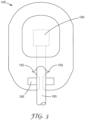
- FIG. 3 is the dressing 100 shown with an underlying device 190 and an extending tube 195.
- the dressing 100 has a first major surface 110 and second major surface 120, which is opposite the first major surface 110. At least a portion of the second major surface 120 comprises an adhesive 160 (see FIG. 2 ) for securing the dressing 100 to an underlying substrate, such as skin.
- a perimeter 130 surrounds the dressing 100 and defines a body layer 140 of the dressing 100.
- the body layer 140 is typically a thin, flexible material that can be applied over an irregular, contoured substrate, such as skin.
- the body layer 140 can be a single or multilayer construction and can further comprise an additional support material 170 secured to at least a portion of the body layer 140.
- suitable materials for the body layer 140 and support material 170, if included, are described below.
- the dressing 100 has a slot 145, which is an extension of the perimeter 130 within a portion of the body layer 140.
- the slot 145 is separated by a first portion 146 of the body layer 140 and a second portion 148 of the body layer 140.
- the slot 145 has a width forming a gap between the first portion 146 and the second portion 148 of the body layer 140.
- the slot 145 has a receiving end 142 that is open and is a separation between the first portion 146 and second portion 148 of the body layer 140, and the slot 145 has a terminal end 144 that is the innermost extension of the slot 145 into the body layer 140.
- the slot 145 is linear along a slot axis 143.
- the slot 145 can be of various sizes, shapes, width or lengths so long as it provides a separation between the first portion 145 and second portion 148 of the body layer 140.
- the first portion 146 and second portion 148 of the body layer 140 are symmetric about the slot axis 143. In use, the device 190, and tubing 195, will extend through the slot 145.
- a first perforation set 150 is at the perimeter 130 at the slot 145.
- the first perforation set 150 is a set of through cuts with each cut separated from another cut by the body layer 140.
- the cuts of the first perforation set 150 extend at least partially through the thickness of the body layer 140 to create an area of structural weakness of the body layer 140.
- the through cuts of the first perforation set 150 extend entirely through the body layer 140.
- the through cuts extend partially into the body layer 140. If the body layer 140 is a multilayer construction, the through cuts could extend entirely through one layer, and not through other layers of the body layer 140.
- the cut of the first perforation set 150 is a slit with essentially no width, meaning no material was removed from the body layer 140 during cutting.
- the cut of the first perforation set 150 has a width of material removed.
- the individual cuts of a perforation set may be the same length as one another or may be of varying lengths.
- the length of each cut may graduate from shorter to longer or from longer to shorter.
- the same with the spacing between each individual cut. may be the same length as one another or may be of varying lengths.
- the spacing between each individual cut may graduate from shorter to longer or from longer to shorter.
- the first perforation set 150 extends from a first end 152 at the perimeter 130 at the slot 145 to a second end 154.
- the second end 154 is within the body layer 140.
- the first perforation set 150 can be in a line, an array, or cluster. If the first perforation set 150 is in a line, it can be a straight, angled, or curved line.
- the first perforation set 150 can be positioned at or near the terminal end 144 of the slot 145 as shown in FIGS. 1 and 3 .
- the first perforation set 150 can extend at least partially from the perimeter 130 into the body 140 at any angle relative to the dressing slot axis 143. In the embodiment depicted in FIG. 1 , the first perforation set 150 extends substantially perpendicular to dressing slot axis 143 into body 140.
- the dressing 100 can have more than one perforation set. Any additional perforation sets can have features such as described for the first perforation set. As shown in the embodiment in FIG. 1-3 , there is a first perforation set 150 and a second perforation set 155 at the slot 145.
- the second perforation set 155 is a set of through cuts with each cut separated from another cut by the body layer 140. Similar to the first perforation set, the second perforation set 155 extends at least partially through the thickness of the body layer 140.
- the second perforation set 155 extends from a first end 156 at the perimeter 130 at the slot 145 to a second end 158.
- the second end 158 is within the body layer 140.
- the second perforation set 155 can be in a line, and array, or cluster. If the second perforation set 155 is in a line, it can be a straight, angled, or curved line.
- the second perforation set 155 extend substantially perpendicular to dressing slot axis 143 into body 140, opposite from the first perforation set 150.
- the second perforation set 155 is substantially the same size and shape as the first perforation set 150.
- first and second perforation sets can be different sizes, lengths, shapes from one another.
- the second perforation set 155 provides an area of weakness in the structural strength of the body layer 140 of the dressing 100 and will cause a break at the second perforation set 155 to expand the side of the slot 145 for a larger tube 195.
- the first perforation set 150, and second perforation set 155, if included, have cut lengths between 0.635 mm (0.025 inches) and 25.4 mm (1.0 inches) wide. In one embodiment, the body layer 140 between cuts is between 2.54 mm (0.01 inches) and 1.27 mm (0.05 inches) wide.
- the dressing 100 is applied over a device 190, like shown in FIG. 3 , with a portion of the device 190, such as tubing 195 extending through the slot 145.
- the tubing 195 size can vary. Therefore, the first perforation set 150 provides an area of weakness in the structural strength of the body layer 140 of the dressing 100 and will cause a break at the first perforation set 150 to expand the side of the slot 145 for a larger tube 195.
- the dressing 100 is for placement over an intravenous catheter device 190 with tubing 195.
- the intravenous device 190 is placed under the body layer 140 of the dressing 100, and the tubing 195 extends through the slot 145.
- the first perforation set 150 and/or second perforation set 155 will expand the width of slit 145 to size of the tubing 195.
- the body layer 140 of the dressing 100 can include a support material 170.
- the support material 170 secures with at least a portion of the body layer 140.
- the body layer 140 is very flexible and elastic.
- the support material 170 can be provided in regions to limit the flexibility and elasticity of the body layer.
- the support material 170 can be provided to have a flexibility or elasticity in one direction that is different than the flexibility or elasticity in a second direction. This can further help control the overall extensibility and flexibility of the overall dressing.
- the support material 170 is secured to the body layer 140, through adhesive, thermal bonding, lamination, or other commonly used securement techniques.
- the support material 170 provides structural strength to the dressing 100, and therefore, independently, is less elastic than the body layer 140.
- the support material 170 independently, has essentially no elasticity, such that is may be unable to stretch and/or it may be unable to recover from a stretch.
- the support material 170 may be more elastic in one direction (machine direction) than in the cross direction (transverse direction), but overall it has less elasticity than the body layer 140.
- Elasticity can be measured by any number of commonly used means for evaluating stretch and recovery of a material.
- the body layer 140 (independent of the support material) has an elongation at break of at least 200%. In one embodiment, the body layer 140 (independent of the support material) has an elongation at break of at least 1000%. In one embodiment, the body layer 140 (independent of the support material) has an elongation at break of less than 500%. In one embodiment, the support material 170 (independent of the backing layer) has an elongation at break of at least 20%. In one embodiment, the support material 170 (independent of the backing layer) has an elongation at break of at least 100%. In one embodiment, the support material 170 has an elongation at break less than 200%.
- a support material 170 extends adjacent the entire perimeter 130 of the dressing 100, but is not continuous across the entire body 140.
- the support material 170 is not located in the central window 142 of the dressing 100 to allow for a transparent window to view the underlying substrate 165 or device 190.
- the support material 170 comprises polymeric film(s), nonwoven fibrous webs, woven fibrous webs, knits, films and other backing materials, which maybe translucent or transparent.
- the arrangement of the body layer 140 and support material 170 is similar to a 3M Tegaderm IV Advanced Securement Dressing, which includes a nonwoven layer adjacent to a thin polyurethane film.
- the perforation sets might be included in only those portion including the support material. Typically, the stiffness or rigidity of the support material will limit the propagation of the perforation opening.
- the body layer 140 can be thin, flexible, elastic and a sufficiently impermeable barrier to the passage of liquids and at least some gases, which protects the covered site from external contaminants. Being elastic allows for the body layer 140 to expand, contract, stretch and recover as the underlying substrate, such as skin, moves.
- the support material 170 can be included in specific areas, like the perimeter 130, to limit flexibility and stretching of the body layer 140. Excessive stretching of the body layer 140 can cause peeling or a loose fit to the underlying device. When a support material 170 is included in the dressing 100, expansion at the slot 145 can be significantly restricted. Therefore, the perforation sets 150, 155 provide for isolated stretching and expansion in the areas with limited ability to stretch due to the support material 170. If a support material 170 is included, the perforation set 150 remains within the areas of the support material 170 to prevent further propagation of the tear.
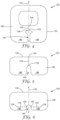
- FIG. 4 is a second embodiment of a dressing 102.
- Dressing 102 is substantially similar to the embodiment of the dressing 100 depicted in FIG. 1 , and so the same reference numbers are used to identify the same structural elements.
- dressing 102 has only the first perforation set 150 and does not include a second perforation set.
- the first perforation set 150 extends parallel to dressing slot axis 143 from the apex of the terminal end 144 of slot 145.
- the first perforation set 150 extends from a first end 152 at the perimeter 130 to a second end 154 within the body layer 140. This arrangement of perforation set 150 allows for selectively tearing along the perforation set 150 to accommodate a catheter of varying sizes and shapes. If a support material 170 is included, the perforation set 150 remains within the areas of the support material 170 to prevent further propagation of the tear.
- FIG. 5 is a third embodiment of a dressing 103.
- the dressing 103 is a tape strip.
- the same reference numbers are used to identify the same structural elements as described in FIGS. 1-3 .
- This dressing 103 comprises a first perforation set 150.
- the first perforation set 150 extends from a first end 152 adjacent the perimeter 130 at the apex of the terminal end 144 of slot 145 at least partially through the body layer 140 to a second end 154 also on the perimeter 130 along a line substantially parallel to dressing slot axis 143.
- Slot 145 is positioned in the body 140 such that the portions of the body on either side of slot 145 are symmetric about dressing slot axis 143. Support material is not included.
- first perforation set 150 allows for selectively tearing along the dressing slot axis for improved coverage of the site around a catheter and for tearing the tape completely to aid in removal of the tape.
- This dressing 103 can be used in combination with a dressing such as shown in FIG. 1 or FIG. 3 to further secure the device 190, like shown in FIG. 3 .
- FIG. 6 is a fourth embodiment of a dressing 104.
- the dressing 104 is a tape strip.
- the same reference numbers are used to identify the same structural elements as described in FIGS. 1-3 .
- This dressing 104 comprising a first perforation sets 150 and second perforation set 155.
- the first perforation sets 150 extend from a first end 152 adjacent the perimeter 130 proximate to the apex of the terminal end 144 of slot 145 to a second end 154 into the body layer 140 along a line substantially perpendicular to dressing slot axis 143.
- the second perforation sets 155 extend from a first end 156 adjacent the perimeter 130 proximate to the apex of the terminal end 144 of slot 145 to a second end 158 into the body layer 140 along a line substantially perpendicular to dressing slot axis 143.
- the first perforation sets 150 and second perforation set 155 are additionally symmetrical about slot 145 and the dressing slot axis 143.
- Support material is not included. It is understood that the support material could be included over a portion or over the entire dressing.
- This arrangement of first perforation sets 150 and second perforation set 155 allows for selectively tearing along the dressing slot axis for improved coverage of the site around a catheter and accommodation of catheters of varying sizes and shapes.
- This dressing 104 can be used in combination with a dressing such as shown in FIG. 1 or FIG. 3 to further secure the device 190, like shown in FIG. 3 .
- FIG. 7 is an embodiment of a dressing 105.
- Dressing 105 is substantially similar to the embodiment of the dressing 100 depicted in FIG. 1 and dressing 102 depicted in FIG. 4 , and so the same reference numbers are used to identify the same structural elements.
- dressing 105 has a first perforation set 150 that extends perpendicular to dressing slot axis 143 from a side of the slot 145.
- the first perforation set 150 extends from a first end 152 at the perimeter 130 to a second end 154 within the body layer 140.
- This first perforation set 150 has a portion that extends in a first direction and a second portion that extends in a second direction.
- This arrangement of first perforation set 150 form an arrow " ⁇ " shape.
- This arrangement of perforation set 150 allows for selectively tearing along the perforation set 150 to accommodate a catheter of varying sizes and shapes.
- the dressing disclosed may be made by conventional techniques (e.g., extrusion, solvent casting, calendaring, laminating, adhesive coating, and the like) which are familiar to those skilled in the art.
- US Patent 6,685,682 discloses constructions and methods for making dressings with backing layers and support material. It will be understood that the perforation sets can be applied using know cutting or perforation techniques to the body layer prior to final construction of the dressing or after final construction of the dressing.
- the dressings are useful to provide an impermeable barrier to the passage of liquids and at least some gases.
- the dressings are well suited for medical application and for securing to skin.
- Representative barriers for use as the body layer may include non-woven and woven fibrous webs, knits, films, foams, polymeric films.
- a transparent substrate is desirable to allow for viewing of the underlying skin or device.
- the body layer has high moisture vapor permeability, but generally impermeable to liquid water so that microbes and other contaminants are sealed out from the area under the substrate.
- a suitable material is a high moisture vapor permeable film such as described in US Patents 3,645,835 and 4,595,001 .
- the composite should transmit moisture vapor at a rate equal to or greater than human skin such as, for example, at a rate of at least 300 g/m 2 /24 hrs at 37°C/100-10% RH, or at least 700 g/m 2 /24 hrs at 37°C/100-10% RH, or at least 2000 g/m 2 /24 hrs at 37°C/100-10% RH using the inverted cup method as described in U.S. Pat. No. 4,595,001 .
- Pattern coated adhesives may be used to increase the moisture vapor transmission.
- the body layer is an elastomeric polyurethane, polyester, or polyether block amide films. These films combine the desirable properties of resiliency, elasticity, high moisture vapor permeability, and transparency. A description of this characteristic of body layers can be found in issued U.S. Patent Nos. 5,088,483 and 5,160,315 .
- Suitable body layers may include the thin polymeric film backings sold under the trade names TEGADERM (3M Company), OPSITE (Smith & Nephew), etc.
- the body layer is relatively thin to improve conformability.
- the backing layer may be formed of polymeric films with a thickness of 200 micrometers or less, or 100 micrometers or less, potentially 50 micrometers or less, or even 25 micrometers or less.
- the support material provides strength to the thin, flexible body layer.
- the support material therefore has more stiffness and less elasticity than the body layer.
- the support material may be a coating, such as an adhesive, or may be a self-supporting substrate such as another film, woven, knitted, or nonwoven fabric.
- US Patent 5,088,483 discloses a permanent adhesive as a reinforcement that could be used as the support material.
- a woven, knitted, or nonwoven fabric used as the support material is a high strength nonwoven fabric available from E. I. Dupont de Nemours & Company of Wilmington, Delaware under the trademark Sontara.
- suitable nonwoven webs include a hydroentangled polyester fabric available from Veratec, a division of International Paper of Walpole, Mass.
- Another suitable nonwoven web is the nonwoven elastomeric web described in US Pat. 5,230,701 .
- Suitable adhesives are pressure sensitive and in certain embodiments have a relatively high moisture vapor transmission rate to allow for moisture evaporation.
- Suitable pressure sensitive adhesives include those based on acrylates, urethane, hydrogels, hydrocolloids, block copolymers, silicones, rubber-based adhesives (including natural rubber, polyisoprene, polyisobutylene, butyl rubber etc.) as well as combinations of these adhesives.
- the adhesive component may contain tackifiers, plasticizers, rheology modifiers as well as active components including for example an antimicrobial agent.
- the pressure sensitive adhesives that may be used in the dressings may include adhesives that are typically applied to the skin such as the acrylate copolymers described in U.S. Patent No. RE 24,906 , particularly a 97:3 isooctyl acrylate:acrylamide copolymer.
- Another example may include a 70:15:15 isooctyl acrylate: ethyleneoxide acrylate:acrylic acid terpolymer, as described in U.S. Patent No. 4,737,410 .
- Other potentially useful adhesives are described in U.S. Patent Nos. 3,389,827 ; 4,112,213 ; 4,310,509 ; and 4,323,557 .
- Inclusion of medicaments or antimicrobial agents in the adhesive is also contemplated, as described in U.S. Patent Nos. 4,310,509 and 4,323,557 .
- Silicone adhesive can also be used. Generally, silicone adhesives can provide suitable adhesion to skin while gently removing from skin. Suitable silicone adhesives are disclosed in PCT Publications WO2010/056541 and WO2010/056543 .
- the pressure sensitive adhesives may, in some embodiments, transmit moisture vapor at a rate greater to or equal to that of human skin. While such a characteristic can be achieved through the selection of an appropriate adhesive, it is also contemplated that other methods of achieving a high relative rate of moisture vapor transmission may be used, such as pattern coating the adhesive on the backing, as described in U.S. Patent No. 4,595,001 .
- Other potentially suitable pressure sensitive adhesives may include blown-micro-fiber (BMF) adhesives such as, for example, those described in U.S. Patent No. 6,994,904 .
- BMF blown-micro-fiber
- a portion may include an acrylate adhesive while another portion may include a silicone adhesive.
- acrylate adhesive to prevent edge separation, adjacent the perimeter is acrylate adhesive, while near the central portion there is silicone adhesive.
- silicone adhesive to strongly secure with a device or tubing near the central portion there is acrylate adhesive, while near the perimeter in contact with skin is silicone adhesive.
- an absorbent material may also be used in conjunction with the dressings described herein.
- An absorbent material can be any of a variety of materials including, but not limited to, foam, sponge, super absorbent fibers/particles, hydrocolloid compositions, knitted, woven or nonwoven fabrics.
- the absorbent material can absorb body fluid underlying the dressing.
- An optional release liner may be included that covers all or a portion of the adhesives to prevent contamination of the adhesives prior to use.
- the package that contains the dressing may serve as a release liner.
- Suitable release liners can be made of Kraft papers, polyethylene, polypropylene, polyester or composites of any of these materials.
- the liners are coated with release agents such as silicones.
- An optional carrier may be included that covers all or a portion of the first major surface of the body layer, providing structural support if the dressing is thin and highly flexible.
- the carrier may be removable from the first major surface once the dressing is placed on skin.
- the carrier can be constructed of a variety of materials such as fabric that are woven or kitted, nonwoven material, papers, or film.
- the carrier is along the perimeter of the first major surface of the dressing and is removable from the first major surface, similar to the carrier used in the 3M Tegaderm TM Transparent Film Dressing, available from 3M Company, St. Paul, MN.
- An optional antimicrobial component may be included that is either separate from the adhesive dressing or may be integral with the dressing.
- the antimicrobial component is placed near or adjacent to the insertion site of the device 190 to inhibit microbial growth in and around the insertion site.
- the antimicrobial component can be absorbent foam or gel, such as used in a 3M Tegaderm TM CHG I.V. Securement Dressing, available from 3M Company.
Landscapes
- Health & Medical Sciences (AREA)
- Life Sciences & Earth Sciences (AREA)
- Veterinary Medicine (AREA)
- Animal Behavior & Ethology (AREA)
- Engineering & Computer Science (AREA)
- Public Health (AREA)
- Biomedical Technology (AREA)
- Heart & Thoracic Surgery (AREA)
- General Health & Medical Sciences (AREA)
- Vascular Medicine (AREA)
- Dermatology (AREA)
- Pulmonology (AREA)
- Hematology (AREA)
- Anesthesiology (AREA)
- Biophysics (AREA)
- Materials For Medical Uses (AREA)
- Media Introduction/Drainage Providing Device (AREA)
Applications Claiming Priority (2)
| Application Number | Priority Date | Filing Date | Title |
|---|---|---|---|
| US201962827400P | 2019-04-01 | 2019-04-01 | |
| PCT/IB2020/052552 WO2020201879A1 (en) | 2019-04-01 | 2020-03-19 | A conformable dressing |
Publications (2)
| Publication Number | Publication Date |
|---|---|
| EP3946187A1 EP3946187A1 (en) | 2022-02-09 |
| EP3946187B1 true EP3946187B1 (en) | 2025-06-11 |
Family
ID=70166086
Family Applications (1)
| Application Number | Title | Priority Date | Filing Date |
|---|---|---|---|
| EP20716939.2A Active EP3946187B1 (en) | 2019-04-01 | 2020-03-19 | A conformable dressing |
Country Status (5)
| Country | Link |
|---|---|
| US (1) | US12409074B2 (https=) |
| EP (1) | EP3946187B1 (https=) |
| JP (1) | JP2022527806A (https=) |
| CN (1) | CN113677304A (https=) |
| WO (1) | WO2020201879A1 (https=) |
Families Citing this family (9)
| Publication number | Priority date | Publication date | Assignee | Title |
|---|---|---|---|---|
| GB0808376D0 (en) | 2008-05-08 | 2008-06-18 | Bristol Myers Squibb Co | Wound dressing |
| JP6151186B2 (ja) | 2010-12-08 | 2017-06-21 | コンバテック・テクノロジーズ・インコーポレイテッドConvatec Technologies Inc | 創傷滲出液システム付属装置 |
| JP5833134B2 (ja) | 2010-12-08 | 2015-12-16 | コンバテック・テクノロジーズ・インコーポレイテッドConvatec Technologies Inc | 創傷部位から滲出液を除去するための方法およびシステム |
| WO2014096843A2 (en) | 2012-12-20 | 2014-06-26 | Convatec Technologies Inc. | Processing of chemically modified cellulosic fibres |
| GB201608099D0 (en) | 2016-05-09 | 2016-06-22 | Convatec Technologies Inc | Negative pressure wound dressing |
| EP4360666A3 (en) | 2017-11-16 | 2024-05-08 | ConvaTec Limited | Fluid collection apparatus |
| SG11202112292QA (en) | 2019-06-03 | 2021-12-30 | Convatec Ltd | Methods and devices to disrupt and contain pathogens |
| US11331221B2 (en) | 2019-12-27 | 2022-05-17 | Convatec Limited | Negative pressure wound dressing |
| US11771819B2 (en) | 2019-12-27 | 2023-10-03 | Convatec Limited | Low profile filter devices suitable for use in negative pressure wound therapy systems |
Family Cites Families (33)
| Publication number | Priority date | Publication date | Assignee | Title |
|---|---|---|---|---|
| CA677797A (en) | 1955-11-18 | 1964-01-14 | Minnesota Mining And Manufacturing Company | Sheet material having a pressure-sensitive adhesive coating of acrylate ester copolymer |
| US4112213A (en) | 1964-09-28 | 1978-09-05 | Johnson & Johnson | Pressure sensitive adhesive tapes and method of making same |
| US3389827A (en) | 1967-04-10 | 1968-06-25 | Minnesota Mining & Mfg | Easy-open container and sealing tape |
| NO134790C (no) | 1968-07-09 | 1984-03-22 | Smith & Nephew | Klebende,; trykkfoelsomt, vanndamp-permeabelt produkt for bruk paa hud hos mennesker. |
| US4310509A (en) | 1979-07-31 | 1982-01-12 | Minnesota Mining And Manufacturing Company | Pressure-sensitive adhesive having a broad spectrum antimicrobial therein |
| US4323557A (en) | 1979-07-31 | 1982-04-06 | Minnesota Mining & Manufacturing Company | Pressure-sensitive adhesive containing iodine |
| AU560088B2 (en) | 1982-04-08 | 1987-03-26 | Smith & Nephew Associated Companies Plc | Surgical adhesive dressing |
| US4737410A (en) | 1986-11-28 | 1988-04-12 | Minnesota Mining And Manufacturing Company | Polyalkyloxazoline-reinforced acrylic pressure-sensitive adhesive composition |
| GB8706116D0 (en) | 1987-03-14 | 1987-04-15 | Smith & Nephew Ass | Adhesive dressings |
| US5230701A (en) | 1988-05-13 | 1993-07-27 | Minnesota Mining And Manufacturing Company | Elastomeric adhesive and cohesive materials |
| US5088483A (en) | 1988-11-04 | 1992-02-18 | Minnesota Mining And Manufacturing Co. | Adhesive frame bandage |
| US5160315A (en) | 1991-04-05 | 1992-11-03 | Minnesota Mining And Manufacturing Company | Combined adhesive strip and transparent dressing delivery system |
| US6685682B1 (en) | 1993-03-22 | 2004-02-03 | 3M Innovative Properties Company | Carrier delivered dressing and method of manufacture |
| GB9401683D0 (en) | 1994-01-28 | 1994-03-23 | Smith & Nephew | Catheter/cannula dressing |
| US6607799B1 (en) * | 1998-10-15 | 2003-08-19 | 3M Innovative Properties Company | Surgical dressing with delivery system and method of manufacture |
| US6124521A (en) | 1999-03-10 | 2000-09-26 | Tri-State Hospital Supply Corporation | Dermal wound window dressing securement system |
| US6994904B2 (en) | 2001-05-02 | 2006-02-07 | 3M Innovative Properties Company | Pressure sensitive adhesive fibers with a reinforcing material |
| US7025749B2 (en) | 2004-05-21 | 2006-04-11 | Tri-State Hospital Supply Corporation | Jugular and subclavian access site dressing and method |
| US7294752B1 (en) | 2006-06-27 | 2007-11-13 | Tri-State Hospital Supply Corporation | Window dressing having integral anchor |
| SE532495C2 (sv) * | 2007-12-13 | 2010-02-09 | Moelnlycke Health Care Ab | Förband för att skydda huden kring föremål som skjuter ut därifrån |
| US8053623B2 (en) * | 2008-01-29 | 2011-11-08 | Centurion Medical Products Corporation | Reinforced closure anchor |
| JP5868177B2 (ja) | 2008-10-29 | 2016-02-24 | スリーエム イノベイティブ プロパティズ カンパニー | 電子ビーム硬化される非官能化シリコーン感圧接着剤 |
| JP5662329B2 (ja) | 2008-10-29 | 2015-01-28 | スリーエム イノベイティブ プロパティズ カンパニー | 電子ビーム硬化シリコーン材料 |
| US8212101B2 (en) * | 2009-02-03 | 2012-07-03 | Centurion Medical Products Corporation | Window dressing having integral anchor |
| JP2012103598A (ja) | 2010-11-12 | 2012-05-31 | Seiko Epson Corp | 画像形成装置および画像形成方法 |
| ITBO20120185A1 (it) * | 2012-04-06 | 2013-10-07 | Emodial S R L | Medicazione antimicrobica, composizione antimicrobica e relativo uso |
| WO2014005140A1 (en) * | 2012-06-29 | 2014-01-03 | Centurion Medical Products Corporation | Multi-layer medical dressings |
| EP2752176B1 (de) * | 2013-01-08 | 2024-03-20 | BSN medical GmbH | Antimikrobiell aktive Wundauflage für Katheterfixierungen |
| US9629983B2 (en) | 2013-03-08 | 2017-04-25 | Ethicon, Inc. | All in one antimicrobial dressing for catheter coverage |
| WO2014149718A1 (en) * | 2013-03-11 | 2014-09-25 | 3M Innovative Properties Company | A conformable medical dressing |
| US20150014949A1 (en) | 2013-04-08 | 2015-01-15 | Rick Terrell Dittman | Carrying Device Attachment |
| CN110639115B (zh) | 2013-09-06 | 2022-06-21 | C·R·巴德股份有限公司 | 医疗制品固定系统 |
| EP3694457A1 (en) * | 2017-10-09 | 2020-08-19 | 3M Innovative Properties Company | Securement dressing with conformal border |
-
2020
- 2020-03-19 US US17/599,059 patent/US12409074B2/en active Active
- 2020-03-19 WO PCT/IB2020/052552 patent/WO2020201879A1/en not_active Ceased
- 2020-03-19 CN CN202080026849.XA patent/CN113677304A/zh active Pending
- 2020-03-19 EP EP20716939.2A patent/EP3946187B1/en active Active
- 2020-03-19 JP JP2021558761A patent/JP2022527806A/ja active Pending
Also Published As
| Publication number | Publication date |
|---|---|
| US20220175585A1 (en) | 2022-06-09 |
| US12409074B2 (en) | 2025-09-09 |
| JP2022527806A (ja) | 2022-06-06 |
| WO2020201879A1 (en) | 2020-10-08 |
| CN113677304A (zh) | 2021-11-19 |
| EP3946187A1 (en) | 2022-02-09 |
Similar Documents
| Publication | Publication Date | Title |
|---|---|---|
| EP3946187B1 (en) | A conformable dressing | |
| EP2968018B1 (en) | A conformable medical dressing | |
| JP7304868B2 (ja) | 適合性のある辺縁を有する固定ドレッシング材 | |
| US20210259889A1 (en) | Trimmable conformable wound dressing | |
| US4753232A (en) | Adhesive wound dressings | |
| EP2731563B1 (en) | A wound dressing assembly | |
| EP3030207B1 (en) | A support device with a contained cushioning element | |
| EP3975955B1 (en) | Medical dressing for securing a tubiform component of a medical device | |
| WO2015130608A1 (en) | Medical dressing | |
| US20220355078A1 (en) | Tube securement tape | |
| EP2874586B1 (en) | A securement assembly | |
| US20230277385A1 (en) | Conformable medical dressing | |
| EP4041163B1 (en) | Tube securement system | |
| US20210178056A1 (en) | Medical tubing organizer |
Legal Events
| Date | Code | Title | Description |
|---|---|---|---|
| STAA | Information on the status of an ep patent application or granted ep patent |
Free format text: STATUS: UNKNOWN |
|
| STAA | Information on the status of an ep patent application or granted ep patent |
Free format text: STATUS: THE INTERNATIONAL PUBLICATION HAS BEEN MADE |
|
| PUAI | Public reference made under article 153(3) epc to a published international application that has entered the european phase |
Free format text: ORIGINAL CODE: 0009012 |
|
| STAA | Information on the status of an ep patent application or granted ep patent |
Free format text: STATUS: REQUEST FOR EXAMINATION WAS MADE |
|
| 17P | Request for examination filed |
Effective date: 20211005 |
|
| AK | Designated contracting states |
Kind code of ref document: A1 Designated state(s): AL AT BE BG CH CY CZ DE DK EE ES FI FR GB GR HR HU IE IS IT LI LT LU LV MC MK MT NL NO PL PT RO RS SE SI SK SM TR |
|
| DAV | Request for validation of the european patent (deleted) | ||
| DAX | Request for extension of the european patent (deleted) | ||
| STAA | Information on the status of an ep patent application or granted ep patent |
Free format text: STATUS: EXAMINATION IS IN PROGRESS |
|
| 17Q | First examination report despatched |
Effective date: 20230223 |
|
| RAP1 | Party data changed (applicant data changed or rights of an application transferred) |
Owner name: SOLVENTUM INTELLECTUAL PROPERTIES COMPANY |
|
| GRAP | Despatch of communication of intention to grant a patent |
Free format text: ORIGINAL CODE: EPIDOSNIGR1 |
|
| STAA | Information on the status of an ep patent application or granted ep patent |
Free format text: STATUS: GRANT OF PATENT IS INTENDED |
|
| INTG | Intention to grant announced |
Effective date: 20250305 |
|
| GRAS | Grant fee paid |
Free format text: ORIGINAL CODE: EPIDOSNIGR3 |
|
| GRAA | (expected) grant |
Free format text: ORIGINAL CODE: 0009210 |
|
| STAA | Information on the status of an ep patent application or granted ep patent |
Free format text: STATUS: THE PATENT HAS BEEN GRANTED |
|
| AK | Designated contracting states |
Kind code of ref document: B1 Designated state(s): AL AT BE BG CH CY CZ DE DK EE ES FI FR GB GR HR HU IE IS IT LI LT LU LV MC MK MT NL NO PL PT RO RS SE SI SK SM TR |
|
| REG | Reference to a national code |
Ref country code: GB Ref legal event code: FG4D |
|
| REG | Reference to a national code |
Ref country code: CH Ref legal event code: EP |
|
| REG | Reference to a national code |
Ref country code: IE Ref legal event code: FG4D |
|
| REG | Reference to a national code |
Ref country code: DE Ref legal event code: R096 Ref document number: 602020052595 Country of ref document: DE |
|
| PG25 | Lapsed in a contracting state [announced via postgrant information from national office to epo] |
Ref country code: ES Free format text: LAPSE BECAUSE OF FAILURE TO SUBMIT A TRANSLATION OF THE DESCRIPTION OR TO PAY THE FEE WITHIN THE PRESCRIBED TIME-LIMIT Effective date: 20250611 Ref country code: FI Free format text: LAPSE BECAUSE OF FAILURE TO SUBMIT A TRANSLATION OF THE DESCRIPTION OR TO PAY THE FEE WITHIN THE PRESCRIBED TIME-LIMIT Effective date: 20250611 |
|
| REG | Reference to a national code |
Ref country code: LT Ref legal event code: MG9D |
|
| PG25 | Lapsed in a contracting state [announced via postgrant information from national office to epo] |
Ref country code: NO Free format text: LAPSE BECAUSE OF FAILURE TO SUBMIT A TRANSLATION OF THE DESCRIPTION OR TO PAY THE FEE WITHIN THE PRESCRIBED TIME-LIMIT Effective date: 20250911 Ref country code: GR Free format text: LAPSE BECAUSE OF FAILURE TO SUBMIT A TRANSLATION OF THE DESCRIPTION OR TO PAY THE FEE WITHIN THE PRESCRIBED TIME-LIMIT Effective date: 20250912 |
|
| REG | Reference to a national code |
Ref country code: NL Ref legal event code: MP Effective date: 20250611 |
|
| PG25 | Lapsed in a contracting state [announced via postgrant information from national office to epo] |
Ref country code: BG Free format text: LAPSE BECAUSE OF FAILURE TO SUBMIT A TRANSLATION OF THE DESCRIPTION OR TO PAY THE FEE WITHIN THE PRESCRIBED TIME-LIMIT Effective date: 20250611 |
|
| PG25 | Lapsed in a contracting state [announced via postgrant information from national office to epo] |
Ref country code: HR Free format text: LAPSE BECAUSE OF FAILURE TO SUBMIT A TRANSLATION OF THE DESCRIPTION OR TO PAY THE FEE WITHIN THE PRESCRIBED TIME-LIMIT Effective date: 20250611 |
|
| PG25 | Lapsed in a contracting state [announced via postgrant information from national office to epo] |
Ref country code: RS Free format text: LAPSE BECAUSE OF FAILURE TO SUBMIT A TRANSLATION OF THE DESCRIPTION OR TO PAY THE FEE WITHIN THE PRESCRIBED TIME-LIMIT Effective date: 20250911 |
|
| PG25 | Lapsed in a contracting state [announced via postgrant information from national office to epo] |
Ref country code: LV Free format text: LAPSE BECAUSE OF FAILURE TO SUBMIT A TRANSLATION OF THE DESCRIPTION OR TO PAY THE FEE WITHIN THE PRESCRIBED TIME-LIMIT Effective date: 20250611 |
|
| PG25 | Lapsed in a contracting state [announced via postgrant information from national office to epo] |
Ref country code: NL Free format text: LAPSE BECAUSE OF FAILURE TO SUBMIT A TRANSLATION OF THE DESCRIPTION OR TO PAY THE FEE WITHIN THE PRESCRIBED TIME-LIMIT Effective date: 20250611 |
|
| PG25 | Lapsed in a contracting state [announced via postgrant information from national office to epo] |
Ref country code: PT Free format text: LAPSE BECAUSE OF FAILURE TO SUBMIT A TRANSLATION OF THE DESCRIPTION OR TO PAY THE FEE WITHIN THE PRESCRIBED TIME-LIMIT Effective date: 20251013 |
|
| REG | Reference to a national code |
Ref country code: AT Ref legal event code: MK05 Ref document number: 1801810 Country of ref document: AT Kind code of ref document: T Effective date: 20250611 |
|
| PG25 | Lapsed in a contracting state [announced via postgrant information from national office to epo] |
Ref country code: IS Free format text: LAPSE BECAUSE OF FAILURE TO SUBMIT A TRANSLATION OF THE DESCRIPTION OR TO PAY THE FEE WITHIN THE PRESCRIBED TIME-LIMIT Effective date: 20251011 |
|
| PG25 | Lapsed in a contracting state [announced via postgrant information from national office to epo] |
Ref country code: AT Free format text: LAPSE BECAUSE OF FAILURE TO SUBMIT A TRANSLATION OF THE DESCRIPTION OR TO PAY THE FEE WITHIN THE PRESCRIBED TIME-LIMIT Effective date: 20250611 Ref country code: SM Free format text: LAPSE BECAUSE OF FAILURE TO SUBMIT A TRANSLATION OF THE DESCRIPTION OR TO PAY THE FEE WITHIN THE PRESCRIBED TIME-LIMIT Effective date: 20250611 |
|
| PG25 | Lapsed in a contracting state [announced via postgrant information from national office to epo] |
Ref country code: CZ Free format text: LAPSE BECAUSE OF FAILURE TO SUBMIT A TRANSLATION OF THE DESCRIPTION OR TO PAY THE FEE WITHIN THE PRESCRIBED TIME-LIMIT Effective date: 20250611 |
|
| PG25 | Lapsed in a contracting state [announced via postgrant information from national office to epo] |
Ref country code: PL Free format text: LAPSE BECAUSE OF FAILURE TO SUBMIT A TRANSLATION OF THE DESCRIPTION OR TO PAY THE FEE WITHIN THE PRESCRIBED TIME-LIMIT Effective date: 20250611 |
|
| PG25 | Lapsed in a contracting state [announced via postgrant information from national office to epo] |
Ref country code: EE Free format text: LAPSE BECAUSE OF FAILURE TO SUBMIT A TRANSLATION OF THE DESCRIPTION OR TO PAY THE FEE WITHIN THE PRESCRIBED TIME-LIMIT Effective date: 20250611 |
|
| PG25 | Lapsed in a contracting state [announced via postgrant information from national office to epo] |
Ref country code: SK Free format text: LAPSE BECAUSE OF FAILURE TO SUBMIT A TRANSLATION OF THE DESCRIPTION OR TO PAY THE FEE WITHIN THE PRESCRIBED TIME-LIMIT Effective date: 20250611 Ref country code: RO Free format text: LAPSE BECAUSE OF FAILURE TO SUBMIT A TRANSLATION OF THE DESCRIPTION OR TO PAY THE FEE WITHIN THE PRESCRIBED TIME-LIMIT Effective date: 20250611 |
|
| REG | Reference to a national code |
Ref country code: DE Ref legal event code: R097 Ref document number: 602020052595 Country of ref document: DE |
|
| PGFP | Annual fee paid to national office [announced via postgrant information from national office to epo] |
Ref country code: GB Payment date: 20260220 Year of fee payment: 7 |
|
| PG25 | Lapsed in a contracting state [announced via postgrant information from national office to epo] |
Ref country code: DK Free format text: LAPSE BECAUSE OF FAILURE TO SUBMIT A TRANSLATION OF THE DESCRIPTION OR TO PAY THE FEE WITHIN THE PRESCRIBED TIME-LIMIT Effective date: 20250611 |
|
| PGFP | Annual fee paid to national office [announced via postgrant information from national office to epo] |
Ref country code: DE Payment date: 20260219 Year of fee payment: 7 |
|
| PG25 | Lapsed in a contracting state [announced via postgrant information from national office to epo] |
Ref country code: IT Free format text: LAPSE BECAUSE OF FAILURE TO SUBMIT A TRANSLATION OF THE DESCRIPTION OR TO PAY THE FEE WITHIN THE PRESCRIBED TIME-LIMIT Effective date: 20250611 |
|
| PLBE | No opposition filed within time limit |
Free format text: ORIGINAL CODE: 0009261 |
|
| STAA | Information on the status of an ep patent application or granted ep patent |
Free format text: STATUS: NO OPPOSITION FILED WITHIN TIME LIMIT |
|
| REG | Reference to a national code |
Ref country code: CH Ref legal event code: L10 Free format text: ST27 STATUS EVENT CODE: U-0-0-L10-L00 (AS PROVIDED BY THE NATIONAL OFFICE) Effective date: 20260423 |