EP3935679B1 - Vorrichtung zum parallelschalten mehrerer, bezüglich einer fügeachse parallel zueinander angeordneter batteriezellen - Google Patents
Vorrichtung zum parallelschalten mehrerer, bezüglich einer fügeachse parallel zueinander angeordneter batteriezellen Download PDFInfo
- Publication number
- EP3935679B1 EP3935679B1 EP20708404.7A EP20708404A EP3935679B1 EP 3935679 B1 EP3935679 B1 EP 3935679B1 EP 20708404 A EP20708404 A EP 20708404A EP 3935679 B1 EP3935679 B1 EP 3935679B1
- Authority
- EP
- European Patent Office
- Prior art keywords
- contact
- battery cells
- passages
- parallel
- tongues
- Prior art date
- Legal status (The legal status is an assumption and is not a legal conclusion. Google has not performed a legal analysis and makes no representation as to the accuracy of the status listed.)
- Active
Links
Images


Classifications
-
- H—ELECTRICITY
- H01—ELECTRIC ELEMENTS
- H01M—PROCESSES OR MEANS, e.g. BATTERIES, FOR THE DIRECT CONVERSION OF CHEMICAL ENERGY INTO ELECTRICAL ENERGY
- H01M6/00—Primary cells; Manufacture thereof
- H01M6/42—Grouping of primary cells into batteries
-
- H—ELECTRICITY
- H01—ELECTRIC ELEMENTS
- H01M—PROCESSES OR MEANS, e.g. BATTERIES, FOR THE DIRECT CONVERSION OF CHEMICAL ENERGY INTO ELECTRICAL ENERGY
- H01M10/00—Secondary cells; Manufacture thereof
- H01M10/02—Details
-
- H—ELECTRICITY
- H01—ELECTRIC ELEMENTS
- H01M—PROCESSES OR MEANS, e.g. BATTERIES, FOR THE DIRECT CONVERSION OF CHEMICAL ENERGY INTO ELECTRICAL ENERGY
- H01M10/00—Secondary cells; Manufacture thereof
- H01M10/04—Construction or manufacture in general
-
- H—ELECTRICITY
- H01—ELECTRIC ELEMENTS
- H01M—PROCESSES OR MEANS, e.g. BATTERIES, FOR THE DIRECT CONVERSION OF CHEMICAL ENERGY INTO ELECTRICAL ENERGY
- H01M50/00—Constructional details or processes of manufacture of the non-active parts of electrochemical cells other than fuel cells, e.g. hybrid cells
- H01M50/50—Current conducting connections for cells or batteries
-
- H—ELECTRICITY
- H01—ELECTRIC ELEMENTS
- H01M—PROCESSES OR MEANS, e.g. BATTERIES, FOR THE DIRECT CONVERSION OF CHEMICAL ENERGY INTO ELECTRICAL ENERGY
- H01M50/00—Constructional details or processes of manufacture of the non-active parts of electrochemical cells other than fuel cells, e.g. hybrid cells
- H01M50/50—Current conducting connections for cells or batteries
- H01M50/502—Interconnectors for connecting terminals of adjacent batteries; Interconnectors for connecting cells outside a battery casing
- H01M50/503—Interconnectors for connecting terminals of adjacent batteries; Interconnectors for connecting cells outside a battery casing characterised by the shape of the interconnectors
-
- H—ELECTRICITY
- H01—ELECTRIC ELEMENTS
- H01M—PROCESSES OR MEANS, e.g. BATTERIES, FOR THE DIRECT CONVERSION OF CHEMICAL ENERGY INTO ELECTRICAL ENERGY
- H01M50/00—Constructional details or processes of manufacture of the non-active parts of electrochemical cells other than fuel cells, e.g. hybrid cells
- H01M50/50—Current conducting connections for cells or batteries
- H01M50/502—Interconnectors for connecting terminals of adjacent batteries; Interconnectors for connecting cells outside a battery casing
- H01M50/509—Interconnectors for connecting terminals of adjacent batteries; Interconnectors for connecting cells outside a battery casing characterised by the type of connection, e.g. mixed connections
- H01M50/512—Connection only in parallel
-
- H—ELECTRICITY
- H01—ELECTRIC ELEMENTS
- H01M—PROCESSES OR MEANS, e.g. BATTERIES, FOR THE DIRECT CONVERSION OF CHEMICAL ENERGY INTO ELECTRICAL ENERGY
- H01M50/00—Constructional details or processes of manufacture of the non-active parts of electrochemical cells other than fuel cells, e.g. hybrid cells
- H01M50/50—Current conducting connections for cells or batteries
- H01M50/502—Interconnectors for connecting terminals of adjacent batteries; Interconnectors for connecting cells outside a battery casing
- H01M50/521—Interconnectors for connecting terminals of adjacent batteries; Interconnectors for connecting cells outside a battery casing characterised by the material
- H01M50/524—Organic material
-
- H—ELECTRICITY
- H01—ELECTRIC ELEMENTS
- H01M—PROCESSES OR MEANS, e.g. BATTERIES, FOR THE DIRECT CONVERSION OF CHEMICAL ENERGY INTO ELECTRICAL ENERGY
- H01M50/00—Constructional details or processes of manufacture of the non-active parts of electrochemical cells other than fuel cells, e.g. hybrid cells
- H01M50/50—Current conducting connections for cells or batteries
- H01M50/502—Interconnectors for connecting terminals of adjacent batteries; Interconnectors for connecting cells outside a battery casing
- H01M50/521—Interconnectors for connecting terminals of adjacent batteries; Interconnectors for connecting cells outside a battery casing characterised by the material
- H01M50/526—Interconnectors for connecting terminals of adjacent batteries; Interconnectors for connecting cells outside a battery casing characterised by the material having a layered structure
-
- H—ELECTRICITY
- H01—ELECTRIC ELEMENTS
- H01M—PROCESSES OR MEANS, e.g. BATTERIES, FOR THE DIRECT CONVERSION OF CHEMICAL ENERGY INTO ELECTRICAL ENERGY
- H01M2220/00—Batteries for particular applications
- H01M2220/20—Batteries in motive systems, e.g. vehicle, ship, plane
-
- Y—GENERAL TAGGING OF NEW TECHNOLOGICAL DEVELOPMENTS; GENERAL TAGGING OF CROSS-SECTIONAL TECHNOLOGIES SPANNING OVER SEVERAL SECTIONS OF THE IPC; TECHNICAL SUBJECTS COVERED BY FORMER USPC CROSS-REFERENCE ART COLLECTIONS [XRACs] AND DIGESTS
- Y02—TECHNOLOGIES OR APPLICATIONS FOR MITIGATION OR ADAPTATION AGAINST CLIMATE CHANGE
- Y02E—REDUCTION OF GREENHOUSE GAS [GHG] EMISSIONS, RELATED TO ENERGY GENERATION, TRANSMISSION OR DISTRIBUTION
- Y02E60/00—Enabling technologies; Technologies with a potential or indirect contribution to GHG emissions mitigation
- Y02E60/10—Energy storage using batteries
-
- Y—GENERAL TAGGING OF NEW TECHNOLOGICAL DEVELOPMENTS; GENERAL TAGGING OF CROSS-SECTIONAL TECHNOLOGIES SPANNING OVER SEVERAL SECTIONS OF THE IPC; TECHNICAL SUBJECTS COVERED BY FORMER USPC CROSS-REFERENCE ART COLLECTIONS [XRACs] AND DIGESTS
- Y02—TECHNOLOGIES OR APPLICATIONS FOR MITIGATION OR ADAPTATION AGAINST CLIMATE CHANGE
- Y02P—CLIMATE CHANGE MITIGATION TECHNOLOGIES IN THE PRODUCTION OR PROCESSING OF GOODS
- Y02P70/00—Climate change mitigation technologies in the production process for final industrial or consumer products
- Y02P70/50—Manufacturing or production processes characterised by the final manufactured product
Definitions
- the invention relates to a device for parallel connection of several battery cells arranged parallel to one another with respect to a joining axis with a contact plate having individual openings.
- the invention is therefore based on the object of designing a device of the type described at the outset in such a way that a reliable and yet releasable parallel connection of individual battery cells under periodic mechanical loads is made possible regardless of their diameter and their relative position to the contact plate, whereby a simple assembly process can be maintained and a more structurally flexible serial connection of the battery cells can be made possible.
- each opening is designed to enclose the battery cells on the casing side and has at least one contact tongue protruding into the opening with a contact body in the form of a cut ovoid protruding from the contact tongue on the opening side.
- the contact surface between the contact spring and the casing is predetermined by the inventive provision of a contact body in the form of a cut ovoid, preferably in the form of a hemisphere, so that a defined contact resistance is produced between the contact body or the contact spring and the battery cell. This contact resistance is largely constant even in the event of mechanical deformation of the device as a result of vibrations.
- the contact bodies can be provided with an oxidation-inhibiting coating.
- a coating can be produced by providing the contact tongues with a coating thickness that is sufficient for the person skilled in the art before the contact bodies are pressed, so that after forming the contact body surfaces protruding into the openings have a closed oxidation-inhibiting coating.
- Nickel or gold can be used as coatings to protect against oxidation and reduce the resistance of the foreign layer.
- the circular openings in the contact plate are arranged in a dense circular arrangement with the formation of gussets between every three openings.
- a dense circular arrangement of openings in the sense of the invention requires a connecting web to remain between the individual battery cells or openings, the width of which must be adapted to the material properties and the required mechanical stability.
- the gussets between every three openings result in a reinforced contact plate section that can be used to introduce clamping forces into the contact plate and which, due to its structural strength, is particularly suitable for positioning the contact tongues. This also allows the mechanical preload and position of the contact tongues to be adapted depending on the type of battery used, since the contact point between the contact tongue and the conductor plate can be chosen more freely in terms of space.
- At least two, preferably at least three contact tongues equidistant around the circumference can be provided per opening.
- This increases the stabilizing clamping force on the battery
- the symmetrical force connection reduces the mechanical tension between the battery modules and the contact plate and enables force-fitting storage even if individual contact tongues are damaged.
- Another resulting effect is a more durable electrical connection between the battery cell casing and the contact plate, since a continuous electrical connection can be created here too, particularly in the event of mechanical damage to a contact tongue.
- each contact tongue of an opening surrounded by six openings delimits a gusset, which is also delimited by a contact tongue of two surrounding openings.
- This arrangement stiffens the device in the direction of the joining axis of the battery modules, i.e. essentially orthogonal to the plane of the parallel sheet, which, in addition to improved electrical conduction properties, increases the mechanical stability of the arrangement as a synergy effect due to the increased number of contact tongues per opening, especially since the forces of the contact tongues introduced into the contact sheet section of a gusset cancel each other out vectorially.
- a particularly material-saving and production-efficient design of the device according to the invention is achieved if exactly three contact tongues are provided for each opening, whereby three contact tongues are adjacent to every second gusset, while the first gussets remain free.
- Such a sequence pattern can also be created in a particularly simple manner by parallel displacement of a generating opening with three contact springs in the contact sheet plane.
- the contact sheet can be designed to be more or less elastic or rigid with respect to bending and torsional stresses due to the number of contact tongues per opening.
- the edge region of the contact sheet is formed at least five times wider than the narrowest point between two openings.
- a device has a contact plate 1.
- battery cells 2 can be mounted in openings 3 and connected in a force-fitting and parallel electrically conductive manner via contact tongues 4, which have contact bodies 5.
- the contact bodies 5 are designed such that under periodic mechanical loading and changes in the relative position between the contact sheet 1 and the battery cell 2, the contact area between the contact body 5 and the battery cell 2 remains largely constant, which is achieved according to the invention by designing the contact bodies 5 as cut ovoids, preferably as hemispheres.
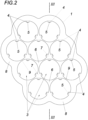
- the openings 3 of the contact sheet 1 are arranged in a very dense circular packing. Together with the arrangement of the contact tongues 4 according to the invention, this results in gussets 6, 7 between three openings 3.
- gussets 6 without contact tongues 4 alternate with gussets 7 with contact tongues 4.
- the edge region 8 of the contact sheet 1 can be formed at least five times as wide as the narrowest point 9 between two openings 3.
Landscapes
- Chemical & Material Sciences (AREA)
- Chemical Kinetics & Catalysis (AREA)
- Electrochemistry (AREA)
- General Chemical & Material Sciences (AREA)
- Engineering & Computer Science (AREA)
- Manufacturing & Machinery (AREA)
- Connection Of Batteries Or Terminals (AREA)
- Battery Mounting, Suspending (AREA)
Description
- Die Erfindung bezieht sich auf eine Vorrichtung zum Parallelschalten mehrerer, bezüglich einer Fügeachse parallel zueinander angeordneter Batteriezellen mit einem, einzelne Durchbrüche aufweisenden Kontaktblech.
- Aus dem Stand der Technik sind Vorrichtungen zum Parallelschalten von Batteriezellen bekannt (
EP3096372A1 ), bei denen einzelne, bezüglich einer Fügeachse parallel angeordnete Batteriezellen von Kontaktfedern unter Vorspannung mantelseitig umgriffen werden. Zur Parallelschaltung der einzelnen Batteriezellen werden die Kontaktfedern mit einem Kontaktblech stoffschlüssig verbunden. Obwohl diese lösbare, kraftschlüssige Verbindung zwischen den Batteriezellen und den Kontaktfedern den Vorteil einer einfachen Assemblierung und einer Austauschbarkeit defekter Batteriezellen mit sich bringt, ergibt sich dennoch der Nachteil, dass die für eine sichere elektrische und mechanische Kontaktierung der Batteriezellen erforderlichen Klemmkräfte den Assembliervorgang insofern erschweren, als es beim Fügen der Batteriezellen in die Kontaktfedern zu Beschädigungen des Batteriemantels und/oder der oxidationshindernden Beschichtung der Kontaktfedern kommt. Daraus ergeben sich hinsichtlich der möglichen Batteriezellendurchmesser und damit der nutzbaren Leistungsdichte konstruktive Beschränkungen, insbesondere für den Fall, dass die Batteriezellen und damit die Kontaktfedern mechanischen Belastungen wie beispielsweise Schwingungen ausgesetzt sind, was bei einer üblichen scharfkantigen Ausgestaltung der Kontaktzungen zu einer sukzessiven Beschädigung des Batteriezellenmantels und/oder der oxidationshindernden Beschichtung der Kontaktfedern führt. Darüber hinaus ergibt sich aufgrund der variierenden Kontaktflächen zwischen den Kontaktzungen und des Batteriezellenmantels ein veränderlicher Kontaktwiderstand, was ungünstige elektrische Betriebsbedingungen mit sich bringt. Aus diesem Grunde werden üblicherweise stoffschlüssige Verbindungen zwischen den Kontaktfedern und den Batteriezellen bevorzugt. - Um auch bei schwer zugänglichen Kontaktstellen daher eine stoffschlüssige Verbindung zu erreichen, wurde bereits vorgeschlagen (
US6120564 ,EP2007833442 CN101719540 A bekannt. - Der Erfindung liegt somit die Aufgabe zugrunde eine Vorrichtung der eingangs beschriebenen Art so auszugestalten, dass eine unter periodischen mechanischen Belastungen zuverlässige und dennoch lösbare Parallelschaltung einzelner Batteriezellen unabhängig von ihrem Durchmesser und ihrer relativen Lage zum Kontaktblech ermöglicht wird, wobei ein einfacher Assembliervorgang beibehalten und eine konstruktiv flexiblere serielle Verschaltung der Batteriezellen ermöglicht werden kann.
- Die Erfindung löst die gestellte Aufgabe dadurch, dass jeder Durchbruch zum mantelseitigen Umschließen der Batteriezellen ausgebildet ist und wenigstens eine in den Durchbruch vorragende Kontaktzunge mit einem durchbruchsseitig von der Kontaktzunge aufragenden Kontaktkörper in Form eines geschnittenen Ovoides aufweist. Im Gegensatz zu einer aus dem Stand der Technik bekannten Kontaktfeder, die je nach relativer Lage eine unbestimmbare Kontaktfläche mit der vom Durchbruch umschlossenen Batteriezelle aufweisen würde, wird durch das erfindungsgemäße Vorsehen eines Kontaktkörpers in Form eines geschnittenen Ovoides, vorzugsweise in Form einer Hemisphäre, die Berührungsfläche zwischen der Kontaktfeder und dem Mantel vorgegeben, sodass sich ein definierter Kontaktwiderstand zwischen dem Kontaktkörper bzw. der Kontaktfeder und der Batteriezelle ergibt. Dieser Kontaktwiderstand ist selbst bei einer mechanischen Verformung der Vorrichtung zufolge von Vibrationen weitgehend konstant. Aufgrund der konvexen Oberfläche der Kontaktkörper kann darüber hinaus eine Oberflächenbeschädigung vermieden werden, zumal die Kontaktkörper die scharfkantigen Kontaktzungen vom jeweiligen Oberflächenmantel der Batteriezellen trennen. Die Ausgestaltung der Erfindung bietet weiters den Vorteil, dass das Kontaktblech an einer beliebigen Position entlang der Füge- und Längsachse der Batteriezellen angeordnet werden kann, sodass sich hinsichtlich der seriellen Verschaltung der einzelnen Batteriezellen größere Gestaltungsmöglichkeiten ergeben. In einer fertigungsgünstigen Ausgestaltung können die Kontaktzungen in Richtung der Fügeachse der Batteriezellen gebogene Abschnitte des Kontaktblechs sein. Dies bedeutet, dass zur besseren elektrischen Leitfähigkeit der Vorrichtung Kontaktblech und Kontaktzungen aus einem einzigen Stück Metall geformt werden.
- Zur Verbesserung des elektrischen Kontakts bei gleichzeitig einfachen Herstellungsbedingungen wird des Weiteren vorgeschlagen, den Kontaktkörper aus den Kontaktzungen zu drücken. Dadurch können die Kontaktkörper in einem Arbeitsschritt hergestellt werden, wobei die abgerundete Oberfläche zur Vermeidung von Oberflächenbeschädigungen ohne eine gesonderte Nachbearbeitung erreicht werden kann. Zur Verringerung des Fremdschichtwiderstandes können die Kontaktkörper mit einer oxidationshindernden Beschichtung versehen sein. Eine solche Beschichtung kann in einer besonders vorteilhaften Ausgestaltung der Erfindung dadurch hergestellt werden, dass die Kontaktzungen vor dem Drücken der Kontaktkörper bereits mit einer für den Fachmann hinreichenden Beschichtungsdicke versehen sind, sodass nach dem Umformen die in die Durchbrüche vorragenden Kontaktkörperoberflächen eine geschlossene oxidationshindernde Beschichtung aufweisen. Als Beschichtungen können etwa Nickel oder Gold als Oxidationsschutz zur Senkung des Fremdschichtwiderstandes eingesetzt werden.
- Da besonders in der Fahrzeugkonstruktion Leistungsgewichte und Energiedichten eine hohe Rolle spielen, wird vorgeschlagen, dass die kreisförmigen Durchbrüche des Kontaktbleches gemäß einer dichtesten Kreispackung unter Ausbildung von zwischen je drei Durchbrüchen liegenden Zwickeln angeordnet sind. Für den Fachmann versteht sich dabei, dass eine dichteste Kreispackung von Durchbrüchen im Sinne der Erfindung das Verbleiben eines Verbindungssteges zwischen den einzelnen Batteriezellen bzw. Durchbrüchen erfordert, dessen Breite den Materialeigenschaften und der geforderten mechanischen Stabilität anzupassen ist. An den sich zwischen jeweils drei Durchbrüchen ergebenden Zwickeln ergibt sich zufolge der vorgeschlagenen Konstruktion ein verstärkter Kontaktblechabschnitt, der zur Einleitung von Klemmkräften in das Kontaktblech genützt werden kann und der sich aufgrund seiner strukturellen Festigkeit bevorzugt zur Positionierung der Kontaktzungen eignet. Dadurch lässt sich auch die mechanische Vorspannung und Lage der Kontaktzungen abhängig vom eingesetzten Batterietyp anpassen, da die Kontaktstelle zwischen Kontaktzunge und Leitungsblech räumlich freier gewählt werden kann.
- Um die Batteriezellen kraftschlüssig und symmetrisch mit dem Kontaktblech zu verklemmen, können pro Durchbruch wenigstens zwei, vorzugsweise wenigstens drei umfangsseitig äquidistante Kontaktzungen vorgesehen sein. Dadurch wird die stabilisierende Klemmkraft auf die Batterie erhöht, der symmetrische Kraftschluss vermindert die mechanische Spannung zwischen Batteriemodulen und Kontaktblech und es wird eine kraftschlüssige Lagerung auch bei Beschädigung einzelner Kontaktzungen ermöglicht. Ein weiterer resultierender Effekt ist eine strapazierfähigere elektrische Verbindung zwischen Batteriezellenmantel und Kontaktblech, da auch hier insbesondere im Fall einer mechanischen Beschädigung einer Kontaktzunge eine kontinuierliche elektrische Verbindung geschaffen werden kann.
- Um eine besonders günstige Krafteinleitung der Klemmkräfte in das Kontaktblech zu erreichen, wird vorgeschlagen, dass jede Kontaktzunge eines von sechs Durchbrüchen umgebenden Durchbruches einen Zwickel begrenzt, der auch von je einer Kontaktzunge zweier umliegender Durchbrüche begrenzt wird. Durch diese Anordnung wird die Vorrichtung in Richtung der Fügeachse der Batteriemodule, also im Wesentlichen orthogonal zur Ebene des Parallelblechs, ausgesteift, wodurch sich zusätzlich zu verbesserten elektrischen Leitungseigenschaften durch die erhöhte Anzahl an Kontaktzungen pro Durchbruch als Synergieeffekt die mechanische Stabilität der Anordnung erhöht, zumal sich die in den Kontaktblechabschnitt eines Zwickels eingeleiteten Kräfte der Kontaktzungen vektoriell aufheben. Es versteht sich dabei für den Fachmann, dass dieses Muster in einem Kontaktblech nicht beliebig fortgesetzt werden kann, sodass die Durchbrüche von Randbereichen, die nicht von sechs Durchbrüchen umgeben werden, dem obigen Kennzeichen nicht mehr genügen müssen. Eine besonders materialsparende und fertigungseffiziente Ausgestaltung der erfindungsgemäßen Vorrichtung ergibt sich, wenn je Durchbruch genau drei Kontaktzungen vorgesehen sind, womit an jeden zweiten Zwickel jeweils drei Kontaktzungen angrenzen, während die jeweils ersten Zwickel frei bleiben. Ein solches Abfolgemuster kann in besonders einfacher Weise auch durch Parallelverschieben eines erzeugenden Durchbruches mit drei Kontaktfedern in der Kontaktblechebene erzeugt werden. Je nach Bedarf und Anwendung kann das Kontaktblech durch die Anzahl der Kontaktzungen pro Durchbruch dadurch mehr oder weniger elastisch bzw. starr gegenüber Biege- und Torsionsspannungen ausgelegt werden.
- Zur weiteren Verbesserung der Stabilität der erfindungsgemäßen Vorrichtung wird vorgeschlagen, dass der Randbereich des Kontaktblechs wenigstens fünfmal breiter ausgeformt ist als die schmalste Stelle zwischen zwei Durchbrüchen.
- In der Zeichnung ist der Erfindungsgegenstand beispielsweise dargestellt. Es zeigen
- Fig. 1
- eine perspektivische Darstellung der erfindungsgemäßen Vorrichtung,
- Fig. 2
- eine Draufsicht auf die erfindungsgemäße Vorrichtung in einem größeren Maßstab und
- Fig. 3
- einen Schnitt entlang der Linie III-III der
Fig. 2 in einem noch größeren Maßstab mit angedeuteten eingesetzten Batteriezellen. - Eine erfindungsgemäße Vorrichtung weist ein Kontaktblech 1 auf. In dem Kontaktblech 1 können Batteriezellen 2 in Durchbrüchen 3 gelagert und über Kontaktzungen 4, die Kontaktkörper 5 aufweisen, kraftschlüssig und parallel elektrisch leitend verbunden werden.
- Die Kontaktkörper 5 sind so ausgestaltet, dass unter periodischer mechanischer Belastung und Änderung der relativen Position zwischen Kontaktblech 1 und Batteriezelle 2 die Kontaktfläche zwischen Kontaktkörper 5 und Batteriezelle 2 weitgehend konstant bleibt, was erfindungsgemäß durch die Gestaltung der Kontaktkörper 5 als geschnittene Ovoide, vorzugsweise als Hemisphären erreicht wird.
- Die Durchbrüche 3 des Kontaktblechs 1 sind gemäß einer dichtesten Kreispackung angeordnet. Zusammen mit der erfindungsgemäßen Anordnung der Kontaktzungen 4 ergeben sich dadurch zwischen jeweils drei Durchbrüchen 3 liegende Zwickel 6, 7. Im Falle von drei Kontaktzungen 4 je Durchbruch 3, die umfangsseitig äquidistant und in einem Winkel von 120° zueinander angeordnet sind, ergeben sich somit einerseits Zwickel 6 an die keine Kontaktzungen 4 anschließen und Zwickel 7, an die unter Ausbildung einer mechanischen Aussteifung Kontaktzungen 4 der umliegenden Durchbrüche 3 anschließen. Bei der dargestellten Vorrichtung wechseln sich somit Zwickel 6 ohne Kontaktzungen 4 mit Zwickeln 7 mit Kontaktzungen 4 jeweils ab.
- Der Randbereich 8 des Kontaktblechs 1 kann aus Stabilitätsgründen mindestens fünfmal so breit ausgeformt sein wie die schmalste Stelle 9 zwischen zwei Durchbrüchen 3.
Claims (6)
- Vorrichtung zum Parallelschalten mehrerer, bezüglich einer Fügeachse parallel zueinander angeordneter Batteriezellen (2) mit einem, einzelne Durchbrüche (3) aufweisenden Kontaktblech (1), dadurch gekennzeichnet, dass jeder Durchbruch (3) zum mantelseitigen Umschließen der Batteriezellen (2) ausgebildet ist und wenigstens eine Kontaktzunge (4) umfasst, die durchbruchsseitig einen von der Kontaktzunge (4) in den Durchbruch (3) vorragenden Kontaktkörper (5) in Form eines geschnittenen Ovoides aufweist.
- Vorrichtung nach Anspruch 1, dadurch gekennzeichnet, dass die Kontaktkörper (5) aus den Kontaktzungen (4) gedrückt sind.
- Vorrichtung nach Anspruch 1 oder 2, dadurch gekennzeichnet, dass die kreisförmigen Durchbrüche (3) des Kontaktbleches (1) gemäß einer dichtesten Kreispackung unter Ausbildung von zwischen je drei Durchbrüchen (3) liegenden Zwickeln (6,7) angeordnet sind.
- Vorrichtung nach einem der Ansprüche 1 bis 3, dadurch gekennzeichnet, dass die Durchbrüche (3) jeweils wenigstens drei umfangsseitig äquidistant zueinander angeordnete Kontaktzungen (4) aufweisen.
- Vorrichtung nach Anspruch 4, dadurch gekennzeichnet, dass jede Kontaktzunge (4) eines von sechs Durchbrüchen (3) umgebenden Durchbruches (3) einen Zwickel (7) begrenzt, der auch von je einer Kontaktzunge (4) zweier umliegender Durchbrüche (3) begrenzt wird.
- Vorrichtung nach einem der Ansprüche 1 bis 5 dadurch gekennzeichnet, dass der Randbereich (8) des Kontaktblechs (1) wenigstens fünfmal breiter ausgeformt ist als die schmalste Stelle (9) zwischen zwei Durchbrüchen (3).
Applications Claiming Priority (2)
| Application Number | Priority Date | Filing Date | Title |
|---|---|---|---|
| ATA50188/2019A AT521970B1 (de) | 2019-03-08 | 2019-03-08 | Vorrichtung zum Parallelschalten mehrerer, bezüglich einer Fügeachse parallel zueinander angeordneter Batteriezellen |
| PCT/AT2020/060054 WO2020181308A1 (de) | 2019-03-08 | 2020-02-25 | Vorrichtung zum parallelschalten mehrerer, bezüglich einer fügeachse parallel zueinander angeordneter batteriezellen |
Publications (2)
| Publication Number | Publication Date |
|---|---|
| EP3935679A1 EP3935679A1 (de) | 2022-01-12 |
| EP3935679B1 true EP3935679B1 (de) | 2024-12-18 |
Family
ID=69740061
Family Applications (1)
| Application Number | Title | Priority Date | Filing Date |
|---|---|---|---|
| EP20708404.7A Active EP3935679B1 (de) | 2019-03-08 | 2020-02-25 | Vorrichtung zum parallelschalten mehrerer, bezüglich einer fügeachse parallel zueinander angeordneter batteriezellen |
Country Status (4)
| Country | Link |
|---|---|
| US (1) | US12444809B2 (de) |
| EP (1) | EP3935679B1 (de) |
| AT (1) | AT521970B1 (de) |
| WO (1) | WO2020181308A1 (de) |
Families Citing this family (4)
| Publication number | Priority date | Publication date | Assignee | Title |
|---|---|---|---|---|
| AT522256B1 (de) | 2019-03-08 | 2021-11-15 | Raiffeisenlandesbank Oberoesterreich Ag | Vorrichtung zum lösbaren Kontaktieren einer Batteriezelle |
| AT524120B1 (de) * | 2020-12-16 | 2022-03-15 | Kreisel Electric Gmbh & Co Kg | Vorrichtung zum parallelen Kontaktieren mehrerer Batteriezellen mit einem Kontaktband |
| CN114221079B (zh) * | 2021-12-14 | 2024-08-27 | 顺加能科技有限公司 | 一种用于圆柱电芯焊接的模组支架 |
| AT528006B1 (de) * | 2024-03-18 | 2025-09-15 | John Deere Electric Powertrain Llc | Vorrichtung zum elektrischen Kontaktieren von Batteriezellen |
Family Cites Families (20)
| Publication number | Priority date | Publication date | Assignee | Title |
|---|---|---|---|---|
| JP3312853B2 (ja) | 1996-09-26 | 2002-08-12 | 松下電器産業株式会社 | 電池間接続構造 |
| JP3668084B2 (ja) | 1999-12-28 | 2005-07-06 | 三洋電機株式会社 | 組電池 |
| JP2003077453A (ja) | 2001-09-06 | 2003-03-14 | Yuasa Corp | 組電池 |
| US6677728B2 (en) * | 2002-04-12 | 2004-01-13 | Honda Giken Kogyo Kabushiki Kaisha | Battery box and battery holder having detachable ring-shaped members |
| US6932651B2 (en) | 2003-09-16 | 2005-08-23 | Honda Motor Co., Ltd. | Connecting structure for electric cells |
| JP5127154B2 (ja) * | 2005-05-23 | 2013-01-23 | パナソニック株式会社 | 電池モジュール |
| KR100786875B1 (ko) | 2006-10-20 | 2007-12-20 | 삼성에스디아이 주식회사 | 전지 모듈 |
| KR20080045305A (ko) | 2006-11-20 | 2008-05-23 | 주식회사 엘지화학 | 디바이스에 도전성 부재를 결합시키는 방법 |
| KR100874055B1 (ko) | 2007-01-25 | 2008-12-12 | 삼성에스디아이 주식회사 | 단위 전지간 인터커넥터 및 이를 구비한 직렬 전지 |
| US8385883B2 (en) | 2007-02-06 | 2013-02-26 | Qualcomm Incorporated | Apparatus and methods for locating, tracking and/or recovering a wireless communication device |
| EP2824731B1 (de) * | 2007-07-16 | 2017-10-04 | LG Chem, Ltd. | Elektrisches Verbindungselement für Sekundärbatterie |
| KR100922350B1 (ko) | 2007-10-09 | 2009-10-19 | 삼성에스디아이 주식회사 | 이차 전지 및 전지 모듈 |
| WO2009103079A2 (en) * | 2008-02-15 | 2009-08-20 | Atieva, Inc. | Method of electrically connecting cell terminals in a battery pack |
| CN101719540A (zh) * | 2009-11-06 | 2010-06-02 | 李然 | 电池组中电池的串联和并联的方法 |
| US9331315B1 (en) | 2013-09-30 | 2016-05-03 | Amazon Technologies, Inc. | Solderless battery contact |
| CN105684212B (zh) * | 2013-10-30 | 2021-01-05 | 胡斯华纳有限公司 | 柔性电池单元保持器 |
| DE102015005529A1 (de) | 2015-05-02 | 2016-11-03 | Kreisel Electric GmbH | Batterie-Speichermodul und Batterie-Speichersystem |
| JP6861395B2 (ja) * | 2017-02-23 | 2021-04-21 | パナソニックIpマネジメント株式会社 | 電池モジュール |
| CN112889175A (zh) * | 2018-11-06 | 2021-06-01 | 利萨·德雷克塞迈尔有限责任公司 | 用于机动车辆电池的各圆形电池单元的导电连接的电池单元连接件以及用于制造机动车辆电池的方法 |
| AT522256B1 (de) | 2019-03-08 | 2021-11-15 | Raiffeisenlandesbank Oberoesterreich Ag | Vorrichtung zum lösbaren Kontaktieren einer Batteriezelle |
-
2019
- 2019-03-08 AT ATA50188/2019A patent/AT521970B1/de active
-
2020
- 2020-02-25 EP EP20708404.7A patent/EP3935679B1/de active Active
- 2020-02-25 WO PCT/AT2020/060054 patent/WO2020181308A1/de not_active Ceased
- 2020-02-25 US US17/437,161 patent/US12444809B2/en active Active
Also Published As
| Publication number | Publication date |
|---|---|
| US20220173483A1 (en) | 2022-06-02 |
| EP3935679A1 (de) | 2022-01-12 |
| AT521970A4 (de) | 2020-07-15 |
| US12444809B2 (en) | 2025-10-14 |
| AT521970B1 (de) | 2020-07-15 |
| WO2020181308A1 (de) | 2020-09-17 |
Similar Documents
| Publication | Publication Date | Title |
|---|---|---|
| AT521970B1 (de) | Vorrichtung zum Parallelschalten mehrerer, bezüglich einer Fügeachse parallel zueinander angeordneter Batteriezellen | |
| EP3316402B1 (de) | Flachkontaktbuchse | |
| DE102017219768B4 (de) | Verfahren zum Herstellen einer Kontaktplatte für einen Batteriestapel, Kontaktplatte für einen Batteriestapel sowie Batteriestapel | |
| DE102011119253A1 (de) | Energiespeicherhaltesystem mit intregrierten elektrischen Verbindern | |
| DE2127594A1 (de) | Abstandhaltender Dämpfer für elektrische Übertragungsleitungen | |
| DE102018000258A1 (de) | Zellverbinder zur elektrischen Verbindung von Zellterminals einer Energiespeichereinrichtung | |
| DE2627648C2 (de) | Funkenstrecke | |
| EP3935700B1 (de) | Vorrichtung zum lösbaren kontaktieren einer batteriezelle | |
| DE102017200311A1 (de) | Batterie, Trägerboard und Trägerboardelement mit Rastelementen | |
| DE3443235A1 (de) | Flachkabel-anschlussvorrichtung | |
| DE102007011096A1 (de) | Anordnung zum Kontaktieren eines Aluminium enthaltenden elektrischen Leiters | |
| DE19823957A1 (de) | HF-Steckverbinder mit versetzten Schneiden | |
| DE2653357A1 (de) | Klemmelement zum abisolierfreien anschluss elektrischer leiter | |
| DE102020133968A1 (de) | Elektrische anschlussanordnung mit vergrössertem kontaktbereich | |
| EP4070406B1 (de) | Sammelschiene für eine batterie | |
| CH567338A5 (de) | ||
| DE102018112313A1 (de) | Batteriezellenverbinder | |
| DE1903547A1 (de) | Verfahren zum Verjuengen der Enden von flexiblen Wellen | |
| EP2246906B1 (de) | Solarzellen-String | |
| DE102017111293A1 (de) | Kontaktstift | |
| WO2017063627A9 (de) | Vorrichtung zum speichern und/oder bereitstellen elektrischer energie, verbindungsmittel zur verwendung in einer vorrichtung zum speichern und/oder bereitstellen elektrischer energie und verfahren zur herstellung | |
| DE102017113269B4 (de) | Polklemme | |
| DE102022124988B4 (de) | Sammel-Verbindungsschiene mit Kopplungsabschnitten zur körperlichen Kopplung mehrerer gleichartiger Sammel-Verbindungsschienen | |
| DE102020108278A1 (de) | Elektrischer Verbinder und Anschlusssteckersystem | |
| AT528006B1 (de) | Vorrichtung zum elektrischen Kontaktieren von Batteriezellen |
Legal Events
| Date | Code | Title | Description |
|---|---|---|---|
| STAA | Information on the status of an ep patent application or granted ep patent |
Free format text: STATUS: UNKNOWN |
|
| STAA | Information on the status of an ep patent application or granted ep patent |
Free format text: STATUS: THE INTERNATIONAL PUBLICATION HAS BEEN MADE |
|
| PUAI | Public reference made under article 153(3) epc to a published international application that has entered the european phase |
Free format text: ORIGINAL CODE: 0009012 |
|
| STAA | Information on the status of an ep patent application or granted ep patent |
Free format text: STATUS: REQUEST FOR EXAMINATION WAS MADE |
|
| 17P | Request for examination filed |
Effective date: 20210901 |
|
| AK | Designated contracting states |
Kind code of ref document: A1 Designated state(s): AL AT BE BG CH CY CZ DE DK EE ES FI FR GB GR HR HU IE IS IT LI LT LU LV MC MK MT NL NO PL PT RO RS SE SI SK SM TR |
|
| DAV | Request for validation of the european patent (deleted) | ||
| DAX | Request for extension of the european patent (deleted) | ||
| RAP1 | Party data changed (applicant data changed or rights of an application transferred) |
Owner name: KREISEL ELECTRIC GMBH & CO KG |
|
| RAP1 | Party data changed (applicant data changed or rights of an application transferred) |
Owner name: JOHN DEERE ELECTRIC POWERTRAIN LLC |
|
| REG | Reference to a national code |
Ref country code: DE Ref legal event code: R079 Free format text: PREVIOUS MAIN CLASS: H01M0002200000 Ipc: H01M0050500000 Ref country code: DE Ref legal event code: R079 Ref document number: 502020009998 Country of ref document: DE Free format text: PREVIOUS MAIN CLASS: H01M0002200000 Ipc: H01M0050500000 |
|
| GRAP | Despatch of communication of intention to grant a patent |
Free format text: ORIGINAL CODE: EPIDOSNIGR1 |
|
| STAA | Information on the status of an ep patent application or granted ep patent |
Free format text: STATUS: GRANT OF PATENT IS INTENDED |
|
| RIC1 | Information provided on ipc code assigned before grant |
Ipc: H01M 50/50 20210101AFI20240626BHEP |
|
| INTG | Intention to grant announced |
Effective date: 20240708 |
|
| GRAS | Grant fee paid |
Free format text: ORIGINAL CODE: EPIDOSNIGR3 |
|
| GRAA | (expected) grant |
Free format text: ORIGINAL CODE: 0009210 |
|
| STAA | Information on the status of an ep patent application or granted ep patent |
Free format text: STATUS: THE PATENT HAS BEEN GRANTED |
|
| AK | Designated contracting states |
Kind code of ref document: B1 Designated state(s): AL AT BE BG CH CY CZ DE DK EE ES FI FR GB GR HR HU IE IS IT LI LT LU LV MC MK MT NL NO PL PT RO RS SE SI SK SM TR |
|
| REG | Reference to a national code |
Ref country code: CH Ref legal event code: EP |
|
| REG | Reference to a national code |
Ref country code: DE Ref legal event code: R096 Ref document number: 502020009998 Country of ref document: DE |
|
| REG | Reference to a national code |
Ref country code: IE Ref legal event code: FG4D Free format text: LANGUAGE OF EP DOCUMENT: GERMAN |
|
| P01 | Opt-out of the competence of the unified patent court (upc) registered |
Free format text: CASE NUMBER: APP_2471/2025 Effective date: 20250115 |
|
| REG | Reference to a national code |
Ref country code: LT Ref legal event code: MG9D |
|
| PG25 | Lapsed in a contracting state [announced via postgrant information from national office to epo] |
Ref country code: HR Free format text: LAPSE BECAUSE OF FAILURE TO SUBMIT A TRANSLATION OF THE DESCRIPTION OR TO PAY THE FEE WITHIN THE PRESCRIBED TIME-LIMIT Effective date: 20241218 |
|
| PG25 | Lapsed in a contracting state [announced via postgrant information from national office to epo] |
Ref country code: FI Free format text: LAPSE BECAUSE OF FAILURE TO SUBMIT A TRANSLATION OF THE DESCRIPTION OR TO PAY THE FEE WITHIN THE PRESCRIBED TIME-LIMIT Effective date: 20241218 |
|
| PG25 | Lapsed in a contracting state [announced via postgrant information from national office to epo] |
Ref country code: BG Free format text: LAPSE BECAUSE OF FAILURE TO SUBMIT A TRANSLATION OF THE DESCRIPTION OR TO PAY THE FEE WITHIN THE PRESCRIBED TIME-LIMIT Effective date: 20241218 |
|
| PG25 | Lapsed in a contracting state [announced via postgrant information from national office to epo] |
Ref country code: NO Free format text: LAPSE BECAUSE OF FAILURE TO SUBMIT A TRANSLATION OF THE DESCRIPTION OR TO PAY THE FEE WITHIN THE PRESCRIBED TIME-LIMIT Effective date: 20250318 |
|
| REG | Reference to a national code |
Ref country code: NL Ref legal event code: MP Effective date: 20241218 |
|
| PG25 | Lapsed in a contracting state [announced via postgrant information from national office to epo] |
Ref country code: LV Free format text: LAPSE BECAUSE OF FAILURE TO SUBMIT A TRANSLATION OF THE DESCRIPTION OR TO PAY THE FEE WITHIN THE PRESCRIBED TIME-LIMIT Effective date: 20241218 Ref country code: GR Free format text: LAPSE BECAUSE OF FAILURE TO SUBMIT A TRANSLATION OF THE DESCRIPTION OR TO PAY THE FEE WITHIN THE PRESCRIBED TIME-LIMIT Effective date: 20250319 |
|
| PG25 | Lapsed in a contracting state [announced via postgrant information from national office to epo] |
Ref country code: RS Free format text: LAPSE BECAUSE OF FAILURE TO SUBMIT A TRANSLATION OF THE DESCRIPTION OR TO PAY THE FEE WITHIN THE PRESCRIBED TIME-LIMIT Effective date: 20250318 |
|
| PG25 | Lapsed in a contracting state [announced via postgrant information from national office to epo] |
Ref country code: NL Free format text: LAPSE BECAUSE OF FAILURE TO SUBMIT A TRANSLATION OF THE DESCRIPTION OR TO PAY THE FEE WITHIN THE PRESCRIBED TIME-LIMIT Effective date: 20241218 |
|
| PG25 | Lapsed in a contracting state [announced via postgrant information from national office to epo] |
Ref country code: SM Free format text: LAPSE BECAUSE OF FAILURE TO SUBMIT A TRANSLATION OF THE DESCRIPTION OR TO PAY THE FEE WITHIN THE PRESCRIBED TIME-LIMIT Effective date: 20241218 |
|
| PG25 | Lapsed in a contracting state [announced via postgrant information from national office to epo] |
Ref country code: PL Free format text: LAPSE BECAUSE OF FAILURE TO SUBMIT A TRANSLATION OF THE DESCRIPTION OR TO PAY THE FEE WITHIN THE PRESCRIBED TIME-LIMIT Effective date: 20241218 |
|
| PG25 | Lapsed in a contracting state [announced via postgrant information from national office to epo] |
Ref country code: ES Free format text: LAPSE BECAUSE OF FAILURE TO SUBMIT A TRANSLATION OF THE DESCRIPTION OR TO PAY THE FEE WITHIN THE PRESCRIBED TIME-LIMIT Effective date: 20241218 |
|
| PG25 | Lapsed in a contracting state [announced via postgrant information from national office to epo] |
Ref country code: IS Free format text: LAPSE BECAUSE OF FAILURE TO SUBMIT A TRANSLATION OF THE DESCRIPTION OR TO PAY THE FEE WITHIN THE PRESCRIBED TIME-LIMIT Effective date: 20250418 |
|
| PG25 | Lapsed in a contracting state [announced via postgrant information from national office to epo] |
Ref country code: PT Free format text: LAPSE BECAUSE OF FAILURE TO SUBMIT A TRANSLATION OF THE DESCRIPTION OR TO PAY THE FEE WITHIN THE PRESCRIBED TIME-LIMIT Effective date: 20250421 |
|
| PG25 | Lapsed in a contracting state [announced via postgrant information from national office to epo] |
Ref country code: EE Free format text: LAPSE BECAUSE OF FAILURE TO SUBMIT A TRANSLATION OF THE DESCRIPTION OR TO PAY THE FEE WITHIN THE PRESCRIBED TIME-LIMIT Effective date: 20241218 |
|
| PG25 | Lapsed in a contracting state [announced via postgrant information from national office to epo] |
Ref country code: RO Free format text: LAPSE BECAUSE OF FAILURE TO SUBMIT A TRANSLATION OF THE DESCRIPTION OR TO PAY THE FEE WITHIN THE PRESCRIBED TIME-LIMIT Effective date: 20241218 |
|
| PG25 | Lapsed in a contracting state [announced via postgrant information from national office to epo] |
Ref country code: SK Free format text: LAPSE BECAUSE OF FAILURE TO SUBMIT A TRANSLATION OF THE DESCRIPTION OR TO PAY THE FEE WITHIN THE PRESCRIBED TIME-LIMIT Effective date: 20241218 |
|
| PG25 | Lapsed in a contracting state [announced via postgrant information from national office to epo] |
Ref country code: CZ Free format text: LAPSE BECAUSE OF FAILURE TO SUBMIT A TRANSLATION OF THE DESCRIPTION OR TO PAY THE FEE WITHIN THE PRESCRIBED TIME-LIMIT Effective date: 20241218 |
|
| PG25 | Lapsed in a contracting state [announced via postgrant information from national office to epo] |
Ref country code: IT Free format text: LAPSE BECAUSE OF FAILURE TO SUBMIT A TRANSLATION OF THE DESCRIPTION OR TO PAY THE FEE WITHIN THE PRESCRIBED TIME-LIMIT Effective date: 20241218 |
|
| PG25 | Lapsed in a contracting state [announced via postgrant information from national office to epo] |
Ref country code: SE Free format text: LAPSE BECAUSE OF FAILURE TO SUBMIT A TRANSLATION OF THE DESCRIPTION OR TO PAY THE FEE WITHIN THE PRESCRIBED TIME-LIMIT Effective date: 20241218 |
|
| PG25 | Lapsed in a contracting state [announced via postgrant information from national office to epo] |
Ref country code: MC Free format text: LAPSE BECAUSE OF FAILURE TO SUBMIT A TRANSLATION OF THE DESCRIPTION OR TO PAY THE FEE WITHIN THE PRESCRIBED TIME-LIMIT Effective date: 20241218 |
|
| REG | Reference to a national code |
Ref country code: DE Ref legal event code: R097 Ref document number: 502020009998 Country of ref document: DE |
|
| REG | Reference to a national code |
Ref country code: CH Ref legal event code: PL |
|
| PG25 | Lapsed in a contracting state [announced via postgrant information from national office to epo] |
Ref country code: DK Free format text: LAPSE BECAUSE OF FAILURE TO SUBMIT A TRANSLATION OF THE DESCRIPTION OR TO PAY THE FEE WITHIN THE PRESCRIBED TIME-LIMIT Effective date: 20241218 |
|
| PG25 | Lapsed in a contracting state [announced via postgrant information from national office to epo] |
Ref country code: LU Free format text: LAPSE BECAUSE OF NON-PAYMENT OF DUE FEES Effective date: 20250225 |
|
| PG25 | Lapsed in a contracting state [announced via postgrant information from national office to epo] |
Ref country code: CH Free format text: LAPSE BECAUSE OF NON-PAYMENT OF DUE FEES Effective date: 20250228 |
|
| PLBE | No opposition filed within time limit |
Free format text: ORIGINAL CODE: 0009261 |
|
| STAA | Information on the status of an ep patent application or granted ep patent |
Free format text: STATUS: NO OPPOSITION FILED WITHIN TIME LIMIT |
|
| 26N | No opposition filed |
Effective date: 20250919 |
|
| GBPC | Gb: european patent ceased through non-payment of renewal fee |
Effective date: 20250318 |
|
| REG | Reference to a national code |
Ref country code: BE Ref legal event code: MM Effective date: 20250228 |
|
| PG25 | Lapsed in a contracting state [announced via postgrant information from national office to epo] |
Ref country code: GB Free format text: LAPSE BECAUSE OF NON-PAYMENT OF DUE FEES Effective date: 20250318 |
|
| PG25 | Lapsed in a contracting state [announced via postgrant information from national office to epo] |
Ref country code: BE Free format text: LAPSE BECAUSE OF NON-PAYMENT OF DUE FEES Effective date: 20250228 |
|
| PG25 | Lapsed in a contracting state [announced via postgrant information from national office to epo] |
Ref country code: IE Free format text: LAPSE BECAUSE OF NON-PAYMENT OF DUE FEES Effective date: 20250225 |
|
| PGFP | Annual fee paid to national office [announced via postgrant information from national office to epo] |
Ref country code: DE Payment date: 20260213 Year of fee payment: 7 |
|
| PG25 | Lapsed in a contracting state [announced via postgrant information from national office to epo] |
Ref country code: AT Free format text: LAPSE BECAUSE OF NON-PAYMENT OF DUE FEES Effective date: 20250225 |
|
| REG | Reference to a national code |
Ref country code: AT Ref legal event code: MM01 Ref document number: 1753004 Country of ref document: AT Kind code of ref document: T Effective date: 20250225 |
|
| PGFP | Annual fee paid to national office [announced via postgrant information from national office to epo] |
Ref country code: FR Payment date: 20260224 Year of fee payment: 7 |