EP3925939B1 - Verfahren zur herstellung von glasprodukten und anordnung - Google Patents
Verfahren zur herstellung von glasprodukten und anordnung Download PDFInfo
- Publication number
- EP3925939B1 EP3925939B1 EP20180547.0A EP20180547A EP3925939B1 EP 3925939 B1 EP3925939 B1 EP 3925939B1 EP 20180547 A EP20180547 A EP 20180547A EP 3925939 B1 EP3925939 B1 EP 3925939B1
- Authority
- EP
- European Patent Office
- Prior art keywords
- glass
- copper
- zinc
- silver
- glass object
- Prior art date
- Legal status (The legal status is an assumption and is not a legal conclusion. Google has not performed a legal analysis and makes no representation as to the accuracy of the status listed.)
- Active
Links
Images


Classifications
-
- C—CHEMISTRY; METALLURGY
- C03—GLASS; MINERAL OR SLAG WOOL
- C03C—CHEMICAL COMPOSITION OF GLASSES, GLAZES OR VITREOUS ENAMELS; SURFACE TREATMENT OF GLASS; SURFACE TREATMENT OF FIBRES OR FILAMENTS MADE FROM GLASS, MINERALS OR SLAGS; JOINING GLASS TO GLASS OR OTHER MATERIALS
- C03C17/00—Surface treatment of glass, not in the form of fibres or filaments, by coating
- C03C17/06—Surface treatment of glass, not in the form of fibres or filaments, by coating with metals
- C03C17/09—Surface treatment of glass, not in the form of fibres or filaments, by coating with metals by deposition from the vapour phase
-
- C—CHEMISTRY; METALLURGY
- C03—GLASS; MINERAL OR SLAG WOOL
- C03B—MANUFACTURE, SHAPING, OR SUPPLEMENTARY PROCESSES
- C03B25/00—Annealing glass products
-
- C—CHEMISTRY; METALLURGY
- C03—GLASS; MINERAL OR SLAG WOOL
- C03B—MANUFACTURE, SHAPING, OR SUPPLEMENTARY PROCESSES
- C03B29/00—Reheating glass products for softening or fusing their surfaces; Fire-polishing; Fusing of margins
-
- C—CHEMISTRY; METALLURGY
- C03—GLASS; MINERAL OR SLAG WOOL
- C03B—MANUFACTURE, SHAPING, OR SUPPLEMENTARY PROCESSES
- C03B29/00—Reheating glass products for softening or fusing their surfaces; Fire-polishing; Fusing of margins
- C03B29/02—Reheating glass products for softening or fusing their surfaces; Fire-polishing; Fusing of margins in a discontinuous way
- C03B29/025—Glass sheets
-
- C—CHEMISTRY; METALLURGY
- C03—GLASS; MINERAL OR SLAG WOOL
- C03B—MANUFACTURE, SHAPING, OR SUPPLEMENTARY PROCESSES
- C03B29/00—Reheating glass products for softening or fusing their surfaces; Fire-polishing; Fusing of margins
- C03B29/04—Reheating glass products for softening or fusing their surfaces; Fire-polishing; Fusing of margins in a continuous way
- C03B29/06—Reheating glass products for softening or fusing their surfaces; Fire-polishing; Fusing of margins in a continuous way with horizontal displacement of the products
- C03B29/08—Glass sheets
-
- C—CHEMISTRY; METALLURGY
- C03—GLASS; MINERAL OR SLAG WOOL
- C03C—CHEMICAL COMPOSITION OF GLASSES, GLAZES OR VITREOUS ENAMELS; SURFACE TREATMENT OF GLASS; SURFACE TREATMENT OF FIBRES OR FILAMENTS MADE FROM GLASS, MINERALS OR SLAGS; JOINING GLASS TO GLASS OR OTHER MATERIALS
- C03C21/00—Treatment of glass, not in the form of fibres or filaments, by diffusing ions or metals in the surface
- C03C21/001—Treatment of glass, not in the form of fibres or filaments, by diffusing ions or metals in the surface in liquid phase, e.g. molten salts, solutions
- C03C21/005—Treatment of glass, not in the form of fibres or filaments, by diffusing ions or metals in the surface in liquid phase, e.g. molten salts, solutions to introduce in the glass such metals or metallic ions as Ag, Cu
-
- C—CHEMISTRY; METALLURGY
- C03—GLASS; MINERAL OR SLAG WOOL
- C03C—CHEMICAL COMPOSITION OF GLASSES, GLAZES OR VITREOUS ENAMELS; SURFACE TREATMENT OF GLASS; SURFACE TREATMENT OF FIBRES OR FILAMENTS MADE FROM GLASS, MINERALS OR SLAGS; JOINING GLASS TO GLASS OR OTHER MATERIALS
- C03C23/00—Other surface treatment of glass not in the form of fibres or filaments
- C03C23/007—Other surface treatment of glass not in the form of fibres or filaments by thermal treatment
-
- C—CHEMISTRY; METALLURGY
- C03—GLASS; MINERAL OR SLAG WOOL
- C03B—MANUFACTURE, SHAPING, OR SUPPLEMENTARY PROCESSES
- C03B25/00—Annealing glass products
- C03B25/02—Annealing glass products in a discontinuous way
- C03B25/025—Glass sheets
-
- C—CHEMISTRY; METALLURGY
- C03—GLASS; MINERAL OR SLAG WOOL
- C03B—MANUFACTURE, SHAPING, OR SUPPLEMENTARY PROCESSES
- C03B25/00—Annealing glass products
- C03B25/04—Annealing glass products in a continuous way
- C03B25/06—Annealing glass products in a continuous way with horizontal displacement of the glass products
- C03B25/08—Annealing glass products in a continuous way with horizontal displacement of the glass products of glass sheets
-
- C—CHEMISTRY; METALLURGY
- C03—GLASS; MINERAL OR SLAG WOOL
- C03C—CHEMICAL COMPOSITION OF GLASSES, GLAZES OR VITREOUS ENAMELS; SURFACE TREATMENT OF GLASS; SURFACE TREATMENT OF FIBRES OR FILAMENTS MADE FROM GLASS, MINERALS OR SLAGS; JOINING GLASS TO GLASS OR OTHER MATERIALS
- C03C2204/00—Glasses, glazes or enamels with special properties
- C03C2204/02—Antibacterial glass, glaze or enamel
Definitions
- the present invention relates to an arrangement and method of manufacturing a glass product, and more particularly to an antimicrobial glass product.
- the conventional glass manufacturing process comprises of forming a glass object of molten glass, flame-polishing the glass object for smooth surface, and followed by annealing the glass object at 300-700 °C for 1-12 hours to prevent internal stress formation due to uncontrolled cooling of surface and bulk before cooling to room temperature.
- the internal stress inside the glass object can be relieved even with a small vibration or hit of the object causing shattering or in case of small stress fracturing.
- anti-microbial effects of metals such as silver (Ag), gold, (Au), copper (Cu) and zinc (Zn) are well known for instance in medical instrument industry as they kill microorganisms or stop their growth.
- Most conventional antimicrobial glass has an antimicrobial layer of metal on the glass surface.
- Several methods are used to form this layer such as by adding metal compounds to the raw materials for forming the glass, coating the finished non-antimicrobial glass product with metal, or adding metal to an ion exchange bath. This is followed by another annealing step and removing excessive metal from the surface.
- ion exchange processes are used to chemically strengthen the annealed glass objects and typically involve submerging the glass object in a molten salt containing ions having a larger ionic radius than ions present in the glass that are prone to the exchange reaction, such that the smaller ions present in the glass are replaced by larger ions from the molten salt solution.
- Some of the disadvantages associated with the metal salt bath are relatively long submerging time and characteristic colour to the metal which appears to the human eye, such as for instance, yellow for silver.
- the conventional ion exchange process may take 30 mins to several hours to obtain the requisite antimicrobial layer. If the concentration of the metal ions is lowered, the antimicrobial properties will also decrease.
- the yellow/amber hue of the silver is caused by the absorption of visible light except for yellow wavelengths, and this is not desirable feature in a transparent product, for instance.
- Another disadvantage relating to the ion exchange is that it is a separate process, which requires additional time, space and workload.
- the glass object is heated to below the glass transition temperature for actuating the ion exchange on the glass object.
- size of the ion exchange bath is a determinant factor. The bigger the salt bath, the more salt and more energy is required.
- 3D product such as a bowl
- the glass product can be so big that only one product is submerged at a time. Considering the usual time for the submerge, the ion exchange process for a whole batch of bowls can be extremely time and energy consuming.
- EP 2 371 779 A1 , US 2004/166173 A1 , US 3 489 546 A and CN 110 357 455 A disclose methods of manufacturing glass products comprising a step of applying an antimicrobial fluid.
- An object of the present invention is to provide a method and arrangement to overcome the above disadvantages.
- the objects of the invention are achieved by a method and arrangement which are characterized by what are stated in the independent claims.
- the preferred embodiments of the invention are disclosed in the dependent claims.
- the invention is based on the idea of applying fluid comprising metal with antimicrobial properties onto the surface of a glass objects during the manufacturing process, and especially after the forming step and before the annealing step so that the ion-exchange will take place during the annealing which will shorten the total manufacturing time and prevent of the characteristic colour of the metal to be visible.
- Figure 1 illustrates a flow diagram of a method for manufacturing a glass product according to some embodiments.
- the method of this invention relates to manufacturing an antimicrobial glass product directly from molten glass without adding antimicrobial material in the molten glass raw materials or without an additional post-processing step of ion exchange of an annealed object.
- the most common used raw materials for soda-lime glass are silicon dioxide (SiO 2 ), calcium oxide (CaO) and sodium oxide (Na 2 O), for instance, which are fed into a glass-melting furnace.
- the present invention relates to manufacturing glass, wherein it comprises a forming step 100 to form a glass object from molten glass which is 1000-1500 °C depending on its composition. For example, for tableware, a preferred temperature is 1000-1200 °C.
- a preferred temperature is 1000-1200 °C.
- the form giving step can be either machine made, or handmade or combination of both.
- the glass is given its shape and the object reaches a temperature where the viscosity of the glass prevents the flow of the glass by gravity to large extent anymore.
- the mould is not needed, and the shape is acquired by gathering the molten glass onto a blowpipe and moulded manually.
- the forming step 100 is followed by a flame-polishing step 110, where the surface of the glass object is smoothed and polished while removing visible marks after the forming.
- Temperature of the glass object before polishing should be generally as high as possible but without destroying the shape of the glass object by allowing the viscosity change too much. Polishing is done with as effective flame as possible to introduce enough energy onto the surface to re-melt it and smoothen the surface. However, this step may not be necessary when there is no need for a polished surface.
- an applying step 120 wherein a fluid comprising metal with antimicrobial properties is applied on the glass object having a surface temperature of 500-950 °C. In this temperature range, the glass object is still soft and receptive to surface treatment.
- the applying step may last less than 200 seconds, or in some embodiments even less than 30 seconds, and can be implemented by spraying on the surface of the glass object, submerging the glass object into a bath or other applying technique where the fluid is deposited at least partly on the surface of the glass object.
- the applying time refers to the time the fluid is actively deposited on the surface of the glass object.
- the fluid deposited on the surface may have a very small droplet size such that solvent is evaporated on the way from the nozzle because of high volatility of the solvent at the ambient temperature boosted by the specific surface area of the droplet and only metal or metal compound contacts the surface. This is preferable because no extra energy is transferred from the hot surface to evaporate the liquid which causes the surface to cool down faster.
- the applying step 120 can be combined with the flame-polishing step 110 where the oxidising or reducing agent further comprises metal particles or metal salts which are deposited on the surface of the glass object. This step can be carried out immediately after the forming step 100.
- the spraying can be implemented by at least one nozzle and the system can be customized according to the desired product shape.
- spraying refers to producing small droplets or particles containing the solvent and the dissolved metal compound in a form of spray, sprinkle, mist, haze, jet or similar and depositing said metal compound onto the surface of the object.
- the system parameters can be designed including spray characterization, droplet size distribution, spray impact, spray pattern, spray coverage and spray angle.
- the residence time of the particles before deposited onto the surface can be so long, but is not limited to, that all the solvent evaporates from the droplets.
- the droplet size in the mist from the atomizer is one of the key parameters in order to obtain the right sized particles to perform ion exchange in a right manner to have the desired effect in the end. That is to avoid too rapid ion exchange which leads to metals diffusing in the bulk of glass matrix and on the other hand to avoid the coloring effect of the metals, the cooling effect of too large particles and the lack of material with too small particle size and concentration combination.
- gas assisted sprays in general produce a smaller droplet size than the ones that use only the pressure of the liquid as atomizing. Both types give initial velocity to the droplets as opposed to ultrasonic sprays which tend to generate droplets without sufficient motion energy if not assisted with external acceleration.
- the mean of the particle size distribution from the liquid pressure operated nozzles can be shifted towards smaller particle sizes by increasing the pressure.
- the gas assisted nozzles spray smaller droplets when increasing the velocity difference of the liquid and gas, that is increasing the gas pressure is the dominant factor with a given orifice size.
- the smaller the liquid feed orifice in general, the smaller the particle size.
- the design of the spray nozzle can affect the spray pattern type.
- spray pattern types such as flat fan, full cone, hollow cone, spiral full cone, solid stream and mist, and this will affect the droplet size, but even staying within a pattern type there may be variation on levels of atomisation.
- the best pattern suitable for a tumbler is the flat fan which covers the whole side when the tumbler rotates around its axis and one nozzle can cover the whole circumference.
- the full cone pattern provides the best coverage.
- the droplet size may range from 10 nm to 1000 ⁇ m and disperse into smaller droplets such as 10 nm to 10 ⁇ m, when the droplet is deposited onto the surface of the glass object.
- the nozzle can spray the fluid at a flow rate of 0,1 to 10 l/h depending on the nozzle type and size. For example, for non-heated fluid the flow rate can be 1 l/h, and for heated fluid the flow rate may decrease while the concentration increases.
- the fluid can be heated below its boiling temperature which depends on the composition.
- the spraying time is preferably 5-60 seconds to obtain the desired coverage of the object, but in some embodiments even 5-30 seconds is enough.
- the pressurized system can be a gas-assisted atomizer, which uses its special design and pressurized air or gas to atomize the liquid and break it into tiny droplets.
- the ultrasonic vaporizer can be an ultrasonic atomizer which uses the energy of high-speed impact to produce a high-frequency oscillation that micro-atomizes the liquid droplets.
- the special design produces tiny and uniform droplets.
- Ultrasonic atomizers have two phases of atomization. Phase one: liquids mix with pressured air and produce tiny droplets to spray. Phase two: when the atomized droplets hit the ultrasonic generator, they get micro-atomized generating smaller droplets.
- the content of the fluid to be applied in the applying step 120 may vary to obtain the desired antimicrobial properties.
- the metals that are being considered antimicrobial are typically within the transition metals of the d-block (V, Ti, Cr, Co, Ni, Cu, Zn, Tb, W, Ag, Cd, Au and Hg) and a few other metals and metalloids from groups 13-16 of the periodic table (Al, Ga, Ge, As, Se, Sn, Sb, Te, Pb and Bi).
- the most used antimicrobial metals are titanium (Ti), nickel (Ni), copper (Cu), zinc (Zn), silver (Ag), gold (Au) and aluminium (Al).
- metal with antimicrobial properties refers to any pure metal mentioned above, or their compounds or ions.
- the pure metal can be in a form of nanoparticles, for instance.
- the metal may be submicron scale nanoparticles made of pure metals encapsulated in polymer or protected by a carbon shell.
- the fluid comprises at least one of silver compound, copper compound and zinc compound.
- the silver compound can be silver salt, and comprises at least one of silver chloride, silver sulphide, silver sulphate, silver nitrate, silver hydroxide, silver phosphate, silver carbonate and organometallic compounds of silver.
- the copper compound can be copper salt, and comprises at least one of copper chloride, copper sulphide, copper sulphate, copper nitride, copper nitrate, copper hydroxide, copper phosphate, copper phosphide, copper carbonate and organometallic compounds of copper.
- the zinc compound can be zinc salt, and comprises at least one of zinc chloride, zinc sulphate, zinc sulphide, zinc nitrate, zinc nitride, zinc hydroxide, zinc phosphate, zinc phosphide, zinc carbonate and organometallic compounds of zinc.
- the fluid comprising the compound can be in an aqueous solution or an organic solvent depending on solubility of the metal compound.
- silver nitrate is relatively soluble into distilled water but quite insoluble in alcohols.
- anhydrous copper sulphate is soluble in water as well and insoluble in ethanol, copper sulphate pentahydrate dissolves quite well in methanol.
- zinc chloride equally soluble in water, ethanol and acetone.
- the concentration of the metal compound in the fluid is 0,1-2 kg/l in room temperature or 0,1-20 kg/l when the fluid is heated above the room temperature but below its boiling temperature.
- concentration needed to produce the antimicrobial effect after the ion exchange depends on the applying time. The longer the applying time, the lower the concentration needed. For example, when applying silver nitrate, 0,1 kg/l at the rate of 1 l/h is sufficient concentration with the applying time of 60 seconds while the same silver nitrate concentration at 10 l/h feed rate can produce a similar impregnation with a 5 second application time.
- the aqueous solution or organic solvent in the fluid evaporates leaving only metal compound on the surface of the glass object, which transforms to metal ions. This applies when the solvent has not evaporated completely before contacting the surface of the glass object, but as disclosed earlier, in some embodiments the solvent is evaporated on the way from the nozzle and only metal compound contacts the surface.
- the annealing step 130 can be carried out in an annealing lehr or any other type of furnace to provide the initial temperature of 500-950 °C depending on the glass transition temperature (Tg) of the glass and followed by a controlled decrease closer to ambient temperature.
- the annealing prevents tensions from forming with simultaneous cooling of bulk and surface resulting in fewer internal stresses, which lowers brittleness and probability of breaking.
- the annealing time and temperature depend on the size and composition of the glass object. Therefore, the invention should not be limited by any particular annealing time or temperature. For example, a small marble needs virtually no controlled annealing while a tumbler of 1 cm thickness can be annealed in few hours and a complex art piece with the largest wall thickness of 10 cm can take a day or two to anneal properly.
- Annealing enables an ion exchange reaction which is a chemical reaction between two substances.
- Each substance consists of positively and negatively charged species called ions that involves an exchange of one or more ionic components.
- the bigger metal ions i.e. electronically charged particles in the metal compound migrate into the glass surface, replacing the smaller ions originally in the glass.
- the ion in the metal compound on the surface penetrates onto the glass surface.
- the reaction rate decreases until there is no ion-exchange taking place.
- the cool down needs to be controlled in order to prevent the exchanged metal ions from penetrating the bulk but to stay on the surface exposed so that ion leeching can actively kill bacteria in the final product.
- the obtained metal ions can be even non-uniformly distributed and cover less than 100 % of the surface as long as the distance of islands, also known as domains, are at the same range as the size of bacteria cells to be effective.
- the obtained layer can be less than 10 nm thick which would appear transparent instead of yellow to human eyes in case of silver.
- the concentration of the particles is important since the faint yellow colour is not detectable by human eye when the islands are far apart.
- the islands can be even 1 um apart since a typical bacteria cell is usually in the size range of 1-5 um.
- the finished antimicrobial glass product is obtained, which is then followed by free cooling which refers to letting the glass object tool cool to the ambient temperature by itself without additional assistance.
- the ambient temperature may refer to room temperature.
- the glass object may be cooled in an open space outside the annealing furnace or in the furnace while the furnace is being cooled down together with the glass object.
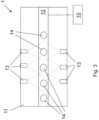
- FIGs 2 and 3 illustrate schematic views of a spray applying unit 1 of a glass manufacturing arrangement according to some embodiments.
- the arrangement comprises the spray applying unit 1 configured to apply fluid comprising metal with antimicrobial properties on a glass object 14.
- the glass object 14 illustrated in the Figures 2 and 3 can be a tumbler, for example.
- the spray applying unit 1 comprises a transportation unit 10 for transporting the glass object 14, a frame 11 and at least one nozzle 13 attached to the frame 11 configured to spray fluid comprising metal with antimicrobial properties on the glass object 14.
- Fig. 2 shows a side view of the arrangement according to one embodiment, where the nozzles 13 are attached to the ceiling of the frame 11 and arranged to spray from above towards the glass object 14.
- Fig. 3 shows a top view of the arrangement according to another embodiment, where the nozzles 13 are attached to sidewalls of the frame 11 and arranged to spray from sides towards the glass object 14.
- the nozzles 13 can be attached to both ceiling and on the sidewalls of the frame 11.
- the transportation unit 10 is arranged to transport the glass object 14 to and from the spray applying unit 1 or within the spray applying unit 1. It can be for instance a robot for grabbing the glass object or an actuator for moving a conveyor 12 with a belt or chain.
- the conveyor 12 can be within the frame 11 where the glass objects 14 are arranged to pass through.
- the conveyor 12 can further comprise rotatable platform on which the glass object 14 is placed. When the glass object 14 arrives next to the nozzle 13, the platform is arranged to rotate, and thus the glass object 14, around its central axis so that the side of the glass object 14 is sprayed uniformly.
- the nozzles 13 are in a pressurized system or an ultrasonic vaporizer.
- the nozzle 13 is arranged to spray the fluid at a flow rate of 0,1 to 10 l/hour.
- a preferred spraying time is 5-60 seconds, most preferably 5-30 seconds.
- the pattern type for the nozzles 13 in Fig. 2 can be a full cone, and the pattern type for the nozzles 13 in Fig. 3 can be a flat fan.
- the applied fluid comprises at least one of silver compound, copper compound and zinc compound, and more preferably silver nitrate.
- the arrangement for antimicrobial glass product further comprises a forming unit configured to form a glass object.
- the forming unit can be a machine-assisted or human-assisted and comprises at least a melting furnace for heating the glass batch to and above the melting temperature and a forming means to give a shape to the glass object.
- the forming means can be a mould or a blowpipe with manual forming or similar.
- a flame polishing unit can be arranged after the glass forming unit and is configured to smooth the surface of the glass object.
- the flame-polishing unit comprises a flame polishing machine which produces a flame ranging 2400 - 3300 °C. This can be achieved, for instance, with a combination of oxygen and hydrogen gas and inputting it into a precision flame nozzle. However, in some embodiments, the flame-polishing unit is not necessary, or it is combined with the spray applying unit 1.
- An annealing unit is arranged after the applying unit and it comprises an annealing lehr or furnace configured to controllably drop down the temperature of the surface of the glass object from slightly above Tg to ambient temperature.
- the annealing furnace can be electrically powered and comprise a conveyor belt and an inlet and an outlet. The time when the glass object passes from the inlet to the outlet defines the annealing time.
- the annealing furnace can also be a closable with one opening.
- the metal compound e.g. silver nitrate dissolves in a de-ionized water at 5 %-wt.
- the liquid comprising metal with antimicrobial properties is atomized by a pneumatized air in the nozzle 13 at the rate of 1 l/min and the metal compound is deposited on the surface of the rotating glass object 14.
- the spray nozzles 13 are placed 10 cm from the surface of the glass object 14 so that the spray deposits all over the outer surface of the glass object 14.
- the glass object 14 is rotated by the rotatable platform around its center axis for 5 seconds in each station. After the deposition, the glass object 14 is placed on the annealing furnace. The annealing furnace temperature and residence time is adjusted so that the object can be annealed properly, depending on the wall thickness of the glass object 14.
- an additional cooling unit may be provided.
- the cooling unit can be a storage space to provide convective heat transfer from the glass object to reach ambient temperature.
- the cooling unit and the annealing unit can be combined in a such way that glass object is cooled inside the annealing furnace as the furnace cools down.
- the finished glass product has a thin antimicrobial layer which appears to be transparent to the human eye.
- the disclosed process is a lot faster and more cost-effective compared to the conventional process for manufacturing an antimicrobial glass product from molten glass.
Landscapes
- Chemical & Material Sciences (AREA)
- Engineering & Computer Science (AREA)
- Materials Engineering (AREA)
- Organic Chemistry (AREA)
- Life Sciences & Earth Sciences (AREA)
- Chemical Kinetics & Catalysis (AREA)
- General Chemical & Material Sciences (AREA)
- Geochemistry & Mineralogy (AREA)
- Physics & Mathematics (AREA)
- Thermal Sciences (AREA)
- Surface Treatment Of Glass (AREA)
Claims (15)
- Verfahren zur Herstellung eines Glasprodukts, umfassend:Formen eines Glasobjekts aus Glasschmelze (100),Aufbringen von Fluid, das Metall mit antimikrobiellen Eigenschaften umfasst, auf das Glasobjekt, das eine Oberflächentemperatur von 500 bis 950°C aufweist, während das Objekt nach dem Formen abkühlt (120), undTempern des Glasobjekts nach dem Aufbringen (130), um das fertige antimikrobielle Glasprodukt zu erhalten.
- Verfahren nach Anspruch 1, wobei das Verfahren ferner einen Schritt (110) des Flammpolierens der Oberfläche des Glasobjekts nach dem Formen (100) umfasst.
- Verfahren nach Anspruch 1 oder 2, wobei der Schritt des Aufbringens (120) des aufgebrachten Fluids mindestens eines von Silber, Kupfer und Zink in einer Form von reinen Metallpartikeln oder seiner Verbindung umfasst.
- Verfahren nach Anspruch 3, wobei die Silberverbindung mindestens eines von Silberchlorid, Silbersulfid, Silbersulfat, Silbernitrat, Silberhydroxid, Silberphosphat, Silbercarbonat und metallorganischer Silberverbindung umfasst.
- Verfahren nach Anspruch 3, wobei die Kupferverbindung mindestens eines von Kupferchlorid, Kupfersulfid, Kupfersulfat, Kupfernitrid, Kupfernitrat, Kupferhydroxid, Kupferphosphat, Kupferphosphid, Kupfercarbonat und metallorganischer Kupferverbindung umfasst.
- Verfahren nach Anspruch 3, wobei die Zinkverbindung mindestens eines von Zinkchlorid, Zinksulfat, Zinksulfid, Zinknitrat, Zinknitrid, Zinkhydroxid, Zinkphosphat, Zinkphosphid, Zinkcarbonat und metallorganischer Zinkverbindung umfasst.
- Verfahren nach Anspruch 3 bis 6, wobei die Verbindungskonzentration in dem Fluid 0,1 bis 2 kg/l in Raumtemperatur beträgt.
- Verfahren nach Anspruch 3 bis 7, wobei während des Aufbringungsschritts (120) die Metallverbindung durch Sprühen von einer Düse auf der Oberfläche des Glasobjekts aufgebracht wird.
- Verfahren nach Anspruch 8, wobei während des Sprühens von der Düse die Tröpfchengröße 10 nm bis 10 µm beträgt, wenn das Tröpfchen auf der Oberfläche des Glasobjekts abgeschieden wird.
- Verfahren nach Anspruch 8 oder 9, wobei die Düse dazu eingerichtet ist, das Fluid bei einer Durchflussmenge von 0,1 bis 10 1/Std. zu sprühen.
- Anordnung zur Herstellung von Glas, umfassend:eine Formungseinheit,eine Tempereinheit,eine Sprühaufbringungseinheit (1), die nach der Formungseinheit und vor der Tempereinheit eingerichtet ist und dazu ausgestaltet ist, Fluid, das Metall mit antimikrobiellen Eigenschaften umfasst, auf ein Glasobjekt (14) aufzubringen, wobei die Sprühaufbringungseinheit (1) umfasst:eine Transporteinheit (10) zum Bewegen des Glasobjekts (14),einen Rahmen (11), undeine Düse (13), die an dem Rahmen (11) angebracht ist und dazu ausgestaltet ist, das Metall mit antimikrobiellen Eigenschaften auf das Glasobjekt (14) zu sprühen.
- Anordnung zur Herstellung von Glas nach Anspruch 11, wobei die Sprühaufbringungseinheit (1) ferner einen Förderer (12) umfasst, der durch die Transporteinheit (10) beweglich ist.
- Anordnung zur Herstellung von Glas nach Anspruch 12, wobei der Förderer (12) ferner eine drehbare Plattform umfasst, auf der das Glasobjekt (14) platziert ist.
- Anordnung zur Herstellung von Glas nach einem der Ansprüche 11 bis 13, wobei die Düse (13) sich in einem druckbeaufschlagten System oder einem Ultraschallzerstäuber befindet.
- Anordnung zur Herstellung von Glas nach einem der Ansprüche 11 bis 14, wobei das Fluid mindestens eines von Silber, Kupfer und Zink in einer Form von reinen Metallpartikeln oder seiner Verbindung umfasst.
Priority Applications (3)
| Application Number | Priority Date | Filing Date | Title |
|---|---|---|---|
| EP20180547.0A EP3925939B1 (de) | 2020-06-17 | 2020-06-17 | Verfahren zur herstellung von glasprodukten und anordnung |
| FIEP20180547.0T FI3925939T3 (fi) | 2020-06-17 | 2020-06-17 | Lasituotteiden valmistusmenetelmä ja järjestely |
| CN202110665851.8A CN113800780A (zh) | 2020-06-17 | 2021-06-16 | 制造玻璃产品的方法和装置 |
Applications Claiming Priority (1)
| Application Number | Priority Date | Filing Date | Title |
|---|---|---|---|
| EP20180547.0A EP3925939B1 (de) | 2020-06-17 | 2020-06-17 | Verfahren zur herstellung von glasprodukten und anordnung |
Publications (2)
| Publication Number | Publication Date |
|---|---|
| EP3925939A1 EP3925939A1 (de) | 2021-12-22 |
| EP3925939B1 true EP3925939B1 (de) | 2024-10-09 |
Family
ID=71105396
Family Applications (1)
| Application Number | Title | Priority Date | Filing Date |
|---|---|---|---|
| EP20180547.0A Active EP3925939B1 (de) | 2020-06-17 | 2020-06-17 | Verfahren zur herstellung von glasprodukten und anordnung |
Country Status (3)
| Country | Link |
|---|---|
| EP (1) | EP3925939B1 (de) |
| CN (1) | CN113800780A (de) |
| FI (1) | FI3925939T3 (de) |
Families Citing this family (2)
| Publication number | Priority date | Publication date | Assignee | Title |
|---|---|---|---|---|
| CN113913765B (zh) * | 2021-09-30 | 2023-12-01 | 江阴佩尔科技有限公司 | 一种抗菌型表面改性镍钛合金材料及制备方法 |
| CN117658431A (zh) * | 2022-08-22 | 2024-03-08 | 杭州九阳小家电有限公司 | 一种易清洗彩色玻璃制品及其制备方法 |
Family Cites Families (4)
| Publication number | Priority date | Publication date | Assignee | Title |
|---|---|---|---|---|
| US3489546A (en) * | 1966-04-04 | 1970-01-13 | Anchor Hocking Glass Corp | Strengthening of oxidized soda-lime glass articles |
| US6921546B2 (en) * | 2003-02-20 | 2005-07-26 | Gemtron Corporation | Antimicrobial glass and glass-like products and method of preparing same |
| EP2371779A1 (de) * | 2010-03-30 | 2011-10-05 | Linde Aktiengesellschaft | Verfahren zur Herstellung von Flachglas und mit diesem Verfahren hergestellte Glasscheibe |
| CN110357455B (zh) * | 2019-07-18 | 2021-09-28 | 中国建筑材料科学研究总院有限公司 | 一种抗菌玻璃的制备方法及抗菌真空玻璃 |
-
2020
- 2020-06-17 EP EP20180547.0A patent/EP3925939B1/de active Active
- 2020-06-17 FI FIEP20180547.0T patent/FI3925939T3/fi active
-
2021
- 2021-06-16 CN CN202110665851.8A patent/CN113800780A/zh active Pending
Also Published As
| Publication number | Publication date |
|---|---|
| EP3925939A1 (de) | 2021-12-22 |
| FI3925939T3 (fi) | 2024-12-27 |
| CN113800780A (zh) | 2021-12-17 |
Similar Documents
| Publication | Publication Date | Title |
|---|---|---|
| EP3925939B1 (de) | Verfahren zur herstellung von glasprodukten und anordnung | |
| EP1546056B1 (de) | Gegenstand mit nanoskaligen strukturen und verfahren zur herstellung eines solchen gegenstands | |
| RU2353702C2 (ru) | Способ нанесения покрытия ультратонким слоем на металлические изделия | |
| US6627265B2 (en) | Methods and apparatus for depositing pyrolytic coatings having a fade zone over a substrate and articles produced thereby | |
| EP1628926B1 (de) | Verfahren zur mikro- und nanostrukturierung von glas | |
| US3876410A (en) | Method of applying durable lubricous coatings on glass containers | |
| CN101070226B (zh) | 一种低辐射自清洁复合功能玻璃的制备方法 | |
| EA013365B1 (ru) | Способ получения функциональных стеклянных поверхностей путем изменения композиции исходной поверхности | |
| AU748247B2 (en) | Compositions, apparatus and methods for forming coatings of selected color on a substrate and articles produced thereby | |
| SE451112B (sv) | Anleggning for kontinuerlig avsettning pa ett underlag, sasom en glasplatta, av en fast beleggning erhallen av minst tva reaktanter i gasfas | |
| US5707412A (en) | Method of reducing glass sheet marking | |
| JP2001026466A (ja) | 抗菌ガラスの製造方法 | |
| JP2527542B2 (ja) | ガラスを被覆する装置および方法 | |
| CN101792249A (zh) | 玻璃成形体的制备方法和光学元件的制备方法 | |
| US20100107693A1 (en) | Method for doping glass | |
| CN111499219A (zh) | 一种高钢化抗菌玻璃杯的制造方法 | |
| KR102373015B1 (ko) | 레이저를 이용한 비정질 합금의 표면처리 | |
| US20090147370A1 (en) | Nanoparticle and nanocomposite films | |
| JP2565694B2 (ja) | ガラスを熱分解的に被覆する方法および装置 | |
| US3989004A (en) | Apparatus for applying durable lubricous coatings to newly formed vitreous surfaces | |
| WO2010094831A1 (en) | Antibacterial glass | |
| US3519408A (en) | Method of treating glass surfaces during surface expansion | |
| CN109906209A (zh) | 制备钠钙硅酸盐玻璃起生物杀灭作用的玻璃表面的方法 | |
| US4824695A (en) | Process and apparatus for coating a substrate | |
| FI122879B (fi) | Menetelmä lasin pinnan muokkaamiseksi |
Legal Events
| Date | Code | Title | Description |
|---|---|---|---|
| PUAI | Public reference made under article 153(3) epc to a published international application that has entered the european phase |
Free format text: ORIGINAL CODE: 0009012 |
|
| STAA | Information on the status of an ep patent application or granted ep patent |
Free format text: STATUS: THE APPLICATION HAS BEEN PUBLISHED |
|
| AK | Designated contracting states |
Kind code of ref document: A1 Designated state(s): AL AT BE BG CH CY CZ DE DK EE ES FI FR GB GR HR HU IE IS IT LI LT LU LV MC MK MT NL NO PL PT RO RS SE SI SK SM TR |
|
| B565 | Issuance of search results under rule 164(2) epc |
Effective date: 20201113 |
|
| STAA | Information on the status of an ep patent application or granted ep patent |
Free format text: STATUS: REQUEST FOR EXAMINATION WAS MADE |
|
| 17P | Request for examination filed |
Effective date: 20220622 |
|
| RBV | Designated contracting states (corrected) |
Designated state(s): AL AT BE BG CH CY CZ DE DK EE ES FI FR GB GR HR HU IE IS IT LI LT LU LV MC MK MT NL NO PL PT RO RS SE SI SK SM TR |
|
| P01 | Opt-out of the competence of the unified patent court (upc) registered |
Effective date: 20230825 |
|
| GRAP | Despatch of communication of intention to grant a patent |
Free format text: ORIGINAL CODE: EPIDOSNIGR1 |
|
| STAA | Information on the status of an ep patent application or granted ep patent |
Free format text: STATUS: GRANT OF PATENT IS INTENDED |
|
| INTG | Intention to grant announced |
Effective date: 20240419 |
|
| GRAS | Grant fee paid |
Free format text: ORIGINAL CODE: EPIDOSNIGR3 |
|
| RAP3 | Party data changed (applicant data changed or rights of an application transferred) |
Owner name: FISKARS FINLAND OY AB |
|
| RIN1 | Information on inventor provided before grant (corrected) |
Inventor name: AROMAA, MIKKO |
|
| GRAA | (expected) grant |
Free format text: ORIGINAL CODE: 0009210 |
|
| STAA | Information on the status of an ep patent application or granted ep patent |
Free format text: STATUS: THE PATENT HAS BEEN GRANTED |
|
| AK | Designated contracting states |
Kind code of ref document: B1 Designated state(s): AL AT BE BG CH CY CZ DE DK EE ES FI FR GB GR HR HU IE IS IT LI LT LU LV MC MK MT NL NO PL PT RO RS SE SI SK SM TR |
|
| REG | Reference to a national code |
Ref country code: CH Ref legal event code: EP |
|
| REG | Reference to a national code |
Ref country code: DE Ref legal event code: R096 Ref document number: 602020038926 Country of ref document: DE |
|
| REG | Reference to a national code |
Ref country code: IE Ref legal event code: FG4D |
|
| REG | Reference to a national code |
Ref country code: FI Ref legal event code: FGE |
|
| REG | Reference to a national code |
Ref country code: LT Ref legal event code: MG9D |
|
| REG | Reference to a national code |
Ref country code: NL Ref legal event code: MP Effective date: 20241009 |
|
| REG | Reference to a national code |
Ref country code: AT Ref legal event code: MK05 Ref document number: 1730462 Country of ref document: AT Kind code of ref document: T Effective date: 20241009 |
|
| PG25 | Lapsed in a contracting state [announced via postgrant information from national office to epo] |
Ref country code: NL Free format text: LAPSE BECAUSE OF FAILURE TO SUBMIT A TRANSLATION OF THE DESCRIPTION OR TO PAY THE FEE WITHIN THE PRESCRIBED TIME-LIMIT Effective date: 20241009 |
|
| PG25 | Lapsed in a contracting state [announced via postgrant information from national office to epo] |
Ref country code: NL Free format text: LAPSE BECAUSE OF FAILURE TO SUBMIT A TRANSLATION OF THE DESCRIPTION OR TO PAY THE FEE WITHIN THE PRESCRIBED TIME-LIMIT Effective date: 20241009 |
|
| PG25 | Lapsed in a contracting state [announced via postgrant information from national office to epo] |
Ref country code: IS Free format text: LAPSE BECAUSE OF FAILURE TO SUBMIT A TRANSLATION OF THE DESCRIPTION OR TO PAY THE FEE WITHIN THE PRESCRIBED TIME-LIMIT Effective date: 20250209 Ref country code: PT Free format text: LAPSE BECAUSE OF FAILURE TO SUBMIT A TRANSLATION OF THE DESCRIPTION OR TO PAY THE FEE WITHIN THE PRESCRIBED TIME-LIMIT Effective date: 20250210 Ref country code: HR Free format text: LAPSE BECAUSE OF FAILURE TO SUBMIT A TRANSLATION OF THE DESCRIPTION OR TO PAY THE FEE WITHIN THE PRESCRIBED TIME-LIMIT Effective date: 20241009 |
|
| PG25 | Lapsed in a contracting state [announced via postgrant information from national office to epo] |
Ref country code: BG Free format text: LAPSE BECAUSE OF FAILURE TO SUBMIT A TRANSLATION OF THE DESCRIPTION OR TO PAY THE FEE WITHIN THE PRESCRIBED TIME-LIMIT Effective date: 20241009 |
|
| PG25 | Lapsed in a contracting state [announced via postgrant information from national office to epo] |
Ref country code: ES Free format text: LAPSE BECAUSE OF FAILURE TO SUBMIT A TRANSLATION OF THE DESCRIPTION OR TO PAY THE FEE WITHIN THE PRESCRIBED TIME-LIMIT Effective date: 20241009 |
|
| PG25 | Lapsed in a contracting state [announced via postgrant information from national office to epo] |
Ref country code: NO Free format text: LAPSE BECAUSE OF FAILURE TO SUBMIT A TRANSLATION OF THE DESCRIPTION OR TO PAY THE FEE WITHIN THE PRESCRIBED TIME-LIMIT Effective date: 20250109 |
|
| PG25 | Lapsed in a contracting state [announced via postgrant information from national office to epo] |
Ref country code: GR Free format text: LAPSE BECAUSE OF FAILURE TO SUBMIT A TRANSLATION OF THE DESCRIPTION OR TO PAY THE FEE WITHIN THE PRESCRIBED TIME-LIMIT Effective date: 20250110 Ref country code: AT Free format text: LAPSE BECAUSE OF FAILURE TO SUBMIT A TRANSLATION OF THE DESCRIPTION OR TO PAY THE FEE WITHIN THE PRESCRIBED TIME-LIMIT Effective date: 20241009 Ref country code: LV Free format text: LAPSE BECAUSE OF FAILURE TO SUBMIT A TRANSLATION OF THE DESCRIPTION OR TO PAY THE FEE WITHIN THE PRESCRIBED TIME-LIMIT Effective date: 20241009 |
|
| PG25 | Lapsed in a contracting state [announced via postgrant information from national office to epo] |
Ref country code: PL Free format text: LAPSE BECAUSE OF FAILURE TO SUBMIT A TRANSLATION OF THE DESCRIPTION OR TO PAY THE FEE WITHIN THE PRESCRIBED TIME-LIMIT Effective date: 20241009 |
|
| PG25 | Lapsed in a contracting state [announced via postgrant information from national office to epo] |
Ref country code: RS Free format text: LAPSE BECAUSE OF FAILURE TO SUBMIT A TRANSLATION OF THE DESCRIPTION OR TO PAY THE FEE WITHIN THE PRESCRIBED TIME-LIMIT Effective date: 20250109 |
|
| PG25 | Lapsed in a contracting state [announced via postgrant information from national office to epo] |
Ref country code: SM Free format text: LAPSE BECAUSE OF FAILURE TO SUBMIT A TRANSLATION OF THE DESCRIPTION OR TO PAY THE FEE WITHIN THE PRESCRIBED TIME-LIMIT Effective date: 20241009 |
|
| PGFP | Annual fee paid to national office [announced via postgrant information from national office to epo] |
Ref country code: FI Payment date: 20250616 Year of fee payment: 6 |
|
| PGFP | Annual fee paid to national office [announced via postgrant information from national office to epo] |
Ref country code: DE Payment date: 20250618 Year of fee payment: 6 |
|
| PG25 | Lapsed in a contracting state [announced via postgrant information from national office to epo] |
Ref country code: DK Free format text: LAPSE BECAUSE OF FAILURE TO SUBMIT A TRANSLATION OF THE DESCRIPTION OR TO PAY THE FEE WITHIN THE PRESCRIBED TIME-LIMIT Effective date: 20241009 |
|
| REG | Reference to a national code |
Ref country code: DE Ref legal event code: R097 Ref document number: 602020038926 Country of ref document: DE |
|
| PG25 | Lapsed in a contracting state [announced via postgrant information from national office to epo] |
Ref country code: EE Free format text: LAPSE BECAUSE OF FAILURE TO SUBMIT A TRANSLATION OF THE DESCRIPTION OR TO PAY THE FEE WITHIN THE PRESCRIBED TIME-LIMIT Effective date: 20241009 |
|
| PG25 | Lapsed in a contracting state [announced via postgrant information from national office to epo] |
Ref country code: RO Free format text: LAPSE BECAUSE OF FAILURE TO SUBMIT A TRANSLATION OF THE DESCRIPTION OR TO PAY THE FEE WITHIN THE PRESCRIBED TIME-LIMIT Effective date: 20241009 |
|
| PG25 | Lapsed in a contracting state [announced via postgrant information from national office to epo] |
Ref country code: SK Free format text: LAPSE BECAUSE OF FAILURE TO SUBMIT A TRANSLATION OF THE DESCRIPTION OR TO PAY THE FEE WITHIN THE PRESCRIBED TIME-LIMIT Effective date: 20241009 |
|
| PG25 | Lapsed in a contracting state [announced via postgrant information from national office to epo] |
Ref country code: CZ Free format text: LAPSE BECAUSE OF FAILURE TO SUBMIT A TRANSLATION OF THE DESCRIPTION OR TO PAY THE FEE WITHIN THE PRESCRIBED TIME-LIMIT Effective date: 20241009 |
|
| PG25 | Lapsed in a contracting state [announced via postgrant information from national office to epo] |
Ref country code: IT Free format text: LAPSE BECAUSE OF FAILURE TO SUBMIT A TRANSLATION OF THE DESCRIPTION OR TO PAY THE FEE WITHIN THE PRESCRIBED TIME-LIMIT Effective date: 20241009 |
|
| PLBE | No opposition filed within time limit |
Free format text: ORIGINAL CODE: 0009261 |
|
| STAA | Information on the status of an ep patent application or granted ep patent |
Free format text: STATUS: NO OPPOSITION FILED WITHIN TIME LIMIT |
|
| PG25 | Lapsed in a contracting state [announced via postgrant information from national office to epo] |
Ref country code: SE Free format text: LAPSE BECAUSE OF FAILURE TO SUBMIT A TRANSLATION OF THE DESCRIPTION OR TO PAY THE FEE WITHIN THE PRESCRIBED TIME-LIMIT Effective date: 20241009 |
|
| 26N | No opposition filed |
Effective date: 20250710 |
|
| REG | Reference to a national code |
Ref country code: CH Ref legal event code: H13 Free format text: ST27 STATUS EVENT CODE: U-0-0-H10-H13 (AS PROVIDED BY THE NATIONAL OFFICE) Effective date: 20260127 |
|
| PG25 | Lapsed in a contracting state [announced via postgrant information from national office to epo] |
Ref country code: MC Free format text: LAPSE BECAUSE OF FAILURE TO SUBMIT A TRANSLATION OF THE DESCRIPTION OR TO PAY THE FEE WITHIN THE PRESCRIBED TIME-LIMIT Effective date: 20241009 |
|
| PG25 | Lapsed in a contracting state [announced via postgrant information from national office to epo] |
Ref country code: LU Free format text: LAPSE BECAUSE OF NON-PAYMENT OF DUE FEES Effective date: 20250617 |
|
| GBPC | Gb: european patent ceased through non-payment of renewal fee |
Effective date: 20250617 |
|
| REG | Reference to a national code |
Ref country code: BE Ref legal event code: MM Effective date: 20250630 |