EP3924299B1 - Verfahren zur herstellung von hochreinem aluminiummonohydrat und alpha-aluminiumoxid - Google Patents
Verfahren zur herstellung von hochreinem aluminiummonohydrat und alpha-aluminiumoxid Download PDFInfo
- Publication number
- EP3924299B1 EP3924299B1 EP21710329.0A EP21710329A EP3924299B1 EP 3924299 B1 EP3924299 B1 EP 3924299B1 EP 21710329 A EP21710329 A EP 21710329A EP 3924299 B1 EP3924299 B1 EP 3924299B1
- Authority
- EP
- European Patent Office
- Prior art keywords
- alumina
- feedstock
- hydrothermal treatment
- ammonia
- feedstock mixture
- Prior art date
- Legal status (The legal status is an assumption and is not a legal conclusion. Google has not performed a legal analysis and makes no representation as to the accuracy of the status listed.)
- Active
Links
Images

Classifications
-
- C—CHEMISTRY; METALLURGY
- C01—INORGANIC CHEMISTRY
- C01F—COMPOUNDS OF THE METALS BERYLLIUM, MAGNESIUM, ALUMINIUM, CALCIUM, STRONTIUM, BARIUM, RADIUM, THORIUM, OR OF THE RARE-EARTH METALS
- C01F7/00—Compounds of aluminium
- C01F7/02—Aluminium oxide; Aluminium hydroxide; Aluminates
- C01F7/44—Dehydration of aluminium oxide or hydroxide, i.e. all conversions of one form into another involving a loss of water
- C01F7/447—Dehydration of aluminium oxide or hydroxide, i.e. all conversions of one form into another involving a loss of water by wet processes
- C01F7/448—Dehydration of aluminium oxide or hydroxide, i.e. all conversions of one form into another involving a loss of water by wet processes using superatmospheric pressure, e.g. hydrothermal conversion of gibbsite into boehmite
-
- C—CHEMISTRY; METALLURGY
- C01—INORGANIC CHEMISTRY
- C01F—COMPOUNDS OF THE METALS BERYLLIUM, MAGNESIUM, ALUMINIUM, CALCIUM, STRONTIUM, BARIUM, RADIUM, THORIUM, OR OF THE RARE-EARTH METALS
- C01F7/00—Compounds of aluminium
- C01F7/02—Aluminium oxide; Aluminium hydroxide; Aluminates
- C01F7/44—Dehydration of aluminium oxide or hydroxide, i.e. all conversions of one form into another involving a loss of water
- C01F7/447—Dehydration of aluminium oxide or hydroxide, i.e. all conversions of one form into another involving a loss of water by wet processes
-
- C—CHEMISTRY; METALLURGY
- C01—INORGANIC CHEMISTRY
- C01F—COMPOUNDS OF THE METALS BERYLLIUM, MAGNESIUM, ALUMINIUM, CALCIUM, STRONTIUM, BARIUM, RADIUM, THORIUM, OR OF THE RARE-EARTH METALS
- C01F7/00—Compounds of aluminium
- C01F7/02—Aluminium oxide; Aluminium hydroxide; Aluminates
- C01F7/44—Dehydration of aluminium oxide or hydroxide, i.e. all conversions of one form into another involving a loss of water
- C01F7/441—Dehydration of aluminium oxide or hydroxide, i.e. all conversions of one form into another involving a loss of water by calcination
-
- C—CHEMISTRY; METALLURGY
- C01—INORGANIC CHEMISTRY
- C01P—INDEXING SCHEME RELATING TO STRUCTURAL AND PHYSICAL ASPECTS OF SOLID INORGANIC COMPOUNDS
- C01P2006/00—Physical properties of inorganic compounds
- C01P2006/80—Compositional purity
-
- Y—GENERAL TAGGING OF NEW TECHNOLOGICAL DEVELOPMENTS; GENERAL TAGGING OF CROSS-SECTIONAL TECHNOLOGIES SPANNING OVER SEVERAL SECTIONS OF THE IPC; TECHNICAL SUBJECTS COVERED BY FORMER USPC CROSS-REFERENCE ART COLLECTIONS [XRACs] AND DIGESTS
- Y02—TECHNOLOGIES OR APPLICATIONS FOR MITIGATION OR ADAPTATION AGAINST CLIMATE CHANGE
- Y02E—REDUCTION OF GREENHOUSE GAS [GHG] EMISSIONS, RELATED TO ENERGY GENERATION, TRANSMISSION OR DISTRIBUTION
- Y02E60/00—Enabling technologies; Technologies with a potential or indirect contribution to GHG emissions mitigation
- Y02E60/10—Energy storage using batteries
Definitions
- the present invention concerns a method for preparing high purity aluminum monohydrate (such as boehmite and/or diaspore), and high purity alpha alumina, from low purity alumina feedstock using a hydrothermal treatment. Further described is the use of a complexing agent.
- the preparation of boehmite using hydrothermal treatment is known in the art.
- EP 0 304 721 B1 discloses a method of making a microcrystalline boehmite product which comprises heating under autogenous pressure a precursor compound that is hydrothermally convertible to boehmite in an aqueous medium having a pH of 5 or less or of 8 or higher and in the presence of boehmite seed particles finer than 0.02 ⁇ m.
- CN 110357135 A teaches a method for preparing alumina for lithium battery separators using aluminum hydroxide and ultrafine aluminum hydroxide seed crystals and mixing these with ammonia. However, both methods are technically complicated and require high amounts of expensive seed particles.
- US 6 403 007 B1 describes a process wherein an aqueous dispersion of an alumina feedstock is mixed with alkaline earth metal compounds, such as barium hydroxide, and hydrothermally treated in an autoclave at 150-300°C to obtain boehmite particles; in order to remove the surplus of the alkaline earth metal compound acetic acid is added to the reaction product mixture. Additives may be added to the reaction mixture.
- alkaline earth metal compounds such as barium hydroxide
- the above-captioned object is solved by a method of preparing aluminum monohydrate, such as boehmite and/or diaspore, comprising the steps of mixing alumina feedstock with ethylenediamine tetraacetic acid as a nitrogen-containing complexing agent to obtain a feedstock mixture and subjecting the feedstock mixture to a hydrothermal treatment. It was surprisingly found that due to the addition of the specific complexing agent to an alumina feedstock prior to hydrothermal treatment the purity of the prepared aluminum monohydrate can be improved significantly.
- an important first aspect of the present invention is directed to a method of preparing aluminum monohydrate comprising the steps of:
- a (low purity) feedstock can be used to prepare aluminum monohydrate (or alpha alumina upon calcination of the aluminum monohydrate) having a high purity, wherein ethylenediamine tetraacetic acid is used in the feedstock mixture subjected to a hydrothermal treatment, and the pH of the feedstock mixture is at least 8.
- the purity of the aluminum monohydrate after carrying out the inventive method is at least 99.90% and preferably up to 99.99%.
- Typical impurities, which can be contained in the alumina feedstock and which can be removed by the inventive method include Na 2 O, CaO, Fe 2 O 3 , ZnO, Li 2 O, MnO, CuO, Ga 2 O 3 and BeO . Such impurities are often occluded in the particles and agglomerates of the alumina feedstock.
- an alumina feedstock having a purity of 99.8% or less, in particular a purity of 99.6% or less is a "low purity" alumina feedstock.
- the purity of the feedstock before treatment e.g. smelter grade alumina or aluminum hydrate
- all purity values are reported on an Al 2 O 3 basis.
- a feedstock mixture which contains the alumina feedstock as well as the ethylenediamine tetraacetic acid, and optionally other ingredients as evident from the disclosure herein.
- the pH of the feedstock mixture i.e. before subjecting it to the hydrothermal treatment is at least 8.
- the alumina feedstock undergoes recrystallization to form thermodynamically more stable phases.
- the inventive complexing agent(s) the impurities become available for removal by complexation and optionally dissolution during hydrothermal treatment and can therefore be separated easily by filtration, washing and drying of the obtained product after finishing the hydrothermal treatment and cooling of the reaction mixture, whereby high purity aluminum monohydrate having a purity of at least 99.90% is obtained.
- the high purity aluminum monohydrate can finally be dried.
- the inventive method does not require specific additional method steps but merely requires the preparation of a feedstock mixture by adding ethylenediamine tetraacetic acid as complexing agent to the alumina feedstock and carrying out hydrothermal treatment, wherein the complexing agent can be used singly or wherein two or more complexing agents can be used in combination.
- the above captioned complexing agents are well known in the art and are available at low costs. Their use is easy and does not require specific precaution since the nitrogen-containing complexing agents are in general non-toxic. The method is easily controllable and can be carried out in short process times so that the costs of the inventive method are low.
- the pH of the feedstock mixture is preferably set to at least 8, more preferably to at least 9 and even more preferably to at least 10 whereby surprisingly the purity of the obtained aluminum monohydrate can be increased.
- the pH of the feedstock mixture is in particular set to a range from 10 to 12, most preferably to a range from 10 to 11.
- the "pH of the feedstock mixture" as used herein refers to the pH of the feedstock before the hydrothermal treatment, i.e. before subjecting the feedstock mixture to the hydrothermal treatment.
- the feedstock mixture preferably contains ammonia, wherein a weight ratio of alumina feedstock to ammonia is preferably from 100 : 1 to 10 : 1, in particular from 50:1 to 10:1.
- the ammonia can be used as aqueous solution.
- a 25 wt% aqueous solution of ammonia can be prepared and added to the feedstock mixture.
- Ammonia may preferably be used in an amount of 22 g pure ammonia relative to 100 g alumina feedstock.
- the feedstock mixture contains ammonia and the content of ammonia relative to the content of the alumina feedstock ranges from 1.25 wt% to 3.70 wt%.
- the alumina feedstock is preferably selected from smelter grade alumina, chemical grade alumina, transition aluminas (i.e. ⁇ -alumina, ⁇ -alumina, ⁇ -alumina, ⁇ -alumina, ⁇ -aiumina, ⁇ -alumina and ⁇ -alumina), and aluminum trihydrate.
- smelter grade alumina, chemical grade alumina, transition aluminas (i.e. ⁇ -alumina, ⁇ -alumina, ⁇ -alumina, ⁇ -alumina, ⁇ -aiumina, ⁇ -alumina and ⁇ -alumina) and aluminum trihydrate are especially preferred.
- the D50 particle size of the ground versions of the above-captioned feedstocks preferably ranges from 0.1 ⁇ m to 100 ⁇ m and more preferably ranges from 1 ⁇ m to 45 ⁇ m.
- alumina feedstock is used herein to encompass the above-mentioned feedstock, including aluminum trihydrate.
- alumina feedstock is thus used herein as a synonym to "feedstock” or “feedstock for the preparation of aluminum monohydrate”, in order to define any feedstock suitable for the preparation of aluminum monohydrate (and alpha alumina, upon calcination of the aluminum monohydrate).
- Ethylenediamine tetraacetic acid has been surprisingly found to be of particular advantage within the method of preparing aluminum monohydrate (or alpha alumina) as described herein, having excellent high purity levels with only very low amounts of impurities such as Na (calculated as Na 2 O), Fe (calculated as Fe 2 O 3 ) and/or Ca (as CaO), even when starting from low purity starting materials (alumina feedstocks).
- Ethylenediamine tetraacetic acid appears to balance the acidic and alkaline properties of the feedstock mixture and surprisingly allows obtaining high purity aluminum monohydrate in a simple and straight forward method starting from low purity alumina feedstocks, as described herein.
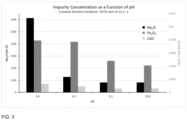
- the disodium salt of the ethylenediamine tetraacetic acid is one of the most commonly used complexing agents, it was found that the pure ethylenediamine tetraacetic acid achieves better results, in particular at a pH of at least 8, preferably at least 9, and more preferably within a pH range of 10 to 12, most preferably 10 to 11, and does not increase the total Na 2 O concentration.
- the impurities could be best separated from the feedstock mixture when a weight ratio of the alumina feedstock to ethylenediamine tetraacetic acid is from 50 : 1 to 20 : 1. Higher amounts of complexing agents did not achieve significant better results on the improvement of the impurity level of the aluminum monohydrate. However, the smaller the amount of complexing agent, the higher the impurity level. Using 20 to 30 g complexing agent relative to 1000 g alumina feedstock was found to be particularly preferable.
- the weight ratio of the alumina feedstock to the complexing agent is calculated based on the dry weight of the alumina feedstock used in the feedstock mixture (to be subjected to the hydrothermal treatment) and the dry weight of the complexing agent present in the feedstock mixture (i.e. preferably without taking into the ratio calculation any remaining moisture of the materials, which is commonly less than 1 wt%, e.g. about 0.5 wt% or less).
- the feedstock mixture comprises ammonium hydroxide.
- ammonium hydroxide serves as a buffer in particular in combination with ammonia, so that the desired pH value can be maintained easily. Therefore, the impurities get dissolved to a high degree and the recrystallization of the alumina proceeds easily at high speed.
- the feedstock mixture may further comprise an acid, wherein the acid is particularly selected from the group consisting of hydrochloric acid, phosphoric acid, sulfuric acid, nitric acid, boric acid, hydrofluoric acid and carboxylic acids, wherein the carboxylic acid is preferably selected from carbonic acid, formic acid and propionic acid. It was surprisingly found that the addition of one of these acids or a mixture thereof contributes to a more efficient reduction of Na 2 O and CaO.
- the feedstock mixture further preferably comprises hydrogen peroxide, sodium hydroxide or potassium hydroxide.
- the pH value can be adjusted more easily.
- a weight ratio of the solid compounds of the feedstock mixture to the liquid compounds of the feedstock mixture ranges from 1 : 1 to 1 : 2.
- the temperature during the hydrothermal treatment within a range from 150 °C to 260 °C. Higher temperatures may also work, however, the higher the temperature is set, the more cost intensive is the method. The lower the temperature is set, the slower is the recrystallization. A temperature set within the range of 150 °C to 260 °C balances all advantageous effects and achieves good results in view of purity of the product.
- the pressure during the hydrothermal treatment is not particularly limited and a maximum value will depend on the stability of the vessel used. However, good reaction speed and cost efficiency can be achieved when the hydrothermal pressure during the hydrothermal treatment ranges from 1 bar to 300 bar and in particular from 1 bar to 50 bar.
- the hydrothermal treatment is carried out for 1 to 100 hours.
- the reaction during the hydrothermal treatment can preferably be accelerated by stirring the feedstock mixture during the hydrothermal treatment.
- a method of preparing alpha alumina wherein the aluminum monohydrate, obtained according to the method described above is calcinated.
- the calcination can be carried out at a temperatures above 700°C, more specifically above 800°C, and most specifically between 900 and 1500°C.
- calcination can be done in an electric, gas or other-fired furnace / kiln (continuous or periodic), and the dwell / hold time is flexible.
- the calcination parameters are preferably set to adjust a specific crystal sizes and surface areas of the alpha alumina.
- Primary crystal sizes are preferably from 0.1 to 6 ⁇ m and specific surface areas from 0.1 to 50m 2 /g, depending on the desired product to be made, wherein the particle size distribution is measured in accordance with DIN EN 725 / T5 and the surface area is measured in accordance with ISO 9227. Due to the use of the high purity aluminum monohydrate, also the alpha alumina shows high purity.
- a further aspect of the present invention is directed to the use of ethylenediamine tetraacetic acid (EDTA) in combination with ammonia in the preparation of aluminum monohydrate, in particular in a hydrothermal treatment.
- EDTA ethylenediamine tetraacetic acid
- a further aspect of the present invention is directed to the aforementioned use, wherein the aluminum monohydrate is obtained from a feedstock mixture which is subjected to a hydrothermal treatment, wherein the pH of the feedstock mixture before the hydrothermal treatment is at least 8, preferably at least 9, more preferably in the range from 10 to 12, most preferably in the range from 10 to 11, and the weight ratio of the feedstock to the ethylenediamine tetraacetic acid is from 50:1 to 20:1, optionally from 40:1 to 20:1.
- Al(OH) 3 aluminum hydroxide having an impurity (Na 2 O, Fe 2 O 3 , SiO 2 , MgO, TiO 2 , CaO, Li 2 O and ZnO) concentration of about 0.25 wt% (see Table 1 for details) were mixed with 0.5 g EDTA (ethylenediamine tetraacetic acid), 1.5 ml pure NH 3 and 50 g H 2 O. Hydrothermal treatment was carried out under steering at 190 °C and 12 bar water vapor pressure for 48 hours. High purity boehmite was obtained in an amount of 41.75 g after filtration of the reaction mixture, washing and drying of the filtrate.
- Al(OH) 3 aluminum hydroxide having an impurity (Na 2 O, Fe 2 O 3 , SiO 2 , MgO, TiO 2 , CaO, Li 2 O and ZnO) concentration of about 0.25 wt% (see Table 1 for details) were mixed with 0.5 g EDTA (ethylenediamine tetra
- Examples 2 to 10 are prepared in the same manner as Example 1, with the exception that the amounts of EDTA and NH 3 have been adjusted as shown in Table 1 above. It can be seen that for impurities Na 2 O, Fe 2 O 3 , MgO, CaO, Li 2 O and ZnO a significant reduction of the impurity level has been achieved.
- Example 2 contains 1 g EDTA per 50 g alumina feedstock which corresponds to a weight ratio alumina feedstock : EDTA of 50 : 1.
- Example 3 contains 1.2 g EDTA per 50 g alumina feedstock which corresponds to a weight ratio alumina feedstock : EDTA of 42.7 : 1.
- Example 5 contains 1.5 g EDTA per 50 g alumina feedstock which corresponds to a weight ratio alumina feedstock : EDTA of 33.3 : 1. It can be seen that a weight ratio of the alumina feedstock to the nitrogen-containing complexing agent which ranges from 50 : 1 to 20 : 1 obtains the best test results. Higher amounts of EDTA significantly increase the costs while the impurity level does not further decrease significantly.
- a weight ratio of the alumina feedstock to ammonia ranging from 100 : 1 to 10:1 obtains excellent impurity reduction. Higher amounts of ammonia do not further influence the impurity level significantly.
- Example 11 was prepared in the same manner as Example 1 using aluminum trihydrate as a starting material having a D50 of 8 ⁇ m.
- the aluminum trihydrate was mixed with 1.1 g EDTA and 4.5 ml NH 3 .
- Hydrothermal treatment was carried out under steering at 190 °C and 12 bar water vapor pressure for 24 hours. High purity boehmite was obtained which was filtered, washed and dried.
- Example 12 was prepared in the same manner as Example 1 using smelter grade alumina (SGA) feedstock having a particle size of 84 ⁇ m and having a particle size of 5 ⁇ m as a starting material.
- SGA smelter grade alumina
- the smelter grade alumina was mixed with 1.5 g EDTA and 6 ml NH 3 .
- Hydrothermal treatment was carried out under steering at 190 °C and 12 bar water vapor pressure for 60 hours. High purity boehmite was obtained which was filtered, washed and dried.
- Example 13 was prepared in the same manner as Example 12 using smelter grade alumina (SGA) feedstock.
- Sample A was not leached.
- Sample B has been leached with HCl/water mixture.
- EDTA has been added in an amount of 1.5 g and NH 3 has been added in an amount of 6 ml to non-leached smelter grade alumina sample A and leached smelter grade alumina sample B.
- Hydrothermal treatment was carried out under steering at 190 °C and 12 bar water vapor pressure for 48 hours. The obtained boehmite was filtered, washed and dried.
- Example 14 was prepared in the same manner as Example 13 using the same smelter grade alumina (SGA) feedstock.
- Sample C was not leached.
- Sample D has been leached with HCl/water mixture.
- EDTA has not been added but NH 3 has been added in an amount of 6 ml to non-leached smelter grade alumina sample C and leaches smelter grade alumina sample D.
- Hydrothermal treatment was carried out under steering at 190 °C and 12 bar water vapor pressure for 48 hours. The obtained boehmite was filtered, washed and dried.
- Samples C and D are not according to the invention.
- Example 15 was prepared in the same manner as Example 13 using the same smelter grade alumina (SGA) feedstock.
- Sample E was not leached.
- Sample F has been leached with HCl/water mixture.
- EDTA has been added in an amount of 1.5 g but NH 3 has not been added.
- Hydrothermal treatment was carried out under steering at 190 °C and 12 bar water vapor pressure for 48 hours. The obtained boehmite was filtered, washed and dried.
- Example 16 shows test results of a soda impurity level of samples G to V of smelter grade alumina feedstock to which EDTA has been added in an amount of 1.5 g and NH 3 has been added in an amount of 6 ml. Hydrothermal treatment was carried out without steering at 190 °C and 12 bar water vapor pressure. The obtained boehmite was filtered, washed and dried. Samples G to V have thus been treated at the same temperature but for a different period of time. In addition, the D50 of the smelter grade alumina feedstock samples G to V varied as outlined in Table 5 below.
- Example 17 was prepared in the same manner as Example 1 using smelter grade alumina (SGA) feedstock having a particle size of 4.5 ⁇ m (D 50 ) as a starting material.
- SGA smelter grade alumina
- D 50 smelter grade alumina
- 50g of smelter grade alumina was mixed with 100ml of water and different amounts of EDTA and NH 3 as shown in Table 6.
- Hydrothermal treatment was carried out under steering at 190°C and 12 bar water vapor pressure for 48 hours. High purity boehmite was obtained which was filtered, washed and dried.
- Example 18 was prepared in the same manner as Example 1 using aluminum hydrate feedstock having a particle size of 8 ⁇ m as a starting material. 50g of aluminum hydrate was mixed with 100ml of water and different amounts of EDTA and NH 3 as shown in Table 7. Hydrothermal treatment was carried out under steering at 190°C and 12 bar water vapor pressure for 24 hours. High purity boehmite was obtained which was filtered, washed and dried.
Landscapes
- Chemical & Material Sciences (AREA)
- Organic Chemistry (AREA)
- Life Sciences & Earth Sciences (AREA)
- Geology (AREA)
- Inorganic Chemistry (AREA)
- Compounds Of Alkaline-Earth Elements, Aluminum Or Rare-Earth Metals (AREA)
Claims (12)
- Verfahren zur Herstellung von Aluminiummonohydrat umfassend die Schritte von:- Mischen eines Aluminiumoxid-Einsatzmaterials mit Ethylendiamintetraessigsäure, wobei ein Einsatzmaterialgemisch erhalten wird, und- Unterwerfen des Einsatzmaterialgemisches einer hydrothermalen Behandlung,wobei der pH-Wert des Einsatzmaterialgemisches mindestens 8 beträgt.
- Verfahren nach Anspruch 1, wobei der pH-Wert des Einsatzmaterialgemisches mindestens 9, stärker bevorzugt mindestens 10 beträgt, insbesondere im Bereich von 10 bis 12, und am stärksten bevorzugt im Bereich von 10 bis 11 liegt.
- Verfahren nach Anspruch 1 oder 2, wobei das Einsatzmaterialgemisch Ammoniak enthält, wobei ein Gewichtsverhältnis von dem Aluminiumoxid-Einsatzmaterial zu Ammoniak 100 : 1 bis 10 : 1, insbesondere 50:1 bis 10:1 beträgt.
- Verfahren nach einem der vorhergehenden Ansprüche, wobei das Einsatzmaterialgemisch Ammoniak enthält, wobei der Gehalt an Ammoniak relativ zum Gehalt des Aluminiumoxid-Einsatzmaterials in einem Bereich von 1,25 Gew.-% bis 3,70 Gew.-% liegt.
- Verfahren nach einem der vorhergehenden Ansprüche, wobei das Aluminiumoxid-Einsatzmaterial aus Aluminiumoxid mit Schmelzqualität, vorbehandeltem Aluminiumoxid mit Schmelzqualität, insbesondere ausgelaugtem Aluminiumoxid mit Schmelzqualität, Aluminiumoxid mit chemischer Qualität, vorbehandeltem Aluminiumoxid mit chemischer Qualität, insbesondere ausgelaugtem Aluminiumoxid mit chemischer Qualität, Übergangsaluminiumoxiden, und Aluminiumtrihydrat ausgewählt ist.
- Verfahren nach einem der vorhergehenden Ansprüche, wobei ein Gewichtsverhältnis von dem Aluminiumoxid-Einsatzmaterial zu der Ethylendiamintetraessigsäure 50:1 bis 20:1, gegebenenfalls 40:1 bis 20:1 beträgt.
- Verfahren nach einem der vorhergehenden Ansprüche, wobei das Einsatzmaterialgemisch ferner Ammoniumhydroxid umfasst.
- Verfahren nach einem der vorhergehenden Ansprüche, wobei das Einsatzmaterialgemisch ferner Wasserstoffperoxid, Natriumhydroxid oder Kaliumhydroxid umfasst.
- Verfahren nach einem der vorhergehenden Ansprüche, wobei ein Gewichtsverhältnis von den festen Verbindungen des Einsatzmaterialgemisches zu den flüssigen Verbindungen des Einsatzmaterialgemisches in einem Bereich von 1 : 1 bis 1 : 2 liegt und/oder wobei die Temperatur während der hydrothermalen Behandlung in einem Bereich von 150 °C bis 260°C liegt und/oder wobei der hydrothermale Druck während der hydrothermalen Behandlung in einem Bereich von 1 bar bis 300 bar, insbesondere von 1 bar bis 50 bar liegt und/oder wobei die hydrothermale Behandlung 1 bis 100 Stunden lang durchgeführt wird, und/oder wobei das Einsatzmaterialgemisch während der hydrothermalen Behandlung gerührt wird.
- Verfahren zur Herstellung von alpha-Aluminiumoxid, umfassend das Verfahren zur Herstellung von Aluminiummonohydrat gemäß einem der Ansprüche 1 bis 9, und dann Kalzinieren des Aluminiummonohydrats, wobei alpha-Aluminiumoxid erhalten wird.
- Verfahren nach den Ansprüchen 1-10, wobei der Reinheitsgrad des Aluminiummonohydrats 99,9 Gew.-% bis 99,99 Gew.-% beträgt.
- Verwendung von Ethylendiamintetraessigsäure in Kombination mit Ammoniak, in der Herstellung von Aluminiummonohydrat, insbesondere in einer hydrothermalen Behandlung.
Applications Claiming Priority (2)
| Application Number | Priority Date | Filing Date | Title |
|---|---|---|---|
| EP20162967.2A EP3878816A1 (de) | 2020-03-13 | 2020-03-13 | Verfahren zur herstellung von hochreinem aluminiummonohydrat und alpha-aluminiumoxid |
| PCT/EP2021/056339 WO2021180924A1 (en) | 2020-03-13 | 2021-03-12 | Method for preparing high purity aluminum monohydrate and alpha alumina |
Publications (3)
| Publication Number | Publication Date |
|---|---|
| EP3924299A1 EP3924299A1 (de) | 2021-12-22 |
| EP3924299C0 EP3924299C0 (de) | 2024-05-01 |
| EP3924299B1 true EP3924299B1 (de) | 2024-05-01 |
Family
ID=69844460
Family Applications (2)
| Application Number | Title | Priority Date | Filing Date |
|---|---|---|---|
| EP20162967.2A Withdrawn EP3878816A1 (de) | 2020-03-13 | 2020-03-13 | Verfahren zur herstellung von hochreinem aluminiummonohydrat und alpha-aluminiumoxid |
| EP21710329.0A Active EP3924299B1 (de) | 2020-03-13 | 2021-03-12 | Verfahren zur herstellung von hochreinem aluminiummonohydrat und alpha-aluminiumoxid |
Family Applications Before (1)
| Application Number | Title | Priority Date | Filing Date |
|---|---|---|---|
| EP20162967.2A Withdrawn EP3878816A1 (de) | 2020-03-13 | 2020-03-13 | Verfahren zur herstellung von hochreinem aluminiummonohydrat und alpha-aluminiumoxid |
Country Status (5)
| Country | Link |
|---|---|
| US (1) | US12528710B2 (de) |
| EP (2) | EP3878816A1 (de) |
| JP (1) | JP7701933B2 (de) |
| KR (1) | KR102742479B1 (de) |
| WO (1) | WO2021180924A1 (de) |
Families Citing this family (1)
| Publication number | Priority date | Publication date | Assignee | Title |
|---|---|---|---|---|
| CN116143155A (zh) * | 2022-12-30 | 2023-05-23 | 南昌宝弘新材料技术有限公司 | 一种粒径小且纯度高的勃姆石及其制备方法 |
Family Cites Families (12)
| Publication number | Priority date | Publication date | Assignee | Title |
|---|---|---|---|---|
| US4797139A (en) | 1987-08-11 | 1989-01-10 | Norton Company | Boehmite produced by a seeded hydyothermal process and ceramic bodies produced therefrom |
| CN1120129C (zh) * | 1996-03-05 | 2003-09-03 | 佐藤护郎 | 氧化铝溶胶的制备方法 |
| JP3283475B2 (ja) * | 1998-09-16 | 2002-05-20 | 河合石灰工業株式会社 | 板状ベーマイト及び板状アルミナ並びにそれらの製造方法 |
| FR2803224B1 (fr) * | 1999-12-30 | 2002-09-27 | Rhodia Chimie Sa | Dispersion colloidale aqueuse a base d'au moins un compose d'un metal et d'un complexant, procede de preparation et utilisation |
| JP3663369B2 (ja) * | 2001-06-18 | 2005-06-22 | 河合石灰工業株式会社 | 六角板状ベーマイト及び六角板状アルミナの製造方法 |
| DE102006012268A1 (de) * | 2006-03-15 | 2007-09-27 | Nabaltec Ag | Feinkristalliner Böhmit und Verfahren zu dessen Herstellung |
| US20090232727A1 (en) * | 2006-05-19 | 2009-09-17 | Sato Research Co. Ltd. | Particulate Alumina Composition and Process for Production Thereof |
| EP2254832A4 (de) * | 2008-02-11 | 2011-09-07 | Sawyer Technical Materials Llc | Whisker aus alpha-aluminiumoxid (korund) und faserig-poröse keramiken und herstellungsverfahren dafür |
| JP2015160755A (ja) * | 2014-02-26 | 2015-09-07 | 宇部マテリアルズ株式会社 | ベーマイトの製造方法及びベーマイト |
| CN109420529B (zh) * | 2017-08-31 | 2021-03-05 | 中国石油化工股份有限公司 | 一种氧化铝载体的制备方法 |
| EP3599221A1 (de) * | 2018-07-27 | 2020-01-29 | SASOL Germany GmbH | Alpha-aluminiumoxid mit hoher reinheit und hoher relativer dichte, verfahren zu dessen herstellung und dessen verwendung |
| CN110357135B (zh) | 2019-06-19 | 2020-11-24 | 苏州盛曼特新材料有限公司 | 一种高纯锂电池隔膜用特种氧化铝的制备方法 |
-
2020
- 2020-03-13 EP EP20162967.2A patent/EP3878816A1/de not_active Withdrawn
-
2021
- 2021-03-12 EP EP21710329.0A patent/EP3924299B1/de active Active
- 2021-03-12 US US17/906,090 patent/US12528710B2/en active Active
- 2021-03-12 JP JP2022555630A patent/JP7701933B2/ja active Active
- 2021-03-12 WO PCT/EP2021/056339 patent/WO2021180924A1/en not_active Ceased
- 2021-03-12 KR KR1020227035357A patent/KR102742479B1/ko active Active
Also Published As
| Publication number | Publication date |
|---|---|
| WO2021180924A1 (en) | 2021-09-16 |
| JP7701933B2 (ja) | 2025-07-02 |
| EP3924299C0 (de) | 2024-05-01 |
| JP2023518222A (ja) | 2023-04-28 |
| KR102742479B1 (ko) | 2024-12-12 |
| US12528710B2 (en) | 2026-01-20 |
| EP3924299A1 (de) | 2021-12-22 |
| EP3878816A1 (de) | 2021-09-15 |
| US20250128956A1 (en) | 2025-04-24 |
| KR20220154169A (ko) | 2022-11-21 |
Similar Documents
| Publication | Publication Date | Title |
|---|---|---|
| CA2519501C (en) | Nanoporous ultrafine alpha-alumina powders and sol-gel process of preparing same | |
| KR101403820B1 (ko) | 고순도 α-알루미나의 제조 방법 | |
| EP0304721B1 (de) | Herstellung von mikrokristallinem Boehmit und keramische Körper | |
| EP1491605B1 (de) | Cer-basierendes schleifmittel und verfahren zu dessen herstellung | |
| US4540509A (en) | Crystalline 3-layer lithium aluminates | |
| NO175774B (no) | Aluminiumoksidbaserte slipekorn, fremgangsmåte til deres fremstilling samt slipende gjenstand | |
| HU216730B (hu) | Eljárás alfa-alumínium-oxid előállítására | |
| EP3924299B1 (de) | Verfahren zur herstellung von hochreinem aluminiummonohydrat und alpha-aluminiumoxid | |
| US8173099B2 (en) | Method of forming a porous aluminous material | |
| EP2938431B1 (de) | Herstellung einer aluminiumoxid-silikazusammensetzung | |
| US5518703A (en) | Production of finely divided rare earth ammonium oxalates/finely divided rare earth oxides | |
| JP2603713B2 (ja) | 水酸化アルミニウムの製造方法および焼結品の形成方法 | |
| JPH08290914A (ja) | α−アルミナおよびその製造方法 | |
| JPH0343211B2 (de) | ||
| WO2007099799A1 (ja) | セリウム系研摩材 | |
| WO2024181300A1 (ja) | ジルコニア含有アルミナ系複合酸化物、及び、ジルコニア含有アルミナ系複合酸化物の製造方法 | |
| KR20240128910A (ko) | α-알루미나 분체의 제조 방법 | |
| JP6681693B2 (ja) | 窒化アルミニウム粉末の製造方法 |
Legal Events
| Date | Code | Title | Description |
|---|---|---|---|
| STAA | Information on the status of an ep patent application or granted ep patent |
Free format text: STATUS: UNKNOWN |
|
| STAA | Information on the status of an ep patent application or granted ep patent |
Free format text: STATUS: THE INTERNATIONAL PUBLICATION HAS BEEN MADE |
|
| PUAI | Public reference made under article 153(3) epc to a published international application that has entered the european phase |
Free format text: ORIGINAL CODE: 0009012 |
|
| STAA | Information on the status of an ep patent application or granted ep patent |
Free format text: STATUS: REQUEST FOR EXAMINATION WAS MADE |
|
| 17P | Request for examination filed |
Effective date: 20210913 |
|
| AK | Designated contracting states |
Kind code of ref document: A1 Designated state(s): AL AT BE BG CH CY CZ DE DK EE ES FI FR GB GR HR HU IE IS IT LI LT LU LV MC MK MT NL NO PL PT RO RS SE SI SK SM TR |
|
| DAV | Request for validation of the european patent (deleted) | ||
| DAX | Request for extension of the european patent (deleted) | ||
| GRAP | Despatch of communication of intention to grant a patent |
Free format text: ORIGINAL CODE: EPIDOSNIGR1 |
|
| STAA | Information on the status of an ep patent application or granted ep patent |
Free format text: STATUS: GRANT OF PATENT IS INTENDED |
|
| INTG | Intention to grant announced |
Effective date: 20231123 |
|
| GRAS | Grant fee paid |
Free format text: ORIGINAL CODE: EPIDOSNIGR3 |
|
| GRAA | (expected) grant |
Free format text: ORIGINAL CODE: 0009210 |
|
| STAA | Information on the status of an ep patent application or granted ep patent |
Free format text: STATUS: THE PATENT HAS BEEN GRANTED |
|
| AK | Designated contracting states |
Kind code of ref document: B1 Designated state(s): AL AT BE BG CH CY CZ DE DK EE ES FI FR GB GR HR HU IE IS IT LI LT LU LV MC MK MT NL NO PL PT RO RS SE SI SK SM TR |
|
| REG | Reference to a national code |
Ref country code: GB Ref legal event code: FG4D |
|
| REG | Reference to a national code |
Ref country code: CH Ref legal event code: EP |
|
| REG | Reference to a national code |
Ref country code: IE Ref legal event code: FG4D |
|
| REG | Reference to a national code |
Ref country code: DE Ref legal event code: R096 Ref document number: 602021012679 Country of ref document: DE |
|
| U01 | Request for unitary effect filed |
Effective date: 20240522 |
|
| U07 | Unitary effect registered |
Designated state(s): AT BE BG DE DK EE FI FR IT LT LU LV MT NL PT SE SI Effective date: 20240603 |
|
| REG | Reference to a national code |
Ref country code: GR Ref legal event code: EP Ref document number: 20240401525 Country of ref document: GR Effective date: 20240819 |
|
| PG25 | Lapsed in a contracting state [announced via postgrant information from national office to epo] |
Ref country code: IS Free format text: LAPSE BECAUSE OF FAILURE TO SUBMIT A TRANSLATION OF THE DESCRIPTION OR TO PAY THE FEE WITHIN THE PRESCRIBED TIME-LIMIT Effective date: 20240901 |
|
| PG25 | Lapsed in a contracting state [announced via postgrant information from national office to epo] |
Ref country code: HR Free format text: LAPSE BECAUSE OF FAILURE TO SUBMIT A TRANSLATION OF THE DESCRIPTION OR TO PAY THE FEE WITHIN THE PRESCRIBED TIME-LIMIT Effective date: 20240501 |
|
| PG25 | Lapsed in a contracting state [announced via postgrant information from national office to epo] |
Ref country code: ES Free format text: LAPSE BECAUSE OF FAILURE TO SUBMIT A TRANSLATION OF THE DESCRIPTION OR TO PAY THE FEE WITHIN THE PRESCRIBED TIME-LIMIT Effective date: 20240501 |
|
| PG25 | Lapsed in a contracting state [announced via postgrant information from national office to epo] |
Ref country code: PL Free format text: LAPSE BECAUSE OF FAILURE TO SUBMIT A TRANSLATION OF THE DESCRIPTION OR TO PAY THE FEE WITHIN THE PRESCRIBED TIME-LIMIT Effective date: 20240501 |
|
| PG25 | Lapsed in a contracting state [announced via postgrant information from national office to epo] |
Ref country code: PL Free format text: LAPSE BECAUSE OF FAILURE TO SUBMIT A TRANSLATION OF THE DESCRIPTION OR TO PAY THE FEE WITHIN THE PRESCRIBED TIME-LIMIT Effective date: 20240501 Ref country code: NO Free format text: LAPSE BECAUSE OF FAILURE TO SUBMIT A TRANSLATION OF THE DESCRIPTION OR TO PAY THE FEE WITHIN THE PRESCRIBED TIME-LIMIT Effective date: 20240801 Ref country code: IS Free format text: LAPSE BECAUSE OF FAILURE TO SUBMIT A TRANSLATION OF THE DESCRIPTION OR TO PAY THE FEE WITHIN THE PRESCRIBED TIME-LIMIT Effective date: 20240901 Ref country code: HR Free format text: LAPSE BECAUSE OF FAILURE TO SUBMIT A TRANSLATION OF THE DESCRIPTION OR TO PAY THE FEE WITHIN THE PRESCRIBED TIME-LIMIT Effective date: 20240501 Ref country code: ES Free format text: LAPSE BECAUSE OF FAILURE TO SUBMIT A TRANSLATION OF THE DESCRIPTION OR TO PAY THE FEE WITHIN THE PRESCRIBED TIME-LIMIT Effective date: 20240501 Ref country code: RS Free format text: LAPSE BECAUSE OF FAILURE TO SUBMIT A TRANSLATION OF THE DESCRIPTION OR TO PAY THE FEE WITHIN THE PRESCRIBED TIME-LIMIT Effective date: 20240801 |
|
| PG25 | Lapsed in a contracting state [announced via postgrant information from national office to epo] |
Ref country code: CZ Free format text: LAPSE BECAUSE OF FAILURE TO SUBMIT A TRANSLATION OF THE DESCRIPTION OR TO PAY THE FEE WITHIN THE PRESCRIBED TIME-LIMIT Effective date: 20240501 |
|
| PG25 | Lapsed in a contracting state [announced via postgrant information from national office to epo] |
Ref country code: SK Free format text: LAPSE BECAUSE OF FAILURE TO SUBMIT A TRANSLATION OF THE DESCRIPTION OR TO PAY THE FEE WITHIN THE PRESCRIBED TIME-LIMIT Effective date: 20240501 Ref country code: RO Free format text: LAPSE BECAUSE OF FAILURE TO SUBMIT A TRANSLATION OF THE DESCRIPTION OR TO PAY THE FEE WITHIN THE PRESCRIBED TIME-LIMIT Effective date: 20240501 |
|
| PG25 | Lapsed in a contracting state [announced via postgrant information from national office to epo] |
Ref country code: SM Free format text: LAPSE BECAUSE OF FAILURE TO SUBMIT A TRANSLATION OF THE DESCRIPTION OR TO PAY THE FEE WITHIN THE PRESCRIBED TIME-LIMIT Effective date: 20240501 |
|
| PG25 | Lapsed in a contracting state [announced via postgrant information from national office to epo] |
Ref country code: SM Free format text: LAPSE BECAUSE OF FAILURE TO SUBMIT A TRANSLATION OF THE DESCRIPTION OR TO PAY THE FEE WITHIN THE PRESCRIBED TIME-LIMIT Effective date: 20240501 Ref country code: SK Free format text: LAPSE BECAUSE OF FAILURE TO SUBMIT A TRANSLATION OF THE DESCRIPTION OR TO PAY THE FEE WITHIN THE PRESCRIBED TIME-LIMIT Effective date: 20240501 Ref country code: RO Free format text: LAPSE BECAUSE OF FAILURE TO SUBMIT A TRANSLATION OF THE DESCRIPTION OR TO PAY THE FEE WITHIN THE PRESCRIBED TIME-LIMIT Effective date: 20240501 Ref country code: CZ Free format text: LAPSE BECAUSE OF FAILURE TO SUBMIT A TRANSLATION OF THE DESCRIPTION OR TO PAY THE FEE WITHIN THE PRESCRIBED TIME-LIMIT Effective date: 20240501 |
|
| REG | Reference to a national code |
Ref country code: DE Ref legal event code: R097 Ref document number: 602021012679 Country of ref document: DE |
|
| PLBE | No opposition filed within time limit |
Free format text: ORIGINAL CODE: 0009261 |
|
| STAA | Information on the status of an ep patent application or granted ep patent |
Free format text: STATUS: NO OPPOSITION FILED WITHIN TIME LIMIT |
|
| 26N | No opposition filed |
Effective date: 20250204 |
|
| U20 | Renewal fee for the european patent with unitary effect paid |
Year of fee payment: 5 Effective date: 20250318 |
|
| PGFP | Annual fee paid to national office [announced via postgrant information from national office to epo] |
Ref country code: CH Payment date: 20250401 Year of fee payment: 5 |
|
| PG25 | Lapsed in a contracting state [announced via postgrant information from national office to epo] |
Ref country code: MC Free format text: LAPSE BECAUSE OF FAILURE TO SUBMIT A TRANSLATION OF THE DESCRIPTION OR TO PAY THE FEE WITHIN THE PRESCRIBED TIME-LIMIT Effective date: 20240501 |
|
| GBPC | Gb: european patent ceased through non-payment of renewal fee |
Effective date: 20250312 |
|
| PG25 | Lapsed in a contracting state [announced via postgrant information from national office to epo] |
Ref country code: GB Free format text: LAPSE BECAUSE OF NON-PAYMENT OF DUE FEES Effective date: 20250312 |
|
| PG25 | Lapsed in a contracting state [announced via postgrant information from national office to epo] |
Ref country code: IE Free format text: LAPSE BECAUSE OF NON-PAYMENT OF DUE FEES Effective date: 20250312 |
|
| REG | Reference to a national code |
Ref country code: CH Ref legal event code: U11 Free format text: ST27 STATUS EVENT CODE: U-0-0-U10-U11 (AS PROVIDED BY THE NATIONAL OFFICE) Effective date: 20260401 |
|
| PGFP | Annual fee paid to national office [announced via postgrant information from national office to epo] |
Ref country code: TR Payment date: 20260305 Year of fee payment: 6 |
|
| PGFP | Annual fee paid to national office [announced via postgrant information from national office to epo] |
Ref country code: GR Payment date: 20260319 Year of fee payment: 6 |
|
| U20 | Renewal fee for the european patent with unitary effect paid |
Year of fee payment: 6 Effective date: 20260319 |