EP3923708B1 - Tierfütterungssystem - Google Patents
Tierfütterungssystem Download PDFInfo
- Publication number
- EP3923708B1 EP3923708B1 EP20756120.0A EP20756120A EP3923708B1 EP 3923708 B1 EP3923708 B1 EP 3923708B1 EP 20756120 A EP20756120 A EP 20756120A EP 3923708 B1 EP3923708 B1 EP 3923708B1
- Authority
- EP
- European Patent Office
- Prior art keywords
- feeding system
- barrel
- sealed
- arm
- opening
- Prior art date
- Legal status (The legal status is an assumption and is not a legal conclusion. Google has not performed a legal analysis and makes no representation as to the accuracy of the status listed.)
- Active
Links
Images







Classifications
-
- A—HUMAN NECESSITIES
- A01—AGRICULTURE; FORESTRY; ANIMAL HUSBANDRY; HUNTING; TRAPPING; FISHING
- A01K—ANIMAL HUSBANDRY; AVICULTURE; APICULTURE; PISCICULTURE; FISHING; REARING OR BREEDING ANIMALS, NOT OTHERWISE PROVIDED FOR; NEW BREEDS OF ANIMALS
- A01K5/00—Feeding devices for stock or game ; Feeding wagons; Feeding stacks
- A01K5/02—Automatic devices
- A01K5/0291—Automatic devices with timing mechanisms, e.g. pet feeders
-
- A—HUMAN NECESSITIES
- A01—AGRICULTURE; FORESTRY; ANIMAL HUSBANDRY; HUNTING; TRAPPING; FISHING
- A01K—ANIMAL HUSBANDRY; AVICULTURE; APICULTURE; PISCICULTURE; FISHING; REARING OR BREEDING ANIMALS, NOT OTHERWISE PROVIDED FOR; NEW BREEDS OF ANIMALS
- A01K5/00—Feeding devices for stock or game ; Feeding wagons; Feeding stacks
- A01K5/02—Automatic devices
-
- A—HUMAN NECESSITIES
- A01—AGRICULTURE; FORESTRY; ANIMAL HUSBANDRY; HUNTING; TRAPPING; FISHING
- A01K—ANIMAL HUSBANDRY; AVICULTURE; APICULTURE; PISCICULTURE; FISHING; REARING OR BREEDING ANIMALS, NOT OTHERWISE PROVIDED FOR; NEW BREEDS OF ANIMALS
- A01K5/00—Feeding devices for stock or game ; Feeding wagons; Feeding stacks
- A01K5/02—Automatic devices
- A01K5/0216—Automatic devices for the distribution of liquid fodder
-
- A—HUMAN NECESSITIES
- A01—AGRICULTURE; FORESTRY; ANIMAL HUSBANDRY; HUNTING; TRAPPING; FISHING
- A01K—ANIMAL HUSBANDRY; AVICULTURE; APICULTURE; PISCICULTURE; FISHING; REARING OR BREEDING ANIMALS, NOT OTHERWISE PROVIDED FOR; NEW BREEDS OF ANIMALS
- A01K5/00—Feeding devices for stock or game ; Feeding wagons; Feeding stacks
- A01K5/02—Automatic devices
- A01K5/0287—Automatic devices for opening food cartridges
-
- A—HUMAN NECESSITIES
- A23—FOODS OR FOODSTUFFS; TREATMENT THEREOF, NOT COVERED BY OTHER CLASSES
- A23B—PRESERVATION OF FOODS, FOODSTUFFS OR NON-ALCOHOLIC BEVERAGES; CHEMICAL RIPENING OF FRUIT OR VEGETABLES
- A23B2/00—Preservation of foods or foodstuffs, in general
- A23B2/50—Preservation of foods or foodstuffs, in general by irradiation without heating
- A23B2/53—Preservation of foods or foodstuffs, in general by irradiation without heating with ultraviolet light
Definitions
- Typical feeding systems succumb to various downfalls, including the ability to only dispense a dry food, or only to allow for exposure of a single receptacle of a wet food.
- Many feeding systems are not capable of opening one, or more sealed cans of food, including wet food, over time, so that an animal can access the recently opened can of food for feeding.
- They capable of containing the opened food in a specialized location made to minimize dry out and bacterial growth.
- US 2015/053138 A1 describes an automatic pet food dispensing apparatus, whereby the apparatus opens a container of pet food, extracts the food to a serving dish, and then disposes of the empty container in a pet food container disposing area.
- US 2005/094484 A1 describes a feeding device which has a feed mixing container with an agitator for mixing feed components and for circulating the feed components.
- US 2015/313176 A1 describes a pet feeding system that facilitates service of bowls by moving the bowls to a vertically enhanced position.
- FR 2 701 353 A1 discloses a device that can be programmed to automatically dispense animal feed packaged in standard commercial trays. The feed is automatically emptied into the animal's dish.
- the present disclosure is directed to feeding system that is configured to dispense canned foods.
- a feeding system for dispensing canned food to animals comprising: a housing that substantially forms an exterior surface of the feeding system, an inside the housing comprising:
- the term "about” indicates that the value listed may be somewhat altered, as long as the alteration does not result in nonconformance of the process or structure to the illustrated embodiment. For example, for some elements the term “about” can refer to a variation of ⁇ 0.1%, for other elements, the term “about” can refer to a variation of ⁇ 1% or ⁇ 10%, or any point therein.
- the term “substantially”, or “substantial”, is equally applicable when used in a negative connotation to refer to the complete or near complete lack of an action, characteristic, property, state, structure, item, or result.
- a surface that is “substantially” flat would either be completely flat, or so nearly flat that the effect would be the same as if it were completely flat.
- references herein to any numerical range expressly includes each numerical value (including fractional numbers and whole numbers) encompassed by that range.
- reference herein to a range of "at least 50" or “at least about 50” includes whole numbers of 50, 51, 52, 53, 54, 55, 56, 57, 58, 59, 60, etc., and fractional numbers 50.1, 50.2 50.3, 50.4, 50.5, 50.6, 50.7, 50.8, 50.9, etc.
- reference herein to a range of "less than 50” or “less than about 50” includes whole numbers 49, 48, 47, 46, 45, 44, 43, 42, 41, 40, etc., and fractional numbers 49.9, 49.8, 49.7, 49.6, 49.5, 49.4, 49.3, 49.2, 49.1, 49.0, etc.
- reference herein to a range of from “5 to 10" includes whole numbers of 5, 6, 7, 8, 9, and 10, and fractional numbers 5.1, 5.2, 5.3, 5.4, 5.5, 5.6, 5.7, 5.8, 5.9, etc.
- FIG. 1A is a top view of a lower tray 10 of an embodiment of a feeding system 1, with elements vertically above the lower tray removed for explanatory purposes.
- a rear portion 12 of the lower tray is configured to contain various electrical elements (such as wiring, fuses, electrical receiving elements, transformers, etc.), various computing elements (such as a processor, memory, wireless transmitters, etc.), one or more motors and optionally one or more batteries.
- the front portion 14 includes a panel 16 that is configured to slide in the direction of arrow 15.
- the panel 16 can slide by being urged by a pole or other element that can contact the panel 16 and cause it to move.
- a pole or other element that can contact the panel 16 and cause it to move.
- this set up is panel 16 contacts two poles, one causing panel 16 to slide in one direction along arrow 15, the other causing panel 16 to slide in a second, opposite direction along arrow 15.
- a screw element can rotate and cause panel 16 to slide in each direction of arrow 15.
- a plurality of bumpers 18 Operably connected to the panel is a plurality of bumpers 18.
- three bumpers are shown, in other embodiments, two, four or more bumpers may be included.
- These plurality of bumpers 18 are configured to move to and from a center of the panel and are configured to contact an exterior surface of a can 20.
- the plurality of bumpers 18 can vary in size and shape, and can move to accommodate varying sizes of cans.
- the plurality of bumpers 18 are rolling cylinders that extend vertically from the panel 16 and have a central pushing element connected to a gear (not shown) under the panel 16. As the gear rotates, the central pushing element of each of the plurality of bumpers 18 move either closer together, or further apart depending on which direction the gear rotates.
- Each of plurality of bumpers 18 can include a sensor (not shown) that is configured to sense a pressure between each of the plurality of bumpers 18 and the can 20. Based on the known location of each of the plurality of bumpers 18 and the pressure measured by the sensors, the feeding system 1 can determine the size of the can on the panel 16.
- the panel 16 is in a first position, but in FIG. 1B , the panel 16 is in a second position.
- This second position allows access to the can 20 from outside the feeding system by, for example, a dog or cat.
- a cover (not shown) is typically vertically above the second position, but upon movement of the panel 16 from the first position to the second position, the cover opens.
- the panel 16 may be extended to the external part of the system so that it protrudes from the outer enclosure to present the contents of the can.
- the cover can open in any suitable way, such as by receiving a signal from a processor, an app, a proximity sensor, a cloud based program, a facial recognition program or a schedule, to open or close at a specific time of day.
- the cover can be opened manually by a user, or a portion of the cover can be contacted, triggering the cover to move.
- FIG. 1C is a side view of the bottom tray 10.
- the panel 16 and the plurality of bumpers 18 can be seen.
- a lid receptacle 24 configured to accept a plurality of lids 22.
- a middle tray 40 is shown in FIG. 2A , which is another view of an embodiment and includes a cover 48 as mentioned above, in a front portion 44.
- the front portion 44 also includes a can opener 46, which is further discussed below.
- a rear portion 42 includes a full can receptacle 50 and an open can receptacle 52.
- the middle tray 40, and its operation, are more fully discussed below.
- FIG. 2B A front side view of the bottom tray 10 and the middle tray 40 is shown in FIG. 2B .
- a can opener 46 is located vertically above the panel 16 (panel 16's first position) and is located to interact with and remove a lid of a can (not shown).
- the can opener 46 is configured to hold the lid for a period of time, for at least the time panel moves from the first position ( FIG. 2B ) to the second position ( FIG. 2C ).
- the lid can be held in position, against the can opener in any suitable way, such as through application of suction and/or magnetism or any other suitable mechanical means, such as by puncturing, a gripping arm, clamps, etc.
- FIG. 2D is a left side view of the feeding system 1.
- the full can receptacle 50 includes one or more full cans 53 (in this embodiment, for example, 7 cans).
- a "full can” refers to any suitable can, of any suitable size, that has a lid that can be removed with a can opener.
- the sides of the can receptacle 50 may contain moving bumpers under tension that assist with the refill of the cans by slowing the fall of the cans down the receptacle.
- these bumpers may be used to sense the size of the can and communicate such information to a processor of the feeding system 1.
- the full can receptacle 50 and the open can receptacle 52 may be opened sideways to allow manual stacking and removal of cans, instead of having cans slide in and out from the top and/or bottom.
- the full can 53 is moved from the full can receptacle 50 onto the panel 16 by a motor (now shown) pushing (or pulling) the full can 53 in the direction of arrow 54.
- the bumpers 18 then move to contact the can, the can opener 46 then removes the lid, the panel 16 moves to the second position, and the lid is released from the can opener 46 into the lid receptacle 24.
- FIG. 2E is a right side view of the feeding system 1.
- the lid 48 can move, allowing access to an opened can 55 from outside the feeding system 1.
- an "opened can” refers to any previously “full can”, which has had a lid removed, regardless of the volume of contents within the opened can.
- a handle 61 At the very top of the open can receptacle 52 is a handle 61.
- the handle 61 can be fixed, or it may fold down.
- buttons 63 On the inside (or on top or around the proximity of the handle) of the handle 61 is a button 63, which may be activated by a user's hand.
- the button 63 is operatively connected to a plurality of one way valves 60, further described below. When the button 63 is pressed, each of the one way valves 60 will pivot upward, downward, sideways or retract in any way to allow the cans to exit the open can receptacle 52.
- the open can receptacle 52 is connected to the feeding system 1 by a thread and screw interaction between the bottom of the open can receptacle 52 and the feeding system1.
- the open can receptacle 52 can be removed from the feeding system 1 by grasping the handle 61 and twisting it in a counter-clockwise direction as compared to the feeding system 1.
- the open can receptacle 52 can be connected to the feeding system 1 by a locking mechanism that can be released when one or more buttons and or levers are pulls or pushed.
- the lid 48 is closed, and the opened can 55 is moved in the direction of arrow 56, into the open can receptacle 52.
- the opened can 55 is moved vertically upwards by a piston 58, which extends (as shown in FIG. 2F ) and contacts a bottom surface of the opened can 55, causing the opened can 55 to move past one of the one way valves 60.
- the piston 58 then retracts, while the opened can 55 is maintained vertically above the one way valve 60, as shown in FIG.
- Each of the one way valves 60 can be configured to be at any suitable location within the open can receptacle 52 and can be formed of any suitable material. Also, the number of one way valves 60 shown in the figures is for illustrative purposes only, the feeding system 1 can include more or less of these one way valves 60.
- the next opened can 59 is moved in the direction of arrow 56, the piston 58 extends, the next opened can 59 is moved vertically upwards and contacts both the bottom surface of the first opened can 55, and the one way valve 60, causing the first opened can 55 to move upwards and be maintained by the next one way valve 60 (or by the next opened can 59) and the next opened can 59 to be maintained above the first one way valve 60.
- the piston 58 then retracts, so that the first opened can 55 and the next opened can 59 are both maintained within the open can receptacle 52, as seen in FIG. 2I . This process can be repeated for each volume of space the open can receptacle 52 can accommodate.
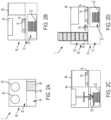
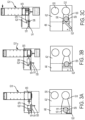
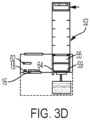
- FIGs. 3A-3D provide a more detailed view of the movement of the next opened can 59 of the embodiment.
- the upper panel is the right side view of the feeding system 1, while the bottom panel is a top view of the middle tray 40 of the feeding system 1.
- an opened can 55 is already within the open can receptacle 52.
- the next open can 59 is to be moved to the open can receptacle 52.
- an arm 62 is rotated clockwise from a side of the middle tray 40.
- This arm 62 can be any suitable size and shape, and can include no, one, or more joints.
- the arm 62 is configured to pass vertically over the bumpers 18, but still contact the next open can 59.
- a hooked element (not shown) can be driven to hook around the opened can 55 and pull the opened can 55 into the open can receptacle 52.
- the hooked element can be placed either above or below the can 55.
- FIG. 3B illustrates the arm 62 at about half way through its travel distance, as it continued to rotate in the clockwise direction, with the next open can 59 moved from its original location on the panel 16, towards the open can receptacle 52.
- FIG. 3C illustrates the arm 62 at the end of its travel distance, which causes the next open can 59 to move beyond the bumpers 18, towards the open can receptacle 52.
- a tab 64 extends vertically upwards towards the next open can 59.
- the arm 62 can then be rotated counter-clockwise back to the position seen in FIG. 3A .
- the tab 64 contacts a side surface of the next open can 59, and then the tab 64 moves towards the open can receptacle 52.
- the tab 64 has extended its travel distance and has caused the next open can 59 to enter the open can receptacle 52, with assistance by one or more optional guides 66. The tab can then return to the position seen in FIG. 3A .
- the feeding system 1 can include several other elements, which can be incorporated in or near the feeding system 1 in any suitable way. Some examples of these additional elements include a display screen and manual and/or touch screen buttons for control of various elements of the feeding system 1.
- the feeding system 1 can include a camera and internet connection (wired or wireless) so that a user can access the camera from a remote location and view images or video of the feeding system 1 and its environment, including animals. This camera can be activated through an application or program, and can capture images and/or video at specified times or in response to a trigger (such as sensing of motion). Link can be established to activate the camera for live viewing, with or without the animal being present.
- the feeding system 1 can include one or more speakers and one or more microphones to allow for capturing of sounds, as well as transmission of sounds from a user to the feeding system 1. Recordings of sound and voice may be added as well to allow users to customize messages to the pets.
- the feeding system 1 can update the user when a feeding has occurred and may provide additional data collected with the sensors.
- Type of data collected and sent to the user may vary depending on software and user settings. Such information may be delivered through a specific app developed for the feeding system, by text, email and or other social media or communication preferences that the user may set up. Such data may also be accessible through the display located physically on the feeding system or available on a website portal and stored on the cloud.
- the feeding system 1 described above is configured to open cans of food
- the feeding system 1 can include additional, accessible receptacles for the dispensing of various dry foods, snacks, can extension chutes and/or water.
- Various sensors within the feeding system 1 may also be optionally configured to gather data about the humidity level inside and outside the feeding system 1, temperature of the feeding system 1, feeding pattern of the animal, such as amount eaten/wasted, preferred flavor of food, how many times the animal eats and exactly when they fed, among others... etc.
- feeding system 100 is substantially circular (however any suitable shape housing and any suitable shape of the internal components could also be included) and can include several components.
- the feeding system 100 includes a suitable housing 110 formed of any suitable material (such as plastics, metals, glass, ceramic, rubbers, carbon based materials, and combinations thereof) and a base 120.
- the housing 110 can be formed of a single piece of material of a suitable shape, or several pieces of material that can be joined to each other in any suitable way.
- the housing 110 can include a housing opening 300, through which a can can be exposed, as discussed below.
- the base 120 is configured to attach to and support the housing 110, as well as support the other components within the housing 110.
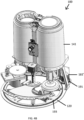
- FIG. 4B illustrates the feeding system 100 with the housing 110 removed. As can be seen, several components are supported by the base 120, within the space enclosed by the housing 110. A chute housing 141 is shown, which contains a can chute (discussed in more detail below). The other individual components visible in FIG. 4B are discussed in more detail below.
- FIG. 5 An enlarged view of the several components within the feeding system 100 is shown in FIG. 5 .
- One component is a can chute 130 shown in FIG. 6A , which is supported through a can chute support 140 to the base 120.
- the can chute 130 can be at least partially or fully surrounded by a chute housing 141.
- the chute housing 141 can support various other elements of the feeding system 100, such as a control device 160, which will be described below.
- the can chute 130 can be formed of any suitable material (such as plastics, metals, glass, ceramic, rubbers, carbon based materials, and combinations thereof), and can be rinsed and/or be washable by a user and/or dish washing apparatus.
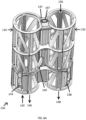
- FIG. 6A shows the can chute 130 alone, upon a removal from the chute housing 141 and the feeding system 100.
- the can chute 130 includes a sealed can barrel 132 and a used can barrel 134.
- Each of the sealed can barrel 132 and the used can barrel 134 have a diameter that is dimensioned to contain any suitably sized can.
- one or both of the sealed can barrel 132 and the used can barrel 134 can accommodate a spacer (not shown) that can extend around a diameter of a can if that can has a diameter smaller than the diameter of one or both of the sealed can barrel 132 and the used can barrel 134 .
- one or both of the sealed can barrel 132 and the used can barrel 134 can be tapered, so that their diameter is smaller at one end as compared to the other.
- the sides of the sealed can barrel 132 and the used can barrel 134 may be composed of multiple panels which allows them to expand and contract to accommodate any sized cans, including multiple different sized cans all at once.
- Each of the sealed can barrel 132 and the used can barrel 134 have a length dimensioned to contain any suitably sized can.
- each of the sealed can barrel 132 and the used can barrel 134 can be dimensioned to contain 1, 2, 3, 4, 5, 6, 7, 8, 9, 10, 11, 12, 13, 14, 15 or more cans stacked vertically.
- Two non-limiting examples of suitable cans are 156 g (5.5 ounce) cans and 85 g (3 ounce) cans.
- the can chute 130 is completely empty of cans.
- the feeding system 100 may include a lid (shown in FIG. 6B and 6C ) attached to the housing 110, which substantially covers the can chute 130.
- the user then pulls a portion of the can chute 130 vertically and out of the feeding system 100.
- the user can then place a sealed can (not shown) into the sealed can barrel 132, in the direction of arrow 136.
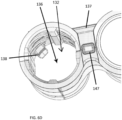
- the sealed can then falls vertically down until it contacts a sealed can catch 138.
- the sealed can catch 138 sufficiently supports each of the sealed cans added to the sealed can barrel 132.
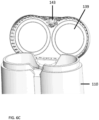
- FIG. 6D A more detailed view of the sealed can barrel 132, from vertically above is shown in FIG. 6D .
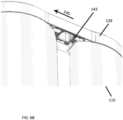
- FIG. 6B is a view of the underside of the lid 139, in a closed configuration and in contact with housing 110.
- a lid latch 143 maintains the lid 139 in contact with the housing 110, by having a portion of the lid latch 143 in contact with a catch of the housing 110.
- a user can cause the lid latch 143 to slide in the direction of arrow 145, thereby disengaging the portion of the lid latch 143 in contact with the catch of the housing 110.
- the lid 139 can then be placed in an open configuration, shown in FIG. 6C .
- the lid being in the open configuration shown in FIG. 6C allows for access by the user to the can chute 130.
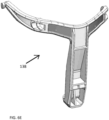
- the sealed can catch 138 can include a shock absorbing element, a curvature designed into the element, which can be configured to absorb at least some of the impact of adding cans in the direction of arrow 136.
- the sealed can catch 138 is shown separately in FIG. 6E .
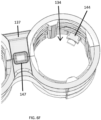
- the used can barrel 134 has received one or more cans in the direction of arrow 142 and are resting on used can catch 144 (this receipt of used cans will be described in more detail below).
- a more detailed view of the used can barrel 134, from vertically above is shown in FIG. 6F .
- the can chute 130 is removed from the feeding system 100 by a user.
- the user will open the lid 139 and pull the can chute 130 out by its handle 137.
- the can chute 130 can then be held over a garbage receptacle, and a can release button 147 is pressed by the user. Pressing the can release button 147 causes release lever 149 to move vertically downward and contact used can catch 144. This contact causes used can catch 144 to move horizontally away from the interior of used can barrel 134, and the one or more used cans within the used can barrel 134 fall vertically down and out of the used can barrel 134, in the direction of arrow 146. Now that all used cans are removed, and used can barrel 134 no longer contains any used cans or lids.
- the user can load new sealed cans into the empty sealed can barrel 132 and the can chute 130 can be placed back into the feeding system 100.
- the can chute 130 will slide into the can chute housing 141.
- the can chute housing 141 may be straight or may be tapered at the bottom to guide the can chute 130 in with ease.
- can chute 130 can be seen, with the exterior of each of the sealed can barrel 132 and the used can barrel 134, both visible below the can chute housing 141.
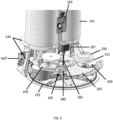
- A can enters the interior of the feeding system 100 by exiting the bottom of the sealed can barrel 132 (in the direction of arrow 148 of FIG. 6A ) onto a support arm 180 (which is further described, and illustrated, below), while the support arm is in a first position.
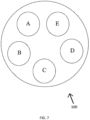
- FIG. 7 is a graphical representation, although not to scale, to generally illustrate the five positions the support arm 180 can rotate to and be maintained at.
- all positions may be configured in any way to be before or after other positions and although only 5 positions are shown, there could be either more or less positions as needed.
- FIG. 7 is a top view of a representation of the feeding system 100, with positions noted, although not to scale or meant to limit the actual location of any position of the support arm 180.
- a can (not shown) travels from position "A”, to position "B”, to position “C”, to position "D”, to position "E”, with these positions discussed below.
- the first position "A" is vertically below a lower opening of the sealed can barrel 132.
- the second position "B" is generally where the sealed can has at least a portion of a lid of the sealed can removed.
- the third position “C” is generally where the contents of the can, which has had at least a portion of its lid removed, are exposed to an exterior of the feeding system 100. At this position "C", an animal can typically access these exposed contents.
- the fourth position "D" is generally where the can, which has had at least a portion of its lid removed, and has been exposed to an exterior of the feeding system 100 for a period of time, is at least partially capped with a capping arm 250 (further described below).
- the fifth position "E" is vertically below a lower opening of the used can barrel 134.
- support arm 180 effects the movement of a can through the positions shown in FIG. 7 .
- first position "A" which is vertically below a lower opening of the sealed can barrel 132
- a sealed can is released and becomes supported by support arm 180.
- the support arm 180 can lift the entire number of cans within the sealed can barrel 132 to test for weight and thereby determine how many sealed cans are left within the sealed can barrel 132.
- the support arm 180 will contain a weight measurement device to obtain this data, such as a load cell, discussed below. Alternatively, sensors within or in proximity to the sealed can barrel 132 will provide this data.
- FIG. 8A A more detailed view of support arm 180 is shown in FIG. 8A , with the support arm 180 being in the vertical position it would be to begin supporting the sealed can.
- the support arm 180 includes an elevation arm 182 and a support pad 184.
- the elevation arm 182 is operably connected to an elevation screw 185 and is configured to pivot about a pivot within a support arm frame 186.
- Elevation screw 185 is capable of being rotated by an elevation motor (elevation motor 187 of FIG. 5 , which is supported by can chute support 140).
- elevation motor 187 of FIG. 5 which is supported by can chute support 140.
- the operation of the elevation screw is discussed below in regards to rotation being "clockwise” or “counter-clockwise” as an example. In other embodiments, the directions can be reversed using a differently threaded elevation screw 185 to achieve the same movements of the support arm 180.
- the clockwise rotation of elevation screw 185 by the elevation motor causes the elevation arm to move vertically downward towards the base 120 of the feeding system 100, to a position shown in FIG. 8B .
- the elevation motor can stop rotation, making the elevation arm 182 any suitable height until an arm protrusion 179 is detected as being present by height sensor 189.
- the counter-clockwise rotation of elevation screw 185 by the elevation motor causes the elevation arm 182 to move vertically upwards, away from the base 120 of the feeding system 100, to a position shown in FIG. 8A .
- the elevation motor can stop rotation, making the elevation arm 182 any suitable height until the elevation arm 182 is stopped because the height stop 183 reaches and is stopped by the top of the elevation screw 185.
- the support pad 184 is configured to support sealed and used cans, and includes an electronic weight sensing device, such as a load cell.
- the electronic weight sensing device is configured to send and/or receive signals from control device 160, which will be described in more detail below. From signals received from the support pad 184, the control device 160 can determine how much food is left in a can that has had at least a portion of a lid of that can removed.
- the control device 160 can also determine a weight of all cans in either sealed can barrel 132 or used can barrel 134, by the support pad being placed under either barrel and caused to lift vertically upwards by the elevation screw 185 to support all weight of all cans in either barrel. As an example, from signals received from the support pad 184, the control device 160 can determine how many sealed cans are within the sealed can barrel 132 by measuring a total weight of all cans present, and then divide that total weight by a predetermined, average sealed can weight.
- a sensor (not shown) can be included on the interior of or in proximity to one or both of the sealed can barrel 132 and the used can barrel 134 to optically or mechanically determine the height of cans in the barrel, thus determining how many cans are in each of the barrels.
- Optical sensors may be placed inside, at the top, at the bottom or around the sealed can barrel 132 and/or the used can barrel 134 to determine how many cans are in the barrels.
- the sealed can barrel 132 and the used can barrel 134 may or may not have cut outs that will allow sensors of this type to work even mounted outside of the barrels.
- one or more mechanical sensors may be placed inside the sealed can barrel 132 and /or the used can barrel 134 to detect how many cans are in the barrels. These sensors may be indented, lifted, pressed or otherwise manipulated by the cans or lack of cans to determine the fullness of each barrel.
- Support arm frame 186 interacts through a suitable gear(s) with a rotation motor 181, which causes support arm frame 186 (including support arm 180) to rotate clockwise and counter-clockwise, between each position shown in FIG. 7 .
- Both rotation motor 181 and elevation motor 187 are any electrical motors, either AC or DC, that are suitably sized to cause rotation of support arm frame 186 (with one or more sealed or used cans supported on support pad 184) and also suitably sized to vertically lift 1, 2, 3, 4, 5, 6, 7, 8, 9, 10, 11, 12, 13, 14, 15 or more sealed cans stacked vertically within sealed can barrel 132 and used can barrel 134.
- a sealed can is released and becomes supported by support arm 180.
- the rotation motor 181 has caused the support arm frame 186 and support arm 180 to rotate to be vertically below a lower opening of the sealed can barrel 132.
- the elevation motor can cause the support arm 180 to extend vertically upward, to a position shown in FIG. 8A .
- the support arm 180 (or another suitable portion of the feeding system 100, such as within the sealed can barrel 132, or near position "B" of FIG. 7 ) can include a scanner (not shown).
- This scanner can be any suitable scanner, including optical scanners and laser scanners, that is capable of decoding data stored in a barcode, a QR code, or any equivalent scannable/detectable coding option used for tracking purposes on a can. This data can be received by the control device 160, and will be described in more detail below.
- the support arm 180 (or another suitable portion of the feeding system 100, such as within the sealed can barrel 132, or near position "B" of FIG. 7 ) can include a second scanner (not shown).
- This second scanner can be any suitable scanner or device (in conjunction with control device 160) that is capable of determining if a sealed can is in the correct orientation (right side up, or the rolled lip and lid of the can is vertically further away from the base 120 of the feeding system than the bottom of the can).
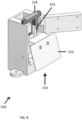
- the support pad 184 can catch the sealed can from the opening at the bottom of the sealed can barrel 132. Before moving on to position "B" to open the can, the support pad 184 will be elevated slightly again and the can will rub against an edge detector 210, shown in FIG. 9 .
- the edge detector 210 can be located in any position between position "A” (including position "A") and position "B".
- the edge detector 210 includes a blade 212 configured to catch on the rim of a can, as the can moves in the direction of arrow 214. If the can was upside down, the lip of the lid of the can will catch on the blade 212 and the edge detector 210 will notify the control device 160. As the rim of the can catches the blade 212, the mechanism rotates so that blade protrusion 215 moves and is detected by blade protrusion sensor 216. The blade 212 will not catch if the can is right side up, with the rim at the top. If the can is right side up, the sealed can can proceed to position "B".
- device can opener 190 can be configured to sense if the can is right side up. This may be determined from feedback received by the control device 160 of the grip of the blades of the can opener on the can or lack thereof. This may also be determined by the control device 160 from the amount of current drawn by the motor as the can opener 190 is operating on the can. The structure of the can opener 190 is further described below.
- the rotation motor 181 rotates and causes the support arm 180 to rotate counter-clockwise from position "A" to position "B” of FIG. 7 .
- the elevation screw 185 rotates counter-clockwise and the support arm 180 (and sealed can thereon) is lifted vertically towards the can opener 190.
- the elevation screw 185 does not rotate and the can opener 190 moves vertically downwards.
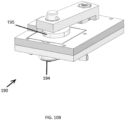
- the can opener 190 includes a feed gear 192, a cutter 194, and lid extractors 199.
- the feed gear 192 is moved by a can opener motor (not shown ) that is on top or located anywhere within the feeding system 100 and is configured to contact and cause the can to rotate against the cutter 194, such that the cutter 194 cuts through a side wall of the can.
- the feed gear 192 can contact and cause the can to rotate against the cutter 194, such that the cutter 194 cuts through an upper surface wall of the can.
- a pinching mechanism (not shown) can contact and pinch a flap handle of a can, and peel the upper flap off of the can.
- the feed gear 192 is configured to move in the direction of arrow 196 through feed gear groove 198 by forwarding and reversing the direction the motor is turning. As shown in FIG. 10B , rotation of cam 195 (through the motor (not shown)) causes the cutter 194 to more in the direction of arrow 196 in FIG. 10A .
- the can opener 190 results in a substantially dull upper metal edge of the can and a removed lid.
- the removed lid refers to any material removed from the sealed can by the can opening process.
- the removed lid can be maintained by the can opener 190 until after the support arm 180, and now opened can, have moved from position "B" of FIG. 7 .
- the can opener 190 can release the removed lid by utilizing the lid extractors 199 which will help push the lid out of the grip of the cutter 194 and/or feed gear 192, so that the removed lid falls vertically down into a receptacle (not shown) which can later be removed by a user.
- the can opener 190 can maintain the removed lid until after the opened can has completed position "C", or after the opened can has completed position "D", both described below in more detail.
- the rotation motor 181 rotates and causes the support arm 180 to rotate clockwise from either position "C” or position "D” back to position "B", and the removed lid is then released so that the removed lid falls vertically down onto the can, which has now been used.
- the rotation motor 181 rotates and causes the support arm 180 to rotate counter-clockwise from position "B” to position "C” of FIG. 7 .
- the elevation screw 185 rotates counter-clockwise and the support arm 180 (and opened can thereon) is lifted vertically towards a feeding opening 200.
- the opened can is lifted to be below the feeding opening, 200, partially exposed through feeding opening 200, or offset a distance below the feeding opening 200.
- an animal can access the contents of the opened can and eat at least a portion or all of the contents.
- the can can be extended outside of the housing 110 to present the food to the animal and then retracting back once finished or per scheduled settings.
- the support pad 184 can measure the weight of the opened can at various times, and transmit that information to the control device 160, such that the weight of the can at the time of opening can be compared to the weight of the opened can over time. These weight measurements can be used by the control device to determine an amount of material remaining in the opened can, and can be used to restrict access to the opened can if the contents are being removed too quickly. Further actions undertaken by the control device 160 are discussed below.
- the feeding opening 200 can include a lip that extends vertically downwards, which substantially covers the exposed edge of the opened can. Also, the feeding opening 200 can include an inclined portion, which extends radially from the feeding opening 200 and is inclined vertically downward towards the feeding opening 200.
- the feeding opening 200 when the opened can is not in position "C", can be covered with an opening cover 202, which extends over the feeding opening 200.
- the opening cover 202 can be maintained, when an opened can is not in position "C", in a closed configuration by the force of an elastic element (shown in FIG. 11 ).
- the rotation motor 181 rotates and causes the support arm 180 to rotate counter-clockwise from position "B", past position "C” a distance, which is prior to position "D".
- the support arm 180 (and opened can thereon) is lifted vertically a predetermined distance by rotation, counter-clockwise, of the elevation screw 185.
- the rotation motor 181 rotates and causes the support arm 180 to rotate clockwise back towards position "C", so that a portion of support arm 180 contacts an opening cover portion (shown in FIG. 11 ) on a lower surface of the opening cover 202.
- the rotation motor 181 continues to rotate clockwise, causing the opening cover 202 to move clockwise, exposing the feeding opening 200.
- FIG. 11 is a portion of the opening cover 202, from an underside perspective. From this view, the opening cover portion 203 that contacts the support arm 180 can be seen as extending from a surface of the opening cover 202. In the configuration shown in FIG. 11 (and in FIG. 4A ), the opening cover 202 is in a closed position, held by an elastic element 204 (such as a spring or an elastomeric element, or the like) between the opening cover 202 and a fixed portion of the feeding system 100.
- an elastic element 204 such as a spring or an elastomeric element, or the like
- the elastic element 204 causes the opening cover to rotate in a counter-clockwise direction of FIG. 11 so that feeding opening 200 is no longer substantially aligned with the housing opening 300 and the opening cover 202 itself is exposed through the housing opening 300, as seen in FIG. 4A .
- the opening cover 202 can be moved through an additional motor (not shown) to expose the feeding opening 200.
- the opening cover 202 is moved as the support arm 180 rotates from position "B" to position "C” through contact between a portion of the support arm 180 and a portion of the opening cover 202.
- the elevation screw 185 rotates counter-clockwise and the support arm 180 (and opened can thereon) is lifted vertically towards a feeding opening 200.
- the feeding opening 200 is near enough to the can to allow for access to the can's contents without the support arm 180 moving vertically up or down.
- the elevation screw 185 rotates clockwise and the support arm 180 (and used can thereon) is moved vertically down and away from the feeding opening 200. Then, the rotation motor 181 rotates and causes the support arm 180 to rotate counter-clockwise from position "C" to one of position "D” or position "E” of FIG. 7 .
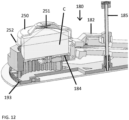
- the capping arm 250 includes a ring 252 made of a substantially compliant material, such as an elastomeric material, that extends around the circumference of the capping arm 250, which is configured to be elastically deformable upon contact with an exposed edge of the used can. Once contact is made between the ring 252 and the used can, a substantially air tight seal is formed between the contents of the used can and the environment around the feeding system 100.
- the capping arm 250 may be larger in circumference than the can and can be placed over the can without touching any part of the can.
- the capping arm 250 can also include one or more lights (shown in FIG. 12 ) that are capable of at least partially limiting bacterial and/or mold growth on the contents of the used can.
- one or more lights is an ultra violet (UV) light and a light emitting diode (LED).
- UV ultra violet
- LED light emitting diode
- the light may be used any time for any amount of time and may be programmable by the user.
- FIG. 12 A side cross-sectional view of the capping arm 250 is shown in FIG. 12 .
- a used can C is shown as being in contact with a portion of the ring 252.
- a light 251 is on an underside surface of the capping arm 250 and emits a light towards the used can C.
- the elevation screw 185 then rotates clockwise and the support arm 180 (and used can thereon) is lifted vertically away from the capping arm 250.
- the rotation motor 181 can rotate counter-clockwise, back to position "C", or the rotation motor 181 can rotate clockwise, to position "E”. If the rotation motor 181 rotates back to position "C", the used can can be exposed again through the feeding opening 200. This process can continue multiple times, with the rotation motor 181 causing the used can to move from position "C", to position "D", to position "C", to position "D”, etc. for a predetermined period of time or amount eaten or as per scheduling settings made by the user..
- the used can After a period of time or amount eaten or as per scheduling settings made by the user, the used can is caused to move into position "B" to pick up the lid and then to position "E” by the rotation motor 181. Position “E” is vertically below a lower opening of the used can barrel 134. Upon reaching position "E", the elevation screw 185 then rotates counter-clockwise and the support arm 180 (and used can thereon) is lifted vertically towards the bottom face of the used can barrel 134. The elevation screw 185 will continue to rotate until the lower edge of the used can passes the used can catch 144. After the lower edge of the used can passes the used can catch 144, the used can is then supported by used can catch 144.
- the elevation screw 185 causes the used can just brought to position "E” to push vertically upwards the one or more other used cans already present in the barrel until the lower edge of the used can that was just brought to position "E” passes the used can catch 144. After the lower edge of the used can that was just brought to position "E” passes the used can catch 144, all used cans in the used can barrel 134 are then supported by used can catch 144.
- an interior surface of the used can barrel 134 can include, 1, 2, 3, 4, 5, or more vertical rails (not shown), which can be formed of any suitable material (such as plastics, metals, glass, ceramic, rubbers, carbon based materials, and combinations thereof). These vertical rails can extend a portion of the vertical length of the used can barrel 134, or a majority or all of the vertical length of the used can barrel 134. These vertical rails can aid in preventing an edge of a used can being caught, or cutting into a portion of the used can barrel 134 itself.
- any suitable material such as plastics, metals, glass, ceramic, rubbers, carbon based materials, and combinations thereof.
- a rotation motor 181' can be located in the position shown in FIG. 4B , which through rotation of motor gear 191 causes the entire carousel 193 to rotate through interaction with motor gear 191 and teeth on the exterior circumference of carousel 193.
- the support arm 180 can be attached to the carousel 193 and the support arm 180 can rotate with the carousel 193 to the locations discussed above.
- FIG. 8C This alternative embodiment is shown in FIG. 8C , which includes the carousel 193 and support arm 180 separate from the other components of the feeding system 100.
- the elevation arm 182 is moved vertically upwards and downwards as in the first embodiment.
- control device 160 refers to all components in, on, or attached to an electrical board. Some components of the control device 160 can be in the location shown in FIG. 5 and/or some components of the control device can be located on control device 160', also shown in FIG. 5 .
- the control device 160 can include one or more of a processor, a memory, a network interface, and/or an image sensor (e.g., a camera).
- the network interface can send and receive various signals, such as WiFi signals, Bluetooth ® signals, etc.
- the control device 160 can be configured to receive various inputs from components of the feeding system 100, or from other devices external to the feeding system 100. Also, each of the actions received by or produced from the control device 160 can be processed locally, on the control device 160, and/or, be transmitted to an external server, such as a cloud database, for processing.
- control device 160 can receive inputs from a mobile phone external to the feeding system 100, where these received inputs can be processed by the processor of control device 160 to control operations of the components of the feeding system 100.
- the control device 160 is configured to receive signals from the electronic weight sensing device on the support pad 184.
- the control device 160 can send a signal to the electronic weight sensing device to make a measurement and, then, the control device 160 can receive the output signal from the electronic weight sensing device at any time, such as when the support arm 180 is at any of positions "A", "B", “C”, “D”, and “E", or between these positions.
- These received signals can be used by the control device 160 to determine the amount of contents of each can that has been removed (eaten by an animal), over time.
- These signals can also be used by the control device 160 to determine if there is an increase in weight, which could indicate a foreign object has been placed in the used can, or if an animal has regurgitated in the used can.
- control device 160 If the control device 160 does make this determination, an alert can be transmitted through the interface that a fault has been detected. If a fault is detected, the control device 160 can stop all movement of all elements within the feeding system 100 (to allow for a user to manually remove the used can) or automatically move the used can into the used can barrel 134, and then retrieve a sealed can from the sealed can barrel 132.
- control device 160 can determine that when a remaining weight of a used can is below a threshold, the control device 160 can automatically move the used can into the used can barrel 134.
- control device 160 can send a signal to the electronic weight sensing device to make a measurement and, then, the control device 160 can receive the output signal from the electronic weight sensing device to determine a weight of all initial (or remaining) sealed cans in the sealed can barrel 132. These received signals can be used by the control device 160 to determine the number of sealed cans in the sealed can barrel 132, if any.
- the control device 160 can be configured to send an alert through the interface when the detected number of sealed cans is below a threshold, such as 0 sealed cans remaining, 1 sealed can remaining, 2 sealed cans remaining, etc.
- the control device 160 can check every time a can is dispensed from the sealed can barrel 132 so that the current number of sealed cans in the sealed can barrel 132 can be known to the user.
- All such weight sensing signals can be stored by the control device and then later transmitted, through the network interface for storage in another location such as but not limited to the cloud or a local or external database.
- the control device 160 can also receive rotational data from each of the elevation motor 187 and the rotation motor 181. To determine the vertical height and the rotational orientation of the support arm 180.
- the control device 160 also transmits rotational data to each of the elevation motor 187 and the rotation motor 181, causing these motors to move the support arm according to stored rules.
- control device 160 can be configured to operate support arm 180, and optionally opening cover 202, as discussed above, to expose the contents of an opened can through the feeding opening 200 for a period of time once motion is detected by a proximity sensor or by the camera of the control device 160.
- the camera may be used as a proximity sensor or for recognition of different pets.
- the proximity sensor may also be a receiver of a signal from a device on an animal, such as an RFID chip on a collar of an animal or a microchip within the animal.
- control device 160 can be configured to run a machine learning model using images received from a camera (the camera of the control device 160).
- the machine learning model can be stored in the memory of the control device 160, and can be a classification model that can distinguish different animals accessing the feeding system 100.
- the process of recognition can be transmitted from the control device 160 to a cloud network and/or external server for recognition processing and data obtained from this process can be stored on the cloud network and/or external server, and/or transmitted back to the control device 160.
- the memory of the control device 160 can store a mapping of different animals to different course of actions to operate the feeding system 1.
- the control device 160 can run the machine learning model to identify an animal currently accessing the feeing system 1 (such as by physical size, shape, color and/or physical appearance, such as fur/eye color and/or fur pattern), and identify, in the memory, a course of actions mapped to the identified animal. For example, if an animal AA is mapped to an action of an allowed eating time of three minutes, in response to identifying animal AA, the control device 160 can operate support arm 180, and optionally opening cover 202, as discussed above, to expose the contents of an opened can through the feeding opening 200 for three minutes,
Landscapes
- Life Sciences & Earth Sciences (AREA)
- Environmental Sciences (AREA)
- Birds (AREA)
- Animal Husbandry (AREA)
- Biodiversity & Conservation Biology (AREA)
- Engineering & Computer Science (AREA)
- Wood Science & Technology (AREA)
- Zoology (AREA)
- Chemical & Material Sciences (AREA)
- Food Science & Technology (AREA)
- Polymers & Plastics (AREA)
- Devices For Opening Bottles Or Cans (AREA)
- Feeding And Watering For Cattle Raising And Animal Husbandry (AREA)
- Closing Of Containers (AREA)
- Control And Other Processes For Unpacking Of Materials (AREA)
Claims (11)
- Fütterungssystem (100) zum Ausgeben von Dosenfutter an Tiere, wobei das Fütterungssystem Folgendes umfasst:
ein Gehäuse (110), das im Wesentlichen eine Außenfläche des Fütterungssystems bildet, wobei das Innere des Gehäuses Folgendes umfasst:einen Arm (180), der zum Drehen im Uhrzeigersinn und gegen den Uhrzeigersinn in mehrere Positionen konfiguriert ist, wobei der Arm zum Tragen einer Dose (20) konfiguriert ist;wobei die mehreren Positionen Folgendes umfassen:eine erste Position "A" vertikal unterhalb einer unteren Öffnung einer Verschlossene-Dose-Trommel (132) des Fütterungssystems; undeine zweite Position "B", in der bei einer verschlossenen Dose zumindest ein Teil eines Deckels der verschlossenen Dose durch einen Dosenöffner entfernt wurde,dadurch gekennzeichnet, dass die mehreren Positionen ferner Folgendes umfassen:eine dritte Position "C", in der der Inhalt der Dose, bei der zumindest ein Teil ihres Deckels entfernt wurde, durch eine Öffnung des Gehäuses zur Außenseite des Fütterungssystems exponiert ist, so dass ein Tier typischerweise Zugang zu diesem exponierten Inhalt hat;eine vierte Position "D", in der die Dose, von der zumindest ein Teil ihres Deckels entfernt wurde und die für eine gewisse Zeit außerhalb des Fütterungssystems exponiert war, zumindest teilweise mit einem Verschlussarm (250) verschlossen ist; undeine fünfte Position "E" vertikal unterhalb einer unteren Öffnung einer Gebrauchte-Dose-Trommel (134) des Fütterungssystems. - Fütterungssystem nach Anspruch 1, wobei der Verschlussarm eine oder mehrere Leuchten umfasst.
- Fütterungssystem nach Anspruch 2, wobei die ein oder mehreren Leuchten so konfiguriert sind, dass sie Bakterien- und/oder Schimmelwachstum an Inhalt der Dose zumindest teilweise begrenzen.
- Fütterungssystem nach Anspruch 1, das ferner eine Elevationsschraube (185) umfasst, die zum Drehen und vertikalen Auf- und Abwärtsbewegen des Arms konfiguriert ist.
- Fütterungssystem nach Anspruch 1, das ferner einen Dosenkanal (130) umfasst, der so konfiguriert ist, dass er vom Gehäuse entfernt werden kann.
- Fütterungssystem nach Anspruch 5, wobei der Dosenkanal die Verschlossene-Dose-Trommel und die Gebrauchte-Dose-Trommel umfasst.
- Fütterungssystem nach Anspruch 6, wobei sowohl die Verschlossene-Dose-Trommel als auch die Gebrauchte-Dose-Trommel zum Halten einer oder mehrerer Dosen konfiguriert sind.
- Fütterungssystem nach Anspruch 1, wobei die Öffnung der Verschlossene-Dose-Trommel zum Freigeben einer Dose aus der Verschlossene-Dose-Trommel auf einen Teil des Arms konfiguriert ist.
- Fütterungssystem nach Anspruch 1, wobei die Öffnung der Gebrauchte-Dose-Trommel zum Aufnehmen einer Dose von einem Teil des Arms in die Gebrauchte-Dose-Trommel konfiguriert ist.
- Fütterungssystem nach Anspruch 1, das ferner eine Abdeckung (202) umfasst, die zum Bewegen von einer ersten Position, in der sie die Öffnung des Gehäuses gegenüber dem Inneren des Fütterungssystems im Wesentlichen abdeckt, in eine zweite Position konfiguriert ist, in der sie die Öffnung des Gehäuses gegenüber dem Inneren des Fütterungssystems im Wesentlichen exponiert.
- Fütterungssystem nach Anspruch 1, das ferner eine Steuervorrichtung (160) umfasst, wobei die Steuervorrichtung eines oder mehrere von einem Prozessor, einem Speicher, einer Netzwerkschnittstelle und einem Bildsensor umfasst.
Priority Applications (1)
| Application Number | Priority Date | Filing Date | Title |
|---|---|---|---|
| EP24212241.4A EP4494462A3 (de) | 2019-02-12 | 2020-02-11 | Tierfütterungssystem |
Applications Claiming Priority (2)
| Application Number | Priority Date | Filing Date | Title |
|---|---|---|---|
| US201962804366P | 2019-02-12 | 2019-02-12 | |
| PCT/US2020/017643 WO2020167754A1 (en) | 2019-02-12 | 2020-02-11 | Feeding system |
Related Child Applications (2)
| Application Number | Title | Priority Date | Filing Date |
|---|---|---|---|
| EP24212241.4A Division EP4494462A3 (de) | 2019-02-12 | 2020-02-11 | Tierfütterungssystem |
| EP24212241.4A Division-Into EP4494462A3 (de) | 2019-02-12 | 2020-02-11 | Tierfütterungssystem |
Publications (4)
| Publication Number | Publication Date |
|---|---|
| EP3923708A1 EP3923708A1 (de) | 2021-12-22 |
| EP3923708A4 EP3923708A4 (de) | 2022-10-26 |
| EP3923708B1 true EP3923708B1 (de) | 2024-11-13 |
| EP3923708B8 EP3923708B8 (de) | 2024-12-18 |
Family
ID=71946246
Family Applications (2)
| Application Number | Title | Priority Date | Filing Date |
|---|---|---|---|
| EP24212241.4A Pending EP4494462A3 (de) | 2019-02-12 | 2020-02-11 | Tierfütterungssystem |
| EP20756120.0A Active EP3923708B8 (de) | 2019-02-12 | 2020-02-11 | Tierfütterungssystem |
Family Applications Before (1)
| Application Number | Title | Priority Date | Filing Date |
|---|---|---|---|
| EP24212241.4A Pending EP4494462A3 (de) | 2019-02-12 | 2020-02-11 | Tierfütterungssystem |
Country Status (8)
| Country | Link |
|---|---|
| US (1) | US12295352B2 (de) |
| EP (2) | EP4494462A3 (de) |
| JP (1) | JP7620323B2 (de) |
| CN (1) | CN113710088A (de) |
| AU (1) | AU2020221188B2 (de) |
| CA (1) | CA3126848A1 (de) |
| GB (1) | GB2594877B (de) |
| WO (1) | WO2020167754A1 (de) |
Families Citing this family (12)
| Publication number | Priority date | Publication date | Assignee | Title |
|---|---|---|---|---|
| US11051488B2 (en) * | 2018-03-06 | 2021-07-06 | Benjamin A. Black | Deer feeder power control and distribution system |
| US12290053B2 (en) * | 2021-06-15 | 2025-05-06 | Mythos Pet Foods Inc. | Automatic pet food dispenser |
| US11980169B1 (en) * | 2022-01-04 | 2024-05-14 | Jay Milton Eppink | Animal feeding system and method of use |
| US20220312727A1 (en) * | 2022-01-26 | 2022-10-06 | Huizhou du du Pet Products Co. LTD | Pet feeder |
| US12471566B2 (en) | 2022-09-14 | 2025-11-18 | Paws Forward Inc. | Automatic animal feeding system for presenting and securing food pods |
| CN219578054U (zh) * | 2022-11-30 | 2023-08-25 | 上海联宠智能科技有限公司 | 一种喂食器 |
| WO2025106809A2 (en) * | 2023-11-15 | 2025-05-22 | Automated Pet Care Products, Llc D/B/A Whisker | Automatic feeding assembly |
| CN221241252U (zh) * | 2023-11-27 | 2024-07-02 | 深圳乐木骆科技有限公司 | 宠物喂食器 |
| CN221382120U (zh) * | 2023-11-27 | 2024-07-23 | 深圳乐木骆科技有限公司 | 宠物喂食器 |
| US20250268228A1 (en) * | 2024-02-23 | 2025-08-28 | Kee Seungjoo | Wet pet food dispenser |
| USD1080080S1 (en) * | 2024-05-28 | 2025-06-17 | Huizhou du du Pet Products Co. LTD | Pet feeding system |
| US12478038B1 (en) * | 2025-01-17 | 2025-11-25 | Shenzhen Beibanqiu Network Technology Co, Ltd | Rotatable feeding bowl device and pet feeder |
Family Cites Families (38)
| Publication number | Priority date | Publication date | Assignee | Title |
|---|---|---|---|---|
| US4077360A (en) | 1976-07-16 | 1978-03-07 | F. G. Waide, Inc. | Pet feeding apparatus |
| US4044722A (en) | 1976-08-13 | 1977-08-30 | Bradshaw John O | Timed pet food dispenser |
| US4421059A (en) * | 1981-12-21 | 1983-12-20 | Cousino Corporation | Automatic cat feeder |
| FR2608894A1 (fr) | 1986-12-26 | 1988-07-01 | Vidal Sole Juan | Appareil et recipient pour la fourniture d'aliments aux animaux, en particulier aux animaux domestiques |
| JPH0327951U (de) | 1989-04-03 | 1991-03-20 | ||
| FR2701353B1 (fr) | 1993-02-12 | 1995-06-30 | Proville Rene | Dispositif de distribution automatique programmable d'aliments conditionnes en barquettes standard du commerce pour animaux: chiens, chats, etc.... |
| US5649499A (en) * | 1995-08-08 | 1997-07-22 | Krietzman; Mark H. | Animal feeding bowl with protective cover movable by animal |
| DE29617137U1 (de) * | 1995-12-01 | 1996-12-19 | Kaplan, Simone, Dipl.-Ing., 04155 Leipzig | Fütterungsvorrichtung für Haustiere, insbesondere Katzen und Hunde |
| JP3054576U (ja) * | 1998-06-01 | 1998-12-08 | 株式会社リッチェル | 缶詰用の蓋体 |
| CN2406481Y (zh) * | 2000-01-27 | 2000-11-22 | 李鹏 | 家养动物自动喂食机 |
| US6578725B2 (en) * | 2001-02-12 | 2003-06-17 | Traffic Works, Inc. | Container lid with finger-receiving scoop |
| DE20120281U1 (de) | 2001-12-14 | 2002-02-28 | Weda-Dammann & Westerkamp GmbH, 49424 Goldenstedt | Futteranmischbehälter |
| KR20050026661A (ko) * | 2003-09-09 | 2005-03-15 | 엘지전자 주식회사 | 디지탈 동영상 해상도 감축을 위한 움직임 벡터 설정방법 |
| US20050066905A1 (en) * | 2003-09-26 | 2005-03-31 | Morosin Rose Chan | Automated pet feeder |
| US20050218141A1 (en) * | 2004-03-31 | 2005-10-06 | Kratzer Oliver C R | Lid with spoon |
| US20090236354A1 (en) * | 2005-12-06 | 2009-09-24 | Brasilata S/A Embalagens | Can closure arrangement |
| CN201008298Y (zh) * | 2007-03-27 | 2008-01-23 | 潘建栋 | 一种自动翻盖宠物碗 |
| CN201226717Y (zh) * | 2008-06-02 | 2009-04-29 | 潘建栋 | 智能识别宠物碗 |
| DE102010055466A1 (de) * | 2009-12-26 | 2011-07-21 | Hans Stark e.K., 89567 | Futterabdeckungsbetätigungsvorrichtung, insbesondere für Futterbehältnisse und eine Futtereinrichtung |
| US8220413B2 (en) | 2010-09-15 | 2012-07-17 | Tunji S Laro | Pet food server |
| US9877462B2 (en) * | 2012-03-12 | 2018-01-30 | Meena Anurag Taneja | Pet feeding robot . automatic pet wet food dispenser robot |
| ITMO20120185A1 (it) * | 2012-07-18 | 2014-01-19 | Damco S R L | Dispositivo distributore di alimenti e confezione alimentare |
| US11249495B2 (en) * | 2012-09-19 | 2022-02-15 | Botsitter, Llc | Method and system for remote monitoring, care and maintenance of animals |
| US20150053138A1 (en) * | 2013-08-22 | 2015-02-26 | David Ramsey | Automated pet feeding apparatus |
| GB201315484D0 (en) * | 2013-08-30 | 2013-10-16 | Sureflap Ltd | Pet feeders |
| US20150313176A1 (en) * | 2014-04-30 | 2015-11-05 | Lori Gelinas | Pet Feeding System |
| RU2695444C2 (ru) | 2014-06-23 | 2019-07-23 | Пэт Новэйшнз Лтд. | Система для кормления животных |
| US9433189B2 (en) * | 2014-08-07 | 2016-09-06 | Bruce Taneja | Pop-top can food dispenser robot |
| GB2541746B (en) * | 2015-08-28 | 2021-09-15 | Kenwood Ltd | Improvements in or relating to food mixers and processors |
| CN106234242B (zh) * | 2016-08-03 | 2019-08-02 | 绍兴市尊铖自动化设备有限公司 | 一种宠物喂食器 |
| TWM550984U (zh) * | 2017-01-06 | 2017-11-01 | Zong-Xin Chen | 寵物餵食裝置 |
| CN107320745A (zh) * | 2017-08-15 | 2017-11-07 | 李雄 | 紫外线消毒罩 |
| CN107373729A (zh) * | 2017-08-24 | 2017-11-24 | 郑州莉迪亚医药科技有限公司 | 一种养殖用饲料储存造粒一体机 |
| CN107396843A (zh) * | 2017-08-31 | 2017-11-28 | 李瑞蓉 | 一种畜牧业用自动加料的饲料槽 |
| CN207505485U (zh) * | 2017-11-13 | 2018-06-19 | 山丹县三羊农牧开发有限公司 | 一种青储饲料的储备箱 |
| CN207767223U (zh) * | 2018-01-22 | 2018-08-28 | 京东方科技集团股份有限公司 | 一种宠物喂食器 |
| CN108308049A (zh) * | 2018-03-07 | 2018-07-24 | 佛山市熙华科技有限公司 | 一种智能自动开罐头投食机 |
| CH715871B1 (de) | 2019-02-21 | 2023-10-13 | Smartpetcare Ag | Vorrichtung, insbesondere Haustierfütterungsvorrichtung und Verfahren zum Bereitstellen und Öffnen gefüllter Behälter. |
-
2020
- 2020-02-11 CA CA3126848A patent/CA3126848A1/en active Pending
- 2020-02-11 GB GB2110613.3A patent/GB2594877B/en active Active
- 2020-02-11 WO PCT/US2020/017643 patent/WO2020167754A1/en not_active Ceased
- 2020-02-11 AU AU2020221188A patent/AU2020221188B2/en active Active
- 2020-02-11 CN CN202080013913.0A patent/CN113710088A/zh active Pending
- 2020-02-11 US US16/787,567 patent/US12295352B2/en active Active
- 2020-02-11 EP EP24212241.4A patent/EP4494462A3/de active Pending
- 2020-02-11 JP JP2021538139A patent/JP7620323B2/ja active Active
- 2020-02-11 EP EP20756120.0A patent/EP3923708B8/de active Active
Also Published As
| Publication number | Publication date |
|---|---|
| EP3923708A1 (de) | 2021-12-22 |
| CN113710088A (zh) | 2021-11-26 |
| US12295352B2 (en) | 2025-05-13 |
| AU2020221188A1 (en) | 2021-07-01 |
| WO2020167754A1 (en) | 2020-08-20 |
| EP4494462A3 (de) | 2025-03-26 |
| JP7620323B2 (ja) | 2025-01-23 |
| EP4494462A2 (de) | 2025-01-22 |
| EP3923708A4 (de) | 2022-10-26 |
| CA3126848A1 (en) | 2020-08-20 |
| US20200253162A1 (en) | 2020-08-13 |
| EP3923708B8 (de) | 2024-12-18 |
| AU2020221188B2 (en) | 2025-05-29 |
| GB2594877A (en) | 2021-11-10 |
| GB2594877B (en) | 2023-02-01 |
| GB202110613D0 (en) | 2021-09-08 |
| JP2022520706A (ja) | 2022-04-01 |
Similar Documents
| Publication | Publication Date | Title |
|---|---|---|
| EP3923708B1 (de) | Tierfütterungssystem | |
| US9877462B2 (en) | Pet feeding robot . automatic pet wet food dispenser robot | |
| RU2695444C2 (ru) | Система для кормления животных | |
| US20240108552A1 (en) | Smart pill dispenser | |
| US12446544B2 (en) | Automatic animal feeding system for self disposing of used food pods | |
| US20250318499A1 (en) | Automatic feeding assembly | |
| US20150053138A1 (en) | Automated pet feeding apparatus | |
| US9433189B2 (en) | Pop-top can food dispenser robot | |
| JP7162633B2 (ja) | 動物給餌システム | |
| US20250187893A1 (en) | Can opener for feeding system | |
| US20240315197A1 (en) | Feeding system | |
| EP2900057B1 (de) | Automatische fütterungsvorrichtung für haustiere | |
| Vijayalakshmi et al. | An innovative approach in the design of ai & iot enhanced automatic animal food dispenser | |
| US20190180552A1 (en) | Commercial Granular Material Dispensing Apparatus, Method, and System | |
| WO2025106809A2 (en) | Automatic feeding assembly | |
| FR2663830A1 (fr) | Machine a distribuer les cuillers metalliques. |
Legal Events
| Date | Code | Title | Description |
|---|---|---|---|
| STAA | Information on the status of an ep patent application or granted ep patent |
Free format text: STATUS: THE INTERNATIONAL PUBLICATION HAS BEEN MADE |
|
| PUAI | Public reference made under article 153(3) epc to a published international application that has entered the european phase |
Free format text: ORIGINAL CODE: 0009012 |
|
| STAA | Information on the status of an ep patent application or granted ep patent |
Free format text: STATUS: REQUEST FOR EXAMINATION WAS MADE |
|
| 17P | Request for examination filed |
Effective date: 20210723 |
|
| AK | Designated contracting states |
Kind code of ref document: A1 Designated state(s): AL AT BE BG CH CY CZ DE DK EE ES FI FR GB GR HR HU IE IS IT LI LT LU LV MC MK MT NL NO PL PT RO RS SE SI SK SM TR |
|
| DAV | Request for validation of the european patent (deleted) | ||
| DAX | Request for extension of the european patent (deleted) | ||
| A4 | Supplementary search report drawn up and despatched |
Effective date: 20220928 |
|
| RIC1 | Information provided on ipc code assigned before grant |
Ipc: A01K 5/00 20060101ALI20220922BHEP Ipc: A01K 5/02 20060101AFI20220922BHEP |
|
| STAA | Information on the status of an ep patent application or granted ep patent |
Free format text: STATUS: EXAMINATION IS IN PROGRESS |
|
| 17Q | First examination report despatched |
Effective date: 20230606 |
|
| GRAP | Despatch of communication of intention to grant a patent |
Free format text: ORIGINAL CODE: EPIDOSNIGR1 |
|
| STAA | Information on the status of an ep patent application or granted ep patent |
Free format text: STATUS: GRANT OF PATENT IS INTENDED |
|
| INTG | Intention to grant announced |
Effective date: 20240617 |
|
| GRAS | Grant fee paid |
Free format text: ORIGINAL CODE: EPIDOSNIGR3 |
|
| GRAA | (expected) grant |
Free format text: ORIGINAL CODE: 0009210 |
|
| STAA | Information on the status of an ep patent application or granted ep patent |
Free format text: STATUS: THE PATENT HAS BEEN GRANTED |
|
| AK | Designated contracting states |
Kind code of ref document: B1 Designated state(s): AL AT BE BG CH CY CZ DE DK EE ES FI FR GB GR HR HU IE IS IT LI LT LU LV MC MK MT NL NO PL PT RO RS SE SI SK SM TR |
|
| REG | Reference to a national code |
Ref country code: GB Ref legal event code: FG4D |
|
| REG | Reference to a national code |
Ref country code: CH Ref legal event code: EP |
|
| RBV | Designated contracting states (corrected) |
Designated state(s): AL AT BE BG CH CY CZ DE DK EE ES FI FR GR HR HU IE IS IT LI LT LU LV MC MK MT NL NO PL PT RO RS SE SI SK SM TR |
|
| REG | Reference to a national code |
Ref country code: DE Ref legal event code: R096 Ref document number: 602020041324 Country of ref document: DE |
|
| REG | Reference to a national code |
Ref country code: CH Ref legal event code: PK Free format text: BERICHTIGUNG B8 |
|
| REG | Reference to a national code |
Ref country code: IE Ref legal event code: FG4D |
|
| REG | Reference to a national code |
Ref country code: NL Ref legal event code: FP |
|
| REG | Reference to a national code |
Ref country code: LT Ref legal event code: MG9D |
|
| PGFP | Annual fee paid to national office [announced via postgrant information from national office to epo] |
Ref country code: NL Payment date: 20250214 Year of fee payment: 6 |
|
| PG25 | Lapsed in a contracting state [announced via postgrant information from national office to epo] |
Ref country code: PT Free format text: LAPSE BECAUSE OF FAILURE TO SUBMIT A TRANSLATION OF THE DESCRIPTION OR TO PAY THE FEE WITHIN THE PRESCRIBED TIME-LIMIT Effective date: 20250313 Ref country code: HR Free format text: LAPSE BECAUSE OF FAILURE TO SUBMIT A TRANSLATION OF THE DESCRIPTION OR TO PAY THE FEE WITHIN THE PRESCRIBED TIME-LIMIT Effective date: 20241113 Ref country code: IS Free format text: LAPSE BECAUSE OF FAILURE TO SUBMIT A TRANSLATION OF THE DESCRIPTION OR TO PAY THE FEE WITHIN THE PRESCRIBED TIME-LIMIT Effective date: 20250313 |
|
| PGFP | Annual fee paid to national office [announced via postgrant information from national office to epo] |
Ref country code: DE Payment date: 20250212 Year of fee payment: 6 |
|
| PG25 | Lapsed in a contracting state [announced via postgrant information from national office to epo] |
Ref country code: FI Free format text: LAPSE BECAUSE OF FAILURE TO SUBMIT A TRANSLATION OF THE DESCRIPTION OR TO PAY THE FEE WITHIN THE PRESCRIBED TIME-LIMIT Effective date: 20241113 |
|
| REG | Reference to a national code |
Ref country code: AT Ref legal event code: MK05 Ref document number: 1740877 Country of ref document: AT Kind code of ref document: T Effective date: 20241113 |
|
| PG25 | Lapsed in a contracting state [announced via postgrant information from national office to epo] |
Ref country code: BG Free format text: LAPSE BECAUSE OF FAILURE TO SUBMIT A TRANSLATION OF THE DESCRIPTION OR TO PAY THE FEE WITHIN THE PRESCRIBED TIME-LIMIT Effective date: 20241113 |
|
| PG25 | Lapsed in a contracting state [announced via postgrant information from national office to epo] |
Ref country code: ES Free format text: LAPSE BECAUSE OF FAILURE TO SUBMIT A TRANSLATION OF THE DESCRIPTION OR TO PAY THE FEE WITHIN THE PRESCRIBED TIME-LIMIT Effective date: 20241113 |
|
| PG25 | Lapsed in a contracting state [announced via postgrant information from national office to epo] |
Ref country code: NO Free format text: LAPSE BECAUSE OF FAILURE TO SUBMIT A TRANSLATION OF THE DESCRIPTION OR TO PAY THE FEE WITHIN THE PRESCRIBED TIME-LIMIT Effective date: 20250213 |
|
| PG25 | Lapsed in a contracting state [announced via postgrant information from national office to epo] |
Ref country code: GR Free format text: LAPSE BECAUSE OF FAILURE TO SUBMIT A TRANSLATION OF THE DESCRIPTION OR TO PAY THE FEE WITHIN THE PRESCRIBED TIME-LIMIT Effective date: 20250214 Ref country code: AT Free format text: LAPSE BECAUSE OF FAILURE TO SUBMIT A TRANSLATION OF THE DESCRIPTION OR TO PAY THE FEE WITHIN THE PRESCRIBED TIME-LIMIT Effective date: 20241113 Ref country code: LV Free format text: LAPSE BECAUSE OF FAILURE TO SUBMIT A TRANSLATION OF THE DESCRIPTION OR TO PAY THE FEE WITHIN THE PRESCRIBED TIME-LIMIT Effective date: 20241113 |
|
| PGFP | Annual fee paid to national office [announced via postgrant information from national office to epo] |
Ref country code: BE Payment date: 20250214 Year of fee payment: 6 Ref country code: CH Payment date: 20250301 Year of fee payment: 6 |
|
| PG25 | Lapsed in a contracting state [announced via postgrant information from national office to epo] |
Ref country code: PL Free format text: LAPSE BECAUSE OF FAILURE TO SUBMIT A TRANSLATION OF THE DESCRIPTION OR TO PAY THE FEE WITHIN THE PRESCRIBED TIME-LIMIT Effective date: 20241113 |
|
| PGFP | Annual fee paid to national office [announced via postgrant information from national office to epo] |
Ref country code: FR Payment date: 20250212 Year of fee payment: 6 |
|
| PG25 | Lapsed in a contracting state [announced via postgrant information from national office to epo] |
Ref country code: RS Free format text: LAPSE BECAUSE OF FAILURE TO SUBMIT A TRANSLATION OF THE DESCRIPTION OR TO PAY THE FEE WITHIN THE PRESCRIBED TIME-LIMIT Effective date: 20250213 |
|
| PG25 | Lapsed in a contracting state [announced via postgrant information from national office to epo] |
Ref country code: SM Free format text: LAPSE BECAUSE OF FAILURE TO SUBMIT A TRANSLATION OF THE DESCRIPTION OR TO PAY THE FEE WITHIN THE PRESCRIBED TIME-LIMIT Effective date: 20241113 |
|
| PG25 | Lapsed in a contracting state [announced via postgrant information from national office to epo] |
Ref country code: DK Free format text: LAPSE BECAUSE OF FAILURE TO SUBMIT A TRANSLATION OF THE DESCRIPTION OR TO PAY THE FEE WITHIN THE PRESCRIBED TIME-LIMIT Effective date: 20241113 |
|
| PG25 | Lapsed in a contracting state [announced via postgrant information from national office to epo] |
Ref country code: RO Free format text: LAPSE BECAUSE OF FAILURE TO SUBMIT A TRANSLATION OF THE DESCRIPTION OR TO PAY THE FEE WITHIN THE PRESCRIBED TIME-LIMIT Effective date: 20241113 |
|
| PG25 | Lapsed in a contracting state [announced via postgrant information from national office to epo] |
Ref country code: SK Free format text: LAPSE BECAUSE OF FAILURE TO SUBMIT A TRANSLATION OF THE DESCRIPTION OR TO PAY THE FEE WITHIN THE PRESCRIBED TIME-LIMIT Effective date: 20241113 |
|
| PG25 | Lapsed in a contracting state [announced via postgrant information from national office to epo] |
Ref country code: CZ Free format text: LAPSE BECAUSE OF FAILURE TO SUBMIT A TRANSLATION OF THE DESCRIPTION OR TO PAY THE FEE WITHIN THE PRESCRIBED TIME-LIMIT Effective date: 20241113 |
|
| PG25 | Lapsed in a contracting state [announced via postgrant information from national office to epo] |
Ref country code: IT Free format text: LAPSE BECAUSE OF FAILURE TO SUBMIT A TRANSLATION OF THE DESCRIPTION OR TO PAY THE FEE WITHIN THE PRESCRIBED TIME-LIMIT Effective date: 20241113 |
|
| REG | Reference to a national code |
Ref country code: DE Ref legal event code: R097 Ref document number: 602020041324 Country of ref document: DE |
|
| PG25 | Lapsed in a contracting state [announced via postgrant information from national office to epo] |
Ref country code: SE Free format text: LAPSE BECAUSE OF FAILURE TO SUBMIT A TRANSLATION OF THE DESCRIPTION OR TO PAY THE FEE WITHIN THE PRESCRIBED TIME-LIMIT Effective date: 20241113 |
|
| PG25 | Lapsed in a contracting state [announced via postgrant information from national office to epo] |
Ref country code: MC Free format text: LAPSE BECAUSE OF FAILURE TO SUBMIT A TRANSLATION OF THE DESCRIPTION OR TO PAY THE FEE WITHIN THE PRESCRIBED TIME-LIMIT Effective date: 20241113 |
|
| PLBE | No opposition filed within time limit |
Free format text: ORIGINAL CODE: 0009261 |
|
| STAA | Information on the status of an ep patent application or granted ep patent |
Free format text: STATUS: NO OPPOSITION FILED WITHIN TIME LIMIT |
|
| PG25 | Lapsed in a contracting state [announced via postgrant information from national office to epo] |
Ref country code: LU Free format text: LAPSE BECAUSE OF NON-PAYMENT OF DUE FEES Effective date: 20250211 |
|
| 26N | No opposition filed |
Effective date: 20250814 |
|
| PG25 | Lapsed in a contracting state [announced via postgrant information from national office to epo] |
Ref country code: IE Free format text: LAPSE BECAUSE OF NON-PAYMENT OF DUE FEES Effective date: 20250211 |