EP3921885B1 - Herstellen eines niedervoltpfades eines zellkontaktiersystems - Google Patents
Herstellen eines niedervoltpfades eines zellkontaktiersystems Download PDFInfo
- Publication number
- EP3921885B1 EP3921885B1 EP20704221.9A EP20704221A EP3921885B1 EP 3921885 B1 EP3921885 B1 EP 3921885B1 EP 20704221 A EP20704221 A EP 20704221A EP 3921885 B1 EP3921885 B1 EP 3921885B1
- Authority
- EP
- European Patent Office
- Prior art keywords
- conductor
- low
- guide
- main body
- head
- Prior art date
- Legal status (The legal status is an assumption and is not a legal conclusion. Google has not performed a legal analysis and makes no representation as to the accuracy of the status listed.)
- Active
Links
Images
Classifications
-
- H—ELECTRICITY
- H01—ELECTRIC ELEMENTS
- H01B—CABLES; CONDUCTORS; INSULATORS; SELECTION OF MATERIALS FOR THEIR CONDUCTIVE, INSULATING OR DIELECTRIC PROPERTIES
- H01B13/00—Apparatus or processes specially adapted for manufacturing conductors or cables
- H01B13/0003—Apparatus or processes specially adapted for manufacturing conductors or cables for feeding conductors or cables
-
- H—ELECTRICITY
- H01—ELECTRIC ELEMENTS
- H01B—CABLES; CONDUCTORS; INSULATORS; SELECTION OF MATERIALS FOR THEIR CONDUCTIVE, INSULATING OR DIELECTRIC PROPERTIES
- H01B13/00—Apparatus or processes specially adapted for manufacturing conductors or cables
- H01B13/012—Apparatus or processes specially adapted for manufacturing conductors or cables for manufacturing wire harnesses
- H01B13/01236—Apparatus or processes specially adapted for manufacturing conductors or cables for manufacturing wire harnesses the wires being disposed by machine
-
- H—ELECTRICITY
- H01—ELECTRIC ELEMENTS
- H01B—CABLES; CONDUCTORS; INSULATORS; SELECTION OF MATERIALS FOR THEIR CONDUCTIVE, INSULATING OR DIELECTRIC PROPERTIES
- H01B13/00—Apparatus or processes specially adapted for manufacturing conductors or cables
- H01B13/012—Apparatus or processes specially adapted for manufacturing conductors or cables for manufacturing wire harnesses
- H01B13/01236—Apparatus or processes specially adapted for manufacturing conductors or cables for manufacturing wire harnesses the wires being disposed by machine
- H01B13/01245—Apparatus or processes specially adapted for manufacturing conductors or cables for manufacturing wire harnesses the wires being disposed by machine using a layout board
-
- H—ELECTRICITY
- H01—ELECTRIC ELEMENTS
- H01M—PROCESSES OR MEANS, e.g. BATTERIES, FOR THE DIRECT CONVERSION OF CHEMICAL ENERGY INTO ELECTRICAL ENERGY
- H01M10/00—Secondary cells; Manufacture thereof
- H01M10/42—Methods or arrangements for servicing or maintenance of secondary cells or secondary half-cells
- H01M10/48—Accumulators combined with arrangements for measuring, testing or indicating the condition of cells, e.g. the level or density of the electrolyte
- H01M10/482—Accumulators combined with arrangements for measuring, testing or indicating the condition of cells, e.g. the level or density of the electrolyte for several batteries or cells simultaneously or sequentially
-
- H—ELECTRICITY
- H01—ELECTRIC ELEMENTS
- H01M—PROCESSES OR MEANS, e.g. BATTERIES, FOR THE DIRECT CONVERSION OF CHEMICAL ENERGY INTO ELECTRICAL ENERGY
- H01M10/00—Secondary cells; Manufacture thereof
- H01M10/42—Methods or arrangements for servicing or maintenance of secondary cells or secondary half-cells
- H01M10/48—Accumulators combined with arrangements for measuring, testing or indicating the condition of cells, e.g. the level or density of the electrolyte
- H01M10/486—Accumulators combined with arrangements for measuring, testing or indicating the condition of cells, e.g. the level or density of the electrolyte for measuring temperature
-
- H—ELECTRICITY
- H01—ELECTRIC ELEMENTS
- H01M—PROCESSES OR MEANS, e.g. BATTERIES, FOR THE DIRECT CONVERSION OF CHEMICAL ENERGY INTO ELECTRICAL ENERGY
- H01M50/00—Constructional details or processes of manufacture of the non-active parts of electrochemical cells other than fuel cells, e.g. hybrid cells
- H01M50/50—Current conducting connections for cells or batteries
- H01M50/569—Constructional details of current conducting connections for detecting conditions inside cells or batteries, e.g. details of voltage sensing terminals
-
- H—ELECTRICITY
- H01—ELECTRIC ELEMENTS
- H01R—ELECTRICALLY-CONDUCTIVE CONNECTIONS; STRUCTURAL ASSOCIATIONS OF A PLURALITY OF MUTUALLY-INSULATED ELECTRICAL CONNECTING ELEMENTS; COUPLING DEVICES; CURRENT COLLECTORS
- H01R13/00—Details of coupling devices of the kinds covered by groups H01R12/70 or H01R24/00 - H01R33/00
- H01R13/02—Contact members
- H01R13/10—Sockets for co-operation with pins or blades
- H01R13/11—Resilient sockets
- H01R13/112—Resilient sockets forked sockets having two legs
-
- H—ELECTRICITY
- H01—ELECTRIC ELEMENTS
- H01R—ELECTRICALLY-CONDUCTIVE CONNECTIONS; STRUCTURAL ASSOCIATIONS OF A PLURALITY OF MUTUALLY-INSULATED ELECTRICAL CONNECTING ELEMENTS; COUPLING DEVICES; CURRENT COLLECTORS
- H01R13/00—Details of coupling devices of the kinds covered by groups H01R12/70 or H01R24/00 - H01R33/00
- H01R13/46—Bases; Cases
- H01R13/502—Bases; Cases composed of different pieces
- H01R13/506—Bases; Cases composed of different pieces assembled by snap action of the parts
-
- H—ELECTRICITY
- H01—ELECTRIC ELEMENTS
- H01R—ELECTRICALLY-CONDUCTIVE CONNECTIONS; STRUCTURAL ASSOCIATIONS OF A PLURALITY OF MUTUALLY-INSULATED ELECTRICAL CONNECTING ELEMENTS; COUPLING DEVICES; CURRENT COLLECTORS
- H01R13/00—Details of coupling devices of the kinds covered by groups H01R12/70 or H01R24/00 - H01R33/00
- H01R13/46—Bases; Cases
- H01R13/52—Dustproof, splashproof, drip-proof, waterproof, or flameproof cases
- H01R13/5213—Covers
-
- H—ELECTRICITY
- H01—ELECTRIC ELEMENTS
- H01R—ELECTRICALLY-CONDUCTIVE CONNECTIONS; STRUCTURAL ASSOCIATIONS OF A PLURALITY OF MUTUALLY-INSULATED ELECTRICAL CONNECTING ELEMENTS; COUPLING DEVICES; CURRENT COLLECTORS
- H01R13/00—Details of coupling devices of the kinds covered by groups H01R12/70 or H01R24/00 - H01R33/00
- H01R13/62—Means for facilitating engagement or disengagement of coupling parts or for holding them in engagement
- H01R13/629—Additional means for facilitating engagement or disengagement of coupling parts, e.g. aligning or guiding means, levers, gas pressure electrical locking indicators, manufacturing tolerances
- H01R13/62905—Additional means for facilitating engagement or disengagement of coupling parts, e.g. aligning or guiding means, levers, gas pressure electrical locking indicators, manufacturing tolerances comprising a camming member
- H01R13/62922—Pair of camming plates
-
- H—ELECTRICITY
- H01—ELECTRIC ELEMENTS
- H01R—ELECTRICALLY-CONDUCTIVE CONNECTIONS; STRUCTURAL ASSOCIATIONS OF A PLURALITY OF MUTUALLY-INSULATED ELECTRICAL CONNECTING ELEMENTS; COUPLING DEVICES; CURRENT COLLECTORS
- H01R13/00—Details of coupling devices of the kinds covered by groups H01R12/70 or H01R24/00 - H01R33/00
- H01R13/62—Means for facilitating engagement or disengagement of coupling parts or for holding them in engagement
- H01R13/629—Additional means for facilitating engagement or disengagement of coupling parts, e.g. aligning or guiding means, levers, gas pressure electrical locking indicators, manufacturing tolerances
- H01R13/631—Additional means for facilitating engagement or disengagement of coupling parts, e.g. aligning or guiding means, levers, gas pressure electrical locking indicators, manufacturing tolerances for engagement only
-
- H—ELECTRICITY
- H01—ELECTRIC ELEMENTS
- H01R—ELECTRICALLY-CONDUCTIVE CONNECTIONS; STRUCTURAL ASSOCIATIONS OF A PLURALITY OF MUTUALLY-INSULATED ELECTRICAL CONNECTING ELEMENTS; COUPLING DEVICES; CURRENT COLLECTORS
- H01R43/00—Apparatus or processes specially adapted for manufacturing, assembling, maintaining, or repairing of line connectors or current collectors or for joining electric conductors
-
- H—ELECTRICITY
- H01—ELECTRIC ELEMENTS
- H01M—PROCESSES OR MEANS, e.g. BATTERIES, FOR THE DIRECT CONVERSION OF CHEMICAL ENERGY INTO ELECTRICAL ENERGY
- H01M10/00—Secondary cells; Manufacture thereof
- H01M10/42—Methods or arrangements for servicing or maintenance of secondary cells or secondary half-cells
- H01M10/425—Structural combination with electronic components, e.g. electronic circuits integrated to the outside of the casing
-
- H—ELECTRICITY
- H01—ELECTRIC ELEMENTS
- H01R—ELECTRICALLY-CONDUCTIVE CONNECTIONS; STRUCTURAL ASSOCIATIONS OF A PLURALITY OF MUTUALLY-INSULATED ELECTRICAL CONNECTING ELEMENTS; COUPLING DEVICES; CURRENT COLLECTORS
- H01R43/00—Apparatus or processes specially adapted for manufacturing, assembling, maintaining, or repairing of line connectors or current collectors or for joining electric conductors
- H01R43/02—Apparatus or processes specially adapted for manufacturing, assembling, maintaining, or repairing of line connectors or current collectors or for joining electric conductors for soldered or welded connections
-
- H—ELECTRICITY
- H01—ELECTRIC ELEMENTS
- H01R—ELECTRICALLY-CONDUCTIVE CONNECTIONS; STRUCTURAL ASSOCIATIONS OF A PLURALITY OF MUTUALLY-INSULATED ELECTRICAL CONNECTING ELEMENTS; COUPLING DEVICES; CURRENT COLLECTORS
- H01R43/00—Apparatus or processes specially adapted for manufacturing, assembling, maintaining, or repairing of line connectors or current collectors or for joining electric conductors
- H01R43/28—Apparatus or processes specially adapted for manufacturing, assembling, maintaining, or repairing of line connectors or current collectors or for joining electric conductors for wire processing before connecting to contact members, not provided for in groups H01R43/02 - H01R43/26
-
- Y—GENERAL TAGGING OF NEW TECHNOLOGICAL DEVELOPMENTS; GENERAL TAGGING OF CROSS-SECTIONAL TECHNOLOGIES SPANNING OVER SEVERAL SECTIONS OF THE IPC; TECHNICAL SUBJECTS COVERED BY FORMER USPC CROSS-REFERENCE ART COLLECTIONS [XRACs] AND DIGESTS
- Y02—TECHNOLOGIES OR APPLICATIONS FOR MITIGATION OR ADAPTATION AGAINST CLIMATE CHANGE
- Y02E—REDUCTION OF GREENHOUSE GAS [GHG] EMISSIONS, RELATED TO ENERGY GENERATION, TRANSMISSION OR DISTRIBUTION
- Y02E60/00—Enabling technologies; Technologies with a potential or indirect contribution to GHG emissions mitigation
- Y02E60/10—Energy storage using batteries
Definitions
- the invention relates to a method for producing at least one low-voltage path of a cell contacting system.
- a cell contacting system is e.g.
- the cell contacting system consists of a carrier frame for accommodating busbars and electronic components.
- the busbars have a compensation element to reduce the force acting on the cell terminals.
- Voltage taps are used to monitor the cells and enable active/passive cell balancing.
- the associated temperature monitoring can be integrated into the cell contacting system or provided externally.
- cable harnesses, flexible conductors and PCBs are common as low-voltage paths or electrical lines. Installation and handling of the corresponding lines can be complex or difficult. This applies in particular to cable harnesses, since these are flexible components that are difficult to process in handling technology.
- WO 2017/137577 A1 a manufacturing method for a stent is disclosed, in which a wire is wound helically onto a winding core. For this purpose, the wire is located on the winding core Deflection devices deflected in a loop.
- the U.S. 2016/29414 A1 describes a method in which, via a tool head, wire is fed to crimp connections of a component to be wired that is held in a receiving device that can be aligned via an index rotary table.
- the object of the invention is to improve the production of low-voltage paths in cell contacting systems.
- a guide head is provided with a dispensing opening.
- the guide head or the dispensing opening serves to dispense an electrical conductor, in particular a plurality of electrical conductors.
- the invention will be explained using the output of a single conductor.
- the provided guide head is then mechanically guided or moved in a predetermined path relative to the base body.
- the guide head and/or the base body can actually be moved in order to bring about the relative movement between the two.
- the conductor is discharged from the guide head and laid or laid down at least in sections, in particular completely, on the base body.
- the low-voltage path is formed by laying the conductor on the base body. “Laying” here means in particular laying down, but at least fixing it relative to the base body, with not all sections of the conductor having to touch the base body.
- the "low-voltage path” is to be understood here in the sense explained above in contrast to power-carrying conductors and is used for diagnosis, control, temperature, voltage, current detection, etc. on a battery cell or a module to which the cell contacting system is connected or should be mounted or is.
- the "low-voltage path” can also be a section or part of an actual larger low-voltage path or overall path, which is piecewise composed of low-voltage paths produced according to the invention.
- the base body is in particular a carrier for the low-voltage paths, busbars, electronics, etc. and is in particular made in one piece or in several pieces.
- the guide head is arranged in particular on a movement device, e.g. a robot arm, an x,y,z/rotary guide or the like.
- the invention describes a method for introducing at least one electrical conductor or line system, in all three translational and rotational axes, within a contacting system for batteries and battery systems.
- a wire or a line is guided through a device (guide head, in particular plus a robot arm or the like).
- the purpose is the electrical connection or formation of the signal paths (through the low-voltage paths) within a cell contacting system for batteries.
- the invention there is a flexible and program-technically defined wiring and cable routing, there is no limp cable or printed circuit board routing in the handling process, there is a tool-independent cable tree design and cable routing, the same systems and automation solutions allow the production of different cable routings, conductor cross-sections and conductor numbers, a combination of laying (guiding head) and contacting heads (see below) in one production process is possible, cable jacket insulation is not necessary in the system, enamelled wire or insulated conductors can be used.
- low-voltage paths for example cable harness, printed circuit board (PCB), flexible conductor, stamped grid, etc.
- PCB printed circuit board
- stamped grid stamped grid
- the movement of the guide head and/or the payout of the conductor from the guide head is performed automatically by means of a programmable control program. This results in the possibility of automation and flexibility of the method.
- the conductor is kept under tension during delivery from the guide head in relation to an already fixed conductor section.
- the fixed conductor section is one that has already been output from the guide head and in particular has been laid or attached to or on the base body, or represents an extension of the conductor in the guide head outside of it.
- the conductor section can also be fixed relative to the base body outside of it, for example on a fixing part of a laying machine, etc.
- the fixing takes place for example by a starting knot or a guiding/fixing element as described below.
- the train is kept constant during the output - especially between the start node and an end node (see below).
- the train is generated in particular via a cable brake. Targeted guidance of the conductor is thus achievable, in particular sagging, tangling, etc. of the conductor is avoided.
- the conductor is fixed at a start node relative to the base body before or at the start of laying on the base body and/or fixed at an end node relative to the base body after or at the end of laying on the base body. In this way, tension on the conductor can be maintained in particular and particularly easily from the beginning and after the end of the laying.
- the conductor is arranged on at least one guide element during laying on the base body.
- the guide elements serve in particular to fix the location and/or redirect the direction of the conductor during and after laying.
- the guide elements are located in particular along the conductor between the start node and the end node. In the case of certain, e.g. "short", lines, in particular, no guide element is required.
- a clamping means and/or a holding means and/or a pin and/or a barrier and/or a channel and/or a labyrinth is used as the start node and/or end node and/or guide element .
- Such components are particularly well suited for the corresponding tasks.
- start nodes and/or end nodes and/or guide elements that are attached to the base body.
- Such components are in particular a component (particularly integrally, in one piece) of the base body or are detachably or non-detachably fixed thereto.
- start and/or end nodes do not necessarily have to be attached to the base body.
- the start and/or end nodes are attached to an additional component (eg PCB, printed circuit board), which in turn can be connected to the base body.
- a wire or a line is used as the electrical conductor.
- Such elements are particularly suitable for the method.
- At least two low-voltage paths are produced by laying a common conductor without interruption on the base body and then separating it into the two low-voltage paths.
- the conductor is fixed relative to the base body on both sides of the separation point before it is cut, e.g. on the above-mentioned guide elements in the form of fixing elements.
- the separation can be carried out, in particular in an automated manner, by means of a corresponding separation head. If necessary, unneeded, severed remnants of lines are removed.
- the separation also takes place in particular by machine, in particular on or with the aid of the same movement device (replacing the guide head) or on an additional movement device. This results in a potentially cheaper alternative to the respective separate creation of two low-voltage paths.
- the guide head contains a—particularly commercially available—wire guide nozzle or such a nozzle is used as the guide head. This is in particular similar to a tube and/or is also referred to as “wire guide”, “winding nozzle” etc. in everyday usage.
- a machine-moved contacting head is moved to a routed conductor and the contacting head contacts the conductor with a counterpart. This is also done in particular by machine, in particular (see above for the cutting head) on the same (replacing the guiding/cutting head) or an additional movement device.
- machine in particular (see above for the cutting head) on the same (replacing the guiding/cutting head) or an additional movement device.
- the invention is based on the following findings, observations and considerations and also has the following embodiments.
- the embodiments are sometimes also referred to as “the invention” for the sake of simplicity.
- the embodiments can also contain parts or combinations of the above-mentioned embodiments or correspond to them and/or optionally also include embodiments that have not been mentioned before.
- the signal lines are automated point-to-point (separate low-voltage paths in each case) or continuous (one conductor continuous, then separation into various low-voltage paths). ) relocated. This is ideally done using a tube-like wire guide nozzle and an x, y, z, phi axis system.
- conductors are laid in all degrees of freedom without shaping tools, universal structural elements in the form of mechanical elements (starting node, end node, guide element: stationary or temporarily fixed pins, barriers, channels, labyrinths). allow exclusively programmatic laying, there is the possibility of combining laying and contacting methods in one unit, there is a geometrical line laying limited only by the conductor itself within the specified installation spaces, there is a possibility of combinations within the laying method in six axes, there are no mechanical stripping processes necessary in the process, but also possible.
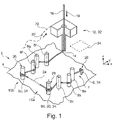
- FIG. 1 shows the production of a cell contacting system 2, of which the figure only shows a symbolic detail, which has a base body 4.
- FIG. A starting node 6 is stationary on the base body 4 and eight guide elements 8a-h, here pins or laying pins, are arranged temporarily or permanently.
- a guide head 12 is provided in the form of a laying head with a wire guide nozzle. This can be moved in all three spatial directions x, y and z.
- the guide head 12 or the wire guide nozzle has a dispensing opening 14 for dispensing an electrical conductor 16 in the direction of the arrow 18 .
- the guide head 12 is guided mechanically in the direction of the arrow 22 by a robot arm (not shown) along a path 20 specified by the program and only indicated here. As a result, it moves relative to the base body 4.
- the conductor 16 is discharged from the guide head 12 in the direction of the arrow 18 and laid on the base body 4 in order to form the low-voltage paths 10a, b.
- the conductor 16 here a wire
- the conductor 16 is fixed at the starting point 26 of the first low-voltage path 10a by an auxiliary device, the guide head 12 or laying head or - as here - by a geometry suitable for the connection, here the starting node 6 in the form of a welding fork .
- the conductor 16 is then guided through the tool suitable for this purpose, in this case the guide head 12 or the wire guide nozzle.
- the path 20 can be freely determined in all degrees of freedom.
- the movement of the guide head 12 and the payout of the conductor 16 from the guide head 12 and the payout opening 14, respectively, is performed automatically by a programmable control program.
- the wire tension is kept at an approximately constant value by a wire tension brake (not shown) upstream of the guide head 12 in the opposite direction of the arrow 18 .
- the train is held in relation to the ladder section 7 already fixed at the start node 6 .
- the starting knot 6 is therefore a winding fork here.
- the guide elements 8a-c serve to guide or fix the low-voltage path 10a along a desired course.
- the conductor 16 is in turn fixed by a suitable connection, here a fixing wrapping around the guide element 8d.
- the latter thus forms an end node 30 for the low-voltage path 10a.
- the guide element 8d (like the guide element 8e, see below) can therefore also be a guide and/or contact element.
- the conductor 16 is thus continued without interruption to the guide element 8e, without the wire tension lose, and there - fixed - again by fixing wrapping on the guide element 8e.
- the latter forms the starting point 26 of the second low-voltage path 10b.
- the endless wire in the form of the conductor 16 is separated at the appropriate points, i.e. between the two low-voltage paths 10a,b, and the wire remnants , i.e. the intermediate piece 24 of the conductor 16 that is no longer required and is shown in dashed lines is then removed.
- the conductor 16 is welded by an alternative contacting head 32, namely a welding head, to a counterpart 34, namely a contact plate, and is thereby electrically contacted.
Landscapes
- Engineering & Computer Science (AREA)
- Manufacturing & Machinery (AREA)
- Chemical & Material Sciences (AREA)
- Chemical Kinetics & Catalysis (AREA)
- Electrochemistry (AREA)
- General Chemical & Material Sciences (AREA)
- Electrical Discharge Machining, Electrochemical Machining, And Combined Machining (AREA)
- Connection Or Junction Boxes (AREA)
- Processing Of Terminals (AREA)
Description
- Die Erfindung betrifft ein Verfahren zum Herstellen mindestens eines Niedervoltpfades eines Zellkontaktiersystems.
- Ein Zellkontaktiersystem ist z.B. aus "https://www.elringklinger.de/ de/ produktetechnologien/ elektromobilitaet/ batterietechnologie-und-elektromobilitaet" (Abruf am 24.01.2019) bekannt. Das Zellkontaktiersystem besteht aus einem Trägerrahmen zur Aufnahme von Busbars und Elektronikkomponenten. Die Busbars verfügen über ein Kompensationselement zur Reduzierung der Krafteinwirkung auf die Zellterminals. Spannungsabgriffe dienen zur Überwachung der Zellen und ermöglichen aktives/passives Zellbalancing. Die dazugehörige Temperaturüberwachung kann im Zellkontaktiersystem integriert oder außerhalb vorgesehen sein.
- In solchen Zellkontaktiersystem sind elektrische Leitungen in Form von "Niedervoltpfaden" integriert. Hierbei handelt es sich nicht um die leistungsführenden Busbars, sondern um Niedervolt-/Niederspannungs-/Niederleistungs-Leitungen zur Verschaltung der Elektronikkomponenten usw.
- In aktuellen Produkten von Zellkontaktiersystemen sind als Niedervoltpfade bzw. elektrische Leitungen Kabelbäume, Flexleiter und PCBs gebräuchlich. Montage und Handhabung der entsprechenden Leitungen können dabei aufwendig bzw. schwierig sein. Dies gilt insbesondere für Kabelbäume, da diese biegeschlaffe Bauteile darstellen, welche in der Handhabungstechnik schwierig verarbeitet werden können.
- Aus dem Stand der Technik sind verschiedene Verfahren zur Drahtformung/Verdrahtung für unterschiedliche Anwendungszwecke bekannt: In der
WO 2017/137577 A1 wird ein Fertigungsverfahren für einen Stent offenbart, bei dem ein Draht helixförmig auf einen Wickelkern aufgewickelt wird. Hierzu wird der Draht über am Wickelkern befindliche Umlenkeinrichtungen schlingenförmig umgelenkt. DieUS 2016/29414 A1 beschreibt ein Verfahren, bei welchem über einen Werkzeugkopf Draht Crimpanschlüssen einer in einer über einen Index-Drehtisch ausrichtbaren Aufnahmevorrichtung gehalterten, zu verdrahtenden Komponente zugeführt wird. - Aufgabe der Erfindung ist es, die Herstellung von Niedervoltpfaden in Zellkontaktiersystemen zu verbessern.
- Die Aufgabe wird gelöst durch ein Verfahren gemäß Patentanspruch 1 zum Herstellen mindestens eines Niedervoltpfades eines Zellkontaktiersystems, wobei das Zellkontaktiersystem einen Grundkörper enthält. Bevorzugte oder vorteilhafte Ausführungsformen der Erfindung sowie anderer Erfindungskategorien ergeben sich aus den weiteren Ansprüchen, der nachfolgenden Beschreibung sowie den beigefügten Figuren.
- Bei dem Verfahren wird ein Führungskopf mit einer Ausgabeöffnung bereitgestellt. Der Führungskopf bzw. die Ausgabeöffnung dient zur Ausgabe eines elektrischen Leiters, insbesondere mehrerer elektrischer Leiter. Im Folgenden wird jedoch der Einfachheit halber die Erfindung anhand der Ausgabe eines einzigen Leiters erläutert. Der bereitgestellte Führungskopf wird dann maschinell in einer vorgebbaren Bahn relativ zum Grundkörper geführt bzw. bewegt. Dabei kann tatsächlich der Führungskopf und/oder der Grundkörper bewegt werden, um die Relativbewegung zwischen beiden zu bewirken. Dabei wird der Leiter aus dem Führungskopf ausgegeben und dabei zumindest abschnittsweise, insbesondere vollständig, auf dem Grundkörper verlegt bzw. abgelegt. Durch das Verlegen des Leiters auf dem Grundkörper wird der Niedervoltpfad gebildet. "Verlegen" bedeutet hierbei insbesondere Ablegen, zumindest aber ein Fixieren relativ zum Grundkörper, wobei nicht alle Abschnitte des Leiters den Grundkörper berühren müssen.
- Der "Niedervoltpfad" ist hierbei im oben erläuterten Sinne in Abgrenzung zu leistungsführenden Leitern zu verstehen und dient der Diagnose, Steuerung, Temperatur-, Spannungs-, Stromerfassung usw. an einer Batteriezelle bzw. einem - modul, an der bzw. dem das Zellkontaktiersystemen angeschlossen bzw. montiert werden soll bzw. ist. Der "Niedervoltpfad" kann hierbei auch ein Abschnitt bzw. Teilstück eines eigentlichen größeren Niedervoltpfades bzw. Gesamtpfades sein, der stückweise aus erfindungsgemäß hergestellten Niedervoltpfaden zusammengesetzt wird. Der Grundkörper ist insbesondere ein Träger für die Niedervoltpfade, Busbars, Elektronik usw. und ist insbesondere ein- oder mehrstückig ausgeführt. Der Führungskopf ist, um dessen maschinelle Führung bzw. Bewegung zu bewerkstelligen, insbesondere an einer Bewegungsvorrichtung, z.B. einem Roboterarm, einer x,y,z-/Dreh-Führung o.ä., angeordnet.
- Gemäß der Erfindung ergibt sich somit ein Verlegen von elektrisch leitenden Verbindungen (Niedervoltpfad, Leiter) für die Signalleitung und -verarbeitung in Zellkontaktiersystemen. Die Erfindung beschreibt ein Verfahren zum Einbringen mindestens eines elektrischen Leiters oder Leitungssystems, in allen drei translatorischen sowie rotatorische Achsen, innerhalb eines Kontaktierungssystems für Batterien und Batteriesysteme. Hierbei wird ein Draht oder eine Leitung (Leiter) durch eine Vorrichtung (Führungskopf, insbesondere zzgl. Roboterarm o.ä.) geführt. Zweck ist die elektrische Verschaltung bzw. Bildung der Signalpfade (durch die Niedervoltpfade) innerhalb eines Zellkontaktiersystems für Batterien.
- Gemäß der Erfindung ergibt sich eine flexible und programmtechnisch definierte Verdrahtung und Leitungsverlegung, es ist keine biegeschlaffe Kabel- oder Leiterkartenführung im Handlingsprozess vorhanden, es erfolgt eine werkzeugunabhängige Leitungsbaumgestaltung und Leitungsverlegung, gleiche Anlagen und Automatisierungslösungen erlauben die Herstellung unterschiedlicher Leitungsführungen, Leiterquerschnitte und Leiteranzahlen, eine Kombination von Verlege- (Führungskopf) und Kontaktierköpfen (siehe unten) in einem Fertigungsvorgang ist möglich, eine Kabelmantelisolierung ist im System nicht notwendig, eine Verwendung von Lackdraht bzw. isolierten Leitern ist möglich.
- Gemäß der Erfindung ergibt sich eine Alternative zu den gängigen Lösungen für die elektrische Verschaltung von Niedervoltpfaden (zum Beispiel Kabelbaum, Leiterplatte (PCB), Flexleiter, Stanzgitter, usw.). Es ergibt sich eine Vereinfachung der Montage von Niedervoltpfaden, ein hoher Grad an Automatisierbarkeit und Flexibilität (Varianten) wird realisiert.
- In einer bevorzugten Ausführungsform wird die Bewegung des Führungskopfes und/oder die Ausgabe des Leiters aus dem Führungskopf automatisch anhand eines programmierbaren Steuerprogramms durchgeführt. Somit ergibt sich eine Automatisierbarkeit und Flexibilität des Verfahrens.
- In einer bevorzugten Ausführungsform wird der Leiter während der Ausgabe aus dem Führungskopf in Bezug auf einen bereits fixierten Leiterabschnitt auf Zug gehalten. Der fixierte Leiterabschnitt ist ein solcher, welcher bereits aus dem Führungskopf ausgegeben wurde und insbesondere auf oder an dem Grundkörper verlegt bzw. befestigt wurde, bzw. eine Verlängerung des Leiters im Führungskopf außerhalb dessen darstellt. Der Leiterabschnitt kann auch außerhalb des Grundkörpers relativ zu diesem fixiert werden, z.B. an einem Fixierteil einer Verlegemaschine usw. Die Fixierung erfolgt zum Beispiel durch einen Startknoten oder ein Führungs-/Fixierungselement, wie sie unten beschrieben werden. Insbesondere wird der Zug während der Ausgabe - insbesondere zwischen dem Startknoten und einem Endknoten (siehe unten) - konstant gehalten. Der Zug wird insbesondere über eine Drahtzugbremse erzeugt. Eine gezielte Führung des Leiters ist somit erreichbar, insbesondere ein Durchhängen, Verschlingen usw. des Leiters vermieden.
- In einer bevorzugten Ausführungsform wird der Leiter vor dem bzw. beim Beginn des Verlegens auf dem Grundkörper an einem Startknoten relativ zum Grundkörper fixiert und/oder nach dem bzw. am Ende des Verlegens auf dem Grundkörper an einem Endknoten relativ zum Grundkörper fixiert. So kann insbesondere und besonders einfach ab Beginn und nach Beendigung der Verlegung Zug am Leiter aufrechterhalten werden.
- In einer bevorzugten Ausführungsform wird der Leiter während des Verlegens auf dem Grundkörper an mindestens einem Führungselement angeordnet. Die Führungselemente dienen insbesondere der Ortsfixierung und/oder Richtungs-Umlenkung des Leiters während des und nach dem Verlegen. Die Führungselemente befinden sich insbesondere entlang des Leiters zwischen Startknoten und Endknoten. Bei bestimmten, z.B. "kurzen", Leitungen ist insbesondere kein Führungselement erforderlich.
- In einer bevorzugten Variante dieser Ausführungsformen wird - jeweils falls vorhanden - als Startknoten und/oder Endknoten und/oder Führungselement ein Klemmmittel und/oder ein Haltemittel und/oder ein Stift und/oder eine Barriere und/oder ein Kanal und/oder ein Labyrinth verwendet. Derartige Bauteile eignen sich besonders gut für die entsprechenden Aufgaben.
- In einer bevorzugten Variante dieser Ausführungsformen werden - falls vorhanden - als Startknoten und/oder Endknoten und/oder Führungselement solche verwendet, die am Grundkörper angebracht sind. Derartige Bauteile sind insbesondere ein Bestandteil (insbesondere integral, einstückig) des Grundkörpers oder an diesem lösbar oder unlösbar fixiert. Start- und/oder Endknoten müssen aber nicht zwingend am Grundkörper angebracht sein. Es ist insbesondere auch denkbar, dass Start- und/oder Endknoten auf einem zusätzlichen Bauteil (z.B. PCB, Printed Circuit Board) angebracht sind, welchen wiederum mit dem Grundkörper verbindbar ist.
- In einer bevorzugten Ausführungsform wird als elektrischer Leiter ein Draht oder eine Leitung verwendet. Derartige Elemente eignen sich besonders gut für das Verfahren.
- In einer bevorzugten Ausführungsform werden mindestens zwei Niedervoltpfade hergestellt, indem ein gemeinsamer Leiter unterbrechungsfrei auf dem Grundkörper verlegt wird und anschließend in die beiden Niedervoltpfade aufgetrennt wird. Insbesondere wird der Leiter vor dem Auftrennen beidseits der Trennstelle relativ zum Grundkörper fixiert, z.B. an den oben genannten Führungselementen in Form von Fixierungselementen. Die Auftrennung kann durch einen entsprechenden Trennkopf insbesondere automatisiert erfolgen. Gegebenenfalls werden nicht benötigte, abgetrennte Reste von Leitungen entfernt. Auch die Auftrennung erfolgt insbesondere maschinell, insbesondere an bzw. mit Hilfe der gleichen Bewegungsvorrichtung (Tausch des Führungskopfes) oder an einer zusätzlichen Bewegungsvorrichtung. So ergibt sich eine ggf. günstigere Alternative zur jeweiligen separaten Erstellung zweier Niedervoltpfade.
- In einer bevorzugten Ausführungsform enthält der Führungskopf eine - insbesondere handelsübliche - Drahtführungs-Düse bzw. wird eine solche als Führungskopf verwendet. Diese ist insbesondere rohrähnlich und/oder wird im Sprachgebrauch auch als "Drahtführer", "Wickeldüse" usw. bezeichnet.
- In einer bevorzugten Ausführungsform wird ein maschinell bewegter Kontaktierkopf zu einem verlegten Leiter bewegt und der Kontaktierkopf kontaktiert den Leiter mit einem Gegenstück. Auch dies erfolgt insbesondere maschinell, insbesondere (siehe oben zum Trennkopf) an der gleichen (Tausch des Führungs-/Trennkopfes) oder einer zusätzlichen Bewegungsvorrichtung. Somit ist insbesondere die voll automatisierte Herstellung einschließlich Kontaktierung eines Zellkontaktiersystems hinsichtlich Niedervoltpfaden möglich.
- Die Erfindung beruht auf folgenden Erkenntnissen, Beobachtungen bzw. Überlegungen und weist noch die nachfolgenden Ausführungsformen auf. Die Ausführungsformen werden dabei teils vereinfachend auch "die Erfindung" genannt. Die Ausführungsformen können hierbei auch Teile oder Kombinationen der oben genannten Ausführungsformen enthalten oder diesen entsprechen und/oder gegebenenfalls auch bisher nicht erwähnte Ausführungsformen einschließen.
- Durch die Gestaltung und Adaption einer Drahtverlegung auf eine flache Ausführung innerhalb von Kontaktierelementen (Startknoten, Endknoten, Führungselement) werden die Signalleitungen (Leiter) automatisiert Point-to-Point (jeweils getrennte Niedervoltpfade) oder durchgehend (ein Leiter durchgehend, danach Auftrennung in verschiedene Niedervoltpfade) verlegt. Dies geschieht idealerweise durch eine rohrähnliche Drahtführerdüse und ein x, y, z, phi- Achssystem.
- Gemäß der Erfindung erfolgt eine Verlegung von Leitern in allen Freiheitsgraden ohne formgebende Werkzeuge, universelle Strukturelemente in Form von mechanischen Elementen (Startknoten, Endknoten, Führungselement: stationär oder temporär fixierte Stifte, Barrieren, Kanäle, Labyrinthe...) erlauben eine ausschließlich programmtechnische Verlegung, es ergibt sich die Möglichkeit der Kombination von Verlege-und Kontaktierverfahren in einer Einheit, es ergibt sich die nur durch den Leiter selbst beschränkte geometrischen Leitungsverlegung innerhalb der vorgegebenen Bauräume, es ergibt sich die Kombinationsmöglichkeit innerhalb des Verlegeverfahrens in sechs Achsen, es sind keine mechanischen Abisoliervorgänge im Prozess notwendig, jedoch auch möglich.
- Weitere Merkmale, Wirkungen und Vorteile der Erfindung ergeben sich aus der nachfolgenden Beschreibung eines bevorzugten Ausführungsbeispiels der Erfindung sowie der beigefügten Figuren. Dabei zeigen, jeweils in einer schematischen Prinzipskizze:
- Figur 1
- das Verlegen eines Leiters auf einem Grundkörper eines Zellkontaktiersystems.
-
Figur 1 zeigt die Fertigung eines Zellkontaktiersystems 2, von dem in der Figur lediglich symbolisch ein Ausschnitt dargestellt ist, das einen Grundkörper 4 aufweist. Auf dem Grundkörper 4 sind ein Startknoten 6 stationär sowie acht Führungselemente 8a-h, hier Stifte bzw. Verlegestifte, temporär bzw. fest angeordnet. - Auf dem Grundkörper 4 sollen zwei Niedervoltpfade 10a,b des Zellkontaktiersystems 2 erzeugt werden. Hierzu wird ein Führungskopf 12 in Form eines Verlegekopfes mit Drahtführungsdüse bereitgestellt. Dieser ist in allen drei Raumrichtungen x, y und z bewegbar. Der Führungskopf 12 bzw. die Drahtführungsdüse weist eine Ausgabeöffnung 14 zur Ausgabe eines elektrischen Leiters 16 in Richtung des Pfeils 18 auf.
- Zur Erstellung der Niedervoltpfade 10a,b wird der Führungskopf 12 entlang einer hier nur angedeuteten programmtechnisch vorgegebenen Bahn 20 durch einen nicht dargestellten Roboterarm in Richtung des Pfeils 22 maschinell geführt. Hierdurch bewegt sich dieser relativ zum Grundkörper 4. Dabei wird der Leiter 16 in Richtung des Pfeils 18 aus dem Führungskopf 12 ausgegeben und auf dem Grundkörper 4 verlegt, um die Niedervoltpfade 10a,b zu bilden.
- Im Beispiel wird der gesamte Leiter 16 einschließlich eines gestrichelt dargestellten Zwischenstückes 24 verlegt.
- Insgesamt wird also der Leiter 16, hier ein Draht, durch eine Hilfsvorrichtung, den Führungskopf 12 bzw. Verlegekopf oder - wie hier - durch eine zur Anbindung geeignete Geometrie, hier den Startknoten 6 in Form einer Schweißgabel, am Anfangspunkt 26 des erstes Niedervoltpfades 10a fixiert. Anschließend wird der Leiter 16 durch das hierfür geeignete Werkzeug, hier den Führungskopf 12 bzw. die Drahtführungs-Düse, geführt. Die Bahn 20 kann dabei in allen Freiheitsgraden frei bestimmt werden. Die Bewegung des Führungskopfes 12 und die Ausgabe des Leiters 16 aus dem Führungskopf 12 bzw. der Ausgabeöffnung 14 wird automatisch anhand eines programmierbaren Steuerprogramms durchgeführt. Während des Verlegens wird der Drahtzug durch eine nicht dargestellte, entgegen der Richtung des Pfeils 18 dem Führungskopf 12 vorgeschaltete Drahtzugbremse auf einen annähernd konstanten Wert gehalten. Der Zug wird dabei in Bezug auf den bereits am Startknoten 6 fixierten Leiterabschnitt 7 gehalten. Der Startknoten 6 ist hier also eine Anwickelgabel.
- Die Führungselemente 8a-c dienen der Führung bzw. Fixierung des Niedervoltpfades 10a entlang eines gewünschten Verlaufes. Am Ende 28 des Niedervoltpfades 10a wird der Leiter 16 wiederum durch eine geeignete Anbindung, hier eine fixierende Umwickelung um das Führungselement 8d, fixiert. Letzteres bildet somit einen Endknoten 30 für den Niedervoltpfad 10a. Bei einem "point-to-point"-Vorgang würde der Leiter 16 an dieser Stelle gekappt und der erste Niedervoltpfad 10a wäre geschaffen. Das Führungselement 8d (wie das Führungselement 8e, siehe unten) kann in einer alternativen Ausführungsform daher auch ein Führungs- und/oder Kontaktierelement sein.
- Im vorliegenden Beispiel findet jedoch eine Endlosverlegung statt, der Leiter 16 wird somit unterbrechungsfrei zum Führungselement 8e weitergeführt, ohne den Drahtzug zu verlieren, und dort - wiederum durch fixierende Umwickelung am Führungselement 8e - fixiert. Letzteres bildet den Anfangspunkt 26 des zweiten Niedervoltpfades 10b. Nun wird der Niedervoltpfad 10b entlang der Führungselemente 8f-h usw.; in
Figur 1 ist die Erstellung des Niedervoltpfades 10b noch nicht abgeschlossen, weitere Führungselemente sowie ein weiterer Endknoten sind nicht dargestellt. - Um bei der im Beispiel gezeigten Endlosverlegung die elektrische Verschaltung zu gewährleisten, d.h. die beiden Niedervoltpfade 10a,b endgültig zu schaffen, wird der Endlosdraht in Form des Leiters 16 an den entsprechenden Stellen, d.h. zwischen den beiden Niedervoltpfaden 10a,b, aufgetrennt und die Drahtreste, d.h. das nicht mehr benötigte, gestrichelt dargestellte Zwischenstück 24 des Leiters 16 anschließend entfernt.
- Am Startknoten 6 und an den Führungselementen 8d,e findet außerdem eine elektrische Kontaktierung des Leiters 16 mit dem betreffenden Bauteil als Gegenstück 34 statt. Der Führungskopf 12 bildet somit gleichzeitig einen Kontaktierkopf 32.
- In
Figur 1 nicht dargestellt, wird am Ende des Niedervoltpfades 10b der Leiter 16 durch einen alternativen Kontaktierkopf 32, nämlich einen Schweißkopf, mit einem Gegenstück 34, nämlich einer Kontaktplatte, verschweißt und dadurch elektrisch kontaktiert. -
- 2
- Zellkontaktiersystem
- 4
- Grundkörper
- 6
- Startknoten
- 7
- Leiterabschnitt
- 8a-h
- Führungselement
- 10a,b
- Niedervoltpfad
- 12
- Führungskopf
- 14
- Ausgabeöffnung
- 16
- Leiter
- 18
- Pfeil
- 20
- Bahn
- 22
- Pfeil
- 24
- Zwischenstück
- 26
- Anfangspunkt
- 28
- Ende
- 30
- Endknoten
- 32
- Kontaktierkopf
- 34
- Gegenstück
- x,y,z
- Raumrichtung
Claims (11)
- Verfahren zum Herstellen mindestens eines Niedervoltpfades (10a,b) eines Zellkontaktiersystems (2), wobei das Zellkontaktiersystem (2) einen Grundkörper (4) enthält, bei dem:- ein Führungskopf (12) mit einer Ausgabeöffnung (14) zur Ausgabe eines elektrischen Leiters (16) bereitgestellt wird,- der Führungskopf (12) maschinell in einer vorgebbaren Bahn (20) relativ zum Grundkörper (4) geführt wird, und dabei der Leiter (16) aus dem Führungskopf (12) ausgegeben und auf dem Grundkörper (4) verlegt wird, um den Niedervoltpfad (10a,b) zu bilden.
- Verfahren nach Anspruch 1,
dadurch gekennzeichnet, dass
die Bewegung des Führungskopfes (12) und/oder die Ausgabe des Leiters (16) aus dem Führungskopf (12) automatisch anhand eines programmierbaren Steuerprogramms durchgeführt wird. - Verfahren nach einem der vorhergehenden Ansprüche,
dadurch gekennzeichnet, dass
der Leiter (16) während der Ausgabe aus dem Führungskopf (12) in Bezug auf einen bereits fixierten Leiterabschnitt (7) auf Zug gehalten wird. - Verfahren nach einem der vorhergehenden Ansprüche,
dadurch gekennzeichnet, dass
der Leiter (16) vor dem Verlegen auf dem Grundkörper (4) an einem Startknoten (6) relativ zum Grundkörper (4) fixiert wird und/oder nach dem Verlegen auf dem Grundkörper (4) an einem Endknoten (30) relativ zum Grundkörper (4) fixiert wird. - Verfahren nach einem der vorhergehenden Ansprüche,
dadurch gekennzeichnet, dass
der Leiter (16) während des Verlegens auf dem Grundkörper (4) an mindestens einem Führungselement (8a-h) angeordnet wird. - Verfahren nach einem der Ansprüche 4 bis 5,
dadurch gekennzeichnet, dass
als Startknoten (6) und/oder Endknoten (30) und/oder Führungselement (8a-h) ein Klemmmittel und/oder ein Haltemittel und/oder ein Stift und/oder eine Barriere und/oder ein Kanal und/oder ein Labyrinth verwendet wird. - Verfahren nach einem der Ansprüche 4 bis 6,
dadurch gekennzeichnet, dass
als Startknoten (6) und/oder Endknoten (30) und/oder Führungselement (8a-h) solche verwendet werden, die am Grundkörper (4) angebracht sind. - Verfahren nach einem der vorhergehenden Ansprüche,
dadurch gekennzeichnet, dass
als elektrischer Leiter (16) ein Draht oder eine Leitung verwendet wird. - Verfahren nach einem der vorhergehenden Ansprüche,
dadurch gekennzeichnet, dass
mindestens zwei Niedervoltpfade (10a,b) hergestellt werden, indem ein gemeinsamer Leiter (16) unterbrechungsfrei auf dem Grundkörper (4) verlegt wird und anschließend in die beiden Niedervoltpfade (10a,b) aufgetrennt wird. - Verfahren nach einem der vorhergehenden Ansprüche,
dadurch gekennzeichnet, dass
der Führungskopf (12) eine Drahtführungs-Düse enthält. - Verfahren nach einem der vorhergehenden Ansprüche,
dadurch gekennzeichnet, dass
ein maschinell bewegter Kontaktierkopf (32) zu einem verlegten Leiter (16) bewegt wird und der Kontaktierkopf (32) den Leiter (16) mit einem Gegenstück (34) elektrisch kontaktiert.
Applications Claiming Priority (2)
| Application Number | Priority Date | Filing Date | Title |
|---|---|---|---|
| DE102019000856.1A DE102019000856A1 (de) | 2019-02-06 | 2019-02-06 | Herstellen eines Niedervoltpfades eines Zellkontaktiersystems |
| PCT/EP2020/052561 WO2020161047A1 (de) | 2019-02-06 | 2020-02-03 | Herstellen eines niedervoltpfades eines zellkontaktiersystems |
Publications (2)
| Publication Number | Publication Date |
|---|---|
| EP3921885A1 EP3921885A1 (de) | 2021-12-15 |
| EP3921885B1 true EP3921885B1 (de) | 2022-11-23 |
Family
ID=69526218
Family Applications (1)
| Application Number | Title | Priority Date | Filing Date |
|---|---|---|---|
| EP20704221.9A Active EP3921885B1 (de) | 2019-02-06 | 2020-02-03 | Herstellen eines niedervoltpfades eines zellkontaktiersystems |
Country Status (5)
| Country | Link |
|---|---|
| US (1) | US20210344084A1 (de) |
| EP (1) | EP3921885B1 (de) |
| CN (1) | CN113261154A (de) |
| DE (1) | DE102019000856A1 (de) |
| WO (1) | WO2020161047A1 (de) |
Families Citing this family (6)
| Publication number | Priority date | Publication date | Assignee | Title |
|---|---|---|---|---|
| DE102022207934A1 (de) | 2022-08-01 | 2024-02-01 | Leoni Bordnetz-Systeme Gmbh | Verfahren zur Herstellung eines elektrischen Leitungssatzes sowie elektri-scher Leitungssatz |
| DE102022122672A1 (de) | 2022-09-07 | 2024-03-07 | Bayerische Motoren Werke Aktiengesellschaft | Batteriemodul für ein Fahrzeug, Verfahren zur Herstellung des Batteriemoduls und ein Fahrzeug mit dem Batteriemodul |
| EP4418438A1 (de) | 2023-02-15 | 2024-08-21 | Röchling Automotive SE | Verfahren zur herstellung eines zellkontaktsystems |
| DE102023208529A1 (de) | 2023-09-05 | 2025-03-06 | Leoni Bordnetz-Systeme Gmbh | Verfahren zur Herstellung eines elektrischen Leitungssatzes sowie elektrischer Leitungssatz |
| DE102023126329B4 (de) | 2023-09-27 | 2025-04-17 | Diehl Advanced Mobility GmbH | Verfahren zum Herstellen eines Verdrahtungs-Bauteils sowie Verdrahtungs-Bauteil |
| DE102024002253A1 (de) | 2024-07-10 | 2026-01-15 | Mercedes-Benz Group AG | Niedervoltkontaktierung für eine Batterie, Montage der Niedervoltkontaktierung und Fahrzeug mit einer Hochvoltbatterie |
Family Cites Families (17)
| Publication number | Priority date | Publication date | Assignee | Title |
|---|---|---|---|---|
| US3769699A (en) * | 1969-06-30 | 1973-11-06 | Raytheon Co | Method of making a memory storage device |
| US3907007A (en) * | 1974-01-23 | 1975-09-23 | Western Electric Co | Apparatus and method for forming wires on a wire-receiving member |
| US3930524A (en) * | 1974-10-17 | 1976-01-06 | Tarbox John W | Harness making apparatus |
| JP3205188B2 (ja) * | 1994-09-12 | 2001-09-04 | タイコエレクトロニクスアンプ株式会社 | 多心ケーブル結線装置 |
| JP2001160389A (ja) * | 1999-12-01 | 2001-06-12 | Toshiba Battery Co Ltd | リード折り曲げ装置 |
| CN101149659B (zh) * | 2006-09-20 | 2010-09-15 | 凌阳科技股份有限公司 | 触控输入装置、触摸定位装置及其方法 |
| JP5233599B2 (ja) * | 2008-11-06 | 2013-07-10 | 住友電装株式会社 | 電線布線用ヘッド装置及び電線布線装置 |
| JP5353539B2 (ja) * | 2009-08-05 | 2013-11-27 | 住友電装株式会社 | 電線布線用ヘッド装置及び電線布線装置 |
| WO2011021614A1 (ja) * | 2009-08-18 | 2011-02-24 | 矢崎総業株式会社 | 電源装置及び電池接続体 |
| JP5789984B2 (ja) * | 2011-01-12 | 2015-10-07 | 住友電装株式会社 | 布線装置 |
| JP5646046B2 (ja) * | 2011-04-04 | 2014-12-24 | 日立オートモティブシステムズ株式会社 | 蓄電モジュール |
| JP5454626B2 (ja) * | 2012-06-26 | 2014-03-26 | 株式会社オートネットワーク技術研究所 | 配線モジュール |
| JP6177352B2 (ja) * | 2013-12-25 | 2017-08-09 | 矢崎総業株式会社 | 電池配線モジュール |
| KR102519325B1 (ko) * | 2015-04-02 | 2023-04-10 | 허친슨 테크놀로지 인코포레이티드 | 카메라 렌즈 서스펜션용 와이어 이송 및 부착 시스템 |
| DE102016102503A1 (de) * | 2016-02-12 | 2017-08-17 | Rheinisch-Westfälische Technische Hochschule Aachen (RWTH) | Verfahren zur Herstellung eines Stents und Stent |
| JP2018006309A (ja) * | 2016-06-28 | 2018-01-11 | 株式会社オートネットワーク技術研究所 | ワイヤーハーネスの製造方法及び電線端末加工装置 |
| DE102016219999A1 (de) * | 2016-10-13 | 2018-04-19 | Robert Bosch Gmbh | Kabelbaum |
-
2019
- 2019-02-06 DE DE102019000856.1A patent/DE102019000856A1/de not_active Withdrawn
-
2020
- 2020-02-03 CN CN202080008098.9A patent/CN113261154A/zh active Pending
- 2020-02-03 WO PCT/EP2020/052561 patent/WO2020161047A1/de not_active Ceased
- 2020-02-03 EP EP20704221.9A patent/EP3921885B1/de active Active
-
2021
- 2021-07-12 US US17/372,603 patent/US20210344084A1/en active Pending
Also Published As
| Publication number | Publication date |
|---|---|
| CN113261154A (zh) | 2021-08-13 |
| DE102019000856A1 (de) | 2020-08-06 |
| WO2020161047A1 (de) | 2020-08-13 |
| US20210344084A1 (en) | 2021-11-04 |
| EP3921885A1 (de) | 2021-12-15 |
Similar Documents
| Publication | Publication Date | Title |
|---|---|---|
| EP3921885B1 (de) | Herstellen eines niedervoltpfades eines zellkontaktiersystems | |
| DE69116008T2 (de) | Endstück für ein kleines Koaxialkabel | |
| DE68915183T2 (de) | Verfahren und Einrichtung für den Anschluss von flexiblen Drähten. | |
| DE112017000932B4 (de) | Kabelbaumstruktur | |
| EP3236544B1 (de) | Verfahren zur bündelung einzelner leitungen eines kabelbaums | |
| DE112011101263T5 (de) | Drahtverbindungsverfahren und Kabelbaum | |
| DE102018131199A1 (de) | Herstellungsverfahren für ein fahrzeugbordnetz eines fahrzeugs sowie fahrzeugbordnetz | |
| DE2361442A1 (de) | Elektrische kupplung und verfahren zur kontaktherstellung | |
| DE19625974C1 (de) | Verfahren zur Herstellung eines vorgefertigten Türmoduls für eine Kraftfahrzeugtür | |
| DE102009017052B3 (de) | Verbindungsvorrichtung für ein photovoltaisches Solarmodul, Verfahren zu deren Herstellung sowie Solaranlage mit einer solchen Verbindungsvorrichtung | |
| DE102019119468A1 (de) | Verfahren, Vorrichtung und System zur Konfektionierung eines elektrischen Kabels | |
| DE102012220940B4 (de) | Verfahren zur Herstellung eines Kabelbaums mit zumindest einer Stromsammelschiene für ein Fahrzeug | |
| DE10216026A1 (de) | Anschlußkasten und Kabelbaum-Verbindungsverfahren | |
| EP2711726B1 (de) | Vorrichtung zur Spannungsüberwachung | |
| EP1238443B1 (de) | Verfahren zum bestücken eines gegenstandes mit einem aus zumindest einem flachleiter gebildeten kabelbaum und an diesen angeschlossenen elektrischen/elektronischen geräten | |
| DE69602489T2 (de) | Mehrpoliger Gleichstrommotor | |
| DE3510370A1 (de) | Verfahren zum verbinden von zwei elektrischen leitungen | |
| EP0444032B1 (de) | Verfahren und vorrichtung zur herstellung von kabelbäumen | |
| DE4238867C2 (de) | Vorrichtung und Verfahren zum Anschließen von mehreren elektrischen Verbrauchern | |
| DE69107658T3 (de) | Verfahren und Gerät zur Einführung von Statorwicklungsadern in Drahtaufnahmekanäle aufweisende Verbinder. | |
| DE69204368T2 (de) | Hilfsvorrichtung für elektrische Verkabelung und dazugehörige elektrische Installation. | |
| DE102017125687B3 (de) | Dezentraler kleinverteiler, leitungssystem und herstellverfahren | |
| DE102021100774A1 (de) | Elektrische Verbindungseinrichtung und Verfahren zu deren Herstellung | |
| DE202021000135U1 (de) | System zur automatisierten Herstellung von Kabeln und Kabelbäumen | |
| DE102023126329B4 (de) | Verfahren zum Herstellen eines Verdrahtungs-Bauteils sowie Verdrahtungs-Bauteil |
Legal Events
| Date | Code | Title | Description |
|---|---|---|---|
| STAA | Information on the status of an ep patent application or granted ep patent |
Free format text: STATUS: UNKNOWN |
|
| STAA | Information on the status of an ep patent application or granted ep patent |
Free format text: STATUS: THE INTERNATIONAL PUBLICATION HAS BEEN MADE |
|
| PUAI | Public reference made under article 153(3) epc to a published international application that has entered the european phase |
Free format text: ORIGINAL CODE: 0009012 |
|
| STAA | Information on the status of an ep patent application or granted ep patent |
Free format text: STATUS: REQUEST FOR EXAMINATION WAS MADE |
|
| 17P | Request for examination filed |
Effective date: 20210726 |
|
| AK | Designated contracting states |
Kind code of ref document: A1 Designated state(s): AL AT BE BG CH CY CZ DE DK EE ES FI FR GB GR HR HU IE IS IT LI LT LU LV MC MK MT NL NO PL PT RO RS SE SI SK SM TR |
|
| DAV | Request for validation of the european patent (deleted) | ||
| DAX | Request for extension of the european patent (deleted) | ||
| REG | Reference to a national code |
Ref country code: DE Ref legal event code: R079 Ref document number: 502020002062 Country of ref document: DE Free format text: PREVIOUS MAIN CLASS: H01M0002200000 Ipc: H01M0010480000 |
|
| GRAP | Despatch of communication of intention to grant a patent |
Free format text: ORIGINAL CODE: EPIDOSNIGR1 |
|
| STAA | Information on the status of an ep patent application or granted ep patent |
Free format text: STATUS: GRANT OF PATENT IS INTENDED |
|
| INTG | Intention to grant announced |
Effective date: 20220822 |
|
| RIC1 | Information provided on ipc code assigned before grant |
Ipc: H01M 50/50 20210101ALI20220805BHEP Ipc: H01B 13/012 20060101ALI20220805BHEP Ipc: B21F 45/00 20060101ALI20220805BHEP Ipc: B21F 23/00 20060101ALI20220805BHEP Ipc: H01M 10/48 20060101AFI20220805BHEP |
|
| GRAS | Grant fee paid |
Free format text: ORIGINAL CODE: EPIDOSNIGR3 |
|
| GRAA | (expected) grant |
Free format text: ORIGINAL CODE: 0009210 |
|
| STAA | Information on the status of an ep patent application or granted ep patent |
Free format text: STATUS: THE PATENT HAS BEEN GRANTED |
|
| AK | Designated contracting states |
Kind code of ref document: B1 Designated state(s): AL AT BE BG CH CY CZ DE DK EE ES FI FR GB GR HR HU IE IS IT LI LT LU LV MC MK MT NL NO PL PT RO RS SE SI SK SM TR |
|
| REG | Reference to a national code |
Ref country code: GB Ref legal event code: FG4D Free format text: NOT ENGLISH |
|
| REG | Reference to a national code |
Ref country code: CH Ref legal event code: EP |
|
| REG | Reference to a national code |
Ref country code: AT Ref legal event code: REF Ref document number: 1533705 Country of ref document: AT Kind code of ref document: T Effective date: 20221215 Ref country code: DE Ref legal event code: R096 Ref document number: 502020002062 Country of ref document: DE |
|
| REG | Reference to a national code |
Ref country code: IE Ref legal event code: FG4D Free format text: LANGUAGE OF EP DOCUMENT: GERMAN |
|
| REG | Reference to a national code |
Ref country code: LT Ref legal event code: MG9D |
|
| REG | Reference to a national code |
Ref country code: NL Ref legal event code: MP Effective date: 20221123 |
|
| PG25 | Lapsed in a contracting state [announced via postgrant information from national office to epo] |
Ref country code: SE Free format text: LAPSE BECAUSE OF FAILURE TO SUBMIT A TRANSLATION OF THE DESCRIPTION OR TO PAY THE FEE WITHIN THE PRESCRIBED TIME-LIMIT Effective date: 20221123 Ref country code: PT Free format text: LAPSE BECAUSE OF FAILURE TO SUBMIT A TRANSLATION OF THE DESCRIPTION OR TO PAY THE FEE WITHIN THE PRESCRIBED TIME-LIMIT Effective date: 20230323 Ref country code: NO Free format text: LAPSE BECAUSE OF FAILURE TO SUBMIT A TRANSLATION OF THE DESCRIPTION OR TO PAY THE FEE WITHIN THE PRESCRIBED TIME-LIMIT Effective date: 20230223 Ref country code: LT Free format text: LAPSE BECAUSE OF FAILURE TO SUBMIT A TRANSLATION OF THE DESCRIPTION OR TO PAY THE FEE WITHIN THE PRESCRIBED TIME-LIMIT Effective date: 20221123 Ref country code: FI Free format text: LAPSE BECAUSE OF FAILURE TO SUBMIT A TRANSLATION OF THE DESCRIPTION OR TO PAY THE FEE WITHIN THE PRESCRIBED TIME-LIMIT Effective date: 20221123 Ref country code: ES Free format text: LAPSE BECAUSE OF FAILURE TO SUBMIT A TRANSLATION OF THE DESCRIPTION OR TO PAY THE FEE WITHIN THE PRESCRIBED TIME-LIMIT Effective date: 20221123 |
|
| PG25 | Lapsed in a contracting state [announced via postgrant information from national office to epo] |
Ref country code: RS Free format text: LAPSE BECAUSE OF FAILURE TO SUBMIT A TRANSLATION OF THE DESCRIPTION OR TO PAY THE FEE WITHIN THE PRESCRIBED TIME-LIMIT Effective date: 20221123 Ref country code: PL Free format text: LAPSE BECAUSE OF FAILURE TO SUBMIT A TRANSLATION OF THE DESCRIPTION OR TO PAY THE FEE WITHIN THE PRESCRIBED TIME-LIMIT Effective date: 20221123 Ref country code: LV Free format text: LAPSE BECAUSE OF FAILURE TO SUBMIT A TRANSLATION OF THE DESCRIPTION OR TO PAY THE FEE WITHIN THE PRESCRIBED TIME-LIMIT Effective date: 20221123 Ref country code: IS Free format text: LAPSE BECAUSE OF FAILURE TO SUBMIT A TRANSLATION OF THE DESCRIPTION OR TO PAY THE FEE WITHIN THE PRESCRIBED TIME-LIMIT Effective date: 20230323 Ref country code: HR Free format text: LAPSE BECAUSE OF FAILURE TO SUBMIT A TRANSLATION OF THE DESCRIPTION OR TO PAY THE FEE WITHIN THE PRESCRIBED TIME-LIMIT Effective date: 20221123 Ref country code: GR Free format text: LAPSE BECAUSE OF FAILURE TO SUBMIT A TRANSLATION OF THE DESCRIPTION OR TO PAY THE FEE WITHIN THE PRESCRIBED TIME-LIMIT Effective date: 20230224 |
|
| PG25 | Lapsed in a contracting state [announced via postgrant information from national office to epo] |
Ref country code: NL Free format text: LAPSE BECAUSE OF FAILURE TO SUBMIT A TRANSLATION OF THE DESCRIPTION OR TO PAY THE FEE WITHIN THE PRESCRIBED TIME-LIMIT Effective date: 20221123 |
|
| P01 | Opt-out of the competence of the unified patent court (upc) registered |
Effective date: 20230526 |
|
| PG25 | Lapsed in a contracting state [announced via postgrant information from national office to epo] |
Ref country code: SM Free format text: LAPSE BECAUSE OF FAILURE TO SUBMIT A TRANSLATION OF THE DESCRIPTION OR TO PAY THE FEE WITHIN THE PRESCRIBED TIME-LIMIT Effective date: 20221123 Ref country code: RO Free format text: LAPSE BECAUSE OF FAILURE TO SUBMIT A TRANSLATION OF THE DESCRIPTION OR TO PAY THE FEE WITHIN THE PRESCRIBED TIME-LIMIT Effective date: 20221123 Ref country code: EE Free format text: LAPSE BECAUSE OF FAILURE TO SUBMIT A TRANSLATION OF THE DESCRIPTION OR TO PAY THE FEE WITHIN THE PRESCRIBED TIME-LIMIT Effective date: 20221123 Ref country code: DK Free format text: LAPSE BECAUSE OF FAILURE TO SUBMIT A TRANSLATION OF THE DESCRIPTION OR TO PAY THE FEE WITHIN THE PRESCRIBED TIME-LIMIT Effective date: 20221123 Ref country code: CZ Free format text: LAPSE BECAUSE OF FAILURE TO SUBMIT A TRANSLATION OF THE DESCRIPTION OR TO PAY THE FEE WITHIN THE PRESCRIBED TIME-LIMIT Effective date: 20221123 |
|
| REG | Reference to a national code |
Ref country code: DE Ref legal event code: R097 Ref document number: 502020002062 Country of ref document: DE |
|
| PG25 | Lapsed in a contracting state [announced via postgrant information from national office to epo] |
Ref country code: SK Free format text: LAPSE BECAUSE OF FAILURE TO SUBMIT A TRANSLATION OF THE DESCRIPTION OR TO PAY THE FEE WITHIN THE PRESCRIBED TIME-LIMIT Effective date: 20221123 Ref country code: AL Free format text: LAPSE BECAUSE OF FAILURE TO SUBMIT A TRANSLATION OF THE DESCRIPTION OR TO PAY THE FEE WITHIN THE PRESCRIBED TIME-LIMIT Effective date: 20221123 |
|
| PG25 | Lapsed in a contracting state [announced via postgrant information from national office to epo] |
Ref country code: MC Free format text: LAPSE BECAUSE OF FAILURE TO SUBMIT A TRANSLATION OF THE DESCRIPTION OR TO PAY THE FEE WITHIN THE PRESCRIBED TIME-LIMIT Effective date: 20221123 |
|
| PLBE | No opposition filed within time limit |
Free format text: ORIGINAL CODE: 0009261 |
|
| REG | Reference to a national code |
Ref country code: CH Ref legal event code: PL |
|
| STAA | Information on the status of an ep patent application or granted ep patent |
Free format text: STATUS: NO OPPOSITION FILED WITHIN TIME LIMIT |
|
| REG | Reference to a national code |
Ref country code: BE Ref legal event code: MM Effective date: 20230228 |
|
| PG25 | Lapsed in a contracting state [announced via postgrant information from national office to epo] |
Ref country code: LU Free format text: LAPSE BECAUSE OF NON-PAYMENT OF DUE FEES Effective date: 20230203 Ref country code: LI Free format text: LAPSE BECAUSE OF NON-PAYMENT OF DUE FEES Effective date: 20230228 Ref country code: CH Free format text: LAPSE BECAUSE OF NON-PAYMENT OF DUE FEES Effective date: 20230228 |
|
| 26N | No opposition filed |
Effective date: 20230824 |
|
| PG25 | Lapsed in a contracting state [announced via postgrant information from national office to epo] |
Ref country code: SI Free format text: LAPSE BECAUSE OF FAILURE TO SUBMIT A TRANSLATION OF THE DESCRIPTION OR TO PAY THE FEE WITHIN THE PRESCRIBED TIME-LIMIT Effective date: 20221123 |
|
| REG | Reference to a national code |
Ref country code: IE Ref legal event code: MM4A |
|
| REG | Reference to a national code |
Ref country code: GB Ref legal event code: 732E Free format text: REGISTERED BETWEEN 20231228 AND 20240103 |
|
| PG25 | Lapsed in a contracting state [announced via postgrant information from national office to epo] |
Ref country code: IE Free format text: LAPSE BECAUSE OF NON-PAYMENT OF DUE FEES Effective date: 20230203 |
|
| REG | Reference to a national code |
Ref country code: DE Ref legal event code: R081 Ref document number: 502020002062 Country of ref document: DE Owner name: DIEHL ADVANCED MOBILITY GMBH, DE Free format text: FORMER OWNER: DIEHL METAL APPLICATIONS GMBH, 90552 ROETHENBACH, DE |
|
| PG25 | Lapsed in a contracting state [announced via postgrant information from national office to epo] |
Ref country code: BE Free format text: LAPSE BECAUSE OF NON-PAYMENT OF DUE FEES Effective date: 20230228 |
|
| PG25 | Lapsed in a contracting state [announced via postgrant information from national office to epo] |
Ref country code: BG Free format text: LAPSE BECAUSE OF FAILURE TO SUBMIT A TRANSLATION OF THE DESCRIPTION OR TO PAY THE FEE WITHIN THE PRESCRIBED TIME-LIMIT Effective date: 20221123 |
|
| PG25 | Lapsed in a contracting state [announced via postgrant information from national office to epo] |
Ref country code: BG Free format text: LAPSE BECAUSE OF FAILURE TO SUBMIT A TRANSLATION OF THE DESCRIPTION OR TO PAY THE FEE WITHIN THE PRESCRIBED TIME-LIMIT Effective date: 20221123 |
|
| PGFP | Annual fee paid to national office [announced via postgrant information from national office to epo] |
Ref country code: AT Payment date: 20250417 Year of fee payment: 5 |
|
| PGFP | Annual fee paid to national office [announced via postgrant information from national office to epo] |
Ref country code: DE Payment date: 20250417 Year of fee payment: 6 |
|
| PG25 | Lapsed in a contracting state [announced via postgrant information from national office to epo] |
Ref country code: CY Free format text: LAPSE BECAUSE OF FAILURE TO SUBMIT A TRANSLATION OF THE DESCRIPTION OR TO PAY THE FEE WITHIN THE PRESCRIBED TIME-LIMIT; INVALID AB INITIO Effective date: 20200203 |
|
| PG25 | Lapsed in a contracting state [announced via postgrant information from national office to epo] |
Ref country code: HU Free format text: LAPSE BECAUSE OF FAILURE TO SUBMIT A TRANSLATION OF THE DESCRIPTION OR TO PAY THE FEE WITHIN THE PRESCRIBED TIME-LIMIT; INVALID AB INITIO Effective date: 20200203 |
|
| PG25 | Lapsed in a contracting state [announced via postgrant information from national office to epo] |
Ref country code: TR Free format text: LAPSE BECAUSE OF FAILURE TO SUBMIT A TRANSLATION OF THE DESCRIPTION OR TO PAY THE FEE WITHIN THE PRESCRIBED TIME-LIMIT Effective date: 20221123 |
|
| PGFP | Annual fee paid to national office [announced via postgrant information from national office to epo] |
Ref country code: GB Payment date: 20260220 Year of fee payment: 7 |
|
| PG25 | Lapsed in a contracting state [announced via postgrant information from national office to epo] |
Ref country code: AT Free format text: LAPSE BECAUSE OF NON-PAYMENT OF DUE FEES Effective date: 20250203 |
|
| PGFP | Annual fee paid to national office [announced via postgrant information from national office to epo] |
Ref country code: IT Payment date: 20260224 Year of fee payment: 7 |
|
| REG | Reference to a national code |
Ref country code: AT Ref legal event code: MM01 Ref document number: 1533705 Country of ref document: AT Kind code of ref document: T Effective date: 20250203 |
|
| PGFP | Annual fee paid to national office [announced via postgrant information from national office to epo] |
Ref country code: FR Payment date: 20260219 Year of fee payment: 7 |